Article

Occurrence Dynamics of Weeds, Yield Losses, and Herbicide Screening for Barnyardgrass (Echinochloa crus-galli) Control in Direct-Seeded Early Rice in Hunan Province, China


1
College of Plant Protection, Hunan Agricultural University, Changsha 410128, China
2
Institute of Plant Protection, Hunan Academy of Agricultural Sciences, Changsha 410125, China
3
Hunan Weed Science Key Laboratory, Hunan Academy of Agricultural Sciences, Changsha 410125, China
4
Frontier Technology Research Department, Yue Lushan Laboratory, Changsha 410128, China
*
Authors to whom correspondence should be addressed.
Agronomy 2026, 16(9), 867; https://doi.org/10.3390/agronomy16090867
Submission received: 2 April 2026 / Revised: 22 April 2026 / Accepted: 23 April 2026 / Published: 25 April 2026
(This article belongs to the Section Weed Science and Weed Management)

Abstract

This study has investigated the occurrence characteristics and population damage of weeds in double-cropping direct-seeded rice fields in Hunan, and has identified efficient and safe pre- and post-emergence herbicides to enhance resistance management. Field trials were conducted at two representative sites (Yiyang and Changsha) in Hunan in 2024~2025. Weed community composition and emergence patterns were systematically monitored. The inhibitory effects of weed infestations on rice growth and yield were quantified. The biological activity and field efficacy of various herbicide classes against barnyardgrass (Echinochloa crus-galli) were evaluated via greenhouse bioassays and field trials. Weed emergence lasted 3–48 days after sowing (DAS) with three distinct peaks. Grasses emerged earliest and dominated the community, with barnyardgrass peaking at 13–17 DAS (≈50% of total weeds), followed by broadleaves at 20 DAS (≈40%) and sedges at 25 DAS (<20%). Weed infestation drastically suppressed rice height (max 19% reduction) and tillering (max 50% reduction), with mixed-weed and grass-dominated plots causing the severest yield losses (92.0% and 90.5%, respectively), versus only 18.0% in broadleaf-dominated plots. Greenhouse bioassays showed that oxaziclomefone had the highest intrinsic activity against barnyardgrass (GR90 = 17.70 g ai ha−1). In pre-emergence applications in field trials, pretilachlor (900 g ai ha−1) and mefenacet (147.6 g ai ha−1) provided >96.8% control at 20 and 40 days after treatment (DAT), while oxaziclomefone (66 g ai ha−1) achieved 88.2% control at 20 DAT. For post-emergence herbicides, Profoxydim showed the highest intrinsic activity (GR90 = 33.01 g ai ha−1), followed by feproxydim (GR90 = 33.45 g ai ha−1) and flusulfinam (GR90 = 64.55 g ai ha−1). In field trials, flusulfinam provided 100% control with superior crop safety at 20 and 40 DAT, while Florpyrauxifen-benzyl, feproxydim, and metamifop reached >93% efficacy. In conclusion, weed emergence in Hunan direct-seeded rice follows a three-peak pattern, with barnyardgrass being the most destructive species. An integrated strategy combining pretilachlor (pre-emergence) and flusulfinam (post-emergence), rotated with florpyrauxifen-benzyl and feproxydim, is recommended for effective barnyardgrass management and resistance mitigation.

1. Introduction

Rice is a staple food for more than half of the world’s population and it is cultivated in over 100 countries. Asia dominates global production, contributing nearly 90% of the total output [1,2]. As a major rice-producing nation, China contributes approximately 28% of global output, with an annual production of 206 million tons on approximately 29 million hectares (NBSC) [3]. Hunan Province is the leading rice producer in the country, with 3.95 million hectares dedicated to rice cultivation and a consistent annual yield of approximately 26 million tons.
In recent years, the adoption of direct-seeded rice in double-cropping systems has expanded rapidly, driven by its advantages in labor and time efficiency, shorter field duration, and compatibility with mechanization. However, the inability to maintain a standing water layer from sowing to seedling emergence necessitates alternate wetting and drying (AWD) irrigation, which creates favorable conditions for weed germination and establishment. Under this regime, soil moisture is maintained and aeration of the plow layer is enhanced, thereby facilitating weed germination and early seedling growth. Compared to conventional transplanted rice, direct-seeded rice exhibits an earlier and more concentrated flush of weed emergence, along with a sharp proliferation of the initial weed seed bank, resulting in closely synchronized growth cycles between weeds and the crop. In contrast to transplanted rice, direct-seeded rice promotes an earlier, more concentrated weed flush, coupled with a marked proliferation of the weed seed bank—leading to closely synchronized growth cycles between the weeds and the crop, which exacerbates the difficulty of timely weed control [4]. Weeds represent a persistent biotic stress, competing with rice for light, nutrients, and space. Without timely herbicide application or effective control measures, significant yield losses—or even total crop failure—can occur [5].
In direct-seeded rice paddies, barnyardgrass and Chinese sprangletop [Leptochloa chinensis (L.) Nees] are the predominant grass weeds. Barnyardgrass—a typical C4 plant—exhibits strong competitiveness and has become a noxious weed in direct-seeded rice systems; its growth efficiency surpasses that of rice, a C3 crop [6,7]. Barnyardgrass competes intensely with rice for light, nutrients, and space. As its density increases, key yield components, including plant height, tiller number, effective panicles, spikelets per panicle, and 1000-grain weight, decline significantly, ultimately reducing grain yield [8,9,10]. At a density of 102.8 plants m−2, barnyardgrass can produce rice yield losses of up to 65.09%. In contrast, sedges and broadleaf weeds have a substantially smaller effect on rice productivity [11].
Chemical herbicides remain the primary tool for weed control in rice paddies, owing to their efficacy and cost-effectiveness [12,13]. However, their prolonged and repeated use has driven the rapid evolution of herbicide resistance in barnyardgrass. Since resistance to quinclorac was first documented in the 1990s [14], the resistance spectrum of this weed has continued to expand. Recent monitoring data indicate that barnyardgrass populations in rice paddies have developed resistance to quinclorac, penoxsulam and metamifop, with resistance indices reaching as high as 100.2, 252 and 14, respectively [15]. Due to the increasing adoption of direct-seeded rice and its continuous cropping, considerable shifts have occurred in the weed community structure of paddy fields, as both species richness and weed density have risen continuously, intensifying problems associated with weed infestation [16,17]. Consequently, barnyardgrass management faces severe challenges in some rice-growing regions, as effective control options become increasingly limited. In response, China has substantially increased investment in the research and development of domestically developed herbicides in recent years. Before 2011, the domestic herbicide market was long dominated by imported and generic products [18]. In recent years, the independent development of novel herbicides in China has entered a new phase. Among them, flusulfinam, created by Shandong Qingyuan Crop Science Co., Ltd., Qingdao. China is an HPPD inhibitor characterized by low toxicity, a broad weed control spectrum, and high crop safety to rice, although it is toxic to aquatic organisms. Tripyrasulfone, also developed by the same company, is another HPPD inhibitor with low toxicity, primarily targeting barnyardgrass, but some indica rice varieties are sensitive to it. Pyraquinate, developed by Shandong Cynda Chemical Co., Ltd., Weifang, China is also an HPPD inhibitor with low toxicity, mainly used for controlling Leptochloa chinensis, with only fair efficacy against barnyardgrass and is limited to one application per season. In addition, feproxydim, developed by the same company, is currently under registration; it is reported to be a cyclohexanedione ACCase inhibitor structurally similar to Profoxydim (BASF), showing high efficacy against barnyardgrass, but its safety to rice needs further verification. The integrated development and field application of these novel herbicides are key strategies to delay the evolution of weed resistance and extend the effective lifespan of new compounds, which is of great significance for achieving sustainable weed management in rice paddies.
Research remains limited on weed occurrence patterns and their community-specific responses in early season double-cropping rice fields, and the efficacy of novel herbicides for barnyardgrass control in direct-seeded rice paddies also requires further validation. To address this, a field survey was conducted in double-cropping early rice regions of Hunan Province to characterize weed community composition, emergence dynamics, and their effects on rice growth and yield. Concurrently, using barnyardgrass as the target species, laboratory bioassays and field efficacy trials were performed to determine whether these new herbicides (Table 1) are effective in controlling weeds in the agricultural system described. The main work was: (1) Field trials and bioassays were conducted at two representative sites (Yiyang and Changsha) in Hunan in 2024~2025. The composition of weed communities was monitored, the inhibitory effects of weed infestations on rice growth and yield were quantified, and the biological activity and field efficacy of various herbicide classes against barnyardgrass (Echinochloa crus-galli) were evaluated via greenhouse bioassays and field trials; (2) Our weed management treatments were established to quantitatively analyze the suppressive effects of weeds on rice growth and yield: a mixed-weed treatment (no weed control throughout the growing season, allowing natural weed infestation), a grass weed treatment (only grass weeds retained), a broadleaf weed treatment (only broadleaf weeds and sedges retained), and a weed-free treatment (no weeds throughout the growing season);. (3) Using barnyardgrass as the target species, the biological activity and field efficacy of various herbicide classes against barnyardgrass were evaluated via greenhouse bioassays and field trials, thereby providing a theoretical basis and practical guidance for the scientific management of barnyardgrass in direct-seeded rice systems.

2. Materials and Methods

2.1. Experimental Materials

2.1.1. Weeds and Rice

Barnyardgrass seeds were obtained from the laboratory stock and confirmed as a susceptible population via pot bioassays. The direct-seeded rice variety ‘Xiangzaoxian 24’ was produced by Hunan Golden NongFeng Seed Co., Ltd., Changsha, China

2.1.2. Tested Herbicides (Table 1)

Basic information of the pesticides is shown in Table 1.

2.1.3. Main Instruments

The 3WP-2000 walking-type spray tower, manufactured by the Nanjing Institute of Agricultural Mechanization, Ministry of Agriculture and Rural Affairs.

2.1.4. Data Processing

Experimental data were statistically analyzed using DPS and SPSS 25.0 software, and graphs were created using GraphPad Prism 8.0. The significance of differences was tested using Duncan’s new multiple range test.

2.2. Experimental Methods

2.2.1. Investigation of Weed Occurrence Patterns in Direct-Seeded Rice Fields

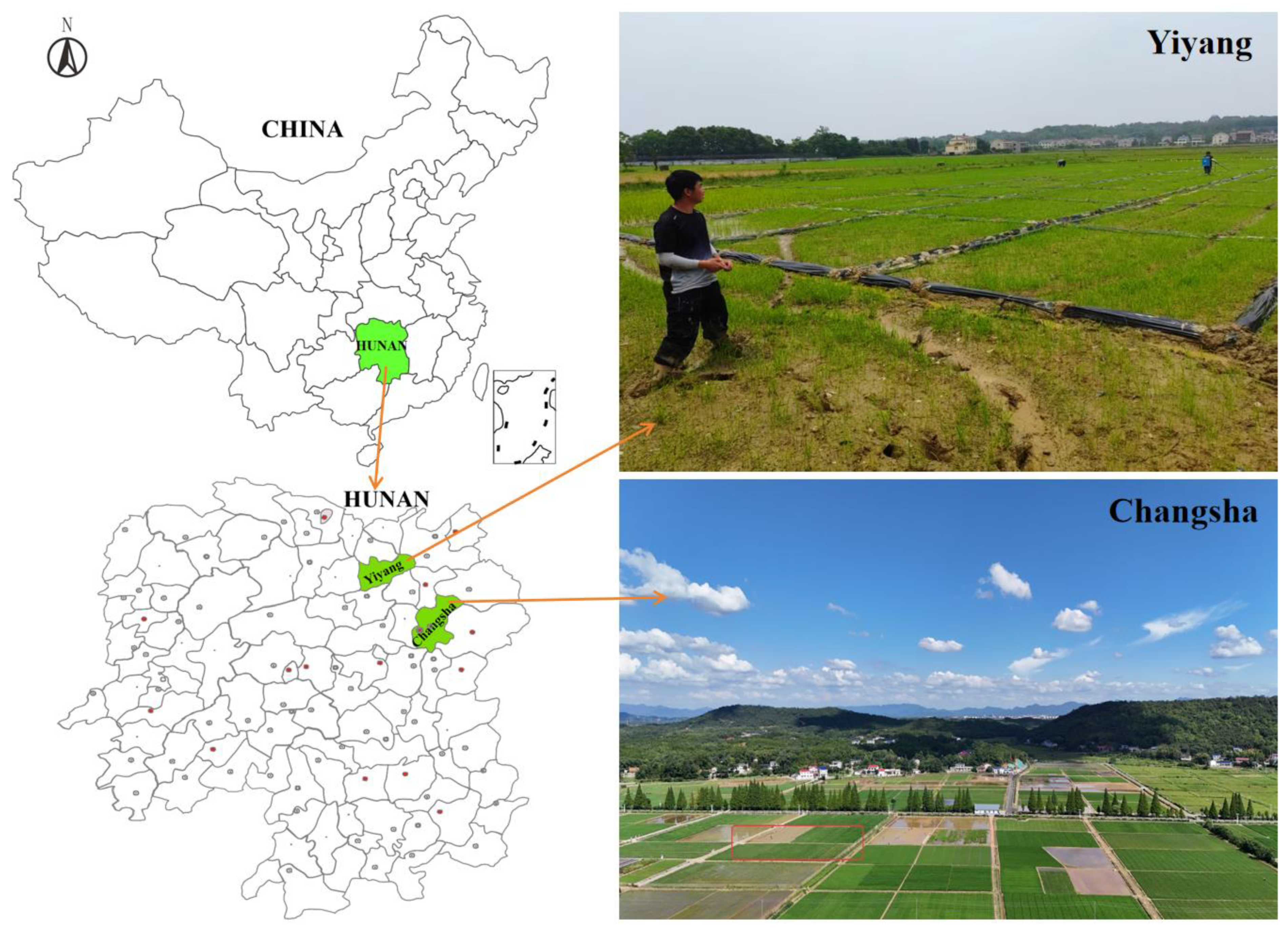
Selection of Field Trial Sites (Figure 1)
The experiment was conducted from April to August 2024 at two representative double-cropping rice locations in Hunan Province: the Yiyang site (112°24′30″ E, 28°26′1″ N, Dongting Lake Plain) and the Chunhua Town site in Changsha County (113°16′30″ E, 28°19′1″ N, hilly terrain). Both sites had rice as the preceding crop and were characterized by high and uniformly distributed weed densities. All management practices, except for the treatment factors, followed local high-yield cultivation protocols. The tested soil was a shallow reddish clay soil. The basic properties of the plow layer (0–20 cm) were as follows: at the Yiyang site, pH was 6.7 and organic matter content was 22.24 g·kg−1; at the Changsha site, pH was 6.1 and organic matter content was 19.31 g·kg−1.
The direct-seeded rice was sown on 12 April and 16 April 2024, at a seeding rate of 7.5 kg/667 m2, with a plot area of 200 m2. Weeds were allowed to occur naturally. Sixteen fixed sampling points were established using the inverted-W pattern, each covering an area of 0.5 m × 0.5 m. Weed species and populations were surveyed at 5, 10, 15, 20, 27, 34, 41, and 48 days after sowing (weeds were removed after each survey) to record the peak emergence period and the period of weed emergence.
Figure 1. Location of the direct-seeded early rice experimental field site, April–August 2024.
Agronomy 16 00867 g001

2.2.2. Methodology for Assessing the Effects of Weed Species on Growth and Yield of Direct-Seeded Rice

The study was conducted at the same site as the investigation of weed emergence patterns. A randomized complete block design was established with four weed management treatments: grass-only plots, where only grass weeds were retained and 480 g·L−1 bentazone AS (1440 g ai ha−1) was applied at the 3–4 leaf stage of rice (corresponding to the 2-leaf-1-heart to 3-leaf stage of arnyardgrass) to control broadleaf weeds, with the remaining broadleaf weeds being hand-removed at 20 days after treatment (DAT); broadleaf-only plots, where only broadleaf and sedge weeds were retained and a tank mixture of 10% metamifop EC (150 g ai ha−1) and 10% cyhalofop-butyl EC (375 g ai ha−1) was applied at the same growth stage to control grass weeds, with the remaining grasses being hand-removed at 20 days after treatment (DAT); weed-infested plots, where weeds were allowed to grow naturally throughout the entire growing season without any control; and weed-free plots, where weeds were manually removed at 20, 40, and 60 days after sowing to maintain weed-free conditions throughout the rice growing season. Each treatment was replicated three times, with a plot area of 100 m2. The plots were independently irrigated and drained. Fertilization and pest control practices followed local conventional management protocols.
At 30, 50, 70, and 90 days after emergence, four fixed quadrats (0.25 m × 0.25 m) were selected in each plot. Within each quadrat, 10 rice plants were randomly selected and tagged for monitoring, and their plant height and tiller number were recorded. At maturity, rice plants within each quadrat were harvested, sun-dried to constant weight, and subjected to yield component analysis to determine the panicle number, grains per panicle, and 1000-grain weight, based on which the theoretical yield was calculated. The remaining area of each plot was harvested using a combine harvester to determine the actual yield, which was adjusted to a standard moisture content of 14%. Theoretical yield was calculated using the following formula: theoretical rice yield (kg·hm−2) = [(panicle number per m2 × grains per panicle × 1000-grain weight (g))/1000] × 10000.

2.2.3. Screening of Herbicides for Control of Barnyardgrass in Direct-Seeded Rice

Laboratory Bioassay of Barnyardgrass: Based on the results of the weed occurrence patterns (Section 2.2.1) and the effects of different weed species on rice (Section 2.2.2), barnyardgrass was identified as the target weed for this study. A whole-plant bioassay was conducted to evaluate the biological activity of various herbicides against barnyardgrass, following the guidelines outlined in the “Pesticides Guidelines for Laboratory Bioactivity Tests” [19] in April 2025. Uniform, plump barnyardgrass seeds were selected and soaked in a 0.01% gibberellin solution for 24 h, followed by germination in a growth chamber at 28 °C for 48 h. The germinated seeds were then sown in plastic pots (12 cm diameter) filled with soil, with 20 seeds per pot and four replicates per treatment. After sowing, the seeds were covered with approximately 0.5 cm of moist fine soil. The pots were maintained in a greenhouse under controlled conditions: day/night temperatures of 21–27 °C/14–21 °C, a light intensity of 3000 lx, a photoperiod of 14/10 h (day/night), and a relative humidity of 65–85%.
Pre-emergence soil treatment was applied one day after sowing (prior to barnyardgrass emergence). For post-emergence treatment, seedlings were thinned to 15 plants per pot at the two-leaf stage, and foliar application was conducted when the seedlings reached the two-leaf-one-heart stage. All herbicide applications were performed using a 3WP-2000 walking-type spray tower equipped with TP65015E flat-fan nozzles Nanjing, China, operating at a spray pressure of 0.27 MPa and a spray volume of 450 L·hm−2. The tested herbicides and their corresponding doses are detailed in Table 1. After treatment, the pots were returned to the greenhouse and maintained under the same controlled conditions as described above. Barnyardgrass plants were regularly monitored for herbicidal phytotoxicity symptoms, including growth inhibition, chlorosis, and malformation. At 12 days after treatment (DAT), the aboveground portions of the plants were harvested and immediately weighed to determine fresh weight. The percent fresh weight inhibition was then calculated relative to the untreated control group.
Field Efficacy Trial: The field trial was conducted in 2025 at the Chunhua Base in Changsha City, Hunan Province (28°18′29″ N, 113°18′06″ E). The soil at the experimental site was a silty loam with a pH of 6.7 and an organic matter content of 2.0%. Sowing was carried out on 3 June 2025, at a seeding rate of 7.5 kg per 667 m2. Based on the laboratory bioassay results, both pre-emergence soil treatment and post-emergence foliar application were established. A randomized complete block design was employed for each application method, with three replications and a plot area of 20 m2. Following plowing, the experimental field was partitioned by ridges (15–20 cm high, 15 cm wide) to delineate plots, which were separated by drainage ditches of 50 cm in width to ensure independent irrigation and drainage.
For the pre-emergence soil treatment, a total of 12 treatments were established, including pretilachlor (450, 900 g ai ha−1), pyriminobac-methyl (30, 60 g ai ha−1), clomazone (162, 324 g ai ha−1), mefenacet (73.8, 147.6 g ai ha−1), oxaziclomefone (33, 66 g ai ha−1), and a water control (formulation concentrations, types, and manufacturers were consistent with those listed in Table 1). Herbicide solutions were prepared using the twofold dilution method and uniformly applied to the soil surface using a knapsack electric sprayer at a spray volume of 450 L·ha−1 after rice sowing but prior to weed emergence. The soil was maintained in a moist condition for three days after application.
For the post-emergence foliar treatment, 16 treatments were established, including flusulfinam (180, 360 g ai ha−1), pyraquinate (150, 300 g ai ha−1), tripyrasulfone (135, 270 g ai ha−1), florpyrauxifen-benzyl (36, 72 g ai ha−1), quintrione (900, 1800 g ai ha−1), metamifop (120, 240 g ai ha−1), Profoxydim (120, 240 g ai ha−1), feproxydim (120, 240 g ai ha−1), and a water control. Foliar applications were conducted at the 2–3 leaf stage of barnyardgrass after draining the plots, with re-flooding initiated 24 h after application.
Crop safety and weed injury symptoms were visually evaluated at 3, 7, 15, and 20 days after treatment (DAT), in accordance with the standard guidelines [20]. At 20 and 40 DAT, weed density was determined using the diagonal quadrat sampling method (four points per plot, 0.25 m2 per point). Furthermore, at 40 DAT, weed fresh weight was measured. Control efficacy was calculated using the following formula: Efficacy (%) = [(CK − PT)/CK] × 100, where PT represents the number or fresh weight of surviving weeds in the treated plot, and CK represents the corresponding value in the untreated control plot.

3. Results and Discussion

3.1. Weed Occurrence Patterns in Direct-Seeded Rice Fields

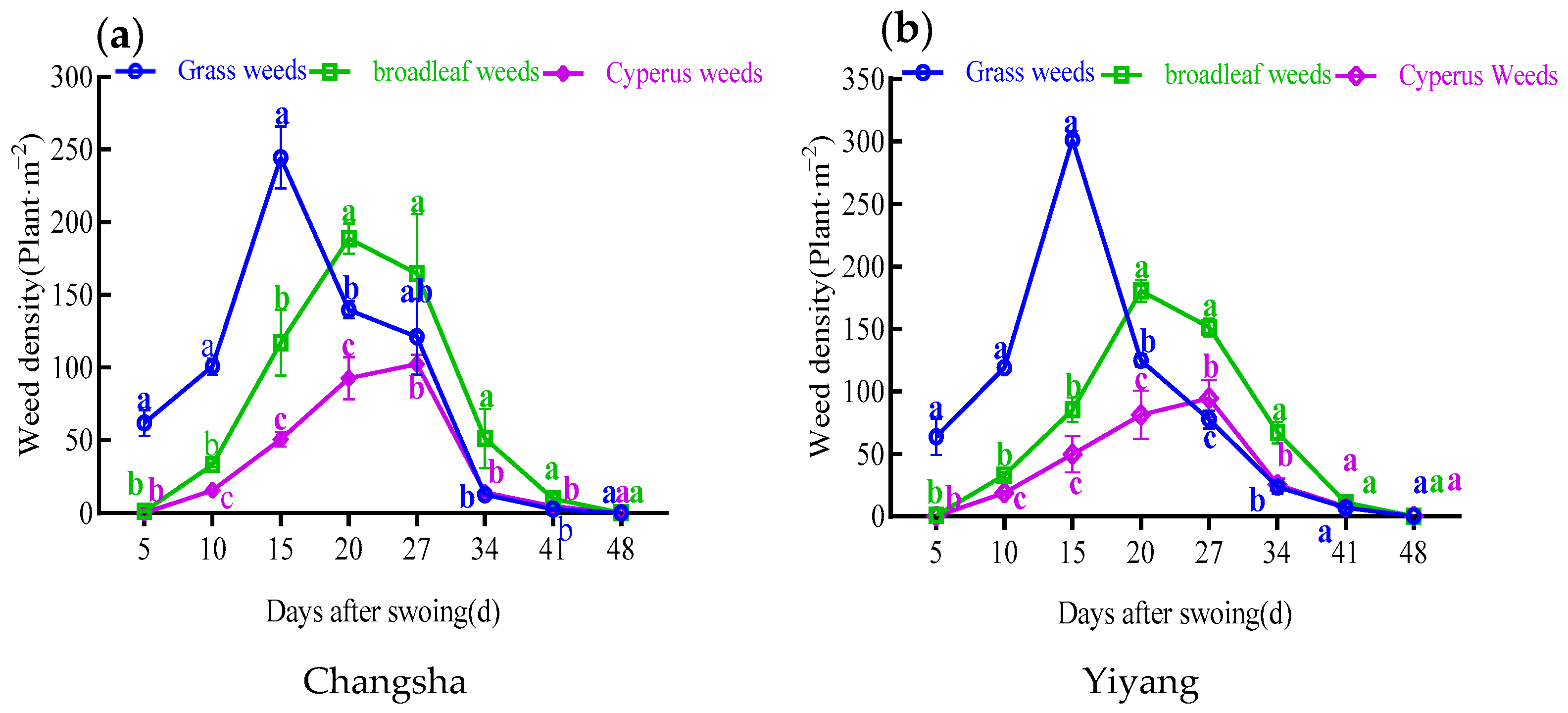
Monitoring of weed emergence dynamics in direct-seeded early rice fields in Changsha and Yiyang showed that weed emergence initiated at 2–3 days after sowing (DAS) and concluded by 48 DAS, with the entire emergence period lasting more than 45 days and showing three distinct peaks (Figure 2). Regarding the emergence sequence, grass weeds emerged first, barnyardgrass began emerging at 2–3 DAS and peaking at 13–17 DAS, reaching densities of 200–254 plants m−2. Broadleaf and sedge weeds emerged slightly later, initiating at 6–7 DAS and peaking at 22–24 DAS and 25–27 DAS, with densities of 180.4–188.6 plants m−2 and 94.5–102.3 plants m−2, respectively. Thereafter, the emergence of all weed species gradually declined until ceasing at 48 DAS. The density of grass weeds was slightly higher in the Yiyang site than in Changsha, whereas the peak density of sedge weeds was slightly lower in Yiyang than in Changsha.
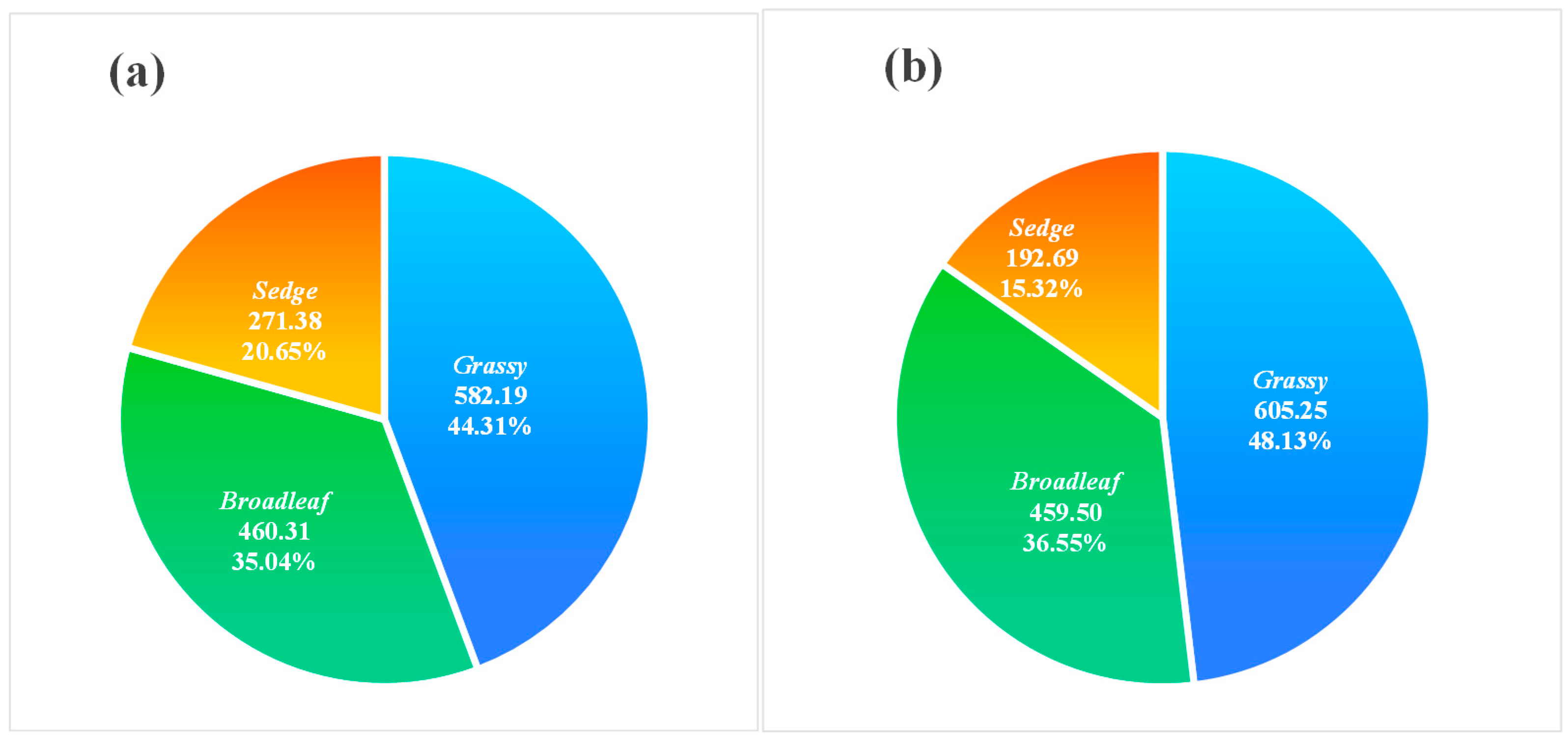
Analysis of the weed community structure revealed distinct compositional patterns at the two experimental locations (Figure 3). At the Changsha site, the densities of grass, broadleaf, and sedge weeds were 582.19 plants m−2 (44.31% of the total weed population), 460.31 plants m−2 (35.03%), and 271.38 plants m−2 (20.65%), respectively. At the Yiyang site, grass weed density was 605.25 plants m−2 (48.13% of the total), broadleaf weed density was 459.50 plants m−2 (36.54%), and sedge weed density was 192.69 plants m−2 (15.32%). Barnyardgrass was the dominant species at both locations, with densities ranging from 540.93 to 635.16 plants m−2, accounting for 79.2% to 88.71% of the total grass weed population. The predominant broadleaf weeds were Ludwigia prostrata Roxb. and Monochoria vaginalis Burm. f., whereas the sedge community was primarily composed of Juncellus serotinus Rottb. These findings indicate a consistent weed community structure across the direct-seeded rice fields in both the Dongting Lake Plain (Yiyang) and the hilly region (Changsha), characterized by grass weeds as the predominant functional group, followed by broadleaf weeds, with Cyperus being the least abundant. This pattern reflects a regional commonality in weed occurrence across the direct-seeded rice systems in Hunan Province.
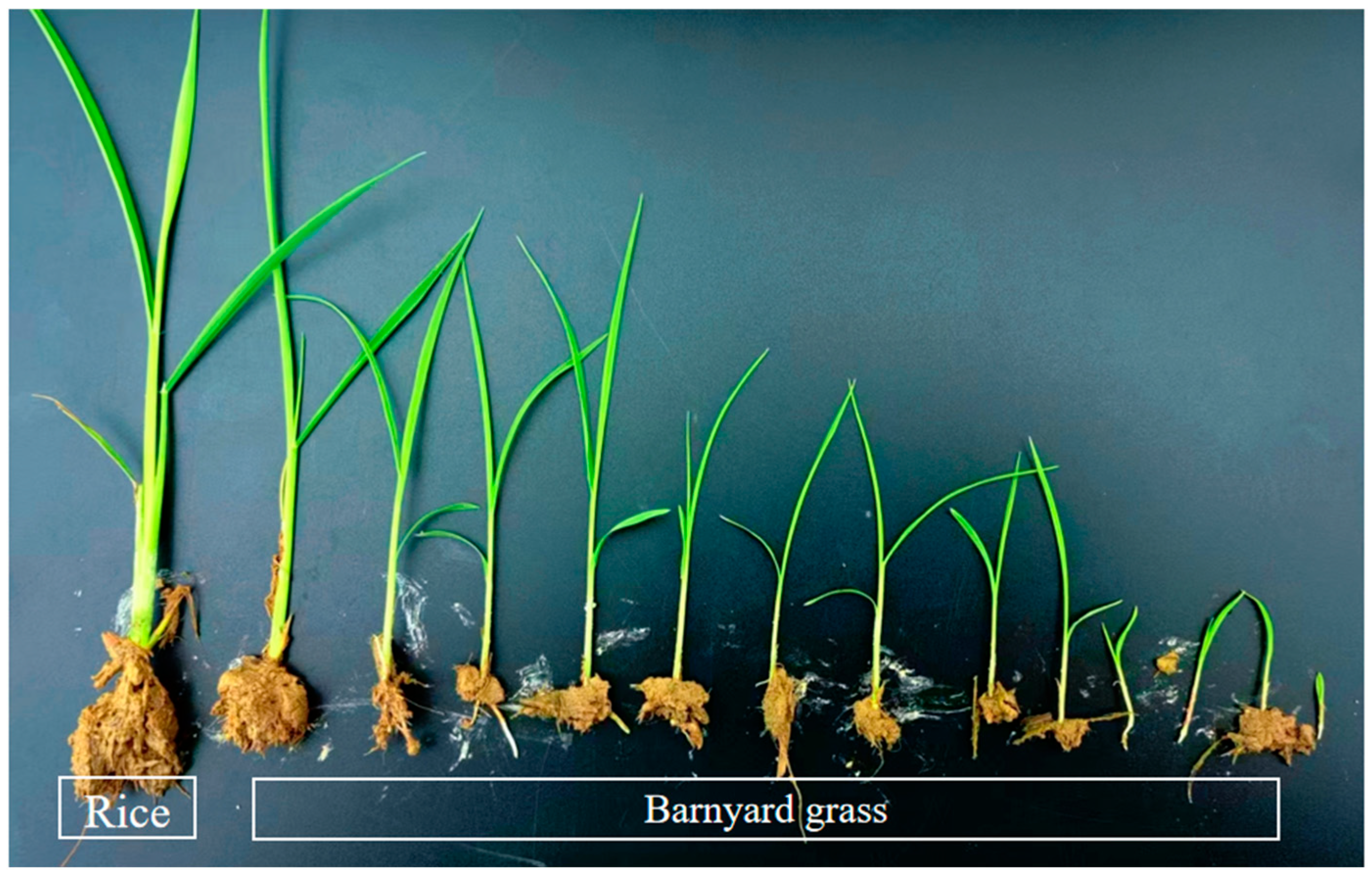
Additionally, our field observations revealed that barnyardgrass emergence in direct-seeded rice fields is a continuous and prolonged process. At 15 days after sowing, the field population exhibited a mixed-age structure, with plants coexisting across multiple growth stages ranging from the first leaf to the fourth leaf (Figure 4). Currently, barnyardgrass control primarily relies on chemical herbicides. However, most herbicides have a narrow application window for optimal efficacy, complicating the control of target weeds at different leaf stages. This asynchrony between prolonged emergence patterns and the limited application windows of chemical controls exacerbates the difficulty of managing this problematic weed in direct-seeded rice systems.

3.2. Effects of Weed Species on the Growth and Yield of Direct-Seeded Rice

3.2.1. Effects on Rice Plant Height and Tiller Number

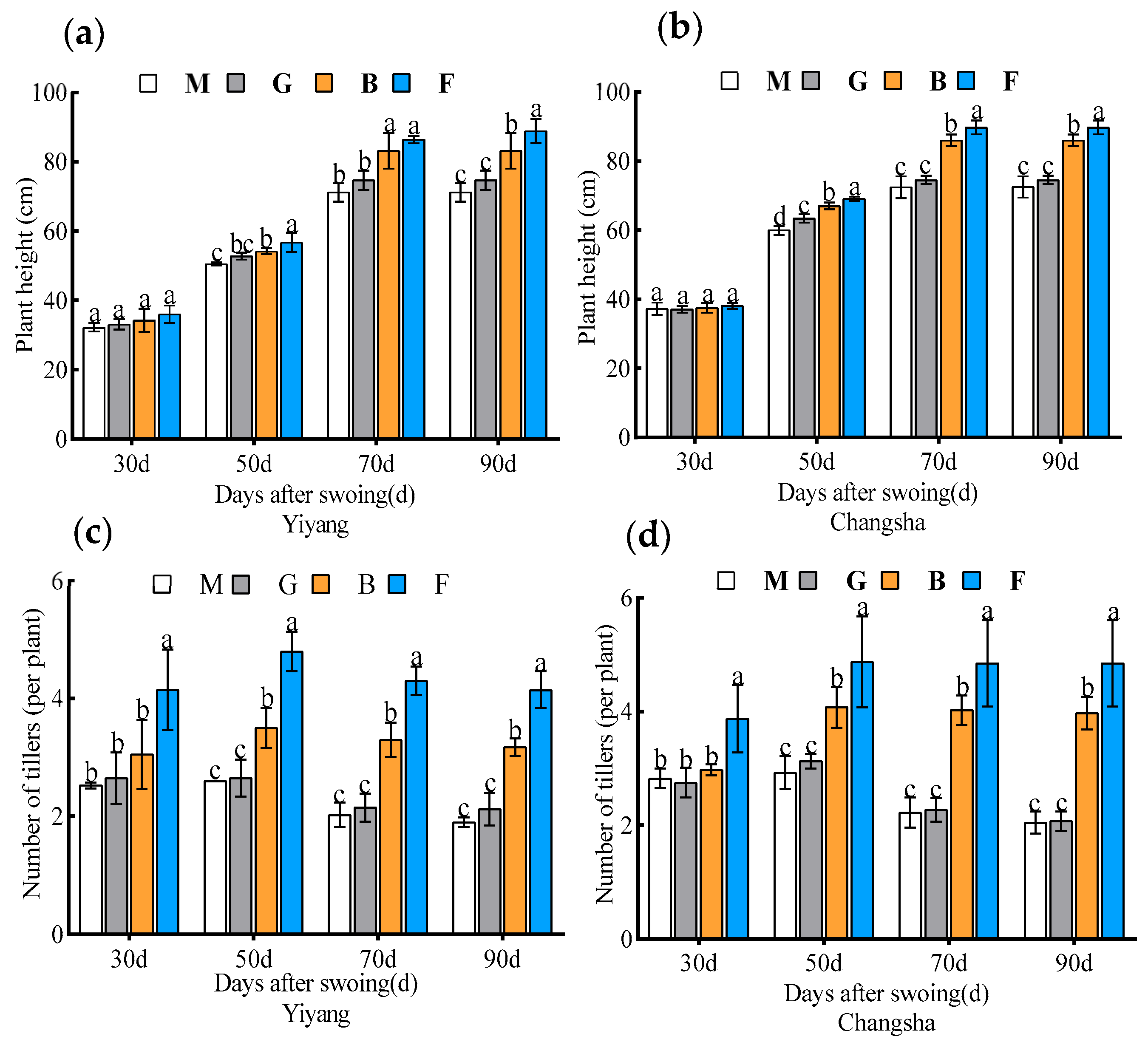
The effects of different weed types on the plant height of direct-seeded rice were generally consistent across the two experimental sites (Figure 5a,b). During the early vegetative growth stage (10–30 d after sowing), no significant differences in rice plant height were observed between the weed-infested treatments (approximately 37.5 cm) and the weed-free control (38.1 cm), indicating that weed competition had not yet substantially affected rice height during this period. From 50 to 90 d after sowing, all weed-infested treatments significantly suppressed rice plant height, although the magnitude of suppression varied among weed types. At 90 d after sowing, plant height in the weed-free control reached 88.9 cm, whereas significantly lower heights were recorded in the weed-infested plots (71.2 cm) and grass-only plots (74.6 cm), with no significant difference between these two treatments. Plant height in the broadleaf-only plots (83.2 cm) was also significantly lower than that of the control from 50 to 90 d after sowing, except at the Yiyang site at 70 d. Throughout the reproductive growth stage, the inhibition rate of plant height was consistently higher in the grass-only plots (16%) compared to the broadleaf-only plots (6%). This suggests that grass weeds exhibit greater niche overlap with rice, leading to more intense competitive interactions.
As shown in Figure 5c,d, all weed-infested treatments significantly inhibited rice tillering. During the early vegetative growth stage (10–30 d after sowing), the number of tillers per plant in the weed-infested plots (2.5), grass-only plots (2.6), and broadleaf-only plots (3.0) was significantly lower than that in the weed-free control (3.9). However, no significant differences were observed among the three weed-infested treatments during this period. During the reproductive growth stage (50–90 d after sowing), the inhibitory effect of weeds on tillering was further intensified. Compared with the weed-free control, the tiller inhibition rates in the weed-infested and grass-only plots were similar (55% and 50%, respectively), with no significant difference between them. However, both exhibited significantly higher inhibition rates than the broadleaf-only plots (31%).

3.2.2. Effects of Different Weed Species on Rice Yield

The results from the two field trials demonstrated that all weed types significantly affected both the yield components and the final grain yield of direct-seeded early rice, with the magnitude of the impact varying depending on the weed community composition (Table 2).
Analysis of yield components revealed that the weed-free treatment produced the highest values across all measured parameters. In Yiyang and Changsha, the effective panicle numbers in the weed-free plots were 443.8 and 438.8 panicles m−2, respectively, with filled grains per panicle amounting to 88.3 and 87.0, seed-setting rates of 88.2% and 90.6%, and 1000-grain weights of 22.6 g and 22.5 g. Conversely, the most severe adverse effects on yield components were observed in the weed-infested plots. In these plots at Yiyang and Changsha, effective panicle numbers were drastically reduced to only 97.3 and 79.8 panicles m−2, representing a 78% reduction compared to the weed-free control. Filled grains per panicle decreased to 39 and 36, a reduction of nearly 58%, while seed-setting rates declined to 69.4% and 76.5%, marking an approximate 21.2% decrease. The 1000-grain weight also fell to 19.9 g and 20.8 g, an 11% reduction. All these parameters were significantly lower than those in the weed-free control. The grass-only plots exhibited similar trends to the weed-infested plots, with no significant differences detected between these two treatments.
In contrast, the broadleaf-only plots had a comparatively minor impact on rice yield components. In Yiyang and Changsha, effective panicle numbers were 399.3 and 378 panicles m−2, respectively, reflecting a reduction of approximately 14% relative to the weed-free control. Filled grains per panicle were 81.3 and 86.5, a decrease of about 1%. The seed-setting rates were 86.7% and 88.7%, and the 1000-grain weights were 21.7 g and 22.1 g, neither of which differed significantly from the values recorded in the weed-free control.
All weed species significantly reduced rice grain yield. The highest yield was recorded in the weed-free control, reaching 7518.2 kg ha−1. In the broadleaf-only plots, yield was 6153.3 kg ha−1, representing a 20.5% reduction compared to the weed-free control. In contrast, yields in the grass-only and weed-infested plots were drastically lower, ranging from only 487.1 to 699.9 kg ha−1, resulting in yield losses exceeding 90%. These reductions were significantly greater than those observed in the broadleaf-only plots, while no significant difference was detected between the grass-only and weed-infested treatments.
Collectively, these results demonstrate that grass weeds, whether present alone or co-occurring with broadleaf species, caused substantial rice yield losses by suppressing effective panicle number, filled grains per panicle, seed-setting rate, and 1000-grain weight. In contrast, broadleaf weeds reduced rice yield primarily by decreasing the effective panicle number, with comparatively minor effects on spikelet development and grain filling processes. These findings establish grass weeds as the primary competitors responsible for yield losses in direct-seeded rice systems, and should therefore be prioritized as the key targets in weed management strategies. Consequently, the present study focused on screening herbicides and conducting field efficacy trials against the problematic grass weed barnyardgrass, aiming to provide a theoretical basis and technical support for effective grass weed control in direct-seeded rice fields.

3.3. Screening of Herbicides for Control of Barnyardgrass in Direct-Seeded Rice Fields

3.3.1. Laboratory Bioassays of Herbicides Against Barnyardgrass

The inhibitory activity of the tested herbicides against barnyardgrass in direct-seeded rice was evaluated using greenhouse pot bioassays. In pre-emergence soil treatments, significant differences in herbicidal activity were observed among the tested compounds. Oxaziclomefone exhibited the highest soil activity against barnyardgrass, with a GR90 value of 17.70 g ai ha−1. This was followed by pyriminobac-methyl, flufenacet, and pyraclonil, which had GR90 values ranging from 29.44 to 62.74 g ai ha−1. Mefenacet and pretilachlor showed GR90 values of 245.60 and 313.15 g ai ha−1, respectively. Quintrione demonstrated comparatively poor pre-emergence activity, with a GR90 value of 887.18 g ai ha−1.
In post-emergence foliar treatments applied at the 2–3 leaf stage of barnyardgrass, marked differences in activity were also evident. Profoxydim and florpyrauxifen-benzyl exhibited the highest activity, with GR90 values of 33.01 and 33.45 g ai ha−1, respectively, followed by flusulfinam (64.55 g ai ha−1). Tripyrasulfone, feproxydim, and metamifop showed intermediate activity, with GR90 values ranging from 113.35 to 135.55 g ai ha−1. Benzobicyclon and pyraquinate were less active, with GR90 values of 213.10 and 217.10 g ai ha−1, respectively. Quintrione again displayed the lowest efficacy among the tested herbicides, with a GR90 value of 747.38 g ai ha−1, significantly higher than that of the other compounds.
The speed of efficacy onset also varied among the herbicides. In both treatment types, florpyrauxifen-benzyl and quintrione induced chlorosis of the newest leaves and growth inhibition within 2–3 days after treatment (DAT), followed by necrosis of the growing point and basal stem rot at 7–10 DAT. Flusulfinam and tripyrasulfone caused leaf bleaching at 3 DAT, with subsequent desiccation and necrosis by 5–7 DAT. Profoxydim, feproxydim, and metamifop suppressed growth at 5–7 DAT, with plants gradually desiccating and dying by 7–14 DAT. In contrast, benzobicyclon and pyraquinate resulted in only minor leaf bleaching (affecting 8–10% of leaves), after which plants resumed normal growth, indicating a relatively slower speed of action.
In summary, oxaziclomefone demonstrated the highest pre-emergence herbicidal activity against barnyardgrass. Among the post-emergence treatments, Profoxydim, florpyrauxifen-benzyl, and flusulfinam exhibited the most potent activity, coupled with rapid efficacy onset (Table 3).

3.3.2. Field Efficacy of Various Herbicides Against Barnyardgrass

Field efficacy results (Table 4) demonstrated that among the pre-emergence soil treatments, pretilachlor at 900 g ai ha−1 and mefenacet at 147.6 g ai ha−1 exhibited the highest efficacy against barnyardgrass, with control exceeding 96.8% at both 20 and 40 days after treatment (DAT). Oxaziclomefone at 66 g ai ha−1 and pyriminobac-methyl at 60 g ai ha−1 showed slightly lower but still substantial efficacy, achieving over 88.0% control at both assessment timings. For all tested herbicides, efficacy increased with application rate. Lower rates of certain herbicides, including pyriminobac-methyl at 30 g ai ha−1, clomazone at 162 g ai ha−1, and oxaziclomefone at 33 g ai ha−1, resulted in poor control, with density-based efficacy below 80% at 20 DAT.
In post-emergence foliar treatments, the highest levels of barnyardgrass control were achieved with flusulfinam (180 and 360 g ai ha−1), florpyrauxifen-benzyl at 72 g ai ha−1, metamifop at 240 g ai ha−1, Profoxydim at 240 g ai ha−1, and feproxydim at 240 g ai ha−1. All these treatments provided 100% control at both 20 and 40 DAT, with flusulfinam achieving complete control at both application rates. Slightly lower, yet still excellent efficacy (≥95.9% at 20 and 40 DAT) was observed with metamifop at 120 g ai ha−1, Profoxydim at 120 g ai ha−1, feproxydim at 120 g ai ha−1, and tripyrasulfone at 270 g ai ha−1. Moderately lower efficacy (≥81.6% at 20 and 40 DAT) was recorded for florpyrauxifen-benzyl at 36 g ai ha−1, tripyrasulfone at 135 g ai ha−1, pyraquinate at 300 g ai ha−1, and quintrione at 1800 g ai ha−1. The lowest efficacy was observed with pyraquinate at 150 g ai ha−1 and quintrione at 900 g ai ha−1, both providing density-based control below 80% at 20 DAT.
Regarding crop safety to direct-seeded rice, visual field observations indicated that metamifop, flusulfinam, and pyraquinate were highly safe, with no phytotoxicity symptoms observed at any of the tested rates. The remaining four herbicides caused mild phytotoxicity. At the double rate, florpyrauxifen-benzyl induced onion leaf symptoms in some rice plants, which did not recover during the later growth stages. Tripyrasulfone caused transient leaf bleaching in a portion of rice plants, although these plants subsequently resumed normal growth. At the double rate, quintrione induced slight leaf distortion in a small proportion of plants, which also failed to recover. Profoxydim applied at the double rate resulted in transient stunting, but affected plants later recovered fully.

4. Discussion

4.1. Implications of Multiple Emergence Flushes for Weed Management in Direct-Seeded Rice

Field surveys conducted in Changsha and Yiyang revealed that weed emergence in direct-seeded early rice fields occurred in multiple distinct peaks. The first peak, dominated by barnyardgrass, peaked at 13–17 days after sowing (DAS), followed by a second peak of broadleaf weeds at 22–24 DAS and a third peak of sedges at 25–27 DAS. This pattern of multiple emergence peaks is consistent with Driver, who reported that weed emergence is influenced by thermal time accumulation [21]. Barnyardgrass was the dominant species at both sites, accounting for 44.31% and 48.13% of total emergence, respectively. Its prolonged and successive emergence resulted in a wide range of growth stages coexisting within the same field, thereby complicating weed management. The high density of grasses intensifies crop injury, while the asynchronous development of barnyardgrass populations renders a single herbicide application insufficient for full-season control. Although most post-emergence herbicides target grass weeds, their effective application window is narrow, frequently leading to inconsistent efficacy against weed cohorts with staggered emergence [22,23]. Given these weed emergence characteristics, integrated management strategies are indispensable in direct-seeded rice systems. A sequential approach—consisting of pre-emergence treatment followed by post-emergence application and supplementary remedial control if necessary—has been proposed to achieve effective season-long weed suppression. Pre-emergence herbicides reduce the initial weed seed bank, post-emergence application targets the first flush, and follow-up remedial treatments suppress late-emerging weeds according to the dominant weed species composition, thereby achieving effective suppression across all emergence cohorts.

4.2. Critical Periods of Weed Interference and Implications for Integrated Management in Rice

The detrimental effects of different weed types on rice varied considerably. Mixed weed plots and grass-dominated plots caused the most severe suppression of tillering and plant height during the reproductive stage (50–90 days after sowing), resulting in yield losses of over 90%. The damage caused by these two weed types was comparable and substantially greater than that in the weed-free control. These findings are consistent with previous studies showing that barnyardgrass significantly reduces rice plant height, tiller number, and grain yield [24,25]. In contrast, broadleaf weed plots had a relatively moderate impact, with yield losses approaching 20%. Weed interference during the vegetative stage (up to 30 days after sowing) and the seedling stage was minimal, providing a critical window for early season control [10,26]. Consequently, this study supports an “early management” strategy. This approach integrates pre-emergence soil application to deplete the initial weed seed bank with post-emergence foliar treatments combined with suppression techniques at the rice 3–4 leaf stage [27]. Such a strategy aims to curtail weed competition during the reproductive phase, achieving more economical and sustainable control.

4.3. Evaluation of Herbicides for the Control of Barnyardgrass

4.3.1. Efficacy of Pre-Emergence Herbicides on Weed Control

In pre-emergence herbicide screening, laboratory bioassays showed that oxaziclomefone and pyriminobac-methyl exhibited excellent herbicidal activity against barnyardgrass, with GR90 values below 29.44 g ai ha−1. However, their field performance contrasted markedly with laboratory results: pretilachlor and mefenacet provided more consistent control of barnyardgrass under field conditions, with longer residual activity and overall efficacy exceeding 87.8%. For pyriminobac-methyl, oxaziclomefone, and clomazone, field efficacy was positively correlated with application rate, reaching >88.2% control at twice the standard dose. This discrepancy between laboratory and field performance can be attributed to the integrated effects of multiple environmental factors. Laboratory assays were conducted under controlled conditions—optimal temperature, humidity, light, and application equipment—using susceptible barnyardgrass populations. In contrast, under field conditions, variables such as heterogeneous weed distribution, soil organic matter content, pH, and moisture significantly affect herbicide adsorption, movement, degradation, and bioavailability [28]. The efficacy of pre-emergence herbicides fundamentally depends on their uniform distribution and stability in the soil surface layer, with soil texture, organic matter content, and moisture status critically influencing the adsorption and leaching processes of active ingredients. Consequently, environmental factors often become the dominant regulators of field efficacy, potentially outweighing the intrinsic activity of the herbicides themselves [29]. This aligns with the findings of Li et al. [30], who reported that pesticide adsorption onto soil is correlated with soil organic matter content, with hydrophobic binding playing an important role in this process.

4.3.2. Efficacy and Safety Evaluation of Post-Emergence Herbicides

Among the post-emergence herbicides evaluated, flusulfinam exhibited exceptional performance, with a GR90 value of 64.5 g ai ha−1 under controlled conditions. This is consistent with the baseline sensitivity (GR50 = 6.48 g ai ha−1) reported for flusulfinam against barnyardgrass [31]. In field trials, flusulfinam provided 100% control of barnyardgrass at 20 and 40 days after treatment (DAT), with no observed rice injury even at high and doubled doses. These results corroborate previous findings on its high efficacy and favorable crop safety [32,33]. As a novel HPPD-inhibiting herbicide developed by Qingyuan Crop Science, flusulfinam is the first compound in its class to demonstrate safety in both indica and japonica rice under post-emergence application—a major advancement, as previous HPPD inhibitors posed substantial phytotoxicity risks to indica varieties. This characteristic is particularly valuable for rice production in southern China, where indica cultivars predominate.
Tripyrasulfone, also developed by Qingyuan Crop Science as an HPPD inhibitor, achieving >90% control at 20 and 40 DAT, showed strong activity against barnyardgrass. However, transient leaf bleaching was observed in treated indica rice, though plants recovered fully by later growth stages. These findings align with previous reports that tripyrasulfone is safe for japonica rice but can suppress growth in some indica varieties at high application rates [34]. This compound is also effective against Chinese sprangletop [35].
Pyraquinate, a novel HPPD inhibitor developed by Shandong Cynda, represents an innovative mode of action but showed suboptimal control against barnyardgrass in this study, achieving only 76.9% control at 20 DAT. However, excellent activity against Chinese sprangletop has been reported for pyraquinate, suggesting species-specific performance [32].
Feproxydim, a novel cyclohexanedione ACCase inhibitor developed by Shandong Cynda, shares structural similarities with Profoxydim (BASF). Both compounds demonstrated strong herbicidal activity against barnyardgrass. Feproxydim showed no adverse effects on rice, whereas Profoxydim caused transient seedling stunting at twice the recommended dose, though plants recovered over time. These results underscore the importance of evaluating varietal sensitivity and application rates for Profoxydim to ensure crop safety in field use.
Quintrione, a quinoline-type herbicide developed by Dingyuan Jiahe, showed unsatisfactory efficacy against barnyardgrass, with only 76.9% control at 20 DAT. Therefore, it is recommended that quintrione be used in combination with other herbicides to improve its performance against this weed.

4.3.3. Value and Prospects of Novel Herbicides in Resistance Management

From a resistance management perspective, the four novel rice herbicides recently developed in China offer distinct mechanisms of action and varying resistance mitigation potentials. Flusulfinam, an HPPD inhibitor, exhibits no cross-resistance with conventional ALS inhibitors, ACCase inhibitors, or synthetic auxin herbicides, providing a novel site of action for managing herbicide-resistant weeds in rice paddies [31]. Notably, as the only HPPD-inhibiting herbicide with a heterocyclic amide structure, flusulfinam poses a low risk of metabolic cross-resistance with other HPPD inhibitors, which may help delay the onset and spread of metabolism-based resistance [31]. Feproxydim, a cyclohexanedione ACCase inhibitor, differs structurally from aryloxyphenoxypropionate herbicides despite sharing the same target site. However, ACCase inhibitors have been extensively used for grass weed control in rice for many years, leading to frequent resistance evolution [36,37]. Recent studies have confirmed that target-site mutations, such as Cys-2088-Arg, can confer cross-resistance to ACCase inhibitors [38]. Therefore, the risk of cross-resistance with existing ACCase inhibitors should be carefully considered when promoting feproxydim in resistance management programs. Tripyrasulfone, another HPPD inhibitor, features a distinct pyrazolone structure that differentiates it from traditional triketone HPPD inhibitors, potentially reducing metabolic cross-resistance [39]. In recent years, tripyrasulfone has shown promise in managing resistant barnyardgrass populations and may serve as an effective component in herbicide mixtures within resistance management strategies.
Globally, four cases of HPPD inhibitor resistance have been documented to date, all attributed to enhanced metabolism mediated by cytochrome P450 enzymes [14]. The natural tolerance of rice to HPPD inhibitors is primarily conferred by oxidases encoded by the HIS1 gene and its homologs, whereas metabolic resistance in weeds arises from increased P450 activity [40,41]. These findings highlight the need for rigorous early monitoring and risk assessment of metabolism-based resistance during the deployment of novel HPPD-inhibiting herbicides.

4.3.4. Integrated Management Strategies and Future Research Directions

Pre-emergence herbicides provide consistent and effective control of barnyardgrass by reducing the soil seedbank, thereby establishing a critical foundation for early season weed management. In contrast, post-emergence herbicides—despite exhibiting high intrinsic activity and satisfactory field efficacy—predominantly target a limited number of sites of action. Prolonged and exclusive reliance on such herbicides intensifies selective pressure and accelerates the evolution of herbicide resistance. Therefore, sustainable barnyardgrass management should follow the principle of early season intervention, emphasizing the rotation or mixing of herbicides with distinct modes of action based on their application characteristics to delay resistance onset and spread. Specifically, an integrated strategy can be established that prioritizes pre-emergence soil treatment supplemented by post-emergence foliar application, rotates herbicides with different mechanisms of action, and employs multi-target mixtures to enhance synergistic efficacy.
The development of novel herbicides is a time-intensive process, requiring 8–10 years from discovery to registration. In this context, a critical challenge in addressing the resistance crisis in rice paddies and promoting sustainable herbicide use is optimizing the use of existing herbicides to delay resistance evolution and preserve the efficacy and lifespan of new chemistries. Based on the findings of this study, future research should prioritize: (i) early monitoring and risk warning technologies for herbicide-resistant weeds, particularly the development of molecular markers for metabolism-based resistance to new modes of action such as HPPD inhibitors; (ii) optimization of environmentally compatible herbicide mixtures that maximize synergistic interactions among diverse mechanisms of action; (iii) integration of precision application technologies, such as variable-rate application based on weed density and growth stage and optimization of adjuvant use; and (iv) investigating differential rice cultivar sensitivity to novel herbicides to inform variety-specific application strategies. It will be essential for achieving long-term, sustainable control of barnyardgrass to advance these research areas, while ensuring rice productivity and ecological safety.

5. Conclusions

In summary, this study shows that: (1) weed emergence in direct-seeded early rice fields in Changsha and Yiyang exhibited three distinct peaks, with barnyardgrass being the dominant species. The prolonged emergence period and wide range of growth stages across populations markedly increase the difficulty of effective control. (2) Mixed and grass-dominated weed communities reduced rice yield by up to 91% through suppression of tillering, effective panicle number, and filled grains per panicle, whereas broadleaf weed communities caused a yield loss of only 20%. Given that early vegetative competition does not significantly suppress rice plant height or tillering, an early season management strategy integrating pre-emergence and post-emergence herbicide applications is recommended for season-long control.
Herbicide screening results indicated that: (i) pretilachlor and mefenacet provided consistently excellent efficacy in pre-emergence applications; (ii) oxaziclomefone and pyriminobac-methyl were suitable as mixture components; (iii) among post-emergence herbicides, flusulfinam exhibited high activity and favorable crop safety, making it a preferred option for barnyardgrass control; (iv) when promoting feproxydim and Profoxydim, attention should be given to the risk of cross-resistance with existing ACCase inhibitors; and (v) tripyrasulfone may serve as a mixture component within resistance management strategies. To address the dual challenges of herbicide resistance and narrow application windows, rotating or combining herbicides with different mechanisms of action, along with strengthening resistance monitoring and management, is recommended in rice production.

Author Contributions

Data curation, Formal analysis, Visualization, Writing—original draft, Writing—review and editing: J.F.; Investigation, Formal analysis, Writing—review and editing: D.P.; Investigation, Methodology: Y.P.; Investigation, Formal analysis, S.L.; Investigation, Methodology: C.N.; Conceptualization Methodology, Writing—review and editing: L.B.; Conceptualization Methodology, Data curation, Formal analysis, Writing—review and editing: G.M. All authors have read and agreed to the published version of the manuscript.

Funding

This work was supported by the National Key Research and Development Program (2023YFD1401100) and the National Natural Science Foundation of China (U22A20461).

Data Availability Statement

The original contributions presented in this study are included in the article. Further inquiries can be directed to the corresponding authors.

Conflicts of Interest

The authors declare no conflicts of interest.

Abbreviations

GR90Growth reduction by 90%
HPPD4-Hydroxyphenylpyruvate Dioxygenase
pre-emergenceSoil pre-emergence treatment
post-emergenceFoliar spray treatment
DASDays after sowing
ACCaseAcetyl-CoA carboxylase
ALSAcetolactate Synthase

References

  1. Hansjoerg, K.; Khawar, J.; Husrev, M.; Singh, C.B. Global distribution of rice weeds a review. Crop Prot. 2016, 80, 73–86. [Google Scholar]
  2. Priya, T.S.R.; Nelson, A.R.L.E.; Ravichandran, K.; Antony, U. Nutritional and functional properties of coloured rice varieties of South India: A review. J. Ethn. Foods 2019, 6, 11. [Google Scholar] [CrossRef]
  3. NBSC (National Bureau of Statistics of China). National Data. 2024. Available online: http://data.stats.gov.cn/ (accessed on 20 January 2024).
  4. Sivanesan, M.; Manivannan, V.; Kumar, G.P.; Sritharan, N.; Prabu, P.C. Effect of Herbicides Combination on Weed Management and Yield of Direct Wet Seeded Rice (Oryza sativa L.). Int. J. Environ. Clim. Chang. 2023, 13, 3434–3442. [Google Scholar] [CrossRef]
  5. Colbach, N.; Adeux, G.; Cordeau, S.; Moreau, D. Weed-induced yield loss through resource competition cannot be sidelined. Trends Plant Sci. 2023, 28, 1329–1330. [Google Scholar] [CrossRef]
  6. Rao, A.; Johnson, D.; Sivaprasad, B.; Ladha, J.; Mortimer, A. Weed management in direct-seeded rice. Adv. Agron. 2007, 93, 153–255. [Google Scholar] [CrossRef]
  7. Cui, H. Challenges and approaches to crop improvement through C3-to-C4 engineering. Front. Plant Sci. 2021, 12, 715391. [Google Scholar] [CrossRef]
  8. Bai, L.Y.; Zhang, S.; Liu, D.C. Monitoring and Control Technologies for Herbicide Resistance in Farmland Weeds; China Agriculture Press: Beijing, China, 2023; pp. 79–86. [Google Scholar]
  9. Sanders, T.L.; Bond, J.A.; Allen, T.W.; Gholson, D.; Krutz, L.J.; Webster, E.P. Bamyardgrass (Echinochloa crus-galli) control and rice injury with labeled herbicides following exposure to sublethal concentrations of paraquat. Weed Technol. 2024, 38, e20. [Google Scholar] [CrossRef]
  10. Fan, J.F.; Pan, L.; Peng, D.J.; Peng, Y.J.; Li, S.F.; Nong, C.Y.; Du, J.H.; Liu, X.Y.; Ma, G.L. Effects of barnyardgrass on rice growth and yield traits and determination of its economic control threshold. Acta Prataculturae Sin. 2026, 35, 124–134. [Google Scholar]
  11. Yue, M.F.; Feng, L.; Tian, X.S.; Liang, D.Y.; Yang, C.H.; Yang, H.M.; Cui, Y. Influence on rice yield loss caused by different kinds of weeds. Guangdong Agric. Sci. 2012, 39, 98–99+109. [Google Scholar] [CrossRef]
  12. Ghani, M.A.A.; Juraimi, A.S.; Su, A.S.M.; Ahmad-Hamdani, M.S.; Islam, A.M.; Motmainna, M. Chemical weed control in direct-seeded rice using drone and mist flow spray technology. Crop. Prot. 2024, 184, 8. [Google Scholar] [CrossRef]
  13. Hasan, M.; Mokhtar, A.S.; Mahmud, K.; Berahim, Z.; Rosli, A.M.; Hamdan, H.; Motmainna, M.; Ahmad-Hamdani, M.S. Physiological and biochemical responses of selected weed and crop species to the plant-based bioherbicide weedlock. Sci. Rep. 2023, 12, 19602. [Google Scholar] [CrossRef]
  14. Heap, I. The International Herbicide-Resistant Weed Database. 1993. Available online: http://www.weedscience.org/ (accessed on 22 January 2024).
  15. Becerra-Alvarez, A.; Godar, A.S.; Ceseski, A.R.; Al-Khatib, K. Herbicide resistance management in rice: Annual field survey of California rice weeds helps establish a weed management decision framework. Outlooks Pest Manag. 2023, 34, 51–57. [Google Scholar] [CrossRef]
  16. Li, W.; Lai, X.; Gu, T.; Wang, H.; Zhang, Z. Seed germination ecology of eclipta (Eclipta prostrata) in dry direct-seeded rice fields from China. Weed Sci. 2025, 73, e71. [Google Scholar] [CrossRef]
  17. Jehangir, I.A.; Raja, W.; Hussain, A.; Al-Shuraym, L.A.; Sayed, S.M.; Lone, A.H.; Shah, Z.A.; Dar, E.A. Herbicide effectiveness and crop yield responses in direct-seeded rice: Insights into sustainable weed management. Adv. Weed Sci. 2024, 42, e020240004. [Google Scholar] [CrossRef] [PubMed]
  18. Tang, W.; Xu, H.X.; Dong, H.; Yang, Y.J.; Zheng, C.M.; Lu, Y.L. Current status and development prospects of rice planting synchronized with herbicides application in China. J. Weed Sci. 2022, 40, 1–5. [Google Scholar] [CrossRef]
  19. NY/T 1155.3; 2006 Pesticides Guidelines for Laboratory Bioactivity Test—Herbicide—Part 3: Activity Test—Soil Spray Method. Ministry of Agriculture of the People’s Republic of China: Beijing, China; China Standards Press: Beijing, China, 2006.
  20. GB/T 17980.40; 2000 Pesticide—Guidelines for the Field Efficacy Trials (I)—Herbicides for Weed Control in Rice Field. Institute for the Control of Agrochemicals, Ministry of Agriculture Beijing: Beijing, China; China Standards Press: Beijing, China, 2000.
  21. Driver, K.E.; Becerra-Alvarez, A.; Mesgaran, M.B.; Al-Khatib, K. Emergence timing of smallflower umbrella sedge (Cyperus difformis), barnyardgrass (Echinochloa crus-galli), and bearded sprangletop (Leptochloa fusca spp. fascicularis) in California water-seeded rice. Weed Technol. 2024, 38. [Google Scholar] [CrossRef]
  22. Gu, Q.; Chu, S.; Huang, Q.; Chen, A.; Li, L.; Li, R. Colletotrichum echinochloae: A Potential Bioherbicide Agent for Control of Barnyardgrass (Echinochloa crus-galli (L.) Beauv.). Plants 2023, 12, 421. [Google Scholar] [CrossRef]
  23. Castner, M.C.; Norsworthy, J.K.; Butts, T.R.; Roberts, T.L.; Bateman, N.R.; Faske, T.R. Grass weed control and rice responsewith tetflupyrolimet-containing programs. Weed Technol. 2025, 39. [Google Scholar] [CrossRef]
  24. Song, J.-S.; Im, J.-H.; Park, Y.-H.; Lim, S.-H.; Yook, M.-J.; Lee, B.-W.; Kim, J.-W.; Kim, D.-S. Modeling the effects of elevated temperature and weed interference on rice grain yield. Front. Plant Sci. 2021, 12, 663779. [Google Scholar] [CrossRef]
  25. Seong, K.Y.; Lee, S.B.; Ku, Y.C.; Song, D.Y.; Huh, I.P.; Kim, Y.S. Reason of late establishment of Barnyardgrass and their density effects on rice yield loss. Korean J. Weed Sci. 1997, 17, 439–444. [Google Scholar]
  26. Li, S.; Yan, Q.; Wang, J.; Peng, Q. Endophytic fungal and bacterial microbiota shift in rice and barnyardgrass grown under co-culture condition. Plants 2022, 11, 1592. [Google Scholar] [CrossRef]
  27. Zhang, S.; Liu, D.C.; Ma, G.L. Study on synergistic control of resistant Barnyardgrass in water-seeded rice fields by multi-target herbicides. China Plant Prot. 2020, 40, 7. [Google Scholar]
  28. Ma, G.L.; Liu, D.C.; Liu, X.Y.; Tang, T.; Peng, Y.J. Biological activity and control effect of six herbicides to large Echinochloa crusgalli (L. ) Beauv. in direct-seeding rice field. Plant Prot. 2014, 40, 204–208. [Google Scholar] [CrossRef]
  29. Bai, J.; Qin, Y.J.; Huang, G.P.; Shi, X.L.; Li, J.; Gao, X.; Yang, Y.; Liu, S.G. Evaluation of pre-emergence control efficacy of several herbicides on weeds in wheat fields. World Pestic. 2025, 47, 48–52. [Google Scholar] [CrossRef]
  30. Li, K.B.; Li, W.P.; Xu, Z.J.; Ma, Y. Adsorption and its mechanisms of herbicide bentazone in soil humic acids. Acta Sci. Circumst. 2003, 22, 754–758. [Google Scholar] [CrossRef]
  31. Li, Z.; Sun, X.; Yu, S.; Sun, H.; Lian, L.; Peng, X.; Jin, T.; Liu, W.; Wang, H. Baseline Sensitivity of Echinochloa crus-galli (L.) P.Beauv. and Leptochloa chinensis (L.) Nees to Flusulfinam, a New 4-Hydroxyphenylpyruvate Dioxygenase (HPPD)-Inhibiting Herbicide in Rice, in China. Plants 2025, 14, 1425. [Google Scholar] [CrossRef]
  32. Ge, X.Q.; Wu, D.F.; Sun, Y.C.; Gong, X.K.; Wu, J.W.; Zhou, J.X.; Zhou, D.Y. Experimental Study on the Control of Weeds in Water-Seeded Rice Fields by Flufenpyreth and Other Herbicides. Bull. Agric. Sci. Technol. 2025, 04, 41–43+47. [Google Scholar]
  33. Yu, S.; Li, Z.H.; Li, M.Y.; Lian, L.; Peng, X.G.; Chen, S.; Wang, J.X.; Liu, W.T.; Wang, H.Z. Herbicidal characteristics of herbicide-flusulfinam in rice. Chin. J. Pestic. Sci. 2025, 27, 138–144. [Google Scholar] [CrossRef]
  34. Wang, H.; Liu, W.; Zhao, K.; Yu, H.; Zhang, J.; Wang, J. Evaluation of weed control efficacy and crop safety of the new HPPD inhibiting herbicide-QYR301U. Sci. Rep. 2018, 8, 7910. [Google Scholar] [CrossRef] [PubMed]
  35. Guo, W.L.; Lu, X.T.; Zhang, T.J.; Tian, X.S.; Zhang, C. Control efficacy of tripyrasulfone 6% OD against annual grassweeds in direet-seeded rice field and its influence on succeeding crops. World Pestic. 2024, 46, 37–43. [Google Scholar] [CrossRef]
  36. Jhala, A.J.; Singh, M.; Sarangi, D.; Shergill, L.; Maity, A.; Ganie, Z.A.; Shyam, C.; Jugulam, M.; Norsworthy, J.K. Acetyl-CoA carboxylase (ACCase)-inhibiting herbicides: Past, present, and future. Weed Technol. 2026, 40. [Google Scholar] [CrossRef]
  37. Li, W.; Wu, C.; Wang, M.; Jiang, M.; Zhang, J.; Liao, M.; Cao, H.; Zhao, N. Herbicide Resistance Status of Italian Ryegrass (Lolium multiflorum Lam.) and Alternative Herbicide Options for Its Effective Control in the Huang-Huai-Hai Plain of China. Agronomy 2022, 12, 2394. [Google Scholar] [CrossRef]
  38. Rangani, G.; Langaro, A.C.; Agrawal, S.; Salas-Perez, R.A.; Velásquez, J.C.; Nelson, C.E.; Roma-Burgos, N. Resistance to AcetylCoenzyme A Carboxylase (ACCase) Inhibitor in Lolium multiforum: Effect of Multiple Target-Site Mutations. Agronomy 2024, 14, 2316. [Google Scholar] [CrossRef]
  39. Wang, H.Z. Study on Mechanism, Feasibility of Weed Control in Paddy Field and Soil Ecological Environment Safety of a New Compound Tripyrasulfone. Ph.D Thesis, Shandong Agricultral University, Shandong, China, 2021. [Google Scholar] [CrossRef]
  40. Maeda, H.; Murata, K.; Sakuma, N.; Takei, S.; Yamazaki, A.; Karim, M.R. A ricegene that confers broad-spectrum resistance to B-triketone herbicides. Science 2019, 365, 393–396. [Google Scholar] [CrossRef]
  41. Jhala, A.J.; Kumar, V.; Yadav, R.; Jha, P.; Jugulam, M.; Williams, M.; Hausman, N.; Dayan, F.; Burton, P.; Dale, R. 4-Hydroxyphenylpyruvate dioxygenase(HPPD)-inhibiting herbicides: Past, present, and future. Weed Technol. 2023, 37, 207–213. [Google Scholar] [CrossRef]
Figure 2. Dynamics of weed occurrence in direct-seeded early rice fields. Different lowercase letters (a, b, c) above the bars indicate statistically significant differences between treatments at the same time point, as determined by a one-way ANOVA followed by Fisher’s LSD test (p < 0.05). Means sharing the same letter are not significantly different from each other. (a) Dynamics of weed occurrence in direct-seeded rice fields in Changsha. (b) Dynamics of weed occurrence in direct-seeded rice fields in Yiyang.
Agronomy 16 00867 g002
Figure 3. Main weed species and their proportions in direct-seeded early paddy fields, (a): relative abundance of weed species in direct-seeding rice fields in Changsha (%), (b): relative abundance of weed species in direct-seeding rice fields in Yiyang (%).
Agronomy 16 00867 g003
Figure 4. Coexistence of rice and barnyardgrass at different leaf stages. Occurrence in 0.01 m−2 quadrats at 15 DAS of direct-seeded early rice.
Agronomy 16 00867 g004
Figure 5. The effects of different weed communities on rice tillering and plant height. Different lowercase letters (a, b, c) above the bars indicate statistically significant differences between treatments at the same time point, as determined by a one-way ANOVA followed by Fisher’s LSD test (p < 0.05). Means sharing the same letter are not significantly different from each other. (a): Yiyang plant height, (b): Changsha plant height, (c): Yiyang tillers, (d): Changsha tillers; M: mixed weed plots, G: grass-dominated plots, B: broadleaf and sedge plots, F: weed-free control.
Agronomy 16 00867 g005
Table 1. Information on herbicides for testing.
Application MethodTreatment AgentMechanism of ActionHerbicide Dosage (g ai ha−1)Manufacturer
pre-emergence41% FlufenacetSCGroup 15 (VLCFA Inhibitor)3.07, 6.15, 12.3, 24.6, 49.2shandong Jingbo Agritech Co., Ltd., Bingzhou. China
10%oxaziclomefoneSCGroup 30 (FAT Inhibition)1.68, 3.37, 6.75, 13.5, 27Shandong Cynda Chemical Co., Ltd., Weifang. China
480 g/LclomazoneECGroup 13 (Inhibitors of the DOXP Synthase)6.75, 13.5, 27, 54, 108FMC Agricultural Solutions (Suzhou) Co., Ltd., Suzhou. China
300 g/LpretilachlorECGroup 15 (VLCFA Inhibitor)25.31, 50.62, 101.25, 202.5, 405Syngenta (Suzhou) Crop Protection Co., Ltd., Suzhou. China
50% mefenacetWPGroup 15 (VLCFA Inhibitor)23.43, 46.87, 93.75, 187.5, 375Jiangsu Kuaida Agrochemical Co., Ltd., Nantong. China
4% pyraclonilSCInhibition of Protoporphyrinogen oxidase (PPO)3.75, 7.5, 15, 30, 60Hubei Xianghe Fine Chemical Co., Ltd., Wuhan. China
10% pyriminobac-methylWPGroup 2 (ALS Inhibitors)1.87, 3.75, 7.5, 15, 30Shandong Cynda Chemical Co., Ltd., Weifang. China
20% QuintrioneODHerbicide Group 27 (HPPD Inhibitors)37.5, 75, 150, 300, 600Anhui Ruichen Plant Protection Engineering Co., Ltd., Hefei. China
post-emergence20% ProfoxydimECacetyl-CoA carboxylase (ACCase)inhibitors15, 30, 60, 90, 120BASF Crop Protection (Jiangsu) Co., Ltd., Nanjing. China
3% Florpyrauxifen-benzylECPlant Growth Regulator (Pyridine-carboxylates)9, 18, 27, 36, 45Corteva Agriscience (China) Co., Ltd., Shanghai. China
10% FeproxydimECacetyl-CoA carboxylase (ACCase)inhibitors15, 30, 60, 90, 120Shandong Cynda Chemical Co., Ltd., Weifang. China
10% MetamifopECacetyl-CoA carboxylase (ACCase)inhibitors45, 90, 135, 180, 225Syngenta (Suzhou) Crop Protection Co., Ltd., Kunshan. China
60 g/LFlazasulfuronMEinhibit 4-hydroxyphenylpyruvate dioxygenase (HPPD)18.75, 37.5, 75, 150, 300Shandong Qingyuan Crop Science Co., Ltd., Qingdao. China
20% QuintrioneODPlant Growth Regulator (Pyridine-carboxylates)150, 300, 600, 900, 1200Anhui Ruichen Plant Protection Engineering Co., Ltd., Hefei. China
6% tripyrasulfoneODHerbicide Group 27 (HPPD Inhibitors)22.5, 45, 90, 135, 180Shandong Qingyuan Crop Science Co., Ltd., Qingdao. China
5% PyraquinateODHerbicide Group 27 (HPPD Inhibitors)37.5, 75, 150, 225, 300Shandong Cynda Chemical Co., Ltd., Weifang. China
25% benzobicyclonSCHerbicide Group 27 (HPPD Inhibitors)37.5, 75, 150, 225, 300SDS Biotech K.K. Tokyo, Japan
Note: Source of information a: Mode of Action Classification: https://hracglobal.com/who-we-are/working-groups/mode-of-action-moa-working-group (accessed on 10 April 2024). b: China Pesticide Information Network, http://www.chinapesticide.org.cn/. The abbreviations for pesticide formulations are as follows: SC stands for suspension concentrate, WP stands for wettable powder, OD stands for oil dispersion, and EC stands for emulsifiable concentrate.
Table 2. Effects of different weeds on yield and yield components of direct-seeded early season rice.
RegionTreatmentEffective Panicles (No·m−2)Filled Grains per PanicleSeed Setting Rate (%)1000-Grain Weight (g)Yield (kg·hm−2)Yield Loss Rate (%)
YiyangMixed weed plots97.3 ± 7.1 c39 ± 6.1 b73.2 ± 5.6 b20.1 ± 1 b656.4 ± 165.1 c91%
Grass-dominated plots97 ± 6.5 c41.5 ± 5.2 b76.5 ± 2.5 b20.3 ± 1.7 b688.4 ± 57.3 c91%
Broadleaf and sedge plots399.3 ± 9.8 b81.3 ± 3.9 a86.7 ± 1.8 a21.7 ± 0.4 ab5979.7 ± 290.8 b20%
Weed-free control443.8 ± 19.6 a88.3 ± 2.8 a88.2 ± 1.4 a22.6 ± 0.4 a7518.2 ± 227.2 a/
Chang
sha
Mixed weed plots79.8 ± 4.2 d36 ± 4.5 c69.4 ± 2.9 c19.9 ± 1.1 b487.1 ± 81 c93%
Grass-dominated plots89 ± 3.6 c44.5 ± 1 b73.9 ± 1 b20.8 ± 0.7 b699.9 ± 20.6 c90%
Broadleaf and sedge plots378 ± 5.2 b86.5 ± 2.1 a88.7 ± 1.2 a22.1 ± 0 a6153.3 ± 191.1 b16%
Weed-free control438.8 ± 5.7 a87 ± 2.9 a90.6 ± 0.6 a22.5 ± 0.4 a7292.3 ± 198.3 a/
Note: Data are mean ± SE. Different letters in the same column indicate significant difference at p < 0.05 level by Duncan’s new multiple range test. The same applies below.
Table 3. Control efficacy of different herbicides on barnyardgrass.
Herbicide ApplicationTreatment AgentHerbicide Dosage (g ai ha−1)Regression ParametersGR90 (SE) (g ai ha−1)
C (SE)D (SE)b (SE)R2
pre-emergence10% pyriminobac-methylWP1.87, 3.75, 7.5, 15, 308.07 (0.66)99.99 (0.25)1.14 (0.01) 0.9999329.44 (1.33)
300 g/LpretilachlorEC25.31, 50.62, 101.25, 202.5, 4051.48 (0.34)99.99 (0.14)1.03 (0.01)0.99998313.15 (8.56)
4% pyraclonilSC3.75, 7.5, 15, 30, 608.35 (2.50)99.96 (0.75)0.96 (0.05)0.9993573.98 (14.35)
41% FlufenacetSC3.07, 6.15, 12.3, 24.6, 49.25.84 (2.89)100.05 (0.85)0.96 (0.06)0.9992062.74 (13.57)
10% oxaziclomefoneSC1.22, 2.44, 4.88, 9.75, 19.522.36 (0.81)100.01 (0.37)1.07 (0.03)0.9998117.70 (1.47)
50% mefenacetWP23.43, 46.87, 93.75, 187.5, 375−0.08 (0.16)100.00 (0.08)1.22 (0.01)0.99999245.60 (2.69)
480 g/LclomazoneEC6.75, 13.5, 27, 54, 108−3.22 (1.51)100.01 (0.45)0.87 (0.03)0.99982116.12 (14.64)
20% QuintrioneOD37.5, 75, 150, 300, 600−3.88 (0.73100.01 (0.20)0.99 (0.01)0.99996887.18 (40.22)
post-emergence25% benzobicyclonSC37.5, 75, 150, 225, 300−6.40 (1.57)100.01 (0.48)1.04 (0.06)0.99983213.10 (28.97)
6% tripyrasulfoneOD22.5, 45, 90, 135, 180−5.15 (2.18)100.01 (0.89)1.21 (0.11)0.99944113.35 (19.53)
10% MetamifopEC45, 90, 135, 180, 225−1.91 (1.96)100.01 (0.93)1.68 (0.16)0.99938135.55 (17.13)
20% ProfoxydimEC15, 30, 60, 90, 120−0.78 (1.81)100.01 (1.40)1.58 (0.30)0.9986833.01 (5.87)
10% FeproxydimEC15, 30, 60, 90, 1202.33 (3.04)100.05 (1.111.41 (0.11)0.99894118.53 (19.87)
20% QuintrioneOD1, 503, 006, 009, 001, 200−1.70 (1.53)100.01 (0.71)1.34 (0.08)0.99962747.38 (84.90)
60 g/LflusulfinamME18.75, 37.5, 75, 150, 300−0.83 (1.37)100.01 (0.48)0.94 (0.03)0.9997964.55 (7.28)
3% Florpyrauxifen-benzylEC9, 18, 27, 36, 45−3.89 (0.81)99.98 (0.44)2.02 (0.05)0.9998733.45 (1.19)
5% PyraquinateOD37.5, 75, 150, 225, 300−2.71 (1.40)99.99 (0.46)1.09 (0.06)0.99984217.10 (25.84)
Note: The herbicide dose causing 90% growth reduction (GR90) was calculated according to a four-parameter log-logistic response equation: y = C + (D − C)/[1 + (x/GR90)b], where C is the lower limit, D is the upper limit, x is the herbicidapplication dose, b is the slope at GR90, and y is the response at the herbicide dose.
Table 4. Field control efficacy of different herbicides on barnyardgrass.
Herbicide ApplicationTreatment AgentHerbicide Dosage (g ai ha−1)20d Reduction in Plant%40d Reduction in Plant%40d Reduction in Fresh Weight%
pre-emergence300 g/LpretilachlorEC45087.8 c95.4 b98.3 b
900100 a100 a100 a
10% pyriminobac-methylWP3079.6 d84.2 e91.8 d
6088.6 c93.1 c97.1 c
480 g/LclomazoneEC16279.5 d81.7 f87.6 f
32486.9 c89.7 d92.2 d
50% mefenacetWP73.888.0 c94.9 b95.4 d
147.696.8 b99.0 a99.4 a
10% oxaziclomefoneSC3379.1 d83.3 e91.9 d
6688.2 c92.6 c95.8 d
CK/4875541367
post-emergence60 g/LflusulfinamME180100 a100 a100 a
360100 a100 a100 a
5% PyraquinateOD15076.9 g82.2 e88.2 h
30088.8 e89.3 d93.4 f
6% tripyrasulfoneOD13593.1 d94.2 c95.8 e
27095.9 c97.9 b98.9 bc
3% Florpyrauxifen-benzylEC3693.3 d95.6 c97.5 d
72100 a100 a100 a
20% QuintrioneOD90076.9 g83.1 e89.2 g
180081.6 f88.7 d92.9 f
10% MetamifopEC12097.57 b99.2 ab99.5 ab
240100 a100 a100 a
20% ProfoxydimEC12097.88 b98.45 ab99.4 a
240100 a100 a100 a
10% FeproxydimEC12096.16 bc97.9 b98.6 c
240100 a100 a100 a
CK/588.3911.52477
Note: Data are mean ± SE. Different letters in the same column indicate significant difference at p < 0.05 level by Duncan’s new multiple range test. The same applies below.
Disclaimer/Publisher’s Note: The statements, opinions and data contained in all publications are solely those of the individual author(s) and contributor(s) and not of MDPI and/or the editor(s). MDPI and/or the editor(s) disclaim responsibility for any injury to people or property resulting from any ideas, methods, instructions or products referred to in the content.