Article

Shifts in Soil Nutrient Availability and C:N:P Stoichiometry During Long-Term Vegetation Restoration in Mu Us Sandy Land

1
College of Natural Resources and Environment, Northwest A&F University, Yangling 712100, China
2
Bio-Agriculture Institute of Shaanxi, Xi’an 710043, China
*
Authors to whom correspondence should be addressed.
Agronomy 2026, 16(8), 815; https://doi.org/10.3390/agronomy16080815
Submission received: 2 March 2026 / Revised: 6 April 2026 / Accepted: 13 April 2026 / Published: 15 April 2026

Abstract

Vegetation restoration profoundly impacts soil carbon (C)-nitrogen (N)-phosphorus (P) cycling in arid sandy lands, with vegetation type critically regulating accumulation patterns. However, the magnitudes of soil nutrients and stoichiometry for different vegetation types are still largely unknown. Thus, we conducted a regional-scale study to evaluate the soil nutrients and nutrient stoichiometry under four typical vegetation types in the Mu Us Sandy Land (MUS), including monoculture arbor (MA), monoculture shrub (MS), arbor-shrub mixed (MAS), and monoculture herbaceous (MH), with cropland (Cr) and bare sand (Bs) controls. Our results showed that vegetation type significantly affected SOC and TN content. MS (30–40 years), MA (>40 years), and MH exhibited significant increases of 285.5–305.8% in SOC and 293.6–374.6% in TN in the topsoil, respectively. MS (30–40 years) and MH demonstrated increases of 399.1% and 283.3% in SOC and 250.2% and 162.8% in TN in the subsoil. However, MAS had no significant effect on SOC and TN. MA (>40 years) resulted in a higher TP in the subsoil. Compared to Bs, humic substances significantly increased by 111.1–171.6% under MA (>40 years), MS (>40 years), and MH, exhibiting positive correlations with SOC. Moreover, MAS treatment resulted in a higher C:N, while the MH resulted in a higher C:P and N:P in the topsoil. Despite stable total phosphorus (TP), elevated C:P and N:P ratios under MH indicated emerging P limitation in restoration. Therefore, long-term monoculture shrub, arbor, and herbaceous vegetation effectively enhances soil fertility in arid sandy lands through long-term SOC accumulation and humic substance formation.

1. Introduction

In arid and semi-arid regions, desertification has severely impaired soil nutrient retention due to limited plant biomass, high immobilization rates, and accelerated erosion [1,2]. Vegetation restoration has emerged as a critical strategy for reversing land degradation, combating wind erosion, and enhancing SOC sequestration [3,4]. Therefore, vegetation restoration has been identified as a key action in the “Global Ecosystem Restoration Framework 2030” by the 15th Conference of the Parties (COP15) to the Convention on Biological Diversity (CBD) [5]. China also has implemented a number of ecological projects over the past three decades, including the “Three North Shelter Forest Program” and the “Conversion of Farmland to Forest Program” [5]. Its goal is not only to restore the vegetation but also to establish the synergy among vegetation, soil, and microorganisms to achieve the functional reconstruction of the ecosystem.
The Mu Us Sandyland (MUS) is located in the transitional area between the Loess Plateau and the Ordos Plateau, characterized by a delicate and vulnerable ecological environment [6]. The extensive vegetation restoration programs initiated during the 1980s have successfully mitigated soil erosion and restored MUS’s ecological environment [3]. Since then, the long-term ecological restoration initiatives have resulted in the coexistence of multiple vegetation types, such as deserts, grasslands, shrubs, and artificial forests. Vegetation restoration has successfully brought about significant ecological benefits, including improving the local climate conditions and soil fertility [7]. While these interventions have demonstrably improved surface soil conditions, significant knowledge gaps persist regarding their long-term impacts on soil nutrient and stoichiometric relationships.
Soil organic carbon (SOC) plays a pivotal role in sustaining multiple ecosystem functions and services, serving as a key indicator of soil quality [8]. Carbon (C), nitrogen (N), and phosphorus (P) are fundamental drivers of biogeochemical cycles, shaping nutrient availability, plant productivity, and ecosystem stability [9,10]. The effectiveness of restoration varies significantly depending on vegetation type, with differences in litter input quality and quantity altering SOC [11,12]. For instance, natural grassland recovery over 15–20 years has been shown to elevate SOC and total nitrogen (TN) by 25–35% [13,14], while shrub afforestation over 60 years increased SOC and TN by 10.6-fold and 8.3-fold, respectively [15]. However, Speckert et al. [16] found that even after more than 100 years of afforestation of pastures, SOC stocks did not increase significantly. The difference in restored vegetation types and residues governs soil organic composition, resulting in the distribution and storage of SOC [14], so it is of utmost importance to clarify the effect of different vegetation types on SOC in the MUS.
Soil C:N:P stoichiometry provides critical insights into nutrient cycling efficiencies and soil health [17,18]. The turnover of SOC is closely linked to N and P availability [19], and imbalances in elemental ratios (C:N, C:P, and N:P) can exacerbate nutrient limitations in degraded soils [20]. Vegetation type is a primary determinant of these stoichiometric relationships by modulating litter decomposition, root exudation, and microbial activity [21,22]. For example, deep-rooted shrubs enhance subsoil nutrient availability through organic acid secretion, potentially alleviating P limitation [23]. In restored grasslands of the Loess Plateau, soil C:N:P ratios shifted toward optimal thresholds (10:1:0.5) after 20 years [24]. Wei and Shao (2007) [25] reported that different vegetation types have different root activity depths, absorption strengths, and depths of soil nutrients, so there is a significant difference in the intensity and depth of soil nutrients. Revealing the balance constraints among C, N, and P elements is essential for optimizing vegetation restoration strategies to maximize carbon sequestration and nutrient recovery in degraded landscapes.
In this study, we investigated soil C, N, and P content and C:N:P stoichiometry response to four typical restored vegetation types in the MUS. We hypothesize that the mixed vegetation type is more conducive to the accumulation of soil C, N, and P content than monoculture in the MUS. Our study objectives were: (1) to determine the impact of different vegetation types on SOC, TN, and total P (TP) in the topsoil and subsoil; (2) to assess the effects of vegetation types on soil C:N:P stoichiometry in the topsoil and subsoil; and (3) to provide suggestions on vegetation selection for restoration and fertility improvement in the MUS based on the results. Our research findings will provide effective decisions on the sustainable management of ecological restoration in ecologically fragile areas.

2. Materials and Methods

2.1. Study Sites

The MUS is located in the transitional zone between the Loess Plateau and the Ordos Plateau, with a total area of approximately 90,000 km2. Our study area is located in Shenmu City, Shaanxi Province, on the southern border of the Mu Us Sandy Land (37°27′30″–39°22′30″ N, 107°20′00″–111°30′00″ E). This 38,000 km2 region exhibits a typical temperate semi-arid continental monsoon climate with distinct seasonal patterns—cold winters (average January temperature −9.9 °C) and warm summers (average July temperature 23.9 °C), with extreme temperatures ranging from −28.4 °C to 38.9 °C. Annual precipitation averages 435.7 mm, mostly occurring as concentrated summer rainfall, while potential evaporation reaches 1336.6 mm(Meteorological data from Shenmu meteorological station). The frost-free period lasts approximately 169 days annually. Following four decades of intensive restoration efforts, the area now represents a stabilized artificial vegetation zone where plant growth relies primarily on precipitation, as groundwater occurs at depths exceeding 10 m.

2.2. Field Investigation and Sampling

Field investigations were conducted from late June to late October 2022, coinciding with the peak vegetation growing season in the MUS, to optimize soil sampling. Four artificial restoration vegetation types were selected based on consistent historical mobile dune conditions: monoculture arbor (MA), monoculture shrub (MS), arbor-shrub mixed (MAS), and monoculture herbaceous (MH). Adjacent cropland (Cr) and bare sand (Bs) served as controls. Each plot contains only one species in the MA, MS, and MH treatments. Each plot contains one arbor species and one shrub species in the MAS treatment. The species of all the plots within a single vegetation type are summarized in Table 1. Afforestation ages by MA, MS, and MAS were confirmed by stored forestry records and dendrochronological analysis.
A total of 96 sites of all treatments were sampled, including four sites for Cr, four sites for Bs, sixteen sites for MH, 28 sites for MA (including all afforestation ages), 28 sites for MS (including all afforestation ages), and 16 sites for MAS (including all afforestation ages). At each site and for each vegetation type, five 5 m × 5 m plots were established within the MA, MS, and MAS areas, and five 1 m × 1 m plots were selected within the MH, Cr, and Bs areas. With each plot, soil subsamples were collected from three depth intervals (0–20 and 20–50) using a soil auger (3 cm diameter). Five subsamples were collected to form a composite soil sample using a five-point sampling method and then sieved (<2 mm) to remove visible litter and organic debris. One part of the soil sample was stored in a 4 °C refrigerator for the analysis of soil dissolved organic matter (DOM), and the other part was air-dried and sieved (<0.15 mm) for the determination of SOC, TN, and TP.

2.3. Sampling Analysis

Soil organic carbon (SOC) was determined using the potassium dichromate oxidation method [26], total nitrogen (TN) via the Kjeldahl method [27], and total phosphorus (TP) using the molybdenum antimony colorimetric method [26]. DOM was characterized using Size Exclusion Chromatography coupled with a multiple detectors system (SEC-MDs) following Zhang et al. 2022 [28]. Specifically, 5 g of fresh soil per sample was weighed into an extraction vessel. Following the addition of 20 mL of 0.5 M K2SO4 solution, the mixture was vigorously shaken at 300 rpm for 30 min using an orbital shaker. The resulting suspension was subsequently filtered through quantitative filter paper to collect the supernatant extract. Then the supernatant sample was filtered through 0.45 mm hydrophilic PTFE membrane filters (Anpel, Shanghai, China) before analysis. To prevent interference from carbonate concentrations up to 10 mg L−1 with OCD detection, the surface sample was acidified to pH 3.5 with 1 N hydrochloric acid (HCl, #H9892, Sigma-Aldrich, St. Louis, MO, USA) before analysis by the SEC-MDs system(Agilent Technologies, Santa Clara, CA, USA). The final sample was measured to determine soil DOM fractions using SEC-MDs. The fractions to be determined include biopolymers, building blocks, low molecular weight acids/humic substances (LMW-Acids + HS), low molecular weight neutrals (LMW-Neutral), and humic substances.

2.4. Statistical Analyses

Data normality and homogeneity were verified using Shapiro–Wilk and Levene’s tests. One-way ANOVA was performed to examine the effects of vegetation type on SCO, TN, TP, C:N:P stoichiometry, and DOM fractions, followed by Fisher’s Least Significant Difference (LSD) test at a 5% level of significance. Pearson correlation analysis using the R Studio software (version 2024.12.0+467) assessed relationships between SOC and DOM fractions. All statistical analyses were conducted using SPSS version 26.0, with figures generated in Origin 2021.

3. Results

3.1. The Distribution of Soil C, N, and P Under Different Restored Vegetation Types

Vegetation type significantly influenced SOC and TN in the topsoil (0–20 cm) and subsoil (20–50 cm) (p < 0.05, Table 2). The SOC and TN of the Cr treatment were 3.8 and 0.39 in the topsoil and 2.17 and 0.23 in the subsoil, respectively, which were significantly higher than those of the other treatments. The SOC and TN in the Bs treatment were 0.48 g kg−1 and 0.05 g kg−1, respectively, in the topsoil. The SOC of the MS (30–40 years), MA (>40 years), and MH treatments were 1.83 g kg−1, 1.93 g kg−1, and 1.86 g kg−1, respectively, in the topsoil. The TN of the MS (30–40 years), MA (>40 years), and MH treatments were 0.2 g kg−1, 0.24 g kg−1, and 0.22 g kg−1, respectively, in the topsoil. Compared to Bs, MS (30–40 years), MA (>40 years), and MH exhibited significant increases of 285.5%, 305.8%, and 291.8% in SOC and 293.6%, 374.6%, and 346.5% in TN, respectively. Similarly, in the subsoil, the SOC of the MA (>40 years), MS (30–40 years), and MH treatments were 1.19 g kg−1, 1.73 g kg−1, and 1.33 g kg−1, respectively. The TN of the MS (30–40 years) and MH treatment were 0.21 g kg−1 and 0.16 g kg−1, respectively, in the subsoil. MA (>40 years), MS (30–40 years), and MH demonstrated SOC increases of 242.1%, 399.1%, and 283.3%, while MS (30–40 years) and MH showed TN enhancements of 250.2% and 162.8%. Notably, the TP of the Cr treatment was 0.4 g kg−1 in the topsoil and 0.31 g kg−1 in the subsoil, respectively, which were significantly higher than those of the other treatments. TP content was significantly higher in long-term MA (>40 years) compared to Bs in the subsoil. Overall, MS (30–40 years), MA (>40 years), and MH increased SOC and TN in the topsoil. MS (30–40 years) and MH increased SOC and TN in the subsoil. MA (>40 years) resulted in a higher TP in the subsoil in the MUS.

3.2. DOM Fractions Dynamics Under Different Restored Vegetation Types

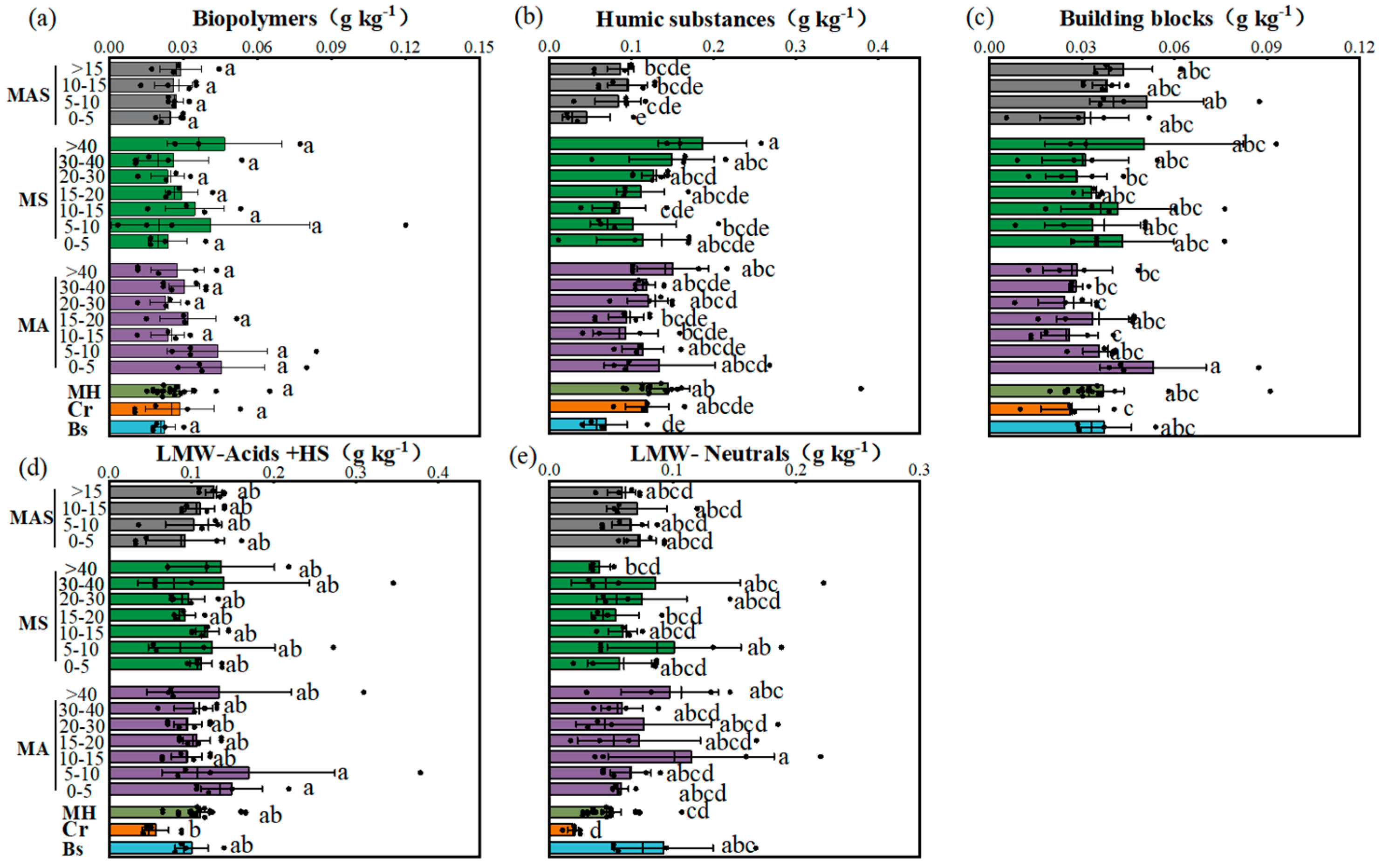
The composition of dissolved organic matter (DOM) was not significantly influenced by vegetation type for biopolymers, building blocks, low molecular weight acids/humic substances (LMW-Acids + HS), and low molecular weight neutrals (LMW-Neutral) (p > 0.05, Figure 1). However, humic substances showed significant accumulation under MH and long-term restoration (>40 years). The humic substances in the MH, MA (>40 years), and MS (>40 years) treatments were 0.14 g kg−1, 0.15 g kg−1, and 0.19 g kg−1, respectively, in the topsoil. Compared to Bs, humic substances increased by 118.3% under MA (>40 years), 171.6% under MS (>40 years), and 111.1% under MH (p < 0.05). Overall, MH, MA (>40 years), and MS (>40 years) increased humic substances accumulation in the MUS.
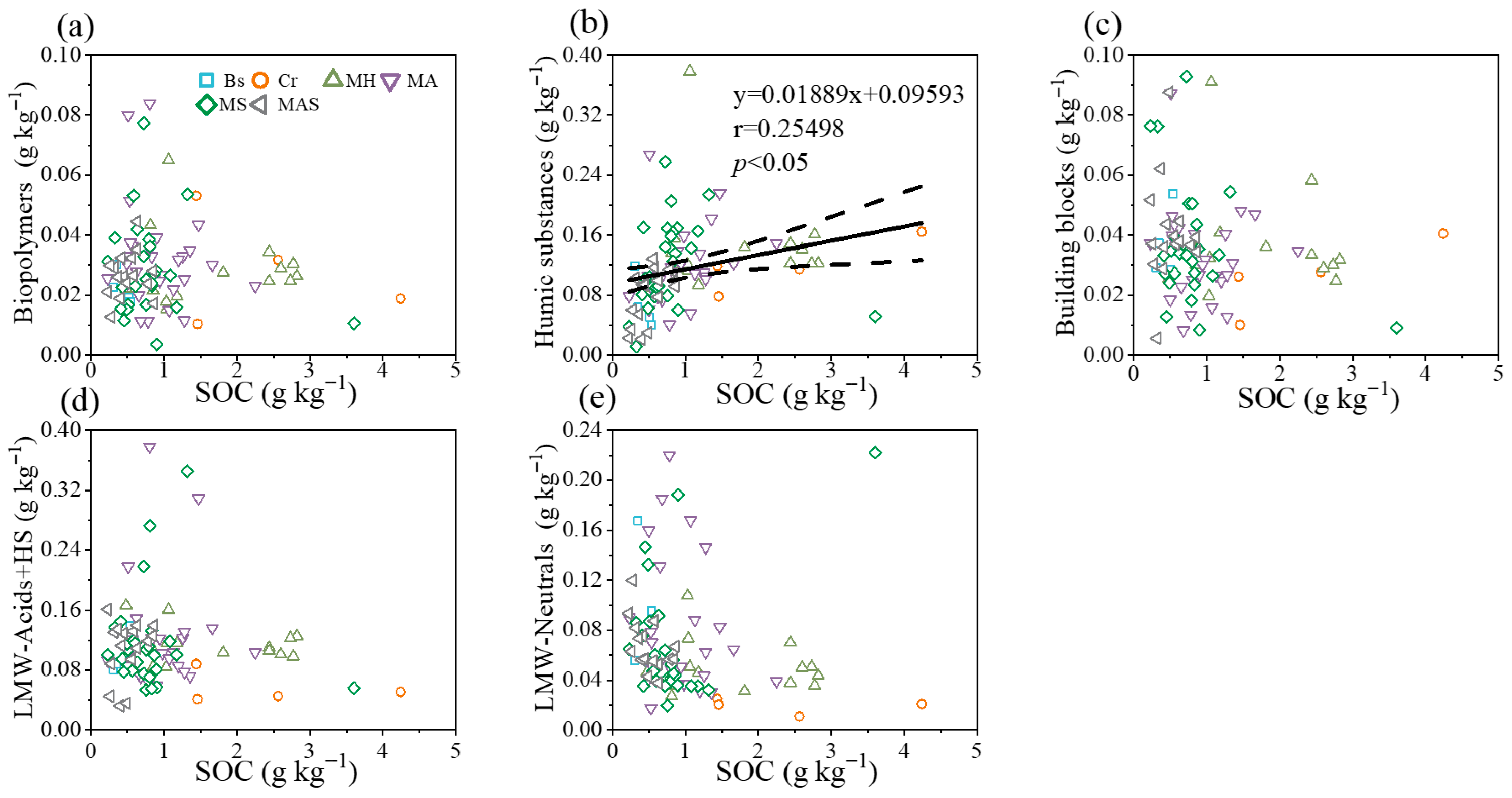
There is no significant correlation between these four DOM fractions (biopolymers, building blocks, LMW-Acids + HS, and LMW-Neutral) and SOC (p > 0.05, Figure 2). However, Pearson correlation analysis revealed a positive relationship between humic substances and SOC in the topsoil (r = 0.255, p < 0.05), suggesting that DOM fractions favoring humification may preferentially stabilize alongside SOC accumulation under prolonged vegetation recovery.

3.3. Soil C:N:P Stoichiometry Under Different Restored Vegetation Types

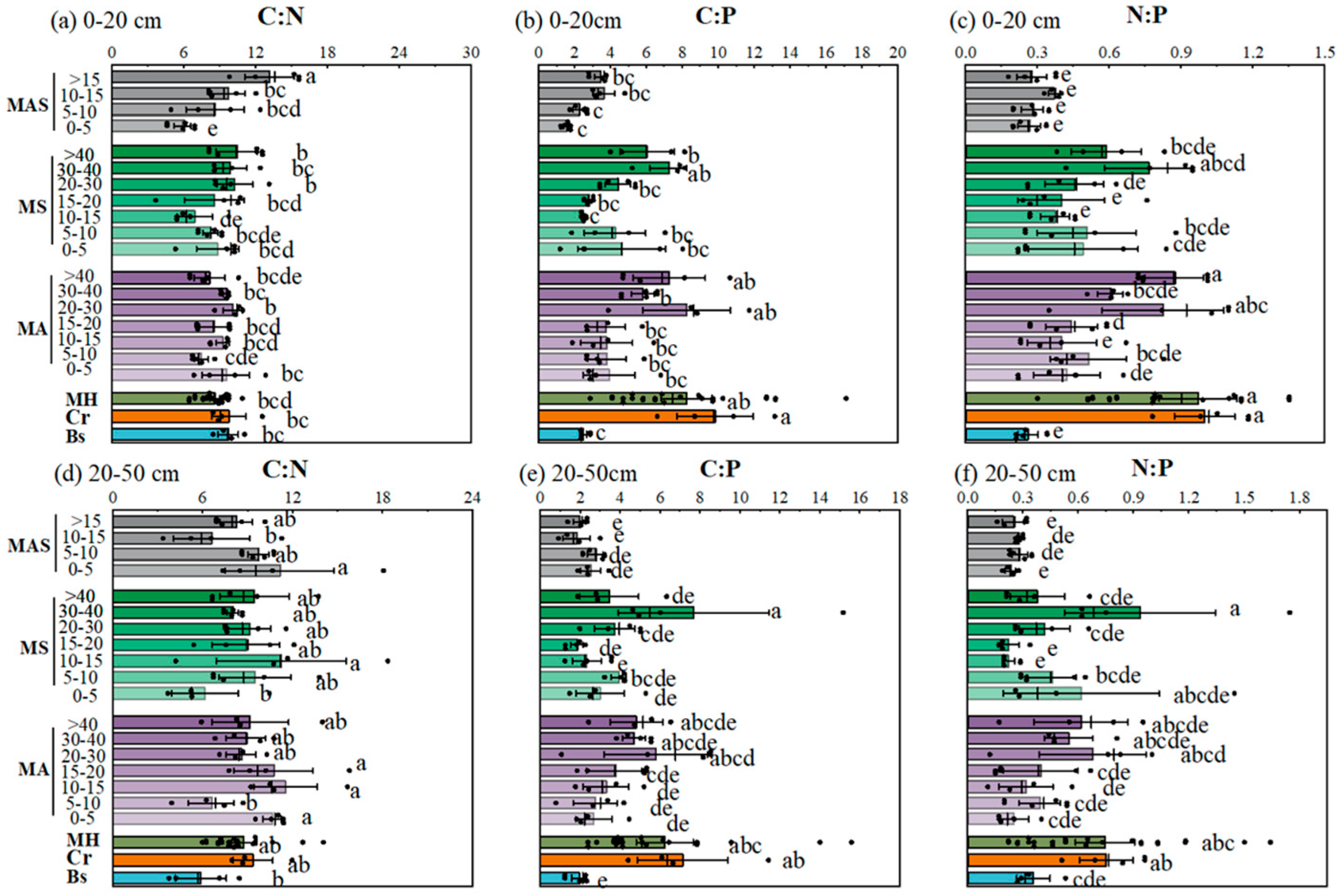
Vegetation type significantly influenced soil C:N:P stoichiometry in both topsoil (0–20 cm) and subsoil (20–50 cm) layers (p < 0.05, Figure 3). In the topsoil, the C:N of the MAS (>15 years) was 13.14 in the topsoil, which was significantly higher than those of the other treatments. The C:P of the Cr, MH, MA (>40 years), and MS (>40 years) treatments were 9.81, 8.23, 7.26, and 6.01, respectively, in the topsoil. Compared to Bs, the C:P increased by 297.2% under Cr, 232.8% under MH, 173.8% under MA (>40 years), and 143.1% under MS (>40 years). The N:P of the Cr, MH, and MA (>40 years) were 1.0, 0.97, and 0.87, respectively, in the topsoil. Compared to Bs, the C:P increased by 286.1% under Cr, 274.9% under MH, and 235.9% under MA (>40 years). Moreover, restoration (<15 years) under MS and MA showed no significant changes in C:P or N:P ratios compared to Bs. In the subsoil, the C:N of the Cr, MH, and MA (>40 years) showed no significant difference compared to Bs. The C:P of the Cr, MH, and MS (30–40 years) were 7.12, 6.23, and 7.67, respectively, in the subsoil. Compared to Bs, the C:P increased by 267.0% under Cr, 221.1% under MH, and 295.4% under MS (30–40 years) (p < 0.05). The N:P of the Cr and MS (30–40 years) were 0.75 and 0.94, respectively, in the subsoil. Compared to Bs, the N:P increased by 114.3% under Cr and 168.6% under MS (30–40 years) (p < 0.05). Overall, the MAS treatment resulted in a higher C:N, while the MH and MA (>40 years) resulted in a higher C:P and N:P in the topsoil. The MH and MS (30–40 years) resulted in a higher C:P, while MS (30–40 years) resulted in a higher N:P in the subsoil in the MUS.

4. Discussion

4.1. Effects of Vegetation Restoration on Soil Nutrient Dynamics in Sandy Ecosystems

The restoration of degraded ecosystems is pivotal in supporting vulnerable sandy ecosystems [29,30]. The MUS is renowned as one of the successful examples of combating desertification. Previous reports have indicated vegetation coverage in the MUS has increased from below 10% to above 20% and reduced soil erosion [31]. Our study showed that SOC and TN can be dramatically affected by vegetation restoration in the MUS. Notably, monoculture herbaceous (MH) showed higher SOC and TN accumulation compared to short-term monoculture arbor (MA) or monoculture shrub (MS) (Table 1). This vegetation-specific effect may be driven by litter chemistry differences. On the one hand, SOC accumulation is regulated by plant-derived carbon inputs, where vegetative traits—including community composition, litter properties, and root exudates [32]. On the other hand, vegetation types modulate microenvironments and microbial assembly through root-soil feedback, leading to changes in SOC [29]. According to Spohn et al. (2013) [11], herbaceous litter exhibits faster decomposition rates due to its biochemical composition, characterized by higher carbohydrate/cellulose and lower lignin concentrations relative to shrub and arbor. Such properties may enhance microbial decomposition efficiency [33], supporting observations of improved nutrient retention capacities in herbaceous-dominated arid ecosystems [25]. In our study, SOC and TN were significantly higher in the 40-year restoration sites and lower in the 10-year restoration sites, likely due to initial soil disturbance effects compounded by limited vegetative inputs [34,35]. A meta-analysis has shown that vegetation restoration in the Loess Plateau significantly increased SOC by 29.40%, and the restoration time was the most important factor affecting the SOC [36]. Moreover, our study demonstrated that arbor-shrub mixed restoration failed to enhance SOC/TN accumulation in the MUS. However, some studies showed that the associated increase in quality and biomass of plant litter, driven by this higher diversity, likely represents key factors promoting soil carbon and nitrogen accumulation [37]. Dai et al. [38] also find that compared to pure plantations, mixed tree-shrub plantations mitigate deep soil water stress and are regarded as the better choice in future silvicultural practices on the eastern Qinghai–Tibet Plateau. Therefore, this discrepancy suggests ecosystem-specific responses to vegetation composition, necessitating further investigation into optimal species ratios and stand densities for mixed systems in sandy environments. Contrasting with dynamic carbon and nitrogen patterns, total phosphorus (TP) remained remarkably stable across all vegetation types. This stability may be related to the TP’s lithogenic nature—derived primarily from parent material weathering with limited biological cycling potential [39]. The decoupling of TP dynamics from vegetation effects may underscore different biogeochemical controls governing phosphorus versus carbon/nutrient cycling in sandy ecosystems.

4.2. Effects of Restoration on Soil Dissolved Organic Matter Fraction

Our findings showed that humic substances exhibited positive correlations with SOC (r = 0.25) and contributed 118–172% higher concentrations in long-term MA or MS (>40 years) compared to Bs. This directly demonstrates that monoculture arbor or shrub may enhance SOC sequestration through the progressive accumulation of recalcitrant humic compounds during extended decomposition cycles [40]. However, the lack of significant DOM component changes in arbor-shrub mixtures might be due to the insufficient restoration age [41,42]. Therefore, long-term monoculture arbor, shrub, and herbaceous plants may rely on classical humification pathways for soil C storage [43]. Our study only analyzed the correlation between DOM components and SOC, without delving into the underlying mechanisms through which different vegetation types lead to variations in SOC accumulation. Future research should further investigate this relationship.

4.3. Soil Stoichiometry Reveals Nutrient Limitations During Restoration

Soil C:N:P stoichiometry serves as a fundamental regulator of biogeochemical cycling, which represents the proportional balance of soil nutrients, and is crucial for understanding the transformation of soil C, N, and P nutrients [44]. This also serves as a valuable indicator for indicating nutrient limitations and usage [45]. A higher soil C:N ratio often signals a reduced rate of organic matter decomposition, as microorganisms require balanced C and N for energy and growth [15]. In our study, soil C:N ratios are approximately 10.4:1 after 40 years of monoculture arbor within the 0–20 cm soil layer. In Chinese grasslands, the average C:N ratio in soil is approximately 12.3 [46]. The soil C:P ratio may reflect the P release from organic matter mineralization, which is an indicator of microbial P retention and bioavailability of soil P [47]. Our study showed that vegetation type can have a strong effect on the C:P ratio, which tends to increase with increasing restoration age (Figure 3). It is likely due to disproportionate changes among C, N, and P concentrations during vegetation restoration [7]. The increased C:P after 30 years of restoration may be due to increased P demand, which is caused by the increased demand from plants and the insufficient supply from the soil [20]. A long-term ecological experiment has indicated that P is the primary limiting element in many ecosystems that have been naturally restored for 30 years [48]. Therefore, total phosphorus (TP) did not change significantly after restoration and may even have decreased [49]. Moreover, the N:P ratio gradually increased as restoration years increased, indicating a possible decrease in N limitation over time [14]. Our study only presented the C:N:P ratios. To gain deeper insights into nutrient limitations (C, N, P) across different vegetation types, further investigation of enzyme activities and microbial community structures (bacteria and fungi) under varied vegetation regimes would be needed to better elucidate these constraints.

5. Conclusions

Our results highlight the differential effects of vegetation types on soil nutrient accumulation across soil profiles following long-term stabilization efforts in MUS. Monoculture herbaceous promotes SOC and TN accumulation, while long-term monoculture arbor (>40 years) enhances humic substance content. Surprisingly, mixed arbor and shrub restoration underperforms in nutrient accrual compared to monocultures of herbaceous plants. TP remains stable across four vegetation types and was lower than cropland in the topsoil. This study identified vegetation-mediated C, N, and P accumulation and nutrient limitations during vegetation restoration. These findings highlight the crucial role of herbaceous and long-term monoculture arbor or shrub in improving SOC and TN dynamics. Our findings can provide essential insights for assessing soil C and N sequestration potential under different vegetation restoration and guidance for vegetation management and socioeconomic policies, especially in ecologically fragile regions.

Author Contributions

C.Z.: Conceptualization, Writing—original draft, Writing—review and editing. X.Z.: Supervision, Funding acquisition, Writing—review and editing. N.Z.: Conceptualization, Validation, Writing—review and editing. All authors have read and agreed to the published version of the manuscript.

Funding

This study was supported by the Science and Technology Innovation Special Fund Project under the Shaanxi Provincial State-owned Capital Operation Budget (Grant No. ZXZJ-2024-036), the Applied Technology Research and Development Project of Shaanxi Academy of Sciences (Grant No. 2025k-05), and the Science and Technology Program Project of the Bio-Agriculture Institute of Shaanxi (Grant No. 2025SY01).

Data Availability Statement

All data generated or analyzed during this study are included in this published article.

Conflicts of Interest

The authors declare that they have no known competing financial interests or personal relationships that could have appeared to influence the work reported in this paper.

References

  1. Feng, X.M.; Fu, B.J.; Lu, N.; Zeng, Y.; Wu, B.F. How Ecological Restoration Alters Ecosystem Services: An Analysis of Carbon Sequestration in China’s Loess Plateau. Sci. Rep. 2013, 3, 2846. [Google Scholar] [CrossRef]
  2. Cui, Y.; Fang, L.; Guo, X.; Han, F.; Ju, W.; Ye, L.; Zhang, X. Natural Grassland as the Optimal Pattern of Vegetation Restoration in Arid and Semi-Arid Regions: Evidence from Nutrient Limitation of Soil Microbes. Sci. Total Environ. 2019, 648, 388–397. [Google Scholar] [CrossRef] [PubMed]
  3. Zhang, C.; Xue, S.; Liu, G.B.; Song, Z.L. Comparison of Soil Qualities Between Different Revegetation Types in the Loess Plateau, China. Plant Soil 2011, 347, 163–178. [Google Scholar] [CrossRef]
  4. Deng, L.; Liu, G.B.; Shangguan, Z.P. Land-Use Conversion and Changing Soil Carbon Stocks in China’s ‘Grain-for-Green’ Program: A Synthesis. Glob. Change Biol. 2014, 20, 3544–3556. [Google Scholar] [CrossRef]
  5. Liu, J.; Liu, J.; Wang, R.; Li, P. Soil C:N:P Stoichiometry and Microbial Community Dynamics Across Six Vegetation Restoration Patterns in the Upper Yellow River. J. Environ. Manag. 2026, 404, 129396. [Google Scholar] [CrossRef]
  6. Gao, N.; Liang, W.; Gou, F.; Liu, Y.; Fu, B.; Lü, Y. Assessing the Impact of Agriculture, Coal Mining, and Ecological Restoration on Water Sustainability in the Mu Us Sandyland. Sci. Total Environ. 2024, 929, 172513. [Google Scholar] [CrossRef] [PubMed]
  7. Chen, H.; Zhang, S.; Ma, C.; Xiang, Y.; Wu, J. Restoring Farmland to Forest Increases Phosphorus Limitation Based on Microbial and Soil C:N:P Stoichiometry—A Synthesis Across China. For. Ecol. Manag. 2024, 556, 121745. [Google Scholar] [CrossRef]
  8. Krause, H.-M.; Stehle, B.; Mayer, J.; Mayer, M.; Steffens, M.; Mäder, P.; Fliessbach, A. Biological Soil Quality and Soil Organic Carbon Change in Biodynamic, Organic, and Conventional Farming Systems After 42 Years. Agron. Sustain. Dev. 2022, 42, 117. [Google Scholar] [CrossRef]
  9. Porazinska, D.L.; Bardgett, R.D.; Blaauw, M.B.; Hunt, H.W.; Parsons, A.N.; Seastedt, T.R.; Wall, D.H. Relationships at the Aboveground–Belowground Interface: Plants, Soil Biota, and Soil Processes. Ecol. Monogr. 2003, 73, 377–395. [Google Scholar] [CrossRef]
  10. Peri, P.L.; Gargaglione, V.; Pastur, G.M. Above- and Belowground Nutrients Storage and Biomass Accumulation in Marginal Nothofagus antarctica Forests in Southern Patagonia. For. Ecol. Manag. 2008, 255, 2502–2511. [Google Scholar] [CrossRef]
  11. Spohn, M.; Ermak, A.; Kuzyakov, Y. Microbial Gross Organic Phosphorus Mineralization Can be Stimulated by Root Exudates—A 33P Isotopic Dilution Study. Soil Biol. Biochem. 2013, 65, 254–263. [Google Scholar] [CrossRef]
  12. Yang, L.; Song, X.; Lyu, S.; Shen, W.; Gao, Y. Dynamics and Fractions of Soil Organic Carbon in Response to 35 Years of Afforestation in Subtropical China. Plant Soil 2024, 500, 481–494. [Google Scholar] [CrossRef]
  13. Wang, S.; Fu, B.J.; Piao, S.L.; Lü, Y.H.; Ciais, P.; Feng, X.M.; Wang, Y.F. Reduced Sediment Transport in the Yellow River Due to Anthropogenic Changes. Nat. Geosci. 2015, 9, 38–41. [Google Scholar] [CrossRef]
  14. Zhong, Z.; Wu, S.; Lu, X.; Ren, Z.; Wu, Q.; Xu, M.; Ren, C.; Yang, G.; Han, X. Organic Carbon, Nitrogen Accumulation, and Soil Aggregate Dynamics Affected by Vegetation Restoration Patterns in the Loess Plateau of China. Catena 2021, 196, 104867. [Google Scholar] [CrossRef]
  15. Li, W.; Zhang, Y.; Shen, R.; Zhu, J.; Cong, N. Ecosystem Carbon Uptake Was Co-Limited by Nitrogen and Phosphorus in Alpine Meadow on the Qinghai–Tibet Plateau. Chin. J. Appl. Ecol. 2022, 33, 51–58. (In Chinese) [Google Scholar]
  16. Speckert, T.C.; Suremann, J.; Gavazov, K.; Santos, M.J.; Hagedorn, F.; Wiesenberg, G.L.B. Soil Organic Carbon Stocks Did Not Change After 130 Years of Afforestation on a Former Swiss Alpine Pasture. SOIL 2023, 9, 609–621. [Google Scholar] [CrossRef]
  17. Delgado-Baquerizo, M.; Maestre, F.T.; Gallardo, A.; Bowker, M.A.; Wallenstein, M.D.; Quero, J.L.; Ochoa, V.; Gozalo, B.; García-Gómez, M.; Soliveres, S.; et al. Decoupling of Soil Nutrient Cycles as a Function of Aridity in Global Drylands. Nature 2013, 502, 672–676. [Google Scholar] [CrossRef]
  18. Chen, M.; Yang, X.; Shao, M.A.; Wei, X.; Li, T. Changes in Soil C–N–P Stoichiometry After 20 Years of Typical Artificial Vegetation Restoration in Semiarid Continental Climate Zones. Sci. Total Environ. 2022, 852, 158380. [Google Scholar] [CrossRef]
  19. Hartman, W.H.; Richardson, C.J. Differential Nutrient Limitation of Soil Microbial Biomass and Metabolic Quotients (qCO2): Is There a Biological Stoichiometry of Soil Microbes? PLoS ONE 2013, 8, e57127. [Google Scholar] [CrossRef]
  20. Liu, Y.; Fang, Y.; An, S. How C:N:P Stoichiometry in Soils and Plants Responds to Succession in Robinia pseudoacacia Forests on the Loess Plateau, China. For. Ecol. Manag. 2020, 475, 118394. [Google Scholar] [CrossRef]
  21. Achat, D.L.; Bakker, M.R.; Augusto, L.; Derrien, D.; Gallegos, N.; Lashchinskiy, N.; Milin, S.; Nikitich, P.; Raudina, T.; Rusalimova, O. Phosphorus Status of Soils from Contrasting Forested Ecosystems in Southwestern Siberia: Effects of Microbiological and Physicochemical Properties. Biogeosciences 2013, 10, 733–752. [Google Scholar] [CrossRef]
  22. Yin, R.; Deng, H.; Wang, H.L.; Zhang, B. Vegetation Type Affects Soil Enzyme Activities and Microbial Functional Diversity Following Re-Vegetation of Severely Eroded Red Soil in Subtropical China. Catena 2014, 115, 96–103. [Google Scholar] [CrossRef]
  23. Bell, C.; Carrillo, Y.; Boot, C.M.; Rocca, J.D.; Pendall, E.; Wallenstein, M.D. Rhizosphere Stoichiometry: Are C:N:P Ratios of Plants, Soils, and Enzymes Conserved at the Plant Species-Level? New Phytol. 2013, 201, 505–517. [Google Scholar] [CrossRef]
  24. Xu, M.; Li, W.; Wang, J.; Zhu, Y.; Feng, Y.; Yang, G.; Zhang, W. Soil Ecoenzymatic Stoichiometry Reveals Microbial Phosphorus Limitation After Vegetation Restoration on the Loess Plateau, China. Sci. Total Environ. 2022, 815, 152918. [Google Scholar] [CrossRef]
  25. Wei, X.R.; Shao, M.A. Distribution of Soil Nutrients on Sloping Land in the Gully Region Watershed of the Loess Plateau. Acta Ecol. Sin. 2007, 27, 603–612. [Google Scholar]
  26. Bao, S.D. Methods for Soil Agricultural and Chemical Analysis; China Agricultural Press: Beijing, China, 2000. (In Chinese) [Google Scholar]
  27. Bremner, J.M. Determination of Nitrogen in Soil by the Kjeldahl Method. J. Agric. Sci. 1960, 55, 11–33. [Google Scholar] [CrossRef]
  28. Zhang, W.; Li, L.; Wang, D.; Wang, R.; Yu, S.; Gao, N. Characterizing Dissolved Organic Matter in Aquatic Environments by Size Exclusion Chromatography Coupled with Multiple Detectors. Anal. Chim. Acta 2022, 1191, 339358. [Google Scholar] [CrossRef] [PubMed]
  29. Eslaminejad, P.; Heydari, M.; Kakhki, F.V.; Mirab-Balou, M.; Omidipour, R.; Muñoz-Rojas, M.; Lucas-Borja, M.E. Plant Species and Season Influence Soil Physicochemical Properties and Microbial Function in a Semi-Arid Woodland Ecosystem. Plant Soil 2020, 456, 43–59. [Google Scholar] [CrossRef]
  30. Du, Z.; Zhou, R.; Chen, Y.; Zhan, E.; Chen, Y.; Zheng, H.; Liu, Y. Effects of Long-Term Vegetation Restoration on Soil Aggregate and Aggregate-Associated Nutrient Stoichiometry of Desertified Grassland on the Eastern Qinghai–Tibet Plateau. Agric. Ecosyst. Environ. 2025, 388, 109661. [Google Scholar] [CrossRef]
  31. Zhang, M.; Wu, X. The Rebound Effects of Recent Vegetation Restoration Projects in Mu Us Sandy Land of China. Ecol. Indic. 2020, 113, 106228. [Google Scholar] [CrossRef]
  32. Feng, J.; He, K.; Zhang, Q.; Han, M.; Zhu, B. Changes in Plant Inputs Alter Soil Carbon and Microbial Communities in Forest Ecosystems. Glob. Change Biol. 2022, 28, 3426–3440. [Google Scholar] [CrossRef]
  33. Domenach, A.M.; Moiroud, A.; Jocteur-Monrozier, L. Leaf Carbon and Nitrogen Constituents of Some Actinorhizal Tree Species. Soil Biol. Biochem. 1994, 26, 649–653. [Google Scholar] [CrossRef]
  34. Cunningham, S.C.; Metzeling, K.J.; Nally, R.M.; Thomson, J.R.; Cavagnaro, T.R. Changes in Soil Carbon of Pastures After Afforestation with Mixed Species: Sampling, Heterogeneity and Surrogates. Agric. Ecosyst. Environ. 2012, 158, 58–65. [Google Scholar] [CrossRef]
  35. Zhu, N.; Yan, Y.; Bai, K.; Zhang, J.; Wang, C.; Wang, X.; Xu, D.; Liu, J.; Xin, X.; Chen, J. Conversion of Croplands to Shrublands Does Not Improve Soil Organic Carbon and Nitrogen but Reduces Soil Phosphorus in Temperate Grassland of Northern China. Geoderma 2023, 432, 116407. [Google Scholar] [CrossRef]
  36. Zhao, Q.; Shi, P.; Li, P.; Li, Z.; Min, Z.; Sun, J.; Cui, L.; Niu, H.; Zu, P.; Cao, M. Effects of Vegetation Restoration on Soil Organic Carbon in the Loess Plateau: A Meta-Analysis. Land Degrad. Dev. 2023, 34, 2088–2097. [Google Scholar] [CrossRef]
  37. Duan, P.; Yang, X.; Chen, J.; Nottingham, A.T.; Domeignoz-Horta, L.A.; Hicks, L.C.; Yuan, H.; Du, H.; Wang, K.; Li, D. Tree Species Diversity Influences Soil Carbon Persistence by Reconfiguring Stabilization Pathways. J. Ecol. 2026, 114, e70288. [Google Scholar] [CrossRef]
  38. Dai, J.J.; Li, Y.Y.; Wang, L. Mixed-Species Plantations Alleviate Deep Soil Water Depletion and Facilitate Hydrological Niche Partitioning Compared to Pure Plantations. For. Ecol. Manag. 2023, 539, 121017. [Google Scholar] [CrossRef]
  39. Cheng, M.; An, S.S. Responses of Soil Nitrogen, Phosphorus and Organic Matter to Vegetation Succession on the Loess Plateau of China. J. Arid Land 2015, 7, 216–223. [Google Scholar] [CrossRef]
  40. Bagherifam, S.; Brown, T.C.; Bagherifam, S.; Baglieri, A. Sequential Extraction of Labile and Recalcitrant Fractions of Soil Organic Matter: A Case Study Focusing on Antimony (Sb) in Humic Acids, Fulvic Acids and Humin Fractions of Long-Term Aged Contaminated Soils. Environ. Pollut. 2023, 327, 121610. [Google Scholar] [CrossRef]
  41. Fujii, K.; Nakada, Y.; Umezawa, K.; Yoshida, M.; Shibata, M.; Hayakawa, C.; Hangs, R. A Comparison of Lignin-Degrading Enzyme Activities in Forest Floor Layers Across a Global Climatic Gradient. Soil Ecol. Lett. 2020, 2, 281–294. [Google Scholar] [CrossRef]
  42. Wu, D.; Ren, C.; Ren, D.; Tian, Y.; Li, Y.; Wu, C.; Li, Q. New Insights into Carbon Mineralization in Tropical Paddy Soil Under Land Use Conversion: Coupled Roles of Soil Microbial Community, Metabolism, and Dissolved Organic Matter Chemodiversity. Geoderma 2023, 432, 116393. [Google Scholar] [CrossRef]
  43. Semenov, V.M.; Tulina, A.S.; Semenova, N.A.; Ivannikova, L.A. Humification and Nonhumification Pathways of Organic Matter Stabilization in Soil: A Review. Eurasian Soil Sci. 2013, 46, 355–368. [Google Scholar] [CrossRef]
  44. Bing, H.; Wu, Y.; Zhou, J.; Sun, H.; Luo, J.; Wang, J.; Yu, D. Stoichiometric Variation of Carbon, Nitrogen, and Phosphorus in Soils and Its Implication for Nutrient Limitation in Alpine Ecosystem of Eastern Tibetan Plateau. J. Soils Sediments 2016, 16, 405–416. [Google Scholar] [CrossRef]
  45. Zhang, H.; Niu, L.; Hu, K.; Hao, J.; Li, F.; Wang, F.; Chen, H. Long-Term Nitrogen and Phosphorus Fertilization Effects on Soil Aggregate Stability and Aggregate-Associated Carbon and Nitrogen in the North China Plain. Soil Sci. Soc. Am. J. 2020, 85, 732–745. [Google Scholar] [CrossRef]
  46. Zhou, Y.; Boutton, T.; Wu, X. Soil C:N:P Stoichiometry Responds to Vegetation Change from Grassland to Woodland. Biogeochemistry 2018, 140, 341–357. [Google Scholar] [CrossRef]
  47. Wang, J.; Wu, Y.; Zhou, J.; Bing, H.; Sun, H. Carbon Demand Drives Microbial Mineralization of Organic Phosphorus During Early-Stage Soil Development. Biol. Fertil. Soils 2016, 52, 825–839. [Google Scholar] [CrossRef]
  48. Wardle, D.A.; Walker, L.R.; Bardgett, R.D. Ecosystem Properties and Forest Decline in Contrasting Long-Term Chronosequences. Science 2004, 305, 509–513. [Google Scholar] [CrossRef]
  49. Alavaisha, E.; Manzoni, S.; Lindborg, R. Different Agricultural Practices Affect Soil Carbon, Nitrogen and Phosphorus in Kilombero-Tanzania. J. Environ. Manag. 2019, 234, 159–166. [Google Scholar] [CrossRef] [PubMed]
Figure 1. DOC fractionations depending on different vegetation types at 0–20 cm soil depth for five DOM fractions: (a) Biopolymers; (b) Humic substances; (c) Building blocks; (d) LMW-Acids + HS; (e) LMW-Neutral. Six vegetation types were monoculture arbor treatment (MA), monoculture shrub treatment (MS), arbor-shrub mixed treatment (MAS), monoculture herbaceous treatment (MH), cropland (Cr), and bare sand (Bs). In each subfigure, different lowercase letters indicate significant differences (p < 0.05) among different vegetation types.
Agronomy 16 00815 g001
Figure 2. Pearson correlation between SOC and fractionation of DOC at 0–20 cm soil depth for five DOM fractions: (a) Biopolymers; (b) Humic substances; (c) Building blocks; (d) LMW-Acids + HS; (e) LMW-Neutral. In each subfigure, the area within the dotted line represents the 95% confidence interval for the slope (p < 0.05). Six vegetation types were monoculture arbor treatment (MA), monoculture shrub treatment (MS), arbor-shrub mixed treatment (MAS), monoculture herbaceous treatment (MH), cropland (Cr), and bare sand (Bs).
Agronomy 16 00815 g002
Figure 3. Soil C:N:P stoichiometry of 0–20 cm (ac) and 20–50 cm (df) depends on different vegetation types. Six vegetation types were monoculture arbor treatment (MA), monoculture shrub treatment (MS), arbor-shrub mixed treatment (MAS), monoculture herbaceous treatment (MH), cropland (Cr), and bare sand (Bs). Different lowercase letters indicate significant differences (p < 0.05) among different vegetation types.
Agronomy 16 00815 g003
Table 1. The species of all the plots within a single vegetation type.
Vegetation TypeDominant Species
MAPinus sylvestris MongolicaPopulus alba L.Populus alba pyramidalis
Leuce Populus L.Salix matsudanaUlmus pumila
Elaeagnus angustifolia
MSAmygdalus pedunculataArtemisia ordosicaSlix psammophila
Hedysarum scopariumAmorpha fruticosaCaragana korshinskii
Corethrodendron lignosum laeveTamarix ramosissima Ledeb.
MASPinus sylvestris MongolicaAmygdalus pedunculataSlix psammophila
Hedysarum scopariumAmorpha fruticosa
MHPugionium cornutumLeymus secalinusAstragalus melilotoides
Stipa caucasicaArtemisia annua L.Polygonum aviculare L. aviculare
Thermopsis lanceolataArtemisia desertorum Spreng.Phragmites australis
Sophora flavescensAstragalus laxmannii Jacq.Lactuca tatarica
Equisetum hyemale L.Sophora alopecuroides L.Imperata cylindrica L.
Sporobolus fertilis
Note: Four vegetation types were monoculture arbor treatment (MA), monoculture shrub treatment (MS), arbor-shrub mixed treatment (MAS), and monoculture herbaceous treatment (MH).
Table 2. Soil organic carbon (SOC), total nitrogen (TN), and total phosphorus (TP) of 0–20 cm and 20–50 cm depend on different vegetation types.
0–20 cm Layer20–50 cm Layer
Vegetation TypesSOC (g kg−1)TN (g kg−1)TP (g kg−1)SOC (g kg−1)TN (g kg−1)TP (g kg−1)
Bs0.48 cd0.05 e0.19 bc0.35 e0.06 cd0.18 d
Cr3.8 a0.39 a0.4 a2.17 a0.23 a0.31 a
MH1.86 b0.22 b0.23 bc1.33 b0.16 b0.21 bcd
MA_0-50.72 cd0.08 cde0.2 bc0.56 cde0.05 d0.24 abcd
MA_5-100.86 cd0.12 cde0.23 bc0.61 cde0.09 bcd0.24 abcd
MA_10-150.96 c0.1 cde0.28 b0.76 bcde0.07 cd0.25 abc
MA_15-200.99 c0.12 cde0.26 b0.84 bcde0.09 bcd0.23 bcd
MA_20-301.54 bc0.16 bc0.2 bc1.14 bcd0.13 bcd0.24 abcd
MA_30-401.28 bc0.13 c0.23 bc1.03 bcde0.12 bcd0.22 bcd
MA_>401.93 b0.24 b0.28 b1.19 bc0.15 abc0.25 abc
MS_0-50.78 cd0.08 cde0.18 c0.52 cde0.1 bcd0.19 cd
MS_5-101.03 c0.12 cde0.25 bc0.8 bcde0.09 bcd0.2 bcd
MS_10-150.53 cd0.08 cde0.21 bc0.51 cde0.05 d0.21 bcd
MS_15-200.69 cd0.1 cde0.24 bc0.49 cde0.06 d0.27 ab
MS_20-301 c0.1 cde0.23 bc0.71 bcde0.08 cd0.2 bcd
MS_30-401.83 b0.2 b0.25 b1.73 ab0.21 ab0.22 bcd
MS_>401.35 bc0.13 c0.24 bc0.78 bcde0.09 cd0.25 abcd
MAS_0-50.3 d0.05 de0.19 bc0.47 cde0.04 d0.19 cd
MAS_5-100.49 cd0.06 cde0.22 bc0.57 cde0.06 d0.21 bcd
MAS_10-150.65 cd0.07 cde0.18 c0.35 de0.05 d0.2 bcd
MAS_>150.74 cd0.06 cde0.22 bc0.43 cde0.05 d0.22 bcd
Note: Numbers in each vegetation type represent the range of restoration age. Six vegetation types were monoculture arbor treatment (MA), monoculture shrub treatment (MS), arbor-shrub mixed treatment (MAS), monoculture herbaceous treatment (MH), cropland (Cr), and bare sand (Bs). Different lowercase letters indicate significant differences (p < 0.05) among different vegetation types.
Disclaimer/Publisher’s Note: The statements, opinions and data contained in all publications are solely those of the individual author(s) and contributor(s) and not of MDPI and/or the editor(s). MDPI and/or the editor(s) disclaim responsibility for any injury to people or property resulting from any ideas, methods, instructions or products referred to in the content.