Reduced Chemical Fertilizer Combined with Microbial Inoculants: Implications for Soil Fertility and Profitability in Mediterranean Vegetable Production
 , ,
, ,  , ,
, ,  ,
,  ,
,  ,
,  and
and
Abstract
1. Introduction
2. Materials and Methods
2.1. Experimental Site and Crop Management
2.2. Fertilization Treatments and Inoculant Application
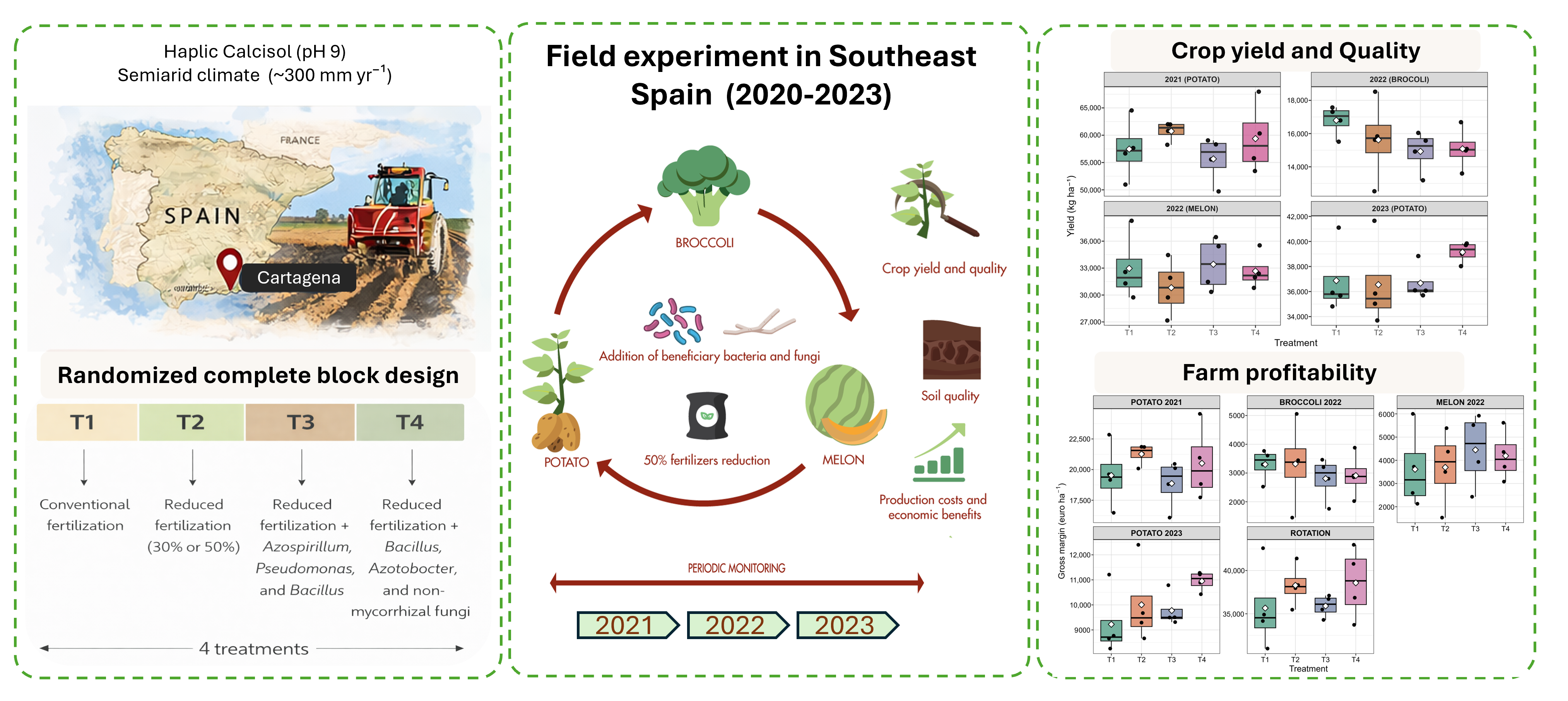
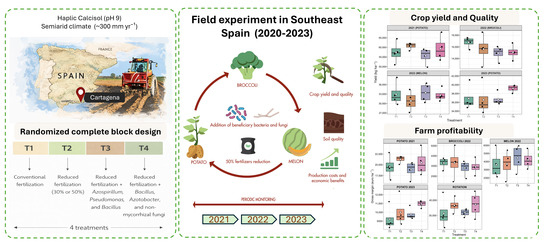
- T1, conventional fertilization, based on the specific nutrient requirements of each crop.
- T2, reduced fertilization, with a 30% reduction relative to T1 in the first potato crop (2021) and a 50% reduction in the subsequent crops (broccoli, melon, and second potato crop, 2022–2023).
- T3, the same reduced fertilization regime as T2, combined with a commercial inoculant containing N-fixing and nutrient-solubilizing bacteria (Azospirillum, Pseudomonas, and Bacillus).
- T4, the same reduced fertilization regime as T2, combined with a commercial inoculant containing N-fixing and nutrient-solubilizing bacteria (Bacillus, Azotobacter) plus non-mycorrhizal fungi.
2.3. Weather Data Recording
2.4. Soil Sampling and Analysis
2.5. Total Yield and Quality Evaluations
2.6. Economic Analysis
2.7. Statistical Analysis
3. Results
3.1. Weather Conditions During the Trial
3.2. Total Yield and Agronomical Evaluation
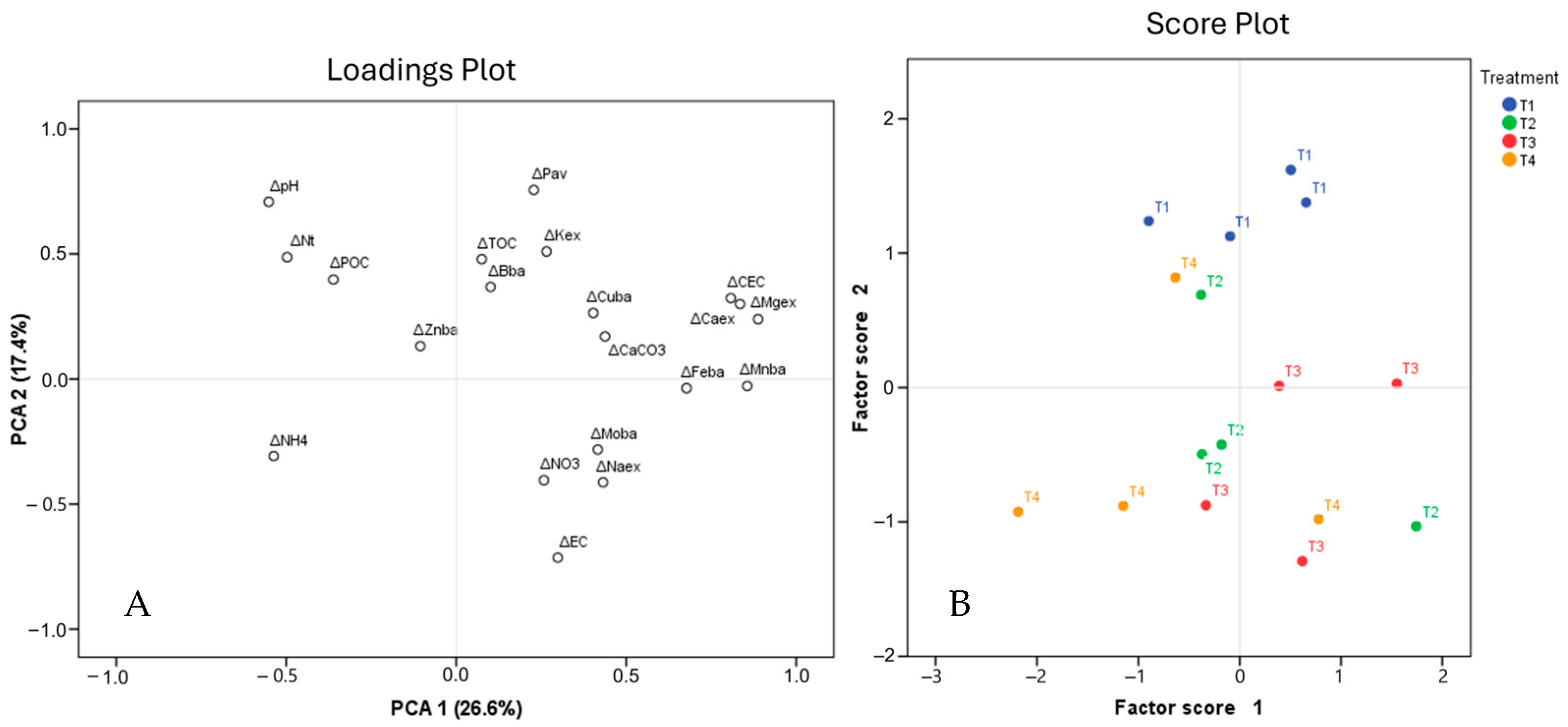
3.3. Evolution of Soil Physicochemical Properties Throughout the Rotation
3.4. Economic Assessment
4. Discussion
4.1. Quality Parameters Are More Responsive than Yield to Reduced Fertilization and Microbial Inoculation
4.2. Reduced Fertilization with Microbial Inoculants Was Associated with Changes in Soil Indicators Related to N Dynamics
4.3. Profitability Is Maintained Under Reduced Fertilization and Microbial Inoculation
5. Conclusions
Supplementary Materials
Author Contributions
Funding
Data Availability Statement
Acknowledgments
Conflicts of Interest
Abbreviations
| AMF | Arbuscular mycorrhizal fungi |
| CEC | Cation exchange capacity |
| DMRT | Duncan’s multiple range test |
| EC | Electrical conductivity |
| ET0 | Reference evapotranspiration |
| PCA | Principal component analysis |
| PGPM | Plant-growth-promoting microorganisms |
| PGPR | Plant-growth-promoting rhizobacteria |
| POC | Particulate organic carbon |
| TOC | Total organic carbon |
References
- Acosta, J.A.; Faz, A.; Jansen, B.; Kalbitz, K.; Martínez-Martínez, S. Assessment of Salinity Status in Intensively Cultivated Soils under Semiarid Climate, Murcia, SE Spain. J. Arid Environ. 2011, 75, 1056–1066. [Google Scholar] [CrossRef]
- Gondwe, R.L.; Kinoshita, R.; Sano, M.; Suminoe, T.; Aiuchi, D.; Koaze, H.; Palta, J.; Tani, M. Lack of Yield Response in Potato (Solanum tuberosum L.) to Phosphate Fertilizer under Contrasting Soil Types Varying in Phosphate Absorption Coefficient and Available Phosphate. Soil Sci. Plant Nutr. 2017, 63, 171–177. [Google Scholar] [CrossRef]
- Fachini, J.; Figueiredo, C.C.d.; Vale, A.T.d. Assessing Potassium Release in Natural Silica Sand from Novel K-Enriched Sewage Sludge Biochar Fertilizers. J. Environ. Manag. 2022, 314, 115080. [Google Scholar] [CrossRef]
- Rahman, K.M.A.; Zhang, D. Effects of Fertilizer Broadcasting on the Excessive Use of Inorganic Fertilizers and Environmental Sustainability. Sustainability 2018, 10, 759. [Google Scholar] [CrossRef]
- He, Y.; Su, R.; Wang, Y.; Li, S.; Huang, Q.; Chen, X.; Zhang, W.; Yao, Z. Environmental Impacts and Nitrogen-Carbon-Energy Nexus of Vegetable Production in Subtropical Plateau Lake Basins. Front. Plant Sci. 2024, 15, 1472978. [Google Scholar] [CrossRef]
- Zhang, F.; Liu, F.; Ma, X.; Guo, G.; Liu, B.; Cheng, T.; Liang, T.; Tao, W.; Chen, X.; Wang, X. Greenhouse Gas Emissions from Vegetables Production in China. J. Clean. Prod. 2021, 317, 128449. [Google Scholar] [CrossRef]
- Qasim, W.; Zhao, Y.; Wan, L.; Lv, H.; Lin, S.; Gettel, G.M.; Butterbach-Bahl, K. The Potential Importance of Soil Denitrification as a Major N Loss Pathway in Intensive Greenhouse Vegetable Production Systems. Plant Soil 2022, 471, 157–174. [Google Scholar] [CrossRef]
- Zhang, H.; Batchelor, W.D.; Hu, K.; Han, H.; Li, J. Modeling Nitrogen Fate and Water and Nitrogen Use Efficiencies under Different Greenhouse Vegetable Production Systems Using the WHCNS-Veg Model. Plants 2024, 13, 1384. [Google Scholar] [CrossRef]
- Sandström, V.; Kaseva, J.; Porkka, M.; Kuisma, M.; Sakieh, Y.; Kahiluoto, H. Disparate History of Transgressing Planetary Boundaries for Nutrients. Glob. Environ. Change 2023, 78, 102628. [Google Scholar] [CrossRef]
- Van Eynde, E.; Ros, G.H.; Yunta, F.; Muntwyler, A.; Hinsinger, P.; Fendrich, A.N.; Panagos, P. Opportunities for Optimizing Phosphorus Inputs in EU Agricultural Soils. Environ. Sci. Policy 2025, 171, 104168. [Google Scholar] [CrossRef]
- Withers, P.J.A.; Van Dijk, K.C.; Neset, T.-S.S.; Nesme, T.; Oenema, O.; Rubæk, G.H.; Schoumans, O.F.; Smit, B.; Pellerin, S. Stewardship to Tackle Global Phosphorus Inefficiency: The Case of Europe. AMBIO 2015, 44, 193–206. [Google Scholar] [CrossRef]
- Dodds, W.K.; Bouska, W.W.; Eitzmann, J.L.; Pilger, T.J.; Pitts, K.L.; Riley, A.J.; Schloesser, J.T.; Thornbrugh, D.J. Eutrophication of U.S. Freshwaters: Analysis of Potential Economic Damages. Environ. Sci. Technol. 2009, 43, 12–19. [Google Scholar] [CrossRef]
- European Commission CAP 2023-27. Available online: https://agriculture.ec.europa.eu/common-agricultural-policy/cap-overview/cap-2023-27_en (accessed on 24 April 2025).
- Bender, S.F.; Wagg, C.; Van Der Heijden, M.G.A. An Underground Revolution: Biodiversity and Soil Ecological Engineering for Agricultural Sustainability. Trends Ecol. Evol. 2016, 31, 440–452. [Google Scholar] [CrossRef]
- Țopa, D.-C.; Căpșună, S.; Calistru, A.-E.; Ailincăi, C. Sustainable Practices for Enhancing Soil Health and Crop Quality in Modern Agriculture: A Review. Agriculture 2025, 15, 998. [Google Scholar] [CrossRef]
- Town, J.R.; Dumonceaux, T.; Tidemann, B.; Helgason, B.L. Crop Rotation Significantly Influences the Composition of Soil, Rhizosphere, and Root Microbiota in Canola (Brassica napus L.). Environ. Microbiome 2023, 18, 40. [Google Scholar] [CrossRef]
- Benini, M.; Blasi, E.; Detti, P.; Fosci, L. Solving Crop Planning and Rotation Problems in a Sustainable Agriculture Perspective. Comput. Oper. Res. 2023, 159, 106316. [Google Scholar] [CrossRef]
- Reckling, M.; Hecker, J.-M.; Bergkvist, G.; Watson, C.A.; Zander, P.; Schläfke, N.; Stoddard, F.L.; Eory, V.; Topp, C.F.E.; Maire, J.; et al. A Cropping System Assessment Framework—Evaluating Effects of Introducing Legumes into Crop Rotations. Eur. J. Agron. 2016, 76, 186–197. [Google Scholar] [CrossRef]
- Raveloaritiana, E.; Wanger, T.C. Decades Matter: Agricultural Diversification Increases Financial Profitability, Biodiversity, and Ecosystem Services over Time. arXiv 2024, arXiv:2403.05599. [Google Scholar] [CrossRef]
- Lopes, M.J.d.S.; Dias-Filho, M.B.; Gurgel, E.S.C. Successful Plant Growth-Promoting Microbes: Inoculation Methods and Abiotic Factors. Front. Sustain. Food Syst. 2021, 5, 606454. [Google Scholar] [CrossRef]
- Singh, V.; Kumar, B. A Review of Agricultural Microbial Inoculants and Their Carriers in Bioformulation. Rhizosphere 2024, 29, 100843. [Google Scholar] [CrossRef]
- Adesemoye, A.O.; Torbert, H.A.; Kloepper, J.W. Plant Growth-Promoting Rhizobacteria Allow Reduced Application Rates of Chemical Fertilizers. Microb. Ecol. 2009, 58, 921–929. [Google Scholar] [CrossRef]
- Ollio, I.; González Rosado, M.; Lloret, E.; Martínez-Martínez, S.; Egea-Gilabert, C.; Calviño, D.F.; Zornoza, R.; Fernández, J.A. Integrating Plant Growth Microorganisms in Potato Farming Reduce Soil CO2 Emissions and Improve Crop Quality. Soil Use Manag. 2025, 41, e13140. [Google Scholar] [CrossRef]
- Rose, M.T.; Phuong, T.L.; Nhan, D.K.; Cong, P.T.; Hien, N.T.; Kennedy, I.R. Up to 52% N Fertilizer Replaced by Biofertilizer in Lowland Rice via Farmer Participatory Research. Agron. Sustain. Dev. 2014, 34, 857–868. [Google Scholar] [CrossRef]
- Ye, L.; Zhao, X.; Bao, E.; Li, J.; Zou, Z.; Cao, K. Bio-Organic Fertilizer with Reduced Rates of Chemical Fertilization Improves Soil Fertility and Enhances Tomato Yield and Quality. Sci. Rep. 2020, 10, 177. [Google Scholar] [CrossRef]
- Galindo, F.S.; Pagliari, P.H.; da Silva, E.C.; de Lima, B.H.; Fernandes, G.C.; Thiengo, C.C.; Bernardes, J.V.S.; Jalal, A.; Oliveira, C.E.S.; de Sousa Vilela, L.; et al. Impact of Nitrogen Fertilizer Sustainability on Corn Crop Yield: The Role of Beneficial Microbial Inoculation Interactions. BMC Plant Biol. 2024, 24, 268. [Google Scholar] [CrossRef]
- de Vries, W.; Posch, M.; Simpson, D.; de Leeuw, F.A.A.M.; van Grinsven, H.J.M.; Schulte-Uebbing, L.F.; Sutton, M.A.; Ros, G.H. Trends and Geographic Variation in Adverse Impacts of Nitrogen Use in Europe on Human Health, Climate, and Ecosystems: A Review. Earth-Sci. Rev. 2024, 253, 104789. [Google Scholar] [CrossRef]
- Loncaric, Z.; Vukadinović, V.; Bertić, B.; Teklić, T. Calculator for the Brassicas Fertilization Recommendation. In XXVI International Horticultural Congress: Toward Ecologically Sound Fertilization Strategies for Field Vegetable Production; ISHS Acta Horticulturae: Leuven, Belgium, 2003. [Google Scholar] [CrossRef]
- Uddin, M.K.; Rahman, M.E.; Hasan, M.M.; Mosharrof, M.; Hossain, M.D.; Juarimi, A.S.; Anwar, M. Fertilizer and Nutrient Requirement Calculation for Different Crops; Uddin, M.K., Juarimi, A.S., Anwar, M.P., Eds.; Universiti Putra Malaysia Press: Serdang, Malaysia, 2020. [Google Scholar]
- CARM. Normativa Reguladora, Producción Integrada, Alimentos Sanos y Garantizados [Regulatory Rules, Integrated Production, Healthy Food and Guaranteed]; Consejería de Agricultura y Agua de La Región de Murcia: Murcia, Spain, 1998. [Google Scholar]
- UNE 176101:2010; Redes de Estaciones Agrometeorológicas Automáticas. Características, Instrumentación y Aspectos Específicos. UNE: Madrid, Spain, 2010.
- González-Rosado, M.; Zornoza, R. Soil Handbook; Zenodo: Geneva, Switzerland, 2025. [Google Scholar] [CrossRef]
- Hoogsteen, M.J.J.; Lantinga, E.A.; Bakker, E.J.; Groot, J.C.J.; Tittonell, P.A. Estimating Soil Organic Carbon Through Loss on Ignition: Effects of Ignition Conditions and Structural Water Loss. Eur. J. Soil Sci. 2015, 66, 320–328. [Google Scholar] [CrossRef]
- ISO 13536:1995; Determination of the Potential Cation Exchange Capacity and Exchangeable Cations Using Barium Chloride Solution Buffered at pH = 8.1. ISO: Geneva, Switzerland, 1995.
- Kandeler, E.; Gerber, H. Short-Term Assay of Soil Urease Activity Using Colorimetric Determination of Ammonium. Biol. Fertil. Soils 1988, 6, 68–72. [Google Scholar] [CrossRef]
- Keeney, D.R.; Nelson, D.W. Nitrogen—Inorganic Forms. In Methods of Soil Analysis; John Wiley & Sons, Ltd.: Montreal, QC, Canada, 1982; pp. 643–698. ISBN 978-0-89118-977-0. [Google Scholar]
- Sempere, A.; Oliver, J.; Ramos, C. Simple Determination of Nitrate in Soils by Second-Derivative Spectroscopy. J. Soil Sci. 2006, 44, 633–639. [Google Scholar] [CrossRef]
- Feng, M.-H.; Shan, X.-Q.; Zhang, S.; Wen, B. A Comparison of the Rhizosphere-Based Method with DTPA, EDTA, CaCl2, and NaNO3 Extraction Methods for Prediction of Bioavailability of Metals in Soil to Barley. Environ. Pollut. 2005, 137, 231–240. [Google Scholar] [CrossRef] [PubMed]
- Olsen, S.R. Estimation of Available Phosphorus in Soils by Extraction with Sodium Bicarbonate; US Department of Agriculture: Washington, DC, USA, 1954.
- Nable, R.O.; Bañuelos, G.S.; Paull, J.G. Boron Toxicity. Plant Soil 1997, 193, 181–198. [Google Scholar] [CrossRef]
- Brezmes Llecha, J.; Correig I Blanchar, X.; Junyent Giralt, G. Diseño de una Nariz Electrónica para la Determinación No Destructiva del Grado de la Maduración de la Fruta; Universitat Politècnica de Catalunya: Barcelona, Spain, 2001. [Google Scholar]
- Glasbey, C.A.; McRae, D.C.; Fleming, J. The Size Distribution of Potato Tubers and Its Application to Grading Schemes. Ann. Appl. Biol. 1988, 113, 579–587. [Google Scholar] [CrossRef]
- Widmann, N.; Goian, M.; Ianculov, I.; Dumbrava, D.; Moldovan, C. Method to Starch Content Determination from Plants by Specific Weight. Sci. Pap. Anim. Sci. Biotechnol. 2008, 41, 814. [Google Scholar]
- Swinton, S.M.; Lowenberg-DeBoer, J. Evaluating the Profitability of Site-Specific Farming. J. Prod. Agric. 1998, 11, 439–446. [Google Scholar] [CrossRef]
- Adamtey, N.; Musyoka, M.W.; Zundel, C.; Cobo, J.G.; Karanja, E.; Fiaboe, K.K.M.; Muriuki, A.; Mucheru-Muna, M.; Vanlauwe, B.; Berset, E.; et al. Productivity, Profitability and Partial Nutrient Balance in Maize-Based Conventional and Organic Farming Systems in Kenya. Agric. Ecosyst. Environ. 2016, 235, 61–79. [Google Scholar] [CrossRef]
- Gabriel, J.L.; Garrido, A.; Quemada, M. Cover Crops Effect on Farm Benefits and Nitrate Leaching: Linking Economic and Environmental Analysis. Agric. Syst. 2013, 121, 23–32. [Google Scholar] [CrossRef]
- Jackson, L.E.; Ramirez, I.; Yokota, R.; Fennimore, S.A.; Koike, S.T.; Henderson, D.M.; Chaney, W.E.; Calderón, F.J.; Klonsky, K. On-Farm Assessment of Organic Matter and Tillage Management on Vegetable Yield, Soil, Weeds, Pests, and Economics in California. Agric. Ecosyst. Environ. 2004, 103, 443–463. [Google Scholar] [CrossRef]
- Kumar, V.; Jat, H.S.; Sharma, P.C.; Singh, B.; Gathala, M.K.; Malik, R.K.; Kamboj, B.R.; Yadav, A.K.; Ladha, J.K.; Raman, A.; et al. Can Productivity and Profitability Be Enhanced in Intensively Managed Cereal Systems While Reducing the Environmental Footprint of Production? Assessing Sustainable Intensification Options in the Breadbasket of India. Agric. Ecosyst. Environ. 2018, 252, 132–147. [Google Scholar] [CrossRef]
- Sartori, L.; Basso, B.; Bertocco, M.; Oliviero, G. Energy Use and Economic Evaluation of a Three Year Crop Rotation for Conservation and Organic Farming in NE Italy. Biosyst. Eng. 2005, 91, 245–256. [Google Scholar] [CrossRef]
- MAPA. ECREA: Estudios de Costes y Rentas de Las Explotaciones Agrarias. Available online: https://www.mapa.gob.es/es/ministerio/servicios/analisis-y-prospectiva/financiacion-fiscalidad-costes-energia/ecrea (accessed on 31 October 2025).
- Turner, J.; Taylor, M. Applied Farm Management; CABI Digital Library: Wallingford, UK, 1989. [Google Scholar]
- Soto-Gómez, D.; Martínez-Martínez, S.; Acosta, J.A.; Fernández, J.A.; Contreras, J.; Almagro, M.; Martínez-Mena, M.; Boix-Fayos, C.; Díaz-Pereira, E.; Temnani, A.; et al. Changes in the Chemical Fertility of a Mediterranean Soil after the Implementation of Alley Crops Rotation in a Mandarin Orchard under Regulated Deficit Irrigation. Eur. J. Agron. 2025, 169, 127705. [Google Scholar] [CrossRef]
- Abou El-Yazied, A.; Selim, S. Effect of Reducing n, p Mineral Fertilization Levels Combined with Biofertilizer on Growth, Yield and Tuber Quality of Potato Plants. J. Plant Prod. 2007, 32, 2957–2982. [Google Scholar] [CrossRef]
- El-Sayed, S.F.; Hassan, H.A.; El-Mogy, M.M.; Abdel-Wahab, A. Growth, Yield and Nutrient Concentration of Potato Plants Grown under Organic and Conventional Fertilizer Systems. Am. Eurasian J. Agric. Environ. Sci. 2014, 14, 636–643. [Google Scholar]
- Kumar, M.; Baishaya, L.K.; Ghosh, D.C.; Gupta, V.K.; Dubey, S.K.; Anup Das, D.P. Patel Productivity and Soil Health of Potato (Solanum tuberosum L.) Field as Influenced by Organic Manures, Inorganic Fertilizers and Biofertilizers under High Altitudes of Eastern Himalayas. J. Agric. Sci. 2012, 4, 223. [Google Scholar] [CrossRef]
- Rosa-Schleich, J.; Loos, J.; Mußhoff, O.; Tscharntke, T. Ecological-Economic Trade-Offs of Diversified Farming Systems—A Review. Ecol. Econ. 2019, 160, 251–263. [Google Scholar] [CrossRef]
- Yu, N.; Liu, J.; Ren, B.; Zhao, B.; Liu, P.; Gao, Z.; Zhang, J. Long-Term Integrated Soil-Crop Management Improves Soil Microbial Community Structure to Reduce GHG Emission and Increase Yield. Front. Microbiol. 2022, 13, 1024686. [Google Scholar] [CrossRef]
- Gautam, P.; Lal, B.; Nayak, A.K.; Raja, R.; Panda, B.B.; Tripathi, R.; Shahid, M.; Kumar, U.; Baig, M.J.; Chatterjee, D.; et al. Inter-Relationship between Intercepted Radiation and Rice Yield Influenced by Transplanting Time, Method, and Variety. Int. J. Biometeorol. 2019, 63, 337–349. [Google Scholar] [CrossRef]
- Zhang, G.; Liu, S.; Dong, Y.; Liao, Y.; Han, J. A Nitrogen Fertilizer Strategy for Simultaneously Increasing Wheat Grain Yield and Protein Content: Mixed Application of Controlled-Release Urea and Normal Urea. Field Crops Res. 2022, 277, 108405. [Google Scholar] [CrossRef]
- Ghobadi, M.; Movahhedi Dehnavi, M.; Yadavi, A.R.; Parvizi, K.; Zafari, D. Reduced P Fertilization Improves Fe and Zn Uptake in Potato When Inoculated with AMF in P, Fe and Zn Deficient Soil. Rhizosphere 2020, 15, 100239. [Google Scholar] [CrossRef]
- Tahir, M.; Ahmad, I.; Shahid, M.; Shah, G.M.; Farooq, A.B.U.; Akram, M.; Tabassum, S.A.; Naeem, M.A.; Khalid, U.; Ahmad, S.; et al. Regulation of Antioxidant Production, Ion Uptake and Productivity in Potato (Solanum tuberosum L.) Plant Inoculated with Growth Promoting Salt Tolerant Bacillus Strains. Ecotoxicol. Environ. Saf. 2019, 178, 33–42. [Google Scholar] [CrossRef]
- Ollio, I.; Santás-Miguel, V.; Gómez, D.S.; Lloret, E.; Sánchez-Navarro, V.; Martínez-Martínez, S.; Egea-Gilabert, C.; Fernández, J.A.; Calviño, D.F.; Zornoza, R. Effect of Biofertilizers on Broccoli Yield and Soil Quality Indicators. Horticulturae 2024, 10, 42. [Google Scholar] [CrossRef]
- Siebers, M.; Rohr, T.; Ventura, M.; Schütz, V.; Thies, S.; Kovacic, F.; Jaeger, K.-E.; Berg, M.; Dörmann, P.; Schulz, M. Disruption of Microbial Community Composition and Identification of Plant Growth Promoting Microorganisms after Exposure of Soil to Rapeseed-Derived Glucosinolates. PLoS ONE 2018, 13, e0200160. [Google Scholar] [CrossRef]
- Guardiola-Márquez, C.E.; García-Sánchez, C.V.; Sánchez-Arellano, Ó.A.; Bojorquez-Rodríguez, E.M.; Jacobo-Velázquez, D.A. Biofortification of Broccoli Microgreens (Brassica oleracea Var. Italica) with Glucosinolates, Zinc, and Iron through the Combined Application of Bio- and Nanofertilizers. Foods 2023, 12, 3826. [Google Scholar] [CrossRef] [PubMed]
- Nuñez, A.M.P.; Rodríguez, G.A.A.; Monteiro, F.P.; Faria, A.F.; Silva, J.C.P.; Monteiro, A.C.A.; Carvalho, C.V.; Gomes, L.A.A.; Souza, R.M.; de Souza, J.T.; et al. Bio-Based Products Control Black Rot (Xanthomonas campestris Pv. Campestris) and Increase the Nutraceutical and Antioxidant Components in Kale. Sci. Rep. 2018, 8, 10199. [Google Scholar] [CrossRef] [PubMed]
- Ribeiro, V.; Vendruscolo, E.P.; Conceição, J.S.; Lima, S.F.d.; Binotti, F.F.d.S.; Bortolheiro, F.P.d.A.P.; Oliveira, C.E.d.S.; Costa, E.; Lafleur, L. Plant–Vitamin–Microorganism Interaction in Hydroponic Melon Cultivation. Horticulturae 2024, 10, 1329. [Google Scholar] [CrossRef]
- Oliveira, Z.V.S.R.; Mesquita, A.C.; Simões, W.L.; Salviano, A.M.; Conceição, P.B.D.; Araújo, M.G.D.; Torres Junior, V.G.; Silva, W.O.D. Production and Quality of Watermelon Subjected to Biofertilizer Fertilization. Comun. Sci. 2024, 15, e4102. [Google Scholar] [CrossRef]
- Bijalwan, P.; Yadav, A.; Sharma, M.; Kaushik, P.; Kumar, P.; Chandola, J.C.; Ravat, P.; Yadav, V.; Mishra, D.S.; Tunç, Y.; et al. Effect of Azotobacter Chroococcum and Rhizophagus irregularis on Morphological and Biochemical Traits of Bitter Gourd under Saline Conditions. Sci. Rep. 2025, 15, 23518. [Google Scholar] [CrossRef]
- Silva, W.O.; Stamford, N.P.; Silva, E.V.N.; Santos, C.E.R.S.; Freitas, A.D.S.; Silva, M.V. The Impact of Biofertilizers with Diazotrophic Bacteria and Fungi Chitosan on Melon Characteristics and Nutrient Uptake as an Alternative for Conventional Fertilizers. Sci. Hortic. 2016, 209, 236–240. [Google Scholar] [CrossRef]
- Lian, H.; Li, R.; Ma, G.; Zhao, Z.; Zhang, T.; Li, M. The Effect of Trichoderma Harzianum Agents on Physiological-Biochemical Characteristics of Cucumber and the Control Effect against Fusarium Wilt. Sci. Rep. 2023, 13, 17606. [Google Scholar] [CrossRef]
- Naidu, Y.; Meon, S.; Siddiqui, Y. Foliar Application of Microbial-Enriched Compost Tea Enhances Growth, Yield and Quality of Muskmelon (Cucumis melo L.) Cultivated under Fertigation System. Sci. Hortic. 2013, 159, 33–40. [Google Scholar] [CrossRef]
- de la Osa, C.; Rodríguez-Carvajal, M.Á.; Gandullo, J.; Aranda, C.; Megías, M.; Ollero, F.J.; López-Baena, F.J.; Monreal, J.A. Plant Growth-Promoting Rhizobacteria Modulate the Concentration of Bioactive Compounds in Tomato Fruits. Separations 2021, 8, 223. [Google Scholar] [CrossRef]
- Lee, S.-K.; Chiang, M.-S.; Hseu, Z.-Y.; Kuo, C.-H.; Liu, C.-T. A Photosynthetic Bacterial Inoculant Exerts Beneficial Effects on the Yield and Quality of Tomato and Affects Bacterial Community Structure in an Organic Field. Front. Microbiol. 2022, 13, 1024686. [Google Scholar] [CrossRef] [PubMed]
- Prasad, K. Productivity and Quality of Horticultural Crop Capsicum (Capsicum annum L.) Through Co-Inoculation of Novel Microbial Consortium Plant Growth Promoting Rhizobacteria, Glycoprotein Producing AM Fungi and Chemical Fertilizer under Low-Cost Protected Cultivation. Open Access J. Microbiol. Biotechnol. 2022, 7, 000223. [Google Scholar] [CrossRef]
- Rashad, Y.M.; El-Sharkawy, H.H.A.; Hafez, M.; Bourouah, M.; Abd-ElGawad, A.M.; Youssef, M.A.A.; Madbouly, A.K. Fostering resistance in common bean: Synergistic defense activation by Bacillus subtilis HE18 and Pseudomonas fluorescens HE22 against Pythium root rot. Rhizosphere 2024, 29, 100851. [Google Scholar] [CrossRef]
- Barrow, N.J.; Hartemink, A.E. The Effects of pH on Nutrient Availability Depend on Both Soils and Plants. Plant Soil 2023, 487, 21–37. [Google Scholar] [CrossRef]
- El-Akhdar, I.; Shabana, M.M.A.; El-Khateeb, N.M.M.; Elhawat, N.; Alshaal, T. Sustainable Wheat Cultivation in Sandy Soils: Impact of Organic and Biofertilizer Use on Soil Health and Crop Yield. Plants 2024, 13, 3156. [Google Scholar] [CrossRef]
- Laishram, B.; Devi, O.R.; Dutta, R.; Senthilkumar, T.; Goyal, G.; Paliwal, D.K.; Panotra, N.; Rasool, A. Plant-Microbe Interactions: PGPM as Microbial Inoculants/Biofertilizers for Sustaining Crop Productivity and Soil Fertility. Curr. Res. Microb. Sci. 2025, 8, 100333. [Google Scholar] [CrossRef] [PubMed]
- Lin, B.; Zhang, Y.; Hao, Y.; Lu, M.; Xiang, H.; Ding, D.; Niu, S.; Li, K.; Li, J.; Huang, Z. Insights into Nitrogen Metabolism and Humification Process in Aerobic Composting Facilitated by Microbial Inoculation. Environ. Res. 2025, 269, 120894. [Google Scholar] [CrossRef]
- Bedwal, S.; Rai, A.K.; Basak, N.; Chandra, P.; Sundha, P.; Chaudhary, A.; Kaur, H.; Patel, S.; Kumar, S.; Yadav, R.K. Acidulated Composts Govern the Soil Solution Nutrient Composition through Changes in Key Functional Bacterial Community of Alkaline Soils. Appl. Soil Ecol. 2025, 211, 106164. [Google Scholar] [CrossRef]
- Pei, B.; Liu, T.; Xue, Z.; Cao, J.; Zhang, Y.; Yu, M.; Liu, E.; Xing, J.; Wang, F.; Ren, X.; et al. Effects of Biofertilizer on Yield and Quality of Crops and Properties of Soil Under Field Conditions in China: A Meta-Analysis. Agriculture 2025, 15, 1066. [Google Scholar] [CrossRef]
- Sun, W.; Shahrajabian, M.H.; Cheng, Q. Nitrogen Fixation and Diazotrophs—A Review. Rom. Biotechnol. Lett. 2021, 26, 2834–2845. [Google Scholar] [CrossRef]
- Papin, M.; Philippot, L.; Breuil, M.C.; Bru, D.; Dreux-Zigha, A.; Mounier, A.; Le Roux, X.; Rouard, N.; Spor, A. Survival of a Microbial Inoculant in Soil after Recurrent Inoculations. Sci. Rep. 2024, 14, 4177. [Google Scholar] [CrossRef]
- Lemanowicz, J.; Bartkowiak, A.; Dębska, B.; Majcherczak, E.; Michalska, A. Mineral Components, Organic Matter Quality and Soil Enzymatic Activity under the Influence of Differentiated Farmyard Manure and Nitrogen Fertilisation. Minerals 2024, 14, 645. [Google Scholar] [CrossRef]
- Xu, Z.; Tsang, D.C.W. Mineral-Mediated Stability of Organic Carbon in Soil and Relevant Interaction Mechanisms. Eco-Environ. Health 2024, 3, 59–76. [Google Scholar] [CrossRef]
- Ling, J.; Dungait, J.A.J.; Delgado-Baquerizo, M.; Cui, Z.; Zhou, R.; Zhang, W.; Gao, Q.; Chen, Y.; Yue, S.; Kuzyakov, Y.; et al. Soil Organic Carbon Thresholds Control Fertilizer Effects on Carbon Accrual in Croplands Worldwide. Nat. Commun. 2025, 16, 3009. [Google Scholar] [CrossRef] [PubMed]
- Hartmann, A.; Fischer, D.; Kinzel, L.; Chowdhury, S.P.; Hofmann, A.; Baldani, J.I.; Rothballer, M. Assessment of the Structural and Functional Diversities of Plant Microbiota: Achievements and Challenges—A Review. J. Adv. Res. 2019, 19, 3–13. [Google Scholar] [CrossRef]
- Xiao, X.; Fan, M.; Wang, E.; Chen, W.; Wei, G. Interactions of Plant Growth-Promoting Rhizobacteria and Soil Factors in Two Leguminous Plants. Appl. Microbiol. Biotechnol. 2017, 101, 8485–8497. [Google Scholar] [CrossRef]
- Wang, L.; Luo, X.; Liao, H.; Chen, W.; Wei, D.; Cai, P.; Huang, Q. Ureolytic Microbial Community Is Modulated by Fertilization Regimes and Particle-Size Fractions in a Black Soil of Northeastern China. Soil Biol. Biochem. 2018, 116, 171–178. [Google Scholar] [CrossRef]
- Zhou, L.; Xie, Y.; Wang, X.; Wang, Z.; Sa, R.; Li, P.; Yang, X. Effect of Microbial Inoculation on Nitrogen Transformation, Nitrogen Functional Genes, and Bacterial Community during Cotton Straw Composting. Bioresour. Technol. 2024, 403, 130859. [Google Scholar] [CrossRef] [PubMed]
- Ollio, I.; Zornoza, R.; Gallego, J.C.; Egea-Gilabert, C.; Fernández, J.A.; Lloret, E. Combined Microbial Inoculation and Reduced Inorganic Fertilization Enhances Diversity and Functionality in Potato Rhizosphere Microbiome at Field Scale. Chem. Biol. Technol. Agric. 2025, 12, 113. [Google Scholar] [CrossRef]
- Zhang, J.; Huang, J.; Hussain, S.; Zhu, L.; Cao, X.; Zhu, C.; Jin, Q.; Zhang, H. Increased Ammonification, Nitrogenase, Soil Respiration and Microbial Biomass N in the Rhizosphere of Rice Plants Inoculated with Rhizobacteria. J. Integr. Agric. 2021, 20, 2781–2796. [Google Scholar] [CrossRef]
- Amare, S.; Haile, M.; Birhane, E. Changes in Ammonium-to-Nitrate Ratio along Faidherbia Albida Tree Age Gradients in Arenosols. Nitrogen 2024, 5, 529–543. [Google Scholar] [CrossRef]
- Issifu, S.; Acharya, P.; Kaur-Bhambra, J.; Gubry-Rangin, C.; Rasche, F. Biological Nitrification Inhibitors with Antagonistic and Synergistic Effects on Growth of Ammonia Oxidisers and Soil Nitrification. Microb. Ecol. 2024, 87, 143. [Google Scholar] [CrossRef]
- Shi, H.; Liu, G.; Chen, Q.; Zheng, X. Synergistic Regulation of Ammonifying Bacteria and Nitrification Inhibitors Enhances Organic Fertilizer Mineralization in Tea Plantation Soils: Microbial Mechanisms and Agronomic Benefits. Plant Soil 2026, 519, 315–330. [Google Scholar] [CrossRef]
- Hui, C.; Sun, P.; Guo, X.; Jiang, H.; Zhao, Y.; Xu, L. Cambiamenti Nella Struttura Della Comunità Microbica e Nella Mineralizzazione Dell’azoto Nel Suolo a Seguito Di Una Modifica Del Suolo a Breve Termine Con l’ammonificatore Bacillus amyloliquefaciens DT. Int. Biodeterior. Biodegrad. 2018, 132, 40–48. [Google Scholar] [CrossRef]
- Lagomarsino, A.; Grego, S.; Marhan, S.; Moscatelli, M.C.; Kandeler, E. Soil Management Modifies Micro-Scale Abundance and Function of Soil Microorganisms in a Mediterranean Ecosystem. Eur. J. Soil Sci. 2009, 60, 2–12. [Google Scholar] [CrossRef]
- Yan, Y.; Shi, J.; Fan, Z.; Peng, Y.; Wang, X. Changes in Long-Term Land Use Alter Deep Soil Microbial Necromass and Organic Carbon Stabilization. J. Environ. Manag. 2025, 384, 125589. [Google Scholar] [CrossRef] [PubMed]
- Zhao, Y.; Xu, Y.; Cha, X.; Zhang, P.; Li, Y.; Cai, A.; Zhou, Z.; Yang, G.; Han, X.; Ren, C. A Global Meta-Analysis of Land Use Change on Soil Mineral-Associated and Particulate Organic Carbon. Glob. Change Biol. 2025, 31, e70111. [Google Scholar] [CrossRef] [PubMed]
- Jayaraman, S.; Sinha, N.K.; Mohanty, M.; Hati, K.M.; Chaudhary, R.S.; Shukla, A.K.; Shirale, A.O.; Neenu, S.; Naorem, A.K.; Rashmi, I.; et al. Conservation Tillage, Residue Management, and Crop Rotation Effects on Soil Major and Micro-Nutrients in Semi-Arid Vertisols of India. J. Soil Sci. Plant Nutr. 2021, 21, 523–535. [Google Scholar] [CrossRef]
- Liu, H.; Yang, F.; Huang, D.; Chen, C. Effect and Evaluation of Soil Trace Elements after Grassland Converted into Cropland in Agro-Pasturage Ecotone of Northern China. Nongye Gongcheng Xuebao Trans. Chin. Soc. Agric. Eng. 2012, 28, 155–160. [Google Scholar] [CrossRef]
- Rayne, N.; Aula, L. Livestock Manure and the Impacts on Soil Health: A Review. Soil Syst. 2020, 4, 64. [Google Scholar] [CrossRef]
- Khoso, M.A.; Wagan, S.; Alam, I.; Hussain, A.; Ali, Q.; Saha, S.; Poudel, T.R.; Manghwar, H.; Liu, F. Impact of Plant Growth-Promoting Rhizobacteria (PGPR) on Plant Nutrition and Root Characteristics: Current Perspective. Plant Stress 2024, 11, 100341. [Google Scholar] [CrossRef]
- Wen, Y.; Liu, W.; Deng, W.; He, X.; Yu, G. Impact of Agricultural Fertilization Practices on Organo-Mineral Associations in Four Long-Term Field Experiments: Implications for Soil C Sequestration. Sci. Total Environ. 2019, 651, 591–600. [Google Scholar] [CrossRef]
- Jilani, G.; Akram, A.; Ali, R.M.; Hafeez, F.Y.; Shamsi, I.H.; Chaudhry, A.N.; Chaudhry, A.G. Enhancing Crop Growth, Nutrients Availability, Economics and Beneficial Rhizosphere Microflora through Organic and Biofertilizers. Ann. Microbiol. 2007, 57, 177–184. [Google Scholar] [CrossRef]
- Faure, J.; Gaba, S.; Gautier, J.-L.; Leluc, A.; Bretagnolle, V. Economic Viability of Reduced Agricultural Inputs in Farmer-Co-Designed Large-Scale Experimental Trials in Western France. Commun. Earth Environ. 2025, 6, 881. [Google Scholar] [CrossRef]
- Bounaffaa, M.; Florio, A.; Le Roux, X.; Jayet, P.-A. Economic and Environmental Analysis of Maize Inoculation by Plant Growth Promoting Rhizobacteria in the French Rhône-Alpes Region. Ecol. Econ. 2018, 146, 334–346. [Google Scholar] [CrossRef]
- Messias, M.; Asobia, P.C.; de Brito Ferreira, E.P. Economic Analysis of Rhizobia and Azospirilla Co-Inoculation in Common Beans. Bull. Natl. Res. Cent. 2023, 47, 173. [Google Scholar] [CrossRef]
- Ali, A.; Liu, X.; Yang, W.; Li, W.; Chen, J.; Qiao, Y.; Gao, Z.; Yang, Z. Impact of Bio-Organic Fertilizer Incorporation on Soil Nutrients, Enzymatic Activity, and Microbial Community in Wheat–Maize Rotation System. Agronomy 2024, 14, 1942. [Google Scholar] [CrossRef]
- Compant, S.; Samad, A.; Faist, H.; Sessitsch, A. A Review on the Plant Microbiome: Ecology, Functions, and Emerging Trends in Microbial Application. J. Adv. Res. 2019, 19, 29–37. [Google Scholar] [CrossRef]
- Fan, Y.; Feng, Q.; Huang, Y.; Yang, N.; Fan, H.; Li, B.; Wang, X.; Yang, L.; Yen, H.; Wu, F.; et al. Determining Optimal Range of Reduction Rates for Nitrogen Fertilization Based on Responses of Vegetable Yield and Nitrogen Losses to Reduced Nitrogen Fertilizer Application. Sci. Total Environ. 2024, 924, 171523. [Google Scholar] [CrossRef]




| Crop Cycle | Planting/Harvest | Fertilization Reduction in T2, T3 and T4 | Inoculant Treatments (Doses, Dates) | Irrigation (m3 ha−1, Weeks) | Pesticides (Date, Product, Doses) |
|---|---|---|---|---|---|
| Potato | Planted 22 December 2020; harvested 31 May–5 June 2021 (160–164 DAS) | −30% | T3, 6 L ha−1, 2 apps (25 February, 11 March); T4, 30 L ha−1, 3 apps (25 February, 11 March, 25 March) | 2400 m3 ha−1 over 23 weeks | 8 February 2021: Cypermethrin 10%, 0.225 kg ha−1;13 April 2021: Mandipropamid 25% + Difenoconazole 25%, 0.175 kg ha−1 |
| Broccoli | Transplanted 5 October 2021; harvested 5–10 January 2022 (92–97 DAT) | −50% | T3, 6 L ha−1, 2 apps (30 November, 9 December); T4, 30 L ha−1, 3 apps (30 November, 9 December, 14 December) | 1100 m3 ha−1 over 14 weeks | 2 November 2022: Lambda-cyhalothrin 1.5%, 1.2 kg ha−1; Azoxystrobin 25% 1.2 kg ha−1 |
| Melon | Transplanted 29 March 2022; harvested 5–14 July 2022 (98–107 DAT) | −50% | T3, 6 L ha−1, 2 apps (13 April, 25 April); T4, 30 L ha−1, 3 apps (13 April, 25 April, 6 May) | 3400 m3 ha−1 over 11 weeks | 8 April 2022: Sulfur 98.5%, 25 kg ha−1; Jun: Abamectin 1.8% 24, 1.45 kg ha−1; 15 June: Boscalid 20% + Kresoxim-methyl 10%, 0.73 kg ha−1 |
| Potato | Planted 16 December 2022; harvested 16 May 2023 (151 DAS) | −50% | T3, 6 L ha−1, 2 apps (1 March, 15 March); T4, 30 L ha−1, 3 apps (1 March, 15 March, 29 March) | 2000 m3 ha−1 over 11 weeks | 14 April 2023: Chlorantraniliprole 20%, 0.6 kg ha−1; Mandipropamid 25% + Difenoconazole 25%, 0.175 kg ha−1 |
| T1 | T2 | T3 | T4 | ||
|---|---|---|---|---|---|
| pH | 9.46 ± 0.05 | 9.43 ± 0.03 | 9.38 ± 0.04 | 9.35 ± 0.03 | |
| EC | dS m−1 | 0.14 ± 0 | 0.14 ± 0 | 0.15 ± 0.01 | 0.13 ± 0.02 |
| TOC | g kg−1 | 10.46 ± 0.88 | 11.04 ± 0.57 | 11.07 ± 0.29 | 10.14 ± 0.24 |
| POC | g kg−1 | 2 ± 0.18 | 2.03 ± 0.06 | 2.42 ± 0.22 | 1.65 ± 0.17 |
| Nt | g kg−1 | 0.86 ± 0.07 | 0.91 ± 0.05 | 0.93 ± 0.04 | 0.88 ± 0.02 |
| CEC | cmol kg−1 | 17.87 ± 0.57 | 18.61 ± 0.71 | 17.42 ± 0.43 | 19.05 ± 0.43 |
| Caex | cmol kg−1 | 11.76 ± 0.45 | 12.08 ± 0.47 | 11.31 ± 0.33 | 12.41 ± 0.24 |
| Mgex | cmol kg−1 | 4.66 ± 0.11 | 4.88 ± 0.18 | 4.66 ± 0.08 | 4.96 ± 0.11 |
| Kex | cmol kg−1 | 0.87 ± 0.02 | 0.96 ± 0.05 | 0.9 ± 0.04 | 0.95 ± 0.03 |
| Naex | cmol kg−1 | 0.57 ± 0.03 | 0.69 ± 0.07 | 0.56 ± 0.03 | 0.74 ± 0.07 |
| Bs | cmol kg−1 | 17.87 ± 0.57 | 18.61 ± 0.71 | 17.42 ± 0.43 | 19.05 ± 0.43 |
| CaCO3 | % | 26.27 ± 0.49 | 26.12 ± 0.63 | 25.92 ± 0.36 | 26.18 ± 0.6 |
| NH4+ | mg kg−1 | 13.45 ± 0.21 | 14.89 ± 0.76 | 14.33 ± 0.71 | 15.69 ± 1.08 |
| NO3− | mg kg−1 | 2.76 ± 0.43 | 3.06 ± 0.62 | 2.6 ± 0.23 | 3.5 ± 0.17 |
| Pav | mg kg−1 | 37.33 ± 0.34 | 38.58 ± 0.66 | 37.75 ± 1.6 | 41.12 ± 2.16 |
| Feba | mg kg−1 | 98.62 ± 4.02 | 93.08 ± 6.19 | 98.78 ± 3.82 | 92.03 ± 4.02 |
| Cuba | mg kg−1 | 3.12 ± 0.12 | 3.04 ± 0.08 | 3.15 ± 0.33 | 2.94 ± 0.08 |
| Znba | mg kg−1 | 2.66 ± 0.08 | 2.57 ± 0.1 | 2.53 ± 0.12 | 2.66 ± 0.09 |
| Mnba | mg kg−1 | 7.6 ± 0.49 | 6.81 ± 0.22 | 6.82 ± 0.2 | 7.09 ± 0.27 |
| Moba | mg kg−1 | 5.9 ± 0.45 | 5.06 ± 0.2 | 5.28 ± 0.29 | 5.59 ± 0.2 |
| Bba | mg kg−1 | 0.02 ± 0 | 0.02 ± 0 | 0.02 ± 0 | 0.02 ± 0 |
| Potato | T1 | T2 | T3 | T4 | F ANOVA | |
|---|---|---|---|---|---|---|
| Weight (g) | 2021 | 181.0 ± 28.3 a | 206.8 ± 19.8 a | 137.3 ± 11.0 b | 186.1 ± 58.0 a | 2.92 |
| Estimated tuber volume (cm3) | 161.1 ± 27.1 ab | 184.4 ± 21.6 a | 119.1 ± 15.4 b | 175.9 ± 56.3 a | 2.91 | |
| Firmness (kg cm−2) | 14.6 ± 0.4 c | 15.4 ± 0.7 ab | 15.5 ± 0.3 a | 14.8 ± 0.3 bc | 4.39 | |
| Starch content (%) | 23.3 ± 6.1 | 24.4 ± 1.0 | 23.9 ± 2.5 | 22.5 ± 4.8 | 0.18 ns | |
| Weight (g) | 2023 | 158.5 ± 6.7 b | 205.8 ± 17.4 ab | 171.3 ± 4.5 b | 244.3 ± 24.4 a | 6.14 |
| Estimated tuber volume (cm3) | 143.0 ± 12.8 | 179.0 ± 20.8 | 162.8 ± 32.8 | 224.5 ± 39.8 | 1.48 ns | |
| Firmness (kg cm−2) | 13.2 ± 0.1 b | 14.8 ± 0.4 a | 15.5 ± 0.4 a | 16.0 ± 0.3 a | 14.23 | |
| Starch content (%) | 21.0 ± 1.1 | 20.3 ± 0.6 | 20.9 ± 7.9 | 21.4 ± 1.9 | 0.05 ns |
| T1 | T2 | T3 | T4 | F ANOVA | |
|---|---|---|---|---|---|
| Broccoli | |||||
| Number of heads m−2 | 5.0 ± 0.1 | 4.8 ± 0.5 | 4.7 ± 0.2 | 4.8 ± 0.2 | 0.33 ns |
| Weight (g head−1) | 322.4 ± 5.4 | 316.5 ± 12.2 | 334.3 ± 12.1 | 309.8 ± 3.6 | 0.59 ns |
| Head circumference (cm) | 40.9 ± 11.0 | 41.6 ± 1.2 | 41.1 ± 1.4 | 41.3 ± 0.8 | 0.67 ns |
| Stem diameter (cm) | 3.5 ± 0.2 | 3.8 ± 0.3 | 3.9 ± 0.2 | 3.7 ± 0.2 | 0.44 ns |
| Melon | |||||
| Number of fruits m−2 | 0.9 ± 0.4 | 0.9 ± 0.43 | 0.9 ± 0.43 | 0.9 ± 0.43 | 0.17 ns |
| Weight (kg fruit−1) | 3.7 ± 0.1 | 3.6 ± 0.22 | 3.8 ± 0.1 | 3.7 ± 0.1 | 0.75 ns |
| ºBrix | 13.5 ± 0.3 a | 13.0 ± 0.3 ab | 13.0 ± 0.23 ab | 12.1 ± 0.66 b | 3.4 |
| Treatment | ΔpH | ΔEC | ΔTOC | ΔPOC | ΔCaCO3 |
|---|---|---|---|---|---|
| T1 | 0.19 ± 0.07 a | 32.71 ± 2.97 b | 25.49 ± 18.13 a | −36.07 ± 4.33 a | −9.17 ± 14.45 a |
| T2 | −0.69 ± 0.36 b | 57.63 ± 11.96 ab | 6.4 ± 2.09 a | −45.2 ± 9.93 a | −4.36 ± 8.77 a |
| T3 | −0.75 ± 0.24 b | 64.94 ± 11.12 a | 4.89 ± 9.88 a | −39.49 ± 8.36 a | −3.69 ± 4.91 a |
| T4 | −0.14 ± 0.31 ab | 57.64 ± 7.37 ab | 7.68 ± 3.49 a | −35.23 ± 4.32 a | −10.75 ± 5.55 a |
| P ANOVA | 0.080 ns | 0.117 ns | 0.497 ns | 0.757 ns | 0.932 ns |
| Treatment | ΔNt | ΔNH4+ | ΔNO3− | ΔCEC | ΔCaex | ΔMgex | ΔKex | ΔNaex |
|---|---|---|---|---|---|---|---|---|
| T1 | 17.87 ± 2.52 a | 79.81 ± 33.3 b | 125.82 ± 56.52 a | 29.31 ± 2.47 a | 22 ± 0.88 a | 105.09 ± 4.28 a | −22.09 ± 12.21 a | −2.8 ± 3.7 a |
| T2 | 14.96 ± 4.16 a | 85.68 ± 4.41 b | 189.68 ± 60.49 a | 23.34 ± 2.04 ab | 18.21 ± 2.32 ab | 98.7 ± 4.6 a | −44.87 ± 2.48 a | 14.09 ± 7.58 a |
| T3 | 10.64 ± 1.04 a | 81.36 ± 10.78 b | 376.48 ± 110.68 a | 26 ± 2.24 ab | 20.32 ± 1.06 a | 103.58 ± 3.72 a | −38.07 ± 5.99 a | 4.6 ± 6.35 a |
| T4 | 17.55 ± 1.86 a | 216.98 ± 50.78 a | 497.94 ± 391.24 a | 21.24 ± 2.86 b | 14.15 ± 2.67 b | 91.92 ± 4.62 a | −35.88 ± 4.13 a | −1.68 ± 3.89 a |
| P ANOVA | 0.244 ns | 0.021 | 0.691 ns | 0.158 ns | 0.063 ns | 0.186 ns | 0.209 ns | 0.184 ns |
| Treatment | ΔPav | ΔFeba | ΔCuba | ΔZnba | ΔMnba | ΔMoba | ΔBba |
|---|---|---|---|---|---|---|---|
| T1 | 82.25 ± 6.22 a | −66.43 ± 1.68 a | −70.23 ± 1.17 a | −75.15 ± 1.3 a | −67.29 ± 2.27 a | −59.89 ± 20.07 b | −4.3 ± 8.56 ab |
| T2 | 62.8 ± 1.31 b | −61.76 ± 3.67 a | −71.03 ± 1.61 a | −77.05 ± 0.85 a | −59.81 ± 3.06 a | −72.22 ± 2.78 b | 9.06 ± 5.65 a |
| T3 | 57.25 ± 4.96 b | −61.96 ± 3.89 a | −71.56 ± 2.3 a | −76.87 ± 1.91 a | −60.66 ± 4.59 a | 35.71 ± 41.85 a | −4.86 ± 6.92 ab |
| T4 | 46.99 ± 8.13 b | −64.67 ± 4.04 a | −69.7 ± 2.33 a | −72.92 ± 2.87 a | −67.43 ± 4.42 a | −39.34 ± 14.34 b | −23.86 ± 10.69 b |
| P ANOVA | 0.007 | 0.739 ns | 0.903 ns | 0.414 ns | 0.339 ns | 0.040 | 0.089 ns |
| Crop Cycle | Experimental Treatment | Average Revenue (€ ha−1) | Direct Costs (€ ha−1) | Average Gross Margin (€ ha−1) |
|---|---|---|---|---|
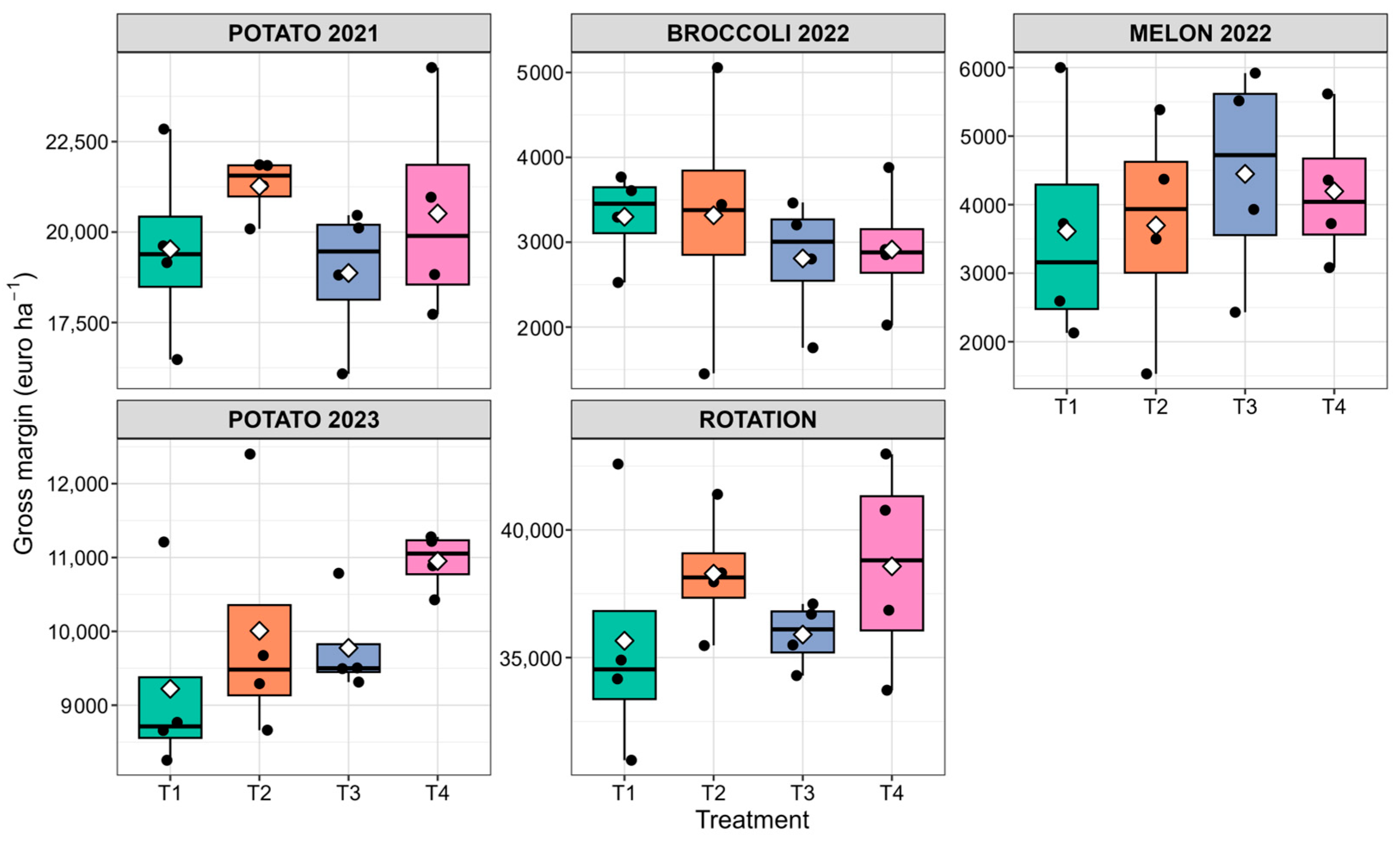
| I (potato 2021) | T1 | 27,005 | 7481 | 19,524 |
| T2 | 28,548 | 7281 | 21,268 | |
| T3 | 26,161 | 7292 | 18,869 | |
| T4 | 27,907 | 7394 | 20,514 | |
| F ANOVA | 0.96 ns | - | 0.99 ns | |
| II (broccoli 2022) | T1 | 10,078 | 6778 | 3300 |
| T2 | 9373 | 6056 | 3317 | |
| T3 | 8957 | 6148 | 2809 | |
| T4 | 9049 | 6136 | 2913 | |
| F ANOVA | 0.97 ns | - | 0.26 ns | |
| III (melon 2022) | T1 | 12,891 | 9280 | 3611 |
| T2 | 12,068 | 8372 | 3696 | |
| T3 | 13,082 | 8633 | 4449 | |
| T4 | 12,767 | 8572 | 4195 | |
| F ANOVA | 0.68 ns | - | 0.56 ns | |
| IV (potato 2023) | T1 | 17,331 | 8109 | 9222 |
| T2 | 17,179 | 7172 | 10,007 | |
| T3 | 17,237 | 7462 | 9775 | |
| T4 | 18,399 | 7446 | 10,953 | |
| F ANOVA | 0.85 ns | - | 1.51 ns | |
| Full crop rotation | T1 | 67,306 | 31,648 | 35,658 |
| T2 | 67,168 | 28,880 | 38,288 | |
| T3 | 65,436 | 29,535 | 35,901 | |
| T4 | 68,122 | 29,547 | 38,575 | |
| F ANOVA | 0.53 ns | - | 0.99 ns |
Disclaimer/Publisher’s Note: The statements, opinions and data contained in all publications are solely those of the individual author(s) and contributor(s) and not of MDPI and/or the editor(s). MDPI and/or the editor(s) disclaim responsibility for any injury to people or property resulting from any ideas, methods, instructions or products referred to in the content. |
© 2026 by the authors. Licensee MDPI, Basel, Switzerland. This article is an open access article distributed under the terms and conditions of the Creative Commons Attribution (CC BY) license.
Share and Cite
Ollio, I.; Martínez-Granados, D.; Calatrava, J.; Zornoza, R.; Lloret, E.; Sánchez-Navarro, V.; Egea-Gilabert, C.; Fernández, J.A.; Conde-Cid, M.; Fernández-Calviño, D.; et al. Reduced Chemical Fertilizer Combined with Microbial Inoculants: Implications for Soil Fertility and Profitability in Mediterranean Vegetable Production. Agronomy 2026, 16, 810. https://doi.org/10.3390/agronomy16080810
Ollio I, Martínez-Granados D, Calatrava J, Zornoza R, Lloret E, Sánchez-Navarro V, Egea-Gilabert C, Fernández JA, Conde-Cid M, Fernández-Calviño D, et al. Reduced Chemical Fertilizer Combined with Microbial Inoculants: Implications for Soil Fertility and Profitability in Mediterranean Vegetable Production. Agronomy. 2026; 16(8):810. https://doi.org/10.3390/agronomy16080810
Chicago/Turabian StyleOllio, Irene, David Martínez-Granados, Javier Calatrava, Raúl Zornoza, Eva Lloret, Virginia Sánchez-Navarro, Catalina Egea-Gilabert, Juan A. Fernández, Manuel Conde-Cid, David Fernández-Calviño, and et al. 2026. "Reduced Chemical Fertilizer Combined with Microbial Inoculants: Implications for Soil Fertility and Profitability in Mediterranean Vegetable Production" Agronomy 16, no. 8: 810. https://doi.org/10.3390/agronomy16080810
APA StyleOllio, I., Martínez-Granados, D., Calatrava, J., Zornoza, R., Lloret, E., Sánchez-Navarro, V., Egea-Gilabert, C., Fernández, J. A., Conde-Cid, M., Fernández-Calviño, D., & Martínez-Martínez, S. (2026). Reduced Chemical Fertilizer Combined with Microbial Inoculants: Implications for Soil Fertility and Profitability in Mediterranean Vegetable Production. Agronomy, 16(8), 810. https://doi.org/10.3390/agronomy16080810