


Abstract
Slightly saline–alkali soils represent an important but underutilized land resource in northern China, and optimizing planting patterns is essential for improving sorghum productivity under such marginal conditions. This study aimed to evaluate the effects of wide–narrow row spacing combined with different planting densities on the canopy structure, photosynthetic performance, and grain yield of brewing sorghum. A field experiment was conducted from 2022 to 2024 at the Yulin Experimental Station in Shaanxi Province, China, using the brewing sorghum cultivar Liaonuo 16. Four planting treatments were established: wide–narrow row spacing (80/60 cm) with three planting densities (105,000, 112,500, and 120,000 plants ha−1) and uniform row spacing (60 cm) with 112,500 plants ha−1 as the control. Wide–narrow row spacing combined with higher planting density significantly improved canopy structure and light interception. The treatment with 120,000 plants ha−1 increased light interception in the middle and lower canopy layers during flowering and grain filling by 8.7% and 25.58%, respectively, and enhanced total canopy light interception by 3.33% and 1.96%. Moreover, the leaf area index and photosynthetic capacity were improved, resulting in a 10.1% increase in grain yield compared with the uniform row spacing treatment. Wide–narrow row spacing combined with a planting density of 120,000 plants ha−1 effectively optimizes canopy structure and enhances sorghum productivity in slightly saline–alkali soils, providing a practical cultivation strategy for improving resource use efficiency in marginal farmlands.
1. Introduction
Food security faces unprecedented challenges amid ongoing global climate change and intensifying constraints on agricultural resources [1,2,3]. Sorghum (Sorghum bicolor L. Moench), with its outstanding drought and salt tolerance, occupies a pivotal position in ensuring food security and has emerged as a crucial strategic crop whose yield stability and resource utilization efficiency have garnered significant attention from both academia and industry [4,5,6].
China possesses approximately 99 million hectares of saline–alkali land, of which mildly saline–alkali soils (pH 8.0–8.5, salinity 0.1–0.3%) account for the largest proportion and are widely distributed across northern China, including the hilly–gully terrain of the Loess Plateau in Shaanxi Province [7,8,9,10]. Although salinity levels in these soils are relatively low, they impose measurable physiological constraints on crop growth. Elevated Na+ concentrations induce ionic toxicity that disrupts membrane integrity and enzyme activity; osmotic stress reduces water and nutrient uptake; and soil alkalinity impairs the availability of phosphorus, iron, and zinc, collectively suppressing root development, shoot elongation, and reproductive performance [11,12,13]. Crucially, these edaphic stresses interact with the complex and variable light and heat conditions characteristic of the Loess Plateau—including high solar radiation, large diurnal temperature ranges, and uneven growing-season precipitation—to create a particularly challenging dual-stress environment for sorghum cultivation [14,15]. Under these conditions, agronomic management must go beyond relying solely on varietal salt tolerance; optimized cultivation practices that actively improve the crop’s capacity to capture and convert light and heat resources are equally indispensable.
Traditional uniform row spacing cultivation systems reveal significant shortcomings under such conditions. Their rigid, uniform plant distribution fails to adapt to the specific light and heat dynamics of each ecological zone or to the structural limitations imposed by saline–alkali soils. Restricted canopy spacing impairs field ventilation and light penetration, sustaining an elevated risk of lodging and disease in an already fragile growth environment [16,17,18,19,20,21]. Simultaneously, suboptimal spatial arrangement leads to inefficient utilization of photosynthetically active radiation (PAR) in the middle and lower canopy layers, constraining photosynthetic production and ultimately limiting both yield and grain quality [22,23,24].
Wide–narrow row spacing combined with increased planting density (WN-HD) has emerged as a promising cultivation strategy to address these limitations. By alternating wide and narrow inter-row intervals, this configuration increases lateral light penetration into the lower canopy while improving air circulation, thereby reducing humidity-driven disease pressure and lodging risk [25,26]. In maize, WN-HD planting has been shown to increase canopy PAR interception by 8–15% and leaf area index (LAI) by 10–20% compared with uniform row spacing, with corresponding yield increases of 6–12% [27,28]. In rice, similar configurations improved light use efficiency and spikelet filling under high-density conditions [29,30]. For sorghum specifically, existing studies conducted in the southern Sichuan foothills and Yellow River Delta report photosynthetic rate increases of 12–18% and yield gains of 7–11% under WN-HD management [31,32]. Furthermore, planting density has been identified as a key determinant of sorghum canopy structure and photosynthetic performance: increasing density from 90,000 to 120,000 plants ha−1 significantly elevated LAI and light interception rates during the grain-filling stage, while its effects on the net photosynthetic rate (Pn), transpiration rate (Tr), and water use efficiency (WUE) varied substantially depending on row spacing configuration and environmental context [25,26,33,34]. Under saline–alkali conditions, optimized agronomic management has been shown to partially compensate for soil-imposed physiological limitations by improving canopy microclimate and root-zone aeration [35,36], though the mechanistic interactions between WN-HD planting and mild salinity stress in sorghum remain poorly understood.
Despite this body of work, a critical research gap persists. Existing WN-HD studies in sorghum have been conducted predominantly in coastal saline–alkali areas and the North China Plain; no systematic investigation has examined the interaction between wide–narrow row spacing configuration and planting density on canopy structure, photosynthetic performance, and grain yield of brewing sorghum under the mildly saline–alkali soils of the Loess Plateau—an ecologically distinct region characterized by its unique combination of arid–semiarid climate, high-pH sandy-loam soils, and concentrated seasonal rainfall. Moreover, Liaonuo No. 16, a leading brewing sorghum variety widely cultivated in northern China due to its inherent salt–alkali tolerance and high starch quality, lacks a scientifically validated cultivation parameter framework for saline–alkali environments, limiting the realization of its full yield potential [33,34].
Therefore, the objectives of this study were to: (1) evaluate the effects of wide–narrow row spacing combined with increased planting density on canopy light interception and the leaf area index in brewing sorghum grown on slightly saline–alkali soils of the Loess Plateau; (2) assess the photosynthetic performance of sorghum leaves under different planting configurations during the critical flowering and grain-filling stages; and (3) determine the optimal row spacing and density combination to maximize grain yield under these edaphic conditions. We hypothesized that: (i) wide–narrow row spacing would improve PAR penetration into the middle and lower canopy layers compared to conventional uniform row spacing; (ii) higher planting density (120,000 plants ha−1) combined with the wide–narrow row configuration would optimize population-level light interception and photosynthetic productivity; and (iii) the combined WN-HD treatment would result in a significantly higher grain yield compared to uniform row spacing at equivalent density.
2. Materials and Methods
2.1. Experimental Site and Field Management
The field experiment was conducted from 2022 to 2024 at the Yulin Experimental Station (37°56′26″ N, 109°21′46″ E) in Yulin City, Shaanxi Province, China. The region has a semi-arid continental monsoon climate with an elevation of approximately 1120 m. The mean annual precipitation is about 400 mm, mainly concentrated from July to September. The mean annual temperature is 11.0 °C, with an extreme maximum of 36.3 °C and an extreme minimum of −25.7 °C. The frost-free period lasts approximately 145 days. Monthly meteorological conditions (mean temperature, rainfall, and cumulative solar radiation) recorded during the growing seasons of 2022, 2023, and 2024 are summarized in Table 1. Briefly, total growing-season rainfall was 479.56, 268.63, and 396.05 mm in 2022, 2023, and 2024, respectively, reflecting considerable inter-annual variation. Mean growing-season temperatures were comparable across years (20.70, 20.69, and 21.92 °C, respectively), while cumulative solar radiation ranged from 3202.08 to 3308.91 MJ m−2. The experimental site is located in the hilly–gully region of the Loess Plateau and is characterized by slightly saline–alkali soil, relatively flat terrain, and uniform soil fertility. Soil physicochemical properties at the 0–20 cm depth were measured at the start of each growing season and are presented in Table 1. Across years, soil pH ranged from 8.43 to 8.63, electrical conductivity (EC, 1:5 soil:water) from 0.22 to 0.28 mS cm−1, soil organic matter from 10.80 to 14.82 g kg−1, total nitrogen from 0.337 to 0.346 g kg−1, available phosphorus from 12.87 to 15.34 mg kg−1, and available potassium from 164.75 to 243.27 mg kg−1, confirming that the site consistently met the definition of slightly saline–alkali soil (pH 8.0–8.5, salinity 0.1–0.3%) throughout the experimental period. The preceding crop in all experimental years was winter wheat, forming a wheat–sorghum rotation system. After wheat harvest, the field was prepared by rotary tillage to a depth of approximately 20 cm, followed by land leveling to ensure uniform soil conditions. Sorghum was sown in late April each year using mechanical drilling with a precision seeder (2BMQ-6, Shandong Dahua Machinery Co., Ltd., Jining, China) at a sowing depth of approximately 3–5 cm. Basal fertilizer was applied before sowing according to the experimental design, and no topdressing or foliar fertilizer was applied during the growing season. Weed control was conducted using a post-emergence herbicide containing 2,4-D and atrazine applied at the 3–5 leaf stage of the sorghum, supplemented with manual inter-row cultivation when necessary. The sorghum was harvested in late September each year by manual harvesting. All plants within each plot were harvested entirely, and grain yield was determined after threshing and cleaning. The yield was subsequently converted to kg ha−1 based on the harvested plot area.
Table 1.
Summary of meteorological conditions during the growing season and soil physicochemical properties for each experimental year.
2.2. Experimental Design
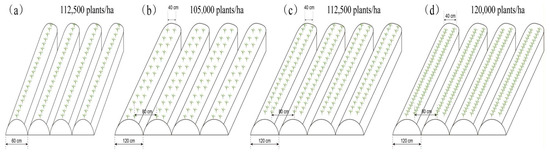
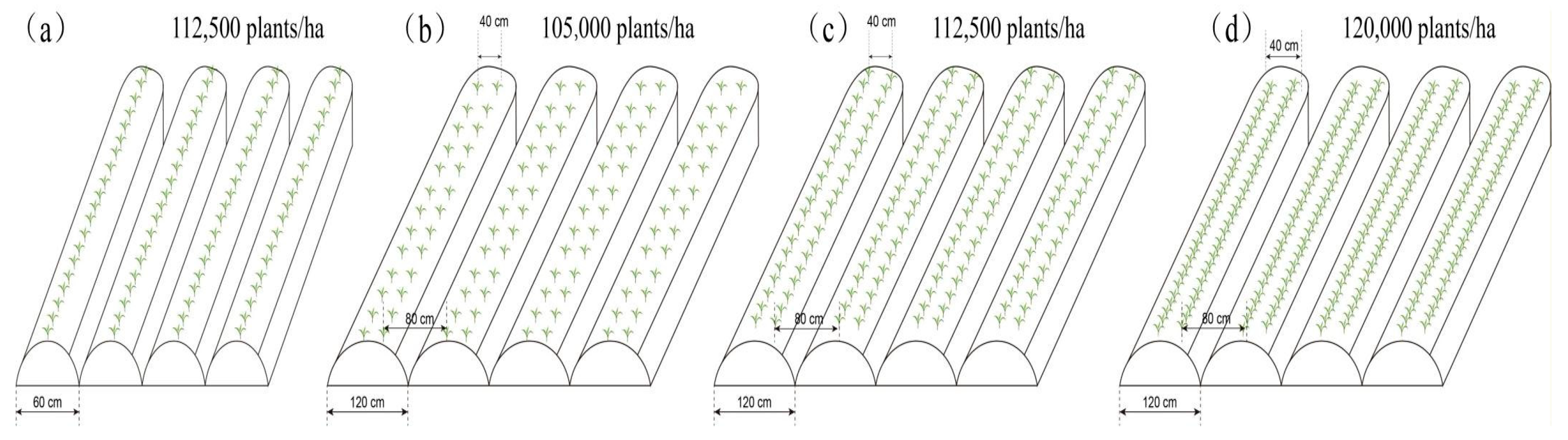
The trial used the brewing sorghum variety Liaonuo No.16 as material. Four treatment patterns were established: two planting patterns, wide–narrow row spacing (wide rows 80 cm, narrow rows 60 cm) and equal row spacing (row width 60 cm, control), were set. The wide–narrow row pattern included three planting densities (105,000, 112,500, and 120,000 plants ha−1), while the equal-row-spacing pattern maintained a density of 112,500 plants ha−1 (Figure 1). Each plot measured 10 m in length with 16 rows, arranged in a randomized block design with three replications.
Figure 1.
Schematic diagram of the planting patterns used in this study. (a) CK, uniform row spacing of 60 cm at 112,500 plants ha−1; (b) wide–narrow row spacing (40 cm + 80 cm) at 105,000 plants ha−1; (c) wide–narrow row spacing (40 cm + 80 cm) at 112,500 plants ha−1; and (d) wide–narrow row spacing (40 cm + 80 cm) at 120,000 plants ha−1. The corresponding intra-row plant spacings were 14.8, 15.9, 14.8, and 13.9 cm for treatments (a), (b), (c), and (d), respectively.
2.3. Statistical Analysis
Each experimental plot was treated as an independent experimental unit. All measurements of canopy characteristics (light interception, LAI) and photosynthetic parameters were conducted on a per-plot basis: within each plot, measurements from multiple individual plants or sub-locations were averaged to yield a single plot-level value prior to statistical analysis. These plot means (n = 3) were used as the unit of replication in all analyses, thereby avoiding pseudoreplication.
All data were analyzed using a mixed-model analysis of variance (mixed-model ANOVA) in SPSS 26.0 (IBM Corp., Armonk, NY, USA). Planting treatment was treated as a fixed effect, whereas year and block (replicate) were treated as random effects. The effects of year, treatment, and their interaction on selected key traits are summarized in Table 2. Treatment differences were evaluated based on the mixed model using the least significant difference (LSD) test at p < 0.05. All results are presented as means ± standard error (SE).
Table 2.
ANOVA results for the effects of year, treatment, and their interaction on selected key traits of brewing sorghum grown in mildly saline–alkaline soil.
2.4. Measurement Items and Methods
2.4.1. Tillering Number Survey
Tillering number surveys were conducted from the emergence to the jointing stage. In each plot, a 10 m2 sub-area was randomly designated as the survey zone. All tillers within the survey area were counted, and the average number of tillers per plant was calculated. Canopy stratification was determined based on plant height. Plant height was measured from the soil surface to the top of the plant, and the canopy was divided into three layers according to relative plant height: upper layer (>2/3 of plant height), middle layer (1/3–2/3 of plant height), and lower layer (<1/3 of plant height). Measurements of canopy characteristics were conducted within the corresponding height ranges.
2.4.2. Measurement of Key Indicators During Flowering to Grain Filling Stage
Measurements were conducted at two key growth stages: flowering stage (approximately 50% of plants showing a visible flowering stage, usually occurring in early August) and grain filling stage (approximately 20 days after flowering). The net photosynthetic rate (Pn), transpiration rate (Tr), intercellular CO2 concentration (Ci), actual photochemical efficiency of PSII (ΦPSII), and electron transport rate (ETR) were measured using a portable photosynthesis system (LI-6400XT, LI-COR Inc., Lincoln, NE, USA) between 09:00 and 11:00 on clear days. For each plot, five plants were selected, and the fully expanded flag leaf was used for photosynthetic measurements. The leaf area index (LAI) was measured using a plant canopy analyzer (LAI-2200, LI-COR Inc., USA). Photosynthetically active radiation (PAR) within different canopy layers was measured using a quantum sensor (LI-190R, LI-COR Inc., USA). For each plot, five representative plants were selected for photosynthetic measurements, and the mean value of the five plants was recorded as the plot-level datum for statistical analysis.
2.4.3. Measurement of Agronomic Traits and Yield Indicators at Harvest
At harvest, agronomic traits including plant height, stem diameter, and dry weight per plant were measured. Simultaneously, yield components including ear weight, thousand-kernel weight, number of effective ears, and grains per ear were determined.
For yield determination, plants from the central rows of each plot were harvested to avoid border effects, and the measurements were conducted in three replicates. Grain yield was converted to kg ha−1 based on the harvested area.
2.4.4. Growth Period Survey
The number of days from emergence to maturity was recorded as the growth period duration. Maturity was determined when over 50% of plants within the plot reached the mature stage.
3. Results
3.1. Sorghum Canopy Structure
3.1.1. Effect of Wide–Narrow Row Spacing and Thinning Technology on Sorghum Leaf Area Index
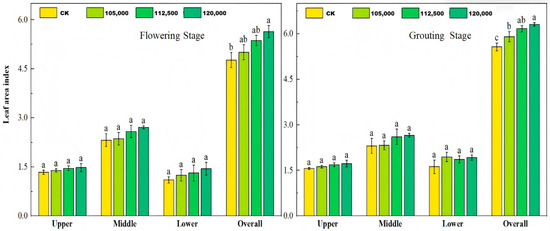
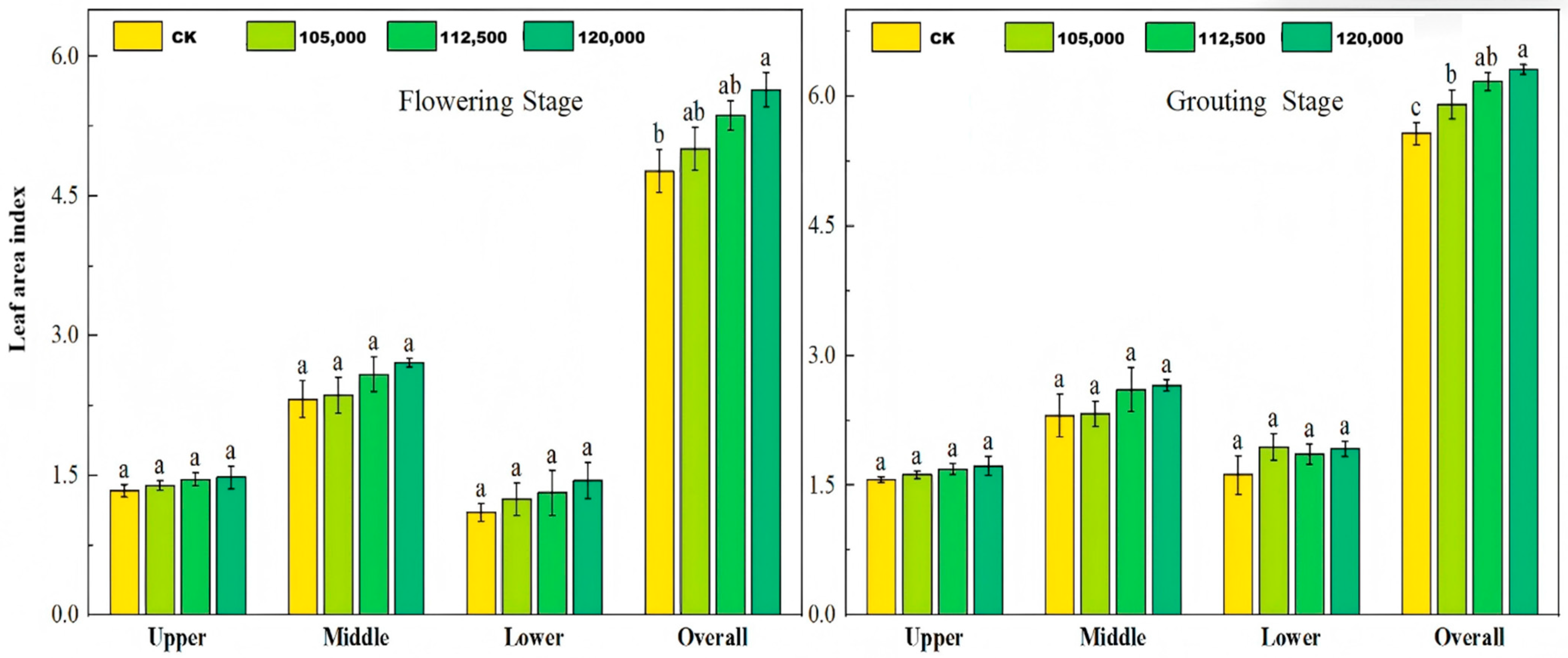
Figure 2 shows the variation in the leaf area index (LAI) across different canopy layers at the flowering and grain filling stages of sorghum. At the flowering stage, the LAI values of the upper, middle, and lower canopy layers ranged from 1.34 to 1.48, 2.32 to 2.72, and 1.11 to 1.45, respectively, with the total LAI ranging from 4.77 to 5.64. At the grain filling stage, the LAI of the three canopy layers ranged from 1.57 to 1.73, 2.31 to 2.66, and 1.63 to 1.95, respectively, resulting in a total LAI of 5.50–6.31. Overall, increasing planting density significantly enhanced the LAI of the upper and middle canopy layers as well as the total LAI. Compared with the control treatment, increasing the planting density to 120,000 plants ha−1 significantly increased total LAI by 18.39% at the flowering stage and 14.66% at the grain filling stage. These results indicate that the wide–narrow row spacing combined with increased planting density significantly improved canopy structure by enhancing the LAI across canopy layers at the flowering and grain filling stages. A higher LAI during the grain filling stage is beneficial for improving canopy interception of photosynthetically active radiation, thereby enhancing canopy photosynthetic productivity.
Figure 2.
Effect of different planting densities on the leaf area index of sorghum populations. Note: Values are presented as means ± SE (n = 3). Different letters above bars indicate significant differences among treatments at p < 0.05 level based on the least significant difference (LSD) test. Treatments sharing the same letter are not significantly different from each other. Upper, Middle, and Lower refer to the leaf area index measured within the upper (>2/3 of plant height), middle (1/3–2/3 of plant height), and lower (<1/3 of plant height) canopy layers, respectively, where plant height was measured from the soil surface to the top of the plant; Overall represents the total canopy leaf area index integrated across all three layers. CK, uniform row spacing of 60 cm at 112,500 plants ha−1; 105,000, 112,500, and 120,000 represent wide–narrow row spacing (40 cm + 80 cm) treatments at the corresponding planting densities (plants ha−1), with intra-row plant spacings of 15.9, 14.8, and 13.9 cm, respectively.
3.1.2. Effect of Wide–Narrow Row Spacing and Increased Planting Density on the Spatial Distribution of Photosynthetically Active Radiation in Sorghum Canopies
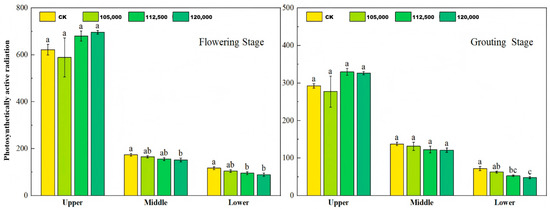
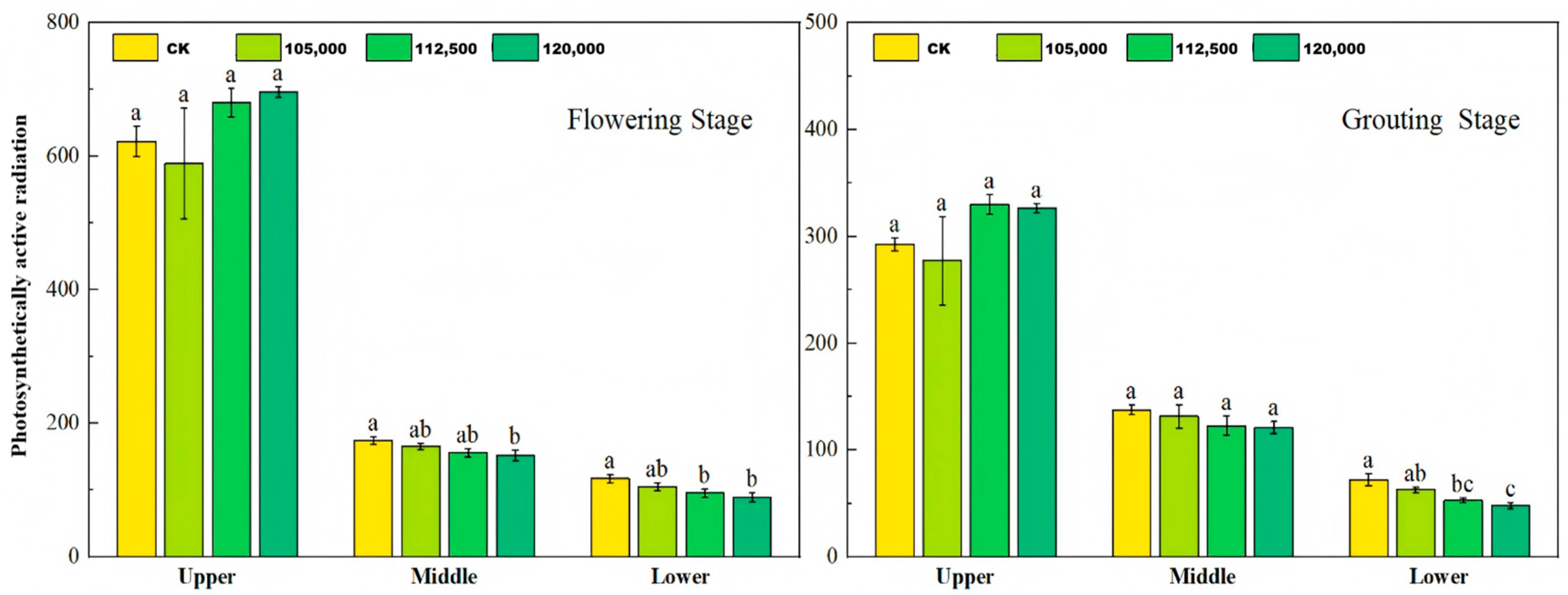
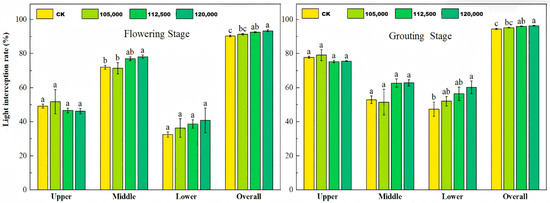
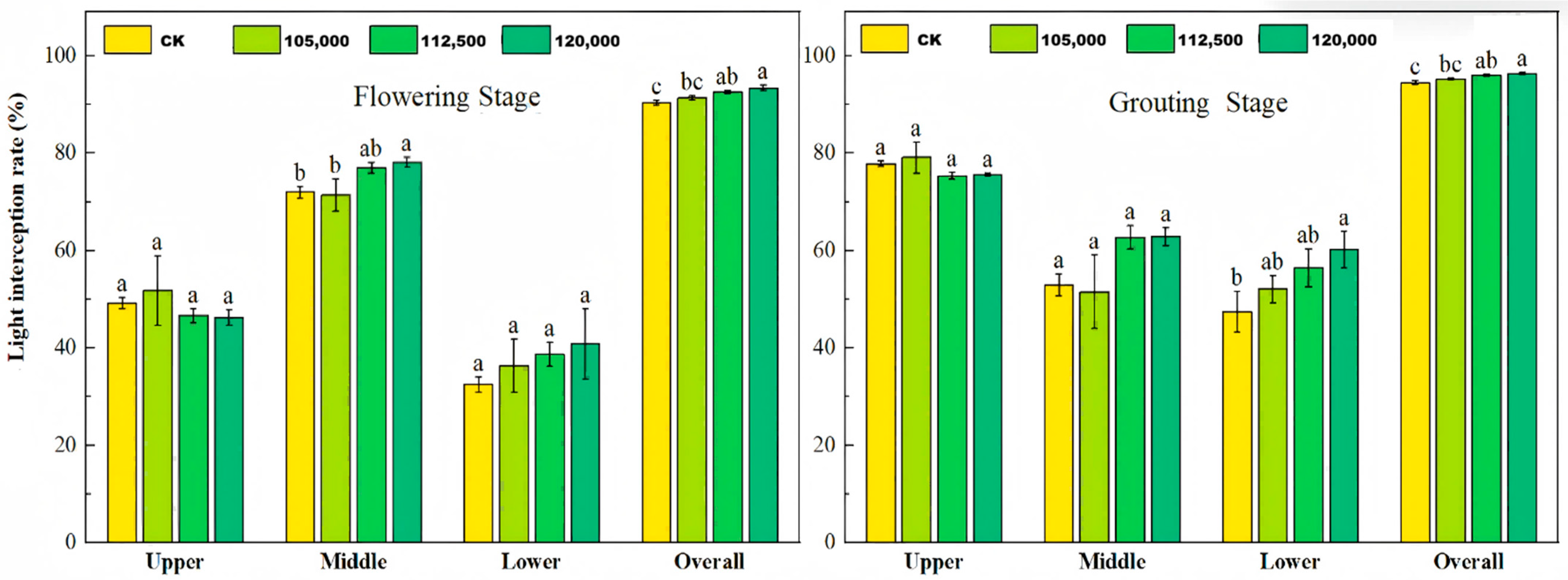
Figure 3 and Figure 4 illustrate the effects of the narrow–wide row spacing and increased density technique on photosynthetically active radiation (PAR) within the canopy and canopy light interception rate during the flowering and grain filling stages. Horizontally, PAR gradually decreased from the inter-row space toward individual plants, while the canopy light interception rate progressively increased. Vertically within the canopy, PAR increased with canopy height. During the flowering stage, PAR values across different canopy layers ranged from 330.33 to 588.90 μmol photons m−2 s−1, 151.73 to 174.23 μmol photons m−2 s−1, and 89.29 to 117.67 μmol photons m−2 s−1, respectively; During the grain filling stage, PAR ranged from 277.28 to 330.08, μmol photons m−2 s−1, 137.75 to 1121.11 μmol photons m−2 s−1, and 48.00 to 72.35 μmol photons m−2 s−1, respectively. Overall, the reduced spacing and increased density technique enhanced light interception rates in the upper canopy and overall canopy of the sorghum population during the grain filling stage, resulting in greater PAR capture by leaves in the middle and upper canopy layers. Compared to the CK treatment, increasing density to 120,000 plants/ha significantly increased light interception rates in the middle and lower layers of the sorghum canopy during flowering and grain filling by 8.7% and 25.58%, respectively, thereby significantly improving overall light interception rates by 3.33% and 1.96%. The experimental results indicate that the WN-HD treatment technique can significantly enhance the PAR capture rate in the middle and lower parts of the sorghum canopy as well as the overall canopy, optimize canopy structure, and improve the distribution of photosynthetically active radiation in the upper and middle canopy layers during the grain filling stage.
Figure 3.
Effect of different planting densities on the photosynthetically active radiation of sorghum populations. Note: Values are presented as means ± SE (n = 3). Different letters above bars indicate significant differences among treatments at p < 0.05 level based on the least significant difference (LSD) test. Treatments sharing the same letter are not significantly different from each other. Upper, Middle, and Lower refer to the photosynthetically active radiation measured within the upper (>2/3 of plant height), middle (1/3–2/3 of plant height), and lower (<1/3 of plant height) canopy layers, respectively, where plant height was measured from the soil surface to the top of the plant; CK, uniform row spacing of 60 cm at 112,500 plants ha−1; 105,000, 112,500, and 120,000 represent wide–narrow row spacing (40 cm + 80 cm) treatments at the corresponding planting densities (plants ha−1), with intra-row plant spacings of 15.9, 14.8, and 13.9 cm, respectively.
Figure 4.
Effect of different planting densities on the light interception rate of sorghum populations. Note: Values are presented as means ± SE (n = 3). Different letters above bars indicate significant differences among treatments at p < 0.05 level based on the least significant difference (LSD) test. Treatments sharing the same letter are not significantly different from each other. Upper, Middle, and Lower refer to the light interception rate measured within the upper (>2/3 of plant height), middle (1/3–2/3 of plant height), and lower (<1/3 of plant height) canopy layers, respectively; Overall represents the total canopy leaf area index integrated across all three layers. CK, uniform row spacing of 60 cm at 112,500 plants ha−1; 105,000, 112,500, and 120,000 represent wide–narrow row spacing (40 cm + 80 cm) treatments at the corresponding planting densities (plants ha−1), with intra-row plant spacings of 15.9, 14.8, and 13.9 cm, respectively.
3.1.3. Effect of Wide–Narrow Row Spacing and Increased Planting Density on the Extinction Coefficient of Sorghum
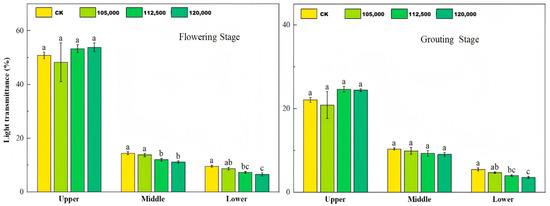
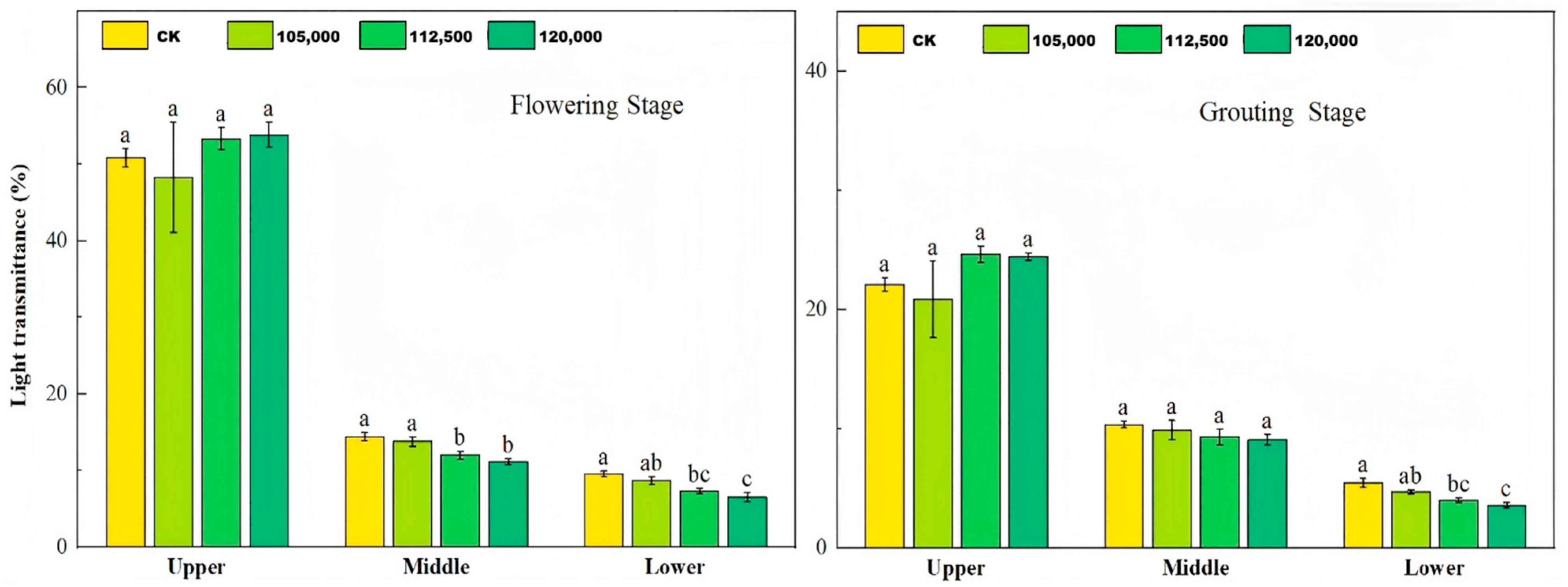
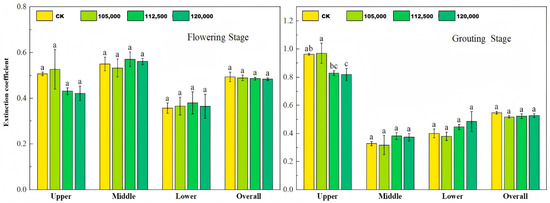
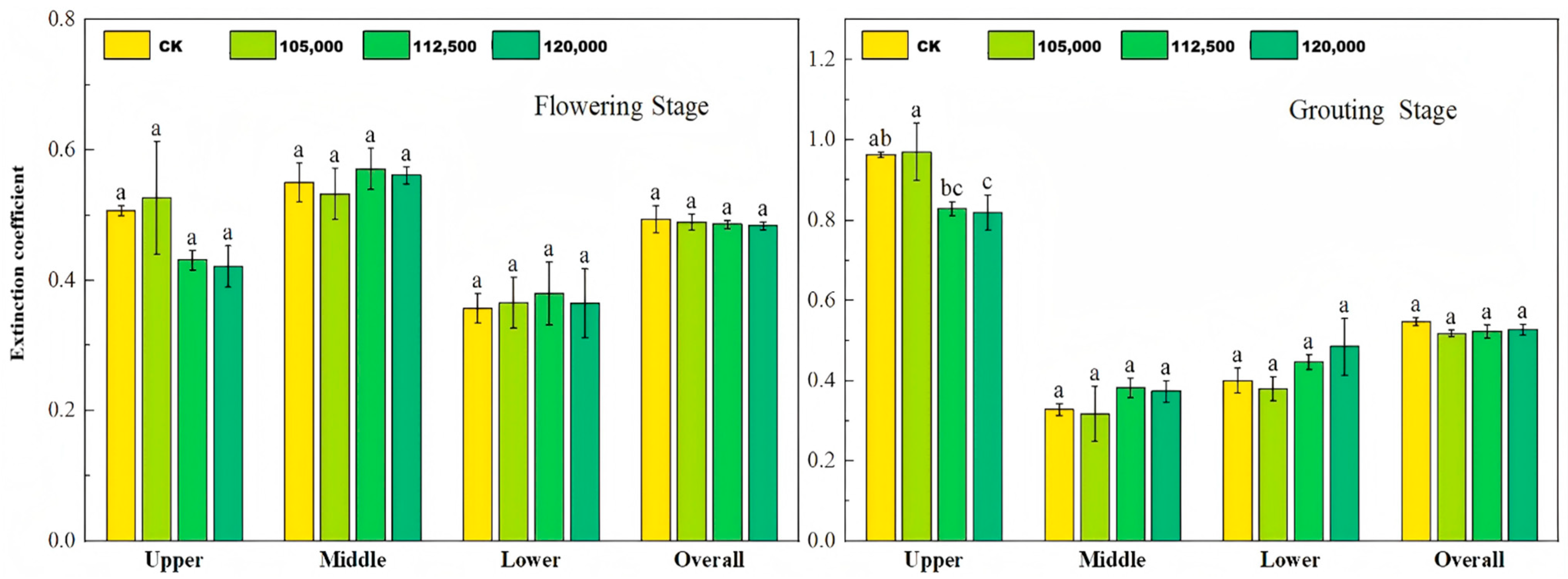
Figure 5 shows the effects of wide–narrow row spacing and reduced spacing techniques on light transmission rates during the flowering and grain filling stages of sorghum. Increasing row spacing reduced canopy light transmission rates across all sorghum varieties. No significant differences in upper canopy light transmission rates were observed among treatments during this growing season, whereas significant differences were noted in middle and lower canopy light transmission rates. Among these, sowing densities of 112,500 and 120,000 plants ha−1 showed significant differences from the control group in the lower canopy layer during both the flowering and grain-filling stages, with reductions of 22.88% to 26.93% and 31.52% to 34.01%, respectively, compared to the control. For the light extinction coefficient of the sorghum canopy (Figure 6), no significant differences were observed among treatments. The light transmission rates and extinction coefficients at different canopy layers reflect the vertical distribution of the leaf area and leaf angle, as well as the vertical attenuation of light within the canopy. The results indicate that the wide–narrow row spacing and reduced spacing densification technique established a more rational canopy structure, enhancing sorghum’s ability to intercept and absorb light.
Figure 5.
Effect of different planting densities on canopy transmittance in sorghum populations. Note: Values are presented as means ± SE (n = 3). Different letters above bars indicate significant differences among treatments at p < 0.05 level based on the least significant difference (LSD) test. Treatments sharing the same letter are not significantly different from each other. Upper, Middle, and Lower refer to the light transmittance measured within the upper (>2/3 of plant height), middle (1/3–2/3 of plant height), and lower (<1/3 of plant height) canopy layers, respectively, where plant height was measured from the soil surface to the top of the plant; Overall represents the total canopy leaf area index integrated across all three layers. CK, uniform row spacing of 60 cm at 112,500 plants ha−1; 105,000, 112,500, and 120,000 represent wide–narrow row spacing (40 cm + 80 cm) treatments at the corresponding planting densities (plants ha−1), with intra-row plant spacings of 15.9, 14.8, and 13.9 cm, respectively.
Figure 6.
Effect of different planting densities on the group extinction coefficient of sorghum. Note: Values are presented as means ± SE (n = 3). Different letters above bars indicate significant differences among treatments at p < 0.05 level based on the least significant difference (LSD) test. Treatments sharing the same letter are not significantly different from each other. Upper, Middle, and Lower refer to the group extinction measured within the upper (>2/3 of plant height), middle (1/3–2/3 of plant height), and lower (<1/3 of plant height) canopy layers, respectively, where plant height was measured from the soil surface to the top of the plant; Overall represents the total canopy leaf area index integrated across all three layers. CK, uniform row spacing of 60 cm at 112,500 plants ha−1; 105,000, 112,500, and 120,000 represent wide–narrow row spacing (40 cm + 80 cm) treatments at the corresponding planting densities (plants ha−1), with intra-row plant spacings of 15.9, 14.8, and 13.9 cm, respectively.
3.2. Photosynthetic Characteristics of Sorghum Leaves
Table 3 indicates that compared to flowering stage photosynthetic parameters, leaf photosynthetic performance generally declined during the grain filling stage. Compared to the CK treatment, increasing sowing density significantly reduced the net photosynthetic rate (Pn) by 16.50% and 19.11% during the flowering and grain filling stages, respectively. Additionally, increased planting density exerted varying degrees of influence on the transpiration rate (Tr), intercellular CO2 concentration (Ci), water use efficiency (WUE), actual photosynthetic efficiency of PSII (ΦPSII), and photosynthetic electron transport rate (ETR) of sorghum leaves during the grain filling stage. The results indicate that the WN-HD treatment technique has certain negative effects on the photosynthetic characteristics of sorghum leaves. Excessively high plant density leads to intense competition among individual sorghum plants, accelerating leaf senescence and reducing leaf photosynthetic performance during the late growth stage.
Table 3.
Effects of different planting densities on sorghum photosynthetic characteristics.
3.3. Agronomic Traits and Yield at Maturity
Table 4 shows that wide–narrow row spacing combined with increased planting density significantly reduced tiller number per plant by 19.91% to 26.63% relative to CK, whereas no significant differences were observed among treatments for plant height, stem diameter, ear length, or ear diameter. Grain yield under the three WN-HD density treatments was 8425, 8494, and 8679 kg ha−1, representing numerical increases of 6.89%, 7.77%, and 10.1% over CK (7882 kg ha−1), respectively; however, none of these differences reached statistical significance.
Table 4.
Effects of different planting densities on agronomic traits and yield at maturity in sorghum.
4. Discussion
4.1. Effects of Wide–Narrow Row Spacing with Reduced Spacing on Plant Population Structure
The results indicate that, compared with uniform row spacing, the wide–narrow row spacing combined with reduced spacing significantly optimized the plant population structure. This improvement is mainly attributed to the altered plant distribution pattern under the wide–narrow row configuration, which enhances ventilation and light penetration within the canopy. In this system, air circulation between plants becomes more efficient, effectively reducing the risk of pest and disease occurrence caused by excessive humidity and creating a healthier growth environment for sorghum. These findings are consistent with previous studies [37,38], although they differ from those reported in [39,40], which may be related to differences in experimental regions and sorghum varieties. In addition, optimized row spacing allows sunlight to penetrate the canopy more uniformly, ensuring sufficient light availability for leaves at different canopy layers. This improvement in canopy structure provides a favorable basis for enhanced photosynthesis and yield formation.
4.2. Relationship Between Enhanced Light Interception and Yield
When sorghum was cultivated under the wide–narrow row spacing system with a higher planting density (120,000 plants ha−1), the light interception rate in the middle and lower canopy layers increased significantly during the flowering and grain filling stages, resulting in an overall improvement in total canopy light interception.
Light interception is a key determinant of photosynthetic efficiency. Increased light interception enables leaves to capture more solar energy for photosynthesis, thereby producing greater amounts of assimilates. These assimilates provide the essential material basis for grain formation and filling in sorghum, ultimately promoting yield improvement. These results are consistent with previous reports [41,42], although slight differences from studies [43,44] may be attributed to variations in environmental conditions. In the present study, this planting pattern increased grain yield by 10.1% compared with the equal-row-spacing system, further demonstrating the close positive relationship between canopy light interception and yield formation.
4.3. Application Prospects of Wide–Narrow Row Spacing Combined with Increased Planting Density
Considering its significant effects on improving canopy structure, enhancing photosynthetic performance, and increasing grain yield, the wide–narrow row spacing system combined with increased planting density shows promising potential for sorghum production. Particularly when the planting density reaches 120,000 plants ha−1, this cultivation strategy effectively optimizes canopy architecture and improves resource utilization efficiency.
These findings are generally consistent with previous studies [45,46], although the slight differences from [47] may arise from variations in research focus and experimental materials. Nevertheless, the practical application of this technique should consider regional differences in soil fertility and climatic conditions. Appropriate adjustments in planting density and row spacing are necessary to fully exploit the benefits of this planting strategy and promote sustainable development of sorghum production.
4.4. Environmental and Soil Variability as Modulators of Grain Yield Response
Although the WN-HD treatment at 120,000 plants ha−1 produced a numerical grain yield increase of approximately 10.1% over the uniform row control (8679 vs. 7882 kg ha−1), this difference did not reach statistical significance (Treatment: F = 1.76, p = 0.183; Table 2). By contrast, the year effect was highly significant (Year: F = 5.84, p = 0.009), while the Year × Treatment interaction was non-significant (p = 0.839). These results indicate that inter-annual environmental variability—rather than planting configuration—was the dominant driver of absolute yield level across the three growing seasons, and that this variability inflated the error variance sufficiently to mask the moderate treatment differences observed.
Growing-season rainfall was the principal source of year-to-year variation. Total precipitation (May–September) was 479.56 mm in 2022, fell sharply to 268.63 mm in 2023—a 44% reduction relative to the regional mean of ~400 mm—and partially recovered to 396.05 mm in 2024 (Table 1). The severe moisture deficit in 2023 would have restricted vegetative growth, impaired pollination, and limited starch accumulation during grain filling, collectively suppressing yield across all treatments [46,48]. Complementary differences in cumulative solar radiation (3308.91 MJ m−2 in 2022 vs. 3202.08 MJ m−2 in 2024) and mean growing-season temperature (20.70 °C in 2022 vs. 21.92 °C in 2024) further modulated phenological development and grain-filling duration, contributing additional background variance to the yield data [42,49].
Soil nutrient dynamics reinforced this inter-annual variability. Available potassium ranged from 164.75 mg kg−1 in 2023 to 243.27 mg kg−1 in 2024, and soil organic matter increased progressively from 10.80 to 14.82 g kg−1 over the three years (Table 1), consistent with gradual organic matter accumulation under the wheat–sorghum rotation. Potassium availability directly regulates phloem loading and sucrose transport during grain filling [29,30], so its markedly lower level in 2023—coinciding with the drought year—would have compounded the moisture-induced yield suppression. In contrast, soil pH (8.43–8.63) and EC (0.22–0.28 mS cm−1) remained stable across years, confirming that slight saline–alkali conditions constituted a consistent background stress rather than a source of inter-annual variation.
The non-significant Year × Treatment interaction (p = 0.839) confirms that treatment rankings were stable across climatically contrasting years, indicating that the WN-HD approach consistently expressed its canopy-structural advantages regardless of annual conditions. The failure to reach statistical significance therefore reflects insufficient statistical power rather than the absence of a biologically meaningful treatment effect: with only three replicates per year and large inter-annual variance (MS_Error = 6.00 × 10⁵), detecting a true yield difference of ~800 kg ha−1 at 80% power would require approximately five to six experimental years [50]. The WN-HD strategy demonstrably improved canopy light interception, the LAI, and photosynthetic capacity—all mechanistically linked to yield formation—yet these gains translated into a numerically positive but statistically non-significant yield advantage under the environmental conditions of this study. Longer-term, multi-site trials combined with optimized water and nitrogen management are needed to provide the statistical power required to confirm the full agronomic potential of this planting approach on slightly saline–alkali soils of the Loess Plateau.
5. Conclusions
The wide–narrow row spacing system at 120,000 plants ha−1 (WN-HD) proved most effective among the tested configurations, optimizing canopy light distribution, improving the leaf area index and net photosynthetic rate, and increasing grain yield by 10.1% over conventional uniform row cultivation on slightly saline–alkali soils. These findings indicate that restructuring the plant spatial arrangement can meaningfully enhance resource-use efficiency in marginal farmlands without increasing input levels. Future work should explore the integration of optimized water and nitrogen management with the WN-HD strategy to further stabilize productivity across varying environmental conditions.
Author Contributions
Conceptualization, F.Z., Z.Z. and Y.Y.; methodology, F.Z., Z.Z. and Y.Y.; formal analysis, F.Z., Z.Z. and Y.Y.; investigation, F.Z., Z.Z., Y.Y., J.W., L.Y., K.Z. (Kuangye Zhang), B.C., Y.D., H.W., B.F. and K.Z. (Kai Zhu); data curation, F.Z., Z.Z., Y.Y., J.W., L.Y., K.Z. (Kuangye Zhang) and B.C.; software, J.W. and L.Y.; validation, F.Z., Z.Z., Y.Y., J.W., L.Y. and K.Z. (Kuangye Zhang); visualization, F.Z., Z.Z., Y.Y., J.W. and L.Y.; writing—original draft preparation, F.Z., Z.Z. and Y.Y.; writing—review and editing, F.Z., Z.Z., Y.Y., J.W., L.Y., K.Z. (Kuangye Zhang), B.C., Y.D., H.W., B.F. and K.Z. (Kai Zhu); resources, B.F., Y.W. and F.L.; supervision, Y.W. and F.L.; project administration, Y.W. and F.L.; funding acquisition, Y.W. and F.L. All authors have read and agreed to the published version of the manuscript.
Funding
This research was funded by the National Millet and Sorghum Industrial Technology System Sorghum Cultivation Position, grant number CARS-06-14.5-A22; the Liaoning Provincial Germplasm Innovation Project for Grain Storage Technology, grant number 2023JH1/10200001; the Liaoning Academy of Agricultural Sciences Agricultural Green High-Quality Development, Shenyang, China, grant number 2025HQ1307; and the Liaoning Academy of Agricultural Sciences Basic Research Program, grant number 2026JC4002.
Data Availability Statement
The original contributions presented in this study are included in the article. Further inquiries can be directed to the corresponding authors.
Acknowledgments
During the preparation of this manuscript, the authors used a generative AI tool, [DeepL Write], for the purposes of improving grammar, spelling, punctuation, language clarity, and formatting. The authors have reviewed and edited the output and take full responsibility for the content of this publication.
Conflicts of Interest
The authors declare no conflicts of interest.
References
- Hossain, M.S.; Islam, M.N.; Rahman, M.M.; Mostofa, M.G.; Khan, M.A.R. Sorghum: A Prospective Crop for Climatic Vulnerability, Food and Nutritional Security. J. Agric. Food Res. 2022, 8, 100300. [Google Scholar] [CrossRef] [Scilit]
- Hadebe, S.T.; Modi, A.T.; Mabhaudhi, T. Drought Tolerance and Water Use of Cereal Crops: A Focus on Sorghum as a Food Security Crop in Sub-Saharan Africa. J. Agron. Crop Sci. 2017, 203, 177–191. [Google Scholar] [CrossRef] [Scilit]
- Teferra, T.F.; Awika, J.M. Sorghum as a Healthy Global Food Security Crop: Opportunities and Challenges. Cereal Foods World 2019, 64, 1–8. [Google Scholar] [CrossRef] [Scilit]
- Gidi, M. Sorghum as a Model Crop for Drought Stress Tolerance. Adv. Biosci. Bioeng. 2023, 11, 54–65. [Google Scholar] [CrossRef] [Scilit]
- Ge, S.; Liu, D.; Chu, M.; Liu, X.; Wei, Y.; Che, X.; Zhu, L.; He, L.; Xu, J. Dynamic and Adaptive Membrane Lipid Remodeling in Leaves of Sorghum under Salt Stress. Crop J. 2022, 10, 1557–1569. [Google Scholar] [CrossRef] [Scilit]
- Tu, M.; Du, C.; Yu, B.; Wang, G.; Deng, Y.; Wang, Y.; Chen, M.; Chang, J.; Yang, G.; He, G.; et al. Current Advances in the Molecular Regulation of Abiotic Stress Tolerance in Sorghum via Transcriptomic, Proteomic, and Metabolomic Approaches. Front. Plant Sci. 2023, 14, 1147328. [Google Scholar] [CrossRef] [Scilit]
- Liu, D.; Li, Y.; Wang, P.; Zhong, H.; Wang, P. Sustainable Agriculture Development in Northwest China under the Impacts of Global Climate Change. Front. Nutr. 2021, 8, 706552. [Google Scholar] [CrossRef] [Scilit]
- Yang, X.; Cheng, C.; Li, Y. Effect of Cropland Occupation and Supplement on Light-Temperature Potential Productivity in China from 2000 to 2008. Chin. Geogr. Sci. 2010, 20, 536–544. [Google Scholar] [CrossRef] [Scilit]
- Liang, Z.; Sun, L.; Tian, Z.; Fischer, G.; Yan, H. Increase in Grain Production Potential of China under Climate Change. PNAS Nexus 2023, 2, pgad057. [Google Scholar] [CrossRef] [Scilit]
- Sun, B.; Luo, Y.; Yang, D.; Yang, J.; Zhao, Y.; Zhang, J. Coordinative Management of Soil Resources and Agricultural Farmland Environment for Food Security and Sustainable Development in China. Int. J. Environ. Res. Public Health 2023, 20, 3233. [Google Scholar] [CrossRef] [Scilit]
- Lei, S.; Jia, X.; Zhao, C.; Shao, M. A Review of Saline-Alkali Soil Improvements in China: Efforts and Their Impacts on Soil Properties. Agric. Water Manag. 2025, 317, 109617. [Google Scholar] [CrossRef] [Scilit]
- Yang, S.; Hao, X.; Xu, Y.; Yang, J.; Su, D. Meta-Analysis of the Effect of Saline-Alkali Land Improvement and Utilization on Soil Organic Carbon. Life 2022, 12, 1870. [Google Scholar] [CrossRef] [Scilit]
- Wang, G.; Ni, G.; Feng, G.; Burrill, H.M.; Li, J.; Zhang, J.; Zhang, F. Saline-Alkali Soil Reclamation and Utilization in China: Progress and Prospects. Front. Agric. Sci. Eng. 2024, 11, 551–565. [Google Scholar] [CrossRef] [Scilit]
- Otlewska, A.; Migliore, M.; Dybka-Stępień, K.; Manber, Z.; Sawicki, A.; Rutkowska, M.; Piotrowska-Cyplik, A. Exploring the Correlation between Salt Tolerance and Yield: Research Advances and Perspectives for Salt-Tolerant Forage Sorghum Selection and Genetic Improvement. Planta 2022, 255, 71. [Google Scholar] [CrossRef] [Scilit] [PubMed]
- Zhao, Y.; Lu, Z.; He, L. Effects of Saline-Alkaline Stress on Seed Germination and Seedling Growth of Sorghum bicolor (L.) Moench. Appl. Biochem. Biotechnol. 2014, 173, 1680–1691. [Google Scholar] [CrossRef] [Scilit]
- Staggenborg, S.A.; Fjell, D.L.; Devlin, D.L.; Gordon, W.B.; Marsh, B.H. Grain Sorghum Response to Row Spacings and Seeding Rates in Kansas. J. Prod. Agric. 1999, 12, 390–395. [Google Scholar] [CrossRef] [Scilit]
- Ciampitti, I.A.; Prasad, P.E.; Schlegel, A.J.; Haag, L.; Schnell, R.W.; Arnall, B.; Lofton, J. Genotype × Environment × Management Interactions: US Sorghum Cropping Systems. In Sorghum: State of the Art and Future Perspectives; Ciampitti, I.A., Prasad, P.V.V., Eds.; Agronomy Monograph 58; ASA, CSSA, SSSA: Madison, WI, USA, 2016. [Google Scholar] [CrossRef] [Scilit]
- Kukal, M.S.; Irmak, S. Light Interactions, Use and Efficiency in Row Crop Canopies under Optimal Growth Conditions. Agric. For. Meteorol. 2020, 284, 107887. [Google Scholar] [CrossRef] [Scilit]
- Truong, S.K.; McCormick, R.F.; Rooney, W.L.; Mullet, J.E. Harnessing Genetic Variation in Leaf Angle to Increase Productivity of Sorghum bicolor. Genetics 2015, 201, 1229–1238. [Google Scholar] [CrossRef] [Scilit] [PubMed]
- Bean, B. Causes and Prevention of Lodging in Sorghum. Sorghum Checkoff, 2024. Available online: https://www.sorghumcheckoff.com (accessed on 29 January 2026).
- Wang, X.; Mace, E.; Tao, Y.; Cruickshank, A.; Hunt, C.; Hammer, G.; Jordan, D. Large-Scale Genome-Wide Association Study Reveals That Drought-Induced Lodging in Grain Sorghum Is Associated with Plant Height and Traits Linked to Carbon Remobilisation. Theor. Appl. Genet. 2020, 133, 3117–3130. [Google Scholar] [CrossRef] [Scilit]
- Jaikumar, N.S.; Stutz, S.S.; Fernandes, S.B.; Leakey, A.D.; Bernacchi, C.J.; Brown, P.J.; Long, S.P. Can Improved Canopy Light Transmission Ameliorate Loss of Photosynthetic Efficiency in the Shade? An Investigation of Natural Variation in Sorghum bicolor. J. Exp. Bot. 2021, 72, 4965–4980. [Google Scholar] [CrossRef] [Scilit]
- Natukunda, M.I.; Mantilla-Perez, M.B.; Graham, M.A.; Liu, P.; Salas-Fernandez, M.G. Dissection of Canopy Layer-Specific Genetic Control of Leaf Angle in Sorghum bicolor by RNA Sequencing. BMC Genom. 2022, 23, 95. [Google Scholar] [CrossRef] [Scilit] [PubMed]
- Zhi, X.; Tao, Y.; Jordan, D.; Borrell, A.; Hunt, C.; Cruickshank, A.; Potgieter, A.; Wu, A.; Hammer, G.; George-Jaeggli, B.; et al. Genetic Control of Leaf Angle in Sorghum and Its Effect on Light Interception. J. Exp. Bot. 2022, 73, 801–816. [Google Scholar] [CrossRef] [Scilit] [PubMed]
- Yan, P.; Song, Y.H.; Zhang, K.Y.; Zhang, F.; Tang, Y.J.; Zhao, X.N.; Wang, N.; Ke, F.L.; Gao, F.J.; Li, J.H.; et al. Interaction of Genotype-Ecological Type-Plant Spacing Configuration in Sorghum [Sorghum bicolor (L.) Moench] in China. Front. Plant Sci. 2023, 13, 1076854. [Google Scholar] [CrossRef] [Scilit] [PubMed]
- Thapa, S.; Stewart, B.A.; Xue, Q.; Chen, Y. Manipulating Plant Geometry to Improve Microclimate, Grain Yield, and Harvest Index in Grain Sorghum. PLoS ONE 2017, 12, e0173511. [Google Scholar] [CrossRef] [Scilit]
- Yang, R.; Sun, Z.; Liu, X.; Long, X.; Gao, L.; Shen, Y. Biomass Composite with Exogenous Organic Acid Addition Supports the Growth of Sweet Sorghum (Sorghum bicolor ‘Dochna’) by Reducing Salinity and Increasing Nutrient Levels in Coastal Saline-Alkaline Soil. Front. Plant Sci. 2023, 14, 1163195. [Google Scholar] [CrossRef] [Scilit]
- Li, Y.; Yuan, F.; Wang, B. Changes in the Sugar Content of Sweet Sorghum Stems under Natural Conditions during Winter in Saline Soil of the Yellow River Delta. IOP Conf. Ser. Earth Environ. Sci. 2018, 113, 012109. [Google Scholar] [CrossRef] [Scilit]
- Tian, Y.; Jiang, W.; Chen, G.; Wang, X.; Li, T. Gypsum and Organic Materials Improved Soil Quality and Crop Production in Saline-Alkali on the Loess Plateau of China. Front. Environ. Sci. 2024, 12, 1434147. [Google Scholar] [CrossRef] [Scilit]
- Gao, Y.; Shao, C.; Liu, Z.; Sun, Z.; Long, B.; Feng, P. Planning Spatial Layout of a Typical Salt Tolerant Forage of Sweet Sorghum in the Yellow River Delta via Considering Resource Constraints, Nitrogen Use Efficiency, and Economic Benefits. Plants 2023, 12, 2483. [Google Scholar] [CrossRef] [Scilit]
- Li, Y.; Li, Q.; Guo, D.; Liang, S.; Wang, Y. Ecological Stoichiometry Homeostasis of Leymus chinensis in Degraded Grassland in Western Jilin Province, NE China. Ecol. Eng. 2016, 90, 387–391. [Google Scholar] [CrossRef] [Scilit]
- Wang, X.; Sun, R.; Tian, Y.; Guo, K.; Sun, H.; Liu, X.; Chu, H.; Liu, B. Long-Term Phytoremediation of Coastal Saline Soil Reveals Plant Species-Specific Patterns of Microbial Community Recruitment. mSystems 2020, 5, e00741-19. [Google Scholar] [CrossRef] [Scilit]
- Zhang, L.; Ding, Y.; Xu, J.; Gao, X.; Cao, N.; Li, K.; Feng, Z.; Cheng, B.; Zhou, L.; Ren, M.; et al. Selection Signatures in Chinese Sorghum Reveals Its Unique Liquor-Making Properties. Front. Plant Sci. 2022, 13, 923734. [Google Scholar] [CrossRef] [Scilit]
- Patroti, P.; Madhusudhana, R.; Sundaram, S.; Prasad, G.S.; Raigond, B.; Das, I.; Satyavathi, C.T. Development of High Yielding and Stress Resilient Post-Rainy Season Sorghum Cultivars Using a Multi-Parent Crossing Approach. Sci. Rep. 2025, 15, 02777. [Google Scholar] [CrossRef] [Scilit]
- Fernandez, C.J.; Fromme, D.D.; Grichar, W.J. Grain Sorghum Response to Row Spacing and Plant Populations in the Texas Coastal Bend Region. Int. J. Agron. 2012, 2012, 238634. [Google Scholar] [CrossRef] [Scilit]
- Conley, S.P.; Stevens, W.G.; Dunn, D.D. Grain Sorghum Response to Row Spacing, Plant Density, and Planter Skips. Crop Manag. 2005, 4, 1–8. [Google Scholar] [CrossRef] [Scilit]
- Liu, T.; Gu, L.; Dong, S.; Zhang, J.; Liu, P.; Zhao, B. Optimum Leaf Removal Increases Canopy Apparent Photosynthesis, 13C-Photosynthate Distribution and Grain Yield of Maize Crops Grown at High Density. Field Crops Res. 2015, 170, 32–39. [Google Scholar] [CrossRef] [Scilit]
- Sangoi, L.; Gracietti, M.A.; Rampazzo, C.; Bianchetti, P. Response of Brazilian Maize Hybrids from Different Eras to Changes in Plant Density. Field Crops Res. 2002, 79, 39–51. [Google Scholar] [CrossRef] [Scilit]
- Abreha, K.B.; Enyew, M.; Carlsson, A.S.; Vetukuri, R.R.; Feyissa, T.; Motlhaodi, T.; Ng’uni, D.; Geleta, M. Sorghum in Dryland: Morphological, Physiological, and Molecular Responses of Sorghum under Drought Stress. Planta 2022, 255, 102. [Google Scholar] [CrossRef] [Scilit]
- Blum, A. Sorghum Physiology. In Physiology and Biotechnology Integration for Plant Breeding; Nguyen, H.T., Blum, A., Eds.; Marcel Dekker: New York, NY, USA, 2004; pp. 141–223. [Google Scholar] [CrossRef] [Scilit]
- Sinclair, T.R.; Sheehy, J.E. Erect Leaves and Photosynthesis in Rice. Science 1999, 283, 1455. [Google Scholar] [CrossRef] [Scilit]
- Hammer, G.L.; van Oosterom, E.; McLean, G.; Chapman, S.C.; Broad, I.; Harland, P.; Muchow, R.C. Adapting APSIM to Model the Physiology and Genetics of Complex Adaptive Traits in Field Crops. J. Exp. Bot. 2010, 61, 2185–2202. [Google Scholar] [CrossRef] [Scilit] [PubMed]
- Duvick, D.N. The Contribution of Breeding to Yield Advances in Maize (Zea mays L.). Adv. Agron. 2005, 86, 83–145. [Google Scholar] [CrossRef] [Scilit]
- Tollenaar, M.; Lee, E.A. Yield Potential, Yield Stability and Stress Tolerance in Maize. Field Crops Res. 2002, 75, 161–169. [Google Scholar] [CrossRef] [Scilit]
- Rooney, W.L.; Blumenthal, J.; Bean, B.; Mullet, J.E. Designing Sorghum as a Dedicated Bioenergy Feedstock. Biofuels Bioprod. Biorefin. 2007, 1, 147–157. [Google Scholar] [CrossRef] [Scilit]
- Assefa, Y.; Staggenborg, S.A.; Prasad, V.P.V. Grain Sorghum Water Requirement and Responses to Drought Stress: A Review. Crop Manag. 2010, 9, 1–11. [Google Scholar] [CrossRef] [Scilit]
- Lafarge, T.A.; Hammer, G.L. Predicting Plant Leaf Area Production: Shoot Assimilate Accumulation and Partitioning, and Leaf Area Ratio, Are Stable for a Wide Range of Sorghum Population Densities. Field Crops Res. 2002, 77, 137–151. [Google Scholar] [CrossRef] [Scilit]
- Vadez, V.; Kholová, J.; Aper, J.; Laplaze, L.; Tardieu, F. Crop Adaptations to Semi-Arid Environments: Responses to Drought and High Temperature. Plant Cell Environ. 2023, 46, 2179–2196. [Google Scholar] [CrossRef] [Scilit]
- Prasad, P.V.V.; Staggenborg, S.A.; Ristic, Z. Impacts of Drought and/or Heat Stress on Physiological, Developmental, Growth, and Yield Processes of Crop Plants. In Response of Crops to Limited Water: Understanding and Modeling Water Stress Effects on Plant Growth Processes; Ahuja, L.R., Reddy, V.R., Saseendran, S.A., Yu, Q., Eds.; American Society of Agronomy: Madison, WI, USA, 2008; pp. 301–355. [Google Scholar] [CrossRef] [Scilit]
- Lenth, R.V. Some Practical Guidelines for Effective Sample Size Determination. Am. Stat. 2001, 55, 187–193. [Google Scholar] [CrossRef] [Scilit]

Disclaimer/Publisher’s Note: The statements, opinions and data contained in all publications are solely those of the individual author(s) and contributor(s) and not of MDPI and/or the editor(s). MDPI and/or the editor(s) disclaim responsibility for any injury to people or property resulting from any ideas, methods, instructions or products referred to in the content. |
© 2026 by the authors. Licensee MDPI, Basel, Switzerland. This article is an open access article distributed under the terms and conditions of the Creative Commons Attribution (CC BY) license.