Haploid and Doubled Haploid Platforms for Wheat Improvement: Methods and Applications
 , , and
Abstract
1. Introduction
2. Androgenesis
2.1. Androgenesis-Based Haploid Production in Wheat
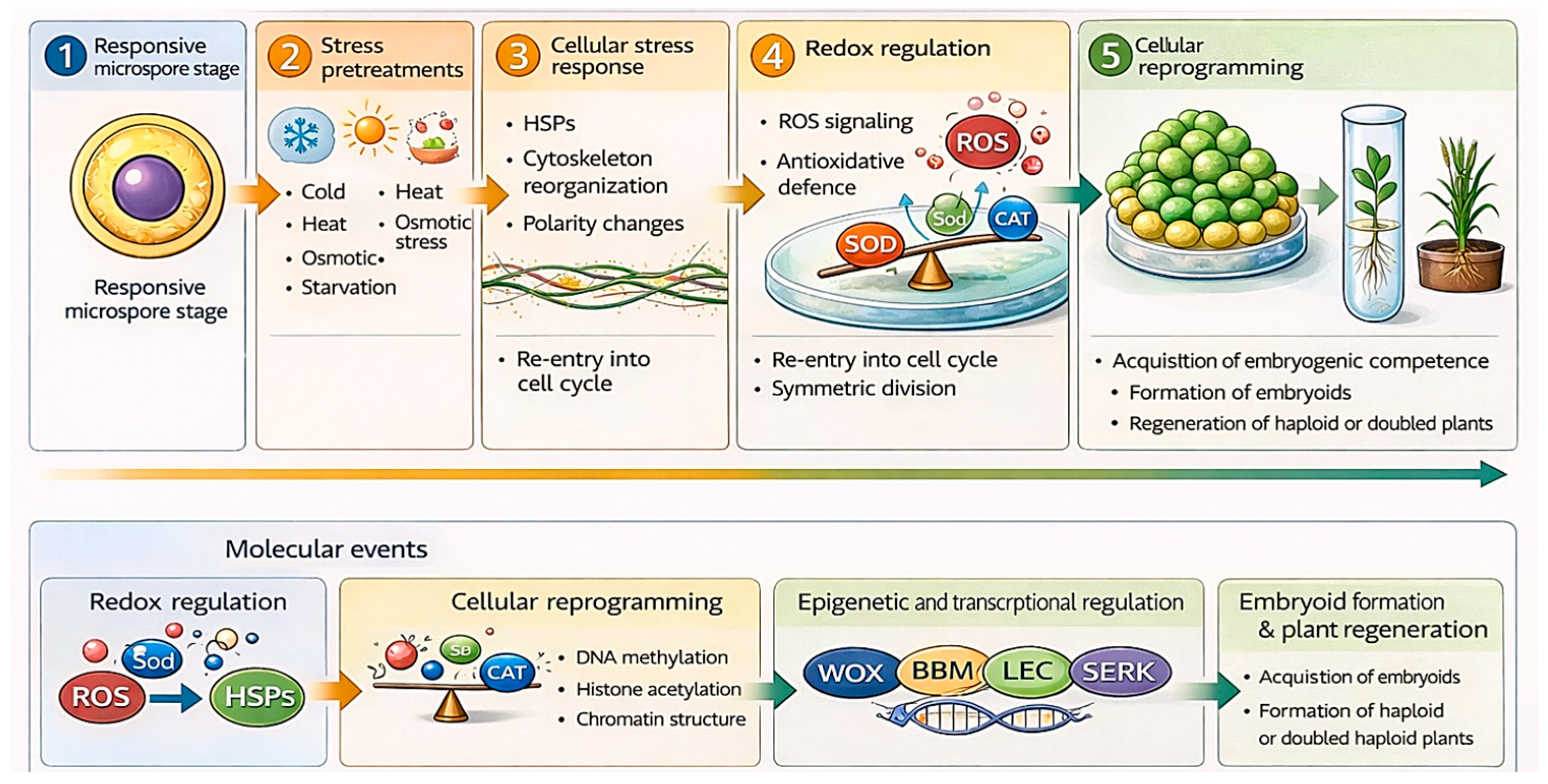
2.1.1. Biological Basis
2.1.2. Pretreatment
2.2. Anther Culture
2.2.1. Principle
2.2.2. Advantages
2.3. Isolated Microspore Culture
Principle
2.4. Major Limitations of Anther Culture and Isolated Microspore Culture in Wheat

| Genotype | Method | Pretreatment | Induction Medium | Regeneration Medium | Response (%) | Green Shoots (%) | Albino Shoots (%) | Reference |
|---|---|---|---|---|---|---|---|---|
| Triticum aestivum: Pavon, Caramba | AC | SM (0.7 M mannitol, 5 days, 25 °C, darkness) → MSMI + 0.2% n-butanol (2–3 h) | MSMIF2 + 6 mature ovaries → MSMIF4 + Ficoll | J25-8 | not reported | not reported | not reported | [8] |
| Triticum spelta L. | AC | Cold pretreatment of donor shoots: 3–4 °C, 14 days | W14mf (300 anthers per Petri dish, 32 °C for 3 days → 28 °C, darkness, 8 weeks) | 190-2Cu | not reported | not reported | not reported | |
| Triticale | IMC | Cold pretreatment of spikes: 4 °C, 21 days (darkness, immersed in water) | CIMC with 20% maltose gradient → TSA 1 µM (10 min) → CIMC with PSK-α (0.1 µM) + 6 ovaries per dish | CIMC-4 | not reported | not reported | not reported | |
| Triticum aestivum | AC | Cold pretreatment of spikes: 4 °C, ~14 days (in water, wrapped with PVC, darkness) | P-4mf liquid medium (P-4 with 9% maltose; 10% Ficoll; potato extract); 32 °C for 3 days → 28 °C for 5–6 weeks | 190-2Cu | not reported | not reported | not reported | [56], pp. 59–64 |
| Triticum aestivum (Central and Eastern European genotypes, n = 32) | AC | Spike selection → surface sterilization with 20% NaOCl for 30 min | W14 medium containing colchicine (40 mg L−1) for 3 days at 29 °C in darkness → followed by W14 without colchicine | 190-2 regeneration medium → 190-2 medium without plant growth regulators | 6.8–82.3 (avg. 26.3) | 1.8–43.8 (avg. 11.4) | not reported | [56], pp. 65–70 |
| Winter wheat | AC | Cold pretreatment at 7 °C for ≤14 days | 190-2 medium supplemented with 9% maltose, 2,4-D (1.5 mg L−1) and kinetin (0.5 mg L−1), without NAA; incubation at 28 °C in darkness | 190-2 | not reported | 3.3–5.6 | not reported | [56], pp. 71–76 |
| Triticum aestivum | IMC | Cold pretreatment at 4 °C for up to 4 days → surface sterilization → one of the following treatments: (i) 0.4 M mannitol for 5 days at room temperature; or (ii) 0.4 M mannitol at 4 °C for 5–7 days; or (iii) water at 4 °C for 2–4 weeks | MMS4 medium; culture in liquid form or on filter paper with the addition of 4–6 ovaries per dish | MMS5 | 2000–4000 embryos/spike | 40–50 | genotype-dependent | [56], pp. 77–81 |
| Triticum aestivum: Gemmeiza 7, Giza 164, Gemmeiza 9, Sids 4, Giza 168, Line-115 | AC | Cold pretreatment of donor tillers: 4 °C for 6–8 days (in darkness, immersed in water) | N6 + 2 mg L−1 2,4-D + 1 mg L−1 kinetin + 90 g/L sucrose + 7 g/L agar | MS + 0.5 mg/L NAA + 0.5 mg L−1 kinetin + 30 g/L sucrose | 0.67–18.0 (callus induction) | 0–10 | 0–24 | [59] |
| Spring wheat cv. Pavon 76 | AC | Cold pretreatment of donor tillers: 4–8 °C for 1–2 weeks | Modified 85D12 medium + PAA + zeatin; 30 °C, 12 h photoperiod | not reported | 5–15 (callus induction, genotype-dependent) | 1–8 | High | [60] |
| Triticum aestivum: Chris, Pavon 76, WED 202 16-2,Yecora Rojo, Calorwa, Waldro, Wawawai, and winter wheats Capo and Svilena | IMC | Chemical pretreatment of donor tillers: 2-HNA (0–1 g/L) ± 2,4-D (10−6 M) ± BAP (10−6 M), 33 °C for 48–72 h | NPB-99 liquid medium + PAA 1 mg/L + 2,4-D 0.2 mg/L + kinetin 0.2 mg/L + 90 g/L maltose + live ovaries (1 per mL) | 190-2 | 20–50 (microspore reprogramming) | 36–100 | not reported | [44] |
| F1 hybrids | AC | Cold pretreatment at 4–6 °C for 5–10 days | Plated onto modified Potato II (P2) medium | 190-2 | not reported | not reported | not reported | [71] |
| Triticum aestivum | AC | Cold pretreatment at 4–6 °C for 5–10 days | Potato-2 in the dark and at 28–30 °C | 190-2 + NAA (0.5 mg L−1) and kinetin (0.5 mg L−1) | 1–15 (callus induction, genotype-dependent) | 0–10 | High | [72] |
| Iranian wheat cultivars and four segregating F 3 wheat lines | AC | Cold pretreatment at 4 °C for 7 days | P4 medium supplemented with 5 mg/L kinetin and 2 mg/L 2,4-D, containing 10% Ficoll | 190-2 medium supplemented with 0.5 mg/L kinetin and 0.5 mg/L NAA | 2–12 (callus induction, genotype-dependent) | 0–6 | High | [73] |
| Triticum aestivum | AC | Cold pretreatment of donor spikes at 4–6 °C for 6–10 days | Modified 85D12 liquid medium supplemented with 2 mg/L 2,4-D, 1 mg/L NAA, and 9% sucrose, with or without PEG 8000 | R85D12 regeneration medium without plant growth regulators, containing 5 g/L wheat starch | 5–20 | 2–10 | High | [65] |
| Triticum aestivum | AC | Cold pretreatment of donor spikes at 4 °C for 2 days | Liquid P-4 induction medium supplemented with 2,4-D (0.5–4.0 mg/L; optimum ≈1.0 mg/L; high concentrations applied only for 10–15 days) | 190-2 medium with 2.0 mg/L 2,4-D for less than 15 days, followed by transfer to medium with 0.2 mg/L 2,4-D | 5–25 (callus induction) | 2–12 | High | [43] |
| Spring and winter wheat | IMC | Cold pretreatment of donor tillers at 4 °C for 21–28 days (in water, dark) | NPB-99 liquid medium supplemented with 2,4-D (0.2 mg/L), kinetin (0.2 mg/L) and PAA (1.0 mg/L) | B5-5 regeneration medium supplemented with kinetin (1.0 mg/L) and IAA (1.0 mg/L) | not reported | not reported | not reported | [6] |
| Triticum aestivum | AC | Anthers cultured for 5 days on medium containing 127.5 g/L mannitol + 5.9 g/L CaCl2·2H2O + FHG macronutrients, solidified with agarose (8 g/L) | MS3M medium (90 g/L maltose, 1 mg/L 2,4-D, 1 mg/L BA) supplemented with n-butanol (0.1–0.2%, 5 h) → medium replaced with MS3MF200 (62 g/L maltose + 200 g/L Ficoll, conditioned with 40 ovaries/6 mL, 5 days) → after 10–12 days addition of MS3MF300 (300 g/L Ficoll) | J25-8 regeneration medium, incubation in the dark at 25 °C for 2 days, then transferred to light | 3–5× vs. control | 3–5× vs. control | not reported | [53] |
| Triticum timopheevii | AC | Cold pretreatment of donor spikes at 4 °C for 14 days, in water, in darkness | Liquid NPB-99, or C17, or modified 190-2 (+ MS vitamins, biotin 1.5 mg/L, thiamine 0.9 mg/L, 2,4-D 2 mg/L, kinetin 0.5 mg/L); all media supplemented with arabinogalactan 10 mg/L, L-glutamine 500 mg/L, cefotaxime 100 mg/L, maltose 90 g/L, Ficoll 400 10%; media pre-conditioned with 10–15 wheat pistils per plate for 2 weeks at 26 °C in darkness; optional epigenetic treatment: NPB-99 + TSA 0.01 µM | 190-4 shoot induction medium + kinetin 1.5 mg/L + NAA 0.5 mg/L, solidified with phytagel 3.5 g/L at 25 °C; red/blue LED light; 16 h photoperiod; subculture every 2 weeks; plantlet elongation on ½ MS salts + double B5 vitamins + activated charcoal 1 g/L (no PGRs) | 1 | 1 | 75–96 | [58] |
| Pavon, Caramba | AC | 0.4 M mannitol with 5.9 g/L CaCl2·2H2O + FHG macronutrients + TSA 0.4 µM, 5 days, 25 °C, dark | OVPCM (MS3M with 1 mg/L 2,4-D; 1 mg/L BA; 200 g/L Ficoll), conditioned with 30 ovaries/10 mL for 5 days → after 10–12 days, add MS3M with 400 g/L Ficoll | J25-8 | 3–5× vs. control | 3–5× vs. control | not reported | [46] |
| Triticum turgidum L. | IMC | Osmotic pretreatment of anthers: 0.7 M mannitol or 0.7 M mannitol + 30 mM CaCl2·2H2O, solidified with 8 g/L agarose; 5–6 days, 24 °C, dark (30 anthers per plate) | C17 with Ficoll-400 (300 g/L); 1 mg/L 2,4-D; 1 mg/L BAP | J25-8 | not reported | not reported | not reported | [52] |
| Macon, Express, Pavón 76 and Chris | IMC | Osmotic pretreatment: 0.4 M mannitol, 7–10 days at 4 °C | MMS4 | RM5 (MMS5 with 5 mg/L ascorbic acid) at 26 °C in the dark for 3 to 4 d, followed by transfer to a full-light growth chamber at 24 °C | not reported | not reported | not reported | [65] |
| Winter wheat F1 and F2 hybrids | AC | Cold pretreatment of donor spikes at 4 °C for 14 days, in water, in darkness | Liquid AMC c Cu2+ 2.5 mg/L at +29 °C in dark conditions | 190-2 | not reported | not reported | not reported | [61] |
| Spring wheat | AC | Cold pretreatment of donor spikes at 4 °C for 7 days, in water, in darkness | C17 with maltose 90 g/L; Gelrite 2.5 g/L; 2,4-D 1.0 mg/L; Dicamba 1.0 mg/L | MS with NAA 0.5 mg/L; Kinetin 0.5 mg/L; agar 0.6% | 6.3 | 2.7 | 0.6–0.7 | [29] |
| Winter wheat | AC | Cold pretreatment of donor spikes at 4 °C for 7 days, in water, in darkness | C17 with maltose 90 g/L; Gelrite 2.5 g/L; 2,4-D 1.5 mg/L; Kinetin 0.5 mg/L | MS with NAA 0.5 mg/L; Kinetin 0.5 mg/L; agar 0.6% | 3.2 | 0.5 | 0.3 | |
| Chris, Pavon Spring wheat | AC | Cold pretreatment of donor spikes at 4 °C for ≤4 days, in water, in darkness | Modified 85D12 (liquid); 2 mg/L 2,4-D; 50 g/L sucrose (initiation) or 0.26 M maltose as carbon source | Modified 85D12 with 2 mg/L 2,4-D; 50 g/L wheat starch (instead of agar) + 90 g/L sucrose | genotype-dependent | 0–10% | genotype-dependent | [74] |
3. DH Production via Wheat × Maize Hybridisation
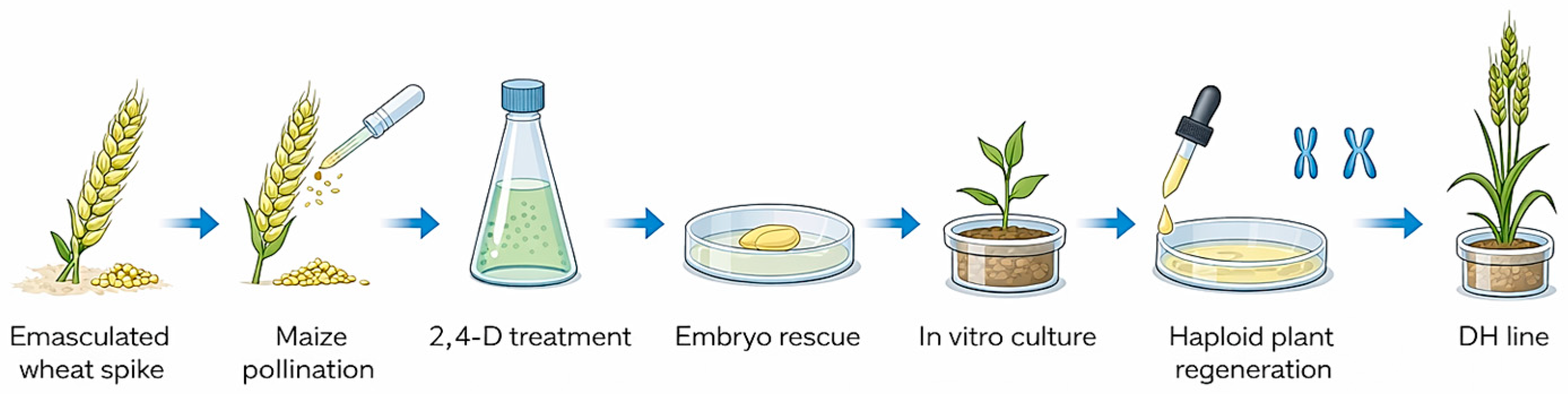
3.1. Haploid Production
3.2. Advantages
3.3. Major Limitations
4. Alternative Wide Hybridisation Systems: Imperata cylindrica × Hordeum bulbosum
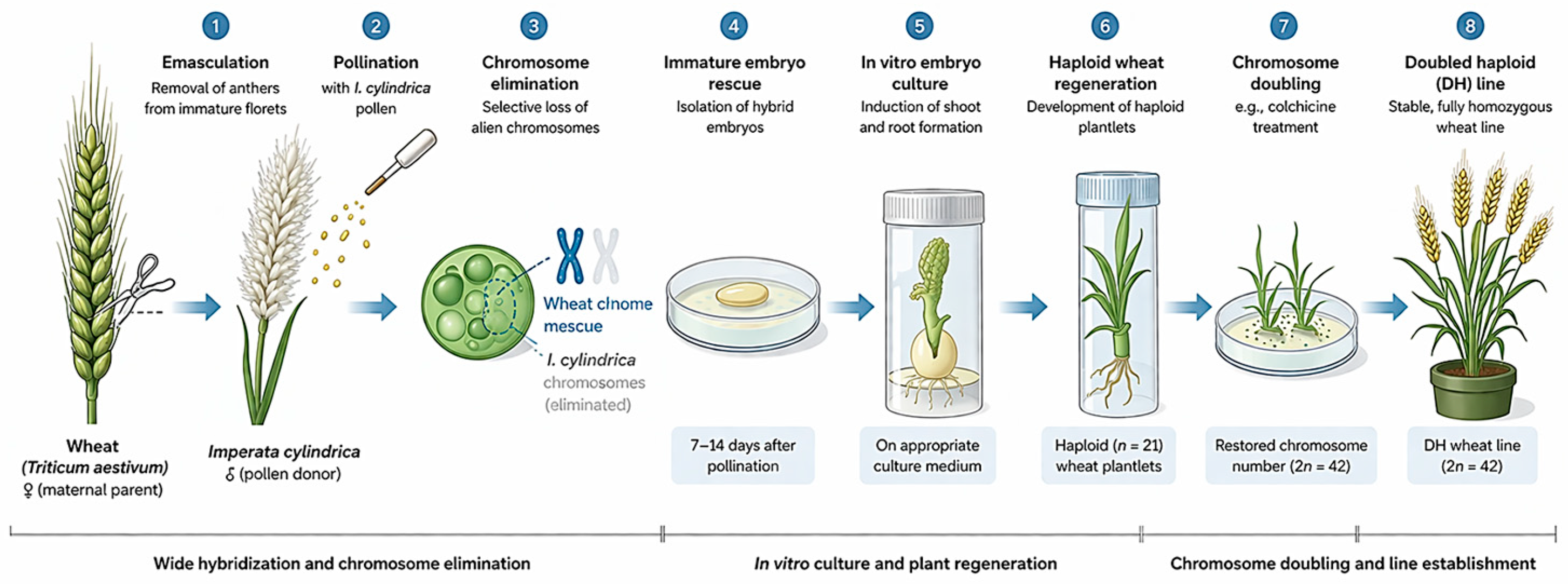
4.1. Imperata cylindrica
4.2. Hordeum bulbosum
5. Haploid and DH Systems as Platforms for Omics Analyses in Wheat
6. DH Populations in QTL Mapping
7. DH Wheat in SNP Genotyping: SNP Arrays, KASP Markers, and Targeted Platforms as an Integrated Breeding–Genetic Framework
8. Integration of Haploid Technologies with Genome Editing in Wheat
9. Conclusions and Future Perspectives
Supplementary Materials
Author Contributions
Funding
Data Availability Statement
Acknowledgments
Conflicts of Interest
Abbreviations
| CMS | Cytoplasmic male sterility |
| DH | Doubled haploid |
| DMSO | Dimethyl sulfoxide |
| HI | Haploid induction |
| GCA | General combining ability |
| GWAS | Genome-wide association studies |
| MAS | Marker-assisted selection |
| mcGISH | Multicolor genomic in situ hybridization |
| QTL/N | Quantitative trait loci / nucleotide |
| SNP | Single nucleotide polymorphism |
| TGW | Thousand grain weight |
| HD | Heading Date |
| PH | Plant Height |
| SL | Spike Length |
| RIL | Recombinant Inbred Lines |
| QTNs | Quantitative Trait Nucleotides |
| NDVI | Normalized Difference Vegetation Index |
| GISH | Genomic In Situ Hybridization |
| mcGISH | Multi-color Genomic In Situ Hybridization |
| 2-HNA | 2-Hydroxynicotinic Acid |
| BAP | 6-Benzylaminopurine |
| 2,4-D | 2,4-Dichlorophenoxyacetic Acid |
| IAA | Indole-3-Acetic Acid |
| IAA-Glu | Indole-3-Acetyl-Glutamate |
| oxIAA | Oxidized Indole-3-Acetic Acid |
| TSA | Trichostatin A |
| MTA | Marker–Trait Association |
| MLM | Mixed Linear Model |
| HI-Edit | Haploid Induction–Mediated Genome Editing |
| IMGE | In Vivo Maize-Mediated Genome Editing |
References
- Srividya, A.; Sandal, S.S.; Walia, P. Doubled haploids in crop improvement: Unraveling strategies, advancements and prospects for enhanced genetics. Int. J. Plant Soil Sci. 2023, 35, 348–358. [Google Scholar] [CrossRef] [Scilit]
- Singh, J.; Chhabra, B.; Raza, A.; Yang, S.H.; Sandhu, K.S. Important wheat diseases in the US and their management in the 21st century. Front. Plant Sci. 2023, 13, 101019. [Google Scholar] [CrossRef] [Scilit] [PubMed]
- Niazian, M.; Shariatpanahi, M.E. In vitro-based doubled haploid production: Recent improvements. Euphytica 2020, 216, 69. [Google Scholar] [CrossRef] [Scilit]
- Kumar, O.; Choudhary, M. Double haploid: An overview. Int. J. Curr. Microbiol. Appl. Sci. 2020, 9, 1012–1029. [Google Scholar] [CrossRef] [Scilit]
- Ren, J.; Wu, P.; Trampe, B.; Tian, X.; Lübberstedt, T.; Chen, S. Novel technologies in doubled haploid line development. Plant Biotechnol. J. 2017, 15, 1361–1370. [Google Scholar] [CrossRef] [Scilit]
- Wang, H.M.; Enns, J.L.; Nelson, K.L.; Brost, J.M.; Orr, T.D.; Ferrie, A.M.R. Improving the efficiency of wheat microspore culture methodology: Evaluation of pretreatments, gradients, and epigenetic chemicals. Plant Cell Tissue Organ Cult. 2019, 139, 589–599. [Google Scholar] [CrossRef] [Scilit]
- Eliby, S.; Bekkuzhina, S.; Kishchenko, O.; Iskakova, G.; Kylyshbayeva, G.; Jatayev, S.; Soole, K.; Langridge, P.; Borisjuk, N.; Shavrukov, Y. Developments and prospects for doubled haploid wheat. Biotechnol. Adv. 2022, 60, 108007. [Google Scholar] [CrossRef] [Scilit]
- Segui-Simarro, J.M.; Moreno, J.B.; Fernández, M.G.; Mir, R. Doubled haploid technology. Methods Mol. Biol. 2021, 2287, 50. [Google Scholar] [CrossRef] [Scilit]
- Hale, B.; Ferrie, A.M.; Chellamma, S.; Samuel, J.P.; Phillips, G.C. Androgenesis-based doubled haploidy: Past, present, and future perspectives. Front. Plant Sci. 2022, 12, 751230. [Google Scholar] [CrossRef] [Scilit]
- Touraev, A.; Pfosser, M.; Heberle-Bors, E. The microspore: A haploid multipurpose cell. Adv. Bot. Res. 2001, 35, 53–109. [Google Scholar] [CrossRef] [Scilit]
- Zheng, M.Y. Microspore culture in wheat (Triticum aestivum)–doubled haploid production via induced embryogenesis. Plant Cell Tissue Organ Cult. 2003, 73, 213–230. [Google Scholar] [CrossRef] [Scilit]
- Wang, K.; Gong, Q.; Ye, X. Recent developments and applications of genetic transformation and genome editing technologies in wheat. Theor. Appl. Genet. 2020, 133, 1603–1622. [Google Scholar] [CrossRef] [Scilit] [PubMed]
- Katoch, A.; Chaudhary, H.K.; Sood, V.K.; Singh, K.; Verma, S.; Rana, A. Relative haploid induction and fertility efficiency in hexaploid, tetraploid and wheat × rye derivatives following Zea mays- and Imperata cylindrica-mediated chromosome elimination approach. Crop Pasture Sci. 2025, 76, CP24339. [Google Scholar] [CrossRef] [Scilit]
- Han, F.; Zhang, X.; Liu, Y.; Liu, Y.; Zhao, H.; Li, Z. One-step creation of CMS lines using a BoCENH3-based haploid induction system in Brassica crop. Nat. Plants 2024, 10, 581–586. [Google Scholar] [CrossRef] [Scilit]
- Wang, D.; Guo, Y.; Liu, M.; Liu, H. The function of TaWOX14 in wheat genetic transformation. Plant Cell Rep. 2025, 44, 176. [Google Scholar] [CrossRef] [Scilit]
- Sheng, H.; Gao, P.; Yang, C.; Quilichini, T.D.; Kochian, L.V.; Datla, R.; Xiang, D. Advances in genome editing through haploid induction systems. Int. J. Mol. Sci. 2025, 26, 4779. [Google Scholar] [CrossRef] [Scilit]
- Wang, L.; Zhang, Y.; Zhao, C.; Qu, G.; Zhao, J.; Wang, C.; Li, T. Mutation of TaPOD8 triggers haploid induction through a reactive oxygen species burst in wheat. Plant Physiol. 2026, 200, kiag053. [Google Scholar] [CrossRef] [Scilit] [PubMed]
- Borrill, P.; Adamski, N.; Uauy, C. Genomics as the key to unlocking the polyploid potential of wheat. New Phytol. 2015, 208, 1008–1022. [Google Scholar] [CrossRef] [Scilit]
- Sun, C.; Hu, H.; Cheng, Y.; Yang, X.; Qiao, Q.; Wang, C.; Zhang, L.; Chen, D.; Zhao, S.; Dong, Z.; et al. Genomics-assisted breeding: The next-generation wheat breeding era. Plant Breed. 2023, 142, 259–268. [Google Scholar] [CrossRef] [Scilit]
- Impens, L.; Lorenzo, C.D.; Vandeputte, W.; Wytynck, P.; Debray, K.; Haeghebaert, J.; Herwegh, D.; Jacobs, T.B.; Ruttink, T.; Nelissen, H.; et al. Combining multiplex gene editing and doubled haploid technology in maize. New Phytol. 2023, 239, 1521–1532. [Google Scholar] [CrossRef] [Scilit]
- Dhariwal, R.; Bihari, L.; Akter, Z.; Randhawa, H.S. Production of doubled haploid spring wheat plants: Wheat × maize hybridization and microspore culture methods. Methods Mol. Biol. 2025, 321, 321–358. [Google Scholar] [CrossRef] [Scilit]
- Blakeslee, A.F.; Belling, J.; Farnham, M.E.; Bergner, A.D. A haploid mutant in the Jimson weed, Datura stramonium. Science 1922, 55, 646–647. [Google Scholar] [CrossRef] [Scilit] [PubMed]
- Gaines, E.F.; Aase, H.C. A haploid wheat plant. Am. J. Bot. 1926, 13, 373–385. [Google Scholar] [CrossRef] [Scilit]
- Tadesse, W.; Inagaki, M.; Tawkaz, S.; Baum, M.; Van Ginkel, M. Recent advances and application of doubled haploids in wheat breeding. Afr. J. Biotechnol. 2012, 11, 15484–15492. [Google Scholar] [CrossRef] [Scilit]
- Tadesse, W.; Tawkaz, S.; Inagaki, M.N.; Picard, E.; Baum, M. Methods and Applications of Doubled Haploid Technology in Wheat Breeding, 3rd ed.; ICARDA: Aleppo, Syria, 2013; pp. 1–36. [Google Scholar]
- Patial, M.; Pal, D.; Thakur, A.; Bana, R.S.; Patial, S. Doubled haploidy techniques in wheat (Triticum aestivum L.): An overview. Proc. Natl. Acad. Sci. India Sect. B Biol. Sci. 2019, 89, 27–41. [Google Scholar] [CrossRef] [Scilit]
- Canonge, J.; Roby, C.; Hamon, C.; Potin, P.; Pfannschmidt, T.; Philippot, M. Occurrence of albinism during wheat androgenesis is correlated with repression of the key genes required for proper chloroplast biogenesis. Planta 2021, 254, 6. [Google Scholar] [CrossRef] [Scilit]
- Zhang, N.; Qi, X.; Wu, L.; Wang, Z.; Ma, H.; Zhu, X.; Liu, J.; Niu, W.; Guo, S.; He, Y.; et al. Accelerating wheat breeding by haploid induction. Crop J. 2025, 13, 1363–1371. [Google Scholar] [CrossRef] [Scilit]
- Weigt, D.; Kiel, A.; Siatkowski, I.; Zyprych-Walczak, J.; Tomkowiak, A.; Kwiatek, M. Comparison of the androgenic response of spring and winter wheat (Triticum aestivum L.). Plants 2019, 9, 49. [Google Scholar] [CrossRef] [Scilit] [PubMed]
- Touraev, A.; Pförtner, T.; Vicente, O.; Heberle-Bors, E. Stress-induced microspore embryogenesis in tobacco: An optimized system for molecular studies. Plant Cell Rep. 1997, 15, 561–565. [Google Scholar] [CrossRef]
- Maraschin, S.F.; de Priester, W.; Spaink, H.P.; Wang, M. Androgenic switch: An example of plant embryogenesis from the male gametophyte perspective. Trends Plant Sci. 2005, 10, 368–375. [Google Scholar] [CrossRef] [Scilit]
- Reynolds, T.L. Pollen embryogenesis. Plant Mol. Biol. 1997, 33, 1–10. [Google Scholar] [CrossRef] [Scilit] [PubMed]
- Pechan, P.M.; Smykal, P. Androgenesis: Affecting the fate of the male gametophyte. Physiol. Plant. 2001, 111, 1–8. [Google Scholar] [CrossRef] [Scilit]
- Żur, I.; Dubas, E.; Krzewska, M.; Janowiak, F. Triticale and barley microspore embryogenesis induction requires both reactive oxygen species generation and efficient system of antioxidative defence. Plant Cell Tissue Organ Cult. 2021, 145, 347–366. [Google Scholar] [CrossRef] [Scilit]
- Ucar, S.; Aydin, M. Effects of epigenetic inhibitors on somatic embryogenesis in wheat (Triticum aestivum L.). Iran. J. Sci. 2025, 49, 1–10. [Google Scholar] [CrossRef] [Scilit]
- Yuan, H.Y.; Jiang, Y.; Kathiria, P.; Bollina, V.; Tan, Y.; Enns, J.L.; Ferrie, A.M.R.; Kagale, S. Transcriptomic analyses reveal regulatory plasticity and metabolic reprogramming underlying genotype-specific microspore embryogenesis in wheat. Plant Cell Rep. 2026, 45, 51. [Google Scholar] [CrossRef] [Scilit] [PubMed]
- Seguí-Simarro, J.M.; Nuez, F. Pathways to doubled haploidy: Chromosome doubling during androgenesis. Cytogenet. Genome Res. 2008, 120, 358–369. [Google Scholar] [CrossRef] [Scilit] [PubMed]
- Germanà, M.A. Gametic embryogenesis and haploid technology as valuable support to plant breeding. Plant Cell Tissue Organ Cult. 2011, 104, 167–179. [Google Scholar] [CrossRef] [Scilit]
- Ferrie, A.M.R.; Möllers, C. Haploids and doubled haploids in Brassica spp. for genetic and genomic research. Plant Cell Tissue Organ Cult. 2011, 104, 375–386. [Google Scholar] [CrossRef] [Scilit]
- Hu, T.; Kasha, K.J. Improvement of isolated microspore culture of wheat (Triticum aestivum L.) through ovary co-culture. Plant Cell Rep. 1997, 16, 520–525. [Google Scholar] [CrossRef] [Scilit]
- Zheng, M.; Liu, W.; Weng, Y.; Polle, E.; Konzak, C. Culture of freshly isolated wheat (Triticum aestivum L.) microspores treated with inducer chemicals. Plant Cell Rep. 2001, 20, 685–690. [Google Scholar] [CrossRef] [Scilit]
- Maıwan, N.; Yıldız, M.; Salih, S.; Luna, S. An overview of haploid and double haploid production methods in wheat. Black Sea J. Agric. 2022, 5, 344–350. [Google Scholar] [CrossRef] [Scilit]
- Zheng, M.Y.; Konzak, C.F. Effect of 2,4-dichlorophenoxyacetic acid on callus induction and plant regeneration in anther culture of wheat (Triticum aestivum L.). Plant Cell Rep. 1999, 19, 69–73. [Google Scholar] [CrossRef] [Scilit]
- Liu, W.; Zheng, M.Y.; Konzak, C.F. Highly efficient doubled haploid production in wheat via induced androgenesis. Crop Sci. 2002, 42, 686–692. [Google Scholar] [CrossRef] [Scilit]
- Soriano, M.; Li, H.; Boutilier, K. Microspore embryogenesis: Establishment of embryo identity and pattern in culture. Plant Reprod. 2013, 26, 181–196. [Google Scholar] [CrossRef] [Scilit]
- Castillo, A.M.; Valero-Rubira, I.; Burrell, M.Á.; Allué, S.; Costar, M.A.; Vallés, M.P. Trichostatin A affects developmental reprogramming of bread wheat microspores towards an embryogenic route. Plants 2020, 9, 1442. [Google Scholar] [CrossRef] [Scilit] [PubMed]
- Orłowska, R.; Zebrowski, J.; Zimny, J.; Androsiuk, P.; Bednarek, P.T. S-Adenosyl-L-Methionine and Cu (II) impact green plant regeneration efficiency. Cells 2022, 11, 2700. [Google Scholar] [CrossRef] [Scilit] [PubMed]
- Dwivedi, S.L.; Britt, A.B.; Tripathi, L.; Sharma, S.; Upadhyaya, H.D.; Ortiz, R. Haploids: Constraints and opportunities in plant breeding. Biotechnol. Adv. 2015, 33, 812–829. [Google Scholar] [CrossRef] [Scilit]
- Springer, A.; Krzewska, M.; Dubas, E.; Kopeć, P.; Plačková, L.; Doležal, K.; Weigt, D.; Żur, I. Induction of microspore embryogenesis in bread wheat by mannitol pre-treatment is associated with the disruption of endogenous hormone balance and substantial accumulation of auxins. BMC Plant Biol. 2025, 25, 370. [Google Scholar] [CrossRef] [Scilit] [PubMed]
- Dubas, E.; Castillo, A.M.; Żur, I.; Krzewska, M.; Vallés, M.P. Microtubule organization changes severely after mannitol and n-butanol treatments inducing microspore embryogenesis in bread wheat. BMC Plant Biol. 2021, 21, 586. [Google Scholar] [CrossRef] [Scilit] [PubMed]
- Lazaridou, T.B.; Mavromatis, A.G.; Xynias, I.N. Effect of culture medium and mannitol pre-treatment on durum wheat anther culture response. Cytol. Genet. 2021, 55, 590–597. [Google Scholar] [CrossRef] [Scilit]
- Cistué, L.; Soriano, M.; Castillo, A.M.; Vallés, M.P.; Sanz, J.M.; Echavarri, B. Production of doubled haploids in durum wheat (Triticum turgidum L.) through isolated microspore culture. Plant Cell Rep. 2006, 25, 257–264. [Google Scholar] [CrossRef] [Scilit]
- Soriano, M.; Cistué, L.; Castillo, A.M. Enhanced induction of microspore embryogenesis after n-butanol treatment in wheat (Triticum aestivum L.) anther culture. Plant Cell Rep. 2008, 27, 805–811. [Google Scholar] [CrossRef] [Scilit]
- Indrianto, A.; Barinova, I.; Touraev, A.; Heberle-Bors, E. Tracking individual wheat microspores in vitro: Identification of embryogenic microspores and body axis formation in the embryo. Planta 2001, 212, 163–174. [Google Scholar] [CrossRef] [Scilit]
- Castillo, A.M.; Valero-Rubira, I.; Allué, S.; Costar, M.A.; Vallés, M.P. Bread wheat doubled haploid production by anther culture. In Doubled Haploid Technology: Volume 1: General Topics, Alliaceae, Cereals; Springer: New York, NY, USA, 2021; pp. 227–244. [Google Scholar] [CrossRef] [Scilit]
- Maluszynski, M. (Ed.) Doubled haploid production in crop plants: A manual. In Doubled Haploid Production in Crop Plants: A Manual; Springer Science & Business Media: Dordrecht, The Netherlands, 2003. [Google Scholar]
- Kasha, K.J.; Maluszynski, M. Doubled Haploid Production in Crop Plants, 3rd ed.; Springer: Dordrecht, The Netherlands, 2003; pp. 1–8. [Google Scholar]
- Oleszczuk, S.; Podskarbi, M.; Michalski, K. First regeneration of doubled haploids via anther culture in Triticum timopheevii. Plant Cell Tissue Organ Cult. 2025, 163, 7. [Google Scholar] [CrossRef] [Scilit]
- El-Hennawy, M.A.; Abdalla, A.F.; Shafey, S.A.; Al-Ashkar, I.M. Production of doubled haploid wheat lines (Triticum aestivum L.) using anther culture technique. Ann. Agric. Sci. 2011, 56, 63–72. [Google Scholar] [CrossRef] [Scilit]
- Kim, K.M.; Baenziger, P.S. A simple wheat haploid and doubled haploid production system using anther culture. Vitr. Cell. Dev. Biol.-Plant 2005, 41, 22–27. [Google Scholar] [CrossRef] [Scilit]
- Grauda, D.; Miķelsone, A.; Ķisina, N.; Žagata, K.; Ornicāns, R.; Fokina, O.; Lapiņa, L.; Rashal, I. Anther culture effectiveness in producing doubled haploids of cereals. Proc. Latv. Acad. Sci. Sect. B Nat. Exact Appl. Sci. 2014, 68, 142–147. [Google Scholar]
- Chaudhary, H.K.; Badiyala, A.; Jamwal, N.S. New frontiers in doubled haploidy breeding in wheat. Agric. Res. J. 2015, 52, 1–12. [Google Scholar] [CrossRef] [Scilit]
- Santra, M.; Ankrah, N.; Santra, D.K.; Kidwell, K.K. An improved wheat microspore culture technique for the production of doubled haploid plants. Crop Sci. 2012, 52, 2314–2320. [Google Scholar] [CrossRef] [Scilit]
- Weigt, D.; Niemann, J.; Siatkowski, I.; Zyprych-Walczak, J.; Olejnik, P.; Kurasiak-Popowska, D. Effect of zearalenone and hormone regulators on microspore embryogenesis in anther culture of wheat. Plants 2019, 8, 487. [Google Scholar] [CrossRef] [Scilit]
- Kang, T.J.; Yang, M.S.; Deckard, E.L. The effect of osmotic potential on anther culture in spring wheat (Triticum aestivum). Plant Cell Tissue Organ Cult. 2003, 75, 35–40. [Google Scholar] [CrossRef] [Scilit]
- Cistué, L.; Romagosa, I.; Batlle, F.; Echávarri, B. Improvements in the production of doubled haploids in durum wheat (Triticum turgidum L.) through isolated microspore culture. Plant Cell Rep. 2009, 28, 727–735. [Google Scholar] [CrossRef] [Scilit] [PubMed]
- Ferrie, A.M.R.; Caswell, K.L. Isolated microspore culture techniques and recent progress for haploid and doubled haploid plant production. Plant Cell Tissue Organ Cult. 2011, 104, 301–309. [Google Scholar] [CrossRef] [Scilit]
- Shariatpanahi, M.E.; Belogradova, K.; Hessamvaziri, L.; Heberle-Bors, E.; Touraev, A. Efficient embryogenesis and regeneration in freshly isolated and cultured wheat (Triticum aestivum L.) microspores without stress pretreatment. Plant Cell Rep. 2006, 25, 1294–1299. [Google Scholar] [CrossRef] [Scilit] [PubMed]
- Petrash, N.V.; Kapko, T.N.; Sovetov, V.V. Study of wheat (Triticum aestivum L.) breeding material potential for in vitro androgenesis. Vavilov J. Genet. Breed. 2023, 27, 1022. [Google Scholar] [CrossRef] [Scilit]
- Torp, A.M.; Andersen, S.B. Albinism in microspore culture. In Advances in Haploid Production in Higher Plants; Springer: Dordrecht, The Netherlands, 2009; pp. 155–160. [Google Scholar]
- Ljevnaić-Mašić, B.; Kondić-Špika, A.; Brbaklić, L.; Trkulja, D.; Hristov, N. Genetic analysis of anther culture response in wheat genotypes. Savrem. Poljopr. 2010, 59, 49–55. [Google Scholar]
- Kondić-Špika, A.; Kobiljski, B.; Hristov, N. Efficiency of anther culture technique in the production of wheat double haploids. Zb. Matice Srp. Prir. Nauk. 2008, 115, 35–40. [Google Scholar] [CrossRef] [Scilit]
- Khiabani, B.N.; Vedadi, C.; Rahmani, E.; Shalmani, M.A.M. Response of some Iranian wheat genotypes to anther culture system. Indian J. Biotechnol. 2008, 7, 531–535. [Google Scholar]
- Kang, T.J. Plant regeneration from anther culture of spring wheat (Triticum aestivum L.). Korean J. Plant Tissue Cult. 1996, 23, 367–370. [Google Scholar]
- Chu, C.C.; Wang, C.C.; Sun, C.S.; Hsu, C.; Yin, K.C.; Chu, C.Y.; Bi, F.Y. Establishment of an efficient medium for anther culture of rice through comparative experiments on the nitrogen sources. Sci. Sin. 1975, 18, 659–668. [Google Scholar]
- Murashige, T.; Skoog, F. A revised medium for rapid growth and bio assays with tobacco tissue cultures. Physiol. Plant. 1962, 15, 473–497. [Google Scholar] [CrossRef] [Scilit]
- Wang, P.; Chen, Y. Preliminary study on production of haploid pollen H2 generation in winter wheat grown in the field. Acta Agron. Sin. 1983, 9, 283–284. [Google Scholar]
- Wang, X.Z.; Hu, H. The effect of potato II medium for triticale anther culture. Plant Sci. Lett. 1984, 36, 237–239. [Google Scholar] [CrossRef] [Scilit]
- Ouyang, J.W. Induction of pollen plants in Triticum aestivum L. In Haploids of Higher Plants In Vitro, 2nd ed.; Hu, H., Yang, Y., Eds.; China Academic Publishers: Beijing, China, 1986; pp. 26–41. [Google Scholar]
- Liu, W.; Zheng, M.Y.; Konzak, C.F. Improving green plant production via isolated microspore culture in bread wheat (Triticum aestivum L.). Plant Cell Rep. 2002, 20, 821–824. [Google Scholar] [CrossRef] [Scilit]
- Ouyang, J.W.; Jia, S.E.; Zhang, C.; Chen, X.; Fen, G. A new synthetic medium (W14) for wheat anther culture. Ann. Rep. Inst. Genet. Sin. 1989, 91–92. [Google Scholar]
- Jensen, C.J. Monoploid production by chromosome elimination. In Applied and Fundamental Aspects of Plant Cell, Tissue and Organ Culture, 2nd ed.; Reinert, J., Bajaj, Y.P.S., Eds.; Springer: Berlin/Heidelberg, Germany, 1977; pp. 299–330. [Google Scholar]
- Liang, G.H.; Xu, A.; Tang, H. Direct regeneration of wheat haploids via anther culture. Crop Sci. 1987, 27, 336–339. [Google Scholar] [CrossRef] [Scilit]
- Maruthachalam, R. Haploids fast-track hybrid plant breeding. Nat. Plants 2024, 10, 530–532. [Google Scholar] [CrossRef] [Scilit]
- Klíma, M.; Čurn, V.; Pudhuvai, B.; Koul, B. Microspore-Derived Haploid Embryos as a Tool for Developing Double Haploid Plants. In Crop Improvement Strategies in Brassica Species: Applied Science; Kumar, A., Koul, B., Eds.; Springer: Singapore, 2026. [Google Scholar] [CrossRef] [Scilit]
- Raffo, M.A.; Jensen, J. Gene × gene and genotype × environment interactions in wheat. Crop Sci. 2023, 63, 1779–1793. [Google Scholar] [CrossRef] [Scilit]
- Raffo, M.A.; Crescente, J.M.; Vanzetti, L.S.; Helguera, M.; Echenique, V. Improvement of genomic prediction in advanced wheat breeding lines by including additive-by-additive epistasis. Theor. Appl. Genet. 2022, 135, 965–978. [Google Scholar] [CrossRef] [Scilit]
- Cyplik, A.; Bocianowski, J.; Nowosad, K.; Kowalski, A.; Liersch, A. The use of weighted multiple linear regression to estimate QTL × QTL × QTL interaction effects of winter wheat (Triticum aestivum L.) doubled-haploid lines. J. Appl. Genet. 2023, 64, 679–693. [Google Scholar] [CrossRef] [Scilit]
- Zenkteler, M.; Nitzsche, W. Wide hybridization experiments in cereals. Theor. Appl. Genet. 1984, 68, 311–315. [Google Scholar] [CrossRef] [Scilit]
- Laurie, D.A.; Bennett, M.D. Wheat × maize hybridization. Can. J. Genet. Cytol. 1986, 28, 313–316. [Google Scholar] [CrossRef] [Scilit]
- Laurie, D.A.; Bennett, M.D. The effect of the crossability loci Kr1 and Kr2 on fertilization frequency in hexaploid wheat × maize crosses. Theor. Appl. Genet. 1987, 73, 403–409. [Google Scholar] [CrossRef] [Scilit]
- Laurie, D.A.; Bennett, M.D. The production of haploid plants from wheat × maize crosses. Theor. Appl. Genet. 1988, 76, 393–397. [Google Scholar] [CrossRef] [Scilit]
- Laurie, D.A.; Bennett, M.D. The timing of chromosome elimination in hexaploid wheat × maize crosses. Genome 1989, 32, 953–961. [Google Scholar] [CrossRef] [Scilit]
- Guan, X.; Peng, J.; Fu, D. Technology for production of wheat doubled haploid via maize pollen induction—Updated review. Agronomy 2024, 14, 375. [Google Scholar] [CrossRef] [Scilit]
- Santra, M.; Wang, H.; Seifert, S.; Haley, S. Doubled haploid laboratory protocol for wheat using wheat–maize wide hybridization. In Wheat Biotechnology: Methods and Protocols; Springer: New York, NY, USA, 2017; pp. 235–249. [Google Scholar] [CrossRef] [Scilit]
- Niu, Z.; Jiang, A.; Abu Hammad, W.; Oladzadabbasabadi, A.; Xu, S.S.; Mergoum, M.; Elias, E.M. Review of doubled haploid production in durum and common wheat through wheat × maize hybridization. Plant Breed. 2014, 133, 313–320. [Google Scholar] [CrossRef] [Scilit]
- Knox, R.E.; Clarke, J.M.; DePauw, R.M. Dicamba and growth condition effects on doubled haploid production in durum wheat crossed with maize. Plant Breed. 2000, 119, 289–298. [Google Scholar] [CrossRef] [Scilit]
- Brazauskas, G.; Pašakinskienė, I.; Ruzgas, V. Improved approaches in wheat × maize crossing for wheat doubled haploid production. Biologija 2005, 51, 4. [Google Scholar]
- Juzoń, K.; Warchoł, M.; Dziurka, K.; Czyczyło-Mysza, I.M.; Marcińska, I.; Skrzypek, E. The effect of 2,4-dichlorophenoxyacetic acid on the production of oat (Avena sativa L.) doubled haploid lines through wide hybridization. PeerJ 2022, 10, e12854. [Google Scholar] [CrossRef] [Scilit]
- Khan, M.Y.; Mita, S.P.; Hossain, A. Plant Biotechnology and Sustainable Agriculture: Bridging the Gap for Global Food Security, 3rd ed.; CABI: Oxford, UK, 2025; pp. 96–112. [Google Scholar]
- Amin, M.F.; Alam, M.N.; Rahman, A.; Khan, M.M.; Rahman, M.M.; Islam, M.S.; El Sabagh, A. Development of doubled haploid lines in spring wheat (Triticum aestivum L.) through wheat × maize hybridization and colchicine application. Biotechnol. Notes 2025, 6, 260–266. [Google Scholar] [CrossRef] [Scilit]
- Niroula, R.K.; Bimb, H.P. Overview of wheat × maize system of crosses for dihaploid induction in wheat. World Appl. Sci. J. 2009, 7, 1037–1045. [Google Scholar]
- Adamski, T.; Krystkowiak, K.; Kuczyńska, A.; Mikołajczak, K.; Ogrodowicz, P.; Ponitka, A.; Surma, M.; Ślusarkiewicz-Jarzina, A. Segregation distortion in homozygous lines obtained via anther culture and maize doubled haploid methods in comparison to single seed descent in wheat (Triticum aestivum L.). Electron. J. Biotechnol. 2014, 17, 6–13. [Google Scholar] [CrossRef] [Scilit]
- Guzy-Wróbelska, J.; Szarejko, I. Molecular and agronomic evaluation of wheat doubled haploid lines obtained through maize pollination and anther culture methods. Plant Breed. 2003, 122, 305–313. [Google Scholar] [CrossRef] [Scilit]
- Dhiman, R.; Rana, V.; Chaudhary, H. Himalayan maize-potential pollen source for maize mediated system of chromosome elimination approach in DH breeding of bread wheat. Cereal Res. Commun. 2012, 40, 246–255. [Google Scholar] [CrossRef] [Scilit]
- Maqbool, M.A.; Beshir, A.; Khokhar, E.S. Doubled haploids in maize: Development, deployment, and challenges. Crop Sci. 2020, 60, 2815–2840. [Google Scholar] [CrossRef] [Scilit]
- Gandhi, S.; Chaudhary, H.K.; Pal, D.; Kumar, S.; Singh, C.; Bishnoi, S.K.; Patial, M. Imperata cylindrica-mediated doubled haploidy in wheat (Triticum aestivum L.): Quittances and breakthrough. J. Cereal Res. 2023, 15, 31–40. [Google Scholar] [CrossRef] [Scilit]
- Patial, M.; Chaudhary, H.K.; Sharma, N.; Gangwar, O.P.; Kishore, N.; Pal, D.; Pramanick, K.K.; Bhardwaj, S.C.; Chauhan, R. Developing genetic stock for yellow and brown rust resistance in Triticum aestivum L. via Imperata cylindrica-mediated doubled haploidy technique. Cereal Res. Commun. 2022, 50, 439–448. [Google Scholar] [CrossRef] [Scilit]
- Chaudhary, H.K.; Badiyal, A.; Jamwal, N.S.; Sharma, P.; Manoj, N.V.; Singh, K. Recent advances in chromosome elimination-mediated doubled haploidy breeding: Focus on speed breeding in bread and durum wheats. In Accelerated Plant Breeding, Volume 1: Cereal Crops; Springer: Berlin/Heidelberg, Germany, 2020; pp. 167–189. [Google Scholar] [CrossRef] [Scilit]
- Chaudhary, H.K.; Tayeng, T.; Kaila, V.; Rather, S.A. Enhancing the efficiency of wide hybridization mediated chromosome engineering for high precision crop improvement with special reference to wheat × Imperata cylindrica system. Nucleus 2013, 56, 7–14. [Google Scholar] [CrossRef] [Scilit]
- Kapoor, C.; Chaudhary, H.K.; Sharma, P.; Relan, A.; Manoj, N.V.; Singh, K.; Sood, V.K. In vivo haploid induction potential of Himalayan maize (Zea mays) and cogon grass (Imperata cylindrica) gene pools in different segregational cycles of intra and inter-generic crosses of wheat. Plant Genet. Resour. 2021, 19, 522–529. [Google Scholar] [CrossRef] [Scilit]
- Kapoor, C.; Chaudhary, H.K.; Relan, A.; Manoj, N.V.; Singh, K.; Sharma, P. Haploid induction efficiency of diverse Himalayan maize (Zea mays) and cogon grass (Imperata cylindrica) gene pools in hexaploid and tetraploid wheats and triticale following chromosome elimination-mediated approach of doubled haploidy breeding. Cereal Res. Commun. 2020, 48, 539–545. [Google Scholar] [CrossRef] [Scilit]
- Patial, M.; Chaudhary, H.K.; Sharma, N.; Sundaresha, S.; Kapoor, R.; Pal, D.; Pramanick, K.K.; Shukla, A.K.; Kumar, J. Effect of different in vitro and in vivo variables on the efficiency of doubled haploid production in Triticum aestivum L. using Imperata cylindrica-mediated chromosome elimination technique. Cereal Res. Commun. 2021, 49, 133–140. [Google Scholar] [CrossRef] [Scilit]
- Badiyal, A.; Chaudhary, H.K.; Jamwal, N.S.; Bhatt, A.K. Comparative efficiency of triticale × wheat derived F1, F2, F3, BC1F1 and BC1F2 recombinants towards Imperata cylindrica-mediated doubled haploid induction. Cereal Res. Commun. 2022, 50, 329–334. [Google Scholar] [CrossRef] [Scilit]
- Sharma, P.; Chaudhary, H.K.; Manoj, N.V.; Singh, K.; Relan, A.; Sood, V.K. Haploid induction in triticale × wheat and wheat × rye derivatives following Imperata cylindrica-mediated chromosome elimination approach. Cereal Res. Commun. 2019, 47, 701–713. [Google Scholar] [CrossRef] [Scilit]
- Patial, M.; Pal, D.; Chaudhary, H.K.; Kumar, J.; Prabhu, K.V. Exploration of wild grass Imperata cylindrica for development of doubled haploids in winter × spring wheat (Triticum aestivum L.) hybrids accompanied with combining ability and hybrid potential estimation. Indian J. Genet. Plant Breed. 2017, 77, 316–320. [Google Scholar] [CrossRef] [Scilit]
- Rey, M.D.; Moore, G.; Martín, A.C. Identification and comparison of individual chromosomes of three accessions of Hordeum chilense, Hordeum vulgare, and Triticum aestivum by FISH. Genome 2018, 61, 387–396. [Google Scholar] [CrossRef] [Scilit] [PubMed]
- Barclay, I.R. High frequencies of haploid production in wheat (Triticum aestivum) by chromosome elimination. Nature 1975, 256, 410–411. [Google Scholar] [CrossRef] [Scilit]
- Sitch, L.A.; Snape, J.W. Doubled haploid production in winter wheat and triticale genotypes, using the Hordeum bulbosum system. Euphytica 1986, 35, 1045–1051. [Google Scholar] [CrossRef] [Scilit]
- Inagaki, M.N. Doubled haploid production in wheat through wide hybridization. In Doubled Haploid Production in Crop Plants, 2nd ed.; Maluszynski, M., Kasha, K.J., Forster, B.P., Szarejko, I., Eds.; Springer: Dordrecht, The Netherlands, 2003; pp. 1–15. [Google Scholar] [CrossRef] [Scilit]
- Polgári, D.; Mihók, E.; Sági, L. Composition and random elimination of paternal chromosomes in a large population of wheat × barley (Triticum aestivum L. × Hordeum vulgare L.) hybrids. Plant Cell Rep. 2019, 38, 767–775. [Google Scholar] [CrossRef] [Scilit] [PubMed]
- Seifert, F.; Bössow, S.; Kumlehn, J.; Gnad, H.; Scholten, S. Analysis of wheat microspore embryogenesis induction by transcriptome and small RNA sequencing using the highly responsive cultivar “Svilena”. BMC Plant Biol. 2016, 16, 97. [Google Scholar] [CrossRef] [Scilit]
- Yao, Y.; Guo, W.; Gou, J.; Hu, Z.; Liu, J.; Ma, J.; Zong, Y.; Xin, M.; Chen, W.; Li, Q.; et al. Wheat2035: Integrating pan-omics and advanced biotechnology for future wheat design. Mol. Plant 2025, 18, 272–297. [Google Scholar] [CrossRef] [Scilit]
- Krzewska, M.; Dubas, E.; Gołębiowska, G.; Nowicka, A.; Janas, A.; Zieliński, K.; Surówka, E.; Kopeć, P.; Mielczarek, P.; Żur, I. Comparative proteomic analysis provides new insights into regulation of microspore embryogenesis induction in winter triticale (× Triticosecale Wittm.) after 5-azacytidine treatment. Sci. Rep. 2021, 11, 22215. [Google Scholar] [CrossRef] [Scilit]
- Goel, S.; Singh, K.; Grewal, S.; Nath, M. Impact of “omics” in improving drought tolerance in wheat. Crit. Rev. Plant Sci. 2020, 39, 222–235. [Google Scholar] [CrossRef] [Scilit]
- Da Ros, L.; Bollina, V.; Soolanayakanahally, R.; Pahari, S.; Elferjani, R.; Kulkarni, M.; Vaid, N.; Risseuw, E.; Cram, D.; Pasha, A.; et al. Multi-omics atlas of combinatorial abiotic stress responses in wheat. Plant J. 2023, 116, 1118–1135. [Google Scholar] [CrossRef] [Scilit]
- Hu, Q.; Liu, J.; Chen, X.; Guzmán, C.; Xu, Q.; Zhang, Y.; Chen, Q.; Tang, H.; Qi, P.; Deng, M.; et al. Multi-omic analysis reveals the effects of interspecific hybridization on the synthesis of seed reserve polymers in a Triticum turgidum ssp. durum × Aegilops sharonensis amphidiploid. BMC Genom. 2024, 25, 626. [Google Scholar] [CrossRef] [Scilit] [PubMed]
- Saini, D.K.; Srivastava, P.; Pal, N.; Gupta, P.K. Meta-QTLs, ortho-meta-QTLs and candidate genes for grain yield and associated traits in wheat (Triticum aestivum L.). Theor. Appl. Genet. 2022, 135, 1049–1081. [Google Scholar] [CrossRef] [Scilit] [PubMed]
- Ma, S.; Wang, M.; Wu, J.; Guo, W.; Chen, Y.; Li, G.; Wang, Y.; Shi, W.; Xia, G.; Fu, D.; et al. WheatOmics: A platform combining multiple omics data to accelerate functional genomics studies in wheat. Mol. Plant 2021, 14, 1965–1968. [Google Scholar] [CrossRef] [Scilit] [PubMed]
- Zhang, N.; Tang, L.; Li, S.; Liu, L.; Gao, M.; Wang, S.; Chen, D.; Zhao, Y.; Zheng, R.; Soleymaniniya, A.; et al. Integration of multi-omics data accelerates molecular analysis of common wheat traits. Nat. Commun. 2025, 16, 2200. [Google Scholar] [CrossRef] [Scilit] [PubMed]
- Sehgal, D.; Dhakate, P.; Ambreen, H.; Shaik, K.H.B.; Rathan, N.D.; Anusha, N.M.; Deshmukh, R.; Vikram, P. Wheat omics: Advancements and opportunities. Plants 2023, 12, 426. [Google Scholar] [CrossRef] [Scilit]
- Lephuthing, M.C.; Khumalo, T.P.; Tolmay, V.L.; Dube, E.; Tsilo, T.J. Genetic mapping of quantitative trait loci associated with plant height and yield component traits in a wheat (Triticum aestivum L.) doubled haploid population derived from Tugela-DN × Elands. Agronomy 2022, 12, 2283. [Google Scholar] [CrossRef] [Scilit]
- Islam, M.T.; Arif, M.R.; Hasan, M.T.; Robin, A.H.K. Anther culture in crop plants: Progress and perspectives. Plant Breed. Biotechnol. 2023, 11, 69–96. [Google Scholar] [CrossRef] [Scilit]
- Nagy, É.; Szabó-Hevér, Á.; Lehoczki-Krsjak, S.; Lantos, C.; Kiss, E.; Pauk, J. Detection of drought tolerance-related QTL in the Plainsman V./Cappelle Desprez doubled haploid wheat population. Cereal Res. Commun. 2022, 50, 689–698. [Google Scholar] [CrossRef] [Scilit]
- Pretini, N.; Vanzetti, L.S.; Terrile, I.I.; Donaire, G.; González, F.G. Mapping QTL for spike fertility and related traits in two doubled haploid wheat (Triticum aestivum L.) populations. BMC Plant Biol. 2021, 21, 353. [Google Scholar] [CrossRef] [Scilit] [PubMed]
- Guo, G.; Xu, S.; Chen, H.; Hao, Y.; Mao, H. QTL mapping for wheat seed dormancy in a Yangmai16/Zhongmai895 double haploid population. Plants 2023, 12, 759. [Google Scholar] [CrossRef] [Scilit] [PubMed]
- Khumalo, T.P.; Hlongoane, T.; Barnard, A.; Tsilo, T.J. Genomic regions influencing preharvest sprouting tolerance in two doubled-haploid wheat populations (Triticum aestivum L.). Agronomy 2022, 12, 832. [Google Scholar] [CrossRef] [Scilit]
- Feurtado, J.A.; Da Ros, L.M.; Kareem, S.H.; Mulligan, B.; Huang, D.; Ehman, L.; Jain, P.; Flatman, L.K.; Hovland, H.; Hovland, J.; et al. Interplay between quantitative trait loci for stem strength and agronomic traits in a wheat doubled-haploid population. Field Crops Res. 2025, 327, 109892. [Google Scholar] [CrossRef] [Scilit]
- Bordes, J.; Goudemand, E.; Duchalais, L.; Chevarin, L.; Oury, F.X.; Heumez, E.; Lapierre, A.; Perretant, M.R.; Rolland, B.; Beghin, D.; et al. Genome-wide association mapping of three important traits using bread wheat elite breeding populations. Mol. Breed. 2014, 33, 755–768. [Google Scholar] [CrossRef] [Scilit]
- Rauf, Y.; Wang, Z.; Parker, K.; Baker, S.A.; Baker, J.A.; Rudd, J.C.; Xue, Q.; Ibrahim, A.; Liu, S. Association mapping for biomass and kernel traits in doubled-haploid population derived from Texas wheat cultivars. Genes 2025, 16, 1172. [Google Scholar] [CrossRef] [Scilit] [PubMed]
- Luján Basile, S.M.; Ramírez, I.A.; Crescente, J.M.; Conde, M.B.; Demichelis, M.; Abbate, P.; Rogers, W.J.; Pontaroli, A.C.; Helguera, M.; Vanzetti, L.S. Haplotype block analysis of an Argentinean hexaploid wheat collection and GWAS for yield components and adaptation. BMC Plant Biol. 2019, 19, 553. [Google Scholar] [CrossRef] [Scilit]
- Kaur, B.; Mavi, G.S.; Gill, M.S.; Saini, D.K. Utilization of KASP technology for wheat improvement. Cereal Res. Commun. 2020, 48, 409–421. [Google Scholar] [CrossRef] [Scilit]
- Makhoul, M.; Rambla, C.; Voss-Fels, K.P.; Hickey, L.T.; Snowdon, R.J.; Obermeier, C. Overcoming polyploidy pitfalls: A user guide for effective SNP conversion into KASP markers in wheat. Theor. Appl. Genet. 2020, 133, 2413–2430. [Google Scholar] [CrossRef] [Scilit] [PubMed]
- Djenadi, C.; Yahiaoui, S.; Abdelguerfi-Laouar, M.; Fellahi, Z.E.A.; Ouakkal, M.; Udupa, S.M. Genetic analysis and marker assisted selection using KASP markers in a doubled haploid bread wheat population. Euphytica 2025, 221, 126. [Google Scholar] [CrossRef] [Scilit]
- Xiong, H.; Li, Y.; Guo, H.; Xie, Y.; Zhao, L.; Gu, J.; Zhao, S.; Ding, Y.; Liu, L. Genetic mapping by integration of 55K SNP array and KASP markers reveals candidate genes for important agronomic traits in hexaploid wheat. Front. Plant Sci. 2021, 12, 628478. [Google Scholar] [CrossRef] [Scilit] [PubMed]
- Bashir, L.; Budhlakoti, N.; Pradhan, A.K.; Mehmood, A.; Haque, M.; Jacob, S.R.; Bhardwaj, R.; Gaikwad, K.; Mishra, D.C.; Kaur, S.; et al. Unraveling the genetic basis of heat tolerance and yield in bread wheat: QTN discovery and its KASP-assisted validation. BMC Plant Biol. 2025, 25, 268. [Google Scholar] [CrossRef] [Scilit] [PubMed]
- Grewal, S.; Guwela, V.; Newell, C.; Yang, C.; Ashling, S.; Scholefield, D.; Hubbart-Edwards, S.; Burridge, A.; Stride, A.; King, I.P.; et al. Generation of doubled haploid wheat–Triticum urartu introgression lines and their characterisation using chromosome-specific KASP markers. Front. Plant Sci. 2021, 12, 643636. [Google Scholar] [CrossRef] [Scilit]
- Grewal, S.; Coombes, B.; Joynson, R.; Hall, A.; Fellers, J.; Yang, C.-Y.; Scholefield, D.; Ashling, S.; Isaac, P.; King, I.P.; et al. Chromosome-specific KASP markers for detecting Amblyopyrum muticum segments in wheat introgression lines. Plant Genome 2022, 15, e20193. [Google Scholar] [CrossRef] [Scilit]
- Irshad, A.; Guo, H.; Ur Rehman, S.; Wang, X.; Gu, J.; Xiong, H.; Xie, Y.; Zhao, L.; Zhao, S.; Wang, C.; et al. Identification of single nucleotide polymorphism in TaSBEIII and development of KASP marker associated with grain weight in wheat. Front. Genet. 2021, 12, 697294. [Google Scholar] [CrossRef] [Scilit] [PubMed]
- Ayalew, H.; Tsang, P.W.; Chu, C.; Wang, J.; Liu, S.; Chen, C.; Ma, X.-F. Comparison of TaqMan, KASP and rhAmp SNP genotyping platforms in hexaploid wheat. PLoS ONE 2019, 14, e0217222. [Google Scholar] [CrossRef] [Scilit] [PubMed]
- Kumar, R.; Kaur, A.; Pandey, A.; Mamrutha, H.M.; Singh, G.P. CRISPR-based genome editing in wheat: A comprehensive review and future prospects. Mol. Biol. Rep. 2019, 46, 3557–3569. [Google Scholar] [CrossRef] [Scilit]
- Debernardi, J.M.; Tricoli, D.M.; Ercoli, M.F.; Hayta, S.; Ronald, P.; Palatnik, J.F.; Dubcovsky, J. A GRF–GIF chimeric protein improves the regeneration efficiency of transgenic plants. Nat. Biotechnol. 2020, 38, 1274–1279. [Google Scholar] [CrossRef] [Scilit]
- Zhang, Z.; Hua, L.; Gupta, A.; Tricoli, D.; Edwards, K.J.; Yang, B.; Li, W. Development of an Agrobacterium-delivered CRISPR/Cas9 system for wheat genome editing. Plant Biotechnol. J. 2019, 17, 1623–1635. [Google Scholar] [CrossRef] [Scilit] [PubMed]
- Liu, H.; Wang, K.; Jia, Z.; Gong, Q.; Lin, Z.; Du, L.; Pei, X.; Ye, X. Efficient induction of haploid plants in wheat by editing of TaMTL using an optimized Agrobacterium-mediated CRISPR system. J. Exp. Bot. 2020, 71, 1337–1349. [Google Scholar] [CrossRef] [Scilit] [PubMed]
- Lv, J.; Yu, K.; Wei, J.; Gui, H.; Liu, C.; Liang, D.; Wang, Y.; Zhou, H.; Carlin, R.; Rich, R.; et al. Generation of paternal haploids in wheat by genome editing of the centromeric histone CENH3. Nat. Biotechnol. 2020, 38, 1397–1401. [Google Scholar] [CrossRef] [Scilit]
- Sun, G.; Geng, S.; Zhang, H.; Jia, M.; Wang, Z.; Deng, Z.; Tao, S.; Liao, R.; Wang, F.; Kong, X.; et al. Matrilineal empowers wheat pollen with haploid induction potency by triggering postmitosis reactive oxygen species activity. New Phytol. 2022, 233, 2405–2414. [Google Scholar] [CrossRef] [Scilit]
- Kelliher, T.; Starr, D.; Su, X.; Tang, G.; Chen, Z.; Carter, J.; Wittich, P.E.; Dong, S.; Green, J.; Burch, E.; et al. One-step genome editing of elite crop germplasm during haploid induction. Nat. Biotechnol. 2019, 37, 287–292. [Google Scholar] [CrossRef] [Scilit]
- Shen, K.; Qu, M.; Zhao, P. The roads to haploid embryogenesis. Plants 2023, 12, 243. [Google Scholar] [CrossRef] [Scilit] [PubMed]
- Li, L.; Zhang, Y.; Chen, X.; Liu, Z.; Wang, H.; Zhao, Q. Harnessing haploid-inducer mediated genome editing for accelerated maize variety development. Plant Biotechnol. J. 2025, 23, 1604–1614. [Google Scholar] [CrossRef] [Scilit]
- Ulyanov, A.V.; Karlov, A.V.; Khatefov, E.B. The use of maize haploidy inducers as a tool in agricultural plant biotechnology. Vavilov J. Genet. Breed. 2022, 26, 704–711. [Google Scholar] [CrossRef] [Scilit]
- Tang, H.; Zhang, X.; Wang, Y.; Li, J.; Liu, H.; Chen, L.; Zhao, Y. A fast technique for visual screening of wheat haploids generated from TaMTL-edited mutants carrying anthocyanin markers. Plant Commun. 2023, 4, 100505. [Google Scholar] [CrossRef] [Scilit] [PubMed]
- Wold-McGimsey, F.; Krosch, C.; Alarcón-Reverte, R.; Ravet, K.; Katz, A.; Stromberger, J.; Mason, R.E.; Pearce, S. Multi-target genome editing reduces polyphenol oxidase activity in wheat (Triticum aestivum L.) grains. Front. Plant Sci. 2023, 14, 1247680. [Google Scholar] [CrossRef] [Scilit]
- Wang, S.; Ouyang, K. Rapid creation of CENH3-mediated haploid induction lines using a cytosine base editor (CBE). Plant Biol. 2023, 25, 226–230. [Google Scholar] [CrossRef] [Scilit] [PubMed]
- Kim, D.; Alptekin, B.; Budak, H. CRISPR/Cas9 genome editing in wheat. Funct. Integr. Genom. 2018, 18, 31–41. [Google Scholar] [CrossRef] [Scilit]
- Türkoğlu, A.; Tosun, M.; Haliloğlu, K. Evaluation of ethyl methanesulfonate-induced in vitro mutagenesis, polymorphism and genomic instability in wheat (Triticum aestivum L.). J. Crop Sci. Biotechnol. 2023, 26, 199–213. [Google Scholar] [CrossRef] [Scilit]
- He, Y.; Mudgett, M.; Zhao, Y. Advances in gene editing without residual transgenes in plants. Plant Physiol. 2022, 188, 1757–1768. [Google Scholar] [CrossRef] [Scilit] [PubMed]

Disclaimer/Publisher’s Note: The statements, opinions and data contained in all publications are solely those of the individual author(s) and contributor(s) and not of MDPI and/or the editor(s). MDPI and/or the editor(s) disclaim responsibility for any injury to people or property resulting from any ideas, methods, instructions or products referred to in the content. |
© 2026 by the authors. Licensee MDPI, Basel, Switzerland. This article is an open access article distributed under the terms and conditions of the Creative Commons Attribution (CC BY) license.
Share and Cite
Nurtaza, A.; Dyussembekova, D.; Yessimseitova, A.; Samatova, I.; Savin, T.; Kakimzhanova, A. Haploid and Doubled Haploid Platforms for Wheat Improvement: Methods and Applications. Agronomy 2026, 16, 797. https://doi.org/10.3390/agronomy16080797
Nurtaza A, Dyussembekova D, Yessimseitova A, Samatova I, Savin T, Kakimzhanova A. Haploid and Doubled Haploid Platforms for Wheat Improvement: Methods and Applications. Agronomy. 2026; 16(8):797. https://doi.org/10.3390/agronomy16080797
Chicago/Turabian StyleNurtaza, Aidana, Damira Dyussembekova, Assel Yessimseitova, Indira Samatova, Timur Savin, and Almagul Kakimzhanova. 2026. "Haploid and Doubled Haploid Platforms for Wheat Improvement: Methods and Applications" Agronomy 16, no. 8: 797. https://doi.org/10.3390/agronomy16080797
APA StyleNurtaza, A., Dyussembekova, D., Yessimseitova, A., Samatova, I., Savin, T., & Kakimzhanova, A. (2026). Haploid and Doubled Haploid Platforms for Wheat Improvement: Methods and Applications. Agronomy, 16(8), 797. https://doi.org/10.3390/agronomy16080797