Article

Response Surface Methodology Optimization of Composting Pretreatment: Enhanced Lignin Degradation, Reduced Greenhouse Gases, and Improved Product Quality

1
Guangdong Laboratory for Lingnan Modern Agriculture, Guangdong Provincial Key Laboratory of Agricultural & Rural Pollution Abatement and Environmental Safety, College of Natural Resources and Environment, South China Agricultural University, Guangzhou 510642, China
2
Guangdong Provincial Key Laboratory of Environmental Pollution Control and Remediation Technology, Sun Yat-sen University, Guangzhou 510006, China
*
Authors to whom correspondence should be addressed.
Agronomy 2026, 16(7), 767; https://doi.org/10.3390/agronomy16070767
Submission received: 30 December 2025 / Revised: 19 March 2026 / Accepted: 26 March 2026 / Published: 6 April 2026
(This article belongs to the Special Issue Organic Improvement in Agricultural Waste and Byproducts)

Abstract

The lignin in chestnut rose waste restricts composting efficiency. This study aimed to optimize lignin degradation in feedstock pretreatment using response surface methodology (RSM) and evaluate the effects on composting efficiency and greenhouse gas emissions. A Box–Behnken design with three factors (temperature, time and biochar) was used to determine optimal conditions. The RSM-optimized pretreatment was then compared against biochar pretreatment, high-temperature pretreatment without biochar, and no pretreatment to evaluate their effects on composting efficiency. The results showed that the RSM-supported optimal pretreatment (79.2 °C, 5.2 h, 10.3% biochar, R2 = 0.9970, p < 0.0001) degraded 59.31% of lignin in chestnut rose waste. The optimized pretreatment condition increased the lignin degradation rate by 31.5% during composting compared to a lack of pretreatment. The quality of the compost was significantly improved, with the total N and NO3 contents increasing by 22.0% and 65.2%, respectively. Furthermore, the optimized pretreatment reduced cumulative CH4 and N2O emissions by 37.5% and 36.5%, respectively. These findings suggest that RSM-optimized pretreatment effectively enhances composting efficiency and mitigates the environmental impacts of chestnut rose waste composting. However, this study was limited to laboratory-scale conditions, and further field-scale validation is needed.

1. Introduction

Aerobic composting is an effective method for converting agricultural waste into organic fertilizer, as it can promote waste reduction, resource utilization, and harmless treatment [1,2]. However, waste from woody plants is high in lignin due to their well-developed secondary cell walls, which often exhibit poor biodegradability [3]. This leads to issues including low efficiency, prolonged maturation cycles, and unstable product quality, all of which limit the practical application of composting [4]. Chestnut rose (Rosa roxburghii Tratt) is an economically important shrub with a long history of cultivation in South China [5]. In 2022, chestnut rose cultivation in Guizhou Province in China reached 140,000 hectares [6]. Local farmers traditionally burn waste chestnut rose branches due to their slow decomposition rates caused by the high lignin content, resulting in air pollution and greenhouse gas emission [7]. Therefore, a composting technology capable of efficiently degrading lignin in chestnut rose waste is urgently needed.
Waste pretreatment offers a viable strategy to overcome the challenges in composting agricultural waste by depolymerizing the resistant lignocellulose matrix [8]. Physical pretreatment employs mechanical crushing and microwave-assisted disruption to destroy chemical bonds within the lignocellulose structure, reducing its crystallinity [9,10]. Chemical pretreatment disrupts the lignocellulosic matrix via alkaline, acidic and oxidative processes, enhancing its susceptibility to enzymatic hydrolysis [11]. However, single pretreatment shows low efficiency for lignin degradation, while combined pretreatment significantly enhances degradation effectiveness in agricultural waste [12,13].
Thermal pretreatment of raw materials is an essential approach to enhancing humification and N retention during composting [14]. Lignin, which is composed of phenylpropanoid units linked via ether bonds (e.g., β-O-4) and C-C bonds (e.g., β-β, β-5), contains characteristic methoxy groups that are a key component of its structure [15]. Under high temperature, β-O-4 ether bonds and methoxy groups are more susceptible to enzymatic cleavage [15]. Biochar has a variety of pore structures and a large specific surface area, which can improve the porosity of the materials and promote the supply of oxygen [16]. The synergistic effect of high temperature and oxygen availability promotes the decomposition of organic matter, with a 5.7-fold increase in the degradation rate [17]. Therefore, the addition of biochar during high-temperature pretreatment can enhance oxygen diffusion, which may contribute to lignin degradation. Importantly, research has demonstrated that biochar can significantly affect emission of methane and nitrous oxide during composting, thereby reducing the overall global warming potential of compost [18,19]. However, although the effects of single pretreatment factors on composting have been widely studied, the synergistic effect of biochar-assisted high-temperature conditions on lignin degradation remains poorly understood. Elucidating the interaction between various factors and lignin in composting raw materials can help optimize the combination of multiple pretreatment methods, which can effectively improve the efficiency of composting. Response surface methodology (RSM) is a systematic tool for optimizing multiple variables, which can describe the functional relationship between one or more reactions and several independent variables [20,21]. RSM can optimize the combination of endophytic fungus and ultrasonic assisted conditions for degrading larch sawdust lignin [22]. By analyzing the interactions between parameters for lignin degradation through a constructed model, optimal pretreatment parameters can be determined. An efficient composting technology suitable for high-lignin agricultural waste can be developed by employing RSM to optimize the synergistic effects of three factors, including temperature, heating time and the biochar ratio.
Based on the above considerations, the aims of this study are to (1) investigate the effects of temperature, heating time, and the biochar ratio on lignin degradation during pretreatment and identify appropriate operational conditions; (2) evaluate whether the RSM-optimized pretreatment enhances compost quality of chestnut rose wastes, especially by increasing nutrient availability and promoting compost maturity; and (3) evaluate the influence of the RSM-optimized pretreatment on greenhouse gas emissions during composting, thereby assessing its potential contribution to emission mitigation. By transforming lignin-rich branch waste into value-added biochar fertilizer, this study will contribute to define methods for alleviating waste disposal pressures from chestnut rose cultivation.

2. Materials and Methods

2.1. Preparation of Chestnut Rose Branch Waste Biochar

The branch waste of chestnut rose (Rosa roxburghii Tratt) was pyrolyzed into biochar at South China Agricultural University laboratory. The waste branches were collected from Liuguan Street, Panzhou City, Guizhou Province (25°49′ N, 104°40′ E), washed with deionized water, and dried at 60 °C to constant weight in an oven (DHG-9070A, Yiheng Scientific Instruments Co., Ltd., Shanghai, China). Dried branches were then crushed and sieved through a 0.9 mm screen (20-mesh; Huafeng Hardware Instrument Co., Shangyu, China). A certain amount of branches were placed in a covered crucible before being heated in a muffle furnace (FP511C, Yamato Scientific Co., Ltd., Tokyo, Japan) under anoxic conditions at 500 °C for 2 h at a rate of 10 °C/min. Pyrolysis of 6.17 kg waste branches produced 1.8 kg biochar, with a mass yield of 29.2%. To enhance the adsorption capacity of biochar, the obtained biochar was further modified with Fe3+ provided by ferric chloride hexahydrate (FeCl3·6H2O) at a Fe3+/biochar mass ratio of 1:15 on a dry weight basis [23]. Iron is an ideal modified material because of its low cost, wide availability and circular bioeconomy benefits [24,25]. The biochar obtained was sieved through a 0.15 mm screen (100-mesh; Huafeng Hardware Instrument Co., Shangyu, China) before it was modified with iron through the acid–base impregnation method, as follows [26,27,28]: (1) the raw biochar was rinsed in 1.0 M hydrochloric acid for 1 h and then filtered; (2) the obtained biochar was rinsed with deionized water and then dried to a constant weight; (3) the dried biochar was placed in a FeCl3·6H2O solution for further modification, with a mass ratio of Fe3+ from FeCl3·6H2O to biochar of 1:15 on a dry weight basis; (4) after adjusting the pH to 8.0, the mixture was shaken in a 25 °C shaker (TS-200DC, Shanghai Tiancheng Experimental Instrument Manufacturing Co., Ltd., Shanghai, China) for 3 h and then filtered; (5) the resulting product was washed with deionized water three times, dried at 60 °C, and stored for further use. The resultant modified biochar had a pH of 7.2, a carbon-to-nitrogen (C/N) ratio of 52.97, a hydrogen-to-carbon (H/C) ratio of 0.05, and an oxygen-to-carbon (O/C) ratio of 0.47. It also contained abundant functional groups (C-O, C=O, -OH, and -N-H) and exhibited a rough and irregular surface (Figures S1 and S2) [27,28].

2.2. Box–Behnken RSM Design and Verification

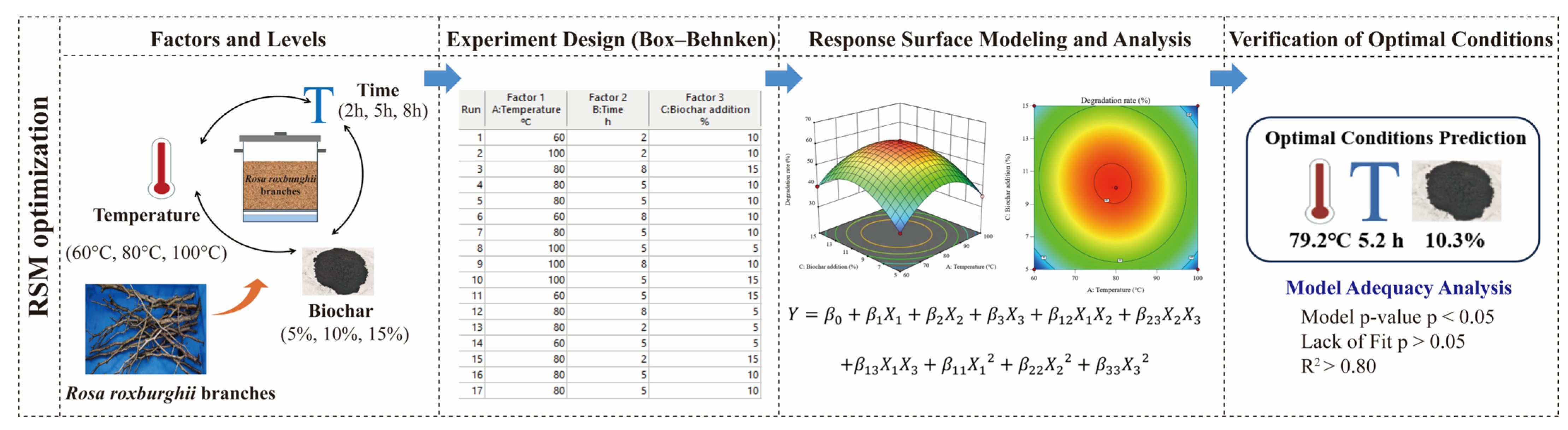
The pretreatment optimization of lignin degradation efficiency in chestnut rose branches was carried out using the RSM model, with a three-factor and three-level Box–Behnken design (BBD) (Figure 1). The BBD is widely used in RSM to optimize experimental parameters and develop quadratic regression models [29]. In addition, BBD has been commonly applied to optimize the lignin degradation process in previous studies [30,31,32]. Temperature (60, 80, and 100 °C), time (2, 5, and 8 h), and the biochar ratio (5, 10, and 15%) were used as independent variables, and the lignin degradation ratio was selected as the response variable. Based on the experimental analysis in Design-Expert software (v13.0; STAT-EASE Inc., Minneapolis, MN, USA), a quadratic equation model (Equation (1)) was established [33]. Based on the Box–Behnken design with three factors and three levels, 17 experimental runs were generated to evaluate the interactions among the variables [34]. The design matrix is presented in Table S1. The effects of factors and their relationships on the response were analyzed by analysis of variance (ANOVA). Model adequacy was assessed using the coefficient of determination (R2), adjusted R2, and lack-of-fit and precision tests. Model predictions of optimal conditions were then verified to determine a combination of the ideal pretreatment temperature (°C), time (h), and biochar ratio (%).
Y = β 0 + β 1 X 1 + β 2 X 2 + β 3 X 3 + β 12 X 1 X 2 + β 23 X 2 X 3 + β 13 X 1 X 3 + β 11 X 1 2 + β 22 X 2 2 + β 33 X 3 2
Here, Y is the predicted lignin degradation ratio; β0 is constant; βi is the coefficient parameter for each variable; and X1, X2 and X3 are temperature (°C), time (h), and biochar ratio (%), respectively.

2.3. Compost Experiment

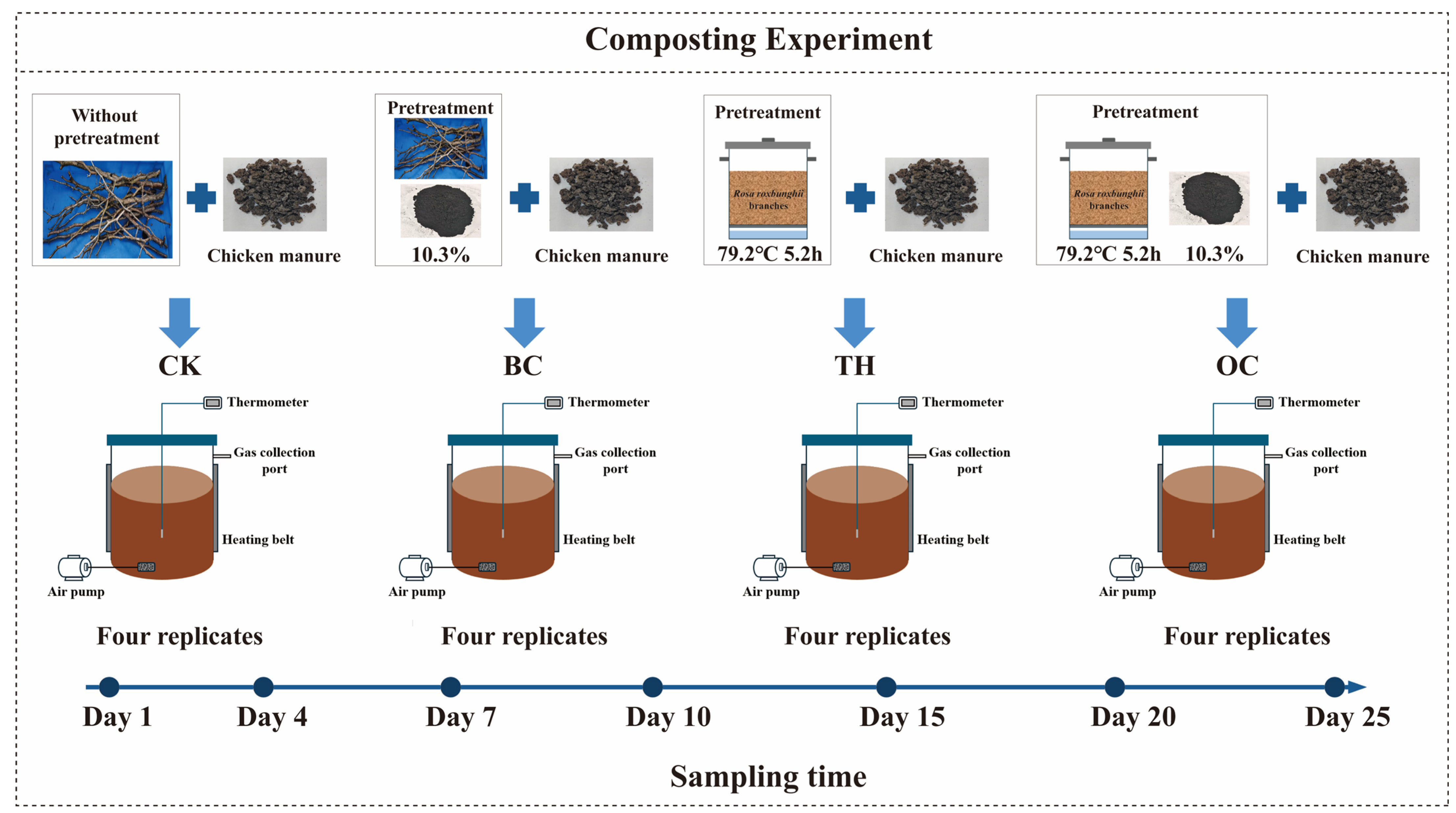
Chestnut rose branches and chicken manure were used as the main materials for composting. All raw materials were crushed to 2 mm through a sieve (10-mesh; Huafeng Hardware Instrument Co., Shangyu, China) before use. The physical and chemical properties of the raw materials were determined (Table 1). Based on the RSM-optimized pretreatment conditions, composting was carried out in a 10 L polyethylene bucket (Figure 2). Temperature was monitored using a digital thermometer (KLT-3000-WS, Yueqing Puning Electric Technology Co., Ltd., Wenzhou, China). A ventilation pump (ACO-003A, Raoping Xingcheng Mechanical Electricity Aquatic Article Co., Ltd., Chaozhou, China) was used to supply the air using a pipe at the barrel bottom. An exhaust outlet at the top was connected to a three-way valve with rubber tubing to collect CH4 and N2O. The branches and chicken manure were mixed at a ratio of 1.2:1 on a dry weight basis. The initial C/N ratio was about 25:1, and the moisture content was adjusted to 60% [35]. The effects of the RSM-optimized biochar ratio, temperature and heating time (OC); optimized biochar ratio only (BC); and combination of optimized temperature and heating time (TH) were investigated. Compost feedstock without pretreatment was established as the control (CK) (Figure 2). The treatments and control were repeated with four replicates, and composting lasted for 25 days. During composting, the aeration pump continuously supplied air, and the initial temperature of the compost container was maintained at 30 °C using a heating belt [36]. The materials were mixed and sampled on days 1, 4, 7, 10, 15, 20, and 25. Samples were stored at −20 °C in a refrigerator (MDF-25H485, Anhui Zhongke Duling Commercial Appliance Co., Ltd., Hefei, China) for determining the physicochemical properties of the compost.

2.4. Physicochemical Analysis

The maturity and nutritional quality of the compost were evaluated by measuring its temperature, pH, EC, organic matter, total nitrogen, ammonium nitrogen and nitrate nitrogen (Table 2). Compost maturity was assessed based on temperature, pH and EC, while nutrient characteristics were evaluated by measuring organic matter, total nitrogen, ammonium nitrogen and nitrate nitrogen [18]. The lignin content was determined by the change in absorbance following the acetylation spectrophotometer method using the Lignin Content Assay kit (AKSU010M, Beijing Boxbio Science & Technology Co., Ltd., Beijing, China) [37].
Gas samples were collected between 9:00 and 11:00 a.m. every day after the air pump had been turned off for 30 min [35,42,43]. Once the composting container was sealed, gas samples were taken using a syringe at 0, 10, 20, and 30 min, with 20 mL collected each time. All treatments and the CK were sampled synchronously to ensure comparability. The concentrations of CH4 and N2O in the samples were determined using a gas chromatograph system (Agilent 7890B, Agilent Technologies, Inc., Santa Clara, CA, USA), which was equipped with a flame ionization detector (FID) for CH4 analysis at 250 °C and an electron capture detector (ECD) for N2O analysis at 300 °C [44]. The emission fluxes of CH4 and N2O during composting were calculated according to Equation (2) [45]:
F = c t × V W × M V s × P P 0 × 273 T
where F is the emission flux of each gas (mg·kg−1·d−1), ∆c/∆t represents the rate of change in gas concentration during measurement (ppm·d−1), M is the relative molecular mass (CH4 and N2O are 16 and 44 g), m is the dry matter weight of compost (kg), p is the atmospheric pressure (bar), P0 is the standard pressure (1.01 × 10⁵ Pa), T is the temperature (K) in the composting barrel, V is the headspace volume (L), and Vs is the volume occupied by 1 mol of a gas at standard temperature and pressure (22.4 L).
The cumulative emissions of CH4 and N2O during composting were calculated according to Equation (3) [45]:
C E = t a t b × F a F b 2
where CE is the cumulative emission of gas during the measurement time (mg·kg−1), ta and tb are the time of two gas measurements (d), and Fa and Fb are two measured gas emission fluxes (mg·kg−1·d−1).
The CH4 and N2O emissions were converted to CO2 equivalents, and the global warming potential (GWP) was estimated using Equation (4) [46]:
G W P = 298 × C E N 2 O + 25 × C E C H 4
where CEN2O and CECH4 are cumulative emissions of N2O and CH4 (mg·kg−1).

2.5. Determination of Germination Index

The germination index (GI) determination was carried out according to the following steps: twenty seeds of lettuce (Lactua sativa var. ramose Hort.) were placed in a Petri dish containing 10 mL of compost extract (solid–liquid ratio 1:10) and incubated in a 25 ± 1 °C incubator (RDZ-600D-4, Ningbo Dongnan Instrument Co., Ltd., Ningbo, China) in darkness for 48 h to measure the germination rate and root length. The GI was calculated according to Equation (5) [47]:
G I   % = n u m b e r   o f   g e r m i n a t e d   s e e d s   i n   e x t r a c t   % × r o o t   l e n g t h   i n   e x t r a c t   mm n u m b e r   o f   g e r m i n a t e d   s e e d s   i n   c o n t r o l   % × r o o t   l e n g t h   i n   c o n t r o l   mm × 100 %

2.6. Statistical Analyses

Data were analyzed using Microsoft Excel 2024 (Microsoft, Washington, DC, USA). Significance analysis of the composting data was conducted using SPSS 27.0 (IBM, Armonk, NY, USA). One-way ANOVA was conducted after confirming variance homogeneity, followed by Duncan’s multiple range test for multiple comparisons. Composting indicators were plotted using OriginPro 2024 (OriginLab, Northampton, MA, USA). Redundancy analysis (RDA) was used to explore the relationship between composting physicochemical properties and carbon and nitrogen transformation using the R (v4.3.2, R Foundation for Statistical Computing, Vienna, Australia) “vegan”, “ggplot2”, and “ggrepel”.

3. Results

3.1. Optimization of Lignin Degradation of Waste Using RSM

Temperature, heating duration, and biochar ratio significantly affected the lignin degradation rate according to the quadratic polynomial model in RSM (Equation (6)). The first-order (X1) and second-order (X12) of temperature had a significant effect on lignin degradation (p < 0.05) (Table 3). Increasing the heating time (X2) negatively affected lignin degradation. The first-order (X3) and second-order (X32) of the biochar ratio also showed significant lignin degradation effects (p < 0.01). The constructed model demonstrated significant predictive capacity for lignin degradation efficiency (F = 257.74, p < 0.0001).
The coefficient of variation (CV% = 1.77) of the model was low, indicating minimal error between the experimental response value and predicted response value (Table 4). The model R2 and the adjusted R2 were 0.9970 and 0.9931, respectively, indicating that the pretreatment temperature, time and biochar ratio accounted for over 99% of the variability in the experimental results. The probability distribution of the predicted values and the residual experimental values for lignin degradation followed a normal distribution, with data points distributed on a straight line (Figure S3). The model showed a high signal-to-noise ratio (42.1697) and a non-significant lack-of-fit value (p > 0.05), indicating a good model fit. The predicted R2 of the model was 0.9733, indicating that the model was robust.
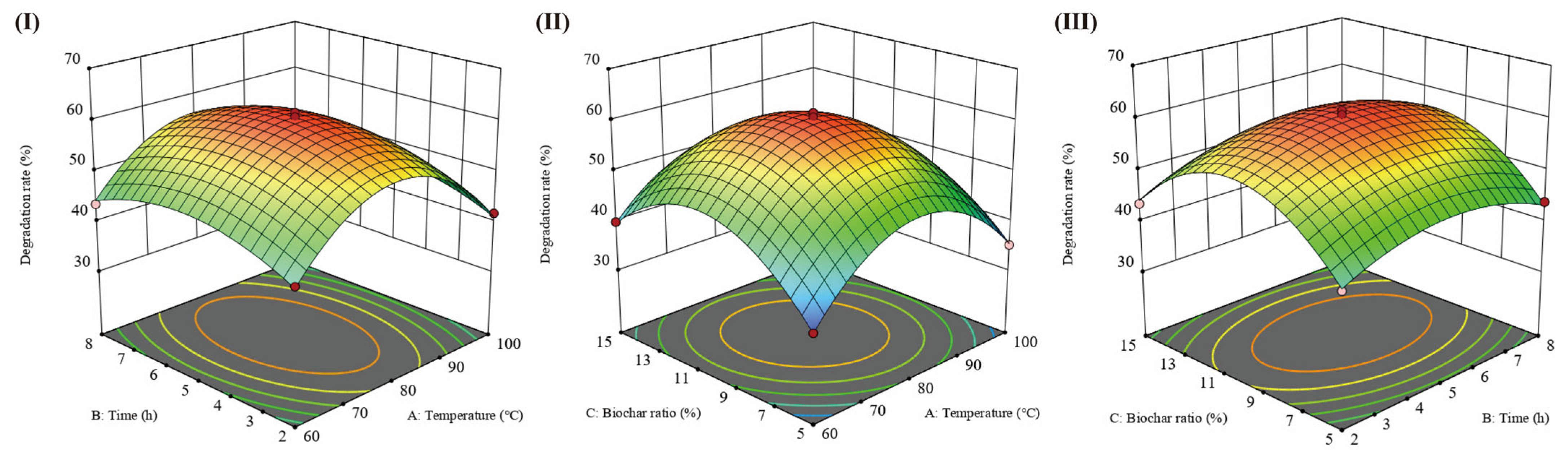
The three-dimensional plot reveals varying degrees of interaction among the factors of temperature, heating time and biochar ratio. As the temperature and biochar ratio increased, the lignin degradation rate of the branch waste first increased and then decreased (Figure 3II). However, the interactions between temperature and heating time (Figure 3I) and heating time and the biochar ratio (Figure 3III) resulted in a slight change in the lignin degradation rate, indicating that these interactions were not significant. Meanwhile, the model showed that the interaction of the independent variables X1X3 was significant (p < 0.01), while the interactions between X1X2 and X2X3 were not significant.
With the increase in temperature and biochar ratio, the contour curve gradually densifies (Figure S4). Meanwhile, the contour density in the direction of temperature and biochar ratio on lignin degradation rate indicates a more significant effect on lignin degradation compared to time. However, there is no significant difference in the contour density for temperature or the biochar ratio, indicating that the two factors did not differ significantly. Temperature and the biochar ratio had the greatest influence on lignin degradation rates, followed by heating duration.
The constructed RSM showed that the optimal pretreatment conditions for maximizing lignin degradation rate were a temperature of 79.2 °C, a heating time of 5.2 h, and a biochar ratio of 10.3%. The theoretical maximum lignin degradation rate was 60.72% (95% CI: 59.78–61.53%). A verification experiment conducted under the optimal conditions achieved an actual lignin degradation rate of 59.31%. The error between the predicted value of the RSM model and the actual value was less than 5%, indicating that the conditions predicted by the model aligned well with the actual results.
Y = 60.65 0.9262 X 1 + 0.6788 X 2 + 1.13 X 3 0.2000 X 1 X 2 1.67 X 1 X 3 + 0.3275 X 2 X 3 13.20 X 1 2 5.02 X 2 2 11.64 X 3 2
Here, Y is the predicted lignin degradation ratio; and X1, X2 and X3 are the temperature (°C), heating time (h), and biochar ratio (%), respectively.

3.2. Effect of Pretreatment on Maturity of Compost

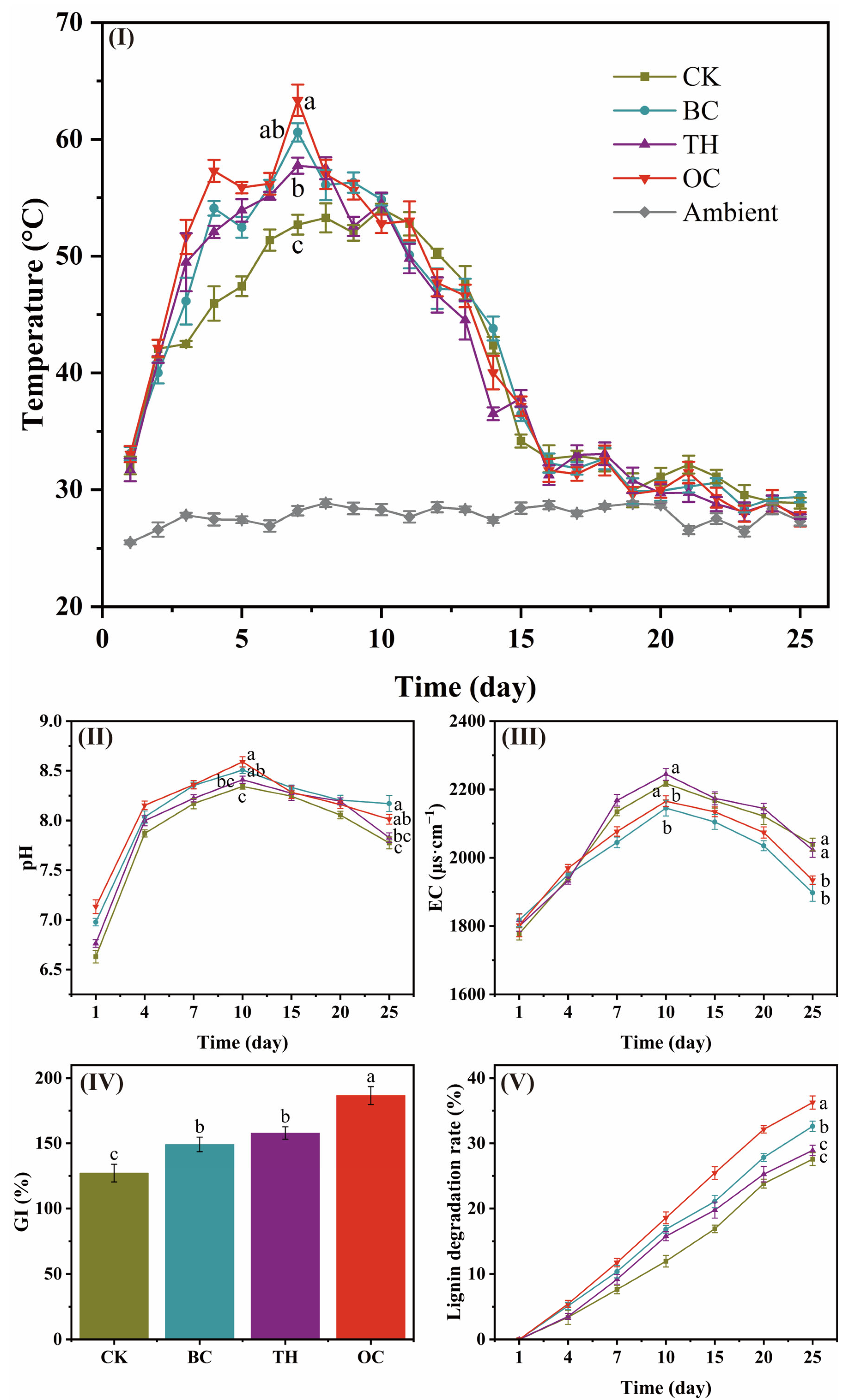
The composting temperature increased prior to 7 d and then decreased to ambient temperature (Figure 4I). The high-temperature periods for OC, BC, TH, and CK lasted for 9, 8, 7, and 7 days, respectively. The highest temperature (63.4 °C) was recorded for the OC treatment. The pH of all treatments reached a peak on 10 d, and OC showed a higher value of 8.59 compared to CK (p < 0.05) (Figure 4II). The final pH values of the treatments ranged from 7.78 to 8.17. The conductivity of all treatments and CK increased prior to 10 d and then decreased (Figure 4III). The final conductivity values of OC and BC (<4000 μs·cm−1) were significantly lower than those of TH and CK, meeting the composting maturity standard (NY/T 525-2021). The final GI followed the order of OC > BC, TH > CK (Figure 4IV). Compared to CK, the final GIs of OC, BC, and TH increased by 46.9%, 17.3%, and 24.2%, respectively (p < 0.05). The lignin degradation rate gradually increased (Figure 4V). The final lignin degradation rates were OC > BC > TH > CK. Compared to CK, the lignin degradation rates of OC and BC increased by 31.6% and 18.3% (p < 0.05).

3.3. Effect of Pretreatment on Nutrients in Compost

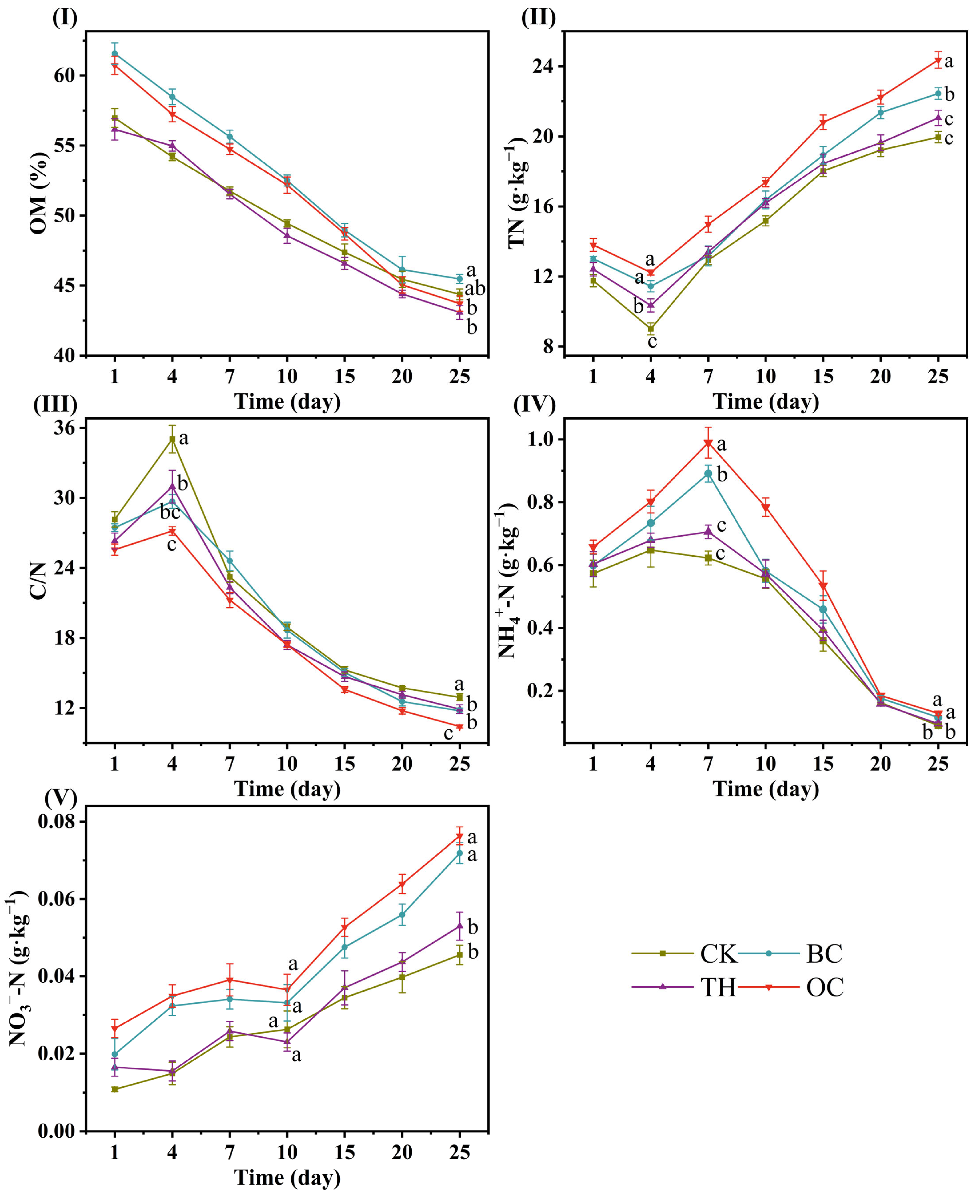
The OM content decreased gradually during composting (Figure 5I). The final degradation rates of OM were OC (28.0%) > BC (26.1%) > TH (23.3%) > CK (22.1%). The TN content in each treatment decreased before 4 d and then increased during composting (Figure 5II). The final TN content followed the order OC > BC > TH > CK, with a 22.0% increase in OC compared to CK (p < 0.05). The C/N ratio showed the opposite trend (Figure 5III), and the final C/N ratio was CK > TH > BC > OC, meeting the maturity standard (C/N < 20). The C/N ratio of OC decreased by 19.4% compared to CK (p < 0.05).
The final NH4+-N content was OC > BC > TH > CK (Figure 5IV), with a 42.2% increase in OC compared with CK (p < 0.05). The final NO3-N content was OC > BC > TH > CK (Figure 5V). The NO3-N content of OC and BC increased by 65.2% and 56.5%, respectively, compared to CK (p < 0.05).

3.4. Effects of Pretreatment on CH4 and N2O Emissions During Composting

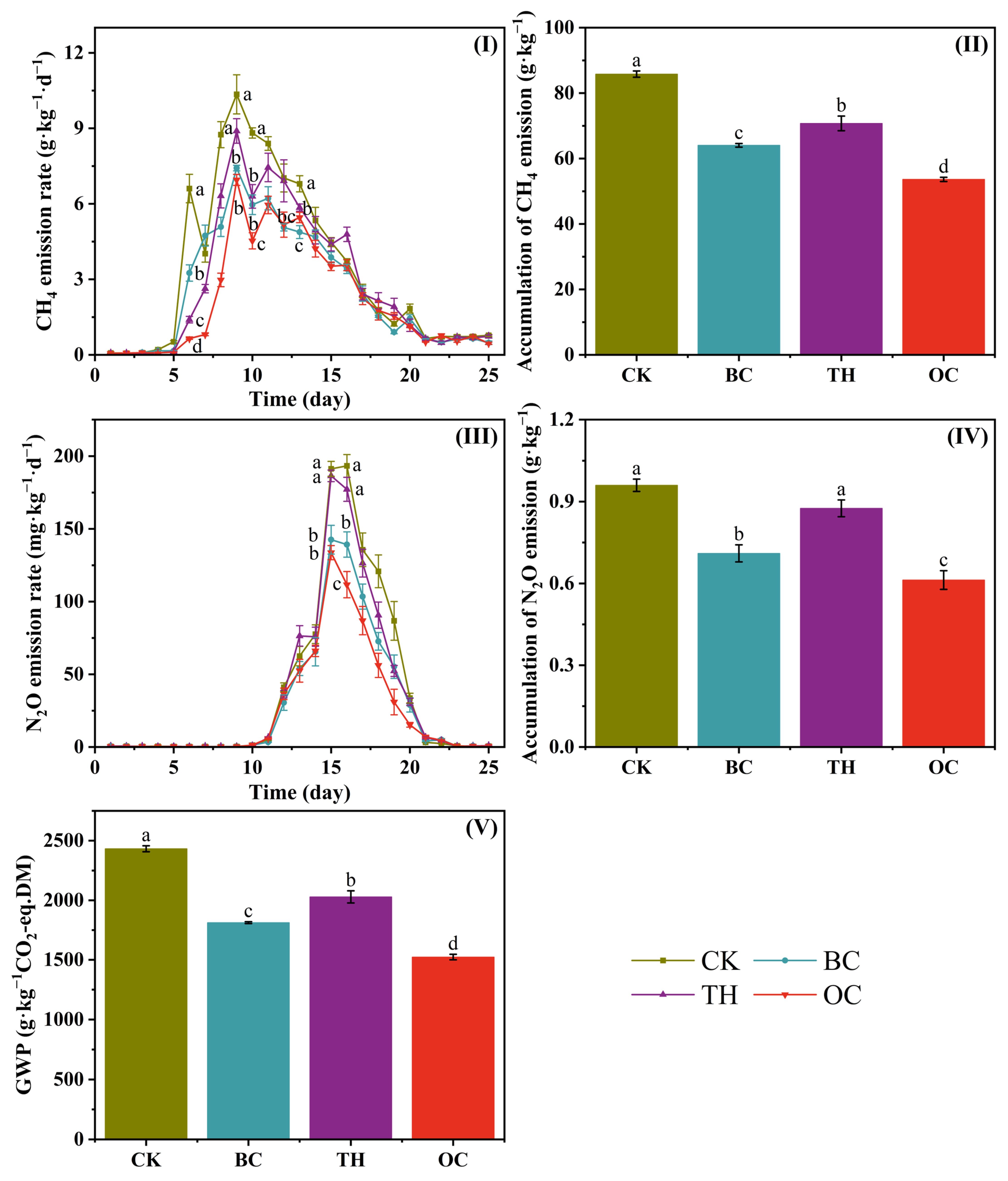
There were differences in CH4 and N2O emission dynamics during composting (Figure 6). The CH4 emission flux increased rapidly during the initial stage of composting, with daily CH4 emission peaks ranked as CK > TH > BC > OC (Figure 6I). After composting, the accumulative CH4 emission in the OC treatment was the lowest, reduced by 37.5% compared to CK (p < 0.05) (Figure 6II). The N2O emission flux remained low during the initial stage of composting before 11 d. Daily N2O emission peaks were CK > TH > BC > OC (Figure 6III). Cumulative N2O emissions from OC and BC were reduced by 36.5% and 26.0%, respectively, compared to CK (p < 0.05) (Figure 6IV). Cumulative emissions of CH4 and N2O were converted to CO2-equivalents to estimate the global warming potential (Figure 6V). Compared to CK, OC, BC, and TH significantly reduced the global warming potential by 37.3%, 25.4%, and 16.5%, respectively (p < 0.05).

3.5. Effects of Physicochemical Properties on Carbon and Nitrogen Transformations

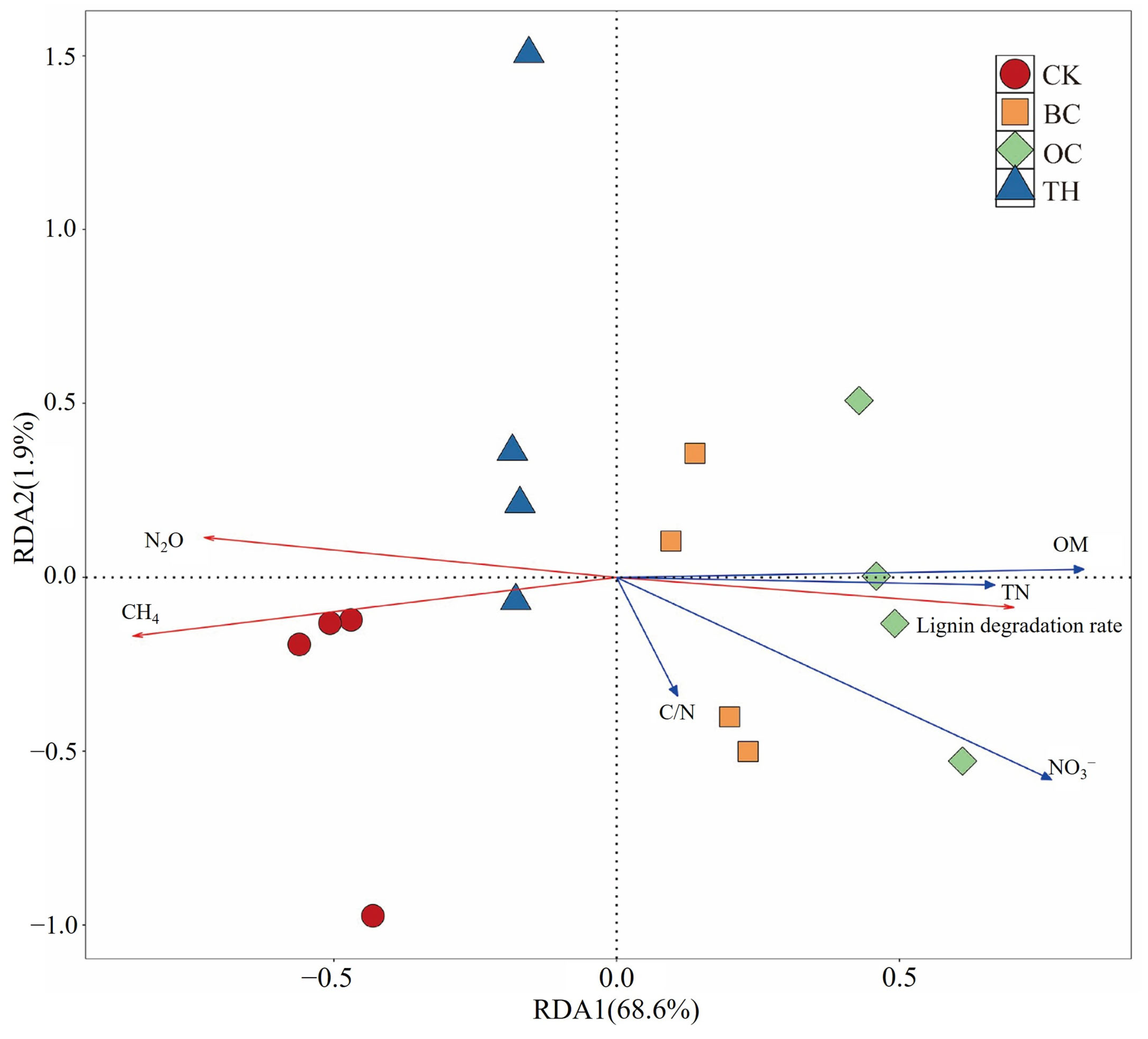
Redundancy analysis (RDA) revealed relationships between physicochemical properties and carbon and nitrogen transformation during composting. RDA1 and RDA2 explained 68.6% and 1.9% of the total variation, respectively (Figure 7). The OC was positively related to OM, TN, NO3 and the lignin degradation rate. BC was positively related to C/N. TH and CK were positively related to CH4 and N2O emissions. Furthermore, the lignin degradation rate was positively correlated with OM, TN, and NO3 but negatively correlated with CH4 and N2O.

4. Discussion

4.1. Effects of RSM-Optimized Pretreatment on Lignin Degradation

RSM is a statistical method based on multivariate nonlinear models, capable of determining optimal condition combinations for multivariate factors [48]. In this study, Box–Behnken experimental design was used to optimize the pretreatment temperature, heating time and biochar ratio for efficient lignin degradation in branch waste. The R2 value of the regression model for the lignin degradation rates was 0.9970, indicating that these factors explained over 99% of the variability in the results. The sums of squares for the pretreatment temperature, heating time, and biochar ratio were 6.86, 3.69, and 10.17, respectively, suggesting that pretreatment temperature and biochar dosage had a greater influence compared to time. The coefficient of the interaction term between temperature (X1) and biochar ratio (X3) was significant (X1X3, p = 0.0049, β = 11.12), indicating a synergistic interaction. This may be attributed to the abundant oxygen-containing functional groups on the biochar surface [49]. Hydroxyl radicals (·OH) accelerate the oxidation of the fiber surface by attacking the lignin structure and destroying the tight binding between lignin and hemicellulose [50].
During the pretreatment stage, the addition of biochar to the feedstock possibly increased lignin exposure on the material’s surface, creating suitable conditions for the high temperature to accelerate lignin degradation. Additionally, biochar possesses a large specific surface area, and its surface is rich in oxygen-containing functional groups, such as carboxyl and hydroxyl groups, as well as persistent free radicals [51,52]. This may support the adsorption of lignin and its degradation products released by the material on the biochar surface, thereby accelerating lignin degradation by reducing their local concentration [53]. The rate of lignin degradation was low in the early stage of composting, possibly due to the preferential degradation of cellulose and hemicellulose as easily degradable organic carbon sources that supported microbial reproduction [54]. By the end of the composting period, the lignin degradation rate in the OC treatment was significantly higher than that of CK, indicating that the combined effect of high temperature and biochar was beneficial for lignin degradation. Furthermore, high temperature may expose lignin components within the lignocellulose matrix [14]. This explains why pretreatment significantly degrades lignin, thereby accelerating compost maturation. Previous studies have reported different lignin degradation efficiencies depending on the substrate and pretreatment method. For example, the lignin degradation rate of UV-treated pine wood was 8% [55]; the lignin degradation rate of pine branches that underwent liquid treatment was 65.5% [56]; and white-rot fungi treatment of cotton stalks achieved a lignin degradation rate of 35.53% [57]. The pretreatment technology examined in this study achieved 59.31% degradation. However, these values are presented only as a general reference, since the substrates, pretreatment methods, and the experimental conditions differ among studies, which limits direct comparisons. Furthermore, the pretreatment technology investigated in this study requires highly precise instruments, so it is recommended for industrial production. In the future, we will also further explore the effects of approximate temperatures (79 °C, 5 h, and 10% biochar).

4.2. Effect of Feedstock Pretreatment on Maturity of Compost

Temperature is a key factor affecting microbial metabolism [58]. A high-temperature period lasting more than 5 days can effectively eliminate pathogenic microorganisms and weed seeds in compost [35]. In this study, the high-temperature period in the OC, BC and TH treatments ranged from 6 to 9 days, achieving the temperature requirement for the thermophilic phase of composting [59]. The peak temperature and duration of the thermophilic stage in the OC, BC, and TH treatments were higher than those in CK. The OC treatment had the longest thermophilic duration, possibly due to the large specific surface area of biochar in the compost. Biochar introduced during feedstock pretreatment may promote organic matter degradation, thereby increasing the composting temperature [60]. In addition, pretreatment can promote the release of soluble small-molecular organic matter, which improves the initial quality of the composting materials [14].
pH condition regulates microorganisms’ activity and the accumulation of organic acids during composting. A suitable pH range for composting is 6.7–9.0 [61]. In the early stage, the pH values of all treatments increased steadily due to the degradation of organic matter, which produced a large amount of NH4+ [62]. At the end of composting, the pH of OC and BC was significantly higher than that of CK, possibly due to the alkalinity of the biochar itself [38]. The final pH in compost from the OC, BC and TH treatments was less than 8.5, meeting the fertilizer safety standard pH (5.5–8.5) [63].
As a safety threshold indicator of composting products, electrical conductivity (EC) reflects the concentration of soluble salts during composting [64]. The EC values increased rapidly within the first 10 days, which may be related to organic matter decomposition and evaporation caused by high temperatures [65]. The final EC values for the OC, BC and TH treatments were less than 4000 μs·cm−1, indicating that the compost had reached standard maturity [64]. The EC values of the OC and BC treatments were significantly lower than those of CK, which can be attributed to the adsorption of salt ions by biochar and mineral salts precipitated during composting [66]. The germination index can be used to assess the phytotoxicity and maturity of compost products [67]. In this study, the GI values for the OC and BC treatments were significantly higher than those of CK, possibly due to the adsorption and buffering effects of biochar reducing volatile fatty acids and NH4+ levels [68]. The GI values of the OC, BC, and TH treatments exceeded 80%, indicating that the compost met the maturity standards [69].

4.3. Effects of Feedstock Pretreatment on Greenhouse Gas Emissions During Composting

Methanogens can utilize organic matter for anaerobic digestion in local habitats, producing CH4 during composting [46]. CH4 emissions were low in the early stages of composting, which may be due to the limited amount of organic matter available for methanogens in the material. As the levels of active organic carbon, such as monosaccharides and small molecular organic acids, in the compost material increased, CH4 emissions increased [70]. The peak methane emission fluxes for the OC and BC treatments were significantly lower than those of CK, indicating that biochar addition inhibited CH4 production. Accumulative CH4 emissions in the OC treatment were significantly lower than those in CK. This is due to the porous structure of biochar, which is conductive to storing and releasing oxygen, thereby minimizing the anaerobic microenvironment in composting and reducing CH4 production [71].
N2O emissions were lower in all treatments in the early stage of composting. This may be explained by the high temperature inhibiting nitrifying and denitrifying bacterial activity and the low NO3 content limiting N2O formation [72]. However, this interpretation remains speculative as no microbiological analyses were conducted to substantiate these mechanisms. Contrary to the initial N2O emission peak in wheat straw composting, the delayed peak observed in our study may be attributed to differences in raw material composition, the C/N ratio, and the physicochemical properties of the biochar [73]. In this study, the accumulative N2O emissions of the OC treatment were significantly reduced compared to CK. This reduction is attributed to the added biochar increasing the porosity and oxygen content of the compost pile, thereby suppressing N2O emissions [74].

4.4. Effect of Feedstock Pretreatment on C and N Contents of Composting

Changes in organic matter content determine the maturity of compost [75]. The degradation rate of organic matter in the OC treatment was significantly higher than that in CK. Biochar can enhance aeration conditions during composting, which may facilitate the degradation of organic matter [76]. In addition, methane production is a by-product of organic matter decomposition. During the thermophilic stage of composting, the rapid degradation of organic matter produces anaerobic zones, which is conducive to the increase in CH4 [77]. This explains the observed negative correlation between OM and CH4.
Composting microorganisms reduce total N content during the conversion of organic N into NH4+, with a large number of N losses via NH3 and N2O emissions [25,78]. The rate of total N reduction in the OC treatment during the initial stage was significantly lower than that in CK, possibly due to adsorption of NH4+ and NH3 by biochar [18]. The final N content in the OC and BC treatments was significantly higher than that in CK, indicating that biochar has strong potential for retaining N in feedstock during composting.
Changes in the C/N reflect stability and maturity during composting [19]. The mineralization of organic matter and decomposition of C-containing substances led to a decrease in the C/N ratio of the compost [79]. The C/N ratio in the OC treatment was significantly lower than that in CK (p < 0.05). The OC treatment had the lowest C/N ratio due to its higher N fixation efficiency and greater organic matter degradation rates during composting [63].
NH4+ is the main source of inorganic N for microorganisms during composting [80]. In the early stage of composting, the mineralization of organic nitrogen leads to a rapid increase in the NH4+ content [16]. During the cooling period, the conversion of NH4+ to NO3 and NH3 volatilization lead to a decrease in NH4+ during composting [81]. In this study, the final NH4+ content of the OC and BC treatments was significantly higher than that of CK, which may be due to the adsorption of NH4+ by biochar, which reduced its conversion to NH3 and subsequent volatilization [82]. The addition of rice straw biochar was reported to reduce the NO3-N content during kitchen waste composting [83]. Unlike the effect observed in rice straw biochar-amended kitchen waste composting, the NO3-N of the OC treatment in this study was significantly higher than that of CK, which may be attributed to differences in biochar application timing and alterations in biochar properties induced by high-temperature pretreatment. The final NO3 content of the OC treatment was significantly higher than that of CK. This may reflect enhanced N mineralization and nitrification under high-temperature conditions [84], though microbial mechanisms were not directly verified.

4.5. Limitations

Although the pretreatment technology improved chestnut rose compost quality and reduced greenhouse gas emissions, several limitations should be acknowledged. First, the biochar proportions were selected based on ranges reported in the literature rather than systematic dose response gradients, limiting definitive assessment of optimal application rates. Secondly, this study was conducted under controlled laboratory conditions, and industrial scaling is complicated by equipment size, variable aeration, and weather factors, necessitating pilot-scale validation. Third, while this study focused on reducing global warming potential during composting, net carbon benefit assessment must incorporate pretreatment energy consumption, requiring further evaluation in subsequent production practices. Lastly, iron was introduced into the compost. As iron is a rich and highly active metal element involved in the soil redox cycle [85], long-term application of this method should consider iron’s potential impact on soil redox stability.

5. Conclusions

In this study, the pretreatment conditions for lignin-rich waste were optimized using the response surface methodology (RSM), demonstrating that RSM-optimized pretreatment conditions enhance composting efficiency and reduce greenhouse gas emissions. This study provides a parameter optimization framework and preliminary data support for the composting of lignin waste. However, its technical–economic feasibility and long-term environmental benefits must be verified at a larger scale and over a longer period before industrial application can be achieved. The next step could involve analyzing the 16S rRNA and functional gene abundances in the microbial community of compost to understand the mechanism related to pretreatment.

Supplementary Materials

The following supporting information can be downloaded at: https://www.mdpi.com/article/10.3390/agronomy16070767/s1, Figure S1: SEM images of Rosa roxburghii biochar (BBC) and iron-modified Rosa roxburghii biochar (Fe-BBC). Figure S2: FT-IR spectra of Rosa roxburghii biochar (BBC) and iron-modified Rosa roxburghii biochar (Fe-BBC). Figure S3: The relationship between the predicted and actual lignin degradation rate of chestnut rose branch waste (I) and actual lignin degradation rate of chestnut rose branch waste (II). Figure S4: Three-dimensional response curve of interaction factors on lignin degradation rate of chestnut rose branch waste. (I): Temperature (°C)—Time (h); (II): Temperature (°C)—Biochar ratio (%); (III): Time (h)—Biochar ratio (%). Table S1: Experimental design matrix of the Box–Behnken design.

Author Contributions

W.W.: Writing—original draft, Methodology, Investigation, Data curation, Formal analysis, Writing—review and editing. M.Z.: Methodology, Investigation. L.W.: Methodology, Investigation. C.F.: Investigation, Formal analysis. Y.T.: Conceptualization, Writing—review and editing, Project administration, Funding acquisition, Supervision. B.Z.: Conceptualization, Writing—review and editing, Project administration, Funding acquisition, Supervision. R.Q.: Project administration, Funding acquisition. All authors have read and agreed to the published version of the manuscript.

Funding

This research was funded by the National Key Research and Development Program of China (2024YFD1701205, 2023YFC3905800), Guangzhou Key Research and Development Program (2023B03J1314), Research Fund Program of Guangdong Provincial Key Laboratory of Environmental Pollution Control and Remediation Technology (2023B1212060016), Key Realm Project of Ordinary Universities in Guangdong Province (2023ZDZX4041), and Guangdong S&T Innovation Strategy Funds (pdjh2024a068).

Data Availability Statement

The data presented in this study are openly at https://figshare.com/s/f56a8bebaf2f299f8820 (accessed on 29 December 2025).

Acknowledgments

The authors gratefully acknowledge Yuan Li and Huina Yang for their technical assistance with the experimental work. The authors also thank the anonymous reviewers for their valuable comments and constructive suggestions.

Conflicts of Interest

The authors declare no conflicts of interest.

References

  1. Ma, S.; Xiong, J.; Wu, X.; Liu, H.; Han, L.; Huang, G. Effects of the functional membrane covering on the gas emissions and bacterial community during aerobic composting. Bioresour. Technol. 2021, 340, 125660. [Google Scholar] [CrossRef] [PubMed]
  2. Zhang, Z.; Yang, H.; Wang, B.; Chen, C.; Zou, X.; Cheng, T.; Li, J. Aerobic co-composting of mature compost with cattle manure: Organic matter conversion and microbial community characterization. Bioresour. Technol. 2023, 382, 129187. [Google Scholar] [CrossRef] [PubMed]
  3. Ma, L.; Sun, R.; Yang, H.; Li, J.; Wen, X.; Cao, Z.; Zhou, Y.; Fu, M.; Li, Q. Metagenomics analysis revealed the coupling of lignin degradation with humus formation mediated via shell powder during composting. Bioresour. Technol. 2022, 363, 127949. [Google Scholar] [CrossRef] [PubMed]
  4. Gao, Q.; Guo, L.-n.; Li, S.-h.; Wu, W.; Ding, J.; Xu, H.-j.; Luo, C.-b.; Li, J.; Li, D.-q.; Liu, Z.-q. Biodegradation mechanism of cellulose, hemicellulose, and lignin in bacteria-dominant aerobic composting from agricultural biomass waste: A review. Carbohydr. Polym. Technol. Appl. 2025, 11, 100879. [Google Scholar] [CrossRef]
  5. Jain, A.; Sarsaiya, S.; Gong, Q.; Wu, Q.; Shi, J. Chemical diversity, traditional uses, and bioactivities of Rosa roxburghii Tratt: A comprehensive review. Pharmacol. Ther. 2024, 259, 108657. [Google Scholar] [CrossRef]
  6. Wang, L.; Wei, T.; Zheng, L.; Jiang, F.; Ma, W.; Lu, M.; Wu, X.; An, H. Recent advances on main active ingredients, pharmacological activities of Rosa roxbughii and its development and utilization. Foods 2023, 12, 1051. [Google Scholar] [CrossRef]
  7. Mehmood, K.; Bao, Y.; Saifullah; Bibi, S.; Dahlawi, S.; Yaseen, M.; Abrar, M.M.; Srivastava, P.; Fahad, S.; Faraj, T.K. Contributions of Open Biomass Burning and Crop Straw Burning to Air Quality: Current Research Paradigm and Future Outlooks. Front. Environ. Sci. 2022, 10, 852492. [Google Scholar] [CrossRef]
  8. Jin, Y.; Zhou, Z.; Yuan, Z.; Hu, R.; Zhang, T.; Chen, S.; Chen, G. Lignin-based biochar with improved properties derived from the microbial combined chemical pretreatment of corn straw for efficient antibiotic removal. Int. J. Biol. Macromol. 2025, 308, 142739. [Google Scholar] [CrossRef]
  9. Chen, H.; Liu, J.; Chang, X.; Chen, D.; Xue, Y.; Liu, P.; Lin, H.; Han, S. A review on the pretreatment of lignocellulose for high-value chemicals. Fuel Process. Technol. 2017, 160, 196–206. [Google Scholar] [CrossRef]
  10. Luengnaruemitchai, A.; Anupapwisetkul, C. Surface morphology and cellulose structure of Napier grass pretreated with the ionic liquid 1-ethyl-3-methylimidazolium acetate combined with either water or dimethyl sulfoxide as a co-solvent under microwave irradiation. Biomass Convers. Biorefin. 2020, 10, 435–446. [Google Scholar] [CrossRef]
  11. Wu, Q.; Zhang, Y.; Zhao, L.; Wei, Z.; Song, C.; Pang, C.; Pang, X. Strategies for efficient degradation of lignocellulose from straw: Synergistic effects of acid-base pretreatment and functional microbial agents in composting. Chem. Eng. J. 2025, 508, 161048. [Google Scholar] [CrossRef]
  12. Ma, S.; Li, Y.; Li, J.; Yu, X.; Cui, Z.; Yuan, X.; Zhu, W.; Wang, H. Features of single and combined technologies for lignocellulose pretreatment to enhance biomethane production. Renew. Sustain. Energy Rev. 2022, 165, 112606. [Google Scholar] [CrossRef]
  13. Anu; Kumar, A.; Rapoport, A.; Kunze, G.; Kumar, S.; Singh, D.; Singh, B. Multifarious pretreatment strategies for the lignocellulosic substrates for the generation of renewable and sustainable biofuels: A review. Renew. Energy 2020, 160, 1228–1252. [Google Scholar] [CrossRef]
  14. Zhu, N.; Gao, J.; Liang, D.; Zhu, Y.; Li, B.; Jin, H. Thermal pretreatment enhances the degradation and humification of lignocellulose by stimulating thermophilic bacteria during dairy manure composting. Bioresour. Technol. 2021, 319, 124149. [Google Scholar] [CrossRef]
  15. Mo, J.; Zhao, C.; Fang, C.; Long, Y.; Han, Y.; Mei, Q.; Wu, W. Pre-biodrying enhanced lignin degradation to promote aromatic macromolecular humic acid formation in double-phase composting. Waste Manag. 2025, 202, 114851. [Google Scholar] [CrossRef]
  16. Zhou, S.X.; Li, Y.; Jia, P.Y.; Wang, X.; Kong, F.L.; Jiang, Z.X. The co-addition of biochar and manganese ore promotes nitrous oxide reduction but favors methane emission in sewage sludge composting. J. Clean. Prod. 2022, 339, 130759. [Google Scholar] [CrossRef]
  17. Vevelstad, S.J.; Johansen, M.T.; Knuutila, H.; Svendsen, H.F. Oxygen and Temperature Effect on Formation of Degradation Compounds from MEA. Energy Procedia 2014, 63, 957–975. [Google Scholar] [CrossRef]
  18. Guo, X.; Liu, H.; Zhang, J. The role of biochar in organic waste composting and soil improvement: A review. Waste Manag. 2020, 102, 884–899. [Google Scholar] [CrossRef]
  19. Li, D.; Manu, M.K.; Varjani, S.; Wong, J.W.C. Role of tobacco and bamboo biochar on food waste digestate co-composting: Nitrogen conservation, greenhouse gas emissions, and compost quality. Waste Manag. 2023, 156, 44–54. [Google Scholar] [CrossRef]
  20. Wang, X.; Li, J.; Chen, C.; Luo, Z.; Pang, Y.; Tu, H.; Lin, X.; Long, C.; Cai, Q.; Wei, Z.; et al. Optimization of degradation conditions and elucidation of novel biodegradation pathways for sulfamonomethoxine by a novel strain. Appl. Environ. Microbiol. 2025, 91, e01329-25. [Google Scholar] [CrossRef]
  21. Weremfo, A.; Abassah-Oppong, S.; Adulley, F.; Dabie, K.; Seidu-Larry, S. Response surface methodology as a tool to optimize the extraction of bioactive compounds from plant sources. J. Sci. Food Agric. 2022, 103, 26–36. [Google Scholar] [CrossRef] [PubMed]
  22. Dou, M.; Li, H.; Qin, X.; Chang, Y.; Wang, Y.; Zhao, C.; Liu, Z.; Gu, C.; Fu, Y. An efficient strategy to degrade lignin by a novel endophytic fungus Chaetomium globosum combined with ultrasound. Ind. Crop. Prod. 2022, 178, 114578. [Google Scholar] [CrossRef]
  23. Gu, X.; Li, H.; Shi, Y.; Li, J.; Li, S. Regulating bacterial dynamics by Mg-modified biochar addition to mitigate gaseous emissions during pig manure composting. J. Clean. Prod. 2024, 465, 142839. [Google Scholar] [CrossRef]
  24. Huang, J.; Jones, A.; Waite, T.D.; Chen, Y.; Huang, X.; Rosso, K.M.; Kappler, A.; Mansor, M.; Tratnyek, P.G.; Zhang, H. Fe(II) Redox Chemistry in the Environment. Chem. Rev. 2021, 121, 8161–8233. [Google Scholar] [CrossRef]
  25. Xu, Z.; Wan, Z.; Sun, Y.; Gao, B.; Hou, D.; Cao, X.; Komárek, M.; Ok, Y.S.; Tsang, D.C.W. Electroactive Fe-biochar for redox-related remediation of arsenic and chromium: Distinct redox nature with varying iron/carbon speciation. J. Hazard. Mater. 2022, 430, 128479. [Google Scholar] [CrossRef]
  26. Liu, C.; Wang, W.; Wu, R.; Liu, Y.; Lin, X.; Kan, H.; Zheng, Y. Preparation of acid- and alkali-modified biochar for removal of methylene blue pigment. ACS Omega 2020, 5, 30906–30922. [Google Scholar] [CrossRef]
  27. Li, C.; Liu, Y.; Zhao, B.; Zhang, J.; Qiu, R. Adsorption of Se (IV) on iron modified Rosa roxburghii biochar and its mechanism. Ecol. Sci. 2024, 43, 146–156. [Google Scholar] [CrossRef]
  28. Zhao, B.; Xie, X.; Li, C.; Zhang, M.; Yang, H.; Liu, Y.; Zhang, J.; Qiu, R. A Preparation Method of Iron-Modified Rosa roxburghii Biochar Based on Rosa roxburghii Waste and Its Application. Chinese Patent Application CN2024114617227, 18 October 2024. [Google Scholar]
  29. Li, Y.; Ooi, K.T.; He, L.; Zhao, S.; Luo, Q.; Liu, W.; Liu, Z. Numerical investigation of subcooled flow boiling in brazed plate heat exchangers using RSM with box-Behnken design. Appl. Therm. Eng. 2026, 288, 129605. [Google Scholar] [CrossRef]
  30. Gönen, Ç.; Deveci, E.Ü.; Önal, N.A. Evaluation of biomass pretreatment to optimize process factors for different organic acids via Box-Behnken RSM method. J. Mater. Cycles Waste Manag. 2021, 23, 2016–2027. [Google Scholar] [CrossRef]
  31. Sharma, P.; Sharma, N. RSM approach to pre-treatment of lignocellulosic waste and a statistical methodology for optimizing bioethanol production. Waste Manag. Bull. 2024, 2, 49–66. [Google Scholar] [CrossRef]
  32. Sharma, L.; Alam, N.M.; Roy, S.; Satya, P.; Kar, G.; Ghosh, S.; Goswami, T.; Majumdar, B. Optimization of alkali pretreatment and enzymatic saccharification of jute (Corchorus olitorius L.) biomass using response surface methodology. Bioresour. Technol. 2022, 368, 128318. [Google Scholar] [CrossRef] [PubMed]
  33. Zhao, B.; Yang, X.; Li, C.; Zhang, M.; Cao, X.; Ruan, X.; Li, H.; Qiu, R. Optimized production of invasive animal biochar for arsenic immobilization and methane oxidation in contaminated soils using response surface methodology. J. Clean. Prod. 2024, 450, 141777. [Google Scholar] [CrossRef]
  34. Ferreira, N.; Viana, T.; Henriques, B.; Tavares, D.S.; Jacinto, J.; Colónia, J.; Pinto, J.; Pereira, E. Application of response surface methodology and box-behnken design for the optimization of mercury removal by Ulva sp. J. Hazard. Mater. 2023, 445, 130405. [Google Scholar] [CrossRef]
  35. Chen, H.; Awasthi, S.K.; Liu, T.; Duan, Y.; Ren, X.; Zhang, Z.; Pandey, A.; Awasthi, M.K. Effects of microbial culture and chicken manure biochar on compost maturity and greenhouse gas emissions during chicken manure composting. J. Hazard. Mater. 2020, 389, 121908. [Google Scholar] [CrossRef]
  36. Liu, X.; Wang, Y.; Zhou, S.; Cui, P.; Wang, W.; Huang, W.; Yu, Z.; Zhou, S. Differentiated strategies of animal-derived and plant-derived biochar to reduce nitrogen loss during paper mill sludge composting. Bioresour. Technol. 2022, 360, 127583. [Google Scholar] [CrossRef]
  37. Wang, D.; He, J.; Li, L.; Wu, G.; Jiang, Z.; Cang, B.; Wu, M.; Nuo, M.; Liu, Z.; Li, J.; et al. Inoculation of the fungi-static ZJW-6 accelerates compost maturation, enhances fertilizer efficiency, and increases the abundance of target microbes in spring and autumn compost. Front. Microbiol. 2025, 16, 1592864. [Google Scholar] [CrossRef]
  38. Ge, M.; Shen, Y.; Ding, J.; Meng, H.; Zhou, H.; Zhou, J.; Cheng, H.; Zhang, X.; Wang, J.; Wang, H.; et al. New insight into the impact of moisture content and pH on dissolved organic matter and microbial dynamics during cattle manure composting. Bioresour. Technol. 2022, 344, 126236. [Google Scholar] [CrossRef]
  39. Ming, L.; Dou, S.; Wang, H.; Zhu, Y. Study of the Humification Process and Humic Acid-like Structure Characteristics of Kitchen Waste with the Addition of Biochar. Agronomy 2023, 13, 465. [Google Scholar] [CrossRef]
  40. Tabrika, I.; Azim, K.; Mayad, E.H.; Zaafrani, M. Composting of tomato plant residues: Improvement of composting process and compost quality by integration of sheep manure. Org. Agric. 2019, 10, 229–242. [Google Scholar] [CrossRef]
  41. Zhang, L.; Sun, X. Food waste and montmorillonite contribute to the enhancement of green waste composting. Process Saf. Environ. Prot. 2023, 170, 983–998. [Google Scholar] [CrossRef]
  42. Sun, B.; Bai, Z.; Li, Y.; Li, R.; Song, M.; Xu, S.; Zhang, H.; Zhuang, X. Emission mitigation of CH4 and N2O during semi-permeable membrane covered hyperthermophilic aerobic composting of livestock manure. J. Clean. Prod. 2022, 379, 134850. [Google Scholar] [CrossRef]
  43. Yuan, J.; Li, Y.; Chen, S.; Li, D.; Tang, H.; Chadwick, D.; Li, S.; Li, W.; Li, G. Effects of phosphogypsum, superphosphate, and dicyandiamide on gaseous emission and compost quality during sewage sludge composting. Bioresour. Technol. 2018, 270, 368–376. [Google Scholar] [CrossRef] [PubMed]
  44. Wu, K.; Wang, L.; Zhang, L.; Han, M.; Gong, P.; Xue, Y.; Song, Y.; Wu, Z.; Zhang, L. The Impact of Applying Different Fertilizers on Greenhouse Gas Emissions and Ammonia Volatilization from Northeast Spring Corn. Agronomy 2024, 14, 2798. [Google Scholar] [CrossRef]
  45. Bao, M.; Cui, H.; Lv, Y.; Wang, L.; Ou, Y.; Hussain, N. Greenhouse gas emission during swine manure aerobic composting: Insight from the dissolved organic matter associated microbial community succession. Bioresour. Technol. 2023, 373, 128729. [Google Scholar] [CrossRef]
  46. Pan, Y.; Chang, H.; Song, P. Effects of Superphosphate as an Additive on Nutrient Characteristics and NH3, CO2, CH4, and N2O Emissions during Pig Manure Composting. Agronomy 2023, 13, 560. [Google Scholar] [CrossRef]
  47. Yang, Y.; Wang, G.; Li, G.; Ma, R.; Kong, Y.; Yuan, J. Selection of sensitive seeds for evaluation of compost maturity with the seed germination index. Waste Manag. 2021, 136, 238–243. [Google Scholar] [CrossRef]
  48. Verma, M.; Ekka, A.; Mohapatra, T.; Ghosh, P. Optimization of kraft lignin decolorization and degradation by bacterial strain Bacillus velezensis using response surface methodology. J. Environ. Chem. Eng. 2020, 8, 104270. [Google Scholar] [CrossRef]
  49. Hu, Q.; Zhang, J.; Pan, Y.; Ding, K.; Xu, C.; Hou, J.; Liu, W.; Thanachayanont, C.; Lampang, T.N.; Chen, M.; et al. Oxygen-containing functional groups of biochars enhancing the oxygen release of CaO2 and the generation of free radicals. Process Saf. Environ. Prot. 2025, 198, 107126. [Google Scholar] [CrossRef]
  50. Niu, Q.; Meng, Q.; Yang, H.; Wang, Y.; Li, X.; Li, G.; Li, Q. Humification process and mechanisms investigated by Fenton-like reaction and laccase functional expression during composting. Bioresour. Technol. 2021, 341, 125906. [Google Scholar] [CrossRef]
  51. Hu, S.; Liu, C.; Bu, H.; Chen, M.; Fei, Y. Efficient reduction and adsorption of Cr(VI) using FeCl3-modified biochar: Synergistic roles of persistent free radicals and Fe(II). J. Environ. Sci. 2024, 137, 626–638. [Google Scholar] [CrossRef]
  52. Qin, S.; Fan, H.; Jia, L.; Jin, Y.; Li, Z.; Fan, B. Molecular structure analysis and mercury adsorption mechanism of iron-based modified biochar. Energy Fuels 2022, 36, 3184–3200. [Google Scholar] [CrossRef]
  53. Zeng, S.; Kan, E. Comparative insights into performance and mechanisms of Fenton and persulfate oxidation on iron-functionalized activated biochar for removal of aqueous tetracycline antibiotics. J. Water Process. Eng. 2024, 65, 105824. [Google Scholar] [CrossRef]
  54. Ma, C.; Lo, P.K.; Xu, J.; Li, M.; Jiang, Z.; Li, G.; Zhu, Q.; Li, X.; Leong, S.Y.; Li, Q. Molecular mechanisms underlying lignocellulose degradation and antibiotic resistance genes removal revealed via metagenomics analysis during different agricultural wastes composting. Bioresour. Technol. 2020, 314, 123731. [Google Scholar] [CrossRef] [PubMed]
  55. Liza, A.A.; Wang, S.; Zhu, Y.; Wu, H.; Guo, L.K.; Qi, Y.; Zhang, F.; Song, J.; Ren, H.; Guo, J. Ultraviolet (UV) assisted fabrication and characterization of lignin containing cellulose nanofibrils (LCNFs) from wood residues. Int. J. Biol. Macromol. 2024, 283, 137973. [Google Scholar] [CrossRef]
  56. Bhatia, S.K.; Jagtap, S.S.; Bedekar, A.A.; Bhatia, R.K.; Patel, A.K.; Pant, D.; Banu, J.R.; Rao, C.V.; Kim, Y.G.; Yang, Y.H. Recent developments in pretreatment technologies on lignocellulosic biomass: Effect of key parameters, technological improvements, and challenges. Bioresour. Technol. 2020, 300, 122724. [Google Scholar] [CrossRef]
  57. Periyasamy, S.; Karthik, V.; Kumar, P.S.; Isabel, J.B.; Temesgen, T.; Hunegnaw, B.M.; Melese, B.B.; Mohamed, B.A.; Vo, D.V.N. Chemical, physical and biological methods to convert lignocellulosic waste into value-added products. A review. Environ. Chem. Lett. 2022, 20, 1129–1152. [Google Scholar] [CrossRef]
  58. Xue, S.; Zhou, L.; Zhong, M.; Awasthi, M.K.; Mao, H. Bacterial agents affected bacterial community structure to mitigate greenhouse gas emissions during sewage sludge composting. Bioresour. Technol. 2021, 337, 125397. [Google Scholar] [CrossRef]
  59. Wang, W.; Zhang, L.; Sun, X. Improvement of two-stage composting of green waste by addition of eggshell waste and rice husks. Bioresour. Technol. 2021, 320, 124388. [Google Scholar] [CrossRef]
  60. Feng, M.; Wu, X.; Qiu, X.; Wang, H. Influence of peat and biochar on gas emissions and microbial metabolism during co-composting of chicken manure and maize straw. Waste Biomass Valorization 2023, 14, 197–208. [Google Scholar] [CrossRef]
  61. Verma, S.; Awasthi, M.K.; Liu, T.; Awasthi, S.K.; Yadav, V.; Ravindran, B.; Syed, A.; Eswaramoorthy, R.; Zhang, Z. Biochar as smart organic catalyst to regulate bacterial dynamics during food waste composting. Bioresour. Technol. 2023, 373, 128745. [Google Scholar] [CrossRef]
  62. Jiang, Z.; Lu, Y.; Xu, J.; Li, M.; Shan, G.; Li, Q. Exploring the characteristics of dissolved organic matter and succession of bacterial community during composting. Bioresour. Technol. 2019, 292, 121942. [Google Scholar] [CrossRef] [PubMed]
  63. Wang, Z.; Xu, Y.; Yang, T.; Liu, Y.; Zheng, T.; Zheng, C. Effects of biochar carried microbial agent on compost quality, greenhouse gas emission and bacterial community during sheep manure composting. Biochar 2023, 5, 3. [Google Scholar] [CrossRef]
  64. Wang, X.; Liu, X.; Wang, Z.; Sun, G.; Li, J. Greenhouse gas reduction and nitrogen conservation during manure composting by combining biochar with wood vinegar. J. Environ. Manag. 2022, 324, 116349. [Google Scholar] [CrossRef] [PubMed]
  65. Zhang, J.; Chen, G.; Sun, H.; Zhou, S.; Zou, G. Straw biochar hastens organic matter degradation and produces nutrient-rich compost. Bioresour. Technol. 2016, 200, 876–883. [Google Scholar] [CrossRef]
  66. Wang, J.; Xie, H.; Wu, J.; He, W.; Zhang, X.; Huang, J.; Feng, Y.; Xue, L. Fe/BC co-conditioners with environmental and economic benefits on composting: Reduced NH3 emissions and improved fertilizer quality. Biochar 2024, 6, 4. [Google Scholar] [CrossRef]
  67. Yang, Y.; Awasthi, M.K.; Du, W.; Ren, X.; Lei, T.; Lv, J. Compost supplementation with nitrogen loss and greenhouse gas emissions during pig manure composting. Bioresour. Technol. 2020, 297, 122435. [Google Scholar] [CrossRef]
  68. Gong, X.; Zou, L.; Wang, L.; Zhang, B.; Jiang, J. Biochar improves compost humification, maturity and mitigates nitrogen loss during the vermicomposting of cattle manure-maize straw. J. Environ. Manag. 2023, 325, 116432. [Google Scholar] [CrossRef]
  69. Zainudin, M.H.M.; Zulkarnain, A.; Azmi, A.S.; Muniandy, S.; Sakai, K.; Shirai, Y.; Hassan, M.A. Enhancement of agro-Industrial waste composting process via the microbial inoculation: A Brief Review. Agronomy 2022, 12, 198. [Google Scholar] [CrossRef]
  70. Lin, X.; Wang, N.; Li, F.; Yan, B.; Pan, J.; Jiang, S.; Peng, H.; Chen, A.; Wu, G.; Zhang, J.; et al. Evaluation of the synergistic effects of biochar and biogas residue on CO2 and CH4 emission, functional genes, and enzyme activity during straw composting. Bioresour. Technol. 2022, 360, 127608. [Google Scholar] [CrossRef]
  71. Yang, X.; Shao, C.; Wu, X.; Zhang, W.; Tang, K.H.D.; Zhang, X.; Pan, J.; Li, R. Co-application of porous biochar and Fe2O3 in cattle manure and wheat straw composting: Mechanistic insights into greenhouse gas mitigation and nitrogen transformation. J. Environ. Manag. 2025, 394, 127489. [Google Scholar] [CrossRef]
  72. Wang, Z.; Ding, Y.; Ren, X.; Xie, J.; Kumar, S.; Zhang, Z.; Wang, Q. Effect of micronutrient selenium on greenhouse gas emissions and related functional genes during goat manure composting. Bioresour. Technol. 2022, 349, 126805. [Google Scholar] [CrossRef] [PubMed]
  73. Yin, Y.; Gu, M.; Zhang, W.; Yang, C.; Li, H.; Wang, X.; Chen, R. Relationships between different types of biochar and N2O emissions during composting based on roles of nosZ-carrying denitrifying bacterial communities enriched on compost and biochar particles. Bioresour. Technol. 2024, 394, 130214. [Google Scholar] [CrossRef] [PubMed]
  74. Zhou, Y.; Zhao, H.; Lu, Z.; Ren, X.; Zhang, Z.; Wang, Q. Synergistic effects of biochar derived from different sources on greenhouse gas emissions and microplastics mitigation during sewage sludge composting. Bioresour. Technol. 2023, 387, 129556. [Google Scholar] [CrossRef] [PubMed]
  75. Geng, X.; Yang, H.; Gao, W.; Yue, J.; Mu, D.; Wei, Z. Greenhouse gas emission characteristics during kitchen waste composting with biochar and zeolite addition. Bioresour. Technol. 2024, 399, 130575. [Google Scholar] [CrossRef]
  76. Li, M.; Xu, C.; Liu, Q.; Zhao, Y.; Jiang, Z.; Tang, P.; Li, A.; Zhao, Z.; Lu, Q. Bacterial resource allocation strategies to reduce CO2 emission and enhance carbon conversion by exogenous additives in chicken manure composting. Environ. Res. 2025, 287, 123136. [Google Scholar] [CrossRef]
  77. Ma, S.; Sun, X.; Fang, C.; He, X.; Han, L.; Huang, G. Exploring the mechanisms of decreased methane during pig manure and wheat straw aerobic composting covered with a semi-permeable membrane. Waste Manag. 2018, 78, 393–400. [Google Scholar] [CrossRef]
  78. Zhao, H.; Li, S.; Jiang, Y.; Wang, D.; Wang, H.; Dou, X. Independent and combined effects of antibiotic stress and EM microbial agent on the nitrogen and humus transformation and bacterial community successions during the chicken manure composting. Bioresour. Technol. 2022, 354, 127237. [Google Scholar] [CrossRef]
  79. Awasthi, M.K.; Duan, Y.; Awasthi, S.K.; Liu, T.; Zhang, Z. Influence of bamboo biochar on mitigating greenhouse gas emissions and nitrogen loss during poultry manure composting. Bioresour. Technol. 2020, 303, 122952. [Google Scholar] [CrossRef]
  80. Awasthi, M.K.; Wang, Q.; Ren, X.; Zhao, J.; Huang, H.; Awasthi, S.K.; Lahori, A.H.; Li, R.; Zhou, L.; Zhang, Z. Role of biochar amendment in mitigation of nitrogen loss and greenhouse gas emission during sewage sludge composting. Bioresour. Technol. 2016, 219, 270–280. [Google Scholar] [CrossRef]
  81. Gu, X.; Li, H.; Shi, Y.; Sun, C.; Li, J.; Li, S. Magnesium modified biochar facilitates favorable nitrogen conversion to mitigate ammonia and nitrous oxide emissions during pig manure composting. Chem. Eng. J. 2025, 159073, 504. [Google Scholar] [CrossRef]
  82. Chen, P.; Zheng, X.; Cheng, W. Biochar combined with ferrous sulfate reduces nitrogen and carbon losses during agricultural waste composting and enhances microbial diversity. Process Saf. Environ. Prot. 2022, 162, 531–542. [Google Scholar] [CrossRef]
  83. Wang, N.; Awasthi, M.K.; Pan, J.; Jiang, S.; Wan, F.; Lin, X.; Yan, B.; Zhang, J.; Zhang, L.; Huang, H.; et al. Effects of biochar and biogas residue amendments on N2O emission, enzyme activities and functional genes related with nitrification and denitrification during rice straw composting. Bioresour. Technol. 2022, 357, 127359. [Google Scholar] [CrossRef]
  84. Xu, Y.; Xu, P.; Teng, H.; Yang, S.; Lang, H.; Han, L.; Peng, X.; Wang, Y.; Li, L. Short-term high-temperature pretreatment to reduce gaseous emissions and accelerate humification in food waste digestate composting: Performance and mechanisms. J. Environ. Chem. Eng. 2025, 13, 118455. [Google Scholar] [CrossRef]
  85. Liu, J.; Chen, Q.; Yang, Y.; Wei, H.; Laipan, M.; Zhu, R.; He, H.; Hochella, M.F.J. Coupled redox cycling of Fe and Mn in the environment: The complex interplay of solution species with Fe- and Mn-(oxyhydr)oxide crystallization and transformation. Earth-Sci. Rev. 2022, 232, 104105. [Google Scholar] [CrossRef]
Figure 1. Pretreatment Experimental Design. In the response surface and contour plots, the color gradient represented the lignin degradation rate (%), with warmer colors indicating higher values and cooler colors indicating lower values. The circles represent contour lines of equal lignin degradation rate.
Agronomy 16 00767 g001
Figure 2. Design of composting experiment. CK: no pretreatment; BC: biochar pretreatment alone (10.3% biochar); TH: high-temperature pretreatment alone (79.2 °C, 5.2 h, without biochar); OC: RSM-optimized pretreatment (79.2 °C, 5.2 h, 10.3% biochar).
Agronomy 16 00767 g002
Figure 3. Three-dimensional response curve of interaction factors on lignin degradation rate of chestnut rose branch waste. (I): Temperature (°C)—Time (h); (II): Temperature (°C)—Biochar ratio (%); (III): Time (h)—Biochar ratio (%). In the response surface, the color gradient represented the lignin degradation rate (%), with warmer colors indicating higher values and cooler colors indicating lower values. The circles represent contour lines of equal lignin degradation rate.
Agronomy 16 00767 g003
Figure 4. Changes in temperature (I), pH (II), electrical conductivity (III), germination index (IV) and lignin degradation ratio (V) during composting under different pretreatments. EC: electrical conductivity; GI: germination index; CK: no pretreatment; BC: biochar pretreatment alone (10.3% biochar); TH: high-temperature pretreatment alone (79.2 °C, 5.2 h); OC: RSM-optimized pretreatment (79.2 °C, 5.2 h, 10.3% biochar). Data are presented as mean ± standard error (n = 4). Different lowercase letters indicate significant differences between treatments and control at the ending time (p < 0.05, Duncan’s multiple range test).
Agronomy 16 00767 g004
Figure 5. The changes in organic matter (I), total nitrogen (II), carbon-to-nitrogen ratio (III), ammonium nitrogen (IV) and nitrate nitrogen (V) contents in different treatments during composting under different pretreatments. OM: organic matter; TN: total nitrogen; C/N: carbon-to-nitrogen ratio; NH4+-N: ammonium nitrogen; NO3-N: nitrate nitrogen; CK: no pretreatment; BC: biochar pretreatment alone (10.3% biochar); TH: high-temperature pretreatment alone (79.2 °C, 5.2 h, without biochar); OC: RSM-optimized pretreatment (79.2 °C, 5.2 h, 10.3% biochar). Data are presented as mean ± standard error (n = 4). Different lowercase letters indicate significant differences between treatments and the control at the ending time (p < 0.05, Duncan’s multiples range test).
Agronomy 16 00767 g005
Figure 6. Changes in methane emission flux (I), methane accumulation emission (II), nitrous oxide emission flux (III), nitrous oxide accumulation emission (IV) and global warming potential (V) during composting under different pretreatments. CH4: methane; N2O: nitrous oxide; GWP: global warming potential; CK: no pretreatment; BC: biochar pretreatment (10.3% biochar); TH: high-temperature pretreatment alone (79.2 °C, 5.2 h); OC: RSM-optimized pretreatment (79.2 °C, 5.2 h, 10.3% biochar). Data are presented as mean ± standard error (n = 4). Different lowercase letters indicate significant differences between treatments and control at the ending time (p < 0.05, Duncan’s multiple range test).
Agronomy 16 00767 g006
Figure 7. Redundancy analysis of physicochemical properties and C and N conversion of compost. OM: organic matter; TN: total nitrogen; C/N: carbon-to-nitrogen ratio; CK: no pretreatment; BC: biochar pretreatment alone (10.3% biochar); TH: high-temperature alone (79.2 °C, 5.2 h); OC: RSM-optimized pretreatment (79.2 °C, 5.2 h, 10.3% biochar).
Agronomy 16 00767 g007
Table 1. Physicochemical properties of composting materials.
MaterialsOM (%)TN (g/kg)TP (g/kg)TK (g/kg)Lignin (%)
Rosa roxbunghii79.50 ± 5.444.36 ± 0.248.97 ± 0.3114.79 ± 0.3528.42 ± 0.37
Chicken manure23.31 ± 1.7322.05 ± 0.0221.97 ± 0.2718.92 ± 0.352.81 ± 0.16
Note: OM, organic matter; TN, total nitrogen; TP, total phosphorus; TK, total potassium.
Table 2. The determination methods of physical and chemical properties of compost.
PropertiesMeasurementReferenceInstrument
pH10:1 compost to deionized water ratio[38]pH meter (PHS-3E, INESA Scientific Instrument Co., Ltd, Shanghai, China)
Electrical Conductivity
(μs/cm)
10:1 compost to deionized water ratio[38]Conductivity meter (DDS-307, INESA Scientific Instrument Co., Ltd, Shanghai, China)
Organic Matter
(g/kg)
Potassium dichromate plus thermal oxidation method[39]Oil bath pan (HH-6S, Changzhou Ronghua Instrument Manufacture Co., Ltd., Changzhou, China)
Total Nitrogen
(g/kg)
Kjeldahl method[40]Kjeldahl Nitrogen Analyzer (Kjeltec 8400, FOSS, Hillerød, Denmark)
Ammonium Nitrogen
(g/kg)
Phenol hypochlorite colorimetric method[41]Spectrophotometer (UV3000, Optosky Photonics Inc., Xiamen, China)
Nitrate
Nitrogen
(g/kg)
UV spectrophotometer method[41]Spectrophotometer (UV3000, Optosky Photonics Inc., Xiamen, China)
Table 3. Variance analysis of lignin degradation rate model of chestnut rose branch waste.
Variance SourceSquare SumDegrees of FreedomMean SquareFp
Model1581.259175.69257.74<0.0001
X1-Temperature6.8616.8610.070.0156
X2-Heating time3.6913.695.410.0530
X3-Biochar ratio10.17110.1714.920.0062
X1X20.160010.16000.23470.6428
X1X311.12111.1216.320.0049
X2X30.429010.42900.62940.4536
X12733.481733.481075.99<0.0001
X22106.041106.04155.56<0.0001
X32570.091570.09836.31<0.0001
Residual4.7770.6817
Lack of fit2.4230.80681.370.3717
Pure error2.3540.5878
Cor. total1586.0316
Table 4. Model reliability analysis for lignin degradation rate of chestnut rose branch waste.
Statistical ItemsValuesStatistical ItemsValues
Standard Deviation0.8256Complex Correlation Coefficient R20.9970
Mean46.60Adjusted R20.9931
Coefficient of Variation1.77Predicted Correlation Coefficient0.9733
Signal to Noise Ratio42.1697
Disclaimer/Publisher’s Note: The statements, opinions and data contained in all publications are solely those of the individual author(s) and contributor(s) and not of MDPI and/or the editor(s). MDPI and/or the editor(s) disclaim responsibility for any injury to people or property resulting from any ideas, methods, instructions or products referred to in the content.