1. Introduction
Chickpea (
Cicer arietinum L.) is one of the most widely grown and consumed grain legumes in the world. It is valued for its nutritional importance, its positive role in soil fertility through symbiotic nitrogen fixation, and its ability to grow under different environmental conditions. Even so, factors such as low water availability and unfavorable temperatures can seriously affect its growth, yield, and seed quality [
1,
2]. Chickpea production is strongly influenced by both genotype and growing conditions, which can lead to marked variation in agronomic traits such as seed yield and 100-seed weight, particularly under drought stress [
3]. This variability is also reflected in disease response and planting time effects, as previous studies have shown that ascochyta blight infection and grain weight per plant may differ considerably among chickpea genotypes under different sowing periods [
4]. Chickpea is widely grown across many countries and remains an important crop in both traditional and developing agricultural systems. Its productivity is strongly influenced by environmental conditions, especially in water-limited environments, which has made the development of short-duration and stress-tolerant varieties a major focus of chickpea improvement programs [
5]. In addition to varietal improvement, agronomic practices such as the inoculation of rhizobium and azotobacter strains have also been reported to improve plant growth and grain yield under challenging agroecological conditions.
Breeding projects aim to improve crop output, particularly by creating resilient, high-quality chickpea varieties [
5,
6,
7,
8]. Path coefficient analysis is a crucial tool for optimizing agricultural productivity by understanding the correlation between yield-associated characteristics and seed yield [
9]. Linear regression models identify critical characteristics for enhancing yield in fodder pea, including plant height (61–70 cm), beans (7–9), seeds per plant (35–40), and 1000-seed weight (150–260 g) [
10]. Yield capacity prediction is complex and influenced by multiple interacting factors, including soil physicochemical properties, environmental conditions, and genotype [
11,
12].
Regression models, including linear and nonlinear forms, are used to predict crop productivity by examining correlations between independent and dependent variables, with multiple linear regression techniques being particularly useful [
13]. Furthermore, principal component analysis (PCA) diminishes dataset complexity while maintaining covariance, hence providing enhanced understanding of the determinants influencing yield [
14]. Correlation analysis of yield-related variables is crucial in breeding programs, influencing productivity and crop performance. Regression models are essential for selecting chickpea lines. However, these conventional statistical approaches may have limited ability to represent the complex and nonlinear interactions among agronomic, environmental, and genotype-related variables affecting chickpea yield. In contrast, artificial neural networks (ANNs) are more suitable for modeling such multidimensional relationships, as they can capture nonlinear patterns and variable interactions without requiring strict parametric assumptions. Therefore, ANN-based approaches may provide a more flexible and powerful framework for chickpea grain yield prediction under variable field conditions.
Machine learning is a powerful tool for creating accurate prediction models using various algorithms like artificial neural networks, decision trees, genetic algorithms, fuzzy logic, and regression [
15]. These models have been proven to effectively train machine learning algorithms, manage intricate input-output relationships, and improve the selection and elimination of relevant characteristics [
16]. In agriculture, these algorithms are frequently utilized to precisely identify descriptive aspects for the evaluation of product quality [
17]. ANNs, particularly multilayer perceptrons (MLPs), are crucial in data processing due to their unidirectional data flow from the input to the output layer [
18,
19]. Among several machine learning techniques, ANNs and random forests (RF) are recognized for their effectiveness in evaluating food characteristics [
20]. The RF technique enhances classification by generating multiple decision trees using bootstrap samples of the original training data, so providing a robust approach for feature distinction. Numerous researchers have comprehensively researched the physical qualities of chickpea seeds, including form, size, and color, as well as various agronomic variables related to biological yields [
21,
22].
A comparative analysis was conducted between ARIMA and ANN models to forecast chickpea yield in the Prayagraj region of Uttar Pradesh, India. Using climatic data (temperature and rainfall) and yield records from 1996 to 2020, projections were made for the period between 2021 and 2025. The results showed that the ANN model outperformed ARIMA, achieving a lower root mean square error (RMSE = 66.716) and a higher coefficient of determination (R
2 = 0.96). These findings suggest that ANN-based approaches offer more accurate predictions in agricultural yield forecasting, especially in regions affected by climate variability [
23].
In another study, rainfed chickpea yield was predicted by integrating remote sensing indices, such as NDVI, EVI, LAI, FPAR, GPP, and ET, with meteorological variables including temperature, humidity, sunshine hours, and precipitation. Support Vector Regression (SVR), Random Forest (RF), and K-Nearest Neighbors (KNN) algorithms were applied to data from 11 counties in Kermanshah, Iran, a region notable for its chickpea cultivation. Model accuracy was assessed using leave-one-out cross-validation (LOOCV), and among the tested methods, Random Forest demonstrated the highest predictive performance, with deviations from official yield statistics limited to 7–8%. The findings highlight the potential of machine learning approaches in improving yield forecasts, particularly in semi-arid environments where climatic variability strongly influences agricultural output [
12,
24].
Recent studies have demonstrated that machine learning algorithms such as Random Forest, Neural Networks, and XGBOOST are widely used in chickpea yield prediction. Among these, XGBOOST has shown superior performance due to its ability to manage feature interactions and multicollinearity effectively. Moreover, incorporating outputs from mechanistic models, such as biomass and soil moisture, into data-driven models has further improved prediction quality and interpretability, making hybrid approaches particularly promising for precision agriculture applications [
25].
A study investigated the potential of machine learning techniques for predicting chickpea seed mass, a trait strongly associated with overall yield, using image-derived physical and color attributes. By applying non-destructive image processing methods, the study evaluated the performance of four algorithms: Random Forest (RF), Multilayer Perceptron (MLP), Support Vector Regression (SVR), and k-Nearest Neighbors (k-NN). Among these, the Random Forest algorithm provided the most accurate predictions, highlighting its robustness in handling complex input features and its suitability for agricultural trait modeling. These findings underscore the value of integrating image analysis and machine learning to support efficient yield estimation and cultivar selection in chickpea breeding programs [
26].
In another study related to chickpea yield prediction, the APSIM-chickpea model was evaluated and enhanced to improve its accuracy in simulating grain yield under variable environmental conditions. After incorporating the effects of soil moisture and frost risk into the thermal time calculation, the model showed significantly improved performance. The updated model achieved a coefficient of determination (R
2) of 0.70 and a root mean square deviation (RMSD) of 293 kg/ha, demonstrating better agreement between predicted and observed yields. These results confirm the model’s enhanced capability in capturing the impact of cold temperatures during the reproductive stage on chickpea productivity, making it a reliable tool for yield forecasting and agronomic decision-making [
1].
Although machine learning methods are increasingly used in agricultural studies, chickpea yield prediction under field conditions remains relatively underexplored, particularly with respect to genotype-dependent variation and seasonal environmental effects. Previous studies have largely emphasized predictive performance, while giving less attention to the biological interpretation of model outputs and the relative importance of yield-related traits. In this context, the present study aimed to evaluate the applicability of an ANN-based model for predicting chickpea grain yield under semi-arid conditions and to identify the agronomic traits with the greatest contribution to model performance. The novelty of the study lies in the integration of ANN-based modeling with SHAP analysis, which enables both accurate prediction and interpretable insight into the factors driving yield variation.
This study contributes to the literature by strengthening data-driven approaches in agriculture through the application of ANN-based models for chickpea yield prediction:
The application of ANNs enabled reliable and accurate prediction of chickpea grain yield, demonstrating strong predictive capability in modeling complex relationships among agronomic and environmental variables.
The modeling process involved the simultaneous evaluation of numerous agronomic and environmental inputs, allowing for a more comprehensive analysis of the parameters affecting yield.
The ANN models employed in the study provided an effective alternative for modeling complex relationships arising from genetic diversity and environmental variability, offering a more flexible and adaptive approach than classical statistical methods.
The research presents a practical application that can support the development of data-based agricultural planning and early warning systems, particularly in regions heavily affected by climate variability and drought.
The predictive analysis of different genotypes’ performances laid the groundwork for the development of tools that can aid in identifying high-yielding lines.
2. Materials and Methods
In this study, 86 wild chickpea (Cicer reticulatum) genotypes obtained from the International Center for Agricultural Research in the Dry Areas (ICARDA genebank) and various regions of Turkey, along with 10 registered chickpea cultivars (İnci, Seçkin, Azkan, Işık, Aksu, Ubet, Tolga 01, Çakır, Arda and Hasanbey), were used as plant materials.
2.1. Experimental Site and Duration
The study was conducted over two consecutive chickpea growing seasons in 2022 and 2023 at the Agricultural R&D Center of the Faculty of Agricultural Sciences and Technology, Sivas University of Science and Technology, Sivas (39°43′09.13″ N 36°55′15.71″ E), Turkey. The field experiment was designed according to an augmented experimental design consisting of four blocks. Sowing was carried out in rows of 1 m length with 45 cm spacing between rows. Throughout the growing period, all necessary cultural practices were properly performed, and fertilization was applied at a rate of 4 kg nitrogen (N) and 6 kg phosphorus (P2O5) per decare. At the end of the maturity stage, five plants were randomly selected from each plot, and the following traits were recorded; days to emergence (days), days to flowering (days), days to first pod set (days), days to maturity (days), plant height (cm), first pod height (cm), number of pods per plant (piece), number of seeds per plant (piece), seed weight per plant (g), 100-seed weight (g), biological yield (kg ha−1) and grain yield (kg da−1). Descriptive statistical analyses, including minimum, maximum, mean values, and standard errors were calculated using the JMP 7 statistical software package.
2.2. Climatic Characteristics of the Experimental Site
The climate of Sivas is classified as a continental climate, characterized by hot and dry summers and cold, snowy winters. The key climatic parameters, including relative humidity, total precipitation, and temperature during the study period, are presented in
Table 1.
During the experimental period in 2022, the total precipitation was at its lowest in July (0 mm) and peaked in June (116.6 mm). In 2023, the lowest total precipitation was recorded in July (3.0 mm), while the highest was observed in April (74.8 mm) (
Table 1).
Regarding average temperature values, the lowest temperature in 2022 was recorded in April (12.2 °C), whereas the highest was measured in August (23.7 °C). Similarly, in 2023, the lowest average temperature was observed in April (9.1 °C), while the highest was recorded in August (23.4 °C) (
Table 1).
The average relative humidity in 2022 was at its lowest in April (44.5%) and reached its highest in June (55.8%). In 2023, the lowest relative humidity was observed in August (76.6%), while the highest was recorded in June (95.3%) (
Table 1).
2.3. Soil Characteristics of the Experimental Site
A total of 96 Turkish chickpea genotypes and 10 registered cultivars were used as plant material in this study, and their identification numbers, origins, collection provinces, and species information are summarized in
Table 2.
The soil in the experimental area was classified as silty clay loam with a pH of 7.28, and it contained 19.6% lime, 0.33% salt, 34.0 kg ha
−1 available phosphorus (P
2O
5), 935.9 kg ha
−1 available potassium (K
2O), and 1.7% organic matter, as shown in
Table 3.
3. Artificial Neural Networks
ANNs are widely used modeling tools capable of capturing complex nonlinear relationships between agronomic variables and crop yield. In this study, an MLP architecture was employed to model chickpea grain yield based on phenological, morphological, and environmental inputs.
The most popular model of ANNs for multiple variables regression analysis is the multi-layer feed-forward network, which consists of input, hidden, and output layers with a different number of neurons. Input neurons refer to independent variables, while output neurons correspond to dependent variables in regression analysis. However, the number of hidden layers and the number of hidden neurons in each hidden layer are generally determined experimentally in a way to give the best output prediction [
27,
28].
Backpropagation is a fundamental algorithm used to train ANNs by minimizing prediction error through gradient descent. It works by comparing the network’s output to the correct answer, calculating the error, and then propagating this error backward through the layers to update the connection weights. This process helps each neuron understand its contribution to the overall error and adjust accordingly. Over time, these adjustments improve the network’s ability to make accurate predictions [
29,
30,
31].
Before applying the Backpropagation Algorithm, all input and output variables must be normalized because they can have different ranges of values, which can cause unfair calculations. The most popular normalization functions are standard normalization (Equation (1)) and min-max normalization (Equation (2)), as follows [
32]:
where µ and σ represent the mean and standard deviation of the i-th feature, respectively.
where min and max represent the minimum and maximum value of i-th feature respectively, while the lower and upper bounds to rescale the data are corresponded to nMin and nMax individually.
During the Backpropagation Algorithm execution, the input values coming from neurons are multiplied by weights, and the results are summed to produce the neuron outputs. To adjust these outputs in a way to be in a specific range, activation functions are used. The mostly used activation functions are given below: The Sigmoid logistic Activation Function (Equation (3)) and Tanh (Hyperbolic Tangent) Activation Function (Equation (4)).
with the properties:
Output range: (0, 1).
Commonly used in classification problems.
Advantage: Output can easily be interpreted as a probability.
Disadvantage: For large positive or negative input values, the derivative becomes very small (vanishing gradient problem).
Output range: (−1, 1)
Has a more centered distribution compared to sigmoid (mean closer to zero).
Can lead to better learning in deeper networks since gradients tend to be larger.
Still susceptible to the vanishing gradient problem for large absolute input values.
The weights between neurons are updated continuously by the Backpropagation algorithms concerning the difference between the actual value and the predicted value of outputs. However, to stop the algorithm, some evaluation metrics are required. For these purposes, the error metrics (MSE, MAE, RMSE, etc.) and the coefficient of determination (R2) are generally used as shown below.
MAE and RMSE evaluate the closeness and variability of the predicted values to the actual ones, respectively, without offsetting positive and negative errors. MSE reflects the average squared difference between predicted and actual values, indicating the degree of deviation. R
2 shows how much of the variation in the dependent variable can be explained by the independent variables. The closer the R
2 value is to 1, the better the regression line fits the data [
33,
34]. The MSE, MAE, and RMSE formulations used in this study are given in Equations (5)–(7), respectively.
where
and
refer to the actual value, the predicted value, and the mean of output, respectively.
Considering the nonlinear nature of yield formation processes and the evaluation framework described above, an MLP-based ANN was selected in this study to capture the complex relationships among phenological, morphological, and yield-related traits influencing chickpea grain yield. Crop yield formation results from interactions between genotype characteristics and environmental variability, which may not always be adequately represented using strictly linear modeling approaches. MLP networks have been widely applied in agricultural yield prediction studies due to their ability to model multidimensional relationships derived from experimental field data.
The objective of this study was not to compare different machine learning algorithms but to evaluate the applicability and interpretability of an MLP-based modeling framework for chickpea yield prediction under field conditions. Model reliability and generalization performance were therefore assessed using 10-fold cross-validation. Accordingly, the model was designed to evaluate yield estimation performance under field conditions using observed agronomic traits, rather than to serve as a purely early-stage forecasting system based only on indirect predictors.
4. Experimental Results
4.1. Model Performance Evaluation
Chickpea (Cicer arietinum L.) is a globally significant legume crop that plays a strategic role in agricultural production due to its high nutritional value and nitrogen fixation capacity. One of the most critical criteria in chickpea production is grain yield, which is determined by various agronomic and physiological factors. For this reason, identifying the traits most closely associated with yield is essential for both crop improvement and predictive modeling.
The primary yield components determining chickpea grain yield include the number of pods per plant, the number of grains per pod, thousand-grain weight, biological yield, and harvest index. The number of pods per plant is influenced by genetic traits as well as environmental factors, whereas the number of grains per pod and thousand-grain weight are directly related to genetic factors along with water and nutrient management. Thousand-grain weight is particularly crucial in terms of the commercial value of chickpea, as it is significantly affected by genotype and environmental conditions. Consistent with this, the SHAP results obtained in the present study identified seed weight per plant, number of pods per plant, and number of seeds per plant as the main contributors to grain yield prediction.
Each yield component can be optimized through different agronomic practices. For instance, sowing time and plant density directly impact the number of pods per plant and, consequently, grain yield. Irrigation and fertilization strategies, especially during the flowering and grain-filling stages, enhance the number of grains per pod and grain size, thereby contributing to total yield. Additionally, effective disease and pest management help minimize physiological losses during the reproductive growth phase, mitigating the negative effects on yield components. Moreover, the contribution of the year variable showed that yield estimation was also affected by environmental variability between growing seasons.
In conclusion, chickpea grain yield is a complex trait determined by the interaction between genetic and environmental factors. Balancing yield components is crucial for achieving high and sustainable yields. The present findings support this interpretation by showing that the developed ANN model was mainly driven by biologically relevant reproductive traits, while also reflecting the influence of seasonal conditions. Accordingly,
Table 4 presents the descriptive statistics of the phenological, morphological, and yield-related traits included in the modeling framework. In this regard, appropriate cultivation techniques and modern agricultural practices are key in enhancing both productivity and quality in chickpea production.
Before model training, missing observations were removed from the dataset. The genotype variable was converted into numerical form using label encoding. All input features and the target variable were standardized using z-score normalization (mean = 0, standard deviation = 1). The dataset was randomly divided into training (70%) and test (30%) subsets. Scaling parameters were calculated using only the training data and subsequently applied to the test data to prevent data leakage.
To predict Grain Chickpea Yield, the features above (
Table 4) are used for the inputs to the ANN models. The MLPRegressor model from the Python scikit-learn library (version 1.8.0) is used for chickpea grain yield prediction with different parameters as given in
Table 5. The solver parameter (lbfgs and adam) refers to the optimization algorithm of the backpropagation algorithm to adjust the weights. Two hidden layers with 2, 5, and 10 neurons were evaluated to obtain the lowest MSE and the highest R
2 values for the test data (30% of the total dataset). To validate the test results, the cross-validation method was applied with 10 folds (CV = 10), in which 10 iterations are applied with 1 portion as test data and 9 portions as training data for each row below. The cross-validation results illustrate that the prediction model for chickpea grain yield works robustly.
As shown above, based on the cross-validation results, the best prediction performance was achieved using the lbfgs solver with the tanh activation function and two hidden layers consisting of 5 and 2 neurons, yielding the highest R2 CV value (0.9461) together with the lowest MSECV (0.0173).
4.2. SHAP-Based Explainability Analysis
SHAP analysis was applied to interpret the contribution of input variables to the prediction performance of the developed machine learning model. The ranking of feature importance and their relative contributions based on SHAP values are presented in
Table 6.
According to
Table 6, seed weight per plant was identified as the most influential variable, contributing 64.9% to the overall model prediction. Although seed weight per plant showed the highest contribution, this does not indicate a one-to-one equivalence with grain yield, as the remaining variables also contributed substantially to the overall model prediction. This suggests that grain yield was influenced not by a single trait alone, but by the combined effects of reproductive, agronomic, and environmental factors. This result indicates that plant-level grain productivity plays a dominant role in determining model outputs. The number of pods per plant ranked second with a contribution of 9.9%, followed closely by the number of seeds per plant (9.4%), highlighting the strong influence of reproductive yield components on prediction performance. The year variable contributed 4.5%, emphasizing the impact of environmental and annual variability. Moderate contributions were observed for 100-seed weight (3.8%) and days to maturity (2.6%), whereas phenological and morphological traits including days to first emergence (1.4%), days to first pod setting (0.9%), first pod height (0.9%), days to flowering (0.7%), plant height (0.6%), and genotype (0.3%) exhibited relatively lower contributions to the overall model importance.
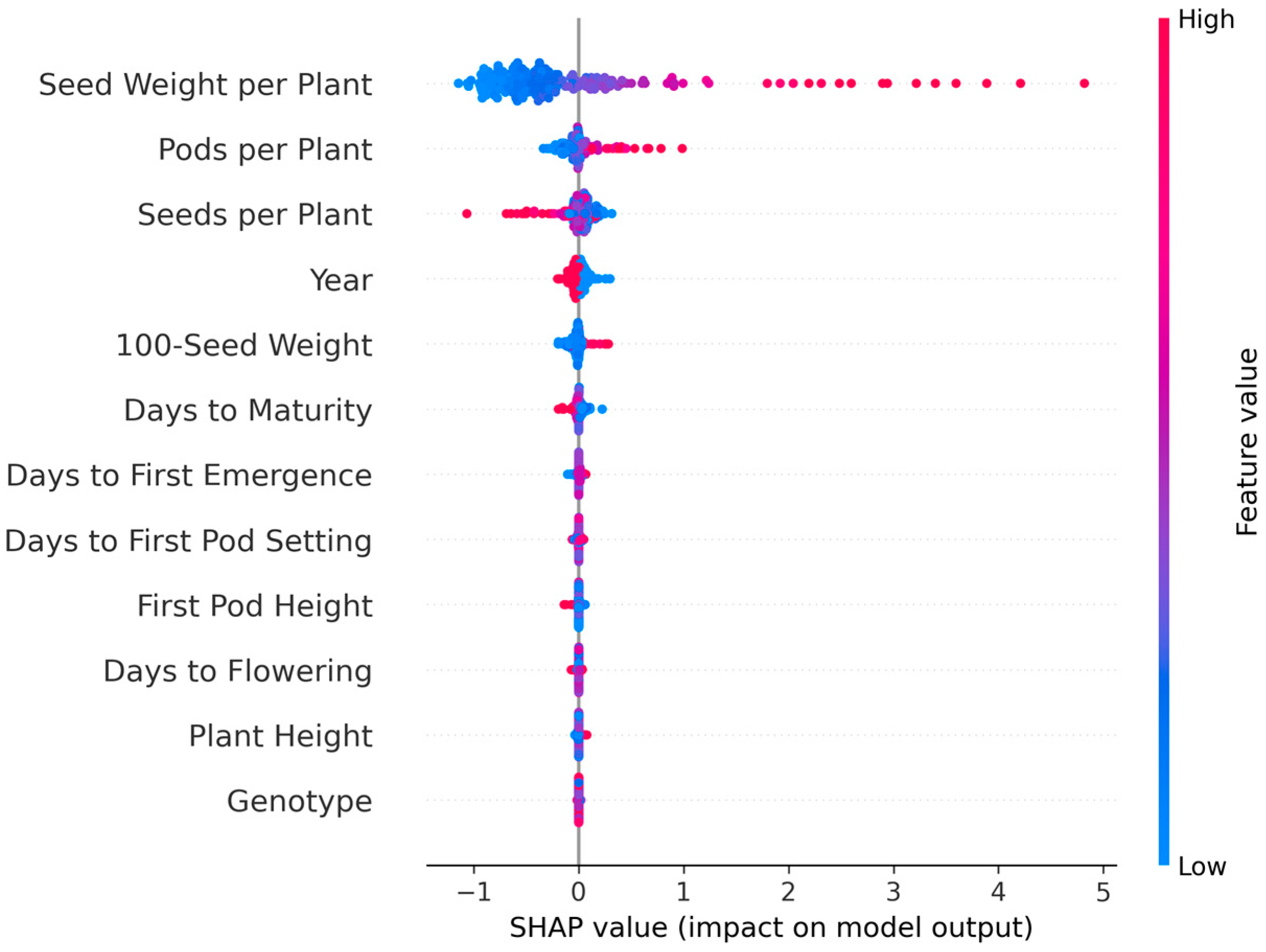
The global distribution and directional effects of feature contributions across all observations are illustrated in the SHAP summary plot shown in
Figure 1. In this plot, each dot represents one observation, and the color of the dot indicates the relative value of the corresponding feature, where blue denotes low feature values and red denotes high feature values. The plot indicates that seed weight per plant has the widest spread of SHAP values and the strongest positive impact on model predictions, demonstrating its dominant contribution across the dataset. Higher values of seed weight per plant (represented by red points) are generally associated with increased predicted grain yield, whereas lower values (represented by blue points) contribute negatively to the model output.
Reproductive traits such as number of pods per plant and number of seeds per plant also show noticeable variability in SHAP values, indicating their meaningful influence on prediction performance, although their impact is considerably smaller than that of seed weight per plant. The year variable exhibits moderate dispersion, confirming the role of environmental and seasonal variability in yield prediction. In contrast, traits including 100-seed weight, days to maturity, emergence time, flowering duration, first pod height, plant height, and genotype display relatively narrow SHAP value distributions centered around zero, suggesting limited individual influence on the model output. Overall, the SHAP summary plot confirms that yield-related reproductive traits primarily drive model predictions, while phenological and morphological variables contribute secondary effects [
35].
SHAP values were computed using the KernelSHAP method exclusively on out-of-fold validation samples (X_fold_test) within each cross-validation iteration to prevent information leakage and attribution bias. The background reference dataset consisted of 50 randomly sampled observations drawn from the corresponding training fold. SHAP values obtained from all folds were pooled across out-of-fold predictions to derive global feature importance estimates. Because SHAP explanations were derived from standardized inputs, importance rankings represent relative predictive influence rather than direct agronomic effect magnitude.
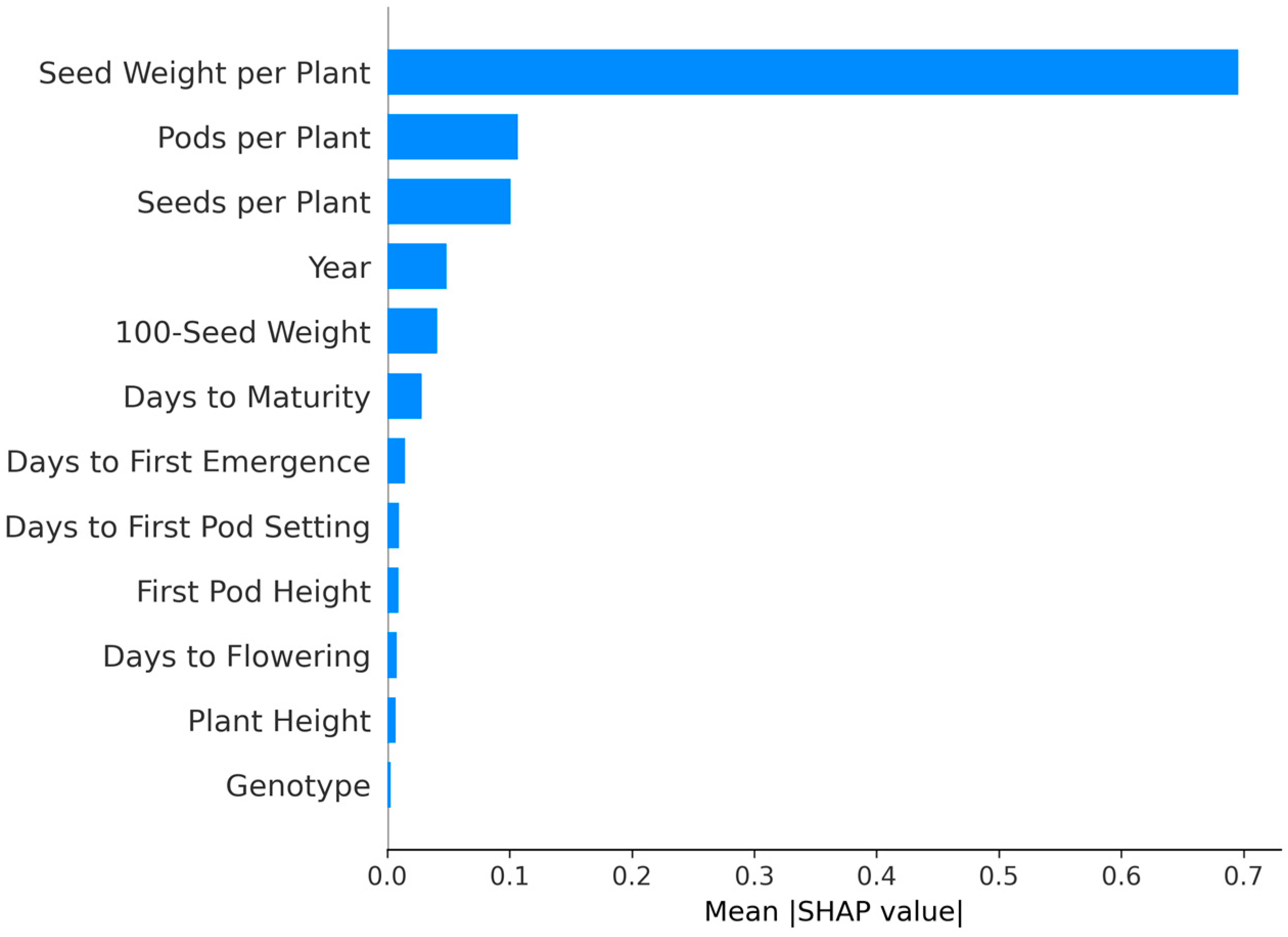
The overall magnitude of feature importance was quantified using mean absolute SHAP values as presented in
Figure 2. In this bar plot, the blue bars represent the mean absolute SHAP value of each feature across all observations, indicating the average magnitude of that feature’s contribution to the model output regardless of direction. The feature importance plot clearly indicates that seed weight per plant exhibits substantially higher importance than all other variables, demonstrating its dominant contribution to chickpea grain yield prediction.
Reproductive traits, particularly the number of pods per plant and the number of seeds per plant, represent the next most influential predictors, although their contributions remain considerably lower than that of seed weight per plant. The year variable and 100-seed weight show moderate importance, reflecting the influence of environmental variability and seed characteristics on model predictions.
In contrast, phenological and morphological traits, including days to maturity, days to first emergence, days to first pod setting, first pod height, days to flowering, plant height, and genotype, display relatively low importance values, indicating a comparatively smaller individual contribution to the prediction process. Overall, the distribution of feature importance confirms that yield-related reproductive traits primarily drive model predictions, whereas structural and developmental characteristics provide secondary predictive information.
The SHAP analysis showed that the prediction model was mainly influenced by yield-related reproductive traits, particularly seed weight per plant, while environmental and other agronomic variables had smaller contributions. These results help explain how different traits affect chickpea grain yield prediction and support the biological relevance of the developed model.
4.3. Principal Component Analysis of Chickpea Genotypes
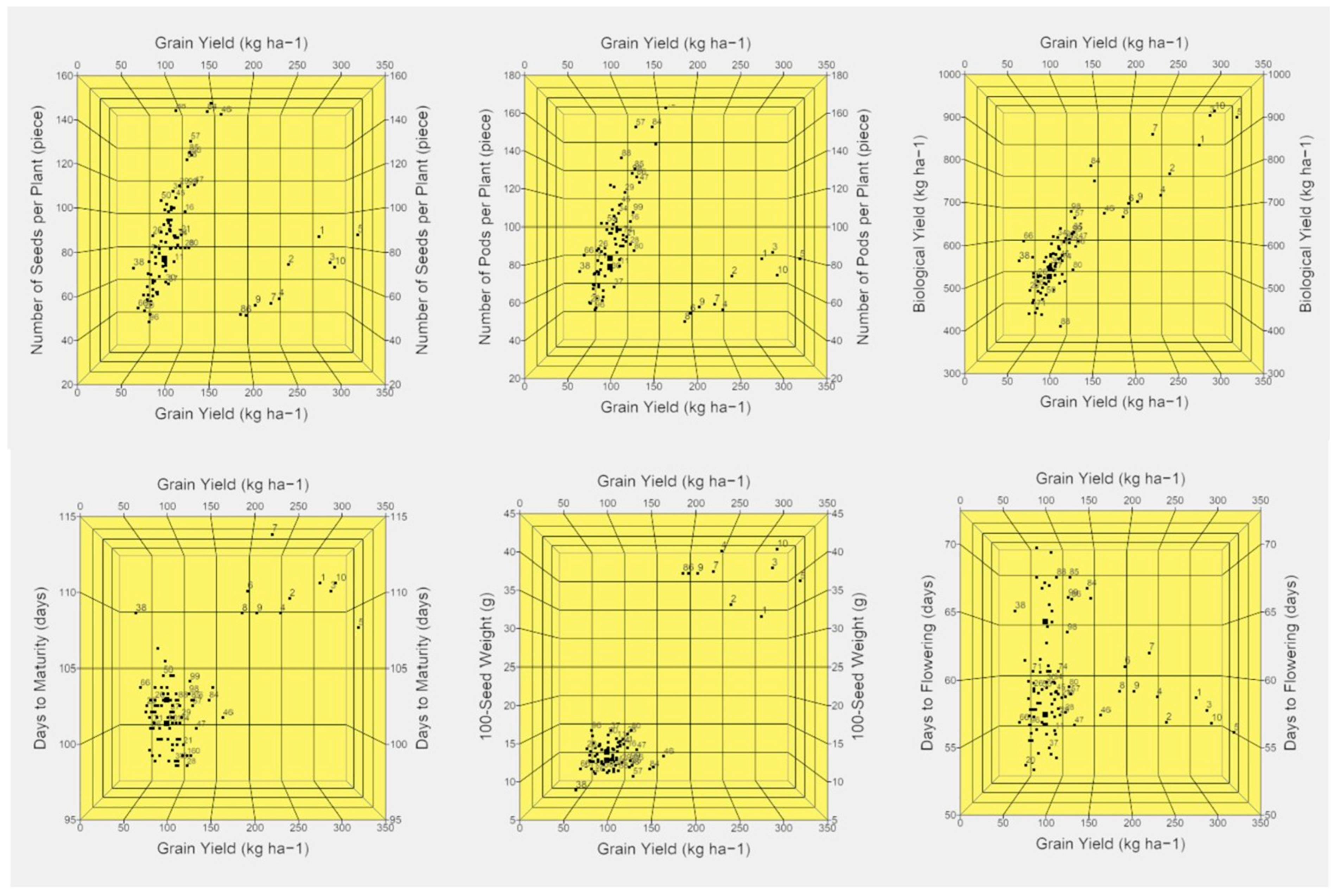
Principal component analysis (PCA) was conducted to evaluate the relationships among phenological, morphological, and yield-related traits and to characterize the multivariate structure of the chickpea dataset prior to artificial neural network (ANN) modeling. The PCA biplot (
Figure 3) revealed substantial variability among genotypes, indicating a broad genetic base and considerable phenotypic diversity suitable for yield prediction and breeding applications. This variability is particularly important for machine learning approaches, as broader variation improves model generalization and predictive capability [
36].
The first two principal components accounted for a large proportion of total variance, suggesting that chickpea yield formation is primarily governed by a limited number of key agronomic traits. Yield-related variables, including seed weight per plant, number of pods per plant, number of seeds per plant, biological yield, and grain yield, were positioned in similar directions on the PCA biplot, indicating strong positive correlations among these traits. This result confirms that reproductive components play a dominant role in determining grain yield, which is consistent with the biological structure of yield formation in chickpea [
36].
The strong association among reproductive traits observed in PCA aligns closely with the ANN-based feature importance results, where seed weight per plant, number of pods per plant, and number of seeds per plant were identified as the most influential predictors of grain yield. This agreement between multivariate statistical analysis and machine learning outputs enhances the biological reliability and interpretability of the developed predictive model. The convergence of these independent analytical approaches further supports the robustness of the identified yield determinants.
In contrast, phenological traits such as days to emergence, days to flowering, days to first pod set, and days to maturity were located at greater distances from yield-related variables in the PCA space, indicating relatively weaker direct relationships with grain yield. Although phenological development is important for plant adaptation and stress avoidance, these results suggest that their influence on final yield is largely indirect. Similarly, morphological traits including plant height and first pod height exhibited moderate associations with yield components, indicating secondary contributions to productivity.
The distribution of genotypes across the PCA biplot demonstrated clear differentiation among chickpea lines, reflecting significant genetic diversity within the evaluated material. Genotypes positioned near yield-related vectors can be considered as high-yield potential candidates, whereas those located closer to phenological traits may represent genotypes with stress adaptation potential rather than high productivity. This differentiation highlights the usefulness of PCA for identifying promising parental material in chickpea breeding programs [
37].
Furthermore, the wide dispersion of genotypes across principal components suggests the presence of genotype × environment interactions, particularly under semi-arid conditions such as those prevailing in Sivas. This variability supports the application of ANN-based modeling approaches, which are particularly suitable for capturing complex nonlinear interactions among agronomic traits and environmental factors.
Overall, the PCA results indicate that chickpea grain yield is primarily driven by reproductive traits, while phenological and morphological variables contribute indirectly to yield formation. These findings complement the ANN modeling results and demonstrate that integrating multivariate statistical approaches with machine learning methods provides a more comprehensive understanding of yield determinants. Such integrated analytical frameworks offer valuable decision-support tools for chickpea breeding and precision agriculture applications, particularly under variable environmental conditions.
5. Discussion
The results indicate that ANN-based modeling is effective for capturing the complex relationships among agronomic traits and chickpea grain yield. The high predictive performance obtained in this study suggests that MLP architectures can successfully model nonlinear interactions that are difficult to represent with conventional linear approaches. This is particularly relevant for chickpea, where yield is controlled by the combined effects of genotype, reproductive development, and environmental conditions. Similar findings have been reported in previous chickpea yield prediction studies using ANN-based approaches [
23], where ANN models demonstrated superior performance compared to traditional time-series methods.
Compared with previous chickpea yield prediction studies, the performance obtained in the present study appears strong, although direct numerical comparisons should be interpreted cautiously because of differences in datasets, predictors, and validation strategies. The MLP-based ANN achieved an R
2CV of 0.9461, indicating high predictive ability under field conditions that included genotype-related and seasonal variability. This level of predictive performance is comparable to studies based on climatic and remote sensing variables [
24]; however, unlike those studies, the present work integrates detailed agronomic and reproductive traits, providing a more biologically grounded and interpretable modeling framework for yield prediction.
A major finding of the study is the dominant contribution of seed weight per plant, followed by number of pods per plant and number of seeds per plant, in the prediction of grain yield. These traits are biologically closely linked to final yield formation, and their prominence in the SHAP analysis supports the agronomic consistency of the model. At the same time, the very strong contribution of seed weight per plant indicates that the model should be interpreted primarily as a yield estimation framework, rather than a strict early-season forecasting tool. This distinction is important for the practical interpretation of the model.
The dominant contribution of seed weight per plant should be interpreted carefully, since this trait is directly associated with final grain yield and therefore represents a near-yield component rather than an independent upstream predictor. For this reason, the proposed ANN framework is more appropriately interpreted as a yield estimation model based on integrated agronomic observations than as a strict early-stage forecasting tool. Nevertheless, the strong influence of this variable remains biologically meaningful, as it reflects the central role of reproductive productivity in final yield formation. This interpretation is also supported by the model comparison, in which excluding seed weight per plant reduced the predictive performance to an R2 of approximately 0.67. This decrease confirms that the variable contains substantial predictive information, but also shows that model performance was not determined exclusively by this single feature.
The contribution of the year variable also highlights the effect of environmental variability on yield prediction. This finding emphasizes the importance of genotype × environment interaction in chickpea and shows that yield performance cannot be explained only by plant traits. Under semi-arid conditions, annual differences in temperature and moisture availability can substantially affect reproductive development and final grain yield. This observation is consistent with previous studies highlighting the importance of climatic variability and environmental factors in chickpea yield prediction models [
23,
24].
In contrast, phenological and morphological traits such as flowering time, maturity, plant height, and first pod height showed lower individual contributions. Although these traits remain important from an agronomic and breeding perspective, their predictive influence in the present model was smaller than that of the direct reproductive components. This suggests that reproductive efficiency had a more immediate role in determining yield variation within the studied material.
An important strength of the study is that the ANN model was supported by SHAP-based interpretation, which improves transparency and helps identify the traits with the greatest influence on model output. This increases the practical value of the approach for genotype evaluation, trait prioritization, and data-driven breeding decisions. However, the study is also limited by its dataset structure, being based on a single location and two growing seasons. Therefore, broader validation under different environments would be necessary to confirm the general applicability of the model. Moreover, the dataset was derived from a single experimental location and limited to two growing seasons, which may restrict the generalizability of the model under different agroecological conditions. In addition, the absence of external validation using independent datasets should be considered when interpreting the robustness and broader applicability of the model. In contrast to earlier studies that primarily emphasized predictive performance [
21,
22], the present study combines high predictive accuracy with an interpretable, feature-based modeling approach, enabling a clearer understanding of the biological drivers of yield formation. This approach is also consistent with recent studies showing that incorporating meaningful input features can improve the effectiveness of data-driven models in crop yield prediction [
25].
Overall, the findings show that explainable ANN models can provide not only accurate yield estimation but also biologically meaningful insight into the relative importance of key agronomic traits in chickpea. In this respect, the study contributes to the literature by moving beyond prediction alone and offering an interpretable, trait-based modeling framework for chickpea yield analysis under field conditions.
6. Conclusions
This study demonstrates the effectiveness of ANN, specifically MLP, in predicting chickpea grain yield based on a wide range of agronomic and environmental variables. The integration of ANN modeling with SHAP-based explainability represents a key contribution of this study, enabling both high predictive accuracy and interpretable insight into yield formation. By analyzing data from 96 genotypes across two growing seasons, the ANN model successfully captured the complex, nonlinear relationships influencing chickpea productivity. The best-performing model, employing the lbfgs solver with the tanh activation function and two hidden layers (5 and 2 neurons), demonstrated strong predictive performance, achieving a cross-validation coefficient of determination of R2 = 0.9461 (MSE = 0.0173), indicating robust generalization capability. These findings demonstrate the suitability of ANN-based modeling for representing genotype–environment interactions in chickpea grain yield prediction.
The SHAP-based explainability analysis further clarified the relative importance of input variables, identifying seed weight per plant as the primary factor influencing model predictions, followed by environmental variability (year) and reproductive traits such as pod and seed number per plant. This interpretability supports the biological consistency of the developed prediction framework. These findings emphasize the critical role of reproductive traits in yield formation and highlight their importance for breeding and selection strategies.
The results indicate that explainable machine learning approaches can support genotype evaluation, trait prioritization, and data-driven breeding strategies under variable environmental conditions. In practical terms, the proposed framework can assist researchers and breeders in identifying high-performing genotypes and optimizing trait-based selection under semi-arid conditions. By linking predictive performance with interpretable trait contributions, the proposed framework provides practical insights for chickpea yield assessment beyond conventional statistical approaches.
However, because certain reproductive traits, particularly seed weight per plant, represent direct yield-related components measured close to harvest, the developed model should primarily be interpreted as a yield estimation framework rather than a strict early-season forecasting tool.
Future studies may focus on integrating additional environmental descriptors, remote sensing information, or hybrid modeling approaches to further improve prediction reliability and enhance decision-support tools for precision agriculture, sustainable chickpea production and crop improvement programs.