Article

Nutrient Management Strategies for Enhancing Maize Yield and Improving Soil Fertility in the Changbai Mountains—Liaodong Hilly Region: A Meta-Analysis


1
College of Land Science and Technology, China Agricultural University, Beijing 100193, China
2
Institute of Plant Nutrition and Environmental Resources, Liaoning Academy of Agricultural Sciences, Shenyang 110161, China
3
Key Laboratory of Arable Land Conservation (North China), Ministry of Agriculture and Rural Affairs, Beijing 100193, China
4
Key Laboratory of Plant-Soil Interactions, Ministry of Education, Beijing 100193, China
*
Author to whom correspondence should be addressed.
Agronomy 2026, 16(7), 752; https://doi.org/10.3390/agronomy16070752
Submission received: 22 February 2026 / Revised: 27 March 2026 / Accepted: 31 March 2026 / Published: 1 April 2026

Abstract

To further enhance nutrient use efficiency for maize cultivation in the Changbai Mountains—Liaodong Hilly Region and to safeguard both grain production and soil quality, 2441 pairs of data points extracted from 47 publicly published papers were selected for analysis to investigate the effects of different fertilizer types, their application rates, and field management practices on spring maize yield enhancement, crop growth, and soil physicochemical properties. According to the subgroup analysis of the above indicators, the results demonstrated that various fertilization management practices can effectively increase maize yield and soil nutrient content. Specifically, applications of nitrogen fertilizer (39.78%) and top-dressing (34.10%) had the best effect on increasing maize yield. The combination of organic–inorganic application (22.93%) and straw returning (20.46%) had the best effect on increasing soil organic matter. Based on grain yield and its components, crop physiology and soil physicochemical properties, we recommend an optimal nutrient management strategy for this region: an application rate of 180 kg/ha for nitrogen and 70–100 kg/ha for both phosphorus and potassium, and the field management practice of combined application of chemical fertilizers and manure based on full-amount straw returning in the field. This study provides a reference for nutrient management of maize fields in the Changbai Mountains—Liaodong Hilly Region.

1. Introduction

Maize (Zea mays L.) is a major grain crop in China. According to statistical data, the corn output of China was approximately 295 million tons in 2024, accounting for about 41.74% of the nation’s total grain production and 24.17% of global corn output, ranking as the second largest corn producer globally and the largest in Asia [1,2]. Moderate fertilization can not only directly and significantly promote maize growth and increase maize yield and nutrient content but also help reduce environmental pollution and farmers’ expenditures, thereby enhancing both economic and environmental benefits [3,4]. However, in China, excessive fertilization in maize production is a widespread phenomenon. In 2018, the average nitrogen (N) application rate for maize in China was 180 kg N/ha, ranking first in the world and well above that of the second-ranked country, the United States (158 kg N/ha) [5]. The national N surplus in maize fields was approximately 47–58 kg/ha [6]. Since 1990, a large amount of chemical fertilizer has been applied in northeast China, while the nitrogen use efficiency (NUE) has only been 32%, far below the world average of 55%, which has accelerated the degradation of arable soil and caused severe acidification in the region [7,8,9]. Excessive N application not only adversely affects soil physicochemical properties and microbial community composition but also reduces crop nutrient use efficiency [10,11], leading to reduced yields and decreased economic benefits [12]. Nutrients that are not absorbed and utilized by crops can pollute groundwater and surface runoff after leaching [13,14] and can also be converted into NH3 and NO2, which volatilize into the atmosphere and cause air pollution [15,16]. Additionally, excess nutrients accumulated in the soil can also lead to nitrate accumulation and acidification in deep soil layers [17]. However, when the N application amount is lower than the requirement of crops, long-term cultivation will continuously deplete the soil N pool. Meanwhile, under long-term N deficiency, the photosynthetic rate of plants decreases significantly, and during the reproductive stage, it also leads to plant senescence and decomposition of N components. These factors collectively constrain maize growth and production, hindering sustainable agricultural development [18,19].
Previous research has shown that optimizing N application for maize (184 kg N/ha) can increase yield (16%) and NUE (46%) in China [20]; reducing N application by 25% (to 180 kg N/ha) can maintain maize yield while significantly reducing cumulative N2O emissions (36.0%) in northeast China [21]. Furthermore, optimizing field management practices is conducive not only to maintaining grain yield but also to enhancing soil quality simultaneously. For instance, selecting locally suitable crop varieties and optimizing planting density during cultivation can improve crop nutrient use efficiency [22]. Implementing a fertilization strategy that combines basal fertilizer and top-dressing, along with adjusting their appropriate ratio, can meet crop nutrient demands at different growth stages while reducing nutrient loss and waste [23]. When applying chemical fertilizers, combining them with organic fertilizers such as manure, biochar, or compost can reduce the amount of chemical fertilizer applied without altering the total N input [24,25]. Adopting conservation tillage practices such as straw mulching, reduced tillage, and no-tillage farming can minimize soil disturbance, promote nutrient accumulation, and enhance soil fertility [26,27,28,29]. Consequently, improved soil quality, as reflected in key physical indicators including bulk density (BD), porosity, and water content, as well as chemical indicators such as soil organic carbon (SOC) and N, can ultimately drive increases in yield [30,31].
The Changbai Mountains—Liaodong Hilly Region (CM-LHR) is located in the southeastern part of northeast China, mainly encompassing southeastern Heilongjiang Province, eastern Jilin Province, and southeastern Liaoning Province, with geographic coordinates ranging from 38°43′ N to 46°16′ N and 121°05′ E to 131°10′ E [32]. The topography of this region is primarily mountainous and hilly, with sloping farmland as the main cultivated land type under a temperate continental monsoon climate [7,33]. Compared to other areas in northeast China, this region has a mild and humid climate with less sunshine but the most abundant precipitation [34]. The total cultivated land area is approximately 6.46 million ha, accounting for about 18.04% of the cultivated land in the northeast Black Soil Region. However, nearly 60% of the cultivated land has a plow layer thickness of less than 20 cm. The soil organic matter (SOM) content is low and the soil is severely acidified (pH is about 5.5–6.5). The soil types in mountainous areas are mostly brown earth and dark brown earth with a sandy texture, while the soil on gentle slopes features a heavier, more clayey texture [7,32]. Influenced by natural factors such as abundant precipitation and alternating freezing and thawing, the cultivated land in this region suffers the most severe water erosion in northeast China, as well as a certain degree of wind erosion [35]. Simultaneously, long-term monoculture and high-intensity agricultural cultivation, coupled with inappropriate farming practices, have accelerated the significant loss of soil nutrients, including SOC, N, and phosphorus (P) in the CM-LHR, leading to a decline in soil fertility and degradation of the cultivated land [8,36].
Meta-analysis is a quantitative method used to summarize and analyze data and conclusions from multiple independent studies [37]. Current meta-analyses on maize cultivation and soil quality in northeast China primarily focus on the three northeastern provinces and eastern Inner Mongolia as an aggregated region [4,29,38]. However, due to differences in natural conditions such as climate, topography, vegetation, and soil, there are significant variations in soil quality, water and nutrient use efficiency, and agricultural ecological sustainability among different regions in northeast China. Consequently, the quality of arable land resources in plain areas such as the Sanjiang, Songnen, and Liaohe Plains is superior to those in the CM-LHR [7,34]. A systematic analysis specifically targeting maize cultivation on farmland in the CM-LHR has been lacking. To address this gap, this study collected published data relevant to this region and employed a meta-analysis to investigate the effects of different fertilizer types, application rates, and field management practices on maize yield and its components, soil physicochemical properties, and nutrient content. The aim of this study was to identify suitable nutrient management strategies for enhancing maize yield and improving soil fertility in this specific area and to provide a scientific theoretical basis and technical support for rational fertilization and organic fertilizer utilization, as well as to enhance both maize yield and SOC content in the CM-LHR.

2. Materials and Methods

2.1. Data Collection and Collation

The literature was searched in databases including the China National Knowledge Infrastructure (CNKI) and Web of Science (WOS) using keywords such as “Northeast”, “Maize (or “Corn”)”, and “Soil” for publications from January 1990 to August 2025. Studies were screened based on the following criteria: (1) the experimental sites were located within the CM-LHR, and the trials were conducted under rain-fed dryland field conditions; (2) the reported indicators included at least the application rates of fertilizers such as N, P, and potassium (K), as well as related crop or soil parameters at maturity (including maize yield or biomass, maize physiological indicators, soil physicochemical properties and nutrient contents, etc.), with data obtained through experimental measurements, observations, or calculations; (3) the experiment covered at least one complete growing season. To avoid data duplication, only one set of data was retained for experiments from the same location and period when reported in multiple publications. Based on these criteria, 55 articles were initially selected. Using the geographic locations and experimental year information provided in the literature, annual rainfall during each trial period was further extracted and calculated from the ERA5-Land hourly time-series dataset published by the European Centre for Medium-Range Weather Forecasts (ECMWF) [39,40]. Finally, the literature information and rainfall data were integrated to construct a comprehensive database for the analyses presented in Section 3.1 and Section 3.2.
Furthermore, the inclusion criteria were refined to require that each trial must include both a control (CK) and a treatment group. For the analysis of fertilization effects, the CK was defined as applying N, P or K fertilizer alone or no fertilizer, while the treatment involved fertilizer application. For the analysis of chemical–organic fertilizer combination application (CO), the CK was the application of chemical fertilizer only, and the treatment was the combined application of chemical and organic fertilizer. For the analysis of basal and top-dressing (BT), the CK was no top-dressing, and the treatment was basal fertilizer plus top-dressing. For the analysis of straw returning (SR), the CK was no SR, and the treatment was SR. Following this refined screening, 47 articles were ultimately selected to construct the database for the meta-analysis in Section 2.2, Section 3.3, Section 3.4 and Section 3.5. The extracted data pairs included: grain yield (672 pairs), grain number per ear (293 pairs), 1000-grain weight (386 pairs), biomass (230 pairs), plant height (177 pairs), leaf area index (LAI, 160 pairs), nutrient content of soil and grain (279 pairs), SOC (157 pairs), and soil physical and chemical properties (87 pairs). Based on the experimental information from the literature, data were categorized into groups according to different fertilization treatments (Table 1). Here, N, P, and K fertilizer rates were expressed in kg/ha. The basal and top-dressing ratio was established based on N application. The effects of various influencing factors on the relevant response variables were examined using meta-subgroup analysis.
For data reported only with the standard error (SE), the standard deviation (SD) was calculated using the following formula:
S D = S E × n
where n is the sample size. For data lacking reported SD values, following the approach of other studies [41,42,43], the missing SD values were estimated using 10% of the mean based on the observed proportional relationship between existing SD values and their corresponding means in the dataset.
For data reporting only SOM, SOC was calculated using the following formula:
SOC = SOM ÷ 1.724

2.2. Data Processing and Analysis

Data collation and grouping were performed using Microsoft Office 2021. Graphs were plotted and functions were fitted using Origin 2024. Meta-analysis was conducted with MetaWin 3.0, and forest plots were generated using GraphPad Prism 10.1.2. The natural logarithm of the Response Ratio (lnRR) was selected as the effect size. The overall effect size (lnRR+) and its 95% confidence interval (95% CI) were calculated using the following formula [37]:
l n R R = l n ( X t X c )
v i = S D t 2 N t X t + S D c 2 N c X c
w i = 1 v i
l n R R + = ( l n R R i × w i ) w i
S l n R R + = 1 w i
95 % C I = l n R R + ± 1.96 S l n R R +
where Xt and Xc are the mean values of the treatment and control groups, respectively; Nt and Nc are the sample sizes of the treatment and control groups, respectively; SDt and SDc are the standard deviations of the treatment and control groups, respectively; wi is the weight assigned to each individual study; vi is the variance of the individual effect size; and SlnRR+ is the standard error of lnRR+.
To intuitively illustrate the treatment effects on the indicators, lnRR+ was converted into a percentage change (E) for generating forest plots:
E = ( e l n R R + 1 ) × 100 %
In the forest plots, the numbers in parentheses indicate the sample size. If the confidence interval of E crosses the zero line, it indicates that the treatment has no significant effect on the corresponding indicator compared to the CK. If it does not cross the zero line, the effect is considered significant. A confidence interval and E both greater than zero indicate that the treatment significantly promotes or increases the indicator compared to CK, while values less than zero indicate a significant adverse effect or reduction [41].
The tests for heterogeneity and publication bias of each treatment on the indicators in this study are detailed in Table S1. The choice of meta-analysis model was determined by the heterogeneity test results (Cochran’s Q) [4,44]: if P(Q) > 0.05, a fixed-effects model was used to calculate the effect size; if P(Q) < 0.05, a random-effects model was used. Publication bias was assessed using Rosenthal’s Fail-safe Number (Nf) [45]: if Nf > 5n + 10 (where n is the number of studies for the corresponding indicator), it suggests no substantial publication bias; otherwise, it indicates that publication bias may have a considerable influence on the meta-analysis results, and unpublished studies could potentially alter the conclusions drawn for that indicator in this study.

3. Results

3.1. Bibliometric Analysis

This study counted a total of 59 experimental sites, and the distribution of experimental sites within the study region is shown in Figure 1a. The trials were primarily located in Changchun City (23) of Jilin Province, Harbin City (11) of Heilongjiang Province, and Dalian City (8) of Liaoning Province. Among these sites, Xianyu 335 was the most cultivated maize variety (accounting for 20.97% of all tested varieties; the same applies to the subsequent percentages), followed by Zhengdan 958 (12.90%), Liangyu 99 (8.06%), and Pioneer 38P05 (6.45%). Among the sites, Liaoning Province primarily cultivated Zhengdan 958 (accounting for 12.00% of all varieties across all experimental sites in the province; the same applies to the subsequent percentages) and Liangyu 99 (12.00%); Jilin Province mainly grew Xianyu 335 (37.50%) and Zhengdan 958 (12.50%), while Heilongjiang Province predominantly planted Xianyu 335 (30.77%) and Pioneer 38P05 (30.77%). The trial years spanned from 1990 to 2023, with a peak concentration occurring from 2013 to 2021 (Figure 1b). Due to the lag between conducting experiments and publishing results, the number of trials recorded for 2022 and beyond is relatively low, but this does not mean a declining trend in actual trials conducted after 2022. Therefore, the overall number of trials in the study region shows a progressive increase over the years. The publication years spanned from 2009 to 2025, with the highest output concentrated from 2016 to 2024. The annual number of publications fluctuated slightly, reaching a peak of eight articles in 2024. In terms of author contributions (considering only first and corresponding authors), Jingkao Zhao published the most articles, totaling four, primarily between 2013 and 2017, followed by Ye Fan, with three articles, mainly between 2021 and 2024. Additionally, 8 authors contributed two articles each, and the remaining 74 authors contributed one article each.
Merging keywords with the same meaning but different expressions, the keyword co-occurrence network for the included articles is displayed in Figure 1c. “Yield” was the most prominent keyword, appearing 32 times between 2011 and 2024, followed by “Maize” (appeared 29 times spanning 2009–2024) and “Black soil” (appeared 11 times spanning 2011–2025, and particularly 7 occurrences between 2021 and 2025). Both “Straw incorporation” and “Nitrogen use efficiency” appeared eight times (spanning 2018–2025 and 2013–2024); “Planting density” appeared six times (spanning 2011–2021); and both “Nitrogen application rate” and “Nitrate nitrogen” appeared five times (spanning 2016–2023 and 2009–2021). The remaining 113 keywords each appeared fewer than five times. In the initial period (2009–2014), keywords were mainly focused on “Maize”, “Yield”, “Fertilizer”, “Planting density”, “Dry matter”, “Black soil”, “Growth characteristic”, and N-related topics, with research centered on N in soil and fertilizers, exploring the effects of fertilization and nutrient supply on maize growth and production. The middle period (2015–2020) witnessed a shift, with new keywords like “Soil microorganisms”, “Soil enzyme activity”, “Soil nutrient”, “Straw incorporation”, and “Organic fertilizer” emerging. The research scope broadened to include soil biological properties and the impacts of organic amendments, and research mainly focused on soil microorganisms and enzymes, and SR and organic fertilizer, and explored the effects of organic fertilizer and SR on soil nutrient supply and microbial communities. The recent period (2021–2025) reflects further evolution, highlighted by keywords such as “Organic carbon”, “Tillage”, “Biochar”, and those covering P-related topics. Current investigations prioritize soil carbon sequestration, conservation tillage practices, and the development of advanced fertilizer technologies.

3.2. Effects of Natural Factors and Cultivation Differences on Maize Yield and Biomass

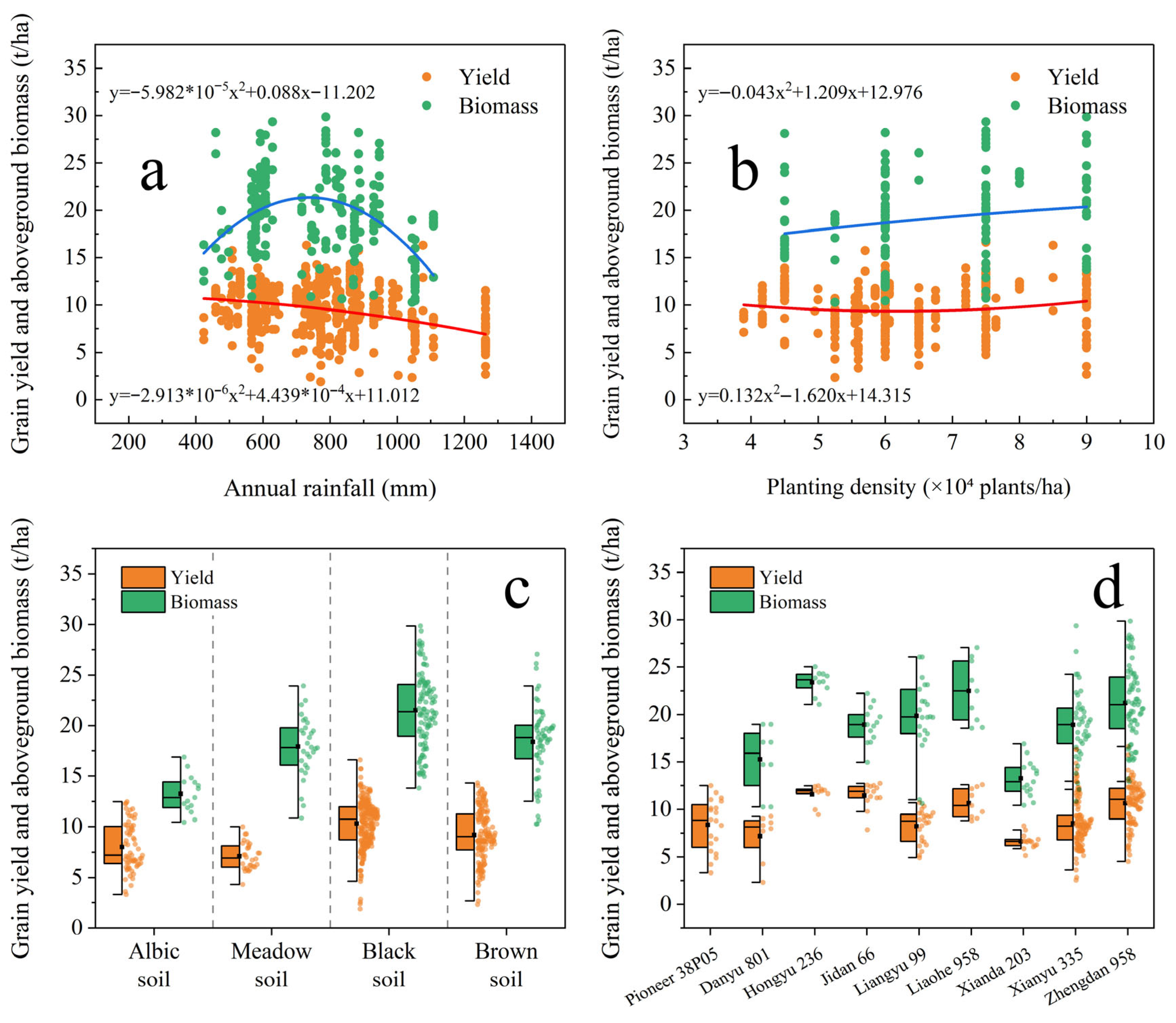
The collected data on yield, biomass, rainfall, and planting density were subjected to fitting analysis. Results indicated that when rainfall was 737.75 mm, biomass reached a maximum of approximately 21.36 t/ha. However, the fitting function showed that grain yield decreased with further increasing annual rainfall, and the corresponding grain yield at the peak biomass level was about 9.75 t/ha (Figure 2a). As shown in Figure 2b, biomass increased with the increase in planting density, reaching approximately 21.23 t/ha at a density of 9.00 × 10⁴ plants/ha. In contrast, planting density had a minor impact on grain yield. Within the density range of 3.89–9.00 × 10⁴ plants/ha, the fitted yield curve fluctuated around 10.00 t/ha. The minimum grain yield, approximately 9.33 t/ha, occurred at a planting density of 6.15 × 10⁴ plants/ha, while the corresponding biomass was about 18.25 t/ha.
The variation in maize yield and biomass across different soil types is presented in Figure 2c, focusing on four main cropland soil types in the CM-LHR. Among them, black soil exhibited the highest average maize yield and biomass, reaching 10.30 t/ha and 21.49 t/ha, respectively. The maize yield and biomass in brown soil were slightly lower than those in black soil. Meadow soil had the lowest average grain yield at 7.08 t/ha, and albic soil had the lowest average biomass at 13.24 t/ha. Nine commonly grown maize varieties in the CM-LHR were evaluated in Figure 2d for their effects on yield and biomass. Data for Pioneer 38P05 were limited to grain yield, in contrast to the other varieties, for which both yield and biomass data were available. Among the varieties, Hongyu 236 showed the highest average yield and biomass, at 11.57 t/ha and 23.40 t/ha, respectively, whereas Xianda 203 showed the lowest values, at 6.65 t/ha and 13.24 t/ha, respectively. For the four most cultivated varieties in the region, the average yields for Xianyu 335, Zhengdan 958, Liangyu 99, and Pioneer 38P05 were 8.52 t/ha, 10.64 t/ha, 8.19 t/ha, and 8.35 t/ha, respectively. Regarding biomass, the average values for Xianyu 335, Zhengdan 958, and Liangyu 99 were 18.91 t/ha, 20.90 t/ha, and 19.85 t/ha, respectively.

3.3. Effects of Fertilizer Application Rate and Management Practices on Maize Yield and Its Components

The meta-analysis of N, P, and K fertilizers in this study was conducted using experiments without corresponding N, P, and K fertilizers as the control; that is, the CK was defined as applying N, P or K fertilizer alone or no fertilizer. Consequently, some of the experimental data for P and K fertilizers included N treatments. Results showed that N fertilizer was significantly superior to P and K fertilizers only in terms of yield enhancement, while there were no significant differences in the remaining indicators among the three types of fertilizers. This may be due to the overlap in experimental data.
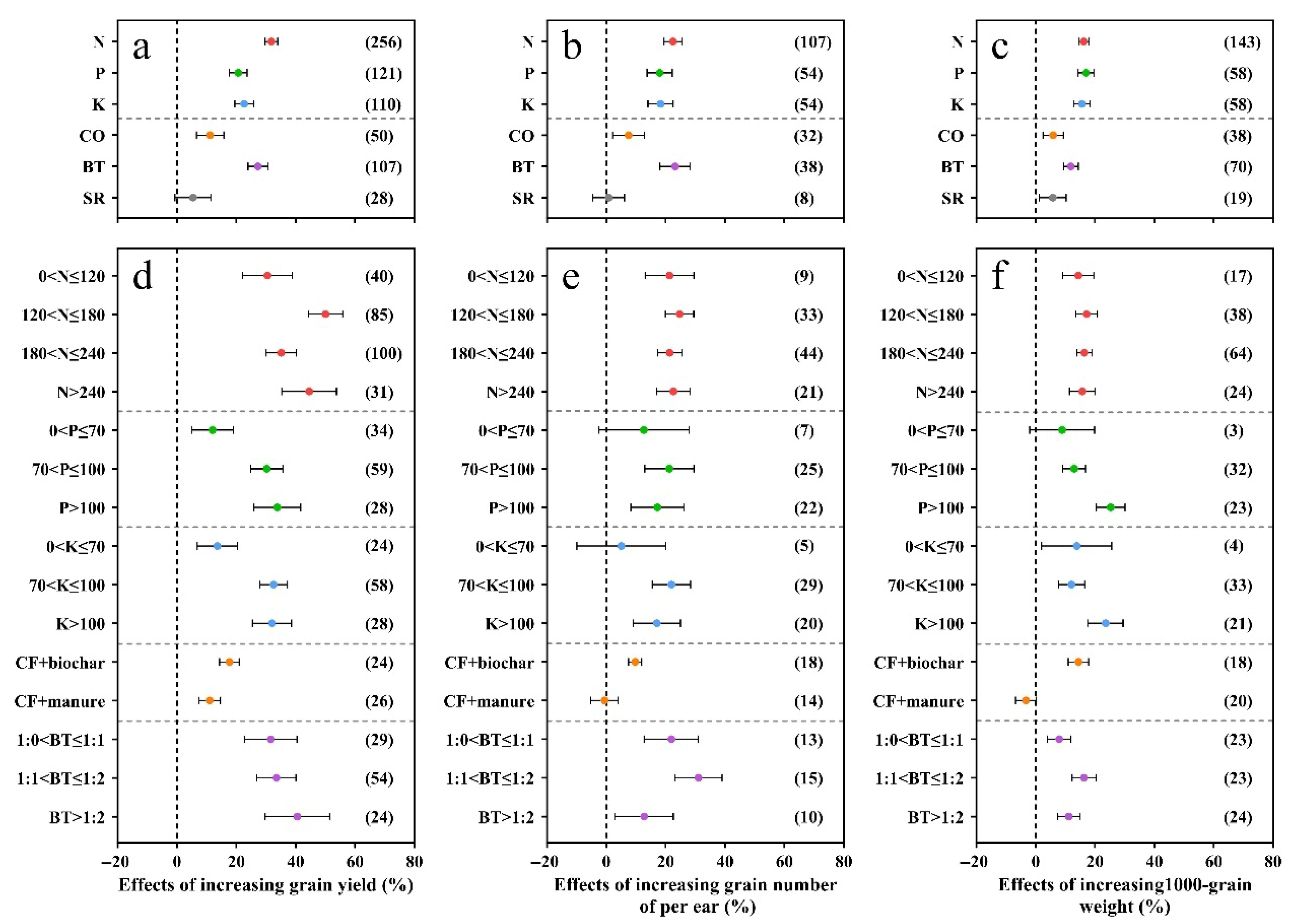
Figure 3 depicts the effects of different fertilizer application rates and management practices on three yield components: grain yield (a and d), grain number per ear (b and e), and 1000-grain weight (c and f). Except for SR, all fertilization rates and management practices significantly (p < 0.05) increased grain yield. The application of fertilizer significantly increased the overall yield as follows: 39.78% (with subgroups increased by 30.49–50.10%; the same applies to the subsequent percentages) for N application, 25.80% (12.00–33.81%) for P application, 28.32% (13.61–32.57%) for K application, 13.96% (11.03–17.66%) for CO, 34.10% (31.56–40.56%) for BT, and 6.75% for SR.
For grain number per ear, the effects of all treatments were similar to those observed for grain yield in the overall analysis, with the increases as follows: 22.44% (21.29–24.68%) for N application, 18.00% (12.66–21.23%) for P application, 18.29% (5.06–21.94%) for K application, 7.52% (−0.62–9.73%) for CO, and 23.17% (12.77–31.03%) for BT. SR increased only by 0.76%. In the overall analysis, the enhancing effects of BT on grain yield and grain number per ear were significantly greater than those on CO and SR. In the subgroup analysis, the combination of chemical fertilizer and manure did not show a desirable effect, although the result was not significant.
Different from grain yield and grain number per ear, all treatments significantly increased 1000-grain weight in the overall analysis, with the increases as follows: 16.21% (14.35–17.16%) for N application, 16.99% (8.92–25.30%) for P application, 15.57% (12.07–23.59%) for K application, 5.89% (−3.27–14.41%) for CO, 11.86% (7.94–16.30%) for BT, and 5.77% for SR. In the subgroup analysis, the combination of chemical fertilizer and manure produced a negative effect, although it was not significant.

3.4. Effects of Fertilizer Application Rates and Management Practices on Physiological Traits of Maize Plants

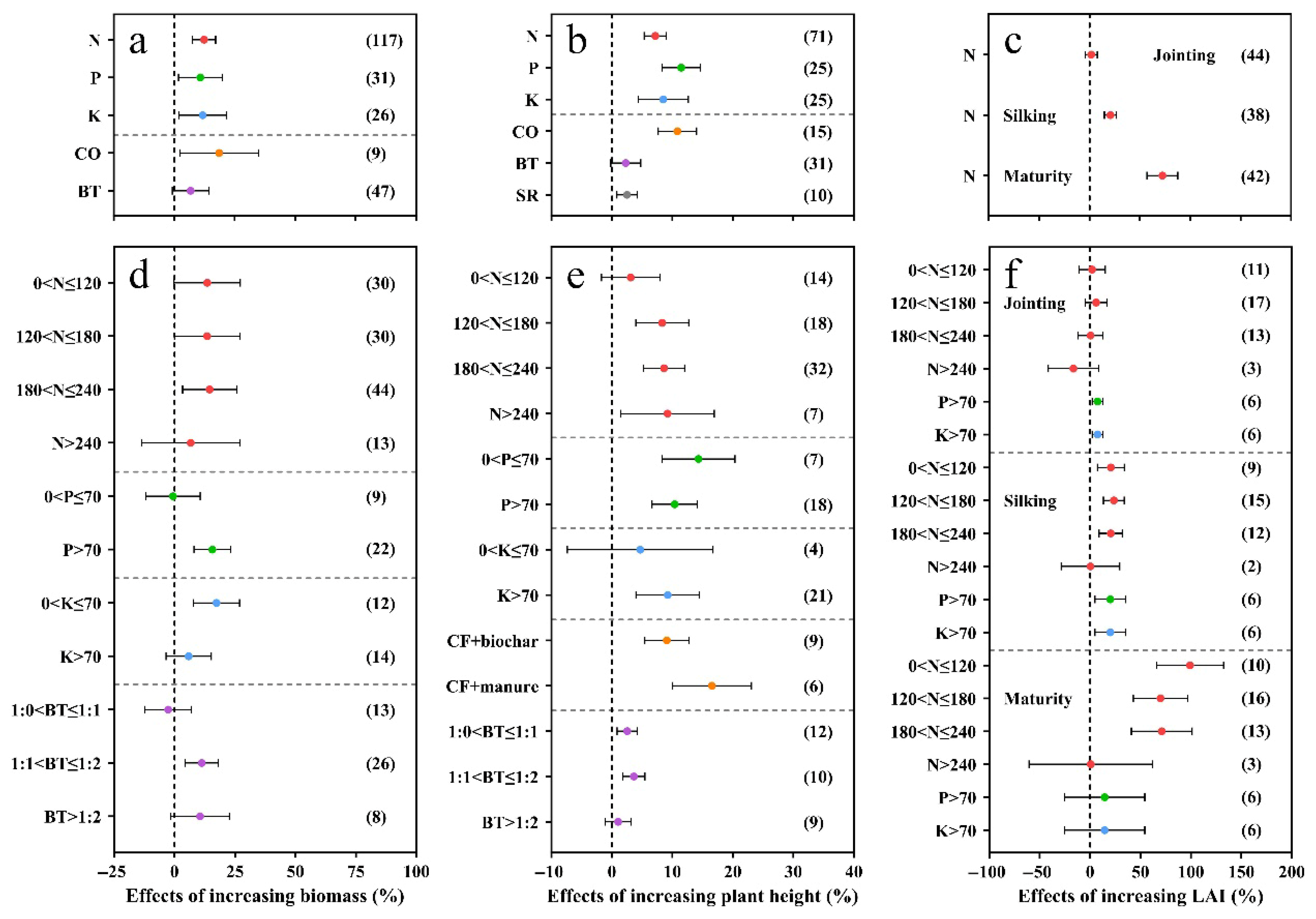
As shown in Figure 4, the effects of different fertilizer application rates and management practices on aboveground biomass and plant height at maize maturity were consistent in the overall analysis. The application of N, P, and K chemical fertilizers, as well as the combined use of organic and inorganic fertilizers, significantly increased both biomass and plant height overall. Specifically, for aboveground biomass, the overall significant increases were as follows: 12.35% (6.69–14.50%) for N application, 10.79% (−0.61–15.63%) for P application, 11.80% (5.85–17.36%) for K application, and 18.57% for CO. BT increased by 6.79% (−2.61–11.26%), but this effect was not significant. In the subgroup analysis, negative but non-significant effects were observed for a basal–top-dressing ratio ≤ 1:1 and for P application at the rate of ≤ 70 kg/ha. For plant height, the overall significant increases were as follows: 7.18% (3.11–9.20%) for N application, 11.47% (10.38–14.32%) for P application, 8.50% (4.68–9.24%) for K application, 10.84% (9.08–16.54%) for CO, and 2.50% for SR. BT increased by 2.30% (1.04–3.63%), but this effect was not significant.
For LAI, at the jointing stage, N application increased by 1.75% (−16.51–5.97%) overall; P and K applications both significantly increased by 7.40%. At the silking stage, N application significantly increased by 20.73% (0.40–23.55%) overall; both P and K applications significantly increased by 20.12%. At the maturity stage, N application significantly increased by 72.31% (0.69–99.16%) overall; both P and K applications significantly increased by 14.49%. When the N application rate was > 240 kg/ha, it had a negative impact on LAI at the jointing stage and only a marginal positive effect at the silking and maturity stages, and none of these effects were significant overall. This indicates that excessive N application can adversely affect leaf growth at different stages. Other N application rates increased LAI to varying degrees at different stages but only significantly at the silking and maturity stages. In the overall analysis, the effect of N application on maize LAI followed the order maturity stage > silking stage> jointing stage, with all differences being significant. Both P and K applications had a certain increasing effect on LAI in each stage.

3.5. Effects of Fertilizer Application Rates and Management Practices on Soil Physicochemical Properties and on Soil and Grain Nutrients

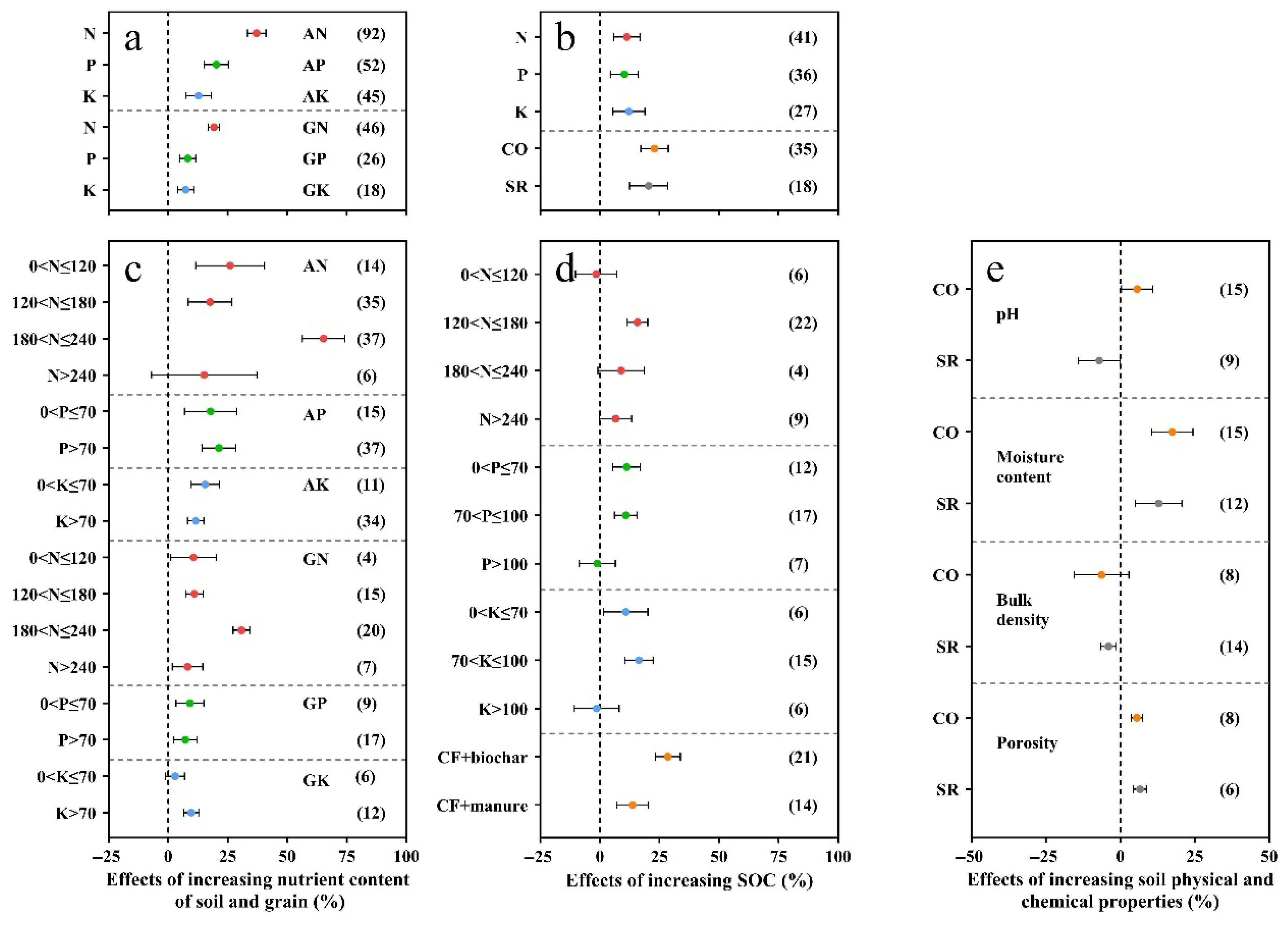
All fertilizer types and their application rates increased nutrient content in soil and grain at maturity (see Figure 5a,c). The overall significant increases were as follows: N application significantly increased alkali-hydrolyzable nitrogen (AN) and grain nitrogen (GN) by 37.17% (15.11–65.24%) and 19.24% (8.11–30.77%), respectively; P application significantly increased available phosphorus (AP) and grain phosphorus (GP) by 20.26% (17.81–21.30%) and 8.20% (7.22–9.11%), respectively; K application significantly increased available potassium (AK) and grain potassium (GK) by 12.77% (11.53–15.52%) and 7.35% (2.88–9.69%), respectively. In the overall analysis, the effects of N and P applications on soil available nutrients were significantly greater than those on grain nutrients, while K application also showed an improvement, though it was not significant. In the subgroup analysis, N application had the best effect on increasing AN and GN when the N application rate was >240 kg/ha and was significantly superior to other application rates. In contrast, no significant differences were observed between the subgroups of P and K application.
All fertilizer types and management practices significantly increased SOC content at maturity in the overall analysis, but some treatments reduced it in the subgroup analysis (Figure 5b,d). The overall significant increases were as follows: 11.30% (−1.56–15.76%) for N application, 10.22% (−1.09–11.21%) for P application, 12.18% (−1.34–16.42%) for K application, 22.93% (13.69–28.54%) for CO, and 20.46% for SR. In the subgroup analysis, negative but non-significant effects were observed for N application at rates ≤ 120 kg/ha and for P and K applications at rates > 100 kg/ha. And the effect of the combination with biochar was significantly greater than that of the combination with manure.
The effects of CO and SR management practices on soil physical and chemical properties at maturity are shown in Figure 5e. For soil pH, CO significantly increased by 5.65%, while SR significantly decreased by 7.07%. For soil moisture content, the two significantly increased by 17.50% and 12.89%, respectively. For soil bulk density, both decreased by 6.29% and 3.96%, respectively, with only the effect of SR being significant. For soil porosity, both significantly increased by 5.56% and 6.62%, respectively.

4. Discussion

4.1. Effects of Different Fertilizers and Their Application Rates on Maize Yield Enhancement and Soil Fertility Improvement

As a typical N-sensitive and P-sensitive crop, maize relies on N to drive chlorophyll, protein, and enzyme synthesis, as well as photosynthesis and growth, while P supports root growth and development [19,46,47]. Despite not being a structural component of biomolecules (unlike N and P), K plays an equally critical role by regulating photosynthesis, water balance, and stress tolerance in crops [48]. Together, these three nutrients interact synergistically to regulate key physiological processes, thereby ensuring stable and high yield, thus making it essential to optimize their application rates. Appropriate N application can meet the demands of crop growth and production while improving NUE, thereby reducing nutrient loss, lowering environmental pollution risks, and cutting costs [3,49]. However, N application rates for maize vary widely across the globe, ranging from approximately 20 to 300 kg/ha, largely due to regional differences in soil and climate [50]. In this study, N application at rates of 120–180 kg/ha had the best effect on increasing grain yield and its components, plant height, and SOC. For biomass, AN and GN, the optimal increase was achieved at N application rates of 180–240 kg/ha. Excessive N application (>240 kg/ha) negatively affected biomass and LAI, while insufficient application (≤120 kg/ha) negatively impacted SOC. Considering the variability in soil fertility across different regions and the direct yield reduction caused by excessive N reduction [49], we recommend an optimal N application rate of 180 kg/ha. For areas prone to nutrient loss, particularly farmland with abundant precipitation and sandy soil textures, the application rate should be appropriately increased [51,52] but should not exceed 240 kg/ha. This recommendation is consistent with the optimal N application rates (180–240 kg/ha) suggested in other meta-analyses on spring maize cultivation in northeast China [4,53] and is slightly higher than the rates reported for Mollisols in South Dakota (142–174 kg/ha) and in Illinois (179 kg/ha), USA [54,55].
P and K application at rates > 70 kg/ha generally produced better overall increases in grain yield and its components, biomass, and plant height. Although K application at rates > 70 kg/ha resulted in somewhat smaller increases in 1000-grain weight and biomass compared to the 0–70 kg/ha range, the difference between the two rate ranges was not significant. Moreover, a low K application rate can directly reduce grain yield [56]. Therefore, the higher application rate (>70 kg/ha) remains acceptable. However, different application rates of P and K did not produce significant differences in soil AP and AK content or GP and GK content. When P and K application rates were >100 kg/ha, a negative effect on SOC was observed. Although grain yield was slightly higher with an application rate of 70–100 kg/ha, the difference was not significant compared with the >100 kg/ha rate. SOC is fundamental to improving crop yield as well as soil fertility, structure, and water retention capacity [57,58]. Additionally, there is a linear relationship between SOC storage and crop yield, along with yield stability [59]. Therefore, considering the goal of soil carbon sequestration, we recommend P and K application rates of 70–100 kg/ha. Experiments in Argentina indicate that Mollisols has a low P adsorption capacity but a higher efficiency in converting applied P into AP [60]. Therefore, the annual P application rate can be adjusted, specifically increasing in the first year and decreasing in subsequent years. The recommended P rate is slightly lower than the 89–119 kg/ha suggested in other meta-analysis for northeast China [61], while the recommended K rate is slightly higher than the 46–76 kg/ha proposed in other studies [62].

4.2. Effects of Different Management Practices on Maize Yield Enhancement and Soil Fertility Improvement

Both CO and SR are field management practices that improve soil environment and increase nutrient content through the external addition of organic materials. After decomposition or mineralization, these exogenous organic materials not only directly increase SOC and nutrients such as N, P, and K but also participate in soil N turnover, reducing N volatilization and leaching while enhancing its availability [28,44,63,64]. At the microbial level, these practices can alter the composition and function of soil microbial communities, promote microbial involvement in SOM turnover and SOC sequestration [65], and mitigate nutrient competition between soil microbes and crops [24]. Consequently, in this study, both practices overall had positive effects on yield and its components, plant physiology, and SOC. In the subgroup analysis, the combination of chemical fertilizer and biochar resulted in greater increases than the combination with manure (except for plant height) or SR. However, manure application had negative effects on kernel number per ear and 1000-grain weight. For soil physical and chemical properties, CO can significantly increase soil pH, thereby alleviating soil acidification. In contrast, SR significantly reduced soil pH, and this phenomenon was also reported in meta-studies by Liang et al. [66] and Guo et al. [67]. Although SR is generally regarded as a measure to mitigate soil acidification, its effectiveness remains debated [68]. After straw addition, the humification of organic matter and the transformation of carbon components generate a large amount of acidic organic material, primarily aliphatic, which can further lower the pH of already acidic soils [69]. Simultaneously, under conditions of high N application and low SR rates, soil chemical processes dominated by chemical fertilizers can also lead to persistent soil acidification [68]. However, both practices significantly increased soil moisture content and porosity and decreased soil bulk density (although the effect of CO was not significant). These changes enhance soil physical quality by improving aeration, water retention, and nutrient retention capacity, thereby mitigating soil degradation and creating a more favorable growth environment for crop roots [25,70]. In turn, the improvement in soil physical quality contributes indirectly to the enhancement of soil chemical and microbial quality [30]. In addition, the application of organic materials supplies nutrients, an appropriate carbon-to-nitrogen ratio, and a favorable microbial habitat [24]. In summary, these factors promote maize yield increase from the perspectives of physical, chemical, and microbial processes. Considering cost and economic benefits, and given that the soil quality improvement from SR generally increases with the amount of straw returned [71,72], we recommend prioritizing the full-amount SR mode when conditions permit. On this basis, the field management practice of chemical fertilizer combined with manure application should be adopted. However, fertilization trials conducted on Mollisols in Illinois indicated that applying biochar did not significantly increase maize yield, crop N uptake, or N recovery efficiency at equivalent N application rates [55]. Therefore, if economically feasible, biochar can be further co-applied to synergistically enhance soil health and carbon sequestration capacity, rather than as a primary organic amendment for yield enhancement in combination with chemical fertilizers.
In this study, BT significantly increased grain yield and its components regardless of the top-dressing ratio, and the overall effect was better than CO and SR. But in terms of plant physiological indicators, the overall effect was poorer than that of CO, though it still showed an increasing trend. Due to the varying nitrogen demands of maize at different growth stages, single fertilization typically exhibits low NUE, which in turn leads to excessive application rates to avoid potential yield losses [73]. By contrast, BT satisfies crop N needs across vegetative and reproductive stages while reducing N loss, thus directly promoting yield improvement [73,74]. In the subgroup analysis, the optimum range for the basal–top-dressing ratio was identified to be between 1:1 and 1:2, except for its slight yield increase compared to ratios > 1:2, which was not significant. Conversely, a ratio < 1:1 reduced biomass, albeit not significantly. Although other studies have recommended basal–top-dressing ratios of <1:1 [75] or >1:2 [76], considering the natural endowment and cropland quality of the CM-LHR, we recommend applying N fertilizer with a basal–top-dressing ratio within the 1:1–1:2 range. Due to the limited availability of experimental data on top-dressing timing collected in this study, a subgroup analysis on this factor could not be conducted. However, based on the existing experimental information, we recommend applying top-dressing during the maize jointing to V12 stage [23,77,78]. Nevertheless, considering the complex topography of farmland in the CM-LHR, with the associated difficulties and costs of mechanized operations, the implementation challenges and additional expenses of top-dressing may result in lower overall economic benefit than the simpler single fertilization. Therefore, whether to adopt top-dressing should be comprehensively evaluated based on local practical production conditions and operational profitability.

4.3. Limitations

In this study, constrained by the relatively small number of publications currently available from the region, the analysis of certain indicators may be subject to bias. This data limitation also precluded more detailed subgroup analysis for some field management practices. For example, as indicated by the publication bias test results (Table S1), the effects of SR on grain yield, grain number of per ear, plant height, and soil bulk density; the effect of CO on soil bulk density; and the effects of N, P and K application on LAI at the jointing stage all showed signs of publication bias. Consequently, the meta-analysis results for these specific treatments and indicators in this study should be interpreted with caution and require validation through subsequent data collection and more in-depth research.
Furthermore, the number of data pairs for plant height, LAI, SOC, and soil physicochemical properties was fewer than 200, which is a relatively small sample size. Additionally, some data were missing standard deviations or detailed experimental information. Therefore, future research would benefit greatly if investigators could provide more comprehensive information, particularly regarding field management practices. This should include, but not be limited to, the type and application rate of organic fertilizers and the method and quantity of SR. Such detailed reporting would facilitate more precise and in-depth meta-analysis in the future, offering stronger theoretical insights and technical guidance for optimizing fertilization and field management practices in the CM-LHR.

5. Conclusions

This study conducted a meta-analysis to assess the effects of different fertilizers, their application rates, and field management practices on spring maize yield and soil properties in the CM-LHR. To integrate the goals of maize yield enhancement, crop growth, and soil fertility improvement, we propose the following optimized nutrient management strategy: (1) N should be applied at 180 kg/ha, which can be increased to a maximum of 240 kg/ha for fields prone to nutrient loss; (2) P and K should be applied at 70–100 kg/ha; (3) field management should be based on full-amount SR combined with chemical fertilizer and manure. Given the complex topography and variable cropland quality in this region, we further recommend that fertilization rates and management practices be appropriately adjusted according to local farmland quality grades. This strategy is ultimately directed toward the dual objectives of synergistically enhancing regional grain yield and soil fertility and progressively reducing chemical fertilizer input and farmers’ costs.

Supplementary Materials

The following supporting information can be downloaded at: https://www.mdpi.com/article/10.3390/agronomy16070752/s1, Table S1: Heterogeneity testing and Rosenberg’s Fail-safe Number of various indicators.

Author Contributions

Data curation, formal analysis, and writing—original draft, J.R.; data curation and visualization, J.H.; investigation and writing—revision, Y.J.; conceptualization, funding acquisition, and writing—review and editing, M.M. All authors have read and agreed to the published version of the manuscript.

Funding

This research was funded by the National Key Research and Development Program of China (No. 2024YFD1501503).

Data Availability Statement

The data presented in this study are available on request from the corresponding author.

Conflicts of Interest

The authors declare no conflicts of interest.

References

  1. National Bureau of Statistics of China. National Bureau of Statistics Announcement on 2024 Grain Production Data. 13 December 2024. Available online: https://www.stats.gov.cn/sj/zxfb/202412/t20241213_1957744.html (accessed on 26 February 2026).
  2. UN FAO. Maize Production Data. 26 February 2026. Available online: https://archive.ourworldindata.org/20260226-122020/grapher/maize-production.html?country=~European+Union (accessed on 26 February 2026).
  3. Li, X.Y.; Long, A.R.; Ji, X.J.; Wang, X.L.; Wang, Z.Y.; Gong, X.W.; Zhang, W.; Qi, H.; Jiang, Y.; Sun, Z.X.; et al. Straw return and nitrogen fertilizer application regulate the efficient use of radiation, water, nitrogen and maize productivity in Northeast China. Agric. Water Manag. 2024, 301, 108973. [Google Scholar] [CrossRef]
  4. Gao, X.Q.; Zhang, L.C.; An, Y.L.; Wang, S.J.; Feng, G.Z.; Lv, J.Y.; Li, X.Y.; Gao, Q. Synergistic Effects of Fertilization on Maize Yield and Quality in Northeast China: A Meta-Analysis. Agriculture 2025, 15, 1371. [Google Scholar] [CrossRef]
  5. Peoples, M.B.; Li, X.X.; Kirkegaard, J.A.; Armstrong, R.D.; Ciampitti, I.A.; Franke, A.C.; Giller, K.E.; Hunt, J.R.; Jeuffroy, M.H.; Ladha, J.K.; et al. Integrating legumes to enhance cereal production: The relative inputs of fertiliser nitrogen and legume biological nitrogen fixation in major wheat and maize producing countries. Plant Soil 2026. [Google Scholar] [CrossRef]
  6. Hou, P.; Liu, Y.; Liu, W.M.; Liu, G.Z.; Xie, R.Z.; Wang, K.R.; Ming, B.; Wang, Y.H.; Zhao, R.L.; Zhang, W.J.; et al. How to increase maize production without extra nitrogen input. Resour. Conserv. Recycl. 2020, 160, 104913. [Google Scholar] [CrossRef]
  7. Xu, Y.; Pei, J.; Li, S.; Zou, H.; Wang, J.; Zhang, J. Main Characteristics and Utilization Countermeasures for Black Soils in Different Regions of Northeast China. Chin. J. Soil Sci. 2023, 54, 495–504. [Google Scholar]
  8. Li, R.; Hu, W.; Jia, Z.; Liu, H.; Zhang, C.; Huang, B.; Yang, S.; Zhao, Y.; Zhao, Y.; Shukla, M.K.; et al. Soil degradation: A global threat to sustainable use of black soils. Pedosphere 2025, 35, 264–279. [Google Scholar] [CrossRef]
  9. Xiong, J.; Wu, H.; Wang, X.; Ma, R.; Lin, C. Response of soil fertility to soil erosion on a regional scale: A case study of Northeast China. J. Clean. Prod. 2024, 434, 140360. [Google Scholar] [CrossRef]
  10. Chen, L.; Li, K.K.; Shi, W.J.; Wang, X.L.; Wang, E.T.; Liu, J.F.; Sui, X.H.; Mi, G.H.; Tian, C.F.; Chen, W.X. Negative impacts of excessive nitrogen fertilization on the abundance and diversity of diazotrophs in black soil under maize monocropping. Geoderma 2021, 393, 114999. [Google Scholar] [CrossRef]
  11. Liu, X.; Cheng, Y.N.; Zhang, Y.; Li, Y.G.; Wang, F.; Shen, C.W. Soil Microbiome Response to Reduced Nitrogen Supply in an Over-Fertilized Wheat-Maize System. Agronomy 2024, 14, 2631. [Google Scholar] [CrossRef]
  12. Ren, C.C.; Jin, S.Q.; Wu, Y.Y.; Zhang, B.; Kanter, D.; Wu, B.; Xi, X.C.; Zhang, X.; Chen, D.L.; Xu, J.M.; et al. Fertilizer overuse in Chinese smallholders due to lack of fixed inputs. J. Environ. Manag. 2021, 293, 112913. [Google Scholar] [CrossRef]
  13. Guo, Q.H.; Wu, W.L. Dynamics of soil water and nitrate within the vadose zone simulated by the WHCNS model calibrated based on deep learning. Agric. Water Manag. 2024, 292, 108653. [Google Scholar] [CrossRef]
  14. Han, J.X.; Xin, Z.H.; Han, F.; Xu, B.; Wang, L.F.; Zhang, C.; Zheng, Y. Source contribution analysis of nutrient pollution in a P-rich watershed: Implications for integrated water quality management. Environ. Pollut. 2021, 279, 116885. [Google Scholar] [CrossRef] [PubMed]
  15. Xu, P.; Li, G.; Zheng, Y.; Fung, J.C.H.; Chen, A.P.; Zeng, Z.Z.; Shen, H.Z.; Hu, M.; Mao, J.F.; Zheng, Y.; et al. Fertilizer management for global ammonia emission reduction. Nature 2024, 626, 792–798. [Google Scholar] [CrossRef] [PubMed]
  16. Wang, Y.R.; Wang, Y.N.; Li, Q.Y.; Tan, Y.; Li, M.X.; Zhang, Y.N.; He, C.; Wang, T. Soil Emissions of Reactive Oxidized Nitrogen Reduce the Effectiveness of Anthropogenic Source Control in China. Environ. Sci. Technol. 2024, 58, 21015–21024. [Google Scholar] [CrossRef] [PubMed]
  17. Ren, M.; Li, C.J.; Gao, X.D.; Niu, H.H.; Cai, Y.H.; Wen, H.X.; Yang, M.H.; Siddique, K.H.M.; Zhao, X.N. High nutrients surplus led to deep soil nitrate accumulation and acidification after cropland conversion to apple orchards on the Loess Plateau, China. Agric. Ecosyst. Environ. 2023, 351, 108482. [Google Scholar] [CrossRef]
  18. Shen, S.J.; Feng, B.; Zhang, D.T.; Zou, J.; Yang, Y.H.; Rees, R.M.; Topp, C.F.E.; Hu, S.Y.; Qiao, B.W.; Huang, W.H.; et al. Optimizing N applications increases maize yield and reduces environmental costs in a 12-year wheat-maize system. Field Crops Res. 2025, 322, 109741. [Google Scholar] [CrossRef]
  19. Mu, X.H.; Chen, Y.L. The physiological response of photosynthesis to nitrogen deficiency. Plant Physiol. Biochem. 2021, 158, 76–82. [Google Scholar] [CrossRef]
  20. Ren, K.Y.; Xu, M.G.; Li, R.; Zheng, L.; Liu, S.G.; Reis, S.; Wang, H.Y.; Lu, C.A.; Zhang, W.J.; Gao, H.; et al. Optimizing nitrogen fertilizer use for more grain and less pollution. J. Clean. Prod. 2022, 360, 132180. [Google Scholar] [CrossRef]
  21. Wang, Y.M.; Sha, Y.; Ren, Z.Z.; Huang, Y.W.; Gao, Q.; Wang, S.J.; Li, X.Y.; Feng, G.Z. Conservative strip tillage system in maize maintains high yield and mitigates GHG emissions but promotes N2O emissions. Sci. Total Environ. 2024, 932, 173067. [Google Scholar] [CrossRef]
  22. Huang, S.H.; Ding, W.C.; Jia, L.L.; Hou, Y.P.; Zhang, J.J.; Xu, X.P.; Xu, R.; Ullah, S.; Liu, Y.X.; He, P. Cutting environmental footprints of maize systems in China through Nutrient Expert management. J. Environ. Manag. 2021, 282, 111956. [Google Scholar] [CrossRef]
  23. Liu, X.D.; Meng, L.B.; Yin, T.J.; Wang, X.R.; Zhang, S.; Cheng, Z.Y.; Ogundeji, A.O.; Li, S.M. Maize/soybean intercrop over time has higher yield stability relative to matched monoculture under different nitrogen-application rates. Field Crops Res. 2023, 301, 109015. [Google Scholar] [CrossRef]
  24. Liu, H.W.; Du, X.F.; Li, Y.B.; Han, X.; Li, B.; Zhang, X.K.; Li, Q.; Liang, W.J. Organic substitutions improve soil quality and maize yield through increasing soil microbial diversity. J. Clean. Prod. 2022, 347, 131323. [Google Scholar] [CrossRef]
  25. Dai, Z.S.; Zhang, Y.; Wei, Y.J.; Cai, C.F. Impacts of long-term organic manure inputs on cultivated soils with various degradation degrees. Soil Tillage Res. 2024, 236, 105950. [Google Scholar] [CrossRef]
  26. Qian, Y.Q.; Zhang, Z.B.; Jiang, F.H.; Wang, J.H.; Dong, F.J.; Liu, J.; Peng, X.H. Impacts of tillage treatments on soil physical properties and maize growth at two sites under different climatic conditions in black soil region of Northeast China. Soil Tillage Res. 2025, 248, 106471. [Google Scholar] [CrossRef]
  27. Qi, X.K.; Huang, W.D.; Li, Y.C.; Xie, J.C.; Huang, F.L.; Wang, Y.F.; Fu, J.; Yang, K.J. Optimize the farming system to improve the physical and chemical properties of soil in Northeast China, thereby increasing maize yield. Front. Plant Sci. 2025, 16, 1626882. [Google Scholar] [CrossRef]
  28. Li, Y.; Zhang, W.; Li, J.; Zhou, F.; Liang, X.A.; Zhu, X.F.; He, H.B.; Zhang, X.D. Complementation between microbial necromass and plant debris governs the long-term build-up of the soil organic carbon pool in conservation agriculture. Soil Biol. Biochem. 2023, 178, 108963. [Google Scholar] [CrossRef]
  29. Wang, S.; Huang, X.L.; Zhang, Y.; Yin, C.B.; Richel, A. The effect of corn straw return on corn production in Northeast China: An integrated regional evaluation with meta-analysis and system dynamics. Resour. Conserv. Recycl. 2021, 167, 105402. [Google Scholar] [CrossRef]
  30. Liu, C.Z.; Si, B.C.; Zhao, Y.; Wu, Z.M.; Lu, X.C.; Chen, X.; Han, X.Z.; Zhu, Y.C.; Zou, W.X. Drivers of soil quality and maize yield under long-term tillage and straw incorporation in Mollisols. Soil Tillage Res. 2025, 246, 106360. [Google Scholar] [CrossRef]
  31. Song, J.J.; Song, J.H.; Xu, W.; Gao, G.X.; Bai, J.Z.; Zhang, Z.H.; Yu, Q.; Hao, J.Q.; Yang, G.H.; Ren, G.X.; et al. Straw return with fertilizer improves soil CO2 emissions by mitigating microbial nitrogen limitation during the winter wheat season. Catena 2024, 241, 108050. [Google Scholar] [CrossRef]
  32. He, M.-n.; Sun, J.-g.; Xu, Y.-d.; Wang, J.-k. The spatiotemporal variation of soil organic matter and its influencing factors in the Changbai MountainLiaodong black soil region. J. Agro-Environ. Sci. 2025, 44, 452–460. [Google Scholar]
  33. Yu, Z.; Li, Z.; Yang, H.; Wang, Y.; Cui, Y.; Lei, G.; Ye, S. Contrasting responses of spatiotemporal patterns of cropland to climate change in Northeast China. Food Secur. 2023, 15, 1197–1214. [Google Scholar] [CrossRef]
  34. Li, Y.; Wang, L.; Yu, Y.; Zang, D.; Dai, X.; Zheng, S. Cropland Zoning Based on District and County Scales in the Black Soil Region of Northeastern China. Sustainability 2024, 16, 3341. [Google Scholar] [CrossRef]
  35. Wang, S.; Xu, X.; Huang, L. Spatial and Temporal Variability of Soil Erosion in Northeast China from 2000 to 2020. Remote Sens. 2023, 15, 225. [Google Scholar] [CrossRef]
  36. Chen, J.S.; Shi, Z.; Tian, Y.G.; Li, H.R.; Duan, H.X.; Qin, Z.H.; Cheng, J.; Dang, Y.P.; Lin, B.J.; Zhao, X.; et al. From growth to decline: The dynamic effects of maize-based cropping systems on soil organic carbon storage in Northeast China. Agric. Ecosyst. Environ. 2025, 393, 109825. [Google Scholar] [CrossRef]
  37. Hedges, L.V.; Gurevitch, J.; Curtis, P.S. The meta-analysis of response ratios in experimental ecology. Ecology 1999, 80, 1150–1156. [Google Scholar] [CrossRef]
  38. Shi, J.; Zhou, H.P.; Xu, M.G.; Zhang, Q.; Li, J.H.; Wang, J.F. Fertilization Highly Increased the Water Use Efficiency of Spring Maize in Dryland of Northern China: A Meta-Analysis. Agronomy 2023, 13, 1331. [Google Scholar] [CrossRef]
  39. Muñoz-Sabater, J.; Dutra, E.; Agustí-Panareda, A.; Albergel, C.; Arduini, G.; Balsamo, G.; Boussetta, S.; Choulga, M.; Harrigan, S.; Hersbach, H.; et al. ERA5-Land: A state-of-the-art global reanalysis dataset for land applications. Earth Syst. Sci. Data 2021, 13, 4349–4383. [Google Scholar] [CrossRef]
  40. Bell, B.; Hersbach, H.; Simmons, A.; Berrisford, P.; Dahlgren, P.; Horányi, A.; Muñoz-Sabater, J.; Nicolas, J.; Radu, R.; Schepers, D.; et al. The ERA5 global reanalysis: Preliminary extension to 1950. Q. J. R. Meteorol. Soc. 2021, 147, 4186–4227. [Google Scholar] [CrossRef]
  41. Liu, D.T.; Song, C.C.; Xin, Z.H.; Fang, C.; Liu, Z.H.; Xu, Y.P. Agricultural management strategies for balancing yield increase, carbon sequestration, and emission reduction after straw return for three major grain crops in China: A meta-analysis. J. Environ. Manag. 2023, 340, 117965. [Google Scholar] [CrossRef]
  42. Wang, Y.L.; Wu, P.N.; Mei, F.J.; Ling, Y.; Qiao, Y.B.; Liu, C.S.; Leghari, S.J.; Guan, X.K.; Wang, T.C. Does continuous straw returning keep China farmland soil organic carbon continued increase? A meta-analysis. J. Environ. Manag. 2021, 288, 112391. [Google Scholar] [CrossRef]
  43. Ul Islam, M.; Guo, Z.C.; Jiang, F.H.; Peng, X.H. Does straw return increase crop yield in the wheat-maize cropping system in China? A meta-analysis. Field Crops Res. 2022, 279, 108447. [Google Scholar] [CrossRef]
  44. Jiang, M.H.; Dong, C.; Bian, W.P.; Zhang, W.B.; Wang, Y. Effects of different fertilization practices on maize yield, soil nutrients, soil moisture, and water use efficiency in northern China based on a meta-analysis. Sci. Rep. 2024, 14, 6480. [Google Scholar] [CrossRef]
  45. Rosenthal, R. The File Drawer Problem and Tolerance for Null Results. Psychol. Bull. 1979, 86, 638–641. [Google Scholar] [CrossRef]
  46. Ma, C.J.; Wu, W.B.; Hou, P.; Wang, Y.; Li, B.W.; Yuan, H.B.; Liu, L.N.; Wang, X.J.; Sun, Z.Q.; Li, Y. Effect of combined nitrogen and phosphorus fertilization on summer maize yield and soil fertility in coastal saline-alkali land. Agric. Water Manag. 2025, 309, 109277. [Google Scholar] [CrossRef]
  47. Liu, D. Root developmental responses to phosphorus nutrition. J. Integr. Plant Biol. 2021, 63, 1065–1090. [Google Scholar] [CrossRef]
  48. Sardans, J.; Peñuelas, J. Potassium Control of Plant Functions: Ecological and Agricultural Implications. Plants 2021, 10, 419. [Google Scholar] [CrossRef] [PubMed]
  49. Liu, M.; Song, F.; Yin, Z.H.; Chen, P.; Zhang, Z.X.; Qi, Z.J.; Wang, B.; Zheng, E.N. Effects of Reduced Nitrogen Fertilizer Rates on Its Fate in Maize Fields in Mollisols in Northeast China: A 15N Tracing Study. Agronomy 2022, 12, 3030. [Google Scholar] [CrossRef]
  50. Yu, X.; Keitel, C.; Zhang, Y.; Wangeci, A.N.; Dijkstra, F.A. Global meta-analysis of nitrogen fertilizer use efficiency in rice, wheat and maize. Agric. Ecosyst. Environ. 2022, 338, 108089. [Google Scholar] [CrossRef]
  51. Nielsen, U.N.; Ball, B.A. Impacts of altered precipitation regimes on soil communities and biogeochemistry in arid and semi-arid ecosystems. Glob. Change Biol. 2015, 21, 1407–1421. [Google Scholar] [CrossRef]
  52. Huang, J.Y.; Hartemink, A.E. Soil and environmental issues in sandy soils. Earth-Sci. Rev. 2020, 208, 103295. [Google Scholar] [CrossRef]
  53. Zhang, L.C.; Zhang, X.Y.; Gao, Q.; Yan, L. Nitrogen Application Effect on Maize Yield, NH3, and N2O Emissions in Northeast China by Meta-Analysis. Agronomy 2023, 13, 1479. [Google Scholar] [CrossRef]
  54. Bhattarai, D.; Clay, S.A.; Nleya, T.; Clark, J.D.; Clay, D.E. Improvements in maize N recommendations decreased carbon dioxide equivalence without sacrificing yield. Agron. J. 2024, 116, 2912–2921. [Google Scholar] [CrossRef]
  55. Fontes, G.P.; Greer, K.D.; Pittelkow, C.M. Does biochar improve nitrogen use efficiency in maize? Glob. Change Biol. Bioenergy 2023, 16, e13122. [Google Scholar]
  56. Wang, Y.; Zhang, T.; Li, B.; Feng, G.; Yan, L.; Gao, Q. Effect of Long-term Potassium Fertilizer Levels on The Yield of Rainfed Corn in Northeast China. Appl. Ecol. Environ. Res. 2020, 18, 597–607. [Google Scholar] [CrossRef]
  57. Kan, Z.R.; Liu, W.X.; Liu, W.S.; Lal, R.; Dang, Y.P.; Zhao, X.; Zhang, H.L. Mechanisms of soil organic carbon stability and its response to no-till: A global synthesis and perspective. Glob. Change Biol. 2022, 28, 693–710. [Google Scholar] [CrossRef]
  58. Qiu, S.J.; Yang, H.Y.; Zhang, S.Q.; Huang, S.M.; Zhao, S.C.; Xu, X.P.; He, P.; Zhou, W.; Zhao, Y.; Yan, N.; et al. Carbon storage in an arable soil combining field measurements, aggregate turnover modeling and climate scenarios. Catena 2023, 220, 106708. [Google Scholar] [CrossRef]
  59. Xu, J.; Han, H.F.; Ning, T.Y.; Li, Z.J.; Lal, R. Long-term effects of tillage and straw management on soil organic carbon, crop yield, and yield stability in a wheat-maize system. Field Crops Res. 2019, 233, 33–40. [Google Scholar] [CrossRef]
  60. Appelhans, S.C.; Novelli, L.E.; Melchiori, R.J.M.; Barbagelata, P.A. Does the fertilisation strategy affect the long-term legacy phosphorus dynamic? Eur. J. Agron. 2024, 153, 127035. [Google Scholar] [CrossRef]
  61. Luo, L.C.; Wei, P.; Peng, S.Y.; Wang, X.X.; Chai, R.S.; Zhang, C.C.; Kadambot, S.H.M.; Palta, J.A. Rational phosphorus stewardship for sustainable maize production in China: A meta-analysis. Eur. J. Agron. 2024, 153, 127072. [Google Scholar] [CrossRef]
  62. Wu, L.Q.; Ma, W.Q.; Zhang, C.C.; Wu, L.; Zhang, W.F.; Jiang, R.F.; Zhang, F.S.; Cui, Z.L.; Chen, X.P. Current potassium-management status and grain-yield response of Chinese maize to potassium application. J. Plant Nutr. Soil Sci. 2013, 176, 441–449. [Google Scholar] [CrossRef]
  63. Yuan, L.; Liu, Y.; He, H.B.; Zhu, T.B.; Chen, X.; Zhang, X.D.; Liang, C.; Xie, H.T.; Zhang, J.B.; Müller, C.; et al. Effects of long-term no-tillage and maize straw mulching on gross nitrogen transformations in Mollisols of Northeast China. Geoderma 2022, 428, 116194. [Google Scholar] [CrossRef]
  64. Yuan, L.; Li, J.; Lei, N.B.; Xie, H.T.; Lu, C.Y.; Chen, X.; Ma, S.C.; Zhang, J.B.; Müller, C.; He, H.B.; et al. Stover mulching in no-tillage farming reduces ammonia volatilization in the Mollisol of Northeast China: Insights from gross N transformation dynamics. Soil Tillage Res. 2024, 240, 106068. [Google Scholar] [CrossRef]
  65. Liu, X.; Zhou, F.; Hu, G.Q.; Shao, S.; He, H.B.; Zhang, W.; Zhang, X.D.; Li, L.J. Dynamic contribution of microbial residues to soil organic matter accumulation influenced by maize straw mulching. Geoderma 2019, 333, 35–42. [Google Scholar] [CrossRef]
  66. Liang, F.; Li, B.Z.; Vogt, R.D.; Mulder, J.; Song, H.; Chen, J.S.; Guo, J.H. Straw return exacerbates soil acidification in major Chinese croplands. Resour. Conserv. Recycl. 2023, 198, 107176. [Google Scholar] [CrossRef]
  67. Guo, Y.L.; Zhang, Z.X.; Liang, F.; Cao, W.C.; Wang, Y.J.; Chen, J.S.; Guo, J.H. Meta-analysis reveals that returning crop straw to arable land causes soil acidification at the global scale. Eur. J. Agron. 2025, 164, 127511. [Google Scholar] [CrossRef]
  68. Cheng, J.; Yang, C.Z.; Zhang, L.; Lin, Z.J.; Dang, Y.P.; Zhao, X.; Zhang, H.L. The competitive effects of crop straw return and nitrogen fertilization on soil acidification. Agric. Ecosyst. Environ. 2025, 388, 109638. [Google Scholar] [CrossRef]
  69. Chen, Y.X.; Zhou, C.K.; Rong, X.M.; Liu, X.Y.; Zhang, L.; Jiang, G.L.; Xiao, R.S.; Han, Y.L. Microbially carbon transformation in response to the partially replacement of chemical fertilizer by straw returning aggravates soil acidification in red paddy soil. J. Soils Sediments 2025, 25, 3608–3628. [Google Scholar] [CrossRef]
  70. Song, F.; Liu, M.; Zhang, Z.X.; Qi, Z.J.; Li, T.C.; Du, S.C.; Li, A.; Liu, J. No-tillage with straw mulching increased maize yield and nitrogen fertilizer recovery rate in northeast China. Agric. Water Manag. 2024, 292, 108687. [Google Scholar] [CrossRef]
  71. Yin, J.D.; Ren, X.L.; Hou, H.Z.; Ma, M.S.; Fang, Y.J.; Liu, Y.L.; Lei, K.N. Soil carbon sequestration cannot be enhanced efficiently under all-straw return in cool semiarid regions: Evidences from a long-term experiment in a crop rotation system. Soil Use Manag. 2024, 40, e13105. [Google Scholar] [CrossRef]
  72. Yang, S.Q.; Wang, Y.S.; Liu, R.L.; Xing, L.; Yang, Z.L. Improved crop yield and reduced nitrate nitrogen leaching with straw return in a rice-wheat rotation of Ningxia irrigation district. Sci. Rep. 2018, 8, 9458. [Google Scholar] [CrossRef]
  73. Zheng, Y.; Ji, J.; Liu, S. Effect of topdressing time on spring maize yield and nitrogen utilization in black soil of northeast China. Sci. Rep. 2023, 13, 11841. [Google Scholar] [CrossRef] [PubMed]
  74. Hammad, H.M.; Abbas, F.; Ahmad, A.; Farhad, W.; Wilkerson, C.J.; Hoogenboom, G. Evaluation of Timing and Rates for Nitrogen Application for Optimizing Maize Growth and Development and Maximizing Yield. Agron. J. 2018, 110, 565–571. [Google Scholar] [CrossRef]
  75. Li, Y.; Ouyang, Y.Q.; Chen, Y.; Wang, J. Effects of Different Nitrogen Topdressing Ratios on Soil Nitrate-Nitrogen and Summer Maize Growth. Agronomy 2025, 15, 303. [Google Scholar] [CrossRef]
  76. Ma, R.S.; Jiang, C.Z.; Shou, N.; Gao, W.; Yang, X.L. An Optimized Nitrogen Application Rate and Basal Topdressing Ratio Improves Yield, Quality, and Water- and N-use Efficiencies for Forage Maize (Zea mays L.). Agronomy 2023, 13, 181. [Google Scholar] [CrossRef]
  77. Geng, Y.H.; Cao, G.J.; Wang, S.H. Nitrogen Accumulation Characteristics of High-Yield Spring Maize in Northeast China. Int. J. Plant Prod. 2018, 12, 149–157. [Google Scholar] [CrossRef]
  78. Fang, N.N.; Chen, Z.H.; Liu, Z.Q.; Dai, H.M.; Yang, X.M.; Wang, W. Effects of mechanochemically activated phosphate rock on maize growth and phosphorus use. Plant Soil Environ. 2022, 68, 155–161. [Google Scholar] [CrossRef]
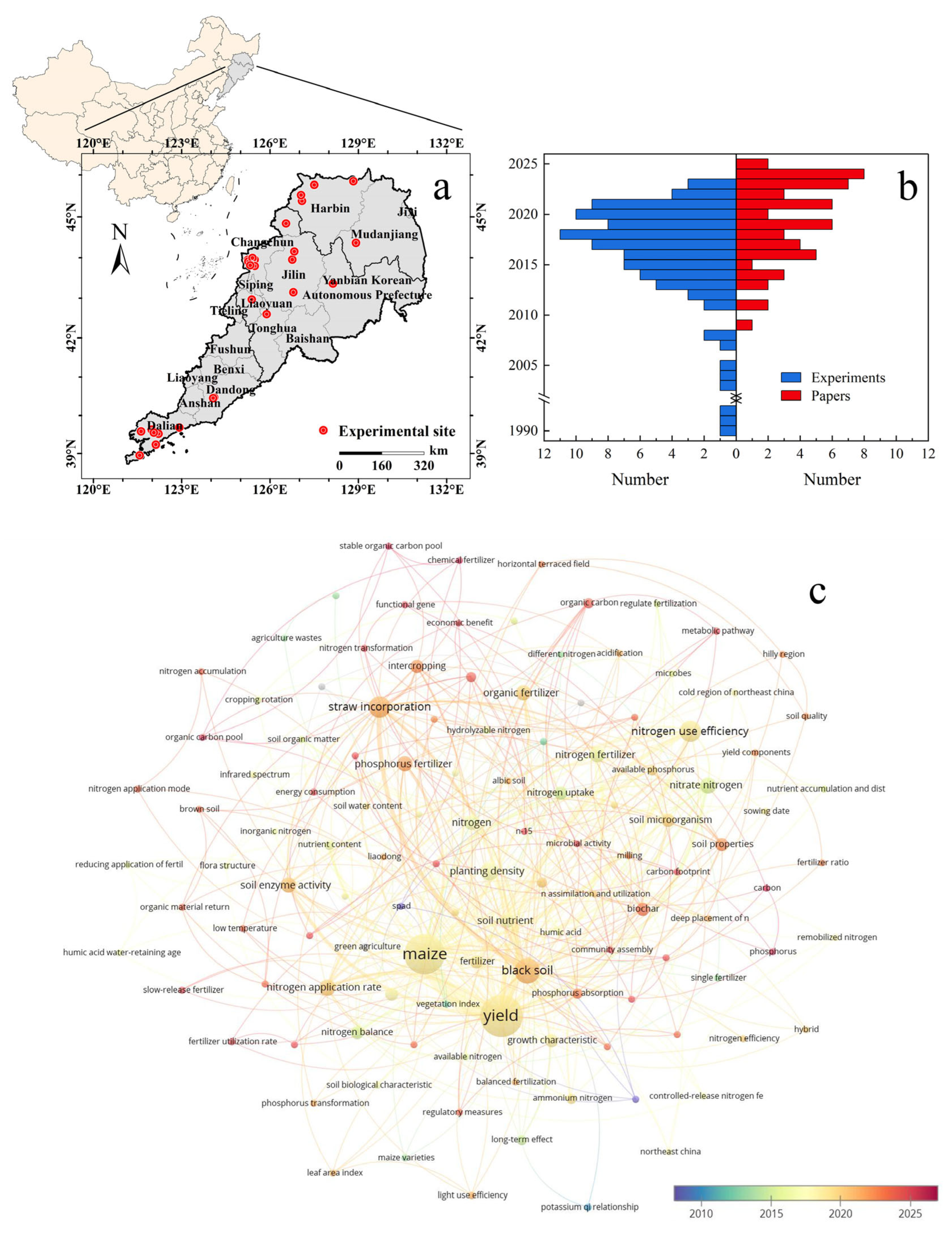
Figure 1. The bibliometric analysis. (a) The distribution of experimental sites in the research area; (b) the number of experiments and papers; (c) the network co-occurrence diagram of the paper keywords. Note: The y-axis in panel (b) is presented with a break to accommodate data range variation.
Agronomy 16 00752 g001
Figure 2. The effects of natural factors and cultivation differences on grain yield and aboveground biomass. (a) Annual rainfall; (b) planting density; (c) soil types; (d) maize varieties.
Agronomy 16 00752 g002
Figure 3. The impact of fertilizer application rates and management practices on grain yield and its components. (a,d) are the grain yield; (b,e) are the grain number per ear; (c,f) are the 1000-grain weight.
Agronomy 16 00752 g003
Figure 4. The impact of fertilizer application rates and management practices on the plant physiological traits. (a,d) are the biomass at the maturity stage; (b,e) are the plant height at the maturity stage; (c,f) are the LAI of the jointing, silking and maturity stages.
Agronomy 16 00752 g004
Figure 5. The impact of fertilizer application rates and management practices on soil and grain nutrients and soil physicochemical properties in the maturity stage. (a,c) are the nutrient content of the soil (AN, AP, and AK) and grain (GN, GP, and GK); (b,d) are the SOC; (e) is the soil physicochemical properties.
Agronomy 16 00752 g005
Table 1. Data grouping situation and abbreviations.
Fertilizer Types and Management MethodsAbbreviationSubgroup
NN0 < N ≤ 120; 120 < N ≤ 180;
180 < N ≤ 240; N > 240
P2O5P0 < P ≤ 70; 70 < P ≤ 100; P > 100
K2OK0 < K ≤ 70; 70 < K ≤ 100; K > 100
Chemical–organic fertilizer combination applicationCOCF + biochar; CF + manure
Basal fertilizer and top-dressing fertilizerBT1:0 < BT ≤ 1:1; 1:1 < BT ≤ 1:2; BT > 1:2
Straw returningSR
Disclaimer/Publisher’s Note: The statements, opinions and data contained in all publications are solely those of the individual author(s) and contributor(s) and not of MDPI and/or the editor(s). MDPI and/or the editor(s) disclaim responsibility for any injury to people or property resulting from any ideas, methods, instructions or products referred to in the content.