Article

Multi-Environment Field Evaluation of Winter Rye Genetic Resources in Russia Reveals Promising Accessions for Improving Fusarium Head Blight Resistance

by
Mira L. Ponomareva
1,2,*,
Sergey N. Ponomarev
1,
Gulnaz S. Mannapova
1,
Irina O. Ivanova
1,
Svetlana Y. Pavlova
1,
Inna B. Chastukhina
1 and
Vladimir Y. Gorshkov
1,2,*
1
Federal Research Center “Kazan Scientific Center of the Russian Academy of Sciences”, 420111 Kazan, Russia
2
Institute of Fundamental Medicine and Biology, Kazan Federal University, 420008 Kazan, Russia
*
Authors to whom correspondence should be addressed.
Agronomy 2026, 16(7), 687; https://doi.org/10.3390/agronomy16070687
Submission received: 21 February 2026 / Revised: 12 March 2026 / Accepted: 23 March 2026 / Published: 25 March 2026
(This article belongs to the Section Pest and Disease Management)

Abstract

Fusarium head blight (FHB) is one of the most devastating diseases of cereal crops worldwide, causing yield losses and mycotoxin contamination. Traditionally associated with warm and humid climates, FHB has increasingly affected cooler and drier regions, including the Volga region of Russia—a major grain-producing area once considered low-risk. In this three-year field study, we evaluated FHB resistance in 50 winter rye accessions under natural infection and artificially enriched infectious backgrounds using high-virulence Fusarium strains from the Volga region. Post-invasive resistance to FHB was generally weak across the tested germplasm. Nevertheless, considerable variability in FHB damage was observed among accessions. Accessions showing the lowest overall FHB severity were identified as promising donors for breeding programs. Specific resistance sources to individual Fusarium species were identified, notably Fusarium sporotrichioides—previously regarded as a weak pathogen but demonstrated here as a serious food safety threat. No significant positive correlation was found between FHB severity and mycotoxin levels, confirming these as partially independent traits; several accessions maintained low mycotoxin content despite severe symptoms. Our study highlights the necessity of multi-environment screening with local pathogen strains and endorses pyramiding approaches for durable FHB resistance in winter rye breeding.

1. Introduction

Winter rye (Secale cereale L.) is a vital cereal crop used in food, feed, and industrial applications. It is unsurpassed among cereals for its adaptability, winter hardiness, and tolerance to acidic and nutrient-poor soils [1]. Rye is a valuable source of dietary fiber, vitamins, and minerals, making it an important raw material for functional foods that promote health, prevent chronic diseases, and delay premature aging [2,3,4,5].
Although winter rye is generally considered a relatively disease-resistant crop, several pathogens can critically limit its yield and significantly diminish grain quality. Among them, Fusarium head blight (FHB) is one of the most destructive and economically significant diseases of cereals worldwide, including rye [6,7]. FHB is caused by a complex of Fusarium species, whose composition varies depending on geographical location and climatic conditions [8,9,10]. The development of FHB not only leads to yield loss but also results in the accumulation of toxic secondary metabolites, such as the mycotoxins deoxynivalenol (DON) and zearalenone (ZEN), which pose risks to food and feed safety [11,12,13,14,15]. Although many studies have reported a positive correlation between FHB severity and mycotoxin levels [16,17,18,19,20,21,22], numerous other studies have found no such correlation [23,24,25], suggesting that mycotoxins may not be the primary factor driving grain infection. Therefore, resistances to FHB and mycotoxin accumulation are often considered not to be fully overlapping traits in crop varieties [13,26,27].
The severity of FHB is highly influenced by environmental conditions, with warm and humid weather considered to promote disease development [28,29,30]. However, the geographic range of FHB pathogens is expanding, with increasing disease incidence now being observed in drier and cooler climates [31,32]. In Russia, FHB was first reported in the Far East in the 1880s and has since been recorded in the North Caucasus, Primorye, and Ural regions [33,34], with a growing prevalence and aggressiveness [35,36]. Although the central regions of Russia, particularly the Volga region—an important grain-producing area—were previously considered low-risk zones for FHB development, the disease has become increasingly prevalent in these areas, affecting not only wheat but also winter rye [37,38].
Higher FHB resistance in rye compared to other cereals such as common wheat, durum wheat, and triticale is thought to be due to rye’s cross-pollinating nature and high heterozygosity, as opposed to the self-pollinating and genetically uniform nature of these other cereals [39]. Besides its higher genetic diversity, the relative FHB resistance in rye is considered to be determined by morphological traits, including greater plant height (1.3–1.6 m compared with 0.7–1.0 m in wheat), extensive anther extrusion, a less compact two-rowed spike, and a waxy glume coating, all of which limit infection and spore accumulation [40,41]. Due to the widely accepted view that rye has higher FHB resistance compared to other cereal crops, most European countries do not have official variety testing programs for FHB resistance in winter rye, and published data on the resistance of rye breeding material remain scarce [42]. Nevertheless, rye production is significantly affected by FHB [39,43], and the idea that rye’s resistance to this disease is overestimated has been proposed, alongside observations regarding the scarcity of FHB-resistant rye genotypes [41,44].
Breeding FHB resistance in winter rye is one of the most effective, economically feasible, and environmentally sustainable strategies for disease management [45,46]. Success in developing resistant varieties depends on the genetic diversity of the germplasm used in breeding. Resistance determined by a single genetic locus (or a small number of loci) is typically short-lived because pathogens rapidly adapt and overcome it. Consequently, durable resistance requires combining multiple, genetically diverse sources that provide complementary defense mechanisms. This is especially true for FHB resistance, as the disease is caused by different pathogens with varying properties, and resistance is influenced by dynamic weather conditions, which can lead to different disease manifestations in different years. Therefore, combining genetically diverse attributes of FHB resistance is essential to achieve high-level and durable resistance. To ensure genetic diversity for FHB resistance, systematic evaluation of genetic resources should be conducted under multi-environment conditions with varying weather and pathogen profiles.
Therefore, the present study aimed to select varieties from the winter rye gene pool for use in improving FHB resistance in this crop. To achieve this goal, the winter rye gene pool was tested under variable between-year conditions in the Volga region for FHB resistance and mycotoxin accumulation, under high pressure from different FHB causal agents originating from this region.

2. Materials and Methods

2.1. Plant Material

Fifty rye (Secale cereale L.) varieties from the collection of the N.I. Vavilov Federal Research Centre of the All-Russian Institute of Plant Genetic Resources (VIR) were evaluated in this study for FHB resistance. The rye accessions originated from twelve countries: Russia, Belarus, Poland, Latvia, Germany, Spain, Uruguay, Argentina, China, USA, Canada, and Ukraine (see Table S1).

2.2. Experimental Design

Field experiments were conducted over three growing seasons: 2022–2023, 2023–2024, and 2024–2025, at the experimental site in Bolshiye Kaban (Laishevsky District, Republic of Tatarstan, 55°38′51″ N, 49°18′29″ E), located 25 km southeast of Kazan, Russia. This region is characterized by a typical warm-temperate, moderate continental climate. The soil type is loamy grey forest soil with a slightly acidic reaction (pH ~5.2) and low fertility, containing 3.42% organic matter, 78 mg kg−1 of alkaline-hydrolyzable nitrogen, 235 mg kg−1 of available phosphorus, and 136 mg kg−1 of exchangeable potassium.
The experimental trials were arranged as randomized incomplete block designs with two replications per rye variety under each of the tested conditions. Each rye variety was sown in eight-row plots (2.5 m × 1.25 m) per replication, with 1.5 m spacing between plots and a seeding density of 400 viable seeds per square meter. The variety Tantana was used as a control (check) cultivar. Agronomic practices applied to the experimental field followed conventional recommendations, employing standard tillage. The preceding crop in all three seasons was bare fallow. Plots were treated with agrochemicals according to local guidelines for winter rye cultivation. Sowing dates ranged from September 1 to 5 each year. Fertilization consisted of 120 kg ha−1 of NPK (19–19–19) applied before sowing, followed by 100 kg ha−1 of ammonium nitrate (34% N) after overwintering in spring. Weed control was performed using registered herbicides: in 2023 Shanstar, water dispersible granules (tribenuron-methyl, 750 g kg−1, at 0.02 kg ha−1), and Fenisan (a water solution containing 360 g L−1 dicamba acid/dimethylamine salt + 22.2 g L−1 chlorsulfuron acid, at 0.2 L ha−1); in 2024 and 2025, Agritox VK (methylamine, potassium and sodium salts) at 1.5 L ha−1. No fungicides were applied to ensure that natural or artificially enriched infectious backgrounds remained unaffected by chemical control. The varieties were grown under both natural infectious background (without exogenous inoculation, NIB) and at different artificially enriched infectious backgrounds (with exogenous inoculation, AIBs). AIBs were created as described below (Section 2.4).

2.3. Weather Conditions

The Republic of Tatarstan is located within a mid-latitude, moderately continental climate zone, characterized by warm summers and moderately cold winters. The region experiences four distinct seasons, with July being the warmest month and January the coldest. The average annual precipitation is approximately 533 mm, placing the area within the zone of moderate humidity. Monthly precipitation peaks in July (~67 mm), whereas the lowest occurs in March (~28 mm). Precipitation mainly occurs as rain (~70%), with snow (~20%) and mixed forms (~10%) constituting the remainder. During the summer months, nearly all precipitation is in liquid form, with occasional hail events. Precipitation patterns exhibit significant variability between years.
Meteorological data were collected daily using an automatic weather station, SokolMeteo 1M (Tekhavtomatika LLC, Kazan, Russia), located directly at the experimental site. The average rainfall during the 2023–2025 period from heading to ripening of winter rye was approximately 160 mm. In 2023, precipitation was extremely low or absent during the second decade of May and June (Figure S1), although total rainfall from May to July was close to the normal average. The maximum temperature recorded was 29 °C, with a mean temperature of 17.6 °C over the period, and an average relative humidity of 77.5%. During the first ten days of June 2023, covering the start to the middle of the winter rye flowering period, precipitation amounted to 20 mm, with an air temperature of 16.1 °C.
In 2024, weather conditions were more favorable for FHB development. From May to July 2024, the average temperature was 17.6 °C, total precipitation amounted to 189 mm, and the maximum relative humidity reached 95.0% (Figure S1). Between the mid-heading stage (11th to 20th May) and the end of the early dough stage (first ten days of July), total rainfall was 66 mm, with an average temperature of 17.3 °C.
In 2025, the first ten-day period of May was characterized by unusually low temperatures, while the second and third ten-day periods showed a noticeable warming trend (Figure S1). Precipitation levels significantly exceeded the long-term average, reaching 216% and 458% of the norm in the first and second decades, respectively. The mean monthly temperature was close to the long-term average. Total precipitation for May amounted to 81 mm, more than double the climatic norm of 36 mm. In June 2025, the average air temperature was +18.2 °C, slightly above the long-term average of +17.6 °C, while total precipitation reached 102 mm, corresponding to 165% of the norm (62 mm). July 2025 exhibited near-normal thermal conditions, with an average temperature of +20.7 °C (the norm being +20.4 °C), but rainfall was notably lower—only 37 mm, representing 59% of the long-term average.

2.4. Plant Inoculation, Creation of Artificially Enriched Infectious Backgrounds (AIBs)

Four Fusarium strains were used for plant inoculation: F. graminearum MFG 58651 (isolated from winter rye spike), F. graminearum FsM 10048 (isolated from winter wheat spike), F. culmorum FsM 10028 (isolated from spring wheat spike), and F. sporotrichioides FsM 10031 (isolated from winter rye spike). F. graminearum MFG 58651 was isolated from the Pskov region and kindly provided by Dr. Gagkaeva T. Yu. (All-Russian Institute of Plant Protection, Saint Petersburg, Russia). The other three strains were isolated from the Volga region and characterized in our recent study [37]. Varieties were inoculated with each strain separately (not in a mixture). In 2023, rye varieties were tested against F. graminearum MFG 58651 from the collection of the All-Russian Institute of Plant Protection, as this strain had been isolated from winter rye and displayed high virulence. In 2024–2025, following preliminary field evaluation of strains from the Volga region in 2023 [37], the most virulent strains of three species were selected for variety screening. In 2024, varieties were tested against F. graminearum FsM 10048 and F. culmorum FsM 10028 separately; in 2025, they were tested against F. graminearum FsM 10048 and F. sporotrichioides FsM 10031 separately. The strategy of screening varieties against different strains in different years was chosen because FHB is caused not by a single species but by multiple species. Therefore, to select varieties suitable for breeding programs aimed at enhancing resistance to the broad complex of FHB pathogens, we varied both the yearly environmental conditions and the pathogen strains. This approach aimed to identify varieties with contrasting resistance profiles, the subsequent crossing of which could serve as the basis for developing progenies with durable resistance to a wide range of FHB pathogens under varying conditions.
Conidial suspensions for plant inoculation were prepared by placing an 8 mm diameter agar block from Fusarium strain colonies into 50 mL of synthetic nutrient broth (SNB) liquid medium, containing the following (g/L): KH2PO4—1; KNO3—1; MgSO4•7H2O—0.5; KCl—0.5; glucose—0.2; sucrose—0.2 [47]. The cultures were incubated for 10 days at 25 °C with shaking at 150 rpm in the dark. After incubation, suspensions were filtered through five layers of sterile cheesecloth to remove mycelium. Conidia were then collected by centrifugation at 3000 rpm for 10 min and washed twice with sterile distilled water. Conidial concentrations were adjusted to 5 × 10⁵ conidia mL−1 using a Goryaev chamber. To improve adherence to plant surfaces, Tween-20 was added to the suspensions to achieve a final concentration of 0.004%.
Since rye has an extended flowering duration of 8–10 days, inoculation was performed when approximately 50–75% of the main tillers had reached full anthesis (Zadoks scale 59–60). Inoculation was carried out by spraying the spikes with a conidial suspension at a rate of approximately 100 mL per m2. The inoculum was applied uniformly from all sides using a 1 L hand sprayer to ensure even coverage of the spikes. After inoculation, spikes were enclosed in transparent polyethylene bags to maintain high humidity; the bags were removed 72 h post-inoculation. In 2023, plants were inoculated with F. graminearum MFG 58651; in 2024 with F. graminearum FsM 10048 and F. culmorum FsM 10028; and in 2025 with F. graminearum FsM 10048 and F. sporotrichioides FsM 10031.

2.5. Disease Assessments

Disease assessment was carried out visually in the field following the method of Miedaner (1996) [48]. Observations began 15–20 days post-inoculation (or after mid-flowering at NIB) and were conducted at 5-day intervals until symptoms could no longer be reliably distinguished due to spike senescence. FHB damage was rated on a 9-point visual scale indicating the disease score, where 1—healthy spike (no visible symptoms) and 9—completely infected spike (100% spikelets were infected). Intermediate scores corresponded to the following levels of spike damage: less than 5%, 10%, 30%, 50%, 70%, 80%, and 90%, respectively [48]. Each spike was individually assessed for the proportion of infected surface area. Rye varieties were classified according to resistance based on severity scores as follows: 1.0–2.5 score (≤10% infected spikelets)—highly resistant (HR), 2.6–4.0 (11–30%)—moderately resistant (MR), 4.1–6.0 (31–50%)—moderately susceptible (MS), 6.1–7.5 (51–70%)—susceptible (S), 7.6–9.0 (>70%)—highly susceptible (HS).
In addition to disease scores, several parameters were calculated to characterize the extent of FHB damage. Disease severity (DS, %) was defined as the average degree of spike infection within each genotype and calculated according to Equation (1) as the sum of disease ratings divided by the product of the number of assessed spikes (n) and the maximum rating of the disease scale (rmax = 9), multiplied by 100.
D S   ( % ) = Ʃ   d i s e a s e r   a t i n g s n × 9 × 100
The area under the disease progress curve (AUDPC) was calculated using the method of Campbell and Madden (1990) [49], which reflects the disease severity dynamics over time, according to the Formula (2), where Yi and Yi+1 represent disease intensity at consecutive observations and ti+1 − ti is the time interval between assessments:
A U D P C = i = 1 k 1 ( Y i + Y i + 1 ) 2 × ( t i + 1 ) t i
The susceptibility index (SI) was defined as the ratio of the AUDPC of the tested sample to the AUDPC of the check variety Tantana [50].
Six quantitative traits contributing to yield were measured: spike length (SL, cm), number of spikelets per spike (NSS), spike density (SD), number of grains per spike (NGS), grain weight per spike (GWS, g), and hundred-grain weight (HGW, g). HGW rather than thousand-grain weight was determined because each spike was assessed individually, and inoculated spikes often contained very few grains, which would have led to considerable error if extrapolated to thousand-grain weight. The percentage reduction in yield-related traits due to high FHB pressure was calculated by comparing the parameters of varieties grown at different AIBs with those of varieties grown under NIB conditions.
Since all tested winter rye varieties exhibited varying levels of susceptibility under high infection pressure, the term “resistance” is used operationally throughout the manuscript to denote lower observed damage relative to the most susceptible varieties, rather than implying classical active resistance mechanisms.

2.6. Determination of Mycotoxins

Mycotoxin content was determined in the grains of varieties grown under different AIBs. Spikes were harvested manually at full maturity, hand-threshed, and the grains were thoroughly cleaned and ground using a laboratory mill equipped with a 1 mm sieve. Mycotoxins were measured using ELISA kits from EVRICA Co., Ltd. (Moscow, Russia) following the manufacturer’s instructions: DON (cat. No. 53621), ZEN (cat. No. 53620), and T-2 toxin (cat. No. 53624). The absorbance was measured at 450 nm using a CLARIOstar microplate reader (BMG Labtech GmbH, Ortenberg, Germany).
Different mycotoxins were determined depending on the Fusarium species used for plant inoculation: DON and ZEN were measured in grains from plants infected with F. graminearum and F. culmorum, whereas T-2 toxin was measured in grains from plants infected with F. sporotrichioides. The minimum quantification limits of the tests were 100 µg/kg for DON, 20 µg/kg for ZEN, and 24 µg/kg for T-2 toxin.

2.7. Statistical Analyses

Statistical analyses were performed using Microsoft Excel 2019 and XLSTAT 2020.4.1 (Addinsoft, Paris, France). Although FHB severity data, scored on a discrete 1–9 scale, deviated from normality in some years, analysis of variance (ANOVA) was applied due to its robustness to moderate departures from normality, particularly in balanced designs with large sample sizes. Given the sample size of 50 genotypes per group, the Central Limit Theorem supports the use of parametric methods. Model assumptions were further evaluated by examining residual normality (Shapiro–Wilk test and Q–Q plots) and homogeneity of variances (Levene’s test).
Two-way analysis of variance (ANOVA) was used to assess the effects of different factors—namely, winter rye variety, environment, and the variety × environment interaction—on FHB disease scores. When significant effects were detected, means were separated among varieties using Duncan’s multiple range test at a significance level of p < 0.05.
Cluster analysis of the varieties was performed using Ward’s minimum variance method [51] with Euclidean distance as the dissimilarity measure. Pearson’s correlation coefficients were calculated to evaluate relationships between FHB severity scores and yield-related traits, as well as between FHB severity and mycotoxin contents (deoxynivalenol (DON), zearalenone (ZEN), and T-2 toxin (T-2)) in grains of 50 winter rye varieties assessed under artificially enriched infectious backgrounds across different years. Correlations were considered significant at p < 0.05.

3. Results

3.1. The Development of FHB in Winter Rye Under Natural Infectious Background (NIB) and Artificially Enriched Infectious Backgrounds (AIBs)

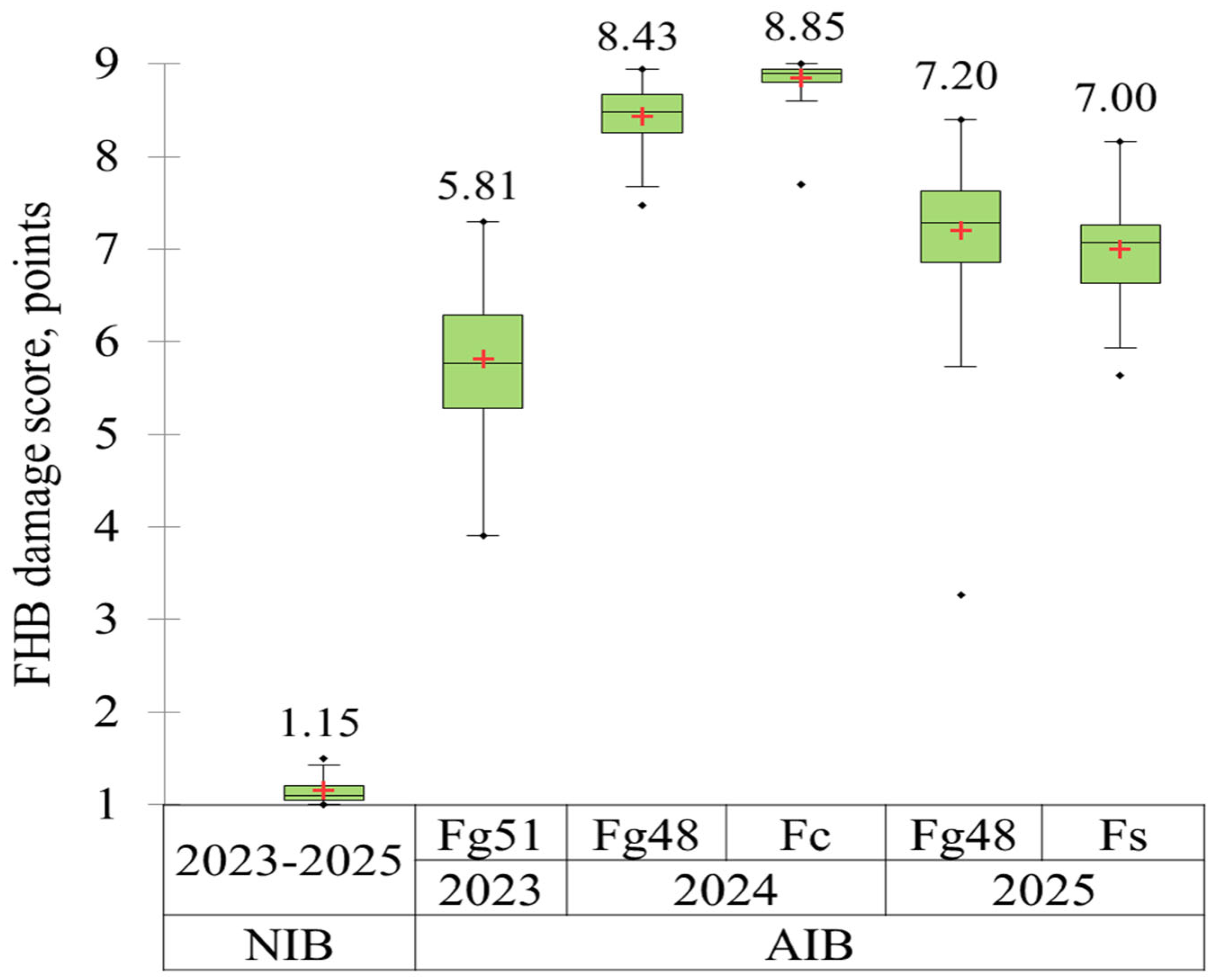
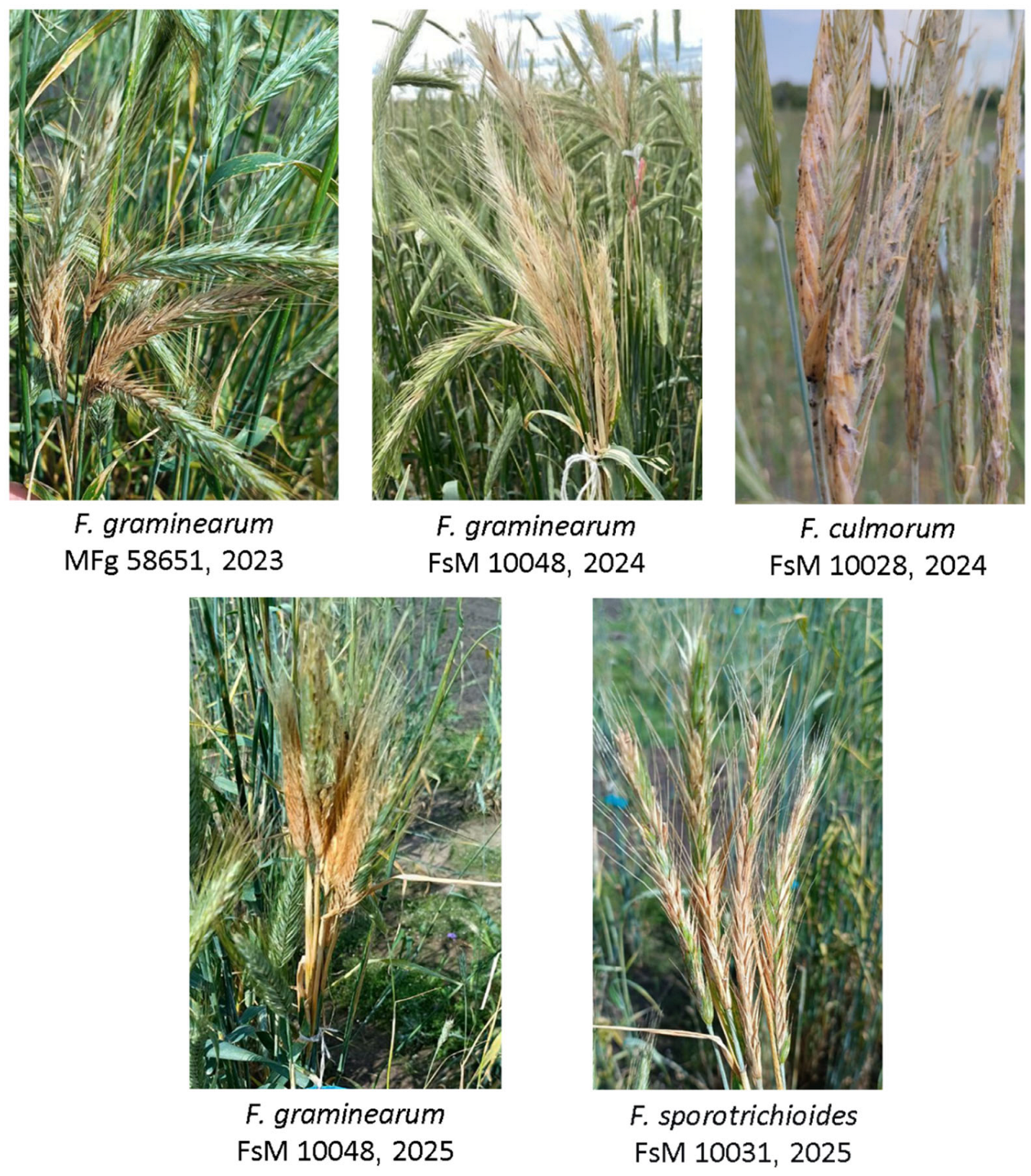
At NIB, the mean level of FHB damage was low (around 1 point) across all three assessed years (2023–2025) (Figure 1). In contrast, at AIBs created in different years using various Fusarium strains, the FHB levels ranged from 5.81 to 8.85, depending on the specific year and Fusarium strain (Figure 1 and Figure 2). Specifically, in 2023, the mean FHB disease score within the AIB created using F. graminearum MFg 58651 was 5.80 points. In 2024, the FHB disease scores within the AIBs created with F. graminearum FsM 10048 and F. culmorum FsM 10028 were the highest observed: 8.43 and 8.85 points, respectively. In 2025, the FHB disease scores within the AIBs created with F. graminearum FsM 10048 and F. sporotrichioides FsM 10031 were 7.19 and 6.99, respectively (for details, see Table S2). Disease incidence at different AIBs ranged from 99.7% to 100%, whereas at NIB it was between 0% and 40%.
To assess the contribution of different factors—namely, winter rye variety, environment, and the variety × environment interaction—to FHB disease scores, a two-way ANOVA was conducted. Five environments were considered, defined by both the specific year conditions and the Fusarium strain used for artificial inoculation. The analysis revealed highly significant effects of environment (F = 805.76, p < 0.001), variety × environment interaction (F = 3.79, p < 0.001), and winter rye variety (F = 4.06, p < 0.001) on FHB disease scores (Table 1). Partitioning of the total phenotypic variance indicated the following contributions: environment accounted for 73.0%, variety for 4.5%, variety × environment interaction for 16.8%, and residual variance for 5.6% (Table 1).

3.2. Differential Resistance of Winter Rye Varieties to Fusarium Species

Given the significant contribution of the winter rye variety variance to FHB disease scores (Table 1), a comparative analysis of resistance among the varieties was performed using Duncan’s test. The varieties Avangard 2, Tantana, Biryuza, Rifle Fall, Zduno, and Amylot (average FHB disease scores 6.7–7.0) exhibited the highest resistance to FHB across different environments, including varying years and Fusarium strains (Table 2). Amylot maintained consistent resistance to both F. graminearum strains used, while in 2025, Avangard 2 showed the lowest infection severity (3.27 points) under inoculation with F. graminearum FsM 10048. When comparing resistance to F. graminearum FsM 10048 across 2024 and 2025, the varieties Avangard 2, Tantana, and Biryuza displayed the lowest FHB disease scores. Talovskaya 44 demonstrated low FHB disease scores in 2023 following inoculation with F. graminearum MFg 58651 and was ranked among the ten most resistant genotypes overall. Under F. sporotrichioides inoculation, Zduno and Solnyshko showed the highest resistance, with mean FHB disease scores of 5.93 and 5.63, respectively. Resistance to F. culmorum appeared to be the weakest point among the tested varieties, as all were highly susceptible in 2024, except the Latvian variety Jana, which exhibited a comparatively lower FHB disease score of 7.7 points (Table 2).
Tantana and Avangard 2 differed significantly from most other varieties in their FHB resistance. Several varieties, including Olga, Gran, Malko, Estepan 415 hl, Toseuchi, Saratovskaya 7, and Parcha, consistently showed high FHB disease scores (7.60–7.67 points) across years and pathogen strains. Similarly, Adar, Slavia, Derzhavinskaya 50, Yaselda, and Ivan exhibited comparable susceptibility, with mean FHB disease scores ranging from 7.31 to 7.39, forming a statistically homogeneous group according to Duncan’s criterion. Intermediate susceptibility (mean scores of 7.51–7.58 points across all environments) was observed for Sinilga, Arant, Karsten 2, Talisman, Pamyati Popova, Pamyati Bambysheva, and Altobar, which also singled out into separate group. Regarding the reproducibility of FHB disease scores, varieties Yuliya, Tatyana, Gran, Alnara, and Saratovskaya 10 demonstrated the most consistent performance across years, with coefficients of variation (CV) ranging from 10.7% to 11.6%. Conversely, Avangard 2, Rifle Fall, Talovskaya 44, and Biryuza exhibited the highest variability (CV = 24.9–32.7%), indicating that FHB disease scores in these varieties were more strongly influenced by environmental factors and the specific Fusarium species or strains than in other varieties.
Regarding AUDPC (assessed only in 2025 at the AIBs created using two strains: F. graminearum FsM 10048 and F. sporotrichioides), the variety Avangard 2 exhibited relatively high resistance, with significantly lower AUDPC values: 37.7 under F. sporotrichioides inoculation and 61.6 under F. graminearum inoculation compared to the standard variety Tantana (Table S3). In addition to Avangard 2, several varieties—including Zduno, Zarnitsa, Solnyshko, and Amilot—demonstrated significantly higher resistance to F. sporotrichioides (AUDPC values ranging from 53.1 to 62.0) compared to Tantana. Conversely, nine varieties exhibited significantly higher AUDPC values than the standard when infected with F. sporotrichioides, with Sinilga, Arant, Sibirskaya 87, and Altabar showing the most intensive disease progression (Table S3). Following F. graminearum inoculation, 35 varieties (70% of the gene pool) showed significantly higher AUDPC values than the standard variety Tantana. The varieties Pamyat Popova, Malko, Roxana, and Altabar were among the most susceptible (Table S3).

3.3. Cluster Analysis of Winter Rye Varieties Based on FHB Disease Scores

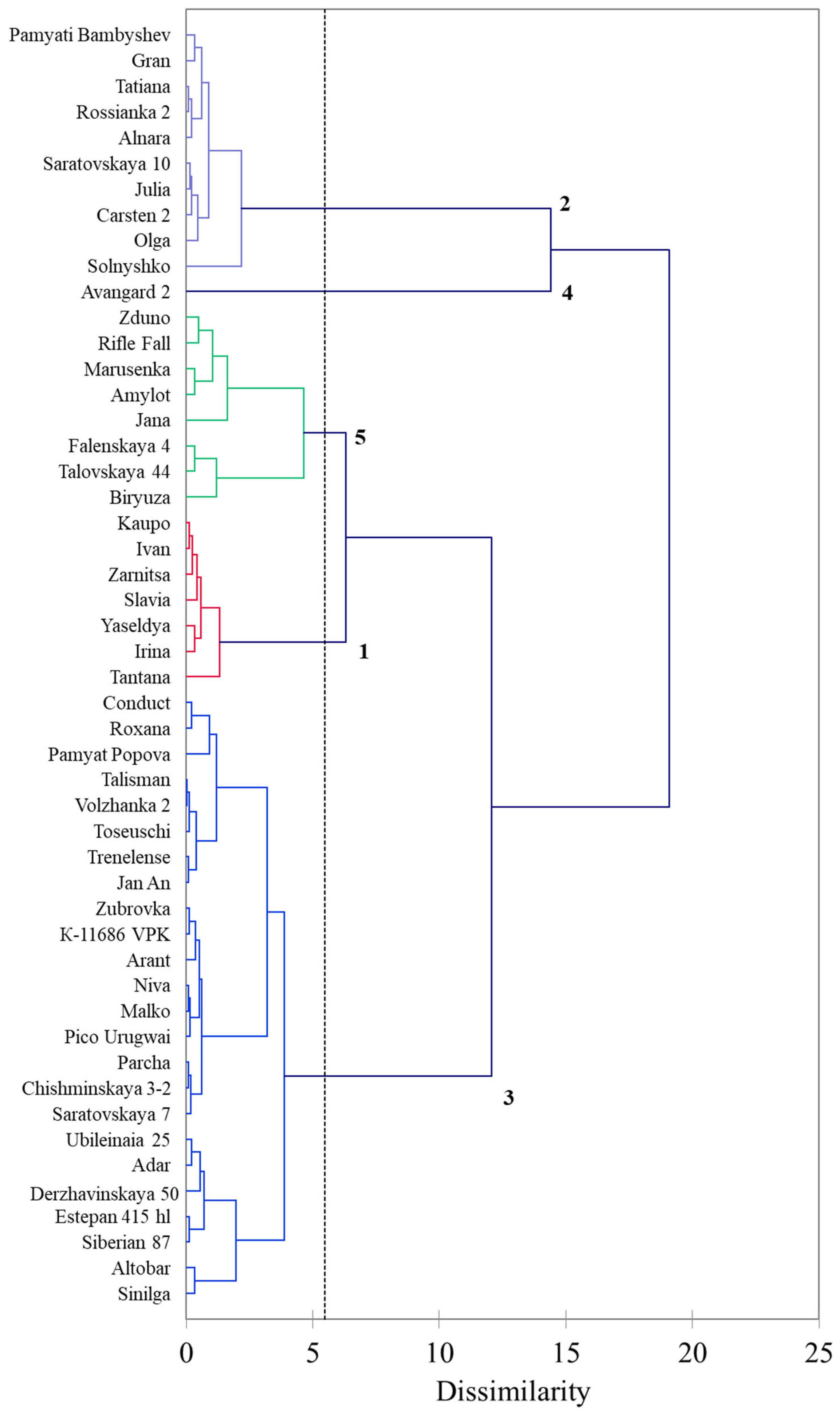
Hierarchical cluster analysis of 50 winter rye varieties, considering FHB disease scores across five experimental conditions (year × strain combinations), classified the varieties into five clusters (Figure 3, Table 3). Cluster 1 comprised seven varieties: Tantana, Slavia, Kaupo, Ivan, Zarnitsa, Yaselda, and Irina (Figure 3). These varieties were characterized by intermediate FHB disease score, indicating consistent susceptibility across environments. In 2023, they showed moderate susceptibility to F. graminearum MFg 58651, while in 2024, they exhibited consistently high susceptibility to F. graminearum FsM 10048 and F. culmorum FsM 10028. In 2025, they displayed moderate disease severity levels after inoculation with both F. graminearum FsM 10048 and F. sporotrichioides FsM 10031 (Table 3). This pattern suggests that these varieties exhibit partial resistance when conditions are less favorable for disease development but are highly susceptible under conditions conducive to disease progression. Cluster 2 included ten varieties: Rossianka 2, Olga, Gran, Carsten 2, Pamyati Bambyshev, Alnara, Julia, Solnyshko, Tatiana, and Saratovskaya 10 (Figure 3). These varieties exhibited low disease scores in 2023, high susceptibility in 2024, and moderate susceptibility in 2025 (Table 3).
The largest cluster 3 included 24 varieties: Volzhanka 2, Roxana, Arant, Malko, Talisman, Pamyat Popova, Toseuschi, K-11686 VPK, Niva, Zubrovka, Pico Urugwai, Chishminskaya 3-2, Jan An, Trenelense, Saratovskaya 7, Conduct, Parcha, Sinilga, Adar, Derzhavinskaya 50, Estepan 415 hl, Altobar, Ubileinaya 25, and Siberian 87 (Figure 3). These varieties were characterized by increased and reproducible susceptibility across all tested conditions, including the highest susceptibility to F. sporotrichioides, indicating that the varieties of this cluster exhibit high susceptibility to FHB regardless of the specific pathogen species (Table 3).
Cluster 4 consisted of a single variety—Avangard 2, a variety from the local Tatarstan breeding (Figure 3). This variety exhibited a unique profile of FHB disease score under the experimental conditions: moderate resistance to F. graminearum FsM 10048 in 2025, moderate susceptibility to F. sporotrichioides; and high susceptibility to F. culmorum FsM 10028 and F. graminearum FsM 10048 in 2024 (Table 3). These results indicate a variable resistance level depending on the year and the specific Fusarium strain. Cluster 5 included eight varieties: Talovskaya 44, Biryuza, Amylot, Rifle Fall, Zduno, Marusenka, Jana, and Falenskaya 4 (Figure 3). These varieties demonstrated comparatively higher resistance to FHB across variable environmental conditions than the varieties from other clusters (Table 3).

3.4. The Effect of FHB Damage on Yield and Agronomic Traits of Winter Rye Varieties

For the studied winter rye varieties, reductions in the number of grains per spike (NGS), grain weight per spike (GWS), and hundred-grain weight (HGW) were assessed for plants grown under different AIBs compared to those grown under NIB. The reduction in NGS ranged from 45.1% in 2023 to 96.7–98.3% in 2024, with an average reduction over three years of 71.0% (Table 4 and Table S4). GWS was affected even more severely: reductions reached ~60% in 2023 (AIB with F. graminearum MFg 58651) and in 2025 (AIB with F. sporotrichioides FsM 10031), 74% in 2025 (F. graminearum FsM 10048), and peaked in 2024 at 99.1–99.5% (AIBs with F. graminearum FsM 10048 and F. culmorum), with an average reduction over three years of 78.5% (Table 4 and Table S4). The reduction in HGW ranged from 12.3% in 2025 under AIB with F. sporotrichioides FsM 10031 to 97.2–99.5% in 2024 under AIBs with F. graminearum FsM 10048 and F. culmorum, with an average reduction over three years of 54.0% (Table 4 and Table S4).
Variation among winter rye varieties in Fusarium-induced reductions in NGS, HGW, and GWS was considerable, especially in 2023, when the FHB levels were lower compared to 2024 and 2025. In 2023, among the studied winter rye varieties, the reduction in NGS ranged from 20.4% to 73.8%; Avangard 2, Alnara, and Olga exhibited the highest reductions, while Rifle Fall and Malko showed the least. Reduction in HGW ranged from 2.4% to 55.4%, with Saratovskaya 7 and Solnyshko showing the highest reductions, while Amilot, Niva, and VPK exhibited the least. Reduction in GWS ranged from 36.1 to 82.1%, with Avangard 2, Alnara, Olga, Rossiyanka 2, and Tatiana showing the highest reductions, while Derzhavinskaya 50, Altobar, Pamyat Popova and Falenskaya 4 exhibited the least (Table S4).
FHB disease scores assessed under AIBs displayed significant negative correlations with NGS, HGW, and GWS: higher FHB disease scores were associated with lower values of NGS, HGW, and GWS (Table 5). No significant correlation was found between FHB disease scores and spike length, number of spikelets per spike, and number of grains per spike (Table 5).

3.5. The Association of FHB Damage with Mycotoxin Accumulation in Grains of Winter Rye Varieties

The grains of 50 studied winter rye varieties grown under different AIBs were analyzed for the content of deoxynivalenol (DON), zearalenone (ZEN), and T-2 toxin (T-2). In 2023, only DON was measured in varieties grown under AIBs with F. graminearum MFg 58651, with levels ranging from 1.9 to 84.8 mg/kg across the different varieties. The lowest levels were observed in Saratovskaya 10, Marusenka, Solnyshko, and Malko, while Zduno, Ivan, Zubrovka, Julia, and Chishminskaya 3-2 exhibited the highest levels (Table 6).
In 2024, DON and ZEN were quantified in varieties grown under AIBs with both F. graminearum FsM 10048 and F. culmorum. Under F. graminearum FsM 10048 infection, DON levels ranged from 34.5 to 837.0 mg/kg, with Tatiana, Saratovskaya 7, and Saratovskaya 10 showing the lowest levels, and Zarnitsa, Trenelense, Amilot, and Chishminskaya 3-2 showing the highest. Herewith, ZEN content ranged from 2.0 to 17.7 mg/kg, with Pamati Bambysheva, Jan An, Olga, Slavia, and Altobar exhibiting the lowest levels, and Tantana, Irina, and Parcha the highest. Under F. culmorum infection, relatively low DON levels were accumulated; most varieties, despite high FHB disease scores, had DON concentrations below the maximum permissible concentration (MPC). However, three varieties (Zarnitsa, Yana, and Gran) exceeded the MPC by 6–12 times. Herewith, ZEN levels ranged from 0.4 to 14.9 mg/kg, with Arant, Jan An, Tatiana, and Marusenka showing the lowest levels, and Pamyati Bambysheva and Estepan 415 hL showing the highest (Table 6).
In 2025, DON and ZEN were measured in varieties grown under AIB with F. graminearum FsM 10048, while T-2 toxin was quantified in varieties grown under AIB with F. sporotrichioides. Under F. graminearum FsM 10048 infection, DON levels ranged from 195.6 to 608.0 mg/kg, with Parcha, Solnyshko, and Tatiana showing the lowest levels, and Sibirskaya 87, Talisman, and Adar the highest. Herewith, ZEN levels ranged from 0.02 to 3.07 mg/kg, with Avangard 2, Jan An, Biryuza, and Toseuschi showing the lowest, while Toseuschi displayed the highest (3.07 mg/kg) and VPK and Derzhavinskaya 50 also exhibited high ZEN levels (0.86–0.90 mg/kg). Under F. sporotrichioides infection, T-2 toxin levels ranged from 2.5 to 7.7 mg/kg, exceeding the MPC by 50–154 times. The lowest levels were found in Avangard 2 and Amilot, while the highest were observed in Altabar, Saratovskaya 7, Parcha, Tatyana, and Marusenka (Table 6).
No significant positive correlations were observed between FHB disease scores and mycotoxin contents (Table 7). In one case, a significant negative correlation was found between FHB disease score caused by F. culmorum and DON content (Table 7).

4. Discussion

In the present study, a gene pool from winter rye comprising 50 varieties originating from different countries was evaluated in the Volga region (a key grain-producing area) for resistance to the causal agents of FHB isolated from this region. Although FHB is generally considered more common in wetter and warmer climates, its causal agents are gradually adapting to drier and cooler conditions, making FHB more widespread [52,53]. Recently, many highly virulent and toxigenic strains of various Fusarium species associated with cereal crop spikes cultured in the Volga region have been isolated and characterized [37]. Some of these highly virulent strains were used in our study to test FHB resistance in winter rye varieties. For this testing, a multi-year field approach was employed: rye varieties were evaluated over a three-year field experiment with artificial inoculation using different strains to assess the variability of FHB resistance depending on weather conditions and pathogen genotypes—both well-known factors that significantly influence FHB manifestation [42,54,55]. Indeed, in our study, the level of FHB damage was most dependent on environmental factors, specifically the particular year’s conditions and the pathogen strain. This underscores the importance of conducting multi-environment screenings of breeding material to obtain a comprehensive understanding of FHB resistance.
Despite the strong influence of environmental factors, winter rye variety was also significantly associated with FHB resistance, indicating that different varieties possess varying susceptibility to the disease. Our results show that the winter rye gene pool exhibits low resistance to the FHB strains originating from the Volga region. Overall, all tested varieties were heavily affected by the strains. The low resistance observed in the rye gene pool is likely related to an underestimation of this problem. Traditionally, rye is considered to be only slightly affected by FHB (at least in comparison to some other cereal crops such as wheat and barley) [53,56], and increasing its resistance has not received adequate attention in breeding programs. This aligns with our observations, as during the three-year experiment under natural infection conditions (without artificial inoculation), only a low level of disease was recorded. The relatively low predisposition of rye to FHB is largely attributed to morphological traits of the crop, such as extensive anther extrusion, a compact two-rowed spike, and a waxy glume coating—all of which negatively influence pathogen invasion [40,41]. However, if this pre-invasive resistance is overcome by the pathogen (as achieved in our study through artificial inoculation), the disease develops intensively. This indicates that post-invasive resistance mechanisms in rye are of low efficiency, posing a significant risk of large-scale crop damage, especially if the pathogens evolve and adapt to overcome the “barriers” that impede host invasion. The idea that rye’s resistance to FHB is overstated has been suggested previously [7,44]; however, this issue has not been effectively addressed to date. Due to all of these issues, the rye gene pool urgently needs to be optimized to enhance post-invasive resistance to FHB in this crop.
Although all tested rye varieties were severely affected by the Fusarium strains used, the degree of damage varied considerably among the varieties, both in the overall assessment (considering all five conditions together) and when evaluated separately within each individual condition. Based on FHB damage scores evaluated under five environmental conditions, the tested varieties were grouped into five clusters according to their damage profiles across different years and strains. The fifth cluster included eight varieties—Talovskaya 44, Biryuza, Amylot, Rifle Fall, Zduno, Marusenka, Jana, and Falenskaya 4—that exhibited the least mean FHB damage across various conditions. These varieties are therefore top candidates for use in breeding programs aimed at gradually improving FHB resistance in the rye gene pool through pyramiding strategies.
Breeding for resistance, including FHB resistance, requires utilizing a diverse set of resistance gene donors, as different donors contribute various resistance-associated traits, and their combination in the progeny can yield high-level and durable resistance. Therefore, hybridizing parental lines from different clusters provides a broader genetic basis for the target trait, leading to an improved phenotype in the progeny. Based on our results, in addition to the varieties from the aforementioned fifth cluster, which exhibited the least average FHB damage across various conditions, varieties from other clusters with lower damage from specific Fusarium species can also be valuable in expanding the genetic diversity of the resistance trait. These include Avangard 2 (from the fourth cluster, with relatively low damage from F. graminearum), Tantana (from the first cluster, with relatively low damage from F. graminearum), and Solnyshko (from the second cluster, with relatively low damage from F. sporotrichioides).
The latter variety, Solnyshko, as well as Zduno, are particularly interesting varieties for breeding. Both exhibited reduced damage after inoculation with F. sporotrichioides. This species is generally considered a weak pathogen, and resistance testing against F. sporotrichioides has traditionally not been considered necessary. However, studies have shown that the population in the Volga region contains highly virulent F. sporotrichioides strains that pose a significant food safety risk [37]. Our current study supports this finding, as most tested rye varieties were severely damaged by F. sporotrichioides. Therefore, Solnyshko and Zduno can be considered primary candidate donors for rye resistance to F. sporotrichioides.
It is not surprising that FHB damage was associated with reduced crop yield. Among the yield components, grain weight per spike (GWS) exhibited the highest and most consistent Fusarium-induced reductions across years, while hundred-grain weight showed the least reduction. This suggests that FHB primarily reduces yield by impairing grain set and grain filling, rather than causing a uniform decrease in individual grain size. Overall, crop yield showed a negative correlation with FHB disease score; however, the strength of this relationship varied among different varieties. For example, Malko, despite a high FHB disease score, maintained relatively high GWS, whereas Avangard 2, with a relatively low FHB disease score, experienced one of the most significant yield reductions. This suggests the existence of variety-specific mechanisms that buffer yield under high FHB pressure. This underscores the need to select for resistance not only based on reduced FHB damage levels but also on the ability to maintain yield under high infection pressure. Among the tested varieties, Malko, Derzhavinskaya 50, Altobar, Pamyat Popova, and Falenskaya 4, despite exhibiting high levels of FHB damage, demonstrated the least disease-mediated reduction in crop yield and, therefore, also serve as sources of valuable traits.
FHB harmfulness is determined not only by the reduction in crop yield, but also by the accumulation of mycotoxins in grain, which must be discarded and cannot be used for consumption. Since levels of mycotoxin contamination and FHB damage have been widely shown to be uncorrelated [57,58] (although many studies have suggested an association [16,17,18,19,20,21,22]), resistance to FHB damage and resistance to mycotoxin accumulation are often considered separate traits in crops [13,46,59]. In our study, we also found no significant positive correlation between FHB disease score and mycotoxin levels within the studied gene pool. Some varieties, despite exhibiting high FHB disease scores, showed the lowest (among those studied) levels of mycotoxins. For example, Jan An consistently showed one of the lowest levels of ZEN following inoculation with both F. graminearum and F. culmorum, while Tatiana, Saratovskaya 10, and Solnyshko exhibited the lowest levels of DON in two out of the three years following inoculation with F. graminearum. Therefore, these varieties are prime candidates as donors of mycotoxin resistance for use in breeding programs.

5. Conclusions

Post-invasive resistance to FHB is weak across the tested winter rye gene pool, posing a significant risk to food safety, especially if pre-invasive crop resistance is overcome by FHB causal agents. However, different winter rye varieties display variability in damage levels under high pressure from different FHB pathogens. The varieties with the lowest levels of FHB damage across different environments (including various years and FHB causal agents) were identified (Talovskaya 44, Biryuza, Amylot, Rifle Fall, Zduno, Marusenka, Jana, and Falenskaya 4) and proposed for use in breeding programs aimed at improving FHB resistance in the winter rye gene pool. Additionally, varieties exhibiting more specific resistance to particular FHB causal agents originating from the Volga region of Russia were identified (Avangard 2, Tantana, and Solnyshko) and recommended to broaden the genetic basis of FHB resistance. F. sporotrichioides, previously considered a weak pathogen, was shown to pose a high food safety risk by causing significant FHB damage and T-2 toxin accumulation across a wide range of winter rye varieties in the Volga region. Candidate resistant sources to F. sporotrichioides were also identified within the winter rye gene pool.
FHB damage showed a negative correlation with crop yield; however, some varieties exhibited relatively low yield reductions even at high levels of FHB damage. The level of FHB damage was not directly associated with the accumulation of mycotoxins (DON, ZEN, and T-2), supporting the view that FHB resistance and mycotoxin resistance are not entirely overlapping traits. Varieties that maintained relatively low mycotoxin levels despite high levels of FHB damage were identified. The importance of conducting multi-environment screenings (including artificial inoculation with different strains of the pathogen) to gain a comprehensive understanding of FHB resistance was clearly demonstrated. This research informs the design of breeding programs aimed at improving FHB resistance in winter rye through pyramiding strategies, which involve combining diverse resistance mechanisms. Such strategies include selecting parents that are donors of different genetic bases for the target traits: most “universal” resistance, resistance that varies depending on the pathogen strain, buffering crop yield under high disease pressure, and reduced mycotoxin levels.

Supplementary Materials

The following supporting information can be downloaded at: https://www.mdpi.com/article/10.3390/agronomy16070687/s1, Figure S1: Average daily mean temperature (lines) and precipitation (columns) during the growing season of winter rye (May, June, and July) in 2023–2025 at the experimental site Bolshiye Kaban; Table S1: Genetic resources from the N.I. Vavilov All-Russian Institute of Plant Genetic Resources (VIR) collection and promising winter rye accessions from the Kazan Scientific Center gene pool evaluated in the present study; Table S2: Mean ranges of Fusarium head blight (FHB) damage and disease incidence in 50 winter rye varieties evaluated during 2023–2025 under artificially enriched infectious backgrounds (AIBs) created in different years (2023–2025) using various Fusarium strains; Table S3: The area under the disease progress curve (AUDPC) and the susceptibility index (SI) for 50 winter rye varieties grown under artificially enriched infectious backgrounds (AIBs) created in 2025 using F. graminearum 10048 (Fg48) or F. sporotrichioides 10031 (Fs); Table S4: Reduction in agronomic traits of winter rye varieties under artificially enriched infectious backgrounds (AIBs) compared to traits under natural infectious background (NIB).

Author Contributions

Conceptualization, M.L.P. and V.Y.G.; methodology, M.L.P., S.N.P., G.S.M., I.O.I., S.Y.P., and I.B.C.; software, S.N.P.; validation, M.L.P. and S.N.P.; formal analysis, S.N.P.; investigation, M.L.P., S.N.P., G.S.M., I.O.I., S.Y.P., and I.B.C.; resources, S.N.P.; data curation, M.L.P. and S.N.P.; writing—original draft preparation, M.L.P. and V.Y.G.; writing—review and editing, M.L.P. and V.Y.G.; visualization, S.N.P., I.O.I., and S.Y.P.; supervision, M.L.P.; project administration, M.L.P. and V.Y.G.; funding acquisition, M.L.P. and V.Y.G. All authors have read and agreed to the published version of the manuscript.

Funding

Expanded phenotypic screening of winter rye genetic resources for resistance to Fusarium head blight and mycotoxin determination in 2024 and 2025 were supported by the Russian Science Foundation (project no. 24-16-00183). Phenotypic screening of winter rye genetic resources and mycotoxin determination in 2023 were conducted within the framework of the government assignment to the FRC Kazan Scientific Center of RAS (No. 125031003428-9).

Data Availability Statement

The original contributions presented in this study are included in the article/Supplementary Materials. Further inquiries can be directed to the corresponding authors.

Conflicts of Interest

The authors declare no conflicts of interest.

Abbreviations

The following abbreviations are used in this manuscript:
FHBFusarium head blight
DONDeoxynivalenol
ZENZearalenone
T-2T-2 toxin
NIBNatural infectious background
AIBArtificially enriched infectious background
HRHighly resistant
MRModerately resistant
MSModerately susceptible
SSusceptible
HSHighly susceptible
DSDisease severity
AUDPCThe area under the disease progress curve
SLSpike length
NSSNumber of spikelets per spike
SDSpike density
NGSNumber of grains per spike
GWSGrain weight per spike
HGWHundred-grain weight
CVCoefficients of variation
Fg51Fusarium graminearum MFg 58651
Fg48Fusarium graminearum FsM 10048
FcFusarium culmorum FsM 10028
FsFusarium sporotrichioides FsM 10031
MPCMaximum permissible concentrations

References

  1. Sysuev, V.A.; Utkina, E.I.; Sheshegova, T.K. Winter rye is the basis of public health and food independence of Russia. Vestn. Ross. Akad. Nauk 2025, 95, 16–27. [Google Scholar] [CrossRef]
  2. Dziki, D. Rye flour and rye bran: New perspectives for use. Processes 2022, 10, 293. [Google Scholar] [CrossRef]
  3. Ikram, A.; Saeed, F.; Noor, R.A.; Imran, A.; Afzaal, M.; Rasheed, A.; Islam, F.; Iqbal, A.; Zahoor, T.; Naz, S.; et al. A comprehensive review on biochemical and technological properties of rye (Secale cereale L.). Int. J. Food Prop. 2023, 26, 2212–2228. [Google Scholar] [CrossRef]
  4. El-Mahis, A.; Baky, M.H.; Farag, M.A. How does rye compare to other cereals? A comprehensive review of its potential nutritional value and better opportunities for its processing as a food-based cereal. Food Rev. Int. 2023, 39, 4288–4311. [Google Scholar] [CrossRef]
  5. Berbeć, A.K.; Wyzińska, M. From nutrition to energy: Evaluating the role of rye (Secale cereale L.) grain in sustainable food systems and biofuel applications. Foods 2025, 14, 1971. [Google Scholar] [CrossRef] [PubMed]
  6. Jin, Z.; Gillespie, J.; Barr, J.; Wiersma, J.J.; Sorrells, M.E.; Zwinger, S.; Gross, T.; Cumming, J.; Bergstrom, G.C.; Brueggeman, R.; et al. Malting of Fusarium Head Blight-infected rye (Secale cereale): Growth of Fusarium graminearum, trichothecene production, and the impact on malt quality. Toxins 2018, 10, 369. [Google Scholar] [CrossRef] [PubMed]
  7. Wang, D.; Brûlé-Babel, A.; Larsen, J.; Henriquez, M.A. Evaluation of winter rye genotypes for Fusarium head blight, leaf rust, and ergot resistance in multi-environment replicated trials. Euphytica 2025, 221, 120. [Google Scholar] [CrossRef]
  8. Buerstmayr, M.; Steiner, B.; Buerstmayr, H. Breeding for Fusarium Head Blight resistance in wheat—Progress and challenges. Plant Breed. 2020, 139, 429–454. [Google Scholar] [CrossRef]
  9. Chin, T.; Pleskach, K.; Tittlemier, S.A.; Henriquez, M.A.; Bamforth, J.; Withana Gamage, N.; Ashfaq, T.; Lee, S.-J.; Kurera, M.S.; Patel, B.; et al. A Status update on Fusarium Head Blight on Western Canadian wheat. Can. J. Plant Pathol. 2023, 45, 277–289. [Google Scholar] [CrossRef]
  10. Haile, J.K.; N’Diaye, A.; Walkowiak, S.; Nilsen, K.T.; Clarke, J.M.; Kutcher, H.R.; Steiner, B.; Buerstmayr, H.; Pozniak, C.J. Fusarium Head Blight in durum wheat: Recent status, breeding directions, and future research prospects. Phytopathology 2019, 109, 1664–1675. [Google Scholar] [CrossRef]
  11. Gab-Allah, M.A.; Choi, K.; Kim, B. Type B trichothecenes in cereal grains and their products: Recent advances on occurrence, toxicology, analysis and post-harvest decontamination strategies. Toxins 2023, 15, 85. [Google Scholar] [CrossRef] [PubMed]
  12. Yli-Mattila, T.; Opoku, J.; Ward, T.J. Population structure and genetic diversity of Fusarium graminearum from Southwestern Russia and the Russian Far East as compared with Northern Europe and North America. Mycologia 2023, 115, 513–523. [Google Scholar] [CrossRef] [PubMed]
  13. Mesterházy, Á. What is Fusarium Head Blight (FHB) resistance and what are its food safety risks in wheat? Problems and solutions—A Review. Toxins 2024, 16, 31. [Google Scholar] [CrossRef] [PubMed]
  14. Al-Rashdi, F.K.H.; Al-Sadi, A.M.; Waly, M.I.; Hussain, S.; Velazhahan, R. Assessment of fumonisin, deoxynivalenol, and zearalenone levels and the occurrence of mycotoxigenic Fusarium species in cereal grains from Muscat, sultanate of Oman. Agriculture 2024, 14, 2225. [Google Scholar] [CrossRef]
  15. Wang, J.; Sufar, E.K.; Bernhoft, A.; Seal, C.; Rempelos, L.; Hasanaliyeva, G.; Zhao, B.; Iversen, P.O.; Baranski, M.; Volakakis, N.; et al. Mycotoxin contamination in organic and conventional cereal grain and products: A systematic literature review and meta-analysis. Compr. Rev. Food Sci. Food Saf. 2024, 23, e13363. [Google Scholar] [CrossRef]
  16. Kriss, A.B.; Paul, P.A.; Xu, X.; Nicholson, P.; Doohan, F.M.; Hornok, L.; Rietini, A.; Edwards, S.G.; Madden, L.V. Quantification of the relationship between the environment and Fusarium head blight, Fusarium pathogen density, and mycotoxins in winter wheat in Europe. Eur. J. Plant Pathol. 2012, 133, 975–993. [Google Scholar] [CrossRef]
  17. Miedaner, T.; Schilling, A.G.; Geiger, H.H. Competition effects among isolates of Fusarium culmorum differing in aggressiveness and mycotoxin production on heads of winter rye. Eur. J. Plant Pathol. 2004, 110, 63–70. [Google Scholar] [CrossRef]
  18. Miedaner, T.; Kalih, R.; Großmann, M.S.; Maurer, H.P. Correlation between Fusarium head blight severity and DON content in triticale as revealed by phenotypic and molecular data. Plant Breed. 2016, 135, 31–37. [Google Scholar] [CrossRef]
  19. He, X.; Singh, P.K.; Dreisigacker, S.; Singh, S.; Lillemo, M.; Duveiller, E. Dwarfing genes Rht-B1b and Rht-D1b are associated with both type I FHB susceptibility and low anther extrusion in two bread wheat populations. PLoS ONE 2016, 11, e0162499. [Google Scholar] [CrossRef]
  20. Góral, T.; Wiśniewska, H.; Ochodzki, P.; Nielsen, L.K.; Walentyn-Góral, D.; Stępień, Ł. Relationship between Fusarium head blight, kernel damage, concentration of Fusarium biomass, and Fusarium toxins in grain of winter wheat inoculated with Fusarium culmorum. Toxins 2018, 11, 2. [Google Scholar] [CrossRef]
  21. Michel, S.; Steiner, B.; Buerstmayr, H. Efficiency of indirect selection for fusarium head blight resistance and mycotoxin accumulation in winter wheat (Triticum aestivum L.). Plant Breed. 2024, 143, 34–43. [Google Scholar] [CrossRef]
  22. Huang, C.; Cui, D.; Li, Y.; Zhuang, Y.; Sui, X.; Fan, Q. Identification and assessment of resistance to Fusarium Head Blight and mycotoxin accumulation among 99 wheat varieties. Agronomy 2025, 15, 1542. [Google Scholar] [CrossRef]
  23. He, X.; Dreisigacker, S.; Singh, R.P.; Singh, P.K. Genetics of low correlation between Fusarium head blight disease and deoxynivalenol (DON) content in a bread wheat mapping population. Theor. Appl. Genet. 2019, 132, 2401–2411. [Google Scholar] [CrossRef]
  24. Wang, R.; Hua, C.; Hu, Y.; Li, L.; Sun, Z.; Li, T. Two different inoculation methods unveiled the relative independence of DON accumulation in wheat kernels from disease severity on spike after infection by Fusarium head blight. Toxins 2021, 13, 353. [Google Scholar] [CrossRef]
  25. Xian, L.; Zhang, Y.; Hu, Y.; Zhu, S.; Wen, Z.; Hua, C.; Li, L.; Sun, Z.; Li, T. Mycotoxin DON accumulation in wheat grains caused by Fusarium head blight are significantly subjected to inoculation methods. Toxins 2022, 14, 409. [Google Scholar] [CrossRef] [PubMed]
  26. Yan, Z.; Zhang, H.; Van Der Lee, T.A.J.; Waalwijk, C.; Van Diepeningen, A.D.; Deng, Y.; Liu, T.; Chen, W. Resistance to Fusarium head blight and mycotoxin accumulation among 129 wheat cultivars from different ecological regions in China. World Mycotoxin J. 2020, 13, 189–200. [Google Scholar] [CrossRef]
  27. Sallam, A.H.; Haas, M.; Huang, Y.; Tandukar, Z.; Muehlbauer, G.; Smith, K.P.; Steffenson, B.J. Meta-analysis of the genetics of resistance to Fusarium head blight and deoxynivalenol accumulation in barley and considerations for breeding. Plant Breed. 2024, 143, 2–25. [Google Scholar] [CrossRef]
  28. Miedaner, T.; Reinbrecht, C.; Lauber, U.; Schollenberger, M.; Geiger, H.H. Effects of genotype and genotype–environment interaction on deoxynivalenol accumulation and resistance to Fusarium Head Blight in rye, triticale, and wheat. Plant Breed. 2001, 120, 97–105. [Google Scholar] [CrossRef]
  29. Krupenko, N.A.; Buga, S.F.; Zhukovsky, A.G.; Zhuk, E.I.; Pilat, T.G.; Radivon, V.A.; Zhukovskaya, A.A.; Burnos, N.A.; Poplavskaya, N.G.; Leshkevich, V.G.; et al. Infection of cereal seeds by fungi of the genus Fusarium. Zashchita Rastenii 2023, 1, 80–85. [Google Scholar]
  30. Kosterina, N.A. Analysis of the current state of the Fusarium Head Blight problem in wheat in the Russian Federation. Agrar. Bull. Ural. 2023, 5, 49–60. [Google Scholar] [CrossRef]
  31. Gagkaeva, T.Y. Importance of Fusarium head blight in Russia and the search for new sources of genetic resistance in wheat and barley. In Proceedings of the 2003 National Fusarium Head Blight Forum, Holiday Inn Select, Bloomington, MN, USA, 13–15 December 2003; Michigan State University: East Lansing, MI, USA, 2003. [Google Scholar]
  32. Valverde-Bogantes, E.; Bianchini, A.; Herr, J.R.; Rose, D.J.; Wegulo, S.N.; Hallen-Adams, H.E. Recent population changes of Fusarium head blight pathogens: Drivers and implications. Can. J. Plant Pathol. 2020, 42, 315–329. [Google Scholar] [CrossRef]
  33. Gagkaeva, T.; Orina, A.; Gavrilova, O. Fusarium Head Blight in the Russian Far East: 140 years after description of the ‘drunken bread’ problem. PeerJ 2021, 9, e12346. [Google Scholar] [CrossRef]
  34. Manukyan, I.R.; Khatsaeva, R.M.; Kosyrev, S.G.; Nagam, M.A.A. Species diversity of Fusarium fungi on grain crops in the foothill zone of the Central Caucasus. BIO Web Conf. 2024, 118, 01018. [Google Scholar] [CrossRef]
  35. Shchekleina, L.M. Monitoring of winter rye diseases in the Kirov region and possible directions of selection for immunity. Agric. Sci. Euro-North-East 2020, 21, 124–132. [Google Scholar] [CrossRef]
  36. Gavrilova, O.P.; Gagkaeva, T.Y.; Orina, A.S.; Gogina, N.N. Diversity of Fusarium species and their mycotoxins in cereal crops from the Asian territory of Russia. Dokl. Biol. Sci. 2023, 508, 9–19. [Google Scholar] [CrossRef]
  37. Chastukhina, I.B.; Ryazanov, E.A.; Ponomarev, S.N.; Ivanova, I.O.; Pavlova, S.Y.; Sakhabutdinov, I.T.; Osipova, E.V.; Ponomareva, M.L.; Gorshkov, V.Y. Fusarium species associated with spikes and grains of cereal crops in the Volga Region: Virulence and toxin-producing potential. J. Fungi 2025, 11, 841. [Google Scholar] [CrossRef]
  38. Kononenko, G.P.; Burkin, A.A.; Zotova, E.V. Mycotoxicological monitoring. Part 2. Wheat, barley, oat and maize grain. Vet. Sci. Today 2020, 2, 139–145. [Google Scholar] [CrossRef]
  39. Gaikpa, D.S.; Miedaner, T. Genomics-assisted breeding for ear rot resistances and reduced mycotoxin contamination in maize: Methods, advances and prospects. Theor. Appl. Genet. 2019, 132, 2721–2739. [Google Scholar] [CrossRef]
  40. Gaikpa, D.S.; Lieberherr, B.; Maurer, H.P.; Longin, C.F.H.; Miedaner, T. Comparison of rye, triticale, durum wheat and bread wheat genotypes for Fusarium head blight resistance and deoxynivalenol contamination. Plant Breed. 2020, 139, 251–262. [Google Scholar] [CrossRef]
  41. Miedaner, T.; Akel, W.; Flath, K.; Jacobi, A.; Taylor, M.; Longin, F.; Würschum, T. Molecular tracking of multiple disease resistance in a winter wheat diversity panel. Theor. Appl. Genet. 2020, 133, 419–431. [Google Scholar] [CrossRef]
  42. Miedaner, T.; Flamm, C.; Oberforster, M. The importance of Fusarium head blight resistance in the cereal breeding industry: Case studies from Germany and Austria. Plant Breed. 2024, 143, 44–58. [Google Scholar] [CrossRef]
  43. Wang, D.; Brûlé-Babel, A.; Larsen, J.; Henriquez, M.A. Comparative pathogenicity of four Fusarium species causing fusarium head blight on rye. Can. J. Plant Pathol. 2025, 47, 393–408. [Google Scholar] [CrossRef]
  44. Perlikowski, D.; Wiśniewska, H.; Góral, T.; Ochodzki, P.; Majka, M.; Pawłowicz, I.; Belter, J.; Kosmala, A. Identification of proteomic components associated with resistance to Fusarium Head Blight in rye. Plant Pathol. J. 2019, 35, 313–320. [Google Scholar] [CrossRef]
  45. Miedaner, T. Breeding wheat and rye for resistance to Fusarium diseases. Plant Breed. 1997, 116, 201–220. [Google Scholar] [CrossRef]
  46. Ochodzki, P.; Twardawska, A.; Wiśniewska, H.; Góral, T. Resistance to Fusarium head blight, kernel damage, and concentrations of Fusarium mycotoxins in the grain of winter wheat lines. Agronomy 2021, 11, 1690. [Google Scholar] [CrossRef]
  47. Leslie, J.F.; Summerell, B.A. The Fusarium Laboratory Manual, 1st ed.; Blackwell: Oxford, UK, 2006; pp. 1–388. [Google Scholar]
  48. Miedaner, T.; Perkowski, J. Correlations among Fusarium culmorum head blight resistance, fungal colonization and mycotoxin contents in winter rye. Plant Breed. 1996, 115, 347–351. [Google Scholar] [CrossRef]
  49. Campbell, C.L.; Madden, L.V. Introduction to Plant Disease Epidemiology; Wiley: New York, NY, USA, 1990; pp. 1–560. [Google Scholar]
  50. Makarov, A.A.; Strizhekozin, Y.A.; Solomatin, D.A.; Demicheva, T.A.; Kukhtina, A.V. Quantitative classification of wheat varieties according to the degree of race-nonspecific resistance to leaf rust. In Immunity of Agricultural Crops to Fungal Pathogens; Agropromizdat: Moscow, Russia, 1991; pp. 105–110. (In Russian) [Google Scholar]
  51. Ward, J.H., Jr. Hierarchical grouping to optimize an objective function. J. Am. Stat. Assoc. 1963, 58, 236–244. [Google Scholar] [CrossRef]
  52. Gagkaeva, T.; Gavrilova, O.; Orina, A.; Lebedin, Y.; Shanin, I.; Petukhov, P.; Eremin, S. Analysis of toxigenic Fusarium species associated with wheat grain from three regions of Russia: Volga, Ural, and West Siberia. Toxins 2019, 11, 252. [Google Scholar] [CrossRef]
  53. Miedaner, T.; Juroszek, P. Climate change will influence disease resistance breeding in wheat in Northwestern Europe. Theor. Appl. Genet. 2021, 134, 1771–1785. [Google Scholar] [CrossRef]
  54. Xu, X.M.; Nicholson, P.; Thomsett, M.A.; Simpson, D.; Cooke, B.M.; Doohan, F.M.; Brennan, J.; Monaghan, S.; Moretti, A.; Mule, G.; et al. Relationship between the fungal complex causing Fusarium head blight of wheat and environmental conditions. Phytopathology 2008, 98, 69–78. [Google Scholar] [CrossRef]
  55. Hofer, K.; Ali, S.; Miedaner, T. Diversity of Fusarium species and mycotoxin contamination in small-grain cereals. Toxins 2019, 11, 264. [Google Scholar]
  56. Langevin, F.; Eudes, F.; Comeau, A. Effect of trichothecenes produced by Fusarium graminearum during Fusarium head blight development in six cereal species. Eur. J. Plant Pathol. 2004, 110, 735–746. [Google Scholar] [CrossRef]
  57. Sun, X.; Yang, R.; Tang, H.; Ma, M.; Chen, H.; Chang, X.; Zhang, M.; Gong, G. Diversity and pathogenicity of Fusarium species associated with Fusarium head blight in wheat and maize cropping systems in Sichuan Province. Sci. Rep. 2025, 15, 5984. [Google Scholar] [CrossRef]
  58. Pigalov, A.V.; Garibian, T.S.; Surina, T.A.; Kostin, N.K.; Soloviev, A.A. Study of fungi of the fusarium genus: Identification, toxicity and impact on grain. Vestn. Russ. Agric. Sci. 2025, 4, 57–65. [Google Scholar] [CrossRef]
  59. Nannuru, V.K.R.; Windju, S.S.; Belova, T.; Dieseth, J.A.; Alsheikh, M.; Dong, Y.; McCartney, C.A.; Henriques, M.A.; Buerstmayr, H.; Michel, S.; et al. Genetic architecture of Fusarium head blight disease resistance and associated traits in Nordic spring wheat. Theor. Appl. Genet. 2022, 135, 2247–2263. [Google Scholar] [CrossRef]
Figure 1. Fusarium head blight (FHB) disease scores for 50 winter rye varieties grown under natural infectious background (NIB) and artificially enriched infectious backgrounds (AIBs) created in different years (2023–2025) using various Fusarium strains: F. graminearum MFg 58651 (Fg51), F. graminearum FsM 10048 (Fg48), F. culmorum FsM 10028 (Fc), F. sporotrichioides FsM 10031 (Fs). Each AIB was prepared using a single strain, not a mixture. The disease score distribution under NIB is presented for all three years combined. The boxplots depict the interquartile range, with whiskers representing the minimum and maximum values. The median is shown as a thick horizontal line within each box, and the mean value is indicated by a cross. “♦” denotes an outlier outside the whiskers that is significantly different from the rest of the dataset.
Agronomy 16 00687 g001
Figure 2. Winter rye spikes infected with different Fusarium strains across experimental years (2023–2025).
Agronomy 16 00687 g002
Figure 3. Hierarchical agglomerative clustering of 50 winter rye varieties based on Fusarium head blight (FHB) disease scores assessed under artificially enriched infectious backgrounds created in different years (2023–2025) using various Fusarium strains: F. graminearum MFg 58651, F. graminearum FsM 10048, F. culmorum FsM 10028, F. sporotrichioides FsM 10031. Clustering was performed using Ward’s method, with proximity between objects measured by the dissimilarity criterion based on Euclidean distance.
Agronomy 16 00687 g003
Table 1. ANOVA analysis of the contribution of different factors to Fusarium head blight (FHB) disease scores in 50 winter rye varieties under artificially enriched infectious backgrounds (AIBs) created in different years (2023–2025) using various Fusarium strains. SS—sum of squares; DF—degrees of freedom; F—F statistic; effect size (η2); %—proportion of variance explained by a factor relative to the total variance. Asterisks indicate statistical significance: *** p < 0.001.
Source of VariationSSDFMean SquareFEffect Size (η2), %
Variety36.161490.7384.06 ***4.5
Environment585.3904146.347805.76 ***73.0
Variety × Environment135.0031960.6893.79 ***16.8
Residual45.4072490.182-5.7
Table 2. Fusarium head blight (FHB) disease scores for 50 winter rye varieties grown under artificially enriched infectious backgrounds (AIBs) created in different years (2023–2025) using various Fusarium strains: F. graminearum MFg 58651 (Fg51), F. graminearum FsM 10048 (Fg48), F. culmorum FsM 10028 (Fc), F. sporotrichioides FsM 10031 (Fs). Mean values denoted by different letters are significantly different from each other at p < 0.05, according to Duncan’s post hoc test.
Name2023. Fg512024. Fg482024. Fc2025. Fg482025. FsMean
Tantana5.537.488.856.136.406.88 ab
Rossianka 26.958.588.907.107.107.73 m–p
Volzhanka 25.708.588.957.436.877.51 f–p
Avangard 26.708.258.933.276.376.70 a
Roxana5.608.689.008.307.077.73 m–p
Sinilga5.307.689.007.778.177.58 g–p
Olga7.008.389.006.437.277.62 i–p
Gran7.308.238.757.136.577.60 i–p
Arant6.107.958.737.277.707.55 g–p
Adar5.288.508.706.777.637.38 c–o
Irina5.358.558.886.476.937.24 b–k
Carsten 26.738.059.006.937.177.58 g–p
Rifle Fall4.588.438.956.836.307.02 a–d
Malko5.888.288.957.877.277.65 i–p
Zarnitsa5.638.488.986.376.137.12 a–g
Talisman5.658.558.807.537.037.51 g–p
Ubileinaia 255.738.058.656.777.437.33 b–n
Siberian 875.688.808.937.407.677.69 k–p
Pamyat Popova4.738.608.958.377.177.56 g–p
Slavia6.308.358.786.736.737.38 c–o
Pamyati Bambyshev6.608.388.737.506.437.53 g–p
Talovskaya 443.908.738.937.277.277.22 b–i
Estepan 415 hl5.808.388.937.307.807.64 i–p
Derzhavinskaya 504.788.338.807.137.907.39 c–o
Falenskaya 44.608.758.906.837.207.26 b–k
Alnara7.258.638.957.677.037.91 p
Toseuschi5.708.908.937.707.107.67 i–p
K-11686 VPK6.008.208.937.406.807.47 d–p
Niva6.258.358.787.807.277.69 k–p
Jana5.458.287.707.406.907.15 b–h
Zubrovka6.158.089.007.437.277.59 h–p
Pico Urugwai5.888.658.937.807.507.75 m–p
Yaseldya5.608.609.007.106.537.37 c–o
Ivan6.058.808.986.606.407.37 c–o
Julia6.888.409.007.177.507.79 n–p
Chishminskaya 3-26.258.838.987.507.077.72 m–p
Kaupo6.008.739.006.176.607.30 b–m
Solnyshko6.608.958.837.435.637.49 e–p
Jan An5.088.658.907.407.007.41 d–o
Amylot4.737.808.507.676.407.02 a–d
Zduno5.208.108.607.275.937.02 a–d
Trenelense5.188.738.907.736.807.47 d–p
Biryuza4.288.758.935.737.006.94 a–c
Altobar5.257.938.588.277.777.56 g–p
Saratovskaya 76.288.538.837.237.507.67 i–p
Conduct6.108.938.888.406.837.8 op
Parcha6.438.558.907.277.077.64 i–p
Tatiana7.288.788.807.177.077.82 op
Marusenka4.808.038.888.306.107.22 b–j
Saratovskaya 106.738.408.737.447.147.69 j–p
Mean5.81 ± 0.81 a8.43 ± 0.33 d8.85 ± 0.20 e7.20 ± 0.81 c7.00 ± 0.53 b7.46
Table 3. Characteristics of the clusters arranged based on Fusarium head blight (FHB) disease scores of 50 winter rye varieties assessed under artificially enriched infectious backgrounds created in different years (2023–2025) using various Fusarium strains F. graminearum MFg 58651 (Fg51), F. graminearum FsM 10048 (Fg48), F. culmorum FsM 10028 (Fc), F. sporotrichioides FsM 10031 (Fs). The mean FHB disease scores presented were calculated separately for each of the five conditions (year × strain combinations) and averaged within each cluster (last column).
Cluster No.Number of Varieties2023.
Fg51
2024.
Fg48
2024.
Fc
2025.
Fg48
2025.
Fs
Mean
175.788.438.926.516.537.23
2106.938.488.877.206.877.67
3245.708.448.877.587.327.58
416.708.258.933.276.376.70
584.698.368.677.166.647.10
Table 4. Percentages of reduction in agronomic traits of winter rye varieties under artificially enriched infectious backgrounds (AIBs) compared to traits under natural infectious background (NIB). AIBs were created in different years (2023–2025) using various Fusarium strains: F. graminearum MFg 58651 (Fg51), F. graminearum FsM 10048 (Fg48), F. culmorum FsM 10028 (Fc), F. sporotrichioides FsM 10031 (Fs).
Year. Strain2023.
Fg51
2024.
Fg48
2024.
Fc
2025.
Fg48
2025.
Fs
Mean for AIBs
Agronomic Trait
Number of grains per spike (NGS)45.196.798.361.253.771.0
Grain weight per spike (GWS, g)60.199.199.574.259.778.5
Hundred grain weight (HGW, g)27.697.299.533.612.354.0
Spike length (cm)6.88.09.03.24.86.3
Number of spikelets per spike6.75.36.04.93.35.2
Spike density0.33.03.41.31.81.4
Table 5. Pearson’s pairwise correlation coefficients between Fusarium head blight (FHB) disease scores and parameters of yield structure for 50 winter rye varieties assessed under artificially enriched infectious backgrounds created in different years (2023–2025) using various Fusarium strains: F. graminearum MFg 58651 (Fg51), F. graminearum FsM 10048 (Fg48), F. culmorum FsM 10028 (Fc), and F. sporotrichioides FsM 10031 (Fs). The statistical significance of correlations is indicated by asterisks: *—p < 0.05; **—p < 0.005; ***—p < 0.0001.
Year. Strain2023.
Fg51
2024.
Fg48
2024.
Fc
2025.
Fg48
2025.
Fs
All AIBs
Together
Agronomic Trait
Number of grains per spike (NGS)−0.62 ± 0.11
***
−0.54 ± 0.12
***
−0.57 ± 0.12
***
−0.59 ± 0.12
***
−0.30 ± 0.14
*
−0.39 ± 0.13
**
Grain weight per spike (GWS, g)−0.65 ± 0.11
***
−0.70 ± 0.10
***
−0.65 ± 0.11
***
−0.75 ± 0.10
***
−0.37 ± 0.13
**
−0.50 ± 0.13
***
Hundred grain weight (HGW, g)−0.33 ± 0.14
*
−0.54 ± 0.12
***
−0.67 ± 0.11
***
−0.39 ± 0.13
**
−0.31 ± 0.14
*
−0.38 ± 0.13
**
Spike length (cm)0.11 ± 0.14−0.12 ± 0.14−0.00 ± 0.14−0.19 ± 0.140.13 ± 0.140.15 ± 0.14
Number of spikelets per spike0.13 ± 0.14−0.05 ± 0.140.07 ± 0.14−0.05 ± 0.140.14 ± 0.140.235 ± 0.14
Spike density−0.02 ± 0.140.17 ± 0.140.10 ± 0.140.21 ± 0.14−0.03 ± 0.140.05 ± 0.14
Table 6. Mycotoxin (deoxynivalenol (DON), zearalenone (ZEN), and T-2 toxin (T-2)) content in grains of 50 winter rye varieties grown under artificially enriched infectious backgrounds created in different years (2023–2025) using various Fusarium strains: F. graminearum MFg 58651 (Fg51), F. graminearum FsM 10048 (Fg48), F. culmorum FsM 10028 (Fc), F. sporotrichioides FsM 10031 (Fs). The mycotoxin content is expressed in mg per kg of grain. Cell backgrounds are color-coded, with green indicating the lowest mean values and red indicating the highest. Mean values across all varieties are shown in bold with a gray background. The maximum permissible concentrations (MPC) are shown in the table footer, represented with a turquoise background, according to both EU and Russian standards.
Year. Strain2023. Fg512024. Fg482024. Fc2025. Fg482025. Fs
ToxinDONDONZENDONZENDONZENT-2
Tantana17.35324.917.690.628.89434.90.114.99
Rossianka 219.55397.94.480.253.38381.70.625.32
Volzhanka 218.86100.48.860.918.80273.10.105.27
Avangard 219.67279.67.430.157.43250.70.052.93
Roxana17.56237.77.862.164.53531.70.144.55
Sinilga12.07286.46.330.767.45534.20.194.68
Olga16.55348.63.270.758.06562.30.104.35
Gran17.77448.48.656.215.18482.00.185.27
Arant18.20475.56.391.300.39413.20.114.47
Adar17.05641.87.010.091.07581.00.085.08
Irina17.15419.315.850.805.45531.70.214.64
Carsten 222.02424.911.560.074.44570.30.133.43
Rifle Fall17.56393.38.970.365.68495.70.634.08
Malko10.09563.07.570.443.02539.20.094.81
Zarnitsa21.25837.07.2712.474.79479.80.114.64
Talisman23.94421.45.540.646.14605.90.104.51
Ubileinaia 2523.80460.96.511.174.08539.20.365.18
Siberian 8720.02470.68.542.534.21608.80.214.81
Pamyat Popova19.43408.55.710.982.82554.50.135.32
Slavia22.69580.73.231.771.16479.80.093.33
Pamyati Bambyshev22.69391.91.950.2214.94324.10.313.65
Talovskaya 4417.67397.74.320.044.08383.50.124.27
Estepan 415 hl20.26184.27.810.3210.17349.30.134.55
Derzhavinskaya 5018.86225.88.730.574.58347.70.864.99
Falenskaya 416.35470.67.690.302.75374.60.104.51
Alnara22.02291.47.500.304.70464.40.394.72
Toseuschi15.97355.97.360.681.09403.73.073.69
K-11686 VPK19.20228.98.000.224.71405.60.903.39
Niva20.50402.97.451.051.44376.40.183.83
Jana18.86572.87.5011.181.52298.00.084.31
Zubrovka76.29388.76.310.615.54249.60.103.52
Pico Urugwai24.55389.15.760.0013.16307.90.183.79
Yaseldya52.79603.27.880.0012.18342.80.103.72
Ivan71.96190.710.190.0013.78349.30.114.19
Julia64.78353.56.790.0031.06315.20.174.04
Chishminskaya 3-261.46786.77.340.041.36470.90.083.27
Kaupo46.15497.38.971.105.37419.00.084.19
Solnyshko5.83542.19.110.241.06217.90.083.33
Jan An38.73395.52.080.130.60350.90.023.79
Amylot11.48808.76.230.091.44407.50.062.53
Zduno84.76400.67.210.0033.16338.10.094.01
Trenelense25.28825.67.640.0062.16296.60.064.19
Biryuza40.58328.88.8090.0044.46316.70.053.13
Altobar53.7397.12.370.801.84296.60.197.65
Saratovskaya 718.4340.18.570.0042.10265.70.157.24
Conduct11.82497.39.230.062.29299.30.136.32
Parcha48.36334.715.580.222.48195.50.096.86
Tatiana16.9934.58.230.030.90227.40.077.69
Marusenka5.76472.24.420.0010.56284.60.157.24
Saratovskaya 101.9148.57.880.861.19364.80.244.58
Mean26.53401.67.551.073.87397.90.244.58
MPCEU1.01.00.11.00.11.00.10.05
Rus0.70.71.00.71.00.71.00.1
Table 7. Pearson’s pairwise correlation coefficients between Fusarium head blight (FHB) disease scores and mycotoxin (deoxynivalenol (DON), zearalenone (ZEN), and T-2 toxin (T2)) content in grains of 50 winter rye varieties assessed under artificially enriched infectious backgrounds created in different years (2023–2025) using various Fusarium strains: F. graminearum MFg 58651 (Fg51), F. graminearum FsM 10048 (Fg48), F. culmorum FsM 10028 (Fc), F. sporotrichioides FsM 10031 (Fs). The significance levels of the correlations are indicated by asterisks: ***—p < 0.001. NA—not assessed.
Mycotoxin
Year. StrainDONZENT2
2023. Fg510.018NANA
2024. Fg480.047−0.019NA
2024. Fc−0.463 ***0.208NA
2025. Fg480.0330.113NA
2025. FsNA0.1530.238
Disclaimer/Publisher’s Note: The statements, opinions and data contained in all publications are solely those of the individual author(s) and contributor(s) and not of MDPI and/or the editor(s). MDPI and/or the editor(s) disclaim responsibility for any injury to people or property resulting from any ideas, methods, instructions or products referred to in the content.