Article

Climate and Soil Properties Affect Yield-Scaled CO2 Emissions Under Plastic Film Mulching: A Meta-Analysis


1
Yunnan Key Laboratory of Efficient Utilization and Intelligent Control of Agricultural Water Resources, Kunming University of Science and Technology, Kunming 650500, China
2
State Key Laboratory of Soil Erosion and Dryland Farming on the Loess Plateau, Northwest A&F University, Yangling 712100, China
3
Yunnan International Joint Laboratory of Intelligent Agricultural Engineering Technology and Equipment, Faculty of Modern Agricultural Engineering, Kunming University of Science and Technology, Kunming 650500, China
4
College of Metallurgy and Energy Engineering, Kunming University of Science and Technology, Jingming South Road 727#, Kunming 650500, China
*
Author to whom correspondence should be addressed.
Agronomy 2026, 16(7), 676; https://doi.org/10.3390/agronomy16070676
Submission received: 25 November 2025 / Revised: 8 March 2026 / Accepted: 13 March 2026 / Published: 24 March 2026

Abstract

Plastic film mulching (PFM) is widely used in arid, semiarid, and seasonally arid regions, where it plays a key role in regulating agricultural productivity and CO2 emissions. Our study aims to clarify the effects of PFM on crop yield, CO2 emissions, and the associated tradeoffs, providing a theoretical basis for the sustainable use of PFM in agriculture. We conducted a meta-analysis to compare differences in crop yield, CO2 emissions, and yield-scaled CO2 emissions (YSC) between mulching and no mulching treatments while identifying factors influencing these outcomes. Our findings demonstrated that PFM enhanced crop yields of maize, wheat, and cotton by 33.2% (p < 0.001), 21.8% (p < 0.05), and 26.3% (p < 0.05), respectively. PFM stimulated CO2 emissions in maize fields by 36.8% (p < 0.001), while decreasing them in wheat and cotton fields by 11.8% (p < 0.05) and 8.1% (p > 0.05), respectively. Consequently, PFM significantly lowered YSC for maize by 39.3% (p < 0.05) and reduced it for cotton by 27.4% (p > 0.05), but led to a 38.3% increase in YSC for wheat (p > 0.05). For maize and cotton, when crop yields exceeded 6 t/ha, the YSC under plastic film mulching was higher than that under non-mulching. In contrast, for wheat, within the conventional yield range (below 10 t/ha), the YSC under plastic film mulching was lower than that under non-mulching. For cotton, the lowest YSC under PFM was achieved under the combined conditions of water inputs > 500 mm, air temperature > 8 °C, soil pH > 8, and N inputs < 200 kg N ha−1. For wheat, the lowest YSC under PFM was obtained under water inputs < 350 mm, air temperature < 8 °C, light-texture soils, and N inputs < 200 kg N ha−1. For maize, the lowest YSC under PFM was achieved under water inputs < 350 mm, air temperature < 8 °C, heavy-texture soils, soil pH < 8, and N inputs < 200 kg N ha−1. These insights offer guidance for the optimal use of PFM to enhance carbon efficiency and crop yield in agricultural systems.

1. Introduction

The sixth assessment report of the United Nations Intergovernmental Panel on Climate Change (IPCC) indicates that global greenhouse gas emissions could increase air temperatures by over 1.5 °C by 2030, posing ongoing risks to the environment, biodiversity, and socioeconomic development [1]. The greenhouse gases contributing most significantly to global warming are CO2, N2O, and CH4 [2], with CO2 accounting for about 60% of the greenhouse effect, making it a primary focus in climate research [3]. Although industrial CO2 emissions were once considered the dominant source of atmospheric CO2, recent measures have reduced them significantly. However, CO2 emissions from agricultural practices, including irrigation, fertilization, and mechanization, have risen [4,5]. Currently, agriculture contributes between 16 and 19 Gt CO2 eq y−1, amounting to around 37% of anthropogenic greenhouse gas emissions [6,7]. Reducing agricultural CO2 emissions is thus essential for achieving the goals of the Paris Agreement.
Plastic film mulching (PFM) significantly influences soil moisture and thermal conditions, proving valuable for agricultural production in arid and cold regions [8,9,10]. The effect of PFM on yield varies with soil moisture and temperature, often promoting yield in dry or cool areas but showing limited or no yield benefit in regions with high precipitation (>770 mm) or high average temperatures (>24 °C) during the growing season [11,12,13]. While Zhou et al. (2023) linked these yield variations to environmental factors such as soil moisture, temperature [14], and aeration, how these factors influence CO2 emissions under PFM has yet to be fully understood.
Irrigation and mulching both modulate soil moisture and temperature, thereby playing a critical role in regulating CO2 emissions from agricultural fields [15]. In agricultural soils, CO2 emissions result from heterotrophic respiration (by soil organisms) and autotrophic respiration (by root respiration). Root distribution significantly influences CO2 emissions, as root respiration rates typically exceed those of soil microorganisms [16]. Elevated soil temperature and moisture generally promote soil respiration, microbial abundance and microbial biomass carbon, as well as plant net primary production and photosynthetic activity [17]. Soil moisture content modulates the impact of soil warming on soil respiration. Optimal soil moisture and temperature conditions can effectively stimulate root respiration, increase microbial population size, and enhance microbial activity, thereby intensifying soil CO2 emissions [18]. PFM alters soil water, temperature, aeration, and nutrient profiles [19,20,21,22], thereby shaping soil organisms and root distribution [23]. For example, PFM can cause roots to rise toward the soil surface [24], enhancing autotrophic respiration and rhizosphere effects. Additionally, by regulating soil water and temperature, PFM modifies soil organic matter mineralization, nutrient availability, and the C:N ratio [25]. By limiting gas exchange at the soil–air interface, PFM can also decrease soil O2:CO2 ratios, potentially leading to reduced soil respiration [26,27] or soil acidification [14,28,29,30]. Furthermore, an optimal range of soil moisture and temperature exists for the growth of root systems and soil microorganisms [31]. When PFM brings the soil moisture and temperature closer to this optimal range, it promotes respiration in both root systems and soil microorganisms, an effect analogous to its impact on crop yield. Studies report mixed findings on PFM’s impact on soil CO2 emissions, with some showing an increase [5,28,30,32,33,34,35] and others indicating a decrease [36,37].
Meta-analyses examining the effects of climatic factors on CO2 emissions under PFM have also yielded inconsistent results. Wang et al. (2021) found that PFM increased CO2 emissions at water inputs < 350 mm or air temperatures > 10 °C [38], while Wei et al. (2022) noted that PFM reduced emissions at annual precipitation > 911.8 mm or air temperatures > 15.6 °C [39]. Zhang et al. (2022) reported that PFM produced more greenhouse gas emissions [40], but had lower greenhouse gas emissions than control treatment under both low (200 kg N ha−1) and high (300 kg N ha−1) N fertilizer rates. Li et al. (2024) demonstrated that PFM enhanced soil water and heat [23], the activities of C-acquiring enzymes, and the abundance of carbon-degrading genes, thereby boosting both soil microbial and root respiration. Recent studies have indicated that although PFM elevated soil CO2 emissions, it did not lead to an increase in emissions per unit yield (referred to as YSC in our study). This suggests that the yield-enhancing effect of mulching outweighs its contribution to soil carbon emissions. These findings underscore the need for further research on how climate affects soil CO2 emissions under PFM. Additionally, given PFM’s effects on soil water, temperature, aeration, and acidification, it is plausible that soil characteristics such as texture, pH, and nutrient levels also modulate its impact on CO2 emissions.
Approximately 30% of global arable land is used to cultivate maize, wheat, and cotton [41,42,43], which are also the main crops in mulched systems in China. Meeting the growing global demand for agricultural products requires strategies that mitigate greenhouse gas emissions without compromising yields [32,44]. Yield-scaled CO2 emissions (YSC) provide a carbon efficiency metric for balancing productivity with climate impact [45]. This meta-analysis examines crop yields, soil CO2 emissions, and YSC under PFM by considering key climate (air temperature, water input) and soil (soil texture, soil pH, N input) factors, aiming to provide insights for sustainable agriculture.

2. Materials and Methods

2.1. Data Collection

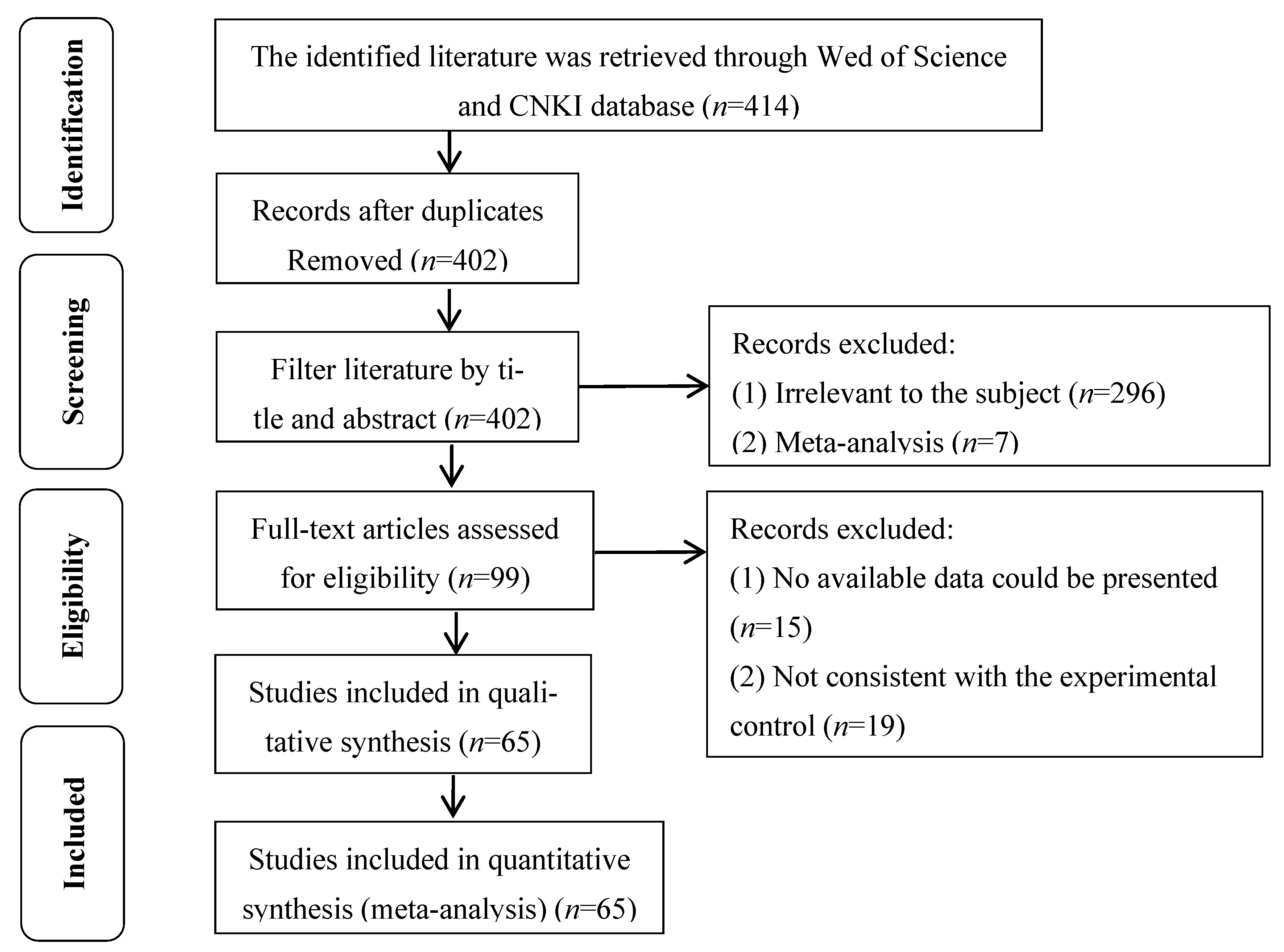
Data were collected from the CNKI and Web of Science databases using the following keywords: “plastic film mulching”, “mulching”, “maize”, “wheat”, “cotton”, and “CO2”. To be included in the analysis, studies were required to meet the following criteria: (1) be field experiments with at least three replicates; (2) clearly state the experimental period and location; (3) include a comparative analysis between mulching and no mulching treatments; (4) focus on maize, wheat, or cotton as the test crops; (5) report mean CO2 levels during the crop growing season. Based on these criteria, a total of 65 studies examining the effects of PFM on CO2 emissions in maize, wheat, and cotton were included in the analysis. The detailed data screening process is illustrated in Figure 1.

2.2. Data Classification

The 65 selected studies were categorized according to the following climate and soil factors: (1) water inputs (precipitation + irrigation) during the crop growth period (<350, 350–500, and >500 mm); (2) annual average temperature (<8 °C, 8–12 °C, and >12 °C); (3) soil texture, classified according to clay content as light (clay < 30%), medium (clay 30–50%), and heavy (clay > 50%); (4) nitrogen (N) application rate (<200, 200–400, and >400 kg N ha−1); (5) soil pH (≤8, representing neutral to alkaline, and >8, representing alkaline).

2.3. Meta-Analysis

The mean ( M ¯ ), standard deviation (SD), and sample size were extracted from each study. Missing SD values were calculated using the following formula, where the coefficient of variation (CV) was derived from the collected data:
S D = C V % 100 × M ¯
The response ratio (R) was used to assess the effect of mulching, calculated as:
R = X e / X c
ln R = ln X e / X c = ln X e ln X c
where Xe and Xc represent the average values of PFM and non-mulching treatments, respectively [46].
A 95% confidence interval (CI) that does not include zero indicates a significant increase in CO2 emissions due to mulching, while a 95% CI entirely below zero indicates a significant reduction. The percentage change is considered insignificant when the 95% CI includes zero. Additionally, non-overlapping 95% CIs between impact factors indicate significantly different effect sizes.
Yield-scaled CO2 emissions (YSC, kg CO2 eq Mg−1) were calculated to assess the relationship between CO2 emissions and yield:
YSC (kg CO2 eq kg−1) = CO2 emission (kg CO2 eq ha−1)/yield (kg ha−1).

2.4. Data Analysis

Box plots were generated using Origin (v2021). Meta-analysis was performed using “esc” and “metafor” software packages in R (v2025), and the results were visualized with the “ggplot” package.

3. Results

3.1. Effects of Mulching on Soil CO2 Emissions, Yield, and YSC

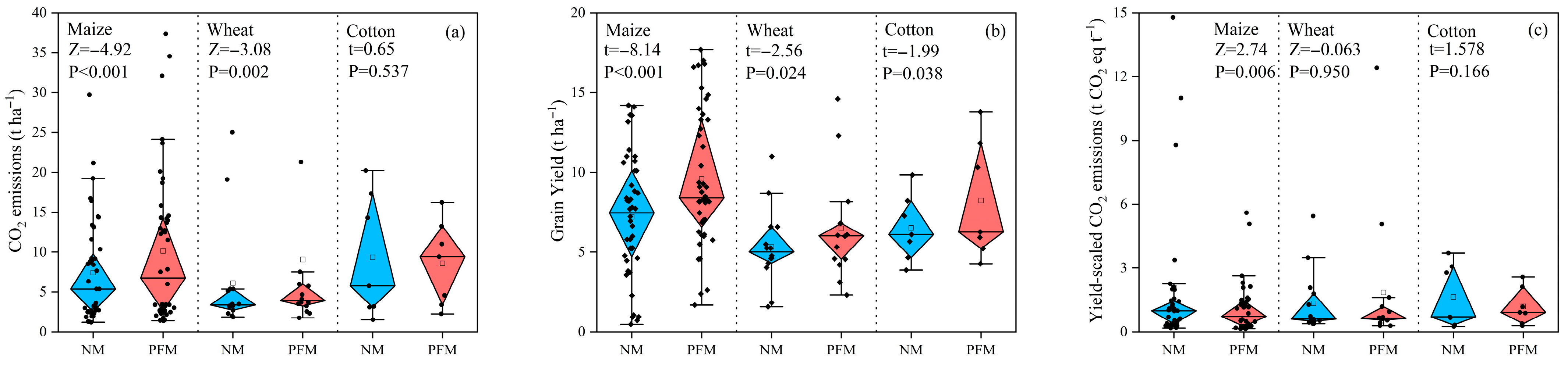
Soil CO2 emissions in mulched fields ranged from 1.4 to 37.4 t/ha−1 for maize, from 1.75 to 21.28 t/ha−1 for wheat, and from 2.25 to 16.22 t/ha−1 for cotton. The corresponding data in non-mulched fields ranged from 1.18 to 29.72 t/ha−1, 1.85 to 25.02 t/ha−1, and 1.5 to 20.2 t/ha−1, respectively (Figure 2a). PFM increased soil CO2 emissions for maize (by 36.8%, p < 0.001) and wheat (by 11.8%, p < 0.05), while reducing emissions for cotton (by 8.1%, p > 0.05). Crop yields in mulched fields ranged from 1.7 to 17.7 t/ha−1, 2.3 to 14.6 t/ha−1, and 4.3 to 13.8 t/ha−1 for maize, wheat, and cotton, respectively. The corresponding yields in non-mulched fields ranged from 0.5 to 14.2 t/ha−1, 1.6 to 11 t/ha−1, and 3.86 to 9.85 t/ha−1, respectively (Figure 2b). PFM significantly improved crop yields by 33.2% (p < 0.001), 21.8% (p < 0.05), and 26.3% (p < 0.05) for maize, wheat, and cotton, respectively. The YSC values in mulched fields ranged from 0.157 to 5.6 t CO2 eq t−1, 0.284 to 12.418 t CO2 eq t−1, and 0.286 to 2.577 t CO2 eq t−1 for maize, wheat, and cotton, respectively. The corresponding values in non-mulched fields ranged from 0.174 to 14.79 t CO2 eq t−1, 0.38 to 5.439 t CO2 eq t−1, and 0.246 to 3.699 t CO2 eq t−1, respectively (Figure 2c). PFM decreased YSC for maize (by 39.3%, p < 0.05) and cotton (by 27.4%, p > 0.05), while increasing YSC for wheat (by 38.3%, p > 0.05).
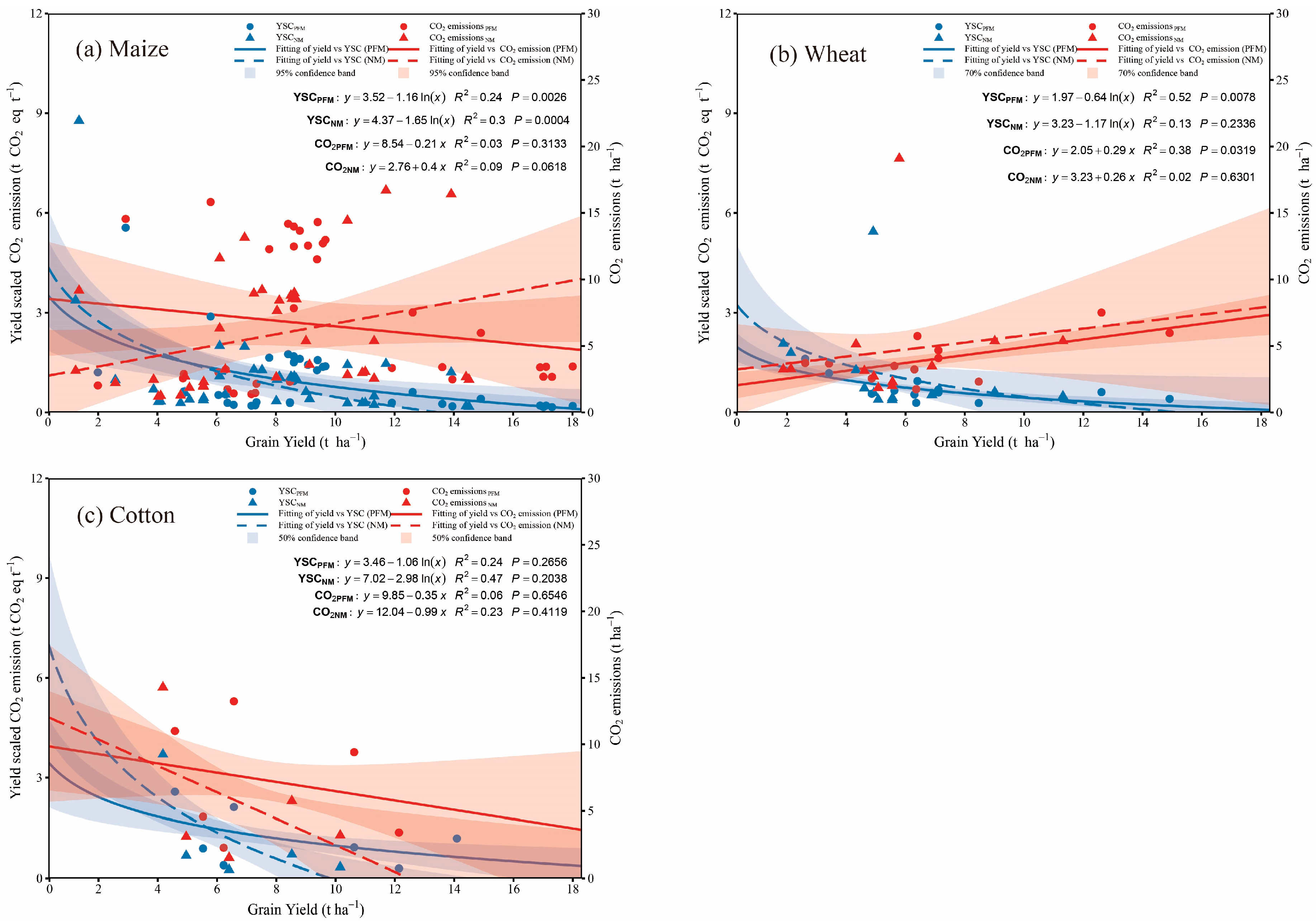
CO2 emissions decreased as crop yield increased in maize and cotton fields, whereas they increased with increasing yield in wheat farmlands (Figure 3). YSC decreased exponentially as crop yield increased. For maize and cotton, the YSC of NM treatment was higher than that of PFM when the crop yield was below 6 t/ha−1, and the trend reversed when the crop yield exceeded 6 t/ha−1. For wheat, when the crop yield was below 10 t/ha−1, the YSC of NM treatment was higher than that of PFM, and there was no significant difference in YSC between the two treatments when the crop yield exceeded 10 t/ha−1.

3.2. Effects of Mulching on Soil CO2 Emissions, Yield, and YSC Under Different Factors

3.2.1. Water Input and Air Temperature

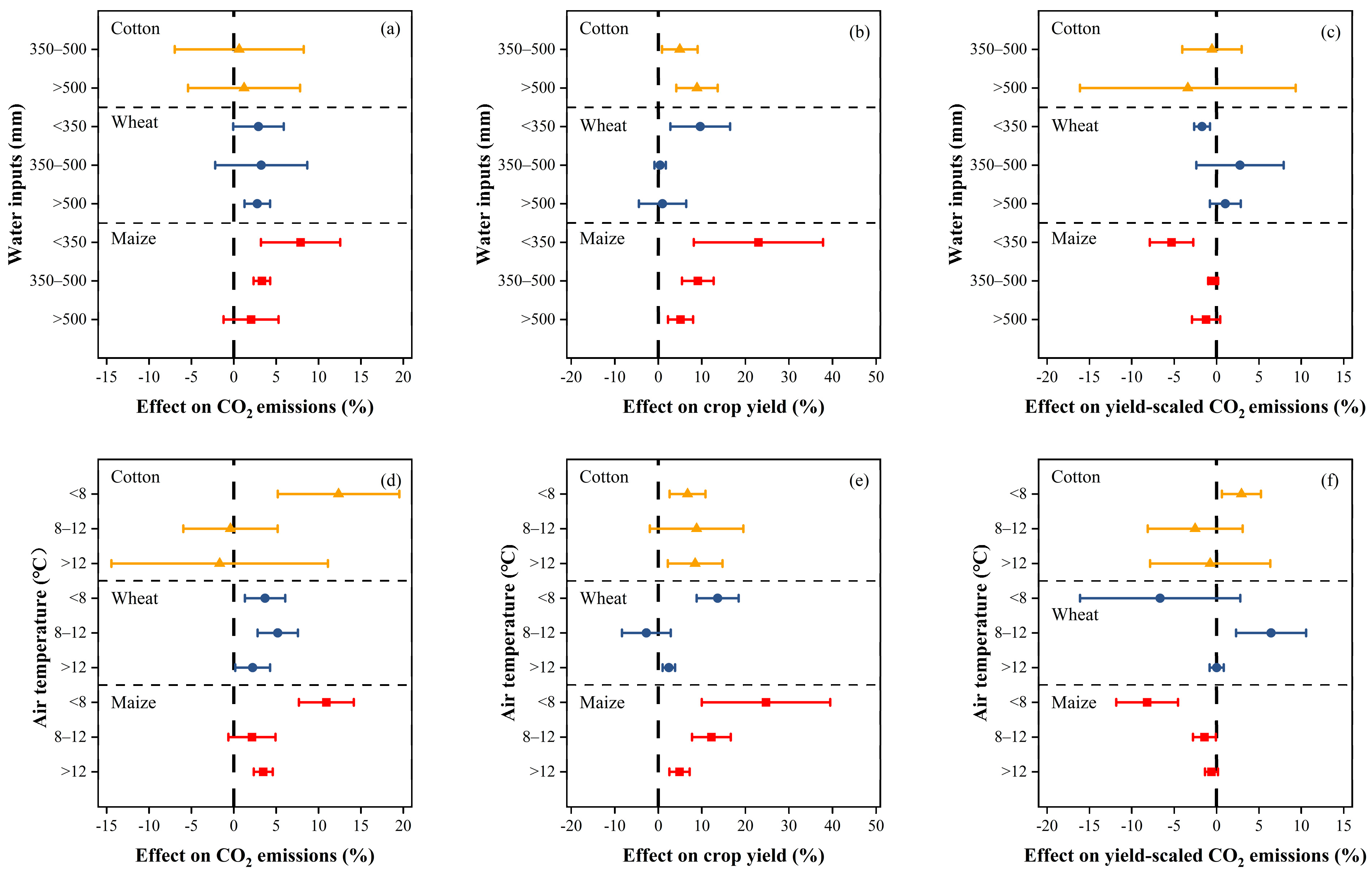
Under PFM, water input had a significant impact on CO2 emissions, crop yield, and YSC (Figure 4a–c). Water input was not a significant factor affecting CO2 emissions from cotton and wheat under PFM. However, for maize, the increase in CO2 emissions induced by PFM was significantly higher under low water input (7.8%; 95% CI: 2.9% to 13.3%) than under high water input (2.3%; 95% CI: −1.1% to 5.4%). An increase in water input enhanced the yield-increasing effect of PFM for cotton but weakened it for wheat and maize. Under high water input, PFM resulted in a lower YSC in cotton (−2.9%; 95% CI: −18.8% to 9.2%), but the lowest YSC was observed under the lowest water input for wheat (−1.1%; 95% CI: −1.4% to −0.6%) and maize (−5.6%; 95% CI: −9.1% to −4.7%).
Air temperature significantly affected CO2 emissions, crop yields, and YSC under PFM (Figure 4d–f). Temperature did not significantly influence the effect of PFM on CO2 emissions from wheat. However, the PFM-induced increase in CO2 emissions was significantly greater in low-temperature regions for cotton (11.7%; 95% CI: 3.6% to 18.8%) and maize (10.6%; 95% CI: 7.5% to 14.4%). Similarly, temperature did not significantly influence cotton yield under PFM, whereas PFM-induced yield increases were more pronounced in low-temperature regions for wheat (11.7%; 95% CI: 3.6% to 18.8%) and maize (10.6%; 95% CI: 7.5% to 14.4%). PFM in cotton field exhibited a low YSC (−2.4%; 95% CI: −9.6% to 3.1%) in moderate-temperature regions, while the lowest YSC values for both wheat (−7.3%; 95% CI: −17.2% to 2.4%) and corn (−8.5%; 95% CI: −12.0% to −4.6%) were observed in low-temperature regions.

3.2.2. Soil Texture, Soil pH, and N Inputs

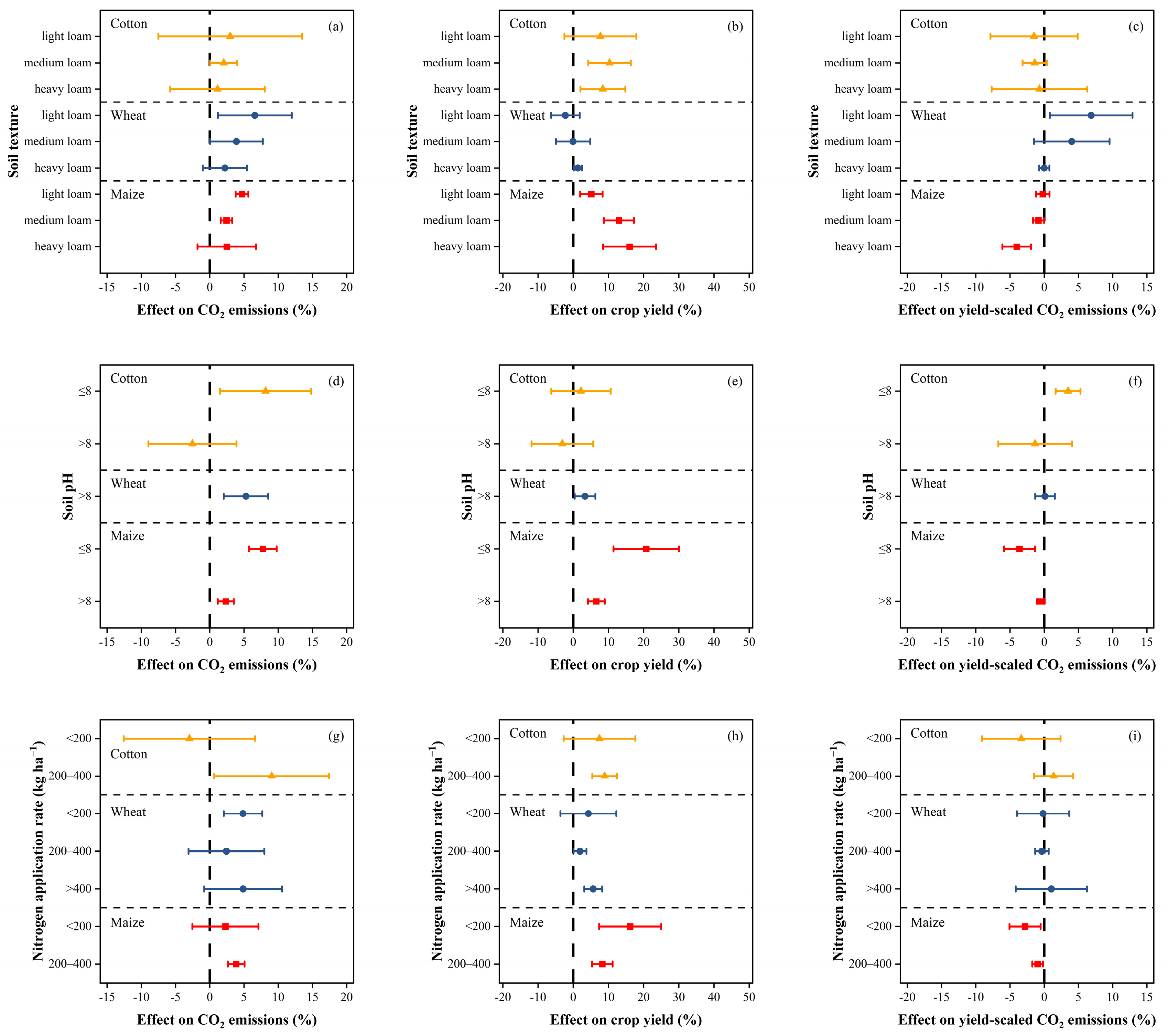
The mean effect of PFM on CO2 emissions for all three crops was maximized in light-textured soils (Figure 5a). The mean increase in crop yield due to PFM was highest in heavy-textured soils (Figure 5b). In fields with soil pH < 8, PFM led to a more pronounced increase in CO2 emissions (Figure 5d). For crop yield enhancement, PFM showed greater effectiveness in maize fields with soil pH < 8 (Figure 5e). Elevating N application rates boosted CO2 emissions more than yield, raising the YSC in mulched fields (Figure 5f). The influence of soil texture, soil pH, and N application rates on YSC was negatively correlated with the effect of PFM on crop yield in mulched fields (Figure 5b,c,e,f,h,i).

4. Discussion

4.1. Effect of PFM on Soil CO2 Emissions

This study found that PFM increased CO2 emissions in maize fields but decreased them in wheat fields. Most research has suggested that PFM enhanced soil temperature and moisture, thereby promoting CO2 emissions due to improved crop growth and in-creased microbial activity [25,30,40,47]. However, a few studies have proposed that warmer and wetter soils under PFM may stimulate CO2 uptake more than soil respiration, potentially suppressing CO2 emissions [48,49], particularly in rain-fed wheat fields [50]. Compared to non-mulched fields, plastic film-mulched wheat fields exhibited higher net photosynthetic rates and greater leaf area, enabling them to fix more CO2 [49].
In our study, PFM consistently promoted soil CO2 emissions across three temperature ranges, with the most pronounced effect observed at low temperatures (<8 °C). Previous research has indicated that PFM has a more significant warming effect in colder regions [51], thus amplifying the impact of PFM on soil respiration in low-temperature environments. Furthermore, the effect of temperature on soil respiration is moderated by soil moisture availability [52,53]. In the absence of film mulching, rising temperatures often correlate with reduced soil moisture [52]. Soil moisture limitations can weaken the stimulatory effect of temperature on respiration [54,55]. PFM mitigates the conflict between soil moisture and temperature by reducing evaporation losses, thereby enhancing soil CO2 emissions under dry and hot conditions.
In addition to moisture and temperature, soil physical and chemical properties also influence the impact of film mulching on soil CO2 emissions. Abalos et al. (2020) demonstrated that increasing soil pH in acidic soils (e.g., through liming) can increase biological activity and root respiration [56], facilitating organic matter mineralization and thus increasing soil CO2 emissions [57]. Neutral to slightly acidic soils (typically with a pH range of 6.0 to 7.5) generally exhibit the highest microbial activity, resulting in the highest CO2 emissions. PFM is often used in arid and semiarid regions with high evapotranspiration rates, where soils are typically alkaline [58]. Previous studies indicate that mulching can reduce the pH of alkaline soils by 0.19–0.54 units, with the accumulation of soil nitrate resulting from accelerated nitrogen mineralization contributing to this decline [59]. Our findings revealed that PFM promoted soil CO2 emissions for soils with pH ≤ 8. For soils with pH ≤ 8 (the lowest pH recorded in this study was 7.06), the slight PH decrease shifts the soil to be in neutral or slightly acidic conditions. Conversely, in soils with pH > 8, the slight decrease in pH induced by PFM was not enough to significantly enhance the microbial activity.
Soil texture influences soil porosity, moisture retention, gas exchange, nutrient cycling, and substrate availability for soil microbial communities [60]. As such, soil texture is a key factor regulating organic matter mineralization under specific climatic conditions. Our study found that medium-textured soil was more conducive to increased soil CO2 emissions under PFM. Light-textured soils typically exhibit poor water and nutrient retention, diminishing the beneficial effects of PFM on soil moisture, temperature, and respiration [33,61,62]. As the proportion of fine particles increases, the physical entrapment of organic matter within soil micropores and the closure of micro-aggregates may occur, inhibiting the organic carbon mineralization and CO2 emissions. For instance, Wankhede et al. (2020) and Hassan et al. (2022) confirmed that due to strong physical protection and limited specific surface area [60,63], carbon mineralization in clay soils is less responsive to temperature changes, which hinders the enhancement of soil CO2 emissions by PFM.
Generally, N addition enhances organic carbon mineralization and CO2 emissions in soils. Moreover, continuous N addition increases CO2 emissions from inorganic carbon in alkaline soils [64]. This may be attributed to the enhanced soil microbial activity under PFM, which amplifies the aforementioned effects.

4.2. Effect of PFM on Crop Yield

The impact of PFM on increasing soil temperature and moisture is particularly significant in regions with limited water and heat availability [38,65,66]. Our study found that PFM contributed most to yield improvement in wheat and maize under low water input (≤350 mm) and low temperatures (≤8 °C), which is consistent with previous research. However, in cotton fields under PFM, yield continues to increase with higher water input. Cotton is more drought-tolerant compared to wheat and maize, yet it has the highest water consumption, with a total water demand of approximately 600–800 mm over the entire growth period. Therefore, it exhibits greater yield potential under adequate irrigation. This study also highlights how soil properties influence the effectiveness of PFM in yield enhancement. Notably, PFM most effectively increased yields in medium-textured soils (Figure 5b). For light-textured soils, deep percolation leads to significant water loss, limiting the effect of PFM on soil moisture retention. Additionally, our results indicated that increasing N inputs gradually enhanced the yield benefits of PFM, which is consistent with the findings of He et al. (2018) [48].

4.3. Effect of Plastic Film Mulching on YSC

This study found that when crop yields were relatively low, PFM significantly reduced carbon emissions per unit of crop output, indicating an improvement in carbon efficiency. However, as yields continued to rise, PFM could lead to a decrease in agricultural carbon benefits. This might be because the yield-enhancing effect of mulching is more pronounced under poor hydrothermal conditions [11,12,13]. Our findings show that adequate water and heat diminished the yield increase from PFM and increased YSC, mirroring the pattern observed with increased N addition. Interestingly, heavy-textured soils showed a marked yield increase alongside higher soil CO2 emissions, effectively reducing YSC. Furthermore, soil pH significantly influenced the impact of PFM on YSC. In soils with pH ≤ 8, PFM significantly reduced YSC, primarily due to a notable increase in yield (Figure 5). He et al. (2018) also reported that in PM systems, YSC was 19–31% lower under medium N input compared to high N input [48]. At present, PFM is also widely adopted in the production of cash crops. However, the literature selected for this study did not include cash crops, such as tomato, watermelon, and sunflower. This aspect therefore warrants further investigation in future research.

5. Conclusions

Plastic film mulching (PFM) significantly increased the yields of maize, wheat, and cotton. It significantly increased CO2 emissions from maize and wheat fields but reduced CO2 emissions from cotton fields. PFM reduced yield-scaled CO2 emissions (YSC) for maize and cotton but increased YSC for wheat. As crop yields increased, the YSC of the three crops decreased exponentially. For maize and cotton, when crop yields exceeded 6 t/ha, the YSC under plastic film mulching was higher than that under non-mulching. In contrast, for wheat, within the conventional yield range (below 10 t/ha), the YSC under PFM was lower than that under non-mulching. For cotton under PFM, the lowest YSC was obtained under the combined conditions of water inputs > 500 mm, air temperature > 8 °C, soil pH > 8, and N inputs < 200 kg N ha−1. For wheat under PFM, the lowest YSC was obtained under the combined conditions of water inputs < 350 mm, air temperature < 8 °C, light-texture soils, and N inputs < 200 kg N ha−1. For maize under PFM, the lowest YSC was achieved under the combined conditions of water inputs < 350 mm, air temperature < 8 °C, heavy-textured soils, soil pH < 8, and N inputs < 200 kg N ha−1.

Author Contributions

Conceptualization, L.Z.; Methodology, H.F.; Software, X.G.; Validation, X.G.; Resources, T.J.; Data curation, L.Z.; Writing—original draft, L.Z.; Writing—review & editing, T.J. and H.F.; Project administration, H.F. All authors have read and agreed to the published version of the manuscript.

Funding

This work was jointly supported by the State Key Laboratory of Soil Erosion and Dryland Farming on the Loess Plateau (Grant No. F2010121002-202313), the National Natural Science Foundation of China (Grant No. 52369006), the Yunnan Fundamental Research Projects (Grant No. 202402AE090005; 202401AT070323), the Yunnan Key Laboratory of Efficient Utilization and Intelligent Control of Agricultural Water Resources (No. 202449CE340014), and the Yunnan International Joint Laboratory of Intelligent Agricultural Engineering Technology and Equipment (No. 202403AP140007).

Data Availability Statement

Data are contained within the article.

Conflicts of Interest

The authors declare no conflicts of interest.

References

  1. IPCC. Climate Change 2023: Synthesis Report, Summary for Policymakers. Contribution of Working Groups I, II and III to the Sixth Assessment Report of the Intergovernmental Panel on Climate Change; IPCC: Geneva, Switzerland, 2023. [Google Scholar]
  2. Kiehl, J.T.; Trenberth, K.E. Earth’s annual global mean energy budget. Bull. Am. Meteorol. Soc. 1997, 78, 197–208. [Google Scholar] [CrossRef]
  3. Nakicenovic, N.; Gritsevskii, A.; Grubler, A.; Riahi, K. Global Natural Gas Perspectives; International Gas Union (IGU), Office of the Secretary General, Denmark and IIASA: Copenhagen, Denmark, 2000. [Google Scholar]
  4. IPCC. Climate Change 2014 Synthesis Report; IPCC: Geneva, Szwitzerland, 2014; pp. 1059–1072. [Google Scholar]
  5. Zong, R.; Wang, Z.; Wu, Q.; Guo, L.; Lin, H. Characteristics of carbon emissions in cotton fields under mulched drip irrigation. Agric. Water Manag. 2020, 231, 105992. [Google Scholar] [CrossRef]
  6. Crippa, M.; Solazzo, E.; Guizzardi, D.; Monforti-Ferrario, F.; Tubiello, F.N.; Leip, A. Food systems are responsible for a third of global anthropogenic GHG emissions. Nat. Food 2021, 2, 198–209. [Google Scholar] [CrossRef]
  7. FAO. Food and agriculture organization of the United Nations—FAO. In The Europa Directory of International Organizations; Routledge: Oxford, UK, 2021; pp. 297–305. [Google Scholar]
  8. Li, M.; Zhang, K.M.; Eldoma, I.; Fang, Y.; Zhang, F. Plastic film mulching sustains high maize (Zea mays L.) grain yield and maintains soil water balance in semiarid environment. Agronomy 2020, 10, 600. [Google Scholar] [CrossRef]
  9. Tiwari, K.; Singh, A.; Mal, P. Effect of drip irrigation on yield of cabbage (Brassica oleracea L. var. capitata) under mulch and non-mulch conditions. Agric. Water Manag. 2003, 58, 19–28. [Google Scholar] [CrossRef]
  10. Yin, C.Q.; Guo, Y.; Fan, Z.L.; Hu, F.L.; Fan, H.; Zhao, C.; Yu, A.; Coulter, J.A. Straw and plastic management regulate air-soil temperature amplitude and wetting-drying alternation in soil to promote intercrop productivity in arid regions. Field Crops Res. 2020, 249, 107758. [Google Scholar] [CrossRef]
  11. Fu, Y.; Si, L.; Jin, Y.; Xia, Z.; Wang, Q.; Lu, H. Efficacy of black plastic film mulching as a cultivation strategy to cope with leaf senescence and increase yield of rainfed spring maize (Zea mays L.). Soil Use Manag. 2020, 38, 1044–1053. [Google Scholar] [CrossRef]
  12. Wang, Y.P.; Li, X.G.; Zhu, J.; Fan, C.Y.; Kong, X.J.; Turner, N.C.; Siddique, K.H.M.; Li, F.M. Multi-site assessment of the effects of plastic-film mulch on dryland maize productivity in semiarid areas in China. Agric. For. Meteorol. 2016, 220, 160–169. [Google Scholar] [CrossRef]
  13. Yu, Y.Y.; Turner, N.C.; Gong, Y.H.; Li, F.M.; Chao, F.; Ge, L.J.; Ye, J.S. Benefits and limitations to straw-and plastic-film mulch on maize yield and water use efficiency: A meta-analysis across hydrothermal gradients. Eur. J. Agron. 2018, 99, 138–147. [Google Scholar] [CrossRef]
  14. Zhou, Q.; Gunina, A.; Chen, J.; Xing, Y.; Xiong, Y.; Guo, Z.; Wang, L. Reduction in soil CO2 efflux through alteration of hydrothermal factor in milk vetch (Astragalus sinicus L.)-rapeseed (Brassica napus L.) intercropping system. Front. Plant Sci. 2023, 13, 1093507. [Google Scholar] [CrossRef]
  15. Liu, F.; Zhang, Y.; Shen, Y. Contrasting effects of irrigation practice on soil respiration and carbon turnover in wheat and maize season. Agric. Water Manag. 2025, 317, 109633. [Google Scholar] [CrossRef]
  16. Ben-Noah, I.; Friedman, S.P. Review and evaluation of root respiration and of natural and agricultural processes of soil aeration. Vadose Zone J. 2018, 17, 1–47. [Google Scholar] [CrossRef]
  17. Guo, H.; Li, S.; Kang, S.; Du, T.; Tong, L.; Ding, R. Annual ecosystem respiration of maize was primarily driven by crop growth and soil water conditions. Agric. Ecosyst. Environ. 2019, 272, 254–265. [Google Scholar] [CrossRef]
  18. Ryhti, K.; Schiestl-Aalto, P.; Tang, Y.; Rinne-Garmston, K.T.; Ding, Y.; Pumpanen, J.; Biasi, C.; Saurer, M.; Bäck, J.; Kulmala, L. Effects of variable temperature and moisture conditions on respiration and nonstructural carbohydrate dynamics of tree roots. Agric. For. Meteorol. 2022, 323, 109040. [Google Scholar] [CrossRef]
  19. Hu, Q.; Wang, J.; Da, Y.; Sun, Y. The effects of plastic mulching and different fertilization on soil nutrients, yield and soil microbiome in maize field. Cereal Res. Commun. 2022, 51, 773–784. [Google Scholar] [CrossRef]
  20. Xie, Y.; Li, J.; Jin, L.; Wei, S.; Wang, S.; Jin, N.; Wang, J.; Xie, J.; Feng, Z.; Zhang, G.; et al. Combined straw and plastic film mulching can increase the yield and quality of open field loose-curd cauliflower. Front. Nutr. 2022, 9, 888728. [Google Scholar] [CrossRef] [PubMed]
  21. Zhao, Y.; Mao, X.; Shukla, M.K.; Li, S.; Xu, Z.; Bo, L.; Huang, X.; Bai, Y.; Qi, X. Modelling water/heat transfer and crop growth under film mulching condition in a seed-maize field. Agric. For. Meteorol. 2023, 340, 109616. [Google Scholar] [CrossRef]
  22. Zhu, G.; Yong, L.; Zhang, Z.; Sun, Z.; Wan, Q.; Xu, Y.; Ma, H.; Sang, L.; Liu, Y.; Wang, L.; et al. Effects of plastic mulch on soil water migration in arid oasis farmland: Evidence of stable isotopes. Catena 2021, 207, 105580. [Google Scholar] [CrossRef]
  23. Li, N.; Qi, W.; Jiang, C.; Liu, H.; Liu, E. Effects of plastic film mulching on soil respiration and its sensitivity to temperature and water content. Environ. Technol. Innov. 2024, 36, 103780. [Google Scholar] [CrossRef]
  24. Zhou, L.; Feng, H. Plastic film mulching stimulates brace root emergence and soil nutrient absorption of maize in an arid environment. J. Sci. Food Agric. 2020, 100, 540–550. [Google Scholar] [CrossRef]
  25. Cuello, J.P.; Hwang, H.Y.; Gutierrez, J.; Kim, S.Y.; Kim, P.J. Impact of plastic film mulching on increasing greenhouse gas emissions in temperate upland soil during maize cultivation. Appl. Soil Ecol. 2015, 91, 48–57. [Google Scholar] [CrossRef]
  26. Frouz, J.; Bujalsky, L. Flow of CO2 from soil may not correspond with CO2 concentration in soil. Sci. Rep. 2018, 8, 10099. [Google Scholar] [CrossRef]
  27. Zhou, L.F.; Yang, Y.X.; Yang, R. Root and leaf senescence of maize subject to spatial differentiation of soil water and CO2 in sandy fields with plastic film mulching. Chin. J. Eco-Agric. 2024, 32, 83−94. [Google Scholar]
  28. Nan, W.G.; Yue, S.C.; Huang, H.Z.; Li, S.Q.; Shen, Y.F. Effects of plastic film mulching on soil greenhouse gases (CO2, CH4 and N2O) concentration within soil profiles in maize fields on the Loess Plateau, China. J. Integr. Agric. 2016, 15, 451–464. [Google Scholar] [CrossRef]
  29. Sharma, J.; Ravindranath, N.H. Applying IPCC 2014 framework for hazard-specific vulnerability assessment under climate change. Environ. Res. Commun. 2019, 1, 051004. [Google Scholar] [CrossRef]
  30. Yu, Y.; Zhao, C.; Stahr, K.; Zhao, X.; Jia, H.; de Varennes, A. Plastic mulching increased soil CO2 concentration and emissions from an oasis cotton field in Central Asia. Soil Use Manag. 2016, 32, 230–239. [Google Scholar] [CrossRef]
  31. Zhao, Z.M.; Zhao, C.Y.; Yan, Y.Y.; Li, J.Y.; Li, J.; Shi, F.Z. Interpreting the dependence of soil respiration on soil temperature and moisture in an oasis cotton field, central Asia. Agric. Ecosyst. Environ. 2013, 168, 46–52. [Google Scholar] [CrossRef]
  32. Chen, H.; Liu, J.; Zhang, A.; Chen, J.; Cheng, G.; Sun, B.; Pi, X.; Dyck, M.; Si, B.; Zhao, Y.; et al. Effects of straw and plastic film mulching on greenhouse gas emissions in Loess Plateau, China: A field study of 2 consecutive wheat-maize rotation cycles. Sci. Total Environ. 2017, 579, 814–824. [Google Scholar] [CrossRef]
  33. Li, Y.; Chai, Y.; Ma, J.; Li, R.; Cheng, H.; Chang, L.; Chai, S. Straw strip mulching in a semiarid rainfed agroecosystem achieves carbon sequestration and emission reduction from winter wheat fields. Agric. Ecosyst. Environ. 2022, 334, 107990. [Google Scholar] [CrossRef]
  34. Cai, W.; Gu, X.; Du, Y.; Chang, T.; Lu, S.; Zheng, X.; Bai, D.; Song, H.; Sun, S.; Cai, H. Effects of mulching on water saving, yield increase and emission reduction for maize in China. Agric. Water Manag. 2022, 274, 107954. [Google Scholar] [CrossRef]
  35. Song, Q.; Yang, B.; Xu, M.; Zhang, F.; Liu, Q.; Li, S. A three-year record of CO2, CH4 and N2O emissions in maize fields influenced by mulching methods on the Loess Plateau, China. Agric. Ecosyst. Environ. 2024, 367, 108963. [Google Scholar] [CrossRef]
  36. Li, Z.G.; Tiang, C.Y.; Zhang, R.H.; Mohamed, I.; Liu, Y.; Zhang, G.S.; Pan, J.F.; Chen, F. Plastic mulching with drip irrigation increases soil carbon stocks of natrargid soils in arid areas of northwestern China. Catena 2015, 133, 179–185. [Google Scholar] [CrossRef]
  37. Zhang, S.; Zhang, G.; Xia, Z.; Wu, M.; Bai, J.; Lu, H. Optimizing plastic mulching improves the growth and increases grain yield and water use efficiency of spring maize in dryland of the Loess Plateau in China. Agric. Water Manag. 2022, 271, 107769. [Google Scholar] [CrossRef]
  38. Wang, W.; Han, L.; Zhang, X.; Wei, K. Plastic film mulching affects N2O emission and ammonia oxidizers in drip irrigated potato soil in northwest China. Sci. Total Environ. 2021, 754, 142113. [Google Scholar] [CrossRef] [PubMed]
  39. Wei, H.H.; Zhang, F.; Zhang, K.P.; Qin, R.Z.; Zhang, W.J.; Sun, G.J.; Huang, J. Effects of soil mulching on staple crop yield and greenhouse gas emissions in China: A meta-analysis. Field Crops Res. 2022, 284, 108566. [Google Scholar] [CrossRef]
  40. Zhang, L.; Qin, R.; Wei, H.; Zhang, K.; Yu, C.; Li, F.M.; Zhang, F. Optimum plastic mulching application to reduce greenhouse gas emissions without compromising on crop yield and farmers’ income. Sci. Total Environ. 2022, 809, 151998. [Google Scholar] [CrossRef]
  41. Linquist, B.; van Groenigen, K.J.; Adviento-Borbe, M.A.; Pittelkow, C.; van Kessel, C. An agronomic assessment of greenhouse gas emissions from major cereal crops. Glob. Change Biol. 2012, 18, 194–209. [Google Scholar] [CrossRef]
  42. Liu, F.; Liu, Y.; Su, L.; Tao, W.; Wang, Q.; Deng, M. Integrated growth model of typical crops in China with regional parameters. Water 2022, 14, 1139. [Google Scholar] [CrossRef]
  43. Tesfaye, K.; Takele, R.; Sapkota, T.B.; Khatri-Chhetri, A.; Solomon, D.; Stirling, C.; Albanito, F. Model comparison and quantification of nitrous oxide emission and mitigation potential from maize and wheat fields at a global scale. Sci. Total Environ. 2021, 782, 146696. [Google Scholar] [CrossRef]
  44. Lesk, C.; Rowhani, P.; Ramankutty, N. Influence of extreme weather disasters on global crop production. Nature 2016, 529, 84–87. [Google Scholar] [CrossRef]
  45. He, G.; Wang, Z.; Li, S.; Malhi, S.S. Plastic mulch: Tradeoffs between productivity and greenhouse gas emissions. J. Clean. Prod. 2018, 172, 1311–1318. [Google Scholar] [CrossRef]
  46. Hedges, L.V.; Gurevitch, J.; Curtis, P.S. The Meta-Analysis of response ratios in experimental ecology. Ecology 1999, 80, 1150–1156. [Google Scholar] [CrossRef]
  47. Zhao, J.; Yang, K.; Wang, F. Effects of transparent and black film mulch on potato productivity and greenhouse gas emissions under drip irrigation: A three-year study in Northwest China. Soil Tillage Res. 2026, 255, 106772. [Google Scholar] [CrossRef]
  48. He, G.; Wang, Z.; Cao, H.; Dai, J.; Li, Q.; Xue, C. Year-round plastic film mulch to increase wheat yield and economic returns while reducing environmental risk in dryland of the Loess Plateau. Field Crops Res. 2018, 225, 1–8. [Google Scholar] [CrossRef]
  49. Jiao, F.; Wang, X.; Gao, J.; Dong, Z.; Li, X.; Kang, S.; Du, T.; Tong, L.; Kang, J.; Xu, W.; et al. White film cover improves water productivity and reduces carbon emissions of spring wheat farmland in the arid region of Northwest China. Agric. Water Manag. 2025, 317, 109658. [Google Scholar] [CrossRef]
  50. Wang, H.; Zheng, J.; Fan, J.; Zhang, F.; Huang, C. Grain yield and greenhouse gas emissions from maize and wheat fields under plastic film and straw mulching: A meta-analysis. Field Crops Res. 2021, 270, 108210. [Google Scholar] [CrossRef]
  51. Zhou, L.; Zhao, W.; Yang, R.; Feng, H. Soil temperature modeling in topsoil with plastic film mulching and low spring temperatures. Arch. Agron. Soil Sci. 2019, 66, 1936–1947. [Google Scholar] [CrossRef]
  52. Guo, D.X.; Chen, C.F.; Guo, P.Y.; Yuan, X.Y.; Xing, X.G.; Ma, X.Y. Evaluation of Aquacrop model for foxtail millet (setaria italica) growth and water use with plastic film mulching and no mulching under different weather conditions. Water 2018, 10, 836. [Google Scholar] [CrossRef]
  53. Soong, J.L.; Castanha, C.; Hicks Pries, C.E.; Ofiti, N.; Porras, R.C.; Riley, W.J.; Schmidt, M.W.; Torn, M.S. Five years of whole-soil warming led to loss of subsoil carbon stocks and increased CO2 efflux. Sci. Adv. 2021, 7, eabd1343. [Google Scholar] [CrossRef]
  54. Zheng, J.; Fan, J.; Zhang, F.; Zhuang, Q. Evapotranspiration partitioning and water productivity of rainfed maize under contrasting mulching conditions in Northwest China. Agric. Water Manag. 2021, 243, 106473. [Google Scholar] [CrossRef]
  55. Moyano, F.E.; Manzoni, S.; Chenu, C. Responses of soil heterotrophic respiration to moisture availability: An exploration of processes and models. Soil Biol. Biochem. 2013, 59, 72–85. [Google Scholar] [CrossRef]
  56. Abalos, D.; Liang, Z.; Dörsch, P.; Elsgaard, L. Trade-offs in greenhouse gas emissions across a liming-induced gradient of soil pH: Role of microbial structure and functioning. Soil Biol. Biochem. 2020, 150, 108006. [Google Scholar] [CrossRef]
  57. Chen, D.; Li, J.; Lan, Z.; Hu, S.; Bai, Y.; Niu, S. Soil acidification exerts a greater control on soil respiration than soil nitrogen availability in grasslands subjected to long-term nitrogen enrichment. Funct. Ecol. 2016, 30, 658–669. [Google Scholar] [CrossRef]
  58. Ji, C.J.; Yang, Y.H.; Han, W.X.; He, Y.F.; Smith, J.; Smith, P. Climatic and edaphic controls on soil pH in alpine grasslands on the Tibetan Plateau, China: A quantitative analysis. Pedosphere 2014, 24, 39–44. [Google Scholar] [CrossRef]
  59. Wang, L.; Li, X.G.; Lv, J.; Fu, T.; Ma, Q.; Song, W.; Wang, Y.P.; Li, F.M. Continuous plastic-film mulching increases soil aggregation but decreases soil pH in semiarid areas of China. Soil Tillage Res. 2017, 167, 46–53. [Google Scholar] [CrossRef]
  60. Hassan, W.; Li, Y.; Saba, T.; Wu, J.; Bashir, S.; Bashir, S.; Gatasheh, M.K.; Zeng-Hui Diao, Z.-H.; Chen, Z. Temperature responsiveness of soil carbon fractions, microbes, extracellular enzymes and CO2 emission: Mitigating role of texture. PeerJ 2022, 10, e13151. [Google Scholar] [CrossRef]
  61. Li, F.M.; Wang, P.; Wang, J.; Xu, J.Z. Effects of irrigation before sowing and plastic film mulching on yield and water uptake of spring wheat in semiarid Loess Plateau of China. Agric. Water Manag. 2004, 67, 77–88. [Google Scholar] [CrossRef]
  62. Thomsen, I.K.; Schjønning, P.; Jensen, B.; Kristensen, K.; Christensen, B.T. Turnover of organic matter in differently textured soils: II. Microbial activity as influenced by soil water regimes. Geoderma 1999, 89, 199–218. [Google Scholar] [CrossRef]
  63. Wankhede, M.; Ghosh, A.; Manna, M.C.; Misra, S.; Sirothia, P.; Rahman, M.M.; Bhattacharyya, P.; Singh, M.; Bhattacharyya, R.; Patra, A.K. Does soil organic carbon quality or quantity govern relative temperature sensitivity in soil aggregates? Biogeochemistry 2020, 148, 191–206. [Google Scholar] [CrossRef]
  64. Yan, T.; Fang, Y.; Wang, J.; Song, H.; Zhong, T.; Wang, P. Effects of long-term nitrogen addition on the shift of nitrogen cycle from open to closed along an age gradient of larch plantations in North China. Soil Biol. Biochem. 2024, 191, 109295. [Google Scholar] [CrossRef]
  65. Qin, W.; Hu, C.; Oenema, O. Soil mulching significantly enhances yields and water and nitrogen use efficiencies of maize and wheat: A meta-analysis. Sci. Rep. 2015, 5, 16210. [Google Scholar] [CrossRef] [PubMed]
  66. Zhao, C.; Chai, Q.; Cao, W.; Whalen, J.K.; Zhao, L.; Cai, L. No-tillage reduces competition and enhances compensatory growth of maize (Zea mays L.) intercropped with pea (Pisum sativum L.). Field Crops Res. 2019, 243, 107611. [Google Scholar] [CrossRef]
Figure 1. Flowchart for data collection and meta-analysis.
Agronomy 16 00676 g001
Figure 2. Soil CO2 emissions (a), crop yield (b), and yield-scaled CO2 emissions (YSC, (c)) in non-mulched (NM) and plastic film mulched (PFM) croplands. The solid line in the figure represents the average. The box boundary represents the 75% and 25% quartiles, and the whisker cap represents the 95th and 5th percentiles. Each dot represents an individual data point.
Agronomy 16 00676 g002
Figure 3. Fitted curves of yield-scaled CO2 emissions (YSC, blue lines) and soil CO2 emissions (red lines) versus grain yield. Solid lines represent plastic film mulching (PFM), while dashed lines represent non-mulched (NM).
Agronomy 16 00676 g003
Figure 4. Effects of water input and air temperature on soil CO2 emissions (a,d), crop yield (b,e), and yield-scaled CO2 emissions (c,f) in mulched croplands. The position of each symbol corresponds to the mean value, and error bars represent 95% confidence intervals.
Agronomy 16 00676 g004
Figure 5. Effects of soil texture, soil pH, and N application rate on soil CO2 emissions (a,d,g), yield (b,e,h), and yield-scaled CO2 emissions (c,f,i) in mulched croplands. The position of each symbol corresponds to the mean value, and error bars represent 95% confidence intervals.
Agronomy 16 00676 g005
Disclaimer/Publisher’s Note: The statements, opinions and data contained in all publications are solely those of the individual author(s) and contributor(s) and not of MDPI and/or the editor(s). MDPI and/or the editor(s) disclaim responsibility for any injury to people or property resulting from any ideas, methods, instructions or products referred to in the content.