Article

Screening and Identification of Cotton Germplasm with Verticillium Wilt Resistance, High Yield, and High Seed Index in Kuitun, Xinjiang


1
National Nanfan Research Institute (Sanya), Chinese Academy of Agricultural Sciences, Sanya 572000, China
2
State Key Laboratory of Cotton Bio-Breeding and Integrated Utilization, Institute of Cotton Research, Chinese Academy of Agricultural Sciences, Anyang 455000, China
3
Nanfan Breeding Research Center, Chinese Academy of Agricultural Sciences, Sanya 572000, China
*
Authors to whom correspondence should be addressed.
These authors contributed equally to this work.
Agronomy 2026, 16(6), 603; https://doi.org/10.3390/agronomy16060603
Submission received: 2 February 2026 / Revised: 5 March 2026 / Accepted: 10 March 2026 / Published: 11 March 2026
(This article belongs to the Section Pest and Disease Management)

Abstract

Xinjiang is the major cotton-producing region in China, and identifying core germplasm with disease resistance, high yield, and high seed index is of great significance for guiding local cotton production and breeding practices. Using 182 upland cotton germplasm accessions, we systematically investigated Verticillium wilt (caused by Verticillium dahliae) disease index, yield, and seed index in Kuitun, Xinjiang, during 2018–2019. Comparative analysis revealed that the germplasm from the Yellow River Ecological Region (YER) exhibited the strongest disease resistance but ranked second in yield, while the germplasm from the Northwest Inland Ecological Region (NWC) was susceptible to disease, yet had the highest yield, indicating great potential for further improving cotton yield in Kuitun. The Verticillium wilt index decreased, and yield increased with breeding periods. PCA and K-Means clustering divided germplasm into three clusters, with Cluster 0 being disease-resistant, high-yielding, and having a high seed index. Using the 20th percentile method, 20 core germplasm (11.0% of total) were selected, including disease-resistant and high-yield accessions, 3 disease-susceptible and high-yield accessions, and 6 disease-resistant and high seed index accessions. The results of this study provide important material support and a theoretical basis for the synergistic breeding of cotton with disease resistance, high yield, and high seed index in Xinjiang.

1. Introduction

Cotton, as a globally important natural fiber crop, possesses extremely high economic value and comprehensive utilization potential: its fibers serve as the core raw material for the textile industry and are widely used in the production of daily necessities such as clothing and bedding as well as banknotes; cottonseeds can be pressed for edible oil, and the defatted cottonseed cake is a high-quality raw material for animal feed [1]. Meanwhile, cottonseed-derived products, such as cottonseed protein and gossypol, can be further extracted for applications in industrial and pharmaceutical sectors [2], making cotton an indispensable crop in the agricultural economy and national production. As a key index for evaluating cottonseed size and plumpness, the seed index is defined as the weight of 100 cottonseeds. It is directly correlated with cottonseed yield and quality, and thus plays a vital role in improving the efficiency of comprehensive cottonseed utilization [1,3]. However, cotton production has long been severely constrained by Verticillium wilt, a typical fungal soil-borne disease caused by the infection of Verticillium dahliae. After invading cotton roots, the pathogen spreads upward along the vascular bundles of stems and disrupts the transport pathways of water and nutrients in plants [4], ultimately leading to leaf wilting, chlorosis, and abscission. This not only significantly reduces cotton yield but also severely degrades fiber quality. More vexingly, the microsclerotia formed by Verticillium dahliae in soil can withstand extreme environmental conditions and are difficult to eliminate completely, making Verticillium wilt a persistent problem in cotton production, often referred to as the “cancer of cotton”. It has thus become a key technical bottleneck that impedes the high-quality development of the cotton industry and must be addressed [5].
The occurrence and damage degree of cotton Verticillium wilt are mainly regulated by the combined effects of host genotype and environmental factors. Due to the complex and variable field environmental conditions that are difficult to artificially control accurately, screening elite core germplasm resistant to Verticillium wilt and breeding resistant varieties through genetic improvement have become the most economical, efficient, and sustainable approach for the prevention and control of this disease [6]. In recent years, the scientific community has made progress in identifying and evaluating cotton germplasm resistant to Verticillium wilt. For example, the successful breeding and popularization of the Verticillium wilt-resistant variety CCRI 12 is a typical example of disease-resistant breeding. At present, core disease-resistant materials represented by CCRI 12 [7], as well as susceptible control varieties such as Junmian 1 [8,9] and Xinlu Zao 57 [10], have been identified, providing a solid material foundation for subsequent studies on disease resistance mechanisms and breeding practices.
Currently, the investigation methods used for cotton Verticillium wilt disease index are mainly divided into two categories: one is the visual method, based on the foliar disease symptoms of plants, and the other is the stem dissection method by observing the discoloration degree of vascular bundles. The visual foliar investigation method remains the primary approach in production practice and conventional scientific research, but it is susceptible to environmental factors and is only moderately accurate. In contrast, the stem dissection method can directly reflect the pathogen’s infection level in plants, yielding more objective and reliable results and providing a scientific basis for the accurate identification of cotton disease resistance [11,12].
Notably, cotton exhibits significant genotypically dependent tolerance differences to Verticillium wilt—some germplasm can maintain a high yield level even under mild, moderate, or severe infection conditions [13]. Such disease-tolerant and high-yield germplasm often exhibit inconspicuous foliar disease symptoms and are easily missed by visual inspection, whereas the stem dissection method can accurately identify these materials [11,14]. As important breeding parents, these germplasm resources can provide unique genetic resources for breeding new cotton varieties with both stress resistance and high yield. Therefore, the accurate screening and systematic identification of such germplasm have important breeding value and practical significance.
Although considerable achievements have been accumulated in the screening of cotton disease-resistant germplasm, and multiple research teams have screened out different numbers of core disease-resistant germplasm [15,16,17,18], there are still obvious deficiencies in the precise and large-scale research targeting specific ecological regions. Kuitun in Xinjiang, the core cotton-producing area in China, has unique arid, low-precipitation climatic and soil conditions, with its ecological environment significantly different from that of cotton regions such as the Yellow River and Yangtze River Basins. Against this background, identifying large-scale core germplasm populations adapted to the local ecological conditions with clear geographical origins and breeding periods, and screening stress-resistant and high-yield cotton germplasm suitable for local production conditions, are of great practical significance for promoting the quality and efficiency improvement of the cotton industry in Xinjiang and breeding characteristic disease-resistant and high-yield varieties. Relevant targeted research is still urgently needed.
In this study, 182 upland cotton germplasm accessions with clear genetic backgrounds, geographical origins, and breeding periods were used as research materials. Field experiments were conducted in Kuitun, Xinjiang, from 2018 to 2019, and three key phenotypic traits, including Verticillium wilt disease index (VWDI), yield, and seed index (SI), were systematically investigated. The core research objectives included four aspects: first, to clarify the correlations between VWDI and the traits of yield and seed index; second, to explore the evolutionary trends of Verticillium wilt disease index and yield traits of cotton in different breeding periods (1900–1979, 1980–1999, 2000–2009, and after 2010); third, to analyze the phenotypic differences in Verticillium wilt resistance, yield and seed index among germplasm from different geographical origins (the Yellow River Basin, the Northwest Inland, the Southern Cotton Region, as well as the United States, the former Soviet Union, etc.); fourth, to screen a batch of characteristic core germplasm, including elite germplasm with high resistance to Verticillium wilt and high yield, disease-susceptible but high-yield tolerant germplasm, and comprehensive utilization-type germplasm with strong disease resistance and high seed index.

2. Materials and Methods

2.1. Experimental Materials and Investigation Methods

The experimental materials used in this study were 182 upland cotton germplasm accessions, with geographical origins covering the Yellow River Basin (YER), Yangtze River Basin (YZR), Northwest Inland Ecological Region (NWC), and South China cotton regions of China (SC), as well as overseas cotton regions including the United States and the former Soviet Union (Table S1). Seeds of all experimental materials were provided by the National Medium-term Gene Bank of Cotton Germplasm Resources, Cotton Research Institute, Chinese Academy of Agricultural Sciences.
The field experiment was conducted in Kuitun, Xinjiang, during 2018–2019. A randomized complete block design (RCBD) with three replications was used. Sowing was performed in early April (around 10 April) and harvesting in early October (around 10 October) each year. Before sowing, all seeds were surface-sterilized using sulfuric acid delinting, followed by disinfection and thorough rinsing with clean water. Only plump, uniform seeds were selected for planting. This step eliminates potential seed-borne pathogens, including Verticillium dahliae, ensuring that the disease resistance evaluation was not affected by inoculum carried on the seed coat.
Cotton was planted using a 3-row per plastic film pattern, at a planting density of approximately 180,000 plants ha−1 (12,000 plants mu−1) and inter-plant spacing of approximately 10 cm. Each germplasm accession was planted in 2 plastic films (6 rows total). Field irrigation and agronomic management were implemented strictly in accordance with local high-yield cotton production protocols in Kuitun, including uniform land preparation, fertilization, drip irrigation, chemical control, and pest management, to ensure consistent and standardized management across all accessions.
The two-year field experiment was sufficient to compare annual differences in Verticillium wilt disease index and cotton yield. The experimental design with three replications effectively reduced experimental error, and the consistent standardized field management across the two years ensured the reliability of inter-annual comparison. Meanwhile, the experimental field in Kuitun had a long-term consistent history of natural Verticillium wilt occurrence, providing relatively stable disease pressure for both years, which further supported the rationality of using two-year data to analyze annual differences.
Verticillium Wilt Disease Index (VWDI): Before cotton harvest, the investigation of Verticillium wilt was conducted using the reported three-section stem dissection method. Disease grading was performed following the 0–4 scale criteria established by Li et al. (2017) [19], and is specified as follows: Grade 0, no discoloration symptoms inside the stem; Grade 1, discolored area inside the stem < 25%, or only extremely slight discoloration streaks near the pith; Grade 2, discolored area inside the stem accounting for 25–50%, with discoloration streaks scattered sporadically in the stem; Grade 3, discolored area inside the stem accounting for 50–75%, with obvious and dark discoloration; Grade 4, discolored area inside the stem > 75% with uniform and dark discoloration, or withered plants [20]. The disease index was calculated using the following formula:
DI = [∑(dc × nc)/(nt × 4)] × 100
where DI = disease index; dc = disease grade (0–4); nc = number of plants at the corresponding disease grade; nt = total number of investigated plants. Yield: The actual seed cotton yield of each plot was measured and converted to a unified unit of kg per hectare (kg/ha). Seed Index (SI): During the peak boll opening stage of cotton in 2018 and 2019, 30 healthy bolls were manually selected for each germplasm accession. After ginning, 100 plump and uniformly sized cottonseeds were selected and weighed to determine the seed index (defined as the weight of 100 cottonseeds).

2.2. Data Analysis Method

Statistical analysis of experimental data was primarily performed in Python 3.12, with supplementary verification of significant differences conducted in GraphPad Prism 8 [21]. The specific analysis methods were as follows: Descriptive statistics were used to compare annual differences in the Verticillium wilt disease index and yield between 2018 and 2019. A paired t-test was performed to assess the significance of differences between years, and the results of multiple comparisons were labeled with different lowercase letters (in ascending order of values), where different letters indicated significant differences between groups.
Principal Component Analysis (PCA) [22] and K-means clustering [23] were performed; the three core datasets (Verticillium wilt disease index, yield, and seed index) were normalized using the Z-score method [24] prior to PCA. K-means clustering was performed using the first three principal components from PCA, and the Calinski–Harabasz index [25] was used to evaluate clustering performance across different K values and determine the optimal number of clusters. GraphPad Prism 8 [21] was used to analyze significant differences in the Verticillium wilt disease index, yield, and seed index among clusters across years.
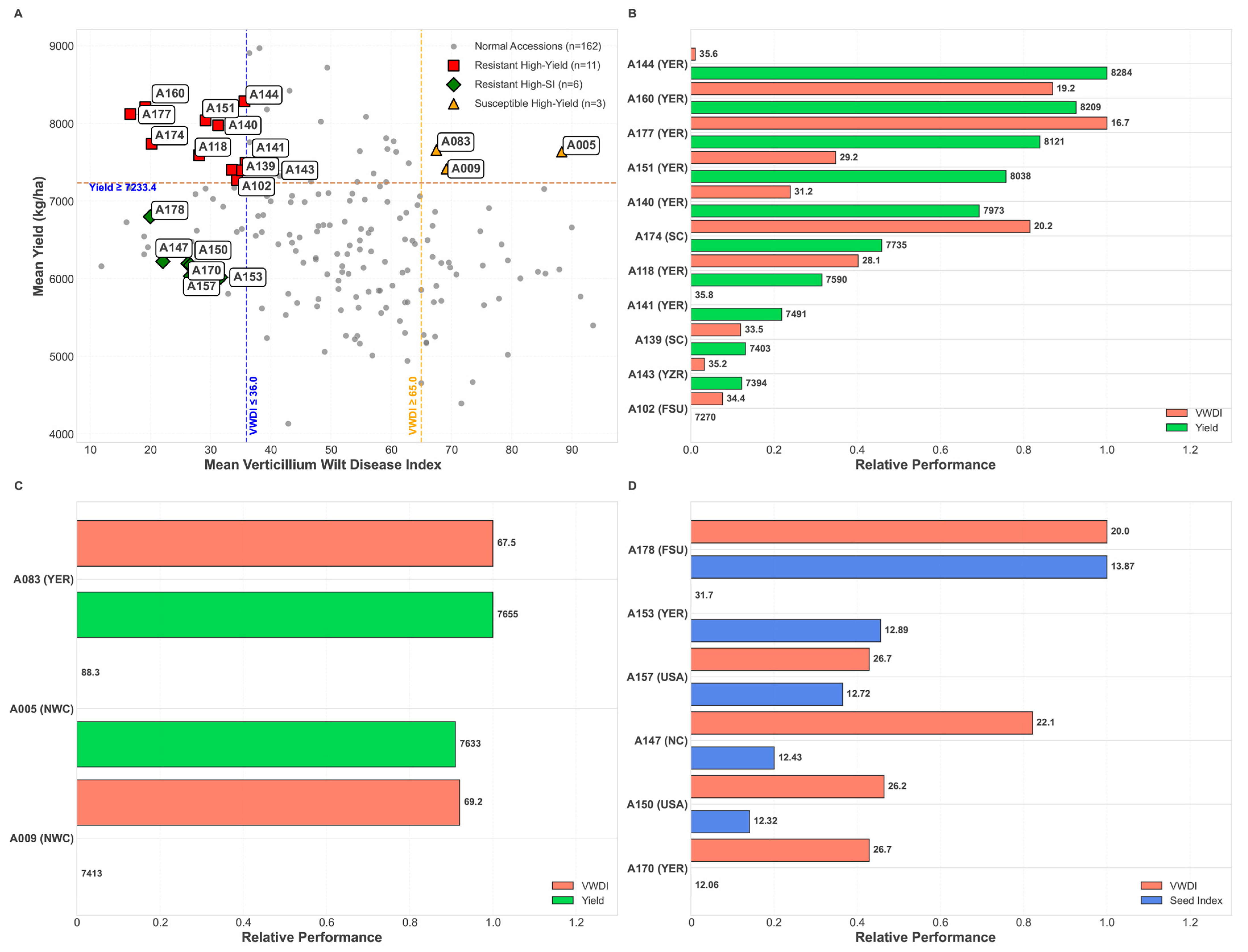
Core germplasm accessions were screened using the 20th percentile double threshold method, with screening thresholds defined for disease-resistant and high-yield, disease-susceptible and high-yield, as well as disease-resistant and high seed index germplasm, respectively: disease-resistant VWDI ≤ 35.95, disease-susceptible VWDI ≥ 65.00, high yield ≥ 7233.38 kg/ha, and high seed index ≥ 12.00.
For data visualization in each subplot, intra-group Min–Max normalization was independently applied to each type of core germplasm; trait values were linearly mapped to the range [0, 1]. The VWDI, a negative trait, was subjected to reverse normalization to ensure that the normalized values of all traits followed the rule of “higher values indicating better phenotypic performance”, thus enabling intuitive comparison of different traits.

3. Results

3.1. Descriptive Statistics and Correlation Analysis of VWDI, Yield, and SI Traits in 182 Upland Cotton Germplasm Accessions

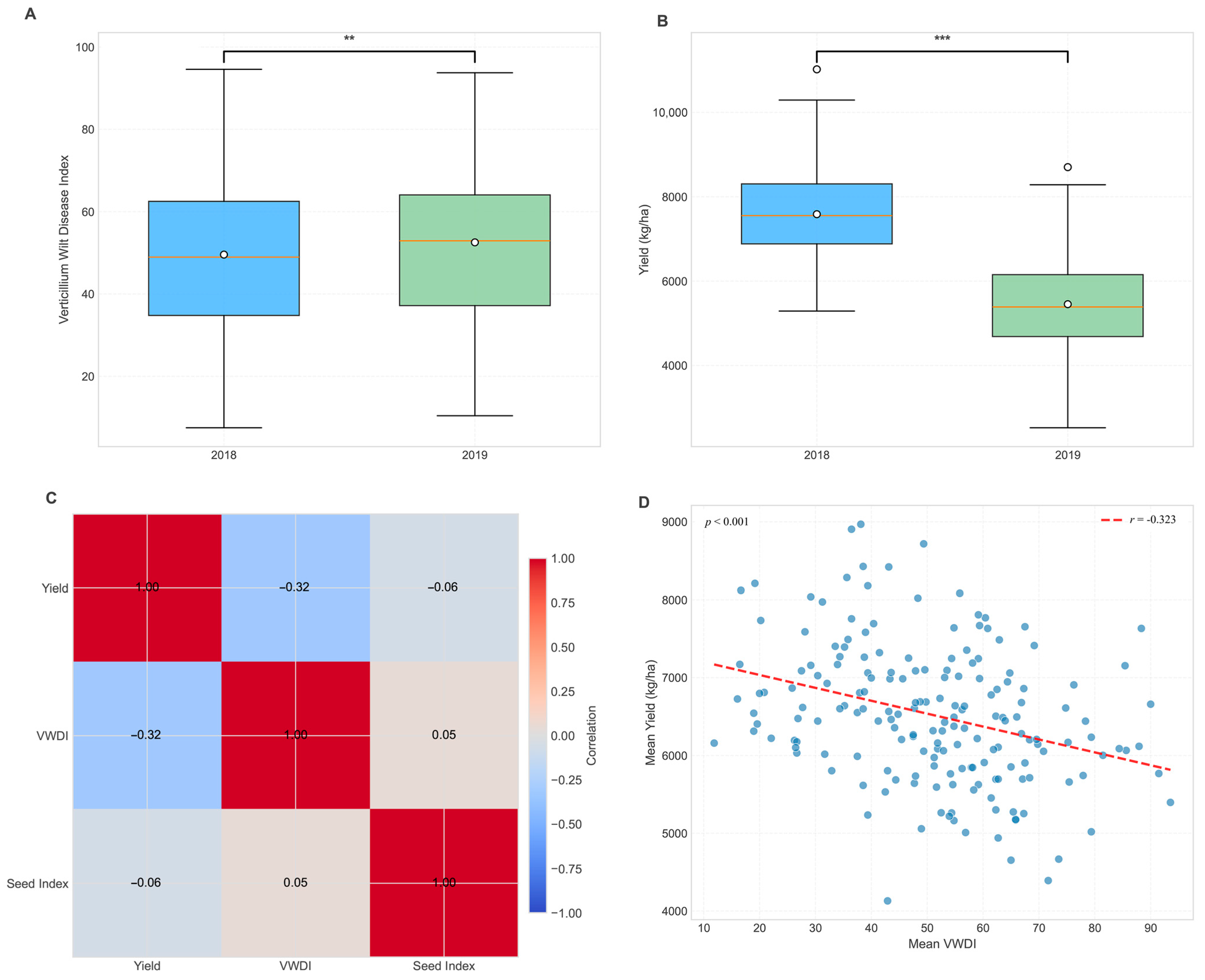
Descriptive statistical analysis was performed on three key traits, namely VWDI, yield, and seed index, of 182 upland cotton germplasm accessions (Table 1, Figure 1). The results showed that the average VWDI in 2018 was 49.57 ± 19.05, which was significantly lower than that in 2019 (52.54 ± 18.82), indicating a more severe occurrence of Verticillium wilt in the field in 2019 (Table 1, Figure 1A). In terms of yield, the average yield of the experimental materials in 2018 was 7587 kg/ha with a range of 5290–11,022 kg/ha; the average yield in 2019 was only 5453 kg/ha, a significant decrease of 28.13% compared with 2018 (Figure 1B). The distinct trait differences between the two years clearly demonstrated that the severe occurrence of cotton Verticillium wilt had a significant negative impact on yield formation. These inter-year variations may be attributed to differences in field environmental conditions, including soil moisture, temperature, and natural inoculum pressure of Verticillium dahliae in the field, which collectively affected disease development and yield performance across the two growing seasons. The SI trait exhibited high stability, with an average value of 11.13 across both years, and the lowest coefficient of variation among the three traits. This indicated that Verticillium wilt had a minor effect on SI and that this trait showed good genetic and phenotypic stability. On this basis, correlation analysis was conducted for VWDI, yield, and SI. The results revealed a strong negative correlation between VWDI and yield (r = −0.323; Figure 1C,D), whereas the correlation between VWDI and SI was weak (Figure 1C).

3.2. Effects of Different Ecological Regions and Breeding Periods on Phenotypic Differences in Cotton Germplasm

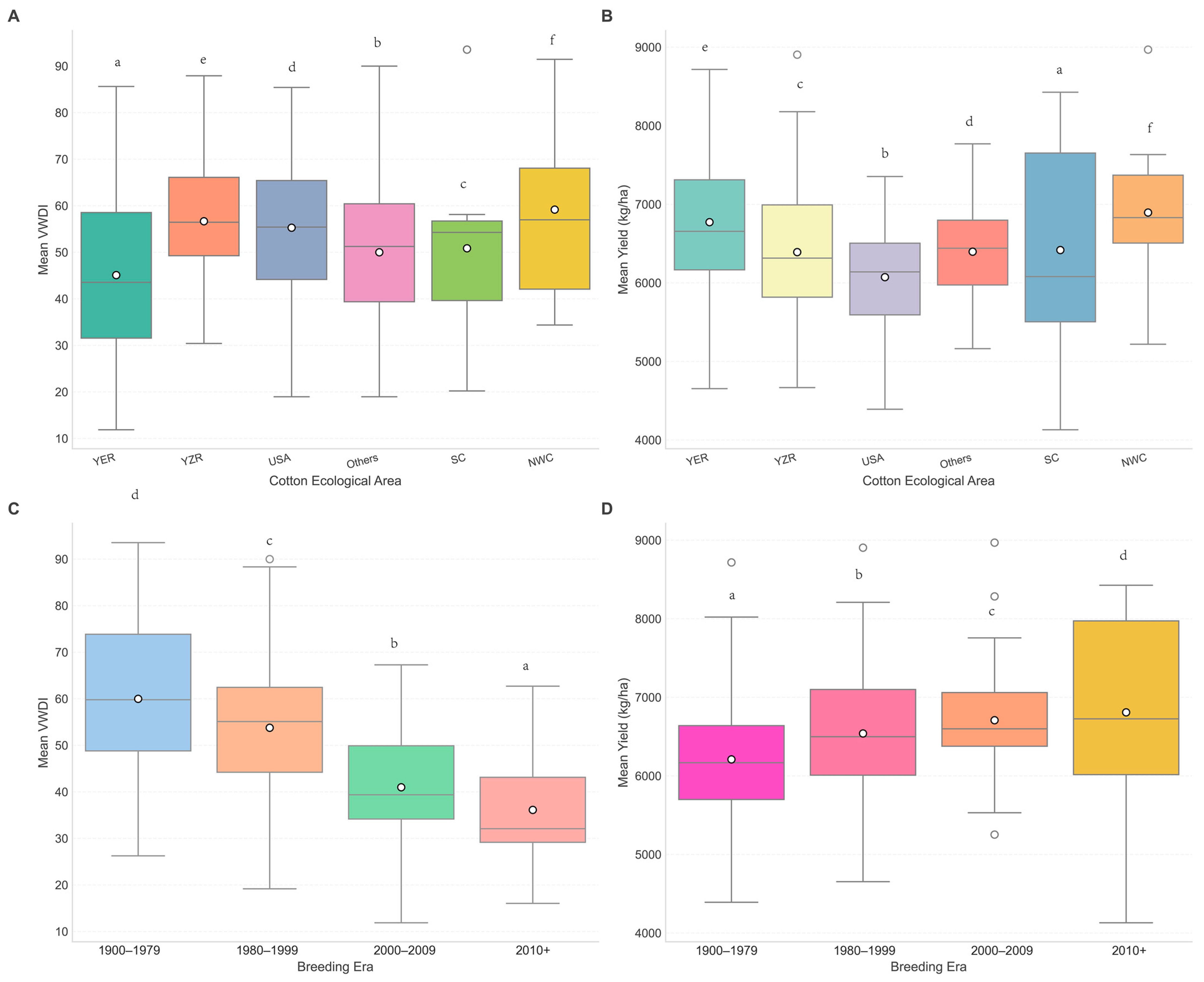
As shown in Figure 2, phenotypic differences in two key traits, VWDI and yield, were compared among different ecological regions. The results indicated that the YER had the lowest VWDI, while the NW had the highest. The ranking of VWDI from the lowest to the highest across all ecological regions was as follows: YER < Others < SC < USA < YZR < NWC (Figure 2A). In contrast, the yield performance showed an opposite trend: NWC ranked first in yield, followed by YER, while the yields in SC, USA, and YZR were relatively low (Figure 2B). Despite having the highest VWDI, NWC still achieved the highest yield, which suggested that the yield improvement potential of this region could be further explored by reducing the incidence of cotton Verticillium wilt.
Meanwhile, the variation patterns of VWDI and yield across four breeding periods (1900–1979, 1980–1999, 2000–2009, and 2010+) were analyzed in this study. The results showed that as breeding periods increased, VWDI decreased gradually, whereas yield increased continuously (Figure 2C,D), fully reflecting the remarkable progress and important breakthroughs made by Chinese cotton researchers in the prevention and control of Verticillium wilt and in cotton yield improvement.

3.3. PCA and K-Means Clustering Analysis of 182 Upland Cotton Germplasm Accessions

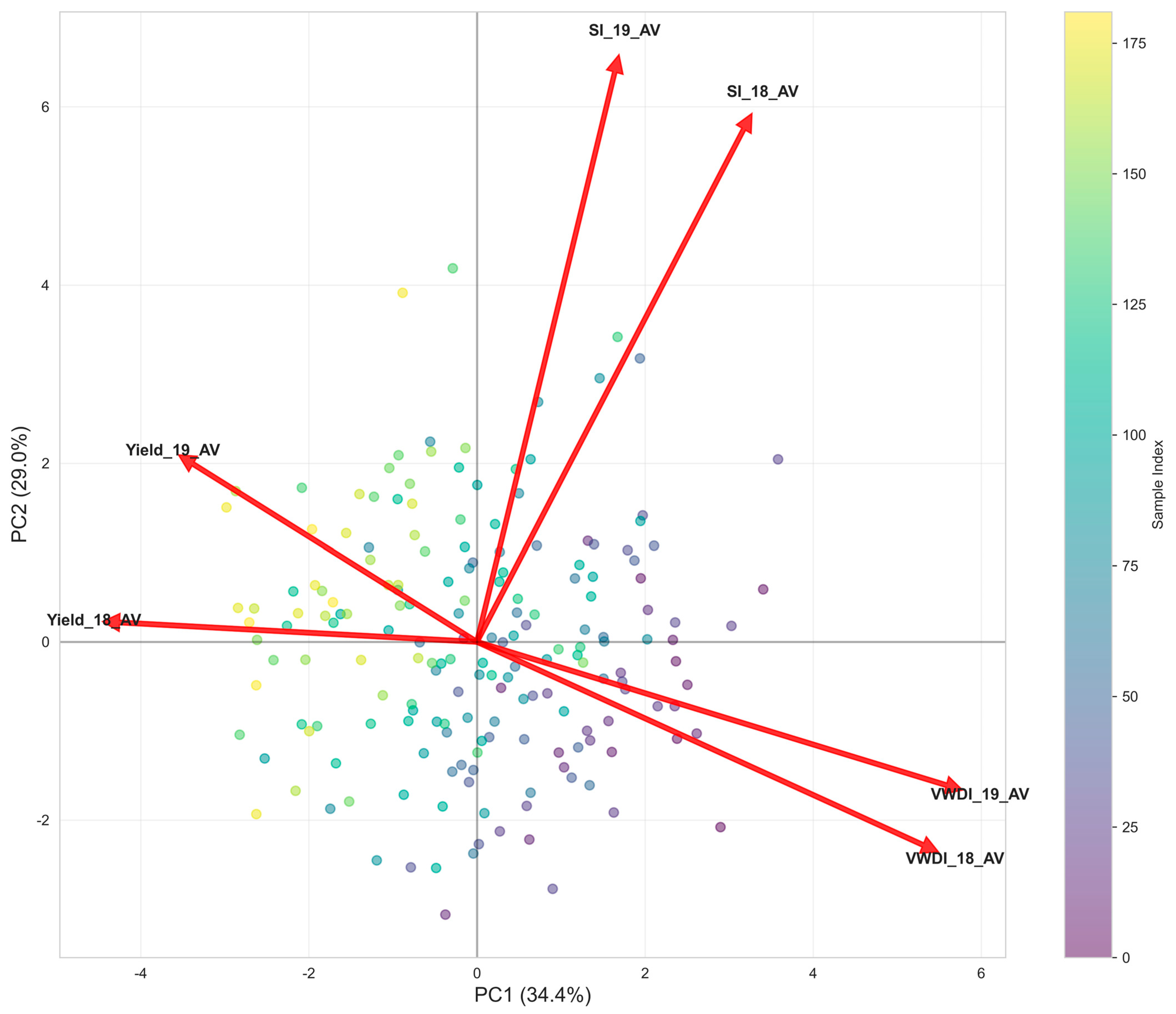
Based on three key traits (VWDI, yield, and seed index (SI)), principal component analysis (PCA) was performed on the 182 upland cotton germplasm accessions, as shown in Figure 3. The results showed that the cumulative variance explained by PC1, PC2, and PC3 was approximately 80%. Among them, PC1 accounted for 34.37% of the total variance, with major loadings on yield and VWDI; PC2 explained 28.99% of the variance, mainly associated with SI; and PC3 contributed 16.36% of the variance, also mainly associated with yield and VWDI. From the PCA biplot (Figure 3), it was intuitively apparent that the vector directions of VWDI and yield were opposite, further confirming the significant negative correlation between them (Table 2).

3.4. Screening of Core Cotton Germplasm with Disease Resistance and High Yield, Disease Susceptibility and High Yield, and Disease Resistance and High Seed Index

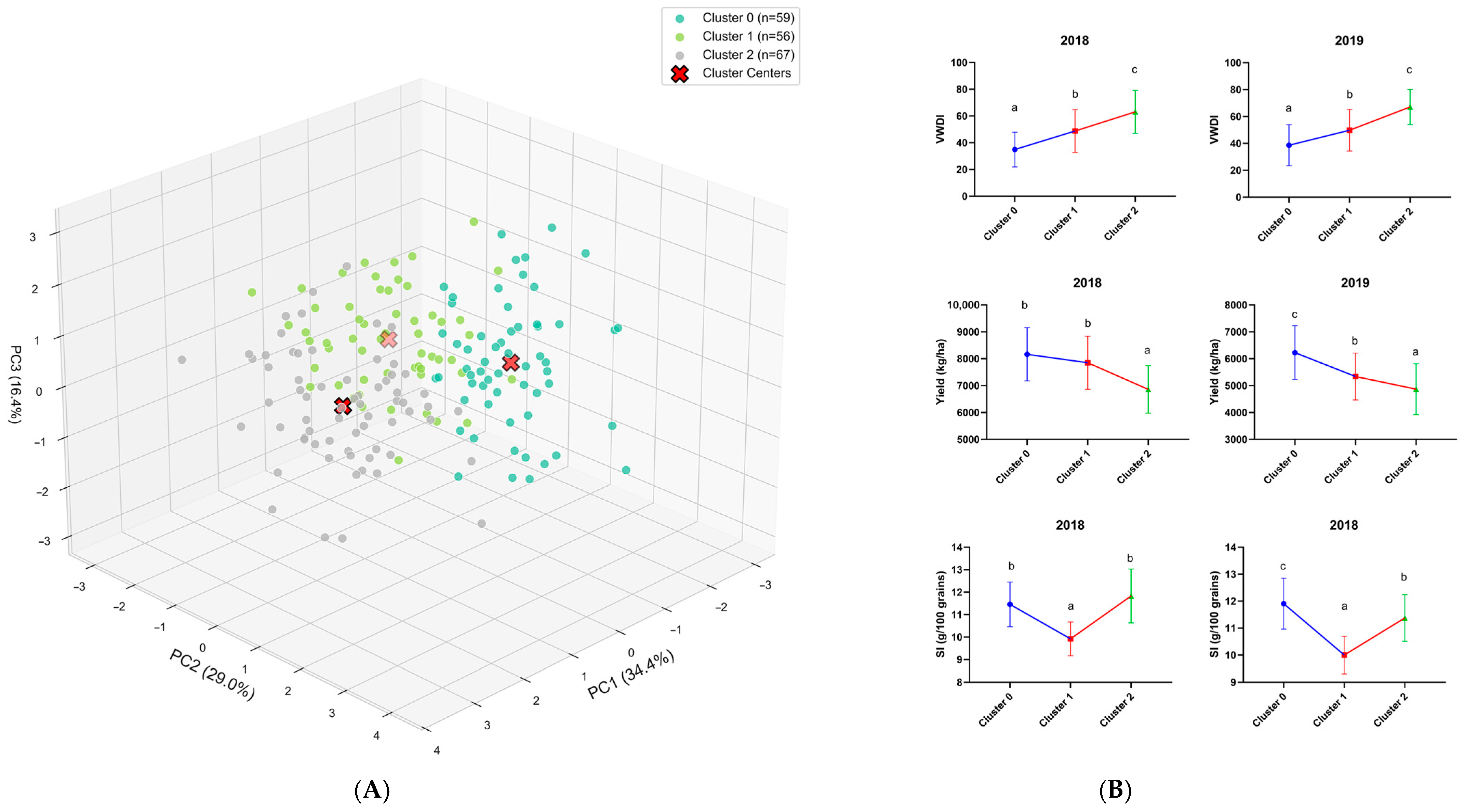
K-means clustering analysis was performed based on the three principal components (PC1, PC2, and PC3). The clustering effects of different K values were evaluated using the Calinski–Harabasz index, and the optimal number of clusters was finally determined to be K = 3 (Figure S1). The clustering results divided the 182 germplasm accessions into three clusters (Cluster 0, Cluster 1, and Cluster 2), which contained 59, 56, and 67 accessions in sequence (Figure 4A, Table S2). Further comparison of phenotypic characteristics showed that Cluster 0 was an elite cluster with disease resistance, high yield and high seed index, whose Verticillium wilt disease index in 2018–2019 was significantly lower than that of Cluster 1 and Cluster 2, while its yield and seed index were significantly higher than those of the other two clusters. Cluster 2 was a cluster with disease susceptibility, low yield, but high seed index, with the highest disease index, the lowest yield and a relatively high seed index among the three clusters. Cluster 1 was a cluster with low seed index, medium yield and disease tolerance, whose seed index was significantly lower than that of Cluster 0 and Cluster 2, and both disease index and yield were at a medium level among the three clusters (Figure 4B).
Based on the 20th percentile double threshold screening method, a total of 20 core germplasm accessions were selected from the 182 upland cotton germplasm accessions in this study, accounting for 11.0% of the total tested germplasm. These included 11 disease-resistant and high-yield core germplasm accessions, 6 disease-resistant and high seed index core germplasm accessions, and 3 disease-susceptible and high-yield core germplasm accessions (Table S3).
Among them, the 11 disease-resistant and high-yield core germplasm accessions were A102 (Bukhara 6), A118 (Jimian 17), A139 (Qian-Sandu-Dayanghua), A140 (A41772BBt), A141 (Jinmian 27 (Yuan 2918)), A143 (Xiumian 9108), A144 (Ari3697), A151 (Ji 169), A160 (Jinmian 20), A174 (Gui-Bangxu-Lu), and A177 (Jizi 64). Notably, four accessions from the Yellow River Ecological Region (YER), namely A144, A160, A177, and A151, all had a yield of over 8000 kg/ha with a Verticillium wilt disease index (VWDI) ranging from 16.7 to 35.2, representing typical elite core germplasm with disease resistance and high yield. Among these, A160 and A140 exhibited the most outstanding performance, with VWDI values as low as 16.7 and 20.2, respectively, and yields of 8209 kg/ha and 7973 kg/ha, respectively. They are core elite germplasm with high resistance to Verticillium wilt and high yield, and can be used as preferred parents for disease-resistant and high-yield breeding (Figure 5).
In addition, cotton has developed some tolerance to Verticillium wilt, and some germplasm accessions can maintain high yields even under moderate to severe infection conditions. The three disease-susceptible and high-yield core germplasm accessions screened in this study were A005 (Banong 212), A009 (Xinluzao 5), and A083 (Jimian 11). Among them, A005 from the Northwest Inland Ecological Region (NWC) performed particularly excellently: it maintained a high yield of 7633 kg/ha with an extremely high VWDI of 88.3 (severe infection), making it a typical special elite germplasm with severe disease susceptibility but high yield. A083 from YER and A009 from NWC still met the high-yield threshold under moderate infection conditions (VWDI of 67.5 and 69.2, respectively), providing unique germplasm resources for cotton breeding to improve stress resistance and high yield.
There were six disease-resistant, high seed index core germplasm accessions in total, namely A147 (Liao 4853), A150 (AC 239), A153 (Zong S9B11), A157 (M-8124-1159), A170 (Taiyuan 4), and A178 (C 6524). Among them, A178 from the Former Soviet Union (FSU) showed the best comprehensive performance, with a seed index (SI) as high as 13.87 and a VWDI of only 20.0, being a typical elite germplasm with disease resistance and high seed index. A157 and A150 from the USA, as well as A147 from the NC region, also exhibited excellent disease resistance and high seed index characteristics, and can be applied to cotton breeding for good quality and disease resistance.

4. Discussion

This study found a significantly negative correlation between cotton Verticillium wilt disease index (VWDI) and yield, consistent with previous studies [13,16,26]. Therefore, screening germplasm with both disease resistance and high yield is of great significance for cotton breeding and improvement. Based on the 20th percentile double threshold screening method, 11 elite core germplasm accessions with disease resistance, high yield, and Verticillium wilt resistance were selected in this study. These materials possess both strong disease resistance and high yield, laying a solid foundation for subsequent breeding work on the synergistic improvement of cotton disease resistance and high yield.
Notably, there exists a type of elite germplasm with a special phenotype in actual production—these germplasm accessions can maintain high yields even under moderate to severe infection conditions. Zhang et al. (2012) [27] analyzed the Verticillium wilt resistance response of cotton using factor analysis, divided 108 upland cotton cultivars (lines) into five groups, and found that Group II cultivars exhibited low Verticillium wilt resistance in both early and late growth stages but could still maintain a high yield. The three disease-susceptible, high-yielding core germplasm accessions screened in this study exhibit this characteristic. Among them, A005 from the Northwest Inland Ecological Region (NWC) is the most typical: it had an extremely high VWDI of 88.3 (severe infection) but still maintained a high yield of 7633 kg/ha. A083 from the Yellow River Ecological Region (YER) and A009 from NWC also reached the high-yield threshold under moderate infection conditions (with VWDI of 67.5 and 69.2, respectively). This indicates that disease-susceptible, high-yield germplasm also has important breeding value, providing unique genetic resources for cotton breeding for stress resistance and high yield, and is of great significance for breaking the breeding bottleneck of the “negative correlation between disease resistance and high yield”.
In the comparative analysis of germplasm from different geographical origins, this study obtained a finding with guiding significance for cotton production areas: the germplasm from the Yellow River Ecological Region (YER) had the lowest VWDI and the strongest disease resistance, but not the highest yield; in contrast, the germplasm from the Northwest Inland Ecological Region (NWC) had the highest VWDI and the most severe infection, yet ranked first in yield. This phenomenon further illustrates that disease-susceptible and high-yield germplasm has played an important role in cotton breeding practice, and also indicates that the NWC cotton region (e.g., Kuitun in Xinjiang) can further tap the potential for yield improvement by reducing the incidence of Verticillium wilt, providing a clear direction for the improvement of local cotton production.
In addition to geographical origins, the evolution of breeding periods also clearly reflects the remarkable progress of cotton breeding for disease resistance and high yield in China [28]. Across the four breeding stages from 1900–1979, 1980–1999, 2000–2009, to after 2010, the VWDI of the tested germplasm showed a continuous decreasing trend while the yield increased gradually, which intuitively reflects the continuous breakthroughs made by Chinese cotton researchers in the fields of Verticillium wilt control and yield improvement. At present, scholars at home and abroad have conducted extensive research on the resistance mechanisms to Verticillium wilt in cotton and on yield-related genes [6,29,30]. For example, Zhang et al. (2025) [6] identified 10 reliable QTLs for Verticillium wilt resistance through GWAS and found that the pyramiding of these loci could reduce the Verticillium wilt disease index from 70 to 20. Yang et al. (2026) [29] identified a new Verticillium wilt resistance locus, VWD11, using pan-genome analysis and discovered a pleiotropic gene regulating fiber strength and seed size. Liu et al. (2024) [30] identified a novel fungal virulence protein, VdTRP, containing a unique tandem repeat domain and elucidated the disease resistance mechanism by which cotton chitinase-like protein CTL1 interacts with VdTRP in the apoplast to prevent it from inducing cell death, thereby enhancing cotton disease resistance. These excellent loci and genetic resources mentioned above provide important support for molecular marker-assisted breeding of cotton for disease resistance and high yield, and they also align with the breeding practice findings of this study. In future studies, we will perform molecular validation of resistance genes (such as the VWD11 locus) in the selected core germplasms, aiming to provide a theoretical basis for germplasm innovation using traditional genetic improvement or molecular breeding technologies such as CRISPR-Cas9.
As an important by-product of cotton, cottonseed has extremely high comprehensive utilization value. It can be used for oil extraction, processing into cottonseed meal (as animal feed or crop fertilizer), and extracting cottonseed protein, gossypol, and other compounds for industrial and pharmaceutical applications. Compared with soybean oil, cottonseed oil has a more balanced fatty acid profile, lower saturated fatty acid content, higher linoleic acid content, and is rich in active compounds such as oryzanol and vitamin E, with superior food safety and nutritional value. Therefore, improving the cottonseed index trait can also enhance the potential for the comprehensive utilization of cottonseed. A total of six disease-resistant and high seed index core germplasm accessions (A147, A150, A153, A157, A170, and A178) were screened in this study, among which A178 from the Former Soviet Union (FSU) exhibited the most outstanding performance (SI = 13.87, VWDI = 20.0). These materials possess both strong disease resistance and high seed index traits, providing new parental options for synergistic breeding of cotton for high-quality fiber, strong disease resistance, and high yield, while accounting for both cotton fiber production and the comprehensive utilization value of cottonseed. In future studies, we will further conduct a systematic analysis of the fatty acid profiles of core germplasms with high seed index, in order to comprehensively evaluate their potential for oil and industrial applications.
In addition, this study performed principal component analysis (PCA) on 182 upland cotton germplasm accessions and conducted K-means clustering analysis based on the first three principal components, dividing all germplasm into three clusters. Among them, Cluster 0 is an elite core cluster with the combined characteristics of disease resistance, high yield, and high seed index. These materials can be directly used as core parents for multi-objective breeding, significantly improving breeding efficiency.

5. Conclusions

Cotton Verticillium wilt incidence in Kuitun, Xinjiang, was milder and cotton yield was higher in 2018 than in 2019, and a significant negative correlation was observed between Verticillium wilt incidence and cotton yield. Across different ecological regions, VWDI ranked from low to high as YER < Others < SC < USA < YZR < NWC, whereas the yield ranking from high to low was NWC > YER > Others > YZR > USA > SC. From the early breeding stage to the contemporary breeding stage, the cotton Verticillium wilt disease index showed a gradual downward trend, whereas yield showed a clear, continuous upward trend. Based on PCA and K-means cluster analysis, the 182 germplasm accessions were divided into three clusters: Cluster 0 was disease-resistant, high-yielding, and high in seed index (SI), Cluster 1 had low SI, moderate yield, and disease tolerance, and Cluster 2 was disease-susceptible, low-yielding, but high in SI. Furthermore, 20 core germplasms accounting for 11.0% of the total were screened out by the 20th percentile double threshold method, including 11 disease-resistant and high-yielding germplasms, 6 disease-resistant and high-SI germplasms, and 3 disease-susceptible but high-yielding germplasms; these core germplasms have obvious phenotypic advantages and can be used as high-quality parental materials for cotton breeding.

Supplementary Materials

The following supporting information can be downloaded at: https://www.mdpi.com/article/10.3390/agronomy16060603/s1, Figure S1. Evaluation of clustering effects across various K values using Calinski–Harabasz index; Table S1. Basic information of 182 Gossypium hirsutum germplasm accessions; Table S2. Cluster assignments and distances to cluster centers derived from K-means clustering (K = 3) of PC1, PC2 and PC3; Table S3. Detailed information of 20 core germplasm accessions screened using the 20th percentile double-threshold method.

Author Contributions

Conceptualization, D.H. and X.D.; methodology, D.H., S.H. and X.G.; software, D.H., H.L., S.H., Z.T., Z.P., X.G. and B.C.; validation, D.H., H.L., B.C., Z.T. and S.H.; formal analysis, D.H., L.W., Z.T., Z.P. and B.C.; investigation, Z.T. and H.L.; resources, Z.P.; data curation, X.G. and L.W.; writing—original draft preparation, D.H.; writing—review and editing, D.H., H.L. and X.D.; visualization, D.H., S.H. and L.W.; supervision, X.D.; project administration, D.H.; funding acquisition, D.H. and H.L. All authors have read and agreed to the published version of the manuscript.

Funding

The research was supported by the Project of Sanya Yazhou Bay Science and Technology City (Grant No: SCKJ-JYRC-2023-52), and the Nanfan special project, CAAS (Grant No. YBXM2547).

Data Availability Statement

The original data and contributions generated in this study are available within the article and its Supplementary Materials. All relevant queries may be addressed to the corresponding authors.

Acknowledgments

We thank the National Medium-term Genebank of Cotton Germplasm Resources, Institute of Cotton Research, Chinese Academy of Agricultural Sciences, for providing experimental seeds for this study. We also thank Doubao v8.0.0 for the language optimization and polishing of this manuscript. The authors have reviewed and edited the output and take full responsibility for the content of this publication.

Conflicts of Interest

The authors declare no conflicts of interest.

Abbreviations

The following abbreviations are used in this manuscript:
VWDIVerticillium wilt disease index
SISeed index
YERYellow River Ecological Region
YZRYangtze River Ecological Region
NWCNorthwest Inland Ecological Region
SCSouth China

References

  1. Bechere, E.; Hardin, R.G., IV; Zeng, L. Seed size, ginning rate, and net ginning energy requirement in upland cotton (Gossypium hirsutum L.). J. Cotton Sci. 2021, 25, 91–100. [Google Scholar] [CrossRef]
  2. Silva, R.V.M.M.; de Carvalho, G.G.P.; Pires, A.J.V.; Pereira, M.L.A.; Pereira, L.; Campos, F.S.; Perazzo, A.F.; de Oliveira Nascimento, C.; Santos, S.A.; Tosto, M.S.L. Cottonseed cake in substitution of soybean meal in diets for finishing lambs. Small Rumin. Res. 2016, 137, 183–188. [Google Scholar] [CrossRef]
  3. Dowd, M.K.; Pelitire, S.M.; Delhom, C.D. Seed-fiber ratio, seed index, and seed tissue and compositional properties of current cotton cultivars. J. Cotton Sci. 2018, 22, 60–74. [Google Scholar] [CrossRef]
  4. Chen, A.; Morrison, S.; Gregson, A.; Le, D.P.; Urquhart, A.S.; Smith, L.J.; Aitken, E.A.; Gardiner, D.M. Fluorescently Tagged Verticillium dahliae to understand the infection process on cotton (Gossypium hirsutum) and weed plant species. Pathogens 2024, 13, 442. [Google Scholar] [CrossRef] [PubMed]
  5. Le, D.P.; Trapero, C.; Nguyen, C.P.T.; Tran, T.T.; Gardiner, D.; Chen, A. Verticillium Wilt of Cotton: Identification and Detection of the Causal Pathogen and Its Control. Plants 2026, 15, 239. [Google Scholar] [CrossRef]
  6. Zhang, X.; Liu, S.; Wu, P.; Xu, W.; Yang, D.; Ming, Y.; Xiao, S.; Wang, W.; Ma, J.; Nie, X. A panoramic view of cotton resistance to Verticillium dahliae: From genetic architectures to precision genomic selection. iMeta 2025, 4, e70029. [Google Scholar] [CrossRef]
  7. Lu, X.; Fu, X.; Wang, D.; Wang, J.; Chen, X.; Hao, M.; Wang, J.; Gervers, K.A.; Guo, L.; Wang, S. Resequencing of cv CRI-12 family reveals haplotype block inheritance and recombination of agronomically important genes in artificial selection. Plant Biotechnol. J. 2019, 17, 945–955. [Google Scholar] [CrossRef]
  8. Zhang, Z.; Zhao, J.; Ding, L.; Zou, L.; Li, Y.; Chen, G.; Zhang, T. Constitutive expression of a novel antimicrobial protein, Hcm1, confers resistance to both Verticillium and Fusarium wilts in cotton. Sci. Rep. 2016, 6, 20773. [Google Scholar] [CrossRef]
  9. Zhu, H.; Song, J.; Dhar, N.; Shan, Y.; Ma, X.-Y.; Wang, X.-L.; Chen, J.-Y.; Dai, X.-F.; Li, R.; Wang, Z.-S. Transcriptome analysis of a cotton cultivar provides insights into the differentially expressed genes underlying heightened resistance to the devastating Verticillium wilt. Cells 2021, 10, 2961. [Google Scholar] [CrossRef]
  10. Yang, N.; Xu, C.; Liang, Y.; Zheng, J.; Geng, S.; Sun, F.; Li, S.; Lai, C.; Yusuyin, M.; Gong, Z. Comparative transcriptome and volatile metabolome analysis of Gossypium hirsutum resistance to verticillium wilt. Genes 2025, 16, 877. [Google Scholar] [CrossRef]
  11. Khan, M.; Hu, D.; Dai, S.; Li, H.; Peng, Z.; He, S.; Awais, M.; Du, X.; Geng, X. Unraveling key genes and pathways involved in Verticillium wilt resistance by integrative GWAS and transcriptomic approaches in Upland cotton. Funct. Integr. Genom. 2025, 25, 39. [Google Scholar] [CrossRef]
  12. Mammadova, R.; Akparov, Z.; Alızade, S.; Amrahov, N.; Abdulalıyeva, G. Verticillium wilt effect on fiber production and its quality traits in upland cotton (Gossypium hirsutum L.). SABRAO J. Breed. Genet. 2025, 57, 2015–2023. [Google Scholar] [CrossRef]
  13. Aguado, A.; De Los Santos, B.; Blanco, C.; Romero, F. Study of gene effects for cotton yield and Verticillium wilt tolerance in cotton plant (Gossypium hirsutum L.). Field Crops Res. 2008, 107, 78–86. [Google Scholar] [CrossRef]
  14. Avşar, Ö.; Kolay, B.; Karademir, E.; Sağır, P.; Orak, A.B. Evaluation of some cotton genotypes for resistance to Verticillium dahliae Kleb. under field conditions. Plant Prot. Bull. 2023, 63, 19–29. [Google Scholar] [CrossRef]
  15. Zhang, G.; Meng, Z.; Ge, H.; Yuan, J.; Qiang, S.; Jiang, P.a.; Ma, D. Investigating Verticillium wilt occurrence in cotton and its risk management by the direct return of cotton plants infected with Verticillium dahliae to the field. Front. Plant Sci. 2023, 14, 1220921. [Google Scholar] [CrossRef] [PubMed]
  16. Zhao, Y.; Wang, H.; Chen, W.; Li, Y. Genetic structure, linkage disequilibrium and association mapping of Verticillium wilt resistance in elite cotton (Gossypium hirsutum L.) germplasm population. PLoS ONE 2014, 9, e86308. [Google Scholar] [CrossRef]
  17. Wheeler, T.A.; Woodward, J.E. Field assessment of commercial cotton cultivars for Verticillium wilt resistance and yield. Crop Prot. 2016, 88, 1–6. [Google Scholar] [CrossRef]
  18. Xu, B.; Yang, J.; Chen, D.; Wang, X.; Ai, X.; Liu, L.; Zhao, R.; Chen, J.; Ma, X.; Li, F. Screening Verticillium wilt-resistant germplasm by monitoring the time-series chlorophyll content of cotton canopies via a UAV-based high-throughput platform. Comput. Electron. Agric. 2025, 238, 110791. [Google Scholar] [CrossRef]
  19. Li, T.; Ma, X.; Li, N.; Zhou, L.; Liu, Z.; Han, H.; Gui, Y.; Bao, Y.; Chen, J.; Dai, X. Genome-wide association study discovered candidate genes of Verticillium wilt resistance in upland cotton (Gossypium hirsutum L.). Plant Biotechnol. J. 2017, 15, 1520–1532. [Google Scholar] [CrossRef]
  20. Wilhelm, S.; Sagen, J.; Tietz, H. Resistance to Verticillium wilt in cotton: Sources, techniques of identification, inheritance trends, and the resistance potential of multiline cultivars. Phytopathology 1974, 64, 924–931. [Google Scholar] [CrossRef]
  21. Swift, M.L. GraphPad prism, data analysis, and scientific graphing. J. Chem. Inf. Comput. Sci. 1997, 37, 411–412. [Google Scholar] [CrossRef]
  22. Jolliffe, I.T.; Cadima, J. Principal component analysis: A review and recent developments. Philos. Trans. R. Soc. A Math. Phys. Eng. Sci. 2016, 374, 20150202. [Google Scholar] [CrossRef]
  23. McQueen, J.B. Some methods of classification and analysis of multivariate observations. In Proceedings of the 5th Berkeley Symposium on Mathematical Statistics and Probability; University of California Press: Berkeley, CA, USA, 1967; pp. 281–297. [Google Scholar]
  24. Iglewicz, B.; Hoaglin, D. How to Detect and Handle Outliers; ASQC Quality Press: Milwaukee, WI, USA, 1993. [Google Scholar]
  25. Caliński, T.; Harabasz, J. A dendrite method for cluster analysis. Commun. Stat.-Theory Methods 1974, 3, 1–27. [Google Scholar] [CrossRef]
  26. Paplomatas, E.; Bassett, D.; Broome, J.; DeVay, J. Incidence of Verticillium wilt and yield losses of cotton cultivars (Gossypium hirsutum) based on soil inoculum density of Verticillium dahliae. Phytopathology 1992, 82, 1417–1420. [Google Scholar] [CrossRef]
  27. Zhang, G. Analysis on the Reaction of Verticillium Wilt Resistance in Upland Cottons. J. Plant Genet. Resour. 2012, 13, 958–962. [Google Scholar]
  28. Wang, H. Review on damage of cotton fusarium and verticillium wilt in China and breeding for disease resistance. Chin. Agric. Sci. Bull. 2015, 31, 124–130. [Google Scholar]
  29. Yang, Z.; Yang, Z.; Gao, C.; Zhang, M.; Hu, G.; Yang, L.; Zhang, Y.; Ma, M.; Liu, R.; Wang, Z. Graph pan-genome illuminates evolutionary trajectories and agronomic trait architecture in allotetraploid cotton. Nat. Genet. 2026, 58, 218–229. [Google Scholar] [CrossRef] [PubMed]
  30. Liu, H.; Zhang, W.; He, Q.; Aikemu, R.; Xu, H.; Guo, Z.; Wang, L.; Li, W.; Wang, G.; Wang, X. Re-localization of a repeat-containing fungal effector by apoplastic protein Chitinase-like 1 blocks its toxicity. Nat. Commun. 2024, 15, 10122. [Google Scholar] [CrossRef]
Figure 1. Comparison and correlation analysis of VWDI and yield traits. (A) Box plots comparing VWDI between 2018 and 2019. (B) Box plots comparing yield performance between 2018 and 2019. (C) Heatmap of correlation coefficients for yield, VWDI, and seed index. (D) Scatter plot of mean VWDI vs. Mean yield. Boxplots display percentile-based distribution: boxes represent interquartile range (IQR, 25th–75th percentile), whiskers extend to 1.5 × IQR, and white circles indicate mean values. Significance levels: ** p < 0.01, *** p < 0.001.
Agronomy 16 00603 g001
Figure 2. Comparisons of VWDI and Yield traits among different ecological regions and breeding periods. (A) Box plots of mean VWDI in different cotton ecological regions. (B) Box plots of mean yield in different cotton ecological regions. (C) Box plots of mean VWDI across different breeding eras. (D) Box plots of mean yield across different breeding eras. Boxplots represent the distribution of traits (VWDI/Yield) across groups: the box denotes the interquartile range (IQR, 25th to 75th percentile), the central line is the median, and the white circle is the mean value. Whiskers extend to the minimum/maximum values within 1.5 × IQR. Lowercase letters above boxplots in those plots typically represent post hoc test results (Tukey’s HSD/Duncan’s test) for statistical significance: Groups sharing the same letter have no significant difference (p > 0.05); Groups with different letters have a significant difference (p < 0.05).
Agronomy 16 00603 g002
Figure 3. PCA biplot of PC1 and PC2 based on VWDI, yield, and SI.
Agronomy 16 00603 g003
Figure 4. Results of K-means analysis based on PC1, PC2, and PC3. (A) K-Means clustering analysis of PC1, PC2, and PC3 (K = 3); (B) Inter-cluster differences in agronomic and disease traits over years.
Agronomy 16 00603 g004
Figure 5. Screening of cotton core germplasm. (A) Scatter plot for screening core cotton accessions based on VWDI, yield, and SI. (B) Relative performance of resistant high-yield accessions. (C) Relative performance of susceptible high-yield accessions. (D) Relative performance of resistant high-Seed index accessions. Values were normalized to a 0–1 scale within the group; longer bars signify better performance. Actual trait values are shown next to each bar.
Agronomy 16 00603 g005
Table 1. Descriptive statistical analysis results of 182 upland cotton germplasm accessions.
TraitNumber of ValuesMinimumMaximumRangeMeanStd. DeviationCoefficient of Variation
Average Verticillium wilt disease index 20181827.594.5887.0849.5719.0538.44%
Average Verticillium wilt disease index 201918210.4293.7583.3352.5418.8235.81%
Average Yield 2018182529011,02257327587110114.51%
Average Yield 20191822523870361795453109720.12%
Average Seed Index 20181828.2816.067.7811.131.29811.67%
Average Seed Index 20191828.5814.245.6611.131.14710.30%
Table 2. Principal component analysis results of Yield, VWDI, and SI traits in 182 upland cotton germplasm accessions.
PCExplained Variance RatioCumulative Variance RatioLoadings_Yield_18Loadings_Yield_19Loadings_SI_18Loadings_SI_19Loadings_VWDI_18Loadings_VWDI_19
PC10.340.34−0.61−0.480.450.230.760.80
PC20.290.630.030.280.820.91−0.33−0.23
PC30.160.800.520.640.020.000.390.40
PC40.110.910.60−0.530.120.060.11−0.05
PC50.060.97−0.050.04−0.150.180.39−0.36
PC60.031.00−0.020.050.30−0.290.09−0.16
Disclaimer/Publisher’s Note: The statements, opinions and data contained in all publications are solely those of the individual author(s) and contributor(s) and not of MDPI and/or the editor(s). MDPI and/or the editor(s) disclaim responsibility for any injury to people or property resulting from any ideas, methods, instructions or products referred to in the content.