Article

Vertical LED Inter-Canopy Lighting with Stage-Specific Spectral Strategies Enhances Fruit Weight and Quality of Overwintering Greenhouse Tomatoes

1
College of Horticulture and Landscape Architecture, Tianjin Agricultural University, Tianjin 300384, China
2
Intelligent Equipment Technology Research Center, Beijing Academy of Agriculture and Forestry Sciences, Beijing 100097, China
3
College of Horticulture, Shanxi Agricultural University, Jinzhong 030801, China
*
Authors to whom correspondence should be addressed.
Agronomy 2026, 16(6), 604; https://doi.org/10.3390/agronomy16060604

Submission received: 25 January 2026 / Revised: 26 February 2026 / Accepted: 9 March 2026 / Published: 11 March 2026

Abstract

Supplemental lighting is essential for overcoming low-light stress and enabling overwintering tomato production in greenhouses. This study investigated the effects of LED supplemental lighting with different spectral qualities in the upper and lower canopy on the fruit weight and quality of tomatoes. Six treatments were established: upper-red/lower-blue (RUBL), full red (R), full blue (B), upper-blue/lower-red (BURL), red–blue mixture (RB), and a non-lit control (CK). The results demonstrated that: (1) All supplemental lighting treatments increased tomato fruit weight. During the early overwintering stage (October–December), the highest fruit weight was observed under the RB treatment, representing an increase of 22.62–24.02% compared to CK at the same truss positions. The light gain coefficient (LGC) under RB treatment reached up to 4.41 times that of other treatments. During the later phase (January–February), the BURL treatment achieved the highest LGC, reaching 1.28 to 5.30 times that of other treatments, and it increased the fruit weight by 48.2–72.88% compared to CK. (2) Regarding fruit quality, R and BURL promoted lycopene accumulation the most, followed by RB treatment. Additionally, lycopene was found positively correlated with key color parameters (a, a*/b*, CCI, and C). (3) Compared to CK, all supplemental lighting treatments increased the soluble sugar content in tomato fruits (ranging 5.36~95.35%), with the highest sugar–acid ratios typically observed under R or BURL treatments. The RB treatment yielded the highest VC levels during the later overwintering stage, exceeding the control by 29.97–39.65%. In summary, for overwintering greenhouse tomato production, application of the RB treatment during the early phase (October to December) and transition to the BURL treatment in the late phase (January to February) could be considered. This phased strategy may help achieve synergistic improvements in yield, fruit coloration, and quality.

1. Introduction

Tomatoes (Solanum lycopersicum), a high-value and light-sensitive crop, are widely cultivated in greenhouses [1]. During winter in northern China, the daily light integral (DLI) inside greenhouses exhibits a significant seasonal decline. Research indicates that the average DLI in northern China is only 5–10 mol·m−2·d−1 in December [2,3], and in severe cold regions such as Harbin, the average DLI throughout the winter is below 12 mol·m−2·d−1 [4]. During this overwintering period, the solar DLI is substantially lower than the optimal DLI range required for tomato growth and development [5]. Furthermore, the relatively deep canopy of greenhouse-grown tomato plants results in mutual shading among leaves, which exacerbates the low-light stress within the canopy. Studies have shown that persistent low-light environments inside the canopy could adversely affect both vegetative and reproductive growth of tomato plants, ultimately leading to reduced fruit size, poor coloration, bland flavor, and diminished nutritional quality—including lower levels of vitamin C and lycopene [6]. Therefore, supplemental artificial lighting is crucial for mitigating low-light stress in overwintering greenhouse tomato production. The effectiveness of LED inter-canopy lighting in mitigating low-light stress has been well documented. For instance, Tewolde et al. [7] demonstrated that night-time LED inter-lighting enhanced photosynthesis, increased yield, and improved fruit quality in single-truss tomatoes by optimizing light distribution within the middle and lower canopy. Under simulated cloudy or low-DLI conditions, Tadesse et al. [8] further confirmed that inter-canopy lighting could compensate for reductions in photosynthesis, yield, sugar accumulation, and ascorbic acid content. These findings collectively establish inter-canopy lighting as a viable strategy for alleviating low-light stress in greenhouse tomato production. Light-emitting diodes (LEDs) have been widely adopted in greenhouse crop production as a novel energy-efficient cold light source and are characterized by advantages such as low heat emission and high luminous efficiency [9].
In vegetable production, light regulates plant growth and development as well as pigment metabolism in fruits as an essential environmental signal. Plants perceive light signals through photoreceptor proteins, including phytochromes (phyA, phyB, phyC, phyD, and phyE) as red/far-red receptors, cryptochromes (cry1, cry2, and cry3), phototropins (phot1 and phot2) and members of the ZEITLUPE family (ZTL, FKF1, and LKP2) as blue/UV-A receptors [6,10,11]. These photoreceptors integrate various light signals to optimize plant growth and development. Xu et al. [12] reported that photoreceptors integrate various light signals such as blue and red light to bind directly to AUX/IAA proteins. This binding competitively inhibits their degradation by auxin receptors TIR1/AFBs, thereby stabilizing AUX/IAA proteins and suppressing ARF transcription factor activity. As a result, the process optimizes plant growth and development, including photomorphogenesis and hypocotyl elongation. Pigments are key determinants of the spectral characteristics of plants in the visible light region. The color of tomato fruits is primarily determined by the content of chlorophyll and carotenoids, such as lycopene and β-carotene. Lycopene accounts for 75–92% of the total carotenoids in tomato fruits and is more susceptible to environmental factors (e.g., light and temperature) than β-carotene [13]. Thus, a high lycopene ratio is essential for the formation of red fruits [14].
The synthesis of lycopene during fruit development and the color-turning stage was directly regulated by the light spectrum, particularly by red light [15]. Studies have shown that the biosynthesis and accumulation of carotenoids in fruits such as tomatoes and citrus were significantly promoted under red light treatment. This occurs by regulating the expression of transcription factors (e.g., the ripening transcription factor RIN in tomatoes, FcrNAC22 in citrus) and key enzyme genes (e.g., the phytoene synthase gene PSY1 and the lycopene β-cyclase gene LCYB), as well as influencing the synthesis and signaling of hormones such as ethylene and abscisic acid (ABA) [16,17,18]. XU et al. [17] demonstrated that, compared to dark conditions and blue light treatment, postharvest tomatoes subjected to red light for 7 days exhibited a significant increase in a* value and lycopene content, while also accelerating chlorophyll degradation. XIE et al. [15] found that red light application during the flowering stage significantly enhanced lycopene content compared to blue and solar light. Red light upregulated the gene expression of phytochrome-interacting factors and the transcription factor ELONGATED HYPOCOTYL 5 through phytochromes, thereby upregulating the expression of phytoene synthase 1 (PSY1) and promoting the synthesis of lycopene precursors. PSY1 expression also could be induced by blue light via cryptochromes, but this induction is less effective than that by red light. Previous studies demonstrated the regulatory effects and preliminary mechanisms of pure red or blue light on lycopene synthesis. However, mixed red and blue light was commonly used for supplemental lighting in practical production. Therefore, how the interaction between light qualities affects fruit color turning deserves attention. CHEN et al. [19] observed that compared with concurrent RB, the alternating R/B treatments increased the content of pigment in lettuce on the basis of the same daily photon amount, which may be attributed to the antagonism caused by signal crosstalk between the red and blue light signaling pathways.
Therefore, the supplementary lighting strategy with different light qualities in the upper and lower canopies can supply light according to the developmental stages of each organ, thereby optimizing light energy use efficiency and maximizing yield on the basis of an unchanged daily light integral (DLI). The spectral response of plant leaves is characterized by a distinct leaf-age dependency, which is closely associated with structural and physiological variations at different developmental stages. In young leaves, where the photosynthetic system is not yet fully developed, greater sensitivity to short-wavelength spectra such as blue light is generally observed, facilitating the establishment of the photosynthetic apparatus and morphogenic regulation. As leaves mature and photosynthetic capacity peaks, their spectral responsiveness shifts toward enhancing photosynthetic efficiency and optimizing carbon assimilation pathways. In senescing leaves, light responses are more closely related to the retardation of aging. A close association between leaf photoreceptive mechanisms and leaf age was confirmed by LI et al. [20]. Their study under low-blue-light conditions revealed that the expression levels of key regulatory factors—including GmCRY1s, GmRGAa, GmRGAb, and GmWRKY100—were significantly upregulated with advancing leaf age, thereby modulating the perception and responsiveness of leaves to light conditions. A similar age-dependent pattern was observed in Phaseolus vulgaris by DALE et al. [21], whose research indicated that photomorphogenesis predominated during the early leaf developmental stages, whereas photosynthesis progressively became the primary mechanism regulating leaf growth as the leaf matured. In continuously flowering and fruiting crops such as tomatoes, the canopy was characterized by the simultaneous presence of organs at distinct developmental stages. This indicated that a uniform light spectrum could not adequately meet the physiological requirements of all tissues. Therefore, the vertical spectral differentiation lighting strategy is expected to supply light according to the developmental stages of each organ, and the present study observed its relative advantages in improving fruit weight and quality under the experimental spectral treatments.
To achieve spatially differentiated regulation of light quality within the canopy, LEDs were identified as an ideal choice for intra-canopy lighting due to their cool-source characteristics (low surface temperature) and structural design flexibility. These traits allow for more uniform light distribution within the canopy and contribute to improved system-level light use efficiency. KUMAR et al. [22] reported that mini-cucumber yield under inter-canopy lighting treatments was increased by 22.3–30.8% compared to no inter-canopy illumination. In high-wire cucumber cultivation, Zhang et al. [23] suggested that the combined overhead and inter-canopy lighting pattern enhanced the net photosynthetic rate by 18–25% compared to overhead lighting alone. And this treatment also resulted in a more uniform PAR distribution in the middle and lower canopy. SCHIPPER et al. [24] found that the total light absorption under inter-canopy lighting treatment was higher than that under overhead lighting or combined overhead–inter-canopy lighting, indicating that inter-canopy illumination could be a more energy-efficient lighting strategy under specific conditions. Recent advances in plant factory cultivation have further emphasized the importance of light distribution optimization for tomato production. Furuta et al. [25] developed an S-shaped multilayer cultivation system that improved light utilization and fruit quality by ensuring more uniform light distribution across the canopy, highlighting the potential of innovative cultivation designs to enhance crop performance. Qiu et al. [26] compared greenhouse and LED-based plant factory systems for large-fruited tomato production, reporting that while photosynthetic efficiency was lower in plant factories, the controlled LED environment supported stable nutritional quality, particularly ascorbic acid content. These studies confirm that lighting design, including spatial arrangement and spectral composition, is a key determinant of tomato yield and quality in controlled environments.
To explore the differential light quality requirements of leaves at different canopy positions, this study developed an intra-canopy LED lighting system with independently adjustable red/blue spectra in the upper and lower canopy zones. Using this system, winter tomato cultivation experiments were conducted, and the light gain coefficient (LGC) was introduced to evaluate the percentage increase in fruit weight per 1% increase in light radiation energy under different treatments. The results provide a theoretical basis for precise light regulation in greenhouse tomato cultivation.

2. Materials and Methods

2.1. Experimental Set-Up

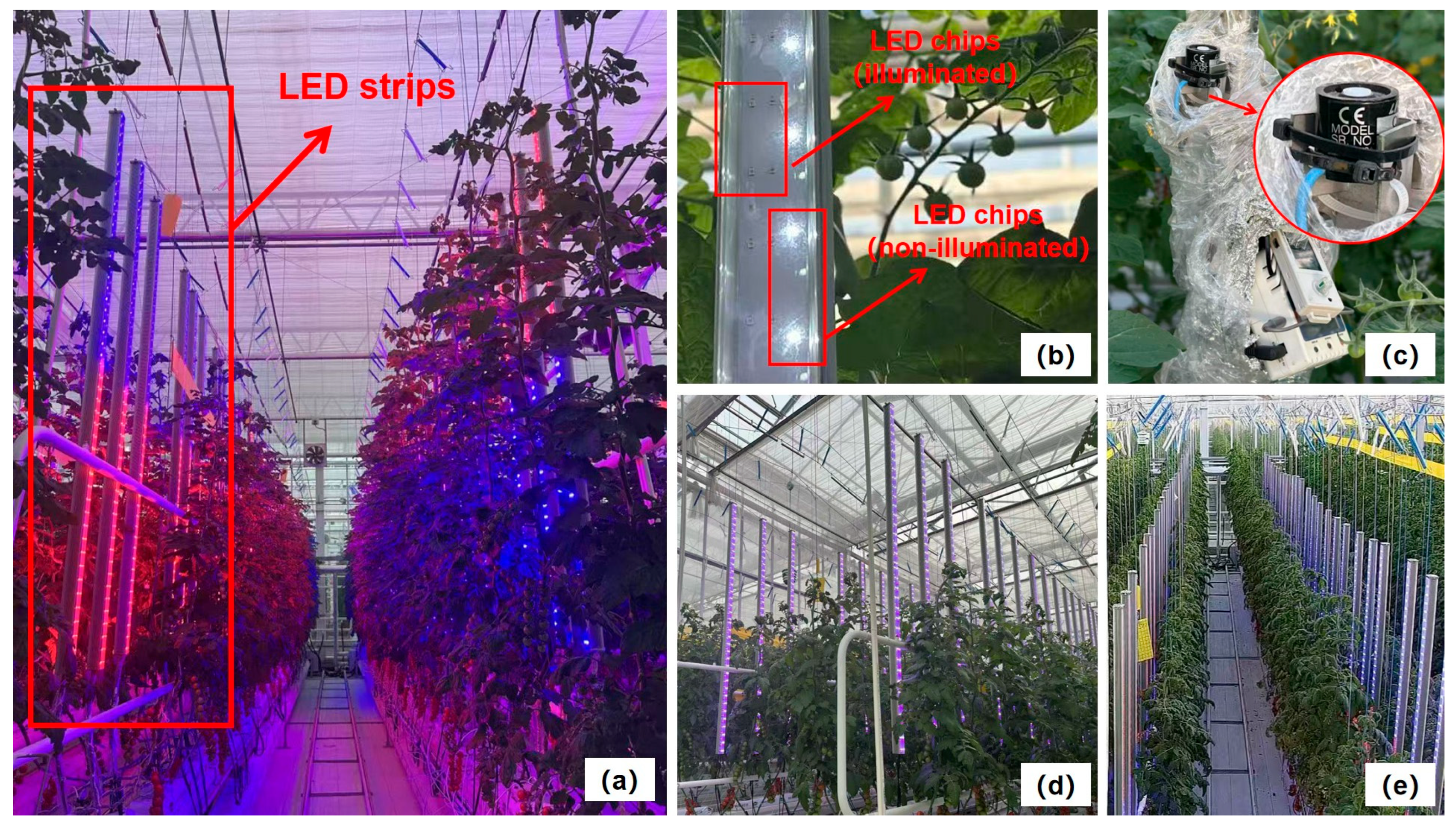
The experiment was conducted using cluster tomato plants (DAIVION, BASF Nunhems, Nunhem, The Netherlands) transplanted in August 2024 and maintained until July 2025 in a multi-span greenhouse at Beijing Shounong Cuihu Factory. A soilless cultivation system employing Forteco coconut coir slabs (Van der Knaap Groep, Nunhem, The Netherlands) was used. The supplemental light source consisted of zone-controllable, double-sided LED strips (designed by the Beijing Academy of Agriculture and Forestry Sciences, BAAFS), which were vertically installed within the plant canopy (detailed images of the LED strips and their technical specifications are provided in the Supplementary Material). These strips provided red (peak at 660 nm) and blue (peak at 450 nm) light, enabling independent regulation of light recipes for the upper and lower canopy sections to ensure uniform illumination on both sides of the plant rows. The actual installation is shown in Figure 1a,b,d,e. All tomato plants were managed with double-stem pruning, and strict fruit thinning was conducted at the young fruit stage to standardize the number of fruits per truss at 10–12, with no further fruit adjustment during the rest of the growth period. The tomato vines were lowered weekly by approximately 20 cm, allowing each fruit cluster to traverse both the upper and lower light zones during development. Throughout the experiment, the time spent in each light zone was kept consistent across all clusters: fruit set and expansion occurred in the upper zone, whereas color transition and ripening took place in the lower zone.
Light treatments were initiated on 24 October 2024, with daily supplemental lighting provided for 8 h (9:00–17:00). This specific timing was selected because: (1) it coincides with the peak period of natural solar radiation and the highest diurnal photosynthetic activity of tomato plants, facilitating synergistic use of light energy while avoiding circadian rhythm disruption; (2) it conforms to standard operational practices of commercial greenhouses in northern China, ensuring that the experimental results are relevant to industrial production conditions. Six treatments were established: upper-red/lower-blue (RUBL), full red (R), full blue (B), upper-blue/lower-red (BURL), 1:1 red–blue mixture (RB), and a non-lit control (CK).
This experiment adopted a Completely Randomized Block Design (CRBD) in a multi-span greenhouse. The greenhouse was longitudinally divided (east–west direction) into 3 independent biological replicate blocks. Six lighting treatments were randomly assigned to each block, resulting in a total of 18 experimental plots (3 blocks × 6 treatments). Each plot contained 60 tomato plants, with 60 corresponding vertical LED strips configured.
The LED strips were installed vertically along the plant rows. Since each tomato plant was subjected to double-stem pruning, the strips were mounted at the middle position of each plant. Three tomato plants were grown on each coconut coir slab (approximately 1 m in length), with 3 LED strips correspondingly configured, and the spacing between adjacent strips in the same group was approximately 40 cm. All strips were fixed at a uniform vertical height, and the distance from the bottom of the strips to the surface of the coconut coir slabs was consistently maintained at 80 cm throughout the experiment.
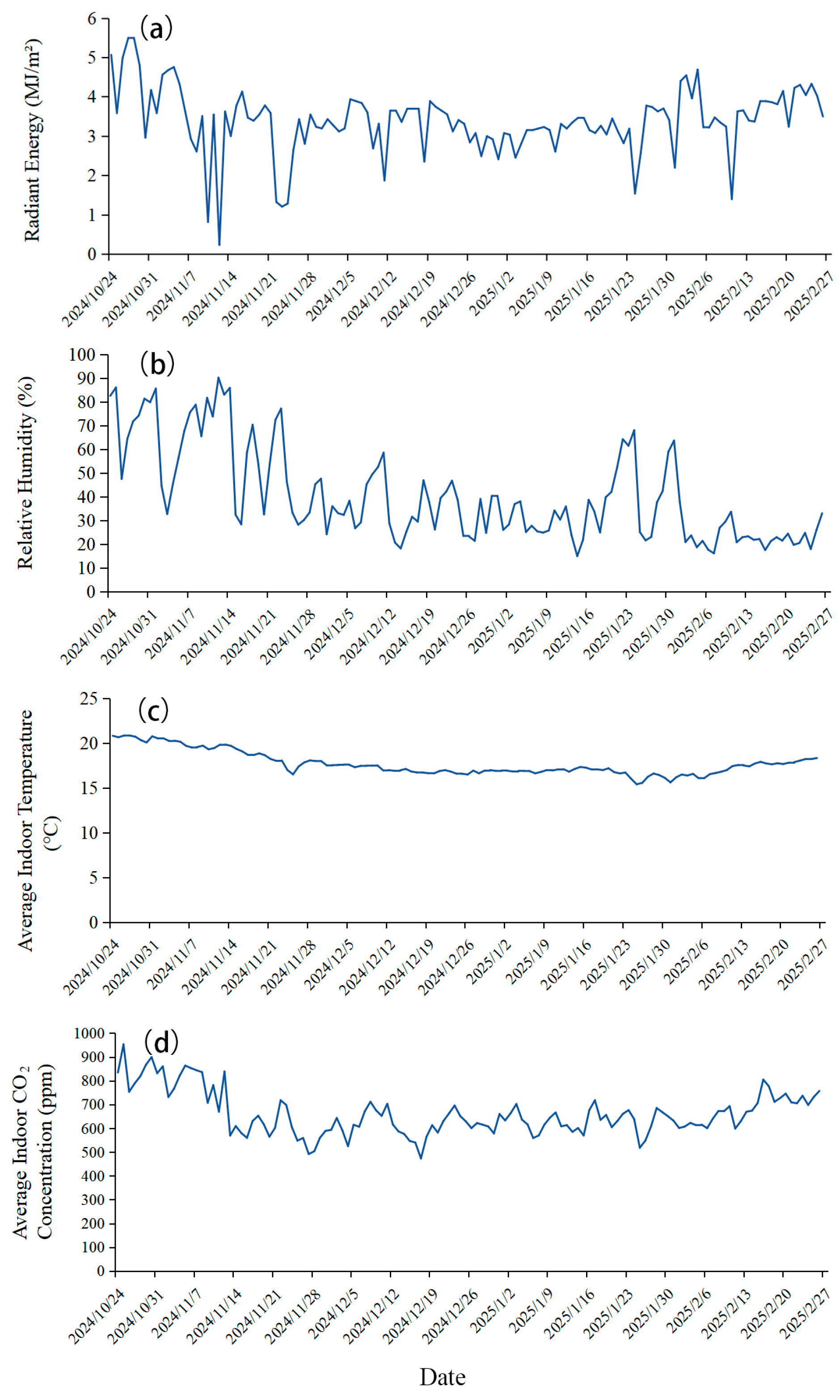
The photosynthetic photon flux density (PPFD) was set at 100 μmol·m−2·s−1 and measured at 15 cm from the light source using an LI-250A light meter (LI-COR Biosciences, Lincoln, NE, USA). In practice, the distance between the plants and LED bars varied from 10 to 25 cm due to vine growth and weekly lowering. To ensure consistent light exposure, PPFD was periodically measured at multiple vertical positions (upper, middle, and lower) within the canopy. Measurements confirmed that PPFD fluctuated within the target range of 90–110 μmol·m−2·s−1, indicating a relatively uniform distribution. Solar DLI was obtained using sensors (LI-COR quantum, shown in Figure 1c) deployed at the mid-canopy leaf position. The variation in radiation during the experimental period is shown in Figure 2a. In addition, the average indoor temperature, relative humidity, and CO2 concentration during the experiment are shown in Figure 2b, Figure 2c and Figure 2d, respectively.
Given the vertical installation of the LED light bars and the uniform illumination on both sides of the plant rows, it was assumed that the daily light integral (DLI) received by all fruit truss during the supplemental lighting period was comparable and consistent. The supplemental DLI for each treatment was calculated based on a fixed photoperiod of 8 h and a PPFD of 100 μmol·m−2·s−1, resulting in a daily supplemental DLI of 2.88 mol/m2. The fruit development period from flowering to maturity was considered to be 42 days (the data were provided by the greenhouse management staff), and the DLI of solar light for each truss was calculated based on the average DLI of solar light 42 days before the harvest of fruits per truss (shown in Table 1).
The light gain coefficient (LGC) was defined as the percentage of fruit weight increase for each 1% increase in light radiant energy. For example, if the fruit weight increased by 2% with a 1% increase in light radiant energy, the LGC would be equal to 2. The calculation formula for LGC was as follows:
LGC = (Fruit weight increase) %/(Supplemental DLI/Solar Light DLI) %

2.2. Sampling and Biometric Measurements

Fruit sampling was conducted on 5 and 26 December 2024, and 16 January, 6 February, and 27 February 2025, corresponding to the 5th, 8th, 11th, 14th, and 17th trusses, respectively. The complete developmental period from flowering to mature harvest was considered to be 42 days. For every treatment of 36 plants, 20 tomato fruits randomly selected from each truss served as one replication, and each treatment had three replications.
The fresh weight (FW) of tomato fruit was measured by an electronic balance. A vernier caliper was used to measure the transverse and longitudinal diameters of the tomatoes, respectively. The volume calculation formula is as follows:
V = ( 1 / 6 ) π   H D 2
H represents the longitudinal diameter, and D represents the transverse diameter.
The samples used to measure the contents of vitamin C, lycopene, soluble sugar, and titratable acid were frozen with liquid nitrogen and stored at −80 °C in an ultra-low-temperature freezer.

2.3. Determination of Chlorophyll Fluorescence

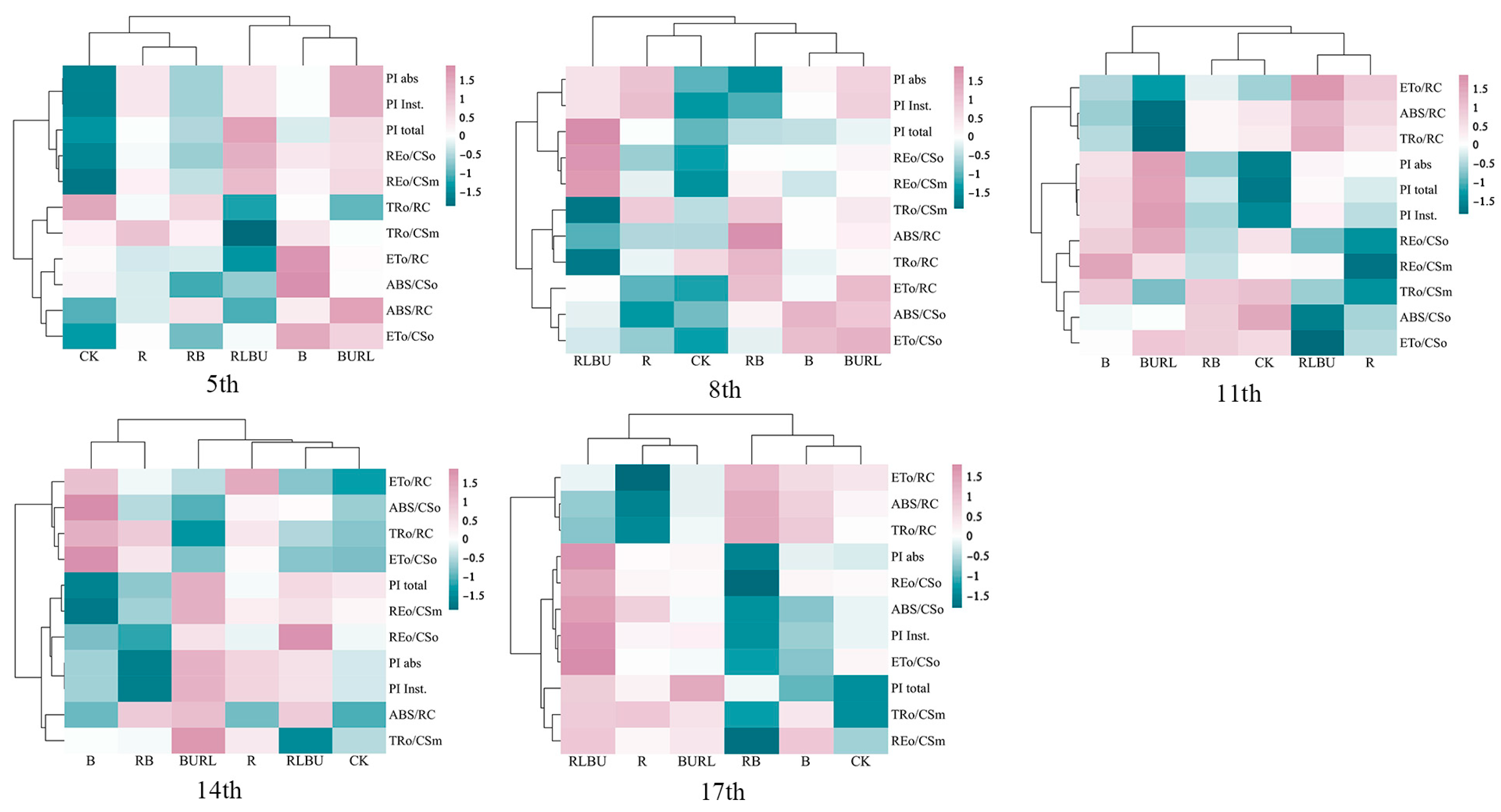
Chlorophyll fluorescence parameters were determined on 5 and 26 December 2024, and 16 January, 6 February, and 27 February 2025. For each measurement, the middle section of leaves adjacent to the 5th, 8th, 11th, 14th, and 17th trusses of tomato fruit was selected. Measurements were conducted between 9:00 and 11:00 AM using a Handy-PEA (Hansatech Instruments Ltd., King’s Lynn, UK) continuous-excitation fluorometer. The rapid chlorophyll fluorescence induction kinetics (OJIP transient) were recorded, and the following fluorescence parameters were derived through JIP-test analysis: performance index on absorption basis (PI abs), synthesis performance index (PI total), instantaneous performance index (PI Inst.), absorbed energy per reaction center (ABS/RC), trapped energy per reaction center (TRo/RC), energy for electron transport per reaction center (ETo/RC), absorbed energy per standard cross-section (ABS/CSo), energy for electron transport per standard cross-section (ETo/CSo), energy for reduction per standard cross-section (REo/CSo), trapped energy per maximal cross-section (TRo/CSm), and energy for reduction per maximal cross-section (REo/CSm).

2.4. Color Parameter Determination

Color parameters of each fruit were measured using a spectrophotometer (YS3010, Shenzhen San’enshi Technology Co., Ltd., Guangzhou, China), with three distinct points along the equatorial line being selected for measurement. The instrument was employed to determine fruit coloration and reflectance across the 400–700 nm spectral range. Measurements included the luminance, L* (higher values indicate greater brightness); red saturation, a* (higher values indicate deeper red color); and yellow saturation, b* (higher values indicate deeper yellow color).
Spectral data were processed to derive the following indices: Chroma (C), hue angle (Hue), color contribution index (CCI), color ratio (a*/b*), Photochemical Reflectance Index (PRI), red/green ratio, and Modified Chlorophyll Absorption Ratio Index (MCARI). Higher C values indicate greater color saturation in tomatoes. The Hue angle reflected fruit coloration, with larger values indicating greener fruits and smaller values indicating redder fruits. The CCI represents the red intensity normalized by fruit lightness and yellowness. Higher CCI values indicate more vivid red coloration, as it increases with a* (redness) and decreases with L* (lightness) and b* (yellowness). The a*/b* ratio was used as a comprehensive color index. PRI was used to assess the carotenoid-to-chlorophyll ratio, and the red/green reflectance ratio indicated the anthocyanin-to-chlorophyll ratio. MCARI was used to monitor chlorophyll content dynamics.
The calculation formula was as follows. In the following formulas, Rxxx represents the light reflectance (%) measured at the specific wavelength of xxx nm.
Hue = tan−1 (b*/a*)
C = a * 2 + b * 2
CCI = 1000 a*/L* b*
Color ratio = a*/b*
PRI =   R 531 R 570 R 531 + R 570
Red Green = 600 699 R ( λ ) d λ 500 599 R ( λ ) d λ
MCARI = [(R700 − R670) − 0.2 (R700 − R550)](R700/R670)

2.5. Determination of Vitamin C, Lycopene, Soluble Sugar, and Titratable Acid

Frozen samples (1.0 g) of tomato fruit were accurately weighed and homogenized in liquid nitrogen. The homogenized powder was separately mixed with 5 mL of 80% (v/v) aqueous ethanol solution. For the extraction of soluble sugars and lycopene, the mixtures were incubated in an 80 °C water bath for 30 min. For vitamin C analysis, extraction was performed at room temperature to prevent degradation. After incubation, the extracts were centrifuged at 12,000× g and 4 °C for 10 min. The resulting supernatants were collected for subsequent biochemical analyses. All assays were performed according to the instructions provided with the commercial assay kits (Shanghai C-Reactive Biotechnology Co., Ltd., Shanghai, China).
Vitamin C (L-Ascorbic Acid) Content: The vitamin C content was quantified using a spectrophotometric assay kit based on the reduction of phosphomolybdate to phosphomolybdenum blue by ascorbic acid, which produces a blue complex measured at 760 nm [27].
Lycopene Content: The lycopene content was determined using a spectrophotometric assay kit. The supernatant was appropriately diluted with an organic solvent (e.g., acetone–hexane mixture), and the absorbance of lycopene was measured at 471 nm [28].
Soluble Sugar Content: The soluble sugar content was measured using a spectrophotometric assay kit based on the anthrone–sulfuric acid method. Soluble sugars react with anthrone in concentrated sulfuric acid to generate a blue–green complex, the intensity of which is measured at 620 nm [29].
Titratable Acidity: Titratable acidity was determined following the Official Methods of Analysis of AOAC INTERNATIONAL [30]. Samples were titrated with 0.1 M NaOH to an endpoint of pH 8.2, using phenolphthalein as an indicator.

2.6. Statistical Analysis

The data were confirmed by the Shapiro–Wilk test to follow a normal distribution (p > 0.05), and the Levene test confirmed the homogeneity of variance (p > 0.05). Data analysis was performed using individual fruit trusses as the experimental unit (n = 3). For comparisons among treatments within each truss, one-way analysis of variance (ANOVA) was applied with SPSS statistical software (IBM SPSS Statistics 27.0). Differences among mean values were determined using Tukey’s multiple range test at a significance level of 0.05. Origin 2021 was used for graphing.

3. Results

3.1. Diameter and Volume of Tomato Fruit Under Different Light Supply Modes

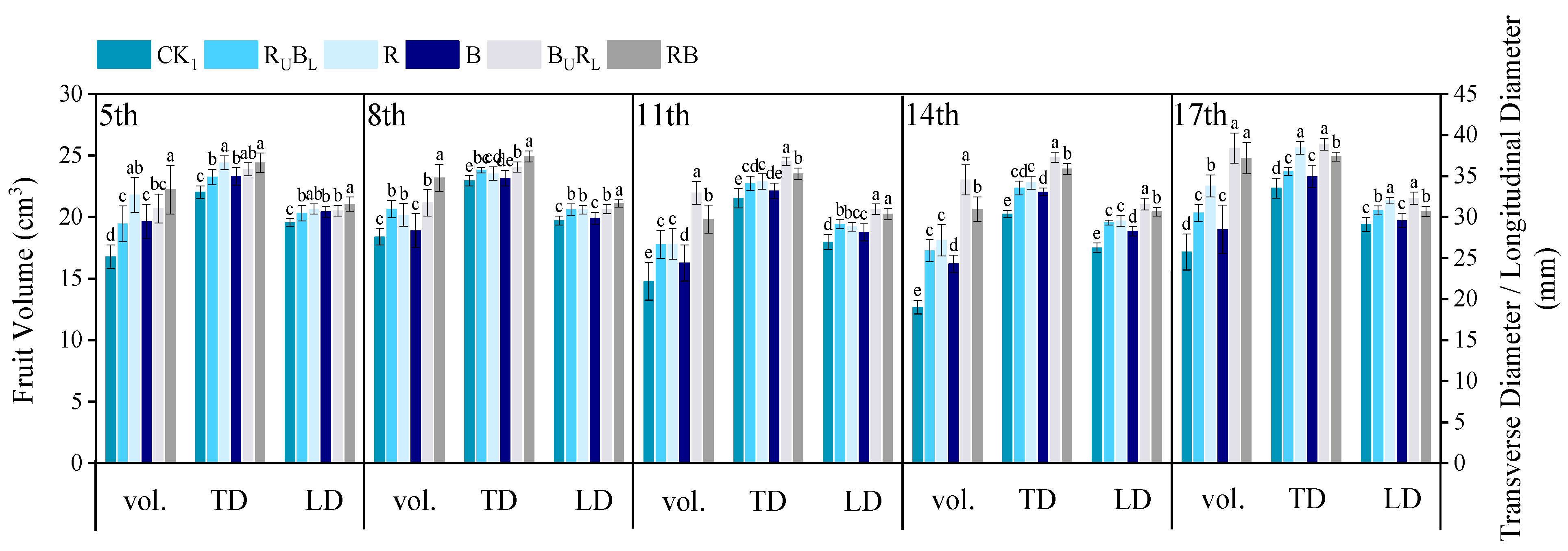
As shown in Figure 3, the transverse diameter, longitudinal diameter, and volume of tomato fruits were enhanced when subjected to all light treatments compared with the control (CK) at the same fruit truss position. Tomato fruits at the fifth and eighth trusses exhibited robust growth under BURL, RB, and R treatments, with minimal differences among them. Starting from the 11th truss, the BURL treatment demonstrated a clear advantage, yielding the largest transverse diameter, longitudinal diameter, and volume in the 11th, 14th, and 17th trusses. The maximum increases across all trusses and treatments were observed at the 14th truss under BURL, with the transverse diameter, longitudinal diameter, and volume increasing by 22.85%, 20.25%, and 81.55%, respectively.

3.2. Fruit Weight of Tomatoes Under Different Light Supply Modes

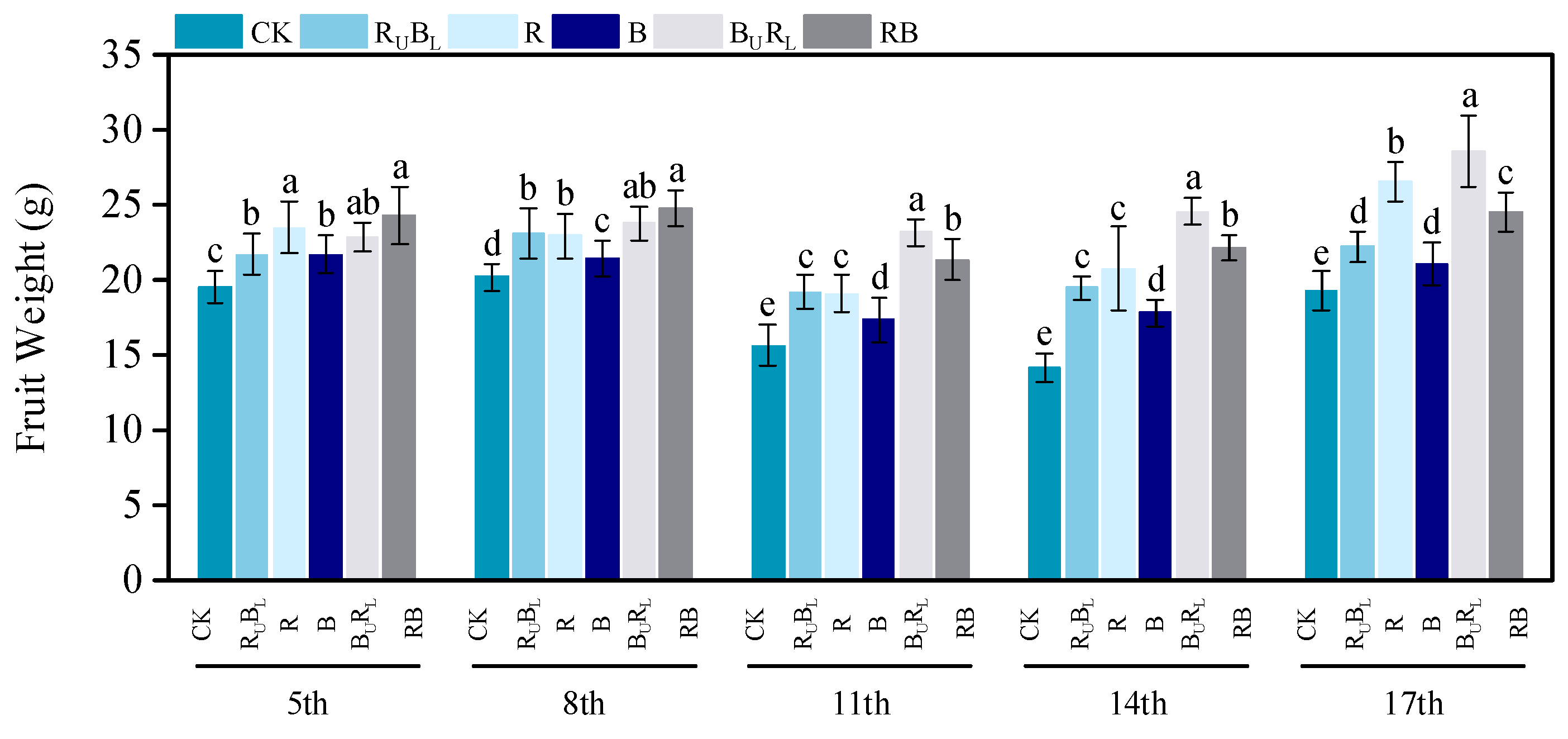
As shown in Figure 4, compared with CK, the fruit weights of tomatoes at five trusses were all increased under supplemental light treatments. Analysis of different truss positions revealed minimal differences among the light treatments at the fifth and eighth trusses. However, the differences became pronounced starting from the 11th truss. The highest fruit weight was observed under BURL treatment, with increases of 48.18%, 72.88%, and 48.21% over CK at the 11th, 14th, and 17th trusses, respectively.
Furthermore, the fruit weight at the 11th and 14th trusses showed an overall declining trend across treatments. This is likely attributable to insufficient light conditions during their growth period. Notably, unlike other light treatments, the BURL treatment prevented this low-light-induced weight reduction at these two trusses, with no marked difference in fruit weight compared to those at other positions within the same treatment. In contrast, CK exhibited a notable decrease in fruit weight at the 11th and 14th trusses relative to the others. These results indicated that the BURL treatment could effectively mitigate the impact of low-light stress, maintaining relatively stable fruit weight across all trusses. Conversely, fruit weight under R treatment exhibited considerable fluctuations under the same weak light conditions. Additionally, B treatment demonstrated the poorest efficacy in enhancing fruit weight, with increases of only 6.09% to 25.40% compared to CK across the five trusses.

3.3. The Light Gain Coefficient (LGC) of Tomatoes Under Different Light Supply Modes

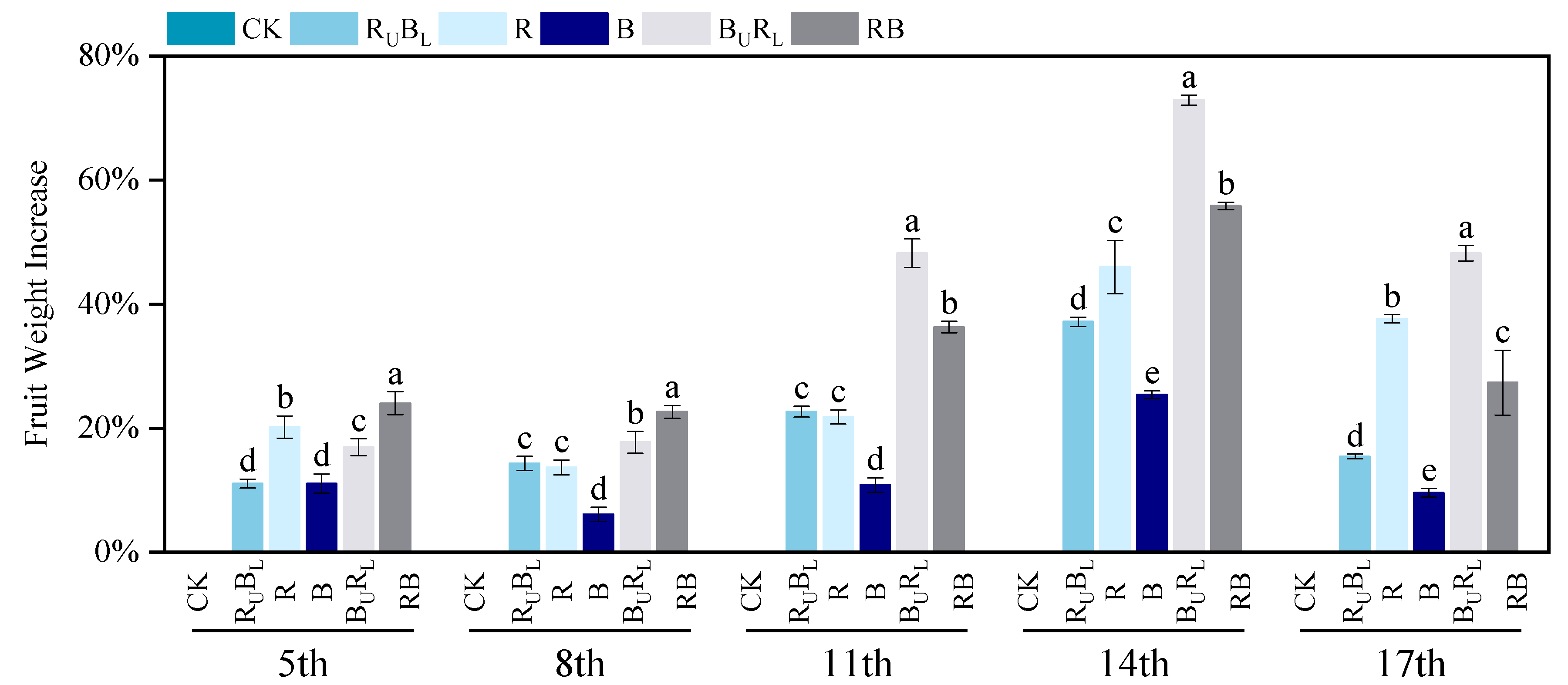
Figure 5 shows that, in the early stage of light treatment (fifth and eighth trusses), the RB treatment was observed to have the best promoting effect, with an increase ranging from 22.62% to 24.02%. In the later stage (11th, 14th, and 17th trusses), however, the enhancing effect of the BURL treatment was found to surpass that of RB. This shift may be attributed to an adaptive change in the tomato plants’ requirement for light quality under persistent low-temperature and low-light stress. The BURL treatment exhibited the optimal yield-increasing effect during the developmental stages of the 11th and 14th trusses, with the fruit weight increasing by 48.20% and 72.88%, respectively, compared to CK. In terms of the overall fruit weight changes among five trusses, an inverse pattern was observed between the magnitude of increase in fruit weight and the absolute fruit weight across the five trusses. The greatest increase in fruit weight was recorded under the most severe weak-light stress (11th and 14th trusses), which contrasted with the “decline–recovery” trend of absolute fruit weight shown in Figure 3.
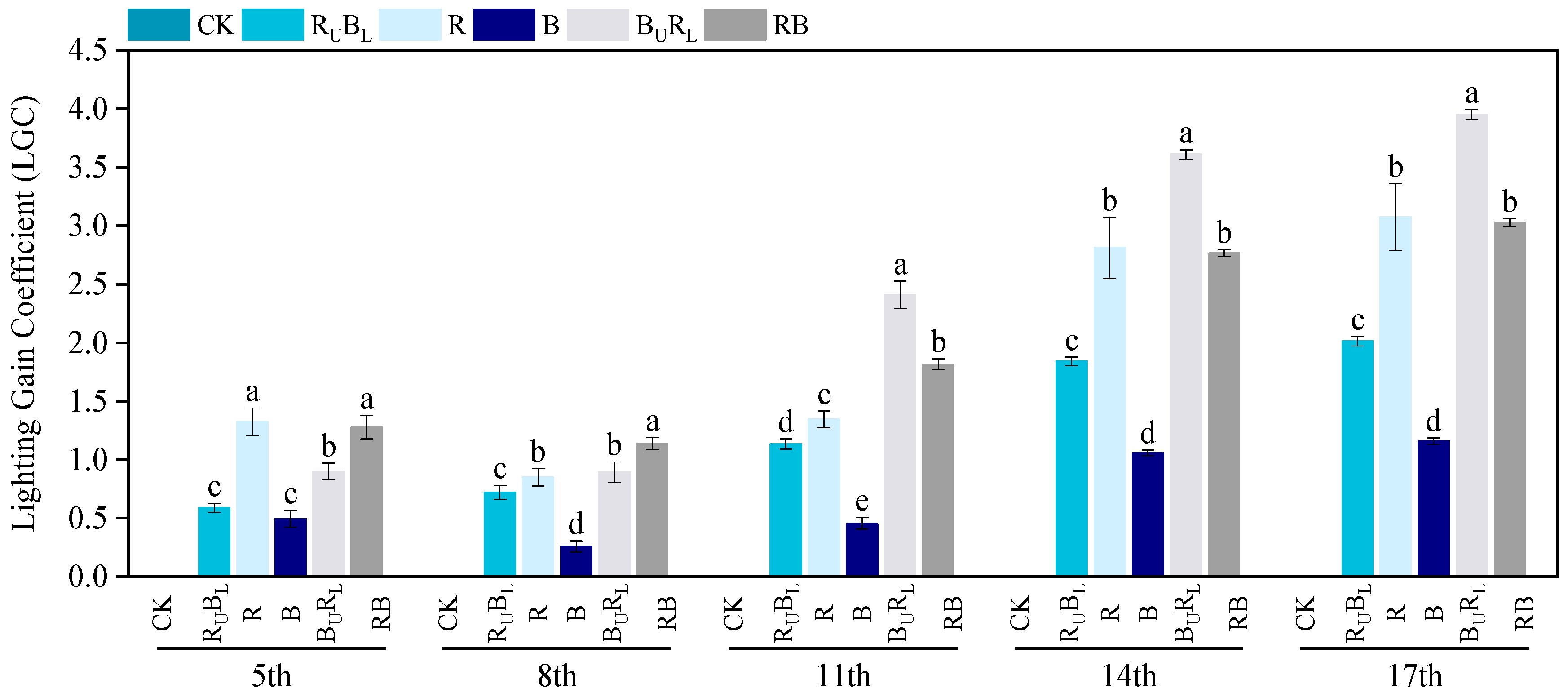
As shown in Figure 6, the light gain coefficient (LGC) generally exhibited an overall increasing trend with ascending truss positions, and significant differences were observed among different light treatments at the same truss position. During the early supplemental lighting phase, the RB treatment was identified as the most effective in enhancing LGC, with values for the fifth and eighth trusses reaching up to 4.41 times those of the other treatments. In the later phase, the BURL treatment demonstrated superior effectiveness, achieving LGC values 1.28 to 5.30 times higher than the other treatments. The highest LGC was detected under the BURL treatment in the 17th truss, which is likely attributable to the varying accumulative effects of different light spectra on the vegetative organs (leaves) of tomato plants, with this treatment exerting a stronger promotive effect on the leaves.

3.4. Coloring Parameters and Simulated Colors of Tomato Fruit Under Different Light Supply Modes

As shown in Table 2, compared with CK at the same truss positions, the a* of tomato fruits were generally increased under all supplemental lighting treatments, while the b* and Hue were generally decreased. The R and BURL treatments were more effective than other treatments in enhancing a*, and the simulated color of tomato fruits under these two treatments appeared reddest. Under the R treatment, the fifth and eighth trusses showed the greatest increase in a*, which were elevated by 16.37% and 14.03%, respectively, compared to CK. In contrast, the BURL treatment performed best on the 11th, 14th, and 17th trusses, with a* increased by 42.80%, 53.12%, and 66.95%, respectively, compared to CK. Furthermore, the 17th truss under the BURL treatment exhibited the largest reductions in b* and Hue, which were significantly decreased by 28.01% and 36.41%, respectively, compared to CK. Under the B treatment, relatively lower a* values were also observed compared to other treatments, and the fruit coloration tended to be yellowish green. These results indicated that both R and BURL light patterns promoted the accumulation of red pigments in tomato fruits, leading to more pronounced red coloration of the fruit peel at maturity.

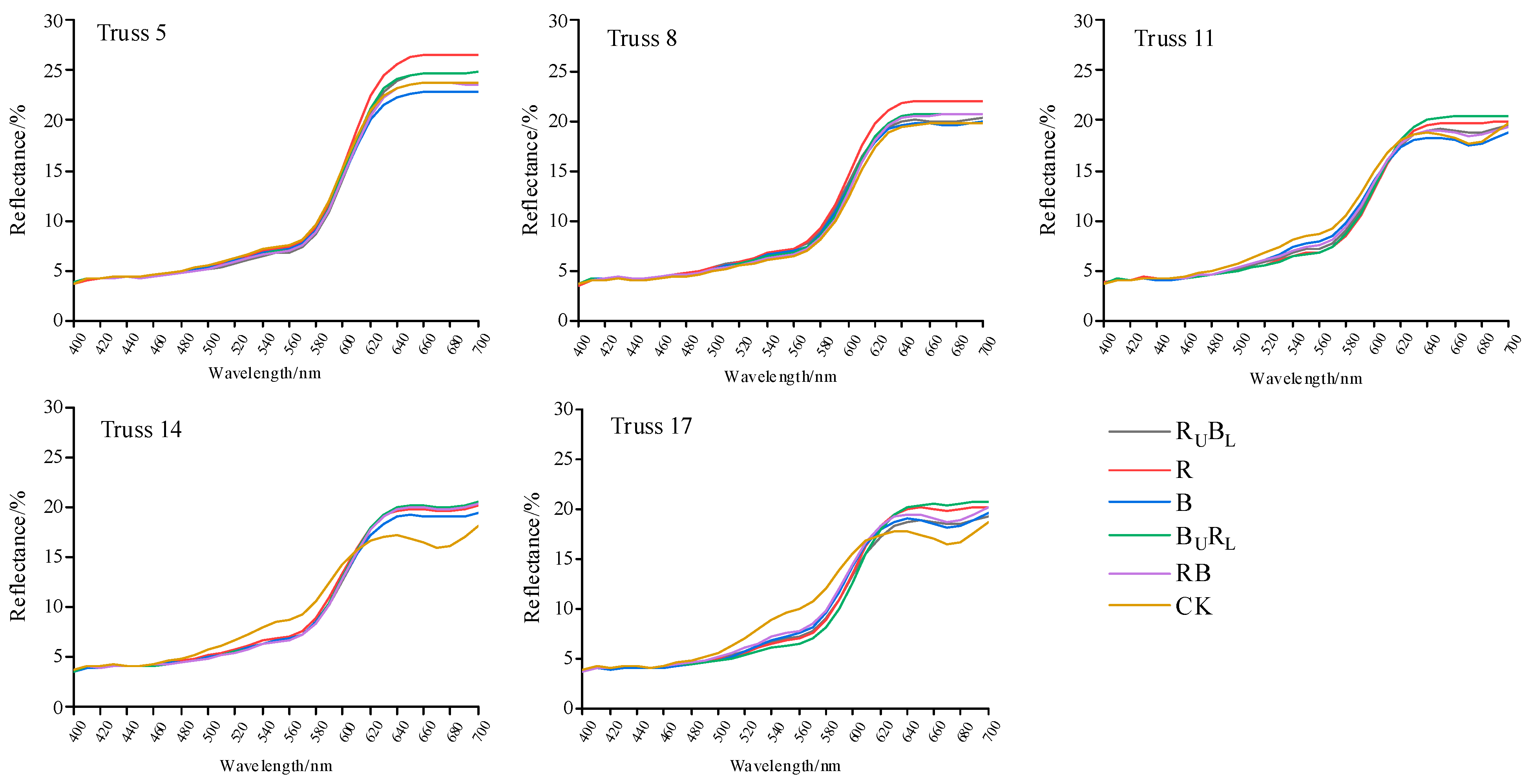
3.5. Reflectance Spectra of Tomato Fruit Under Different Light Supply Modes

As shown in Figure 7, the reflectance of tomato fruits across all trusses generally increased in the visible spectral region under all light treatments, which was consistent with the optical characteristics of chlorophyll degradation and lycopene accumulation during maturation. For the fifth and eighth trusses, minor differences in reflectance below 620 nm were observed among treatments, while above 620 nm, the highest reflectance was recorded under the R treatment, and the lowest values were found under B and CK. The differences in fruit reflectance among treatments became more pronounced in the 11th, 14th, and 17th trusses: CK exhibited higher reflectance below 620 nm but lower reflectance above 620 nm compared to all supplemental lighting treatments, confirming that supplemental lighting effectively promoted fruit coloration. The BURL treatment demonstrated optimal performance, showing the lowest reflectance below 620 nm and the highest reflectance above 620 nm, indicating the most complete chlorophyll degradation, the most substantial lycopene accumulation, and the highest maturity level, followed by the pure red (R) treatment. A key finding was the presence of a reflectance inflection near 680 nm in some treatments and CK, representing residual chlorophyll absorption and indicating incomplete maturity. In contrast, the reflectance spectra of the BURL and R treatments remained stable in this region, confirming that these treatments accelerated the coloring process and shortened the maturation period under simultaneous harvest conditions.

3.6. Effects of Different Light Supply Modes on Vitamin C (VC) and Lycopene Contents in Tomato Fruit

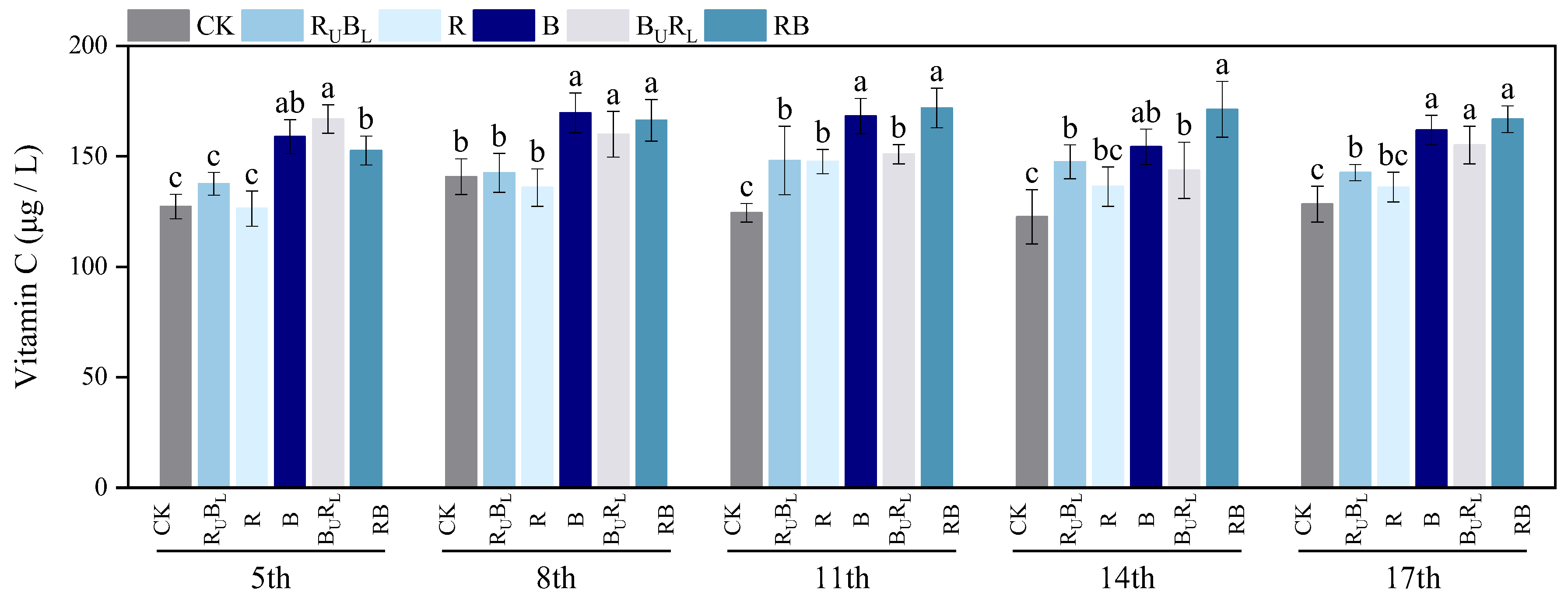
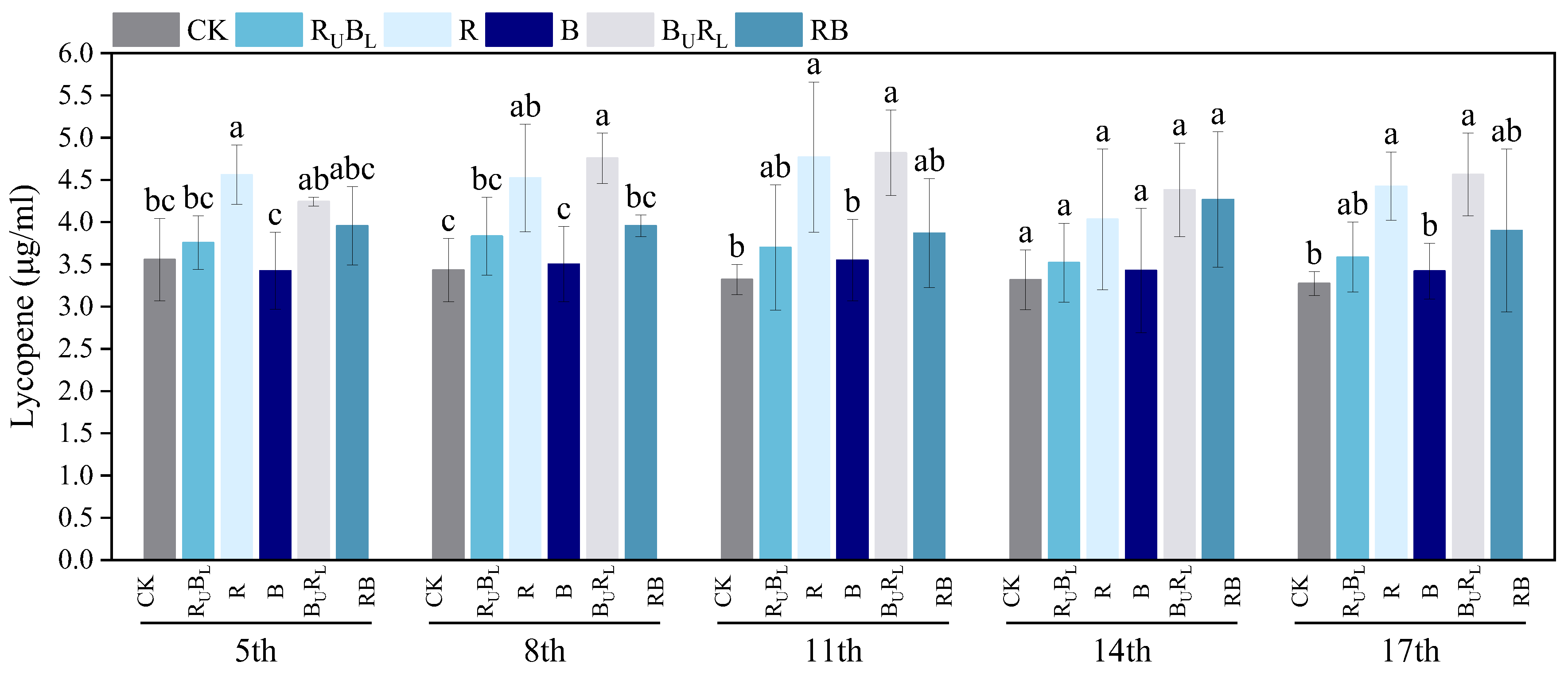
Figure 8 and Figure 9 present the contents of lycopene and VC in tomato fruits from different trusses under varying red/blue light regimes. The results indicated that the contents of lycopene and VC were generally consistent across different truss positions under the same light treatment. Starting with the 11th truss, the contents of both lycopene and VC were increased by all supplemental lighting treatments. The vitamin C content was significantly enhanced by the BURL, B, and RB treatments compared to the control. Notably, the RB treatment yielded the highest VC levels in the 11th, 14th, and 17th trusses, exceeding the control by 38.15%, 39.65%, and 29.97%, respectively. Among all treatments, R and BURL were the most effective at promoting lycopene accumulation, followed by RB. Under the R treatment, the fifth truss showed the highest increase in lycopene content (28.21%) compared to CK. For the 8th, 11th, 14th, and 17th trusses, the maximum increases were all achieved by the BURL treatment, with values ranging from 32.16% to 45.33%. A specific regulatory effect of light quality was noted: monochromatic blue light significantly enhanced vitamin C content compared to CK, whereas pure red light showed minimal effect. Conversely, lycopene accumulation was strongest under pure red light and weaker under blue light. Overall, the BURL treatment was the most effective at enhancing both lycopene and vitamin C contents, followed by the RB treatment.

3.7. Effects of Different Light Supply Modes on Sugar Content, Acid Content, and Sugar–Acid Ratio of Tomato Fruit

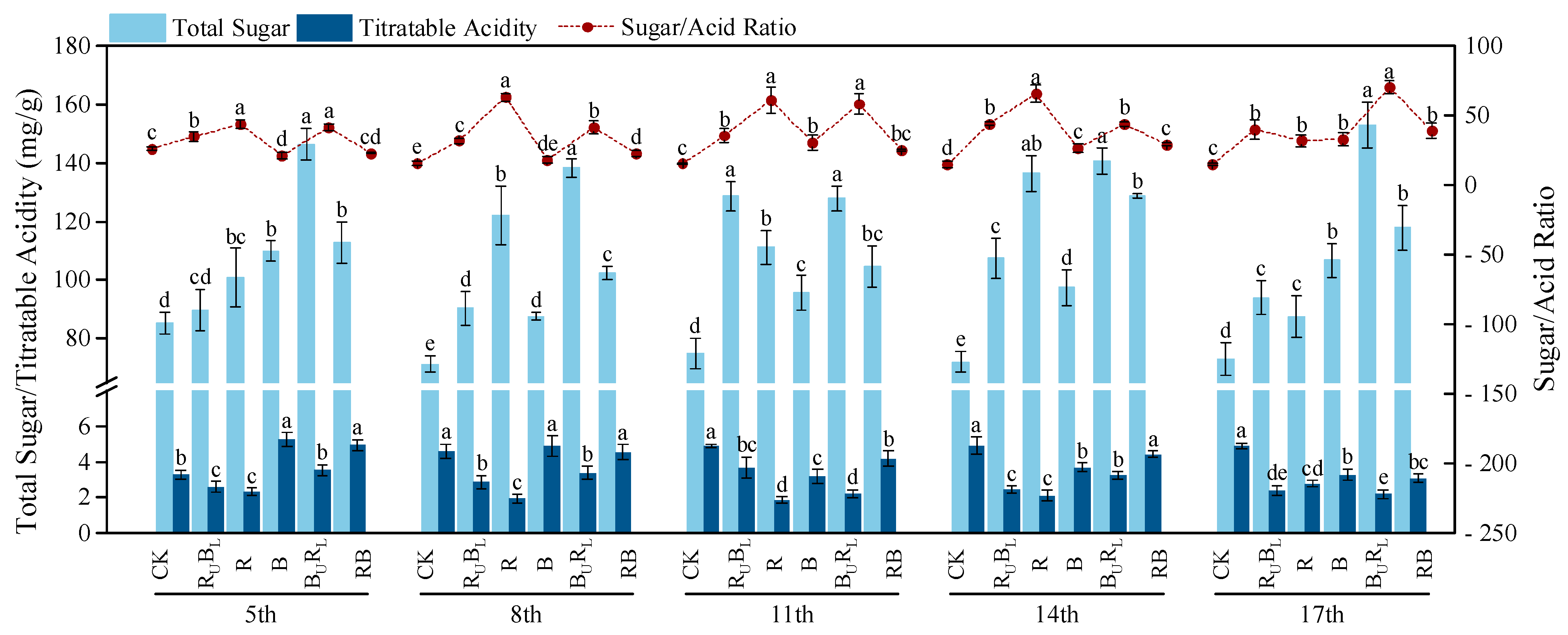
Figure 10 shows the variations in the content of total sugar and titratable acidity, as well as the sugar/acid ratio in tomato fruits from different trusses under light treatments. The results demonstrated that all supplemental lighting treatments increased the soluble sugar content of fruits, with a maximum increase of 109.39% compared to CK, while simultaneously reducing the titratable acid content from the 11th truss onward, with a maximum reduction of 62.49% compared to CK. Across the five truss positions, the regulatory trends of different light treatments on the sugar/acid ratio showed high consistency, with most trusses reaching peak values under the R or BURL treatments. This pattern was attributed to the BURL treatment being most conducive to sugar accumulation, increasing sugar content by 70.88–109.39% compared to CK, while the R treatment was most effective in reducing acid content, decreasing it by 29.51–62.49% compared to CK. Additionally, the RB treatment resulted in relatively high levels of both sugar and acid in the fruits. Although this led to a non-significant increase in the sugar/acid ratio, it may contribute to the formation of fruits with a strong flavor profile characterized by high sugar and high acid content.

3.8. Effects of Different Light Supply Modes on Chlorophyll Fluorescence Characteristics in Functionally Adjacent Leaves Across Truss Positions

A heatmap of chlorophyll fluorescence parameters (Figure 11) was used to analyze the effects of spectral treatments on functionally adjacent leaves (FALs) at different tomato truss positions. Cluster analysis of the heatmap revealed that functionally similar parameters formed distinct clusters such as comprehensive performance indices and energy allocation parameters, reflecting the regulatory effect of supplemental lighting on photosynthetic parameter response patterns. Analysis of comprehensive indices, particularly PI abs and PI total, demonstrated that the coordination efficiency of the photosynthetic electron transport chain (PSII → PSI) in tomato functional leaves exposed to supplemental lighting treatments was significantly enhanced, especially for the BURL treatment. Photosynthetic performance was enhanced under all supplemental lighting treatments, as indicated by an increase in PI total for functional leaves adjacent to nearly all trusses (except the 14th) and a general elevation across most PI-related parameters.

3.9. Correlation Analysis Between Color Parameters and Lycopene Content in Tomato Fruits Across Truss Positions Under Different Light Supply Modes

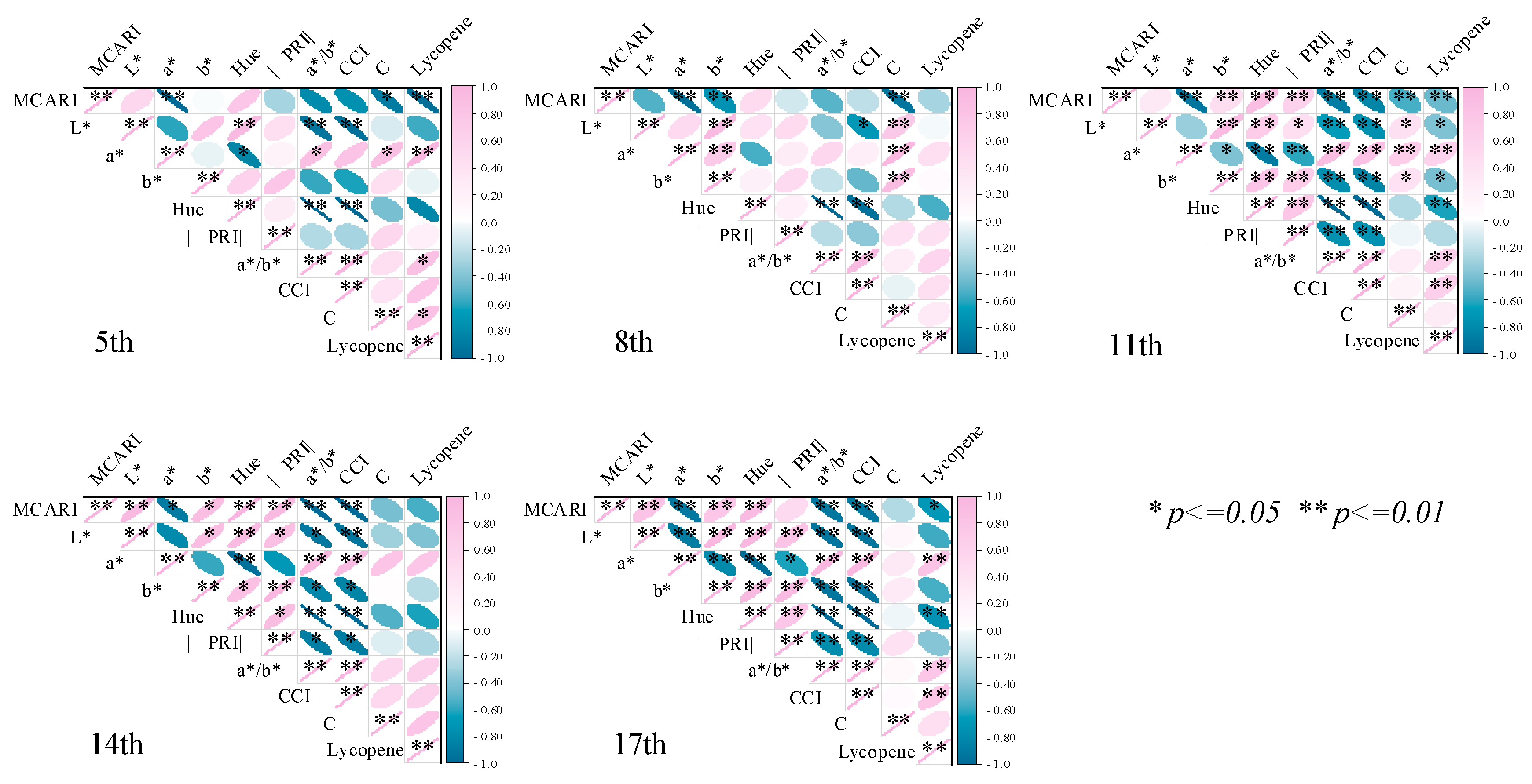
Correlation analysis of color parameters and lycopene content across trusses (Figure 12) showed consistent positive relationships between lycopene and a*, a/b*, CCI, and C, and negative correlations with MCARI and Hue, with most being extremely significant. These color parameters were validated as reliable indirect indicators of lycopene content. From the 11th truss, lycopene showed significant or extremely significant relationships with more color parameters. This demonstrated high synchrony between fruit coloration and lycopene accumulation during this period. Thus, supplemental lighting applied in this stage more efficiently promoted simultaneous improvement in fruit coloration and lycopene levels.

4. Discussion

Light is one of the most important environmental factors affecting crop growth and development, and serves as the energy source for crop photosynthesis as well as the formation of yield and quality [31]. Due to the characteristically deep canopy architecture of tomato plants, the middle and lower leaves in overwintering greenhouses receive limited light, resulting in reduced photosynthetic capacity and consequent impacts on tomato yield and quality.
In our study, compared to the non-supplemented control (CK), all lighting treatments were found to increase the transverse diameter, longitudinal diameter, volume, and fruit weight of tomato fruits. This observation is consistent with the findings of APPOLLONI et al. [32], who reported that supplemental LED lighting significantly enhanced yield and multiple quality parameters in greenhouse tomato production compared to natural light alone or natural light combined with HPS lighting. Furthermore, in this study, the fruit weight of the five trusses across all treatments generally decreased from the 11th to the 14th truss and then increased, whereas the fruit weight increment showed an opposite trend. This phenomenon, where the 11th and 14th trusses exhibited lower absolute fruit weight but the highest relative increase, can be explained by the development of these trusses coinciding with the period of the lowest winter irradiance. The severe suppression of fruit development under this weak light stress led to a reduced absolute weight in the CK group; consequently, even a modest absolute gain through supplemental lighting resulted in a high relative increment. With the increased solar light intensity in February (17th truss), the environmental suppression was alleviated, resulting in a relatively reduced fruit weight increment. This phenomenon suggested a positive correlation between weak light stress levels and the fruit weight increment. Notably, during the low-light period of the experiment (the 11th and 14th trusses), the fruit weight generally declined across treatments, whereas no fruit weight reduction was observed under the BURL treatment. This suggests that the BURL treatment appeared to have a greater mitigating effect on low-light stress.
The observations in this study showed that, during the early phase of light treatment (the fifth and eighth trusses), the full-canopy red–blue combined light (RB) treatment demonstrated optimal fruit weight enhancement. This effect was likely due to the synergistic interaction between red and blue light in driving photosynthesis and optimizing the photosynthetic apparatus. Red light efficiently promoted chlorophyll synthesis and the generation of photochemical energy (ATP and NADPH), thereby providing sufficient carbon skeletons for fruit biomass accumulation. Meanwhile, blue light enhanced stomatal opening and photomorphogenesis, as well as mitigating photosynthetic inhibition under light-limited conditions [33]. These findings were consistent with previous reports indicating that the maximum net photosynthetic rate (Pmax) under red–blue combined light was significantly higher than under monochromatic light [34], and the total biomass, fruit dry weight, and fruit number of tomato plants reached their maximum values within the 6–12% blue light ratio range [35]. The above results substantiated the universal mechanism underlying the efficacy of early-stage RB treatment.
However, upon entering the winter low-light period (11th and 14th truss development), the BURL treatment surpassed the RB treatment in fruit weight increment, demonstrating the strongest yield enhancement potential. This shift might be due to an adaptive change in the plants’ spectral demand under sustained low-light stress, where the BURL treatment’s spectral distribution better matched the functional needs of the tomato canopy. Trojak and Skowron [36] found that blue light can significantly enhance the photoprotective capacity of tomato plants, manifested by the increased amplitudes of non-photochemical quenching (NPQ) and the rapid photoprotective component qE (energy-dependent quenching), as well as reduced membrane oxidative damage. This process may be achieved by upregulating the contents of NPQ-related proteins, including photosystem II subunit S (PsbS), violaxanthin de-epoxidase (VDE), Proton Gradient Regulation-Like1 (PGRL1), and cytochrome b6f subunit f (cytf) [36]. Simultaneously, upper-canopy blue light was shown to specifically regulate young fruits and new leaves. This observation was supported by Brelsford et al. [37], who reported that young leaf growth strongly depends on blue light signaling, and reduced blue light significantly delayed leaf expansion in Acer platanoides seedlings. Red light regulated the expression of key genes involved in carbohydrate metabolism, optimized the translocation and partitioning of photoassimilates such as sucrose and glucose between the source (leaves) and sink (fruits) of tomato plants, and ultimately significantly increased fruit size. This effect might be achieved by up-regulating the expression of genes related to sucrose synthesis and transport in leaves [38]. Lower-canopy red light efficiently activated the photosynthetic function of mature leaves in the middle and lower canopy. XIE et al. [39] demonstrated that in Arabidopsis, protein levels of the key light signaling regulators FHY3/FAR1 (genes) were dynamically downregulated with leaf age, resulting in significantly higher photosynthetic efficiency in mature leaves under red light compared to young leaves. This leaf-age-specific photoresponse was further validated as a general phenomenon by GROHER et al. [40], who reported that young and old tomato leaves were affected differentially by supplemental lighting, with leaf age being identified as the critical factor determining rutin content, chlorophyll levels, and nitrogen balance in response to light. Notably, our study observed that the regulatory effects of the upper-blue/lower-red (BURL) and upper-red/lower-blue (RUBL) treatments on late-stage tomato fruit weight and quality differed. This result further suggests that the spatial configuration of red and blue light is more likely to align with the developmental stages of plant organs within the canopy. From the perspective of leaf age, the BURL treatment provided blue light to the upper young leaves, which better met their morphogenetic requirements compared to the red light provided in the upper canopy under the RUBL treatment. From the perspective of fruit development, the middle and lower fruits were at the coloring and ripening stage. The BURL treatment delivered red light to these lower fruits, which more effectively promoted lycopene accumulation and fruit coloration compared to the blue light provided in the lower canopy under the RUBL treatment.
To precisely quantify the efficiency of converting supplemental light energy into fruit weight, the light gain coefficient (LGC) was defined in this study based on the “1% rule” [41], which states that a 1% increase in light leads to approximately a 1% increase in yield. The LGC was established as a unified and objective quantitative benchmark for evaluating light use efficiency under different supplemental lighting strategies and environmental conditions. Specifically, the LGC is designed to address the question: By what percentage is fruit weight expected to increase for a 1% increase in total light energy relative to ambient solar daily light integral (DLI)? The core value of this metric lies in its ability to provide a uniform benchmark for evaluating supplemental lighting effects that is independent of variations in baseline solar radiation. In our study, the high LGC observed under the RB treatment during the early overwintering stage (reaching up to 4.41 times that of the other treatments) demonstrates that the red–blue light combination was highly efficient in converting supplemental light into fruit biomass at this stage. Similarly, the consistently high LGC detected under the BURL treatment during low-light periods (1.28–5.30 times that of the other treatments) indicates that high conversion efficiency was maintained by this spatial–spectral configuration even under stress conditions. While the LGC and conventional LUE are related, they serve different purposes. LUE (g·mol−1) is a physiological measure of how efficiently plants convert absorbed light into biomass through photosynthesis. The LGC, by contrast, is an agronomic efficiency index that integrates both physiological responses and environmental interactions. It is a dimensionless ratio interpreted as an efficiency index for supplemental light utilization, rather than a measure of absolute photosynthetic efficiency. Nevertheless, it should be noted that the light gain coefficient (LGC) defined in this study is based solely on input (supplemental light energy) and output (fruit weight increase). The LGC does not account for actual light interception by the canopy or the complex processes of photosynthetic conversion and carbon partitioning. Therefore, the application of the LGC has certain limitations without quantitative data on within-canopy light distribution. Future work should integrate canopy light measurements with LGC analysis to establish a more mechanistic understanding of how spatial and spectral lighting strategies influence yield formation.
This study demonstrated that light quality exerted specificity in regulating fruit quality. Analysis of coloring parameters (Table 1) and reflectance spectra (Figure 6) revealed that all supplemental lighting treatments enhanced fruit a* while reducing b* and Hue compared to truss-specific controls (CK). This finding confirmed the positive effect of supplemental lighting on promoting red coloration, with the BURL treatment showing optimal performance among the treatments. Reflectance spectra indicated that from the 11th truss onward, the BURL treatment consistently exhibited the lowest reflectance below 620 nm and the highest reflectance above 620 nm, demonstrating that both the chlorophyll degradation and lycopene accumulation in tomatoes were markedly promoted. Furthermore, correlation analysis (Figure 12) revealed that lycopene content was correlated with color parameters (positively with a, a*/b*, CCI, and C; negatively with MCARI and Hue), indicating high synchrony between fruit coloration and lycopene biosynthesis during this period. These findings are consistent with WANG et al. [42], who reported that supplemental blue/red lighting accelerated fruit coloring and promoted lycopene synthesis in tomato fruits. ZHANG et al. [10] also confirmed that a red-to-blue light ratio of 1:0.8 resulted in the highest fruit redness and significantly higher color index (a*/b*) compared to white light or other red–blue ratios, accompanied with peak values for both total carotenoid and lycopene content.
In terms of nutritional quality, this study found that when the lower canopy was exposed to red light (R and BURL treatments), the lycopene content in tomatoes was significantly enhanced. This phenomenon might be closely linked with the phytochrome-mediated signaling pathway. It was demonstrated by YAN et al. [43] that the red light signal, which was perceived by phytochrome SiPHYB1, led to the stabilization of the transcription factor SIHY5. Consequently, the expression of the lycopene β-cyclase gene (SlCYCB) was directly suppressed, resulting in a reduced conversion of lycopene to β-carotene and a significant accumulation of lycopene in tomato fruits. Consistently, XU et al. [17] also found that red light was more effective than blue light in promoting carotenoid accumulation in tomatoes. In contrast, vitamin C (VC) accumulation in tomatoes was more prominent under blue-light-containing treatments, with the highest VC content in the 11th, 14th, and 17th truss fruits all observed under RB treatment, showing increases of 38.15%, 39.65%, and 29.97% compared to CK, respectively. This could be attributed to blue light directly inhibiting PAS/LOV photoreceptors (such as PLP), thereby relieving their suppression of GDP-L-galactose phosphorylase (GGP) and upregulating the activity of key enzymes in the VC biosynthesis pathway [44]. Notably, the BURL treatment was associated with the synergistic accumulation of both lycopene and VC. This likely reflects the effectiveness of the spatial light differentiation strategy in simultaneously coordinating multiple metabolic pathways under the present experimental conditions.
In terms of flavor quality, we found that the soluble sugar content was enhanced in tomato fruits subjected to all light supplementation treatments, while the titratable acid content was synchronously reduced starting from the 11th truss, with the highest sugar content elevation reaching 109.39% and the maximum acid content reduction reaching 62.49% compared to CK. This observation was in concordance with previous studies, which suggested that soluble sugar content in plants such as strawberry, sweet pepper and grape was enhanced under red–blue combined light [45,46,47]. This consistency can be attributed to the central role of the light-signaling transcription factor HY5, which promotes soluble sugar biosynthesis by directly activating key sucrose metabolism genes such as LIN5, VI, and SS [48]. In this study, the highest sugar–acid ratios were typically observed under R or BURL treatments, primarily due to the effective suppression of acid accumulation by the R treatment, while BURL synergistically enhanced sugar synthesis while maintaining moderate acidity levels. Notably, the RB treatment produced flavor-rich fruits with elevated levels of both sugar and acid, whereas BURL achieved high-sweetness fruits through coordinated sugar–acid balance under the present experimental conditions. This may be associated with changes in the activity of sucrose synthase (SS) and acid invertase (AI), as well as the expression of genes related to glucose metabolism under red/blue light treatment [49].
In conclusion, our results showed that during the early phase (October–December), the RB treatment was most effective in promoting fruit weight. During the later phase (January–February of the following year), the BURL treatment exhibited relatively better performance, more efficiently enhancing the light gain coefficient (LGC) and fruit weight. Based on these observed stage-dependent differences, it is posited that adopting a dynamic “stage-specific and zone-differentiated” supplemental lighting strategy in future production may hold potential. Specifically, the RB treatment could be applied in the early stage to meet basic growth demands, followed by the BURL treatment in the mid-to-late period. This leverages the synergistic effect where upper-layer blue light enhances stress resistance and lower-layer red light maintains photosynthetic capacity. Crucially, this supplementary light mode improved fruit weight and LGC by optimizing light quality based on the same DLI, rather than increasing light intensity. This strategy may provide a potential reference approach to synergistically optimizing fruit weight, quality, and energy efficiency in protected tomato cultivation.
In this study, due to the lack of measurements of photosynthetic photon flux density (PPFD) and spectral distribution at different canopy heights, as well as the quantification of natural light attenuation along the vertical canopy gradient, the actual interception and distribution of the combined natural and artificial light within the canopy under field conditions could not be rigorously evaluated. This is a fundamental limitation of the present study. Therefore, all conclusions related to the vertical lighting configuration in this study are based on the relative differences in fruit weight and quality among the designed spectral treatments, rather than an absolute demonstration of the superiority of vertical spectral partitioning over other lighting spatial configurations. Furthermore, we acknowledge that the natural light in winter glass greenhouses provides limited ultraviolet (UV) and far-red radiation, which represents a spectral limitation of this study. First, our LEDs emitted only red (660 nm) and blue (450 nm) light and did not provide UV radiation. UV light, particularly UV-A and UV-B, is known to influence secondary metabolism, antioxidant accumulation, and fruit quality in various plant species, including tomato [50,51]. The absence of UV may have affected the levels of compounds such as phenolics or flavonoids, which were not measured in this study. However, since all treatments equally lacked UV radiation, the relative differences observed among treatments remain valid. Second, our study focused on 660 nm red light, which corresponds to the chlorophyll absorption peak and effectively drives photosynthesis. Nevertheless, it is worth considering the potential effects of other spectral regions. Deep-red/far-red light (e.g., 730 nm) is known to interact with phytochrome photoreceptors and can influence shade avoidance responses, flowering, and ripening processes [52,53]. Incorporating deep-red or far-red LEDs could further modulate phytochrome-mediated signaling pathways, potentially affecting lycopene accumulation and fruit maturation. Future research could explore the potential benefits of adding other spectral regions—such as low-intensity UV radiation to enhance nutritional quality or accelerate ripening, and deep-red/far-red light to regulate phytochrome-mediated ripening responses. Investigating whether supplementing our optimized zone-specific lighting strategies with these wavelengths could further improve yield, quality, or energy efficiency represents a promising direction for subsequent studies.

5. Conclusions

This study indicates that during the early phase in the wintering period in greenhouses, red–blue combined light (RB) demonstrated the best fruit weight enhancement effect, increasing the fruit weight of the fifth and eighth trusses by 22.62–24.02%, with its light gain coefficient (LGC) reaching up to 4.41 times that of the other treatments. In the late supplemental lighting period characterized by low temperature and limited light, the BURL treatment showed stronger advantages, with its LGC increasing to 1.28–5.30 times that of the other treatments, while substantially increasing the fruit weight of the 11th, 14th, and 17th trusses by 48.20–72.88%.
In terms of tomato fruit quality, the R and BURL treatments were most effective in promoting lycopene accumulation, increasing its content by up to 45.33% compared to CK, and these increases were closely correlated with improved color parameters. The RB treatment yielded the highest VC levels in the 11th, 14th, and 17th trusses (up to a 39.65% increase). All treatments boosted soluble sugar content, with R/BURL yielding optimal sugar–acid ratios and RB producing high-sugar high-acid fruits with a rich flavor.
Consequently, the implementation of a phased and spatially differentiated lighting strategy could be considered for production. The full-canopy RB treatment is recommended for the early overwintering period, followed by a transition to the spatially differentiated BURL treatment in the mid-to-late season. This approach is expected to alleviate environmental stress, shorten the maturation period, and synergistically enhance fruit weight, fruit quality, and energy use efficiency.

Supplementary Materials

The following supporting information can be downloaded at: https://www.mdpi.com/article/10.3390/agronomy16060604/s1; Supplementary Material: The photos and technical specifications of the LED light strips.

Author Contributions

Conceptualization, X.G. and X.C.; methodology, X.G. and L.W.; software, X.G. and X.W.; validation, X.W. and Y.Z.; formal analysis, X.W., Y.Z. and W.S.; resources, W.S.; data curation, X.G. and Y.Z.; writing—original draft preparation, X.G.; writing—review and editing, X.G., X.C. and W.S.; visualization, X.C. and L.W.; supervision, L.W., W.S., X.W. and Y.Z.; funding acquisition, X.C. and L.W. All authors have read and agreed to the published version of the manuscript.

Funding

This research was funded by the Beijing Intelligent Greenhouse Vegetable Innovation Consortium Project (BAIC12-2026-6) and the Beijing Rural Revitalization Agricultural Science and Technology Project (NY2501010225).

Data Availability Statement

The original contributions presented in this study are included in the article. Further inquiries can be directed to the corresponding authors.

Conflicts of Interest

The authors declare that the research was conducted in the absence of any commercial or financial relationships that could be construed as a potential conflict of interest.

Abbreviations

RUBLUpper-red/lower-blue
RFull red
BFull blue
BURLUpper-blue/lower-red
RB1:1 red–blue mixture
CKNon-lit control
LEDLight-emitting diode
DLIDaily light integral
PPFDPhotosynthetic photon flux density
PARPhotosynthetically active radiation
HPSHigh-pressure sodium
LGCLight gain coefficient
L*Luminance
a*Red–green color component
b*Yellow–blue color component
CChroma
HueHue angle
CCIColor contribution index
a*/b*Color ratio
PRIPhotochemical Reflectance Index
MCARIModified Chlorophyll Absorption Ratio Index
PI absPerformance index on absorption basis
PI totalSynthesis performance index
PI Inst.Instantaneous performance index
ABS/RCAbsorbed energy per reaction center
TRo/RCTrapped energy per reaction center
ETo/RCEnergy for electron transport per reaction center
ABS/CSoAbsorbed energy per standard cross-section
ETo/CSoEnergy for electron transport per standard cross-section
REo/CSoEnergy for reduction per standard cross-section
TRo/CSmTrapped energy per maximal cross-section
REo/CSmEnergy for reduction per maximal cross-section

References

  1. Heuvelink, E.; Acevedo-Siaca, L.G.; Van de Poel, B.; Van der Jeucht, L.; Vialet-Chabrand, S.; Steppe, K.; Ji, Y.; Körner, O.; Kusuma, P.; Langer, S.; et al. Tomato in the spotlight: Light regulation of whole-plant physiology in tomato. J. Exp. Bot. 2025, 76, 6289–6310. [Google Scholar] [CrossRef]
  2. Yang, L.; Liu, H.; Cohen, S.; Gao, Z. Microclimate and Plant Transpiration of Tomato (Solanum lycopersicum L.) in a Sunken Solar Greenhouse in North China. Agriculture 2022, 12, 260. [Google Scholar] [CrossRef]
  3. Sun, Y.P.; Sun, Y.B.; Sun, Z.C.; Liu, Q.; Li, P.W.; Li, C.Z. Mapping Monthly Distribution of Daily Light Integrals Across China. Hunan For. Sci. Technol. 2015, 42, 43–47+106. (In Chinese) [Google Scholar]
  4. Jin, Y.; Jiang, W.; Han, Y.; Nan, S.; Liu, G.; Guo, W.; Zhang, K.; Li, Q.; Li, D. Comprehensive optimization of shading and electrical performance of roof-mounted photovoltaic system of Venlo-type greenhouse in the severe cold region. Energy 2024, 296, 131125. [Google Scholar] [CrossRef]
  5. Zhang, M.; Cui, J.; Ju, J.; Hu, Y.; Liu, X.; He, R.; Song, J.; Huang, Y.; Liu, H. The Impact of Daily Light Integral from Artificial Lighting on Tomato Seedling Cultivation in Plant Factory. Agronomy 2025, 15, 70. [Google Scholar] [CrossRef]
  6. Alves, F.R.R.; Pikart, F.C.; Bianchetti, R.E.; Rossi, M.; Freschi, L. No Fear of the Dark: Constitutively Active PHYTOCHROME B2 Minimizes Tomato Nutritional Quality Penalty Due to Suboptimal Ripening Conditions. J. Plant Growth Regul. 2025, 44, 1297–1302. [Google Scholar] [CrossRef]
  7. Tewolde, F.T.; Lu, N.; Shiina, K.; Maruo, T.; Takagaki, M.; Kozai, T.; Yamori, W. Nighttime Supplemental LED Inter-lighting Improves Growth and Yield of Single-Truss Tomatoes by Enhancing Photosynthesis in Both Winter and Summer. Front. Plant Sci. 2016, 7, 448. [Google Scholar] [CrossRef]
  8. Tewolde, F.T.; Shiina, K.; Maruo, T.; Takagaki, M.; Kozai, T.; Yamori, W. Supplemental LED inter-lighting compensates for a shortage of light for plant growth and yield under the lack of sunshine. PLoS ONE 2018, 13, e0206592. [Google Scholar] [CrossRef]
  9. Heuvelink, E.; Hemming, S.; Marcelis, L.F.M. Some recent developments in controlled-environment agriculture: On plant physiology, sustainability, and autonomous control. J. Hortic. Sci. Biotechnol. 2025, 100, 604–614. [Google Scholar] [CrossRef]
  10. Zhang, Y.; Zhu, K.; Wang, X.; Yan, J.; Zhu, H.; Zhang, N.; Wang, Y.; Zhao, Q.; Liu, Y.; Bu, X.; et al. Manipulation of artificial light environment improves plant biomass and fruit nutritional quality in tomato. J. Adv. Res. 2025, 75, 79–93. [Google Scholar] [CrossRef]
  11. Wang, F.; Guo, Z.; Li, H.; Wang, M.; Onac, E.; Zhou, J.; Xia, X.; Shi, K.; Yu, J.; Zhou, Y. Phytochrome A and B function antagonistically to regulate cold tolerance via abscisic acid-dependent jasmonate signaling. Plant Physiol. 2016, 170, 459–471. [Google Scholar] [CrossRef]
  12. Xu, F.; He, S.; Zhang, J.; Mao, Z.; Wang, W.; Li, T.; Hua, J.; Du, S.; Xu, P.; Li, L.; et al. Photoactivated CRY1 and phyB interact directly with AUX/IAA proteins to inhibit auxin signaling in Arabidopsis. Mol. Plant 2018, 11, 523–541. [Google Scholar] [CrossRef]
  13. Mendelová, A.; Fikselová, M.; Mendel, Ľ. Carotenoids and lycopene content in fresh and dried tomato fruits and tomato juice. Acta Univ. Agric. Silvic. Mendel. Brun. 2013, 61, 1329–1337. [Google Scholar] [CrossRef]
  14. Hu, J.; Wang, J.; Muhammad, T.; Yang, T.; Li, N.; Yang, H.; Yu, Q.; Wang, B. Integrative Analysis of Metabolome and Transcriptome of Carotenoid Biosynthesis Reveals the Mechanism of Fruit Color Change in Tomato (Solanum lycopersicum). Int. J. Mol. Sci. 2024, 25, 6493. [Google Scholar] [CrossRef] [PubMed]
  15. Xie, B.X.; Wei, J.J.; Zhang, Y.T.; Song, S.W.; Su, W.; Sun, G.W.; HAOY; Liu, H.C. Supplemental blue and red light promote lycopene synthesis in tomato fruits. J. Integr. Agric. 2019, 18, 590–598. [Google Scholar] [CrossRef]
  16. Zhang, J.; Zhang, Y.; Song, S.; Su, W.; Hao, Y.; Liu, H. Supplementary red light results in the earlier ripening of tomato fruit depending on ethylene production. Environ. Exp. Bot. 2020, 175, 104044. [Google Scholar] [CrossRef]
  17. Xu, Y.; You, C.; Xu, C.; Zhang, C.; Hu, X.; Li, X.; Ma, H.; Gong, J.; Sun, X. Red and blue light promote tomato fruit coloration through modulation of hormone homeostasis and pigment accumulation. Postharvest Biol. Technol. 2024, 207, 112588. [Google Scholar] [CrossRef]
  18. Gong, J.; Zeng, Y.; Meng, Q.; Guan, Y.; Li, C.; Yang, H.; Zhang, Y.; Ampomah-Dwamena, C.; Liu, P.; Chen, C. Red light-induced citrus fruit colouration is attributable to increased carotenoid metabolism regulated by the NAC transcription factor FcrNAC22. Authorea Preprints 2020. [Google Scholar] [CrossRef]
  19. Chen, X.-L.; Wang, L.-C.; Li, Y.-L.; Yang, Q.-C.; Guo, W.-Z. Alternating red and blue irradiation affects carbohydrate accumulation and sucrose metabolism in butterhead lettuce. Sci. Hortic. 2022, 302, 111177. [Google Scholar] [CrossRef]
  20. Li, Z.; Lyu, X.; Li, H.; Tu, Q.; Zhao, T.; Liu, J.; Liu, B. The mechanism of low blue light-induced leaf senescence mediated by GmCRY1s in soybean. Nat. Commun. 2024, 15, 798. [Google Scholar] [CrossRef]
  21. Dale, J.E.; Murray, D. Photomorphogenesis, photosynthesis, and early growth of primary leaves of Phaseolus vulgaris. Ann. Bot. 1968, 32, 767–780. [Google Scholar] [CrossRef]
  22. Kumar, K.; Hao, X.; Khosla, S.; Guo, X.; Bennett, N. Comparison of HPS lighting and hybrid lighting with top HPS and intra-canopy LED lighting for high-wire mini-cucumber production. In Proceedings of the VIII International Symposium on Light in Horticulture 1134, East Lansing, MI, USA, 22–26 May 2016. [Google Scholar]
  23. Zhang, Z.X.; Li, B.; Feng, P.; Zhang, P.; Lai, H.B.; Hu, J.; Zhang, H.H. Stereoscopic Light Environment Intelligent Control System Based on Characteristic Differences of Facility Cucumber Plants Light Requirements. Smart Agric. 2020, 2, 94–104. (In Chinese) [Google Scholar]
  24. Schipper, R.; Van Der Meer, M.; De Visser, P.H.B.; Heuvelink, E.; Marcelis, L.F.M. Consequences of intra-canopy and top LED lighting for uniformity of light distribution in a tomato crop. Front. Plant Sci. 2023, 14, 1012529. [Google Scholar] [CrossRef] [PubMed]
  25. Furuta, H.; Qu, Y.; Ishizuka, D.; Kawabata, S.; Sano, T.; Yamori, W. A novel multilayer cultivation strategy improves light utilization and fruit quality in plant factories for tomato production. Front. Hortic. 2025, 4, 1633097. [Google Scholar] [CrossRef]
  26. Qiu, N.; Shen, H.; Ishizuka, D.; Yatsuda, K.; Kawabata, S.; Qu, Y.; Yamori, W. Harnessing LED Technology for Consistent and Nutritious Production of Large-fruited Tomatoes. HortScience 2025, 60, 1851–1859. [Google Scholar] [CrossRef]
  27. Kampfenkel, K.; Van Montagu, M.; Inzé, D. Extraction and Determination of Ascorbate and Dehydroascorbate from Plant Tissue. Anal. Biochem. 1995, 225, 165–167. [Google Scholar] [CrossRef]
  28. Fish, W.W.; Perkins-Veazie, P.; Collins, J.K. A Quantitative Assay for Lycopene That Utilizes Reduced Volumes of Organic Solvents. J. Food Compos. Anal. 2002, 15, 309–317. [Google Scholar] [CrossRef]
  29. Yemm, E.W.; Willis, A.J. The estimation of carbohydrates in plant extracts by anthrone. Biochem. J. 1954, 57, 508–514. [Google Scholar] [CrossRef]
  30. Latimer, G.W. (Ed.) Official Methods of Analysis of AOAC INTERNATIONAL; Oxford University Press: Oxford, UK, 2023. [Google Scholar]
  31. Gao, X.; Li, L.; Guo, W.; Zhai, Y.; Wei, X.; Chen, X. Intermittent Blue Light Supplementation Affected Carbohydrate Accumulation and Sugar Metabolism in Red-Light-Grown Tomato Seedlings. Horticulturae 2025, 11, 700. [Google Scholar] [CrossRef]
  32. Appolloni, E.; Orsini, F.; Pennisi, G.; Durany, X.G.; Paucek, I.; Gianquinto, G. Supplemental LED Lighting Effectively Enhances the Yield and Quality of Greenhouse Truss Tomato Production: Results of a Meta-Analysis. Front. Plant Sci. 2021, 12, 596927. [Google Scholar] [CrossRef]
  33. Lima, I.H.A.; Rodrigues, A.A.; Resende, E.C.; da Silva, F.B.; Farnese, F.d.S.; Silva, L.d.J.; Rosa, M.; Reis, M.N.O.; Bessa, L.A.; de Oliveira, T.C.; et al. Light means power: Harnessing light spectrum and UV-B to enhance photosynthesis and rutin levels in microtomato plants. Front. Plant Sci. 2023, 14, 1261174. [Google Scholar] [CrossRef]
  34. Niu, Y.; Lyu, H.; Liu, X.; Zhang, M.; Li, H. Photosynthesis prediction and light spectra optimization of greenhouse tomato based on response of red–blue ratio. Sci. Hortic. 2023, 318, 112065. [Google Scholar] [CrossRef]
  35. Kaiser, E.; Ouzounis, T.; Giday, H.; Schipper, R.; Heuvelink, E.; Marcelis, L.F.M. Adding blue to red supplemental light increases biomass and yield of greenhouse-grown tomatoes, but only to an optimum. Front. Plant Sci. 2019, 9, 2002. [Google Scholar] [CrossRef]
  36. Trojak, M.; Skowron, E. Light Quality-Dependent Regulation of Non-Photochemical Quenching in Tomato Plants. Biology 2021, 10, 721. [Google Scholar] [CrossRef]
  37. Brelsford, C.C.; Trasser, M.; Paris, T.; Hartikainen, S.M.; Robson, T.M. Understorey light quality affects leaf pigments and leaf phenology in different plant functional types. Physiol. Plant. 2022, 174, e13723. [Google Scholar] [CrossRef] [PubMed]
  38. Fukushima, A.; Hikosaka, S.; Kobayashi, M.; Nishizawa, T.; Saito, K.; Goto, E.; Kusano, M. A systems analysis with “simplified source-sink model” reveals metabolic reprogramming in a pair of source-to-sink organs during early fruit development in tomato by LED light treatments. Front. Plant Sci. 2018, 9, 1439. [Google Scholar] [CrossRef]
  39. Xie, Y.; Ma, M.; Liu, Y.; Wang, B.; Wei, H.; Kong, D.; Wang, H. Arabidopsis FHY3 and FAR1 function in age gating of leaf senescence. Front. Plant Sci. 2021, 12, 770060. [Google Scholar] [CrossRef] [PubMed]
  40. Groher, T.; Röhlen-Schmittgen, S.; Fiebig, A.; Noga, G.; Hunsche, M. Influence of supplementary LED lighting on physiological and biochemical parameters of tomato (Solanum lycopersicum L.) leaves. Sci. Hortic. 2019, 250, 154–158. [Google Scholar] [CrossRef]
  41. Marcelis, L.F.M.; Broekhuijsen, A.G.M.; Meinen, E.; Nijs, E.M.F.M.; Raaphorst, M.G.M. Quantification of the growth response to light quantity of greenhouse grown crops. In Proceedings of the V International Symposium on Artificial Lighting in Horticulture 711, Lillehammer, Norway, 21–24 June 2005. [Google Scholar]
  42. Wang, W.; Liu, D.; Qin, M.; Xie, Z.; Chen, R.; Zhang, Y. Effects of supplemental lighting on potassium transport and fruit coloring of tomatoes grown in hydroponics. Int. J. Mol. Sci. 2021, 22, 2687. [Google Scholar] [CrossRef]
  43. Yan, J.; Liu, J.; Yang, S.; Jiang, C.; Liu, Y.; Zhang, N.; Sun, X.; Zhang, Y.; Zhu, K.; Peng, Y.; et al. Light quality regulates plant biomass and fruit quality through a photoreceptor-dependent HY5-LHC/CYCB module in tomato. Hortic. Res. 2023, 10, uhad219. [Google Scholar] [CrossRef]
  44. Bournonville, C.; Mori, K.; Deslous, P.; Decros, G.; Blomeier, T.; Mauxion, J.-P.; Jorly, J.; Gadin, S.; Cassan, C.; Maucourt, M.; et al. Blue light promotes ascorbate synthesis by deactivating the PAS/LOV photoreceptor that inhibits GDP-L-galactose phosphorylase. Plant Cell 2023, 35, 2615–2634. [Google Scholar] [CrossRef] [PubMed]
  45. Ma, X.; Zhang, J.; Li, W.; Li, W.; Fang, Y.; Chen, K.; Zhang, K. Effect of artificial light on grape berry coloring and volatile compounds. J. Food Compos. Anal. 2025, 148, 108534. [Google Scholar] [CrossRef]
  46. Kim, D.; Son, J.E. Adding Far-Red to Red, Blue Supplemental Light-Emitting Diode Interlighting Improved Sweet Pepper Yield but Attenuated Carotenoid Content. Front. Plant Sci. 2022, 13, 938199. [Google Scholar] [CrossRef]
  47. Choi, H.G.; Moon, B.Y.; Kang, N.J. Effects of LED light on the production of strawberry during cultivation in a plastic greenhouse and in a growth chamber. Sci. Hortic. 2015, 189, 22–31. [Google Scholar] [CrossRef]
  48. Wang, J.; Li, X.; Li, J.; Dong, H.; Hu, Z.; Xia, X.; Yu, J.; Zhou, Y. Manipulating the Light Systemic Signal HY5 Greatly Improve Fruit Quality in Tomato. Adv. Sci. 2025, 12, e2500110. [Google Scholar] [CrossRef]
  49. Nassarawa, S.S.; Luo, Z. Effect of light irradiation on sugar, phenolics, and GABA metabolism on postharvest grape (Vitis vinifera L.) during storage. Food Bioprocess Technol. 2022, 15, 2789–2802. [Google Scholar] [CrossRef]
  50. Wong, G.R.; Khor, J.H.; Arshad, N.M.; Harikrishna, J.A.; Ramakrishnan, N.; Mazumdar, P. Pre-flowering UV-C treatment influences yield, bioactive compounds and sensory attributes by altering phenylpropanoid biosynthesis gene expression in tomato. Sci. Hortic. 2024, 329, 113030. [Google Scholar] [CrossRef]
  51. Moreno, A.G.; Woolley, J.M.; Domínguez, E.; de Cózar, A.; Heredia, A.; Stavros, V.G. Synergic photoprotection of phenolic compounds present in tomato fruit cuticle: A spectroscopic investigation in solution. Phys. Chem. Chem. Phys. 2023, 25, 12791–12799. [Google Scholar] [CrossRef] [PubMed]
  52. Whitelam, G.C.; Smith, H. Retention of Phytochrome-Mediated Shade Avoidance Responses in Phytochrome-Deficient Mutants of Arabidopsis, Cucumber and Tomato. J. Plant Physiol. 1991, 139, 119–125. [Google Scholar] [CrossRef]
  53. Mastoraki, M.; Bengoa Luoni, S.; Lindeboom, J.; Heuvelink, E.; Marcelis, L.F. Regulation of tomato fruit growth and development during different plant developmental stages by far-red light: A combined anatomical, physiological, and transcriptomic analysis. Plant J. 2025, 124, e70613. [Google Scholar] [CrossRef]
Figure 1. Field installation view. (a,d,e) Vertical LED strips installed between tomato rows; (b) a close-up view of the strips, depicting both illuminated and non-illuminated states; (c) LI-COR quantum sensor deployed at the middle leaf position to measure solar DLI.
Agronomy 16 00604 g001
Figure 2. Variation in environmental parameters during the experiment. (a) Variation in radiation during the experimental period; (b) average indoor temperature during the experiment; (c) average indoor relative humidity during the experiment; (d) average indoor CO2 concentration during the experiment.
Agronomy 16 00604 g002
Figure 3. Transverse diameter, longitudinal diameter and volume of tomato fruit under different red–blue light supply modes. Note: CK, non-lit control; RUBL, upper-red/lower-blue; BURL, upper-blue/lower-red; R, monochromatic red light; B, monochromatic blue light; RB, mixed red and blue light (1:1). n = 3 (biological replicates). All data passed normality and homoscedasticity tests, satisfying the requirements for ANOVA (Shapiro–Wilk test, Levene test, p > 0.05). Lowercase letters indicate significant differences among treatments at the 0.05 level. Error bars represent the standard deviation. Statistical comparisons were performed only within the same fruit truss, and no direct comparisons were made between different trusses.
Agronomy 16 00604 g003
Figure 4. Fruit weight of tomatoes under different light supply modes. Note: CK, non-lit control; RUBL, upper-red/lower-blue; BURL, upper-blue/lower-red; R, monochromatic red light; B, monochromatic blue light; RB, mixed red and blue light (1:1). n = 3 (biological replicates). All data passed normality and homoscedasticity tests, satisfying the requirements for ANOVA (Shapiro–Wilk test, Levene test, p > 0.05). Lowercase letters indicate significant differences among treatments at the 0.05 level. Error bars represent the standard deviation. Statistical comparisons were performed only within the same fruit truss, and no direct comparisons were made between different trusses.
Agronomy 16 00604 g004
Figure 5. Fruit increase of tomatoes under different light supply modes. Note: CK, non-lit control; RUBL, upper-red/lower-blue; BURL, upper-blue/lower-red; R, monochromatic red light; B, monochromatic blue light; RB, mixed red and blue light (1:1). n = 3 (biological replicates). All data passed normality and homoscedasticity tests, satisfying the requirements for ANOVA (Shapiro–Wilk test, Levene test, p > 0.05). Lowercase letters indicate significant differences among treatments at the 0.05 level. Error bars represent the standard deviation. Statistical comparisons were performed only within the same fruit truss, and no direct comparisons were made between different trusses.
Agronomy 16 00604 g005
Figure 6. The light gain coefficient (LGC) of tomatoes under different light supply modes. Note: CK, non-lit control; RUBL, upper-red/lower-blue; BURL, upper-blue/lower-red; R, monochromatic red light; B, monochromatic blue light; RB, mixed red and blue light (1:1). n = 3 (biological replicates). All data passed normality and homoscedasticity tests, satisfying the requirements for ANOVA (Shapiro–Wilk test, Levene test, p > 0.05). Lowercase letters indicate significant differences among treatments at the 0.05 level. Error bars represent the standard deviation. Statistical comparisons were performed only within the same fruit truss, and no direct comparisons were made between different trusses.
Agronomy 16 00604 g006
Figure 7. Reflectance spectra of tomato fruit under different light supply modes. Note: CK, non-lit control; RUBL, upper-red/lower-blue; BURL, upper-blue/lower-red; R, monochromatic red light; B, monochromatic blue light; RB, mixed red and blue light (1:1). n = 3 (biological replicates).
Agronomy 16 00604 g007
Figure 8. Effects of different light supply modes on vitamin C (VC) content in tomato fruit. Note: CK, non-lit control; RUBL, upper-red/lower-blue; BURL, upper-blue/lower-red; R, monochromatic red light; B, monochromatic blue light; RB, mixed red and blue light (1:1). n = 3 (biological replicates). All data passed normality and homoscedasticity tests, satisfying the requirements for ANOVA (Shapiro–Wilk test, Levene test, p > 0.05). Lowercase letters indicate significant differences among treatments at the 0.05 level. Error bars represent the standard deviation. Statistical comparisons were performed only within the same fruit truss, and no direct comparisons were made between different trusses.
Agronomy 16 00604 g008
Figure 9. Effects of different light supply modes on lycopene content in tomato fruit. Note: CK, non-lit control; RUBL, upper-red/lower-blue; BURL, upper-blue/lower-red; R, monochromatic red light; B, monochromatic blue light; RB, mixed red and blue light (1:1). n = 3 (biological replicates). All data passed normality and homoscedasticity tests, satisfying the requirements for ANOVA (Shapiro–Wilk test, Levene test, p > 0.05). Lowercase letters indicate significant differences among treatments at the 0.05 level. Error bars represent the standard deviation. Statistical comparisons were performed only within the same fruit truss, and no direct comparisons were made between different trusses.
Agronomy 16 00604 g009
Figure 10. Effects of different light supply modes on sugar content, acid content, and sugar–acid ratio of tomato fruit. Note: CK, non-lit control; RUBL, upper-red/lower-blue; BURL, upper-blue/lower-red; R, monochromatic red light; B, monochromatic blue light; RB, mixed red and blue light (1:1). n = 3 (biological replicates). All data passed normality and homoscedasticity tests, satisfying the requirements for ANOVA (Shapiro–Wilk test, Levene test, p > 0.05). Lowercase letters indicate significant differences among treatments at the 0.05 level. Error bars represent the standard deviation. Statistical comparisons were performed only within the same fruit truss, and no direct comparisons were made between different trusses.
Agronomy 16 00604 g010
Figure 11. Effects of different light supply modes on Chlorophyll fluorescence characteristics in functionally adjacent leaves across truss positions. Note: CK, non-lit control; RUBL, upper-red/lower-blue; BURL, upper-blue/lower-red; R, monochromatic red light; B, monochromatic blue light; RB, mixed red and blue light (1:1). n = 3 (biological replicates).
Agronomy 16 00604 g011
Figure 12. Correlation analysis between color parameters and lycopene content in tomato fruits across truss positions under different light supply modes.
Agronomy 16 00604 g012
Table 1. Light parameters of different LED light sources.
TreatmentWavelength (nm)Daily Light Integral of LEDDaily Light Integral of Solar Light (MJ/m2)
(mol/m2)(MJ/m2)Truss 5Truss 8Truss 11Truss 15Truss 17
CK/003.423.243.223.193.49
RUBL660 & 4502.880.644
R6602.880.522
B4502.880.766
BURL450 & 6602.880.644
RB660 & 4502.880.644
Note: Solar DLI (MJ·m−2) is the original monitoring data of the quantum sensor; LED DLI is presented as mol·m−2 (the commonly used photon flux unit for artificial light) in the main text, and the MJ·m−2 value in this table is only converted for the unified calculation of the light gain coefficient (LGC), with the conversion based on the photon energy differences of red (660 nm) and blue (450 nm) light.
Table 2. Coloring parameters and simulated colors of tomato fruit under different light supply modes.
Truss Node
Position
TreatmentL*a*b*HueCCCIa*/b*|PRI|MCARISimulated Color
5th trussCK37.63 ± 0.59 a19.79 ± 0.77 c20.32 ± 0.37 a45.77 ± 1.04 a28.37 ± 0.68 b25.90 ± 1.21 e0.97 ± 0.04 d0.10 ± 0.01 a−3.46 ± 0.38 bc
RUBL35.67 ± 1.03 b21.16 ± 0.30 b18.78 ± 0.51 bc41.59 ± 0.53 b28.29 ± 0.56 b31.62 ± 1.29 c1.13 ± 0.02 b0.10 ± 0.01 a−3.46 ± 0.38 bc
R35.96 ± 0.66 b23.03 ± 0.51 a19.35 ± 0.46 b40.03 ± 0.74 b30.08 ± 0.57 a33.11 ± 0.39 ab1.19 ± 0.03 a0.10 ± 0.01 a−3.83 ± 0.43 d
B36.41 ± 0.50 b19.59 ± 0.58 c18.38 ± 0.67 c43.17 ± 0.55 ab26.86 ± 0.85 c29.29 ± 0.54 d1.07 ± 0.02 c0.09 ± 0.01 a−3.08 ± 0.40 a
BURL35.42 ± 0.57 b21.92 ± 0.59 b18.43 ± 0.51 c40.05 ± 0.46 b28.64 ± 0.75 b33.59 ± 0.59 a1.19 ± 0.02 a0.10 ± 0.01 a−3.55 ± 0.18 c
RB35.76 ± 0.84 b20.75 ± 1.03 b18.18 ± 0.41 c41.25 ± 0.87 b27.6 ± 1.03 bc31.92 ± 1.15 bc1.14 ± 0.03 b0.10 ± 0.01 a−3.43 ± 0.41 bc
8th trussCK33.59 ± 0.53 b17.54 ± 0.20 c15.79 ± 0.26 c41.98 ± 0.29 b23.60 ± 0.31 d33.09 ± 0.54 b1.11 ± 0.01 b0.09 ± 0.01 bc−2.62 ± 0.28 b
RUBL34.93 ± 0.59 a17.55 ± 0.13 c17.27 ± 0.28 ab44.54 ± 0.40 a24.63 ± 0.26 c29.10 ± 0.55 e1.05 ± 0.01 d0.10 ± 0.01 b−2.30 ± 0.22 a
R35.30 ± 0.48 a20.00 ± 0.48 a17.74 ± 0.40 a41.57 ± 0.71 b26.74 ± 0.53 a31.96 ± 0.84 c1.13 ± 0.03 b0.11 ± 0.01 a−2.96 ± 0.24 c
B35.00 ± 0.41 a17.85 ± 0.31 c16.88 ± 0.23 b43.40 ± 0.45 a24.56 ± 0.33 c30.22 ± 0.69 d1.06 ± 0.02 c0.10 ± 0.01 b−2.39 ± 0.17 a
BURL35.22 ± 0.61 a18.87 ± 0.61 b16.94 ± 0.46 b41.93 ± 0.92 b25.36 ± 0.64 c31.62 ± 0.91 c1.11 ± 0.04 b0.10 ± 0.01 b−2.71 ± 0.33 b
RB34.04 ± 0.41 b18.48 ± 0.19 b15.85 ± 0.31 c40.62 ± 0.60 b24.34 ± 0.26 b34.25 ± 0.58 a1.17 ± 0.02 a0.09 ± 0.01 c−2.79 ± 0.23 bc
11th trussCK36.90 ± 0.56 a13.34 ± 0.23 c20.57 ± 0.61 a57.04 ± 1.18 a24.52 ± 0.41 c17.58 ± 0.75 d0.65 ± 0.03 d0.12 ± 0.01 ab−0.32 ± 0.85 a
RUBL34.76 ± 0.59 b16.92 ± 0.08 b17.37 ± 0.43 c45.76 ± 0.82 c24.25 ± 0.27 c28.01 ± 0.72 b0.97 ± 0.03 b0.11 ± 0.01 cd−2.40 ± 0.49 d
R34.72 ± 0.63 b18.86 ± 0.11 a16.75 ± 0.15 c41.61 ± 0.33 d25.22 ± 0.12 b32.43 ± 0.39 a1.13 ± 0.01 a0.10 ± 0.01 d−1.81 ± 0.48 c
B36.77 ± 0.44 a16.37 ± 0.09 b20.71 ± 0.50 a51.67 ± 0.79 b26.40 ± 0.36 a21.50 ± 0.47 c0.79 ± 0.02 c0.12 ± 0.01 a−0.96 ± 0.46 b
BURL34.21 ± 0.79 b19.05 ± 0.08 a16.81 ± 0.47 c41.42 ± 0.72 d25.41 ± 0.35 b33.16 ± 1.14 a1.13 ± 0.03 a0.11 ± 0.01 bc−2.72 ± 0.16 d
RB34.93 ± 0.78 b17.19 ± 0.16 b18.29 ± 0.54 b46.77 ± 1.05 c25.10 ± 0.33 b26.94 ± 1.40 b0.94 ± 0.03 b0.11 ± 0.01 bc−1.52 ± 0.38 c
14th trussCK36.16 ± 0.19 a13.31 ± 0.18 c19.59 ± 0.73 a55.79 ± 0.79 a23.68 ± 0.68 e18.81 ± 0.56 c0.68 ± 0.02 c0.11 ± 0.01 a0.25 ± 0.83 a
RUBL34.29 ± 0.30 a18.04 ± 0.21 b16.33 ± 0.26 c42.15 ± 0.48 c24.33 ± 0.27 bc32.22 ± 0.46 a1.10 ± 0.02 a0.10 ± 0.01 b−2.47 ± 0.50 b
R35.08 ± 0.41 a17.60 ± 0.10 b17.08 ± 0.21 c44.14 ± 0.31 b24.52 ± 0.19 bc29.37 ± 0.52 b1.03 ± 0.01 b0.10 ± 0.01 b−2.12 ± 0.61 b
B34.27 ± 0.62 a17.14 ± 0.24 b16.77 ± 0.37 c44.38 ± 0.42 b23.98 ± 0.4 cd29.82 ± 0.71 b1.02 ± 0.02 b0.10 ± 0.01 b−2.19 ± 0.24 b
BURL34.53 ± 0.71 a20.38 ± 0.14 a18.03 ± 0.26 b41.49 ± 0.45 c27.21 ± 0.20 a32.77 ± 1.16 a1.13 ± 0.02 a0.11 ± 0.01 b−2.36 ± 0.50 b
RB34.13 ± 0.47 a18.40 ± 0.36 b16.48 ± 0.29 c41.85 ± 0.73 c24.70 ± 0.33 b32.73 ± 0.99 a1.12 ± 0.03 a0.10 ± 0.01 b−2.38 ± 0.12 b
17th trussCK38.60 ± 0.67 a11.95 ± 0.42 c23.17 ± 0.93 a62.72 ± 0.24 a26.07 ± 1.01 a13.36 ± 0.22 e0.52 ± 0.01 e0.15 ± 0.02 a−0.46 ± 0.45 a
RUBL34.74 ± 0.81 b17.07 ± 0.28 b18.68 ± 0.24 b47.58 ± 0.52 b25.3 ± 0.29 a26.31 ± 0.56 c0.91 ± 0.02 c0.12 ± 0.01 d−2.07 ± 0.62 b
R34.62 ± 0.95 b18.95 ± 0.38 a17.43 ± 0.21 c42.61 ± 0.70 c25.74 ± 0.34 a31.42 ± 0.77 b1.09 ± 0.03 b0.12 ± 0.01 cd−2.71 ± 0.23 c
B35.65 ± 0.55 b16.50 ± 0.22 b19.99 ± 0.50 b50.45 ± 0.38 b25.92 ± 0.51 a23.17 ± 0.18 d0.83 ± 0.01 d0.14 ± 0.01 b−1.65 ± 0.29 b
BURL34.19 ± 0.80 b19.95 ± 0.53 a16.68 ± 0.76 c39.88 ± 0.77 c26.00 ± 0.86 a35.05 ± 1.72 a1.20 ± 0.03 a0.11 ± 0.01 e−2.89 ± 0.32 c
RB35.22 ± 0.68 b17.37 ± 0.19 b18.90 ± 0.54 b47.42 ± 0.51 b25.67 ± 0.52 a26.10 ± 0.69 c0.92 ± 0.02 c0.13 ± 0.01 c−1.73 ± 0.81 b
Note: CK, non-lit control; RUBL, upper-red/lower-blue; BURL, upper-blue/lower-red; R, monochromatic red light; B, monochromatic blue light; RB, mixed red and blue light (1:1). n = 3 (biological replicates). All data passed normality and homoscedasticity tests, satisfying the requirements for ANOVA (Shapiro–Wilk test, Levene test, p > 0.05). Lowercase letters indicate significant differences among treatments at the 0.05 level. Statistical comparisons were performed only within the same fruit truss, and no direct comparisons were made between different trusses. Simulated color was generated based on measured L*, a*, and b* values using the CIE Lab color space model (YS3010 spectrophotometer).
Disclaimer/Publisher’s Note: The statements, opinions and data contained in all publications are solely those of the individual author(s) and contributor(s) and not of MDPI and/or the editor(s). MDPI and/or the editor(s) disclaim responsibility for any injury to people or property resulting from any ideas, methods, instructions or products referred to in the content.