Article

Assessing the Antiviral Potential of PGPMs Against Severe Virus Diseases of Tomato

by
Konstantinos Kotsaridis
1,
Anastasia Dimopoulou
1,
Ioannis Theologidis
2,
Nikolaos P. Arapitsas
3,
Eirini G. Poulaki
4,
Panagiotis F. Sarris
3,
Sotirios E. Tjamos
4,
Nikon Vassilakos
1 and
Despoina Beris
1,*
1
Laboratory of Virology, Scientific Directorate of Phytopathology, Benaki Phytopathological Institute, 8 Stefanou Delta Street, 14561 Athens, Greece
2
Laboratory of Toxicological Control of Pesticides, Scientific Directorate of Pesticides’ Control & Phytopharmacy, Benaki Phytopathological Institute, 8 Stefanou Delta street, 14561 Athens, Greece
3
Department of Biology, University of Crete, 71409 Crete, Greece
4
Laboratory of Phytopathology, Department of Crop Science, Agricultural University of Athens, 75 Iera Odos Street, 11855 Athens, Greece
*
Author to whom correspondence should be addressed.
Agronomy 2026, 16(5), 518; https://doi.org/10.3390/agronomy16050518
Submission received: 16 January 2026 / Revised: 12 February 2026 / Accepted: 26 February 2026 / Published: 27 February 2026
(This article belongs to the Section Pest and Disease Management)

Abstract

Viral diseases pose a major threat to tomato cultivation, mainly due to the lack of effective antiviral control methods. Plant growth-promoting microorganisms (PGPMs) represent a promising and sustainable strategy for virus disease management, as, in addition to plant growth, they can promote resistance to pathogens. In this study, we examined the antiviral potential of selected PGPMs against three economically important and genetically distinct tomato viruses, tomato spotted wilt virus (TSWV, Orthotospovirus tomatomaculae), cucumber mosaic virus (CMV, Cucumovirus CMV), and tomato brown rugose fruit virus (ToBRFV, Tobamovirus fructirugosum) under controlled greenhouse conditions. The efficacy of each PGPM was assessed by monitoring disease development via visual scoring and DAS-ELISA. Our results indicate a significant TSWV symptom attenuation upon the application of Paraburkholderia eburnea EP3 and the yeast isolate SRL248, though, without a respective reduction in virus accumulation. However, no antiviral effect was observed by any PGPM tested against CMV or ToBRFV. A targeted gene expression analysis revealed a PGPM-specific induction of salicylic acid-dependent defense and RNA silencing markers, indicating priming of host immune responses. Overall, this work increases our knowledge on the antiviral potential of PGPMs showing a strain- and virus-specific effect primarily associated with enhanced symptom tolerance.

1. Introduction

Tomato is considered as the most economically important crop in Greece and the third most economically important crop worldwide [1]. Intensive selection for specific fruit traits has resulted in low genetic diversity within tomato crops, making them highly prone to diseases and leading to substantial economic losses in the agri-food sector [2]. Among pathogens, diseases of virus etiology are particularly destructive as, under certain circumstances, they can lead to the complete loss of production [2]. In the Mediterranean basin, cucumber mosaic virus (CMV, Cucumovirus CMV, genus Cucumovirus), tomato spotted wilt virus (TSWV, Orthotospovirus tomatomaculae, genus Orthotospovirus), and tomato brown rugose fruit virus (ToBRFV, Tobamovirus fructirugosum, genus Tobamovirus) are enlisted among the most important viral pathogens capable of causing up to 100% production loss [2].
Since no effective antiviral compounds are available for field application, the management of viral diseases is mainly based on preventive strategies, which amongst others include (i) the use of genetically resistant plant cultivars and (ii) the application of insecticides for the restriction of viruses’ insect vectors, when applicable. However, sources of genetic resistance are not often available, whereas the ability of viruses to evolve rapidly gives rise to new variants that can overcome plant genetic resistance. The second approach, when applicable, has heavy environmental and economic impacts. Therefore, the identification of novel, eco-friendly, durable, and sustainable approaches to combat viral diseases is essential.
Plant growth-promoting microorganisms (PGPMs), particularly species of the Bacillus and Pseudomonas genera, are beneficial microbes that enhance plant growth and health via root colonization. Their direct growth promotion effect is mainly attributed to the production of plant hormones, siderophore secretion, facilitation of nutrient uptake, and solubilization of phosphorus and vitamins. Indirectly, PGPMs contribute to plant health through the production of antibiotics and lytic enzymes, their antagonism with plant pathogens, and by triggering complex signaling pathways that induce systemic resistance (ISR) [3,4]. The latter is directly linked to the PGPMs’ ability to act as antiviral agents and refers to an enhanced defense status, during which plants are better prepared to tackle upcoming pathogen attacks, a phenomenon known as priming [5]. ISR is typically characterized by the activation of key defense associated genes, such as NON-EXPRESSOR OF PATHOGENESIS-RELATED GENES 1 (NPR1) and PATHOGENESIS RELATED PROTEINS (PRs), as well as to the increased accumulation of metabolites of the phenylpropanoid pathway [6]. ISR activation upon PGPM application is mainly orchestrated by the jasmonic acid (JA) and ethylene (ET) signaling pathways, which are classically associated with plant beneficial microbe-mediated defense responses; however, in some cases, salicylic acid (SA)-dependent pathways may also be involved [7]. The specific defense pathways triggered in each individual case depend on the PGPM strain, plant species, and even plant cultivar [7].
PGPMs are considered as promising agents for an effective and sustainable strategy against plant pathogens as they promote plant growth and health through natural, eco-friendly processes [3,4,8]. Evidence for the antiviral potential of PGPMs has been accumulating across multiple viral genera and plant hosts. More specifically in tomato, the antiviral ability of PGPMs, mainly belonging to the Bacillus species, against CMV was experimentally documented during the early 2000s and their application mainly led to reduced disease severity and virus accumulation [9,10,11]. Similar results were also observed against TSWV upon the application of individual or mixtures of Pseudomonas species in tomato plants [11,12], while in a previous study, we provided evidence that the application of Bacillus amyloliquefaciens strain MBI600 (active ingredient of Serifel®) resulted in lower TSWV incidence via the induction of an SA-dependent defense mechanism [13]. Concerning the recently emerged ToBRFV, there are only few records focusing on the effect of PGPM application against the virus, where attenuated disease symptoms and lower virus titer were observed [14,15].
Although records supporting the antiviral activity of PGPMs are numerous [16], their use in the field as an applicable control method against plant viruses is limited. This is mainly due to the complexity of the interactions formed, which are defined by the PGPM species, the viral species or isolate, the plant cultivar, as well as the plant physiological status and the environmental conditions. This complexity requires further extensive studies to evaluate or predict the outcome of the effect of a PGPM application against a virus infection in a specific plant cultivation. In this context, in this study, we evaluated the effect of various PGPMs against important viral diseases affecting tomato crops caused by CMV, TSWV, and ToBRFV. The three viruses differ in genome organization, replication dynamics, mechanisms of systemic movement, transmission, etc. As a consequence, their interactions with host defense pathways are different and therefore their responses to PGPM-mediated priming are likely to vary. Specifically, (i) Bacillus amyloliquefaciens strain MBI600 (commercially known as Serifel®), Bacillus velezensis K165 [17], Pseudomonas putida Z13 [18], Paraburkholderia eburnea EP3 [19], and the yeast isolate SRL248 were tested against CMV; (ii) K165, Z13, EP3, and SRL48 were tested against TSWV; and (iii) Serifel® and K165 were tested against ToBRFV in tomato plants under greenhouse conditions. Our results show antiviral activity against TSWV by EP3 and SRL248. In contrast, no significant effect was observed against CMV and ToBRFV for any of the PGPMs tested.

2. Materials and Methods

2.1. Plants, Virus Isolates, and PGPM Strains

The tomato (Solanum lycopersicum) hybrid ‘Belladonna F1’ was used throughout this study. The viral isolates used were CMV isolate I17-F [20], TSWV isolate BPI-479 [13], and ToBRFV-Gr [21], and were maintained in Nicotiana rustica plants. For Bacillus amyloliquefaciens MBI600 applications, commercially available Serifel® (BASF SE, Ludwigshafen, Germany) was used. Experimental PGPMs Bacillus velezensis K165, Pseudomonas putida Z13, and Paraburkholderia eburnea EP3 were kindly provided by Dr S. Tjamos (Agricultural University of Athens, Athens, Greece), while the yeast isolate SRL248 was kindly provided by Professor P. Sarris (University of Crete, Crete, Greece).

2.2. Plant Growth Conditions

Plants were grown in an insect-proof greenhouse under controlled environmental conditions. Temperature was set at 25 °C/20 °C, (day/night) with recorded extreme values of 28 °C/17 °C (day/night), and photoperiod adjusted to 16 h light supplementary to daylight illumination provided by GreenPower LED (Signify, Eindhoven, The Netherlands) flowering DR/W and DR/W/FR lamps (22 μmol/s). The experiments were performed for two consecutive years. Plants were grown in soil-less potting medium (Potgrond P, Klasmann-Deilmann GmbH, Geeste, Germany) in pots with dimensions of 90 mm × 90 mm × 100 mm. No additional fertilization was provided.

2.3. PGPM Application and Virus Inoculation

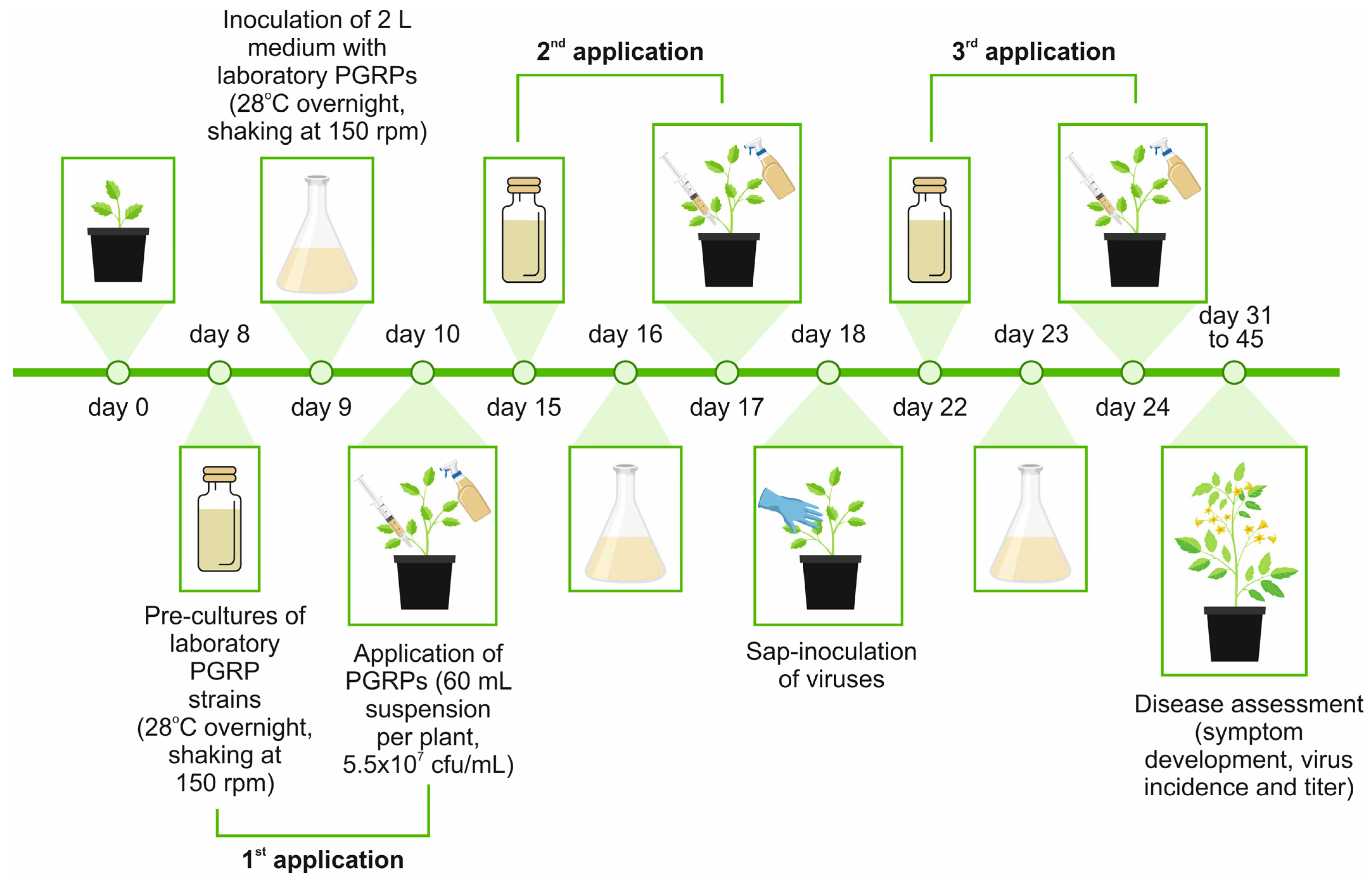
Serifel® (MBI600 viable spores) was diluted in sterile water in a concentration of 5.5 × 10⁷ cfu/mL as recommended. In the case of K165, Z13, EP3, and SRL248, the strains were initially grown overnight in 8 mL LB medium at 28 °C with agitation at 150 rpm. These pre-cultures were then used to inoculate 2 L of LB and the resulting cultures were grown overnight at 28 °C with agitation at 150 rpm. Upon overnight incubation, the PGPM cultures were centrifuged at 2000× g for 5 min and subsequently resuspended to the same volume of sterile water to an approximate target concentration ranging from 1 × 10⁸ to 2 × 10⁸ cfu/mL. For all PGPMs, 60 mL of the resulting suspension were applied through drenching the plant roots, whereas SRL248 was also applied by spraying. A triple weekly drenching/spraying program was applied, with the first application of the PGPMs at the tomato developmental stage of the second leaf on the main shoot unfolding (phenological developmental stage BBCH 102). Virus challenge was performed by sap-inoculating a plant leaflet one day after the second PGPM application. Inocula of the viruses tested were obtained by grinding infected N. rustica leaf tissue in 10 mM sodium phosphate buffer pH 7, 0.2% w/v DIECA (1:3 w/v dilution). For the mechanical inoculation, 3% (w/v) carborundum was added to each inoculum. A simplified scheme of the methodological approach followed for evaluating the antiviral effect of PGPMs against specific viruses is presented in Figure 1. Water-treated plants were used as controls for PGPM application and were mechanically inoculated with the respective virus, similar to all other treatments. In each experiment, a total of 30 plants per treatment were analyzed.

2.4. Disease Assessment

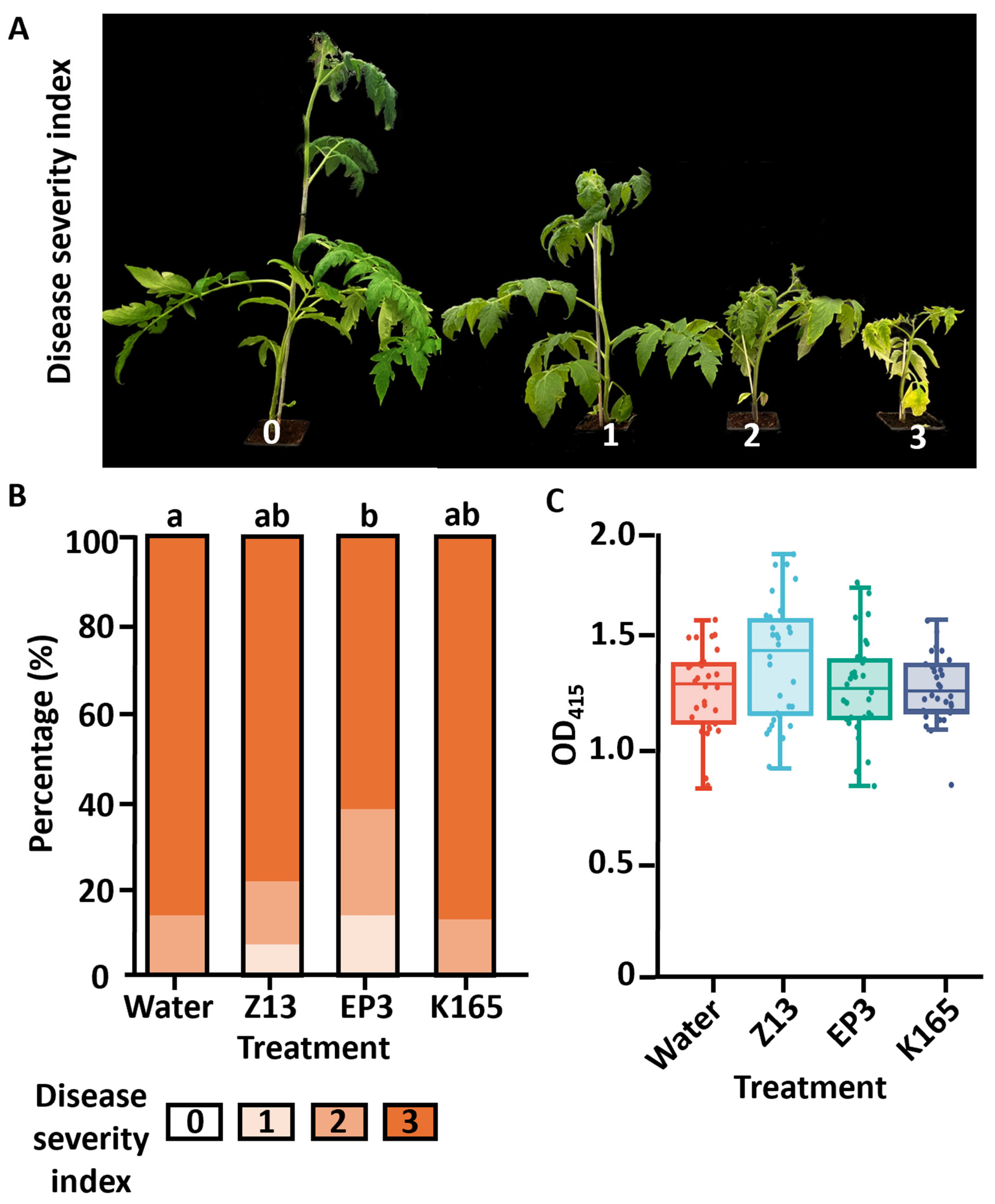
The evaluation of the progress of the viral diseases was monitored visually by symptom observation and, when needed, by measuring specific plant biometric characteristics (e.g., plant height), while the presence and titer of the viruses were assessed by double-antibody sandwich enzyme-linked immunosorbent assay (DAS-ELISA) on the apical non-inoculated leaves, utilizing commercial antibodies specific for each virus (LOEWE Biochemica GmbH, Sauerlach, Germany). Disease severity was assessed using a visual disease index based on symptom severity, where plants were categorized as follows: ‘0’: no symptoms, ‘1’: mild mosaic and slight distortion, ‘2’: stunted growth and leaf curling, and ‘3’: stunted growth, chlorosis and necrosis, ring spots, and bronzing. Disease index values were calculated based on the proportion of plants within each category at the indicated time point. For the statistical analysis, disease severity data were analyzed as categorical frequency distributions. Overall differences among treatments were assessed using a Chi-square test of independence. When significant effects were detected, pairwise Chi-square tests were performed to compare individual treatments. Statistical significance was evaluated at p < 0.05. DAS-ELISA was performed on samples consisting of three tomato leaflets from the most apical fully expanded leaf homogenized in plastic bags (1:10 w/v) in 1X PBS supplemented with 2% w/v polyvinylpyrrolidone (MW 40,000, PVP40 Sigma-Aldrich, St. Louis, MO, USA) and 0.2% (w/v) bovine serum albumin (BSA, Sigma-Aldrich, St. Louis, MO, USA). ELISA reactions were performed according to the manufacturer’s instructions and the absorbance of the samples at 415 nm (OD415) was measured one hour upon the addition of the substrate. Samples were considered positive when their OD415 was higher than 2.5 times the mean OD415 of three healthy control samples. ANOVA followed by Bonferroni post hoc testing was used for the statistical analysis of all ELISA obtained data.

2.5. Gene Expression Analysis

For the analysis of Pathogenesis related protein 1b (SlPR1b.1) and RNA-dependent RNA polymerase 1 (SlRdR1) expression upon PGPM application, tomato plants were grown in a controlled growth chamber (MLR-352H, Panasonic, Osaka, Japan) with a 16 h light photoperiod, light intensity of 20,000 lux, temperature set at 25 °C/22 °C (day/night), and relative humidity at 85%/90% (day/night). Gene expression analysis was performed just prior to virus inoculation (one day after the second drench application) in plants treated with Serifel®, K165, Z13, and EP3 as described above. Water-treated plants were used as controls and five plants per treatment were assessed. The upper non-inoculated, fully expanded leaf from each plant was sampled and homogenized with liquid nitrogen. Total RNA was extracted from 80 mg of homogenized tissue with the RNeasy Plant Mini Kit (QIAGEN GmbH, Hilden, Germany) according to the manufacturer’s instructions. To avoid contamination with genomic DNA, a DNase treatment step with DNase I (RNase-free; New England Biolabs, Ipswich, MA, USA) was followed. A total of 500 ng of the resulting RNA was used as a template for cDNA synthesis with SMART® MMLV Reverse Transcriptase (Takara Bio USA, Inc., San Jose, CA, USA). RT-qPCR reactions were performed in duplicates in a QuantStudio 5 apparatus (Thermo Fisher Scientific, Waltham, MA, USA) using the KAPA SYBR® FAST qPCR Master Mix Kit (KAPA Biosystems, Roche, Wilmington, MA, USA) according to the manufacturer’s instructions. The Ubiquitin3 gene was used as a reference. Primer sequences and the statistical analysis followed are described in [13].

3. Results

3.1. EP3 and SRL248 Application Resulted in Tomato Spotted Wilt Virus (TSWV) Attenuated Symptoms

Under greenhouse conditions, a significant effect on the TSWV symptom development was recorded only in plants treated with EP3. The initiation of symptoms in the upper non-inoculated plant parts was recorded at 10 days post-inoculation (dpi) in all treatments. Disease index scoring at 20 dpi showed that 40% of EP3-treated plants exhibited attenuated symptoms (Figure 2A, index 1 and 2), showing only mild mosaic and slight distortion in the upper leaves. In contrast, Z13 (p = 0.27) and K165 (p = 0.2) applications had no effect on symptom development as the majority of plants displayed stunted growth, chlorosis and necrosis, ring spots, and bronzing similar to water-treated control plants (Figure 2A, index 3). Although EP3 application resulted in a statistically significant reduction in the TSWV disease index (Figure 2B, p = 0.04), no effect was observed in the TSWV titer as indicated by the OD415 values obtained after ELISA at 20 dpi (mean OD415 1.29 ± 0.18). As demonstrated in Figure 2C, no statistical difference in OD415 values was recorded among treatments, while a non-significant trend towards higher OD415 values (p = 0.08) was recorded upon Z13 application (mean OD415 1.4 ± 0.24).
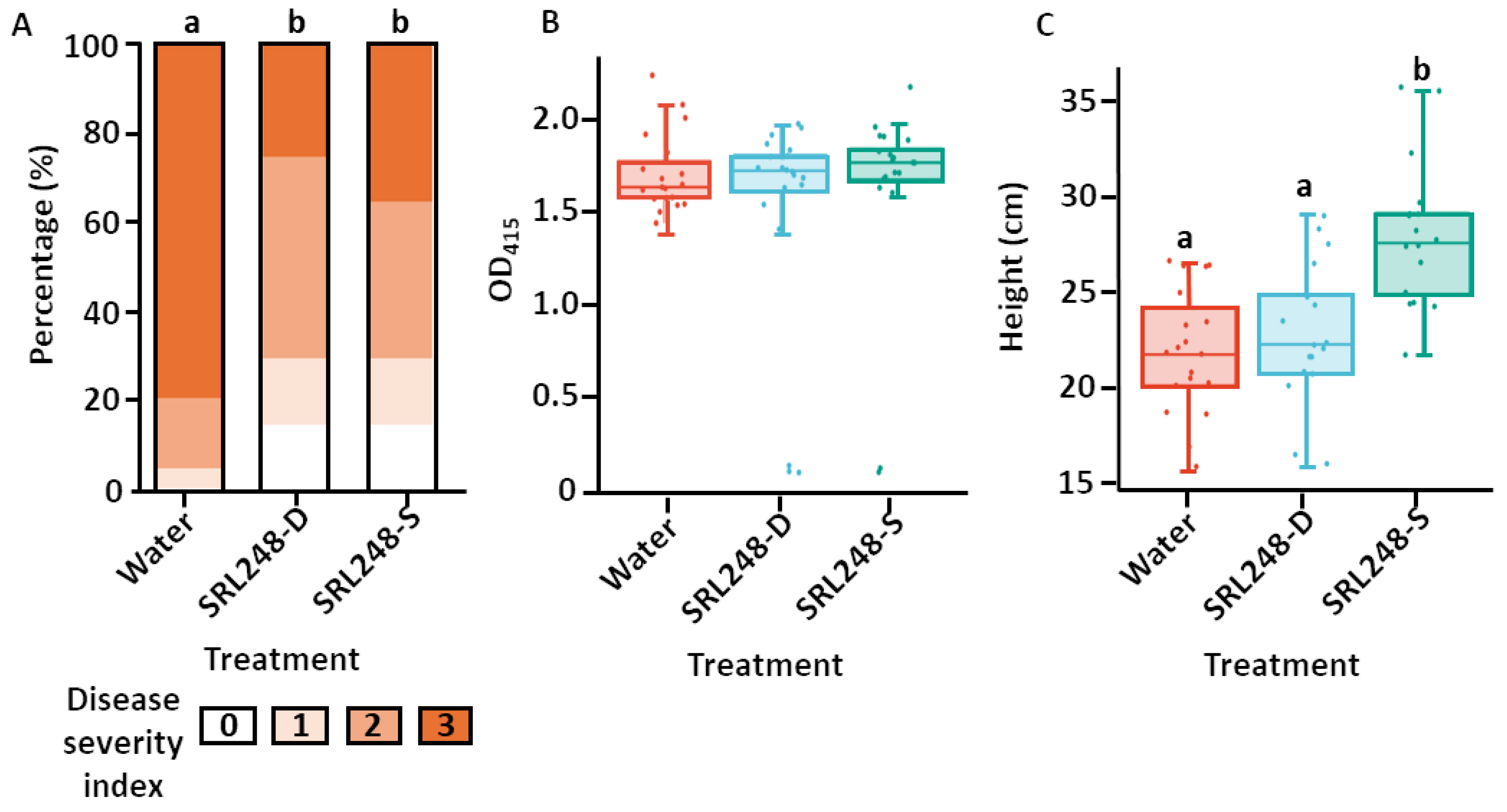
Concerning the PGPM strain SRL248, two application methods were followed: root drenching or spraying. As illustrated in Figure 3A, at 21 dpi, drench and spraying applications resulted in 75% (p = 0.007) and 65% (p = 0.037) symptom attenuation, respectively, compared to the control plants. Similar to the results obtained with the bacterial PGPMs, TSWV accumulation was not affected (mean OD415 for drench 1.49 ± 0.62 and for spraying 1.62 ± 0.54 compared to 1.7 ± 0.21 for water), although a statistically significant reduction in symptom development was recorded. More importantly, the spraying application of SRL248 resulted also in a statistically significant increase in plant height (p < 0.001), even in the presence of TSWV (Figure 3C).

3.2. Effect of PGPM Application Against Cucumber Mosaic Virus (CMV) and Tomato Brown Rugose Fruit Virus (ToBRFV)

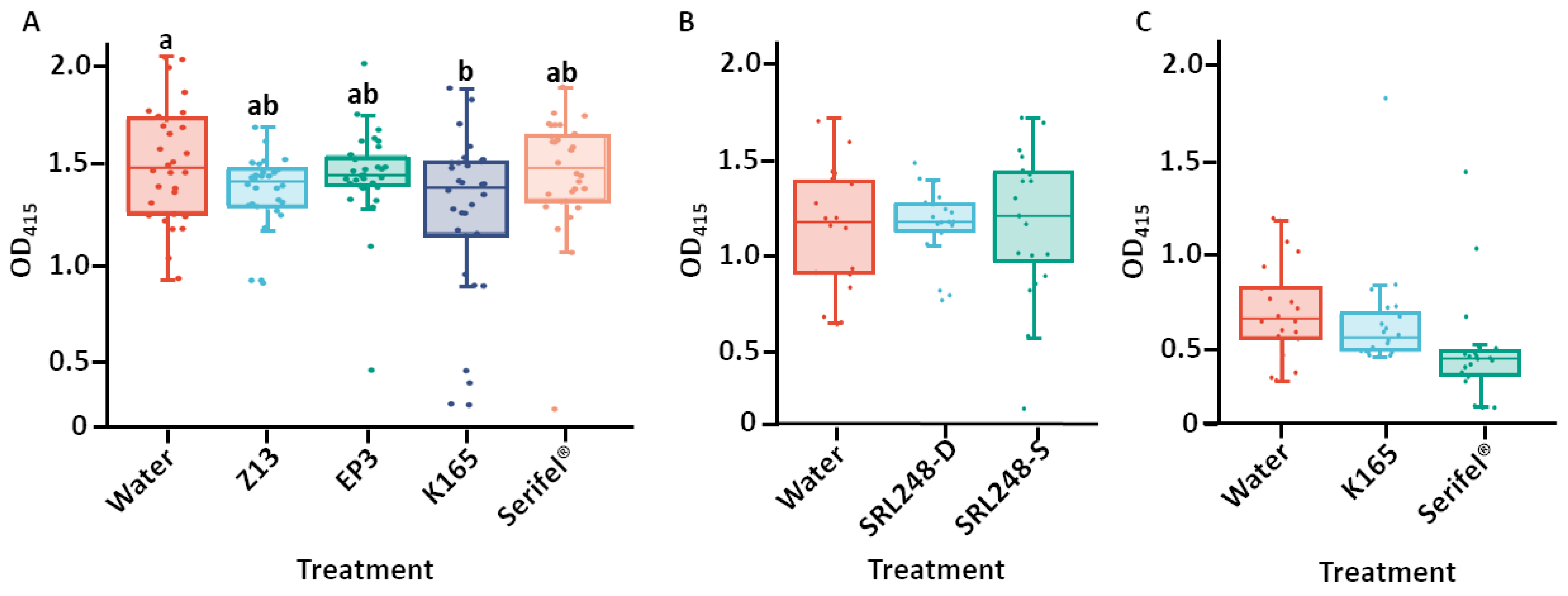
The same experimental approach was used to test the effect of PGPM application against CMV and ToBRFV. Concerning CMV, disease symptoms appeared in the upper non-inoculated plant parts as early as 7 days post-inoculation (dpi) and included leaf mosaic, shoestring leaf distortion, and stunted growth. No difference in symptomatology was observed among treatments. Analysis of CMV accumulation via ELISA at 14 dpi indicated a statistically significant difference only upon K165 application (mean OD415 1.25 ± 0.42, p = 0.007) compared to control plants (mean OD415 1.5 ± 0.29) (Figure 4A,B). However, this difference was not accompanied by a corresponding change in symptom development.
Against ToBRFV infection, only K165 and Serifel® were tested. Similar symptoms were recorded among all treatments in the non-inoculated plant parts at 5 dpi, and included mosaic, shoestring leaf distortion, and stunted growth. The ELISA analysis performed at 11 dpi revealed a non-significant difference in the ToBRFV titer (p = 0.07), however a trend towards lower OD415 values was observed in Serifel®-treated plants (Figure 4C, mean OD415 0.41 ± 0.33 for Serifel® treatment compared to 0.64 ± 0.27 for K165- and 0.64 ± 0.27 for water-treated plants).

3.3. Differential Effect of PGPM Application on SlPR1b.1 and SlRdR1 Expression

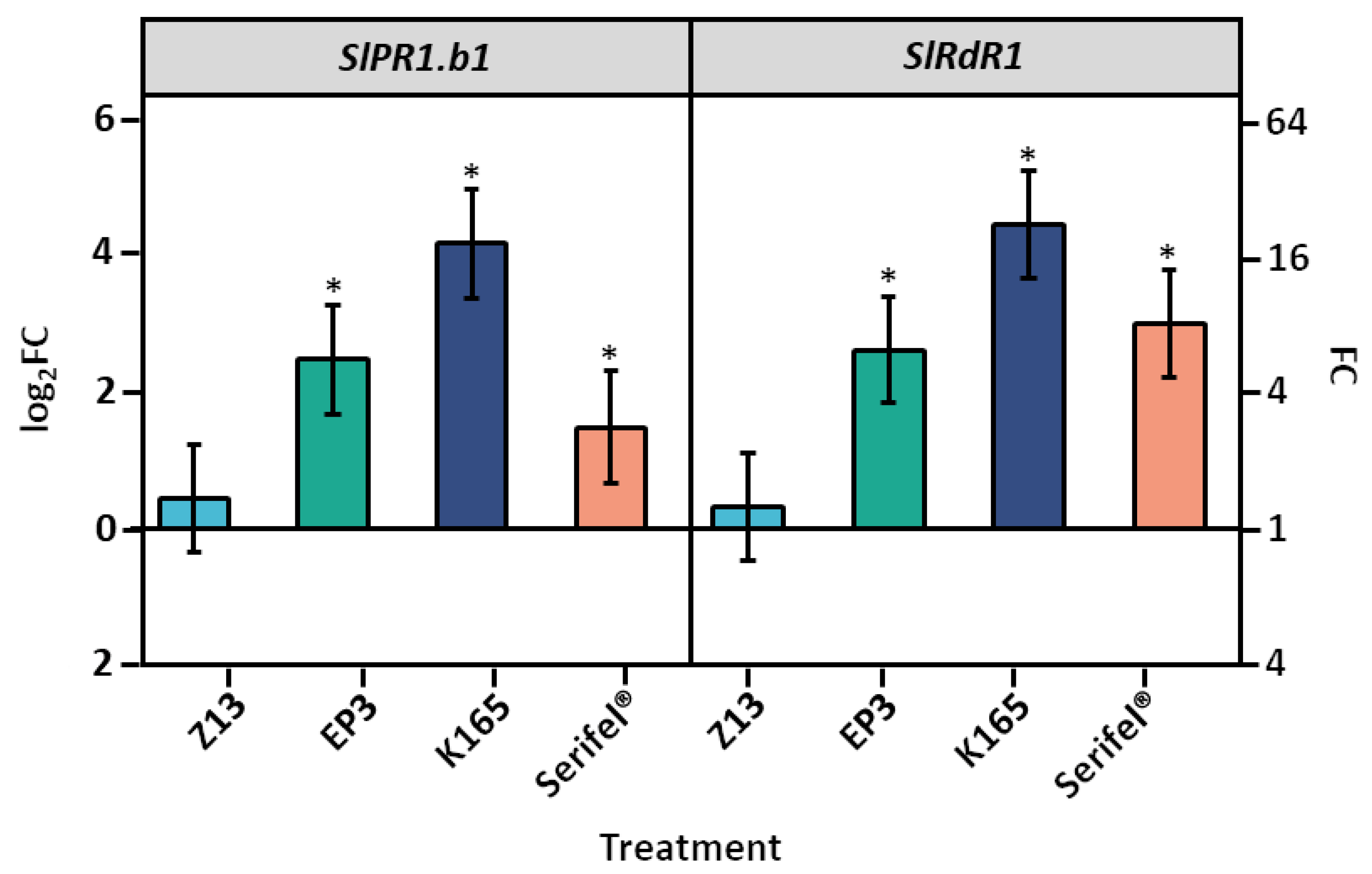
To obtain an insight into the putative antiviral mechanism induced by each PGPM, the expression of SlPR1.b1, the key gene of SA-induced defense, and SlRdR1, the marker of the induction of RNA silencing machinery, were assessed in tomato plants at 24 h upon the second drench application of the PGPMs. As demonstrated in Figure 5, K165, EP3 and Serifel® applications resulted in a significant upregulation of both genes tested when compared to water-treated control plants. More specifically, the highest expression levels were recorded upon K165 treatment that resulted in 18- and 22-fold inductions of SlPR1.b1 and SlRdR1, respectively. A statistically significant six-fold induction of both genes was recorded in EP3-treated plants. Although Serifel® application resulted in the lowest significant induction of SlPR1.b1 (three-fold induction), an eight-fold upregulation in SlRdR1 expression was observed. Finally, no significant differences were recorded in the expression of the two genes among Z13-treated and control plants.

4. Discussion

Viruses are responsible for approximately 50% of plant diseases affecting agricultural systems worldwide, resulting in great agronomic losses that reach over USD 30 billion annually [22]. Their management is mainly based on prevention, since no therapeutical means are available. The identification of novel strategies for virus management has always been a challenge to virologists. In this study, we evaluated the antiviral capacity of selected plant growth promoting microorganisms (PGPMs), against three economically important viruses, namely tomato spotted wilt virus (TSWV), cucumber mosaic virus (CMV), and tomato brown rugose fruit virus (ToBRFV), in tomato plants under controlled greenhouse conditions. Our results demonstrate that the application of specific PGPMs can lead to a substantial reduction in symptom severity, although this is not linked to a coinciding reduction in virus accumulation. In addition, the effect of the PGPMs tested was dependent on the virus species.
Among the bacteria tested against TSWV, the strongest antiviral effect was obtained from the application of Paraburkholderia eburnea EP3. Paraburkholderia species are bacteria known to promote the growth of plants and induce effectively direct or indirect defense mechanisms against plant pathogens. In specific, EP3 was recently shown to reduce Verticillium wilt in eggplants and to induce ISR through the induction of PR1 and PR4 genes [19]. Against TSWV, EP3 application resulted in attenuated symptoms in about 40% of plants tested, without however an accompanied reduction in virus accumulation. A similar antiviral effect was observed with the experimental PGPM strain SRL248. Both root drenching and foliar application mitigated TSWV symptom severity, while foliar spraying additionally promoted plant height, even in the presence of virus infection, supporting the idea that SRL248 is a plant growth-promoting yeast isolate. Such growth-promoting effects may partially compensate for virus-induced damage and could contribute to yield loss attenuation, highlighting the potential agronomic value of SRL248 application, even in the absence of reduced virus accumulation. Similar to EP3 application, the absence of an effect on virus titer suggests that SRL248 influences plant physiological resilience rather than inducing antiviral effects. These phenomena are in line with the results obtained from previous studies reporting that the defense mechanisms induced by PGPMs frequently result in improved plant tolerance to viral infections without necessarily suppressing virus replication [23,24,25]. However, such symptom alleviation is of great agricultural value, as elevated yield losses are often tightly correlated to severe symptoms rather than to virus load [26].
The virus-specific tolerance observed in this study, particularly against TSWV, may be attributed to fundamental biological differences among the viruses tested. Viruses exhibit substantial variation in their replication strategies, the host pathways they exploit for systemic movement, and their capacity to suppress host defense mechanisms [27,28,29]. Therefore, the modulation of any of these pathways by PGPMs may interfere with the TSWV infection process, resulting in symptom alleviation. In contrast, rapidly replicating viruses such as CMV and ToBRFV may more readily overcome such priming-mediated tolerance mechanisms, which could explain the absence of an antiviral effect against these viruses. Nevertheless, as EP3 and SRL248 are experimental PGPMs and little is currently known about the mechanisms underlying their activity, further research is required to elucidate the molecular and physiological basis of their antiviral properties.
In contrast to EP3 and SRL248, the application of Z13 and K165 showed no effect against TSWV symptomatology, while Z13 even displayed a non-significant trend towards increased viral accumulation. These observations highlight the PGPM/strain-specific differences frequently described in PGPM–plant–virus interactions [30]. The processes that take place during the infection of a plant by a virus, including virus multiplication, intercellular and systemic movement, and even its interaction with an insect vector, are affected by phytohormones [31,32,33]. Since PGPMs are well-documented to affect the hormonal profile of a plant, such changes may unintentionally create conditions that might favor virus accumulation and spread.
Although the antiviral effect of several PGPMs against CMV has been demonstrated [9,25,34], none of the PGPMs tested in this study showed any effect on CMV symptomatology. Concerning CMV, K165 application resulted in a decrease in virus titer as suggested by the ELISA results, but this was not linked to a milder symptomatology. As already suggested, the appearance and development of symptoms during a viral infection are highly affected by environmental factors, the viral genus and isolate, the plant host/cultivar, the developmental stage of the plant, and not by the virus accumulation per se [26,35]. In this context, severe symptoms could be induced even in the presence of a low CMV load. Finally, since the results of experimental conditions often do not coincide with those obtained during field trials, field-based validation remains necessary to conclusively assess the antiviral potential of a PGPM [36].
For ToBRFV, neither K165 nor Serifel® significantly affected symptoms or viral accumulation, although a trend towards reduced titer was observed in Serifel®-treated plants. Tobamoviruses, in general, are characterized by their high stability, rapid accumulation, and systemic movement, which render their management highly challenging through ISR induction [37]. Therefore, it is plausible that stronger or more targeted ISR-inducing agents may be needed for the suppression of viruses belonging to the Tobamovirus genus.
The transcriptional analysis of the defense-related genes, Pathogenesis-related protein 1b (SlPR1b.1) and RNA-dependent RNA polymerase 1 (SlRdR1), provides valuable pieces of information regarding the molecular basis of the mechanisms induced by the tested PGPMs. Applications of K165, EP3, and Serifel® resulted in a statistically significant induction of SlPR1b.1, the marker gene of salicylic acid (SA)-mediated defense [38]. These PGPMs are already known for their ability to induce an SA-dependent mechanism either in tomato [13] or other plant pathosystems [19]. Except for SlPR1b.1, they all induced the expression of SlRdR1, the key regulatory gene of the basal antiviral defense [39]. Although for Serifel® this was already demonstrated in our previous study [13], this is the first time of reporting such an induction for K165 and EP3. Furthermore, K165 application resulted in the strongest transcriptional activation of both genes tested; however, this molecular response was not associated with a corresponding antiviral effect against either CMV, TSWV, or ToBRFV. In contrast, the moderate induction of both genes upon EP3 application coincided with the attenuation of TSWV symptom development. Finally, during gene expression analysis, no difference was recorded in Z13-treated plants, a fact that was consistent with its lack of antiviral efficacy and the observed trend towards increased TSWV accumulation. Collectively, our results support the idea that PGPM-mediated antiviral effects are strain-specific and may primarily function through the priming of host defenses, rather than through a strong constitutive activation of antiviral mechanisms.
Concluding, the present study expands the known list of PGPM strains with antiviral activity, and signifies both their potential in the control of viral diseases but also the need for an extensive, case-by-case evaluation of their antiviral effect based on the specific requirements of their application, as defined by the plant cultivar, the virus isolate, the plant physiological status, and the environmental conditions.

5. Conclusions

This study demonstrates that the recorded antiviral effects of PGPMs are both strain- and virus-specific and are primarily associated with symptom attenuation rather than a reduction in virus accumulation. Applications of Paraburkholderia eburnea EP3 and the yeast isolate SRL248 significantly reduced TSWV symptom severity, supporting a PGPM-induced tolerance effect. However, against CMV or ToBRFV, no antiviral action was recorded. The growth-promoting effect observed following SRL248 application further highlights the potential agronomic value of such PGPMs by alleviating to some extent the detrimental effects associated with virus infection. Overall, these findings support the potential of PGPMs as sustainable tools for the management of viral diseases while emphasizing the need for further mechanistic investigations and field validation.

Author Contributions

Conceptualization, D.B. and N.V.; software, I.T.; formal analysis, K.K., A.D., I.T. and D.B.; investigation, K.K. and A.D.; resources, P.F.S., E.G.P., S.E.T., D.B. and N.V.; writing—review and editing, K.K., A.D., I.T., N.P.A., P.F.S., E.G.P., S.E.T., D.B. and N.V.; supervision, D.B. and N.V.; funding acquisition, D.B. and N.V. All authors have read and agreed to the published version of the manuscript.

Funding

This study was part of the “Innovations in Plant Protection for sustainable and environmentally friendly pest control, InnoPP—TAEDR-0535675” project that was funded by the European Union Next-Generation EU, Greece 2.0 National Recovery and Resilience plan, National Flagship Initiative “Agriculture and Food Industry” and “Rhizovir: Deciphering the molecular mechanisms induced by rhizobacteria against plant viral pathogens”, which was carried out within the framework of the National Recovery and Resilience Plan Greece 2.0, funded by the European Union—NextGenerationEU (implementation body: HFRI).

Data Availability Statement

The original contributions presented in this study are included in the article. Further inquiries can be directed to the corresponding authors.

Conflicts of Interest

The authors declare no conflicts of interest.

Abbreviations

The following abbreviations are used in this manuscript:
CMVCucumber mosaic virus
TSWVTomato spotted wilt virus
ToBRFVTomato brown rugose fruit virus
PGPMPlant growth-promoting microorganisms
ISRInduced systemic resistance
SASalicylic acid
JAJasmonic acid
ETEthylene
dpiDays post-inoculation
BSABovine serum albumin
NPR1NON-EXPRESSOR OF PATHOGENESIS-RELATED GENES 1
PRPATHOGENESIS-RELATED PROTEINS
RdR1RNA-dependent RNA polymerase 1
DAS-ELISADouble-antibody sandwich enzyme-linked immunosorbent assay

References

  1. Directorate-General for Agriculture and Rural Development. European Commission|Fresh Tomatoes Dashboard. Available online: https://agridata.ec.europa.eu/extensions/DashboardTomato/Dashboard.html# (accessed on 3 December 2025).
  2. Panno, S.; Davino, S.; Caruso, A.G.; Bertacca, S.; Crnogorac, A.; Mandić, A.; Noris, E.; Matić, S. A Review of the Most Common and Economically Important Diseases that Undermine the Cultivation of Tomato Crop in the Mediterranean Basin. Agronomy 2021, 11, 2188. [Google Scholar] [CrossRef]
  3. Tripathi, A.; Pandey, V.K.; Jain, D.; Singh, G.; Brar, N.S.; Taufeeq, A.; Pandey, I.; Dash, K.K.; Samrot, A.V.; Rustagi, S. An Updated Review on Significance of PGPR-Induced Plant Signalling and Stress Management in Advancing Sustainable Agriculture. J. Agric. Food Res. 2024, 16, 101169. [Google Scholar] [CrossRef]
  4. Hasan, A.; Tabassum, B.; Hashim, M.; Khan, N. Role of Plant Growth Promoting Rhizobacteria (PGPR) as a Plant Growth Enhancer for Sustainable Agriculture: A Review. Bacteria 2024, 3, 59–75. [Google Scholar] [CrossRef]
  5. Conrath, U.; Beckers, G.J.M.; Langenbach, C.J.G.; Jaskiewicz, M.R. Priming for Enhanced Defense. Annu. Rev. Phytopathol. 2015, 53, 97–119. [Google Scholar] [CrossRef] [PubMed]
  6. Meena, B. PGPR-Mediated Systemic Resistance for Sustainable Agriculture. In Bacteria in Agrobiology: Plant Probiotics; Maheshwari, D.K., Ed.; Springer: Berlin/Heidelberg, Germany, 2012; pp. 269–285. [Google Scholar]
  7. Pieterse, C.M.J.; Zamioudis, C.; Berendsen, R.L.; Weller, D.M.; Van Wees, S.C.M.; Bakker, P.A.H.M. Induced Systemic Resistance by Beneficial Microbes. Annu. Rev. Phytopathol. 2014, 52, 347–375. [Google Scholar] [CrossRef] [PubMed]
  8. Shah, A.; Nazari, M.; Antar, M.; Msimbira, L.A.; Naamala, J.; Lyu, D.; Rabileh, M.; Zajonc, J.; Smith, D.L. PGPR in Agriculture: A Sustainable Approach to Increasing Climate Change Resilience. Front. Sustain. Food Syst. 2021, 5, 667546. [Google Scholar] [CrossRef]
  9. Zehnder, G.W.; Yao, C.; Murphy, J.F.; Sikora, E.R.; Kloepper, J.W. Induction of Resistance in Tomato against Cucumber Mosaic Cucumovirus by Plant Growth-Promoting Rhizobacteria. BioControl 2000, 45, 127–137. [Google Scholar] [CrossRef]
  10. Murphy, J.F.; Reddy, M.S.; Ryu, C.-M.; Kloepper, J.W.; Li, R. Rhizobacteria-Mediated Growth Promotion of Tomato Leads to Protection Against Cucumber mosaic virus. Phytopathology 2003, 93, 1301–1307. [Google Scholar] [CrossRef]
  11. Sudhakar, N.; Thajuddin, N.; Murugesan, K. Plant Growth-Promoting Rhizobacterial Mediated Protection of Tomato in the Field against Cucumber Mosaic Virus and Its Vector Aphis Gossypii. Biocontrol Sci. Technol. 2011, 21, 367–386. [Google Scholar] [CrossRef]
  12. Kandan, A.; Commare, R.R.; Nandakumar, R.; Ramiah, M.; Raguchander, T.; Samiyappan, R. Induction of Phenylpropanoid Metabolism byPseudomonas Fluorescens against Tomato Spotted Wilt Virus in Tomato. Folia Microbiol. 2002, 47, 121–129. [Google Scholar] [CrossRef]
  13. Beris, D.; Theologidis, I.; Skandalis, N.; Vassilakos, N. Bacillus amyloliquefaciens Strain MBI600 Induces Salicylic Acid Dependent Resistance in Tomato Plants against Tomato spotted wilt virus and Potato virus Y. Sci. Rep. 2018, 8, 10320. [Google Scholar] [CrossRef]
  14. Zohoursoleimani, R.; Aeini, M.; Ghodoum Parizipour, M.H. Effects of Abiotic and Biotic Elicitors on Tomato Resistance to Tomato Brown Rugose Fruit Virus. Sci. Rep. 2025, 15, 27216. [Google Scholar] [CrossRef] [PubMed]
  15. Ramos-Villanueva, C.D.; Carrillo-Benitez, G.; Zamora-Macorra, E.J.; Santiago-Elena, E.; Ramírez-Alarcón, S.; Jimenez-Vidals, J.; Ávila-López, R. Use of Endophytic Microorganisms for the Management of Tomato Brown Rugose Fruit Virus in Tomato Crop (Solamun lycopersicum). Rev. Mex. Fitopatol. 2023, 41. [Google Scholar] [CrossRef]
  16. Öncü, F.; Baştaş, K.K. Plant Viruses and Plant Growth Promoting Rhizobacteria (PGPR) Relationships: A Shiny Application. Selcuk. J. Agric. Food Sci. 2022, 36, 43–47. [Google Scholar] [CrossRef]
  17. Tjamos, E.C.; Tsitsigiannis, D.I.; Tjamos, S.E.; Antoniou, P.P.; Katinakis, P. Selection and Screening of Endorhizosphere Bacteria from Solarized Soils as Biocontrol Agents Against Verticillium dahliae of Solanaceous Hosts. Eur. J. Plant Pathol. 2004, 110, 35–44. [Google Scholar] [CrossRef]
  18. Ziazia, P.; Poulaki, E.G.; Gkizi, D.; Lozano, L.; Serrano, M.; Tjamos, S.E. Feeding the Microbes: A Strategy to Control Verticillium Wilt. Agronomy 2021, 11, 1946. [Google Scholar] [CrossRef]
  19. Poulaki, E.G.; Karamichali, I.; Lianos, O.; Alexopoulos, V.; Dimitrakas, V.; Amourgis, G.G.; Tjamos, S.E. Exploring the Biocontrol Potential of Rocket (Eruca Sativa) Extracts and Associated Microorganisms against Verticillium Wilt. J. Appl. Microbiol. 2024, 135, lxae070. [Google Scholar] [CrossRef]
  20. Beris, D.; Tzima, A.; Gousi, F.; Rampou, A.; Psarra, V.; Theologidis, I.; Vassilakos, N. Multiple Integrations of a Sense Transgene, Including a Tandem Inverted Repeat Confer Stable RNA-Silencing Mediated Virus Resistance under Different Abiotic and Biotic Conditions. Transgenic Res. 2023, 32, 53–66. [Google Scholar] [CrossRef]
  21. Beris, D.; Malandraki, I.; Kektsidou, O.; Theologidis, I.; Vassilakos, N.; Varveri, C. First Report of Tomato Brown Rugose Fruit Virus Infecting Tomato in Greece. Plant Dis. 2020, 104, 2035. [Google Scholar] [CrossRef]
  22. Hilaire, J.; Tindale, S.; Jones, G.; Pingarron-Cardenas, G.; Bačnik, K.; Ojo, M.; Frewer, L.J. Risk Perception Associated with an Emerging Agri-Food Risk in Europe: Plant Viruses in Agriculture. Agric. Food Secur. 2022, 11, 21. [Google Scholar] [CrossRef]
  23. Damayanti, T.A.; Pardede, H.; Mubarik, N.R. Utilization of Root-Colonizing Bacteria to Protect Hot-Pepper Against Tobacco Mosaic Tobamovirus. HAYATI J. Biosci. 2007, 14, 105–109. [Google Scholar] [CrossRef]
  24. Raupach, G.S. Induced Systemic Resistance in Cucumber and Tomato Against Cucumber Mosaic Cucumovirus Using Plant Growth-Promoting Rhizobacteria (PGPR). Plant Dis. 1996, 80, 891. [Google Scholar] [CrossRef]
  25. Ryu, C.-M.; Murphy, J.F.; Reddy, M.S.; Kloepper, J.W. A Two-Strain Mixture of Rhizobacteria Elicits Induction of Systemic Resistance against Pseudomonas Syringae and Cucumber Mosaic Virus Coupled to Promotion of Plant Growth on Arabidopsis Thaliana. J. Microbiol. Biotechnol. 2007, 17, 280–286. [Google Scholar] [PubMed]
  26. Gao, M.; Lozano-Durán, R. Symptom Development in Plant Viral Diseases: What, How, and Why? Annu. Rev. Phytopathol. 2025, 63, 431–450. [Google Scholar] [CrossRef]
  27. Hull, R. Replication of Plant Viruses. In Plant Virology; Academic Press: Cambridge, MA, USA, 2014; pp. 341–421. [Google Scholar] [CrossRef]
  28. Boevink, P.; Oparka, K.J. Virus-Host Interactions during Movement Processes. Plant Physiol. 2005, 138, 1815–1821. [Google Scholar] [CrossRef]
  29. Alazem, M.; Lin, N.-S. Roles of Plant Hormones in the Regulation of Host–Virus Interactions. Mol. Plant Pathol. 2015, 16, 529–540. [Google Scholar] [CrossRef]
  30. Beris, D.; Vassilakos, N. Chapter 2—Plant Beneficial Microbes: Do They Have a Role as Antiviral Agents in Agriculture? In Molecular Aspects of Plant Beneficial Microbes in Agriculture; Sharma, V., Salwan, R., Al-Ani, L.K.T., Eds.; Academic Press: Cambridge, MA, USA, 2020; pp. 19–33. [Google Scholar]
  31. Collum, T.D.; Culver, J.N. The Impact of Phytohormones on Virus Infection and Disease. Curr. Opin. Virol. 2016, 17, 25–31. [Google Scholar] [CrossRef]
  32. Pan, L.-L.; Miao, H.; Wang, Q.; Walling, L.L.; Liu, S.-S. Virus-Induced Phytohormone Dynamics and Their Effects on Plant–Insect Interactions. New Phytol. 2021, 230, 1305–1320. [Google Scholar] [CrossRef]
  33. Zhao, S.; Li, Y. Current Understanding of the Interplays between Host Hormones and Plant Viral Infections. PLoS Pathog. 2021, 17, e1009242. [Google Scholar] [CrossRef]
  34. Dashti, N.H.; Ali, N.Y.; Cherian, V.M.; Montasser, M.S. Application of Plant Growth-Promoting Rhizobacteria (PGPR) in Combination with a Mild Strain of Cucumber mosaic virus (CMV) Associated with Viral Satellite RNAs to Enhance Growth and Protection against a Virulent Strain of CMV in Tomato. Can. J. Plant Pathol. 2012, 34, 177–186. [Google Scholar] [CrossRef]
  35. Jiang, T.; Zhou, T. Unraveling the Mechanisms of Virus-Induced Symptom Development in Plants. Plants 2023, 12, 2830. [Google Scholar] [CrossRef]
  36. Skandalis, N.; Dimopoulou, A.; Beri, D.; Tzima, A.; Malandraki, I.; Theologidis, I.; Bitivanos, S.; Varveri, C.; Klitsinaris, T.; Vassilakos, N. Effect of Pyraclostrobin Application on Viral and Bacterial Diseases of Tomato. Plant Dis. 2016, 100, 1321–1330. [Google Scholar] [CrossRef][Green Version]
  37. Smith, E.; Dombrovsky, A.; Smith, E.; Dombrovsky, A. Aspects in Tobamovirus Management in Intensive Agriculture. In Plant Diseases—Current Threats and Management Trends; IntechOpen: London, UK, 2019. [Google Scholar]
  38. Métraux, J.-P. Recent Breakthroughs in the Study of Salicylic Acid Biosynthesis. Trends Plant Sci. 2002, 7, 332–334. [Google Scholar] [CrossRef]
  39. Xie, Z.; Fan, B.; Chen, C.; Chen, Z. An Important Role of an Inducible RNA-Dependent RNA Polymerase in Plant Antiviral Defense. Proc. Natl. Acad. Sci. USA 2001, 98, 6516–6521. [Google Scholar] [CrossRef]
Figure 1. Simplified graph of the approach followed for the evaluation of the antiviral effect of 3PGPMs against cucumber mosaic virus (CMV), tomato spotted wilt virus (TSWV), and tomato brown rugose fruit virus (ToBRFV).
Agronomy 16 00518 g001
Figure 2. (A) Plants representative of the different levels of the tomato spotted wilt virus (TSWV) disease severity index. ‘0’: no symptoms, ‘1’: mild mosaic and slight distortion, ‘2’: stunted growth and leaf curling, and ‘3’: stunted growth, chlorosis and necrosis, ring spots, and bronzing. (B) Percentage of plants exhibiting the different disease indexes upon the application of Pseudomonas putida Z13 (Z13), Paraburkholderia eburnea EP3 (EP3), and Bacillus velezensis K165 (K165). Water-treated plants inoculated with TSWV (water) were used as controls. Different letters indicate statistically significant differences (p value < 0.05). (C) TSWV accumulation levels as indicated by the OD415 values obtained by ELISA at 20 days post-inoculation (dpi). No significant statistical difference was recorded among treatments.
Agronomy 16 00518 g002
Figure 3. (A) Percentage of plants exhibiting the different TSWV disease indexes upon drench (D) or spraying (S) application of the yeast isolate SRL248. Different letters indicate statistically significant differences (p value < 0.05). (B) TSWV titer as indicated by OD415 values obtained by ELISA at 21 dpi. No significant difference was recorded among treatments. No statistically significant differences were recorded among treatments (p = 0.415). (C) Distribution of plant height in SRL248-treated tomato plants compared to water treatment in the presence of TSWV. Different letters indicate statistically significant differences (p value < 0.05). Water-treated plants inoculated with TSWV (water) were used as controls.
Agronomy 16 00518 g003
Figure 4. (A,B) Cucumber mosaic virus (CMV) accumulation levels as supported by OD415 values obtained by ELISA at 14 dpi. Different letters indicate statistically significant differences (p < 0.05). For the SRL248 treatments (root drench, D; foliar spray, S), no statistically significant differences in virus accumulation were detected compared to water-treated control plants (p = 0.947). (C) Tomato brown rugose fruit virus (ToBRFV) titer as calculated by OD415 values obtained by ELISA at 11 dpi (p = 0.07).
Agronomy 16 00518 g004
Figure 5. Effect of Pseudomonas putida Z13 (Z13), Paraburkholderia eburnea EP3 (EP3), Bacillus velezensis K165 (K165), and Serifel® on the transcriptional levels of Pathogenesis related protein 1b (SlPR1b.1) and RNA-dependent RNA polymerase 1 (SlRdR1) defense genes. Five individual plants were analyzed with RT-qPCR. Fold change (FC) represents the relative difference in expression between each treatment and water-treated control plants. UBI3 was used as the reference gene. Error bars represent 2 × SE and asterisks denote statistical significance between treatment and water-treated control plants (p < 0.05).
Agronomy 16 00518 g005
Disclaimer/Publisher’s Note: The statements, opinions and data contained in all publications are solely those of the individual author(s) and contributor(s) and not of MDPI and/or the editor(s). MDPI and/or the editor(s) disclaim responsibility for any injury to people or property resulting from any ideas, methods, instructions or products referred to in the content.