Systematic Review

From Precision Agriculture to Intelligent Agricultural Ecosystems: A Systematic Review of Machine Learning and Big Data Applications


1
Department of Computer Science and Informatics, Universidad de La Frontera, Temuco 4780000, Chile
2
Faculty of Computer Systems Engineering, Universidad Tecnológica de Panamá, Panama City 32401, Panama
*
Author to whom correspondence should be addressed.
Agronomy 2026, 16(5), 516; https://doi.org/10.3390/agronomy16050516
Submission received: 15 January 2026 / Revised: 20 February 2026 / Accepted: 23 February 2026 / Published: 27 February 2026

Abstract

This systematic review analyzes the evolution of Machine Learning and Big Data applications in agriculture from 2021 to 2025, with particular emphasis on how recent technological advances facilitate the transition from precision agriculture to Intelligent Agricultural Ecosystems. A comprehensive literature search was conducted across Scopus, Web of Science, IEEE Xplore, the ACM Digital Library, SpringerLink, and MDPI, following the PRISMA 2020 guidelines. After duplicate removal and a two-stage screening process (title/abstract screening followed by full-text assessment), eligible peer-reviewed studies were systematically extracted using a structured coding matrix encompassing six analytical domains: crops, soil, weather and water, land use, animal systems, and farmer decision-making. The findings reveal a substantial increase in ML-driven agricultural analytics. Although Random Forest and Convolutional Neural Networks remain widely adopted, recent studies demonstrate a marked shift toward advanced Deep Learning architectures, integrated cloud–edge–device infrastructures, Federated Learning frameworks for privacy-preserving collaboration, Explainable AI techniques to enhance transparency, and governance-oriented mechanisms to ensure interoperability. Notwithstanding these advances, several persistent challenges remain, including limited generalizability across diverse agroclimatic contexts, the high costs associated with high-quality data annotation, the integration of heterogeneous and multimodal datasets, and infrastructural constraints related to connectivity. These developments are synthesized within the IAE conceptual framework, underscoring governance- and lifecycle-aware orchestration MLOps as a critical differentiator that transcends purely technology-centric approaches.

1. Introduction

The sustained growth of the global population, coupled with the increasing demand for more nutritious, safe, and sustainably produced food, has placed considerable pressure on agricultural systems around the world [1,2]. Agriculture today faces structural challenges, including climate change, water scarcity, soil degradation, and the shrinking availability of arable land, all within a context in which food demand is projected to increase by up to 70% by 2050 [3]. Additionally, phenomena such as pests, diseases, and extreme weather events further exacerbate the risks to agricultural production [4]. In light of this scenario, the integration of digital technologies—particularly Machine Learning (ML) and Big Data—has opened new avenues for transforming traditional agriculture into smart agriculture. This transformation aims to increase efficiency, reduce waste, and mitigate environmental impacts [5,6]. These technologies enable the large-scale integration of climatic, soil-related, genetic, and economic data, providing predictive and prescriptive capabilities that facilitate more accurate agronomic decision-making [7]. In crop production, ML has proven effective for tasks such as yield prediction, disease detection, soil classification, and irrigation optimization [3,8]. Simultaneously, Big Data platforms have enabled the processing of multi-source data (including climatic, satellite, and IoT sensor data) in near real-time, thereby supporting practices such as precision agriculture and the monitoring of production chains [4,9].
Over the past five years, the use of ML and Big Data in agriculture has become established as a systematic strategy, not only in terms of the algorithms applied but also in the development of more robust data infrastructures [3]. The reviewed studies indicate a shift from exploratory approaches toward increasingly specialized and replicable applications. Classical algorithms such as Random Forest (RF), Support Vector Machines (SVM), and Artificial Neural Networks (ANN) remain in use; however, there is a growing adoption of more advanced models such as Long Short-Term Memory (LSTM), Gated Recurrent Unit (GRU), You Only Look Once (YOLO), and Extreme Gradient Boosting (XGBoost), particularly in tasks requiring sequential modeling, computer vision, or multimodal analysis [10,11]. This evolution is accompanied by the deployment of distributed, scalable architectures based on Data Lakes, Apache Spark, Edge Computing, and platforms such as Google Earth Engine (GEE), facilitating the massive, distributed processing of agricultural data [12].
Object detection in high-resolution remote sensing imagery has also evolved through architectural refinements of one-stage detectors. For example, Yang et al. (2022) proposed an enhanced YOLOv4-based framework (YOLOv4_CE) that integrates a ConvNeXt-S backbone, a coordinate attention mechanism, and an Efficient IoU (EIoU) loss function to improve feature extraction and bounding-box regression performance [13]. The model achieved mean average precision values above 95% on benchmark remote sensing datasets, demonstrating the impact of backbone redesign and loss-function optimization in complex geospatial image analysis tasks. Although developed in a general remote sensing context, such methodological contributions are directly relevant to agricultural monitoring scenarios that rely on satellite and UAV imagery for crop assessment, land-use analysis, and object-level detection.
Since 2021, the technological landscape of ML-enabled Big Data analytics in agriculture has undergone substantive structural transformation. Earlier research largely concentrated on isolated ML applications—such as yield prediction and disease detection—evaluated primarily through performance metrics. In contrast, recent literature demonstrates a shift toward integrated, scalable, and governance-aware digital infrastructures. Emerging developments include the implementation of Federated Learning to enable multi-farm collaboration, cloud–edge–device architectures that support real-time distributed analytics, MLOps frameworks for continuous model monitoring and retraining, blockchain-enabled data governance mechanisms, and the incorporation of Explainable AI and digital twins into operational agricultural environments. Collectively, these advancements signal a transition from tool-centric precision agriculture toward ecosystem-level intelligence orchestration, thereby substantiating the need for an updated systematic synthesis covering the 2021–2025 period.
Beyond purely technical progress, the literature also reflects a growing emphasis on data governance, transparency, and responsible AI deployment. The adoption of ethical frameworks for agricultural data management, the institutionalization of MLOps principles to ensure model reliability and traceability, and the exploration of federated learning paradigms underscore increasing concern for security, fairness, and equity in digital agriculture [14]. In this evolving context, the development of intelligent agricultural systems depends not only on algorithmic performance but also on robust data stewardship, interoperability, accessibility, and agroclimatic contextualization [15]. These dimensions underscore the need to move beyond accuracy-driven evaluation toward governance-aware, lifecycle-managed agricultural intelligence systems.
This article analyzes recent advances in applying ML techniques implemented with Big Data technologies to advance agriculture, with a particular focus on progress over the past five years. A systematic literature review identifies trends, application domains, persistent challenges, and emerging opportunities. As with previous studies [3,16], this work seeks not only to update the state of the art but also to provide a critical perspective on the consolidation of these technologies across various domains of smart agriculture. The proposed approach enables the identification of common patterns, research gaps, and potential future development pathways.
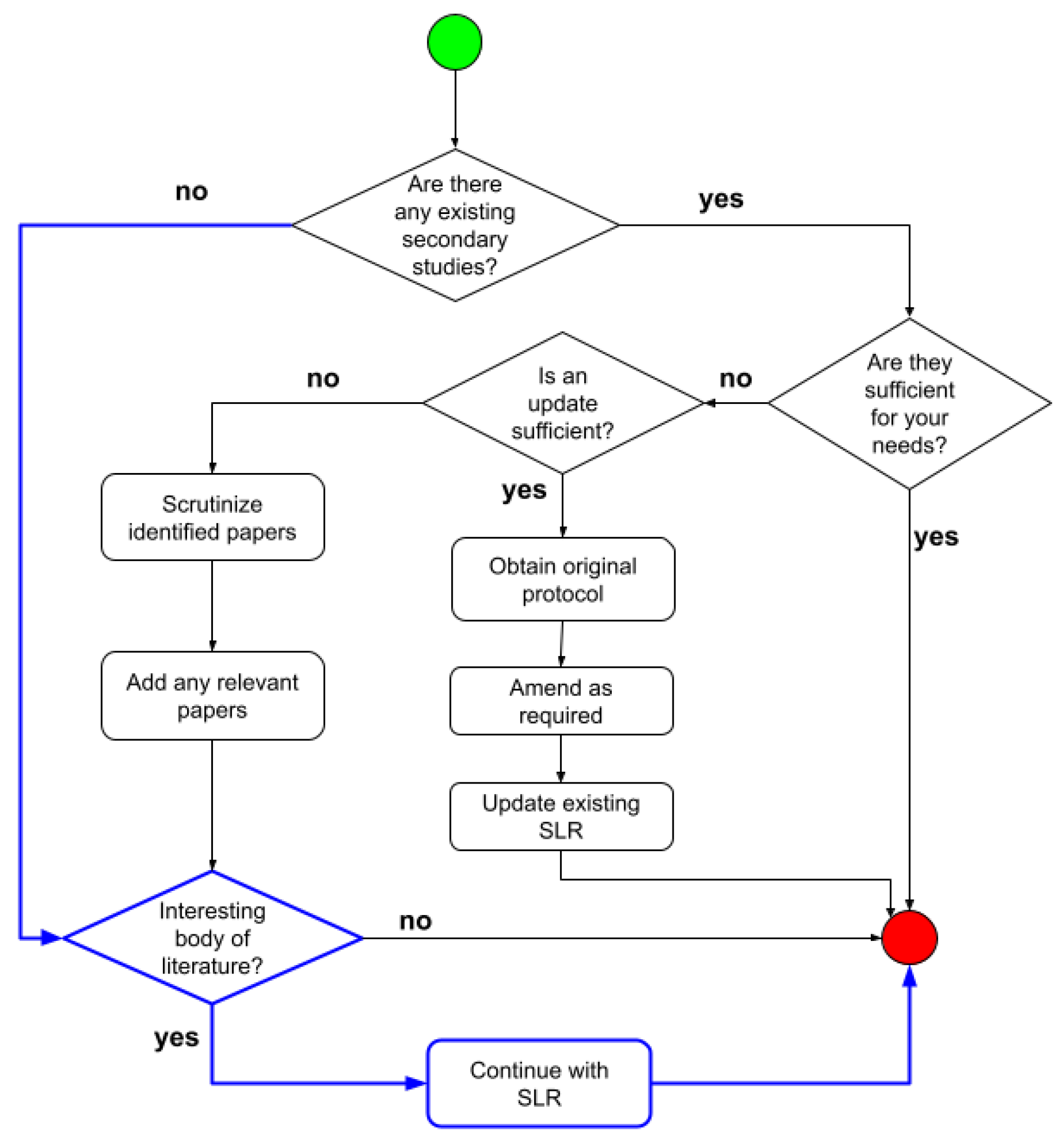
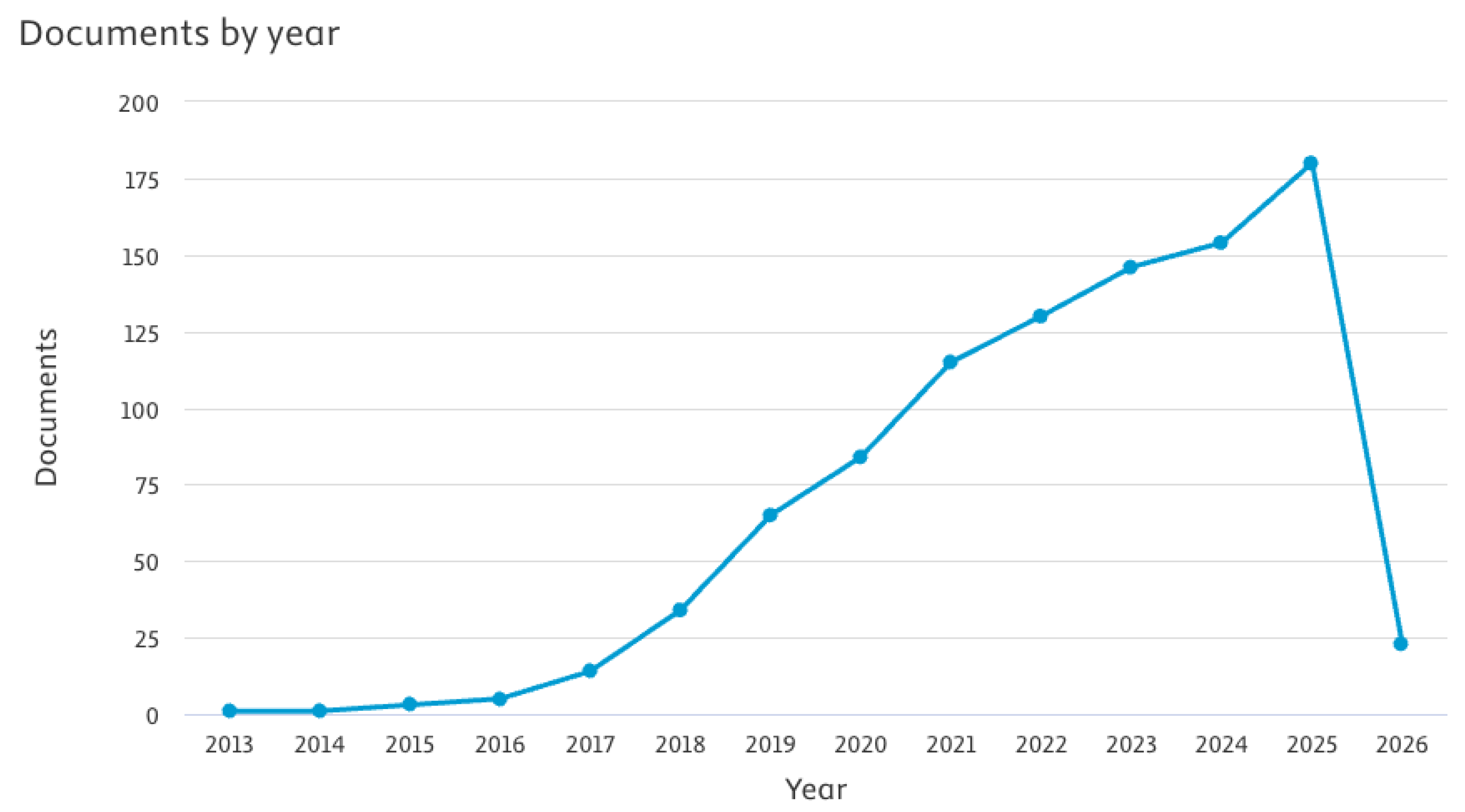
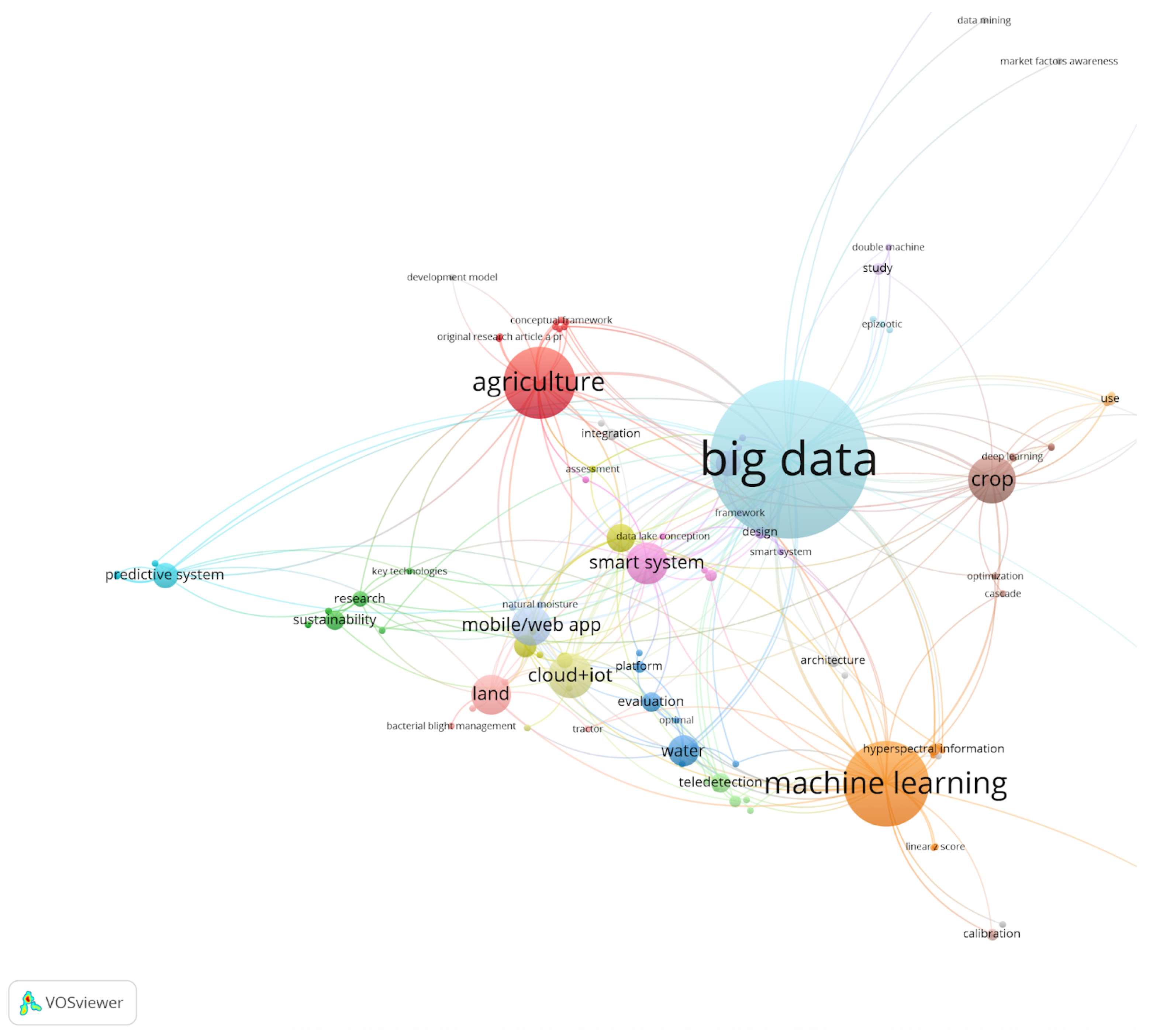
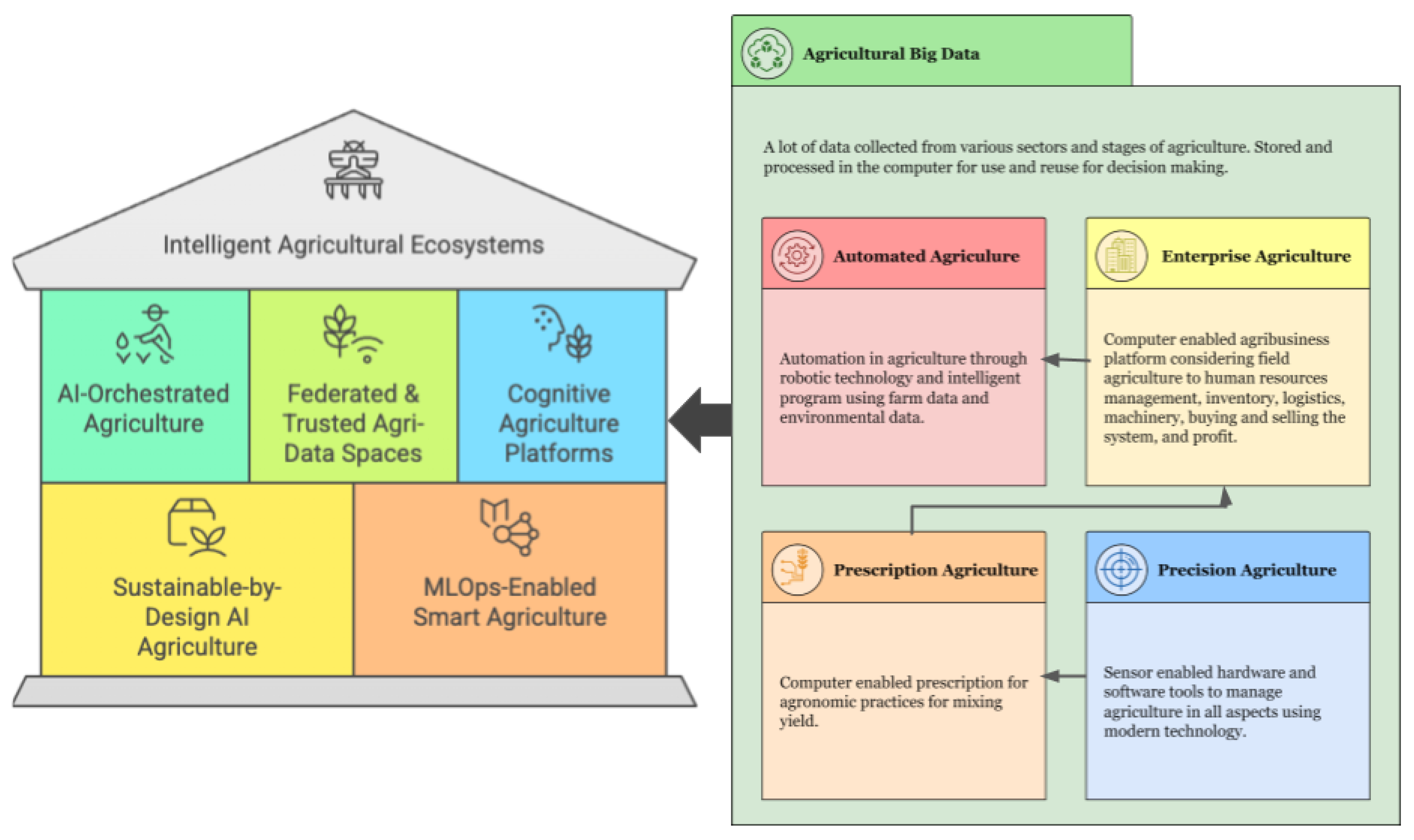
The need for this review is grounded in two complementary elements. On the one hand, as illustrated in Figure 1, there exists a conceptual framework that justifies an in-depth exploration of the use of ML and Big Data in agriculture, considering the advancement of digital platforms, specialized algorithms, and distributed architectures applied to agricultural analysis. This rapidly expanding technological ecosystem demands systematic evaluations to identify best practices, persistent challenges, and emerging opportunities. On the other hand, the bibliographic analysis presented in Figure 2—based on the search query (“machine learning” AND “big data”) AND (agriculture OR farm) in the Scopus database—reveals a sustained increase in scientific output on this topic, reaching its peak in 2025. This trajectory confirms that the use of these technologies has evolved from an exploratory phase to a consolidated area of agricultural research, thus reinforcing the relevance of focusing the analysis on the past five years.
Figure 1. Need for the study, adapted from [17].
Agronomy 16 00516 g001
Figure 2. Number of papers selected for review.
Agronomy 16 00516 g002

2. Materials and Methods

The methodological approach for this updated review follows a Systematic Literature Review (SLR) design. The PRISMA framework (Preferred Reporting Items for Systematic Reviews and Meta-Analyses) was applied to guide the article selection process, comprising four key stages: identification, screening, eligibility, and inclusion [18]. To define the objectives and research questions (RQs), we adopted the guidelines proposed by Kitchenham [17]. This review addresses a specific RQ aimed at understanding the current landscape of ML applications in agriculture, specifically: (RQ) What have been the main advances, applications, and challenges in the use of Machine Learning and Big Data techniques for the development of intelligent agricultural systems during the last five years?
The search string was developed based on the RQ, starting with the identification of relevant keywords. To guide this process, we applied the PICOC framework (Population, Intervention, Comparison, Outcome, Context) [17]. According to Kitchenham, the population corresponds to the application domain, which in this case is agricultural Big Data. The intervention involves the use of ML techniques to address specific challenges in this domain. The comparison element was not applicable for this study. The outcomes considered include the types of problems identified, the proposed ML-based solutions, and the challenges reported during their implementation.
We conducted the literature search across several academic databases, including Scopus, Springer, ACM, IEEE, MDPI, and Web of Science, on 9 February 2026. The search strings applied across all sources included the terms (“Big Data” AND “machine learning”) AND (“agriculture” OR “farm”). These keywords were used to query article titles, abstracts, and author-provided keywords. The search was limited to peer-reviewed journal articles and conference papers published in English between 2021 and 2025.
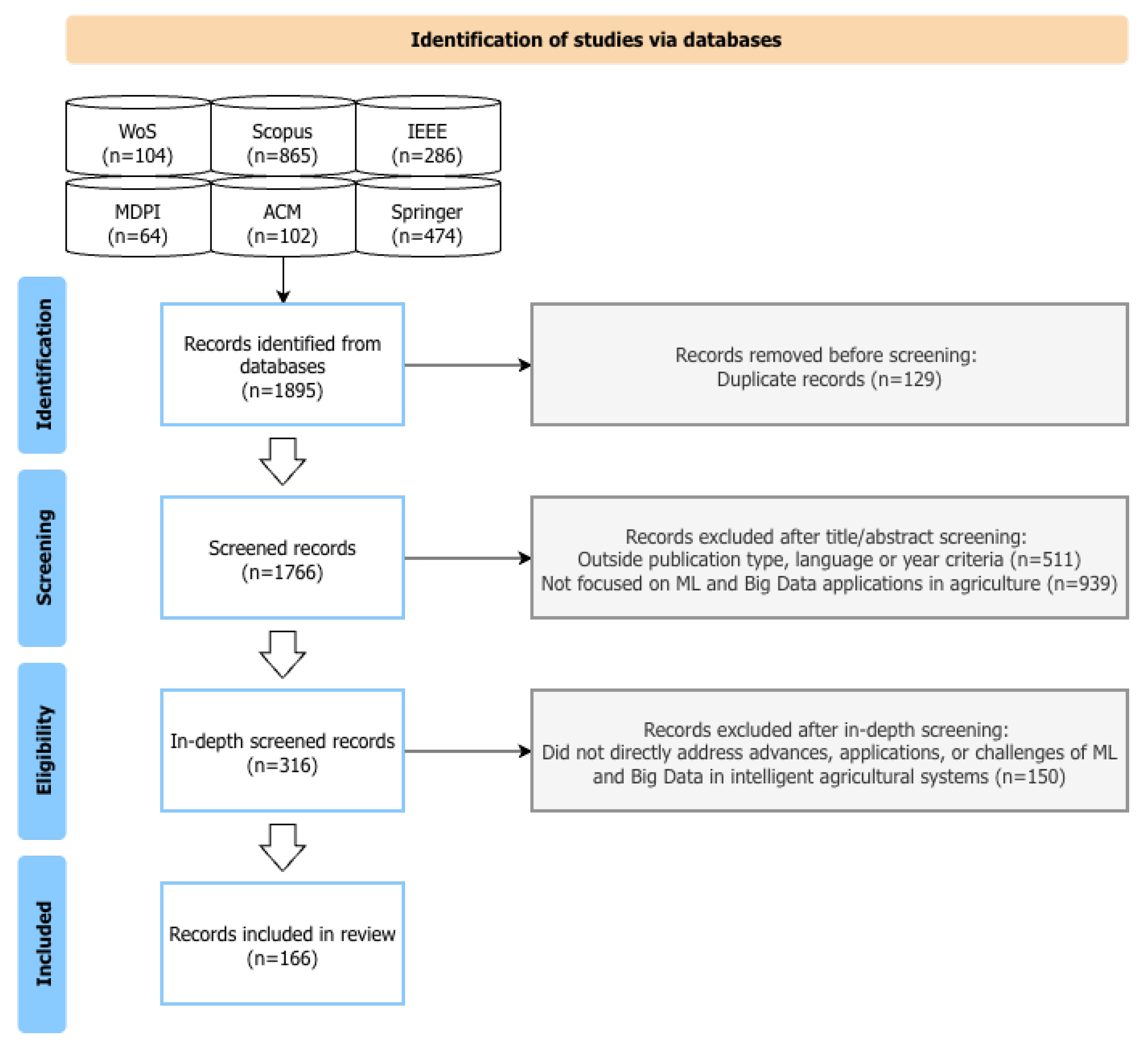
A total of 1895 records were initially retrieved from six databases: Scopus (865), Springer (474), IEEE (286), ACM (102), Web of Science (104), and MDPI (64). After removing 129 duplicate records, 1766 unique papers were screened. During the title and abstract screening phase, 1450 records were excluded: 511 were excluded due to publication type, including non-peer-reviewed material, editorials, book chapters, short communications, and other formats not meeting the inclusion criteria (language and publication year); and 939 were removed because they did not focus on machine learning and big data applications in agriculture. This resulted in 316 papers selected for full-text assessment. Following a detailed eligibility review of the full texts, 150 articles were excluded because they did not directly contribute to answering the research question guiding this review—namely, identifying the main advances, applications, and challenges in the use of Machine Learning and Big Data techniques for the development of intelligent agricultural systems over the last five years. Specifically, these studies either addressed ML techniques outside an agricultural context, focused on agricultural topics without incorporating ML or Big Data methods as a central component, or discussed these technologies at a general or theoretical level without presenting concrete advances, applications, or challenges relevant to intelligent agricultural systems. The final selection included 166 scientific articles that met all predefined quality and relevance criteria for this review (Figure 3).
Each of the 166 selected papers was thoroughly reviewed to extract the information needed to address the research questions (see Table 1). The main inclusion criterion was to consider works that explain problems in the field of agriculture and that have been solved using Big Data and ML technology together. For each paper, the extracted data and evaluation criteria included: (i) title, authors, and year of publication; (ii) justification for its initial inclusion; (iii) ML techniques applied; (iv) identified challenges for applying ML and proposed solutions; and (v) architectures, technologies, and Big Data tools employed. The extracted data were then classified according to the agricultural area in which the work was carried out, as well as the ML techniques used and the Big Data technologies.
We validated the structure and reporting of this study using the 2020 PRISMA Statement (Preferred Reporting Items for Systematic Reviews and Meta-Analyses (PRISMA), https://www.prisma-statement.org/) (Preferred Reporting Items for Systematic Reviews and Meta-Analyses). PRISMA provides a standardized checklist that defines the minimum set of items required for transparent and complete reporting of systematic literature reviews and meta-analyses [19]. The present review complies with the PRISMA 2020 recommendations for systematic reviews focused on technological and methodological evidence. All relevant items were addressed, except those related to quantitative effect measures, risk-of-bias assessment, and statistical synthesis (Items 12, 13a–13f, 19, 20a–20d, and 24a), which are not applicable due to the qualitative, exploratory, and domain-based nature of this review and the absence of meta-analytic comparisons. A detailed PRISMA 2020 checklist indicating the correspondence between each item and its location in the manuscript is provided in Table 2.
Table 1. Selected papers included in the systematic review (n = 166), ordered by publication year.
#AuthorsTitleYear
1Chen F. et al. [20]Agricultural and rural ecological management system based on big data in complex system2021
2Patel J. et al. [21]Big data analytics for advanced viticulture2021
3Ang K.L.-M. et al. [22]Big data and machine learning with hyperspectral information in agriculture2021
4Zainab A. et al. [23]Big Data Management in Smart Grids: Technologies and Challenges2021
5Alibabaei K. et al. [24]Crop Yield Estimation Using Deep Learning Based on Climate Big Data and Irrigation Scheduling2021
6Katyayan A. et al. [25]Design of Smart Agriculture Systems using Artificial Intelligence and Big Data Analytics2021
7Rabhi L. et al. [26]Digital agriculture based on big data analytics: A focus on predictive irrigation for smart farming in Morocco2021
8Bertoni D. et al. [27]Estimating the CAP greening effect by machine learning techniques: A big data ex post analysis2021
9Liu Y. et al. [28]Remote sensing big data analysis of the lower yellow river ecological environment based on internet of things2021
10Tsai W. et al. [29]From calibration to parameter learning: Harnessing the scaling effects of big data in geoscientific modeling2021
11Riley C. et al. [30]Internet of things-enabled sustainability, big data-driven decision-making processes, and digitized mass production in Industry 4.0-based manufacturing systems2021
12Kumari M. et al. [31]Multidisciplinary Real-Time Model for Smart Agriculture based on Weather Forecasting Using IoT, Machine Learning, Big Data and Cloud2021
13Shaik Mazhar S. A. et al. [32]Precision Pig Farming Image Analysis Using Random Forest and Boruta Predictive Big Data Analysis Using Neural Network and K- Nearest Neighbor2021
14Anita M. et al. [33]Predictive analytics in soil for agriculture using Kendall normalized feature selection based Jaccarized Rocchio boyer-moore bootstrap aggregative mapreduce classifier for predictive analytics with big data2021
15Refonaa J. et al. [34]Remote sensing based rain fall prediction using big data assisted integrated routing framework2021
16Akhtar M.N. et al. [35]Smart sensing with edge computing in precision agriculture for soil assessment2021
17Guan H. et al. [36]Study on the Prediction System of Shrimp Field Distribution in the East China Sea Based on Big Data Analysis of Fishing Trajectories2021
18Sharma S. et al. [5]Sustainable Innovations in the Food Industry through Artificial Intelligence and Big Data Analytics2021
19Gupta R. et al. [37]WB-CPI: Weather Based Crop Prediction in India Using Big Data Analytics2021
20Berto F. et al. [38]A 5G-IoT enabled Big Data infrastructure for data-driven agronomy2022
21George A. et al. [39]A Big Data Architecture for Heterogeneous Data in Precision Agriculture2022
22Ahmed S. et al. [40]A Conceptual Framework for using Big Data in Egyptian Agriculture2022
23Mazhar S. A. S. et al. [41]A Novel Framework to Perform Efficient Analysis of Animal Sciences Using Big Data2022
24Ouafiq, E et al. [42]AI-based modeling and data-driven evaluation for smart farming-oriented big data architecture using IoT with energy harvesting capabilities2022
25Chen Y. et al. [43]An improved method for sink node deployment in wireless sensor network to big data2022
26Ayyappan S. et al. [44]Application of Big Data Processing Technologies in Agriculture2022
27Jiang Y. et al. [45]Aquaculture Prediction Model Based on Improved Water Quality Parameter Data Prediction Algorithm under the Background of Big Data2022
28El Aissi M. E. M. et al. [46]Big Data Enabling Fish Farming Data-Driven Strategy2022
29Benjelloun S. et al. [47]Big Data Technology Architecture Proposal for Smart Agriculture for Moroccan Fish Farming2022
30Franceschini S. et al. [48]Can unsupervised learning methods applied to milk recording big data provide new insights into dairy cow health?2022
31Zhang L. et al. [49]Cascade Parallel Random Forest Algorithm for Predicting Rice Diseases in Big Data Analysis2022
32Birant D. et al. [50]Classifying horse activities with big data using machine learning2022
33Ouafiq E.M. et al. [42]Data Lake Conception for Smart Farming: A Data Migration Strategy for Big Data Analytics2022
34Sagan V. et al. [51]Data-Driven Artificial Intelligence for Calibration of Hyperspectral Big Data2022
35Jayanthi S. et al. [52]Design and Development of Framework for Big Data Based Smart Farming System2022
36Sengupta S. et al. [53]Development of a Rice Plant Disease Classification Model in Big Data Environment2022
37Virtriana R. et al. [54]Development of Geospatial Information Integrated with Big Data for Agricultural Hazard Monitoring in West Java2022
38Al-Awar B. et al. [55]Evaluation of Nonparametric Machine-Learning Algorithms for an Optimal Crop Classification Using Big Data Reduction Strategy2022
39Gong L. et al. [56]GpemDB: A Scalable Database Architecture with the Multi-omics Entity-relationship Model to Integrate Heterogeneous Big-data for Precise Crop Breeding2022
40de Carvalho Alves M. et al. [57]Insights for improving bacterial blight management in coffee field using spatial big data and machine learning2022
41Micheni E. et al. [58]Internet of Things, Big Data Analytics, and Deep Learning for Sustainable Precision Agriculture2022
42Bonofiglio F. et al. [59]Machine learning applied to big data from marine cabled observatories: A case study of sablefish monitoring in the NE Pacific2022
43Singh A. et al. [60]Modeling the public attitude towards organic foods: a big data and text mining approach2022
44Han X. et al. [61]Open Innovation Web-Based Platform for Evaluation of Water Quality Based on Big Data Analysis2022
45Sinaga A. S. R. M. et al. [62]Prediction measuring local coffee production and marketing relationships coffee with big data analysis support2022
46Wang X. et al. [63]The Application of Big Data Technology in the Construction of Financial Shared Service Center of Agricultural Enterprise Group2022
47Wu Y. et al. [64]The Path of Agricultural Policy Finance in Smart Service for Rural Revitalization under Big Data Technology2022
48Huang H. et al. [65]The Practical Application of Agricultural Genetic Breeding Technology in Elm Cultivation Based on Big Data Analysis2022
49El Hachimi C. et al. [66]Towards Smart Big Weather Data Management2022
50Park Y. et al. [67]Trend Analysis of Balcony Vegetable Gardens in Korea, Before and After COVID-19 Pandemic Using Big Data2022
51Wang X. et al. [63]Using big data searching and machine learning to predict human health risk probability from pesticide site soils in China2022
52Barrile G. M. et al. [68]A big data-model integration approach for predicting epizootics and population recovery in a keystone species2023
53Canavera G. et al. [69]A sensorless, Big Data based approach for phenology and meteorological drought forecasting in vineyards2023
54Sahu S. et al. [70]A Study on Weather based Crop Prediction System using Big Data Analytics and Machine Learning2023
55Qian P. et al. [71]Agricultural Planting Big Data QA System Technology Research Based on Knowledge Graph2023
56Rslan E. et al. [72]AgroSupportAnalytics: big data recommender system for agricultural farmer complaints in Egypt2023
57Pavlova A.I. et al. [73]Application of big data technologies to assess the natural moisture of the territory2023
58Yang Y. et al. [74]Application Research of K-means Algorithm based on Big Data Background2023
59Krishna S.R. et al. [75]Artificial intelligence and big data analytics-based optimization of crop yields in sustainable agriculture2023
60Berestov D. et al. [76]Assessment of Weather Risks for Agriculture using Big Data and Industrial Internet of Things Technologies2023
61Shrivastava A. et al. [77]Automatic robotic system design and development for vertical hydroponic farming using IoT and big data analysis2023
62Balduque-Gil J. et al. [78]Big Data and Machine Learning to Improve European Grapevine Moth (Lobesia botrana) Predictions2023
63de la Parte M.S. et al. [79]Big Data and precision agriculture: a novel spatio-temporal semantic IoT data management framework for improved interoperability2023
64Rossi P. et al. [80]Big Data for Farm Machines: An Algorithm for Estimating Tractors’ Operating Costs2023
65Silva J.V. et al. [81]Big data, small explanatory and predictive power: Lessons from random forest modeling of on-farm yield variability and implications for data-driven agronomy2023
66Ghanim M. et al. [82]Cloud-Based Simulation Model for Agriculture Big Data in the Kingdom of Bahrain2023
67Saritha S. et al. [83]Crop yield prediction in big data using margalef kernel perceptron based winnow brown boost classifier2023
68Babu D. K. et al. [84]Deep residual network-based data streaming approach for soil type application under IoT-based big data environment2023
69Nurcahyo A. et al. [85]Developing Smart Precision Farming Using Big Data and Cloud-Based Intelligent Decision Support System2023
70Issac A. et al. [86]Development and deployment of a big data pipeline for field-based high-throughput cotton phenotyping data2023
71Wang P.C. et al. [87]Development Model of Agriculture + Travel Industry Integration in the Context of Big Data Explore: A case study from Huyi District, Xi’an2023
72Cui J. et al. [88]Economic value evaluation of water resources based on big data2023
73Abu-Gellban H. et al. [89]Efficient Crop Classification Using Optical and Radar Big Data: A Time and Cost Reduction Approach2023
74Saravanan R. et al. [90]Empowering the Tribal people with the use of big data processing expert system in animal Husbandry and Poultry Farming application2023
75Parashar V. et al. [91]Enhancing crop yield prediction in precision agriculture through sustainable big data analytics and deep learning techniques2023
76Vlachou E. et al. [92]EVCA Classifier: A MCMC-Based Classifier for Analyzing High-Dimensional Big Data2023
77Ikhlaq U. et al. [93]Harnessing Big Data in Agriculture by Addressing Heterogeneity in Large-Scale Data Mining Techniques and Limitations2023
78Kliangkhlao M. et al. [94]Harnessing the power of big data digitization for market factors awareness in supply chain management2023
79Rao M. S. et al. [95]Integration of Cloud Computing, IoT, and Big Data for the Development of a Novel Smart Agriculture Model2023
80Ahmed S. et al. [96]Investigation on the use of ensemble learning and big data in crop identification2023
81Xiang H. X. et al. [97]Modeling potential wetland distributions in China based on geographic big data and machine learning algorithms2023
82Sinha J. et al. [98]Modelling big data analysis approach with multi-agent system for crop-yield prediction2023
83Majeed M. G. et al. [99]Research on Sustainable development of green energy and manufacturing in smart agriculture based on big data analysis2023
84Khalid N. et al. [100]Revolutionizing Weed Detection in Agriculture through the Integration of IoT, Big Data, and Deep Learning with Robotic Technology2023
85Liu W. et al. [101]Smart sensors, sensing mechanisms and platforms of sustainable smart agriculture realized through the big data analysis2023
86Hachimi C. E. et al. [102]Smart Weather Data Management Based on Artificial Intelligence and Big Data Analytics for Precision Agriculture2023
87An Y. et al. [103]Soil and water conservation monitoring and landscape ecological restoration strategy based on big data and internet of things2023
88Kamyab H. et al. [104]The latest innovative avenues for the utilization of artificial Intelligence and big data analytics in water resource management2023
89Jayaraman G. et al. [105]Unravelling the potential of Big Data-driven decision-making in sustainable water irrigation: An AI perspective2023
90Roznik M. et al. [106]Using a machine learning approach and big data to augment WASDE forecasts: Empirical evidence from US corn yield2023
91Park J.-R. et al. [107]Utilization of the Winkler scale of plants using big data temperature presented by the Korea Meteorological Administration2023
92Chawla P. et al. [108]Water quality prediction of salton sea using machine learning and big data techniques2023
93Zhang J. et al. [109]A Gaussian interval type-2 fuzzy characterization method based on heterogeneous big data and its application in forest ecological assessment2024
94Wang Y. [110]A pricing model for agricultural insurance based on big data and machine learning2024
95Xie Z. et al. [111]A scalable big data approach for remotely tracking rangeland conditions2024
96Giannakopoulos N. T. et al. [112]Agroeconomic Indexes and Big Data: Digital Marketing Analytics Implications for Enhanced Decision Making with Artificial Intelligence-Based Modeling2024
97Huh J. et al. [113]AgTech: Building Smart Aquaculture Assistant System Integrated IoT and Big Data Analysis2024
98Stephen A. et al. [114]An efficient deep learning with a big data-based cotton plant monitoring system2024
99Xia J. et al. [115]Analysis of visible–near infrared spectral characteristics for water layer management of rice based on the big data platform2024
100Ayyappan S. et al. [44]Application and Research of Key Technologies of Big Data for Agriculture2024
101Geetha P. et al. [116]Big data analytics in agriculture: cloud-based architecture for crop disease classification2024
102Higuera D.F.B. et al. [117]Colombian Agricultural Sector’s Early Estimator of Gross Domestic Production Using Nowcasting and Big Data Methods2024
103Li L.I.N. et al. [118]Complex event information mining and processing for massive aerospace big data2024
104Wei X. et al. [119]Effects of Big Data on PM2.5: A Study Based on Double Machine Learning2024
105Kong J. et al. [12]FICformer: A Multi-factor Fuzzy Bayesian Imputation Cross-former for Big Data-driven Agricultural Decision Support Systems2024
106Yang J. et al. [120]Geographical big data and data mining: A new opportunity for “water-energy-food” nexus analysis2024
107Minallah N. et al. [121]GeoSurvey: A cloud-based mobile app for efficient land surveys and big data collection2024
108Liu J. et al. [122]Global soil respiration estimation based on ecological big data and machine learning model2024
109Borol Y. D. et al. [123]Hyperspectral Information with Big Data and Machine Learning for Agriculture2024
110Saeed N. et al. [124]Incorporating big data and IoT in intelligent ecosystems: state-of-the-arts, challenges and opportunities, and future directions2024
111Pan S.-F. et al. [125]Influence of landform, soil properties, soil Cd pollution and rainfall on the spatial variation of Cd in rice: Contribution and pathway models based on big data2024
112Sushma Y. et al. [126]IoT-based soil nutrient monitoring and analysis system2024
113Zhang S. et al. [127]Knowledge Distillation via Token-Level Relationship Graph Based on the Big Data Technologies2024
114Pallavi C. V. et al. [128]Linear Z Score and Gaussian Radial Artificial Neural Network Big Data Analytics to Enhance Crop Yield2024
115Shetty S. et al. [129]MResGat: Multi-head residual dilated convolution for crop yield prediction2024
116Alves G. M. et al. [130]Parallel and distributed processing for high resolution agricultural tomography based on big data2024
117Rana H. et al. [131]Prediction of Agricultural Commodity Prices using Big Data Framework2024
118Xiao K. et al. [132]Research on Crop Growth Detection and Prediction in Farmland Based on Agricultural Big Data2024
119Boukhris A. et al. [133]Satellite imagery, big data, IoT and deep learning techniques for wheat yield prediction in Morocco2024
120Wang B. et al. [110]Smart farming using the big data-driven approach for sustainable agriculture with iot-deep learning techniques2024
121Romero-Gomez D. et al. [134]The Challenge of Big Data and Machine Learning Optimizing Banana Yields in Ecuador2024
122Zhu X. et al. [135]The role of agricultural product logistics supply chain in agricultural economic development in the context of big data and in-depth learning2024
123Salsabila A. B. et al. [136]Using VARI Model to Forecast Climate Phenomena in Big Data Era2024
124Manoj T. et al. [137]A blockchain-assisted trusted federated learning for smart agriculture2025
125Almusawi M. et al. [138]A data-driven strategy for long-term agrarian sustainability: Pest and disease management2025
126Batistatos M.C. et al. [139]AGRARIAN: A hybrid AI-driven architecture for smart agriculture2025
127Meta Inc. et al. [140]AI in agriculture: Cloud-powered precision farming with real-time analytics2025
128Reddy G.R. et al. [141]An IoT-driven ML framework for predictive crop health monitoring2025
129Galkin A.I. et al. [142]Application of machine learning methods and big data analysis in precision agriculture2025
130Kate M. et al. [143]Big data approaches to bovine bioacoustics: FAIR-compliant dataset and machine learning framework2025
131Mensah F.P. et al. [144]Big data in agriculture: Leveraging large datasets to analyse and improve rice production2025
132Burgueño-Romero A.M. et al. [145]Big Data-driven MLOps workflow for annual high-resolution land cover classification models2025
133Lell M. et al. [146]Breaking down data silos for genome-wide predictions in wheat2025
134Mohanty N.K. et al. [147]Climate-aware crop yield forecasting using hybrid statistical-ML methods2025
135Chunawala H. et al. [148]Cloud computing-enabled hybrid ML models for crop yield prediction2025
136Yu P. et al. [149]Cloud-edge-device collaborative computing in smart agriculture2025
137Jiao Y. et al. [150]Computational intelligence for precision agriculture: Smart sensing decision support2025
138Aggarwal S. et al. [151]Crop prediction, disease detection using machine learning2025
139Tripathi D. et al. [152]Crop yield prediction using ensemble learning with effective data analytics2025
140Eremin S.G. et al. [153]Digitalization of agriculture: The role of big data in improving efficiency2025
141Gong R. et al. [154]Edge computing-enabled smart agriculture: Technical architectures2025
142Bakshi A. et al. [155]Edge-enabled UAV assisted sensing and analytics framework for precision agriculture2025
143Taha M.F. et al. [156]Emerging technologies for precision crop management towards agriculture 5.02025
144Rajakumar V. et al. [157]FarmFog: Implementation of fog computing in IoT-based smart agriculture2025
145Ishtaiwi A.M. et al. [158]Framework for agricultural water scarcity using big data and IoT2025
146John L.B. et al. [159]Geospatial big data analytics for precision agriculture2025
147Kumar S. et al. [160]Harnessing big data for precision agriculture: Crop yields and resource management2025
148Ramos M.I. et al. [161]Improving early prediction of crop yield in Spanish olive groves using machine learning2025
149Oppong R.A. et al. [162]Integration of IoT-based sprinklers, embedded systems, data and cloud computing2025
150Yap J.A. et al. [163]Investigation on IoT and cloud technology implementation for smart agriculture2025
151Hussain M. et al. [164]IoT-enabled machine learning for precision agriculture in Pakistan2025
152Rani N.S. et al. [165]IoT-enabled smart irrigation framework leveraging stacked ML algorithms2025
153Chowdam V.S. et al. [166]IoT-enabled smart soil monitoring system with crop and fertilizer recommendations2025
154Kole P. et al. [167]IoT-ML-decision support system for smart agriculture2025
155Vijayasuganthi K. et al. [168]Management practices for sustainable agriculture in the age of smart farming2025
156Amori P.N. et al. [169]Scalable machine learning framework for adaptive irrigation management (Maize/Soybean)2025
157Kumar K.G. et al. [170]SmartAgri-IoT: Hybrid LPWAN edge computing framework for real-time precision agriculture2025
158Datta S.S. et al. [171]TCAN-AgriCloud: Cloud-enabled IoT-integrated deep learning for yield prediction2025
159Sokona F.Y. et al. [172]TCHIA-FedPer: Edge online federated learning and IoT for smart agriculture2025
160Hostens M. et al. [173]The future of big data and artificial intelligence on dairy farms2025
161Galkin A.I. et al. [174]The use of big data and neural networks in precision agriculture to increase crop yield2025
162Vaishnavi K. et al. [175]Transforming agriculture through IoT and big data: A comprehensive framework2025
163Mohammed S. et al. [176]Transforming agriculture with cloud computing: Data processing & analysis2025
164Petrov D. et al. [177]Utilizing big data for sustainable management of agricultural production2025
165Wassay M. et al. [178]Geo-intelligent agriculture: Integrating GIS, remote sensing, IoT for real-time monitoring2025
166Gogna A. et al. [179]Predicting enviromically adapted varieties with big data2025
Table 2. PRISMA 2020 checklist for the systematic review.
Section/TopicItemPRISMA 2020 Checklist ItemLocation in Manuscript
Title1Identify the report as a systematic reviewTitle
Abstract2Provide a structured summary including background, objectives, methods, results, and conclusionsAbstract
Introduction3Describe the rationale for the review in the context of existing knowledgeIntroduction
4Provide an explicit statement of the objectives or research questionsIntroduction
Methods5Indicate whether a review protocol exists and where it can be accessedMethods (protocol not registered)
6Specify inclusion and exclusion criteriaMethods—Eligibility Criteria
7Specify all information sources and the date last searchedMethods—Information Sources (search updated 9 February 2026)
8Present the full search strategy for at least one databaseMethods—Search Strategy
9Describe the process for selecting studiesMethods—Study Selection
10Describe the data collection processMethods—Data Extraction and Consistency Checks
11List and define all data items extractedMethods—Data Extraction and Coding Matrix
12Describe methods used to assess risk of bias in individual studiesAddressed qualitatively; see Methods and Section “Methodological Limitations and Quality Assessment Constraints”
13a–13fDescribe effect measures and statistical synthesis methodsNot applicable (no quantitative meta-analysis; heterogeneous technological evidence)
14Describe methods used for qualitative synthesisMethods—Data Synthesis and Cross-Domain Convergence Analysis
Results15Describe the results of the study selection process, ideally using a flow diagramResults—PRISMA Flow Diagram
16Cite and describe characteristics of included studiesResults—Study Characteristics (Table 1)
17Present results of individual studiesResults—Domain-Based Analysis
19Present results of risk-of-bias assessmentsAddressed qualitatively in Limitations section
20a–20dPresent results of quantitative syntheses and heterogeneity analysesNot applicable (qualitative synthesis without statistical pooling)
Discussion21Provide a general interpretation of the resultsDiscussion—Synthesis of Results and IAE Framework
22Discuss limitations of the included evidenceDiscussion—Limitations
23Discuss limitations of the review processDiscussion—Methodological Limitations and Quality Assessment Constraints
24Discuss implications for practice and future researchDiscussion—Future Research Directions
Other Information24aProvide registration information for the reviewNot registered (exploratory technological review)
25Describe sources of funding and their roleFunding Statement
26Declare competing interestsConflicts of Interest
Literature Screening Criteria. To ensure methodological transparency, predefined inclusion and exclusion criteria were applied during the screening process. Studies were included if they (i) were published between 2021 and 2025, (ii) explicitly addressed ML and/or Big Data applications in agriculture, and (iii) provided empirical, architectural, or systematic contributions. Studies were excluded if they (i) presented purely conceptual discussions without methodological content, (ii) addressed agriculture only marginally, (iii) lacked sufficient methodological transparency, or (iv) were duplicates across databases. Non-English publications and grey literature were excluded to ensure evaluation consistency.
Data Extraction and Consistency Checks. A structured coding matrix was developed to systematically extract key variables from each selected study, including domain classification, ML techniques, data sources, evaluation metrics, architectural components, and reported challenges. Screening was conducted in two stages (title/abstract and full-text review), and domain assignments were iteratively verified to reduce classification bias. Consistency checks were performed through repeated cross-validation of extracted information to ensure traceability and alignment between reported findings and analytical categorization.

3. Results

This section presents the key findings derived from the analysis of the selected papers. It begins by showing the distribution of publications by year, providing an overview of the temporal trends in the research. The section also describes the leading solutions proposed for agricultural Big Data, along with the primary problems they address. In addition, the most frequently applied machine learning techniques are reviewed, along with the key technologies implemented. Finally, it highlights the main challenges reported across the studies.

3.1. General Results

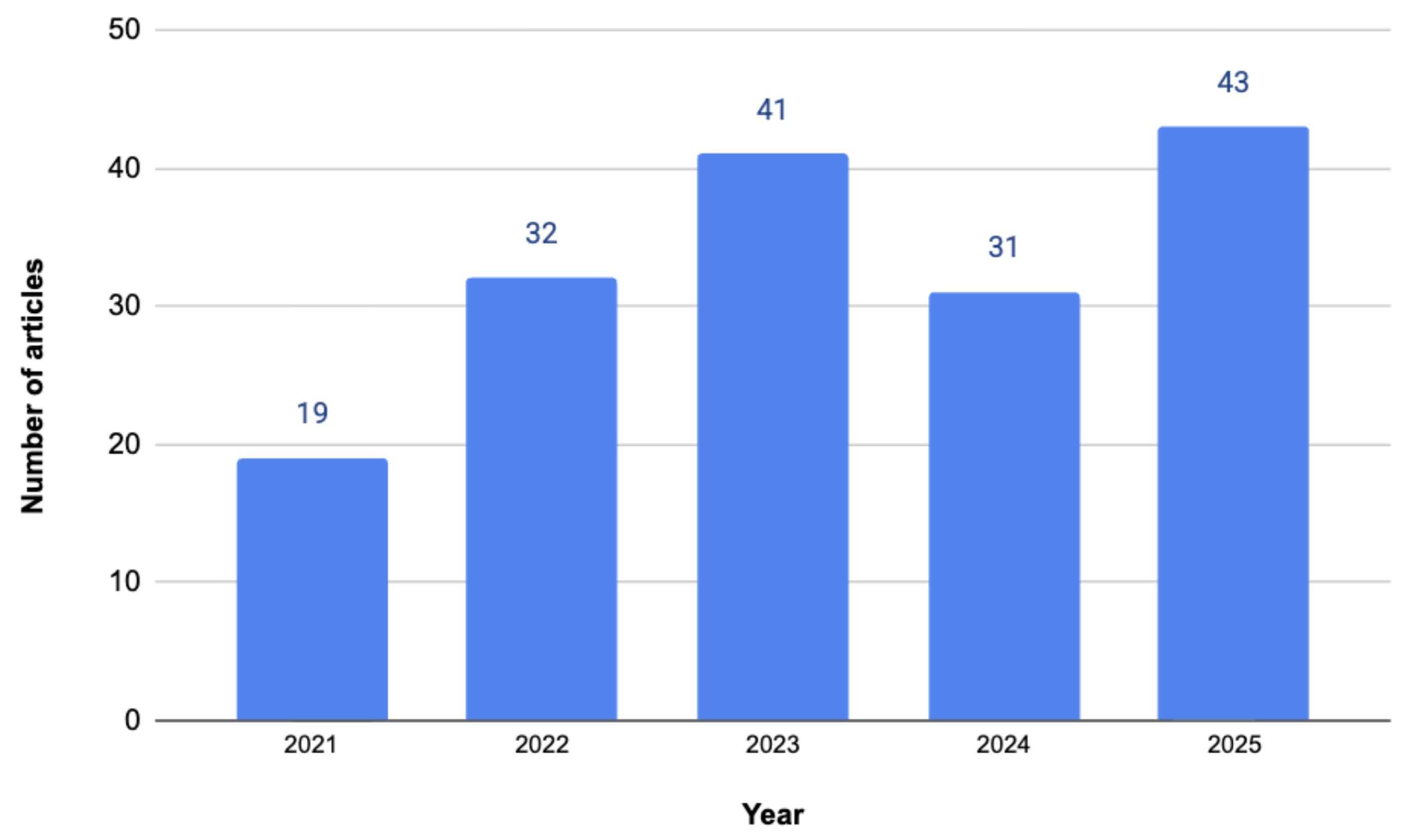
The SLR identified 166 relevant papers published between 2021 and 2025, showing a sustained increase in academic output from 2021 (18 papers) to a peak in 2023 (41 papers), as illustrated in Figure 4. In 2022, 33 publications were recorded, followed by a slight decrease in 2024 (28 papers). In contrast, 2025 exhibits a marked increase, with 46 papers. This adjustment accounts for early online publications and indexing delays and reflects the most recent research activity captured by the review. Overall, the observed trend confirms a growing and consolidated interest in the application of Machine Learning and Big Data in agriculture, with methodological and application diversity reaching maturity around 2023 and remaining strong in subsequent years.
An analysis of the keywords provided in the selected studies reveals the prevalence of concepts such as big data analytics, machine learning, IoT, and remote sensing (see Figure 5). These findings indicate that the central focus of the selected works is oriented toward the analysis of the Big Data technologies employed and the application of ML techniques to address the identified problems.
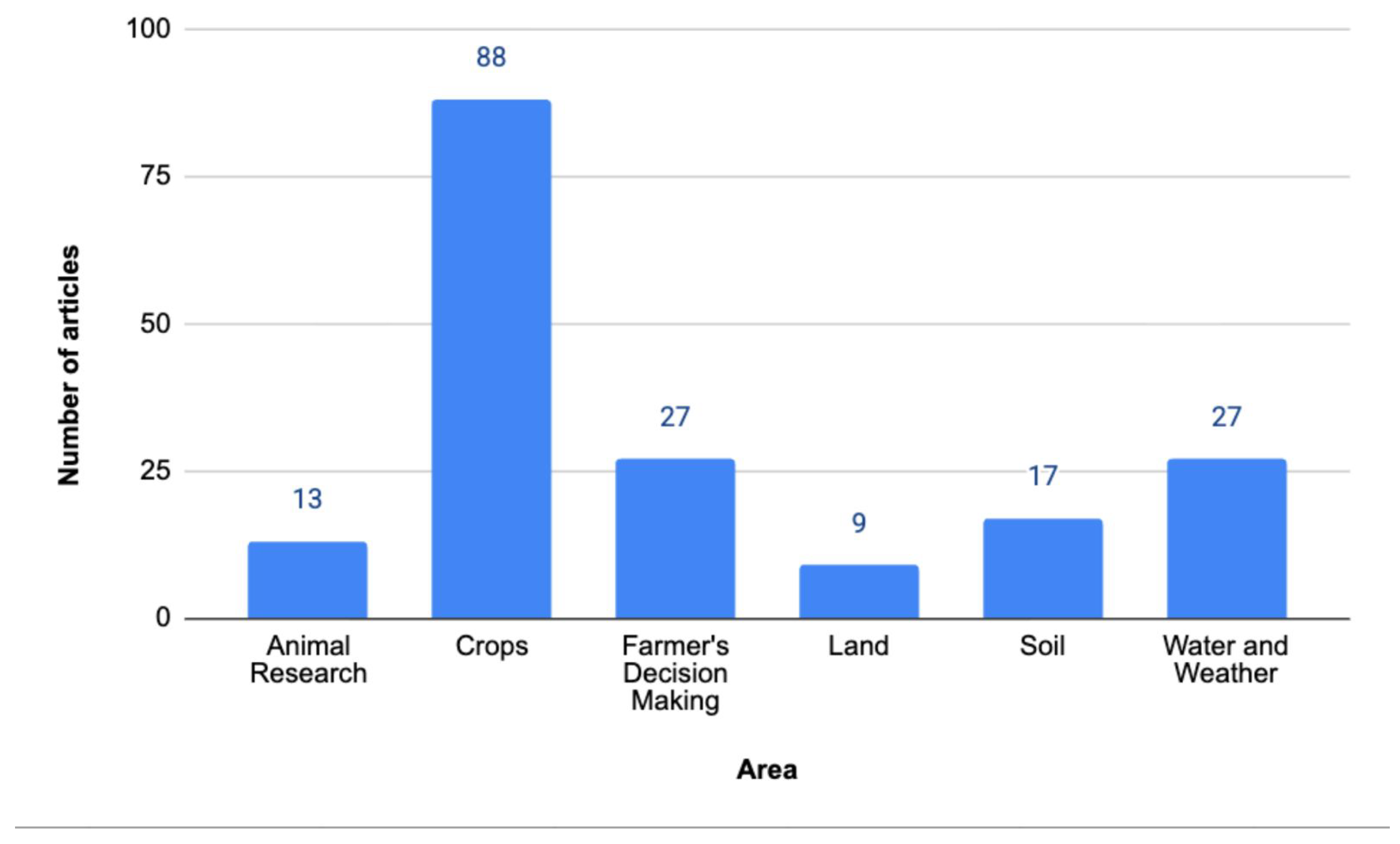
The selected articles address a wide range of agricultural domains, with notable emphasis on Crops, Farmer Decision Making, Water and Weather, Soil, Land use, and Animal Research. As shown in Figure 6, the “Crops” category accounts for the largest number of studies, followed by “Farmer Decision Making” and “Water and Weather,” highlighting the central role of crop production in the recent research agenda. As in previous studies [3,16], this work adopts these categories to analyze the use of ML and the most prominent Big Data technologies.
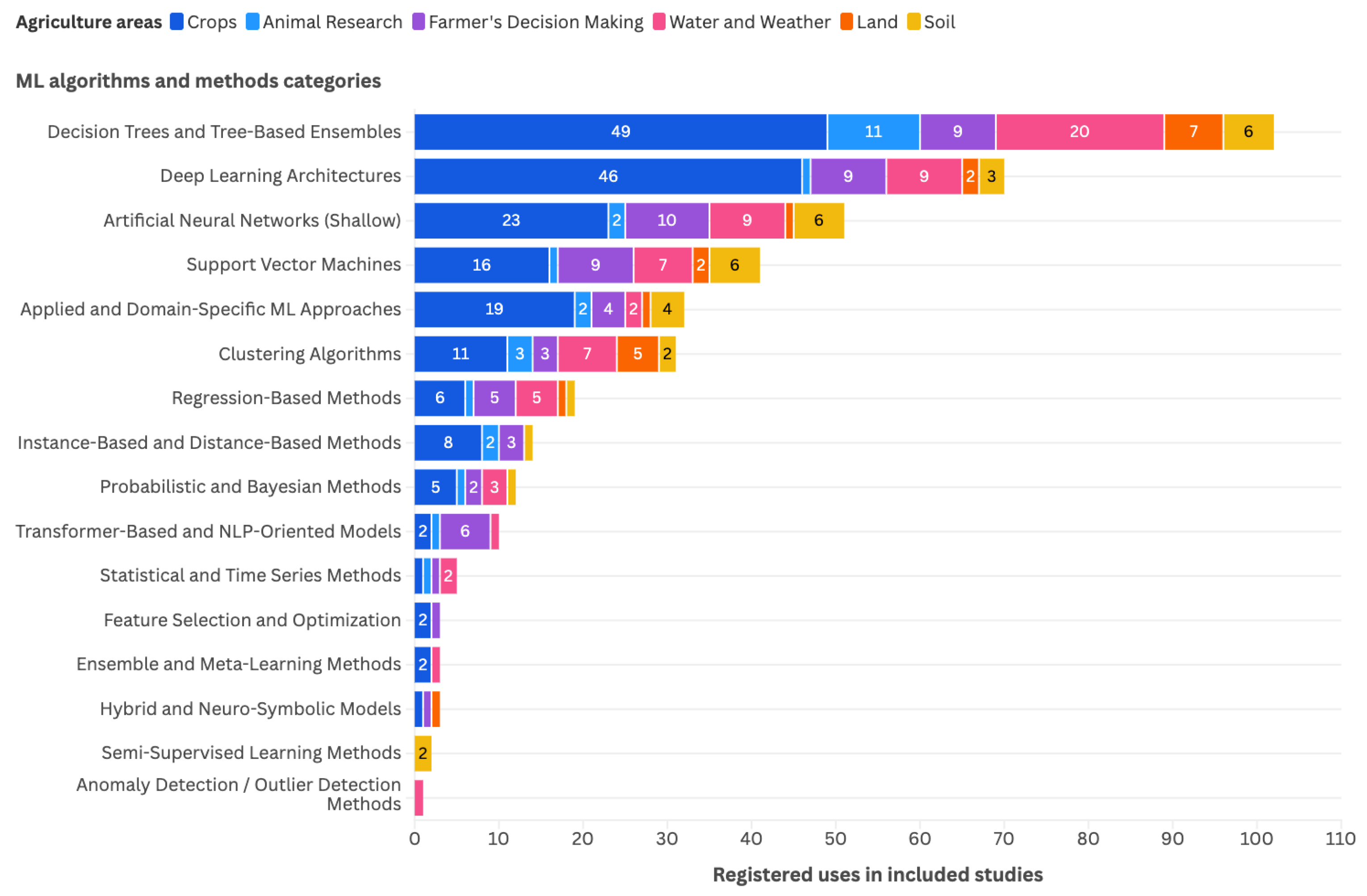
With respect to the ML techniques identified, Figure 7 displays those employed across various areas according to the agricultural domain classification. Each domain utilizes different ML techniques, underscoring the need for a thorough analysis of how these methods correspond to the specific agricultural problems being addressed.
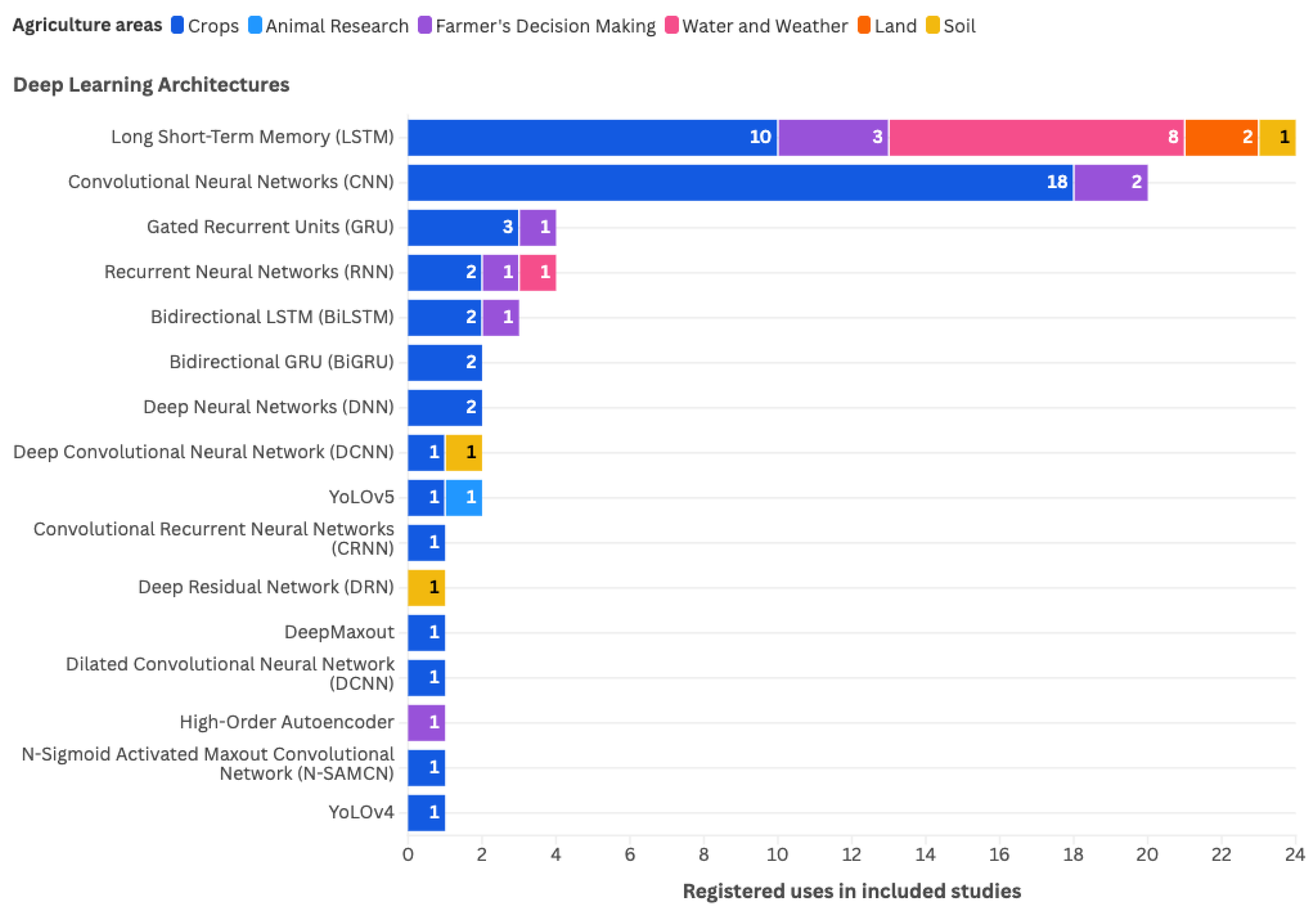
Figure 8 shows the distribution of Deep Learning (DL) architectures employed in the analyzed studies, highlighting the consolidation of LSTM and CNN as the most widely used techniques in smart agriculture. LSTM stands out for its ability to model time series and dynamic phenomena, which explains its substantial presence in the domains of Crops, Water and Weather, and Farmer Decision Making—where it is applied to predict yields, precipitation, or water demand. CNNs, on the other hand, are primarily used for visual recognition in satellite imagery, sensors, or field cameras, making them essential for pest detection, soil classification, and animal monitoring.
There is also growing interest in more advanced architectures such as GRU, Bidirectional Long Short-Term Memory (BiLSTM), and Deep Convolutional Neural Network (DCNN), which improve training efficiency and generalization capacity in complex agricultural contexts. Finally, the emergence of models such as YOLOv5 and Deep Residual Networks (DRN) reflects the expansion of vision-based analytics into real-time detection and large-scale classification tasks, signaling a trend toward increasingly autonomous and multimodal agricultural systems. Additional ML algorithms are detailed in [180], which is included as an annex to this work.
Based on these general findings, it becomes essential to disaggregate the analysis and examine how ML and Big Data techniques are being applied within each of the identified agricultural domains: Crops, Farmer Decision Making, Water and Weather, Soil, Land, and Animal Research. This disaggregation enables a more precise understanding of the diversity of problems addressed, the types of data used, and the technological solutions adopted in each context. Moreover, it reveals that methodological decisions—such as the choice of algorithms, data architectures, and integration approaches—are not homogeneous but rather respond to the specific dynamics and demands of each domain. This comparative approach not only highlights the heterogeneity of the digital agricultural ecosystem but also helps identify emerging patterns, persistent gaps, and opportunities that can guide future research and technological development.

3.2. Types of Agricultural Problems

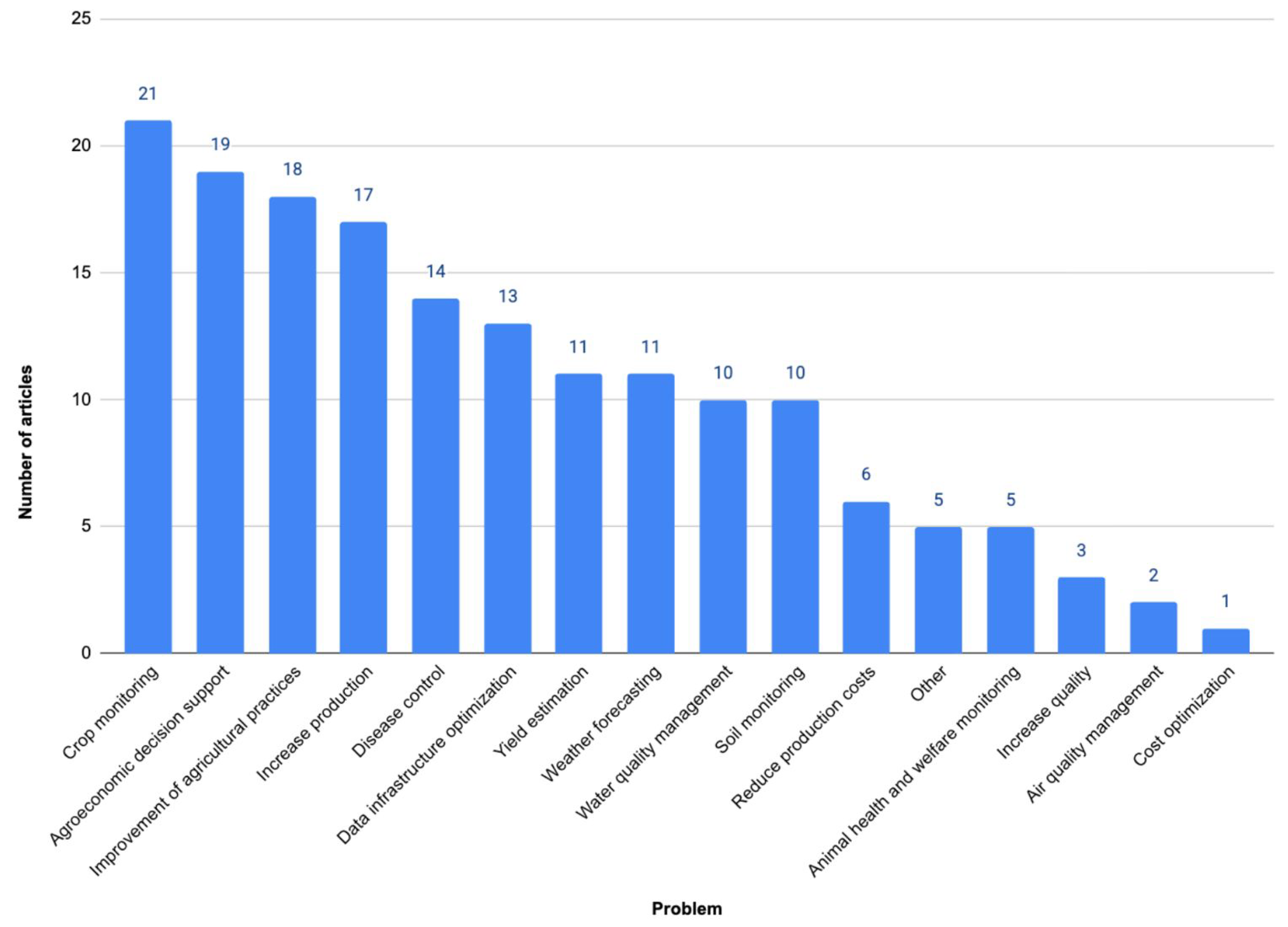
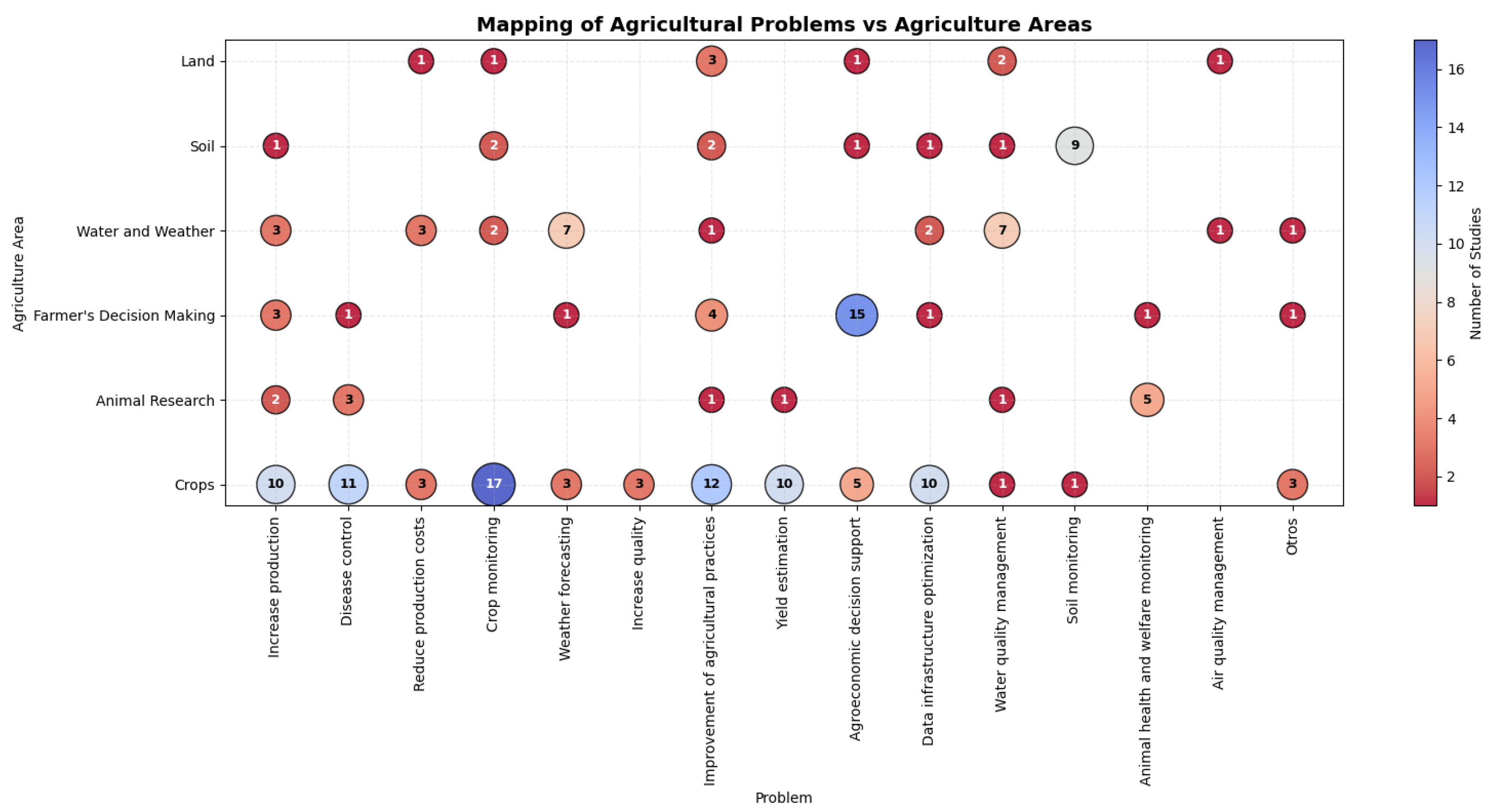
The SLR identified 13 types of problems addressed through the use of ML and Big Data in agriculture (see Figure 9). The most frequently addressed issues include support for agroeconomic decision-making, crop monitoring, improvements in agricultural practices, and increased production. These problems reflect key challenges in the sector and represent major research priorities, with a strong focus on production efficiency, resource optimization, and risk reduction. As shown in Figure 10, the identified problems are not evenly distributed across the different agricultural domains. Support for agroeconomic decision-making accounts for the largest number of contributions within the “Farmer Decision Making” domain, with 15 papers, underscoring its strategic importance in the design of intelligent decision-support systems for farmers.
In the “Crops” domain, studies are focused on several areas, including 10 on crop monitoring, 9 on improving agricultural practices, and 9 on increasing production. This diversity indicates that plant production remains the core application area for ML and Big Data, albeit with technically varied objectives depending on the productive context.
In contrast, significant gaps were identified in less-explored domains, including air quality management, animal health, soil monitoring, improving production quality, and reducing production costs. These areas are still in early stages of development and require greater research attention, particularly given their potential impact on sustainability, environmental efficiency, and the resilience of agricultural systems.

3.3. Domain-Specific Analysis

The application of ML and Big Data in agriculture does not manifest uniformly; rather, it responds to specific challenges, operational conditions, and objectives that vary by domain. This heterogeneity means that technical decisions—such as the selection of algorithms, data architectures, and integration strategies—are configured differently depending on the problem type, production context, and nature of the available data. Analyzing studies by domain enables a more precise understanding of current research priorities, technological trends, and persisting gaps.
A disaggregated analysis provides a structured view of the digital agricultural ecosystem, facilitating cross-domain comparison. This section is organized around six key agricultural domains. Each domain is examined with a focus on the problems addressed, the ML techniques employed, the Big Data technologies used, and the specific challenges encountered.

3.3.1. Crops

The analysis of the selected studies shows that ML and Big Data applications in the Crops domain have primarily focused on three objectives: yield prediction, management of spatial variability, and early detection of pests and diseases. In the first category, models such as LSTM, Artificial Neural Network (ANN), and RF have been used to forecast productivity levels by analyzing climatic, soil, and phenological data. These techniques have proven useful for optimizing input application, selecting crop varieties, and enhancing agronomic planning. For instance, Ahmed et al. (2022) applied LSTM to meteorological time series to predict rice yield, achieving high accuracy [40].
Spatial variability management has been addressed using multispectral imaging, Unmanned Aerial Vehicle (UAV), and remote sensing, integrated into Big Data platforms to support localized decision-making, such as site-specific fertilizer dosing or zonal irrigation. Technologies like Apache Spark, distributed analytics platforms, and cloud-based image processing have been essential for large-scale distributed data processing. These infrastructures enable real-time processing of vast data volumes to generate prescription maps for fertilization, irrigation, or selective harvesting.
On the other hand, automated analysis of Red Green Blue (RGB) and multispectral images has advanced pest and disease detection through algorithms such as CNN, SVM, and Gradient Boosting. Studies such as those by Ahmed et al. (2022) have demonstrated that integrating UAVs and multispectral imaging with SVM and ANN enhances early-stage detection of crop variability [40]. Similarly, the work by Kumari et al. (2023) highlights the use of CNN for pest identification in horticultural crops, achieving over 95% accuracy [11].
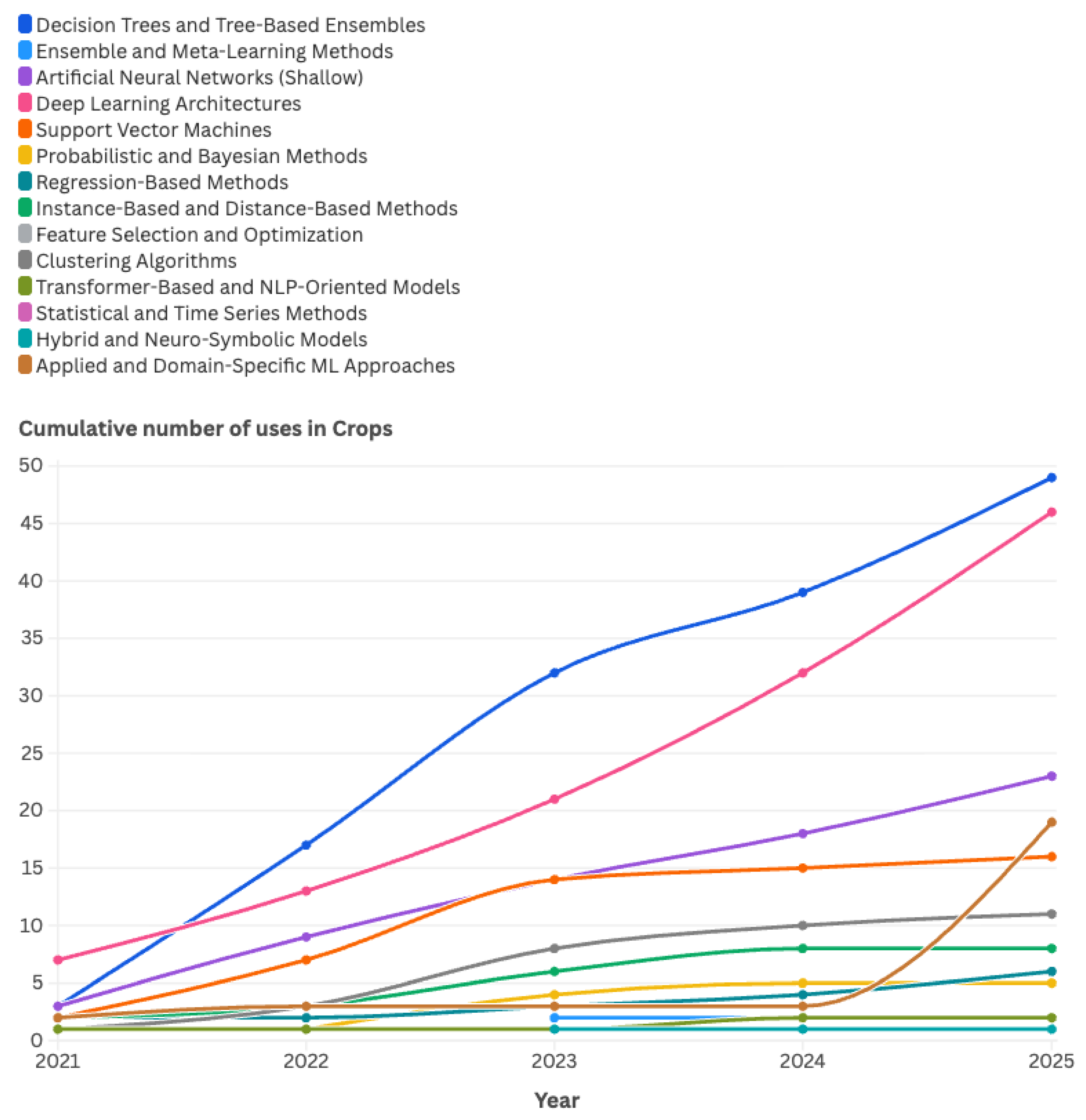
As shown in Figure 11, the most commonly used approaches in this domain include tree-based models and deep learning techniques. Algorithms such as RF and XGBoost have become well-established due to their capacity to handle heterogeneous data, robustness to noise, and interpretability. At the same time, there has been increased use of deep architectures such as LSTM and CNN for problems involving complex time series or image processing. This evolution reflects a shift from exploratory methods to more sophisticated models that improve prediction accuracy and adapt to the variability of real-world agricultural conditions.
One of the most significant developments is the emergence of models such as GRU, KNN, and GBM, which first appeared in 2021. Although still used infrequently, these models represent an exploratory shift toward less conventional techniques, suggesting an openness within the research community to newer hybrid methods and ensemble models. For example, GBM has been used for soil and crop quality classification, leveraging its ability to optimize complex loss functions [21].
During 2025, the most frequently adopted ML techniques within the crops domain include RF, CNN, and ensemble learning approaches. Among these, RF emerges as the most prevalent algorithm, with multiple reported implementations demonstrating robust performance across crop classification and yield prediction tasks. Several studies report classification accuracies close to 99%, highlighting the suitability of RF for handling high-dimensional and heterogeneous agricultural datasets, as well as nonlinear relationships between agronomic variables [144,160]. CNN-based Deep Learning (DL) models constitute the second most widely employed technique, primarily applied to crop disease and pest detection tasks, where reported accuracies consistently exceed 95%, confirming their effectiveness in image-based crop monitoring and phenotyping [138,147]. In addition, hybrid ML configurations combining SVM, DT, and LR remain relevant, particularly in crop recommendation systems and soil-attribute-driven classification tasks involving parameters such as pH, temperature, moisture, and nutrient content [148,152]. The integration of these ML techniques with cloud and edge computing architectures enables near–real-time processing of large-scale agricultural data, supporting informed decision-making related to crop selection, irrigation management, and early disease detection [161,175].
Recent studies reporting the highest performance increasingly rely on advanced DL architectures, including LSTM, ViT, and hybrid DL models, often combined with FL to address data privacy and data ownership constraints. LSTM-based models achieve outstanding performance in yield prediction, with reported coefficients of determination (R2) approaching 0.99 when trained on multimodal time-series data derived from satellite imagery and IoT sensor networks [170,171]. Similarly, ViT-based architectures outperform conventional CNN models in crop disease classification tasks, demonstrating superior accuracy by effectively capturing long-range spatial dependencies in high-resolution agricultural images [12,144]. Among ensemble-based ML methods, XGBoost and related boosting techniques demonstrate strong predictive performance in yield estimation tasks, achieving low MSE values and stable generalization across diverse crop datasets [141,151]. A prominent emerging trend identified in the literature is the convergence of FL, DL, and edge computing, which enables decentralized model training directly on agricultural devices without centralizing sensitive data. This paradigm enhances scalability and adoption in regions with limited connectivity while preserving data sovereignty [137,174]. Furthermore, integrating XAI techniques improves model interpretability and transparency, thereby increasing farmers’ trust in ML-based decision-support systems for sustainable crop management [162,173].
Beyond algorithmic performance improvements, these crop-oriented applications increasingly operate within distributed data environments that integrate satellite imagery, IoT sensing, and cloud-based processing pipelines. This architectural shift reflects the transition from standalone predictive models toward scalable, interoperable analytics infrastructures capable of supporting real-time agronomic decision-making across heterogeneous production systems. Consequently, crop intelligence is progressively embedded within broader Big Data ecosystems rather than isolated ML implementations.

3.3.2. Farmer’s Decision Making

The analysis of the reviewed studies indicates that the application of ML and Big Data in the “Farmer Decision Making” domain has focused on three main areas: intelligent recommendation systems, prediction of productive variables, and agroeconomic planning. In the first category, virtual assistants have been developed based on models such as Bidirectional Encoder Representations from Transformers (BERT) and Bidirectional Long Short-Term Memory–Conditional Random Field (BiLSTM-CRF), capable of delivering personalized recommendations through natural language processing [12]. In parallel, algorithms such as SVM and Latent Semantic Analysis (LSA) have been applied to classify farmer queries and link them to previously validated solutions [72].
In the prediction field, models such as CNN, LSTM, and GRU stand out for estimating yields, climate risks, and sowing conditions based on multi-source data, including weather, input prices, and soil moisture [60]. In this context, the hybrid FICformer model [12] combines Cross-former networks with fuzzy logic and Bayesian techniques, achieving robust predictions even with incomplete data.
Finally, in operational and economic planning, ANN and data-mining-based models have been implemented to anticipate productive scenarios based on variables such as costs, demand, and agricultural employment [112]. These approaches allow for the simulation of production alternatives and the evaluation of their economic impact. In terms of technology, platforms such as Apache Hadoop and Spark are reported, along with infrastructures that integrate IoT sensors, satellite data, and historical records, enabling real-time decision-making in contexts with limited connectivity or infrastructure.
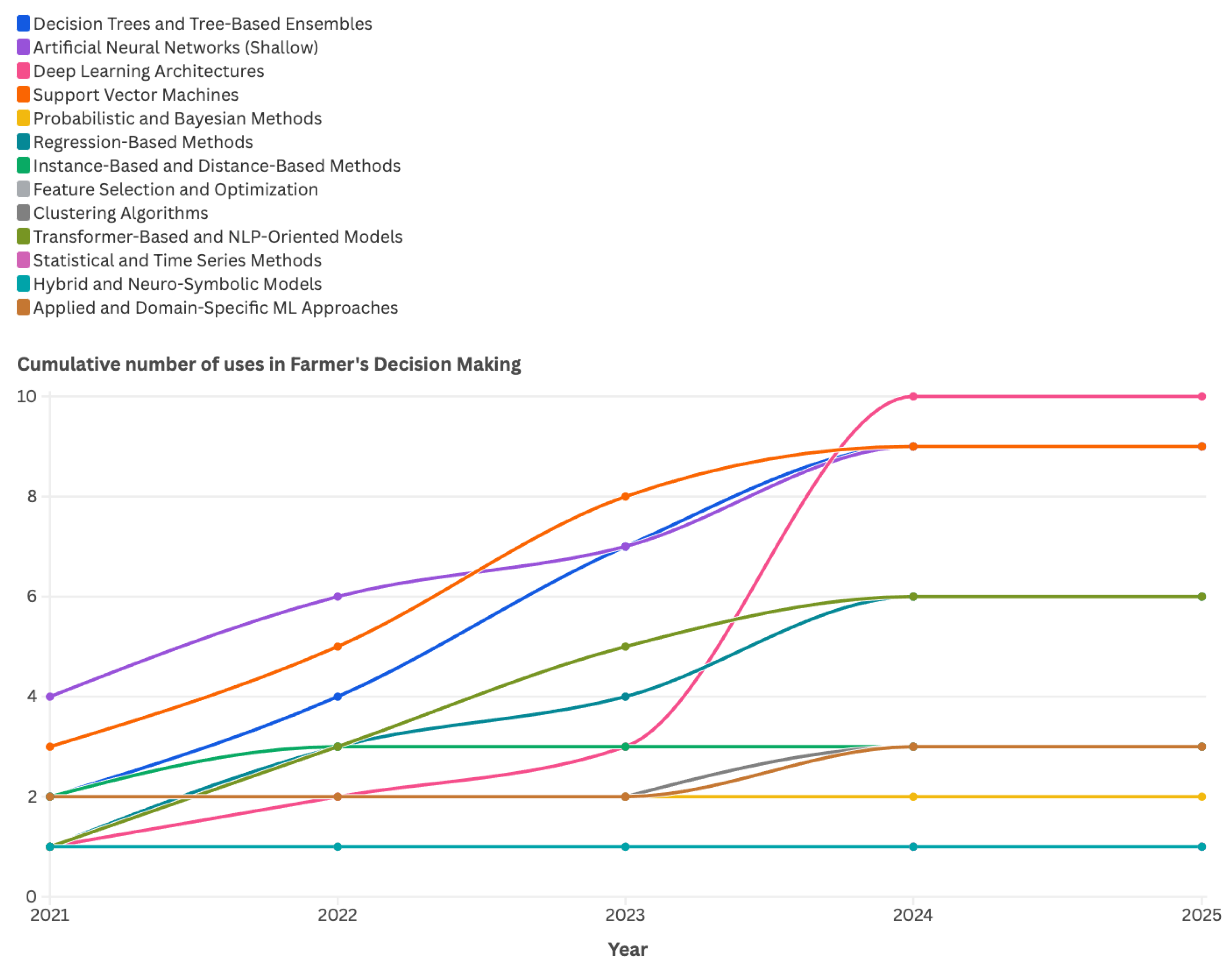
As shown in Figure 12, more recent studies have increasingly incorporated deep learning architectures alongside classical approaches such as SVM, decision trees, and ANN. However, the use of deep learning techniques increases significantly from 2024 onwards, surpassing the usage of other methods.
A notable trend is the increased use of time-series and natural language processing models, driven by the need to process unstructured data such as technical reports and user queries. In parallel, techniques such as RF and XGBoost have been applied to classify productive scenarios and predict critical events. The use of ANN has remained stable across simulation and decision-optimization tasks, particularly when combined with agroeconomic indicators. This evolution reflects a convergence of traditional techniques and deeper architectures, enabling the development of more adaptive support systems that can work with dynamic data sources and deliver contextually relevant recommendations for agricultural decision-making.
Decision-support systems targeting farmers increasingly aggregate heterogeneous data sources—including weather forecasts, soil diagnostics, crop models, and market signals—within interoperable cloud-based platforms. This integrative architecture illustrates the shift from isolated recommendation tools to coordinated intelligence ecosystems capable of synthesizing large-scale, multi-domain data streams.

3.3.3. Water and Weather

The analysis of the selected studies reveals that the application of ML and Big Data in the “Water and Weather” domain has focused on weather prediction, detection of extreme events, and estimation of key agroclimatic variables for water management. These applications respond to the growing need to anticipate climate variability and mitigate its impacts on agricultural planning.
For climate prediction, models such as SVM, RF, DT, and LSTM have been employed using historical data, satellite imagery, and weather station records. These techniques enable the generation of early warnings for heavy rainfall, droughts, or frosts, providing critical information for defining sowing windows or risk management strategies. LSTM, in particular, has proven effective at capturing complex temporal patterns and integrating multiple variables into multivariate time-series models [104].
In parallel, models have been developed to estimate variables such as evapotranspiration (ET0), soil moisture, and solar radiation, to optimize water use. In such tasks, ANN-based models—often combined with fuzzy logic and ensemble techniques—have been prominent for producing estimates tailored to various agroclimatic conditions [102,104]. These tools have been successfully applied in water-stressed regions, contributing to more efficient irrigation management.
From a Big Data perspective, data processing has been supported by platforms such as GEE and open-source datasets like ERA5 and WorldClim, which facilitate near-real-time access and analysis of large volumes of meteorological data. These infrastructures have been instrumental in developing dynamic, scalable, and adaptable monitoring systems across diverse geographic regions [40].
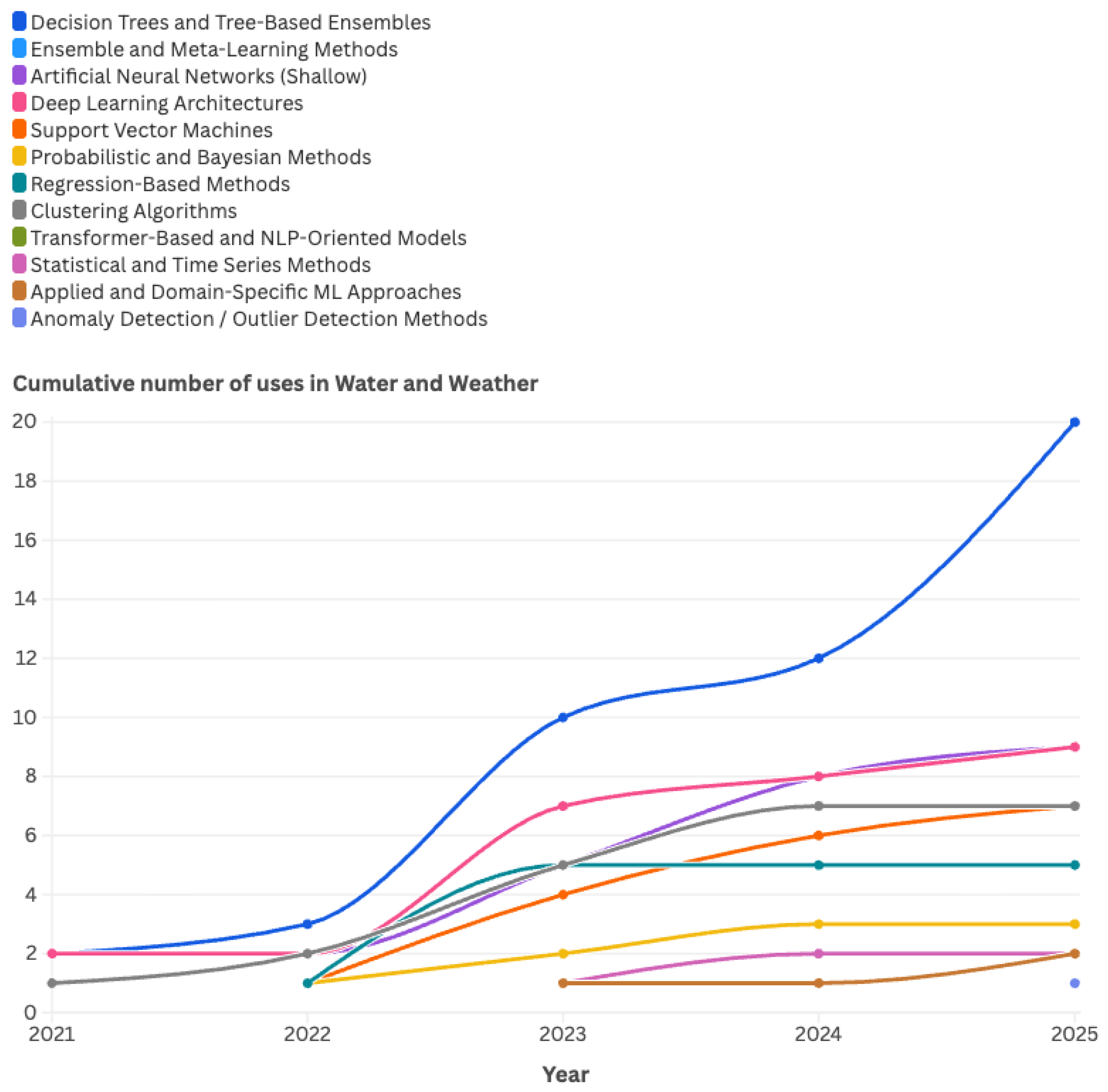
This agricultural domain has seen the consolidation of Decision Tree-based models, ANN, and deep architectures such as LSTM. The adoption of hybrid models and sequential approaches has intensified, marking a shift toward more context-specific solutions.
As shown in Figure 13, ML techniques in the DT and Tree-Based Ensembles category have increased and stand out compared to other ML methods employed.
Among the most widely used approaches in this domain are DT-based models, particularly RF and XGBoost, which have been applied to tasks such as rainfall prediction, agroclimatic zone classification, and extreme event detection. These algorithms have demonstrated strong performance in heterogeneous data environments, integrating information from sensors, weather stations, and satellite imagery. Their ability to handle correlated variables and tolerate noise explains their increasing adoption since 2021. In several studies, tree-based ensembles have outperformed individual models in terms of accuracy and stability, facilitating their integration into early warning systems and operational climate monitoring tools in agriculture.
Recent advances in ML within the water and weather domains have strengthened data-driven irrigation management and climate-informed decision-making. Intelligent irrigation frameworks integrating IoT sensor networks with ensemble-based ML models—such as stacked configurations combining RF, SVR, and LightGBM—report accuracies exceeding 99%, demonstrating strong performance in site-specific water allocation [165]. Similarly, multi-source models based on DT, RF, Gradient Boosting, and XGB effectively estimate soil water depletion and support precision irrigation strategies [169].
To address agricultural water scarcity, integrated IoT–Big Data–ML architectures achieve water savings of up to 25% and irrigation demand prediction accuracies of around 91%, often leveraging LSTM and transformer-based DL models to capture temporal hydrometeorological dynamics [158]. In climate-driven yield forecasting, hybrid approaches combining statistical regression with RF, XGBoost, and MLP models nonlinearly interact precipitation, temperature, humidity, and agroclimatic indices such as GDD and SPI [147]. More recent DL architectures, including TCN and KAN, further enhance temporal modeling of meteorological time series [171]. Overall, cloud-enabled hybrid frameworks integrating ensemble methods and LSTM improve predictive robustness, supporting adaptive irrigation management and climate-resilient agricultural planning [148].
Weather and water management systems exemplify the structural convergence between ML and large-scale data infrastructures. The reliance on satellite-derived time series, remote sensing platforms, and real-time sensor networks necessitates distributed storage, parallel computation, and cloud-based orchestration mechanisms. These characteristics highlight the intrinsic Big Data foundation underpinning modern agroclimatic intelligence systems.

3.3.4. Soil

The soil domain has been addressed from multiple perspectives through the combined use of ML and Big Data technologies, with an emphasis on improving the characterization, monitoring, and prediction of edaphic properties relevant to agriculture. Based on the analysis of the selected articles, three major lines of application can be identified: (1) estimation of soil physicochemical properties, (2) soil type classification, and (3) spatial-temporal mapping and monitoring.
One of the most common applications is the estimation of soil properties, such as nitrogen, phosphorus, potassium, pH, and organic matter. These estimates are derived from spectral data, satellite imagery, or in-field sensor data, reducing the need for laboratory analysis. In this context, techniques such as RF, SVM, and ANN have been widely used for their ability to handle complex nonlinear relationships [26,84].
Another important application is the classification of soil types and cartographic units using models trained on geospatial databases and environmental variables derived from remote sensing. These approaches have been crucial for generating updated soil maps, particularly in areas with limited historical data. Models such as XGBoost, DT, and KNN are the most commonly employed in this context [29,84].
Spatial and temporal soil monitoring has gained prominence as a strategy for analyzing processes such as erosion, compaction, and salinity, by integrating time-series of satellite imagery and climatic data. In these studies, techniques such as LSTM and CNN have been applied, along with Big Data platforms like GEE and cloud-based Geographic Information System (GIS) tools, to capture large-scale dynamics at high resolution [122].
Overall, advancements in this domain reflect a transition from descriptive approaches to predictive and prescriptive models, with an increasing incorporation of geospatial technologies, multi-source data, and advanced ML techniques. This evolution has not only enhanced our understanding of soil systems but also supported more sustainable and efficient agronomic decision-making [29].
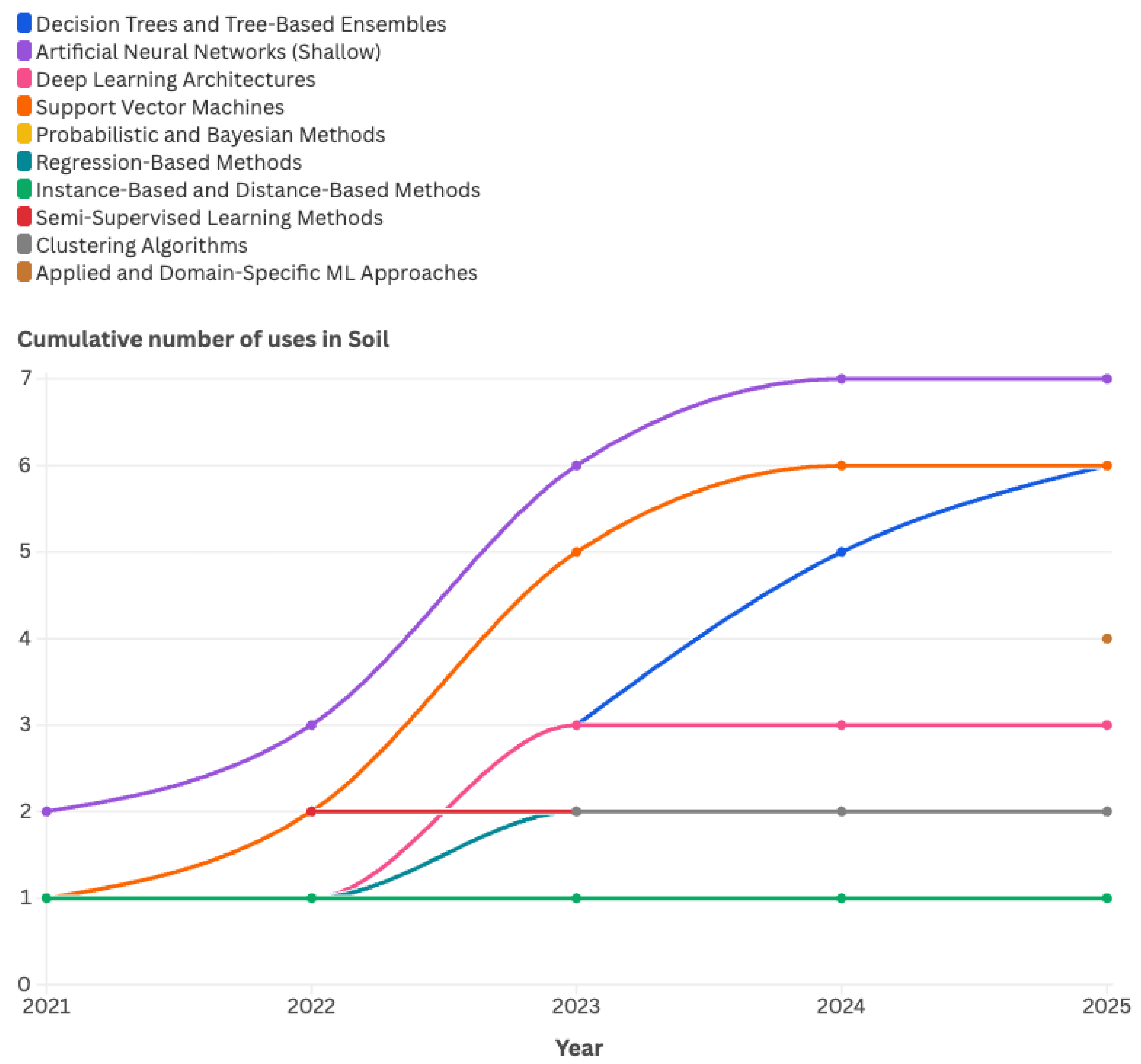
As illustrated in Figure 14, the soil domain has consolidated the use of Decision Tree-based models, ANNs, and SVMs across various soil characterization tasks.
Tree-based algorithms such as RF and XGBoost have been widely used to predict soil properties from spectral or environmental data, particularly for their accuracy and robustness in the presence of noisy or incomplete datasets. In parallel, ANN have demonstrated strong performance in estimating continuous variables, such as moisture, conductivity, and organic matter, by modeling complex nonlinear relationships. Meanwhile, SVM models have been applied to soil type classification and the delineation of cartographic units, especially in contexts involving small or high-dimensional datasets. This combination of approaches reflects a shift toward more specialized solutions, with a growing use of ensemble and hybrid models to improve both spatial and operational accuracy in soil analyses.
Recent advances in ML within the soil domain have significantly improved soil health monitoring, nutrient management, and precision cultivation practices. The integration of IoT-based sensing systems with ML algorithms enables real-time acquisition and analysis of critical soil parameters, including temperature, moisture, organic matter content, and macronutrient levels (NPK) [166]. In this context, RF is frequently adopted for crop suitability prediction and fertilizer recommendation, achieving predictive accuracies close to 90% under heterogeneous soil conditions [166]. More advanced decision-support frameworks incorporate CNN and multi-model ML pipelines to enhance soil moisture estimation and complex pattern recognition, reporting correlation coefficients of up to 0.94 in moisture prediction tasks [167].
For predictive crop health monitoring linked to soil conditions, hybrid configurations combining RF and CNN demonstrate strong performance in early stress and disease detection, with reported accuracies of 94.7% [141]. Furthermore, precision agriculture architectures integrating IoT sensing, edge processing, and cloud computing enable scalable soil assessment and contaminant monitoring, supporting large-scale data-driven soil management strategies [35]. These developments illustrate the transition toward integrated, ML-enabled soil analytics frameworks that enhance resource efficiency, optimize nutrient application, and promote sustainable agricultural practices.
Importantly, soil-focused ML applications are no longer limited to localized dataset experimentation but are increasingly deployed within IoT-enabled sensing networks and cloud-edge collaborative infrastructures. The integration of multimodal soil parameters (e.g., moisture, temperature, nutrient profiles) within distributed processing frameworks underscores the data-intensive nature of contemporary soil intelligence systems. This evolution situates soil analytics within scalable Big Data architectures aligned with ecosystem-level orchestration principles.

3.3.5. Land

In the Land domain, the application of ML and Big Data has focused on tasks such as land suitability assessment, land cover classification, and ecological condition monitoring in forest and rangeland environments. These studies are characterized by the integration of large volumes of heterogeneous data—originating from satellite sensors, climate records, and topographic variables—within contexts that demand scalability and minimal reliance on fieldwork.
One of the most relevant applications involves large-scale ecological assessment using models that can represent the ambiguity and subjectivity inherent in human-derived data. Zhang et al. (2024) proposed an approach based on Gaussian type-2 fuzzy logic to transform qualitative variables into numerical representations, thereby facilitating information aggregation under high-uncertainty conditions [109].
In parallel, significant progress has been made in automated land-cover classification using high-resolution satellite imagery. In this line, Burgueño-Romero et al. (2025) developed an architecture aligned with MLOps best practices to automate the lifecycle of annual classification models, highlighting advancements in data governance [145]. The authors employed algorithms such as RF, SVM, and DT, along with feature selection techniques. This solution was implemented on platforms such as Apache Spark, Kubernetes, and GEE and processed over 10 TB of raw Sentinel-2 and Landsat imagery to generate updated land-use maps.
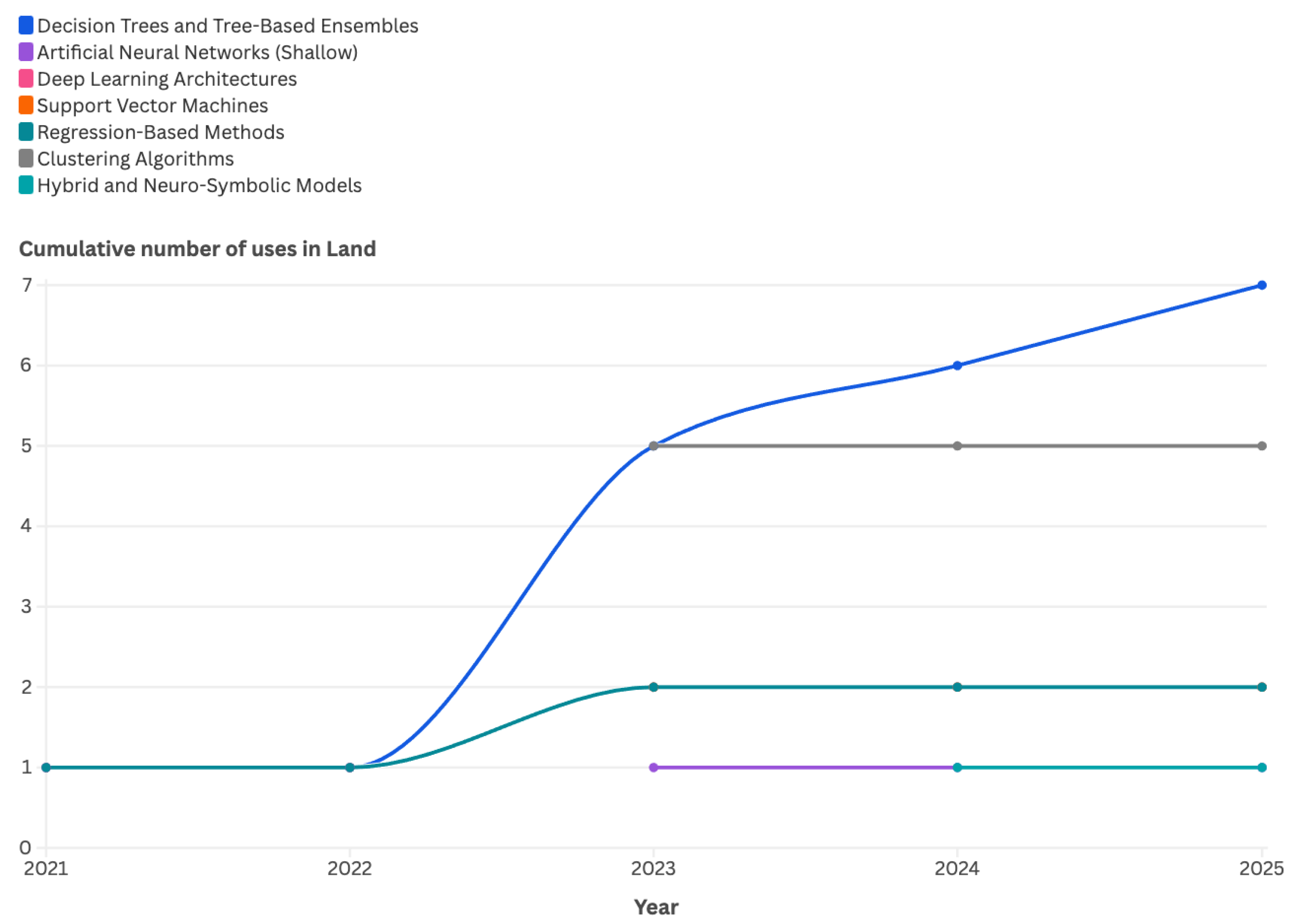
As shown in Figure 15, the use of ML algorithms in this domain has shown moderate progress, though it remains limited compared to other agricultural areas. One of the most prominent approaches involves DT and Tree-Based Ensemble models, such as RF and GBM, which have primarily been employed for land cover classification and the prediction of ecological indicators in forest and rangeland settings. These models stand out for their ability to handle multiscale data and complex environmental variables, significantly enhancing the accuracy of analyses based on high-resolution satellite imagery.
In parallel, clustering algorithms have emerged—particularly unsupervised techniques such as K-Means—to classify Land Capability Classes (LCC) and analyze agrotourism models. These approaches allow for the grouping of land areas with similar ecological characteristics without the need for labeled data, representing a significant advantage in contexts with limited field information.
Nevertheless, the literature indicates that the Land domain remains in an early stage of development compared to areas such as Crops or Farmer’s Decision Making, with relatively few studies fully leveraging the potential of ML. Most applications are still focused on workflow automation and ecological characterization, while the adoption of advanced DL techniques or hybrid models remains low. This highlights a significant opportunity to expand the use of ML in this domain, particularly by integrating more sophisticated approaches and strengthening data and model infrastructures.
Land use analytics inherently depend on high-volume geospatial datasets, including remote sensing imagery and GIS layers, which require scalable processing frameworks and distributed data pipelines. The integration of spatial Big Data with ML-based classification and forecasting models reflects the increasing alignment between geospatial intelligence and ecosystem-level agricultural orchestration.

3.3.6. Animal Research

The application of ML and Big Data technologies in the Animal Research domain has enabled the resolution of complex challenges related to animal health, production, and welfare. The main applications are concentrated in three areas: disease prediction, behavior recognition through sensors and imaging, and smart aquaculture management, integrating predictive models with real-time digital infrastructure.
In animal health, algorithms such as RF have been used to model outbreaks of epizootic diseases and generate risk maps, as in the study by Barrile et al. (2023), which integrated geospatial variables and historical data to predict the impact of swine fever on wild populations [68]. In dairy production, predictive platforms based on logistic regression have been developed, achieving accuracy rates above 89%, outperforming models such as DT and KNN [32].
In aquaculture, notable developments include architectures combining IoT, language models like GPT-3.5, and real-time analytics to deliver adaptive recommendations in response to changes in water quality or disease outbreaks [113]. Other approaches have combined PCA, backpropagation neural networks (BPNN), and genetic algorithms to predict critical parameters such as dissolved oxygen levels [45].
Animal behavior monitoring has incorporated unsupervised algorithms and classification models, such as XGBoost, Categorical Boosting (CatBoost), and RF, to recognize activities and detect conditions such as mastitis or metabolic disorders in livestock [48,50]. These models have demonstrated high accuracy when customized for specific species and environments.
From a Big Data perspective, real-time analytical infrastructure has been developed for rural communities, integrating tools such as Apache Kafka, Storm, and MongoDB, along with models such as DBSCAN and RF to classify diseases in livestock and poultry [41]. In marine monitoring, YOLO neural networks have been trained to detect fish in underwater video footage, showcasing the potential of deep learning for aquatic ecosystem management [59].
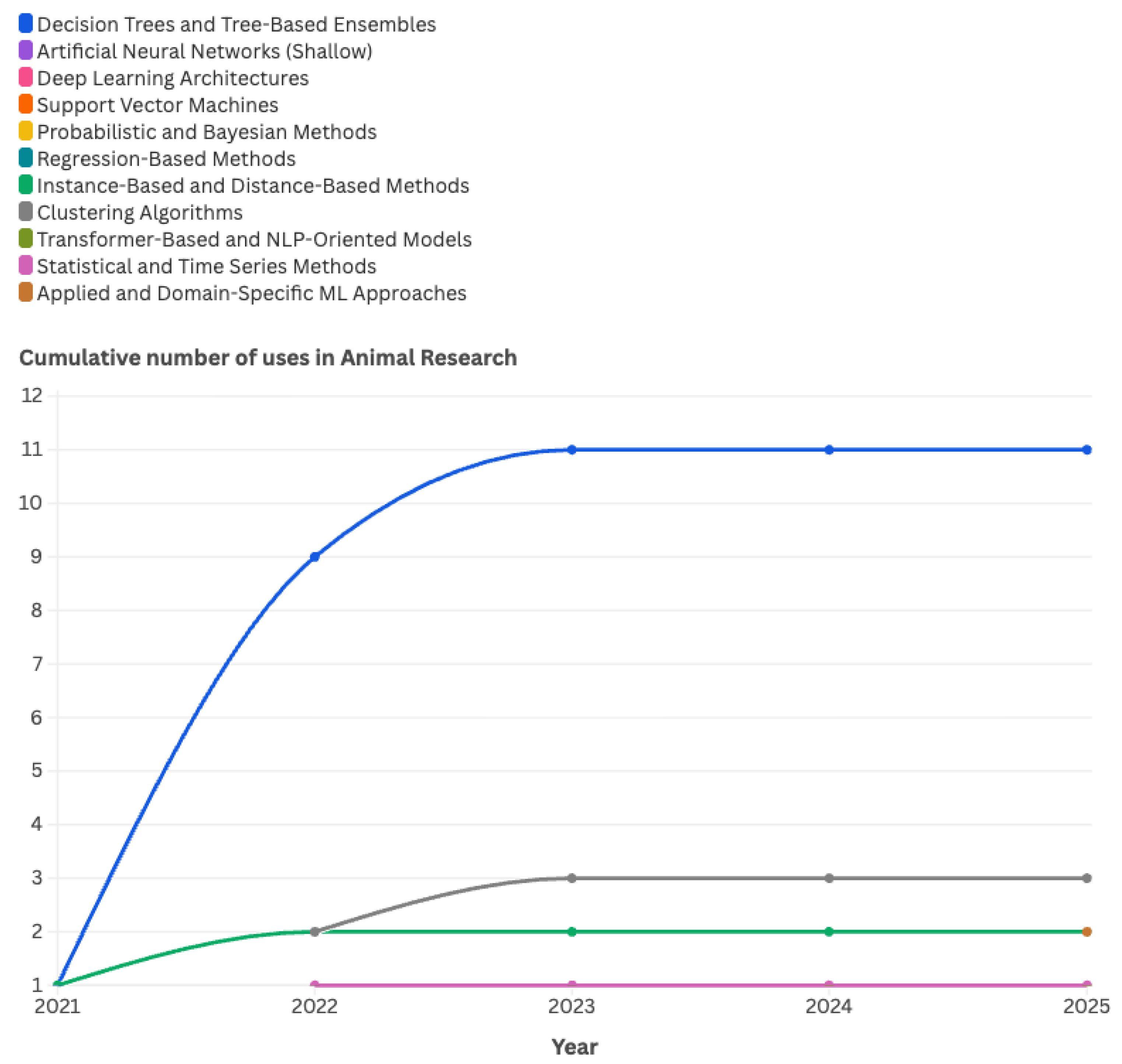
As shown in Figure 16, decision tree-based models and ensemble methods have been a consistent presence in the Animal Research domain due to their ability to handle multivariate data, categorical variables, and nonlinear relationships.
Algorithms such as RF, XGBoost, and CatBoost have been successfully applied to disease detection, behavioral pattern recognition, and physiological state classification, delivering robust results even under noisy or incomplete data conditions. Their relative interpretability and low computational cost explain their preference in operational environments where response time and scalability are critical factors. This consolidation of tree-based models reflects a practical, adaptable orientation to ML in livestock production contexts, where decisions must be precise, traceable, and executable in real time.
Recent advances in ML within the animal research domain have enhanced the monitoring and management of livestock health and welfare, particularly in intensive production systems. A notable development is the integration of bovine bioacoustics with ML-based analytics to enable continuous and non-invasive welfare assessment [143]. Scalable frameworks process complex acoustic data streams using robust feature extraction pipelines derived from tools such as Praat, librosa, and openSMILE, incorporating 24 noise-resilient acoustic descriptors. The resulting FAIR-compliant datasets include expert-labeled vocalizations spanning 48 behavioral classes and expanded through domain-informed data augmentation techniques, supporting tasks such as estrus detection, distress classification, and maternal communication recognition [143].
In parallel, intelligent dairy data ecosystems integrate multimodal AI, edge computing, and FL to support real-time, privacy-preserving decision-making [173]. These architectures combine heterogeneous data sources—including IoT sensors, cameras, and multi-array microphones—with modular processing pipelines for denoising, synchronization, and standardized feature extraction. By embracing real-farm environmental variability rather than controlled laboratory conditions, these ML frameworks enable scalable, deployment-ready models capable of continuous welfare evaluation at industrial scale. Collectively, these developments contribute to improved ethical compliance, enhanced livestock management, and greater sustainability in animal production systems.
Similarly, livestock monitoring systems increasingly operate within multimodal data environments combining bioacoustic streams, sensor arrays, and cloud-based analytics platforms. The scalable processing of high-frequency behavioral and physiological data reinforces the Big Data dimension of contemporary animal intelligence systems and supports their integration within ecosystem-oriented digital infrastructures.

3.4. Big Data Technologies

The analysis of the reviewed studies reveals that the most commonly used Big Data technologies in smart agriculture are concentrated within distributed ecosystems for large-scale data processing and storage. Platforms such as Apache Spark, Hadoop, GEE, and Apache Kafka support workflows for the real-time acquisition, integration, and analysis of agricultural data from heterogeneous sources, including IoT sensors, satellites, drones, and hyperspectral imagery [113,145]. These architectures enable the resolution of tasks such as crop classification, yield prediction, and environmental condition monitoring by integrating ML algorithms—such as Random Forest, SVM, ANN, and XGBoost—within large-scale processing pipelines [47,90]. Additionally, the use of Data Lakes and NoSQL databases (such as MongoDB) enables the efficient management of both structured and unstructured data, supporting the development of predictive systems and early warning mechanisms across domains such as soil, climate, and livestock [47].
Current trends point toward a convergence of distributed analytics, artificial intelligence, and data governance. Agricultural ecosystems are increasingly migrating toward AI-orchestrated infrastructures, where models, data, and computing resources operate in an integrated manner between edge and cloud environments, enabling continuous learning and real-time prescriptive decision-making [145]. In this context, the combination of MLOps, Edge–Cloud Computing, and multimodal analytics enables automated workflows that integrate satellite imagery, climatic records, and sensor data to generate autonomous, verifiable actions. Likewise, the emergence of federated and trusted data spaces fosters interoperability and ethical information sharing among stakeholders in the agricultural ecosystem, ensuring privacy, equity, and model traceability. In parallel, agricultural cognitive platforms are emerging, combining conversational AI, predictive models, and supply chain analytics to provide intelligent support for both field-level and strategic decision-making [76,113].
Recent advances in Big Data technologies have fundamentally redefined modern agriculture, consolidating its transition toward a fully data-driven paradigm that integrates AI, ML, advanced analytics, and distributed digital infrastructures to enhance productivity and sustainability. This transformation aligns with the emergence of Agriculture 5.0 (Ag5.0), where Big Data analytics functions as a core enabling layer alongside IoT, cloud computing, blockchain, digital twins, and next-generation communication networks for precision crop management [156]. Contemporary Big Data frameworks typically operate through multi-layered architectures—comprising sensing, communication, data processing, and application layers—that support large-scale data acquisition from IoT sensors, UAVs, satellite imagery, and agricultural machinery. These heterogeneous data streams are subsequently processed using predictive ML models to generate actionable intelligence for farm-level decision-making [175].
The empirical impact of Big Data adoption in agriculture is substantial. Reported outcomes include yield increases of 15–20%, reductions of 10–15% in post-harvest losses, and resource cost optimizations of 20–25% through predictive analytics [153]. Field-level implementations further indicate volumetric yield improvements of up to 33% in crops such as wheat, rice, and soybean, alongside reductions of 26% in water consumption, 25% in fertilizer use, and 33% in pesticide application under data-driven management regimes [160]. The integration of GIS, remote sensing, and IoT with Big Data analytics has enabled the development of geo-intelligent systems capable of real-time soil and crop health monitoring, anomaly detection, and predictive modeling for sustainable farm management [159].
Despite these advances, critical challenges remain that hinder the consolidation of a sustainable and trustworthy Big Data ecosystem. The primary issues involve data heterogeneity and quality, institutional fragmentation, and the lack of global interoperability standards [47,113]. Moreover, the deployment of cloud infrastructure and distributed processing is constrained by connectivity limitations and high energy costs, which strain operational sustainability in rural areas [82]. Sustainable-by-design solutions are needed—ones that integrate the full model lifecycle and optimize resource use through energy-efficient analytics at the edge. Lastly, consolidating responsible data governance practices and promoting digital literacy among farmers and technicians are essential for ensuring equity, transparency, and climate resilience in the future of digital agriculture. Despite its transformative potential, the adoption and scalability of Big Data in agriculture remain constrained by structural, organizational, and technical challenges. Key barriers include limited data science expertise, high initial technological costs, and resistance to digital transformation, particularly among small and medium-scale producers facing digital literacy gaps and insufficient institutional support [153,177]. Technical constraints such as heterogeneous data integration, interoperability, infrastructure scalability, data privacy, and unreliable rural connectivity further hinder implementation. Additionally, issues related to large-scale data annotation, ML model generalization across agroclimatic contexts, and the integration of emerging technologies (e.g., edge computing and digital twins) continue to limit widespread deployment [150].

4. Discussion

The discussion is organized around three complementary axes. The first revisits previously reported challenges in the literature, which help contextualize the historical limitations in the adoption of ML and Big Data in agriculture. The second addresses the challenges identified in this review, reflecting new issues arising from the expansion of these technologies—such as increasing data complexity, operational sustainability of systems, and tensions surrounding information governance. The third axis focuses on emerging opportunities, emphasizing recent technologies such as data governance, MLOps approaches, Quantum Machine Learning, and multimodal models, all of which open new possibilities for developing a smarter, more resilient, and sustainable agriculture.
This structure allows for comparing current findings with previous evidence, identifying persistent gaps, and delineating trends shaping the future of digital agriculture. More than a synthesis of advancements, this discussion offers a critical reading of the current state of the field. It proposes strategic directions for future research in ML and Big Data applied to the agricultural sector.

4.1. Previous Challenges in the Use of ML and Big Data in Agriculture

The use of ML in agriculture presents significant technical and operational limitations. One of the main barriers is data quality: available datasets often contain noise, missing values, and class imbalance, all of which directly affect model performance [16,181]. Moreover, advanced algorithms such as LSTM, GRU, or YOLO require large volumes of labeled data—a scarce resource in areas such as pest detection or animal welfare monitoring [182].
Another critical challenge is interpretability. In agricultural contexts—where technology adoption depends on the trust of technicians and producers—models must be understandable and traceable. However, many deep learning architectures behave as “black boxes,” which limits their practical use [76].
Scalability and transferability also remain problematic. A model trained for a specific crop or region is not always applicable to other agroclimatic contexts, reducing its generalization capacity [118]. Furthermore, the gap between academic development and on-the-ground implementation remains wide, particularly in rural areas with limited access to digital infrastructure and technical support [16]. These challenges underscore the need to move toward hybrid models (combining physical simulations and ML) and user-adapted platforms that integrate explanatory features, accessible interfaces, and context-aware recommendations.
The adoption of Big Data in agriculture faces limitations associated with the well-known “4 Vs”: volume, variety, velocity, and veracity. The volume of data generated by sensors, satellite imagery, and UAVs demands robust storage and processing infrastructures (e.g., Hadoop, Spark, HDFS), which increases operational costs [16,181].
The variety of sources—climate, soil, agronomic decisions, IoT sensors—poses challenges in standardization and format compatibility, making it difficult to integrate heterogeneous data [76]. Velocity is also critical: systems must operate in real time to issue alerts for weather events, disease outbreaks, or infrastructure failures [31]. Veracity is another sensitive issue. Incomplete, outdated, or inconsistent data can lead to erroneous decisions with technical and economic consequences. Additionally, institutional fragmentation—where different actors (e.g., water, energy, soil agencies) manage data in isolation—hinders an integrated view of the water–energy–food nexus [183]. This fragmentation reduces the effectiveness of intelligent systems and weakens interoperability between platforms.
Beyond technical considerations, implementing ML and Big Data in agriculture faces social, organizational, and governance barriers. One major issue is the lack of trust from end-users. Many farmers perceive these technologies as complex, costly, or poorly adapted to their productive realities [16]. This perception is reinforced by the limited availability of intuitive platforms and systematic training processes [181]. In parallel, concerns around privacy, data ownership, and security are emerging. Farmers’ reluctance to share production data—due to fear of misuse or loss of control—limits the creation of collaborative data ecosystems [76]. This highlights the need for clear regulatory and ethical frameworks that ensure confidentiality, promote transparency, and define responsibilities in data use.
Finally, best practices in interoperability, data visualization, and governance are essential. Establishing open standards and traceability mechanisms is key to bridging the gap between technological development and effective adoption in the agricultural sector.

4.2. Challenges Identified in This Review

When comparing traditional challenges described in the literature with recent findings across different agricultural domains, new demands become apparent that reflect the evolving use of ML and Big Data in the sector. While limitations related to data quality and heterogeneity persist [16,181], the need to develop climate-resilient models is becoming increasingly critical. In domains such as Water, Weather, and Soil, current studies call for algorithms that can adapt to extreme events and rapid changes by integrating multiple spatial and temporal scales [183]. This adds a layer of complexity: the need to advance toward hybrid models that combine physical simulations with deep neural networks, capable of generalizing under high uncertainty [76].
Another emerging challenge involves managing complexity in multi-source and multimodal environments. In areas such as Crops and Farmer Decision Making, the use of models like LSTM, XGBoost, and YOLO has accelerated, requiring the simultaneous integration of satellite data, IoT sensors, meteorological variables, and economic indicators. This convergence introduces not only interoperability and standardization challenges but also concerns about energy consumption and the operational sustainability of these systems [182]. In this context, designing more efficient processing architectures becomes a priority—ones that reduce environmental impact without compromising model performance.
The deployment of ML models in agriculture faces domain-specific constraints that limit their operational scalability. A primary challenge concerns poor model generalization across heterogeneous agroclimatic contexts, as models trained on limited or homogeneous datasets often experience substantial performance degradation when transferred to new environments [169]. High-quality data annotation represents an additional bottleneck, requiring specialized agronomic expertise to accurately label complex phenomena such as plant diseases, water stress, and pest outbreaks, which increases implementation costs, particularly for small-scale producers [150]. Furthermore, technical barriers persist in integrating heterogeneous data sources (e.g., sensors, satellites, UAVs, weather stations), ensuring system interoperability, and efficiently coupling ML models with edge computing and emerging technologies such as digital twins [150]. These challenges are compounded by shortages of skilled data science professionals and ongoing concerns regarding data privacy and security, collectively constraining the sustainable adoption of ML-driven agricultural solutions.
Finally, ethical, trust-related, and data governance challenges are intensifying. In domains such as Animal Research and Land, the use of drones, visual sensors, and computer vision algorithms has raised new questions around privacy, algorithmic bias, and animal welfare. Moreover, there remains a gap in access to and ownership of technology among small-scale farmers, particularly in regions with limited infrastructure [16]. These current challenges go beyond the technical realm, incorporating social, regulatory, and environmental dimensions that require a comprehensive rethinking of the digital agriculture research agenda.

4.3. Opportunities for ML and AI in Agriculture

The consolidation of data governance frameworks is emerging as an enabling condition to build trust in ML- and Big Data-driven solutions in agriculture. Tools such as model cards and dataset datasheets, as proposed by Potdar (2024), allow for standardized documentation of the assumptions, limitations, and usage conditions of models and datasets [184]. This improves traceability, transparency, and informed consent. These initiatives are complemented by regulatory frameworks and ethical guidelines, such as ALTAI, and established standards, such as the DAMA-DMBOK, which define operational principles for data quality, interoperability, and security. The adoption of such frameworks helps mitigate risks related to ownership, privacy, and bias, while also facilitating standardization in the capture, storage, and use of agricultural data. These practices foster better conditions for the adoption of models among farmers, public institutions, and actors from the private sector, paving the way for a more trustworthy and collaborative digital ecosystem [185].
The sustainability of ML models in agriculture increasingly depends on their integration into automated MLOps pipelines that support end-to-end model lifecycle management—from training to operational updates. These practices ensure continuous monitoring, which is essential for detecting concept drift and recalibrating models in response to changing conditions, such as climate variability, phenological dynamics, or the emergence of new pests and crop varieties.
In smart agriculture, MLOps help maintain up-to-date models for yield prediction, disease classification, and fertilization recommendations, thereby reducing algorithmic obsolescence. Technologies such as Kubernetes and containerized environments have proven effective for enabling reproducible, scalable, and efficient model updates in real production environments [186].
Beyond technical support, MLOps helps bridge the gap between development and deployment by facilitating the transition of models from research environments to operational applications. This enhances the potential for ML to become a structural component of more adaptive and evidence-based agricultural systems. In parallel, the application of quantum computing (QC) in agriculture represents a disruptive leap in processing capacity for high-dimensional problems such as yield prediction, varietal selection, and input optimization. Models such as Variational Quantum Circuits (VQC) have outperformed classical regression techniques in complex production scenarios [187], positioning themselves as promising tools in environments characterized by multiple environmental, genetic, and management variables [188].
In soil management, quantum classifiers have demonstrated improvements in fertility assessment, accelerating decision-making regarding the efficient use of natural resources [189]. In plant health, quantum image processing techniques have enabled more precise and earlier disease detection in crops such as wheat, reducing the need for chemical treatments [189].
In animal production, the combination of QC and AI models has been explored to manage genomic, environmental, and behavioral complexity in breeding programs, improving the efficiency and sustainability of such systems [190]. These applications signal the emergence of a more climate-resilient agriculture, with more accurate diagnostics and more efficient use of available resources. The progressive integration of QC into ML workflows points toward a new cycle of innovation in precision agriculture, with broad impact across the entire value chain.
Transformative opportunities to overcome current limitations lie in the adoption of innovative technological paradigms and governance mechanisms. Federated Learning (FL) constitutes a critical enabler for decentralized model training, allowing multiple farms to collaboratively improve global models without sharing sensitive local data, thereby preserving privacy while maintaining contextual relevance [173]. Complementarily, integrating blockchain-based data governance enhances transparency, traceability, and data provenance through decentralized identifiers (DIDs), verifiable credentials (VCs), and smart contracts that enable immutable auditing of model updates and data transactions [137].
The emergence of cloud–edge–device collaborative architectures further supports scalable ML operationalization by combining low-latency edge inference with centralized cloud-based model training and coordination [149]. Advanced frameworks such as Geo-Conscious Agriculture incorporate ethical data governance, XAI, and digital twins to simulate agronomic scenarios before deployment, thereby strengthening transparency and climate resilience [178]. Additionally, initiatives aimed at breaking agricultural data silos—supported by interdisciplinary collaboration and science–industry partnerships—can unlock the full value of aggregated Big Data ecosystems. Together with advancements in 5G connectivity and lightweight edge AI algorithms, these developments enable scalable ML deployment even in connectivity-constrained rural environments [156].

4.4. Synthesis of Results: From Domain Evidence to IAE Pillars

Figure 17 synthesizes the technological evolution toward what we define as Intelligent Agricultural Ecosystems (IAE)—a new stage in the development of digital agricultural systems that transcends the Agricultural Big Data paradigm. While previous generations focused on the large-scale collection, storage, and analysis of information, IAE integrates data, models, infrastructure, and governance under a systemic logic [3]. Our new framework articulates various technological domains—AI, Big Data, Edge–Cloud Computing, MLOps, and ethical governance—into an operational environment where data flows, models learn, and decisions adapt in real time. Thus, agriculture moves beyond being merely data-driven to becoming intelligence-driven, capable of dynamically responding to changing environmental, social, and productive conditions.
The analysis across the six reviewed domains (crops, soil, weather and water, land use, animal research, and farmer decision-making) reveals structural convergence patterns that extend beyond isolated ML applications. While domain-specific implementations differ in datasets, models, and evaluation metrics, recurrent technological and organizational characteristics emerge consistently across the literature.
First, studies of crops, soil, and weather increasingly rely on distributed infrastructures that integrate IoT, satellite imagery, and multimodal sensing within cloud–edge–device architectures. This convergence directly supports the Infrastructure and Scalability pillar of the IAE framework, emphasizing real-time, large-scale, and interoperable data processing.
Second, cross-domain adoption of Federated Learning, blockchain-supported data governance, and interoperability mechanisms reflects a growing concern for privacy, trust, and data sovereignty. These developments underpin the Data Governance and Interoperability pillar.
Third, the incorporation of continuous model monitoring, retraining strategies, and lifecycle-aware deployment practices—particularly in large-scale agricultural analytics platforms—aligns with the Lifecycle Management (MLOps) pillar, demonstrating a transition from experimental ML models to operational AI systems.
Fourth, the integration of Explainable AI, ethical data frameworks, and transparency mechanisms across crop recommendation, irrigation optimization, and livestock monitoring applications supports the Transparency and Trust pillar, reinforcing the socio-technical dimension of intelligent agriculture.
Finally, the orchestration of heterogeneous domain-specific intelligence into coordinated decision-support systems reflects the emergence of Intelligence Orchestration, wherein predictive models, sensing infrastructures, and governance mechanisms operate as an integrated ecosystem rather than isolated tools.
Therefore, the IAE framework does not represent a deductive conceptual proposal imposed on the literature; rather, it emerges inductively from consistent structural patterns identified across the 2021–2025 evidence base.
IAE is structured around five complementary approaches that define its key components. First, AI-Orchestrated Agriculture promotes the multimodal integration of data from sensors, imagery, text, and weather through edge–cloud architectures, enabling the automation of both analytical and prescriptive processes. Second, Federated & Trusted Agri-Data Spaces facilitate the secure and interoperable exchange of information between institutions and producers, ensuring transparency, traceability, and data sovereignty. Third, Cognitive Agriculture Platforms merge conversational AI, computer vision, and decision support systems to strengthen human–machine interaction in productive management. A fourth approach, Sustainable-by-Design AI Agriculture, seeks to minimize the energy and environmental footprint of analytical systems by optimizing resource use and deploying low-consumption models. Finally, MLOps-Enabled Smart Agriculture ecosystems ensure the operational continuity of models through automated training, validation, and deployment pipelines, enabling their timely updating in response to climatic and biological variability.
These five pillars integrate to form a new architecture for contemporary agricultural systems, steering them toward a cognitive, resilient, and collaborative agriculture. The IAE framework represents not only a technological evolution but also a conceptual one: an ecosystem where artificial intelligence is fused with principles of sustainability, trust, and adaptability. This convergence consolidates a new generation of digital agricultural infrastructures that learn, collaborate, and optimize in real time, marking a definitive shift from data-driven agriculture to agriculture guided by integrated, ethical intelligence.
Although Agriculture 5.0 emphasizes the integration of advanced digital technologies—such as IoT, robotics, AI, cloud computing, and next-generation connectivity—to enhance automation and precision farming, the proposed IAE framework extends beyond technological convergence. While Agriculture 5.0 primarily represents a stage in technological evolution focused on human-centric automation and productivity enhancement, IAE introduces a systemic, governance-oriented architecture that explicitly incorporates data governance, interoperability standards, federated collaboration mechanisms, and ML lifecycle management (MLOps).
In contrast to Agriculture 5.0, which centers on digitalization and the deployment of smart infrastructure, IAE conceptualizes agriculture as an adaptive ecosystem in which data flows, model training, deployment, monitoring, retraining, explainability, and ethical oversight are structurally embedded. The IAE framework integrates decentralized learning paradigms (e.g., FL), continuous model validation, drift detection, reproducibility protocols, and explainable AI (XAI) as core architectural components. Thus, IAE shifts the focus from technological capability to the institutionalized orchestration of intelligence, ensuring long-term scalability, trust, transparency, and sustainable governance of ML-driven agricultural systems.
Accordingly, IAE should not be interpreted as a successor stage of Ag5.0, but rather as a complementary and more structurally mature paradigm that operationalizes digital agriculture through coordinated governance, lifecycle-aware MLOps, and ecosystem-level intelligence management. Table 3 presents a structured comparison between Agriculture 5.0 and the proposed IAE framework, emphasizing the latter’s explicit integration of governance mechanisms and ML lifecycle management (MLOps) as defining features beyond technological digitalization.

4.5. Evolution of the Field (2021–2025): From Algorithmic Applications to Ecosystem-Level Intelligence

The present review reveals a structural evolution in the application of Machine Learning (ML) and Big Data in agriculture when compared to earlier literature syntheses. While previous reviews—including our 2022 systematic review—primarily emphasized algorithmic performance, data scarcity challenges, and implementation barriers in precision agriculture, the literature published between 2021 and 2025 demonstrates a clear transition toward integrated, scalable, and governance-aware digital infrastructures. Recent contributions increasingly move beyond isolated ML applications (e.g., yield prediction or disease classification) toward orchestrated architectures that combine distributed sensing, real-time analytics, federated collaboration, and lifecycle-aware model management.
In particular, emerging studies from 2023–2025 introduce structural components that were marginal or absent in earlier reviews: Federated Learning (FL) for multi-farm collaboration, cloud–edge–device collaborative computing, MLOps-oriented ML lifecycle management, blockchain-based data governance, and the integration of Explainable AI (XAI) and digital twins for simulation and anticipatory decision-making. These developments indicate that the field is no longer focused solely on predictive accuracy, but increasingly concerned with scalability, interoperability, transparency, and sustainable governance of AI systems in agricultural environments.
This convergence of technological, governance, and lifecycle management innovations supports the emergence of the proposed IAE framework. Unlike earlier precision agriculture paradigms centered on technological deployment, the IAE model reflects an ecosystem-level transformation in which data governance, federated coordination, continuous model monitoring, and explainability become structural pillars. Table 4 synthesizes this evolution and highlights the additional contributions identified in the 2021–2025 literature relative to previous reviews.

4.6. Main Limitations of the Study

Despite the careful design and execution of the SLR protocol, this type of study may be subject to a set of limitations that could threaten the validity of its results and conclusions. These limitations include, for instance, the risk of failing to access or inadvertently excluding relevant studies, which could affect the generalizability of the findings.
Below, we outline the various criteria and the measures taken to mitigate the potential effects of limitations that may threaten the validity of the results [191].

4.6.1. Descriptive Validity

This criterion ensures that observations and data are collected and described accurately and objectively. Mitigation in this case involved the following:
  • All data collected were structured in a single type of form, made available to all researchers via Google Sheets, ensuring both accessibility and auditability of the information among the team members.
  • During the definition, piloting, and execution phases of the SLR protocol, weekly meetings were held to standardize criteria and clarify any questions about how to carry out the process.

4.6.2. Theoretical Validity

This criterion relates to the acquisition of the necessary data. Mitigation strategies included:
  • Construction of a search string, which was then adapted to each specific search engine to ensure optimal retrieval of relevant studies.
  • To support the objectivity of the article selection process, a set of inclusion and exclusion criteria was defined.
  • Given the volume of studies, it was determined that limiting the selection to articles written in English would have minimal impact on the overall outcomes of the study.

4.6.3. Generalizability

This criterion refers to the extent to which the study’s findings can be generalized. The mitigation strategy included ensuring that the scope of the research questions was sufficiently broad to identify and classify various categories, approaches, and technologies, among other relevant aspects.

4.6.4. Interpretive Validity

This criterion is satisfied when, based on the data, the study’s conclusions are reasonable. The mitigation actions taken included:
  • All authors reviewed and validated the conclusions of the study.
  • One of the researchers, an expert in Big Data and data analysis, oversaw the results and final conclusions of the work.

4.6.5. Repeatability

This criterion ensures that the research proposal is detailed and that the results can eventually be replicated.
  • We designed a protocol to carry out the SLR (see Section 2) so other researchers can repeat the process and corroborate the results.
  • The structure of our report is based on the 2020 PRISMA Statement (Preferred Reporting Items for Systematic Reviews and Meta-Analyses (PRISMA)) [19].

4.6.6. Quality Assessment Considerations

A further limitation concerns the absence of a formal risk-of-bias or quantitative quality scoring assessment. Given the heterogeneous, predominantly technological nature of the included studies—spanning algorithm benchmarking, architectural frameworks, distributed computing infrastructures, and governance-oriented proposals—standardized appraisal tools commonly used in clinical or experimental systematic reviews (e.g., CASP) are not directly transferable to this type of evidence. These instruments are typically designed for controlled experimental designs with comparable outcome measures, whereas the present corpus encompasses diverse methodological paradigms lacking uniform evaluation structures.
Nevertheless, omitting a formal bias assessment may limit the ability to systematically weight the relative strength of individual studies. To mitigate this limitation, inclusion required methodological transparency, explicit implementation of ML and Big Data components, and sufficient technical detail to enable structured analytical categorization. Furthermore, the identified technological trends—such as federated learning, cloud–edge–device architectures, MLOps integration, and governance-aware infrastructures—are supported by cross-domain convergence across multiple independent studies rather than isolated findings.
Accordingly, while methodological quality may vary at the individual study level, the structural patterns synthesized in this review reflect consistent and recurrent directions within the 2021–2025 literature. Future work may incorporate adapted or domain-specific appraisal frameworks tailored to systematic reviews in artificial intelligence and engineering research to further enhance methodological rigor.

5. Conclusions

This systematic literature review, covering the period from 2021 to 2025, has outlined the trajectory and growing impact of ML and Big Data in shaping a smarter, more efficient, and sustainable agriculture. The analysis of 166 articles has revealed the consolidation of these technologies as foundational pillars in addressing the inherent challenges of modern agricultural production.
A central finding of this review is the diversification and increasing sophistication of ML techniques applied within the sector. While classical algorithms such as Random Forest, SVM, and ANN remain relevant, there has been a notable adoption and consolidation of more advanced approaches, including LSTM, GRU, YOLO, and XGBoost. This evolution reflects a growing capacity to address complex problems requiring sequential modeling, computer vision, and multimodal analysis—ranging from yield prediction and pest monitoring to soil classification and pastureland analysis.
In parallel, the technological infrastructure supporting these applications has undergone a significant transformation. The shift toward scalable and distributed Big Data architectures—incorporating Data Lakes, Edge Computing, IoT, and platforms such as Apache Spark and GEE—has been crucial. These innovations have enabled the real-time processing and management of massive volumes of heterogeneous data from satellite, climatic, and phenological sources, thereby supporting precision agriculture and more informed decision-making.
Nevertheless, the large-scale implementation of these technologies is not without persistent challenges. Data quality and heterogeneity remain critical limitations for training robust models. Moreover, the interpretability of models and their transferability across different agroclimatic contexts continue to hinder practical adoption. Added to these are emerging challenges related to climate resilience, the sustainability of analytical systems, and ethical concerns regarding privacy and equitable access to technology.
Looking ahead, promising opportunities are emerging that could catalyze the next phase of smart agriculture development. Enhancing data governance, rigorously applying MLOps principles for model lifecycle management, exploring Quantum Machine Learning, consolidating multimodal approaches, and developing AI-based conversational agents represent key avenues for overcoming current limitations and maximizing the potential of ML and Big Data in agriculture. These advancements promise not only to optimize production and resource management but also to promote a more resilient, equitable, and globally responsive agricultural system.
In this context of ongoing transformation, the concept of Intelligent Agricultural Ecosystems (IAE) emerges as a natural evolution of the digital agriculture paradigm. This approach holistically integrates advancements in Big Data, AI, Edge–Cloud Computing, and MLOps, articulating an ecosystem where data, models, and decisions coexist within a dynamic flow of learning and adaptation. IAE represents a new generation of agricultural systems characterized by their ability to orchestrate multimodal information, operate in accordance with principles of sustainability and ethical governance, and respond in real time to environmental and production variability. In this way, contemporary agriculture is shifting from basic data analytics toward integrated, collaborative, and resilient agricultural intelligence—capable of sustaining productivity and sustainability in an increasingly complex global environment.

Author Contributions

Conceptualization, A.C. and S.S.; methodology, A.C.; software, A.C.; validation, A.C., and F.G.; formal analysis, L.M.; investigation, A.C.; resources, S.S.; data curation, A.C., S.S. and F.G.; writing—original draft preparation, A.C.; writing—review and editing, S.S. and F.G.; visualization, L.M.; supervision, A.C.; project administration, A.C.; funding acquisition, S.S. All authors have read and agreed to the published version of the manuscript.

Funding

This research is funded by the Vice-Rectorate for Research of the University of La Frontera.

Institutional Review Board Statement

Not applicable.

Informed Consent Statement

Not applicable.

Data Availability Statement

The data presented in this study are openly available in [Systematic literature review on the use of machine learning and big data in 803 agriculture (2021–2025)] at [https://doi.org/10.17605/OSF.IO/G7UES], reference number [180].

Acknowledgments

During the preparation of this paper, the authors used the following AI tools: Grammarly Pro to support the improvement of English writing; NotebookLM Plus to search for specific information in selected papers, which was subsequently validated by another author; and ChatGPT Team version 5.x to review the manuscript and identify potential inconsistencies, contributing to improvements in clarity, structure, and overall organization. The authors take full responsibility for the content of the manuscript.

Conflicts of Interest

The authors declare no conflicts of interest.

Abbreviations

The following abbreviations are used in this manuscript:
AIArtificial Intelligence
AI-Orchestrated AgricultureArtificial Intelligence-Orchestrated Agriculture (conceptual
framework pillar)
ALTAIAssessment List for Trustworthy Artificial Intelligence
ANNArtificial Neural Network
APIApplication Programming Interface
BERTBidirectional Encoder Representations from Transformers
BiLSTMBidirectional Long Short-Term Memory
BiLSTM-CRFBidirectional Long Short-Term Memory–Conditional Random Field
BPBack Propagation
CatBoostCategorical Boosting
CNNConvolutional Neural Network
DAMA-DMBOKData Management Body of Knowledge
DBSCANDensity-Based Spatial Clustering of Applications with Noise
DCNNDeep Convolutional Neural Network
DLDeep Learning
DRNDeep Residual Network
DTDecision Tree
Edge–Cloud ComputingDistributed architecture combining edge devices and
cloud infrastructure
ET0Reference Evapotranspiration
FICformerFuzzy Information Cross-former
FLCFuzzy Logic Controller
GAGenetic Algorithm
GBMGradient Boosting Machine
GEEGoogle Earth Engine
GISGeographic Information System
GRUGated Recurrent Unit
HPCHigh-Performance Computing
IAEIntelligent Agricultural Ecosystem
IoTInternet of Things
KNNK-Nearest Neighbors
LSTMLong Short-Term Memory
MLMachine Learning
MLOpsMachine Learning Operations
NLPNatural Language Processing
PCAPrincipal Component Analysis
PRISMAPreferred Reporting Items for Systematic Reviews
and Meta-Analyses
QCQuantum Computing
QC-AIQuantum Computing–Artificial Intelligence Hybrid Systems
RFRandom Forest
RGB-DRed Green Blue–Depth (image format)
SLRSystematic Literature Review
SVMSupport Vector Machine
UAVUnmanned Aerial Vehicle
VQCVariational Quantum Circuit
WEFWater–Energy–Food Nexus
WSNWireless Sensor Network
XGBoostExtreme Gradient Boosting
YOLOYou Only Look Once

References

  1. Kalhotra, S.K.; Prakash, K.; Mishra, M.K.; Kumar, M. A Study of Crop Yield Prediction Using Machine Learning Approaches. J. Adv. Zool. 2023, 44, 1260–1263. [Google Scholar] [CrossRef]
  2. Sonka, S.T. Digital technologies, big data, and agricultural innovation. In The Innovation Revolution in Agriculture; Springer: Berlin/Heidelberg, Germany, 2021; p. 207. [Google Scholar]
  3. Cravero, A.; Pardo, S.; Sepúlveda, S.; Muñoz, L. Challenges to use machine learning in agricultural big data: A systematic literature review. Agronomy 2022, 12, 748. [Google Scholar] [CrossRef]
  4. Fenu, G.; Malloci, F.M. Forecasting plant and crop disease: An explorative study on current algorithms. Big Data Cogn. Comput. 2021, 5, 2. [Google Scholar] [CrossRef]
  5. Sharma, S.; Gahlawat, V.K.; Rahul, K.; Mor, R.S.; Malik, M. Sustainable Innovations in the Food Industry through Artificial Intelligence and Big Data Analytics. Logistics 2021, 5, 66. [Google Scholar] [CrossRef]
  6. Abioye, E.A.; Hensel, O.; Esau, T.J.; Elijah, O.; Abidin, M.S.Z.; Ayobami, A.S.; Yerima, O.; Nasirahmadi, A. Precision irrigation management using machine learning and digital farming solutions. AgriEngineering 2022, 4, 70–103. [Google Scholar] [CrossRef]
  7. Mahmood, M.R.; Matin, M.A.; Goudos, S.K.; Karagiannidis, G. Machine learning for smart agriculture: A comprehensive survey. IEEE Trans. Artif. Intell. 2023, 5, 2568–2588. [Google Scholar] [CrossRef]
  8. Rani, S.; Mishra, A.K.; Kataria, A.; Mallik, S.; Qin, H. Machine learning-based optimal crop selection system in smart agriculture. Sci. Rep. 2023, 13, 15997. [Google Scholar] [CrossRef]
  9. Rejeb, A.; Rejeb, K.; Zailani, S. Big data for sustainable agri-food supply chains: A review and future research perspectives. J. Data, Inf. Manag. 2021, 3, 167–182. [Google Scholar] [CrossRef]
  10. Benos, L.; Tagarakis, A.C.; Dolias, G.; Berruto, R.; Kateris, D.; Bochtis, D. Machine learning in agriculture: A comprehensive updated review. Sensors 2021, 21, 3758. [Google Scholar] [CrossRef] [PubMed]
  11. Kumari, M.; Kaul, A. Deep learning techniques for remote sensing image scene classification: A comprehensive review, current challenges, and future directions. Concurr. Comput. Pract. Exp. 2023, 35, e7733. [Google Scholar] [CrossRef]
  12. Kong, J.; Fan, X.; Zuo, M.; Yan, W.; Jin, X. FICformer: A multi-factor fuzzy Bayesian imputation cross-former for big data-driven agricultural decision support systems. IEEE Trans. Fuzzy Syst. 2024, 33, 69–81. [Google Scholar] [CrossRef]
  13. Yang, X.; Zhao, J.; Zhang, H.; Dai, C.; Zhao, L.; Ji, Z.; Ganchev, I. Remote sensing image detection based on yolov4 improvements. IEEE Access 2022, 10, 95527–95538. [Google Scholar] [CrossRef]
  14. Lassoued, R.; Macall, D.M.; Smyth, S.J.; Phillips, P.W.; Hesseln, H. Expert insights on the impacts of, and potential for, agricultural big data. Sustainability 2021, 13, 2521. [Google Scholar] [CrossRef]
  15. Kumari, J.; Kumari, K.; Sinha, A. Assessment of machine learning techniques for improving agriculture crop production. In Handbook of Research on Innovative Approaches to Information Technology in Library and Information Science; IGI Global Scientific Publishing: Hershey, PA, USA, 2024; pp. 303–322. [Google Scholar]
  16. Cravero, A.; Sepúlveda, S. Use and adaptations of machine learning in big data—Applications in real cases in agriculture. Electronics 2021, 10, 552. [Google Scholar] [CrossRef]
  17. Kitchenham, B.; Brereton, P.; Li, Z.; Budgen, D.; Burn, A. Repeatability of systematic literature reviews. In 15th Annual Conference on Evaluation & Assessment in Software Engineering (EASE 2011); IET: London, UK, 2011; pp. 46–55. [Google Scholar]
  18. Parums, D.V. Review articles, systematic reviews, meta-analysis, and the updated preferred reporting items for systematic reviews and meta-analyses (PRISMA) 2020 guidelines. Med. Sci. Monit. Int. Med. J. Exp. Clin. Res. 2021, 27, e934475-1. [Google Scholar] [CrossRef]
  19. Page, M.J.; McKenzie, J.E.; Bossuyt, P.M.; Boutron, I.; Hoffmann, T.C.; Mulrow, C.D.; Shamseer, L.; Tetzlaff, J.M.; Akl, E.A.; Brennan, S.E.; et al. The PRISMA 2020 statement: An updated guideline for reporting systematic reviews. BMJ 2021, 372, n71. [Google Scholar] [CrossRef]
  20. Chen, F.; Hu, Y. Agricultural and rural ecological management system based on big data in complex system. Environ. Technol. Innov. 2021, 22, 101390. [Google Scholar] [CrossRef]
  21. Patel, J.; Patel, R.; Shah, S.; Patel, J. Big data analytics for advanced viticulture. Scalable Comput. 2021, 22, 302–312. [Google Scholar] [CrossRef]
  22. Ang, K.M.; Seng, J. Big data and machine learning with hyperspectral information in agriculture. IEEE Access 2021, 9, 36699–36718. [Google Scholar] [CrossRef]
  23. Zainab, A.; Ghrayeb, A.; Syed, D.; Abu-Rub, H.; Refaat, S.; Bouhali, O. Big Data Management in Smart Grids: Technologies and Challenges. IEEE Access 2021, 9, 73046–73059. [Google Scholar] [CrossRef]
  24. Alibabaei, K.; Gaspar, P.; Lima, T. Crop Yield Estimation Using Deep Learning Based on Climate Big Data and Irrigation Scheduling. Energies 2021, 14, 4. [Google Scholar] [CrossRef]
  25. Katyayan, A.; Mashelkar, S.; Dc, A.; Morajkar, S. Design of Smart Agriculture Systems using Artificial Intelligence and Big Data Analytics. In 2021 3rd International Conference on Advances in Computing, Communication Control and Networking (ICAC3N); IEEE: New York, NY, USA, 2021. [Google Scholar] [CrossRef]
  26. Rabhi, L.; Falih, N.; Afraites, L.; Bouikhalene, B. Digital agriculture based on big data analytics: A focus on predictive irrigation for smart farming in Morocco. Indones. J. Electr. Eng. Comput. Sci. 2021, 24, 581–589. [Google Scholar] [CrossRef]
  27. Bertoni, D.; Aletti, G.; Cavicchioli, D.; Micheletti, A.; Pretolani, R. Estimating the CAP Greening Effect by Machine Learning Techniques: A Big Data Ex Post Analysis. Environ. Sci. Policy 2021, 119, 44–53. [Google Scholar] [CrossRef]
  28. Liu, Y.; He, K.; Qin, F. Remote sensing big data analysis of the lower yellow river ecological environment based on internet of things. J. Sens. 2021, 2021, 1059517. [Google Scholar] [CrossRef]
  29. Tsai, W.P.; Feng, D.; Pan, M.; Beck, H.; Lawson, K.; Yang, Y.; Liu, J.; Shen, C. From calibration to parameter learning: Harnessing the scaling effects of big data in geoscientific modeling. Nat. Commun. 2021, 12, 5988. [Google Scholar] [CrossRef] [PubMed]
  30. Riley, C.; Vrbka, J.; Rowland, Z. Internet of things-enabled sustainability, big data-driven decision-making processes, and digitized mass production in industry 4.0-based manufacturing systems. J.-Self-Gov. Manag. Econ. 2021, 9, 42–52. [Google Scholar]
  31. Kumari, M.; Kumar, A.; Singh, P.; Singh, S. Multidisciplinary Real-Time Model for Smart Agriculture based on Weather Forecasting Using IoT, Machine Learning, Big Data and Cloud. In 2021 5th International Conference on Information Systems and Computer Networks (ISCON 2021); IEEE: New York, NY, USA, 2021. [Google Scholar] [CrossRef]
  32. Shaik Mazhar, S.A.; Suseendran, G. Precision Pig Farming Image Analysis Using Random Forest and Boruta Predictive Big Data Analysis Using Neural Network and K-Nearest Neighbor. In 2021 2nd International Conference on Intelligent Engineering and Management (ICIEM 2021); IEEE: New York, NY, USA, 2021. [Google Scholar] [CrossRef]
  33. Anita, M.; Shakila, S. Predictive analytics in soil for agriculture using Kendall normalized feature selection based Jaccarized Rocchio boyer-moore bootstrap aggregative mapreduce classifier for predictive analytics with big data. Int. J. Eng. Trends Technol. 2021, 69, 80–91. [Google Scholar] [CrossRef]
  34. Refonaa, J.; Lakshmi, M. Remote sensing based rain fall prediction using big data assisted integrated routing framework. J. Ambient. Intell. Humaniz. Comput. 2021, 1–11. [Google Scholar] [CrossRef]
  35. Akhtar, M.; Shaikh, A.; Khan, A.; Awais, H.; Bakar, E.; Othman, A. Smart sensing with edge computing in precision agriculture for soil assessment. Agriculture 2021, 11, 475. [Google Scholar] [CrossRef]
  36. Guan, H.; Zhao, X. Study on the prediction system of shrimp field distribution in the East China Sea based on big data analysis of fishing trajectories. J. Ocean. Univ. China 2021, 20, 228–234. [Google Scholar] [CrossRef]
  37. Gupta, R.; Sharma, S. WB-CPI: Weather based crop prediction in India using big data analytics. IEEE Access 2021, 9, 137869–137885. [Google Scholar] [CrossRef]
  38. Berto, F.; Ardagna, C.; Torrente, M.; Manenti, D.; Ferrari, E.; Calcante, A.; Oberti, R.; Fra, C.; Ciani, L. A 5G-IoT enabled Big Data infrastructure for data-driven agronomy. In 2022 IEEE Globecom Workshops (GC Wkshps); IEEE: New York, NY, USA, 2022. [Google Scholar] [CrossRef]
  39. George, A. A Big Data Architecture for Heterogeneous Data in Precision Agriculture. In 2022 13th International Conference on Computing Communication and Networking Technologies, ICCCNT 2022; IEEE: New York, NY, USA, 2022. [Google Scholar] [CrossRef]
  40. Ahmed, S.; Mahmoud, A.S.; Farg, E.; Mohamed, A.M.; Moustafa, M.S.; AbdelRahman, M.A.E.; AbdelSalam, H.M.; Arafat, S.M. A Conceptual Framework for using Big Data in Egyptian Agriculture. Int. J. Adv. Comput. Sci. Appl. 2022, 13, 165–173. [Google Scholar] [CrossRef]
  41. Mazhar, S.A.S.; Akila, D. A Novel Framework to Perform Efficient Analysis of Animal Sciences Using Big Data. In 2022 International Conference on Emerging Smart Computing and Informatics (ESCI 2022); IEEE: New York, NY, USA, 2022. [Google Scholar] [CrossRef]
  42. Ouafiq, E.; Saadane, R.; Chehri, A.; Jeon, S. AI-based modeling and data-driven evaluation for smart farming-oriented big data architecture using IoT with energy harvesting capabilities. Sustain. Energy Technol. Assess. 2022, 52, 102093. [Google Scholar] [CrossRef]
  43. Chen, Y.; Zhu, X.; Fang, K.; Chen, X.; Guo, T.; Li, C.; Ren, Q.; Zou, Z. An improved method for sink node deployment in wireless sensor network to big data. Neural Comput. Appl. 2022, 34, 9499–9510. [Google Scholar] [CrossRef]
  44. Ayyappan, S.; Gnanasekaren, S. Application of Big Data Processing Technologies in Agriculture. In 2022 International Conference on Computer Communication and Informatics, ICCCI 2022; IEEE: New York, NY, USA, 2022. [Google Scholar] [CrossRef]
  45. Jiang, Y.; Yan, F. Aquaculture Prediction Model Based on Improved Water Quality Parameter Data Prediction Algorithm under the Background of Big Data. J. Appl. Math. 2022, 2022, 2071360. [Google Scholar] [CrossRef]
  46. El Aissi, M.E.M.; Benjelloun, S.; Lakhrissi, Y.; Ali, S.E.H.B. Big Data Enabling Fish Farming Data-Driven Strategy. Ing. Des Syst. D’Information 2022, 27, 949. [Google Scholar] [CrossRef]
  47. Benjelloun, S.; El Aissi, M.; Lakhrissi, Y.; Ali, S. Big Data Technology Architecture Proposal for Smart Agriculture for Moroccan Fish Farming. WSEAS Trans. Inf. Sci. Appl. 2022, 19, 311–322. [Google Scholar] [CrossRef]
  48. Franceschini, S.; Grelet, C.; Leblois, J.; Gengler, N.; Soyeurt, H.; Crowe, M.; McLoughlin, N.; Fahey, A.; Carter, F.; Matthews, E.; et al. Can unsupervised learning methods applied to milk recording big data provide new insights into dairy cow health? J. Dairy Sci. 2022, 105, 6760–6772. [Google Scholar] [CrossRef] [PubMed]
  49. Zhang, L.; Xie, L.; Wang, Z.; Huang, C. Cascade Parallel Random Forest Algorithm for Predicting Rice Diseases in Big Data Analysis. Electronics 2022, 11, 1079. [Google Scholar] [CrossRef]
  50. Birant, D.; Tepe, E. Classifying horse activities with big data using machine learning. Kuwait J. Sci. 2022. [Google Scholar] [CrossRef]
  51. Sagan, V.; Maimaitijiang, M.; Paheding, S.; Bhadra, S.; Gosselin, N.; Burnette, M.; Demieville, J.; Hartling, S.; Lebauer, D.; Newcomb, M.; et al. Data-Driven Artificial Intelligence for Calibration of Hyperspectral Big Data. IEEE Trans. Geosci. Remote Sens. 2022, 60, 5510320. [Google Scholar] [CrossRef]
  52. Jayanthi, S.; Rajkumar, K.; Shaheen; Shrivastava, S.; Herman, I. Design and Development of Framework for Big Data Based Smart Farming System. In Innovations in Computer Science and Engineering; Lecture Notes in Networks and Systems; Springer: Singapore, 2022. [Google Scholar] [CrossRef]
  53. Sengupta, S.; Dutta, A.; Abdelmohsen, S.; Alyousef, H.; Rahimi-Gorji, M. Development of a Rice Plant Disease Classification Model in Big Data Environment. Bioengineering 2022, 9, 758. [Google Scholar] [CrossRef] [PubMed]
  54. Virtriana, R.; Riqqi, A.; Anggraini, T.; Fauzan, K.; Ihsan, K.; Mustika, F.; Atmaja, F.; Suwardhi, D.; Harto, A.; Sakti, A.; et al. Development of Geospatial Information Integrated with Big Data for Agricultural Hazard Monitoring in West Java. In Proceedings of the International Archives of the Photogrammetry, Remote Sensing and Spatial Information Sciences, Denver, CO, USA, 6–8 February & 21–25 March 2022. [Google Scholar] [CrossRef]
  55. Al-Awar, B.; Awad, M.M.; Jarlan, L.; Courault, D. Evaluation of Nonparametric Machine-Learning Algorithms for an Optimal Crop Classification Using Big Data Reduction Strategy. Remote Sens. Earth Syst. Sci. 2022, 5, 141–153. [Google Scholar] [CrossRef]
  56. Gong, L.; Lou, Q.; Yu, C.; Chen, Y.; Hong, J.; Wu, W.; Fan, S.; Chen, L.; Liu, C. GpemDB: A Scalable Database Architecture with the Multi-Omics Entity-Relationship Model to Integrate Heterogeneous Big-Data for Precise Crop Breeding. Front. Biosci.-Landmark 2022, 27, 159. [Google Scholar] [CrossRef] [PubMed]
  57. de Carvalho Alves, M.; Pozza, E.A.; Sanches, L.; Belan, L.L.; de Oliveira Freitas, M.L. Insights for improving bacterial blight management in coffee field using spatial big data and machine learning. Trop. Plant Pathol. 2022, 47, 118–139. [Google Scholar] [CrossRef]
  58. Micheni, E.; MacHii, J.; Murumba, J. Internet of Things, Big Data Analytics, and Deep Learning for Sustainable Precision Agriculture. In 2022 IST-Africa Conference (IST-Africa); IEEE: New York, NY, USA, 2022. [Google Scholar] [CrossRef]
  59. Bonofiglio, F.; De Leo, F.C.; Yee, C.; Chatzievangelou, D.; Aguzzi, J.; Marini, S. Machine learning applied to big data from marine cabled observatories: A case study of sablefish monitoring in the NE Pacific. Front. Mar. Sci. 2022, 9, 842946. [Google Scholar] [CrossRef]
  60. Singh, A.; Glińska-Neweś, A. Modeling the public attitude towards organic foods: A big data and text mining approach. J. Big Data 2022, 9, 2. [Google Scholar] [CrossRef]
  61. Han, X.; Shen, H.; Hu, H.; Gao, J. Open Innovation Web-Based Platform for Evaluation of Water Quality Based on Big Data Analysis. Sustainability 2022, 14, 8811. [Google Scholar] [CrossRef]
  62. Sinaga, A.S.R.M.; Putra, R.E.; Girsang, A.S. Prediction measuring local coffee production and marketing relationships coffee with big data analysis support. Bull. Electr. Eng. Inform. 2022, 11, 2764–2772. [Google Scholar] [CrossRef]
  63. Wang, C. The Application of Big Data Technology in the Construction of Financial Shared Service Center of Agricultural Enterprise Group. Mob. Inf. Syst. 2022, 2022, 1693365. [Google Scholar] [CrossRef]
  64. Wu, Y. The path of agricultural policy finance in smart service for rural revitalization under big data technology. Mob. Inf. Syst. 2022, 2022, 9113683. [Google Scholar] [CrossRef]
  65. Huang, H.; Yang, R.; Hao, L.; Zhang, G. The practical application of agricultural genetic breeding technology in elm cultivation based on big data analysis. Mob. Inf. Syst. 2022, 2022, 2441292. [Google Scholar] [CrossRef]
  66. El Hachimi, C.; Belaqziz, S.; Khabba, S.; Chehbouni, A. Towards smart big weather data management. Chem. Proc. 2022, 10, 54. [Google Scholar] [CrossRef]
  67. Park, Y.; Shin, Y.W. Trend analysis of balcony vegetable gardens in Korea, before and after COVID-19 pandemic using big data. J. People Plants, Environ. 2022, 25, 447–456. [Google Scholar] [CrossRef]
  68. Barrile, G.M.; Augustine, D.J.; Porensky, L.M.; Duchardt, C.J.; Shoemaker, K.T.; Hartway, C.R.; Derner, J.D.; Hunter, E.A.; Davidson, A.D. A big data-model integration approach for predicting epizootics and population recovery in a keystone species. Ecol. Appl. 2023, 33, e2827. [Google Scholar] [CrossRef] [PubMed]
  69. Canavera, G.; Magnanini, E.; Lanzillotta, S.; Malchiodi, C.; Cunial, L.; Poni, S. A sensorless, Big Data based approach for phenology and meteorological drought forecasting in vineyards. Sci. Rep. 2023, 13, 16818. [Google Scholar] [CrossRef] [PubMed]
  70. Sahu, S.; Daniya, T.; Cristin, R. A Study on Weather based Crop Prediction System using Big Data Analytics and Machine Learning. In 5th International Conference on Smart Systems and Inventive Technology (ICSSIT 2023); IEEE: New York, NY, USA, 2023. [Google Scholar] [CrossRef]
  71. Qian, P.; Maalla, A.; Wenhai, H.; Shaoqiang, L. Agricultural Planting Big Data Q & A System Technology Research Based on Knowledge Graph. In 2023 IEEE 3rd International Conference on Information Technology, Big Data and Artificial Intelligence (ICIBA 2023); IEEE: New York, NY, USA, 2023. [Google Scholar] [CrossRef]
  72. Rslan, E.; Khafagy, M.H.; Ali, M.; Munir, K.; Badry, R.M. AgroSupportAnalytics: Big data recommender system for agricultural farmer complaints in Egypt. Int. J. Electr. Comput. Eng. 2023, 1, 746–755. [Google Scholar] [CrossRef]
  73. Pavlova, A.I. Application of BIG DATA Technologies to assess the natural moisture of the territory. Sib. J. Life Sci. Agric. 2023, 15, 139–154. [Google Scholar] [CrossRef]
  74. Yang, Y.; Chen, Q.; Huang, T.; Pareek, P. Application Research of K-means Algorithm based on Big Data Background. In 2023 IEEE International Conference on Integrated Circuits and Communication Systems, ICICACS 2023; IEEE: New York, NY, USA, 2023. [Google Scholar] [CrossRef]
  75. Krishna, S.; Kumar, R.; Rose, J.; Patidar, V.; Soni, A.; Mehta, D.; Ranadive, A. Artificial Intelligence and BIG DATA Analitycs-Based optimization of Crop yields in ustainable agriculture. Carpathian J. Food Sci. Technol. 2023, 2023, 1–15. [Google Scholar] [CrossRef]
  76. Berestov, D.; Kurchenko, O.; Zubyk, L.; Kulibaba, S.; Mazur, N. Assessment of Weather Risks for Agriculture using Big Data and Industrial Internet of Things Technologies. Cybersecur. Provid. Inf. Telecommun. Syst. 2023, 3550, 1–13. [Google Scholar]
  77. Shrivastava, A.; Nayak, C.; Dilip, R.; Samal, S.; Rout, S.; Ashfaque, S. Automatic robotic system design and development for vertical hydroponic farming using IoT and big data analysis. Mater. Today Proc. 2023, 80, 3546–3553. [Google Scholar] [CrossRef]
  78. Balduque-Gil, J.; Lacueva-Pérez, F.; Labata-Lezaun, G.; del Hoyo-Alonso, R.; Ilarri, S.; Sánchez-Hernández, E.; Martín-Ramos, P.; Barriuso-Vargas, J. Big Data and Machine Learning to Improve European Grapevine Moth (Lobesia botrana) Predictions. Plants 2023, 12, 633. [Google Scholar] [CrossRef]
  79. de la Parte, M.; Martínez-Ortega, J.; Díaz, V.; Martínez, N. Big Data and precision agriculture: A novel spatio-temporal semantic IoT data management framework for improved interoperability. J. Big Data 2023, 10, 52. [Google Scholar] [CrossRef]
  80. Rossi, P.; Rigon, G.; Alemanno, R.; Bianchini, L.; Cecchini, M.; Monarca, D. Big Data for Farm Machines: An Algorithm for Estimating Tractors’ Operating Costs. In AIIA 2022: Biosystems Engineering Towards the Green Deal. AIIA 2022; Lecture Notes in Civil Engineering; Springer: Cham, Switzerland, 2023. [Google Scholar] [CrossRef]
  81. Silva, J.; Heerwaarden, J.; Reidsma, P.; Laborte, A.; Tesfaye, K.; van Ittersum, M. Big data, small explanatory and predictive power: Lessons from random forest modeling of on-farm yield variability and implications for data-driven agronomy. Field Crops Res. 2023, 302, 109063. [Google Scholar] [CrossRef]
  82. Ghanim, M.; Alammary, J. Cloud-Based Simulation Model for Agriculture Big Data in the Kingdom of Bahrain. In Proceedings of Eighth International Congress on Information and Communication Technology. ICICT 2023; Lecture Notes in Networks and Systems; Springer: Singapore, 2023. [Google Scholar] [CrossRef]
  83. Saritha, S.; Abel Thangaraja, G. Crop Yield Prediction in Big Data Using Margalef Kernel Perceptron Based Winnow Brown Boost Classifier. J. Theor. Appl. Inf. Technol. 2023, 101, 2091–2107. [Google Scholar]
  84. Babu, D.K.; Ravindra Raman, C.; Venkata Divakara Rao, D. Deep residual network-based data streaming approach for soil type application under IoT-based big data environment. Wirel. Netw. 2023, 29, 1751–1769. [Google Scholar] [CrossRef]
  85. Nurcahyo, A.; Soeparno, H.; Gaol, F.; Arifin, Y. Developing Smart Precision Farming Using Big Data and Cloud-Based Intelligent Decision Support System. In 10th International Conference on ICT for Smart Society (ICISS) 2023—Proceedings; IEEE: New York, NY, USA, 2023. [Google Scholar] [CrossRef]
  86. Issac, A.; Ebrahimi, A.; Mohammadpour Velni, J.; Rains, G. Development and deployment of a big data pipeline for field-based high-throughput cotton phenotyping data. Smart Agric. Technol. 2023, 5, 100265. [Google Scholar] [CrossRef]
  87. Wang, P.; Kou, X.; Zheng, Y. Development Model of Agriculture + Travel Industry Integration in the Context of Big Data: A Case Study from Huyi District, Xi’an. EAI Endorsed Trans. Scalable Inf. Syst. 2023, 10, 1–13. [Google Scholar] [CrossRef]
  88. Cui, J. Economic value evaluation of water resources based on big data. Desalin. Water Treat. 2023, 315, 590–599. [Google Scholar] [CrossRef]
  89. Abu-Gellban, H.; Imhmed, E. Efficient Crop Classification Using Optical and Radar Big Data: A Time and Cost Reduction Approach. In 2023 International Conference on Computational Science and Computational Intelligence (CSCI); IEEE: New York, NY, USA, 2023; pp. 598–604. [Google Scholar]
  90. Saravanan, R.; Nehru, V.; Muthuselvi, S. Empowering the Tribal People with the Use of Big Data Processing Expert System in Animal Husbandry and Poultry Farming Application. In 2023 IEEE International Conference on Research Methodologies in Knowledge Management, Artificial Intelligence and Telecommunication Engineering (RMKMATE); IEEE: New York, NY, USA, 2023. [Google Scholar] [CrossRef]
  91. Parashar, V.; Labhade-Kumar, N.; Rajkumar, B.P.; Khan, B.; Rout, S.; Porselvi, T.; Sandhi, M.I.I. Enhancing Crop Yield Prediction in Precision Agriculture Through Sustainable Big Data Analytics and Deep Learning Techniques. Carpathian J. Food Sci. Technol. 2023, 2023, 1–18. [Google Scholar] [CrossRef] [PubMed]
  92. Vlachou, E.; Karras, C.; Karras, A.; Tsolis, D.; Sioutas, S. EVCA Classifier: A MCMC-Based Classifier for Analyzing High-Dimensional Big Data. Information 2023, 14, 451. [Google Scholar] [CrossRef]
  93. Ikhlaq, U.; Kechadi, T. Harnessing Big Data in Agriculture by Addressing Heterogeneity in Large-Scale Data Mining Techniques and Limitations. In 2023 Congress in Computer Science, Computer Engineering, and Applied Computing (CSCE 2023); IEEE: New York, NY, USA, 2023. [Google Scholar] [CrossRef]
  94. Kliangkhlao, M.; Limsiroratana, S. Harnessing the Power of Big Data Digitization for Market Factors Awareness in Supply Chain Management. Multimed. Tools Appl. 2023, 82, 347–365. [Google Scholar] [CrossRef]
  95. Rao, M.S.; Modi, S.; Singh, R.; Prasanna, K.L.; Khan, S.; Ushapriya, C. Integration of Cloud Computing, IoT, and Big Data for the Development of a Novel Smart Agriculture Model. In 2023 3rd International Conference on Advance Computing and Innovative Technologies in Engineering (ICACITE 2023); IEEE: New York, NY, USA, 2023. [Google Scholar] [CrossRef]
  96. Ahmed, S.; Mahmoud, A.S.; Farg, E.; Mohamed, A.M.; Moustafa, M.S.; Abutaleb, K.; Saleh, A.M.; AbdelRahman, M.A.E.; AbdelSalam, H.M.; Arafat, S.M. Investigation on the use of ensemble learning and big data in crop identification. Heliyon 2023, 9, e13339. [Google Scholar] [CrossRef]
  97. Xiang, H.X.; Xi, Y.B.; Mao, D.H.; Xu, T.Y.; Wang, M.; Yu, F.D.; Feng, K.D.; Wang, Z.M. Modeling potential wetland distributions in China based on geographic big data and machine learning algorithms. Int. J. Digit. Earth 2023, 16, 3706–3724. [Google Scholar] [CrossRef]
  98. Sinha, J.; Kant, S.; Saini, M. Modelling big data analysis approach with multi-agent system for crop-yield prediction. Int. J. Inf. Decis. Sci. 2023, 15, 27–45. [Google Scholar] [CrossRef]
  99. Majeed, M.G.; Allwiftaiet, A.; Fouad, L.; Hussien, N.A.; Abbas, S.Q. Research on sustainable development of green energy and manufacturing in smart agriculture based on big data analysis. In 2023 Annual International Conference on Emerging Research Areas: International Conference on Intelligent Systems, AICERA/ICIS 2023; IEEE: New York, NY, USA, 2023. [Google Scholar] [CrossRef]
  100. Khalid, N.; Elkhiri, H.; Oumaima, E.; Elfahsi, N.; Zahra, Z.F.; Abdellatif, K. Revolutionizing weed detection in agriculture through the integration of IoT, big data, and deep learning with robotic technology. In International Conference on Electrical, Computer, Communications and Mechatronics Engineering, ICECCME 2023; IEEE: New York, NY, USA, 2023. [Google Scholar] [CrossRef]
  101. Liu, W. Smart sensors, sensing mechanisms and platforms of sustainable smart agriculture realized through the big data analysis. Clust. Comput. 2023, 26, 2503–2517. [Google Scholar] [CrossRef]
  102. Hachimi, C.E.; Belaqziz, S.; Khabba, S.; Sebbar, B.; Dhiba, D.; Chehbouni, A. Smart weather data management based on artificial intelligence and big data analytics for precision agriculture. Agriculture 2023, 13, 95. [Google Scholar] [CrossRef]
  103. An, Y. Soil and water conservation monitoring and landscape ecological restoration strategy based on big data and internet of things. J. Biotech Res. 2023, 14, 219–226. [Google Scholar]
  104. Kamyab, H.; Khademi, T.; Chelliapan, S.; SaberiKamarposhti, M.; Rezania, S.; Yusuf, M.; Farajnezhad, M.; Abbas, M.; Jeon, B.H.; Ahn, Y. The latest innovative avenues for the utilization of artificial Intelligence and big data analytics in water resource management. Results Eng. 2023, 20, 101566. [Google Scholar] [CrossRef]
  105. Jayaraman, G.; Singh, V.; Kulhar, K.S.; Homavazir, Z. Unravelling the potential of big data-driven decision-making in sustainable water irrigation: An AI perspective. Multidiscip. Rev. 2023, 6, e2023ss069. [Google Scholar] [CrossRef]
  106. Roznik, M.; Mishra, A.K.; Boyd, M.S. Using a machine learning approach and big data to augment WASDE forecasts: Empirical evidence from US corn yield. J. Forecast. 2023, 42, 1370–1384. [Google Scholar] [CrossRef]
  107. Park, J.R.; Kim, E.G.; Jang, Y.H.; Kim, K.M. Utilization of the Winkler scale of plants using big data temperature presented by the Korea Meteorological Administration. Front. Plant Sci. 2023, 2023, 1349606. [Google Scholar] [CrossRef]
  108. Chawla, P.; Cao, X.; Fu, Y.; Hu, C.M.; Wang, M.; Wang, S.; Gao, J.Z. Water quality prediction of Salton Sea using machine learning and big data techniques. Int. J. Environ. Anal. Chem. 2023, 103, 6835–6858. [Google Scholar] [CrossRef]
  109. Zhang, J.; Lin, J.; Lin, Y.; Xu, Z. A Gaussian interval type-2 fuzzy characterization method based on heterogeneous big data and its application in forest ecological assessment. Appl. Soft Comput. 2024, 167, 112292. [Google Scholar] [CrossRef]
  110. Wang, Y.; Abdullah, M.A.B. A pricing model for agricultural insurance based on big data and machine learning. J. Auton. Intell. 2024, 7. [Google Scholar] [CrossRef]
  111. Xie, Z.; Game, E.T.; Phinn, S.R.; Adams, M.P.; Bayarjargal, Y.; Pannell, D.J.; Purevbaatar, G.; Baldangombo, B.; Hobbs, R.J.; Yao, J.; et al. A scalable big data approach for remotely tracking rangeland conditions. Commun. Earth Environ. 2024, 5, 349. [Google Scholar] [CrossRef]
  112. Giannakopoulos, N.T.; Terzi, M.C.; Sakas, D.P.; Kanellos, N.; Toudas, K.S.; Migkos, S.P. Agroeconomic Indexes and Big Data: Digital Marketing Analytics Implications for Enhanced Decision Making with Artificial Intelligence-Based Modeling. Information 2024, 15, 67. [Google Scholar] [CrossRef]
  113. Le, N.-B.-V.; Huh, J.-H.; Huh, J.H. AgTech: Building smart aquaculture assistant system integrated IoT and big data analysis. IEEE Trans. Agrifood Electron. 2024, 2, 471–482. [Google Scholar] [CrossRef]
  114. Stephen, A.; Arumugam, P.; Arumugam, C. An efficient deep learning with a big data-based cotton plant monitoring system. Int. J. Inf. Technol. 2024, 16, 145–151. [Google Scholar] [CrossRef]
  115. Xia, J.; Zhang, W.; Zhang, W.; Mu, W.; Xu, R.; Yuan, W.; Ge, D.; Zhang, Q.; Ge, S.; Cao, H. Analysis of visible–near infrared spectral characteristics for water layer management of rice based on the big data platform. Multimed. Tools Appl. 2024, 83, 53279–53292. [Google Scholar] [CrossRef]
  116. Geetha, P.; Thaiyalnayaki, S.; Vivekanandan, S.; Abirami, G. Big data analytics in agriculture: Cloud-based architecture for crop disease classification. Int. J. Hoc Ubiquitous Comput. 2024, 47, 191–208. [Google Scholar] [CrossRef]
  117. Higuera, D.; Bernal, L.; Cusi, M.; Pineda, G. Colombian Agricultural Sector’s Early Estimator of Gross Domestic Production Using Nowcasting and Big Data Methods. J. Technol. Manag. Innov. 2024, 19. [Google Scholar] [CrossRef]
  118. Li, L.; Jia, L. Complex Event Information Mining and Processing for Massive Aerospace Big Data. Scalable Comput. 2024, 25, 2540–2547. [Google Scholar] [CrossRef]
  119. Wei, X.; Cheng, M.; Duan, K.; Kong, X. Effects of Big Data on PM2.5: A Study Based on Double Machine Learning. Land 2024, 13, 327. [Google Scholar] [CrossRef]
  120. Yang, L.; Ye, H. Application and Research of Key Technologies of Big Data for Agriculture. Int. J. Inf. Syst. Supply Chain. Manag. 2024, 17, 1–20. [Google Scholar] [CrossRef]
  121. Minallah, N.; Khan, W.; Zeeshan, M.; Ahmad, T. GeoSurvey: A Cloud-Based Mobile App for Efficient Land Surveys and Big Data Collection. Softw. Impacts 2024, 19, 100620. [Google Scholar] [CrossRef]
  122. Liu, J.; Hu, J.; Liu, H.; Han, K. Global Soil Respiration Estimation Based on Ecological Big Data and Machine Learning Model. Sci. Rep. 2024, 14, 13231. [Google Scholar] [CrossRef]
  123. Borol, Y.D.; Thilagham, K.T.; Nagpal, A.; Harika, A.; Aravinda, K.; Shnawa, A.H. Hyperspectral Information with Big Data and Machine Learning for Agriculture. In 4th International Conference on Innovative Practices in Technology and Management (ICIPTM 2024); IEEE: New York, NY, USA, 2024. [Google Scholar] [CrossRef]
  124. Saeed, N.; Malik, H.; Naeem, A.; Bashir, U. Incorporating Big Data and IoT in Intelligent Ecosystems: State-of-the-Arts, Challenges and Opportunities, and Future Directions. Multimed. Tools Appl. 2024, 83, 20699–20741. [Google Scholar] [CrossRef]
  125. Pan, S.F.; Ji, X.H.; Liu, X.L.; Xie, Y.H.; Xiao, S.Y.; Tian, F.X.; Xue, T.; Liu, S.H. Influence of Landform, Soil Properties, Soil Cd Pollution and Rainfall on the Spatial Variation of Cd in Rice: Contribution and Pathway Models Based on Big Data. Sci. Total Environ. 2024, 912, 168687. [Google Scholar] [CrossRef]
  126. Sushma, Y.; Jaya Lakshmi, C.; Rajesh, K.; Kumar, V.; Subramanian, S. IoT-based soil nutrient monitoring and analysis system. In 2024 International Conference on IoT Based Control Networks and Intelligent Systems (ICICNIS); IEEE: New York, NY, USA, 2024. [Google Scholar]
  127. Zhang, S.; Liu, H.; He, K. Knowledge distillation via token-level relationship graph based on the big data technologies. Big Data Res. 2024, 36, 100438. [Google Scholar] [CrossRef]
  128. Pallavi, C.V.; Usha, S. Linear Z Score and Gaussian Radial Artificial Neural Network Big Data Analytics to Enhance Crop Yield. Eng. Technol. Appl. Sci. Res. 2024. [Google Scholar] [CrossRef]
  129. Shetty, S.; Mahesh, T. MResGat: Multi-head residual dilated convolution for crop yield prediction. Sci. Comput. Program. 2024, 25, 5039–5055. [Google Scholar]
  130. Alves, G.M.; Cruvinel, P.E. Parallel and distributed processing for high resolution agricultural tomography based on big data. Multimed. Tools Appl. 2024, 83, 10115–10146. [Google Scholar] [CrossRef]
  131. Rana, H.; Farooq, M.U.; Kazi, A.K.; Baig, M.A.; Akhtar, M.A. Prediction of Agricultural Commodity Prices using Big Data Framework. Eng. Technol. Appl. Sci. Res. 2024, 14, 12652–12658. [Google Scholar] [CrossRef]
  132. Xiao, K. Research on Crop Growth Detection and Prediction in Farmland Based on Agricultural Big Data. In 2024 International Conference on Telecommunications and Power Electronics, TELEPE 2024; IEEE: New York, NY, USA, 2024. [Google Scholar] [CrossRef]
  133. Boukhris, A.; Jilali, A.; Sadiq, A. Satellite imagery, big data, IoT and deep learning techniques for wheat yield prediction in Morocco. Results Control Optim. 2024, 17, 100489. [Google Scholar] [CrossRef]
  134. Romero-Gomez, D.; Villegas-Izaguirre, J.M.; Ahumada-Tello, E. The challenge of big data and machine learning optimizing banana yields in Ecuador. In 2024 IEEE Technology and Engineering Management Society, TEMSCON LATAM 2024; IEEE: New York, NY, USA, 2024. [Google Scholar] [CrossRef]
  135. Zhu, X. The role of agricultural product logistics supply chain in agricultural economic development in the context of big data and in-depth learning. Int. J. Innov. Comput. Inf. Control 2024, 20, 525–540. [Google Scholar] [CrossRef]
  136. Salsabila, A.B.; Sutisna, S.; Purwani, S. Using VARI model to forecast climate phenomena in big data era. IAENG Int. J. Appl. Math. 2024, 54, 2711–2718. [Google Scholar]
  137. Manoj, T.; Makkithaya, K.; Misra, A.; Varadharajan, V. A blockchain-assisted trusted federated learning for smart agriculture. SN Comput. Sci. 2025, 6, 221. [Google Scholar] [CrossRef]
  138. Almusawi, M.; Schroeder, M.; Kaur, S. A data-driven strategy for long-term agrarian sustainability: Pest and disease management. SHSConf 2025, 216, 01033. [Google Scholar] [CrossRef]
  139. Batistatos, M.; de Cola, T.; Kourtis, M.; Mandalidis, A.; Koutsakis, P. AGRARIAN: A hybrid AI-driven architecture for smart agriculture. Agriculture 2025, 15, 904. [Google Scholar] [CrossRef]
  140. Meta Inc. AI in agriculture: Cloud-powered precision farming with real-time analytics. J. Comput. Sci. Technol. Stud. 2025, 7, 298–306. [Google Scholar] [CrossRef]
  141. Reddy, G.; Kudtala, U.; Rao, V. An IoT-Driven Machine Learning Framework for Predictive Crop Health Monitoring in Precision Agriculture. In Proceedings of the 2025 4th International Conference on Applied Artificial Intelligence and Computing (ICAAIC), Salem, India, 17–19 December 2025; IEEE: New York, NY, USA, 2025; pp. 1806–1812. [Google Scholar]
  142. Galkin, A. Application of machine learning methods and big data analysis in precision agriculture. Agrochem. Soil Sci. 2025, 171–174. [Google Scholar] [CrossRef]
  143. Kate, M.; Neethirajan, S. Big data approaches to bovine bioacoustics: FAIR-compliant dataset and machine learning framework. Front. Big Data 2025, 8. [Google Scholar] [CrossRef]
  144. Mensah, F.; Ampah-Korsah, J.; Baiden, A.; Boafo, E.; Kenin, M.; Gladstone, B.; Kwawu, N.; Anama, A.; Futorwu, D. Big data in agriculture: Leveraging large datasets to analyse and improve rice production. Int. J. Dev. Res. 2025, 15, 30218. [Google Scholar]
  145. Burgueño-Romero, A.; Barba-González, C.; Aldana-Montes, J. Big Data-driven MLOps workflow for annual high-resolution land cover classification models. Future Gener. Comput. Syst. 2025, 163, 107499. [Google Scholar] [CrossRef]
  146. Lell, M.; Gogna, A.; Kloesgen, V.; Avenhaus, U.; Dörnte, J.; Eckhoff, W.M.; Eschholz, T.; Gils, M.; Kirchhoff, M.; Koch, M.; et al. Breaking down data silos across companies to train genome-wide predictions: A feasibility study in wheat. Plant Biotechnol. J. 2025, 23, 2704–2719. [Google Scholar] [CrossRef] [PubMed]
  147. Mohanty, N.; Mallick, P.; Kumar, S.; Singh, R. Climate-Aware Crop Yield Forecasting Using Hybrid Statistical-Machine Learning Methods: A Case Study of Odisha, India. In Proceedings of the 2025 International Conference on Innovations in Intelligent Systems: Advancements in Computing, Communication, and Cybersecurity (ISAC3), Bhubaneswar, India, 25–26 July 2025; IEEE: New York, NY, USA, 2025. [Google Scholar] [CrossRef]
  148. Chunawala, H.; Chhabra, G.; Guru, A.; Rane, S.; Sharma, P. Cloud computing-enabled hybrid ML models for crop yield prediction. In Proceedings of the 2025 International Conference on Innovations in Intelligent Systems: Advancements in Computing, Communication, and Cybersecurity (ISAC3), Bhubaneswar, India, 25–26 July 2025; IEEE: New York, NY, USA, 2025. [Google Scholar]
  149. Yu, P.; Teng, F.; Zhu, W.; Li, Z.; Wang, S.; Zhang, X. Cloud-edge-device collaborative computing in smart agriculture. Front. Plant Sci. 2025, 16. [Google Scholar] [CrossRef]
  150. Jiao, Y. Computational Intelligence for Precision Agriculture: A Technical Review of Smart Sensing, Machine Vision, and Decision Support decision support. In Proceedings of the 2025 International Conference on Artificial Intelligence, Virtual Reality and Interaction Design, Dongguan, China, 17–19 October 2025. [Google Scholar]
  151. Aggarwal, S.; Raw, R. Crop Prediction, Disease Detection and Multilingual Support Using Machine Learning Techniques. In Proceedings of the 2025 International Conference on Networks and Cryptology (NETCRYPT), New Delhi, India, 29–31 May 2025. [Google Scholar] [CrossRef]
  152. Tripathi, D.; Biswas, S. Crop yield prediction using ensemble learning with effective data analytics. Expert Syst. 2025, 43, 59–79. [Google Scholar] [CrossRef]
  153. Eremin, S. Digitalization of agriculture: The role of big data in improving the efficiency and sustainability of the industry. Agrochem. Soil Sci. 2025, 1, 172–176. [Google Scholar] [CrossRef]
  154. Gong, R.; Zhang, H.; Li, G.; He, J. Edge computing-enabled smart agriculture: Technical architectures. Sensors 2025, 25, 5302. [Google Scholar] [CrossRef]
  155. Bakshi, A.; Ghosh, S.; Singha, A.; Barua, S.; Bhattacharjee, K. Design and implementaion of the edge-enabled UAV assisted sensing and analytics framework for precision agriculture. In Proceedings of the 2025 International Conference on Computing, Intelligence, and Application (CIACON), Durgapur, India, 18–19 July 2025; IEEE: New York, NY, USA, 2025. [Google Scholar] [CrossRef]
  156. Taha, M.F.; Mao, H.; Zhang, Z.; Elmasry, G.; Awad, M.A.; Abdalla, A.; Mousa, S.; Elwakeel, A.E.; Elsherbiny, O. Emerging technologies for precision crop management towards agriculture 5.0. Agriculture 2025, 15, 582. [Google Scholar] [CrossRef]
  157. Rajakumar, V.; Kumar S, V. FarmFog: The Implementation of Fog Computing and Biometric System in IoT-based Smart Agriculture. In Proceedings of the 2025 2nd International Conference on Trends in Engineering Systems and Technologies (ICTEST), Ernakulam, India, 3–5 April 2025; IEEE: New York, NY, USA, 2025. [Google Scholar] [CrossRef]
  158. Ishtaiwi, A.; Alhomsi, A.; Al-Natour, N.; Haddad, N. Framework for Addressing Agricultural Water Scarcity Using Big Data and IoT. In Proceedings of the 2025 1st International Conference on Computational Intelligence Approaches and Applications (ICCIAA), Amman, Jordan, 28–30 April 2025; IEEE: New York, NY, USA, 2025. [Google Scholar] [CrossRef]
  159. John, L.; James, G. Geospatial big data analytics for precision agriculture. J. Spat. Resour. 2025, 10, 116–129. [Google Scholar]
  160. Kumar, S.; Sharma, P. Harnessing Big Data for Precision Agriculture: Improving Crop Yields and Resource Management. In Proceedings of the 2025 International Conference on Automation and Computation (AUTOCOM), Dehradun, India, 4–6 March 2025; IEEE: New York, NY, USA, 2025. [Google Scholar]
  161. Ramos, M.; Garcia, J.; Sanchez-Perez, J.; Gonzalez-Prieto, M. Improving early prediction of crop yield in Spanish olive groves using machine learning. PLoS ONE 2025, 20, e0311530. [Google Scholar] [CrossRef]
  162. Oppong, R. Integration of IoT-based sprinklers, embedded systems, data and cloud computing. World J. Adv. Res. Rev. 2025, 25, 126–151. [Google Scholar] [CrossRef]
  163. Yap, J.; Rangkuti, A.; Sen, S.; Djerahian, D.; Arif, A. Investigation on IoT and cloud technology implementation for smart agriculture. In Proceedings of the 2025 IEEE International Conference on Computing (ICOCO), Kuching, Malaysia, 6–8 October 2025; IEEE: New York, NY, USA, 2025. [Google Scholar]
  164. Hussain, M.; Sayed, S.; Mushtaque, R.; Nadeem, T. IoT-Enabled Machine Learning Framework for Precision Agriculture: Achieving Near-Perfect Crop Yield Prediction in Pakistan’s Diverse Agro-Climatic Zones. Venugopal Tech. Comput. Sci. 2025, 13. [Google Scholar] [CrossRef]
  165. Rani, N.; Banu, N. IoT-Enabled Smart Irrigation Framework Leveraging Stacked Machine Learning Algorithms. In Proceedings of the 2025 3rd International Conference on Data Science and Network Security (ICDSNS), Tiptur, India, 25–26 July 2025; IEEE: New York, NY, USA, 2025. [Google Scholar] [CrossRef]
  166. Chowdam, V.; Reddy, P.; Likhitha, S.; Alam, M.; Kumar, P. IoT-enabled smart soil monitoring system with crop and fertilizer recommendations. In Proceedings of the 2025 International Conference on Visual Analytics and Data Visualization (ICVADV), Tirunelveli, India, 4–6 March 2025; IEEE: New York, NY, USA, 2025. [Google Scholar]
  167. Kole, P. An IoT-Machine Learning-decision support system framework for smart agriculture: Design, implementation, and performance evaluation. Int. J. Appl. Math. 2025, 38, 2846–2863. [Google Scholar] [CrossRef]
  168. Vijayasuganthi, K.; Swetha, C.; Sowmya, B.; Naveen, K. Management practices for sustainable agriculture in the age of smart farming. In Proceedings of the 2025 IEEE International Students’ Conference on Electrical, Electronics and Computer Science (SCEECS), Bhopal, India, 18–19 January 2025; IEEE: New York, NY, USA, 2025. [Google Scholar]
  169. Amori, P.N.; Heeren, D.M.; Shi, Y.; Wilkening, E.; Goncalves, I.Z.; Balboa, G.R.; Rudnick, D.; Katimbo, A.; Ritzema, R.S. Scalable machine learning framework for adaptive irrigation management of maize and soybean in the U.S. Midwest. Precis. Agric. 2025, 237, 110710. [Google Scholar] [CrossRef]
  170. Kumar, K.; Rao, S.; Alva, V. SmartAgri-IoT: Hybrid LPWAN edge computing framework for real-time precision agriculture. In Proceedings of the 2025 IEEE 4th International Conference on Data, Decision and Systems (ICDDS), Dharwad, India, 4–6 December 2025; IEEE: New York, NY, USA, 2025. [Google Scholar] [CrossRef]
  171. Datta, S.; Sangaiah, A.; Mohan, A.; Anandakrishnan, J. TCAN-AgriCloud: A Cloud-Enabled IoT-Integrated Deep Learning Framework for Spatio-Temporal Crop Yield Prediction. In Proceedings of the 2025 IEEE International Conference on Cloud Computing Technology and Science (CloudCom), Shenzhen, China, 14–16 November 2025. [Google Scholar] [CrossRef]
  172. Sokona, F.; Sylla, T.; Sangar, H.; Diallo, M.; Sow, M. TCHIA-FedPer: Edge online federated learning and IoT for smart agriculture. In Proceedings of the 2025 21th International Conference on Wireless and Mobile Computing, Networking and Communications (WiMob), Marrakesh, Morocco, 20–22 October 2025. [Google Scholar] [CrossRef]
  173. Hostens, M.; Franceschini, S.; van Leerdam, M.; Yang, H.; Pokharel, S.; Liu, E.; Niu, P.; Zhang, H.; Noor, S.; Hermans, K.; et al. The future of big data and artificial intelligence on dairy farms: A proposed dairy data ecosystem. J. Dairy Sci. 2025, 6, S9–S14. [Google Scholar] [CrossRef] [PubMed]
  174. Galkin, A. The use of big data and neural networks in precision agriculture to increase crop yield and the sustainability of agricultural production. Agrochem. Soil Sci. 2025, 150–154. [Google Scholar] [CrossRef]
  175. Vaishnavi, K.; Kingslin, S. Transforming agriculture through IoT and big data: A comprehensive framework. Int. J. Latest Trends Eng. 2025, 14, 736–740. [Google Scholar]
  176. Mohammed, S.; Singh, A.; Kaur, H. Transforming Agriculture with Cloud Computing: Data Processing and Analysis Innovations. In Proceedings of the 2025 International Conference on Intelligent and Innovative Technologies in Computing, Electrical and Electronics (IITCEE), Bangalore, India, 16–17 January 2025; IEEE: New York, NY, USA, 2025. [Google Scholar] [CrossRef]
  177. Petrov, D. Utilizing Big Data for Sustainable Management of Agricultural Production and Economic Analysis in Agriculture: A Case Study from Southern Bulgaria. STEM Educ. J. 2025, 7, 243–253. [Google Scholar] [CrossRef]
  178. Wassay, M.; Khalid, B.; Ashraf, M.; Riaz, T.; Khan, N.; Maqbool, R. Geo-Intelligent Agriculture: Integrating GIS, Remote Sensing, and IoT for Real-Time Soil and Crop Health Monitoring and Predictive Farm Management. Agric. Rev. 2026, 3. [Google Scholar] [CrossRef]
  179. Gogna, A.; Kamali, B.; Wimmer, V.; Schmidt, R.H.; Eyshi Rezaei, E.; Eckhoff, W.M.; Reif, J.C.; Zhao, Y. Predicting enviromically adapted varieties with big data. Genome Biol. 2026, 27, 3. [Google Scholar] [CrossRef]
  180. Leal, A.L.C. Systematic literature review on the use of machine learning and big data in agriculture (2021–2025). OSF 2025. [Google Scholar] [CrossRef]
  181. Wolfert, S.; Ge, L.; Verdouw, C.; Bogaardt, M.J. Big data in smart farming—A review. Agric. Syst. 2017, 153, 69–80. [Google Scholar] [CrossRef]
  182. Kamilaris, A.; Prenafeta-Boldú, F.X. Deep learning in agriculture: A survey. Comput. Electron. Agric. 2018, 147, 70–90. [Google Scholar] [CrossRef]
  183. Yang, J.; Cao, X.; Yao, J.; Kang, Z.; Chang, J.; Wang, Y. Geographical big data and data mining: A new opportunity for “water-energy-food” nexus analysis. J. Geogr. Sci. 2024, 34, 203–228. [Google Scholar] [CrossRef]
  184. Potdar, A. AI-based big data governance frameworks for secure and compliant data processing. Int. J. Artif. Intell. Data Sci. Mach. Learn. 2024, 5, 72–80. [Google Scholar]
  185. Loyo Menoyo, M.; de Miguel Beriain, I.; López de la Peña de Pablo, M. El nuevo reglamento europeo relativo al espacio europeo de datos de salud: Su impacto en la gobernanza del dato y su uso ético y seguro. Rev. Derecho Genoma Humano. GenéTica, Biotecnol. Med. Av. 2025. [Google Scholar] [CrossRef]
  186. Cob-Parro, A.C.; Lalangui, Y.; Lazcano, R. Fostering agricultural transformation through AI: An open-source AI architecture exploiting the MLOps paradigm. Agronomy 2024, 14, 259. [Google Scholar] [CrossRef]
  187. Jadhav, G. On the True Origin of Quantum Nature in Atoms: A Missing Story. Preprints 2025. [Google Scholar]
  188. Pook, T.; Vandenplas, J.; Boschero, J.C.; Aguilera, E.; Leijnse, K.; Chauhan, A.; Bouzembrak, Y.; Knapen, R.; Aldridge, M. Assessing the potential of quantum computing in agriculture. Comput. Electron. Agric. 2025, 235, 110332. [Google Scholar] [CrossRef]
  189. Mukhamedieva, D. Innovative quantum technologies in agriculture for assessing land fertility. In E3S web of Conferences; EDP Sciences: Paris, France, 2024; Volume 494, p. 04026. [Google Scholar]
  190. Tedeschi, L.O. 6 Transforming animal agriculture through hybrid modeling and quantum computing. J. Anim. Sci. 2024, 102, 70–71. [Google Scholar] [CrossRef]
  191. Petersen, K.; Gencel, C. Worldviews, research methods, and their relationship to validity in empirical software engineering research. In 2013 Joint Conference of the 23rd International Workshop on Software Measurement and the 8th International Conference on Software Process and Product Measurement; IEEE: New York, NY, USA, 2013; pp. 81–89. [Google Scholar]
Figure 3. Flowchart of the literature selection process.
Agronomy 16 00516 g003
Figure 4. Yearly distribution of the included articles.
Agronomy 16 00516 g004
Figure 5. Relationship between the most relevant terms.
Agronomy 16 00516 g005
Figure 6. Distribution of articles by agricultural theme addressed in the proposed solutions.
Agronomy 16 00516 g006
Figure 7. Machine Learning Techniques Employed in the Development of Agricultural Systems.
Agronomy 16 00516 g007
Figure 8. Deep Learning algorithms used.
Agronomy 16 00516 g008
Figure 9. Distribution of articles according to the problems solved in agricultural ML.
Agronomy 16 00516 g009
Figure 10. Mapping of identified problems across agricultural domains.
Agronomy 16 00516 g010
Figure 11. Use of ML in Crops domain.
Agronomy 16 00516 g011
Figure 12. Use of ML in Farmer’s Decision Making domain.
Agronomy 16 00516 g012
Figure 13. Use of ML in Water and Weather domain.
Agronomy 16 00516 g013
Figure 14. Use of ML in Soil domain.
Agronomy 16 00516 g014
Figure 15. Use of ML in Land domain.
Agronomy 16 00516 g015
Figure 16. Use of ML in Animal Research domain.
Agronomy 16 00516 g016
Figure 17. Intelligent Agricultural Ecosystems (IAE).
Agronomy 16 00516 g017
Table 3. Conceptual distinction between Agriculture 5.0 and Intelligent Agricultural Ecosystems (IAE).
DimensionAgriculture 5.0Intelligent Agricultural Ecosystems (IAE)
Primary FocusTechnological integration and automationGovernance-centered, adaptive intelligence orchestration
Core TechnologiesIoT, robotics, AI, cloud, 5G/6GML, FL, XAI, MLOps, interoperable data governance
Data GovernanceImplicit or secondaryExplicit architectural component
Model LifecycleNot structurally addressedContinuous training, monitoring, validation, drift detection (MLOps)
Collaboration ModelFarm- or enterprise-level digitalizationFederated, multi-actor ecosystem collaboration
Ethical OversightEmerging concernEmbedded through governance and explainability mechanisms
Table 4. Evolution of ML and Big Data in agriculture: comparison between previous reviews and emerging trends (2021–2025).
DimensionEarlier Reviews (Pre-2021/2022 SLR)Emerging Trends (2021–2025)
Primary FocusAlgorithmic performance and feasibility of ML in agricultureEcosystem-level orchestration of ML, governance, and infrastructure
Data ChallengesData scarcity, labeling, heterogeneityInteroperability, federated coordination, lifecycle management
InfrastructureCloud-based analytics and IoT deploymentCloud–edge–device collaboration, scalable real-time inference
Model ManagementModel training and evaluationMLOps, drift detection, continuous retraining and monitoring
GovernanceLimited discussion of data governanceBlockchain-enabled governance, privacy-preserving FL, ethical AI
ExplainabilityAccuracy-oriented evaluationIntegration of XAI for transparency and trust
System PerspectivePrecision agriculture toolsIntelligent Agricultural Ecosystems (IAE) as adaptive digital ecosystems
Disclaimer/Publisher’s Note: The statements, opinions and data contained in all publications are solely those of the individual author(s) and contributor(s) and not of MDPI and/or the editor(s). MDPI and/or the editor(s) disclaim responsibility for any injury to people or property resulting from any ideas, methods, instructions or products referred to in the content.