Article

Impact of Plant Density and Nitrogen Fertilizer on the Yield and Quality of Rapeseed Flowering Stalks Harvested at Various Plant Heights

Crop Breeding and Cultivation Research Institute, Shanghai Academy of Agricultural Sciences, Shanghai 201403, China
*
Author to whom correspondence should be addressed.
Agronomy 2026, 16(5), 508; https://doi.org/10.3390/agronomy16050508
Submission received: 5 January 2026 / Revised: 20 February 2026 / Accepted: 25 February 2026 / Published: 26 February 2026
(This article belongs to the Section Horticultural and Floricultural Crops)

Abstract

To develop innovative, high-value utilization models for green manure rapeseed, this study investigated the effects of planting density (PD) and nitrogen (N) application rate on the yield and quality of rapeseed flowering stalks harvested at different plant heights. A factorial experimental design was employed, incorporating three factors, PD, N application, and harvesting height, each at three levels. Morphological traits, including stem diameter, fresh weight per plant, flowering stalk yield, and fresh biomass yield after stalk harvesting, were evaluated, together with biochemical traits comprising cellulose, soluble protein, soluble sugar, and vitamin C concentrations in the flowering stalks. The results showed that stem diameter, individual plant fresh weight, and flowering stalk yield generally declined with increasing PD and delayed harvesting height, whereas responses to N application varied depending on PD level. Flowering stalk yield ranged from low to high values across treatments, with the highest yields consistently recorded at a PD of 202,000 plants ha−1 (PD2) across all N levels and at 303,000 plants ha−1 (PD3) combined with 17.25 kg N ha−1 (N1). Variations in PD and N application significantly influenced both yield performance and biochemical composition of the flowering stalks. Elevated concentrations of soluble protein, soluble sugar, and vitamin C were observed at a harvesting height of 25 cm under PD3N1 and at 30 cm under PD2N1 and PD2N2, whereas lower cellulose concentrations were detected at 30 cm under PD2N1 and PD2N2. Overall, these findings demonstrate that coordinated optimization of planting density, nitrogen input, and harvesting height can effectively balance yield and quality traits, providing a practical dual-purpose production strategy for rapeseed cultivated as both a vegetable and green manure in the Shanghai region.

1. Introduction

Rapeseed (Brassica napus L.) is a significant oilseed crop that is also utilized as green manure. Rapeseed green manure has been extensively employed due to its high biomass production, strong adaptability, and its capacity to enhance soil phosphorus availability throughout the world [1,2,3,4]. To augment the economic value of rapeseed when used as green manure, its role as a vegetable crop has been progressively developed within China [4]. Recently, rapeseed flowering stalks have gained popularity as a novel green vegetable, attributed to their palatable flavor and rich nutritional content, including abundant vitamins, dietary fibers, and proteins [5,6]. The integrated cultivation system combining rapeseed shoots and rapeseed seed or fresh grass production has emerged as a promising agronomic approach, characterized as a “one crop, two harvests” strategy, which not only enhances land use efficiency but also increases farmers’ income.
Previous research has demonstrated that optimizing planting density (PD) can enhance seed yield by influencing yield components in conventional rapeseed cultivation [7,8]. Regarding fertilization, nitrogen (N) is a critical nutrient for crop development, significantly affecting seed yield and quality [9]. Rapeseed exhibits a high nitrogen demand, and soil nitrogen alone is insufficient to satisfy its growth requirements [10]. Numerous studies have investigated the impact of nitrogen fertilizer application on rapeseed seed yield and quality [8,10,11,12]. The dual-purpose use of rapeseed as both a vegetable and green manure involves harvesting the flowering stalks during the bolting stage for vegetable use, followed by returning the remaining plant biomass to the soil as green fertilizer during the flowering stage. Prior studies have indicated that appropriate harvesting heights and nitrogen application rates can effectively balance the production and carbohydrate accumulation in dual-purpose rapeseed [13,14]. Nevertheless, despite these advancements, existing research frameworks exhibit notable limitations and gaps, impeding the development of a comprehensive and precise cultivation technology system for dual-purpose rapeseed.
Previous studies have primarily concentrated on oilseed-only or oilseed–vegetable dual-purpose rapeseed systems [7,8,9,10,11,12,13,14,15], and their findings did not clearly demonstrate applicability to vegetable–green manure dual-purpose rapeseed. In this context, a novel planting model characterized by high productivity, low input cost, reduced fertilizer application, and increased planting density represents a promising strategy for vegetable–green manure dual-purpose rapeseed production. To achieve efficient yield formation and quality improvement of rapeseed flowering stalks under this dual-purpose system, it is therefore essential to elucidate the effects of key management practices, particularly planting density and nitrogen application. Accordingly, this study was designed to identify the optimal combination of planting density, nitrogen application rate, and harvesting height with respect to flowering stalk yield and quality. Specifically, the objectives were to (i) analyze flowering stalk production and biomass accumulation under three nitrogen levels, three planting densities, and three harvesting heights; (ii) evaluate the effects of nitrogen application and planting density on flowering stalk quality at varying harvesting heights; and (iii) determine the optimal combination of planting density, nitrogen application, and harvesting height.

2. Materials and Methods

2.1. Site Description

The present study was carried out at the Experimental Base of the Shanghai Academy of Agricultural Sciences, located in Shanghai, China (30°53′ N, 121°22′ E; elevation 5 m), during the 2024–2025 period. The research utilized the rapeseed cultivar “Huyou3302”, which serves a dual purpose as both a vegetable and green manure. The soil at the experimental site is characterized as rice-derived clay loam, with rice being the preceding crop. Soil samples collected from the 0–20 cm depth were analyzed to determine baseline fertility parameters. The measured soil properties included organic matter content (2.7%), available nitrogen (82 mg kg−1), available phosphorus (70 mg kg−1), available potassium (126 mg kg−1), and pH (7.2). “Huyou3302” (Shanghai Academy of Agricultural Sciences, Shanghai, China) is a winter-type, dual-purpose rapeseed cultivar widely cultivated in Shanghai for both vegetable stalk production and green manure utilization. The crop was sown on 15 October 2024 and grown under open-field conditions following the local winter rapeseed production calendar. It is noteworthy that the nitrogen application rates adopted in this study (17.25–51.75kg N ha−1) are lower than those commonly used in conventional rapeseed production systems. This experimental range was intentionally selected to reflect local low-input management practices for dual-purpose rapeseed cultivated as both a vegetable and green manure in rice-based cropping systems, where excessive nitrogen fertilization is generally avoided. Moreover, the relatively high baseline soil nitrogen availability at the experimental site further justified the use of reduced top-dressing nitrogen rates to prevent excessive vegetative growth and potential lodging. The experimental field was a long-term research site with a flat topography and relatively uniform soil texture and fertility, as confirmed by preliminary soil surveys conducted prior to the experiment. No obvious gradients in soil properties or elevation were found across the experimental area.

2.2. Experimental Design

The rapeseed cultivar “Huyou3302”, a predominant variety utilized as green manure in Shanghai, was selected to assess the influence of plant density (PD) and nitrogen (N) application on the yield and quality attributes of flowering stalks at varying harvesting heights. A factorial experimental design incorporating three factors (plant density, nitrogen application, and harvesting plant height), each at three distinct levels, was implemented as detailed in Table 1. Each treatment combination was replicated thrice within a completely randomized design framework. A completely randomized design was adopted because the experimental area was small, topographically uniform, and exhibited minimal spatial heterogeneity in soil physicochemical properties. Under these conditions, blocking was not expected to substantially reduce experimental error. Random allocation of treatments was therefore considered sufficient to control potential spatial effects while maintaining full randomization among treatment combinations. In this study, “harvesting stage” refers to the developmental stage of the main flowering stalk, defined by the vertical distance from the soil surface to the apex of the terminal flower bud, rather than the total plant height.
To achieve the target plant densities, seeds were initially sown uniformly at a higher rate, and different target plant densities were achieved through manual thinning at the 3–4 leaf stage. The reported plant densities (PD1, PD2, and PD3) therefore reflect the final established plant population per unit area, rather than being determined solely by within-row spacing at sowing. Specifically, PD1 corresponded to approximately 151,000 plants ha−1, PD2 to 202,000 plants ha−1, and PD3 to 303,000 plants ha−1, as determined by counting the number of surviving plants within each 20 m2 plot and extrapolating to a per-hectare basis. For clarity, three related but distinct terms are used consistently throughout this study. “Harvesting plant height (H)” refers to the vertical distance from the soil surface to the cutting position of the main flowering stalk at the time of harvest (25 cm for H1, 30 cm for H2, and 35 cm for H3). “Apical stem segment length” refers to the length of the flowering stalk segment excised downward from the apex of the flower bud for analysis (15 cm, 20 cm, and 25 cm corresponding to H1, H2, and H3, respectively). “Sampling length” refers specifically to the standardized segment length used for trait comparisons among treatments (15 cm), which was applied to selected samples from H2 and H3 to allow direct comparison of stem diameter and biochemical traits across harvesting stages.
Crop management and plant density: Each experimental plot measured 20 m2 (10 m × 2.0 m) and comprised six rows spaced at 33 cm intervals. Manual drilling was employed to sow 110 seeds per row, maintaining plant spacing of 20 cm (151,000 plants ha−1, designated as PD1), 15 cm (202,000 plants ha−1), and 10 cm (303,000 plants ha−1, designated as PD3), respectively. Furrow irrigation was applied immediately post-sowing to ensure uniform seedling emergence. Standard agronomic practices, including weeding, irrigation, and pest and disease management, were uniformly administered throughout the experimental period [16].
Fertilization: Prior to sowing, a basal application of compound fertilizer (N:P2O5:K2O = 20:5:10) (Dangyang Lvruan Chemical Co. Ltd., Hubei, China) at a rate of 300 kg ha−1 was applied. Subsequently, three nitrogen top-dressing levels (N1, N2, and N3) were administered at the bud stage using urea (46% N) (Haoyuan Chemical Group Co. Ltd., Anhui, China). The respective pure nitrogen application rates were 17.25 kg N ha−1 (N1), 34.5 kg N ha−1 (N2), and 51.75 kg N ha−1 (N3).
Harvesting of rapeseed flowering stalks: Flowering stalks were harvested at approximately BBCH 53–59 (visible flower buds enclosed by leaves), corresponding to different harvesting plant heights. The first harvest (H1) was conducted about 120 days after sowing, the second harvest (H2) at 125 days after sowing, and the third harvest (H3) at 130 days after sowing. Rapeseed flowering stalks were harvested from the main flowering stalk at three defined stages during the flowering period. All harvesting treatments were conducted during flowering but at progressively later developmental stages, corresponding to delayed harvest times. The main flowering stalks were harvested by cutting the stem at fixed positions measured from the soil surface, defined as harvesting plant heights of 25 cm (H1), 30 cm (H2), and 35 cm (H3). Harvesting plant height (H1–H3) therefore represented both the cutting position on the main flowering stalk and the progressive advancement of flowering development. Plants assigned to H1 were harvested first, whereas plants assigned to H2 and H3 were harvested sequentially at later times, once approximately 75% of the plants in each plot had reached the target harvesting height. From each harvested stalk, the apical portion above the cutting point was collected as the edible flowering stalk. Consequently, the lengths of the harvested apical segments were approximately 15 cm, 20 cm, and 25 cm for H1, H2, and H3, respectively, measured downward from the flower bud apex. Thus, harvesting plant height refers to the cutting position of the main flowering stalk measured from the soil surface, whereas the sampled stalk segment length represents the apical portion excised downward from the flower bud apex for subsequent yield and quality analyses. For each plot, flowering stalks from 30 randomly selected plants were collected when approximately 75% of plants reached the designated harvesting height. As a result, H2 and H3 represented delayed harvesting relative to H1, reflecting natural stem elongation and physiological maturation over time rather than simultaneous harvesting at different cutting heights. To minimize edge effects, plants located at plot boundaries were excluded from sampling. Samples from all treatments were partitioned into two subsets; from one subset of H2 and H3 samples, a 15 cm apex segment was excised downward. This additional sub-sampling was conducted to obtain uniform 15 cm apical segments across all harvesting heights, thereby enabling direct comparison of stem diameter and biochemical traits without the confounding effect of segment length. The remaining subset retained the full apical segment length corresponding to each harvesting height (20 cm for H2 and 25 cm for H3) and was used to evaluate the combined effects of harvesting stage and segment size on yield-related traits. All samples were immediately placed in insulated foam containers with crushed ice and transported to the laboratory for subsequent analysis. Evaluated parameters included stem diameter, yield, and concentrations of cellulose, soluble protein, soluble sugar, and vitamin C (Vc) in the rapeseed flowering stalks.

2.3. Data Collection

2.3.1. Measurement of Stem Diameter, Fresh Weight, Yield and Biomass

Upon transportation to the laboratory, the fresh weight and stem diameter of rapeseed flowering stalks were immediately measured. Stem diameter was determined using a digital vernier caliper (Ningbo Deli Information Technology Co. Ltd., Zhejiang, China), with measurements taken at the cut end of the stalks and averaged accordingly. Flowering stalks from each treatment group were promptly weighed to obtain the average fresh weight per plant. Subsequently, yield was calculated by extrapolating these data based on the planting density. All reported values represent mean measurements derived from composite samples, with 15 rapeseed flowering stalks randomly selected from each experimental replicate. Yield was expressed on a per-plant basis, defined as the fresh weight of the harvested apical flowering stalk segment obtained from an individual plant at each harvesting height. Plot-level and hectare-scale yields were subsequently calculated by extrapolating the mean per-plant yield using the final established plant density for each treatment. Thus, yield comparisons among harvesting heights (H1–H3) reflect treatment effects associated with the harvest stage rather than differences in the number of stalks harvested.
At the final flowering stage, following the harvest of stalks, all remaining plants were collected to assess per-plant biomass for each treatment. Fresh grass yield post-stalk harvest was similarly calculated by adjusting for planting density. These measurements represent mean values obtained from composite samples, with 20 plants selected randomly from each replicate.

2.3.2. Quantification of Cellulose, Soluble Protein, Soluble Sugar and Vitamin C Content

The contents of cellulose, soluble sugar and vitamin C (Vc) in the samples were quantified using a Cellulose Content Assay Kit (JC DTECT, Jiangsu, China), Plant Soluble Sugar Content Assay Kit (JC DTECT, Jiangsu, China), and Vc Content Assay Kit (JC DTECT, Jiangsu, China), respectively, following the manufacturers’ protocols. Soluble protein content was determined via the Bradford assay employing Coomassie Brilliant Blue G-250 dye.

2.4. Statistical Analysis

All collected data were compiled and organized using Microsoft Excel 2020. Statistical analyses were performed using SAS version 9.2. All collected data were subjected to factorial analysis of variance (ANOVA) using a three-way model, with plant density (PD), nitrogen application rate (N), and harvesting plant height (H) treated as fixed factors. The main effects of PD, N, and H, as well as their two-way and three-way interactions (PD × N, PD × H, N × H, and PD × N × H), were tested. When significant effects were detected (p < 0.05), mean comparisons were conducted using Fisher’s Least Significant Difference (LSD) test. Differences among treatment groups were evaluated using Fisher’s Least Significant Difference (LSD) test at a significance level of p < 0.05. Analytical outputs were generated utilizing the R version 4.5.0 package “agricolae” through the CNSknowall platform (http://cnsknowall.com, accessed 16 December 2025), a comprehensive web-based tool for statistical analysis and data visualization. All graphical representations were produced using the visualization module provided by CNSknowall.

3. Results

3.1. Stem Diameter of Rapeseed Flowering Stalks in Response to Plant Density and N Application

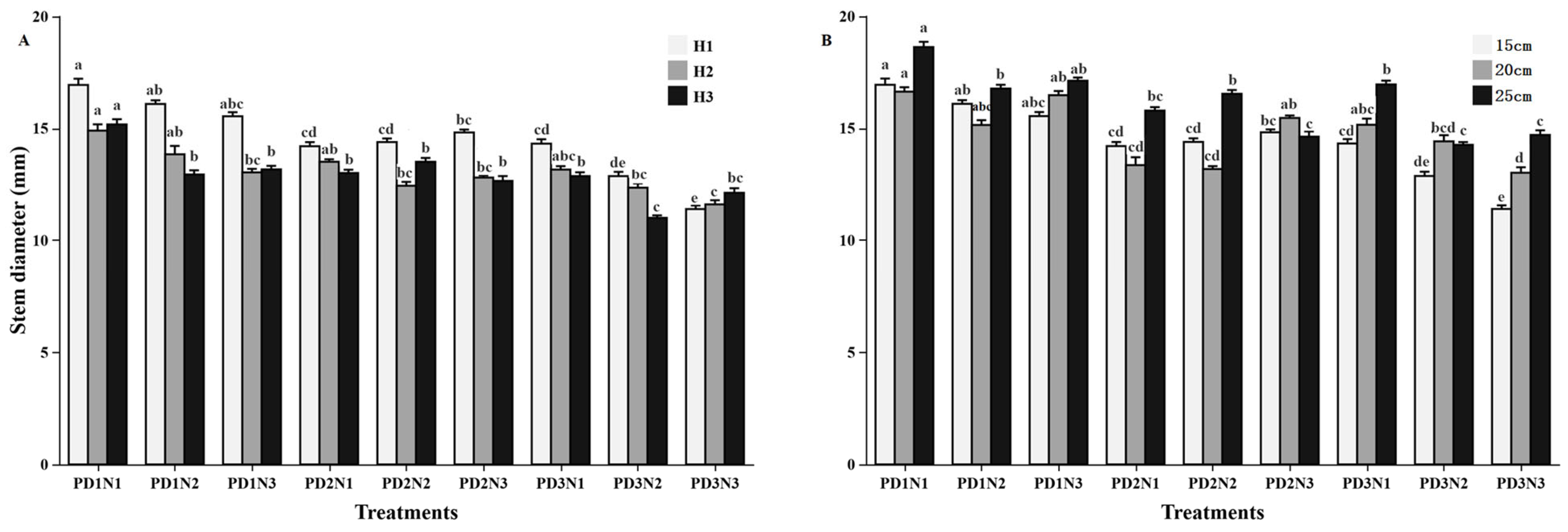
The stem diameter of rapeseed flowering stalks was significantly affected by PD, the N application rate, and harvesting plant height (p < 0.01; Figure 1, Table S1). Factorial ANOVA revealed significant main effects of PD (F = 78.27), N application (F = 26.25), and harvesting plant height (F = 48.27) on stem diameter for 15 cm apical segments. Across all treatments, mean stem diameter ranged from 11.0 ± 0.8 mm (PD3N2H3) to 16.9 ± 0.4 mm (PD1N1H1). Generally, an increase in either PD or the N application rate corresponded with a reduction in stem diameter; however, the magnitude of these effects varied among treatment combinations. Across treatments, the flowering stalk stem diameter of plants harvested at 25 cm (H1) was significantly higher than those harvested at 30 cm (H2) and 35cm (H3). Specifically, for flowering stalks standardized to a 15 cm apical segment, stem diameter significantly decreased as harvesting plant height increased across most PD × N treatments, except under the lowest nitrogen application rate (N1) (Figure S1). When the N application rate was held constant, stem diameter at H1 declined significantly with increasing PD, whereas PD did not exert a significant effect on stem diameter at H2 (Figure 1A). Furthermore, under the PD2 treatment, the N application rate did not significantly influence stem diameter across the three harvesting heights (Figure 1).

3.2. Vitamin C Content of Rapeseed Flowering Stalks in Response to PD and N Application

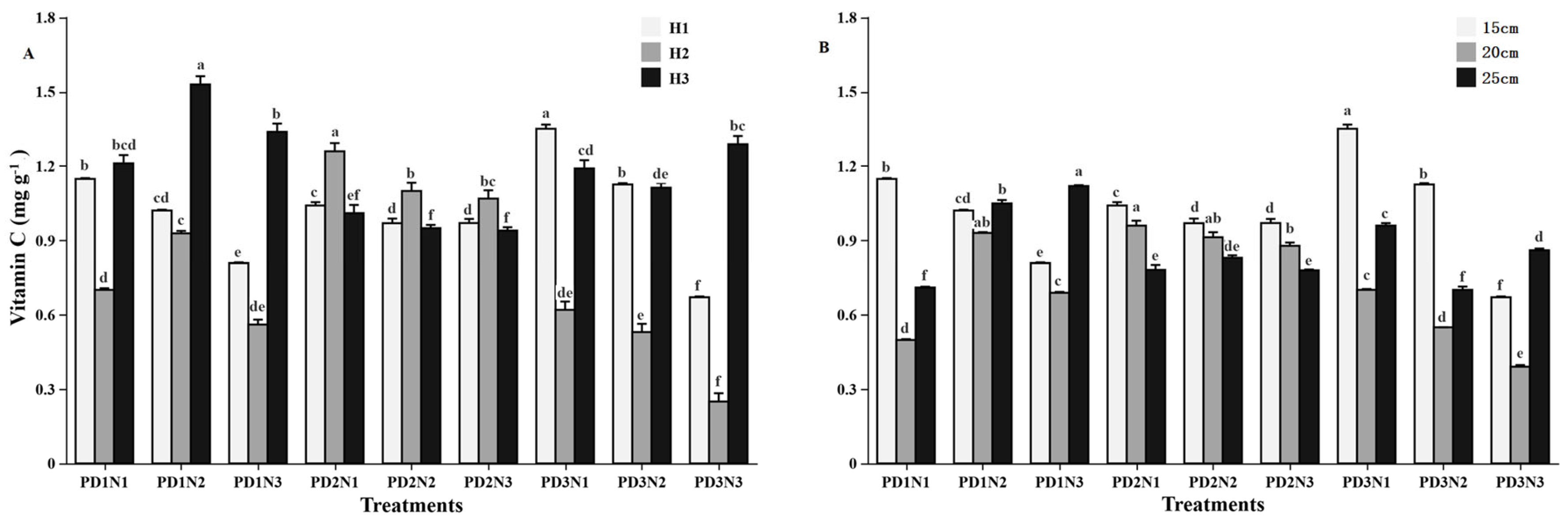
The vitamin C (Vc) content in rapeseed flowering stalks varied significantly among harvesting plant heights and treatment combinations (p < 0.01; Figure 2 and Figure S2, Tables S1 and S2). Across all treatments, Vc concentration ranged from 0.25 ± 0.10 mg·g−1 FW (PD3N3H2) to 1.53 ± 0.1 mg·g−1 FW (PD1N2H3) (Table S1). Specifically, under PD2, the Vc content of the full apical segments declined progressively as harvesting time was delayed, corresponding to increasing harvesting plant height (Figure 2B). In contrast, under PD1 and PD3, Vc content decreased from H1 to H2 and then showed a slight recovery at H3 (Figure S2A). Nitrogen application significantly influenced Vc content at the early harvest stage (H1), with N3 treatments exhibiting 9–12% lower Vc concentrations than N1 across all planting densities (p < 0.05). At H2, Vc content initially decreased and then stabilized with increasing N application under PD2 and PD3, whereas under PD1 it increased at moderate N levels before declining at higher N rates. Similarly, at H3 under PD3, Vc content first increased and subsequently declined with increasing N application (Figure 2). For 15 cm stem segments at H3, Vc content initially increased and then decreased as the N application rate increased (Figure 2A), whereas for 25 cm stem segments, Vc content exhibited an overall increasing trend with higher N application rates (Figure 2B). Notably, nitrogen application did not exert a significant effect on Vc content at H3 under the PD2 treatment (Figure 2).

3.3. Soluble Protein Content of Rapeseed Flowering Stalks in Response to PD and N Application

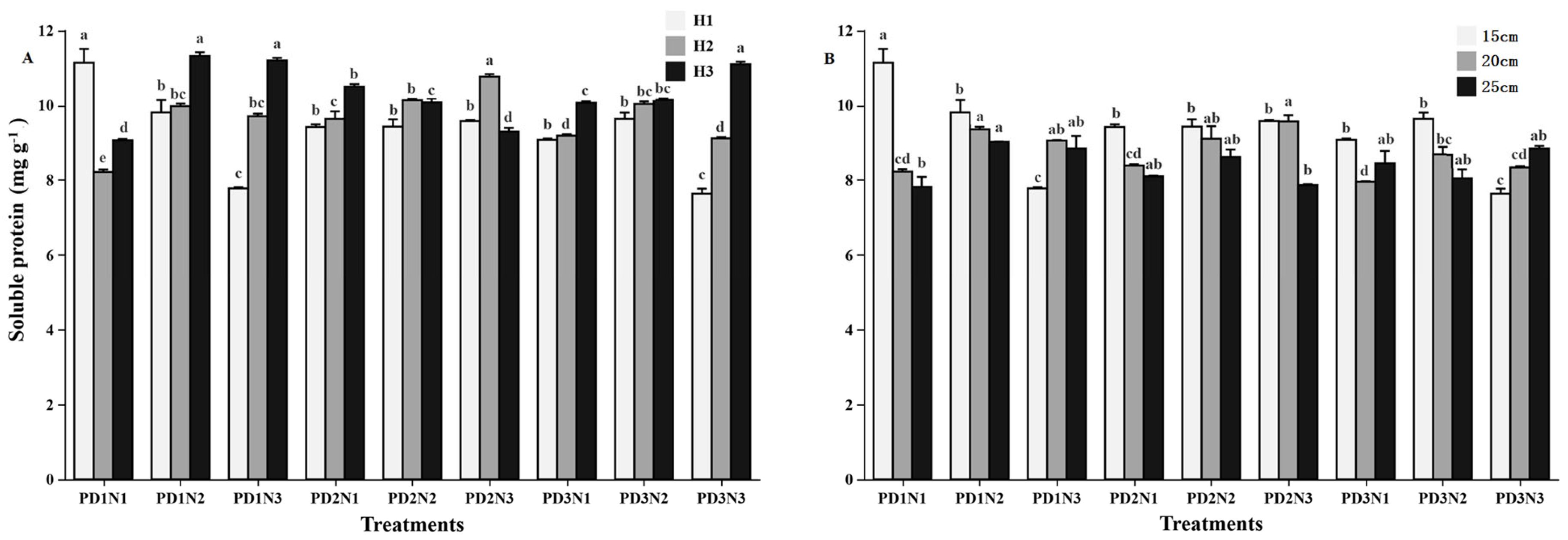
The soluble protein content in rapeseed flowering stalks was significantly affected by planting density (PD), the nitrogen (N) application rate, and harvesting plant height (p < 0.05; Figure 3 and Figure S2B, Tables S1 and S2). Factorial ANOVA revealed significant main effects of PD, the N rate, and harvesting height on soluble protein concentration, with F-values ranging from 4.85 to 61.49. Across all treatments, mean soluble protein concentrations ranged from 7.6 ± 0.4 mg·g−1 FW (PD3N3H1) to 11.3 ± 0.3 mg·g−1 FW (PD1N2H3) (Table S1). Overall, soluble protein content in standardized 15 cm apical stem segments increased progressively with delayed harvesting time for most treatment combinations. However, differences among harvesting heights were not significant under the PD2N2 and PD3N2 treatments (p > 0.05; Figure S2B). Soluble protein content was also significantly influenced by PD and the N application rate, although response patterns varied among treatment combinations (Figure 3). At H1, soluble protein content decreased with increasing N application under PD1 and PD3, whereas N application did not significantly affect protein content under PD2. At H2, soluble protein content increased with higher N rates under PD1 and PD2 but showed an initial increase followed by a decline under PD3. At H3, soluble protein content in 15 cm stem segments under PD1 and PD3 (Figure 3A), as well as in 25 cm stem segments under PD1 (Figure 3B), increased with an increasing N application rate, while N application exerted no significant effect under PD2. Interaction analysis further indicated a significant PD × N interaction (Table S2), whereby under PD1, soluble protein concentration increased by approximately 26% as the N application rate increased from N1 to N3.

3.4. Soluble Sugar Content of Rapeseed Flowering Stalks in Response to PD and N Application

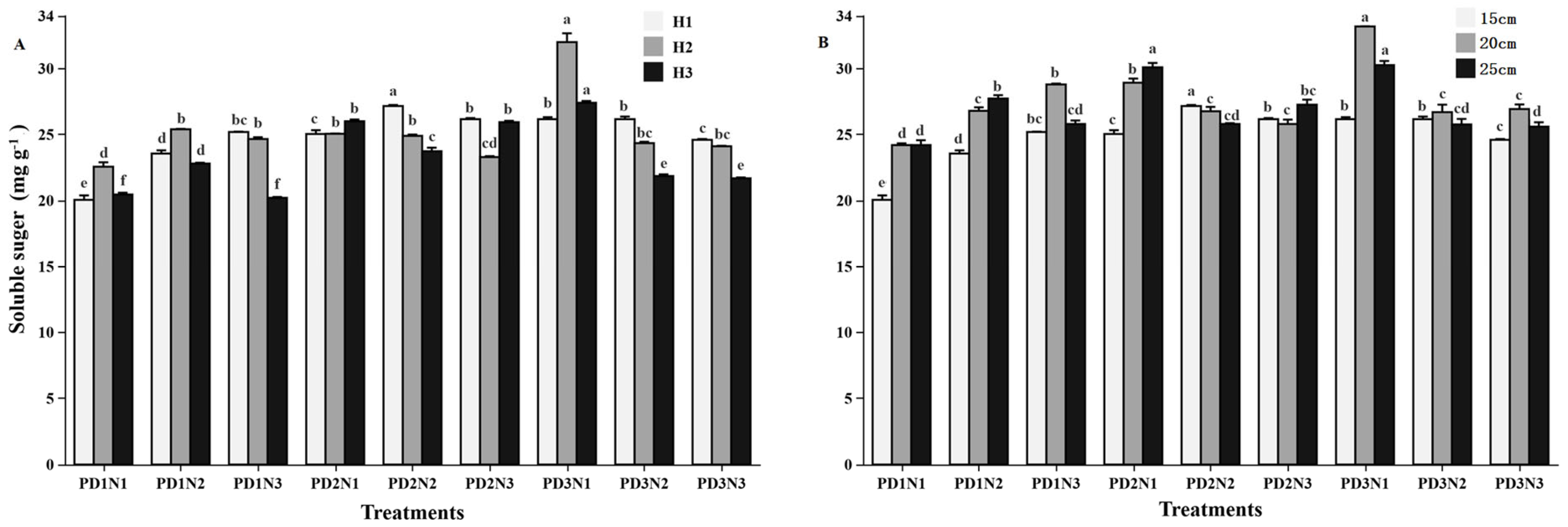
Variations in harvesting plant height under identical treatment conditions significantly affected the soluble sugar content in rapeseed flowering stalks, although the observed trends differed among planting density (PD) and nitrogen (N) application treatments (Figure S2C). Overall, PD, N application, and harvesting height levels significantly affected soluble sugar content (p < 0.01), and a significant PD × N × H interaction was also detected (F = 10.61, p < 0.001) (Table S2). Soluble sugar content ranged from 20.0 ± 1.0 to 32.0 ± 2.0 mg·g−1 FW (Table S1), depending on the treatment combination and harvesting height. For example, when the sampled apical stem length was fixed at 15 cm, soluble sugar content generally decreased with delayed harvesting under PD1N3, PD2N2, PD3N2, and PD3N3 treatments, whereas it initially increased and subsequently declined under PD1N1, PD1N2, and PD3N1 treatments (Figure S2C). Under low nitrogen supply (N1), soluble sugar content decreased with increasing PD and delayed harvesting, whereas moderate nitrogen application (N2) sustained relatively higher sugar levels at H2. Moreover, the influence of harvesting plant height on soluble sugar content was significantly modulated by PD and N application rates (Figure 4). Specifically, soluble sugar content increased with increasing PD under the N1 application rate across all harvesting heights. In addition, soluble sugar content increased with higher N application rates under PD1 at H1 and H2 but showed an initial increase followed by a decline under PD1 at H3 and under PD2 and PD3 at H1. Notably, stalks under PD3N1H2 treatment exhibited the highest mean soluble sugar content (32.0 mg·g−1 FW), which was approximately 15–36% higher than the values observed under other treatments.

3.5. Cellulose Content of Rapeseed Flowering Stalks in Response to PD and N Application

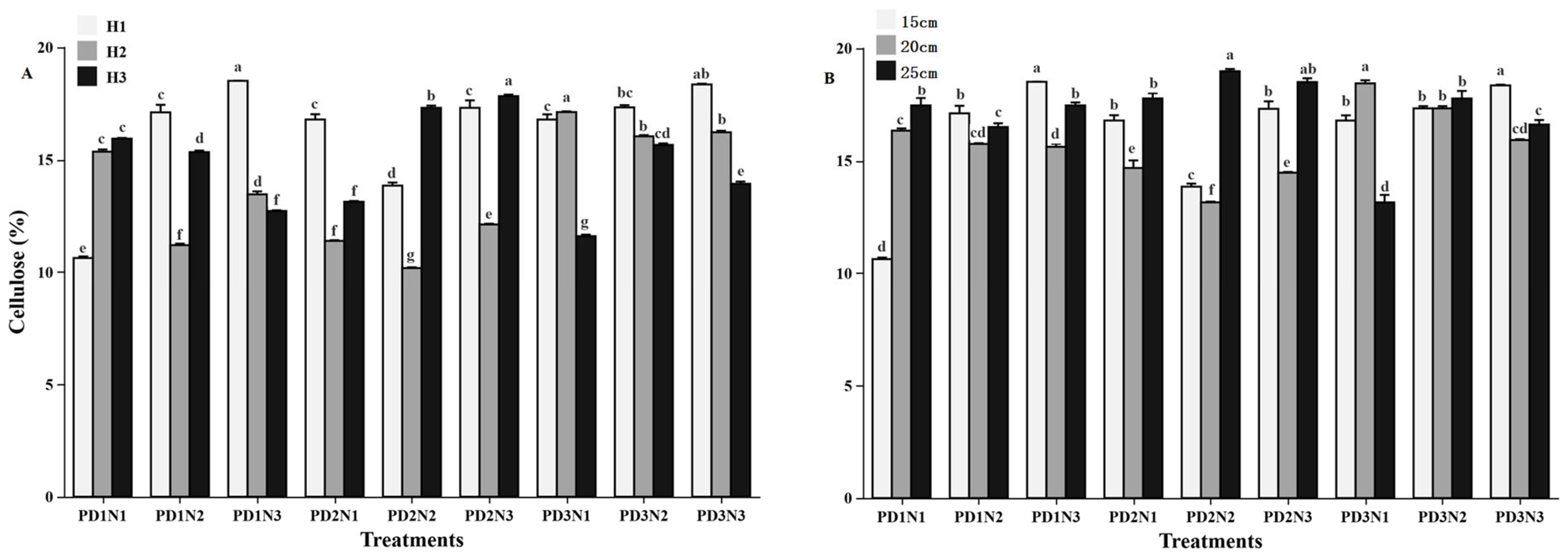
The cellulose content of rapeseed flowering stalks was significantly affected by harvesting plant height, planting density (PD), and the nitrogen (N) application rate (p < 0.01). Mean cellulose concentrations ranged from 10.2 ± 0.1% under PD1N1H1 to 18.5 ± 0.1% under PD1N3H1 (Table S1), depending on treatment combination and harvesting height. Moreover, significant interaction effects among PD, N, and harvesting height were detected (PD × N × H, F = 45.59, p < 0.001) (Table S2), indicating that cellulose accumulation was jointly regulated by these factors. Overall, as harvesting time was delayed, cellulose content in 15 cm stem segments decreased slightly (by approximately 8%) under PD3, whereas it increased under PD1N1 conditions (Figure S2D). Under PD1N3, cellulose content declined with delayed harvesting, while under PD2 and PD1N2 treatments it initially decreased and subsequently increased. With increasing N application rates, cellulose content first declined and then increased at H2 across all PD treatments, as well as at H1 under PD2 and PD3. In contrast, cellulose content initially increased and then decreased at H1 under PD1 and at H3 under PD2 and PD3. Regarding PD effects, cellulose content initially decreased and then increased at H1 and H2 under the N2 treatment and at H3 under N1. Notably, stalks harvested at H1 and H2 under PD3N1 exhibited average cellulose concentrations exceeding 16.8%, which were significantly higher than those observed under PD3N1H3 (11.6 ± 0.2%), whereas comparatively lower cellulose contents were recorded at H1 under PD1N1 and H2 under PD2N2 relative to other treatment combinations (Figure 5).

3.6. Yield of Rapeseed Flowering Stalks in Response to PD and N Application

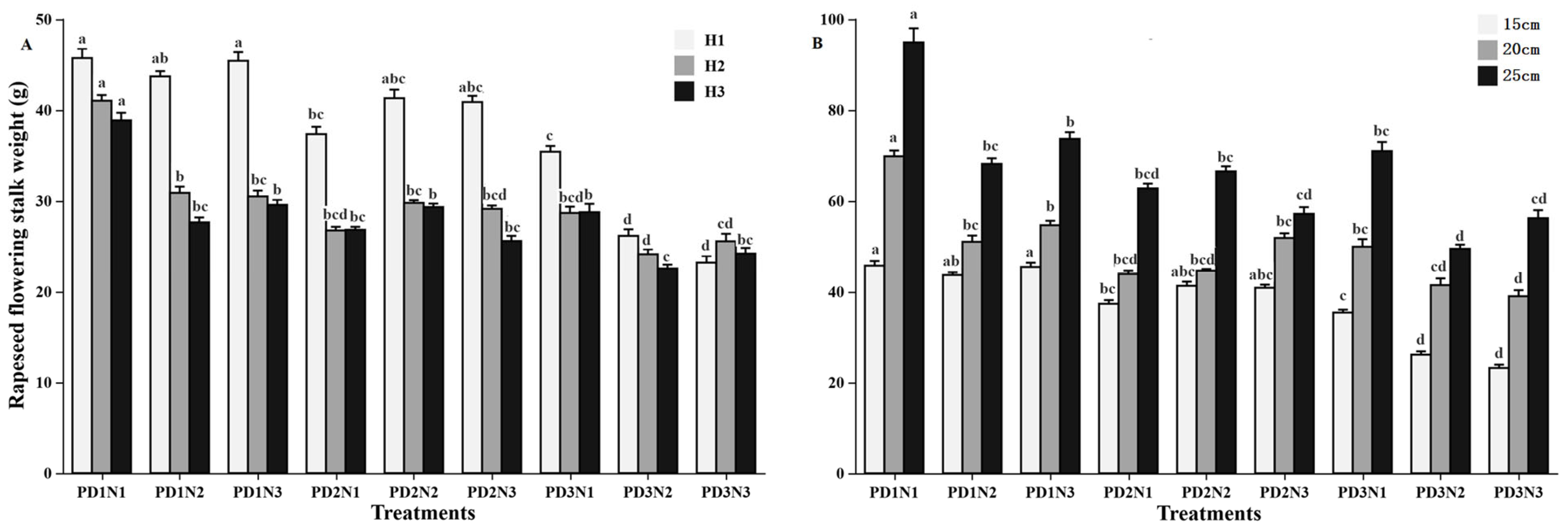
The fresh weight of rapeseed flowering stalks per plant decreased as harvesting time was delayed when the stem sampling length was fixed at 15 cm (Figure S3A). Mean fresh stalk weight per plant ranged from 22.5 ± 2.9 g under PD3N2H3 to 45.7 ± 2.5 g under PD1N1H1, corresponding to adjusted per-hectare yields of 5.8 t·ha−1 and 6.9 t·ha−1 based on the final established plant densities, respectively (Table S1). When harvesting involved longer apical segments (20 cm for H2 and 25 cm for H3), stalk weight increased proportionally with delayed harvest, resulting in higher per-plant yield at later stages (Figure 6B). Overall, flowering stalk yield per plant was significantly affected by planting density (PD),the nitrogen (N) application rate, and harvesting plant height (H) (p < 0.01), with highly significant main effects detected for the PD × N interaction (F = 20.64, p < 0.001) and PD × N × H interaction (F = 4.81, p < 0.001) (Table S2). Across harvesting heights, stalk yield declined significantly with increasing PD, whereas the effect of the N application rate was not significant under the PD2 treatment (Figure 6).
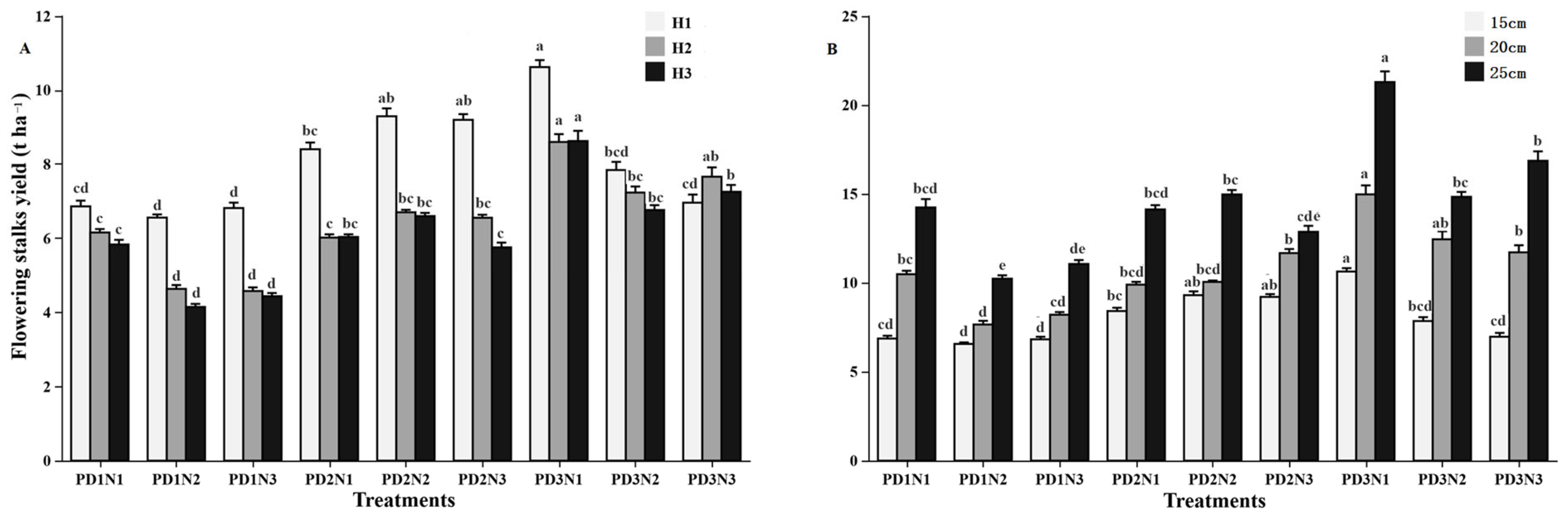
The yield of rapeseed flowering stalks declined with delayed harvesting time when the stem sampling length was fixed at 15 cm; however, harvesting time did not exert a significant effect under the PD3 and PD1N1 treatments (Figure S3B). Additionally, variations in planting density (PD) and nitrogen (N) application rates significantly affected the yield of rapeseed flowering stalks (Figure 7, Table S2). Overall, flowering stalk yield was significantly affected by PD and the N application rate (p < 0.01), and a significant PD × N interaction was also detected (F = 20.96, p < 0.001) (Table S2). In general, yield increased with higher PD, and under the PD2 treatment, yield improved as N application increased. Conversely, yield decreased with higher nitrogen levels under the PD1 and PD3 treatments (Figure 6). Among the treatments, rapeseed stalks under PD3N1 and all PD2 exhibited relatively higher yields compared to other treatments, whereas the lowest yields were observed under PD1N2 and PD1N3 at the same harvesting plant height. Across all treatment combinations, PD3N1 produced the highest average flowering stalk yield (10.62–21.29 t·ha−1), which was significantly higher than that of other treatments (Figure 7B). When the sampled stem length was fixed at 15 cm, flowering stalk yield decreased by approximately 19% as harvesting was delayed from H1 to H3, whereas harvesting longer apical segments (20–25 cm) at later stages partially offset this decline and resulted in higher overall yield (Figure 6B).

3.7. Yield of Rapeseed Fresh Grass After Flowering Stalks Harvesting

The yield of rapeseed fresh biomass following the harvest of flowering stalks did not exhibit statistically significant differences across harvesting plant heights within the same treatment group (p > 0.05; Figure S4). Fresh biomass yield ranged from 50.9 ± 5.7 t·ha−1 to 80.0 ± 2.4 t·ha−1 across all treatment combinations, indicating relatively stable fresh grass production irrespective of harvesting height. Similarly, variations in N application rates under PD1 and PD2 treatments did not result in significant changes in fresh grass yield. In contrast, PD and the N application rate exerted a pronounced effect on fresh biomass yield (p < 0.01). Specifically, treatments PD2N1 and PD3N1 produced significantly higher fresh grass yields (approximately 73 t·ha−1) compared with PD3N2 and PD3N3, which exhibited the lowest yields (approximately 50 t·ha−1). Nevertheless, all treatments maintained fresh grass yields exceeding 50 t·ha−1, thereby meeting the agronomic threshold required for effective green manure incorporation into the soil.

4. Discussion

The exclusive cultivation of rapeseed solely as green manure has been shown to yield limited economic benefits for farmers, thereby diminishing their incentive to engage in its planting [4,6]. To mitigate this issue, a strategy has emerged to develop multiple applications for the crop, such as floral display and rapeseed sprout production, alongside its traditional role as green manure [17]. The cultivar “Huyou 3302”, characterized by flowering stalks that are notably sweet and palatable, is particularly well-suited to a dual-purpose cultivation system that integrates both vegetable and green manure production. Compared to traditional rapeseed cultivation for green manure alone, the principal method to enhance the overall economic value of dual-use rapeseed varieties involves harvesting the flowering stalks without reducing the volume of fresh biomass returned to the soil. The present study demonstrated that the combinations PD2N1, PD2N2, PD2N3, and PD3N1 yielded higher production of both flowering stalks and fresh biomass relative to other treatments.
Stem diameter and weight are critical morphological parameters influencing the quality of rapeseed flowering stalks [18]. Consistent with prior research [18], our findings indicate that both stem diameter and weight per plant significantly decrease as the harvesting height increases, which aligns with the observed reduction in stem diameter from the base toward the apex. However, as the stem sampling length increases concomitantly with harvesting height, the weight per plant correspondingly increases. This suggests that extending the stem sampling length when delaying harvest can effectively maintain stalk yield. Furthermore, the study revealed that both stalk weight and stem diameter significantly declined with PD increasing and with higher N application rates under PD1 and/or PD3 conditions but did not exert a significant effect under PD2, a finding that diverges somewhat from previous studies examining the influence of nitrogen on stalk weight and stem diameter [18,19]. These results imply that the impact of nitrogen application on stalk weight and stem diameter is contingent upon the planting density employed.
Vegetables characterized by favorable palatability, enhanced sweetness, and high nutritional value currently constitute the primary focus of consumer preferences [20]. Soluble protein and soluble sugar are recognized as critical indicators of the nutritional quality of vegetables [21,22]. Soluble sugars contribute significantly to the sweetness and overall palatability of vegetables, with higher soluble sugar concentrations generally associated with improved taste profiles [21]. Soluble proteins play essential roles in regulating various physical and chemical metabolic processes and function as integral components of enzymes [22]. Furthermore, reduced cellulose content is associated with improved palatability due to decreased fibrous residue [20]. Additionally, vitamin C serves as a vital antioxidant molecule involved in both plant and animal metabolic processes [6]. Nitrogen availability plays a central role in regulating carbon–nitrogen balance in rapeseed flowering stalks. Increased nitrogen supply tends to promote protein synthesis and vegetative growth, which can reduce the allocation of assimilated carbon to structural carbohydrates such as cellulose. This trade-off helps explain the observed inverse or non-linear relationships between nitrogen application, soluble sugar accumulation, and cellulose content across different planting densities and harvesting stages. Similar nitrogen-mediated shifts in carbohydrate partitioning have been reported in other Brassica vegetables, where excessive nitrogen reduced stem firmness and increased metabolic carbohydrate utilization rather than structural deposition. The interaction between planting density and nitrogen application further suggests that carbon allocation patterns are strongly influenced by intra-specific competition. At higher planting densities, competition for light likely enhances stem elongation while limiting radial growth, resulting in reduced stem diameter and modified carbohydrate accumulation. Under moderate density (PD2), nitrogen application appeared to optimize source–sink relationships, leading to more stable stem diameter, higher soluble sugar and protein contents, and relatively balanced cellulose formation. This may explain why PD2 treatments consistently exhibited favorable quality traits and yield performance across multiple harvest stages. Compared with reports from other rapeseed production systems focused solely on green manure or oilseed yield, the present results highlight distinct quality–yield trade-offs specific to dual-purpose vegetable rapeseed. Studies conducted in northern China and Europe have reported that high nitrogen inputs primarily enhance biomass accumulation but often reduce stem quality and soluble carbohydrate concentration. In contrast, the moderate nitrogen and density combinations identified in this study achieved acceptable flowering stalk yield and maintained fresh biomass for soil incorporation, demonstrating the feasibility of integrating vegetable harvest with green manure production under subtropical rice-based cropping systems.
The present study demonstrated that the levels of soluble protein, soluble sugar, cellulose, and vitamin C were significantly affected by the harvesting plant height, planting density, and nitrogen application. To achieve elevated soluble protein and soluble sugar contents, flowering stalks should be harvested at a plant height of 25 cm under PD2N2, PD2N3, PD3N1, and PD3N2; at 30 cm under PD2N1 and PD2N2; and at 35 cm under PD2N1 and PD3N1. For optimal vitamin C content, harvesting at 25 cm is recommended under PD1N1, PD3N1, and PD3N2; at 30 cm under PD1N2, PD2N1, PD2N2, and PD2N3; and at 35 cm under PD1N2 and PD1N3. To minimize cellulose content, harvesting at 25 cm is advised under PD1N1 and PD2N2; at 30 cm under PD2N1 and PD2N2; and at 35 cm under PD3N1. The PD × N combinations identified as producing relatively higher yield or quality responses in this study should be interpreted as context-dependent responses under the specific environmental, soil fertility, and management conditions of a single season and site, rather than as universally optimal agronomic prescriptions.
Nevertheless, because the nitrogen application rates evaluated in this study represent a relatively narrow and low range compared with typical rapeseed fertilization regimes, the full biomass response to nitrogen input may not have been captured. In combination with the high initial soil nitrogen status, this limited nitrogen gradient may have partially masked differences in flowering stalk yield and fresh biomass accumulation among nitrogen treatments. Therefore, conclusions regarding nitrogen effects on biomass production should be interpreted with caution, and future studies incorporating broader nitrogen application ranges under lower background soil fertility are warranted. It should be noted that the experimental soil exhibited a relatively high initial nitrogen availability (82 mg kg−1), and a basal fertilization was applied prior to sowing, which might reduce plant sensitivity to additional nitrogen inputs during the experimental period. Under such conditions, the relatively low nitrogen application rates tested in this study (17.25–51.75 kg N ha−1) might partially mask treatment effects on rapeseed biomass accumulation and yield response. Consequently, the absence of pronounced biomass differences among nitrogen treatments should be interpreted with caution. Future studies under lower background soil nitrogen conditions, or employing a broader range of nitrogen application rates, will be beneficial to fully characterize the nitrogen response curve of rapeseed flowering stalk production. In addition, this study employed the LSD test for post-hoc mean comparisons following factorial ANOVA. Although the LSD procedure is widely used in agronomic research, it does not strictly control the family-wise error rate when a large number of pairwise comparisons are conducted, which may increase the risk of Type I error. Therefore, some marginally significant differences should be interpreted with caution. Nevertheless, the primary conclusions of this study were supported by consistent and biologically coherent response patterns across plant density, the nitrogen application rate, and harvesting height, as well as by the presence of significant main and interaction effects detected by the factorial ANOVA. Future studies may benefit from applying more conservative multiple-comparison procedures (e.g., Tukey’s HSD or Bonferroni adjustment) to further confirm the robustness of treatment differences.

5. Conclusions

This study examined the interactive effects of the nitrogen application rate, plant density, and harvesting height on the yield and quality attributes of rapeseed flowering stalks in a dual-purpose cultivation system. The results indicate that flowering stalk yield and quality traits responded strongly to planting density and nitrogen management, with moderate plant density (PD2) showing relatively stable performance across nitrogen levels, and combinations of high plant density with low nitrogen input (PD3N1) or moderate density with low to moderate nitrogen inputs (PD2N1–PD2N2) generally exhibiting favorable outcomes. In terms of harvesting strategy, harvesting flowering stalks at plant heights of 25–35 cm, combined with stem sampling lengths of 15–20 cm, was associated with a balanced trade-off between stalk yield, nutritional quality (soluble protein, soluble sugar, and vitamin C), and cellulose content, while maintaining fresh biomass production for green manure incorporation. It should be noted, however, that these findings are derived from a single growing season, one experimental site, and a single rapeseed cultivar (“Huyou3302”). Therefore, the conclusions should be interpreted with caution and are most directly applicable to similar agro-ecological conditions and management systems, particularly in rice-based cropping regions of the lower Yangtze River basin. Further multi-year, multi-location studies involving additional cultivars are required to verify the robustness and broader applicability of these results. Despite these limitations, the present study provides useful preliminary evidence that appropriate coordination of planting density, nitrogen fertilization, and harvesting timing can improve both flowering stalk quality and overall biomass utilization in dual-purpose rapeseed systems. These findings may serve as a practical reference for optimizing management strategies aimed at enhancing the economic and ecological benefits of vegetable–green manure integrated rapeseed cultivation.

Supplementary Materials

The following supporting information can be downloaded at https://www.mdpi.com/article/10.3390/agronomy16050508/s1, Table S1: Mean values of the studied traits in rapeseed for each treatment; Table S2: Effects of planting density (PD), nitrogen (N) application rate, harvesting plant height (H) and their interaction on the studied traits for each treatment. “***” indicates p < 0.001; “**” indicates p < 0.01; “ns” indicates non-significant differences; Figure S1: Stem diameter (mm) for 15 cm apical segment at the harvesting heights of 25 cm (H1), 30 cm (H2), and 35 cm (H3), respectively; Figure S2: Content of Vc (A), soluble protein (B), soluble sugar (C), and cellulose (D) for 15 cm stem length of rapeseed flowering stalks at the harvesting plant heights of 25 cm (H1), 30 cm (H2), and 35 cm (H3), respectively; Figure S3: Weight (A) and yield (B) for 15 cm stem length of rapeseed flowering stalks at the harvesting plant heights of 25 cm (H1), 30 cm (H2), and 35 cm (H3), respectively; Figure S4: Biomass of rapeseed fresh grass after the flowering stalk harvesting. Different lowercase letters indicate differences by LSD (0.05).

Author Contributions

Conceptualization, J.Z. and W.W.; formal analysis, writing—original draft preparation, J.Z.; data curation and investigation, H.L., L.L. and X.M.; project administration, L.L. and X.M.; methodology, J.Z., H.L. and W.W.; supervision, H.L.; validation, L.L.; visualization, X.M.; resources, writing—review and editing, W.W. All authors have read and agreed to the published version of the manuscript.

Funding

This research was funded by the Shanghai Agriculture Applied Technology Development Program, China (Grant No. 2024-02-08-00-12-F00041), and the Shanghai Academy of Agricultural Sciences Program for Excellent Research Team, China (Grant No. [2025]025).

Data Availability Statement

The original contributions presented in this study are included in the article/Supplementary Material. Further inquiries can be directed to the corresponding author.

Acknowledgments

During the preparation of this manuscript, the author(s) used the AI-assisted tool Wordvice AI (https://wordvice.ai/cn, accessed on 5 January 2026) to aid in grammar verification and text refinement. The authors have reviewed and edited the output and take full responsibility for the content of this publication.

Conflicts of Interest

The authors declare no conflicts of interest.

References

  1. Gu, C.M.; Li, Y.S.; Yang, L.; Dai, J.; Hu, W.S.; Yu, C.B.; Brools, M.; Liao, X.; Qin, L. Effects of oilseed rape green manure on phosphorus availability of red soil and rice yield in rice–green manure rotation system. Front. Plant Sci. 2024, 15, 1417504. [Google Scholar] [CrossRef] [PubMed]
  2. Li, X.; Ciren, Y.; He, C.; Ma, Z.; Hua, S. Nutritional quality response to different fertilizers in young stems of rapeseed (Brassica napus L.) at different harvesting stages. Horticulturae 2025, 11, 1353. [Google Scholar] [CrossRef]
  3. Mojtahedi, H. Managing meloidogyne chitwoodi on potato with rapeseed as green manure. Plant Dis. 1993, 77, 42. [Google Scholar] [CrossRef]
  4. Xia, Y.; Gao, P.; Lei, W.; Gao, J.; Luo, Y.; Peng, F.; Mou, T.; Zhao, Z.; Zhang, K.; Guggenberger, G.; et al. Covering green manure increases rice yields via improving nitrogen cycling between soil and crops in paddy fields. Agric. Ecosyst. Environ. 2025, 383, 109517. [Google Scholar] [CrossRef]
  5. Zhan, J.; Qi, M.; Wang, C.; Wang, X.; Wang, H.; Dun, X. Precise determination of selenium forms and contents in selenium-enriched rapeseed seedlings and flowering stalks by HPLC-ICP-MS. J. Agric. Food Chem. 2024, 72, 9477–9486. [Google Scholar] [CrossRef]
  6. Wang, C.; Kuang, L.; Tian, Z.; Wang, X.; Wang, H.; Dun, X. Genome-wide association study reveals the genetic basis of vitamin C content in rapeseed (Brassica napus L.) seedlings. Front. Plant Sci. 2025, 16, 1649023. [Google Scholar] [CrossRef]
  7. Wang, L.; Li, Y.; Qian, C.; Li, J.; Lin, G.; Qu, W.; Wang, Y.; Lin, Y.; Huang, Y.; Zheng, J.; et al. Promoting rapeseed yield: Improving canopy structure and formation of large pod via adjusting planting density. Crop. Sci. 2025, 65, e21428. [Google Scholar] [CrossRef]
  8. Ren, T.; Liu, B.; Lu, J.; Deng, Z.; Li, X.; Cong, R. Optimal plant density and N fertilization to achieve higher seed yield and lower N surplus for winter oilseed rape (Brassica napus L.). Field Crops Res. 2017, 204, 199–207. [Google Scholar] [CrossRef]
  9. Hou, W.F.; Xue, X.X.; Li, X.K.; Khan, M.R.; Yan, J.Y.; Ren, T.; Cong, R.H.; Lu, J. Interactive effects of nitrogen and potassium on: Grain yield, nitrogen uptake and nitrogen use efficiency of rice in low potassium fertility soil in China. Field Crops Res. 2019, 236, 14–23. [Google Scholar] [CrossRef]
  10. Wang, C.; Wang, X.; Yang, J.; Zhang, Z.; Chen, M. Effects and mechanism of nitrogen regulation on seed yield and quality of rapeseed (Brassica napus L.). Agronomy 2025, 15, 1232. [Google Scholar] [CrossRef]
  11. Wang, C.; Li, Z.; Zhang, L.; Gao, Y.; Cai, X.; Wu, W. Identifying key metabolites associated with Glucosinolate biosynthesis in response to nitrogen management strategies in two rapeseed (Brassica napus L.) varieties. J. Agric. Food Chem. 2022, 70, 634–645. [Google Scholar] [CrossRef]
  12. Ghafoor, A.; Karim, H.; Asghar, M.A.; Raza, A.; Hussain, M.I.; Javed, H.H.; Shafiq, I.; Xiao, P.; Yue, H.; Ahmad, B.; et al. Carbohydrates accumulation, oil quality and yield of rapeseed genotypes at different nitrogen rates. Plant Prod. Sci. 2022, 25, 49–69. [Google Scholar] [CrossRef]
  13. Hou, P.; Jiang, Y.; Yan, L.; Petropoulos, E.; Wang, J.; Xue, L.; Yang, L.; Chen, D. Effect of fertilization on nitrogen losses through surface runoffs in Chinese farmlands: A meta-analysis. Sci. Total Environ. 2021, 793, 148554. [Google Scholar] [CrossRef] [PubMed]
  14. Zhu, J.; Dai, W.; Chen, B.; Cai, G.; Wu, X.; Yan, G. Research progress on the effect of nitrogen on rapeseed between seed yield and oil content and its regulation mechanism. Int. J. Mol. Sci. 2023, 24, 14504. [Google Scholar] [CrossRef] [PubMed]
  15. Li, Q.; Luo, T.; Cheng, T.; Yang, S.; She, H.; Li, J.; Wang, B.; Kuai, J.; Wang, J.; Xu, Z.; et al. Evaluation and screening of rapeseed varieties (Brassica napus L.) suitable for mechanized harvesting with high yield and quality. Agronomy 2023, 13, 795. [Google Scholar] [CrossRef]
  16. Zhu, J.; Lei, L.; Meng, X.; Li, H.; Wang, W. Effect of sowing date and low-temperature seed germination on rapeseed yield. Agronomy 2025, 15, 2545. [Google Scholar] [CrossRef]
  17. Raboanatahiry, N.; Li, H.; Yu, L.; Li, M. Rapeseed (Brassica napus): Processing, utilization, and genetic improvement. Agronomy 2021, 11, 1776. [Google Scholar] [CrossRef]
  18. Lin, B.; Hao, P.; Ren, Y.; Huai, Y.; Zhang, H.; Xue, B.; Hua, S. Appearance traits, nutrient accumulation, and amino acid composition in young stem of rapeseed. J. Nucl. Agric. Sci. 2022, 36, 2474–2481. [Google Scholar] [CrossRef]
  19. Ma, M.; Zhang, Y.; Yan, G.; Huang, C.; Ma, C. Effects of density and fertility on the bolt yield of Brassica napus L. Hubei Agric. Sci. 2020, 59, 20–23, 27. [Google Scholar] [CrossRef]
  20. Fu, M.; Guo, J.; Tang, K.; Jiang, S.; Luo, S.; Luo, W.; Khan, I.; Li, G. Comparative transcriptome analysis of purple and green flowering Chinese Cabbage and functional analyses of BrMYB114 Gene. Int. J. Mol. Sci. 2023, 24, 13951. [Google Scholar] [CrossRef]
  21. Yang, T.; Chen, Y.; Zeng, F.; Ye, M.; Wang, L.; Luo, Z.; Qi, Y.; Chen, F. Effects of modified atmosphere packaging on the postharvest quality of mulberry leaf vegetable. Sci. Rep. 2022, 12, 10893. [Google Scholar] [CrossRef]
  22. Yan, J.; Weng, H.; Hou, L.; Yao, Q.; He, T. Transcriptome and metabolome analysis of organic and chemical fertilizer effects on highland barley growth and nutrient utilization. Agronomy 2025, 15, 380. [Google Scholar] [CrossRef]
Figure 1. Interactive effects of plant density and N application rate on rapeseed flowering stalk stem diameter: (A) presents the stem diameter measured at a 15 cm apical segment for harvesting heights of 25 cm (H1), 30 cm (H2), and 35 cm (H3); (B) depicts the stem diameter corresponding to the sampled stalk segment length of 15 cm, 20 cm, and 25 cm for H1, H2, and H3, respectively. Different lowercase letters indicate differences by LSD (0.05).
Agronomy 16 00508 g001
Figure 2. Interactive effects of plant density and the N application rate on Vc content of rapeseed flowering stalks: (A) is showing the Vc content of 15 cm apical segments for 25 cm (H1), 30 cm (H2), and 35 cm (H3) harvesting heights, respectively; (B) is showing the Vc content at the sampled stalk segment lengths of 15 cm, 20 cm, and 25 cm for H1, H2, and H3, respectively. Different lowercase letters indicate differences by LSD (0.05).
Agronomy 16 00508 g002
Figure 3. Interactive effects of plant density and the N application rate on soluble protein content of rapeseed flowering stalks: (A) is showing the soluble protein content of 15 cm apical segments for 25 cm (H1), 30 cm (H2), and 35 cm (H3) harvesting heights, respectively; (B) is showing the soluble protein content at the sampled stalk segment lengths of 15 cm, 20 cm, and 25 cm for H1, H2, and H3, respectively. Different lowercase letters indicate differences by LSD (0.05).
Agronomy 16 00508 g003
Figure 4. Interactive effects of plant density and the N application rate on soluble sugar content of rapeseed flowering stalks: (A) is showing the soluble sugar content of 15 cm apical segments for 25 cm (H1), 30 cm (H2), and 35 cm (H3) harvesting heights, respectively; (B) is showing the soluble sugar content at the sampled stalk segment lengths of 15 cm, 20 cm, and 25 cm for H1, H2, and H3, respectively. Different lowercase letters indicate differences by LSD (0.05).
Agronomy 16 00508 g004
Figure 5. Interactive effects of plant density and the N application rate on cellulose content of rapeseed flowering stalks: (A) is showing the cellulose content of 15 cm apical segments for 25 cm (H1), 30 cm (H2), and 35 cm (H3) harvesting heights, respectively; (B) is showing the cellulose content at the sampled stalk segment lengths of 15 cm, 20 cm, and 25 cm for H1, H2, and H3, respectively. Different lowercase letters indicate differences by LSD (0.05).
Agronomy 16 00508 g005
Figure 6. Interactive effects of plant density and the N application rate on rapeseed flowering stalk weight per plant: (A) is showing the 15 cm apical segment stalk weight for harvesting heights of 25 cm (H1), 30 cm (H2), and 35 cm (H3), respectively; (B) is showing the stalk weight of the sampled stalk segment lengths of 15 cm, 20 cm, and 25 cm for H1, H2, and H3, respectively. Different lowercase letters indicate differences by LSD (0.05).
Agronomy 16 00508 g006
Figure 7. Interactive effects of plant density and N application rate on rapeseed flowering stalk yield: (A) is showing the 15 cm apical segment stalk yield for harvesting heights of 25 cm (H1), 30 cm (H2), and 35 cm (H3), respectively; (B) is showing the stalk yield of the sampled stalk segment lengths of 15 cm, 20 cm, and 25 cm for H1, H2, and H3, respectively. Different lowercase letters indicate differences by LSD (0.05).
Agronomy 16 00508 g007
Table 1. Description of all treatments.
AbbreviationsTreatment Descriptions
PD1The plant density of rapeseed was about 151,000 plants ha−1.
PD2The plant density of rapeseed was about 202,000 plants ha−1.
PD3The plant density of rapeseed was about 303,000 plants ha−1.
N1The pure nitrogen application level at 17.25 kg N ha−1.
N2The pure nitrogen application level at 34.5 kg N ha−1.
N3The pure nitrogen application level at 51.75 kg N ha−1.
H1Rapeseed flowering stalk was collected at the harvesting plant height of 25 cm.
H2Rapeseed flowering stalk was collected at the harvesting plant height of 30 cm.
H3Rapeseed flowering stalk was collected at the harvesting plant height of 35 cm.
Disclaimer/Publisher’s Note: The statements, opinions and data contained in all publications are solely those of the individual author(s) and contributor(s) and not of MDPI and/or the editor(s). MDPI and/or the editor(s) disclaim responsibility for any injury to people or property resulting from any ideas, methods, instructions or products referred to in the content.