Article

Effects of Different Calcium Sources and Doses on Shiitake (Lentinula edodes) Production in Eucalyptus Sawdust-Based Substrates


by
Rodrigo Zuliani Furlan
1,
Rafael Simões Tomaz
1,
Murilo Sampaio Bassi Janegitz
1,
Wagner Gonçalves Vieira Junior
2,3,
Leonardo Ueda Caldeira
1,
Adriano Taffarel Camargo de Paula
2 and
Diego Cunha Zied
1,*
1
Department of Plant Production, College of Agricultural and Technological Sciences, São Paulo State University (Unesp), Dracena 17915-899, São Paulo, Brazil
2
Graduate Program in Agricultural Microbiology, School of Agricultural and Veterinarian Sciences, São Paulo State University (Unesp), Jaboticabal 14884-900, São Paulo, Brazil
3
Graduate Program in Society, Technology and Environment, Laboratory of Soils, Ecology and Organic Matter Dynamics (SEDMO), Evangelical University Center of Goianésia (UniEgo), Evangelical University of Goiás (UniEvangélica), Goianésia 76385-608, Goiás, Brazil
*
Author to whom correspondence should be addressed.
Agronomy 2026, 16(5), 509; https://doi.org/10.3390/agronomy16050509
Submission received: 15 December 2025 / Revised: 14 February 2026 / Accepted: 24 February 2026 / Published: 26 February 2026
(This article belongs to the Section Agricultural Biosystem and Biological Engineering)

Abstract

Shiitake grows on lignin-rich materials and can be cultivated on wood substrate (sawdust), to which wheat, rice, and/or corn bran is added to correct the C/N ratio. In addition to the C/N ratio, another concern regarding substrate production is pH and calcium supply. Therefore, this manuscript seeks to elucidate the agronomic parameters of shiitake mushrooms (Lentinula edodes) cultivated with different doses of calcium carbonate (CaCO3) and gypsum (calcium sulfate, CaSO4) in a substrate based on eucalyptus sawdust. Three doses of carbonate (0, 1, and 2%) and three doses of gypsum (0, 2.5, and 5%) were used, totaling nine treatments. Two experiments were conducted, each with a different strain (LED 19/11 and LED 22/02). The results indicate that gypsum supplementation is not required, as it led to a decrease in yield and biological efficiency. Conversely, the incorporation of 1% calcium carbonate enhanced productivity in the LED 19/11 strain. Calcium source and dosage significantly influenced the agronomic performance of L. edodes, with 1% calcium carbonate providing the most consistent positive effects on yield and biological efficiency. These findings emphasize the importance of strain-specific mineral management to optimize productivity and substrate chemical balance in shiitake cultivation.

1. Introduction

Commonly known as shiitake, Lentinula edodes has an Asian origin, with China, Japan, and South Korea considered its centers of domestication [1,2]. This species has attracted the attention of researchers due to its nutritional, medicinal, and therapeutic properties, as well as its high palatability [3].
An important step in its production process involves the preparation of the substrate. Briefly, this process consists of selecting sawdust and supplementing it with wheat bran, rice bran, and cornmeal to correct the C/N ratio, followed by moistening the mixture until it reaches approximately 65% moisture content [4]. The substrate is then autoclaved at 121 °C for 4 h [5] and inoculated at a rate of 2% (wet weight) in a laminar flow chamber. Finally, the blocks are incubated at 25 °C for 80 days to allow substrate colonization and browning, followed by the fruiting of the mushrooms [6].
In addition to adjusting the C/N ratio, substrate pH is also a key factor during substrate preparation. L. edodes differs from other mushrooms by acidifying its substrate through the production of oxalic, citric, tartaric, malic, and acetic acids [7,8,9]. In commercial cultivation, the application of calcium carbonate (CaCO3) has been widely practiced and has become a topic of discussion due to the variability in methodologies and the lack of consistent scientific evidence supporting its effectiveness.
It is well known that Ca2+ is an essential element for fungal growth, metabolism, and fruiting [10]. Moreover, the use of CaCO3 helps maintain the substrate’s selectivity for shiitake, reducing the likelihood of contamination by Trichoderma spp., the main competitive agent in cultivation. However, Li et al. [11] reported that the formation of soluble oxalates resulting from CaCO3 application reduced the mycelial growth rate of L. edodes by 29%, a finding that drew the attention of the scientific community.
A possible substitute for CaCO3 is agricultural gypsum, also known as calcium sulfate (CaSO4), which can supply Ca2+ to the fungus without leading to the formation of soluble oxalates during the mycelial growth of L. edodes. This characteristic is particularly relevant, as the accumulation of oxalates may negatively affect fungal development. In addition to serving as a calcium source, agricultural gypsum also contributes sulfur to the substrate, an essential macronutrient involved in several metabolic pathways. Sulfur plays a key role in the synthesis of sulfur-containing amino acids, such as cysteine, cystine, and methionine, which are fundamental for protein formation and cellular function. Moreover, the availability of sulfur has been associated with the stimulation of proteolytic enzyme production, thereby supporting metabolic activity and growth during fungal development [12].
CaSO4 also plays a crucial role in improving the physical characteristics of the substrate, making it more aerated and porous. Several studies have reported a reduction in anaerobic zones within the substrate following gypsum application. This occurs due to the high hygroscopic capacity of gypsum, which helps reduce substrate stickiness [13].
Considering the objective of formulating a substrate as selective as possible for the fungus, the present study aimed to determine the optimal amounts of calcium carbonate and agricultural gypsum to be added to the substrate, either individually or in combination.

2. Materials and Methods

The strains used in this project have shown the best agronomic performance in several studies conducted over the past two years and are designated LED 19/11 and LED 22/02 [14,15]. These strains were isolated from commercial cultivations in the municipalities of Botucatu and Sarapuí, in the State of São Paulo, Brazil. These are strains that, in previous studies, exhibit distinct behaviors in response to different production methods. For inoculum production, the following stages were followed: preparation of the primary, secondary, and tertiary matrices, and mycelial multiplication, according to the methodology proposed by Owaid et al. in 2025 [16].
The control substrate was prepared with the following formulation: 80% eucalyptus sawdust, 10% wheat bran, and 10% rice bran. These materials were mixed dry to ensure uniformity, after which the calcium sources were added as described in Table 1. When different doses of calcium carbonate (CaCO3) and agricultural gypsum or calcium sulfate (CaSO4) were incorporated, the percentage of eucalyptus sawdust was proportionally reduced to maintain a total of 100% (Table 1).
The use of two different calcium sources was primarily motivated by the demand from Brazilian mushroom growers. The acquisition of materials such as calcium carbonate involves high costs and, furthermore, it is a non-renewable resource that requires mining for its extraction. Gypsum, in turn, although indirectly associated with mining activities, is a residual material from the production of other inputs, making it a more accessible and sustainable alternative.
After adding the calcium sources, water was incorporated into the substrate until a moisture content of 65% was reached. The substrates were then packed into 2 kg polypropylene bags, compacted, sealed, and autoclaved for 4 h at 121 °C. After cooling, the substrates were inoculated with 1% mycelium under aseptic conditions, resealed, and incubated at 26 °C for 80 days for mycelial colonization and the formation of the mycelial browning.
For fruiting induction, the substrate blocks were removed from the bags and washed with water to eliminate exudates released during the mycelial browning. After 4 to 7 days, primordia began to appear. The cultivation chamber was maintained at a relative humidity of 85 ± 5% and a temperature of 20 ± 2 °C. After the first flush harvest, the blocks were submerged in water for approximately 8 h to induce the second and third flushes [17]. The intervals between flushes were 20 days, allowing for mycelial recovery after each harvest. Four flushes were conducted, totaling a cultivation cycle of 160 days.
Harvesting was performed manually three times a day by cutting the mushrooms close to the substrate block without leaving stipe residues. Only mushrooms at the optimal harvest stage were collected, as determined by partial cap opening.
The experiment followed a completely randomized design (CRD) in a two-factor factorial arrangement (3 calcium carbonate doses × 3 agricultural gypsum doses), totaling nine treatments, each with eight replicates, resulting in 72 experimental units. Two separate experiments were carried out: one using strain LED 19/11 and the other using strain LED 22/02.
The experiment was evaluated based on agronomic parameters such as yield (weight of harvested mushrooms × 100/initial wet substrate weight), biological efficiency (weight of harvested mushrooms × 100/initial dry substrate weight, determined after drying in a forced-air oven at 105 °C for 24 h), average mushroom weight (fresh mushroom weight/number of mushrooms), and number of mushrooms (counted per unit). The pH and electrical conductivity of the substrate after sterilization were analyzed in the Plant Mineral Nutrition Laboratory following the methodology described by Malavolta et al. in 1997 [18].
The data obtained were subjected to analysis of variance (ANOVA) to determine the significance of calcium carbonate and gypsum doses and their interaction, using the open-source software R version 4.4.1 [19] with the AgroR package [20]. For the variables yield, biological efficiency, mushroom mass, number of mushrooms, pH, and electrical conductivity, means were compared using Tukey’s test at a 5% significance level. Additionally, a stepwise regression model was fitted, using the Akaike Information Criterion (AIC) as the model selection criterion.

3. Results

Among the factors analyzed, the LED 19/11 strain showed significant effects for yield and biological efficiency when the factors gypsum and calcium carbonate were evaluated individually (Table 2). A significant interaction was observed only for the number of mushrooms. The LED 22/02 strain, in turn, exhibited significant effects for yield and biological efficiency when analyzed separately, as well as a significant gypsum × calcium carbonate interaction for mushroom weight and number (Table 3).
It was observed that the application of different calcium carbonate doses may enhance production and biological efficiency of the strain, provided that the dosage does not exceed 1% of the substrate weight. The combination of gypsum with calcium carbonate for strain LED 19/11 resulted in reduced productive efficiency at all evaluated doses (2.5% and 5%). Regarding average mushroom weight, different calcium carbonate doses showed no statistically significant effect on this variable; however, at the 1% calcium carbonate dose, gypsum addition promoted an increase in mushroom weight. No statistically significant differences were observed for the remaining dose interactions. Concerning the number of mushrooms, a positive response was observed when calcium carbonate dosage increased from 0 to 1%, followed by a reduction at the 2% dose. Gypsum addition reduced mushroom number and rendered the response to calcium carbonate non-significant.
Regarding mushroom weight, the LED 22/02 strain exhibited variations in both gains and losses depending on the calcium sources. The 1% calcium carbonate dose resulted in higher mushroom weight at 0 and 5% gypsum. In substrates without calcium carbonate, gypsum addition increased mushroom weight.
For strain LED 22/02, some specific variations were observed that were not previously identified for strain LED 19/11. Notably, a response to gypsum application was detected, in which the 5% dose resulted in yields statistically similar to the control treatment (0%), whereas the 2.5% dose showed a slight reduction in productive performance. This behavior was observed exclusively in the absence of calcium carbonate (0%), a pattern that was also repeated for the average mushroom weight. For the remaining evaluated factors, both strains exhibited similar behavior.
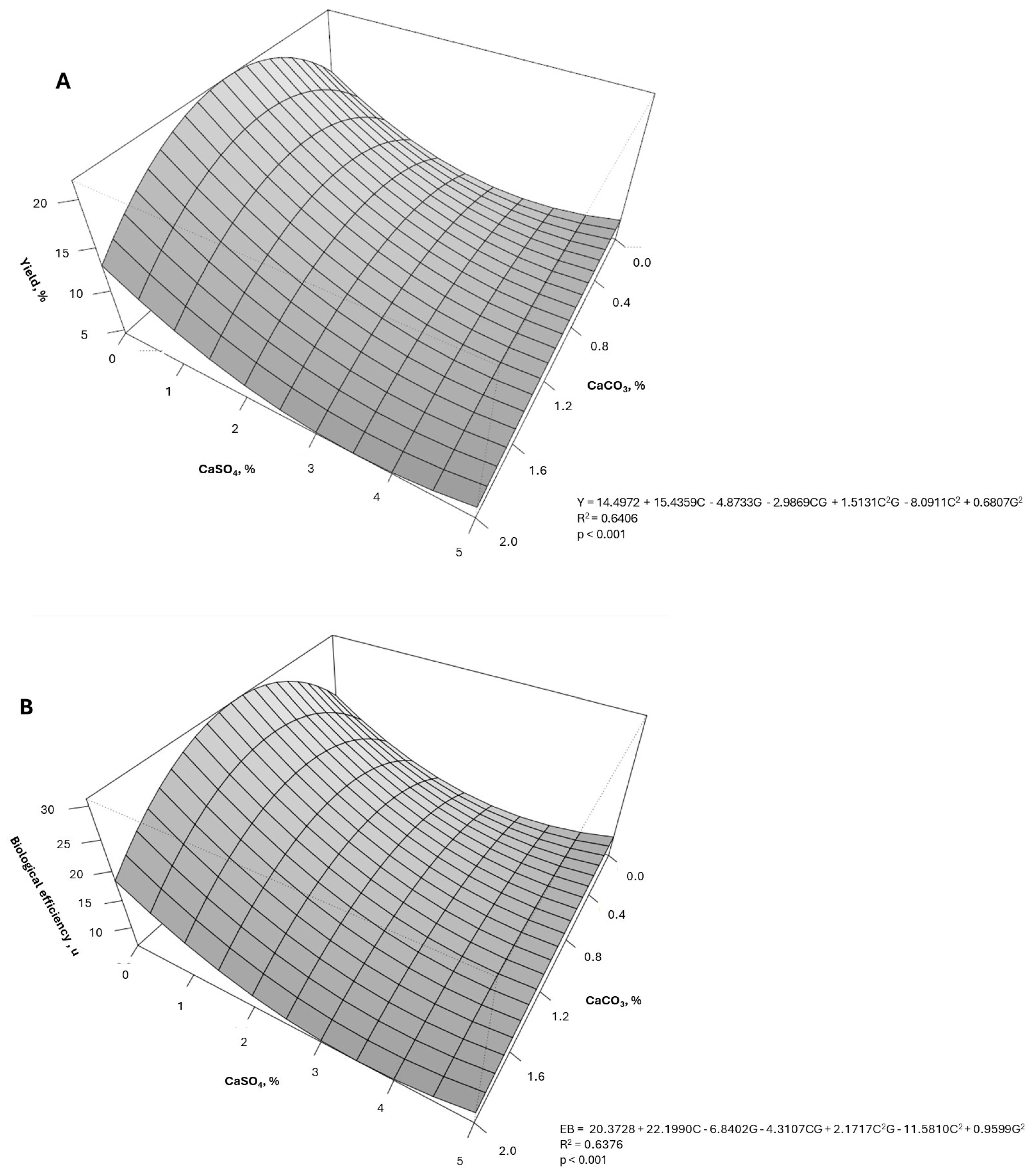
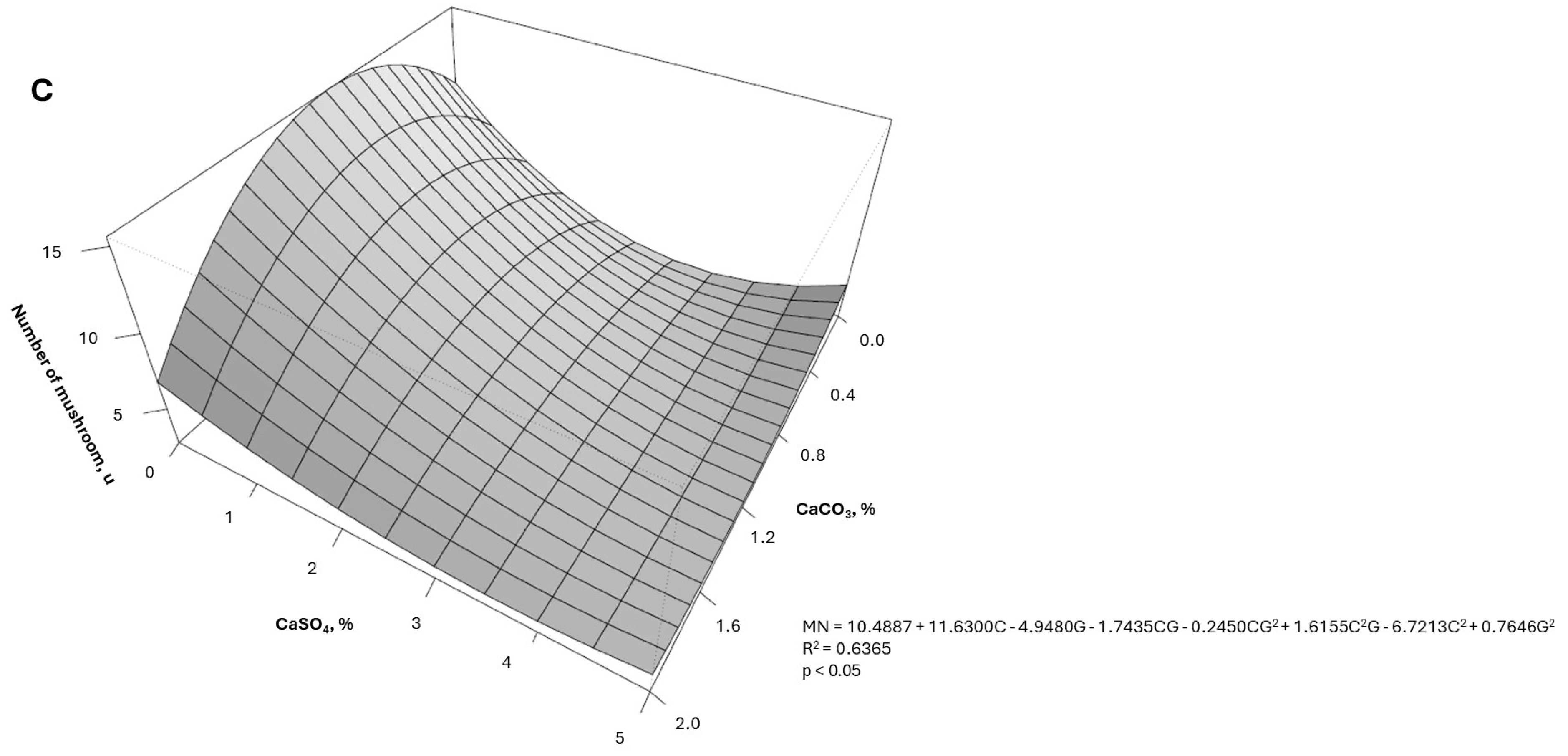
To model the responses observed as a function of calcium sources and to predict yield, biological efficiency, and mushroom number, Figure 1 presents equations that may be applied in commercial cultivation to standardize production processes and regulate mushroom supply throughout the year, contributing to the financial sustainability of the sector. Although the R2 value show a moderate correlation, the figure reveals a general pattern in data behavior that supports an overall assessment of the results obtained in this study.
Regarding pH, both gypsum and calcium carbonate were significant when analyzed independently, while electrical conductivity showed a significant interaction (Table 4).
Table 5 presents the statistical differences observed among the different substrates, considering variations in calcium carbonate and agricultural gypsum dosages. Calcium carbonate showed a greater capacity for substrate pH correction, with increasing dosages resulting in values progressively closer to neutrality. In contrast, the addition of agricultural gypsum tended to decrease pH, thereby increasing substrate acidity.
Gypsum addition increased electrical conductivity, whereas calcium carbonate application caused variable results depending on the gypsum dose. The lowest conductivity was recorded for the combination of 2% calcium carbonate and 0% gypsum, while the highest occurred with 2% calcium carbonate and 5% gypsum (Table 6).

4. Discussion

4.1. Performance Factors

The productivity and development of L. edodes are closely associated with the chemical conditions of the substrate, particularly pH and calcium availability, which regulate key metabolic processes during mycelial colonization and fruiting. The ability of this species to modify its growth environment through the production of organic acids, combined with interactions with mineral components of the substrate, may result in either physiological advantages or growth constraints, depending on the chemical balance established. In this context, supplementation with calcium sources plays an important role in pH regulation, mitigation of oxalate toxicity, and enhancement of substrate selectivity, directly influencing the productive performance of L. edodes.
Substrate pH is a critical factor in the cultivation of edible mushrooms, as it directly influences both the colonization of the substrate and the subsequent fruiting processes [21,22]. In the case of L. edodes, the optimal pH range extends from 3 to 7, within which the fungus is able to establish and develop efficiently. During the colonization phase, active mycelial growth typically promotes a gradual reduction in substrate pH, reaching values of approximately 3.5–4.0 [23]. This acidification process is mainly associated with the synthesis and release of oxalic acid, which is the primary organic compound produced by fungal hyphae. The production of this organic acid plays a fundamental role in mycelial development, contributing to physiological and biochemical processes essential for fungal growth and substrate colonization [11,24].
In substrates with high buffering capacity, such as sawdust, the continuous production of oxalic acid can lead to the accumulation of soluble oxalate at levels that compromise fungal growth [8,25]. Although oxalate is considered only mildly toxic to brown-rot fungi [26], its soluble form at concentrations above 8 mmol kg−1 can inhibit fungal activity and negatively affect critical processes such as fruiting [11,27]. Under these conditions, calcium supplementation becomes particularly relevant.
In the production of L. edodes, as with other mushroom species, the addition of gypsum to the substrate is a widely adopted practice. However, it is generally applied at lower proportions than those used in the present study, typically ranging from 1 to 3% [11,28,29]. In this study, concentrations exceeding these conventional ranges were evaluated, and the observed reduction in productivity may be associated with the higher application rates, suggesting a dose-dependent relationship between gypsum supplementation and yield performance.
It is noteworthy that, in commercial production systems, approximately 2% calcite (calcium carbonate) is commonly used as a calcium source in substrates for L. edodes cultivation [30,31,32,33]. Considering that calcite contains around 50% calcium [34], whereas gypsum (calcium sulfate) contains approximately 30% of this element [35], the implementation of an exploratory study using higher proportions of gypsum is justified. This approach aims to adequately meet the calcium requirements of the substrate by compensating for the lower calcium concentration in gypsum and to evaluate its effects on fungal yield.
Calcium carbonate contributes to substrate chemical regulation by both buffering pH and converting soluble oxalate into insoluble calcium oxalate, thereby reducing its toxicity. Previous studies have demonstrated that both calcium carbonate (CaCO3) and gypsum (CaSO4) are effective in decreasing soluble oxalate concentrations in the substrate [11]. This mechanism may explain the increase in yield observed in the present study when calcium carbonate was applied at a dose of 1%. Similar responses have been reported by [17], who observed an increase in mushroom weight following calcium carbonate supplementation between production flushes, with mean values rising from 32.7 g in the control to 47.3 g in the supplemented substrate.
In mushroom production systems, it is commonly observed that certain substrates may enhance the formation capacity of mushroom and consequently produce mushrooms with greater individual weight [36]. However, this increase in unit weight does not necessarily translate into higher overall productivity. In this context, larger mushrooms do not inherently represent a productive advantage. Likewise, a higher number of smaller mushrooms may increase harvesting costs by raising labor demand for collecting a greater number of units, which may ultimately result in yields comparable to those obtained under standard production systems.
Optimizing fruiting body size at the time of harvest is a key determinant of production unit profitability. According to principles of agricultural economics applied to mushroom cultivation [37], an increase in pileus diameter is positively correlated with harvesting rate (kg h−1). Given that the operational handling time per harvested unit tends to remain relatively constant, prioritizing larger mushroom contributes to reducing fixed labor costs per kilogram produced, especially in shiitake cultivation where harvesting is not mechanized.
In this regard, gypsum and calcium carbonate supplementation may have induced significant changes in parameters such as earliness, moisture content, or other relevant physiological factors. Mushrooms exhibiting greater earliness often display variations in both the number and weight of mushroom produced [38,39].

4.2. Variations Between Strains

The differential responses of L. edodes strains to variations in substrates and cultivation systems are governed by a set of complex physiological mechanisms, primarily associated with the plasticity of the extracellular enzymatic system and adaptive metabolic regulation, as well as the interaction between substrate composition and the nutritional demands of the fungus [14,40]. Colonization efficiency and fruiting performance largely depend on the intrinsic ability of each strain to secrete a specific profile of lignocellulolytic enzymes, including laccases, manganese peroxidases, and complexes of cellulases and xylanases [41,42]. The expression of these enzymes is modulated by the chemical composition of the substrate—such as the C/N ratio, lignin content, and the presence of soluble sugars—as well as by physical factors including pH and moisture [14,43].
More productive strains generally exhibit a more efficient coordination between biomass degradation and nutrient uptake rates, in addition to activating cellular signaling pathways and antioxidant systems that mitigate environmental stresses or the presence of toxic phenolic compounds released during the decomposition of wood or agro-industrial residues [11,44,45]. In this context, the use of two strains, as adopted in the present study, represents a more robust approach for evaluating different cultivation techniques, as it allows the assessment of whether the observed responses reflect a general species-level pattern or vary according to the strains employed.
The reduction in yield observed under excessive gypsum (CaSO4) supplementation was strain-dependent, indicating that tolerance to osmotic stress and elevated sulfur availability varies significantly among L. edodes genotypes. While certain strains exhibited greater adaptive capacity, others showed signs of early metabolic inhibition, possibly associated with the interference of excess mineral ions in the activity of lignocellulolytic enzymes essential for substrate degradation [46].
Conversely, the positive effect of calcium carbonate (CaCO3) also varied among strains and was associated with the intrinsic metabolic acidification potential of each genotype. Strains characterized by more vigorous mycelial growth and higher secretion of organic acids exhibited a stronger response to the buffering effect of calcite, which contributed to maintaining pH within optimal ranges for fruiting [47]. Therefore, the effectiveness of mineral supplementation should be interpreted within a genotype × environment interaction framework, in which the benefit of calcium carbonate lies in its capacity to mitigate specific chemical imbalances generated by high-performance strains [48].

4.3. Chemical Factors

Despite these benefits, the response to calcium supplementation may vary according to strain and substrate conditions. Kumla et al. in 2020 [49] reported that calcium naturally present in raw materials is absorbed by mushrooms after approximately 60 days of inoculation, coinciding with substrate mineralization, which may reduce the need for external application of lime or gypsum. In contrast, Gea et al. in 2017 [50] highlighted that CaCO3 increases substrate selectivity by elevating pH and reducing contamination by ascomycetes. In the present study, the distinct responses observed between strains LED 19/11 and LED 22/02 suggest variability in substrate degradation dynamics and mineral utilization.
The pH values recorded among treatments ranged from 5.0 to 6.8, with the highest values observed at the 2% calcium carbonate dose, while gypsum addition resulted in a reduction in substrate pH (Table 5). According to Miles and Chang in 2004 [51], the ideal substrate pH for L. edodes cultivation lies between 4.5 and 5.5, although some strains exhibit tolerance to more alkaline conditions. Duan et al. in 2020 [23] further reported that hyphal growth actively lowers substrate pH during colonization, maintaining acidic conditions through the production of organic acids. Consistently, Kwak et al. in 2016 [8] demonstrated that L. edodes sustains an acidic environment via the synthesis of oxalic, citric, tartaric, malic, and acetic acids. In the present study, however, pH measurements were conducted only after substrate sterilization, which limits direct inference regarding pH dynamics during colonization.
In addition to pH, substrate electrical conductivity and ionic composition play an important role in mushroom development. Nutrients such as potassium and sodium directly influence the osmotic potential of the substrate and its electrical conductivity, which, in turn, affects water availability and absorption by the fungus. Variations in these parameters can alter the physiological balance required for optimal fungal growth. Pardo et al. (2003) [52] reported that elevated electrical conductivity levels (4000 µS cm−1) inhibit mushroom production when compared with lower conductivity values (1500 µS cm−1), thereby reinforcing the importance of maintaining balanced mineral levels in the substrate for adequate mushroom development.
Overall, the results indicate that the productive performance of L. edodes is strongly influenced by calcium source and dose, with distinct responses observed between strains LED 19/11 and LED 22/02, particularly regarding productivity, biological efficiency, mushroom weight, and mushroom number. Calcium carbonate, especially at the 1% dose, exhibited the most consistent positive effects, whereas gypsum provided limited benefits and, in some cases, reduced productive efficiency. Variations in pH and electrical conductivity confirm the central role of calcium in maintaining the chemical balance of the substrate, thereby directly influencing colonization and fruiting. Consequently, appropriate mineral management should consider the interaction between strain, calcium source, and application rate to optimize mushroom production.

5. Conclusions

The present study demonstrates that the agronomic performance of L. edodes is directly influenced by both the calcium source and its application rate, with clear strain-dependent responses. Calcium carbonate at 1% consistently promoted higher yield and biological efficiency, particularly for strain LED 19/11. Increasing CaCO3 to 2% did not result in additional benefits and, in some cases, reduced efficiency. Gypsum supplementation, especially at higher doses, generally decreased yield and biological efficiency, although strain LED 22/02 exhibited partial tolerance under specific conditions. Variations in pH and electrical conductivity confirm that mineral balance plays a central role in regulating substrate selectivity, colonization, and fruiting. The differential behavior between strains reinforces the importance of genotype-specific substrate management. In conclusion, this research highlights that precise mineral supplementation—especially the use of 1% calcium carbonate—represents a technically viable and agronomically efficient strategy to optimize shiitake production, while reinforcing the importance of strain-specific management to ensure economic sustainability and improved decision-making in commercial mushroom cultivation systems.

Author Contributions

Conceptualization, D.C.Z., M.S.B.J. and L.U.C.; methodology, D.C.Z., R.Z.F., R.S.T. and L.U.C.; software, data curation and writing—original draft preparation, D.C.Z., W.G.V.J., R.S.T., M.S.B.J., L.U.C. and A.T.C.d.P.; writing—review and editing, W.G.V.J. and A.T.C.d.P.; visualization and supervision, W.G.V.J., M.S.B.J. and A.T.C.d.P.; investigation, R.Z.F., R.S.T., M.S.B.J. and L.U.C.; project administration and funding acquisition, D.C.Z. All authors have read and agreed to the published version of the manuscript.

Funding

This study was financed in part by the Coordination for the Improvement of Higher Education Personnel—Brazil (CAPES)—Finance Code 001 (W.G.V.J. and A.T.C.P.), São Paulo Research Foundation (Grant number: FAPESP 23/07948-1) and National Council for Scientific and Technological Development—CNPq (Grant number: PQ 305213/2024-5 and 303268/2021-2).

Data Availability Statement

The original contributions presented in this study are included in the article. Further inquiries can be directed to the corresponding authors.

Conflicts of Interest

The authors declare no conflicts of interest.

References

  1. Sau-Wa Mak, V. Scientists and remaking heritage: The case of shiitake cultivation in a globally important agricultural heritage system in Japan. Int. J. Heritage Stud. 2024, 30, 42–55. [Google Scholar] [CrossRef]
  2. Kazuko, E. The Complete Book of Japanese Cooking; Hermes House: London, UK, 2006; p. 77. [Google Scholar]
  3. Ahmad, I.; Arif, M.; Xu, M.; Zhang, J.; Ding, Y.; Lyu, F. Therapeutic values and nutraceutical properties of shiitake mushroom (Lentinula edodes): A review. Trends Food Sci. Technol. 2023, 134, 123–135. [Google Scholar] [CrossRef]
  4. Shen, Q.; Liu, P.; Wang, X.; Royse, D.J. Effects of substrate moisture content, log weight and filter porosity on shiitake (Lentinula edodes) yield. Bioresour. Technol. 2008, 99, 8212–8216. [Google Scholar] [CrossRef]
  5. Sud, D.; Sharma, S.; Dhiman, R. Significance and cultivation techniques of shiitake mushroom (Lentinula edodes (Berk.) Pegler). Indian Phytopathol. 2024, 77, 925–945. [Google Scholar] [CrossRef]
  6. Mata, G.; Gaitán-Hernández, R.; Salmones, D. El Cultivo del Shiitake: Tecnología e Innovación en la Producción de un Alimento y Medicina Ancestral; Instituto de Ecología, AC: Xalapa, México, 2020; Volume 1, pp. 44–77.
  7. He, X.K.; Xing, Z.T.; Rao, Q.X.; Zhao, X.Y.; Zhao, M.W. Determination of organic acids in Lentinus edodes by HPLC. Nat. Prod. Res. 2012, 24, 1444–1448. [Google Scholar]
  8. Kwak, A.M.; Lee, I.K.; Lee, S.Y.; Yun, B.S.; Kang, H.W. Oxalic acid from Lentinula edodes culture filtrate: Antimicrobial activity on phytopathogenic bacteria and qualitative and quantitative analyses. Mycobiology 2016, 44, 338–342. [Google Scholar] [CrossRef]
  9. Papetti, A.; Signoretto, C.; Spratt, D.A.; Pratten, J.; Lingström, P.; Zaura, E.; Ofek, I.; Wilson, M.; Pruzzo, C.; Gazzani, G. Components in Lentinus edodes mushroom with anti-biofilm activity directed against bacteria involved in caries and gingivitis. Food Funct. 2018, 9, 3489–3499. [Google Scholar] [CrossRef] [PubMed]
  10. Dzurendova, S.; Zimmermann, B.; Kohler, A.; Reitzel, K.; Nielsen, U.G.; Dupuy Galet, B.X.; Leivers, S.; Horn, S.J.; Shapaval, V. Calcium affects polyphosphate and lipid accumulation in mucoromycota fungi. J. Fungi 2021, 7, 300. [Google Scholar] [CrossRef]
  11. Li, J.; Duan, Y.; Hu, Z.; Yang, F.; Wu, X.; Zhang, R. Physiological mechanisms by which gypsum increases the growth and yield of Lentinula edodes. Appl. Microbiol. Biotechnol. 2022, 106, 2677–2688. [Google Scholar] [CrossRef] [PubMed]
  12. Linder, T. Assimilation of alternative sulfur sources in fungi. World J. Microbiol. Biotechnol. 2018, 34, 51. [Google Scholar] [CrossRef]
  13. Mouthier, T.M.; Kilic, B.; Vervoort, P.; Gruppen, H.; Kabel, M.A. Potential of a gypsum-free composting process of wheat straw for mushroom production. PLoS ONE 2017, 12, e0185901. [Google Scholar] [CrossRef] [PubMed]
  14. Vieira Junior, W.G.V.; Caitano, C.E.C.; da Silva Alves, L.; Teixeira, P.A.G.; Noble, R.; Pardo, J.E.; Zied, D.C. From waste to resource: Sustainable reuse of spent shiitake mushroom substrate in subsequent production cycles. Int. Biodeterior. Biodegrad. 2025, 200, 106034. [Google Scholar] [CrossRef]
  15. Zied, D.C.; Silva, B.D.; Caitano, C.E.C.; Vieira Junior, W.G.; Da Silva Freitas, M.A.; Teixeira, P.A.G.; Pardo-Giménez, A. Use of eucalyptus charcoal waste in the formulation of substrate for the cultivation of two strains (LED 20/11 and LED 20/12) of Lentinula edodes. Agronomy 2024, 14, 811–821. [Google Scholar] [CrossRef]
  16. Owaid, M.N.; Abed, I.A.; Alsaeedi, S.S.S. Oyster Mushroom Spawn Production Technique. Macrofungi 2025, 1, 30–37. [Google Scholar] [CrossRef]
  17. Beje, G.; Diriba, M.; Dawit, A. Evaluation of locally available substrates for cultivation of oyster mushroom (Pleurotus ostreatus) in Jimma, Ethiopia. Afr. J. Microbiol. Res. 2013, 7, 2228–2237. [Google Scholar] [CrossRef]
  18. Malavolta, E.; Vitti, G.C.; Oliveira, S.A. Avaliação do Estado Nutricional das Plantas: Princípios e Aplicações; Editora Potafos: Piracicaba, Brazil, 1997; 319p. [Google Scholar]
  19. R Core Team. R: A Language and Environment for Statistical Computing. R Foundation for Statistical Computing, Vienna, Austria, 2024. Available online: https://www.R-project.org/ (accessed on 23 February 2026).
  20. Shimizu, G.D.; Marubayashi, R.Y.P.; Gonçalves, L.S.A. AgroR: An R package and a Shiny interface for agricultural experiment analysis. Acta Scientiarum. Agron. 2025, 47, e73889. [Google Scholar] [CrossRef]
  21. Khan, M.W.; Ali, M.; Khan, N.; Khan, M.; Rehman, A.; Javed, N. Effect of different levels of lime and pH on mycelial growth and production efficiency of oyster mushroom (Pleurotus spp.). Pak. J. Bot. 2013, 45, 297–302. [Google Scholar]
  22. Yadav, M.K.; Chandra, R. Effect of culture media, pH and temperature on mycelial growth of Agaricus bisporus strains. J. Pure Appl. Microbiol. 2014, 8, 2497–2500. [Google Scholar]
  23. Duan, Y.C.; Hu, Z.Y.; Yang, F.; Li, J.T.; Wu, X.L.; Zhang, R.Y. Effects of pH and buffering on the growth of Lentinula edodes mycelium. Sci. Agric. Sin. 2020, 53, 4683–4690. [Google Scholar]
  24. Guggiari, M.; Bloque, R.; Aragno, M.; Verrecchia, E.; Job, D.; Junier, P. Experimental calcium-oxalate crystal production and dissolution by selected wood-rot fungi. Int. Biodeterior. Biodegrad. 2011, 65, 803–809. [Google Scholar] [CrossRef]
  25. Policardi, F.; Thebault, M. The buffer effect of different wood species and the influence of oak on panel composites binders. Polymers 2020, 12, 1540. [Google Scholar] [CrossRef]
  26. Makela, M.R.; Hilden, K.; Hatakka, A.; Lundell, T.K. Oxalate decarboxylase of the white-rot fungus Dichomitus squalens demonstrates a novel enzyme primary structure and non-induced expression on wood and in liquid cultures. Microbiology 2009, 155, 2726–2738. [Google Scholar] [CrossRef]
  27. Makela, M.R.; Sietiö, O.M.; Vries, R.P.; Timonen, S.; Hilden, K. Oxalate-metabolising genes of the white-rot fungus Dichomitus squalens are differentially induced on wood and at high proton concentration. PLoS ONE 2014, 9, e87959. [Google Scholar] [CrossRef]
  28. Yang, R.C.; Liu, M.Y. Effect of rice flour and gypsum on yield of Lentinus edodes. Edible Fungi 1987, 5, 22–23. [Google Scholar]
  29. Jiang, J.; Wu, C.L.; Liu, K.; Zheng, Q.P.; Zeng, F.Q. Optimization of cultivation substrate formula for L808 of Lentinus edodes. Edible Fungi 2016, 6, 39–40. [Google Scholar]
  30. Philippoussis, A.; Diamantopoulou, P.; Zervakis, G. Monitoring of mycelium growth and fructification of Lentinula edodes on several agricultural residues. In Mushroom Biology and Mushroom Products; UAEM: Cuernavaca, Mexico, 2002; pp. 279–287. [Google Scholar]
  31. Royse, D.J.; Sanchez-Vazquez, J.E. Influence of precipitated calcium carbonate (CaCO3) on shiitake (Lentinula edodes) yield and mushroom size. Bioresour. Technol. 2003, 90, 225–228. [Google Scholar] [CrossRef]
  32. Desisa, B.; Muleta, D.; Dejene, T.; Jida, M.; Goshu, A.; Martin-Pinto, P. Substrate optimization for shiitake (Lentinula edodes (Berk.) Pegler) mushroom production in Ethiopia. J. Fungi 2023, 9, 811. [Google Scholar] [CrossRef] [PubMed]
  33. Rocha, E.M.D.; Avila, S.; Lima, J.J.D.; Silva, R.S.; Mathias, A.L.; Bacila, D.M.; Jorge, R.M.M. Nutritional value and antioxidant activity of Agaricus bisporus, Lentinula edodes and Pleurotus ostreatus mushrooms. An. Acad. Bras. Ciências 2025, 97, e20241454. [Google Scholar] [CrossRef] [PubMed]
  34. Haldar, S.K. Minerals and rocks. In Introduction to Mineralogy and Petrology, 2nd ed.; Elsevier: Amsterdam, The Netherlands, 2020; pp. 1–51. [Google Scholar] [CrossRef]
  35. Dias, L.E. Uso de Gesso Como Insumo Agrícola; Comunicado Técnico 7:1–6; EMBRAPA-CNPBS: Rio de Janeiro, Brazil, 1992. [Google Scholar]
  36. Royse, D.J.; Bahler, B.D. Yield and size of shiitake as influenced by synthetic log diameter and genotype. Mushroom J. Trop. 1989, 9, 109–113. [Google Scholar]
  37. Oei, P. Mushroom Cultivation: Appropriate Technology for Mushroom Growers, 3rd ed.; Backhuys Publishers: Leiden, The Netherlands, 2003. [Google Scholar]
  38. Gong, W.; Xu, R.; Xiao, Y.; Zhou, Y.; Bian, Y. Phenotypic evaluation and analysis of important agronomic traits in hybrid and natural populations of Lentinula edodes. Sci. Hortic. 2014, 179, 271–276. [Google Scholar] [CrossRef]
  39. Ozkan, D.; Morrow, R.; Zhang, M.; Dade-Robertson, M. Are mushrooms parametric? Biomimetics 2022, 7, 60. [Google Scholar] [CrossRef] [PubMed]
  40. Song, X.; Shang, X.; Zhang, M.; Yu, H.; Zhang, D.; Tan, Q.; Song, C. Cultivation methods and biology of Lentinula edodes. Appl. Microbiol. Biotechnol. 2025, 109, 63. [Google Scholar] [CrossRef] [PubMed]
  41. Elisashvili, V.; Penninckx, M.; Kachlishvili, E.; Tsiklauri, N.; Metreveli, E.; Kharziani, T.; Kvesitadze, G. Lentinus edodes and Pleurotus species lignocellulolytic enzymes activity in submerged and solid-state fermentation of lignocellulosic wastes of different composition. Bioresour. Technol. 2008, 99, 457–462. [Google Scholar] [CrossRef] [PubMed]
  42. Jiang, N.; Dong, H.R.; Tian, L.; Xin, T.Z.; Wang, S.X.; Li, Y.; Yu, H.L. Mechanism of Enzyme Activity Regulation and Strain-Specific Response of Lentinula edodes Cultivation Adaptability Under Peach Wood Substrate. J. Fungi 2025, 11, 684. [Google Scholar] [CrossRef] [PubMed]
  43. Colla, I.M.; de O. Filho, O.B.Q.; Bertéli, M.B.D.; De Freitas, J.D.S.; Avelino, K.V.; Ruiz, S.P.; Do Valle, J.S.; Linde, G.A.; Colauto, N.B. Carbon-to-nitrogen ratios on laccase and mushroom production of Lentinus crinitus. Int. J. Environ. Sci. Technol. 2023, 20, 3941–3952. [Google Scholar] [CrossRef]
  44. Buswell, J.A.; Cai, Y.J.; Chang, S.T.; Peberdy, J.F.; Fu, S.Y.; Yu, H.S. Lignocellulolytic enzyme profiles of edible mushroom fungi. World J. Microbiol. Biotechnol. 1996, 12, 537–542. [Google Scholar] [CrossRef]
  45. Menolli Junior, N.; Paccola-Meirelles, L.D. Obtenção de linhagens de Lentinula edodes resistentes a temperaturas elevadas e seleção de linhagens resistentes ao Trichoderma sp. Ciênc. Agrotec. 2010, 34, 1640–1646. [Google Scholar] [CrossRef]
  46. Royse, D.J. Cultivation of Shiitake on Synthetic Logs; College of Agricultural Sciences, Agricultural Research and Cooperative Extension, Pennsylvania State University: University Park, PA, USA, 2001. [Google Scholar]
  47. Stamets, P. Growing Gourmet and Medicinal Mushrooms, 3rd ed.; Ten Speed Press: Berkeley, CA, USA, 2000. [Google Scholar]
  48. Minhoni, M.T.A.; Andrade, M.C.N.; Zied, D.C. Cultivo de Lentinula edodes (shiitake). In Cultivo de Cogumelos Comestíveis; FEPAF: Botucatu, Brazil, 2007; pp. 63–96. [Google Scholar]
  49. Kumla, J.; Suwannarach, N.; Sujarit, K.; Penkhrue, W.; Kakumyan, P.; Jatuwong, K.; Vadthanarat, S.; Lumyong, S. Cultivation of mushrooms and their lignocellulolytic enzyme production through the utilization of agro-industrial waste. Molecules 2020, 25, 2811. [Google Scholar] [CrossRef]
  50. Gea, F.J.; Carrasco, J.; Suz, L.M.; Navarro, M.J. Characterization and pathogenicity of Cladobotryum mycophilum in Spanish Pleurotus eryngii mushroom crops and its sensitivity to fungicides. Eur. J. Plant Pathol. 2017, 147, 129–139. [Google Scholar] [CrossRef]
  51. Miles, P.G.; Chang, S.T. Mushrooms: Cultivation, Nutritional Value, Medicinal Effect, and Environmental Impact; CRC Press: Boca Raton, FL, USA, 2004. [Google Scholar]
  52. Pardo, A.; de Juan, J.A.; Pardo, J.E. Performance of composted vine shoots as a peat alternative in casing materials for mushroom cultivation. J. Appl. Hortic. 2003, 5, 11–15. [Google Scholar] [CrossRef]
Figure 1. Regression models adjusted for the characteristic yield (A), biological efficiency (B) and mushroom number (C), considering R2 values greater than 0.60 and p < 0.05.
Agronomy 16 00509 g001aAgronomy 16 00509 g001b
Table 1. Substrate formulations using different proportions of calcium carbonate and agricultural gypsum.
TreatmentEucalyptus SawdustWheat BranRice BranCalcium CarbonateGypsum
%
180101000
277.5101002.5
375101005
479101010
576.5101012.5
674101015
778101020
875.5101022.5
973101025
Table 2. Analysis of agronomic parameters of the 19/11 Lentinula edodes line with different doses of calcium carbonate and gypsum, grown in a eucalyptus sawdust-based substrate.
Doses(s)Gypsum
Calcium Carbonate0%2.50%5%
Yield (%)
0%14.91 ± 0.97 b A5.72 ± 0.99 b B7.56 ± 1.60 B
1%21.82 ± 2.82 a A10.26 ± 0.72 a B7.1 ± 1.23 B
2%12.60 ± 1.43 b A6.08 ± 0.90 b B5.64 ± 0.98 B
CV (%)20.45
Biological efficiency
0%20.94 ± 1.38 b A8.12 ± 1.41 b B10.74 ± 2.28 B
1%30.97 ± 4.01 a A14.56 ± 1.03 a B10.08 ± 1.75 B
2%17.88 ± 2.03 b A8.63 ± 1.28 b B8.01 ± 1.40 B
CV (%)20.45
Mushroom weight (g)
0%29.49 ± 1.8141.43 ± 5.7834.68 ± 4.36
1%29.07 ± 4.01 B35.51 ± 6.07 B47.43 ± 4.33 A
2%37.68 ± 1.9730.08 ± 5.5841.33 ± 6.94
CV (%)22.00
Number of mushrooms (u)
0%10.37 ± 1.10 b A3.12 ± 0.69 B4.75 ± 1.17 B
1%15.62 ± 2.09 a A5.5 ± 0.56 B3.23 ± 0.67 B
2%6.75 ± 0.67 c3.87 ± 0.473.75 ± 1.48
CV (%)22.25
Lowercase letters indicate comparisons of means among rows within each analyzed variable, whereas uppercase letters compare treatments among columns. Different letters denote statistically significant differences according to the Scott–Knott test at the 5% probability level; the absence of letters indicates that there was no statistical difference. Data were previously transformed using a base-10 logarithmic transformation [log10(y)]. Means followed by ±the standard error.
Table 3. Analysis of agronomic parameters of the LED 22/02 Lentinula edodes line with different doses of calcium carbonate and gypsum, grown in a eucalyptus sawdust-based substrate.
Doses(s)Gypsum
Calcium Carbonate0%2.50%5%
Yield (%)
0%24.05 ± 1.38 a A13.42 ± 1.86 B18.83 ± 1.85 a A
1%28.15 ± 2.59 a A16.36 ± 3.81 B18.98 ± 2.30 a B
2%16.52 ± 2.43 b11.4 ± 1.9710.68 ± 0.93 b
CV (%)15.71
Biological efficiency
0%34.14 ± 1.96 a A19.05 ± 2.64 B26.73 ± 2.63 a A
1%39.95 ± 3.68 a A23.23 ± 5.41 B26.73 ± 3.27 a B
2%23.45 ± 3.45 b16.18 ± 2.8015.17 ± 1.32 b
CV (%)13.94
Mushroom weight
0%9.87 ± 0.92 b B37.68 ± 1.84 a A24.42 ± 6.22 b B
1%48.16 ± 4.33 a A19.03 ± 1.82 b B41.33 ± 6.94 a A
2%15.85 ± 1.99 b33.83 ± 3.60 a14.24 ± 1.74 b
CV (%)18.06
Number of mushrooms
0%58.37 ± 6.19 a A18.01 ± 3.90 C40.12 ± 5.98 a B
1%52.00 ± 5.64 a A28.87 ± 8.01 B27.75 ± 4.91 b B
2%18.87 ± 3.32 b A13.12 ± 3.06 B17.00 ± 3.07 b A
CV (%)24.72
Lowercase letters indicate comparisons of means among rows within each analyzed variable, whereas uppercase letters compare treatments among columns. Different letters denote statistically significant differences according to the Scott–Knott test at the 5% probability level; the absence of letters indicates that there was no statistical difference. Data were previously transformed using a base-10 logarithmic transformation [log10(y)]. Means followed by ±the standard error.
Table 4. Analysis of variance and Shapiro–Wilk value for pH and electrical conductivity values (* p < 0.05; ** p < 0.01; *** p < 0.001).
MS
SVDFpHEC
Gypsum20.62 ***0.3585 ***
Calcium carbonate24.41 ***0.0011 ***
Interaction40.0230.04 ***
Residue 0.0090.002
x ¯ 5.72240
CV (%) 5.26.4
DF (Degrees of Freedom), SV (Source of Variation), MS (Mean Squares) and EC (Electrical conductivity).
Table 5. pH of substrates with different doses of calcium carbonate (0, 1 and 2%) and agricultural gypsum (0, 2.5 and 5%).
Dose(s)Calcium CarbonateDose(s)Gypsum
0%5.3 b0%6.0 a
1%5.7 b2.5%5.6 b
2%6.5 a5%5.4 b
Different letters indicate statistical difference by Tukey’s test at 5% significance, where lowercase letters compare the means in the columns.
Table 6. Electrical conductivity of substrates (µS cm−1) with different doses of calcium carbonate (0, 1 and 2%) and agricultural gypsum (0, 2.5 and 5%).
Dose(s) Gypsum
Calcium carbonate0%2.5%5%
0%1403 b C2360 c B2830 b A
1%1553 a B2460 b A2444 c A
2%848 c C2780 a B3580 a A
Different letters indicate statistical difference by Tukey’s test at 5% significance, where lowercase letters compare the means in the columns and uppercase letters in the rows.
Disclaimer/Publisher’s Note: The statements, opinions and data contained in all publications are solely those of the individual author(s) and contributor(s) and not of MDPI and/or the editor(s). MDPI and/or the editor(s) disclaim responsibility for any injury to people or property resulting from any ideas, methods, instructions or products referred to in the content.