Article

Composting and Vermicomposting of Fish Sludge with Egg Boxes and Lettuce Wastes with the Addition of Eggshells: Impacts on Chemical Properties, Nutrient Availability, and Safety

Department of Agro-Environmental Chemistry and Plant Nutrition, Czech University of Life Sciences Prague, Kamycka 129, 165 00 Prague, Czech Republic
*
Author to whom correspondence should be addressed.
Agronomy 2026, 16(4), 473; https://doi.org/10.3390/agronomy16040473
Submission received: 15 January 2026 / Revised: 13 February 2026 / Accepted: 16 February 2026 / Published: 19 February 2026
(This article belongs to the Special Issue Composting for Soil Improvement and Removal of Soil Contaminants)

Abstract

This study compared the composting and vermicomposting of fish sludge amended with egg boxes, lettuce residues, and eggshells, over a five-month period. Eight treatments (T1–T8) differing in fish sludge content and the presence or absence of earthworms (Eisenia andrei) were evaluated. Monitored parameters included pH, electrical conductivity, earthworm biomass and abundance, concentrations of available elements (P, K, Mg, S, Fe, Cu, Zn and Mn), volatile solids and C/N ratio. Final total levels of potentially toxic elements (PTEs), such as Cr, Ni, Pb and As were also measured. The results demonstrated that fish sludge, egg boxes, and lettuce at a 4:5:1 ratio plus eggshells with earthworms (T8) enhanced nutrient transformation and earthworm activity. Fish sludge and egg boxes at 1:3 plus eggshells (T2) and the same mixture with earthworms (T6) produced compost with PTEs concentrations within safe limits. Final concentrations of Cu, Zn, Cr, Ni, and Pb in T2, T6, and T8 remained below European regulatory thresholds. T8 showed significantly higher concentrations of available K and Mg compared to T2 and T6. T8 was identified as the most effective treatment for processing fish sludge while producing a safe, nutrient-rich product suitable for use as a high-quality organic fertilizer in sustainable agriculture. These findings support vermicomposting as an efficient and environmental strategy for fish sludge utilization.

1. Introduction

Fish sludge is a major waste stream in the aquaculture industry. Depending on the fish species and the aquaculture process, the solid matter is composed of fish feed, feces, and biomass from dead fish and other species [1]. Daily sludge discharge accounts for 5–20% of the total volume of a recirculating aquaculture system [2].
Fish farming is associated with environmental risks such as eutrophication and oxygen depletion caused by excessive sludge accumulation [3,4]. While fish sludge is rich in bioavailable nutrients like N, P, K, Mg, S and Fe derived from feed, its agricultural use is limited by strong odors, crust formation, and heavy metal contamination [2,5,6,7].
Fish sludge can be mineralized by microbial action in aerobic or anaerobic reactors into soluble nutrients that hydroponic plants can take up [2]. For example, sludge from recirculating African catfish aquaculture systems has been successfully treated using anaerobic and aerobic mineralization methods resulting in substantial recovery of N, P, K, Ca, and Mg within 15 days; the best method was an aerobic system with added molasses as carbon source [8]. Other ways to process fish sludge for nutrient benefits are composting, vermicomposting, and bioflocculation technology [9].
Earthworms in association with microbes can reduce heavy metal mobility by enhancing microbial enzyme activity in their intestinal tracts and casts. The reduction in total heavy metal concentration in vermicompost is attributed to the accumulation and immobilization of metals in earthworm tissues [10]. It has been observed that Cu and Zn accumulate to higher levels in the bodies of earthworms than in their castings [11]. Heavy metals or potentially toxic elements (PTEs) are accumulated in the earthworms’ tissues through two different methods: through direct skin contact with compounds dissolved in soil water, or by digestion of certain elements in soil and subsequent absorption through the intestines [12].
In comparisons between vermicomposting and traditional composting, vermicomposting proved to be more efficient in biodegradation through the increased processing ability of additional earthworms [13]. Vermicomposting of 5–30% sludge (dry weight) is recommended as a green and sustainable technology capable of transforming aquaculture sludge into nutrient-rich fertilizer and earthworm biomass [14]. Worm castings contain a high percentage of humus and humic acid which has binding sites for macronutrients, such as Ca, Fe, K, S and P, which then are stored in a form readily available to plants [15]. The results of Srikanth et al. [16] supported the idea that sludge from aquaculture ponds has the potential to be used as a raw material for composting when mixed with either rice paddy straw or water hyacinth biomass. In their study, the greatest germination, height and fresh weight of the plants were achieved at a ratio of 60:40 (aqua sludge: paddy straw). Other studies demonstrated that vermicomposting of fish sludge without the addition of fibrous materials still resulted in a high-quality biofertilizer safe for use in agriculture [17]. Birch et al. [18] showed that aquaculture sludge from freshwater pond systems could be effectively turned into an agricultural fertilizer through vermicomposting using rice straw and water hyacinths in various proportions with Perionyx excavatus earthworms in 53 days, however, the Fe and Mn concentrations were too high and toxic to rice.
Despite its potential as a fertilizer, the utilization of fish sludge presents a complex challenge in balancing high nutritional value with chemical safety, particularly regarding PTEs. To overcome these limitations, various organic and inorganic amendments can be employed to optimize the composting process. Carbon compounds from rice straw or hyacinths serve as the primary energy sources for microbial metabolism, and nitrogen is crucial for nucleic acid and protein synthesis, as well as microbial growth [19]. Addition of C-rich materials, like the egg boxes used in this study, is required for composting fishery waste due to its high protein content and low C:N ratio [1]. Zaini and Syafi [20] showed that having a sufficient level of carbonaceous material available at the beginning of the process increased microbial growth and boosted the rate of vermicomposting. Chopping or shredding the material increases the surface area available for microbial action and provides better aeration for the composting process [21]. In our experiments, we also tested chopped lettuce trimmings as a way to accelerate the worms’ digestive activity. Used egg boxes are typically discarded as waste, but as carbon-rich materials, they can serve as an important enhancer in the composting and vermicomposting processes. The final ingredient tested was eggshell powder, which has been shown to be a good source of nutrients for the reproduction and survival of worms in vermicomposting [22].
Few studies have been conducted on the composting and vermicomposting of fish sludge. A significant gap remains in the current literature, as most studies focus on short-term transformations without addressing the long-term behaviour of nutrients. Furthermore, there is a lack of comprehensive data evaluating plant-available nutrients or using enzymatic indicators to assess compost maturity and safety. Therefore, it remains unresolved how these specific combinations of amendments interact over time to mitigate toxicity while maximizing nutrient efficiency. Thus, we tested increasing percentages of fish sludge (25, 40, 90 and 100%) with inexpensive C sources (egg boxes, eggshells, and lettuce residues) and monitored the changes throughout the process. The maximum yield of compost was used to choose the best amendments for producing a safe and effective fish sludge fertilizer.
Our chief objectives were to (i) compare the changes in pH, electrical conductivity (EC), earthworm biomass and numbers, and available concentrations of macronutrients (P, K, Mg, S) and micronutrients (Fe, Cu, Zn, Mn) over a period of five months, (ii) evaluate the effect of different mixtures on the chemical properties and safety of compost and vermicompost of fish sludge, and (iii) determine the best process for producing the highest yield of nutrients with the lowest level of PTEs. The following hypotheses were formulated: (1) the percentage of fish sludge influences earthworm population and biomass; (2) addition of egg boxes, lettuce and eggshells is effective for both composting and vermicomposting of fish sludge; (3) the presence of Eisenia andrei will accelerate nutrient mineralization and increase available P and K compare to composting (4) treatments containing egg boxes (high C/N bulking) will show faster stabilization (fast decline in enzyme activities, volatile solids, and C/N ratios) than sludge-dominant treatments, due to improved aeration and balanced C supply and (5) lower sludge fractions (25–40%) combined with bulking agents will yield final products that comply with EU limits for Cu/Zn/Ni/Pb/Cr while maintaining agronomically relevant nutrient availability.
These research findings are globally important because of the rapid expansion of aquaculture worldwide, creating a severe challenge in managing fish sludge. By establishing an approach that optimizes nutrient recovery while strictly monitoring heavy metal safety, this study provides a workable solution to this problem; by testing combining multiple fish sludge proportions (25–100%) with low-cost carbon and nitrogen sources (egg boxes and lettuce) with eggshell amendment over a five-month stabilization period.

2. Materials and Methods

2.1. Experimental Design

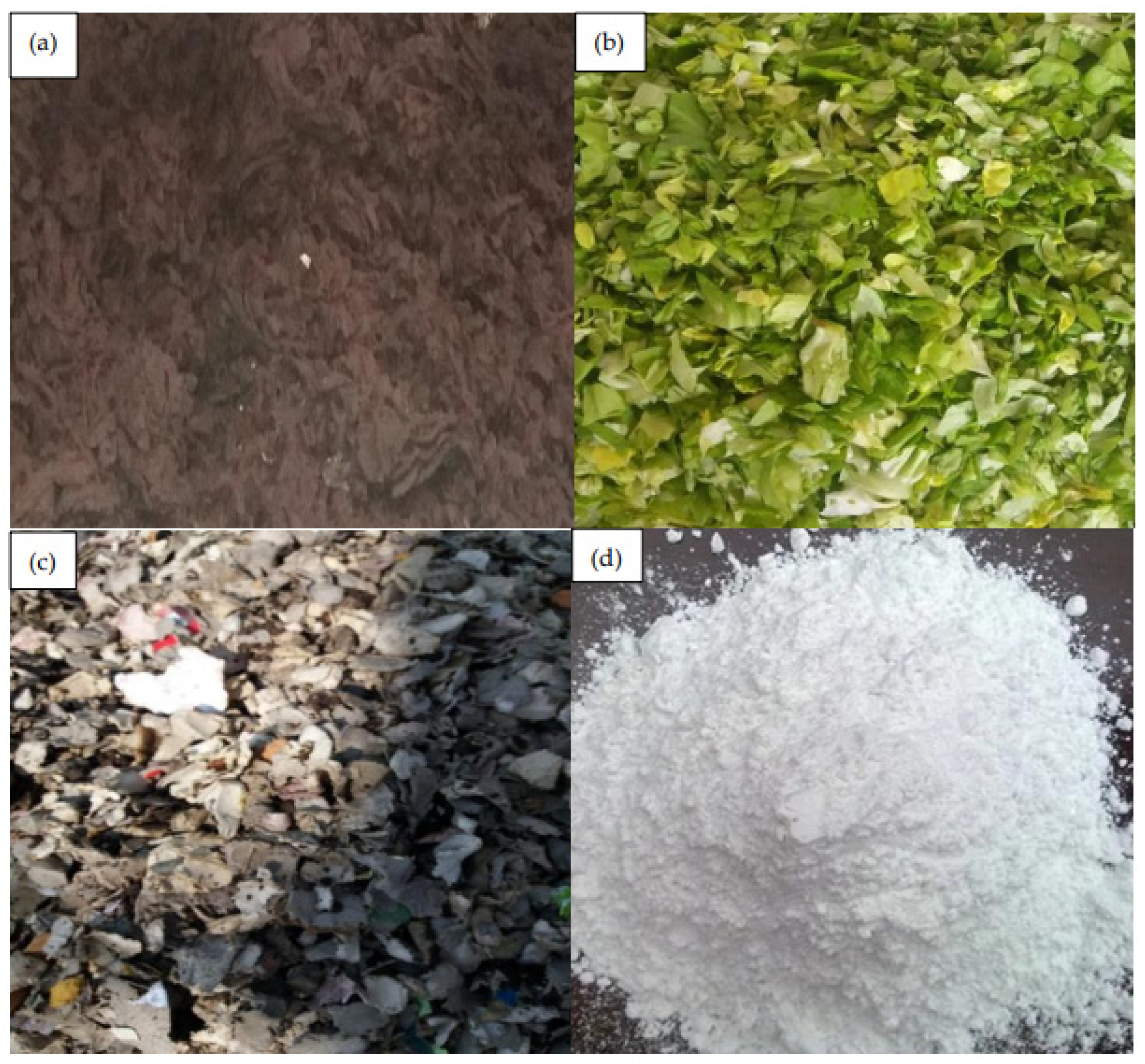
The composting and vermicomposting experiment was conducted under controlled laboratory conditions at the Experimental Station of the Faculty of Agrobiology, Food and Natural Resources, Czech University of Life Sciences Prague (CZU) in Cerveny Ujezd, Czech Republic. Dewatered fish sludge originating from a recirculating aquaculture fish farm of Oreochromis niloticus and Clarias gariepinus (Hroby, Czech Republic) was collected and used as the primary nitrogen-rich substrate. Lettuce residues and wastepaper egg boxes were employed as carbonaceous amendments, while crushed eggshells were added as a calcium source and pH stabilizing agent. The lettuce was postharvest residues from an aquaponic recirculation culture from Aquaponia Ltd. (Lážovice, Czech Republic), which was cut into smaller fragments. The cardboard egg boxes were soaked in hot water at a 1:2 ratio before use to ensure sufficient moisture. Powdered eggshells were added to all biowaste mixtures at 5% by weight. The input materials (Figure 1) were thoroughly mixed to ensure homogeneity of the substrate and loaded into trays according to the treatments. The dimensions of each tray were 40 cm × 40 cm × 12 cm, and trays were arranged in a randomized block design with three replicates per treatment. The experiments were carried out in a laboratory under controlled conditions of temperature (20–21 °C), relative humidity (86%) and light from March to September 2022.
The treatment conditions are listed in Table 1. Eight experimental treatments were performed, differing in substrate composition and the presence or absence of Eisenia andrei B earthworms: T1–T4 without earthworms and T5–T8 with earthworms. Each treatment was run in triplicate. The weight of the mixtures in each composting/vermicomposting tray was 7 kg and 3 L of fresh earthworm substrate consisting of grape marc, apple pomace and wood sawdust) was added to each tray. Earthworms (Eisenia andrei) were introduced at approximately 172 ± 38 earthworms/kg of substrate (biomass 37.3 ± 7.3 g/kg) in treatments T5–T8.
At the start of the experiment, earthworms were confined to one-third of the tray area containing a bedding substrate, while the remaining two-thirds was filled with the experimental sludge-based mixtures. Direct contact between earthworms and the test material was intentionally avoided during the initial phase, and colonization of the sludge mixtures occurred gradually over time. This experimental design was implemented to prevent potential toxic effects from the elevated ammoniacal nitrogen concentrations and their volatilization from fish sludge during the early stage of the process, which could otherwise have caused earthworm mortality.

2.2. Sampling, Physicochemical and Biological Analyses

Representative samples (150 g fresh weight) were collected at 0, 1, 3, and 5 months and earthworms were manually removed before analysis. Fresh samples were divided into subsamples for physicochemical analyses, while portions intended for biological analyses were frozen (at −26 °C) and lyophilized.
For the measurement of pH and electrical conductivity (EC), the fresh samples were suspended in demineralized water at a ratio of 1:5 (w/v) and shaken for 10 min before measurement. A WTW 340i pH meter and a WTW 730 IonLab conductivity meter (Xylem Analytics Germany Sales, GmbH, Weilheim, Germany) were used according to BSI EN 15933 [23]. The dry matter was determined gravimetrically as the difference in weight between the samples before and after lyophilization (Gregor Instruments s.r.o., Sázava, Czech Republic).
Total C, N, and S content was determined using approximately 25 mg of dried, homogenized sample per analysis on a CHNS Vario MACRO Cube elemental analyzer (Elementar Analysensysteme GmbH, Langenselbold, Germany), with high-temperature catalytic combustion [24].
The total amounts of selected macro- and micronutrients were determined following wet microwave digestion in a closed system (Ethos 1, MLS GmbH, Germany). Approximately 0.5 g of lyophilized sample was digested in aqua regia (HCl:HNO3, 3:1). For the determination of available nutrients, the CAT method was used, according to BS EN 13651 [25]. Ten-g samples were added to extraction solution (0.01 mol/L CaCl2 + 0.002 mol/L DTPA) at a 1:10 (w/v) ratio and shaken for 1 h at room temperature (RT), after which they were centrifuged for 5 min at 10,776× g (MegaStar 600, VWR International, Radnor, PA, USA) and supernatants were removed for analysis. Total and available nutrient contents were quantified by inductively coupled plasma optical emission spectrometry (ICP-OES 700 Series, Varian VistaPro, Varian Inc., Macquarie Park, Australia), using an axial plasma view and external calibration with multi-element standard solutions. To quantify volatile solids (VS), 1 g samples of homogenized, dried, ground compost were weighed into glass beakers, which were covered and placed on an electric hotplate at 220 °C for 1 h. Afterwards, the beakers were transferred to an oven, where combustion was carried out at of 350 °C for 0.5 h, then 450 °C for 0.5 h, and lastly at 500 °C for 16 h. The beakers were removed, allowed to cool, and weighed to determine the loss of weight.
Earthworm numbers and weight (biomass) were quantified by manual separation from substrate, followed by counting. The collected earthworms were maintained in Petri dishes in a dark room at 20 °C for 24 h to allow gut depuration, after which their biomass was determined gravimetrically.
The enzymatic activities of β-D-glucosidase, acid phosphatase, lipase, cellobiohy-drolase, and alanine aminopeptidase were determined fluorometrically in 96-well microplates. Lyophilized compost samples (0.2 g) were extracted with 20 mL of acetate buffer (50 mmol/L, pH 5.0) and homogenized for 30 s using an Ultra-Turrax homogenizer (IKA Labortechnik, Staufen, Germany) for 30 s at 8000 rpm. The homogenate (200 µL) was pipetted into 96-well microplates, and 40 µL of the corresponding substrate solution (MUFs or AMC) was added. Specific fluorogenic substrates were used for each enzyme: MUFG for β-D-glucosidase, MUFP for acid phosphatase, MUFY for lipase, MUFC for cellobiohydrolase, and AMCA for alanine aminopeptidase, according to Hřebečková et al. [26]. The microplates were incubated at 40 °C for 2 h, and fluorescence was measured on a microplate reader (Tecan Infinite® M Plex, Tecan Austria GmbH, Grödig, Austria) with an excitation wavelength of 360 nm and an emission wavelength of 450 nm. Enzymatic activities were expressed as micromoles of substrate per hour per gram of dry weight. Calibration was performed with 4-methylumbelliferone and 7-amido-4-methylcoumarin standards. The procedure was conducted in four replicates for each sample [26].

2.3. Statistical Analysis

All results are presented as means ± standard deviation (n = 3). The means and standard deviations were calculated using Microsoft Excel. Statisticaltudent’s t tests were performed using CoStat version 6.400 (CoHort Software, CA, USA) for evaluation of available nutrients (P, K, Mg, S, Fe, Cu, Zn and Mn), potentially toxic elements (Cr, Ni, Pb and As), and volatile solids in the final products. Comparisons of means were done by ANOVA followed by Duncan’s multiple range test (p < 0.05) for comparing the treatments, and the LSD test (p < 0.05) for comparing available nutrients (P, K, Mg, S, Fe and Mn) and total (Cu, Zn, Cr, Ni, Pb and As) between the final compost and vermicompost groups, representing treatments T1–T4 and T5–T8 respectively

3. Results

To facilitate interpretation of the extensive dataset, the evaluation of composting and vermicomposting treatments was primarily based on indicators of compost maturity and agronomic suitability. These included reduction of volatile solids, convergence of the C/N ratio, availability of key nutrients (P, K, Mg), compliance with heavy metal limits, and temporal patterns of enzymatic activity. Other measured parameters are presented to support these key indicators and to provide mechanistic insights into the processes occurring during composting and vermicomposting.

3.1. Analysis of Input Materials

The C/N ratios of the groups containing different proportions of starting material and the compost vs. vermicompost groups ranged from a mean of 6.48 to 178.34: fish sludge 6.48 ± 0.08; lettuce 8.33 ± 0.2; egg boxes 178.34 ± 34.2; 100% fish sludge + eggshells (T1 and T5), 7.2 ± 0.3; 25% fish sludge + egg boxes (1:3) + eggshells (T2 and T6), 94.5 ± 13.26; 90% fish sludge + lettuce (9:1) + eggshells (T3 and T7), 6.9 ± 0.01; 40% fish sludge + egg boxes + lettuce (4:5:1) + eggshells (T4 and T8), 73.6 ± 18.7. Table 2 presents the total nutrient content of the input materials. The highest values of P, S, Fe, Cu, Zn and Mn were in fish sludge. The highest values of K and Mg were in lettuce. Egg boxes contained the lowest values of P, K, Mg and S.

3.2. Numbers of Earthworms and Biomass

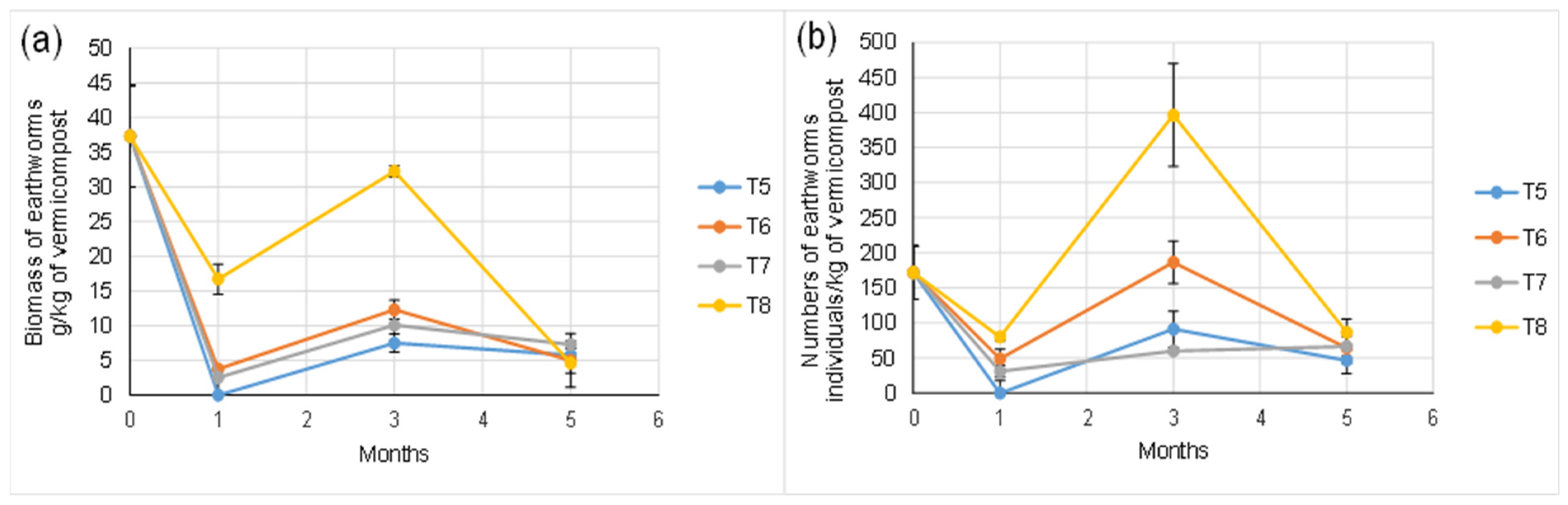
Figure 2 shows that the biomass and numbers of earthworms in all treatments were highest at three months, after which they declined. The two highest values of earthworm biomass at three months were 32.2 ± 0.8 g/kg in T8 and 12.3 ± 1.4 g/kg in T6. The lowest values were observed in T5 and T7. The number of earthworms per kilogram during the process was the highest in T8 at the first (80), third (397), and fifth months (87). The decrease in biomass and abundance at the end of the fifth month suggests a reduced availability of organic substrates.

3.3. Total Nutrient Concentrations in Earthworms

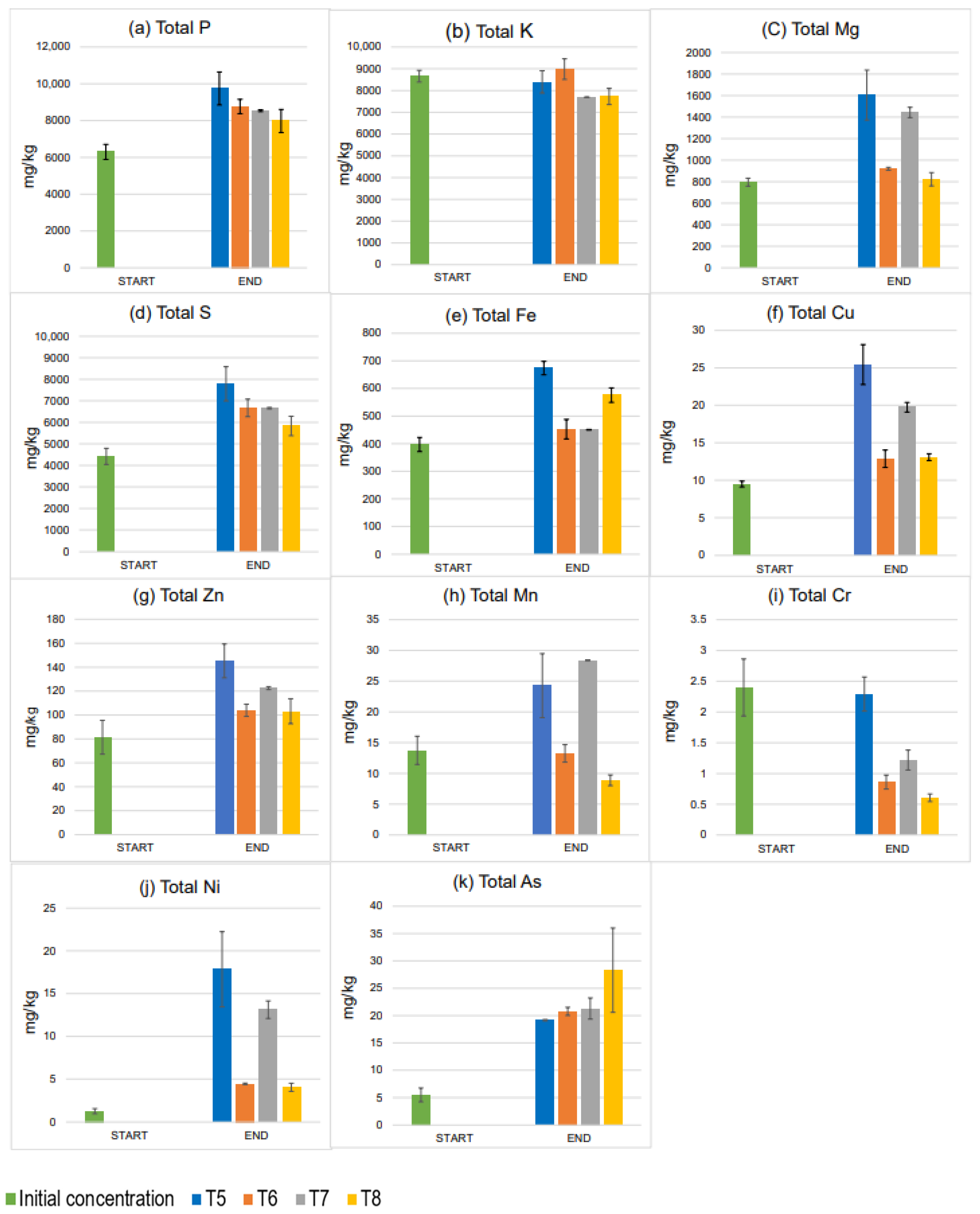
Total P, Mg and S concentrations in earthworms were increased by the end of the experimental period (month 5) compared with the beginning (Figure 3). The increase in total P ranged from 27% in T8 to 55% in T5. The increases in total Mg concentration were 3.4%, 16%, 82% and 102% in T8, T6, T7 and T5, respectively. The highest increase in total S was 76% in T5. Compared to initial values, the total K concentration decreased by 3%, 10.8%, and 11% at the end of T5, T7, and T8, respectively.
Total Fe concentrations in earthworms at the end of the experimental period (month 5) were T5: 674 ± 24; T6: 452 ± 35; T7: 451 ± 1.2, and T8: 576 ± 26 mg/kg (Figure 2). The largest increases in total Cu and Zn were 168% and 78% in T5. Total Zn concentrations ranged from 103 to 145 mg/kg. Total Mn concentrations in the earthworms were T5: 24.3 ± 5.2; T6: 13.3 ± 1.4; T7: 28.4 ± 0.02, and T8: 8.9 ± 0.9 mg/kg, at the end of the experiment. Total Pb concentrations were below the detection limit in the earthworms. Total Ni and As concentrations increased in the earthworms in all treatments compared to the initial levels, indicating the ability of the earthworms to accumulate Ni and As in their bodies. Total Cr concentrations decreased in all treatments compared to the beginning, indicating that Cr was eliminated by Eisenia andrei at the end.

3.4. Chemical Changes During the Process

3.4.1. Changes in pH

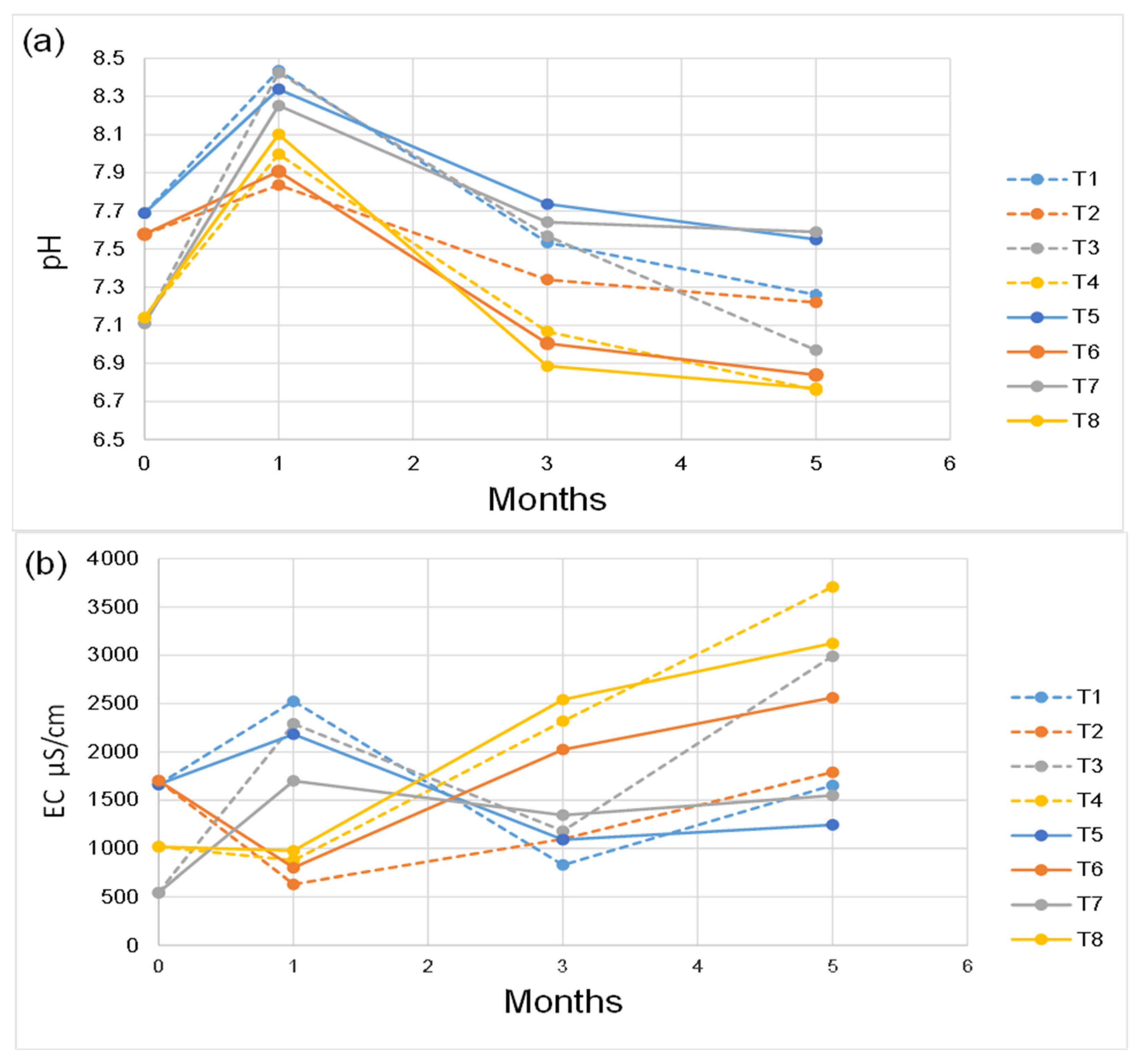
Values of pH increased during the first month and then declined toward near-neutral values by months 3 and 5. The strongest acidification occurred in T8, consistent with organic acid formation during active decomposition (Table S1). The pH at months three and five for both compost and vermicompost were relatively stable, with differences in pH not exceeding 0.27 in any treatment, except for T3, which had values of 7.57 ± 0.11 after three months and 6.97 ± 0.2 after five months of composting. There was a decrease in pH at the end compared with the initial values in all treatments except T7.

3.4.2. Changes in Electrical Conductivity (EC)

In composting treatments, there was an increase in EC by the end of the first month in T1 and T3. The increase in EC values could be caused by the release of mineral salts through the decomposition of organic substances. There was a 62% decrease in EC in T2 and a 14% decrease in T4; the values were T1: 2523 ± 93; T2: 632 ± 42; T3: 2290 ± 108 and T4: 877 ± 54 μS/cm (Figure 4b).
In vermicomposting treatments, there was an increase in EC after one month in T5 (by 31%) and T7 (by 211%), but there was a decrease in EC in T6 (by 53%) and T8 (by 4%) (Figure 4b, Table S2). After three months, there was an increase in EC in T2, T4, T6, and T8 of 74%, 164%, 153% and 178%, respectively, compared with one month. There was an increase in EC at the end compared to the initial values in all treatments except T1 and T5. The increases in EC were 5448, 327, 51, 184, and 207% at the end relative to the beginning in T2–T4, and T6–T8, respectively.

3.4.3. Changes in Available Macronutrients

The concentrations of available P increased in all treatments at one month, except for T2 and T6. The highest values were 3257 ± 46 and 3254 ± 69 mg/kg in T1 and T5, respectively (Table 3). These high P values could result from the large percentage of fish sludge, which contains high concentrations of soluble salts. The lowest concentrations were 108 ± 11 and 193 ± 44 mg/kg in T2 and T6, respectively. After three months, the P content was lower in all treatments except T2, T4 and T8, and the highest value was 1678 ± 170 mg/kg in T3. At the end of the experiment, the P concentrations in all treatments were lower, with values ranging from 83.7 ± 12 mg/kg in T2 to 981 ± 229 mg/kg in T5. In the T4, T8, T3 and T7 treatments, the available P after five months increased by 5.6, 8.1, 47.6 and 81.1 times respectively. Vermicomposting (T7 and T8) produced more available P than traditional composting (T3 and T4).
The concentrations of available K increased in all treatments after one month except T1, T2 and T6. The highest values were in T7 and T3, and the lowest value was 547 ± 98 mg/kg in T2. After three months, the K concentration increased in all treatments, and the highest values were in T7 and T3. The lowest value was 864 ± 66 mg/kg in T2. The high K concentrations in T3 and T7 could be caused by the higher total K content in lettuce (79,355 ± 1660 mg/kg). By the end of the experiment, the K concentrations had increased in all treatments compared with the initial levels, except T2 and T6, and the values ranged from 934 ± 75 mg/kg in T2 to 8635 ± 678 mg/kg in T7. The lower concentration in T2 and T6 could result from the smaller amounts of total K in egg boxes (438 ± 57 mg/kg). The decrease in available K concentrations in T2 and T6 can be attributed to the high C/N ratio (94.5 ± 13.26), which leads to a decrease in biological activity. The highest net increases in available K were in T7 (1242%) and T3 (877%). The decreases were 79% in T2 and 56% in T6 (Table 3).
The concentrations of available Mg increased in T3, T4, T7 and T8 at the end of the first month and increased again after three months (Table 3). Higher Mg concentrations in these treatments likely came from the high total Mg in the raw materials (2865 ± 77 mg/kg in fish sludge and 5058 ± 392 mg/kg in lettuce). There was a decrease in Mg concentration after one month in T1, T2, T5 and T6, then an increase in T1, T3 and T5 after three months (Table 3). The inclusion of a high percentage of egg boxes with low total Mg (1475 ± 51 mg/kg) in T2 and T6 may be the reason for the decrease of available Mg after the first month. At the end of the experiment, the available Mg concentrations were only increased in T3, T4, T7 and T8 compared to the initial values. The highest values were 1534 ± 74 mg/kg in T1 and 1524 ± 255 mg/kg in T3. The decreases in available Mg as percentages compared to the initial values were 10%, 69%, 41% and 54% in T1, T2, T5 and T6, respectively.
The concentrations of available S after one month increased in all treatments except T2 and T6. At three months, there was a further increase in the treatment groups, except for T3. The highest values were 2833 ± 205 and 2773 ± 83 mg/kg in T5 and T7, respectively (Table 3). At the end of the experiment, S concentrations had increased in all treatments compared to the initial values, except for T2 and T6. The low amounts in T2 and T6 could be due to the high proportion of egg boxes (75%) and the low concentration of total S in egg boxes (762 ± 20 mg/kg). The highest concentration was in T1 at 2737 ± 83 mg S/kg, and the greatest increases were 9 times and 7 times in T3 and T7.

3.4.4. Changes in Available Micronutrients

In the first and third months, available Fe concentrations increased gradually in the compost treatments, except for T2. At the third month, the biggest decrease relative to the initial value was in T6 (82%). The highest value at the end was 343 ± 3.7 mg/kg in T5. Overall, available Fe concentrations increased only in T3, T4, T7 and T8 (Table 4).
The available Cu concentrations in T1, T2, T5 and T6 decreased at the first and fifth months compared with the initial values, and the lowest concentrations were in T2: 4.9 ± 0.2 mg/kg at the first month and 6.9 ± 0.5 mg/kg at the end (Table 4). The highest Cu concentration was 25.5 ± 2 mg/kg in T3 at the end of month five. The increases at the end compared to the beginning were 5.0, 1.2, 3.6 and 1.0 times more in T3, T4, T7 and T8, respectively.
There was no clear trend for changes in Zn concentrations with time of FS composting, but at the end of month five, the lowest concentration was in T6 at 67.5 ± 7.7 mg/kg and the highest was in T3 at 436 ± 27 mg/kg. There were decreases in available Zn only in T2 (63%) and T6 (65%) relative to the initial values.
Available Mn concentrations in T1 decreased gradually in the first, third and fifth months, but other treatments showed different trends. Compared with the values in the third month, there were decreases in T1, T2, T5 and T6, but high concentrations in T5 (114 ± 5.5 mg/kg) and T1 (110 ± 5.4 mg/kg). The highest concentrations at the end were in T5, T7, T1 and T3 (Table 4). The high amounts of fish sludge (100% in T1 and T5 and 90% in T3 and T5) could be the reason for high final available Mn concentrations, because fish sludge contains the highest total Mn concentration (493 ± 14.8 mg/kg) (Table 4).
Table 4. Changes in available Fe, Cu, Zn and Mn (mg/kg of dry matter) during the composting (T1–T4) and vermicomposting (T5–T8) processes.
CompostingVermicomposting
TreatmentT1T2T3T4T5T6T7T8
Feavailm 0413 ± 28357 ± 8.841.6 ± 2.835.5 ± 3.1413 ± 28357 ± 8.841.6 ± 2.835.5 ± 3.1
m 1434 ± 1680 ± 8.6367 ± 8.586.4 ± 2.6449 ± 3079.5 ± 0.8395 ± 9.776.3 ± 2.7
m 3653 ± 4390 ± 5.1453 ± 7196.3 ± 4.1401 ± 11964.1 ± 4.5221 ± 3579.6 ± 4.3
m 5177 ± 2767.6 ± 2.5104 ± 8.366.6 ± 3.1343 ± 3.763 ± 2.8206 ± 3871.2 ± 5.5
Cuavailm 026.2 ± 1.125.5 ± 1.34.3 ± 0.75.2 ± 1.926.2 ± 1.125.5 ± 1.34.3 ± 0.75.2 ± 1.9
m 121 ± 0.64.9 ± 0.216.5 ± 2.46.2 ± 116.4 ± 1.56.3 ± 0.815.5 ± 1.26.03 ± 0.1
m 34.04 ± 0.68.4 ± 0.47.9 ± 2.112.5 ± 0.25.02 ± 0.78.98 ± 0.414 ± 3.212.6 ± 0.5
m 523.9 ± 3.86.9 ± 0.525.5 ± 2.111.4 ± 115.4 ± 0.77.9 ± 0.119.9 ± 1.210.5 ± 1
Znavailm 0214 ± 13194 ± 9.425.9 ± 2.225.8 ± 4.3214 ± 13194 ± 9.425.9 ± 2.225.8 ± 4.3
m 1119 ± 2.459.4 ± 3.3112 ± 7106 ± 0130 ± 0.4789.5 ± 3.8119 ± 2.890.1 ± 7.2
m 3138 ± 1072.3 ± 17186 ± 23163 ± 10179 ± 4982 ± 6.5245 ± 78143 ± 26
m 5435 ± 7471.9 ± 11436 ± 27133 ± 9.4227 ± 9467.5 ± 7.7363 ± 45122 ± 21
Mnavailm 0196 ± 5.1169 ± 5.720 ± 118 ± 1.9196 ± 5.1169 ± 5.720 ± 118 ± 1.9
m 1142 ± 2.324 ± 1.5133 ± 6.637 ± 4.9168 ± 2.940 ± 2.7145 ± 1.240 ± 3.8
m 3110 ± 5.432 ± 6.6108 ± 4.851 ± 3.8114 ± 5.531 ± 3.8108 ± 7.132 ± 1.5
m 5101 ± 6.619 ± 1.7101 ± 9.921 ± 2.9120 ± 10.321 ± 3.7114 ± 3.722 ± 3.1
Values are means ± SD, n = 3; m 0: at the beginning, m 1: after 1 month, m 3: after 3 months, m 5: after 5 months; T1: FS; T2: FS + EB; T3: FS + L; T4: FS + EB + L; T5: FS + W; T6: FS + EB + W; T7: FS + L + W; T8: FS + EB + L + W; FS: fish sludge + eggshells; EB: egg boxes; L: lettuce; W: with Eisenia andrei worms.

3.4.5. Changes in the Enzymatic Activity Levels

Enzymatic activities provided an integrated view of microbial functioning and organic matter transformation and allowed a more detailed interpretation of compost maturity and nutrient availability across treatments. The temporal evolution of enzymatic activities closely mirrored changes in available nutrients, volatile solids (VS), and C/N ratios, confirming their suitability as early indicators of process efficiency and stabilization.
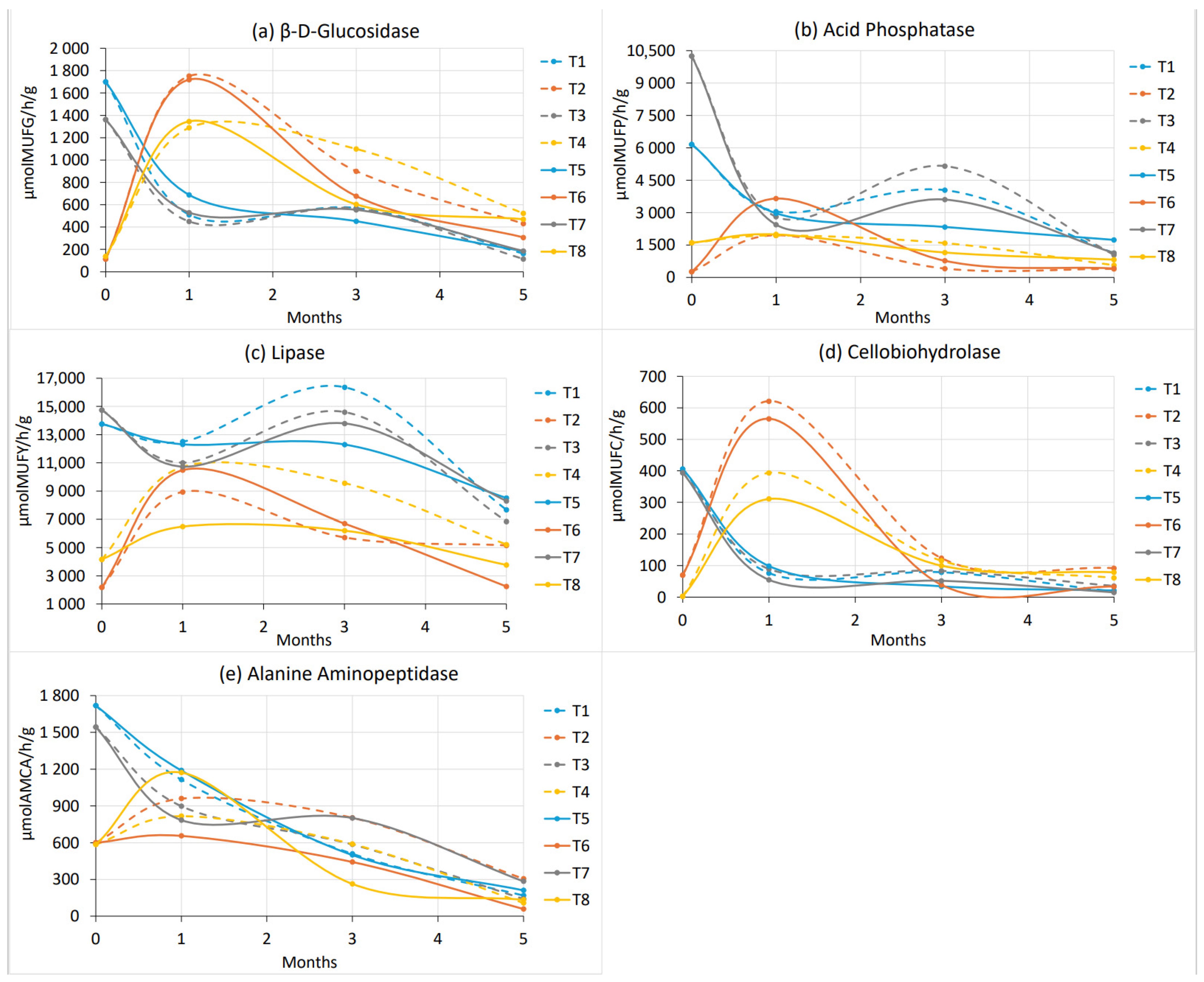
Both β-D-glucosidase and cellobiohydrolase showed a sharp increase during the first month (up to 1800 µmol MUFG/h/g and 600 µmol MUFC/h/g, respectively) (Figure 5a,d), followed by a steady decline in treatments T2, T4, T6 and T8. This pattern indicates an early decomposition of cellulose and hemicellulose from the fibrous egg boxes and lettuce residues. Treatments containing both fibrous and easily degradable components (T4 and T8) showed the highest glucosidase activities, confirming that an improved C:N balance supports microbial growth and carbon degradation.
The subsequent decline coincided with the marked reduction in volatile solids (Figure 6) and decreasing C/N ratios (Table 5), indicating progressive stabilization and re-duced availability of labile carbon substrates. By contrast, T1 and T5 (100% FS + eggshell) exhibited lower enzymatic activity, likely due to oxygen limitation and the inhibitory effect of ammonia and sulfur compounds released from the protein-rich sludge. These conditions limited microbial growth despite high nutrient content, explaining the slower stabilization observed in C/N trends in these treatments. Acid phosphatase activity peaked at the beginning (up to 9000 µmol MUFP/h/g; Figure 5b), particularly in T3 and T7 (90% FS + lettuce, 9:1), and gradually decreased thereafter. This early maximum corresponded to the sharp increase in available P after 1 month (Table 3), confirming intensive mineralization of organically bound P derived from FS. The subsequent decrease coincides with the generation of available P via incorporation into more stable organomineral complexes.
The overall decline in phosphatase activity in the later phases of our experiment aligns with the reduced content of available P in the final mixtures, indicating the maturity of the compost. Thus, phosphatase activity effectively reflected both P bioavailability and the transition from the active to the mature phase. Lipase activity was particularly high in treatments rich in FS (T1 and T5), reaching as high as 15,000 µmol MUFY/h/g (T1) during the first three months and slightly decreasing afterwards (Figure 5c). These variants contained a high proportion of protein and lipid compounds derived from FS, which sustained lipase-producing microbial populations over a longer period. The persistence of high lipase activity in these treatments paralleled elevated concentrations of available S and K, supporting the interpretation that lipid and protein mineralization remained active even when cellulose degradation slowed. Similarly high lipase activities in T3 and T7 indicated that lettuce addition did not dilute this effect but rather supported microbial metabolism.
Alanine aminopeptidase activity declined gradually across all treatments, from almost 1800 µmol AMCA/h/g at the beginning to < 300 µmol AMCA/h/g by month 5. This steady decrease indicated the progressive mineralization of proteins and stabilization of N compounds. The sharpest declines occurred in T1 and T5 (100% fish sludge + eggshells), likely due to the rapid exhaustion of labile N sources, whereas treatment with egg boxes and lettuce (T4 and T8) showed a slower decrease, indicating sustained microbial activity supported by balanced carbon availability and improved aeration.
Across all enzymes, the highest activities occurred during the first month, except for lipase in T1, marking the active phase of decomposition, followed by a decline toward stabilization. This enzymatic succession clearly aligned with reductions in volatile solids, stabilization of pH and EC, and convergence of C/N ratios, confirming that enzymatic activity can provide an early and sensitive signal of compost maturity. The order of enzymatic activity (lipase > acid phosphatase > β-D-glucosidase > cellobiohydrolase > aminopeptidase) indicates dominant hydrolysis of lipid and phosphorus-rich compounds from fish sludge, in agreement with the observed increases in available K and S during the same period. T4 and particularly T8 showed the best balanced enzymatic profiles, characterized by high early activity and a clear decline during maturation. This pattern corresponded with optimal nutrient availability, acceptable heavy metal concentrations, and advanced stabilization indicators, supporting the selection of T8 as supporting the most efficient activity and highest yield of mature product.

3.4.6. Changes in Volatile Solids (VS)

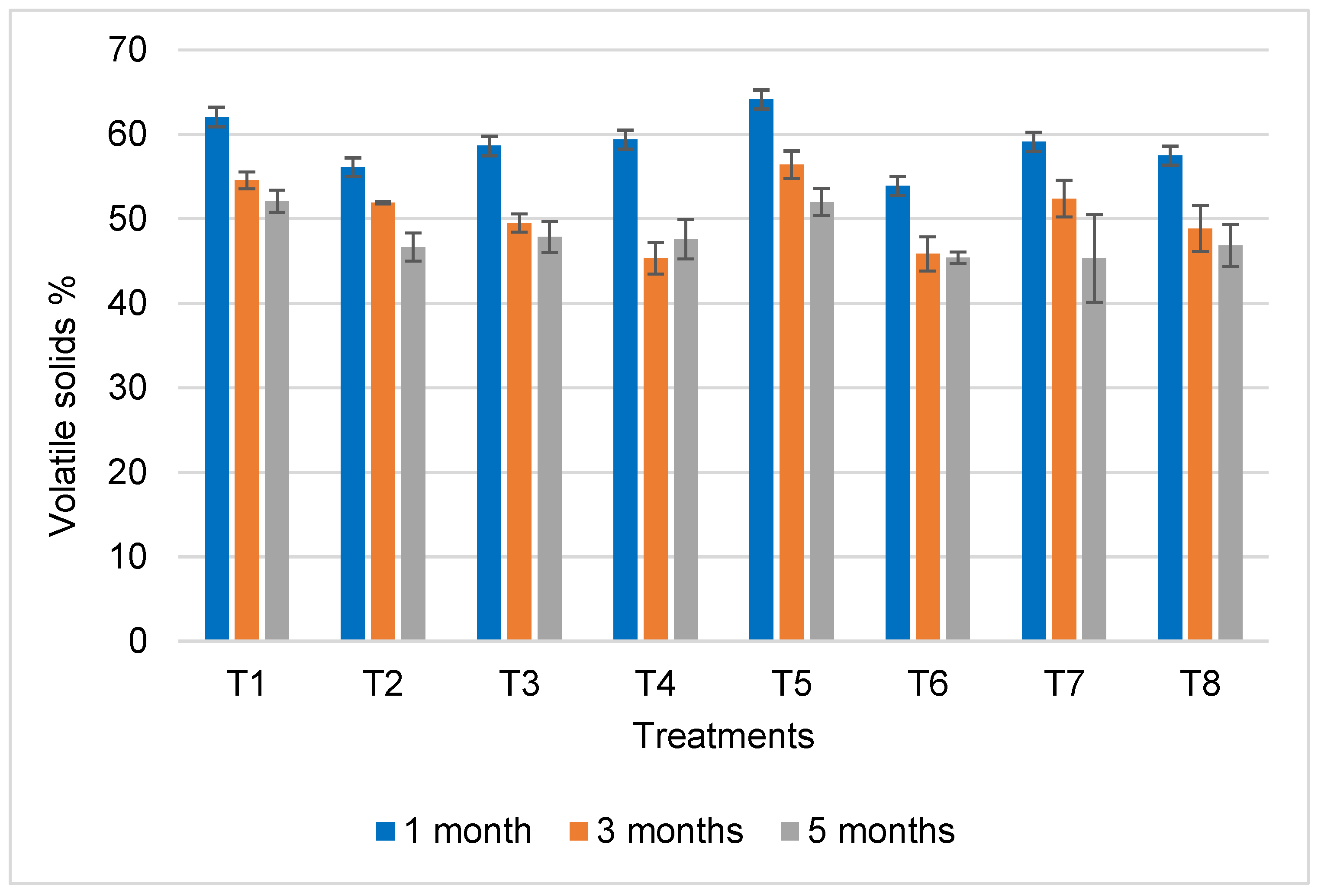
The proportion of VS indicates the progress of mineralization of organic materials (Figure 6). There was a gradual decrease in the percentage of VS over time in all treatments except for T4. The highest decrease in the third month comparing the first month was 23.7% in T4. The highest values of VS were in T1 and T5: 62.1 ± 1.2% and 64.2 ± 0.7% after 1 month, and 52.1 ± 1.3% and 52 ± 1.6% after 5 months. The decreases between the third and fifth months were 4.5, 10.1, 3.4, 7.9, 0.97, 13.5 and 4.1% in T1, T2, T3, T5, T6, T7 and T8, respectively. These decreases were correlated with the stability of the final product.

3.4.7. C/N Ratio

The C/N ratio reflects the balance between total carbon and nitrogen, serving as a key indicator of compost and vermicompost maturity. The treatments that contained high amounts of fish sludge (90% or 100%); T1, T3, T5 and T7 showed increases in C/N during the five months, and the final values ranged from 8.5 to 9.1. By the end of the process, the highest C/N ratio was observed in T2 (16.7± 0.5), reflecting the maturity and stability of the final compost and vermicompost product (Table 5).
Table 5. Changes in C/N ratio during composting and vermicomposting.
CompostingVermicomposting
TreatmentT1T2T3T4T5T6T7T8
C/Nm 07.2 ± 0.394.5 ± 13.36.9 ± 0.0173.6 ± 18.77.2 ± 0.394.5 ± 13.36.9 ± 0.0173.6 ± 18.7
m 17.9 ± 0.126.3 ± 3.58.1 ± 0.0616.2 ± 3.28.2 ± 0.116.4 ± 0.48.1 ± 0.114.1 ± 1.2
m 38.3 ± 0.120.2 ± 3.48.7 ± 0.312.5 ± 0.88.4 ± 0.115.3 ± 1.58.7 ± 0.412.2 ± 0.5
m 58.8 ± 0.216.7 ± 0.58.5 ± 0.310.7 ± 0.58.9 ± 0.214.6 ± 1.19.1 ± 0.311.3 ± 0.5
Values are means ± SD. T1: FS, T2: FS + EB, T3: FS + L, T4: FS + EB + L, T5: FS + W, T6: FS + EB + W, T7: FS + L + W, T8: FS + EB + L + W; FS: fish sludge + eggshells, EB: egg boxes, L: lettuce, W: with Eisenia andrei worms.

3.5. Comparison Between the Final Products of Composting and Vermicomposting

A separate analysis of quality parameters in composting vs. vermicomposting products from all mixtures was conducted. Analysis of variance (ANOVA) revealed a highly significant difference between the overall mean performance of composting and vermicomposting across all mixtures;The pH was significantly higher in the vermicompost compared to the compost. F values for effects on available P, K, Fe, Mn were 60.21, 116.4, 55.76, and 7.9 respectively (P < 0.05). Vermicomposting resulted in significantly higher available P, K, Fe and Mn compared to composting (Table 6). The percentage of available P, K, Fe, and Mn in vermicompost increased by 38%, 50%, 64%, and 14%, respectively, relative to compost. It is important to note, however, that while this result establishes an overall trend, the significant interaction confirms that the magnitude and even the direction of this effect are dependent on mixture composition. Therefore, the individual means derived from the interaction analysis between the processes and the mixtures must be considered for practical application.
In terms of total Zn, Cu, Ni, and Pb, however, the concentrations were higher in the final vermicompost compared to the final compost, but there were no significant differences between composting and vermicomposting. The order of the total PTEs according to their concentrations was: Zn > Cu > Cr > Ni >As >Pb (Table 6).

3.6. Determination of Optimal Treatment Based on Levels of Final Products

T5 showed the highest content of available P, and there was no significant difference between T5 and T7. T1 showed the highest content of available Mg and S, and there was no significant difference between T1 and T3 (Table 7). The highest concentration of available K was in T7.
The conventional composting treatments, T1 and T3, resulted in significantly higher concentrations of available Mg and S compared with the vermicomposting treatments, T5 and T7, whereas the opposite was true for P and K. The vermicomposting conditions of T5 and T7 produced significantly higher concentrations of available P and K compared with the traditional composting treatments, T1 and T3. Concentrations of available P and K in T7 were 908 mg P/kg and 8634 mg K/kg. The highest values of FeA and MnA were in T5, with 342.67 mg Fe/kg and 120.33 mg Mn/kg (Table 7). There was no significant difference between T5 and T7 in MnA concentration.
For the design of a safe sludge composting system, it is crucial that the total amount of PTEs present be determined, as they can be transformed into bioavailable forms that can be toxic to plants and animals. Zn and Cu are essential micronutrients, but they are also classed as heavy metal PTEs with a risk of toxicity at higher levels. The limit for total Cu is 300 mg/kg [27], but threshold values above 110 mg Cu/kg must be declared. The Cu levels for all treatments were below the threshold at the end of the experiment, but the lowest ones were T2 (63.96 ± 4.6 mg/kg), T4 (68.8 ± 2.9 mg/kg), T6 (74.12 ± 4.05 mg/kg) and T8 (76.6 ± 4.6 mg/kg). The toxicity threshold for total Zn is 600 mg/kg [27]; however, measured values above 400 mg Zn/kg DM must be declared. Among our treatments, only the final Zn values of T2, T4, T6 and T8 had acceptable concentrations: 240.7 ± 18; 423.0 ± 27; 264.2 ± 21 and 360.0 ± 48 mg/kg, respectively; the T4 concentration would have to be declared, however, because it is > 400 mg/kg. The other treatments exceeded the limit. The limit values for total Cr, Ni and Pb are 60; 40 and 130 mg/kg, respectively [27]. Table 7 shows that the total Cr was under the limit in all treatments, while the total Ni values were safe only in treatments T2, T4, T6 and T8 with 10.5 ± 0.5; 15.9 ± 1.4; 12.2 ± 1.7 and 15.5 ± 0.9 mg/kg, respectively. Total Pb was safe in the final product of all treatments. Arsenic (As) values were the lowest in T2 and T6 (3.64 ± 0.2 mg/kg and 3.1 ± 0.6 mg/kg), and there were no significant differences between these treatments and T8.
A comparison among the three treatments, T2, T6 and T8, in terms of available nutrients (P, K, Mg, S, Fe and Mn), showed that the best treatment was T8. T8 had the highest available concentrations of K, Mg, Fe and Mn, but the difference between T8 and T6 in available S, Fe, and Mn was not significant. T2, T6, and T8 were all deemed safe compost treatments; however, T8 was able to process a higher proportion of fish sludge (40%), making it more efficient in converting aquaculture waste into a usable product. According to the 2019 update of EU thresholds, there were slightly different limits. Updated thresholds were 800 mg/kg for Zn, 50 mg/kg for Ni, and 120 mg/kg for Pb [28]. This means that all final products were safe with respect to total Ni.

4. Discussion

Although a wide range of parameters was evaluated, the final assessment of treatments was based on a limited set of decisive indicators, namely compost maturity (C/N ratio and volatile solids reduction), nutrient availability (P, K, Mg), and enzyme activity.

4.1. Biomass, Abundance and Nutrient Content of Earthworms

The results showed that the biomass and numbers of earthworms were the lowest in the third month in T5 and T7 possibly due to the high percentage of fish sludge (100% and 90%, respectively), which contains the highest total sulfur level (6898 ± 285 mg/kg). T5 and T7 contained the highest concentrations of available S, 2833 ± 205 mg/kg and 2773 ± 83 mg/kg, respectively. This is consistent with Duddigan et al. [29], who reported that the total number of adult and juvenile earthworms in podzolic soil was significantly lower after elemental sulfur treatment compared to controls without treatment. The findings of this study regarding total Cu concentrations in fish sludge provide a potential explanation for the observed reduction in earthworm population and biomass in T5 and T7. These results align with the study by Clasen et al. [30], who demonstrated that increasing Cu concentrations resulted in a decrease in the number of E. andrei cocoons at 56 days. However, earthworms subjected to Cu levels up to 140 mg/kg have shown an ability to increase biomass production after 21 days. The pH value of 7.74 ± 0.11 in T5 and 7.64 ± 0.07 in T7 at the end of three months appeared to be a limiting factor. This observation agreed with the results reported by Jicong et al. [31], who showed that the number of surviving Eisenia fetida earthworms was lower when the pH was between 7.2 and 8.6 compared with pH 6.5, in the vermicomposting of municipal solid waste. By the end of the experiment, earthworms showed an accumulation of total P, Mg and S when compared with baseline values. Zn concentrations in the present work mirrored the 103–141 μg/g range recorded by Alcaraz and Gestal [32] for Eisenia andrei. In all treatments, final Ni levels within the earthworms increased from the start of the study, confirming their ability to accumulate this metal. These findings are supported by Rusanescu et al. [33], who noted that earthworms and microorganisms together absorb toxic heavy metals via feeding and skin contact. Final total Cr concentrations in the earthworms decreased relative to the baseline, suggesting that Eisenia andrei effectively eliminated Cr by the end of the study. This finding aligns with the research of Koski et al. [34], who demonstrated that in medium- to highly-contaminated soils, E. andrei exhibited rapid uptake kinetics of Cr, but also high elimination rates. The increase in As concentrations in earthworms at the end of the experiment, compared to the baseline, confirmed the bioaccumulation capacity of Eisenia andrei for this element, similar to the findings of Kouba et al. [14].

4.2. Chemical Changes During the Composting and Vermicomposting Processes

The pH levels at months three and five for both compost and vermicompost were relatively stable. The stability could be a result of the slow reactions and the buffering effects of humus [35]. In addition; the calcium carbonate (CaCO3) content within the eggshells may serve as a critical agent for maintaining pH stability and providing buffering capacity. There was a decrease in pH at the end compared with the initial values in all treatments except T7. This decrease could result from the degradation of organic matter, leading to the release of organic acids and CO2 [36,37]. The pH increase observed in T7 presents a different dynamic, possibly driven by the growth in earthworm biomass and population by the end of the experiment. This observation is consistent with the findings of Elissen et al. [38], who reported significant increases in pH in earthworm casts compared to bulk soil, which may explain the increase in pH.
The decrease in EC observed in T2, T4, T6 and T8 after one month may be attributed to the lower percentages of fish sludge available for microbial activity and the higher proportion of egg boxes. A low EC may result from the decrease in ammonia and other ions due to rapid proliferation of the aerobic microbial population, volatilization of ammonia, or precipitation of mineral salts. Our results are similar to those of Karak et al. [39], who composted rice straw, wheat straw, potato plant trimmings, and mustard stover with fishpond bottom sediment. Except for treatments T1 and T5, final EC levels increased across all groups relative to their initial values. This trend, specifically observed in T2, T3, T4, T6, T7, and T8, may be attributed to the reduction in pH, which enhances the solubility of cationic and anionic salts [40].
Consistent with Lanno et al. [41], our one-month results confirmed that fish waste compost has a high proportion of labile P, ensuring good biological availability. Notably, this increase in phosphorus availability was observed across all experimental groups, except for treatments T2 and T6. The low P concentration in T2 after one month aligns with Dróżdż et al. [42]; however, we observed a 95% decrease, substantially greater than their 16.8% reduction on day 28 of fish waste treatment with wheat straw, fresh grass, and cardboard. Comparison between initial and final available potassium (K) concentrations revealed a notable decline in treatments T2 and T6. This trend is attributed to the high C/N ratio, which restricts microbial activity and consequently slows the decomposition rate [43]. The highest concentration of available K was observed in T7 (90% fish sludge and 10% lettuce), likely due to the high initial K content in these materials. This observation is strongly supported by Moustafa et al. [44], who demonstrated that incorporating plant wastes as raw materials for vermicomposting enhanced K content. Compared to the baseline levels, the concentrations of available Cu in treatments T1, T2, T5, and T6 exhibited a decline during the first and fifth months, similar to Fan et al. [45], who noted a reduction in Cu bioavailability following the composting of chicken manure with wheat bran and bagasse.
Overall, enzymatic activity acted as a mechanistic indicator linking substrate composition with nutrient dynamics and compost maturity. Treatments with balanced carbon and nitrogen inputs (T4 and especially T8) showed high early enzymatic activity followed by a clear decline, reflecting efficient substrate utilization and timely stabilization. In contrast, sludge-dominated treatments (T1 and T5) exhibited prolonged lipase activity but lower cellulolytic enzyme responses, indicating sustained mineralization of proteins and lipids but delayed structural carbon turnover. This imbalance was mirrored by slower reductions in volatile solids and less pronounced improvements in maturity indicators. The synchronized decline in enzyme activities, volatile solids, and C/N ratios, therefore, represents a robust signature of compost maturation, with T8 showing the most coherent and complete transition from active decomposition to a stable product. Both β-D-glucosidase and cellobiohydrolase showed a sharp increase during the first month. This aligns with the findings of Hanc et al. [46], who observed the highest β-D-glucosidase and cellobiohydrolase activity during the first month of composting sewage sludge with straw pellets, followed by a subsequent decline as the substrate stabilized. Similarly, Enebe and Erasmus [47] described β-glucosidase as an inducible enzyme with peak activity during the active phase of vermicomposting, followed by a decline during the maturation phase.
Acid phosphatase activity peaked at the beginning and then gradually decreased. Similar behavior was also reported by Dume et al. [48], who noted that phosphatase peaked during the early stage of feather residue vermicomposting. Lipase activity peaked during the initial three months in treatments with high fish sludge content (T1 and T5), followed by a minor reduction. These results are consistent with the findings of Dume et al. [48], who observed a progressive decrease in lipase activity during the vermicomposting of hydrolyzed feather residues. Similarly, Hanc et al. [46] reported a comparable decline when vermicomposting sludge combined with straw pellets. Alanine aminopeptidase activity exhibited a gradual decline across all treatments by the fifth month. This trend aligns with the findings of Dume et al. [48], who observed that aminopeptidase activities peaked mid-process (at 60 days) before diminishing as the vermicompost matured. Similarly, Enebe and Erasmus [47] confirmed that these enzymes were most active during the intensive degradation phase, with their activity decreasing as substrate nitrogen was integrated into stable humic fractions.
Volatile solids are a critical indicator of the biological stabilization of composted sludge [49]. In this study, all treatments except T4 showed a gradual decrease in the percentage of VS over time. In T4, bacterial activity during the first month was associated with the consumption of lettuce residues (rich in water and simple carbohydrates) and fish sludge (high in protein and nitrogen), leading to an initial decrease in VS. Subsequently, a rise in VS was observed, which can be attributed to the presence of egg box cardboard. Since these materials contain cellulose and lignin, which are resistant to rapid degradation, there is an initial lag period before the specialized fungi and bacteria can begin the breakdown of the cardboard fiber polymers into smaller molecules [50]. The marked decrease in volatile solids (VS) in T4 after 3 months (23.7%) can be attributed to increased porosity and aeration provided by the physical structure of the egg boxes. This enhanced oxygen availability stimulated microbial activity, accelerating the mineralization of easily degradable organic matter even before the bulking agent itself began to decompose.
Initial high C/N levels in T2, T4, T6, and T8 pointed to the presence of unutilized complex carbon content at the early stages of the process. The decrease in C/N in these treatments after five months indicated the breakdown and stabilization of organic matter achieved during composting [51]. Higher carbon and nitrogen contents require more time to complete the maturation phase [52]. In treatments T1, T3, T5, and T7 (100% and 90% FS) the C/N ratios after one month were between 7.9 ± 0.1 and 8.2 ± 0.1. These values align with those reported by Wiater [53], who observed a C/N ratio of 7.9 following five weeks of sludge vermicomposting. By the conclusion of the study, C/N ratios ranged from 8.5 ± 0.3 to 16.7 ± 0.5. These findings are consistent with reported values of 13.3 for catfish sludge and water hyacinth compost, and comparable to the 7.7 reported for the corresponding vermicompost [54].

4.3. Comparison Between the Final Products of Composting and Vermicomposting

The higher pH observed in the final vermicomposts compared with the final composts may be attributed to the elevated pH of the earthworm castings [55]. Vermicomposting significantly increased the average concentrations of available P, K, Fe, and Mn in comparison to traditional composting because organic waste is oxidized through the combined activity of microorganisms and earthworms, which increases the surface area available for microbial activity and further decomposition of organic matter [56]. Our findings were consistent with the results of Abinaya et al. [57], who showed that vermicomposts produced from a mixture of different organic wastes and cow dung had more available P and K than conventional compost. In line with Chaulagain et al. [58], our research showed higher available K levels in vermicomposted materials. Earthworm activity enhances microbial mineralization of plant metabolites [59], resulting in higher available K compared to traditional composting methods. High electrical conductivity (EC), often associated with increased salinity, can influence nutrient availability through ion competition [60]. Consequently, the elevated EC in the final compost (2695 ± 1162 uS/cm) likely reflects the significantly higher Mg concentrations observed (1150 ± 448 mg/kg in compost vs. 931 ± 137 mg/kg in vermicompost). There were no significant differences between composting and vermicomposting in terms of total Zn, Cu, Ni, and Pb. The levels of potentially toxic elements remained similar in both composts and vermicomposts [61]. The order of the total PTEs according to their concentrations in our experiment was as follows: Zn > Cu > Cr > Ni > As > Pb, which agrees with the results of Rekasi et al., except for Pb (which was ≈ Ni) and for As (which was less than Pb) [61]. The total As in all treatments was below the limit mentioned by Amlinger et al. [62]. The low proportion of fish sludge (25% and 40%) in T2, T4, T6 and T8 resulted in low total As in the final products of these treatments. The values ranged between 3.1 ± 0.6 mg As/kg and 5.55 ± 0.6 mg As/kg.

5. Conclusions

This study examined the effectiveness of composting and vermicomposting of aquaculture fish sludge amended with different proportions of carbonaceous waste materials over five months. We monitored pH and electrical conductivity and evaluated changes in available macro- and micro-nutrients as well as the effect of earthworms. The monitoring of hydrolytic enzymes confirmed that the most intensive biochemical activity occurred during the first two months, supporting the nutrient transformation dynamics observed in the mixtures. The composts and vermicomposts were compared based on their content of available nutrients and total PTEs, and a mixture of fish sludge, egg boxes, lettuce (4:5:1) with eggshells and earthworms was found to be the best combination for ensuring a safe and effective product within five months. T8 was the best in terms of available nutrients (P, K, Mg, S, Fe and Mn), and safe final concentrations of PTEs (Cu, Zn, Cr, Ni, Pb and As). T2 and T6 were also found to be safe and effective for use in agriculture. These findings suggest that vermicomposting is a sustainable strategy for recycling aquaculture waste into high-quality organic fertilizer. The main limitations of this study are that it was conducted under controlled laboratory conditions using fish sludge from a single aquaculture system and one earthworm species. Practical applications include the integration of this system into large-scale fish farms to reduce environmental impact and produce a useful product. Future research should focus on testing the long-term effects of these vermicomposts on different crops, soils and growth media.

Supplementary Materials

The following supporting information can be downloaded at: https://www.mdpi.com/article/10.3390/agronomy16040473/s1, Table S1: Changes in pH over time for all treatments; Table S2: Changes in EC over time for all treatments.

Author Contributions

Conceptualization, A.H.; methodology, A.H.; formal analysis, M.H. and T.H.; investigation, M.H. and P.M.; resources, A.H.; data curation, M.H. and P.M.; writing—original draft preparation, M.H.; writing—review and editing, M.H., A.H. and T.H.; visualization, M.H.; supervision, A.H.; project administration, A.H.; funding acquisition, A.H. All authors have read and agreed to the published version of the manuscript.

Funding

This research was funded by the Ministry of Agriculture of the Czech Republic under the NAZV project number QK21010207.

Data Availability Statement

The original contributions presented in this study are included in the article/Supplementary Material. Further inquiries can be directed to the corresponding author.

Acknowledgments

The authors would like to thank Gary Bentley, PhD for professionally reviewing and editing the English text.

Conflicts of Interest

The authors declare no conflicts of interest. The funders had no role in the design of the study; in the collection, analyses, or interpretation of data; in the writing of the manuscript; or in the decision to publish the results.

References

  1. Zhang, J.; Akyol, C.; Meers, E. Nutrient recovery and recycling from fishery waste and by-products. Review. J. Environ. Manag. 2023, 348, 119266. [Google Scholar] [CrossRef]
  2. Zhang, H.; Gao, Y.; Liu, J.; Lina, Z.; Lee, C.T.; Hashim, H.; Wu, W.-M.; Li, C. Recovery of Nutrients from Fish Sludge as Liquid Fertilizer to Enhance Sustainability of Aquaponics: A Review. Chem. Eng. Trans. 2021, 83, 55–60. [Google Scholar] [CrossRef]
  3. Nordvarg, L. Predictive models and eutrophication effects of fish farms. In Comprehensive Summaries of Uppsala Dissertations from the Faculty of Science and Technology 602; Acta Universitatis Upsaliensis: Uppsala, Sweden, 2001; 44p. [Google Scholar]
  4. Madhusanki, F.; Epa, U. Use of Aquaculture Pond Sludge and Fish Waste to Produce Manure Worm, Eisenia fetida (Lumbricidae), Vermiwash. J. Fish. Environ. 2023, 47, 126–137. [Google Scholar]
  5. Salazar, F.J.; Saldana, R.C. Characterization of manures from fish cage farming in Chile. Bioresour. Technol. 2007, 98, 3322–3327. [Google Scholar] [CrossRef]
  6. Campo, L.M.; Ibarra, P.; Gutierrez, X.; Takle, H. Utilization of Sludge from Recirculation aquaculture Systems; Report; Nofima Marin: Tromsø, Norway, 2010; Available online: https://hdl.handle.net/11250/2559653 (accessed on 3 January 2026).
  7. Habib, S.S.; Arshad, M.; Majeed, S.; Ullah, M.; Ujan, J.A.; Naz, S.; Mohany, M. Sludge removal frequency influences heavy metal accumulation, water quality, and growth in Nile tilapia (Oreochromis niloticus) biofloc systems. Water Environ Res. 2025, 97, e70081. [Google Scholar] [CrossRef]
  8. Guyapale, R.M.; Dionela, C.; Huervana, F. Comparison of the nutrient composition of sludge under aerobic and anaerobic mineralization from African catfish, Clarias gariepinus (Actinopterygii: Siluriformes: Clariidae), reared in an intensive recirculating aquaculture system. Acta Ichthyol. Piscat. 2024, 54, 275–282. [Google Scholar] [CrossRef]
  9. Ogello, E.O.; Outa, N.O.; Obiero, K.O.; Kyule, D.N.; Munguti, J.M. The prospects of biofloc technology (BFT) for sustainable aquaculture development. Sci. Afr. 2021, 14, e01053. [Google Scholar] [CrossRef]
  10. Ejileugha, C.; Onyegbule, U.O.; Osuoha, J.O. Use of Additives in Composting Promotes Passivation and Reduction in Bioavailability of Heavy Metals (HMs) in Compost. Rev. Environ. Contam. Toxicol. 2024, 262, 1–28. [Google Scholar] [CrossRef]
  11. Kumar, S.; Sharma, V.; Bhoyar, R.V.; Bhattacharyya, J.K.; Chakrabarti, T. Effect of Heavy Metals on Earthworm Activities During Vermicomposting of Municipal Solid Waste. Water Environ Res. 2008, 80, 154–161. [Google Scholar] [CrossRef]
  12. Amouei, A.; Yousefi, Z.; Khosrafi, T. Comparison of vermicompost characteristics produced from sewage sludge of wood and paper industry and household solid wastes. J. Environ. Health Sci. Eng. 2017, 15, 1–6. [Google Scholar] [CrossRef] [PubMed]
  13. Macktoobian, M. Life Cycle Assessment of Vermicomposting Process. Master’s Thesis, University of South-Eastern Norway, Notodden, Norway, 2024. [Google Scholar]
  14. Kouba, A.; Lunda, R.; Hlavac, D.; Kuklina, I.; Hamackova, J.; Randak, T.; Kozak, P.; Koubova, A.; Buri, M. Vermicomposting of sludge from recirculating aquaculture system using Eisenia andrei: Technological feasibility and quality assessment of end-products. J. Clean. Prod. 2018, 177, 665–673. [Google Scholar] [CrossRef]
  15. Adhikary, S. Vermicompost, the story of organic gold: A review. Agric. Sci. 2012, 3, 905–917. [Google Scholar] [CrossRef]
  16. Srikanth, M.; Rao, G.R.; Lakshmi, G.V.; Rani, I.U. A Study on Composting of Aquaculture Sludge from Patapalem (SPSR Nellore) and its Suitability to different Crops. Andhra Agric. J. 2019, 66, 453–459. Available online: https://aaj.net.in/wp-content/uploads/2023/08/663-006.pdf (accessed on 3 January 2026).
  17. Belmeskine, H.; Dilmi, N.; Tsagadirts, Z. Aquacultural sludge recovery and vermicomposting for soil amendment: A useful strategy for sustainable agriculture. Int. J. Recycl. Org. Waste Agric. 2023, 12, 111–121. [Google Scholar] [CrossRef]
  18. Birch, S.; Bell, R.; Nair, J.; Phung, C.V. Feasibility of vermicomposting aquaculture solid waste on the Mekong Delta, Vietnam: A pilot study. In Dynamic Soil, Dynamic Plant; Global Science Books: Hong Kong, China, 2010; Volume 4, pp. 127–134. [Google Scholar]
  19. Borkute, P.A.; Hedaoo, D.M.N. Study on composting of vegetable waste. Int. J. Emerg. Technol. Innov. Res. 2022, 9, 31–36. Available online: https://www.jetir.org/papers/JETIR2211120.pdf (accessed on 10 January 2026).
  20. Zaini, M.S.; Syafi, W.S. Recycling of Waste Tea Leaves via Vermicomposting Process and the Effect on Water Spinach Growth. Kem. Ind. 2021, 70, 387−392. [Google Scholar] [CrossRef]
  21. Misra, R.V.; Roy, R.N.; Hiraoka, H. On-Farm Composting Methods. FAO. FAO Land and Water Discussion Papers. 2003. Available online: https://www.fao.org/4/y5104e/y5104e00.htm (accessed on 5 January 2026).
  22. Sindhu, M.; Annapoorani, C. Efficacy of reproduction and vermicomposting ability of eggshell powder using Eudrilus eugeniae. Int. J. Entomol. Res. 2021, 6, 273–277. Available online: www.entomologyjournals.com (accessed on 5 January 2026).
  23. BSI EN 15933:2012; Sludge, Treated Biowaste and Soil—Determination of pH. British Standards Institution: London, UK, 2012. Available online: https://lakeohridniva.wordpress.com/wp-content/uploads/2015/07/bs-en-15933-2012sludge-treated-biowaste-and.pdf (accessed on 3 January 2026).
  24. Hanc, A.; Castkova, T.; Kuzel, S.; Cajthaml, T. Dynamics of a vertical- ow windrow vermicomposting system. Waste Manag. Res. 2017, 11, 1121–1128. [Google Scholar] [CrossRef]
  25. BS EN 13651:2001; Soil Improvers and Growing Media. Extraction of Calcium Chloride/DTPA (CAT) Soluble Elements. British Standards Institution: London, UK, 2001. Available online: https://knowledge.bsigroup.com/products/soil-improvers-and-growing-media-extraction-of-calcium-chloride-dtpa-cat-soluble-elements (accessed on 12 January 2026).
  26. Hrebeckova, T.; Wiesnerova, L.; Hanc, A. Changes of enzymatic activity during a large-scale vermicomposting process with continuous feeding. J. Clean. Prod. 2019, 239, 118127. [Google Scholar] [CrossRef]
  27. European Compost Network ECN e.V. European Quality Assurance Scheme for Compost and Digestate. 2014. Available online: www.compostnetwork.info (accessed on 10 January 2026).
  28. Official Journal of the European Union. Regulation (EU) 2019/1009 of the European Parliament and of the Council of 5 June 2019. Laying Down Rules on the Making Available on the Market of EU Fertilising Products and Amending Regulations (EC) No 1069/2009 and (EC) No 1107/2009 and Repealing Regulation (EC) No 2003/2003; Official Journal of the European Union: Luxembourg, 2019. [Google Scholar]
  29. Duddigan, S.; Fraser, T.; Green, I.; Diaz, A.; Sizmur, T.; Tibbett, M. Plant, soil and faunal responses to a contrived pH gradient. Plant Soil 2021, 462, 505–524. [Google Scholar] [CrossRef]
  30. Clasen, B.; Ferreira, T.; Santana, N.A.; Portela, V.O.; Loro, V.L.; Murussi, C.R.; Leitemperger, J.; Tiecher, T.L.; Domínguez, J.; Jacques, R.J.S.; et al. Eisenia andrei Behavioral and Antioxidative Responses to Excess of Copper in the Soil. Water Air Soil Pollut. 2021, 232, 443. [Google Scholar] [CrossRef]
  31. Jicong, H.; Yanyun, Q.; Guangqing, L.; Dong, R. The Influence of Temperature, pH and C/N Ratio on the Growth and Survival of Earthworms in Municipal Solid Waste. Agric. Eng. Int. E J. CIGR 2005, VII, 1–6. Available online: https://hdl.handle.net/1813/10443 (accessed on 5 January 2026).
  32. Alcaraz, M.N.G.; Gestel, C.A.M. Metal/metalloid (As, Cd and Zn) bioaccumulation in the earthworm Eisenia andrei under different scenarios of climate change. Environ. Pollut. 2016, 215, 178–186. [Google Scholar] [CrossRef]
  33. Rusanescu, C.O.; Rusanescu, M.; Voicu, G.; Paraschiv, G.; Biris, S.S.; Popescu, I.N. The Recovery of Vermicompost Sewage Sludge in Agriculture. Review. Agronomy 2022, 12, 2653. [Google Scholar] [CrossRef]
  34. Koski, J.; Penttinen, O.P.; Väisänen, A.O.; Gestel, C. An uptake and elimination kinetics approach to assess the bioavailability of chromium, copper, and arsenic to earthworms (Eisenia andrei) in contaminated field soils. Environ. Sci. Pollut. Res. 2019, 26, 15095–15104. [Google Scholar] [CrossRef]
  35. Lalremruati, M.; Devi, A.S. Duration of Composting and Changes in Temperature, pH and C/N Ratio during Composting: A Review. Agric. Rev. 2021, 44, 350. [Google Scholar] [CrossRef]
  36. Dominguez, J.; Edwards, C.A. Relationships between Composting and Vermicomposting. In Vermiculture Technology; Taylor & Francis Group, LLC: Abingdon, UK, 2011; pp. 11–25. [Google Scholar] [CrossRef]
  37. Gao, Y.; Zhang, C.; Tan, L.; Wei, X.; Li, Q.; Zhing, X.; Liu, F.; Wang, J.; Xu, Y. Full-Scale of a Compost Process Using Swine Manure, Human Feces, and Rice Straw as Feedstock. Front. Bioeng. Biotechnol. 2022, 10, 928032. [Google Scholar] [CrossRef] [PubMed]
  38. Elissen, H.; Weide, R.; Gollenbeek, L. Effects of Vermicompost on Plant and Soil Characteristics—A Literature Overview; Report WPR-995; Wageningen Research: Lelystad, The Netherlands, 2023. [Google Scholar] [CrossRef]
  39. Karak, T.; Bhattacharyya, P.; Paul, R.K.; Das, T.; Saha, S. Evaluation of Composts from Agricultural Wastes with Fish Pond Sediment as Bulking Agent to Improve Compost Quality. Clean -Soil Air Water. 2013, 41, 711–723. [Google Scholar] [CrossRef]
  40. Wong, J.W.C.; Wong, M.H. Coal Fly Ash as a Composting Material for Sewage Sludge: Effects on Microbial Activities. Environ. Technol. 1995, 16, 527–537. [Google Scholar] [CrossRef]
  41. Lanno, M.; Kriipsalu, M.; Shanskiy, M.; Silm, M.; Kisand, A. Distribution of Phosphorus Forms Depends on Compost Source Material. Resources 2021, 10, 102. [Google Scholar] [CrossRef]
  42. Dróżdż, D.; Malińska, K.; Kacprzak, M.; Mrowiec, M.; Szczypiór, A.; Postawa, P.; Stachowiak, T. Potential of Fish Pond Sediments Composts as Organic Fertilizers. Waste Biomass Valorization 2020, 11, 5151–5163. [Google Scholar] [CrossRef]
  43. Abu Bakar, A.; Gawi, S.N.A.S.M.; Mahmood, N.Z.; Abdullah, N. Vermicomposting of Vegetable Waste Amended with Different Sources of Agro-Industrial By-Product Using Lumbricus rubellus. Pol. J. Environ. Stud. 2014, 23, 1491–1498. [Google Scholar]
  44. Moustafa, Y.; El-Hady, E.S.; El-Dahshouri, M.F.; Zuhair, R.; Zhang, L.; Mustafa, N. Impact of Different Agro-Wastes on Quality of Vermicompost Made of Either Fish Sludge or Cow Dung. Asian J. Plant Sci. 2021, 20, 370–379. [Google Scholar] [CrossRef]
  45. Fan, L.; Miao, J.; Yang, J.; Zhao, X.; Xie, M.; Shi, W.; Cai, J.; Ding, W. Evolution of Cr, Cu, Mn, and Zn during the composting process of chicken manure and their integrated potential ecological risk assessment. IOP Conf. Ser. Earth Environ. Sci. 2019, 349, 012043. [Google Scholar] [CrossRef]
  46. Hanc, A.; Dume, B.; Hrebeckova, T. Differences of Enzymatic Activity During Composting and Vermicomposting of Sewage Sludge Mixed with Straw Pellets. Front. Microbiol. 2022, 12, 801107. [Google Scholar] [CrossRef] [PubMed]
  47. Enebe, M.C.; Erasmus, M. Mediators of biomass transformation—A focus on the enzyme composition of the vermicomposting process. Environ. Chall. 2023, 12, 100732. [Google Scholar] [CrossRef]
  48. Dume, B.; Hanc, A.; Svehla, P.; Michal, P.; Solcová, O.; Chane, A.D.; Nigussie, A. Nutrient recovery and changes in enzyme activity during vermicomposting of hydrolysed chicken feather residue. Environ. Technol. 2022, 1–15. [Google Scholar] [CrossRef]
  49. Manea, E.E.; Bumbac, C. Sludge Composting—Is This a Viable Solution for Wastewater Sludge Management? Water 2024, 16, 2241. [Google Scholar] [CrossRef]
  50. Hubbe, M.A.; Daystar, J.S.; Venditti, R.A.; Pawlak, J.J.; Zambrano, M.C.; Barlaz, M.; Ankeny, M.; Pires, S. Biodegrability of Cellulose Fibers, Films, and Particles: A review. BioResources 2025, 20, 1–68. [Google Scholar] [CrossRef]
  51. Vishwakarma, V.K.; Kumar, P.; Jethoo, A.S.; Khwairakpam, M. Comparative study on assessment of compost stability through C/N ratio by different composting techniques. In Proceedings of the International Conference on Academic Research in Science, Technology and Engineering, Rome, Italy, 10–12 May 2019; Available online: https://www.dpublication.com/wp-content/uploads/2019/05/ICARSTE-1-188.pdf (accessed on 8 January 2026).
  52. Devi, N.L.; Singh, A.H.; Nongthombam, J.; Kumar, S.; Chaudhary, K.P. Fish Waste Compost—A Fertilizer for Organic Agriculture. J. Exp. Agric. Int. 2024, 46, 778–785. [Google Scholar] [CrossRef]
  53. Wiater, J. Changes in the C:N Ratio in the Sludge Treated with Natural Methods. J. Ecol. Eng. 2020, 21, 240–245. [Google Scholar] [CrossRef]
  54. Hai, L.T.; Kien, T.T.; Hung, N.T. Utilizing sludge from catfish farming to produce vermicompost for improving soil quality. IOP Conf. Ser. Earth Environ. Sci. 2024, 1383, 012005. [Google Scholar] [CrossRef]
  55. Hidalgo, P.R.; Matta, F.B.; Harkess, R.L. Physical and Chemical Properties of Substrates Containing Earthworm Castings and Effects on Marigold Growth. HortSci 2006, 41, 1474–1476. [Google Scholar] [CrossRef]
  56. Ahmad, A.; Aslam, Z.; Belliturk, K.; Iqbal, N.; Naeem, S.; Idrees, M.; Kaleem, Z.; Nawaz, M.Y.; Nawaz, M.; Sajjad, M.; et al. Vermicomposting Methods from Different Wastes: An Environment Friendly, Economically Viable and Socially Acceptable Approach for Crop Nutrition: A Review. Int. J. Food Sci. Agric. 2021, 5, 58–68. [Google Scholar] [CrossRef]
  57. Abinaya, V.; Devanathan, S.; Senthilmurugan, S. Physicochemical analysis of compost and vermicompost of banana and water hyacinth leaf wastes processed by using the earthworm Eisenia fetida. Int. J. Entomol. Res. 2024, 9, 1–7. Available online: https://www.entomologyjournals.com/assets/archives/2024/vol9issue9/9214.pdf (accessed on 5 January 2026).
  58. Chaulagain, A.; Maharjan, B.; Pathak, R.; Piya, S.; Chimoriya, S.; Shrestha, I.; Gauchan, D.P.; Lamichhane, J. Effect of feeding materials on yield, quality of vermicompost, multiplication and reproduction of Eisenia Foetida. Int. J. Sci. Eng. Technol. 2017, 13, 15–25. [Google Scholar] [CrossRef]
  59. Suthar, S. Vermicomposting potential of Perionyx sansibaricus (Perrier) in different waste materials. Bioresour. Technol. 2007, 98, 1231–1237. [Google Scholar] [CrossRef]
  60. Mehdaoui, I.; Mahmoud, R.; Majbar, Z.; Berrada, S.; Abbou, M.; Elshikh, M.S.; Ali, M.A.; Chen, T.W. Comparing how compost and manure affect soil organic matter using a complete factorial design. JKSU 2024, 36, 103471. [Google Scholar] [CrossRef]
  61. Rekasi, M.; Ragalyi, P.; Sandor, D.B.; Szabo, A.; Rivier, P.A.; Farkas, C.; Szecsy, O.; Uzinger, N. Effect of composting and vermicomposting on potentially toxic element contents and bioavailability in sewage sludge digestate. Bioresour. Technol. Rep. 2023, 21, 101307. [Google Scholar] [CrossRef]
  62. Amlinger, F.; Pollak, M.; Favoino, E. Annex 2: Compost Quality Definition—Legislation and Standards. European Commission, Directorate General Environment. 2004. Available online: https://ec.europa.eu/environment/pdf/waste/compost/hm_annex2.pdf (accessed on 10 January 2026).
Figure 1. Treated input materials used in the experiment. (a) Dewatered fish sludge, (b) chopped lettuce, (c) shredded egg boxes, (d) ground eggshells.
Agronomy 16 00473 g001
Figure 2. Changes in biomass (a) and numbers of earthworms (b) during the vermicomposting process. Values are means ± SD (n = 3), T5: FS + W; T6: FS + EB + W; T7: FS + L + W; T8: FS + EB + L + W; FS: fish sludge + eggshells; EB: egg boxes; L: lettuce; W: with Eisenia andrei worms.
Agronomy 16 00473 g002
Figure 3. Total concentrations of nutrients and potentially toxic elements in earthworms at the beginning (green bars) and at the end of the experimental period (month 5) of the vermicomposting process. Values are means ± SD (n = 3) expressed in dry matter; (a) total P; (b) total K; (c) total Mg; (d) total S; (e) total Fe; (f) total Cu; (g) total Zn; (h) total Mn; (i) total Cr; (j) total Ni; (k) total As. T5: FS + W; T6: FS + EB + W; T7: FS + L + W; T8: FS + EB + L + W; FS: fish sludge + eggshells; EB: egg boxes; L: lettuce; W: with Eisenia andrei worms.
Agronomy 16 00473 g003
Figure 4. Changes in pH (a) and EC (b) with months of composting and vermicomposting. T1: FS, T2: FS + EB, T3: FS + L, T4: FS + EB + L, T5: FS + W, T6: FS + EB + W, T7: FS + L + W, T8: FS + EB + L + W, FS: fish sludge + eggshells, EB: egg boxes, L: lettuce, W: with Eisenia andrei worms.
Agronomy 16 00473 g004
Figure 5. Enzymatic activities in all treatments. Values are means ± SD, n = 3; (a) β-D-Glucosidase; (b) Acid Phosphatase; (c) Lipase; (d) Cellobiohydrolase; (e) Alanine Aminopeptidase; T1: FS, T2: FS + EB, T3: FS + L, T4: FS + EB + L, T5: FS + W, T6: FS + EB + W, T7: FS + L + W, T8: FS + EB + L + W; FS: fish sludge + eggshells, EB: egg boxes, L: lettuce, W: with Eisenia andrei worms.
Agronomy 16 00473 g005
Figure 6. Comparison of volatile solids in all treatments after 1, 3 and 5 months. Values are means ± SD, n = 3. T1: FS, T2: FS + EB, T3: FS + L, T4: FS + EB + L, T5: FS + W, T6: FS + EB + W, T7: FS + L + W, T8: FS + EB + L + W; FS: fish sludge + eggshells, EB: egg boxes, L: lettuce, W: with Eisenia andrei worms.
Agronomy 16 00473 g006
Table 1. Experimental protocol for the treatments.
Treatment GroupWeight Ratio of Fish Sludge: Egg Boxes: Lettuce (FS: EB: L)AdditivesEarthworms
(Eisenia andrei)
T11:0:0eggshellsNo
T21:3:0eggshellsNo
T39:0:1eggshellsNo
T44:5:1eggshellsNo
T51:0:0eggshellsYes
T61:3:0eggshellsYes
T79:0:1eggshellsYes
T84:5:1eggshellsYes
Table 2. Total macronutrients and micronutrients in input materials (mg/kg of dry matter, DM).
ElementFish SludgeEgg BoxesEggshells
Dry matter DM%32 ± 1.799 ± 0.3598 ± 0.52
P23,082 ± 422277 ± 371763 ± 26
K2541 ± 63438 ± 57902 ± 53
Mg2865 ± 771475 ± 513862 ± 46
S6898 ± 285762 ± 201663 ± 65
Fe5758 ± 112904 ± 8153 ± 3.6
Cu93 ± 0.84.7 ± 0.122.1 ± 0.08
Zn1207 ± 4045.6 ± 3.65.3 ± 0.14
Mn493 ± 14.830 ± 1.12 ± 0.23
Ni47 ± 62 ± 00.45 ± 0.2
Cr29 ± 75 ± 0ND
PbND8 ± 11.7 ± 0.2
As0.449 ± 0.010.359 ± 0.0090.446 ± 0.03
Values are means ± SD of n = 3.
Table 3. Changes in available P, K, Mg and S (mg/kg DM) during composting (T1–T4) and vermicomposting (T5–T8).
CompostingVermicomposting
TreatmentT1T2T3T4T5T6T7T8
Pavailm 02613 ± 1352397 ± 111 99.7 ± 7.3113.7 ± 232613 ± 1352397 ± 11199.7 ± 7.3113.7 ± 22.8
m 13257 ± 46108 ± 112567 ± 278231.7 ± 183254 ± 69193 ± 442523.5 ± 60226 ± 28.9
m 31837 ± 242124 ± 2.91678 ± 1701457 ± 251457 ± 192161.7 ± 281533 ± 119287.3 ± 43
m 5665.6 ± 4583.7 ± 12574.6 ± 22177 ± 4981 ± 229139 ± 25.3908.1 ± 73206.3 ± 13
Kavailm 02306 ± 894370 ± 367643.3 ± 131458 ± 622306 ± 894370 ± 367643 ± 131458 ± 62
m 12030 ± 16547 ± 983933 ± 1473140 ± 2062557 ± 2291499 ± 5545140 ± 3053583 ± 380
m 32650 ± 43864 ± 665784 ± 2113197 ± 1024959 ± 2231897 ± 2006863 ± 1964845 ± 228
m 53150 ± 88934 ± 756283 ± 4363683 ± 2855817 ± 3151930 ± 1568635 ± 6784757 ± 243
Mgavailm 01700 ± 361590 ± 57318 ± 1.9343 ± 361700 ± 361590 ± 57318 ± 1.9343 ± 36
m 1625 ± 39547 ± 98490 ± 116624 ± 28801 ± 76527 ± 27718 ± 58563 ± 27
m 31283 ± 5.5427 ± 181181 ± 35798 ± 57934 ± 20676 ± 59922 ± 89959 ± 58
m 51534 ± 74496 ± 171524 ± 2551049 ± 811005 ± 92739 ± 19919 ± 301062 ± 73
Savailm 0460 ± 9.4437 ± 12273 ± 11267 ± 15460 ± 9.4437 ± 12273 ± 11267 ± 15
m 11730 ± 43236 ± 512300 ± 303684 ± 202540 ± 353415 ± 822647 ± 3722647 ± 109
m 31943 ± 550197 ± 212193 ± 246539 ± 522833 ± 205204 ± 602773 ± 83406 ± 156
m 52737 ± 83107 ± 8.62733 ± 87657 ± 502150 ± 454234 ± 612240 ± 149419 ± 132
Values are means ± SD, n = 3; m 0: at the beginning, m 1: after 1 month, m 3: after 3 months, m 5: after 5 months; T1: FS; T2: FS + EB; T3: FS + L; T4: FS + EB + L; T5: FS + W; T6: FS + EB + W; T7: FS + L + W; T8: FS + EB + L + W; FS: fish sludge + eggshells, EB: egg boxes, L: lettuce, W: with Eisenia andrei worms.
Table 6. Comparison of effects of composting and vermicomposting on pH, EC (μS/cm), available P, K, Mg, S, Fe and Mn, and total Cu, Zn, Cr, Ni, Pb and As (mg/ kg DM) in the final product as overall average.
ParameterCompostingVermicomposting
pH7.05 ± 0.23 b7.19 ± 0.4 a
EC2695 ± 1162 a2119 ± 773 b
Available P375 ± 250 b518 ± 350 a
Available K3512 ± 1921 b5284 ± 2433 a
Available Mg1150 ± 448 a931 ± 137 b
Available S1558 ± 1194 a1260 ± 970 b
Available Fe103 ± 47 b170 ± 116 a
Available Mn60 ± 41 b69 ± 48 a
Total Cu585 ± 362 a665 ± 363 a
Total Zn90 ± 7.1 a97 ± 8 a
Total Cr178 ± 6.1 b198 ± 6.6 a
Total Ni26 ± 13.7 a27 ± 14 a
Total Pb5.34 ± 3.1 a5.41 ± 3.4 a
Total As6.71 ± 2.3 a5.98 ± 2.4 a
Note: Values are means ± SD. Different lowercase letters indicate a statistically significant difference between composting and vermicomposting (ANOVA; LSD, p < 0.05).
Table 7. Available P, K, Mg, S, Fe and Mn, and total Cu, Zn, Cr, Ni, Pb and As in mg/kg in the final product at the end of the experiment in all treatments.
CompostingVermicomposting
Element TreatmentT1T2T3T4T5T6T7T8
PA665.6 ± 45 b83.74 ± 12 c574.6 ± 22 b177 ± 4 c981 ± 229 a139 ± 25.3 c908.1 ± 73 a206.3 ± 13 c
KA3150 ± 88 d934 ± 75 f6283 ± 436 b3683 ± 285 d5817 ± 315 b1930 ± 156 e8635 ± 678 a4757 ± 243 c
MgA1534 ± 74 a496 ± 17 d1524 ± 255 a1049 ± 81 b1005 ± 92 b739 ± 19 c919 ± 30 bc1062 ± 73 b
SA2737 ± 83 a107 ± 8.6 d2733 ± 87 a657 ± 50 c2150 ± 454 b234 ± 61 cd2240 ± 149 b419 ± 132 cd
FeA177 ± 27 b67.6 ± 2.5 c104 ± 8.3 c66.6 ± 3.1 c343 ± 3.7 a63 ± 2.8 c206 ± 38 b71.2 ± 5.5 c
MnA101 ± 6.6 b19 ± 1.7 c101 ± 9.9 b21 ± 2.9 c120 ± 10.3 a21 ± 3.7 c114 ± 3.7 ab22 ± 3.1 c
CuT118 ± 7.5 a64 ± 4.6 b112 ± 13.4 a68.8 ± 2.9 b123 ± 10.6 a74.1 ± 4.1 b116 ± 12.8 a76.6 ± 4.6 b
ZnT1055 ± 31 a241 ± 18 c1023 ± 80 a423 ± 27 b1064 ± 93 a264 ± 21 c972 ± 87 a360 ± 47.7 bc
CrT24.3 ± 0.7 ab11.2 ± 0.8 d23.5 ± 2.5 b12.9 ± 0.8 cd25.7 ± 1 ab11.8 ± 0.5 d26.5 ± 1.2 a14.7 ± 1.2 c
NiT40.1 ± 2.5 a10.5 ± 0.5 b39.5 ± 4.2 a15.9 ± 1.4 b42.9 ± 2.1 a12.2 ± 1.7 b39.3 ± 4.4 a15.5 ± 0.9 b
PbT1.98 ± 0.1 c9.9 ± 1 a3.37 ± 0.1 d6.11 ± 0.6 c2.55 ± 0.5 de9.53 ± 0.2 a1.66 ± 0.3 e7.89 ± 0.5 b
AsT9.64 ± 1.4 a3.64 ± 0.2 e7.04 ± 0.6 bc5.55 ± 0.6 cd8.31 ± 0.9 ab3.1 ± 0.6 e7.99 ± 0.6 ab4.53 ± 0.9 de
Note: Values in the same column with the same small letters are not significantly different (ANOVA; Duncan’s Test, p < 0.05). The capital ‘A’ next to the symbol for the element stands for ‘available’. The capital ‘T’ next to the symbol for the element stands for ‘total’. EU thresholds: Cu 300 mg/kg, Zn 600 mg/kg, Cr 60 mg/kg, Ni 40 mg/kg, Pb 130 mg/kg. Values are means ± SD, T1: FS, T2: FS + EB, T3: FS + L, T4: FS + EB + L, T5: FS + W, T6: FS + EB + W, T7: FS + L + W, T8: FS + EB + L + W; FS: fish sludge + eggshells, EB: egg boxes, L: lettuce, W: with Eisenia andrei worms.
Disclaimer/Publisher’s Note: The statements, opinions and data contained in all publications are solely those of the individual author(s) and contributor(s) and not of MDPI and/or the editor(s). MDPI and/or the editor(s) disclaim responsibility for any injury to people or property resulting from any ideas, methods, instructions or products referred to in the content.