Article

UAV Hyperspectral Remote Sensing for Wheat CSPAD Estimation Model Based on Fusion of Spectral Parameters

1
Jiangsu Key Laboratory of Crop Genetics and Physiology/Jiangsu Key Laboratory of Crop Cultivation and Physiology, Agricultural College of Yangzhou University, Yangzhou 225009, China
2
Jiangsu Co-Innovation Center for Modern Production Technology of Grain Crops, Yangzhou University, Yangzhou 225009, China
3
College of Water Conservancy, North China University of Water Resources and Electric Power, Zhengzhou 450046, China
4
Faculty of Engineering, Kyushu Institute of Technology, 1-1 Sensui, Tobata-ku, Kitakyushu 804-8550, Japan
5
School of Computer and Information, Anqing Normal University, Anqing 246011, China
*
Author to whom correspondence should be addressed.
Agronomy 2026, 16(4), 430; https://doi.org/10.3390/agronomy16040430

Submission received: 26 December 2025 / Revised: 30 January 2026 / Accepted: 10 February 2026 / Published: 11 February 2026
(This article belongs to the Special Issue Digital Twins in Precision Agriculture)

Abstract

Wheat canopy chlorophyll content (CSPAD) is an important physiological parameter characterizing the photosynthetic capacity and nutritional status of crops. Precision agricultural technologies are widely used for non-destructive monitoring of wheat SPAD, but the SPAD inversion models have limitations due to the incorporation of many principal components besides spectral parameters. In the current study, combined with the SPAD values measured by a handheld instrument, an effective approach for estimating CSPAD from unmanned aerial vehicle (UAV) hyperspectral data is proposed. A fusion modeling scheme based on spectral parameters was constructed by extracting (1) the traditional vegetation index (VI), (2) the sensitive-band index (2D-COSI) screened based on two-dimensional correlation spectroscopy (2D-COS), and (3) the geometric-angle index (SPADSI) constructed by combining the SPA and the PROSAIL model. Finally, the CSPAD estimation model was developed by using Gaussian Process Regression (GPR) and Support Vector Machine Regression (SVM), and their accuracy comparison and feature importance analysis were conducted at different growth stages. We found that the model integrating three types of spectral parameters performed better as compared to the model with a single type of parameter. Further, the GPR model had the highest estimation efficiency at 20 days after the anthesis stage (R2 = 0.90, RMSE = 5.95, MAE = 4.47) as compared to the SVM model and other growth stages. This study provides innovative insights and technical support based on a CSPAD estimation framework integrating multiple types of spectral characteristics for the rapid and non-destructive monitoring of wheat CSPAD and for overall sustainability in farmland management.

1. Introduction

Wheat is one of the most important food crops in the world. Ensuring high and sustainable wheat yields is crucial to ensuring food security [1]. Chlorophyll is an important pigment related to plant physiological activities and directly affects the light energy utilization during the photosynthesis process in plants [2,3], which in turn affects wheat yield [4]. The chlorophyll content is closely related to the health status and nutritional deficiency of wheat [5]. Therefore, rapidly, non-destructively and accurately obtaining crop canopy chlorophyll information is of great significance for understanding the growth status of wheat and managing the agricultural operations [6].
The SPAD value measured by a handheld chlorophyll meter (SPAD-502) reflects the relative chlorophyll content in leaves [7,8], and is a widely used method for obtaining the SPAD value of wheat leaves. However, this method has low efficiency and high labor intensity because it requires leaf-by-leaf measurements, and it is difficult to meet the needs of large-scale real-time monitoring. In recent years, with the rapid development of remote sensing technology, unmanned aerial vehicle (UAV) hyperspectral remote sensing has become one of the important means for monitoring crop physiological parameters. Compared with satellite remote sensing, which is limited by spatial resolution and weather conditions [9], and the insufficiency of near-Earth platforms in terms of operational efficiency [10], unmanned aerial vehicle (UAV) platforms are capable of obtaining data with high spatio-temporal resolution during the growth period of crops, and enable rapid deployment and multi-temporal continuous observation [11]. When combined with hyperspectral sensors, unmanned aerial vehicles can not only capture the detailed spectral information that traditional multispectral sensors cannot obtain, but can also achieve high-precision and non-contact estimation of key physiological parameters such as chlorophyll, nitrogen and water content [12,13,14,15]. The application of this technology has potential in precise fertilization in agriculture, early identification of pests and diseases, and dynamic monitoring of crop growth, and it has become an indispensable and efficient tool for assessing crop nutritional status and precise agricultural management [16,17,18,19].
However, hyperspectral data also have problems such as high band dimension, severe information redundancy between bands, and significant noise influence [20,21]. Meanwhile, directly applying the original reflectance for modeling is prone to high model complexity and poor fitting ability. Therefore, scientific screening of sensitive bands that are highly correlated with chlorophyll is the key to improving the accuracy and stability of hyperspectral modeling [22,23,24,25]. The successive projection algorithm (SPA) is a forward variable selection method based on vector projection principles, which aims to iteratively select wavelengths with minimal collinearity while preserving the most relevant spectral information associated with the target variable (e.g., SPAD). Unlike methods that rely primarily on statistical-importance ranking, SPA explicitly minimizes redundancy among selected bands, making it particularly suitable for hyperspectral data characterized by strong spectral correlation [26]. Moreover, SPA retains the original physical meaning of the selected wavelengths, which is beneficial for physiological interpretation of chlorophyll-sensitive spectral features. By effectively reducing input dimensionality and suppressing multicollinearity, SPA improves model stability, computational efficiency, and prediction accuracy, and has been widely applied in hyperspectral estimation of crop biochemical parameters [27].
To gain a deeper understanding of the physiological, structural coupling relationship between spectral reflectance and chlorophyll content, researchers have tried to combine the radiative transport model to structurally express the characteristics of spectral curves [28]. Among them, the PROSAIL model, as a semi-empirical radiative transport model that integrates the PROSPECT model at the leaf scale and the SAIL model at the canopy scale, enables the simulation of canopy spectral reflectance under different chlorophyll contents, structural parameters, and background conditions [29]. With the help of the spectral curves simulated by PROSAIL, a new type of spectral index can be designed from the perspective of geometric structure to more intuitively quantify the variation pattern of spectral reflectance between key bands [30]. Motivated by the principles of PROSAIL, this study proposes a hyperspectral index designed to capture structural changes in canopy reflectance spectra [31].
On the other hand, the two-dimensional correlation spectroscopy (2D-COS) analysis method starts from the variation law of the spectral sequence. By applying two-dimensional transformation to spectral data under external perturbations (e.g., biomass, photosynthetic capacity, or nitrogen gradients), synchronous and asynchronous correlation spectra are generated, which reveal the co-variation characteristics and response sequences among different wavelengths [32,33]. The 2D-COS method can not only improve the spectral resolution, but it also improves the understanding of dynamic physiological changes, providing a new theoretical support for the screening of chlorophyll-sensitive bands. Therefore, in this study, the band that is most sensitive to SPAD changes in the synchronous-correlation spectrum was also selected as the characteristic parameter.
In addition to the construction of spectral indicators, the selection of machine learning algorithms also has an important influence on the estimation accuracy of chlorophyll-related vegetation parameters. Currently, the algorithms commonly used for hyperspectral modeling mainly include Support Vector Machine (SVM), Backpropagation Neural Network (BP-NN), Random Forest (RF), and Least Squares Support Vector Machine (LSSVM) [34,35,36]. Among them, SVM, with its good adaptability to high-dimensional, nonlinear and small sample data, has shown high accuracy and robustness in the field of crop chlorophyll estimation and has been widely used in remote sensing image interpretation, geographic information processing and multi-parameter vegetation model construction [37,38,39,40]. In addition, the recently emerged Gaussian Process Regression (GPR) has gradually been applied in the scenario of estimating crop physiological parameters because it is based on Bayesian theory and can simultaneously output predicted values and uncertainty information [41]. Different models have their own advantages in terms of accuracy, training speed and interpretability. Thus, choosing the appropriate algorithm plays a key role in achieving stable and efficient SPAD estimation.
This study was conducted with objectives as follows: (1) to develop multiple types of spectral indicators, including the traditional vegetation index (VI), two-dimensional correlation spectral construction index (2D-COSI), and spectral index based on SPA and PROSAIL-derived geometric angles (SPADSI); (2) to construct a high-precision CSPAD estimation model based on various spectral indexes; (3) to compare the performance of GPR and SVM models at different growth stages, and explore the stability and spatio-temporal adaptability of the modeling method; (4) to assess the contributions of different features to the models through the Minimum-Redundancy, Maximum-Correlation (mRMR) method. The results of this study provide a theoretical basis and methodological support for the rapid perception and precise management of wheat canopy chlorophyll information.

2. Materials and Methods

2.1. Field Experiments

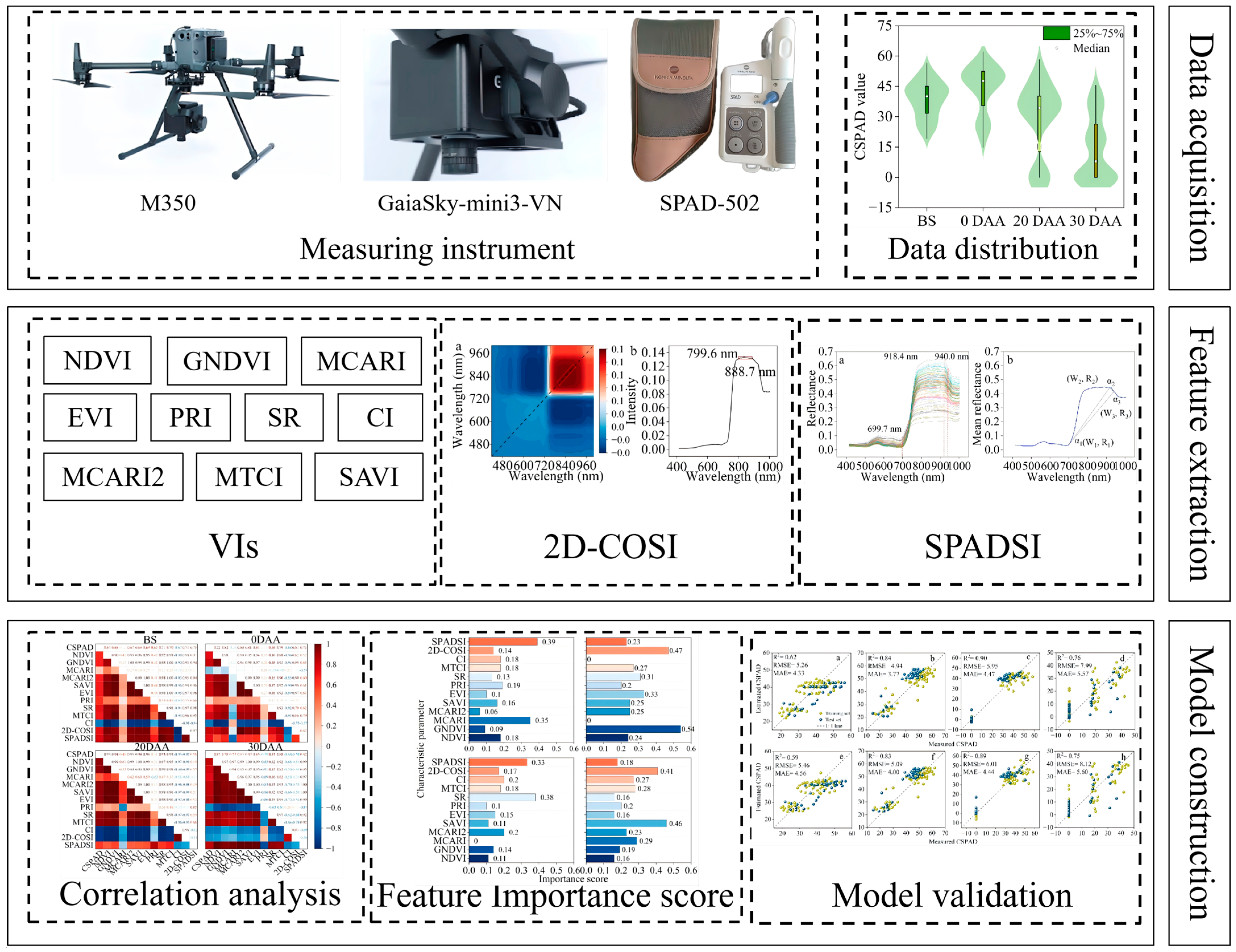
The experiments were conducted in the wheat-growing season from 2023 to 2024 at Zhenjiang, Jiangsu Province, China (32°16′ N, 119°33′ E). To construct wheat populations with different canopy structures, the experiment included 3 variety types, 3 planting densities and 4 nitrogen fertilizer levels, totaling 36 treatments. Each treatment was replicated 3 times, with a total of 108 experimental plots. The three planting densities were 150 × 104 plants ha−1, 225 × 104 plants ha−1 and 300 × 104 plants ha−1 respectively; The three variety types were Yangfumai 13 (upright seedling, compact plant type), Yangmai 20 (semi-upright seedling, medium plant density), and Yangmai 28 (upright seedling, loose plant type). Meanwhile, the four nitrogen fertilizer levels (applied as urea, CO(NH2)2, with a nitrogen content of 46%) were 0 kg ha−1, 150 kg ha−1, 225 kg ha−1 and 300 kg ha−1 respectively. Half of the nitrogen fertilizer was applied as a base fertilizer, and the other half was applied at the jointing stage. The hyperspectral images of the field and canopy SPAD were obtained at the booting stage (BS, 15 April), 0 days after anthesis (0 DAA, 21 April), 20 days after anthesis (20 DAA, 11 May), and 30 days after anthesis (30 DAA, 21 May), respectively. The data acquisition, feature extraction, model construction and validation processes of the current study are shown in Figure 1.

2.2. Data Acquisition

2.2.1. Determination of Relative Chlorophyll Content in Canopy (CSPAD)

The chlorophyll content of the flag, 2nd, 3rd, 4th, and 5th leaves from the top were measured with a SPAD-502 Minolta Chlorophyll Meter (Spectrum Technologies, Plainfield, IL, USA) according to the methods of Xu et al. (2018) [42]. The chlorophyll contents were measured in all plots, and 20 plants were randomly selected per plot from the central area, avoiding border plants and excluding extremely vigorous or weak individuals, to ensure representative sampling. To account for the physiological heterogeneity of chlorophyll distribution within individual leaves, SPAD values were recorded at three positions (upper, middle, and lower sections) on the same leaf, and the average value was used to represent the chlorophyll status of that leaf. The SPAD values of all measured leaves were then averaged to obtain the canopy SPAD (CSPAD) for each plot.

2.2.2. UAV Image Acquisition

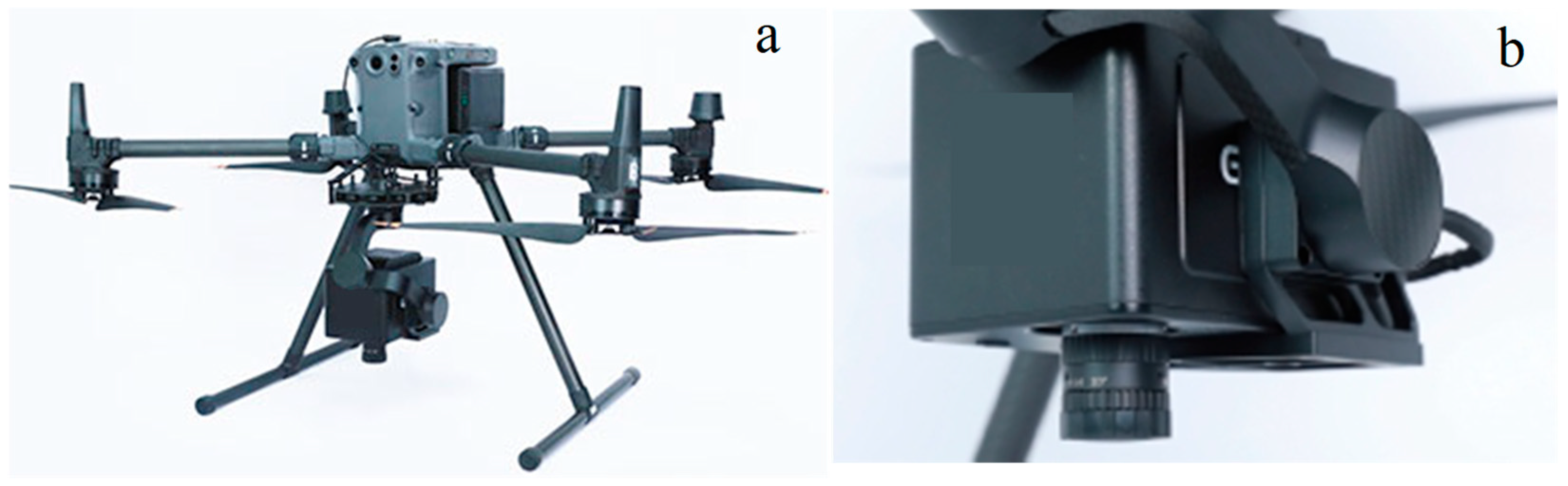
Remote sensing images of crop canopies were obtained using the DJI M350 UAV (DJI Technology Co., Ltd., Shenzhen, Guangdong, China) equipped with GaiaSky-mini3-VN hyperspectral-imaging sensor (Figure 2). The flight path generated by the waypoint coordinate calculator was imported before the unmanned aerial vehicle operation. The specific parameters of the unmanned aerial vehicle and the hyperspectral imaging sensor are shown in Table 1.

2.2.3. Spectral Reflectance Acquisition

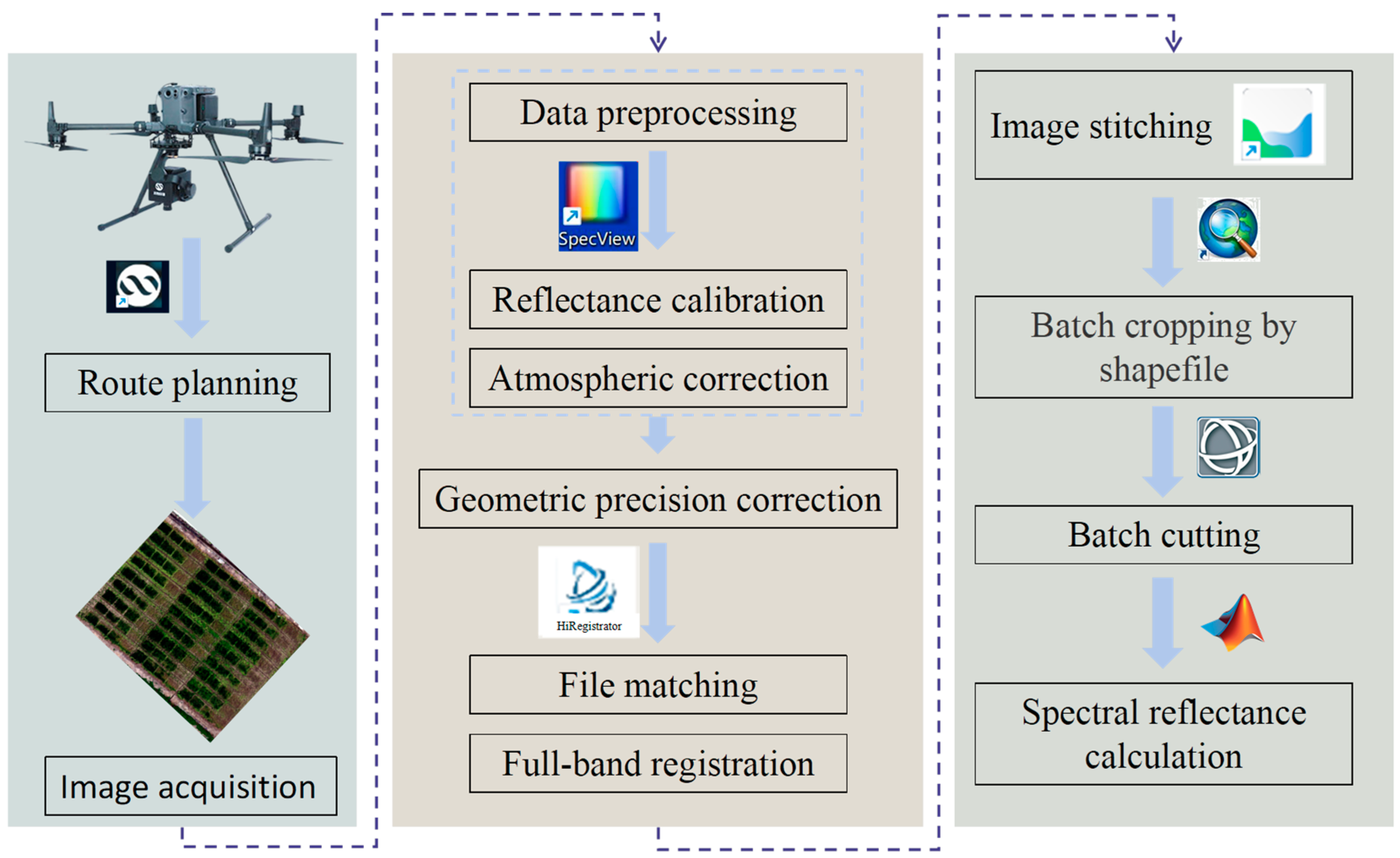
First, the collected hyperspectral images were preprocessed before stitching. The reflectance correction and atmospheric correction of the obtained hyperspectral images were carried out using the Spectraview 2.9.4.21 software. The HiRegistrator V80 software was used to perform file matching and full-band registration on the corrected images. Then, Agisoft Metashape 2.1.0 Professional mapping software was used to perform image stitching on the preprocessed hyperspectral images to generate high-resolution, comprehensive images with spectral-reflectance information. Finally, the HiRegistrator software was used for format conversion to a readable format by ENVI 5.6.
We used ArcMap 10.7 to generate the shape file of each plot and used the batch cropping function of ENVI to crop the hyperspectral image of each plot. The average spectral reflectance of each band in each plot was calculated through MATLAB 2023a. Subsequently, the Savitzky–Golay (SG) filtering algorithm was applied to smooth the original hyperspectral data. The specific process of obtaining hyperspectral data is shown in Figure 3.
Savitzky–Golay (SG) filtering is a smoothing filtering method based on polynomial fitting and is often used in spectral-data processing, time series analysis and signal denoising. This algorithm fits the local polynomial through the sliding window and replaces the original data points with the fitting results, thereby reducing noise and maintaining the main features of the signal.

2.2.4. Vegetation Index (VI) Acquisition

Based on previous studies, we selected 10 vegetation indices (VIs) closely related to SPAD, as shown in Table 2. In MATLAB 2023a, the corresponding VIs were calculated according to the formulas listed in Table 2.

2.2.5. Two-Dimensional Correlation Spectral Index (2D-COSI) Extraction

We used the 2D Correlation Spectroscopy Analysis module in Origin 2024 to conduct 2D spectral analysis of hyperspectral data. We screened the band range sensitive to CSPAD through synchronous spectroscopy and calculated the average reflectance of this band. This is taken as the two-dimensional correlation spectral index (2D-COSI) related to CSPAD.
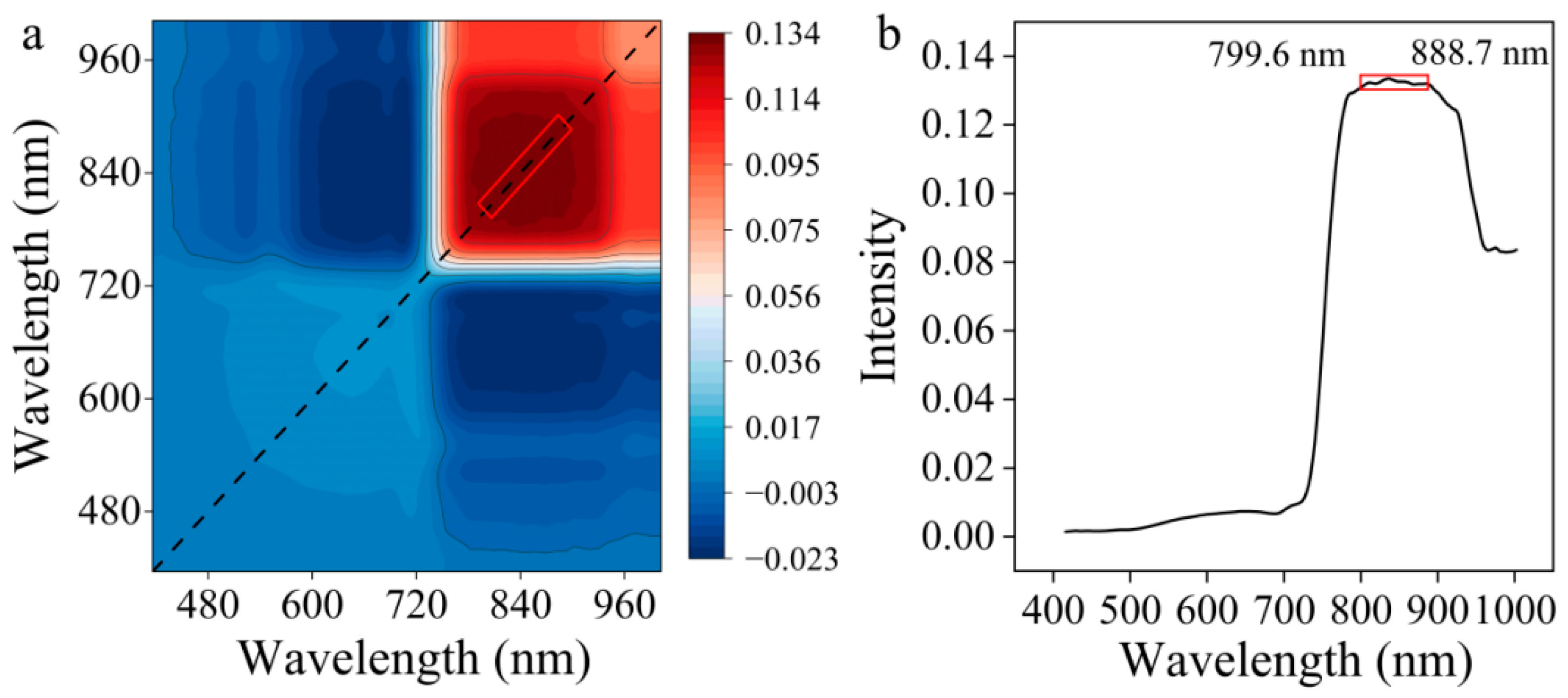
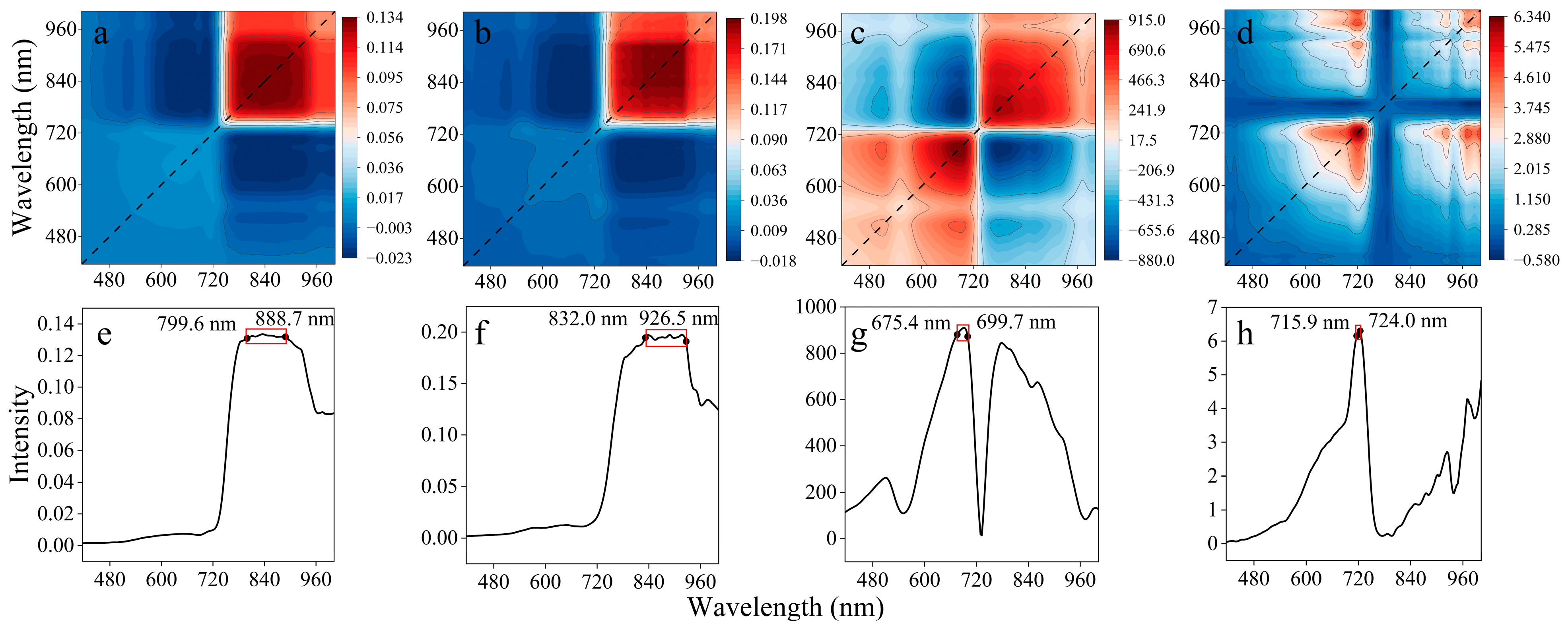
Two-dimensional correlation spectroscopy (2D-COS) is a technique based on external perturbation (CSPAD) for analyzing the dynamic changes in spectra. 2D-COS enables the identification of wavelength interactions and dynamic spectral responses under external perturbations, while enhancing spectral resolution and reducing band overlap compared with one-dimensional spectra. This study mainly used the synchronous spectral graph (Figure 4a) and extracted the dynamic changes in the spectral intensity along the diagonal (Figure 4b).

2.2.6. CSPAD Spectral Index (SPADSI) Extraction

In this study, although the PROSAIL model was not explicitly used for forward simulation, its theoretical foundation inspired the development of the SPADSI. By constructing geometric angles between sensitive spectral bands, we aimed to capture structural changes in the reflectance curve, consistent with the principles underlying radiative-transfer modeling of canopy reflectance.
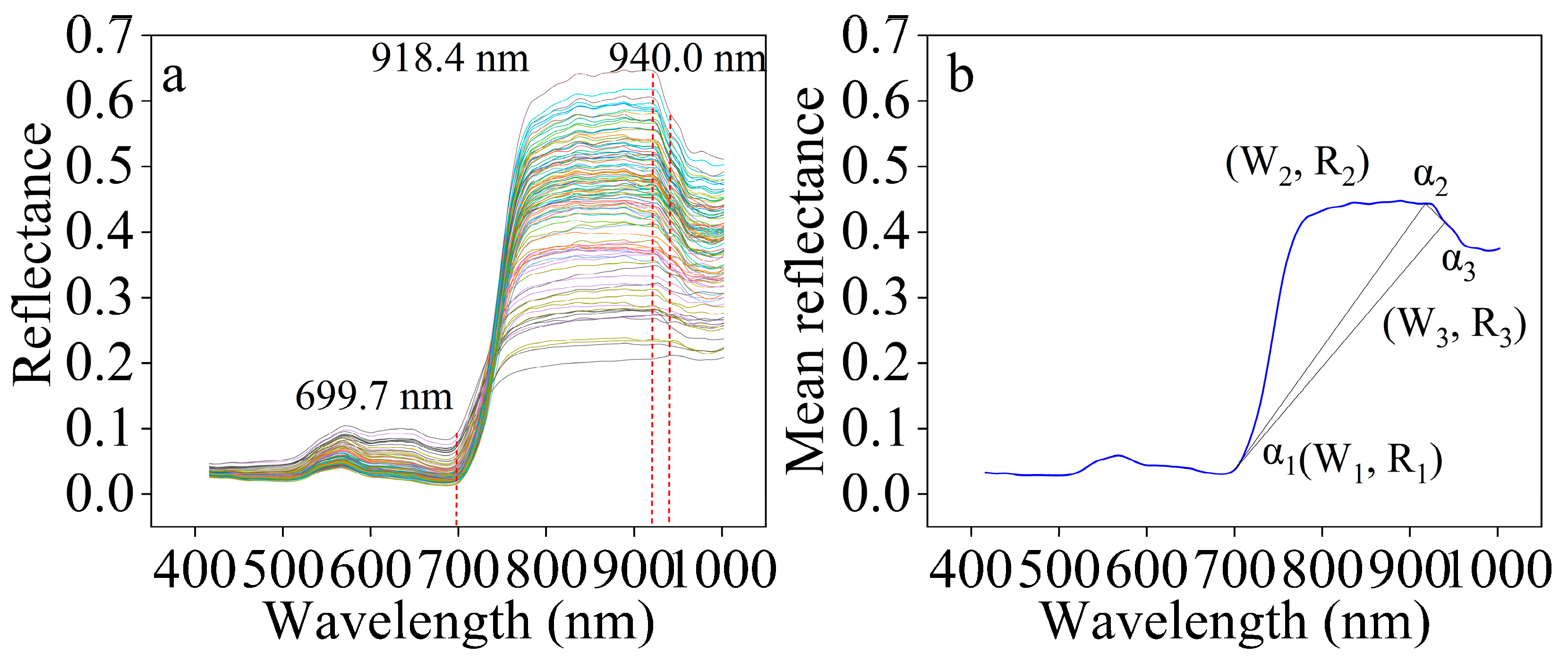
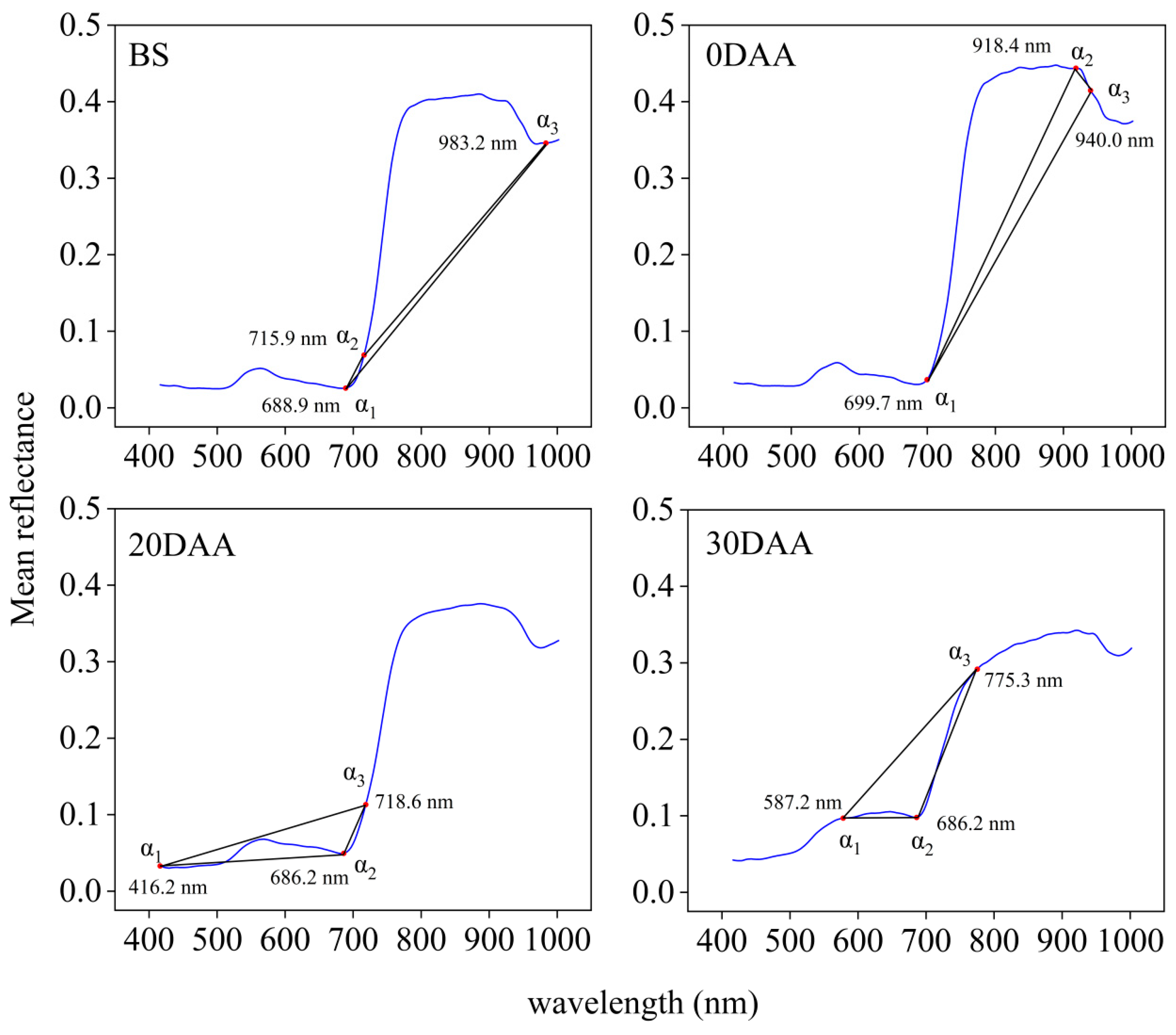
Firstly, the SPA was used to screen the wavelengths significantly related to CSPAD. Then, the Random Forest (RF) algorithm was applied to calculate the contribution of the selected band to CSPAD. To ensure the stability of the results, we carried out 100 iterations. Finally, three sensitive wavelengths were selected for the construction of spectral indices. The schematic diagram created with PROSAIL is shown in Figure 5b. Three sensitive wavelengths are connected on the spectral curve to form a triangle. By comparing the Pearson correlation coefficients of the three angles with CSPAD, the angle with the strongest correlation was selected as a new index—the CSPAD Spectral Index (SPADSI). The calculation process of the three angles is shown in the formula.
α 1 = 90 a r c t a n W 2 W 1 R 2 R 1 + a r c t a n W 3 W 1 R 3 R 1 × 180 π
α 2 = 180 ( a r c t a n R 2 R 1 W 2 W 1 + a r c t a n W 2 W 3 R 3 R 2 ) × 180 π
α 3 = 180 α 1 α 2

2.3. Model Construction and Validation

In the current study, we took 10 VIs and the extracted 2D-COSI and SPADSI as the input parameters of the model. Before feeding the parameters into the model, Z-score normalization was performed to standardize variables with different scales and distributions. This transformation maps the original data to a standard normal distribution, effectively removing unit inconsistencies and enhancing the performance, convergence, and stability of machine learning models. Subsequently, principal component analysis (PCA) was applied for dimensionality reduction to mitigate overfitting risks. In this study, only those principal components that jointly explained 90% or more of the total variance were selected as model inputs. In MATLAB 2023a, the data was divided into the training set and the validation set at a ratio of 2:1, with a total of 108 samples. The CSPAD estimation models were established respectively by using Gaussian Process Regression (GPR) and Support Vector Machine Regression (SVM).
To evaluate model performance, the coefficient of determination (R2), root mean square error (RMSE), and mean absolute error (MAE) were calculated using Equations (4)–(6). R2 reflects the goodness of fit between observed and predicted values, while RMSE and MAE quantify the prediction error magnitude. A higher R2 and lower RMSE and MAE indicate better model performance. These metrics were jointly used to comprehensively assess model accuracy and stability.
R 2 = 1 i = 1 N ( y i y i ) 2 i = 1 N ( y i y ¯ i ) 2
R M S E = i = 1 N ( y i y i ) 2 N
M A E = i = 1 N y i y i N
Here, N is the number of samples, and y i and y i represent the measured value and predicted value, respectively, while y i ¯ is the average measured value.

3. Results

3.1. CSPAD Data Distribution

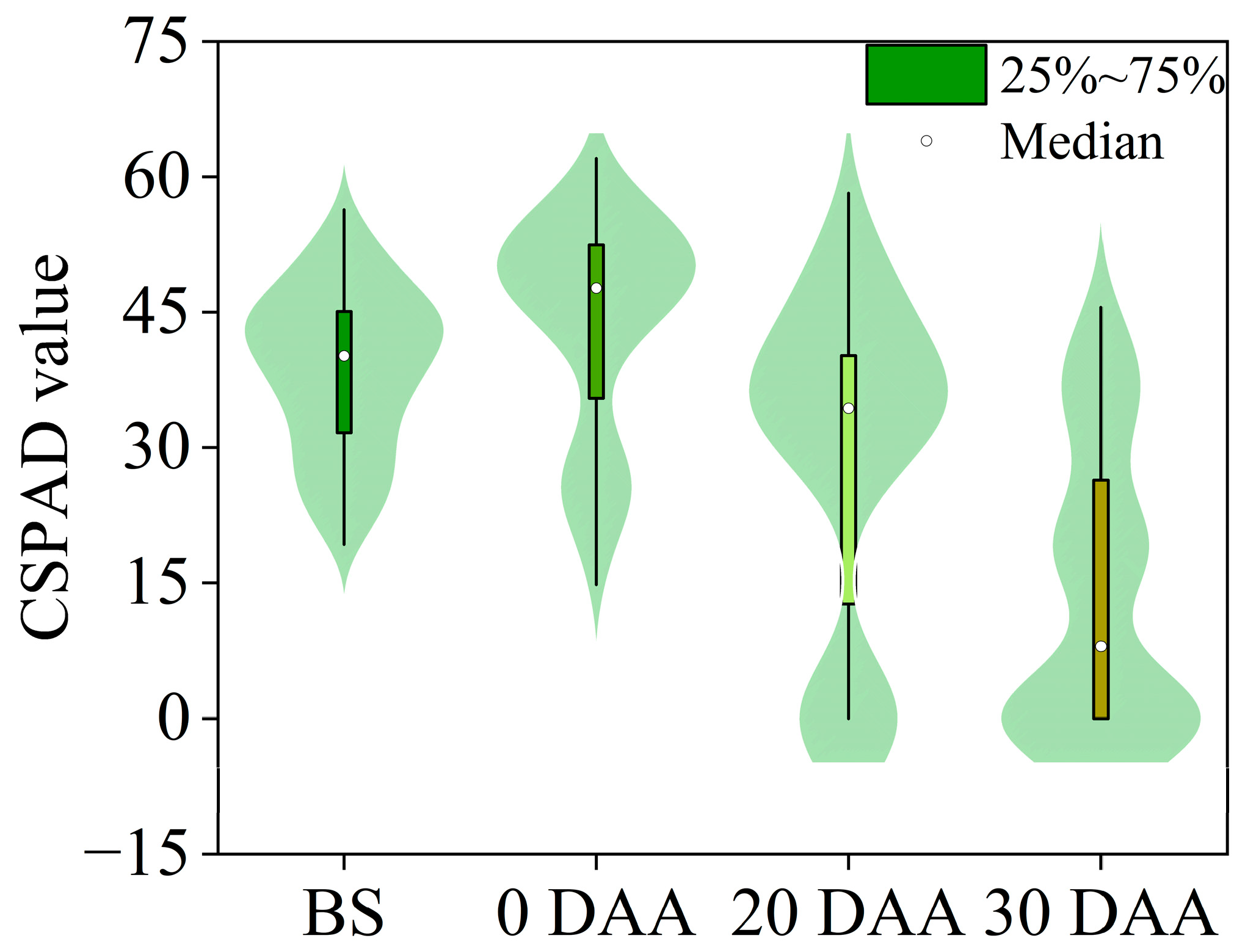
The detailed distribution of winter wheat CSPAD at different growth stages is shown in Figure 6. To enhance the adaptability of the experiment to different growth conditions, we adopted a combination of 36 treatments including different varieties, planting densities and nitrogen fertilizer levels. This dataset contains multiple sample types, providing conditions for the adaptability of the model. It enables the model to better adapt to the agronomic indicators obtained in complex field environments, ensures robust performance across different datasets, and enhances overall applicability.
By analyzing the data presented in Figure 6, it can be found that the CSPAD values show a rising trend first and then start decreasing, which is precisely attributed to the senescence process during the growth of wheat. In BS, the CSPAD ranges from 19.26 to 56.35. At 0 DAA, the CSPAD ranges from 14.80 to 62.03. At 20 DAA, the CSPAD ranges from 0 to 58.18. At 30 DAA, the CSPAD ranges from 0 to 45.54. The shapes of the peripheral green areas are different at various growth stages which reflects different aging rates of CSPAD among different treatments. The above changing trends provide an important basis for understanding the CSPAD content of winter wheat at different growth stages and lay the foundation for subsequent analysis and model construction.

3.2. Determination of 2D-COSI

To explore the feasibility of inverting CSPAD using spectral characteristics, CSPAD was taken as the perturbation variable, and the dynamic spectra of different wheat populations were obtained. The CSPAD and canopy spectra at different growth stages were compared and analyzed to determine the changes in spectral characteristics over time.
The non-diagonal region (between different wavelengths) of the two-dimensional correlation spectrum (Figure 7) shows the cooperative variation relationship among different wavelengths. The red area in the picture indicates that the spectral-signal variation trends at the two wavelengths are the same, which indicates that they increased or decreased simultaneously. The blue area indicates that the spectral signals of the two wavelengths change in opposite trends, which means that when one is enhanced, the other is weakened. The diagonal of the synchronous spectrum (the main diagonal) represents the autocorrelation of each wavelength, that is, the response intensity of the spectral intensity to external disturbances at that wavelength. The wavelengths with larger peaks on the diagonal are the characteristic wavelengths that are most significantly affected by disturbances. It can be noticed that the band ranges sensitive to CSPAD at BS, 0 DAA, 20 DAA, and 30 DAA are 799.6–888.7 nm, 832.0–926.5 nm, 675.4–699.7 nm, and 715.9–724.0 nm, respectively.

3.3. Determination of SPADSI

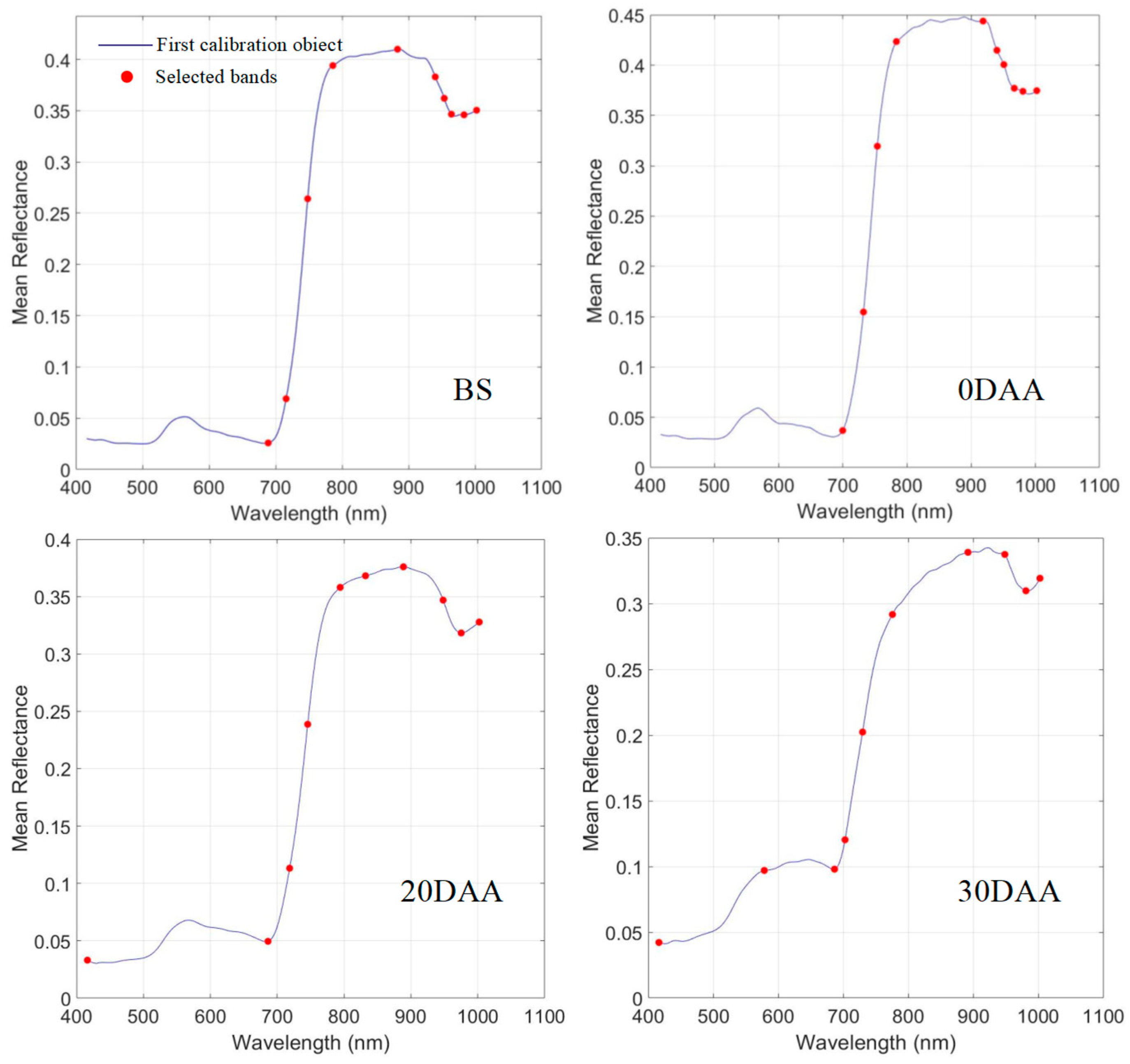
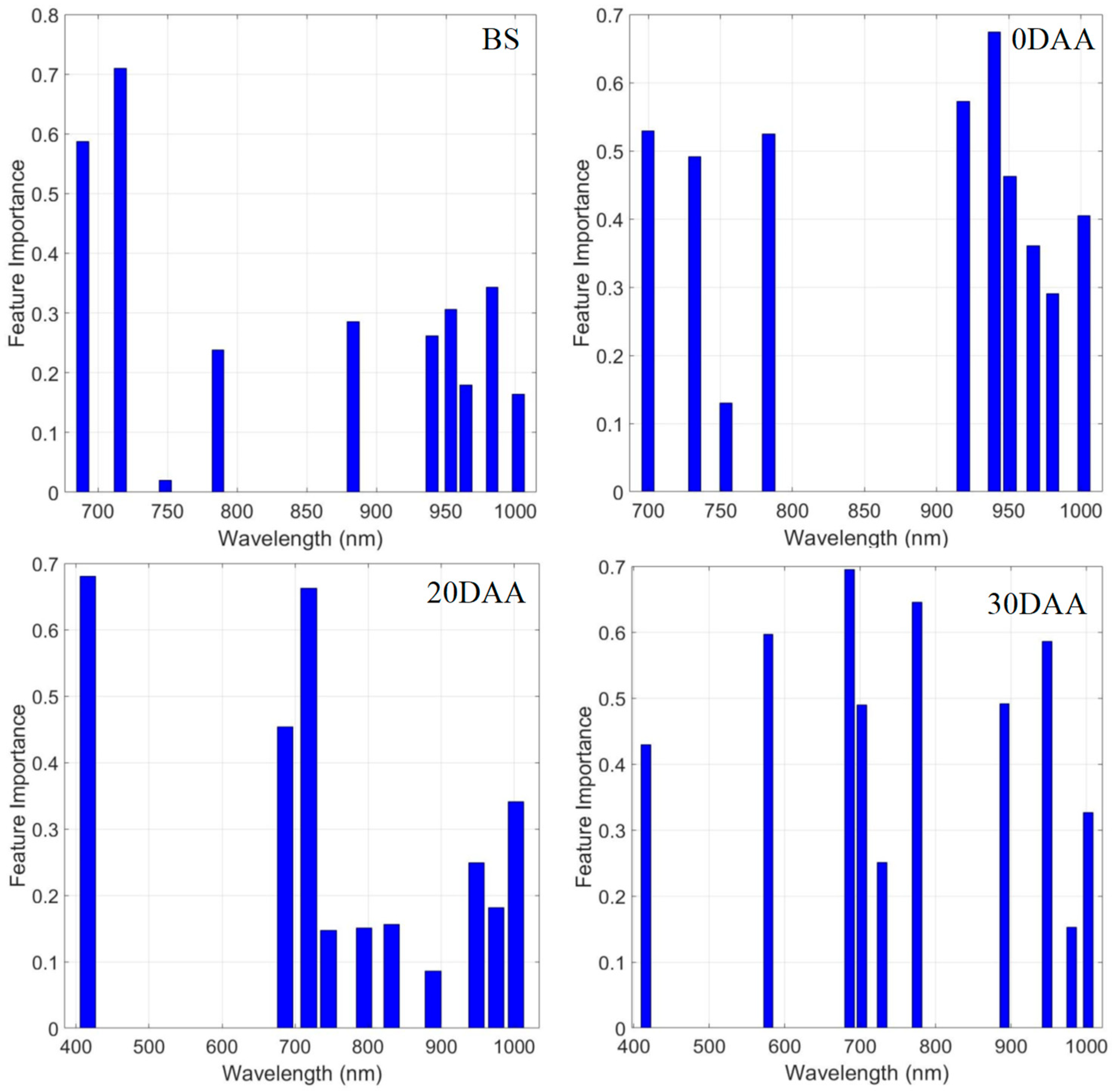
In this study, the successive projection algorithm (SPA) was used to screen 10 wavelengths sensitive to CSPAD, as shown in Figure 8. It can be seen from the figure that in BS and 0 DAA, the wavelengths are concentrated in the red edge and near-infrared bands. In 20 DAA and 30 DAA, the wavelengths are not only relatively concentrated in the red edge and near-infrared bands, but also distributed in the visible light band. Further, the Random Forest algorithm (RF) was used to evaluate the contribution of those 10 wavelengths selected by SPA to CSPAD (Figure 9). Later on, we selected the three bands with the highest contribution and conducted further triangle construction and angle calculation (Figure 10). It can be seen from the figures that the three wavelengths at BS were 715.9, 688.9, and 983.2 nm. Meanwhile, 940.0, 918.4, and 699.7 nm were the wavelengths at 0 DAA; 416.2, 718.6, 686.2 nm at 20 DAA; and the wavelengths at 30 DAA were 686.2, 775.3 and 578.2 nm.

3.4. Evaluation of the Importance of Different Characteristic Parameters

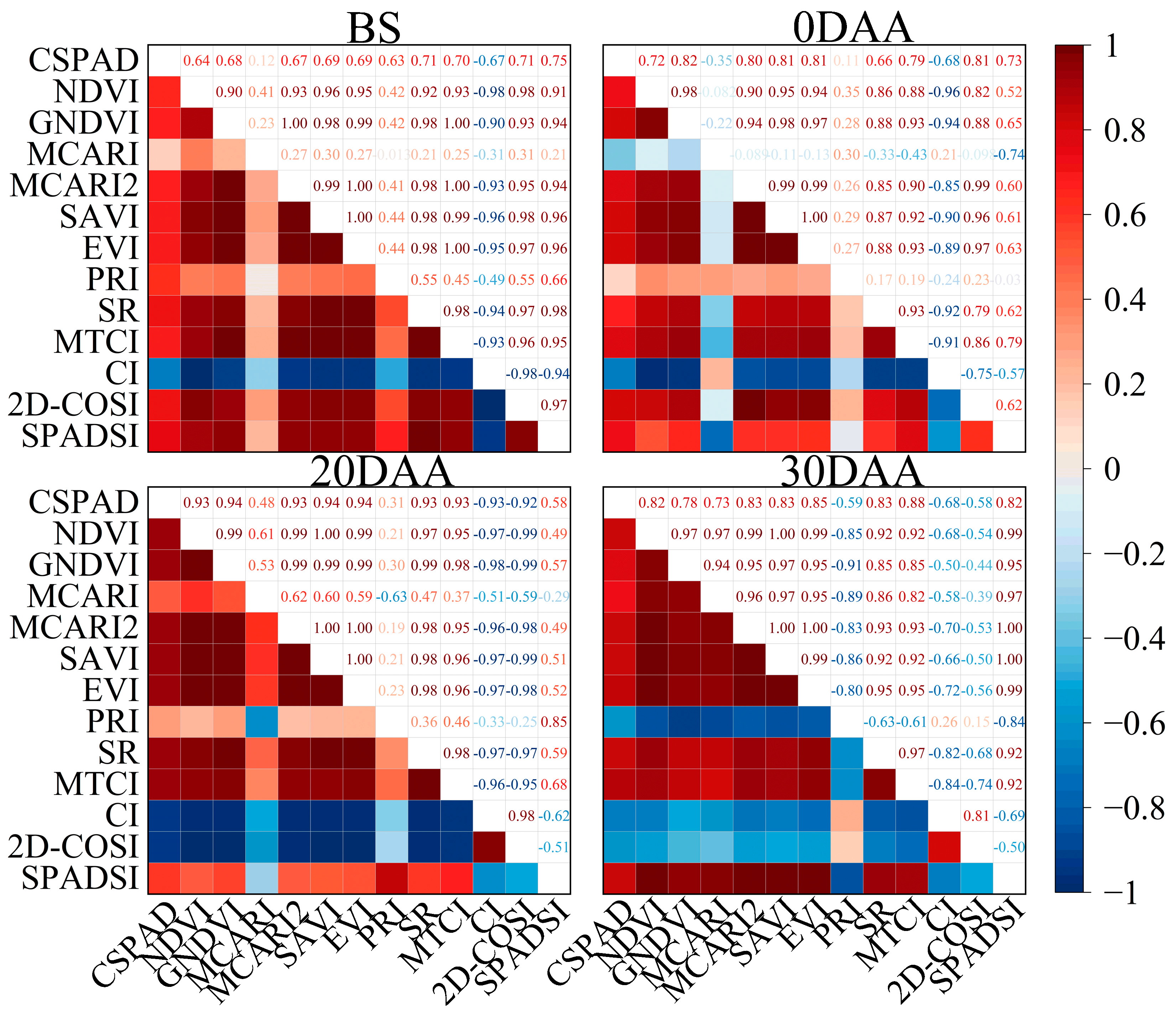
In this study, a total of 10 VIs, including NDVI, GNDVI, MCARI, MCARI2, SAVI, EVI, PRI, SR, MTCI and CI, as well as the newly extracted 2D-COSI and SPADSI, were selected to estimate CSPAD. The results presented in Figure 11 illustrate the correlation between different characteristic parameters and CSPAD. The three characteristic parameters with high correlations with CSPAD were statistically analyzed at each growth stage. At winter wheat BS, the SPADSI, 2D-COSI, and SR, with correlations of 0.75, 0.71, and 0.71, respectively, have a strong correlation with CSPAD. At 0 DAA, GNDVI, EVI, and 2D-COSI, with correlations of 0.82, 0.81, and 0.81, respectively, were strong parameters. At 20 DAA, EVI, GNDVI, and SAVI were the most strongly correlated parameters, whereas at 30 DAA, MTCI, EVI, and MCARI2 showed the highest correlations, with coefficients of 0.88, 0.85, and 0.83, respectively. The parameters with high correlation to CSPAD varied in different growth stages, and there is also a relatively high correlation among different characteristics. Therefore, it is necessary to conduct feature importance statistics and screening of appropriate parameters to improve the accuracy of the CSPAD estimation model.
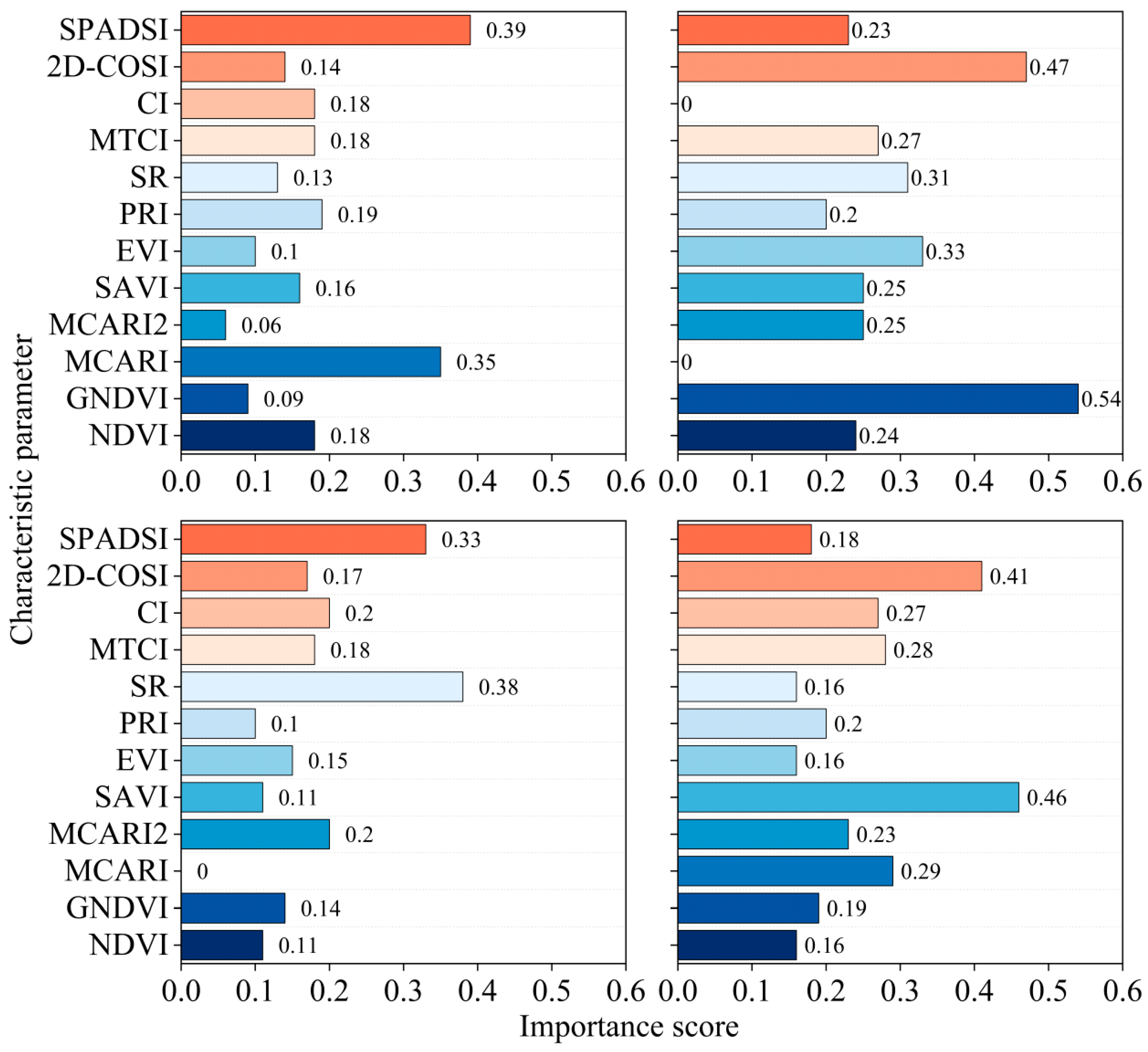
We also used the mRMR method to evaluate the importance scores of each feature for CSPAD (Figure 12). The goal of mRMR is to select a set of features that are most relevant to CSPAD and have the least redundancy from the high-dimensional feature set. This method comprehensively considers two core criteria: (1) The correlation between the selected features and CSPAD should be as high as possible. (2) The selected features should have as little repeating information as possible to avoid overfitting or information duplication in the model.
By analyzing the importance scores of different features, it can be found that at wheat BS, the SPADSI, MCARI, and PRI have relatively high scores. In 0 DAA, GNDVI, 2D-COSI, and EVI have relatively high scores. Further, at 20 DAA, the SR, SPADSI and MCARI2 achieved relatively high scores, and at 30 DAA, the SAVI, 2D-COSI and EVI have relatively high scores. It can be seen from the results that the importance of the same feature varies in different growth periods. Therefore, the principal component analysis method was used in this study, and the feature parameters with a cumulative contribution rate of 90% were selected as the input of the model to construct the CSPAD estimation model.

3.5. Accuracy Comparison of CSPAD Estimation Models Based on Different Modeling Methods

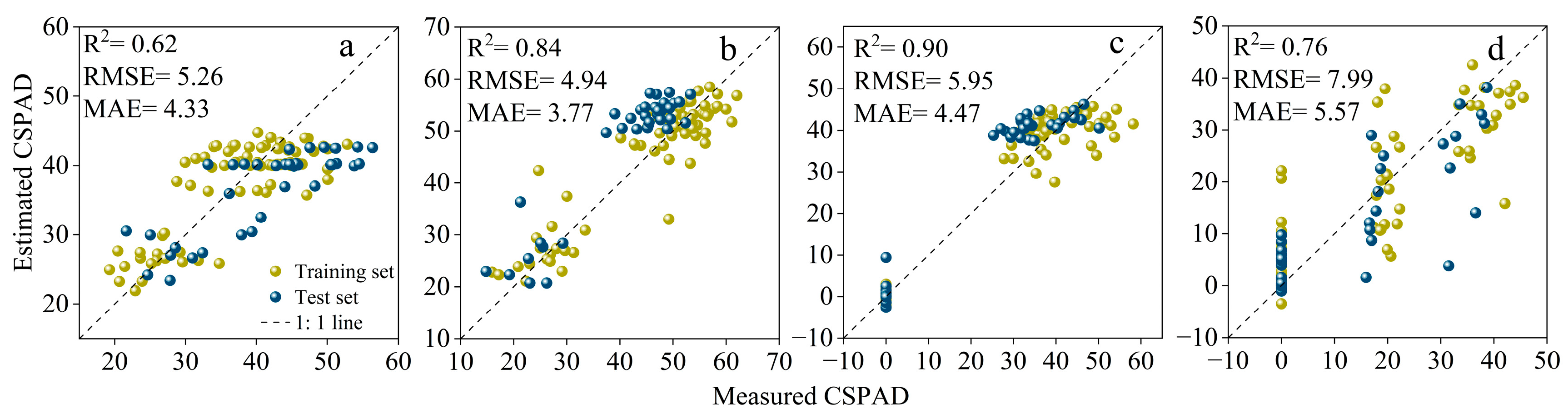
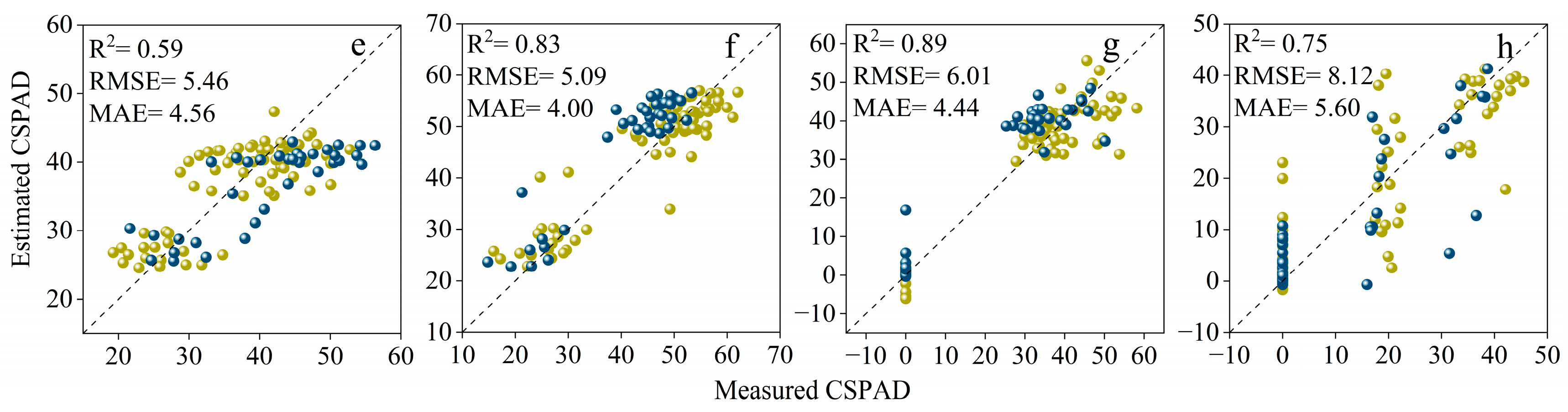
We constructed the CSPAD estimation model by using GPR and SVM. These models exhibit different validities at different reproductive periods (Figure 13). We found that GPR and SVM show similar modeling results, while GPR has a slight advantage in terms of accuracy and stability. In this study, the model estimation accuracy was relatively high at 20 DAA, with its R2 reaching 0.90, and RMSE and MAE being only 5.95 and 4.47, respectively, followed by estimation accuracy at 0 DAA. In addition, the estimation efficiency at the heading stage and 30 DAA were relatively poor, but the accuracy still reached 0.62. The RMSE and MAE were only 5.26 and 4.33 respectively.
Further, model estimation accuracy was also compared by fusing VIs, 2D-COSI, SPADSI alone and in combination (Table 3). We found that, the models using all three types of parameters have the highest accuracy at all growth stages, followed by those using only VIs. Meanwhile, the models using only 2D-COSI and SPADSI have relatively low accuracy.

4. Discussion

4.1. Validity Analysis of Multi-Parameter Modeling

In order to improve the stability and overall accuracy of the CSPAD estimation model, a multi-parameter fusion modeling scheme based on vegetation index (VI), two-dimensional correlation spectral index (2D-COSI), and PROSAIL-based spectral index (SPADSI) was applied. The results show that although using a certain type of parameter alone (such as VIs) can also achieve high prediction accuracy (Table 3), the comprehensive approach of using three types of parameters shows better robustness and adaptability at all growth stages (Figure 13), indicating that the fusion of multiple types of spectral information can effectively enhance the model’s capability to capture variations in wheat CSPAD.
By analyzing the features, it was found that different types of parameters are complementary [52,53]. The traditional VIs are constructed in the form of a two-band ratio or normalization, and they are the most widely used spectral indices in current SPAD estimation [54,55]. The 2D-COSI is based on the dynamic change law of spectral responses, which can capture the spectral detail information not covered by VIs, and is particularly suitable for identifying the wavelengths with characteristic responses during the growth period change process [32]. By combining the PROSAIL model theory and the geometric-structure characteristics of hyperspectral curves, SPADSI quantifies angular information composed of three sensitive bands and is able to reflect the changes in vegetation structure and functional state from the perspective of “spectral morphological changes” [31]. The integration of these three types of parameters enables the model to introduce dynamic change features and structural geometric features on the basis of taking into account the traditional strong correlation features, thereby comprehensively improving the model’s explanatory power and prediction accuracy for CSPAD. Furthermore, the ranking of importance of different feature types at different periods also varies (Figure 12), indicating that hyperspectral features have a certain growth period dependence on the response mechanism of SPAD. The new comprehensive feature scheme integrating VIs, 2D-COSI and SPADSI constructed in this study shows good stability and universality in hyperspectral data modeling, providing a feasible and promotable path for improving the estimation ability of vegetation physiological parameters such as SPAD.

4.2. Comparative Analysis Among Different Machine Learning Models

Different machine learning models have significantly varied impacts on the construction of the SPAD estimation model [56,57,58]. In this study, regression models based on Support Vector Machine (SVM) and Gaussian Process Regression (GPR) were constructed to achieve high-precision estimation of wheat CSPAD. The performance evaluation was conducted under different feature combinations by using data from different growth stages. We found that both models can capture the nonlinear relationship between hyperspectral features and CSPAD quite well, but there are certain differences in their fitting ability and robustness. The comprehensive comparison shows that GPR has certain advantages over SVM in terms of estimation accuracy and feature adaptability. The GPR model shows a higher R2 and a lower RMSE in multiple periods and feature combinations (Figure 13, Table 3), indicating that it is more adaptable under small-sample and high-dimensional input features. Based on Bayesian theory, GPR can effectively describe the uncertainty of predicted values and has the ability to automatically adjust the model complexity [59]. Therefore, it has a better fitting effect and robustness under different combinations of spectral feature inputs [41]. Especially after introducing nonlinear new features such as SPADSI, the adaptability of the GPR model to complex input relationships is more obvious.
Furthermore, this study also conducted a comparative analysis to evaluate model performance in estimating CSPAD at different periods (BS, 0 DAA, 20 DAA, 30 DAA). The results indicated that the model accuracy exhibits a clear stage-dependent pattern. Overall, at 20 DAA, both the GPR and SVM models demonstrated the optimal fitting effects, with the highest R2 value and the smallest RMSE. This phenomenon may be related to the relatively high canopy leaf area index (LAI) of wheat during this period, the strongest photosynthetic capacity, and the significant variation in chlorophyll content, which leads to the enhanced sensitivity of hyperspectral data to CSPAD, thereby improving the identifiability and prediction accuracy of the model. In contrast, at BS and 30 DAA, the model accuracy is slightly lower. This might be because at BS, the canopy leaf area index was the highest and the difference in chlorophyll content could be relatively small, while at 30 DAA, a large number of leaves age and turn yellow (Figure 5), and the canopy structure is unstable, resulting in increased spectral interference and reduced sensitivity of hyperspectral reflectance to CSPAD, which affects the spectral response ability to CSPAD.

4.3. Research Limitations and Future Prospects

Although this study applied a hyperspectral-feature system integrating VIs, 2D-COSI and SPADSI angle parameters, and achieved high-accuracy estimation of wheat CSPAD through GPR and SVM models, there are still some limitations that need to be further optimized in future research. First of all, the sample size and spatio-temporal ranges are limited. The ecological environment and planting management conditions covered in this study are still relatively narrow. The regional generalization ability of the model and its applicability in different years still need to be further verified. Secondly, there are still problems of noise interference and feature redundancy in the processing of hyperspectral data. Although feature screening methods such as SPA and two-dimensional correlation spectroscopy have been adopted, the potential nonlinear coupling relationship and redundant information among features may still affect the modeling effect. Furthermore, the physical interpretability and robustness of the constructed structural indices such as SPADSI still require support and verification from a wider range of multi-temporal data.
In response to the above issues, future research can be expanded in the following directions: (1) further increase the number and regional heterogeneity of the experimental samples, construction of cross-regional and multi-year hyperspectral database to enhance the universality and generalization ability of the model; (2) introduce high-order nonlinear modeling methods such as deep learning (such as CNN, LSTM, Transformer, etc.) to explore their potential in automatic feature extraction and multi-spatio-temporal modeling; (3) integrate multi-source remote sensing information, such as thermal infrared, Lidar, solar-induced chlorophyll fluorescence (SIF) and other multimodal data to achieve coordinated monitoring of crop chlorophyll, photosynthetic capacity and stress response.

5. Conclusions

Based on UAV hyperspectral remote sensing data, this study constructed a set of feature extraction and modeling methods for estimating the wheat CSPAD value. The optimal spectral features were screened at different growth stages of winter wheat, and then the CSPAD estimation model was developed based on GPR and SVM algorithms. The results of the current study showed that, compared with using only a single feature, the model integrating all features, including traditional vegetation indices (VIs), the two-dimensional correlation Spectral Sensitive Band Index (2D-COSI), and the SPADSI constructed based on the PROSAIL angle, has shown higher stability and prediction accuracy across all growth stages. In the comparison of different modeling approaches, the overall fitting effect of the GPR model was better (R2 = 0.90) than that of the SVM model, especially at 20 DAA. Through the mRMR algorithm and correlation analysis, we noticed that the importance of different characteristic parameters varies in different periods, and the input features need to be dynamically adjusted according to the growth period to improve the modeling effect. In conclusion, the wheat CSPAD estimation framework based on multi-feature fusion and GPR modeling proposed in this study has strong robustness and application potential, providing theoretical support and methodological reference for accurate and high-precision monitoring of wheat SPAD content. Further, integrating deep learning and multi-source remote sensing data can provide more insights to further enhance the universality and timeliness of wheat CSPAD estimation.

Author Contributions

Conceptualization, D.H. and S.Z.; methodology, D.H., W.Z. and S.Z.; formal analysis, D.H.; investigation, D.H., J.W. and Y.Z.; resources, T.L. and C.S.; data curation, J.W.; writing—original draft preparation, D.H. and M.Z.; writing—review and editing, D.H., W.Z., M.Z., C.S. and W.G.; supervision, T.L. and C.S.; project administration, D.H. and C.S.; funding acquisition, C.S. All authors have read and agreed to the published version of the manuscript.

Funding

This research was funded by the Biological breeding Zhongshan Laboratory Program of Jiangsu Province (ZSBBL-KY2023-05) and the Key Research and Development Program (Modern Agriculture) of Jiangsu Province (BE2022335, BE2022338).

Data Availability Statement

The original contributions presented in this study are included in the article. Further inquiries can be directed to the corresponding author.

Conflicts of Interest

The authors declare no conflicts of interest.

References

  1. Liu, J.; Zhu, Y.; Tao, X.; Chen, X.; Li, X. Rapid Prediction of Winter Wheat Yield and Nitrogen Use Efficiency Using Consumer-Grade Unmanned Aerial Vehicles Multispectral Imagery. Front. Plant Sci. 2022, 13, 1032170. [Google Scholar] [CrossRef]
  2. Croft, H.; Chen, J.M.; Wang, R.; Mo, G.; Luo, S.; Luo, X.; He, L.; Gonsamo, A.; Arabian, J.; Zhang, Y.; et al. The global distribution of leaf chlorophyll content. Remote Sens. Environ. 2020, 236, 111479. [Google Scholar] [CrossRef]
  3. Liu, L.; Xie, Y.; Zhu, B.; Song, K. Rice leaf chlorophyll content estimation with different crop coverages based on Sentinel-2. Ecol. Inform. 2024, 81, 102622. [Google Scholar] [CrossRef]
  4. Gitelson, A.A.; Viña, A.; Ciganda, V.; Rundquist, D.C.; Arkebauer, T.J. Remote Estimation of Canopy Chlorophyll Content in Crops. Geophys. Res. Lett. 2005, 32, L08403. [Google Scholar] [CrossRef]
  5. Simkin, A.J.; Kapoor, L.; Doss, C.G.P.; Hofmann, T.A.; Lawson, T.; Ramamoorthy, S. The role of photosynthesis related pigments in light harvesting, photoprotection and enhancement of photosynthetic yield in planta. Photosynth. Res. 2022, 152, 23–42. [Google Scholar] [CrossRef] [PubMed]
  6. Li, D.; Hu, Q.; Ruan, S.; Liu, J.; Zhang, J.; Hu, C.; Liu, Y.; Dian, Y.; Zhou, J. Utilizing Hyperspectral Reflectance and Machine Learning Algorithms for Non-Destructive Estimation of Chlorophyll Content in Citrus Leaves. Remote Sens. 2023, 15, 4934. [Google Scholar] [CrossRef]
  7. Singh, P.; Srivastava, P.K.; Verrelst, J.; Mall, R.K.; Rivera, J.P.; Dugesar, V.; Prasad, R. High resolution retrieval of leaf chlorophyll content over himalayan pine forest using visible/IR sensors mounted on UAV and radiative transfer model. Ecol. Inform. 2023, 75, 102099. [Google Scholar] [CrossRef]
  8. Singhal, G.; Choudhury, B.U.; Singh, N.; Goswami, J. An enhanced chlorophyll estimation model with a canopy structural trait in maize crops: Use of multi-spectral UAV images and machine learning algorithm. Ecol. Inform. 2024, 83, 102811. [Google Scholar] [CrossRef]
  9. Zhou, W.; Liu, Y.; Ata-Ul-Karim, S.T.; Ge, Q.; Li, X.; Xiao, J. Integrating Climate and Satellite Remote Sensing Data for Predicting County-Level Wheat Yield in China Using Machine Learning Methods. Int. J. Appl. Earth Obs. Geoinf. 2022, 111, 102861. [Google Scholar] [CrossRef]
  10. Zhou, X.; Yang, M.; Chen, X.; Ma, L.; Yin, C.; Qin, S.; Wang, L.; Lv, X.; Zhang, Z. Estimation of Cotton Nitrogen Content Based on Multi-Angle Hyperspectral Data and Machine Learning Models. Remote Sens. 2023, 15, 955. [Google Scholar] [CrossRef]
  11. Liu, J.; Zhu, Y.; Song, L.; Su, X.; Li, J.; Zheng, J.; Zhu, X.; Ren, L.; Wang, W.; Li, X. Optimizing Window Size and Directional Parameters of GLCM Texture Features for Estimating Rice AGB Based on UAVs Multispectral Imagery. Front. Plant Sci. 2023, 14, 1284235. [Google Scholar] [CrossRef]
  12. Jin, J.; Wang, Q. Selection of Informative Spectral Bands for PLS Models to Estimate Foliar Chlorophyll Content Using Hyperspectral Reflectance. IEEE Trans. Geosci. Remote Sens. 2019, 57, 3064–3072. [Google Scholar] [CrossRef]
  13. Tao, H.; Feng, H.; Xu, L.; Miao, M.; Long, H.; Yue, J.; Li, Z.; Yang, G.; Yang, X.; Fan, L. Estimation of Crop Growth Parameters Using UAV-Based Hyperspectral Remote Sensing Data. Sensors 2020, 20, 1296. [Google Scholar] [CrossRef]
  14. Jararweh, Y.; Fatima, S.; Jarrah, M.; AlZu’bi, S. Smart and Sustainable Agriculture: Fundamentals, Enabling Technologies, and Future Directions. Comput. Electr. Eng. 2023, 110, 108799. [Google Scholar] [CrossRef]
  15. Su, X.; Nian, Y.; Yue, H.; Zhu, Y.; Li, J.; Wang, W.; Sheng, Y.; Ma, Q.; Liu, J.; Wang, W. Improving Wheat Leaf Nitrogen Concentration (LNC) Estimation across Multiple Growth Stages Using Feature Combination Indices (FCIs) from UAV Multispectral Imagery. Agronomy 2024, 14, 1052. [Google Scholar] [CrossRef]
  16. Gomez, C.; Viscarra Rossel, R.A.; McBratney, A.B. Soil organic carbon prediction by hyperspectral remote sensing and field vis-NIR spectroscopy: An Australian case study. Geoderma 2008, 146, 403–411. [Google Scholar] [CrossRef]
  17. Zhu, W.; Sun, Z.; Yang, T.; Li, J.; Peng, J.; Zhu, K.; Li, S.; Gong, H.; Lyu, Y.; Li, B.; et al. Estimating leaf chlorophyll content of crops via optimal unmanned aerial vehicle hyperspectral data at multi-scales. Comput. Electron. Agric. 2020, 178, 105786. [Google Scholar] [CrossRef]
  18. Shu, M.; Zhou, L.; Chen, H.; Wang, X.; Meng, L.; Ma, Y. Estimation of amino acid contents in maize leaves based on hyperspectral imaging. Front Plant Sci. 2022, 13, 885794. [Google Scholar] [CrossRef]
  19. Choudhury, B.U.; Narzari, R.; Zafar, M.; Singh, N.; Mishra, V.K.; Prabhakar, M. Spectral library of crops and discrimination of major vegetables grown in the eastern Himalayan ecosystem: A proximal hyperspectral remote sensing approach. Ecol. Inform. 2023, 77, 102263. [Google Scholar] [CrossRef]
  20. Wang, W.; Yao, X.; Yao, X.F.; Tian, Y.C.; Liu, X.J.; Ni, J.; Cao, W.X.; Zhu, Y. Estimating leaf nitrogen concentration with three-band vegetation indices in rice and wheat. Field Crops Res. 2012, 129, 90–98. [Google Scholar] [CrossRef]
  21. Yu, K.; Lenz-Wiedemann, V.; Chen, X.; Bareth, G. Estimating leaf chlorophyll of barley at different growth stages using spectral indices to reduce soil background and canopy structure effects. ISPRS J. Photogramm. Remote Sens. 2014, 97, 58–77. [Google Scholar] [CrossRef]
  22. Liang, L.; Geng, D.; Yan, J.; Qiu, S.; Di, L.; Wang, S.; Xu, L.; Wang, L.; Kang, J.; Li, L. Estimating Crop LAI Using Spectral Feature Extraction and the Hybrid Inversion Method. Remote Sens. 2020, 12, 3534. [Google Scholar] [CrossRef]
  23. Wang, Z.; Zhang, F.; Zhang, X.; Chan, N.W.; Te Kung, H.; Ariken, M.; Zhou, X.; Wang, Y. Regional suitability prediction of soil salinization based on remote-sensing derivatives and optimal spectral index. Sci. Total Environ. 2021, 775, 145807. [Google Scholar] [CrossRef]
  24. Wang, T.; Gao, M.; Cao, C.; You, J.; Zhang, X.; Shen, L. Winter wheat chlorophyll content retrieval based on machine learning using in situ hyperspectral data. Comput. Electron. Agric. 2022, 193, 106728. [Google Scholar] [CrossRef]
  25. Yang, C.; Xu, J.; Feng, M.; Bai, J.; Sun, H.; Song, L.; Wang, C.; Yang, W.; Xiao, L.; Zhang, M. Evaluation of Hyperspectral Monitoring Model for Aboveground Dry Biomass of Winter Wheat by Using Multiple Factors. Agronomy 2023, 13, 983. [Google Scholar] [CrossRef]
  26. Araújo, M.C.U.; Saldanha, T.C.B.; Galvao, R.K.H.; Yoneyama, T.; Chame, H.C.; Visani, V. The successive projections algorithm for variable selection in spectroscopic multicomponent analysis. Chemom. Intell. Lab. Syst. 2001, 57, 65–73. [Google Scholar] [CrossRef]
  27. He, J.; Jing, H.; Gang, L.; Weile, L.; Zhe, L.; Zhi, L. Inversion analysis of soil nitrogen content using hyperspectral images with different preprocessing methods. Ecol. Inform. 2023, 78, 102381. [Google Scholar]
  28. Jacquemoud, S.; Verhoef, W.; Baret, F.; Bacour, C.; Zarco-Tejada, P.J.; Asner, G.P.; Francois, C.; Ustin, S. PROSPECT+SAIL models: A review of use for vegetation characterization. Remote Sens. Environ. 2009, 113, 56–66. [Google Scholar] [CrossRef]
  29. Jacquemoud, S.; Baret, F. PROSPECT: A model of leaf optical properties spectra. Remote Sens. Environ. 1990, 34, 75–91. [Google Scholar] [CrossRef]
  30. Zhang, Y.; Hui, J.; Qin, Q.; Sun, Y.; Zhang, T.; Sun, H.; Li, M. Transfer-learning-based approach for leaf chlorophyll content estimation of winter wheat from hyperspectral data. Remote Sens. Environ. 2021, 267, 112724. [Google Scholar] [CrossRef]
  31. Zhang, B.; Wu, W.; Zhou, J.; Dai, M.; Sun, Q.; Sun, X.; Chen, Z.; Gu, X. A spectral index for estimating grain filling rate of winter wheat using UAV-based hyperspectral images. Comput. Electron. Agric. 2024, 223, 109059. [Google Scholar] [CrossRef]
  32. Liu, T.; Yang, T.; Zhu, S.; Mou, N.; Zhang, W.; Wu, W.; Zhao, Y.; Yao, Z.; Sun, J.; Chen, C.; et al. Estimation of wheat biomass based on phenological identification and spectral response. Comput. Electron. Agric. 2024, 222, 109076. [Google Scholar] [CrossRef]
  33. Zhu, S.; Yang, T.; Han, D.; Zhang, W.; Zain, M.; Yu, Q.; Zhao, Y.; Wu, F.; Yao, Z.; Liu, T.; et al. ODP: A novel indicator for estimating photosynthetic capacity and yield of maize through UAV hyperspectral images. Comput. Electron. Agric. 2025, 235, 110350. [Google Scholar] [CrossRef]
  34. Sonobe, R.; Yamashita, H.; Mihara, H.; Morita, A.; Ikka, T. Hyperspectral reflectance sensing for quantifying leaf chlorophyll content in wasabi leaves using spectral pre-processing techniques and machine learning algorithms. Int. J. Remote Sens. 2021, 42, 1311–1329. [Google Scholar] [CrossRef]
  35. Sun, J.; Yang, L.; Yang, X.; Wei, J.; Li, L.; Guo, E.; Kong, Y. Using spectral reflectance to estimate the leaf chlorophyll content of maize inoculated with arbuscular mycorrhizal Fungi under water stress. Front. Plant Sci. 2021, 12, 646173. [Google Scholar] [CrossRef]
  36. Zhang, Y.; Liang, K.; Zhu, F.; Zhong, X.; Lu, Z.; Chen, Y.; Pan, J.; Lu, C.; Huang, J.; Ye, Q.; et al. Differential Study on Estimation Models for Indica Rice Leaf SPAD Value and Nitrogen Concentration Based on Hyperspectral Monitoring. Remote Sens. 2024, 16, 4604. [Google Scholar] [CrossRef]
  37. Daviran, M.; Maghsoudi, A.; Ghezelbash, R.; Pradhan, B. A new strategy for spatial predictive mapping of mineral prospectivity: Automated hyperparameter tuning of random forest approach. Comput. Geosci. 2021, 148, 104688. [Google Scholar] [CrossRef]
  38. Daviran, M.; Shamekhi, M.; Ghezelbash, R.; Maghsoudi, A. Landslide susceptibility prediction using artificial neural networks, SVMs and random forest: Hyperparameters tuning by genetic optimization algorithm. Int. J. Environ. Sci. Technol. 2023, 20, 259–276. [Google Scholar] [CrossRef]
  39. Liu, Y.; Wang, S.; Wang, X.; Chen, B.; Chen, J.; Wang, J.; Huang, M.; Wang, Z.; Ma, L.; Wang, P.; et al. Exploring the superiority of solar-induced chlorophyll fluorescence data in predicting wheat yield using machine learning and deep learning methods. Comput. Electron. Agric. 2022, 192, 106612. [Google Scholar] [CrossRef]
  40. Shi, S.; Xu, L.; Gong, W.; Chen, B.; Chen, B.; Qu, F.; Tang, X.; Sun, J.; Yang, J. A convolution neural network for forest leaf chlorophyll and carotenoid estimation using hyperspectral reflectance. Int. J. Appl. Earth Obs. Geoinf. 2022, 108, 102719. [Google Scholar] [CrossRef]
  41. Song, X.; Yang, G.; Xu, X.; Zhang, D.; Yang, C.; Feng, H. Winter Wheat Nitrogen Estimation Based on Ground-Level and UAV-Mounted Sensors. Sensors 2022, 22, 549. [Google Scholar] [CrossRef] [PubMed]
  42. Xu, X.X.; Zhang, Y.H.; Li, J.P.; Zhang, M.; Zhou, X.N.; Zhou, S.L.; Wang, Z.M. Optimizing single irrigation scheme to improve water use efficiency by manipulating winter wheat sink-source relationships in Northern China Plain. PLoS ONE 2018, 13, e0193895. [Google Scholar] [CrossRef]
  43. Rouse, J.W., Jr.; Haas, R.H.; Deering, D.; Schell, J.; Harlan, J.C. Monitoring the Vernal Advancement and Retrogradation (Green Wave Effect) of Natural Vegetation; Goddard Space Flight Center: Greenbelt, MD, USA, 1974. [Google Scholar]
  44. Candiago, S.; Remondino, F.; De Giglio, M.; Dubbini, M.; Gattelli, M. Evaluating multispectral images and vegetation indices for precision farming applications from UAV images. Remote Sens. 2015, 7, 4026–4047. [Google Scholar] [CrossRef]
  45. Daughtry, C.S.T.; Walthall, C.L.; Kim, M.S.; de Colstoun, E.B.; McMurtrey, J.E. Estimating corn leaf chlorophyll concentration from leaf and canopy reflectance. Remote Sens. Environ. 2000, 74, 229–239. [Google Scholar] [CrossRef]
  46. Huete, A.R. A soil-adjusted vegetation index (SAVI). Remote Sens. Environ. 1988, 25, 295–309. [Google Scholar] [CrossRef]
  47. Liu, H.Q.; Huete, A. A feedback based modification of the NDVI to minimize canopy background and atmospheric noise. IEEE Trans. Geosci. Remote Sens. 1995, 33, 457–465. [Google Scholar] [CrossRef]
  48. Penuelas, J.; Filella, I.; Gamon, J.A. Assessment of photosynthetic radiation-use efficiency with spectral reflectance. New Phytol. 2010, 131, 291–296. [Google Scholar] [CrossRef]
  49. Gamon, J.A.; Surfus, J.S. Assessing leaf pigment content and activity with a reflectometer. New Phytol. 1999, 143, 105–117. [Google Scholar] [CrossRef]
  50. Dash, J.; Curran, P.J. The MERIS terrestrial chlorophyll index. Int. J. Remote Sens. 2004, 25, 5403–5413. [Google Scholar] [CrossRef]
  51. Gitelson, A.A.; Merzlyak, M.N. Remote sensing of chlorophyll concentration in higher plant leaves. Adv. Space Res. 1997, 22, 689–692. [Google Scholar] [CrossRef]
  52. Zhen, J.; Jiang, X.; Xu, Y.; Miao, J.; Zhao, D.; Wang, J.; Wang, J.; Wu, G. Mapping leaf chlorophyll content of mangrove forests with Sentinel-2 images of four periods. Int. J. Appl. Earth Obs. Geoinf. 2021, 102, 102387. [Google Scholar] [CrossRef]
  53. Jiang, X.; Zhen, J.; Miao, J.; Zhao, D.; Shen, Z. Newly-developed three-band hyperspectral vegetation index for estimating leaf relative chlorophyll content of mangrove under different severities of pest and disease. Ecol. Indic. 2022, 140, 108978. [Google Scholar] [CrossRef]
  54. Xu, M.; Liu, R.; Chen, J.M.; Liu, Y.; Shang, R.; Ju, W.; Wu, C.; Huang, W. Retrieving leaf chlorophyll content using a matrix-based vegetation index combination approach. Remote Sens. Environ. 2019, 224, 60–73. [Google Scholar] [CrossRef]
  55. Zhang, X.; Sun, H.; Qiao, X.; Yan, X.; Feng, M.; Xiao, L.; Song, X.; Zhang, M.; Shafiq, F.; Yang, W. Hyperspectral Estimation of Canopy Chlorophyll of Winter Wheat by Using the Optimized Vegetation Indices. Comput. Electron. Agric. 2022, 193, 106654. [Google Scholar] [CrossRef]
  56. Ta, N.; Chang, Q.; Zhang, Y. Estimation of apple tree leaf chlorophyll content based on machine learning methods. Remote Sens. 2021, 13, 3902. [Google Scholar] [CrossRef]
  57. Wang, J.; Zhou, Q.; Shang, J.; Liu, C.; Zhuang, T.; Ding, J.; Xian, Y.; Zhao, L.; Wang, W.; Zhou, G. UAV- and Machine Learning-Based Retrieval of Wheat SPAD Values at the Overwintering Stage for Variety Screening. Remote Sens. 2021, 13, 5166. [Google Scholar] [CrossRef]
  58. Feng, Z.; Guan, H.; Yang, T.; He, L.; Duan, J.; Song, L.; Wang, C.; Feng, W. Estimating the Canopy Chlorophyll Content of Winter Wheat under Nitrogen Deficiency and Powdery Mildew Stress Using Machine Learning. Comput. Electron. Agric. 2023, 211, 107989. [Google Scholar] [CrossRef]
  59. Verrelst, J.; Camps-Valls, G.; Muñoz-Marí, J.; Rivera, J.P.; Veroustraete, F.; Clevers, J.G.P.W.; Moreno, J. Optical remote sensing and the retrieval of terrestrial vegetation bio-geophysical properties—A review. ISPRS J. Photogramm. Remote Sens. 2012, 108, 273–290. [Google Scholar] [CrossRef]
Figure 1. A workflow diagram of data acquisition, feature extraction, and model construction for wheat CSPAD estimation.
Agronomy 16 00430 g001
Figure 2. (a) The DJI M350 RTK unmanned aerial vehicle, and (b) the GaiaSky-mini3-VN hyperspectral-imaging sensor.
Agronomy 16 00430 g002
Figure 3. Flowchart of hyperspectral data acquisition.
Agronomy 16 00430 g003
Figure 4. Schematic diagram of 2D-COSI extraction; (a) the synchronous two-dimensional correlation spectral graph, (b) the dynamic change in the spectral intensity along the diagonal. The band selected in red in the figure is the band with the highest spectral intensity.
Agronomy 16 00430 g004
Figure 5. (a) The distribution of spectral curves for different processing (taking the data of 0 DAA as an example), (b) and three selected wavelengths constituting a triangle example graph.
Agronomy 16 00430 g005
Figure 6. Distribution of winter wheat CSPAD across different growth stages.
Agronomy 16 00430 g006
Figure 7. The dynamic changes in two-dimensional correlation spectra (ad) and diagonal light intensity (eh) at different reproductive stages. Here, the parts a and e present the BS stage, b and f present 0 DAA, c and g present 20 DAA, and d and h present 30 DAA. The band selected in red in the figure is the band with the highest spectral intensity.
Agronomy 16 00430 g007
Figure 8. Successive projection algorithm (SPA) screening results.
Agronomy 16 00430 g008
Figure 9. The contribution degree of key bands based on the Random Forest algorithm (RF).
Agronomy 16 00430 g009
Figure 10. Triangles and their three angles at different reproductive stages.
Agronomy 16 00430 g010
Figure 11. Pearson correlation coefficients between VIs, 2D-COSI, SPADSI and CSPAD.
Agronomy 16 00430 g011
Figure 12. The importance score of each characteristic parameter based on the mRMR algorithm for the construction of the CSPAD model.
Agronomy 16 00430 g012
Figure 13. The scatter plots of estimated and measured CSPAD based on various spectral indices by using the GPR algorithm (ad), and the SVM algorithm (eh). Here, the parts (a,e) show results at BS, (b,f) at 0 DAA, (c,g) at 20 DAA, and (d,h) at 30 DAA.
Agronomy 16 00430 g013aAgronomy 16 00430 g013b
Table 1. Specific parameters of unmanned aerial vehicles and hyperspectral imaging sensors.
UAV Hyperspectral Camera
ModelDJI M350 RTKModelGaiaSky-mini3-VN
Flight time10:30–11:30Spectral range400~1000 nm
Flight altitude50 mSpectral resolution5 nm (average)
Hover time12 sSpectral sampling interval2.7 nm
Forward overlap60%Spectral channel number224
Lateral overlap60%Image resolution1024 × 1003
Table 2. The VIs used in this study.
AcronymVegetation IndexFormulaReference
NDVINormalized Difference Vegetation Index ( R 800 R 670 ) / ( R 800 + R 670 ) [43]
GNDVIGreen Normalized Difference Vegetation Index ( R 800 R 550 ) / ( R 800 + R 550 ) [44]
MCARIModified Chlorophyll Absorption
Reflectance Index
( ( R 700 R 670 ) 0.2 × ( R 700 R 550 ) ) × ( R 700 / R 670 ) [45]
MCARI2Modified Chlorophyll Absorption
Reflectance Index Two
( 1.2 × ( 2.5 × ( R 800 R 670 ) 1.3 × ( R 800 R 550 ) ) ) [45]
SAVISoil-Adjusted Vegetation Index 1.5 × ( R 800 R 670 ) / ( R 800 + R 670 + 0.5 ) [46]
EVIEnhanced Vegetation Index 2.5 × ( R 800 R 670 ) / ( R 800 + 6 × R 670 7.5 × R 470 + 1 ) [47]
PRIPhotochemical Reflectance Index ( R 531 R 570 ) / ( R 531 + R 570 ) [48]
SRSimple Ratio Index R 800 / R 670 [49]
MTCIMERIS Terrestrial chlorophyll index ( R 754 R 709 ) / ( R 7009 R 681 ) [50]
CIChlorophyll Index R 695 / R 420 [51]
Table 3. Evaluation of CSPAD model estimation accuracy with different types of parameters.
GPRSVM
VIs2D-COSISPADSIAllVIs2D-COSISPADSIAll
R2BS0.580.560.570.620.570.550.560.59
0 DAA0.810.700.600.840.800.680.590.83
20 DAA0.890.870.310.900.890.870.320.89
30 DAA0.750.400.720.760.740.390.710.75
RMSEBS7.137.377.255.267.217.437.365.46
0 DAA6.458.079.324.946.598.289.455.09
20 DAA7.247.9018.205.957.357.9318.056.01
30 DAA9.6514.8110.157.999.7415.0310.248.12
MAEBS4.674.784.734.334.784.824.874.56
0 DAA4.075.285.793.774.265.336.034.00
20 DAA4.254.6511.104.474.394.6610.534.44
30 DAA5.5310.305.485.575.668.946.015.60
Disclaimer/Publisher’s Note: The statements, opinions and data contained in all publications are solely those of the individual author(s) and contributor(s) and not of MDPI and/or the editor(s). MDPI and/or the editor(s) disclaim responsibility for any injury to people or property resulting from any ideas, methods, instructions or products referred to in the content.