Article

Effect of Different Pre-Cooling Methods on the Quality of Litchi During Cold Storage

1
College of Engineering, South China Agricultural University, Guangzhou 510642, China
2
Key Laboratory of Key Technology of Southern Agricultural Machinery and Equipment, Ministry of Education, South China Agricultural University, Guangzhou 510642, China
3
Dong Fang International Container (Qidong) Co., Ltd., 1 Zhuoyue Road, Nantong 226200, China
4
State Key Laboratory of Water Pollution Control and Green Resource Recycling, College of Environmental Science and Engineering, Shanghai Institute of Pollution Control and Ecological Security, Tongji University, 1239 Siping Road, Shanghai 200092, China
*
Author to whom correspondence should be addressed.
Agronomy 2026, 16(4), 428; https://doi.org/10.3390/agronomy16040428
Submission received: 26 December 2025 / Revised: 7 February 2026 / Accepted: 9 February 2026 / Published: 11 February 2026
(This article belongs to the Special Issue Effects of Storage Environment and Technology on Fruit Quality)

Abstract

Pre-cooling can rapidly reduce the respiration intensity of fruit, helping extend its preservation period. This study investigates the effects of forced-air cooling with package treatment on fruit cooling and subsequent quality during storage. Moreover, a comparison was made between forced-air cooling and hydro-cooling in terms of fruit quality. Specifically, ‘Guiwei’ litchi fruit was treated with forced-air cooling at air velocities of 3, 6, and 10 m/s and hydro-cooling (5 °C), followed by storage at 3–5 °C for 18 days. Changes in cooling efficiency, pericarp moisture content, color, fruit firmness, weight loss, total soluble solids (TSS), and titratable acidity (TA) were monitored. The temperature of the forced-air-treated fruit first decreases faster and then slows down as the air velocity increases from 3 m/s to 10 m/s. Compared to forced-air cooling, hydro-cooling-treated fruit maintained better pericarp color, higher cooling rate, pericarp moisture content, and fruit firmness, but presented a lower total soluble solids (TSS) content, with no significant difference in titratable acidity (TA). The weight loss and aerobic respiratory depletion positively correlate with total soluble solid content and texture softening of litchi. The results provide a comprehensive reference for the selection of pre-cooling methods and the improvement of the postharvest industry.

1. Introduction

Litchi (Litchi chinensis Sonn.) is a popular fruit of high commercial value in southern China. However, litchi ripens in summer with hot weather, and the pericarp turns brown rapidly within 2 ± 3 days after harvest without any treatments. To extend the storage time and shelf-life of litchi, many fresh-keeping measurements have been conducted, such as refrigerated storage, packaging, and coating [1]. Among them, refrigerated storage with low temperature is considered the most effective way of maintaining the quality of litchis. Mahajan and Goswami [2] compared the effects of refrigerated storage with controlled atmosphere on litchi quality during storage and found that the characteristic litchi fruit taste was retained throughout the 56 days of storage. On the other hand, refrigerated storage with coating has also been proven to be a significant method for delaying the pericarp browning of litchi and maintaining a better quality compared with other treatments [3,4]. Removing the field heat and reducing the respiration rate of fresh products is important not only for maintaining quality but also for reducing the refrigerated load of the storage or transport facility. Thus, pre-cooling is considered a necessary commercial treatment for most fresh products’ circulation [5]. Air cooling [6,7,8,9] and hydro-cooling [10] are the most common pre-cooling methods for fresh products. In the hydro-cooling [11], fruit is immersed in cold water, and sustainably exchanges heat with each other to be cooled down. It is an effective and low-cost way for litchi pre-cooling. However, the temperature and quality are difficult to maintain during cooling since water has a large specific heat, and there is some dust, spores, and spoilage microorganisms on the surface of litchi, which will accumulate in the water and degrade water quality. Moreover, the packaging process after hydro-cooling is also reported to increase the risk of mechanical damage and the residual moisture on the fruit surface that may promote microbial growth in the package [12].
Due to the easy water loss of the pericarp [13], air cooling, which forces cool air to flow across the fruit surface and takes away the field heat, is considered not suitable for litchi. Air pre-cooling with a package can prevent water loss from fruit and vegetables [14]. The pre-cooling time and quality vary with different cooling air velocity [8,15], package types [16] and structures [17]. Shilpa et al. [14] conducted a study on the effects of different pre-cooling time (2, 4 and 6 h) on the storage quality of litchi, in which litchi fruit was packed in plastic crates and cooled down in a forced-air cooling system. However, the relationship between the cooling time and fruit temperature was not presented. Research on the optimal air parameters for forced air pre-cooling of cherries was conducted by Liu et al. [8], which shows that improving air velocity can reduce cooling time but also increase the energy consumption. However, the effects of air velocity on the subsequent quality change were not investigated.
In this paper, a forced-air cooling system was built, based on which the effects of different air velocities on the cooling time and quality change during long-term storage were investigated. Additionally, a comparison was conducted on the pre-cooling performance between the forced-air cooling and the hydro-cooling. The results of this study can provide advice for litchi pre-cooling to maintain the quality of fresh fruit after harvest.

2. Materials and Methods

2.1. Fruit Materials

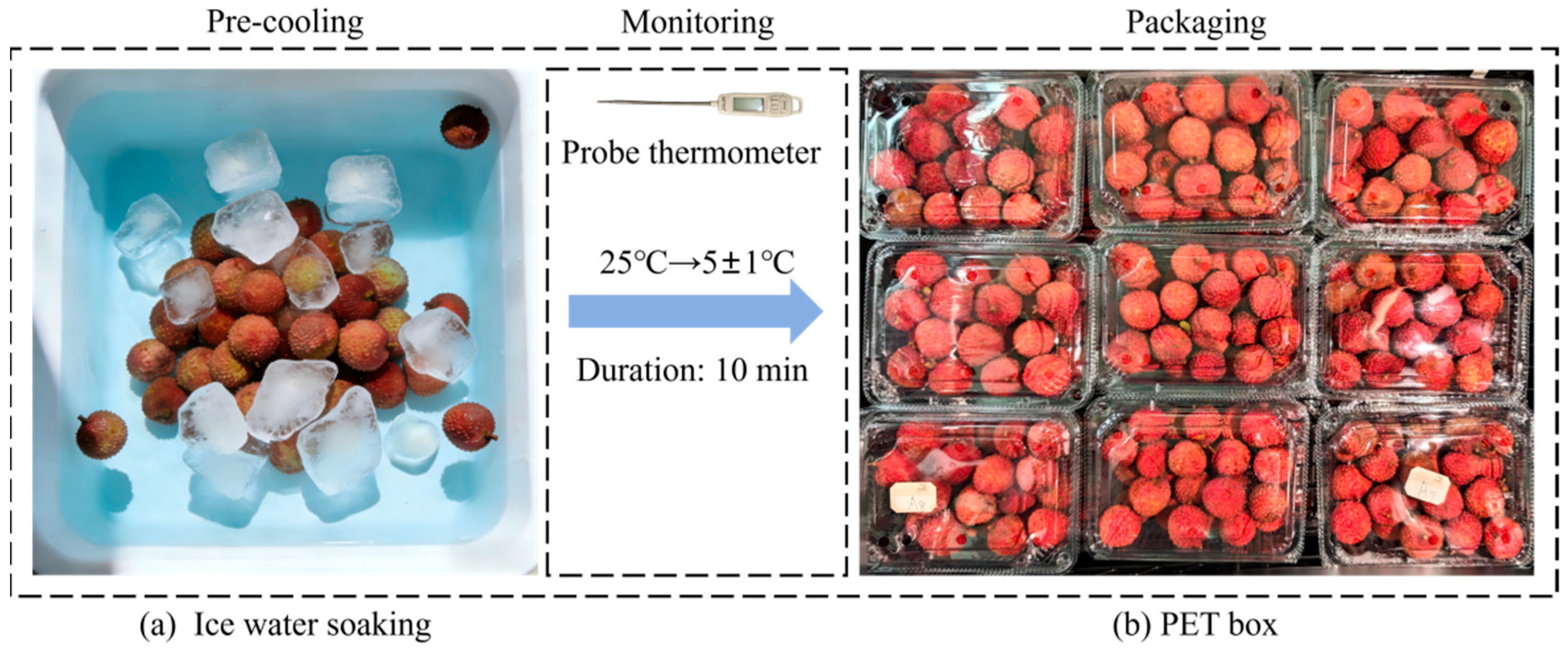
The research was carried out at the Key Laboratory of Southern Agricultural Machinery and Equipment (Ministry of Education), South China Agricultural University, Guangzhou, China. A total of 50 kg of litchi fruit (cultivar ‘Guiwei’) at commercial maturity (characterized by a bright red pericarp) were harvested in the orchard located at Conghua, Guangzhou, in the early morning and transported to the laboratory at South China Agricultural University immediately. Upon arrival, the initial fruit core temperature was approximately 21 ± 1 °C. Litchi fruit was packed with PET packages and about 0.5 kg in one package, as shown in Figure 1.
The fruit for hydro-cooling treatments was immersed in a container with an ice–water mixture for ten minutes, and the final fruit (core) temperature was about 5 ± 1 °C, measured by a probe thermometer. After that, the fruit was removed from the cooling container, dried with blotting paper, and packed with PET packages (about 0.5 kg in one package).

2.2. Forced-Air Cooling Treatments and Storage

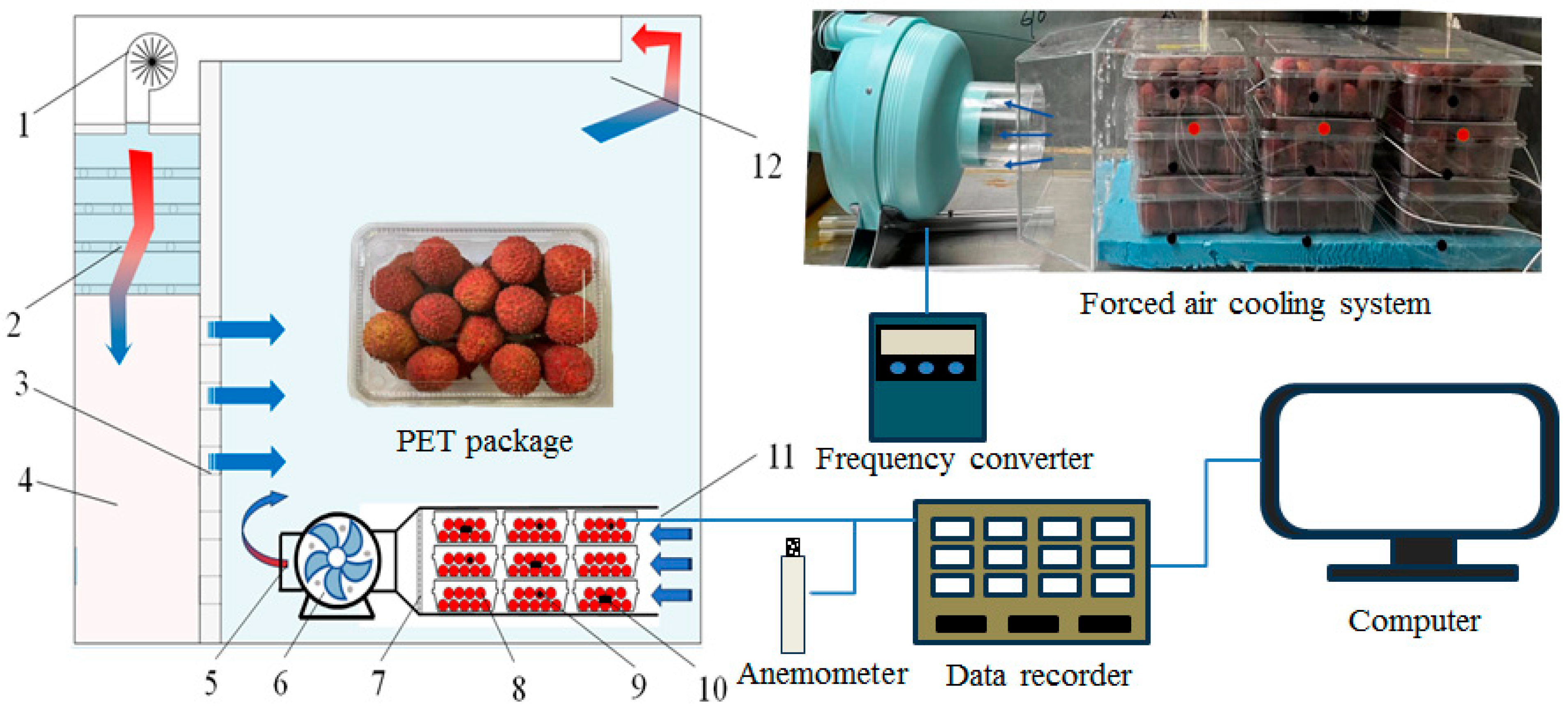
A fresh-keeping container (1.9 m length × 1.1 m width × 1.5 m high) was adopted to control the ambient temperature during pre-cooling and storage. The container is divided into two parts, including a fresh-keeping area and a refrigeration area, as shown in Figure 2. When the circulation fan is running, the air from the fresh-keeping area reaches the refrigeration area through the air duct and is cooled by the refrigerating system. The air in the fresh-keeping area was controlled at 3–5 °C.
A forced-air cooling system that consists of a fan and air tube was built and placed in the fresh-keeping area to regulate velocity for litchi pre-cooling. The air velocity at the fan outlet was calibrated by a hot wire anemometer (model Testo 410i, Testo SE & Co. KGaA, Titisee-Neustadt, Germany, range 0.4–30 m/s), with an accuracy of ±0.2 m/s + 2% of the measured value. The core temperature of litchi and air temperature in the package were monitored and recorded by nine and three pt100 sensors (adhesive-type Class A, accuracy ±0.15, temperature range −60–180 °C), respectively, and connected to a data recorder (SIN-R9600, accuracy 2%, Hangzhou Lianmei Automation Technology Co., Ltd., Hangzhou, China).
The effects of different air velocities at the fan inlet on fruit temperature and subsequent quality were investigated. The air velocity was set as 3, 6, and 10 m/s according to FAC (Forced-air cooling) 1, 2, and 3, respectively. The pre-cooling was finished after the fruit core temperature reached 5 °C. After that, all the fruit treated by forced-air cooling and hydro-cooling was placed in another fresh-keeping container, as shown in Figure 1, for 18-day storage under a 3–5 °C environment, and quality evaluation was conducted at 6 and 18 days.

2.3. Experimental Design

To comprehensively evaluate the effects of pre-cooling on litchi quality, a 4 × 3 factorial experimental design was implemented. The first factor was the pre-cooling treatment (T) with four levels of forced-air cooling at three velocities (3, 6, and 10 m/s), and hydro-cooling, as a traditional benchmark. The rationale for selecting these air velocities was to represent the range of low, medium, and high-intensity airflows typically encountered in industrial cooling facilities. The second factor was the storage duration (S) with three levels (0, 6, and 18 days) to monitor physiological evolution during long-term cold storage. This factorial layout was chosen to identify not only the individual impact of each cooling method but also the interactive effects between the cooling intensity and storage time on fruit quality deterioration. All treatment combinations were performed in triplicate, with each replicate consisting of one PET package (approximately 0.5 kg). The factorial experimental design for litchi pre-cooling and storage treatments is shown in Table 1.

2.4. Measurement of Fruit Color Characteristics

The chromaticity of litchi pericarp was measured by a chroma meter (Minolta CR 400, Konica Minolta Sensing, Inc., Osaka, Japan) and represented as the L*, a* and b* values according to the CIE (Commission Internationale de L’Eclairage) system. Two points on opposite sides of the equatorial perimeter of ten individual litchi fruit from each group, randomly selected, were measured.

2.5. Measurement of Total Soluble Solid (TSS) and Titratable Acidity Content (TA)

The total soluble solids (TSS) and titratable acid (TA) of the litchi fruit were determined by using an integrated refractometer (PAL-BX|ACID3, Atago Co., Ltd., Tokyo, Japan). The range for soluble solids of this instrument is 0–60% with an accuracy of 0.01%, and the range of titratable acid °Brix is 0.1–3.0% with an accuracy of 0.01%. Nine fruit samples were taken for each group of experiments. The litchi fruit was peeled and pitted (seeds removed). The arils were put into clean packaging bags and manually squeezed/crushed to extract the juice. The juice was filtered through gauze, poured into beakers, and shaken evenly [18]. Before measurement, the instrument was formatted and calibrated with deionized water, dried, and 10 µL of juice was taken with a pipette and dropped onto the measurement area of the instrument. The data on soluble solids were read and recorded. Then, 20 mL of deionized water was taken with a pipette and mixed with the juice at a ratio of 1:50. The data of titratable acid were read and recorded. Each measurement was repeated three times.

2.6. Measurement of Pericarp Moisture Content (PMC) and Fruit Weight Loss Rate (WLR)

The pericarp moisture content (PMC) of the pericarp was determined by the drying method [19]. Nine fruit types were taken from each group, and the pericarps were removed. The moisture on the inner and outer surfaces of the peels was absorbed with blotting paper. A 5 g sample of the pericarp was punched out using a 0.5 cm diameter punch. Approximately 1.3 g of the peel was weighed using an electronic scale. Each group was placed in a halogen moisture analyzer (model VM-E50; weighing accuracy: 0.005 g; moisture readability: 0.01%; temperature resolution: 0.1 °C; moisture range MC%: 0.00–100.00%; solid content range DC%: 100.00–0.00%; heating range: 40–250 °C; Jiangsu Weikete Instrument & Meter Co., Ltd., Xinghua, China) and dried at 100 °C. When the pericarps lost water to a constant weight, the dry weight and moisture content of the pericarps were recorded. The measurement was repeated three times, and the average value was taken according to Formula (1). The weight loss rate (WLR) of litchi fruit was measured by the weighing method. Three packages of litchi fruit were selected from each treatment group for weighing. The initial weight was recorded as M1. After the storage, the fruit was taken out from the fresh-keeping area, and the surface condensation was gently blotted with soft gauze to ensure consistency, and the weight was recorded as Mn. The weight loss rate of litchi fruit was calculated according to Formula (2), and three replicates were set:
P M C = M 0 M F / M 0
W L R % = M 1 M n / M 1 × 100 %
where M0 is the initial weight of the fruit pericarp, MF is the weight of the fruit pericarp after drying, M1 is the initial weight of the fruit, and Mn is the weight of the fruit after storage.

2.7. Measurement of Fruit Firmness (FF)

Fruit firmness was measured using a fruit hardness tester (GY-4, Zhejiang Top Cloud-agri Technology Co., Ltd., Hangzhou, China), ranging from 0 N to 30 N. The pericarp of the litchi fruit was plucked off, and two different test positions were selected for fruit firmness testing. By increasing the pressure of the thimble until the thimble pierced the fruit, the firmness of 18 fruit individuals in each group was measured, and the average value was taken.

2.8. Evaluation of Cooling Efficiency

The half-cooling time (HCT) was used to evaluate the cooling efficiency, which is calculated at every location in the tunnel where the temperatures were measured. The method for HCT calculation in this study is from Mercier et al. [20]. The monitored temperature was first nondimensionalized as follows:
T a ( t ) = 1 T a 0 T a ( t ) T a 0 T 0 , min
where Ta(t) is the dimensionless temperature at location a, Ta(t) is the current temperature measured at the same location, Ta0 is the initial temperature at the same location, and To,min is the minimum air temperature measured at the tunnel inlet during pre-cooling. The minimum temperature at the tunnel inlet was chosen because it is the lowest temperature observed in the tunnel during pre-cooling, hence scaling the dimensionless temperature to a range of [0, 1]. The HCT was defined as the time required to reach a dimensionless temperature Ta(t) = 0.5.

2.9. Statistical Analysis

The experiment was conducted using a completely randomized design with a factorial arrangement of treatments. The factors included the pre-cooling treatment (four levels: forced-air cooling at 3, 6, 10 m/s, and hydro-cooling) and storage time (three levels: 0, 6, and 18 days). All data were analyzed using a two-way factorial analysis of variance (ANOVA) via SPSS software (Version 27.0, IBM Corp., Armonk, NY, USA) to evaluate the main effects of treatment and storage time, as well as their interactions. When the ANOVA indicated significant differences (p < 0.05), means were separated using Fisher’s Least Significant Difference (LSD) test.

3. Results and Analysis

3.1. Evolution of the Temperature During Forced-Air Cooling

Evolution of the Litchi Temperature During Forced-Air Cooling

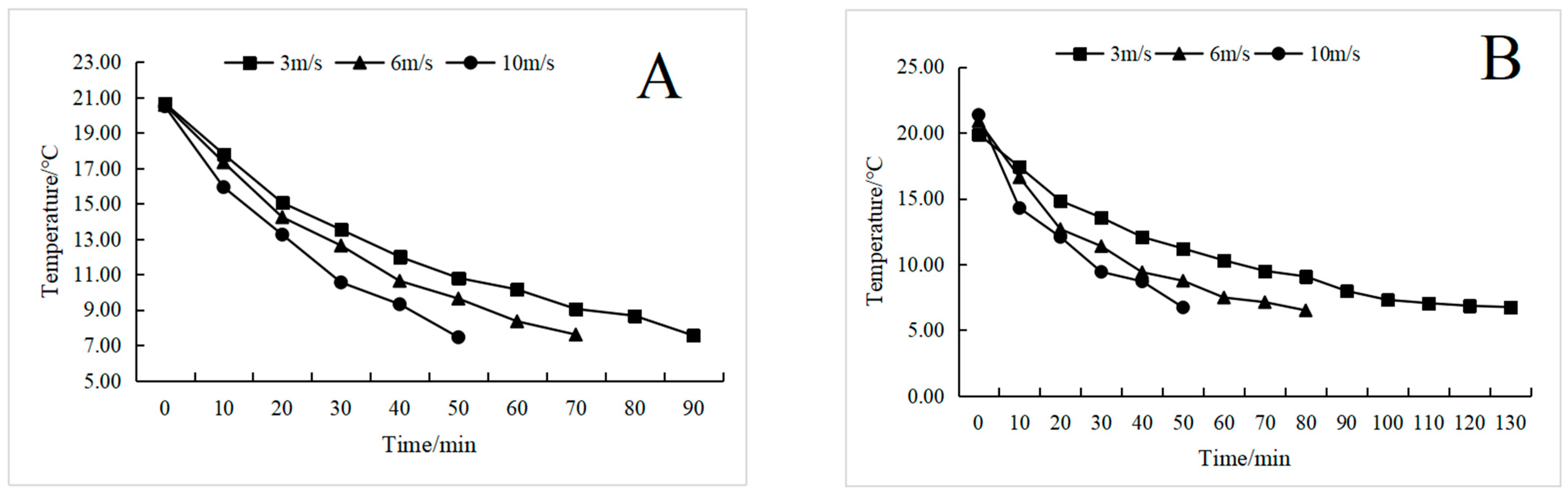
The temperature variation in fruit and in-package during pre-cooling is shown in Figure 3A,B. From Figure 3A, the fruit temperature decreases faster under a higher air velocity. When the air velocity is 10 m/s, it takes only about 55 min for the fruit temperature from 21 °C decrease to 6 °C. From Figure 3B, the temperature in the package decreased faster as the air velocity increased. However, when the air velocity is increased to 10 m/s, the cooling time only reduces by about 30 min compared to the gap (about 50 min) between 3 m/s and 6 m/s. The air temperature is determined by the combination of the cold air and the fruit.

3.2. Pericarp Color and PMC

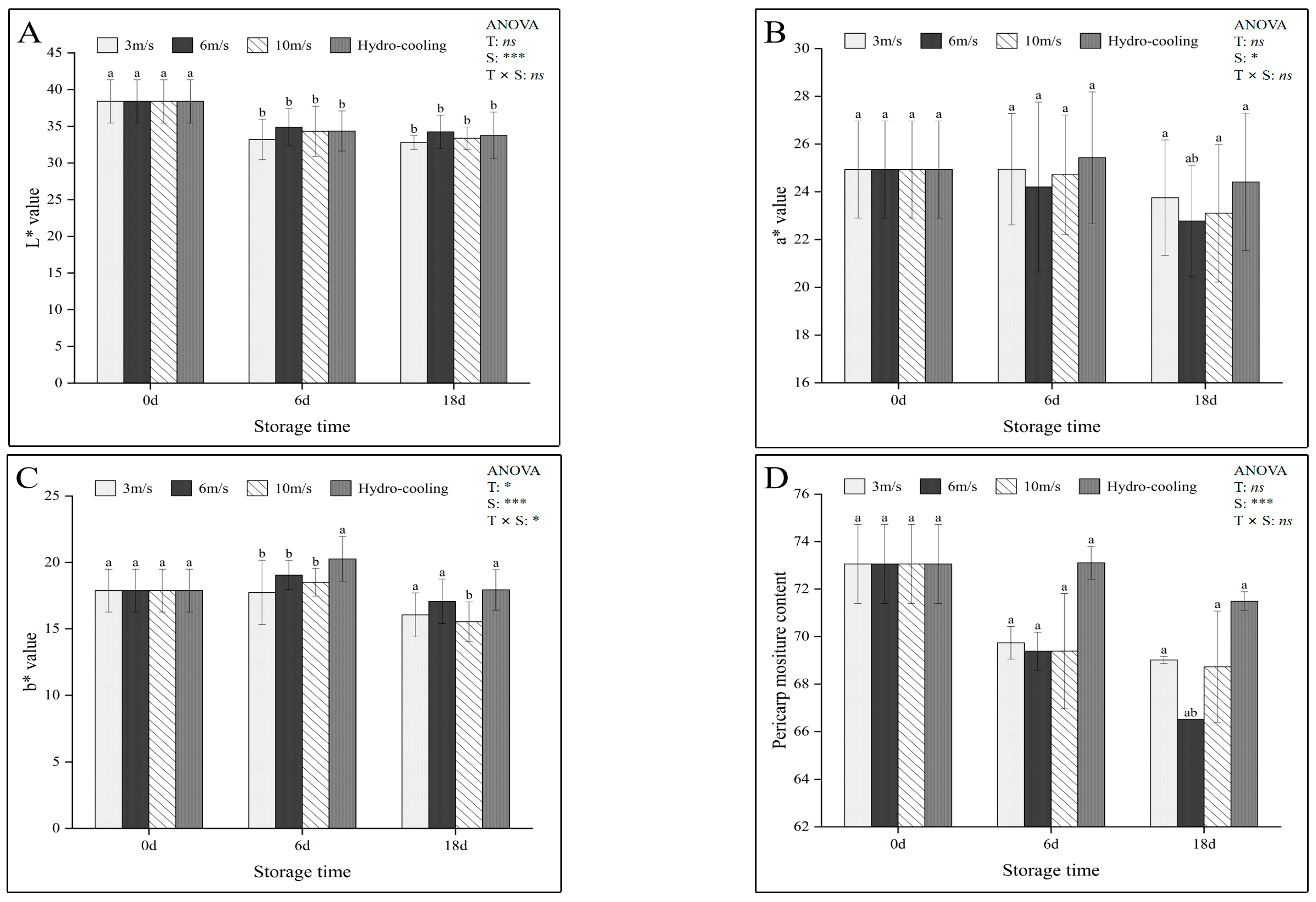
The two-way ANOVA results indicated that storage time (S) had a significant main effect on all color parameters and PMC, while the pre-cooling treatment (T) only significantly affected the b* value (Table 2). Notably, the interaction between treatment and storage time was significant for b (p < 0.05), but not significant for L*, a*, and PMC (p > 0.05). This suggests that while all fruit underwent significant color changes and moisture loss over time, the pre-cooling methods specifically influenced the trajectory of yellowness (b*) during the 18-day storage, whereas their effects on lightness (L*) and redness (a*) remained consistent across different storage stages.
The variation in pericarp color and the weight loss rate of fruit pre-cooled with different methods during storage is shown in Figure 4. Basically, the L* color and the PMC of the fruit decreased over the storage time. Notably, no significant changes in a* values were observed throughout the 18-day storage period for all treatments (Figure 4B), indicating that the degradation of anthocyanins was effectively inhibited by the pre-cooling treatments and subsequent cold storage. Fruit pre-cooled with hydro-cooling showed higher a* and b* values during storage. Fruit pre-cooled with forced air at 6 m/s (FAC 2) exhibited slightly higher L*, b*, and PMC, but lower a* values. The a* value of the fruit pericarp was 23.8, 2.4, 22.8, 2.3, 23.1, and 24.4, respectively. Hydro-cooling helped delay pericarp moisture loss during storage (Figure 4D). Increasing cooling air velocity improved the pre-cooling rate of fruit but promoted the risk of moisture loss. However, the 10 m/s treatment had the shortest cooling time, and fruit pre-cooled with this velocity showed lower moisture loss compared with other air velocities. PMCs for forced-air and hydro-cooled fruit were 69.01%, 66.51%, 68.73%, and 71.49%, respectively.

3.3. WLR, TSS, TA, and FF

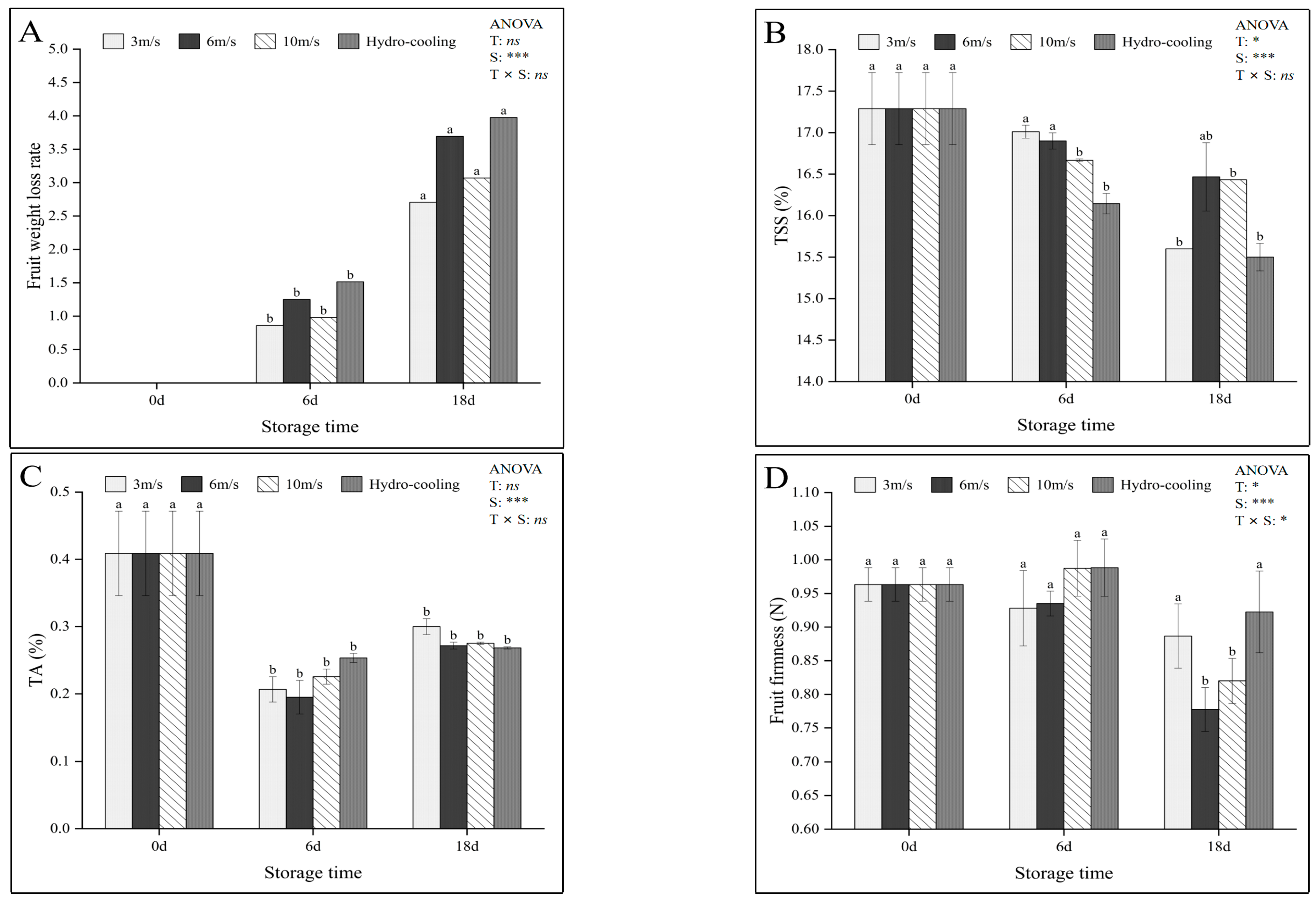
The two-way ANOVA results (Table 2) showed that storage time (S) had a dominant and highly significant effect on all measured quality indices, confirming the progressive senescence of litchi fruit. Regarding the interaction between pre-cooling treatment and storage time (T × S), a significant effect was observed for fruit firmness (FF) (p < 0.05), indicating that the impact of pre-cooling methods on texture softening changed over the storage duration. However, no significant interactions were detected for WLR, TSS, and TA (p > 0.05), suggesting that these parameters followed a consistent variation trend across all treatment groups during the 18 days. As shown in Figure 5A, the fruit WLR increased throughout the storage period, reaching approximately 4% by day 18. In alignment with the ANOVA results, no significant differences were observed among the four pre-cooling treatments at either the 6- or 18-day interval (p > 0.05), reflecting that while pre-cooling is essential, the specific method did not significantly alter the overall weight loss rate under these storage conditions. As shown in Figure 5B, although the interaction was not significant, the pre-cooling treatment had a significant main effect on TSS (Table 2). At the end of storage (18 d), the TSS values for the 3, 6, 10 m/s FAC, and hydro-cooling treatments were 15.6%, 16.5%, 16.4%, and 15.5%, respectively, with the 6 and 10 m/s FAC groups maintaining slightly higher levels. However, there are insignificant difference on the TA value between FAC- and hydro-cooling-treated fruit during the 18-day storage, showing a decrease in the first 6 days, but a small increase can be seen at 18 days, and the TA value is about 0.28%. The firmness of the fruit decreases with the storage time. Forced-air cooling with 3 m/s and hydro-cooling treated fruit have higher firmness during the whole storage, showing values of 0.89 N and 0.92 N, respectively.

3.4. Analysis of the Correlation Among the Indicators

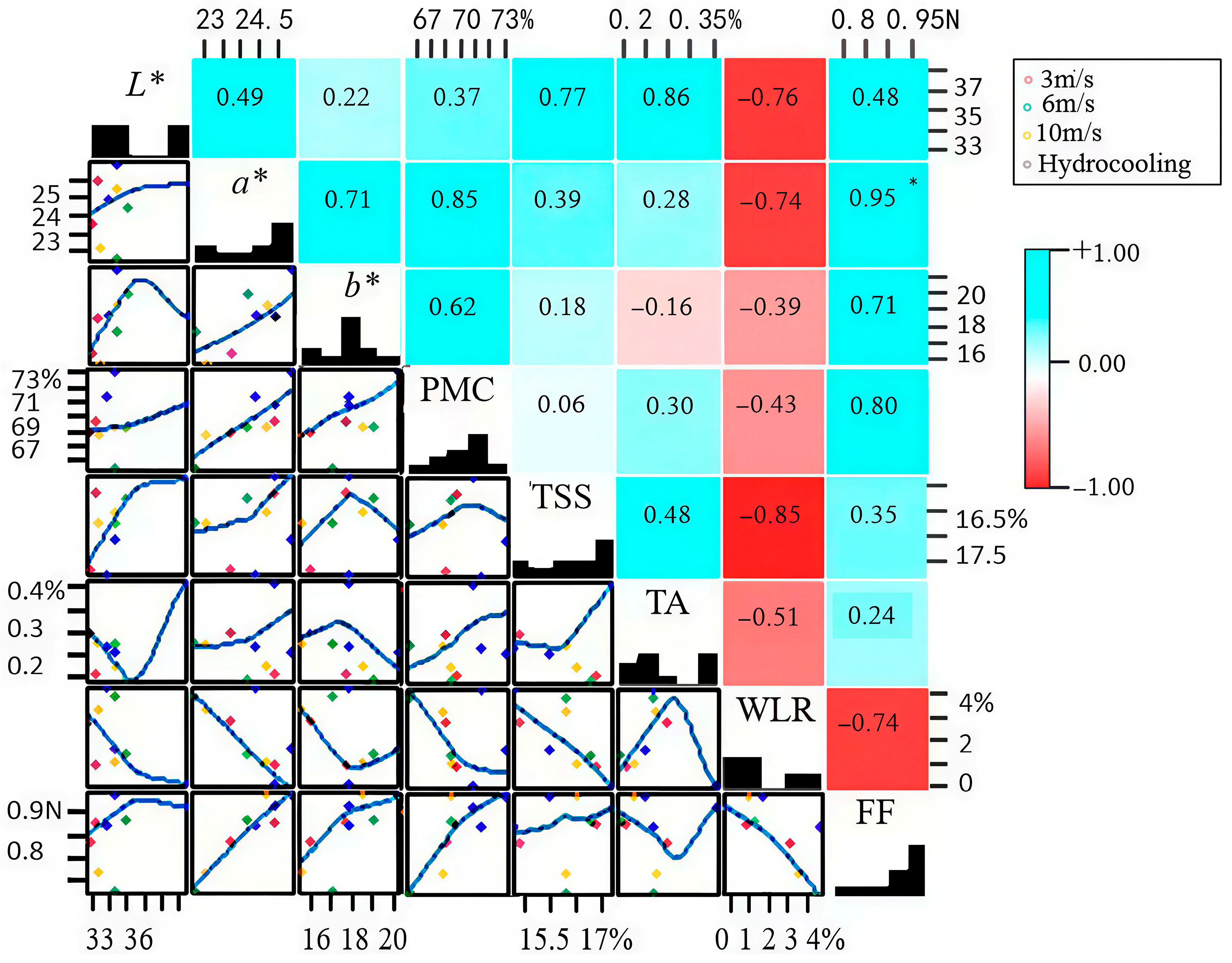
To analyze the variation in the quality of litchi fruit during storage, the relationship among the indices of fruit is represented by a heat map, as shown in Figure 6.
As shown in Figure 6, the litchi quality indicators exhibited highly integrated and synchronized variation patterns throughout the storage period. Specifically, the variation in fruit brightness (L*) was synergistic with internal chemical markers, showing high positive correlations with TSS (0.77) and TA (0.86), suggesting that surface color fading was closely linked to changes in soluble solids and organic acids. Similarly, pericarp redness (a*) was closely associated with moisture status, as indicated by its strong positive correlation with PMC (0.85). Regarding quality degradation, strong inverse relationships were observed between WLR and TSS (−0.85), indicating that weight loss was synchronized with the depletion of soluble solids during storage. Finally, fruit firmness (FF) was closely coupled with the moisture status of the fruit, showing a positive correlation with PMC (0.80) and a strong negative correlation with WLR (−0.74), indicating that fruit softening was closely associated with changes in moisture status during the storage process.

4. Discussion

Litchi is a well-known fruit in China with a great cultivated area and yield. It is famous for its juicy and sweet flavor as well as high nutritional value. However, litchi is difficult for preservation that the fruit becomes susceptible to pericarp browning and decay after being harvested. Pre-cooling can remove the field heat by cooling down the fruit temperature [14]. To improve the efficiency and performance of litchi pre-cooling, a test was conducted to investigate the pre-cooling methods and the relationship between the cooling parameters and fruit quality. Rapid pre-cooling modulates the respiratory rate of fresh litchi by quickly removing field heat, thereby suppressing the metabolic activity associated with nutrient depletion and quality deterioration [21].
In this study, higher air velocity was found to be able to improve the temperature decrease rate, shortening the cooling process. The cooling effect is significant on the air temperature in the package. The convection inside and outside the package also influences the air temperature that cooling air to enter and be pushed out quickly by the following new cold air when the air velocity is relatively large. A similar result can be seen in the research of Delele et al. [7] that fruit cooling rate increased with an increase in vent area of the package. For these reasons, the effects of higher air velocity are more obvious on the air temperature in the package compared with the fruit temperature.
In the present study, hydro-cooling has a better effect on the color maintenance of the fruit pericarp, which may account for the shorter cooling time for hydro-cooling as well as the immersion under water protection. A similar result can be found from the research by Alibas and Koksal [22] that worse color parameters of cooled cauliflower heads were obtained in the forced air-pre-cooling method. Thus, forced air pre-cooling is not suitable for the fruit and vegetables that are prone to losing moisture. Forced air pre-cooling with a package is reported as an effective way to solve such problems [5]. However, in this paper, the PMC of forced air pre-cooling with package-treated fruit kept a lower value compared to hydro-cooling-treated fruit during the storage time. This phenomenon may account for the poor water retention capacity of litchi fruit pericarp [23]. It has been reported that there is no connection between the pericarp and aril, except that the two tissues are connected via the pedicel of the fruit [24]. Although increasing air velocity may increase the risk of water loss, it can shorten the cooling time. The PMC of the 10 m/s air-cooled fruit in this research has a higher PMC and lower WLR than the 6 m/s air-cooled fruit. Moreover, it is also reported that the opening vent area plays an important role in the energy consumption of the cooling system, as a small vent area could retard the heat transfer between the air and the fruit [17]. Thus, inhibiting water loss of the pericarp should be considered during pre-cooling. The relationship among the vent area, air velocity, and cooling performance should be investigated in the future.
From Figure 5A, it can be shown that hydro-cooling-treated fruit keeps a greater WLR during storage, which may be attributed to the residual water on the fruit surface that makes it difficult to dry the water completely just by blotting paper since the structure of the fruit pericarp is complex [25]. Among the forced-air cooling fruit, FAC2 kept a higher WLR than other treatments, which are consist with Figure 4D that FAC2 also kept a lower pericarp moisture content during storage. The reason for such a phenomenon may be that the 6 m/s cooling velocity has a higher air velocity than the 3 m/s cooling velocity and longer cooling time than the 10 m/s cooling velocity, which may improve the damage in litchi fruit [26]. An increase in TA can be seen during the storage, which may be due to the WLR increase during the storage that TA per unit of pulp increasing. This phenomenon is similar to the results from [3,27].
During storage, the enzymatic reactions of fruit metabolism accelerate the respiratory consumption of TSS and TA as storage time increases [28]. In this process, these substrates may be utilized in carbohydrate metabolism to support cellular activity, and their contents continuously decrease, leading to an increase in weight loss rate (WLR). Therefore, the variations in TSS and TA values are positively correlated with the variations in WLR. In addition, for the fact that the red color of fruit pericarp is determined by the anthocyanin glycosides in the vesicles, and when the pericarp loses water, the anthocyanin glycosides content in the pericarp cells also decreases [29]. The variations between a* and PMC show a strong positive correlation, suggesting that pericarp moisture retention may be essential for maintaining cell membrane permeability. Pericarp desiccation likely leads to a loss of cellular compartmentalization, which could allow oxidative enzymes to react with phenolic substrates, thereby potentially triggering enzymatic browning and the decline of redness (a*) [30]. Furthermore, the relationship between TSS and WLR suggests that the aerobic respiration consumption during fruit storage significantly increases the weight loss rate of the fruit [31]. The variations in FF and WLR exhibit a positive correlation, which may be attributed to the simultaneous occurrence of transpiration and aerobic respiration. These processes drive the osmotic diffusion of water from the fruit tissue to the external environment, leading to a loss of cellular turgor and the subsequent degradation of fruit firmness [32]. Under the effect of transpiration, water from the fruit migrates outward. Aerobic respiration consumes organic matter within the fruit. Both organic matter and water are crucial components for maintaining the structural stability of the fruit [33]. Consequently, when water and organic matter are depleted, the fruit’s structure is also affected accordingly.

5. Conclusions

This study demonstrates that forced-air cooling with package treatment is a feasible alternative to hydro-cooling for litchi pre-cooling. The fruit temperature decreased faster under a higher air velocity, but the cooling effect slowed down after the air velocity increased to 10 m/s, which also resulted in a lower fruit moisture loss compared with other air velocities, indicating that further increases in air velocity are unnecessary for practical applications. Although hydro-cooling provided the fastest cooling and better retention of pericarp moisture and firmness, it resulted in lower total soluble solid content during storage and involves operational limitations, such as water hygiene control and post-cooling handling risks. In contrast, forced-air cooling with package treatment maintained comparable appearance and internal quality during 18 days of cold storage, while offering advantages in system hygiene and operational flexibility. From an industrial perspective, an optimized forced-air cooling regime (≈10 m/s) can be recommended as a practical pre-cooling strategy for litchi, balancing cooling performance, quality preservation, and operational convenience. The observed correlations further indicate that water loss and respiration-related depletion are key drivers of texture softening and soluble solid variation, highlighting moisture management as a critical control point in postharvest handling. Future research should focus on optimizing packaging vent designs and conducting energy-consumption analyses to further enhance the sustainability and cost-effectiveness of forced-air cooling systems in large-scale industrial applications.

Author Contributions

Conceptualization, J.G. and Z.Z.; methodology, J.W., Z.D. (Zilong Deng), P.G., and D.L.; software, P.G. and D.L.; validation, P.G. and Z.D. (Zhiwu Ding); formal analysis, Z.D. (Zilong Deng); investigation, D.L. and P.G.; resources, J.G. and H.L.; data curation, J.W., H.L. and Z.D. (Zhiwu Ding); writing—original draft preparation, J.G.; writing—review and editing, J.W., Z.D. (Zhiwu Ding), D.L. and P.G.; visualization, H.L.; supervision, J.G., Z.Z. and E.L.; project administration, J.G., Z.Z. and E.L.; funding acquisition, J.G., Z.Z. and E.L. All authors have read and agreed to the published version of the manuscript.

Funding

This research was funded by National Natural Science Foundation of China, grant number: 32472023; Guangdong Special Support Program (Agriculture and Rural Revitalization Talents), grant number: NYQN2024010; National Lychee Longan Industry Technology System, grant number: CARS-32-11; Guangzhou Rural Science and Technology Commis-sioner Project, grant number: 2025D04J0092; Shanghai Agricultural Science and Technology Innovation Program (T2024203); Guangdong S&T Program (2025B0202110002).

Data Availability Statement

The original contributions presented in the study are included in the article. Further inquiries can be directed to the corresponding author.

Conflicts of Interest

Author Hong Lu was employed by the company Dong Fang International Container (Qidong) Co., Ltd. The remaining authors declare that the research was conducted in the absence of any commercial or financial relationships that could be construed as a potential conflict of interest.

References

  1. Jiang, Y.; Li, J.; Jiang, W. Effects of chitosan coating on shelf life of cold-stored litchi fruit at ambient temperature. LWT-Food Sci. Technol. 2005, 38, 757–761. [Google Scholar] [CrossRef]
  2. Mahajan, P.V.; Goswami, T.K. Extended storage life of litchi fruit using controlled atmosphere and low temperature. J. Food Process. Preserv. 2004, 28, 388–403. [Google Scholar] [CrossRef]
  3. Jiang, X.; Lin, H.; Shi, J.; Neethirajan, S.; Lin, Y.; Chen, Y.; Wang, H.; Lin, Y. Effects of a novel chitosan formulation treatment on quality attributes and storage behavior of harvested litchi fruit. Food Chem. 2018, 252, 134–141. [Google Scholar] [CrossRef]
  4. Kumar, N.; Neeraj; Pratibha; Singla, M. Enhancement of storage life and quality maintenance of litchi (Litchi chinensis Sonn.) fruit using chitosan:pullulan blend antimicrobial edible coating. Int. J. Fruit Sci. 2020, 20, S1662–S1680. [Google Scholar] [CrossRef]
  5. Kumar, A.; Kumar, R.; Subudhi, S. Numerical modeling of forced-air pre-cooling of fruits and vegetables: A review. Int. J. Refrig. 2023, 145, 217–232. [Google Scholar] [CrossRef]
  6. Delele, M.A.; Ngcobo, M.E.K.; Getahun, S.T.; Chen, L.; Mellmann, J.; Opara, U.L. Studying airflow and heat transfer characteristics of a horticultural produce packaging system using a 3-d cfd model. Part i: Model development and validation. Postharvest Biol. Technol. 2013, 86, 536–545. [Google Scholar] [CrossRef]
  7. Delele, M.A.; Ngcobo, M.E.K.; Getahun, S.T.; Chen, L.; Mellmann, J.; Opara, U.L. Studying airflow and heat transfer characteristics of a horticultural produce packaging system using a 3-d cfd model. Part ii: Effect of package design. Postharvest Biol. Technol. 2013, 86, 546–555. [Google Scholar] [CrossRef]
  8. Liu, F.; Jia, B.; Li, Z.; Zhang, X. Thermodynamics analysis for forced air pre-cooling of cherry. J. Food Process Eng. 2021, 44, e13851. [Google Scholar] [CrossRef]
  9. Jia, B.; Liu, F.; Yuan, S.; Li, Z.; Zhang, X. The effect of alternating ventilation on forced air pre-cooling of cherries. Int. J. Food Eng. 2021, 17, 423–433. [Google Scholar] [CrossRef]
  10. Ferreira, M.D.; Brecht, J.K.; Sargent, S.A.; Chandler, C.K. Hydrocooling as an alternative to forced-air cooling for maintaining fresh-market strawberry quality. HortTechnology 2006, 16, 659–666. [Google Scholar] [CrossRef]
  11. Liang, Y.S.; Wongmetha, O.; Wu, P.S.; Ke, L.S. Influence of hydrocooling on browning and quality of litchi cultivar feizixiao during storage. Int. J. Refrig. 2013, 36, 1173–1179. [Google Scholar] [CrossRef]
  12. Bovi, G.G.; Caleb, O.J.; Rauh, C.; Mahajan, P.V. Condensation regulation of packaged strawberries under fluctuating storage temperature. Packag. Technol. Sci. 2019, 32, 545–554. [Google Scholar] [CrossRef]
  13. Bryant, P.H. A model of postharvest moisture loss under air currents to reduce pericarp browning of litchi (Litchi chinensis Sonn.). Postharvest Biol. Technol. 2012, 73, 8–13. [Google Scholar] [CrossRef]
  14. Shilpa; Mahajan, B.V.C.; Singh, N.P.; Bhullar, K.S.; Kaur, S. Forced air cooling delays pericarp browning and maintains post-harvest quality of litchi fruit during cold storage. Acta Physiol. Plant. 2022, 44, 59. [Google Scholar] [CrossRef]
  15. Ndukwu, M.C.; Matthew, I.; Godwin, A.; Oriaku, L.; Abada, U.C.; Kalu, C.A.; Ben, A.E.; Mbanasor, J.; Wu, H. Heat transfer correlations and pressure drop dynamics of palm fibre wetting media for evaporative cooling at different air flow rates. Int. J. Refrig. 2023, 154, 268–280. [Google Scholar] [CrossRef]
  16. Eddine, A.N.; Duret, S.; Flick, D.; Moureh, J. Convective heat transfer characteristics within a multi-package during precooling. J. Food Eng. 2023, 359, 111710. [Google Scholar] [CrossRef]
  17. Wang, D.; Lai, Y.; Jia, B.; Chen, R.; Hui, X. The optimal design and energy consumption analysis of forced air pre-cooling packaging system. Appl. Therm. Eng. 2020, 165, 114592. [Google Scholar] [CrossRef]
  18. Guo, J.; Liu, D.; Lin, G.; Qiu, H.; Guo, P.; Ding, Z.; Wu, D.; Wang, J.; Lv, E. Effects of different litchi e-commerce logistics packaging methods on microenvironment and fruit quality variations. Foods 2025, 14, 1184. [Google Scholar] [CrossRef]
  19. Yang, Y.; Sun, D.; Wang, N. Rapid detection of browning levels of lychee pericarp as affected by moisture contents using hyperspectral imaging. Comput. Electron. Agric. 2015, 113, 203–212. [Google Scholar] [CrossRef]
  20. Mercier, S.; Brecht, J.K.; Uysal, I. Commercial forced-air precooling of strawberries: A temperature distribution and correlation study. J. Food Eng. 2019, 242, 47–54. [Google Scholar] [CrossRef]
  21. Xiang, B.; Zhang, X. Advancements in the development of field precooling of fruits and vegetables with/without phase change materials. J. Energy Storage 2023, 73, 109007. [Google Scholar] [CrossRef]
  22. Alibas, I.; Koksal, N. Forced-air, vacuum, and hydro precooling of cauliflower (Brassica oleracea L. var. botrytis cv. Freemont): Part i. Determination of precooling parameters. Food Sci. Technol. 2014, 34, 730–737. [Google Scholar] [CrossRef]
  23. Fang, F.; Liu, B.; Fu, L.; Tang, H.; Li, Y.; Pang, X.; Zhang, Z. Water supply via pedicel reduces postharvest pericarp browning of litchi (Litchi chinensis Sonn.) fruit. Foods 2024, 13, 814. [Google Scholar]
  24. Liu, B.; Xue, W.; Guo, Z.; Liu, S.; Zhu, Q.; Pang, X.; Zhang, Z.; Fang, F. Water loss and pericarp browning of litchi (Litchi chinensis Sonn.) and longan (Dimocarpus longan) fruit maintain seed vigor. Sci. Hortic. 2021, 290, 110519. [Google Scholar] [CrossRef]
  25. Huang, H.; Liu, H.; Wang, L.; Xiang, X. Cuticular wax metabolism responses to atmospheric water stress on the exocarp surface of litchi fruit after harvest. Food Chem. 2023, 414, 135681. [Google Scholar] [CrossRef]
  26. Xiao, L.; Li, T.; Jiang, G.; John, A.; Zhang, D.; Jin, W.; Duan, X.; Jiang, Y. Effects of dry fog humidification on pericarp browning and quality of litchi fruit stored at low temperature. Int. J. Agric. Biol. Eng. 2019, 12, 192–196. [Google Scholar] [CrossRef]
  27. Pesis, E.; Dvir, O.; Feygenberg, O.; Arie, R.B.; Ackerman, M.; Lichter, A. Production of acetaldehyde and ethanol during maturation and modified atmosphere storage of litchi fruit. Postharvest Biol. Technol. 2002, 26, 157–165. [Google Scholar] [CrossRef]
  28. Hong, K.; Xu, H.; Wang, J.; Zhang, L.; Hu, H.; Jia, Z.; Gu, H.; He, Q.; Gong, D. Quality changes and internal browning developments of summer pineapple fruit during storage at different temperatures. Sci. Hortic. 2013, 151, 68–74. [Google Scholar] [CrossRef]
  29. Silva, D.F.P.; Lins, R.D.; Cabrini, E.C. Influence of the use of acids and films in post-harvest lychee conservation. Rev. Ceres 2012, 59, 745–750. [Google Scholar] [CrossRef]
  30. Wang, J.H.; Li, F.J.; Li, B.R.; Li, L.; Shang, J.; Fu, X.D.; Zhao, X.M.; Li, X.A.; Zhang, X.H.; Ahmed, Z.F.R. ROS-mediated membrane damage and antioxidant imbalance drive apple flesh browning during cold storage. Front. Plant Sci. 2025, 16, 1718635. [Google Scholar] [CrossRef]
  31. Li, G.; Chen, T.; Feng, B.; Peng, S.; Tao, L.; Fu, G. Respiration, rather than photosynthesis, determines rice yield loss under moderate high-temperature conditions. Front. Plant Sci. 2021, 12, 678653. [Google Scholar] [CrossRef] [PubMed]
  32. Hasan, M.U.; Singh, Z.; Shah, H.M.S.; Kaur, J.; Woodward, A. Water loss: A postharvest quality marker in apple storage. Food Bioprocess Technol. 2024, 17, 2155–2180. [Google Scholar] [CrossRef]
  33. Dos Santos, L.F.; Vilvert, J.C.; De Souza, T.A.; Alves, J.D.; Ribeiro, T.D.; Neuwald, D.A.; De Freitas, S.T. Minimum O2 levels during storage to inhibit aerobic respiration and prolong the postharvest life of ‘Tommy Atkins’ mangoes produced in different growing seasons. Sci. Hortic. 2021, 348, 112094. [Google Scholar] [CrossRef]
Figure 1. Treatments of fruit cooled by hydro-cooling.
Agronomy 16 00428 g001
Figure 2. Structure of the fresh-keeping container and placement of the sensors: 1. circulation fan; 2. evaporator; 3. division plate with holes; 4. fresh-keeping area; 5. fan outlet; 6. forced air fan; 7. cooling tube; 8. litchi; 9. Pt100 sensor (fruit temperature); 10. Pt100 sensor (air temperature); 11. cooling tube inlet; and 12. air duct.
Agronomy 16 00428 g002
Figure 3. Evolution of the fruit temperature (A) and air temperature in the package (B) during forced-air cooling against the average HCT of fruit and the package.
Agronomy 16 00428 g003
Figure 4. Chroma L* (A), a* (B), b* (C), and pericarp moisture content (D) of litchi fruit treated by forced air-cooling or hydro-cooling during storage. The forced air velocity was set at 3, 6, and 10 m/s, respectively. Storage temperature was 3–5 °C. Values are means ± standard deviation (SD), n = 3. Different letters indicate significant differences between treatments at the same storage time according to Fisher’s protected least significant difference test at p < 0.05. T, S, and T × S represent the effects of treatment, storage time, and their interaction, respectively, based on two-way ANOVA results (ns, p > 0.05; *, p < 0.05; and ***, p < 0.001).
Agronomy 16 00428 g004
Figure 5. Fruit weight loss rate (A), total soluble solid content (B), titratable acidity content (C), and fruit firmness (D) of litchi fruit treated by forced-air cooling or hydro-cooling during storage. The forced air velocity was set at 3, 6, and 10 m/s, respectively. Storage temperature was 3–5 °C. Values are means ± standard deviation (SD), n = 3. Different letters indicate significant differences between treatments at the same storage time according to Fisher’s protected least significant difference test at p < 0.05. T, S, and T × S represent the effects of treatment, storage time, and their interaction, respectively, based on two-way ANOVA results (ns, p > 0.05; *, p < 0.05; and ***, p < 0.001).
Agronomy 16 00428 g005
Figure 6. Relationship between the air velocity and the quality indices after different pre-cooling methods. Correlation matrix depicting the pairwise scatter plot and the Pearson’s correlation coefficient (ranging from −1 to +1, where −1 indicates a strong negative correlation, 0 indicates the absence of correlation, and +1 indicates a strong, positive correlation). Significance for each correlation is indicated as asterisks: * < 0.05). L*, a*, and b* represented the values according to the CIE (Commission Internationale de L’Eclairage) system, respectively. PMC and TSS represented the moisture content of the fruit pericarp and the total soluble solid content of pulp, respectively. TA and WLR represented the titratable acid of pulp and the fruit weight loss rate. FF represented the fruit firmness.
Agronomy 16 00428 g006
Table 1. Factorial experimental design for litchi pre-cooling and storage treatments.
FactorLevelDescription
Pre-cooling treatment (T)FAC-3Forced-air cooling at 3 m/s
FAC-6Forced-air cooling at 6 m/s
FAC-10Forced-air cooling at 10 m/s
HCHydro-cooling (5 °C)
Storage duration (S)0 dImmediately after pre-cooling
6 dMid-term cold storage
18 dEnd-term cold storage
Replication3Three independent replicates per treatment × time combination
Experimental unit1One PET package (0.5 kg litchi fruit)
Response Variables8L*, a*, b*, PMC, WLR, TSS, TA, and FF
Table 2. Two-way ANOVA results for the effects of pre-cooling treatment (T), storage time (S), and their interaction (T × S) on the quality attributes of litchi fruit.
Source of VariationdfL*a*b*PMCWLRTSSTAFF
Treatment (T)31.15 ns1.42 ns3.24 *1.88 ns1.25 ns3.11 *0.85 ns3.45 *
Storage Time (S)2150.3 ***12.5 *25.6 ***85.4 ***450.2 ***65.8 ***120.4 ***45.2 ***
Interaction (T × S)60.95 ns1.05 ns2.31 *1.12 ns0.68 ns1.95 ns0.42 ns2.55 *
Note: The values presented in the table are the F-statistics from the ANOVA. Df indicates degrees of freedom. Significance levels are denoted as follows: ns, not significant (p > 0.05); *, significant at p < 0.05; and ***, significant at p < 0.001. Abbreviations: PMC, pericarp moisture content; WLR, weight loss rate; TSS, total soluble solids; TA, titratable acidity; and FF, fruit firmness.
Disclaimer/Publisher’s Note: The statements, opinions and data contained in all publications are solely those of the individual author(s) and contributor(s) and not of MDPI and/or the editor(s). MDPI and/or the editor(s) disclaim responsibility for any injury to people or property resulting from any ideas, methods, instructions or products referred to in the content.