Article

A Multispectral UAV Straw Returning Amount Estimation Method Integrating Novel Spectral Calibration and a Deep Learning Model

by
Yuanyuan Liu
1,
Xin Tong
1,
Jiaxin Zhang
1,
Xuan Zhao
2,
Junhui Chen
1,
Yuxin Du
1,
Fuxuan Li
1,
Yueyong Wang
2,
Jun Wang
2,*,
Libin Wang
3,
Meng Yu
3,
Pengxiang Sui
4 and
Xiaodan Liu
4
1
College of Information and Technology & Smart Agriculture Research Institute, Jilin Agricultural University, Changchun 130118, China
2
College of Engineering and Technology, Jilin Agricultural University, Changchun 130118, China
3
Agricultural Machinery Research Institute, Changchun Agricultural Commission, Changchun 130052, China
4
Jilin Academy of Agricultural Sciences, Changchun 130033, China
*
Author to whom correspondence should be addressed.
Agronomy 2026, 16(4), 416; https://doi.org/10.3390/agronomy16040416

Submission received: 21 December 2025 / Revised: 28 January 2026 / Accepted: 2 February 2026 / Published: 9 February 2026
(This article belongs to the Special Issue Digital Twins in Precision Agriculture)

Abstract

Accurately quantifying the amount of corn straw returned to the field is crucial for evaluating conservation tillage measures and phaeozem protection. This study proposes a framework for quantitatively estimating the amount of corn straw returned to the field based on UAV multispectral imaging, integrating a standardized spectral correction strategy, a novel straw index (SI), and an improved deep learning model (convolutional neural network-straw, CNN-Straw). By combining multispectral images acquired by UAVs with ground-measured straw weight data, regression datasets covering autumn and spring conditions were constructed. The proposed straw index aims to enhance the spectral differences between non-photosynthetic straw residues and living vegetation. Furthermore, the CNN-Straw model, combining frequency domain convolution and local spatial attention mechanisms, has an improved ability to represent the complex texture of straw features. Experimental results show that CNN-Straw outperforms traditional machine learning models, including random forest (RF), support vector regression (SVR), and XGBoost, achieving a high coefficient of determination (R2) of 0.82 on different seasonal datasets and effectively reducing the root mean square error (RMSE) and mean absolute error (MAE). Cross-seasonal experiments further demonstrate the stable performance of the framework under different environmental conditions. The proposed method provides an efficient and scalable solution for the quantitative assessment of straw return to the field, supporting precision agricultural management and phaeozem conservation practices.

1. Introduction

Phaeozem is one of the most fertile and ecologically valuable soil types in the world. It is characterized by high organic matter content, stable structure and strong water retention capacity. It is an important strategic resource for food production and ecological security [1]. Northeast China is a typical phaeozem distribution area and an important grain production area. However, long-term high-intensity farming, straw burning and excessive application of chemical fertilizers have led to soil structure degradation, acidification and fertility decline, which seriously threaten the sustainable development of agriculture [2,3,4,5,6]. In order to address the above problems, the Chinese government has established straw return to the field and conservation tillage as the key technical paths for phaeozem protection [7]. Straw return to the field helps to improve soil organic matter and carbon sequestration capacity. However, its implementation still mainly relies on manual surveys or empirical estimations in actual production. There is a lack of efficient, quantitative and repeatable monitoring methods [8,9,10], which restricts the accurate implementation of phaeozem protection assessment and agricultural subsidy policies.
Driven by the needs of phaeozem protection and agricultural management, the development of efficient and objective quantitative monitoring methods for straw return to the field has become an urgent requirement. With the development of remote sensing and artificial intelligence technologies, multispectral remote sensing based on unmanned aerial vehicles (UAVs) has been widely used in crop growth monitoring, biomass inversion, and yield prediction at the farmland scale due to its various advantages, such as high spatial resolution, low cost, and flexible deployment [11,12,13,14,15,16]. Numerous studies have shown that combining machine learning methods (such as PLSR, SVR, RFR, GPR, etc.) can effectively process multi-source, high-dimensional remote sensing data, exhibiting good stability and generalization ability in crop nitrogen content, yield, and biomass estimation [17,18,19,20,21,22,23]. On this basis, deep learning models (such as CNN, ResNet, and Transformer) have further broken through the limitations of traditional feature engineering, showing significant advantages in automatic feature extraction and end-to-end modeling of remote sensing images, and have achieved good results in the identification, disease monitoring, and yield estimation of crops such as wheat, rice, and soybean [24,25,26,27,28,29,30]. Especially in the field of grassland and pasture biomass estimation, combining UAV imagery with deep network structures such as CNN, U-Net, and LSTM can achieve high-precision inversion (R2 usually exceeds 0.85), fully validating the applicability of deep neural networks in quantitative inversion of agroforestry ecosystems [31,32,33,34,35]. However, compared with crop and grassland biomass research, the literature on straw return to the field still mainly focuses on the identification of coverage or return methods [36,37,38,39,40,41,42,43], and research on the direct quantitative estimation of straw return amount (SRA) is relatively limited. At the same time, a dedicated spectral index system and a standardized spectral calibration method for straw, a non-photosynthetic vegetation (NPV), have yet to be developed. Traditional vegetation indices (such as NDVI and EVI) are prone to spectral saturation and class confusion in the context of straw–soil mixture. Therefore, it is necessary to construct a new methodological framework that integrates spectral mechanisms and deep learning models to achieve high-precision, stable, and interpretable estimation of the straw return amount.
Against the backdrop of the aforementioned research and technological development trends, and addressing the current lack of research on the quantitative estimation of straw return amount, this paper builds upon previous research in UAV remote sensing and agricultural informatization, further exploring a quantitative remote sensing estimation method for straw return amount (SRA). Existing research has verified the feasibility of identifying straw coverage based on RGB and multispectral UAV imagery [44,45], but refined modeling of the key indicator of straw weight still requires further development. Therefore, this study takes corn straw in the northeast phaeozem region as the research object and conducts the following research on the quantitative estimation of straw return to the field: (1) a spectral calibration strategy based on standardized calibration plots is proposed to establish a stable correspondence between UAV multispectral reflectance and straw weight; (2) based on the spectral response characteristics of straw as non-photosynthetic vegetation (NPV), a dedicated straw index (SI) is constructed to enhance the spectral discrimination between straw and living vegetation; and (3) a deep learning regression model (CNN-Straw) for multispectral imagery is constructed to achieve end-to-end estimation of straw return to the field.
Through the above research, this paper aims to explore a scalable and repeatable UAV remote sensing technology path to provide methodological support for the quantitative monitoring of straw return to the field and to provide data references for the evaluation of phaeozem protection effectiveness and agricultural management decisions.

2. Materials and Methods

2.1. Overview of the Experimental Area

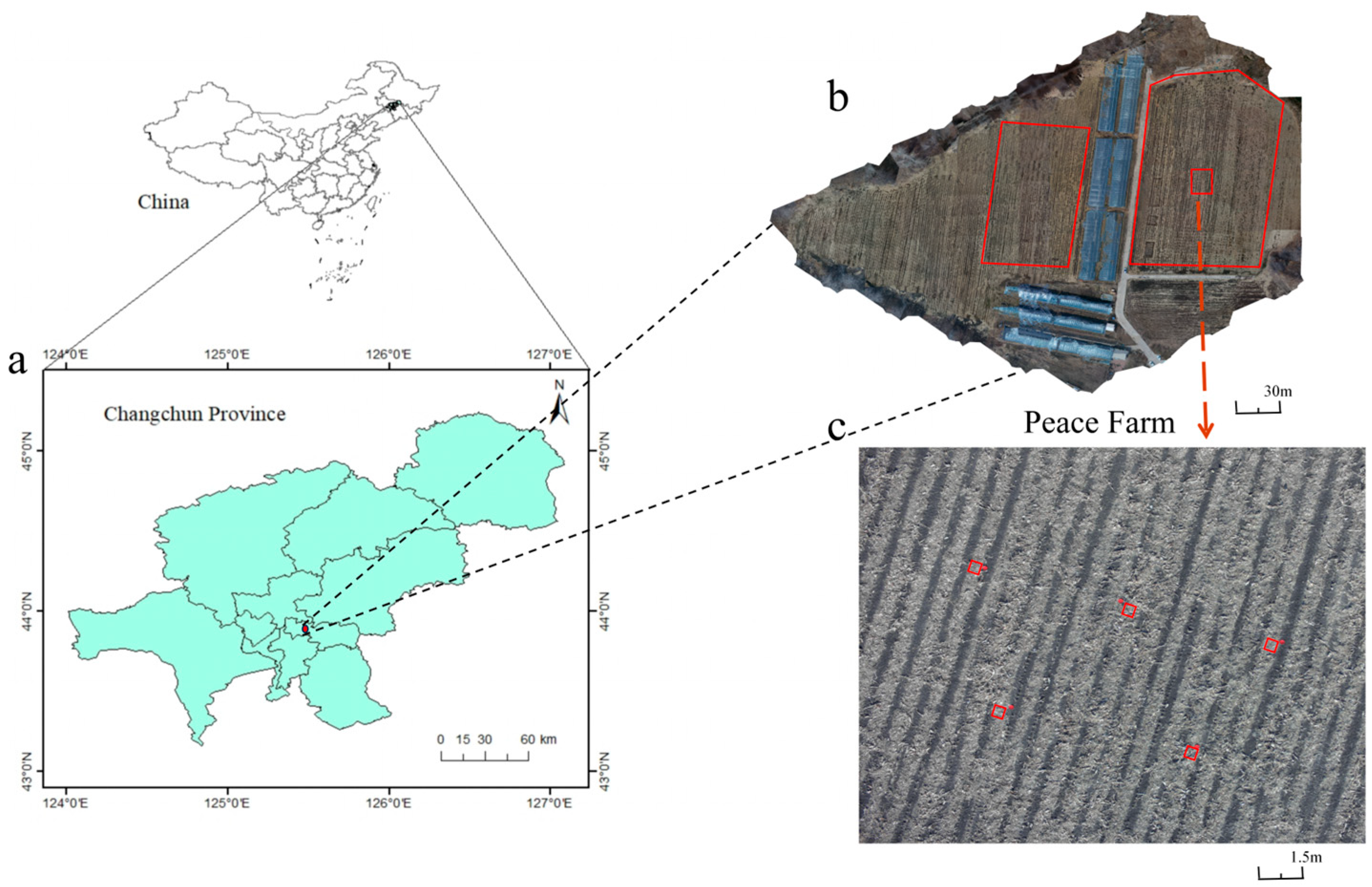
To facilitate the implementation of the experiment, the Changchun Agricultural Machinery Research Institute Research and Experiment Base (43°50′ N, 125°30′ E) in the eastern part of Changchun City, Jilin Province, was selected as the research area, as shown in Figure 1. The base is located at the junction of the Songnen Plain and the Songliao River Basin. The terrain is flat, and the average altitude is about 250 m. The region has a temperate continental monsoon climate with an average annual temperature of about 6.5 °C and an annual precipitation of about 620 mm. Spring and autumn seasons are relatively short. The soil types are mainly fertile phaeozem and black calcareous soil, which are typical soil types in China’s major corn-producing areas. The soil layer is deep and rich in organic matter. However, in recent years, intensive agricultural activities have led to serious degradation of phaeozem, thinning of the topsoil layer, and loss of organic matter [5]. Therefore, the study on straw return to the field in this region is not only representative but also of practical significance for the protection of phaeozem.
The experimental field in the study area adopts a wide–narrow row planting pattern, with the maize variety “SuiYu 55” planted, developed and promoted by the SuiFeng Agricultural Science Research Institute of Changchun City, China. The maize is sown in May and harvested in October. After harvesting, the straw is rotary tilled and shredded by a combine harvester before being returned to the field. This practice allows for the return of most or all straw to the field, effectively reducing soil erosion and improving soil fertility. The study area has relatively flat terrain, and the selected maize variety is a widely planted variety approved by the government. Both the study area and the maize variety are highly representative, providing favorable conditions for the subsequent development and validation of straw return estimation methods.
The study area was divided into a calibration area and a validation area. The calibration area was mainly used to extract relevant feature variables for constructing the inversion model, establish the relationship between spectral information and straw weight, and verify the feasibility of the proposed method. The validation area was used to evaluate the accuracy and applicability of the model. To ensure that the prediction results accurately and objectively reflect the actual straw return situation in agricultural production, UAV images were collected multiple times throughout the experiment.

2.2. Spectral Calibration Framework Based on Ground Reference Sample Area

In order to establish an accurate mapping relationship between straw weight and spectral reflectance characteristics under natural straw return conditions and, at the same time, minimize the uncertainty caused by moisture changes, surface heterogeneity and decomposition, this study designed a simplified yet representative calibration plot construction method. The core objective of this method is to establish a reliable “spectrum–weight” correspondence under controlled conditions so as to provide a reliable sample basis for subsequent model training and spectral feature analysis. Sampling in traditional natural straw return areas is greatly affected by environmental factors [46], making it difficult to consistently reflect the relationship between spectral features and straw weight. Therefore, this study constructed standardized calibration plots artificially along the edge of the experimental field. By artificially controlling the straw cover density and distribution pattern, external interference was minimized, thereby realizing the rapid and repeatable establishment of the spectrum–weight relationship. In order to quantitatively characterize the relationship between straw distribution and weight in the plot, the straw weight density ρ s (unit: g/m2) is defined as follows (Formula (1)):
ρ s = W s A
where ρ s represents the straw weight density (g/m2), W s represents the dry weight of straw in the sample plot (g), and A represents the area of the sample plot (m2). As shown in Formula (1), this definition can standardize the amount of straw under different cover gradients, providing a consistent physical basis for subsequent spectral calibration.
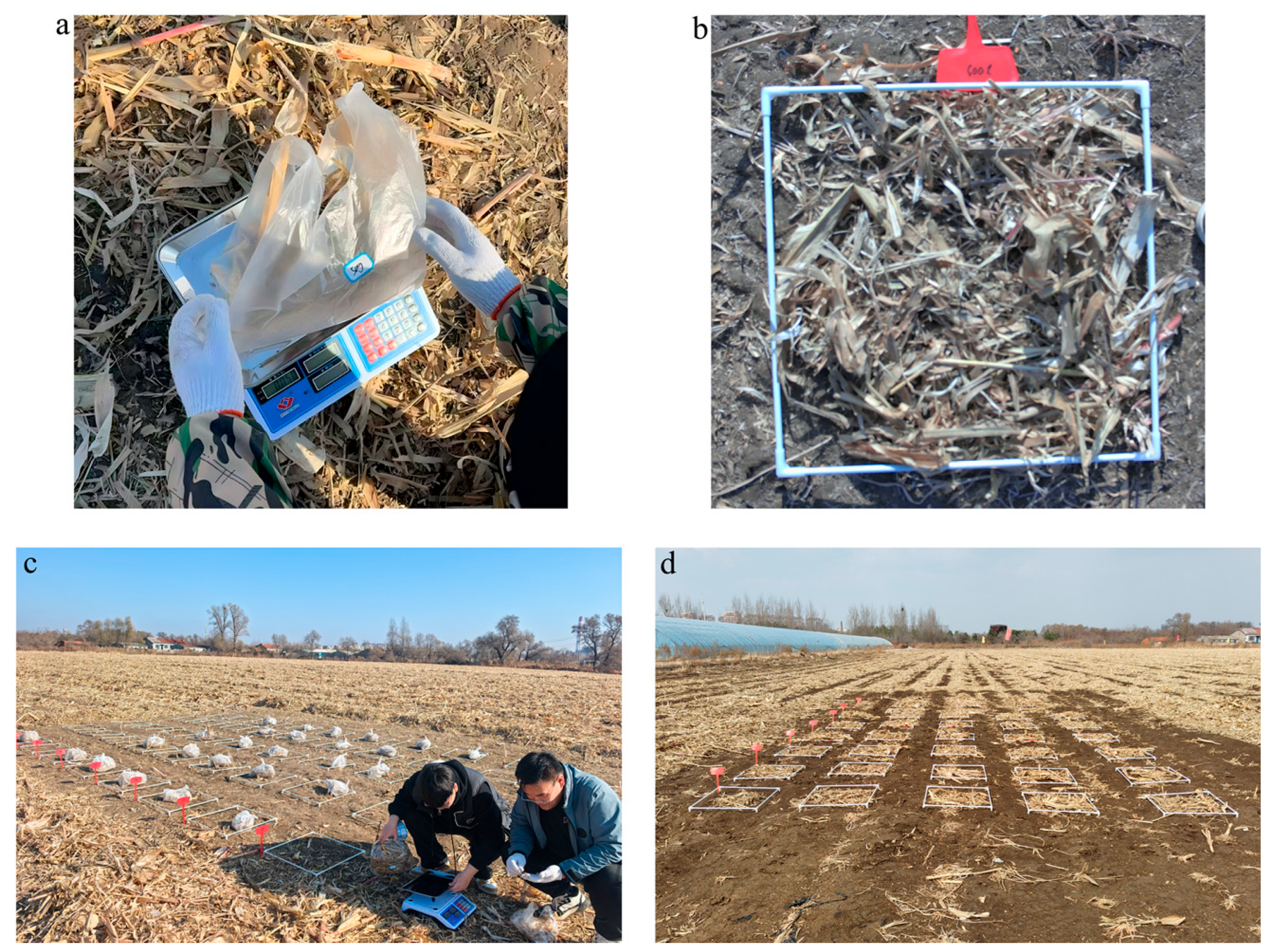
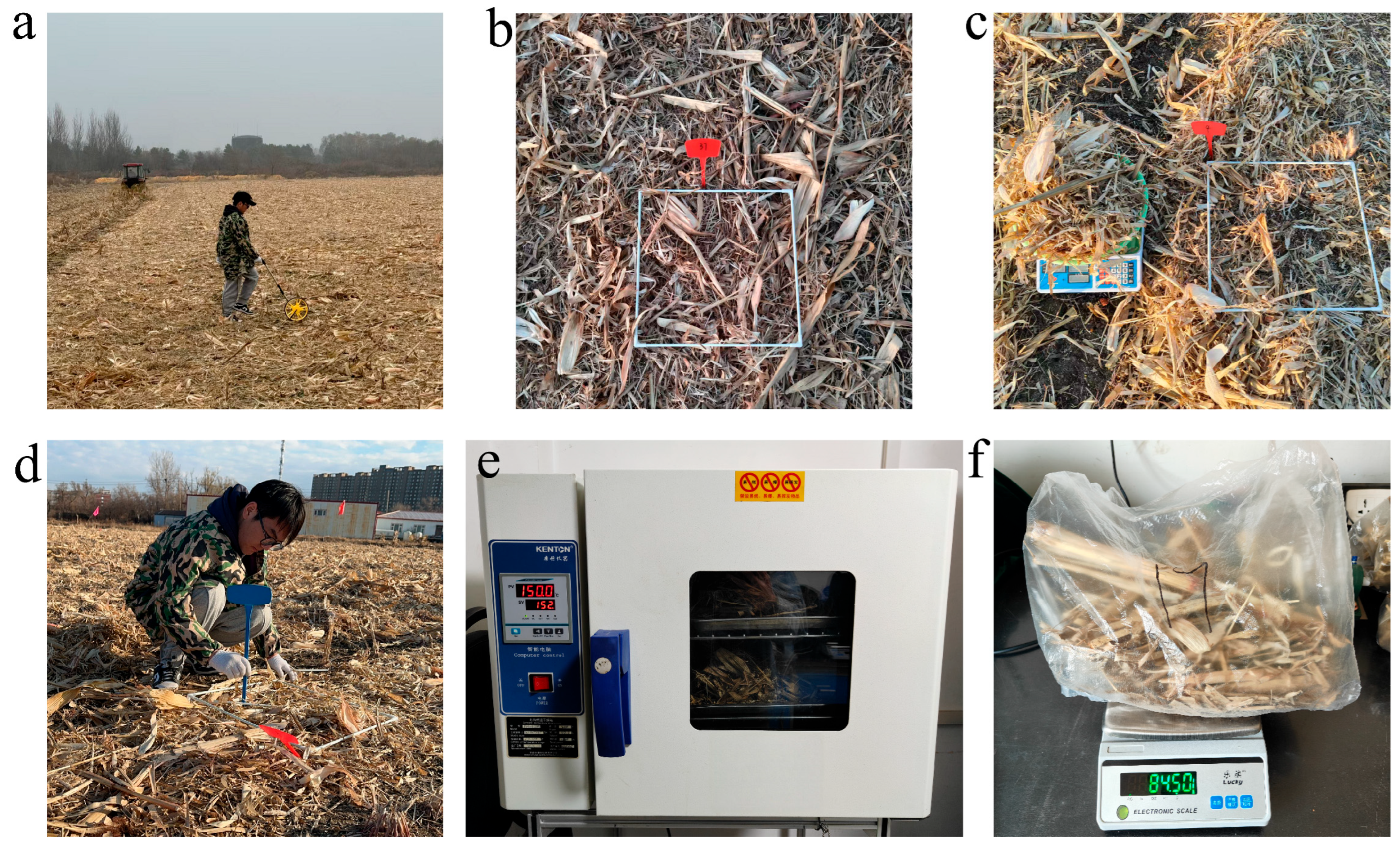
According to the “Technical Guidelines for Conservation Tillage in Black Calcium Soil Areas” [47], 2.7 tons per hectare and 5.4 tons per hectare correspond to the thresholds for partial and complete straw return to the field, respectively. These thresholds were converted to area mass density (g·m−2) for experimental design. In this study, straw mass was measured based on air-drying (natural air-drying under environmental conditions), while dried straw data were only used to estimate straw moisture content. Based on the converted thresholds, ten straw mass density gradients were established: 0, 50, 100, 150, 200, 250, 300, 400, 500, and 600 g·m−2. Multiple replicates were set for each gradient level to reduce random error and ensure consistency with policy-based classification criteria (<150 g/m2: low return; 150–270 g/m2: partial return; >270 g/m2: high return). The area of each calibration plot was 0.5 m × 0.5 m (0.25 m2), consistent with the sampling parameters of the validation plots. To ensure the accuracy and comparability of the SRA (straw returning amount) data, all straw samples used in the calibration plots were collected under dry, stable weather conditions. The moisture content of the straw was measured using the oven-drying method (65 °C until constant weight), and the results showed that the initial moisture content was consistently low (mean value < 15%). Therefore, the weight recorded in this study refers to the air-dried weight, which minimizes the spectral fluctuations caused by varying water content in the straw tissues. The weight of the straw was measured using an electronic balance (Hengzi KC-833, Wuyi Dahe Electronics Co., Ltd., Wuyi County, Jinhua, Zhejiang Province, China, accuracy: 0.001 kg), verified before placement, and recorded by batch to ensure traceability. To maintain uniform straw thickness within each plot, a light compaction method was used to avoid unevenness caused by “stacking and exposure.” To enhance the physical interpretability of the model, a five-point averaging method was used to record the average straw layer thickness of each plot, which was then used as an auxiliary variable to analyze reflectance changes under different cover conditions. The entire calibration plot construction process is shown in Figure 2.
By maintaining the representativeness and reproducibility of the data, this method provides a reusable calibration benchmark, supporting the generalization and validation of large-scale models. Furthermore, this simplified and standardized calibration process effectively improves experimental controllability and the efficiency of spectral modeling, laying a solid foundation for establishing the quantitative correlation between straw weight and multispectral information.

2.3. UAV Image Acquisition and Ground Data Measurement

To establish a quantitative correlation between multispectral image reflectance characteristics and straw weight, we simultaneously conducted multispectral image acquisition using a drone and ground-based measurements. This process aimed to achieve coordinated ground–air data acquisition, thereby constructing a model training dataset with high spatiotemporal consistency and strong physical representativeness.
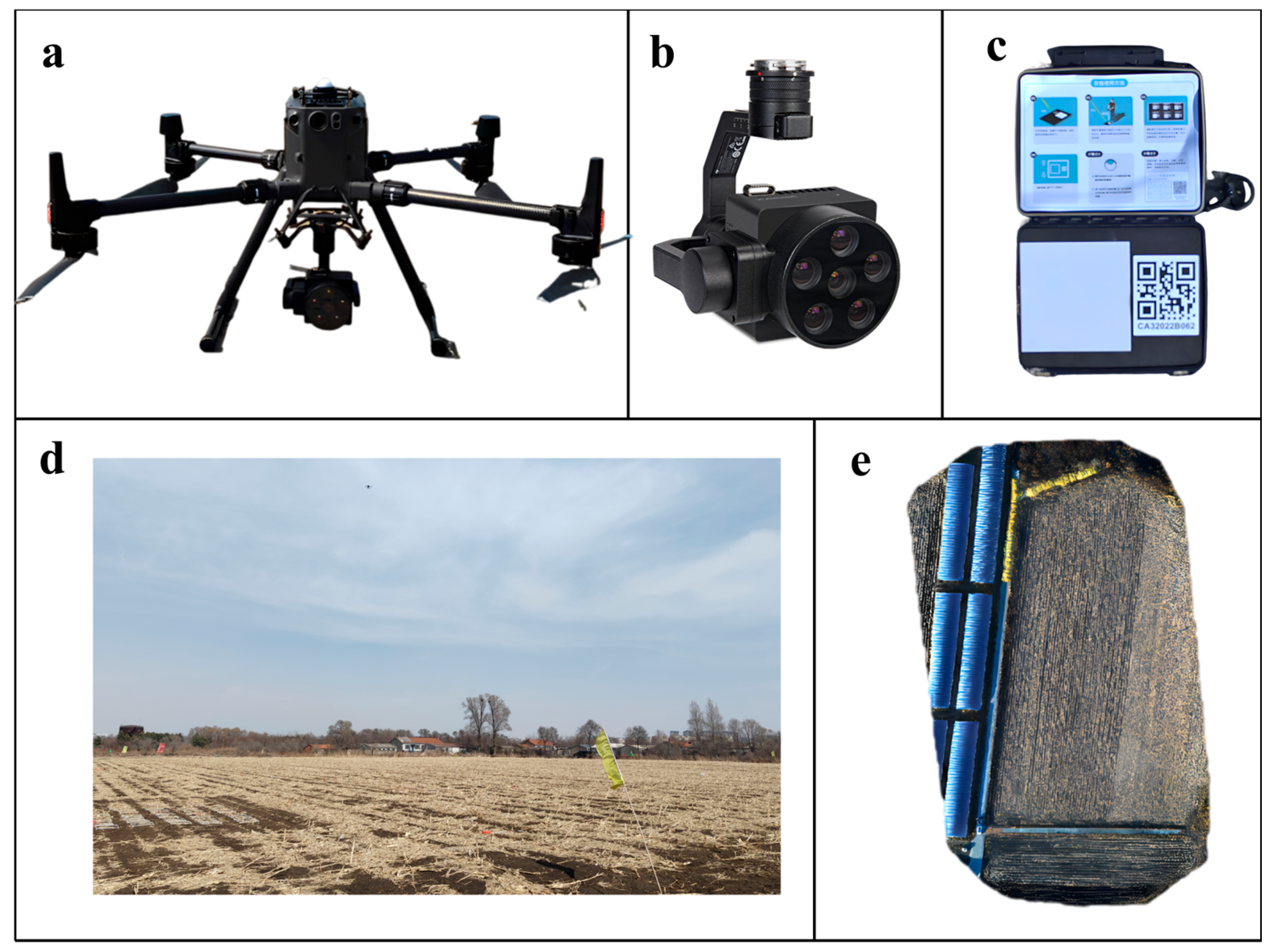
We used the DJI Matrice 300 RTK (M300 RTK) industrial-grade multirotor UAV (DJI Innovation Technology Co., Ltd., Shenzhen, China) as the flight platform (Figure 3a), equipped with an AQ600 Pro multispectral camera manufactured by Changguang Yuchen Information Technology and Equipment (Qingdao) Co., Ltd., Qingdao, China (Figure 3b). The AQ600 Pro multispectral camera integrates a 1/4-inch CMOS multispectral sensor with an effective resolution of 1.3 megapixels and a radiometric resolution of 12 bits. The system acquires images in five spectral bands: blue, green, red, red-edge, and near-infrared (NIR), as well as visible light RGB images. The main parameters of the multispectral bands are summarized in Table 1.
Before each flight, radiometric calibration was performed using a standard white reference panel (Figure 3c) to establish an absolute reflectivity baseline. During the UAV’s flight, the multispectral system, equipped with a solar irradiance sensor, continuously recorded downward-radiating solar radiation to correct for changes in illumination caused by variations in solar angle and atmospheric conditions. The combination of pre-flight white reference panel calibration and in-flight solar irradiance monitoring ensured consistent radiometric normalization of images acquired during and between flight missions.
To ensure image clarity and radiometric consistency and to minimize the impact of external interference on spectral signals, all flight operations were conducted under clear or partially cloudy conditions with stable lighting and wind speeds below 4 m/s, thereby ensuring the consistency and comparability of spectral data [48]. All flights were conducted between 10:30 a.m. and 3:00 p.m., when the solar altitude angle was high and the lighting was uniform (Figure 3d). To avoid shadow interference, the flight path design followed the principle of equal illumination to ensure the consistency of brightness and reflectance characteristics between adjacent images. To improve image stitching integrity and ensure continuous spatial coverage, the flight path adopted a parallel reciprocating mode. All image acquisition missions were conducted under clear or lightly cloudy conditions with low wind speeds. Environmental parameters such as temperature, humidity, wind speed, wind direction, and solar altitude angle were recorded during each flight. All environmental and acquired data were synchronously stored in a metadata table for subsequent error analysis and environmental normalization. Specific acquisition times and parameters are summarized in Table 2.
The multispectral images were processed using Yusense Map V2.2.3 software to complete band registration, radiometric correction, image stitching and orthorectification [49], thereby generating multi-band orthorectified reflectance images (Figure 3e). All processed images were exported in GeoTIFF format for subsequent spectral feature extraction and model training. To ensure spatial accuracy, the UAV was equipped with an RTK (real-time kinematic) positioning system, which can synchronously record flight attitude and geographic coordinate information. The positioning accuracy is better than ±2 cm, providing a high-precision spatial reference for ground plot registration.
After image acquisition, the straw was collected and weighed at each calibration plot and ground sampling point. All work was completed on the same day to establish a one-to-one data pair. This ensured the consistency of spectral response with measured straw weight in time and space, providing reliable data for subsequent modeling and accuracy verification. Field sampling was conducted in two agricultural seasons: autumn and spring. Autumn sampling was conducted after crop harvest and straw return to the field, while spring sampling was conducted before tillage, when the straw had completed its natural decomposition over winter. These two periods represent different farmland conditions, with significant differences in straw residue, and correspond to the actual survey period for straw return subsidies. Using data from these two seasons, the spectral variation characteristics and model stability under different seasonal conditions were analyzed.
When collecting measured ground data, each plot area was 0.5 m × 0.5 m (0.25 m2), and sampling was conducted using a regular interval layout [50]. The experimental field was divided into nine regions (3 rows and 3 columns, each region 45 m × 30 m), with eight sampling points set up in each region, covering different straw return states and distribution patterns (Figure 4a). To facilitate subsequent UAV image registration, a red positioning marker was placed in the upper left corner of each quadrat (Figure 4b), and its center coordinates were recorded using an RTK positioning device. During sampling, all weeds, stones, and non-target materials were carefully removed to ensure that the measurement results reflected only the straw component.
All straw from each sample plot was collected and weighed to obtain the actual straw recovery amount. The collected straw was air-dried before weighing. Fresh weight was measured in situ using an electronic balance with an accuracy of 0.001 kg (Figure 4c). To obtain dry weight data, representative samples were transported to the laboratory and dried in a Kangheng-35AS drying oven, Guangzhou Kangheng Instrument Co., Ltd., Baiyun District, Guangzhou, China electric oven at 120 °C for 8 h (Figure 4e) until the quality stabilized. Moisture content was calculated, and the dry weight of all samples was estimated based on this ratio (Figure 4f).
During field sampling, straw layer thickness (cm) was also recorded as an auxiliary physical variable. Thickness was measured using a five-point averaging method (four corner points and the center point) (Figure 4d). This variable was subsequently used to explain near-infrared reflectance anomalies and weight prediction biases, thereby enhancing the physical interpretability of the model.
To ensure the reliability and representativeness of the data, all sampled plots underwent repeated measurements and cross-validation. After each sampling, 10–15% of the plots were randomly selected for secondary weighing and comparison. When the difference exceeded ±5%, resampling was performed to eliminate potential measurement errors [51]. This procedure ensured that the accuracy of the field measurement data met the requirements for model validation.
A total of approximately 260 high-quality ground samples were obtained, covering a wide range of straw return amounts, layer thicknesses, and moisture conditions, providing sufficient sample support for model training and generalization performance evaluation. Through this synchronous data acquisition method, this study ensured a high degree of consistency between the ground measurement data and the UAV multispectral imagery in terms of time, space, and radiance.

2.4. Image Processing and Spectral Indices

After completing the mosaicking of multispectral orthophotos acquired by UAVs, the image data was imported into ArcMap 10.8, the region of interest (ROI) was extracted, and the raster was cropped according to the location of the sample plots measured in the field. To ensure the spatial correspondence between the ground sample plots and the image pixels [52], the average reflectance value of all pixels in each sample plot was used to represent the reflectance of the sample plot, thereby reducing the influence of local abnormal pixels. The reflectance characteristics of each band were calculated in batches using Python3.8 scripts to generate a reflectance matrix containing five basic bands (B, G, R, RE, and NIR). Subsequently, the average reflectance value of all pixels in each sampling area was calculated using the raster averaging method, and it was used as the representative spectral value of the corresponding sampling point. To ensure that the images acquired by different UAVs have radiometric consistency, the normalized reflectance was calculated using the standard white light reference and dark light reference, as shown in Formula (2):
R i = D N i D N d a r k D N w h i t e D N d a r k
where R i the reflectance of the i t h spectral band, D N i is the digital number value of the sample point in the image, and D N w h i t e and D N d a r k represent the responses of the white and dark references, respectively. As shown in Equation (2), the normalization process effectively eliminates radiometric variations caused by changes in ambient illumination, providing reliable input data for subsequent spectral feature analysis.
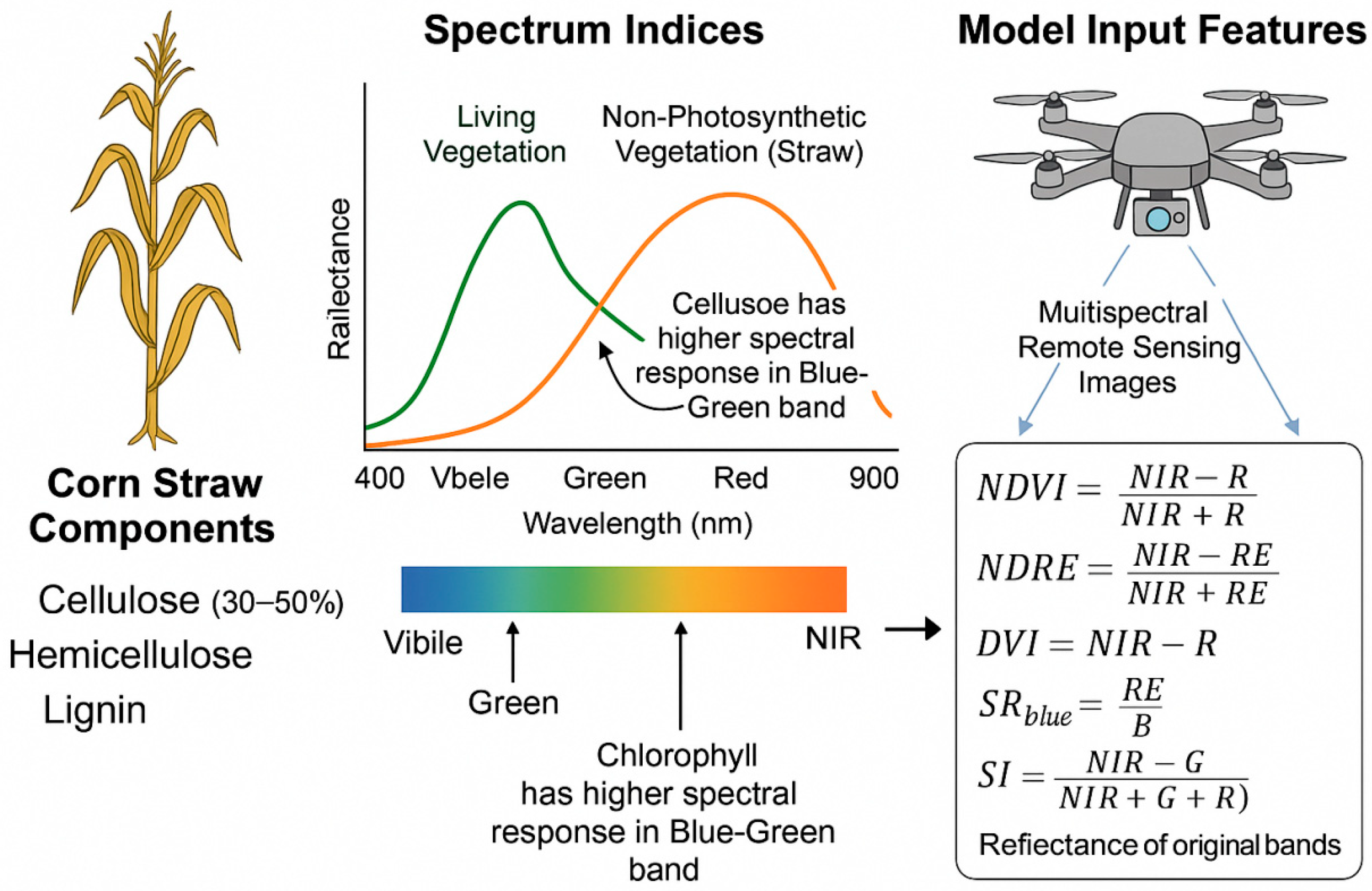
To improve the discriminative power of multispectral features in straw identification and weight prediction, we calculated several spectral indices associated with vegetation and non-photosynthetic vegetation (NPV). The selected indices, including NDVI, NDRE, DVI, SRblue, and SRRE, can identify both living vegetation and distinguish the reflectance characteristics of dry straw. Table 3 summarizes the calculation formulas and main applications of each index.
B, G, R, RE, and NIR represent spectral reflectance at wavelengths of 450, 555, 660, 720, and 840 nm, respectively.
Cellulose, hemicellulose, and lignin are the main components affecting the spectral properties of maize straw, with cellulose being the primary structural component, accounting for 30–50% of the total [58,59]. It exhibits a strong spectral response in the blue-green band (approximately 490–511 nm) [60,61]. Chlorophyll is mainly found in living plants and has the highest reflectance in the green and near-infrared bands [62]. The spectral indices designed for this study considered the differences between photosynthetic and non-photosynthetic plant tissues (straw) to ensure that the multispectral features have clear physical meaning and discriminative power.
In addition, in order to more accurately quantify the relationship between straw coverage and image reflectance, this study proposes a new image-based index—the straw index (SI) (as shown in Figure 5).
Unlike traditional vegetation indices (such as NDVI and DVI), the straw index (SI) specifically focuses on the spectral characteristics of non-photosynthetic plant tissues, thus enhancing its sensitivity to changes in straw cover.
In order to comprehensively evaluate the response of different spectral bands and vegetation indices to the measured straw return weight, this study constructed 11 input feature variables based on five original multispectral bands (blue, green, red, red edge (RE) and near-infrared (NIR)) and six commonly used spectral indices (NDVI, NDRE, DVI, straw index (SI), SRblue and SRRE). These spectral indices were all derived from multispectral images collected during the autumn and spring sampling periods.
Five original spectral bands (B, G, R, RE, and NIR) and six spectral indices (NDVI, NDRE, DVI, SRblue, SRRE, and SI) were combined into an 11-dimensional feature matrix, which served as the input dataset for subsequent machine learning modeling. All features were extracted from their corresponding regions of interest (ROI) to ensure an accurate spatial and spectral correspondence between image features and ground-based measured data, thus providing high-quality input data for subsequent model development.

2.5. Machine Learning Modeling and Analysis

In order to systematically evaluate the quantitative relationship between multispectral features and straw weight and to compare the performance of different algorithms in predicting straw return to the field, we developed and comprehensively analyzed multiple machine learning regression models based on a standardized dataset. This process aimed to establish a benchmark reference and feature–response relationship for the subsequent optimization of deep learning models. The model input features included five original multispectral bands (B, G, R, RE, and NIR) and six spectral indices (NDVI, NDRE, DVI, SRblue, SRRE, and straw index), totaling 11 variables. All features were extracted from spatially registered ground plots to ensure that reflectance data correspond one-to-one with measured straw weight in spatial and spectral dimensions. All features were subjected to consistency checks to detect and remove missing or outlier values [63]. Subsequently, we applied minimum–maximum normalization to scale the feature values to the range of [0, 1] to eliminate the influence of differences in the size of different variable values. The entire dataset was randomly divided into a training set (80%) and a validation set (20%), and five-fold cross-validation (K = 5) was used to improve the stability of model evaluation. To explore the differences in adaptability and accuracy of different algorithms in multispectral regression prediction, we selected ten representative supervised learning models, covering four main categories: linear learning methods, regularization-based methods, ensemble learning methods, and nonlinear learning methods. The corresponding model classifications are shown in Table 4.
The proposed modeling framework integrates algorithmic diversity and representative performance, enabling a comprehensive analysis of the contribution of multispectral features to straw weight estimation—from simple linear fitting to complex nonlinear ensemble methods. All models were implemented in Python 3.8/PyCharm 2023 and used mainstream machine learning libraries such as scikit-learn and LightGBM. Some models were optimized using the GridSearchCV method to obtain the optimal combination of hyperparameters. The training objective of the model was to minimize the prediction error function, as shown in Equation (3):
L = 1 n i = 1 n   ( y i y i ^ ) 2 ,
where y i is the measured straw weight, y i ^ is the model prediction value, and n is the sample size. After training, multiple statistical indicators were calculated on the validation set to comprehensively evaluate the prediction accuracy and stability of different models.
After model training, various statistical metrics were calculated on the validation set to comprehensively compare the prediction accuracy and stability of each algorithm. To systematically evaluate the performance of different models in straw weight prediction, we considered three key aspects: accuracy, stability, and generalization ability. The main statistical metrics used for evaluation are summarized in Table 5.
In addition, to further evaluate the model’s generalization ability under different seasons and environmental conditions, cross-validation was performed on the spring and autumn datasets to assess its robustness.

2.6. Deep Learning Optimization

Traditional machine learning-based straw return estimation methods typically rely on manually calculating multiple spectral indices (e.g., NDVI, NDRE, and SRblue) as model input features. These methods usually require multiple rounds of feature selection and parameter tuning for different algorithms. Such processes are computationally complex and time-consuming and highly sensitive to human intervention, band selection, and changes in illumination, ultimately limiting the stability and transferability of the model in practical applications.
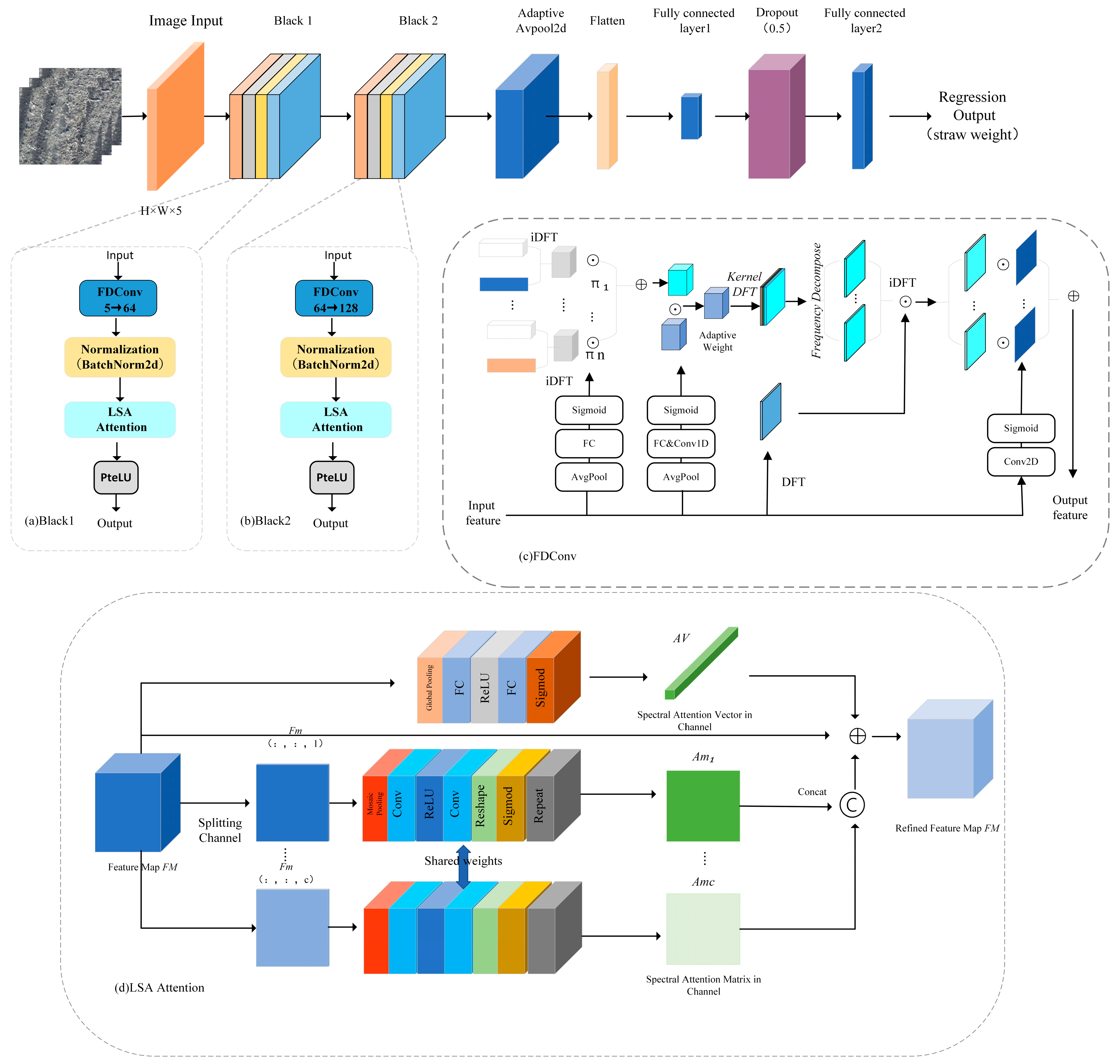
To further enhance the feature representation capability of multispectral images in straw weight prediction and to achieve end-to-end automation of the prediction process, this study proposes an improved deep learning model—CNN-Straw, which is based on an improved convolutional neural network (CNN) architecture [64]. The CNN-Straw model integrates frequency domain convolution (FDConv) [65], a lightweight spectral attention module (LSA) [66], and a parameterized hyperbolic tangent exponential linear unit (PTeLU) [67] activation function. The model aims to jointly learn spatial and spectral features from multispectral images to accurately capture the texture structure and spectral distribution differences in straw return areas, thereby achieving high-precision and robust regression prediction of straw weight.
Unlike traditional machine learning models, the CNN-Straw model employs an end-to-end regression framework, directly using the original multispectral image (five bands) as input, thus eliminating the need for manual construction of spectral indices or manual feature selection. Through multi-layer convolutional operations, the model automatically extracts spatial structure features and spectral correlations, achieving a complete mapping from pixel-level reflectance to straw weight prediction.
The overall architecture of the CNN-Straw model (Figure 6) consists of three core modules: (1) FDConv (frequency domain convolution): This module applies fast Fourier transform (FFT) to the convolutional feature map for frequency domain decomposition and weighting. It enhances the model’s ability to capture multi-scale frequency information, effectively identifying periodic textures and fine structural patterns in straw images while suppressing high-frequency noise. (2) LSA (lightweight spectral attention module): This module combines spatial attention and channel attention mechanisms, adaptively weighting local regions to enhance the model’s response to key spectral regions (such as the red edge and near-infrared bands) while reducing background interference. (3) PTeLU (parameterized hyperbolic tangent exponential linear unit): By introducing learnable parameters into the traditional activation function, PTeLU improves gradient propagation stability and enhances nonlinear expressive power, thus achieving stronger fitting performance under small-sample learning conditions. In terms of architecture, the CNN-Straw model strikes a balance between lightweight design and high accuracy, making it very suitable for agricultural remote sensing scenarios with limited sample size, high noise, and multi-band spectral data.
The proposed CNN-Straw model integrates frequency domain convolution, a local spatial attention mechanism, and a parameterized activation function to achieve multi-scale feature fusion. Its overall mapping function is expressed as follows (Equation (4)):
y ^ = f θ ( X ) = f F C ( f L S A ( f F D C o n v ( X ) ) ) ,
where X represents the input multispectral image, y ^ represents the model’s predicted output, and f F D C o n v , f L S A , and f F C correspond to the frequency domain convolution module, the local spatial attention module, and the fully connected layer mapping function, respectively.
To clearly describe the frequency domain convolution process, this operation can be expressed as Formula (5):
f F D C o n v ( X ) = F 1 ( F ( X ) F ( W ) ) ,
where X R ^ { H × W × C } denotes the input feature map, W represents the learnable convolution kernel, F ( · ) and F 1 ( · ) denote the fast Fourier transform (FFT) and its inverse transform, respectively, and represents element-wise multiplication in the frequency domain. As shown in Equation (5), according to the convolution theorem, convolution in the spatial domain is equivalent to point-wise multiplication in the frequency domain. By performing convolution in the frequency domain, FDConv may enhance sensitivity to repetitive texture patterns, which could partially explain its improved performance on straw residue images.
The PTeLU activation function is defined by Formula (6):
f ( x ) = { x , x 0 α ( e β x 1 ) , x < 0
where α and β are learnable parameters used to control the curvature and gradient decay in the negative domain. As shown in Equation (6), PTeLU aims to provide smoother negative domain gradient behavior and may enhance the model’s nonlinear representation capabilities.
The calculation formula for the local spatial attention (LSA) mechanism is shown in Equation (7):
L S A ( X ) = σ ( W 2 · R e L U ( W 1 · A v g P o o l ( X ) ) )
where σ represents the Sigmoid activation function, and W 1 and W 2 are learnable weight matrices. As shown in Equation (7), the LSA module extracts local features through spatial average pooling and dynamically adjusts channel weights, which helps to highlight regions rich in spectral and textural information related to straw residue.
Preliminary experiments showed that mixed-season training reduced model performance due to significant differences in straw moisture, decomposition stage, and soil background conditions. Therefore, the autumn and spring datasets were modeled separately, rather than jointly. The partitioning of training, validation, and testing datasets is summarized in Table 6. All image samples underwent standardized data preprocessing and augmentation procedures to increase the effective training sample size and improve model robustness. Model training was performed using TensorFlow 2.15 and Python 3.8 on an NVIDIA GeForce RTX 3080 GPU, NVIDIA, Santa Clara, CA, USA platform. The training parameters are summarized in Table 7.
To further evaluate model stability and generalization ability, five-fold cross-validation was applied to the training dataset of each season. All input images were normalized to the [0, 1] range, and the output labels represented the straw dry weight (kg/m2) corresponding to each ground plot.
The CNN-Straw model adopts a five-layer network architecture, including an input layer, convolutional and pooling layers, an attention module, a fully connected layer, and an output layer. The input image size is 64 × 64 × 5, corresponding to five multispectral bands (B, G, R, RE, and NIR). The convolutional and pooling layers contain three convolutional modules (Conv + BatchNorm + PTeLU + MaxPooling) to progressively extract local spatial features and perform downsampling operations. The frequency domain convolution (FDConv) module is embedded after the second convolutional layer to extract frequency domain features related to the straw structure, thereby enhancing the model’s sensitivity to texture changes. The local spatial attention (LSA) module adaptively adjusts the channel weights in the high-level feature maps to highlight the spectral response of key bands and suppress background interference. After flattening, the fully connected layer consists of two fully connected layers: the first fully connected layer performs feature fusion, and the second fully connected layer outputs the predicted straw weight. To prevent overfitting, the Dropout [68] regularization strategy (p = 0.3) is applied in the fully connected layer.
The main research contributions of this study include the following aspects: (1) collecting UAV multispectral images and actual straw return data; (2) comparing the prediction performance of various traditional machine learning models and analyzing the feature correlation between spectral bands; (3) designing and training the CNN-Straw model to verify its superiority in straw weight regression prediction; (4) analyzing the functional contributions of different modules (FDConv, LSA, PTeLU); and (5) verifying that the proposed model has significant improvements in accuracy, stability and generalization ability compared with traditional CNN and ResNet models. The results show that the CNN-Straw model has higher accuracy and robustness in predicting straw return amount, providing scientific and technological support for phaeozem protection and agricultural subsidy assessment. This method has the potential for large-scale application in the field of agricultural remote sensing and can provide valuable technical reference for policy verification and subsidy quantitative management, thereby improving the objectivity and efficiency of agricultural subsidy allocation.

3. Results

3.1. Straw Weight Distribution

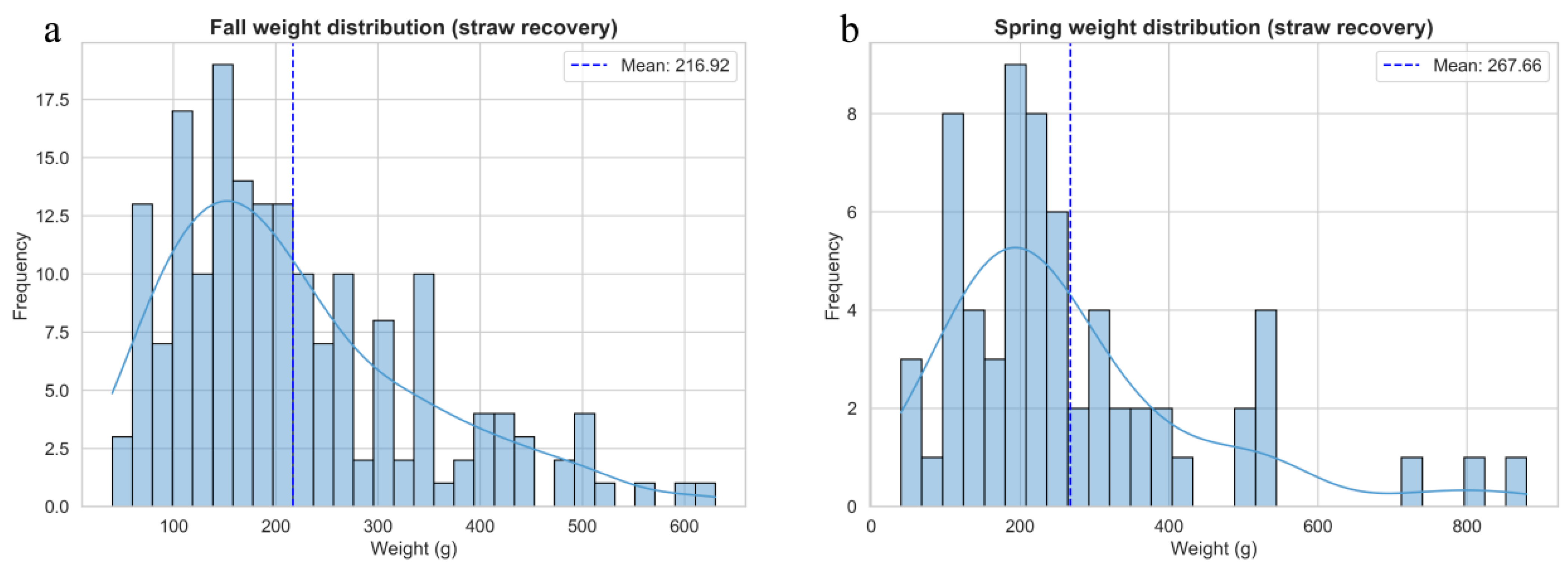
To comprehensively understand the actual distribution of straw return weight in typical phaeozem farmland, this study conducted statistical analysis on straw fresh weight data from multiple ground sampling plots collected in November 2024 (autumn) and April 2025 (spring). The analysis aimed to reveal the quantitative characteristics and spatial distribution patterns of straw return under different seasonal conditions. The histogram in Figure 7 illustrates the distribution characteristics of straw residue in different seasons and sampling areas.
Statistical results show that the total amount of straw returned to the field in autumn is significantly higher than in spring. This difference is closely related to the fact that autumn crop harvesting and straw crushing have just been completed, and the straw has not yet decomposed. In contrast, the spring sampling plots are affected by various factors such as winter precipitation, wind erosion, and microbial degradation, resulting in a generally lower straw coverage rate. In some areas, the soil is even close to bare, reflecting the impact of seasonal decomposition on the retention of straw residues.
However, the average straw weight of spring sampling plots was higher than that of autumn sampling plots. The main reason is that the spring sampling period coincides with the transition from snowmelt to rainfall, when surface moisture is relatively high [69]. Therefore, the moisture content of the remaining straw increases significantly, resulting in a higher apparent air-dried weight. In contrast, autumn sampling was conducted under stable weather conditions with very little precipitation, allowing the straw to dry naturally in the field for a longer period of time. Therefore, the weight measured in autumn is closer to the actual dry weight, effectively reducing the impact of uncontrollable factors such as moisture fluctuations.
Therefore, the autumn dataset is considered more representative and stable during the modeling process, making it a more suitable primary basis for model training. These distribution characteristics not only reflect the objective situation of straw return to the field in different seasons but also provide important benchmark data for analyzing the seasonal adaptability of the proposed prediction model.

3.2. Feature Correlation Analysis

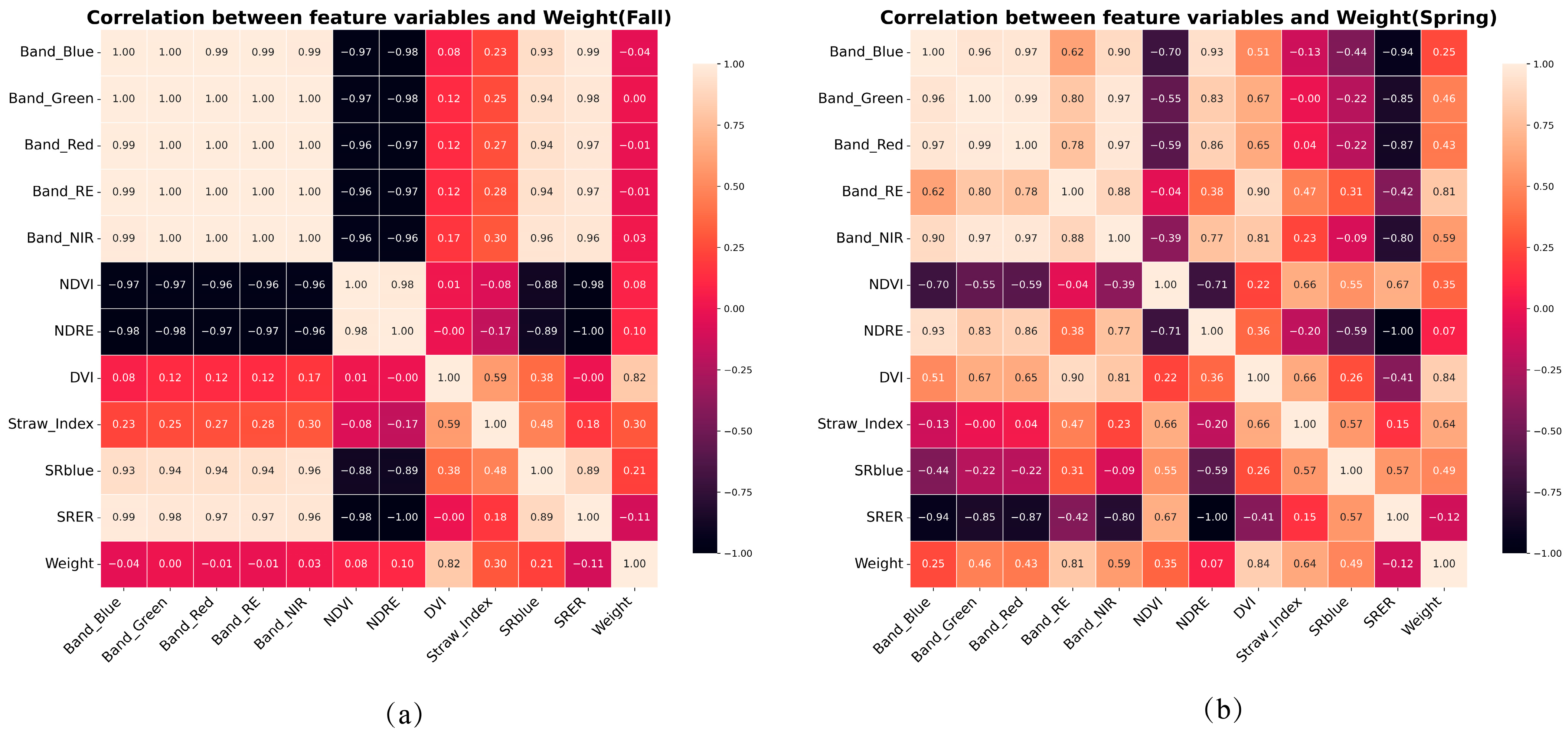
For each dataset, the Pearson correlation coefficient between these features and the measured dry straw weight was calculated, and corresponding correlation heatmaps for two seasons were generated (see Figure 8a,b).
The main findings are as follows: In the autumn samples, the differential vegetation index (DVI) showed the strongest correlation with straw dry weight (r = 0.82), followed by the straw index (r = 0.30) and SRblue (r = 0.21). This indicates that when the straw cover is clear and structurally intact in autumn, the reflectance difference between the near-infrared and red bands can effectively indicate straw weight. The high responsiveness of the near-infrared band to changes in straw cover is consistent with its high reflectance characteristics to non-photosynthetic biomass and its relatively low sensitivity to chlorophyll interference. In the spring samples, DVI remained the most correlated feature (r = 0.84), while the red-edge band (Band RE, r = 0.81) and the straw index (r = 0.64) also showed strong positive correlations [70]. This suggests that although straw has partially decomposed in spring, its structural information can still be effectively captured through specific spectral bands.
Most of the original spectral bands—especially the blue and green bands—showed weak correlation with straw weight in both seasons, indicating that single-band reflectance alone is insufficient to construct a reliable predictive model. There are obvious seasonal differences in the correlation between different feature variables. Typical vegetation indices, such as NDVI and NDRE, were originally designed to detect living green vegetation, and they contribute relatively little to the identification of autumn straw residues. This may be because NDVI [71] mainly reflects photosynthetically active vegetation rather than non-photosynthetic substances such as straw.
In summary, DVI, straw index, and Band_RE showed good stability and significance in both seasons and can therefore be used as core input features for subsequent modeling. Conversely, some traditional vegetation indices (e.g., NDVI) performed poorly in non-vegetation scenarios (e.g., straw return to the field). This limitation may be attributed to the higher residual moisture content during spring sampling, which coincides with snowmelt and early spring rainfall. Increased moisture in straw leads to large fluctuations in spectral reflectance, especially in the short and medium wave bands (e.g., red and green light), where water absorption peaks are more pronounced.
Furthermore, the adhesion of straw to soil and moisture accumulation in spring often result in weak or even negative correlations between certain bands (e.g., blue light) and straw weight, further confirming the importance of considering environmental disturbances when modeling under unstable seasonal conditions [72]. Overall, the near-infrared band was considered the most stable and representative main feature in both seasons and can be used as a key input for subsequent modeling. Among the index-based variables, the straw index, SR_blue, and DVI consistently performed well, demonstrating a strong ability to distinguish between dry straw and background soil. This result validates that the proposed straw index is more effective than traditional indices in reflecting straw return to the field. In contrast, SR_RE and NDRE exhibited greater seasonal variation in spring, indicating that their sensitivity and reliability should be carefully evaluated during model construction. Therefore, subsequent modeling could prioritize feature selection based on autumn samples to minimize errors caused by overfitting and unstable environmental factors in spring.

3.3. Performance of Machine Learning Models

3.3.1. Modeling and Prediction Results in Autumn

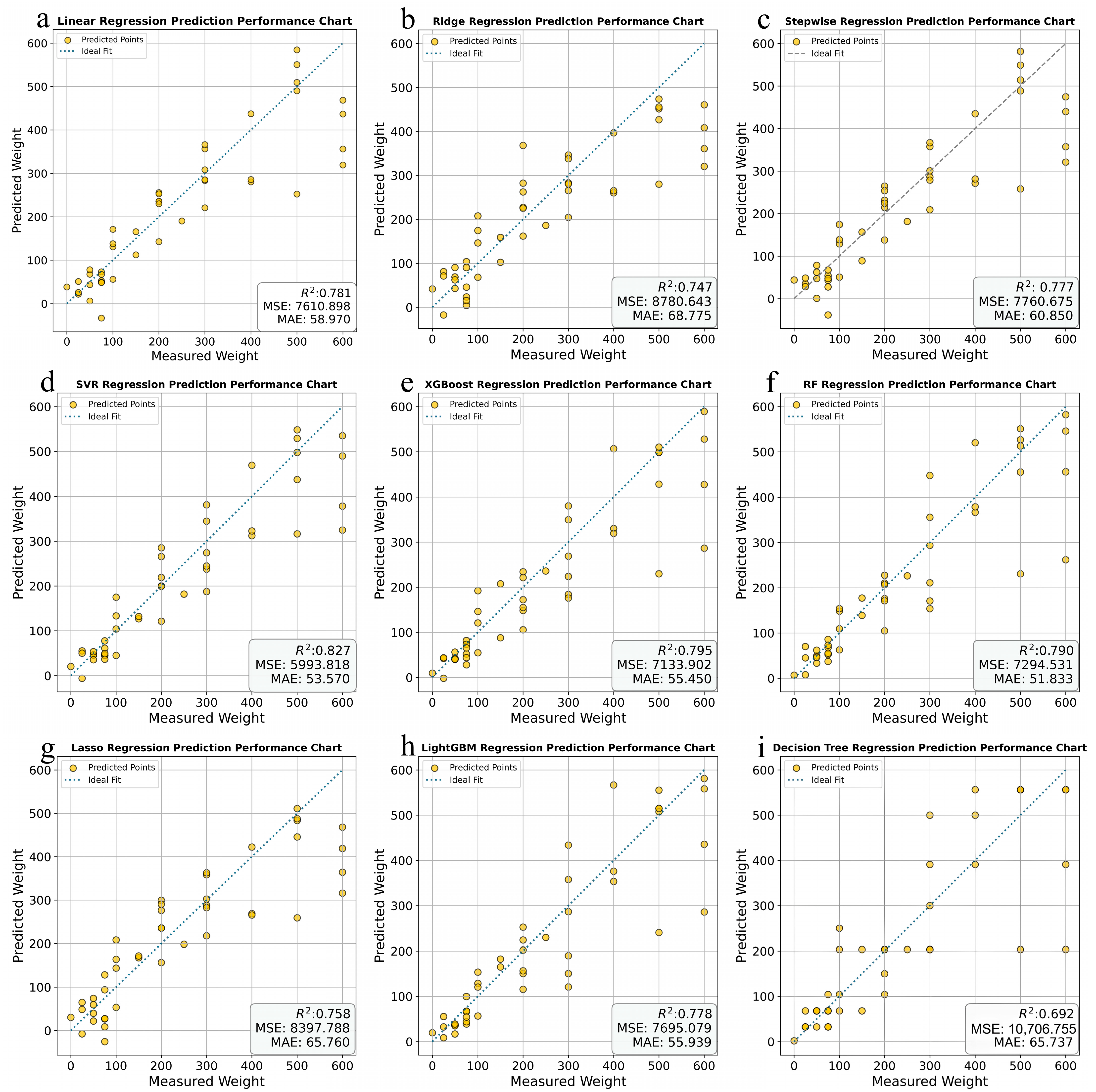
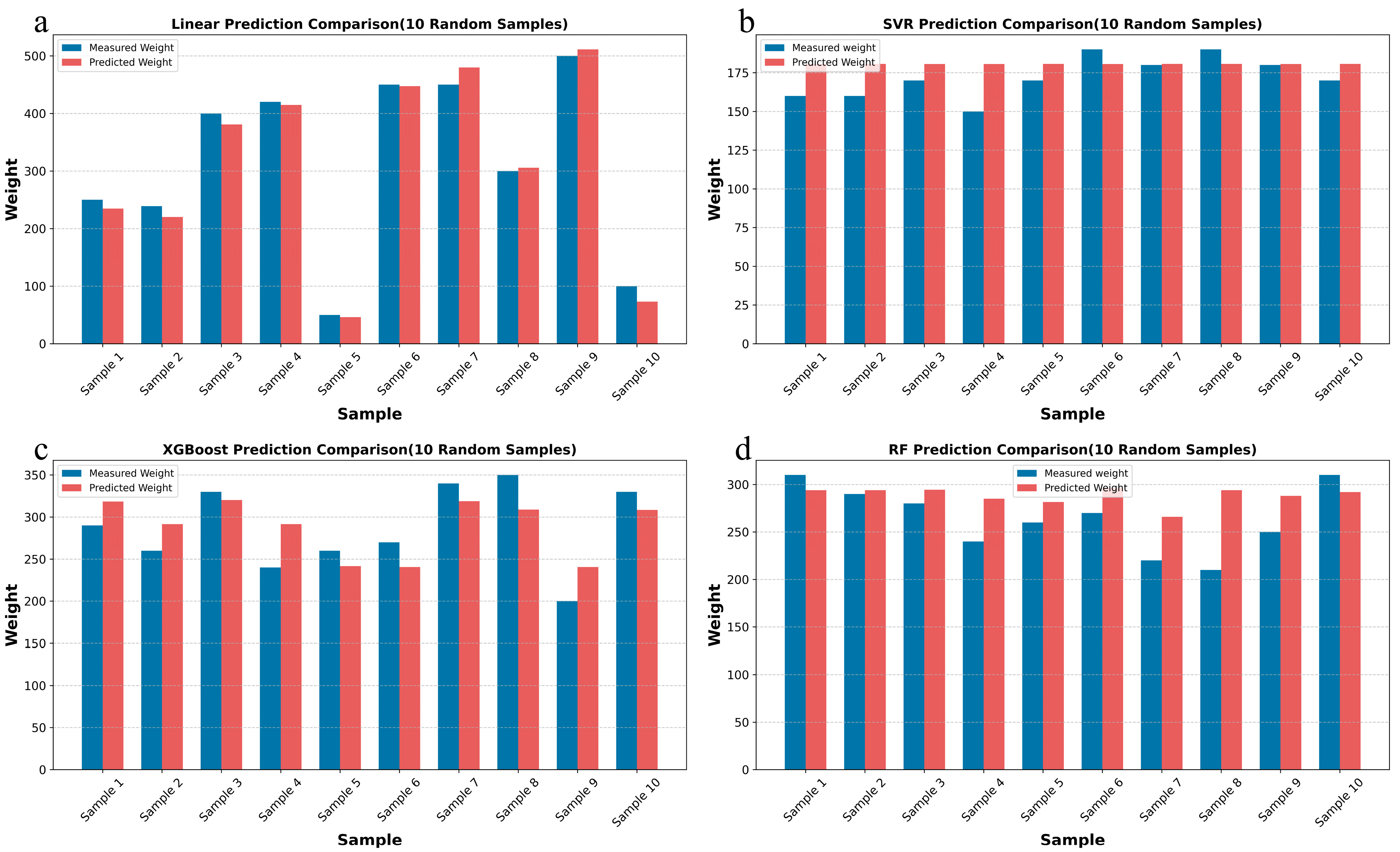
In the autumn experiment, the overall performance of the models was better than that in spring, with higher prediction accuracy. Among all tested algorithms, the four best-performing models were multiple linear regression (MLR), support vector regression (SVR), XGBoost, and random forest (RF) (Figure 9). XGBoost and RF models showed high coefficients of determination in both training and testing phases, and their predictions successfully reproduced the actual spatial distribution of straw weight, demonstrating strong generalization ability. The SVR model excelled in handling noisy data, generating smoother fitting curves. Although the MLR model had a relatively simple structure, it still achieved competitive results when dealing with the more clearly defined and linear relationships in the autumn dataset.
The differences between the predicted and measured values of these four models were generally small. As shown in the prediction plot in Figure 10, the predicted values were close to or even completely consistent with the measured values, indicating that these models have strong applicability and reliability in the actual task of estimating straw recycling volume.

3.3.2. Modeling and Prediction Results in Spring

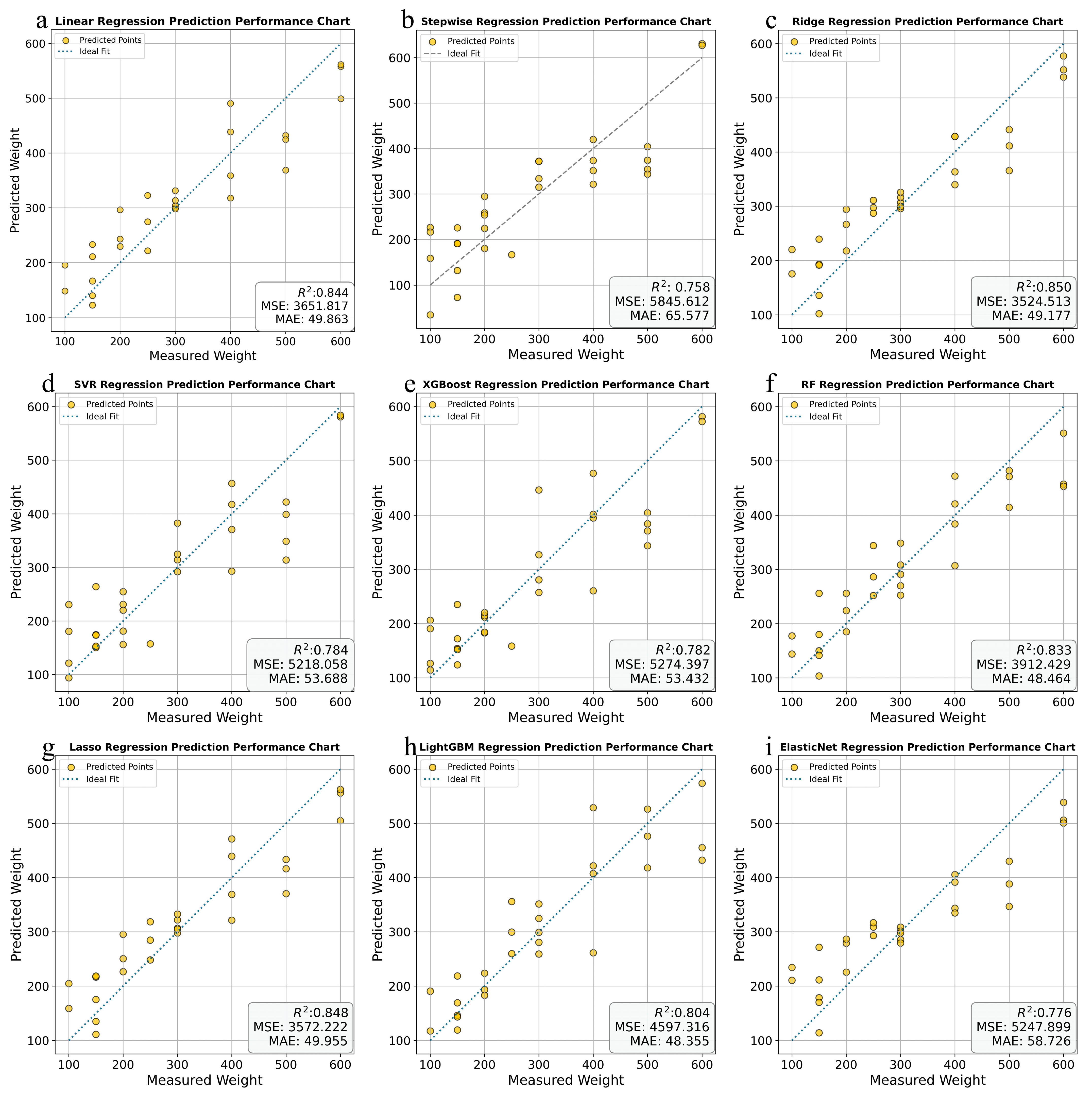
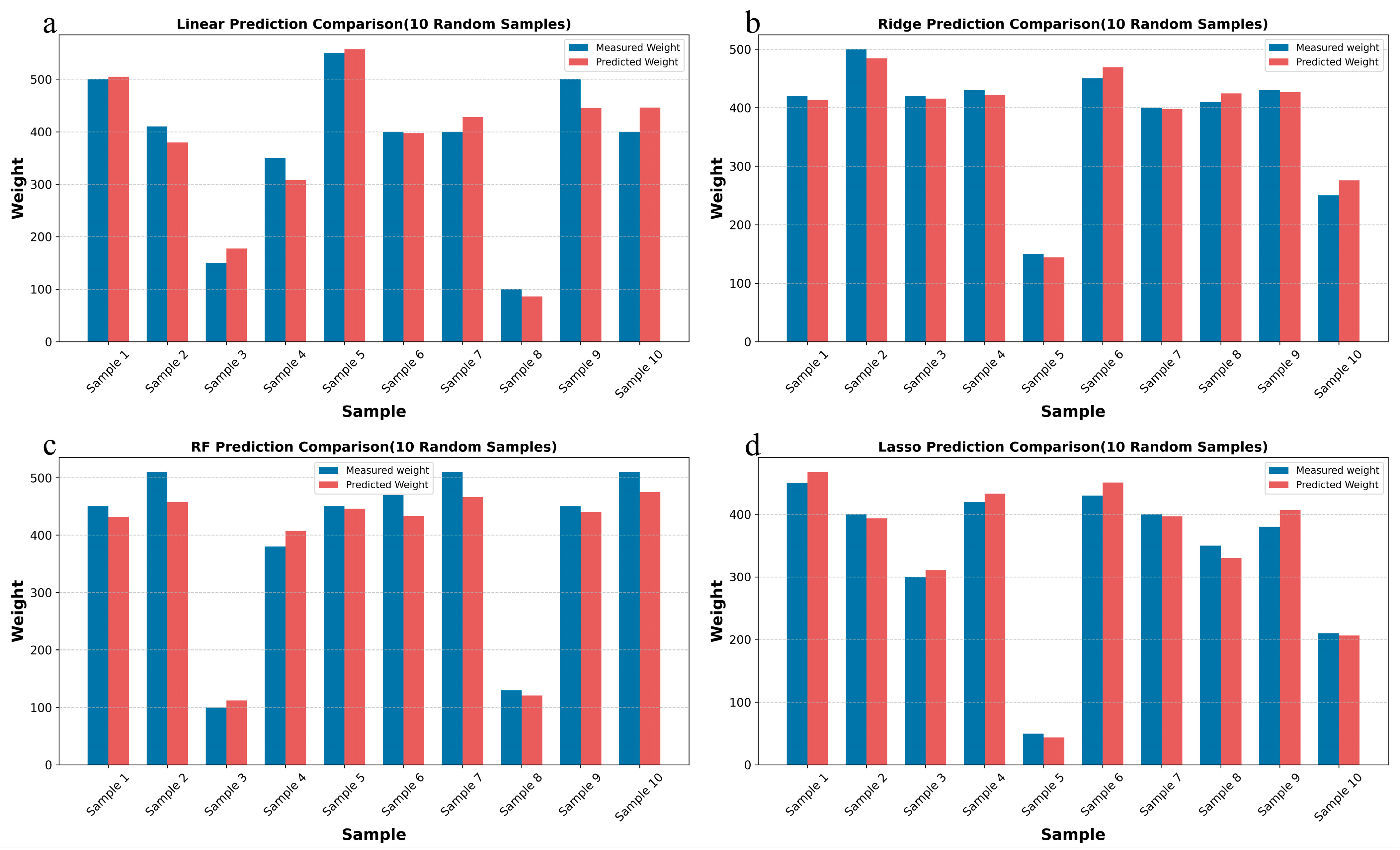
The modeling performance in spring was slightly lower than in autumn, mainly due to the higher moisture content of straw and reduced reflectance stability after snowmelt and rainfall. These environmental conditions introduced greater uncertainty into the spectral information, increasing the difficulty of achieving stable regression fitting. Among the ten regression models tested, the four best-performing models were multiple linear regression (MLR), ridge regression, random forest regression (RF), and lasso regression (Figure 11). Compared to the autumn dataset, the spring models showed slightly lower values on all evaluation metrics (R2, MAE, MSE, and MAPE), and the corresponding prediction scatter plots also exhibited greater dispersion.
Notably, ridge regression and lasso regression, by introducing regularization constraints on the feature coefficients, achieved better robustness and generalization ability, making them more suitable for the highly variable spring dataset. The random forest model maintained good nonlinear fitting performance, demonstrating its adaptability to complex agricultural remote sensing conditions.
As shown in Figure 12, although the accuracy decreased slightly in spring, the main models were still able to effectively capture the overall trend of straw weight distribution, indicating that the method still has practical significance and reliability for real-world applications.

3.3.3. Summary and Comparative Analysis of Evaluation Metrics

The combined results (Table 8) show that the modeling accuracy in autumn is generally higher than that in spring [73], which can be attributed to the higher stability of straw moisture and spatial distribution in autumn. Random forest (RF) and XGBoost models performed well in different seasons, indicating that they are suitable as the main models in this study. Meanwhile, under specific and well-structured conditions, simpler linear models are still an economical and effective solution. In addition, the integration of deep learning methods into the modeling of the spring dataset further improves the robustness of the prediction results by enhancing the tolerance to unstructured noise [74].
In summary, the multi-model comparison verified the effectiveness and robustness of the proposed method under different spatial and temporal conditions, providing a strong data foundation for the future development of remote sensing estimation models and the practical implementation of the straw repayment subsidy policy.

3.4. Performance of the Deep Learning Model

To further improve the accuracy and automation of straw yield estimation, this study developed an advanced end-to-end deep learning architecture called CNN-Straw. This architecture integrates frequency domain convolution (FDConv), local spatial attention (LSA), and parameterized hyperbolic tangent exponential linear unit (PTeLU) on top of the traditional convolutional neural network (CNN) framework. The model aims to fuse the spatial and spectral frequency features of multispectral images to achieve fully automated regression from the original image to straw weight prediction [75].
The CNN-Straw model takes 64 × 64 × 5 multispectral image patches (corresponding to B, G, R, RE, and NIR bands) as input and outputs the straw weight corresponding to each sample plot. The entire architecture consists of three convolutional blocks, one FDConv module, one LSA module, and two fully connected layers.
During feature extraction, the FDConv module embeds a fast Fourier transform (FFT) operation to map the convolutional features to the frequency domain [76]. Through weighted filtering, it enhances the network’s ability to capture high-frequency textures and periodic structural patterns. The LSA module combines spatial and channel attention mechanisms in high-level feature maps to enhance the response to key spectral regions, such as the red edge and near-infrared bands. The PTeLU activation function introduces trainable parameters during nonlinear mapping, improving gradient propagation stability and the model’s overall expressive power.
Compared with traditional models, the proposed method eliminates the time-consuming band extraction and exponent calculation steps, thereby improving the automation and practicality of prediction. The CNN-Straw model was trained and tested using autumn and spring datasets, respectively [38]. Experimental results show that the autumn model performs better because the images collected during this period are less affected by rain, snow, and humidity; the spectral signals are more stable; and the model fits better [36]. Especially when the number of calibration plots is large, the prediction accuracy of the model is further improved.
The model exhibits strong generalization ability and maintains good regression performance on different time series datasets, demonstrating its good transferability and robustness [77]. Although traditional machine learning methods can also show some robustness when the sample size is small, they lack the ability to deeply model spatial structure and multi-channel spectral information. In contrast, the CNN-Straw model, with its end-to-end learning framework, can directly and automatically extract discriminative spatiotemporal joint features from the original images. By integrating the attention mechanism, the model can selectively emphasize key information, thereby achieving more accurate regression prediction. Furthermore, CNN-Straw’s lightweight design and fewer parameters make it particularly suitable for small-sample agricultural applications.
To verify the performance advantage of CNN-Straw, we compared six representative algorithms: RF, XGBoost, SVR, baseline CNN [30], ResNet-18 [29], and CNN-Straw. We trained and tested independently on the fall and spring datasets [25,26], and the results are summarized in Table 9.
The results show that the CNN-Straw model achieved the highest prediction accuracy on the autumn dataset, with R2 = 0.85, while both RMSE and MAE were significantly lower than the baseline model. This indicates that CNN-Straw has excellent robustness and generalization ability in feature extraction and spectral response recognition. Under the high humidity conditions of the spring experiments, despite the poor stability of the spectral signal, the model still maintained high prediction accuracy (R2 > 0.80), demonstrating strong adaptability and noise resistance.
To further investigate the contribution of each module to the overall model performance, we conducted an ablation study, removing the FDConv, LSA, and PTeLU components in sequence [26]. The results are summarized in Table 10.
The results show that the FDConv module effectively enhances the model’s ability to capture high-frequency texture and structural information, while the LSA module improves the model’s focus on key spectral regions. The PTeLU activation function further optimizes nonlinear fitting and gradient propagation performance. The synergistic integration of these three modules significantly improves the overall prediction accuracy, validating the rationality and necessity of the CNN-Straw model design.
To evaluate the robustness of the model under different environmental conditions, we conducted seasonal cross-validation and noise interference experiments. In the seasonal cross-validation experiment, the model was trained on the autumn dataset and tested on the spring dataset, and vice versa. The R2 value of the CNN-Straw model remained above 0.78, demonstrating strong cross-seasonal generalization ability. In the noise robustness test, we added random Gaussian noise with intensities of 5%, 10%, and 15% to the input image [78]. The RMSE variation in the CNN-Straw model was less than 8%, significantly lower than that of the baseline CNN model (fluctuation of about 18%), indicating that it has a significant advantage in noise tolerance [79].
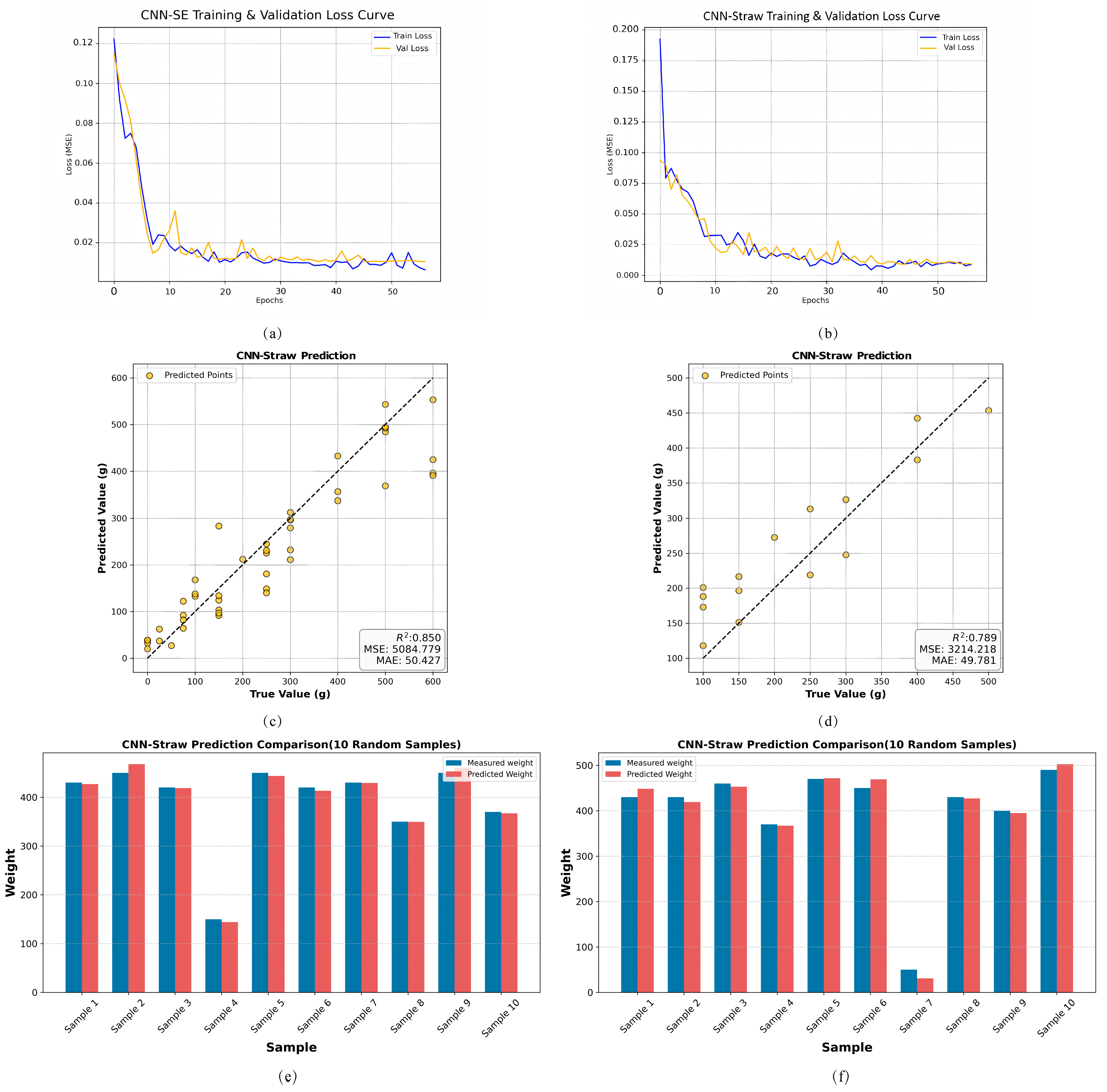
Furthermore, the loss convergence curves (Figure 13a,d) and prediction performance plots (Figure 13b,c,e,f) of the autumn and spring datasets both demonstrate a strong consistency between the predicted and measured values, confirming the excellent applicability and practical potential of the proposed method in the straw weight prediction task.
The CNN-Straw model adopts an end-to-end learning architecture, which can directly process the original multispectral images without manually calculating the spectral index. The model enhances the ability to identify subtle spectral details by jointly considering texture structure and spectral changes. The synergistic integration of FDConv, LSA and PTeLU modules effectively suppresses noise and improves the accuracy of nonlinear fitting. In addition, the model shows strong generalization ability and stability and can maintain high prediction performance (R2 ≥ 0.8) under different seasons and surface conditions. The CNN-Straw model only requires 65% of the parameters of the traditional CNN model, has excellent model portability and computational efficiency, and is very suitable for field deployment on agricultural drone platforms [24]. In summary, the CNN-Straw model shows excellent accuracy, stability and generalization ability in estimating the amount of straw returned to the field using multispectral remote sensing images [80]. It provides an efficient, scientific and reliable technical foundation for the implementation of phaeozem protection and agricultural subsidy policies.

3.5. Methodological Framework and Practical Application Scenarios

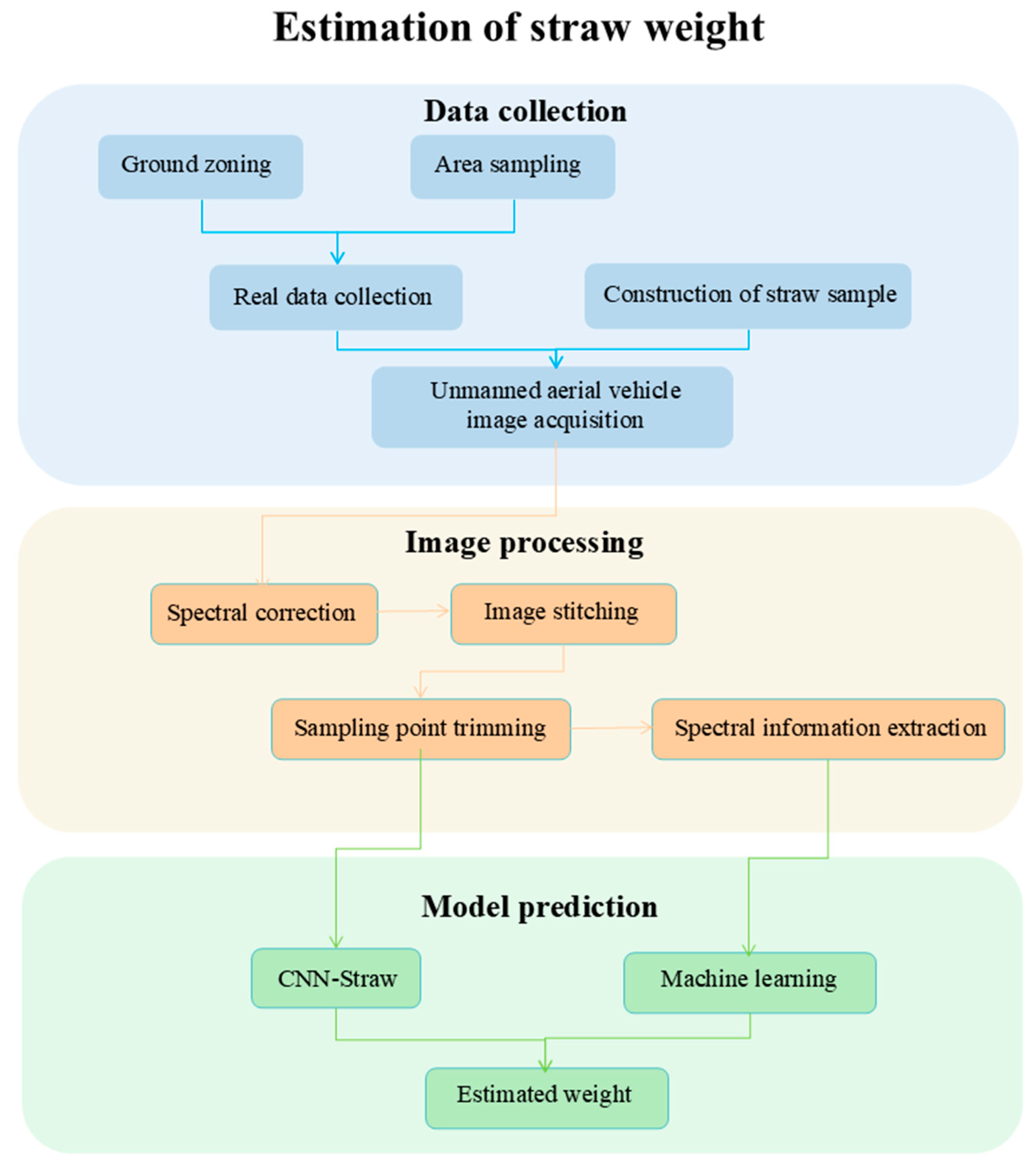
The experimental framework based on UAV multispectral imaging and deep learning constructed in this study demonstrates a high degree of proceduralization and practicality in the quantitative monitoring of maize straw return (SRA) in phaeozem regions. This framework achieves automated mapping from raw remote sensing images to straw weight distribution through a standardized technical approach [26] (Figure 14). Its core components are standardized ground-to-air spectral calibration and end-to-end image-based modeling. The proposed framework consists of four main procedural steps.
First, standardized ground calibration plots with fixed areas and preset straw mass densities are established near the experimental field. Straw weight is set according to commonly used management and policy-related thresholds and measured under controlled soil moisture conditions. These calibration plots serve as physical references, linking straw mass (g·m−2) to multispectral reflectance, laying the foundation for model training and validation.
Second, UAV multispectral imagery is acquired using a five-band sensor (blue, green, red, red-edge, and near-infrared) under consistent lighting and flight conditions. Radiometric calibration is first performed using a standard white reference panel, followed by orthorectification and band registration. Image patches corresponding to each calibration plot are extracted to ensure spatial consistency between ground measurements and spectral observations.
Secondly, two parallel regression workflows are implemented. In the machine learning-based workflow, spectral bands and vegetation-related indices (including the proposed straw index (SI)) are calculated and used as model input. In contrast, the deep learning-based workflow employs a CNN-Straw model that directly processes multispectral image patches and performs end-to-end regression [81]. This approach avoids explicit feature engineering and manual index selection, simplifying preprocessing and reducing reliance on empirically defined spectral features.
Finally, the trained model is applied to UAV imagery to generate straw weight estimates at the plot or field level. These estimates can be spatially aggregated and visualized using a Geographic Information System (GIS) to achieve quantitative mapping of farmland straw return distribution [82].
From a methodological perspective, the deep learning-based framework provides a simplified processing flow compared to traditional machine learning methods, which typically require repetitive feature construction, index selection, and parameter tuning. By integrating feature extraction and regression into a single modeling architecture, the CNN-Straw framework reduces operational complexity, especially when dealing with large-scale UAV datasets.
In terms of practical applications, the proposed framework is suitable for field straw monitoring consistent with the conditions of this study, specifically, for monitoring maize straw in phaeozem regions using multispectral UAV data. This workflow can serve as a technical reference and can be extended to other crop straw or monitoring targets, provided that a suitable calibration dataset is established. Potential applications related to agricultural management or policy evaluation should be considered as intended uses of the framework, rather than the validation results of this study.

4. Discussion

4.1. Interpretation of Model Performance and Sources of Uncertainty

This study explores the feasibility of quantitatively estimating straw return to the field using UAV multispectral imagery by combining standardized spectral calibration, straw-specific spectral indices (SI), and a custom deep learning architecture (CNN-Straw). This paper does not replicate the numerical performance metrics reported in Section 3 but focuses on explaining model behavior, identifying key sources of uncertainty, and clarifying its practical applicability.
Overall, under the same data partitioning scheme, the CNN-Straw model demonstrates superior predictive performance compared to traditional machine learning methods (RF, SVR, and XGBoost). For the autumn dataset, the model achieves higher accuracy, reducing the root mean square error (RMSE) and mean absolute error (MAE) by approximately 15% and 12%, respectively, compared to baseline methods. These improvements, based on the same test set partitioning, should be considered indicative rather than statistically definitive, as this study does not explicitly evaluate uncertainty estimates (e.g., confidence intervals).
Seasonal differences play a crucial role in model performance. Autumn straw residues are typically drier and more structurally intact, resulting in a more stable spectral response and clearer contrast between straw and the soil background. In contrast, spring straw residue is affected by moisture accumulation, partial decomposition, and soil-straw mixing, leading to reduced spectral separation and increased regression uncertainty. It is noteworthy that all quantitative analyses used the weight of dried straw; the difference in measurements between fresh and air-dried straw primarily reflects the effect of moisture, rather than actual residue mass. This distinction helps explain the observed seasonal performance differences.
The improved performance of the CNN-Straw framework may be attributed to its ability to simultaneously utilize spectral and spatial texture information [18,20]. The frequency domain convolution (FDConv) module enhances sensitivity to repetitive texture patterns and high-frequency structural features in straw residue, while the local spatial attention (LSA) mechanism may emphasize spectrally rich regions, particularly in the red-edge and near-infrared bands. However, these interpretations should be considered hypothetical mechanisms, as no explicit interpretability analyses (e.g., attention visualization or feature attribution) have been performed to directly validate them.
Similarly, the proposed straw index (SI) aims to improve the distinction between non-photosynthetic vegetation (NPV) and the soil background by utilizing the reflectance difference between the visible and near-infrared bands [83]. Although the chemical composition of straw (e.g., cellulose, hemicellulose, and lignin) is generally associated with reflectance characteristics in the blue-green light region, the multispectral sensor used in this study captures a broad band with center wavelengths of approximately 450 nm (blue light) and 555 nm (green light) [84]. Therefore, the observed SI effectiveness should be interpreted as reflecting indirect spectral sensitivity rather than direct biochemical absorption characteristics.
The study also identified several sources of uncertainty limiting model robustness. Straw moisture content, decomposition stage, soil background brightness, light variation, stubble orientation and thickness, and plot-pixel registration errors all contribute to performance differences, especially under spring conditions [84,85]. These factors highlight the inherent difficulty of quantifying stubble in heterogeneous environments after winter and explain why the performance improvement is more significant in the autumn dataset.
Currently, the universality of the proposed framework is limited to single-point and cross-seasonal scenarios of maize straw in the phaeozem region of Northeast China. Its applicability to other crop stubble, soil types, and management practices remains to be validated. Furthermore, the use of five-band multispectral data limits the sensitivity to moisture and decomposition dynamics; incorporating hyperspectral or thermal information could further improve robustness. Environmental factors such as meteorological and soil physicochemical properties have not yet been explicitly modeled, representing an important direction for future research [86].
Despite these limitations, the proposed UAV-based multispectral framework demonstrates potential to support crop residue monitoring in the context of phaeozem conservation and precision agriculture. Applications such as subsidy assessment and management decision support should be considered potential uses rather than proven results. Future work should expand spatial and crop cover coverage, introduce statistical uncertainty analysis, and employ explicit interpretability methods to better link model behavior to physical processes.

4.2. Limitations and Scope of Application

The applicability of the proposed CNN-Straw framework is limited by several important limitations. First, experimental validation was conducted at a single location in the chernozem soil region of Northeast China, and only for maize straw. Therefore, the demonstrated generalization ability should be interpreted as the framework’s applicability at the same location and across seasons under similar soil backgrounds and crop residue conditions.
Second, the use of five-band multispectral imagery limits the model’s sensitivity to straw moisture variations and decomposition dynamics. The framework’s applicability to other crop residues, soil types, and sensor configurations has not yet been validated. No formal interpretability analysis was performed in this study; therefore, all physical interpretations are presented as plausible explanations rather than verified mechanisms.
Finally, although potential applications such as subsidy assessment and management decision support are discussed, these should be considered as anticipated use cases rather than validated results. Future research should focus on multi-location and multi-crop validation, explicit uncertainty quantification, and interpretability analysis to further evaluate the robustness and portability of the proposed method.

5. Conclusions

A multispectral framework based on unmanned aerial vehicles (UAVs) was developed to quantitatively estimate the amount of straw returned to the field in phaeozem farmland in Northeast China. This method integrates three core components: (1) a standardized ground-to-air spectral calibration scheme; (2) a straw-specific spectral index (straw index, SI); and (3) an improved deep learning regression model (CNN-Straw).
Based on multi-season field trials, the CNN-Straw model consistently outperformed traditional machine learning methods, including random forest (RF), support vector regression (SVR), and XGBoost. On the autumn dataset, the model achieved a high coefficient of determination (R2) of 0.85, and compared to the best-performing traditional model with the same data partitioning, the root mean square error (RMSE) and mean absolute error (MAE) were reduced by approximately 15% and 12%, respectively. Under spring conditions, despite increased uncertainty due to straw moisture content and surface heterogeneity, the CNN-Straw model maintained stable predictive performance (R2 ≥ 0.80), demonstrating stronger cross-seasonal robustness. From a methodological perspective, this study demonstrates the effectiveness of combining standardized spectral calibration with end-to-end deep learning for estimating straw return to the field. Compared to traditional vegetation indices, the straw index (SI) improves the distinction between non-photosynthetic straw residue and soil background, while the CNN-Straw architecture allows for direct regression from raw multispectral images without manual feature engineering. These components together constitute a unified, automated workflow suitable for UAV-based field straw monitoring.
Despite these advancements, some limitations should be noted. The proposed framework was developed and validated based on a single crop type (maize), a single geographic region, and a five-band multispectral sensor, which may limit its applicability across different crops, soil types, or sensor configurations. Environmental factors such as straw moisture variation, decomposition stage, and soil background effects have not been explicitly modeled and remain significant sources of uncertainty. Therefore, the current findings should be interpreted in conjunction with field-scale and seasonal considerations and cannot be fully generalized to other regions or production systems.
Overall, this study demonstrates the feasibility of using UAV multispectral imagery combined with deep learning techniques to quantitatively estimate straw return to the field in phaeozem regions. The proposed framework provides a repeatable and scalable technical approach for crop residue monitoring and is expected to support future applications in precision agriculture and soil conservation assessment. To further enhance its versatility and feasibility, validation is needed across various crops, regions, and sensing modes.

Author Contributions

Conceptualization, Y.L.; methodology, Y.L., X.T., J.Z., X.Z. and J.C.; software, X.T. and J.Z.; validation, J.Z., X.Z., J.C., J.W., L.W. and M.Y.; formal analysis, X.T.; investigation, Y.L., X.T. and Y.D.; resources, Y.L., J.W., L.W., M.Y., P.S. and X.L.; data curation, Y.L., X.T., J.C., Y.D. and F.L.; writing—original draft, X.T. and Y.D.; writing—review and editing, Y.L., X.Z., J.C., F.L., Y.W., J.W., L.W., M.Y., P.S. and X.L.; visualization, X.T.; supervision, Y.L., J.Z., X.Z., Y.W., J.W., L.W. and M.Y.; project administration, Y.L., X.Z., F.L. and Y.W.; funding acquisition, Y.L., F.L. and Y.W. All authors have read and agreed to the published version of the manuscript.

Funding

This research was funded by “Research on regionalized surface straw cover information detection methods in complex contexts for conservation tillage”, the National Natural Science Foundation of China, product number: 42001256, and the Jilin Science and Technology Development Program Project, product number: 20230202039NC.

Institutional Review Board Statement

Not applicable.

Data Availability Statement

The datasets in this study are available from the corresponding author on reasonable request.

Acknowledgments

We would like to express our gratitude to the Changchun Agricultural Machinery Research Institute for providing the experimental facilities. We also thank ChatGPT (a product of OpenAI, version GPT-5.0) for its assistance in facilitating the translation of this article and for helping to generate the spectral diagrams of straw used in the experiments.

Conflicts of Interest

The authors declare no conflicts of interest.

References

  1. Zhang, G.; Yang, Y.; Liu, Y.; Wang, Z.J. Advances and prospects of soil erosion research in the black soil region of Northeast China. J. Soil Water Conserv. 2022, 36, 1–12. [Google Scholar]
  2. Xu, X.Z.; Xu, Y.; Chen, S.C.; Xu, S.G.; Zhang, H.J. Soil loss and conservation in the black soil region of Northeast China: A retrospective study. Environ. Sci. Policy 2010, 13, 793–800. [Google Scholar] [CrossRef]
  3. Zhang, S.; Li, Q.; Zhang, X.; Wei, K.; Chen, L.; Liang, W. Effects of conservation tillage on soil aggregation and aggregate binding agents in black soil of Northeast China. Soil Tillage Res. 2012, 124, 196–202. [Google Scholar] [CrossRef]
  4. Wang, J.-K.; Xu, X.-R.; Pei, J.-B.; Li, S.-Y. Current situations of black soil quality and facing opportunities and challenges in northeast China. Chin. J. Soil Sci. 2021, 52, 695–701. [Google Scholar]
  5. Liu, X.; Zhang, X.; Wang, Y.; Sui, Y.; Zhang, S.; Herbert, S.; Ding, G. Soil degradation: A problem threatening the sustainable development of agriculture in Northeast China. Plant Soil Environ. 2010, 56, 87–97. [Google Scholar] [CrossRef]
  6. Hossain, A.; Krupnik, T.J.; Timsina, J.; Mahboob, M.G.; Chaki, A.K.; Farooq, M.; Bhatt, R.; Fahad, S.; Hasanuzzaman, M. Agricultural land degradation: Processes and problems undermining future food security. In Environment, Climate, Plant and Vegetation Growth; Springer: Berlin/Heidelberg, Germany, 2020; pp. 17–61. [Google Scholar]
  7. Zhu, F.; Lin, X.; Guan, S.; Dou, S. Deep incorporation of corn straw benefits soil organic carbon and microbial community composition in a black soil of Northeast China. Soil Use Manag. 2022, 38, 1266–1279. [Google Scholar] [CrossRef]
  8. Wang, Y.-J.; Wang, N.; Huang, G.Q. How do rural households accept straw returning in Northeast China? Resour. Conserv. Recycl. 2022, 182, 106287. [Google Scholar] [CrossRef]
  9. Li, H.; Dai, M.; Dai, S.; Dong, X. Current status and environment impact of direct straw return in China’s cropland–A review. Ecotoxicol. Environ. Saf. 2018, 159, 293–300. [Google Scholar] [CrossRef]
  10. Jiang, W.; Yan, T.; Chen, B. Impact of media channels and social interactions on the adoption of straw return by Chinese farmers. Sci. Total Environ. 2021, 756, 144078. [Google Scholar] [CrossRef]
  11. Hassan, M.A.; Yang, M.; Rasheed, A.; Yang, G.; Reynolds, M.; Xia, X.; Xiao, Y.; He, Z. A rapid monitoring of NDVI across the wheat growth cycle for grain yield prediction using a multi-spectral UAV platform. Plant Sci. 2019, 282, 95–103. [Google Scholar] [CrossRef]
  12. Alckmin, G.T.; Lucieer, A.; Rawnsley, R.; Kooistra, L. Perennial ryegrass biomass retrieval through multispectral UAV data. Comput. Electron. Agric. 2022, 193, 106574. [Google Scholar] [CrossRef]
  13. Bai, Y.; Shi, L.; Zha, Y.; Liu, S.; Nie, C.; Xu, H.; Yang, H.; Shao, M.; Yu, X.; Cheng, M.; et al. Estimating leaf age of maize seedlings using UAV-based RGB and multispectral images. Comput. Electron. Agric. 2023, 215, 108349. [Google Scholar] [CrossRef]
  14. Fu, Z.; Jiang, J.; Gao, Y.; Krienke, B.; Wang, M.; Zhong, K.; Cao, Q.; Tian, Y.; Zhu, Y.; Cao, W. Wheat growth monitoring and yield estimation based on multi-rotor unmanned aerial vehicle. Remote Sens. 2020, 12, 508. [Google Scholar] [CrossRef]
  15. Su, X.; Wang, J.; Ding, L.; Lu, J.; Zhang, J.; Yao, X.; Cheng, T.; Zhu, Y.; Cao, W.; Tian, Y. Grain yield prediction using multi-temporal UAV-based multispectral vegetation indices and endmember abundance in rice. Field Crop. Res. 2023, 299, 108992. [Google Scholar] [CrossRef]
  16. Zhang, B.; Gu, L.; Dai, M.; Bao, X.; Sun, Q.; Qu, X.; Zhang, M.; Liu, X.; Fan, C.; Gu, X. Estimation of grain filling rate and thousand-grain weight of winter wheat (Triticum aestivum L.) using UAV-based multispectral images. Eur. J. Agron. 2024, 159, 127258. [Google Scholar] [CrossRef]
  17. Maimaitijiang, M.; Sagan, V.; Sidike, P.; Daloye, A.M.; Erkbol, H.; Fritschi, F.B. Crop monitoring using satellite/UAV data fusion and machine learning. Remote Sens. 2020, 12, 1357. [Google Scholar] [CrossRef]
  18. Bian, C.; Shi, H.; Wu, S.; Zhang, K.; Wei, M.; Zhao, Y.; Sun, Y.; Zhuang, H.; Zhang, X.; Chen, S. Prediction of field-scale wheat yield using machine learning method and multi-spectral UAV data. Remote Sens. 2022, 14, 1474. [Google Scholar] [CrossRef]
  19. Alabi, T.R.; Abebe, A.T.; Chigeza, G.; Fowobaje, K.R. Estimation of soybean grain yield from multispectral high-resolution UAV data with machine learning models in West Africa. Remote Sens. Appl. Soc. Environ. 2022, 27, 100782. [Google Scholar] [CrossRef]
  20. Sharifi, A. Yield prediction with machine learning algorithms and satellite images. J. Sci. Food Agric. 2021, 101, 891–896. [Google Scholar] [CrossRef] [PubMed]
  21. Yang, M.-D.; Hsu, Y.-C.; Tseng, W.-C.; Tseng, H.-H.; Lai, M.-H. Precision assessment of rice grain moisture content using UAV multispectral imagery and machine learning. Comput. Electron. Agric. 2025, 230, 109813. [Google Scholar] [CrossRef]
  22. Kumar, C.; Mubvumba, P.; Huang, Y.; Dhillon, J.; Reddy, K. Multi-stage corn yield prediction using high-resolution UAV multispectral data and machine learning models. Agronomy 2023, 13, 1277. [Google Scholar] [CrossRef]
  23. Iniyan, S.; Varma, V.A.; Naidu, C.T. Crop yield prediction using machine learning techniques. Adv. Eng. Softw. 2023, 175, 103326. [Google Scholar] [CrossRef]
  24. Fan, J.; Bai, J.; Li, Z.; Ortiz-Bobea, A.; Gomes, C.P. A GNN-RNN approach for harnessing geospatial and temporal information: Application to crop yield prediction. In Proceedings of the AAAI conference on artificial intelligence, Vancouver, Canada, 22 February–1 March 2022; pp. 11873–11881. [Google Scholar]
  25. Han, D.; Wang, P.; Tansey, K.; Zhang, Y.; Li, H. A graph-based deep learning framework for field scale wheat yield estimation. Int. J. Appl. Earth Obs. Geoinf. 2024, 129, 103834. [Google Scholar] [CrossRef]
  26. Chu, Z.; Yu, J. An end-to-end model for rice yield prediction using deep learning fusion. Comput. Electron. Agric. 2020, 174, 105471. [Google Scholar] [CrossRef]
  27. Nevavuori, P.; Narra, N.; Lipping, T. Crop yield prediction with deep convolutional neural networks. Comput. Electron. Agric. 2019, 163, 104859. [Google Scholar] [CrossRef]
  28. Cao, J.; Zhang, Z.; Luo, Y.; Zhang, L.; Zhang, J.; Li, Z.; Tao, F. Wheat yield predictions at a county and field scale with deep learning, machine learning, and google earth engine. Eur. J. Agron. 2021, 123, 126204. [Google Scholar] [CrossRef]
  29. Yang, Q.; Shi, L.; Han, J.; Zha, Y.; Zhu, P. Deep convolutional neural networks for rice grain yield estimation at the ripening stage using UAV-based remotely sensed images. Field Crop. Res. 2019, 235, 142–153. [Google Scholar] [CrossRef]
  30. Tanabe, R.; Matsui, T.; Tanaka, T.S. Winter wheat yield prediction using convolutional neural networks and UAV-based multispectral imagery. Field Crop. Res. 2023, 291, 108786. [Google Scholar] [CrossRef]
  31. Sun, B.; Qin, P.; Yue, W.; Guo, Y.; Gao, Z.; Wang, Y.; Li, Y.; Yan, Z. High temporal and spatial estimation of grass yield by applying an improved Carnegie-Ames-Stanford approach (CASA)-NPP transformation method: A case study of Zhenglan Banner, Inner Mongolia, China. Comput. Electron. Agric. 2024, 224, 109134. [Google Scholar] [CrossRef]
  32. Zhou, Y.; Liu, T.; Batelaan, O.; Duan, L.; Wang, Y.; Li, X.; Li, M. Spatiotemporal fusion of multi-source remote sensing data for estimating aboveground biomass of grassland. Ecol. Indic. 2023, 146, 109892. [Google Scholar] [CrossRef]
  33. Patel, M.K.; Padarian, J.; Western, A.W.; Fitzgerald, G.J.; McBratney, A.B.; Perry, E.M.; Suter, H.; Ryu, D. Retrieving canopy nitrogen concentration and aboveground biomass with deep learning for ryegrass and barley: Comparing models and determining waveband contribution. Field Crop. Res. 2023, 294, 108859. [Google Scholar] [CrossRef]
  34. Muro, J.; Linstädter, A.; Magdon, P.; Wöllauer, S.; Männer, F.A.; Schwarz, L.-M.; Ghazaryan, G.; Schultz, J.; Malenovský, Z.; Dubovyk, O. Predicting plant biomass and species richness in temperate grasslands across regions, time, and land management with remote sensing and deep learning. Remote Sens. Environ. 2022, 282, 113262. [Google Scholar] [CrossRef]
  35. Togeiro de Alckmin, G.; Kooistra, L.; Rawnsley, R.; De Bruin, S.; Lucieer, A. Retrieval of hyperspectral information from multispectral data for perennial ryegrass biomass estimation. Sensors 2020, 20, 7192. [Google Scholar] [CrossRef] [PubMed]
  36. Liu, W.; Liu, Y.; Liu, G.; Xie, R.; Ming, B.; Yang, Y.; Guo, X.; Wang, K.; Xue, J.; Wang, Y.; et al. Estimation of maize straw production and appropriate straw return rate in China. Agric. Ecosyst. Environ. 2022, 328, 107865. [Google Scholar] [CrossRef]
  37. Bi, Y.; Gao, C.; Wang, Y.; Li, B. Estimation of straw resources in China. Trans. Chin. Soc. Agric. Eng. 2009, 25, 211–217. [Google Scholar]
  38. Zhou, D.; Li, M.; Li, Y.; Qi, J.; Liu, K.; Cong, X.; Tian, X. Detection of ground straw coverage under conservation tillage based on deep learning. Comput. Electron. Agric. 2020, 172, 105369. [Google Scholar] [CrossRef]
  39. Wang, L.; Xu, L.; Wei, S.; Wei, C.; Zhao, B.; Yuan, Y.; Fan, J. Straw coverage detection method based on sauvola and otsu segmentation algorithm. Agric. Eng. 2017, 7, 29–35. [Google Scholar]
  40. Wang, F.; Lv, C.; Jiang, H.; Pan, Y.; Guo, P.; Li, F.; Zhou, L. Efficient detection of corn straw coverage in complex agricultural scenarios. Comput. Electron. Agric. 2025, 235, 110338. [Google Scholar] [CrossRef]
  41. An, X.; Wang, P.; Luo, C.; Meng, Z.; Chen, L.; Zhang, A. Corn straw coverage calculation algorithm based on K-means clustering and zoning optimization method. Nongye Jixie Xuebao/Trans. Chin. Soc. Agric. Mach. 2021, 52. [Google Scholar] [CrossRef]
  42. Zhou, J.; Gu, X.; Gong, H.; Yang, X.; Sun, Q.; Guo, L.; Pan, Y. Intelligent classification of maize straw types from UAV remote sensing images using DenseNet201 deep transfer learning algorithm. Ecol. Indic. 2024, 166, 112331. [Google Scholar] [CrossRef]
  43. Zhang, Y.; Du, J. Improving maize residue cover estimation with the combined use of optical and SAR remote sensing images. Int. Soil Water Conserv. Res. 2024, 12, 578–588. [Google Scholar] [CrossRef]
  44. Liu, Y.; Sun, Y.; Wang, Y.; Wang, J.; Gao, X.; Wang, L.; Liu, M. Model Optimization and Application of Straw Mulch Quantity Using Remote Sensing. Agronomy 2024, 14, 2352. [Google Scholar] [CrossRef]
  45. Wang, Y.; Gao, X.; Sun, Y.; Liu, Y.; Wang, L.; Liu, M. Sh-DeepLabv3+: An Improved Semantic Segmentation Lightweight Network for Corn Straw Cover Form Plot Classification. Agriculture 2024, 14, 628. [Google Scholar] [CrossRef]
  46. Wu, Z.; Wang, B.; Feng, X.; Liang, J.; Zhong, Y.; Yan, Q.; Wu, Z. Mapping Soil Organic Carbon in High-standard Farmland Construction Areas Using Machine Learning Algorithms: Threshold and Interaction Effects of Environmental Variables. Land Degrad. Dev. 2025, 36, 4770–4782. [Google Scholar] [CrossRef]
  47. Qu, Y.; Pan, C.; Guo, H. Factors affecting the promotion of conservation tillage in black soil—The case of Northeast China. Sustainability 2021, 13, 9563. [Google Scholar] [CrossRef]
  48. Zhu, H.; Huang, Y.; An, Z.; Zhang, H.; Han, Y.; Zhao, Z.; Li, F.; Zhang, C.; Hou, C. Assessing radiometric calibration methods for multispectral UAV imagery and the influence of illumination, flight altitude and flight time on reflectance, vegetation index and inversion of winter wheat AGB and LAI. Comput. Electron. Agric. 2024, 219, 108821. [Google Scholar] [CrossRef]
  49. Csillik, O.; Belgiu, M.; Asner, G.P.; Kelly, M. Object-based time-constrained dynamic time warping classification of crops using Sentinel-2. Remote Sens. 2019, 11, 1257. [Google Scholar] [CrossRef]
  50. Reynolds, M.R.; Amin, R.W.; Arnold, J.C.; Nachlas, J.A. Charts with variable sampling intervals. Technometrics 1988, 30, 181–192. [Google Scholar] [CrossRef]
  51. Qanbari, S.; Strom, T.M.; Haberer, G.; Weigend, S.; Gheyas, A.A.; Turner, F.; Burt, D.W.; Preisinger, R.; Gianola, D.; Simianer, H. A high resolution genome-wide scan for significant selective sweeps: An application to pooled sequence data in laying chickens. PLoS ONE 2012, 7, e49525. [Google Scholar] [CrossRef]
  52. Luscier, J.D.; Thompson, W.L.; Wilson, J.M.; Gorham, B.E.; Dragut, L.D. Using digital photographs and object-based image analysis to estimate percent ground cover in vegetation plots. Front. Ecol. Environ. 2006, 4, 408–413. [Google Scholar] [CrossRef]
  53. Pettorelli, N.; Vik, J.O.; Mysterud, A.; Gaillard, J.-M.; Tucker, C.J.; Stenseth, N.C. Using the satellite-derived NDVI to assess ecological responses to environmental change. Trends Ecol. Evol. 2005, 20, 503–510. [Google Scholar] [CrossRef] [PubMed]
  54. Boiarskii, B.; Hasegawa, H. Comparison of NDVI and NDRE indices to detect differences in vegetation and chlorophyll content. J. Mech. Contin. Math. Sci. 2019, 4, 20–29. [Google Scholar] [CrossRef]
  55. Naji, T.A. Study of vegetation cover distribution using DVI, PVI, WDVI indices with 2D-space plot. J. Phys. Conf. Ser. 2018, 1003, 012083. [Google Scholar] [CrossRef]
  56. Morel, A.; Gentili, B. A simple band ratio technique to quantify the colored dissolved and detrital organic material from ocean color remotely sensed data. Remote Sens. Environ. 2009, 113, 998–1011. [Google Scholar] [CrossRef]
  57. Verstraete, M.M.; Pinty, B. Designing optimal spectral indexes for remote sensing applications. IEEE Trans. Geosci. Remote Sens. 2002, 34, 1254–1265. [Google Scholar] [CrossRef]
  58. Shi, M.; Ma, Z.; Tian, Y.; Zhang, X.; Shan, H. Effects of maize straw treated with various levels of CaO and moisture on composition, structure, and digestion by in vitro gas production. Anim. Biosci. 2021, 34, 1940. [Google Scholar] [CrossRef]
  59. Pauly, M.; Keegstra, K. Cell-wall carbohydrates and their modification as a resource for biofuels. Plant J. 2008, 54, 559–568. [Google Scholar] [CrossRef]
  60. Asner, G.P. Biophysical and biochemical sources of variability in canopy reflectance. Remote Sens. Environ. 1998, 64, 234–253. [Google Scholar] [CrossRef]
  61. Curran, P.J. Remote sensing of foliar chemistry. Remote Sens. Environ. 1989, 30, 271–278. [Google Scholar] [CrossRef]
  62. Gitelson, A.; Merzlyak, M.N. Spectral reflectance changes associated with autumn senescence of Aesculus hippocastanum L. and Acer platanoides L. leaves. Spectral features and relation to chlorophyll estimation. J. Plant Physiol. 1994, 143, 286–292. [Google Scholar] [CrossRef]
  63. Josse, J.; Chen, J.M.; Prost, N.; Varoquaux, G.; Scornet, E. On the consistency of supervised learning with missing values. Stat. Pap. 2024, 65, 5447–5479. [Google Scholar] [CrossRef]
  64. Ma’arif, A.; Rahmaniar, W.; Fathurrahman, H.I.K.; Frisky, A.Z.K. Understanding of Convolutional Neural Network (CNN): A Review. Int. J. Robot. Control. Syst. 2022, 2, 739–748. [Google Scholar] [CrossRef]
  65. Chen, L.; Gu, L.; Li, L.; Yan, C.; Fu, Y. Frequency Dynamic Convolution for Dense Image Prediction. In Proceedings of the Computer Vision and Pattern Recognition Conference, Seattle, WA, USA, 16–21 June 2025; pp. 30178–30188. [Google Scholar]
  66. Feng, K.; Zeng, H.; Zhao, Y.; Kong, S.G.; Bu, Y. Unsupervised spectral demosaicing with lightweight spectral attention networks. IEEE Trans. Image Process. 2024, 33, 1655–1669. [Google Scholar] [CrossRef]
  67. Fernandez, A. TeLU Activation Function for Fast and Stable Deep Learning. Master’s thesis, University of South Florida, Tampa, FL, USA, 2024. [Google Scholar]
  68. Srivastava, N.; Hinton, G.; Krizhevsky, A.; Sutskever, I.; Salakhutdinov, R. Dropout: A simple way to prevent neural networks from overfitting. J. Mach. Learn. Res. 2014, 15, 1929–1958. [Google Scholar]
  69. Semádeni-Davies, A. Monthly snowmelt modelling for large-scale climate change studies using the degree day approach. Ecol. Model. 1997, 101, 303–323. [Google Scholar] [CrossRef]
  70. Benesty, J.; Chen, J.; Huang, Y. On the importance of the Pearson correlation coefficient in noise reduction. IEEE Trans. Audio Speech Lang. Process. 2008, 16, 757–765. [Google Scholar] [CrossRef]
  71. Huang, S.; Tang, L.; Hupy, J.P.; Wang, Y.; Shao, G. A commentary review on the use of normalized difference vegetation index (NDVI) in the era of popular remote sensing. J. For. Res. 2021, 32, 1–6. [Google Scholar] [CrossRef]
  72. Ge, X.; Ding, J.; Jin, X.; Wang, J.; Chen, X.; Li, X.; Liu, J.; Xie, B. Estimating agricultural soil moisture content through UAV-based hyperspectral images in the arid region. Remote Sens. 2021, 13, 1562. [Google Scholar] [CrossRef]
  73. Keenan, T.F.; Richardson, A.D. The timing of autumn senescence is affected by the timing of spring phenology: Implications for predictive models. Glob. Change Biol. 2015, 21, 2634–2641. [Google Scholar] [CrossRef]
  74. Zhu, H.; Lin, C.; Liu, G.; Wang, D.; Qin, S.; Li, A.; Xu, J.-L.; He, Y. Intelligent agriculture: Deep learning in UAV-based remote sensing imagery for crop diseases and pests detection. Front. Plant Sci. 2024, 15, 1435016. [Google Scholar] [CrossRef]
  75. Song, B.; Min, S.; Yang, H.; Wu, Y.; Wang, B. A Fourier frequency domain convolutional neural network for remote sensing crop classification considering global consistency and edge specificity. Remote Sens. 2023, 15, 4788. [Google Scholar] [CrossRef]
  76. Dangi, S.; Mullapudi, S.K.; Raghaw, C.S.; Dar, S.S.; Rehman, M.Z.U.; Kumar, N. A multi-temporal multi-spectral attention-augmented deep convolution neural network with contrastive learning for crop yield prediction. Comput. Electron. Agric. 2025, 239, 110895. [Google Scholar] [CrossRef]
  77. Sullivan, D.; Shaw, J.; Mask, P.; Rickman, D.; Guertal, E.; Luvall, J.; Wersinger, J. Evaluation of multispectral data for rapid assessment of wheat straw residue cover. Soil Sci. Soc. Am. J. 2004, 68, 2007–2013. [Google Scholar] [CrossRef]
  78. Joshi, A.; Pradhan, B.; Gite, S.; Chakraborty, S. Remote-sensing data and deep-learning techniques in crop mapping and yield prediction: A systematic review. Remote Sens. 2023, 15, 2014. [Google Scholar] [CrossRef]
  79. Joshi, A.; Pradhan, B.; Chakraborty, S.; Varatharajoo, R.; Gite, S.; Alamri, A. Deep-Transfer-Learning Strategies for Crop Yield Prediction Using Climate Records and Satellite Image Time-Series Data. Remote Sens. 2024, 16, 4804. [Google Scholar] [CrossRef]
  80. Osco, L.P.; Nogueira, K.; Marques Ramos, A.P.; Faita Pinheiro, M.M.; Furuya, D.E.G.; Gonçalves, W.N.; de Castro Jorge, L.A.; Marcato Junior, J.; dos Santos, J.A. Semantic segmentation of citrus-orchard using deep neural networks and multispectral UAV-based imagery. Precis. Agric. 2021, 22, 1171–1188. [Google Scholar] [CrossRef]
  81. Xu, J.; Zhu, Y.; Zhong, R.; Lin, Z.; Xu, J.; Jiang, H.; Huang, J.; Li, H.; Lin, T. DeepCropMapping: A multi-temporal deep learning approach with improved spatial generalizability for dynamic corn and soybean mapping. Remote Sens. Environ. 2020, 247, 111946. [Google Scholar] [CrossRef]
  82. Lian, Z.; Zhan, Y.; Zhang, W.; Wang, Z.; Liu, W.; Huang, X. Recent Advances in Deep Learning-Based Spatiotemporal Fusion Methods for Remote Sensing Images. Sensors 2025, 25, 1093. [Google Scholar] [CrossRef]
  83. Azimi, F.; Jung, J. Automated Crop Residue Estimation via Unsupervised Techniques Using High-Resolution UAS RGB Imagery. Remote Sens. 2024, 16, 1135. [Google Scholar] [CrossRef]
  84. Yang, L.; Lu, B.; Schmidt, M.; Natesan, S.; McCaffrey, D. Applications of remote sensing for crop residue cover mapping. Smart Agric. Technol. 2025, 100880. [Google Scholar] [CrossRef]
  85. Radočaj, D.; Radočaj, P.; Plaščak, I.; Jurišić, M. Evolution of Deep Learning Approaches in UAV-Based Crop Leaf Disease Detection: A Web of Science Review. Appl. Sci. 2025, 15, 10778. [Google Scholar] [CrossRef]
  86. Zhang, P.; Sun, X.; Zhang, D.; Yang, Y.; Wang, Z. Lightweight deep learning models for high-precision rice seedling segmentation from UAV-based multispectral images. Plant Phenomics 2023, 5, 0123. [Google Scholar] [CrossRef] [PubMed]
Figure 1. Map of the research area of the Changchun Experimental Field in Jilin Province. (a) The experimental field is located in Changchun City. (b) Research base of Changchun Agricultural Machinery Research Institute. (c) Random sampling method for experimental fields.
Agronomy 16 00416 g001
Figure 2. Construction process and site layout of straw weight and spectral mapping calibration plots. (a) Weighing multiple sets of straw to establish calibration plots. (b) Setting up equal-area calibration units. (c) Distributing the corresponding straw weights evenly within each calibration frame. (d) Final design of the straw marking area.
Agronomy 16 00416 g002
Figure 3. The process and equipment configuration for UAV and multispectral image acquisition. (a) DJI M300 UAV; (b) Changguang Yuchen AQ600 Pro multispectral camera; (c) calibration board; (d) test site under clear sky conditions; (e) mosaic result after multispectral image stitching.
Agronomy 16 00416 g003
Figure 4. The process of collecting the straw test dataset: (a) measuring the test field and dividing it into sampling areas; (b) randomly sampling and selecting sampling points; (c) weighing the straw samples at the selected sampling points; (d) measuring the straw thickness using the five-point sampling method; (e) drying the collected straw samples; (f) weighing the dried samples to calculate the moisture content.
Agronomy 16 00416 g004
Figure 5. A conceptual diagram of the proposed straw index (SI) and its spectral response (image generated with ChatGPT 5.0, source: https://www.celignis.com/feedstock.php?value=2, accessed on 26 January 2026).
Agronomy 16 00416 g005
Figure 6. Overall structure and module details of the CNN-Straw model: FDConv, LSA, and PTeLU.
Agronomy 16 00416 g006
Figure 7. Histograms of straw return weight distribution for the fall and spring datasets: (a) Histogram of straw return weight distribution (fall); (b) Histogram of straw return weight distribution (spring). The solid curve represents the kernel density estimate (KDE) of the weight distribution, and the dashed vertical line represents the mean.
Agronomy 16 00416 g007
Figure 8. Correlation heatmaps between spectral features and straw weight (autumn dataset): (a) autumn correlation heatmap; (b) spring correlation heatmap.
Agronomy 16 00416 g008
Figure 9. Predictive performance of different machine learning models on the fall dataset: (a) linear regression prediction performance; (b) ridge regression prediction performance; (c) stepwise regression prediction performance; (d) SVR prediction performance; (e) XGBoost regression prediction performance; (f) RF regression prediction performance; (g) lasso regression prediction performance; (h) LightGBM regression prediction performance; (i) decision tree regression prediction performance.
Agronomy 16 00416 g009
Figure 10. For the fall dataset, the test results of the four best-performing models are as follows: (a) a bar chart showing the prediction performance of the linear prediction model on ten random samples; (b) a bar chart showing the prediction performance of the SVR prediction model on ten random samples; (c) a bar chart showing the prediction performance of the XGBoost prediction model on ten random samples; (d) a bar chart showing the prediction results of the RF prediction model on ten random samples.
Agronomy 16 00416 g010
Figure 11. Predictive performance of different machine learning models on the spring dataset: (a) linear regression prediction performance; (b) stepwise regression prediction performance; (c) ridge regression prediction performance; (d) SVR prediction performance; (e) XGBoost regression prediction performance; (f) RF regression prediction performance; (g) lasso regression prediction performance; (h) LightGBM regression prediction performance; (i) ElasticNet regression prediction performance.
Agronomy 16 00416 g011
Figure 12. The test results for the four best-performing models on the Spring dataset are as follows: (a) a bar chart showing the prediction performance of the linear prediction model for ten random samples; (b) a bar chart showing the prediction performance of the ridge prediction model for ten random samples; (c) a bar chart showing the prediction performance of the RF prediction model for ten random samples; and (d) a bar chart showing the prediction results of the lasso prediction model for ten random samples.
Agronomy 16 00416 g012
Figure 13. Training process and prediction results of the CNN-Straw model. (a) Fall CNN-Straw model training loss reduction graph. (b) Spring CNN-Straw model training loss reduction graph. (c) Fall CNN-Straw model training loss reduction graph. (d) Spring CNN-Straw model training loss reduction graph. (e) Fall CNN-Straw model prediction and actual values at ten random points. (f) Spring CNN-Straw model prediction and actual values at ten random points.
Agronomy 16 00416 g013
Figure 14. Overall workflow of the proposed straw returning estimation framework.
Agronomy 16 00416 g014
Table 1. Main spectral band parameters of the AQ600 Pro multispectral camera.
Bands NameCentral Wavelength
(nm)
Bandwidth
(nm)
Band IntroductionMain Applications in Experiments
Blue (B)45030Located at the short-wavelength end of the visible light spectrum, it exhibits significant absorption of chlorophyll a and b.Distinguishing between living vegetation and straw or stubble;
Responding to the cellulose content in straw.
Green (G)55527Chlorophyll absorbs this wavelength weakly; healthy vegetation reflects this wavelength highly.Differentiate between healthy crops, senescent crops, and straw; used for determining farmland surface mulch types.
Red (R)66022The region with strong chlorophyll absorption is extremely sensitive to changes in biomass and leaf area index.The core band of classic vegetation indices such as NDVI, crop growth status; changes in aboveground biomass.
Red edge (RE)72010Located in the transition region from red to near-infrared light, this is the area where the vegetation spectral curve changes most dramatically.It can effectively distinguish between physiologically active vegetation and inactive straw residues.
Near-infrared spectrum (NIR)84030Dominated by the internal structure of plant leaves (cell walls, air cells), vegetation typically has high reflectivity in this wavelength range.High response to non-photosynthetic plant tissues (straw).
RGB-2048 × 1536
(resolution)
Used for location positioning and image information retrieval.Assist in spatial positioning and registration.
Table 2. Overview of UAV flight mission time and data acquisition parameters.
DataWeatherFlight DataSample Size
13 June 2024Partly cloudy, 21 °C, west windFlight speed: 3.6 m/s, altitude: 40 m, side overlap: 70%, flight overlap: 70%32
1 November 2024Sunny, 13 °C, west windFlight speed: 3.6 m/s, altitude: 40 m, side overlap: 70%, flight overlap: 70%64
2 November 2024Partly cloudy, 7 °C, east windFlight speed: 3.6 m/s, altitude: 40 m, side overlap: 70%, flight overlap: 70%64
13 November 2024Sunny, 7–9 °C, southeast windFlight speed: 3.6 m/s, altitude: 40 m, side overlap: 70%, flight overlap: 70%64
8 April 2025Sunny, 14 °C, northwest windFlight speed: 3.6 m/s, altitude: 40 m, side overlap: 70%, flight overlap: 70%32
10 April 2025Partly cloudy, 16 °C, west windFlight speed: 3.6 m/s, altitude: 40 m, side overlap: 70%, flight overlap: 70%32
Table 3. Spectral indices related to vegetation and straw and their formulas.
Spectral IndexAbbreviationFormulaCommon UsesReference
Normalized difference vegetation indexNDVI(NIR − R)/(NIR + R)The most commonly used remote sensing vegetation index for assessing vegetation activity and biomass levels.[53]
Normalized difference red edge indexNDRE(NIR − RE)/(NIR + RE)Sensitive to medium- and low-density vegetation and can be used to estimate the early growth status of crops.[54]
Difference vegetation indexDVINIR-RSimply reflects the differences in the intensity of vegetation reflection, but is prone to interference from light and background.[55]
Simple ratio using blue bandSRblueRE/BUsed to distinguish between living vegetation and non-photosynthetic vegetation, such as straw, dead branches, fallen leaves, etc.[56]
Red-edge simple ratio indexSRRERE/NIRSensitive to plant water content, stress responses and structural changes.[57]
Straw indexSI(NIR − G)/(NIR + G + R)Proposed custom index to enhance the spectral response characteristics of the straw.[57]
Table 4. Types and key characteristics of machine learning regression models.
Model TypeModel NameMain Features and Functions
Linear modelMultiple linear regressionEstablishes a baseline linear relationship between spectral characteristics and the weight of the straw, which is used to verify the degree of linear fitting between the variables.
Regularization modelRidge regression, lasso regression, ElasticNet regressionBy using L1/L2 regularization terms, overfitting is suppressed, model stability is enhanced, and feature selection is achieved.
Nonlinear modelSupport vector regressionA nonlinear mapping is established using the radial basis function (RBF), which is suitable for modeling complex relationships with small samples.
Integrating modelDecision tree, random forest, extreme gradient boosting, LightGBMThrough the multi-tree structure, feature interaction modeling is achieved, enhancing the nonlinear fitting and generalization ability of the model.
Feature optimization modelStepwise regressionBy gradually selecting key characteristic variables, the interpretability of the model can be enhanced.
Table 5. Evaluation metrics and calculation formulas for regression model performance.
Evaluation IndicatorsAbbreviationEffectComputational Formula
Determination coefficient(R2)Measuring the explanatory power of the model for the observed values R 2 = S S R S S T = y i ^ y ¯ 2 y i y ¯ 2
Error of mean square(MSE)The square average of the errors between the predicted values and the actual values M S E = 1 n i = 1 n y i y i ^ 2
Mean absolute error(MAE)The average of the absolute values of the differences between the predicted values and the actual values M A E = 1 n i = 1 n y i y i ^
Mean absolute percentage error(MAPE)Used to measure the relative error ratio, suitable for multi-scale comparison M A P E = 1 n i = 1 n y i y i y i
Table 6. Dataset composition and partitioning strategy for seasonal straw weight estimation experiments.
SeasonGround Sampling PlotsTrainingValidationTesting
Autumn19270%20%10%
Spring6470%20%10%
Table 7. Training parameter settings of the CNN-Straw model.
Name of ParameterParameter Setting
OptimizerAdam (learning rate = 1 × 10⁻⁴, β1 = 0.9, β2 = 0.999)
Loss functiondata
Batch size16
Number of training rounds200
Dropout0.3
Weight initialization methodNormal
Data enhancementRandom rotation (±15°), horizontal flip, brightness perturbation (±10%)
Table 8. Comparison of the main model predictions for the fall and spring datasets.
Seasons and AlgorithmsR2MSEMAEAnticipate the Effect
Autumn MLP0.78761058Good
Autumn SVR0.83599353Excellent
Autumn XGBoost0.80713355Excellent
Autumn RF0.79729451Good
Spring MLP0.84365149Good
Spring ridge0.85352449Excellent
Spring RF0.83391248Excellent
Spring lasso0.85357249Good
Table 9. Summary of model performance under different seasons and algorithms.
Model NameAutumn R2MSEMAESpring R2MSEMAE
RF0.797294510.83391248
XGBoost0.807133550.82415352
CNN0.816872500.74604154
ResNet-180.836523480.77557350
CNN-Straw0.855892430.80521246
Table 10. Results of ablation study on CNN-Straw model components.
Model ConfigurationR2RMSEMAE
No FDConv module0.8069.854
No LSA module0.8167.550
No PTeLU module0.8265.348
CNN-Straw0.8558.943
Note: The reported performance metrics (R2, RMSE, and MAE) represent the average values obtained from multiple independent training runs using different random seeds in order to assess the stability of each model configuration and reduce the impact of random initialization.
Disclaimer/Publisher’s Note: The statements, opinions and data contained in all publications are solely those of the individual author(s) and contributor(s) and not of MDPI and/or the editor(s). MDPI and/or the editor(s) disclaim responsibility for any injury to people or property resulting from any ideas, methods, instructions or products referred to in the content.