Article

Deficit Irrigation and Preharvest Chitosan Sprays Enhance Fruit Quality and Postharvest Performance in Peach


by
Lucía Andreu-Coll
1,†,
Pedro J. Blaya-Ros
1,†,
Begoña García-Castellanos
2,
Jesús Vigueras-Fernández
1,
Donaldo Morales-Guevara
3,
José García-García
2,
Jesús García-Brunton
1,
Ángel Calín-Sánchez
4,*,
Francisca Hernández
5 and
Alejandro Galindo
1,*
1
Grupo de Fruticultura, Departamento de Producción Vegetal y Agrotecnología, Instituto Murciano de Investigación y Desarrollo Agrario y Medioambiental (IMIDA), Calle Mayor, s/n, 30150 La Alberca, Murcia, Spain
2
Grupo de Bioeconomía, Departamento de Bioeconomía, Agua y Medio Ambiente, Instituto Murciano de Investigación y Desarrollo Agrario y Medioambiental (IMIDA), Calle Mayor, s/n, 30150 La Alberca, Murcia, Spain
3
Instituto Nacional de Ciencias Agrícolas (INCA), Carretera San José-Tapaste, km 3½, Gaveta Postal 1, San José de las Lajas 32700, Mayabeque, Cuba
4
Departamento de Actividades Agrarias, Centro Integrado de Formación y Experiencias Agrarias de Jumilla, C/Ingeniero de la Cierva, 30520 Jumilla, Murcia, Spain
5
Grupo de Investigación en Fruticultura y Técnicas de Producción, Instituto de Investigación e Innovación Agroalimentaria y Agroambiental (CIAGRO-UMH), Universidad Miguel Hernández, Carretera de Beniel, km 3,2, 03312 Orihuela, Alicante, Spain
*
Authors to whom correspondence should be addressed.
These authors contributed equally to this work.
Agronomy 2026, 16(3), 361; https://doi.org/10.3390/agronomy16030361
Submission received: 31 December 2025 / Revised: 30 January 2026 / Accepted: 30 January 2026 / Published: 2 February 2026

Abstract

Water scarcity in Mediterranean environments has driven the search for sustainable strategies to improve water-use efficiency while maintaining fruit quality. This study evaluated the combined effect of sustained deficit irrigation and preharvest chitosan sprays on fruit quality, bioactive compounds, mineral composition, and postharvest behaviour in two late-season peach cultivars (“Tiétar” and “Duero”) grown under semi-arid Mediterranean conditions. Sustained deficit irrigation was applied throughout the season, together with preharvest chitosan applications during fruit development, to assess individual and interactive effects. Deficit irrigation caused only slight reductions in fruit size while increasing total soluble solids (TSS) concentration and the maturity index (TSS/titratable acidity). Chitosan application increased fruit firmness and modified titratable acidity depending on the irrigation regime (full irrigation or deficit irrigation). The combined treatment (chitosan + deficit irrigation) promoted the accumulation of phenolic compounds and antioxidant activity, particularly in “Tiétar”, increased calcium and iron contents, and showed a longer shelf life. These results indicate that integrating deficit irrigation with preharvest chitosan sprays can mitigate the impact of water scarcity while improving functional and postharvest quality of peaches under Mediterranean conditions.

1. Introduction

The Mediterranean basin has been identified as one of the most vulnerable regions to climate change. The IPCC Sixth Assessment Report [1] reported that anthropogenic climate change is increasing the frequency and intensity of drought events. More recent analyses indicate that accelerated warming in Mediterranean climate-type regions is linked to rising greenhouse gas concentrations, declining aerosol levels, and reduced soil moisture, which intensify drought risk and plant water stress [2]. This hotspot coincides with areas where irrigated fruit production is highly concentrated, particularly stone fruit orchards in the Spanish southeast, which are especially vulnerable to increasing water scarcity. In this context, deficit irrigation has emerged as a key management option to improve water-use efficiency in fruit trees and vines under Mediterranean conditions [3].
Peach (Prunus persica L. Batsch) is one of the most important stone fruit crops worldwide, with global production exceeding 27 million tons in 2023 [4]. Spain is among the main producers in Europe, although national figures show a decrease in yields in recent years, largely attributed to recurrent drought and unfavourable climatic conditions [5].
Water scarcity in peach orchards reduces CO2 assimilation, particularly during the hottest hours of the day, because of partial stomatal closure and the imbalance between atmospheric evaporative demand and soil water availability. Reduced transpiration cooling increases leaf temperature and enhances photoinhibition, photorespiration, and photodamage, contributing to further carbon losses [6,7].
The application of deficit irrigation in peach trees and other deciduous species has been investigated for decades. Early studies demonstrated that moderate water restriction during periods of low fruit sensitivity can reduce excessive vegetative growth and optimize irrigation without major yield penalties [8,9]. More recent work shows that deficit irrigation not only increases water productivity but also influences fruit biochemical composition, including antioxidant activity and phenolic content [10,11,12]. When water availability is continuous, either through stored resources or collective reservoirs, it is possible to implement controlled deficit irrigation strategies such as regulated deficit irrigation (RDI), partial root-zone drying (PRD), or sustained deficit irrigation (SDI) [3]. RDI involves reducing irrigation during non-critical stages of fruit development, in which water shortage does not negatively affect yield, while maintaining full irrigation during critical stages, which, in peaches, includes fruit growth and early postharvest [12]. In contrast, SDI consists of distributing a moderate water deficit uniformly throughout the entire crop cycle to avoid severe stress at any phenological stage, whereas PRD alternates the irrigation of different parts of the root zone to maintain partial hydration while stimulating physiological responses to moderate stress [3]. All these techniques aim to optimise water use without compromising production, although their physiological and fruit-quality effects may vary according to species and environmental conditions.
Nevertheless, under the increasingly frequent drought events expected in Mediterranean areas, additional agronomic tools may be required to maintain both yield and fruit quality. Among these, natural biostimulants such as chitosan have shown potential to enhance plant tolerance to abiotic stress and to complement the effects of deficit irrigation. Chitosan, a deacetylated derivative of chitin present in crustacean shells, insect exoskeletons, and fungal cell walls, is attracting interest as a natural bio-stimulant. Its biodegradability and antimicrobial activity, together with its ability to stimulate plant metabolism and modulate physiological responses to abiotic stress, make it suitable for sustainable crop management [13]. In peach trees, preharvest chitosan applications have been associated with improved firmness, higher soluble solids concentration, and enhanced antioxidant compounds levels, improving postharvest performance [14,15]. From a physiological perspective, drought stress induces the accumulation of soluble sugars through polysaccharide breakdown, contributing to the maintenance of cellular turgor and osmotic adjustment. Chitosan-treated plants have been reported to enhance the accumulation of sugars such as glucose, fructose, mannose, trehalose, sorbitol, and myo-inositol, which support carbon balance and stress signaling under water-limited conditions. In addition, chitosan application has been associated with antioxidant defense systems by increasing the activity of key reactive oxygen species (ROS)-scavenging enzymes, including superoxide dismutase (SOD), catalase (CAT), and peroxidase (POD), thereby reducing oxidative damage and improving physiological performance under drought stress [14]. Similar responses have been reported in pomegranate, where preharvest chitosan sprays not only reduced peel physiopathies such as cracking, splitting, and sunburn, but also increased antioxidant activity. Importantly, these positive effects were observed both under full irrigation and water stress, suggesting that the combination of deficit irrigation and chitosan can contribute to maintaining fruit quality in water-limited environments [16]. However, research on the combined use of deficit irrigation and chitosan in peach orchards under Mediterranean conditions remains limited. Evaluating whether preharvest chitosan treatments can mitigate the physiological responses to water deficit and contribute to maintaining or improving fruit quality is necessary to develop sustainable management strategies.
In this context, the present study aimed to evaluate how sustained deficit irrigation and preharvest chitosan sprays, applied individually or in combination, influence fruit quality attributes, bioactive compounds, and postharvest performance of peach cultivars “Tiétar” and “Duero” under Mediterranean conditions. Sustained deficit irrigation was selected as a widely accepted and commercially convenient strategy, with practical management at the orchard scale, allowing water savings and being particularly suitable for production systems where the implementation of more complex deficit irrigation strategies is limited by the lack of continuous sensing. By addressing these interactions, the study seeks to provide insights into sustainable water and crop management strategies adapted to the increasing drought pressure projected for the Mediterranean basin.

2. Materials and Methods

2.1. Plant Material, Growing Conditions and Experimental Design

The experiment was conducted between August and November 2023 in a commercial orchard located in Jumilla, Region of Murcia, Spain (38°27′10.2″ N, 1°17′10.4″ W). The orchard consisted of Prunus persica L. Batsch cvs. ‘Tiétar®—PRO 798’ and ‘Duero®—PRO 796’, both yellow-fleshed cultivars intended for the fresh market. Trees were 3 years old, with a spacing of 5 × 3 m (666 trees ha−1), and grafted onto the INRA ‘GF-677’ rootstock, widely used in stone-fruit orchards under Mediterranean conditions for its tolerance to iron chlorosis, ease of propagation, and productive efficiency [17]. The combination of deficit irrigation strategies with preharvest chitosan applications may further enhance the performance of this rootstock under water-limited conditions, reinforcing its suitability for sustainable peach production in Mediterranean environments.
Irrigation water was supplied by the “Miraflores” irrigation community, with an electrical conductivity (EC25 °C) of 1.71 dS m−1. Water distribution was achieved through a single drip line per row, consisting of a 16 mm low-density polyethylene pipe. Each tree was equipped with five pressure-compensating emitters delivering 3 L h−1. Fertilisation was differentiated by cultivar: “Duero” trees received 134 kg ha−1 of nitrogen (N), 24 kg ha−1 of phosphorus (P2O5), and 115 kg ha−1 of potassium (K2O), while “Tiétar” trees received 147 kg ha−1 of nitrogen (N), 27 kg ha−1 of phosphorus (P2O5), and 127 kg ha−1 of potassium (K2O).
The regional climate is classified as semi-arid, characterized by scarce and irregular torrential rainfall. Climatic data for the experimental period were obtained from the meteorological station “MU112”, belonging to the Agricultural Information System of the Region of Murcia (SIAM) [18]. The reference evapotranspiration (ET0), calculated using the FAO Penman–Monteith method, was 1497 mm, while the annual precipitation was 155 mm, highlighting the constant need for supplementary irrigation to meet crop water requirements.
Irrigation was scheduled weekly according to crop evapotranspiration (ETc) [19], which was calculated as the product of reference evapotranspiration (ET0), the crop coefficient (Kc) [20], and localisation factor (Kr) [21]. Two irrigation strategies were applied: fully irrigated plants (FI), corresponding to the conventional orchard schedule, and deficit irrigation (DI), which received 67% of FI, representing a 33% reduction in applied water throughout the experimental period. This adjustment resulted in seasonal irrigation volumes of 4007 m3 ha−1 for FI and 2805 m3 ha−1 for DI.
In addition, plants for both irrigation treatments were sprayed with a QuitoMax®, a commercial formulation developed in INCA (Mayabeque, Cuba), based on chitosan polymers produced through the deacetylation of chitin extracted from crustacean exoskeletons. Applications were carried out twice during the experimental period: (i) on 1 August 2023, (day of the year, DOY, 213) at a dose of 16 L ha−1, coinciding with a key phase of fruit development, and (ii) on 4 September 2023, (DOY 247) at a dose of 6 L ha−1, during fruit maturation when water stress could have a stronger impact on the final quality of fruit. Plants treated with QuitoMax® comprised treatment Q, while treatment NQ consisted of plants that were not sprayed with chitosan.
To evaluate the combined effects of irrigation regime and chitosan application, four treatments were established for each peach cultivar:
  • FI–Q (Control–With chitosan): 100% ETc irrigation, sprayed with QuitoMax® solution.
  • FI–NQ (Control–No chitosan): 100% ETc irrigation, untreated.
  • DI–Q (Deficit irrigation–With chitosan): 67% ETc, sprayed with QuitoMax® solution.
  • DI–NQ (Deficit irrigation–No chitosan): 67% ETc irrigation, untreated.
Stem water potential (Ψstem) was measured at solar midday every 2 weeks using a Scholander-type pressure chamber (Model 600-EXP, PMS Instrument Co., Albany, OR, USA). For each replicate, three shaded, fully expanded leaves were enclosed in aluminized plastic bags approximately 2 h before measurement. Monitoring extended from the first chitosan application until the end of harvest (“Duero”: 26 September; “Tiétar”: 16 October), covering the total productive cycle of both cultivars. The seasonal water stress integral (SΨ) was computed from midday Ψstem values following the formulation of Myers [22], which integrates both the intensity and duration of water deficit during the season. Therefore, SΨ values represent cumulative stress over time (MPa day−1) and do not correspond to instantaneous Ψstem measurements.
Average SΨ values confirmed that both cultivars experienced controlled water limitation. In “Duero”, SΨ ranged between 93 and 141 MPa day−1, showing clear discrimination among treatments: DI–NQ (141 MPa day−1) > DI–Q (126 MPa day−1) > FI–Q (101 MPa day−1) > FI–NQ (93 MPa day−1). The lower cumulative stress in DI–Q compared with DI–NQ indicated that chitosan sprays partially mitigated water deficit effects. In “Tiétar”, SΨ values were higher overall (157–176 MPa day−1) due to the longer fruit growth period. However, the relative ranking among treatments remained similar, with the lowest stress recorded in FI–NQ and FI–Q. These patterns demonstrate that the imposed deficit conditions resulted in moderate water stress. This was sufficient to induce physiological responses without affecting fruit development. This ensured that the conditions were representative of those for the subsequent quality assessment.
The fruits from “Duero” and “Tiétar” were harvested at commercial maturity on 22 September 2023, (day of the year, DOY 265) and 4 October 2023, (DOY 277), respectively. The sample selection was carried out in two stages: field and laboratory. In the field, 300 fruits were collected from 10 trees per treatment, taken from both the southeast and northwest sides of the trees, and from upper and lower canopy on each side, selecting 30 fruits from each tree. During harvest, three biological replicates were established per treatment by collecting fruits from different trees, each replicate consisting of fruits from a distinct subset of trees. Fruits were manually picked at the same ripening stage and immediately transported to the laboratory. Of these, 120 were used for physical, chemical, and freeze-dried analyses, while the remaining 180 were reserved for the postharvest study.
Once in the laboratory, the 120 fruits per treatment assigned to analyses were divided into two groups of 60 fruits each. One group was used for physical and chemical analyses, while the other group of 60 fruits was reserved for freeze-dried analyses. In both cases, fruits corresponded to the three biological replicates previously established in the field.
The first group of 60 fruits was used to determine physical-quality parameters. Entire “Duero” and “Tiétar” peaches were used to analyse weight, caliber, flesh firmness, and colour. A total of 20 fruits per biological replicate were considered. External colour was measured on two opposite sides of all fruits (n = 120 per treatment). Of these, 10 fruits were used to determine flesh firmness on two opposite sides of each fruit (n = 60 per treatment). Another 10 fruits were used to obtain juice by squeezing the pulp of peaches for the measurement total soluble solids (TSS), titratable acidity (TA), and organic acids and sugars. For each biological replicate, TSS and TA were analysed in triplicate (n = 9 per treatment), whereas organic acids and sugars were analysed in duplicate (n = 6 per treatment).
The second group of 60 fruits was promptly frozen in liquid nitrogen and then freeze-dried in an Alpha 2–4 freeze dryer (Christ Alpha 2–4; Braum Biotech, Melsungen, Germany) for 24 h under reduced pressure (0.220 mbar) for the analysis of antioxidant activity, total phenolics content (TPC), and mineral profile. The temperature in the drying chamber was −25 °C, while the heating plate reached 15 °C. Subsequently, the samples were milled to a fine powder and vacuum-packed. Three batches per treatment were obtained from freeze-dried samples. For the antioxidant activity, TPC, and mineral profile analyses, the biological replicates were analysed along with a fourth sample that consisted of a mixture of these three batches (n = 4).

2.2. Physicochemical Quality Parameters

Fruit weight was recorded in 60 fruits per treatment (20 per replicate) using a precision balance (Model BL-600, Sartorius, Madrid, Spain). Fruit dimensions—length, equatorial diameter, and suture diameter—were measured on the same 60 fruits with a digital caliper (model CD-15 DC; Mitutoyo (UK) Ltd., Telford, UK). Flesh firmness was determined in 30 fruits per treatment after peel removal, using a handheld fruit penetrometer (Bertuzzi FT-327, Facchini, Alfonsine, Italy) equipped with an 8 mm cylindrical plunger. Two measurements were taken manually on opposite sides of the equatorial region of each fruit cheek (n = 60).
External colour parameters of peach peel were measured in 60 fruits per treatment with a Minolta colorimeter C-300 Chroma Meter (Minolta Corp., Osaka, Japan) by using the CIE L*a*b* system. Measurements were taken at two opposite points on the equatorial zone of each fruit (n = 120). The average of these measurements was used for the analysis. Results were expressed as L* (lightness), a* (redness), and b* (yellowness), and the objective colour was calculated as chromaticity or chroma (C* = ((a*)2 + (b*)2)1/2) and hue angle (H°* = arctan(b*/a*)).
The total soluble solids (TSS) were measured with a digital refractometer (Atago N-20; Atago, Bellevue, WA, USA) at 20 °C, with values being expressed as degrees Brix (°Brix). Titratable acidity (TA) was determined by acid–base potentiometry (877 Titrino plus, Metrohm ion analyses CH9101, Herisau, Switzerland), using 0.1 mol L−1 NaOH up to pH 8.1. Six replicate analyses were performed, and the results were expressed as grams of malic acid per litre. The maturity index was calculated as the ratio between TSS and TA.

2.3. Organic Acids, Sugars, and Sweetness Index

Organic acid and sugar profiles were determined following the methodology described by Hernández et al. [23], using the same HPLC operating conditions, elution buffers, and reference standards. The standards for sugars and organic acids were obtained from Supelco Analysis (Bellefonte, PA, USA). Each analysis was performed in six replicates, and the concentrations of both sugars and organic acids were expressed as g 100 mL−1 of juice. The sweetness index (SI), used as an indicator of the perceived sweetness of the fruits, was calculated considering the relative concentrations and sweetness coefficients of the main soluble carbohydrates. The contribution of each sugar-to-sweetness perception was estimated according to Keutgen and Pawelzik [24] as follows: Sweetness index (SI) = (1.00 × [glucose]) + (2.30 × [fructose]) + (1.35 × [sucrose]).

2.4. Antioxidant Activity (AA) and Total Phenolics Content (TPC)

The extraction of samples for total phenolics content (TPC) and antioxidant activity (AA) assays was carried out following the protocol of Wojdyło et al. [25]. Antioxidant activity was assessed using three complementary methods. The radical scavenging ability was determined with the 2,2-diphenyl-1-picrylhydrazyl assay (DPPH•) as reported by Brand-Williams et al. [26]. In addition, the 2,2-azinobis (3-ethylbenzothiazoline-6-sulfonic acid) cation radical (ABTS•+) and the ferric reducing antioxidant power (FRAP) were measured according to Benzie and Strain [27] and Re et al. [28], respectively. All three assays were performed in quadruplicate using a UV-Vis spectrophotometer (Termospectromic Helios Gamma UVG 1002 E, Cambridge, UK), and results were expressed as mmol Trolox equivalents per kilogram of dry weight (dw). TPC was determined with the Folin–Ciocalteu method as described by Singleton et al. [29]. This analysis was also performed in four replicates using the same spectrophotometer, and results were expressed as grams of gallic acid equivalents (GAE) per kilogram dw.

2.5. Phenolic Compounds

The extraction, identification, and quantification of phenolic compounds (non-anthocyanin phenolics and anthocyanins) were carried out according to Caranqui-Aldaz et al. [30]. Briefly, 50 mg of freeze-dried sample were extracted with 1 mL of methanol/water (80:20, v/v) containing 1% formic acid for the determination of non-anthocyanin phenolics, while 0.5 g of freeze-dried sample were mixed with 4 mL of cold methanol/water/formic acid (80:19.9:0.1, v/v/v) for anthocyanin extraction. In both cases, samples were shaken for 10 min, sonicated for 10 min, centrifuged (non-anthocyanins: 12,000 rpm; anthocyanins: 4000 rpm; 10 min, 4 °C), and the supernatants were filtered (0.45 μm PTFE or nylon membranes). All extractions were performed in triplicate. Phenolic compounds were analysed using HPLC-DAD-ESI-MSn (Agilent 1100 Ion Trap, Santa Clara, CA, USA) or LC–MS/MS 8050 (Shimadzu, Kyoto, Japan) with C18 columns and water/formic acid–acetonitrile gradients. Identification and quantification were performed using external calibration curves prepared from authentic phenolic and anthocyanin standards.

2.6. Mineral Content

For mineral determination, 0.2 g of freeze-dried sample were digested in a microwave system (MARS ONE, 240/50 CEM) (OneTouch Technology, CEM Corporation, Matthews, NC, USA), reaching 200 °C within 15 min and holding at this temperature for a further 15 min after the addition of 10 mL of concentrated HNO3 (65%, w/v). The digests were filtered through quantitative filter paper, transferred to volumetric flasks, and diluted (1:10, 1:20, and, for potassium, 1:60) with ultrapure deionised water (18 MΩ, Milli-Q® system; Millipore Corporation, Madrid, Spain). The concentrations of macronutrients (Ca, Mg, K) and micronutrients (Cu, Fe, Mn, Zn) were measured in the mineralised samples using an inductively coupled plasma mass spectrometer (ICP-MS, ICPS-2030; Shimadzu Scientific Instruments, Columbia, MD, USA). Results were expressed as g kg−1 dry weight (dw) for macronutrients and as mg kg−1 dw (equivalent to ppm dw) for micronutrients.

2.7. Postharvest Performance

After harvest, 180 fruits per treatment were reserved for the postharvest study and distributed according to the three biological replicates previously established in the field into 18 lots of 10 fruits (three lots per sampling date), with one lot per biological replicate at each sampling date. Fruits were selected at a uniform maturity stage with homogeneous size and color, and without defects. Three lots were used to evaluate fruit properties at harvest (day 0). The remaining 15 lots were stored in a cold chamber at 4 ± 0.5 °C and 90–95% RH. During storage, fruits from each lot were periodically weighed to determine weight loss until their corresponding sampling date. At each sampling date (7, 14, 20, 27, and 33 days after harvest), three lots (one per biological replicate) were removed from storage and used for destructive analyses, including firmness, total soluble solids (TSS), and titratable acidity (TA). All other quality and compositional measurements were performed only at harvest (day 0). The storage conditions were selected to reflect realistic commercial postharvest handling conditions and to avoid chilling injury.
At each sampling date, weight loss was determined on the same fruits of each lot reserved for the postharvest study by comparing individual initial weights recorded at harvest (day 0) with the corresponding weights at each storage time, using a precision balance (BL-600, Sartorius, Madrid, Spain). Weight loss was expressed as percentage relative to the initial fruit weight. Flesh firmness was assessed after peel removal using a handheld fruit penetrometer (Bertuzzi FT-327, Facchini, Alfonsine, Italy) fitted with an 8 mm cylindrical plunger; two measurements were taken on opposite sides of the equatorial region of each fruit cheek, and firmness was expressed as kg cm−2. TSS and TA were determined as described previously.

2.8. Statistical Analysis

A multifactorial analysis of variance (ANOVA) was carried out to evaluate the effects of irrigation regime, chitosan application, and peach cultivar, as well as their three-way interaction (cultivar × irrigation × chitosan application), after checking normality and homogeneity of variances. When significant differences were detected (p < 0.05), Tukey’s test was employed as the multiple range procedure to discriminate among means at the 95% confidence level. Statistical analyses and figure preparation were performed using XLSTAT software version 9 [31]. Significant differences among samples were indicated by different letters to facilitate interpretation of the results. Graphical representation of treatment effects on fruit physicochemical parameters (TSS, TA, MI), antioxidant activity (ABTS•+, DPPH•, FRAP, TPC), and post-storage parameters (weight loss, firmness, TSS, TA) was performed using SigmaPlot version 12.5 [32].

3. Results

Overall data variability was low, with standard deviation values remaining below 20% of the mean across all variables.

3.1. Physicochemical Quality Parameters

Fruit weight and size were strongly influenced by both cultivar and irrigation regime (Table 1), with full irrigation (FI) resulting in higher average fruit weight than deficit irrigation (DI) across cultivars (203 vs. 194). Cultivar also affected fruit size, with “Tiétar” producing heavier fruits than “Duero”. The highest value was observed in FI–NQ cv. “Tiétar” (231 g), while the lowest was recorded in DI–NQ cv. “Duero” (178 g). Chitosan application did not affect fruit weight within cultivar or irrigation groups.
Fruit dimensions (length, equatorial, and suture diameters) followed a similar pattern, with larger values in “Tiétar” and under FI. The maximum equatorial diameter was measured in FI–NQ “Tiétar” (77.3 mm), and the minimum in DI–NQ “Duero” (69.5 mm). Chitosan showed a slight but significant effect only on fruit length, with cultivar-dependent responses that varied with the irrigation regime. On average, fruits with chitosan were shorter than the untreated ones (71.8 vs. 72.5 mm), mainly due to a marked reduction in “Tiétar” under FI (71.5 vs. 76.1 mm). By contrast, an opposite trend was observed in “Duero” under DI, where chitosan increased fruit length (72.3 vs. 69.7 mm). No significant effects of chitosan were detected for equatorial or suture diameters. These contrasting responses reflect differences among cultivar × irrigation combinations.
Firmness was significantly affected by all three factors (Table 1). On average, FI fruits were firmer than DI fruits in both cultivars, and “Tiétar” fruits showed higher values than “Duero”. The highest firmness was recorded in DI–Q “Tiétar” (4.8 kg cm−2), while the minimum was recorded in DI–Control “Duero” (3.8 kg cm−2). Chitosan application resulted in higher firmness overall, with statistically significant effects detected in “Tiétar” under deficit irrigation and in “Duero” under full irrigation.
Total soluble solids (TSS), titratable acidity (TA), and the resulting maturity index (MI) varied between cultivars and irrigation regimes (Figure 1). In “Tiétar”, deficit irrigation led to higher TSS compared with full irrigation, with both DI–Q and DI–NQ exceeding 13 °Brix. TA values decreased under DI, with the lowest values observed in this cultivar. Consequently, MI was highest under DI, reaching values above 30 in both chitosan-treated and control fruits. No significant effect of chitosan was detected within either irrigation level.
In “Duero”, TSS values were lower than those observed in “Tiétar”, ranging between 11.5 and 12.5 °Brix. The effect of irrigation was less pronounced, although DI tended to increase TSS slightly compared with FI. TA values were higher than those in “Tiétar”, particularly under DI, where DI–Q fruits showed the highest acidity. Consequently, MI was lower in “Duero”, while the highest values overall were recorded in “Tiétar” under DI, regardless of chitosan application.
External colour parameters differed significantly between cultivars, while irrigation and chitosan effects were limited (Table 2).
“Duero” fruits displayed higher lightness (L*) and redness (a*), reflecting a lighter and redder skin colour. In contrast, “Tiétar” showed higher b*, chroma (C*), and hue angle (H°), consistent with a more saturated, yellowish appearance. Irrigation effects were minor and limited to b* and C*, which were slightly higher under DI compared with FI, indicating more intense and yellowish skin colour. No significant effect of chitosan treatment was detected for any colour attribute.

3.2. Organic Acids, Sugars and Sweetness Index

The concentrations of organic acids and sugars in “Tiétar” and “Duero” peaches under the different treatments are shown in Table 3. Malic acid was the predominant acid, with concentrations between 0.72 and 0.77 g 100 mL−1. Levels were slightly but significantly higher under FI than under DI in both cultivars, but no differences were observed between “Tiétar” and “Duero”, nor due to chitosan application.
Citric and quinic acids were higher in “Duero” than in “Tiétar” (0.21 vs. 0.10 and 0.20 vs. 0.18 g 100 mL−1, respectively). FI increased citric acid content, while quinic acid was the only compound affected by chitosan application, showing slightly higher values in treated fruits. Total organic acids followed the same pattern, with greater contents in “Duero” and under FI.
Regarding sugars, sucrose was the predominant compound, followed by fructose and glucose. “Tiétar” showed significantly more sucrose than “Duero” (27.0 g vs. 24.4 g 100 mL−1), whereas glucose and fructose were higher in “Duero”. Total sugars ranged from 24.9 to 29.5 g 100 mL−1 across cultivars and treatments and were consistently greater in “Tiétar” than in “Duero”, with no effect of irrigation or chitosan application. The sweetness index varied between 34.5 in “Duero” DI–NQ and 40.8 in “Tiétar” DI–Q, with higher mean values in “Tiétar” irrespective of treatments; higher values indicating a greater contribution of sugars to perceived sweetness.

3.3. Antioxidant Activity and Total Phenolics Content

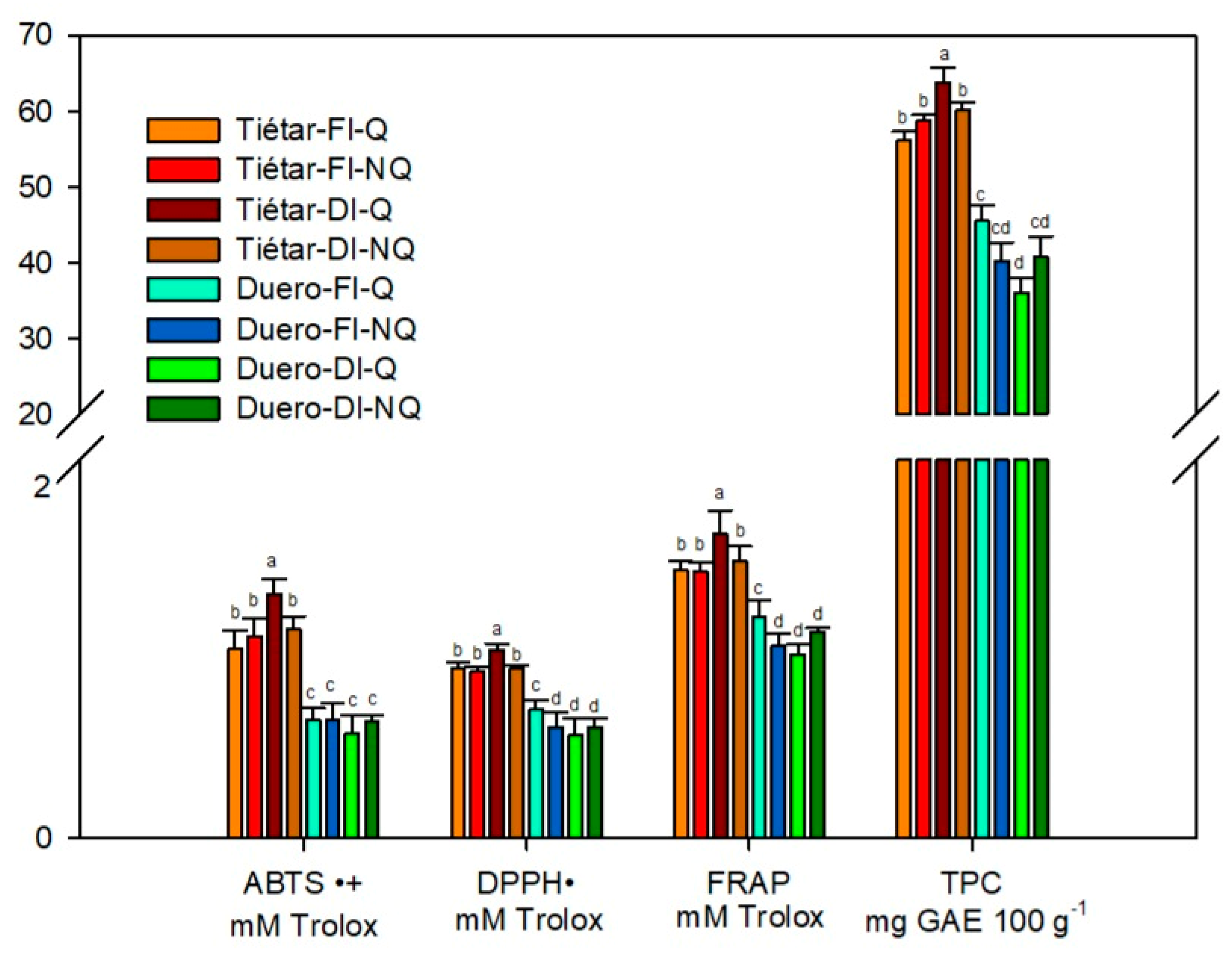
Figure 2 shows the antioxidant activity (ABTS•+, DPPH•, FRAP) and total phenolic content (TPC) of “Tiétar” and “Duero” peaches under the different treatments. In “Tiétar”, the combination of deficit irrigation and chitosan (DI–Q) showed the highest values for all three antioxidant assays and for TPC. No statistically significant differences were detected among the remaining treatments within this cultivar (FI–Q, FI–NQ, and DI–NQ). In “Duero”, treatment effects were less marked. ABTS•+ activity did not show statistically significant differences among treatments. In contrast, DPPH• and FRAP reached their highest values under FI–Q, while the other treatments showed no significant differences. For TPC, FI–Q showed significantly higher values than DI–Q, while FI–NQ and DI–NQ did not differ significantly from either treatment.

3.4. Phenolic Compounds

A total of 16 phenolic compounds were identified in both peach cultivars and classified into three groups: flavonoids (quercetin-3-glucoside, quercetin-3-β-D-galactoside, quercetin-3-rutinoside, quercetin-3-β-D-glucopyranoside, catechin, epicatechin, luteolin-7-O-glucoside, and pinoresinol), phenolic acids (neochlorogenic acid, chlorogenic acid, and 3,5-di-O-caffeoylquinic acid), and anthocyanins (cyanidin-3-rutinoside/keracyanin, cyanidin-3-glucoside/kuromanin, peonidin-3-glucoside, pelargonidin-3-rutinoside, and pelargonidin-3-glucoside/callistephin) (Supplementary Materials, Tables S1–S3). Flavonoids represented the most diverse group, with quercetin derivatives being the most abundant, whereas catechin, epicatechin, and luteolin-7-O-glucoside were detected at lower concentrations. Pinoresinol also occurred at low concentrations and was responsive to chitosan application. Anthocyanins were consistently detected but remained at comparatively low concentrations, with kuromanin showing the clearest treatment-related differences, exhibiting significantly higher values under full irrigation.
To better illustrate the treatment effects, six representative compounds were selected based on both their relative abundance and their significant variation across factors: neochlorogenic acid (NeoCGA), chlorogenic acid (CGA), quercetin-3-O-rutinoside (Q-3-Rut), quercetin-3-β-D-glucopyranoside (Q-3-Glcp), quercetin-3-glucoside (Q-3-Glc), and cyanidin-3-O-glucoside (Cy-3-Glc; kuromanin) (Table 4).
Among the phenolic acids, chlorogenic and neochlorogenic acids showed the highest concentrations overall, exceeding 17 mg 100 g−1 dw in “Tiétar” under deficit irrigation. When irrigation regimes were compared, water restriction significantly increased their levels relative to full irrigation. Regarding flavonoids, quercetin derivatives (Q-3-Rut, Q-3-Glcp, Q-3-Glc) accumulated at markedly higher levels in “Duero” than in “Tiétar”. Among them, quercetin-3-β-D-glucopyranoside was significantly increased by chitosan application.

3.5. Mineral Content

Nine mineral elements were quantified in the peach samples (five macroelements: Ca, K, Mg, Na, and P; and four microelements: Cu, Fe, Mn, and Zn; Table 5), showing significant differences among cultivars, irrigation treatments, and chitosan application.
Among the macroelements, potassium (K) was the most abundant mineral across all treatments, with concentrations ranging from 1471 to 1795 mg 100 g−1 dw. Calcium (Ca) showed the widest variation, from 72.2 mg 100 g−1 dw in “Tiétar” under full irrigation to 500 mg 100 g−1 in “Duero” under deficit irrigation combined with chitosan treatment. Duero peaches showed significantly higher mean concentrations of Ca, Mg, and P compared to Tiétar, whereas Tiétar exhibited slightly higher K and Na levels.
Deficit irrigation significantly increased Ca content (193.8 vs. 105.9 mg 100 g−1 dw), while decreasing Mg and P levels. No differences in K or Na were observed between irrigation treatments. Regarding chitosan application, the treated fruit presented higher Ca and Na contents but slightly lower Mg levels.

3.6. Postharvest Performance

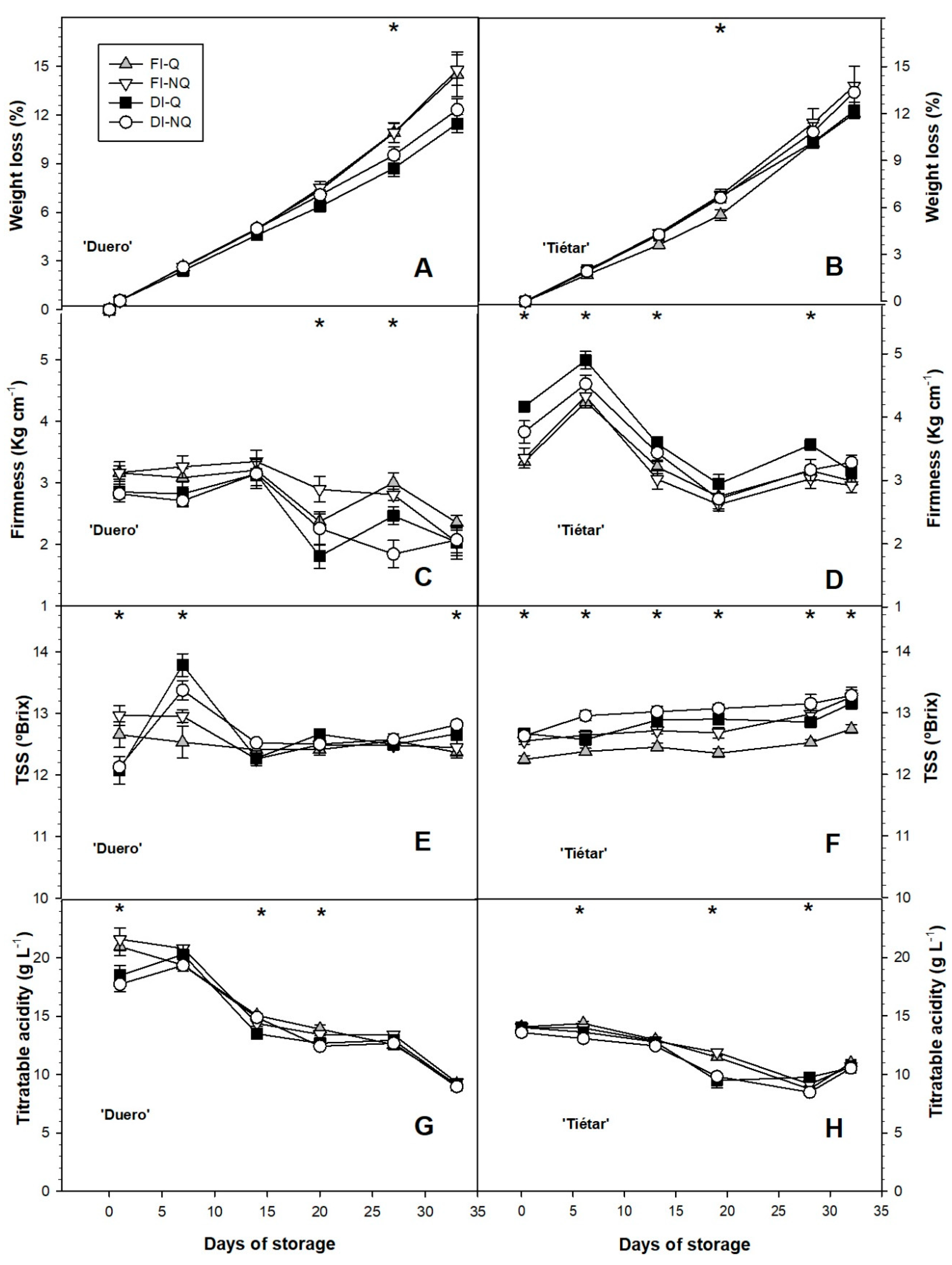
Figure 3 illustrates the evolution of weight loss, firmness, total soluble solids (TSS), and titratable acidity (TA) during 33 days of cold storage in “Duero” and “Tiétar” peaches under different irrigation and chitosan treatments.
Weight loss increased progressively with storage time in both cultivars (Figure 3A,B). In “Duero”, FI-NQ fruits showed the highest weight loss by day 33 (>14%), whereas DI-Q maintained the lowest weight loss (~11%). In “Tiétar”, cumulative losses were slightly lower overall (10–13%), with DI–Q consistently showing the best performance.
Firmness decreased during storage, with cultivar-dependent dynamics (Figure 3C,D). In “Duero”, values remained stable until day 14, followed by a marked decline, particularly in FI-NQ fruits, which fell below 2.5 kg cm−2 at the end of storage. In “Tiétar”, an initial increase was observed at day 7, after which firmness gradually declined. DI–Q fruits maintained higher firmness throughout storage, whereas FI–NQ fruits softened more rapidly.
TSS showed different patterns between cultivars (Figure 3E,F). In “Duero”, TSS increased transiently at day 7 under DI treatment, but values later stabilised around 12.5–13 °Brix. In “Tiétar”, TSS showed a gradual increase during storage, from ~13 °Brix at harvest to ~14 °Brix at day 33. DI treatments maintain slightly higher levels than FI, whereas chitosan application had little effect. TA declined progressively in both cultivars during storage (Figure 3G,H). In “Duero”, TA dropped from initial values near 18 g L−1 to ~7 g L−1 at day 33, with no major differences among treatments. In “Tiétar”, TA values also decreased, although slightly more gradually, stabilizing near 8 g L−1 by the end of storage.

4. Discussion

Fruit weight and size are traditionally considered primary commercial traits in peach, as they largely determine market classification and price. Nevertheless, consumer acceptance is more closely associated with sweetness and flavour attributes, with soluble solids concentration considered a more reliable indicator of sensory quality than external dimensions [33].
In this study, both cultivar and irrigation regime significantly influenced fruit growth, with “Tiétar” producing larger fruits than “Duero” and deficit irrigation resulting in only modest but statistically significant reductions (≈4–5% in weight and <2% in size parameters). In a previous study, Girona et al. [34] reported reductions of about 11% in fruit weight in some seasons when RDI was applied during stage II (pit hardening, a non-critical phase of fruit development), which, in their study, were mainly attributed to variations in fruit load rather than to a direct effect of water stress. Similarly, Alcobendas et al. [35], applied a RDI strategy maintaining a Ψstem threshold of −1.8 MPa during stage II and reported slightly lower fruit weight in trees under RDI, though differences were not statistically significant and were attributed to the low crop load. Consistently, Vera et al. [36] (2013) reported that fruit size remained relatively unaffected under both RDI and SDI treatments.
In our experiment, preharvest chitosan application did not significantly modify fruit weight or size, whereas other studies have reported positive effects depending on the timing and concertation. For instance, in peach “Early Grand”, sprays at 1% enhanced fruit growth when applied 50 days after full bloom [13], and Khan et al. [15] observed increases in fruit weight and volume at chitosan concentration of 150 ppm. In our experiment, chitosan was applied twice during phase III (fruit expansion and ripening), yet no significant effects were detected on final fruit size. Applications closer to harvest tend to affect biochemical or quality-related traits rather than growth-driven parameters [37]. Fruit size remained relatively stable across the different irrigation and chitosan treatments, whereas notable differences were detected in several compositional and quality-related parameters.
Firmness is a key textural attribute in peach, as it conditions consumer acceptance and determines both handling resistance and market destination [33]. In our study, the fruits under deficit irrigation were firmer than those under full irrigation in both cultivars, with “Tiétar” consistently exceeding “Duero”, and firmness was further enhanced by chitosan application. Similar responses have been reported under moderate preharvest water restriction in peach [38]. By contrast, Wang et al. [39] found no differences in firmness between full and deficit irrigation, which may be related to the fact that their deficit strategy was implemented after harvest rather than during fruit development, emphasizing the importance of timing in water management.
Regarding biostimulant effects, several studies indicate that preharvest chitosan sprays can influence firmness in stone fruits. In peach trees, preharvest sprays of 1% chitosan increased firmness in “Early Grand” [13], and treatments with concentrations of 150 ppm also yielded higher values in the same cultivar [15], whereas in “Florida Prince”, preharvest sprays with nano-chitosan only maintained pulp firmness at levels comparable to untreated controls, without significant improvement [40]. In apricot trees, Elmenofy et al. [41] applied 1% chitosan sprays 30 and 15 days before harvest and observed significantly firmer fruit at harvest compared with untreated controls. Similarly, in nectarine trees, Giacalone & Chiabrando [42] reported that a 1% preharvest spray applied 14 days before harvest helped maintain higher firmness during storage. It has been consistently demonstrated that preharvest chitosan applications improve firmness in stone fruits, though the extent of this response depends on the species, cultivars, and timing of application. Chitosan has been reported to modulate plant physiological responses to water deficit, including changes in osmotic balance and stress-responsive metabolites, which may contribute to the maintenance of tissue integrity under stress conditions [14].
While fruit size is a primary commercial trait, sweetness and acidity, expressed as total soluble solids (TSS) and titratable acidity (TA), are generally stronger predictors of consumer acceptance, since their balance and the resulting sugar:acid ratio (MI) largely determine flavour perception in peach [33,38]. A minimum TSS of 10–12 °Brix is usually required to ensure consumer acceptance [33]. In our study, all treatments in “Duero” reached or slightly exceeded this threshold, while “Tiétar” consistently showed higher values, particularly under deficit irrigation, where values approached 14 °Brix.
The effect of deficit irrigation on flavour attributes was strongly cultivar dependent. In “Tiétar”, deficit irrigation not only increased TSS but also reduced TA, leading to higher MI values. This trend is in line with previous studies reporting improved sugar:acid ratio under moderate deficit irrigation [38] and agrees with findings in peach under Mediterranean conditions, where deficit irrigation often led to increases in TSS accompanied by lower TA [35,43]. By contrast, “Duero” in our trial showed limited changes in TSS and a less consistent response of TA, reflecting genotypic differences in the sensitivity of flavour traits to water stress. Comparable results have been reported in pomegranate, where irrigation water withholding increased both TSS and TA, and where the interaction with chitosan treatment significantly modified acidity and specific organic acids depending on water regime [16]. In that study, the changes in acidity and organic acids were not uniform, but restricted to full irrigation or water stress combinations, reinforcing that the effect of chitosan is strongly conditioned by the irrigation regime. From a physiological standpoint, water deficit promotes the accumulation of soluble sugars because of polysaccharide degradation, contributing to the maintenance of cellular turgor and osmotic adjustment. In this context, chitosan-treated plants have been reported to enhance sugar-related metabolic responses involved in carbon balance and stress signaling under water-limited conditions [14]. In our study, chitosan did not significantly modify TSS, but it influenced TA depending on the irrigation regime in “Duero”, with opposite effects under FI and DI. Similar outcomes have been described in peaches, where preharvest chitosan sprays increased acidity [13,15], while in peach “Florida Prince”, nano-chitosan improved the sugar:acid ratio [40].
Fruit colour is a key external trait in peach, contributing to visual attractiveness and consumer choice, although its relationship with flavour quality is less direct than that of TSS or TA. In our study, cultivar differences determined peel colour expression: “Duero” showed higher lightness (L*) and redness (a*), whereas “Tiétar” displayed higher b*, C*, and hue values, reflecting more yellowish tones. These genotypic contrasts highlight the strong influence of cultivar on peel pigmentation, in agreement with previous studies in peach under different irrigation regimes [35,43].
The effect of deficit irrigation was more limited, producing increases in b* and C*, consistent with previous reports where moderate water restriction improved peel colouration, whether assessed by expert scoring [38] or by reductions in hue angle and increases in chroma using instrumental methods [35,43].
By contrast, chitosan application did not significantly alter any colour attribute in our trial. This contrasts with findings in other Prunus species: in apricot, Elmenofy et al. [41] applied 1% chitosan sprays at 30 and 15 days before harvest and reported significant changes in L*, a*, and b* at harvest, while in nectarine, Giacalone & Chiabrando [42] applied 1% spray 14 days before harvest and found higher L* and hue values compared with untreated fruit. In our case, chitosan was applied well before harvest (between 21 and 53 days, depending on cultivar), which may help explain the absence of significant effects at maturity.
Sugars and organic acids are central to peach flavour, since their balance determines the perception of sweetness and acidity. Their levels vary with genotype, irrigation regime, and, to some extent, preharvest treatments such as chitosan sprays [14,44]. In peach flesh, sucrose is usually the predominant sugar, while glucose and fructose occur in lower amounts [45], in line with our results, where “Tiétar” accumulated more sucrose, whereas “Duero” showed higher glucose and fructose, reflecting genotypic differences in carbon partitioning. Moreover, the sugar concentrations observed in the present study are comparable to those reported in apricot (Prunus armeniaca L.) fruits subjected to deficit irrigation, where sucrose was also the major soluble carbohydrate, followed by fructose and glucose [12]. Malic acid is the main organic acid, followed by smaller proportions of citric and quinic acids [11,46], and this proportion was maintained in our study. Malic acid concentrations declined under DI, consistent with previous studies in water-stressed peaches [11,35,46].
Alcobendas et al. [35] and Toumi et al. [11] also reported increases in glucose under DI, supporting the idea that water deficit can enhance hexose accumulation while reducing organic acids. This pattern is in line with the higher sweetness index of “Tiétar”. The stability of sucrose may be related to its secondary osmotic role compared with sorbitol, which accumulates in vegetative tissues under drought stress [44]. Although sorbitol was not quantified in this study, this mechanism could partly explain the relatively small changes in sucrose observed under DI.
Chitosan application had no clear impact on sugar concentrations, but it slightly increased quinic acid in “Duero”. According to Hidangmayum et al. [14], chitosan can stimulate the accumulation of sugars and organic acids as osmolytes, contributing to osmotic adjustment, stress signaling, and energy metabolism under water-limited conditions. This response is associated with drought-induced metabolic adjustments, in which soluble sugars derived from polysaccharide breakdown help maintain cellular turgor and carbon balance. In our case, chitosan treatments were carried out 3–7 weeks before harvest, which may partly explain the weaker effects detected at harvest maturity.
Phenolic compounds are major contributors to peach quality, not only because of their role in colour and flavour but also due to their contribution to antioxidant potential. Their accumulation is strongly influenced by genotype and irrigation regime and can also be modulated by elicitors such as chitosan. Previous studies have shown substantial genotypic differences in phenolic composition and antioxidant activity among peach and nectarine cultivars [47], as well as consistent increases in hydroxycinnamic acids and anthocyanins [11] and higher antioxidant activity [48] under deficit irrigation. Similar responses to water stress have also been described in other Mediterranean fruit crops [49,50]. In addition, chitosan has been reported to enhance phenolic and anthocyanin accumulation and to mitigate water stress by activating antioxidant defense systems, including reactive oxygen species (ROS)-scavenging enzymes such as superoxide dismutase (SOD), catalase (CAT), and peroxidase (POD), thereby reducing oxidative damage under drought conditions [14].
In pomegranate, Griñán et al. [16] examined the interaction between water deficit and preharvest chitosan application, reporting that antioxidant activity (ABTS•+) increased in treated fruit. However, this response was more pronounced under full irrigation and was not associated with changes in total phenolic content. These contrasting outcomes indicate that the relationship between phenolics and antioxidant activity is not consistent across species, with other metabolites such as anthocyanins or organic acids contributing more prominently in pomegranate. In contrast, both peach cultivars showed a parallel response of antioxidant activity and total phenolic content, suggesting a closer link between phenolic accumulation and antioxidant potential.
Within peaches, cultivar-dependent differences were observed, in line with previous reports [11,47]. The increase in chlorogenic and neochlorogenic acids observed in “Tiétar” agrees with the accumulation of hydroxycinnamates reported in peach under partial root-zone drying irrigation (50% of ETc) and SDI [11] and parallels the rise in antioxidant activity described under cyclic deficit irrigation (irrigation at 100% field capacity with a soil moisture of 50% field capacity) and sustained deficit irrigation (50% ETc) regimes [48]. The effect of chitosan differed between cultivars, with a stronger response in “Tiétar”. This variability may stem from cultivar-dependent differences in phenolic metabolism [47], the interval between the last application and harvest (22 September in “Duero” vs. 4 October in “Tiétar”), or other factors such as concentration and developmental stage, which have been shown to influence chitosan efficacy [14].
Mineral nutrition is a fundamental component of peach physiology, as it regulates vegetative growth, water relations, and fruit quality. Both irrigation management and preharvest chitosan applications have been shown to modify the balance of macronutrients and micronutrients in peach fruit, and their combined effects are often environment- and cultivar-dependent.
Evidence from deficit irrigation studies indicates that water supply strongly affects nutrient uptake and distribution. Abrisqueta et al. [51] reported that reduced irrigation significantly modified leaf nutrient composition in peaches, while Boland et al. [52] described long-term alterations in mineral nutrition when peach trees were subjected to regulated deficit irrigation combined with restricted root volume. Similarly, Toumi et al. [11] showed that both sustained deficit irrigation and partial root-zone drying irrigation (50% of ETc) strategies modified fruit mineral contents in semi-arid conditions, with Fe and Zn showing notable increases, which reinforces the capacity of regulated water deficit to alter nutrient composition at both vegetative and fruit levels.
In addition to irrigation, preharvest chitosan sprays can influence mineral status in peaches. Yang et al. [53] reported that chitosan application in peach seedlings increased the uptake of Ca, Mg, and Na, with the strongest response at intermediate concentrations, indicating a dose-dependent effect. In “Florida Prince” peach trees, nano-chitosan also modified leaf mineral composition, although potassium silicate produced more pronounced increases in N, P, K, Fe, Zn, and Mn [40]. Under abiotic stress, chitosan has additionally been associated with improved nutrient transport and physiological activity, contributing to a more efficient acquisition of essential elements [14].
In our trial, chitosan increased Ca and Fe, whereas Mg and P showed more limited changes. This response aligns with previous reports and reflects the timing of application. Sprays were applied during late fruit development (16 L ha−1 on 1 August and 6 L ha−1 on 4 September), a period when phloem transport to the fruit is reduced, and nutrient accumulation becomes increasingly dependent on residual xylem-driven flow. At this stage, fruit growth and phloem transport are reduced, limiting the accumulation of highly mobile elements such as Mg and P, whereas nutrients with low or intermediate mobility and xylem-dependent transport, such as Ca and Fe, can still increase due to residual transpiration and enhanced root uptake [54,55,56,57,58]. These comparisons indicate that both the severity and duration of the applied water deficit and the formulation, dose, and timing of chitosan play key roles in determining mineral responses in peach fruit. Our findings align with the variability described in previous studies and further emphasise the cultivar-dependent differences observed between “Tiétar” and “Duero” cultivars.
Postharvest behaviour of peach is strongly influenced by irrigation regime, cultivar, and storage conditions, and preharvest sprays such as chitosan can also affect fruit behaviour during cold storage. Rahimi et al. [59] reported ~14% weight loss in untreated fruits and ~11–12% when chitosan and thymol coatings were applied and stored at 6 °C and 80% relative humidity, values broadly consistent with those observed in our study, although their approach was based on postharvest coatings rather than preharvest sprays. By contrast, Falagán et al. [60] combined deficit irrigation strategies with controlled atmosphere storage and reported much lower weight losses (<3%), underscoring the major influence of storage conditions beyond preharvest management.
Firmness declined in both cultivars but with different dynamics, depending on cultivar and treatment. The transient increase in firmness observed at early storage in “Tiétar” may be related to initial postharvest water loss and short-term changes in cell wall properties, which can temporarily increase tissue rigidity before firmness starts to decline. Rahimi et al. [59] (2019) also showed that chitosan delayed softening, and Lee et al. [61] found reduced ethylene and respiration rates when chitosan was combined with calcium. Similarly, Gelly et al. [43] indicated that the timing of deficit irrigation (stage II vs. postharvest) differentially affected firmness, suggesting an interaction between scheduling and treatment effectiveness. In our case, chitosan sprays were applied earlier in the season and at relatively low doses, and the shorter interval between the last application and harvest in “Duero” compared with “Tiétar” may have limited the effectiveness of the treatment, which could help explain the differential firmness retention observed between cultivars.
Postharvest patterns of TSS have been shown to vary with irrigation regime. Gelly et al. [43] reported higher TSS/TA ratios under deficit irrigation, which is consistent with the patterns observed in our study. Acidity generally declined during storage, as also described by Gelly et al. [43], while Fan et al. [62] showed that simple chitosan coatings were less effective in maintaining TA compared with more complex formulations. These results suggest that both irrigation strategy and the type of chitosan application can influence postharvest flavour attributes, although their effectiveness appears to be strongly dependent on the specific experimental context.

5. Conclusions

Overall, the findings of this work highlight that the combined use of deficit irrigation and preharvest chitosan sprays can provide significant improvements for peach production under semi-arid conditions. This strategy helped maintain fruit size while enhancing firmness, stimulating phenolic accumulation and antioxidant activity, improving mineral composition, and reducing postharvest weight loss and softening. These positive effects support both fruit quality at harvest and storage potential, offering growers a practical tool to increase the functional and commercial value of their produce. In this context, chitosan application proved effective in mitigating quality losses commonly associated with water deficit conditions, particularly in terms of firmness and postharvest performance. Importantly, chitosan is a safe and food-grade product, which reinforces its potential as a sustainable and reliable practice for integrated fruit production without requiring changes in standard commercial orchard management.

Supplementary Materials

The following supporting information can be downloaded at: https://www.mdpi.com/article/10.3390/agronomy16030361/s1, Table S1: Concentration of flavonoid compounds (mg 100 g−1 dry weight) in peach flesh as affected by cultivar, irrigation treatment, and chitosan application; Table S2: Concentration of phenolic acids (mg 100 g−1 dry weight) in peach flesh as affected by cultivar, irrigation treatment, and chitosan application; Table S3: Concentration of anthocyanins (mg 100 g−1 dry weight) in peach flesh as affected by cultivar, irrigation treatment, and chitosan application.

Author Contributions

Conceptualization, A.G., D.M.-G., F.H., Á.C.-S., and J.G.-B.; methodology, L.A.-C., P.J.B.-R., D.M.-G., and J.V.-F.; validation, A.G., F.H., Á.C.-S., J.G.-G., and J.G.-B.; formal analysis, L.A.-C. and P.J.B.-R.; investigation, L.A.-C., P.J.B.-R., and B.G.-C.; resources, A.G., J.V.-F., and J.G.-B.; data curation, L.A.-C. and P.J.B.-R.; writing—original draft preparation, L.A.-C. and P.J.B.-R.; writing—review and editing, B.G.-C., J.V.-F., D.M.-G., J.G.-G., J.G.-B., Á.C.-S., F.H., and A.G.; visualization, L.A.-C. and P.J.B.-R.; supervision, J.G.-G. and F.H., project administration, A.G.; funding acquisition, A.G. All authors have read and agreed to the published version of the manuscript.

Funding

This work is the result of the visit of D.M-G., (22199/IV/23), funded by the Seneca Foundation (SF), Agency for Science and Technology in the Region of Murcia in connection with the “Jiménez de la Espada” Regional Programme For Mobility, Collaboration and Knowledge Exchange; and of the: (i) “Jóvenes Líderes en Investigación” programme, (22119/JLI/22), (ii) the European Regional Development Fund (CC Huella Hídrica), (iii) Agroalnext Region of Murcia (Reducción de Huella Hídrica en frutales (47) and (iv) Agroalnext Generalitat Valenciana (HydroSOStonefruit), for the grants provided to the authors.

Data Availability Statement

The original contributions presented in this study are included in the article. Further inquiries can be directed to the corresponding author.

Conflicts of Interest

The authors declare no conflicts of interest. The funders had no role in the design of the study; in the collection, analyses, or interpretation of data; in the writing of the manuscript; or in the decision to publish the results.

Abbreviations

The following abbreviations are used in this manuscript:
ANOVAAnalysis of variance
DIDeficit irrigation
ETcCrop evapotranspiration
FIFull irrigation
MIMaturity index
Water stress integral
TATitratable acidity
TSSTotal soluble solids
ΨstemStem water potential

References

  1. Legg, S. Interaction. Climate Change 2021—The Physical Science Basis; IPCC: Geneva, Switzerland, 2021; Volume 49, pp. 44–45. [Google Scholar]
  2. Urdiales-Flores, D.; Zittis, G.; Hadjinicolaou, P.; Osipov, S.; Klingmüller, K.; Mihalopoulos, N.; Kanakidou, M.; Economou, T.; Lelieveld, J. Drivers of accelerated warming in Mediterranean climate-type regions. npj Clim. Atmos. Sci. 2023, 6, 97. [Google Scholar] [CrossRef]
  3. Ruiz-Sánchez, M.C.; Domingo, R.; Castel, J.R. Review: Deficit irrigation in fruit trees and vines in Spain. Span. J. Agric. Res. 2010, 8, S5–S20. [Google Scholar] [CrossRef]
  4. FAO. FAOSTAT Statistical Database. Food and Agriculture Organization of the United Nations. 2023. Available online: https://www.fao.org/faostat/en/#data/ (accessed on 5 September 2025).
  5. MAPA. Anuario de Estadística Agraria 2024; Ministerio de Agricultura, Pesca y Alimentación: Madrid, Spain, 2024; Available online: https://www.mapa.gob.es/es/agricultura/temas/producciones-agricolas/boletin6_2024frutadehuesocampana202427deseptiembre2024_tcm30-697931.pdf (accessed on 5 September 2025).
  6. Chaves, M.M. Effects of water deficits on carbon assimilation. J. Exp. Bot. 1991, 42, 1–16. [Google Scholar] [CrossRef]
  7. Losciale, P.; Gaeta, L.; Corsi, M.; Galeone, C.; Tarricone, L.; Leogrande, R.; Stellacci, A.M. Physiological responses of apricot and peach cultivars under progressive water shortage: Different crop signals for anisohydric and isohydric behaviours. Agric. Water Manag. 2023, 286, 108384. [Google Scholar] [CrossRef]
  8. Chalmers, D.J.; Mitchell, P.D.; Van Heek, L. Control of peach tree growth and productivity by regulated water supply, tree density, and summer pruning. J. Am. Soc. Hortic. Sci. 1981, 106, 307–312. [Google Scholar] [CrossRef]
  9. Fereres, E.; Goldhamer, D.A. Deciduous fruit and nut trees. In Irrigation of Agricultural Crops; Stewart, B.A., Nielsen, D.R., Eds.; ASA-CSSA-SSSA: Madison, WI, USA, 1990; pp. 987–1017. [Google Scholar]
  10. Galindo, A.; Calín-Sánchez, Á.; Griñán, I.; Rodríguez, P.; Cruz, Z.N.; Girón, I.F.; Corell, M.; Martínez-Font, R.; Moriana, A.; Carbonell-Barrachina, A.A.; et al. Water stress at the end of the pomegranate fruit ripening stage produces earlier harvest and improves fruit quality. Sci. Hortic. 2017, 226, 68–74. [Google Scholar] [CrossRef]
  11. Toumi, I.; Zarrouk, O.; Ghrab, M.; Nagaz, K. Improving peach fruit quality traits using deficit irrigation strategies in southern Tunisia arid area. Plants 2022, 11, 1656. [Google Scholar] [CrossRef] [PubMed]
  12. Andreu-Coll, L.; Burló, F.; Galindo, A.; García-Brunton, J.; Vigueras-Fernández, J.; Blaya-Ros, P.J.; Martínez-Font, R.; Noguera-Artiaga, L.; Sendra, E.; Hernández, F.; et al. Enhancing ‘Mirlo Rojo’ Apricot (Prunus armeniaca L.) Quality Through Regulated Deficit Irrigation: Effects on Antioxidant Activity, Fatty Acid Profile, and Volatile Compounds. Horticulturae 2024, 10, 1253. [Google Scholar] [CrossRef]
  13. Sajid, M.; Basit, A.; Khan, S.; Nafees, M.; Ullah, S. Chitosan-based foliar application modulated the yield and biochemical attributes of peach (Prunus persica L.) cv. Early Grand. Bull. Natl. Res. Cent. 2020, 44, 150. [Google Scholar] [CrossRef]
  14. Hidangmayum, A.; Dwivedi, P.; Katiyar, D.; Hemantaranjan, A. Application of chitosan on plant responses with special reference to abiotic stress. Physiol. Mol. Biol. Plants 2019, 25, 313–326. [Google Scholar] [CrossRef]
  15. Khan, M.J.; Sakhi, S.; Azam, N.; Ahmad, Z.; Hadayat, N.; Ahmad, B.; Hussain, F.; Shuaib, M.; Khan, S.; Hussain, F.; et al. Effect of Chitosan and Gibberellic Acid on Fruit Yield and Production of Peach (Prunus persica L.). Pol. J. Environ. Stud. 2024, 33, 721–726. [Google Scholar] [CrossRef]
  16. Griñán, I.; Morales, D.; Collado-González, J.; Falcón-Rodríguez, A.B.; Torrecillas, A.; Martín-Palomo, M.J.; Centeno, A.; Corell, M.; Carbonell-Barrachina, A.A.; Hernández, F.; et al. Reducing incidence of peel physiopathies and increasing antioxidant activity in pomegranate fruit under different irrigation conditions by preharvest application of chitosan. Sci. Hortic. 2019, 247, 247–253. [Google Scholar] [CrossRef]
  17. Hueso Martín, J.J.; Cuevas González, J. (Eds.) La fruticultura del siglo XXI en España; Cajamar Caja Rural: Almería, Spain, 2014; ISBN -13 978-84-95531-64-3. Available online: https://publicacionescajamar.es/series-tematicas/agricultura/la-fruticultura-del-siglo-xxi-en-espana/ (accessed on 5 September 2025).
  18. SIAM. Sistema de Información Agraria de Murcia; Consejería de Agricultura: Región de Murcia, Spain; Available online: http://siam.imida.es/apex/f?p=101:1:1412596729992377 (accessed on 5 September 2025).
  19. Allen, R.G.; Pereira, L.S.; Raes, D.; Smith, M. Crop Evapotranspiration—Guidelines for Computing Crop Water Requirements; FAO Irrigation and Drainage Paper No. 56; FAO: Rome, Italy, 1998; ISBN 9253042192. [Google Scholar]
  20. Girona, J.; Fereres, E. Peach. In Crop Yield Response to Water; Steduto, P., Hsiao, T.C., Fereres, E., Raes, D., Eds.; FAO: Rome, Italy, 2012; pp. 392–406. [Google Scholar]
  21. Fereres, E.; Martinich, D.; Aldrich, T.; Castel, J.R.; Holzapfel, E.; Schulbach, H. Drip irrigation saves money in young almond orchards. Calif. Agric. 1982, 36, 12–13. [Google Scholar]
  22. Myers, B.J. Water stress integral—A link between short-term stress and long-term growth. Tree Physiol. 1988, 4, 315–323. [Google Scholar] [CrossRef] [PubMed]
  23. Hernández, F.; Noguera-Artiaga, L.; Burló, F.; Wojdyło, A.; Carbonell-Barrachina, Á.A.; Legua, P. Physico-chemical, nutritional, and volatile composition and sensory profile of Spanish jujube (Ziziphus jujuba Mill.) fruits. J. Sci. Food Agric. 2016, 96, 2682–2691. [Google Scholar] [CrossRef]
  24. Keutgen, A.; Pawelzik, E. Modifications of taste-relevant compounds in strawberry fruit under NaCl salinity. Food Chem. 2007, 105, 1487–1494. [Google Scholar] [CrossRef]
  25. Wojdyło, A.; Oszmiański, J.; Laskowski, P. Polyphenolic compounds and antioxidant activity of new and old apple varieties. J. Agric. Food Chem. 2008, 56, 6520–6530. [Google Scholar] [CrossRef]
  26. Brand-Williams, W.; Cuvelier, M.E.; Berset, C. Use of a free radical method to evaluate antioxidant activity. LWT–Food Sci. Technol. 1995, 28, 25–30. [Google Scholar] [CrossRef]
  27. Benzie, I.F.F.; Strain, J.J. The ferric reducing ability of plasma (FRAP) as a measure of “antioxidant power”: The FRAP assay. Anal. Biochem. 1996, 239, 70–76. [Google Scholar] [CrossRef]
  28. Re, R.; Pellegrini, N.; Proteggente, A.; Pannala, A.; Yang, M.; Rice-Evans, C. Antioxidant activity applying an improved ABTS radical cation decolorization assay. Free Radic. Biol. Med. 1999, 26, 1231–1237. [Google Scholar] [CrossRef]
  29. Singleton, V.L.; Orthofer, R.; Lamuela-Raventós, R.M. Analysis of total phenols and other oxidation substrates and antioxidants by means of Folin–Ciocalteu reagent. Methods Enzymol. 1999, 299, 152–178. [Google Scholar] [CrossRef]
  30. Caranqui-Aldaz, J.M.; Muelas-Domingo, R.; Hernández, F.; Martínez, R. Chemical composition and polyphenol compounds of Vaccinium floribundum Kunth (Ericaceae) from the volcano Chimborazo Páramo (Ecuador). Horticulturae 2022, 8, 956. [Google Scholar] [CrossRef]
  31. Addinsoft. XLSTAT Software, version 9; Addinsoft: Barcelona, Spain, 2010. [Google Scholar]
  32. Systat Software, version 12.5; SigmaPlot for Windows; Systat Software Inc.: San Jose, CA, USA, 2013.
  33. Crisosto, C.H.; Crisosto, G.M. Relationship between ripe soluble solids concentration (RSSC) and consumer acceptance of high- and low-acid melting-flesh peach and nectarine cultivars. Postharvest Biol. Technol. 2005, 38, 239–246. [Google Scholar] [CrossRef]
  34. Girona, J.; Mata, M.; Arbonès, A.; Alegre, S.; Rufat, J.; Marsal, J. Peach tree response to single and combined regulated deficit irrigation regimes under shallow soils. J. Am. Soc. Hortic. Sci. 2003, 128, 432–440. [Google Scholar] [CrossRef]
  35. Alcobendas, R.; Mounzer, O.; Alarcón, J.J.; Nicolás, E. Effects of irrigation and fruit position on size, colour, firmness and sugar contents of fruits in a mid-late maturing peach cultivar. Sci. Hortic. 2013, 164, 340–347. [Google Scholar] [CrossRef]
  36. Vera, J.; Abrisqueta, I.; Abrisqueta, J.M.; Ruiz-Sánchez, M.C. Effect of deficit irrigation on early-maturing peach tree performance. Irrig. Sci. 2013, 31, 747–757. [Google Scholar] [CrossRef]
  37. Romanazzi, G.; Gabler, F.M.; Smilanick, J.L. Preharvest chitosan and postharvest UV irradiation treatments suppress gray mold of table grapes. Plant Dis. 2006, 90, 445–450. [Google Scholar] [CrossRef]
  38. Zhou, H.; Zhang, F.; Kjelgren, R.; Wu, L.; Gong, D.; Zhao, N.; Yin, D.; Xiang, Y.; Li, Z. Peach yield and fruit quality is maintained under mild deficit irrigation in semi-arid China. J. Integr. Agric. 2017, 16, 1173–1183. [Google Scholar] [CrossRef]
  39. Wang, Y.; Zhang, H.; Gartung, J. Long-term productivity of early season peach trees under postharvest deficit irrigation. Agric. Water Manag. 2020, 231, 105940. [Google Scholar] [CrossRef]
  40. Soliman, N.G.; Nomier, S.A.A.; Ibrahim, M.; Gad, M.M. Effect of spraying nano-chitosan and nano-silicon on physicochemical fruit quality and leaf mineral content of Florida Prince peach trees. Zagazig J. Agric. Res. 2021, 48, 1215–1226. [Google Scholar] [CrossRef]
  41. Elmenofy, H.M.; Okba, S.K.; Salama, A.-M.; Alam-Eldein, S.M. Yield, fruit quality, and storability of ‘Canino’ apricot in response to aminoethoxyvinylglycine, salicylic acid, and chitosan. Plants 2021, 10, 1838. [Google Scholar] [CrossRef] [PubMed]
  42. Giacalone, G.; Chiabrando, V. Effect of preharvest and postharvest application of chitosan coating on storage quality of nectarines. Acta Hortic. 2015, 1084, 675–680. [Google Scholar] [CrossRef]
  43. Gelly, M.; Recasens, I.; Girona, J.; Mata, M.; Arbonès, A.; Rufat, J.; Marsal, J. Effects of stage II and postharvest deficit irrigation on peach quality during maturation and after cold storage. J. Sci. Food Agric. 2004, 84, 561–568. [Google Scholar] [CrossRef]
  44. Lo Bianco, R.; Rieger, M.; Sung, S.J.S. Effect of drought on sorbitol and sucrose metabolism in sinks and sources of peach. Physiol. Plant. 2000, 108, 71–78. [Google Scholar] [CrossRef]
  45. Cantín, C.M.; Gogorcena, Y.; Moreno, M.Á. Analysis of phenotypic variation of sugar profile in different peach and nectarine [Prunus persica (L.) Batsch] breeding progenies. J. Sci. Food Agric. 2009, 89, 1909–1917. [Google Scholar] [CrossRef]
  46. Wu, B.-H.; Génard, M.; Lescourret, F.; Gomez, L.; Li, S.-H. Influence of assimilate and water supply on seasonal variation of acids in peach (cv Suncrest). J. Sci. Food Agric. 2002, 82, 1829–1836. [Google Scholar] [CrossRef]
  47. Buendía, B.; Allende, A.; Nicolás, E.; Alarcón, J.J.; Gil, M.I. Effect of regulated deficit irrigation and crop load on the antioxidant compounds of peaches. J. Agric. Food Chem. 2008, 56, 3601–3608. [Google Scholar] [CrossRef]
  48. Guizani, M.; Dabbou, S.; Maatallah, S.; Montevecchi, G.; Antonelli, A.; Serrano, M.; Hajlaooui, H.; Rezig, M.; Kilani-Jaziri, S. Evaluation of two water deficit models on phenolic profiles and antioxidant activities of different peach fruits parts. Chem. Biodivers. 2022, 19, e202100851. [Google Scholar] [CrossRef]
  49. Cano-Lamadrid, M.; Hernández, F.; Corell, M.; Burló, F.; Legua, P.; Moriana, A.; Carbonell-Barrachina, Á.A. Antioxidant capacity, fatty acids profile, and descriptive sensory analysis of table olives as affected by deficit irrigation. J. Sci. Food Agric. 2016, 97, 444–451. [Google Scholar] [CrossRef]
  50. Lipan, L.; Moriana, A.; López-Lluch, D.B.; Cano-Lamadrid, M.; Sendra, E.; Hernández, F.; Vázquez-Araújo, L.; Corell, M.; Carbonell-Barrachina, Á.A. Nutrition quality parameters of almonds as affected by deficit irrigation strategies. Molecules 2019, 24, 2646. [Google Scholar] [CrossRef] [PubMed]
  51. Abrisqueta, I.; Quezada-Martin, R.; Munguía-López, J.P.; Ruiz-Sánchez, M.C.; Abrisqueta, J.M.; Vera, J. Nutrient concentrations of peach-tree leaves under deficit irrigation. J. Plant Nutr. Soil Sci. 2011, 174, 871–873. [Google Scholar] [CrossRef]
  52. Boland, A.M.; Jerie, P.H.; Mitchell, P.D.; Goodwin, I.; Connor, D.J. Long-term Effects of Restricted Root Volume and Regulated Deficit Irrigation on Peach: I. Growth and Mineral Nutrition. J. Am. Soc. Hortic. Sci. 2000, 125, 135–142. [Google Scholar] [CrossRef]
  53. Yang, L.; Gao, X.; Xiao, L.; Shu, J.; Li, Q.; Liao, M. Effects of Chitosan on the Uptake of Total Calcium, Magnesium and Sodium in Peach Seedlings. IOP Conf. Ser. Earth Environ. Sci. 2020, 446, 032005. [Google Scholar] [CrossRef]
  54. Briat, J.F.; Dubos, C.; Gaymard, F. Iron nutrition, biomass production, and plant product quality. Trends Plant Sci. 2015, 20, 33–40. [Google Scholar] [CrossRef]
  55. Karley, A.J.; White, P.J. Moving cationic minerals to edible tissues: Potassium, magnesium, calcium. Curr. Opin. Plant Biol. 2009, 12, 291–298. [Google Scholar] [CrossRef]
  56. Veneklaas, E.J.; Lambers, H.; Bragg, J.; Finnegan, P.M.; Lovelock, C.E.; Plaxton, W.C.; Price, C.A.; Scheible, W.-R.; Shane, M.W.; White, P.J.; et al. Opportunities for improving phosphorus-use efficiency in crop plants. New Phytol. 2012, 195, 306–320. [Google Scholar] [CrossRef] [PubMed]
  57. Hocking, B.; Tyerman, S.D.; Burton, R.A.; Gilliham, M. Fruit calcium: Transport and physiology. Front. Plant Sci. 2016, 7, 569. [Google Scholar] [CrossRef] [PubMed]
  58. Carrasco-Cuello, F.; Van der Heijden, G.; Rufat, J.; Torres, E. Unraveling calcium absorption and distribution in peach and nectarine during fruit development through 44Ca isotope labeling. Plants 2024, 13, 2287. [Google Scholar] [CrossRef]
  59. Rahimi, R.; ValizadehKaji, B.; Khadivi, A.; Shahrjerdi, I. Effect of chitosan and thymol essential oil on quality maintenance and shelf life extension of peach fruits cv. ‘Zaferani’. J. Hortic. Postharvest Res. 2019, 2, 143–156. [Google Scholar] [CrossRef]
  60. Falagán, N.; Artés, F.; Gómez, P.A.; Artés-Hernández, F.; Conejero, W.; Aguayo, E. Deficit irrigation strategies combined with controlled atmosphere preserve quality in early peaches. Food Sci. Technol. Int. 2015, 21, 547–556. [Google Scholar] [CrossRef]
  61. Lee, G.J.; Lee, D.B.; Kim, S.J.; Choi, S.J.; Yun, H.K. Extended shelf-life of ‘Kumhong’ nectarine and ‘Madoka’ peach fruits by treating the trees with calcium compounds and chitosan. Korean J. Agric. Sci. 2019, 46, 737–754. [Google Scholar] [CrossRef]
  62. Fan, K.; Tang, R.; Li, L. Carbon dots–melatonin–chitosan coating to alleviate chilling injury, enhance storage quality and antioxidant capacity of yellow peaches. Food Packag. Shelf Life 2025, 52, 101629. [Google Scholar] [CrossRef]
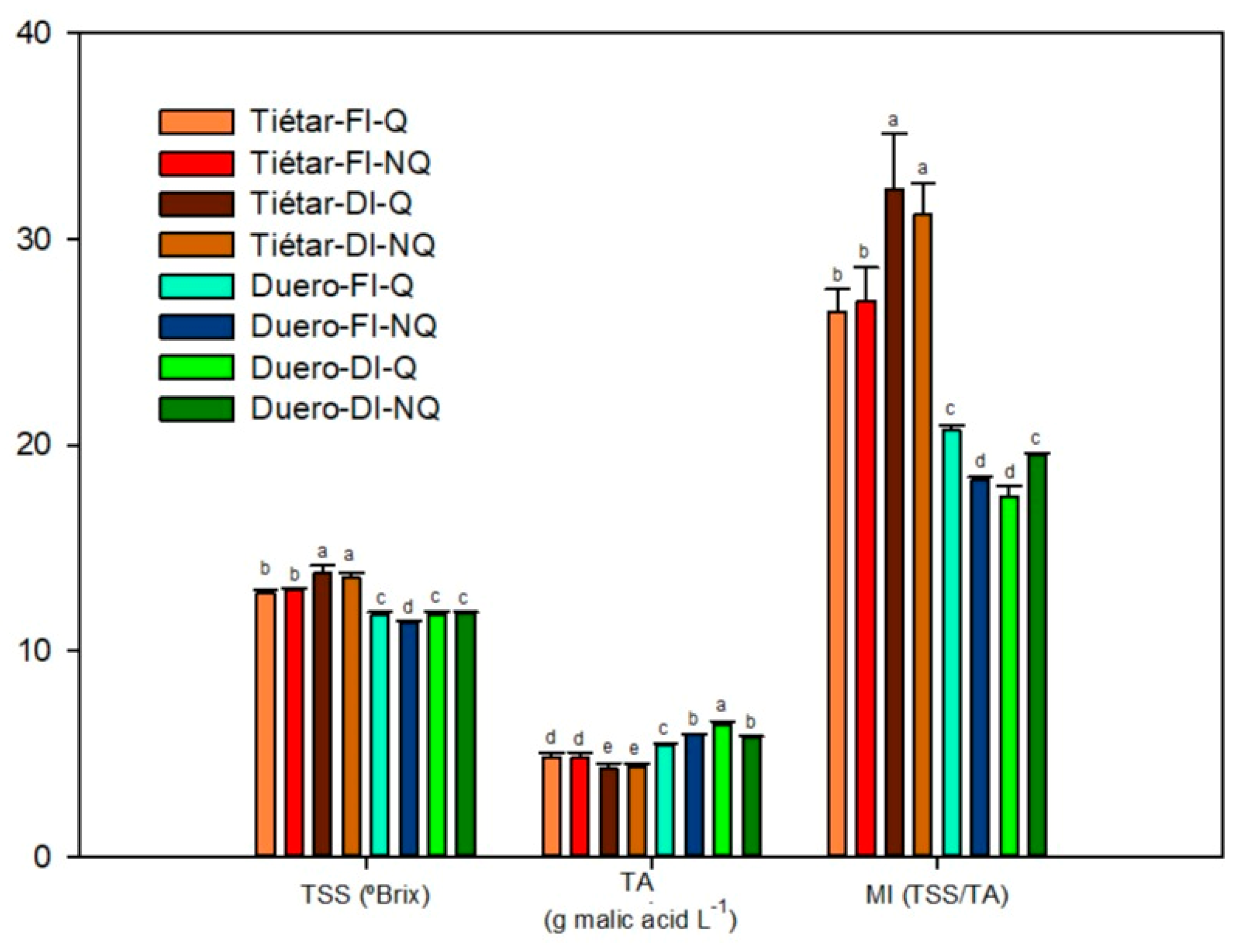
Figure 1. Total soluble solids (TSS), titratable acidity (TA), and maturity index (MI) in fruits of peach cultivars “Tiétar” and “Duero” under different irrigation and chitosan treatments. Values (means ± standard error) followed by the same letter, within the same parameter, were not statistically different according to Tukey’s multiple range test (p < 0.05) (n = 9).
Agronomy 16 00361 g001
Figure 2. Antioxidant activity (ABTS•+, DPPH• and FRAP) and total phenolic content (TPC) in fruits of peach cultivars “Tiétar” and “Duero” under different irrigation and chitosan treatments. Values (means ± standard error) followed by the same letter, within the same parameter, were not statistically different according to Tukey’s multiple range test (p < 0.05) (n = 4).
Agronomy 16 00361 g002
Figure 3. Changes in weight loss (A,B), firmness (C,D), total soluble solids (TSS) (E,F), and titratable acidity (TA) (G,H) during cold storage in fruits of peach cultivars “Duero” and “Tiétar”. Data are shown separately for “Duero” (left panels) and “Tiétar” (right panels). Asterisks indicate statistically significant differences among treatments at each time point (Tukey’s test, p < 0.05).
Agronomy 16 00361 g003
Table 1. Fruit weight, size parameters, and firmness of peach cultivars “Tiétar” and “Duero” as affected by irrigation and chitosan treatments.
CultivarIrrigation
Treatment
Chitosan
Treatment
Weight (g)Length (mm)Equatorial
Diameter (mm)
Suture
Diameter (mm)
Firmness
(kg cm−2)
TiétarFull irrigationChitosan217 b 1 71.5 bc75.4 b73.5 b4.1 cd
Control231 a76.1 a77.3 a75.5 a4.4 bc
Deficit irrigationChitosan203 c72.1 b74.1 bc72.6 b4.8 a
Control204 c72.0 b73.4 c72.8 b3.9 de
DueroFull irrigationChitosan183 de71.4 bc70.2 de69.2 c4.7 ab
Control181 de72.1 b70.0 de68.9 c4.3 c
Deficit irrigationChitosan191 d72.3 b71.1 d69.8 c3.9 de
Control178 e69.7 c69.5 e68.7 c3.8 e
ANOVA*** 2************
CultivarTiétar21472.975.073.64.3
Duero18371.370.269.24.1
ANOVA*************
Irrigation treatmentFull Irrigation20372.873.271.84.4
Deficit irrigation19471.572.071.04.1
ANOVA***************
Chitosan applicationChitosan19971.872.771.34.4
Control19872.572.671.54.1
ANOVANS*NSNS***
1 Values (means) followed by the same letter, within the same column, were not statistically different according to Tukey’s multiple range test (n = 60). 2 NS = not significant at p < 0.05; *, ***, significant at p < 0.05 and 0.001, respectively.
Table 2. External colour coordinates of peach cultivars “Tiétar” and “Duero” under different irrigation and chitosan treatments.
CultivarIrrigation
Treatment
Chitosan
Treatment
L* (D65)a* (D65)b* (D65)C* (D65)H° (D65)
TiétarFull irrigationChitosan70.4 b 110.3 b44.6 a45.9 ab76.9 a
Control69.6 b10.9 b44.0 ab45.6 abc75.6 a
Deficit irrigationChitosan70.4 b10.5 b45.1 a46.4 a77.0 a
Control70.3 b12.3 ab46.0 a47.7 a75.0 a
DueroFull irrigationChitosan74.7 a14.3 a40.4 cd43.9 cd69.0 b
Control73.9 a14.8 a39.8 d43.6 d67.7 b
Deficit irrigationChitosan74.7 a14.4 a40.9 bcd44.4 bcd69.1 b
Control75.8 a14.9 a42.7 abc46.1 ab69.7 b
ANOVA*** 2************
CultivarTiétar70.2 11.0 44.9 46.4 76.1
Duero74.8 14.6 41.0 44.5 68.9
ANOVA***************
Irrigation treatmentFull Irrigation72.1 12.6 42.2 44.8 72.3
Deficit irrigation72.8 13.0 43.7 46.1 72.7
ANOVANSNS***NS
Chitosan applicationChitosan72.5 12.4 42.8 45.1 73.0
Control72.4 13.2 43.1 45.8 72.0
ANOVANSNSNSNSNS
1 Values (means) followed by the same letter, within the same column, were not statistically different according to Tukey’s multiple range test (n = 120). 2 NS = not significant at p < 0.05; *, **, ***, significant at p < 0.05, 0.01, and 0.001, respectively.
Table 3. Organic acid and sugar contents in peach cultivars “Tiétar” and “Duero” under different irrigation and chitosan treatments (g 100 mL−1).
CultivarIrrigation TreatmentChitosan TreatmentCitricMalicQuinicTotal
Organic
Acids
SucroseGlucoseFructoseTotal
Sugars
SI 3
TiétarFull
irrigation
Chitosan0.10 e 10.76 a0.17 d1.03 de26.2 bc0.23 g0.68 c27.1 bcd37.2 abc
Control0.10 e0.76 a0.17 d1.03 de27.0 ab0.28 fg0.91 bc28.2 ab38.9 abc
Deficit
irrigation
Chitosan0.09 e0.73 ab0.20 b1.02 de28.0 a0.36 de1.11 b29.5 a40.8 a
Control0.09 e0.73 ab0.18 cd1.00 e26.7 b0.38 d0.72 c27.8 bc38.1 abc
DueroFull
irrigation
Chitosan0.24 a0.77 a0.26 a1.26 a25.6 c0.66 a1.73 a28.0 b39.3 ab
Control0.22 ab0.77 a0.20 b1.18 b24.0 de0.47 c1.46 a26.0 de36.3 bc
Deficit
irrigation
Chitosan0.18 c0.72 b0.16 d1.06 cd23.5 e0.31 ef1.12 b24.9 e34.5 c
Control0.20 bc0.73 ab0.19 bc1.12 c24.5 d0.54 b1.53 a26.6 cd37.1 abc
ANOVA*** 2************************
CultivarTiétar0.10 0.74 0.18 1.02 27.0 0.31 0.86 28.2 38.7
Duero0.21 0.75 0.20 1.16 24.4 0.49 1.46 26.3 36.8
ANOVA***NS*******************
Irrigation treatmentFull
Irrigation
0.17 0.76 0.20 1.13 25.7 0.41 1.19 27.4 37.9
Deficit
irrigation
0.14 0.73 0.18 1.05 25.7 0.40 1.12 27.2 37.6
ANOVA************NSNSNSNSNS
Chitosan applicationChitosan0.15 0.75 0.20 1.09 25.8 0.39 1.16 27.4 37.9
Control0.15 0.74 0.18 1.08 25.6 0.42 1.15 27.1 37.6
ANOVANSNS***NSNSNSNSNSNS
1 Values (means) followed by the same letter, within the same column, were not statistically different according to Tukey’s multiple range test (n = 6). 2 NS = not significant at p < 0.05; **, ***, significant at p < 0.01, and 0.001, respectively. 3 Sweetness index = (1.00 × [glucose]) + (2.30 × [fructose]) + (1.35 × [sucrose]).
Table 4. Concentration of selected phenolic compounds (mg 100 g−1 dry weight) in the flesh of peach cultivars “Tiétar” and “Duero” as affected by cultivar, irrigation treatment, and chitosan application.
CultivarIrrigation
Treatment
Chitosan
Treatment
NeoCGA 1CGAQ-3-RutQ-3-GlcpQ-3-GlcCy-3-Glc
TiétarFull irrigationChitosan12.5 d 212.2 c1.16 d0.14 bc0.53 c0.06 c
Control14.7 bcd14.9 bc1.54 cd0.18 bc0.63 bc0.09 c
Deficit irrigationChitosan17.7 ab17.7 a1.33 cd0.20 bc0.73 bc0.12 c
Control18.0 a17.7 ab1.19 d0.10 c0.46 c0.08 c
DueroFull irrigationChitosan16.1 abc17.3 ab2.48 abc0.70 ab2.25 ab1.17 ab
Control14.4 cd15.3 ab3.01 ab1.12 a3.26 a1.90 a
Deficit irrigationChitosan14.3 cd16.3 ab3.48 a1.27 a3.65 a1.24 ab
Control14.9 abcd15.2 ab1.97 bcd0.37 bc1.19 bc0.41 bc
ANOVA*** 3***************
CultivarTiétar15.7 a15.6 a1.30 b0.15 b0.59 b0.07 b
Duero14.9 a16.0 a2.74 a0.87 a2.58 a1.18 a
ANOVANSNS************
Irrigation treatmentFull Irrigation14.4 b14.9 b2.05 a0.53 a1.67 a0.79 a
Deficit irrigation16.2 a16.7 a1.99 a0.49 a1.51 a0.45 b
ANOVA*****NSNSNS*
Chitosan applicationChitosan15.2 a15.9 a2.11 a0.58 a1.79 a0.64 a
Control15.5 a15.8 a1.93 a0.44 b1.38 a0.62 a
ANOVANSNSNS*NSNS
1 Abbreviations: NeoCGA (neochlorogenic acid), CGA (chlorogenic acid), Q-3-Rut (quercetin-3-O-rutinoside), Q-3-Glcp (quercetin-3-β-D-glucopyranoside), Q-3-Glc (quercetin-3-glucoside), Cy-3-Glc (cyanidin-3-O-glucoside, kuromanin). 2 Values (means) followed by the same letter, within the same column, were not statistically different according to Tukey’s multiple range test (n = 4). 3 NS = not significant at p < 0.05; *, **, ***, significant at p < 0.05, 0.01 and 0.001, respectively.
Table 5. Concentration of macroelements and microelements in peach fruits of peach cultivars “Tiétar” and “Duero” as affected by cultivar, irrigation regime, and chitosan application.
CultivarIrrigation
Treatment
Chitosan
Treatment
Macroelements (mg 100 g−1 dw)Microelements (µg 100 g−1 dw)
CaKMgNaPCuFeMnZn
TiétarFull
irrigation
Chitosan72.2 d 11795 a52.4 bc13.7 abc149 a380 bc2277 c344 bc782 abc
Control78.2 d1585 bc50.8 bcd9.74 bc133 bcd361 bc2198 c348 bc705 bc
Deficit
irrigation
Chitosan82.3 d1650 b48.1 d15.3 ab119 d341 c2071 c299 d645 c
Control86.4 d1611 bc47.8 d15.8 ab123 cd332 c2587 bc338 cd767 abc
DueroFull
irrigation
Chitosan181 b1510 cd53.2 bc20.8 a130 bcd401 ab3552 ab382 ab896 a
Control92.2 d1572 bcd57.5 a4.99 c137 abc391 b2731 bc390 a778 abc
Deficit
irrigation
Chitosan500 a1471 d50.5 cd8.83 bc133 bc380 bc4088 a359 abc833 ab
Control107 c1612 bc54.4 ab6.35 bc142 ab443 a2680 bc368 abc862 ab
ANOVA*** 2************************
CultivarTiétar79.8 1660 49.8 13.7 131 354 2283 332 725
Duero220 1541 53.9 10.3 136 404 3263 375 842
ANOVA***********************
Irrigation treatmentFull Irrigation106 1615 53.5 12.3 137 383 2690 366 790
Deficit irrigation194 1586 50.2 11.6 129 374 2856 341 777
ANOVA*NS***NS**NSNS***NS
Chitosan applicationChitosan209 1606 51.1 14.7 133 375 2997 346 789
Control90.9 1595 52.6 9.22 134 382 2549 361 778
ANOVA***NS****NSNS***NS
1 Values (means) followed by the same letter, within the same column, were not statistically different according to Tukey’s multiple range test (n = 4). 2 NS = not significant at p < 0.05; *, **, ***, significant at p < 0.05, 0.01 and 0.001, respectively.
Disclaimer/Publisher’s Note: The statements, opinions and data contained in all publications are solely those of the individual author(s) and contributor(s) and not of MDPI and/or the editor(s). MDPI and/or the editor(s) disclaim responsibility for any injury to people or property resulting from any ideas, methods, instructions or products referred to in the content.