Review

Nature-Based Solutions (NbS) in Agricultural Soils for Greenhouse Gas Mitigation

by
Alessia Corami
1,* and
Andrew Hursthouse
2
1
Cerege-Centre de Recherche et d’Enseignement des Géosciences de l’Environnement, Aix-Marseille Université, 13545 CEDEX 4 Aix-en-Provence, France
2
School of Computing, Engineering & Physical Sciences, Paisley Campus, University of the West of Scotland, Paisley PA1 2BE, UK
*
Author to whom correspondence should be addressed.
Agronomy 2026, 16(3), 360; https://doi.org/10.3390/agronomy16030360
Submission received: 26 August 2025 / Revised: 11 November 2025 / Accepted: 12 November 2025 / Published: 2 February 2026

Abstract

Greenhouse gases (GHG), accumulated in the atmosphere, are the main cause of climate change. In 2017, the increase in average temperature was about 1 °C (between 0.8 °C–1.2 °C) above pre-industrial levels. Global warming refers to the increase in air surface, sea surface, and soil surface temperature and according to IPCC (Intergovernmental Panel Climate Change), since the industrial revolution, C emissions are due to land use changes like deforestation, biomass burning, conversion of natural lands, drainage of wetlands, soil cultivation, and tillage. As the world population has increased, world food production has risen too with a subsequent increase in GHG emissions and agricultural production, which is worsened by climate change. Negative consequences are well known such as the loss in water availability and in soil fertility, and pest infestations which are climate change’s effects on agriculture activity. Climate change’s main aftermath is the frequency of extreme weather events influencing crop yields. As climate change exacerbates degradation processes, land management can mitigate its impact and aid adaptation strategies for climate change. About 21–37% of GHGs have been caused by the agriculture activity, so the application of Nature-based Solutions (NbS) like sustainable agriculture could be a way to reduce GHGs worldwide. The aim of this article is to review how NbS may mitigate GHG emissions from soil, with solutions defined as an integrated approach to tackle climate change and to sustainably restore and manage ecosystems, delivering multiple benefits. NbS is a low-cost tool working within and with nature, which holds many benefits for people and the environment.

1. Introduction

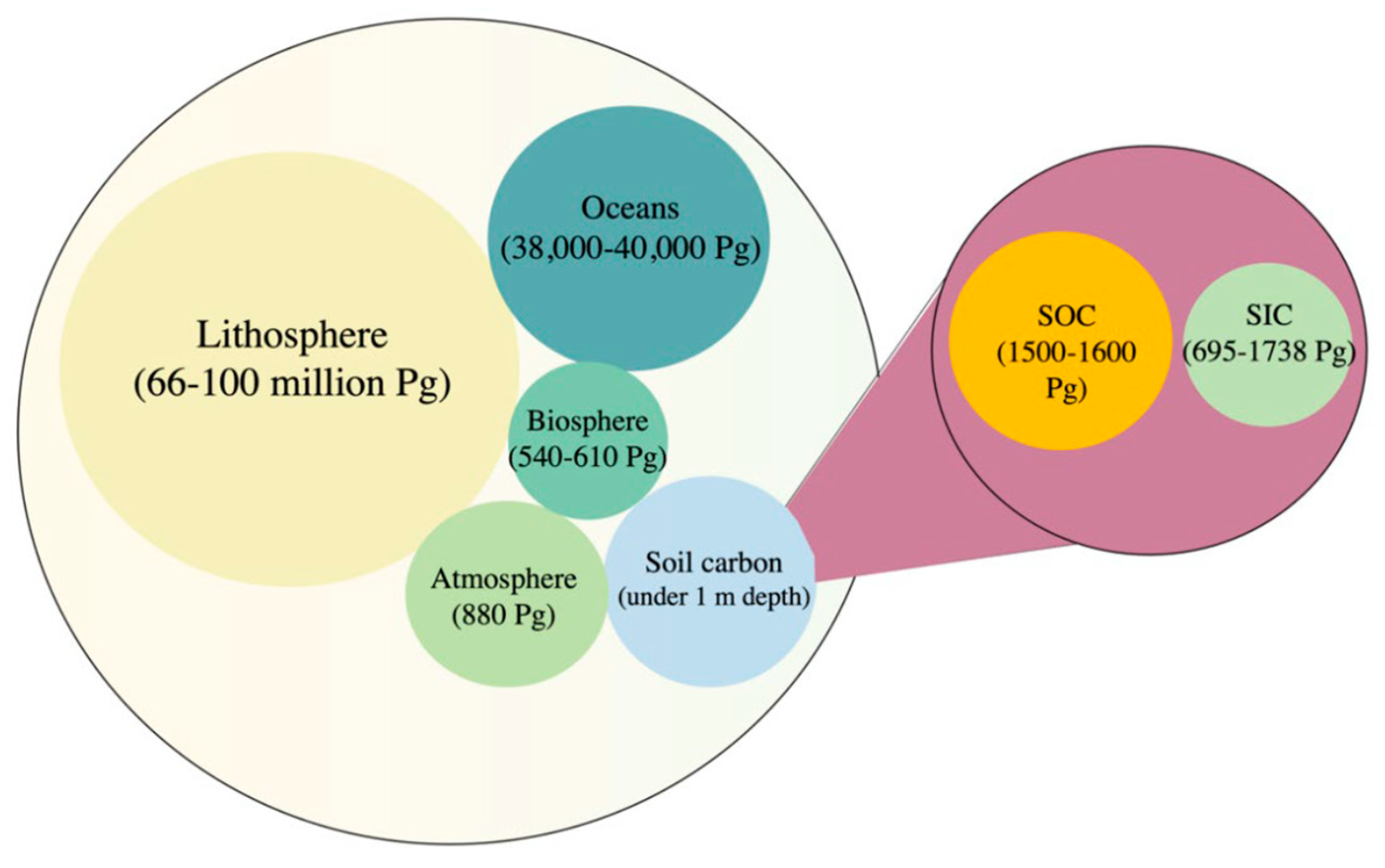
Carbon is considered a key parameter of many functions in soil, which is defined as a non-renewable resource on human scales [1,2,3,4]. Soil Organic Carbon (SOC) and land use play an important role in valuing the global carbon budget [5], it means to determine and quantify C sources and sinks. Five C pools have been distinguished: oceanic, geologic, pedologic (soil), biotic, and atmospheric pools. In the pedologic pool, the quantity of C is four times that in the biotic pool (trees, etc.) and about three times that in the atmospheric pool [5] (Figure 1 and Figure 2).
Soils hold the largest C pool, defined as SOC and Soil Inorganic Carbon (SIC). Soil quality can be enhanced by removing and storing atmospheric CO2 [8]. Stored CO2 shows variations in SOC and SIC amount and they are huge at the global level [9]; both are distinct components of soil carbon that coexist [10]. SOC plays a fundamental role in the C cycle, contributing to fertility, water storage, and crop production [11,12]; higher levels of SOC and N enhance biodiversity and improve soil quality, and nutrient supply ameliorates water reserves and soil structure, soil structural stability, and biogeochemical cycles of water and nutrients (C, P and N) [3,13].
Carbon emissions are based on improper crop management, deforestation and fertiliser overuse with a loss of SOM [14,15,16]. Soil is more enriched in C than in the atmosphere, and SOM is defined as a regulator of climate [17]. Indeed, SOM affects physical, chemical, and biological soil properties; it reduces erosion, improves water quality, and retains nutrients and water [18].
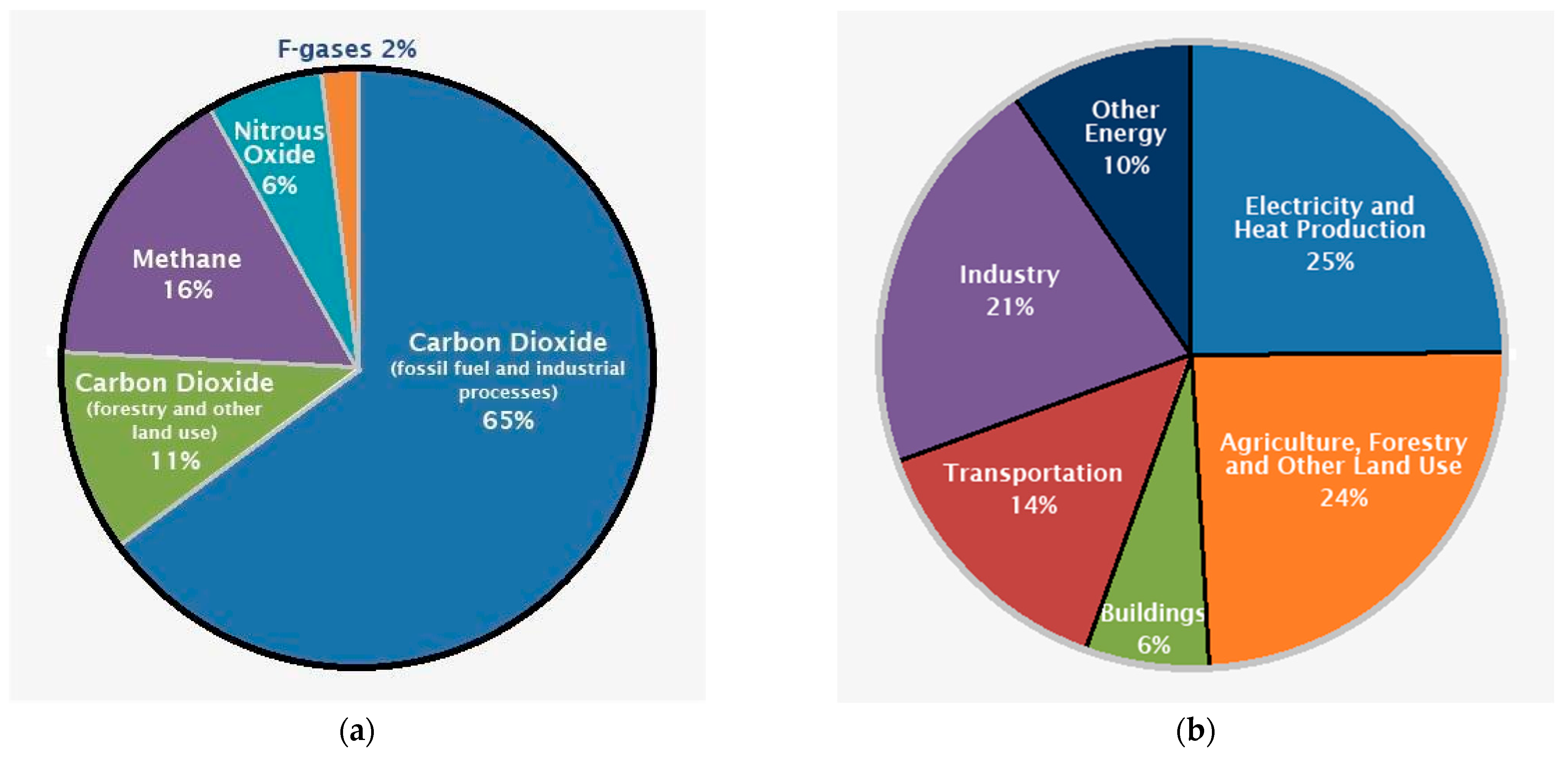
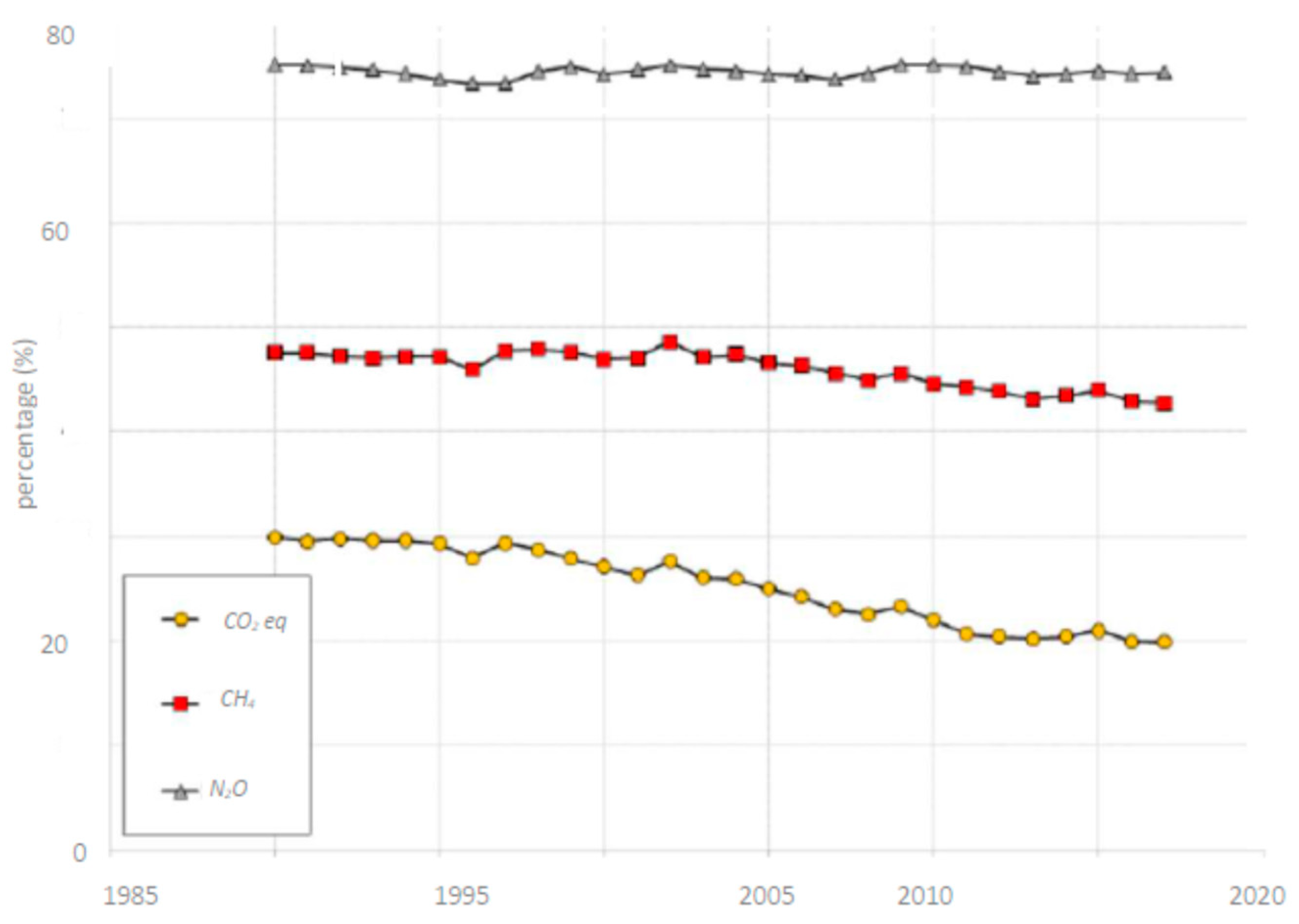
Global warming leads to an SOC decrease, C is oxidised and released in the atmosphere as CO2 [12,19,20,21], and CO2 varies according to time and environmental conditions [22]. Methane (CH4), nitrous oxide (N2O), and chlorofluorocarbons (CFCs) are emitted too; CO2, CH4, and N2O are long-lived in the atmosphere [23]. According to IPCC [24,25], CO2 is accountable for about 72% of global warming, CH4 about 16%, and N2 about 6% (Figure 3).
GHG flux’s main cause is anthropogenic activity, with emissions partially due to land use change in agricultural and industrial development [26]. Muñoz et al. (2010) [21] highlights the contribution of agricultural activity to GHG emissions depending on biophysical processes, on the incorporation/decomposition of organic residues in soil. Carbon dioxide is emitted in aerobic conditions, whereas CH4 is emitted in anaerobic conditions; nitrification and denitrification processes lead to N2O emission. Kirschbaum (1995) [20] pointed out that C and N are negatively correlated with temperature and precipitation. Low vegetation cover increases the risk of degradation and SOC depletion [27], inferring a relationship between vegetation cover and SOC in soil; this depends on the temperature and decomposition rate of SOM [20,28]. Carbon sequestration depends on soil C saturation deficit, recalcitrant C fractions, and aggregate physically associated with C, whereas organic C is a soil nutrient with a slow turnover in terrestrial ecosystems [11,29]. Accumulating C in soil could help in mitigating CO2 in the atmosphere [11,30,31]; SOC stocks can raise passing from less to more complex systems [32].
IPCC (2021) [33,34] suggests that the terrestrial ecosystem can be a sink [35]; land was a C sink for about 30% of the anthropogenic emission from 2008 to 2017 [36,37], soil as a C sink can mitigate climate change, and SOC acts as indicator of soil quality and health [3,13]. Soil could also be a source of GHG emissions; the balance between the absorbance of C atmospheric and its release determines the net temporal status of soils [21]. Soil as a sink is one of the largest uncertainties in C biogeochemical cycles according to the climate models [38].
There are three high-level sustainable strategies to lower CO2 emissions to mitigate climate change: decreasing the amount of energy, finding alternatives to fossil fuels, and sequestering CO2 [39,40]. Skinner et al. (2014) [41] states that SOC is stabilised through physic-chemical processes and in soil’s structure within mineral surfaces and/or metal ions.
Soil can be a sustainable sink for CO2 and, nature-based solutions (NbS) might be a valid tool to mitigate GHG emissions. The meaning of NbS is to enhance natural solutions to manage ecosystems and human wellbeing through storing carbon, flood control, shoreline stabilisation, landslide control, and increasing air and water quality. In the last few years, NbS have been considered cost-effective [42], through restoring degraded lands and practising sustainable agriculture through NbS and avoiding and/or mitigating GHG emissions and reducing soil degradation; preventing soil erosion through conservation will support C sequestration, enhance CH4 consumption, manage N for crop production, and reduce N2O emissions.
Furthermore, mitigation of GHGs can also occur through sustainable agricultural (SA). This practice can be divided into three components: reducing emissions from the agriculture activity by conservation agriculture (CA) with no-till farming and the use of organic manures; enhancing the photosynthetic input of C soil amendments like crop residue mulching; and avoiding emissions by using crops and residues from agricultural lands as a source of fuel [12,28,39,43].
This review examines the scientific knowledge of how NbS can exert control on land degradation to achieve sustainability, starting from the description of soil parameters such as Soil Organic and Inorganic Carbon (SOC and SIC), Soil Organic Matter (SOM), GHG emissions (nitrous oxide, carbon dioxide and methane) to assess soil health, being a key component of the Earth System [44,45], and being a leading tool to achieve sustainability of soil management. Agriculture activity raises GHG from lithosphere to atmosphere [46]. Soil can be a source or a sink according to the characteristics, but GHG’s storage capacity is finite [47].

2. Soil Organic Carbon (SOC)

Soil Organic Carbon is the sum of the interactions among photosynthesis, respiration, and decomposition, a balance between the amount of C from the growth and death of plant roots and from the transfer of carbon-enriched compounds from roots to soil microbes, assuring a continuous amount for microbial biomass and nutrients for plants [48]. Huang and Wei (2025) [10] asserts that SOC density is abundant in top soil; indeed, vegetation generally rises SOC pool than SIC pool. Its accumulation is higher in northern high latitude or peatlands, whereas it is inhibited in area with low temperatures or waterlogged conditions [10]. In effect, high precipitations increase vegetation and consequently SOM, wet conditions prevent SOC decomposition too. In particular, histosol and gelisol show more SOC; spodosol, ultisol, vertisol, and mollisol show more SOC on the top soil layer; aridisol and entisol have a low SOC amount whereas alfisol has large values in the top, middle, and bottom layers [10].
SOC stock incorporates the active, stable, and passive pools. The active pool is characterised by the presence of microbial biomass, is associated with nutrient mineralisation [49] and includes dissolved organic matter (DOM) [50], whereas the stable and passive pool contributes to soil health [11,51,52,53]. Carbon microbial biomass and mineralisable C are pools representative of biomass and activity of soil microorganisms [11], and there is a good correlation between SOC and microbial biomass C [54].
Indeed, CO2 in soil is higher than in the atmosphere because of root respiration and organic material decomposition; depending on the climate and ecosystems [22], an increase in atmospheric CO2 can produce an increase in subsurface CO2 production. Lost carbon from soils is mainly CO2 from decomposition processes [13], in particular, emissions are the sum of three processes: soil respiration (root respiration anaerobic and aerobic microbial respiration), ecosystem respiration, and net ecosystem exchange which is the difference between photosynthesis and ecosystem respiration [47]. Lal (2004) [5] stated that C emissions from land use changes are due to the decomposition of vegetation and mineralisation/oxidation of humus or SOC. A soil can sequester C according to vegetation, soil depth, drainage capacity, mineral composition, soil temperature, and the relative proportion of soil, water, and air [4,55]. From biomass decomposition, a small level of carbon is retained in the soil through the formation of humus [56,57]; these different origins make C more or less recalcitrant. Four types of soil degradation have been identified (physical, chemical, biological, and ecological), highlighting the reduction in water infiltration, runoff, wind and water erosion, depletion of nutrients, loss of cation exchange capacity (CEC) and biodiversity, and emission of GHGs [27]. Climate change can accelerate these phenomena; acidification and salinisation could also accelerate soil degradation processes. These changes affect all the ecosystem functions; mean annual temperature, seasonal temperature and mean annual precipitation are variables which can condition the amount of SOC and SIC in the soil layers [10]. Huang and Wei (2025) [10] states that less C in SOC and a reduction in SOC storage is caused by a loss of SIC reducing soil pH which controls nutrient availability, plant productivity, and soil microbial activity, also influencing plant and soil fertility. Managing SOC in the pedologic pool means to enhance soil quality, to stabilise soil structure, morphology, and geometry [11,27,48,58]. Improved management can reduce the amount of additional inorganic fertiliser, increasing vegetative cover and enhance infiltration water in soil. NbS are a first-rate way to enhance soil’s resilience, improving soil stability and pore geometry [12].

3. Soil Inorganic Carbon (SIC)

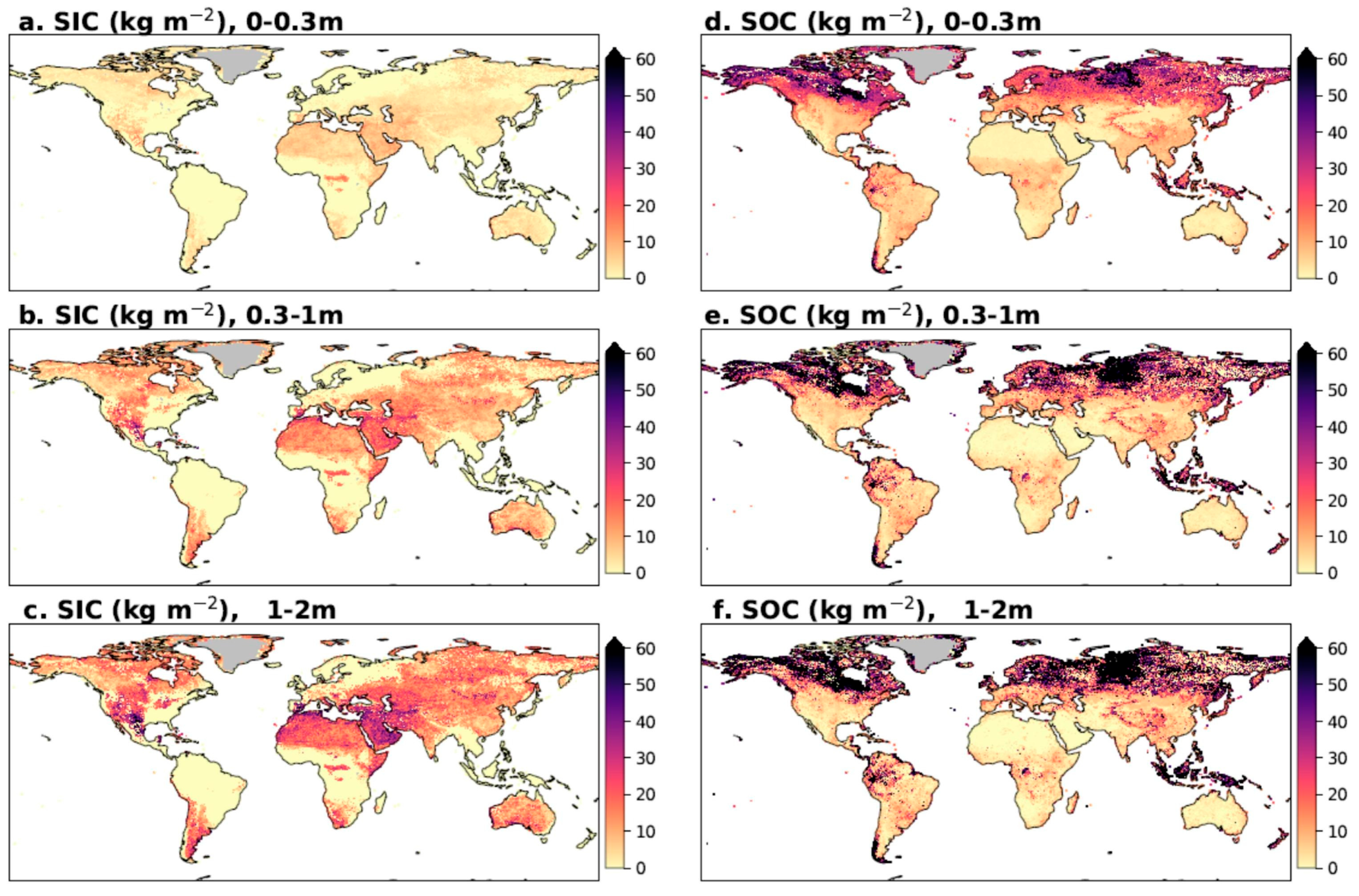
Huang and Wei (2025) [10] writes SIC higher in arid regions due to low soil water availability and limited leaching but, in arid and semi-arid land, SIC loss is caused by soil acidification due to the fertilisation phenomenon. Generally, SIC loss is reduced and it rises with soil depths, whereas SOC slightly decreases. SIC concentration is also high in cold and temperate humid regions close to lakes, rivers, and coastal areas because of the Ca-rich alluvial deposits or calcareous parent material; on the contrary, in high precipitation areas, SIC is easily leaching [10] (Figure 4).
Inter alia, SIC is high in aridisol and entisol in the top, middle and bottom layers; high SIC values are in the middle and bottom layers of spodosol, ultisol, vertisol, and mollisol. SIC dynamics are also affected by climate change, organic matter decomposition, microbial activity, and soil management such as irrigation, fertilisation, and afforestation.
SIC sequestration is considered a secondary one [4] with the formation of a paedogenic calcium carbonate [59,60]. A responsible irrigation leads to an SIC sequestration through leaching bicarbonates in groundwater [10,61,62]. Carbon sequestration in SIC requires interaction with Ca from silicates, an alkaline pH, and CO2 [63]. Carbonate formation could sequester atmospheric C from Ca silicate mineral weathering [64] and can also be sequestered as bicarbonate through the dissolution of a pre-existing carbonate, and during the precipitation, CO2 is released in the atmosphere. As a matter of fact, SIC is not considered a good sink [65,66], rather, a minor sink on a continental and/or global scale. The loss of SIC might be a sink or source for C, this unsolved point is due to the carbonate chemistry; certainly, this loss alters soil environment such as pH buffering capacity, structure, and chemical composition, which must be deeply studied in the near future [10]. Only a little amount has a biological origin and a significant role in C sequestration [11,67,68]. Actually, adsorption capacity is higher in SOC than in SIC, mainly in regions dominated by organic-rich soils; it is sensitive to the annual amount of CO2 in soil [22].

4. Soil Organic Matter (SOM)

Soil Organic Matter means microbes such as bacteria and fungi, decaying material from plant and animal tissues, and faecal material [28,60,69,70,71,72,73,74]. Symbiotic arbuscular mycorrhizal fungi, found in the roots, are thought to contribute to C and SOM sequestration in soils [75]. SOM is highly enriched in carbon and SOC is directly related to the amount of it; its concentration is a clue to consider soil as a sink and not as a source [4].
Pataki et al. (2003) [76] states that high temperature leads to high levels of SOM decomposition and high CO2 emissions [5,66]; in areas with high precipitation, SOM concentration is high because vegetation growth is favoured [10]. Soil productivity depends on SOM concentration; its decrease affects overall ecosystem health, reducing the water infiltration and soil moisture, increasing the erosion and consequently the depletion of nutrients, which could lead to the eutrophication phenomenon downstream [18]. Increasing SOM increases C and N in soil, soil aggregation, and aggregate stability [26,77,78,79,80,81]. Indeed, SOM has a key role in soil chemical properties such as pH, nutrient availability and cycling, and cation exchange capacity and buffer capacity [26].

5. Nitrous Oxide (N2O)

Land use and land use changes affect N2O emissions [21], nitrification and denitrification; soil microbial processes produced most of N2O emission [82,83,84]. Fertilisers and animal manures are the first cause of N2O emission from agriculture activity [26], providing a substrate for microbial nitrogen conversion through nitrification and denitrification [85]; these emissions may be greater from manure sources since they are strongly related to N-inputs [86].
The denitrification process of microbes occurs when nitrate is in anaerobic microsites, lacking oxygen, and under water saturation [87]. Anthropogenic activities have caused a disruption of N cycle, lowering the efficiency; N2O emissions are higher in agricultural soil with availability of organic substrate [88].
Soil N2O emissions increase because high soil moisture levels, restricted oxygen levels, abundant readily decomposable organic C, and high levels of soluble N (NH4+ and NO3) occur together [89,90,91]. Cavigelli (2025), Reinbot (2015), Skinner (2014) [41,92,93] write that N2O annual emissions from organically managed soils are lower than from the conventional treatment. In intensive agriculture N-cycling, processes of nitrification and denitrification have been shown to increase with synthetic N fertilisation and greater tillage intensity, which changes the bacterial and fungal communities involved in [94,95].
On the other hand, nitric oxide (NO) emissions from soil are less important; they were studied because of the acidic precipitation and ozone formation and destruction [47].

6. Methane (CH4)

Methane is emitted in the atmosphere via methanogenic bacteria living in anaerobic soils, which may be a sink or source of CH4 depending on moisture, N level, and ecosystem [75,96,97]. CH4 is consumed by soil methanotrophic bacteria, which are ubiquitous in many soils [98], and it is also produced by methanogenic bacteria [99]. It favours the formation of methanogenic microorganism because of its formation under anaerobic conditions in flooded systems [21,100] (Table 1).

7. SOC and Erosion

The increase in agricultural activity affects natural erosion processes and causes a relevant and observable increase in soil erosion rates across landscapes [17,101], confirming the need to predict the consequences of soil erosion. Correlation between SL (soil loss rate) and R (annual runoff) is high in land use change and minimised in natural lands [102]. Water and wind erosion leads to the removal of soil fine fraction like clay and silt, resulting in partial loss of SOM which is bound with these fractions [57].
Soil erosion is the main factor in SOM removal and, consequently, the CO2 increasing into the atmosphere [4].
Soil erosion affects C stocks; at larger-scale erosion, it may not represent a loss process per se, but rather a redistribution of soil C [103] over land (CO2, CH4, N2O), deposition in channels (CO2, CH4, N2O), and transportation/burial in the ocean (CH4) [104]. This is considered the main cause for nutrient loss and carbon cycling, affecting land productivity, and is a threat to socioeconomic conditions worldwide [102,105,106,107,108].
Decreasing SOC increases erodibility and susceptibility in crusting, compaction, runoff, and erosion [5]. Sedimentologists affirm that soil erosion is a carbon sink; considering displaced C through the erosion phenomenon, part of SOC is released in valleys or surface depressions and accumulate in these sites [109], whereas agronomists state soil erosion is a loss in C. SOC depletion is enhanced by SOM erosion, and SOM is an indirect measure of soil quality and productivity [11,27]; it is affected by nutrient pollution and CO2, different precipitation regimes [110,111] and climate change. Soil moisture and modelling climate change lead to understanding the global carbon budget [22]. Part of the eroded C might be buried and redistributed and generate different feedback [112], partially emitted in the atmosphere as CO2 or CH4 because of methanogenesis [5]. When C is displaced from the erosion, it can be mineralised during transport and accumulate in different sites and be substituted from new photosynthates stabilised by the less C-saturated subsoil.
The erosion process redistributes particles according to the size; this phenomenon might change environmental conditions affecting plant growth and SOC decomposition [113,114]. Eroded soil shows a lower NPP than uneroded soil [109,115], and a linear correlation is observed between NPP and annual soil respiration. The temperature of soil respiration could differ from the temperature of organic matter decomposition, and it could be different from the root respiration temperature; the temperature of soil decomposition must be greater than the temperature of NPP [116]. Tillage increases temperature in the superficial soil horizon, whereas no-tillage procedure augments thermal diffusivity in the soil within depth [117]. Tillage is a normal practice after harvest and is a main contributor to the formation of colluvial deposits; it enhances soil erosion, but it hides the effect of water erosion [118]. One disadvantage from tillage practice is the exposure to freeze–thaw and wet–dry cycles enhancing the destruction of aggregates, whereas no-tillage practice might foster fungal growth, and fungal hyphae which enhances macroaggregate formation [119]. Oertel et al. (2016) [47] states that intensive tillage and fertilisers enhance GHG emissions in croplands.
SOC and N amounts are positively correlated with rainfall and negatively correlated with increase in temperature [20,120,121,122]. Soil water content and temperature vary during the year, high temperature does not necessarily mean high soil decomposition, as the rate of soil decomposition varies according to the soil water content, and decomposition is consistent with the loss of SOM [20]; SOM is mineralised and about 20–30% of SOC is emitted in the atmosphere.

8. GHG Emissions from Soil

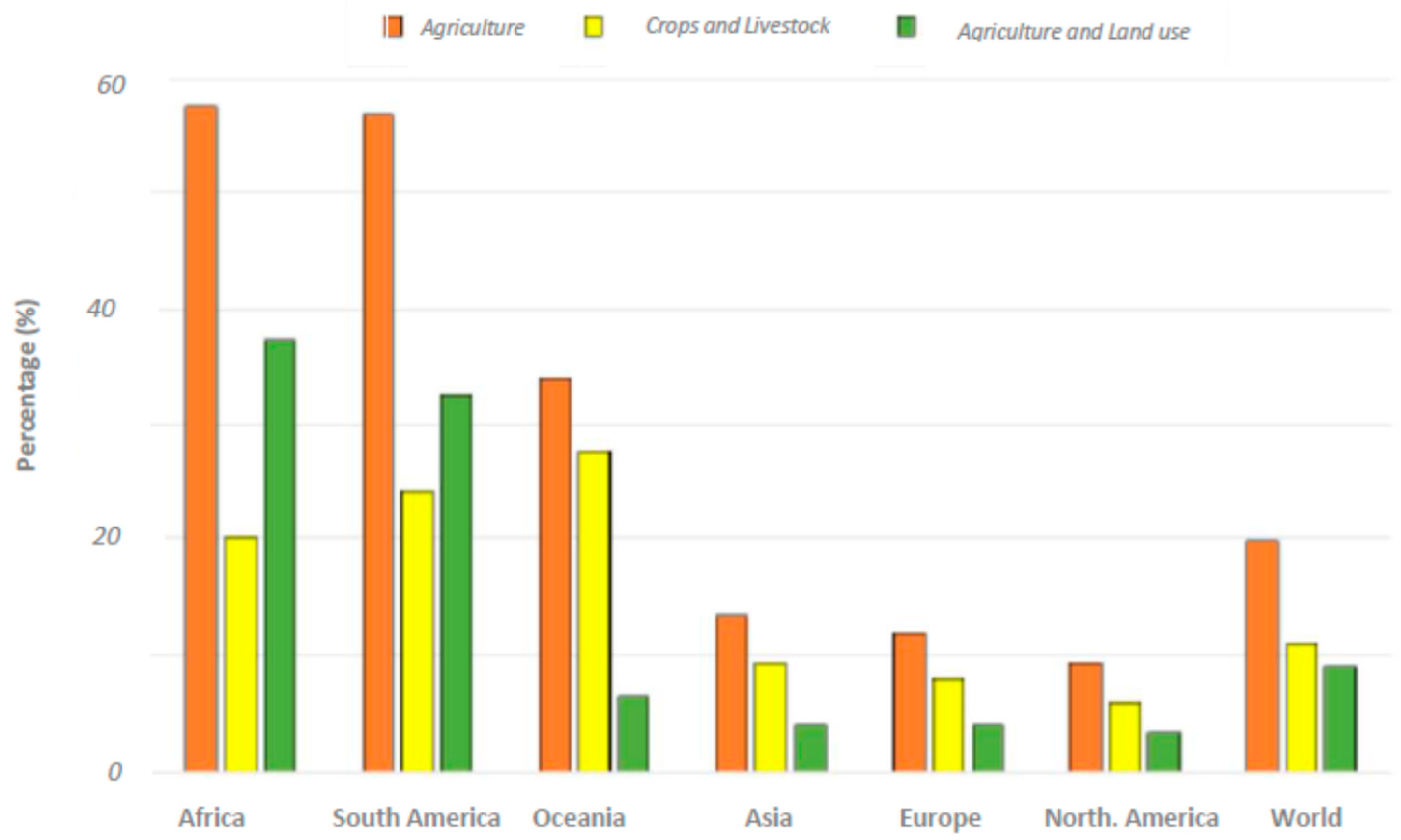
Greenhouse gas emissions will rise by about 50% between 2000 and 2030, impacting weather, climate, and agriculture activity [85]. Lamb et al. (2021) [123] states that GHG emissions are caused by five economic sectors such as energy, industry, buildings, transport, and all land uses. Food production and agriculture activity produce more than 20% of greenhouse gas emissions [124]. In developed countries, GHG emissions are quite stable from 1990 to 2015, whereas in developing countries like China, the emissions have been doubled, mainly for the mechanisation in agriculture activity [124]. In 2017, agriculture emissions were 11.1 Gt CO2eq/year, about 6.1 Gt CO2eq/year stands for crop and livestock, and about 5.0 Gt CO2eq/year are for agriculture land use [125].
The main emissions from land change used are caused by deforestation, peat drainage, wood harvesting, transformation between croplands and pasture, and CO2 soil emissions from grassland and cropland management [123] (Figure 5).
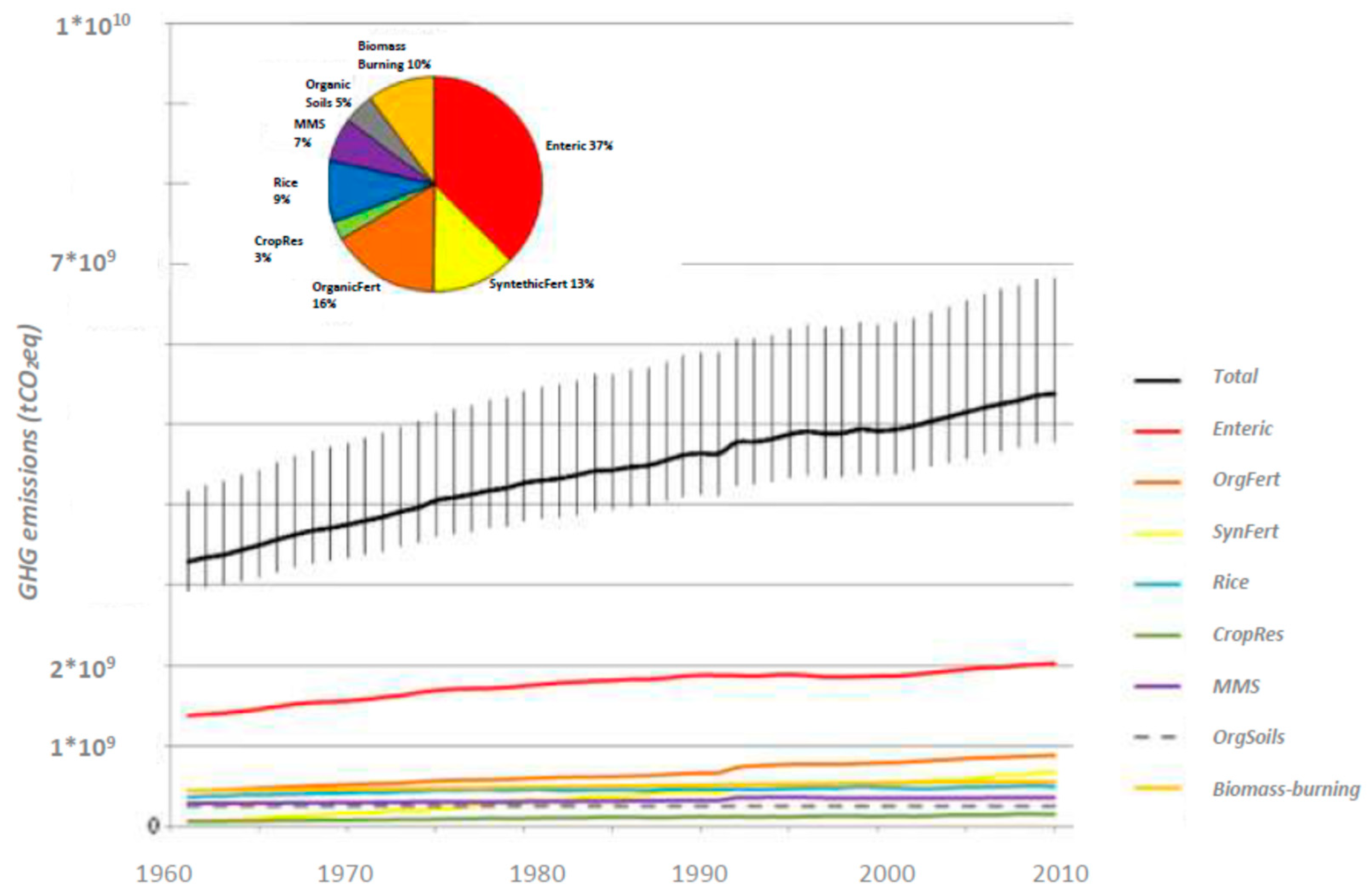
The application of fertiliser increases N2O emission, the application of manure release CH4 and N2O, and forestry and other land use stand for CO2 emissions [126] (Figure 6 and Figure 7).
Generally, CO2 is emitted when the assimilation is less than the mineralisation phenomenon in the soil [46]. Soil humidity affects GHG emissions controlling microbial activity. Parameter water-filled pore space (WFPS) rules emissions; a value of about 20% stands for the maximum emissions. If WFPS is lower than 10% NO emissions decrease because of the inhibition of nutrient supply, CH4 and N2O require an anaerobic system, N2O is good with a value of WFPS about 60% and decreases with a value of 30% [47]. CH4 emissions are correlated with anaerobic conditions. Granulometry affects the amount of water in pores; in aerobic conditions, large pores cannot retain water fostering GHG emissions, whereas in anaerobic conditions, fine pores emit more CH4 and N2O—CO2 emissions are also higher (Table 2).
In acidic conditions, emissions from soil are lower, in a pH range between 4 and 7, methanogenesis produce high CH4 emissions, whereas at neutral values, CO2 emissions are highest and N2O emissions are reduced in acidic conditions; nitrification raises at high pH [47].
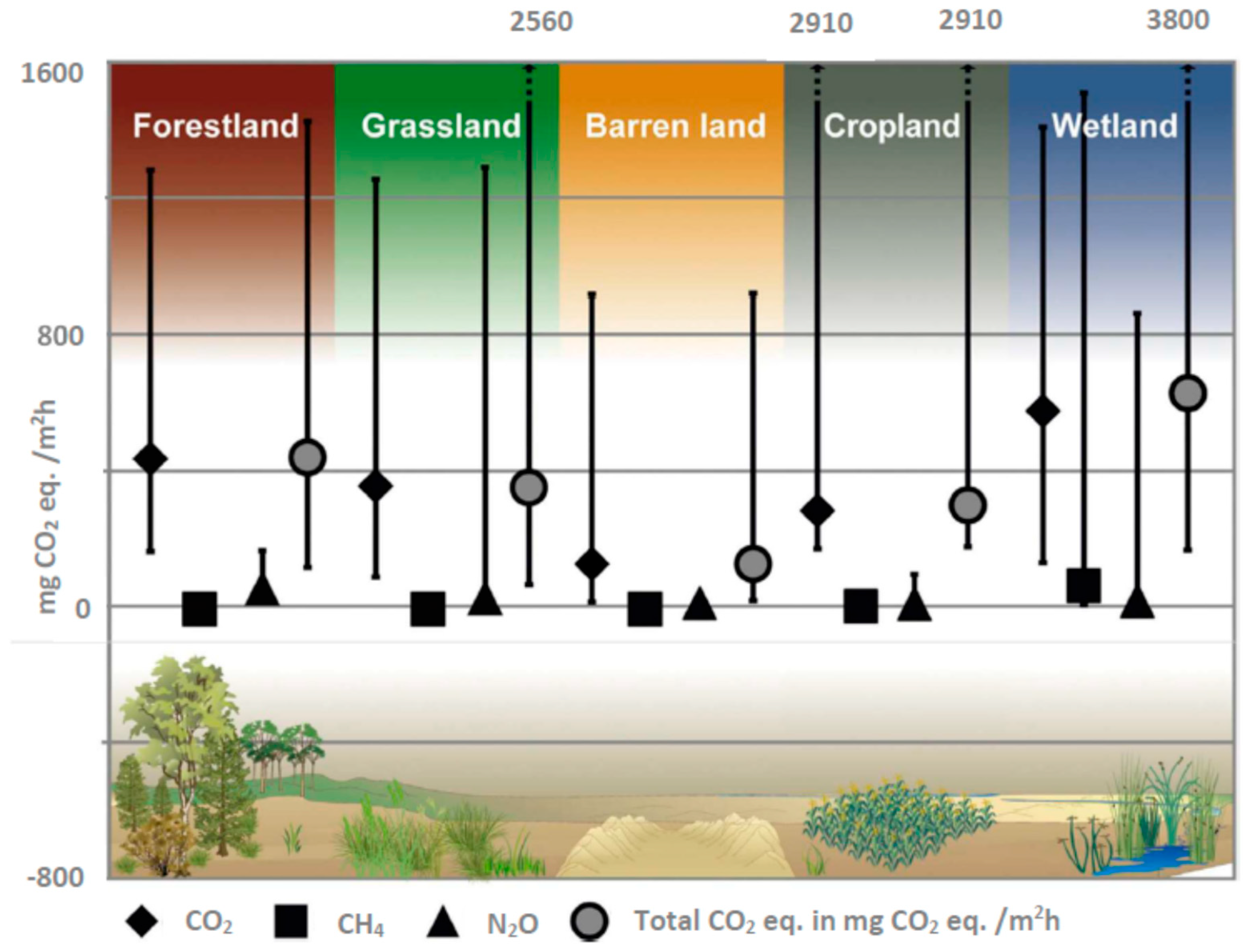
Agricultural intensification, eutrophication, and contamination of groundwater exert a significant influence on GHG emissions; the management of soil resources and SOC is extremely important [127] (Figure 8, Table 3).
Carbon dioxide emissions and removal are influenced by land use changes such as reduction in forest cover, conversion to permanent cropland/waste lands, and land for conversion to forestry (including plantations) and from erosive processes [21,39,129]. These emissions are an index of root respiration and decomposition of organic matter by the microorganisms, an indicator of the mineralisation of nutrients and rate of decomposition. This activity is influenced by root systems, microbial process, crop residues, litter content, microclimate, and soil characteristics [130]. Considering total CO2 emissions, it is possible to define
CO2 tot-emission = EFF + ELUE + GR + SO + SL
where EFF is the emissions from fossil fuels and industry, ELUE emissions from land use change, GR rate of growth of CO2, SO mean ocean CO2 sink, and SL global residual terrestrial CO2 sink [4]. CO2 emissions can decrease by using energy-efficient technology and through capture and storage within long-lived pools [40] (Figure 9).

9. Solutions

Solutions will involve SOC sequestration through crop and grassland management and the improvement in soil quality and productivity, and consequently food security [126].
SOC sequestration enables management of biomass, minimum soil disturbance, and improvement in soil structure and microbial activity [5]. Sustainable and organic agriculture may reduce GHG emissions through a lower fertiliser use and a low level of carbon-based inputs, and it can contribute to SOC sequestration [131,132]; so, organic production systems are more resilient [133] (Figure 10).
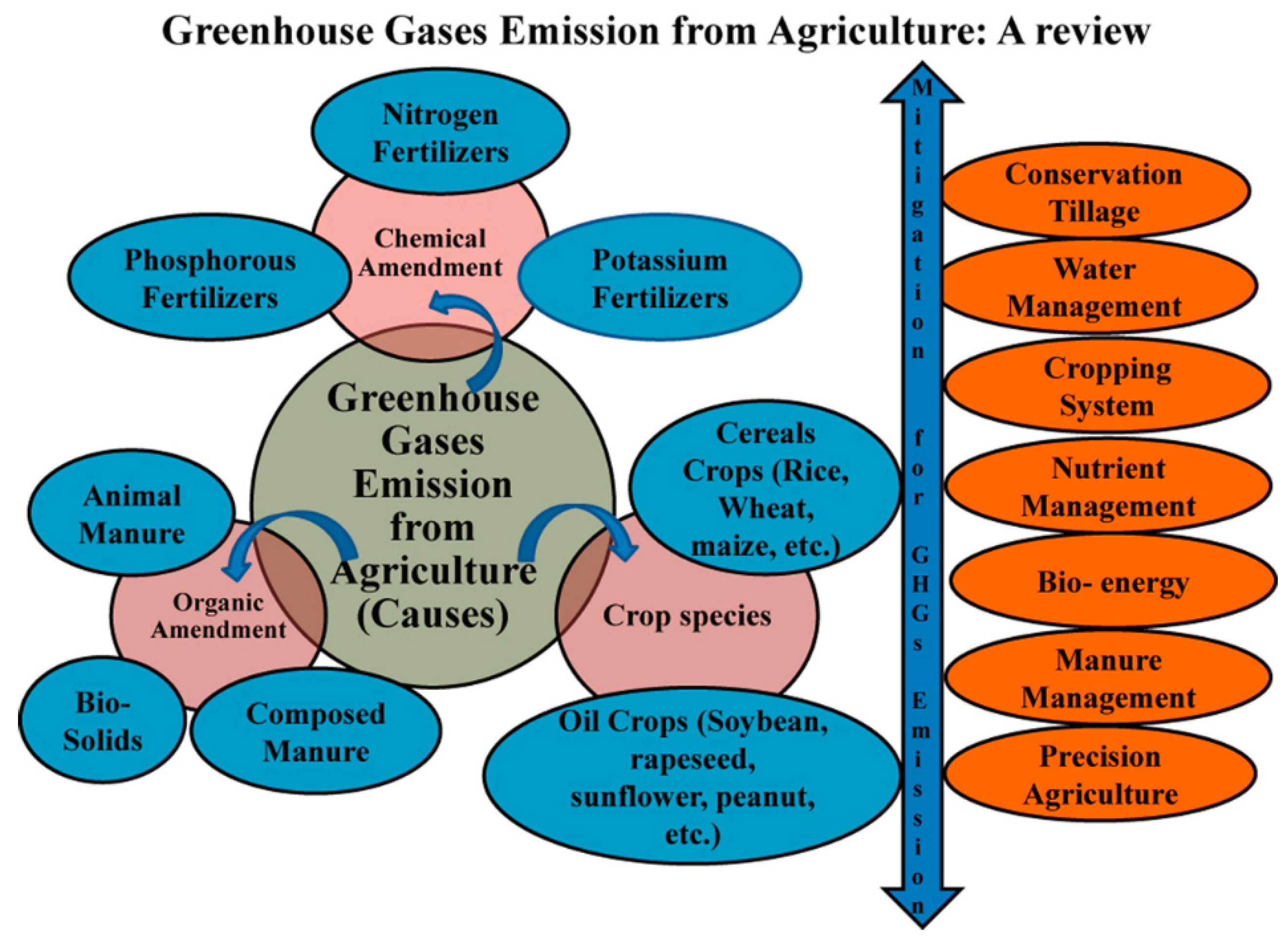
Blanco-Canqui and Lal (2008) [135] underlined the importance of establishing a relationship between soil erosion and water, wind, and tillage; valuing C dynamics and storage in soils at different climatic conditions; modelling the fate of C transport by erosion; valuing if soil is a source or a sink and the importance of biochar in sequestering and mitigating climate change. Restoring SOC enhances soil quality; this improves food production and maintains clean water [53]. Amount of CH4 and N2O might change the mitigation by the management practice, and this must be considered along with SOC sequestration [5]. Lal (2015) [27] suggests conservation agriculture (CA) as a suitable management, that is, the retention of crop residue mulch (increasing SOC) [30,136,137,138]; incorporation of cover crop in the rotation cycle, the use of integrated nutrient management and organic amendments, no-till (mechanical tillage is an energy-intensive process), limited use of synthetic fertilisers and herbicides highlighting benefits such as a significant C sequestration and reduction in fuel consumption [139].
A resilient agriculture system is suggested to maintain and improve economic, ecological, and social benefits [84]. A stable SOC sequestration path might be achieved through agricultural system and management practice and by conversion of degraded land [140].

10. Nature-Based Solution (NbS)

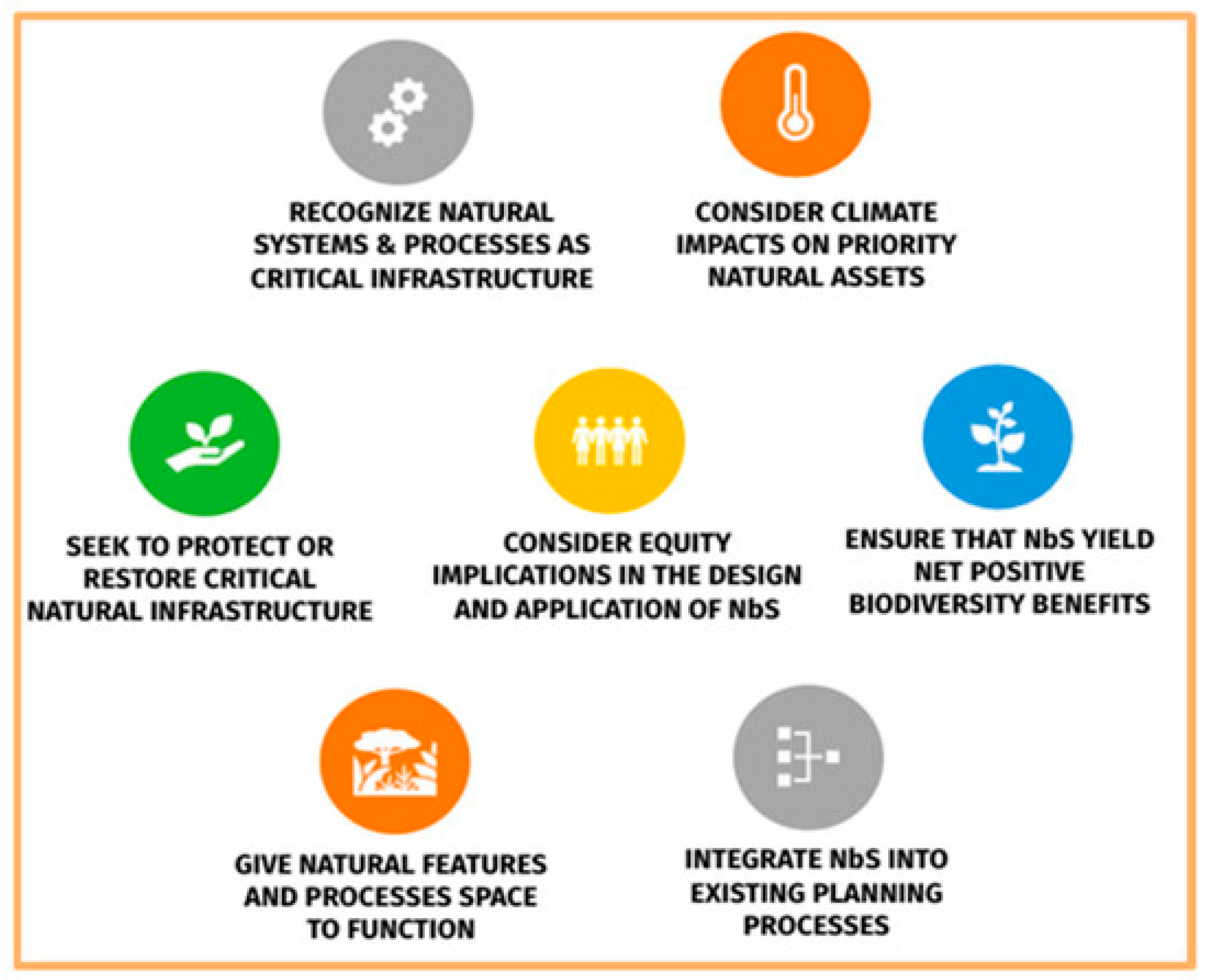
Nature-based Solutions have been defined as a way to find a solution for mitigating and adapting to the climate change effects, whilst simultaneously protecting biodiversity and improving sustainable livelihoods [14,141,142,143], to manage natural systems balancing the benefits for both nature and society [144]. Seddon et al. (2021) [145] states that NbS may enhance synergies and tackle more challenges due to the flexible and integrated approach (Figure 11). Adil et al. (2022) [146] states that for NbS, like non-removal crop residues, conservation tillage increases SOC, in particular, mineral associated organic carbon, mineral associated organic matter, and microbial biomass carbon components.
Nature-based Solutions can provide multiple benefits for living organisms and biodiversity, economy, society, and environment; they are cost-effective and efficient than engineering solutions [147].
The main idea of NbS is to improve land management, to improve C storage and sequestration, to protect soil from erosion, and to avoid the changes in land use [124] (Figure 12).
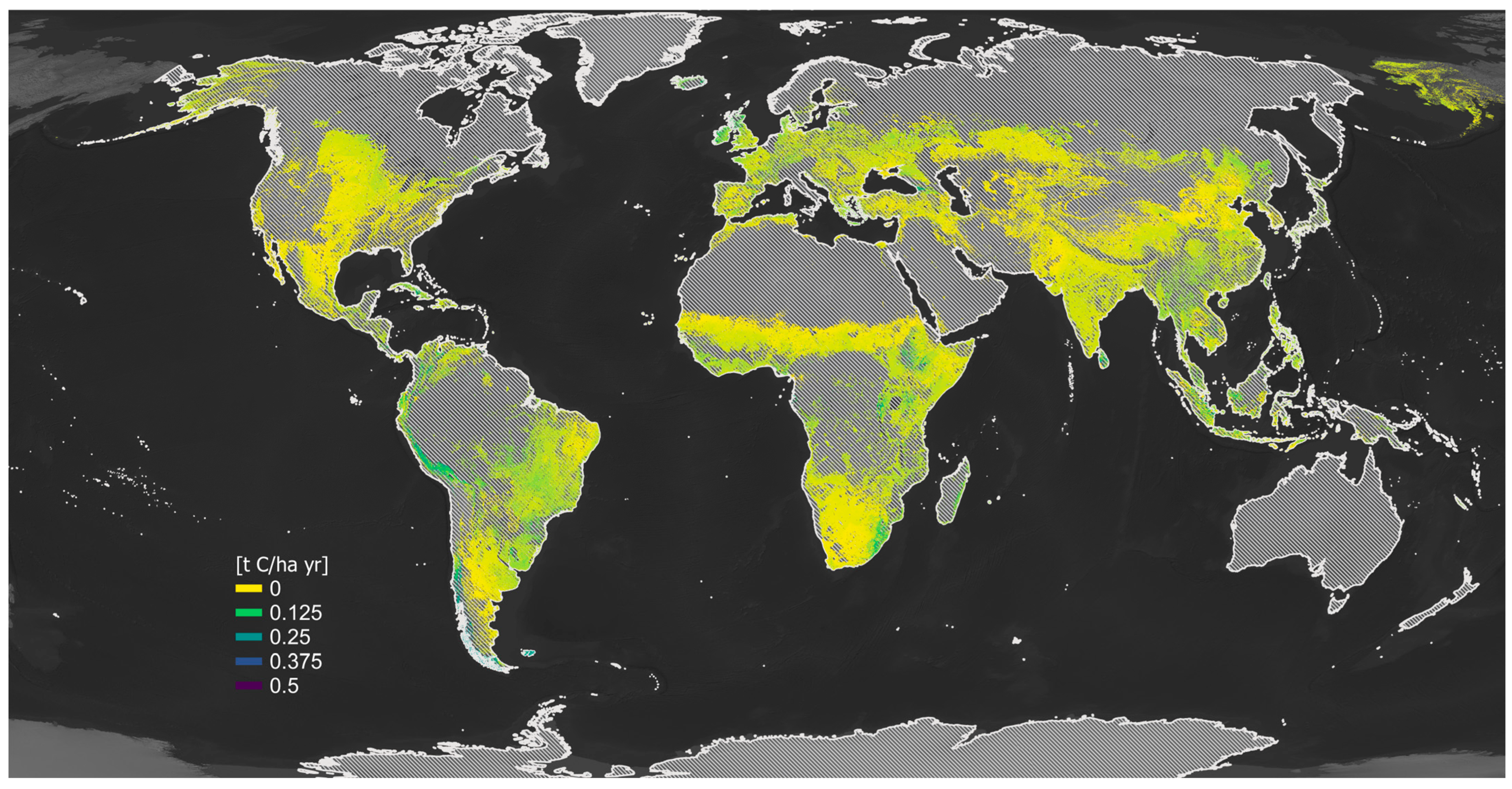
Nature-based Solutions are considered a cost-effective long-term solution for soil and water; they are considered a holistic approach which can tackle problems more efficiently [135,149,150,151] and mimic natural processes, improving vegetation and water availability, restoring biodiversity, and raising agricultural productivity [152]. They are based on natural processes to recover services such as goods and resources and having their fundamentals in the concept of soil health [62,144,150]. Eight criteria have been defined: address societal challenges, landscape scale of intervention, biodiversity gain, economic viability, governance capability, equitably balance trade-offs, adaptive management, and mainstreamed within an appropriate jurisdictional context [144] (Table 4).
The implementation of long-term sustainable solutions requires a better and deeper, more comprehensive understanding of the coupled natural and human systems and the causal mechanisms, impacts, and feedback inherent in this complex interaction [141]. Indeed, ref. [147] raises that NbS must be achieved the considering ecosystem services and trade-offs; therefore, NbS advantages will be largely leveraged.
Eggermont et al. (2015) [153] proposed some typologies of NbS; the first type is of no or minimal intervention in ecosystems, to maintain or improve the delivery of a range of ecosystem services both inside and outside of these preserved ecosystems. A second type corresponds to the definition and implementation of management approaches developing sustainable and multi-functional ecosystems and landscapes. A third type consists of managing ecosystems in very intrusive ways or even creating new ecosystems.
Seddon et al. (2021) [145] has classified NbS as soil-vegetation and landscape solutions. The former solution enhances soil health and resilience [154] such as vegetation cover, mulch to avoid soil erosion and runoff, and to improve porosity, aggregate stability, organic matter content and water holding capacity, whereas the landscape solutions are geomorphological parameter like hillslope morphology and runoff pathways. These solutions may mitigate flooding, droughts, soil erosion, carbon emissions, and can enhance biodiversity.
Actually, NbS are site-specific so that the success of a solution is bounded with socioeconomic and environmental conditions, this is the reason why the choice of an NbS is with population and stakeholders too. Indeed, Debele et al. (2023) [147] underlines that NbS must be designed to be measurable, sustainable and cost-effective.
Nature-based Solutions applied to the agriculture landscape have the carbon sequestration as a main goal, including water and disaster-risk management [28,103,155,156,157]. Conversion to invigorating land uses and implementation of NbS can enhance SOC concentration in soil [39].
Some NbS practices are based on the use of trees and plants reducing the environmental impact of the production [157], like grass strips’ control on soil erosion and return crop yields [157,158], and vetiver to trap phosphorous [157,159].
Organic agriculture, silvo-pasture, cover cropping, and agroforestry are methods which show positive impacts on SOC. On the contrary, tillage and grazing management are activities which show different N2O emissions and different impact on SOC storage [17].
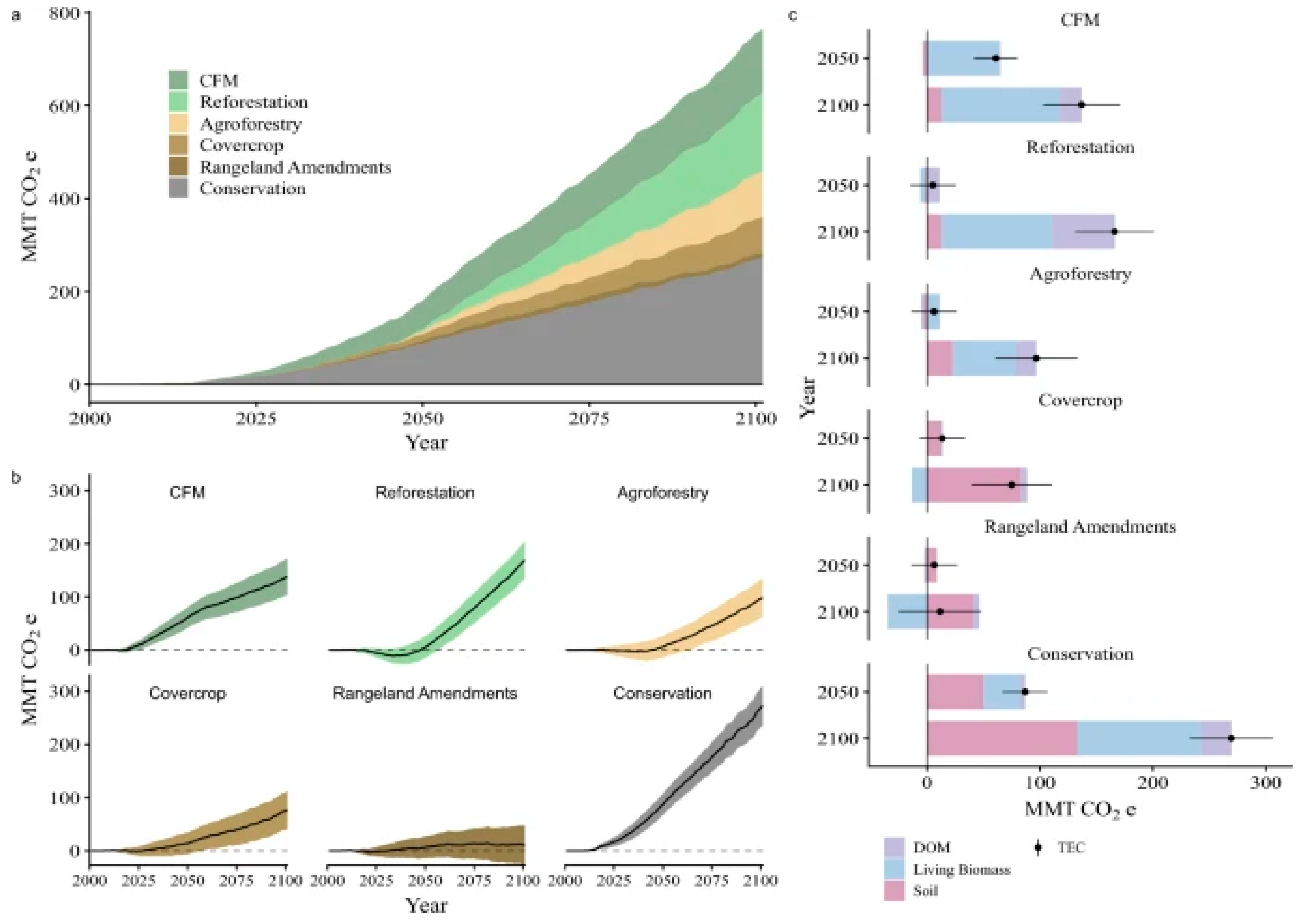
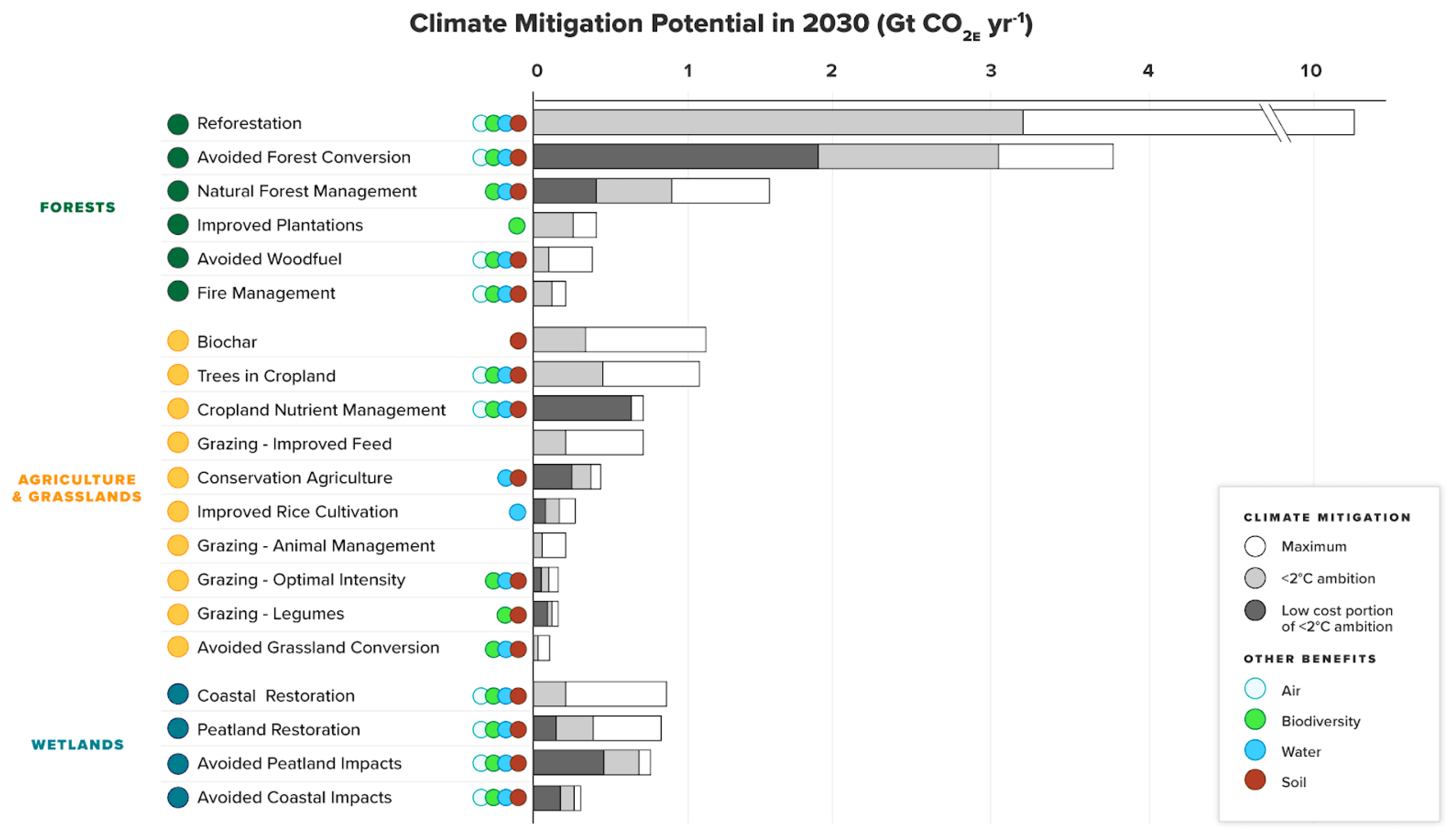
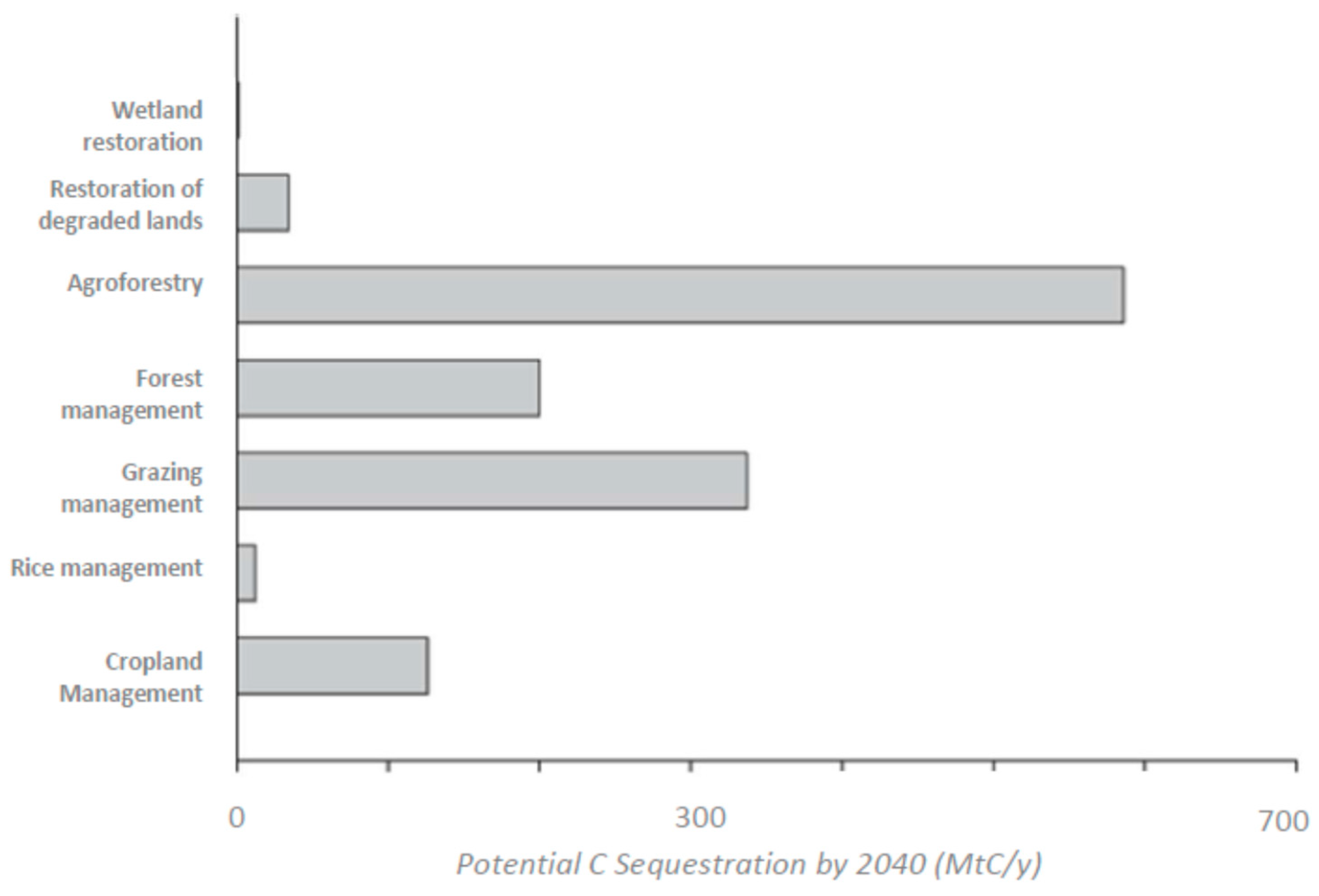
Agroforestry, an NbS based on land use management, may be an opportunity to counter the adverse impacts of climate change through adaptation and mitigation [102,160]. As a matter of fact, agroforestry cropping systems tend to be resilient, pest-resistant, nutrient conserving and providing multiple benefits [161], like improving carbon sequestration and storage [162,163]. The application of agroforestry may be a tool to enhance resilience for food supplies to pests, diseases, and extreme climate events [42,164,165,166]. Indeed, NbS are fundamental in reducing the cost of climate mitigation solutions to achieve the goals from the Paris Agreement [167]. Griscom et al. (2020) [168] suggests that the application of NbS will reduce the emission of CO2 through the forest protection, wetland, and grassland, whereas the global carbon sink is through the management of timberland, croplands, grazing land, and with the restoration of native forests and wetlands.
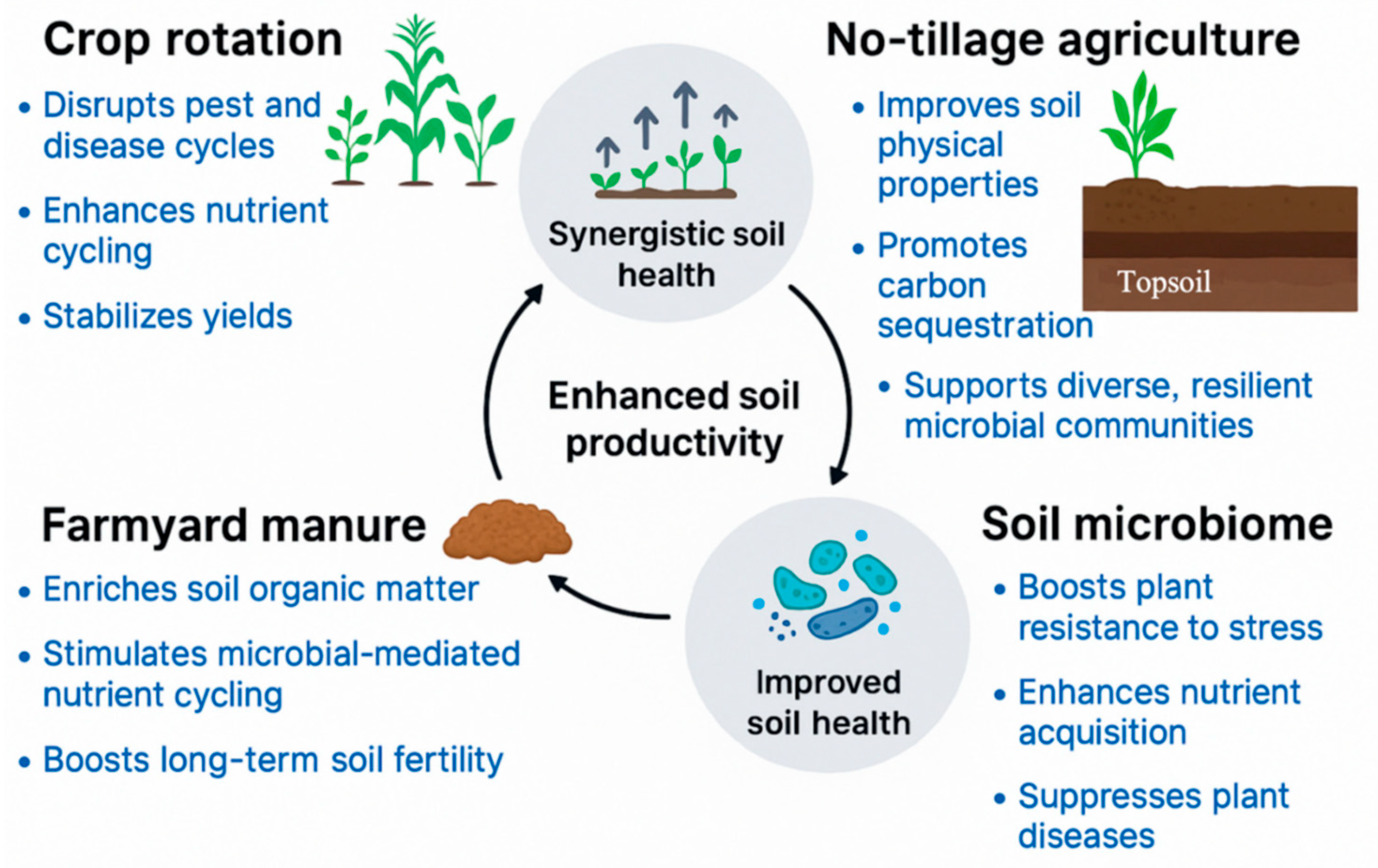
Agriculture practice and forestry may be a significant way to mitigate CO2 sequestering of C so soil can act as a sink [32,169]. Specifically, conservation agriculture is a mix of conservation tillage, crop rotation, and cover crops, pointing out the potential to increase crop yields [157]. Indeed, trees enhance the resilience of small farmers to face climate risks through crop and income diversification, soil and water conservation, and efficient nutrient cycling and conservation [132,170]. It is fundamental to select the suitable tree species leading to the management of pest control, spacing and width of hedgerows, sustainable forest management to conserve soil and water resources, developing protocols for assessing C pools and assessing the potential of C sequestration [135] (Figure 13 and Figure 14).
The postulation of NbS encompasses climate change mitigation as well as the sustainable agriculture [145]; actually, NbS can be very helpful in reducing the consequences due to flooding, erosion, drought, and poor agricultural productivity phenomena [173].

11. SOC Sequestration

Borrelli et al. (2021) [17] defined SOC as a natural climate solution via C restoration in soil (sink) and avoiding and/or reducing CO2 emissions, considering land use change and climate change and pointing out that SOC’s loss is quicker than its storage in soil. SOC makes soil more resilient to fire, pests, and winds. (Figure 15).
Soil can sequester C in two ways, direct transformation (transformed in SIC) and indirect fixation of atmospheric CO2 (transformed in SOC during the photosynthesis reaction) [32,175].
SOC sequestration is a cost-effective and environmentally friendly practice; atmospheric CO2 is transferred into long-lived pools, C is stored in soil mainly through photosynthesis [18], and it depends on the turnover time and physical or chemical protection against microorganisms and soil erosion [48]. After a period of 10 to 40 years, C attains a steady state [84]; it is not reemitted and SIC is also increased [53]. The time to reach the steady state varies with the soil type, management intervention, climate regime, and previous SOC depletion [17]. Soil as a sink can sequester SOC through recommended management practices: no-till on agricultural and forest soils, leaving residues as mulch and cover crop, crop rotations, and agroforestry [13] (Figure 16).
The potential SOC sequestration is in the following order: degraded soils and desert ecosystems > cropland > grazing lands > forest lands and permanent crops [177]. Effectively, Borrelli et al. (2021) [17] states that forest system SOC is mainly in the above-ground tree biomass whereas in wetland system, SOC is the main way to reach climate mitigation. Furthermore, Oertel et al. (2016) [47] highlights that reforestation of croplands shows reduction in CO2 emissions, not in CH4 and N2O emissions. These recommended strategies might affect N2O emissions [39,178,179] since the reduction in these emissions seems to depend on soil and climatic conditions [180]. Nitrification seems to affect soil CO2 sink and nitrogen cycling in CO2 sink and reduces CO2 emissions due to soil respiration. Nitrification is considered an energy-yielding reaction, enabling the use of CO2 as a carbon source and, to reduce CO2, it is necessary for the energy from nitrification processes and N-cycling to be repeated several times. When increasing NH4+ concentration in soil, a decrease in CO2 emission is observed until a limit; beyond this limit, nitrification is inhibited even though NH4+ is supplied and CO2 is emitted [181]. Emissions may be caused by a retarded respiration or inhibition; another hypothesis is that the NH4+ excess may cause a stabilisation of the CO2 minimum without significant CO2 release.
SOC content in soil depends on interacting mechanisms such as the formation of passive humus fraction, formation of stable micro-aggregates, and deep placement of SOC; it is fundamental to understand how much and how long C could be in soil [11,182,183]. Turnover time depends on SOC fractions; labile or decomposable fractions have a turnover time of less than 5 years; fraction with particulate or light fractions have a time between 5 and 20 years; humus and light fractions between micro-aggregates show a time of 20–50 years; passive or non- labile fractions have a time of 50–100 years [28,48,184,185]. Determining the amount of C in soil compared to its saturation capacity leads to fixed C being sequestered in the soil [186,187]. Soil can also be a sink depending on SOM concentration, climate, soil profile, and soil management [5]. Improving SOC and SOM enhances soil sustainability and, the management of land may help reduction in GHG emissions from soil, particularly leaving the crop residues on soil and increasing N efficiency [21,188,189]. There is a potential for C sequestration through the management of crop residues [190]; C from annual crops undergoes its fastest turnover in the wet, warm season, whereas carbon returned by woody species resists decomposition and carries over into the cooler, drier periods [4,191,192]. Instead, the management of land use bears on the stability of soil aggregates and C concentration and its dynamics in these aggregates. Soil primary particles form stable aggregates due to the presence of humic substances and/or complexes with polyvalent cations forming micro-aggregates [4,80], whereas macro-aggregates are formed by polysaccharides, fungal hyphae and plant roots. Stable micro-aggregates are the main mechanism for C sequestration in soil. In particular, Ca2+ is considered a persistent linking agent with the formation of clay-cation polyvalent-organic material complex [5,193]. Application of Ca2+ leads to the formation of stable aggregates in soil [99,194]; sesquioxides show the same influence on the soil aggregates and influence the stability of SOM too. It has been observed that C in micro-aggregates is older but more labile than C in macro-aggregates [195].
Moisture, temperature, clay content, and mineralogy are also fundamental parameters and, in general, SOC is mostly associated with clay fraction [196]. Macro and micro-aggregates make soil more resistant to C decomposition by enzymes and microorganisms. In these aggregates, organic material is protected from enzyme and/or microorganism attacks; the lesser amount of oxygen reduces microbial activity [197]. The formation of soil aggregates is a strategy to sequester C in soil, so C mineralisation is reduced [64,198,199]. Moreover, SOM could act as a binding agent to form stable macro-aggregates and enhance C sequestration [190]. During climatic conditions of high precipitation and frozen soil in the winter, SOM is higher and leads to higher C sequestration than in warmer and drier climates, while crop rotation allows a high C sequestration in sub-humid climates than drier ones [200,201].
Six et al. (2002) [64] distinguishes four SOM pools: a biochemically protected C pool, a silt- and clay-protected C pool, a micro-aggregate-protected C pool, and an unprotected C pool. The silt- and clay-protected C pool is protected by the mineral particles, and it is hydrolysable and depends on the amount of silt and clay in the soils. The micro-aggregate-protected C pool is exerted by SOM at the micro-aggregates level (SOM physical protection), the biochemically protected C pool is associated with the non-hydrolysable fraction, and the unprotected C pool is labile; it is a nutrient source and very sensitive to the management practice.
In addition, Six et al. (2002) [64] defines three major mechanisms to stabilise SOM: physical, chemical, and biochemical processes. Physical mechanism is the formation of aggregates to protect SOM from microbes and enzymes; it is mainly protected in free micro-aggregates and in micro-aggregates within macro-aggregates [202,203,204]. Chemical mechanism is the binding between SOM and soil minerals since C is associated with primary organo- mineral complexes; therefore, they are chemically protected; silt and clay content underpins this mechanism [64,205,206,207]. Biochemical SOM stabilisation is a mechanism because of its own complex chemical composition [64]. Microbial-derived C binds micro-aggregates into macro-aggregates and it seems that macro-aggregates protect SOM [80,208].

12. Tillage

Ploughing and tillage lead to a moisture decrease and an increase in soil temperature and of SOC mineralisation. The most suitable tillage system is one which leads to the restoration of soil quality, reduces soil erosion, and allows the efficient use of rainwater and fertilisers [60]. Cover vegetation avoids the overgrazing and reduction in water infiltration, soil erosion, and runoff; biomass is related to SOC pool, to restore biodiversity; fauna and flora (micro, meso, and macro) is one other important aspect to improve.
Ploughing accelerates erosion and is responsible for about 1 Gt/year of C loss; tillage increases SOC mineralisation with CO2 release and crop residues are closer to microbes favouring mineralisation too [5,27]. Daniels (2022) [124] states that tillage accelerates soil erosion and consequently impoverishes soil health with the leaching of N and P heightening the erosion; tilling races up CO2 emissions because of the soil disturbing. In a wetland system, CO2 emissions are also reduced in the case of a no-tillage system [47].
Conservation tillage (CT) is a tool for soil and water conservation through crop residues and enhancing soil quality; it is an instrument for mitigating the greenhouse effect and for improving environmental quality [28,209]—response from conservation tillage differs by regions, climates, and soil types [89]. The evolution of weed control technology and farm gear facilitated the application of CT [85].
Tillage removes soil aggregates, a physical barrier between SOC and microbial degradation [146], reducing the amount of SOC in all the fractions and particularly in fine clay and sand [193], ploughing decreases particulate SOC and the light fraction. Through CT, the added SOC is in inter-macro-aggregate material; this may increase macro-aggregation and their stability; showing a positive impact on sequestering C in agricultural soil [146,188,210]. The increase in SOC amount is close to the soil surface and seems to protect erosion and microbial decomposition. Conversely, Baker et al. (2010) and Johnson et al. (2007) [26,211] underline that tillage may redistribute and mix plant material and SOC throughout the profile. In a short-term, tillage enables CO2 emission proportional to the volume of disturbed soil and, CT raises C sequestration based on the depth of soil sampling [26].
Generally, reduced tillage or no-tillage allow C sequestration, whereas in some cases, a C loss is caused by the soil disturbance due to the accelerated decomposition and erosion [85]. No-tillage is suggested as a practice to reduce soil erosion and, at the same time, it betters soil’s physical conditions and cuts down GHG emission but does not affect the yield [85,116,212].
Adil et al. (2022) [146] writes that NT increases all the various SOC fractions comparing to CT. Reducing tillage makes SOC increase, in particular, easily oxidised organic carbon and particulate organic carbon components; in a minor measure dissolved organic carbon and microbial organic carbon components.
Actually, no-tillage or conservative tillage enhances carbon sequestration and storage; at the same time, with a minor use of tractors, fewer fossil fuels will be used [124]. Duda et al. (2014) [213] also states that no-tillage, mulch and rotations ameliorate markedly soil properties with a less amount of emitted CO2. However, conservative tillage shows good results in improving soil’s physic parameters, reducing soil erosion and increasing infiltration and, in some cases, even increased productivity. Concerning conservative tillage, results suggest overlaying land with 15–30% of plant debris; in the case of minimal tillage the cover is over 30%; in a no-tillage system, seeds are put in the stubble or the ground is protected by plant debris from the previous yield.
The amount of SOC leads to stable aggregation due to dominant fungal microflora, earthworm activity, and formation of platy structure with high bulk density [193,214,215,216]. Ploughing leads to aggregate breakdown and conversion to CT can enhance the aggregate dimensions [217,218,219,220]. The goal is to improve the physical, biological, and ecological components of soil to achieve good soil health [53].
Lal (2007) [221] highlights that reducing tillage to sequester C may increase the frequency or duration of denitrifying conditions in soil, because soil remains wetter and additional N fertiliser may be used; high amount of N2O emissions is emitted under non-tillage (NT) than conventional tillage [222,223]. Blanco-Canqui et al. (2008) [135] developed a model to value soil transport by tillage, to discriminate the difference between soil loss by tillage, by water erosion, and by wind erosion, and the consequences on C sequestration in soil.
Three activities might restore soil quality, including minimising losses from soil, creating a positive C content in soil, and strengthening the water and nutrient supply [27]. Under no-tillage, soil C sequestration occurs in the upper-soil layers but declines in deeper layers; therefore, the total soil C content remains unchanged [8,224].
Carbon and SOM accumulate in soil when no-tillage is applied; according to [225], it may increase the denitrification process and N2O emissions, whereas it is helpful in reducing CH4 emissions; [226] stated that comparing no-tillage and plough tillage, CH4 emissions were reduced. The advantage of no-tillage practice is a pore continuity and a niche for methanotrophic bacteria, therefore a CH4 absorption. According to [213], reduction in tillage led to improve qualitative and quantitative agriculture activity and soil fertility.

13. Water Management

Agricultural water management may decrease GHG emissions; sustainable agriculture (SA) improves infiltration, water capacity, and water retention, consequently allowing the development of root system, restoring aerobic soil condition and reducing flood impacts [227,228]. Restoring the ecosystem through water regulation leads to biodiversity conservation, carbon sequestration, pollination enhancement, and generation of livelihoods [229,230,231,232].
Calderón Cendejas et al. (2021); McDowel et al. (2021) [233,234] highlighted a correlation between land use and water quality and the different impact on the water of crop, forest, and population. Agricultural practices have a negative impact on water quality, showing a positive correlation with higher levels of turbidity, hardness, total nitrogen, nitrates, and ammonium [233,235].
Duda et al. (2014) [213] highlights that sustainable water management with innovative agriculture could mitigate climate change effects; innovative agriculture stands for a sustainable agriculture based on the enhancing of crop rotation and reduction in energy consumption. Liu et al. (2020) [236] asserts that Mulched Drip Irrigation (MDI) reduces the amount of water and GHG emissions, whereas a wrong irrigation can race up N2O emissions because of the denitrification and the breakdown of SOM, which causes CH4 emissions.

14. Organic Agriculture

Organic agriculture may help in mitigating climate change by reducing GHG emissions [4,237,238]; cover crop practice points out positive results in C sequestration [239]. Organic agriculture application has increased, reaching about 70 million hectares for crops like dry pulses, vegetables, and olives [85]. Conservation agriculture (CA) can play a crucial role in the development of sustainable agricultural systems in view of growing food demand and environmental changes [8]. FAO (2017) [240] is promoting CA for more sustainable land management, environmental protection, and climate change adaptation and mitigation; CA results in an improvement in fertility and yield [127,241]. Soil carbon sequestration and the adoption of conservation agriculture depend on climate conditions, especially in arid regions. In dry areas, CA enhances soil moisture mostly during fallow time; reduction in soil temperature, increase in water infiltration, evaporation and C emissions are impeded by mulch residual [8]. Intensive agriculture means a high loss of SOC [4,11,242,243,244,245,246,247]. Sun et al. (2020) [8] states that the humidity index (HI) affects the SOC value. In semi-arid to humid areas (40 ≤ HI ≤ 100), conservation agriculture leads to an increase in SOC, whereas in cool, humid, and tropical humid areas, the decreasing temperature and mulch cover waterlogging might be a disadvantage for early seed germination and crop growth.
Organic agriculture leads to the reduction in manure, to avoid the application of organic fertiliser before irrigation; hence, to diminish nutrient depletion, crop rotation and organic fertilisers might reduce contaminants concentration in soil [4,135]. Animal manures may be decomposed by soil microorganisms and contribute to the SOM pool; cover cropping and animal manures can contribute to SOC sequestration [26,248].

15. Biochar

Biochar can be a soil conditioner and/or a soil amendment improving soil quality, a sink for nutrients enhancing plant growth, and have a great potential to mitigate soil emissions [157,249]. Biochar has a high C content; it fosters the ability to store and recycle C in an efficient way [26,249,250,251] and decreases N2O and CH4 emissions and enhances soil sustainability and fertiliser concentration [40,252,253,254,255,256,257]. Carbon sequestration is high if biochar is produced from plants because of the high C/N ratio; the pyrolysis conditions influence C content and potential sequestration in biochar. Biochar application provides SOC content in the long term and high stability, and it increases the availability of nutrients and water, yield, microbial biomass, and diversity. Biochar enhances long-term carbon storage due to the high rate of C sequestration; microbial decomposition is very low, making biochar a very powerful recalcitrant amendment [40,258]. H/C value must be lower than 0.7 and O/C value must be lower than 0.4 to reach a good quality and high stability in biochar [40,259]. Converting biomass to biochar can store about 50% of original C and persist for a long time, interacting with organic matter reducing its decomposition [13,40]. Gupta et al. (2020) [40] suggests valuing the carbon sequestration potential of biochar (CSB) by
CSB (%) = (M × Ch × Cch × R50)/(M × CF)
where M = mass of feedstock (g); Ch = yield of biochar (%); Cch = carbon content of the biochar, R50 = recalcitrant index; and CF = carbon content of feedstock.
Implementing the annual biochar application leads to a higher C stock in soil. Soil mineralogical composition affects the results of biochar application; increasing clay content increases SOC stability. Gross et al. (2021) [260] states that tillage enhances C biochar migration to low horizons, fostering soil aeration and decay; tillage practice and biochar application should maximise SOC sequestration. It may reduce CO2 emission so the system is C-neutral, and under proper conditions, it may increase soil CEC, water storage, and soil fertility [26,250]; it could act as a slow fertiliser and potentially decrease leaching and runoff [26,249,261]—these favourable effects can be provided for a long time [206,262,263]. Methane emissions are reduced during methanotrophic activity according to soil lithology, biochar physico-chemical characteristics, and water management [40,264]. Methanotrophic activity is enhanced increasing the aeration and via methane adsorption on biochar which shows a high surface area [253]. In addition, some biochar characteristics like porosity, pH, and surface area are profitable in reducing N2O emissions. Its application in soil lowers NO3 and NH+4, limiting microbial activity and emissions as well as concentration for nitrification and denitrification reactions.

16. Agroforestry

Agroforestry is a cost-effective way to sequester C over a long time period, combining trees, shrubs, and agronomic crops. Bangroo et al. (2013) [39] highlights the importance of afforestation and reforestation as a mitigation strategy for C sequestration and a resource for wood production, too. The presence of trees increases C sequestration and their residues (leaves and branches) increase SOM. Reforestation–afforestation of non-forest lands and/or brownfields will prevent land degradation, as well as sequestering and reducing the net C emission [39]. To succeed in afforestation protocol, the choice of the correct tree species is imperative; different tree species generate litter with differentiated characteristics which affects soil formation and properties like texture and pH [265,266]. Further parameters, which can affect its success, are clay content past land use and climatic zone [32,267]. This practice is considered a good natural-based solution to sequester C in soil; increasing C residence time enhances SOM stabilisation in the aggregates. Deforestation leads to a C release from biomass decomposition and SOM; part of this C could be restored through reforestation [18]. Forests are considered an atmospheric CO2 sink according to the net aerial primary production rise; after harvest or a natural catastrophe, vegetation can be regenerated [35], but the carbon balance might be negative because of constant SOM decomposition. Forests turn out to be a very good sink for atmospheric CO2 during the active phase of regeneration, whereas at a maturing stage, the CO2 adsorption is less due to the established balance between the rates of net production and net decomposition. Miralles-Wilhelm (2021) [157] identifies that reforestation has highlighted co-benefits, including biodiversity habitat, air and water filtration, flood control, and enhanced soil fertility. Furthermore, land change from agriculture to agroforestry increases SOC in soil up to a depth of 100 cm [32].
Ontl and Schulte (2012) [18] suggests the creation of wetlands and ponds to sequester a massive amount of C, because decomposition is greatly reduced in waterlogged soils from the lack of oxygen. Tubiello (2010) [268] pointed out that the positive impact of forests in mitigating atmospheric CO2 will be lower. Particularly, average productivity increases in young trees under elevated CO2, whereas a lower stimulation in stem growth of older tree stands has been observed. Additionally, species competition, disturbance, pollutants, and nutrient availability may limit stand-level response to elevated CO2 (Figure 17).
Further conservative practices to reduce soil erosion are grassed waterways and vegetated riparian buffer strips; therefore, floods could be absorbed and C sequestered [212].

17. Future Hints

Compare short-term versus long-term effects of conventional tillage and conservative tillage systems to identify which practice is sustainable.
Evaluate how soil properties, climate, and management interactions modify outcomes over time, and determine whether practices such as no-tillage, reduced tillage, conservation agriculture, and agroforestry consistently lower GHG emissions and improve soil health when observed on multi-decadal scales.
Short-term studies often show variable or contradictory results for no-tillage and other conservation practices. There is a scarcity of long-term experiments that track how the environmental context and time shape sustainability metrics.
Important unresolved questions include whether soil depth plays a role in long-term CO2 stabilisation, how extreme climate events alter trajectories, and whether agroforestry provides durable co-benefits for food, timber, and climate mitigation.
Hypotheses to test in long-term studies on more multi-site, multi-decadal experiments with standardised protocols and open data are needed to resolve context-dependent effects.
To better understand the longevity and stability of SOC gained under different tillage systems, especially the role of depth and mineral association.
Quantification of how extreme climate events change SOC trajectories and how tree cover in agroforestry mitigates these effects.
Economic and social assessments to evaluate adoption barriers and co-benefits of long-term conservation strategies.
Long-term evaluation is essential to determine whether conservation tillage and agroforestry reliably deliver sustainable outcomes.
Soil depth, climate, management interactions, and ecosystem processes all shape the final result; therefore, comprehensive, depth-resolved monitoring, integrated GHG accounting, and site-tailored practices are required to establish robust, scalable recommendations for climate-smart agriculture.

18. Conclusions

NbS play a critical role in climate mitigation by enhancing carbon sequestration, protecting ecosystems, preventing carbon release from deforestation and degradation, and improving land management. NbS can be more cost-effective than engineered solutions for climate adaptation. NbS could contribute up to 10 Gt of CO2 equivalent per year by 2050, under the effective implementation of NbS for climate mitigation. More data is needed on long-term impacts, especially on biodiversity and ecosystem health.
In particular, C and N sequestration in soils are suitable within soil and water management as well as the protection of biodiversity, natural systems filter pollutants, coastal wetlands, and mangroves buffer storm surges and stabilise shorelines. The amount of C sequestered in soil relies on the vegetation, soil depth, its drainage capacity, mineral composition, soil temperature, ongoing and former land use, and the relative proportion of soil, water, and air.
NbS such as conservation tillage, organic farming, crop rotation, cover crops, and green manures lead to the reduction in compaction and improved water management, avoiding the erosion and depletion of nutrients. These solutions lead to the maintenance of biodiversity, to sustain ecological processes providing a healthy ecosystem including pest control, pollination, and restoration of soil nutrients connected to management procedures, mitigating GHG emissions from the agricultural system.
In particular, CA and CT are deeply interconnected in improving soil health, retaining SOM, reducing erosion, and promoting microbial activity. No-tillage has been found to be a viable alternative for improving soil health in some industrial agricultural systems due to its potential in enhancing sustainability, reducing costs, and improving long-term productivity. Industrial agriculture typically involves large-scale monoculture, heavy machinery, and intensive input use, and its benefits are as follows: it prevents erosion and degradation across vast fields, improves infiltration and retention, and reduces irrigation needs by up to 30%.
Agroforestry systems might lead to an increase both above- and below-ground C stocks, reducing soil erosion and degradation and mitigating GHG emissions. Conservation and cover crops and elimination of synthetic pesticides may help to offsets GHGs and restore the nutrient cycling mechanisms of natural systems.
Good agricultural practices may mitigate GHG emissions, such as soil conservation, reducing the use of inorganic fertilisers and pesticides; the diversification of the crops will help in mitigating climate change. The synergy between climate-change mitigation and agriculture adaptation is a great opportunity for developing win–win strategies in the GHG sequestration. Management of agriculture and forestry have the same importance for GHG mitigation through increasing carbon sequestration and sustainable agricultural and forestry practices within the protection of soil health.
Nature-based solutions can crucially reduce greenhouse gas emissions by enhancing the natural capacity of ecosystems to capture and store carbon.

Funding

This research received no external funding.

Data Availability Statement

No new data were created or analyzed in this study.

Conflicts of Interest

The authors declare no conflict of interest.

References

  1. Andrews, S.; Karlen, D.; Cambardella, C. The soil management assessment framework: A quantitative soil quality evaluation method. Soil Sci. Soc. Am. J. 2004, 68, 1945–1962. [Google Scholar] [CrossRef]
  2. Bouma, J.; McBratney, A. Framing soils as an actor when dealing with wicked environmental problems. Geoderma 2013, 201, 130–139. [Google Scholar] [CrossRef]
  3. McBratney, A.B.; Stockmann, U.; Angers, D.A.; Minasny, B.; Field, D.J. Challenges for soil organic carbon research. In Soil Carbon. Progress in Soil Science; Hartemink, A.E., McSweeney, K., Eds.; Springer International Publishing: Cham, Switzerland, 2014. [Google Scholar]
  4. Meena, R.S.; Kumar, S.; Yadav, G.S. Soil Carbon Sequestration in Crop Production; Springer: Singapore, 2020; pp. 1–39. [Google Scholar]
  5. Lal, R. Soil carbon sequestration to mitigate climate change. Geoderma 2004, 123, 1–22. [Google Scholar] [CrossRef]
  6. GLOBE. Carbon Cycle Project. 2010. Available online: https://kfrserver.natur.cuni.cz/globe/others.htm (accessed on 22 October 2025).
  7. Naorem, A.; Jayaraman, S.; Dalal, R.C.; Patra, A.; Rao, C.S.; Lal, R. Soil inorganic carbon as a potential sink in carbon storage in dryland soils—A review. Agriculture 2022, 12, 1256. [Google Scholar] [CrossRef]
  8. Sun, W.; Canadell, J.G.; Yu, L.; Yu, L.; Zhang, W.; Smith, P.; Fischer, T.; Huang, Y. Climate drives global soil carbon sequestration and crop yield changes under conservation agriculture. Glob. Change Biol. 2020, 26, 3325–3335. [Google Scholar] [CrossRef]
  9. Minasny, B.; McBratney, A.B.; Malone, B.P.; Lacoste, M.; Walter, C. Quantitatively predicting soil carbon across landscapes. In Soil Carbon. Progress in Soil Science; Hartemink, A.E., McSweeney, K., Eds.; Springer International Publishing: Cham, Switzerland, 2015. [Google Scholar]
  10. Huang, Y.; Wei, F. Climate controls the global distribution of soil organic and inorganic carbon. Ecol. Indic. 2025, 175, 113514. [Google Scholar] [CrossRef]
  11. Deb, S.; Bhadoria, P.B.S.; Mandal, B.; Rakshit, A.; Singh, H.B. Soil organic carbon: Towards better soil health, productivity and climate change mitigation. Clim. Change Environ. Sustain. 2015, 3, 26–34. [Google Scholar] [CrossRef]
  12. Lal, R. Soil carbon management and climate change. In Progress in Soil Science; Springer International Publishing: Cham, Switzerland, 2014. [Google Scholar]
  13. Paustian, K.; Larson, E.; Kent, J.; Marx, E.; Swan, A. Soil C Sequestration as a Biological Negative Emission. Strategy Front. Clim. 2019, 1, 482133. [Google Scholar] [CrossRef]
  14. Borrelli, P.; Robinson, D.A.; Panagos, P.; Lugato, E.; Yang, J.E.; Alewell, C.; Wuepper, D.; Montanarella, L.; Ballabio, C. Land use and climate change impacts on global soil erosion by water (2015–2070). Proc. Natl. Acad. Sci. USA 2020, 17, 21994–22001. [Google Scholar] [CrossRef]
  15. Robinson, D.A.; Panagos, P.; Borrelli, P.; Jones, A.; Montanarella, L.; Tye, A.; Obst, C.G. Soil natural capital in Europe; A framework for state and change assessment. Sci. Rep. 2017, 7, 6706. [Google Scholar] [CrossRef]
  16. Srinivasarao, C.; Venkateswarlu, B.; Sudha Rani, Y.; Singh, A.K.; Dixit, S. Soil carbon sequestration with soil sanagement in three tribal villages in India. In Soil Carbon. Progress in Soil Science; Hartemink, A.E., McSweeney, K., Eds.; Springer International Publishing: Cham, Switzerland, 2014. [Google Scholar]
  17. Borrelli, P.; Alewell, C.; Alvarez, P.; Anache, J.A.A.; Baartman, J.; Ballabio, C.; Bezak, N.; Biddoccu, M.; Cerdà, A.; Chalise, D.; et al. Soil erosion modelling: A global review and statistical analysis. Sci. Total Environ. 2021, 780, 146494. [Google Scholar] [CrossRef]
  18. Ontl, T.A.; Schulte, L.A. Soil carbon storage. Nat. Educ. Knowl. 2012, 3, 35. [Google Scholar]
  19. Bliss, N.B.; Waltman, S.W.; West, L.T.; Neale, A.; Mehaffey, M. Distribution of soil organic carbon in the conterminous United States. In Soil Carbon; Springer: Cham, Switzerland, 2014; pp. 85–93. [Google Scholar]
  20. Kirschbaum, M.U.F. The temperature dependence of soil organic matter decomposition, and the effect of global warming on soil organic C storage. Soil Biol. Biochem. 1995, 27, 753–760. [Google Scholar] [CrossRef]
  21. Muñoz, C.; Paulino, L.; Monreal, C.; Zagal, E. Greenhouse gas (CO2 and N2O) emissions from soils: A review. Chil. J. Agric. Res. 2010, 70, 485–497. [Google Scholar] [CrossRef]
  22. Davidson, G.R.; Phillips-Housley, A.; Stevens, M.T. Soil-zone adsorption of atmospheric CO2 as a terrestrial carbon sink. Geochim. Cosmochim. Acta 2013, 106, 44–50. [Google Scholar] [CrossRef]
  23. IPCC. Special Report. 1996. Available online: https://www.ipcc-nggip.iges.or.jp/public/gl/invs1.html (accessed on 22 October 2025).
  24. IPCC. AR5 Climate Change 2014: Impacts, Adaptation, and Vulnerability. 2014. Available online: https://www.ipcc.ch/report/ar5/wg2/ (accessed on 22 October 2025).
  25. IPCC. AR5 Synthesis Report: Climate Change. 2014. Available online: https://www.ipcc.ch/report/ar5/syr/ (accessed on 22 October 2025).
  26. Johnson, J.M.-F.; Franzluebbers, A.J.; Weyers, S.L.; Reicosky, D.C. Agricultural opportunities to mitigate greenhouse gas emissions. Environ. Pollut. 2007, 50, 107–124. [Google Scholar] [CrossRef]
  27. Lal, R. Restoring soil quality to mitigate soil degradation sustainability. Sustainability 2015, 7, 5875–5895. [Google Scholar] [CrossRef]
  28. Dynarski, K.A.; Bossio, D.A.; Scow, K.M. Dynamic Stability of Soil Carbon: Reassessing the “Permanence” of Soil Carbon Sequestration. Front. Environ. Sci. 2020, 8, 514701. [Google Scholar] [CrossRef]
  29. Trumbore, S.E. Potential responses of soil organic carbon to global environmental change. Proc. Natl. Acad. Sci. USA 1997, 94, 8284–8291. [Google Scholar] [CrossRef]
  30. Paustian, K.; Andrén, O.; Janzen, H.; Lal, R.; Smith, P.; Tian, G.; Tiessen, H.; van Noordwijk, M.; Woomer, P. Agricultural soil as a C sink to offset CO2 emissions. Soil Use Manage 1997, 13, 230–244. [Google Scholar] [CrossRef]
  31. Paustian, K.; Collins, H.P.; Paul, E.A. Management controls of soil carbon. In SOM in Temperate Agroecosystems: Long Term Experiments in North America; CRC Press Inc.: Boca Raton, FL, USA, 1997; pp. 5–49. [Google Scholar]
  32. De Stefano, A.; Jacobson, M.G. Soil carbon sequestration in agroforestry systems: A meta-analysis. Agrofor. Syst. 2018, 92, 285–299. [Google Scholar] [CrossRef]
  33. IPCC. Special Report Global Warming of 1.5 °C. 2021. Available online: https://www.ipcc.ch/sr15/ (accessed on 22 October 2025).
  34. IPCC. Climate Change 2021: The Physical Science Basis. 2021. Available online: https://www.ipcc.ch/report/ar6/wg1/ (accessed on 22 October 2025).
  35. Hakamata, T.; Matsumoto, N.; Ikeda, H.; Nakane, K. Do plant and soil systems contribute to global carbon cycling as a sink of CO2? Nutr. Cycl. Agroecosyst. 1997, 49, 287–293. [Google Scholar] [CrossRef]
  36. Canadell, J.G.; Schulze, E.D. Global potential of biospheric carbon management for climate mitigation. Nat. Commun. 2014, 5, 5282. [Google Scholar] [CrossRef] [PubMed]
  37. Le Quéré, C.; Moriarty, R.; Andrew, R.M.; Canadell, J.G.; Sitch, S.; Korsbakken, J.I.; Friedlingstein, P.; Peters, G.P.; Andres, R.J.; Boden, T.A.; et al. Global carbon budget 2015. Earth Syst. Sci. Data 2015, 7, 349–396. [Google Scholar] [CrossRef]
  38. Le Quéré, C.; Andrew, R.M.; Friedlingstein, P.; Sitch, S.; Hauck, J.; Pongratz, J.; Pickers, P.A.; Korsbakken, J.I.; Peters, G.P.; Canadell, J.G.; et al. Global carbon budget 2018. Earth Syst. Sci. Data 2018, 10, 2141–2194. [Google Scholar] [CrossRef]
  39. Bangroo, S.A.; Ali, T.; Mahdi, S.S.; Najar, G.R.; Sofi, J.A. Carbon and greenhouse gas mitigation through soil carbon sequestration potential of adaptive agriculture and agroforestry systems. Range Manag. Agrofor. 2013, 34, 1–11. [Google Scholar]
  40. Gupta, D.K.; Gupta, C.K.; Dubey, R.; Fagodiya, R.K.; Sharma, G.; Mohamed, M.B.N.; Dev, R.; Shukla, A.K. Role of biochar in carbon sequestration and greenhouse gas mitigation. In Biochar Applications in Agriculture and Environment Management; Singh, J.S., Singh, C., Eds.; Springer: Cham, Switzerland, 2020; pp. 141–165. [Google Scholar]
  41. Skinner, C.; Gattinger, A.; Muller, A.; Mader, P.; Fliessbach, A.; Stolze, M.; Ruser, R.; Niggli, U. Greenhouse gas fluxes from agricultural soils under organic and non-organic management—A global meta- analysis. Sci. Total Environ. 2014, 468–469, 553–563. [Google Scholar] [CrossRef]
  42. Seddon, N.; Chausson, A.; Berry, P.; Girardin, C.A.; Smith, A.; Turner, B. Understanding the value and limits of nature-based solutions to climate change and other global challenges. Philos. Trans. R. Soc. B 2020, 375, 20190120. [Google Scholar] [CrossRef]
  43. Paustian, K.; Babcock, B.; Hatfield, J.; Lal, R.; McCarl, B.; McLaughlin, S.; Mosier, A.; Rice, C.; Roberton, N.; Rosenberg, N.; et al. Agricultural Mitigation of Greenhouse Gases: Science and Policy Option; Council of Agricultural Science and Technology (CAST) Report, R 141 2004; CAST: Ames, IO, USA, 2004; p. 120. ISBN 1-887383-26-3. [Google Scholar]
  44. Abbas, F.; Hammad, H.M.; Ishaq, W.; Farooque, A.A.; Bakhat, H.F.; Zia, Z.; Fahad, S.; Farhad, W.; Cerdà, A. A review of soil carbon dynamics resulting from agricultural practices. J. Environ. Manag. 2020, 268, 110319. [Google Scholar] [CrossRef]
  45. Galati, A.; Crescimanno, M.; Gristina, L.; Keesstra, S.; Novara, A. Actual provision as an alternative criterion to improve the efficiency of payments for ecosystem services for C sequestration in semiarid vineyards. Agric. Syst. 2016, 144, 58–64. [Google Scholar] [CrossRef]
  46. Oenema, O.; Velthof, G.; Kuikman, P. Technical and policy aspects of strategies to decrease greenhouse gas emissions from agriculture. Nutr. Cycl. Agroecosystems 2001, 60, 301–315. [Google Scholar] [CrossRef]
  47. Oertel, C.; Matschullat, J.; Zurba, K.; Zimmermann, F.; Erasmi, S. Greenhouse gas emissions from soils—A review. Geochemistry 2016, 76, 327–352. [Google Scholar] [CrossRef]
  48. Lal, R. Degradation and resilience of soils. Phil. Trans. R. Soc. Lond. B 1997, 352, 997–1010. [Google Scholar] [CrossRef]
  49. Barrios, E.; Buresh, R.J.; Sprent, J.I. Organic matter in the soil particle size and density fractions from maize and legume cropping systems. Soil Biol. Biochem. 1996, 28, 185–193. [Google Scholar] [CrossRef]
  50. Ellert, B.H.; Gregorich, E.G. Management-induced changes in the actively cycling fractions of soil organic matter. In Carbon Forms and Functions in Forest Soils; McFee, W.W., Kelly, J.M., Eds.; Soil Science Society of America: Madison, WI, USA, 1995; pp. 119–138. [Google Scholar]
  51. Bationo, A.; Kihara, J.; Vanlauwe, B.; Waswa, B.; Kimetu, J. Soil organic carbon dynamics, functions and management in West African agro-ecosystems. Agric. Syst. 2007, 94, 13–25. [Google Scholar] [CrossRef]
  52. Ghosh, S.; Wilson, B.; Ghoshal, S.; Senapati, N.; Mandal, B. Organic amendments influence soil quality and carbon sequestration in the Indo-Gangetic plains of India. Agric. Ecosyst. Environ. 2012, 156, 134–141. [Google Scholar] [CrossRef]
  53. Lal, R. Soil carbon sequestration impacts on global climate change and food security. Science 2004, 304, 1623–1627. [Google Scholar] [CrossRef]
  54. Biederbeck, V.O.; Campbell, C.A.; Zentner, R.P. Effect of crop rotation and fertilization on some biological properties of a loam in southwestern Saskatchewan. Can. J. Soil Sci. 1984, 64, 355–367. [Google Scholar] [CrossRef]
  55. Swift, R.S. Sequestration of C by soil. Soil Sci. 2001, 166, 858–871. [Google Scholar] [CrossRef]
  56. Miltner, A.; Bombach, P.; Schmidt-Brücken, B.; Kästner, M. SOM genesis: Microbial biomass as a significant source. Biogeochemistry 2012, 111, 41–55. [Google Scholar] [CrossRef]
  57. Olsson, L.; Barbosa, H.; Bhadwal, S.; Cowie, A.; Delusca, K.; Flores-Renteria, D.; Hermans, K.; Jobbagy, E.; Kurz, W.; Li, D.; et al. Land Degradation. In Climate Change and Land: An IPCC Special Report on Climate Change, Desertification, Land Degradation, Sustainable Land Management, Food Security, and Greenhouse Gas Fluxes in Terrestrial Ecosystems; Cambridge University Press: Cambridge, UK, 2019. [Google Scholar] [CrossRef]
  58. Greenland, D.J.; Szabolcs, I. (Eds.) Soil Resilience and Sustainable Land Use. In Proceedings of the Second Workshop on the Ecological Foundations of Sustainable Agriculture (WEFSA II), Budapest, Hungary, 28 September–2 October 1992; CAB International: Wallingford, UK, 1994. [Google Scholar]
  59. Chaudhury, S.T.; Bhattacharyya, S.P.W.; Pal, D.K.; Sahrawat, K.L.; Chandran, P.; Venugopalan, M.V. Use and cropping effects on C in black soils of semi-arid tropical India. Curr. Sci. 2016, 110, 1652–1698. [Google Scholar] [CrossRef]
  60. Meena, R.S.; Meena, P.D.; Yadav, G.S.; Yadav, S.S. Phosphate solubilizing microorganisms, principles and application of microphos technology. J. Clean. Prod. 2017, 145, 157–158. [Google Scholar] [CrossRef]
  61. Nordt, L.C.; Wilding, L.P.; Drees, L.R. Pedogenic carbonate transformations in leaching soil systems; implications for the global carbon cycle. In Global Climate Change and Pedogenic Carbonates; CRC/Lewis: Boca Raton, FL, USA, 2000; pp. 43–64. [Google Scholar]
  62. Weil, R.R.; Brady, N.C. The Nature and Properties of Soils, 15th ed.; Pearson Press: Upper Saddle River, NJ, USA, 2017. [Google Scholar]
  63. Monger, H.C.; Kraimer, R.A.; Khresat, S.; Cole, D.R.; Wang, X.; Wang, J. Sequestration of inorganic carbon in soil and groundwater. Geology 2015, 43, 375–378. [Google Scholar] [CrossRef]
  64. Six, J.; Conant, R.T.; Paul, E.A.; Paustian, K. Stabilization mechanisms of soil organic matter: Implications for C-saturation of soils. Plant Soil 2002, 241, 55–176. [Google Scholar] [CrossRef]
  65. Lorenz, K.; Lal, R. Environmental impact of organic agriculture. Adv. Agron. 2016, 139, 99–152. [Google Scholar]
  66. Schlesinger, W.H. Carbon sequestration in soils: Some cautions amidst optimism. Agric. Ecosyst. Environ. 2000, 82, 121–127. [Google Scholar] [CrossRef]
  67. Monger, H.C.; Cole, D.R.; Buck, B.J.; Gallegos, R.A. Scale and the isotopic record of C4 plants in pedogenic carbonate: From the biome to the rhizosphere. Ecology 2009, 90, 1498–1511. [Google Scholar] [CrossRef]
  68. Monger, H.C. Soils as a generator and sinks of inorganic Carbon in geologic time. In Soil Carbon. Progress in Soil Science; Hartemink, A.E., McSweeney, K., Eds.; Springer International Publishing: Cham, Switzerland, 2014. [Google Scholar]
  69. Gleixner, G. Soil organic matter dynamics: A biological perspective derived from the use of compound-specific isotopes studies. Ecol. Res. 2013, 28, 683–695. [Google Scholar] [CrossRef]
  70. Grandy, A.S.; Neff, J.C. Molecular C dynamics downstream: The biochemical decomposition sequence and its impact on soil organic matter structure and function. Sci. Total Environ. 2008, 404, 297–307. [Google Scholar] [CrossRef]
  71. Kallenbach, C.M.; Frey, S.D.; Grandy, A.S. Direct evidence for microbial-derived soil organic matter formation and its ecophysiological controls. Nat. Commun. 2016, 7, 13630. [Google Scholar] [CrossRef]
  72. Kopittke, P.M.; Dalal, R.C.; Hoeschen, C.; Li, C.; Menzies, N.W.; Mueller, C.W. Soil organic matter is stabilized by organo-mineral associations through two key processes: The role of the carbon to nitrogen ratio. Geoderma 2020, 357, 113974. [Google Scholar] [CrossRef]
  73. Plaza, C.; Courtier-Murias, D.; Fernández, J.M.; Polo, A.; Simpson, A.J. Physical, chemical, and biochemical mechanisms of soil organic matter stabilization under conservation tillage systems: A central role for microbes and microbial by-products in C sequestration. Soil Biol. Biochem. 2013, 57, 124–134. [Google Scholar] [CrossRef]
  74. Simpson, A.J.; Simpson, M.J.; Smith, E.; Kelleher, B.P. Microbially derived inputs to soil organic matter: Are current estimates too low? Environ. Sci. Technol. 2008, 42, 3115. [Google Scholar] [CrossRef]
  75. Liebig, M.A.; Morgan, J.A.; Reeder, J.D.; Ellert, B.H.; Gollany, H.T.; Schuman, G.E. Greenhouse gas contributions and mitigation potential of agricultural practices in northwestern USA and western Canada. Soil Tillage Res. 2005, 83, 25–52. [Google Scholar] [CrossRef]
  76. Pataki, D.E.; Ellsworth, D.S.; Evans, R.D.; Gonzalez-Meler, M.; King, J.; Leavitt, S.W.; Lin, G.; Matamala, R.; Pendall, E.; Siegwolf, R.; et al. Tracing changes in ecosystem function under elevated carbon dioxide conditions. Bioscience 2003, 53, 805–818. [Google Scholar] [CrossRef][Green Version]
  77. Gollany, H.T.; Schumacher, T.E.; Lindstrom, M.J.; Evenson, P.; Lemme, G.D. Topsoil thickness and desurfacing effects on properties and productivity of a typic argiustoll. Soil Sci. Soc. Am. J. 1992, 56, 220–225. [Google Scholar] [CrossRef]
  78. Pikul, J.L.; Johnson, J.M.F.; Wright, S.F.; Caesar, T.; Ellsbury, M. Soil organic matter and aggregate stability affected by tillage. In Humic Substances: Molecular Details and Applications in Land and Water Conservation; Ghabbour, E.A., Davies, G., Eds.; Taylor and Francis: New York, NY, USA, 2005; pp. 243–258. [Google Scholar]
  79. Six, J.; Bossuyt, H.; Degryze, S.; Denef, K. A history of research on the link between (micro)aggregates, soil biota, and soil organic matter dynamics. Soil Tillage Res. 2004, 79, 7–31. [Google Scholar] [CrossRef]
  80. Tisdall, J.M.; Oades, J.M. Organic matter and water-stable aggregates in soils. J. Soil Sci. 1982, 33, 141–163. [Google Scholar] [CrossRef]
  81. Tisdall, J.M. Formation of soil aggregates and accumulation of soil organic matter. In Structure and Organic Matter Storage in Agricultural Soils; Carter, M.R., Stewart, B.A., Eds.; CRC/Lewis Publishers: Boca Raton, FL, USA, 1996; pp. 57–96. [Google Scholar]
  82. Charles, A.; Rochette, P.; Whalen, J.K.; Angers, D.A.; Chantigny, M.H.; Bertrand, N. Global nitrous oxide emission factors from agricultural soils after addition of organic amendments: A meta-analysis. Agric. Ecosyst. Environ. 2017, 236, 88–98. [Google Scholar] [CrossRef]
  83. Cogger, C.; Fortuna, A.; Collins, D. Why the Concern About Nitrous Oxide Emissions? Available online: https://agclimate.net/greenhouse-gas-emissions/ (accessed on 22 October 2025).
  84. NSAC. Policy Imperatives and Opportunities to Help Producers Meet the Challenge 11/209. Available online: https://sustainableagriculture.net/wp-content/uploads/2019/11/NSAC-Climate-Change-Policy-Position_paper-112019_WEB.pdf (accessed on 10 November 2025).
  85. Chataut, G.; Bhatta, B.; Joshi, D.; Subedi, K.; Kafle, K. Greenhouse gases emission from agricultural soil: A review. J. Agric. Food Res. 2023, 11, 100533. [Google Scholar] [CrossRef]
  86. Petersen, S.O.; Regina, K.; Pöllinger, A.; Rigler, E.; Valli, L.; Yamulki, S.; Esala, M.; Fabbri, C.; Syväsalo, E.; Vinther, F.P. Nitrous oxide emissions from organic and conventional crop rotation in five European countries. Agric. Ecosyst. Environ. 2006, 112, 200–206. [Google Scholar] [CrossRef]
  87. FAO. Factors Regulating Nitrous Oxide and Nitric Oxide Emission. Global Estimates of Gaseous Emissions of NH3, NO and N2O from Agricultural Land; International Fertilizer Industry Association: Paris, France; Food and Agriculture Organization of the United Nations (FAO): Rome, Italy, 2001; pp. 11–20. ISBN 92-5-104689-1. [Google Scholar]
  88. Burger, M.; Jackson, L. Microbial immobilization of ammonium and nitrate in relation to ammonification and nitrification rates in organic and conventional cropping systems. Soil Biol. Biochem. 2003, 35, 29–36. [Google Scholar] [CrossRef]
  89. Baas, D.G.; Robertson, G.P.; Miller, S.R.; Millar, N. Effects of Cover Crops on nitrous oxide emissions, nitrogen availability, and carbon accumulation in organic versus conventionally managed systems. Final report for ORG project. Cellulose 2011, 4, 3. [Google Scholar]
  90. Jackson, L. Soil Microbial Nitrogen Cycling for Organic Farms. 2010. Available online: https://eorganic.org/node/3227 (accessed on 22 October 2025).
  91. Li, C.; Salas, W.; Muramoto, J. Process based models for optimizing N management in California cropping systems: Application of DNDC model for nutrient management for organic broccoli production. In Proceedings of the California Soil and Plant Conference—Conference Proceedings 2009, Fresno, CA, USA, 10–11 February 2009; pp. 92–98. [Google Scholar]
  92. Cavigelli, M. Impact of Organic Grain Farming Methods on Climate Change (Webinar). 2010. Available online: https://www.youtube.com/watch?v=5hgTeyjJ_t4 (accessed on 22 October 2025).
  93. Reinbott, T. Identification of Factors Affecting Carbon Sequestration and Nitrous Oxide Emissions in Three Organic Cropping Systems. Final Report on ORG Project 2011-04958. CRIS Abstracts. 2015. Available online: https://hub.ofrf.org/repository/identifying-factors-in-carbon-sequestration-and-nitrous-oxide-emission-in-three-organic-cropping-systems (accessed on 10 November 2025).
  94. Lin, B.B.; Chappell, M.J.; Vandermeer, J.; Smith, G.; Quintero, E.; Bezner-Kerr, R.; Griffith, D.M.; Ketcham, S.; Latta, S.C.; McMichael, P.; et al. Effects of industrial agriculture on climate change and the mitigation potential of small-scale agro-ecological farms. CAB Rev. 2011, 6, 1–18. [Google Scholar] [CrossRef]
  95. Wakelin, S.A.; Gregg, A.L.; Simpson, R.J.; Li, G.D.; Riley, I.T.; Mckay, A.C. Pasture management clearly affects soil microbial community structure and N-cycling bacteria. Pedobiologia 2009, 52, 237–251. [Google Scholar] [CrossRef]
  96. Chan, A.S.K.; Parkin, T.B. Effect of land use on methane flux from soil. J. Environ. Qual. 2001, 30, 786–797. [Google Scholar] [CrossRef]
  97. Gregorich, E.G.; Rochette, P.; VandenBygaart, A.J.; Angers, D.A. Greenhouse gas contributions of agricultural soils and potential mitigation practices in Eastern Canada. Soil Tillage Res. 2005, 83, 53–72. [Google Scholar] [CrossRef]
  98. McLain, J.E.T.; Martens, D.A. Moisture controls on trace gas fluxes in semiarid riparian soils. Soil Sci. Soc. Am. J. 2006, 70, 367–377. [Google Scholar] [CrossRef]
  99. Chan, K.Y.; Heenan, D.P. Effect of lime (CaCO3) application on soil structural stability of a red earth. Aust. J. Soil Res. 1998, 36, 73–86. [Google Scholar] [CrossRef]
  100. Reay, D.; Smith, K.; Hewitt, C. Methane: Importance, sources and sinks. In Greenhouse Gas Sinks; CAB International: Wallingford, UK, 2007; pp. 143–151. [Google Scholar]
  101. Poesen, J. Soil erosion in the Anthropocene: Research needs. Earth Surf. Process. Landforms 2018, 84, 64–84. [Google Scholar] [CrossRef]
  102. Xiong, M.; Sun, R.; Chen, L. A global comparison of soil erosion associated with land use and climate type. Geoderma 2019, 343, 31–39. [Google Scholar] [CrossRef]
  103. Paustian, K.; Lehmann, J.; Ogle, S.; Reay, D.; Robertson, G.P.; Smith, P. Climate-smart soils. Nature 2016, 532, 49–57. [Google Scholar] [CrossRef] [PubMed]
  104. Lal, R. Soil erosion and gaseous emissions. Appl. Sci. 2020, 10, 2784. [Google Scholar] [CrossRef]
  105. Anache, J.A.A.; Wendland, E.C.; Oliveira, P.T.S.; Flanagan, D.C.; Nearing, M.A. Runoff and soil erosion plot-scale studies under natural rainfall: A meta-analysis of the Brazilian experience. Catena 2017, 152, 29–39. [Google Scholar] [CrossRef]
  106. Auerswald, K.; Fiener, P.; Dikau, R. Rates of sheet and rill erosion in Germany—A meta-analysis. Geomorphology 2009, 111, 182–193. [Google Scholar] [CrossRef]
  107. Borrelli, P.; Robinson, D.A.; Fleischer, L.R.; Lugato, E.; Ballabio, C.; Alewell, C.; Muesburger, K.; Modugno, S.; Schütt, B.; Ferro, V.; et al. An assessment of the global impact of 21st century land use change on soil erosion. Nat. Commun. 2017, 8, 2013. [Google Scholar] [CrossRef]
  108. Garcia-Ruiz, J.M.; Begueria, S.; Lana-Renault, N.; Nadal-Romero, E.; Cerda, A. Ongoing and emerging questions in water erosion studies. Land Degrad. Dev. 2017, 28, 5–21. [Google Scholar] [CrossRef]
  109. Lal, R. Soil erosion and carbon dynamics. Soil Tillage Res. 2005, 81, 137–142. [Google Scholar] [CrossRef]
  110. Pendall, E.; Rustad, L.; Schimel, J. Towards a predictive understanding of belowground process responses to climate change: Have we moved any closer? Funct. Ecol. 2008, 22, 937–940. [Google Scholar] [CrossRef]
  111. Rocci, K.S.; Lavallee, J.M.; Stewart, C.E.; Cotrufo, M.F. Soil organic carbon response to global environmental change depends on its distribution between mineral-associated and particulate organic matter: A meta-analysis. Sci. Total Environ. 2021, 793, 148569. [Google Scholar] [CrossRef]
  112. Smith, S.V.; Renwick, W.H.; Buddemeier, R.W.; Crossland, C.J. Budgets of soil erosion and deposition for sediments and sedimentary organic carbon across the conterminous United States. Glob. Biogeochem. Cycles 2001, 15, 697–707. [Google Scholar] [CrossRef]
  113. Lugato, E.; Smith, P.; Borrelli, P.; Panagos, P.; Ballabio, C.; Orgiazzi, A.; Fernandez-Ugalde, O.; Montanarella, L.; Jones, A. Soil erosion is unlikely to drive a future carbon sink in Europe. Sci. Adv. 2018, 4, eaau3523. [Google Scholar] [CrossRef] [PubMed]
  114. Xiao, H.; Li, Z.; Chang, X.; Huang, B.; Nie, X.; Liu, C.; Liu, L.; Wang, D.; Jiang, J. The mineralization and sequestration of organic carbon in relation to agricultural soil erosion. Geoderma 2018, 329, 73–81. [Google Scholar] [CrossRef]
  115. Dick, W.A.; Gregorich, E.G. Developing and maintaining soil organic matter levels. In Managing Soil Quality: Challenges in Modern Agriculture; Schjonning, P., Elmholt, S., Christensen, B.T., Eds.; CAB International: Wallingford, UK, 2004; pp. 103–120. [Google Scholar]
  116. Shakoor, A.; Shahbaz, M.; Hassan, T.; Sahar, N.E.; Muhammad, S.; Mohsin, M.; Ashraf, M. A global meta-analysis of greenhouse gases emission and crop yield under no- tillage as compared to conventional tillage. Sci. Total Environ. 2021, 750, 142299. [Google Scholar] [CrossRef]
  117. Shen, Y.; McLaughlin, N.; Zhang, X.; Xu, M.; Liang, A. Effect of tillage and crop residue on soil temperature following planting for a Black soil in Northeast China. Sci. Rep. 2018, 8, 4500. [Google Scholar] [CrossRef]
  118. Van Oost, K.; Govers, G.; Quine, T.A.; Heckrath, G. Comment on “Managing Soil Carbon”. Science 2004, 305, 1567. [Google Scholar] [CrossRef]
  119. Six, J.; Elliott, E.T.; Paustian, K.; Doran, J.W. Aggregation and soil organic matter accumulation in cultivated and native grassland soils. Soil Sci. Soc. Am. J. 1998, 62, 1367–1377. [Google Scholar] [CrossRef]
  120. Post, W.M.; Emanuel, W.R.; Zinke, P.J.; Stangenberger, A.G. Soil carbon pools and world life zones. Nature 1982, 298, 156–159. [Google Scholar] [CrossRef]
  121. Post, W.M.; Pastor, J.; Zinke, P.J.; Stangenberger, A.G. Global patterns of soil nitrogen storage. Nature 1985, 317, 613–616. [Google Scholar] [CrossRef]
  122. Shaver, G.R.; Billings, W.D.; Chapin, F.S.I.I.I.; Giblin, A.E.; Nadelhoffer, K.J.; Oechel, W.C.; Rastetter, E.B. Global change and the carbon balance of arctic ecosystems. Bioscience 1992, 42, 433–441. [Google Scholar] [CrossRef]
  123. Lamb, W.F.; Wiedmann, T.; Pongratz, J.; Andrew, R.; Crippa, M.; Olivier, J.G.D.; Wiedenhofer, D.; Mattioli, G.; Al Khourdajie, A.; House, J.; et al. A review of trends and drivers of greenhouse gas emissions by sector from 1990 to 2018. Environ. Res. Lett. 2021, 16, 073005. [Google Scholar] [CrossRef]
  124. Daniels, T.L. The potential of nature-based solutions to reduce greenhouse gas emissions from US agriculture. Socio-Ecol. Pract. Res. 2022, 4, 251–265. [Google Scholar] [CrossRef]
  125. FAO. The Share of Food Systems in Total Greenhouse Gas Emissions. Global, Regional and Country Trends, 1990–2019. FAOSTAT Analytical Brief Series No. 31. Rome. 2021. Available online: https://openknowledge.fao.org/server/api/core/bitstreams/ffb21ed0-05dd-46b1-b16c-50c9d47a6676/content (accessed on 22 October 2025).
  126. Frank, S.; Havlík, P.; Soussana, J.F.; Levesque, A.; Valin, H.; Wollenberg, E.; Kleinwechter, U.; Fricko, O.; Gusti, M.; Herrero, M.; et al. Reducing greenhouse gas emissions in agriculture without compromising food security? Environ. Res. Lett. 2017, 12, 105004. [Google Scholar] [CrossRef]
  127. Valkama, E.; Kunypiyaeva, G.; Zhapayev, R.; Karabayev, M.; Zhusupbekov, E.; Perego, A.; Schillaci, C.; Sacco, D.; Moretti, B.; Grignani, C.; et al. Can conservation agriculture increase soil carbon sequestration? A modelling approach. Geoderma 2020, 369, 114298. [Google Scholar] [CrossRef]
  128. Tubiello, F.N.; Salvatore, M.; Rossi, S.; Ferrara, A.; Fitton, N.; Smith, P. The FAOSTAT database of greenhouse gas emissions from agriculture. Environ. Res. Lett. 2013, 8, 015009. [Google Scholar] [CrossRef]
  129. Follett, R.F.; Kimble, J.M.; Lal, R. The Potential of U.S. Grazing Lands to Sequester Soil Carbon and Mitigate the Greenhouse Effect; Lewis Publishers: London, UK, 2001; imprint of CRC Press LLC: Boca Raton, FL, USA; pp. 401–430. [Google Scholar]
  130. Matteucci, G.; Dore, S.; Rebmann, C.; Stivanello, S.; Buchmann, N. Soil respiration in beech and spruce forest in Europe: Trends, controlling factors, annual budgets and implications for the ecosystem carbon balance. In Carbon and Nitrogen Cycling in European Forest Ecosystems; Schulze, E.D., Ed.; Springer Verlag: Berlin/Heidelberg, Germany, 2000; pp. 217–236. [Google Scholar]
  131. Schonbeck, M.D.J.; Snyder, L. Soil Health and Organic Farming: Organic Practices for Climate Mitigation, Adaptation, and Carbon Sequestration; Organic Farming Research: Santa Cruz, CA, USA, 2018; 78p. [Google Scholar]
  132. Yohannes, H. A review on relationship between climate change and agriculture. J. Earth Sci. Clim. Change 2016, 7, 335. [Google Scholar]
  133. Rodale Inst. Farming Systems Trial Brochure. 2015. Available online: https://rodaleinstitute.org/wp-content/uploads/farming-systems-trial.pdf (accessed on 22 October 2025).
  134. Available online: https://www.fao.org/soils-portal/data-hub/soil-maps-and-databases/global-soil-organic-carbon-sequestration-potential-gsocseq-map/en/ (accessed on 22 October 2025).
  135. Blanco-Canqui, H.; Lal, R. Soil and Water Conservation. In Principles of Soil Conservation and Management; Springer: Berlin/Heidelberg, Germany, 2008. [Google Scholar]
  136. Havlin, J.L.; Kissel, D.E.; Maddus, L.D.; Claassen, M.M.; Long, J.H. Crop rotation and tillage effects on soil organic carbon and nitrogen. Soil Sci. Soc. Am. J. 1990, 54, 448–452. [Google Scholar] [CrossRef]
  137. Mulumba, L.N.; Lal, R. Mulching effects on selected soil physical properties. Soil Tillage Res. 2008, 98, 106–111. [Google Scholar] [CrossRef]
  138. Saroa, G.S.; Lal, R. Soil restorative effects of mulching on aggregation and carbon sequestration in a Miamian soil in Central Ohio. Land Degrad. Dev. 2003, 14, 481–493. [Google Scholar] [CrossRef]
  139. Lal, R. Beyond COP21: Potential challenges of the “4 per thousand” initiative. J. Soil Water Conserv. 2016, 71, 20A–25A. [Google Scholar] [CrossRef]
  140. Lal, R.; Follett, R.F.; Kimble, J.M. Achieving Soil Carbon Sequestration in the U.S.: A challenge to the policymakers. Soil Sci. 2003, 168, 827–845. [Google Scholar] [CrossRef]
  141. Kalantari, Z.; Ferreira, C.S.S.; Deal, B.; Destouni, G. Nature-based solutions for meeting environmental and socio-economic challenges in land management and development Land. Degrad. Dev. 2019, 31, 1867–1870. [Google Scholar] [CrossRef]
  142. MacKinnon, K.; Sobrevila, C.; Hickey, V. Biodiversity, Climate Change and Adaptation: Nature-Based Solutions from the Word Bank Portfolio; World Bank: Washington, DC, USA, 2008. [Google Scholar]
  143. Mittermeier, R.; Totten, M.; Pennypacker, L.L.; Boltz, F. A Climate for Life: Meeting the Global Challenge; International League of Conservation Photographers: Arlington, VA, USA, 2008. [Google Scholar]
  144. Sowińska-Świerkosz, B.; García, J. What are Nature-based solutions (NBS)? Setting core ideas for concept clarification. Nat. Based Solut. 2022, 2, 100009. [Google Scholar] [CrossRef]
  145. Seddon, N.; Smith, A.; Smith, P.; Key, I.; Chausson, A.; Girardin, C.; House, J.; Srivastava, S.; Turner, B. Getting the message right on nature-based solutions to climate change. Glob. Change Biol. 2021, 27, 1518–1546. [Google Scholar] [CrossRef]
  146. Adil, M.; Yao, Z.; Zhang, C.; Lu, S.; Fu, S.; Mosa, W.F.; Hasan, M.E.; Lu, H. Climate change stress alleviation through nature-based solutions: A global perspective. Front. Plant Sci. 2022, 13, 1007222. [Google Scholar] [CrossRef]
  147. Debele, S.E.; Leo, L.S.; Kumar, P.; Sahani, J.; Ommer, J.; Bucchignani, E.; Vranić, S.; Kalas, M.; Amirzada, Z.; Pavlova, I.; et al. Nature-based solutions can help reduce the impact of natural hazards: A global analysis of NBS case studies. Sci. Total Environ. 2023, 902, 165824. [Google Scholar] [CrossRef]
  148. Pathak, A.; Hilberg, L.E.; Hansen, L.J.; Stein, B.A. Key considerations for the use of nature-based solutions in climate services and adaptation. Sustainability 2022, 14, 16817. [Google Scholar] [CrossRef]
  149. Favretto, N.; Stringer, L.C.; Dougill, A.J.; Dallimer, M.; Perkins, J.S.; Reed, M.S.; Mulale, K. Multi- Criteria Decision Analysis to identify dryland ecosystem service trade-offs under different rangeland land uses. Ecosyst. Serv. 2016, 17, 142–151. [Google Scholar] [CrossRef]
  150. Keesstra, S.; Nunes, J.; Novara, A.; Finger, D.; Avelar, D.; Kalantari, Z.; Cerdà, A. The superior effect of nature based solutions in land management for enhancing ecosystem services. Sci. Total Environ. 2018, 610–611, 997–1009. [Google Scholar] [CrossRef]
  151. Turner, K.G.; Anderson, S.; Gonzales-Chang, M.; Costanza, R.; Courville, S.; Dalgaard, T.; Ratna, N. A review of methods, data, and models to assess changes in the value of ecosystem services from land degradation and restoration. Ecol. Model. 2016, 319, 190–207. [Google Scholar] [CrossRef]
  152. Sonneveld, B.G.J.S.; Merbis, M.D.; Alfarra, A.; Unver, I.H.O.; Arnal, M.F. Nature-Based Solutions for Agricultural Water Management and Food Security; FAO: Rome, Italy, 2018. [Google Scholar]
  153. Eggermont, H.; Balian, E.; Azevedo, J.M.N.; Beumer, V.; Brodin, T.; Claudet, J.; Fady, B.; Grube, M.; Keune, H.; Lamarque, P.; et al. Nature-based solutions: New influence for environmental management and research in Europe. GAIA Ecol. Perspect. Sci. Soc. 2015, 24, 243–248. [Google Scholar] [CrossRef]
  154. Abbott, L.K.; Manning, D.A. Soil health and related ecosystem services in organic agriculture. Sustain. Agric. Res. 2015, 4, 116–125. [Google Scholar] [CrossRef]
  155. Chenu, C.; Hassink, J.; Bloem, J. Short-term changes in the spatial distribution of microorganisms in soil aggregates as affected by glucose addition. Biol. Fertil. Soils 2001, 34, 349–356. [Google Scholar] [CrossRef]
  156. Cohen-Shacham, E.; Walters, G.; Janzen, C.; Maginnis, S. Nature-Based Solutions to Address Global Societal Challenges; IUCN: Gland, Switzerland, 2016. [Google Scholar]
  157. Miralles-Wilhelm, F. Management and Conservation of Land, Water and Biodiversity; FAO: Rome, Italy; The Nature Conservancy: Arlington, VA, USA, 2021. [Google Scholar]
  158. Rosenstock, T.S.; Rohrbach, D.; Nowak, A.; Girvetz, E. An Introduction to the Climate-Smart Agriculture Papers. In The Climate-Smart Agriculture Papers: Investigating the Business of a Productive, Resilient and Low Emission Future; Rosenstock, T.S., Nowak, A., Girvetz, E., Eds.; Springer International Publishing: Cham, Switzerland, 2019; pp. 1–12. [Google Scholar]
  159. Huang, Z.; Oshunsanya, S.O.; Li, Y.; Yu, H.; Ar, K.S. Vetiver grass hedgerows significantly trap P but little N from sloping land: Evidenced from a 10-year field observation. Agric. Ecosyst. Environ. 2019, 281, 72–80. [Google Scholar] [CrossRef]
  160. FAO. Livestock Report 2006; Animal Production and Health Division, Food and Agriculture Organization of the United Nations: Rome, Italy, 2006. [Google Scholar]
  161. Ewel, J.J. Natural systems as models for the design of sustainable systems of land use. Agrofor. Syst. 1999, 45, 1–21. [Google Scholar] [CrossRef]
  162. Bruun, T.B.; de Neergaard, A.; Lawrence, D.; Ziegler, A.D. Environmental consequences of the demise in swidden cultivation in Southeast Asia: Carbon storage and soil quality. Hum. Ecol. 2009, 37, 375–388. [Google Scholar] [CrossRef]
  163. Montagnini, F.; Nair, P.K.R. Carbon sequestration: An underexploited environmental benefit of agroforestry systems. Agrofor. Syst. 2004, 61, 281–295. [Google Scholar] [CrossRef]
  164. Altieri, M.A.; Nicholls, C.I.; Henao, A.; Lana, M.A. Agroecology and the design of climate change-resilient farming systems. Agron. Sustain. Dev. 2015, 35, 869–890. [Google Scholar] [CrossRef]
  165. Tamburini, G.; Bommarco, R.; Wanger, T.C.; Kremen, C.; van der Heijden, M.G.A.; Liebman, M.; Hallin, S. Agricultural diversification promotes multiple ecosystem services without compromising yield. Sci. Adv. 2020, 6, eaba1715. [Google Scholar] [CrossRef]
  166. Vignola, R.; Harvey, C.A.; Bautista-Solis, P.; Avelino, J.; Rapidel, B.; Donatti, C.; Martinez, R. Ecosystem-based adaptation for smallholder farmers: Definitions, opportunities and constraints. Agric. Ecosyst. Environ. 2015, 211, 126–132. [Google Scholar] [CrossRef]
  167. CBD. The Ecosystem Approach: COP 5 Decision V/6. Retired sections: Paragraphs 4–5. In Proceedings of the Fifth Meeting of the Conference of the Parties to the Convention on Biological Diversity—Convention on Biological Diversity, Nairobi, Kenya, 15–26 May 2000. [Google Scholar]
  168. Griscom, B.W.; Busch, J.; Cook-Patton, S.C.; Ellis, P.W.; Funk, J.; Leavitt, S.M.; Lomax, G.; Turner, W.R.; Chapman, M.; Engelmann, J.; et al. National mitigation potential from natural climate solutions in the tropics. Philos. Trans. R. Soc. B Biol. Sci. 2020, 375, 20190126. [Google Scholar] [CrossRef] [PubMed]
  169. Hutchinson, J.J.; Campbell, C.A.; Desjardins, R.L. Some perspectives on carbon sequestration in agriculture. Agric. For. Meteorol. 2007, 142, 288–302. [Google Scholar] [CrossRef]
  170. Action Aid. The Time Is NOW: Lessons from Farmers Adapting to Climate Change; Action Aid: Johannesburg, South Africa, 2008. [Google Scholar]
  171. Marvin, D.C.; Sleeter, B.M.; Cameron, D.R.; Nelson, E.; Plantinga, A.J. Natural climate solutions provide robust carbon mitigation capacity under future climate change scenarios. Sci. Rep. 2023, 13, 19008. [Google Scholar] [CrossRef] [PubMed]
  172. Griscom, B.W.; Adams, J.; Ellis, P.W.; Houghton, R.A.; Lomax, G.; Miteva, D.A.; Schlesinger, W.H.; Shoch, D.; Siikamäki, J.V.; Smith, P.; et al. Natural climate solutions. Proc. Natl. Acad. Sci. USA 2017, 114, 11645–11650. [Google Scholar] [CrossRef]
  173. Chausson, A.; Turner, C.B.; Seddon, D.; Chabaneix, N.; Girardin, C.A.J.; Key, I.; Smith, A.C.; Woroniecki, S.; Seddon, N. Mapping the effectiveness of Nature-based solutions for climate change adaptation. Glob. Change Biol. 2020, 26, 6134–6155. [Google Scholar] [CrossRef]
  174. Yin, C.; Zhao, W.; Pereira, P. Soil conservation service underpins sustainable development goals. Glob. Ecol. Conserv. 2022, 33, e01974. [Google Scholar] [CrossRef]
  175. Burras, C.L.; Kimble, J.; Lal, R.; Mausbach, M.J.; Uehara, G. Carbon Sequestration: Position of the Soil Science Society of America. Available online: https://www.csuchico.edu/regenerativeagriculture/_assets/documents/carbon-sequestration-paper.pdf (accessed on 22 October 2025).
  176. Liang, X.; Yu, S.; Ju, Y.; Wang, Y.; Yin, D. Integrated management practices foster soil health, productivity, and agroecosystem resilience. Agronomy 2025, 15, 1816. [Google Scholar] [CrossRef]
  177. Lal, R.; Griffin, M.; Apt, J.; Lave, L.; Morgan, M.G. Managing Soil Carbon. Science 2004, 304, 393. [Google Scholar] [CrossRef]
  178. Li, C.; Frolking, S.; Butterbach-Bahl, K. Carbon sequestration in arable soils is likely to increase nitrous oxide emissions, offsetting reductions in climate radiative forcing. Clim. Change 2005, 72, 321–338. [Google Scholar] [CrossRef]
  179. Smith, K.A.; Conen, F. Impacts of land management on fluxes of trace greenhouse gases. Soil Use Manag. 2004, 20, 255–263. [Google Scholar] [CrossRef]
  180. Marland, G.; McCarl, B.A.; Schneider, U.A. Soil carbon: Policy and economics. Clim. Change 2001, 51, 101–117. [Google Scholar] [CrossRef]
  181. Fleischer, S.; Bouse, I. Nitrogen cycling drives a strong within-soil CO2-sink. Tellus 2008, 60B, 782–786. [Google Scholar] [CrossRef][Green Version]
  182. Monreal, C.M.; Schulten, H.-R.; Kodama, H. Age, turnover and molecular diversity of soil organic matter in aggregates of a Gleysol. Can. J. Soil Sci. 1997, 77, 379–388. [Google Scholar] [CrossRef]
  183. Piao, S.; Fang, J.; Ciais, P.; Peylin, P.; Huang, Y.; Sitch, S.; Wang, T. The carbon balance of terrestrial ecosystems in China. Nature 2010, 458, 1009–1013. [Google Scholar] [CrossRef] [PubMed]
  184. Oades, J.M.; Waters, A.G. Aggregate hierarchy in soils. Aust. J. Soil Res. 1991, 29, 815–828. [Google Scholar] [CrossRef]
  185. Woomer, P.L.; Martin, A.; Albrecht, A.; Resck, D.V.S.; Scharpenseel, H.W. The importance and management of soil organic matter in the tropics. In The Biological Management of Tropical Soil Fertility; Woomer, P.L., Swift, M.J., Eds.; Wiley: Oxford, UK, 1993; pp. 47–80. [Google Scholar]
  186. Matus, F.; Amigo, X.; Kristiansen, S.M. Aluminum stabilization controls organic carbon levels in Chilean volcanic soils. Geoderma 2006, 132, 158–168. [Google Scholar] [CrossRef]
  187. Muñoz, C.; Ovalle, C.; Zagal, E. Distribution of soil organic carbon stock in an Alfisol profile in Mediterranean Chilean ecosystems. Rev. Cienc. Suelo Nutr. Veg. 2007, 7, 15–27. [Google Scholar]
  188. Chowdhury, S.; Bolan, N.; Farrell, M.; Sarkar, B.; Sarker, J.R.; Kirkham, M.B.; Hossain, M.Z.; Kim, G.H. Role of cultural and nutrient management practices in carbon sequestration in agricultural soil. Adv. Agron. 2021, 166, 131–196. [Google Scholar]
  189. Hobbs, P.R.; Sayre, K.; Gupta, R. The role of conservation agriculture in sustainable agriculture. Philos. Trans. R. Soc. Lond. Ser. B Biol. Sci. 2008, 363, 543–555. [Google Scholar] [CrossRef]
  190. Kong, A.Y.Y.; Six, J.; Bryant, D.C.; Denison, R.F.; van Kessel, C. The relationship between carbon input, aggregation, and soil organic carbon stabilization in sustainable cropping systems. Soil Sci. Soc. Am. J. 2005, 69, 1078–1085. [Google Scholar] [CrossRef]
  191. Helfrich, M.; Ludwig, B.; Buurman, P.; Flessa, H. Effect of land use on the composition of soil organic matter in density and aggregate fractions as revealed by solid state 13C NMR spectroscopy. Geoderma 2006, 136, 331–341. [Google Scholar] [CrossRef]
  192. Meena, R.S.; Gogaoi, N.; Kumar, S. Alarming issues on agricultural crop production and environmental stresses. J. Clean. Prod. 2017, 142, 3357–3359. [Google Scholar] [CrossRef]
  193. Lal, R. Residue management, conservation tillage and soil restoration for mitigating greenhouse effect by CO2-enrichment. Soil Tillage Res. 1997, 43, 81–107. [Google Scholar] [CrossRef]
  194. Chan, K.Y.; Heenan, D.P. Lime-induced loss of soil organic carbon and effect on aggregate stability. Soil Sci. Soc. Am. J. 1999, 63, 1841–1844. [Google Scholar] [CrossRef]
  195. Jastrow, J.D. Soil aggregate formation and the accrual of particulate and mineral-associated organic matter. Soil Biol. Biochem. 1996, 28, 665–676. [Google Scholar] [CrossRef]
  196. Saggar, S.; Parshotam, A.; Sparling, G.P.; Feltham, C.W.; Hart, P.B.S. 14C-labeled ryegrass turnover and residence times in soils varying in clay content and mineralogy. Soil Biol. Biochem. 1996, 28, 1677–1686. [Google Scholar] [CrossRef]
  197. Christensen, B.T. Physical fractionation of soil and structural and functional complexity in organic matter turnover. Eur. J. Soil Sci. 2001, 52, 345–353. [Google Scholar] [CrossRef]
  198. Shrestha, B.M.; Singh, B.R.; Situala, B.K.; Lal, R.; Bajracharya, R.M. Soil aggregate and particle-associated organic carbon under different land uses in Nepal. Soil Sci. Soc. Am. J. 2007, 71, 1194–1203. [Google Scholar] [CrossRef]
  199. Six, J.; Elliott, E.T.; Paustian, K. Soil macroaggregate turnover and microaggregate formation: A mechanism for C sequestration under no-tillage agriculture. Soil Biol. Biochem. 2000, 32, 2099–2103. [Google Scholar] [CrossRef]
  200. Desjardins, T.; Volkoff, B.; Andreaux, F.; Cerri, C. Distribution du carbon total et de l’isotope 13C dans des sols ferrallitiques du Bresil. Sci. Sol 1991, 29, 175–187. [Google Scholar]
  201. Tiessen, H.; Cuevas, E.; Salcedo, I.H. Organic matter stability and nutrient availability under temperate and tropical conditions. In Towards Sustainable Land Use. Advances in GeoEcology; Catena Verlag: Reiskirchen, Germany, 1998; pp. 415–422. [Google Scholar]
  202. Balesdent, J.; Chenu, C.; Balabane, M. Relationship of soil organic matter dynamics to physical protection and tillage. Soil Tillage Res. 2000, 53, 215–230. [Google Scholar] [CrossRef]
  203. Besnard, E.; Chenu, C.; Balesdent, J.; Puget, P.; Arrouays, D. Fate of particulate organic matter in soil aggregates during cultivation. Eur. J. Soil Sci. 1996, 47, 495–503. [Google Scholar] [CrossRef]
  204. Skjemstad, J.O.; Clarke, P.; Taylor, J.A.; Oades, J.M.; McClure, S.G. The chemistry and nature of protected carbon in soil. Aust. J. Soil Res. 1996, 34, 251–271. [Google Scholar] [CrossRef]
  205. Chantigny, M.H.; Angers, D.A.; Prévost, D.; Vézina, L.-P.; Chalifour, F.-P. Soil aggregation and fungal and bacterial biomass under annual and perennial cropping systems. Soil Sci. Soc. Am. J. 1997, 61, 262–267. [Google Scholar] [CrossRef]
  206. Guggenberger, G.; Frey, S.D.; Six, J.; Paustian, K.; Elliott, E.T. Bacterial and fungal cell-wall residues in conventional and no-tillage agroecosystems. Soil Sci. Soc. Am. J. 1999, 63, 1188–1198. [Google Scholar] [CrossRef]
  207. Puget, P.; Angers, D.A.; Chenu, C. Nature of carbohydrates associated with water-stable aggregates of two cultivated soils. Soil Biol. Biochem. 1999, 31, 55–63. [Google Scholar] [CrossRef]
  208. Beare, M.H.; Hendrix, P.F.; Coleman, D.C. Water-stable aggregates and organic matter fractions in conventional- and no-tillage soils. Soil Sci. Soc. Am. J. 1994, 58, 777–786. [Google Scholar] [CrossRef]
  209. Hediger, W. The non-permanence of optimal soil carbon sequestration. In Proceedings of the 83th Annual Conference of the Agricultural Economics Society, Dublin, Ireland, 30 March–1 April 2009; pp. 1–32. [Google Scholar]
  210. Sanderman, J.; Farquharson, R.; Baldock, J. Soil Carbon Sequestration Potential: A Review for Australian Agriculture; CSIRO: Canberra, Australia, 2009. [Google Scholar]
  211. Baker, J.M.; Ochsner, T.E.; Venterea, R.T.; Griffis, T.J. Tillage and soil carbon sequestration: What do we really know? Agric. Ecosyst. Environ. 2007, 118, 1–5. [Google Scholar] [CrossRef]
  212. Cole, C.V.; Duxbury, J.; Freney, J.; Heinemeyer, O.; Minami, K.; Mosier, A.; Paustian, K.; Rosenberg, N.; Sampson, N.; Sauerbeck, D.; et al. Global estimates of potential mitigation of greenhouse gas emissions by agriculture. Nutr. Cycl. Agroecosyst. 1997, 49, 221–228. [Google Scholar] [CrossRef]
  213. Duda, B.M.; Rusu, T.; Bogdan, I.; Pop, A.I.; Moraru, P.I.; Giurgiu, R.M.; Coste, C.L. Considerations Regarding the Opportunity of Conservative Agriculture in the Context of Global Warming. Res. J. Agric. Sci. 2014, 46, 210–217. [Google Scholar]
  214. Beare, M.H.; Pohland, B.R.; Wright, D.H.; Coleman, D.C. Residue placement and fungicide effects on fungal communities in conventional and no-tillage soils. Soil Sci. Sot. Am. J. 1993, 57, 392–399. [Google Scholar] [CrossRef]
  215. Beam, M.H.; Hu, S.; Coleman, D.C.; Hendrix, P.F. Influence of mycelial fungi on aggregation and soil organic matter retention in conventional and no-tillage soil. Soil Sci. Sot. Am. J. 1997, 5, 211–219. [Google Scholar]
  216. Edwards, W.M.; Shipitalo, M.J.; Owens, L.B.; Dick, W.A. Factors affecting preferential flow of water and atrazine through earthworm burrows under continuous no-till corn. J. Environ. Qual. 1993, 22, 453–457. [Google Scholar] [CrossRef]
  217. Dalal, R.C. Long-term effects of no-tillage, crop residue and nitrogen application on properties of a Vertisol. Soil Sci. Soc. Am. J. 1989, 53, 1511–1515. [Google Scholar] [CrossRef]
  218. Hamblin, A.P. Changes in aggregate stability and associated organic matter properties after direct drilling and ploughing on some Australian soils. Aust. J. Soil Res. 1980, 18, 27–36. [Google Scholar] [CrossRef]
  219. Ike, I.P. Soil and crop responses to different tillage practices in a ferruginous soil in the Nigerian savanna. Soil Tillage Res. 1986, 6, 261–272. [Google Scholar] [CrossRef]
  220. Prove, B.G.; Loch, R.J.; Foley, J.L.; Anderson, V.J.; Younger, D.R. Improvements in aggregation and infiltration characteristics of a Krasnozem under maize with direct drill and stubble retention. Aust. J. Soil Res. 1990, 28, 577–590. [Google Scholar] [CrossRef]
  221. Lal, R. Soil science and the carbon civilization. Soil Sci. Soc. Am. J. 2007, 71, 1425–1437. [Google Scholar] [CrossRef]
  222. Dendoncker, N.; Van Wesemael, B.; Rounsevell, M.D.A.; Roelandt, C.; Letten, S. Belgium’s CO2 mitigation potential under improved cropland management. Agric. Ecosyst. Environ. 2004, 103, 101–116. [Google Scholar] [CrossRef]
  223. Freibauer, A.; Rounsevell, M.D.A.; Smith, P.; Verhagen, J. Carbon sequestration in the agricultural soils of Europe. Geoderma 2004, 122, 1–23. [Google Scholar] [CrossRef]
  224. Ogle, S.M.; Alsaker, C.; Baldock, J.; Bernoux, M.; Breidt, F.J.; McConkey, B.; Regina, K.; Vazquez-Amabile, G.G. Climate and soil characteristics determine where no-till management can store carbon in soils and mitigate greenhouse gas emissions. Sci. Rep. 2019, 9, 11665. [Google Scholar] [CrossRef]
  225. Ma, Y.; Sun, L.; Zhang, X.; Yang, B.; Wang, J.; Yin, B.; Yan, X.; Xiong, Z. Mitigation of nitrous oxide emissions from paddy soil under conventional and no-till practices using nitrification inhibitors during the winter wheat-growing season. Biol. Fertil. Soils 2013, 49, 627–635. [Google Scholar] [CrossRef]
  226. Zhao, R.F.; Chen, X.P.; Zhang, F.S.; Zhang, H.; Schroder, J.; Romheld, V. Fertilization and nitrogen balance in a wheat–maize rotation system in North China. J. Agron. 2006, 98, 938–945. [Google Scholar] [CrossRef]
  227. Manela, A.P. Soil Carbon and the Mitigation of Flood Risks. In Soil Carbon Management: Economic, Environmental and Social Benefits; Kimble, J.M., Rice, C.W., Reed, D., Mooney, S., Follett, R.F., Lal, R., Eds.; CRC Press: Boca Raton, FL, USA, 2007. [Google Scholar]
  228. Rawls, J.W.; Pachepsky, Y.A.; Ritchie, J.C.; Sobecki, T.M.; Bloodworth, H. Effects of Soil Organic Carbon on Soil Water Retention. Geoderma 2003, 116, 61–76. [Google Scholar] [CrossRef]
  229. Kenny, A. Ecosystem Services in the New York City Watershed. Ecosystem Marketplace. 2006. Available online: https://www.ecosystemmarketplace.com/articles/ecosystem-services-in-the-new-york-city-watershed-1969-12-31-2/ (accessed on 22 October 2025).
  230. Vörösmarty, C.J.; Rodríguez Osuna, V.; Cak, A.D.; Bhaduri, A.; Bunn, S.E.; Corsi, F.; Gastelumendi, J.; Green, P.; Harrison, I.; Lawford, R.; et al. Ecosystem-based water security and the Sustainable Development Goals (SDGs). Ecohydrol. Hydrobiol. 2018, 18, 317–333. [Google Scholar] [CrossRef]
  231. Westling, N.; Stromberg, P.M.; Swain, R.B. Can upstream ecosystems ensure safe drinking water—Insights from Sweden. Ecol. Econ. 2020, 169, 106552. [Google Scholar] [CrossRef]
  232. Zawadzka, J.; Gallagher, E.; Smith, H.; Corstanje, R. Ecosystem services from combined natural and engineered water and wastewater treatment systems: Going beyond water quality enhancement. Ecol. Eng. 2019, 2, 100006. [Google Scholar] [CrossRef]
  233. Calderón Cendejas, J.; Ramírez, L.M.; Zierold, J.R.; Valenzuela, J.D.; Merino, M.; de Tagle, S.M.S.; Téllez, A.C. Evaluation of the impacts of land use in water quality and the role of nature-based solutions: A citizen science-based study. Sustainability 2021, 13, 10519. [Google Scholar] [CrossRef]
  234. McDowell, R.W.; Noble, A.; Pletnyakov, P.; Mosley, L.M. Global database of diffuse riverine nitrogen and phosphorus loads and yields. Geosci. Data J. 2021, 8, 132–143. [Google Scholar] [CrossRef]
  235. Gorgoglione, A.; Gregorio, J.; Ríos, A.; Alonso, J.; Chreties, C.; Fossati, M. Influence of land use/land cover on surface-water quality of Santa Lucia River, Uruguay. Sustainability 2020, 12, 4692–4721. [Google Scholar]
  236. Liu, H.; Zhang, X.; Ma, J.; Han, B.; Li, W.; Zou, H.; Zhang, Y.; Lin, X. Impacts of irrigation methods on greenhouse gas emissions/absorptions from vegetable soils. J. Soils Sediments 2020, 20, 723–733. [Google Scholar]
  237. FAO; ITPS (Intergovernmental Technical Panel on Soils). Status of the World’s Soil Resources (SWSR)—Main Report; FAO: Rome, Italy, 2015. [Google Scholar]
  238. Niggli, U.; Fließbach, A.; Hepperly, P.; Scialabba, N. Low Greenhouse Gas Agriculture: Mitigation and Adaptation Potential of Sustainable Farming Systems; FAO: Rome, Italy, 2009. [Google Scholar]
  239. Poeplau, C.; Don, A. Carbon sequestration in agricultural soils via cultivation of cover crops—A meta- analysis. Agric Ecosyst Environ. 2015, 200, 33–41. [Google Scholar] [CrossRef]
  240. FAO. Conservation Agriculture. 2017. Available online: http://www.fao.org/documents/card/en/c/981ab2a0-f3c6-4de3-a058-f0df6658e69f (accessed on 22 October 2025).
  241. Pisante, M.; Stagnari, F.; Grant, C.A. Agricultural innovations for sustainable crop production intensification. Ital. J. Agron. 2012, 7, 300–311. [Google Scholar] [CrossRef]
  242. Guo, L.B.; Gifford, R.M. Soil C stocks and land use change: A meta-analysis. Glob. Change Biol. 2002, 8, 345–360. [Google Scholar] [CrossRef]
  243. Ogle, S.M.; Breidt, F.J.; Eve, M.D.; Paustian, K. Uncertainty in estimating land use and management impacts on soil organic carbon storage for US agricultural lands between 1982 and 1997. Glob. Change Biol. 2003, 9, 1521–1542. [Google Scholar] [CrossRef]
  244. Robert, M.; Antoine, J.; Nachtergaele, F. Carbon Sequestration in Soils. Proposals for Land Management in Arid Areas of the Tropics; FAO: Rome, Italy, 2001. [Google Scholar]
  245. Shi, X.M.; Li, X.G.; Long, R.J.; Singh, B.P.; Li, Z.T.; Li, F.M. Dynamics of soil organic carbon and nitrogen associated with physically separated fractions in a grassland-cultivation sequence in the Qinghai–Tibetan plateau. Biol. Fert. Soils 2010, 46, 103–111. [Google Scholar] [CrossRef]
  246. Söderström, B.; Hedlund, K.; Jackson, L.E.; Kätterer, T.; Lugato, E.; Thomsen, I.K.; Bracht Jørgensen, H. What are the effects of agricultural management on soil organic carbon (SOC) stocks? Environ. Evid. 2014, 3, 2. [Google Scholar] [CrossRef]
  247. Yadav, G.S.; Lal, R.; Meena, R.S.; Babu, S.; Das, A.; Bhomik, S.N.; Datta, M.; Layak, J.; Saha, P. Conservation tillage and nutrient management effects on productivity and soil carbon sequestration under double cropping of rice in northeastern region of India. Ecol. Indic. 2017, 105, 303–315. [Google Scholar] [CrossRef]
  248. Jarecki, M.; Lal, R. Crop management for soil carbon sequestration. Crit. Rev. Plant Sci. 2003, 22, 471–502. [Google Scholar] [CrossRef]
  249. Purakayastha, T.J.; Bera, T.; Bhaduri, D.; Sarkar, B.; Mandal, S.; Wade, P.; Kumari, S.; Biswas, S.; Menon, M.; Pathag, H.; et al. A review on biochar modulated soil condition improvements and nutrient dynamics concerning crop yields: Pathways to climate change mitigation and global food security. Chemosphere 2019, 227, 345–365. [Google Scholar] [CrossRef]
  250. Fowles, M. Black carbon sequestration as an alternative to bioenergy. Biomass Bioenergy 2007, 31, 426–432. [Google Scholar] [CrossRef]
  251. Lehmann, J.; Gaunt, J.; Rondon, M. Bio-char sequestration in terrestrial ecosystems—A review. Mitig. Adapt. Strateg. Glob. Clim. Change 2006, 11, 403–427. [Google Scholar] [CrossRef]
  252. Jeffery, S.; Verheijen, F.G.A.; van der Velde, M.; Bastos, A.C. A quantitative review of the effects of biochar application to soils on crop productivity using meta-analysis. Agric. Ecosyst. Environ. 2011, 144, 175–187. [Google Scholar] [CrossRef]
  253. Jeffery, S.; Verheijen, F.G.; Kammann, C.; Abalos, D. Biochar effects on methane emissions from soils: A meta-analysis. Soil Biol. Biochem. 2016, 101, 251–258. [Google Scholar] [CrossRef]
  254. Lehmann, J.; Joseph, S. (Eds.) Biochar for Environmental Management: Science and Technology; Routledge: London, UK, 2012. [Google Scholar]
  255. Majumder, S.; Neogia, S.; Duttaa, T.; Powelb, M.A.; Banik, P. The impact of biochar on soil carbon sequestration: Meta-analytical approach to evaluating environmental and economic advantages. J. Environ. Manag. 2019, 250, 109466. [Google Scholar] [CrossRef]
  256. Wang, J.Y.; Xiong, Z.Q.; Kuzyakov, Y. Biochar stability in soil: Meta-analysis of decomposition and priming effects. Glob. Change Biol. Bioenergy 2016, 8, 512–523. [Google Scholar] [CrossRef]
  257. Waters, D.; Van Zwieten, L.; Singh, B.P.; Downie, A.; Cowie, A.L.; Lehmann, J. Biochar in soil for climate change mitigation and adaptation. In Soil Health and Climate Change. Soil Biology; Singh, B., Cowie, A., Chan, K., Eds.; Springer: Berlin/Heidelberg, Germany, 2011; Volume 29. [Google Scholar]
  258. Liang, B.; Lehmann, J.; Solomon, D.; Sohi, S.; Thies, J.E.; Skjemstad, J.O.; Luizão, F.J.; Engelhard, M.H.; Neves, E.G.; Wirick, S. Stability of biomass-derived black carbon in soils. Geochim. Cosmochim. Acta 2008, 72, 6069–6078. [Google Scholar] [CrossRef]
  259. EBC. European Biochar Certificate—Guidelines for a Sustainable Production of Biochar; European Biochar Foundation (EBC): Arbaz, Switzerland, 2012; Available online: http://www.european-biochar.org/en/Download (accessed on 22 October 2025).
  260. Gross, A.; Bromm, T.; Glaser, B. Soil organic carbon sequestration after biochar application: A global meta-analysis. Agronomy 2021, 11, 2474. [Google Scholar] [CrossRef]
  261. Olmo, M.; Villar, R.; Salazar, P.; Alburquerque, J.A. Changes in soil nutrient availability explain biochar’s impact on wheat root development. Plant Soil. 2016, 399, 333–343. [Google Scholar] [CrossRef]
  262. Major, J.; Lehmann, J.; Rondon, M.; Goodale, C. Fate of soil-applied black carbon: Downward migration, leaching and soil respiration. Glob. Change Biol. 2010, 16, 1366–1379. [Google Scholar] [CrossRef]
  263. Steiner, C.; Teixeira, W.G.; Lehmann, J.; Nehls, T.; de Macedo, J.L.V.; Blum, W.E.H.; Zech, W. Long term effects of manure, charcoal and mineral fertilization on crop production and fertility on a highly weathered central Amazonian upland soil. Plant Soil 2007, 291, 275. [Google Scholar] [CrossRef]
  264. Zhang, A.; Cui, L.; Pan, G.; Li, L.; Hussain, Q.; Zhang, X.; Zheng, J.; Crowley, D. Effect of biochar amendment on yield and methane and nitrous oxide emissions from a rice paddy from Tai Lake plain, China. Agric. Ecosyst. Environ. 2010, 139, 469–475. [Google Scholar] [CrossRef]
  265. Chodak, M.; Niklińska, M. Effect of texture and tree species on microbial properties of mine soils. Appl. Soil Ecol. 2010, 46, 268–275. [Google Scholar] [CrossRef]
  266. Józefowska, A.; Pietrzykowski, M.; Woś, B.; Cajthaml, T.; Frouz, J. The effects of tree species and substrate on carbon sequestration and chemical and biological properties in reforested post-mining soils. Geoderma 2017, 292, 9–16. [Google Scholar] [CrossRef]
  267. Laganiere, J.; Angers, D.A.; Pare, D. Carbon accumulation in agricultural soils after afforestation: A meta-analysis. Glob. Change Biol. 2010, 16, 439–453. [Google Scholar] [CrossRef]
  268. Tubiello, F.N.; Van Der Velde, M. Land and Water Use Options for Climate Change Adaptation and Mitigation in Agriculture; Solaw Background Thematic Report—Tr04a; FAO: Rome, Italy, 2010. [Google Scholar]
  269. IPCC. Land Use, Land-Use Change, and Forestry; A Special Report of the IPCC; Watson, R.T., Noble, I.R., Bolin, B., Ravindranath, N.H., Verardo, D.J., Dokken, D.J., Eds.; Cambridge University Press: Cambridge, UK, 2000; p. 375. Available online: https://www.ipcc.ch/site/assets/uploads/2018/03/srl-en-1.pdf (accessed on 22 October 2025).
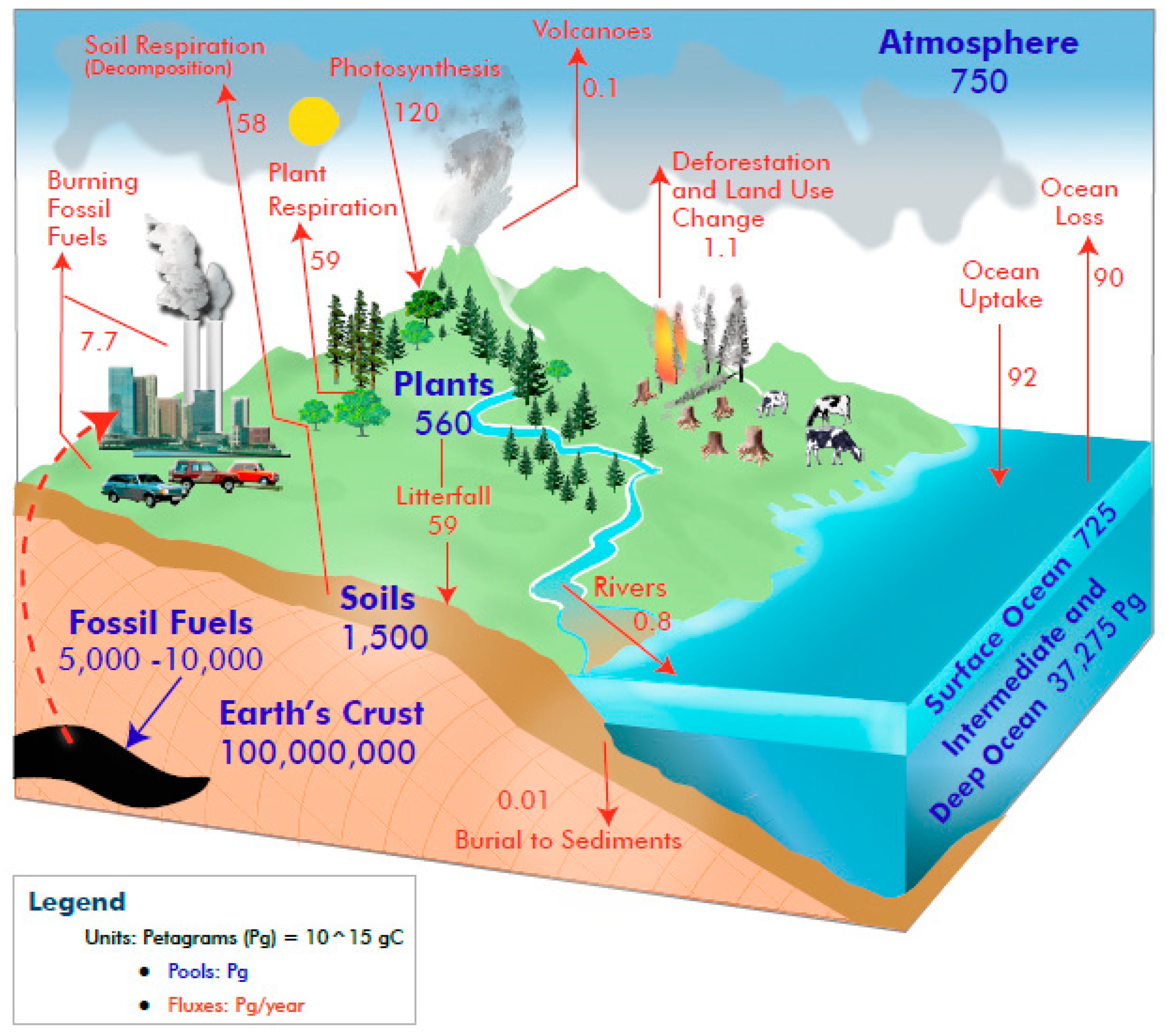
Figure 1. Global C cycle (C is in Pg = 1015 gC). Blue= pools; red= fluxes (Pg/y). Reprinted from Ref. [6].
Agronomy 16 00360 g001
Figure 2. Major pools of carbon in the Earth System (Pg = Petagrams = 1015 g). Reprinted from Ref. [7].
Agronomy 16 00360 g002
Figure 3. (a) Relative proportion of individual GHG emissions; (b) main sources of GHG emissions. Reprinted from Refs. [24,25].
Agronomy 16 00360 g003
Figure 4. Global distribution of SOC and SIC according to the soil depth. SOC in 0–0.3 m (a), 0.3–1 m (b), and 1–2 m (c); SIC in 0–0.3 m (d), 0.3–1 m (e), and 1–2 m (f). Reprinted from Ref. [10].
Agronomy 16 00360 g004
Figure 5. GHG emissions from soils (mg CO2eq). Reprinted from Ref. [47].
Agronomy 16 00360 g005
Figure 6. Agriculture emissions shares of regional GHG emissions. Adapted from Ref. [125].
Agronomy 16 00360 g006
Figure 7. Agricultural emissions shares of world total CO2eq emissions. Adapted from Ref. [125].
Agronomy 16 00360 g007
Figure 8. Global emission for the main agriculture categories relative to the period 1961–1990. Error bars represent 95% confidence intervals, based on uncertainty estimates. The pie chart indicates the percentage contribution of each category to total emission from agriculture for the year 2010. Reprinted from Ref. [128].
Agronomy 16 00360 g008
Figure 9. Agricultural greenhouse gas emission reduction model. Reprinted from Ref. [85].
Agronomy 16 00360 g009
Figure 10. Carbon sequestration potential of world’s soil. Reprinted from Ref. [134].
Agronomy 16 00360 g010
Figure 11. Conceptual diagram of NbS involving protection, restoration, and management of natural and semi-natural ecosystems. Reprinted from Ref. [145].
Agronomy 16 00360 g011
Figure 12. Nature-based Solutions and the key factors that influence their effectiveness. Reprinted from Ref. [148].
Agronomy 16 00360 g012
Figure 13. Additional SOC storage potential to climate mitigation. (a) NbS and no interventions comparison. (b) NbS with variation (shading). (c) SOC value in each NbS. (DOM is dead organic material). Reprinted from Ref. [171].
Agronomy 16 00360 g013
Figure 14. Maximum climate mitigation potential of soil in 2030. Reprinted from Ref. [172].
Agronomy 16 00360 g014
Figure 15. The role of soil and co-benefits for sustainable development. Reprinted from Ref. [174].
Agronomy 16 00360 g015
Figure 16. Recommended management practices (RMPs) for soil carbon sequestration. Reprinted from Ref. [176].
Agronomy 16 00360 g016
Figure 17. C sequestration potential of different land use and management options. Adapted from Ref. [269].
Agronomy 16 00360 g017
Table 1. Potential mitigation methods for N2O and CH4 from the manure management continuum. Reprinted from Ref. [85].
MethaneNitrous Oxide
Animal houseModify feeding strategy
Removal of a slurry from
beneath the house
Modify feeding strategy
Adopt a slurry-based system compared
to a straw or deep litter system
Manure storeCooling slurry; e.g., below the slatted floor
Modify feeding strategy
Removal of slurry from the slurry store
Minimising slurry volume stored in summer months
Modify feeding strategy
Keep anaerobic (e.g., cover and compact)
Adopt a slurry-based system compared to a
straw of deep litter-based system
Add additional straw to immobilise ammonium-N
Land spreadingCooling slurry
Aerate solid manure heaps-composting Anaerobic digestion
Enhancing crust formation
Modify feeding strategy
Nitrification and inhibition
Spring application of slurry
Integrate manure N with fertiliser N
Slurry separation
Solid manure application
Table 2. Key drivers of GHG emissions from soils. Reprinted from Ref. [47].
Land useTransformation
Ecosystem resilience
Land coverForestlands, grasslands, barren lands, croplands, wetlands, other land covers
VegetationAge and type
Distribution
Leaf area index
NutrientsC/N ratios
Land use management
Atmospheric deposition
HumiditySoil water content (SWC)
Water-filled pore space (WFPS)
Precipitation/drought
TemperatureRadiation
Exposure (Soil cover, exposition)
Corg
Soil colour (mineralogy)
Wildfires
Table 3. Emissions data from land change use. Reprinted from Ref. [128].
Agriculture category (MtCO2 eq/yr)19611990200020052010
Enteric fermentation13751875186319472018
Manure left on pasture386578682731764
Synthetic fertiliser67434521582683
Rice cultivation366466490493499
Manure management284319348348353
Crop residues66124129142151
Manure applied to soils5988103111116
Total (MtCO2 eq/yr)2604388341,36143544586
Net deforestation 4315429633973374
Combined total 8198843277517960
Table 4. Specific types of NbS implemented within ecosystem. Reprinted from Ref. [147].
Type of Nature-based Solutions
GreenBlueMixed (Green-Blue)Hybrid (Green-Blue-Grey)
Urban parksPondsMangrovesBioswales
Heritage parksWetlandsVegetable wetlandsRain gardens
Green stripsRiversCoral reefsGreen roof
Plains grass coverLakes and streamsSeagrassPermeable surface channels
Trees and shrubsSeas and oceansRiparian buffer zonesLive pole drains
Forest orchardAquifer protectionSubmerged dams or weirsLive cribwalls
Hedges/shrubs/green fencesRoom for the riverBeach nourishmentLive ground anchors, etc.
Street trees(s)Constructed flood storage, etc.
Agroforestry Forest protection Reforestation Optimised forest Managements, etc.
Disclaimer/Publisher’s Note: The statements, opinions and data contained in all publications are solely those of the individual author(s) and contributor(s) and not of MDPI and/or the editor(s). MDPI and/or the editor(s) disclaim responsibility for any injury to people or property resulting from any ideas, methods, instructions or products referred to in the content.