Article

Doubling CO2 Modulates Root Morphology to Enhance Maize Elemental Stoichiometry and Water Use Efficiency Under Soil Drought and Salinity

Key Laboratory of Agricultural Soil and Water Engineering in Arid and Semiarid Areas, Ministry of Education, Northwest A&F University, Yangling 712100, China
*
Author to whom correspondence should be addressed.
These authors contributed equally to this work.
Agronomy 2026, 16(3), 326; https://doi.org/10.3390/agronomy16030326
Submission received: 16 December 2025 / Revised: 16 January 2026 / Accepted: 26 January 2026 / Published: 28 January 2026

Abstract

This study aimed to explore the effect of doubled CO2 concentration (d[CO2]) on the modulation of root morphological structure, leaf potassium (K)/sodium (Na) ratio, and nutrient stoichiometry, as well as water use efficiency (WUE) of a C4 maize (Zea mays L.) in response to soil drought and salinity. C4 maize was grown in two atmospheric CO2 concentrations of 400 and 800 ppm (a[CO2] and d[CO2]), subjected to two soil water regimes (well-watered and drought stress) and two soil salinity levels (0 and 100 mM NaCl pot−1 (non-salt and salt stress)). The results indicated that soil drought increased maize root tissue density and specific root length. Both d[CO2] and salt stress reduced leaf phosphorus (P) and K concentrations; conversely, drought stress enhanced leaf nitrogen (N) and K concentrations. The lower specific leaf area, but greater specific leaf N and N/K under soil drought, was amplified by salt stress. In contrast, d[CO2] promoted leaf carbon (C)/N and C/K. Notably, d[CO2] combined with soil drought enhanced leaf K/Na under salt stress. Moreover, d[CO2] ameliorated the adverse impacts of soil drought and salinity on root morphology in terms of enlarged root length and root surface area, contributing to superior leaf C, N, and K use efficiency and consequently improved C4 maize plant dry mass and WUE. These findings would provide essential knowledge to elevate salt tolerance and achieve optimal nutrient homeostasis and WUE in C4 maize, adapting to future drier and more saline soils under a CO2-enriched scenario.

1. Introduction

The continuously increasing atmospheric CO2 concentration ([CO2]) has caused global warming, leading to the aggravated magnitude of soil drought and salt stress in arid agricultural areas [1]. Moreover, C4 maize is well known to have greater resistance to various abiotic stresses because of the highly efficient CO2 fixation adaptations during the photosynthetic process, further impacting plant growth, as well as water and nutrient utilization [2]. Maize (Zea mays L.) is one of the most widely cultivated cereal crops worldwide, serving as a staple food for humans, feed for livestock, and a raw material for multiple industrial products. Its cultivation is widely distributed in arid and semi-arid regions, where soil drought and salinity frequently co-occur and severely restrict yield and quality [3]. Therefore, a better understanding of how doubling the CO2 concentration (d[CO2]) modulated root development, element stoichiometry, and water use efficiency (WUE) in C4 maize in response to soil drought and salinity was vital for improving resource efficiency under changing environmental scenarios.
Earlier evidence has found that drought stress inhibited crops’ aboveground dry mass [4]. Aboveground photosynthetic products could be transported to roots on account of the synergistic regulation and dynamic balance between aboveground and underground biomass. This could ensure the optimal allocation of resources under drought conditions and enhance plant drought resistance [5]. The effects on root growth were quite different according to the water stress degree and crop type. Mild and moderate water stress was beneficial to root development, while the root length and activity were significantly inhibited under severe drought [6]. Additionally, the response of C4 maize root morphological traits to water stress was found to be heightened, as presented in a previous study [7]. Moreover, mineral nutrients were absorbed through the soil water into the plant. On the one hand, drought stress influenced root nitrogen (N) and potassium (K) absorption via reducing available soil nutrients, namely decreasing the diffusion and migration rates of soil mineral elements to the root surface [8]. On the other hand, the decreased transpiration rate in the plant also had an adverse effect on nutrient uptake [9]. Hence, leaf element stoichiometry and the use efficiency were affected by soil drought, resulting in lowered mineral accumulation and imbalance of plant nutrients [10], further varying plant growth and WUE.
Previous studies have revealed that soil salinity inhibited primary root elongation but promoted lateral root proliferation to directly mediate water and nutrient acquisition from the soil [11]. The osmotic stress and ionic toxicity (sodium (Na) accumulation) induced by salinity modulated hormonal signals (auxin and abscisic acid) to disrupt root cell division and elongation, resulting in a shorter and denser root system and reduced root biomass [12]. In addition, the reduced uptake of nutrients, particularly N under saline soil, was derived from the decreased water transportation and nitrate reductase activity, resulting in lowered leaf elemental concentrations, which further disrupted carbon (C) assimilation during the photosynthetic process and adjusted leaf element stoichiometric ratios [13]. The more Na accumulation relative to K deficiency in saline-affected leaves was ascribed to the excessive Na competing with K for the enzyme binding site, thus impairing metabolic process, reducing leaf K/Na ratio, and salt tolerance [14,15]. It was commonly reported that salt stress reduced leaf stomatal conductance and water consumption, while simultaneously limiting CO2 uptake and dry mass accumulation, thus inducing varied WUE depending on the different magnitude of photosynthesis decrease relative to transpiration [16,17]. Hence, the analysis of root structure and leaf elemental stoichiometry was a useful method to provide an important understanding of ion homeostasis for maximizing C4 maize WUE under soil salinity.
There were controversial observations on the photosynthesis and growth of C4 maize responding to d[CO2] in terms of similar or enhanced photosynthetic processes under the CO2-concentrating mechanism, resulting in no decrease in C concentration [18]. Whether d[CO2] can promote root growth depends on the disparate crop varieties and [CO2] conditions. Recent evidence has indicated that the root development parameters of oriental melon were increased under d[CO2] concentrations, but then decreased during the prolongation of d[CO2] treatment [19]. Furthermore, the ability of the roots to absorb mineral nutrients from soil would directly influence plant element concentrations [20]. The decreased mineral concentration in d[CO2] plants was a result of the increased dry mass, namely the ‘dilution effect’ on element content [21] and the lowered transpiration flux accompanied by reduced water and nutrient absorption [22]. It was generally believed that the d[CO2] plant had a greater plant C content, but a larger decreasing effect on N than other mineral elements [23], resulting in an enhanced C/N ratio, but a decreased N/K [24] and varied plant K/Na under salt stress [1]. Earlier studies have noted that d[CO2] could alleviate the negative effect of soil drought on plant growth [25]. Nonetheless, how d[CO2] concentrations modulate root architecture and leaf nutrient status in C4 maize plants, further altering plant salt tolerance and WUE under drought stress, remains poorly understood. Compared with existing studies on maize and other C4 crops under elevated CO2, which primarily explored single or dual stress factors without systematic investigation of how elevated CO2 mediates root development optimization and ion homeostasis in response to concurrent water and salt stress, this study provides some useful knowledge for the adaptive potential of C4 maize under increased soil degradation and climate change.
Therefore, in the current study, C4 maize plants were grown in two atmospheric CO2 concentrations (400 ppm (ambient CO2 concentration (a[CO2])) and 800 ppm (d[CO2]), respectively) and exposed to two water stress regimes (well-watered (W) and drought stress (D)) and two salt stress levels ((0 and 100 mM NaCl pot−1 (N and S)). The aim of this study was to investigate the mediating effect of d[CO2] on root morphological traits, leaf element stoichiometry and K/Na ratio, leaf nutrient use efficiency, and plant WUE in the C4 maize crop under soil drought and salt stress. It was hypothesized that d[CO2] could have a positive impact on root morphology and, accordingly, mitigate the negative influence of soil drought and salt stress on leaf nutrient balance to improve salt tolerance and WUE in C4 maize.

2. Materials and Methods

2.1. Crop Material and Growth Conditions

The experiment was carried out in two phytotrons (Qiushi Artificial Environment Co., Ltd., Hangzhou, China) where light, temperature, humidity, and CO2 concentrations could be controlled at the South Campus of Northwest A&F University in Yangling, Shaanxi, China, from June 2023. The experimental setup and processing have been detailed in Xu et al. (2025) [26], as this was the same experimental design, and only a brief summary is given here. In this experiment, half of the maize (MC278) seedlings were grown in a phytotron with an ambient CO2 concentration of 400 ppm (a[CO2]), and the other half was grown in the phytotron with a doubled CO2 concentration of 800 ppm (d[CO2]). Maize plants were exchanged between two CO2 phytotrons every two weeks to eliminate differences in light intensity, temperature uniformity, and other microenvironmental factors within the chambers, thus ensuring the repeatability and reliability in controlled CO2 treatments throughout the experiment. Meanwhile, the air temperature in each phytotron was set at 25/18 ± 2 °C during the day/night, and the relative humidity was maintained at 60%. The light duration was set to 16 h per day, and the photosynthetically active radiation provided by high-pressure sodium lamps and LED lights was 500 μmol m−2 s−1.

2.2. Experimental Design

Two CO2 concentrations were set in this experiment: ambient CO2 concentration (a[CO2], 400 ppm) and doubled CO2 concentration (d[CO2], 800 ppm). Thereafter, salt stress was established in maize plants under two salt levels, non-salt treatment (N, 0 mM NaCl pot−1) and salt treatment (S, 100 mM NaCl pot−1, moderate salt stress [27]), and exposed to two water stress regimes, well-watered (W) and drought stress (D). For the drought stress treatment, plants were harvested when the stomatal conductance (gs) in maize gradually decreased to 10% of the well-watered plants. Specifically, at a[CO2], the duration of progressive soil drought in N and S plants was 14 and 18 days, respectively. At d[CO2], the duration of progressive soil drought in N and S plants was 15 and 22 days, respectively. The fertilizer was supplied as 2.7 g CO(NH2)2 and 2.2 g KH2PO4 in each pot. The pot experiment was randomly designed, including eight treatments with four replicates per treatment.

2.3. Measurements

2.3.1. Root Morphological Traits

All roots in each pot were carefully picked with tweezers, washed with tap water to remove attached soil particles, and stored at −80 °C before measuring root traits. Briefly, roots were washed over a 2 mm sieve, and broken segments during rinsing were also collected. Subsequently, each clean root sample was scanned on a 20 × 25 cm transparent tray containing deionized water using WinRHIZO Pro Root Analysis System (Modified Epson Expression 12000XL, Regent Instruments Inc., Québec, QC, Canada; official website: https://www.regentinstruments.com) at a 400 dots per inch resolution. The resulting images were analyzed with WinRHIZO software (Regent Instruments Inc., Quebec, QC, Canada) for root length (RL), root surface area (RSA), root volume (RV), and root average diameter (RAD). Root tissue density (RTD) was calculated as root dry mass (RDM) divided by RV [28]. Specific root length (SRL) was calculated as RL divided by RDM.

2.3.2. Leaf Element Concentration and Content

The leaf dry mass was ground into fine powder and separately analyzed for C and N concentrations using a CHNS/O Elemental Analyser (Flash 2000, Thermo Fisher Scientific, Cambridge, UK). Leaf K concentrations were determined by inductively coupled plasma mass spectrometry (ICP-MS, Agilent 7700×, Agilent Technologies, Santa Clara, CA, USA). Leaf Na concentration was measured using flame photometry (PE-pinAAcle, 900 F, PerkinElmer Inc., Waltham, MA, USA).
The content of each chemical element (C, N, K, and Na) in the leaf was obtained by multiplying the corresponding element concentration by leaf dry mass.

2.3.3. Acquisition of Leaf Stoichiometry, K/Na and Element Use Efficiency

Leaf stoichiometric ratios ([C/N], [C/K], and [N/K]) were calculated as the ratio of the corresponding element concentrations in the leaf. The leaf K/Na ratio ([K/Na]) was calculated as the ratio of K concentrations to Na concentrations. Leaf C, N, and K use efficiency (CUE, NUE, and KUE) was estimated as leaf dry mass divided by each corresponding element concentration.

2.3.4. Acquisition of Specific Leaf N, Plant Dry Mass, and Water Use Efficiency

The maize stems and leaves were harvested at the end of the progressive soil drought by cutting the stems from the soil surface. The entire root was carefully removed from the pot soil, and after root morphology measurement, the root, stem, and leaf were oven dried at 70 °C to a constant weight to obtain root dry mass (RDM) and aboveground (stem and leaf) dry mass (ADM). Plant total dry mass (TDM) was the sum of RDM and ADM. The root-to-shoot ratio (RSR) was calculated as RDM divided by ADM.
Specific leaf area (SLA) was calculated as the ratio of leaf area to leaf dry mass. Specific leaf N (SLN) was calculated as the ratio of leaf N concentrations to SLA. Plant water use efficiency (WUEp) was calculated as the ratio of TDM to plant water use during progressive soil drought stress.

2.4. Statistics Analysis

A three-way analysis of variance (ANOVA) was performed on the experimental data. The effects of the independent factors, CO2 concentration ([CO2]), salt level ([S]), and water stress ([W]), as well as their interactions, were analyzed using the software IBM SPSS Statistics 24.0 (SPSS Inc., New York, NY, USA). Specifically, the Shapiro–Wilk test was used to verify data normality, and the Levene’s test was employed to check homogeneity of variance. The F-test and P-test were conducted to assess the significance of the independent factors, CO2 concentrations ([CO2], 400 ppm and 800 ppm), salt levels ([S], N and S), and water stresses ([W], W and D), as well as their interactions. *, ** and *** indicate significance levels at p < 0.05, p < 0.01, and p < 0.001, respectively.
The results of the CO2 effect were expressed as mean relative change  ±  standard error, being calculated as the percentage change [(Cd/Ca − 1)  ×  100] in response to d[CO2], where Ca and Cd were the average values of each measured variable from individual replicates in a[CO2] and d[CO2] environments, respectively. Error bars indicated the standard error of four replications.
Pearson’s correlation among all variables was performed using the software OriginPro 2024 (OriginLab Corporation, Northampton, MA, USA).

3. Results

3.1. Root Morphology

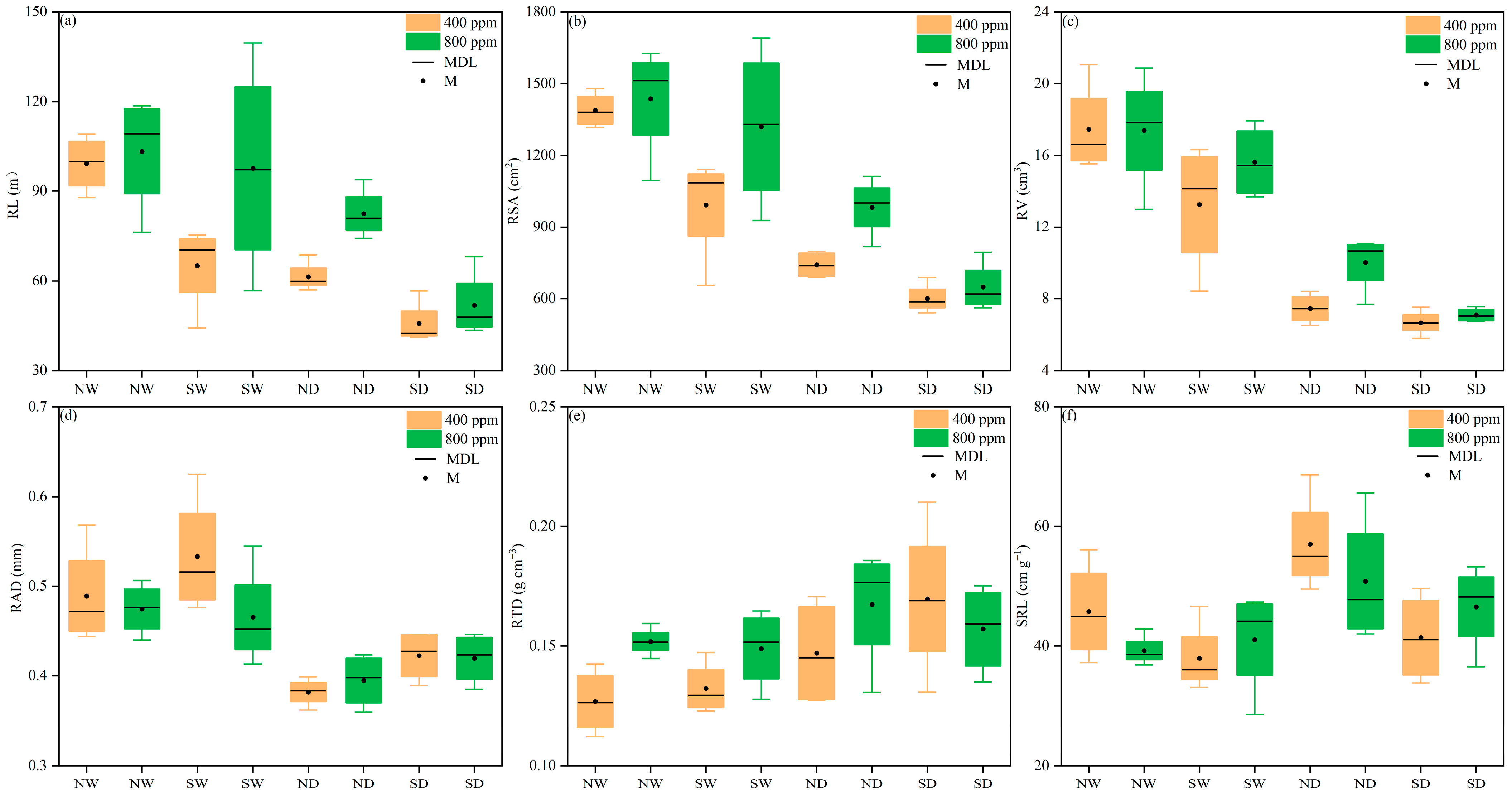
d[CO2] increased maize RL and RSA relative to a[CO2]. Salt stress decreased maize RL, RSA, RV, and SRL relative to the non-salt treatment. Drought stress decreased maize RL, RSA, RV, and RAD, but increased maize RTD and SRL relative to the well-watered treatment (Figure 1; Table 1).

3.2. Leaf Element and Na Concentration and Content

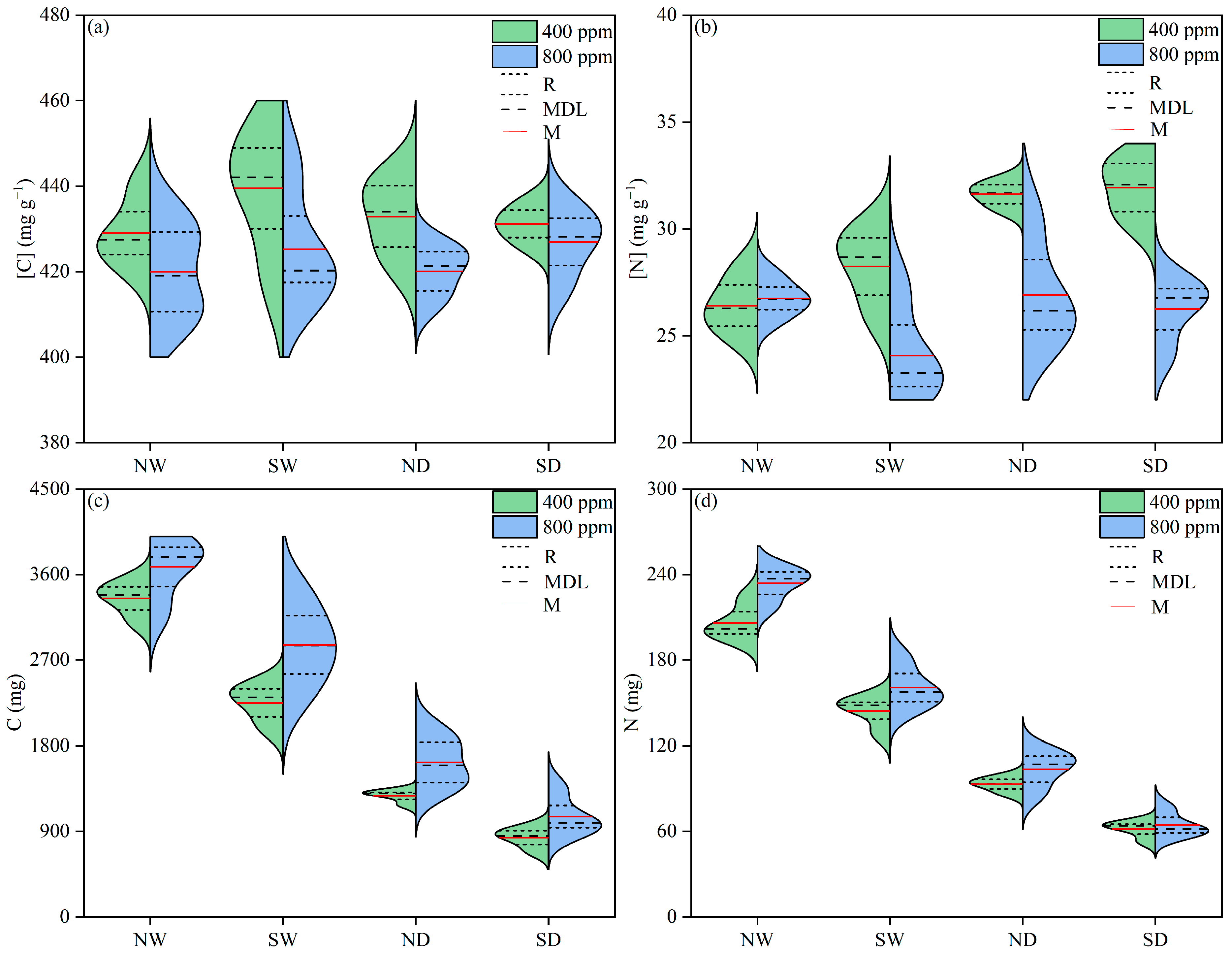
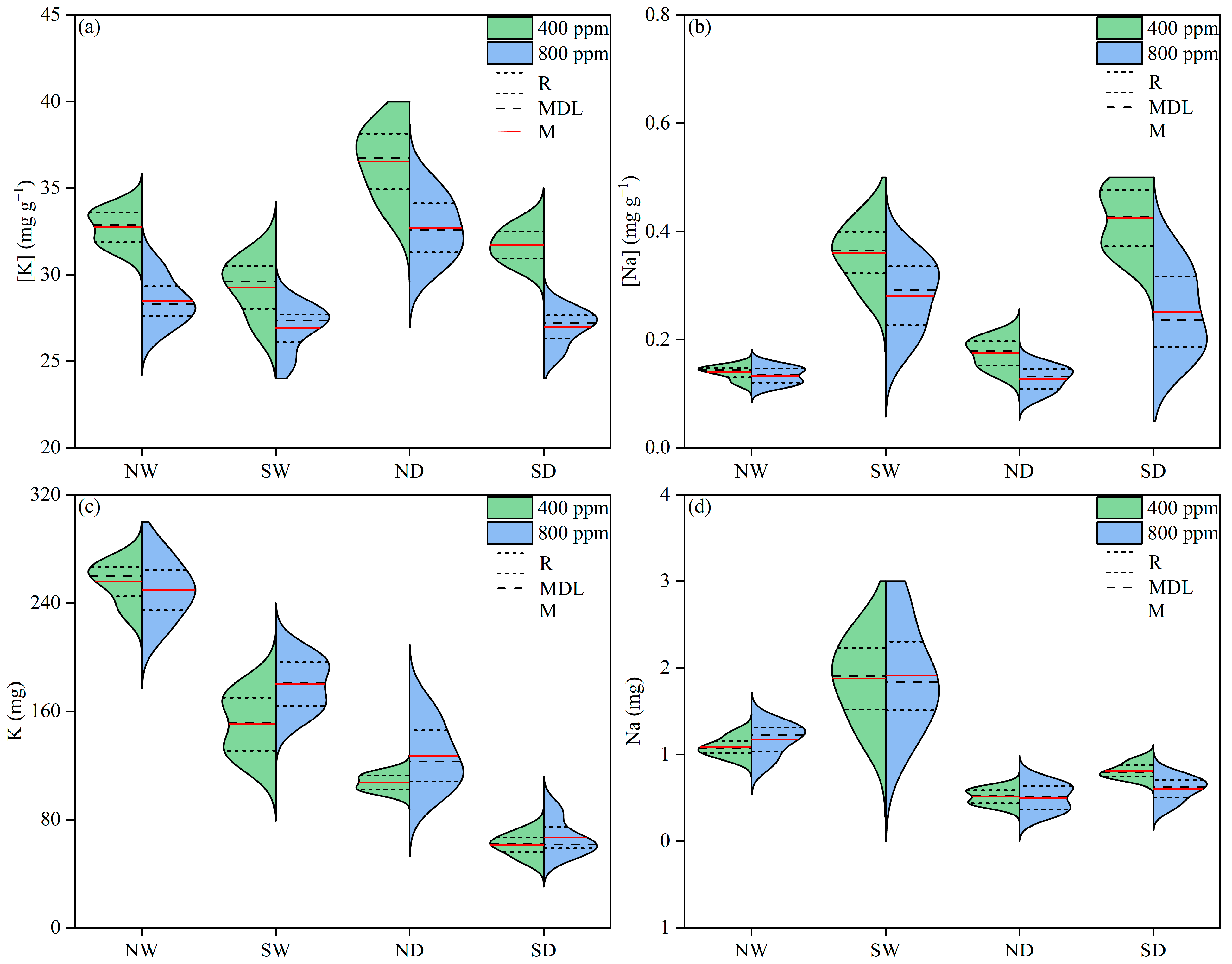
d[CO2] decreased maize [C], [N], [K], and [Na] relative to a[CO2]. Salt stress decreased maize [K], but increased maize [Na] relative to non-salt treatment. Drought stress increased maize [N] and [K] relative to the well-watered treatment (Figure 2 and Figure 3; Table 2).
d[CO2] increased maize C and N relative to a[CO2]. Salt stress decreased maize C, N, and K, but increased maize Na relative to the non-salt treatment. Drought stress decreased maize C, N, K, and Na relative to the well-watered treatment (Figure 2 and Figure 3; Table 2).

3.3. Leaf Stoichiometry, K/Na, and Element Use Efficiency

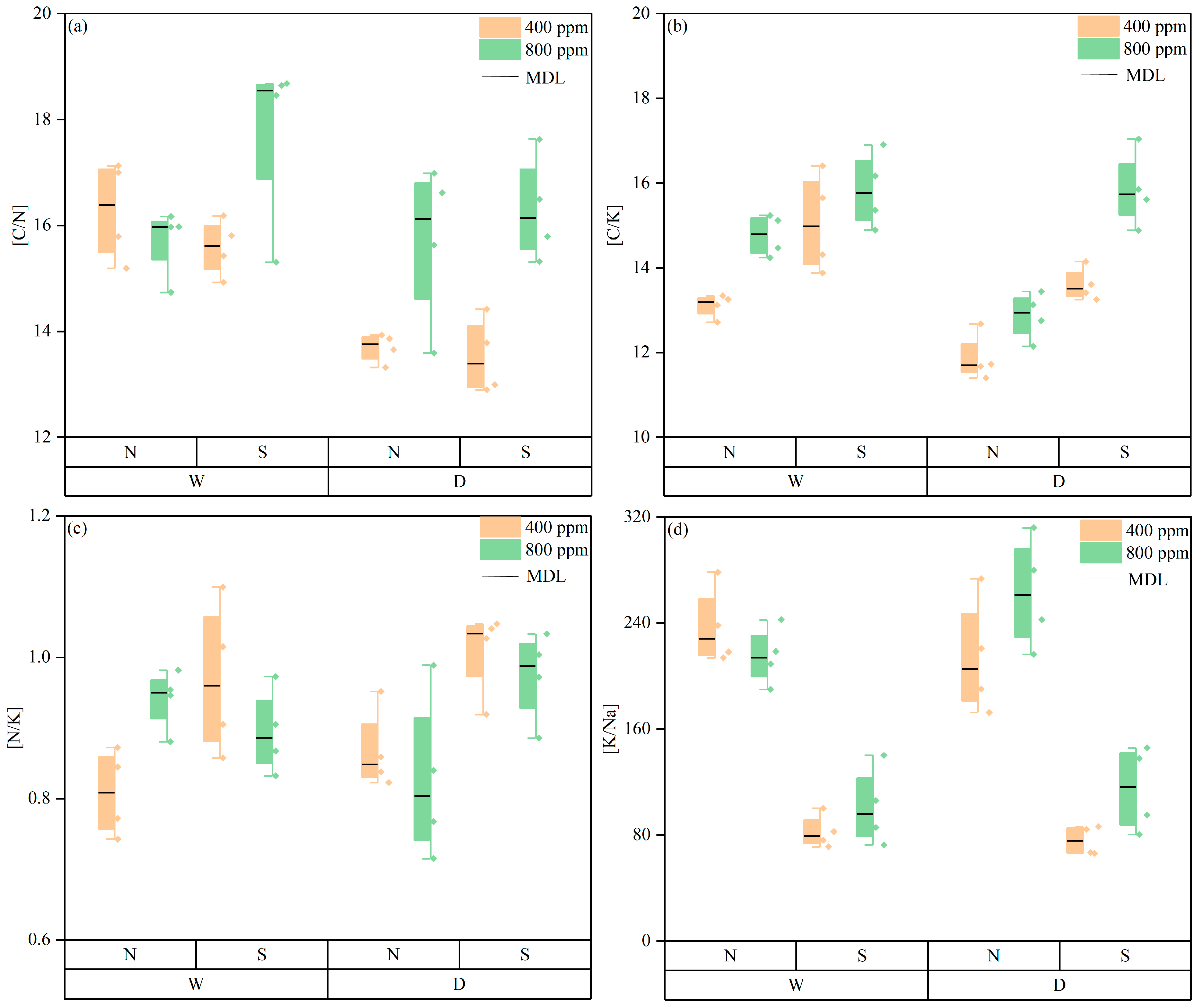
d[CO2] increased maize [C/N] and [C/K] relative to a[CO2]. Salt stress decreased maize [K/Na], but increased maize [C/K] and [N/K] relative to the non-salt treatment. Drought stress decreased maize [C/N] and [C/K], but increased maize [N/K] relative to the well-watered treatment. Moreover, regardless of salt treatment, d[CO2] together with drought stress increased maize [K/Na] (Figure 4; Table 3).
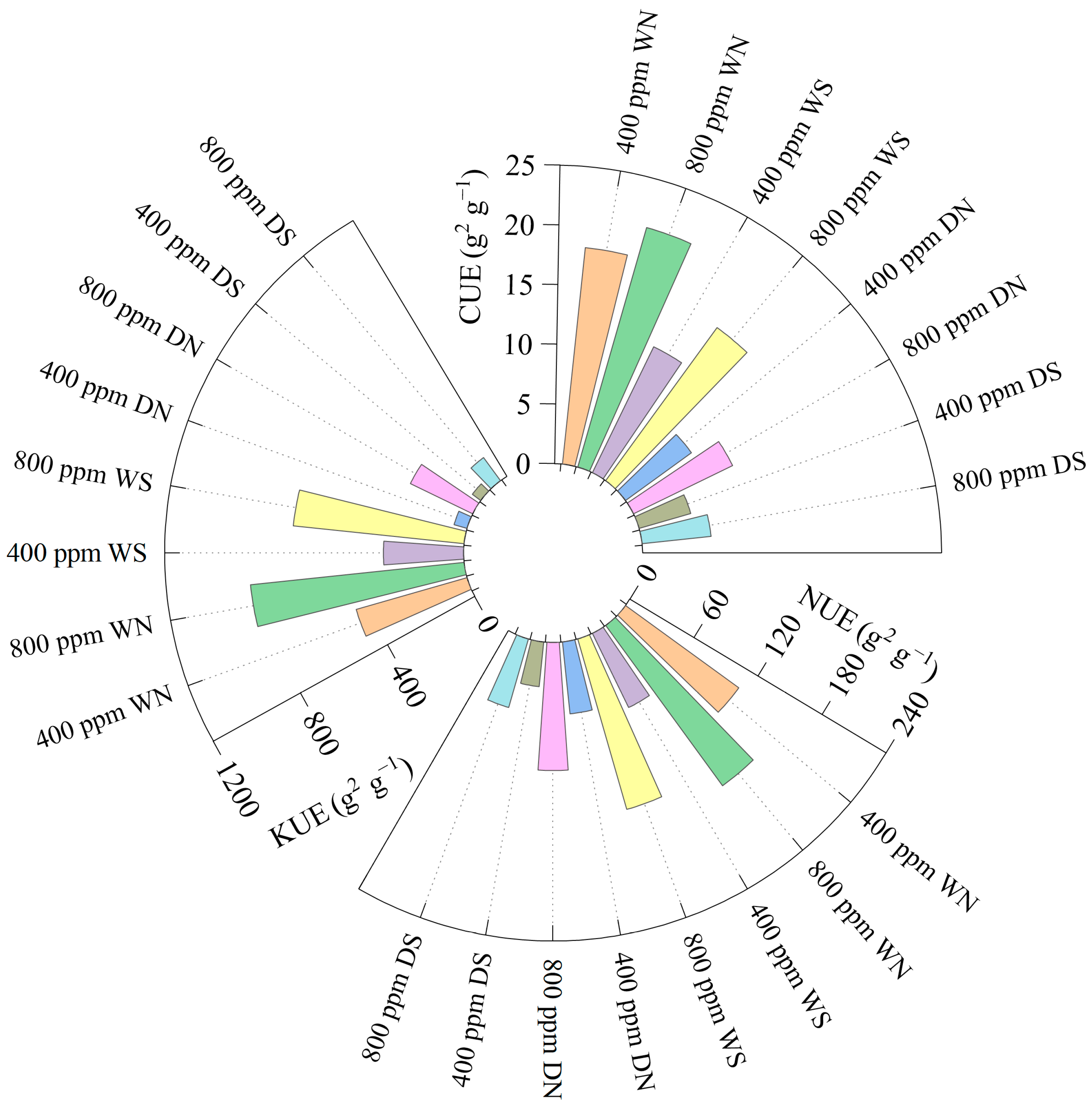
d[CO2] increased maize CUE, NUE, and KUE relative to a[CO2]. Salt stress decreased maize CUE, NUE, and KUE relative to the non-salt treatment. Drought stress decreased maize CUE, NUE, and KUE relative to the well-watered treatment (Figure 5; Table 3).

3.4. Specific Leaf N, Plant Dry Mass, and Water Use Efficiency

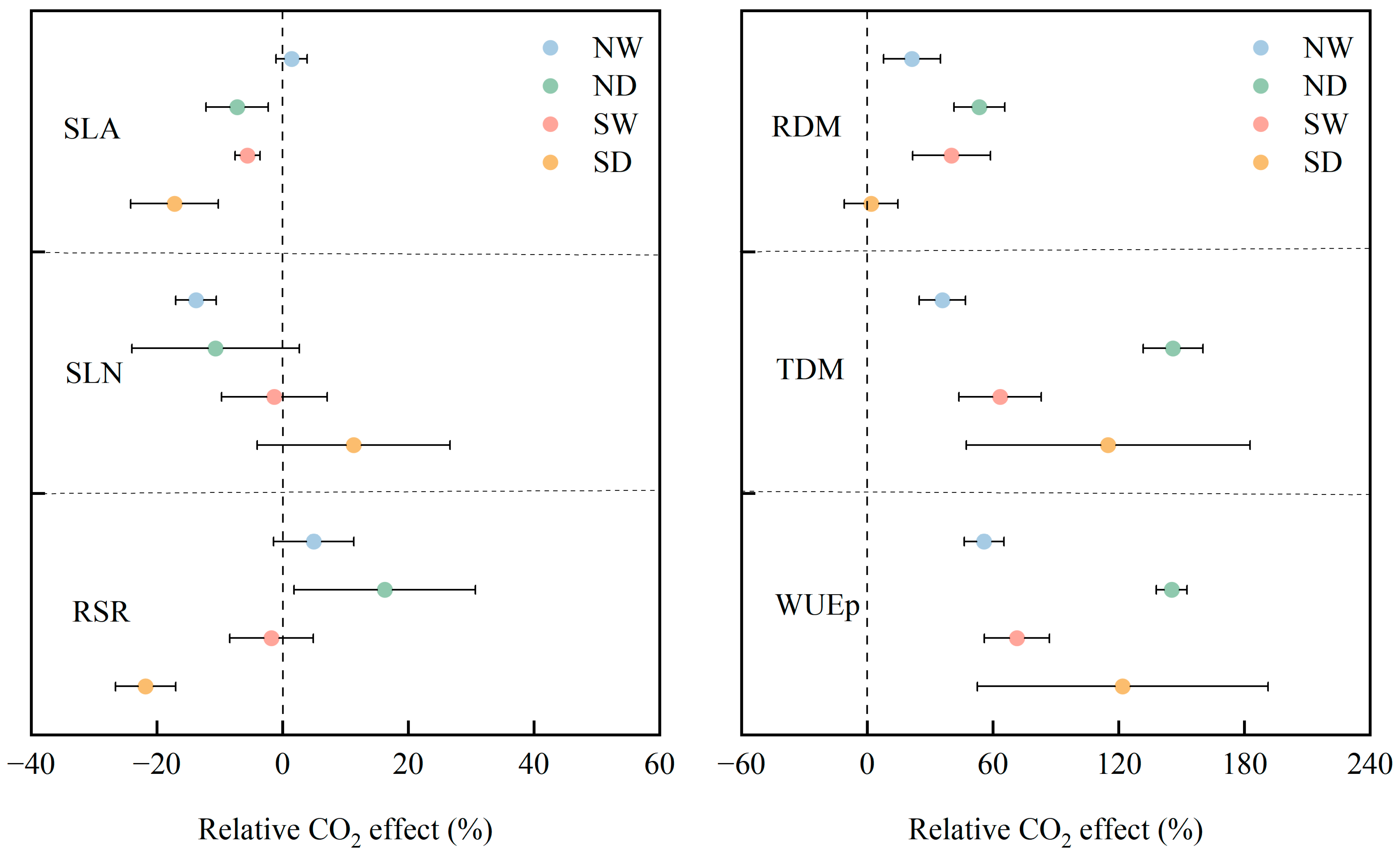
d[CO2] decreased maize SLA, but increased maize RDM, TDM, and WUEp relative to a[CO2]. Both salt and drought stress decreased maize SLA, RDM, TDM, and WUEp, but increased maize SLN and RSR relative to non-salt and well-watered treatment (Figure 6; Table 4).

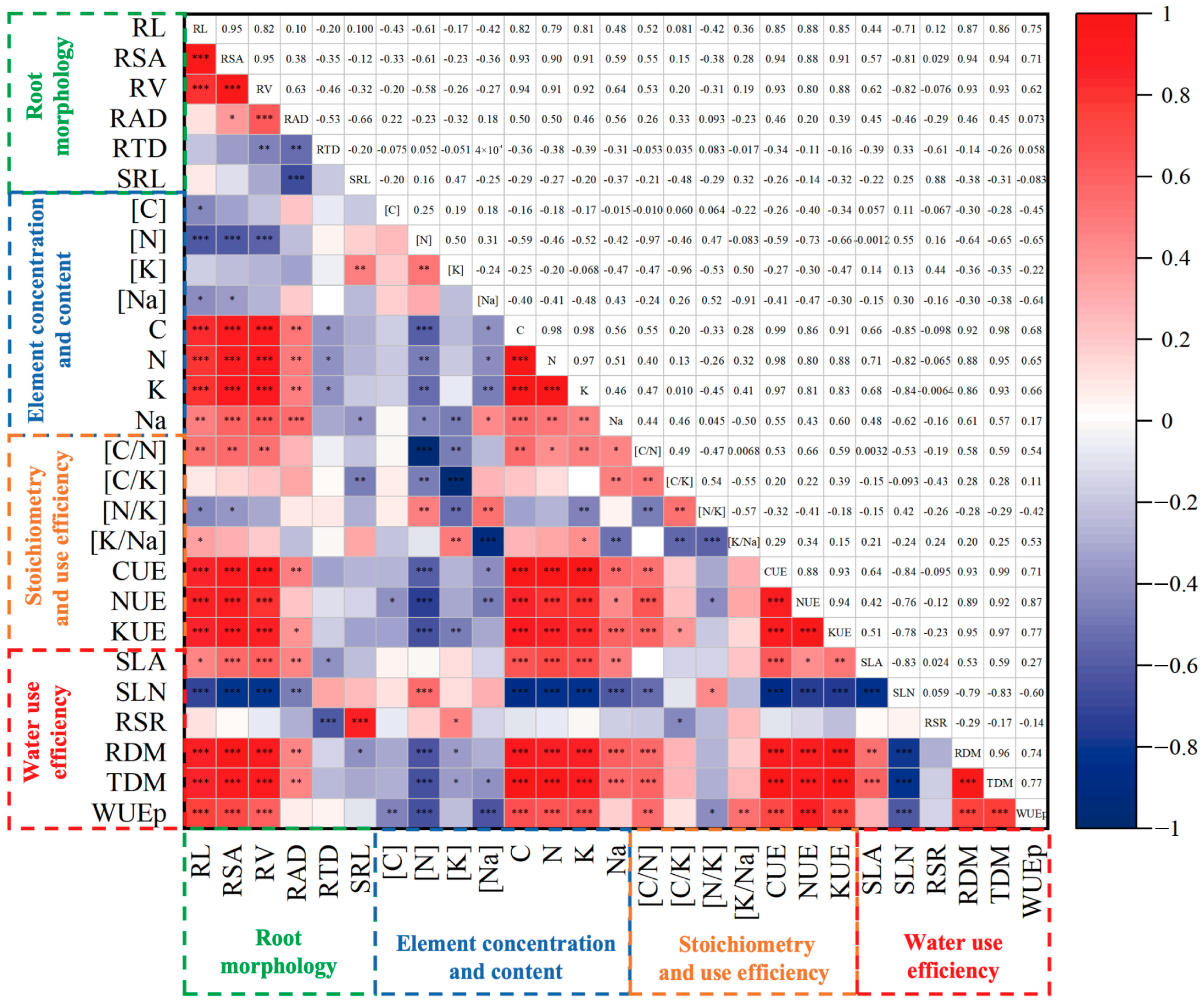
3.5. Correlations Between Measured Variables

The correlation analysis of all measured variables is revealed in Figure 7. RL, RSA, and RV were positively correlated with C, N, K, [C/N], CUE, NUE, KUE, SLA, RDM, TDM, and WUEp, and negatively correlated with [N] and SLN. C, N, and K were positively correlated with RL, RSA, RV, RAD, [C/N], CUE, NUE, KUE, SLA, RDM, TDM, and WUEp, and negatively correlated with SLN. [K/Na] was positively correlated with RL, [K], K and WUEp, and negatively correlated with [Na], Na and [N/K].
SLA, RDM, and TDM were positively correlated with RL, RSA, RV, RAD, C, N, K, CUE, NUE, and KUE, and negatively correlated with SLN. SLN was positively correlated with [N] and [N/K], and negatively correlated with RL, RSA, RV, RAD, C, N, K, [C/N], CUE, NUE, KUE, SLA, RDM, TDM, and WUEp. WUEp was positively correlated with RL, RSA, RV, C, N, K, [C/N], [K/Na], CUE, NUE, KUE, RDM, and TDM, and negatively correlated with [Na], [N/K], and SLN.

4. Discussion

It was well known that root structure can be stimulated under moderate drought stress, whereas it is restrained under severe drought [6]. Similarly, in the present study, drought stress decreased RL and RSA, but increased RTD and SRL (Figure 1; Table 1), reflecting a potential finer and denser root system to coordinate root-to-shoot growth and facilitate water and mineral acquisition in the moisture-limited soils [29]. Additionally, the enhanced root morphology here was possibly attributed to the C4 maize plant, having a stronger survival capacity to regulate root development under soil drying, as reported in [30]. It was revealed that salt stress suppressed maize RL, RSA, RV, and SRL in Figure 1; Table 1 mostly attributed this to the osmotic disturbance and Na+-induced cytotoxicity in root meristematic tissue to restrict primary cell elongation without compensatory lateral root growth [31]. Furthermore, it is worth noting that the maintenance of maize RV and RAD and enhancement in RL and RSA were observed at d[CO2] (Figure 1; Table 1), which was in line with the earlier study reporting that d[CO2] could drive greater photoassimilate distribution to the root and stimulate root division, thus optimizing soil resource absorption under diverse abiotic stress [32]. Hence, d[CO2] could alleviate the negative effects of both soil drought and salt stress on root development. This was also confirmed by the positive correlations between RL, RSA, RV, and C, N, K, CUE, NUE, KUE, RDM, TDM, and WUEp of this study (Figure 7). Our results emphasized the preferential root architecture investment to counteract stress impacts and played a vital role in coordinating carbon assimilation and resource allocation [33], further maximizing water and nutrient use efficiency in the C4 maize plant.
In the current study, drought maize maintained [C] and [Na], and even enhanced [N] and [K] (Figure 2 and Figure 3; Table 2), probably owing to the lowered transpiration loss, reduced biomass accumulation, and compensatory root acquisition, inducing an elemental “concentration effect” in drought-stressed plants, as described in [34]. Likewise, soil salinity here reduced maize [K], but maintained [C] and [N] (Figure 2 and Figure 3; Table 2) due to the similar explanation underlying drought stress [35]. However, the content of each element (C, N, K, and Na) in the maize leaf was conversely reduced under drought and salt stress (Figure 2 and Figure 3; Table 2), indicating that the suppression of leaf dry matter was more severe than the reduction in elemental concentration in the stressed maize.
The [C] in d[CO2] plants is commonly increased through the greater C assimilation during leaf photosynthesis, while the unexpectedly lower maize [C] here (Figure 2; Table 2) may result from the “dilution effect”, wherein the larger biomass increment exceeded the C accumulation per dry matter, as defined in [36]. Meanwhile, d[CO2] normally reduced leaf element concentration as a result of the “dilution effect” in plant biomass and diminished transpiration flux from soil to leaf [37]. This was consistent with the obtained results, revealing the reduced maize [N], [K], and [Na] at d[CO2] (Figure 2 and Figure 3; Table 2). Whereas, compared to a[CO2], leaf elemental contents were not decreased at d[CO2] in terms of similar K and Na, and enhanced C and N (Figure 2 and Figure 3; Table 2), attributed to the higher leaf biomass formation in d[CO2] maize plants. Obviously, our results indicated that d[CO2] could have mitigated the adverse impacts of soil drought and salinity on maize leaf C accumulation and nutrients (N and K) uptake.
It has been suggested that diverse changes in elemental concentrations could alter leaf nutrient imbalance and stoichiometry, finally influencing crop metabolism and growth [38]. Here, salt stress reduced maize [K/Na], but enhanced [C/K] and [N/K] (Figure 4; Table 3). The increased elemental stoichiometric ratios caused by salt stress were noticeable, meaning the limitation in K uptake, which was derived from the ion antagonism of Na competing with K in the transport channel, led to the disturbed mineral acquisition capability, as explained in [39]. Additionally, the greater leaf N and K concentrations relative to C concentrations under drought stress resulted in the lowered maize [C/N] and [C/K], whereas they promoted [N/K] (Figure 4; Table 3), reflecting that soil drought was beneficial to condense N concentration, consistent with [8]. In this study, d[CO2] maize had equivalent [N/K] and higher [C/N] and [C/K] (Figure 4; Table 3), in accordance with the finding from tomato plants [40], demonstrating that d[CO2] was preferred for carbon accumulation in maize leaves more than the nutrient uptake from soil roots.
d[CO2] coupled with soil drought could enhance maize [K/Na] under salt stress (Figure 4; Table 3), suggesting greater condensed leaf K minerals in contrast to Na elements of salt-stressed plants when grown under a drought and d[CO2] environment, as indicated in [41]. This was also supported by the positive correlation between RL and [K/Na] (Figure 7), contributing to the improved root development to heighten salt tolerance in the C4 maize crop. The increased root surface area in d[CO2] could increase K absorption. Moreover, it was reported that the decreased transpiration rate at d[CO2] was accompanied by the decreased Na uptake from root to shoot and increased endogenous ABA levels under soil salinity, implying ABA might play a role in regulating Na homeostasis and favoring enhanced K/Na homeostasis [42]. Whether this process was mediated by increased root Na efflux still merited further investigation.
Specific leaf N (SLN) represents the leaf N content per unit of leaf area [43]. The greater decrease in leaf area than N content led to the promotion of maize SLN under both soil drought and salinity (Figure 6; Table 4). This would certainly facilitate the photosynthetic capacity in the C4 maize leaf, but it is mainly due to the N concentration effect in smaller leaves under different abiotic stresses. SLN was maintained at d[CO2] (Figure 6; Table 4), implying a relative balance between the increased leaf N content and leaf area in the maize plant. Additionally, nutrient use efficiency was proposed as a vital indicator to assess the coordination between nutrient status and plant biomass accumulation [44]. In the present study, both soil drought and salinity decreased maize CUE, NUE, and KUE (Figure 5; Table 3). The lowered element use efficiency was primarily ascribed to the greater reduction in dry matter compared with each elemental variation in drought and salinity-stressed plants. Inversely, the improved leaf element (C, N, and K) use efficiency of d[CO2] maize (Figure 5; Table 3) resulted from the larger enhancement in biomass together with the greater reduction in element concentration relative to a[CO2] maize.
Leaf thickness could be characterized by specific leaf area (SLA). A lower SLA indicates a thicker leaf and is closely relevant to decreased N status or increased photosynthetic capacity [45]. In line with this, here, maize SLA was reduced under a drought, salt stress, and d[CO2] environment (Figure 6; Table 4). This was also demonstrated by the positive relationship between SLA and leaf element contents, including N uptake (Figure 7). Additionally, both drought and salt stress decreased root and total plant dry matter, but the root-to-shoot ratio (RSR) was enhanced in this study (Figure 6; Table 4) as a consequence of the lower reduction in RDM relative to TDM. This indicated the coordinated allometry from shoot to root, further conducive to optimizing C4 maize growth and acquiring water and nutrients in dry and saline soils [46,47]. However, for d[CO2] plants, C4 maize RDM and TDM were concurrently enhanced (Figure 6; Table 4), resulting in a sustained RSR when compared with a[CO2] plants.
It was widely accepted that plant WUE (WUEp) plays an important role in evaluating the trade-off between water absorption and C assimilation in agricultural crops, depending on the magnitude of alteration of plant biomass relative to water utilization [48]. In the present study, drought and saline soils resulted in lower maize WUEp (Figure 6; Table 4). This was because of the greater reduction in maize dry matter relative to plant water use, reflecting the cumulative effect of osmotic stress and ionic toxicity in disrupting maize photosynthesis and transpiration. Previous evidence has reported that C4 dry mass might not be increased owing to the lower sensitivity of C4 photosynthesis in response to d[CO2] [49]. On the contrary, here WUEp at d[CO2] was significantly greater than that at a[CO2] (Figure 6; Table 4), contributing to the elevated maize biomass accompanied by reduced water consumption [2]. Meanwhile, WUEp was positively correlated with RL, RSA, RV, CUE, NUE, KUE, [C/N], and [K/Na] (Figure 7), emphasizing that the optimized root plasticity and leaf ion homeostasis at d[CO2] were able to promote stress tolerance via synergistically enhancing nutrient, water acquisition, and use efficiency in the C4 maize plant.

5. Conclusions

Taken together, soil drought increased maize RTD and SRL. Both d[CO2] and salt stress reduced maize [K], but drought stress enhanced maize [N] and [K]. The lowered maize SLA, higher RSR, SLN, and [N/K] under drought stress were further amplified by soil salinity. Whilst, d[CO2] promoted maize [C/N] and [C/K]. Furthermore, d[CO2] associated with soil drought elevated maize [K/Na] under salt stress. d[CO2] attenuated the detrimental effects of soil drought and salinity on root architecture as exemplified by equivalent RV, RAD, and enlarged RL, RSA, leading to greater C, N, CUE, NUE, KUE, and ultimately improved C4 maize TDM and WUEp. These findings were substantially crucial for optimizing elemental balance and enhancing water use efficiency of C4 maize in response to a drier and saltier soil under a CO2-enriched environment.

Author Contributions

C.X.: Investigation; formal analysis; writing—original draft; visualization. H.T.: Investigation; formal analysis; writing—original draft; visualization. Z.G.: Investigation. W.Z.: Investigation. C.L.: Investigation. M.Z.: Investigation. Z.W.: Conceptualization; writing—review and editing; funding acquisition; supervision. All authors have read and agreed to the published version of the manuscript.

Funding

This work was supported by the Natural Science Basic Research Program of Shaanxi Province (2024 JC-YBQN-0491) and the National Natural Science Foundation of China (51909220).

Data Availability Statement

The data that support this finding were available from the corresponding author upon reasonable request.

Conflicts of Interest

The authors declare that they have no competing interests.

References

  1. Liang, K.H.; Peng, X.Y.; Liu, F.L. Physiological Response of Miscanthus Genotypes to Salinity Stress Under Elevated CO2. GCB Bioenergy 2022, 14, 858–874. [Google Scholar] [CrossRef] [Scilit]
  2. Wei, Z.H.; Abdelhakim, L.O.A.; Fang, L.; Peng, X.Y.; Liu, J.; Liu, F.L. Elevated CO2 Effect on the Response of Stomatal Control and Water Use Efficiency in Amaranth and Maize Plants to Progressive Drought Stress. Agric. Water Manag. 2022, 266, 107609. [Google Scholar] [CrossRef] [Scilit]
  3. Ranum, P.; Peña-Rosas, J.P.; Garcia-Casal, M.N. Global maize production, utilization, and consumption. Ann. N. Y. Acad. Sci. 2014, 1312, 105–112. [Google Scholar]
  4. Wang, Y.S.; Janz, B.; Engedal, T.; de Neergaard, A. Effect of Irrigation Regimes and Nitrogen Rates on Water Use Efficiency and Nitrogen Uptake in Maize. Agric. Water Manag. 2017, 179, 271–276. [Google Scholar] [CrossRef] [Scilit]
  5. Yang, X.; Shao, M.A.; Li, T.C.; Zhang, Q.Y.; Gan, M.; Chen, M.Y.; Bai, X. Distribution of Soil Nutrients Under Typical Artificial Vegetation in the Desert-Loess Transition Zone. Catena 2021, 200, 105165. [Google Scholar]
  6. Yang, Z.Q.; Qiu, Y.X.; Liu, Z.X.; Chen, Y.Q.; Tan, W. The Effects of Soil Moisture Stress on the Growth of Root and Above-Ground Parts of Greenhouse Tomato Crops. Acta Ecol. Sin. 2016, 36, 748–757. [Google Scholar] [CrossRef] [Scilit]
  7. Yahaya, M.A.; Shimelis, H. Drought Stress in Sorghum: Mitigation Strategies, Breeding Methods and Technologies—A Review. J. Agron. Crop Sci. 2022, 208, 127–142. [Google Scholar]
  8. He, M.Z.; Dijkstra, F.A. Drought Effect on Plant Nitrogen and Phosphorus: A Meta-Analysis. New Phytol. 2014, 204, 924–931. [Google Scholar] [PubMed]
  9. Chilundo, M.; Joel, A.; Wesstrom, I.; Brito, R.; Messing, I. Effects of Reduced Irrigation Dose and Slow Release Fertilizer on Nitrogen Use Efficiency and Crop Yield in a Semi-Arid Loamy Sand. Agric. Water Manag. 2016, 168, 68–77. [Google Scholar]
  10. Viciedo, D.O.; Prado, R.M.; Martínez, C.A.; Habermann, E.; Piccolo, M.C. Short-Term Warming and Water Stress Affect Panicum maximum Jacq. Stoichiometric Homeostasis and Biomass Production. Sci. Total Environ. 2019, 681, 267–274. [Google Scholar]
  11. Zou, Y.; Zhang, Y.; Testerink, C. Root Dynamic Growth Strategies in Response to Salinity. Plant Cell Environ. 2022, 45, 695–704. [Google Scholar] [CrossRef] [Scilit]
  12. Arif, Y.; Singh, P.; Siddiqui, H.; Bajguz, A.; Hayat, S. Salinity Induced Physiological and Biochemical Changes in Plants: An Omic Approach Towards Salt Stress Tolerance. Plant Physiol. Biochem. 2020, 156, 64–77. [Google Scholar] [CrossRef] [Scilit] [PubMed]
  13. Jiang, L.; Wu, D.; Li, W.; Liu, Y.; Li, E.; Li, X.; He, X. Variations in Physiological and Biochemical Characteristics of Kalidium Foliatum Leaves and Roots in Two Saline Habitats in Desert Region. Forests 2024, 15, 148. [Google Scholar] [CrossRef] [Scilit]
  14. Yao, Y.; Sun, Y.F.; Feng, Q.; Zhang, X.; Gao, Y.F.; Ou, Y.B.; Yang, F. Acclimation to Nitrogen × Salt Stress in Populus Bolleana Mediated by Potassium/Sodium Balance. Ind. Crops Prod. 2021, 170, 113789. [Google Scholar] [CrossRef] [Scilit]
  15. Waqas, M.; Yaning, C.; Iqbal, H.; Shareef, M.; ur Rehman, H.; Bilal, H.M. Synergistic Consequences of Salinity and Potassium Deficiency in Quinoa: Linking with Stomatal Patterning, Ionic Relations and Oxidative Metabolism. Plant Physiol. Biochem. 2021, 159, 17–27. [Google Scholar] [CrossRef] [Scilit]
  16. Liu, E.K.; Mei, X.R.; Yan, C.R.; Gong, D.Z.; Zhang, Y.Q. Effects of Water Stress on Photosynthetic Characteristics, Dry Matter Translocation and WUE in Two Winter Wheat Genotypes. Agric. Water Manag. 2016, 167, 75–85. [Google Scholar] [CrossRef] [Scilit]
  17. Liao, Q.; Gu, S.J.; Kang, S.Z.; Du, T.S.; Tong, L.; Wood, J.D.; Ding, R. Mild Water and Salt Stress Improve Water Use Efficiency by Decreasing Stomatal Conductance Via Osmotic Adjustment in Field Maize. Sci. Total Environ. 2022, 805, 150364. [Google Scholar] [CrossRef] [Scilit] [PubMed]
  18. Silva, R.G.d.; Alves, R.d.C.; Zingaretti, S.M. Increased [CO2] Causes Changes in Physiological and Genetic Responses in C4 Crops: A Brief Review. Plants 2020, 9, 1567. [Google Scholar] [CrossRef] [Scilit]
  19. Lu, Y.; Liu, J.; Tang, J.; Ao, X.; Li, H.; Zhou, J.; Sun, X. Pore Changes of Slickwater-Containing Shale Under Supercritical CO2 Treatment. Fuel 2022, 312, 122775. [Google Scholar] [CrossRef] [Scilit]
  20. Benlloch-Gonzalez, M.; Bochicchio, R.; Berger, J.; Bramley, H.; Palta, J.A. High Temperature Reduces the Positive Effect of Elevated CO2 on Wheat Root System Growth. Field Crop Res. 2014, 165, 71–79. [Google Scholar] [CrossRef] [Scilit]
  21. Feng, Z.Z.; Rutting, T.; Pleijel, H.; Wallin, G.; Reich, P.B.; Kammann, C.I.; Newton, P.C.D.; Kobayashi, K.; Li, Y.J.; Uddling, J. Constraints to Nitrogen Acquisition of Terrestrial Plants Under Elevated CO2. Glob. Change Biol. 2015, 21, 3152–3168. [Google Scholar] [CrossRef] [Scilit] [PubMed]
  22. Pleijel, H.; Uddling, J. Yield vs. Quality Trade-Offs for Wheat in Response to Carbon Dioxide and Ozone. Glob. Change Biol. 2012, 18, 596–605. [Google Scholar] [CrossRef] [Scilit]
  23. Wei, Z.H.; Du, T.S.; Li, X.N.; Fang, L.; Liu, F.L. Interactive Effects of CO2 Concentration Elevation and Nitrogen Fertilization on Water and Nitrogen Use Efficiency of Tomato Grown Under Reduced Irrigation Regimes. Agric. Water Manag. 2018, 202, 174–182. [Google Scholar] [CrossRef] [Scilit]
  24. Li, W.; Ali, I.; Han, X.M.; Ullah, S.; Yang, M. Soil C, N, P, K and Enzymes Stoichiometry of an Endangered Tree Species, Parashorea chinensis of Different Stand Ages Unveiled Soil Nutrient Limitation Factors. Forests 2023, 14, 624. [Google Scholar] [CrossRef] [Scilit]
  25. Liu, J.; Hu, T.T.; Fang, L.; Peng, X.Y.; Liu, F.L. CO2 Elevation Modulates the Response of Leaf Gas Exchange to Progressive Soil Drying in Tomato Plants. Agric. For. Meteorol. 2019, 268, 181–188. [Google Scholar] [CrossRef] [Scilit]
  26. Xu, C.T.; Liu, C.S.; Zhang, M.Y.; Zhao, W.T.; Tong, H.R.; Hou, J.X.; Wan, H.; Chen, Y.T.; Wei, Z.H. Doubled CO2 Mediated Stomatal Behaviour and Water Use Efficiency in Saline Maize Plants Responding to Progressive Drought. Physiol. Plant. 2025, 177, e70656. [Google Scholar] [CrossRef] [Scilit]
  27. Akhtar, S.S.; Andersen, M.N.; Liu, F. Biochar mitigates salinity stress in potato. Agron. Crop Sci. 2015, 201, 368–378. [Google Scholar] [CrossRef] [Scilit]
  28. Birouste, M.; Zamora-Ledezma, E.; Bossard, C.; Pérez-Ramos, I.M.; Roumet, C. Measurement of fine root tissue density: A comparison of three methods reveals the potential of root dry matter content. Plant Soil. 2014, 374, 299–313. [Google Scholar] [CrossRef] [Scilit]
  29. Chimungu, J.G.; Brown, K.M.; Lynch, J.P. Large Root Cortical Cell Size Improves Drought Tolerance in Maize. Plant Physiol. 2014, 166, 2166–2178. [Google Scholar] [CrossRef] [Scilit]
  30. Calleja-Cabrera, J.; Boter, M.; Oñate-Sánchez, L.; Pernas, M. Root Growth Adaptation to Climate Change in Crops. Front. Plant Sci. 2020, 11, 544. [Google Scholar] [CrossRef] [Scilit]
  31. Galvan-Ampudia, C.S.; Testerink, C. Salt Stress Signals Shape the Plant Root. Curr. Opin. Plant Biol. 2011, 14, 296–302. [Google Scholar] [CrossRef] [Scilit]
  32. Thompson, M.; Gamage, D.; Hirotsu, N.; Martin, A.; Seneweera, S. Effects of Elevated Carbon Dioxide on Photosynthesis and Carbon Partitioning: A Perspective on Root Sugar Sensing and Hormonal Crosstalk. Front. Physiol. 2017, 8, 578. [Google Scholar] [CrossRef] [Scilit]
  33. Galindo-Castañeda, T.; Lynch, J.P.; Six, J.; Hartmann, M. Improving Soil Resource Uptake by Plants Through Capitalizing on Synergies Between Root Architecture and Anatomy and Root-Associated Microorganisms. Front. Plant Sci. 2022, 13, 827369. [Google Scholar] [CrossRef] [Scilit] [PubMed]
  34. Ibrahim, M.; Iqbal, M.; Tang, Y.T.; Khan, S.; Guan, D.X.; Li, G. Phosphorus Mobilization in Plant–Soil Environments and Inspired Strategies for Managing Phosphorus: A Review. Agronomy 2022, 12, 2539. [Google Scholar] [CrossRef] [Scilit]
  35. Zhao, Q.; Guo, J.; Shu, M.; Wang, P.; Hu, S. Impacts of Drought and Nitrogen Enrichment on Leaf Nutrient Resorption and Root Nutrient Allocation in Four Tibetan Plant Species. Sci. Total Environ. 2020, 723, 138106. [Google Scholar] [CrossRef] [Scilit]
  36. Byeon, S.; Kim, K.; Hong, J.; Kim, S.; Park, C.; Ryu, D.; Han, S.H.; Oh, C.; Kim, H.S. Down-Regulation of Photosynthesis to Elevated CO2 and N Fertilization in Understory Fraxinus rhynchophylla Seedlings. Forests 2021, 12, 1197. [Google Scholar] [CrossRef] [Scilit]
  37. Fan, X.; Cao, X.; Zhou, H.; Hao, L.; Dong, W.; He, C.; Xu, M.; Wu, H.; Wang, L.; Chang, Z.; et al. Carbon Dioxide Fertilization Effect on Plant Growth Under Soil Water Stress Associates with Changes in Stomatal Traits, Leaf Photosynthesis, and Foliar Nitrogen of Bell Pepper (Capsicum annuum L.). Environ. Exp. Bot. 2020, 179, 104203. [Google Scholar] [CrossRef] [Scilit]
  38. Tian, D.; Reich, P.B.; Chen, H.Y.; Xiang, Y.; Luo, Y.; Shen, Y.; Meng, C.; Han, W.; Niu, S. Global Changes Alter Plant Multi-Element Stoichiometric Coupling. New Phytol. 2019, 221, 807–817. [Google Scholar] [CrossRef] [Scilit] [PubMed]
  39. Ondrasek, G.; Rathod, S.; Manohara, K.K.; Gireesh, C.; Anantha, M.S.; Sakhare, A.S.; Parmar, B. Salt Stress in Plants and Mitigation Approaches. Plants 2022, 11, 717. [Google Scholar] [CrossRef] [Scilit] [PubMed]
  40. Gedeon, S.; Ioannou, A.; Balestrini, R.; Fotopoulos, V.; Antoniou, C. Application of Biostimulants in Tomato Plants (Solanum lycopersicum) to Enhance Plant Growth and Salt Stress Tolerance. Plants 2022, 11, 3082. [Google Scholar] [CrossRef] [Scilit]
  41. Farooq, M.; Hussain, M.; Wakeel, A.; Siddique, K.H. Salt Stress in Maize: Effects, Resistance Mechanisms, and Management. A Review. Agron. Sustain. Dev. 2015, 35, 461–481. [Google Scholar] [CrossRef] [Scilit]
  42. Liang, K.H.; Chen, Y.T.; Hou, J.X.; Liu, F.L. Elevated CO2-conferred sodium homeostasis is linked to abscisic acid-mediated stomatal closure and signalling pathway in tomato. Hortic. Plant J. 2025, 11, 1218–1230. [Google Scholar]
  43. Parkash, V.; Snider, J.; Awori, K.J.; Katta, J.R.; Pilon, C.; Tishchenko, V. Distinguishing High Daytime from Nighttime Temperature Effects During Early Vegetative Growth in Cotton. J. Agron. Crop Sci. 2024, 210, e12757. [Google Scholar]
  44. Weih, M.; Hamnér, K.; Pourazari, F. Analyzing Plant Nutrient Uptake and Utilization Efficiencies: Comparison Between Crops and Approaches. Plant Soil 2018, 430, 7–21. [Google Scholar] [CrossRef] [Scilit]
  45. Negi, P.; Tiwari, D.C.; Rawat, M.; Thakur, S.; Khatri, D.; Pandey, R.; Bhatt, I.D.; Nautiyal, S. Quercus leucotrichophora Strategies to Adapt the Different Environments in Western Himalaya. Plant Ecol. 2025, 226, 735–752. [Google Scholar] [CrossRef] [Scilit]
  46. Abdelraheem, A.; Esmaeili, N.; O’Connell, M.; Zhang, J. Progress and Perspective on Drought and Salt Stress Tolerance in Cotton. Ind. Crops Prod. 2019, 130, 118–129. [Google Scholar] [CrossRef] [Scilit]
  47. Xiang, C.; Wang, X.; Chen, Y.; Liu, L.; Li, M.; Wang, T.; Sun, Y.; Li, H.; Guo, X. Nitrogen Deposition Enhances the Competitive Advantage of Invasive Plant Species Over Common Native Species Through Improved Resource Acquisition and Absorption. Ecol. Process. 2024, 13, 61. [Google Scholar] [CrossRef] [Scilit]
  48. Li, Q.; Wei, M.; Li, Y.; Feng, G.; Wang, Y.; Li, S.; Zhang, D. Effects of Soil Moisture on Water Transport, Photosynthetic Carbon Gain and Water Use Efficiency in Tomato Are Influenced by Evaporative Demand. Agric. Water Manag. 2019, 226, 105818. [Google Scholar] [CrossRef] [Scilit]
  49. Kellner, J.; Houska, T.; Manderscheid, R.; Weigel, H.J.; Breuer, L.; Kraft, P. Response of Maize Biomass and Soil Water Fluxes on Elevated CO2 and Drought-From Field Experiments to Process-Based Simulations. Glob. Change Biol. 2019, 25, 2947–2957. [Google Scholar]
Figure 1. The effects of different CO2 concentrations (a[CO2], 400 ppm; d[CO2], 800 ppm) on root length (RL) (a), root surface area (RSA) (b), root volume (RV) (c), root average diameter (RAD) (d), root tissue density (RTD) (e), and specific root length (SRL) (f) of well-watered (W) or soil drought (D) maize plants with non-salt (N) and salt stress (S). Filled black dots represent the mean values, and black solid lines denote the median values (n = 4).
Agronomy 16 00326 g001
Figure 2. The effects of different CO2 concentrations (a[CO2], 400 ppm; d[CO2], 800 ppm) on C ([C]) (a) and N ([N]) (b) concentrations and C (c) and N (d) content in well-watered (W) or soil drought (D) maize leaves with non-salt (N) and salt stress (S). Red solid lines indicate mean values, black short-dashed lines denote range, whereas black long-dashed lines denote median values (n = 4).
Agronomy 16 00326 g002
Figure 3. The effects of different CO2 concentrations (a[CO2], 400 ppm; d[CO2], 800 ppm) on K ([K]) (a) and Na ([Na]) (b) concentrations and K (c), Na (d) content in well-watered (W) or soil drought (D) maize leaves with non-salt (N) and salt stress (S). Red solid lines indicate mean values, black short-dashed lines denote range, whereas black long-dashed lines denote median values (n = 4).
Agronomy 16 00326 g003
Figure 4. The effects of different CO2 concentrations (a[CO2], 400 ppm; d[CO2], 800 ppm) on C to N ([C/N]) (a), C to K ([C/K]) (b), N to K ([N/K]) (c), and K to Na ([K/Na]) (d) in leaves of well-watered (W) or soil drought (D) maize plants with non-salt (N) and salt stress (S). Different colors represent the different treatments. Black solid lines denote the median values (n = 4).
Agronomy 16 00326 g004
Figure 5. The effects of different CO2 concentrations (a[CO2], 400 ppm; d[CO2], 800 ppm) on leaf C use efficiency (CUE), leaf N use efficiency (NUE), and leaf K use efficiency (KUE) in leaves of well-watered (W) or soil drought (D) maize plants with non-salt (N) and salt stress (S).
Agronomy 16 00326 g005
Figure 6. The effects of doubled CO2 concentration (d[CO2], 800 ppm) on specific leaf area (SLA), specific leaf nitrogen (SLN), root to shoot ratio (RSR), root dry mass (RDM), total dry mass (TDM), and water use efficiency (WUEp) of well-watered (W) or soil drought (D) maize plants with non-salt (N) and salt stress (S). Presented are average relative changes (±standard error) due to doubled CO2 against ambient CO2 concentration (a[CO2], 400 ppm) (n = 4). Different colors represent the four treatments.
Agronomy 16 00326 g006
Figure 7. Correlation plots between root morphology (RL, RAS, RV, RAD, RTD, and SRL), element concentration and content ([C], [N], [K], [Na], C, N, K, and Na), element stoichiometry and use efficiency ([C/N], [C/K], [N/K], [K/Na], CUE, NUE, and KUE), and plant growth and water use efficiency (SLA, SLN, RSR, RDM, TDM, and WUEp). *, **, and *** indicate significance levels at p < 0.05, p < 0.01, and p < 0.001, respectively.
Agronomy 16 00326 g007
Table 1. Output of three-way ANOVA of root length (RL), root surface area (RSA), root volume (RV), root average diameter (RAD), root tissue density (RTD), and specific root length (SRL) of well-watered (W) or soil drought (D) maize plants under two atmospheric CO2 concentrations (400 and 800 ppm) with non-salt (N) and salt stress (S).
FactorRL
(m)
RSA
(cm2)
RV
(cm3)
RAD
(mm)
RTD
(g cm−3)
SRL
(cm g−1)
[CO2]7.41 *6.81 *2.96 ns1.53 ns3.01 ns0.18 ns
[S]13.44 **15.18 **9.86 **2.99 ns0.27 ns5.64 *
[W]27.79 ***72.60 ***111.08 ***31.35 ***8.71 **8.48 **
[CO2] × [S]0.33 ns0.11 ns0.01 ns1.33 ns1.93 ns3.73 ns
[CO2] × [W]0.16 ns0.11 ns0.05 ns2.45 ns1.09 ns0.05 ns
[S] × [W]0.07 ns0.02 ns0.52 ns0.33 ns0.03 ns1.62 ns
[CO2] × [S] × [W]3.45 ns3.46 ns2.20 ns0.43 ns0.48 ns0.03 ns
Note: The numbers are the F-test values. *, **, and *** indicate significance levels at p < 0.05, p < 0.01 and p < 0.001, respectively; ns denotes no significance.
Table 2. Output of three-way ANOVA on C ([C]), N ([N]), K ([K]), and Na ([Na]) concentrations and C, N, K, and Na content of well-watered (W) or soil drought (D) maize plants under two atmospheric CO2 concentrations (400 and 800 ppm) with non-salt (N) and salt stress (S).
Factor[C]
(g kg−1)
[N]
(g kg−1)
[K]
(g kg−1)
[Na]
(g kg−1)
C
(μg)
N
(μg)
K
(μg)
Na
(μg)
[CO2]8.53 **39.84 ***53.13 ***19.36 ***19.45 ***15.21 **3.70 ns0.06 ns
[S]2.28 ns0.29 ns55.98 ***113.90 ***73.01 ***195.50 ***125.79 ***19.83 ***
[W]0.03 ns24.96 ***25.66 ***0.82 ns458.43 ***822.65 ***357.16 ***69.69 ***
[CO2] × [S]0.06 ns5.93 *0.24 ns8.24 **0.18 ns1.69 ns0.74 ns0.33 ns
[CO2] × [W]0.20 ns8.49 **0.86 ns3.75 ns1.15 ns4.39 *0.00 ns0.62 ns
[S] × [W]0.59 ns0.05 ns6.99 *0.01 ns7.02 *19.10 ***7.36 *6.74 *
[CO2] × [S] × [W]1.00 ns2.43 ns1.81 ns0.55 ns1.43 ns0.06 ns4.00 ns0.11 ns
Note: The numbers are the F-test values. *, **, and *** indicate significance levels at p < 0.05, p < 0.01 and p < 0.001, respectively; ns denotes no significance.
Table 3. Output of three-way ANOVA of leaf C use efficiency (CUE), leaf N use efficiency (NUE), leaf K use efficiency (KUE), C to N ([C/N]), C to K ([C/K]), N to K ([N/K]), and K to Na ([K/Na]) in leaves of well-watered (W) or soil drought (D) maize plants under two atmospheric CO2 concentrations (400 and 800 ppm) with non-salt (N) and salt stress (S).
Factor[C/N][C/K][N/K][K/Na]CUENUEKUE
[CO2]20.05 ***31.70 ***0.02 ns3.92 ns26.43 ***39.74 ***48.62 ***
[S]1.58 ns59.08 ***13.94 ***170.67 ***71.67 ***18.90 ***10.27 **
[W]18.20 ***20.67 ***0.37 ***0.56 ns392.42 ***56.59 ***146.58 ***
[CO2] × [S]6.00 *0.13 ns3.54 ns0.54 ns0.04 ns0.03 **1.42 ns
[CO2] × [W]4.91 *0.65 ns1.52 ns4.58 *2.23 ns3.62 ns9.52 **
[S] × [W]0.42 ns2.83 ns2.54 *0.17 ns8.02 **0.02 ns0.82 ns
[CO2] × [S] × [W]1.91 ns4.48 *3.93 ns1.39 ns1.62 ns3.08 *0.59 ns
Note: The numbers are the F-test values. *, **, and *** indicate significance levels at p < 0.05, p < 0.01 and p < 0.001, respectively; ns denotes no significance.
Table 4. Output of three-way ANOVA of specific leaf area (SLA), specific leaf nitrogen (SLN), root to shoot ratio (RSR), root dry mass (RDM), total dry mass (TDM), and water use efficiency (WUEp) of well-watered (W) or soil drought (D) maize plants under two atmospheric CO2 concentrations (400 and 800 ppm) with non-salt (N) and salt stress (S).
FactorSLA
(cm2 g−1)
SLN
(g m−2)
RSR
(g g−1)
RDM
(g)
TDM
(g)
WUEp
(g L−1)
[CO2]15.71 **3.82 ns0.83 ns12.46 **45.73 ***137.96 ***
[S]26.43 ***22.32 ***28.49 ***7.44 *37.85 ***74.96 ***
[W]106.06 ***183.13 ***49.42 ***72.54 ***273.79 ***47.11 ***
[CO2] × [S]4.76 *0.00 ns10.59 **0.76 ns1.08 ns10.44 **
[CO2] × [W]6.98 *0.00 ns1.09 ns1.10 ns2.89 ns0.73 ns
[S] × [W]17.19 ***23.05 ***3.32 ns0.28 ns3.34 ns4.11 ns
[CO2] × [S] × [W]0.00 ns3.96 ns5.49 *2.73 ns2.07 ns7.00 *
Note: The numbers are the F-test values. *, **, and *** indicate significance levels at p < 0.05, p < 0.01 and p < 0.001, respectively; ns denotes no significance.
Disclaimer/Publisher’s Note: The statements, opinions and data contained in all publications are solely those of the individual author(s) and contributor(s) and not of MDPI and/or the editor(s). MDPI and/or the editor(s) disclaim responsibility for any injury to people or property resulting from any ideas, methods, instructions or products referred to in the content.