Article

Evaluation of Soil Heavy Metals in Major Sugarcane-Growing Areas of Guangxi, China

1
Sugarcane Research Institute, Guangxi Academy of Agricultural Sciences/Key Laboratory of Sugarcane Biotechnology and Genetic Improvement (Guangxi), Ministry of Agriculture and Rural Affairs/Guangxi Key Laboratory of Sugarcane Genetic Improvement, Nanning 530007, China
2
Guangxi Academy of Agricultural Sciences, Nanning 530007, China
3
Laibin Academy of Agricultural Sciences, Laibin 546100, China
4
Laibin Sugar Industry Development Technology and Information Service Center, Laibin 546100, China
*
Authors to whom correspondence should be addressed.
These authors contributed equally to this work.
Agronomy 2026, 16(2), 185; https://doi.org/10.3390/agronomy16020185
Submission received: 8 October 2025 / Revised: 26 October 2025 / Accepted: 29 October 2025 / Published: 12 January 2026
(This article belongs to the Section Soil and Plant Nutrition)

Abstract

In Guangxi, China, the area used to plant sugarcane is growing in order to meet the Fourteenth Five-Year Plan’s objective of sugar self-sufficiency (2021–2025). Comprehensive soil heavy metal data are necessary for growing area expansion in order to inform farmers and policymakers. Here, we analyzed soil samples from ten sugarcane-growing counties/districts of Guangxi by employing four different risk assessment indices. Our results indicate that the studied soils are moderately to strongly acidic and are deficient in soil organic matter (<6 g/kg). Single-factor pollution index evaluation revealed detectable heavy metal pollution, with Cd present above reference levels in all ten areas, Cr in six, Pb in four, As in two, and Hg in two areas. The Nemerow comprehensive pollution index indicated that the overall soil pollution level was mild, except for Jiangzhou district (moderate). The geo-accumulation index revealed significant anthropogenic enrichment, with severe Cr pollution (Igeo > 3) across all regions and Pb and As contamination ranging from moderate to severe, particularly in Jiangzhou district. Contrastingly, Cd and Hg showed no significant enrichment (Igeo < 0) relative to the local background, though their sources require further investigation. The potential ecological risk assessment showed a high risk, specifically from As in Jiangzhou district, which was the only area showing a moderate comprehensive potential ecological risk. A significant positive correlation was found between the total and bioavailable contents of all five heavy metals, whereas soil pH and organic matter were significantly negatively correlated with the bioavailability of Cr and Pb, but positively correlated with As and Hg. The availability of Cd, however, was independent of pH and OM, suggesting the influence of other, unmeasured geochemical factors. These results highlight specific and localized environmental risks that may require targeted management to ensure agricultural safety, ecosystem health, and sustainable sugarcane production.

1. Introduction

Sugarcane (Saccharum officinarum), an important sugar crop in China, is the main raw material for sugar production. Annual sucrose output in China accounts for over 85% of total sugar production. As the largest sugarcane production base in China, the Guangxi region contributes over 60% of the national total output of sugarcane and sucrose, ranking first in the country and playing a crucial role in national sugar security [1,2]. Soil, as the growth medium for sugarcane, directly affects its normal growth, development, yield, and quality. Heavy metal content is a key indicator in the farmland soil quality index system. Currently, governments at all levels and agricultural departments give great importance to sustainable agricultural production (quality- and quantity-wise). One of the directions in this regard is to implement policies on the improvement of soil quality, i.e., drainage, aeration, fertility, and the content of heavy metals [3]. Heavy metals such as Arsenic (As), Cadmium (Cd), Copper (Cu), Chromium (Cr), Lead (Pb), Nickel (Ni), Zinc (Zn), Mercury (Hg), etc., significantly impact sugarcane productivity and quality [4]. Earlier research has shown these heavy metals can lead to reduced crop yields, impaired photosynthesis, diminished sugar content, nutrient imbalances, and reduced juice quality [4,5,6,7].
Earlier research on the analysis and evaluation of soil heavy metals in sugarcane-growing areas, focusing on major sugarcane-producing provinces, i.e., Guangxi, Yunnan, and Guangdong, has provided fractional data. Specific studies on the sugarcane-growing areas are scarce, and therefore, the data on the level of heavy metals in Guangxi soils are limited. A study reported heavy metal contents, i.e., Cd (0.056), As (10.3), Pb (23.7), Cr (55.9), Cu (17.8), Zn (33.7), and Ni (18.9), in 26 surface soil samples from Guangxi sugarcane fields (Shangsi county, Fangchenggang city) using the single-factor pollution index, potential ecological hazard index method, and Nemerow comprehensive pollution index [8]. Another study, with a relatively large sampling area across Du’an county and Huanjiang county, Hechi city, Xingbin district, and Laibin city in Guangxi, showed that the geo-accumulation index indicated no pollution, and the potential ecological risk index indicated low risk [9,10]. Although these studies provided useful results, the results are specific to a limited sampling area, and these results cannot be generalized to the whole sugarcane-growing areas of Guangxi. Moreover, another study focusing on Huanjiang county and Hechi city reported low risk for Cu and Zn but high potential risks for Pb and Cd [11]. Tang, et al. [12] assessed the bioaccumulation and health risks of heavy metals in sugarcane-growing soils in Liujiang district and Liuzhou city of Guangxi, finding that the soils were mildly polluted, mainly by Cd and Cr. These studies report variable results for combined or individual heavy metal pollutants. For example, a survey of Guangxi soils based on two decades of data indicated that there was high variability in Cd content (0.040–244.1 mg/kg). Moreover, the survey reported that the mean Cd content in agricultural soils was higher (6.643 mg/kg−1) than the standard (0.153 mg·kg−1), indicating moderate heavy metal pollution levels [13]. By reviewing these reports, it is understandable that the currently available data not only provide variable risk indicators but also do not fully represent the Guangxi sugarcane-growing area. Therefore, a relatively detailed and systematic survey covering key sugarcane-growing areas through multiple heavy metal risk evaluation methods is needed. Since heavy metal pollution in sugarcane has been reported across multiple countries, e.g., Brazil [14], Cuba, Ecuador [15], India [16], Mexico [17], Nigeria [18], Pakistan [19], Thailand [20], etc., such systematic results, when available, may help identifying risks to sugarcane crop under similar scenarios.
With the goal of sugar self-sufficiency under the Fourteenth Five-Year Plan (2021–2025), the area under sugarcane cultivation in Guanxi is increasing mainly because of government subsidies and financial support from millers. According to the United States Department of Agriculture, Foreign Agricultural Services report (21 April 2025), sugarcane production in China is forecasted to reach 9.9 million metric tons. This is being achieved mainly by increasing the planting area in Guanxi and increasing milling in Yunnan [11]. Such an expansion requires soil heavy metal content data to inform both the farmers as well as policy makers. Sugarcane-growing areas in Guangxi are mainly distributed in the southwest and central regions, with Chongzuo city having the largest planting area, followed by Nanning, Laibin, and Liuzhou. However, no systematic and up-to-date data on heavy metal content in Guangxi soils are available. To capture potential pollution sources, land use types, and geological conditions, stratified sampling is a relatively better approach, where a systematic sampling of the key Guangxi sugarcane areas is better than randomly sampling schemes. It also helps in identifying local hotspots, their implications, and solutions thereof. Moreover, multiple assessment indices provide a more robust and nuanced interpretation of the heavy metal pollution data. Therefore, in this study, we selected soil samples from 10 counties/districts in major sugarcane-producing cities of Guangxi, including Chongzuo, Nanning, Laibin, Liuzhou, Baise, Beihai, and Guigang. The pollution characteristics and ecological risks of soil heavy metals were evaluated by using the single-factor pollution index, Nemerow comprehensive pollution index, geo-accumulation index, and potential ecological index. These indices, when used for understanding heavy metal risk of the Guangxi area, could help in the identification of specific heavy metals as primary drivers of contamination, reflect the overall severity of contaminators, differentiate between heavy metals originating from human activities versus those occurring naturally in soil, and shift focus from just concentration levels to the actual ecological threat, respectively [21]. Overall, the combined use of these methods provides a more accurate assessment, reduced uncertainty, and a comprehensive risk characterization. Therefore, this study aims to provide a scientific basis for soil quality evaluation and the establishment of high-quality, high-yield, and high-sugar sugarcane bases in Guangxi.

2. Materials and Methods

2.1. Overview of the Study Area

Guangxi is located in southern China, between 20°54′09″–26°23′19″ N and 104°26′48″–112°03′24″ E, with a subtropical monsoon climate and a mountainous, hilly, and basin landscape. Guangxi is warm and humid all year round, with high average annual temperatures, sufficient sunshine, and abundant precipitation. The average temperature in summer (May–September) is 28–34 °C, with high temperatures and rain, and in winter (December–February), the average temperature is 15–22 °C, dry, and warm with little rain. The annual precipitation is about 1200–1800 mm, concentrated in summer. In 2023, the average temperature in Guangxi was 21.6 °C, with an average annual precipitation of 1396 mm. Most areas in Guangxi have an annual average sunshine duration of 1500–1800 h, while the northern region has approximately 1300 h.

2.2. Sample Collection and Processing

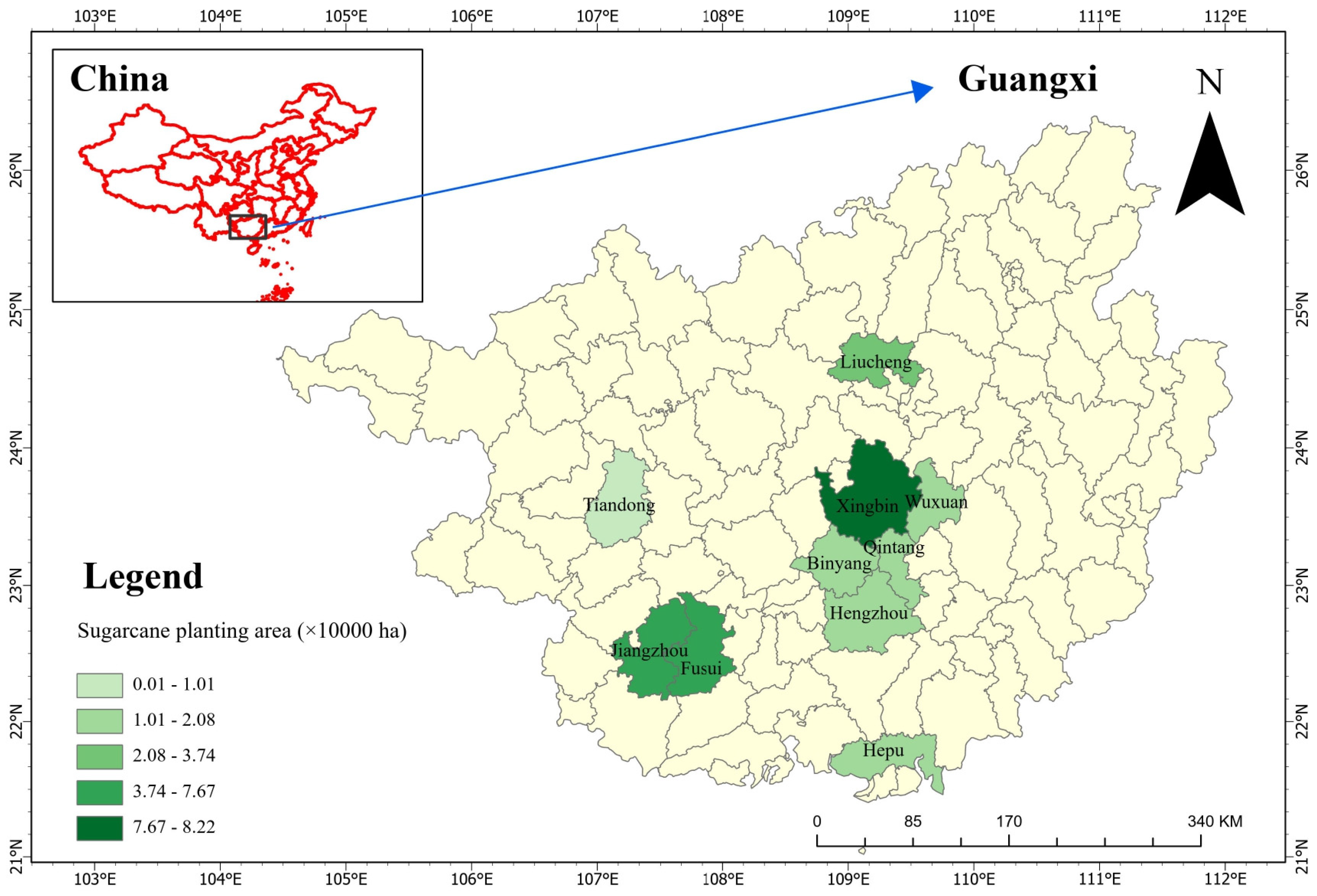
Soil samples were collected from January to June 2024 in 10 counties/districts in Guangxi: Fusui county (Chongzuo city), Jiangzhou district (Chongzuo city), Hengzhou city (a county-level city in Nanning), Binyang county (Nanning), Xingbin district (Laibin), Wuxuan county (Laibin), Liucheng county (Liuzhou), Tiandong county (Baise), Hepu county (Beihai), and Qintang district (Guigang). The sugarcane planting area of each county/district is shown in Figure 1. A total of 500 soil samples were collected, with 50 samples from each county (district). GPS was used to locate sampling points to ensure coverage of the entire sugarcane-growing area in each county/district. At each sampling point, a mixed surface soil sample (0–20 cm) weighing approximately 1 kg was collected using the five-point sampling method. After air-drying, the sample size was halved using the quartering method, and the samples were sieved through 20-mesh and 100-mesh nylon sieves for storage. Samples sieved through 20-mesh were used for soil pH analysis, while those sieved through 100-mesh were used for the analysis of soil organic matter and heavy metal contents.

2.3. Sample Analysis

Soil pH was measured by the potentiometric method [22] after extraction with a soil-to-water ratio of 1:2.5. Soil organic matter was determined by the potassium dichromate oxidation method in accordance with the national standard Soil Organic Matter Determination Method (HJ 615-2011; [23]). The total contents of Cd, Cr, Pb, and As in soil were determined using the method specified in National Food Safety Standard—Determination of Multi-elements in Foods (GB 5009.268-2025; [24]) with an inductively coupled plasma mass spectrometer (Model 7800, Agilent Technologies, Santa Clara, CA, USA). The total content of Hg in soil was determined using the method in the first section of National Food Safety Standard—Determination of Total Mercury and Organic Mercury in Foods (GB 5009.17-2021; [25]) with an atomic fluorescence spectrometer (Model BAF-2000, Beijing Baode Instrument Co., Ltd., Beijing, China). The available contents of Cd, Cr, Pb, As, and Hg in soil were detected by atomic absorption spectrometry. Briefly, homogenized soil samples were air-dried and passed through a 2 mm sieve to remove coarse debris. A total of 0.2 g of each soil sample was placed in a digestion vessel. Then, 20 mL of 0.1% acetic acid solution was added and mixed by shaking. The phases (solid soil sample and liquid extracts) were separated by centrifugation, and the clear supernatant was decanted and filtered through a 0.45 µm PTFE filter. The extract was analyzed through atomic absorption spectrometry [26].

2.4. Evaluation Methods

2.4.1. Single-Factor Pollution Index Method

The single-factor pollution index method is one of the most commonly used methods for evaluating soil heavy metal pollution [27]. It calculates the pollution degree of a single heavy metal element with the standard values of soil environmental quality as the evaluation criteria, and the calculation formula is
Pi = Ci/Si
where Pi is the single-factor pollution index of the i-th indicator, Ci is the measured value of the i-th indicator (mg/kg), and Si is the standard value of the i-th indicator (mg/kg). The “Soil Environmental Quality—Agricultural Land Soil Pollution Risk Control Standard (Trial)” (GB 15618-2018; [28]) is used as the evaluation standard for the single-factor pollution index method (Table 1).

2.4.2. Nemerow Comprehensive Pollution Index Method

The Nemerow comprehensive pollution index method is based on the evaluation of single-factor pollution indices. It can highlight the impact of the heavy metal element with the highest pollution degree on the soil environment, reflect the comprehensive pollution status of multiple heavy metals in the soil, and emphasize the most severely polluting factor [29]. The calculation formula is
P N = ( P i , m a x 2 + P i , a v e 2 ) / 2
where Pi,max is the maximum value of the single-factor pollution index of each indicator, and Pi,ave is the mean value of the single-factor pollution index of each indicator. Based on the Nemerow comprehensive pollution index, soil can be divided into five levels:

2.4.3. Geo-Accumulation Index Method

The geo-accumulation index method is a commonly used evaluation method for assessing the degree of heavy metal pollution in soil and sediments. This method not only reflects the impact of anthropogenic pollution factors and environmental geochemistry on background values but also the impact of changes in background values that may be caused by natural diagenesis. It can intuitively reflect the enrichment degree of a single heavy metal in regional sediments [30], and the calculation formula is
Igeo = log2[Ci/(1.5Bi)]
where Igeo is the geoaccumulation index, Ci is the measured content of element i in the soil (mg/kg), Bi is the geochemical background value of element i in the soil (mg/kg), and the constant 1.5 is a conversion factor (to eliminate the possible changes in background values caused by differences in rocks from different locations).

2.4.4. Potential Ecological Risk Assessment Method

The potential ecological risk assessment method was established by Swedish scientist Hakanson. It is a set of methods that use sedimentology principles to evaluate heavy metal pollution and ecological hazards [31]. This method can characterize the pollution level of a single heavy metal element and reflect the ecological hazards caused by the synergy of multiple elements [32]. The calculation formula is
E i r = T i r × P i
R I = Σ i n E i r
where Eir is the potential ecological risk index of a single heavy metal, Tir is the pollutant toxicity response coefficient, Pi is the single-factor pollution index, and RI is the potential ecological risk index. The evaluation indicators of the potential ecological risk assessment method are shown in Table 2.

2.4.5. Other Analyses

The box plots were drawn using the R (v 4.5.2; https://www.r-project.org/) package ggplot2. The distribution and Pearson correlation of different indicators were analyzed using the R package Performance Analytics [33].

3. Results

3.1. Analysis of pH, Organic Matter, and Soil Heavy Metal Content Characteristics in Major Sugarcane-Producing Areas in Guangxi

The average pH value of the 10 major sugarcane areas ranges from 4.63 to 5.64, of which 9 have an average pH value of <5.5 (moderately acidic), and only Qintang district has an average pH value of 5.5 to 6.5 (weakly acidic) (Table 3). Among all the sugarcane areas, the number of samples with a soil pH value of <4.5 (strongly acidic) is relatively large in Fusui county and Jiangzhou district of Chongzuo city. Hepu county and Tiandong county of Baise city have a pH value of <4.67 for 12 to 25 samples (accounting for 24 to 50%), while the number of samples with a pH ≥6.5 (neutral) is only three. These results indicate that the soil in the sugarcane area of Guangxi is strongly acidic to acidic, with moderately strong acidity being the main type.
In terms of organic matter, the content in the 10 major sugarcane-producing areas in Guangxi is less than 6 g/kg (Table 3). According to the nutrient classification standard of the Second National Soil Survey, it is classified as the sixth level (the lowest level of organic matter content), indicating that the soil organic matter in the major sugarcane-producing areas in Guangxi is seriously deficient.
According to the secondary standard in the National Soil Environmental Quality Standard (GB 15618-2018; [28]), when the soil pH value is less than 6.5, the Cd, Cr, Pb, As, and Hg standard values are ≤0.30 mg/kg, ≤150 mg/kg, ≤250 mg/kg, ≤40 mg/kg, and ≤0.30 mg/kg, respectively. Our results show that the average Cd content in the 10 major sugarcane areas ranged from 0.42 to 0.63 mg/kg, exceeding the national soil environmental quality secondary standard (Table 4). The over-limit rates were high (84–100%), with the highest rate in Qintang district (100%). Cr content exceeded the standard in six sugarcane areas, namely Fusui county, Jiangzhou district, Hengzhou city, Binyang county, Hepu county, and Tiandong county, with average values ranging from 159.83 to 226.74 mg/kg, whereas the highest over-limit rate was observed for Hengzhou city (100%). Pb content exceeded the standard in Xingbin district, Wuxuan county, and Qintang district, with an over-limit rate of 0, meeting the standard. Pb content exceeded the standard in four sugarcane areas, namely Fusui county, Jiangzhou district, Binyang county, and Hepu county, with average values ranging from 262.3 to 277.5 mg/kg. As content exceeded the standard in two sugarcane areas, namely Jiangzhou district and Binyang county, with average values of 273.6 mg/kg and 52.46 mg/kg, respectively. Of the two areas, Jiangzhou district had the highest over-limit rate (100%). The Hg content exceeded the standard in two sugarcane areas, Fusui county and Qintang district, with average values of 0.35 mg/kg and 0.44 mg/kg, respectively. Of these, Qintang district had the highest over-limit rate (100%).
These results indicate that the heavy metal pollution is widespread in the surveyed sugarcane areas, with Cd, Cr, Pb, As, and Hg exceeding national soil quality standards in multiple regions, particularly in Qintang district (Cd, Hg), Jiangzhou district (As), and Hengzhou city (Cr). This highlights significant environmental risks that may require remediation to ensure agricultural safety, ecosystem health, and better sugarcane production.

3.2. Evaluation of Single-Factor Pollution Index in Major Sugarcane-Producing Areas in Guangxi

According to the evaluation criteria of the Soil Environmental Quality Agricultural Land Soil Pollution Risk Control Standard (Trial) (GB 15618-2018; [28]), the single-factor pollution index was used to evaluate the degree of soil heavy metal pollution in 10 major sugarcane areas in Guangxi. As shown in Table 5, the Pi values of Cd in the soils of the 10 sugarcane-producing areas were all >1. This indicates that Cd contamination was present in the soils of all 10 major sugarcane-producing areas, and the over-limit rates were all high (84–100%), with the highest rate in Qintang district (100%). Cr contamination was present in the soils of six areas, namely Fusui county, Jiangzhou district, Hengzhou city, Binyang county, Hepu county, and Tiandong county, with over-limit rates ranging from 56 to 100%, with the highest exceedance rate in Hengzhou city (100%). Pb contamination was present in the soils of four sugarcane-producing areas, namely Fusui county, Jiangzhou district, Binyang county, and Hepu county, with over-limit rates ranging from 48 to 54%. As contamination was present in the soils of two sugarcane-producing areas, Jiangzhou district and Binyang county, with the Pi value of As in the soils of Jiangzhou district greater than 5.0, reaching a severe pollution level, and the over-limit rate was also as high as 100%. Hg contamination was present in the soils of two sugarcane-producing areas, namely Fusui county and Qintang district, with exceedance rates of 50% and 98%, respectively.
The results highlight that heavy metal pollution in Guangxi’s sugarcane-growing soils is severe, with Cd (Pi > 1) contamination observed in all the surveyed areas. Among others, the As level in Jiangzhou district is reaching severe pollution levels (Pi > 5.0). Though not in all surveyed areas, Cr, Pb, and Hg exceeded safety thresholds in multiple areas, highlighting the urgent need for pollution control measures and mitigation strategies.

3.3. Evaluation of Nemerow Comprehensive Pollution Index in Guangxi’s Major Sugarcane Areas

The Nemerow comprehensive pollution index (P-comprehensive) indicates that the average values for the 10 major sugarcane-producing areas in Guangxi range from 1.15 to 4.45. None of the areas were classified as safe, and all, with the exception of Jiangzhou district, were lightly polluted, with Jiangzhou district experiencing severe pollution (P-comprehensive = 4.45). The highest percentages of areas experiencing warning, light, moderate, and heavy pollution were Hengzhou city (88%), Tiandong county (90%), Fusui county (34%), and Jiangzhou district (92%), respectively. These results indicate that the overall degree of soil pollution in Guangxi’s 10 major sugarcane-producing areas is at the mild pollution level, with heavy pollution points primarily located in Jiangzhou district (92%) and, to a lesser extent, in Binyang county (12%) (Table 6).

3.4. Evaluation of the Geoaccumulation Index in Guangxi’s Major Sugarcane Areas

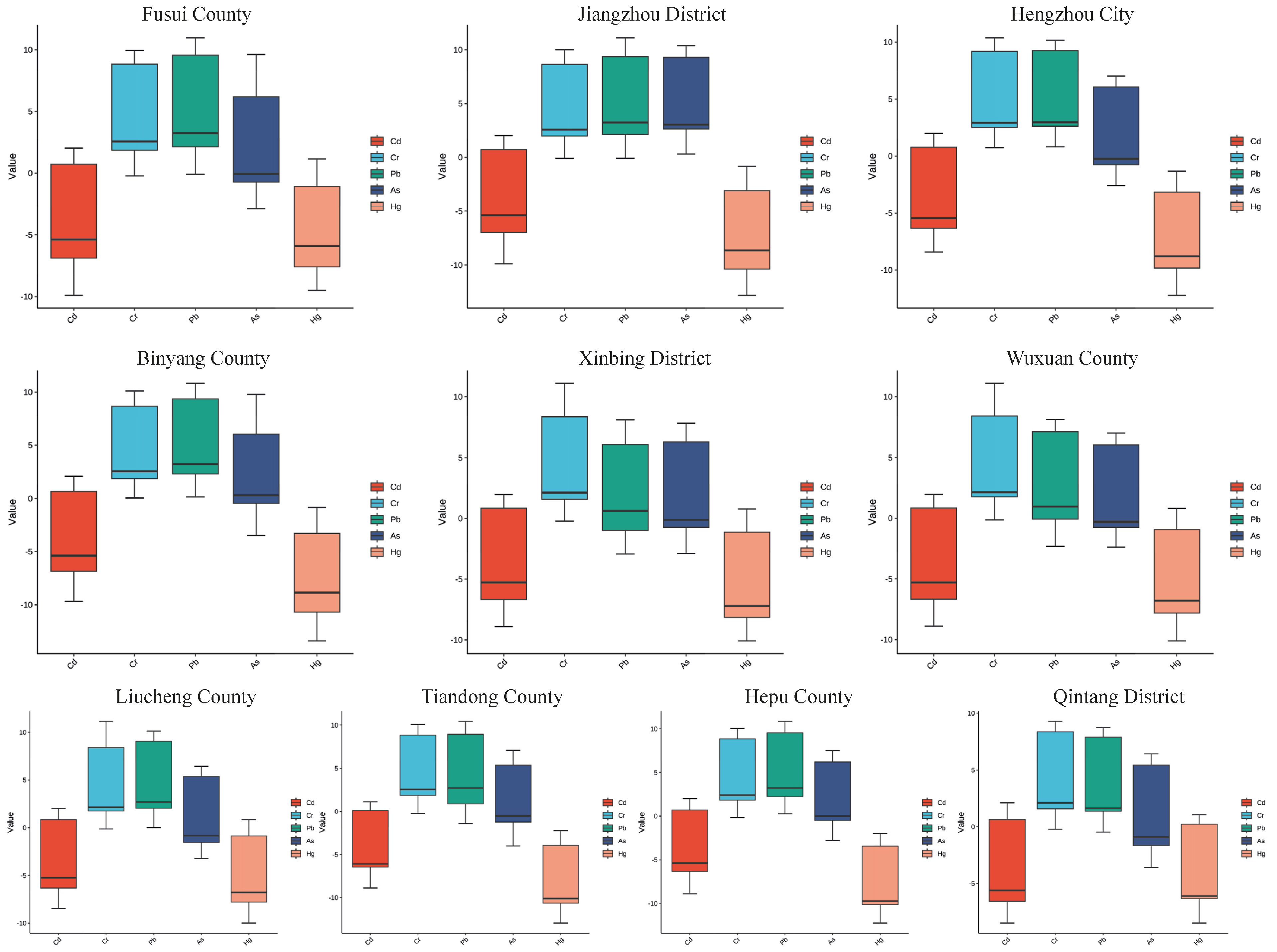
As shown in Figure 1, the results of the geoaccumulation index evaluation show that the average Igeo values of Cd and Hg in the soils of the 10 major sugarcane-producing areas in Guangxi are all less than 0, indicating that Cd and Hg are not affected by human activities; the average Igeo values of Cr in the soils of the 10 major sugarcane-producing areas in Guangxi are all greater than 3, indicating that the areas are seriously polluted with Cr. Among Guangxi’s 10 major sugarcane-producing areas, soils were severely polluted by Pb in Xingbin district and Wuxuan county (2 < Igeo average ≤ 3), while the remaining eight major sugarcane-producing areas were highly polluted (Igeo average > 3). Soil As was moderately polluted in five major sugarcane-producing areas (Wuxuan county, Hengzhou city, Liucheng county, Tiandong county, and Qintang district) (1 < Igeo average ≤ 2), highly polluted in four (Fusui county, Xingbin district, Binyang county, and Hepu county) (2 < Igeo average ≤ 3), and severely polluted in Jiangzhou district (Igeo average > 3) (Figure 2).
Overall, the Igeo data indicate severe Cr pollution (Igeo > 3) across all regions, while Pb contamination ranges from high to severe, and As varies from moderate to extreme, particularly in Jiangzhou district (Igeo > 3); Cd and Hg show no anthropogenic pollution (Igeo < 0). These results demonstrate widespread heavy metal contamination in Guangxi’s sugarcane soils, dominated by Cr, Pb, and As, requiring prioritized remediation efforts.

3.5. Assessment of Potential Ecological Risks in Major Sugarcane-Producing Areas in Guangxi

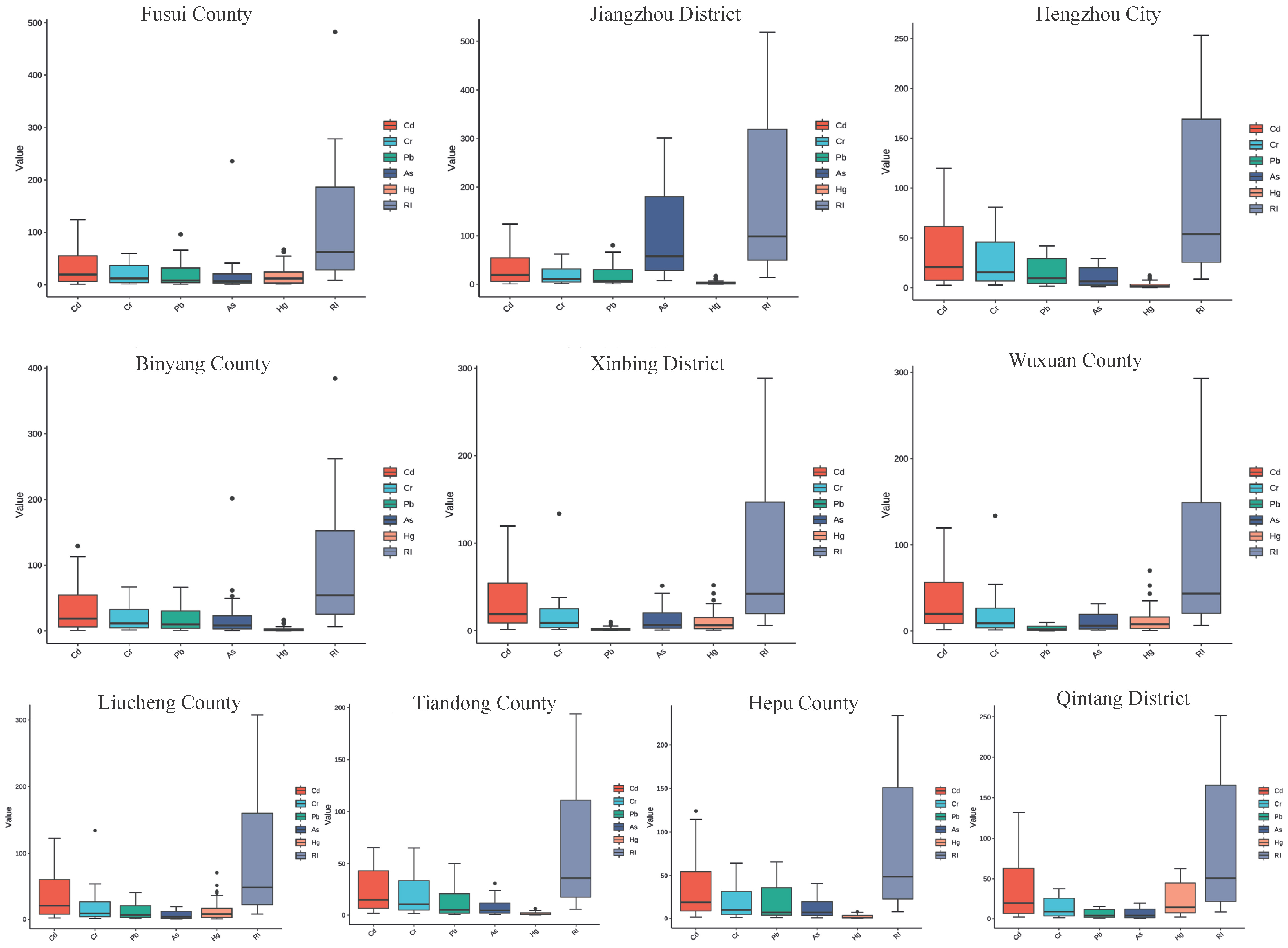
As shown in Figure 2, the potential ecological risk assessment results show that among the 10 major sugarcane-producing areas in Guangxi, only the As single heavy metal potential ecological risk index in Jiangzhou district reached a high ecological risk level (80 ≤ Eir < 160), with an average Eir of 101.54. At the same time, only the comprehensive potential ecological risk index in Jiangzhou district was at a medium ecological risk level (150 ≤ RI < 300), with an average RI of 178.1. The single heavy metal potential ecological risk index (Eir) and comprehensive potential ecological risk index of the other nine major sugarcane-producing areas were all at a low ecological risk level (Figure 3).
Overall, the ecological risk assessment reveals that only Jiangzhou district poses concerning heavy metal risks, with As showing high individual risk (Eir = 101.54) and moderate combined risk (RI = 178.1), while all other sugarcane regions maintain low-risk levels for both individual metals and overall contamination. These findings suggest localized but significant ecological threats in Jiangzhou district, contrasting with generally safe conditions elsewhere in Guangxi’s sugarcane belt.

3.6. Correlation Among pH, Organic Matter, and Total and Available Heavy Metals

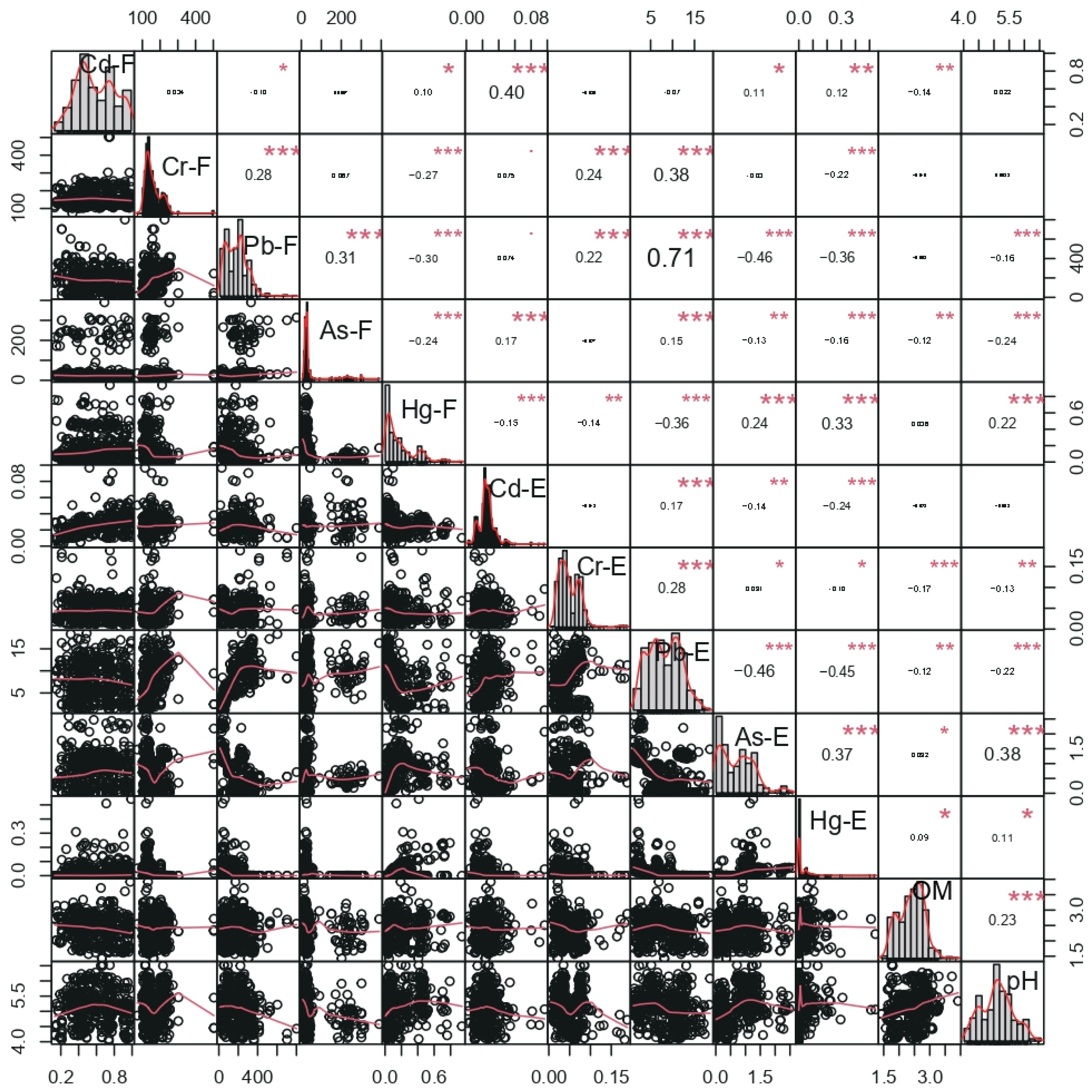
As shown in the correlation analysis in Figure 4, the total contents of Cd, Cr, Pb, As, and Hg in the soil of the 10 major sugarcane-growing areas in Guangxi were all highly significantly positively correlated with their available contents (p < 0.01). This indicates that the available forms of these five heavy metals in the soil of the study area are determined by their total contents. Both soil pH and organic matter were highly significantly negatively correlated with the available forms of Cr and Pb, suggesting that with the increase in pH or organic matter, the soil reduces the adsorption of the available heavy metals (Cr and Pb). Both soil pH and organic matter were significantly or highly significantly positively correlated with the available forms of As and Hg, indicating that the bioavailability of As and Hg increases with the increase in pH or organic matter (Figure 4).

4. Discussion

Sugarcane cultivation in China is undergoing a shift towards the central and western regions, with Guangxi, Yunnan, and Guangdong as the primary growing areas. The Chinese government’s self-sufficiency goal and the support by the government, as well as millers, are driving increased area under sugarcane cultivation in Guangxi [11]. Sugarcane is moderately sensitive to acidic soils, which, when combined with heavy metal soil pollution, can negatively impact sugarcane growth, physiological functions, and yield. Moreover, sugarcane can absorb heavy metals, risking the health of the consumers [7]. Soil health, including pH, organic matter, and the availability of heavy metals, can significantly impact sugarcane growth. Therefore, we surveyed and analyzed soil from 10 sugarcane-growing areas of Guangxi, China. It has been previously reported that sugarcane can tolerate a wider range of pH, i.e., 5.5–8.0, ensuring optimal nutrient uptake, utilization, and overall better yields [34]. In this survey, the average pH values of the 10 major sugarcane-growing areas in Guangxi ranged from 4.63 to 5.64, mainly moderately strong acidic (pH < 5.5), which is consistent with the results of Bo, et al. [35], who investigated the soil pH in Guangxi sugarcane areas in 2019 with an average value of 5.21. However, Yan, et al. [36] reported an average soil pH of 4.52 in 15 major sugarcane-growing areas in Guangxi in 2023, among which strongly acidic soils with pH < 4.5 accounted for the majority. These variations may be due to differences in some sampling locations. These two studies shared seven common sampling areas: Fusui county, Jiangzhou district, Xingbin district, Wuxuan county, Binyang county, Liucheng county, and Qintang district, while the remaining sampling locations were different, resulting in different average pH values. Nevertheless, our results reflect that severe soil acidification has occurred in the main sugarcane-producing areas of Guangxi, which is consistent with the earlier report by [36]. This intensification of soil acidification could be mainly due to the heavy application of nitrogen fertilizers (nitrification) in recent years [35], which affects sugarcane production. Generally, neutral soil supports better sugarcane growth when compared to acidic soils [37]. Further continuation of long-term nitrogenous fertilizers would lead to a significant decrease in pH over time, impacting soil health and sugarcane productivity. Therefore, the problem of soil acidification in Guangxi sugarcane areas requires urgent attention. In addition to paying attention to the rational application of fertilizers, attention should also be paid to the application of soil conditioners for regulation.
Soil organic matter is an important indicator for measuring soil fertility. It not only provides nutrient elements for plant growth but also improves soil physical properties and enhances soil fertility, retention, and buffering capacity [38]. Our survey shows that the organic matter content in all 10 major sugarcane-growing areas in Guangxi is less than 6 g/kg, indicating a serious shortage of soil organic matter in the major sugarcane-growing areas of Guangxi. Higher soil organic matter content is positively correlated with the sugarcane yield [39]. When organic matter is lower, the soil structure is easily damaged, and the ability to retain fertilizer and water is weak, which seriously restricts crop growth and yield improvement. The organic matter content observed during our survey is much lower than the average soil organic matter content of 24.43 g/kg in Guangxi sugarcane areas surveyed by previous researchers in 2019 [35]. This might also suggest a significant decline in soil organic matter content in Guangxi sugarcane areas. Though we did not study the reasons, a possible cause could be the heavy use of chemical fertilizers and little use of organic fertilizers in sugarcane areas, coupled with the large biomass of sugarcane and high consumption of organic substances, forming a vicious cycle [40]. Measures such as partial replacement of chemical fertilizers with organic fertilizers, sugarcane leaf returning to the field, and resource reuse of sugar factory waste can be adopted to improve soil fertility and increase soil organic matter content [41].
Heavy metal accumulation in sugarcane-growing soils represents a serious environmental concern that not only reduces sugarcane productivity [4] but also poses significant health risks to consumers [16]. Our comprehensive survey reveals widespread heavy metal pollution across the studied sugarcane cultivation areas, with Cd, Cr, Pb, As, and Hg concentrations exceeding the limits established by the National Soil Environmental Quality Standard (GB 15618-2018; [28]) in multiple regions. Particularly concerning are the pollution patterns observed in specific locations: Qintang district shows significant contamination by both Cd and Hg, Jiangzhou district demonstrates severe As pollution, and Hengzhou city exhibits elevated Cr levels. In contrast, our data indicate that Pb concentrations in Xingbin district, Laibin city, remain below regulatory thresholds, with an over-limit rate of 0%, fully complying with the GB 15618-2018; [28] standard. This finding aligns with previous research conducted by Xiaobo, et al. [10]. A comparison with the 2020 report [28] reveals notable temporal trends in Xingbin district: while average Cr concentrations have decreased from previously exceeding the standard to currently meeting requirements, average Cd levels have increased from compliant (231.01 mg/kg) to exceeding the standard. These fluctuations may reflect variations in sampling years and locations. Nevertheless, our overall assessment confirms that sugarcane field soils in Xingbin district exhibit only slight heavy metal pollution at the regional scale, though localized areas show elevated concentrations of specific metals. This conclusion remains consistent with earlier research findings [10].
Our study reveals complex patterns of heavy metal accumulation in Guangxi’s sugarcane-growing soils through complementary pollution assessment methods. The single-factor pollution index indicates widespread Cd contamination across all 10 regions, with localized Hg pollution in Fusui county and Qintang district (Table 5). However, geoaccumulation index results (for Cd and Hg) suggest these metals originate primarily from natural sources rather than anthropogenic activities (Figure 2). Our results are consistent with the earlier research (2011 and 2016 surveys) on above-limit Hg levels throughout China [42]. The Igeo < 0 for Hg suggests that the measured concentrations are not significantly enriched relative to the specific local backgrounds used in our study. It is important to highlight that the low Igeo value highly depends on the chosen background and does not preclude the presence of anthropogenic Hg, particularly in the context of China as a whole. As indicated above, the country-wide national surveys significantly exceed Hg levels in agricultural soils than the background levels, attributing this to anthropogenic activities [42]. The possible explanations for such a Igeo < 0 could be either because the geology of the Guangxi region is known to have a high natural background of heavy metals, including Hg. It is possible that the Bi we used accurately reflects the elevated natural state, indicating that moderate anthropogenic inputs have not yet caused significant enrichment beyond this high baseline. Additionally, Hg distribution in China is heterogeneous [42]. This, together with our results, suggests that anthropogenic pressure on Guangxi’s 10 study areas may be lower or different in nature compared to those major industrial and energy-producing regions. Future work employing techniques on isotropic tracing or with robust regional background comparisons would be necessary to definitively identify the sources.
In contrast, Cr, Pb, and As exhibit clear anthropogenic signatures (Figure 2) [43]. While the single-factor index identifies Cr pollution in six regions, Pb in four regions, and As in two regions (notably severe As contamination in Jiangzhou district), the geoaccumulation index reveals more extensive impacts: all 10 regions show moderate-to-severe accumulation of Cr and Pb [44], with As reaching severe levels in Jiangzhou district (Figure 2). This, in agreement with earlier work [43], indicates that human-derived pollution has caused early-stage heavy metal enrichment in several regions, exceeding natural background levels but remaining below national regulatory thresholds (GB 15618-2018; [28]). Such latent accumulation poses risks for future exceedances if anthropogenic inputs continue unchecked [45]. It is important to highlight that the Nemerow index generally categorizes the areas mildly polluted against the results of Igeo. This suggests that the Nemerow index may underestimate the ecological risk posed by a universally elevated contaminant, e.g., Cr [21]. These findings highlight that relying solely on single-method assessments is not sufficient [46]. The geoaccumulation index’s sensitivity to background variations uncovers emerging pollution trends that regulatory thresholds may overlook, particularly for Cr and Pb [47]. This suggests the need for integrated monitoring combining pollution indices with bioavailability analyses to guide targeted soil management in sugarcane systems [48].
The correlation analysis results of this survey show that the total content of Pb in the soil of the 10 major sugarcane-growing areas in Guangxi has a highly significant positive correlation with its available content, which is consistent with a previous study by Cong, et al. [49]. This suggests that total Pb concentrations reliably predict its bioavailability in these soils. Soil pH exhibited a highly significant negative correlation with available Pb, which is consistent with the research results of Han and Jiemin [50] and Li Zhongyi, et al. [51]. This is because pH affects the activity of Pb ions in the soil solution. When pH is high, the adsorption capacity of Pb in the soil increases, reducing the Pb content in the soil solution [52]. Similarly, soil organic matter content showed a highly significant negative correlation with available Pb, because organic matter, as a natural adsorbent, can change the adsorption of heavy metals by the soil and reduce the activity of heavy metal ions [52]. However, Zhongyi et al. [51] showed that soil organic matter content has an extremely significant positive correlation with available Pb, which may be due to the high content of fulvic acid in the soil organic matter in their research area. Notably, neither pH nor organic matter significantly influenced available Cd, consistent with Han and Jiemin [50]. This divergence highlights a departure from the typical adsorption-controlled mobility. Though it is known that Cd mobility is often governed by chloride competition or redox conditions rather than pH/organic matter in acidic soils [53], we used 0.1% acetic acid, which targets the exchangeable (and acid-soluble) fractions, which include Cd bound to carbonates or weakly adsorbed surfaces. Thus, the observed independence from pH and organic matter implies that Cd in the studied locations might be influenced by different geochemical drivers. For instance, in environments with high chloride levels, the formation of stable, soluble Cd-Cl complexes may reduce sorption to solid phases, lessening the reliance of its extraction on pH and OM [54]. Although we did not assess chloride concentrations to confirm this process, the application of an acetic acid extractant may be effective in mobilizing Cd stored in such complexes or in carbonate forms [55]. Therefore, our results are consistent with a scenario where Cd mobility is controlled by salinity or the presence of certain competitive anions, either in addition to or instead of pH and OM. However, it is still important to further validate by using a wider range of chemical measures.

5. Conclusions

This study systematically evaluated soil quality and heavy metal contamination in Guangxi’s sugarcane-growing regions through comprehensive analyses of pH, organic matter, and metal contents. Our results suggest that the soils exhibited strongly acidic conditions (predominantly moderate-to-strong acidity) and are deficient in organic matter (<6 g/kg). By employing four complementary assessment methods, we conclude that (1) single-factor indexing identified universal Cd contamination across all regions, with localized severe As pollution in Jiangzhou district (P_i > 5.0); (2) the Nemerow index classified overall pollution as mild, except for severe contamination in Jiangzhou district; (3) geoaccumulation assessment showed severe Cr pollution throughout all regions (Igeo > 3), with Pb pollution ranging from heavy to severe (Igeo > 2) and As pollution levels varying from moderate to severe (Igeo > 3 in Jiangzhou district), while Cd and Hg exhibited no anthropogenic accumulation (Igeo < 0); and (4) ecological risk assessment confirmed that only Jiangzhou district reached concerning levels (high risk for As [Eir = 101.54] and moderate composite risk [RI = 178.1]). Correlation analyses demonstrated that total metal contents strongly predicted their available forms, while pH and organic matter significantly influenced metal bioavailability—showing negative correlations with available Cr/Pb but positive associations with As/Hg. Overall, our results conclude that Jiangzhou district should be a priority for remediation due to severe As contamination and elevated ecological risk. We also highlight that region-specific strategies should be designed in light of specific pollutants, e.g., Cr/Pb. Moreover, soil acidification should be managed throughout Guangxi’s sugarcane cultivation areas.

Author Contributions

Conceptualization, L.L. and Y.G.; methodology, Y.L., Z.Y., B.F., S.L. (Shanyu Lu), S.L. (Shiping Liu) and C.Y.; software, S.Z. and B.Z.; investigation, S.S., S.L. (Shanyu Lu), Z.Y., B.F. and S.L. (Shiping Liu); data curation, Y.L., C.Y., S.Z., B.Z., S.S., S.L. (Shanyu Lu), L.L. and Y.G.; writing—original draft preparation, Y.L. and C.Y.; writing—review and editing, S.L. (Shanyu Lu), S.L. (Shiping Liu), Z.Y., B.F., L.L. and Y.G.; project administration, Y.G.; funding acquisition, Y.G. All authors have read and agreed to the published version of the manuscript.

Funding

This research was funded by the China Agriculture Research System of MOF and MARA-National Sugar Industry Technology System (CARS-17), Guangxi Natural Science Foundation Project (2024GXNSFAA010174), Stable Funding Research Team Project of Guangxi Academy of Agricultural Sciences (Guinongke 2026YT056 and Guinongke 2026YT050) and Province- and Ministry-Cosponsored Collaborative Innovation Center of the Canesugar Industry (No. 201812639). The funders had no role in the study design, data collection and analysis, decision to publish, or preparation of the manuscript.

Data Availability Statement

The original contributions presented in this study are included in the article; further inquiries can be directed to the corresponding authors.

Acknowledgments

During the preparation of this manuscript, the author(s) used the freely available version of DeepL Write (https://www.deepl.com/en/write; accessed on 20 August 2025) for the purposes of spelling and punctuation. The authors have reviewed and edited the output and take full responsibility for the content of this publication.

Conflicts of Interest

The authors declare no conflicts of interest.

References

  1. Li, Y.-R.; Zhang, B.-Q.; Song, X.-P.; Liang, Q.; Verma, K.K.; Li, D.-M. Development of sugar industry in China: R&D priorities for sustainable sugarcane production. Sugar Tech 2024, 26, 972–981. [Google Scholar] [CrossRef]
  2. Yan, C.; Li, X.; Zhan, L.; Li, Z.; Wen, J. Measurement of Production Efficiency and Analysis of Influencing Factors in Major Sugarcane-Producing Regions of China. Agriculture 2025, 15, 885. [Google Scholar] [CrossRef]
  3. Shukla, S.; Solomon, S.; Sharma, L.; Jaiswal, V.; Pathak, A.; Singh, P. Green technologies for improving cane sugar productivity and sustaining soil fertility in sugarcane-based cropping system. Sugar Tech 2019, 21, 186–196. [Google Scholar] [CrossRef]
  4. Misra, S.; Singh, B.P. Impact of heavy metal toxicity on sugarcane growth, development and productivity. In Agro-Industrial Perspectives on Sugarcane Production Under Environmental Stress; Springer: Berlin/Heidelberg, Germany, 2023; pp. 159–169. [Google Scholar]
  5. Liao, J.; Wang, T.; Fan, Y.; He, J.; Huang, F.; Mo, L. Effects of cadmium contamination on sugarcane growth, soil microorganism and soil enzyme activity. Agric. Sci. Technol. 2017, 18, 2378–2382. [Google Scholar]
  6. Zeng, Q.; Ling, Q.; Wu, J.; Yang, Z.; Liu, R.; Qi, Y. Excess copper-induced changes in antioxidative enzyme activity, mineral nutrient uptake and translocation in sugarcane seedlings. Bull. Environ. Contam. Toxicol. 2019, 103, 834–840. [Google Scholar] [CrossRef] [PubMed]
  7. Yadav, D.; Jain, R.; Rai, R. Impact of heavy metals on sugarcane. In Soil Heavy Metals; Springer: Berlin/Heidelberg, Germany, 2009; pp. 339–367. [Google Scholar]
  8. Xia, H.; Hai-rong, G.; Gui-ping, X.; Xiao-fei, W. Evaluation of heavy metal contamination to the irrigated sugarcane farmland soil in Guangxi. J. South. Agric. 2014, 45, 2183. [Google Scholar]
  9. He, D.M.; Wang, X.F.; Chen, L.J.; Su, R. Assessment on heavy metals contaminations of sugarcane soil in Guangxi Province by the geo-accumulation index and potential ecological risk index. J. Agric. Resour. Environ. 2014, 31, 126–131. [Google Scholar]
  10. Sun, X.B.; Gao, H.F.; Wang, X.M.; Lu, W.Y.; Guo, S. Analysis and Evaluation of Heavy Metal from Soil of Sugarcane Field in Xingbin District of Laibin City. Guangdong Chem. Ind. 2021, 48, 241–243+226. [Google Scholar]
  11. United States Department of Agriculture, Foreign Agricultural Service. Sugar Annual; CH2025-0086; United States Department of Agriculture: Washington, DC, USA, 2025.
  12. Tang, M.; Lu, G.; Fan, B.; Xiang, W.; Bao, Z. Bioaccumulation and risk assessment of heavy metals in soil-crop systems in Liujiang karst area, Southwestern China. Environ. Sci. Pollut. Res. 2021, 28, 9657–9669. [Google Scholar] [CrossRef]
  13. Zhong, X.-M.; Xia, D.-S.; Song, B.; Chen, T.-B. Review on soil cadmium study and risk assessment in Guangxi. J. Nat. Resour. 2017, 32, 1256–1270. [Google Scholar]
  14. da Silva, F.B.V.; do Nascimento, C.W.A.; Araújo, P.R.M.; da Silva, L.H.V.; da Silva, R.F. Assessing heavy metal sources in sugarcane Brazilian soils: An approach using multivariate analysis. Environ. Monit. Assess. 2016, 188, 457. [Google Scholar] [CrossRef]
  15. Alcívar, M.; Vinueza, E.; Pernía, B.; Álvarez-Montero, X.; Gallardo, A. Contamination by Cadmium and Lead in Sugarcane and Its Derived Products in Ecuador. Agriculture 2024, 14, 2121. [Google Scholar] [CrossRef]
  16. Pandey, B.; Suthar, S.; Singh, V. Accumulation and health risk of heavy metals in sugarcane irrigated with industrial effluent in some rural areas of Uttarakhand, India. Process Saf. Environ. Prot. 2016, 102, 655–666. [Google Scholar] [CrossRef]
  17. Ernesto, R.-A.; Harlen, C.-R. Historical review of the last 50 years of research on heavy metal pollution in Mexico. Environ. Earth Sci. 2025, 84, 397. [Google Scholar] [CrossRef]
  18. Ogidi, O.A.; Danja, B.; Sanusi, K.; Samuel, N.S.; Abubakar, A.; Hammashi, H. Heavy Metal Content of Agricultural Soils at Tumu, Akko Local Government Area of Gombe State, Nigeria. Int. J. Sci. Res. Publ. 2019, 9, 745–749. [Google Scholar] [CrossRef]
  19. Khan, M.J.; Azeem, M.T.; Jan, M.T.; Perveen, S. Effect of amendments on chemical immobilization of heavy metals in sugar mill contaminated soils. Soil Environ. 2012, 31, 55. [Google Scholar]
  20. Bridhikitti, A.; Kaewsuk, J.; Karaket, N.; Somchat, K.; Friend, R.; Sallach, B.; Chong, J.P.; Redeker, K.R. Sources and Magnitude of Heavy Metals in Sugarcane Plantation Soils with Different Agricultural Practices and Their Implications on Sustainable Waste-to-Foods Strategy in the Sugar–Ethanol Industry. Sustainability 2023, 15, 14816. [Google Scholar] [CrossRef]
  21. Kowalska, J.B.; Mazurek, R.; Gąsiorek, M.; Zaleski, T. Pollution indices as useful tools for the comprehensive evaluation of the degree of soil contamination–A review. Environ. Geochem. Health 2018, 40, 2395–2420. [Google Scholar] [CrossRef]
  22. Sakurai, K.; Ohdate, Y.; Kyuma, K. Comparison of salt titration and potentiometric titration methods for the determination of zero point of charge (ZPC). Soil Sci. Plant Nutr. 1988, 34, 171–182. [Google Scholar] [CrossRef]
  23. HJ 615-2011; Soil–Determination of Organic Carbon–Potassium Dichromate Oxidation Spectrophotometric Method. Ministry of Environmental Protection: Beijing, China, 2011; 9p.
  24. GB 5009.268-2025; National Food Safety Standard—Determination of Multi-Elements in Foods. National Health Commission of the People’s Republic of China: Beijing, China, 2025; 25p.
  25. GB 5009.17-2021; National Food Safety Standard—Determination of Total Mercury and Organic-mercury in Food. National Health Commission of the People’s Republic of China: Beijing, China, 2022; 25p.
  26. Gzar, H.A.; Abdul-Hameed, A.S.; Al-Taie, A. Extraction of lead, cadmium and nickel from contaminated soil using acetic acid. Open J. Soil Sci. 2014, 4, 207–214. [Google Scholar] [CrossRef]
  27. Zhang, Y.; Cao, Y.; Feng, N.; Liu, Y.; Zhang, Y.; Wang, Q.; Liu, J. Risk assessment of heavy metals in the soil of an abandoned coal mine area. J. China Coal Soc. 2024, 49, 3188–3198. [Google Scholar]
  28. GB 15618-2018; Soil environmental quality—Risk control standard for soil contamination of agricultural land. Ministry of Ecology and Environment: Beijing, China, 2018; 11p.
  29. Wang, W.; Wang, X.; Gao, S.; Sun, T.; Yuebing, S. Spatial distribution and ecological risk assessment of heavy metals in soil at the field scale. J. Agric. Resour. Environ. 2022, 39, 475. [Google Scholar]
  30. Muller, G. Index of geoaccumulation in sediments of the Rhine River. Geo J. 1969, 2, 108–118. [Google Scholar]
  31. Hakanson, L. An ecological risk index for aquatic pollution control. A sedimentological approach. Water Res. 1980, 14, 975–1001. [Google Scholar] [CrossRef]
  32. Xu, Z.Q.; Ni, S.J.; Tuo, X.; Zhang, C.J. Calculation of heavy metals’ toxicity coefficient in the evaluation of potential ecological risk index. Environ. Sci. Technol. 2008, 31, 112–115. [Google Scholar]
  33. Peterson, B.; Carl, P.; Boudt, K.; Bennett, R.; Ulrich, J.; Zivot, E.; Cornilly, D.; Hung, E.; Lestel, M.; Balkissoon, K. Package ‘PerformanceAnalytics’, R Team Cooperation: Vienna, Austria, 2018; Volume 3, pp. 13–14.
  34. Guo, J.W.; Zhang, Y.B.; Liu, S.C. Study on the distribution of soil organic matter and available nutrients in the main sugarcane producing areas of Yunnan. Soil Bull. 2010, 41, 872–876. [Google Scholar]
  35. Meng, B.; Zhou, Y.F.; Zhan, J.; Yang, L.S.; Deng, Y. Investigation on soil fertility and leaf nutrient status in sugarcane areas of Guangxi. Soil Fertil. China 2022, 55, 181–188. [Google Scholar]
  36. Yan, Z.; Rulin, X.; Jiayu, P.; Jinsheng, H.; Xiaowei, S. Analysis on soil acidification characteristics in the main sugarcane producing areas of Guangxi. South. J. Agric. 2024, 55, 2623–2631. [Google Scholar]
  37. Yuan, X.; Luo, Y.; Liang, R.; Ma, L.; Ren, X.; He, T.; Liang, Y.; Chen, B.; Wang, Z.; Yao, W. Neutral soil supports better growth and productivity of sugarcane (Saccharum officinarum L.) than acidic soil in China. J. Agric. Food Res. 2025, 23, 102265. [Google Scholar] [CrossRef]
  38. Gerke, J. The central role of soil organic matter in soil fertility and carbon storage. Soil Syst. 2022, 6, 33. [Google Scholar] [CrossRef]
  39. McCray, M.; Swanson, S. Soil Organic Matter Impacts on Sugarcane Production on Florida Mineral Soils: SS-AGR-442/AG441, 2/2020. EDIS 2020, 2020. [Google Scholar] [CrossRef]
  40. Pahalvi, H.N.; Rafiya, L.; Rashid, S.; Nisar, B.; Kamili, A.N. Chemical fertilizers and their impact on soil health. In Microbiota and Biofertilizers, Vol 2: Ecofriendly Tools for Reclamation of Degraded Soil Environs; Springer: Berlin/Heidelberg, Germany, 2021; pp. 1–20. [Google Scholar]
  41. Wen, S.B.; Ge, C.; Li, M.; Zou, Y.K.; Hou, X.W. Effects of different returning field methods on soil nutrient of sugarcane. J. Trop. Crops 2017, 38, 1423–1426. [Google Scholar]
  42. Zhou, Y.; Aamir, M.; Liu, K.; Yang, F.; Liu, W. Status of mercury accumulation in agricultural soil across China: Spatial distribution, temporal trend, influencing factor and risk assessment. Environ. Pollut. 2018, 240, 116–124. [Google Scholar] [CrossRef] [PubMed]
  43. Huang, Y.; Wang, L.; Wang, W.; Li, T.; He, Z.; Yang, X. Current status of agricultural soil pollution by heavy metals in China: A meta-analysis. Sci. Total Environ. 2019, 651, 3034–3042. [Google Scholar] [CrossRef]
  44. Zhang, B.; Hou, H.; Huang, Z.; Zhao, L. Estimation of heavy metal soil contamination distribution, hazard probability, and population at risk by machine learning prediction modeling in Guangxi, China. Environ. Pollut. 2023, 330, 121607. [Google Scholar] [CrossRef]
  45. Alloway, B.J. Sources of heavy metals and metalloids in soils. In Heavy Metals in Soils: Trace Metals and Metalloids in Soils and Their Bioavailability; Springer: Berlin/Heidelberg, Germany, 2012; pp. 11–50. [Google Scholar]
  46. Ghadeer, A.; Ibrahim, A.; Al-Masri, M. Geochemistry of uranium and thorium in phosphate deposits at the Syrian coastal area (Al-Haffah and Al-Qaradaha) and their environmental impacts. Environ. Geochem. Health 2019, 41, 1861–1873. [Google Scholar] [CrossRef]
  47. Kim, B.S.M.; Angeli, J.L.F.; Ferreira, P.A.L.; de Mahiques, M.M.; Figueira, R.C.L. Critical evaluation of different methods to calculate the Geoaccumulation Index for environmental studies: A new approach for Baixada Santista–Southeastern Brazil. Mar. Pollut. Bull. 2018, 127, 548–552. [Google Scholar] [CrossRef]
  48. Jia, Z.; Wang, J.; Li, B.; Li, Y.; Zhou, Y.; Tong, G.; Yan, D.; Zhou, S. An integrated methodology for improving heavy metal risk management in soil-rice system. J. Clean. Prod. 2020, 273, 122797. [Google Scholar] [CrossRef]
  49. Cong, D.; Zhiliang, C.; He, L.; Xiaochun, P.; Haolin, F.; Yuenan, Z.; Guojian, L.; Shuhua, Z. Correlation analysis between total and available content of heavy metals in agricultural soils in Changsha, Zhuzhou and Xiangtan areas. J. Ecol. Environ. 2012, 21, 2002–2006. [Google Scholar]
  50. Jin, H.; Cheng, J.M. Study on basic properties of soil under different tillage methods. Anhui Agric. Sci. 2012, 40, 3322–3323. [Google Scholar]
  51. Li, Z.Y.; Zhang, C.L.; Deng, C.B.; Gu, M.H.; Li, L.; Liu, M. Analysis on the spatial distribution of available heavy metals and their influencing factors in farmland soils in lead-zinc mining areas. J. Ecol. Environ. 2009, 18, 5. [Google Scholar]
  52. McBride, M. Reactions controlling heavy metal solubility in soils. In Advances in Soil Science; Springer: Berlin/Heidelberg, Germany, 1989; Volume 10, pp. 1–56. [Google Scholar]
  53. Kirkham, M.B. Cadmium in plants on polluted soils: Effects of soil factors, hyperaccumulation, and amendments. Geoderma 2006, 137, 19–32. [Google Scholar] [CrossRef]
  54. Kubier, A.; Wilkin, R.T.; Pichler, T. Cadmium in soils and groundwater: A review. Appl. Geochem. 2019, 108, 104388. [Google Scholar] [CrossRef] [PubMed]
  55. Zhong, C.; Lin, Z.; Hu, W.; Xu, Z. Evaluating the long-term stability of iron oxide-adsorbed cadmium: The role of organic acids and microbial agents in re-mobilization dynamics. J. Environ. Chem. Eng. 2025, 13, 115502. [Google Scholar] [CrossRef]
Figure 1. Geographical map of Guangxi showing the ten sampling counties (districts). The intensity of the green color represents the planting area (×10,000 ha). The X- and Y-axes show N and E coordinates.
Agronomy 16 00185 g001
Figure 2. Evaluation of heavy metal accumulation index in soils of major sugarcane-producing areas in Guangxi.
Agronomy 16 00185 g002
Figure 3. Potential ecological risk assessment of heavy metals in soils of major sugarcane-producing areas in Guangxi.
Agronomy 16 00185 g003
Figure 4. Correlation analysis among pH, organic matter, and total and available heavy metals in major sugarcane-producing areas in Guangxi. Note: -F represents total, and -E represents available; OM: organic matter. *, **, *** significant at p < 0.05, 0.01 and 0.001, respectively.
Agronomy 16 00185 g004
Table 1. Soil heavy metal pollution level criteria.
Single-Factor Pollution Index Pollution LevelNemerow Comprehensive Pollution Index Pollution LevelGeo-Accumulation IndexPollution Level
Pi ≤ 1.0CleanPN ≤ 0.7 SafeIgeo ≤ 0No pollution
1.0 < Pi ≤ 2.0Slightly polluted0.7 < PN ≤ 1Warning level0 < Igeo ≤ 1Light pollution
2.0 < Pi ≤ 3.0Slightly polluted1 < PN ≤ 2Mild pollution1 < Igeo ≤ 2Moderate pollution
3.0 < Pi ≤ 5.0Moderately polluted2 < PN ≤ 3Moderate pollution2 < Igeo ≤ 3High pollution
Pi > 5.0Heavily pollutedPN > 3Severe pollutionIgeo > 3Severe pollution
Table 2. Potential ecological risk assessment criteria.
E i r Ecological Risk Level of a Single Heavy Metal R I Comprehensive Pollution Potential Ecological Risk Level
E i r < 40low ecological riskRI < 150low ecological risk
40 ≤ E i r < 80moderate ecological risk150 ≤ RI < 300moderate ecological risk
80 ≤   E i r < 160higher ecological risk300 ≤ RI < 600higher ecological risk
160 ≤   E i r < 320high ecological risk600 ≤ RI < 1200high ecological risk
E i r ≥ 320extremely high ecological riskRI ≥ 1200extremely high ecological risk
Table 3. pH value and organic matter in major sugarcane areas in Guangxi.
Sugarcane Area →Fusui CountyJiangzhou DistrictYokoshu CityBinyang CountyXingbin DistrictWuxuan CountyLiucheng CountyTiandong CountyHepu CountyQintang District
pH and Organic Matter ↓
pH valuemaximum value5.125.136.55.956.544.256.155.365.426.52
minimum value4.074.024.944.854.226.55.034.134.124.92
average value4.694.695.645.455.155.175.454.674.635.64
<4.5 samples15120033019250
≥6.5 samples0010100001
organic mattermaximum value (g/kg)3.23.213.273.253.253.293.921.792.853.23
minimum value (g/kg)1.431.431.642.021.681.611.972.831.571.64
average value (g/kg)2.242.272.432.662.42.42.772.422.072.45
standard deviation0.420.410.40.290.420.410.40.220.360.41
coefficient of variation18.8818.1416.2510.9417.3217.1214.319.0617.3116.57
Table 4. Heavy metal contents in soils of major sugarcane-producing areas in Guangxi.
Sugarcane Area →Fusui CountyJiangzhou DistrictYokoshu CityBinyang CountyXingbin DistrictWuxuan CountyLiucheng CountyTiandong CountyHepu CountyQintang District
Content (mg/kg) ↓
CdMax. value0.990.970.920.990.990.990.980.490.990.99
Min. value0.130.130.210.150.210.210.240.210.210.31
Avg. value0.600.590.590.570.60.620.630.420.620.60
Over-limit ratio (%)868496868690969494100
CrMax. value252.21302.71303.11261.61503.12503.12503.12255.05255.03171.61
Min. value105.54115.58201.23107.5271.61101.71101.71104.55104.78101.27
Avg. value165.85163.08226.74173.61130.74144.57144.57162.11159.83124.86
Over-limit rate (%)6862100762202064562
PbMax. value801703.1275.1603.275.173.6267.2339.5439.899.8
Min. value116.143.6211.5136.111.524.6124.731.3131.790.1
Avg. value277.5270233.22272.834.449.8180.92162.27262.395
Over-limit rate (%)4860165000612540
AsMax. value314.4390.129.7301.757.43020.734.344.319.9
Min. value10.2140.220.111.115.819.410.36.516.810.2
Avg. value33.5273.625.3452.4629.125.516.0418.328.2815.35
Over-limit rate (%)1210002414000100
HgMax. value0.9390.1710.0950.1280.390.7270.7910.0620.0720.49
Min. value0.0550.0090.0140.0080.0740.0480.0520.0040.0130.33
Avg. value0.350.0590.0580.0470.1840.2510.2660.0260.0360.44
Over-limit rate (%)500006222400100
Table 5. Evaluation results of the single-factor index of heavy metals in soils of major sugarcane-producing areas in Guangxi.
Sugarcane AreaFusui CountyJiangzhou DistrictYokoshu CityBinyang CountyXingbin DistrictWuxuan CountyLiucheng CountyTiandong CountyHepu CountyQintang District
Sample Quantity
CdPi ≤ 1, clean7827752330
1.0 < Pi ≤ 2.0, slightly polluted17162522192023472126
2.0 < Pi ≤ 3.0, mildly polluted1819221516171601823
3.0 < Pi ≤ 5.0, moderately polluted8716889081
Avg. Pi2.00 1.961.981.912.012.072.11.412.071.98
Over-limit rate (%)868496868690969494100
CrPi ≤ 1, clean1619012494040182249
1.0 < Pi ≤ 2.0, slightly polluted3430493809932281
2.0 < Pi ≤ 3.0, mildly polluted0110000000
3.0 < Pi ≤ 5.0, moderately polluted0000111000
Avg. Pi1.111.091.50 1.160.870.960.961.081.070.83
Over-limit rate (%)6862100762202064562
PbPi ≤ 1, clean2625422550047442350
1.0 < Pi ≤ 2.0, slightly polluted21228230036270
2.0 < Pi ≤ 3.0, mildly polluted2302000000
3.0 < Pi ≤ 5.0, moderately polluted1000000009
Avg. Pi1.111.080.931.090.140.20 0.720.651.050.38
Over-limit rate (%)4850165000612540
AsPi ≤ 1, clean4400384205050450
1.0 < Pi ≤ 2.0, slightly polluted5005800050
2.0 < Pi ≤ 3.0, mildly polluted0001000000
3.0 < Pi ≤ 5.0, moderately polluted0902000000
Avg. Pi14104000000
Over-limit rate (%)0.845.940.641.310.730.640.40 0.460.710.39
Pi ≤ 1, clean1210002416000100
HgPi ≤ 1, clean250050473938001
1.0 < Pi ≤ 2.0, slightly polluted180003780049
2.0 < Pi ≤ 3.0, mildly polluted6000044000
3.0 < Pi ≤ 5.0, moderately polluted1000000000
Avg. Pi1.170.20 0.190.160.730.830.890.090.121.46
Over-limit rate (%)50000622240098
Table 6. Evaluation results of the Nemerow comprehensive pollution index of heavy metals in soils of major sugarcane-producing areas in Guangxi.
Sugarcane AreaNumber of Samples (% Share)P Comprehensive Average
P total ≤ 0.7, Safe0.7 < P Total ≤ 1.0, Warning Line1.0 < P < 2.0, Mild2.0 < P-Sum ≤ 3.0, ModerateP-Sum > 3.0, Severe
Fusui County0 (0)0 (0)32 (64)17 (34)1 (2)1.90
Jiangzhou District0 (0)0 (0)0 (0)4 (8)46 (92)4.45
Hengzhou City0 (0)44 (88)6 (12)0 (0)0 (0)1.62
Binyang County0 (0)1 (2)34 (68)9 (18)6 (12)1.97
Xingbin District0 (0)8 (16)29 (58)13 (26)0 (0)1.58
Wuxuan County0 (0)7 (14)29 (58)14 (28)0 (0)1.66
Liucheng County0 (0)2 (4)33 (66)15 (30)0 (0)1.71
Tiandong County0 (0)5 (10)45 (90)0 (0)0 (0)1.15
Hepu County0 (0)0 (0)37 (74)13 (26)0 (0)1.67
Qintang District0 (0)0 (0)41 (82)9 (18)0 (0)1.62
Disclaimer/Publisher’s Note: The statements, opinions and data contained in all publications are solely those of the individual author(s) and contributor(s) and not of MDPI and/or the editor(s). MDPI and/or the editor(s) disclaim responsibility for any injury to people or property resulting from any ideas, methods, instructions or products referred to in the content.