Article

Non-Invasive Assessment of Grape Berry Development and Metabolic Maturation Under Tropical Field Conditions


by
Eduardo Monteiro
,
Gleidson Morais de Souza
and
Ricardo Bressan-Smith
*
Laboratory of Plant Physiology, Integrative Biology Unit, Universidade Estadual do Norte Fluminense Darcy Ribeiro, Campos dos Goytacazes 28016-315, Brazil
*
Author to whom correspondence should be addressed.
Agronomy 2026, 16(2), 181; https://doi.org/10.3390/agronomy16020181
Submission received: 15 December 2025 / Revised: 4 January 2026 / Accepted: 8 January 2026 / Published: 11 January 2026

Abstract

Non-destructive monitoring of fruit ripening is essential for optimising harvest time, yet its application to tropical viticulture remains largely unexplored. This study evaluated in situ chlorophyll a fluorescence as a non-invasive physiological marker to track berry development and metabolic maturation in two table grape cultivars (Vitis labrusca L. var. Niagara Rosada and var. Romana) under tropical field conditions, characterised by the latitude position, absence of chilling-induced dormancy, and variable rainfall during ripening. Berries’ fluorescence parameters (Fo, Fm, Fv and Fv/Fm) were monitored weekly from the pea-size stage to commercial harvest (67–123 days after pruning) using a portable modulated fluorometer, along with chlorophyll and quality trait measurements. A decline in fluorescence parameters during maturation coincided with chlorophyll degradation and the accumulation of glucose and fructose. The maximum quantum yield of PSII (Fv/Fm) remained stable (≈0.75) throughout development, indicating sustained photochemical efficiency despite chloroplast disassembly. Significant correlations (r > 0.80) were established between fluorescence parameters and key maturity indices, with distinct cultivar-specific patterns evident between the NR and RM cultivars. Therefore, chlorophyll a fluorescence provided a reliable, portable, non-destructive tool for monitoring ripening dynamics and estimating quality parameters in table grapes, offering practical advantages for tropical viticulture where environmental variability demands flexible monitoring.

1. Introduction

Grape berry (Vitis labrusca) development is characterised by a double-sigmoidal growth curve, delineated into three distinct stages involving two growth phases [1]. The first phase (Stage I) involves rapid cell division and expansion, while Stage II corresponds to a lag phase preceding the onset of ripening (veraison). The second growth phase (Stage III) corresponds to fruit ripening, characterised by profound biochemical and physiological changes, including fruit softening, sugar accumulation, acidity reduction, chlorophyll degradation, and modifications to the mesocarp cell walls [2,3].
Advances in understanding grape berry physiology revealed complex metabolic alterations during the onset of grape ripening, involving changes in sugar metabolism and transport. It was established that sucrose transport switches from symplastic to apoplastic pathways during the onset of ripening [4], enabling massive hexose accumulation in the berry vacuole. Furthermore, the patterns of glucose, fructose, and sucrose accumulation vary among cultivars [5], influencing sweetness perception and overall fruit quality [6]. The inherent asynchronicity of berry development within a cluster is governed not only by a delayed onset of ripening [7], but also by cultivar- and berry-specific factors. These include differences in the kinetics of phloem sucrose unloading and malate breakdown, as well as the sensitivity of berry composition to the local microenvironment [8].
Such complexity makes the definition of optimal harvest timing particularly challenging in tropical viticulture systems, where continuous growth cycles and reduced seasonality disrupt calendar-based scheduling. Consequently, accurately determining the growth stage of table grapes is crucial for the delivery of high-quality berries. As a non-climacteric fruit, grapes must be harvested at optimal maturity, as their quality does not improve after detachment. Grapes must be harvested only after reaching an adequate maturity stage that confers appropriate appearance, flavour, and texture for consumption. Due to its high correlation with palatability, total soluble solids (TSS) determination is the method commonly employed by viticulturists to define harvest timing, typically measured using handheld refractometers [9]. Although practical, this standard method is destructive and, therefore cannot be used for repeated in situ monitoring of fruit development from initial stages to harvest. To address this limitation, non-destructive technologies such as chlorophyll a fluorescence can be employed. This technique has been validated for monitoring physiological changes in a range of fruits including papaya [10], apple [11,12], tomato [13,14], mango [15], and strawberry [16], throughout their development, ripening, storage, and postharvest handling. Such studies consistently demonstrate clear correlations between fluorescence parameters and key fruit quality attributes such as firmness, colour, and total soluble solids (TSS). Notably, in mango, the correlation between fluorescence and internal CO2 content was unaffected by growing conditions such as canopy position and carbohydrate supply. This finding suggests that chlorophyll fluorescence provides a more accurate and robust assessment of fruit maturity than traditional calendar-based methods.
Chlorophyll a fluorescence estimates the photochemical efficiency of the photosynthetic apparatus because it is associated with the physical and functional state of thylakoids [11,17]. This estimation is provided through a series of parameters determined by the excitation state of chlorophylls and the redox state of electron transporters in photosystems II and I. Parameters are obtained by exposing previously dark-adapted photosynthetic tissues to light (dark fluorescence), or during the operation of photosynthetic photochemistry under actinic light [17]. Among the most used parameters are initial fluorescence (Fo), maximum fluorescence (Fm), variable fluorescence (Fv), and maximum quantum yield (Fv/Fm). Variations in these parameters occur when the thylakoid structure, the physical state of light-harvesting complexes, or photosystem activities are altered, thereby shifting the balance between photochemistry, fluorescence emission, and heat dissipation [18,19].
On this principle, chlorophyll a fluorescence is not only non-destructive but also practical as it employs user-friendly portable equipment capable of rapid and highly precise measurements. The technique’s versatility is further evidenced by its expansion into chlorophyll fluorescence imaging that allows for spatial heterogeneity assessment and stress detection in various crops [20]. In viticulture, its potential is supported by findings in Vitis vinifera, where negative correlations were observed between Fo and sugar concentrations in cultivars Bacchus and Silvaner under temperate conditions [21]. However, despite its potential in crop production research and breeding programmes, the use of chlorophyll a fluorescence as a tool to track physiological and biochemical transitions during grape berry development remains limited [21]. Notably, the integration of this approach with biochemical markers in Vitis labrusca berry development under tropical field conditions remains unaddressed, despite the unique context of continuous growth cycles and weak seasonality. In addition, a specific methodological challenge in grapes is the potential for optical interference on pigmented berry surfaces, where accessory pigments like anthocyanins and carotenoids compete with chlorophyll for light absorption [22,23], thereby compromising signal interpretation. This factor is particularly relevant when comparing white-skinned and coloured-skinned cultivars and must be accounted for to ensure robust data.
To address this knowledge gap, this study aimed to evaluate chlorophyll a fluorescence as a non-destructive indicator of physiological and biochemical transitions during berry development in the tropical vineyard. Specifically, we integrated measurements of fluorescence parameters (Fo, Fm, Fv/Fm) with the dynamics of chlorophyll and soluble sugars in two contrasting Vitis labrusca cultivars, the red-skinned Niagara Rosada and the white-skinned Romana, from early growth through to full maturation. By correlating non-destructive fluorescence readings with established biochemical markers, this work provides a foundational framework for using this technique to determine optimal harvest timing under tropical conditions growth cycles, while also directly evaluating the effect of berry skin pigmentation on fluorescence signals.

2. Materials and Methods

2.1. Plant Material

Vines of Vitis labrusca var. Niagara Rosada (NR) and var. Romana A1105 (RM), grafted onto ‘IAC-572’ rootstock, were grown in a commercial vineyard (21°51′ S; 41°71′ W) using a pergola training system, with 2.5 m spacing between rows and 2.0 m between plants. Climatic conditions during the experimental period are summarised in Table 1. The vineyard is located in a tropical climate zone characterised by mild winters and warm, humid summers. Mean monthly temperatures ranged from 20.1 °C to 23.5 °C, with minimum temperatures not less than 15.4 °C and maximum temperatures between 26.1 °C and 28.1 °C. Total solar radiation varied from 11.88 MJ m-2 day-1 to 16.78 MJ m-2 day-1. Rainfall distribution was uneven, with a dry period during August (3.8 mm) and a pronounced wet period in November (506.4 mm), coinciding with final berry maturation. Because of the absence of sufficient chilling temperatures required for natural dormancy release and uniform budbreak [24], production pruning was carried out and an application of hydrogenated cyanamide (5.0%) was performed to break dormancy and induce uniform budbreak [25]. At the beginning of flowering (35 days after pruning, DAP), grape clusters were tagged for experimental evaluation. Sampling of berries and fluorescence analyses were carried out for both cultivars at nine time points (67, 74, 81, 88, 95, 102, 109, 116, and 123 DAP), covering developmental stages E-L 31 to E-L 38 [26]. On each sampling date, four clusters per cultivar were collected in the early morning, placed in ice-filled boxes, and immediately transported to the laboratory for qualitative and biochemical analyses. In vivo chlorophyll fluorescence measurements were performed directly in the vineyard.

2.2. Chlorophyll a Fluorescence Measurements

A MINI-PAM modulated fluorometer (Heinz Walz, Effeltrich, Germany) was used to determine chlorophyll a fluorescence parameters in situ under field conditions. All measurements were performed during early morning hours (7:00–9:00 a.m.) to minimise interference from high ambient temperatures and high solar radiation. Firstly, fruits were dark-adapted for 30 min using appropriate clips (DLC-8) and dark synthetic fabric bags that completely covered the clusters. After that, minimum fluorescence (Fo) was obtained with low-intensity modulated light (<0.1 µmol m−2 s−1) to avoid inducing effects on variable fluorescence. Maximum fluorescence (Fm) was determined with a 0.3 s duration saturating light pulse (6000 μmol m−2 s−1), applied at a 600 Hz frequency, causing the closure of all PSII reaction centres. Variable fluorescence (Fv) was determined as the difference between Fm and F0. The maximum quantum yield of PSII (Fv/Fm = (Fm − Fo)/Fm) was calculated, representing an indicator of PSII photochemical efficiency.

2.3. Chlorophyll Quantification

Chlorophylls were extracted from 1 g of grape berry skin pool gathered from each cluster. The berry skin pool was immersed in 5.0 mL of dimethyl sulfoxide (DMSO) within sealed test tubes, which were maintained in darkness for 72 h. After that time, a 200 µL aliquot of the DMSO extract was analysed for absorbance at 649 nm and 665 nm with a μ-Quant microplate spectrophotometer (Biotek Instrument, Winooski, VT, USA). The absorbance values were subsequently applied to calculate chlorophyll a, chlorophyll b, and total chlorophyll concentrations according to Wellburm [27].

2.4. Determination of Total Soluble Solids and Titratable Acidity

Juice was extracted from ten berries per cluster for each cultivar and used for the analysis of total soluble solids (TSS) and titratable acidity (TA). TSS was determined via refractometry using a portable ATAGO N1 refractometer (Atago Co., Tokyo, Japan), with results expressed as °Brix. TA was determined by titration with 0.1 N NaOH solution, with results expressed as g tartaric acid/100 g of pulp (g 100 g−1). The TSS/TA ratio was subsequently calculated by dividing TSS by the corresponding TA value.

2.5. Quantification of Soluble Sugars

Soluble sugar (SS) concentrations (glucose, fructose, and sucrose) were determined in berry pulp. Fruits were peeled, and 0.1 g pulp samples were macerated with liquid nitrogen in a porcelain mortar in the presence of 10% (w/v) polyvinylpolypyrrolidone (PVPP) and 50 mM ascorbic acid. The macerate was homogenised with 1.0 mL of 80% ethanol and heated at 70 °C for 90 min. The heated homogenate was then transferred to microcentrifuge tubes and centrifuged (Mikro 220R, Tuttlingen, Hettich, Germany) at 13,000 RPM for 10 min at 4 °C. The supernatant was collected and stored, and the pellet was subjected to a second extraction with 1 mL of 80% ethanol under identical centrifugation conditions. The supernatants were pooled and stored at −18 °C until spectrophotometric analysis.
Soluble carbohydrates were quantified enzymatically by monitoring NAD+ reduction at 340 nm [28], in a μ-Quant Microplate Spectrophotometer. The assay reaction contained 100 mM imidazole buffer (pH 7.4), 5 mM MgCl2, 2 mM NAD+, 1 mM ATP, and 2 U of glucose-6-phosphate dehydrogenase (G6PDH; EC 1.1.1.49). Reactions were initiated by adding 20 µL of sample extract. Glucose was measured by adding 1.5 U of hexokinase (HK; EC 2.7.1.1) to the initial mixture. Optical density (OD) was recorded at 10 min intervals until stable. Subsequently, 3 U of phosphoglucose isomerase (PGI; EC 5.3.1.9) were added to the same microplate well for fructose quantification, and OD was monitored again until a stable reading was achieved. Finally, sucrose was determined by adding 5 U of β-fructosidase (INV; EC 3.2.1.26), with tracking OD until reaction completion. All concentrations were calculated based on the change in absorbance at 340 nm (ΔA340) using the molar extinction coefficient for NADH (ε = 6.22 mM−1 cm−1). First, ΔA340 was calculated for each sugar according to the equations below:
ΔODglucose = A340 (final HK) − A340 (initial HK)
ΔODfructose = A340 (final PGI) − A340 (initial PGI)
ΔODsucrose = A340 (final INV) − A340 (initial INV)
And then, sugar concentrations were calculated as
[Sugar] = (ΔOD/6.22) × (Vtotal/855) × (Vtotal/Vsample) × (1/MF)
where ΔA340 is the change in absorbance at 340 nm, 6.22 is the molar extinction coefficient of NADH (mM−1 cm−1), Vtotal is the total reaction volume (2000 µL), 855 is the microplate pathlength correction factor, Vsample is the volume of extract added to the reaction (20 µL), and MF is the fresh mass of the tissue sample (g).

2.6. Data Analysis

The experimental design was presented in randomised blocks with four replications, structured in a 2 × 9 factorial arrangement comprising two cultivars (Niagara Rosada and Romana) and nine sampling periods (67, 74, 81, 88, 95, 102, 109, 116, and 123 days after pruning, DAP). Data were analysed using R version 4.3.0 [29]. Prior to statistical analysis, assumptions of normality (Shapiro–Wilk test) and homogeneity (Levene’s test) of variances were assessed. Variables violating these assumptions were subject to Box–Cox transformation to identify optimal transformations. Two-way analysis of variance with interaction (ANOVA) was performed to assess treatment effects in cultivar and stage. For variables where normality remained violated after transformation, White’s heteroscedasticity-consistent standard errors were applied, and when normality remained violated, the Aligned Rank Transform ANOVA was used, followed by pairwise Wilcoxon rank-sum tests with Benjamini–Hochberg correction for multiple comparisons. Post hoc means comparisons were performed using Sidak adjustment for factorial treatment combinations or Tukey HSD for main effects, both with a significance level of 0.05. Pearson analysis was employed to define correlations between chlorophyll a fluorescence parameters and other analysed variables. Linear regression analyses were performed to establish associations between fluorescence parameters and fruit quality attributes.

3. Results

3.1. Total Soluble Solids and Titratable Acidity

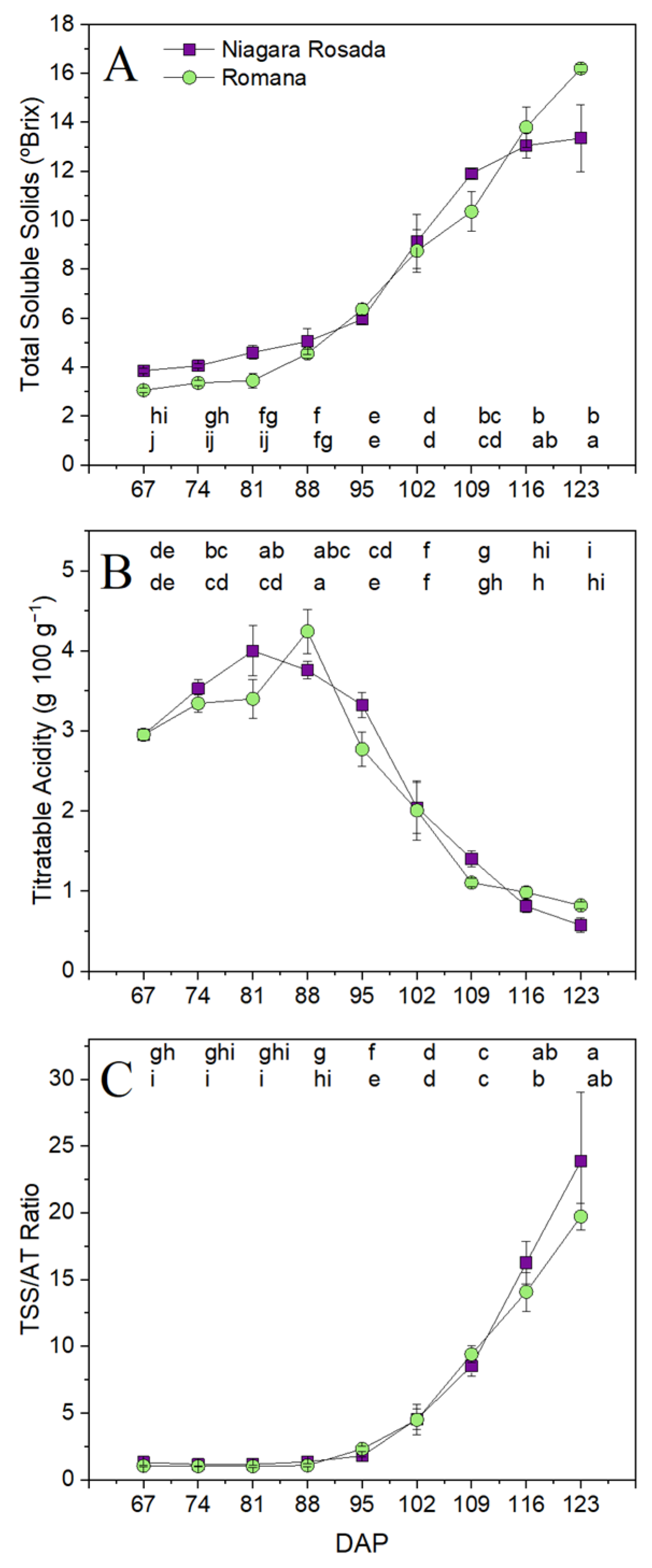
Total soluble solids (TSS) accumulation commenced post-veraison at 95 DAP (Figure 1A). NR maintained higher TSS concentrations than RM until 109 DAP, after which RM exhibited a greater accumulation rate, achieving higher final TSS at harvest (123 DAP). Titratable acidity (TA) peaked earlier in NR (81 DAP) than in RM (88 DAP), followed by a sharp decline during ripening that was more pronounced for NR, resulting in its significantly lower final acidity (Figure 1B). Consequently, the TSS/TA ratio remained low in both cultivars until 88 DAP, with RM with lower values compared to NR cultivar. A marked inflexion at 95 DAP triggered a steep ratio increase for RM over NR. However, at 116 DAP onward, the increase was significantly more accentuated in NR, leading to its higher final maturity index at 123 DAP (Figure 1C).

3.2. Soluble Sugar Quantification

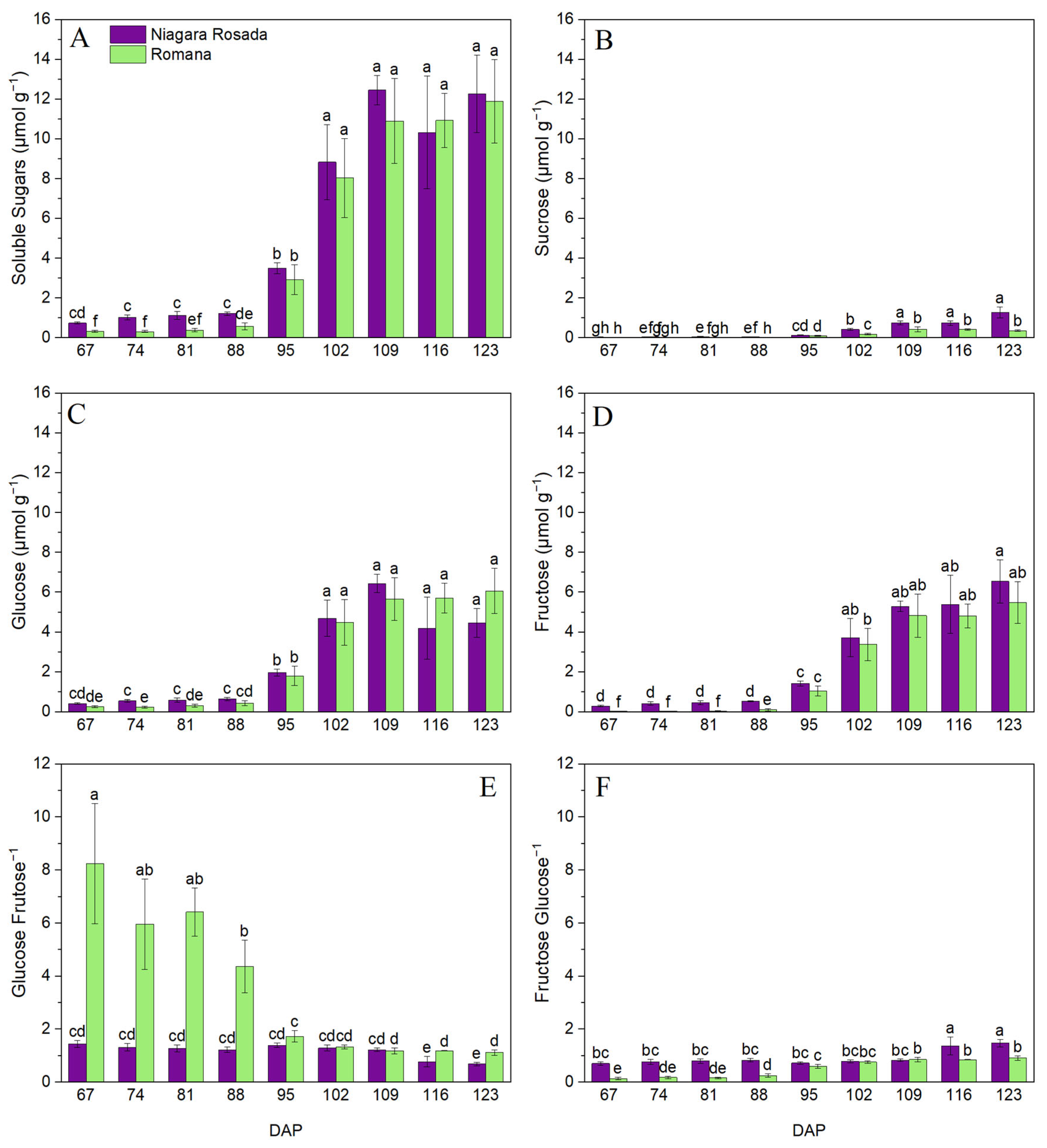
Berry SS maintained significantly higher for the NR than for the RM from 67 to 88 DAP (Figure 2A). A significant increase in SS occurred from 95 DAP onward, maintaining similar values in both cultivars until 123 DAP. Sucrose concentration (Figure 2B) remained low relative to glucose (Figure 2C) and fructose (Figure 2D) in both cultivars. Minimal and similar sucrose accumulation occurred until 74 DAP in both cultivars, followed by increased accumulation. NR accumulated substantially more sucrose than RM along the developmental stages, with a higher concentration at 123 DAP. Consistent with TSS and sucrose, marked accumulation of glucose and fructose was observed from 95 DAP. However, hexose partitioning diverged between cultivars: RM exhibited lower glucose concentration with NR before 95 DAP and similar after (Figure 2C), whereas NR accumulated more fructose at 123 DAP (Figure 2D). This differential accumulation generated distinct hexose balance profiles. The glucose/fructose ratio for RM declined sharply from 67 to 95 DAP before stabilising, while it remained stable until 109 DAP for NR (Figure 2E). Conversely, the fructose/glucose ratio increased progressively for RM from 67 DAP but only increased at 116 DAP for NR (Figure 2F).

3.3. Chlorophyll Quantification and Fluorescence Analysis

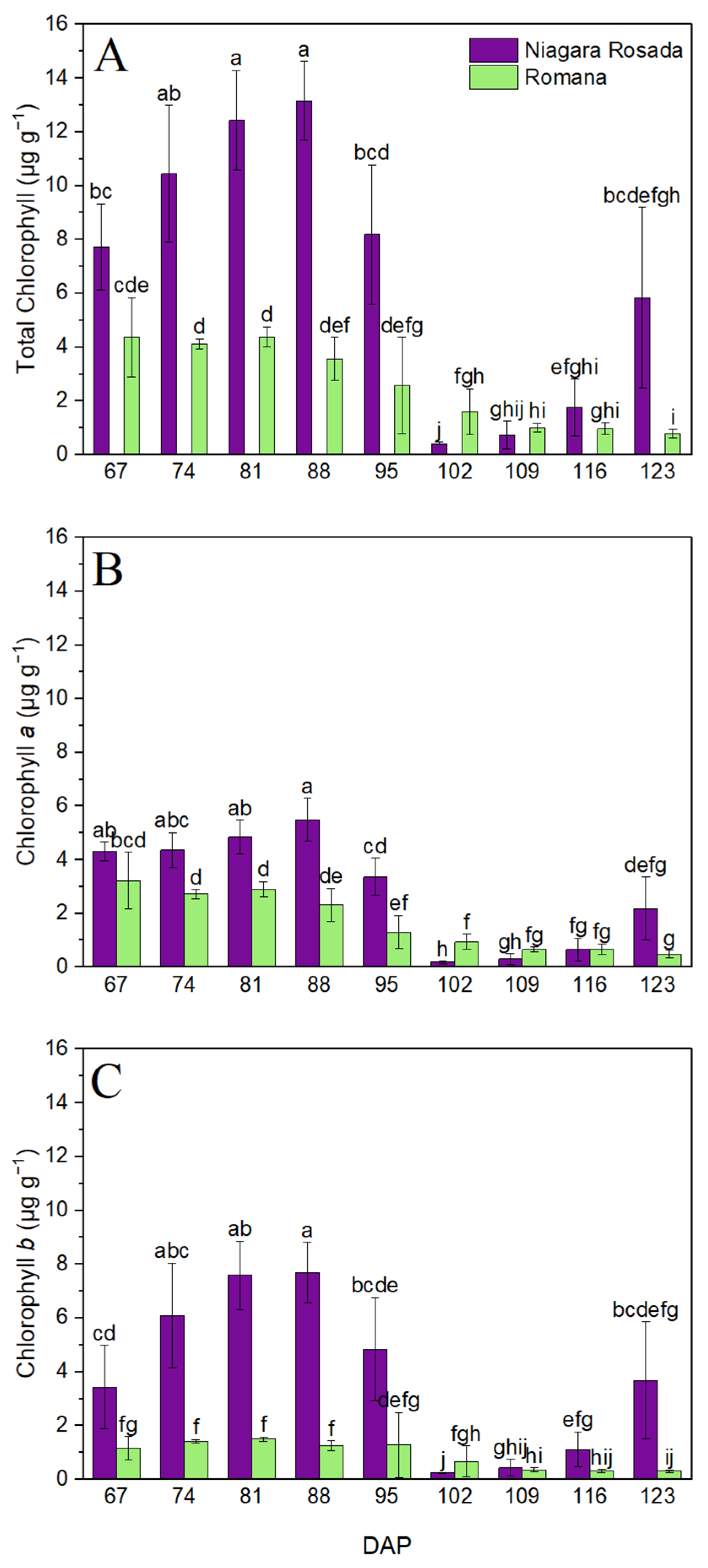
While the total chlorophyll content presented a sharp increase from 67 DAP to 88 DAP in NR, RM exhibited a minor decline until 95 DAP (Figure 3A). After the onset of ripening, NR presented a significant decrease at 102 DAP, followed by a high deviation increase at 123 DAP. On the other hand, RM continued a reduction until 123 DAP. Chlorophyll a and b profiles were similar to the total chlorophyll (Figure 3B,C). NR skin contained predominantly chlorophyll b, whereas chlorophyll a was higher in RM. In RM, both chlorophylls declined steadily from 102 DAP. In contrast, NR exhibited progressive chlorophyll accumulation until 88 DAP, followed by degradation and posterior accumulation at 123 DAP.
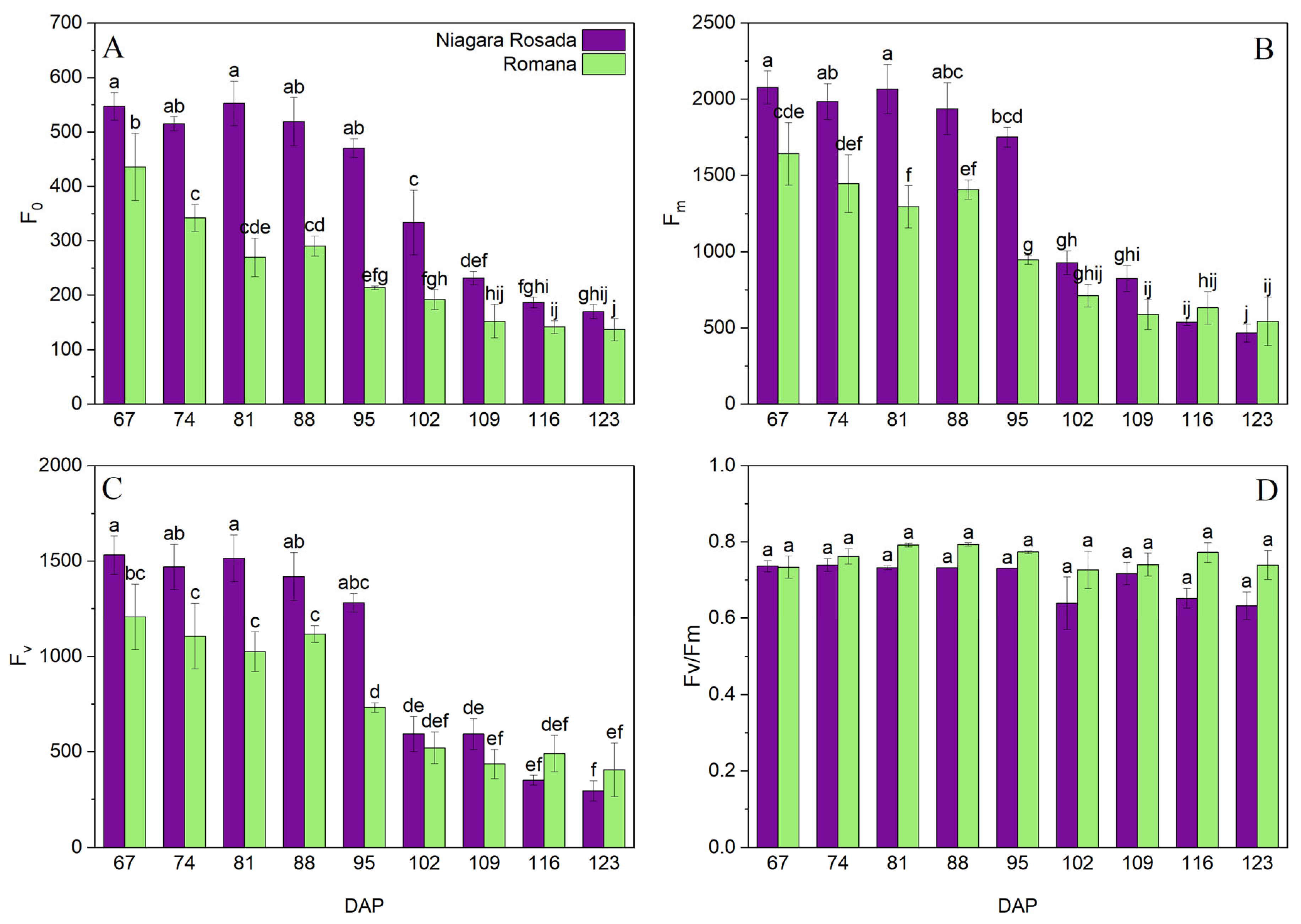
Chlorophyll a fluorescence parameters Fo, Fm, and Fv decreased progressively during berry development in both cultivars (Figure 4A–D). Fo from RM decreased earlier, at 74 DAP, when compared to NR, where the decrease started at 102 DAP (Figure 4A). Despite the reduction in both cultivars, Fo values were consistently lower for RM than for NR across all evaluations. Notably, the stable F0 in NR until 88–95 DAP coincided with the period of chlorophyll accumulation, while RM exhibited continuous F0 reduction from the beginning of the experiment, consistent with the pattern of continuous chlorophyll degradation.
In line with Fo, Fm values remained stable until 88 DAP for NR before declining (Figure 4B). In contrast, Fm for RM declined at 81 DAP and after 95 DAP. The overall reduction between 67 and 123 DAP was more pronounced in NR (75.78%) when compared to RM (66.97%). Fm was higher for NR throughout most of the developmental stages, converging to RM values only after 102 DAP.
Fv values were calculated as (Fm − Fo), remained high and stable longer in NR (until 95 DAP) than in RM (until 88 DAP), with NR consistently showing greater values throughout this period. Thereafter, Fv decreased significantly for RM at 95 DAP and more gradually for NR. This resulted in RM displaying higher values than NR exclusively at 116 and 123 DAP.
Maximum quantum yield values, represented by the Fv/Fm ratio (Figure 4D), was significant for Cultivar (F = 85.6, p < 0.001), Stage (F = 16.3, p < 0.001), and their interaction (F = 5.04, p < 0.001) based on Aligned Rank Transform ANOVA. Overall, RM maintained significantly higher Fv/Fm values than NR throughout development, with peak values at 81–88. NR values remained relatively stable during early development before declines from 102 DAP onward. However, post hoc pairwise comparisons did not reveal significant differences between individual Cultivar × Stage combinations after multiplicity, likely due to the conservative nature of corrections with 18 treatment combinations.

3.4. Correlation Analysis

Pearson correlation analysis of combined data between chlorophyll a fluorescence parameters and most other studied variables for the combined data from NR and RM demonstrated significant correlations (p < 0.05) (Table 2). Fo positively correlated with chlorophyll a (r = 0.83), chlorophyll b (r = 0.71), and total chlorophyll (r = 0.79), as well as negative correlations with SS (r = −0.73), TSS (r = −0.71), and individual sugars. Notably, Fo did not significantly correlate with either the Fv/Fm (r = 0.04) or the glucose/fructose (r = 0.11). On the other hand, Fm exhibited high correlations with Fv/Fm (r = 0.99) and negative correlations with SS (r = −0.82) and TSS (r = −0.82). Fv demonstrated positive correlations with chlorophyll content and negative correlations with SS (r = −0.84) and TSS (r = −0.84).
When analysing only NR data, fluorescence parameters presented high correlations with all the traits. Fo exhibited high correlations with Fm (r = 0.98) and Fv (r = 0.96), as well as for TSS (r = −0.96), TA (r = 0.94), and SS (r = −0.93), and moderate with Fv/Fm (r = 0.63). Notably, F0 was a high negative correlation with sucrose (r = −0.91), glucose (r = −0.85), and fructose (r = −0.94). Fm was a similarly high negative correlation, particularly with TSS (r = −0.96), SS (r = −0.93), and individual sugars (sucrose r = −0.90, glucose r = −0.86, fructose r = −0.94). Fv displayed the highest correlations among fluorescence variables with TSS (r = −0.96), SS (r = −0.93), TA (r = 0.93) and all sugar components. The fructose/glucose ratio was moderate negative correlations with Fo, Fm and Fv, while the glucose/fructose ratio was moderate positive correlated.
For RM, fluorescence parameters also correlated with most studied parameters, though with some distinct patterns. F0 depicted high correlations with Fm (r = 0.94) and Fv (r = 0.90), and with chlorophyll a (r = 0.86), chlorophyll b (r = 0.56), and total chlorophyll (r = 0.79). For RM, Fo did not correlate with Fv/Fm. Negative correlations were observed with TSS (r = −0.86), SS (r = −0.80), and individual sugars. Fm was high correlated with Fv (r = 0.99) as well as with chlorophyll a (r = 0.92), TSS (r = −0.86), TA (r = 0.83) and the fructose/glucose ratio (r = −0.92). Fv was high correlated with chlorophyll a (r = 0.91), total chlorophyll (r = 0.87), TSS (r = −0.85), TA (r = 0.85), SS (r = −0.87), and the fructose/glucose ratio (r = −0.93), representing the highest correlation with this metabolic ratio among all variables studied.
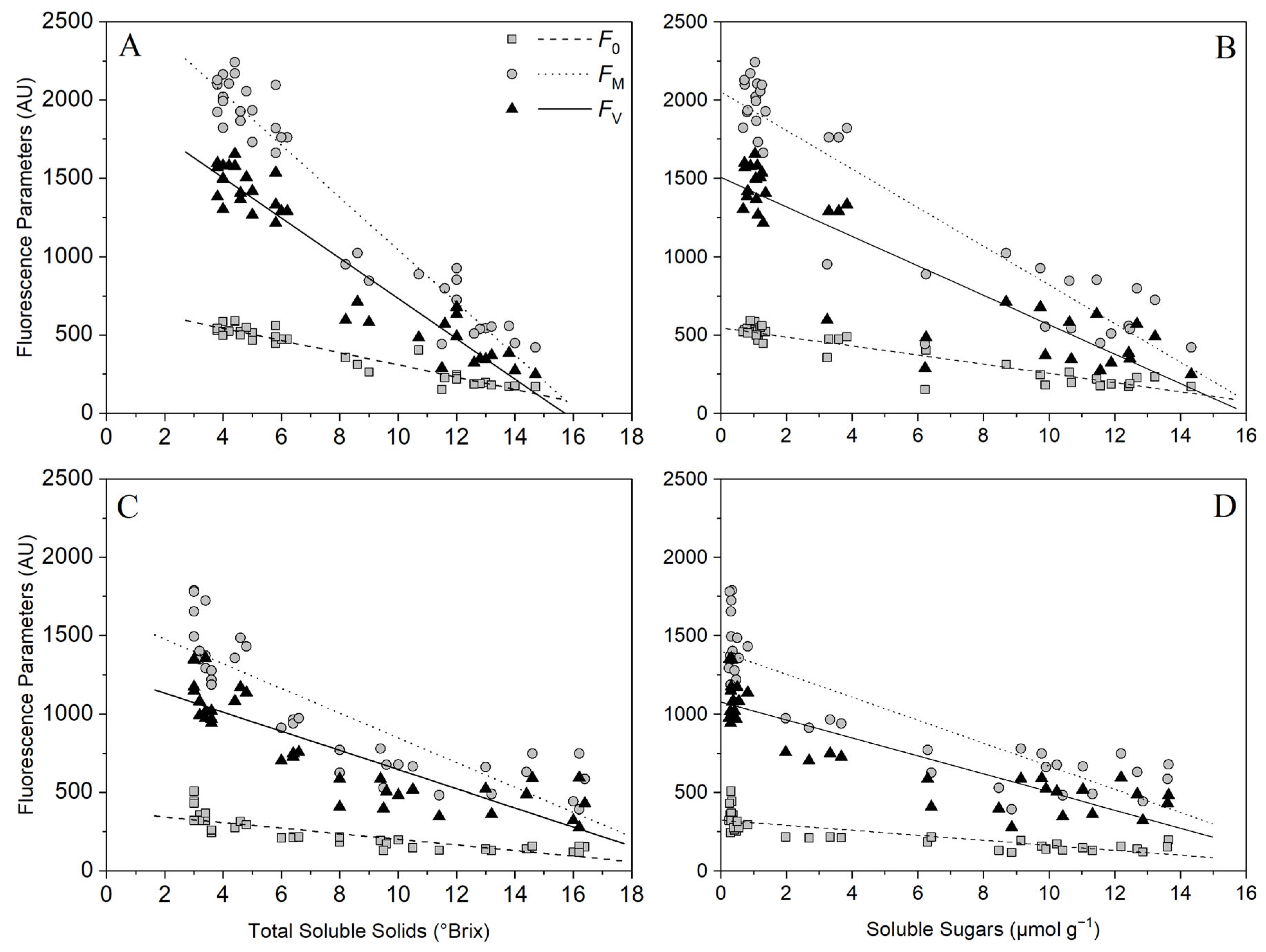
Negative linear trends were observed between Fo, Fm, and Fv, as well as between TSS and SS, for both NR and RM cultivars (Figure 5A–D). Notably, regression slopes for NR were steeper than for RM. This is partially explained by the higher F0, Fm, and Fv values in NR compared to RM during most of the fruit development, reflecting the distinct chlorophyll accumulation–degradation pattern in NR versus the continuous degradation in RM. The best-fitting equations (R2 > 0.90) were obtained in NR. However, R2 in the RM cultivar was consistently greater than 0.80.

4. Discussion

The high correlations found between chlorophyll a fluorescence parameters and fruit quality traits support this technique as a reliable non-destructive tool for assessing grape berry maturation under tropical field conditions. Among the parameters, Fv exhibited the highest predictive capacity within the combined dataset, being highly correlated with soluble sugars (r = −0.84), total soluble solids (r = −0.84), titratable acidity (r = 0.86), and chlorophyll a (r = 0.87).
The high correlations observed for NR (r ≥ 0.93) for Fo, Fm, and Fv with soluble solids and total soluble sugars indicate a coupling between the dismantling of the photosynthetic apparatus and ripening-related metabolic processes. These correlations may suggest a tighter coordination between chloroplast dismantling and sugar accumulation in V. labrusca compared to previous reports for V. vinifera, where the correlation between Fm soluble sugars was less pronounced [21]. Such differences likely reflect cultivar-specific regulation of chloroplast-to-chromoplast transitions and carbohydrate partitioning during ripening, which may alter the temporal coupling between pigment loss and hexose accumulation.
Linear regression models strengthen the analytical utility of fluorescence parameters, with coefficients of determination exceeding 0.90 for NR and 0.80 for RM. Consequently, fluorescence measurements provide a reliable, non-destructive means of estimating internal quality parameters. This overcomes a fundamental limitation of conventional refractometry, as its destructive nature constrains the longitudinal monitoring needed to track developmental trajectories. While combining fluorescence with spectral or imaging approaches has improved maturity or quality assessment in other fruit systems [30,31], the portability and simplicity of modulated fluorometers make fluorescence measurements a readily deployable option for rapid, in-field decision-making in commercial vineyards.
The progressive decline in Fo, Fm, and Fv throughout berry development reflects the structural disassembly of the photosynthetic apparatus associated with fruit ripening. The correlation between Fo and chlorophyll content (r = 0.83 for chlorophyll a, r = 0.79 for total chlorophyll) confirms the intrinsic link between minimum fluorescence and pigment concentration, as Fo emission depends directly on structural changes and chlorophyll concentration in thylakoids [32,33]. The reduction in Fm indicates increased thermal dissipation by reaction centres and light-harvesting complexes of PSII [34], while the Fv decline reflects a progressive loss of chloroplast function [35].
Despite substantial chlorophyll degradation and the concomitant decline in fluorescence parameters, the maximum quantum yield (Fv/Fm) remained relatively stable around 0.75 for RM throughout ripening, with a non-significant reduction after veraison in NR at late developmental stages. This value falls within the typical range (0.75–0.85) for photosynthetically competent tissues [36]. The maintenance of PSII efficiency is consistent with a coordinated senescence process in which the number of functional units declines while the remaining units retain relatively high efficiency [27]. Such coordination may help sustain light reactions in berry skin chloroplasts and support ripening-related metabolism [37]. Therefore, the parallel between chlorophyll degradation and fluorescence decline provides a basis for using fluorescence as a ripening indicator and underscores that chloroplast dismantling is a highly coordinated component of the ripening programme, integrally linked to metabolic shifts toward sugar accumulation [38].
The characteristic patterns of sugar accumulation provide a clear biochemical marker for tracking berry development and validating fluorescence-based assessments. The increase in total soluble sugars from 102 DAP onward, coinciding with the veraison at 95 DAP, aligns with the shift from symplastic to apoplastic phloem unloading that enables massive sugar accumulation during the final growth phase [4]. Glucose and fructose comprised over 90% of total soluble sugars for both cultivars, consistent with the hexose-dominant profiles of grape berries [1]. The significant sucrose accumulation in NR (reaching 10.10% of total soluble sugars at harvest) aligns with reports for Vitis rotundifolia [39], hybrids between V. labrusca and V. vinifera, red-skinned berries, and seeded berries [5]. This is marked higher than the typical 1% in V. vinifera [1,5]. In contrast, RM maintained lower sucrose levels at harvest (around 2.84%), demonstrating the cultivar-specific regulation of carbohydrate metabolism between coloured and non-coloured grapes. The distinct temporal patterns in the fructose/glucose ratio illustrate distinct cultivar-specific metabolic signatures, with implications for both quality assessment and sweetness perception. The differential hexose accumulation patterns may be associated with cultivar-specific enzyme activities [40].
Despite the overall correlation between chlorophyll fluorescence parameters and sugar and chlorophyll content for both cultivars, distinct cultivar-specific characteristics could still be observed. NR’s fluorescence parameters declined more rapidly after veraison than those of the white-skinned RM. These differences reflect a distinct chlorophyll dynamic in NR, characterised by accumulation until just before veraison, and subsequent rapid degradation during colour change. In contrast, RM exhibited no chlorophyll accumulation, with degradation only after veraison. In NR, the biphasic Fo pattern (stable until veraison, then declining sharply) provides a clear physiological-based marker for ripening onset. Its precise coincidence with the critical shift to sugar accumulation offers a reliable, non-destructive signal for determining the optimal harvest window.
The steeper fluorescence decline observed in NR compared to RM may reflect not only differences in chlorophyll degradation rates but also optical effects of accessory pigment accumulation. Anthocyanins may compete with chlorophylls for light absorption, particularly in the green spectral region, thereby altering fluorescence excitation spectra in pigmented fruit tissues [22]. In genetically modified ‘Hamlin’ sweet orange trees expressing the grapevine-derived Vitis vinifera mybA1 (VvmybA1), anthocyanin accumulation confers photoprotective properties by attenuating irradiance reaching the chloroplasts [23]. The progressive anthocyanin accumulation in NR during ripening likely creates an optical screening effect that amplifies apparent fluorescence decline beyond chlorophyll loss alone. In contrast, the white-skinned RM lacks this confounding optical filter. Additionally, structural differences in the exocarp, including cuticle thickness, which influences both light penetration and chlorophyll stability [41], may contribute to cultivar-specific responses. The cuticle thickness in V. labrusca cultivars such as Concord, has been reported to increase 27% during ripening and to be 2–3 times greater than in V. vinifera cultivars like Merlot [42]. These differences in cuticle properties may modify the optical pathway of both excitation and emitted fluorescence light.
The higher correlations observed for NR compared to RM likely reflect the distinct chlorophyll accumulation-degradation pattern, and skin composition and structure that produce clearer fluorescence signal transitions corresponding to quality improvements. The correlation between Fv and the fructose/glucose ratio is particularly high in RM (r = −0.93), reflecting that fluorescence parameters can track not only total sugar accumulation but also the metabolic shifts in hexose composition associated with maturation. The steeper regression slopes for NR in all fluorescence-quality links further emphasise this cultivar-dependent sensitivity. These considerations support the establishment of separate calibration curves for coloured-skinned versus white-skinned table grape cultivars in fluorescence-based monitoring applications. Fluorescence-based monitoring protocols should be calibrated individually for each cultivar to achieve optimal predictive accuracy, particularly when transitioning between coloured and white-skinned table grape cultivars.
Tropical viticulture, practised from equatorial to subtropical latitudes (0°–35° N/S), encompasses diverse climates, from areas with minimal temperature variation to those with distinct seasonal patterns. Our study site at 21° S latitude represented a tropical lowland where mean temperatures during berry development (20.1–23.5 °C) are comparable to growing season values in temperate wine regions [43], while solar radiation was moderated [44,45]. The mean maximum temperatures recorded (<28.1 °C) remained within the optimal range for grapevine physiology (25–32 °C) and below thresholds associated with heat stress effects on photosynthetic apparatus (>35 °C) [46]. Transient heat peaks of >35 °C were observed for only 26 h during the whole experimentation time. Therefore, the defining characteristic of tropical viticulture is not only extreme heat, but rather other unique challenges, including reduced seasonality, a frequent reliance on dormancy-breaking practices (e.g., hydrogen cyanamide) to synchronise budbreak [34], and unpredictable rainfall during ripening. Transient heat peaks could affect PSII performance, although cultivar-specific photoprotective responses may mitigate heat impacts [47], along with the substantial PSII-recovery capacity following short-term heat exposure when temperatures return to optimal ranges overnight [46]. However, the moderate temperatures during our experiment ensured that fluorescence parameters reflected developmental changes in berry physiology rather than thermal stress responses, supporting the robustness of this technique for routine application in subtropical production systems.
Although elevated temperatures and high solar irradiance characterise certain tropical environments, the measurement protocol employing pre-dawn readings and complete dark adaptation was designed to minimise direct environmental interference on fluorescence signals, even under more thermally stressful conditions. The stability of the Fv/Fm ratio throughout the experimental period confirms that diurnal temperature fluctuations did not compromise measurement reliability. This finding suggests that photoprotective mechanisms may remain functional during berry maturation under tropical field conditions.
The overlap between the maturation period and seasonal rainfall observed in this study illustrates a well-documented challenge in tropical viticulture. The lower soluble solids content in NR at harvest (13.35 °Brix) compared to typical values [47] may result from the sugar concentration being reduced by rainy events immediately prior to the harvest time. Similarly, RM required an early harvest due to bunch rot, which was precipitated by berry cracking, a frequent consequence of high humidity [48]. These cases underscore the necessity for tools that monitor physiological maturity in real-time, moving beyond fixed calendar-based schedules. Chlorophyll fluorescence monitoring fulfils this requirement by enabling non-destructive and real-time assessment of physiological status, allowing growers to adapt harvest decisions to volatile environmental conditions.
In this sense, chlorophyll fluorescence monitoring may enable real-time tracking of physiological status without damaging the fruit, allowing producers to respond to changing environmental conditions. The high correlations maintained across the extended sampling period (67–123 DAP) demonstrate how efficient this approach is within diverse developmental stages. The portability and ease of use of pulse-amplitude modulated fluorometers make this technique particularly suited for field applications in commercial vineyards, where rapid assessment of multiple sampling points is essential for informed harvest decisions.

5. Conclusions

The progressive decline in chlorophyll a fluorescence during ripening correlated closely with key qualitative traits, confirming it as an effective non-invasive method for monitoring grape berry development and estimating fruit quality in V. labrusca cultivars in tropical field conditions. The maintenance of Fv/Fm values around 0.75 despite significant chlorophyll loss indicates that the remaining photosynthetic units maintain their functionality during ripening, supporting the idea of programmed developmental senescence rather than being induced by abiotic stress. Future research should expand the cultivar range and growing regions to develop robust, generalizable models, including other V. labrusca cultivars and interspecific hybrids commonly cultivated in tropical environments. Furthermore, investigating the influence of environmental factors, particularly water availability, on fluorescence-quality relationships will be crucial for enhancing model reliability across diverse tropical production systems.

Author Contributions

G.M.d.S. and R.B.-S. conceived the study and designed the methodology. G.M.d.S. performed the experiments and curated the data. G.M.d.S. and E.M. developed the analysis software and performed the formal analysis. R.B.-S. provided resources and supervision. The original draft was written by G.M.d.S. and all authors (G.M.d.S., E.M., and R.B.-S.) participated in the review and editing of the final version of the manuscript. All authors have read and agreed to the published version of the manuscript.

Funding

This research was funded by the FUNDAÇÃO CARLOS CHAGAS FILHO DE AMPARO À PESQUISA DO ESTADO DO RIO DE JANEIRO (FAPERJ), Grant number E-26/190.022.

Data Availability Statement

The raw data supporting the conclusions of this article will be made available by the authors upon request.

Acknowledgments

The authors acknowledge the farmers (Neusa, Levy and Leandro Hespanhol Viana) who provided the agronomic, technical, and plant material.

Conflicts of Interest

The authors declare no conflicts of interest.

Abbreviations

The following abbreviations are used in this manuscript:
DAPDays after pruning
DMSODimethyl sulfoxide
G6PDHGlucose-6-phosphate dehydrogenase
HKHexokinase
ODInitial fluorescence
FmMaximum fluorescence
Fv/FmMaximum quantum yield of PSII
NRNiagara Rosada
ODOptical density
PGIPhosphoglucose isomerase
PVPPPolyvinylpolypyrrolidone
RMRomana A1105
SSSoluble sugar
TATitratable acidity
TSSTotal soluble solids
FvVariable fluorescence

References

  1. Coombe, B.G. Research on Development and Ripening of the Grape Berry. Am. J. Enol. Vitic. 1992, 43, 101–110. [Google Scholar] [CrossRef]
  2. Davies, C.; Robinson, S.P. Differential Screening Indicates a Dramatic Change in mRNA Profiles during Grape Berry Ripening. Cloning and Characterization of cDNAs Encoding Putative Cell Wall and Stress Response Proteins. Plant Physiol. 2000, 122, 803–812. [Google Scholar] [CrossRef]
  3. Thomas, T.R.; Matthews, M.A.; Shackel, K.A. Direct in Situ Measurement of Cell Turgor in Grape (Vitis vinifera L.) Berries during Development and in Response to Plant Water Deficits. Plant Cell Environ. 2006, 29, 993–1001. [Google Scholar] [CrossRef]
  4. Zhang, X.-Y.; Wang, X.-L.; Wang, X.-F.; Xia, G.-H.; Pan, Q.-H.; Fan, R.-C.; Wu, F.-Q.; Yu, X.-C.; Zhang, D.-P. A Shift of Phloem Unloading from Symplasmic to Apoplasmic Pathway Is Involved in Developmental Onset of Ripening in Grape Berry. Plant Physiol. 2006, 142, 220–232. [Google Scholar] [CrossRef] [PubMed]
  5. Liu, H.-F.; Wu, B.-H.; Fan, P.-G.; Li, S.-H.; Li, L.-S. Sugar and Acid Concentrations in 98 Grape Cultivars Analyzed by Principal Component Analysis. J. Sci. Food Agric. 2006, 86, 1526–1536. [Google Scholar] [CrossRef]
  6. Wang, J.; Zhang, C.; Li, M.; Fan, X.; Zhang, Y.; Jiang, J.; Liu, C.; Sun, L. Multi-Omics Analysis Unravels the Dynamics of Flavor Profile in ‘Queen Nina’ Berries and the Regulatory Mechanism Underlying Volatile Esters. Food Chem. Mol. Sci. 2025, 10, 100248. [Google Scholar] [CrossRef]
  7. Shahood, R.; Torregrosa, L.; Savoi, S.; Romieu, C. First Quantitative Assessment of Growth, Sugar Accumulation and Malate Breakdown in a Single Ripening Berry. OENO One 2020, 54, 1077–1092. [Google Scholar] [CrossRef]
  8. Kuhn, N.; Guan, L.; Dai, Z.W.; Wu, B.-H.; Lauvergeat, V.; Gomès, E.; Li, S.-H.; Godoy, F.; Arce-Johnson, P.; Delrot, S. Berry Ripening: Recently Heard through the Grapevine. J. Exp. Bot. 2013, 65, 4543–4559. [Google Scholar] [CrossRef]
  9. Feiten, M.C.; Vieira, A.S. Utilização de Refratômetro Para Determinação Da Maturação de Uvas Viníferas de Pequenas Propriedades Familiares. Rev. Agro. Amb. 2024, 17, e12212. [Google Scholar] [CrossRef]
  10. Urbano Bron, I.; Vasconcelos Ribeiro, R.; Azzolini, M.; Pedro Jacomino, A.; Caruso Machado, E. Chlorophyll Fluorescence as a Tool to Evaluate the Ripening of ‘Golden’ Papaya Fruit. Postharvest Biol. Technol. 2004, 33, 163–173. [Google Scholar] [CrossRef]
  11. Greer, D.H. Non-destructive Chlorophyll Fluorescence and Colour Measurements of ‘Braeburn’ and ‘Royal Gala’ Apple (Malus domestica) Fruit Development throughout the Growing Season. N. Z. J. Crop Hortic. Sci. 2005, 33, 413–421. [Google Scholar] [CrossRef]
  12. Huybrechts, C.J.G.; Deckers, T.; Valcke, R. Assessing Apple Quality and Storage Capability by Means of Fluorescence Imaging. Acta Hortic. 2003, 628, 91–96. [Google Scholar] [CrossRef]
  13. Abdelhamid, M.A.; Rawdhan, S.A.; Shalaby, S.S.; Atia, M.F. Assessment of Tomato Ripeness Using Chlorophyll Fluorescence. Rev. Bras. Eng. Agríc. Ambient. 2024, 28, e277711. [Google Scholar] [CrossRef]
  14. Choi, H.-G.; Park, K.-S. Ripening Process of Tomato Fruits Postharvest: Impact of Environmental Conditions on Quality and Chlorophyll a Fluorescence Characteristics. Horticulturae 2023, 9, 812. [Google Scholar] [CrossRef]
  15. Lechaudel, M.; Urban, L.; Joas, J. Chlorophyll Fluorescence, a Nondestructive Method to Assess Maturity of Mango Fruits (Cv. ‘Cogshall’) without Growth Conditions Bias. J. Agric. Food Chem. 2010, 58, 7532–7538. [Google Scholar] [CrossRef]
  16. Choi, H.G.; Moon, B.Y.; Kang, N.J. Correlation between Strawberry (Fragaria ananassa Duch.) Productivity and Photosynthesis-Related Parameters under Various Growth Conditions. Front. Plant Sci. 2016, 7, 1607. [Google Scholar] [CrossRef]
  17. Baker, N.R. Applications of Chlorophyll Fluorescence Can Improve Crop Production Strategies: An Examination of Future Possibilities. J. Exp. Bot. 2004, 55, 1607–1621. [Google Scholar] [CrossRef] [PubMed]
  18. Krause, G.H.; Weis, E. Chlorophyll Fluorescence and Photosynthesis: The Basics. Annu. Rev. Plant Biol. 1991, 42, 313–349. [Google Scholar] [CrossRef]
  19. Baker, N.R. Chlorophyll Fluorescence: A Probe of Photosynthesis In Vivo. Annu. Rev. Plant Biol. 2008, 59, 89–113. [Google Scholar] [CrossRef]
  20. Leach, N.; Coops, N.C.; Obrknezev, N. Normalization Method for Multi-Sensor High Spatial and Temporal Resolution Satellite Imagery with Radiometric Inconsistencies. Comput. Electron. Agric. 2019, 164, 104893. [Google Scholar] [CrossRef]
  21. Kolb, C.A.; Wirth, E.; Kaiser, W.M.; Meister, A.; Riederer, M.; Pfündel, E.E. Noninvasive Evaluation of the Degree of Ripeness in Grape Berries (Vitis vinifera L. Cv. Bacchus and Silvaner) by Chlorophyll Fluorescence. J. Agric. Food Chem. 2006, 54, 299–305. [Google Scholar] [CrossRef]
  22. Merzlyak, M.N.; Melø, T.B.; Naqvi, K.R. Effect of Anthocyanins, Carotenoids, and Flavonols on Chlorophyll Fluorescence Excitation Spectra in Apple Fruit: Signature Analysis, Assessment, Modelling, and Relevance to Photoprotection. J. Exp. Bot. 2008, 59, 349–359. [Google Scholar] [CrossRef]
  23. Cheaib, A.; Mahmoud, L.M.; Vincent, C.; Killiny, N.; Dutt, M. Influence of Anthocyanin Expression on the Performance of Photosynthesis in Sweet Orange, Citrus sinensis (L.) Osbeck. Plants 2023, 12, 3965. [Google Scholar] [CrossRef]
  24. Anzanello, R.; Fialho, F.B.; Santos, H.P.D. Chilling Requirements and Dormancy Evolution in Grapevine Buds. Ciência Agrotecnol. 2018, 42, 364–371. [Google Scholar] [CrossRef]
  25. De Souza Leão, P.C.; Da Silva, E.E.G. Effects of Hydrogen Cyanamid on Bud Breaking of the Grapevine “Italia” in the São Francisco River Valley. Acta Hortic. 2010, 864, 157–162. [Google Scholar] [CrossRef]
  26. Coombe, B.G. Growth Stages of the Grapevine: Adoption of a System for Identifying Grapevine Growth Stages. Aust. J. Grape Wine Res. 1995, 1, 104–110. [Google Scholar] [CrossRef]
  27. Wellburn, A.R. The Spectral Determination of Chlorophylls a and b, as Well as Total Carotenoids, Using Various Solvents with Spectrophotometers of Different Resolution. J. Plant Physiol. 1994, 144, 307–313. [Google Scholar] [CrossRef]
  28. Stitt, M.; Lilley, R.M.c.C.; Gerhardt, R.; Heldt, H.W. [32] Metabolite Levels in Specific Cells and Subcellular Compartments of Plant Leaves. In Methods in Enzymology; Elsevier: Amsterdam, The Netherlands, 1989; Volume 174, pp. 518–552. ISBN 978-0-12-182075-6. [Google Scholar]
  29. R Core Team. R Core Team R: A Language and Environment for Statistical Computing; R Found. Stat. Comput: Vienna, Austria, 2023. [Google Scholar]
  30. Kasampalis, D.S.; Tsouvaltzis, P.; Ntouros, K.; Gertsis, A.; Gitas, I.; Siomos, A.S. The Use of Digital Imaging, Chlorophyll Fluorescence and Vis/NIR Spectroscopy in Assessing the Ripening Stage and Freshness Status of Bell Pepper Fruit. Comput. Electron. Agric. 2021, 187, 106265. [Google Scholar] [CrossRef]
  31. Noh, H.K.; Lu, R. Hyperspectral Laser-Induced Fluorescence Imaging for Assessing Apple Fruit Quality. Postharvest Biol. Technol. 2007, 43, 193–201. [Google Scholar] [CrossRef]
  32. Kitao, M.; Lei, T.T.; Koike, T.; Tobita, H.; Maruyama, Y.; Matsumoto, Y.; Ang, L. Temperature Response and Photoinhibition Investigated by Chlorophyll Fluorescence Measurements for Four Distinct Species of Dipterocarp Trees. Physiol. Plant. 2000, 109, 284–290. [Google Scholar] [CrossRef]
  33. Toivonen, P.M.A.; DeEll, J.R. Differences in Chlorophyll Fluorescence and Chlorophyll Content of Broccoli Associated with Maturity and Sampling Section. Postharvest Biol. Technol. 1998, 14, 61–64. [Google Scholar] [CrossRef]
  34. Schreiber, U.; Bilger, W. Rapid Assessment of Stress Effects on Plant Leaves by Chlorophyll Fluorescence Measurements. In Plant Response to Stress; Tenhunen, J.D., Catarino, F.M., Lange, O.L., Oechel, W.C., Eds.; Springer: Berlin/Heidelberg, Germany, 1987; pp. 27–53. ISBN 978-3-642-70870-1. [Google Scholar]
  35. Mir, N.; Perez, R.; Beaudry, R.M. Chlorophyll Fluorescence and Whole Fruit Senescence in ‘Golden Delicious’ Apple. Acta Hortic. 1998, 464, 121–126. [Google Scholar] [CrossRef]
  36. Bolhàr-Nordenkampf, H.R.; Öquist, G. Chlorophyll Fluorescence as a Tool in Photosynthesis Research. In Photosynthesis and Production in a Changing Environment; Hall, D.O., Scurlock, J.M.O., Bolhàr-Nordenkampf, H.R., Leegood, R.C., Long, S.P., Eds.; Springer: Dordrecht, The Netherlands, 1993; pp. 193–206. ISBN 978-0-412-42910-1. [Google Scholar]
  37. Teixeira, A.; Noronha, H.; Sebastiana, M.; Fortes, A.M.; Gerós, H. A Proteomic Analysis Shows the Stimulation of Light Reactions and Inhibition of the Calvin Cycle in the Skin Chloroplasts of Ripe Red Grape Berries. Front. Plant Sci. 2022, 13, 1014532. [Google Scholar] [CrossRef]
  38. Balic, I.; Vizoso, P.; Nilo-Poyanco, R.; Sanhueza, D.; Olmedo, P.; Sepúlveda, P.; Arriagada, C.; Defilippi, B.G.; Meneses, C.; Campos-Vargas, R. Transcriptome Analysis during Ripening of Table Grape Berry Cv. Thompson Seedless. PLoS ONE 2018, 13, e0190087. [Google Scholar] [CrossRef]
  39. Carroll, D.E.; Marcy, J.E. Chemical and Physical Changes during Maturation of Muscadine Grapes (Vitis rotundifolia). Am. J. Enol. Vitic. 1982, 33, 168–172. [Google Scholar] [CrossRef]
  40. Walker, R.P.; Bonghi, C.; Varotto, S.; Battistelli, A.; Burbidge, C.A.; Castellarin, S.D.; Chen, Z.-H.; Darriet, P.; Moscatello, S.; Rienth, M.; et al. Sucrose Metabolism and Transport in Grapevines, with Emphasis on Berries and Leaves, and Insights Gained from a Cross-Species Comparison. Int. J. Mol. Sci. 2021, 22, 7794. [Google Scholar] [CrossRef] [PubMed]
  41. Yang, M.; Luo, Z.; Li, D.; Ma, C.; Li, L. Role of Epicuticular Wax Involved in Quality Maintenance of Table Grapes: Evidence from Transcriptomic Data. Postharvest Biol. Technol. 2023, 196, 112155. [Google Scholar] [CrossRef]
  42. Chang, B.-M.; Keller, M. Cuticle and Skin Cell Walls Have Common and Unique Roles in Grape Berry Splitting. Hortic. Res. 2021, 8, 168. [Google Scholar] [CrossRef] [PubMed]
  43. Jones, G.V.; White, M.A.; Cooper, O.R.; Storchmann, K. Climate Change and Global Wine Quality. Clim. Change 2005, 73, 319–343. [Google Scholar] [CrossRef]
  44. Tomás, M.; Medrano, H.; Pou, A.; Escalona, J.M.; Martorell, S.; Ribas-Carbó, M.; Flexas, J. Water-Use Efficiency in Grapevine Cultivars Grown under Controlled Conditions: Effects of Water Stress at the Leaf and Whole-Plant Level: Genotypic Variability of Water-Use Efficiency. Aust. J. Grape Wine Res. 2012, 18, 164–172. [Google Scholar] [CrossRef]
  45. Mosetti, D.; Herrera, J.C.; Sabbatini, P.; Green, A.; Alberti, G.; Peterlunger, E.; Lisjak, K.; Castellarin, S.D. Impact of Leaf Removal after Berry Set on Fruit Composition and Bunch Rot in “Sauvignon Blanc”. VITIS—J. Grapevine Res. 2016, 55, 57–64. [Google Scholar] [CrossRef]
  46. Luo, H.-B.; Ma, L.; Xi, H.-F.; Duan, W.; Li, S.-H.; Loescher, W.; Wang, J.-F.; Wang, L.-J. Photosynthetic Responses to Heat Treatments at Different Temperatures and Following Recovery in Grapevine (Vitis amurensis L.) Leaves. PLoS ONE 2011, 6, e23033. [Google Scholar] [CrossRef]
  47. Vedoato, B.T.F.; Domingues Neto, F.J.; Pimentel Junior, A.; Paiva, A.P.M.; Silva, M.J.R.D.; Moura, M.F.; Lima, G.P.P.; Tecchio, M.A. Production, Physicochemical Quality and Antioxidant Capacity of ‘Niagara Rosada’ Grape Grafted on Different Rootstocks. Biosci. J. 2020, 36, 1879–1889. [Google Scholar] [CrossRef]
  48. Lulu, J.; Castro, J.V.D.; Pedro Júnior, M.J. Efeito Do Microclima Na Qualidade Da Uva de Mesa “Romana” (A 1105) Cultivada Sob Cobertura Plástica. Rev. Bras. Frutic. 2005, 27, 422–425. [Google Scholar] [CrossRef]
Figure 1. Total soluble solids (TSS) (A), Titratable acidity (TA) (B) and the TSS/TA ratio (C) in Vitis labrusca berries (var. Niagara Rosada and Romana) from 67 to 123 days after pruning (DAP), stages E-L 31 to E-L 38. Means that do not share a letter are significantly different with a significance level of 0.05. The first line corresponds for Niagara Rosada lettering and the second line for the Romana lettering. All values shown are means ± SD.
Agronomy 16 00181 g001
Figure 2. Variations in soluble sugars (SS) (A), their components, sucrose (B), glucose (C), fructose (D) and the glucose/fructose (E), fructose/glucose (F) ratios in Vitis labrusca berries (var. Niagara Rosada and Romana) from 67 to 123 days after pruning (DAP), stages E-L 31 to E-L 38. Means that do not share a letter are significantly different with a significance level of 0.05. All values shown are means ± SD.
Agronomy 16 00181 g002
Figure 3. Total chlorophyll (A), chlorophyll a (B), and chlorophyll b (C) in Vitis labrusca berries (var. Niagara Rosada and Romana) from 67 to 123 days after pruning (DAP), stages E-L 31 to E-L 38. Means that do not share a letter are significantly different with a significance level of 0.05. All values shown are means ± SD.
Agronomy 16 00181 g003
Figure 4. Arbitrary units of minimum fluorescence (Fo) (A), maximum fluorescence (Fm) (B), variable fluorescence (Fv) (C) and the maximum quantum yield of PSII (Fv/Fm) (D) in Vitis labrusca berries (var. Niagara Rosada and Romana) from 67 to 123 days after pruning (DAP), stages E-L 31 to E-L 38. Means that do not share a letter are significantly different with a significance level of 0.05. All values shown are means ± SD.
Agronomy 16 00181 g004
Figure 5. Linear fitting between minimum fluorescence (Fo), maximum fluorescence (Fm), and variable fluorescence (Fv) of chlorophyll a to total soluble solids (TSS) and soluble sugars (SS) from Vitis labrusca berries, var. Niagara Rosada (A,B) and Romana (C,D), from 67 to 123 days after pruning (DAP), stages E-L 31 to E-L 38. All regressions were significant at p < 0.001, with R2 values ranging from 0.81 to 0.96.
Agronomy 16 00181 g005
Table 1. Monthly climatic conditions during the experimental period at the experimental vineyard (21°51′ S; 41°71′ W).
MonthT min (°C)T Avg (°C)T Max (°C)Total Rainfall (mm)Total Radiation (MJ m−2 day−1)
June17.721.126.153.611.88
July15.420.126.51414.96
August18.222.227.83.816.23
September17.721.526.853.216.78
October20.623.428.172.416.14
November20.823.527.3506.415.48
Table 2. Pearson correlation coefficients between chlorophyll a minimum fluorescence (Fo), maximum fluorescence (Fm), variable fluorescence (Fv) and chlorophyll content, soluble solids, titratable acidity, and soluble sugars in Vitis labrusca berries (var. Niagara Rosada and Romana). Data are presented for combined cultivars and individually for each cultivar between 67 and 123 days after pruning (DAP).
FoFvFm
VariablesCombined NRRMCombinedNRRMCombinedNRRM
Fm0.95 *0.98 *0.94 *
Fv 0.92 *0.96 *0.90 *0.99 *0.99 *0.99 *
Fv/Fm0.04 ns0.63 *0.01 ns0.31 *0.76 *0.32 ns0.40 *0.79 *0.40 *
Chlorophyll a (µg g−1)0.83 *0.81 *0.86 *0.87 *0.84 *0.92 *0.87 *0.84 *0.91 *
Chlorophyll b (µg g−1)0.71 *0.66 *0.56 *0.68 *0.69 *0.66 *0.68 *0.70 *0.68 *
Chlorophyll Total (µg g−1)0.79 *0.73 *0.79 *0.78 *0.77 *0.87 *0.78 *0.77 *0.87 *
TSS (°Brix)−0.73 *−0.96 *−0.82 *−0.82 *−0.96 *−0.86 *−0.84 *−0.96 *−0.85 *
AT (g 100 g−1)0.74 *0.94 *0.71 *0.84 *0.93 *0.83 *0.86 *0.93 *0.85 *
TSS/AT−0.67 *−0.85 *−0.72 *−0.75 *−0.84 *−0.76 *−0.76 *−0.83 *−0.76 *
Soluble Sugars (µmol g−1)−0.71 *−0.93 *−0.80 *−0.82 *−0.93 *−0.87 *−0.84 *−0.93 *−0.87 *
Sucrose (µmol g−1)−0.55 *−0.91 *−0.76 *−0.68 *−0.90 *−0.82 *−0.71 *−0.89 *−0.82 *
Glucose (µmol g−1)−0.70 *−0.85 *−0.80 *−0.80 *−0.86 *−0.88 *−0.81 *−0.86 *−0.88 *
Fructose (µmol g−1)−0.69 *−0.94 *−0.78 *−0.81 *−0.94 *−0.86 *−0.84 *−0.94 *−0.86 *
Glucose Fructose−10.11 ns0.72 *0.80 *0.25 *0.71 *0.84 *0.29 *0.70 *0.84 *
Fructose Glucose−1−0.25 *−0.70 *−0.85 *−0.42 *−0.69 *−0.92 *−0.47 *−0.68 *−0.93 *
* states significant (p value < 0.05) and not significant (ns) Pearson correlation.
Disclaimer/Publisher’s Note: The statements, opinions and data contained in all publications are solely those of the individual author(s) and contributor(s) and not of MDPI and/or the editor(s). MDPI and/or the editor(s) disclaim responsibility for any injury to people or property resulting from any ideas, methods, instructions or products referred to in the content.