Article

Production and Quality of ‘Smooth Cayenne’ Pineapple as Affected by Nitrogen Fertilization and Types of Plantlets in the Northern Region of Rio de Janeiro State, Brazil


by
Denilson Coelho De Faria
1,
Rômulo André Beltrame
2,
Jéssica Morais Cunha
1,
Stella Arndt
3,
Simone de Paiva Caetano Bucker Moraes
3,
Paulo Cesar Dos Santos
3,*,
Marta Simone Mendonça Freitas
1,
Moises Zucoloto
3,
Silvio de Jesus Freitas
1,
Willian Bucker Moraes
3,
Marlene Evangelista Vieira
4 and
Almy Junior Cordeiro de Carvalho
1
1
Center for Agricultural Sciences and Technologies, State University of Northern Rio de Janeiro Darcy Ribeiro, Campos dos Goytacazes 28013-602, RJ, Brazil
2
Federal Rural University of Rio de Janeiro, Seropédica 23890-000, RJ, Brazil
3
Department of Agronomy, Federal University of Espírito Santo, Alegre 29500-000, ES, Brazil
4
State University of Amapá, Campus Território dos Lagos, Macapá 68901-258, AP, Brazil
*
Author to whom correspondence should be addressed.
Agronomy 2026, 16(2), 153; https://doi.org/10.3390/agronomy16020153
Submission received: 14 November 2025 / Revised: 3 December 2025 / Accepted: 9 December 2025 / Published: 7 January 2026
(This article belongs to the Section Horticultural and Floricultural Crops)

Abstract

This study evaluated the effects of nitrogen fertilization and different types of planting material on the yield and fruit quality of pineapple (Ananas comosus var. comosus) cv. Smooth Cayenne under the edaphoclimatic conditions of the Northern region of Rio de Janeiro State, Brazil. The experiment was conducted in a randomized block design, arranged in a factorial scheme with four nitrogen rates, six types of planting material, and two harvest seasons (winter and summer). Based on the results, it can be inferred that slips provided higher yields and heavier fruits, whereas plants derived from crowns and suckers showed lower productivity. Increasing nitrogen rates promoted greater fruit mass and length, higher pulp percentage, and increased production of vegetative propagules. Fruits harvested in the summer showed higher soluble solids content (15.5 °Brix), greater pulp and juice percentages, and lower titratable acidity, which are desirable characteristics for fresh consumption. Despite the seasonal differences, fruit mass ranging from 1.5 to 2.0 kg met commercial standards for both processing and domestic markets. The soluble solids/titratable acidity ratio (15.8) was below the ideal range for fresh consumption. The combination of appropriate planting material and nitrogen fertilization contributes to higher production efficiency, cost reduction, and improved fruit quality.

1. Introduction

The pineapple (Ananas comosus var. comosus) is cultivated in more than 70 countries and is recognized as one of the most economically important tropical fruit crops [1]. In 2023, Brazil produced approximately 1,482,136 thousand fruits over 56,955 hectares, according to Embrapa and IBGE [2], ranking among the world’s leading producers. The state of Rio de Janeiro stands out with 6390 hectares harvested in 2024, and its edaphoclimatic characteristics, combined with the proximity to major consumer markets, create favorable conditions and strong prospects for the expansion of pineapple cultivation. This interaction between environmental conditions and human factors reinforces the natural suitability and economic potential of the region for pineapple production.
Despite this potential, several constraints still limit the full development of pineapple cultivation in Brazil. Inadequate fertilization practices and the widespread use of unselected planting material remain major bottlenecks, directly affecting yield uniformity and fruit quality. The adoption of selected propagules, defined by type and mass, therefore represents a strategic approach to improve both productivity and fruit attributes.
In Brazil, most vegetative propagules are collected after harvest in commercial fields and consist predominantly of slips and suckers [2]. In the cultivar Smooth Cayenne, suckers are generally the most abundant type of propagule, although slips are also commonly used when available. For processing-oriented production, crowns represent an excellent alternative source of planting material [3]. Although several alternative propagation methods have been proposed [3,4,5,6,7], their large-scale adoption remains limited due to low practical feasibility, long propagation periods, and high production costs. Consequently, the shortage of high-quality planting material continues to hinder productivity and competitiveness in the sector.
Although significant scientific advances have been made in recent years, these improvements do not always reach growers, partly due to the limited number of field-based studies evaluating plant agronomic performance and fruit quality under production conditions. This gap between research findings and on-farm practices helps explain why the national average yield remains low compared with the productive potential of the crop. Regional studies conducted in Brazil have shown that nitrogen fertilization can significantly influence vegetative growth, yield components, and fruit quality of ‘Smooth Cayenne’ pineapple, although responses tend to vary according to soil type and environmental conditions. For instance, Spironello et al. (2004) [8] demonstrated strong effects of nitrogen on fruit weight and soluble solids under tropical soil conditions, whereas Teixeira et al. (2002) [9]. Despite these contributions, most studies evaluate nitrogen effects in isolation, without simultaneous consideration of propagule type or harvest season.
Efficient fertilization management requires understanding the physiological characteristics of the plant, nutrient availability in the soil, and the functional role of each element [8]. Because fertilization represents approximately 30% of total production costs, defining appropriate nitrogen rates must consider not only crop nutritional requirements but also the technological level of production systems, economic constraints, and market demands [3].
Given the inconsistencies among studies evaluating nitrogen fertilization in pineapple, particularly regarding fruit quality and the lack of research integrating propagule type with harvest season, there is a clear need for field-based experimental evidence under Brazilian edaphoclimatic conditions. This gap significantly limits the development of precise recommendations for growers.
Thus, this study aimed to evaluate how different nitrogen rates and types of planting material influence yield components and fruit quality attributes of ‘Smooth Cayenne’ pineapple and to determine whether these responses differ between winter and summer harvest seasons under the edaphoclimatic conditions of northern Rio de Janeiro State.

2. Materials and Methods

The experiment was carried out at the Experimental Station of CCTA–UENF, located at the Antônio Sarlo State Agricultural Technical School in Campos dos Goytacazes, Rio de Janeiro, Brazil (21°45′15″ S, 41°19′28″ W, altitude 14 m). The experiment was conducted over a 20-month period, from May 2005 to January 2007. The soil of the experimental area was classified as a well-drained clayey Typic Hapludult (Argissolo Vermelho-Amarelo Distrófico latossólico) according to the classification proposed by EMBRAPA [10]. Prior to the experiment, soil samples were collected from the 0–20 cm layer for physical and chemical characterization. The results were as follows: pH = 4.9; total N = 1.8 g kg−1; P = 2 mg dm−3; K = 29 mg dm−3; Ca = 1.2 cmolc dm−3; Mg = 1.2 cmolc dm−3; Al = 0.3 cmolc dm−3; Zn = 0.80 mg dm−3; Fe = 31 mg dm−3; Mn = 4 mg dm−3; clay = 510 g kg−1; silt = 90 g kg−1; and sand = 400 g kg−1.
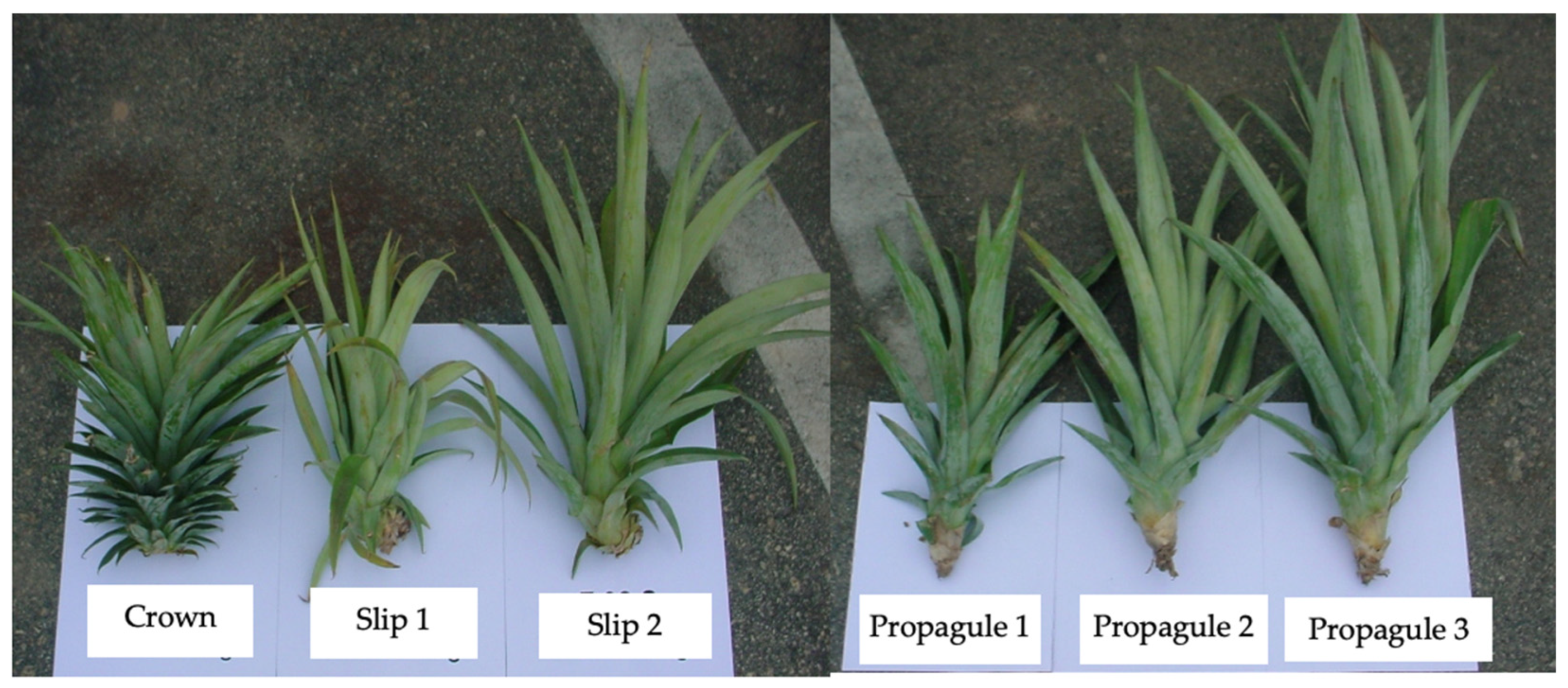
The experiment was conducted in a randomized complete block design arranged in a 4 × 6 factorial scheme, consisting of four N doses (4, 8, 12, and 16 g N plant−1 cycle−1), using urea as the N source, six types of Smooth Cayenne pineapple planting material, and four replicates. The planting materials used were conventional propagules: Crown (crowns weighing 250–400 g and with an average length of 24.6 cm), Slip 1 (slips weighing 200–350 g and averaging 38.3 cm in length), Slip 2 (slips weighing 350–500 g and averaging 44.7 cm), Propagule 1 (propagule weighing 300–450 g and averaging 44.1 cm), Propagule 2 (propagule weighing 450–600 g and averaging 54.5 cm), and Propagule 3 (propagule weighing 600–750 g and averaging 62.2 cm). The types of propagules used in the study are shown in Figure 1.
Each plot consisted of three double rows with six plants per row, spaced 0.30 m between plants, 0.40 m between single rows, and 1.0 m between double rows, totaling 36 plants per plot, of which 16 were considered for evaluation. The planting density corresponded to approximately 47,600 plants per hectare. The planting materials were previously selected based on type, mass, and health status, and underwent phytosanitary treatment with a thiophanate-methyl-based fungicide and an ethion-based insecticide to control fusariosis (Fusarium subglutinans) and pineapple mealybug (Dysmicoccus brevipes).
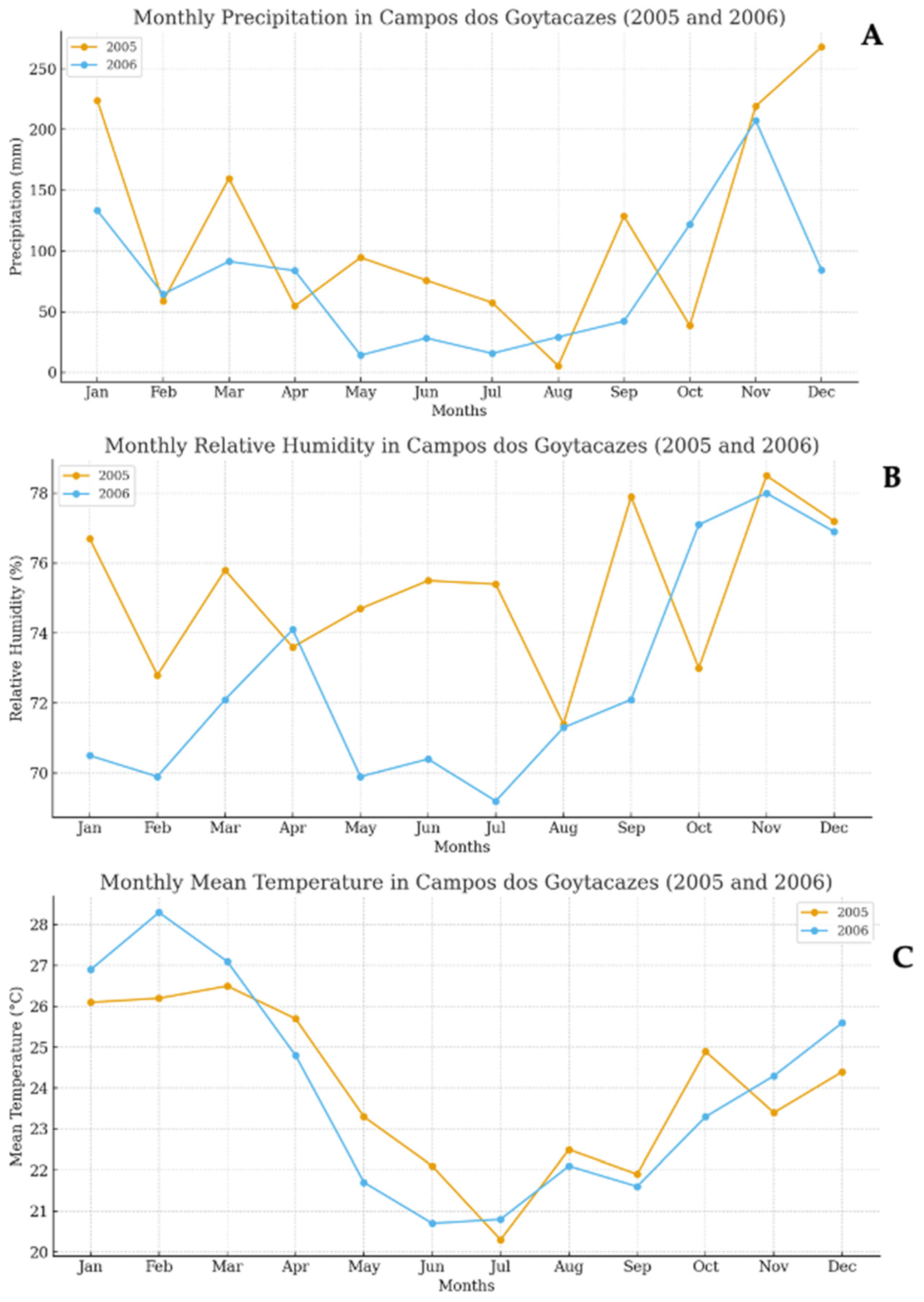
The climate is tropical, with an average annual rainfall of 900 mm. The mean annual temperature recorded in 2005 was 23.9 °C, with monthly minimum and maximum averages of 19.3 °C and 28.6 °C, respectively. In 2006, the mean annual temperature was also 23.9 °C, with monthly minimum and maximum averages of 19.0 °C and 28.9 °C, respectively, according to data from the UENF Meteorological Station located at the Agricultural Research Corporation of the State of Rio de Janeiro in Campos dos Goytacazes (Figure 2).
Phosphorus was applied once in the planting furrow at a rate of 3.5 g plant−1 cycle−1 of P2O5, using single superphosphate as the source. During the vegetative growth period and prior to natural floral induction, nitrogen and potassium fertilization was split into five applications, at 60-day intervals, and applied as topdressing in the 3rd, 5th, 7th, 9th, and 11th months after planting, positioned near the axils of the oldest leaves. The N and K doses were calculated using an arithmetic progression, with an initial dose of 0.5 g plant−1 for each nutrient. The first two applications were performed using liquid fertilizer because the doses were very small, facilitating uniform distribution of the commercial product. The total K dose was 16 g plant−1 cycle−1 of K2O, supplied as potassium chloride and applied concurrently with the nitrogen fertilization.
The irrigation system was of the sprinkler type, providing full-area coverage with 12 sprinklers (6.4 × 3.2 mm nozzles and a flow rate of 3.55 m3 h−1). A net irrigation depth of 12.0 mm was applied per irrigation event, following the recommendations of Rêgo Filho [11], which consider climatic conditions, soil characteristics, and crop water requirements. Weed control was carried out using a pre-emergent herbicide based on diuron, combined with manual weeding, keeping the area consistently free of unwanted vegetation.
To estimate yield (t ha−1), all fruits from each plot were counted and weighed, using the mean fruit weight from the useful area of the plot. In both fruiting periods that occurred during the experiment, five fruits were harvested from the useful area of each plot at the apparent maturity stage 2, corresponding to fruits showing 25% to a maximum of 50% of yellow-colored eyes.
At harvest, the peduncle length and diameter were measured, as well as the number of slips and suckers produced per plant. The fruits were then labeled, placed in plastic crates, and transported to the laboratory, where the following measurements were taken: fresh fruit weight with and without crown; fruit and crown length; fruit median diameter; total number of fruitlets per fruit; and fresh crown weight.
For chemical analyses of the pulp, two out of the five fruits from the useful area of each plot were randomly selected. The fruits were taken to the laboratory, where the following were determined: peel firmness, measured using a manual penetrometer at the middle third of the fruit, based on the mean of three points around the fruit circumference, with results expressed in kilogram-force (kgf); pulp firmness, measured using a manual penetrometer at three points of the median cross-section of the fruit, with results expressed in kgf; And pulp color, evaluated using the following rating scale: 1—white pulp, 2—pulp more white than yellow, 3—pulp more yellow than white, and 4—yellow pulp (adapted from Giacomelli [12]).
The fruits were manually peeled, and juice was extracted from the pulp using a potato masher and sieves. The extracted volume was immediately measured using a graduated cylinder, and the total juice weight per fruit was recorded. The residue from juice extraction (fibers) was dried in a forced-air oven at 75 °C for 96 h. The peels were also weighed on a digital scale and subsequently dried in a forced-air oven at 75 °C for 96 h. After drying, the dry weight of each component was determined.
Juice concentration in the fruit was calculated considering the total fruit weight (with crown) relative to the amount of juice extracted from the fibers through the pressing and drying processes.
A subsample of the extracted juice was used to determine: vitamin C content, expressed as mg of ascorbic acid per 100 mL of juice, obtained by titrating with 2,6-dichlorophenol–indophenol solution; titratable acidity (TA), expressed as g of citric acid per 100 mL of juice, determined by titration with 0.1 N sodium hydroxide; total soluble solids (SS), expressed in °Brix and measured using a digital refractometer; juice pH, measured using a digital pH meter. The SS/TA ratio was calculated by dividing total soluble solids by the percentage of titratable acidity, also referred to as the “ratio”.

2.1. Evaluation of Fruit and Juice Yield and Quality as a Function of Harvest Season

In both flowering periods evaluated in the experiment, no artificial floral induction methods were used. The plants underwent natural spontaneous induction at different times: the first during January/February 2006 and the second during August/September 2006, corresponding to fruit harvest in May/June 2006 and December/January 2007, respectively.
All types of propagules used in the experiment produced fruits, except for the Crown, which did not produce, and Slip 1, which showed a low fruiting rate during the first flowering period and was therefore discarded.

2.2. Statistical Analyses

Analysis of variance was performed for all parameters evaluated in the experiment. The analyses were conducted in two stages. In the first stage, the quantified parameters were evaluated based on the fruits harvested from the second natural flowering, which were collected in the summer. In the second stage, yield, fruit quality, and juice quality were compared between the winter and summer harvests, corresponding to the first and second natural flowering events. In this second stage, a split-plot factorial design was used, with four nitrogen doses, four types of propagules, and two harvest seasons (summer and winter).
Analysis based on the second natural flowering (summer harvest): Phenological cycle: days from planting to flowering, to anthesis, to end of anthesis, and to harvest; Propagation: production of slips and suckers per plant until fruit harvest; Yield and yield components: fruit weight with crown (g), crown weight (g), number of fruitlets, yield (kg plot−1), fruit length (cm), peduncle length (cm), crown length (cm), fruit diameter (cm), and peduncle diameter (cm); fruit and juice quality: peel firmness (kgf), pulp firmness (kgf), pulp color (color scale), percentage of pulp, peel, crown, and juice; juice pH; vitamin C (mg 100 mL−1); total soluble solids (°Brix); titratable acidity (percentage of citric acid); and SS/TA ratio.
Comparative analysis between two fruit harvest seasons: Phenological cycle: total flowering percentage, days from planting to floral differentiation, and days to harvest; Propagation: production of slips and suckers per plant until fruit harvest; Production components: fruit weight with crown (g), crown weight (g), number of fruitlets, fruit length (cm), peduncle length (cm), and crown length (cm); Fruit and juice quality: peel firmness (kgf), pulp firmness (kgf), pulp color (color scale), percentage of pulp, peel, crown, and juice; juice pH; vitamin C (mg 100 mL−1); total soluble solids (°Brix); titratable acidity (percentage of citric acid); and SS/TA ratio.
For all evaluated traits, means were compared using Tukey’s test at a 5% probability level. For the nitrogen dose factor, polynomial regression analysis was performed, using the F-test of the regression analysis, statistically significant model coefficients, and the highest R2 value. Statistical significance was considered at the 5% (*) and 1% (**) levels. All statistical analyses were performed using the SANEST Version 3.0 software [13].

3. Results

3.1. Fruit Yield and Quality—Results from the Summer Harvest

The mean values for the natural growth cycle of Smooth Cayenne pineapple plants, from planting to fruit harvest, are shown in Table 1. On average, the plants required 445 days for floral differentiation, 473 days to reach anthesis, 497 days to complete anthesis, and 578 days to reach fruit harvest. The phenological cycle of the crop, from planting to fruit harvest, was not influenced by nitrogen fertilization.
Regarding the production of slips and propagules per plant, evaluated at fruit harvest, slip-type propagules generally showed the highest values. For example, slip production in Slip 1 was 385% higher than that observed in Propagules 3.
Regression analysis also revealed a significant and increasing linear effect (Y = 1.16 + 0.0912N, R2 = 0.92 **) on slip production in Smooth Cayenne pineapple as a function of the different types of propagules used. However, no significant regression effect was found for nitrogen doses on the production of propagules (Table 2).
The results indicate that the type of planting material used had a significant influence on several yield and fruit quality attributes of ‘Smooth Cayenne’ pineapple harvested during the summer season. Productivity was higher when slips were used, whereas crowns and propagules showed lower and statistically similar yields. The average fruit mass with crown and the number of fruitlets per fruit were also higher in plants derived from slips (Table 1). In contrast, no significant differences were observed among the different planting material types for crown mass or fruit diameter. A significant interaction between nitrogen fertilization and planting material type was observed for fruit mass with crown and number of fruitlets, with increasing nitrogen rates promoting higher fruit mass in plants derived from slips and propagules (Table 2).
For fruit, peduncle, and crown length, a linear increasing effect was observed as a function of nitrogen rates, regardless of the type of planting material, while fruit and peduncle diameter were not significantly affected. The type of planting material did not influence peel or pulp firmness, pulp color, or the percentages of peel, crown, and pulp (Table 3). However, nitrogen fertilization affected some of these characteristics: the pulp percentage showed a linear increase in slips 1 and 2 and propagule 2, whereas the crown percentage and juice pH exhibited a quadratic response to nitrogen rates in certain planting material types (propagule 1 and 2, crown, slip 2, and propagule 3).
The juice percentage (mean of 49.3%) and pH (mean of 3.28) did not differ among planting material types, although specific interactions with nitrogen fertilization were observed (Table 3). The mean values of soluble solids (15.5 °Brix) and titratable acidity (0.85% citric acid) were not influenced by either planting material type or nitrogen fertilization, indicating stability of these traits under the study conditions. While many quality attributes appeared consistent across the different types of ‘Smooth Cayenne’ pineapple planting materials, the type of propagule had a significant effect on vitamin C content and the SS/TA ratio.

3.2. Fruit Yield and Quality—Comparative Results Between Winter and Summer Harvests

Under the edaphoclimatic conditions of the experiment, ‘Smooth Cayenne’ pineapple planted in May exhibited natural flowering on average at 282 and 444 days after planting, with harvests occurring at 413 days (13.8 months, winter) and 578 days (19.3 months, summer). The floral differentiation rate was 22.5% in the first flowering and 60.4% in the second, varying according to the type of planting material (Table 4). In the first flowering, a linear increase in the flowering index was observed with increasing propagule mass, whereas in the second flowering, most plants completed the cycle after reaching full vegetative development.
The total cycle, from planting to harvest, did not differ among planting material types, although crowns did not flower naturally during the first flowering period, and slips showed a lower floral index (Table 4). The production of slips was low, averaging two per plant in the summer and absent in the winter (Table 5). Nitrogen fertilization increased the production of slips and propagules (Table 6).
The average fruit mass with crown ranged from 1.5 to 2.0 kg, a size suitable for both processing and the fresh fruit and export markets, with no significant difference between winter and summer harvests (Table 7). However, summer fruits showed a higher number of fruitlets and greater fruit length, whereas winter fruits exhibited relatively greater crown development (Table 8).
Regression analyses indicated that increasing nitrogen rates did not cause differences in fruit characteristics between harvest seasons (Table 9). Pulp color was similar in both seasons (score 3, predominantly yellow). In winter, fruits exhibited greater peel and pulp firmness, which favors transport and marketing in distant markets. Conversely, in summer, higher percentages of pulp, peel, and juice were observed, along with proportionally smaller crowns (Table 9).
Vitamin C content did not vary between harvest seasons, whereas pH values were lower than the range of 3.7 to 3.9 reported in the literature, with higher pH observed in fruits harvested during winter. Soluble solids (SS) were higher in summer fruits (15.5 °Brix) compared to winter fruits (12.5 °Brix), while titratable acidity (TA) showed the opposite trend, with 0.83% and 1.00% citric acid, respectively (Table 9).

4. Discussion

The growth cycle of ‘Smooth Cayenne’ pineapple planted in May 2005, under the edaphoclimatic conditions of Campos dos Goytacazes, is characterized by a less pronounced natural flowering event at 9 months (February 2006) and a more expressive one at 15 months (August 2006). These flowering periods occurred approximately 60 days later than those reported for the Bebedouro region in São Paulo by Giacomelli [14], and the November/December and May/June induction periods described for April plantings in the Recôncavo Baiano region by Reinhardt [4].
Because natural floral induction precedes floral differentiation by approximately 40–46 days (Matos and Sanches [15]), or 42 days according to Giacomelli [14], the low temperatures recorded in June 2006, combined with shorter day length, may have triggered this natural induction, as suggested by Bartholomew and Kadzimin [16].
In this study, the average period from planting to inflorescence emergence (vegetative phase) was 445 days, followed by 28 days from inflorescence emergence to anthesis, 24 days from the first to the last flower, 81 days from the last flower to harvest, and 133 days from inflorescence emergence to harvest (reproductive phase). The total cycle lasted 578 days. The vegetative phase was longer than the 8–12 months commonly reported, whereas the reproductive phase was shorter than the 5–6 months described by Santos and Borém (2019) [17], likely due to higher temperatures during this period.
Similar results were reported in São Paulo by Spironello et al. [18], who observed, in Votuporanga, 26.5 days for inflorescence development, 21.7 days of flowering, 88.2 days from the last flower to harvest, and 136.4 days from inflorescence emergence to harvest. In Cordeirópolis, the same authors reported 37 days from inflorescence emergence to flowering for slips, 31 days for propagules, 29 days for crowns; 22–23 days of flowering depending on propagule type; 84–94 days from flower senescence to harvest; and a total of 136–152 days from inflorescence emergence to harvest depending on propagule type.
According to Giacomelli [19], the higher the position of the propagule on the mother plant (e.g., crowns), the longer the natural flowering cycle. This decreasing order, propagules < slips < crowns, was confirmed in this study, with crown-type propagules flowering last and not exhibiting natural induction before 450 days after planting.
Average fruit mass ranged from 1613 g to 1882 g among propagule types. Plants derived from slips produced the heaviest fruits, even with lower initial mass. This contrasts with Gaillard [20], Hung et al. [3], Vieira et al. [21], and Gadelha and Vasconcelos [22], who found a positive correlation between planting material mass and fruit size. In this study, slips type 2 (350–500 g, 44.7 cm length) produced fruits of approximately 1.9 kg, with a diameter of 13 cm, length of 18 cm, and about 126 fruitlets, indicating that fruit size was more closely related to morphological characteristics than initial propagule mass.
The average number of 126 fruitlets resulted in a fruit weight with crown of approximately 1.9 kg when using slip-type planting materials weighing 350–500 g. Fruits derived from slip-type propagules showed, on average, greater fruit length, peduncle length, and crown length (Table 1). Considering the possible correlation between the number of fruitlets, fruit length, fruit diameter, and fruit weight with crown, this study indicates that fruits measuring 13.0 cm in diameter and 18 cm in length and containing 126 fruitlets reach approximately 1.9 kg when slip-type propagules are used.
Sunburn is a major problem in pineapple cultivation, especially in ‘Smooth Cayenne’ due to its potential to produce large fruits. Slip-type propagules showed greater peduncle length and diameter, enhancing lodging resistance and reducing sunburn incidence. The values obtained (15.2 cm length; 2.72 cm diameter) were close to those reported by Reinhardt et al. (2002) [4].
Regarding nitrogen fertilization, an interaction was observed between propagule type and nitrogen dose for fruit weight with crown and number of fruitlets. Increasing nitrogen rates increased fruit weight when slips and Propagules 2 were used (Table 2).
Propagule type had no significant effect on peel firmness, pulp firmness, pulp color, or the percentages of peel, crown, and pulp (Table 3). The peel (37%) and pulp (63%) percentages were similar to those reported by Singleton and Gortner [23], although lower than the juice percentage described by Reinhardt et al. (2002) [4]. Increasing nitrogen doses enhanced pulp coloration and reduced peel firmness, regardless of propagule type.
Pulp percentage, crown percentage, and juice pH were significantly affected by nitrogen fertilization, with interactions among propagule types (Table 3). A quadratic effect of nitrogen was observed for crown percentage and juice pH in Propagules 1, Propagules 2, crowns, and Propagules 3. In Slip 1, Slip 2, and Propagules 2, nitrogen increased pulp percentage linearly. No significant effects were observed for SS, TA, SS/TA ratio, peel percentage, or pulp firmness. Vitamin C content (12–13.6 mg 100 mL−1) and SS/TA ratio (17.8–19.8) differed among propagule types (Table 3).
Vitamin C decreased with increasing nitrogen doses (Table 2). These values were lower than those reported by Bezerra et al. [24], Carvalho et al. [25], and Gonçalves and Carvalho [26]. Although N levels increased fruit length, number of fruitlets, and fruit mass, higher N levels decreased vitamin C content [27].
Juice percentage and juice pH were not affected by propagule type, with means of 49.3% and 3.28, respectively. Juice pH showed interactions with nitrogen dose, increasing in Crown, Slip 2, and Propagules 2, decreasing in Propagules 3, and remaining unchanged in other types. The pH values were close to the ideal range reported by Carvalho et al. 1998 [25] and Gonçalves and Carvalho [26].
The mean SS (15.5 °Brix) and TA (0.85% citric acid) values were within the ideal sugar–acid ratio for processing, as reported by Carvalho and Cunha [28], and higher than those found by Berilli et al. (2014) [29] when compared with traditional cultivars. Bezerra et al. [24] also observed no influence of slip weight on SS, TA, or the SS/TA ratio.

Fruit Yield and Quality—Comparative Results Between Winter and Summer

Under the edaphoclimatic conditions of Campos dos Goytacazes, the data indicate that ‘Smooth Cayenne’ pineapple planted in May 2005 flowered naturally at an average of 282 and 444 days after planting, with variation among propagule types, reaching fruit harvest at 413 and 578 days after planting in winter and summer, respectively. Natural floral differentiation was 22.5% (0.0–38.5%) and 60.4% (28.2–90%) for the first and second flowering events, respectively (Table 4).
The data allow comparison of the two flowering periods among propagule types, except for crowns, which did not flower naturally in the first event, and Slip 1, which showed low flowering percentages. In the first flowering event, natural induction increased linearly with propagule weight, though with variation among types. In the second event, the remaining plants flowered upon reaching maximum vegetative development (Table 4).
The higher flowering percentage observed in propagules 3 (38.5%) agrees with Giacomelli et al. (1984) [14], likely due to the greater reserve of photosynthates compared with slips, which, despite greater fresh and dry mass and larger leaf area in this study, showed lower natural flowering percentages.
Throughout the full plant cycle, there was no significant difference among propagule types from planting to harvest, including during the flowering periods. Mean duration from planting to harvest was 413 days (13.8 months) for winter and 578 days (19.3 months) for summer harvests. According to Alvarenga (1981) [30], crowns produce fruits in 24–30 months, slips in 20–22 months, and propagules in 16–18 months. Compared with these values, cycles were shorter for all propagule types, except propagules harvested in summer (Table 5).
Slip production was low, approximately two slips per plant at summer Harvest, and absent in winter harvest (Table 5). When floral differentiation occurs in warm periods, slip production is minimal, as reported by Giacomelli et al. (1984) [14]. In ‘Smooth Cayenne’, propagules remain the predominant planting material in commercial crops (Reinhardt et al., 2002 [4]), though slips are also used to a lesser extent. Propagule production did not differ between flowering seasons and was low because evaluation occurred only from flowering to harvest; production continues after harvest.
Nitrogen is considered the most important nutrient for vegetative growth. Aquino et al. (1986) [31], evaluating two flowering seasons, found that nitrogen reduced the total plant cycle (Y = 498 − 0.2503N, R2 = 0.73 *) and did not affect flowering percentage, contrasting with Gaillard (1969) [20], who reported that vigorous vegetative growth may delay flowering. In the present study, higher nitrogen doses reduced the total cycle, likely due to enhanced vegetative growth.
For propagule production, nitrogen fertilization increased both slip and propagule production (Table 6). Bregonci et al. (2008) [32] also reported positive effects of nitrogen on propagule formation.
Fruit yield and quality varied between harvest seasons as nitrogen fertilization increased, except for fruit weight with crown, pulp color, and vitamin C. Winter fruits, developing under low luminosity, were formed after summer induction; summer fruits developed after winter induction under higher luminosity. Fruits harvested in warmer months had superior quality and yield, consistent with Collins (1960) [33], Giacomelli et al. (1984) [14] and Carvalho et al. (1998) [25].
Fruit weight with crown did not differ between seasons (Table 9), with commercial standards of 1.5–2.0 kg for industry, 1.3–1.5 kg for fresh market, and <2.0 kg for export, according to Giacomelli (1982) [19]. Summer fruits had more fruitlets and greater length (Table 7), resulting in larger crownless fruit; winter fruits showed proportionally larger crowns.
Regression analyses showed no effect of nitrogen fertilization on production traits (fruit weight with crown, fruitlet number, fruit length, peduncle length, crown length) nor on fruit or juice quality traits (peel firmness, pulp firmness, pulp color, peel %, pulp %, crown %, juice concentration, vitamin C, juice pH, SS, TA, SS/TA) (Table 9).
Fruits harvested in both seasons had similar pulp color (scale 3). Winter fruits exhibited greater peel and pulp firmness (Table 9), increasing transport resistance. Peel and pulp percentages were higher in summer fruits, whereas crown percentage was higher in winter fruits (Table 9), likely due to larger crowns in winter.
Juice percentage was higher in summer fruits (Table 9), likely due to climatic conditions during fruit development. Vitamin C did not differ between seasons, remaining below 17 mg 100 mL−1, consistent with Carvalho et al. (1998) [25] and Gonçalves and Carvalho (2000) [26]. Juice pH was slightly below the ideal range (3.7–3.9), with higher values in winter fruits.
Soluble solids (SS) were higher in summer fruits (15.5 °Brix) than in winter fruits (12.5 °Brix), while titratable acidity was higher in winter (1.00% vs. 0.83% citric acid) (Table 9). These results agree with Carvalho et al. (1998) [25], who observed that fruits ripened in winter under low luminosity exhibit reduced sugar levels and increased acidity. The values remained within the 12–15 °Brix and 0.6–1.62% citric acid ranges reported by Carvalho et al. [28] and were consistent with Reinhardt et al. (2002) [4]. Temperature has a significant influence on fruit quality [26], and it is known that titratable acidity increases under high temperature stress [34]. Heat stress influences fruit growth and ripening by regulating sucrose synthase and acid invertase enzymes, as well as controlling sugar transport in fruits [35].
Based on SS and TA, fruits harvested in both seasons met industrial standards (≥10 °Brix; ≤1.35% citric acid), as defined by Carvalho and Cunha (1999) [28].
The SS/TA ratio (15.8) was lower than the ideal 31.8 for fresh ‘Pérola’ pineapple [36] and below the 22.5 reported for ‘Smooth Cayenne’ [24]. These attributes depend, among other factors [28], on K and N levels [37]; a K/N ratio near 3 does not impair fruit quality [38]. Nitrogen contributes to yield and fruit weight [39].
Nitrogen and potassium are the nutrients most required by pineapple plants and are also responsible for the high yield and fruit quality [8]. However, although N levels increase yield and fresh fruit mass, much higher N levels reduce sugar content and ascorbic acid [27].
Leaf N (9.58 g kg−1) and K (23.8 g kg−1) contents (Table S1) were sufficient to produce fruits of 1.7 kg in both seasons, reinforcing the potential to reduce nitrogen use and production costs. These results indicate that balanced fertilization supports productivity and maintains fruit quality, enhancing the competitiveness of pineapple produced in Northern Rio de Janeiro.

5. Conclusions

The productive and qualitative performance of ‘Smooth Cayenne’ pineapple was strongly influenced by both the type of propagule, nitrogen fertilization, and the harvest season. Slip-type propagules showed clear superiority over the other types, particularly when compared with propagules, resulting in greater production of vegetative propagules, larger fruit and peduncle dimensions, a higher number of fruitlets, and greater overall yield. The phenological cycle under the edaphoclimatic conditions of Campos dos Goytacazes displayed two distinct natural flowering periods, at 282 and 444 days after planting, leading to winter and summer harvests, respectively. However, crown propagules did not flower early and Slip 1 showed a low flowering percentage.
Nitrogen fertilization produced contrasting effects: on one hand, it increased the production of slips per plant, fruit weight with crown, number of fruitlets, fruit length, juice pH, pulp coloration, and pulp percentage; on the other hand, it reduced peduncle and crown length, peel firmness, juice percentage, crown percentage, and vitamin C content. In general, fruit physical and chemical traits were minimally affected by propagule type, except for vitamin C and the SS/TA ratio.
Harvest season also played an important role. Fruits harvested in winter exhibited higher crown weight, fewer fruitlets, greater peel and pulp firmness, lower juice concentration, and higher titratable acidity and pH. Conversely, fruits harvested in summer showed superior fruit quality attributes that better meet consumer preferences for fresh fruit.
Overall, the results demonstrate that it is possible to produce fruits with an average weight of approximately 1.9 kg, adequate for different market segments, by using slip-type propagules and applying reduced nitrogen doses, thereby lowering production costs without compromising agronomic performance or fruit quality.

Supplementary Materials

The following supporting information can be downloaded at: https://www.mdpi.com/article/10.3390/agronomy16020153/s1, Table S1. Leaf nitrogen (N) and potassium (K) contents in the dry matter of ‘Smooth Cayenne’ pineapple as affected by different planting material types and sampling times (days after planting) in Campos dos Goytacazes, RJ, Brazil.

Author Contributions

Conceptualization, D.C.D.F., P.C.D.S. and A.J.C.d.C.; Formal analysis, D.C.D.F., P.C.D.S., M.S.M.F., S.d.J.F. and A.J.C.d.C.; validation, D.C.D.F., P.C.D.S., M.S.M.F. and A.J.C.d.C.; writing—original draft preparation, D.C.D.F., R.A.B., J.M.C., S.A., S.d.P.C.B.M., P.C.D.S., M.S.M.F., M.Z., W.B.M., M.E.V., S.d.J.F. and A.J.C.d.C.; Investigation and writing—review and editing, D.C.D.F., R.A.B., J.M.C., S.A., P.C.D.S., M.S.M.F., M.E.V. and M.Z.; visualization, D.C.D.F. and A.J.C.d.C.; supervision, A.J.C.d.C.; project administration, A.J.C.d.C. All authors have read and agreed to the published version of the manuscript.

Funding

This research received no external funding.

Data Availability Statement

The original contributions presented in this study are included in the article. Further inquiries can be directed at the corresponding author.

Acknowledgments

The authors would like to thank the Universidade Estadual do Norte Fluminense Darcy Ribeiro (UENF) for providing infrastructure and institutional support for the development of this study. During the preparation of this manuscript, the authors used ChatGPT (OpenAI, version 5.1.) for support with formatting. The authors have reviewed and edited all generated output and take full responsibility for the content of this publication.

Conflicts of Interest

The authors declare that they have no known competing financial interests or personal relationships that could have appeared to influence the work reported in this paper.

References

  1. Hassan, A.; Othman, Z.; Siriphanich, J. Pineapple (Ananas comosus L. Merr.). In Postharvest Biology and Technology of Tropical and Subtropical Fruits; Yahia, E.M., Ed.; Woodhead Publishing: Cambridge, UK, 2011; pp. 194–218. [Google Scholar] [CrossRef]
  2. CNPMF/EMBRAPA; IBGE. Dados de Produção de Abacaxi no Brasil; CNPMF/EMBRAPA: Brasília, Brazil, 2024.
  3. Hung, N.Q.; Ha, L.T.M.; Lien, D.T.; Nga, N.T.T.; Lam, V.P. Optimal Shoot Mass for Propagation to Increase the Yield and Quality of Pineapple. Sustainability 2024, 16, 5729. [Google Scholar] [CrossRef]
  4. Reinhardt, D.H.R.C.; Cabral, J.R.S.; Souza, L.F.d.S.; Sanches, N.F.; Matos, A.P.d. Pérola and Smooth Cayenne pineapple cultivars in the state of Bahia, Brazil: Growth, flowering, pests, diseases, yield and fruit quality aspects. Fruits 2002, 57, 43–53. [Google Scholar] [CrossRef]
  5. Silva, A.A.; Carvalho, A.J.C.; Freitas, F.P.; Pessanha, P.G.O.; Vasconcelos, T.S.; Santos, P.C.; Silva, M.P.S.; Olivares, F.L. Diazotrophic bacteria and nitrogen fertilization on the growth of micropropagated pineapple plantlets during acclimatization. Cienc. Rural 2016, 46, 1952–1958. [Google Scholar] [CrossRef]
  6. Reinhardt, D.H.R.C.; Bartholomew, D.P.; Souza, F.V.D.; Carvalho, A.C.P.P.; Pádua, T.R.P.; Junghans, D.T.; Matos, A.P. Advances in pineapple plant propagation. Rev. Bras. Frutic. 2018, 40, e-302. [Google Scholar] [CrossRef]
  7. Andrade, R.A.; de Brito, R.S.; Mendes, R.F.; Neto, R.D.C.A. Cultural treatments in pineapple crop. Management for high yield–Review. Sci. Electron. Arch. 2021, 14, 12. [Google Scholar] [CrossRef]
  8. Spironello, A.; Quaggio, J.A.; Teixeira, L.A.J.; Furlani, P.R.; Sigrist, J.M.M. Pineapple Yield and Fruit Quality Effected by NPK Fertilization in a Tropical Soil. Rev. Bras. Frutic. 2004, 26, 155–159. [Google Scholar] [CrossRef]
  9. Teixeira, L.A.J.; Spironello, A.; Furlani, P.R.; Sigrist, J. Parcelamento da adubação NPK em abacaxizeiro. Rev. Bras. Frutic. 2002, 24, 219–224. [Google Scholar] [CrossRef]
  10. Carvalho Rios, E.S.; Nunes Mendonça, R.M.; de Almeida Cardoso, E.; Pereira da Costa, J.; de Melo Silva, S. Quality of ‘Imperial’ pineapple infructescence in function of nitrogen and potassium fertilization. Rev. Bras. Ciênc. Agrár. 2018, 13, 5499. [Google Scholar] [CrossRef]
  11. Santos, H.G.; Ker, J.C.; Silva, I.F.; Mielniczuk, J. Sistema Brasileiro de Classificação de Solos, 6th ed.; Embrapa: Brasília, Brazil, 2025; 393p. [Google Scholar]
  12. Rego Filho, L.M. Resposta do Abacaxizeiro ‘Pérola’ a Diferentes Lâminas de Irrigação no Norte Fluminense. Ph.D. Thesis, UENF, Campos dos Goytacazes, Brazil, 2002; 132p. [Google Scholar]
  13. Zonta, E.P.; Machado, A.A. SANEST—Sistema de Análise Estatística para microcomputadores. Pelotas 1984, 75. [Google Scholar]
  14. Giacomelli, E.J.; Py, C.; Lossois, P. Estudo sobre o ciclo natural do abacaxizeiro ‘Cayenne’ no planalto paulista. Bragantia 1984, 43, 626–642. [Google Scholar] [CrossRef]
  15. Matos, A.P.d.; Sanches, N.F. Desenvolvimento da inflorescência do abacaxizeiro ‘Pérola’. Rev. Bras. Frutic. Cruz Das Almas 1989, 11, 49–53. [Google Scholar]
  16. Bartholomew, D.P.; Kadzimin, S.B. Pineapple. In Ecophysiology of Tropical Crops; Alvim, P.D.T., Kozlowski, T.T., Eds.; Academic Press: New York, NY, USA, 1977; pp. 113–156. [Google Scholar] [CrossRef]
  17. Santos, C.E.M.; Borém, A. Abacaxi: Do Plantio à Colheita, 1st ed.; Editora UFV: Viçosa, Brasil, 2019; 202p, ISBN 978-85-7269-593-0. [Google Scholar]
  18. Spironello, A.; Bortoletto, N.; Sigrist, J.M.M.; Nagai, V. Avaliação agrotecnológica e do ciclo de variedades de abacaxizeiro, em duas densidades, em Votuporanga (SP). Bragantia Camp.-SP 1997, 56, 343–355. [Google Scholar] [CrossRef]
  19. Giacomelli, E.J. Expansão da Abacaxicultura no Brasil; Fundação Cargill: Campinas, Brazil, 1982. [Google Scholar]
  20. Gaillard, J.P. Influence de la date de plantation et du poids des rejets sur la croissance des ananas au Cameroun. Fruits 1969, 24, 75–87. [Google Scholar]
  21. Vieira, A.; Gadelha, R.S.D.S.; Maldonado, J.F.M.; Santos, A.C.D. Influência da idade da planta na indução floral sobre a produção do abacaxizeiro. Pesqui. Agropecuária Bras. Brasília 1983, 18, 33–35. [Google Scholar]
  22. Gadelha, R.R.S.; Vasconcelos, H.O. Influência do tamanho e peso das mudas de abacaxi, Ananas comosus (L.) no desenvolvimento da planta e na qualidade do fruto. Pesq. Agropecu. Bras. 1977, 12, 151–156. [Google Scholar]
  23. Singleton, V.L.; Gortner, W.A. Chemical and physical development of the pineapple fruit. J. Food Sci. 1965, 30, 19–23. [Google Scholar] [CrossRef]
  24. Bezerra, J.E.F.; Lederman, I.E.; Aguilar, J.A.E.; Reis, O.V.D. Influência da idade de indução do florescimento e do peso dos filhotes sobre a produção e qualidade do abacaxizeiro ‘Cayenne’. In V Congresso Brasileiro de Fruticultura 1979; Pelotas-RS: Anais, Brasil; Sociedade Brasileira de Fruticultura: Pelotas, Brazil, 1979; Volume 1, pp. 327–339. [Google Scholar]
  25. Carvalho, V.D.; Abreu, C.M.P.; Gonçalves, N.B. Qualidade e industrialização do abacaxi. Inf. Agropec. 1998, 19, 67–69. [Google Scholar]
  26. Gonçalves, N.B.; Carvalho, V.D. Características da fruta. In Abacaxi Pós-Colheita; Brasília: CTT (Frutas do Brasil, 5); Gonçalves, N.B., Ed.; Embrapa Mandioca e Fruticultura: Cruz das Almas, Brazil, 2000; pp. 13–27. [Google Scholar]
  27. Omotoso, S.O.; Akinrinde, E.A. Effect of nitrogen fertilizer on some growth, yield and fruit quality parameters in pineapple (Ananas comosus L. Merr.) plant at Ado-Ekiti Southwestern, Nigeria. Nternational Res. J. Agric. Sci. Soil Sci. 2013, 3, 11–16. [Google Scholar]
  28. Carvalho, V.D.; Cunha, G.A.P. Produtos e usos. In O Abacaxizeiro: Cultivo, Agroindústria e Economia; Embrapa: Brasília, Brazil, 1999; pp. 389–402. [Google Scholar]
  29. Berilli, S.d.S.; Freitas, S.d.J.; Freitas, S.d.J.; Santos, P.C.d.; Oliveira, J.G.d.; Caetano, L.C.S. Avaliação da qualidade de frutos de quatro genótipos de abacaxi para consumo in natura. Rev. Bras. Frutic. 2014, 36, 503–508. [Google Scholar] [CrossRef][Green Version]
  30. Alvarenga, L.R. Controle da época de produção do abacaxizeiro. Inf. Agropec. 1981, 7, 32–35. [Google Scholar]
  31. Aquino, A.R.L.; Vieira, A.; Azevedo, J.A.; Genú, P.J.C.; Kliemann, H.J. Nutrição mineral e adubação do abacaxizeiro. In Nutrição Mineral e Adubação de Frutíferas Tropicais; Haag, P.H., Ed.; Fundação Cargill: Campinas, Brazil, 1986; pp. 31–58. [Google Scholar]
  32. Bregonci, I.S.; Schmildt, E.R.; Coelho, R.I.; Reis, E.F.; Brum, V.J.; Santos, J.G. Foliar fertilization with macro and micronutrients in the growth of plantlets micropropagated of pineapple cv. Gold [Ananas comosus (L.) Merrill] in different containers. Ciênc. Agrotec. 2008, 32, 705–711. [Google Scholar] [CrossRef]
  33. Collins, J.L. The Pineapple: Botany, Cultivation and Utilization; Leonard Hill: London, UK, 1960. [Google Scholar]
  34. Khanal, B. Effect of Day and Night Temperature on Pollen Characteristics, Fruit Quality and Storability of Tomato. Master’s Thesis, Department of Plant and Environmental Sciences, Norwegian University of Life Sciences, Ås, Norway, 2012. Available online: http://hdl.handle.net/11250/189462 (accessed on 14 October 2025).
  35. Fleisher, D.H.; Clarke, J.L. Effects of Temperature on Tomato Fruit Development and Quality. HortTechnology 2006, 16, 723–727. [Google Scholar] [CrossRef]
  36. Fagundes, G.R.; Yamanishi, O.K.; Borgo, L.A.; Manica, I. Características físicas e químicas do abacaxi ‘Pérola’. Rev. Bras. Frutic. 2000, 22, 22–25. [Google Scholar]
  37. de Amorim, D.A.; Favero, A.C.; Conceição, M.P.D.; Vilela Rodrigues, M.G.; Belarmino Rodrigues, J.B.; Natale, W.; Rozane, D.E. DRIS nutritional norms and sufficiency range for the perola pineapple cultivation. J. Plant Nutr. 2024, 47, 3998–4007. [Google Scholar] [CrossRef]
  38. Martin-Prével, P. Potassium, calcium et magnésium dans la nutrition de l’ananas em Guinée. III. Influence sur la qualité du fruit. Fruits 1961, 16, 161–180. [Google Scholar]
  39. Lima, R.P.; de Sousa, A.S.B.; Dantas, R.L.; Dantas, A.L.; Mendonça, R.M.N.; de Souza, A.P.; da Silva, M.C.A.; Santos, E.F.d.S.; Silva, S.d.M. Nitrogen and potassium balance as key regulators of antioxidant metabolism in pineapple fruit. J. Plant Nutr. 2025, 48, 2911–2926. [Google Scholar] [CrossRef]
Figure 1. Types of propagules used in the study: Crown (crowns weighing 250–400 g and with an average length of 24.6 cm), Slip 1 (slips weighing 200–350 g and averaging 38.3 cm in length), Slip 2 (slips weighing 350–500 g and averaging 44.7 cm), Propagule 1 (propagule weighing 300–450 g and averaging 44.1 cm), Propagule 2 (propagule weighing 450–600 g and averaging 54.5 cm), and Propagule 3 (propagule weighing 600–750 g and averaging 62.2 cm).
Agronomy 16 00153 g001
Figure 2. (A) Monthly precipitation, (B) relative humidity, and (C) mean air temperature at Campos dos Goytacazes, Rio de Janeiro, during the experimental period. Source: Meteorological Station of UENF—Campos dos Goytacazes, RJ/BRAZIL.
Agronomy 16 00153 g002
Table 1. Duration of the different phenological stages of Smooth Cayenne pineapple and production of slips and suckers, average fruit mass with crown, crown mass, number of fruitlets per fruit, and fruit yield of ‘Smooth Cayenne’ pineapple harvested in summer as a function of the type of planting material used, in Campos dos Goytacazes, RJ, Brazil.
Type of Planting
Material
From Planting to Floral Differentiation (Days)From Planting to Anthesis (Days)From Planting to End of Anthesis (Days)From Planting to Harvest (Days)Number of Slips per Plant Until Fruit HarvestNumber of Suckers per Plant Until Fruit Harvest
Crown450 a475 a500 a581 a2.11 bc0.67 ab
Slip 1443 b473 a497 a579 a3.25 a1.07 a
Slip 2441 b469 a496 a576 a3.12 ab0.65 ab
Propagule1444 b471 a497 a578 a1.74 cd0.75 ab
Propagule 2443 b470 a491 a578 a1.51 cd0.46 b
Propagule 3446 ab477 a499 a579 a0.67 d0.44 b
Mean4454734975782.070.67
C.V. (%)1.061.952.10.9650.381.8
Type of Planting
Material
Fruit Mass with Crown
(g)
Crown Mass
(g)
Number of Fruitlets per FruitYield
(kg plot−1)
Length (cm)Diameter (cm)
FruitPeduncleCrownFruitPeduncle
Crown1761 ab194.8 a121.9 ab30.4 b17.5 ab15.8 ab17.1 ab13.0 a2.79 ab
Slip 11882 a162.6 a125.9 a48.6 a18.2 a16.3 a18.1 a13.0 a2.86 a
Slip 21854 a159.1 a126.3 a46.4 a18.1 a15.3 ab16.3 abc13.0 a2.85 a
Propagule11764 ab165.8 a119.7 ab28.5 b17.5 ab14.9 ab16.0 bc12.9 a2.65 abc
Propagule 21716 ab145.4 a122.6 ab27.6 b17.0 ab14.4 b14.5 c12.8 a2.65 bc
Propagule 31613 b152.7 a115.2 b25.6 b16.6 b14.3 b15.1 c12.3 a2.55 c
Mean1765163.4121.934.517.515.216.212.82.72
C.V. (%)13.144.27.926.66.6310.611.65.667.24
Means followed by the same letter in the columns do not differ from each other according to Tukey’s test at the 5% probability level.
Table 2. Regression equations and coefficients of determination for yield and fruit quality attributes of ‘Smooth Cayenne’ pineapple as a function of nitrogen fertilization rates and types of planting material, in Campos dos Goytacazes, RJ, Brazil.
Evaluated CharacteristicType of Planting MaterialPolynomial RegressionR2
Fruit mass with crown (g)Crowny = 1761ns
Slip 1y = 1417 + 46.4594n0.73 *
Slip 2y = 1549 + 30.4271n0.62 *
Propagule 1y = 1764ns
Propagule 2y = 1277 + 43.8657n0.77 *
Propagule 3y = 1613ns
Meany = 1530 + 23.4533n0.68 *
Number of fruitlets per fruitCrowny = 121.9ns
Slip 1y = 107.6 + 1.8280n0.93 *
Slip 2y = 113.3 + 1.2970n0.91 *
Propagule 1y = 119.7ns
Propagule 2y = 90.7 + 3.1874n0.97 *
Propagule 3y = 103.9 + 1.1322n0.93 *
Meany = 108.6 + 1.3380n0.93 *
Fruit length (cm)Meany = 16.16 + 0.1337n0.65 *
Fruit peduncle length (cm)Meany = 16.36 − 0.1172n0.99 *
Crown length (cm)Meany = 18.27 − 0.2104n0.63 *
Pulp color (N)Meany = 2.21 + 0.0484n0.67 *
Peel firmness (N)Meany = 65.6 − 0.4458n0.97 *
Juice (%)Meany = 51.9 − 0.2671n0.85 *
Vitamin C (mg/100 mL)Meany = 14.5 − 0.1534n0.97 *
Pulp (%)Crowny = 55.9ns
Slip 1y = 52.8 + 0.3607n0.95 *
Slip 2y = 52.7 + 0.2770n0.92 *
Propagule 1y = 55.3ns
Propagule 2y = 52.1 + 0.4019n0.64 *
Propagule 3y = 54.9ns
Meany = 52.8 + 0.2891n0.82 *
Crown (%)Crowny = 8.89ns
Slip 1y = 12.05 − 0.2700n0.92 *
Slip 2y = 13.46 − 0.3929n0.99 *
Propagule 1y = 18.65 − 1.8712n + 0.0867n20.70 *
Propagule 2y = 22.33 − 2.7401n + 0.1173n20.87 *
Propagule 3y = 9.98ns
Meany = 12.19 − 0.2678n0.83 *
Juice pHCrowny = 2.95 + 0.0790n − 0.0036n20.74 *
Slip 1y = 3.26ns
Slip 2y = 3.19 + 0.0099n0.77 *
Propagule 1y = 3.27ns
Propagule 2y = 3.15 + 0.0138n0.74 *
Propagule 3y = 3.47 − 0.0654n + 0.0037n20.98 *
Meany = 3.21 + 0.0066n0.96 *
ns Not significant. * Significant at the 5% probability levels, respectively, according to the F-test.
Table 3. Peel and pulp firmness in kilogram-force (kgf), pulp color, and percentages of pulp, peel, and crown in the fruit; juice concentration; juice pH; vitamin C; soluble solids (SS); titratable acidity (TA); and SS/TA ratio as a function of planting material type of ‘Smooth Cayenne’ pineapple in Campos dos Goytacazes, RJ, Brazil.
Type of Planting MaterialPeel Firmness (kgf)Pulp Firmness (kgf)Pulp
Color
PulpPeelCrown
(%)(%)(%)
Crown6.46 a0.93 a2.53 a55.9 a35.1 a8.90 a
Slip 15.94 a0.95 a2.78 a56.4 a34.2 a9.35 a
Slip 26.20 a0.92 a2.75 a55.5 a34.9 a9.53 a
Propagule 15.89 a0.90 a2.68 a55.3 a34.3 a10.33 a
Propagule 26.10 a0.84 a2.62 a56.1 a34.9 a9.00 a
Propagule 36.10 a0.92 a2.79 a54.9 a35.1 a9.98 a
Mean6.110.912.6955.734.89.52
C.V. (%)15.012.018.83.174.220.8
Type of Planting MaterialJuice
(%)
Juice
pH
Vit. CSSTASS/TA
(mg/100mL)(°Brix)(% Citric Acid)
Crown49.4 a3.31 a13.3 ab15.6 a0.88 a17.9 ab
Slip 148.7 a3.26 a12.3 ab15.4 a0.87 a17.8 b
Slip 249.6 a3.28 a12.0 b15.7 a0.81 a19.7 a
Propagule 149.4 a3.27 a13.0 ab15.6 a0.85 a18.5 ab
Propagule 248.4 a3.29 a13.6 a15.4 a0.81 a19.1 ab
Propagule 350.0 a3.25 a13.4 ab15.4 a0.86 a18.1 ab
Mean49.33.2812.915.50.8518.5
C.V. (%)4.02.410.94.7110.49.8
Means followed by the same letter in the columns do not differ from each other according to Tukey’s test at the 5% probability level.
Table 4. Comparative data on flowering (%), floral differentiation (days), floral opening (days), and harvest time (days) for the first and second natural flowering of ‘Smooth Cayenne’ pineapple in Campos dos Goytacazes, RJ, Brazil.
Type of Planting MaterialTotal Flowering (%)From Planting to Floral Differentiation (Days)From Planting to Harvest (Days)
1st 2nd 1st2nd1st 2nd
Crown0.0 dB90.0 aA----
Slip 17.3 cB76.0 aA----
Slip 213.2 bB66.8 abA288 a441 a416 a576 a
Propagule 113.4 bB55.1 bA282 b444 a412 a578 a
Propagule 225.1 bB46.6 bA280 b443 a411 a578 a
Propagule 338.5 aA28.2 cB280 b446 a412 a579 a
Mean22.560.4282 A444 B413 B578 A
Plot C.V. (%)22.20.740.75
Subplot C.V. (%)28.51.071.30
Means followed by the same lowercase letter in the column and uppercase letter in the row do not differ from each other according to Tukey’s test at the 5% probability level.
Table 5. Production of slip- and propagule-type planting materials evaluated at winter and summer harvests of ‘Smooth Cayenne’ pineapple as a function of the type of planting material used at planting, in Campos dos Goytacazes, RJ, Brazil.
Type of Planting MaterialSlip Production per Plant up to Fruit HarvestPropagule Production per Plant up to Fruit Harvest
WinterSummerWinterSummer
Slip 20.003.12 a0.591 a0.656 a
Propagule 10.001.74 b0.579 a0.751 a
Propagule 20.001.51 bc0.551 a0.458 a
Propagule 30.000.67 c0.534 a0.437 a
Mean0.00 B1.76 A0.564 A0.576 A
Plot C.V. (%)56.761.8
Subplot C.V. (%)87.576.9
Means followed by the same lowercase letter in the column and uppercase letter in the row do not differ from each other according to Tukey’s test at the 5% probability level.
Table 6. Regression equations and coefficients of determination for types of planting material produced during the first and second harvest periods of ‘Smooth Cayenne’ pineapple as a function of nitrogen fertilization, in Campos dos Goytacazes, RJ, Brazil.
Evaluated CharacteristicFlowering PeriodPolynomial RegressionR2
Propagule production per plant up to fruit harvestMean of two seasonsy = 0.427 + 0.142n0.72 *
Slip production per plant up to fruit harvestMean of two seasonsy = 0.484 + 0.0397n0.96 **
* and ** Significant at the 5% and 1% probability levels, respectively, according to the F-test.
Table 7. Fruit mass with crown, number of fruitlets per fruit, and fruit, crown, peduncle length, peel firmness, pulp firmness, pulp color, percentages of pulp, peel, and crown, juice percentage, juice pH, vitamin C, soluble solids (SS), titratable acidity (TA), and SS/TA ratio in the juice as a function of planting material type ‘Smooth Cayenne’ pineapple in Campos dos Goytacazes, RJ, Brazil.
Type of Planting MaterialFruit Mass with Crown (g)Number of Fruitlets per FruitFruit Length (cm)Crown Length (cm)Penducule Length (cm)
Slip 21891 a123 a17.3 a17.4 ab19.5 a
Propagule 11765 ab114 b16.3 b17.6 a18.6 ab
Propagule 21719 ab115 b16.0 b16.3 bc18.2 b
Propagule 31593 b110 b15.5 b16.1 c17.6 b
Mean174211616.316.918.5
Plot C.V. (%)10.67.17.988.625.99
Type of Planting MaterialPulp Firmness (kgf)Peel Firmness (kgf)Pulp ColorPulp (%)Peel (%)Crown (%)
Slip 21.08 a6.46 a2.60 a52.7 a34.4 a13.0 a
Propagule 11.11 a6.37 a2.77 a51.3 a33.0 a15.7 a
Propagule 21.10 a6.71 a2.73 a51.4 a33.7 a14.9 a
Propagule 31.11 a6.68 a2.91 a52.9 a33.3 a13.8 a
Mean1.16.562.7652.133.614.3
Plot C.V. (%)6.227.7313.46.744.9522.8
Type of Planting MaterialJuice (%)pH JuiceVit. C (mg/100 mL)SS (°Brix)TA
(% Citric Acid)
SS/TA
Slip 246.7 a3.29 b12.7 a14.1 a0.95 a15.7 a
Propagule 145.5 a3.32 ab12.6 a13.9 a0.93 ab15.4 a
Propagule 244.7 a3.35 a13.4 a14.1 a0.88 b16.4 a
Propagule 347.9 a3.34 a13.0 a14.0 a0.91 ab15.9 a
Mean46.23.3312.9140.9215.8
Plot C.V. (%)6.731.548.824.517.47.96
Means followed by the same lowercase letter in the column do not differ from each other according to Tukey’s test at the 5% probability level.
Table 8. Fruit crown mass as a function of planting material type and harvest season of ‘Smooth Cayenne’ pineapple in Campos dos Goytacazes, RJ, Brazil.
Type of Planting MaterialCrown Mass (g)
WinterSummerMean
Slip 2349 a159 a254
Propagule 1335 ab166 a250
Propagule 2328 ab145 a236
Propagule 3264 b153 a208
Mean319 A156 B237
Plot C.V. (%)17.1
Subplot C.V. (%)23.1
Means followed by the same lowercase letter in the column and uppercase letter in the row do not differ from each other according to Tukey’s test at the 5% probability level.
Table 9. Fruit mass with crown, number of fruitlets per fruit, and fruit, crown, peduncle length, peel firmness, pulp firmness, pulp color, percentages of pulp, peel, and crown, juice percentage, juice pH, vitamin C, soluble solids (SS), titratable acidity (TA), and SS/TA ratio in the juice as a function of harvest season of ‘Smooth Cayenne’ pineapple in Campos dos Goytacazes, RJ, Brazil.
Fruit HarvestFruit Mass with Crown (g)Number of Fruitlets per FruitFruit Length (cm)Crown Length
(cm)
Penducule Length
(cm)
Winter1748 A111 B15.3 B18.3 A22.2 A
Summer1737 A121 A17.3 A15.5 B14.7 B
Mean174211616.316.918.5
Subplot C.V. (%)13.210.187.988.629.81
Fruit HarvestPulp Firmness (kgf)Peel Firmness (kgf)Pulp ColorPulp (%)Peel
(%)
Crown
(%)
Winter7.04 a7.04 a2.80 a48.6 b32.4 b18.9 a
Summer6.07 b6.07 b2.71 a55.5 a34.8 a9.71 b
Mean6.566.562.7652.133.614.3
Subplot C.V. (%)9.111.1819.68.037.2626.7
Fruit HarvestJuice (%)Juice pHVit. C (mg/100 mL)SS (°Brix)TA
(% Citric Acid)
SS/TA
Winter43.0 b3.38 a12.9 a12.5 b1.00 a12.8 b
Summer49.4 a3.28 b13.0 a15.5 a0.83 b18.9 a
Mean46.23.3312.9140.9215.8
Subplot C.V. (%)8.22 2.6814.57.212.914.1
Means followed by the same lowercase letter in the column and uppercase letter in the row do not differ from each other according to Tukey’s test at the 5% probability level.
Disclaimer/Publisher’s Note: The statements, opinions and data contained in all publications are solely those of the individual author(s) and contributor(s) and not of MDPI and/or the editor(s). MDPI and/or the editor(s) disclaim responsibility for any injury to people or property resulting from any ideas, methods, instructions or products referred to in the content.