Article

Spray Deposition and Coverage in Potato and Brussels Sprouts Using Drift-Reducing Spray Configurations †

by
Ingrid Zwertvaegher
1,*,
Tewodros Andargie Zewdie
2,
Jan Vanwijnsberghe
3,
Sarah Bossuyt
3,
Benny De Cauwer
4,
Pieter Verboven
2 and
David Nuyttens
1,*
1
Technology and Food Science Unit, Flanders Research Institute for Agriculture, Fisheries and Food (ILVO), 9820 Merelbeke-Melle, Belgium
2
BIOSYST-MeBioS, Department of Biosystems, Katholieke Universiteit Leuven (KU Leuven), 3001 Leuven, Belgium
3
Inagro, 8800 Rumbeke-Beitem, Belgium
4
Weed Science Unit, Department of Plants and Crops, Faculty of Bioscience Engineering, Ghent University (UGent), 9000 Ghent, Belgium
*
Authors to whom correspondence should be addressed.
This article is a revised and expanded version of a paper entitled ‘OPTiSPRAY: Selecting Optimal Spray Application Techniques and Settings Using a CFD Model—Part 1: Experimental Work’, which was presented at the AAB-IAPA Conference, Brighton, UK, 23–25 January 2024.
Agronomy 2026, 16(17), 1719; https://doi.org/10.3390/agronomy16171719
Submission received: 10 July 2026 / Revised: 21 August 2026 / Accepted: 31 August 2026 / Published: 4 September 2026
(This article belongs to the Section Pest and Disease Management)

Abstract

In dense or structurally complex canopies, spray applications often fail to adequately reach the specific plant sites where pest organisms reside, typically the lower canopy and abaxial leaf surfaces. An additional challenge is balancing drift mitigation while providing adequate spray coverage and deposition. This study investigates spray deposition and coverage in potato (Solanum tuberosum L.) and Brussels sprouts (Brassica oleracea var. gemmifera DC.) crops using drift-reducing spray configurations. Across two growing seasons (2023 and 2024), seven spray configurations (varying per crop) were evaluated during field trials at three growth stages (early, mid and late). The configurations combined different application techniques (standard boom, air support, air-injection system, Wingssprayer, reduced boom height, droplegs) with nozzle types (flat-fan nozzles with 0%, 75%, and 90% drift reduction, and an angled nozzle). Deposition and coverage were quantified using artificial collectors (filter paper collectors and water sensitive papers) and multiple mineral chelate tracer analysis using spectrometry. This method provides a comparative assessment under standardized measurement conditions rather than absolute deposition on leaf surfaces. Significant interactions between spray configuration and collector position were observed in both crops (p < 0.001), except for relative deposition in potato at the mid and late growth stage, indicating that spray performance depended highly on canopy location. However, no consistent trends across configurations were identified. No single configuration outperformed or, more importantly, underperformed the others across all collector positions. This suggests that drift-reducing configurations could potentially be adopted without substantially compromising spray deposition and coverage, at least as indicated by measurements obtained with artificial collectors.

1. Introduction

Efficient application of plant protection products (PPP) is essential for maintaining crop productivity while limiting adverse environmental effects. Biological efficacy of fungicides and insecticides depends not only on the applied dose, but also on the amount of spray effectively deposited on the target, its distribution within the canopy, and the degree of leaf surface coverage achieved [1]. Inadequate deposition or coverage can compromise efficacy even when label rates are applied. In dense or structurally complex canopies, spray applications often fail to adequately reach the specific plant sites where pest organisms are located. These sites are typically situated within the lower canopy or on the abaxial surfaces of leaves. At the same time, off-target spray drift remains a major concern as it may lead to unintended environmental contamination and exposure of bystanders [2,3]. Increasingly stringent drift-reduction requirements have stimulated the widespread adoption of drift-reducing technologies [4], including low-drift nozzles, adjusted boom configurations (e.g., reduced boom height and nozzle spacing, Wingssprayer) and more advanced techniques, such as air support and air-injection nozzles. While these measures effectively reduce the susceptibility of droplets to drift, they can also alter droplet size spectra, droplet’s kinetic energy and air-droplet interactions, potentially influencing canopy penetration, within-canopy deposition and coverage.
A challenge in modern crop protection is balancing drift mitigation with biological performance. Drift-reducing nozzles typically produce coarser droplets, which are less susceptible to drift, but are often regarded as biologically less effective than finer droplets [5,6]. This trade-off is particularly important in dense or structurally complex canopies as droplet size strongly influences spray penetration. Finer droplets are more likely to follow the airflow pathways and pass through openings in the canopy. In contrast, coarser droplets possess greater inertia and tend to impact and deposit on outer leaf surfaces or rebound upon contact [7]. In various crops, conventional spray application techniques often struggle to deliver spray droplets to the specific canopy zones where the intended targets are located. The deposition pattern is the result of complex interactions between droplet dynamics, airflow characteristics, and canopy architecture. Factors such as plant height, leaf area index, and leaf inclination angle strongly influence this pattern [8,9]. Consequently, deposition and coverage outcomes cannot be generalized across crop types without accounting for structural differences in canopy morphology.
Potato (Solanum tuberosum L.) plants typically form a relatively dense, horizontally layered canopy with intertwined and overlapping stems and leaves that create pronounced shielding effects between layers [10]. As one of the most important staple crops worldwide, valued for its high nutritional content and yield potential, potato is extensively cultivated in Belgium [11]. In 2024, the harvested area was 100,468 ha, representing approximately 12% of the total cultivated crop area [12]. Besides its agronomic importance, potato is particularly relevant for spray deposition and coverage studies due to its vertically structured and dynamically developing canopy, which creates complex spray interception patterns. In contrast, Brussels sprouts (Brassica oleracea var. gemmifera DC.) exhibit a more heterogenous vertical structure, characterized by a central stem bearing leaves and axillary buds. This results in spatially variable target surfaces within the canopy [13]. The crop also presents more open structural features and relatively hydrophobic leaf surfaces [13,14], which may influence droplet retention and redistribution. Key insect pests are often located on the abaxial leaf surfaces, making deposition on this side of the leaves essential, yet traditionally challenging [15].
Within the OPTiSPRAY project, the overall objective is to gain insight in where droplets are deposited in crops with different canopy architecture with various (drift-reducing) spray configurations, and to use this data to validate a computational fluid dynamics (CFD) based simulation model [13]. This model simulates droplet transport, impaction, and resulting deposition and coverage as functions of droplet size distribution, spray release conditions, and canopy architecture. Such a mechanistic approach offers strong potential to support spray application optimization and to predict deposition outcomes under varying operational and environmental conditions. However, the reliability of CFD-based predictions depends on rigorous experimental validation. Without such validation data in a variety of crops and crop architectures, the general applicability of CFD-based predictions remains limited.
To this end, spray deposition and coverage were determined in three model crops, i.e., winter wheat, potato, and Brussels sprouts. The results from the winter wheat field trials have been reported in Zwertvaegher et al. [16]. The present study focuses on the field trials conducted in potato and Brussels sprouts. By evaluating spray application for different crops and growth stages, the study provides a more comprehensive understanding of how drift-reducing configurations perform under realistic crop-specific conditions. The resulting knowledge can support the development of more targeted spray recommendations that account for both the application technology and the characteristics of the crop and its growth stage.

2. Materials and Methods

2.1. Spray Configurations

Seven spray configurations were tested in the field in a potato (Solanum tuberosum L.) and in a Brussels sprouts (Brassica oleracea var. gemmifera DC.) crop. The tested configurations varied per crop and were a combination of a particular technique (standard, air support, Airtec air-injection system, Wingssprayer, reduced boom height and droplegs) and nozzle type (flat-fan nozzle with 0% drift reduction, 75% and 90% drift-reducing nozzles according to Belgian legislation, and angled nozzle). Table 1 gives an overview of the spray configurations, techniques, nozzles and settings tested and the corresponding drift reduction percentages according to Belgian legislation.
The reference configuration consisted of a standard TeeJet XR 110 03 (Spraying Systems, Glendale Heights, IL, USA) flat-fan nozzle at 300 kPa spray pressure, 0.5 m nozzle spacing, 0.5 m boom height, and 6 km h−1 driving speed, resulting in a spray application volume of 240 L ha−1. The same settings were used with the other configurations, except for the Airtec system (Airtec, Lucindale, Australia), Wingssprayer (Wingssprayer, Nederweert, The Netherlands), reduced boom height and droplegs. In those configurations, either spray pressure, nozzle spacing and/or boom height were adjusted to match a spray application of 240 L ha−1 at 6 km h−1 driving speed and to comply with the manufacturer’s guidelines.
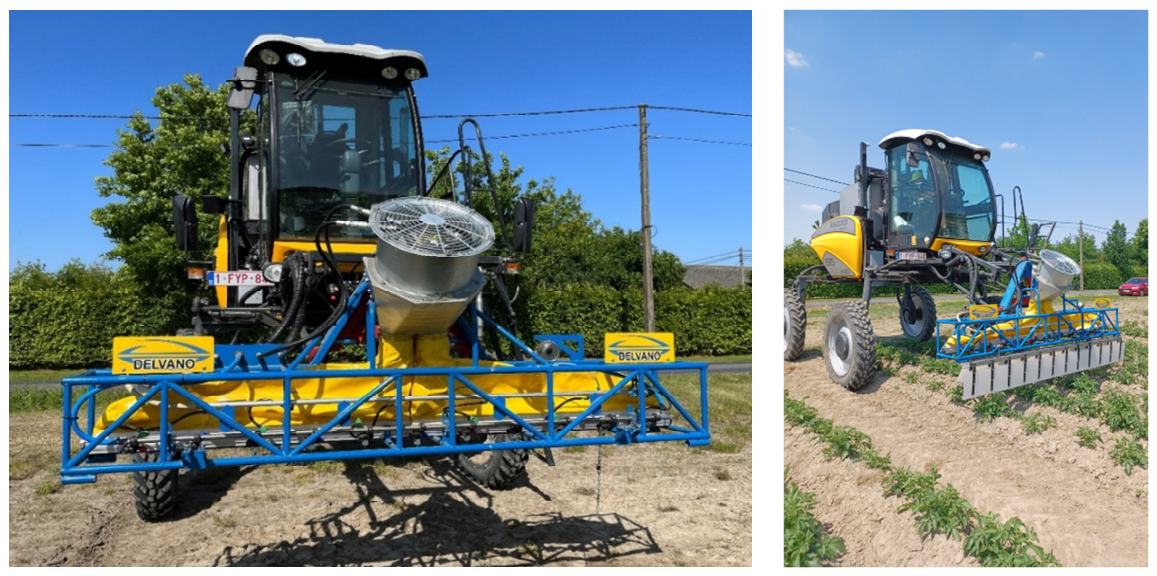
Spray applications were carried out using a Mazotti sprayer fitted with a 3.0 m-wide spray boom (Delvano, Harelbeke, Belgium). The boom was equipped with 11 multi-nozzle bodies, spaced 25 cm apart (Figure 1). The spray boom was purpose-built for the present project and included an Airtec air-injection system with separate air and liquid pressure lines, an air support system consisting of a fan and air bag, and a mounting interface for the Wingssprayer Double Wing shielded boom. Specifications of the air support and Wingssprayer are described in Zwertvaegher et al. [16]. Air-injection systems, also referred to as twin-fluid or air-assisted nozzles, use a pressurized air stream to regulate liquid atomization [17]. The air-injection system was equipped with Airtec NAP06LD backward-oriented deflector nozzles fitted with yellow restrictors (body size 50) (Cleanacres Machinery Ltd., Cheltenham, UK).
In Brussels sprouts, the sprouts and abaxial leaf surfaces generally require the greatest protection against insect pests, such as aphids. However, these plant parts are notoriously difficult to reach with conventional top-down spray applications. For this reason, droplegs were tested as an alternative application technique. Droplegs are under-leaf spraying devices consisting of a vertical tube equipped with two nozzles at the lower end. The selected nozzles (FT 90 02) were directed to spray upward from beneath the canopy to target the difficult to reach parts inside the canopy of the plants. The tubes were mounted on the spray boom at 0.7 m distance to align with the inter-row spacing of the Brussels sprouts crop.

2.2. Droplet Size and Velocity Characteristics

Prior to the field trials, the nozzle flow rate and the droplet size and velocity characteristics of the nozzle types used in the field trials were determined at the Flanders Research Institute for Agriculture, Fisheries and Food (ILVO, Merelbeke-Melle, Belgium) as described by Zwertvaegher et al. [16]. Particle/Droplet Image Analysis (PDIA) measurements were conducted using a VisiSize N60 system (Oxford Laser Ltd., Oxfordshire, UK), which operates on the principle of shadowgraphy. This image-based technique uses automated image processing to characterize droplets in two-phase flows. As droplets pass through the field of view (FOV), positioned between the camera and a high-intensity pulsed light source, they are captured as shadow images. The VisiSize 6.5.47 software processes these images to determine droplet diameter and shape from a single frame, while droplet velocity and flight angle are calculated from two consecutive frames. With the selected optical configuration, the FOV measured 10,965 × 6246 µm. Measurements were conducted 0.5 m below the nozzle orifice and repeated three times. Rectangular scan profiles were used to characterize the entire spray fan. All measurements were conducted along the horizontal major axis of the spray fan following the methodology of Nuyttens et al. [18] A minimum of 10,000 droplets were analyzed per scan.
Before droplet characterization, the flow rate of each nozzle was verified at the ILVO Spray Technology Laboratory. Each nozzle was tested three times at its corresponding operating pressure (Table 1), and the nozzle exhibiting the smallest mean deviation from the nominal flow rate was selected for the subsequent experiments.

2.3. Experimental Design

The spray application field trials were performed at Inagro (Beitem, Belgium) over two consecutive years during three (2023) or two (2024) growth stages around the time of standard fungicide and insecticide spray applications. The trials in potato took place on 14 June, 12 July, and 22 August 2023 (BBCH 35, 61 and 79, respectively) on a 0.50 ha test field and on 25 June and 18 July 2024 (BBCH 49 and 61, respectively) on a 0.32 ha test field. Potatoes (var. Jelly) were planted on 2 May 2023 and 6 June 2024 at an intra-row spacing of 0.35 m and an inter-row spacing of 0.75 m. The trials in Brussels sprouts were conducted on 18 July, 17 August, and 10 October 2023 (BBCH 32, 38 and 45, respectively) on a 0.29 ha test field and on 24 July and 29 August 2024 (BBCH 31 and 42, respectively) on a 0.13 ha test field. Brussels sprouts (var. Cryptus) were planted on 5 May 2023 and 6 June 2024 at an intra-row spacing of 0.40 m and an inter-row spacing of 0.70 m.
In 2023 and 2024, a total of six and four plots, respectively, were considered within the field, of which two plots were sprayed per growth stage. To prevent cross-contamination, distinct plots were assigned to each growth stage. In 2023, the plots were 20 m long and 3 m wide. To obtain a stable spray fan over the plots, spraying started 5 m before the plots. Per plot, five collector zones contained filter papers collectors (FPC, 7.5 cm × 2.6 cm, Schleicher and Schuell, type 751, Filter Service NV, Eupen, Belgium) for spray deposition measurements and five other collector zones contained water sensitive papers (WSP, 7.5 cm × 2.6 cm, Syngenta Crop Protection AG, Basel, Switzerland) for spray coverage measurements.
A collector zone consisted of one potato and one Brussels sprouts plant with collectors attached to them and the ground underneath the plants with collectors placed on small wooden blocks (ca. 10.0 cm × 3.0 cm × 2.5 cm). If a potato collector plant showed signs of wilting during the course of the day, the adjacent plant on the same ridge was used as replacement collector plant for WSP placement. The collector zones were positioned in the central rows of the plot, 3 m apart, and starting 4 m from the side of the plot. The type of collector zone (FPC or WSP) alternated around the centerline of the plot. To reduce the variation in spray deposition measurements, more FPC were used in 2024. In 2024, ten collector zones per plot (instead of five) contained FPC. The plots were 30 m long and 3 m wide. The collector zones started 1.5 m from the side of the plot.
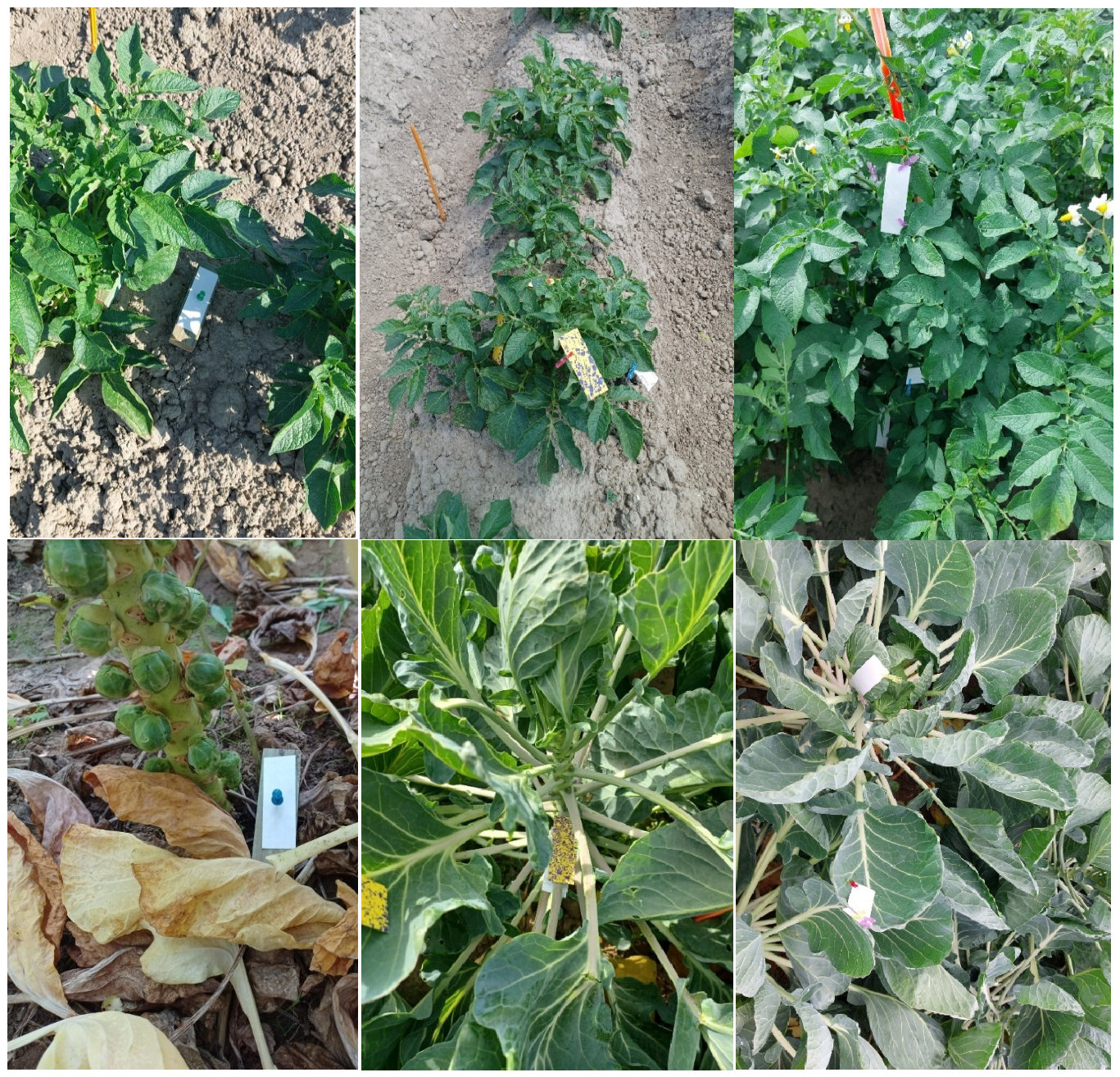
Depending on the growth stage, five to eight collectors (either FPC and WSP) were distributed in each collector zone, i.e., either attached to the plant or placed on the ground. To assess the distribution of spray droplets within a plant canopy, collectors were positioned at different heights and locations throughout the canopy. An overview of the collector positions is given in Table 2. Due to the high humidity in the Brussels sprouts crop during late growth stage spray applications, no coverage measurements were performed at this stage. The WSP would immediately turn blue, making accurate measurements impossible. Figure 2 shows collectors on the ground and on the plants at different growth stages. In each collector zone, one collector was placed per collector position. Collectors were attached to the plant using small clips or needles, or pinned to small wooden blocks and placed on the ground.
Environmental conditions were monitored during the spray applications using a weather station. Wind speed and wind direction were measured at 1.00, 1.75 and 4.60 m height using 3D ultrasonic anemometers (Young, model 81000, R.M. Young Company, Traverse City, MI, USA). Air temperature and relative humidity were recorded at 2.0 and 3.6 m height using HMP45AC sensors (Campbell Scientific Inc., Logan, UT, USA). All measurements were logged at 1 s intervals with a Campbell Scientific, Model CR1000 micrologger (Logan, UT, USA). For one of the experiments (Brussels sprouts late stage 2023), however, meteorological data could not be included because of a failure in the weather station’s data-logging system, and no permanent meteorological station was available in the vicinity to provide suitable alternative data. For another experiment (potato mid stage 2024), similar data-logging issues occurred, but hourly data (average, minimum, maximum) from a nearby permanent meteorological station were available. The environmental conditions measured during the different spray applications are given in Tables S1–S10.

2.4. Spray Deposition and Coverage

Spray deposition and coverage were quantified as described by Zwertvaegher et al. [16]. For each measurement day (i.e., growth stage within a given year), the same FPCs were used at the same plots, plants and positions for all seven spray configurations. The order of application of the spray configurations was randomized to minimize potential effects related to environmental conditions. To enable comparison of the spray treatments, a different mineral chelate tracer was randomly assigned to each spray configuration within a plot. The tracers consisted of Co, Cu, Fe, Mg, Mn, Mo, and Zn chelates (Chelal®, BMS Micro-Nutrients NV, Bornem, Belgium), each applied at a target concentration of 1 g L−1. These chelates are commercially available foliar fertilizers for horticultural use. The allocation of mineral tracers to the different plots is presented in Tables S1–S10. The use of multiple mineral tracers has previously been validated for comparative spray deposition studies, and its accuracy was demonstrated by Foqué et al. [19]. To minimize potential tracer-specific effects, different chelates were assigned within each spray configuration. For example, within the reference spray configuration, plot 1 received the Fe chelate whereas plot 2 received the Cu chelate. Between consecutive spray applications, the collectors were allowed to dry completely. After spraying the first plot of each configuration, a tank sample was collected at the nozzle outlet to determine the actual tracer concentration. After all spray applications were performed, the FPCs were gathered and analyzed by inductively coupled plasma-optical emission spectrometry (ICP-OES, VISTA-PRO, Varian, Palo Alto, CA, USA) after extraction in 20 mL of 0.16 M HNO3 (66+%, p.a., Acros Organics, Geel, Belgium).
Spray deposition (L ha−1) on each collector was calculated using the measured tracer concentration in the tank sample, the extraction volume, and blank sample corrections. Results were expressed as relative spray deposition (%), defined as the percentage of the actual application rate. The actual application rate was calculated from the measured sprayer travel speed, nozzle spacing, and nominal nozzle flow rate.
In contrast to the FPCs, WSPs were collected immediately after each spray application and replaced before the next treatment. The collected WSP were stored in labeled plastic bags and scanned the next day at 600 dpi using a Konica Minolta Bizhub C360i scanner (Konica Minolta, Tokyo, Japan). Spray coverage was subsequently quantified by image analysis using Halcon 8.0 software (MVTec Software GmbH, Munich, Germany).

2.5. Statistical Analyses

Prior to the statistical analysis, zero values for relative deposition and coverage were replaced by 0.00001 to allow for transformation. Box–Cox transformations were applied to the response variables separately for each crop–growth stage combination to achieve residual normality and homoscedasticity. Analyses were performed in RStudio (R 4.3.2, R Core TeamVienna, Austria, 2023) with a significance level of α = 0.05. For each crop and growth stage, linear mixed models (LMM) were fitted using the lmer() function of the lme4 package. The models assumed a Gaussian distribution of the residuals with an identity link function. Relative deposition and coverage were analyzed separately. The fixed effects included Configuration, Collector position and their interaction. Random effects included Year, Plot, and Plant to account for variation between experimental years, plots, and repeated observations within the same plants. For deposition, Chelate was also included as random effect to account for potential variability related to the different mineral tracers used. The inclusion of Plant and Plot as random effects accounted for the hierarchical structure of the experimental design and prevented pseudo replication arising from repeated measurements within the same experimental units.
Model selection was based on the lowest Akaike information criterion (AIC), and non-significant Configuration × Collector position interactions were removed. Final models were checked using residual diagnostics to verify model assumptions. Significant differences between treatment means were assessed using Tukey-adjusted post hoc tests.
The objective of this study was to compare spray deposition and coverage under different canopy conditions rather than to assess differences between individual BBCH growth stages. Therefore, growth stages were grouped based on comparable canopy development and spray application timing. Although the specific BBCH stages sometimes differed between years (e.g., BBCH 35 and BBCH 49 in potato), they represented similar canopy development phases and application timings. Year was retained as a random effect in the statistical models to account for remaining interannual variability in crop development and environmental conditions.

2.6. Configuration Comparisons

The tested spray configurations consisted of a combination of multiple factors, including spray application technique (standard, air support, Airtec air-injection system, Wingssprayer, reduced boom height, and droplegs) and nozzle type, resulting in droplet size spectra ranging from fine to ultra coarse droplet spectra. Consequently, the study compared complete spray configurations rather than examining the isolated effect of single spray factors. Nevertheless, some specific comparisons were made to evaluate the influence of selected application characteristics (i.e., air support, spray angle, droplet size spectrum, and reduced boom height) where these comparisons were supported by the experimental design. More specifically, the following pairwise comparisons were performed to isolate the effect of individual factors while keeping the nozzle type or drift reduction class comparable where possible:
  • Effect of air support: air-support configuration vs. reference configuration, both equipped with XR 110 03 nozzles;
  • Effect of nozzle orientation: angled fan configuration (3D90 03) vs. 90% drift-reducing configuration (ID3 120 03), both belonging to the 90% drift reduction class according to Belgian legislation;
  • Effect of droplet size: reference configuration (XR 110 03) vs. 75% drift-reducing configuration (AVI 110 03) (Albuz, Evreux, France) vs. 90% drift-reducing configuration (ID3 120 03);
  • Effect of reduced boom height and nozzle spacing: reduced boom height configuration vs. 75% drift-reducing configuration (AVI 110 03), both belonging to the 75% drift reduction class according to Belgian legislation.

3. Results

3.1. Droplet Characteristics

An overview of the most important droplet size and velocity characteristics, as well as the droplet size class, is given in Table 3. The PDIA measurements indicate that the finest droplet size spectrum was obtained with the standard flat-fan nozzle XR 110 03, followed by the deflector nozzle FT 90 02 (volume median diameter (VMD) = 184 µm and 258 µm, respectively). Very coarse droplets were generated by the Airtec air-injection system, and the air-induction flat-fan nozzles CVI 110 015 and AVI 110 03 (VMD = 411 µm, 420 µm, and 445 µm, respectively). Extremely coarse droplet size spectra were produced by the air-induction flat-fan nozzle ID3 120 03 (VMD = 592 µm), while ultra coarse droplets were obtained with the angled 3D90 03 nozzle (VMD = 646 µm).
With regard to droplet velocity, the volumetric median droplet velocities ranged from 2.7 m s−1 to 5.6 m s−1, with most nozzle types around 3.0 m s−1 (vv0.5 = 2.7, 2.8, 3.0, 3.5 m s−1 for FT 90 02, XR 110 03, 3D90 03 and CVI 110 015). Droplet velocities above 5.0 m s−1 were observed for AVI 110 03, Airtec air-injection system, and ID3 120 03 nozzle (vv0.5 = 5.2, 5.6 and 5.9 m s−1, respectively).

3.2. Linear Mixed Models

The final linear mixed models of relative spray deposition and spray coverage are presented in Table 4. In potato, the interaction between configuration and collector position was significant in all growth stages for coverage, but for relative deposition only at the early growth stage. A significant interaction means that depending on the collector position, the spray configuration had a different effect on the dependent variable, and vice versa. In the mid stage, Collector position was found to have a significant effect on relative deposition, but Configuration was not, while in the late stage both Collector position and Configuration had a significant effect, but not their interaction.
In the Brussels sprouts crop, the interaction between Configuration and Collector position was always significant.

3.3. Potato Crop

3.3.1. Spray Deposition

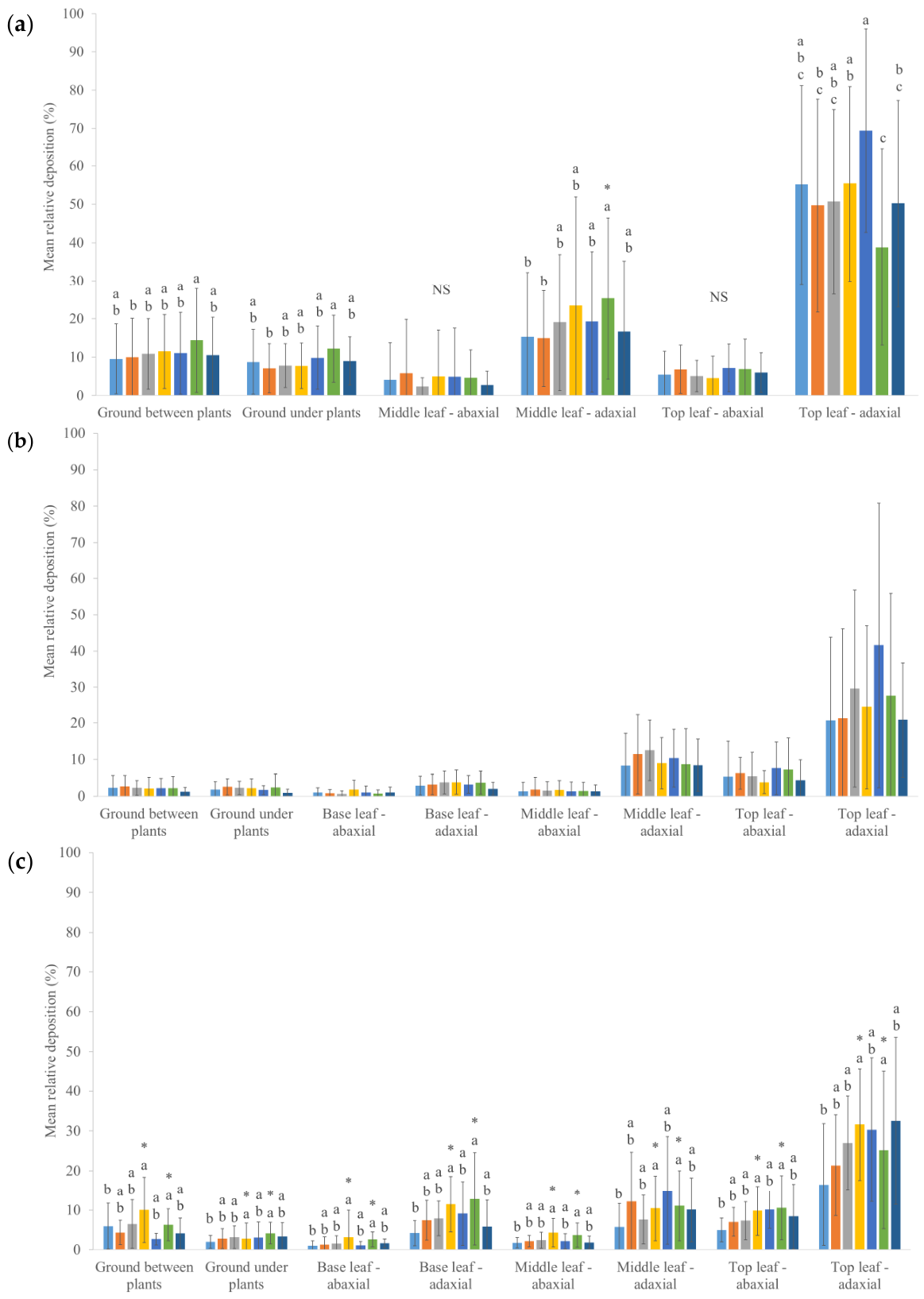
The relative spray depositions (mean ± SD) in the potato crop for the different spray configurations and collector positions at the different growth stages are shown in Figure 3 and Table S11. Over all the growth stages, highest depositions were generally found at the adaxial side of the leaves in the top (16 to 69%) and middle layer (6 to 25%), followed by on the ground on the ridge between two plants (2 to 14%) and under the plants (1 to 12%). Lowest depositions were obtained at the abaxial sides of the leaves in the top of the plant (5 to 11%) and in the middle layer (1 to 6%).
In the early stage, no significant effect of spray configuration was observed on the abaxial side of the leaves, in contrast to the adaxial sides and at the ground level. The Wingssprayer configuration resulted in the highest mean depositions on the ground under and between the plants (12 and 14%), significantly higher than those obtained with air support (7 and 10%). Similar, the Wingssprayer produced the highest mean depositions on the adaxial side of the leaves in the plant’s middle layer (25%). This was significantly higher than the deposition observed for both the reference and air support applications (15%). In contrast, lowest depositions were achieved with the Wingssprayer on the adaxial side of the leaves in the top of the plant (39%).
Spray configuration had no significant effect on relative deposition in the potato crop at the mid growth stage. This means that within collector position all configurations performed comparable, as indicated by the absence of letters denoting significant differences in Figure 3b. At all layers of the plant, the adaxial side of the leaves received significantly higher depositions than the abaxial side. The depositions at the ground under plants and between plants did not significantly differ from each other.
In the late stage, the interaction between Configuration and Collector position was not significant (Table 4), but Configuration and Collector position both significantly affected relative deposition. The effect of Configuration was therefore the same at every collector position. At all collector positions, the reference configuration resulted in significantly lower depositions than Wingssprayer and the configuration with 90% drift-reducing nozzles. As for the mid stage, the adaxial side of the leaves received significantly higher depositions than the abaxial side at all plant layers. The depositions on the ground under the plants was significantly lower than that between the plants.

3.3.2. Spray Coverage

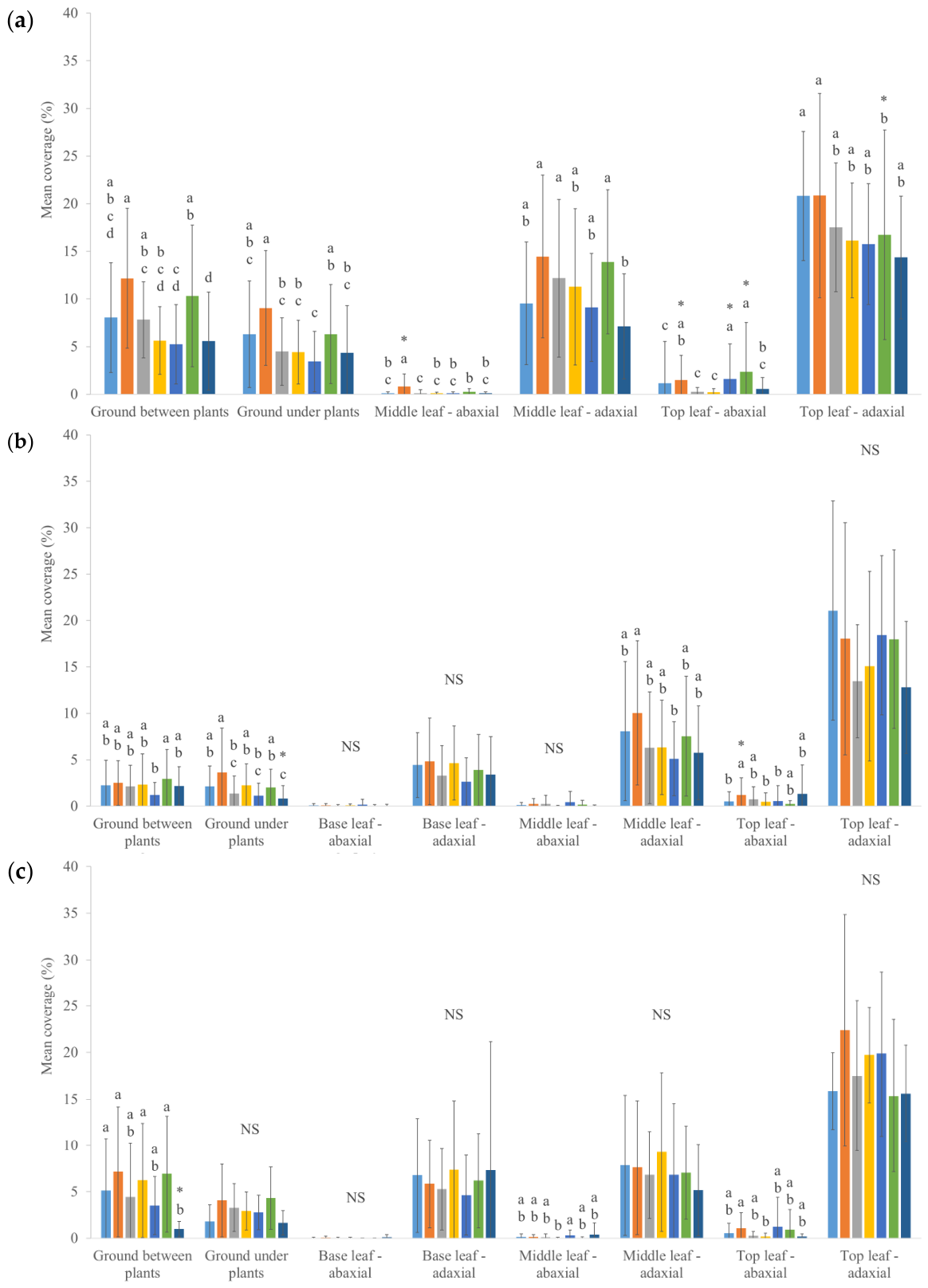
The spray coverage (mean ± SD) in the potato crop for the different spray configurations and collector positions at the different growth stages is presented in Figure 4 and Table S12. Mean spray coverage was always lowest and below 2.5% on the abaxial side of the leaves across all growth stages. In contrast, the highest coverage was found on the adaxial side, increasing progressively from the base to the mid and top layers up to 22%.
Spray configuration significantly affected coverage at all collector positions during the early growth stage. Although not always significant, the configuration with air support in combination with a fine-spray-quality nozzle achieved the highest coverage (up to 21%), including at the ground level. The Airtec configuration frequently resulted in the lowest coverage (varying from 0 to 14%).
At the mid stage, significant differences between configurations were observed only at the ground level, the adaxial side of the leaves in the middle layer and the abaxial side of the leaves in the top layer. Even then, only small differences were observed between configurations. For example, the configuration employing air support resulted in significantly higher coverage on the leaves than the angled nozzle 3D90 03.
Similarly, only small differences in spray coverage were observed between spray configurations at the late growth stage at the ground between plants, and at the abaxial side of leaves in the middle and the top layer.

3.4. Brussels Sprouts

3.4.1. Spray Deposition

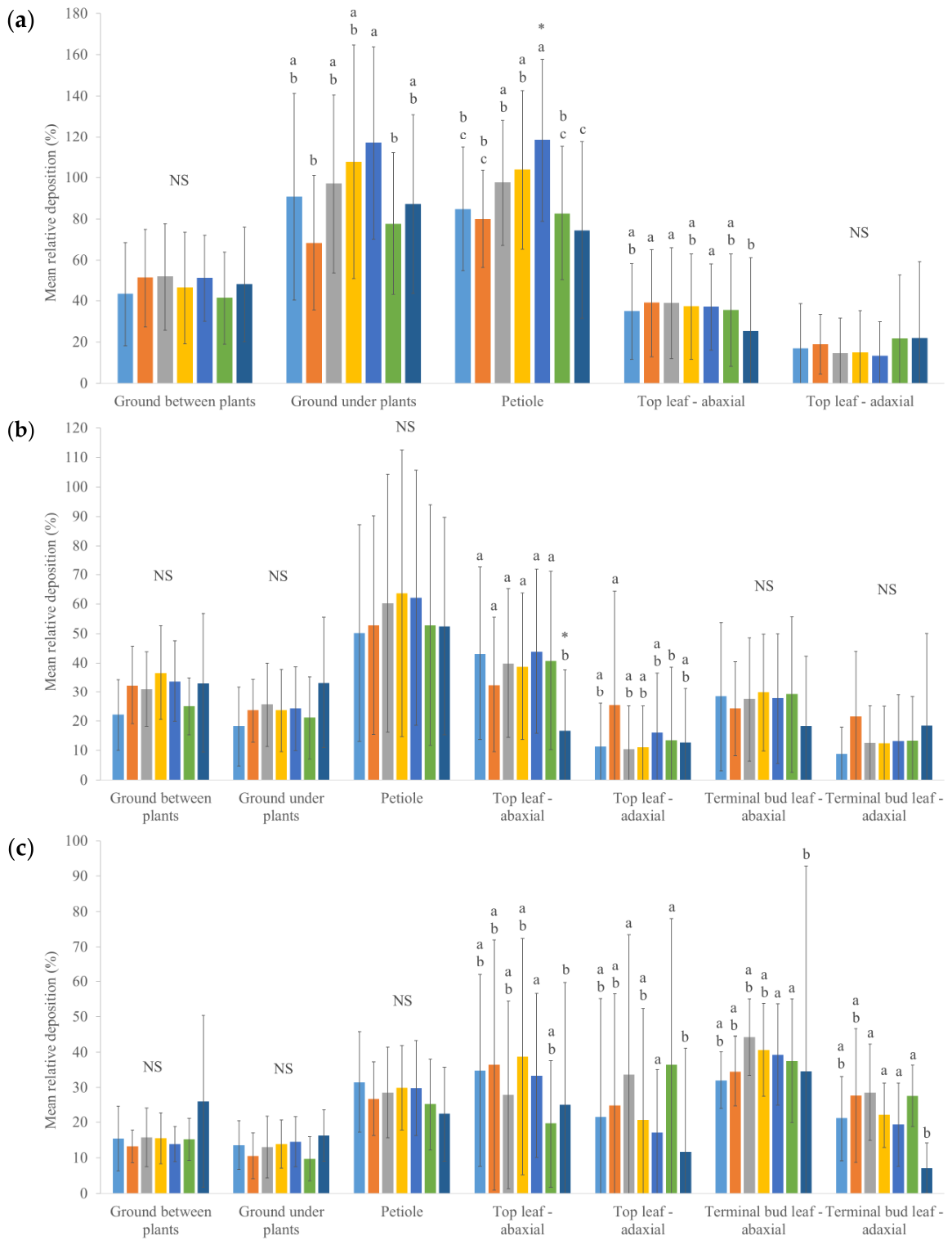
Figure 5 and Table S13 present the relative spray deposition (mean ± SD) for the different spray configurations and collector positions at the three growth stages in the Brussels sprouts crop. At all growth stages, the adaxial side of the leaves generally received lower depositions than the abaxial side.
At the early growth stage, highest depositions were found on the ground under the plants (68 to 117%) and on the petiole, which was positioned in the middle of the plant (74 to 118%), followed by on the ground between plants (41 to 52%), the abaxial side of the top leaves (25 to 39%) and finally the adaxial side of the top leaves (13 to 22%). Significant differences between spray configurations were found at the ground under the plants, on the petiole and on the abaxial side of the top leaves (Figure 5a).
At the ground under the plants, the configuration with a reduced boom height produced significantly higher depositions than both the air-supported configuration and the one using the Airtec system. At the petiole, the relative deposition was also significantly higher than that achieved with the reference configuration and the droplegs. Furthermore, the droplegs resulted in lowest deposition at the abaxial side of the top leaves.
At the mid growth stage, spray configuration had a significant effect on relative deposition only at the top leaves, both abaxial and adaxial side (Figure 5b). On the abaxial side of the top leaves, the droplegs resulted in significantly lower depositions than the other configurations. At the adaxial side of the top leaves, the configuration using air support resulted in significantly higher depositions than the configuration employing the Airtec system.
At the late stage, significant differences were observed on both sides of the top leaves as well as on the terminal bud leaves. At these collector positions, the droplegs never significantly differed from the reference or air support configuration.

3.4.2. Spray Coverage

Figure 6 and Table S14 present the spray coverage (mean ± SD) for the different spray configurations and collector positions at two growth stages (early and mid) in the Brussels sprouts crop.
At the early growth stage, average spray coverage was approximately 14%, varying from 4 to 24%. The highest coverage occurred on the ground under the plants (18 to 24%), followed by the petioles (13 to 17%) and the ground between plants (11 to 19%). On average, the adaxial side of the top leaves showed higher spray coverage than the abaxial side (11% vs. 8%), though the exact values depended on the configuration. The droplegs produced the lowest mean coverage on the top leaves, often significantly different from other configurations. At the abaxial side of the top leaves, the air-supported configuration resulted in significantly higher depositions than the other configurations, except for the reduced boom height and Airtec configuration.
At the mid growth stage, mean spray coverage across the different configurations and collector positions ranged from 1% to 16%, with an overall average of 10%. Highest spray coverage was found on the petiole (12 to 16%), the abaxial side of the top leaves (5 to 16%), and the ground between the plants (9 to 13%). Significant differences between configurations were observed on the top leaves and the terminal bud leaves. The droplegs generally produced the lowest coverage on the abaxial leaf surface. The values were significantly lower than several other configurations, including the air-supported, the 90% drift-reducing nozzle, and the Airtec configuration. On the adaxial side of the top leaves, however, the 90% drift-reducing nozzle showed the lowest coverage. Its coverage was significantly lower than the two configurations using a fine-spray-quality nozzle, namely the reference configuration and the air support configuration.

4. Discussion

This study aimed to gain insight into spray distribution patterns in potato and Brussels sprouts crops with different (drift-reducing) spray configurations. Spray deposition and coverage were determined using artificial collectors (FPC and WSP). These collectors do not respond the same to incoming droplets and air streams as actual plant surfaces. They generally retain droplets on impact rather than bouncing or shattering them. As discussed in Zwertvaegher et al. [16], this can lead to an overestimation of deposition. Their hydrophilic and highly retentive properties likely further enhanced droplet capture compared to natural leaf surfaces. Consequently, measured deposition values may not directly represent the amount of spray retained by plant surfaces or the actual biological exposure of the crop. On natural leaves, droplet behavior is influenced by surface characteristics such as waxiness, roughness, and leaf orientation, which can affect droplet spreading, retention, rebound, shattering, and runoff. The spray liquid did not contain surfactants which may further influence droplet behavior compared to commercial formulations. These effects may be particularly relevant for crops such as Brussels sprouts, where the leaf surface has more pronounced hydrophobic and lipophilic characteristics. Furthermore, WSP also have limitations, such as the continuation of the chemical color reaction until complete [21]. This can affect the accuracy of droplet quantification, particularly when comparing sprays with varying droplet sizes. Despite these drawbacks, artificial collectors remain useful for comparing spray application performances and offer valuable insights into spray distribution patterns within crops, which was the goal of this study.
This study did not assess the relationship between spray deposition, coverage and biological efficacy. Therefore, differences in measured deposition and coverage cannot be directly translated into differences in pest or disease control. Future research should therefore include bio-efficacy trials.
In addition, as mentioned in the Materials and Methods section, a limitation of the experimental design is that the evaluated spray configurations differed in multiple factors, including spray technique, nozzle type, droplet size spectrum, boom height, and air support. Consequently, when differences in spray deposition or coverage were observed, these could not always be attribute to a single factor. Instead, the observed responses reflect the combined effect of the different technologies and settings included in each configuration. Isolating the contribution of individual factors would require a factorial experimental design in which each spray factor is varied independently. Nevertheless, the current approach of evaluating complete spray configurations provides practical insight into the performance of commercially relevant spray configurations under field conditions.

4.1. Potato Crop

4.1.1. Spray Deposition

No significant differences in spray deposition were observed between air support and the reference configuration at any of the collector positions and growth stages in the potato crop. It should be noted that large variations were observed in relative spray deposition within the same collector position and spray configuration. Such variability is common in field experiments due to differences in plant architecture, leaf orientation, canopy density, and collector positioning, and may have reduced the ability to detect significant differences between spray configurations. However, at the late growth stage, crop depositions were slightly higher with air support than with the conventional application, suggesting a modest improvement in droplet transport and canopy penetration under denser foliage conditions using air support. Variable and sometimes contrasting effects of air support on spray deposition in potato canopies were reported in the literature. Leonard et al. [22] observed reduced deposition on the adaxial surface of potato leaves in the upper (−21.5%) and middle (−36.2%) canopy layers when maximum air support was used compared with a conventional application using 4110-20 nozzles at 300 kPa and 250 L ha−1. In contrast, deposition on the abaxial surfaces within these layers increased substantially, by up to 101%. In the lower canopy layers, air support resulted in more than 30% higher deposition on both leaf surfaces. However, air support also increased spray losses to the ground, from 5.0% to 7.3% of the total collected deposition compared with conventional spraying. Panneton and Piché [23], using vinyl disc collectors, reported significant increases in spray deposition with air support on the adaxial leaf surface in the middle (+20%) and lower (+218%) canopy layers, as well as on the abaxial surface of upper canopy leaves (+2266%). Their study compared applications using a medium-quality spray (XR 110 03 nozzle operated at 140 kPa) at a spray volume of 150 L ha−1, with and without air support (air velocity 40 m s−1 vs. 0 m s−1). Deposition on abaxial leaf surfaces was negligible in the absence of air support, underscoring the role of airflow in improving leaf surface exposure. Nevertheless, air support significantly reduced deposition (−45%) on the adaxial surface of leaves in the upper canopy. van de Zande et al. [24] provided a comprehensive overview of different field trials in potato crops, showing that applications at 200 L ha−1 using a medium-quality spray generally increased deposition on both adaxial and abaxial leaf surfaces throughout the canopy. However, the response to air support varied with crop growth stage. During early (leaf canopy in distinct rows) and very late (leaf canopy decreasing because of senescence) growth stages, when the leaf area index (LAI) was around 1 to 2, air-supported applications resulted in 6 to 10% lower foliar deposition than conventional spraying. This difference was averaged across the top, middle and bottom canopy layers. In contrast, in a fully developed canopy (LAI of 5.1), air support increased average deposition by approximately 4%. Effects on spray losses to the soil were inconsistent across trials. One experiment showed no significant effect of air support, while another reported increased deposition on ridge tops and inter-row areas, but not beneath the plants. Combined, these findings emphasize that the performance of air-supported spraying is strongly influenced by canopy structure, crop development, spray configuration and application parameters, as also found in other crops [25,26], despite its general characterization as a technique that enhances canopy penetration and improves spray distribution uniformity.
When comparing two 90% drift-reducing nozzles, i.e., the Syngenta 3D90 03 nozzle (Syngenta, Basel, Switzerland), which produces an ultra-coarse spray (VMD = 646 µm) at a 55° angle, and the Lechler ID3 120 03 nozzle (Lechler, Metzingen, Germany), which generates an extremely coarse vertically oriented spray (VMD = 592 µm), no significant differences in spray deposition were observed despite the difference in spray orientation. In a study by Scudeler and Raetano [27], forward-oriented sprays were associated with higher canopy depositions on the abaxial potato leaf surfaces in the bottom canopy. In contrast, backward-oriented sprays did not result in significantly higher or lower depositions than a vertical spray. The alternating forward and backward orientation of the 3D90 03 nozzle may have averaged out potential benefits associated with a consistently forward-directed spray, resulting in deposition levels comparable to that of a vertical spray. The Airtec air-injection system used in this study employed a backward-oriented deflector nozzle (about −25°) along the entire boom. It did not result in significantly different spray depositions compared to the other configurations. The only exception was observed for the angled nozzle at the adaxial side of the top leaf in the early growth stage. While several studies have characterized the droplet spectra of air-injection systems as a function of liquid and air pressure [28,29], field-based evaluations, both overall and specifically in potato, remain limited.
In our study, significantly higher depositions than the reference configuration (XR 110 03) were only observed for the 90% drift-reducing ID3 120 03 nozzle and the Wingssprayer configuration. During the late growth stage, this effect remained consistent across all collector positions, including the ground collectors, as also indicated by the non-significant interaction term in the final model (Table 4). In the early growth stage, the Wingssprayer also showed significantly higher deposition than the XR 110 03 nozzle at the adaxial side of the leaves in the middle canopy layer, both with and without air support. In the top canopy layer, the Wingssprayer resulted in lower depositions on the adaxial leaf surfaces compared to the fine-spray configurations. This could be the result of the wings physically touching the crop, causing leaf turnover and partial deflection of the spray. The findings suggest that substantial modifications in droplet size spectrum (as in the case of the extremely coarse ID3 nozzle) or in spray delivery geometry, such as air guidance through shields in the Wingssprayer, could be required to induce measurable changes in canopy deposition under dense canopy conditions, while more subtle adjustments in nozzle orientation or droplet size did not result in consistent differences.

4.1.2. Spray Coverage

The present study did not reveal a clear droplet size effect on spray coverage: as no significant differences were observed between the fine (reference, XR 110 03), very coarse (75% drift-reducing, AVI 110 03), and extremely coarse (90% drift-reducing, ID3 120 03) spray quality nozzles. Kierzek and Wachowiak [30] also found no significant differences in spray coverage in potato when comparing coarse air-induction nozzles (Lechler ID 120 03 and Lurmark DB 120 03) with fine standard flat-fan nozzles (TeeJet XR 110 03) over four growing seasons using the transfer of copper trace from leaves to blotting paper and the classification of the results on a 0 to 400 scale as measuring method. The authors suggest that on easy-to-wet leaf surfaces, such as on those of potato, droplet retention is generally high and therefore only little affected by application characteristics. In contrast, Vučajnk and Bernik [10] reported significantly higher coverage on WSP in the middle and lower layers of potato plants, as well as over the whole plant at growth stage BBCH 64, when coarse droplets were applied compared with fine droplets. The authors attributed this effect to the greater kinetic energy of coarse droplets, which likely improved canopy penetration. Similarly, Sayinci and Bastaban [31] observed that nozzles producing coarse droplets resulted in more uniform distribution of spray coverage throughout the potato canopy than nozzles producing fine droplets. Differences in methodologies used to assess spray coverage, as well as variations in cultivar, growth stage, and consequently crop architectures and LAI, may account for discrepancies observed between studies.
Minor but statistically significant differences in spray coverage were observed in this study when using air support compared to the reference configuration. These increases were confined to the abaxial leaf surfaces, i.e., during the early growth stage at the middle and top layer of the potato canopy, and in the mid growth stage at the top layer. Panneton et al. [32] and Piché et al. [33] reported substantial improvements in abaxial leaf coverage and in the balance between abaxial and adaxial coverage across all canopy heights when high air support velocities (>25 m s−1) were employed compared with conventional spraying. Panneton et al. [32] furthermore demonstrated that air velocity was the dominant factor influencing leaf coverage. Higher air velocities (>25 m s−1) were found to increase the abaxial coverage at all canopy heights and adaxial coverage in the lower third of the canopy, whereas lower air velocities (<21 m s−1) improved adaxial coverage in the upper two-thirds. In the present study, the average air outlet velocity was 21 m s−1, resulting in an air velocity of approximately 8 m s−1 at 0.50 m below the outlet. It is possible that the air velocity achieved in our study was insufficient to obtain more pronounced air support effects.
A comparison between the 90% drift-reducing extremely coarse nozzle (ID3 120 03, VMD = 592 µm) and the angled ultra coarse nozzle (3D90 03, VMD = 646 µm), showed only two significant differences in spray coverage at the abaxial leaf surface across all three growth stages. In the early growth stage, the angled 3D90 03 nozzle achieved slightly higher mean abaxial coverage at the top layer than the vertical ID3 120 03 nozzle (2% vs. 0%). Although statistically significant, the difference in mean abaxial coverage in the middle canopy layer at the late growth stage was negligible between the angled 3D90 03 and the vertical spraying ID3 120 03 nozzle (0% vs. 0%).
The very coarse Airtec configuration resulted in significantly lower ground coverage than the 90% drift-reducing extremely coarse nozzle and the fine reference spray nozzle, i.e., under the plants in the mid growth stage and between the plants in the late growth stage. It is unclear why the Airtec configuration resulted in lower ground coverage, as an angled, high-energy spray would theoretically increase penetration to the ground. A plausible explanation is enhanced canopy interception due to longer in-canopy droplet trajectories.

4.1.3. Practical Recommendations

The different spray configurations resulted in little difference, except that the 90% drift-reducing nozzle and the Wingssprayer configuration significantly improved deposition relative to the fine-spray reference at the late growth stage at all collector positions. This suggests that enhanced deposition in dense potato canopies requires substantial modifications, such as ultra coarse droplets or modified spray delivery systems that enhance canopy penetration. Air support also increased deposition and coverage compared with the reference configuration, highlighting its potential as a valuable technology for improving spray applications. Overall, coarse droplet applications gave similar deposition and coverage results to those obtained with fine droplets so that with increasing concerns about spray drift, drift-reducing nozzles could potentially be adopted without major losses in deposition or coverage.

4.2. Brussels Sprouts

4.2.1. Spray Deposition

High deposition values were observed in Brussels sprouts, even exceeding 100% in the early growth stage at the ground under the plants and on the petiole with the 90% drift-reducing nozzle and the reduced boom height configuration. These high values are likely attributable to the use of artificial collectors (filter papers) for the quantification of deposition rather than actual leaf surfaces. Compared with the relatively lipophilic leaves of Brussels sprouts, such collectors typically retain more spray liquid, which may partly explain the high measured deposition. Moreover, the low leaf wettability promotes droplet coalescence and subsequent runoff, which can be captured by these collectors, further increasing measured values. Consequently, tracer accumulation on the collectors may have masked subtle differences between application techniques. Although no canopy density measurements were performed, the visually open canopy structure of Brussels sprouts likely facilitated greater spray penetration. This may have contributed to high overall deposition on the collectors, especially in the middle and lower parts of the plants.
Regarding the use of air support, the present study found no significant differences in relative spray deposition when using the same fine-spray standard flat-fan nozzle (XR 110 03) with or without air support. When droplet characteristics are kept constant, the potential benefits of air support may therefore be minimal in open crops like Brussels sprouts.
When comparing the relative spray deposition of the fine-spray-quality flat-fan nozzle XR 110 03 (reference, VMD = 184 µm) with the very coarse 75% drift-reducing nozzle AVI 110 03 (VMD = 445 µm) and the extremely coarse 90% drift-reducing nozzle ID3 120 03 (VMD = 592 µm), no significant differences, and thus no effect of droplet size, were detected at any of the three growth stages or collector positions.
Lower spray boom height and nozzle spacing did not significantly affect spray deposition compared to the reference configuration in this study. This indicates that these adjustments can be implemented for improved drift reduction without compromising on-target spray deposition. Overall, research on spray deposition in Brussels sprouts is extremely limited, with no studies identified addressing these adjustments in this crop.
In the present study, the Airtec system, producing a very coarse spray quality, did not result in significantly different relative deposition compared with the standard flat-fan nozzle. Bruyneel and Nuyttens [15], however, reported the highest relative spray depositions throughout a Brussels sprouts canopy with the Airjet system, i.e., an air-injection nozzle conceptually comparable to the Airtec system, compared to other (drift-reducing) configurations. In their study, the reported operating conditions included a spray pressure of 400 kPa and an air pressure of 200 kPa. However, no additional technical specifications, such as the type of orifice insert or resulting droplet size spectrum, were provided. Consequently, it is not possible to determine the exact spray quality generated by the Airjet system or to directly compare to droplet characteristics with those produced in our experiments. This discrepancy may be attributed to differences in spray quality, air support intensity, or overall system configuration. It is plausible that the assigned penetration benefits of air-injection systems are highly dependent on the interaction between droplet size, air pressure, and canopy structure. A medium spray quality without sufficient air momentum may not generate the same level of canopy disturbance or droplet transport as a configuration optimized for deeper penetration.
The droplegs configuration frequently resulted in lower relative spray deposition than other configurations in the present study. This was particularly evident on the adaxial leaf surface in the top of the canopy during the late growth stage. However, these differences were not always statistically significant. Reduced deposition on the adaxial top leaves and terminal bud leaves is not unexpected, given the curled and shielded orientation relative to a bottom-up spray trajectory. These findings indicate that droplegs are less suitable when deposition on the upper canopy is desired. Similar trends have been reported in the literature. Bruyneel and Nuyttens [15] found that, although overall relative spray deposition with droplegs equipped with drift-reducing TeeJet DG 80 03 nozzles at 400 L ha−1 was comparable to that of a conventional boom application using the same nozzles and volume, deposition with the droplegs was consistently lower on the upper and middle canopy leaves. Furthermore, crop architecture can impair spray deposition when using droplegs. Rueegg et al. [34] observed that in crops taller than 130 cm and with LAI values up to 8, droplegs were unable to penetrate the dense canopy, causing the droplegs to be deflected backward.

4.2.2. Spray Coverage

Spray coverage did not significantly differ between the standard flat-fan nozzle with or without air support. An exception was observed at the abaxial surface of the top leaves during the early growth stage, where air support showed a slight positive effect.
Although finer sprays are generally associated with enhanced spray coverage on WSP [35], no clear droplet size effect was identified in this study. For most sampling positions and growth stages, spray coverage did not differ significantly between the reference nozzle XR 110 03 nozzle and the 75% and 90% drift-reducing nozzles AVI 110 03 and ID3 120 03, despite clear differences in their droplet size classifications (fine vs. very coarse vs. extremely coarse). A statistically significant difference was detected only at the adaxial surface of the top leaves during the mid growth stage. At this location the fine reference spray nozzle XR 110 03 provided higher coverage than the extremely coarse 90% drift-reducing nozzle ID3 120 03. The absence of a droplet size effect may indicate that droplet size had limited influence on spray coverage under these conditions. However, it is also possible that the use of paper collectors reduced the sensitivity to detect such effects. Bruyneel and Nuyttens [15] did not observe a significant droplet size effect on spray coverage on WSP with mineral chelate tracers added to water and applied using a tractor mounted sprayer either, regardless of collector position. However, interpretation of their findings should consider the spray volumes applied. In their study, coarse droplet applications were generally performed at 400 L ha−1, resulting in spray coverages up to 53%. The fine-spray treatment was conducted at 200 L ha−1, which is more comparable to the 240 L ha−1 used in the present study, and still resulted in relatively high coverage levels. Coverage reached 48% at the top of the canopy and 40% on the adaxial surfaces in the middle canopy. By comparison, spray coverage in the present study was considerably lower. Coverage values at the top leaves were 4 to 15% during the early growth stage and 1 to 16% during the mid growth stage. Slightly higher values were observed during the early growth stage at the ground level (11 to 22%) and the petiole (13 to 17%). During the mid growth stage, mean spray coverage did not exceed 16% at any position.
No significant differences in spray coverage were found between the configuration with reduced spray boom height using very coarse droplets (VMD = 175 µm) and the 75% drift-reducing nozzle producing extremely coarse droplets (VMD = 189 µm) at either the early or mid growth stage. Lowering the boom height thus did not alter canopy coverage compared to a standard boom with comparable droplet size spectra in Brussel sprouts under the conditions tested.
The performance of the Airtec configuration showed only limited differences. Significant effects were observed only during the mid growth stage. At the top and terminal bud leaves, coverage was lower than with the air-support configuration on the adaxial surfaces, but higher than with the droplegs on the abaxial surfaces. The higher coverage achieved with air support at the adaxial leaf surfaces can be explained by the production of finer droplets combined with directed airflow. The finer droplets are more readily transported by the (turbulent) airstream into less exposed canopy zones, somewhat enhancing penetration and coverage on surfaces that are otherwise difficult to reach. The lower coverage of the droplegs on the abaxial surface is somewhat peculiar given their bottom-up spray delivery, which generally favors abaxial deposition. However, this appears to be a consistent trend with the droplegs as they tend to show lower coverage in the upper canopy compared to the other top-down configurations as well. This may be related to the interaction between dropleg-delivered spray and the canopy, which can limit spray penetration and reduce deposition in the upper parts of the crop. Bruyneel and Nuyttens [15] also reported the lowest spray coverage at the top of the Brussels sprouts plant when using the droplegs, with significantly lower values than those obtained using a conventional top-down configuration equipped with the same DG 80 03 drift-reducing nozzles.

4.2.3. Practical Recommendations

The dense, layered, and umbrella-shaped canopy structure of Brussels sprouts could have created substantial penetration challenges. This may have limited differences between the tested spray configurations. Under these conditions, all configurations achieved comparable spray deposition and coverage, except for the droplegs, which showed reduced ability to reach the upper canopy layers. From a practical perspective, this suggests that most tested configurations can be used without major losses in spray performance in Brussels sprouts. It should be noted, however, that the use of artificial collectors and the absence of surfactants may have limited the representativeness of these results under field conditions.

4.3. General Discussion

The findings highlight the complexity of spray application in potato and Brussels sprouts crops and the difficulty of generalizing recommendations. Computational approaches, such as CFD modeling, offer strong potential for systematic evaluation of spray configurations under varying conditions. By allowing virtual sensitivity analyses and controlled comparisons that are difficult to realize experimentally, such models can support targeted optimization of spray delivery systems. By generating empirical data for model validation, this study helped taking steps toward more robust crop-specific spray applications. Tailoring spray applications to specific crops and growth stages can contribute to environmental sustainability by improving spray targeting and reducing pesticide losses to the soil and the surrounding environment while maintaining effective crop protection. Such applications can thus promote more efficient pesticide use, minimize unnecessary inputs, and reduce the overall environmental footprint of crop production.

5. Conclusions

Significant interactions between spray configuration and collector position in both potato and Brussels sprouts for relative deposition and coverage confirm that spray performance is spatially dependent and the optimal configuration varies depending on the plant part being targeted. This spatial variability makes it difficult to define a single spray configuration that provides optimal deposition and coverage across all parts of a heterogeneous canopy.
Comparison between spray configurations was complicated by differences in spray technique, nozzle type and droplet spectra. Moreover, the use of hydrophilic artificial collectors may have reduced the sensitivity to detect subtle differences and limited the direct translation of the results to deposition on actual leaves. These methodological constraints illustrate the challenges associated with quantifying spray–canopy interactions under field conditions.
For the potato crop, spray deposition and coverage was highest at the adaxial top leaf followed by adaxial middle leaf, while lowest depositions were obtained at the abaxial leaf surfaces. The different spray configurations generally resulted in little difference. Only the 90% drift-reducing nozzle and the Wingssprayer configuration significantly improved deposition relative to the fine-spray reference at the late growth stage at all collector positions. These findings suggest that enhanced deposition in dense potato canopies requires substantial modifications, such as ultra coarse droplets or modified spray delivery systems that enhance canopy penetration. In addition, no clear droplet size effect on spray coverage was observed. Therefore, with increasing concerns about spray drift in mind, drift-reducing nozzles could potentially be adopted without major losses in deposition or coverage.
For the Brussels sprouts crops, the petiole and ground under the plants had the highest depositions in the early growth stage when plants were more open. At the late growth stage, depositions on the ground and petiole substantially decreased. In contrast, those on the abaxial side of the terminal bud leaf and top leaf remained more or less the same, or even increased. The abaxial side of leaves is where pests generally reside. All configurations achieved comparable spray deposition and coverage, except for the droplegs, which showed reduced ability to reach the upper canopy layers. As for the potato crop, this suggests that drift-reducing technologies could be adopted without effecting spray performance. However, biological efficacy was not assessed in this study, and the use artificial collectors may have reduced the representativeness of the results to field conditions.

Supplementary Materials

The following supporting information can be downloaded at: https://www.mdpi.com/article/10.3390/agronomy16171719/s1, Table S1. Meteorological conditions (average ± SD) and mineral tracers used during spray applications (14 June 2023) in the early growth stage (BBCH 35) of potato. Table S2. Meteorological conditions (average ± SD) and mineral tracers used during spray applications (12 July 2023) in the mid growth stage (BBCH 61) of potato. Table S3. Meteorological conditions (average ± SD) and mineral tracers used during spray applications (22 August 2023) in the late growth stage (BBCH 79) of potato. Table S4. Meteorological conditions (average ± SD) and mineral tracers used during spray applications (25 June 2024) in the early growth stage (BBCH 49) of potato. Table S5. Meteorological conditions as hourly average (minimum–maximum) and mineral tracers used during spray applications (18 July 2024) in the mid growth stage (BBCH 61) of potato. Due to problems with the original, mobile weather station, data from a nearby permanent station (50.903978, 3.121711) are given. Table S6. Meteorological conditions (average ± SD) and mineral tracers used during spray applications (18 July 2023) in the early growth stage (BBCH 32) of Brussels sprouts. Table S7. Meteorological conditions (average ± SD) and mineral tracers used during spray applications (17 August 2023) in the mid growth stage (BBCH 38) of Brussels sprouts. Table S8. Mineral tracers used during spray applications (10 October 2023) in the late growth stage (BBCH 45) of Brussels sprouts. The meteorological conditions were not logged due to problems with the weather station and no nearby permanent station was available as an alternative source. Table S9. Meteorological conditions (average ± SD) and mineral tracers used during spray applications (24 July 2024) in the early growth stage (BBCH 31) of Brussels sprouts. Table S10. Meteorological conditions (average ± SD) and mineral tracers used during spray applications (29 August 2024) in the mid growth stage (BBCH 42) of Brussels sprouts. Table S11: Spray deposition relative to the application rate (%) at different collector positions (mean ± SD) for the different spray configurations in three growth stages (early, mid, late) in a potato crop averaged over two years of field trials (2023 + 2024). Spray configurations sharing no common letters within the same collector position within the same growth stage denote statistical significance (p < 0.05). Superscripts in bold indicate configurations which significantly differ from the reference configuration at that collector position. Table S12: Spray coverage (%) at different collector positions (mean ± SD) for the different spray configurations in three growth stages (early, mid, late) in a potato crop averaged over two years of field trials (2023 + 2024). Spray configurations sharing no common letters within the same collector position within the same growth stage denote statistical significance (p < 0.05). Superscripts in bold indicate spray configurations which significantly differ from the reference configuration at that collector position. Table S13: Spray deposition relative to the application rate (%) at different collector positions (mean ± SD) for the different spray configurations in three growth stages (early, mid, late) in a Brussels sprouts crop averaged over two years of field trials (2023 + 2024). Spray configurations sharing no common letters within the same collector position within the same growth stage denote statistical significance (p < 0.05). Superscripts in bold indicate configurations which significantly differ from the reference configuration at that collector position. Table S14: Spray coverage (%) at different collector positions (mean ± SD) for the different spray configurations in two growth stages (early, mid) in a Brussels sprouts crop averaged over two years of field trials (2023 + 2024). Spray configurations sharing no common letters within the same collector position within the same growth stage denote statistical significance (p < 0.05). Superscripts in bold indicate configurations which significantly differ from the reference configuration at that collector position.

Author Contributions

Conceptualization, I.Z., J.V., B.D.C. and D.N.; methodology, I.Z. and D.N.; formal analysis, I.Z.; investigation, I.Z., T.A.Z., J.V., S.B. and D.N.; data curation, I.Z.; writing—original draft preparation, I.Z.; writing—review and editing, I.Z., T.A.Z., J.V., B.D.C., S.B., P.V. and D.N.; visualization, I.Z.; supervision, D.N.; project administration, I.Z., J.V. and S.B.; funding acquisition, J.V., B.D.C., P.V. and D.N. All authors have read and agreed to the published version of the manuscript.

Funding

This research was funded by VLAIO (Flanders Innovation & Entrepreneurship agency), grant agreement number HBC.2021-1070 (OPTiSPRAY project).

Data Availability Statement

Data are contained within the article or Supplementary Materials.

Acknowledgments

This article is a revised and expanded version of a paper [36], which was presented at the AAB-IAPA Conference, Brighton, UK, 23–25 January 2024. The conference proceeding included results from potato collected during the early growth stage in one year (2023). The present manuscript substantially expands on that preliminary contribution by incorporating data from two additional growth stages (mid and late), a second experimental year (2024), and an additional crop (Brussels sprouts). The authors gratefully acknowledge the sprayer and nozzle manufacturers for providing the nozzles and techniques tested. In addition, we would like to thank the colleagues and technical staff of Inagro and ILVO for their support during the field trials and statistical analysis. Special thanks go to Kristof Werbrouck, Ellen Pauwelyn, Eva Ampe, Donald Dekeyser, Aaron Van Gehuchten, Brecht Dobbelaere, Stan Martens, Patrick Magdaleens, Shilin Wang and Jarissa Maselyne. The authors have reviewed and edited the output and take full responsibility for the content of this publication. During the preparation of this manuscript, the authors used ChatGPT (GPT-5.6 Luna) with the integrated image-generation tool for the purposes of generating the graphical abstract. The infographic was developed iteratively through a series of natural-language prompts. The initial prompt requested a schematic infographic comparing different agricultural spray configurations (fine, coarse, extremely coarse, air support, angled, reduced boom height, and droplegs) for deposition in potato and Brussels sprout canopies with outcomes on four collector positions (top, middle, base, ground), specifying the levels of deposition on each position. Subsequent prompts specified and refined the illustration: spray penetration differences; the visual representation of droplet sizes and spray patterns; air-support representation as downward air waves; the angled nozzle configuration illustration; more realistic illustrations of potato and Brussels sprout plants; conclusion that no single configuration is best overall and that choice matters for target position.

Conflicts of Interest

Authors Jan Vanwijnsberghe and Sarah Bossuyt were employed by the company Inagro (Belgium). All authors declare that the research was conducted in the absence of any commercial or financial relationships that could be construed as a potential conflict of interest.

Abbreviations

The following abbreviations are used in this manuscript:
WSPWater sensitive paper
FPCFilter paper collector

References

  1. Lipiński, S.; Markowski, P.; Kaliniewicz, Z.; Szczyglak, P. Improving Resource Efficiency in Plant Protection by Enhancing Spray Penetration in Crop Canopies Using Air-Assisted Spraying. Resources 2025, 14, 165. [Google Scholar] [CrossRef] [Scilit]
  2. Felsot, A.S.; Unsworth, J.B.; Linders, J.B.H.J.; Roberts, G.; Rautman, D.; Harris, C.; Carazo, E. Agrochemical spray drift; assessment and mitigation—A review. J. Environ. Sci. Health Part B-Pestic. Food Contam. Agric. Wastes 2011, 46, 1–23. [Google Scholar] [CrossRef] [Scilit] [PubMed]
  3. Ahrens, K.; Röver, M.; Molnar, G.; Martin, S.; Peter, E.; Schäckermann, J.-N.; Bense, S.; Wegener, J.K. Novel field data for exposure of bystanders and residents towards spray drift during application of plant protection products in orchards. J. Consum. Prot. Food Saf. 2024, 19, 131–142. [Google Scholar] [CrossRef] [Scilit]
  4. De Ryck, S.; Van Hecke, E.; Zwertvaegher, I.; Nuyttens, D.; Vanwijnsberghe, J.; Zewdie, T.A.; Verboven, P.; De Meester, M.; De Cauwer, B. Bio-Efficiency of Foliar Herbicides Applied with Drift-Reducing Nozzles. Agriculture 2025, 15, 2115. [Google Scholar] [CrossRef] [Scilit]
  5. Jensen, P.K.; Jorgensen, L.N.; Kirknel, E. Biological efficacy of herbicides and fungicides applied with low-drift and twin-fluid nozzles. Crop Prot. 2001, 20, 57–64. [Google Scholar] [CrossRef] [Scilit]
  6. Prado, E.P.; Guerreiro, J.C.; Ferreira-Filho, P.J.; do Nascimento, V.; Ferrari, S.; Galindo, F.S.; Funichello, M.; Raetano, C.G.; Pagliari, P.H.; Chechetto, R.G. Performance of spray nozzles and droplet size on glufosinate deposition and weed biological efficacy. Crop Prot. 2024, 177, 106560. [Google Scholar] [CrossRef] [Scilit]
  7. Wang, Y.; Zhang, Z.; Shi, R.; Dai, S.; Jia, W.; Ou, M.; Dong, X.; Yan, M. A review of multiscale interaction mechanisms of wind–leaf–droplet systems in orchard spraying. Sensors 2025, 25, 4729. [Google Scholar] [CrossRef] [Scilit] [PubMed]
  8. Müller, M.; Rakocevic, M.; Caverzan, A.; Boller, W.; Chavarria, G. Architectural characteristics and heliotropism may improve spray droplet deposition in the middle and low canopy layers in soybean. Crop Sci. 2018, 58, 2029–2041. [Google Scholar] [CrossRef] [Scilit]
  9. Zhu, H.; Rowland, D.L.; Dorner, J.W.; Derksen, R.C.; Sorensen, R.B. Influence of plant structure, orifice size, and nozzle inclination on spray penetration into peanut canopy. Trans. ASAE 2002, 45, 1295–1301. [Google Scholar] [CrossRef] [Scilit]
  10. Vučajnk, F.; Bernik, R. Improved quality of fungicide deposition and coverage of potato leaves using flat fan air-injector nozzle IDK. Acta Agric. Slov. 2012, 99, 151–164. [Google Scholar] [CrossRef] [Scilit]
  11. van Loon, M.P.; Alimagham, S.; Abuley, I.K.; Boogaard, H.; Boguszewska-Mańkowska, D.; de Galarreta, J.I.R.; Geling, E.H.; Kryvobok, O.; Kryvoshein, O.; Landeras, G. Insights into the potential of potato production across Europe. Crop Environ. 2025, 4, 97–106. [Google Scholar] [CrossRef] [Scilit]
  12. Statbel. Landbouwcijfers. 2024. Available online: https://view.officeapps.live.com/op/view.aspx?src=https%3A%2F%2Fstatbel.fgov.be%2Fsites%2Fdefault%2Ffiles%2Ffiles%2Fdocuments%2Flandbouw%2F8.1%2520Land-%2520en%2520tuinbouwbedrijven%2FDBREF-L05-2024-TAB-A-NL.xlsx&wdOrigin=BROWSELINK (accessed on 30 August 2026).
  13. Zewdie, T.A.; Zwertvaegher, I.; Nuyttens, D.; Vanwijnsberghe, J.; De Cauwer, B.; De Ryck, S.; Nicolai, B.; Verboven, P. Development of a CFD model for optimizing spray application techniques for Brussels sprouts. In Precision Agriculture ‘25 Stafford; J.V., Ed.; Wageningen Academic Publisher: Wageningen, The Netherlands, 2025; pp. 90–97. [Google Scholar]
  14. Koch, K.; Barthlott, W. Superhydrophobic and superhydrophilic plant surfaces: An inspiration for biomimetic materials. Philos. Trans. R. Soc. A-Math. Phys. Eng. Sci. 2009, 367, 1487–1509. [Google Scholar] [CrossRef] [Scilit] [PubMed]
  15. Bruyneel, L.; Nuyttens, D. Effect of spray application technology on the biological control of aphids in Brussels sprouts. Commun. Agric. Appl. Biol. Sci. 2010, 75, 139–145. [Google Scholar] [PubMed]
  16. Zwertvaegher, I.; Zewdie, T.A.; Vanwijnsberghe, J.; De Cauwer, B.; De Ryck, S.; Verboven, P.; Nuyttens, D. Effect of drift-reducing spray configurations on spray deposition and coverage in winter wheat. Pest Manag. Sci. 2026, 82, 4836–4848. [Google Scholar] [CrossRef] [Scilit] [PubMed]
  17. Nenić, P.; Urošević, M.; Živković, M.; Koprivica, R. CDA method technological assumptions and technical solutions conceptions. Acta Agric. Serbica 2001, 6, 19–27. [Google Scholar]
  18. Nuyttens, D.; Baetens, K.; De Schampheleire, M.; Sonck, B. Effect of nozzle type, size and pressure on spray droplet characteristics. Biosyst. Eng. 2007, 97, 333–345. [Google Scholar] [CrossRef] [Scilit]
  19. Foqué, D.; Pieters, J.G.; Nuyttens, D. Effect of spray angle and spray volume on deposition of a medium droplet spray with air support in ivy pot plants. Pest Manag. Sci. 2014, 70, 427–439. [Google Scholar] [CrossRef] [Scilit] [PubMed]
  20. ISO 25358:2018; Crop Protection Equipment—Droplet-Size Spectra from Atomizers—Measurement and Classification. ISO: Geneva, Switzerland, 2018.
  21. He, M.; Qi, P.; Han, L.; He, X. Study on spray evaluation: The key role of droplet collectors. Agronomy 2024, 14, 305. [Google Scholar] [CrossRef] [Scilit]
  22. Leonard, R.; Rice, B.; Dowley, L.J. The effect of air assistance on spray depostion and biological effect in the control of Phytophtora infestans in potatoes. Asp. Appl. Biol. 2000, 57, 243–250. [Google Scholar]
  23. Panneton, B.; Piche, M. Interaction between application volume, airflow, and spray quality in air-assisted spraying. Trans. ASAE 2005, 48, 37–44. [Google Scholar] [CrossRef] [Scilit]
  24. van de Zande, J.; Michielsen, J.; Stallinga, H.; Porskamp, H.; Holterman, H.; Huijsmans, J. Spray distribution when spraying potatoes with a conventional or an air-assisted field boom sprayer. In Proceedings of the ASAE 2002, Chicago, IL, USA, 28–31 July 2002. [Google Scholar]
  25. Zhang, J.; Chen, Q.; Zhou, H.; Liu, C.; Han, R.; Lv, X. Morphological changes and spray coverage of pear leaves and canopy at different phenological periods during air-assisted spraying. Crop Prot. 2025, 197, 107324. [Google Scholar] [CrossRef] [Scilit]
  26. Duga, A.T.; Ruysen, K.; Dekeyser, D.; Nuyttens, D.; Bylemans, D.; Nicolai, B.M.; Verboven, P. Spray deposition profiles in pome fruit trees: Effects of sprayer design, training system and tree canopy characteristics. Crop Prot. 2015, 67, 200–213. [Google Scholar] [CrossRef] [Scilit]
  27. Scudeler, F.; Raetano, C.G. Spray deposition and losses in potato as a function of air-assistance and sprayer boom angle. Sci. Agric. 2006, 63, 515–521. [Google Scholar] [CrossRef] [Scilit]
  28. Holterman, H.; van de Zande, J.C. Onderzoek aan de Spuitdoppen Cleanacres Airtec 35 en 40 ter Verkrijging van de Status Driftarm en Voor Classificatie op Basis van Driftgevoeligheid; Nota 515; Wageningen Research: Wageningen, The Netherlands, 2008; p. 24. [Google Scholar]
  29. Holterman, H.; de Hoog, D.C.; van de Zande, J.C. Onderzoek aan Lucht-Vloeistof Mengdoppen Airtec NAP06LD 0 Groen en Airtec NAP06LD 80 BLAUW Voor Classificatie op Basis van Driftgevoeligheid; Rapport WPR-1097; Wageningen Research: Wageningen, The Netherlands, 2022; p. 26. [Google Scholar]
  30. Kierzek, R.; Wachowiak, M. Effect of nozzle types and adjuvanrs on the leaf coverage and biological efficacy of fungicides in potato. J. Plant Prot. Res. 2003, 43, 181–189. [Google Scholar]
  31. Sayinci, B.; Bastaban, S. Spray distribution uniformity of different types of nozzles and its spray deposition in potato plant. Afr. J. Agric. Res. 2011, 6, 352–362. [Google Scholar]
  32. Panneton, B.; Philion, H.; Theriault, R.; Khelifi, M. Spray chamber evaluation of air-assisted spraying on potato plants. Trans. ASAE 2000, 43, 529–534. [Google Scholar] [CrossRef] [Scilit]
  33. Piché, M.; Panneton, B.; Thériault, R. Field evaluation of air-assisted boom spraying on broccoli and potato. Trans. ASAE 2000, 43, 793–799. [Google Scholar] [CrossRef] [Scilit]
  34. Rueegg, J.; Eder, R.; Anderau, V. Improved application techniques: Ways to higher efficacy of fungicides and insecticides in field grown vegetables. Outlooks Pest Manag. 2006, 17, 80–84. [Google Scholar] [CrossRef] [Scilit]
  35. Guler, H.; Zhu, H.P.; Ozkan, H.E.; Ling, P. Characterization of hydraulic nozzles for droplet size and spray coverage. At. Sprays 2012, 22, 627–645. [Google Scholar] [CrossRef] [Scilit]
  36. Zewdie, T.A.; Vanwijnsberghe, J.; De Cauwer, B.; De Ryck, S.; Zwertvaegher, I.; Nuyttens, D.; Verboven, P. OPTiSPRAY: Selecting Optimal Spray Application Techniques and Settings Using a CFD Model—Part 1: Experimental Work. In Proceedings of the AAB-IAPA Conference, Brighton, UK, 23–25 January 2024. [Google Scholar]
Figure 1. Mazotti sprayer with 3.0 m Delvano spray boom, air support system and Wingssprayer Double Wing shielded boom used in the field trials.
Agronomy 16 01719 g001
Figure 2. (Top): (Left) Filter paper ground collector on the ridge between two potato plants pinned to wooden block in early growth stage, (Middle) Potato plant in early growth stage with water sensitive papers attached, (Right) Potato plant in late growth stage with filter paper collectors attached. (Bottom): (Left) Filter paper ground collector close to the stem of a Brussels sprouts plant pinned to wooden block in late growth stage, (Middle) Water sensitive papers on both sides of a petiole of a Brussels sprouts plant in the early growth stage, (Right) Brussels sprouts plant in mid growth stage with filter paper collectors attached to top leaf and terminal bud leaf.
Agronomy 16 01719 g002
Figure 3. Mean spray depositions relative to the application rate (%) at different collector positions (mean ± SD) for the different spray configurations (Agronomy 16 01719 i001 reference, Agronomy 16 01719 i002 air support, Agronomy 16 01719 i003 75% drift-reducing nozzle, Agronomy 16 01719 i004 90% drift-reducing nozzle, Agronomy 16 01719 i005 angled fan, Agronomy 16 01719 i006 Wingssprayer, Agronomy 16 01719 i007 Airtec) in three growth stages, i.e., (a) early (BBCH 35 and 49 in 2023 and 2024, respectively), (b) mid (BBCH 61 in 2023 and 2024) and (c) late (BBCH 79 in 2023), in a potato crop averaged over two years of field trials (2023 + 2024). Spray configurations sharing no common letters within the same collector position denote statistical significance (p < 0.05). Superscripts with an asterisk indicate spray configurations which significantly differ from the reference configuration at that collector position. NS, not significant.
Agronomy 16 01719 g003
Figure 4. Mean spray coverage (%) at different collector positions (mean ± SD) for the different spray configurations (Agronomy 16 01719 i001 reference, Agronomy 16 01719 i002 air support, Agronomy 16 01719 i003 75% drift-reducing nozzle, Agronomy 16 01719 i004 90% drift-reducing nozzle, Agronomy 16 01719 i005 angled fan, Agronomy 16 01719 i006 Wingssprayer, Agronomy 16 01719 i007 Airtec) in three growth stages, i.e., (a) early (BBCH 35 and 49 in 2023 and 2024, respectively), (b) mid (BBCH 61 in 2023 and 2024) and (c) late (BBCH 79 in 2023), in a potato crop averaged over two years of field trials (2023 + 2024). Spray configurations sharing no common letters within the same collector position denote statistical significance (p < 0.05). Superscripts with an asterisk indicate spray configurations which significantly differ from the reference configuration at that collector position. NS, not significant.
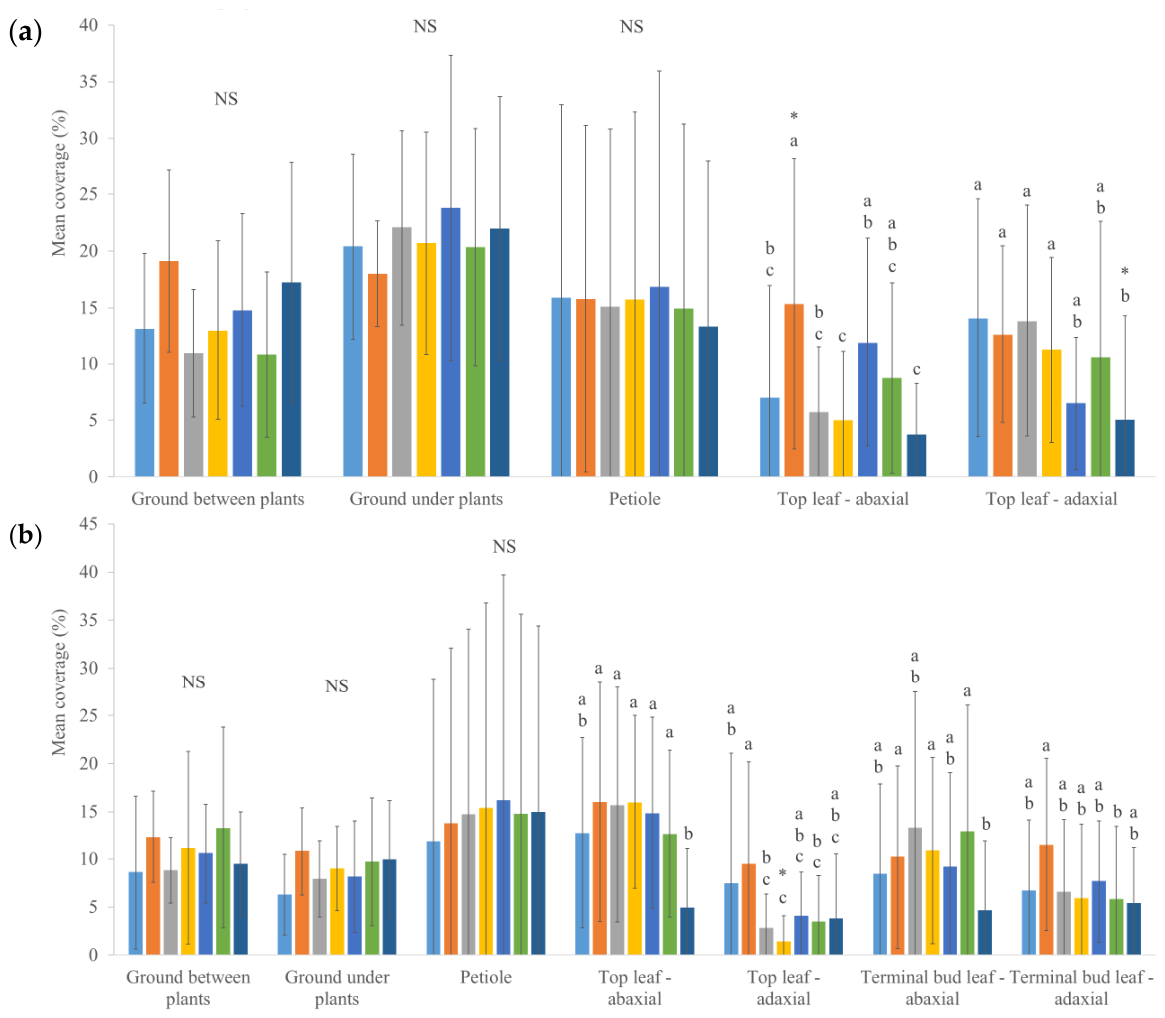

Agronomy 16 01719 g004
Figure 5. Mean spray depositions relative to the application rate (%) at different collector positions (mean ± SD) for the different spray configurations (Agronomy 16 01719 i001 reference, Agronomy 16 01719 i002 air support, Agronomy 16 01719 i003 75% drift-reducing nozzle, Agronomy 16 01719 i004 90% drift-reducing nozzle, Agronomy 16 01719 i005 reduced boom height, Agronomy 16 01719 i006 Airtec, Agronomy 16 01719 i007 droplegs) in three growth stages, i.e., (a) early (BBCH 32 and 31 in 2023 and 2024, respectively), (b) mid (BBCH 38 and 42 in 2023 and 2024, respectively) and (c) late (BBCH 45 in 2023), in a Brussels sprouts crop averaged over two years of field trials (2023 + 2024). Spray configurations sharing no common letters within the same collector position denote statistical significance (p < 0.05). Superscripts with an asterisk indicate spray configurations which significantly differ from the reference configuration at that collector position. NS, not significant.
Agronomy 16 01719 g005
Figure 6. Mean spray coverage (%) at different collector positions (mean ± SD) for the different spray configurations (Agronomy 16 01719 i001 reference, Agronomy 16 01719 i002 air support, Agronomy 16 01719 i003 75% drift-reducing nozzle, Agronomy 16 01719 i004 90% drift-reducing nozzle, Agronomy 16 01719 i005 reduced boom height, Agronomy 16 01719 i006 Airtec, Agronomy 16 01719 i007 droplegs) in two growth stages, i.e., (a) early (BBCH 32 and 31 in 2023 and 2024, respectively), and (b) mid (BBCH 38 and 42 in 2023 and 2024, respectively), in a Brussels sprouts crop averaged over two years of field trials (2023 + 2024). Spray configurations sharing no common letters within the same collector position denote statistical significance (p < 0.05). Superscripts with an asterisk indicate spray configurations which significantly differ from the reference configuration at that collector position. NS, not significant.
Agronomy 16 01719 g006
Table 1. Overview of spray configurations, techniques, nozzles and settings tested during the field trials in a potato and Brussels sprouts crop.
Spray ConfigurationTechniqueNozzle TypeDrift Reduction Class (%) Spray Pressure
(kPa)
Nozzle Spacing
(m)
Boom Height
(m)
PotatoBrussels Sprouts
ReferenceStandardTeeJet XR 110 03TeeJet XR 110 0303000.50.5
Air support §Air supportTeeJet XR 110 03TeeJet XR 110 03753000.50.5
75% drift-reducingStandardAlbuz AVI 110 03Albuz AVI 110 03753000.50.5
90% drift-reducingStandardLechler ID3 120 03Lechler ID3 120 03903000.50.5
Angled fan StandardSyngenta 3D90 03-903000.50.5
WingssprayerWingssprayerAlbuz CVI 110 015-753000.25Wings just touching crop
Reduced boom heightReduced boom height-Albuz CVI 110 015753000.250.25
AirtecAir-injectionBody size 50 restrictor (yellow)Body size 50 restrictor (yellow)75240 (liquid)
100 (air)
0.50.5
DroplegsDroplegs-Lechler FT 90 0203300.7 Nozzles 0.35 m below top of crop
According to Belgian legislation. Alternating forward and backward orientation of the nozzles on the spray boom. § Outlet oriented downward and positioned circa 12 cm behind the nozzles. Fan diameter of 0.47 m and maximum fan revolution speed of 3200 rpm as suggested by the manufacturers. Droplegs positioned 0.7 m apart on the spray boom to match the inter-row distance of the Brussels sprouts.
Table 2. Overview of the collector positions in the potato and Brussels sprouts crops.
CropCollector PositionGrowth StageCollector Position Description
PotatoGround under plantsEarly , Mid , Late §On the ground, close to the stem of a plant, pinned to a wooden block
Ground between plantsEarly , Mid , Late §On the ground, in the row between potato plants on a ridge, pinned to a wooden block
Base leaf—abaxialMid , Late §On the abaxial side of a terminal or lateral leaflet of a fully expanded base canopy leaf
Base leaf—adaxialMid , Late §On the adaxial side of a terminal or lateral leaflet of a fully expanded base canopy leaf
Middle leaf—abaxialEarly , Mid , Late §On the abaxial side of a terminal or lateral leaflet of a fully expanded middle canopy leaf
Middle leaf—adaxialEarly , Mid , Late §On the adaxial side of a terminal or lateral leaflet of a fully expanded middle canopy leaf
Top leaf—abaxialEarly , Mid , Late §On the abaxial side of a terminal or lateral leaflet of a fully expanded upper canopy leaf
Top leaf—adaxialEarly , Mid , Late §On the adaxial side of a terminal or lateral leaflet of a fully expanded upper canopy leaf
Brussels sproutsGround under plantsEarly ††, Mid ‡‡, Late §§On the ground, at the stem base of a Brussels sprouts plant, pinned to a wooden block
Ground between plantsEarly ††, Mid ‡‡, Late §§On the ground, in the row between Brussels sprouts plants stems, pinned to a wooden block
PetioleEarly ††, Mid ‡‡, Late §§On both sides of a petiole (coverage)/around a petiole (deposition), close to the stem, in the middle of the plant
Top leaf—abaxialEarly ††, Mid ‡‡, Late §§On the leaf tip on the abaxial side of a fully expanded upper canopy leaf, oriented along the sprayer’s travel direction
Top leaf—adaxialEarly ††, Mid ‡‡, Late §§On the leaf tip on the adaxial side of a fully expanded upper canopy leaf, oriented along the sprayer’s travel direction
Terminal bud leaf—abaxialMid ‡‡, Late §§On the leaf tip on the abaxial side of a not-fully expanded upper canopy leaf, oriented along the sprayer’s travel direction
Terminal bud leaf—adaxialMid ‡‡, Late §§On the leaf tip on the adaxial side of a not-fully expanded upper canopy leaf, oriented along the sprayer’s travel direction
BBCH 35 and 49 in 2023 and 2024, respectively. BBCH 61 in 2023 and 2024. § BBCH 79 in 2023, no field trial was performed in 2024. †† BBCH 32 and 31 in 2023 and 2024, respectively ‡‡ BBCH 38 and 42 in 2023 and 2024, respectively §§ BBCH 45 in 2023, no field trial was performed in 2024.
Table 3. Droplet size class and droplet size and velocity characteristics Dv0.1, Dv0.5, Dv0.9 (diameter below which smaller droplets constitute 10, 50, and 90% of the total volume), V100 (proportion of total volume of droplets smaller than 100 µm in diameter), vv0.50 (velocity below which slower droplets constitute 50% of the total volume), vavg (average droplet velocity) of the seven nozzle types operating at 300 kPa (unless mentioned otherwise) measured at 0.5 m below the nozzle orifice (average ± SD).
Nozzle TypePressure
(kPa)
Droplet Size Class Dv0.1
(µm)
Dv0.5
(µm)
Dv0.9
(µm)
V100
(%)
vv0.50
(m s−1)
vavg
(m s−1)
XR 110 03300Fine96.1 ± 0.8183.6 ± 1.0303.3 ± 2.511.1 ± 0.32.8 ± 0.02.7 ± 0.0
AVI 110 03300Very Coarse188.7 ± 6.4445.2 ± 5.0781.8 ± 13.21.4 ± 0.25.2 ± 0.12.4 ± 0.1
ID3 120 03300Extremely Coarse224.1 ± 1.5591.8 ± 14.01015 ± 33.50.7 ± 0.25.9 ± 0.12.5 ± 0.1
CVI 110 015300Very Coarse174.5 ± 10.9419.9 ± 7.8792.0 ± 6.31.9 ± 0.33.5 ± 0.01.6 ± 0.0
3D90 03300Ultra Coarse280.5 ± 8.3645.9 ± 5.41061.4 ± 26.00.5 ± 0.03.0 ± 0.01.4 ± 0.0
Airtec240/100 Very coarse174.6 ± 10.8410.5 ± 11.3803.8 ± 23.72.0 ± 0.45.6 ± 0.12.6 ± 0.1
FT 90 02330Medium130.1 ± 1.6258.0 ± 4.5501.0 ± 15.64.9 ± 0.22.7 ± 0.12.0 ± 0.0
Droplet size class according to ISO 25358:2018 [20]. Liquid pressure/Air pressure (in kPa).
Table 4. Final linear mixed models describing the Box–Cox transformed dependent variables, i.e., relative deposition (%) and coverage (%), Box–Cox transformation parameters (λ), and model fit indices (AIC, R2m, R2c) for the different growth stages (early, mid, late) in a potato and Brussels sprouts crop. Random factors are indicated in parentheses.
CropDependent VariableGrowth
Stage
Final ModelλAICR2mR2c
PotatoRel. deposition (%)Early Configuration * + Collector position * + Configuration:Collector position * + (Chelate) + (Plant) + (Plot) + (Year)0.3050990.480.68
Mid Collector position * + (Chelate) + (Plant) + (Plot)0.2264340.430.54
Late §Configuration * + Collector position * + (Chelate) + (Plant)0.3021050.480.55
Coverage (%)Early Configuration * + Collector position * + Configuration:Collector position * + (Plant)0.2254740.750.76
Mid Configuration * + Collector position * + Configuration:Collector position * + (Plant) + (Year)0.1878690.690.70
Late §Configuration * + Collector position * + Configuration:Collector position * + (Plant)0.1838450.730.75
Brussels sproutsRel. deposition (%)Early ††Configuration * + Collector position * + Configuration:Collector position * + (Chelate) + (Plant) + (Year)0.4264790.550.60
Mid ‡‡Configuration * + Collector position * + Configuration:Collector position * + (Year)0.2673910.290.29
Late §§Configuration * + Collector position * + Configuration:Collector position * + (Chelate) + (Plant)0.3826430.250.38
Coverage (%)Early ††Configuration * + Collector position * + Configuration:Collector position * + (Year)0.3477480.160.16
Mid ‡‡Configuration * + Collector position * + Configuration:Collector position * + (Year)0.2295360.140.15
Late §§-----
* p-values < 0.001. BBCH 35 and 49 in 2023 and 2024, respectively. BBCH 61 in 2023 and 2024. § BBCH 79 in 2023, no field trial was performed in 2024. †† BBCH 32 and 31 in 2023 and 2024, respectively. ‡‡ BBCH 38 and 42 in 2023 and 2024, respectively. §§ BBCH 45 in 2023, no field trial was performed in 2024.
Disclaimer/Publisher’s Note: The statements, opinions and data contained in all publications are solely those of the individual author(s) and contributor(s) and not of MDPI and/or the editor(s). MDPI and/or the editor(s) disclaim responsibility for any injury to people or property resulting from any ideas, methods, instructions or products referred to in the content.