Article

Effects of Different Branch Bending Angles on the Growth and Fruiting of ‘Jinyefoxilan’ Olive

1
College of Forestry, Southwest Forestry University, Kunming 650224, China
2
Yunnan Academy of Forestry and Grassland, Kunming 650201, China
3
Yunnan Technology Innovation Center of Woody Oil, Kunming 650201, China
*
Authors to whom correspondence should be addressed.
These authors contributed equally to this work.
Agronomy 2026, 16(15), 1469; https://doi.org/10.3390/agronomy16151469
Submission received: 30 April 2026 / Revised: 26 July 2026 / Accepted: 27 July 2026 / Published: 2 August 2026

Abstract

A reasonable branch bending angle is essential for optimizing canopy structure and regulating metabolic distribution in fruit trees. ‘Jinyefoxilan’ is a new olive variety bred by crossing ‘Frantoio’ and Olea cuspidata Wall., characterized by rapid growth and high oil concentration. This study evaluated the physiological and metabolic responses of ‘Jinyefoxilan’ to natural growth (CK), 60°, 90°, and 110° bending. Parameters including leaf morphology, photosynthetic pigments, endogenous hormones, mineral distribution, and fruit quality were analyzed. The results demonstrated that the 60° treatment stimulated leaf gibberellin synthesis. The 90° treatment facilitated the synergistic enrichment of nitrogen and potassium in leaves, resulting in the highest fruit oil concentration, although the yield per plant was the lowest among all treatments. Conversely, 110° bending significantly altered the endogenous hormonal balance, with indole-3-acetic acid concentration reaching 13.3 times that of the CK. This treatment achieved the numerically highest fruit set rate and yield per plant, accompanied by significant accumulations of calcium, magnesium, and phosphorus. However, the 110° angle also induced severe N and K deficits, resulting in the lowest fruit moisture and oil concentration. In conclusion, 90° branch bending represents the optimal strategy for enhancing intrinsic fruit quality and oil accumulation. Although 110° bending maximizes yield, it necessitates supplemental potassium fertilization during fruit development to mitigate metabolic limitations. These findings provide a theoretical and practical basis for canopy management and cultivation of ‘Jinyefoxilan’ olives.

1. Introduction

In forestry and commercial orchard systems, the optimization of canopy spatial structure plays a decisive role in maximizing light interception and regulating source–sink relationships. Artificial branch bending physically alters the canopy microenvironment, which can influence floral induction and fruit set and enhance fruit quality in fruit trees [1]. Research by Pertille et al. [2] found that increasing the branch angle not only effectively improved light penetration within the inner canopy but also suppressed vegetative growth, thus accelerating the tree’s transition from vegetative to reproductive phases. Although branch bending techniques have been widely adopted across various commercial fruit trees, research concerning the physiological responses within olive cultivation systems remains relatively limited, with existing literature predominantly focused on conventional pruning and fertilization management [3,4]. Specifically, in-depth investigations into the optimal branch bending angle for olive trees are notably lacking. Furthermore, the commercial cultivation of traditional Mediterranean olives in Yunnan, China, is heavily constrained by altitude and soil pH. To optimize these restrictive boundaries, China’s olive growing regions have been systematically classified into two primary tiers and six suitability zones [5]. The experimental plot of this study is situated within the premier Jinsha River dry-hot valley zone, a region spanning Yunnan and Sichuan provinces that is widely recognized as the core optimal area of the first tier. During critical crop developmental stages, this environment exhibits a unique microclimate characterized by abundant thermal energy, high effective accumulated temperature, ample sunshine hours, sparse rainfall, and significantly low atmospheric relative humidity [6]. To thrive in these specific conditions, the olive cultivar ‘Jinyefoxilan’ was selected as the experimental material in this study. ‘Jinyefoxilan’ is a new olive variety bred by crossing Olea europaea L. ‘Frantoio’ as the female parent and Olea cuspidata Wall. as the male parent. This variety possesses excellent characteristics such as rapid growth, early and high yield, indistinct alternate bearing, high oil concentration, and strong resistance to peacock spot disease. Furthermore, it can adapt to acidic soil and has the potential for development as both an oil and rootstock variety. Developed through hybridization, the new cultivar ‘Jinyefoxilan’. successfully inherited the climatic and elevational adaptability of O. cuspidata alongside the high oil yield of the ‘Frantoio’ cultivar [7,8].
In the training and pruning of fruit trees, the branch bending angle is important for constructing a reasonable tree skeleton structure, optimizing the spatial distribution of branches, and improving canopy lighting and ventilation. Previous studies have shown that branch bending can significantly alter the metabolic distribution flow within plants. For example, Niyaz et al. [1] proposed a multi-trait physiological tradeoff framework in their study on Korla fragrant pear, discovering that the branch bending angle significantly alters carbon-nitrogen status and endogenous hormone signaling within the tree. Their research demonstrated that specific bending treatments effectively break apical dominance by regulating the continuous synergistic effect of IAA and zeatin, thereby inhibiting vegetative growth while optimizing the physiological pathways for fruit quality. Zhang et al. [9] showed in a study on ‘Luhong 618′ peach trees that an 85° main branch opening angle can significantly increase relative canopy light intensity, inhibit 57.7% of new shoot growth, and simultaneously increase flower bud carbon-nitrogen, single fruit weight, and soluble solid content by 69%, 25.9%, and 8.7%, respectively, facilitating the establishment of high-density peach orchards. Khandaker et al. [10] found that branch bending treatments on wax apples significantly enhanced the accumulation of total soluble solids, carbohydrates, and biochemical metabolites in fruits compared to naturally growing branches. This indicates that an appropriate branch bending angle significantly affects fruit quality by regulating the direction of assimilate flow, facilitating the preferential allocation of photosynthetic nutrients to the developing fruits.
Although branch bending techniques have been widely applied in deciduous fruit trees such as apples and pears, the physiological response mechanism of olives to different branch bending angles may be quite different. This study set three branch bending angles of 60°, 90°, and 110° to systematically study their effects on the growth, development, and fruiting characteristics of ‘Jinyefoxilan’, to provide a scientific basis for the development of improved management protocols.

2. Materials and Methods

2.1. Experimental Site

All experiments were carried out at a 12.33-hectare Olive orchard located in Yongren, Yunnan, China (25°83′17″ N, 101°21′77″ E), at an elevation of about 1600 m. The site is characterized by a mean annual temperature of 17.5 °C, 267 frost-free days, and 868.4 mm of annual precipitation. Due to the typical undulating mountainous topography and spatial heterogeneity of the micro-terrain across the terraced orchard plots, the soil types varied among loam, clay loam, and sandy loam, all with a pH of about 6.5.

2.2. Plant Materials

To minimize pre-treatment environmental variation, uniformly growing, 8-year-old ‘Jinyefoxilan’ olive trees were selected from plots featuring a homogeneous local soil baseline. Prior to treatment, these trees exhibited an average height of 2.45 ± 0.15 m and a canopy size of 2.20 m × 2.15 m. Branch bending treatments were applied using a rope fixation method, tying one end of a soft rope to the target branch and anchoring the other end to the trunk or ground to maintain the desired angle as described in [1]. Treatments consisted of three bending angles, with natural growth serving as the control (CK). The experiment adopted a completely randomized block design, divided into 3 blocks. Within each block, 3 sample trees with consistent growth were randomly selected for each treatment to serve as an experimental plot. Thus, 36 sample trees were selected and marked across the 4 treatments.

2.3. Determination Indicators and Methods

2.3.1. Determination of Olive Leaf Morphology and Chlorophyll

During the fruit expansion stage (specifically in mid-July 2025), fully developed leaves were collected from the mid-canopy across four directions (east, south, west, north). Samples were immediately frozen in liquid nitrogen and stored at −80 °C. Leaf dimensions were measured with a vernier caliper (Digital Vernier Caliper, Guilin Guanglu, Guilin, China) and leaf area meter (YMJ-B, Top Cloud-Agri, Hangzhou, China). For leaf water status and dry matter determination, 30 leaves per treatment were deactivated at 105 °C for 15 min and dried at 80 °C to a constant weight. Photosynthetic pigments (chlorophyll a, b, and carotenoids) were extracted using a 1:1 acetone–ethanol solution, and their concentrations were identified and quantified by measuring the absorbance of the supernatant at 663 nm, 645 nm, and 470 nm using a U-5100 UV-Vis spectrophotometer (Hitachi, Tokyo, Japan) according to standard equations [11]. Leaf moisture concentration (%) was calculated by using the standard formula:
Leaf   Moisture   Concentration   ( % ) = Fresh   weight   of   leaves Dry   weight   of   leaves Fresh   weight   of   leaves × 100

2.3.2. Determination of Endogenous Hormone Concentrations

Endogenous hormones, including indole-3-acetic acid (IAA), gibberellin (GA3), abscisic acid (ABA), zeatin riboside (Tzr), jasmonic acid (JA), and salicylic acid (SA), were all determined using High-Performance Liquid Chromatography (HPLC). To assess experimental variance, leaf samples from the 3 trees within each of the 3 independent blocks were pooled to form 3 distinct biological replicates per treatment. Each biological replicate was processed, extracted, and analyzed independently, ensuring the error bars reflect biological variation rather than analytical replication.
Approximately 0.2 g of the well-mixed leaf sample was accurately weighed and placed in a centrifuge tube. Then, 2.0 mL of acetonitrile and 30 μL of internal standard stock solution were added and mixed thoroughly. After extracting overnight in the dark at 4 °C, the mixture was centrifuged at 7000 r/min for 5 min at 4 °C, and the supernatant was collected. The precipitate was re-extracted with 2.0 mL of acetonitrile, and the supernatants from the two extractions were combined. Next, 200 mg of C18 packing material was added, shaken vigorously for 30 s, and centrifuged at 7000 r/min for 5 min to collect the supernatant. The liquid was concentrated with a vacuum concentrator (CV600, Beijing JM, Beijing, China) without heating to prevent hormone degradation. The dried residue was then reconstituted with 150 µL of methanol, filtered through a 0.22 µm organic phase filter membrane, and immediately subjected to instrumental analysis. The HPLC chromatographic conditions were as follows: a Waters XSelect® HSS T3 column (2.1 × 150 mm, 2.5 μm; Waters, Milford, MA, USA) was used, with a column temperature of 30 °C and an injection volume of 5 µL. The flow rate was 0.35 mL/min, and the mobile phase consisted of solvent A (0.1% formic acid aqueous solution) and solvent B (acetonitrile) for gradient elution. For the precise identification and quantification of the endogenous hormones, the chromatographic system was coupled with an AB QTRAP 5500 mass spectrometer (AB Sciex, Framingham, MA, USA). Authentic standards of IAA, GA3, ABA, Tzr, JA, and SA, along with isotope-labeled internal standards, were utilized. Individual hormones in the samples were identified by matching their chromatographic retention times and specific mass-to-charge transitions in Multiple Reaction Monitoring mode with those of the pure authentic standards. Quantification was achieved by establishing standard calibration curves from serial dilutions of the standard mixtures, with final concentrations adjusted based on the recovery rate of the 20 ng/mL internal standards.

2.3.3. Determination of Leaf Mineral Element Concentrations

Washed and dried leaf samples were wet-digested by initial treatment with 5 mL of 95–98% H2SO4, followed by sequential dropwise additions of 30% H2O2 under continuous heating. The digestion was maintained until the solution became completely clear, followed by an additional 5–10 min of heating to remove excess H2O2. The final digested solution was diluted to 100 mL with ultrapure water. Total nitrogen was determined via the Kjeldahl method, and total phosphorus via the vanadium-molybdenum yellow colorimetric method. The elements K, Ca, Mg, Zn, and Fe were quantified with a polarized Zeeman atomic absorption spectrophotometer (ZA3000, Hitachi Ltd., Tokyo, Japan).

2.3.4. Fruit Set Rate and Quality Traits

During flowering, inflorescences and florets were recorded to calculate the final fruit set rate after physiological fruit drop. Specifically, a total of 27 representative bearing branches were selected per treatment, and approximately 80 inflorescences were selected for further statistical analysis. At ripening, fruit and pit dimensions (longitudinal and transverse diameters) and weights were measured. Fruit oil concentration (dry basis) was determined via Soxhlet extraction using petroleum ether for 1.5 h. Moisture concentration was assessed using the oven-drying method.

2.4. Data Processing

The experimental data were initially organized using Excel, and the charts were drawn using Origin 2022 and GraphPad Prism 10.1.2 software. Data were analyzed with SPSS Statistics 27 software (IBM, New York, NY, USA). Specifically, for the comparisons shown in Figure 1 and Figure 2, Dunnett’s multiple comparison test was conducted to determine the exact significance between specific treatment groups, denoted by asterisks (* p < 0.05, ** p < 0.01, *** p < 0.001). For the results presented in Table 1, Table 2 and Figure 4, Duncan’s multiple range test was applied, where different lowercase letters indicate statistically significant differences at p < 0.05. Results are presented as the mean ± standard deviation of independent biological replicates.

3. Results

3.1. Effects of Different Branch Bending Angles on Leaf Size and Chlorophyll Concentration

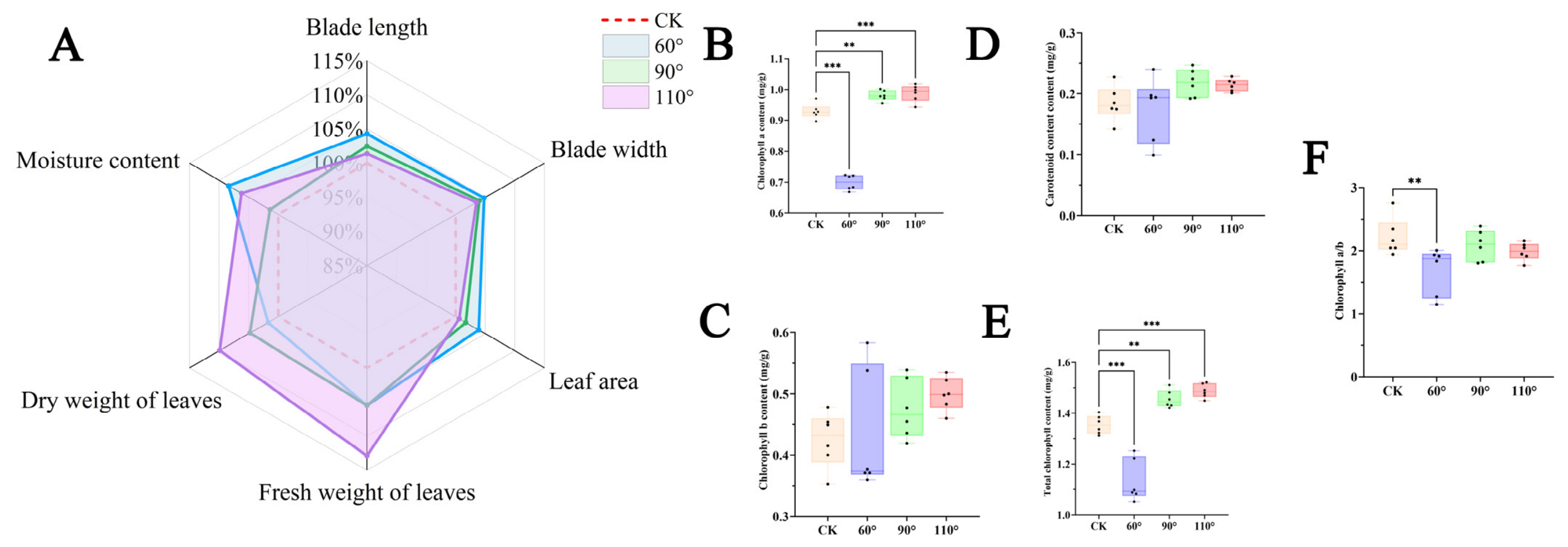
Different branch bending angles distinctly modulated the leaf development patterns and physical characteristics of ‘Jinyefoxilan’ olive (Figure 1A). When evaluated as relative values against the CK plants, the treatments induced divergent morphological and biomass allocation shifts. Under the 60° treatment, a comprehensive improvement across all leaf physical traits was observed, with leaf area and moisture concentration increasing compared to the CK group. The 90° treatment maintained a leaf morphology generally similar to the CK, yet displayed a numerical enhancement in dry matter accumulation. In contrast, the 110° treatment resulted in reduced leaf length and width and a decrease in leaf area, although the leaf area was still larger than that of the CK. Under the 110° treatment, fresh weight and dry weight of the leaves were the highest among all treatment groups.
Figure 1. Effects of different branch bending angles on comprehensive leaf physical characteristics of ‘Jinyefoxilan’ olive. (A) Radar chart evaluating comprehensive leaf physical parameters; (B) chlorophyll a concentration; (C) chlorophyll b concentration; (D) carotenoid concentration; (E) total chlorophyll concentration; (F) chlorophyll a/b ratio. Asterisks indicate significant differences between treatments (** p < 0.01, *** p < 0.001).
Agronomy 16 01469 g001
The concentrations of chlorophyll a, chlorophyll b, and total chlorophyll showed a trend of initial decrease followed by an increase. Under the 60° treatment, the overall chlorophyll level decreased, and the chlorophyll a/b ratio significantly decreased. As the branch bending angle increased to 90° and 110°, the concentrations of chlorophyll a and total chlorophyll increased, indicating that the wider angles might stimulate a compensatory effect in photosynthetic pigment synthesis. Although no statistically significant differences in carotenoid concentrations were observed among the treatments, there was a potential upward trend with the increase in branch bending intensity. Compared with CK and the 60° treatment, carotenoid levels under the 90° and 110° treatments increased, reaching the highest values under the 90° treatment (Figure 1B–F).

3.2. Effects of Different Branch Bending Angles on Endogenous Hormones in Leaves

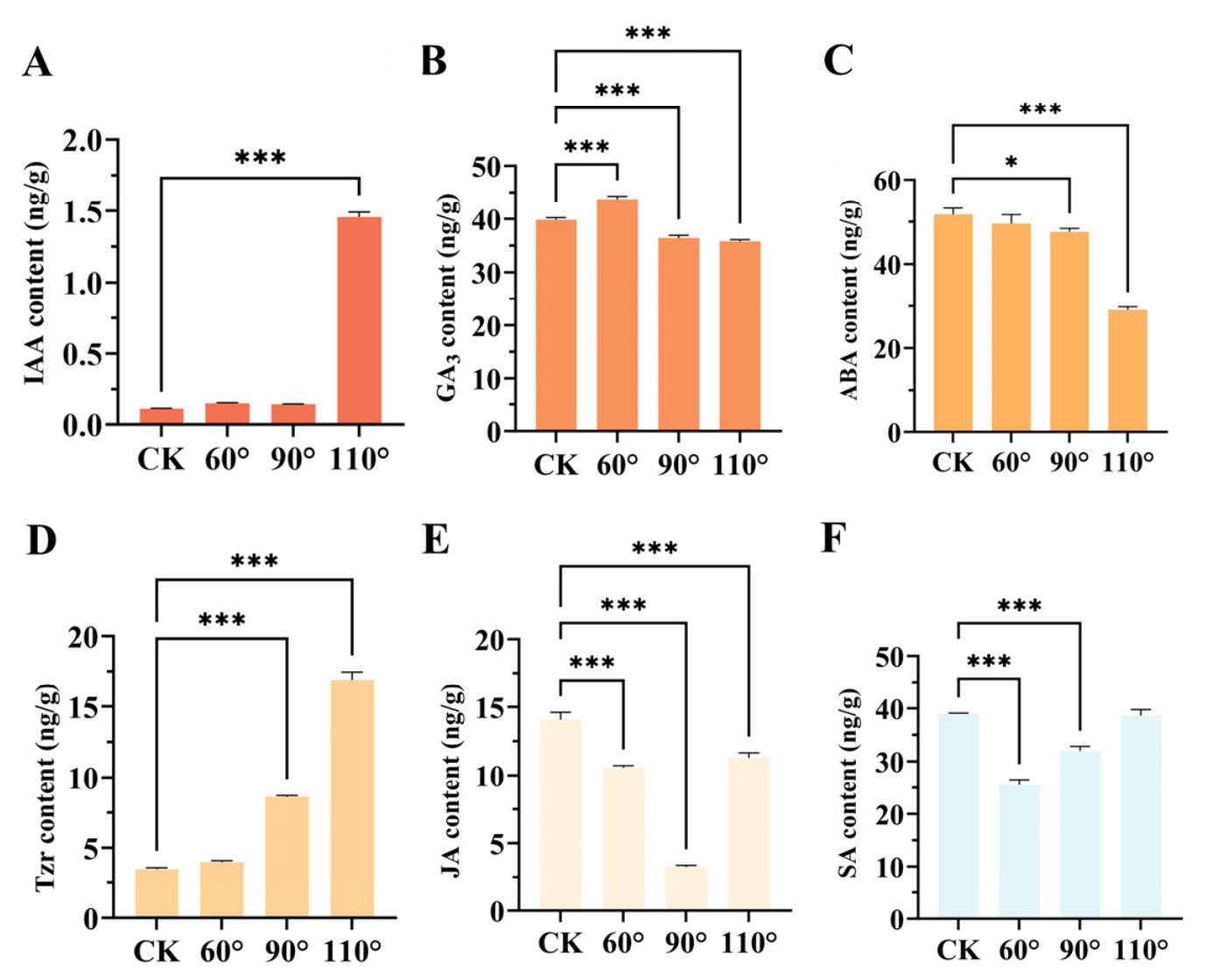
As shown in Figure 2, different branch bending angles exert significant regulatory effects on endogenous hormones in ‘Jinyefoxilan’ leaves. The IAA concentration showed a significant upward trend with the increase in branch bending angle. When the branch bending angle increased to 110°, the IAA concentration rose markedly, reaching 13.3, 9.9, and 10.3 times that of the CK, 60°, and 90° treatments, respectively. The Tzr concentration displayed an upward trend with the increase in branch bending angle, reaching its peak under the 110° treatment. The GA3 concentration only significantly increased in the 60° treatment and was significantly inhibited in the 90° and 110° treatments. As a growth-inhibiting hormone, the ABA concentration showed a downward trend with the increase in branch bending angle, with the lowest ABA concentration under the 110° treatment. The JA concentration was inhibited in all branch bending treatments, reaching the lowest value in the 90° treatment. Under the 110° branch bending treatment, although the JA concentration increased compared to 90°, it was still significantly lower than CK. Under the 60° treatment, the SA concentration decreased significantly compared to CK; as the branch bending angle increased to 90°, the SA concentration increased slightly but remained lower than the control. When the branch bending angle increased to 110°, the SA concentration increased to 38.65 ng/g.
Figure 2. Effects of different branch bending angles on endogenous hormone concentrations. Data are expressed as mean ± SE of n = 3 independent biological replicates. (A) IAA concentration; (B) GA3 concentration; (C) ABA concentration; (D) Tzr concentration; (E) JA concentration; (F) SA concentration. Asterisks indicate significant differences between treatments (* p < 0.05, *** p < 0.001).
Agronomy 16 01469 g002
The (IAA+GA3+Tzr)/ABA ratio was highest under the 110° treatment, which was 121% higher than CK. The ratios of the 60° and 90° treatments were also higher than CK. The GA3/ABA ratio was also the highest under the 110° treatment (Table 1). This indicates that all branch bending treatments improved the growth activity of the tree to varying degrees, with the 110° treatment having the most significant improvement effect.
Table 1. Effects of different branch bending angles on the ratios of endogenous hormones.
AngleCK60°90°110°
(IAA+GA3+TZR)/ABA0.84 ± 0.02 c0.96 ± 0.027 b0.95 ± 0.024 b1.86 ± 0.031 a
GA3/ABA0.77 ± 0.016 c0.88 ± 0.024 b0.76 ± 0.023 c1.23 ± 0.029 a
Note: Different lowercase letters indicate significant differences between treatments (p < 0.05).

3.3. Effects of Different Branch Bending Angles on Mineral Elements in Leaves

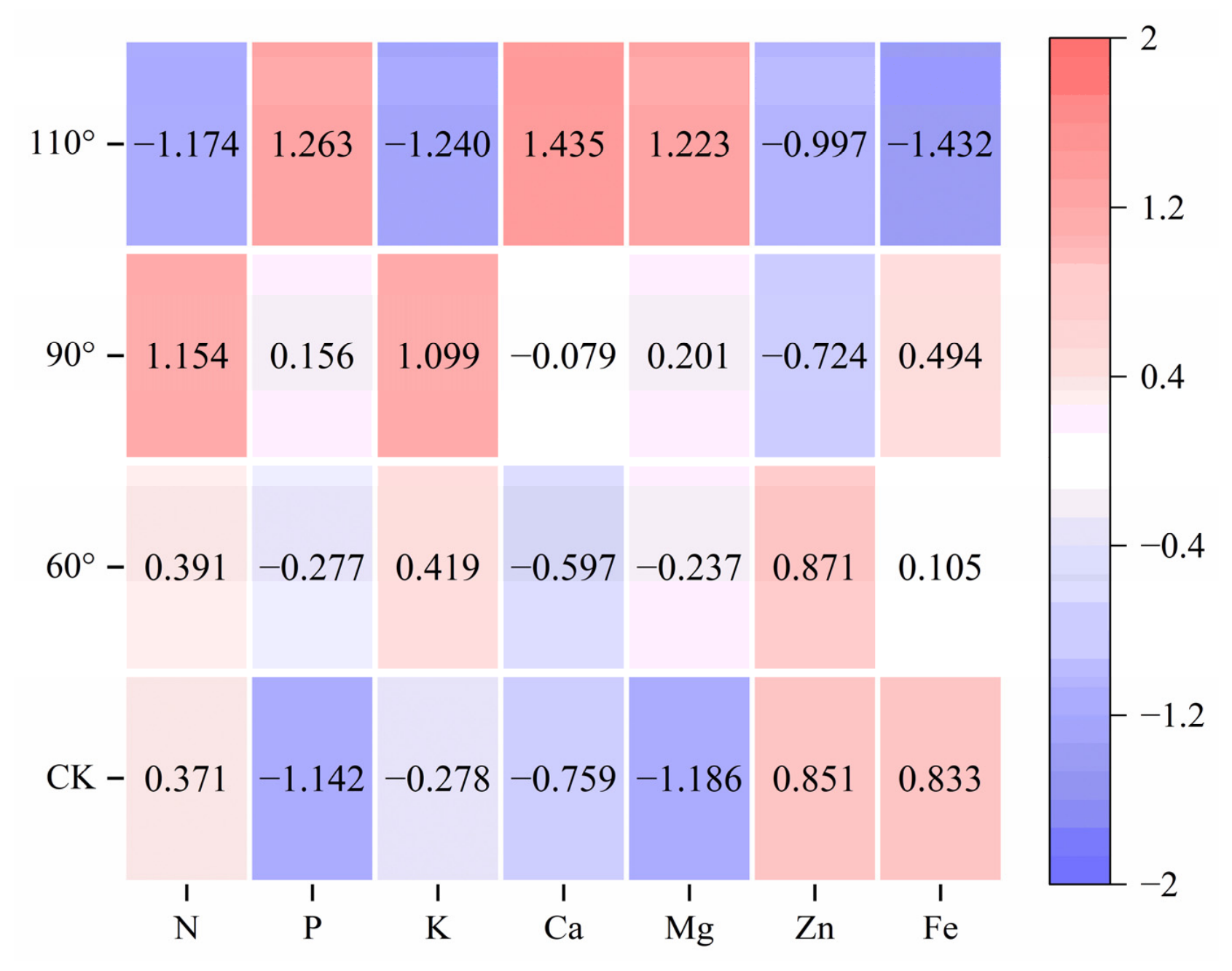
Different branch bending angle treatments significantly modified the original mineral nutrient balance of ‘Jinyefoxilan’ leaves (Figure 3 and Table 2). Under natural growth conditions, leaves mainly enriched the trace element Fe; when bent to 60°, the distribution of macro, meso, and trace elements in leaves was relatively balanced, and a high Zn concentration was maintained. With the increase in bending angle, under the 90° branch bending treatment, the leaves showed a characteristic of synergistic enrichment of nitrogen and potassium, and the concentrations of N and K reached the peak of all treatment groups. However, the Zn element in leaves showed a significant deficiency. When the branch bending angle increased to 110°, leaf Ca, Mg, and P showed high enrichment, but the key macronutrients N and K that maintain high-efficiency tree metabolism, as well as Zn and Fe, presented significant deficits.
Table 2. The effect of different bending angles of the branch on mineral concentration in leaves.
AngleN (%)P (%)K (%)Ca (%)Mg (%)Zn (mg/kg)Fe (mg/kg)
CK1.407 ± 0.011 a0.119 ± 0.023 c0.939 ± 0.087 bc1.156 ± 0.155 b0.113 ± 0.008 b42.07 ± 9.45 a94.32 ± 5.80 a
60°1.426 ± 0.113 a0.137 ± 0.014 bc1.023 ± 0.209 ab1.206 ± 0.207 b0.126 ± 0.016 ab42.30 ± 13.48 a78.54 ± 21.60 ab
90°1.445 ± 0.065 a0.146 ± 0.018 ab1.105 ± 0.117 a1.366 ± 0.304 ab0.132 ± 0.013 ab24.11 ± 5.99 b86.98 ± 23.42 a
110°1.388 ± 0.076 a0.169 ± 0.045 a0.824 ± 0.025 c1.833 ± 0.249 a0.146 ± 0.029 a21.00 ± 3.54 b45.23 ± 16.59 b
Note: Different lowercase letters indicate significant differences between treatments (p < 0.05).

3.4. Effects of Different Branch Bending Angles on Fruit Traits

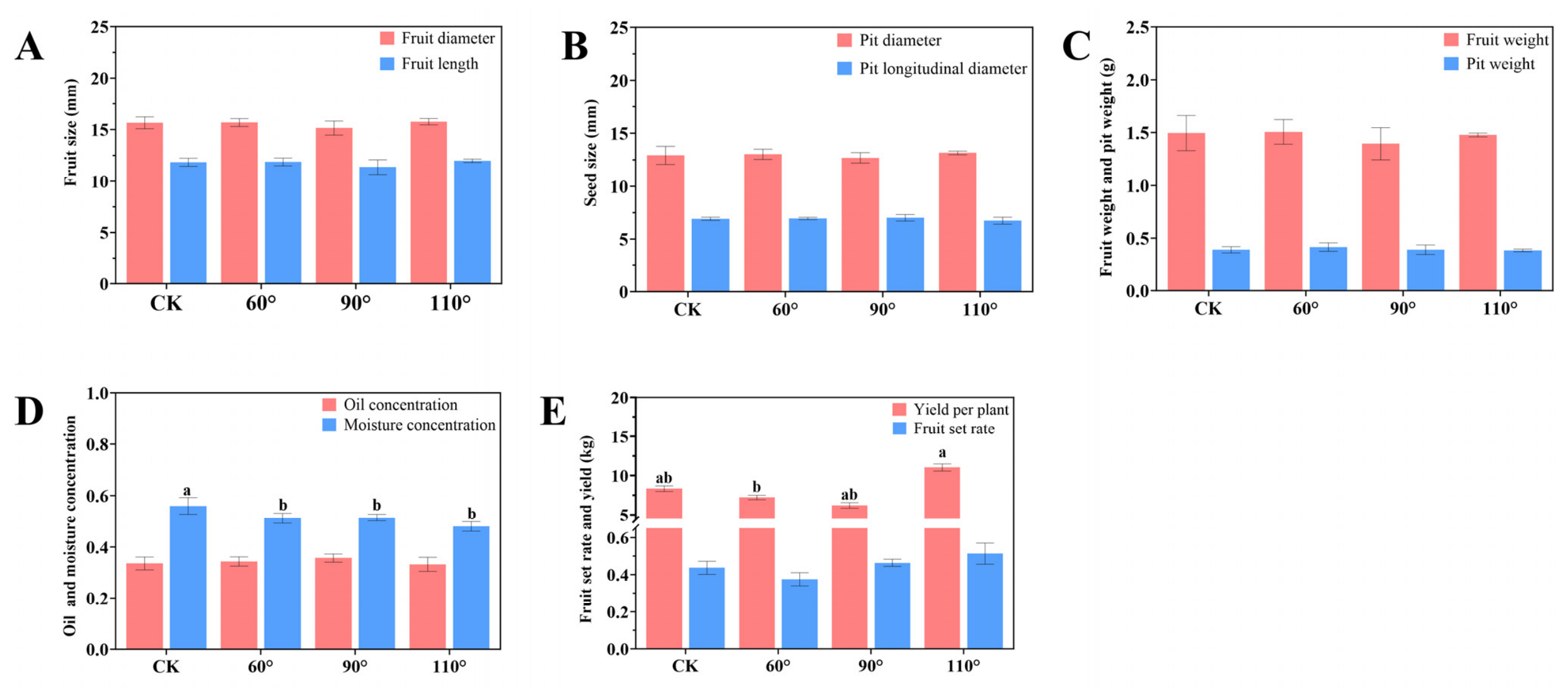
In terms of fruit appearance and morphology, different branch bending angle treatments showed variation in fruit moisture and yield per plant (Figure 4D,E). Other fruit characteristics did not differ significantly from any treatment. In terms of moisture concentration, as the branch bending angle increased, the overall fruit moisture showed a downward trend, with CK having the highest moisture concentration, while the 110° treatment resulted in the lowest value. Regarding yield per plant and fruit set rate, although no statistically significant differences were detected among the treatments, the 110° treatment exhibited the highest values, recording a fruit set rate of 5.13% and a yield per plant of 11.03 kg.

4. Discussion

Our experimental results showed that the 60° branch bending angle weakened apical dominance to a certain extent, while avoiding the transport obstacles usually accompanied by horizontal or pendulous growth. The research by Niyaz et al. [1] indicates that a moderate bending angle can optimize the xylem structure and transport efficiency of branches, thereby avoiding physiological limitations under extreme bending. Unlike more severe bending, the 60° treatment maintained a relatively higher moisture content in the leaves. This elevated moisture status, combined with the partial release of apical inhibition, may have maintained the turgor pressure required for vigorous cell division and elongation [12], thus driving the increase in leaf area observed in this study. In contrast, the 110° treatment induced phenotypic differentiation, resulting in reduced leaf length and width and a decrease in leaf area. The 110° branch bending treatment produced a different leaf development pattern, which may be an adaptive response of olive trees to the dual stresses of gravity and hydraulics. When branches drop to 110°, the base of the branch bears huge mechanical tension, which easily leads to blocked xylem transport and inhibits vegetative growth [1]. Research by Zhang et al. [9] indicated that a large-angle bending treatment will significantly weaken the apical dominance of the branch and limit its vegetative growth potential. In order to survive under restricted water and nutrient transport conditions, leaves stop expanding and instead initiate defensive metabolism, namely increasing the synthesis and deposition of lignin in the cell wall. This strategy prevents tissue collapse and reduces water loss by reinforcing the cell wall, important mechanisms for plants to cope with abiotic stress [13].
Under the 60° treatment condition, the leaf chlorophyll a/b ratio decreased significantly compared to the control group. This reduction was primarily driven by a significant decline in chlorophyll a concentration, whereas chlorophyll b levels remained relatively stable across all treatments [14]. The spatial reorientation induced by the 60° bending angle likely triggered localized stress, resulting in the preferential degradation or accelerated turnover of core chlorophyll a. In contrast, chlorophyll b is bound to peripheral light-harvesting complex II (LHCII) proteins to maintain thylakoid membrane stability, rendering it structurally more resilient to rapid stress-induced decomposition [15]. Consequently, against the background of stable chlorophyll b levels, the depletion of chlorophyll a led to the observed drop in the chlorophyll a/b ratio. These results suggest that following branch angle adjustment, the leaves in the 60° treatment group did not enter a typical active shade adaptation phase characterized by de novo chlorophyll b synthesis, but rather experienced a transient phase of physiological stress-induced degradation.
As the branch bending angle increased to 90° and 110°, the concentrations of chlorophyll a and total chlorophyll showed significant recovery, accompanied by an increase in dry matter accumulation, which may reflect the plant’s positive adaptive response to enhanced light radiation. Larger branch bending angles expose leaves to a high light intensity environment, thereby inducing an increase in chloroplast density within mesophyll cells and the de novo synthesis of photosynthetic reaction centers [16]. The transition to this ‘sun leaf’ characteristic endows the leaves with better light energy conversion efficiency, ensuring an adequate supply of photosynthates, which provides support for the numerical trends of oil accumulation and fruit set rate observed under the 90°and 110° treatments [17]. Carotenoid concentrations showed an upward, but non-significant trend with increasing branch bending angle. Carotenoids not only assist in light energy capture but also participate in the xanthophyll cycle as non-enzymatic antioxidants, which effectively quench excess excitation energy through thermal dissipation, thereby preventing photosystem II from photoinhibition or photooxidative damage [18].
The study found that the 110° branch bending treatment induced a massive accumulation of IAA concentration in leaves, resulting in the highest ratio of (IAA+GA3+Tzr)/ABA, verifying the physical blocking effect of wide bending angles on auxin transport. Yun et al. [19] confirmed that branch bending can significantly alter the distribution of endogenous hormones in buds and shoots, leading to auxin accumulation in gravity-affected parts and distal apices. The fruit yield and significant enrichment of calcium and magnesium under the 110° treatment in this study are most likely due to high IAA concentrations activating nutrient-transport channels between leaves and fruits, establishing the nutrient competitive advantage of reproductive organs. This may explain why ‘Jinyefoxilan’ did not weaken under large-angle branch bending, but instead achieved an efficient transition from vegetative to reproductive growth. Du et al. [20] explicitly pointed out in their classic study on Camellia oleifera that an elevated level of endogenous GA would significantly inhibit flower bud differentiation, while cytokinins play a promotional role. In our study, 60° branch bending significantly increased GA3 levels, a potential driver for increased leaf length. The 110° treatment decreased the GA3 concentration, while Tzr increased to 4.8 times that of CK, a change in hormonal balance resembling the findings of Xing et al. on apples [21], who noted that branch bending can significantly down-regulate the expression of gibberellin synthesis genes through a complex miRNA regulatory network, while simultaneously activating the cytokinin signaling pathway. This molecular-level influence is the key to breaking floral inhibition and initiating reproductive growth.
High temperatures cause elevated ABA in plants to close stomata [22]. In this study, however, the ABA concentration in the 110° treatment was significantly lower than that of the control, directly affecting the decrease in GA3/ABA. This suggests that 110° branch bending alleviated the physiological stress caused by high summer temperatures by optimizing tree structure or hormone regulation. Bharath et al. [23] pointed out that during the rapid fruit growth period, lower ABA levels are conducive to maintaining leaf stomatal opening and photosynthetic rate, thereby ensuring maximal photosynthetic output. Compared with the control, JA concentration was significantly reduced in all branch bending treatments and reached its minimum under the 90° treatment. Cheng et al. [24] confirmed that a low level of JA indicates that the tree has reduced the energy consumption of defensive secondary metabolism, withdrawing the carbon sources originally used for defense and investing them entirely into fruit development. The physiological responses observed under the 90° treatment provide a robust theoretical foundation for integrating this technique into future canopy management and orchard development. The 60° and 90° treatments resulted in a significant decrease in SA, while the 110° treatment maintained a high level of SA comparable to the control. In the late stage of fruit expansion, SA is a key factor in maintaining the leaf antioxidant system and preventing chlorophyll degradation [16]. By maintaining high SA, the 110° treatment ensured that leaves did not senesce prematurely under a high yield load, continuing to export photosynthates to the fruit.
The 90° branch bending treatment maintained high levels of leaf nitrogen and potassium, a synergistic combination to support fruit quality. Nitrogen is essential for the synthesis of photosynthetic enzymes. By maintaining high nitrogen levels, the leaves achieve a higher photosynthetic rate, producing an abundance of carbohydrates. These carbohydrates are then used in the fruit reservoir as the basis for fatty acid biosynthesis [25,26]. At the same time, potassium, as a key osmotic driver, promotes the loading of sucrose into the phloem and the long-distance transport of these assimilates to sink organs [27]. Oil synthesis is a highly energy-consuming process that requires a continuous input of a large amount of photosynthates. The characteristics of high N and high K under the 90° treatment indicate that this angle did not cause metabolic inhibition, but rather provided a material basis for fruit development by optimizing transport efficiency. This may be the basis for the fruits reaching the highest oil concentration under this treatment, reflecting that the tree was in a state of optimal yield metabolic balance; however, we should note that it was not significantly different from the control [28]. In contrast, the 110° treatment induced nutritional stoichiometric characteristics of significantly low N, low K, and high P. The accumulation of phosphorus is inherently related to reproductive physiology, primarily used to support the vigorous nucleic acid synthesis and ATP metabolism required for flowering and fruit setting. This shift indicates that the intense mechanical stress generated by large-angle branch bending triggered a resource reallocation strategy, prioritizing the fulfillment of reproductive output over vegetative growth [24]. However, the significant deficit of potassium became a key factor limiting fruit quality. Because potassium provides the basic osmotic gradient required by the phloem, its deficiency hinders the effective export of photosynthates from leaf to fruit sinks [25,29]. This transport blockage most likely restricted the supply for oil biosynthesis, thereby explaining why the high yield of the 110° treatment was not accompanied by a high oil concentration [30].
The 110° treatment induced a massive increase in leaf calcium concentration; this enrichment represents a synergistic dual-defense strategy to cope with extreme mechanical stress. The research of Kouhen et al. and Gupta et al. [31,32] pointed out that at the structural level, in order to resist the huge tension generated on the abaxial side of the bent branch, plants actively sequester Ca2+ into the cell wall. During this process, calcium ions cross-link pectin chains to form rigid calcium pectate complexes, significantly enhancing tissue integrity and preventing rupture [33]. Concurrently, this surge in intracellular calcium ions acts as a ubiquitous second messenger in plant mechanical signal transduction. It rapidly transduces physical bending signals into biochemical cascades, likely initiating downstream hormonal regulation to cope with growth and defense responses under stress [34,35]. Along with the increase in leaf phosphorus concentration, the concentrations of zinc and iron showed a significant downward trend in the 110° treatment group. This negative correlation is primarily attributed to the widely documented antagonism between phosphorus and zinc in plant nutrition. According to research by Nadeem et al. [36], excessive phosphate ions in the rhizosphere or apoplast can precipitate with zinc, reducing its bioavailability and hindering its long-distance transport. The higher numerical trend of fruit set rate and yield under the 110° treatment most likely induced a dilution effect, where the rate of biomass accumulation exceeded the absorption rate of trace elements, leading to a decrease in their concentrations [37,38]. Physiologically, this zinc-deficient state has profound effects on hormonal balance. Because zinc is an essential cofactor for tryptophan synthase in the auxin biosynthesis pathway, its deficiency feedback-inhibits the production of IAA [39]. The reduced IAA level weakens apical dominance, thereby releasing the inhibition on lateral buds and promoting the reproductive transition observed in the pendulous branches [40].
Although no statistically significant differences were observed across the treatment groups, our results suggest that the 60° treatment might maximize single fruit weight and transverse and longitudinal diameters of ‘Jinyefoxilan’ fruits. Perhaps a moderate bending angle optimizes the xylem structure and hydraulic status of the branches, maintaining the pressure required for vigorous cell division and elongation. Consistent with physiological studies across multiple fruit crops, a moderate branch bending angle of 60° can significantly optimize canopy light interception and the partitioning of assimilates [41,42]. However, since we observed no statistically significant differences in these specific characteristics across the treatment groups, this hypothesis will need to be confirmed by future studies.
The oil concentration of the 90° branch bending treatment was 35.65%, not a statistically significant difference, but possibly related to enrichment of nitrogen and potassium in the leaves. As reported by Silva et al. [43], adequate nitrogen and potassium nutrition can significantly increase resource allocation to the pulp, thereby substantially increasing the final oil content of olive fruits. Under the 110° treatment, both fruit moisture and oil concentrations were low, moisture significantly so. As pointed out by Imtiaz et al. [44] regarding plant physiological regulation under abiotic stress, the mechanical stress brought about by a large bending angle easily leads to a significant deficit in potassium, which can directly hinder the effective export of photosynthates from the leaf to the fruit sink. This transport blockage fundamentally limits the resource supply required for oil biosynthesis.
Under the 110° severe branch bending treatment, the fruit set rate was as high as 5.13%, and the yield per plant reached 11.03 kg. Although not statistically significant, these numerical trends suggest a potential positive influence on flowering and fruit retention. Evidently, this treatment physically blocked IAA transport, inducing its local accumulation, thereby establishing a strong nutrient competitive advantage for the reproductive organs. Based on the findings of Xing et al. [21], severe branch bending can disrupt a tree’s apical dominance, block IAA transport, and induce a massive enrichment of cytokinins in the buds. This initiates transcriptome reprogramming from vegetative growth to reproductive growth, ultimately leading to improvements in flower bud differentiation and fruit set rate. The 110° treatment significantly reduced GA3 content while substantially increasing Tzr. Similar studies indicate that a reduction in endogenous gibberellin levels is a fundamental prerequisite for breaking floral inhibition, while cytokinin accumulation directly drives flower bud induction and significantly improves subsequent fruit set [45,46]. As is well known, olive trees are highly prone to alternate bearing. Therefore, the high yields observed under the 110° treatment may represent a temporary peak. A rigorous, multi-year field evaluation is required to verify whether this specific branch bending angle can consistently maintain high yields over consecutive years.

5. Conclusions

This study investigated the effects of different branch bending angles (natural growth, 60°, 90°, and 110° treatment) on the leaf morphology, photosynthetic pigments, endogenous hormones, mineral distribution, and fruit quality of ‘Jinyefoxilan’ olive trees. The 110° treatment induced a massive accumulation of IAA and Tzr, while significantly decreasing the GA3 level. This hormonal shift effectively broke floral inhibition and promoted reproductive growth, thereby achieving the numerically highest fruit set rate and yield per plant. The 110° branch bending promoted the accumulation of Ca, Mg, and P in leaves, but concurrently caused a significant deficiency of N and K, which was likely due to the restricted vascular transport capacity caused by severe mechanical bending. This nutrient imbalance may have inhibited oil accumulation. The 90° treatment promoted the synergistic enrichment of N and K in leaves, providing a material foundation for fatty acid biosynthesis, and consequently achieved the highest fruit oil concentration, which was not significantly different from the control. Therefore, the branch management strategy for ‘Jinyefoxilan’ should be adjusted according to specific production demands. A 90° bending angle may enhance intrinsic fruit quality and oil concentration, whereas severe bending at 110° maximizes yield but triggers intense resource competition and metabolic limitations. If adopting the 110° treatment in production practice, it would be imperative to strengthen the supplementation of key nutrients such as potassium during fruit development. Additional research is needed to better understand the effects of different branch opening angles on the overall growth and long-term performance of olive trees. Furthermore, future studies should incorporate an economic analysis to evaluate the return on investment of these canopy management strategies. It is crucial to determine in commercial orchard settings whether the financial gains from increased production or improved intrinsic quality can sufficiently offset the higher labor and management costs associated with artificial branch bending. Finally, given that biennial bearing is a common challenge in olive cultivation, further longitudinal studies are warranted to investigate the specific long-term effects of branch angle manipulation on alternate bearing cycles.

Author Contributions

Conceptualization, Q.H. and T.M.; Methodology, T.M.; Software, Y.L. (Yongjie Li).; Validation, T.W., B.W. and X.M.; Formal analysis, Y.L. (Yubo Liu); Investigation, L.W. and D.N.; Resources, L.W.; data curation, Q.H.; Writing—original draft preparation, Q.H. and T.M.; Writing—review and editing, L.W. and D.N.; Visualization, B.W.; Supervision, B.W. and D.N.; Project administration, T.M.; Funding acquisition, D.N. and T.M. All authors have read and agreed to the published version of the manuscript.

Funding

This study was supported by the Yunnan Provincial Science and Technology Talent and Platform Program (202405AK340006) and the Central Government Forestry Science and Technology Extension Demonstration Project (Yun [2024] TG13).

Data Availability Statement

The data presented in this study are available on request from the corresponding author.

Conflicts of Interest

The authors declare no conflicts of interest.

References

  1. Niyaz, A.; Nasir, M.; Zhang, S.; Wang, S.; Min, C.; Fan, G.; Muhtar, D.; Ma, X.; Tunyaz, M.; Cui, L.; et al. Optimal branch bending angle for Korla fragrant pear: A multi-trait physiological trade-off framework. Plants 2026, 15, 339. [Google Scholar] [CrossRef] [PubMed]
  2. Pertille, R.H.; Citadin, I.; Oliveira, L.S.; Lauri, P.E.; Rauh, A.T. Branching formation of apple trees grown under contrasting growing conditions in a mild winter region. Sci. Agr. 2025, 82, e20230267. [Google Scholar] [CrossRef]
  3. Perna, C.; Pagliai, A.; Sarri, D.; Lisci, R.; Vieri, M. Can a light detection and ranging (LiDAR) and multispectral sensor discriminate canopy structure changes due to pruning in olive growing? A field experimentation. Sensors 2024, 24, 7894. [Google Scholar] [CrossRef] [PubMed]
  4. Lodolini, E.M.; Polverigiani, S.; Giorgi, V.; Famiani, F.; Neri, D. Time and type of pruning affect tree growth and yield in high-density olive orchards. Sci. Hortic. 2023, 311, 111831. [Google Scholar] [CrossRef]
  5. Wang, J.; Zhang, D.; Farooqi, T.J.A.; Ma, L.; Deng, Y.; Jia, Z. The olive (Olea europaea L.) industry in China: Its status, opportunities and challenges. Agroforest. Syst. 2019, 93, 395–417. [Google Scholar] [CrossRef]
  6. Si, Z.; Sun, W.; Qi, W.; Li, Y.; Liu, J. On the suitable regions for olive (Olea europaea) growing in China. Plant Divers. 2011, 33, 571–579. [Google Scholar]
  7. Ma, T.; Xu, T.; Ning, D.L.; Xiao, L.J.; Li, J. Comparative study on the growth and morphology of new olive varieties ‘Jinyefoxilan’ and its parents. South. Hortic. 2015, 26, 1–3. [Google Scholar] [CrossRef]
  8. Ning, D.L.; Bin, L.; Du, C.H.; Li, Y.J.; Liao, Y.J.; Zhang, Y.L. Division of suitable planting area of olive in Yunnan Province. J. For. Eng. 2008, 22, 39–41. [Google Scholar] [CrossRef]
  9. Zhang, B.; Zheng, F.; Geng, W.; Du, H.; Xiao, Y.; Futian, P. Effect of branch bending on the canopy characteristics and growth of peach (Prunus persica (L.) Batsch). Agronomy 2023, 13, 1058. [Google Scholar] [CrossRef]
  10. Khandaker, M.M.; Ismail, N.H.; Abdullahi, U.A.; Alan, M.A.; Badaluddin, N.A.; Mohd, K.S. Tree physiology, fruit growth and nutrient elements of wax apple (Syzygium samarangense) as affected by branch bending angle. Basrah J. Agric. Sci. 2021, 34, 206–221. [Google Scholar] [CrossRef]
  11. Lichtenthaler, H.K. Chlorophylls and carotenoids: Pigments of photosynthetic biomembranes. Methods Enzymol. 1987, 148, 350–382. [Google Scholar] [CrossRef]
  12. Brodribb, T.J.; Powers, J.; Cochard, H.; Choat, B. Hanging by a thread? Forests and drought. Science 2020, 368, 261–266. [Google Scholar] [CrossRef] [PubMed]
  13. Cordovilla, M.P.; Rharrabti, Y.; El Yamani, M. Drought-Induced changes in morphology and phenology of olive trees (Olea europaea L.). Plants 2025, 14, 3624. [Google Scholar] [CrossRef] [PubMed]
  14. Wang, X.; Chen, G.; Du, S.; Wu, H.; Fu, R.; Yu, X. Light intensity influence on growth and photosynthetic characteristics of Horsfieldia hainanensis. Front. Ecol. Evol. 2021, 9, 636804. [Google Scholar] [CrossRef]
  15. Tanaka, R.; Tanaka, A. Chlorophyll cycle regulates the construction and destruction of the light-harvesting complexes. Biochim. Biophys. Acta Bioenerg. 2011, 1807, 968–976. [Google Scholar] [CrossRef] [PubMed]
  16. Camarero, M.C.; Briegas, B.; Corbacho, J.; Labrador, J.; Gomez-Jimenez, M.C. Hormonal content and gene expression during olive fruit growth and ripening. Plants 2023, 12, 3832. [Google Scholar] [CrossRef] [PubMed]
  17. Zhou, Q.; Zhao, F.; Zhang, H.; Zhu, Z. Responses of the growth, photosynthetic characteristics, endogenous hormones and antioxidant activity of Carpinus betulus L. seedlings to different light intensities. Front. Plant Sci. 2022, 13, 1055984. [Google Scholar] [CrossRef] [PubMed]
  18. Demmig-Adams, B.; Hodges, A.K.; Polutchko, S.K.; Adams, W.W. Zeaxanthin and other carotenoids: Roles in abiotic stress defense with implications for biotic defense. Plants 2025, 14, 2703. [Google Scholar] [CrossRef] [PubMed]
  19. Yun, C.; Ma, W.; Feng, J.; Li, L. Branching angles in the modulation of plant architecture: Molecular mechanisms, dynamic regulation, and evolution. Plant Commun. 2025, 6, 101292. [Google Scholar] [CrossRef] [PubMed]
  20. Du, W.; Ding, J.; Li, J.; Li, H.; Ruan, C. Co-regulatory effects of hormone and mRNA–miRNA module on flower bud formation of Camellia oleifera. Front. Plant Sci. 2023, 14, 1109603. [Google Scholar] [CrossRef] [PubMed]
  21. Xing, L.; Zhang, D.; Zhao, C.; Li, Y.; Ma, J.; An, N.; Han, M. Shoot bending promotes flower bud formation by miRNA-mediated regulation in apple (Malus domestica Borkh.). Plant Biotechnol. J. 2016, 14, 749–770. [Google Scholar] [CrossRef] [PubMed]
  22. Waadt, R.; Seller, C.A.; Hsu, P.K.; Takahashi, Y.; Munemasa, S.; Schroeder, J.I. Plant hormone regulation of abiotic stress responses. Nat. Rev. Mol. Cell Biol. 2022, 23, 680–694. [Google Scholar] [CrossRef]
  23. Bharath, P.; Gahir, S.; Raghavendra, A.S. Abscisic acid-induced stomatal closure: An important component of plant defense against abiotic and biotic stress. Front. Plant Sci. 2021, 12, 615114. [Google Scholar] [CrossRef] [PubMed]
  24. Cheng, Y.; Liang, C.; Qiu, Z.; Zhou, S.; Liu, J.; Yang, Y.; Wang, R.; Yin, J.; Ma, C.; Cui, Z.; et al. Jasmonic acid negatively regulates branch growth in pear. Front. Plant Sci. 2023, 14, 1105521. [Google Scholar] [CrossRef] [PubMed]
  25. Sardans, J.; Peñuelas, J. Potassium control of plant functions: Ecological and agricultural implications. Plants 2021, 10, 419. [Google Scholar] [CrossRef] [PubMed]
  26. Cao, W.; Sun, H.; Shao, C.; Wang, Y.; Zhu, J.; Long, H.; Geng, X.; Zhang, Y. Progress in the study of plant nitrogen and potassium nutrition and their interaction mechanisms. Horticulturae 2025, 11, 930. [Google Scholar] [CrossRef]
  27. Wu, Y.; Ma, L.; Zhang, L.; Zhang, Y.; Zhou, H.; Wang, Y.; Liu, Y. Photosynthetic carbon and nitrogen metabolism of Camellia oleifera Abel during acclimation to low light conditions. J. Plant Physiol. 2022, 278, 153814. [Google Scholar] [CrossRef] [PubMed]
  28. Johnson, R.; Vishwakarma, K.; Hossen, M.S.; Kunar, V.; Shackira, A.M.; Puthur, J.; Abdi, G.; Sarraf, M.; Hasabuzzaman, M. Potassium in plants: Growth regulation, signaling, and environmental stress tolerance. Plant Physiol. Bioch. 2022, 172, 56–69. [Google Scholar] [CrossRef] [PubMed]
  29. Cui, J.; Lamade, E.; Tcherkez, G. Potassium deficiency reconfigures sugar export and induces catecholamine accumulation in oil palm leaves. Plant Sci. 2020, 300, 110628. [Google Scholar] [CrossRef] [PubMed]
  30. Ghazzawy, H.S.; Alqahtani, N.; Munir, M.; Alghanim, N.; Mohammed, M. Combined impact of irrigation, potassium fertilizer, and thinning treatments on yield, skin separation, and physicochemical properties of date palm fruits. Plants 2023, 12, 1003. [Google Scholar] [CrossRef] [PubMed]
  31. Kouhen, M.; Dimitrova, A.; Scippa, G.S.; Trupiano, D. The course of mechanical stress: Types, perception, and plant response. Biology 2023, 12, 217. [Google Scholar] [CrossRef] [PubMed]
  32. Gupta, S.; Kaur, N.; Kant, K.; Jindal, P.; Ali, A.; Naeem, M. Calcium: A master regulator of stress tolerance in plants. S. Afr. J. Bot. 2023, 163, 580–594. [Google Scholar] [CrossRef]
  33. Vukašinović, N.; Serif, M.; Bacete, L. Cracking the green wall code: Insights into cell wall integrity across organisms. Front. Plant Physiol. 2023, 1, 1323899. [Google Scholar] [CrossRef]
  34. Jędrzejuk, A.; Kuźma, N. Response of plants to touch stress at morphological, physiological and molecular levels. Int. J. Mol. Sci. 2025, 26, 11120. [Google Scholar] [CrossRef] [PubMed]
  35. Kang, X.; Zhao, L.; Liu, X. Calcium signaling and the response to heat shock in crop plants. Int. J. Mol. Sci. 2023, 25, 324. [Google Scholar] [CrossRef] [PubMed]
  36. Nadeem, F.; Abbas, S.; Waseem, F.; Ali, N.; Mahmood, R.; Bibi, S.; Deng, L.; Wang, R.; Zhong, Y.; Li, X. Phosphorus (P) and zinc (Zn) nutrition constraints: A perspective of linking soil application with plant regulations. Environ. Exp. Bot. 2024, 226, 105875. [Google Scholar] [CrossRef]
  37. Soares, J.C.; Santos, C.S.; Carvalho, S.M.P.; Pintado, M.M.; Vasconcelos, M.W. Preserving the nutritional quality of crop plants under a changing climate: Importance and strategies. Plant Soil 2019, 443, 1–26. [Google Scholar] [CrossRef]
  38. Zhang, W.; Zhang, W.; Wang, X.; Liu, D.; Zou, C.; Chen, X. Quantitative evaluation of the grain zinc in cereal crops caused by phosphorus fertilization. A meta-analysis. Agron. Sustain. Dev. 2021, 41, 6. [Google Scholar] [CrossRef]
  39. Gomes, G.L.B.; Scortecci, K.C. Auxin and its role in plant development: Structure, signalling, regulation and response mechanisms. Plant Biol. 2021, 23, 894–904. [Google Scholar] [CrossRef] [PubMed]
  40. Casanova-Sáez, R.; Voß, U. Auxin metabolism controls developmental decisions in land plants. Trends Plant Sci. 2019, 24, 741–754. [Google Scholar] [CrossRef] [PubMed]
  41. Yang, L.; Cheng, Y.S.; Liu, Z.; Li, X.; Yang, F.; Nie, X.; Cai, H.; Wu, T. Branch-base angle influenced the shoot growth and fruit quality of flat-type trellised pear trees. HortScience 2025, 60, 1400–1408. [Google Scholar] [CrossRef]
  42. Lopez, R.; Badel, E.; Peraudeau, S.; Leblanc-Fournier, N.; Beaujard, F.; Julien, J.L.; Cochard, H.; Moulia, B. Tree shoot bending generates hydraulic pressure pulses: A new long-distance signal? J. Exp. Bot. 2014, 65, 1997–2008. [Google Scholar] [CrossRef] [PubMed][Green Version]
  43. Silva, E.; Gonçalves, A.; Martins, S.; Brito, C.; Ferreira, H.; Ferreira, L.M.M.; Moutinho-Pereira, J.; Rodrigues, M.A.; Correia, C.M. Olive yield and physicochemical properties of olives and oil in response to nutrient application under rainfed conditions. Molecules 2023, 28, 831. [Google Scholar] [CrossRef] [PubMed]
  44. Imtiaz, H.; Mir, A.R.; Corpas, F.J.; Hayat, S. Impact of potassium starvation on the uptake, transportation, photosynthesis, and abiotic stress tolerance. Plant Growth Regul. 2023, 99, 429–448. [Google Scholar] [CrossRef]
  45. Reddy, P.; Plozza, T.; Scalisi, A.; Ezernieks, V.; Goodwin, I.; Rochfort, S. Zonal chemical signal pathways mediating floral induction in apple. Metabolites 2024, 14, 251. [Google Scholar] [CrossRef] [PubMed]
  46. Xie, X.; Zhang, H.; Kong, Z.; Qian, D.; Liu, X.; Zhao, M.; Li, J. Cytokinin response factor LcARR11 promotes floral bud physiological differentiation by activating LcIPT3 and LcFT1 in litchi. Hortic. Res. 2025, 12, uhaf218. [Google Scholar] [CrossRef] [PubMed]
Figure 3. Effects of different branch bending angles on leaf mineral element concentrations. The heatmap displays Z-score-normalized values rather than concentrations, enabling the simultaneous visualization of relative enrichment and depletion by using a unified color scale.
Agronomy 16 01469 g003
Figure 4. Effects of different branch bending angles on fruit characteristics and yield. (A) Fruit diameter and fruit length; (B) pit diameter and pit longitudinal diameter; (C) fruit weight and pit weight; (D) oil concentration and moisture concentration; (E) yield per plant and fruit set rate. Different letters indicate significant differences between treatment groups (p < 0.05).
Agronomy 16 01469 g004
Disclaimer/Publisher’s Note: The statements, opinions and data contained in all publications are solely those of the individual author(s) and contributor(s) and not of MDPI and/or the editor(s). MDPI and/or the editor(s) disclaim responsibility for any injury to people or property resulting from any ideas, methods, instructions or products referred to in the content.