Article

Foliar Application of Selenium Nanoparticles Reduced Cadmium Accumulation and Alleviated Cd Toxicity in Winter Wheat Grown in Cd-Contaminated Soil

1
College of Natural Resources and Environment, Northwest A&F University, Yangling 712100, China
2
Key Laboratory of Plant Nutrition and the Agri-Environment in Northwest China, Ministry of Agriculture, Yangling 712100, China
*
Author to whom correspondence should be addressed.
Agronomy 2026, 16(15), 1468; https://doi.org/10.3390/agronomy16151468
Submission received: 24 June 2026 / Revised: 25 July 2026 / Accepted: 31 July 2026 / Published: 2 August 2026

Abstract

This study investigated the efficacy and mechanisms of foliar-applied selenium nanoparticles (SeNPs) in reducing cadmium (Cd) concentrations and alleviating Cd toxicity in winter wheat grown in Cd-contaminated soil. Pot experiments were conducted to evaluate SeNPs of different particle sizes (50, 100, 200 nm) and concentrations (0.125, 0.25 mmol/L). Foliar SeNPs application achieved the dual objectives of significantly decreasing Cd while increasing selenium (Se) concentrations in wheat grain. High-concentration (0.25 mmol/L) SeNPs treatments were most effective, particularly with a particle size of 100 nm size. Compared with the control, SeNPs significantly reduced grain Cd concentrations by 18.9–70.5% and increased grain Se concentrations by 1.2–27.2 times. Durum wheat exhibited a stronger response than soft wheat. The primary mechanisms included: (1) enhancing antioxidant defense: SeNPs significantly boosted superoxide dismutase (55.2–165.2%) and peroxidase (36.5–182.6%) activities, effectively scavenging reactive oxygen species, reducing oxidative stress markers malondialdehyde (12.0–35.1%) and regulating hydrogen peroxide (7.9–64.1%), which mitigated membrane lipid peroxidation. (2) Regulating subcellular Cd distribution: SeNPs increased the proportion of Cd immobilized in the cell wall by 2.9–39.6% and decreased Cd in organelles by 9.1–38.4%, thereby reducing its bioavailability and toxicity. This study provides a theoretical basis for using foliar SeNPs to remediate Cd pollution and simultaneously produce Se-enriched functional wheat.

1. Introduction

Cadmium (Cd) is a highly toxic and mobile metal contaminant that threatens crop production, ecosystem integrity, and human health. Excessive Cd in soil has been demonstrated to disrupt plant cellular structure, destroy chloroplasts, mitochondria, and other organelles, and impair photosynthesis and respiration [1,2]. Cd exerts multiorgan toxicity in humans. Chronic dietary exposure to low levels of Cd can cause renal dysfunction and osteoporosis [3,4,5]. Cd contamination in agricultural areas is a global concern affecting major production regions across different continents. According to the latest global soil pollution data analysis, the exceedance rate of Cd is the highest, reaching 9.0% (−1.9%/+1.5%). Cd exceedance for agricultural soil is the most notable in northern and central India, Pakistan, Bangladesh, southern China, southern parts of Thailand and Cambodia, Iran, Turkey, Ethiopia, Nigeria, South Africa, Mexico, and Cuba [6]. According to the national soil pollution survey (2014), the pollution exceedance rate of agricultural soil in China is 19.4%, and excessive Cd levels rank first, with a pollution rate of 7% [7]. Winter wheat, a major staple crop, serves as a significant carrier for Cd to enter the human body. In the North China Plain, a primary wheat-producing region of China, elevated Cd concentrations in wheat grains have frequently been reported, with bioconcentration factors ranging from 0.39 to 1.01 [8]. Thus, wheat Cd pollution has become a pressing issue that requires urgent attention.
In recent years, selenium (Se), an essential trace element for humans, has been widely reported to mitigate Cd accumulation and toxicity in crops. Soil applications of Se (0.5–1.0 mg/kg) have been shown to reduce Cd concentrations in wheat grain by 59–61% [9]. Xia also demonstrated that foliar spraying of 2 mmol/L selenate (SeO42−) reduced Cd concentration in wheat grain by 32.0% [10]. The main mechanisms by which Se mitigates Cd accumulation and toxicity operated at multiple levels. Firstly, Se can reduce Cd uptake by roots and limit its translocation to aboveground tissues (especially grain) by downregulating the expression of key genes (e.g., TaNramp5, TaHMA2, TaHMA3) involved in Cd uptake and translocation in the root system [11]. Se can also indirectly inhibit Cd absorption by promoting Zn2+ and Fe2+ uptake [12]. Secondly, Se modulates the subcellular distribution of Cd in plants. Se has been reported to modulate the genes responsible for cell wall biosynthesis, increasing the levels of lignin, cellulose, and hemicellulose contents [13,14], thereby immobilizing Cd ions and regulating their mobility [15,16]. Cd leads to reactive oxygen species (ROS) accumulation, as indicated by malondialdehyde (MDA) and hydrogen peroxide (H2O2) [17,18]. Antioxidant enzymes, such as superoxide dismutase (SOD) and peroxidase (POD), can scavenge ROS [19]. Se enhances their activity, improving ROS detoxification to reduce oxidative damage and MDA/H2O2 levels [20,21,22]. Importantly, Se supplementation can simultaneously enhance Se enrichment in grain, offering a dual benefit of Cd mitigation and biofortification. Therefore, it is necessary to identify a more effective Se management strategy for reducing grain Cd accumulation in wheat.
Se application mainly includes soil application, foliar spraying, and seed soaking. Compared with soil application, foliar spraying generally provides higher use efficiency and faster assimilation while minimizing soil disturbance [9,21,22,23]. However, traditional Se fertilizers (Na2SeO4, Na2SeO3) generally have some unavoidable drawbacks, such as potential environmental risks and physiological toxicity. Generally, Se salts are classified as highly toxic, and their safety threshold in agricultural production is very low; high-dose ionic Se may pose environmental and biological risks, including potential toxicity and off-target impacts on the rhizosphere [23,24,25]. In this context, selenium nanoparticles (SeNPs) have emerged as a potentially safer alternative due to their high surface reactivity and improved biocompatibility [25,26]. Evidence from other nanomaterials (e.g., iron oxide and phosphorus nanoparticles) further supports the feasibility of nanoparticle-enabled reductions in Cd accumulation in crops [27,28,29], providing a rationale for exploring SeNPs as a foliar nano-fertilizer [26,30].
Notably, as a nanomaterial, the absorption rate of SeNPs on leaf surfaces and their bioavailability within plants during foliar application are influenced by their inherent properties, particularly the particle size of the NPs and the concentration of the suspension at the time of application. Nanoparticles that are too large may not be absorbed by winter wheat leaves, while those that are too small are highly prone to agglomeration on the leaf surface [31,32]. Similarly, the concentration of NP suspension is also a key factor influencing NP agglomeration [33,34]. Current research on foliar application of SeNPs still has many gaps: how the particle size of SeNPs and the concentration of the suspension affect absorption by winter wheat leaves; what effects SeNPs have on Cd transport and accumulation within winter wheat; and how foliar SeNPs alleviate Cd stress in winter wheat. Systematic experimental evidence is still lacking for these issues.
This study systematically evaluated the effects of foliar-applied SeNPs with three particle sizes (50 nm, 100 nm, 200 nm) and two concentration levels (0.125 mmol/L, 0.25 mmol/L) on Cd accumulation and associated toxicity in winter wheat grown in Cd-contaminated soil. Specifically, the objectives of the present study were to: (1) clarify the effects of foliar application of SeNPs with different particle sizes and levels on Cd absorption and translocation in winter wheat; and (2) elucidate changes in the subcellular partitioning of Cd/Se and oxidative stress responses following SeNP application.

2. Materials and Methods

2.1. Materials and Experimental Design

The soil used for the pot experiments was collected from the surface layer (0~20 cm) of Cd-contaminated soil in Jiyuan City, Henan Province, China (35°04′01″ N, 112°36′07″ E). The soil type is brown soil, and the texture is loam. The following are the fundamental physical and chemical properties of the sampled soil: pH 7.68 (water:soil = 1:2.5, pH meter method), total Se 0.02 mg/kg (atomic fluorescence spectrometry), total Cd 2.4 mg/kg, available Cd 1.1 mg/kg, (graphite furnace atomic absorption spectrometry), organic matter 8.6 g/kg (potassium dichromate method), total N 1.2 g/kg (semi-micro Kjeldahl method), available P 9.4 mg/kg (Molybdenum antimony colorimetric method), and available K 125.4 mg/kg (ammonium acetate extraction-flame photometry method). SeNPs with three different particle sizes (50 nm, 100 nm, 200 nm) were synthesized using Na2SeO3 and Na2S2O3·5H2O following the method described by Lin et al. (2005) [35].
The experimental design included three particle sizes (50, 100, 200 nm) and two levels (0.125 mmol/L, 0.25 mmol/L) of SeNPs, with no SeNPs application as the control. Two varieties of winter wheat, including durum wheat (Zhoumai 49, labeled as D) and soft wheat (Puxing 5, labeled as S), were selected as experimental plants. Each treatment was replicated three times. Five kg of Cd-contaminated soil were added to each pot. The experiment employed a single-application basal fertilizer strategy, applying 1.714 g of urea, 0.501 g of K2HPO4, and 0.375 g of KH2PO4 to the soil in each pot. Wheat seeds were surface-disinfected with 10% hydrogen peroxide for 30 min and rinsed three times with distilled water. After 3 days of pre-germination, 10 seedlings were sown per pot. The pots were maintained at 75% of soil field capacity.
Foliar application of SeNPs was carried out at the pre-flowering and pre-grain filling stages, respectively [36]. SeNPs concentration was controlled by adding ultrapure water. Each pot received six sprays (10 mL each) during the pre-flowering stage and six sprays (10 mL each) during the pre-grain filling stage, totaling 120 mL of solution. During spraying, the soil surface of each pot was covered with plastic film. Prior to each application, nanoparticle suspensions were freshly prepared and sonicated for 30 min at 20 °C. The experimental site was located in the controlled-shed experimental area at Northwest Agriculture and Forestry University, China. Winter wheat was harvested at the flowering and maturity stages, respectively. Fresh flag leaves were collected on the 5th day after the second spraying and stored at −80 °C for subsequent analyses. Plant samples were dissected into roots, stems, leaves, husks, and grains (spikes were separated into husks and grains at maturity), washed, and dried to a constant weight. The dried plant samples were weighed, ground, and stored for chemical analysis.

2.2. Chemical and Oxidative Stress Parameters Analysis

2.2.1. Determination of Se and Cd Concentration in Plant and Soil

Plant and soil samples (0.3 g) were digested with mixed acids to determine Se and Cd. For Se analysis, plant and soil samples were digested with HNO3–HClO4 (4:1, v/v) and HNO3–HClO4 (3:2, v/v), respectively, and measured with atomic fluorescence spectrometry (LC-AFS-8530, Haiguang Instrument Co., Ltd., Beijing, China) [37]. For Cd analysis, plant and soil samples were digested with HNO3–HClO4 (4:1, v/v), and HNO3–HClO4–HCl (8:2:5, v/v), respectively, and Cd concentrations were determined using an atomic absorption spectrometer (AAS, Z-2000, Hitachi, Tokyo, Japan) [38].

2.2.2. Determination of Subcellular Se and Cd Concentration in Winter Wheat Leaf at Flowering Stage

Subcellular Se and Cd extraction was performed using the method described by Wang [39]: 2.000 g of frozen tissue samples were homogenized with 20 mL of pre-chilled extraction buffer [50 mM Tris-HCl (pH 7.5), 250 mM sucrose, and 1.0 mM DTE] and ground to a uniform slurry. The homogenate was centrifuged at 6000× g for 5 min, and the residue was collected as the cell wall fraction. The supernatant was centrifuged at 16,000× g for 10 min; the residue constituted the organelle fraction, and the supernatant represented the cytoplasmic fraction. The separated samples were dried at 70 °C to a constant weight. Se and Cd concentrations in each fraction were determined as described in Section 2.2.1.

2.2.3. Measurements of Antioxidant Enzymatic Activities, Lipid Peroxidation, and Reactive Oxygen Species of Winter Wheat at Flowering Stage

Fresh wheat leaf samples (0.2 g) were ground in liquid nitrogen and homogenized in 0.05 mol L−1 phosphate buffer (pH 7.8). After centrifugation at 4000× g for 15 min at 4 °C, the supernatant was used to determine SOD and POD activities spectrophotometrically, as described by Paoletti et al. (1986) [40]. For the reaction, 0.5 mL of enzyme extract was incubated with phosphate buffer and 10 mM hydroxylamine hydrochloride at 25 °C for 1 h. Then, 17 mM sulfosalicylic acid and 7 mM α-naphthylamine were added, and the absorbance was measured at 530 nm. The MDA content was determined using the trichloroacetic acid (TCA) method [41], with absorbance recorded at 532 and 600 nm. The H2O2 content was measured by reacting the centrifuged extract with TiCl4 and 20% NH4OH to form a precipitate. The precipitate was washed with diethyl ether, dissolved in 10–15% H2SO4 (10% was used consistently in the experiment), diluted to 25 mL, and measured at 415 nm [42]. All reagents and assay kits were supplied by Beijing Solarbio Science and Technology Co., Ltd. (Beijing, China).

2.3. Quality Control

To ensure experimental reliability, all conditions were standardized, and reproducibility was verified using certified reference materials (Se: GBW080215; Cd: GBW080119) [43,44]. The coefficient of variation among replicates was less than 10%. The recovery rate for standard materials (Se and Cd) was 97.9–98.0%. Environmental and sample handling conditions were strictly controlled to minimize systematic errors.

2.4. Data Statistics and Analysis

Data were statistically analyzed using Microsoft Excel and presented as mean ± standard deviation (n = 3). The transfer factors (TF) of Se and Cd were calculated using the following equations:
Se :   T F s t e m l e a f = C s t e m C l e a f ;   T F r o o t s t e m = C r o o t C s t e m ;   T F h u s k s t e m = C h u s k C s t e m ;   T F g r a i n h u s k = C g r a i n C h u s k ;
Cd :   T F s t e m r o o t = C s t e m C r o o t ;   T F l e a f s t e m = C l e a f C s t e m ;   T F h u s k s t e m = C h u s k C s t e m ;   T F g r a i n h u s k = C g r a i n C h u s k ;
where Cgrain, Cstem, Cleaft, Chusk, and Croot denote the Se or Cd concentration (mg/kg) in the grain, stem, leaf, husk, and root of winter wheat, respectively.
Mean comparisons, three-way ANOVA, PCA, and Pearson correlation were performed using IBM SPSS Statistics 27, and significant differences between means were determined by Duncan’s test at a significance level of 0.05. Graphs were generated using Origin 2023 and a Mantel test was performed using ChiPlot (https://www.chiplot.online/index.html, accessed on 30 July 2026).

3. Results and Discussion

3.1. Foliar Application of SeNPs Increased the Growth of Winter Wheat Grown in Cd-Contaminated Soil

Foliar application of SeNPs promoted winter wheat growth. Five days after the first foliar application of SeNPs, compared with the CK, the root and husk biomass significantly increased by 9.8–44.3% and 69.6–129.5%, respectively, and the stem and leaf biomass of the durum variety also increased (Table 1). At the maturity stage, the biomass of all plant parts in the durum variety was increased compared with the CK (Table 2). The grain, leaf, stem, and root biomass rose by 17.8%, 38.4%, 22.7%, and 49.7%, respectively. For the soft variety, the increase in biomass was mainly observed in the leaves and stems. Among all treatments, 100 nm SeNPs at 0.125 mmol/L produced the greatest yield increase (to 17.7 g/pot, an 18.3% increase) compared with the CK (15.0 g/pot for the durum variety). These results indicate that SeNPs effectively alleviate Cd-induced growth inhibition and promote greater biomass and yield formation. Notably, durum wheat exhibited a stronger growth response to SeNPs than soft wheat, suggesting genotype-dependent sensitivity. Similar protective effects of SeNPs against Cd stress have been reported in wheat, as well as rice and maize, where SeNP application partially restored yield losses induced by Cd exposure [45,46,47].

3.2. Foliar Application of SeNPs Alleviated Cd Toxicity in Winter Wheat by Activating the Antioxidant Defense System at the Flowering Stage

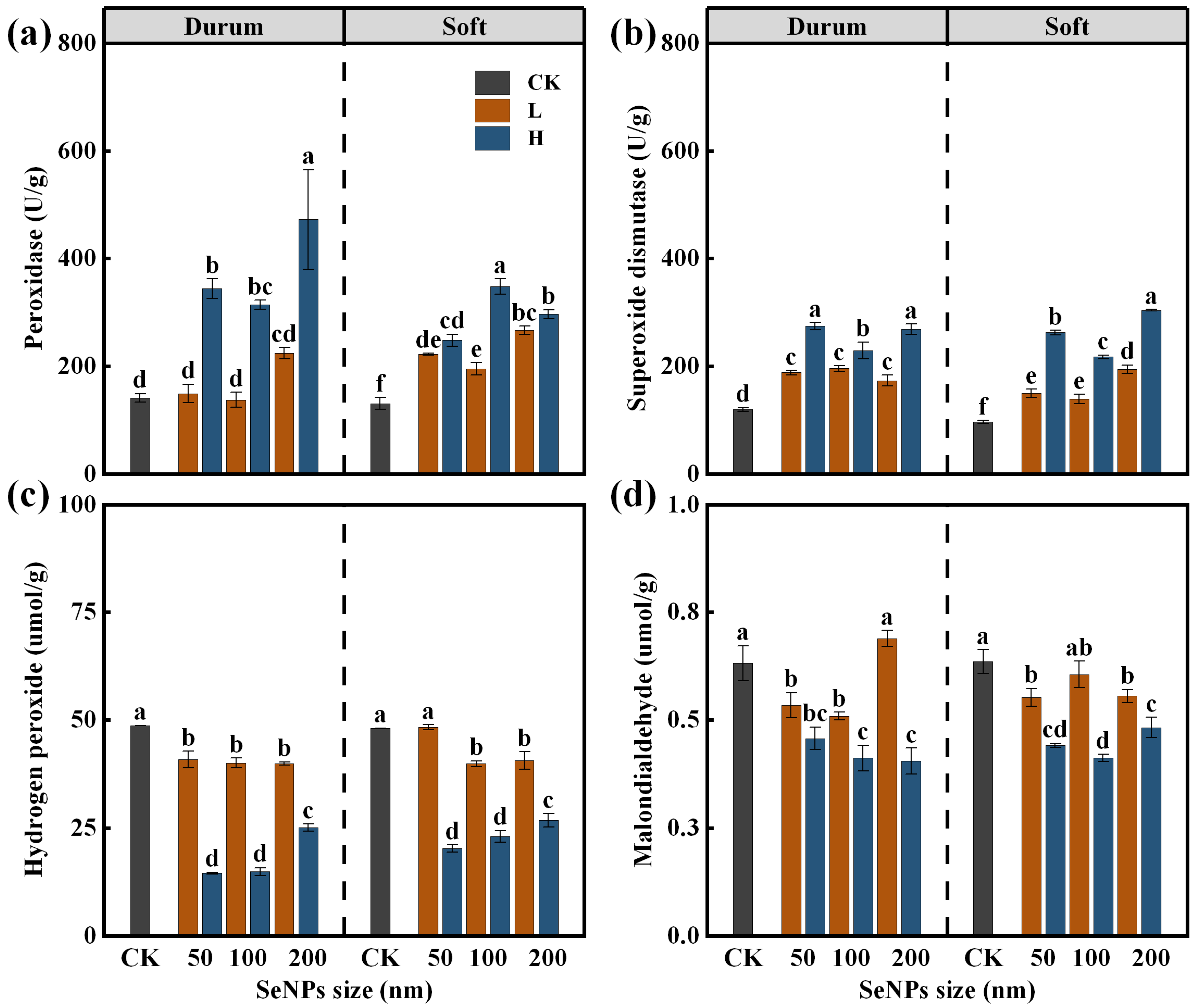
Foliar application of SeNPs modulated the antioxidant enzyme system. SeNPs significantly reduced MDA by 12.0–35.1% and H2O2 by 7.9–64.1% while significantly increasing POD activity by 36.5–182.6%, and SOD activity by 55.2–165.2% in winter wheat leaves at the flowering stage (Figure 1). These changes indicate effective suppression of Cd-induced oxidative stress. Similarly, previous studies have shown that foliar Se application reduced lipid peroxidation and reactive oxygen species (ROS) accumulation in rice and other crops [48,49].
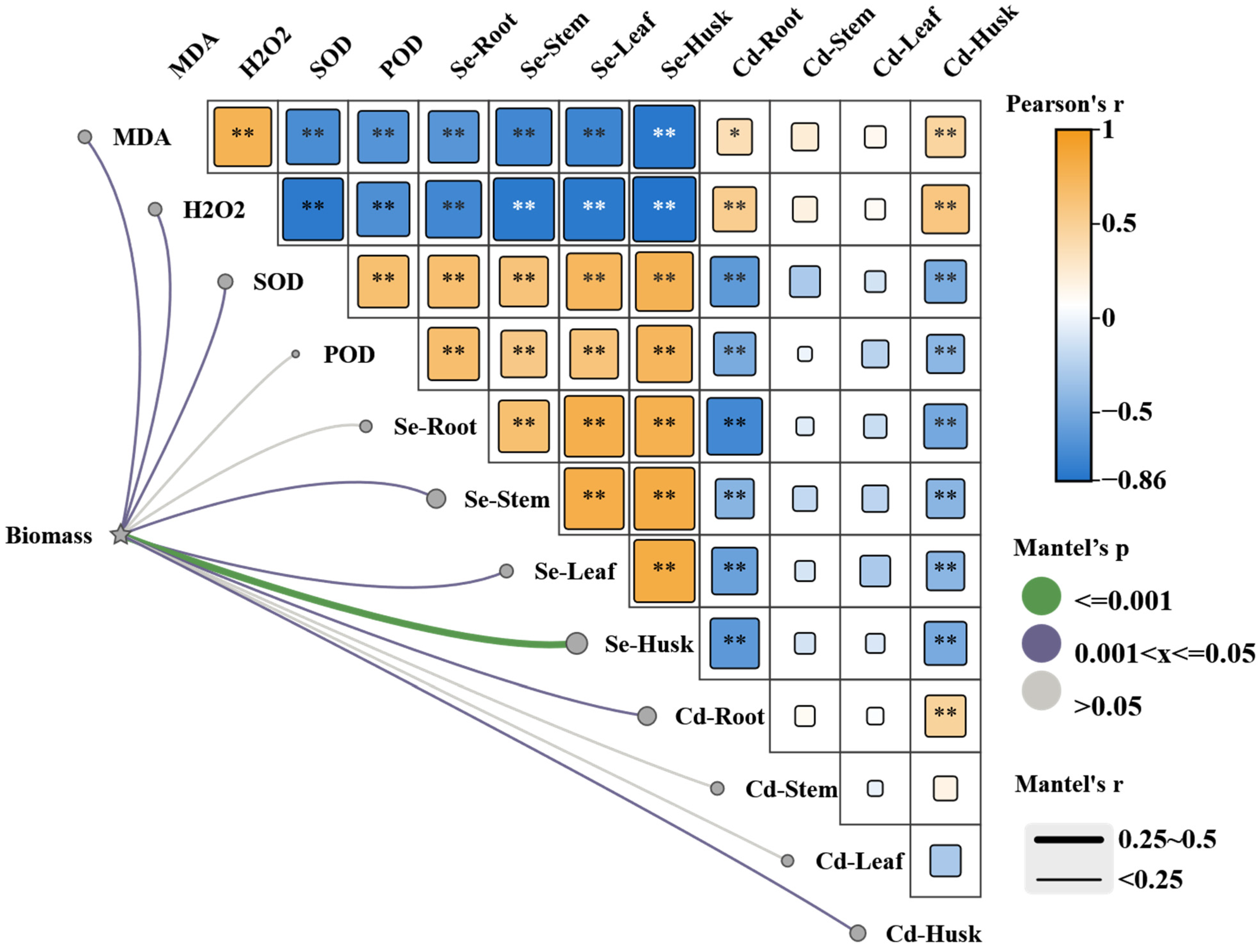
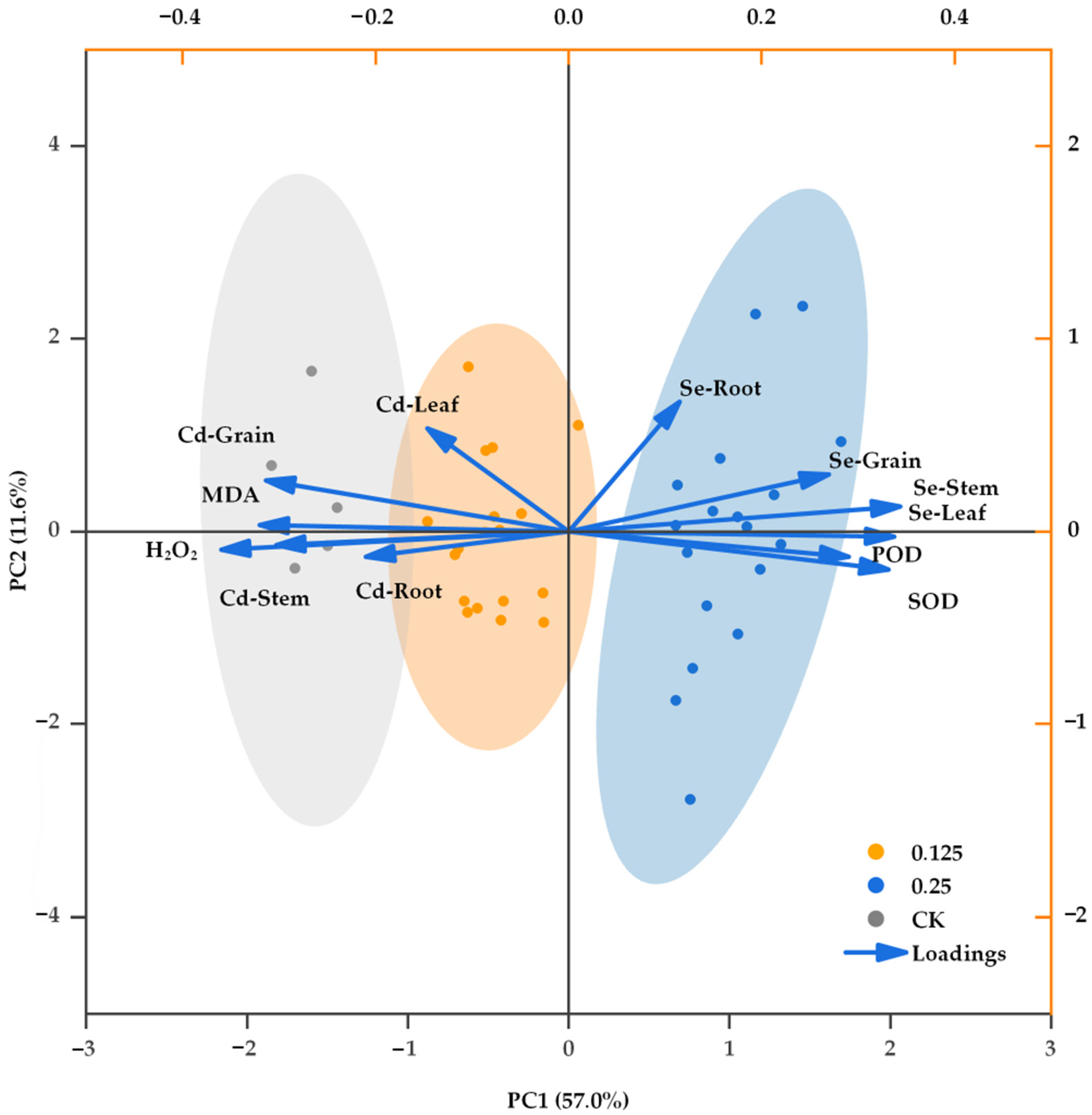
Correlation analysis further elucidated the relationships among the antioxidant enzyme system, Se and Cd concentrations, and biomass indicators in winter wheat (Figure 2). Se concentration showed significant positive correlations (r > 0.5) with antioxidant enzyme activities (SOD, POD) and negative correlations (r < −0.5) with oxidative stress markers (MDA, H2O2). Conversely, Cd exhibited positive correlations (r > 0.5) with oxidative stress markers and negative correlations (r < −0.5) with antioxidant enzymes, suggesting that Cd impedes the plant antioxidant system. The correlation analysis also revealed a pronounced antagonistic relationship between Se and Cd in winter wheat (Figure 2). These results are consistent with previous studies in potato, lettuce, and rice [49,50,51], which also reported that exogenous Se decreased Cd-induced ROS accumulation and oxidative damage. PCA further validated these associations (Figure 3). The first two principal components (PC1: 57.0%; PC2: 11.6%) accounted for 68.6% of the total variance. PC1 distinctly reflected the fundamental physiological response pattern. These analyses indicated that Cd stress was associated with increased ROS accumulation, whereas Se application was linked to enhanced antioxidant enzyme activities and reduced oxidative damage. Concurrently, the results revealed a strong negative correlation between Se and Cd concentrations, indicating that Se reduced Cd enrichment in plant organs, thereby mitigating Cd toxicity. Plants rely on a complex antioxidant defense system composed of enzymatic and non-enzymatic components to mitigate oxidative stress [51,52,53]. Furthermore, experimental observations indicated that foliar application of SeNPs activated antioxidant enzymes in winter wheat, thereby effectively scavenging reactive oxygen species. Mantel’s test further demonstrated that biomass parameters were strongly correlated with Cd concentrations in plant organs and moderately correlated with ROS levels and antioxidant enzyme activities.
These results suggest that foliar-applied SeNPs mitigate Cd-induced growth inhibition primarily by suppressing oxidative damage and restoring redox homeostasis, rather than by growth stimulation alone (Figure 1, Figure 2 and Figure 3). The Se-induced enhancement of antioxidant enzyme activities is widely recognized as an effective mechanism for mitigating Cd-induced oxidative stress [53,54,55]. Although signaling pathways involved in Se-mediated stress responses were not directly examined in this study, previous research suggests that SeNPs may enhance ROS-scavenging capacity by activating the ascorbate–glutathione cycle and regulating MAPK-related pathways and hormone signaling [56,57]. The observed enhancement of antioxidant enzyme activities in the present study is consistent with these proposed mechanisms. Overall, the activation of the antioxidant defense system is a central physiological process through which foliar-applied SeNPs alleviate Cd-induced oxidative stress and promote growth in winter wheat.

3.3. Foliar Application of SeNPs Regulated the Subcellular Distribution of Se and Cd in Winter Wheat at Flowering Stage

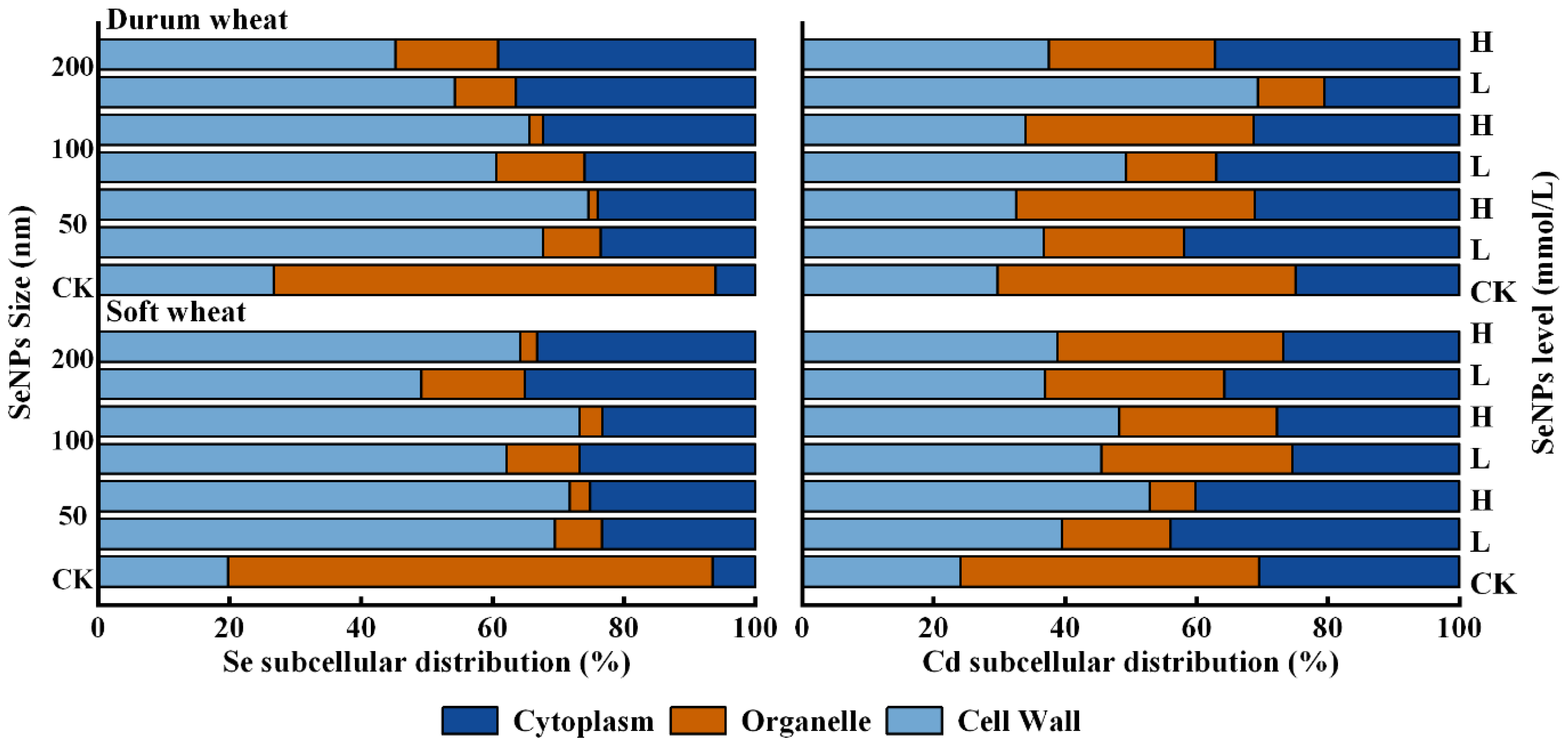
After spraying SeNPs, the proportion of Cd fixation in the cell wall increased by 2.9–39.6%, while the concentration of Cd in the organelles decreased by 9.1–38.4%. The 100 nm SeNPs showed the best Cd fixation effect (Figure 4). The proportion of Se in the organelles was significantly lower than that in the CK. After spraying SeNPs, Se was mainly enriched in the cell wall (the proportion of which was elevated by 18.5–53.6%). It has been shown that most of the Cd in the cell accumulates in the cell wall and soluble fractions [58]. Foliar application of SeNPs enhanced Cd sequestration within cell walls, thereby impeding Cd movement between cells and reducing Cd concentrations in winter wheat organs. Conversely, enhanced sequestration of cell wall components reduced Cd exposure to organelles and decreased Cd-induced lipid membrane peroxidation.
The root cell wall served as the primary defense barrier against heavy metals and was composed of pectin, hemicellulose, and cellulose. These components contained abundant functional groups (–OH, –COOH, –NH2) that could chelate Cd2+ ions and prevent their entry into the cell [59,60,61]. Previous studies suggested that SeNPs alleviated Cd toxicity predominantly through subcellular compartmentalization, in which Cd was preferentially immobilized in the apoplast rather than translocated to the symplast [59]. At the cellular level, SeNPs enhanced glutathione and phytochelatin synthesis, facilitating Cd sequestration in vacuoles and cell walls while downregulating HMA2 and HMA4 expression, thereby inhibiting Cd loading into the xylem [62].
Therefore, it could be concluded that the primary mechanisms by which Se application inhibited Cd toxicity can be summarized in two points: First, the application of SeNPs enhanced the activity of two antioxidant enzymes (POD and SOD), accelerated the clearance of reactive oxygen species (ROS) by plants, and reduced lipid membrane peroxidation caused by ROS production under Cd stress. On the other hand, the application of SeNPs strengthened plant cell walls, enhanced the immobilization of Cd within the cell walls, and thereby hindered Cd’s impact on organelles.

3.4. Foliar Application of SeNPs Reduced Cd Concentration but Enhanced Se Enrichment in Winter Wheat Grown in Cd-Contaminated Soil

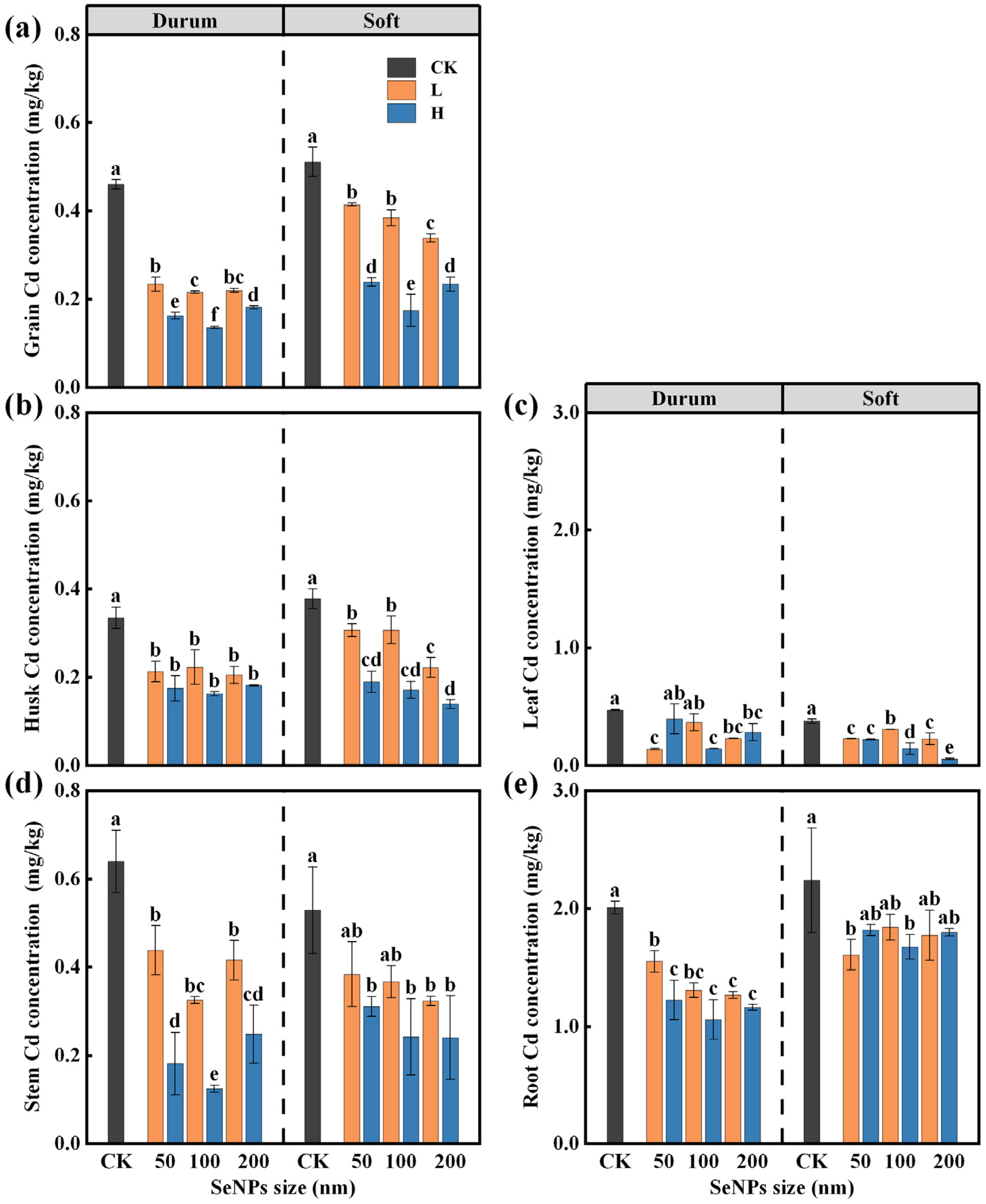
Foliar application of SeNPs reduced Cd concentrations in winter wheat organs. At the flowering stage, SeNP application significantly reduced root Cd concentrations by 14.4–33.0% compared to CK (p < 0.05). Cd concentrations in stems and husks also decreased, suggesting that the reduction in Cd concentrations likely began with decreased root Cd concentration and the inhibition of root-to-stem transport (Figure S1). At the mature stage, Cd concentrations decreased in all plant parts, with significant differences observed in grains, husks, and stems. In particular, grain Cd concentrations were significantly decreased to 0.14–0.41 mg/kg (a decrease of 18.9–70.5%) at maturity, compared with the CK (Figure 5). Among these treatments, SeNPs with a 100 nm size and 0.25 mmol/L showed the most pronounced Cd-reducing effect, decreasing grain Cd concentrations in durum wheat and soft wheat to 0.14 ± 0.01 and 0.17 ± 0.01 mg/kg, respectively (decreased by 70.5% and 65.9% compared to CK). The present results were consistent with previous findings in rice, where foliar application of SeNPs reduced Cd concentrations in brown rice from 1.13 to 0.48 mg/kg [63]. Similarly, foliar application of SeNPs (0.125–0.25 mM) reduced grain Cd concentration in rice by 20–36% [9]. The reduction in grain Cd concentrations was associated with increased biomass. The weight of winter wheat grain was significantly (p < 0.05) increased by 17.8% (Table 2). Cd translocation from roots to stems and from stems to leaves showed a decreasing trend under foliar application of SeNPs (Figure 2). Similarly, Rizwan et al. (2019) attributed the reduction in Cd concentration to decreased Cd uptake accompanied by increased biomass, which diluted Cd concentrations in rice tissues (the dilution effect) [64]. The reduction in Cd uptake may also have been attributed to SeNPs-mediated regulation of Cd uptake and transport-related genes. Zhou et al. (2021) reported that foliar application of SeNPs significantly downregulated the transcription levels of the Cd uptake and grain-loading transporter genes TaNramp5 and TaLCT1 by 58–65%, while upregulating the expression of Cd efflux and vacuolar sequestration-related genes TaTM20 (51–52%) and TaHMA3 (19–30%), ultimately resulting in a 20–36% reduction in grain Cd concentration [9]. Furthermore, Wang et al. [36] demonstrated that foliar application of SeNPs regulated rhizosphere Cd speciation. SeNPs decreased bioavailable Cd fractions by 6% and increased residual Cd by 8%, suggesting enhanced Cd immobilization in soil. Moreover, SeNPs might alter rhizosphere metabolic processes by reducing organic acid secretion (e.g., oxalic acid), thereby decreasing Cd mobilization and bioavailability [36]. These findings provide a plausible mechanistic basis for the observed reduction in grain Cd. In addition, variance analysis indicated that SeNP size had a significant (p < 0.05) effect on grain Cd concentration (Table 3). Among the tested sizes, 100 nm SeNPs exhibited the highest Cd-reducing capacity at 0.25 mmol/L. This resulted in reduced grain Cd concentrations of 0.14 ± 0.01 mg/kg and 0.17 ± 0.01 mg/kg, which were 65–70% lower than those in the CK. This effect may be attributed to a balance between bioavailability and foliar retention associated with SeNP particle size. On the one hand, larger nanoparticles exhibit greater retention on leaf surfaces following foliar application [65]. In contrast, SeNPs in the 100–800 nm range have shown higher bioavailability [66]. Compared with 50 nm and 200 nm SeNPs, 100 nm SeNPs appear to be more readily absorbed and more efficiently utilized by plants.
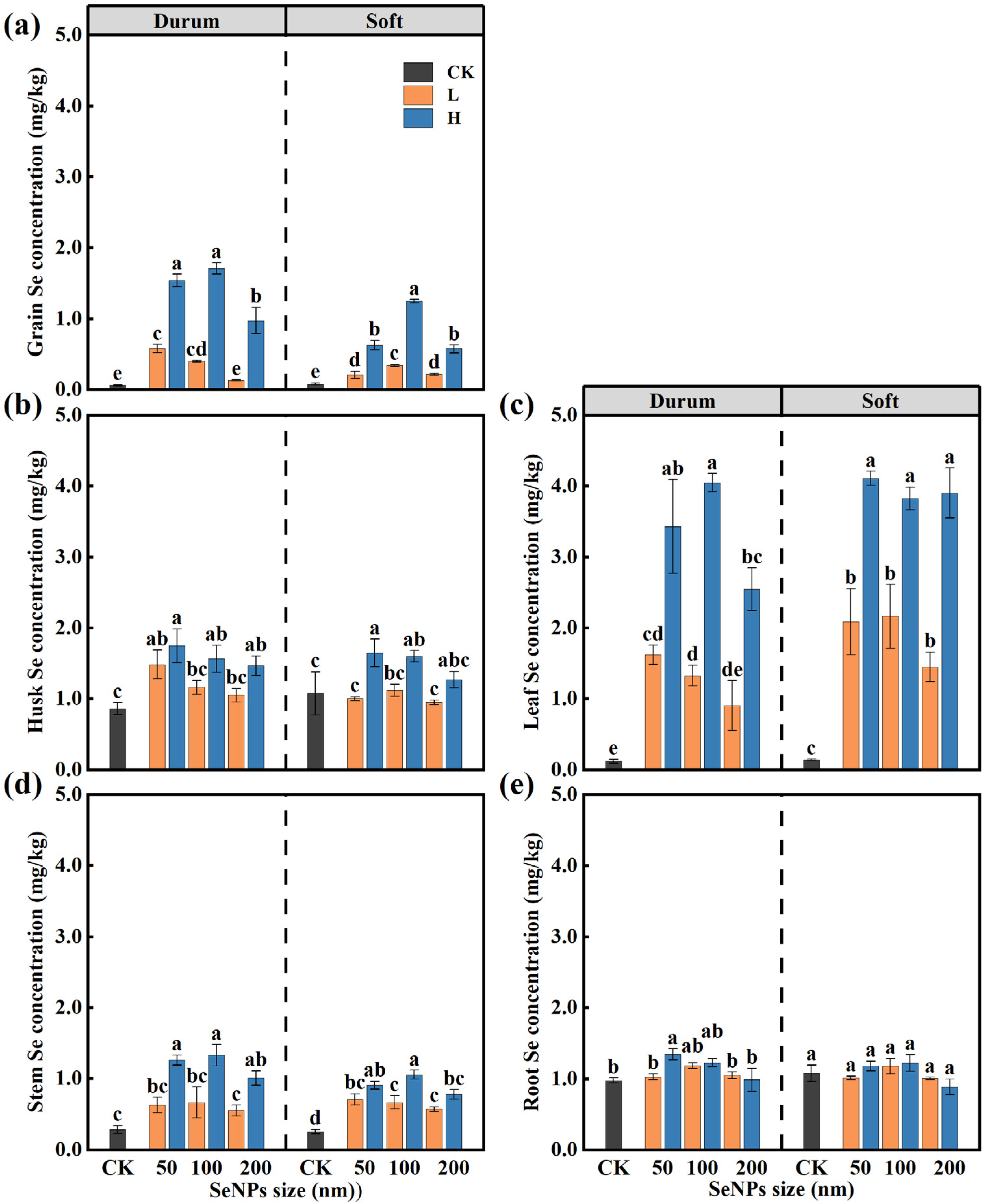
SeNPs also substantially enhanced Se enrichment in wheat, particularly in grain. During the flowering stage, the Se concentration in all parts significantly increased (p < 0.05), mainly accumulating in the leaves (Figure S2). At the mature stage, grain Se concentrations increased by 1.2–27.2-fold relative to the control (Figure 6). Compared with CK (0.06 mg/kg), under the 0.25 mmol/L SeNPs level, the SeNPs with 50 nm, 100 nm, and 200 nm particle size resulted in grain Se concentrations that were 24.4 times, 27.2 times, and 15.1 times higher (1.53, 1.71, and 0.97 mg/kg), respectively. Variance analysis showed that particle size, application level, and wheat genotype all significantly affected Se enrichment (Table 3). Across three particle sizes, 100 nm SeNPs resulted in a significantly higher (p < 0.05) Se concentration in grain, stem, and leaf (Figure 6a,c,d). Regardless of particle size, 0.25 mmol/L SeNPs resulted in a 15.1–27.2-fold increase in grain Se concentration. The increase in Se concentration was consistent with previous experiments on wheat [9,28,36,67,68]. Moreover, durum wheat exhibited greater Se enrichment than soft wheat, indicating a clear genotype dependence. This outcome is incongruent with the findings of Grant (2007), which reported that durum wheat performed less favorably in Se uptake following the application of SeNPs [67]. This discrepancy may be attributable to particular wheat varieties, as well as the particle size and level of SeNPs.
Based on the results of foliar application of SeNPs to reduce Cd concentration and enhance Se accumulation, it was found that the effects of SeNPs did not simply increase with decreasing particle size. At the 0.125 mmol/L SeNPs application levels, Se enrichment showed a positive correlation with particle size (50 nm > 100 nm > 200 nm), but at the 0.25 mmol/L SeNPs levels, the order of effectiveness was 100 nm > 50 nm > 200 nm (Figure 5 and Figure 6). This further indicated that the interaction effect between particle size and level might play a significant role in the absorption and utilization of SeNPs by winter wheat (Table 3). Previous studies have generally reported that smaller nanomaterials enter plants more readily through foliar pathways. However, the present study’s results were not entirely consistent with those findings. This discrepancy might have been attributed to particle aggregation and the actual foliar absorption capacity under spray application conditions.
From the perspective of foliar uptake, the main pathways for SeNPs entering winter wheat include cuticular diffusion and stomatal penetration. Particles in the range of 20–100 nm are primarily accommodated by stomatal pathways [69]. In general, larger particles (>50 nm) do not directly enter the leaf tissue. The effective utilization of such SeNPs by plants largely depends on the gradual dissolution of Se from the particle surface into soluble Se forms (e.g., Se ions or nanoscale molecular complexes), which can then penetrate the cell wall and be absorbed and translocated [45]. These observations indicate that foliar Se uptake relies more on the indirect Se-supplying function of SeNPs (slow release of absorbable Se forms) rather than on the direct uptake of larger particles themselves. Smaller SeNPs might provide a greater surface area and be directly absorbed by the leaf, but on the other hand, smaller NPs (especially under 100 nm) are thermodynamically more prone to agglomeration [31,32]. Simultaneously, at high levels, particles agglomerate more rapidly into larger aggregates [33,34], reducing effective contact with the leaf and diminishing foliar uptake efficiency.
Overall, foliar application of SeNPs simultaneously reduces grain Cd and enhances grain Se, with a strong dependence on particle size × dose × genotype (Table 3). Among the tested treatments, 100 nm at 0.25 mmol/L provides the best combined outcome, achieving grain Cd below the safety threshold while maximizing Se enrichment. Similar dose-dependent particle-size effects have been observed during foliar application of SeNPs to wheat, where 200 nm particles showed higher utilization efficiency than 60 nm particles [45]. In contrast, medium-sized SeNPs (around 100 nm) not only exhibit stronger leaf retention and controlled release of Se, but also enter the leaf directly through stomatal pathways; furthermore, they exhibit no significant agglomeration even at high concentrations (0.25 mmol/L).

3.5. Foliar Application of SeNPs Regulated the Translocation of Se and Cd in Winter Wheat

The transfer factors (TF) of Se and Cd reflected the capacity of Se and Cd to be transferred among different organs (Table 4). Foliar application of SeNPs significantly reduced the Cd TFstem/root. At the 0.25 mol/L SeNPs level, the TFstem/root of durum wheat and soft wheat decreased by 33.9–90.5% and 34.6–46.1%, respectively. These results indicated that the application of SeNPs effectively inhibited the translocation of Cd from roots to shoots. In durum wheat, TFgrain/husk was also reduced by 18.5–39.7%, and similar trends were also observed in soft wheat, suggesting that SeNPs further restricted the transport of Cd into the grains. Conversely, the Se transfer factor from husk to grain increased significantly, indicating that foliar-applied SeNPs might enhance the transport pathway of Se. These results suggested that SeNPs promoted Se accumulation in grains while simultaneously limiting Cd translocation, suggesting a key physiological mechanism underlying Se-induced Cd detoxification. Foliar-applied SeNPs were absorbed through the cuticle and stomata and subsequently transformed into organic Se compounds, which may act as systemic signaling molecules regulating Cd transport [36]. The results showed that Cd concentrations in wheat roots were substantially higher than in other tissues (Figure 5). According to Di et al. [56], SeNPs might regulate root metabolism by suppressing Cd uptake-related transporters (IRT1 and Nramp5) and enhancing the secretion of organic acids in the rhizosphere, thereby promoting Cd immobilization in the root zone. Collectively, these processes reduced the translocation of Cd from roots to shoots.
Overall, based on the results of the subcellular analyses described above, foliar application of SeNPs promotes the sequestration of Cd in the cell walls and vacuoles of roots and leaves. This compartmentalization of Cd effectively reduces its mobility, inhibits its transport from roots to stems and from stems to leaves and grains, and minimizes damage to metabolically active organelles. This is considered the primary mechanism for reducing Cd concentrations in grains. Future studies should investigate how SeNP size influences foliar retention, transformation, and long-distance transport efficiency in wheat, thereby optimizing SeNP-based strategies to reduce Cd accumulation while enhancing Se biofortification.

4. Conclusions

Foliar application of SeNPs effectively increases biomass and reduces Cd concentrations in winter wheat while enhancing Se enrichment. SeNPs with 100 nm particle size and 0.25 mmol/L level demonstrated superior foliar uptake efficiency while simultaneously achieving the goals of enriching the grains with Se and reducing Cd levels. Durum wheat exhibited a stronger response than soft wheat, indicating genotype-dependent regulation. Mechanistically, SeNPs restrict Cd uptake and long-distance translocation, promote Cd sequestration in the cell wall, and reduce Cd allocation to organelles, thereby lowering Cd bioavailability. Simultaneously, SeNPs enhance antioxidant defense by increasing superoxide dismutase and peroxidase activities and by decreasing reactive oxygen species and lipid peroxidation, thereby alleviating Cd-induced oxidative stress and supporting improvements in biomass and yield. This study provides an important theoretical basis and technical approach for simultaneously remediating Cd pollution and producing Se-biofortified wheat. Foliar spraying with SeNPs is a promising strategy to mitigate Cd contamination in winter wheat while promoting Se enrichment. Further studies focusing on the transformation processes of SeNPs of different sizes in the environment and on long-term field performance are warranted to optimize SeNP-based applications in sustainable agriculture.

Supplementary Materials

The following supporting information can be downloaded at: https://www.mdpi.com/article/10.3390/agronomy16151468/s1, Figure S1: Effects of foliar-applied selenium nanoparticles (SeNPs) at two levels (0.125 (L) and 0.25 (H) mmol/L) and different sizes (50, 100, 200 nm) on Cd concentration in husk (a), leaf (b), stem (c), and root (d) of two winter wheat varieties (durum and soft) grown in Cd-contaminated soil at the flowing stage (mean ± SE, n = 3); Figure S2: Effects of foliar-applied selenium nanoparticles (SeNPs) at two levels (0.125 (L) and 0.25 (H) mmol/L) and different sizes (50, 100, 200 nm) on Se concentration in husk (a), leaf (b), stem (c), and root (d) of two winter wheat varieties (durum and soft) grown in Cd-contaminated soil at the flowing stage (mean ± SE, n = 3).

Author Contributions

Conceptualization, F.W. and Y.Q.; methodology, Y.Q. and Y.M.; software, Y.Q.; validation, F.W.; formal analysis, Y.Q. and Y.M.; investigation, Y.Q., Y.M. and Y.W.; resources, F.W.; data curation, Y.Q. and Y.W.; writing—original draft preparation, Y.Q.; writing—review and editing, F.W. and S.H.; visualization, Y.Q.; supervision, F.W.; project administration, F.W.; funding acquisition, F.W. All authors have read and agreed to the published version of the manuscript.

Funding

This study was funded by the National Natural Science Foundation of China (42077325; 41571456) and the Natural Science Basic Research Program of Shaanxi (Program No. 2023-JC-ZD-17).

Data Availability Statement

The original contributions presented in this study are included in the article/Supplementary Material. Further inquiries can be directed to the corresponding author.

Acknowledgments

We are very grateful to every scientific researcher who supports and helps us in our work.

Conflicts of Interest

The authors declare no conflict of interest.

References

  1. Abedi, T.; Mojiri, A. Cadmium Uptake by Wheat (Triticum aestivum L.): An Overview. Plants 2020, 9, 500. [Google Scholar] [CrossRef] [PubMed]
  2. Herbette, S.; Taconnat, L.; Hugouvieux, V.; Piette, L.; Magniette, M.L.M.; Cuine, S.; Auroy, P.; Richaud, P.; Forestier, C.; Bourguignon, J.; et al. Genome-wide transcriptome profiling of the early cadmium response of Arabidopsis roots and shoots. Biochimie 2006, 88, 1751–1765. [Google Scholar] [CrossRef] [PubMed]
  3. Bautista, C.J.; Arango, N.; Plata, C.; Mitre-Aguilar, I.B.; Trujillo, J.; Ramírez, V. Mechanism of cadmium-induced nephrotoxicity. Toxicology 2024, 502, 153726. [Google Scholar] [CrossRef] [PubMed]
  4. Nakadaira, H.; Nishi, S. Effects of low-dose cadmium exposure on biological examinations. Sci. Total Environ. 2003, 308, 49–62. [Google Scholar] [CrossRef] [PubMed]
  5. Satarug, S.; Moore, M.R. Adverse Health Effects of Chronic Exposure to Low-Level Cadmium in Foodstuffs and Cigarette Smoke. Environ. Health Perspect. 2004, 112, 1099–1103. [Google Scholar] [CrossRef] [PubMed]
  6. Hou, D.; Jia, X.; Wang, L.; McGrath, S.P.; Zhu, Y.-G.; Hu, Q.; Zhao, F.-J.; Bank, M.S.; O’cOnnor, D.; Nriagu, J. Global soil pollution by toxic metals threatens agriculture and human health. Science 2025, 388, 316–321. [Google Scholar] [CrossRef] [PubMed]
  7. Ministry of Ecology and Environment of the People’s Republic of China; Ministry of Natural Resources of the People’s Republic of China. The Report on the National Soil Contamination Survey. 2014. Available online: https://www.mee.gov.cn/gkml/sthjbgw/qt/201404/t20140417_270670.htm (accessed on 17 April 2014).
  8. Song, Y.; Wang, Y.; Mao, W.; Sui, H.; Yong, L.; Yang, D.; Jiang, D.; Zhang, L.; Gong, Y. Dietary cadmium exposure assessment among the Chinese population. PLoS ONE 2017, 12, e0177978. [Google Scholar] [CrossRef] [PubMed]
  9. Zhou, J.; Zhang, C.; Du, B.; Cui, H.; Fan, X.; Zhou, D.; Zhou, J. Soil and foliar applications of silicon and selenium effects on cadmium accumulation and plant growth by modulation of antioxidant system and Cd translocation: Comparison of soft vs. durum wheat varieties. J. Hazard. Mater. 2021, 402, 123546. [Google Scholar] [CrossRef] [PubMed]
  10. Xia, S.; Wang, J.; Chen, Z.; Lan, H.; Shen, Z.; Shi, L.; Chen, Y. Foliar application of several reagents reduces Cd concentration in wheat grain. Environ. Sci. Pollut. Res. 2022, 29, 17150–17161. [Google Scholar] [CrossRef] [PubMed]
  11. Sasaki, A.; Yamaji, N.; Ma, J.F. Overexpression of OsHMA3 enhances Cd tolerance and expression of Zn transporter genes in rice. J. Exp. Bot. 2014, 65, 6013–6021. [Google Scholar] [CrossRef] [PubMed]
  12. Riaz, M.; Kamran, M.; Rizwan, M.; Ali, S.; Parveen, A.; Malik, Z.; Wang, X. Cadmium uptake and translocation: Selenium and silicon roles in Cd detoxification for the production of low Cd crops: A critical review. Chemosphere 2021, 273, 129690. [Google Scholar] [CrossRef] [PubMed]
  13. Cui, J.; Liu, T.; Li, Y.; Li, F. Selenium reduces cadmium uptake into rice suspension cells by regulating the expression of lignin synthesis and cadmium-related genes. Sci. Total Environ. 2018, 644, 602–610. [Google Scholar] [CrossRef] [PubMed]
  14. Zhu, J.; Zhao, P.; Nie, Z.; Shi, H.; Li, C.; Wang, Y.; Qin, S.; Qin, X.; Liu, H. Selenium supply alters the subcellular distribution and chemical forms of cadmium and the expression of transporter genes involved in cadmium uptake and translocation in winter wheat (Triticum aestivum). BMC Plant Biol. 2020, 20, 1–12. [Google Scholar] [CrossRef] [PubMed]
  15. Lux, A.; Martinka, M.; Vaculik, M.; White, P.J. Root responses to cadmium in the rhizosphere: A review. J. Exp. Bot. 2011, 62, 21–37. [Google Scholar] [CrossRef] [PubMed]
  16. Wang, X.; Liu, Y.; Zeng, G.; Chai, L.; Song, X.; Min, Z.; Xiao, X. Subcellular distribution and chemical forms of cadmium in Bechmeria nivea (L.) Gaud. Environ. Exp. Bot. 2008, 62, 389–395. [Google Scholar] [CrossRef]
  17. Saidi, I.; Chtourou, Y.; Djebali, W. Selenium alleviates cadmium toxicity by preventing oxidative stress in sunflower (Helianthus annuus) seedlings. J. Plant Physiol. 2014, 171, 85–91. [Google Scholar] [CrossRef] [PubMed]
  18. Shah, K.; Kumar, R.G.; Verma, S.; Dubey, R. Effect of cadmium on lipid peroxidation, superoxide anion generation and activities of antioxidant enzymes in growing rice seedlings. Plant Sci. 2001, 161, 1135–1144. [Google Scholar] [CrossRef]
  19. Handa, N.; Kohli, S.K.; Sharma, A.; Thukral, A.K.; Bhardwaj, R.; Abd Allah, E.F.; Alqarawi, A.A.; Ahmad, P. Selenium modulates dynamics of antioxidative defence expression, photosynthetic attributes and secondary metabolites to mitigate chromium toxicity in Brassica juncea L. plants. Environ. Exp. Bot. 2019, 161, 180–192. [Google Scholar] [CrossRef]
  20. Lin, L.; Zhou, W.; Dai, H.; Cao, F.; Zhang, G.; Wu, F. Selenium reduces cadmium uptake and mitigates cadmium toxicity in rice. J. Hazard. Mater. 2012, 235, 343–351. [Google Scholar] [CrossRef] [PubMed]
  21. Shen, J.; Jiang, C.; Yan, Y.; Zu, C. Selenium Distribution and Translocation in Rice (Oryza sativa L.) under Different Naturally Seleniferous Soils. Sustainability 2019, 11, 520. [Google Scholar] [CrossRef]
  22. Zou, R.; Wang, L.; Li, Y.C.; Tong, Z.; Huo, W.; Chi, K.; Fan, H. Cadmium absorption and translocation of amaranth (Amaranthus mangostanus L.) affected by iron deficiency. Environ. Pollut. 2020, 256, 113410. [Google Scholar] [CrossRef] [PubMed]
  23. Li, G.; Li, Q.; Wang, L.; Chen, G.; Zhang, D. Subcellular distribution, chemical forms, and physiological response to cadmium stress in Hydrilla verticillata. Int. J. Phytoremediat. 2019, 21, 230–239. [Google Scholar] [CrossRef] [PubMed]
  24. Kaur, M.; Sharma, S. Influence of selenite and selenate on growth, leaf physiology and antioxidant defense system in wheat (Triticum aestivum L.). J. Sci. Food Agric. 2018, 98, 5700–5710. [Google Scholar] [CrossRef] [PubMed]
  25. Fatemi, H.; Esmaiel Pour, B.; Rizwan, M. Foliar application of silicon nanoparticles affected the growth, vitamin C, flavonoid, and antioxidant enzyme activities of coriander (Coriandrum sativum L.) plants grown in lead (Pb)—spiked soil. Environ. Sci. Pollut. Res. 2021, 28, 1417–1425. [Google Scholar] [CrossRef] [PubMed]
  26. Dalia, A.M.; Loh, T.C.; Sazili, A.Q.; Samsudin, A.A. Influence of bacterial organic selenium on blood parameters, immune response, selenium retention and intestinal morphology of broiler chickens. BMC Vet. Res. 2020, 16, 365. [Google Scholar] [CrossRef] [PubMed]
  27. Bashir, A.; Rehman, M.Z.U.; Hussaini, K.M.; Adrees, M.; Qayyum, M.F.; Sayal, A.U.; Rizwan, M.; Ali, S.; Alsahli, A.A.; Alyemeni, M.N. Combined use of zinc nanoparticles and co-composted biochar enhanced wheat growth and decreased Cd concentration in grains under Cd and drought stress: A field study. Environ. Technol. Innov. 2021, 23, 101518. [Google Scholar] [CrossRef]
  28. Hussain, A.; Rizwan, M.; Ali, S.; Rehman, M.Z.U.; Qayyum, M.F.; Nawaz, R.; Ahmad, A.; Asrar, M.; Ahmad, S.R.; Alsahli, A.A.; et al. The combined use of different nanoparticles effectively decreased cadmium (Cd) concentration in wheat grains grown in a field contaminated with Cd. Ecotox Environ. Safe 2021, 215, 112139. [Google Scholar] [CrossRef] [PubMed]
  29. Konate, A.; He, X.; Zhang, P.; Ma, Y.; Yang, J.; Alugongo, G.M.; Rui, Y.; Zhang, Z. Alleviation of cadmium-induced changes on growth, antioxidative enzyme activities, and lipid peroxidation in crop seedlings by magnetic (fe3o4) nanoparticles. Fresenius Environ. Bull. 2018, 27, 3920–3935. [Google Scholar]
  30. Wang, C.-L.; Liu, Y.-G.; Zeng, G.-M.; Hu, X.-J.; Ying, Y.-C.; Hu, X.; Zhou, L.; Wang, Y.-Q.; Li, H.-Y. Mechanism of exogenous selenium alleviates cadmium induced toxicity in Bechmeria nivea (L.) Gaud (Ramie). Trans. Nonferrous Met. Soc. China 2014, 24, 3964–3970. [Google Scholar] [CrossRef]
  31. Sun, H.; Jiao, R.; An, G.; Xu, H.; Wang, D. Influence of particle size on the aggregation behavior of nanoparticles: Role of structural hydration layer. J. Environ. Sci. 2021, 103, 33–42. [Google Scholar] [CrossRef] [PubMed]
  32. Bélteky, P.; Rónavári, A.; Zakupszky, D.; Boka, E.; Igaz, N.; Szerencsés, B.; Pfeiffer, I.; Vágvölgyi, C.; Kiricsi, M.; Kónya, Z. Are smaller nanoparticles always better? Understanding the biological effect of size-dependent silver nanoparticle aggregation under biorelevant conditions. Int. J. Nanomed. 2021, 16, 3021–3040. [Google Scholar] [CrossRef] [PubMed]
  33. Rigopoulos, S. Population balance modelling of polydispersed particles in reactive flows. Prog. Energy Combust. Sci. 2010, 36, 412–443. [Google Scholar] [CrossRef]
  34. Xu, J.; Yu, M.; Wang, S.; Liu, Y. Using Langevin dynamics to investigate the effects of particle concentration on particle collision rate and aggregate morphology. Phys. Fluids 2025, 37, 063317. [Google Scholar] [CrossRef]
  35. Lin, Z.H.; Wang, C. Evidence on the size-dependent absorption spectral evolution of selenium nanoparticles. Mater. Chem. Phys. 2005, 92, 591–594. [Google Scholar] [CrossRef]
  36. Wang, M.; Mu, C.; Lin, X.; Ma, W.; Wu, H.; Si, D.; Ge, C.; Cheng, C.; Zhao, L.; Li, H.; et al. Foliar application of nanoparticles reduced cadmium content in wheat (Triticum aestivum L.) grains via long-distance “leaf–root–microorganism” regulation. Environ. Sci. Technol. 2024, 58, 6900–6912. [Google Scholar] [CrossRef] [PubMed]
  37. Wang, M.; Ali, F.; Wang, M.; Dinh, Q.T.; Zhou, F.; Bañuelos, G.S.; Liang, D. Understanding boosting selenium accumulation in Wheat (Triticum aestivum L.) following foliar selenium application at different stages, forms, and doses. Environ. Sci. Pollut. Res. 2019, 27, 717–728. [Google Scholar] [CrossRef] [PubMed]
  38. Bao, S.D. Analysis Methods for Soil Agriculture Chemistry; China Agriculture Press: Beijing, China, 2000; pp. 373–375. [Google Scholar]
  39. Wang, Y.; Huang, J.; Gao, Y. Arbuscular Mycorrhizal Colonization Alters Subcellular Distribution and Chemical Forms of Cadmium in Medicago sativa L. and Resists Cadmium Toxicity. PLoS ONE 2012, 7, e48669. [Google Scholar] [CrossRef] [PubMed]
  40. Paoletti, F.; Aldinucci, D.; Mocali, A.; Caparrini, A. A sensitive spectrophotometric method for the determination of superoxide dismutase activity in tissue extracts. Anal. Biochem. 1986, 154, 536–541. [Google Scholar] [CrossRef] [PubMed]
  41. Abbas, M.; Arshad, M.; Nisar, N.; Nisar, J.; Ghaffar, A.; Nazir, A.; Tahir, M.A.; Iqbal, M. Muscilage characterization, biochemical and enzymatic activities of laser irradiated Lagenaria siceraria seedlings. J. Photochem. Photobiol. B Biol. 2017, 173, 344–352. [Google Scholar] [CrossRef] [PubMed]
  42. Ferguson, I.B.; Watkins, C.B.; Harman, J.E. Inhibition by calcium of senescence of detached cucumber cotyledons. Plant Physiol. 1983, 71, 182–186. [Google Scholar] [CrossRef] [PubMed]
  43. GBW 080215; Standard Solution of Se. National Institute of Metrology: Beijing, China, 2008.
  44. GBW (E) 080119; Standard Solution of Cd. National Institute of Metrology: Beijing, China, 2008.
  45. Wang, X.; Hussain, B.; Xin, X.; Zou, T.; Huang, X.; Cheng, L.; Wu, Z.; Yang, Y.; Li, Y.; He, Z.; et al. Fate and physiological effects of foliar selenium nanoparticles in wheat. ACS Nano 2025, 19, 21792–21806. [Google Scholar] [CrossRef] [PubMed]
  46. Barman, F.; Kundu, R. Foliar application of selenium affecting pollen viability, grain chalkiness, and transporter genes in cadmium accumulating rice cultivar: A pot study. Chemosphere 2023, 313, 137538. [Google Scholar] [CrossRef] [PubMed]
  47. Dzomba, E.; Dikic, M.; Gadzo, D.; Cengic-Dzombai, S.; Loncaric, Z.; Singh, B.R. Effect of different doses and application methods of sodium selenate on selenium status in maize for silage. Agric. Food Sci. 2018, 27, 255–263. [Google Scholar] [CrossRef]
  48. Lan, X.; Li, J.; Chen, J.; Liu, J.; Cao, F.; Liao, C.; Zhang, Z.; Gu, M.; Wei, Y.; Shen, F.; et al. Effects of foliar applications of Brassinolide and Selenium on the accumulation of Arsenic and Cadmium in rice grain and an assessment of their health risk. Int. J. Phytoremediat. 2023, 25, 161–171. [Google Scholar] [CrossRef] [PubMed]
  49. Turakainen, M.; Hartikainen, H.; Seppänen, M.M. Effects of selenium treatments on potato (Solanum tuberosum L.) growth and concentration of soluble sugars and starch. J. Agric. Food Chem. 2004, 52, 5378–5382. [Google Scholar] [CrossRef] [PubMed]
  50. Xue, T.L.; Hartikainen, H.; Piironen, V. Antioxidative and growth-promoting effect of selenium on senescing lettuce. Plant Soil 2001, 237, 55–61. [Google Scholar] [CrossRef]
  51. Shan, H.Y.; Guang-hua, L.; Frances, K.K. Peroxidation Damage of Oxygen Free Radicals Induced by Cadmium To Plant. J. Integr. Plant Biol. 1997, 39, 6. [Google Scholar]
  52. Gill, S.S.; Tuteja, N. Reactive oxygen species and antioxidant machinery in abiotic stress tolerance in crop plants. Plant Physiol. Biochem. 2010, 48, 909–930. [Google Scholar] [CrossRef] [PubMed]
  53. Guo, Y.; Mao, K.; Cao, H.; Ali, W.; Lei, D.; Teng, D.; Chang, C.; Yang, X.; Yang, Q.; Niazi, N.K.; et al. Exogenous selenium (cadmium) inhibits the absorption and transportation of cadmium (selenium) in rice. Environ. Pollut. 2021, 268, 115829. [Google Scholar] [CrossRef] [PubMed]
  54. Khan, M.I.R.; Nazir, F.; Asgher, M.; Per, T.S.; Khan, N.A. Selenium and sulfur influence ethylene formation and alleviate cadmium-induced oxidative stress by improving proline and glutathione production in wheat. J. Plant Physiol. 2015, 173, 9–18. [Google Scholar] [CrossRef] [PubMed]
  55. Sun, H.; Wang, X.; Yang, N.; Zhou, H.; Gao, Y.; Yu, J.; Wang, X. Effect of exogenous selenium on mineral nutrition and antioxidative capacity in cucumber (Cucumis sativus L.) seedlings under cadmium stress. Plant Soil Environ. 2022, 68, 580–590. [Google Scholar] [CrossRef]
  56. Di, X.; Jing, R.; Qin, X.; Liang, X.; Wang, L.; Xu, Y.; Sun, Y.; Huang, Q. The role and transcriptomic mechanism of cell wall in the mutual antagonized effects between selenium nanoparticles and cadmium in wheat. J. Hazard. Mater. 2024, 472, 134549. [Google Scholar] [CrossRef] [PubMed]
  57. Yang, J.; Ma, Y.; Hao, S.; Qin, Y.; Zhu, H.; Wu, F. Arbuscular mycorrhizal fungi regulate cadmium uptake and detoxification in winter wheat via Cd dose-dependent molecular and cellular mechanisms. J. Environ. Sci. 2025, 165, 799–811. [Google Scholar] [CrossRef] [PubMed]
  58. Li, J.H.; Yang, W.P.; Guo, A.N.; Yang, S.; Chen, J.; Qiao, Y.J.; Anwar, S.; Wang, K.; Yang, Z.P.; Gao, Z.Q.; et al. Combined foliar and soil selenium fertilizer improves selenium transport and the diversity of the rhizosphere bacterial community in oats. Environ. Sci. Pollut. Res. 2021, 28, 64407–64418. [Google Scholar] [CrossRef] [PubMed]
  59. Peng, T.; Huang, Z.; Yao, Y.; Yang, Z.; Sun, Z.; Dong, X.; Peng, J.; Liu, L.; Zeng, C.; Liu, Z.; et al. The metabolomic and transcriptomic analysis reveals that Brassica juncea responds to cadmium stress by enhancing pectin and lignin synthesis in roots. Sci. Hortic. 2024, 337, 113451. [Google Scholar] [CrossRef]
  60. Yang, F.; Yu, H.; Huang, H.; Li, Q.; Li, T. The characteristics of cell wall pectin in roots of cadmium-safe rice line in response to cadmium stress. J. Plant Nutr. Fertil. 2023, 29, 704–711. [Google Scholar] [CrossRef]
  61. Zhang, X.; Hu, W.; Xie, X.; Wu, Y.; Liang, F.; Tang, M. Arbuscular mycorrhizal fungi promote lead immobilization by increasing the polysaccharide content within pectin and inducing cell wall peroxidase activity. Chemosphere 2021, 267, 128924. [Google Scholar] [CrossRef] [PubMed]
  62. Wang, M.; Mu, C.; Li, Y.; Wang, Y.; Ma, W.; Ge, C.; Cheng, C.; Shi, G.; Li, H.; Zhou, D. Foliar application of selenium nanoparticles alleviates cadmium toxicity in maize (Zea mays L.) seedlings: Evidence on antioxidant, gene expression, and metabolomics analysis. Sci. Total Environ. 2023, 899, 165521. [Google Scholar] [CrossRef] [PubMed]
  63. Gao, M.; Zhou, J.; Liu, H.; Zhang, W.; Hu, Y.; Liang, J.; Zhou, J. Foliar spraying with silicon and selenium reduces cadmium uptake and mitigates cadmium toxicity in rice. Sci. Total Environ. 2018, 631-632, 1100–1108. [Google Scholar] [CrossRef] [PubMed]
  64. Rizwan, M.; Ali, S.; Ali, B.; Adrees, M.; Arshad, M.; Hussain, A.; ur Rehman, M.Z.; Waris, A.A. Zinc and iron oxide nanoparticles improved the plant growth and reduced the oxidative stress and cadmium concentration in wheat. Chemosphere 2019, 214, 269–277. [Google Scholar] [CrossRef] [PubMed]
  65. Avellan, A.; Yun, J.; Zhang, Y.; Spielman-Sun, E.; Unrine, J.M.; Thieme, J.; Li, J.; Lombi, E.; Bland, G.; Lowry, G.V. Nanoparticle size and coating chemistry control foliar uptake pathways, translocation, and leaf-to-rhizosphere transport in wheat. ACS Nano 2019, 13, 5291–5305. [Google Scholar] [CrossRef] [PubMed]
  66. Hochella, M.F., Jr.; Lower, S.K.; Maurice, P.A.; Penn, R.L.; Sahai, N.; Sparks, D.L.; Twining, B.S. Nanominerals, mineral nanoparticles, and earth systems. Geochim. Cosmochim. Acta 2008, 72, A382. [Google Scholar]
  67. Grant, C.A.; Buckley, W.T.; Wu, R. Effect of selenium fertilizer source and rate on grain yield and selenium and cadmium concentration of durum wheat. Can. J. Plant Sci. 2007, 87, 703–708. [Google Scholar] [CrossRef]
  68. Gu, X.; Wen, X.; Yi, N.; Liu, Y.; Wu, J.; Li, H.; Liu, G. Effect of foliar application of silicon, selenium, and zinc on heavy metal accumulation in wheat grain in field studies. Environ. Pollut. Bioavailab. 2022, 34, 246–252. [Google Scholar] [CrossRef]
  69. Djanaguiraman, M.; Anbazhagan, V.; Dhankher, O.P.; Prasad, P.V.V. Uptake, translocation, toxicity, and impact of nanoparticles on plant physiological processes. Plants 2024, 13, 3037. [Google Scholar] [CrossRef] [PubMed]
Figure 1. Effects of foliar-applied selenium nanoparticles (SeNPs) at two levels (0.125 (L), 0.25 (H) mmol/L) and different sizes (50, 100, 200 nm) on peroxidase (a), superoxide dismutase (b), hydrogen peroxide (c), and malondialdehyde (d) of winter wheat grown in Cd-contaminated soil at flowing stage (mean ± SE, n = 3). Different letters indicate significant differences among different SeNPs treatments (levels and sizes) under the same wheat varieties (p < 0.05, Duncan’s test).
Agronomy 16 01468 g001
Figure 2. Correlation heatmap showing relationships among peroxidase (POD), superoxide dismutase (SOD), malondialdehyde (MDA), hydrogen peroxide (H2O2), and Se and Cd concentrations in winter wheat organs; Mantel tests with winter wheat biomass. Cell color indicates the level of relevance (r). (*: 0.01 < p < 0.05, **: 0.001 < p < 0.01). Edge width corresponds to Mantel’s r statistic for the corresponding distance correlations, and edge color denotes the statistical significance based on permutations.
Agronomy 16 01468 g002
Figure 3. Principal component analysis (PCA) between peroxidase (POD), superoxide dismutase (SOD), malondialdehyde (MDA), hydrogen peroxide (H2O2), and Se, Cd concentrations in winter wheat organs. Shadows represent the confidence ellipse, displaying grouping and clustering patterns, and discrimination between groups. Points represent individual samples, and colors indicate different treatment groups (see legend). Arrows represent variable loadings; their directions indicate associations with PC axes, and their lengths reflect the relative contributions (loading magnitudes) of variables to the ordination (p < 0.05).
Agronomy 16 01468 g003
Figure 4. Effects of foliar-applied selenium nanoparticles (SeNPs) at two levels (0.125 (L), 0.25 (H) mmol/L) and three sizes (50, 100, 200 nm) on subcellular structure distribution of Se and Cd in leaves of two winter wheat varieties at the flowering stage, displayed as percentage (n = 3).
Agronomy 16 01468 g004
Figure 5. Effects of foliar-applied selenium nanoparticles (SeNPs) at two levels (0.125 (L), 0.25 (H) mmol/L) and different sizes (50, 100, 200 nm) on Cd concentration in grain (a), husk (b), leaf (c), stem (d), and root (e) of two winter wheat varieties (durum and soft) grown in Cd-contaminated soil at mature stage (mean ± SE, n = 3). Different letters indicate significant differences among different SeNP treatments (levels and sizes) under the same wheat varieties (p < 0.05, Duncan’s test).
Agronomy 16 01468 g005
Figure 6. Effects of foliar-applied selenium nanoparticles (SeNPs) at two levels (0.125 (L) and 0.25 (H) mmol/L) and different sizes (50, 100, 200 nm) on Se concentration in grain (a), husk (b), leaf (c), stem (d), and root (e) of two winter wheat varieties (durum and soft) grown in Cd-contaminated soil at mature stage (mean ± SE, n = 3). Different letters indicate significant differences among different SeNPs treatments (levels and sizes) under the same wheat varieties (p < 0.05, Duncan’s test).
Agronomy 16 01468 g006
Table 1. Effects of foliar-applied selenium nanoparticles (SeNPs) at two levels (0.125 and 0.25 mmol/L) and different sizes (50, 100, 200 nm) on biomass of two varieties of winter wheat (durum and soft) grown in Cd-contaminated soil at flowering stage (mean ± SE, n = 3).
VarietySeNPs Size (nm)SeNPs Level (mmol/L)Biomass (g/pot)
HuskLeafStemRoot
DurumCK1.83 ± 0.08 c5.24 ± 0.79 b3.27 ± 0.22 b0.93 ± 0.18 c
500.1252.15 ± 0.13 bc5.46 ± 0.66 b4.71 ± 0.61 a1.92 ± 0.17 b
0.252.32 ± 0.29 ab6.34 ± 0.85 ab4.17 ± 0.58 ab1.97 ± 0.12 b
1000.1252.11 ± 0.11 bc6.78 ± 0.24 ab4.38 ± 0.46 ab2.13 ± 0.36 ab
0.252.33 ± 0.09 ab7.90 ± 1.75 a4.32 ± 0.23 ab2.46 ± 0.36 a
2000.1252.62 ± 0.30 a7.01 ± 1.41 ab4.16 ± 0.47 ab1.82 ± 0.10 b
0.252.64 ± 0.22 a7.53 ± 1.01 a4.89 ± 1.31 a2.00 ± 0.31 ab
SoftCK2.34 ± 0.05 c5.41 ± 1.59 a4.07 ± 0.24 a0.71 ± 0.07 b
500.1252.99 ± 0.38 ab5.70 ± 0.80 a4.00 ± 1.87 a1.39 ± 0.35 a
0.253.12 ± 0.02 a4.90 ± 1.05 a5.01 ± 1.05 a1.21 ± 0.45 a
1000.1252.57 ± 0.22 c5.06 ± 0.34 a4.84 ± 0.49 a1.40 ± 0.13 a
0.252.60 ± 0.30 bc5.58 ± 0.43 a4.74 ± 0.38 a1.48 ± 0.25 a
2000.1252.62 ± 0.10 bc5.18 ± 0.42 a4.40 ± 0.17 a1.52 ± 0.08 a
0.252.63 ± 0.17 bc5.37 ± 1.17 a4.54 ± 0.67 a1.40 ± 0.26 a
Note: Different letters indicate significant differences among different SeNPs treatments (levels and sizes) under the same wheat varieties (p < 0.05, Duncan’s test).
Table 2. Effects of foliar-applied selenium nanoparticles (SeNPs) at two levels (0.125 and 0.25 mmol/L) and different sizes (50, 100, 200 nm) on biomass of two varieties of winter wheat (durum and soft) grown in Cd-contaminated soil at mature stage (mean ± SE, n = 3).
VarietySeNPs Size (nm)SeNPs Level (mmol/L)Biomass (g/pot)
GrainHuskLeafStemRoot
DurumCK14.97 ± 0.54 c4.19 ± 0.31 b5.21 ± 0.25 c4.31 ± 0.23 b1.53 ± 0.23 c
500.12516.96 ± 0.52 ab4.33 ± 0.23 b5.97 ± 0.28 ab4.49 ± 0.15 ab1.86 ± 0.06 abc
0.2517.14 ± 0.59 ab4.94 ± 0.3 ab5.44 ± 0.08 bc4.55 ± 0.07 ab1.81 ± 0.11 bc
1000.12517.71 ± 0.16 a4.92 ± 0.08 ab6.36 ± 0.02 a4.87 ± 0.07 a1.92 ± 0.06 abc
0.2517.63 ± 0.13 ab5.96 ± 0.4 a6.39 ± 0.10 a4.91 ± 0.03 a2.29 ± 0.12 a
2000.12516.72 ± 0.07 b4.87 ± 0.19 ab5.94 ± 0.16 ab4.50 ± 0.16 ab2.10 ± 0.16 ab
0.2516.30 ± 0.40 a4.96 ± 0.4 ab5.85 ± 0.12 ab4.47 ± 0.11 ab1.94 ± 0.10 abc
SoftCK15.62 ± 0.25 a3.53 ± 0.21 b4.18 ± 0.38 b4.18 ± 0.35 a1.23 ± 0.21 a
500.12516.63 ± 0.25 a4.37 ± 0.02 ab5.47 ± 0.23 a4.96 ± 0.04 a1.54 ± 0.08 a
0.2516.57 ± 0.20 a4.81 ± 0.09 a4.81 ± 0.38 ab4.24 ± 0.46 a1.65 ± 0.19 a
1000.12516.00 ± 0.42 a4.41 ± 0.09 a5.15 ± 0.26 ab4.90 ± 0.07 a1.53 ± 0.03 a
0.2517.08 ± 0.22 a5.09 ± 0.43 a5.78 ± 0.40 a5.02 ± 0.21 a1.63 ± 0.10 a
2000.12516.93 ± 0.45 a4.47 ± 0.37 a5.27 ± 0.33 a4.81 ± 0.12 a1.43 ± 0.15 a
0.2516.54 ± 1.07 a4.37 ± 0.13 ab5.25 ± 0.12 a4.47 ± 0.16 a1.59 ± 0.11 a
Note: Different letters indicate significant differences among different SeNPs treatments (levels and sizes) under the same wheat varieties (p < 0.05, Duncan’s test).
Table 3. Results of three-way ANOVA showing significance levels (F-values) of SeNP sizes, levels, wheat varieties, and their interactions on grain Cd and Se concentration.
ANOVAGrain CdGrain Se
F ValueSignificanceF ValueSignificance
Variety502.239**71.865**
SeNPs level18.012**39.213**
SeNPs size564.049**366.506**
Variety × SeNPs level6.338**12.481**
Variety × SeNPs size114.24**32.114*
SeNPs level × SeNPs size21.892**13.995**
Variety × SeNPs level × SeNPs size3.455*0.244ns
Note: Three-way ANOVA was used to test the significant effects of SeNPs level, SeNPs size, wheat variety, and their interaction at the level of 95%. “ns” indicates not significant (p > 0.05); * indicates p < 0.05; ** indicates p < 0.01. (p < 0.05, Duncan’s test).
Table 4. Effects of foliar-applied selenium nanoparticles (SeNPs) at two levels (0.125 (L) and 0.25 (H) mmol/L) and different sizes (50, 100, 200 nm) on the transfer factor (TF) between grain, husk, stem, leaf and root of two varieties of winter wheat (durum and soft) grown in Cd-contaminated soil (mean ± SE, n = 3).
VarietySeNPs SizeSeNPs LevelTransfer Factor (Cd)Transfer Factor (Se)
(nm)(mmol/L)Stem/RootLeaf/StemHusk/StemGrain/HuskStem/LeafRoot/StemHusk/StemGrain/Husk
DurumCK0.32 ± 0.03 a0.76 ± 0.09 b0.54 ± 0.07 a1.39 ± 0.09 a3.14 ± 1.55 a3.73 ± 0.71 a3.15 ± 0.32 a0.07 ± 0.01 e
500.1250.29 ± 0.05 a0.33 ± 0.05 b0.51 ± 0.12 a1.13 ± 0.15 ab0.39 ± 0.05 b1.75 ± 0.32 b2.49 ± 0.45 ab0.41 ± 0.08 d
0.250.14 ± 0.04 b3.29 ± 1.42 b1.35 ± 0.49 a0.99 ± 0.21 ab0.41 ± 0.07 b1.08 ± 0.1 b1.4 ± 0.24 c0.90 ± 0.07 b
1000.1250.25 ± 0.02 ab1.12 ± 0.22 b0.68 ± 0.11 a1.04 ± 0.22 ab0.51 ± 0.13 b2.12 ± 0.52 b2.02 ± 0.44 bc0.35 ± 0.03 d
0.250.03 ± 0.01 c7.62 ± 3.14 a0.88 ± 0.37 a0.84 ± 0.02 b0.33 ± 0.03 b0.94 ± 0.07 b1.18 ± 0.10 c1.11 ± 0.09 a
2000.1250.33 ± 0.03 a0.56 ± 0.06 b0.52 ± 0.11 a1.09 ± 0.11 ab1.12 ± 0.66 b1.98 ± 0.24 b1.95 ± 0.11 bc0.13 ± 0.01 e
0.250.21 ± 0.05 ab1.13 ± 0.11 b0.84 ± 0.22 a1.01 ± 0.01 ab0.39 ± 0.02 b1.02 ± 0.23 b1.48 ± 0.16 c0.67 ± 0.12 c
SoftCK0.26 ± 0.07 a0.62 ± 0.12 ab0.76 ± 0.12 a1.36 ± 0.11 a1.85 ± 0.30 a4.51 ± 1.12 a4.69 ± 1.98 a0.07 ± 0.01 d
500.1250.24 ± 0.04 a0.64 ± 0.13 ab0.87 ± 0.20 a1.36 ± 0.07 ab0.37 ± 0.07 b1.46 ± 0.14 b1.44 ± 0.13 b0.20 ± 0.05 cd
0.250.17 ± 0.01 a0.72 ± 0.04 ab0.61 ± 0.07 a1.30 ± 0.16 ab0.22 ± 0.01 b1.31 ± 0.12 b1.85 ± 0.32 b0.40 ± 0.10 b
1000.1250.20 ± 0.03 a1.05 ± 0.14 a0.87 ± 0.15 a1.28 ± 0.16 ab0.34 ± 0.09 b1.84 ± 0.34 b1.74 ± 0.28 b0.30 ± 0.02 ab
0.250.15 ± 0.05 a0.85 ± 0.37 ab0.97 ± 0.43 a1.02 ± 0.03 b0.28 ± 0.03 b1.18 ± 0.18 b1.52 ± 0.01 b0.79 ± 0.05 a
2000.1250.19 ± 0.02 a0.69 ± 0.13 ab0.69 ± 0.09 a1.56 ± 0.16 ab0.41 ± 0.05 b1.77 ± 0.14 b1.68 ± 0.13 b0.23 ± 0.02 c
0.250.14 ± 0.06 a0.32 ± 0.12 b0.75 ± 0.23 a1.71 ± 0.17 ab0.21 ± 0.04 b1.14 ± 0.13 b1.63 ± 0.02 b0.45 ± 0.02 b
Note: Different letters indicate significant differences among different SeNPs treatments (levels and sizes) under the same wheat varieties (p < 0.05, Duncan’s test).
Disclaimer/Publisher’s Note: The statements, opinions and data contained in all publications are solely those of the individual author(s) and contributor(s) and not of MDPI and/or the editor(s). MDPI and/or the editor(s) disclaim responsibility for any injury to people or property resulting from any ideas, methods, instructions or products referred to in the content.