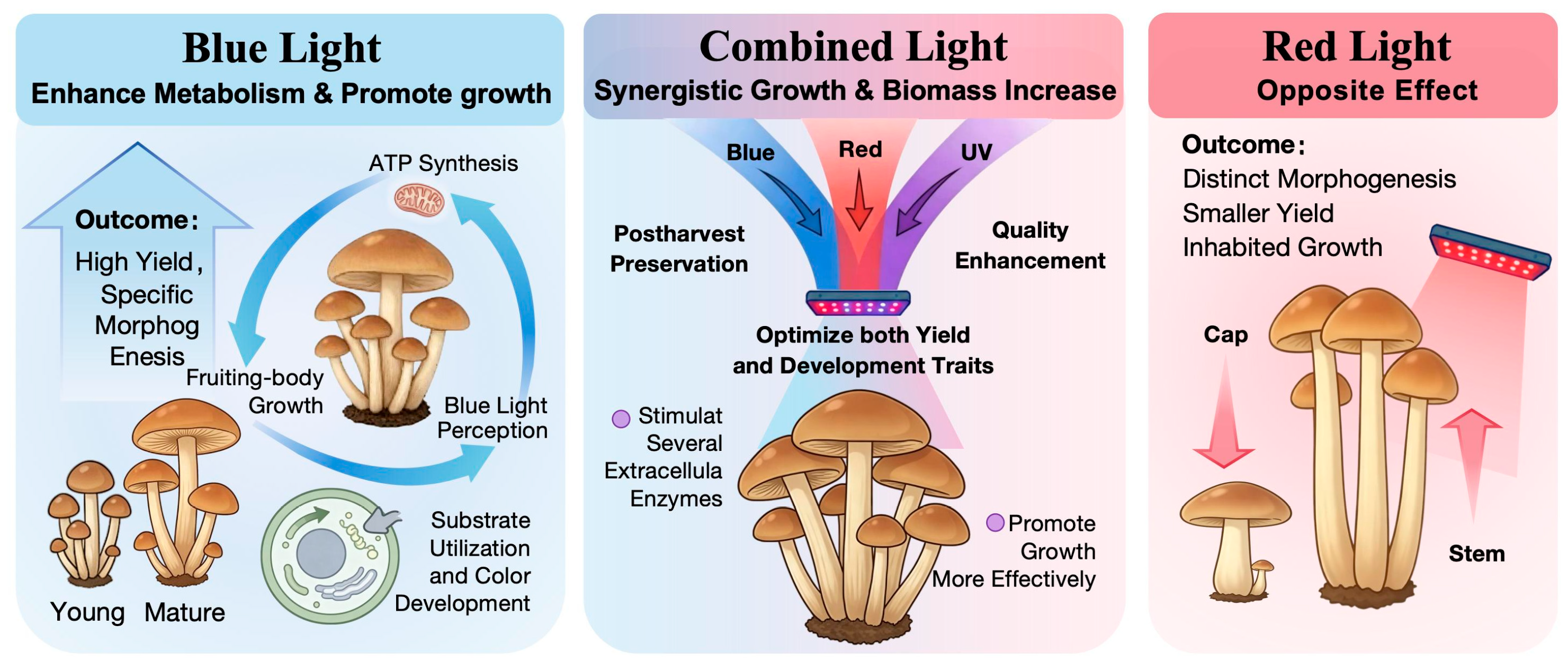
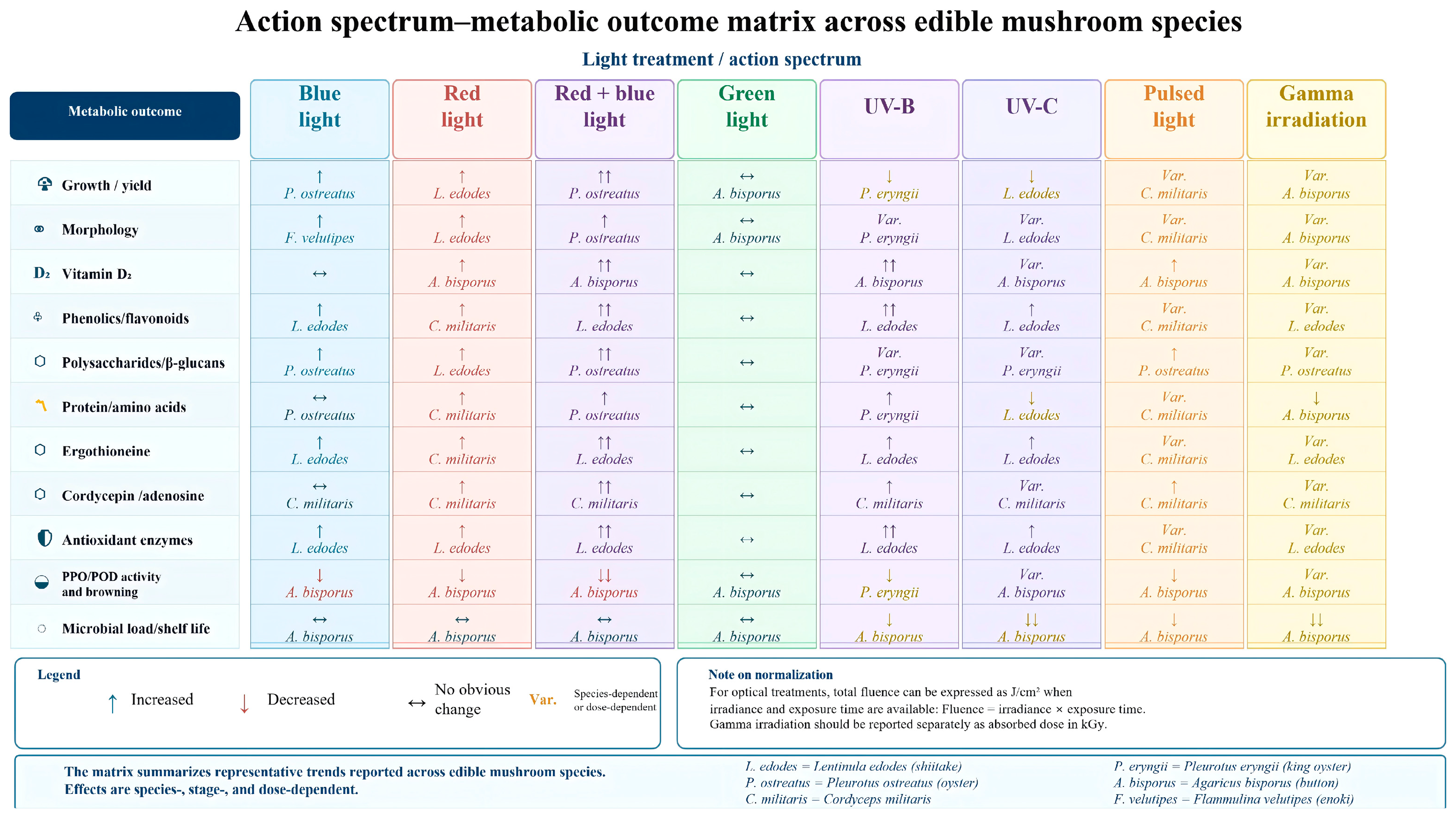
Effects of Different Radiation-Based Treatments on the Quality of Edible Mushrooms: A Systematic Review
 , and
, and
Abstract
1. Introduction
2. Materials and Methods
2.1. Study Identification
2.2. Study Selection Process
2.3. Eligibility Criteria
2.4. Data Extraction
2.5. Data Analysis
2.6. Risk-of-Bias Assessment
3. Results and Discussion: Mechanisms Underlying Radiation-Induced Quality Regulation in Edible Mushrooms
3.1. Common Types of Optical Radiation and Irradiation Treatments in Edible Mushrooms
3.2. Light Perception Systems in Edible Mushrooms
3.3. Radiation Signal Transduction and Cellular Response Mechanisms
3.3.1. Photoreceptor-Mediated Signal Transduction
3.3.2. Non-Specific Photochemical Reactions
3.3.3. Radiation-Induced Microbial Inactivation
3.4. Radiation Signal-Driven Metabolic Regulation Framework
4. Results and Discussion: Effects of Different Light Conditions on the Quality of Edible Mushrooms
4.1. Effects of Light Quality on the Growth, Development, and Appearance of Edible Mushrooms
4.2. Effects of Radiation-Based Treatments on the Nutritional Quality and Bioactive Compounds of Edible Mushrooms
4.2.1. Effects of Visible Light on the Nutritional Quality and Bioactive Compounds of Edible Mushrooms
4.2.2. Effects of UV Treatment on the Nutritional Quality and Bioactive Compounds of Edible Mushrooms
4.2.3. Effects of γ-Irradiation on the Nutritional Quality and Bioactive Compounds of Edible Mushrooms
4.2.4. Effects of Pulsed Light on the Nutritional Quality and Bioactive Compounds of Edible Mushrooms
4.2.5. Critical Discussion on the Comprehensive Table: Systematic Driving Mechanisms of Multidimensional Variables on Fungal Photoresponses

| Light/Irradiation type | Representative Species | Key Physiological Outcomes | Dose/Intensity | Normalized Total Fluence (J/cm2) (If Optical) | Main Advantages and Disadvantages | References |
|---|---|---|---|---|---|---|
| Blue light (mycelial stage) | Hericium erinaceus | Biomass +12.28%, anticancer activity ↑, DPPH scavenging ↑ | 10–40 µmol·m−2·s−1 PPFD, 12 h/d | ~11.5–46.0 (estimated from 450 nm) | LED precise control, enhances nutraceuticals; species-specific optimal PPFD, not studied on fruiting bodies | [88] |
| Blue light (mycelial + fruiting) | Ganoderma sichuanense | Polysaccharides 15.62%, triterpenoids 82.44 mg/g, antioxidant ↑ (optimal at 10 PPFD) | 1–20 PPFD, 12 h/d | ~1.15–23.0 (estimated from 450 nm) | first systematic LED optimization, clear optimal PPFD; red/green light inferior | [89] |
| Blue light (fruiting body) | Lentinus sajor-caju | Dry biomass +50%, DPPH, Fe2+ chelation, reducing power ↑ | 10–40 PPFD, 8–12 h/d | ~7.7–46.0 (estimated, depending on 8 or 12 h) | blue superior to white/red/green, clear PPFD response; >40 PPFD not beneficial | [60] |
| Blue light (fruiting body) | Lyophyllum ulmarium | Ergosterol ↑ (160 mg/100 g blue; 171 mg/100 g yellow) | intensity not given (12 h/d) | N/A | LED effective substitute for fluorescent; PPFD not reported, mechanism unclear | [59] |
| Blue + UV (fresh-cut) | Pleurotus eryngii | Vitamin D2 ↑, soluble protein +23.36%, sugar ↑, delays quality loss | blue PPFD not given, UV dose not given | N/A | dual function (fortification + preservation); individual contributions of blue vs. UV not separable | [90] |
| UV-B (low dose) | L. edodes, A. bisporus, P. ostreatus, P. eryngii | Total phenolics, flavonoids, ergothioneine ↑, antioxidant and antibacterial ↑ | 200–222 mJ/cm2, 23–25 s | 0.20–0.22 | short exposure effective, enhances nutraceuticals; optimal dose species-specific, high dose reduces ergothioneine | [63] |
| UV-B (high dose) | Same as above | Beneficial effects reduced or reversed, oxidative stress risk | 390–430 mJ/cm2, 23–25 s | 0.39–0.43 | exceeding optimal dose induces oxidative damage | [63] |
| UV-B (mycelia) | P. eryngii (submerged) | Vitamin D2 up to 314.75 µg/g DW, phenolics, β-glucan ↑ | ~8.64 kJ/m2, 40 min | 0.864 | extremely high vitamin D2 conversion, mycelial biomass as valuable source; long exposure (40 min), mechanism not fully elucidated | [64] |
| Gamma irradiation (low dose, preservation) | Volvariella volvacea | Reduces browning, weight loss, respiration; SOD ↑, delays senescence | 0.8 kGy (+sodium dehydroacetate) | N/A | combined treatment effective for shelf-life; chemical preservative not suitable for organic/natural labels | [91] |
| Gamma irradiation (low dose, nutrient preservation) | Agaricus bisporus | Vitamin D2, total phenolics and flavonoids maintained; shelf-life extended | 1.5–2.0 kGy (+essential oil fumigation) | N/A | maintains nutritional quality during storage; essential oil may affect flavor, consumer acceptance | [91] |
| Gamma irradiation (moderate dose, polysaccharide structure) | A. bisporus powder/Morchella sextelata polysaccharide | No significant change in phenolics/flavonoids/antioxidant activity (powder); Mw ↓, radical scavenging ↑ (isolated polysaccharide) | 2.5–5.0 kGy | N/A | low-moderate doses safe, retain functional components; higher doses may degrade polysaccharides | [92,93] |
| Pulsed light (low-moderate fluence, fresh-cut) | A. bisporus | Microbial shelf-life extended 2–3 d, vitamin D2 retained 64.2% | 4.8 J·cm−2 | 4.8 | fast, non-thermal, dual function (decontamination + vitamin D2 enrichment); ≥12 J·cm−2 causes thermal damage, browning, loss of phenolics/vitamin C | [16,84] |
| Pulsed light (whole mushroom storage) | A. bisporus | PPO/POD inactivation, browning delayed, polyphenols retained 90.6% | 1.11 J·cm−2 | 1.11 | applicable to whole mushrooms; enzyme inactivation incomplete, geometry affects efficacy | [84] |
| Pulsed light (drying pretreatment) | Lentinus edodes | PPO activity ↓ 42.8%, browning index ↓, polysaccharides and reducing sugars ↑ | 400 J/25 pulses (fluence not reported) | N/A | controls enzymatic browning; only as drying pretreatment, fluence (J·cm−2) not reported | [87] |
4.3. Patterns Governing Differential Effects of Radiation-Based Treatments
5. Conclusions
5.1. Industrial Applicability and Sustainability
5.2. Smart Lighting and Intelligent Mushroom Production
5.3. Regulatory Considerations and Consumer Acceptance
Supplementary Materials
Author Contributions
Funding
Data Availability Statement
Acknowledgments
Conflicts of Interest
Abbreviations
| PL | Pulsed light |
| UV | Ultraviolet |
| LED | Light emitting diode |
| PPO | Polyphenol oxidase |
| MDA | Malonaldehyde |
| IPL | Intense pulsed light |
| ROS | Reactive oxygen species |
| POD | Peroxidase |
| CAT | Catalase |
| SOD | Superoxide dismutase |
| SDH | Succinic acid dehydrogenase |
| GRN | Gene Regulatory Network |
| WC | White Collar |
| WCC | White Collar Complex |
| L. edodes | Lentinula edodes |
| P. ostreatus | Pleurotus ostreatus |
| C. militaris | Cordyceps militaris |
| P. eryngii | Pleurotus eryngii |
| A. bisporus | Agaricus bisporus |
Appendix A
| Light Type | Typical Wavelength | Dose/Intensity | Exposure Time | Targeted Species | Major Physiological Outcomes | Advantages | Disadvantages | References |
|---|---|---|---|---|---|---|---|---|
| Visible light (blue)—mycelial stage | 450–460 nm | 10–40 µmol·m−2·s−1 (PPFD) | 12 h/day (12/12 L/D) | Hericium erinaceus | Increases mycelial biomass (+12.28%), radial growth, substrate colonization; enhances anticancer activity (SW480 IC50 133.71 µg/mL; HepG2 IC50 114.84 µg/mL); improves DPPH scavenging. | LED integration; precise intensity control; enhances nutraceutical metabolites. | Optimal PPFD species-specific; effects not studied on fruiting bodies. | [88] |
| Visible light (blue)—mycelial and fruiting body | 450–460 nm | 1–20 µmol·m−2·s−1 (optimal 10) | 12 h/day | Ganoderma sichuanense (antler-type) | Blue light (10 µmol·m−2·s−1) gives highest yield, polysaccharides (15.62%), triterpenoids (82.44 mg/g), DPPH scavenging (31.46–42.96%), and total phenolics. Red light significantly lowers yield and bioactives. | First systematic LED optimization for this species; clear optimal PPFD identified. | Red and green light inferior to blue. | [89] |
| Visible light (blue)—fruiting body | 450–475 nm | 10–40 µmol·m−2·s−1 (PPFD) | 8–12 h/day | Lentinus sajor-caju | Blue light increases dry biomass (+50% vs. white light), DPPH scavenging, Fe2+ chelation, reducing power, and soluble sugars (peak at 40 PPFD). | Clear PPFD dose–response; blue superior to red/green/white. | Excess PPFD (>40) not beneficial. | [60] |
| Visible light (blue)—fruiting body | 450–475 nm (blue LED) | Not specified (intensity not given in PPFD) | 12 h/day | Lyophyllum ulmarium | Blue LED increases ergosterol (160.21 mg/100 g), higher than fluorescent control (143.58 mg/100 g). Yellow LED gave highest ergosterol (171.55 mg/100 g). | LED effective substitute for fluorescent lighting. | PPFD not reported; mechanism unclear. | [59] |
| Visible light (blue + UV combination)—fresh-cut storage | Blue LED (450–475 nm) + UV-C/UV-B | Blue PPFD not specified; UV dose not specified | Combined treatment | P. eryngii (fresh-cut) | Increases vitamin D2 (0.77 µg/100 g), soluble protein (+23.36%), reducing sugar (2.06× control at day 10); delays declines in flavonoids, total phenolics, and vitamin C; inhibits microbial growth; enhances ROS and secondary metabolism enzyme activities; delays cell wall and mitochondrial degradation. | Dual function: nutritional fortification + preservation. | Complex parameter optimization; individual contributions of blue vs. UV not separable. | [90] |
| UV-B—low dose | 280–315 nm | 200–222 mJ/cm2 | 23–25 s | L. edodes, A. bisporus, P. ostreatus, P. eryngii | Increases total phenolics, flavonoids, ergothioneine (peak at low dose, 0.21–2.6 mg/g DW), glutamate, antioxidant and antibacterial activities. L. edodes and P. ostreatus show strongest antioxidant response. | Short exposure (seconds) effective; enhances multiple nutraceuticals. | Optimal dose species-specific; high dose may reduce ergothioneine. | [63] |
| UV-B—high dose | 280–315 nm | 390–430 mJ/cm2 | 23–25 s | Same as above | Higher UV-B reduces or reverses beneficial effects; ergothioneine and antioxidant activity decline; risk of oxidative stress. | Useful for threshold determination. | Exceeding optimal dose induces oxidative damage. | [63] |
| UV-B—high dose (mycelia) | 280–315 nm | ~3.6 W/m2 × 40 min = ~8.64 kJ/m2 | 40 min | P. eryngii submerged mycelia | Vitamin D2 reaches 314.75 µg/g DW; total phenolics: 12.52 → 17.54 mg GAE/g; flavonoids: 1.19 → 1.72 mg QE/g; β-glucan: 26.18 → 32.21%; DPPH antioxidant activity ↑; essential amino acids (glutamate, arginine, threonine) ↑. | Extremely high vitamin D2 conversion (record level); mycelial biomass as a valuable source. | Long exposure (40 min); mechanism not fully elucidated. | [64] |
| UV-B—vitamin D2 quantification | 280–315 nm | Not specified (commercial treatment) | Not specified | A. bisporus (white button) | Fresh mushroom vitamin D2 = 21.5 ± 2.4 µg/100 g FW (42% in cap peel). Cooking loss 9–63%; 75–190 g cooked mushroom meets RDI (15 µg). | Consumer-relevant cooking data; highlights peel contribution. | No UV dose reported—not used for dose–response. | [105] |
| Gamma irradiation—low dose (preservation) | 60Co γ-rays | 0.8 kGy | Not specified | Volvariella volvacea | 0.8 kGy + sodium dehydroacetate (SD): reduces browning, weight loss (10.53–34.73%), respiration rate (17.20–48.72%), microbial load; increases CAT, SOD, POD (SOD +13.68–40.53%); maintains membrane integrity; delays senescence. | Combined treatment (γ + SD) effective for shelf-life extension. | Synergy with chemical preservative may not be suitable for organic/natural labels. | [91] |
| Gamma irradiation—low dose (nutrient preservation) | 60Co γ-rays | 1.5–2.0 kGy | Not specified | A. bisporus (white) | 2 kGy + essential oil fumigation: vitamin D2 preserved (106.30–114.40 mg/kg DW); total phenolics and flavonoids maintained; shelf-life extended 18 days at 4 °C. | Maintains nutritional quality during storage. | Essential oil may affect flavor; consumer acceptance. | [79] |
| Gamma irradiation—low dose (water properties) | 60Co γ-rays | 1.0 kGy | Not specified | L. edodes (shiitake) | Delays browning, stabilizes water status (bound water content), maintains firmness and microstructure during postharvest storage. | Improves texture and water-holding capacity. | Dose optimization needed for different cultivars. | [106] |
| Gamma irradiation—moderate dose (polysaccharide structure) | 60Co γ-rays | 2.5–5.0 kGy | Not specified | A. bisporus powder | 2.5–5 kGy: no significant change in total phenolics, flavonoids, or antioxidant activity (DPPH/FRAP). | Low doses safe for powder processing; retain functional components. | Higher doses may degrade polysaccharides. | [92] |
| Gamma irradiation—moderate dose (polysaccharide from M. sextelata) | 60Co γ-rays | 2.5–5.0 kGy | Not specified | Morchella sextelata (isolated polysaccharide) | Dose-dependent reduction in average molecular weight; increased surface porosity; enhanced radical scavenging; H2O2 protection of PC12 cells. | Improves bioactivity of polysaccharides via controlled degradation. | Not applicable to fresh mushroom preservation. | [93] |
| Gamma irradiation—high dose (preservation—Portobello) | 60Co γ-rays | 5 kGy | 1–2 h (dose rate ~4.5–32 kGy/h) | A. bisporus (Portobello) | 5 kGy: increases protein content; preserves sugars and ergosterol better than electron beam; reduces agaritine (1.54 → 1.35 g/kg DW). 10 kGy: no significant change in protein or polysaccharide. | High penetration; can treat packaged products; reduces agaritine. | High capital cost; may reduce unsaturated fatty acids; consumer acceptance issues. | [72] |
| Gamma irradiation—very high dose (polysaccharide degradation) | 60Co γ-rays | 10–1000 kGy | Hours | Morchella sextelata (isolated polysaccharide) | 100 kGy: significant reduction in Mw and particle size; increased surface porosity; thermal stability increases at 10–100 kGy then decreases at 1000 kGy; antioxidant activity increases with dose at low polysaccharide concentration (50–100 µg/mL). | Enhances bioactivity of isolated polysaccharides. | Not for fresh produce; extremely high doses. | [93] |
| Pulsed light (PL)—low to moderate fluence (fresh-cut preservation) | Broad spectrum + UV (xenon) | 4.8 J·cm−2 (optimal) | Microsecond pulses | A. bisporus (fresh-cut) | 4.8 J·cm−2 optimal: extends microbial shelf life 2–3 days, minimal texture change, preserves color, phenolics, and vitamin D2 (retains 64.2% after 5 d at 4 °C). Lower doses (0.13–1.11 J·cm−2) inactivate PPO/POD (first-order kinetics, kPPO = 3.84 cm2/J). | Fast, non-thermal; dual function (decontamination + vitamin D2 enrichment). | High fluence (≥12 J·cm−2) causes thermal damage, PPO activation, browning, loss of phenolics/vitamin C. | [16,84] |
| Pulsed light (PL)—whole mushroom storage | Broad spectrum + UV (xenon) | 1.11 J·cm−2 | Microsecond pulses | A. bisporus (whole) | 1.11 J·cm−2: PPO/POD inactivation, browning delayed, polyphenols retained, vitamin D2 increased. After 5 d at 4 °C: 90.6% polyphenols, 78.9% antioxidant activity, 64.2% vitamin D2 retained. | Applicable to whole mushrooms (not just sliced). | Enzyme inactivation incomplete at 1.11 J·cm−2; whole mushroom geometry affects efficacy. | [84] |
| Pulsed light (PL)—C. militaris | Broad spectrum + UV (xenon) | Not reported (only pulse number: 3,6,9) | Microsecond pulses | C. militaris | Increases vitamin D2; total amino acids +9–48%; preserves umami and antioxidant components. | Fast treatment, improves nutritional quality. | No dose/fluence reported —parameter comparability limited. | [57] |
| Pulsed light (IPL)—drying pretreatment | Broad spectrum + UV (xenon) | 400 J total energy (25 pulses); fluence not reported | Microsecond pulses | L. edodes (dried) | 25-pulse IPL pretreatment: reduces initial PPO activity by 42.83%, browning index ↓ 43.02%, browning degree ↓ 47.54%; increases polysaccharides, reducing sugars, antioxidant activity; reduces 5-HMF; preserves umami during subsequent hot-air drying. | Effective for dried mushroom processing; controls enzymatic browning. | Only as drying pretreatment; fluence (J·cm−2) not reported—poor comparability. | [87] |
| Pulsed light (IPL)—mechanism on PPO | Broad spectrum + UV (xenon) | Not reported (same 400 J/25 pulses likely) | Microsecond pulses | Mushroom polyphenol oxidase (PPO) | IPL changes PPO secondary structure (FTIR), alters physico-chemical properties and surface topography, leading to irreversible enzyme inactivation. | Mechanistic insight into IPL-induced enzyme inactivation. | No fluence reported; pure enzyme study, not whole mushroom. | [107] |
References
- Imarc. Mushroom Market Size, Share, Trends and Forecast by Mushroom Type, Form, Distribution Channel, End-Use, and Region, 2026–2034. Available online: https://www.giiresearch.com/report/imarc1941729-mushroom-market-size-share-trends-forecast-by.html (accessed on 6 May 2026).
- China Edible Fungi Association. China Edible Fungi Public Service Platform. Available online: https://bigdata.cefa.org.cn/ (accessed on 6 May 2026).
- Dawadi, E.; Magar, P.B.; Bhandari, S.; Subedi, S.; Shrestha, S.; Shrestha, J. Nutritional and post-harvest quality preservation of mushrooms: A review. Heliyon 2022, 8, e12093. [Google Scholar] [CrossRef] [Scilit] [PubMed]
- Feng, Y.; Xu, H.; Sun, Y.; Xia, R.; Hou, Z.; Li, Y.; Wang, Y.; Pan, S.; Li, L.; Zhao, C.; et al. Effect of light on quality of preharvest and postharvest edible mushrooms and its action mechanism: A review. Trends Food Sci. Technol. 2023, 139, 104119. [Google Scholar] [CrossRef] [Scilit]
- Li, Y.; Ding, S.; Xiang, T.; Kitazawa, H.; Sun, H.; Guo, Y. Effects of light irradiation on the textural properties and energy metabolism of postharvest shiitake mushrooms (Lentinula edodes). J. Food Process. Preserv. 2021, 45, e16066. [Google Scholar] [CrossRef] [Scilit]
- Zhu, C.; Thomas, H.R.; Kang, H.; Xia, X.; Zhou, Y. Light regulation of shoot architecture in horticultural crops. Hortic. Plant J. 2025, 11, 1727–1743. [Google Scholar] [CrossRef] [Scilit]
- Zhu, K.; Guo, Q.; Chen, Y.; Bu, X.; Yan, J.; Zhang, Y.; Wang, X.; Sun, X.; Zhang, X.; Ahammed, G.J.; et al. Behind the scenes: The roles of radiation signaling in stomatal movements. Hortic. Plant J. 2025, 11, 1711–1726. [Google Scholar] [CrossRef] [Scilit]
- Yu, Z.; Fischer, R. Light sensing and responses in fungi. Nat. Rev. Microbiol. 2019, 17, 25–36. [Google Scholar] [CrossRef] [Scilit] [PubMed]
- Vonk, P.J.; van der Poel, M.J.P.; Niemeijer, Z.E.; Ohm, R.A. The regulatory network of the White Collar complex during early mushroom development in Schizophyllum commune. Microbiol. Res. 2024, 284, 127736. [Google Scholar] [CrossRef] [Scilit] [PubMed]
- Sakamoto, Y. Influences of environmental factors on fruiting body induction, development and maturation in mushroom-forming fungi. Fungal Biol. Rev. 2018, 32, 236–248. [Google Scholar] [CrossRef] [Scilit]
- Taofiq, O.; Fernandes, Â.; Barros, L.; Barreiro, M.F.; Ferreira, I.C.F.R. UV-irradiated mushrooms as a source of vitamin D2: A review. Trends Food Sci. Technol. 2017, 70, 82–94. [Google Scholar] [CrossRef] [Scilit]
- Rondanelli, M.; Moroni, A.; Zese, M.; Gasparri, C.; Riva, A.; Petrangolini, G.; Perna, S.; Mazzola, G. Vitamin D from UV-Irradiated Mushrooms as a Way for Vitamin D Supplementation: A Systematic Review on Classic and Nonclassic Effects in Human and Animal Models. Antioxidants 2023, 12, 736. [Google Scholar] [CrossRef] [Scilit] [PubMed]
- Jiang, Q.; Zhang, M.; Mujumdar, A.S. UV induced conversion during drying of ergosterol to vitamin D in various mushrooms: Effect of different drying conditions. Trends Food Sci. Technol. 2020, 105, 200–210. [Google Scholar] [CrossRef] [Scilit] [PubMed]
- Tiwari, A.; Singh, G.; Sharma, V.; Srivastava, R.K.; Sharma, S. Harnessing the potential of UVB irradiation for improving the nutraceutical properties of edible xylotrophic mushroom dried powder. LWT—Food Sci. Technol. 2021, 150, 111913. [Google Scholar] [CrossRef] [Scilit]
- Fernandes, Â.; Barreira, J.C.M.; Antonio, A.L.; Oliveira, M.B.P.P.; Martins, A.; Ferreira, I.C.F.R. Extended use of gamma irradiation in wild mushrooms conservation: Validation of 2 kGy dose to preserve their chemical characteristics. LWT—Food Sci. Technol. 2016, 67, 99–105. [Google Scholar] [CrossRef] [Scilit]
- Oms-Oliu, G.; Aguiló-Aguayo, I.; Martín-Belloso, O.; Soliva-Fortuny, R. Effects of pulsed light treatments on quality and antioxidant properties of fresh-cut mushrooms (Agaricus bisporus). Postharvest Biol. Technol. 2010, 56, 216–222. [Google Scholar] [CrossRef] [Scilit]
- Wang, H.; Tong, X.; Tian, F.; Jia, C.; Li, C.; Li, Y. Transcriptomic profiling sheds light on the blue-light and red-light response of oyster mushroom (Pleurotus ostreatus). AMB Express 2020, 10, 10. [Google Scholar] [CrossRef] [Scilit] [PubMed]
- Page, M.J.; McKenzie, J.E.; Bossuyt, P.M.; Boutron, I.; Hoffmann, T.C.; Mulrow, C.D.; Shamseer, L.; Tetzlaff, J.M.; Akl, E.A.; Brennan, S.E.; et al. The PRISMA 2020 statement: An updated guideline for reporting systematic reviews. Bmj 2021, 372, n71. [Google Scholar] [CrossRef] [Scilit] [PubMed]
- Sowa, P.; Rutkowska-Talipska, J.; Sulkowska, U.; Rutkowski, K.; Rutkowski, R. Ionizing and non-ionizing electromagnetic radiation in modern medicine. Pol. Ann. Med. 2012, 19, 134–138. [Google Scholar] [CrossRef] [Scilit]
- Xu, Y.; Huang, X.M.; Wang, Z.X.; Zhao, Y.J.; Lv, D.M.; Xu, J.W. Blue Light Receptor WC-2 Regulates Ganoderic Acid Biosynthesis in Ganoderma lingzhi. J. Fungi. 2025, 11, 646. [Google Scholar] [CrossRef] [Scilit] [PubMed]
- Xu, C.; Luo, X.; Zhang, H.; Qiu, Z.; Li, X.; Cai, J.; Lai, Y.; Li, H.; Tao, Y. Identification and expression pattern of photoreceptor cryptochrome Ffcry gene in Flammulina filiformis. J. Mycosystema 2022, 41, 962–970. [Google Scholar] [CrossRef]
- Blumenstein, A.; Vienken, K.; Tasler, R.; Purschwitz, J.; Veith, D.; Frankenberg-Dinkel, N.; Fischer, R. The Aspergillus nidulans Phytochrome FphA Represses Sexual Development in Red Light. Curr. Biol. 2005, 15, 1833–1838. [Google Scholar] [CrossRef] [Scilit] [PubMed]
- Chen, X.L.; Liu, Y.H.; Guo, W.Z.; Wang, M.F.; Zhao, J.X.; Zhang, X.; Zheng, W.A. The development and nutritional quality of Lyophyllum decastes affected by monochromatic or mixed light provided by light-emitting diode. Front. Nutr. 2024, 11, 1404138. [Google Scholar] [CrossRef] [Scilit] [PubMed]
- Wu, C.-Y.; Liang, C.-H.; Liang, Z.-C. Enhanced production of fruiting bodies and bioactive compounds of Cordyceps militaris with grain substrates and cultivation patterns. J. Taiwan Inst. Chem. Eng. 2022, 132, 104138. [Google Scholar] [CrossRef] [Scilit]
- Ha, S.; Jung, J.; Yang, J.-K. Effect of Light-Emitting Diodes on Cordycepin Production in Submerged Culture of Paecilomyces japonica. J. Korean Wood Sci. Technol. 2020, 48, 548–561. [Google Scholar] [CrossRef] [Scilit]
- Yang, T.; Guo, M.; Yang, H.; Guo, S.; Dong, C. The blue-light receptor CmWC-1 mediates fruit body development and secondary metabolism in Cordyceps militaris. Appl. Microbiol. Biotechnol. 2016, 100, 743–755. [Google Scholar] [CrossRef] [Scilit] [PubMed]
- Kim, D.Y.; Jang, M.-J.; Park, Y.-J.; Kim, J.Y. Transcriptome Analysis Identified Candidate Genes Involved in Fruit Body Development under Blue Light in Lentinula edodes. Appl. Sci. 2021, 11, 6997. [Google Scholar] [CrossRef] [Scilit]
- In-on, A.; Thananusak, R.; Ruengjitchatchawalya, M.; Vongsangnak, W.; Laomettachit, T. Construction of Light-Responsive Gene Regulatory Network for Growth, Development and Secondary Metabolite Production in Cordyceps militaris. Biology 2022, 11, 71. [Google Scholar] [CrossRef] [Scilit] [PubMed]
- De Bonis, M.; Locatelli, S.; Sambo, P.; Zanin, G.; Pecchia, J.A.; Nicoletto, C. Effect of Different LED Light Wavelengths on Production and Quality of Pleurotus ostreatus Grown on Different Commercial Substrates. Horticulturae 2024, 10, 11477. [Google Scholar] [CrossRef] [Scilit]
- Deng, Y.; Yang, T.; Wang, H.; Yang, C.; Cheng, L.; Yin, S.F.; Kambe, N.; Qiu, R. Recent Progress on Photocatalytic Synthesis of Ester Derivatives and Reaction Mechanisms. Top. Curr. Chem. 2021, 379, 42. [Google Scholar] [CrossRef] [Scilit] [PubMed]
- Apel, K.; Hirt, H. REACTIVE OXYGEN SPECIES: Metabolism, Oxidative Stress, and Signal Transduction. Annu. Rev. Plant Biol. 2004, 55, 373–399. [Google Scholar] [CrossRef] [Scilit] [PubMed]
- Gill, S.S.; Tuteja, N. Reactive oxygen species and antioxidant machinery in abiotic stress tolerance in crop plants. Plant Physiol. Biochem. 2010, 48, 909–930. [Google Scholar] [CrossRef] [Scilit] [PubMed]
- Yaakoub, H.; Mina, S.; Calenda, A.; Bouchara, J.P.; Papon, N. Oxidative stress response pathways in fungi. Cell Mol. Life Sci. 2022, 79, 333. [Google Scholar] [CrossRef] [Scilit] [PubMed]
- Ai, Z.; Zhang, B.; Chen, Y.; Yu, Z.; Chen, H.; Ni, D. Impact of light irradiation on black tea quality during withering. J. Food Sci. Technol. 2017, 54, 1212–1227. [Google Scholar] [CrossRef] [Scilit] [PubMed]
- Fang, D.; Wang, H.; Deng, Z.; Kimatu, B.M.; Pei, F.; Hu, Q.; Ma, N. Nanocomposite packaging regulates energy metabolism of mushrooms (Flammulina filiformis) during cold storage: A study on mitochondrial proteomics. Postharvest Biol. Technol. 2022, 193, 112046. [Google Scholar] [CrossRef] [Scilit]
- Webster, J.B.; Duncan, S.E.; Marcy, J.E.; O’Keefe, S.F. Controlling light oxidation flavor in milk by blocking riboflavin excitation wavelengths by interference. J. Food Sci. 2009, 74, S390–S398. [Google Scholar] [CrossRef] [Scilit] [PubMed]
- Tang, J.; Shen, H.; Lv, W.; Zhang, J.; Fu, J. Edible Fungi Melanin: Recent Advances in Extraction, Characterization, Biological Activity and Applications. J. Fungi. 2025, 11, 738. [Google Scholar] [CrossRef] [Scilit]
- Mshelia, R.D.; Dibal, N.I.; Chiroma, S.M. Food irradiation: An effective but under-utilized technique for food preservations. J. Food Sci. Technol. 2023, 60, 2517–2525. [Google Scholar] [CrossRef] [Scilit] [PubMed]
- Fernandes, Â.; Antonio, A.L.; Barreira, J.C.M.; Oliveira, M.B.P.P.; Martins, A.; Ferreira, I.C.F.R. Effects of gamma irradiation on physical parameters of Lactarius deliciosus wild edible mushrooms. Postharvest Biol. Technol. 2012, 74, 79–84. [Google Scholar] [CrossRef] [Scilit]
- Bhatnagar, P.; Gururani, P.; Bisht, B.; Kumar, V.; Kumar, N.; Joshi, R.; Vlaskin, M.S. Impact of irradiation on physico-chemical and nutritional properties of fruits and vegetables: A mini review. Heliyon 2022, 8, e10918. [Google Scholar] [CrossRef] [Scilit] [PubMed]
- Ramos-Villarroel, A.Y.; Martín-Belloso, O.; Soliva-Fortuny, R. Pulsos de luz intensa: Inactivación microbiana en frutas y hortalizas. CyTA-J. Food 2013, 11, 234–242. [Google Scholar] [CrossRef] [Scilit]
- Mukhopadhyay, S.; Ukuku, D.O.; Olanya, O.M.; Sokorai, K.; Fan, X. Effects of pulsed light and aerosolized formic acid treatments on inactivation of Salmonella enterica on cherry tomato, reduction of microbial loads, and preservation of fruit quality. Food Control 2022, 136, 108667. [Google Scholar] [CrossRef] [Scilit]
- Thilini Deepashika Perera, W.P.; Navaratne, S.; Wickramasinghe, I. Impact of spectral composition of light from light-emitting diodes (LEDs) on postharvest quality of vegetables: A review. Postharvest Biol. Technol. 2022, 191, 111955. [Google Scholar] [CrossRef] [Scilit]
- Ghate, V.S.; Zhou, W.; Yuk, H.G. Perspectives and Trends in the Application of Photodynamic Inactivation for Microbiological Food Safety. Compr. Rev. Food Sci. Food Saf. 2019, 18, 402–424. [Google Scholar] [CrossRef] [Scilit] [PubMed]
- Lamikanra, O.; Richard, O.A.; Parker, A. Ultraviolet induced stress response in fresh cut cantaloupe. Phytochemistry 2002, 60, 27–32. [Google Scholar] [CrossRef] [Scilit] [PubMed]
- Corrochano, L.M. Fungal photobiology: A synopsis. IMA Fungus 2011, 2, 25–28. [Google Scholar] [CrossRef] [Scilit] [PubMed]
- Kim, M.J.; Jeong, Y.; Park, M.J.; Jang, Y.; Ka, K.H. Effects of Blue Light on Fruiting Body Production and Ergothioneine Content During Sawdust Cultivation of Shiitake (Lentinula edodes). Mycobiology 2024, 52, 439–445. [Google Scholar] [CrossRef] [Scilit] [PubMed]
- Chen, X.; Liu, Y.; Guo, W.; Wei, X.; Wang, M.; Zhang, X.; Zheng, W. The effects of different light qualities on the growth and nutritional components of Pleurotus citrinopileatus. Front. Nutr. 2025, 12, 1554575. [Google Scholar] [CrossRef] [Scilit] [PubMed]
- Cetin, M.; Atila, F.; Sen, F.; Yemen, S. The effect of different LED wavelengths used in the cultivation of Pleurotus ostreatus on quality parameters of the mushroom during the storage process. Sci. Hortic. 2024, 336, 113422. [Google Scholar] [CrossRef] [Scilit]
- Wu, C.Y.; Liang, C.H.; Liang, Z.C. Effect of LED light on the production of fruiting bodies and nucleoside compounds of Cordyceps militaris at different growth stages of solid-state fermentation. J. Taiwan Inst. Chem. Eng. 2023, 153, 105190. [Google Scholar] [CrossRef] [Scilit]
- Fernandes, Â.; Antonio, A.L.; Oliveira, M.B.P.P.; Martins, A.; Ferreira, I.C.F.R. Effect of gamma and electron beam irradiation on the physico-chemical and nutritional properties of mushrooms: A review. Food Chem. 2012, 135, 641–650. [Google Scholar] [CrossRef] [Scilit] [PubMed]
- Ben, A.E.; Orsat, V. UV-Induced Nutritional Transformation of Mushrooms: From Molecular Shifts to Health Outcomes. Food Res. Int. 2026, 228, 118235. [Google Scholar] [CrossRef] [Scilit] [PubMed]
- Liu, Y.H.; Guo, Y.; Zheng, W.G.; Zhang, X.; Guo, W.Z.; Wang, M.F.; Chen, X.L. Effects of Different Light Qualities on Spectral Characteristics and Mineral Elements of the Pholiota Adiposa. Spectrosc. Spectr. Anal. 2024, 44, 2326–2333. [Google Scholar]
- Dong, J.Z.; Lei, C.; Zheng, X.J.; Ai, X.R.; Wang, Y.; Wang, Q. Light Wavelengths Regulate Growth and Active Components of Cordyceps militaris Fruit Bodies. J. Food Biochem. 2013, 37, 578–584. [Google Scholar] [CrossRef] [Scilit]
- Chiang, S.-S.; Liang, Z.-C.; Wang, Y.-C.; Liang, C.-H. Effect of light-emitting diodes on the production of cordycepin, mannitol and adenosine in solid-state fermented rice by Cordyceps militaris. J. Food Compos. Anal. 2017, 60, 51–56. [Google Scholar] [CrossRef] [Scilit]
- Huang, S.J.; Huang, F.K.; Purwidyantri, A.; Rahmandita, A.; Tsai, S.Y. Effect of Pulsed Light Irradiation on Bioactive, Nonvolatile Components and Antioxidant Properties of Caterpillar Medicinal Mushroom Cordyceps militaris (Ascomycetes). Int. J. Med. Mushrooms 2017, 19, 547–560. [Google Scholar] [CrossRef] [Scilit] [PubMed]
- Halabura, M.I.W.; Avelino, K.V.; Araújo, N.L.; Kassem, A.S.S.; Seixas, F.A.V.; Barros, L.; Fernandes, A.; Liberal, A.; Ivanov, M.; Sokovic, M.; et al. Light conditions affect the growth, chemical composition, antioxidant and antimicrobial activities of the white-rot fungus Lentinus crinitus mycelial biomass. Photochem. Photobiol. Sci. 2023, 22, 669–686. [Google Scholar] [CrossRef] [Scilit] [PubMed]
- Feng, Y.; Xu, H.R.; Fan, Y.M.; Ma, F.M.; Du, B.; Li, Y.T.; Xia, R.R.; Hou, Z.S.; Xin, G. Effects of different monochromatic lights on umami and aroma of dried Suillus granulatus. Food Chem. 2023, 404, 134524. [Google Scholar] [CrossRef] [Scilit] [PubMed]
- Kim, S.-Y.; Son, J.; Lo, Y.M.; Lee, C.; Moon, B. Effects of Light-Emitting Diode (LED) Lighting on the Ergosterol Content of Beech Mushrooms (Lyophyllum ulmarium). J. Food Process. Preserv. 2014, 38, 1926–1931. [Google Scholar] [CrossRef] [Scilit]
- Huang, M.-Y.; Lin, K.-H.; Lu, C.-C.; Chen, L.-R.; Hsiung, T.-C.; Chang, W.-T. The intensity of blue light-emitting diodes influences the antioxidant properties and sugar content of oyster mushrooms (Lentinus sajor-caju). Sci. Hortic. 2017, 218, 8–13. [Google Scholar] [CrossRef] [Scilit]
- Szabó, A.; Gyepes, A.; Nagy, Á.; Abrankó, L.; Győrfi, J. The effect of UVB radiation on the vitamin D 2 content of white and cream type button mushrooms (Agaricus bisporus LANGE/IMBACH) and oyster mushroom (Pleurotus ostreatus (JACQ.) P. KUMM). Acta Aliment. 2012, 41, 187–196. [Google Scholar] [CrossRef] [Scilit]
- Tidke, S.; Pooja, B.; Manjula, B.V.; Singh, R.; Shora, R.; Arush, H.A.; Sinosh, S.; Geethanath, S.; Kiran, S.; Ravishankar, G.A. Enhancement of nutraceutical components of mushroom by uv exposure and extension of their shelf-life using edible coating material adopting online assessment of keeping quality by Magnetic Resonance Imaging (MRI) technique. Appl. Chem. Eng. 2024, 7, 1. [Google Scholar] [CrossRef] [Scilit]
- Bakır, T.; Ertürk, Ö.; Karadeniz, M.; Ünal, S.; Sanci, R. Change of Total Phenolic Substance, Total Flavonoid Substance, Ergothioneine Concentration, Antioxidant and Antibacterial Properties in Edible Mushrooms Under The Influence of UV-B Radiation. Kastamonu Univ. J. For. Fac. 2025, 25, 53–68. [Google Scholar] [CrossRef] [Scilit]
- Singh, U.; Kant, R.; Jain, A.K.; Sharma, S. Stimulatory effects of Ultraviolet-B irradiation on bioactives, phenolics, beta-glucans, vitamin D2 and antioxidant activities in submerged fermented Pleurotus eryngii mycelia. Food Biosci. 2025, 71, 107148. [Google Scholar] [CrossRef] [Scilit]
- Jiang, T.; Jahangir, M.M.; Jiang, Z.; Lu, X.; Ying, T. Influence of UV-C treatment on antioxidant capacity, antioxidant enzyme activity and texture of postharvest shiitake (Lentinus edodes) mushrooms during storage. Postharvest Biol. Technol. 2010, 56, 209–215. [Google Scholar] [CrossRef] [Scilit]
- Wu, X.; Guan, W.; Yan, R.; Lei, J.; Xu, L.; Wang, Z. Effects of UV-C on antioxidant activity, total phenolics and main phenolic compounds of the melanin biosynthesis pathway in different tissues of button mushroom. Postharvest Biol. Technol. 2016, 118, 51–58. [Google Scholar] [CrossRef] [Scilit]
- Guan, W.; Zhang, J.; Yan, R.; Shao, S.; Zhou, T.; Lei, J.; Wang, Z. Effects of UV-C treatment and cold storage on ergosterol and vitamin D2 contents in different parts of white and brown mushroom (Agaricus bisporus). Food Chem. 2016, 210, 129–134. [Google Scholar] [CrossRef] [Scilit] [PubMed]
- Wang, Q.; Chu, L.; Kou, L. UV-C Treatment maintains quality and delays senescence of oyster mushroom (Pleurotus ostreatus). Sci. Hortic. 2017, 225, 380–385. [Google Scholar] [CrossRef] [Scilit]
- Xu, Z.; Meenu, M.; Xu, B. Effects of UV-C treatment and ultrafine-grinding on the biotransformation of ergosterol to vitamin D2, physiochemical properties, and antioxidant properties of shiitake and Jew’s ear. Food Chem. 2020, 309, 125738. [Google Scholar] [CrossRef] [Scilit] [PubMed]
- Singh, U.; Kant, R. Unravelling the potential of UVB irradiation in augmenting the nutraceutical qualities of submerged fermented Calocybe indica. Biocatal. Agric. Biotechnol. 2026, 71, 104005. [Google Scholar] [CrossRef] [Scilit]
- Rathore, H.; Prasad, S.; Sehwag, S.; Sharma, S. Vitamin D2 fortification of Calocybe indica mushroom by natural and artificial UVB radiations and their potential effects on nutraceutical properties. 3 Biotech 2020, 10, 41. [Google Scholar] [CrossRef] [Scilit] [PubMed]
- Cardoso, R.V.C.; Fernandes, Â.; Barreira, J.C.M.; Verde, S.C.; Antonio, A.L.; Gonzaléz-Paramás, A.M.; Barros, L.; Ferreira, I.C.F.R. Effectiveness of gamma and electron beam irradiation as preserving technologies of fresh Agaricus bisporus Portobello: A comparative study. Food Chem. 2019, 278, 760–766. [Google Scholar] [CrossRef] [Scilit] [PubMed]
- Fernandes, Â.; Barreira, J.C.M.; Antonio, A.L.; Oliveira, M.B.P.P.; Martins, A.; Ferreira, I.C.F.R. Effects of gamma irradiation on chemical composition and antioxidant potential of processed samples of the wild mushroom Macrolepiota procera. Food Chem. 2014, 149, 91–98. [Google Scholar] [CrossRef] [Scilit] [PubMed]
- Shi, D.; Yin, C.; Fan, X.; Yao, F.; Qiao, Y.; Xue, S.; Lu, Q.; Feng, C.; Meng, J.; Gao, H. Effects of ultrasound and gamma irradiation on quality maintenance of fresh Lentinula edodes during cold storage. Food Chem. 2022, 373, 131478. [Google Scholar] [CrossRef] [Scilit] [PubMed]
- Khan, A.A.; Gani, A.; Shah, A.; Masoodi, F.A.; Hussain, P.R.; Wani, I.A.; Khanday, F.A. Effect of γ-irradiation on structural, functional and antioxidant properties of β-glucan extracted from button mushroom (Agaricus bisporus). Innov. Food Sci. Emerg. Technol. 2015, 31, 123–130. [Google Scholar] [CrossRef] [Scilit]
- Beaulieu, M.; D’Aprano, G.; Lacroix, M. Effect of dose rate of gamma irradiation on biochemical quality and browning of mushrooms Agaricus bisporus. Radiat. Phys. Chem. 2002, 63, 311–315. [Google Scholar] [CrossRef] [Scilit]
- Benoît, M.A.; D’Aprano, G.; Lacroix, M. Effect of gamma-irradiation on phenylalanine ammonia-lyase activity, total phenolic content, and respiration of mushrooms (Agaricus bisporus). J. Agric. Food Chem. 2000, 48, 6312–6316. [Google Scholar] [CrossRef] [Scilit] [PubMed]
- Pelcaru, C.F.; Ene, M.; Petrache, A.-M.; Neguț, D.C. Low Doses of Gamma Irradiation Stimulate Synthesis of Bioactive Compounds with Antioxidant Activity in Fomes fomentarius Living Mycelium. Appl. Sci. 2021, 11, 4236. [Google Scholar] [CrossRef] [Scilit]
- Aly, A.A.; Mohammed, M.K.; Maraei, R.W.; Abdalla, A.E.; Abouel-Yazeed, A.M. Improving the nutritional quality and bio-ingredients of stored white mushrooms using gamma irradiation and essential oils fumigation. Radiochim. Acta 2023, 111, 387–399. [Google Scholar] [CrossRef] [Scilit]
- Fernandes, Â.; Barreira, J.C.M.; Günaydi, T.; Alkan, H.; Antonio, A.L.; Oliveira, M.B.P.P.; Martins, A.; Ferreira, I.C.F.R. Effect of gamma irradiation and extended storage on selected chemical constituents and antioxidant activities of sliced mushroom. Food Control 2017, 72, 328–337. [Google Scholar] [CrossRef] [Scilit]
- Fernandes, Â.; Barreira, J.C.M.; Antonio, A.L.; Santos, P.M.P.; Martins, A.; Oliveira, M.B.P.P.; Ferreira, I.C.F.R. Study of chemical changes and antioxidant activity variation induced by gamma-irradiation on wild mushrooms: Comparative study through principal component analysis. Food Res. Int. 2013, 54, 18–25. [Google Scholar] [CrossRef] [Scilit]
- Kalaras, M.D.; Beelman, R.B.; Holick, M.F.; Elias, R.J. Generation of potentially bioactive ergosterol-derived products following pulsed ultraviolet light exposure of mushrooms (Agaricus bisporus). Food Chem. 2012, 135, 396–401. [Google Scholar] [CrossRef] [Scilit] [PubMed]
- Jung, E.-B.; Choi, H.-J.; Lee, J.-Y.; Hwang, H.-J.; Chung, M.-S. Comparison between intense pulsed light and continuous ultraviolet treatment processes for enhancing the vitamin D2 content of shiitake mushroom (Lentinula edodes) powder. Food Chem. 2025, 468, 142434. [Google Scholar] [CrossRef] [Scilit] [PubMed]
- Dhawan, A.; Chakraborty, S. Impact of pulsed light treatment on enzyme inactivation and quality attributes of whole white button mushroom (Agaricus bisporus) and its storage study. Food Chem. 2025, 463, 141412. [Google Scholar] [CrossRef] [Scilit] [PubMed]
- Chien, R.-C.; Yang, S.-C.; Lin, L.-M.; Mau, J.-L. Anti-Inflammatory and Antioxidant Properties of Pulsed Light Irradiated Lentinula edodes. J. Food Process. Preserv. 2017, 41, e13045. [Google Scholar] [CrossRef] [Scilit]
- Cardwell, G.; Bornman, J.F.; James, A.P.; Daly, A.; Dunlop, E.; Dabos, G.; Adorno, P.; Black, L.J. The Retention of Vitamin D2 and 25-Hydroxyvitamin D2 in Pulse UV-Irradiated Dried Button Mushrooms (Agaricus bisporus) after 12 Months of Storage. Foods 2023, 12, 1429. [Google Scholar] [CrossRef] [Scilit] [PubMed]
- Zhang, J.; Yagoub, A.E.A.; Sun, Y.; Mujumdar, A.S.; Ma, H.; Wahia, H.; Zhou, C. Intensive pulsed light pretreatment combined with controlled temperature and humidity for convection drying to reduce browning and improve quality of dried shiitake mushrooms. J. Sci. Food Agric. 2021, 101, 5608–5617. [Google Scholar] [CrossRef] [Scilit] [PubMed]
- Chutimanukul, P.; Sukdee, S.; Phetkaew, P.; Thepsilvisut, O.; Prajuabjinda, O. LED light spectra influence the stimulation of mycelial growth and anticancer activity in Hericium erinaceus mycelium. Front. Fungal Biol. 2025, 6, 1684852. [Google Scholar] [CrossRef] [Scilit] [PubMed]
- Apiwatanapiwat, W.; Janchai, P.; Vaithanomsat, P.; Boondaeng, A.; Meelaksana, J.; Trakunjae, C.; Nimitkeatkai, H.; Jarerat, A. Stimulation of growth, polysaccharides, and triterpenoids formation in antler-type fruiting body of Ganoderma sichuanense using light-emitting diodes. Discov. Food 2026, 6, 65. [Google Scholar] [CrossRef] [Scilit]
- Zhu, K.; Wu, W.J.; Fang, X.J.; Chen, H.J.; Liu, R.L.; Han, Y.C.; Gao, H.Y. Effect of Light Emitting Diode Blue Light Combined with Ultraviolet Treatment on the Storage Quality of Fresh-Cut Pleurotus eryngii. Food Sci. 2022, 43, 223–231. [Google Scholar]
- Mao, M.; Ma, L.; Jiang, N.; Lin, J.; Qu, S.; Li, H.; Xu, P.; Liu, D.; Hou, L. Effects of (60)Coγ-irradiation combined with sodium dehydrogenate on post-harvest preservation and physiological indices of Volvariella volvacea. PeerJ 2024, 12, e18177. [Google Scholar] [CrossRef] [Scilit] [PubMed]
- Pewlong, W.; Sajjabut, S.; Eamsiri, J.; Chookaew, S.; Kemthong, K. Effects of gamma irradiation on antioxidant activities and chemical properties in Agaricus bisporus mushrooms. J. Phys. Conf. Ser. 2019, 1285, 012005. [Google Scholar] [CrossRef] [Scilit]
- Xiong, C.; Li, P.; Luo, Q.; Yan, J.; Zhang, J.; Jin, X.; Huang, W. Effect of γ-irradiation on the structure and antioxidant activity of polysaccharide isolated from the fruiting bodies of Morchella sextelata. Biosci. Rep. 2020, 40, BSR20194522. [Google Scholar] [CrossRef] [Scilit] [PubMed]
- Liakos, K.G.; Busato, P.; Moshou, D.; Pearson, S.; Bochtis, D. Machine Learning in Agriculture: A Review. Sensors 2018, 18, 2674. [Google Scholar] [CrossRef] [Scilit] [PubMed]
- Zhao, R.; Luo, C.; Zhang, Q.; Wei, Q.; Zhang, X.; Wang, M.; Zhang, J.; Li, H. Deep learning-based phenotypic analysis and intelligent environmental control in edible mushrooms: Advances, challenges, and prospects. Smart Agric. Technol. 2025, 12, 101330. [Google Scholar] [CrossRef] [Scilit]
- Yang, K.; Zhao, M.; Argyropoulos, D. Deep learning driven methodology for the prediction of mushroom moisture content using a novel LED-based portable hyperspectral imaging system. Smart Agric. Technol. 2025, 10, 100747. [Google Scholar] [CrossRef] [Scilit]
- Yu, J.; Luo, C.; Wei, Q.; Lu, Y.; Zheng, Y. Research on Precise Detection Methods for the Maturity of Pleurotus ostreatus in Complex Mushroom Cultivation Environments. Sensors 2026, 26, 2583. [Google Scholar] [CrossRef] [Scilit] [PubMed]
- Huang, Y.R.; Huang, Y.Q.; Xiao, J.K.; Ge, F.; Sui, J.; Ge, Y.; Wang, Z.Q.; Zhang, W.W. Method and System for Regulating Inoculation Parameters of Edible Fungus Stick Based on Spectrophotometer. Chinese Patent CN120722724B, 4 November 2025. [Google Scholar]
- Das, A.; Debnath, S.; Pramanik, S.; Monshi, F.I.; Rahimi, M. Bio-digital feedback loop systems: A synergistic integration of predictive genomics, genome editing, and AI-driven phenomic synthesis for next-generation edible and medicinal mushroom breeding. Antonie Leeuwenhoek 2025, 118, 168. [Google Scholar] [CrossRef] [Scilit]
- National Standardization Administration. Measures for the Administration of National Food Safety Standards. Available online: https://www.sac.gov.cn/xxgk/flfg/art/2015/art_f1d3f6bbd02d44548baaf23d08ca5117.html (accessed on 6 May 2026).
- EP Council. Directive 1999/3/EC of the European Parliament and of the Council. Available online: https://www.legislation.gov.uk/eudr/1999/3 (accessed on 6 May 2026).
- FDA. Irradiation of Food & Packaging. Available online: https://www.fda.gov/food/food-ingredients-packaging/irradiation-food-packaging (accessed on 6 May 2026).
- Soro, A.B.; Shokri, S.; Nicolau-Lapeña, I.; Ekhlas, D.; Burgess, C.M.; Whyte, P.; Bolton, D.J.; Bourke, P.; Tiwari, B.K. Current challenges in the application of the UV-LED technology for food decontamination. Trends Food Sci. Technol. 2023, 131, 264–276. [Google Scholar] [CrossRef] [Scilit]
- Cote, S.; Rodoni, L.; Miceli, E.; Concellón, A.; Civello, P.M.; Vicente, A.R. Effect of radiation intensity on the outcome of postharvest UV-C treatments. Postharvest Biol. Technol. 2013, 83, 83–89. [Google Scholar] [CrossRef] [Scilit]
- Çelik, S.E.; Karaman Ersoy, Ş.; Kaya, E.N.; Şenol, O.; Apak, R. Combined spectroscopic and chromatographic techniques augmented with chemometrics for the authentication of black cumin (Nigella sativa L.) seed oil. J. Food Compos. Anal. 2024, 131, 106221. [Google Scholar] [CrossRef] [Scilit]
- Shuang, Y.; Cong, C.; Hong, G.; Xiuzhi, F.; Chaomin, Y.; Fen, Y.; Cuiping, F.; Defang, S. Effect of Gamma Irradiation on Water Properties and Physicochemical Indexes of Lentinus edodes during Postharvest Storage. Food Sci. 2021, 42, 91–97. [Google Scholar] [CrossRef]
- Zhang, J.; Yu, X.; Xu, B.; Yagoub, A.E.A.; Mustapha, A.T.; Zhou, C. Effect of intensive pulsed light on the activity, structure, physico-chemical properties and surface topography of polyphenol oxidase from mushroom. Innov. Food Sci. Emerg. Technol. 2021, 72, 102741. [Google Scholar] [CrossRef] [Scilit]


| Species | Treatment | Light Intensity/Dose (Unified Unit) | Spectral Details (Peak Wavelength) | Nutritional Quality/Bioactive Changes | Reference |
|---|---|---|---|---|---|
| P. ostreatus | White, red, blue, or green LED; 8 or 12 h/day | 100 ± 5 μmol/(m2·s) | Blue: 450 nm; Red: 630 nm; Green: 525 nm; White: 6500 K | Red light (8 h/day) increased total phenols from 54.4 to 95.1 mg GAE/100 g fresh weight. | [49] |
| Lyophyllum decastes | Red-blue, blue, red, and far-blue vs. control | 80 μmol/(m2·s) | Red: 660 nm; Blue: 450 nm; Far-red: 730 nm | Red-blue light increased crude protein, polysaccharides, and activated cellulase/laccase. | [14] |
| C. militaris | Red, green, and blue LED; red-blue combinations | 160 μmol/(m2·s) | Red: 625 nm; Green: 525 nm; Blue: 465 nm | Biomass and yield were affected; red favored cordycepin, green favored mannitol, blue favored adenosine. | [55] |
| Lentinus crinitus | Blue, green, or red light | 35 μmol/(m2·s) | Blue: 460 nm; Green: 530 nm; Red: 625 nm | Carbohydrates and fatty acids increased; red light produced the highest antioxidant activity. | [56] |
| Suillus granulatus | Red, yellow, green, blue, or white light | 60 μmol/(m2·s) | Red: 620–630 nm; Yellow: 580–590 nm; Green: 520–530 nm; Blue: 450–460 nm | Blue light increased umami amino acids and 5′-nucleotides (EUC). | [58] |
| Lyophyllum ulmarium | Red, yellow, green, blue, or white light | 15 μmol/(m2·s) | Red: 630 nm; Yellow: 590 nm; Green: 530 nm; Blue: 460 nm | Ergosterol content was significantly higher than in the fluorescent control under LED lights. | [59] |
| Lentinus sajor-caju | Blue, red, green, or white light | 20, 40 and 80 μmol/(m2·s) | Blue: 460 nm; Red: 625 nm; Green: 530 nm | Blue light intensity influenced antioxidant properties, DPPH scavenging, and sugar content. | [60] |
| Species | UV Type and Peak Wavelength | Radiation Intensity and Total Dose (Unified) | Changes | Reference |
|---|---|---|---|---|
| L. edodes | UV-B (Peak: 313 nm) | Intensity: 2.34 W/m2 Total Dose: 0.14–1.26 J/cm2 | Increased vitamin D2, beta-glucans, antioxidants, total phenolics, flavonoids, and amino acids. | [14] |
| Calocybe indica | UV-B (Peak: 310 nm) | Intensity: 5.3 W/m2 Exposure: 15–90 min | Increased beta-glucans, phenolics, and flavonoids; enhanced antioxidant capacity. | [71] |
| L. edodes | UV-C (Peak: 254 nm) | Intensity: 2.82 mW/cm2 Total Dose: 4.0 kJ/m2 | Increased flavonoids and vitamin C; increased CAT, SOD, APX, and GR activities. | [65] |
| A. bisporus | UV-C (Peak: 254 nm) | Total Dose: 1.0 kJ/m2 | Increased antioxidant capacity and related compounds. | [66] |
| A. bisporus | UV-C (Peak: 254 nm) | Total Dose: 0.5–2.0 kJ/m2 | Vitamin D2 increased significantly, with the optimal response at 2.0 kJ/m2. | [67] |
| P. ostreatus | UV-C (Peak: 254 nm) | Intensity: 0.23 mW/cm2 (230 μW/cm2) Total Dose: 4.0 kJ/m2 | No significant change in soluble solids or protein; CAT and PAL activities increased. | [68] |
| L. edodes + Auricularia auricula-judae | UV-C (Peak: 253.7 nm) | Total Dose: 2.0–4.0 kJ/m2 | Promoted the conversion of ergosterol to vitamin D2. | [69] |
Disclaimer/Publisher’s Note: The statements, opinions and data contained in all publications are solely those of the individual author(s) and contributor(s) and not of MDPI and/or the editor(s). MDPI and/or the editor(s) disclaim responsibility for any injury to people or property resulting from any ideas, methods, instructions or products referred to in the content. |
© 2026 by the authors. Licensee MDPI, Basel, Switzerland. This article is an open access article distributed under the terms and conditions of the Creative Commons Attribution (CC BY) license.
Share and Cite
Liu, R.; Liu, Y.; Zhang, J.; Zeng, H.; Ruan, X.; Ma, R.; Shang, C.; Pan, Y. Effects of Different Radiation-Based Treatments on the Quality of Edible Mushrooms: A Systematic Review. Agronomy 2026, 16, 1239. https://doi.org/10.3390/agronomy16131239
Liu R, Liu Y, Zhang J, Zeng H, Ruan X, Ma R, Shang C, Pan Y. Effects of Different Radiation-Based Treatments on the Quality of Edible Mushrooms: A Systematic Review. Agronomy. 2026; 16(13):1239. https://doi.org/10.3390/agronomy16131239
Chicago/Turabian StyleLiu, Renyuan, Yuetong Liu, Jueru Zhang, Honghao Zeng, Xianjue Ruan, Rongjin Ma, Chunyu Shang, and Yu Pan. 2026. "Effects of Different Radiation-Based Treatments on the Quality of Edible Mushrooms: A Systematic Review" Agronomy 16, no. 13: 1239. https://doi.org/10.3390/agronomy16131239
APA StyleLiu, R., Liu, Y., Zhang, J., Zeng, H., Ruan, X., Ma, R., Shang, C., & Pan, Y. (2026). Effects of Different Radiation-Based Treatments on the Quality of Edible Mushrooms: A Systematic Review. Agronomy, 16(13), 1239. https://doi.org/10.3390/agronomy16131239