Article

Pore Structure Reorganization and Effective Porosity Regulation in Grey Desert Soil Under Biogas Slurry Drip Irrigation

1
College of Water Resources and Intelligence Engineering, China Agricultural University, Beijing 100083, China
2
Institute of Agricultural Resources and Environment, Xinjiang Academy of Agricultural Sciences, Urumqi 830091, China
3
Institute of Agricultural Equipment, Xinjiang Academy of Agricultural Sciences, Urumqi 830091, China
4
College of Urban and Rural Construction, Zhongkai University of Agriculture and Engineering, Guangzhou 510225, China
5
State Key Laboratory of Efficient Utilization of Agricultural Water Resources, China Agricultural University, Beijing 100083, China
*
Author to whom correspondence should be addressed.
Agronomy 2026, 16(13), 1227; https://doi.org/10.3390/agronomy16131227 (registering DOI)
Submission received: 30 April 2026 / Revised: 30 May 2026 / Accepted: 22 June 2026 / Published: 25 June 2026

Abstract

Degraded grey desert soils are characterized by severe nutrient deficiencies and structural compaction. This study elucidated how biogas slurry drip irrigation regulates the micro-pore architecture, fertility, and macroscopic hydraulic properties. A one-year field experiment was conducted using a completely randomized design with three replications. The experimentation included three irrigation levels (W1: 70% W, W2: 85% W, and W3: 100% W, where W is full irrigation) and three slurry ratios (S1: 60% S, S2: 80% S, and S3: 100% S, where S is the annual nitrogen application rate of 93 kg ha−1), with undisturbed (CK) and chemical fertilizer (CF) controls. Surface soil samples (0–20 cm) were analyzed based on treatment averages using scanning electron microscopy and the van Genuchten (vG) model. The results indicated that W3S2 increased the total porosity to a peak of 42.39% compared with the CK baseline of 25.25%, while expanding the mean pore diameter to 9.24 μm. Concurrently, the application minimized the morphological pore fragmentation, reducing the fractal dimension from 1.82 under CK to 1.61 under W3S3. Although the macroscopic porosity expanded, the effective saturated water content decreased. We hypothesize that this reduction is driven by partial micropore clogging by organic coatings. This mitigated the excessive near-saturation water retention and accelerated drainage, while significantly increasing the specific water capacity at 100–1000 kPa suctions to delay moisture depletion. W2S3 (85% W, 100% S) performed favorably with regard to soil fertility and water retention stability. The W2S3 treatment optimized soil fertility and water retention stability by achieving peak concentrations of 17.69 g kg−1 for SOM and 1.31 g kg−1 for TN. Path analysis suggested that physical microstructural traits dominate macroscopic hydraulic regulation. In conclusion, biogas slurry drip irrigation provides a sustainable framework to optimize structural and hydraulic resilience in dryland agriculture.

1. Introduction

As the fundamental agricultural substrate in Xinjiang’s oasis regions, grey desert soil plays a pivotal role in the arid farming systems of Northwest China [1]. Shaped by extreme climatic conditions and specific geological parent materials, this regional soil exhibits inherent vulnerabilities, notably a high calcareousness, an elevated pH, and the acute shortages of organic carbon and essential nutrients [2]. These natural deficits have been further compounded by decades of intensive farming heavily reliant on synthetic fertilizers. Such practices have accelerated the deterioration of the soil physical architecture and the depletion of carbon sinks [3], which critically limits the root expansion and water-use efficiency of deep-rooted forages like alfalfa [4]. Consequently, identifying sustainable agronomic interventions to synchronously rebuild porous soil structures and replenish fertility is an urgent prerequisite for regional agricultural viability.
Derived from livestock manure, biogas slurry enables concurrent pollution mitigation and enhanced water-fertilizer efficiency through drip irrigation technology, replacing traditional flood methods. The application introduces active organic matter that fosters mineral–organic complex formation, optimizes pore structure and connectivity, and enhances the soil water retention capacity [5,6]. Under drip irrigation frameworks, the continuous application of biogas slurry has been demonstrated to significantly alter the soil water infiltration capacity, redistribution dynamics, and wetting front morphology [7]. However, long-term mechanical compaction has significantly reduced soil infiltration rates, with pore structure degradation being a primary constraint on hydraulic conductivity [8]. Conversely, the incorporation of organic-rich liquid amendments can trigger microstructural reorganization. As demonstrated by high-resolution X-ray computed tomography, an organic carbon addition significantly increases the total aggregate porosity and the ratio of connected-to-isolated pores, thereby directly modulating the soil permeability and multi-modal water retention dynamics, which underscores the critical need to optimize these micro-scale structural modifications through advanced drip irrigation modes for arid agroecosystems [9,10]. To precisely quantify these micro-scale structural modifications, high-resolution imaging techniques such as scanning electron combined with fractal theory have been proven highly effective in evaluating the soil particle morphology, pore distribution, and connectivity [11,12].
Although biogas slurry drip irrigation has been widely reported to improve root-zone environments, the synergistic mechanisms governing its effects on soil hydraulic characteristics remain minimally quantified. Previous research has predominantly examined sandy and loamy soils [13,14]. However, based on the unique physicochemical properties of grey desert soil—specifically its extreme baseline deficiency in organic matter and susceptibility to structural degradation—the mechanisms of pore–water–organic interactions may fundamentally differ from those in coarse-textured soils. Moreover, deciphering these interactions is statistically challenging because soil physical, chemical, and hydraulic attributes are deeply intertwined, meaning that traditional bivariate correlations or simple regressions often fail to isolate confounding factors or identify true causal hierarchies. Recently, structural equation modeling (SEM) has emerged as a powerful multivariate statistical tool in advanced soil science, uniquely capable of partitioning direct and indirect causal pathways within complex soil-amendment systems to resolve intertwined mechanisms [15]. By embedding SEM frameworks into microstructural studies, researchers can mathematically verify whether macroscopic hydraulic regulation is driven directly by the hydro-affinity of added organic carbon or indirectly mediated via the structural reorganization of internal pore dimensions. This leaves a critical knowledge gap: in such degraded arid soils, does biogas slurry drip irrigation synchronously regulate water retention and conductivity through alterations in the pore structure?
It was hypothesized that biogas slurry drip irrigation optimizes macroscopic hydraulic parameters in degraded grey desert soil primarily by inducing microstructural pore reorganization through organo-mineral complexation, rather than solely relying on direct organic matter accumulation. To test this hypothesis, the general objective of this study was to systematically evaluate the synergistic regulation of the soil pore architecture and water retention under deficit biogas slurry drip irrigation in an alfalfa field, which was broken down into three specific segments: The specific objectives were to (1) quantify the regulatory effects of varying water–slurry combinations on SWCC and specific water capacity parameters; (2) characterize the microstructural evolution (porosity and fractal dimension) using scanning electron microscopy; and (3) elucidate the synergistic transport mechanisms, specifically testing the hypothesis that biogas slurry optimizes macroscopic hydraulic parameters primarily by reorganizing the microscopic pore-fractal architecture rather than solely through direct organic matter accumulation.

2. Materials and Methods

2.1. Experimental Site

This study was conducted at the Long-Term Monitoring Station of Grey Desert Soil Fertility and Fertilizer Efficiency in Urumqi (43°59′26″ N, 87°46′45″ E), Xinjiang Uygur Autonomous Region. The region is characterized by a typical continental arid climate, with an average annual precipitation of 242 mm and an average annual temperature of 7.6 °C. The annual sunshine duration totals 2454 h, the frost-free period lasts approximately 156 days, and annual evaporation reaches approximately 2570 mm [16]. Baseline soil samples were collected at a depth of 0–20 cm prior to the experiment. The initial soil bulk density was 1.40 g·cm−3. The investigated soil is classified as grey desert soil with a clayey texture. Fundamental physicochemical properties included ammonium nitrogen 0.52 mg·kg−1, nitrate nitrogen 11.97 mg·kg−1, total nitrogen 0.76 g·kg−1, organic matter 10.39 g·kg−1, total phosphorus 0.74 g·kg−1, available phosphorus 21.1 mg·kg−1, available potassium 347.16 mg·kg−1, and pH 8.46.

2.2. Experimental Design and Pretesting

This study was conducted using irrigation amount and biogas slurry application rate as experimental factors in a factorial design with three irrigation levels and three biogas slurry application levels. Biogas slurry dosage was determined based on equivalent nitrogen substitution. Irrigation scheduling was based on the soil moisture status of the fully irrigated treatment (W3). Field capacity (FC) was determined prior to the experiment using the traditional field capacity method. Soil volumetric water content was systematically monitored using a TRIME-TDR moisture measurement system (IMKO GmbH, Ettlingen, Germany), with access tubes installed within the planned wetted layer of 0–40 cm, a depth optimized for the managed root zone during the alfalfa establishment year. Irrigation was initiated when the average soil moisture content within the planned wetted layer of the W3 plots decreased to 60–65% of FC and continued until it reached 90% FC. The irrigation amount required to raise soil moisture from 60% FC to 90% FC was defined as W. Accordingly, three irrigation treatments were established: 70% W (W1), 85% W (W2), and 100% W (W3). Throughout the agricultural cycle, the soil moisture and matric potential in the W1 and W2 treatments were strictly monitored and maintained below the designated standard thresholds to guarantee strict and continuous deficit irrigation regimes. All treatments were irrigated simultaneously according to the irrigation threshold of W3 to ensure consistent field management. During each irrigation event, W1 and W2 received 70% and 85% of the irrigation amount applied to W3, respectively. As a result, the pre-irrigation soil moisture in W1 and W2 gradually declined below 60% FC over time, thereby forming a continuous deficit irrigation regime.
An undisturbed bare soil plot without any irrigation, fertilization, or cultivation was monitored simultaneously. It should be noted that this CK plot served strictly as a natural baseline reference to gauge the absolute degree of structural degradation and potential recovery, rather than as an equivalent experimental control for the irrigated cultivated treatments in the ANOVA, while the conventional chemical fertilizer treatment under full irrigation (W3CF) served as the agronomic control. Three biogas slurry application levels were established, namely, 60% S (S1), 80% S (S2), and 100% S (S3). Before each fertilization event, biogas slurry, chemical fertilizer, and water were thoroughly mixed in the fertilization tank. To maintain uniform phosphorus and potassium inputs across treatments, calcium superphosphate (19% P2O5) and potassium sulfate (60% K2O) were applied as supplements based on the maximum P and K inputs under the 100% S treatment. Urea (46% N) and biogas slurry were used as nitrogen sources, and N was applied evenly at the green-up stage of each alfalfa cutting (Table 1).
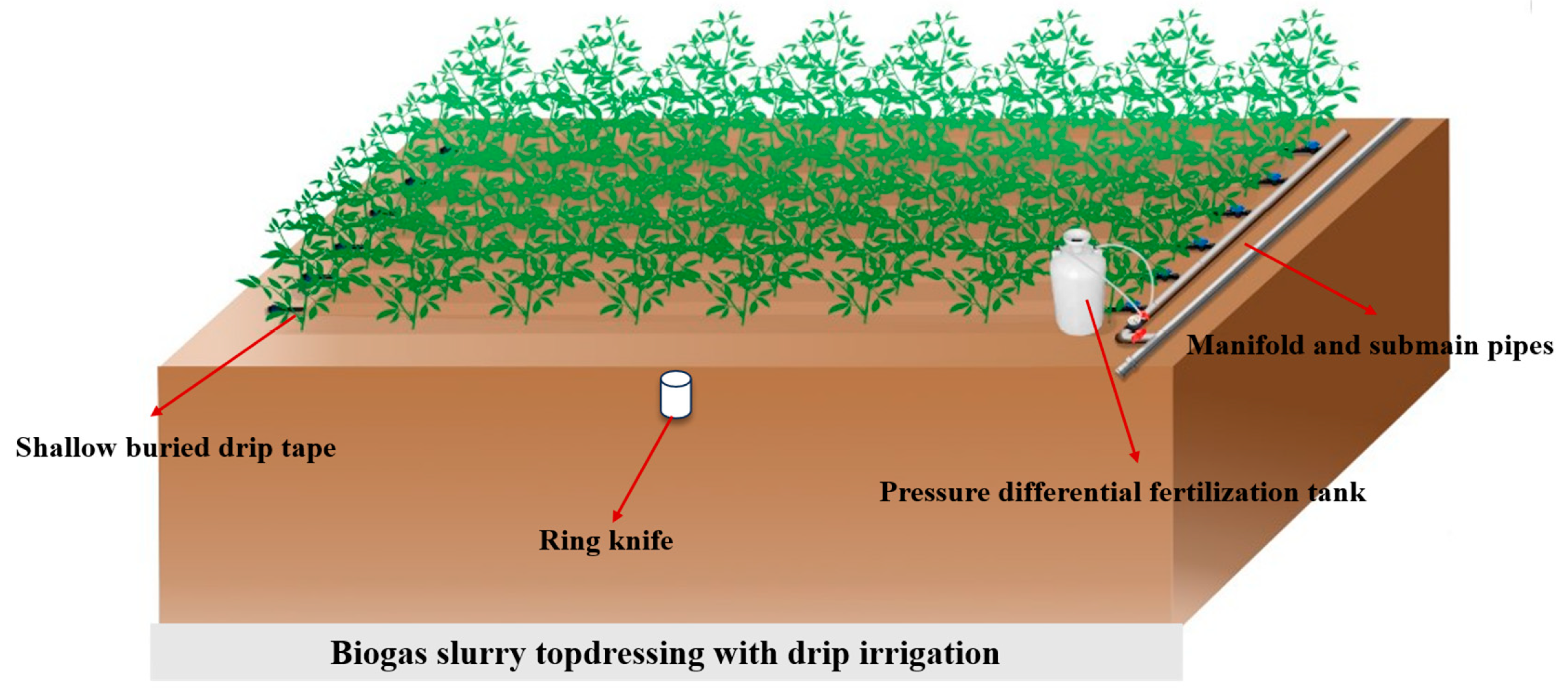
The experiment included nine water–fertilizer coupling treatments plus controls. Each treatment was replicated three times. Individual plots measured 7 m × 4 m and were arranged in a completely randomized design. The drip irrigation system consisted of a water source, a pump, a differential-pressure fertilization tank, and a water distribution pipeline. Inline drip tapes were installed at a depth of 3–5 cm, with an emitter spacing of 30 cm and a discharge rate of 3.0 L h−1, as illustrated in Figure 1.
The field experiment was conducted during the 2024 growing season, representing the alfalfa establishment year. Alfalfa (cv. MF4020) was sown on 9 May 2024, with a row spacing of 30 cm, and the final harvest was managed on 8 October 2024. A total of three fertigation events were executed during the green-up and regrowth stages following alfalfa cuttings throughout the growing cycle. To eliminate any potential confounding effects of active root systems on soil pore architecture and macro-aggregate orientation, undisturbed soil samples for both microscopic imaging and hydraulic parameterization were selectively collected from both sides of the drip irrigation tapes at the terminal ends of each experimental plot. Measurements and analysis were subsequently carried out based on treatment averages.

2.3. Soil Characteristics

2.3.1. SWCC Determination

The SWCC of grey desert soil was determined using a high-speed hydrocarbon-refrigerated centrifuge method (CR21GII, Hitachi, Ltd., Tokyo, Japan). Undisturbed soil cores were collected from the field using standard stainless-steel cutting rings (ring knives) with a volume of 100 cm3 (inner diameter: 5.04 cm, height: 5.00 cm), with density control corresponding to the in situ dry bulk density of each treatment (averaging approximately 1.40 g·cm−3). Prior to centrifugation, the soil cores were slowly saturated with distilled water from the bottom upward for 24 h. The pre-saturated cores were then subjected to sequential centrifugation at specific matric potential heads (10, 50, 100, 300, 500, 700, 1000, 3000, 5000, and 7000 cm).
The widely applied van Genuchten (vG) model was employed to fit the soil water characteristic curve (SWCC) and derive essential hydraulic parameters. The widely applied van Genuchten (vG) model [17,18] was fitted to the SWCC data, expressed as follows:
θ h = θ r + θ s θ r 1 + α h n m h < 0 θ s                                         h 0
where e θ(h) is the volumetric water content (cm3·cm−3) at a specific matric suction head h (expressed in cm of water column), cm; α represents the inverse of air-entry value, cm−1; θs is the saturated volumetric water content of the matrix, cm3·cm−3; θr indicates residual volumetric water content, cm3·cm−3; n is a shape parameter associated with the pore-size distribution; and m is constrained by the relationship m = 1 − 1/n.

2.3.2. Soil Specific Water Capacity

The specific water capacity, C(h), defined as the change in volumetric water content per unit change in matric suction head, signifies the water-supply capacity of the soil. It is calculated by taking the absolute value of the first derivative of the vG model with respect to h:
C h = d θ d h = θ s θ r m n α α h n 1 1 + α h n m + 1
where C(h) is the specific water capacity (cm−1).

2.3.3. Classification of Soil Pores

The soil equivalent pore size was categorized as very-micropores (<0.3 μm), micropores (≥0.3–5 μm), small pores (≥5–30 μm), medium pores (≥30–75 μm), large pores (≥75–100 μm), and soil voids (≥100 μm) [19].

2.3.4. Microscopic Characterization

Samples from the surface layer (0–5 cm) were collected for each test treatment, with sampling positions directly beneath the drip tape. This specific 0–5 cm depth was intentionally selected because the ultra-surface layer represents the primary zone directly subject to dynamic dry–wet cycles and intense physico-chemical interactions driven by biogas slurry drip infiltration, making it highly sensitive to architectural adjustments. The microscopic morphology of the samples was observed by scanning electron microscopy (Zeiss supra55, Carl Zeiss, Oberkochen, Germany) to obtain the porosity, average pore diameter, and number of pores in the soil pores. To ensure robust statistical representation, a total of 5 high-resolution digital images were randomly acquired per experimental plot (yielding 15 images per treatment average) at a standard magnification of 500×. Quantitative image analysis was conducted using ImageJ software (Version 1.54, NIH, Bethesda, MD, USA). Pore segmentation was achieved via an adaptive local thresholding method (Bernsen algorithm), where the thresholding criteria automatically separated darker structural voids (pores) from the brighter mineral–organic matrix. Binary segmentation and subsequent pore-size distribution calculations were executed based on treatment averages to filter out localized heterogeneity.
Due to the irregular shape of soil pore structures, the Box Counting method was employed to enumerate grids of varying sizes. The ratio of grid counts to grid size was calculated. Subsequently, the slope was derived via linear regression to compute the fractal dimension [20], as follows:
F D = l i m ε 0 log N ( ε ) log ε
In the equation, ε denotes the side length of the square box utilized to cover the graphical representation; N(ε) represents the minimum number of boxes required to fully cover the graph using a box of side length ε; and FD signifies the fractal dimension computed via the Box Counting method.

2.3.5. Soil Chemical Properties

Soil chemical properties were evaluated using disturbed bulk total soil samples (<2 mm) collected from the 0–20 cm plow layer on 10 October 2024, with 5 randomized cores homogenized per plot to yield three independent replicates per treatment. SOM was determined using the potassium dichromate oxidation spectrophotometric method, in which a known soil quantity underwent digestion with potassium dichromate in sulfuric acid under controlled heating, followed by colorimetric measurement of oxidized organic carbon. TN was quantified via the modified Kjeldahl method, involving acid digestion with concentrated sulfuric acid and catalyst, followed by ammonia distillation and titration.

2.4. Characteristics of Biogas Slurry

The concentrated biogas slurry used in this study was commercially procured (CGN Hutubi Bio-Energy Co., Ltd., Hutubi, Xinjiang, China). To prevent emitter and soil macropore clogging, the slurry was mechanically pre-filtered through a 50 μm mesh screen prior to drip application. The baseline chemical composition was analyzed according to the Chinese National Standard for biogas slurry for agricultural use (GB/T 40750-2021) [21] as follows: total nitrogen (3.1 g·L−1), phosphorus (P2O5, 2.1 g·L−1), potassium (K2O, 4.4 g·L−1), organic matter (19.6 g·L−1), and humic acid (17.5 g·L−1). The slurry had a pH of 8.0, a density of 1.03 g·mL−1, and a suspended solids (water-insoluble matter) content of 2.1 g·L−1. Heavy metals were quantified well below legal limits (mg·L−1): As (0.2, limit ≤ 10.0), Cd (0.4, limit < 3.0), Pb (0.9, limit < 50.0), Hg (0.06, limit ≤ 5.0), and hexavalent Cr (not detected).

2.5. Structural Equation Modeling

The structural equation modeling is a statistical method for analyzing the relationships among variables based on their covariance matrix [22]. The structural equation modeling mainly includes two parts, the measurement model and the structural modeling, which are as follows:
X = ξ X ξ + δ
Y = η Y η + ω
Among them,
η = B η + Γ ξ + ζ
In the formula, X is the exogenous observation variable; Y is the endogenous observation variable; ξ is an exogenous latent variable; η is an endogenous latent variable; δ is the residual error of exogenous observation variables; ω is the residual of endogenous observation variable; and ξX is the factor load of X on ξ.
Path analysis was executed based on individual plot replicates (n = 33, 11 treatments × 3 replicates) rather than treatment means to ensure model stability. This study employed soil porosity, fractal dimension, nutrient indicators, and hydraulic parameters to construct a structural equation modeling. Hypothetical relationships among variables were established based on correlation analysis. Following established methodologies [23], model fit was evaluated using root mean square error of approximation (RMSEA), goodness-of-fit index (GFI), and ratio of chi-square to degrees of freedom (χ2/df). Prior to SEM analysis, normality tests were conducted on all data distributions. Model fitting via maximum likelihood estimation was performed, with satisfactory fit defined by χ2/df < 3, GFI > 0.90 and RMSEA < 0.05.

2.6. Data Analysis

RetentionCurve Version 6.02 (RETC) software and Origin 2021 were employed to fit the soil water characteristic curves. Data were analyzed via a two-way ANOVA to evaluate the main and interactive effects of W and S, with Tukey’s HSD test applied for post hoc multiple comparisons (p < 0.05). One-way ANOVA was utilized to compare specific treatments against CK and CF controls. All statistical procedures and plotting were performed using SPSS 26.0, Excel 2016, and Origin 2021 software. IBM SPSS Statistics 25 with the AMOS module was utilized to develop structural equation modeling.

3. Results

3.1. Effect of Biogas Slurry Drip Irrigation on the Microstructure of Grey Desert Soil

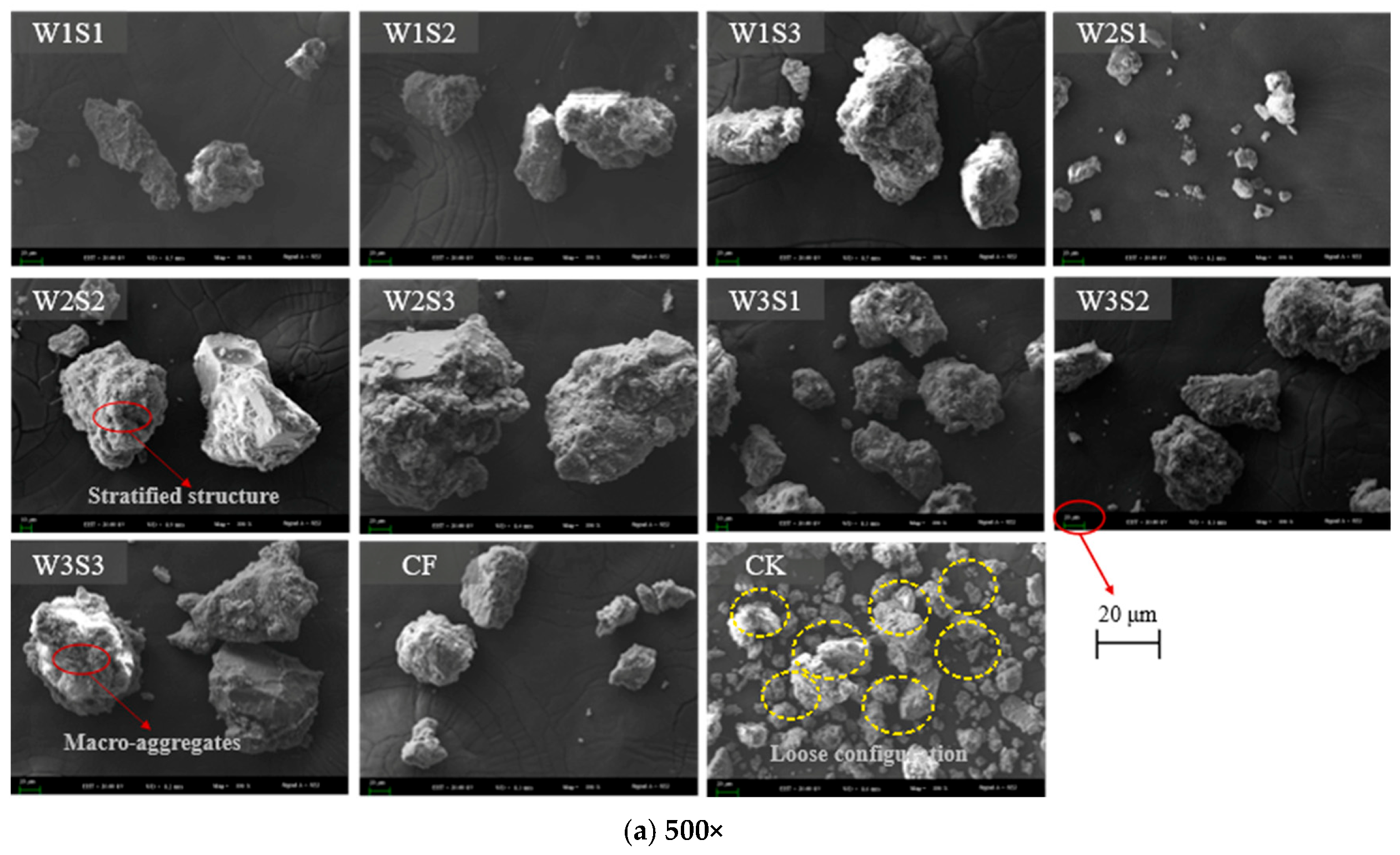
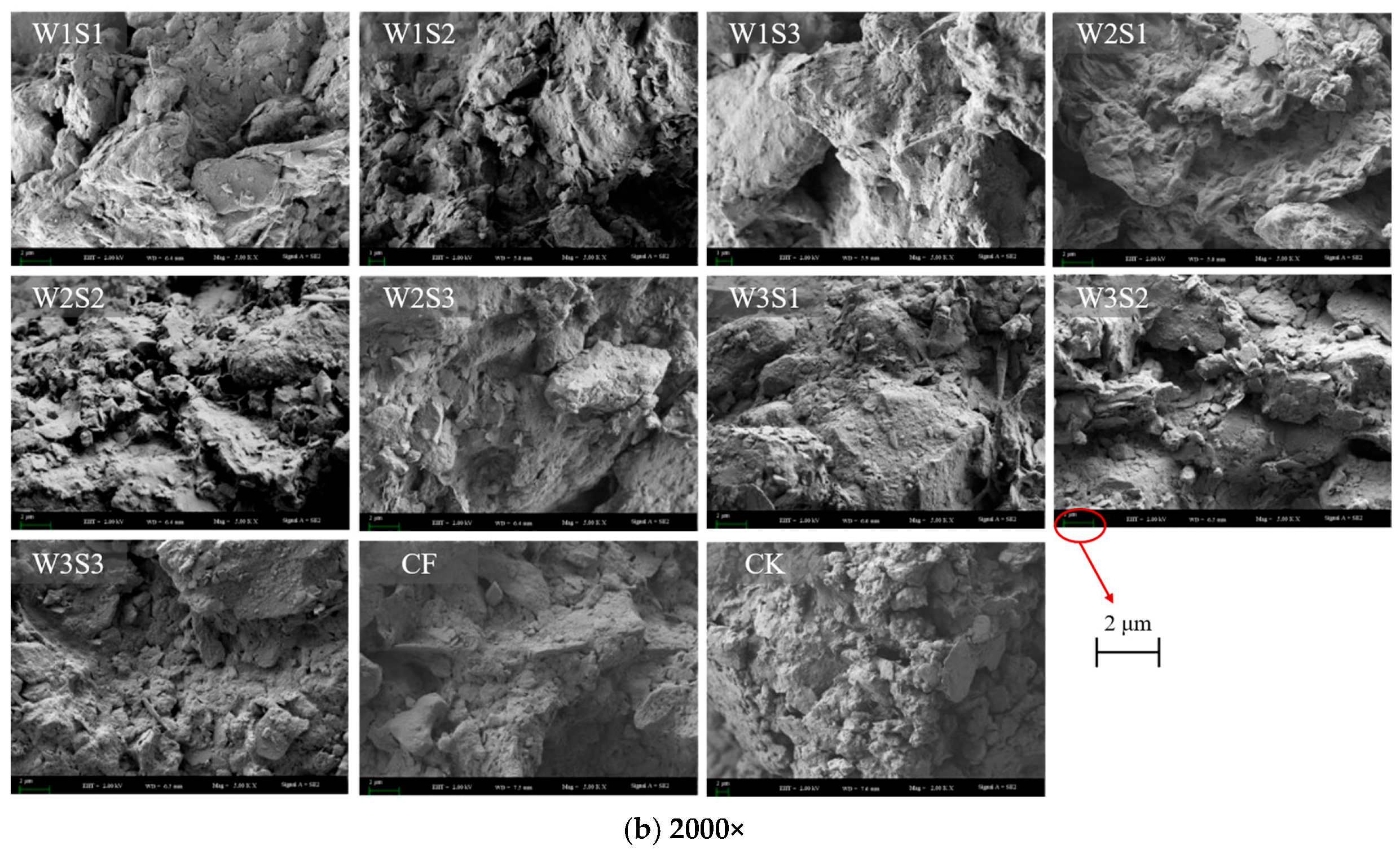
Scanning electron microscopy was employed to characterize the microstructure of the 0–5 cm soil layer under shallow buried drip application (Figure 2). The results showed that there were significant differences in the soil structure under different treatments. The CK treatment exhibited predominantly fine powder particles and micro-aggregates with a loose configuration. In contrast, biogas slurry treatments displayed increased macro-aggregates, stratified structures, and granular aggregates, indicating a greater structural complexity and density. A quantitative analysis of 2000×-magnified pore images using Image-Pro Plus 6.0 (Table 2) revealed that both the biogas slurry and chemical fertilizer treatments enhanced the soil porosity. The W3S2 treatment demonstrated a significantly higher porosity (42.39%) than CK, representing a 17.14% increase, with average pore size (9.24 μm) exceeding CK by 64.1%. Concurrently, the pore density decreased markedly from 380 (CK) to 31 in W3S2. Furthermore, the FD of the W3S3 treatment was 1.61, which was significantly lower than that of CK (1.82), reflecting a tendency towards a more regular pore morphology and further verifying the optimization effect of biogas slurry on the pore architecture. The two-way ANOVA demonstrated that both the main effects of the irrigation level (W) and slurry ratio (S), as well as their interactive effect (W × S), significantly influenced the soil mean pore diameter, porosity, and pore number (p < 0.05, Table 2). Quantitative analysis revealed that the W3S2 treatment achieved a peak porosity of 42.39%, representing an increase of 17.14 percentage points (a 67.9% relative increase) compared to the CK baseline (25.25%). Concurrently, the pore number per field of view decreased markedly from 380 (CK) to 31 (W3S2) (p < 0.05). The significant W × S interaction confirms that this substantial reduction in the individual pore count—reflecting the extensive physical fusion of isolated micro-voids into interconnected macro-pores—is optimally driven by the synergistic coupling of water and organic slurry, rather than thresholding artifacts.
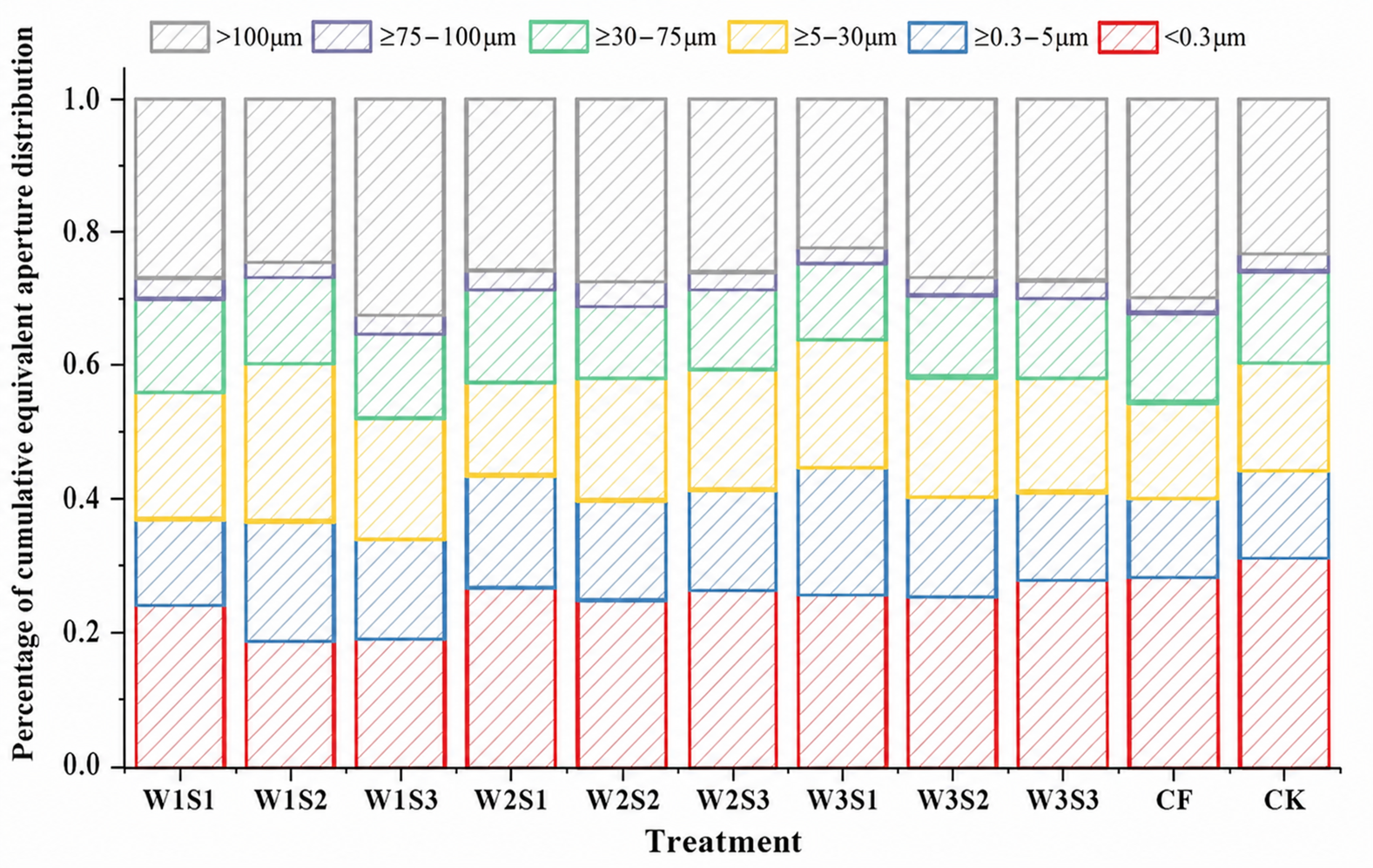
The application of varying irrigation levels and biogas slurry ratios elucidated the dynamic evolution of soil pore structures (Figure 3). At the W3 irrigation level, the S1 treatment demonstrated distinctive pore reorganization patterns, with very-micropores (<0.3 μm) accounting for 19.04%. Conversely, pore transformation dynamics diverged under the W1 deficit irrigation level: the very-micropore (<0.3 μm) proportion declined progressively from 24.07% (S1) to 18.97% (S3), while the small pore (5–30 μm) proportion increased correspondingly from 27.01% to 32.67%. At the W2 level, the S3 treatment exhibited 27.75% very-micropores (<0.3 μm) and 2.71% medium pores (30–75 μm). This indicates that the water–slurry coupling induces a systematic structural shift and optimization in pore size groupings. Compared to the experimental treatments, the CK baseline maintained a high proportion of very-micropores (<0.3 μm) at 30.71%, whereas the chemical fertilizer (CF) treatment elevated the medium pore (30–75 μm) proportion from 1.48% (CK) to 2.72%.

3.2. Effect of Biogas Slurry Drip Irrigation on Fertility of Grey Desert Soil

Biogas slurry drip irrigation induced specific temporal variations in the soil fertility parameters between the two monitored periods (Table 3). To ensure the successful establishment of alfalfa during its first growing season, uniform irrigation and baseline biogas slurry application were implemented during the initial cultivation phase; consequently, data from this establishment phase were excluded, and monitoring focused on the subsequent stages (Second and Third Samplings). The two-way ANOVA revealed that these soil chemical properties (SOM and TN) were predominantly influenced by the main effect of the irrigation level (W) rather than the S main effect or W × S interaction (Table 3). Specifically, within the W2 treatment group, the TN content increased significantly from 1.03 to 1.31 g·kg−1 in the W2S3 treatment (a 27.2% relative increase, p < 0.05), and from 0.97 to 1.20 g·kg−1 in the W2S2 treatment (a 23.7% increase, p < 0.05). Conversely, the SOM content under the W2S3 treatment exhibited only a minor numerical fluctuation between the two samplings, moving from 17.51 to 17.69 g·kg−1 (a 1.0% fluctuation).
Given the high within-treatment variability shown in Table 3, this slight variation was statistically non-significant (p > 0.05), indicating that SOM pools remained relatively stable over these two sampling moments rather than showing a continuous upward trend. For the W1 and W3 irrigation groups, both SOM and TN contents generally displayed localized fluctuations or downward tendencies between the two sampling periods. For example, under full irrigation (W3), the TN content decreased from 1.18 g·kg−1 (W3S1) and 1.29 g·kg−1 (W3S3) to 0.85 g·kg−1 and 1.01 g·kg−1, respectively. Regarding the comparison with the conventional agronomic control, at the third sampling, the W2S3 treatment attained the highest numerical values for both SOM (17.69 g·kg−1) and TN (1.31 g·kg−1) among all cultivated treatments. Although these values were numerically higher than those of the CF treatment (15.66 g·kg−1 for SOM and 1.11 g·kg−1 for TN), the differences were not statistically significant due to the overlapping standard errors and shared post hoc multiple comparison letters (p > 0.05, Table 3).

3.3. Regulation Effect of Drip Application of Biogas Slurry on Hydraulic Characteristic Parameters

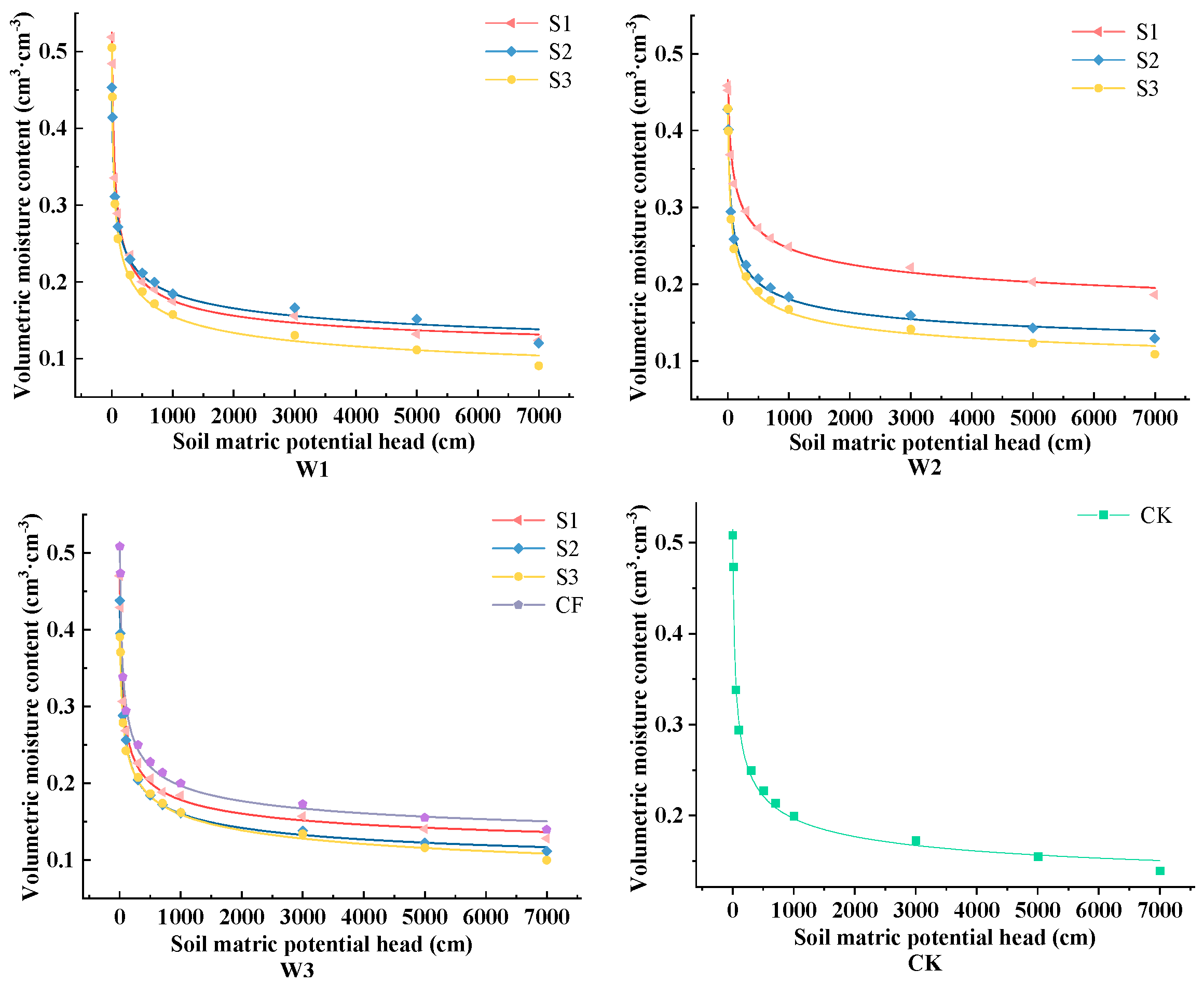
Figure 4 shows the SWCC across different treatments, with the corresponding vG model parameters detailed in Table 4. Two-way ANOVA revealed a highly significant interaction between irrigation volume and biogas slurry concentration (W × S, p < 0.01) on the θs, indicating that the regulatory effect of slurry application was strictly modulated by the baseline water input. Compared with the untreated control (CK, 0.5232 cm3·cm−3), biogas slurry application generally suppressed the maximum water-holding capacity at saturation, with the lowest θs observed in the W3S1 treatment (0.3957 cm3·cm−3). Specifically, as the slurry rate increased, θs exhibited a non-monotonic, fluctuating trend under W1 and W2 levels, but displayed a progressive expansion under the full irrigation level (W3), climbing from 0.3957 (W3S1) to 0.4741 (W3S3). This overall reduction in θs relative to CK confirms that, although the macroscopic physical porosity increased, the active organic macromolecules partially clogged the intrinsic micro-voids, thereby restricting the effective saturation water volume. Concurrently, the air-entry parameter α was substantially increased by slurry application, with the maximum value observed in W1S3 (0.1188 cm−1), representing a 144% increase over CK (0.0487 cm−1). For the pore-size distribution shape parameter n, a progressive increase with the slurry concentration was observed exclusively under the W2 and W3 irrigation volumes, shifting from 1.2242 to 1.2895 in W2, and from 1.2154 to 1.3217 in W3, reflecting an optimized pore connectivity and enhanced hydraulic conductivity. Conversely, under the deficit irrigation level (W1), the parameter n did not increase linearly; it peaked at W1S1 (1.3910) and dropped significantly at higher slurry rates.
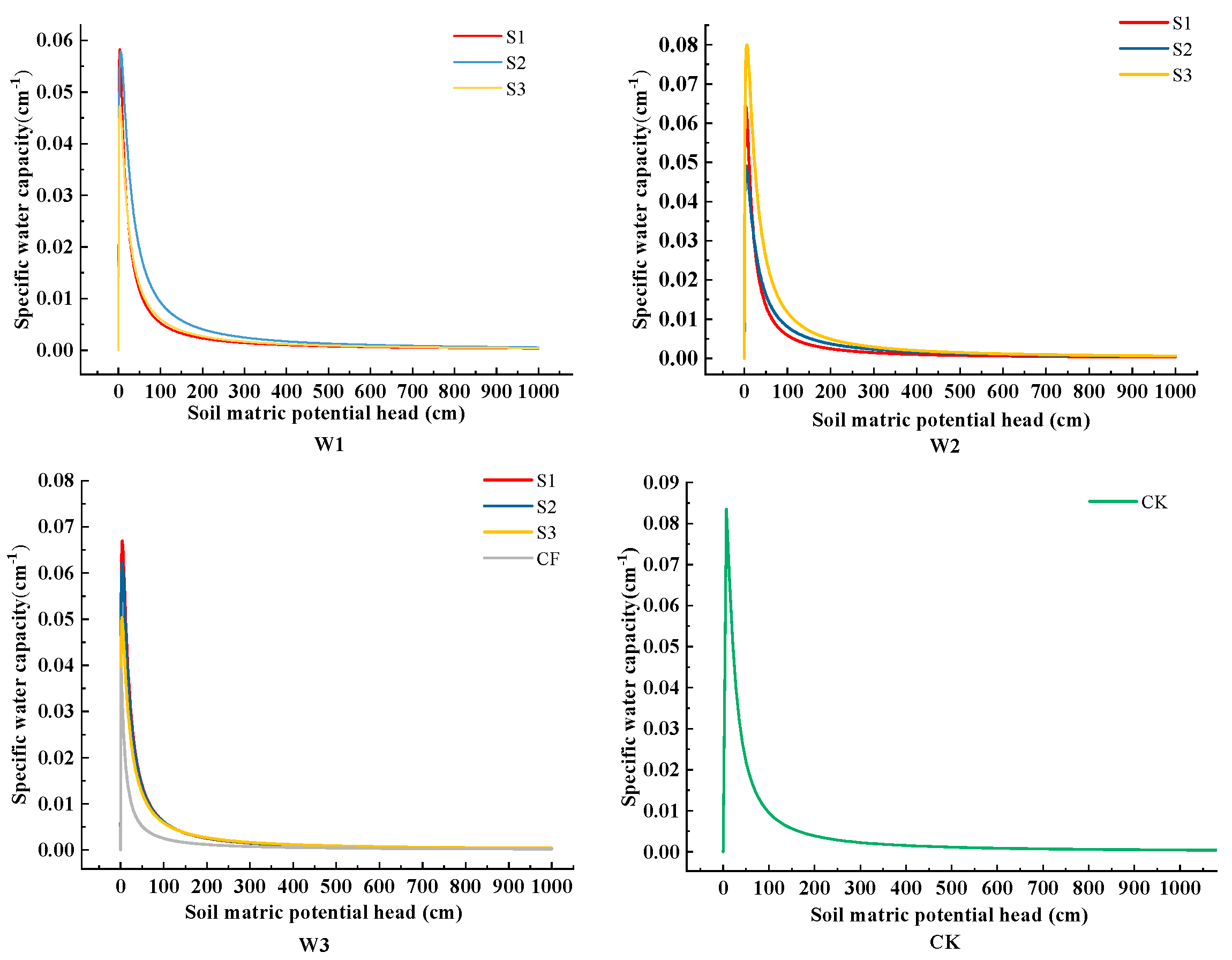
Figure 5 illustrates the suction-dependent C(h) variations across treatments, elucidating the suction-stage-specific regulation of soil water retention, at the low soil matric potential head (h < 100 cm), which was 9.6% lower than that of the CK baseline (0.07654 cm−1). In contrast, the W3S2 treatment increased the peak by 31.1% relative to CK, indicating that an appropriate biogas slurry ratio under full irrigation substantially enhances water retention in this stage. In the medium suction range (100–500 cm), the C(h) of W1S3 at 300 cm was 0.00166 cm−1, 19.4% higher than W1S1, reflecting its effective delay in moisture depletion through the optimized pore structure. At high suction (h > 500 cm), the C(h) of W2S1 at 1000 cm was 3.084 × 10⁻⁴ cm−1, 30.7% lower than CK, demonstrating a clear inhibitory effect on water movement under high tension. Additionally, W2S3 increased C(h) by 36.6% within the 500–1000 cm range, further confirming that specific water-slurry combinations improve the water retention stability under high drought-stress conditions.

3.4. Interrelationships Among Soil Microstructure, Hydraulic Parameters, and Fertility Properties

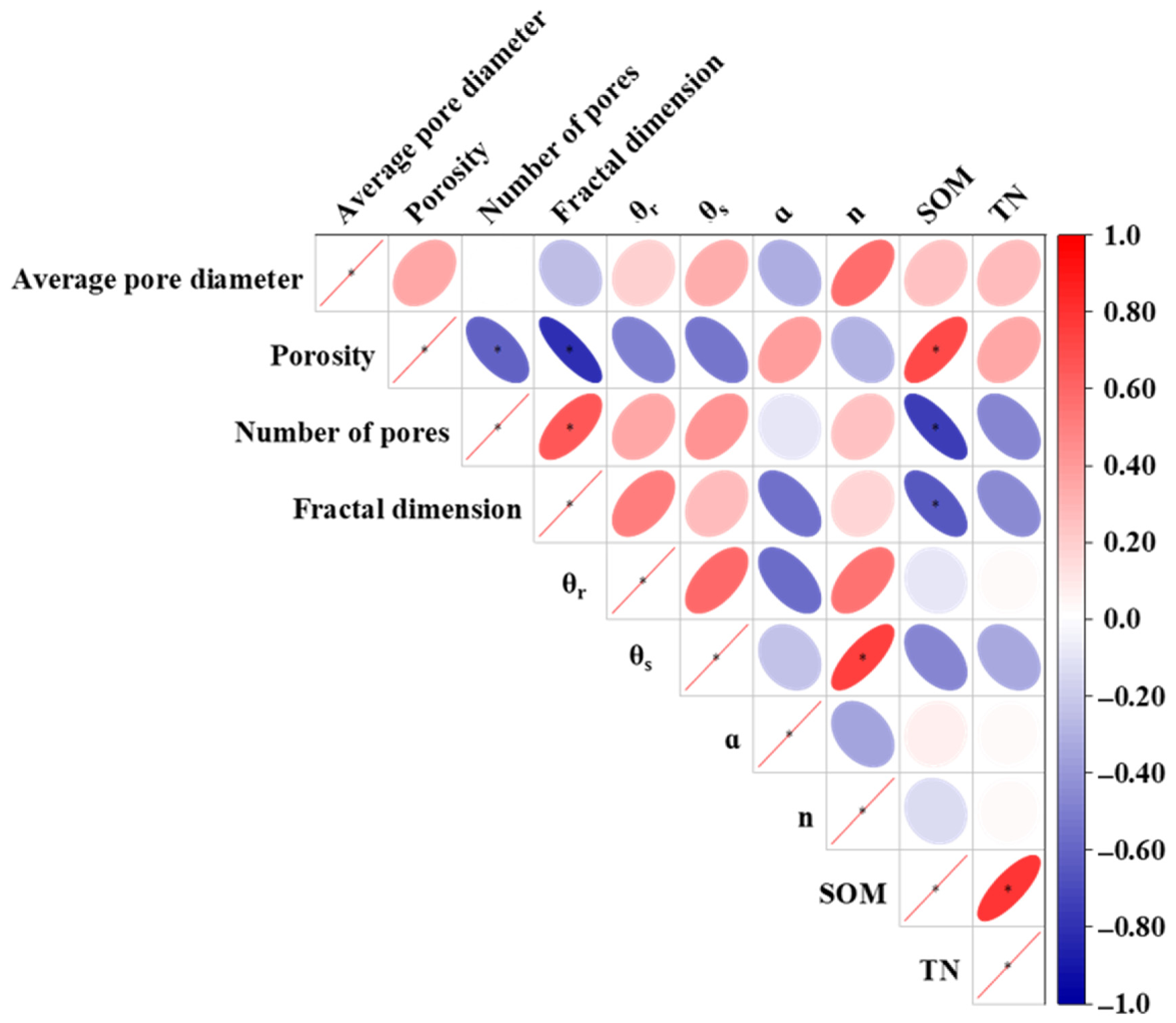
A multivariate correlation analysis (n = 33) of the soil pore architecture, hydraulic properties, and fertility indices across treatments (Figure 6) revealed systematic relationships among variables. Porosity showed significant positive correlations with SOM and TN (p < 0.01). In contrast, porosity was negatively correlated with the pore number density and FD (p < 0.05). Notably, FD exhibited predominantly negative correlations with most hydraulic and fertility parameters (p < 0.05).
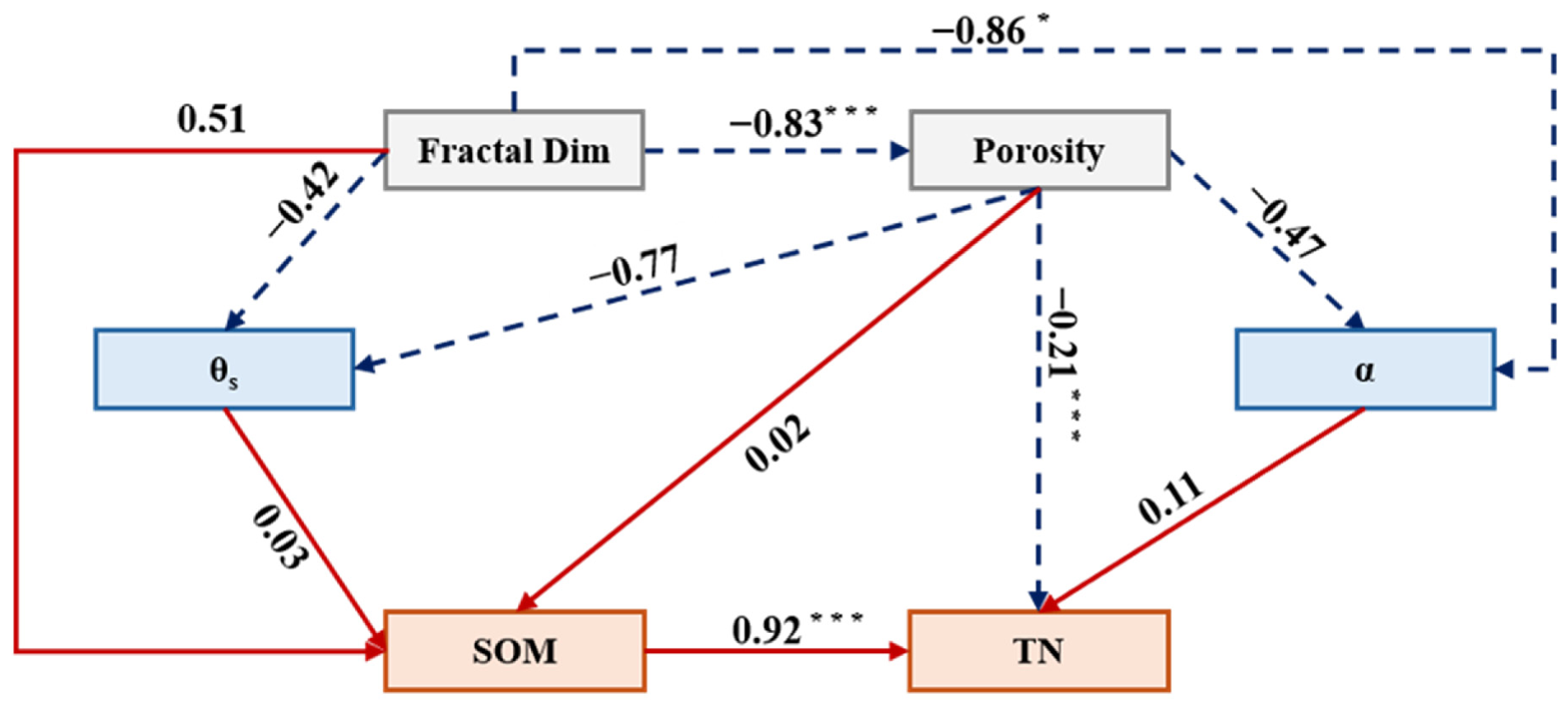
To further disentangle the direct and indirect interactions among these variables, SEM was executed (Figure 7). The model demonstrated a satisfactory fit to the empirical data (χ2/df = 0.72, GFI = 0.923, RMSEA < 0.05). Path analysis successfully quantified the direct and indirect interactions governing the soil structural, hydraulic, and nutrient properties. Within the physical pathways, FD exerted a strong negative direct effect on porosity (path coefficient = −0.83, p < 0.001). Concurrently, both FD and porosity showed negative direct paths toward thetas (−0.42 and −0.77, respectively; p < 0.01) and the shape parameter alpha (−0.86 and −0.47, respectively; p < 0.01). Regarding the nutrient–structure interaction pathways, a prominent positive direct effect was identified from SOM to TN (0.92, p < 0.001). Additionally, FD displayed a positive direct effect on SOM (0.51, p < 0.01), whereas porosity exerted a negligible direct effect on SOM (0.02, p > 0.05) and a significant negative direct effect on TN (−0.21, p < 0.05). Furthermore, the hydraulic attributes thetas and alpha exhibited weak direct paths toward SOM (0.03) and TN (0.11, directed from alpha), respectively (p > 0.05).

4. Discussion

4.1. Evolution Mechanism of Soil Pore Structure in Grey Desert Soil Under Biogas Slurry Drip Irrigation

The soil structure, a key physical framework comprising solid particles and pore networks, governs the hydraulic transport, nutrient availability, gas diffusion, and microbial dynamics [24]. This study demonstrates that biogas slurry drip irrigation significantly modifies the pore architecture and nutrient distribution in grey desert soil. Compared to conventional chemical fertilization, the combined biogas slurry drip irrigation enhanced soil porosity and promoted larger mean pore diameters. This indicates that biogas slurry facilitated hierarchical pore network development within aggregates, optimizing the soil aeration–water retention balance [25,26].
Biogas slurry drip irrigation increased its porosity, thereby enhancing the matrix adsorption and capillary action [27,28]. This finding differs from the conclusions of some previous scholars who reported pore clogging following slurry application [29,30]. A plausible explanation is that the biogas slurry used in this study was mechanically microfiltered through a 50 μm mesh screen prior to application. This pre-treatment step effectively mitigated the severe clogging of both drip emitters and soil macropores that typically occurs with raw slurry, allowing for the maintenance of a stable clay fraction and unimpeded macro-pore formation. Rather than masking the effects of organic inputs, the abundant clay particles actually synergized with the active organic matter from the biogas slurry (e.g., lignin, cellulose, and humic substances). This organo-mineral complexation acted as a powerful natural cementing agent, binding with clay minerals to form stable aggregates [31]. Under chemical fertilization (CF), carbonaceous particulates were preferentially located at interparticle junctions, potentially causing localized pore blockage [32]. In contrast, the continuous liquid phase of the slurry treatment facilitated the deep transport of dissolved organic agents, which was more conducive to structural optimization and water infiltration in the grey desert soil.

4.2. Hydraulic Modifications in Grey Desert Soil Under Biogas Slurry Drip Irrigation

Soil hydraulic properties constitute the fundamental determinants of ecological functionality and crop productivity. The SWCC provides critical insights into the permeability and water retention capacity at specific matric suctions (h). In this study, increasing the biogas slurry concentration significantly altered the SWCC configuration [18,33]. A seemingly contradictory, yet highly insightful, phenomenon emerged regarding the saturated water content. While the total physical macroscopic porosity increased (as discussed in Section 4.1), the θs exhibited a decreasing trend. This cannot be attributed to the compression of macropores, which would contradict our microscopic observations. Rather, it is driven by a fundamental reduction in “effective water-holding porosity” [30,34]. Because direct measurements such as the contact angle, porosimetry, tomography, trapped air content, or saturated hydraulic conductivity were not conducted in this study, the following mechanisms are presented as plausible possibilities rather than definitive conclusions: the active organic colloids and microbial biofilms introduced by the biogas slurry may have partially clogged intrinsic micropores (<0.3 μm), potentially transforming them into closed pores that no longer participate in active water exchange. Furthermore, organic coatings on soil particles might have induced micro-hydrophobicity, possibly exacerbating air entrapment (entrapped air bubbles) during the soil saturation process.

4.3. Mechanisms of Microstructural-Hydraulic Co-Regulation

A critical finding of this study, illuminated by the SEM, is the hierarchical mechanism by which biogas slurry drip irrigation regulates soil hydraulic properties. Unlike previous hypotheses that often attribute water retention improvements solely to the direct hydrophilic nature of the accumulated organic matter, our path analysis reveals that this regulation is predominantly mediated through physical microstructural reorganization. The fundamental mechanism begins with the aforementioned organo-mineral complexation. Grey desert soils are inherently structurally fragile. The biogeochemical flocculation triggered by the slurry directly alters the microscopic pore architecture. As demonstrated by our SEM pathway, structural complexity (FD) exerted a strong negative regulatory effect on effective porosity. Mechanistically, untreated or chemically fertilized degraded soils exhibit high FD values, characterized by highly fragmented, tortuous, and isolated micro-fissures that restrict fluid flow. The organic cementing action of the biogas slurry coalesces these irregular micro-voids into larger, well-connected macropore networks. This physical reorganization simultaneously reduces the morphological fragmentation (lowering FD) and increases the effective pore space. Subsequently, this microstructural optimization governs the macroscopic hydraulic behaviors. The newly formed, well-connected macropores serve as preferential flow pathways, which fundamentally regulates the air-entry suction (α) and water retention dynamics. The SEM effectively disentangles this network, confirming that nutrient-driven structural reorganization is the definitive causal driver for hydraulic restoration in degraded arid soils [15].

4.4. Limitations and Prospects

While this study provides a systematic and quantitative analysis of how deficit biogas slurry drip irrigation regulates the pore architecture and hydraulic functionality, several limitations must be honestly acknowledged. First, the experimental duration was limited to the establishment year of alfalfa, representing short-term dynamic responses rather than cumulative, long-term organo-mineral complexation. Second, the microstructural analyses were focused on the 0–5 cm surface layer where the drip application impacts are the most intense. Future studies must quantify pore–water interactions vertically across deeper soil horizons. Finally, the continuous application of livestock-derived biogas slurry in arid regions with high evaporation rates carries potential environmental and agronomic risks. Therefore, subsequent research must integrate the comprehensive long-term monitoring of EC, salinity, sodicity/SAR, nitrogen leaching, pathogens, heavy metal buildup, emitter clogging, and the risk of salt redistribution under high evaporation, ensuring the sustainable and safe deployment of this agricultural strategy [18,34].

5. Conclusions

This study quantitatively evaluated the effects of deficit biogas slurry drip irrigation on the pore architecture and hydraulic properties of degraded grey desert soil during the alfalfa establishment year. The results demonstrated that this combined agronomic practice effectively restructured the soil physical framework. Compared with CK, which exhibited a baseline total porosity of 25.25%, the W3S2 treatment increased the total soil porosity to a peak value of 42.39%, corresponding to an increase of 17.14 percentage points, or a 67.9% relative increase. The same treatment also expanded the mean pore diameter to 9.24 μm, representing a 64.1% increase compared with CK, whereas CF mainly increased the larger structural voids. Meanwhile, a high slurry input under W3S3 reduced the pore morphological fragmentation, as indicated by the decrease in fractal dimension from 1.82 in CK to 1.61. In terms of soil fertility, W2S3 achieved the highest soil organic matter and total nitrogen contents, reaching 17.69 g·kg−1 and 1.31 g·kg−1, respectively. For soil hydraulic properties parameterized using the vG model, although the total porosity increased, the saturated water content decreased, suggesting that the organic colloid input and pore restructuring may have reduced the excessive near-saturation water storage while improving the water retention at higher suction ranges. SEM observations further confirmed that biogas slurry application promoted microstructural reorganization, including particle cementation, aggregate formation, and pore-network regularization, which, together, contributed to the observed changes in effective porosity and water retention behavior. Overall, the continuous drip application of pre-filtered biogas slurry represents an effective agronomic strategy for synchronously improving the pore structure, soil fertility, and hydraulic functionality in degraded grey desert soils under arid agroecosystems.

Author Contributions

F.M.: writing–original draft, formal analysis, and data curation. F.D.: writing—review and editing. H.Y. (Huimin Yang): data curation. H.Z.: writing—review and editing. H.Y. (Haijun Yan): writing—review and editing, and conceptualization. All authors have read and agreed to the published version of the manuscript.

Funding

This research was supported by the National Key Research and Development Program of China (Grant No. 2022YFD1300804), the Regional Collaborative Project of Xinjiang Uygur Autonomous Region (S&T Assisting Xinjiang Project) (Grant No. 2024E02004), and the China Agriculture Research System of MOF and MARA (Grant No. CARS-33).

Data Availability Statement

The original contributions presented in this study are included in the article. Further inquiries can be directed to the corresponding author.

Acknowledgments

During the preparation of this manuscript, the authors used the Gemini 1.5 Pro model for grammar checking and language polishing. The authors have reviewed and edited the output and take full responsibility for the content of this publication.

Conflicts of Interest

The authors declare that they have no known competing financial interests or personal relationships that could have appeared to influence the work reported in this paper.

Abbreviations

The following abbreviations are used in this manuscript:
CFChemical fertilizer
CKUndisturbed soil (Control)
SBiogas slurry application ratio (S = 93 kg hm−2 annual nitrogen)
SEMStructural equation modeling
SOMSoil organic matter
TNTotal nitrogen
vGvan Genuchten model
WIrrigation level
αShape parameter in van Genuchten model
nPore-size distribution parameter
θrResidual water content
θsSaturated water content

References

  1. He, H.; Peng, M.; Lu, W.; Ru, S.; Hou, Z.; Li, J. Organic fertilizer substitution promotes soil organic carbon sequestration by regulating permanganate oxidizable carbon fractions transformation in oasis wheat fields. CATENA 2023, 221, 106784. [Google Scholar] [CrossRef]
  2. Hu, A.; Wang, J.; Sun, H.; Niu, B.; Si, G.; Wang, J.; Yeh, C.-F.; Zhu, X.; Lu, X.; Zhou, J.; et al. Mountain biodiversity and ecosystem functions: Interplay between geology and contemporary environments. ISME J. 2020, 14, 931–944. [Google Scholar] [CrossRef] [PubMed]
  3. Peng, Y.; Duan, Y.; Huo, W.; Xu, M.; Yang, X.; Wang, X.; Wang, B.; Blackwell, M.S.A.; Feng, G. Soil microbial biomass phosphorus can serve as an index to reflect soil phosphorus fertility. Biol. Fertil. Soils 2021, 57, 657–669. [Google Scholar] [CrossRef]
  4. Peng, M.; He, H.; Wang, Z.; Li, G.; Lv, X.; Pu, X.; Zhuang, L. Responses and comprehensive evaluation of growth characteristics of ephemeral plants in the desert–oasis ecotone to soil types. J. Environ. Manag. 2022, 316, 115288. [Google Scholar] [CrossRef] [PubMed]
  5. Guo, Y.; Tang, H.; Li, G.; Xie, D. Effects of Cow Dung Biochar Amendment on Adsorption and Leaching of Nutrient from an Acid Yellow Soil Irrigated with Biogas Slurry. Water Air Soil Pollut. 2014, 225, 1820. [Google Scholar] [CrossRef]
  6. Liang, X.; Wang, H.; Wang, C.; Wang, H.; Yao, Z.; Qiu, X.; Ju, H.; Wang, J. Unraveling the relationship between soil carbon-degrading enzyme activity and carbon fraction under biogas slurry topdressing. J. Environ. Manag. 2024, 356, 120641. [Google Scholar] [CrossRef] [PubMed]
  7. Wang, H.; Qiu, X.; Liang, X.; Wang, H.; Wang, J. Biogas slurry change the transport and distribution of soil water under drip irrigation. Agric. Water Manag. 2024, 294, 108719. [Google Scholar] [CrossRef]
  8. Liang, X.; Wang, C.; Wang, H.; Qiu, X.; Ji, H.; Ju, H.; Wang, J. Synergistic effect on soil health from combined application of biogas slurry and biochar. Chemosphere 2023, 343, 140228. [Google Scholar] [CrossRef] [PubMed]
  9. Sun, K.; Yang, R.; Che, Z.; Zhao, W.; Song, S.; Ren, H. Soil texture modulates microbial responses to irrigation: Implications for nutrient cycling in arid agroecosystem. Soil Tillage Res. 2026, 256, 106838. [Google Scholar] [CrossRef]
  10. Liu, J.; Lu, S. Amendment of different biochars changed pore characteristics and permeability of Ultisol macroaggregates identified by X-ray computed tomography (CT). Geoderma 2023, 434, 116470. [Google Scholar] [CrossRef]
  11. Allegretta, I.; Legrand, S.; Alfeld, M.; Gattullo, C.E.; Porfido, C.; Spagnuolo, M.; Janssens, K.; Terzano, R. SEM-EDX hyperspectral data analysis for the study of soil aggregates. Geoderma 2022, 406, 115540. [Google Scholar] [CrossRef]
  12. Omondi, M.O.; Xia, X.; Nahayo, A.; Liu, X.; Korai, P.K.; Pan, G. Quantification of biochar effects on soil hydrological properties using meta-analysis of literature data. Geoderma 2016, 274, 28–34. [Google Scholar] [CrossRef]
  13. Dagadu, J.S. Infiltration studies of different soils under different soil conditions and comparison of infiltration models with field data. Int. J. Adv. Eng. Technol. 2012, 3, 154–157. [Google Scholar]
  14. Pu, S.; Li, G.; Tang, G.; Zhang, Y.; Xu, W.; Li, P.; Feng, G.; Ding, F. Effects of biochar on water movement characteristics in sandy soil under drip irrigation. J. Arid Land 2019, 11, 740–753. [Google Scholar] [CrossRef]
  15. Fang, Y.; Zhu, B.; Wang, H.; Peng, C.; Chen, X.; Lu, C.; Chi, G. Partial substitution of chemical nitrogen fertilizer with organic manure is more feasible than full substitution for soil phosphorus risk management. Soil Tillage Res. 2026, 256, 106847. [Google Scholar] [CrossRef]
  16. Wang, Z.; Sanusi, I.A.; Wang, J.; Ye, X.; Kana, E.B.G.; Olaniran, A.O.; Shao, H. Developments and Prospects of Farmland Application of Biogas Slurry in China—A Review. Microorganisms 2023, 11, 2675. [Google Scholar] [CrossRef] [PubMed]
  17. Wang, Z.; Li, X.; Shi, H.; Li, W.; Yang, W.; Qin, Y. Estimating the water characteristic curve for soil containing residual plastic film based on an improved pore-size distribution. Geoderma 2020, 370, 114341. [Google Scholar] [CrossRef]
  18. Xue, P.; Fu, Q.; Li, T.; Liu, D.; Hou, R.; Li, Q.; Li, M.; Meng, F. Effects of biochar and straw application on the soil structure and water-holding and gas transport capacities in seasonally frozen soil areas. J. Environ. Manag. 2022, 301, 113943. [Google Scholar] [CrossRef] [PubMed]
  19. Fu, Q.; Zhao, H.; Li, T.; Hou, R.; Liu, D.; Ji, Y.; Zhou, Z.; Yang, L. Effects of biochar addition on soil hydraulic properties before and after freezing-thawing. CATENA 2019, 176, 112–124. [Google Scholar] [CrossRef]
  20. Zhang, H.; He, H.; Gao, Y.; Mady, A.; Filipović, V.; Dyck, M.; Lv, J.; Liu, Y. Applications of Computed Tomography (CT) in environmental soil and plant sciences. Soil Tillage Res. 2023, 226, 105574. [Google Scholar] [CrossRef]
  21. GB/T 40750-2021; Biogas Slurry for Agricultural Use. China Standards Press: Beijing, China, 2021.
  22. Wu, Y.; Si, W.; Yan, S.; Wu, L.; Zhao, W.; Zhang, J.; Zhang, F.; Fan, J. Water consumption, soil nitrate-nitrogen residue and fruit yield of drip-irrigated greenhouse tomato under various ir-rigation levels and fertilization practices. Agric. Water Manag. 2023, 277, 108092. [Google Scholar] [CrossRef]
  23. Schubert, A.-L.; Hagemann, D.; Voss, A.; Bergmann, K. Evaluating the model fit of diffusion models with the root mean square error of approximation. J. Math. Psychol. 2017, 77, 29–45. [Google Scholar] [CrossRef]
  24. Zhou, H.; Mooney, S.J.; Peng, X. Bimodal Soil Pore Structure Investigated by a Combined Soil Water Retention Curve and X-Ray Computed Tomography Approach. Soil Sci. Soc. Am. J. 2017, 81, 1270–1278. [Google Scholar] [CrossRef]
  25. Bottinelli, N.; Zhou, H.; Boivin, P.; Zhang, Z.B.; Jouquet, P.; Hartmann, C.; Peng, X. Macropores generated during shrinkage in two paddy soils using X-ray micro-computed tomography. Geoderma 2016, 265, 78–86. [Google Scholar] [CrossRef]
  26. Chen, F.Q.; Zhao, N.K.; Feng, S.; Liu, H.W.; Liu, Y.C. Effects of biochar content on gas diffusion coefficient of soil with different compactness and air contents. Environ. Sci. Pollut. Res. 2020, 27, 21497–21505. [Google Scholar] [CrossRef] [PubMed]
  27. Zheng, L.; Zhang, Q.; Zhang, A.; Hussain, H.A.; Liu, X.; Yang, Z. Spatiotemporal characteristics of the bearing capacity of cropland based on manure nitrogen and phosphorus load in mainland China. J. Clean. Prod. 2019, 233, 601–610. [Google Scholar] [CrossRef]
  28. Liu, W.; Yao, B.; Xu, Y.; Dai, S.; Wang, M.; Ma, J.; Ye, Z.; Liu, D. Biogas digestate as a potential nitrogen source enhances soil fertility, rice nitrogen metabolism and yield. Field Crops Res. 2024, 318, 109568. [Google Scholar] [CrossRef]
  29. Hartmann, R.; Verplancke, H.; De Boodt, M. The Influence of a nonionic surfactant on the effect of soil conditioners on the infiltration in sand and silt loam. Z. Pflanzenernährung Bodenkd. 1979, 142, 117–123. [Google Scholar] [CrossRef]
  30. Wang, H.; Wang, H.; Liang, X.; Wang, J.; Qiu, X.; Wang, C.; Li, G. Infiltration simulation and system design of biogas slurry drip irrigation using HYDRUS model. Comput. Electron. Agric. 2024, 218, 108682. [Google Scholar] [CrossRef]
  31. Yaashikaa, P.R.; Kumar, P.S.; Varjani, S.; Saravanan, A. A critical review on the biochar production techniques, characterization, stability and applications for circular bioeconomy. Biotechnol. Rep. 2020, 28, e00570. [Google Scholar] [CrossRef] [PubMed]
  32. Wang, H.; Wang, J.; Wang, C.; Wang, S.; Qiu, X.; Sun, Y.; Li, G. Characterization of labyrinth emitter-clogging substances in biogas slurry drip irrigation systems. Sci. Total Environ. 2022, 820, 153315. [Google Scholar] [CrossRef] [PubMed]
  33. Feng, Z.-J.; Nie, W.-B.; Ma, Y.-P.; Li, Y.-C.; Ma, X.-Y.; Zhu, H.-Y. Effects of urea solution concentration on soil hydraulic properties and water infiltration capacity. Sci. Total Environ. 2023, 898, 165471. [Google Scholar] [CrossRef] [PubMed]
  34. Hu, J.; Yang, S.; Cornelis, W.M.; Huang, Q.; Qi, S.; Jiang, Z.; Qiu, H.; Xu, Y. Biochar amendment mitigates negative effects of controlled irrigation on paddy soil structure: Insights from micro-pore network analysis. Agric. Water Manag. 2025, 314, 109517. [Google Scholar] [CrossRef]
Figure 1. Schematic diagram of the experimental setup for biogas slurry drip irrigation and sampling locations during the field trial.
Agronomy 16 01227 g001
Figure 2. Soil microstructure under varying biogas slurry irrigation volumes: (a) scanning electron microscopy image at 500× magnification for texture analysis; and (b) scanning electron microscopy image at 2000× magnification for quantifying porosity, pore number, and FD using Image-Pro Plus 6.0 software. Note: Red arrows indicate loose fine particles and micro-aggregates, while yellow dashed circles highlight the formation of dense macro-aggregates and stratified structures.
Agronomy 16 01227 g002aAgronomy 16 01227 g002b
Figure 3. Pore-size distribution patterns under varying biogas slurry irrigation volumes, categorized as very micropores (<0.3 μm), micropores (0.3–5 μm), small pores (5–30 μm), medium pores (30–75 μm), large pores (75–100 μm), and soil voids (>100 μm), to ensure exact compliance with the pedological classification described in Section 2.3.3.
Agronomy 16 01227 g003
Figure 4. SWCCs under varying irrigation levels for treatments S1–S3, where CK represents undisturbed indigenous soil samples without nutrient amendments or irrigation interventions.
Agronomy 16 01227 g004
Figure 5. Soil specific water capacity curve under varying irrigation levels for treatments S1–S3, where CK represents undisturbed indigenous soil samples without nutrient amendments or irrigation interventions.
Agronomy 16 01227 g005
Figure 6. Correlational relationships among soil microstructure, hydraulic parameters, and fertility indices in grey desert soil. Color gradient corresponds to Pearson correlation coefficient magnitude, with ellipse inclination denoting correlation direction (right-leaning: positive; left-leaning: negative). Ellipse eccentricity reflects correlation strength (spherical: weak; flattened: strong). Asterisks denote statistical significance (* p < 0.05).
Agronomy 16 01227 g006
Figure 7. Structural equation modeling of the hypothetical causal relationship between fractal dimension, porosity, θs, α, SOM, and TN. The red solid line represents the positive path coefficient, and the blue dotted line represents the negative path coefficient. The significance level is as follows: * p < 0.05 and *** p < 0.001. Goodness-of-fit statistics are displayed below the modeling box.
Agronomy 16 01227 g007
Table 1. Irrigation volumes and N fertilizer application rates for the eleven treatments under biogas slurry drip irrigation.
Irrigation LevelSlurry
Treatment
Irrigation
Amount
Biogas Slurry
Application Rates at Each Cutting
(m3·ha−1)
Annual N Application (kg·ha−1)N Application Rate at Each Cutting (kg ha−1)
W1S170% W655.818.6
S270% W874.424.8
S370% W109331
W2S185% W655.818.6
S285% W874.424.8
S385% W109331
W3S1100% W655.818.6
S2100% W874.424.8
S3100% W109331
CF100% W09331
Table 2. Mean pore diameter, porosity, pore number, and FD in grey desert soil.
TreatmentMean Pore Diameter
(μm)
Porosity
(%)
Pore NumberFractal DimensionR2 of Fractal
Dimension
W1S13.82 ± 0.07 i27.32 ± 2.42 d54 ± 2.25 b1.76 ± 0.17 a0.9963
W1S24.97 ± 0.11 h38.07 ± 3.73 ab50 ± 4.12 b1.69 ± 0.08 a0.9956
W1S36.16 ± 0.18 d35.79 ± 1.19 bc36 ± 5.13 c1.61 ± 0.25 a0.9950
W2S12.88 ± 0.12 k30.67 ± 2.87 cd30 ± 2.46 c1.75 ± 0.21 a0.9906
W2S23.87 ± 0.14 i32.23 ± 1.35 c38 ± 6.15 c1.73 ± 0.15 a0.9892
W2S35.55 ± 0.17 f35.57 ± 1.39 bc29 ± 4.53 c1.65 ± 012 a0.9949
W3S14.92 ± 0.18 h38.25 ± 1.15 ab30 ± 3.17 c1.69 ± 0.26 a0.9970
W3S29.24 ± 0.26 b42.39 ± 2.28 a31 ± 3.83 c1.68 ± 0.21 a0.9940
W3S38.55 ± 0.29 c41.96 ± 3.27 a30 ± 1.59 c1.61 ± 0.24 a0.9970
W3CF15.68 ± 0.43 a34.20 ± 0.25 bc82 ± 8.78 a1.71 ± 0.09 a0.9953
CK5.63 ± 0.1825.25 ± 1.81380 ± 13.681.82 ± 0.180.9962
W888.71 ***32.56 ***52.27 ***0.16 
S613.02 ***17.48 ***11.73 ***0.81 
W × S84.13 ***3.43 *6.65 *0.03 
Note: Different lowercase letters within the same column indicate significant differences among treatments at the 0.05 probability level (p < 0.05); undisturbed soil (CK) data serve as a baseline reference and are included for overall reference but not included in the pairwise grouping analysis; in the ANOVA rows, * and *** indicate significance at the 0.05 (p < 0.05) and 0.001 (p < 0.001) probability levels, respectively; and R2 of fractal dimension exceeding 0.95 demonstrates significant fractal characteristics in grey desert soil under the specified experimental conditions.
Table 3. SOM and TN content across different sampling periods.
TreatmentSecond SamplingThird Sampling
SOM (g·kg−1)TN (g·kg−1)SOM (g·kg−1)TN (g·kg−1)
W1S113.60 ± 0.72 b0.91 ± 0.16 b13.43 ± 2.37 b0.81 ± 0.10 d
W1S215.30 ± 1.80 ab1.02 ± 0.23 ab14.14 ± 1.33 ab0.92 ± 0.07 cd
W1S315.64 ± 1.78 ab0.95 ± 0.13 ab14.78 ± 2.64 ab0.96 ± 0.08 bcd
W2S114.91 ± 1.14 ab0.93 ± 0.13 ab15.75 ± 2.60 ab0.94 ± 0.12 bcd
W2S214.75 ± 0.75 ab0.97 ± 0.18 ab16.92 ± 2.15 ab1.20 ± 0.16 ab
W2S317.51 ± 2.36 ab1.03 ± 0.13 ab17.69 ± 1.91 a1.31 ± 0.24 a
W3S115.66 ± 1.22 ab1.18 ± 0.12 ab14.47 ± 1.27 ab0.85 ± 0.10 cd
W3S217.91 ± 2.73 a1.08 ± 0.16 ab18.09 ± 1.65 a1.04 ± 0.06 abcd
W3S318.08 ± 3.29 a1.29 ± 0.21 ab17.89 ± 1.23 a1.01 ± 0.20 bcd
CF15.81 ± 0.84 ab1.08 ± 0.16 a15.66 ± 0.90 ab1.11 ± 0.14 abc
W3.415.10 *5.53 *8.04 **
S3.290.643.276.84
W × S0.500.600.490.68
Note: The values of all parameters are expressed as mean ± standard error; different lowercase letters within the same column indicate significant differences among treatments for a specific parameter during the same sampling period at the 0.05 probability level (p < 0.05); and in the ANOVA rows, * and ** indicate significance at the 0.05 (p < 0.05) and 0.01 (p < 0.01) probability levels, respectively.
Table 4. Parameters of the vG model under different treatments.
Treatmentθr
(cm3·cm−3)
θs
(cm3·cm−3)
α
(cm−1)
nSSQR2
W1S10.0930 ± 0.008 a0.5249 ± 0.031 a0.0685 ± 0.007 cd1.3910 ± 0.084 a0.00120.9969
W1S20.0672 ± 0.006 cd0.4569 ± 0.022 cd0.0991 ± 0.011 b1.2597 ± 0.072 ab0.00140.9935
W1S30.0368 ± 0.005 abc0.5089 ± 0.045 abc0.1188 ± 0.011 a1.2895 ± 0.076 ab0.00110.9964
W2S10.1011 ± 0.010 bcd0.4661 ± 0.019 bcd0.0600 ± 0.007 d1.2242 ± 0.067 b0.00110.9939
W2S20.0832 ± 0.009 de0.4333 ± 0.021 de0.0887 ± 0.009 b1.2852 ± 0.069 ab0.00100.9937
W2S30.0620 ± 0.006 de0.4343 ± 0.023 de0.0897 ± 0.009 b1.2895 ± 0.058 ab0.00110.9938
W3S10.0105 ± 0.001 e0.3957 ± 0.024 e0.0822 ± 0.008 bc1.2154 ± 0.069 b0.00090.9947
W3S20.0616 ± 0.007 de0.4401 ± 0.025 de0.0900 ± 0.009 b1.2983 ± 0.063 ab0.00030.9986
W3S30.0888 ± 0.009 abcd0.4741 ± 0.023 abcd0.0930 ± 0.009 b1.3217 ± 0.064 ab0.00090.9962
CF0.0980 ± 0.010 ab0.5143 ± 0.029 ab0.0839 ± 0.008 b1.3247 ± 0.063 ab0.00160.9947
CK0.1020 ± 0.0100.5232 ± 0.0250.0487 ± 0.0061.3996 ± 0.0680.00210.9944
W34.30 ***13.40 ***7.06 *1.19  
S2.912.7027.06 ***0.29  
W × S75.65 ***5.22 **4.00 *2.70  
Notes: The values of soil hydraulic parameters are expressed as mean ± standard error; different lowercase letters within the same column indicate significant differences among treatments at the 0.05 probability level (p < 0.05); CK data serve as a baseline reference and are included for overall comparison but not included in the pairwise grouping analysis; in the ANOVA rows, *, **, and *** indicate significance at the 0.05 (p < 0.05), 0.01 (p < 0.01), and 0.001 (p < 0.001) probability levels, respectively; θr, θs, α, and n represent the residual water content, saturated water content, reciprocal of the air-entry suction, and pore-size distribution parameter of the vG model, respectively; and SSQ denotes the residual sum of squares and R2 represents the coefficient of determination derived from nonlinear regression curve-fitting.
Disclaimer/Publisher’s Note: The statements, opinions and data contained in all publications are solely those of the individual author(s) and contributor(s) and not of MDPI and/or the editor(s). MDPI and/or the editor(s) disclaim responsibility for any injury to people or property resulting from any ideas, methods, instructions or products referred to in the content.