Selenium Biofortification Improves Grain Quality and Reduces Arsenic Accumulation in Rice Under Alternate Wetting and Drying Irrigation
 , ,
, ,  , and
, and
Abstract
1. Introduction
2. Materials and Methods
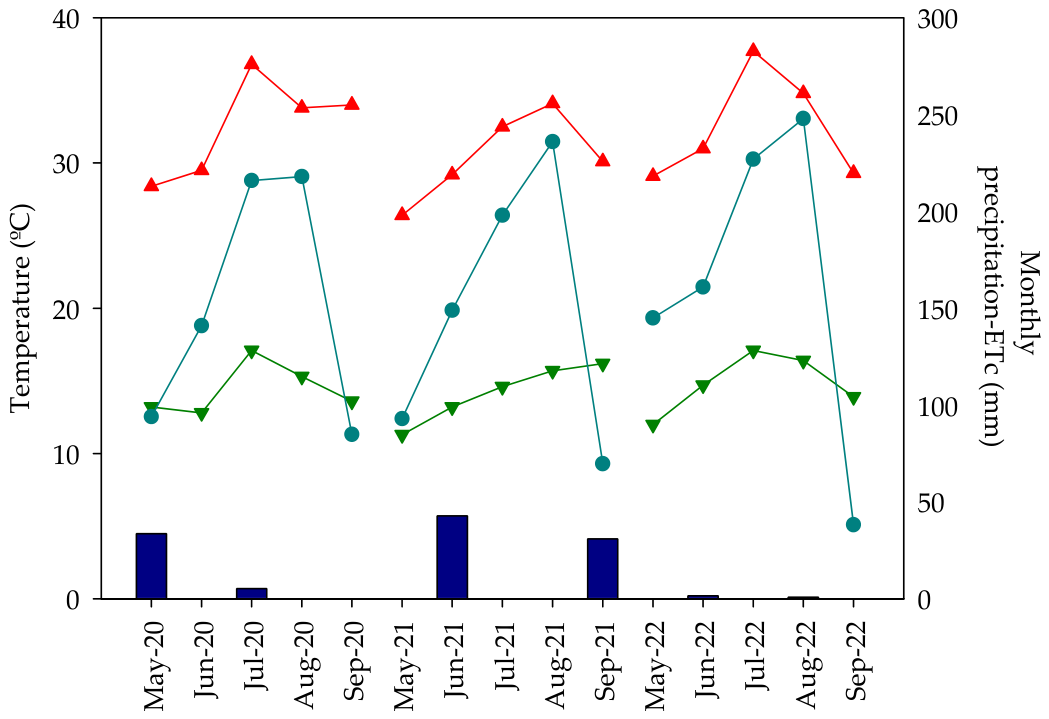
2.1. Study Site
2.2. Experimental Design and Field Management
2.3. Rice Performance
2.4. Soil and Plant Analysis for Selenium and Arsenic
2.5. Statistical Analysis
3. Results and Discussion
3.1. Effects on Grain and Biomass Production
3.2. Effects on Available Se and as in the Soil
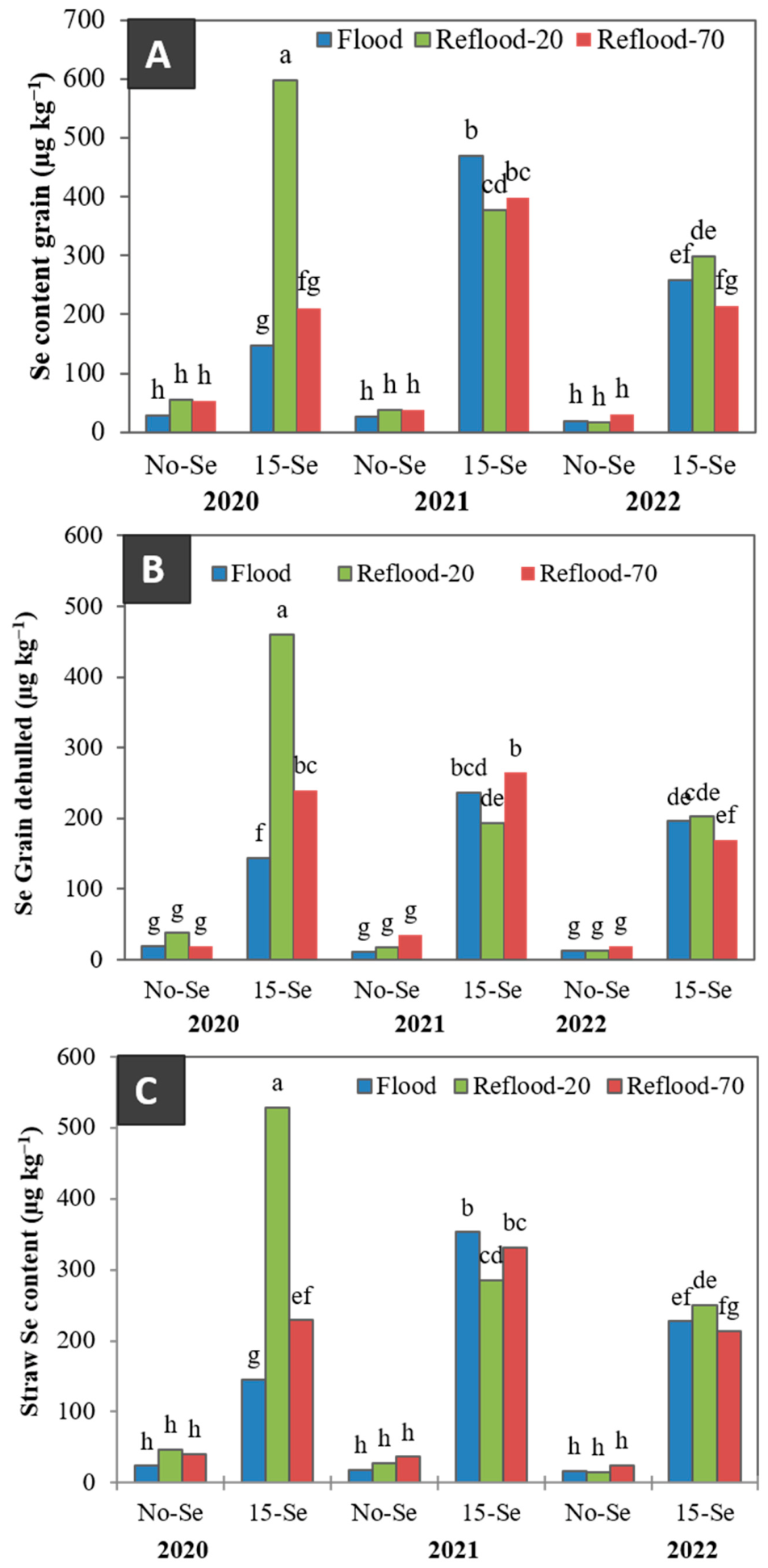
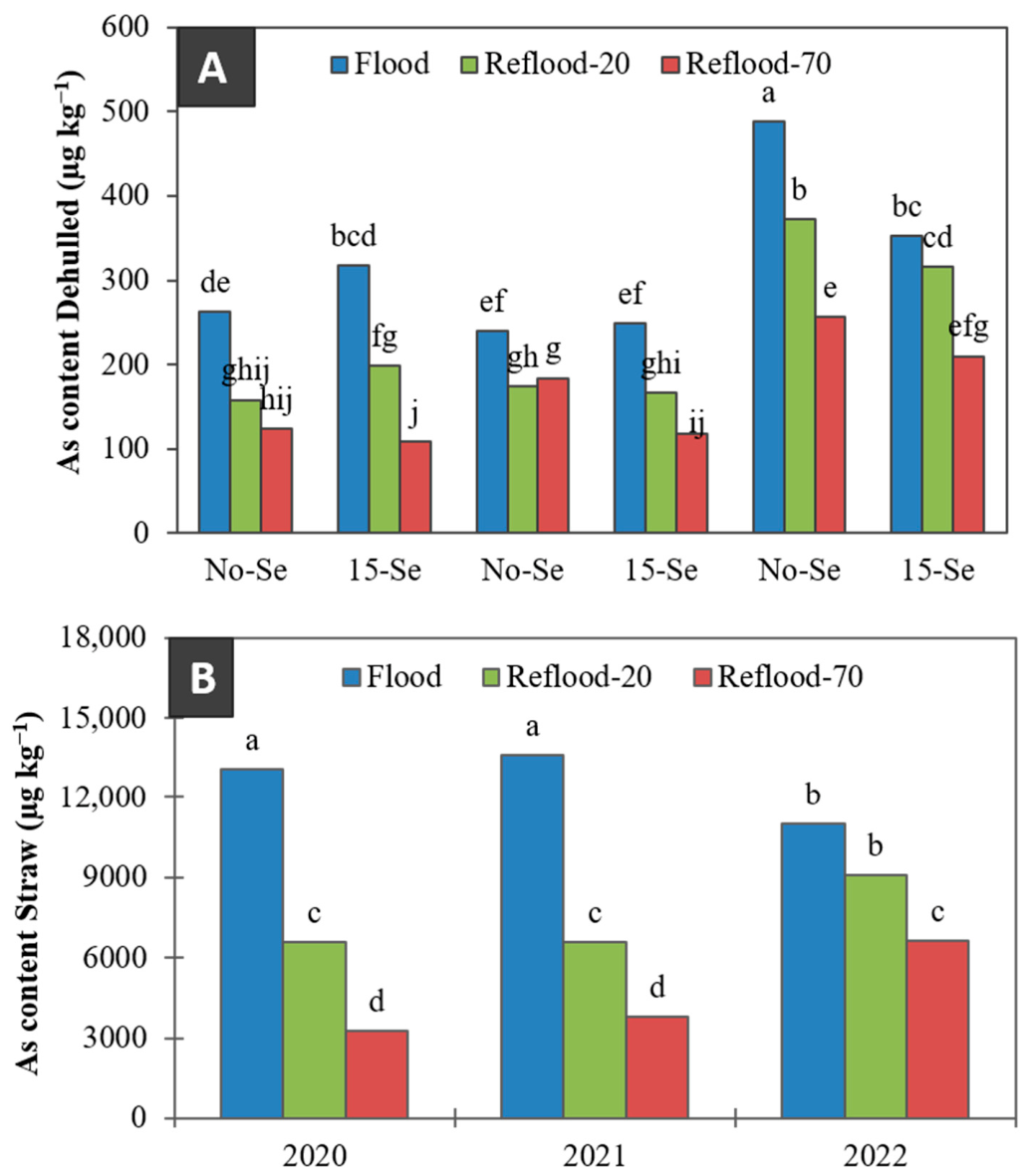
3.3. Effects on Se and As Contents on Whole and Dehulled Grain
3.4. Effects on Straw Se and as Contents
4. Conclusions
Author Contributions
Funding
Data Availability Statement
Conflicts of Interest
References
- FAO; IFAD; UNICEF; WFP; WHO. The State of Food Security and Nutrition in the World 2024—Financing to End Hunger, Food Insecurity and Malnutrition in All Its Forms; FAO: Rome, Italy, 2024. [Google Scholar] [CrossRef]
- Roy, A.; Moradkhani, H.; Mekonnen, M.; Moftakhari, H.; Magliocca, N. Towards strategic interventions for global food security in 2050. Sci. Total Environ. 2024, 954, 176811. [Google Scholar] [CrossRef] [PubMed]
- Kuresova, G.; Haberle, J.; Svoboda, P.; Wollnerova, J.; Moulik, M.; Chrpova, J.; Raimanova, I. Effects of post-anthesis drought and irrigation on grain yield, canopy temperature and 13C discrimination in common wheat, spelt, and einkorn. Agronomy 2022, 12, 2941. [Google Scholar] [CrossRef]
- Li, Y.; Guan, K.; Schnitkey, G.D.; DeLucia, E.; Peng, B. Excessive rainfall leads to maize yield loss of a comparable magnitude to extreme drought in the United States. Glob. Change Biol. 2019, 25, 2325–2337. [Google Scholar] [CrossRef] [PubMed]
- Rezaei, E.E.; Webber, H.; Asseng, S.; Boote, K.; Durand, J.L.; Ewert, F.; Martre, P.; MacCarthy, D.S. Climate change impacts on crop yields. Nat. Rev. Earth Environ. 2023, 4, 831–846. [Google Scholar] [CrossRef]
- Sen, S.; Chakraborty, R.; Kalita, P. Rice—Not just a staple food: A comprehensive review on its phytochemicals and therapeutic potential. Trends Food Sci. Technol. 2020, 97, 265–285. [Google Scholar] [CrossRef]
- Taddei, F.; Galassi, E.; Nocente, F.; Gazza, L. Innovative milling processes to improve the technological and nutritional quality of parboiled brown rice pasta from contrasting amylose content cultivars. Foods 2021, 10, 1316. [Google Scholar] [CrossRef] [PubMed]
- Zhang, Q.; Wu, J.; Zhao, Y.; Wang, J. Greenhouse gas emissions and water-carbon cost-adjusted yield of drought-tolerant rice under varying irrigation amounts in the Jianghan Plain of China. Agric. Water Manag. 2026, 328, 110303. [Google Scholar] [CrossRef]
- Li, S.; Zhuang, Y.; Liu, H.; Wang, Z.; Zhang, F.; Lv, M.; Zhai, L.; Fan, X.; Niu, S.; Chen, J.; et al. Enhancing rice production sustainability and resilience via reactivating small water bodies for irrigation and drainage. Nat. Commun. 2023, 14, 3794. [Google Scholar] [CrossRef] [PubMed]
- Vicente, L.; Peña, D.; Fernández, D.; Albarrán, Á.; Rato-Nunes, J.M.; López-Piñeiro, A. Alternate wetting and drying irrigation with field aged biochar may enhance water and rice productivity. Agron. Sustain. Dev. 2025, 45, 6. [Google Scholar] [CrossRef]
- Vitali, A.; Moretti, B.; Bertora, C.; Miniotti, E.F.; Tenni, D.; Romani, M.; Facchi, A.; Martin, M.; Fogliatto, S.; Vidotto, F.; et al. The environmental and agronomic benefits and trade-offs linked with the adoption alternate wetting and drying in temperate rice paddies. Field Crops Res. 2024, 317, 109550. [Google Scholar] [CrossRef]
- Dhakal, S.; Ahmed, S.F.; Ullah, H.; Cha-um, S.; Datta, A. Effect of biochar and alternate wetting and drying irrigation on tropical rice under different planting methods. Water Conserv. Sci. Eng. 2026, 11, 4. [Google Scholar] [CrossRef]
- Gao, R.; Zhuo, L.; Duan, Y.; Yan, C.; Yue, Z.; Zhao, Z.; Wu, P. Effects of alternate wetting and drying irrigation on yield, water-saving, and emission reduction in rice fields: A global meta-analysis. Agric. For. Meteorol. 2024, 353, 110075. [Google Scholar] [CrossRef]
- Lagomarsino, A.; Agnelli, A.E.; Linquist, B.; Adviento-Borbe, M.A.; Agnelli, A.; Gavina, G.; Ravaglia, S.; Ferrara, R.M. Alternate wetting and drying of rice reduced CH4 emissions but triggered N2O peaks in a clayey soil of central Italy. Pedosphere 2016, 26, 533–548. [Google Scholar] [CrossRef]
- Fan, J.; Peng, D.; Peng, Y.; Li, S.; Nong, C.; Bai, L.; Ma, G. Occurrence Dynamics of Weeds, Yield Losses, and Herbicide Screening for Barnyardgrass (Echinochloa crus-galli) Control in Direct-Seeded Early Rice in Hunan Province, China. Agronomy 2026, 16, 867. [Google Scholar] [CrossRef]
- Adviento-Borbe, M.A.A.; Massey, J.H.; Ottis, B.; Anders, M. Alternate wetting and drying irrigation and selected hybrid rice maintain high grain yield and further reduce soil trace gas fluxes in Arkansas. J. Environ. Manag. 2026, 401, 128962. [Google Scholar] [CrossRef] [PubMed]
- Arai, H. Increased rice yield and reduced greenhouse gas emissions through alternate wetting and drying in a triple-cropped rice field in the Mekong Delta. Sci. Total Environ. 2022, 842, 156958. [Google Scholar] [CrossRef] [PubMed]
- Howell, K.R.; Shrestha, P.; Dodd, I.C. Alternate wetting and drying irrigation maintained rice yields despite half the irrigation volume, but is currently unlikely to be adopted by smallholder lowland rice farmers in Nepal. Food Energy Secur. 2015, 4, 144–157. [Google Scholar] [CrossRef] [PubMed]
- Sriphirom, P.; Chidthaisong, A.; Towprayoon, S. Effect of alternate wetting and drying water management on rice cultivation with low emissions and low water used during wet and dry season. J. Clean. Prod. 2019, 223, 980–988. [Google Scholar] [CrossRef]
- Martínez-Eixarch, M.; Alcaraz, C.; Guàrdia, M.; Català-Forner, M.; Bertomeu, A.; Monaco, S.; Cochrane, N.; Oliver, V.; The, Y.A.; Courtois, B.; et al. Multiple environmental benefits of alternate wetting and drying irrigation system with limited yield impact on European rice cultivation: The Ebre Delta case. Agric. Water Manag. 2021, 258, 107164. [Google Scholar] [CrossRef]
- Zhang, Y.; Wang, W.; Li, S.; Zhu, K.; Hua, X.; Harrison, M.T.; Liu, K.; Yang, J.; Liu, L.; Chen, Y. Integrated management approaches enabling sustainable rice production under alternate wetting and drying irrigation. Agric. Water Manag. 2023, 281, 108265. [Google Scholar] [CrossRef]
- Qin, Y.; Huang, C.; Huang, G.; Li, H.; Shohag, M.J.I.; Gu, M.; Shen, F.; Lu, D.; Zhang, M.; Wei, Y. Relative bioavailability of selenium in rice using a rat model and its application to human health risk assessment. Environ. Pollut. 2023, 338, 122675. [Google Scholar] [CrossRef] [PubMed]
- García-Latorre, C.; Rivera-Martín, A.; Poblaciones, M.J. Selenium biofortification in triticale (× Triticosecale Wittmack) under mediterranean conditions: Effects on forage yield and quality parameters. Agric. Res. 2026. [Google Scholar] [CrossRef]
- Tolu, J.; Bouchet, S.; Helfenstein, J.; Hausheer, O.; Chékifi, S.; Frossard, E.; Tamburini, F.; Chadwick, O.A.; Winkel, L.H.E. Understanding soil selenium accumulation and bioavailability through size resolved and elemental characterization of soil extracts. Nat. Commun. 2022, 13, 6974. [Google Scholar] [CrossRef] [PubMed]
- EFSA Panel on Nutrition, Novel Foods and Food Allergens (NDA) Scientific opinion on the tolerable upper intake level for selenium. EFSA J. 2023, 21, 194. [CrossRef] [PubMed]
- D’Amato, R.; Regni, L.; Falcinelli, B.; Mattioli, S.; Benincasa, P.; Dal Bosco, A.; Pacheco, P.; Proietti, P.; Troni, E.; Santi, C.; et al. Current knowledge on selenium biofortification to improve the nutraceutical profile of food: A comprehensive review. J. Agric. Food Chem. 2020, 68, 4075–4097. [Google Scholar] [CrossRef] [PubMed]
- Zeng, J.Y.; Guan, D.X.; Dai, Z.H.; Chen, J.Y.; Dong, W.J.; Ding, S.; Ma, L.Q. Selenium contents, speciation and bioaccessibility of Se-enriched rice grains from Chinese markets. Soil Environ. Health 2023, 1, 100037. [Google Scholar] [CrossRef]
- Lai, R.F.; Zhang, T.T.; Gao, Y.H.; Lu, R.H.; Liu, Y.F.; Zheng, A.X.; Ashraf, U.; Fan, P.S.; Du, B.; Luo, H.W.; et al. The effect of EDTA-Se with different concentrations on photosynthesis of fragrant rice (Oryza sativa L.). Appl. Ecol. Environ. Res. 2019, 17, 3293–3303. [Google Scholar] [CrossRef]
- Hu, J.; Feng, D.; Tang, Z.; Ya, C.; Lin, X.; Zhang, K.; Yao, X. Effects of Foliar Organic Selenium Application During the Main Season on Ratoon Rice Yield, Grain Quality, and Selenium Accumulation. Plants 2025, 14, 2758. [Google Scholar] [CrossRef] [PubMed]
- Zhang, L.; Song, H.; Guo, Y.; Fan, B.; Huang, Y.; Mao, X.; Liang, K.; Hu, Z.; Sun, X.; Fang, Y.; et al. Benefit–risk assessment of dietary selenium and its associated metals intake in China (2017–2019): Is current selenium-rich agro-food safe enough? J. Hazard. Mater. 2020, 398, 123224. [Google Scholar] [CrossRef] [PubMed]
- Xie, Q.; Li, J.; Luo, D.; Kong, F.; Zhang, S.; Chai, G.; Yan, Q.; Zhou, H.; Li, G.; Cheng, Q.; et al. Co-occurrence of selenium and toxic elements and health risk assessment in commercial selenium-enriched rice from China. Sci. Rep. 2026, 16, 5922. [Google Scholar] [CrossRef] [PubMed]
- Moreno-Jiménez, E.; Meharg, A.A.; Smolders, E.; Manzano, R.; Becerra, D.; Sánchez-Llerena, J.; Albarrán, A.; López-Piñero, A. Sprinkler irrigation of rice fields reduces grain arsenic but enhances cadmium. Sci. Total Environ. 2014, 485–486, 468–473. [Google Scholar] [CrossRef] [PubMed]
- Harine, I.J.; Islam, M.R.; Hossain, M.; Afroz, H.; Jahan, R.; Siddique, A.B.; Uddin, S.; Hossain, M.A.; Alamri, S.; Siddiqui, M.H.; et al. Arsenic accumulation in rice grain as influenced by water management: Human health risk assessment. Agronomy 2021, 11, 1741. [Google Scholar] [CrossRef]
- Ahsan, M.Z.; Panhwar, F.H.; Jia, X.; Ye, X.; Rongjun, C.; Lihua, L.; Zhu, J. Selenium-rich rice genotypes mitigate arsenic uptake and accumulation while maintaining agronomic performance in arsenic-contaminated soil. Plant Soil 2026, 521, 1717–1734. [Google Scholar] [CrossRef]
- Pokhrel, G.R.; Wang, K.T.; Zhuang, H.; Wu, Y.; Chen, W.; Lan, Y.; Zhu, X.; Li, Z.; Fu, F.; Yang, G. Effect of selenium in soil on the toxicity and uptake of arsenic in rice plant. Chemosphere 2020, 239, 124712. [Google Scholar] [CrossRef] [PubMed]
- Papadakis, J. Climates of the World and Their Agricultural Potentialities; Libro de Edicion Argentina: Buenos Aires, Argentina, 1966; p. 179. [Google Scholar]
- FAO. Guidelines for Soil Description, 4th ed.; Food and Agriculture Organization of the United Nations: Rome, Italy, 2006. [Google Scholar]
- Adams, M.L.; Lombi, E.; Zhao, F.J.; McGrath, S.P. Evidence of low selenium concentrations in UK bread-making wheat grain. J. Sci. Food Agric. 2002, 82, 1160–1165. [Google Scholar] [CrossRef]
- Shi, Y.; Ma, H.; Li, T.; Guo, E.; Zhang, T.; Zhang, X.; Yang, X.; Wang, L.; Jiang, S.; Zhou, L.; et al. Model improvement for simulating the effects of individual and combined low-temperature stress at different reproductive stages in rice. Eur. J. Agron. 2026, 176, 128050. [Google Scholar] [CrossRef]
- Ministerio de Agricultura, Pesca y Alimentación, MAPA. 2021 Cultivos Herbáceos e Industriales: El Arroz. Available online: https://www.mapa.gob.es/es/agricultura/temas/producciones-agricolas/cultivos-herbaceos/arroz/default.aspx (accessed on 19 May 2026).
- Okamura, M.; Arai-Sanoh, Y.; Yoshida, H.; Mukouyama, T.; Adachi, S.; Yabe, S.; Nakagawa, H.; Tsutsumi, K.; Taniguchi, Y.; Kobayashi, N.; et al. Characterization of high-yielding rice cultivars with different grain-filling properties to clarify limiting factors for improving grain yield. Field Crops Res. 2018, 219, 139–147. [Google Scholar] [CrossRef]
- Li, R.; Li, M.; Ashraf, U.; Liu, S.; Zhang, J. Exploring the relationships between yield and yield-related traits for rice varieties released in china from 1978 to 2017. Front. Plant Sci. 2019, 10, 543. [Google Scholar] [CrossRef] [PubMed]
- Ramos, D.P.; Chan, G.A.H.; Dias, M.A.R.; Silva, D.V.; Sousa, P.L.R.; Júnior, N.R.M.; Leal, T.H.V.; de Oliveira, W.T.M.; Dias, D.S.; Cavallini, G.S.; et al. Effect of foliar application with selenium on biofortification and physiological attributes of irrigated rice cultivars. J. Food Compos. Anal. 2023, 123, 105534. [Google Scholar] [CrossRef]
- Luo, H.; He, L.; Lai, R.; Liu, J.; Xing, P.; Tang, X. 2021 Selenium applications enhance 2-acetyl-1-pyrroline biosynthesis and yield formation of fragrant rice. Agron. J. 2021, 113, 250–260. [Google Scholar] [CrossRef]
- Boldrin, P.F.; Faquin, V.; Ramos, S.J.; Boldrin, K.V.F.; Avila, F.W.; Guilherme, L.R.G. Soil and foliar application of selenium in rice biofortification. J. Food Compos. Anal. 2013, 31, 238–244. [Google Scholar] [CrossRef]
- Mangueze, A.V.; Pessoa, M.F.G.; Silva, M.J.; Ndayiragije, A.; Magaia, H.E.; Cossa, V.S.I.; Reboredo, F.H.; Carvalho, M.L.; Santos, J.P.; Guerra, M.; et al. Simultaneous zinc and selenium biofortification in rice. Accumulation, localization and implications on the overall mineral content of the flour. J. Cereal Sci. 2018, 82, 34–41. [Google Scholar] [CrossRef]
- Naeem, A.; Aslam, M.; Ahmad, M.; Asif, M.; Yazici, M.A.; Cakmak, I.; Rashid, A. Biofortification of diverse basmati rice cultivars with iodine, selenium, and zinc by individual and cocktail spray of micronutrients. Agronomy 2021, 12, 49. [Google Scholar] [CrossRef]
- Ramos, D.P.; Chan, G.A.H.; Tavares, T.C.O.; Santos, M.M.; Sousa, S.A.; Soares, G.M.; Veloso, D.A.; Souza, W.R.; Oliveira, A.C.F.; Veloso, N.M.; et al. Impacts of selenium foliar biofortification on the biochemical composition and grain yield of rice cultivars. Am. Acad. Sci. Res. J. Eng. Technol. Sci. 2022, 88, 1–14. [Google Scholar]
- Rodrigo, S.; Santamaria, O.; Pérez-Izquierdo, L.; Poblaciones, M.J. Arsenic and selenium levels in rice fields from south-west of Spain: Influence of the years of monoculture. Plant Soil Environ. 2017, 63, 184–188. [Google Scholar] [CrossRef]
- Hawkesford, M.J.; Zhao, F.J. Strategies for increasing the selenium content of wheat. J. Cereal Sci. 2007, 46, 282–292. [Google Scholar] [CrossRef]
- Mandal, J.; Jain, V.; Sengupta, S.; Rahman, M.; Bhattacharyya, K.; Rahman, M.; Golui, D.; Wood, M.; Mondal, D. Determination of bioavailable arsenic threshold and validation of modelled permissible total arsenic in paddy soil using machine learning. J. Environ. Qual. 2023, 52, 2. [Google Scholar] [CrossRef] [PubMed]
- Matos-Reyes, M.N.; Cervera, M.L.; Campos, R.C.; de la Guardia, M. Total content of As, Sb, Se, Te and Bi in Spanish vegetables, cereals and pulses and estimation of the contribution of these foods to the Mediterranean daily intake of trace elements. Food Chem. 2010, 122, 188–194. [Google Scholar] [CrossRef]
- Ventura, M.G.; Freitas, M.; Pacheco, A.; Van Merteen, T.; Wolterbeek, H.T. Selenium content in selected Portuguese foodstuffs. Eur. Food Res. Technol. 2007, 224, 395–401. [Google Scholar] [CrossRef]
- Lidon, F.C.; Oliveira, K.; Galhano, C.; Guerra, M.; Ribeiro, M.M.; Pelica, J.; Pataco, I.; Ramalho, J.C.; Leitão, A.E.; Almeida, A.S.; et al. Selenium biofortification of rice through foliar application with selenite and selenate. Exp. Agric. 2019, 55, 528–542. [Google Scholar] [CrossRef]
- Chen, L.; Yang, F.; Xu, J.; Yun, H.; Hu, Q.; Zhang, Y.; Pan, G. Determination of selenium concentration of rice in China and effect of fertilization of selenite and selenate on Se content of rice. J. Agric. Food Chem. 2002, 50, 5128–5130. [Google Scholar] [CrossRef] [PubMed]
- Deng, X.; Liu, K.; Li, M.; Zhang, W.; Zhao, X.; Zhao, Z.; Liu, X. Difference of selenium uptake and distribution in the plant and selenium form in the grains of rice with foliar spray of selenite or selenate at different stages. Field Crops Res. 2017, 211, 165–171. [Google Scholar] [CrossRef]
- Elmadfa, I. The European Nutrition and Health Report; Forum of Nutrition: Vienna, Austria, 2009; p. 62. [Google Scholar]
- Reid, M.E.; Duffield-Lillico, A.J.; Slate, E.; Natarajan, N.; Turnbull, B.; Jacobs, E.; Combs, G.F.; Alberts, D.S.; Clark, L.C.; Marshall, J.R. The nutritional prevention of cancer: 400 mcg per day selenium treatment. Nutr. Cancer 2008, 60, 155–163. [Google Scholar] [CrossRef] [PubMed]
- Zhao, F.J.; Ma, J.F.; Meharg, A.A.; McGrath, S.P. Arsenic uptake and metabolism in plants. New Phytol. 2009, 181, 777–794. [Google Scholar] [CrossRef] [PubMed]
- Williams, P.N.; Villada, A.; Deacon, C.; Raab, A.; Figuerola, J.; Green, A.J.; Feldmann, J.; Meharg, A.A. Greatly enhanced arsenic shoot assimilation in rice leads to elevated grain levels compared to wheat and barley. Environ. Sci. Technol. 2007, 41, 6854–6859. [Google Scholar] [CrossRef] [PubMed]
- Ma, R.; Shen, J.; Wu, J.; Tang, Z.; Shen, Q.; Zhao, F. Impact of agronomic practices on arsenic accumulation and speciation in rice grain. Environ. Pollut. 2014, 194, 217–223. [Google Scholar] [CrossRef] [PubMed]
- Jahan, I.; Abedin, M.A.; Islam, M.R.; Hossain, M.; Hoque, T.S.; Quadir, Q.F.; Hossain, M.I.; Gaber, A.; Althobaiti, Y.S.; Rahman, M.M. Translocation of soil arsenic towards accumulation in rice: Magnitude of water management to minimize health risk. Water 2021, 13, 2816. [Google Scholar] [CrossRef]
- Bogdan, K.; Schenk, M.K. Arsenic in rice (Oryza sativa L.) related to dynamics of arsenic and silicic acid in paddy soils. Environ. Sci. Technol. 2008, 42, 7885–7890. [Google Scholar] [CrossRef] [PubMed]
- Islam, F.S.; Gault, A.G.; Boothman, C.; Polya, D.A.; Charnock, J.M.; Chatterjee, D. Role of metal-reducing bacteria in arsenic release from Bengal delta sediments. Nature 2004, 430, 68–71. [Google Scholar] [CrossRef] [PubMed]
- Kaur, S.; Singh, D.; Singh, K. Effect of selenium application on arsenic uptake in rice (Oryza sativa L.). Environ. Monit. Assess. 2017, 189, 430. [Google Scholar] [CrossRef] [PubMed]
- Lin, L.; Zhou, W.; Dai, H.; Cao, F.; Zhang, G.; Wu, F. Selenium reduces cadmium uptake and mitigates cadmium toxicity in rice. J. Hazard. Mater. 2012, 235, 343–351. [Google Scholar] [CrossRef] [PubMed]
- Liu, W.; Shang, S.; Feng, X.; Zhang, G.; Wu, F. Modulation of exogenous selenium in cadmium-induced changes in antioxidative metabolism, cadmium uptake, and photosynthetic performance in the 2 tobacco genotypes differing in cadmium tolerance. Environ. Toxicol. Chem. 2014, 34, 92–99. [Google Scholar] [CrossRef] [PubMed]
- Sun, H.; Dai, H.; Wang, X.; Wang, G. Physiological and proteomic analysis of selenium-mediated tolerance to Cd stress in cucumber (Cucumis sativus L.). Ecotoxicol. Environ. Saf. 2016, 133, 114–126. [Google Scholar] [CrossRef]
- Ding, Y.; Di, X.; Norton, G.; Beesley, L.; Yin, X.; Zhang, Z.; Zhi, S. Selenite Foliar Application Alleviates Arsenic Uptake, Accumulation, Migration and Increases Photosynthesis of Different Upland Rice Varieties. Int. J. Environ. Res. Public Health 2020, 17, 3621. [Google Scholar] [CrossRef] [PubMed]
- Huang, S.Y.; Wang, Q.; Qi, H.; Liu, Z.; Tao, Y.; Fan, Y.; Wang, Q.; Li, H.F.; Wan, Y. Selenate simultaneously alleviated cadmium and arsenic accumulation in rice (Oryza sativa L.) via regulating transport genes. Environ. Pollut. 2024, 359, 124725. [Google Scholar] [CrossRef] [PubMed]
- Wang, W.; Zhang, F.; Liu, D.; Chen, K.; Du, B.; Qiu, X.; Xu, J.; Xing, D. Distribution characteristics of selenium, cadmium and arsenic in rice grains and their genetic dissection by genome-wide association study. Front. Genet. 2022, 13, 1007896. [Google Scholar] [CrossRef] [PubMed]
- Guan, H.; Lv, Y.; Wang, K.; Zhang, H.; Xu, J.; Liu, X. Hydroxyapatite-modified biochar application derived from recycled selenium-rich straw enhances rice biofortification and economic benefits. Environ. Sci. Technol. 2026, 60, 473–485. [Google Scholar] [CrossRef] [PubMed]
- Mahdavi, S.M.; Mohammadian, M.; Mahdavi Mashaki, K.; Abadian, H.; Nabipour, A.; Erfani, R. The Effect of Climate Changes on Soil Fertility and Temperature Stress in Rice Cultivation. Int. J. Plant Prod. 2025, 19, 167–182. [Google Scholar] [CrossRef]
- Abdullah; Wani, K.I.; Hayat, K.; Naeem, M.; Aftab, T. Multifaceted role of selenium in plant physiology and stress resilience: A review. Plant Sci. 2025, 355, 112456. [Google Scholar] [CrossRef] [PubMed]
- Zhang, L.; Chu, C. Selenium Uptake, Transport, Metabolism, Reutilization, and Biofortification in Rice. Rice 2022, 15, 30. [Google Scholar] [CrossRef] [PubMed]
- Wang, F.; Zhang, J.; Xu, L.; Ma, A.; Zhuang, G.; Huo, S.; Zou, B.; Qian, J.; Cui, Y. Selenium volatilization in plants, microalgae, and microorganisms. Heliyon 2024, 10, e26023. [Google Scholar] [CrossRef] [PubMed]
- Dhillon, K.S.; Dhillon, S.K.; Dogra, R. Selenium accumulation by forage and grain crops and volatilization from seleniferous soils amended with different organic materials. Chemosphere 2010, 78, 548–556. [Google Scholar] [CrossRef] [PubMed]
- Khan, M.A.; Islam, M.R.; Panaullah, G.M.; Duxbury, J.M.; Jahiruddin, M.; Loeppert, R.H. Accumulation of arsenic in soil and rice under wetland condition in Bangladesh. Plant Soil 2010, 333, 263–274. [Google Scholar] [CrossRef]
- Singh, R.; Upadhyay, A.K.; Singh, D.P. Regulation of oxidative stress and mineral nutrient status by selenium in arsenic treated crop plant Oryza sativa. Ecotoxicol. Environ. Saf. 2018, 148, 105–113. [Google Scholar] [CrossRef] [PubMed]



| Properties | Value |
|---|---|
| Sand (%) | 62.0 |
| Silt (%) | 23.4 |
| Clay (%) | 14.6 |
| TOC (g kg−1) | 8.64 |
| pH (H2O) | 5.51 |
| EC (dS m−1) | 2.81 |
| N (g kg−1) | 0.76 |
| CEC (cmolc kg−1) | 10.8 |
| Available As (µg kg−1) | 70.3 |
| Available Se (µg kg−1) | 1.32 |
| Year (Y) | Irrigation (I) | Y × I | Selenium (Se) | Y × Se | I × Se | Y × I × Se | |
|---|---|---|---|---|---|---|---|
| DF | 2 | 2 | 4 | 1 | 2 | 2 | 4 |
| Grain yield | 21.57 *** | 10.93 *** | 1.96 | 0.01 | 0.67 | 2.31 | 1.90 |
| Biomass production | 43.26 *** | 4.40 * | 1.05 | 11.47 ** | 1.21 | 1.11 | 0.40 |
| 1000 grain weight | 43.59 *** | 6.11 ** | 0.61 | 5.23 * | 1.23 | 0.49 | 0.28 |
| Se soil | 0.54 | 0.80 | 0.14 | 4.78 | 2.59 | 0.87 | 0.97 |
| As soil | 1.38 | 1.72 | 0.56 | 0.38 | 0.25 | 0.53 | 1.09 |
| Se whole grain | 13.00 *** | 12.89 *** | 13.90 *** | 477.01 *** | 10.47 *** | 11.67 *** | 12.14 *** |
| As whole grain | 116.95 *** | 34.90 *** | 1.82 | 1.51 | 0.02 | 0.76 | 1.32 |
| Se dehulled | 14.59 *** | 13.00 *** | 19.69 *** | 680.58 *** | 8.18 *** | 9.93 *** | 15.68 *** |
| As dehulled | 105.16 *** | 92.38 *** | 4.54 ** | 7.23 * | 11.33 *** | 1.21 | 3.00 * |
| Se straw | 63.3 *** | 0.93 | 2.18 | 655.3 *** | 21.2 *** | 1.26 | 2.52 * |
| As straw | 2.56 | 98.07 *** | 5.92 *** | 21.27 *** | 0.41 | 0.82 | 0.22 |
| Parameter | Year | Irrigation System | Se Application | |||||
|---|---|---|---|---|---|---|---|---|
| 2020 | 2021 | 2022 | Flood | Reflood-20 | Reflood-70 | 15-Se | No-Se | |
| Grain yield (kg ha−1) | 8309 ± 232 b | 8409 ± 213 b | 10,230 ± 411 a | 9436 ± 609 a | 9418 ± 389 a | 8094 ± 312 b | 8984 ± 285 | 8982 ± 268 |
| Biomass production (kg ha−1) | 6287 ± 227 c | 8760 ± 197 a | 7875 ± 246 b | 8084 ± 558 a | 7531 ± 310 b | 7307 ± 331 b | 8013 ± 322 a | 7268 ± 234 b |
| 1000 grain weight (g) | 23.9 ± 0.2 a | 22.4 ± 0.2 b | 21.6 ± 0.2 c | 23.1 ± 1.3 a | 22.6 ± 0.4 b | 22.2 ± 0.3 b | 22.9 ± 0.2 a | 22.4 ± 0.3 b |
| Se soil (µg kg−1) | 1.5 ± 0.03 | 1.5 ± 0.05 | 1.4 ± 0.03 | 1.4 ± 0.04 | 1.5 ± 0.04 | 1.5 ± 0.4 | 1.5 ± 0.03 | 1.4 ± 0.04 |
| As soil (µg kg−1) | 65.3 ± 2.4 | 74.5 ± 3.6 | 71.1 ± 4.4 | 75.2 ± 3.0 | 66.2 ± 3.1 | 68.6 ± 4.3 | 68.7 ± 4.2 | 71.2 ± 3.7 |
| Se grain (µg kg−1) | 182 ± 53.8 b | 225 ± 53.8 a | 140 ± 81.9 c | 158 ± 61.0 b | 231 ± 57.5 a | 157 ± 36.0 b | 330 ± 61.5 a | 34 ± 18.2 b |
| As grain (µg kg−1) | 225 ± 28.9 b | 206 ± 29.1 b | 564 ± 81.7 a | 444 ± 62.1 a | 328 ± 53.8 b | 224 ± 35.2 c | 317 ± 63.2 | 346 ± 44.5 |
| Se dehulled (µg kg−1) | 156 ± 40.3 a | 126 ± 27.5 b | 102 ± 22.0 c | 103 ± 24.7 c | 154 ± 39.7 a | 127 ± 26.5 b | 235 ± 18.7 a | 22 ± 2.4 b |
| As dehulled (µg kg−1) | 195 ± 19.3 b | 189 ± 13.7 b | 332 ± 23.8 a | 319 ± 23.9 a | 231 ± 21.2 b | 167 ± 14.5 c | 226 ± 17.4 b | 251 ± 22.4 a |
| Se Straw (µg kg−1) | 143 ± 31.4 c | 298 ± 51.3 a | 190 ± 33.2 b | 204 ± 46.8 | 221 ± 44.0 | 205 ± 39.0 | 358 ± 6.7 a | 62 ± 23.8 b |
| As Straw (µg kg−1) | 7641 ± 1089 b | 7979 ± 1191 ab | 8904 ± 564 a | 12,553 ± 623 a | 7403 ± 422 b | 4566 ± 605 c | 7086 ± 676 b | 9263 ± 850 a |
Disclaimer/Publisher’s Note: The statements, opinions and data contained in all publications are solely those of the individual author(s) and contributor(s) and not of MDPI and/or the editor(s). MDPI and/or the editor(s) disclaim responsibility for any injury to people or property resulting from any ideas, methods, instructions or products referred to in the content. |
© 2026 by the authors. Licensee MDPI, Basel, Switzerland. This article is an open access article distributed under the terms and conditions of the Creative Commons Attribution (CC BY) license.
Share and Cite
Poblaciones, M.J.; Vicente, L.; Fernández-Rodríguez, D.; Albarrán, Á.; Peña, D.; López-Piñeiro, A. Selenium Biofortification Improves Grain Quality and Reduces Arsenic Accumulation in Rice Under Alternate Wetting and Drying Irrigation. Agronomy 2026, 16, 1220. https://doi.org/10.3390/agronomy16131220
Poblaciones MJ, Vicente L, Fernández-Rodríguez D, Albarrán Á, Peña D, López-Piñeiro A. Selenium Biofortification Improves Grain Quality and Reduces Arsenic Accumulation in Rice Under Alternate Wetting and Drying Irrigation. Agronomy. 2026; 16(13):1220. https://doi.org/10.3390/agronomy16131220
Chicago/Turabian StylePoblaciones, María J., Luis Vicente, Damián Fernández-Rodríguez, Ángel Albarrán, David Peña, and Antonio López-Piñeiro. 2026. "Selenium Biofortification Improves Grain Quality and Reduces Arsenic Accumulation in Rice Under Alternate Wetting and Drying Irrigation" Agronomy 16, no. 13: 1220. https://doi.org/10.3390/agronomy16131220
APA StylePoblaciones, M. J., Vicente, L., Fernández-Rodríguez, D., Albarrán, Á., Peña, D., & López-Piñeiro, A. (2026). Selenium Biofortification Improves Grain Quality and Reduces Arsenic Accumulation in Rice Under Alternate Wetting and Drying Irrigation. Agronomy, 16(13), 1220. https://doi.org/10.3390/agronomy16131220