Article

Environment-Dependent Control by Trichogramma-Based Preparations Against Ostrinia nubilalis and Helicoverpa armigera: Results from On-Farm Trials in Hungary


1
Doctoral School of Agricultural and Food Sciences, Hungarian University of Agriculture and Life Sciences, Villányi út 29–43., H-1118 Budapest, Hungary
2
Department of Entomology, Institute of Plant Protection, Hungarian University of Agriculture and Life Sciences, Villányi út 29–43., H-1118 Budapest, Hungary
3
Hungarian Research Institute of Organic Agriculture (ÖMKi), Ráby Mátyás u. 26., H-1038 Budapest, Hungary
4
Biocont Magyarország Kft., Trafó u. 1., H-6000 Kecskemét, Hungary
5
Faculty of Horticulture and Rural Development, John von Neumann University, Izsáki út 10., H-6000 Kecskemét, Hungary
6
Institute of Horticultural Sciences, Hungarian University of Agriculture and Life Sciences, Páter Károly u.1., H-2100 Gödöllő, Hungary
7
Syntech Research Kft., Széchenyi u. 132/A, H-2141 Csömör, Hungary
8
Department of Applied Statistics, Institute of Mathematics and Basic Science, Hungarian University of Agriculture and Life Sciences, Villányi út 29–43., H-1118 Budapest, Hungary
*
Author to whom correspondence should be addressed.
Agronomy 2026, 16(11), 1104; https://doi.org/10.3390/agronomy16111104
Submission received: 26 April 2026 / Revised: 29 May 2026 / Accepted: 1 June 2026 / Published: 3 June 2026
(This article belongs to the Special Issue Comprehensive Impacts of Agrobiodiversity in Agricultural Ecosystems)

Abstract

This study presents the findings of on-farm trials conducted in Hungary between 2023 and 2025, evaluating the efficacy of inundative Trichogramma releases against the European corn borer (ECB) and the cotton bollworm (CBW). The research assessed three Trichogramma preparations, including solo T. brassicae (TB) and two species mixtures: (1) T. dendrolimi, T. cacoeciae, and T. brassicae (TSM1) and (2) T. brassicae and T. pintoi (TSM2). The timing of the releases was synchronized with pest swarming and maize phenology. The efficacy of Trichogramma-based biological control was assessed by comparing the number of damaged plants and the number of pest larvae detected in treated and untreated plots. Statistical analyses revealed a significant association between the release of parasitoids and a reduction in pest damage. The efficacy of the Trichogramma releases was determined using Abbott’s formula. In our research, the following pattern emerged: (1) medium efficacy (ranging from 40% to 68.2%) occurred under low pest pressure and optimal weather conditions; (2) low efficacy (35.5% and 33.3%) occurred under medium pest pressure and suboptimal climatic conditions; and (3) no efficacy occurred under high pest abundance combined with unfavorable weather. Our findings suggest that Trichogramma-based products can serve as complementary components of Integrated Pest Management (IPM); however, they also emphasize that parasitism by Trichogramma wasps is influenced by several factors, such as climatic conditions and pest abundance, indicating that additional plant protection treatments may be necessary, for example, under high pest pressure and/or suboptimal climatic conditions.

1. Introduction

Maize (Zea mays L.) is one of the most important agricultural crops worldwide, serving as a critical industrial raw material, a forage component, and a primary food source for humans [1,2]. According to the Food and Agriculture Organization of the United Nations, global maize production reached 1.2 billion tons in 2023, of which 61 million tons were produced in Europe and 6.2 million tons in Hungary [3]. While maize production in Northern Europe is primarily intended for silage, grain maize remains the main focus in Central and Southern regions [4]. Among the European countries, sweet corn is cultivated extensively in Hungary and France [5].
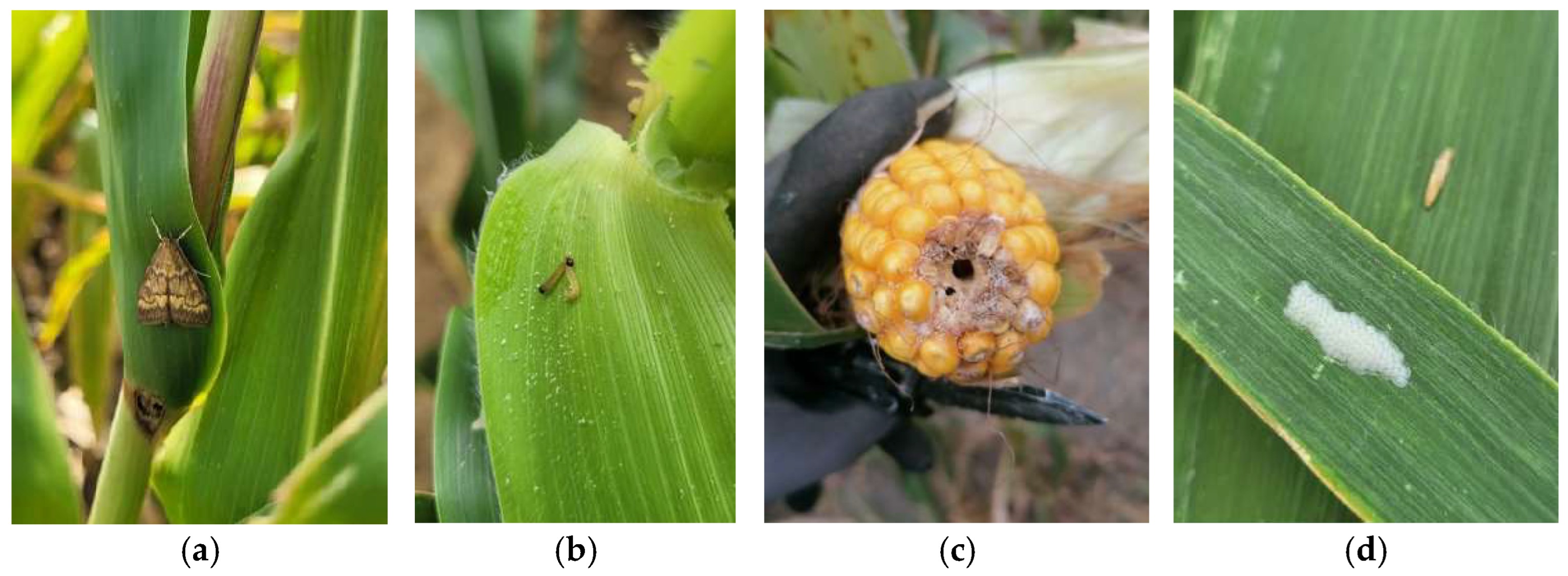
The European corn borer (Ostrinia nubilalis Hübner) (ECB) (Figure 1a) and the cotton bollworm (Helicoverpa armigera Hübner) (CBW) (Figure 2a) are ranked among the most destructive pests of maize in Europe. The ECB causes various symptoms in plants. Initially, the larvae (Figure 1b) feed on the leaf epidermis. After the first molt, they bore into the maize stalk to feed on the pith. This often results in the characteristic symptom of the ECB: tassel or stalk breakage. The latter is more critical regarding yield loss. Additionally, larvae attack the cobs, consuming grains and creating internal galleries (Figure 1c). As a form of secondary damage, the larval injuries favor the emergence of microfungal species, which produce mycotoxins that degrade grain quality. Because female moths lay eggs in clusters (Figure 1d), field damage is often patchy [2,6,7,8]. ECB development varies regionally in Europe: two to three generations occur in Mediterranean countries, one to two in Central Europe, and only one generation annually in northern areas [9,10].
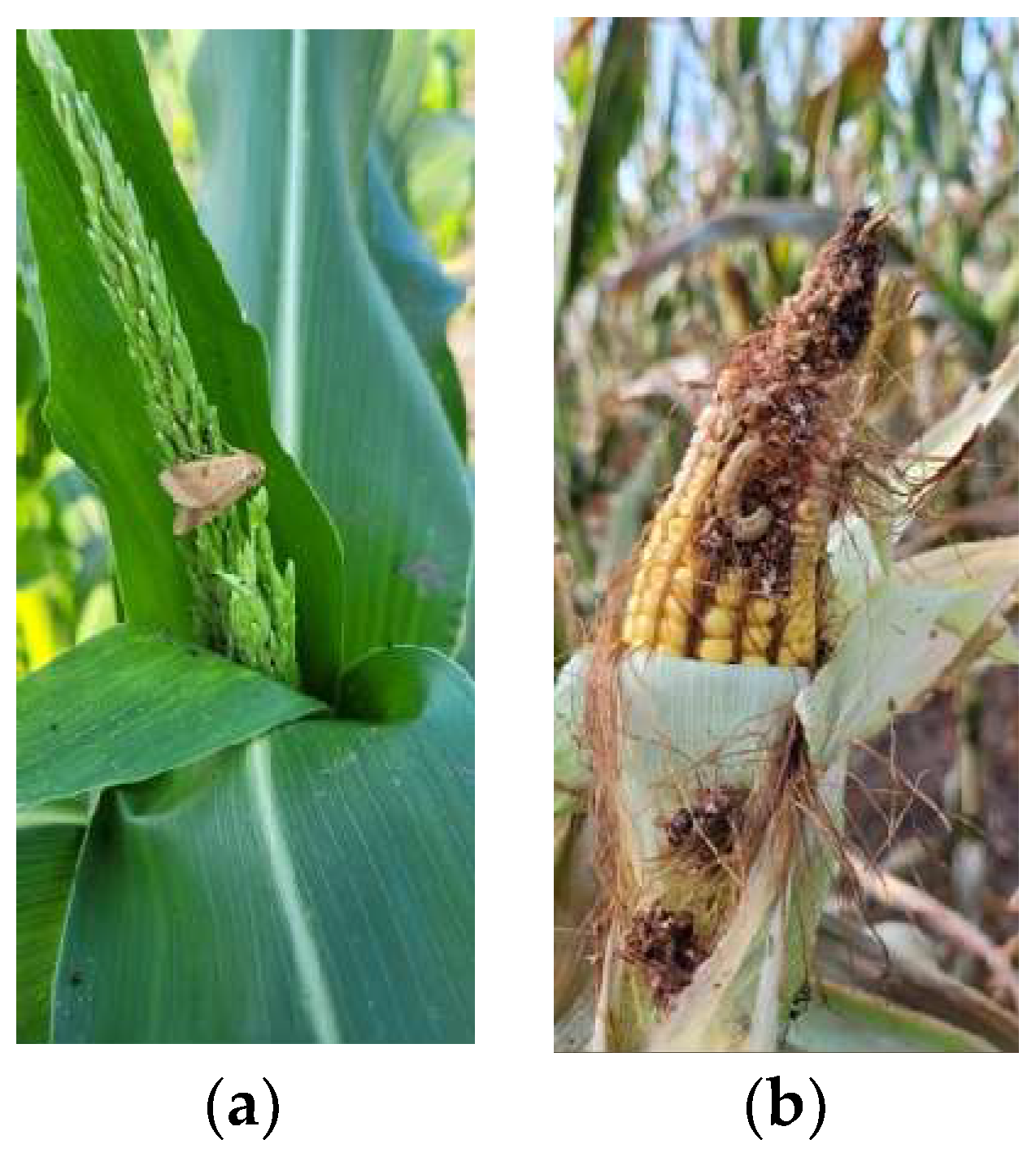
The CBW (Figure 2a) is a polyphagous pest known to attack more than 100 plant species from different botanical families [11,12,13]. Recent studies indicate that the CBW has a host range exceeding 200 host species [14,15,16]. The CBW larvae are aggressive feeders that primarily damage generative plant parts (Figure 2b); however, they also consume vegetative structures in many instances [17,18]. In contrast to the patchy distribution of the ECB, CBW damage is typically uniform across the field, as females lay their eggs individually. Pupation occurs in the upper 4–6 cm of the soil. The larvae undergo five developmental instars [19]. The CBW is considered to be a facultative migrant, departing its current habitat when environmental conditions deteriorate, seeking more favorable locations to ensure the survival of adults and the successful growth of its offspring [20,21,22]. In temperate climate regions, the CBW produces one to three generations annually and is capable of overwintering in Hungary as well [22,23,24,25]. Beyond direct larval damage, secondary pathogens such as Fusarium or corn smut (Ustilago maydis) can colonize the affected areas, significantly impairing the marketability of the maize [26].
Trichogramma (Hymenoptera: Trichogrammatidae) are minute parasitoid wasps that attack the eggs of insects, primarily lepidopterans [27,28]. Trichogramma wasps range in size from 0.4 to 0.6 mm; females are slightly larger than males [29]. Trichogramma wasps are haplodiploid: haploid males develop from unfertilized eggs, while diploid females develop from fertilized eggs [30,31]. The larvae develop through three stages and pupate inside the host eggs. The color of parasitized host eggs turns black, making them easily recognizable [27]. To locate host eggs, females utilize both chemical and visual cues. Kairomones are chemical signals originating from the scales of female moths, left near the eggs during oviposition [27,32]. Adult parasitoids meet their carbohydrate and protein requirements by consuming nectar, pollen, and honeydew [33]. Female parasitoids also utilize hemolymph exuding from oviposition wounds on the host eggs as a nutritional source [34,35,36,37]. Host feeding is critical for the fecundity of the parasitoids [38,39,40]. Trichogramma parasitoid wasps overwinter as larvae inside the host egg [40].
Foliar insecticide treatments are a common practice in maize cultivation across many European countries, including Spain, Hungary, Poland, Germany, Italy, France, and Denmark. However, the application intensity and the percentage of treated acreage vary by country [4]. Chemical pesticides can accumulate in the environment, posing risks to biodiversity and potentially impacting human health. Residues of these plant protection products are often detected in agricultural products. Biological control, for instance, the use of parasitoid Trichogramma wasps, provides an environmentally friendly method for reducing pest populations [41]. Reducing reliance on pesticides and addressing the associated risks to human health and the environment are core parts of the European Union’s agricultural agenda (Directive 2009/128/EC). To achieve these goals, Integrated Pest Management (IPM) has been compulsory within the EU since 2014. The mass release of Trichogramma wasps is a promising alternative pest control tool, offering a way to avoid or greatly reduce the application of broad-spectrum insecticides [42].
The use of Trichogramma species in plant protection began at the turn of the 20th century. In 1930, Flanders developed a method of rearing Trichogramma wasps using the eggs of Sitotroga cerealella Olivier [39,43]. Species of Trichogramma are considered among the most widely used natural enemies throughout the world because they occur across wide geographic areas, have a short lifespan, are easy to mass-produce, and are highly effective at parasitizing Lepidoptera eggs in many economically important crops [39,44,45].
Currently, Trichogramma wasps are used to control various moth pests, providing significant ecological and economic advantages [45,46,47,48,49]. Globally, six Trichogramma species are primarily used in the biological control of the genus Ostrinia. In the United States, the native Trichogramma nubilale Hübner and Trichogramma pretiosum Riley are used; in China, primarily Trichogramma ostriniae Pang and Chen and Trichogramma dendrolimi Matsumura are utilized; while in Europe, Trichogramma evanescens Westwood and Trichogramma brassicae Bezdenko are the most commonly applied species [46,50,51]. Successful control of the CBW has also been documented worldwide, including the mass release of Trichogramma chilonis Ishii in China [52] and India [53,54,55], Trichogramma australicum Girault [56] and Trichogramma pretiosum Riley in Australia [57], Trichogramma evanescens in Egypt [58,59], Trichogramma pretiosum [60,61] in Brazil, and Trichogramma evanescens, Trichogramma pintoi Voegele [62] and Trichogramma brassicae [42] in Europe.
While numerous studies in other countries confirm the efficacy of Trichogramma parasitoids against the ECB [42,62,63,64,65] and the CBW [61,62,66,67], only limited published data are available from Hungary regarding the Trichogramma parasitoids.
In experiments conducted in Hungary [62], the release of a mixture of two Trichogramma species (T. evanescens and T. pintoi) resulted in an average 73% and 83% efficacy against the ECB, and 62% and 69% against the CBW. T. evanescens and Trichogramma cacoeciae Marchal have also been recorded parasitizing the eggs of codling moth and leafroller moths [68,69,70]. In an experiment conducted in South Hungary [71], researchers found significantly less ECB and CBW damage on plants treated with T. pintoi and T. evanescens compared to chemical control plots.
The artificial release of Trichogramma wasps can be carried out by different methods, such as placing Trichogramma egg cards [72,73], spraying suspensions [74,75] using aircraft [63] or releasing capsules [62]. Egg cards or capsules containing parasitized eggs have been the most common method of applying Trichogramma individuals. The efficacy of these treatments has been confirmed by several trials [62,71,73,76]. Although using agricultural vehicles as carriers of the application systems is somewhat faster, it is fuel-consuming and, most importantly, causes unnecessary soil compaction [77,78,79]. Airplanes require significant logistical effort, such as finding a suitable airfield or navigating weather conditions, and the cost of fuel and aircraft rental is high [63]. Aerial application using unmanned aircraft systems (UAS) is a novel option. There are promising results regarding the application of Trichogramma wasps by agricultural drones [80,81]. Trichogramma individuals can be applied using drones via either bulk material (where parasitized eggs are mixed with a carrier material, such as semolina or vermiculite) or capsules. Parasitoids are dispersed uniformly during bulk releases, whereas dispersal from capsules is localized. However, capsules can protect parasitoids from predators or weather conditions [80,82].
This paper presents the results of the evaluation of inundative Trichogramma releases against the ECB and the CBW in feed corn in Hungary. The aim of our study was to assess the efficacy of Trichogramma-based preparations against the ECB and CBW under field conditions.

2. Materials and Methods

2.1. Experimental Sites and Design

Three on-farm experiments were conducted between 2023 and 2025 to compare the efficacy of biological control against the ECB and the CBW using Trichogramma-based preparations. In 2023 and 2024, inundative releases of Trichogramma wasps were carried out in central Hungary (Kecskemét), while in 2025, the experiments took place in western Hungary (Nágocs) (Table 1). At each location, large plots (1.0 and 1.4 ha) were established using a randomized complete block design with three to five replicates per treatment (Table 1). During the randomization of the blocks, care was taken to ensure that no two identical treatments shared a common border. No insecticide applications were used in the trial area during the trial period, and no previous Trichogramma releases had been conducted at these sites.

2.2. Insect Material

The Trichogramma individuals used in this study were from European laboratory colonies, maintained on eggs of Ephestia kuehniella Zeller (Lepidoptera: Pyralidae) and Sitotroga cerealella Olivier (Lepidoptera: Gelechiidae) under controlled conditions with a 16L:8D photoperiod, a temperature range of 22–25 °C, and relative humidity between 60% and 80%. Prior to field application, the Trichogramma-based products were stored at 6 °C to prevent premature hatching. Releases were conducted using cards or capsules; TB products contained parasitized E. kuehniella eggs, while TSM1 and TSM2 capsules contained parasitized S. cerealella eggs. We assessed the efficacy of three Trichogramma-based preparations: T. brassicae as a single strain, and two experimental Trichogramma species mixtures. TSM1 contained T. brassicae, T. dendrolimi, and T. cacoeciae, whereas TSM2 consisted of T. brassicae and T. pintoi. The species were present in an equivalent ratio in the mixtures. Releases were conducted using cards or capsules; TB products contained parasitized E. kuehniella eggs, while TSM1 and TSM2 capsules held parasitized S. cerealella eggs.

2.3. On-Farm Releases of Trichogramma-Based Preparations

Inundative releases of Trichogramma species against the first generation of the ECB were performed once in 2023 and 2024, and twice in 2025. In 2024, the TSM1 capsules were damaged by heavy post-release rainfall, which necessitated a repeated release. The remaining Trichogramma releases targeted the CBW. Against the CBW, two parasitoid releases were performed at two-week intervals in each year. The timing of applications was determined based on pest monitoring data and plant phenology. The dosages and number of releases were selected in accordance with the technological recommendations of the producers. Inundative releases of Trichogramma preparations were carried out manually in 2023 and 2024. In 2025, Trichogramma applications were conducted by drone (DJI Agras T30) (Table 2).

2.4. Evaluation Methods

Against the ECB, the efficacy of Trichogramma parasitoids was assessed by counting the number of damaged plants (identified visually by leaf and/or stem damage) and the number of ECB larvae. We also recorded the number of plants showing symptoms of stem breakage.
Regarding the CBW, we determined the efficacy of Trichogramma-based preparations by counting the number of damaged plants and the number of CBW larvae in treated and untreated plots. We assessed the CBW cob damage using the following four-point scale:
  • 0: No damage;
  • 1: 1–5 kernels damaged;
  • 2: 6–20 kernels damaged;
  • 3: More than 20 kernels damaged or an unsellable cob (where damage extends beyond just the cob ends).
An 80 × 80 m assessment area was designated within each plot, with a 20 m buffer zone maintained from the plot boundaries. In 2023 and 2024, we evaluated 10 plants at 10 points per plot, for a total of 100 plants per plot (500 per treatment). In 2025, the sample size was increased to 20 plants at 10 points per plot, with 200 plants per plot (600 per treatment).
In our experiments, the releases in May and June targeted the first generation of the ECB. The remaining Trichogramma releases in July targeted the CBW. The number and dates of the assessments, plant phenology during the evaluations, and the number of days after releases (DAR) are summarized in Table 3.
After collecting the field data, the following descriptive categories were created a posteriori for climatic conditions and pest pressure: optimal conditions were defined as a maximum temperature not higher than 35.1 °C, a weekly mean temperature below 25 °C, wind speed below 9 m/s, and relative humidity (RH) above 66%. Pest pressure was categorized based on pest abundance as low (<15%), medium (15–90%) and high (>90%).

2.5. Swarming Data

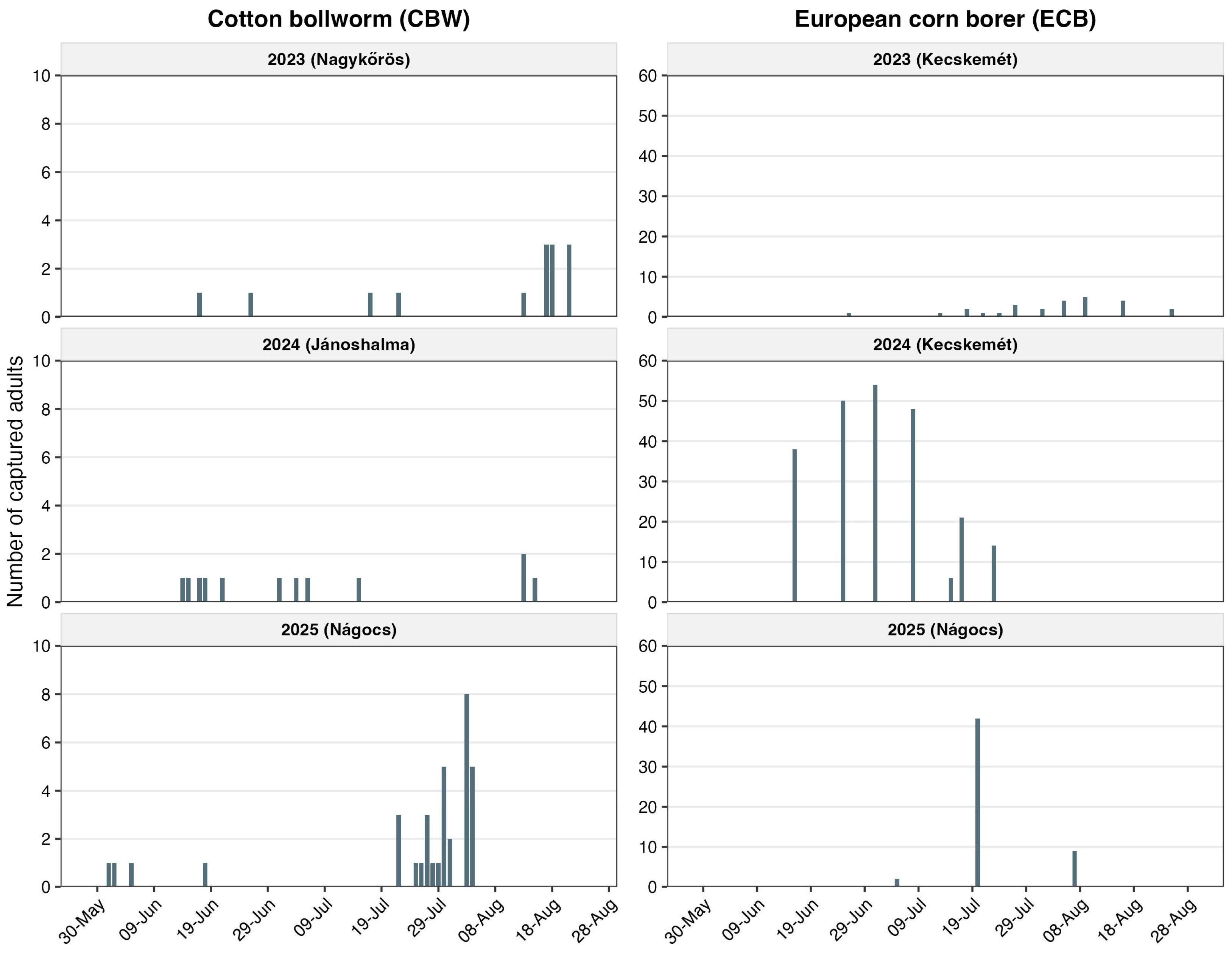
The dates of the parasitoid releases were calculated based on the monitoring of pest flight dynamics and plant phenology. Swarming of the ECB was observed using light traps. In 2023 and 2024, to determine the swarming of the ECB, we utilized the catch data from the FMC ArcTM farm light trap national network. Data on the number of ECB adults caught in light traps located closest to the experimental site are presented in Figure 3 (in 2023 in Nagykőrös and in 2024 in Jánoshalma). In 2025, a TrapView digital light trap was installed directly in the experimental area (Figure 3).
To monitor the adult emergence of CBW, we installed two Csalomon® sex-pheromone traps in different parts of all experimental sites during the V7–V11 maize phenological stages and used the average catch data (Figure 3).

2.6. Meteorological Data

Meteorological data in 2023 and 2024 were obtained from the HungaroMet (HMS: Hungarian Meteorological Service Nonprofit Ltd., Budapest, Hungary) Kecskemét station (station number 46304, GPS: N46.9656, E19.5450). In 2025, wind speed data were recorded on-site in Nágocs, while temperature and humidity data were retrieved from the TrapView digital light trap (Table 4).

2.7. Statistical Analysis

We used the statistical software R (v. 4.5.1, R Core Team, 2025) to evaluate the results.

2.7.1. Model for the Damages Caused by European Corn Borer (ECB)

The number of damaged plants (out of 10) was analyzed using a Zero-Inflated Binomial Mixed-Effects Model (GLMM) to account for the nested nature of the data (two years; five plots; 10 sampling points per plot) and the high frequency of zero-damage observations. The zero-inflation component of the model was not statistically significant (Logit estimate = 0.29, p = 0.315), which confirms that it successfully accounted for the structure of the zeros. The experimental design was incorporated into the model by nesting measurement points within plots as random effects. Treatment and time (Year) were included as fixed factors, including their interaction term. The model was fitted using the glmmTMB package in R [83,84]. Post hoc comparisons between treatments and the control were performed separately for each year, calculating the odds ratios using estimated marginal means (EMMs) with a Dunnett-type adjustment for multiple comparisons.
Abbott’s efficacy was calculated based on the predicted probabilities of damage for each treatment relative to the control within each year.

2.7.2. Model for the Damages Caused by Cotton Bollworm (CBW)

The experimental data (three years; five inspection dates: two in 2023, two in 2024 and one in 2025; five plots in 2023 and 2024, three plots in 2025; and 10 sampling points per plot) were analyzed using a Joint Multivariate Bayesian Mixed-Effects Model implemented in the brms package for R [85,86,87]. This approach was selected to simultaneously account for plant damage incidence and cob damage severity while acknowledging their biological correlation.
We utilized two distinct likelihood families. Plant damage (incidence) was modeled using a Beta-Binomial distribution to account for the bounded count (0–10) and overdispersion. Cob damage (severity) was modeled using a Zero-One-Inflated Beta (ZOIB) distribution after rescaling the 0–3 scores to a [0, 1] interval. This distribution was essential to handle the discrete peaks in the data at 0 (no damage) and 1 (maximum damage) and the continuous variation in damage in between.
A combined variable (interaction of year, inspection time, and treatment) was used as the primary predictor (fixed effect) to accommodate the unbalanced treatment design across the three years (TSM1 was used in 2023 and 2024, TSM2 and TB were applied in 2025).
To account for the hierarchical nesting of the study, random intercepts were included for plots and measurement points nested within plots. We allowed these intercepts to be correlated between the two response variables to determine if plots with high incidence also displayed higher severity.
The distributional parameters (overdispersion, zero-inflation, and one-inflation) were allowed to vary by time point to account for the extreme shift in damage pressure observed in the year 2024. Weakly informative normal priors N(0, 2.5) were applied to the regression coefficients to stabilize the model and prevent complete separation (infinite estimates) during high-damage periods.
The model was fitted using four Markov Chain Monte Carlo (MCMC) chains with 4000 iterations each. All parameters achieved excellent convergence, with their diagnostic R ^ values of 1.00. Effective sample sizes (ESS, i.e., the measurement of sampling efficiency) for both bulk (for the center of the posterior) and tail (for the 5% and 95% quantiles) exceeded 2000, indicating high posterior stability.
The posterior predictive check plots that compare the observed and simulated data confirmed that the model successfully replicated the bimodal distribution of plant damage and the zero/one spikes in cob severity.
To quantify the explanatory power of the model, we calculated the Bayesian R2 [88]. We distinguished between the marginal R2, representing the variance explained by fixed factors (treatment, year, and inspection time), and the conditional R2, representing the total variance explained by both fixed and random factors (including plots and measurement points).
To assess significance, the model utilized 95% Highest Density Credible Intervals (HDIs). A treatment effect was considered statistically significant if the 95% Credible Interval for the difference between the estimated marginal means of the treatment and the control group excluded zero.

3. Results

3.1. ECB

In 2023, we found only two larvae in the untreated control (UTC) plots, and no plants showed symptoms of stem breakage. Consequently, statistical analyses were based on the number of plants exhibiting symptoms of ECB stem and/or leaf damage. Low infestation pressure was observed in the study area, with 4.4% of plants in the UTC plots showing damage.
The Zero-Inflated Binomial Mixed-Effects Model (GLMM) revealed a non-significant zero-inflation component (p = 0.315), suggesting that the binomial distribution appropriately characterized the data structure. The random effect of plots explained more variance (variance = 0.104) than the nested measurement points (variance < 0.001), indicating spatial consistency within plots.
A significant interaction between treatment and time (year) was observed for the efficacy of the interventions (p < 0.001).
In 2023, the TB treatment significantly reduced the probability of plant damage compared to the UTC (Z = 2.66, p < 0.05). The predicted probability of damage was 10.9% for the UTC and 3.08% for TB, resulting in an Abbott’s efficacy of 68.2%. The TSM1 treatment did not differ significantly from the UTC in this year (p = 0.23, efficacy = 40.9%) (Table 5).
Low infestation pressure was also observed at the experimental site in 2024, with 5% of plants in the UTC plots showing damage. During the assessment, a low number of larvae were recorded (seven in the UTC, nine in the TB plots, and four in the TSM1 plots), and no plants showed symptoms of stem breakage. Thus, statistical analyses were again performed based on the number of plants exhibiting symptoms of ECB stem and/or leaf damage (Table 5). In 2024, the performance of the treatments shifted. The TB treatment no longer significantly differed from the UTC (Z = 1.47, p = 0.25, efficacy = 40.0%). However, the TSM1 treatment became significantly effective, reducing damage probability from 11.2% (UTC) to 3.96% (Z = 2.55, p < 0.05), yielding an Abbott’s efficacy of 60.0%.
The results demonstrate that both TB and TSM1 have the potential to reduce plant damage, but their efficacy is highly year-dependent. While TB was the superior treatment in 2023, TSM1 provided better protection in 2024. This suggests that environmental factors or variation in pest pressure between years may influence the performance of these specific treatments.
In 2025, the infestation pressure of the ECB was exceptionally low. In the UTC plots, only 0.5% of the evaluated plants were damaged; due to this negligible pressure, the data did not permit a robust statistical analysis.

3.2. CBW

In 2023, thirteen days after the TSM1 releases, the proportion of plants damaged by the CBW larvae was 6.8% in the UTC plots and 4.0% in the TSM1-treated plots.
The Joint Multivariate Bayesian Mixed-Effects Model estimated a positive correlation ( r = 0.56 ) between the intercepts of the two variables, suggesting that environmental factors at the plot level that increase the number of damaged plants also moderately increase the severity of damage on the cobs.
For the plant damage incidence and the cob damage, the fixed effects explained 93% and 48% of the variance, respectively (marginal R2), while the full model accounted for 94% and 49%, respectively (conditional R2).
The probability of plant damage incidence varied drastically across the three-year study period. In 2023, TSM1 initially reduced the probability of damage (efficacy = 41.2%), lowering the mean severity of damaged cobs from 50.5% to 32.3% (from 1.51 to 0.97 expressed in the four-point scale), based on the estimated marginal means (EMMs). However, this protection did not persist into the second inspection. By the final evaluation (21 days after the last Trichogramma releases), the CBW infestation rate approximately doubled in the UTC plots, reaching 15%. Unexpectedly, a higher percentage of damaged plants was recorded in the treated plots (23.9%), indicating that the treatment was not effective under these conditions (Table 6).
In 2024, twelve days after the TSM1 release, a period of extreme CBW pest pressure was observed (with 99.4% and 99.6% plant damage in the UTC plots at the first and second time points, respectively). In the UTC plots, 497 out of the 500 examined plants were damaged, with a total of 348 larvae recorded. The TSM1 treatment failed completely, as the damage rates were even higher in the treated plots (>99.9% at both time points). The zero-one inflation (zoi) and conditional-one inflation (coi) coefficients of the model were significant, with their 95% credible intervals not containing zero, reflecting that most damaged cobs tended toward either very low or very high damage.
During the second assessment, the number of larvae was substantially lower, with only six larvae recovered from untreated plants.
The mean cob damage rates exhibited almost identical values at the two time points with values of 2.66 and 2.60 in the UTC plots, respectively, calculated based on the estimated marginal means (EMMs). A comparison of the mean severity values revealed that they were similar in the treated plots, with values of 2.60 and 2.58 being recorded. This finding suggests that the severity of cob damage was comparable in the UTC and treated plots, with values ranging from 86.1% to 88.7% (Table 6).
In 2025, the CBW damage incidence was 15.5% in the UTC plots. The larvae were virtually absent from the study area at the time of assessment. Under moderate pressure, TB outperformed TSM2, reducing the estimated probability of damage to 10.0% (efficacy = 35.5%) compared to 10.3% for TSM2 (efficacy = 33.3%).
The mean cob damage rates to the cobs, calculated based on the estimated marginal means (EMMs), were 0.32 in the UTC plots and 0.23 in the TB-treated plots, while 0.25 was recorded in the TSM2-treated plots (Table 6). The mean severity coefficients of the model indicated that TB reduced the mean severity from 10.7% to 7.8% compared to the mean severity rate of TSM2 of 8.3%.

4. Discussion

With respect to the ECB, the efficacy of the TB releases was evaluated on an annual basis, whereas TSM1 was assessed in 2023 and 2024. Inundative releases of Trichogramma were carried out manually in 2023 and 2024; however, owing to labor and cost constraints [80,89], drone-assisted application (DJI Agras T30) was introduced in 2025. The ECB incidence in the UTC plots was low in both years (4.4% and 5.0%). According to the Z-test of the odds ratios, the number of damaged plants was significantly lower in plots treated with TB compared with the UTC plots in 2023. TSM1 also significantly reduced damage in 2024. Using Abbott’s formula, we determined that TB achieved an efficacy of 68.2% in 2023 and 40.0% in 2024; however, the latter value did not differ significantly from that observed in the UTC plots. The TSM1 treatment resulted in efficacies of 40.9% in 2023 and 60% in 2024, although the 2023 result was not statistically significant (Table 5). In 2025, the low level of ECB infestation precluded a robust statistical evaluation. It is important to emphasize that under conditions of low pest pressure or non-significant treatment differences, even small numerical variations may generate seemingly meaningful efficacy estimates, meaning that statistical significance should take precedence over the interpretation of Abbott’s percentage-based indices when considered in isolation.
Against the CBW, TSM1 was tested in 2023 and 2024, while TB and TSM2 were evaluated in 2025. Applications followed the same procedures as those for the ECB (manual in 2023 and 2024, drone-based in 2025). In 2023, TSM1 achieved 41.2% efficacy at the first assessment but showed no detectable effect at the second, indicating inconsistent performance. In 2024, high pest pressure combined with suboptimal climatic conditions led to complete treatment failure. In 2025, TB and TSM2 significantly reduced damage compared to the UTC plots, with efficacies of 35.5% and 33.3%, respectively (Table 6).
Previous studies have demonstrated the effectiveness of Trichogramma-based control against the ECB [42,62,63,64,65] and the CBW [61,62,66,67]. Our results are consistent with earlier findings, confirming moderate but variable efficacy under field conditions [71]. The tested TSM formulations contained T. dendrolimi, T. cacoeciae, T. pintoi, and T. brassicae, all of which are recognized as effective agents against lepidopteran pests [23,90,91,,92]. Moreover, they could consistently maintain mycotoxin levels below EU thresholds and potentially reduce environmental impacts associated with chemical insecticide use [42].
Trichogramma wasps are minute insects whose parasitic activity is influenced by a wide range of biotic [93,94,95] and abiotic [96,97,98,99] factors. Although different species compositions were evaluated, the observed variations in efficacy appear to be more closely associated with environmental factors and pest pressure rather than species composition alone. Against the ECB, both TB and TSM1 achieved efficacies of 40–70%, whereas against the CBW, efficacy remained around 35–40% under favorable conditions. In contrast, unsuccessful treatments coincided with adverse weather and/or high pest pressure, suggesting that these external factors may heavily influence field performance. Regarding the application method, several authors have concluded that ground or aerial releases exhibit comparable efficacy [49,80,100,101]; accordingly, the influence of the application method is considered to be of limited importance in the present trials. Based on our field observations, the following descriptive categories were defined: optimal conditions were characterized by maximum temperature not exceeding 35.1 °C, a weekly mean temperature below 25 °C, wind speed below 9 m/s, and relative humidity (RH) above 66%. Pest pressure was categorized according to pest abundance as low (<15%), medium (15–90%) and high (>90%). It should be noted that our classification of climatic suitability and pest pressure levels represents an a posteriori, descriptive categorization based on the observed range of our collected datasets.
Regarding the efficacy of the Trichogramma preparations, the following pattern was observed, which may provide a possible explanation for the treatment outcomes: (1) medium efficacy (≥40%) occurred under low pest pressure and optimal weather conditions; (2) low efficacy (<40%) occurred under medium pest pressure and suboptimal climatic conditions; and (3) no efficacy occurred under high pest abundance in combination with unfavorable weather conditions (Table 5 and Table 6).
However, as this study provides context-dependent, on-farm evidence rather than a fully controlled factorial experiment, several confounding factors, such as year, location, species composition, application method, and dosage, must be taken into account in the interpretation of the results.
The temperature sensitivity of Trichogramma wasps is well-known, with optimal performance between 25 and 35 °C and reduced survival or activity at higher temperatures [102,103,104,105,106]. Humidity appeared to play a secondary but nonetheless important role [87,107,108], as efficacy values above 40% were only observed at RH exceeding 66%.
Wind conditions may have further influenced outcomes. Although average wind speeds remained below critical thresholds, periodic episodes of elevated wind speed may have limited parasitoid dispersal [98,109,110], thereby contributing to the lower efficacy.
The functional response describes the relationship between the attack rate of natural enemies and varying pest densities [111]. The type of functional response of Trichogramma species has been reported as either type II (decelerating, i.e., the rate of efficacy slows down as the pest density increases) or type III (a sigmoid response, i.e., at low pest densities, efficacy initially accelerates, followed by a deceleration as the predator reaches its capacity limit) [112,113,114]. Our findings are consistent with a type II functional response, in which parasitism efficiency declines with increasing host density. This may provide a plausible explanation for the observation that effective control was maintained only at low pest densities (Table 5 and Table 6).

5. Conclusions

Our findings suggest that Trichogramma-based products can serve as complementary components of Integrated Pest Management (IPM); however, they also indicate that the efficacy of Trichogramma wasps is influenced by multiple factors, including environmental conditions and pest pressure.
Given the short lifespan of Trichogramma wasps (7–15 days at 25–35 °C) [103,115,116], strict monitoring of meteorological data and pest swarming is recommended during the two-week period following the releases to support informed decisions regarding the need for supplementary insecticide treatments. Moreover, regional pest pressure should also be considered, as spatial variation in pest abundance [22] may influence treatment outcomes.
Finally, this study highlights the importance of reporting negative or inconclusive results, as the omission of such data may bias future meta-analyses and lead to overly optimistic conclusions [117,118,119].
Overall, our results support the context-dependent application of Trichogramma-based biological control under continental (semiarid) climates.

Author Contributions

Conceptualization, F.T., L.J. and Á.S.; data curation, L.J. and M.L.; formal analysis, L.J. and M.L.; funding acquisition, L.J. and M.L.; investigation, L.J., A.T., R.D., B.G., A.F., Á.G., B.B. and A.F.; methodology, F.T., L.J. and Á.S.; project administration, L.J.; resources L.J.; software, L.J. and M.L.; supervision, M.L. and Á.S.; validation, L.J., Á.S. and M.L.; visualization, L.J.; writing—original draft preparation, L.J., M.L. and Á.S.; writing—review and editing, L.J., M.L. and Á.S.; All authors have read and agreed to the published version of the manuscript.

Funding

Laura Jávorszky was supported by the EKÖP-24 New National Excellence Program of the Ministry for Culture and Innovation from the source of the National Research, Development and Innovation Fund (2024-2.1.2-EKÖP-KDP-2024-00020-5).

Institutional Review Board Statement

Not applicable.

Data Availability Statement

The data presented in this study are available upon request from the corresponding author due to privacy reasons.

Acknowledgments

The authors would like to thank the staff of Biocont Magyarország Kft. and Syntech Research Kft. for their professional assistance during the field trials. Special thanks are extended to the team of Agrodron for their expert work and precision in carrying out the drone-based applications of the Trichogramma preparations. We are also grateful to the FMC Arc™ farm light trap network for providing the European corn borer monitoring data for 2023 and 2024. Furthermore, we thank the farm owners and management in Kecskemét and Nágocs for providing the experimental sites and logistical support.

Conflicts of Interest

Authors Bernadett Gyekiczki and Ármin Gyuris were employed by the company Biocont Magyarország Kft., H-6000 Kecskemét, Trafó u. 1, Hungary. Biocont Magyarország Kft. provided professional assistance in procuring the TSM1 and TSM2 Trichogramma preparations used in the experiments, assisted in field application and certain data collection activities. However, the commercial partners had no role in the study design; in the statistical analysis or interpretation of data; in the writing of the manuscript; or in the decision to publish the results. The remaining authors declare that the research was conducted in the absence of any commercial or financial relationships that could be construed as a potential conflict of interest.

References

  1. Birkás, M. A kukorica talajkímélő művelése. Gyak. Agrofórum 2000, 11, 26–30. (In Hungarian) [Google Scholar]
  2. Arias-Martín, M.; Haidukowski, M.; Farinós, G.P.; Patiño, B. Role of Sesamia nonagrioides and Ostrinia nubilalis as Vectors of Fusarium spp. and Contribution of Corn Borer-Resistant Bt Maize to Mycotoxin Reduction. Toxins 2021, 13, 780. [Google Scholar] [CrossRef] [Scilit]
  3. Faostat. Available online: https://www.fao.org/faostat/en/#data/QCL (accessed on 11 October 2025).
  4. Meissle, M.; Mouron, P.; Musa, T.; Bigler, F.; Pons, X.; Vasileiadis, V.P.; Otto, S.; Anitchi, D.; Kiss, J.; Pálinkás, Z.; et al. Pests, pesticide use and alternative options in European maize production: Current status and future prospects. J. Appl. Entomol. 2010, 134, 357–375. [Google Scholar] [CrossRef] [Scilit]
  5. Huzsvai, L.; Fejér, P.; Illés, Á.; Bojtor, C.; Bojté, C.; Horváth, É.; Demeter, C. Analysis of sweet corn nutritional values using multivariate statistical methods. Acta Agrar. Debreceniensis 2021, 1, 103–108. [Google Scholar] [CrossRef] [Scilit] [PubMed]
  6. Keszthelyi, S. Szántóföldi Növények Kártevői; Agroinform Kiadó: Budapest, Hungary, 2016; pp. 163–176. [Google Scholar]
  7. Darvas, B.; Bánáti, H.; Takács, E.; Lauber, É.; Szécsi, Á.; Székács, A. Relationships of Helicoverpa armigera, Ostrinia nubilalis and Fusarium verticillioides on MON 810 Maize. Insects 2011, 2, 1–11. [Google Scholar] [CrossRef] [Scilit]
  8. Trotuş, E.; Buburuz, A.-A.; Ursache, P.L. New data regarding the appearance, evolution and the attack produced by Ostrinia nubilalis Hbn. species, at maize crop, under the center of Moldavia conditions. Rom. Agric. Res. 2018, 35, 229–236. [Google Scholar] [CrossRef] [Scilit]
  9. Svobodová, E.; Trnka, M.; Dubrovský, M.; Semerádová, D.; Eitzinger, J.; Žalud, Z.; Štěpánek, P. Pests occurrence model in current climate—Validation study for European Domain. Acta Univ. Agric. Silvic. Mendel. Brun. 2013, 61, 205–214. [Google Scholar] [CrossRef] [Scilit]
  10. Szőke, C.; Zsubori, Z.; Pók, I.; Rácz, F.; Illés, O.; Szegedi, I. Significance of the European corn borer (Ostrinia nubilalis Hübn.) in maize production. Acta Agron. Hung. 2002, 50, 447–461. [Google Scholar] [CrossRef] [Scilit]
  11. Firempong, S.; Zalucki, M.P. Host Plant Preferences of Populations of Helicoverpa-Armigera (Hubner) (Lepidoptera, Noctuidae) From Different Geographic Locations. Aust. J. Zool. 1989, 37, 665–673. [Google Scholar] [CrossRef] [Scilit]
  12. Talekar, N.S.; Opeña, R.T.; Hanson, P. Helicoverpa armigera management: A review of AVRDC’s research on host plant resistance in tomato. Crop Prot. 2006, 25, 461–467. [Google Scholar] [CrossRef] [Scilit]
  13. Hemati, S.A.; Naseri, B.; Nouri Ganbalani, G.; Rafiee Dastjerdi, H.; Golizadeh, A. Effect of different host plants on nutritional indices of the pod borer, Helicoverpa armigera. J. Insect Sci. 2012, 12, 55. [Google Scholar] [CrossRef] [Scilit]
  14. Riaz, S.; Johnson, J.B.; Ahmad, M.; Fitt, G.P.; Naiker, M. A review on biological interactions and management of the cotton bollworm, Helicoverpa armigera (Lepidoptera: Noctuidae). J. Appl. Entomol. 2021, 145, 467–498. [Google Scholar] [CrossRef] [Scilit]
  15. Dourado, P.M.; Pantoja-Gomez, L.M.; Horikoshi, R.J.; Carvalho, R.A.; Omoto, C.; Corrêa, A.S.; Kim, J.H.; Martinelli, S.; Head, G.P. Host plant use of Helicoverpa spp. (Lepidoptera: Noctuidae) in the Brazilian agricultural landscape. Pest Manag. Sci. 2021, 77, 780–794. [Google Scholar] [CrossRef] [Scilit]
  16. Yang, L.; Li, M.; Liu, J.; Zeng, J.; Lu, Y. Long-term expansion of cereal crops promotes regional population increase of polyphagous Helicoverpa armigera. J. Pest Sci. 2025, 98, 131–144. [Google Scholar] [CrossRef] [Scilit]
  17. Keszthelyi, S. Gyapottok-bagolylepke (Helicoverpa armigera). Agrofórum 2015, 26, 30–31. [Google Scholar]
  18. Mingotti Dias, P.; de Souza Loureiro, E.; Amorim Pessoa, L.G.; Mendes de Oliveira Neto, F.; de Souza Tosta, R.A.; Teodoro, P.E. Interactions between Fungal-Infected Helicoverpa armigera and the Predator Chrysoperla externa. Insects 2019, 10, 309. [Google Scholar] [CrossRef] [Scilit]
  19. Szeőke, K. Károkozó Rovarok a Mezőgazdaságban; Hajnalpír Kiadó: Székesfehérvár, Hungary, 2015; pp. 40–90. [Google Scholar]
  20. Colvin, J.; Gavin Gatehouse, A. Migration and genetic regulation of the pre-reproductive period in the Cotton-bollworm moth, Helicoverpa armigera. Heredity 1993, 70, 407–412. [Google Scholar] [CrossRef] [Scilit]
  21. Jyothi, P.; Aralimarad, P.; Wali, V.; Dave, S.; Bheemanna, M.; Ashoka, J.; Shivayogiyappa, P.; Lijm, K.S.; Chapman, J.W.; Sane, S.P. Evidence for facultative migratory flight behavior in Helicoverpa armigera (Noctuidae: Lepidoptera) in India. PLoS ONE 2021, 16, e0245665. [Google Scholar] [CrossRef] [Scilit] [PubMed]
  22. Keszthelyi, S.; Nowinszky, L.; Puskás, J. The growing abundance of Helicoverpa armigera in Hungary and its areal shift estimation. Cent. Eur. J. Biol. 2013, 8, 756–764. [Google Scholar] [CrossRef] [Scilit]
  23. Huang, J.; Li, J. Effects of climate change on overwintering pupae of the cotton bollworm, Helicoverpa armigera (Hübner) (Lepidoptera: Noctuidae). Int. J. Biometeorol. 2015, 59, 863–876. [Google Scholar] [CrossRef] [Scilit] [PubMed]
  24. Shimizu, K.; Fujisaki, K. Timing of diapause induction and overwintering success in the cotton bollworm Helicoverpa armigera (Hb.) (Lepidoptera: Noctuidae) under outdoor conditions in temperate Japan. Appl. Entomol. Zool. 2006, 41, 151–159. [Google Scholar] [CrossRef] [Scilit]
  25. Mironidis, G.K.; Stamopoulos, D.C.; Savopoulou-Soultani, M. Overwintering survival and spring emergence of Helicoverpa armigera (Lepidoptera: Noctuidae) in Northern Greece. Environ. Entomol. 2010, 39, 1068–1084. [Google Scholar] [CrossRef] [Scilit]
  26. Keszthelyi, S. A Változó Klíma és Termesztéstechnológia Hatása a Szántóföldi Kultúrák Kártevőire; Agrofórum Kiadó, Magyarország: Szekszárd, Hungary, 2018; pp. 8–13. [Google Scholar]
  27. Knutson, A. The Trichogramma Manual; Texas Agricultural Extension Service: College Station, TX, USA, 1998; pp. 5–20. [Google Scholar]
  28. Nagarkatti, S.; Nagaraja, H. Biosystematics of Trichogramma and Trichogrammatoidea Species. Annu. Rev. Entomol. 1977, 22, 157–176. [Google Scholar] [CrossRef] [Scilit]
  29. Pinto, J.D. Systematics of the North American species of Trichogramma Westwood (Hymenoptera: Trichogrammatidae). Mem. Entomol. Soc. Wash. 1999, 22, 1–287. [Google Scholar]
  30. Heimpel, G.E.; de Boer, J. G Sex Determination in the Hymenoptera. Annu. Rev. Entomol. 2008, 53, 209–230. [Google Scholar] [CrossRef] [Scilit] [PubMed]
  31. Zou, Y.; Geuverink, E.; Beukeboom, L.W.; Verhulst, E.C.; van de Zande, L. A chimeric gene paternally instructs female sex determination in the haplodiploid wasp Nasonia. Science 2020, 370, 1115–1118. [Google Scholar] [CrossRef] [Scilit]
  32. Lewis, W.J.; Nordlund, D.A.; Gueldner, R.C.; Teal, P.E.A.; Tumlinson, J.H. Kairomones and their use for management of entomophagous insects. J. Chem. Ecol. 1982, 8, 1323–1331. [Google Scholar] [CrossRef] [Scilit]
  33. Jervis, M.A.; Kidd, N.A.C.; Walton, M. A review of methods for determining dietary range in adult parasitoids. Entomophaga 1992, 37, 565–574. [Google Scholar] [CrossRef] [Scilit]
  34. Ellers, J.; Sevenster, J.G.; Driessen, G. Egg Load Evolution in Parasitoids. Am. Nat. 2000, 156, 650–665. [Google Scholar] [CrossRef]
  35. Farahani, H.K.; Ashouri, A.; Zibaee, A.; Abroon, P.; Alford, L. The effect of host nutritional quality on multiple components of Trichogramma brassicae fitness. Bull. Entomol. Res. 2016, 106, 633–641. [Google Scholar] [CrossRef] [Scilit]
  36. Giron, D.; Pincebourde, S.; Casas, J. Lifetime gains of host-feeding in a synovigenic parasitic wasp. Physiol. Entomol. 2004, 29, 436–442. [Google Scholar] [CrossRef] [Scilit]
  37. Godfray, H.C.J. Parasitoids: Behavioral and Evolutionary Ecology; Princeton University Press: Princeton, NJ, USA, 1994; pp. 129–131. [Google Scholar]
  38. Flanders, S.E. Mass Production of Egg Parasites of the Genus Trichogramma. Hilgardia 1930, 4, 465–501. [Google Scholar] [CrossRef] [Scilit]
  39. Hassan, S.A. The mass rearing and utilization of Trichogramma to control lepidopterous pests: Achievements and outlook. Pestic. Sci. 1993, 37, 387–391. [Google Scholar] [CrossRef] [Scilit]
  40. Boivin, G. Overwintering Strategies of Egg Parasitoid. In Biological Control with Egg Parasitoids; CAB International: Oxfordshire, UK, 1994; pp. 219–244. [Google Scholar]
  41. Keszthelyi, S.; Nagy, B.; Vasas, L.; Mile, L.; Szabó, Z. A kukoricamoly (Ostrinia nubilalis Hbn.). Gyak. Agroórum 2003, 14, 31–44. [Google Scholar]
  42. Razinger, J.; Vasileiadis, V.P.; Giraud, M.; van Dijk, W.; Modic, Š.; Sattin, M.; Urek, G. On-farm evaluation of inundative biological control of Ostrinia nubilalis (Lepidoptera: Crambidae) by Trichogramma brassicae (Hymenoptera: Trichogrammatidae) in three European maize-producing regions: Inundative biological control of Ostrinia nubilalis by Trichogramma brassicae. Pest Manag. Sci. 2016, 2, 246–254. [Google Scholar] [CrossRef] [Scilit]
  43. Mills, N. Parasitoids. In Encyclopedia of Insects; Academic Press: Cambridge, MA, USA, 2009; pp. 748–751. [Google Scholar] [CrossRef] [Scilit]
  44. Consoli, F.L.; Parra, J.R.P.; Zucchi, R.A. Egg Parasitoids in Agroecosystems with Emphasis on Trichogramma; Springer Science & Business Media: Berlin/Heidelberg, Germany, 2010; pp. 1–285. [Google Scholar]
  45. Smith, S.M. Biological Control with Trichogramma: Advances, Successes, and Potential of Their Use. Annu. Rev. Entomol. 1996, 41, 375–406. [Google Scholar] [CrossRef]
  46. Zang, L.-S.; Wang, S.; Zhang, F.; Desneux, N. Biological Control with Trichogramma in China: History, Present Status, and Perspectives. Annu. Rev. Entomol. 2021, 66, 463–484. [Google Scholar] [CrossRef] [Scilit]
  47. Navik, O.; Yele, Y.; Kedar, S.C.; Sushil, S.N. Biological control of fall armyworm Spodoptera frugiperda (JE Smith) using egg parasitoids, Trichogramma species (Hymenoptera: Trichogrammatidae): A review. Egypt. J. Biol. Pest Control 2023, 33, 118. [Google Scholar] [CrossRef] [Scilit]
  48. Gavara, J.; Cabello, T.; Gámez, M.; Bastin, S.; Hernández-Suárez, E.; Piedra-Buena, A. Evaluation and Selection of New Trichogramma spp. as Biological Control Agents of the Guatemalan Potato Moth (Tecia solanivora) in Europe. Insects 2023, 14, 679. [Google Scholar] [CrossRef] [Scilit] [PubMed]
  49. Basso, C.; Chiaravalle, W.; Maignet, P. Effectiveness of Trichogramma pretiosum in controlling lepidopterous pests of soybean crops. Agrociencia Urug. 2020, 24, SPE2. [Google Scholar] [CrossRef] [Scilit]
  50. Hassan, S.A. Strategies to select Trichogramma species for use in biological control. Biol. Control Egg Parasit. 1994, 41–58. [Google Scholar]
  51. Wang ZhenYing, W.Z.; He KangLai, H.K.; Yan Su, Y.S. Large-scale augmentative biological control of Asian corn borer using Trichogramma in China: A success story. In Proceedings of the Second International Symposium on Biological Control of Arthropods, Davos, Switzerland, 12–16 September 2005; pp. 487–494. [Google Scholar]
  52. Liu, B.; Yang, L.; Yang, F.; Wang, Q.; Yang, Y.; Lu, Y.; Gardiner, M.M. Landscape diversity enhances parasitism of cotton bollworm (Helicoverpa armigera) eggs by Trichogramma chilonis in cotton. Biol. Control 2016, 93, 15–23. [Google Scholar] [CrossRef] [Scilit]
  53. Irshad, R.; Yousuf, M.; Ikram, M. Role of Trichogramma in biological control of pests in India: A concise review. J. Biol. Control 2025, 39, 1–13. [Google Scholar] [CrossRef] [Scilit]
  54. Yadav, D.N.; Patel, R.C.; Patel, D.S. Impact of inundative release of Trichogramma Chilonis ishii against Heliothis Armigera (Hbn.) in Gujarat. J. Ent. Res. 1985, 9, 153–159. [Google Scholar] [CrossRef] [Scilit]
  55. Venkatesan, T.; Jalali, S.K. Development, characterization and field assessment of multiple insecticides and high temperature tolerant strain of an egg parasitoid, Trichogramma chilonis Ishii against crop pests. In New Horizons in Insect Science: Towards Sustainable Pest Management; Springer: New Delhi, India, 2015; pp. 327–345. [Google Scholar]
  56. Dahlan, A.N.; Gordh, G. Development of Trichogramma australicurn Girault (Hymenoptera: Trichogrammatidae) on Helicoverpa armigera (Hubner) Eggs (Lepidoptera: Noctuidae). Aust. J. Entomol. 1996, 35, 337–344. [Google Scholar] [CrossRef] [Scilit]
  57. Davies, A.P.; Carr, C.M.; Scholz, B.C.G.; Zalucki, M.P. Using Trichogramma Westwood (Hymenoptera: Trichogrammatidae) for insect pest biological control in cotton crops: An Australian perspective. Aust. J. Entomol. 2011, 50, 424–440. [Google Scholar] [CrossRef] [Scilit]
  58. El-Wakeil, N.E. Evaluation of efficiency of Trichogramma evanescens reared on different factitious hosts to control Helicoverpa armigera. J. Pest Sci. 2007, 80, 29–34. [Google Scholar] [CrossRef] [Scilit]
  59. Li, L. Worldwide use of Trichogramma for biological control on different crops: A survey. Biol. Control Egg Parasit. 1994, 37–53. [Google Scholar]
  60. Parra, J.R.P.; Coelho Junior, A.; Geremias, L.D.; Bertin, A.; Ramos, C.J. Criação de Anagasta Kuehniella, em Pequena Escala, Para Produção de Trichogramma; Occasio: Piracicaba, Brazil, 2014. [Google Scholar]
  61. Pereira, F.P.; Reigada, C.; Diniz, A.J.F.; Parra, J.R.P. Potential of Two Trichogrammatidae species for Helicoverpa armigera control. Neotrop. Entomol. 2019, 48, 966–973. [Google Scholar] [CrossRef] [Scilit]
  62. Hluchỳ, M.; Bagar, M.; Broklová, M.; Kalmán, S.; László, G.; Tamašek, Z. The results of the testing a product based on Trichogramma sp. the European corn borer eggs Ostrinia nubilalis Hbn. and cotton bollworm Helicoverpa armigera Hbn. in maize. in Book of Abstracts. In Proceedings of the XVIth Slovak and Czech Plant Protection Conference, Nitra, Slovakia, 16–17 September 2003. [Google Scholar]
  63. Bzowska-Bakalarz, M.; Bulak, P.; Bereś, P.K.; Czarnigowska, A.; Czarnigowski, J.; Pniak, M.; Karamon, B.; Bieganowski, A. Using gyroplane for application of Trichogramma spp. against the European corn borer in maize. Pest Manag. Sci. 2020, 76, 2243–2250. [Google Scholar] [CrossRef] [Scilit]
  64. Hoffmann, M.P.; Wright, M.G.; Pitcher, S.A.; Gardner, J. Inoculative releases of Trichogramma ostriniae for suppression of Ostrinia nubilalis (European corn borer) in sweet corn: Field biology and population dynamics. Biol. Control 2002, 25, 249–258. [Google Scholar] [CrossRef] [Scilit]
  65. Burgio, G.; Maini, S. Control of European corn borer in sweet corn by Trichogramma brassicae Bezd. (Hym., Trichogrammatidae). J. Appl. Entomol. 1995, 119, 83–87. [Google Scholar] [CrossRef] [Scilit]
  66. Hussain, D.; Hussain, A.; Qasim, M.; Khan, J. Insecticidal susceptibility and effectiveness of Trichogramma chilonis as parasitoids of tomato fruit borer, Helicoverpa armigera. Pak. J. Zool. 2025, 47, 1427–1432. [Google Scholar]
  67. Oztemiz, S.; Karacaoglu, M.; Yarpuzlu, F. Parasitization Rate of Helicoverpa armigera Hübner (Lepidoptera: Noctuidae) Eggs After Field Releases of Trichogramma evanescens Westwood (Hymenoptera: Trichogrammatidae) in Cotton in Cukurova Region of Turkey-. J. Kans. Entomol. Soc. 2009, 82, 183–193. [Google Scholar] [CrossRef] [Scilit]
  68. Bognár, S. Adatok az almamoly magyarországi természetes ellenségeiről és szerepükről. (Data concerning the natural enemies of the apple moth in Hungary and their role). Kert. És Szőlészeti Főisk. Évkönyve 1962, 26, 31–43. [Google Scholar]
  69. Nagy, B. The possible role of entomophagous insects in the genetic control of the codling moth, with special reference to Trichogramma. Entomophaga 1973, 18, 185–191. [Google Scholar] [CrossRef] [Scilit]
  70. Reichart, G. Adatok a magyarországi gyümölcsösök sodrómolyainak ismeretéhez. Data Referring Knowl. Fruit Tree Leaf Roll. Hung. Orchards. Ujabb Véd. Eljárások Kert. Kártevők És Bet. Ellen; Mezőgazdasági Kiadó: Budapest, Hungary, 1953; pp. 21–43. [Google Scholar]
  71. Csengeri, E.; Molnár, K.; Krizsán, P.; Gombos, B. Efficacy of egg parasitic wasps (Trichoplus capsules) in the insect pest control of sweet corn. Res. J. Agric. Sci. 2023, 55, 44–51. [Google Scholar]
  72. Kazmer, D.J.; Luck, R.F. Field Tests of the Size-Fitness Hypothesis in the Egg Parasitoid Trichogramma Pretiosum. Ecology 1995, 76, 412–425. [Google Scholar] [CrossRef] [Scilit]
  73. Mannan, A.; Iqbal, N.; Randhawa, A.H.; Qadeer, A. Impact of egg parasitoid of Trichogramma cards on growth yield and quality of sugarcane at different intervals. Sarhad J. Agric. 2024, 40, 972–979. [Google Scholar] [CrossRef] [Scilit]
  74. Dionne, A.; Khelifi, M. A novel Trichogramma ostriniae release system to control Ostrinia nubilalis in sweet corn. Appl. Eng. Agric. 2024, 40, 577–588. [Google Scholar] [CrossRef] [Scilit]
  75. Kienzle, J.; Zimmermann, O.; Wührer, B.; Triloff, P.; Morhard, J.; Landsgesell, E.; Zebitz, C.P.W. New species and new methods of application—A new chance for Trichogramma in codling moth control. In Proceedings of the Ecofruit. 15th International Conference on Organic Fruit-Growing, Hohenheim, Germany, 20–22 February 2012. [Google Scholar]
  76. Abbas, S.S.; Shahzad, M.F.; Iqbal, J.; Ullah, A.; Batool, A.; Nadeem, M.; Hafeez-ur-Rehman, M.K. Trichogramma chilonis as Parasitoid: An Eco-friendly Approach Against Tomato Fruit Borer, Helicoverpa armigera. J. Agric. Sci. 2020, 12, 167. [Google Scholar] [CrossRef] [Scilit]
  77. Lipiec, J.; Medvedev, V.V.; Birkás, M.; Dumitru, E.; Lyndina, T.E.; Rousseva, S.; Fulajtar, E. Effect of soil compaction on root growth and crop yield in Central and Eastern Europe. Int. Agrophysics 2003, 17, 61–69. [Google Scholar]
  78. Van den Akker, J.J.; Arvidsson, J.; Horn, R. Introduction to the special issue on experiences with the impact and prevention of subsoil compaction in the European Union. Soil Tillage Res. 2003, 73, 1–8. [Google Scholar]
  79. Slawinski, C.; Cymerman, J.; Witkowska-Walczak, B.; Lamorski, K. Impact of diverse tillage on soil moisture dynamics. Int. Agrophysics 2012, 26, 301–309. [Google Scholar] [CrossRef] [Scilit]
  80. Martel, V.; Johns, R.C.; Jochems-Tanguay, L.; Jean, F.; Maltais, A.; Trudeau, S.; St-Onge, M.; Cormier, D.; Smith, S.M.; Boisclair, J. The Use of UAS to Release the Egg Parasitoid Trichogramma spp. (Hymenoptera: Trichogrammatidae) Against an Agricultural and a Forest Pest in Canada. J. Econ. Entomol. 2021, 114, 1867–1881. [Google Scholar] [CrossRef] [Scilit]
  81. Song, C.; Wang, Q.; Wang, G.; Liu, L.; Zhang, T.; Han, J.; Lan, Y. Study on the Design and Experiment of Trichogramma Ball Delivery System Based on Agricultural Drone. Drones 2023, 7, 632. [Google Scholar] [CrossRef] [Scilit]
  82. Gundreddy, R.R.; Alekhya, G.; Vidya Madhuri, E.; Jayanth, B.V.; Darjee, S.; Shashikala, M.; Thirupam, B.; Gaddam, N.R. Actuation Drones in Agriculture: Advancing Precision Pest Management through Biocontrol and Modern Techniques. J. Exp. Agric. Int. 2024, 46, 825–835. [Google Scholar] [CrossRef] [Scilit]
  83. Brooks, M.E.; Kristensen, K.; Van Benthem, K.J.; Magnusson, A.; Berg, C.W.; Nielsen, A.; Skaug, H.J.; Mächler, M.; Bolker, B.M. glmmTMB balances speed and flexibility among packages for zero-inflated generalized linear mixed modeling. R J. 2017, 9, 378–400. [Google Scholar] [CrossRef] [Scilit]
  84. McGillycuddy, M.; Popovic, G.; Bolker, B.M.; Warton, D.I. Parsimoniously fitting large multivariate random effects in glmmTMB. J. Stat. Softw. 2025, 112, 1–19. [Google Scholar] [CrossRef] [Scilit]
  85. Bürkner, P.C. brms: An R package for Bayesian multilevel models using Stan. J. Stat. Softw. 2017, 80, 1–28. [Google Scholar] [CrossRef] [Scilit]
  86. Bürkner, P.C. Advanced Bayesian Multilevel Modeling with the R Package brms. R J. 2018, 10, 395–411. [Google Scholar] [CrossRef] [Scilit]
  87. Bürkner, P.C. Bayesian Item Response Modeling in R with brms and Stan. J. Stat. Softw. 2021, 100, 1–54. [Google Scholar] [CrossRef] [Scilit]
  88. Gelman, A.; Goodrich, B.; Gabry, J.; Vehtari, A. R-Squared for Bayesian Regression Models; The American Statistician: Alexandria, VA, USA, 2019. [Google Scholar]
  89. Dionne, A.; Khelifi, M.; Todorova, S.; Boivin, G. Design and testing of a boom sprayer prototype to release Trichogramma ostriniae (Hymenoptera: Trichogrammatidae) in sweet corn for biocontrol of Ostrinia nubilalis (Hübner) (Lepidoptera: Crambidae). Trans. ASABE 2018, 61, 1867–1879. [Google Scholar] [CrossRef] [Scilit]
  90. Cherif, A.; Mansour, R.; Attia-Barhoumi, S.; Zappalà, L.; Grissa-Lebdi, K. Effectiveness of Different Release Rates of Trichogramma Cacoeciae (Hymenoptera: Trichogrammatidae) against Tuta Absoluta (Lepidoptera: Gelechiidae) in Protected and Open Field Tomato Crops in Tunisia. Biocontrol Sci. Technol. 2019, 29, 149–161. [Google Scholar] [CrossRef] [Scilit]
  91. Wang, Y.; Hou, Y.Y.; Iqbal, A.; Wang, S.; Monticelli, L.S.; Desneux, N.; Zang, L.S. Inundative Release of Trichogramma Dendrolimi at Different Developmental Stages Enhances the Control Efficacy over Ostrinia Furnacalis. J. Pest Sci. 2024, 97, 1889–1898. [Google Scholar] [CrossRef] [Scilit]
  92. Yan, Z.; Yue, J.J.; Yang, C.Y. Potential Use of Trichogramma Pintoi as a Biocontrol Agent Against Heortia Vitessoides (Lepidoptera: Pyralidae). J. Econ. Entomol. 2020, 113, 654–659. [Google Scholar] [CrossRef] [Scilit]
  93. Tayat, E.; Özder, N. Preference study of Trichogramma pintoi (Voegele) (Hymenoptera:Trichogrammatidae) on host eggs of different ages and species. Mustafa Kemal Üniversitesi Tarım Bilim. Derg. 2023, 28, 355–362. [Google Scholar] [CrossRef] [Scilit]
  94. Tabebordbar, F.; Shishehbor, P.; Ebrahimi, E.; Polaszek, A.; Riddick, E.W. Parasitoid age and host age interact to improve life history parameters and rearing of Trichogramma euproctidis. Biocontrol Sci. Technol. 2022, 32, 267–280. [Google Scholar] [CrossRef] [Scilit]
  95. Atashi, N.; Shishehbor, P.; Seraj, A.A.; Rasekh, A.; Hemmati, S.A.; Riddick, E.W. Effects of Helicoverpa armigera Egg Age on Development, Reproduction, and Life Table Parameters of Trichogramma euproctidis. Insects 2021, 12, 569. [Google Scholar] [CrossRef] [Scilit]
  96. Kalyebi, A.; Overholt, W.A.; Schulthess, F.; Mueke, J.M.; Sithanantham, S. The effect of temperature and humidity on the bionomics of six African egg parasitoids (Hymenoptera: Trichogrammatidae). Bull. Entomol. Res. 2006, 96, 305–314. [Google Scholar] [CrossRef] [Scilit]
  97. Fournier, F.; Pelletier, D.; Vigneault, C.; Goyette, B.; Boivin, G. Effect of Barometric Pressure on Flight Initiation by Trichogramma pretiosum and Trichogramma evanescens (Hymenoptera: Trichogrammatidae). Environ. Entomol. 2005, 34, 1534–1540. [Google Scholar] [CrossRef] [Scilit]
  98. Bigler, F.; Suverkropp, B.P.; Cerutti, F. Host Searching by Trichogramma and Its Implications for Quality Control and Release. Ecol. Interact. Biol. Control 2019, 15, 240–253. [Google Scholar]
  99. Pino, M.; Gallego, J.R.; Hernández Suárez, E.; Cabello, T. Effect of Temperature on Life History and Parasitization Behavior of Trichogramma achaeae Nagaraja and Nagarkatti (Hym.: Trichogrammatidae). Insects 2020, 11, 482. [Google Scholar] [CrossRef] [Scilit]
  100. Smith, S.M.; Wallace, D.R.; Howse, G.; Meating, J. Suppression of spruce budworm populations by Trichogramma minutum Riley, 1982–1986. Mem. Entomol. Soc. Can. 1990, 122, 56–81. [Google Scholar] [CrossRef] [Scilit]
  101. Rysbekova, A.M.; Taishikov, M.A.; Fazylbekov, R.R.; Beknazarova, Z.B.; Boltayev, M.D.; Alpysbayeva, K.A.; Nikonorov, A.P.; Usmanov, U.T. Automated UAV-based system development to establish encapsulated entomopaghes for pest control in Kazakhstan. Sabro J. Breed. Genet. 2025, 57, 2097-2015. [Google Scholar]
  102. Zouba, A.; Zougari, S.; Mamay, M.; Kadri, N.; Ben Hmida, F.; Lebdi-Grissa, K. The effect of different oviposition and preadult development temperatures on the biological characteristics of four Trichogramma spp. parasitoids (Hymenoptera: Trichogrammatidae) species. Phytoparasitica 2024, 52, 19. [Google Scholar] [CrossRef] [Scilit]
  103. Chihrane, J.; Laugé, G.; Hawlitzky, N. Effects of high temperature shocks on the development and biology of Trichogramma brassicae [Hym.: Trichogrammatidae]. Entomophaga 1993, 38, 185–192. [Google Scholar] [CrossRef] [Scilit]
  104. Negahban, M.; Sedaratian-Jahromi, A.; Ghane-Jahromi, M.; Haghani, M.; Zalucki, M.P. Response of Trichogramma brassicae (Hym.: Trichogrammatidae) to temperature: Utilizing thermodynamic models to describe curvilinear development. Crop Prot. 2021, 143, 105562. [Google Scholar] [CrossRef] [Scilit]
  105. Ksentini, I.; Herz, A.; Ksantini, M.; Jardak, T.; Hassan, S.A. Temperature and strain effects on reproduction and survival of Trichogramma oleae and Trichogramma cacoeciae (Hymenoptera: Trichogrammatidae). Biocontrol Sci. Technol. 2011, 21, 903–916. [Google Scholar] [CrossRef] [Scilit]
  106. Park, Y.-K.; Lee, H.-P.; Lee, K.-S. Effect of Temperature on the Biology of Trichogramma dendrolimi (Hymenoptera: Trichogrammatidae) Reared on a Factitious Host, Antheraea pernyi (Lepidoptera: Saturniidae) Egg. J. Asia-Pac. Entomol. 2000, 3, 65–70. [Google Scholar] [CrossRef] [Scilit]
  107. Haitao, Q.; Bin, C.; Zaolin, Z.; Qiuhui, D. Effect of some environmental and biological factors on reproductive characters of Trichogramma spp. Afr. J. Agric. Res. 2013, 8, 2195–2203. [Google Scholar] [CrossRef] [Scilit]
  108. Kalyebi, A.; Sithanantham, S.; Overholt, W.A.; Hassan, S.A.; Mueke, J.M. Parasitism, longevity and progeny production of six indigenous Kenyan trichogrammatid egg parasitoids (Hymenoptera: Trichogrammatidae) at different temperature and relative humidity regimes. Biocontrol Sci. Technol. 2005, 15, 255–270. [Google Scholar] [CrossRef] [Scilit]
  109. Kristensen, N.P.; Schellhorn, N.A.; Hulthen, A.D.; Howie, L.J.; De Barro, P.J. Wind-Borne Dispersal of a Parasitoid: The Process, the Model, and its Validation. Environ. Entomol. 2013, 42, 1137–1148. [Google Scholar] [CrossRef] [Scilit]
  110. Fournier, F.; Boivin, G. Comparative Dispersal of Trichogramma evanescens and Trichogramma pretiosum (Hymenoptera: Trichogrammatidae) in Relation to Environmental Conditions. Environ. Entomol. 2000, 29, 55–63. [Google Scholar] [CrossRef] [Scilit]
  111. Berryman, A.A. The theoretical foundations of biological control. In Theoretical Approaches to Biological Control; Cambridge University Press: Cambridge, UK, 1999; pp. 3–21. [Google Scholar]
  112. Tonğa, A.; Erkek, M.; Ali, J.; Fathipour, Y.; Özder, N. A comparative approach for life history and functional response demonstrates similar survival strategies for Trichogramma evanescens and T. pintoi. Pest Manag. Sci. 2024, 80, 5630–5639. [Google Scholar] [CrossRef] [Scilit]
  113. Tonğa, A. The link between functional response and longevity of Trichogramma evanescens strains indigenous to Türkiye: A comparative assessment of parameters. J. Appl. Entomol. 2024, 148, 611–623. [Google Scholar] [CrossRef] [Scilit]
  114. Moezipour, M.; Kafil, M.; Allahyari, H. Functional response of Trichogramma brassicae at different temperatures and relative humidities. Bull. Insectology 2008, 61, 245–250. [Google Scholar]
  115. Özder, N.; Kara, G. Comparative biology and life tables of Trichogramma cacoeciae, T. brassicae and T. evanescens (Hymenoptera: Trichogrammatidae) with Ephestia kuehniella and Cadra cautella (Lepidoptera: Pyralidae) as hosts at three constant temperatures. Biocontrol Sci. Technol. 2010, 20, 245–255. [Google Scholar] [CrossRef] [Scilit]
  116. Tabebordbar, F.; Shishehbor, P.; Ebrahimi, E.; Polaszek, A.; Ugine, T.A. Effect of Different Constant Temperatures on Life History and Life Table Parameters of Trichogramma euproctidis (Hymenoptera: Trichogrammatidae). J. Econ. Entomol. 2022, 115, 474–481. [Google Scholar] [CrossRef] [Scilit]
  117. Nair, A.S. Publication bias—Importance of studies with negative results! Indian J. Anaesth. 2019, 63, 505. [Google Scholar] [CrossRef] [Scilit]
  118. Song, F.; Hooper, L.; Loke, Y. Publication bias: What is it? How do we measure it? How do we avoid it? Open Access J. Clin. Trials 2013, 5, 71–81. [Google Scholar] [CrossRef] [Scilit]
  119. Mlinarić, A.; Horvat, M.; Šupak Smolčić, V. Dealing with the positive publication bias: Why you should really publish your negative results. Biochem. Medica 2017, 27, 447–452. [Google Scholar] [CrossRef] [Scilit]
Figure 1. (a) European corn borer (Ostrinia nubilalis Hübner) (ECB) adult, (b) larvae, (c) larval tunnel in the cob, (d) egg cluster. Source: Laura Jávorszky; 2023, 2025.
Agronomy 16 01104 g001
Figure 2. (a) Cotton bollworm (Helicoverpa armigera Hübner) (CBW) adult and (b) cob damage caused by the larvae. Source: Laura Jávorszky, 2023.
Agronomy 16 01104 g002
Figure 3. Flight dynamics (number of captured adults since the previous trap inspection) of European corn borer (ECB, (left)) monitored by light traps, and cotton bollworm (CBW, (right)) monitored by sex pheromone traps, with data collected between 2023 and 2025. Source: ECB: own measurement (2025); FMC ArcTM farm light trap network (2023, 2024); and CBW: own measurement.
Agronomy 16 01104 g003
Table 1. Summary table of Trichogramma trial sites including location, sowing date, variety or hybrid, plot size, and number of replicates between 2023 and 2025.
LocationGPSDate of SowingVariety or
Hybrid
Plot Size (ha)Number of
Replicates
Year
Kecskemét46°57′28.7″ N
19°38′17.9″ E
10.04Batanga
(FAO 320)
152023
Kecskemét46°57′51.9″ N
19°37′29.3″ E
06.04Batanga
(FAO 320)
152024
Nágocs46°38′04.5″ N
17°58′28.5″ E
12.04P9413DUO
(FAO 380)
1.432025
Table 2. Summary of Trichogramma-based preparations: T. brassicae (TB), TSM1 (T. brassicae, T. dendrolimi, and T. cacoeciae) or TSM2 (T. brassicae and T. pintoi) between 2023 and 2025 against the ECB or the CBW.
PestTrichogramma PreparationType of
the Product
Release TimeMaize
Phenology
Mode of the ReleaseDosage
(pcs/ha)
Individual Number (pcs/ha)Year
ECBTBcard09.06V8manually25225.0002023
TSM1capsule09.06V8manually200240.0002023
TBcard30.05V7manually25225.0002024
TSM1capsule30.05
06.06 *
V7 and V8manually200240.0002024
TBcapsule30.05
12.06
V6 and V8drone100100.0002025
CBWTSM1capsule30.06
14.07
R1 and R2manually200240.0002023
TSM1capsule04.07
18.07
R1 and R2manually200240.0002024
TBcapsule05.07
20.07
R1 and R2drone100100.0002025
TSM2capsule05.07
20.07
R1 and R2drone100120.0002025
* re-release.
Table 3. Summary of assessments between 2023 and 2025: the number and the dates of the assessments, the maize phenology during the evaluations, and the number of days after releases (DARs).
YearDate of AssessmentPlant PhenologyDAR
202329.06R120
13.07R213
04.08R421
202402.07R126
15.07R212
04.08R419
202524.06V1212
07.08R418
Table 4. Meteorological data between 2023 and 2025: average mean weekly temperature (°C); maximum daily temperature (°C); number of heat days (daily maximum temperature > 35 °C); weekly average wind speed (m/s); weekly average maximum wind speed (m/s); and weekly average humidity (%).
YearWeekDate of ReleaseAverage Mean Weekly Temp (°C)Number of Days with Maximum Temp > 35 °CMax. Daily Temp.
(°C)
Average Weekly Wind Speed (m/s)Average Weekly Max. Wind Speed (m/s)Average Humidity
(%)
202309.06–15.0609.0618.0026.41.177.5670.57
16.06–22.06 21.9033.61.097.1966.14
30.06–06.0730.0621.8031.21.017.2771.86
07.07–13.07 23.3135.11.208.6168.57
14.07–20.0714.0725.1236.21.178.1065.14
21.07–27.07 21.6135.11.649.3765.29
202430.05–06.0630.0518.4028.11.179.5677.29
07.06–13.0606.06 *21.5032.31.096.7974.14
03.07–09.0703.0723.7236.81.317.9757.71
10.07–16.07 28.9739.61.199.5161.00
17.07–23.0717.0725.5237.61.207.9666.00
24.07–30.07 22.5137.41.349.0454.00
202530.05–05.0630.0522.7033.30.231.3162.70
06.06–12.0612.0621.5032.90.401.7655.70
13.06–19.06 22.3034.80.371.6157.70
20.06–26.06 25.5340.60.341.5648.30
05.07–11.0705.0721.0138.10.672.2769.90
12.07–18.07 23.2237.90.441.7760.80
19.07–25.0720.0726.1438.20.321.4753.90
26.07–01.08 22.2034.30.702.3964.25
* only TSM1.
Table 5. Results of treatments T. brassicae (TB) and TSM1 (T. brassicae, T. dendrolimi, and T. cacoeciae) with the targeted species European corn borer (ECB) in the years 2023 and 2024, compared to untreated control (UTC): the pest abundance and damage incidence in the control and treated plots, the total number of inspected plants, the odds ratios with Z test values and their significance levels, and Abbott’s efficacy. Descriptive categories were defined for pest pressure (low, medium, high) and climatic conditions (optimal, sub-optimal). Pest pressure was categorized based on the pest abundance as low (<15%), medium (15–90%) and high (>90%). Optimal conditions were defined as maximum temperature ≤ 35.1 °C, weekly mean temperature < 25 °C, wind speed < 9 m/s, and relative humidity RH > 66%.
Trichogramma PreparationTBTSM1TBTSM1
Year2023202320242024
Abundance in the UTC plots (pcs.)22222525
Abundance in the treated plots (pcs.)7131510
Total number of inspected plants500500500500
Incidence in the UTC plots (%)4.44.45.05.0
Incidence in the treated plots (%)1.42.63.02.0
Odds ratio (treated/control)0.260.510.540.33
Z test value2.66 *1.52 ns1.47 ns2.55 *
Abbott’s efficacy (%)68.240.940.060.0
Pest pressurelowlowlowlow
Climatic conditionsoptimaloptimaloptimaloptimal
* Significant at p < 0.05, ns not significant (Dunnett’s test).
Table 6. Results of treatments T. brassicae (TB), TSM1 (T. brassicae, T. dendrolimi, and T. cacoeciae) and TSM2 (T. brassicae and T. pintoi) with the targeted species cotton bollworm (CBW) in the years 2023–2025, the damage rate reduction (Abbott’s efficacy), as well as the mean damage severity in the control and treated plots (based on the estimated marginal means (EMMs)), the damage severity reduction rates, and their significance levels. Descriptive categories were defined for pest pressure (low, medium, high) and climatic conditions (optimal, sub-optimal). Pest pressure was categorized based on the pest abundance as low (<15%), medium (15–90%) and high (>90%). Optimal conditions were defined as maximum temperature ≤ 35.1 °C, weekly mean temperature < 25 °C, wind speed < 9 m/s, and relative humidity RH > 66%.
Trichogramma PreparationTSM1TSM1TSM1TSM1TSM2TB
Year2023 (1)2023 (2)2024 (1)2024 (2)20252025
Abundance in the UTC plots (pcs.)34754974989393
Abundance in the treated plots (pcs.)201195005006260
Total number of inspected plants500500500500600600
Incidence in the UTC plots (%)6.815.099.499.615.515.5
Incidence in the treated plots (%)4.023.8>99.9>99.910.310.0
Abbott’s efficacy (%)41.2   33.335.5
Mean severity of damaged cobs in the UTC plots1.5151.5902.6612.6040.3210.321
Mean severity of damaged cobs in the treated plots0.9691.5152.6042.5830.2490.234
Damage severity rate reduction (%)36.0 *4.7 ns2.1 ns0.8 ns22.4 *27.1 *
Pest pressurelowmediumhighhighmediummedium
Climatic conditionsoptimalsub-optimalsub-optimalsub-optimalsub-optimalsub-optimal
ns: not significant; * Significant based on the 95% Highest Density Credible Intervals around the estimated marginal means excluding zero. (1) After first release in the year. (2) After second release in the year.
Disclaimer/Publisher’s Note: The statements, opinions and data contained in all publications are solely those of the individual author(s) and contributor(s) and not of MDPI and/or the editor(s). MDPI and/or the editor(s) disclaim responsibility for any injury to people or property resulting from any ideas, methods, instructions or products referred to in the content.