Article

Consumption of Susceptible and Bt-Resistant Spodoptera frugiperda Eggs by Ladybeetles and Lacewings: Preference and Functional Responses


by
Luis O. Viteri
1,2,*,†,
Pedro F. S. Toledo
3,4,†,
Ana C. Fernandes
4,
Silvana M. Orozco
4,
Thadeu Carlos de Souza
4,
Sarah M. Rezende
4,5,
Eliseu J. Pereira
4,
Lessando M. Gontijo
6 and
Eugênio E. Oliveira
4,*
1
Programa de Pós-Graduação em Biologia Animal, Universidade Federal de Viçosa, Viçosa 36570-900, MG, Brazil
2
Programa de Pós-Graduação em Produção Vegetal, Universidade Federal do Tocantins, Gurupi 77402-970, TO, Brazil
3
Department of Entomology, Texas A&M AgriLife Research and Extension Center, Dallas, TX 75252, USA
4
Departamento de Entomologia, Universidade Federal de Viçosa, Viçosa 36570-900, MG, Brazil
5
Department of Entomology, University of Georgia, Tifton, GA 31793, USA
6
Departamento de Entomologia e Acarologia Escola Superior de Agricultura Luiz de Queiroz, Universidade de São Paulo, Piracicaba 13418-900, SP, Brazil
*
Authors to whom correspondence should be addressed.
These authors contributed equally to the manuscript.
Agronomy 2026, 16(11), 1027; https://doi.org/10.3390/agronomy16111027
Submission received: 17 April 2026 / Revised: 9 May 2026 / Accepted: 20 May 2026 / Published: 22 May 2026
(This article belongs to the Special Issue Application of Biological Control in Crop Protection)

Abstract

Immature ladybeetles and lacewings can thrive by feeding on eggs of lepidopteran pests, such as Spodoptera frugiperda (Smith) (Lepidoptera: Noctuidae). However, considering that the survival and fitness performances of generalist predators are heavily dependent on their ability to select suitable prey, we first evaluated whether eggs of S. frugiperda strains with differential susceptibilities to Bacillus thurigiensis (Bt) toxins would affect the food preference of larvae of the ladybeetle Coleomegilla maculata DeGeer (Coleptera: Coccinellidae) and the lacewing Chrysoperla externa (Hagen, 1861) (Neuroptera: Chrysopidae). We further determined, for the first time, the functional responses of all immature phases of both predator species when fed with S. frugiperda eggs. In our choice bioassays, predator larvae were individually offered 25 eggs of each S. frugiperda strain. The number of consumed eggs was recorded hourly and replenished during each evaluation. For the functional responses, increasing densities of S. frugiperda eggs were offered to the larvae of lacewings and ladybeetles, and the number of consumed eggs was recorded 24 h after the release of the predator. Ch. externa larvae had a generalized preference for Bt-susceptible strains of eggs, while Co. maculata exhibited such a preference only during the first evaluation hour. Both predators displayed type II functional responses, and their consumption substantially increased during larval development. By demonstrating that lacewing and ladybeetle larvae can satisfactorily consume S. frugiperda eggs, including eggs from Bt-resistant individuals, our findings reinforce the potential of these predatory insects for the ecological management of S. frugiperda.

1. Introduction

Although generalist predators such as ladybeetles (Coleoptera: Coccinelidae) and lacewings (Neuroptera: Chrysopidae) have been associated with their relevant roles in the natural or augmentative biological control of aphids and other soft-bodied arthropods, several species of such predatory insects have evolved the ability to opportunistically feed on non-hemipteran prey (e.g., eggs and larvae of Coleoptera and Lepidoptera) as primary prey [1,2]. This capacity reinforces their contribution to the management of several lepidopteran pests. Previous investigations have shown that predators such as the ladybeetle Coleomegilla maculata DeGeer and the lacewing Chrysoperla externa (Hagen, 1861) are options for aiding in conservation and augmentative biological control programs of the lepidopteran pest Spodoptera frugiperda (Smith) (Lepidoptera: Noctuidae) [3,4,5].
The fall armyworm S. frugiperda is one of the most relevant pests of maize, Zea mays L., in fields worldwide. Populations of S. frugiperda, with a high level of resistance to conventional insecticides and genetically modified plants that express the Bacillus thuringiensis (Bt) toxins, have become a chronic threat to maize production [6,7,8,9,10]. The potential selection of resistant individuals to Bt plants may have no effect on S. frugiperda performance or it could have detrimental or beneficial consequences [11,12,13]. Taking into consideration that resistance to Bt toxins would affect egg traits (e.g., size and nutritional content) of the resistant individuals, it may disrupt the rate at which these eggs are chosen as prey. Indeed, the ability of generalist predators (e.g., ladybeetles and lacewings) to select and consume different feeds represents an advantage for biological control as it promotes temporal and spatial pest suppression [14,15].
While selecting prey from different species may be guided by more conspicuous cues, selecting prey within the same species might require a refined perception between predator and prey [16,17]. The intraspecific variation in size and nutrient content in prey within the same life stage is expected to be minimal, which can lead to the assumption that generalist predators may not distinguish and select prey that are in the same developmental stage but those that belong to different strains. Recent investigations showed, however, that adult ladybeetles of two closely related species, Coccinella novemnotata Herbst and Coccinella septempunctata L., preferably preyed on eggs of C. novemnotata even though neither species showed any significant difference in their egg volume [18]. Furthermore, eggs of the diamondback moth, Plutella xylostella L., previously treated with a Bt-based insecticide, were preferred by larvae of the lacewing Ceraeochrysa cincta (Schneider) when compared to Bt-unexposed P. xylostella eggs [19].
Here, we first evaluate whether the larval stages of the ladybeetle Co. maculata and lacewing Ch. externa exhibit any preference for feeding on eggs of S. frugiperda strains with differing susceptibilities to Bt toxins. We further determine the functional response of all larval instars of both predators under mixed-prey conditions. Functional response parameters, defined as changes in prey consumption per predator over time in relation to prey density [20], were used to assess the potential impact of these predators on S. frugiperda population dynamics.

2. Materials and Methods

2.1. Rearing of Predators

We used Ch. externa individuals obtained from a laboratory strain that had been maintained under controlled conditions (i.e., temperature: 27 ± 2 °C; relative humidity: 65 ± 5%; and period 12L:12D) for approximately four years. Adults of Ch. externa were kept in plastic containers (20 cm diameter, 30 cm height), the lids of which were replaced by an organza fabric to allow ventilation and were fed ad libitum with an artificial diet consisting of a mixture of bee honey and brewer’s yeast (1:1). Water was offered through a small piece of cotton soaked in distilled water. Food and water were replaced every two days. The larvae of Ch. externa (i.e., first, second, and third instars) were reared individually in Petri dishes (6 cm diameter) to avoid cannibalism and fed ad libitum with eggs of Ephestia kuehniella (Lepidoptera: Pyralidae) [21,22].
The Co. maculata individuals were reared from a laboratory strain initially collected in maize fields at the Universidade Federal de Viçosa (Viçosa, MG, Brazil) and maintained under laboratory conditions for six years. Groups of Co. maculata adults (five males and five females) were kept inside individual plastic containers (500 mL) and fed ad libitum with E. kuehniella eggs as well as with a mixture of yeast and bee honey (1:1). Water was provided through a piece of a small cotton ball soaked in distilled water. Sulfite paper stripes (3 cm × 20 cm) were placed inside each container to serve as a substrate for predator oviposition. Food replacement and harvesting of predator eggs occurred every other day. After hatching, larvae were placed in individual glass flasks (15 mL) to avoid cannibalism and fed eggs of E. kuehniella ad libitum throughout their entire development [23,24]. The rearing of both Ch. externa and Co. maculata was conducted under laboratory conditions (temperature, 25 ± 2 °C; relative humidity, 65 ± 5%; photoperiod, 12:12 L:D).

2.2. Rearing Conditions of Spodoptera frugiperda

For the bioassays, recently oviposited egg masses from susceptible and Bt-resistant strains of S. frugiperda were provided to our study by the Insect–Plant Interactions Laboratory at the Universidade Federal de Viçosa. The S. frugiperda strain that is susceptible to Cry1A.105 and Cry2Ab Bt toxins was reared under controlled conditions in the absence of Bt exposure for approximately two decades, whereas the isogenic S. frugiperda Bt-resistant strain was selected in the laboratory for consecutive generations over the last 10 years [25]. The susceptible strain was maintained with occasional reintroduction of susceptible insects from subpopulations maintained in different Brazilian laboratories, conducting research in maize and sorghum [11]. The Bt-resistant strain presents a monogenic and recessive Bt resistance pattern [25,26].
Separately, adults of both S. frugiperda strains were maintained under laboratory conditions in cylindrical PVC cages (1200 mL) lined internally with sulfite paper to provide an oviposition substrate. Moths were fed a solution containing 10% sugar and 5% ascorbic acid supplied via cotton wicks. Egg masses were collected daily and stored in plastic bags until hatching. Neonates were reared in groups in 500 mL plastic cups containing a standard artificial diet until the second instar, after which larvae were individually transferred to 16-cell PVC trays (Advento do Brasil, Diadema, SP, Brazil) until pupation. Insects were maintained at 27 ± 2 °C, 70 ± 15% relative humidity, and a 14:10 h (L:D) photoperiod.

2.3. Choice Assay with the Predators Coleomegilla maculata and Chrysoperla externa

We performed choice tests to assess whether the larvae of Co. maculata and Ch. externa showed a preference for eggs of susceptible or Bt-resistant strains of S. frugiperda. Despite the Bt-resistance level between both S. frugiperda strains being 183-fold (based on the LC50 values) [25], no evident visual differences in their egg mass morphology or coloration were observed (Supplementary Figure S1). Twenty-five eggs of each strain were placed/grouped on opposite sides of a Petri dish, the bottom of which was covered with filter paper. Predator larvae of both species were maintained in Petri dishes with filter paper and starved for 24 h prior to the choice tests. Subsequently, a fourth-instar larva of Co. maculata or a third-instar larva of Ch. externa (representing the final larval stages with high consumption capacity) was individually released at the center of each Petri dish to initiate the choice assay. Each Petri dish was considered a replicate, and 15 replicates were performed for the choice test of each predator species. To minimize directional bias during the choice assays, egg masses from both S. frugiperda strains were alternately positioned on opposite sides of the Petri dish relative to the predator release point. Egg consumption by predators was assessed every hour for four consecutive hours; to maintain the initial density, the initial number of eggs was restored every hour for each evaluation.
A two-proportion z-test was carried out using the software R Version 4.0.2 [27] to assess predator preference for S. frugiperda egg type (susceptible vs. Bt-resistant strains). Individual z-tests were carried out for each predator species at each assessment time (1, 2, 3, and 4 h) as well as for the pooled data (considering the egg replacement and accumulation at 4 h). Additionally, a preference analysis using the Strauss Linear Index (SLI) [28,29] was performed for each predator species at each assessment time. Specifically, this preference test was conducted individually for each replicate. The Strauss Linear Index is defined as the unweighted difference in proportions according to the following equation:
L i = r i p i ,
where Li is the measure of electivity (i.e., preference index), ri is the relative abundance of the prey item i consumed (as a proportion or percentage of the total prey consumed), and pi is the relative abundance of the same prey item remaining in the environment (or arena). The index values vary symmetrically from −1.0 to +1.0, where positive values indicate prey preference, negative values indicate relative avoidance or inaccessibility of prey, and values of zero (or near zero) indicate random selection.

2.4. Functional Response Analysis of the Predators Coleomegilla maculata and Chrysoperla externa

Bioassays of functional responses for Co. maculata and Ch. externa larvae were conducted inside Petri dish arenas (diameter: 6 cm), the bottoms of which were covered with filter paper. Larvae of both species were starved for 24 h prior to the bioassays. Additionally, recently oviposited eggs (<48 h) from both susceptible and Bt-resistant strains of S. frugiperda were randomly mixed (to simulate their concomitant availability in Bt maize fields) and carefully transferred to each arena with the help of a camel hairbrush. We established densities of 3, 6, 9, 12, 15, 20, 25, and 30 eggs of S. frugiperda per arena for the 1st instars of each species. The 2nd and 3rd instars of Co. maculata, as well as the 2nd instar of Ch. externa were exposed to densities of 12, 20, 40, 60, 80, 100, and 140 eggs/arena. In contrast, the 4th instar of Co. maculata and the 3rd instar of Ch. externa were exposed to densities of 20, 40, 80, 140, 200, 300, and 450 eggs/arena. Prey density ranges were defined through preliminary bioassays that identified the minimum and maximum consumption capacities of each larval instar, allowing predatory responses to be evaluated across biologically relevant prey densities. For the functional bioassays, we used a minimum of 10 replicates for each combination of egg density and predator species. A single-predator larva was added to each Petri dish after the starvation period, and egg consumption was assessed 24 h after the release of the predator. The Petri dishes were arranged randomly in a growth chamber under the same environmental conditions described above for predator rearing.
The functional response was estimated by determining the general shape of the functional response curve based on logistic regression between the eggs consumed within each density and each predator stage using the CATMOD procedure of the SAS version 9.1 statistical software [30]. The cubic model was initially tested because of its capacity to detect functional response graph variations [31], and a polynomial function was fitted.
N e N 0 = exp ( P 0 + P 1 N 0 + P 2 N 0 2 + P 3 N 0 3 ) 1 + exp ( P 0 + P 1 N 0 + P 2 N 0 2 + P 3 N 0 3 )
Here, ( N e ) is the number of eggs consumed, ( N 0 ) is the density offered, and P0, P 1 , P 2 , and P 3 are the intercept, linear, quadratic, and cubic coefficients related to the slope of the curve. P 1 and P 2 are used to determine the type of functional response. For a type II functional response, P1 is negative because Ne/N0 decreases initially as N0 increases, while for a type III functional response, P1 is positive and P2 is negative because Ne/N0 increases and then decreases as N0 increases [31]. As our experiments were conducted with prey depletion, we used the random predator equation [31,32] to describe the functional response types II and III.
N e = N 0 { 1 exp [ α ( T h N e T ) ] }
N e = N 0 { 1 exp [ ( d + b N 0 ) ( T h N e T ) ( 1 + c N 0 ) ] }
Here, Ne is the number of prey attacked, T is the exposure period (24 h), N0 is the initial prey density, α denotes the attack rate (the constant rate of a successful search), and Th is the handling time; the coefficients α, b, c, and d are constants related to the attack rate. Subsequently, the Th (handling time) and α (attack rate) parameters of the functional response were estimated using the nonlinear least squares regression PROC NLIN procedure using SAS [30], as described by Juliano (2001) [31]. The average consumption by lacewings and ladybeetles in the early stages (1st instar), intermediary stages (2nd instar of Ch. externa and Co. maculata and 3rd instar of C. maculata), and last stages (3rd instar of Ch. externa and 4th of Co. maculata) was determined by Kruskal–Wallis one-way ANOVA (p < 0.05) using Sigma Plot 12.5 [33].

3. Results

3.1. Predator Choice Test

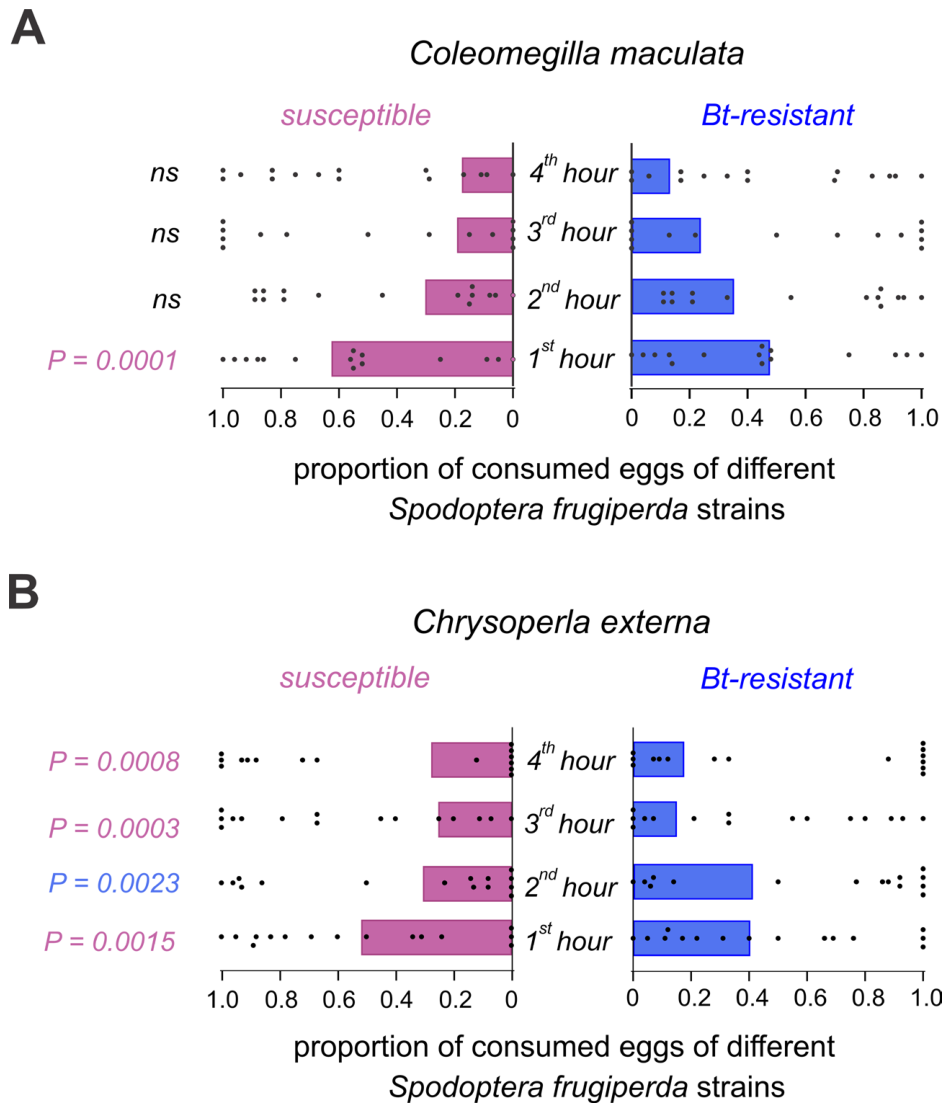
According to the proportion z-test, larvae of Co. maculata showed preference for eggs of the Bt-susceptible strain of S. frugiperda in the first hour of assessment (χ2 = 15.10, p = 0.0001) (Figure 1A). However, no preference was recorded for this predator in either of the remaining hours or in the pooled data for all hours. Ch. externa larvae, however, showed preference for Bt-susceptible strain S. frugiperda eggs in the first (χ2 = 9.92, p = 0.0015), third (χ2 = 12.74, p = 0.0003), and fourth evaluation hours (χ2 = 11.17, p = 0.0008), and for all hours in the pooled data (χ2 = 9.98, p = 0.0015) (Figure 1B). In contrast, the Ch. externa larvae preferred to feed on eggs of the S. frugiperda Bt-resistant strain in the second evaluation hour (χ2 = 9.30, p = 0.0023).
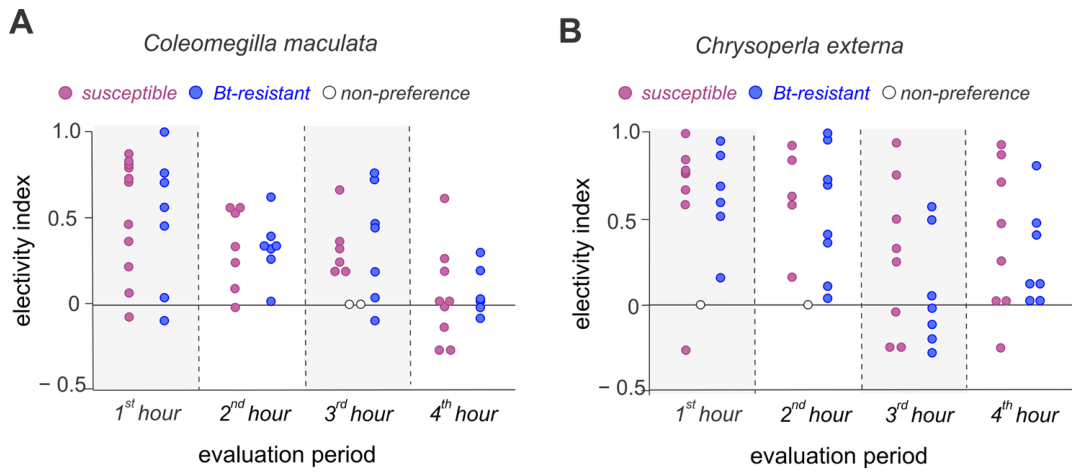
In general, the Strauss Linear Index results support the two-proportion z-test analysis, indicating that a higher number of Co. maculata larvae showed preference for eggs of the susceptible strain of S. frugiperda in the first feeding hour, while the proportion of predators exhibiting preference for either of the egg strains was similar in the remaining three feeding hours (Figure 2A). Regarding the Ch. externa larvae, a higher number of predators showed a preference (i.e., more positive values for the Strauss Linear Index) for feeding on eggs of the Bt-susceptible S. frugiperda strain during the assessment of the 1st, 3rd, and 4th hours (Figure 2B).

3.2. Predator Functional Response

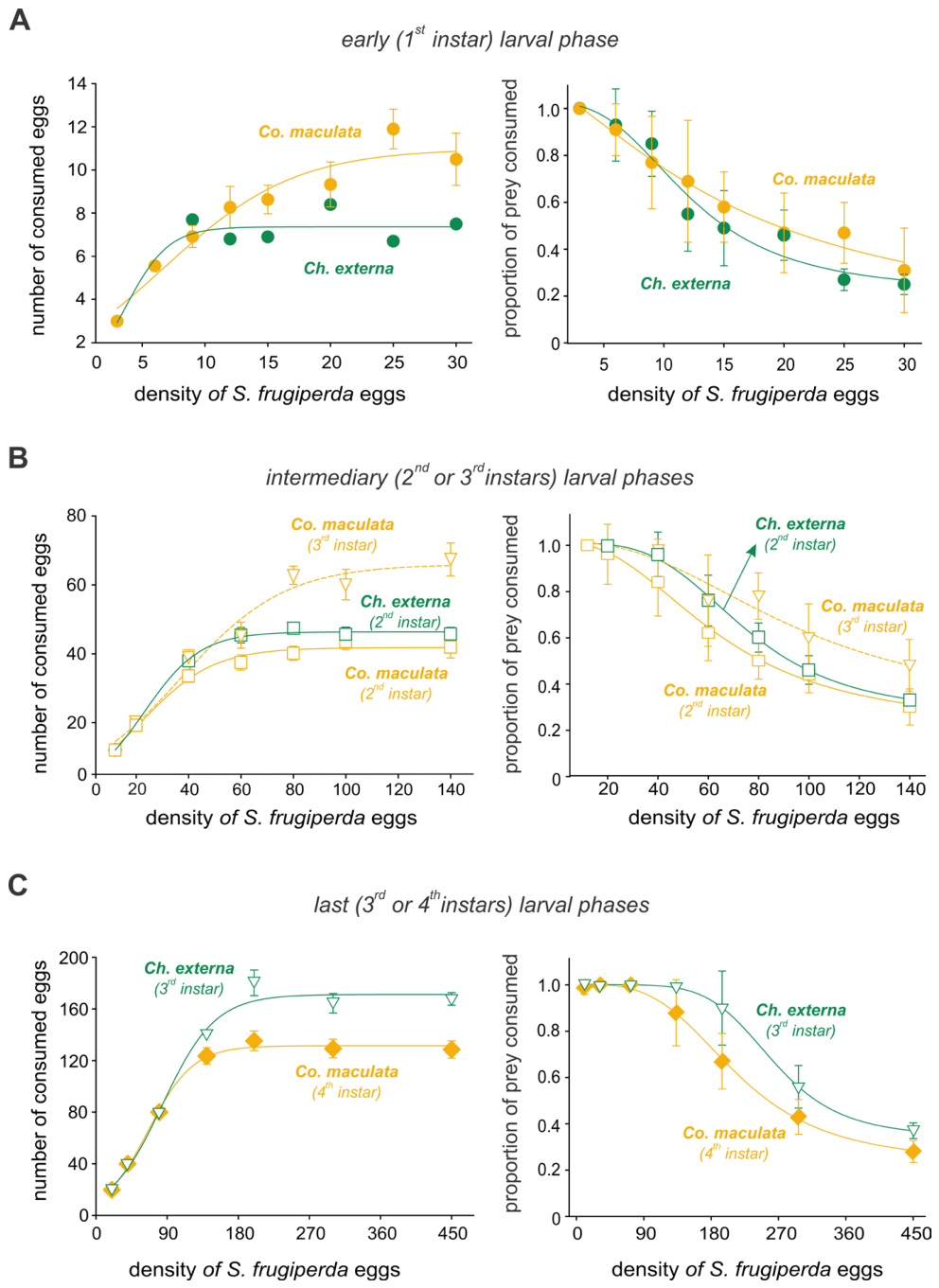
Cubic or quadratic logistic regression used to analyze the predation rates of Co. maculata and Ch. externa at different egg densities showed a negative linear coefficient (P1) and a positive quadratic coefficient (Table S1). These patterns indicate that all larval instars of both predator species exhibited functional response type II, suggesting that the proportion of S. frugiperda eggs consumed decreased as egg density increased (Figure 3A–C). While the early larval instar of Co. maculata had a predation rate that plateaued at 11 eggs/24 h (Figure 3A), the intermediary larval phases (i.e., second and third instars) leveled their predation at 40 eggs (second instar) and 65 eggs (third instar) (Figure 3B). The last larval instar exhibited an even higher predatory ability, preying on 125 eggs/24 h (Figure 3C). Similarly, the first (early), second (intermediary), and third (last) larval instars of Ch. externa reached a plateau for their predation rate at approximately 7, 45, and 170 eggs consumed in 24 h, respectively (Figure 3A–C).
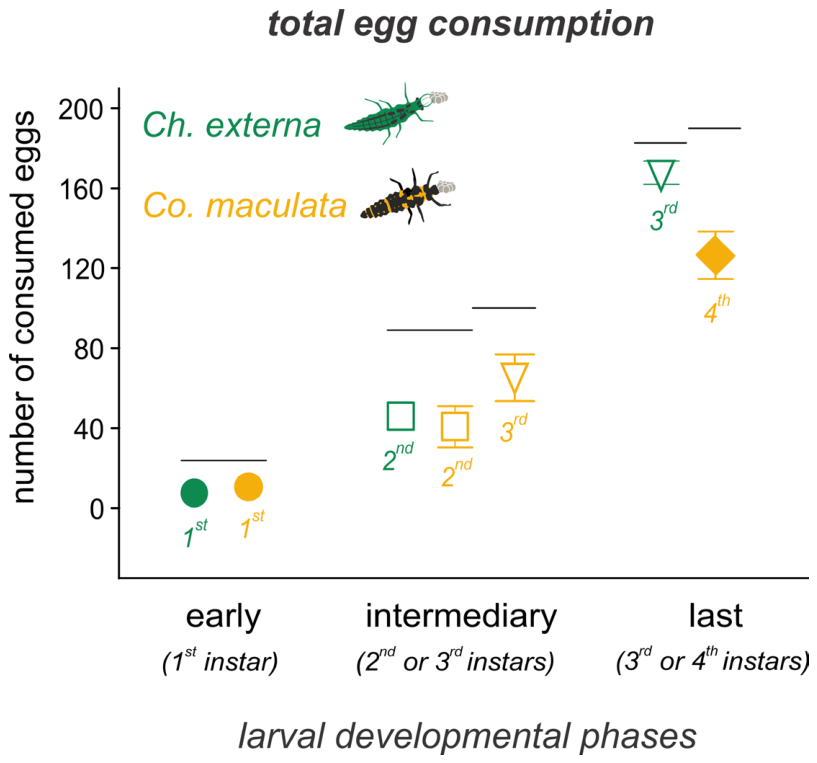
There was no statistical difference (95% confidence interval) between the attack rates of Co. maculata and Ch. externa when comparing their early, intermediary, and last larval instars (Table S2). The handling time (Th) observed for the early instar (first instar) of Co. maculata (Th = 2.3 ± 0.13) was relatively shorter than that of the Ch. externa first instar (Th = 3.0 ± 0.13). Similar results were observed for the second instar of Ch. externa, which handled eggs longer (Th = 0.49 ± 0.01) compared to the third instar of C. maculata (Th = 0.35 ± 0.02) (Table S2). Nonetheless, no statistical difference was found when comparing the handling times for the second instars of Co. maculata and Ch. externa (Table S2). In addition, there was no difference in the handling times of the last instars of these predators (i.e., third instar of Ch. externa and fourth instar of Co. maculata), and no statistical difference was found between predator species in terms of egg consumption by either the first instar (F1.10 = 1.89; p = 0.199) or second instar larvae (F1.18 = 0.79; p = 0.386). In contrast, there was a significant difference in egg consumption between predator species when comparing the second instar of Ch. externa to the third instar of Co. maculata (H = 9.87; df = 1; p = 0.002). Finally, the third larval instar of Ch. externa consumed significantly more eggs of S. frugiperda than the fourth instar of Co. maculata (F1.17 = 21.65; p < 0.001) (Figure 4).

4. Discussion

Here, we demonstrated that larvae of Co. maculata preferred eggs of the S. frugiperda strain susceptible to Bt toxins, but only at the beginning of the feeding (i.e., the first hour), whereas Ch. externa larvae showed a generalized preference for the same type of eggs during most of the assessment times. Furthermore, our findings demonstrated that all larval stages of both predator species exhibited a type II functional response when exposed to a mixture of resistant and susceptible prey, and S. frugiperda egg consumption substantially increased as the predator larvae developed.
Although the potential differences in the nutritional contents and/or morphology (size and volume) of S. frugiperda eggs were not investigated here, it is reasonable to expect that these factors influence the preference indices described for larvae of Co. maculata and Ch. externa. For instance, previous investigations have shown that lepidopteran eggs can uptake Bt toxins [34], and applying Bt-based insecticides to the eggs altered the capacity of lacewing larvae to prey upon them [19]. Although Bt toxins have different modes of action regarding synthetic insecticides, it has been shown that the selection of the diamondback moth, Plutella xylostella, which is capable of surviving chronic sublethal exposure to synthetic insecticides (e.g., fenverlerate and spynosins) or natural substances (e.g., cantharidin), resulted in smaller-sized eggs [35,36,37,38,39], which may affect the probability of these eggs being chosen by predators. However, it is reasonable to state that the mechanisms of predators for distinguishing between eggs may not only be based on size, as eggs of the ladybeetle Coccinella novemnotata are preferably preyed upon over their conspecifics or individuals of a closely related ladybeetle species, Coccinella septempunctata, even though both species have no significant difference in their egg sizes [18].
The factor that induced the Co. maculata preference for susceptible eggs in the first evaluation hour was not strong enough to maintain such a pattern over time. This pattern may be associated with the larvae’s acute hunger following a 24 h starvation period prior to the assay. Under such conditions, predators are expected to maximize their immediate energy intake, and the observed preference may reflect differences in prey palatability or accessibility rather than stable feeding selectivity. Furthermore, the factors that contributed to ladybeetles in choosing S. frugiperda egg types (i.e., Bt-susceptible or -resistant) seem to differ from those used to distinguish larvae prey, as the ladybeetle Harmonia axyridis Pallas exhibited no preference for susceptible or Bt-resistant S. frugiperda strains [40]. Regardless, our results demonstrated that neither predator species was repelled by the eggs of the Bt-resistant strain, which certainly contributes to the biological control of S. frugiperda Bt-resistant individuals. Although not investigated in detail in the present study and considering that no evident visual differences were observed between egg masses under the evaluated conditions, the stronger preference of Ch. externa for eggs of the Bt-susceptible S. frugiperda strain may suggest the involvement of prey-associated cues (e.g., chemical signals, scales, or oviposition residues). These cues may differ from those used by ladybeetles. For instance, larvae of another lacewing species, Ceraeochrysa cincta (Schneider), exhibited higher consumption of P. xylostella eggs that were previously treated with a Bt-based insecticide [19], which contradicts our results. Additionally, the temporal variation observed in prey choice suggests that prey selection by Ch. externa may not be entirely fixed throughout the assay period. Such shifts may reflect context-dependent feeding behavior influenced by factors such as predator satiation or changes in responsiveness to prey-associated cues over time.
Our results indicate that the predatory behavior of Co. maculata and Ch. externa larvae preying upon eggs of S. frugiperda is better described by a type II functional response. This type of functional response is characterized by an increase in consumption rate as prey availability increases, until the species reaches a plateau where the consumption rate stabilizes, and the predator cannot handle more prey [41,42]. This predator behavior is often considered unstable on a long-term basis, as predators tend to evade the environment after feeding on the available prey source [43,44]. Despite the fact that type II functional responses are known for their instability, predators displaying this type of response usually still carry out good pest control on a short-term basis [45,46]. Additionally, pest control is fairly enhanced and more durable when it comes to omnivorous predators, such as Co. maculata and Ch. externa, which can stabilize population dynamics by feeding on other food sources (e.g., pollen and nectar) and thus are able to stay longer in a given landscape area after depleting the prey population [47,48,49,50,51].
The higher consumption of S. frugiperda eggs by both predator species was achieved in their last larval instars, which may reflect their increased size, speed, and capacity to subdue prey [52], as well as their need to consume greater quantities before undergoing metamorphosis [19,53,54]. In the last and most voracious instar, Ch. externa had a lower handling time, suggesting a potentially greater impact on the pest population when compared to Co. maculata. However, it is difficult to predict the predation efficacy of these omnivorous predators under field conditions where other prey and non-prey food are available, since our study was limited to laboratory conditions. Nevertheless, it is expected that these predators will readily attack S. frugiperda eggs, mainly because they are easily preyed on (i.e., they do not try to escape, hide, or fight back).
Both predator species tested here have been previously demonstrated to survive, develop, and produce offspring when feeding on eggs of S. frugiperda [3,5,55,56,57]. Regardless, the framework provided here innovatively evaluated whether these generalist predators display preferences towards S. frugiperda Bt-susceptible or -resistant eggs. Our results are fundamental for future research on the morphologic and chemical characteristics of these eggs, which may induce preferences among these predatory insects, contributing to a better understanding of the services that these predators provide for the ecological management of S. frugiperda. However, because egg morphological, nutritional, and chemical traits were not directly evaluated in the present study, the mechanisms underlying predator preference remain unresolved and should be interpreted with caution.
Despite these limitations, our findings revealed that both predators were able to consume eggs from Bt-susceptible and Bt-resistant strains under functional response conditions, highlighting their potential contribution to the biological control of this pest regardless of prey strain. The higher consumption rates observed at advanced larval stages reinforce the importance of these predators in suppressing egg populations under high prey densities. Additionally, differences in feeding behavior between predators, including the piercing-sucking habit of Ch. externa and the mandibular feeding of Co. maculata, may help explain their distinct responses to the prey strains. Nevertheless, because these experiments were conducted under controlled laboratory conditions, caution is required when extrapolating these findings to field environments, where prey distribution, environmental variability, and additional biotic interactions may affect predator performance. These findings provide important insights into predator–prey interactions involving Bt-resistant populations of S. frugiperda and support the ecological compatibility of these natural enemies with integrated pest management programs.

Supplementary Materials

The following supporting information can be downloaded at https://www.mdpi.com/article/10.3390/agronomy16111027/s1, Supplementary Figure S1: Representative egg masses of Bt-susceptible and Bt-resistant strains of Spodoptera frugiperda used in the prey preference and functional response bioassays. Table S1: Estimated parameters of the logistic regression of the proportion of Spodoptera frugiperda eggs consumed by immature stages of Ch. externa and Co. maculata. Table S2: Attack rates (α) and handling times (Th) of immature stages of predators Ch. externa and Co. maculata feeding upon eggs, S. frugiperda.

Author Contributions

Conceptualization, L.O.V., P.F.S.T. and E.E.O.; methodology, L.O.V., P.F.S.T. and E.E.O.; software, A.C.F., S.M.R., S.M.O., T.C.d.S. and L.M.G.; validation, L.M.G., E.J.P., E.E.O. and L.O.V.; investigation, L.O.V., P.F.S.T., A.C.F., S.M.R., S.M.O. and T.C.d.S.; formal analysis, L.O.V., L.M.G. and E.E.O.; resources, E.J.P., T.C.d.S., A.C.F. and E.E.O.; writing—original draft, L.O.V., P.F.S.T., E.E.O. and L.M.G.; writing—review and editing, L.O.V., P.F.S.T., E.E.O. and L.M.G.; visualization, L.O.V., P.F.S.T., E.E.O., A.C.F. and S.M.R.; supervision, E.E.O. and E.J.P.; project administration, E.E.O., T.C.d.S. and E.J.P.; funding acquisition, E.E.O., L.M.G. and E.J.P. All authors have read and agreed to the published version of the manuscript.

Funding

The authors express their gratitude to the Coordenação de Aperfeiçoamento de Pessoal de Nível Superior (CAPES) in Brazil (Finance Code 001). Further thanks are directed to CNPq for their support (project numbers 309890/2022-5 and 408598/2023-9), as well as the Minas Gerais State Foundation for Research Aid (FAPEMIG; APQ-05316-23). Furthermore, the authors thank the Federal University of Tocantins for the availability of facilities.

Data Availability Statement

The original contributions presented in this study are included in the article/Supplementary Materials. Further inquiries can be directed to the corresponding authors.

Acknowledgments

This work was supported by the National Council of Scientific and Technological Development (CNPq), the Coordination for the Improvement of Higher Education Personnel (CAPES), the Minas Gerais State Foundation for Research Aid (FAPEMIG), and The Secretariat of Higher Education, Science, Technology and Innovation (SENESCYT).

Conflicts of Interest

The authors declare no conflicts of interest.

References

  1. Senior, L.; McEwen, P.; McEwen, P.; New, T.; Whittington, A. The use of lacewings in biological control. In Lacewings in the Crop Environment; Cambridge University Press: Cambridge, UK, 2001; pp. 296–302. [Google Scholar]
  2. Evans, E.W. Lady beetles as predators of insects other than Hemiptera. Biol. Control 2009, 51, 255–267. [Google Scholar] [CrossRef] [Scilit]
  3. Da Silva, R.B.; Cruz, I.; Figueiredo, M.d.L.C.; Tavares, W.d.S. Development of Coleomegilla maculata De Geer (Coleoptera: Coccinellidae) with prey and artificial diet. Rev. Bras. Milho Sorgo 2010, 9, 13–26. [Google Scholar] [CrossRef] [Scilit]
  4. Musser, F.R.; Shelton, A.M. Predation of Ostrinia nubilalis (Lepidoptera: Crambidae) eggs in sweet corn by generalist predators and the impact of alternative foods. Environ. Entomol. 2003, 32, 1131–1138. [Google Scholar] [CrossRef] [Scilit]
  5. Tavares, W.S.; Cruz, I.; Silva, R.B.; Serrão, J.E.; Zanuncio, J.C. Prey consumption and development of Chrysoperla externa (Neuroptera: Chrysopidae) on Spodoptera frugiperda (Lepidoptera: Noctuidae) eggs and larvae and Anagasta kuehniella (Lepidoptera: Pyralidae) eggs. Maydica 2012, 56, 283–289. [Google Scholar]
  6. Aguirre, L.A.; Hernández-Juàrez, A.; Flores, M.; Cerna, E.; Landeros, J.; Frías, G.A.; Harris, M.K. Evaluation of foliar damage by Spodoptera frugiperda (Lepidoptera: Noctuidae) to genetically modified corn (Poales: Poaceae) in Mexico. Fla. Entomol. 2016, 99, 276–280. [Google Scholar] [CrossRef] [Scilit]
  7. Chandrasena, D.I.; Signorini, A.M.; Abratti, G.; Storer, N.P.; Olaciregui, M.L.; Alves, A.P.; Pilcher, C.D. Characterization of field-evolved resistance to Bacillus thuringiensis-derived Cry1F δ-endotoxin in Spodoptera frugiperda populations from Argentina. Pest Manag. Sci. 2018, 74, 746–754. [Google Scholar] [CrossRef] [Scilit]
  8. Farias, J.R.; Andow, D.A.; Horikoshi, R.J.; Sorgatto, R.J.; Fresia, P.; dos Santos, A.C.; Omoto, C. Field-evolved resistance to Cry1F maize by Spodoptera frugiperda (Lepidoptera: Noctuidae) in Brazil. Crop Prot. 2014, 64, 150–158. [Google Scholar] [CrossRef] [Scilit]
  9. Zhang, J.; Huang, Y.; Yuan, L.; Yang, G.; Chen, L.; Zhao, C. Using satellite multispectral imagery for damage mapping of armyworm (Spodoptera frugiperda) in maize at a regional scale. Pest Manag. Sci. 2016, 72, 335–348. [Google Scholar] [CrossRef] [Scilit]
  10. González, M.A.; Macas, S.D.; Pineda-Escobar, M.; Mazón, M.; Jumbo, L.V. Potential use of Heterorhabditis bacteriophora IJs for the control of Spodoptera frugiperda (Smith, 1797) in small Andean productive systems: Culture, harvest and application. Int. J. Trop. Insect Sci. 2025, 45, 425–432. [Google Scholar] [CrossRef] [Scilit]
  11. Campos, S.O.; Santana, I.V.; Silva, C.; Santos-Amaya, O.F.; Guedes, R.N.C.; Pereira, E.J.G. Bt-induced hormesis in Bt-resistant insects: Theoretical possibility or factual concern? Ecotoxicol. Environ. Saf. 2019, 183, 109577. [Google Scholar] [CrossRef] [Scilit]
  12. Sousa, F.F.; Mendes, S.M.; Santos-Amaya, O.F.; Araújo, O.G.; Oliveira, E.E.; Pereira, E.J. Life-history traits of Spodoptera frugiperda populations exposed to low-dose Bt maize. PLoS ONE 2016, 11, e0156608. [Google Scholar] [CrossRef] [Scilit]
  13. Rabelo, M.M.; Matos, J.M.L.; Santos-Amaya, O.F.; França, J.C.; Gonçalves, J.; Paula-Moraes, S.V.; Guedes, R.N.C.; Pereira, E.J.G. Bt-toxin susceptibility and hormesis-like response in the invasive southern armyworm (Spodoptera eridania). Crop Prot. 2020, 132, 105129. [Google Scholar] [CrossRef] [Scilit]
  14. Murdoch, W.W.; Chesson, J.; Chesson, P.L. Biological Control in Theory and Practice. Am. Nat. 1985, 125, 344–366. [Google Scholar] [CrossRef] [Scilit]
  15. Stiling, P.; Cornelissen, T. What makes a successful biocontrol agent? A meta-analysis of biological control agent performance. Biol. Control 2005, 34, 236–246. [Google Scholar] [CrossRef] [Scilit]
  16. Chau, A.; Mackauer, M. Host–instar selection in the aphid parasitoid Monoctonus paulensis (Hymenoptera: Braconidae, Aphidiinae): Assessing costs and benefits. Can. Entomol. 2001, 133, 549–564. [Google Scholar] [CrossRef] [Scilit]
  17. Henry, L.M.; Ma, B.O.; Roitberg, B.D. Size-mediated adaptive foraging: A host-selection strategy for insect parasitoids. Oecologia 2009, 161, 433–445. [Google Scholar] [CrossRef] [Scilit] [PubMed]
  18. Turnipseed, R.; Ugine, T.A.; Losey, J.E. Egg predation by the introduced lady beetle, Coccinella septempunctata (Coleoptera: Coccinellidae), lowers mortality but raises relative risk for the native lady beetle, Coccinella novemnotata. PLoS ONE 2015, 10, e0118493. [Google Scholar] [CrossRef] [Scilit]
  19. Pimenta, I.C.; da Silva Nunes, G.; de Magalhães, G.O.; Dos Santos, N.A.; Pinto, M.M.D.; De Bortoli, S.A. Effects of a Bt-based insecticide on the functional response of Ceraeochrysa cincta preying on Plutella xylostella. Ecotoxicology 2020, 29, 856–865. [Google Scholar] [CrossRef] [Scilit]
  20. Royama, T. A comparative study of models for predation and parasitism. Popul. Ecol. 1971, 13, 1–91. [Google Scholar] [CrossRef] [Scilit]
  21. Jumbo, L.O.V.; Teodoro, A.V.; Rêgo, A.S.; Haddi, K.; Galvão, A.S.; de Oliveira, E.E. The lacewing Ceraeochrysa caligata as a potential biological agent for controlling the red palm mite Raoiella indica. PeerJ 2019, 7, e7123. [Google Scholar] [CrossRef] [Scilit]
  22. Viteri, L.O.; Lira, V.A.; Freitas, G.S.; Farias, A.P.; Rêgo, A.S.; Oliveira, E.E.; Teodoro, A.V. Chrysoperla externa (Neuroptera: Chrysopidae) as a Potential Biological Control Agent of Raoiella indica (Acari: Tenuipalpidae). Entomol. Exp. Appl. 2026, 174, 335–342. [Google Scholar] [CrossRef] [Scilit]
  23. Toledo, P.F.; Ferreira, T.P.; Bastos, I.M.; Rezende, S.M.; Jumbo, L.O.V.; Didonet, J.; Andrade, B.S.; Melo, T.S.; Smagghe, G.; Oliveira, E.E. Essential oil from Negramina (Siparuna guianensis) plants controls aphids without impairing survival and predatory abilities of non-target ladybeetles. Environ. Pollut. 2019, 255, 113153. [Google Scholar] [CrossRef] [Scilit]
  24. Toledo, P.F.; Jumbo, L.O.V.; Rezende, S.M.; Haddi, K.; Silva, B.A.; Mello, T.S.; Della Lucia, T.M.; Aguiar, R.W.; Smagghe, G.; Oliveira, E.E. Disentangling the ecotoxicological selectivity of clove essential oil against aphids and non-target ladybeetles. Sci. Total Environ. 2020, 718, 137328. [Google Scholar] [CrossRef] [Scilit]
  25. Santos-Amaya, O.F.; Tavares, C.S.; Monteiro, H.M.; Teixeira, T.P.; Guedes, R.N.; Alves, A.P.; Pereira, E.J. Genetic basis of Cry1F resistance in two Brazilian populations of fall armyworm, Spodoptera frugiperda. Crop Prot. 2016, 81, 154–162. [Google Scholar] [CrossRef] [Scilit]
  26. Santos-Amaya, O.F.; Tavares, C.S.; Rodrigues, J.V.C.; Campos, S.O.; Guedes, R.N.C.; Alves, A.P.; Pereira, E.J.G. Fitness costs and stability of Cry1Fa resistance in Brazilian populations of Spodoptera frugiperda. Pest Manag. Sci. 2017, 73, 35–43. [Google Scholar] [CrossRef] [Scilit] [PubMed]
  27. The R Core Team. R: A Language and Environment for Statistical Computing; R Foundation for Statistical Computing: Vienna, Austria, 2017. [Google Scholar]
  28. Houck, M. Prey preference in Stethorus punctum (Coleoptera: Coccinellidae). Environ. Entomol. 1986, 15, 967–970. [Google Scholar] [CrossRef] [Scilit]
  29. Strauss, R.E. Reliability estimates for Ivlev’s electivity index, the forage ratio, and a proposed linear index of food selection. Trans. Am. Fish. Soc. 1979, 108, 344–352. [Google Scholar] [CrossRef] [Scilit]
  30. SAS Institute Inc. SAS/STATÒ 9.2 User’s Guide; SAS Institute Inc.: Cary, NC, USA, 2008. [Google Scholar]
  31. Juliano, S.A. Nonlinear curve fitting: Predation and functional response curves. In Design and Analysis of Ecological Experiments, 2nd ed.; Oxford Academic: New York, NY, USA, 2001; pp. 178–196. [Google Scholar]
  32. Rogers, D. Random search and insect population models. J. Anim. Ecol. 1972, 41, 369–383. [Google Scholar] [CrossRef] [Scilit]
  33. Systat Software Inc. Sigma Plot, version 12.5; Systat Software Inc.: Cary, NC, USA, 2008.
  34. Paula, D.P.; Andow, D.A.; Timbó, R.V.; Sujii, E.R.; Pires, C.S.; Fontes, E.M. Uptake and transfer of a Bt toxin by a Lepidoptera to its eggs and effects on its offspring. PLoS ONE 2014, 9, e95422. [Google Scholar] [CrossRef] [Scilit]
  35. Chen, X.D.; Nakasuji, F. Diminished egg size in fenvalerate resistant strains of the diamondback moth Plutella xylostella (Lepidoptera: Yponomeutidae). Appl. Entomol. Zool. 2004, 39, 335–341. [Google Scholar] [CrossRef] [Scilit]
  36. Chen, X.D.; Sanada-Morimura, S.; Yanagi, S.-i.; Nakasuji, F. Genetic relationships between development of insecticide resistance and reduction of egg size as a negative effect on the fitness of the diamondback moth Plutella xylostella (Lepidoptera: Yponomeutidae). Appl. Entomol. Zool. 2006, 41, 479–486. [Google Scholar] [CrossRef] [Scilit]
  37. Fujiwara, Y.; Takahashi, T.; Yoshioka, T.; Nakasuji, F. Changes in egg size of the diamondback moth Plutella xylostella (Lepidoptera: Yponomeutidae) treated with fenvalerate at sublethal doses and viability of the eggs. Appl. Entomol. Zool. 2002, 37, 103–109. [Google Scholar] [CrossRef] [Scilit]
  38. Yin, X.-H.; Wu, Q.-J.; Li, X.-F.; Zhang, Y.-J.; Xu, B.-Y. Sublethal effects of spinosad on Plutella xylostella (Lepidoptera: Yponomeutidae). Crop Prot. 2008, 27, 1385–1391. [Google Scholar] [CrossRef] [Scilit]
  39. Huang, Z.; Zhang, Y. Chronic sublethal effects of cantharidin on the diamondback moth Plutella xylostella (Lepidoptera: Plutellidae). Toxins 2015, 7, 1962–1978. [Google Scholar] [CrossRef] [Scilit]
  40. Dutra, C.C.; Koch, R.L.; Burkness, E.C.; Meissle, M.; Romeis, J.; Hutchison, W.D.; Fernandes, M.G. Harmonia axyridis (Coleoptera: Coccinellidae) exhibits no preference between Bt and non-Bt maize fed Spodoptera frugiperda (Lepidoptera: Noctuidae). PLoS ONE 2012, 7, e44867. [Google Scholar] [CrossRef] [Scilit] [PubMed]
  41. Holling, C.S. Some characteristics of simple types of predation and parasitism. Can. Entomol. 1959, 91, 385–398. [Google Scholar] [CrossRef] [Scilit]
  42. Holling, C.S. The components of predation as revealed by a study of small-mammal predation of the European Pine Sawfly1. Can. Entomol. 1959, 91, 293–320. [Google Scholar] [CrossRef] [Scilit]
  43. Hassell, M.P. The Dynamics of Arthopod Predator-Prey Systems; Princeton University Press: Princeton, NJ, USA, 1978; Volume 13. [Google Scholar]
  44. Murdoch, W.W.; Oaten, A. Predation and population stability. In Advances in Ecological Research; Elsevier: Amsterdam, The Netherlands, 1975; Volume 9, pp. 1–131. [Google Scholar]
  45. Briggs, C.J.; Hoopes, M.F. Stabilizing effects in spatial parasitoid–host and predator–prey models: A review. Theor. Popul. Biol. 2004, 65, 299–315. [Google Scholar] [CrossRef] [Scilit]
  46. Nachman, G. A functional response model of a predator population foraging in a patchy habitat. J. Anim. Ecol. 2006, 75, 948–958. [Google Scholar] [CrossRef] [Scilit]
  47. Andrade, K.; Aguiar-Menezes, E.; Gonçalves-Esteves, V.; Mendonça, C.; Vieira, G.; Melo, S.; Magalhães, J.; Melo, G. Pollen ingestion by Chrysoperla externa (Hagen) adults in a diversified organic agroecosystem. Neotrop. Entomol. 2018, 47, 118–130. [Google Scholar] [CrossRef] [Scilit] [PubMed]
  48. Ingegno, B.; Messelink, G.; Bodino, N.; Iliadou, A.; Driss, L.; Woelke, J.; Leman, A.; Tavella, L. Functional response of the mirid predators Dicyphus bolivari and and their efficacy as biological control agents of Tuta absoluta on tomato. J. Pest Sci. 2019, 92, 1457–1466. [Google Scholar] [CrossRef] [Scilit]
  49. Lundgren, J.G.; Huber, A.; Wiedenmann, R.N. Quantification of consumption of corn pollen by the predator Coleomegilla maculata (Coleoptera: Coccinellidae) during anthesis in an Illinois cornfield. Agric. For. Entomol. 2005, 7, 53–60. [Google Scholar] [CrossRef] [Scilit]
  50. Messelink, G.J.; Bennison, J.; Alomar, O.; Ingegno, B.L.; Tavella, L.; Shipp, L.; Palevsky, E.; Wäckers, F.L. Approaches to conserving natural enemy populations in greenhouse crops: Current methods and future prospects. BioControl 2014, 59, 377–393. [Google Scholar] [CrossRef] [Scilit]
  51. Symondson, W.; Sunderland, K.; Greenstone, M. Can generalist predators be effective biocontrol agents? Annu. Rev. Entomol. 2002, 47, 561–594. [Google Scholar] [CrossRef] [Scilit]
  52. Uiterwaal, S.F.; DeLong, J.P. Multiple factors, including arena size, shape the functional responses of ladybird beetles. J. Appl. Ecol. 2018, 55, 2429–2438. [Google Scholar] [CrossRef] [Scilit]
  53. Hodek, I.; Honêk, A. Ecology of Coccinellidae; Springer Science & Business Media: Berlin/Heidelberg, Germany, 2013; Volume 54. [Google Scholar]
  54. McEwen, P.K.; New, T.R.; Whittington, A.E. Lacewings in the Crop Environment; Cambridge University Press: Cambridge, UK, 2007. [Google Scholar]
  55. Auad, A.M.; Carvalho, C.F.; Souza, B.; Barbosa, L.R. Duração e viabilidade das fases imaturas de Chrysoperla externa (Hagen, 1861)(Neuroptera: Chrysopidae) alimentada com ovos e lagartas de Spodoptera frugiperda (JE Smith, 1797)(Lepidoptera: Noctuidae). Rev. Bras. Milho Sorgo 2003, 2, 106–111. [Google Scholar] [CrossRef] [Scilit]
  56. De Bortoli, S.A.; Caetano, A.C.; Murata, A.T.; Oliveira, J.d.M. Desenvolvimento e capacidade predatória de Chrysoperla externa (Hagen) (Neuroptera: Chrysopidae) em diferentes presas. Rev. Biol. Ciênc. Terra 2006, 6, 145–152. [Google Scholar]
  57. Murata, A.T.; Caetano, A.C.; de Bortoli, S.A.; de Brito, C.H. Capacidade de consumo de Chrysoperla externa (Hagen, 1861)(Neuroptera: Chysopidae) em diferentes presas. Rev. Caatinga 2006, 19, 304–309. [Google Scholar]
Figure 1. Proportion of susceptible and Bt-resistant strains of Spodoptera frugiperda eggs consumed by either Coleomegilla maculata (A) or Chrysoperla externa (B) during 4 h choice tests. (A,B) Non-significant (ns) and significant (p < 0.0–5) differences between the proportions of egg types consumed (i.e., from the S. frugiperda Bt-susceptible and -resistant strains) by either predator, according to a two-proportion z-test, are also shown.
Agronomy 16 01027 g001
Figure 2. Strauss Linear Index (electivity index) for the individual predators Coleomegilla maculata (A) or Chrysoperla externa (B) during feeding choice tests. Each predator had a choice between 25 eggs of Bt-susceptible and 25 eggs of Bt-resistant strains of Spodoptera frugiperda every hour for 4 consecutive hours. Symbols represent the electivity index of each individual who preferred eggs of S. frugiperda Bt-susceptible (magenta) or -resistant (blue) strains. The index values vary from −1.0 to +1.0, where positive values indicate prey preference, negative values indicate relative avoidance or prey inaccessibility, and values of zero (or near zero) indicate random selection.
Agronomy 16 01027 g002
Figure 3. Mean (±SE) of Spodoptera frugiperda eggs consumed and their proportion in early (A), intermediary (B), and last (C) larval phases of Coleomegilla maculata and Chrysoperla externa according to prey density offered over 24 h.
Agronomy 16 01027 g003
Figure 4. Mean (±SE) of the total of Spodoptera frugiperda eggs consumed by early, intermediary, and last larval phases of Coleomegilla maculata and Chrysoperla externa according to prey density offered over 24 h. Symbols grouped under the same horizontal line do not differ according to the Kruskal–Wallis test (p < 0.05).
Agronomy 16 01027 g004
Disclaimer/Publisher’s Note: The statements, opinions and data contained in all publications are solely those of the individual author(s) and contributor(s) and not of MDPI and/or the editor(s). MDPI and/or the editor(s) disclaim responsibility for any injury to people or property resulting from any ideas, methods, instructions or products referred to in the content.