Consumption of Susceptible and Bt-Resistant Spodoptera frugiperda Eggs by Ladybeetles and Lacewings: Preference and Functional Responses

 ,
,  ,
,  , and
, and 
Abstract
1. Introduction
2. Materials and Methods
2.1. Rearing of Predators
2.2. Rearing Conditions of Spodoptera frugiperda
2.3. Choice Assay with the Predators Coleomegilla maculata and Chrysoperla externa
2.4. Functional Response Analysis of the Predators Coleomegilla maculata and Chrysoperla externa
3. Results
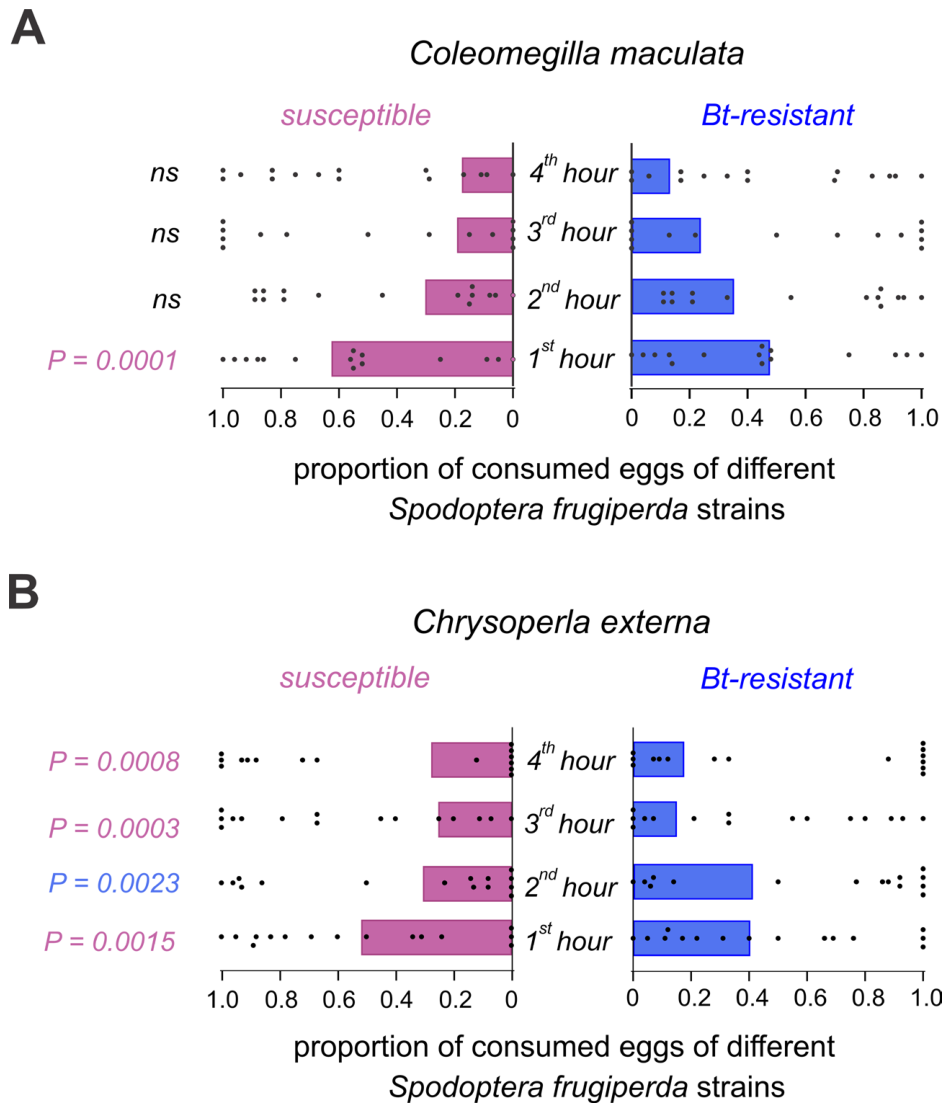
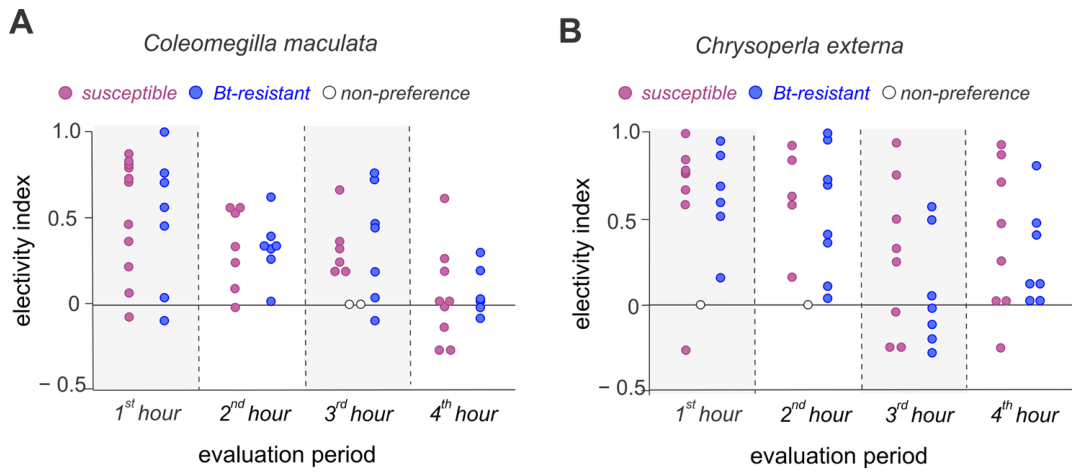
3.1. Predator Choice Test
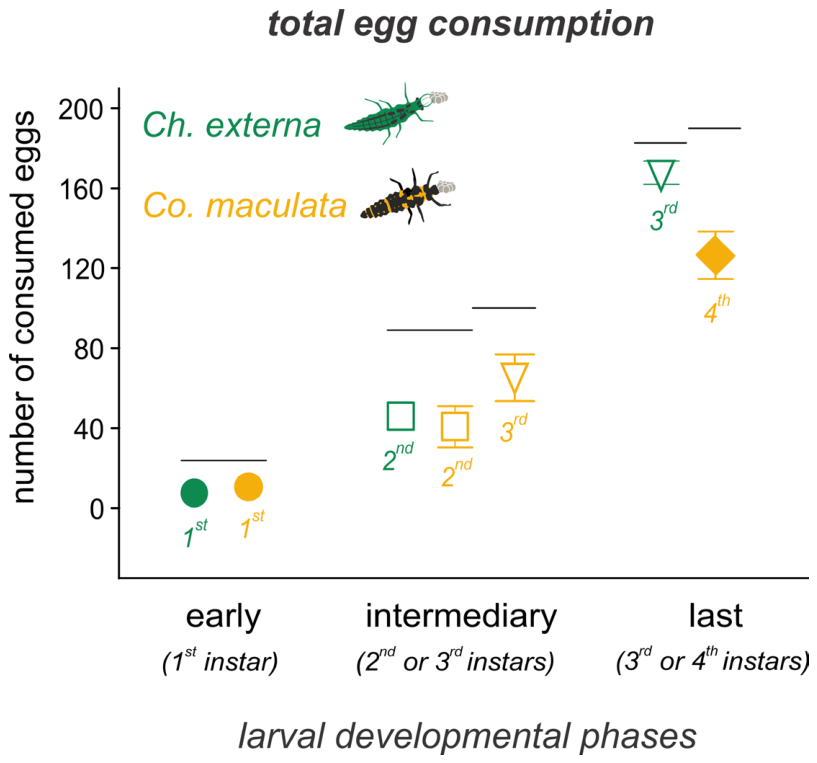
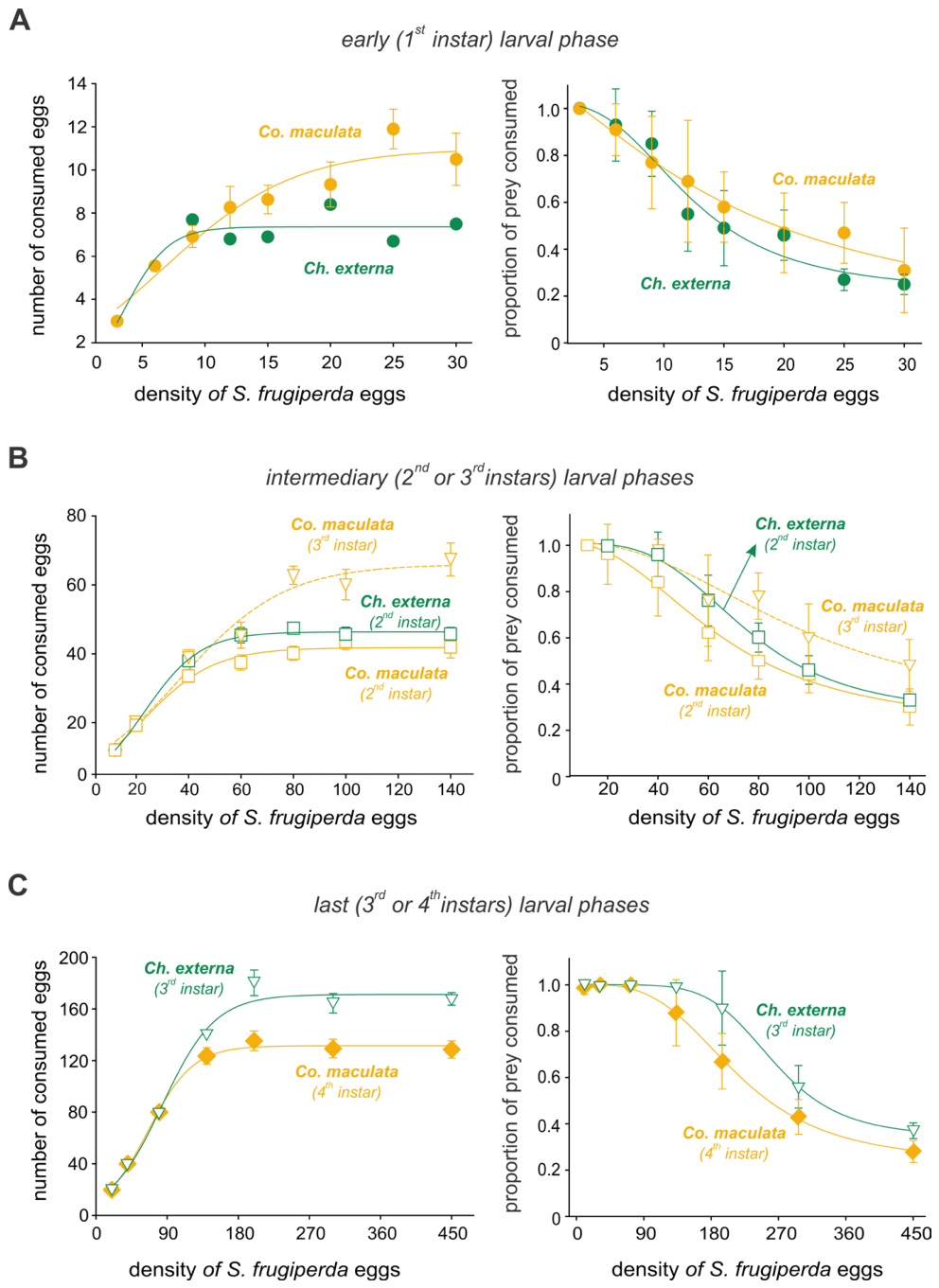
3.2. Predator Functional Response
4. Discussion
Supplementary Materials
Author Contributions
Funding
Data Availability Statement
Acknowledgments
Conflicts of Interest
References
- Senior, L.; McEwen, P.; McEwen, P.; New, T.; Whittington, A. The use of lacewings in biological control. In Lacewings in the Crop Environment; Cambridge University Press: Cambridge, UK, 2001; pp. 296–302. [Google Scholar]
- Evans, E.W. Lady beetles as predators of insects other than Hemiptera. Biol. Control 2009, 51, 255–267. [Google Scholar] [CrossRef] [Scilit]
- Da Silva, R.B.; Cruz, I.; Figueiredo, M.d.L.C.; Tavares, W.d.S. Development of Coleomegilla maculata De Geer (Coleoptera: Coccinellidae) with prey and artificial diet. Rev. Bras. Milho Sorgo 2010, 9, 13–26. [Google Scholar] [CrossRef] [Scilit]
- Musser, F.R.; Shelton, A.M. Predation of Ostrinia nubilalis (Lepidoptera: Crambidae) eggs in sweet corn by generalist predators and the impact of alternative foods. Environ. Entomol. 2003, 32, 1131–1138. [Google Scholar] [CrossRef] [Scilit]
- Tavares, W.S.; Cruz, I.; Silva, R.B.; Serrão, J.E.; Zanuncio, J.C. Prey consumption and development of Chrysoperla externa (Neuroptera: Chrysopidae) on Spodoptera frugiperda (Lepidoptera: Noctuidae) eggs and larvae and Anagasta kuehniella (Lepidoptera: Pyralidae) eggs. Maydica 2012, 56, 283–289. [Google Scholar]
- Aguirre, L.A.; Hernández-Juàrez, A.; Flores, M.; Cerna, E.; Landeros, J.; Frías, G.A.; Harris, M.K. Evaluation of foliar damage by Spodoptera frugiperda (Lepidoptera: Noctuidae) to genetically modified corn (Poales: Poaceae) in Mexico. Fla. Entomol. 2016, 99, 276–280. [Google Scholar] [CrossRef] [Scilit]
- Chandrasena, D.I.; Signorini, A.M.; Abratti, G.; Storer, N.P.; Olaciregui, M.L.; Alves, A.P.; Pilcher, C.D. Characterization of field-evolved resistance to Bacillus thuringiensis-derived Cry1F δ-endotoxin in Spodoptera frugiperda populations from Argentina. Pest Manag. Sci. 2018, 74, 746–754. [Google Scholar] [CrossRef] [Scilit]
- Farias, J.R.; Andow, D.A.; Horikoshi, R.J.; Sorgatto, R.J.; Fresia, P.; dos Santos, A.C.; Omoto, C. Field-evolved resistance to Cry1F maize by Spodoptera frugiperda (Lepidoptera: Noctuidae) in Brazil. Crop Prot. 2014, 64, 150–158. [Google Scholar] [CrossRef] [Scilit]
- Zhang, J.; Huang, Y.; Yuan, L.; Yang, G.; Chen, L.; Zhao, C. Using satellite multispectral imagery for damage mapping of armyworm (Spodoptera frugiperda) in maize at a regional scale. Pest Manag. Sci. 2016, 72, 335–348. [Google Scholar] [CrossRef] [Scilit]
- González, M.A.; Macas, S.D.; Pineda-Escobar, M.; Mazón, M.; Jumbo, L.V. Potential use of Heterorhabditis bacteriophora IJs for the control of Spodoptera frugiperda (Smith, 1797) in small Andean productive systems: Culture, harvest and application. Int. J. Trop. Insect Sci. 2025, 45, 425–432. [Google Scholar] [CrossRef] [Scilit]
- Campos, S.O.; Santana, I.V.; Silva, C.; Santos-Amaya, O.F.; Guedes, R.N.C.; Pereira, E.J.G. Bt-induced hormesis in Bt-resistant insects: Theoretical possibility or factual concern? Ecotoxicol. Environ. Saf. 2019, 183, 109577. [Google Scholar] [CrossRef] [Scilit]
- Sousa, F.F.; Mendes, S.M.; Santos-Amaya, O.F.; Araújo, O.G.; Oliveira, E.E.; Pereira, E.J. Life-history traits of Spodoptera frugiperda populations exposed to low-dose Bt maize. PLoS ONE 2016, 11, e0156608. [Google Scholar] [CrossRef] [Scilit]
- Rabelo, M.M.; Matos, J.M.L.; Santos-Amaya, O.F.; França, J.C.; Gonçalves, J.; Paula-Moraes, S.V.; Guedes, R.N.C.; Pereira, E.J.G. Bt-toxin susceptibility and hormesis-like response in the invasive southern armyworm (Spodoptera eridania). Crop Prot. 2020, 132, 105129. [Google Scholar] [CrossRef] [Scilit]
- Murdoch, W.W.; Chesson, J.; Chesson, P.L. Biological Control in Theory and Practice. Am. Nat. 1985, 125, 344–366. [Google Scholar] [CrossRef] [Scilit]
- Stiling, P.; Cornelissen, T. What makes a successful biocontrol agent? A meta-analysis of biological control agent performance. Biol. Control 2005, 34, 236–246. [Google Scholar] [CrossRef] [Scilit]
- Chau, A.; Mackauer, M. Host–instar selection in the aphid parasitoid Monoctonus paulensis (Hymenoptera: Braconidae, Aphidiinae): Assessing costs and benefits. Can. Entomol. 2001, 133, 549–564. [Google Scholar] [CrossRef] [Scilit]
- Henry, L.M.; Ma, B.O.; Roitberg, B.D. Size-mediated adaptive foraging: A host-selection strategy for insect parasitoids. Oecologia 2009, 161, 433–445. [Google Scholar] [CrossRef] [Scilit] [PubMed]
- Turnipseed, R.; Ugine, T.A.; Losey, J.E. Egg predation by the introduced lady beetle, Coccinella septempunctata (Coleoptera: Coccinellidae), lowers mortality but raises relative risk for the native lady beetle, Coccinella novemnotata. PLoS ONE 2015, 10, e0118493. [Google Scholar] [CrossRef] [Scilit]
- Pimenta, I.C.; da Silva Nunes, G.; de Magalhães, G.O.; Dos Santos, N.A.; Pinto, M.M.D.; De Bortoli, S.A. Effects of a Bt-based insecticide on the functional response of Ceraeochrysa cincta preying on Plutella xylostella. Ecotoxicology 2020, 29, 856–865. [Google Scholar] [CrossRef] [Scilit]
- Royama, T. A comparative study of models for predation and parasitism. Popul. Ecol. 1971, 13, 1–91. [Google Scholar] [CrossRef] [Scilit]
- Jumbo, L.O.V.; Teodoro, A.V.; Rêgo, A.S.; Haddi, K.; Galvão, A.S.; de Oliveira, E.E. The lacewing Ceraeochrysa caligata as a potential biological agent for controlling the red palm mite Raoiella indica. PeerJ 2019, 7, e7123. [Google Scholar] [CrossRef] [Scilit]
- Viteri, L.O.; Lira, V.A.; Freitas, G.S.; Farias, A.P.; Rêgo, A.S.; Oliveira, E.E.; Teodoro, A.V. Chrysoperla externa (Neuroptera: Chrysopidae) as a Potential Biological Control Agent of Raoiella indica (Acari: Tenuipalpidae). Entomol. Exp. Appl. 2026, 174, 335–342. [Google Scholar] [CrossRef] [Scilit]
- Toledo, P.F.; Ferreira, T.P.; Bastos, I.M.; Rezende, S.M.; Jumbo, L.O.V.; Didonet, J.; Andrade, B.S.; Melo, T.S.; Smagghe, G.; Oliveira, E.E. Essential oil from Negramina (Siparuna guianensis) plants controls aphids without impairing survival and predatory abilities of non-target ladybeetles. Environ. Pollut. 2019, 255, 113153. [Google Scholar] [CrossRef] [Scilit]
- Toledo, P.F.; Jumbo, L.O.V.; Rezende, S.M.; Haddi, K.; Silva, B.A.; Mello, T.S.; Della Lucia, T.M.; Aguiar, R.W.; Smagghe, G.; Oliveira, E.E. Disentangling the ecotoxicological selectivity of clove essential oil against aphids and non-target ladybeetles. Sci. Total Environ. 2020, 718, 137328. [Google Scholar] [CrossRef] [Scilit]
- Santos-Amaya, O.F.; Tavares, C.S.; Monteiro, H.M.; Teixeira, T.P.; Guedes, R.N.; Alves, A.P.; Pereira, E.J. Genetic basis of Cry1F resistance in two Brazilian populations of fall armyworm, Spodoptera frugiperda. Crop Prot. 2016, 81, 154–162. [Google Scholar] [CrossRef] [Scilit]
- Santos-Amaya, O.F.; Tavares, C.S.; Rodrigues, J.V.C.; Campos, S.O.; Guedes, R.N.C.; Alves, A.P.; Pereira, E.J.G. Fitness costs and stability of Cry1Fa resistance in Brazilian populations of Spodoptera frugiperda. Pest Manag. Sci. 2017, 73, 35–43. [Google Scholar] [CrossRef] [Scilit] [PubMed]
- The R Core Team. R: A Language and Environment for Statistical Computing; R Foundation for Statistical Computing: Vienna, Austria, 2017. [Google Scholar]
- Houck, M. Prey preference in Stethorus punctum (Coleoptera: Coccinellidae). Environ. Entomol. 1986, 15, 967–970. [Google Scholar] [CrossRef] [Scilit]
- Strauss, R.E. Reliability estimates for Ivlev’s electivity index, the forage ratio, and a proposed linear index of food selection. Trans. Am. Fish. Soc. 1979, 108, 344–352. [Google Scholar] [CrossRef] [Scilit]
- SAS Institute Inc. SAS/STATÒ 9.2 User’s Guide; SAS Institute Inc.: Cary, NC, USA, 2008. [Google Scholar]
- Juliano, S.A. Nonlinear curve fitting: Predation and functional response curves. In Design and Analysis of Ecological Experiments, 2nd ed.; Oxford Academic: New York, NY, USA, 2001; pp. 178–196. [Google Scholar]
- Rogers, D. Random search and insect population models. J. Anim. Ecol. 1972, 41, 369–383. [Google Scholar] [CrossRef] [Scilit]
- Systat Software Inc. Sigma Plot, version 12.5; Systat Software Inc.: Cary, NC, USA, 2008.
- Paula, D.P.; Andow, D.A.; Timbó, R.V.; Sujii, E.R.; Pires, C.S.; Fontes, E.M. Uptake and transfer of a Bt toxin by a Lepidoptera to its eggs and effects on its offspring. PLoS ONE 2014, 9, e95422. [Google Scholar] [CrossRef] [Scilit]
- Chen, X.D.; Nakasuji, F. Diminished egg size in fenvalerate resistant strains of the diamondback moth Plutella xylostella (Lepidoptera: Yponomeutidae). Appl. Entomol. Zool. 2004, 39, 335–341. [Google Scholar] [CrossRef] [Scilit]
- Chen, X.D.; Sanada-Morimura, S.; Yanagi, S.-i.; Nakasuji, F. Genetic relationships between development of insecticide resistance and reduction of egg size as a negative effect on the fitness of the diamondback moth Plutella xylostella (Lepidoptera: Yponomeutidae). Appl. Entomol. Zool. 2006, 41, 479–486. [Google Scholar] [CrossRef] [Scilit]
- Fujiwara, Y.; Takahashi, T.; Yoshioka, T.; Nakasuji, F. Changes in egg size of the diamondback moth Plutella xylostella (Lepidoptera: Yponomeutidae) treated with fenvalerate at sublethal doses and viability of the eggs. Appl. Entomol. Zool. 2002, 37, 103–109. [Google Scholar] [CrossRef] [Scilit]
- Yin, X.-H.; Wu, Q.-J.; Li, X.-F.; Zhang, Y.-J.; Xu, B.-Y. Sublethal effects of spinosad on Plutella xylostella (Lepidoptera: Yponomeutidae). Crop Prot. 2008, 27, 1385–1391. [Google Scholar] [CrossRef] [Scilit]
- Huang, Z.; Zhang, Y. Chronic sublethal effects of cantharidin on the diamondback moth Plutella xylostella (Lepidoptera: Plutellidae). Toxins 2015, 7, 1962–1978. [Google Scholar] [CrossRef] [Scilit]
- Dutra, C.C.; Koch, R.L.; Burkness, E.C.; Meissle, M.; Romeis, J.; Hutchison, W.D.; Fernandes, M.G. Harmonia axyridis (Coleoptera: Coccinellidae) exhibits no preference between Bt and non-Bt maize fed Spodoptera frugiperda (Lepidoptera: Noctuidae). PLoS ONE 2012, 7, e44867. [Google Scholar] [CrossRef] [Scilit] [PubMed]
- Holling, C.S. Some characteristics of simple types of predation and parasitism. Can. Entomol. 1959, 91, 385–398. [Google Scholar] [CrossRef] [Scilit]
- Holling, C.S. The components of predation as revealed by a study of small-mammal predation of the European Pine Sawfly1. Can. Entomol. 1959, 91, 293–320. [Google Scholar] [CrossRef] [Scilit]
- Hassell, M.P. The Dynamics of Arthopod Predator-Prey Systems; Princeton University Press: Princeton, NJ, USA, 1978; Volume 13. [Google Scholar]
- Murdoch, W.W.; Oaten, A. Predation and population stability. In Advances in Ecological Research; Elsevier: Amsterdam, The Netherlands, 1975; Volume 9, pp. 1–131. [Google Scholar]
- Briggs, C.J.; Hoopes, M.F. Stabilizing effects in spatial parasitoid–host and predator–prey models: A review. Theor. Popul. Biol. 2004, 65, 299–315. [Google Scholar] [CrossRef] [Scilit]
- Nachman, G. A functional response model of a predator population foraging in a patchy habitat. J. Anim. Ecol. 2006, 75, 948–958. [Google Scholar] [CrossRef] [Scilit]
- Andrade, K.; Aguiar-Menezes, E.; Gonçalves-Esteves, V.; Mendonça, C.; Vieira, G.; Melo, S.; Magalhães, J.; Melo, G. Pollen ingestion by Chrysoperla externa (Hagen) adults in a diversified organic agroecosystem. Neotrop. Entomol. 2018, 47, 118–130. [Google Scholar] [CrossRef] [Scilit] [PubMed]
- Ingegno, B.; Messelink, G.; Bodino, N.; Iliadou, A.; Driss, L.; Woelke, J.; Leman, A.; Tavella, L. Functional response of the mirid predators Dicyphus bolivari and and their efficacy as biological control agents of Tuta absoluta on tomato. J. Pest Sci. 2019, 92, 1457–1466. [Google Scholar] [CrossRef] [Scilit]
- Lundgren, J.G.; Huber, A.; Wiedenmann, R.N. Quantification of consumption of corn pollen by the predator Coleomegilla maculata (Coleoptera: Coccinellidae) during anthesis in an Illinois cornfield. Agric. For. Entomol. 2005, 7, 53–60. [Google Scholar] [CrossRef] [Scilit]
- Messelink, G.J.; Bennison, J.; Alomar, O.; Ingegno, B.L.; Tavella, L.; Shipp, L.; Palevsky, E.; Wäckers, F.L. Approaches to conserving natural enemy populations in greenhouse crops: Current methods and future prospects. BioControl 2014, 59, 377–393. [Google Scholar] [CrossRef] [Scilit]
- Symondson, W.; Sunderland, K.; Greenstone, M. Can generalist predators be effective biocontrol agents? Annu. Rev. Entomol. 2002, 47, 561–594. [Google Scholar] [CrossRef] [Scilit]
- Uiterwaal, S.F.; DeLong, J.P. Multiple factors, including arena size, shape the functional responses of ladybird beetles. J. Appl. Ecol. 2018, 55, 2429–2438. [Google Scholar] [CrossRef] [Scilit]
- Hodek, I.; Honêk, A. Ecology of Coccinellidae; Springer Science & Business Media: Berlin/Heidelberg, Germany, 2013; Volume 54. [Google Scholar]
- McEwen, P.K.; New, T.R.; Whittington, A.E. Lacewings in the Crop Environment; Cambridge University Press: Cambridge, UK, 2007. [Google Scholar]
- Auad, A.M.; Carvalho, C.F.; Souza, B.; Barbosa, L.R. Duração e viabilidade das fases imaturas de Chrysoperla externa (Hagen, 1861)(Neuroptera: Chrysopidae) alimentada com ovos e lagartas de Spodoptera frugiperda (JE Smith, 1797)(Lepidoptera: Noctuidae). Rev. Bras. Milho Sorgo 2003, 2, 106–111. [Google Scholar] [CrossRef] [Scilit]
- De Bortoli, S.A.; Caetano, A.C.; Murata, A.T.; Oliveira, J.d.M. Desenvolvimento e capacidade predatória de Chrysoperla externa (Hagen) (Neuroptera: Chrysopidae) em diferentes presas. Rev. Biol. Ciênc. Terra 2006, 6, 145–152. [Google Scholar]
- Murata, A.T.; Caetano, A.C.; de Bortoli, S.A.; de Brito, C.H. Capacidade de consumo de Chrysoperla externa (Hagen, 1861)(Neuroptera: Chysopidae) em diferentes presas. Rev. Caatinga 2006, 19, 304–309. [Google Scholar]



Disclaimer/Publisher’s Note: The statements, opinions and data contained in all publications are solely those of the individual author(s) and contributor(s) and not of MDPI and/or the editor(s). MDPI and/or the editor(s) disclaim responsibility for any injury to people or property resulting from any ideas, methods, instructions or products referred to in the content. |
© 2026 by the authors. Licensee MDPI, Basel, Switzerland. This article is an open access article distributed under the terms and conditions of the Creative Commons Attribution (CC BY) license.
Share and Cite
Viteri, L.O.; Toledo, P.F.S.; Fernandes, A.C.; Orozco, S.M.; Souza, T.C.d.; Rezende, S.M.; Pereira, E.J.; Gontijo, L.M.; Oliveira, E.E. Consumption of Susceptible and Bt-Resistant Spodoptera frugiperda Eggs by Ladybeetles and Lacewings: Preference and Functional Responses. Agronomy 2026, 16, 1027. https://doi.org/10.3390/agronomy16111027
Viteri LO, Toledo PFS, Fernandes AC, Orozco SM, Souza TCd, Rezende SM, Pereira EJ, Gontijo LM, Oliveira EE. Consumption of Susceptible and Bt-Resistant Spodoptera frugiperda Eggs by Ladybeetles and Lacewings: Preference and Functional Responses. Agronomy. 2026; 16(11):1027. https://doi.org/10.3390/agronomy16111027
Chicago/Turabian StyleViteri, Luis O., Pedro F. S. Toledo, Ana C. Fernandes, Silvana M. Orozco, Thadeu Carlos de Souza, Sarah M. Rezende, Eliseu J. Pereira, Lessando M. Gontijo, and Eugênio E. Oliveira. 2026. "Consumption of Susceptible and Bt-Resistant Spodoptera frugiperda Eggs by Ladybeetles and Lacewings: Preference and Functional Responses" Agronomy 16, no. 11: 1027. https://doi.org/10.3390/agronomy16111027
APA StyleViteri, L. O., Toledo, P. F. S., Fernandes, A. C., Orozco, S. M., Souza, T. C. d., Rezende, S. M., Pereira, E. J., Gontijo, L. M., & Oliveira, E. E. (2026). Consumption of Susceptible and Bt-Resistant Spodoptera frugiperda Eggs by Ladybeetles and Lacewings: Preference and Functional Responses. Agronomy, 16(11), 1027. https://doi.org/10.3390/agronomy16111027