Article

Effects of Nitrogen and Phosphorus Addition on the Community Structure and Diversity of Mesofaunal Soil Arthropods in Degraded Sophora alopecuroides Grassland


1
Institute of Resources and Ecology, Yili Normal University, Yining 835000, China
2
College of Biology and Technology, Yili Normal University, Yining 835000, China
3
College of Resources and Environment, Yili Normal University, Yining 835000, China
4
College of Ecology and Environment, Xinjiang University, Urumqi 830017, China
5
Key Laboratory of Oasis Ecology of Education Ministry, Xinjiang University, Urumqi 830017, China
*
Author to whom correspondence should be addressed.
Agronomy 2026, 16(11), 1025; https://doi.org/10.3390/agronomy16111025
Submission received: 17 April 2026 / Revised: 12 May 2026 / Accepted: 15 May 2026 / Published: 22 May 2026
(This article belongs to the Section Grassland and Pasture Science)

Abstract

Understanding how soil arthropod communities respond to nutrient enrichment is important for assessing grassland ecosystem health, but such knowledge remains limited for degraded Sophora alopecuroides grasslands. To address this gap, a two-year field experiment was conducted in the Tuhulusu grassland (Xinjiang, China) with four treatments: nitrogen (N) addition, phosphorus (P) addition, combined N and P (NP) addition, and an unamended control (CK). Soil arthropod communities and environmental variables were monitored during the flowering, maturity, and senescence stages of S. alopecuroides. Across all treatments, three taxa—Oppiidae, Hypoaspidae, and Rhagidiidae—remained dominant, indicating wide ecological tolerance. Nutrient addition significantly altered arthropod individual density (response variable) and soil properties, including total phosphorus, available phosphorus, nitrate−N, ammonium−N, and pH (all p < 0.001), and these effects were strongly linked to plant phenology. The dominance, evenness, and Shannon diversity indices ranked as NP > CK > P > N. The key environmental drivers varied by treatment: total phosphorus and soil moisture under N addition, soil moisture under P and NP addition, and pH and electrical conductivity under CK. Collectively, these findings provide evidence that soil arthropod communities in S. alopecuroides grasslands are sensitive to nutrient enrichment in a phenology−dependent manner, with soil moisture content emerging as a critical limiting factor under nutrient−added conditions.

1. Introduction

Soil fauna are integral to mediating key ecological processes in terrestrial ecosystems, and their community structure and diversity are widely recognized as reliable indicators of soil ecosystem health and functional dynamics [1]. On one hand, the responses of soil fauna to nitrogen deposition exhibit both specificity and predictability [2]. On the other hand, soil fauna actively modulate their environment through multiple pathways, including the transformation of organic matter, migration of functional groups, and interactions with microbial communities [3].
In temperate ecosystems, nitrogen is widely regarded as the primary limiting nutrient for plant growth, while phosphorus constitutes the second most critical constraint [4]. Building on this, Carroll et al. [5] suggested that different nutrient types may influence grassland ecosystems through distinct mechanisms. Consistent with this view, nitrogen and phosphorus inputs directly modify soil physicochemical properties and plant community composition, thereby indirectly shaping the composition and functional structure of soil fauna assemblages [6]. Empirical evidence indicates that exogenous nitrogen input can reduce the abundance of soil faunal functional groups by 22% to 37% [7], and that both nitrogen and phosphorus addition exert negative effects on arthropods [8]. Importantly, the relationship between nutrient inputs and soil fauna is not strictly linear: low levels of nitrogen input may enhance the proliferation of certain groups by alleviating nutrient limitation, whereas high levels produce inhibitory effects [9]. Given the context−specific nature of these responses, shifts in soil fauna community structure serve as critical indicators for assessing soil ecosystem health and the potential ecological consequences of future nitrogen deposition. Therefore, the nitrogen addition in this study was designed to simulate atmospheric nitrogen deposition rather than merely supplement agricultural fertilizer, which is relevant to global change scenarios.
In this context, the grassland ecosystem of the Yili River Valley in northwestern China is highly sensitive to global climate change and human activities [10]. In recent years, the natural grasslands of the Yili River Valley have experienced severe degradation [11]. Sophora alopecuroides L. is a perennial herbaceous plant of the genus Sophora in the Fabaceae family. It is mainly distributed in desert and semi−desert regions of northern China [12]. Because livestock do not eat it, this species has expanded excessively, forming a “dominant poisonous and harmful plant” situation in Yili [13].
Although nutrient addition has been extensively studied across various grassland systems, the synergistic dynamics between soil fauna communities and nutrient inputs in S. alopecuroides grasslands remain poorly documented in China. A recent study by Liu et al. [14] examined the effects of short−term nitrogen and water addition, as well as mowing, on soil biodiversity and ecosystem multifunctionality in S. alopecuroides grasslands; however, that work was primarily focused on the relationship between soil biodiversity and ecosystem multifunctionality rather than on soil fauna community dynamics per se.
We hypothesized that: (1) nitrogen addition would have negative effects on the individual density and diversity of soil arthropods; (2) phosphorus addition would affect soil fauna through pathways such as promoting plant growth; (3) combined N and P addition would alleviate the negative effects of N alone and support higher diversity; and (4) soil moisture would emerge as a key limiting factor under nutrient enrichment given the arid climate. To address this research gap, a manipulative nutrient addition experiment was conducted between 2024 and 2025 in the Tuhulusu grassland [15]. The objective was to elucidate how differential nutrient inputs influence soil fauna community structure and its temporal variation across the key phenological stages of S. alopecuroides.

2. Materials and Methods

2.1. Study Site

The field experiment was conducted at a site located in the Tuhulusu grassland within the Yili River Valley, Xinjiang (44°12′26″ N, 81°52′29″ E; 760 m above sea level). Climatically, the area is classified as a typical montane grassland under a temperate continental regime, with a mean annual temperature of approximately 9 °C, mean annual precipitation of 340 mm, and mean annual evaporation of 1621 mm. In terms of land−use history, the site has long served as seasonal natural grazing land, with an estimated grazing intensity ranging from 2.5 to 3.5 sheep·hm−2, corresponding to moderate to heavy grazing pressure. Importantly, no agricultural management practices, including plowing, fertilization, or mowing, have ever been applied [16]. Consistent with this management legacy, the current vegetation is dominated by S. alopecuroides, accompanied by Onopordum acanthium and Cynodon dactylon. The soil was classified as Typic Calciustolls (Great Group) according to the USDA Soil Taxonomy [17], corresponding to Calcic Cambisols in the FAO World Reference Base for Soil Resources [18]. Prior to the experiment, baseline physicochemical properties of the surface soil (0–10 cm depth) were measured and found to be as follows: total nitrogen, 1.067 g·kg−1; total phosphorus, 0.811 g·kg−1; nitrate nitrogen, 4.352 mg·kg−1; ammonium nitrogen, 9.690 mg·kg−1; and available phosphorus, 6.927 mg·kg−1.

2.2. Plot Setup

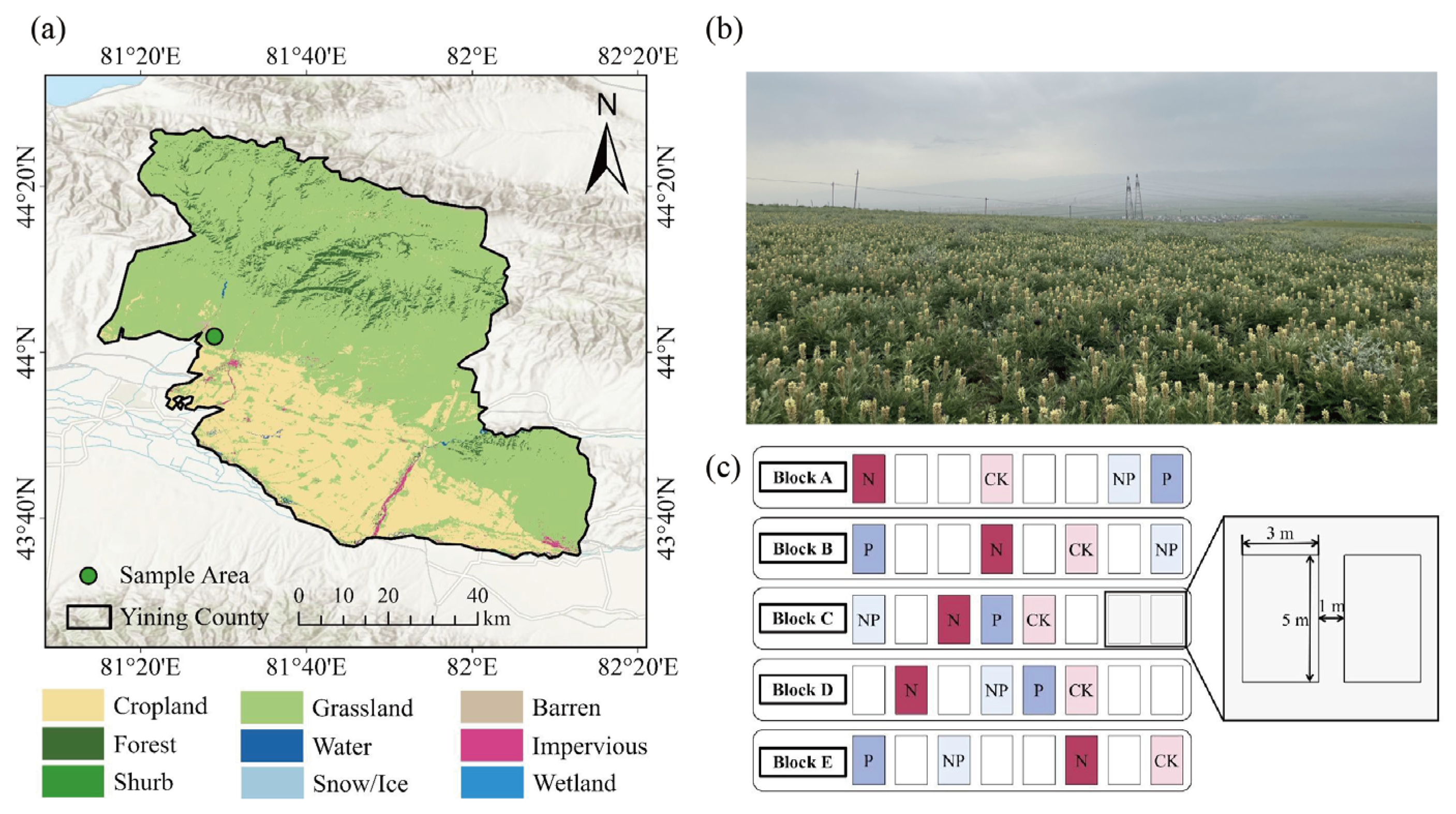
A flat, freely grazed grassland area dominated by S. alopecuroides was selected within the Tuhulusu site, and a main experimental plot measuring 40 m × 30 m was established. A randomized complete block design was employed to control for spatial heterogeneity. Specifically, the plot was divided into five blocks, each separated by a 1−m−wide buffer strip. Within each block, five subplots of 5 m × 3 m were laid out with 1 m spacing between adjacent subplots. Four treatments—nitrogen (N) addition, phosphorus (P) addition, combined nitrogen and phosphorus (NP) addition, and an unamended control (CK) receiving no N or P—were randomly allocated within each block. Each treatment was replicated five times, resulting in a total of 20 experimental subplots (Figure 1).
Nutrient amendments were applied once annually in mid−April, corresponding to the early growing season of S. alopecuroides, during both 2024 and 2025. The addition rates were determined based on the critical nitrogen deposition load reported by Xu et al. [19] and further justified by the threshold response of grassland ecosystems to nitrogen enrichment. Specifically, low nitrogen deposition increases soil nutrient pools and microbial diversity, while excessive nitrogen causes acidification, nutrient loss, and ecosystem degradation [20]. The same rate was applied to phosphorus addition to allow direct comparison between single and combined nutrient treatments, although a separate ecological threshold for phosphorus in this system remains to be established. The addition rates were as follows: CK (no N or P added), N (10 g N·m−2·yr−1), P (10 g P·m−2·yr−1), and NP (10 g N·m−2·yr−1 + 10 g P·m−2 yr−1). Urea [CO(NH2)2] was used as the nitrogen source, and calcium dihydrogen phosphate [Ca(H2PO4)2·H2O] served as the phosphorus source. At the time of application, the fertilizers were dissolved in 2 L of clean water and applied uniformly by manual spraying; the CK treatment received an equivalent volume of water alone to account for any potential effects of water addition. Pre−treatment baseline sampling of soil arthropod communities was not conducted; instead, treatment effects were evaluated by comparing each treatment against the concurrent CK control within a randomized block design.

2.3. Sample Collection and Measurement

Field sampling was conducted at multiple time points across the two−year study stage. In 2024, samples were collected during the maturity stage (July) and the senescent stage (September); in 2025, sampling additionally included the flowering stage (May), along with the maturity stage (July) and the senescent stage (September). At each sampling event, soil fauna, soil physicochemical properties, and vegetation were systematically collected from each experimental plot.

2.3.1. Soil Fauna Collection, Extraction, and Identification

Within each plot, three sampling points were established following a triangular arrangement to ensure spatial representativeness. Soil cores (0–10 cm depth) were obtained using a corer with a diameter of 35 mm. The cores from each plot were combined, placed in sealed bags, and transported to the laboratory under cooled conditions to preserve sample integrity. Upon arrival, soil fauna were extracted using Tullgren funnels—a standard dry−extraction method—and subsequently identified to family or order level under an OLYMPUS SZX 16 stereomicroscope (Olympus Corporation, Tokyo, Japan). Taxonomic identification primarily followed the reference works General Entomology, Taxonomy and Ecological Diversity of Collembola in Heilongjiang Province, and Soil Gamasid Mites in Northeast China [21,22,23].
After identification, soil fauna taxa were categorized according to their relative abundance (Perc.) into three classes: dominant (Perc. ≥ 10%), common (1% ≤ Perc. < 10%), and rare (Perc. < 1%). In addition, each taxon was assigned to one of five functional guilds based on feeding habits: herbivores, predators, decomposers, fungivores, and omnivores.

2.3.2. Measurement of Soil Physicochemical Properties

Soil samples were collected from the 0–10 cm depth interval using a five−point sampling method to ensure representativeness. Following collection, samples from each plot were thoroughly homogenized, placed in sealed bags, and transported to the laboratory. They were then air−dried under cool, well−ventilated conditions and subsequently passed through 0.25 mm and 0.85 mm sieves to obtain uniform material for analysis. Approximately 500 g of the sieved soil from each plot was stored in sealed bags, with each sample subjected to a single round of analysis.
After sample preparation, a series of analytical procedures was conducted to characterize soil physicochemical properties. Soil moisture content (SMC, %) was determined gravimetrically using the oven−drying method. Soil pH was measured with a Mettler−Toledo FiveEasy Plus pH meter (Mettler−Toledo International Inc., Greifensee, Switzerland) at a soil−to−water ratio of 1:2.5. Electrical conductivity (EC, μS·cm−1) was measured using a HANNA HI 2315 conductivity meter (Hanna Instruments, Smithfield, RI, USA). Soil organic carbon (SOC, g·kg−1) was quantified by the potassium dichromate volumetric method with external heating. Total nitrogen (g·kg−1) was determined by the perchloric acid−sulfuric acid digestion method, while total phosphorus (g·kg−1) was measured using the acid digestion–molybdenum antimony colorimetric method. Available phosphorus (mg·kg−1) was determined via the sodium bicarbonate extraction−molybdenum antimony colorimetric method. Nitrate−N and ammonium−N (mg·kg−1) were measured following extraction with 10 mmol·L−1 calcium chloride. All analytical procedures were performed in accordance with the methods described in Soil Agricultural Chemical Analysis [24].

2.3.3. Vegetation Survey

Within each plot, a single 50 cm × 50 cm quadrat was randomly established to characterize aboveground vegetation. All S. alopecuroides individuals within the quadrat were clipped at ground level and placed into paper bags. The collected plant material was transported to the laboratory, where it was oven−dried at 65 °C until constant weight was achieved. The resulting dry mass was then recorded as the aboveground biomass of S. alopecuroides (AGB, g·m−2).

2.4. Data Analysis

The original data were organized using Excel 2024, and the soil fauna community diversity was calculated using PAST 4.17 software. To quantify community−level diversity, four commonly used indices were employed: the Shannon–Wiener diversity index (H′), Margalef richness index (D), Pielou evenness index (E), and Simpson dominance index (C). These were calculated using the following formulas:
H = i = 1 S ( n i / N ) · ln ( n i / N )
D = ( S 1 ) / lnN
E = H / lnS
C = i = 1 S ( n i / N ) 2
where N represents the total number of individuals, ni the number of individuals belonging to the i−th taxonomic group within a given plot, and S the total number of groups present. For samples in which no soil fauna individuals were captured, diversity indices were treated as missing data (NaN) and were excluded from all statistical analyses to avoid bias.
To investigate the mechanisms underlying soil fauna community responses to different nutrient addition regimes, the dataset was first partitioned into four treatment groups: N addition, P addition, NP addition, and CK. Generalized estimating equations (GEE) implemented in SPSS 27.0 were employed to evaluate the main effects of nutrient addition and sampling time, as well as their interactive effects, on soil fauna metrics and environmental variables. Collinearity diagnostics were performed for all environmental factors, using a variance inflation factor (VIF) greater than 5 as the criterion for multicollinearity. In the N and P addition treatments, soil total nitrogen (TN) was excluded from subsequent analyses; in the NP addition and CK treatments, both TN and available phosphorus (AP) were excluded. Following this variable screening, Pearson correlation analysis was carried out in Origin 2021 to assess relationships among explanatory variables.
For ordination analysis, detrended correspondence analysis (DCA) was first conducted on the soil fauna community dataset using CANOCO 5.0, with the appropriate ordination model selected based on the longest gradient length among the ordination axes. Because the longest gradient length across all axes was less than 3.0, redundancy analysis (RDA) was chosen for subsequent analyses. RDA was performed using common and dominant soil fauna groups as response variables and the environmental factors retained after collinearity diagnostics as explanatory variables. Finally, a Monte Carlo permutation test with 999 permutations was applied to evaluate the statistical significance of both the first canonical axis and the full set of canonical axes combined.

3. Results

3.1. Characteristics of Soil Fauna Community Composition

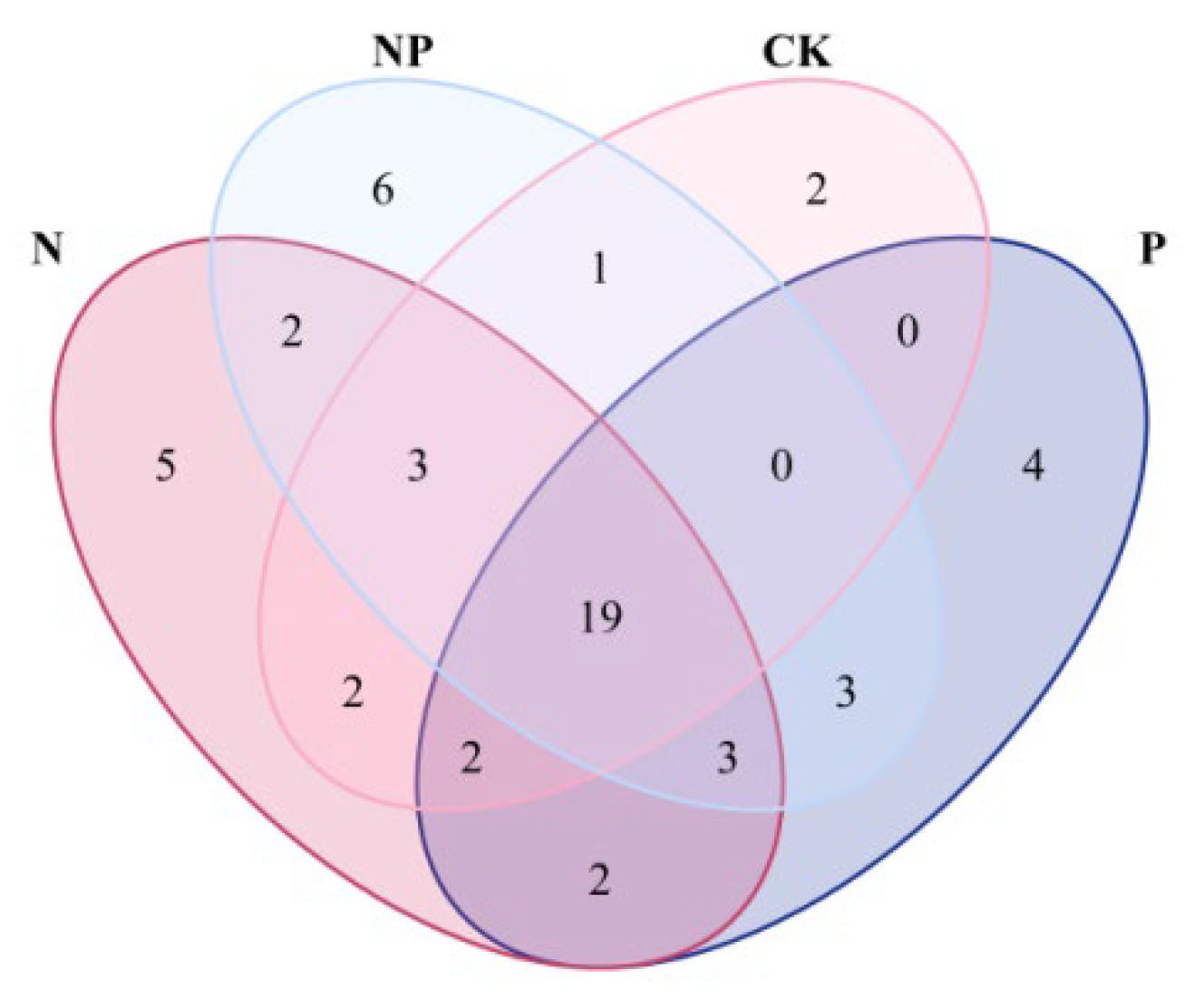
The survey yielded a total of 3357 soil fauna individuals, which were taxonomically assigned to 12 orders and 51 families. Across all experimental treatments, three families—Oppiidae, Hypoaspidae, and Rhagidiidae—consistently dominated the community, accounting collectively for 60.0% of all individuals captured (Table A1). Across treatments, N addition yielded the highest individual abundance (1118), while CK and NP addition showed lower family richness (24 and 18 families, respectively). Family−level community composition varied substantially among treatments (Figure 2, Table A2). NP addition had the most unique families (6), whereas only 2 families were unique to CK. Nineteen families were common to all treatments.

3.2. Number of Families and Individual Density

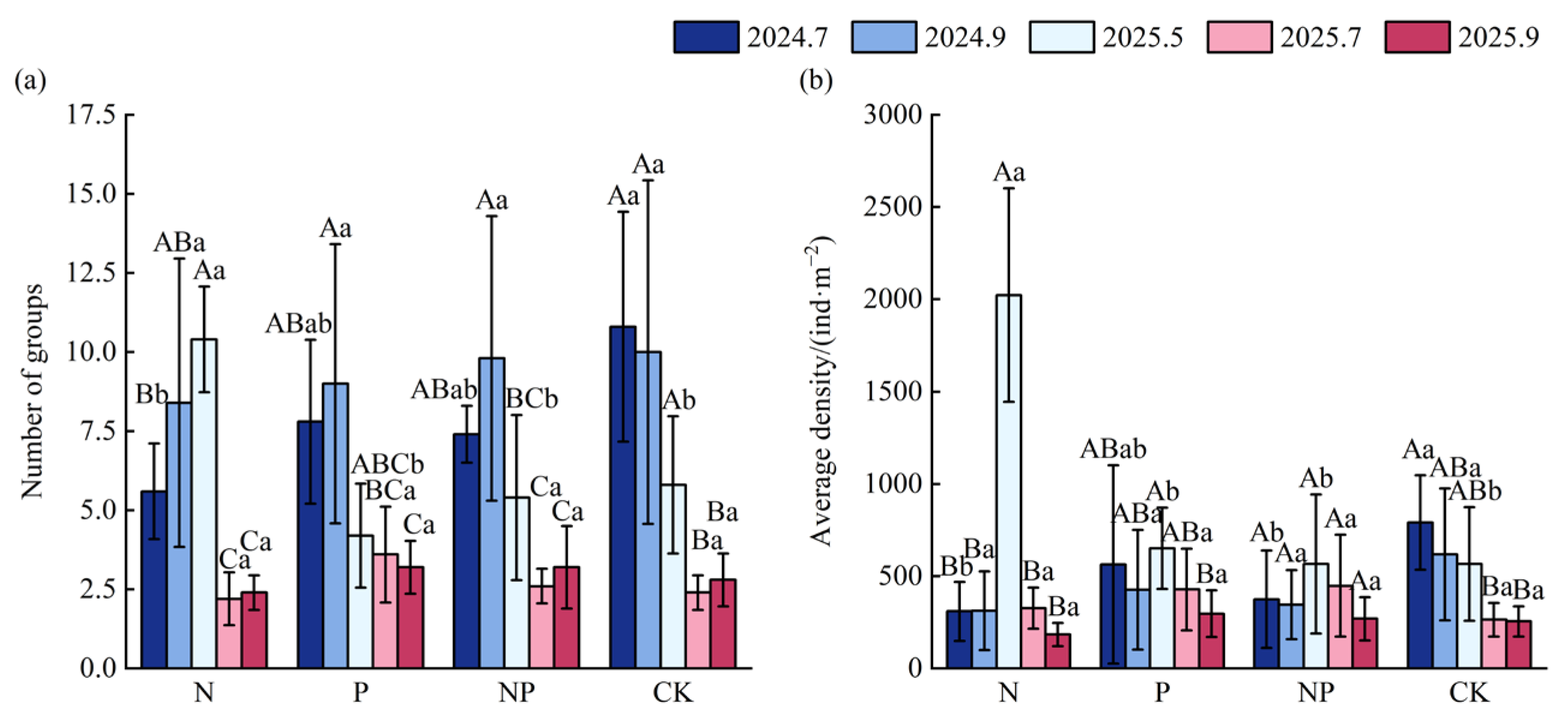
Generalized estimating equation (GEE) analysis revealed that both sampling time and its interaction with nutrient addition type exerted highly significant effects on individual density and the number of families (p < 0.001). The main effect of nutrient addition on individual density was also highly significant (p < 0.001) (Table A3, Figure 3).
Considering treatment differences across the entire study stage, mean individual density under N addition (630.78 ind·m−2) was significantly higher than under NP addition (400.57 ind·m−2, p = 0.003) and under CK (499.07 ind·m−2, p = 0.040). In contrast, no significant difference was observed between N addition and P addition (473.13 ind·m−2, p = 0.067), nor among P addition, NP addition, and CK treatments. For the number of families, the ranking across treatments was CK > N > NP > P; however, pairwise differences did not reach statistical significance (p > 0.05).
With respect to temporal dynamics, the number of families in July (maturity stage) and September (senescent stage) 2024 was significantly elevated relative to the corresponding months in 2025 (p < 0.05). Conversely, individual density in May (flowering stage) 2025 was significantly higher than in all other sampling stages (p < 0.001).
Notably, treatment effects exhibited pronounced temporal divergence. In the July maturity stage of 2024, both the number of families and individual density under N addition were significantly lower than those under CK (p < 0.05); similarly, individual density under NP addition was also significantly lower than under CK (p < 0.05). In contrast, the May flowering stage of 2025 marked the peak of both metrics over the entire study stages, with values significantly exceeding those recorded at all other time points (p < 0.001).

3.3. Community Diversity

Generalized estimating equation (GEE) analysis revealed that both sampling time and its interaction with nutrient addition exerted highly significant effects on all four diversity indices (p < 0.01). In contrast, the main effect of nutrient addition was not statistically significant (p > 0.05) (Table A3).
Across the entire study stage, no statistically significant differences in diversity indices were detected among treatments (p > 0.05). Nevertheless, consistent rankings emerged: the dominance index (C), evenness index (E), and Shannon–Wiener index (H) followed the order NP > CK > P > N, while the Margalef richness index (D) exhibited a distinct ordering: CK > NP > N > P Detailed values for each treatment and sampling time are presented in Table 1.
All diversity indices displayed pronounced seasonal and interannual variability. With respect to seasonal dynamics, D, E, and H were significantly elevated during the flowering stage (May 2025) compared with the maturity stage and senescent stages (July and September 2025). Regarding interannual patterns, D and H were generally higher in the July maturity stage and September senescent stage of 2024 than in the corresponding stages of 2025 (p < 0.05), whereas C and E showed the opposite tendency (p < 0.01).
Significant interaction effects were detected, with the influence of nutrient addition being largely confined to specific phenological stages. In September 2024 (senescent stage), NP addition significantly increased both C (p = 0.021) and E (p = 0.002) relative to CK. In May 2025 (flowering stage), N addition significantly elevated H (p = 0.001) and D (p < 0.001) compared with P addition, whereas P addition significantly reduced C relative to CK (p = 0.027). Furthermore, both NP addition and CK exhibited significantly higher E values than N and P addition, with pairwise comparisons as follows: NP vs. N, p = 0.006; NP vs. P, p = 0.028; CK vs. N, p < 0.001; CK vs. P, p = 0.002.

3.4. Characteristics of Soil Environmental Factors Under Nutrient Addition

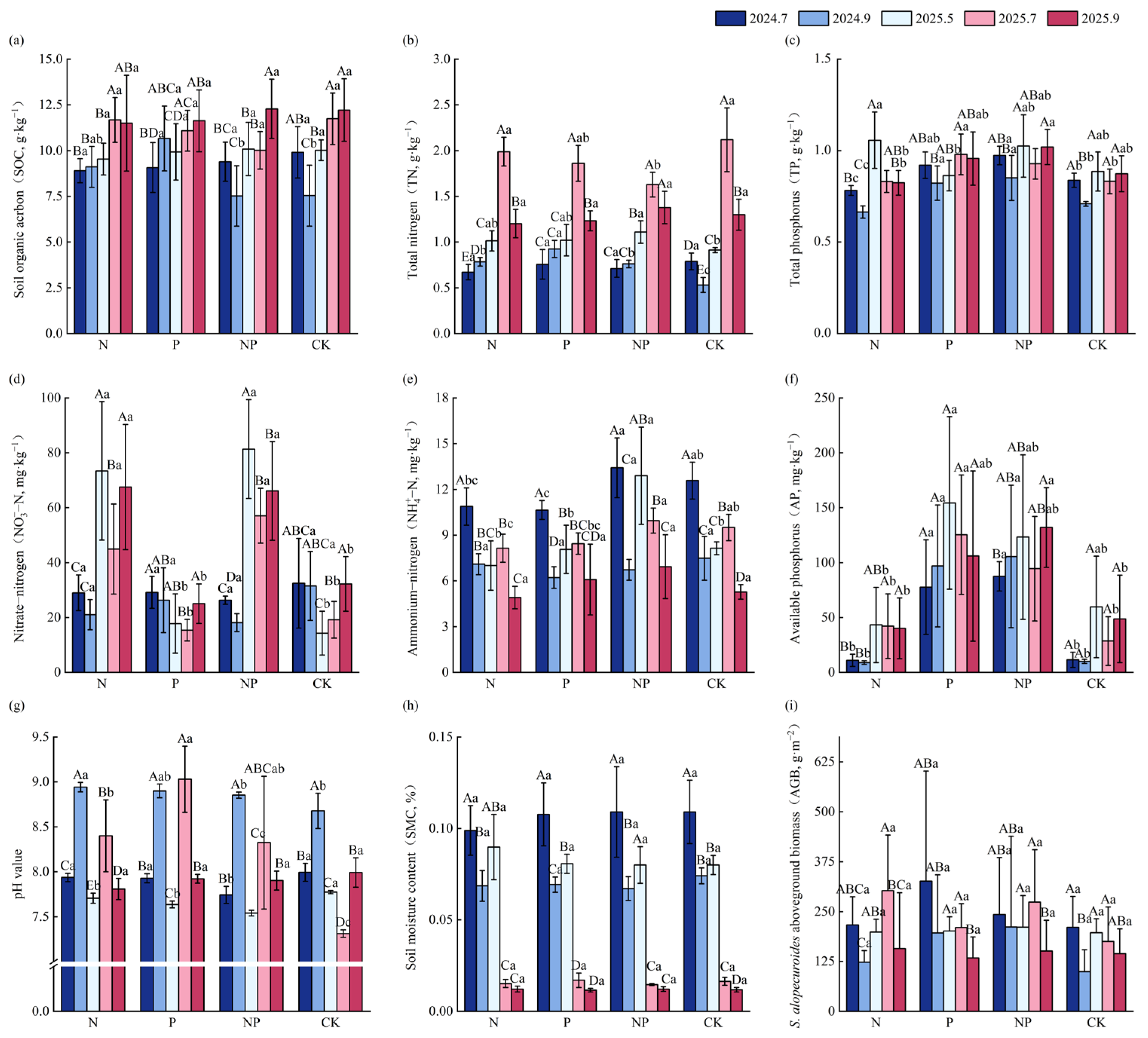
Generalized estimating equation (GEE) analysis revealed that the effect of sampling time was highly significant for all measured environmental factors (p < 0.001). Treatment effects were highly significant for total phosphorus, nitrate−N, ammonium−N, available phosphorus, and pH (p < 0.001), while the interaction between time and treatment reached significance for all factors except aboveground biomass (p = 0.061) (Table A3, Figure 4).
Nitrogen−sensitive variables ( NO 3 −N, NH 4 + −N, pH) responded strongly to N addition. In 2025, nitrate−N concentrations under N and NP addition were significantly higher than those in treatments receiving no nitrogen (P and CK; p < 0.001). Ammonium−N under NP addition was significantly elevated compared with N and P addition in July (maturity stage) 2024 and in both May (flowering stage) and July (maturity stage) 2025 (p < 0.05). Additionally, pH under N addition was significantly higher than under NP and CK in September (senescent stage) 2024 (p < 0.05). Phosphorus−sensitive variables (AP, TP) also showed clear responses. AP under P and NP addition was significantly higher than under N and CK (p < 0.001). TP under NP addition exceeded that under N and CK in July (maturity stage) and September (senescent stage) 2024 (p < 0.05), and TP under P addition was also significantly higher than under N addition during the same stages (p < 0.05). In September (senescent stage) 2025, TP under NP addition remained significantly higher than under N addition (p < 0.001). In contrast, treatment main effects were not significant for electrical conductivity, SMC, TN, SOC, or AGB (p > 0.05). Seasonally, NH 4 + −N and SMC consistently showed significantly higher values in July (maturity stage) than in September (senescent stage) (p < 0.05). In contrast, total nitrogen, total phosphorus, and aboveground biomass exhibited this seasonal pattern only in specific years or under particular treatments. The seasonal behavior of pH displayed marked interannual differences. In 2024, pH across all treatments was significantly lower in July (maturity stage) than in September (senescent stage) (p < 0.05). In 2025, however, pH under N, P, and NP addition was significantly higher in July (maturity stage) than in September (senescent stage) (p < 0.05), whereas under CK, pH remained significantly lower in July (maturity stage) (p < 0.05). In addition, soil organic carbon content in September (senescent stage) 2025 was significantly higher than in May (flowering stage) 2025 (p < 0.05).
Turning to interannual dynamics, several variables were significantly elevated in 2025 relative to the corresponding stages in 2024: total nitrogen across all treatments (p < 0.001), nitrate−N under N and NP addition (p < 0.01), available phosphorus under N addition (p < 0.05), and soil organic carbon under P, NP, and CK treatments (p < 0.05). Conversely, ammonium−N, pH, and soil moisture content were significantly higher in 2024 than in 2025 (p < 0.05).

3.5. Driving Effects of Environmental Factors Under Nutrient Addition

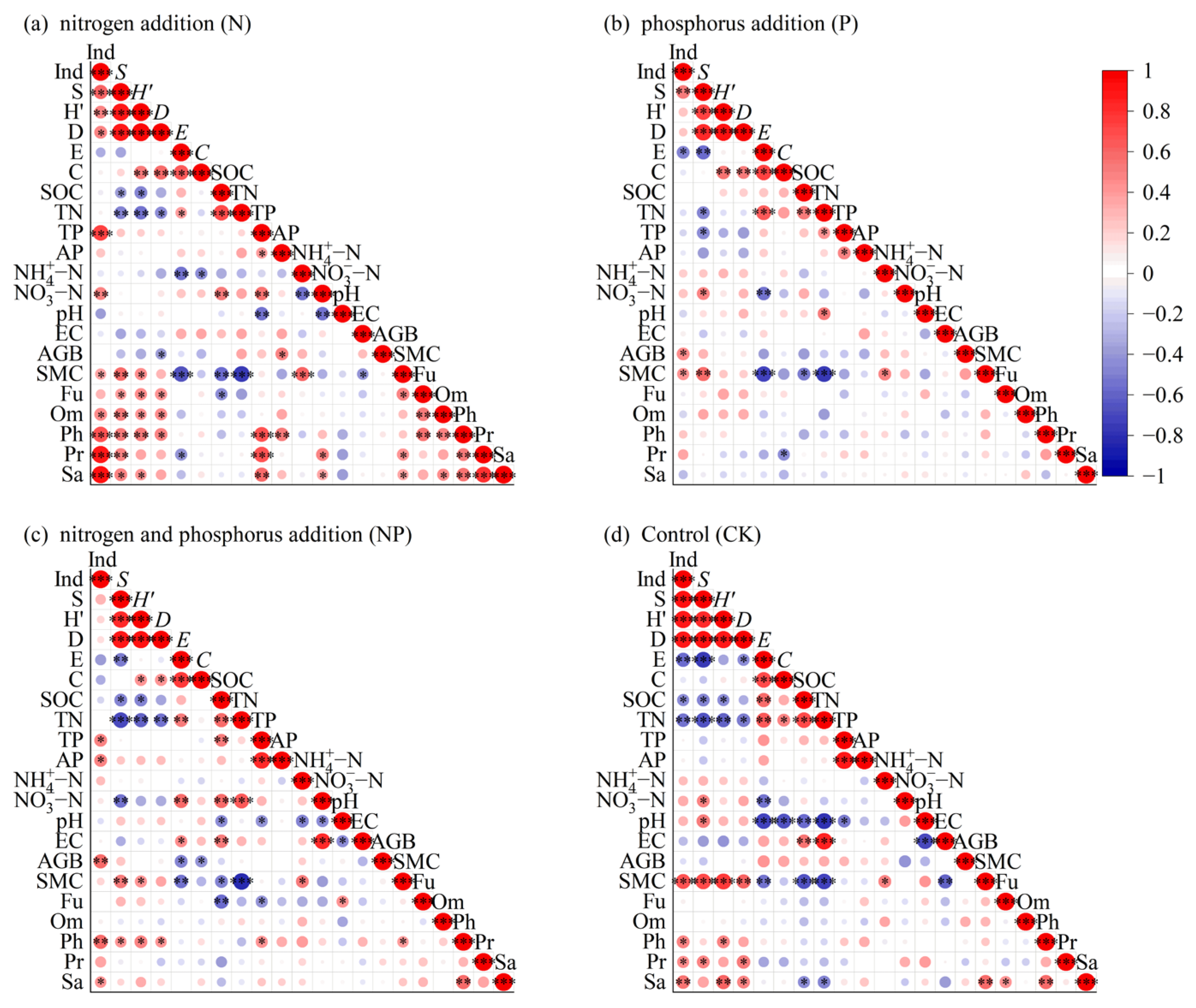
Pearson correlation analysis revealed significant positive correlations among H, D, and C (p < 0.05), and the relationships between diversity indices and environmental factors were treatment−dependent (Figure 5). Treatment−specific patterns were examined: under N addition, individual density (Ind) showed strong positive correlations with total phosphorus (TP) and nitrate−N (p < 0.01), whereas total nitrogen (TN) was negatively correlated with the number of families (S), H, and D (p < 0.05). Under P addition, Ind correlated positively with soil moisture content (SMC) and aboveground biomass (AGB) (p < 0.05); the number of families correlated positively with nitrate−N and SMC (p < 0.05) and negatively with TN and TP (p < 0.05). Additionally, the functional groups Ph, Pr, and Sa each exhibited strong positive correlations with TP (p < 0.01); Ph also correlated strongly with available phosphorus (AP) (p < 0.01), while Pr and Sa correlated positively with nitrate−N (p < 0.05). Under NP addition, Ind correlated positively with TP, nitrate−N, and SMC (p < 0.05), whereas TN again showed negative correlations with S, H, and D (p < 0.05). Under CK treatment, Ind correlated negatively with TN (p < 0.01) and positively with SMC (p < 0.001); TN was negatively correlated with S, H, and D (p < 0.05).
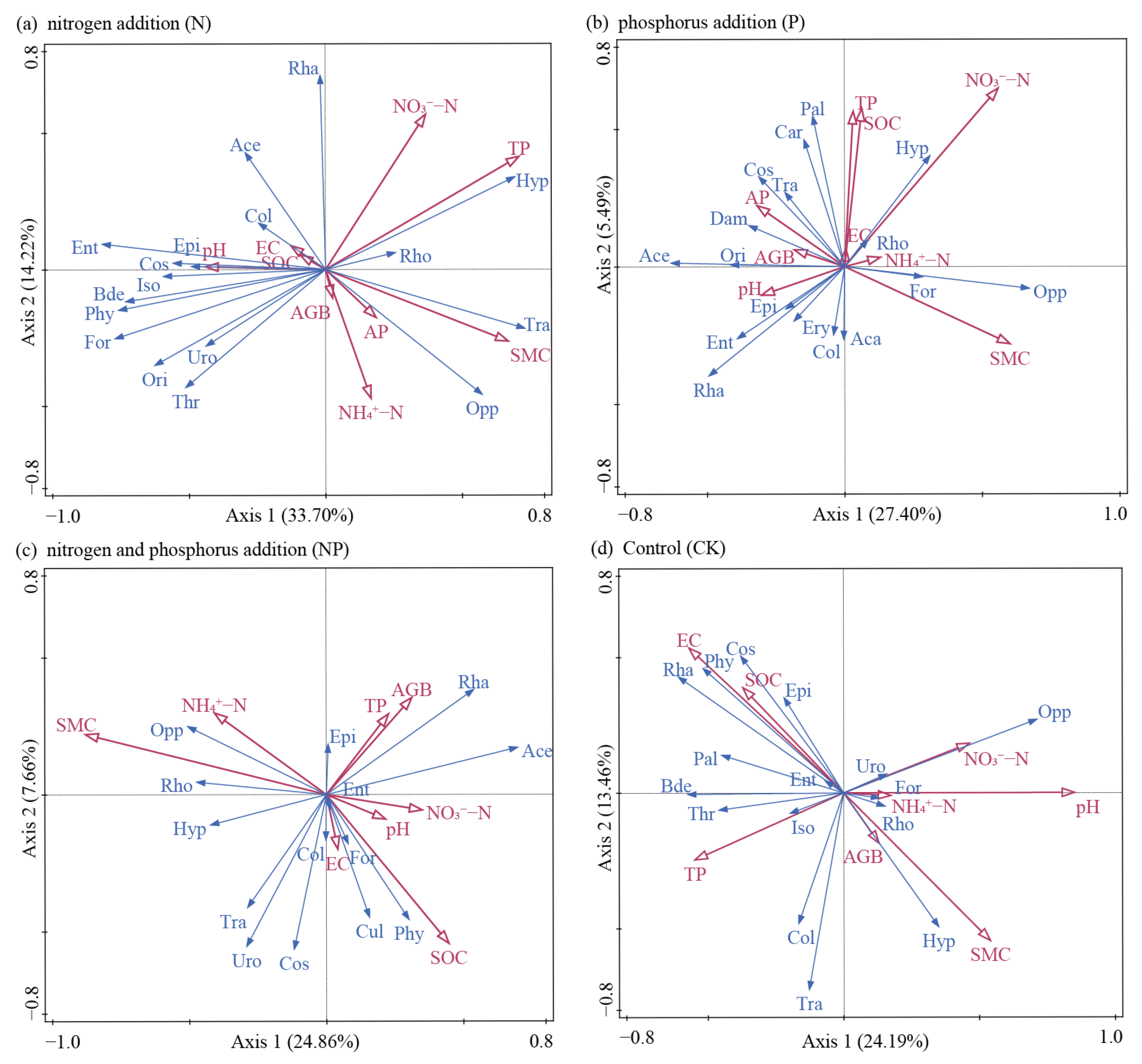
To further quantify the relative importance of environmental drivers, redundancy analysis (RDA) was performed. In addition, soil physicochemical properties collectively accounted for 47.92% of the total variation in soil fauna community composition, with the first two axes explaining 33.7% and 14.22%, respectively (Figure 6). Among the measured factors, TP, SMC, and AP contributed the most, with explanatory rates of 31.9% (p = 0.01), 21.9% (p = 0.002), and 14.3% (p = 0.03), respectively. Under P addition, the explained variation was 32.88% (axis 1: 27.4%; axis 2: 5.49%), and SMC emerged as the most influential factor, explaining 25.5% of the variation (p = 0.028). Under NP addition, the total explained variation was 32.53% (axis 1: 24.86%; axis 2: 7.66%), with SMC again acting as the dominant driver (47.9%, p = 0.002). For the CK treatment, soil properties explained 37.65% of the variation (axis 1: 24.19%; axis 2: 3.46%), with pH and electrical conductivity accounting for 37.9% (p = 0.002) and 17.2% (p = 0.034) of the community variation, respectively.

4. Discussion

4.1. Effects of Nutrient Addition on Soil Fauna Community Composition and Diversity

In the present study, two years of short−term nutrient addition significantly influenced soil fauna individual density (p < 0.001). In contrast, the main effects of treatment on the number of families and on diversity indices were not statistically significant. This differential response indicates that faunal abundance is more sensitive to nutrient enrichment than community richness or evenness—a pattern consistent with the two−year grassland nitrogen addition experiment reported by Cole et al. [25].
Turning to community composition, the consistent dominance of Oppiidae, Hypoaspidae, and Rhagidiidae across all treatments suggests that these taxa possess broad ecological adaptability to nutrient inputs and collectively form a stable core component of the soil fauna community in this ecosystem. Notably, all three families consist of predatory mites characterized by wide ecological tolerance, which likely enables their stable persistence under varying fertilization regimes—an observation that aligns with the findings of Malica et al. [26]. Furthermore, within this group, oribatid mites (including members of Oppiidae) are known to exhibit strong buffering capacity against fluctuations in soil nutrient availability [27], further reinforcing their role as stable components under nutrient perturbations.

4.1.1. Nitrogen Addition

Under nitrogen addition, the total number of individuals was higher than under all other treatments, whereas the number of families was relatively low (1118 individuals and 17 families), displaying a pattern of “high abundance, low richness.” This indicates that nitrogen addition promotes the mass proliferation of certain dominant taxa while causing the disappearance of some sensitive taxa. This pattern suggests that nitrogen enrichment promotes the proliferation of certain dominant groups while simultaneously causing the decline or loss of more sensitive taxa [28]—a finding that aligns with the results of Mo et al. [29] under an equivalent nitrogen addition rate. The exclusive dominance of certain taxa (e.g., Trachyuropodidae) under nitrogen−only addition may be hypothetically attributed to the formation of semi−decomposed organic matter patches with elevated C:N ratios, which create favorable microhabitats [30]; however, direct measurements of organic matter C:N ratios were not conducted in this study, and this mechanistic interpretation requires further validation. From an applied perspective, the presence of Trachyuropodidae can be considered a potential bioindicator of nitrogen−enriched conditions in this grassland type.
To further explore the underlying mechanisms, RDA revealed that under N addition, TP, SMC, and AP emerged as the key limiting factors, whereas variables directly related to nitrogen were not retained as significant explanatory variables. This outcome indicates that once nitrogen limitation is alleviated, phosphorus availability and water status assume increasingly prominent roles in regulating soil fauna communities [31]. Correlation analysis further substantiated this interpretation. Soil fauna individual density was jointly influenced by total phosphorus and nitrate−N, and total phosphorus simultaneously enhanced the abundance of herbivorous, decomposer, and predatory groups through bottom−up effects. In contrast, available phosphorus exerted only a modest positive influence on herbivorous groups. This divergence suggests that total phosphorus and its available fraction play functionally distinct roles in modulating the soil food web.

4.1.2. Phosphorus Addition

Under phosphorus addition, the number of families was intermediate−higher than under N addition but lower than under the CK treatment, and the unique families were predominantly herbivorous insects. This pattern is likely attributable to the influence of phosphorus addition on plant growth and resource allocation.
To explore the underlying mechanisms, Pearson correlation analysis revealed that under P addition, individual density was significantly positively correlated with aboveground biomass (p < 0.05) (Figure 5). This finding suggests that phosphorus addition alleviates soil phosphorus limitation, thereby promoting plant growth and providing higher−quality food resources for herbivorous insects, which in turn facilitates their colonization and population increase [32]. Concomitantly, enhanced plant growth elevates plant water demand [33]. In line with this, soil moisture content emerged as the most important factor influencing the soil fauna community in the present study, explaining 25.5% of the variation. Moreover, both individual density and the number of families exhibited significant positive correlations with moisture content, and the number of families was also significantly positively correlated with aboveground biomass (p < 0.05). Collectively, these results indicate that microhabitats with favorable water conditions can supply more abundant food resources and suitable habitats for soil fauna [34].
Given the climatic context of the study area, a temperate continental zone characterized by low precipitation and high evaporation, water constitutes a critical limiting factor in this ecosystem. Consistent with this, in May (flowering stage) 2025, the dominance index under P addition was lower than that under CK, implying a weakening of dominant group dominance. This shift may be attributable to the enrichment of unique herbivorous groups, which in turn alters community structure.

4.1.3. Nitrogen and Phosphorus Addition

Under combined nitrogen and phosphorus addition, mean individual density was significantly lower than that observed under nitrogen addition alone (p = 0.003). In contrast, the dominance index, evenness index, and Shannon diversity index were all higher than those recorded under CK and under either single−nutrient treatment. This pattern, characterized as “nitrogen inhibition–phosphorus alleviation,” aligns with the findings of Tie et al. [35] in a subtropical forest.
To investigate the mechanisms underlying coexistence, the Venn diagram revealed that NP addition supported the highest number of unique families, and the families shared among NP, N, and P additions encompassed multiple functional guilds (Figure 2, Table A2). This indicates that nitrogen–phosphorus interactions facilitate the coexistence of soil fauna groups by enhancing resource availability [36].
Extending this line of evidence, redundancy analysis (RDA) identified soil moisture content as the sole significant explanatory factor, accounting for 47.9% of the total variation. This finding corroborates the view, together with Alatalo et al. [37], that soil moisture constitutes a key environmental constraint for soil microarthropod communities. Notably, the present study further demonstrates that under combined nitrogen and phosphorus enrichment, the regulatory role of water in shaping soil fauna communities is amplified.
Further underscoring this pattern, correlation analysis additionally showed that individual density under NP addition was significantly positively correlated with total phosphorus, nitrate−N, and soil moisture content, reflecting the synergistic effects of nitrogen, phosphorus, and water. Within the temperate continental climate context, although the importance of water was already evident under single−nutrient addition (with SMC explaining 25.5% of the variation under P addition), the simultaneous alleviation of both nitrogen and phosphorus limitations leads to peak water demand for plant growth, positioning water as the ultimate determining factor. Consequently, in NP−treated S. alopecuroides grasslands, the soil fauna community composition—particularly the dominance of moisture−sensitive groups—can serve as an integrative bioindicator of water availability under conditions of co−limited N and P.
From a seasonal perspective, in September 2024 (senescent stage), NP addition significantly increased the dominance index and evenness index relative to CK (p < 0.05). This effect is likely attributable to the material foundation provided by litter input under nitrogen–phosphorus interactions [36], which optimizes C:N:P stoichiometric ratios and creates new niches for distinct functional guilds [38].

4.1.4. Control Treatment

Among all treatments, the control exhibited the highest number of families, suggesting that under natural conditions without nutrient addition, the soil fauna community maintains elevated family−level richness. The unique families present exclusively in the CK treatment were all predatory groups; their confinement to the control likely reflects sensitivity to the disturbance associated with nutrient addition.
To further understand the factors shaping community structure under natural conditions, redundancy analysis (RDA) revealed that in the absence of nutrient addition, basic soil physicochemical properties—specifically pH and electrical conductivity—emerged as the dominant factors regulating community structure. Supporting this, Santorufo et al. [39] demonstrated in a Mediterranean region that soil pH indirectly modulates food resources for soil fauna by influencing microbial community composition and organic matter decomposition processes. Similarly, electrical conductivity, which reflects soil soluble salt content, can impose physiological stress on soil fauna when values deviate substantially from optimal ranges [40]. In addition, individual density was positively correlated with soil moisture content, reinforcing the critical role of water availability. The restriction of certain predatory families to the CK treatment highlights their value as bioindicators of undisturbed conditions and nutrient−addition disturbance. Furthermore, the sensitivity of community structure to pH and EC in the control suggests that shifts in these baseline edaphic parameters can be tracked via changes in soil arthropod assemblages, providing a reference for assessing grassland health.
Bioindicative value of soil arthropods for assessing the condition and health of S. alopecuroides grasslands. The differential responses of soil arthropod community parameters to nitrogen, phosphorus, and their combination provide a basis for bioindication. Specifically, the “high abundance, low richness” pattern under nitrogen addition signals nitrogen−induced ecological stress, characterized by the loss of sensitive taxa and dominance of a few tolerant predators. Such a shift can serve as an early warning of declining grassland health under atmospheric nitrogen deposition. Conversely, the increase in unique herbivorous families under phosphorus addition indicates improved plant resource quality, which may reflect a temporary alleviation of phosphorus limitation but also suggests potential risks of herbivore outbreaks. The amplified role of soil moisture under combined NP addition, together with the increased evenness and unique family richness, points to a community state more dependent on water availability, a critical indicator of grassland vulnerability under projected drying trends. Moreover, the confinement of predatory unique families to the control treatment suggests that these sensitive predators are potential bioindicators of low−disturbance, healthy grassland conditions. Therefore, monitoring soil arthropod community composition—particularly the abundance of sensitive predatory mites, the richness of herbivorous families, and the dominance−evenness balance—can provide an integrated assessment of the ecological status of S. alopecuroides grasslands in response to nutrient enrichment and water stress.
It is worth noting that while the RDA models identified key drivers for each treatment, a substantial proportion of the variation in soil fauna community composition remained unexplained (52.08–67.47% across treatments). This reflects the influence of factors not explicitly measured in this experiment, such as the fact that soil microarthropods are highly sensitive to fine−scale microhabitat heterogeneity (e.g., the distribution of organic matter patches, soil pore space, and moisture gradients at the centimeter scale) and stochastic processes such as random colonization and extinction events. Furthermore, complex biotic interactions—including intraguild predation, competition, and specific plant–microbe–fauna feedbacks—may contribute significantly to community assembly but are difficult to quantify in field experiments.

4.2. Temporal Dynamics and Phenological Effects

Generalized estimating equation (GEE) analysis revealed that the effect of time was highly significant for all indicators (p < 0.001), and the time × treatment interaction was significant for most indicators. Together, these results indicate that the response of soil fauna communities to nutrient enrichment is markedly time−dependent and treatment−specific.

4.2.1. Seasonal Dynamics Analysis

Most environmental factors exhibited significantly higher values during the maturity stage (July) than during the senescent stage (September). This pattern reflects a fundamental ecological transition in grassland ecosystems from a production−dominated to a decomposition−dominated phase. Characterized by resource accumulation during maturity and resource transition during senescence, this seasonal dynamic aligns with observations from East African savannas reported by Ngatia et al. [41]. Consequently, it parallels the dynamics of the soil fauna community: abundant nutrient resources during the maturity stage support greater family richness and individual density, whereas during the senescent stage, despite declines in most nutrient indices, litter inputs provide new food sources for decomposer groups, thereby driving seasonal reorganization of community structure.
Within this seasonal framework, a particularly striking phenomenon emerged. Notably, the pronounced peak in individual density observed under N addition in May (flowering stage) 2025 (p < 0.001) highlights a key underlying mechanism. Following one year of accumulated nitrogen, a substantial resource pulse is released through the plant–soil fauna cascade pathway during the phenological window of peak plant demand, namely, the flowering stage [42,43]. Mechanistically, this integrated “accumulation–phenology–pulse” pattern emphasizes the temporal sensitivity of soil fauna responses to nitrogen addition. From a bioindication perspective, the magnitude and timing of such seasonal peaks in soil arthropod abundance can serve as sensitive indicators of the synchrony between nitrogen deposition and plant phenology, which is crucial for assessing the ecological impact of nutrient enrichment on grassland health.

4.2.2. Interannual Dynamics Analysis

Because the 2024 sampling did not include the flowering stage (May), direct year−to−year comparisons are limited to the maturity (July) and senescence (September) stages. Within this constraint, on the interannual scale, the contents of soil organic carbon, total nitrogen, nitrate−N, and available phosphorus were generally higher in 2025 than in 2024, whereas ammonium−N, pH, and soil moisture content exhibited the opposite trend (p < 0.05). This divergence reflects the combined influence of cumulative nutrient addition and interannual climatic variability [44,45]. To contextualize this pattern, according to the Xinjiang Meteorological Bureau, mean annual precipitation in Xinjiang in 2025 was 149.6 mm, representing a 13% reduction relative to the long−term average [15]. This decrease in precipitation directly reduced soil moisture content, which in turn affected soil nitrogen transformation and accumulation.
Interannual variation in the soil fauna community mirrored these effects: richness and Shannon diversity were higher in 2024 than in 2025, whereas dominance and evenness showed the reverse trend. Ecologically, in the first year, the initial species pool was largely retained, but nutrient addition already induced abundance fluctuations, resulting in uneven community distribution. This aligns with observations by Valerio et al. [46] in Mediterranean grasslands, indicating that fertilization reduces species and community stability. After two years of nutrient selection, sensitive groups declined or disappeared, reducing richness, while surviving populations stabilized and relative abundances became more even. These interannual shifts demonstrate that soil arthropod diversity indices (richness, Shannon, dominance, evenness) can collectively indicate the progression of community restructuring under sustained nutrient enrichment. In particular, the decline in richness coupled with increased evenness after two years signals a transition from initial perturbation to a new, more adapted community state—a valuable bioindicator of the rate and direction of grassland ecosystem change under fertilization.
Beyond the temporal patterns discussed above, several limitations of this study warrant consideration in future research. The experiment was conducted over only two years, a duration that may be insufficient to capture long−term successional trajectories. Soil microbial communities and enzyme activities were not directly measured, limiting the depth of mechanistic insight into the cascade pathways. Furthermore, the investigation was restricted to the 0–10 cm soil layer; consequently, the response mechanisms of soil fauna in deeper soil horizons remain to be elucidated.

5. Conclusions

Through a two−year manipulative experiment with nitrogen and phosphorus addition, this study elucidated how soil fauna communities in the S. alopecuroides grassland of Yili, Xinjiang, respond to nutrient inputs. The main conclusions are synthesized below.
Stable core groups and functional shifts. Oppiidae, Hypoaspidae, and Rhagidiidae formed the stable core of the soil fauna community. Under different nutrient addition regimes, the functional composition of unique groups diverged markedly: nitrogen addition enriched decomposer and omnivorous groups; phosphorus addition promoted herbivorous insects; and combined nitrogen and phosphorus addition supported the coexistence of multiple functional groups.
Treatment effects and their temporal patterns. Nitrogen and phosphorus addition exerted highly significant effects on soil fauna individual density, soil available nutrients (nitrate−N, ammonium−N, and available phosphorus), and pH. These effects were strongly phenology−dependent and exhibited interannual accumulation characteristics.
Drivers under contrasting nutrient conditions. Water availability emerged as the key limiting factor under nutrient−enriched conditions, whereas pH and electrical conductivity played dominant roles in the absence of nutrient addition.
Implications for diversity maintenance. Combined nitrogen and phosphorus addition alleviated the negative effects of nitrogen addition alone on soil fauna diversity, and appropriate phosphorus supplementation contributed to the maintenance of soil biodiversity.

Author Contributions

Conceptualization, D.C., G.L. and S.L.; methodology, D.C., G.L. and S.L.; investigation, L.L. (lead, experiments and sampling), Z.J., Y.W., Z.L., Y.H. and J.G. (supporting, sampling); data curation, L.L.; writing—original draft preparation, L.L.; writing—review and editing, D.C., G.L. and S.L. All authors have read and agreed to the published version of the manuscript.

Funding

This research was supported by the National Natural Science Foundation of China (Grant No. 32260272), the Open Project of the Institute of Resources and Ecology, Yili Normal University (Grant No. 2024XJPTZD017), the XPCC Forest and Grassland Fire Prevention and Control Project: the XPCC Grassland Fire Prevention and Control Prescribed Burning Implementation Project (Grant No. 202605140006), the Yili Kazak Autonomous Prefecture Key Research and Technology Development Program (Grant No. YZD2024A04), and the Study on the metallogenic model and target optimization of typical copper deposits in the western section of the Awulale Metallogenic Belt, western Tianshan (Grant No. YZD2025Z01).

Data Availability Statement

The original contributions presented in this study are included in the article. Further inquiries can be directed to the corresponding author.

Acknowledgments

We acknowledge all research group members for their help with field experiments and laboratory tasks. During the preparation of this manuscript, the authors used an DeepSeek (version DeepSeek-V3) for the purposes of making corrections to the language in terms of grammar, spelling, punctuation, and sentence structure, without altering the scientific content or original ideas of the paper. AI was not used for study design, data collection, data analysis, interpretation, or figure generation. The authors have reviewed and edited the output and take full responsibility for the content of this publication. Lastly, we thank the editors and reviewers for their insightful feedback.

Conflicts of Interest

The authors declare no conflicts of interest.

Abbreviations

The following abbreviations are used in this manuscript:
SOCSoil organic carbon
TNTotal nitrogen
TPTotal phosphorus
NO 3 −NNitrate nitrogen
NH 4 + −NAmmonium nitrogen
APAvailable phosphorus
pHpH value
ECElectrical conductivity
SMCSoil moisture content
AGBSophora alopecuroides aboveground biomass
H′Shannon–Wiener diversity index
DMargalef’s richness index
EPielou’s evenness index
CSimpson’s dominance index
IndIndividual number
SNumber of groups
CKControl
NNitrogen addition
PPhosphorus addition
NPNitrogen and phosphorus addition
PhPhytophages
OmOmnivores
FuFungivores
PrPredators
SaSaprophages

Appendix A

Table A1. Response of soil fauna abundance and relative proportion to nutrient addition.
SpeciesNPNPCK
IndPerc.
(%)
Abu.IndPerc.
(%)
Abu.IndPerc.
(%)
Abu.IndPerc.
(%)
Abu.
Arachnida
Parasitiformes
Rhodacaridae11410.20+++405.07++557.61++608.25++
Hypoaspidae14613.06+++8310.52+++7610.51+++11615.96+++
Trachyuropodidae12411.09+++131.65++131.80++618.39++
Uropodidae221.97++30.38+131.80++162.20++
Aceosejidae524.65++556.97++9312.86+++20.28+
Phytoseiidae141.25++00.00 162.21++131.79++
Acariformes
Palaeacaridae10.09+222.79++60.83+81.10++
Oppiidae26924.06+++23629.91+++16723.10+++16923.25+++
Cosmochthoniidae232.06++222.79++91.24++121.65++
Epilohmanniidae161.43++111.39++243.32++101.38++
Damaeidae70.63+101.27++50.69+20.28+
Oribatulidae141.25++121.52++00.00 70.96+
Erythraeidae50.45+212.66++50.69+40.55+
Rhagidiidae12110.82+++10112.80+++11616.04+++11415.68+++
Bdellidae131.16++70.89+20.28+162.20++
Acaridae30.27+202.53++00.00 00.00
Insecta
Collembola
Entomobryidae121.07++131.65++202.77++121.65++
Isotomidae282.50++70.89+50.69+101.38++
Thysanoptera
Thripidae282.50++10.13+00.00 81.10++
Coleoptera
Carabidae00.00 202.53++50.69+00.00
Diptera
Culicidae30.27+40.51+81.11++00.00
Hymenoptera
Formicidae161.43++212.66++263.60++243.30++
Larvae
Coleoptera Larvae332.95++374.69++202.77++385.23++
Other Rare Taxa544.83+303.80+395.39+253.44+
Total1118100 789100 723100 727100
Number of taxa10 orders,
17 families
10 orders,
21 families
8 orders,
18 families
9 orders,
24 families
+++, dominant (Perc. ≥ 10%); ++, common (1% ≤ Perc. < 10%); +, rare (Perc. < 1%). Ind: Individual number; Perc.: Percentage; Abu.: Abundance.
Table A2. Functional group composition of unique and shared soil faunal taxa under different nutrient addition treatments.
PhOmFuPrSa
Unique to N addition Diptera Larvae Trombidiidae, StaphylinidaeTrhypochthoniidae, Cecidomyiidae
Unique to P additionMiridae, Lepidoptera Larvae, PseudococcidaeBlephariceridae
Unique to NP addition Galumnidae Jacot, NeanuridaeParasitidae, Trematuridae,
Hypochthoniidae,
Mycetophilidae
Unique to CKCarabodidae Geophilidae
Shared by N and P PsocidaeAcaridae
Shared by N and NPCicadellidae Onychiuridae
Shared by P and NPCicadoidea, Chalcidoidea Carabidae
Shared by all four treatmentsBdellidae, Curculionidae, Coleoptera LarvaeFormicidae Rhodacaridae, Hypoaspidae, Uropodidae, Aceosejidae, Parholaspidae, Oppiidae, Cosmochthoniidae, Damaeidae, Erythraeidae, RhagidiidaeTrachyuropodidae, Palaeacaridae, Epilohmanniidae, Entomobryidae, Isotomidae
Table A3. Results of generalized estimating equation (GEE) analysis of the effects of nutrient addition, sampling time, and their interaction on various variables.
VariablesTypeTimeType × Time
Wald χ2pWald χ2pWald χ2p
Average density18.129<0.001112.678<0.001184.888<0.001
Number of groups(S)1.2060.752174.787<0.00199.311<0.001
Simpson’s dominance index(C)4.3670.22516.2310.004148.369<0.002
Margalef’s richness index(D)1.6940.63938.371<0.002128.699<0.002
Pielou’s evenness index(E)4.2410.238126.299<0.002153.131<0.002
Shannon–Wiener diversity index(H′)1.8440.60655.599<0.00252.063<0.002
Soil organic carbon (SOC)2.1890.53465.529<0.001167.959<0.001
Total nitrogen (TN)5.2960.1511102.389<0.001142.780<0.001
Total phosphorus (TP)27.564<0.001109.817<0.001176.582<0.001
Nitrate nitrogen ( NO 3 −N)85.921<0.00150.594<0.001209.348<0.001
Nitrate nitrogen ( NH 4 + −N)40.985<0.001249.937<0.00153.325<0.001
Available phosphorus (AP)46.666<0.00122.853<0.00122.1460.036
pH value92.499<0.0012792.232<0.001919.168<0.001
Soil moisture content (SMC)0.8980.8268954.767<0.00125.2420.014
Aboveground biomass (AGB)3.7340.29243.569<0.00120.3430.061
Electrical conductivity (EC)2.7000.440211.609<0.001330.311<0.001

References

  1. Yang, G.; Wagg, C.; Veresoglou, S.D.; Hempel, S.; Rillig, M.C. How soil biota drive ecosystem stability. Trends Plant Sci. 2018, 23, 1057–1067. [Google Scholar] [CrossRef]
  2. Blankinship, J.C.; Niklaus, P.A.; Hungate, B.A. A meta-analysis of responses of soil biota to global change. Oecologia 2011, 165, 553–565. [Google Scholar] [CrossRef]
  3. Angst, G.; Potapov, A.; Joly, F.X.; Angst, Š.; Frouz, J.; Ganault, P.; Eisenhauer, N. Conceptualizing soil fauna effects on labile and stabilized soil organic matter. Nat. Commun. 2024, 15, 5005. [Google Scholar] [CrossRef] [PubMed]
  4. Sundareshwar, P.V.; Morris, J.T.; Koepfler, E.K.; Fornwalt, B. Phosphorus limitation of coastal ecosystem processes. Science 2003, 299, 563–565. [Google Scholar] [CrossRef] [PubMed]
  5. Carroll, O.; Batzer, E.; Bharath, S.; Borer, E.T.; Campana, S.; Esch, E.; MacDougall, A.S. Nutrient identity modifies the destabilising effects of eutrophication in grasslands. Ecol. Lett. 2022, 25, 754–765. [Google Scholar] [CrossRef]
  6. Wu, Z.D.; Hong, M.; Ma, S.F.; Liu, R.N.; Zhao, B.B.; Wang, J. Effects of long-term nutrient addition on meso-micro soil arthropod communities in a Stipa baicalensis grassland. Chin. J. Appl. Environ. Biol. 2022, 28, 1534–1541. [Google Scholar] [CrossRef]
  7. Boxman, A.W.; Blanck, K.; Brandrud, T.E.; Emmett, B.A.; Gundersen, P.; Hogervorst, R.F.; Kjonaas, O.J.; Persson, H.; Timmermann, V. Vegetation and soil biota response to experimentally-changed nitrogen inputs in coniferous forest ecosystems of the NITREX project. For. Ecol. Manag. 1998, 101, 65–79. [Google Scholar] [CrossRef]
  8. Sun, F.; Tariq, A.; Chen, H.; He, Q.; Guan, Y.; Pan, K.; Gu, Y. Effect of nitrogen and phosphorus application on agricultural soil food webs. Arch. Agron. Soil Sci. 2017, 63, 1176–1186. [Google Scholar] [CrossRef]
  9. Wu, H.T.; Lv, X.G.; Yang, Q.; Jiang, M. Ecological characteristics and functions of soil fauna community. Acta Pedol. Sin. 2006, 43, 314–323. (In Chinese) [Google Scholar] [CrossRef]
  10. Wei, J.; Chen, Y.N.; Li, W.H.; Zhu, C.; Li, Z. Estimation of net primary productivity and its driving factors in the Ili River Valley. J. Arid Land 2018, 10, 781–793. [Google Scholar] [CrossRef]
  11. Yan, J.J.; Liu, H.J.; Cui, D.; Chen, C. Spatiotemporal dynamics of grassland degradation in Yili Valley of Xinjiang over the last 15 years. Pratacultural Sci. 2018, 35, 508–520. (In Chinese) [Google Scholar] [CrossRef]
  12. Editorial Committee of Flora of China, Chinese Academy of Sciences. Flora of China; Science Press: Beijing, China, 1993; Volume 42. [Google Scholar]
  13. Li, H.; Chen, W.M.; Chen, X.; Wang, H.; Li, X. Poisonous weed species and their harmfulness in the grassland of Yili region, Xinjiang Uygur Autonomous Region of China. Pratacultural Sci. 2010, 27, 171–173. (In Chinese) [Google Scholar] [CrossRef]
  14. Liu, S.Q.; Cui, D.; Jiang, Z.C.; Liu, L.Y.; Wu, Y.H.; Liu, Z.Z.; Liu, J.Q. Short-term nitrogen addition, watering, and mowing weakened the relationship between soil biodiversity and ecosystem multifunctionality in degraded Sophora alopecuroides grassland. Biodivers. Sci. 2025, 33, 172–185. [Google Scholar] [CrossRef]
  15. Xinjiang Meteorological Bureau. Xinjiang Climate Bulletin and Impact Assessment. 2026. Available online: http://xj.cma.gov.cn/xwzx/qxyw/202601/t20260120_7554056.html (accessed on 4 March 2026). (In Chinese)
  16. Wu, Y.X.; Liang, F.; Cui, D.; Liu, S.Q.; Jiang, Z.C.; Liu, L.Y. Effects of grazing intensity on soil physical and chemical properties of Yili Tuohulasu grassland in Xinjiang. J. Domest. Anim. Ecol. 2024, 45, 41–49. [Google Scholar] [CrossRef]
  17. Soil Survey Staff. Keys to Soil Taxonomy, 11th ed.; USDA-Natural Resources Conservation Service: Washington, DC, USA, 2010.
  18. IUSS Working Group WRB. World Reference Base for Soil Resources 2014, Update 2015: International Soil Classification System for Naming Soils and Creating Legends for Soil Maps; World Soil Resources Reports No. 106; FAO: Rome, Italy, 2015. [Google Scholar]
  19. Xu, G.L.; Mo, J.M.; Brown, S.; Zhou, G.Y. Effects of simulated N deposition on soil fauna. Acta Ecol. Sin. 2004, 24, 2245–2251. (In Chinese) [Google Scholar] [CrossRef]
  20. Wang, X.Y.; Yao, H.Y.; Li, X. Research progress in soil ecosystem responses to nitrogen deposition in grasslands. J. Wuhan Inst. Technol. 2020, 42, 276–281. (In Chinese) [Google Scholar] [CrossRef]
  21. Lei, C.L.; Rong, X.L. General Entomology; China Agriculture Press: Beijing, China, 2003. (In Chinese) [Google Scholar]
  22. Sun, Y.; Wang, Y.; Liu, X.Y. Collembolan Taxonomy and Ecological Diversity in Heilongjiang Province; Heilongjiang University Press: Harbin, China, 2012. (In Chinese) [Google Scholar]
  23. Yin, S.G.; Bei, N.X.; Chen, W.P. Soil Gamasid Mites in Northeast China; China Agriculture Press: Beijing, China, 2013. (In Chinese) [Google Scholar]
  24. Bao, S.D. Soil and Agrochemical Chemistry Analysis, 3rd ed.; China Agriculture Press: Beijing, China, 2000. (In Chinese) [Google Scholar]
  25. Cole, L.; Buckland, S.M.; Bardgett, R.D. Influence of disturbance and nitrogen addition on plant and soil animal diversity in grassland. Soil Biol. Biochem. 2008, 40, 505–514. [Google Scholar] [CrossRef]
  26. Malica, J.; Urbanowski, C.K.; Kamczyc, J.; Tama, A.Y.; Skorupski, M.; Podrázský, V. Effects of Humac and Alginite fertilization on mite communities (Acari, Mesostigmata) under post-agricultural land conditions. Forests 2025, 16, 1596. [Google Scholar] [CrossRef]
  27. Sánchez-Galindo, L.M.; Sandmann, D.; Marian, F.; Maraun, M.; Scheu, S. Do oribatid mites of tropical montane rainforests respond to nitrogen and phosphorus additions? Ecosphere 2025, 16, e70348. [Google Scholar] [CrossRef]
  28. Ochoa-Hueso, R.; Rocha, I.; Stevens, C.J.; Manrique, E.; Luciañez, M.J. Simulated nitrogen deposition affects soil fauna from a semiarid Mediterranean ecosystem in central Spain. Biol. Fertil. Soils 2014, 50, 191–196. [Google Scholar] [CrossRef]
  29. Mo, L.; Xu, G.; Zhang, J.; Wu, Z.; Yu, S.; Chen, X.; Zanella, A. Threshold reaction of soil arthropods to simulative nitrogen deposition in urban green spaces. Front. Ecol. Evol. 2021, 9, 711774. [Google Scholar] [CrossRef]
  30. Napierała, A.; Błoszyk, J. Unstable microhabitats (merocenoses) as specific habitats of Uropodina mites (Acari: Mesostigmata). Exp. Appl. Acarol. 2013, 60, 163–180. [Google Scholar] [CrossRef]
  31. Gao, X.; Wu, G.; Yu, Y.; Chen, L.; Gao, Y.; Iqbal, K.; Fu, S. Eleven-year nitrogen addition exacerbates phosphorus limitation by reducing plant roots and soil microbial biomass in a temperate forest. Soil Ecol. Lett. 2025, 7, 250326. [Google Scholar] [CrossRef]
  32. Huberty, A.F.; Denno, R.F. Consequences of nitrogen and phosphorus limitation for the performance of two planthoppers with divergent life-history strategies. Oecologia 2006, 149, 444–455. [Google Scholar] [CrossRef] [PubMed]
  33. He, J.; Jin, Y.I.; Turner, N.C.; Chen, Z.; Liu, H.Y.; Wang, X.L.; Li, F.M. Phosphorus application increases root growth, improves daily water use during the reproductive stage, and increases grain yield in soybean subjected to water shortage. Environ. Exp. Bot. 2019, 166, 103816. [Google Scholar] [CrossRef]
  34. Ren, H.; Xu, Z.; Huang, J.; Lü, X.; Zeng, D.H.; Yuan, Z.; Fang, Y. Increased precipitation induces a positive plant-soil feedback in a semi-arid grassland. Plant Soil 2015, 389, 211–223. [Google Scholar] [CrossRef]
  35. Tie, L.; Wei, S.; Peñuelas, J.; Sardans, J.; Peguero, G.; Zhou, S.; Huang, C. Phosphorus addition reverses the negative effect of nitrogen addition on soil arthropods during litter decomposition in a subtropical forest. Sci. Total Environ. 2021, 781, 146786. [Google Scholar] [CrossRef]
  36. Liu, R.; Guo, J.; Wei, M.; Feng, J.; Zhu, Z.; Liu, S.; Zhao, C.; Yang, Z.; Li, G.; Gao, K.; et al. Nitrogen and phosphorus addition interactively affected the abundance of soil nematodes in a Tibetan alpine meadow. Glob. Ecol. Conserv. 2025, 61, e03692. [Google Scholar] [CrossRef]
  37. Alatalo, J.M.; Jägerbrand, A.K.; Juhanson, J.; Michelsen, A.; Ľuptáčik, P. Impacts of twenty years of experimental warming on soil carbon, nitrogen, moisture and soil mites across alpine/subarctic tundra communities. Sci. Rep. 2017, 7, 44489. [Google Scholar] [CrossRef]
  38. Warnke, L.; Hertel, D.; Scheu, S.; Maraun, M. Opening up new niche dimensions: The stoichiometry of soil microarthropods in European beech and Norway spruce forests. Ecol. Evol. 2023, 13, e10122. [Google Scholar] [CrossRef]
  39. Santorufo, L.; Panico, S.C.; Zarrelli, A.; De Marco, A.; Santini, G.; Memoli, V.; Maisto, G. Examining litter and soil characteristics impact on decomposer communities, detritivores and carbon accumulation in the Mediterranean area. Plant Soil 2024, 505, 381–396. [Google Scholar] [CrossRef]
  40. Liu, J.L.; Li, F.R.; Niu, R.X.; Liu, C.A.; Liu, Q.J. Influence of soil salinization on soil animal community in an arid oasis of middle Heihe River basin. Chin. J. Appl. Ecol. 2012, 23, 1551–1561. [Google Scholar] [CrossRef]
  41. Ngatia, L.W.; Reddy, K.R.; Nair, P.R.; Pringle, R.M.; Palmer, T.M.; Turner, B.L. Seasonal patterns in decomposition and nutrient release from East African savanna grasses grown under contrasting nutrient conditions. Agric. Ecosyst. Environ. 2014, 188, 12–19. [Google Scholar] [CrossRef]
  42. Strecker, T.; Jesch, A.; Bachmann, D.; Jüds, M.; Karbstein, K.; Ravenek, J.; Scheu, S. Incorporation of mineral nitrogen into the soil food web as affected by plant community composition. Ecol. Evol. 2021, 11, 4295–4309. [Google Scholar] [CrossRef]
  43. Ni, J.; Liao, J.; Zhang, C.; Li, Y.; Zou, X.; Chen, H.Y.; Ruan, H. Nitrogen enrichment promotes isopods through reduced carbon and nitrogen stoichiometric mismatch with understorey plants. Funct. Ecol. 2025, 39, 3225–3237. [Google Scholar] [CrossRef]
  44. Peng, Y.; Niu, L.; Hu, Y.; Huo, C.; Shi, J.; Fan, Z.; Wang, X. Long-term effects of nitrogen and phosphorus fertilization on profile distribution and characteristics of dissolved organic matter in fluvo-aquic soil. J. Environ. Manag. 2024, 366, 121834. [Google Scholar] [CrossRef]
  45. Chen, J.; van Groenigen, K.J.; Hungate, B.A.; Terrer, C.; van Groenigen, J.W.; Maestre, F.T.; Elsgaard, L. Long-term nitrogen loading alleviates phosphorus limitation in terrestrial ecosystems. Glob. Change Biol. 2020, 26, 5077–5086. [Google Scholar] [CrossRef]
  46. Valerio, M.; Ibáñez, R.; Gazol, A.; Götzenberger, L. Long-term and year-to-year stability and its drivers in a Mediterranean grassland. J. Ecol. 2022, 110, 1174–1188. [Google Scholar] [CrossRef]
Figure 1. Sample plot design. (a) Schematic diagram of the study area location (Yining region; base map of administrative divisions with map approval number: GS (2024)0650); (b) Photograph of the S. alopecuroides L. community at the flowering stage within the sample plot; (c) Layout diagram of the block design used in this experiment.
Agronomy 16 01025 g001
Figure 2. Venn diagram of soil faunal family−level groups under different treatments.
Agronomy 16 01025 g002
Figure 3. Effects of nitrogen (N) and phosphorus (P) addition on the average density and number of groups of soil fauna across different phenological stages. (a) number of groups; (b) average density. Lowercase letters indicate significant differences (p < 0.05) among different treatments within the same phenological stage, while uppercase letters indicate significant differences (p < 0.05) between the maturity and senescence stages under the same treatment. The same conventions apply below.
Agronomy 16 01025 g003
Figure 4. Effects of nitrogen (N) and phosphorus (P) addition on nine environmental factors across different phenological stages: (a) soil organic carbon (SOC); (b) total nitrogen (TN); (c) total phosphorus (TP); (d) nitrate nitrogen ( NO 3 −N); (e) ammonium nitrogen ( NH 4 + −N); (f) available phosphorus (AP); (g) pH value; (h) soil moisture content (SMC); (i) Sophora alopecuroides aboveground biomass (AGB). Lowercase letters indicate significant differences (p < 0.05) among different treatments within the same phenological stage, while uppercase letters indicate significant differences (p < 0.05) between the maturity and senescence stages under the same treatment. The same conventions apply below.
Agronomy 16 01025 g004
Figure 5. Pearson correlation analysis of soil fauna community characteristics, abundance of functional groups, and environmental factors across different treatments: (a) nitrogen addition (N); (b) phosphorus addition (P); (c) combined nitrogen and phosphorus addition (NP); (d) control (CK). *: p < 0.05; **: p < 0.01; ***: p < 0.001; red denotes positive correlations, blue represents negative correlations, with larger and darker circles indicating stronger associations; Ind: Individual number; S: Number of groups; H′: Shannon–Wiener diversity index; D: Margalef’s richness index; E: Pielou’s evenness index; C: Simpson’s dominance index; SOC: Soil organic carbon; TN: Total nitrogen; TP: Total phosphorus; AP: Available Phosphorus; NH 4 + −N: Ammonium−nitrogen; NO 3 −N: Nitrate Nitrogen; pH: pH value; EC: Electrical Conductivity; AGB: aboveground biomass; SMC: Soil moisture content; Ph: phytophages; Om: omnivores; Fu: fungivores; Pr: predators; Sa: saprophages; The same below.
Agronomy 16 01025 g005
Figure 6. Redundancy analysis (RDA) of soil fauna community composition and environmental factors during the maturity and senescence stages of S. alopecuroides: (a) nitrogen addition(N); (b) phosphorus addition(P); (c) combined nitrogen and phosphorus addition(NP); (d) control (CK). Opp: Oppiidae; Car: Carabidae; Tra: Trachyuropodidae; Ent: Entomobryidae; Ery: Erythraeidae; Iso: Isotomidae; Aca: Acaridae; Pal: Palaeacaridae; Cos: Cosmochthoniidae; Thr: Thripidae; Ace: Aceosejidae; Rha: Rhagidiidae; Col: Coleoptera Larvae; Ori: Oribatulidae; Epi: Epilohmanniidae; Uro: Uropodidae; Cul: Culicidae; Bde: Bdellidae; Hyp: Hypoaspidae; Rho: Rhodacaridae; For: Formicidae; Phy: Phytoseiidae; Dam: Damaeidae.
Agronomy 16 01025 g006
Table 1. Diversity indices (mean ± SD) of soil fauna under different nutrient addition treatments across phenological stages.
TreatmentSampling TimeSimpson’s Dominance(C)Margalef’s Richness(D)Pielou’s Evenness(E)Shannon–Wiener Diversity(H)
N2024.70.677 ± 0.177 Ca1.581 ± 0.479 Ba0.807 ± 0.242 Ba1.437 ± 0.418 Ba
N2024.90.826 ± 0.165 ABab2.581 ± 0.953 Aa0.972 ± 0.336 ABCab1.930 ± 0.549 Aa
N2025.50.875 ± 0.062 BCab2.860 ± 0.657 Aa0.939 ± 0.197 BCb2.251 ± 0.343 Aa
N2025.70.673 ± 0.409 Ca1.083 ± 0.689 Ba1.170 ± 0.166 ABCa0.866 ± 0.539 Ba
N2025.90.967 ± 0.075 Aa1.518 ± 0.169 Ba1.292 ± 0.066 Aa1.110 ± 0.234 Ba
P2024.70.757 ± 0.136 Ca2.078 ± 0.592 Aa0.789 ± 0.289 Ca1.709 ± 0.416 Aa
P2024.90.709 ± 0.257 BCab2.418 ± 0.978 ABa0.780 ± 0.247 BCab1.782 ± 0.711 ABa
P2025.50.729 ± 0.176 BCb1.462 ± 0.596 ABb1.025 ± 0.159 BCb1.396 ± 0.469 ABb
P2025.70.964 ± 0.058 Aa1.865 ± 0.423 ABa1.331 ± 0.081 Aa1.498 ± 0.416 ABa
P2025.90.875 ± 0.141 ABa1.591 ± 0.402 Ba1.260 ± 0.142 Aa1.358 ± 0.321 Ba
NP2024.70.764 ± 0.149 Aa2.124 ± 0.406 Aa0.839 ± 0.278 Ca1.766 ± 0.384 ABa
NP2024.90.887 ± 0.040 Aa2.835 ± 0.968 Aa1.031 ± 0.216 Ba2.185 ± 0.409 Aa
NP2025.50.901 ± 0.137 Aab2.163 ± 0.849 ABab1.289 ± 0.175 ABCa1.816 ± 0.593 Bab
NP2025.70.833 ± 0.167 Aa1.268 ± 0.445 Ba1.200 ± 0.158 ABCa1.112 ± 0.250 Ca
NP2025.90.907 ± 0.146 Aa1.666 ± 0.573 ABa1.300 ± 0.148 Aa1.354 ± 0.489 ABCa
CK2024.70.780 ± 0.120 Ba2.451 ± 0.751 ABa0.706 ± 0.246 Ba1.914 ± 0.305 Aa
CK2024.90.716 ± 0.139 Bb2.395 ± 1.076 ABa0.670 ± 0.142 Bb1.752 ± 0.506 ABa
CK2025.50.935 ± 0.041 Aa2.354 ± 0.466 Aa1.295 ± 0.106 Aa1.960 ± 0.310 Aab
CK2025.70.967 ± 0.075 Aa1.518 ± 0.169 Ba1.292 ± 0.066 Aa1.110 ± 0.234 Ba
CK2025.90.847 ± 0.206 ABa1.458 ± 0.458 Ba1.233 ± 0.149 Aa1.197 ± 0.380 Ba
Lowercase letters indicate significant differences (p < 0.05) among different treatments within the same phenological stage, while uppercase letters indicate significant differences (p < 0.05) between the maturity and senescence stages under the same treatment.
Disclaimer/Publisher’s Note: The statements, opinions and data contained in all publications are solely those of the individual author(s) and contributor(s) and not of MDPI and/or the editor(s). MDPI and/or the editor(s) disclaim responsibility for any injury to people or property resulting from any ideas, methods, instructions or products referred to in the content.