Article

The Impact of Drought Events on Cropland Phenology and Vegetation Productivity in Northeast China (2001–2020)

Heilongjiang Province Key Laboratory of Geographical Environment Monitoring and Spatial Information Service in Cold Regions, Harbin Normal University, Harbin 150025, China
*
Author to whom correspondence should be addressed.
Agronomy 2026, 16(11), 1031; https://doi.org/10.3390/agronomy16111031
Submission received: 16 March 2026 / Revised: 18 May 2026 / Accepted: 19 May 2026 / Published: 22 May 2026
(This article belongs to the Section Agroecology Innovation: Achieving System Resilience)

Abstract

Ongoing global climate change and intensified human activities have increased the frequency and intensity of droughts, posing a serious threat to global ecosystems and agricultural sustainability. However, the seasonally differentiated effects of droughts on cropland phenology and productivity, especially in Northeast China, remain insufficiently understood, limiting the assessment of agro-ecosystem vulnerability and the development of effective adaptation strategies. In this study, the standardized precipitation evapotranspiration index (SPEI) was used to assess the frequency and severity of extreme drought in Northeast China based on run theory. Cropland phenology parameters and productivity were derived from time-series MODIS normalized difference vegetation index (NDVI), and gross primary productivity (GPP) products, which were smoothed using a Savitzky–Golay (S–G) filter. Correlation analyses were conducted to examine regional associations between SPEI-defined drought conditions and cropland phenology and productivity. Results show that: (1) Drought events occurred frequently in the central and southern parts of Northeast China, particularly in the Songnen Plain (5.22 events per decade) and the Liaohe Plain (4.89 events per decade); (2) the Songnen Plain showed significant increases (Sen’s slope > 0, p < 0.05) across all drought metrics over 2001–2020, which coincided with LOS shortening (−0.18 d a−1) and GPP decline (−9.12 g C m−2 a−1); in contrast, the Sanjiang Plain exhibited slight declines (Sen’s slope, p > 0.05) in drought metrics, resulting in LOS lengthening (0.06 d a−1) and GPP increases (7.84 g C m−2 a−1); and (3) drought impacts were strongly season-dependent, with autumn droughts showing a stronger association with reductions in crop productivity in local areas of Northeast China. These findings highlight the need to account for crop responses to drought events, which is essential for developing measures to cope with drought and protecting regional food security.

1. Introduction

In recent decades, global warming has been associated with an increased frequency of extreme climatic events, including droughts and heatwaves [1]. These events have notably affected the structure and function of terrestrial ecosystems [2]. The IPCC Sixth Assessment Report states that extreme climatic events have increased the frequency and intensity over roughly the past 70 years, and are projected to continue to increase in the future. Drought includes several related but distinct forms, such as meteorological, agricultural, hydrological, ecological, and socioeconomic drought [3]. In this study, we focus on meteorological drought, as drought conditions were characterized using the standardized precipitation evapotranspiration index (SPEI), which is based on climatic water balance (precipitation minus potential evapotranspiration) and thus reflects atmospheric water deficit rather than directly measured soil-moisture conditions [4]. Over cropland, meteorological drought can disrupt plant physiological processes and alter phenological timing [5]. Such drought conditions increase the risk of leaf damage and plant mortality, reduce photosynthetic capacity, and ultimately weaken ecosystem carbon sequestration and threaten food security [6]. Investigating the mechanisms and seasonal differences through which drought events influence cropland phenology and productivity is essential for accurately simulating crop growth dynamics and supporting food-security risk assessment [7].
Vegetation phenology is among the most sensitive indicators of climate change [8,9]. Under extreme climatic events, the effects of drought on vegetation phenology have shown marked differences across recent studies. Zhang et al. [10] reported that extreme drought in spring and summer advanced EOS and reduced productivity in temperate forests in China, whereas autumn extreme drought had the opposite effect. Earlier studies have reported that drought can delay autumn phenology in European forests. This pattern has been attributed to the persistence of summer drought stress, which can extend to the end of the growing season. Trees may delay autumn leaf senescence to compensate for drought-induced reductions in photosynthetic activity [11]. Kang et al. [12] found that autumn drought advanced EOS in semi-arid regions, potentially because drought induces stomatal closure, thereby reducing transpiration and photosynthesis and limiting carbon assimilation required to sustain normal physiological processes. Previous studies have mainly focused on the impacts of short-term, high-intensity drought extremes on natural vegetation (e.g., forests and grasslands), whereas the season-specific effects of drought on agricultural crop phenology have received less attention.
Extreme climate events can substantially influence vegetation growth [13]. Studies have reported that the extreme droughts in Europe in 2003 and 2010 were associated with declines in vegetation productivity [14,15]. This is because drought-induced water deficits can damage plant tissues, reduce photosynthesis, and increase the risk of plant mortality [16]. Previous research has primarily focused on the impacts of cropland drought events on vegetation growth at the scale of the entire growing season. However, increasing evidence suggests that drought effects on vegetation growth are strongly season-dependent [17]. Across different vegetation types, Deng et al. [18] reported that, at the China scale, summer drought caused larger reductions in GPP than spring or autumn drought. In temperate grasslands, Hahn et al. [19] found that drought timing within the growing season strongly influenced annual productivity, with spring drought generally causing smaller productivity losses than drought later in the season. Similarly, simulation experiments in subtropical coniferous forests showed that drought in summer and autumn substantially reduced ecosystem productivity [20]. However, evidence from cropland ecosystems, particularly in Northeast China, remains limited, and the seasonal sensitivity of cropland phenology and productivity to drought is still not well understood.
Croplands in the cold region of Northeast China account for 18.3% of China’s total cropland area and are mainly used to cultivate crops such as maize and soybean [21]. As a key high-latitude grain base in Eurasia, croplands in Northeast China lie in a monsoon transition region with pronounced hydroclimatic variability. This setting makes drought a recurrent threat to regional food security. However, analyses based on annual-mean metrics can mask the impacts of individual drought episodes and their seasonal timing on crop phenology and productivity [22,23]. To address this gap, this study aimed to quantify the spatiotemporal characteristics of drought events in Northeast China croplands and to examine how drought timing and event properties are associated with cropland phenology and productivity. Specifically, we aimed to: (1) characterize the spatial and temporal patterns of drought events across the five ecological subregions; (2) assess long-term trends in cropland phenology and productivity, with particular attention to drought-prone hotspots; and (3) identify the seasonal windows in which drought is more strongly associated with variations in SOS, EOS, LOS, and GPP.

2. Materials and Methods

2.1. Study Area

The cold region of Northeast China (38°40′–53°34′ N, 115°05′–135°02′ E), encompassing Heilongjiang, Jilin, Liaoning, and the eastern part of the Inner Mongolia Autonomous Region (Figure 1), represents a major commodity grain production region in China [24,25]. To reflect spatial heterogeneity in topography, hydrothermal conditions, cropping systems, and soil characteristics, the region is commonly subdivided into five ecological subregions (Figure 1): the Songnen Plain Zone, the Sanjiang Plain Zone, the Liaohe Plain Zone, the Changbai Mountains–Liaodong Hills Zone, and the foothill zones of the Greater and Lesser Khingan Ranges. In the subsequent spatial figures, the five ecological subregions are delineated by overlaid boundary lines to facilitate regional comparison and interpretation. In this study, Northeast China refers to the overall regional extent, whereas the actual study area used for subsequent analyses specifically refers to cropland within Northeast China. Therefore, the boundaries shown in the subsequent figures represent the spatial extent of cropland in Northeast China rather than the administrative boundary of the entire region. Cropland is mainly concentrated in the Sanjiang Plain, Songnen Plain, and Liaohe Plain [26]. According to data from the National Bureau of Statistics of China, rice, maize and soybean are the major crop types in this region [27]. Northeast China is characterized by a temperate continental monsoon climate, featuring relatively mild and humid summers and long, cold winters. The annual mean temperature ranges from 5 to 10.6 °C, and annual precipitation shows a clear east–west gradient, decreasing from approximately 1000 mm in the east to about 400 mm in the west [24]. Most precipitation is concentrated in July and August.

2.2. Standardized Precipitation–Evapotranspiration Drought Index

SPEI is a multi-scalar drought metric based on a climatic water-balance framework used to characterize extreme climatic events. SPEI effectively links climate dynamics with ecological responses and is widely used to investigate drought impacts on vegetation productivity and phenology. It is well suited for capturing drought variability under warming conditions and for analyses across multiple accumulation time scales [28]. SPEI is calculated from the climatic water balance ( D ), defined as the difference between monthly precipitation ( P ) and potential evapotranspiration ( P E T ):
D i = P i P E T i
where i denotes the specific month. The D i values are then aggregated at various time scales. The aggregated D series is fitted to a Log-Logistic probability distribution function F x to capture the deficit characteristics:
F x = 1 + α x γ β 1
where α , β , and γ are scale, shape, and origin parameters, respectively. Finally, F x is transformed into a standard normal variable (the SPEI value) with a mean of zero and a standard deviation of one. In this study, we obtained multi-timescale SPEI from the HSPEI dataset released through the National Ecosystem Science Data Center and the Science Data Bank, which provides 1 km gridded SPEI over mainland China. We extracted the 2001–2020 subset to match our study period, and the 1 km resolution facilitates pixel-level comparisons with GPP and phenological metrics.

2.3. Extraction of Phenological Metrics

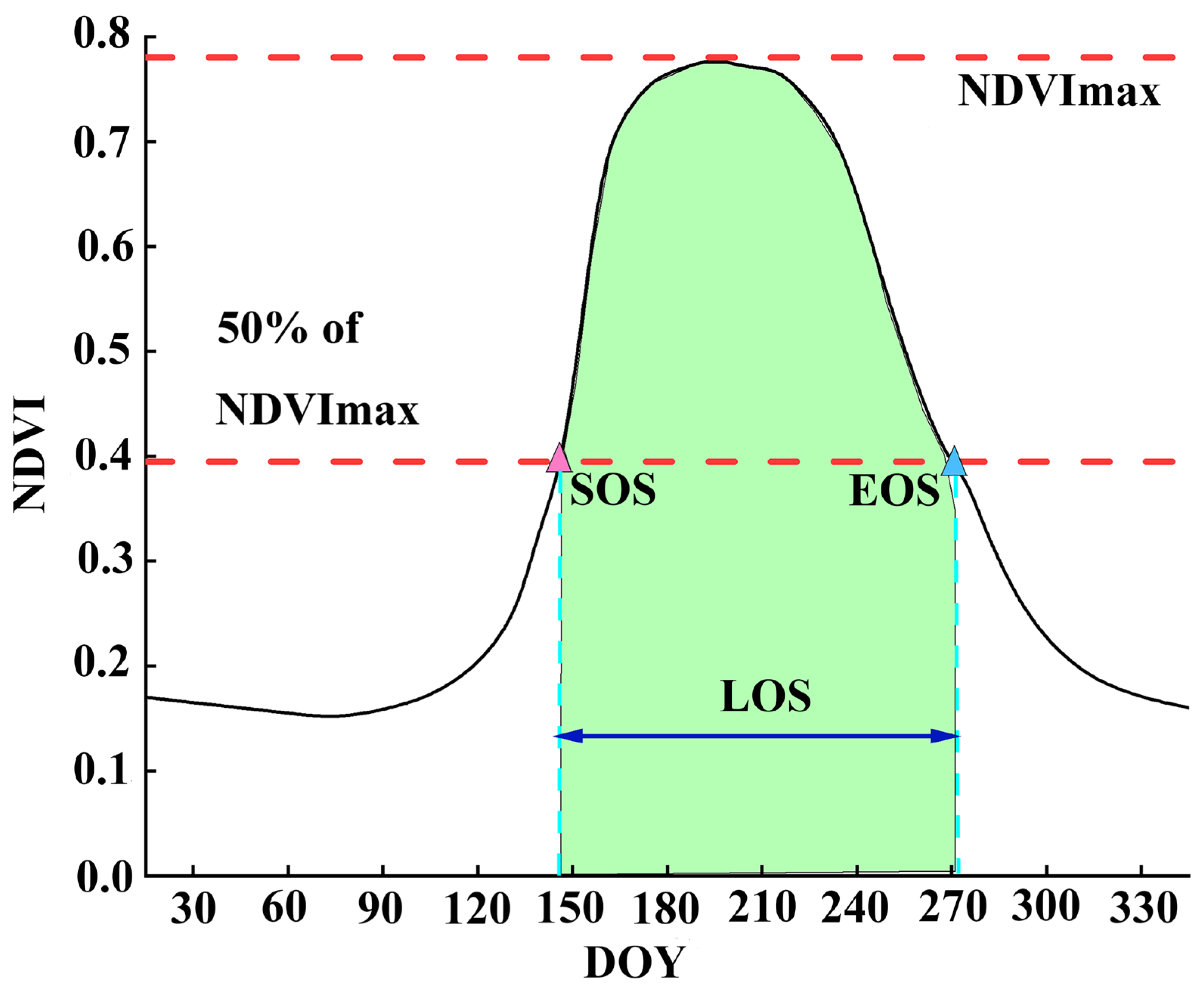
Cropland NDVI data were obtained from the MODIS/Terra MOD13A2 vegetation indices product, which provides 16-day composite NDVI at 1 km spatial resolution. After quality screening, NDVI observations affected by cloud, shadow, and snow/ice contamination were removed according to the product quality-control flags. This procedure resulted in data gaps in the annual NDVI time series, with removed low-quality observations accounting for 17.7% on average and up to 38.8% in some pixel-year records. The NDVI time series for each pixel was then reconstructed in TIMESAT using the Savitzky–Golay (S–G) filter to reduce residual noise and improve temporal continuity. Phenological metrics, including start of season (SOS), end of season (EOS), and length of season (LOS), were extracted from the fitted annual NDVI curves using a dynamic threshold approach as illustrated in Figure 2. In this study, SOS and EOS were defined as the first and last dates, respectively, when the fitted NDVI curve exceeded and then fell below 50% of the seasonal NDVI amplitude between the annual minimum and maximum values. This 50% threshold corresponds to the commonly used seasonal midpoint method in remote-sensing phenology studies and provides a consistent basis for temporal and spatial comparison across pixels and years. However, we acknowledge that this threshold is relatively conservative and, compared with lower thresholds, may yield later SOS and earlier EOS estimates, thereby masking very early green-up and very late senescence. Therefore, the retrieved SOS and EOS should be interpreted primarily as standardized indicators for regional comparison rather than exact field-scale phenological dates.

2.4. Gross Primary Productivity and Other Data Sources

Gross primary productivity (GPP) quantifies the amount of carbon fixed by vegetation through photosynthesis and represents the primary entry of carbon and energy into terrestrial ecosystems. As a fundamental indicator of ecosystem functioning, GPP underpins material–energy cycling and provides a direct measure of vegetation productivity and carbon assimilation capacity [29]. In this study, GPP data for 2001–2020 were obtained from NASA’s MODIS/Terra MOD17A2HGF (https://www.earthdata.nasa.gov/, accessed on 12 January 2026), which provides globally consistent, cumulative 8-day composites at 500 m spatial resolution on the MODIS sinusoidal grid.
A digital elevation model (DEM) was obtained from the GEBCO_2020 Grid (https://www.gebco.net/, accessed on 21 January 2026), which provides global elevation data on a 15-arc-second grid. Land-cover data were obtained from the 30 m China Land Cover Dataset (https://doi.org/10.5281/zenodo.12779975, accessed on 17 January 2026) available on Zenodo [30]. The dataset was developed using 335,709 Landsat scenes processed on Google Earth Engine, incorporating stable CLUD samples and visually interpreted training samples. Land-cover maps were classified with random forest and further refined using spatio–temporal filtering and rule-based constraints to ensure national consistency. To ensure spatial consistency across datasets, all layers were reprojected to a common coordinate reference system and harmonized to a 1 km analysis grid. The categorical land-cover dataset was resampled using the nearest-neighbor method to preserve class identity, whereas continuous variables, including GPP and DEM, were resampled using bilinear interpolation. Spatial preprocessing, including reprojection, grid harmonization, resampling, and raster calculation, was performed in ArcGIS 10.8.

2.5. Run-Theory Method and Threshold Setting

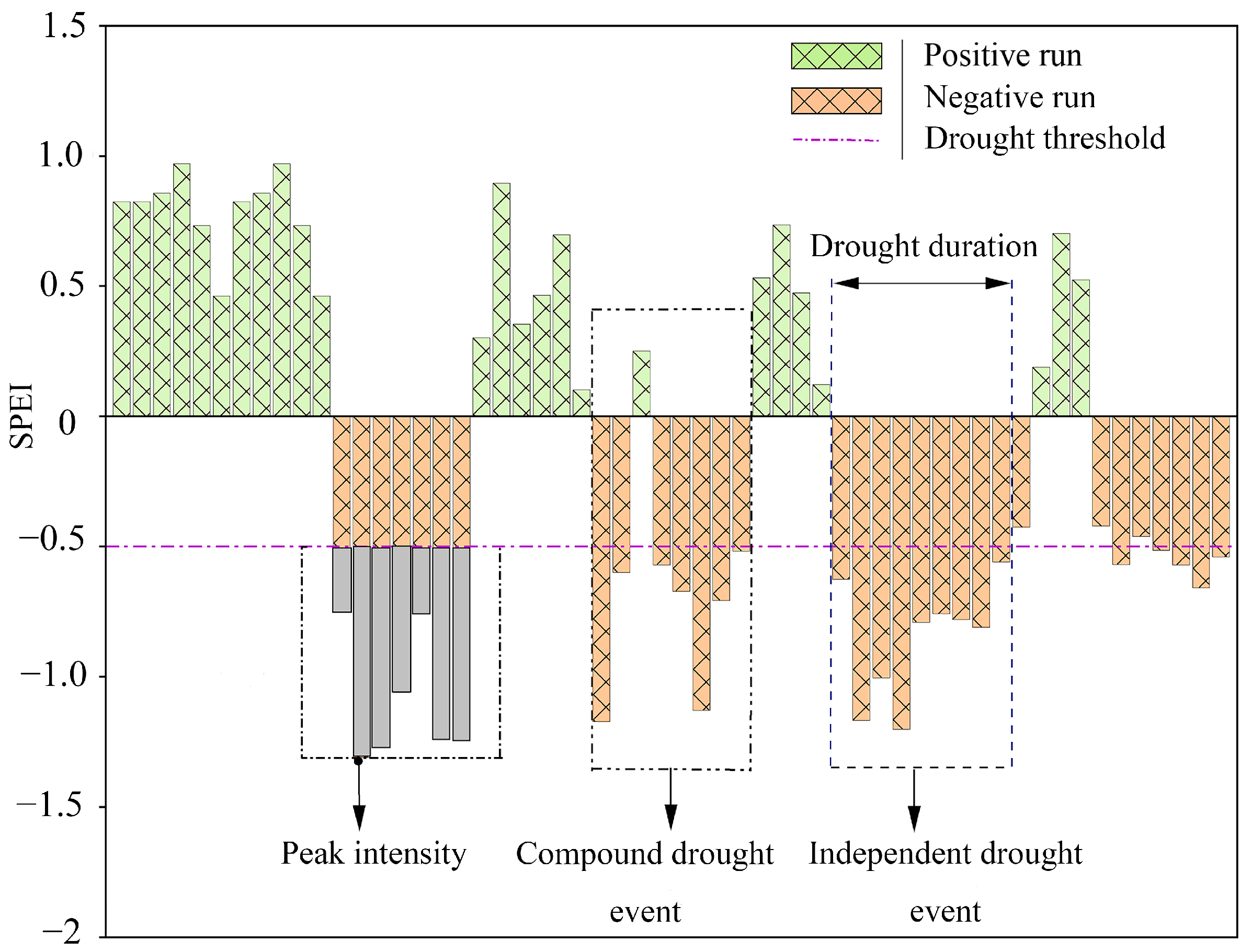
A three-threshold run-theory framework, adapted from He et al. [31], was used to identify SPEI-based drought events. In this framework, r1, r2, and r3 denote the thresholds for pooling adjacent events, drought onset, and removal of minor drought events, respectively. Following previous multi-threshold drought-identification studies and particularly considering the threshold selection adopted by Yu et al. [32] for northern regions, r1, r2, and r3 were set to 0, −0.5, and −1.0, respectively. Specifically, r2 = −0.5 was used to identify drought onset, r3 = −1.0 was used to exclude one-month events with only weak deficits, and r1 = 0 was used as a conservative pooling threshold for adjacent drought segments. The choice of r1 = 0 was not used to optimize vegetation correlations, but to determine whether the intervening month between two drought segments had recovered to near-normal climatic water-balance conditions. Under this setting, adjacent drought segments were merged only when the intervening month had not recovered to a positive SPEI value. This threshold choice reduces the risk of artificially merging independent drought episodes and provides a consistent operational framework for drought-event identification in this study [32]. Four alternative scenarios were tested by varying the event-pooling threshold, drought-identification threshold, and weak-event removal threshold. Drought frequency, mean duration, and mean severity were then compared with the baseline results. As illustrated in Figure 3, drought events were identified as follows:
(1)
Months with SPEI below r2 were initially identified as drought months.
(2)
After the preliminary screening in step 1, drought events lasting only one month and with SPEI ≥ r3 were discarded.
(3)
Two adjacent drought events separated by a one-month interval were merged when the SPEI of the intervening month remained below r1. The resulting runs were treated as individual drought events.
For each event, three metrics were derived: duration (D, months), cumulative severity (S, defined as the absolute sum of SPEI deficits during the event), and mean intensity (I = S/D). For pixel-level multi-year summaries over 2001–2020, total drought duration was calculated as the cumulative number of drought months identified for each pixel across the full study period, and peak severity was defined as the minimum SPEI value recorded among all identified drought events. These indicators were used to describe the spatial patterns of drought characteristics and to classify drought severity (Table 1).

2.6. Trend Analysis

To quantify the long-term spatiotemporal evolution of cropland productivity and phenological timing from 2001 to 2020, we applied the Theil–Sen median slope estimator combined with the Mann–Kendall trend test at the pixel scale. The Theil–Sen estimator is a non-parametric method that estimates the magnitude and direction of monotonic trends without relying on the assumptions of ordinary least-squares linear regression. Therefore, it is less sensitive to outliers and non-normal data, making it suitable for trend analysis of vegetation productivity and phenological time series. The Sen’s slope was calculated as the median of all pairwise slopes:
β = M d i a n x i x j i j ,   1 < i < j < n
where n represents the study period of 20 years, i and j are year indices, and P i and P j denote the values of SOS, EOS, LOS, or GPP in years i and j , respectively. A positive β indicates a delaying trend for SOS and EOS, a lengthening trend for LOS, or an increasing trend for GPP, whereas a negative β indicates an advancing phenological trend, a shortening LOS, or decreasing productivity.
The significance of the monotonic trend was evaluated using a modified Mann–Kendall test to reduce the influence of serial dependence in the annual time series. Unlike the original Mann–Kendall test, the modified test adjusts the variance of the test statistic according to the autocorrelation structure of the time series, thereby reducing the risk of inflated significance caused by temporal autocorrelation. Because the trend test was performed independently for a large number of pixels, the resulting p-values were adjusted using the false discovery rate correction to reduce the risk of false-positive detections caused by multiple testing. Pixels with FDR-adjusted p < 0.05 were considered to show statistically significant trends. All pixel-wise statistical analyses were conducted in R-4.2.1 software. ArcGIS 10.8 was used for spatial visualization, map layout, and calculation of the area proportions of significant pixels.

2.7. Correlation Analysis

For revised correlation analyses, we evaluated the seasonal association between drought and cropland dynamics using pixel-wise Pearson correlation analyses between SPEI and vegetation metrics (SOS, EOS, LOS, and GPP). Because vegetation responses to climate often involve lagged and cumulative effects, we focused on interannual variability. First, we calculated annual anomalies for phenological metrics (SOS, EOS, LOS) and GPP to reduce the influence of long-term trends. We then correlated these vegetation anomalies with monthly or annual SPEI series.
The Pearson correlation coefficient r was calculated for each pixel as:
r = i = 1 n X i X ¯ Y i Y ¯ i ˙ = 1 n X i X ¯ 2 i = 1 n Y i Y ¯ 2
where X i represents the SPEI value for a specific month or year i , Y i represents the vegetation anomaly (SOS, EOS, LOS, or GPP) in the same year, X ¯ and Y ¯ are the multi-year averages of the respective variables. The value of r ranges from −1 to 1. A significant positive correlation for GPP indicates that wetter conditions promote productivity, whereas for phenology the sign indicates whether wetter conditions tend to delay or advance the corresponding phenological date.
To account for temporal autocorrelation in the paired time series, the significance of each pixel-wise Pearson correlation was assessed using an effective sample size approach based on the lag-1 autocorrelations of both series. The effective sample size was estimated as:
N e f f = N 1 r 1 x r 1 y 1 + r 1 x r 1 y
where N is the original sample size, and r 1 x and r 1 y are the lag-1 autocorrelation coefficients of the SPEI and vegetation-anomaly series, respectively. The significance of the correlation coefficient was then tested using a two-tailed Student’s t -test with N e f f 2 degrees of freedom:
t = r N e f f 2 1 r 2
The resulting pixel-wise p -values were further adjusted using the FDR procedure to reduce inflated significance caused by multiple testing across pixels. Pixels were considered significantly correlated at p < 0.05 after FDR correction. Pearson-based correlation results were interpreted as spatial patterns of linear association rather than as evidence of causal, nonlinear, or assumption-free relationships. All pixel-wise statistical analyses were conducted in R software. ArcGIS 10.8 was used for spatial visualization, map layout, and calculation of the area proportions of significant pixels.

3. Results

3.1. Spatiotemporal Characteristics and Formation Pathways of Drought in Northeast China

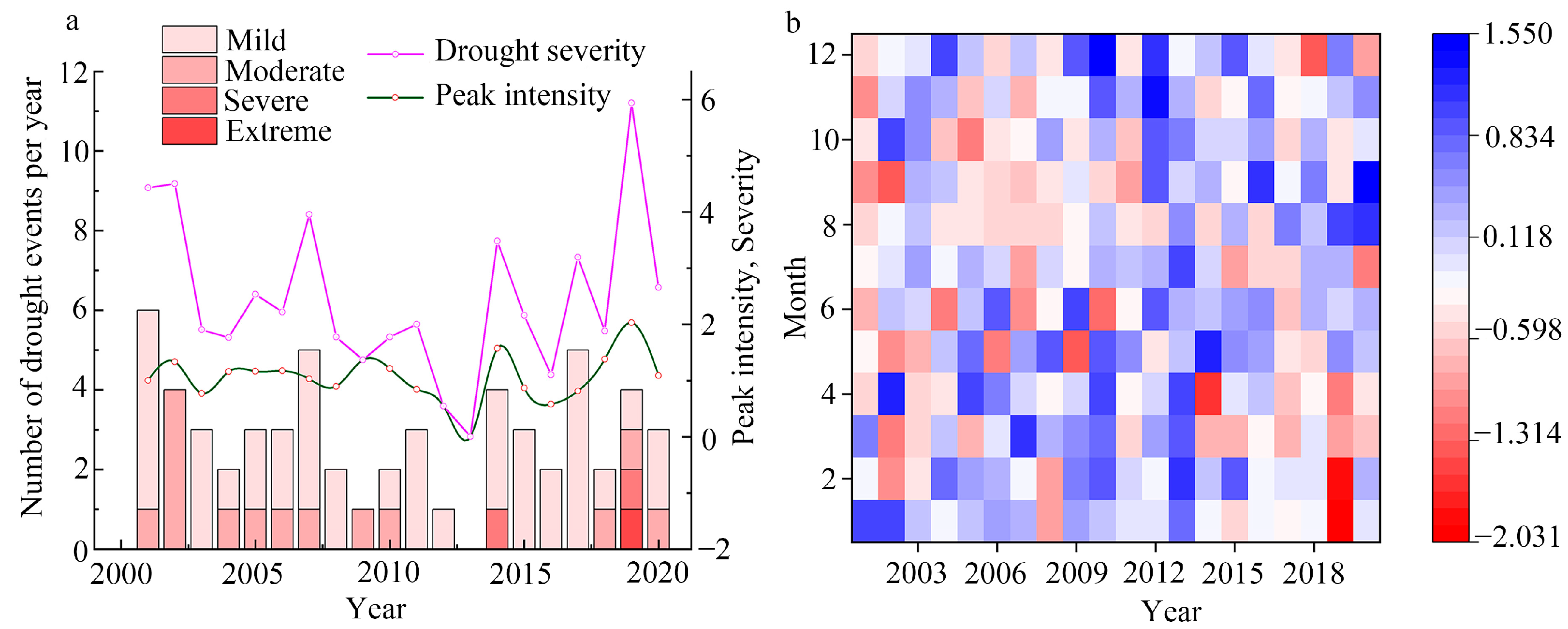
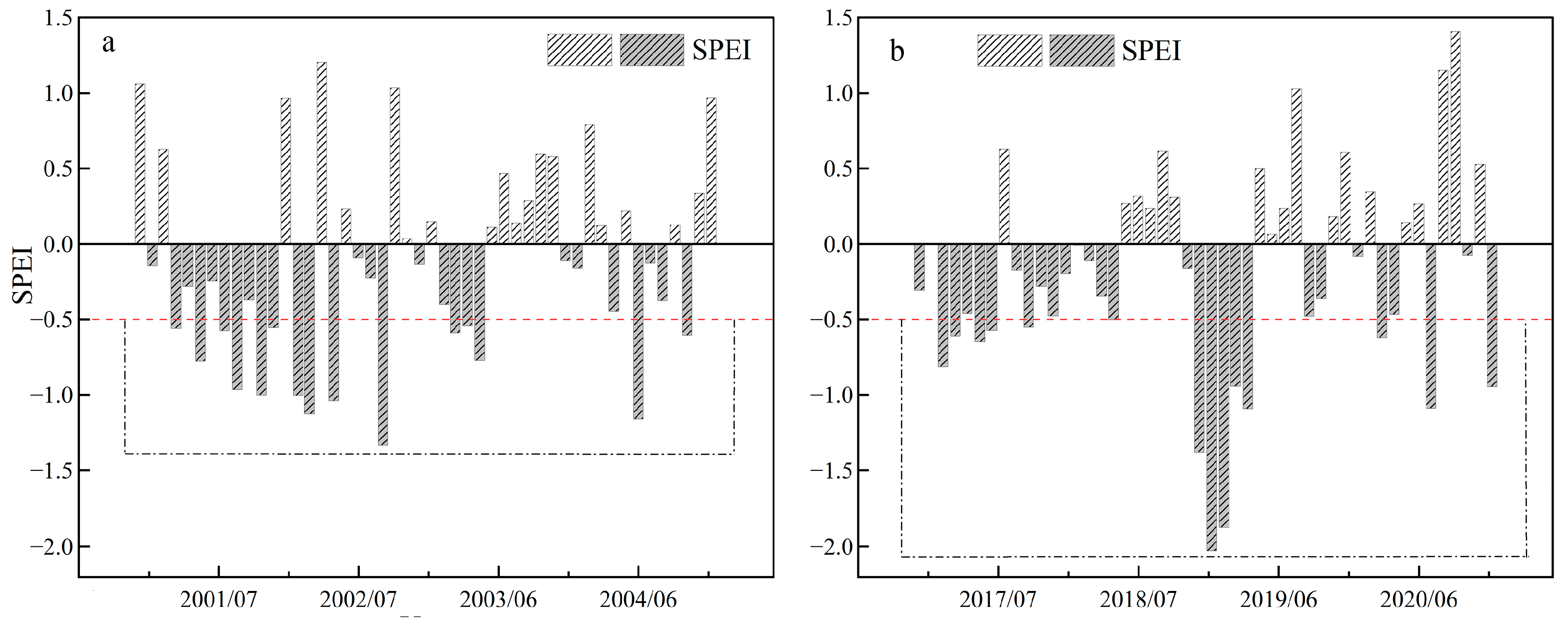
Based on run theory applied to the area-averaged monthly SPEI-1 series for Northeast China during 2001–2020, 19 cropland drought events were identified, equivalent to 9.5 events decade−1, with higher subregional frequencies in the Songnen Plain (5.41 events decade−1) and the Liaohe Plain (4.98 events decade−1). Mild and moderate droughts dominated, accounting for 70.8% and 24.1% of all events, whereas severe and extreme droughts were rare and together represented only 5.1% (Figure 4). Drought evolution followed two distinct modes (Figure 5): an accumulation-dominated mode associated with persistent mild-to-moderate drought (e.g., 2001–2004), and a peak-dominated mode driven by short-lived but intense drought shocks (e.g., 2019).
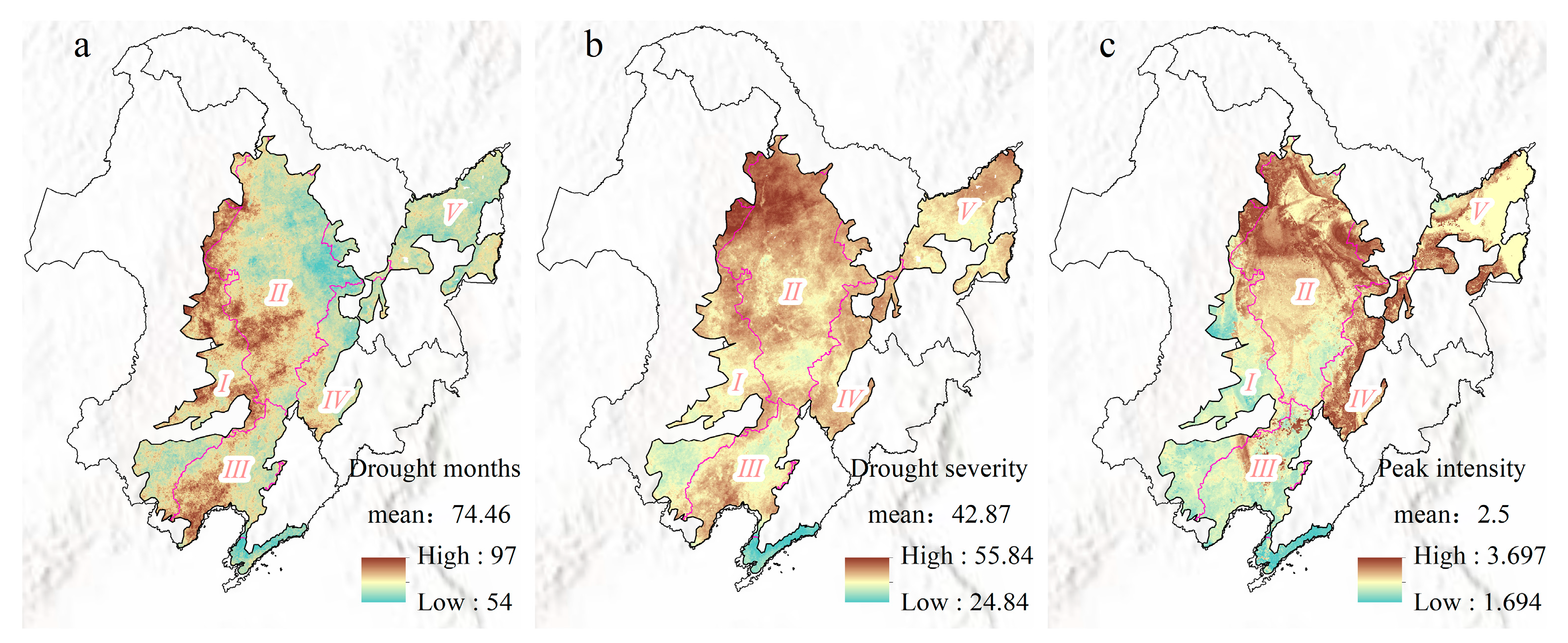
Pixel-level aggregation of the same run-theory metrics revealed a pronounced west–east gradient in cropland drought conditions. Over the full study period (2001–2020), mean cumulative drought duration reached 74.46 months per pixel, with a mean cumulative severity of 42.87 (Figure 6). A subregional summary across the five ecological zones indicated that drought frequency and cumulative severity were generally higher in the Songnen Plain Zone (region II in Figure 6) and the Liaohe Plain Zone (region III in Figure 6), lower in the more humid Sanjiang Plain Zone (region V in Figure 6), and relatively weak and patchier in the Changbai Mountains–Liaodong Hills Zone (region IV in Figure 6) (Table 2). Trend analysis further revealed divergent trajectories between the Songnen Plain and the Sanjiang Plain. In the Songnen Plain, drought duration, cumulative severity, and peak intensity all increased significantly during 2001–2020 (p < 0.05), whereas the same metrics in the Sanjiang Plain showed slight but non-significant declines (p > 0.05) (Table 3).
The threshold sensitivity analysis showed that different threshold settings led to moderate changes in drought frequency, duration, and severity (Table 4). However, the main spatial pattern of drought occurrence remained broadly consistent with the baseline scenario, indicating that the drought-identification results were robust and not dependent on a single threshold combination.

3.2. Spatiotemporal Trends in Phenology and Productivity

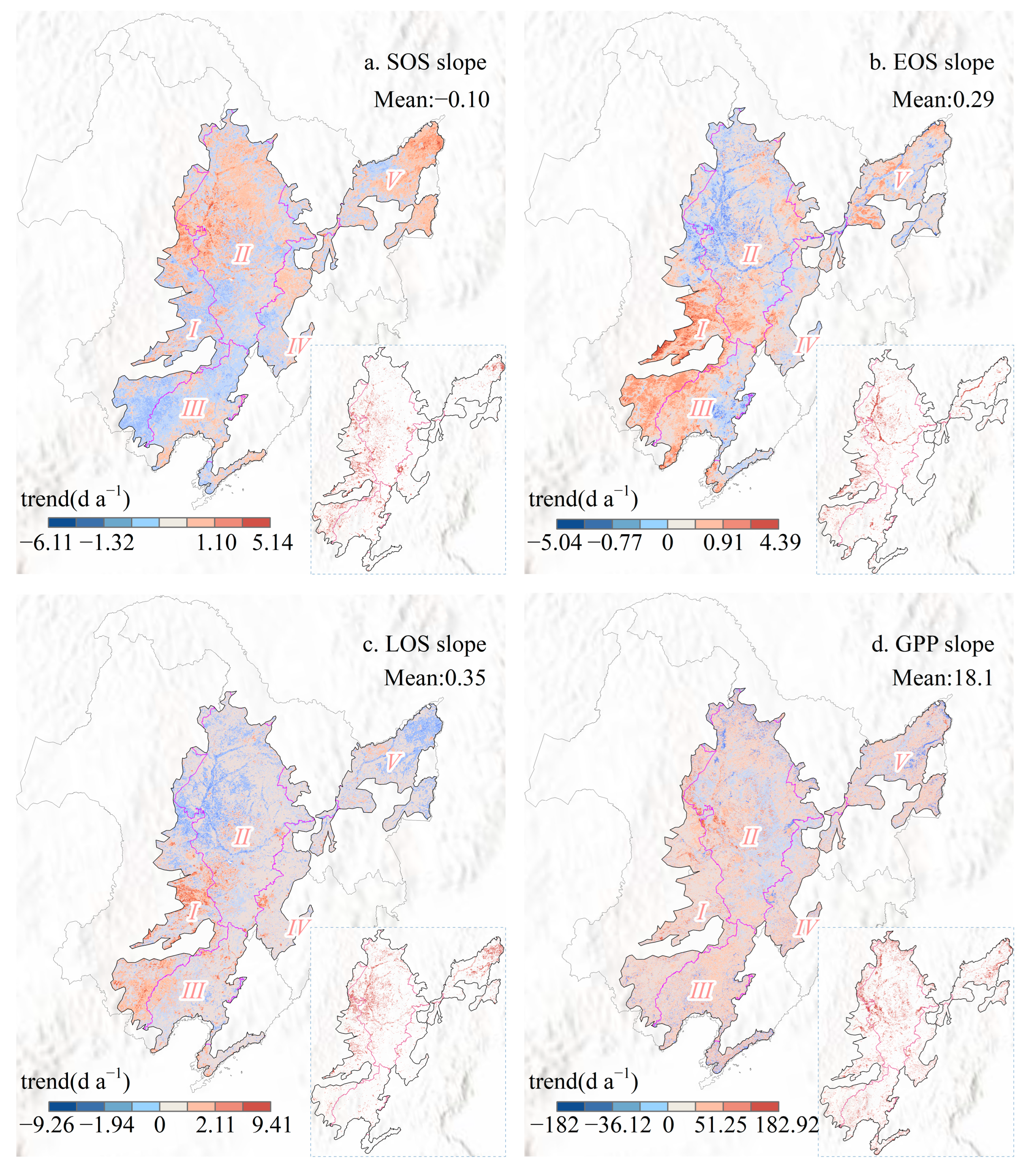
Trend maps derived from Sen’s slope estimates show an overall tendency toward later autumn termination and earlier spring onset (Figure 7 and Figure 8). Specifically, 63.97% of cropland area experienced a delayed EOS, with 19.82% showing statistically significant delays after the modified Mann–Kendall test and FDR correction (p < 0.05). In contrast, 53.79% of croplands exhibited an advancing SOS, and 13.51% of the area showed significant advances (p < 0.05). Consequently, 50.3% of the region exhibited LOS lengthening, and GPP increased over 66.7% of croplands, with 21.31% showing significant increases after FDR correction. This overall tendency, however, conceals marked zonal contrasts across the five ecological zones, as quantified by Table 5. The drought-prone Songnen Plain (region II in Figure 8) is the clear exception to the regional greening/lengthening tendency, exhibiting LOS shortening (−0.18 d a−1) accompanied by a GPP decline (−9.12 g C m−2 a−1). In contrast, the other four ecological zones show net gains, with LOS generally lengthening and GPP increasing (Table 5). Among them, the Khingan foothill zone (region I in Figure 8) and the Liaohe Plain (region III in Figure 8) display the most pronounced improvements in both season length and productivity, whereas the Changbai Mountains–Liaodong Hills (region IV in Figure 8) show more moderate increases. The Sanjiang Plain (region V in Figure 8) stands out as comparatively weak in trend magnitude, with near-neutral LOS change and only a modest GPP increase despite an overall delayed EOS signal (Table 5).

3.3. Cropland Phenology Responses to Drought (SOS, EOS, LOS)

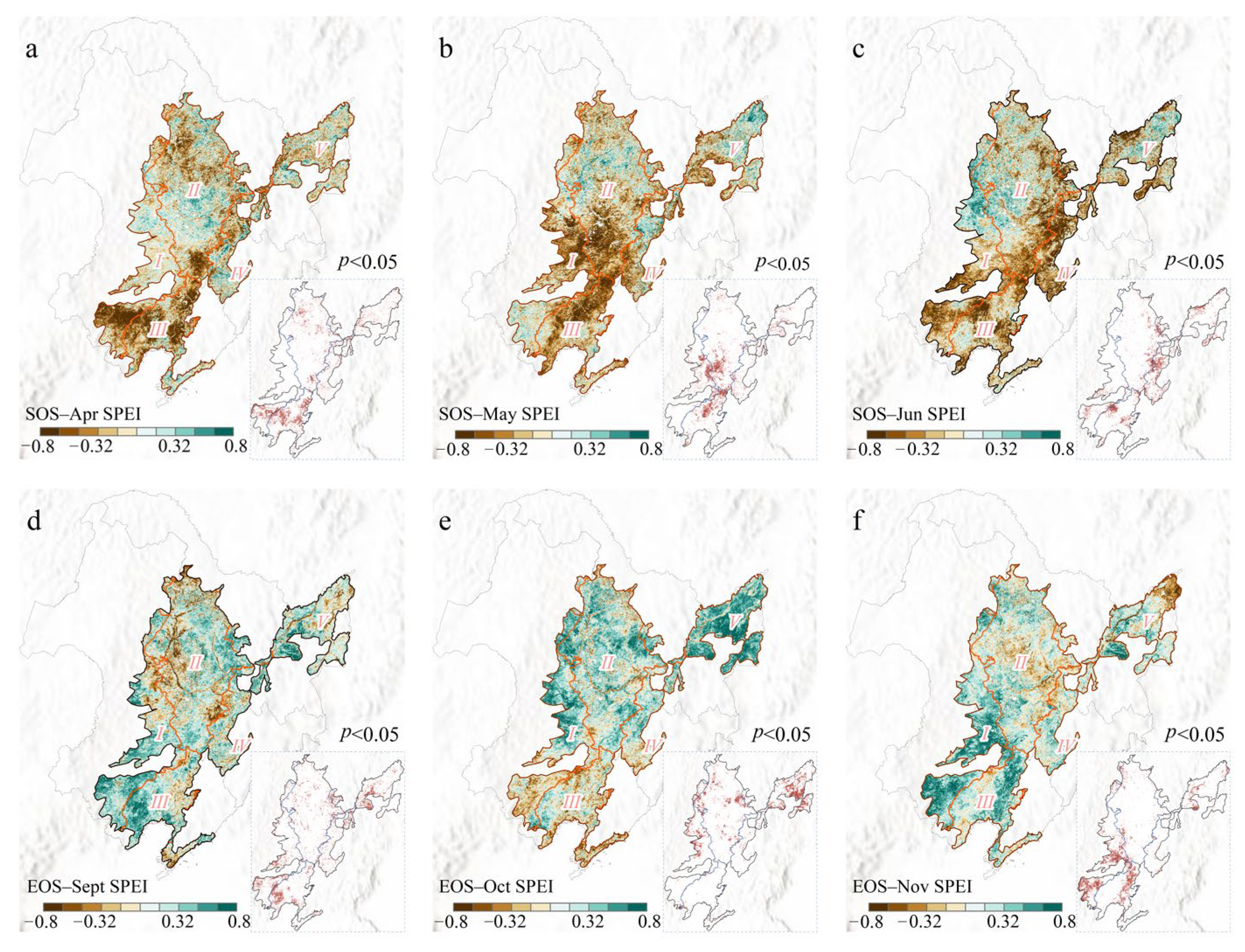
Correlation analyses revealed a clear seasonal asymmetry in cropland phenological responses to drought across Northeast China (Figure 9). In spring, SOS–SPEI relationships were predominantly negative, indicating that drier conditions were generally associated with delayed growing-season onset. Significant negative correlations were strongest in May (10.14%), whereas significant positive correlations remained limited throughout spring (Table 6). Spatially, these negative SOS–SPEI relationships were concentrated mainly in the central and western Songnen Plain (region II in Figure 9) and in parts of the western Liaohe Plain (region III in Figure 9), while responses in the Sanjiang Plain (region V in Figure 9) and the Changbai Mountains–Liaodong Hills (region IV in Figure 9) were weaker and more fragmented. In contrast, EOS–SPEI relationships in autumn were dominated by positive correlations, indicating that drier conditions were generally associated with earlier end-of-season timing. Significant positive correlations covered 10.97%, 9.57%, and 10.06% of cropland pixels in September, October, and November, respectively, and were concentrated mainly in the southern Songnen Plain and the Liaohe Plain. Compared with SOS, EOS responses showed greater spatial continuity.
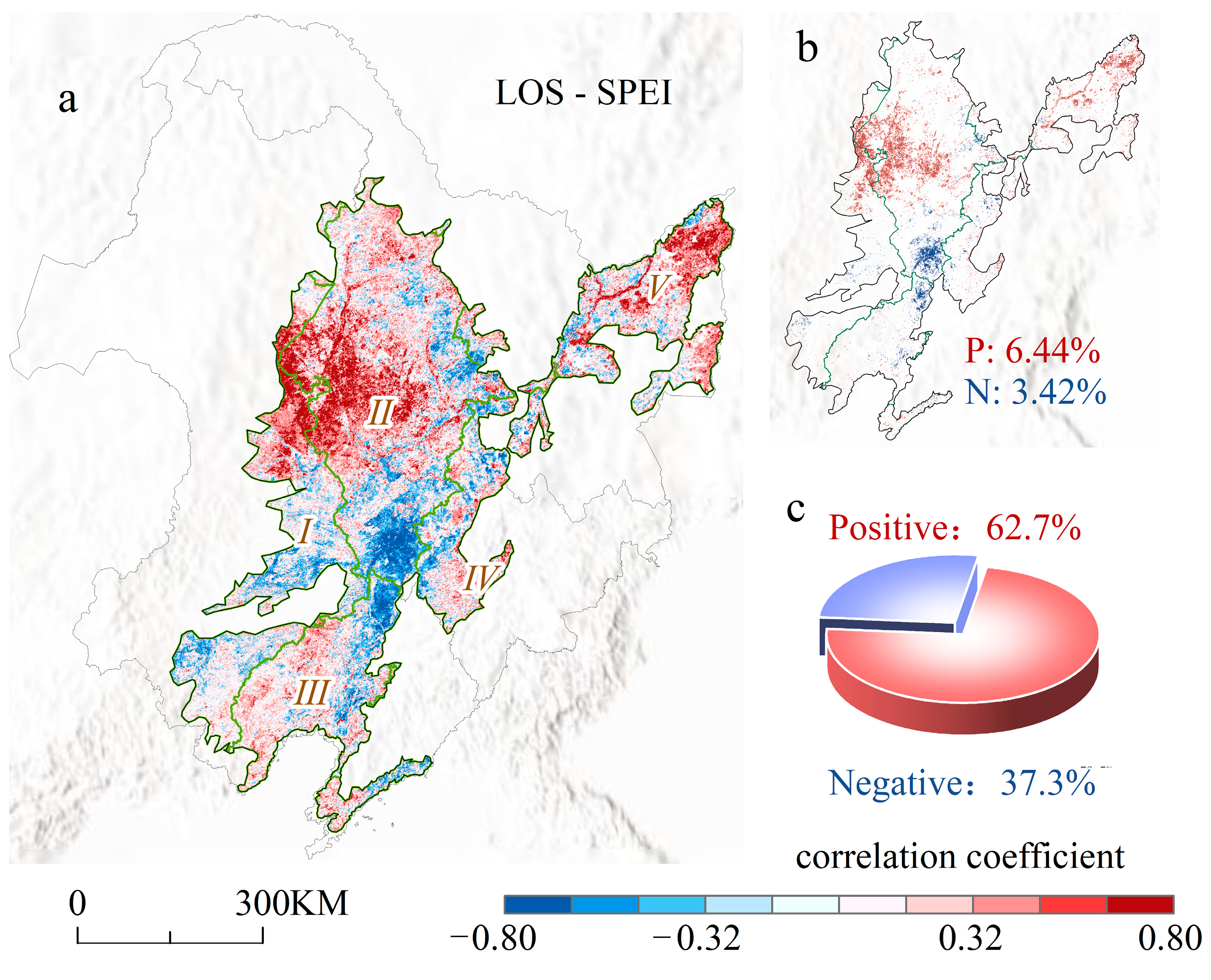
The combined effects of delayed SOS and earlier EOS were reflected in the LOS–SPEI relationships (Figure 10). Significant positive LOS–SPEI correlations accounted for 6.44% of cropland pixels, exceeding the proportion of significant negative correlations (3.42%). These significant correlations were spatially clustered rather than uniformly distributed. Positive LOS–SPEI clusters were most prominent in the Songnen Plain and also occurred in parts of the Sanjiang Plain, whereas negative clusters were concentrated primarily in the Liaohe Plain. By contrast, the foothill zones of the Greater and Lesser Khingan Ranges and the Changbai Mountains–Liaodong Hills showed weaker and more fragmented LOS–SPEI patterns.

3.4. Cropland Productivity Responses to Drought (GPP)

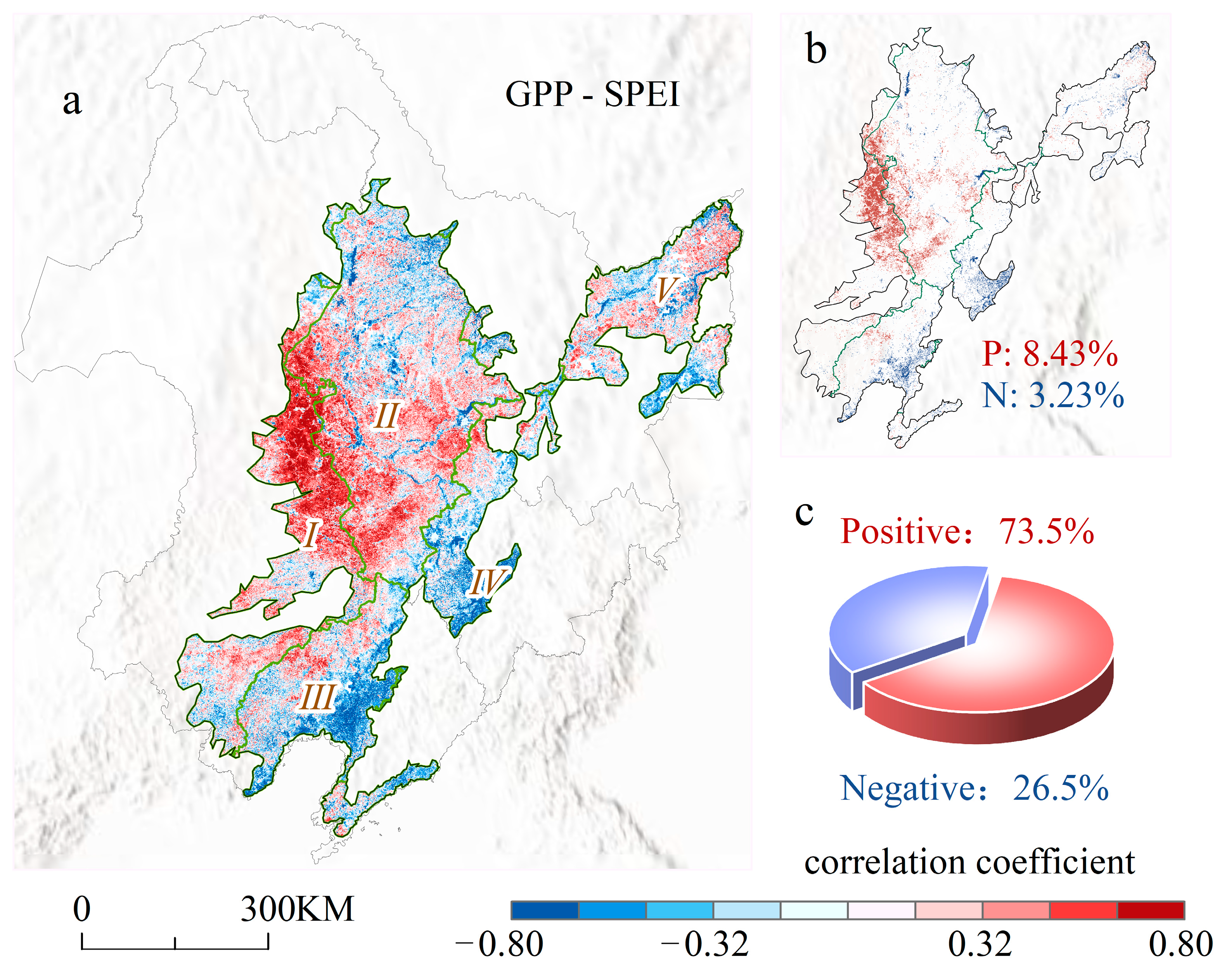
Cropland productivity also exhibited pronounced spatial heterogeneity in its response to drought (Figure 11). Significant positive GPP–SPEI correlations accounted for 8.43% of cropland pixels, whereas significant negative correlations accounted for 3.23%, indicating that positive drought–productivity coupling dominated over a larger area of Northeast China croplands.
Spatially, significant positive GPP–SPEI clusters were concentrated mainly in the Songnen Plain Zone (region II in Figure 11) and extended into parts of the foothill zones of the Greater and Lesser Khingan Ranges (region I in Figure 11), whereas significant negative correlations occurred more frequently in the Liaohe Plain Zone (region III in Figure 11) and were also distributed locally in the Sanjiang Plain Zone (region V in Figure 11) and the Changbai Mountains–Liaodong Hills Zone (region IV in Figure 11). As with LOS, the GPP response was characterized by coherent positive and negative clusters rather than a spatially uniform pattern.
Notably, the spatial pattern of GPP–SPEI correlations partly corresponded to that of LOS–SPEI correlations, particularly in the Songnen Plain where positive relationships dominated in both variables. However, this correspondence was not complete, as some areas with significant GPP–SPEI correlations did not show equally strong LOS–SPEI relationships. This indicates that drought sensitivity in cropland productivity was only partly aligned with drought sensitivity in growing-season length.

4. Discussion

4.1. Spatiotemporal Forms of Cropland Drought and Risk Types

Drought hazard in Northeast China exhibits clear spatial heterogeneity [33]. The Songnen Plain (region II in Figure 6) and the western Liaohe Plain (region III in Figure 6) are characterized by longer drought duration and higher cumulative severity; this is consistent with Ma et al. [34] and indicates an accumulation-dominated drought pattern. By contrast, the Sanjiang Plain and the Changbai Mountains–Liaodong Hills more often show shorter but sharper drought anomalies, suggesting that drought risk in these humid subregions is influenced more strongly by event-scale peaks than by prolonged deficit persistence [35].
This contrast is broadly consistent with the hydroclimatic background of Northeast China [36]. Previous studies have shown that precipitation across Northeast China generally decreases from southeast to northwest under the combined influence of the East Asian summer monsoon and topography [37]. Within this regional gradient, the Songnen Plain lies in a semi-humid to semi-arid transition zone where annual precipitation is relatively limited and evaporative demand is high [38]. Under such conditions, meteorological drought is more likely to develop through the gradual accumulation of monthly water deficits [39]. By contrast, the eastern subregions are generally more humid and more strongly influenced by monsoonal moisture supply, so drought risk there is more likely to emerge when short-term circulation anomalies weaken moisture transport, suppress convection, or reduce summer rainfall [40,41]. This interpretation is consistent with Zou et al. [42], showing that fluctuations of the East Asian summer monsoon boundary and regional anticyclonic circulation anomalies can reduce precipitation and increase drought risk in Northeast China.
Overall, these results suggest that drought should be interpreted as a regionally differentiated process rather than a uniform climatic hazard [43]. In water-limited plains, duration and cumulative severity are more informative for identifying drought risk, whereas in relatively humid subregions, short-term peak anomalies linked to circulation variability may play a disproportionately large role [44]. More broadly, this distinction indicates that drought events may represent different dominant risk structures across subregions, highlighting the need to interpret drought characteristics in relation to regional hydroclimatic background, especially in monsoon transition zones.

4.2. Seasonal and Scale-Dependent Responses of Cropland Phenology to Meteorological Drought

Our analysis reveals a seasonally asymmetric and spatially heterogeneous relationship between SPEI-defined meteorological drought and cropland phenology across Northeast China [45]. During spring green-up, lower SPEI values were generally associated with delayed SOS, whereas wetter meteorological conditions tended to promote earlier SOS [46]. This response was most evident in the water-limited western plains, especially the Songnen Plain. In these areas, short-term meteorological water deficits during the preseason and early growing season may reduce favorable hydrothermal conditions for crop emergence and early canopy development [47]. During autumn senescence, lower SPEI values were generally associated with earlier EOS [48]. From a meteorological-drought perspective, this response may be related to reduced precipitation, increased potential evapotranspiration, and enhanced atmospheric evaporative demand [49]. In particular, elevated VPD under dry atmospheric conditions can reduce stomatal conductance and constrain carbon assimilation, thereby contributing to accelerated canopy senescence and earlier phenological offset [50]. LOS integrates the combined effects of SOS and EOS. In water-limited plains, especially the Songnen Plain, LOS increased with SPEI. In cooler and wetter regions, such as the Sanjiang Plain, this relationship was weaker or inconsistent, probably because moisture was not always the dominant limiting factor and excessive wetness, reduced radiation, or lower thermal accumulation may offset the benefits of wetter conditions [51].
These relationships should also be interpreted from a scale-dependent perspective [52]. At the 1 km pixel scale, cropland phenology integrates differences in crop type, irrigation, soil, topography, and management; therefore, SPEI–phenology correlations should be viewed as regional-scale associations rather than direct crop-specific physiological responses [53]. In particular, the mixture of maize, rice, and soybean within the cropland mask may partly contribute to the fragmented or spatially heterogeneous SPEI–phenology patterns, because crop-specific calendars and drought-sensitive stages are not fully synchronized. Temporal scale also matters: monthly SPEI reflects short-term meteorological drought, whereas SOS, EOS, and LOS are annual phenological metrics derived from smoothed 16-day NDVI time series. Thus, SPEI–phenology correlations may reflect not only concurrent drought conditions but also antecedent and cumulative water-balance anomalies [45]. This scale dependence helps explain why SPEI–phenology relationships are spatially coherent in some regions but not universally significant across all cropland pixels.
Overall, these findings suggest that the phenological impacts of meteorological drought depend not only on drought intensity, but also on drought timing, atmospheric evaporative demand, and the spatial scale at which cropland responses are assessed [54]. This provides a broader framework for interpreting drought–phenology relationships in other large agricultural regions with strong hydroclimatic gradients.

4.3. Spatial Divergence in Cropland Productivity Responses to Meteorological Drought

Our GPP–SPEI analysis shows that productivity responses to meteorological drought are spatially heterogeneous across the five ecological zones, rather than uniform. Overall, positive GPP–SPEI correlations dominate across the study area [55]. The most coherent positive coupling occurs in the Songnen Plain and the adjacent foothills of the Greater and Lesser Khingan Mountains, where mainly rain-fed systems are more sensitive to drought-induced limits on canopy development and photosynthesis [56]. In contrast, negative correlations appear in the Liaohe Plain and parts of the Sanjiang Plain, where excessive wetness and cloudier conditions may reduce solar radiation and limit carbon gain [57]. These spatial differences may also reflect subregional variation in agricultural intensification. In the Songnen Plain, relatively extensive farming practices and limited water availability may intensify the effects of drought on crop growth [58]. In contrast, the Liaohe Plain is characterized by more intensive irrigated agriculture and stronger human regulation of water resources. Irrigation can alleviate the adverse effects of drought on farmland vegetation productivity, making irrigated cropland generally less sensitive to drought than rainfed cropland [59]. As a result, under highly irrigated conditions, crop water availability may be partially maintained even during meteorological drought, thereby weakening the coupling between crop productivity and meteorological drought indices such as the SPEI, and ultimately reducing the observed GPP–SPEI relationship [60]. However, irrigation intensity, sowing-date adjustment, and crop management practices were not included as explicit covariates in the correlation framework. Therefore, this interpretation should be regarded as a plausible management-related explanation for the spatial heterogeneity of GPP–SPEI relationships, rather than direct analytical attribution.
While spatial patterns indicate where productivity is strongly coupled with the SPEI, the seasonal timing of drought helps identify when GPP is most associated with meteorological water-balance variability [61]. Our correlation analysis suggests that late-season drought, especially in autumn, shows a stronger association with annual GPP anomalies than spring drought in the study area. One possible explanation is that late-season drought often coincides with reproductive and grain-filling stages (August–September) and may be further amplified by late-summer monsoon weakening [62]. Under such conditions, drought may accelerate leaf senescence and reduce assimilate transfer to grains, whereas early-season stress may sometimes be partially offset by subsequent favorable conditions [63,64]. Thus, autumn meteorological drought is more appropriately interpreted as a key seasonal correlate of annual productivity reductions rather than a sole causal driver.
This interpretation further suggests that phenology is not only an outcome of drought stress, but also a factor modulating productivity sensitivity to drought [65]. Drought occurring during rapid canopy expansion, reproductive development, or grain filling may have different GPP consequences because crop carbon allocation and source–sink relationships vary across growth stages [50]. Accordingly, late-season meteorological drought should receive particular attention in future drought monitoring and agricultural adaptation planning, especially during the reproductive stage. More broadly, this result highlights the importance of considering drought timing and hydroclimatic background when assessing meteorological drought impacts on cropland productivity in large agricultural regions.

4.4. Limitations and Perspective

Several limitations should be considered when interpreting the results of this study. First, croplands were analyzed as a single aggregated land-cover type, although major crops such as maize, rice, and soybean differ in phenological characteristics, rooting depth, water-use efficiency, and stage-specific water demand [66]. This aggregation limits crop-specific interpretation but is consistent with the regional-scale objective of this study, which aims to identify broad cropland-level associations between meteorological drought, phenology, and productivity rather than to resolve physiological responses of individual crop types. Regional cropland aggregation may smooth crop-specific drought signals, especially in seasonal analyses, because the same calendar month may correspond to different growth stages among maize, rice, and soybean. Therefore, the reported relationships should be interpreted as regional cropland-level patterns rather than crop-specific drought responses [53]. Future work should further distinguish major crop types and explicitly examine how their phenology and productivity respond differently to drought events, including possible differences in lagged responses across growth stages.
Second, the observed drought–phenology and drought–productivity relationships may also be influenced by human management, including irrigation, sowing-date adjustment, and other agronomic practices. Such buffering or adaptation measures may alter both phenology and productivity responses, particularly in more intensively managed areas such as the Liaohe Plain. Thus, irrigation and crop management were not treated as explanatory variables in the correlation framework, but they provide an important interpretive context for the spatial heterogeneity of GPP–SPEI relationships. Areas with stronger irrigation or management intervention may show weaker meteorological drought signals because crop water availability is partly decoupled from precipitation–evapotranspiration anomalies [60].
Third, the present study was conducted within a meteorological-drought framework based on SPEI, and the use of fixed seasonal windows may not fully capture lagged or cumulative drought effects across different crop growth stages [67,68]. Consequently, the stronger autumn drought signal detected here should be interpreted as a robust regional association with meteorological drought conditions rather than conclusive evidence that autumn drought is the sole or universally dominant driver of year-to-year productivity variability.
Finally, the present study was designed primarily as a regional-scale exploratory assessment based on descriptive statistics and correlation-based analyses to identify large-scale spatiotemporal patterns. Although these approaches are useful for revealing broad regional organization, they have limited ability to rigorously validate the proposed relationships, capture nonlinear responses, or provide predictive understanding of drought–cropland interactions [69]. In addition, because the analyses were conducted on spatially structured raster data, the resulting significance maps are better interpreted as indicators of coherent spatial patterns rather than evidence from statistically independent pixels. Future work should incorporate more rigorous quantitative approaches, such as multivariate or partial-correlation analyses, mixed-effects or structural-equation models, and process-based or multi-timescale analyses, to better understand how drought timing, crop type, and human management jointly affect cropland phenology and productivity.

5. Conclusions

This study used remote-sensing observations to characterize the spatiotemporal dynamics of drought events, cropland phenology (SOS, EOS, and LOS), and gross primary productivity (GPP) across Northeast China during 2001–2020, and to examine their regional-scale association. The results show that (1) drought events were frequent within the cropland areas of Northeast China, and drought hazard exhibited a clear west–east gradient, with the Songnen Plain showing particularly long drought duration and high cumulative severity; (2) the high-latitude Sanjiang Plain exhibited a lengthening growing season accompanied by rising GPP over the past two decades, whereas the Songnen Plain showed shortened LOS and reduced GPP, indicating a potential vulnerability hotspot within this semi-arid subregion; and (3) drought–phenology and drought–productivity relationships were season-dependent and spatially heterogeneous. Spring drought was mainly associated with delayed SOS, whereas autumn drought showed a stronger association with earlier EOS and lower annual GPP in parts of Northeast China. These findings indicate that late-season drought may serve as an important regional indicator associated with cropland productivity variation in Northeast China. Therefore, regional drought monitoring and early-warning systems should consider both drought intensity and seasonal timing, particularly during reproductive and grain-filling stages. However, given the observational and correlation-based nature of this study, the results should be interpreted as regional associations rather than direct causal or predictive evidence. Future assessments should further incorporate crop-specific information, irrigation, and management practices to improve the understanding of agricultural drought risk.

Author Contributions

Z.Z.: writing—original draft and editing, methodology, investigation, data curation, formal analysis, conceptualization, investigation, validation. X.N.: writing—review and editing, supervision, project administration, investigation, funding acquisition, conceptualization. X.L.: data curation, investigation, methodology. S.M.: data curation, investigation. Y.W.: data curation, investigation. All authors have read and agreed to the published version of the manuscript.

Funding

This work was supported by the National Natural Science Foundation of China (42571553) and Natural Science Foundation of Heilongjiang Province (PL2024D012).

Data Availability Statement

The data that support the findings are available from the corresponding author upon reasonable request.

Conflicts of Interest

The authors declare no conflicts of interest.

References

  1. Yu, M.; Cao, Y.; Tian, J.; Ren, B. Increased Contribution of Extended Vegetation Growing Season to Boreal Terrestrial Ecosystem GPP Enhancement. Remote Sens. 2024, 17, 83. [Google Scholar] [CrossRef]
  2. Hao, Z. Compound Events and Associated Impacts in China. iScience 2022, 25, 104689. [Google Scholar] [CrossRef]
  3. Heim, R.R.; Bathke, D.; Bonsal, B.; Cooper, E.W.T.; Hadwen, T.; Kodama, K.; McEvoy, D.; Muth, M.; Nielsen-Gammon, J.W.; Prendeville, H.R.; et al. A Review of User Perceptions of Drought Indices and Indicators Used in the Diverse Climates of North America. Atmosphere 2023, 14, 1794. [Google Scholar] [CrossRef]
  4. Pińskwar, I.; Choryński, A.; Kundzewicz, Z.W. Severe Drought in the Spring of 2020 in Poland—More of the Same? Agronomy 2020, 10, 1646. [Google Scholar] [CrossRef]
  5. Khan, A.A.; Wang, Y.-F.; Akbar, R.; Alhoqail, W.A. Mechanistic Insights and Future Perspectives of Drought Stress Management in Staple Crops. Front. Plant Sci. 2025, 16, 1547452. [Google Scholar] [CrossRef]
  6. Wang, Y.; Tian, D.; Xiao, J.; Li, X.; Niu, S. Increasing Drought Sensitivity of Plant Photosynthetic Phenology and Physiology. Ecol. Indic. 2024, 166, 112469. [Google Scholar] [CrossRef]
  7. Zheng, J.; Yu, L.; Du, Z.; Xiao, L.; Huang, X. Modeling Wheat Development under Extreme Weather with WOFOST-EW V1. Geosci. Model Dev. 2025, 18, 8379–8400. [Google Scholar] [CrossRef]
  8. Li, P.; Liu, Z.; Zhou, X.; Xie, B.; Li, Z.; Luo, Y.; Zhu, Q.; Peng, C. Combined Control of Multiple Extreme Climate Stressors on Autumn Vegetation Phenology on the Tibetan Plateau under Past and Future Climate Change. Agric. For. Meteorol. 2021, 308–309, 108571. [Google Scholar] [CrossRef]
  9. Zhong, R.; Yan, K.; Gao, S.; Yang, K.; Zhao, S.; Ma, X.; Zhu, P.; Fan, L.; Yin, G. Response of Grassland Growing Season Length to Extreme Climatic Events on the Qinghai-Tibetan Plateau. Sci. Total Environ. 2024, 909, 168488. [Google Scholar] [CrossRef] [PubMed]
  10. Zhang, J.; Wang, S.; Wu, Z.; Li, M.; Gong, Y.; Fu, Y. Effects of Extreme Climate Events on Autumn Phenology of Temperate Forests in China. Acta Geogr. Sin. 2025, 80, 1786–1800. [Google Scholar] [CrossRef]
  11. Arend, M.; Sever, K.; Pflug, E.; Gessler, A.; Schaub, M. Seasonal Photosynthetic Response of European Beech to Severe Summer Drought: Limitation, Recovery and Post-Drought Stimulation. Agric. For. Meteorol. 2016, 220, 83–89. [Google Scholar] [CrossRef]
  12. Kang, W.; Wang, T.; Liu, S. The Response of Vegetation Phenology and Productivity to Drought in Semi-Arid Regions of Northern China. Remote Sens. 2018, 10, 727. [Google Scholar] [CrossRef]
  13. Zhou, Y.; Pei, F.; Xia, Y.; Wu, C.; Zhong, R.; Wang, K.; Wang, H.; Cao, Y. Assessing the Impacts of Extreme Climate Events on Vegetation Activity in the North South Transect of Eastern China (NSTEC). Water 2019, 11, 2291. [Google Scholar] [CrossRef]
  14. Bastos, A.; Gouveia, C.M.; Trigo, R.M.; Running, S.W. Analysing the Spatio-Temporal Impacts of the 2003 and 2010 Extreme Heatwaves on Plant Productivity in Europe. Biogeosciences 2014, 11, 3421–3435. [Google Scholar] [CrossRef]
  15. Gampe, D.; Zscheischler, J.; Reichstein, M.; O’Sullivan, M.; Smith, W.K.; Sitch, S.; Buermann, W. Increasing Impact of Warm Droughts on Northern Ecosystem Productivity over Recent Decades. Nat. Clim. Change 2021, 11, 772–779. [Google Scholar] [CrossRef]
  16. Yuan, M.; Zhu, Q.; Zhang, J.; Liu, J.; Chen, H.; Peng, C.; Li, P.; Li, M.; Wang, M.; Zhao, P. Global Response of Terrestrial Gross Primary Productivity to Climate Extremes. Sci. Total Environ. 2021, 750, 142337. [Google Scholar] [CrossRef]
  17. Ji, S.; Ren, S.; Li, Y.; Dong, J.; Wang, L.; Quan, Q.; Liu, J. Diverse Responses of Spring Phenology to Preseason Drought and Warming under Different Biomes in the North China Plain. Sci. Total Environ. 2021, 766, 144437. [Google Scholar] [CrossRef]
  18. Deng, Y.; Wang, X.; Lu, T.; Du, H.; Ciais, P.; Lin, X. Divergent Seasonal Responses of Carbon Fluxes to Extreme Droughts over China. Agric. For. Meteorol. 2023, 328, 109253. [Google Scholar] [CrossRef]
  19. Hahn, C.; Lüscher, A.; Ernst-Hasler, S.; Suter, M.; Kahmen, A. Timing of Drought in the Growing Season and Strong Legacy Effects Determine the Annual Productivity of Temperate Grasses in a Changing Climate. Biogeosciences 2021, 18, 585–604. [Google Scholar] [CrossRef]
  20. Xie, M.; Zhu, Y.; Liu, S.; Deng, D.; Zhu, L.; Zhao, M.; Wang, Z. Simulating the Impacts of Drought and Warming in Summer and Autumn on the Productivity of Subtropical Coniferous Forests. Forests 2022, 13, 2147. [Google Scholar] [CrossRef]
  21. Liang, Z.; Du, J.; Yu, W.; Zhuo, K.; Shao, K.; Zhang, W.; Zhang, C.; Qin, J.; Han, Y.; Sui, B.; et al. Evaluating Maize Residue Cover Using Machine Learning and Remote Sensing in the Meadow Soil Region of Northeast China. Remote Sens. 2024, 16, 3953. [Google Scholar] [CrossRef]
  22. Jia, R.; Fang, X.; Yang, Y.; Yokozawa, M.; Ye, Y. A 28-Time-Point Cropland Area Change Dataset in Northeast China from 1000 to 2020. Earth Syst. Sci. Data 2024, 16, 4971–4994. [Google Scholar] [CrossRef]
  23. Li, J.; Li, G.; Wang, L.; Li, D.; Li, H.; Gao, C.; Zhuang, M.; Zhuang, J.; Zhou, H.; Xu, S.; et al. Predicting Maize Yield in Northeast China by a Hybrid Approach Combining Biophysical Modelling and Machine Learning. Field Crops Res. 2023, 302, 109102. [Google Scholar] [CrossRef]
  24. Pu, L. Impact of Cropland Use Changes Based on Non-Agriculturalization, Non-Grainization and Abandonment on Grain Potential Production in Northeast China. Sci. Rep. 2025, 15, 23596. [Google Scholar] [CrossRef]
  25. You, N.; Dong, J.; Huang, J.; Du, G.; Zhang, G.; He, Y.; Yang, T.; Di, Y.; Xiao, X. The 10-m Crop Type Maps in Northeast China during 2017–2019. Sci. Data 2021, 8, 41. [Google Scholar] [CrossRef] [PubMed]
  26. He, J.; Ran, D.; Tan, D.; Liao, X. Spatiotemporal Evolution of Cropland in Northeast China’s Black Soil Region over the Past 40 Years at the County Scale. Front. Sustain. Food Syst. 2024, 7, 1332595. [Google Scholar] [CrossRef]
  27. Xiang, K.; Ma, M.; Liu, W.; Dong, J.; Zhu, X.; Yuan, W. Mapping Irrigated Areas of Northeast China in Comparison to Natural Vegetation. Remote Sens. 2019, 11, 825. [Google Scholar] [CrossRef]
  28. Qiao, L.; Xia, H.; Zhao, X.; Yang, J.; Song, H.; Liu, Y. Divergent Impacts of Drought on Autumn Phenology in China. Ecol. Indic. 2024, 160, 111770. [Google Scholar] [CrossRef]
  29. Yao, W.; Bie, Q. Global-Scale Improvement of Terrestrial Gross Primary Productivity Estimation by Integrating Optical Remote Sensing with Meteorological Data. Ecol. Indic. 2025, 173, 113429. [Google Scholar] [CrossRef]
  30. Yang, J.; Huang, X. The 30 m Annual Land Cover Datasets and Its Dynamics in China from 1985 to 2023, Zenodo. 2024. Available online: https://zenodo.org/records/12779975 (accessed on 18 April 2026).
  31. He, J.; Yang, X.; Li, Z.; Zhang, X.; Tang, Q. Spatiotemporal Variations of Meteorological Droughts in China During 1961–2014: An Investigation Based on Multi-Threshold Identification. Int. J. Disaster Risk Sci. 2016, 7, 63–76. [Google Scholar] [CrossRef]
  32. Yu, T.; Li, T.; Fu, Q.; Zhou, Z.; Li, M.; Liu, D.; Hou, R.; Yang, X. Research on the Reciprocal Feedback Relationship and Influencing Factors between Meteorological and Agricultural Drought in Northeast China. Agric. Water Manag. 2025, 321, 109893. [Google Scholar] [CrossRef]
  33. Wang, R.; Zhang, X.; Guo, E.; Cong, L.; Wang, Y. Characteristics of the Spatial and Temporal Distribution of Drought in Northeast China, 1961–2020. Water 2024, 16, 234. [Google Scholar] [CrossRef]
  34. Ma, Q.; Li, Y.; Liu, F.; Feng, H.; Biswas, A.; Zhang, Q. SPEI and Multi-Threshold Run Theory Based Drought Analysis Using Multi-Source Products in China. J. Hydrol. 2023, 616, 128737. [Google Scholar] [CrossRef]
  35. Ji, L.; Wu, Y.; Ma, J.; Song, C.; Zhu, Z.; Zhao, A. Spatio-Temporal Variations and Drought of Spring Maize in Northeast China between 2002 and 2020. Environ. Sci. Pollut. Res. 2022, 30, 33040–33060. [Google Scholar] [CrossRef] [PubMed]
  36. Wang, W.; Yin, S.; Yu, J.; He, Z.; Xie, Y. Long-Term Trends of Precipitation and Erosivity over Northeast China during 1961–2020. Int. Soil Water Conserv. Res. 2023, 11, 743–754. [Google Scholar] [CrossRef]
  37. Liang, L.; Li, L.; Liu, Q. Precipitation Variability in Northeast China from 1961 to 2008. J. Hydrol. 2011, 404, 67–76. [Google Scholar] [CrossRef]
  38. Liu, M.; Li, C.; Yan, D.; Yang, J.; Hou, K.; Liang, X.; Xiao, C. Study on the Groundwater Ecological Threshold in Soil Salinization Zones within Semi-Arid and Semi-Humid Climate Zones. Environ. Earth Sci. 2025, 84, 690. [Google Scholar] [CrossRef]
  39. Wu, R.; Zhang, J.; Bao, Y.; Guo, E. Run Theory and Copula-Based Drought Risk Analysis for Songnen Grassland in Northeastern China. Sustainability 2019, 11, 6032. [Google Scholar] [CrossRef]
  40. Zeng, D.; Yuan, X. The Important Role of Reduced Moisture Supplies from the Monsoon Region in the Formation of Spring and Summer Droughts over Northeast China. J. Clim. 2024, 37, 1703–1722. [Google Scholar] [CrossRef]
  41. Zhang, Z.; Xing, W.; Wang, G.; Tong, S.; Lv, X.; Sun, J. The Peatlands Developing History in the Sanjiang Plain, NE China and Its Response to East Asian Monsoon Variation. Sci. Rep. 2015, 5, 11316. [Google Scholar] [CrossRef]
  42. Zou, Y.; Qiao, Y.; Lin, A.; Chen, R. Relationship between Interannual Variability of the North Edge of the East Asian Summer Monsoon and Extreme Precipitation in North China. Atmos. Res. 2024, 311, 107654. [Google Scholar] [CrossRef]
  43. Zhang, M.; Feng, M.; Bai, X.; Liu, L.; Lin, K.; Li, J. Chelating Surfactant N-Lauroyl Ethylenediamine Triacetate Enhanced Electrokinetic Remediation of Copper and Decabromodiphenyl Ether Co-Contaminated Low Permeability Soil: Applicability Analysis. J. Environ. Manag. 2022, 301, 113888. [Google Scholar] [CrossRef] [PubMed]
  44. Hu, Y.; Zhou, B.; Han, T.; Li, H.; Wang, H. In-Phase Variations of Spring and Summer Droughts over Northeast China and Their Relationship with the North Atlantic Oscillation. J. Clim. 2022, 35, 6923–6937. [Google Scholar] [CrossRef]
  45. Ge, C.; Sun, S.; Yao, R.; Sun, P.; Li, M.; Bian, Y. Long-Term Vegetation Phenology Changes and Response to Multi-Scale Meteorological Drought on the Loess Plateau, China. J. Hydrol. 2022, 614, 128605. [Google Scholar] [CrossRef]
  46. Yuan, M.; Zhao, L.; Lin, A.; Wang, L.; Li, Q.; She, D.; Qu, S. Impacts of Preseason Drought on Vegetation Spring Phenology across the Northeast China Transect. Sci. Total Environ. 2020, 738, 140297. [Google Scholar] [CrossRef]
  47. Sah, R.P.; Chakraborty, M.; Prasad, K.; Pandit, M.; Tudu, V.K.; Chakravarty, M.K.; Narayan, S.C.; Rana, M.; Moharana, D. Impact of Water Deficit Stress in Maize: Phenology and Yield Components. Sci. Rep. 2020, 10, 2944. [Google Scholar] [CrossRef]
  48. Ge, W.; Han, J.; Zhang, D.; Wang, F. Divergent Impacts of Droughts on Vegetation Phenology and Productivity in the Yungui Plateau, Southwest China. Ecol. Indic. 2021, 127, 107743. [Google Scholar] [CrossRef]
  49. Xue, L.; Kappas, M.; Wyss, D.; Putzenlechner, B. Assessing the Drought Variability in Northeast China over Multiple Temporal and Spatial Scales. Atmosphere 2022, 13, 1506. [Google Scholar] [CrossRef]
  50. Fu, Z.; Ciais, P.; Prentice, I.C.; Gentine, P.; Makowski, D.; Bastos, A.; Luo, X.; Green, J.K.; Stoy, P.C.; Yang, H.; et al. Atmospheric Dryness Reduces Photosynthesis along a Large Range of Soil Water Deficits. Nat. Commun. 2022, 13, 989. [Google Scholar] [CrossRef] [PubMed]
  51. Han, X.; Dong, L.; Cao, Y.; Lyu, Y.; Shao, X.; Wang, Y.; Wang, L. Adaptation to Climate Change Effects by Cultivar and Sowing Date Selection for Maize in the Northeast China Plain. Agronomy 2022, 12, 984. [Google Scholar] [CrossRef]
  52. Zhang, X.; Wang, J.; Gao, F.; Liu, Y.; Schaaf, C.; Friedl, M.; Yu, Y.; Jayavelu, S.; Gray, J.; Liu, L.; et al. Exploration of Scaling Effects on Coarse Resolution Land Surface Phenology. Remote Sens. Environ. 2017, 190, 318–330. [Google Scholar] [CrossRef]
  53. Meroni, M.; d’Andrimont, R.; Vrieling, A.; Fasbender, D.; Lemoine, G.; Rembold, F.; Seguini, L.; Verhegghen, A. Comparing Land Surface Phenology of Major European Crops as Derived from SAR and Multispectral Data of Sentinel-1 and -2. Remote Sens. Environ. 2021, 253, 112232. [Google Scholar] [CrossRef]
  54. Grossiord, C.; Buckley, T.N.; Cernusak, L.A.; Novick, K.A.; Poulter, B.; Siegwolf, R.T.W.; Sperry, J.S.; McDowell, N.G. Plant Responses to Rising Vapor Pressure Deficit. New Phytol. 2020, 226, 1550–1566. [Google Scholar] [CrossRef]
  55. Wang, Z.; Chen, W.; Piao, J.; Chen, S.; Kim, J.-S.; Wang, L.; Yang, R.; Yu, T. Responses of Gross Primary Productivity in Different Types of Terrestrial Ecosystems to Interannual Variation in the Northern Boundary of the East Asian Summer Monsoon. Glob. Planet. Change 2024, 236, 104414. [Google Scholar] [CrossRef]
  56. Zhang, R.; Yue, Z.; Chen, X.; Huang, R.; Zhou, Y.; Cao, X. Effects of Waterlogging at Different Growth Stages on the Photosynthetic Characteristics and Grain Yield of Sorghum (Sorghum bicolor L.). Sci. Rep. 2023, 13, 7212. [Google Scholar] [CrossRef]
  57. Van Diepen, K.H.H.; Kaiser, E.; Hartogensis, O.K.; Graf, A.; De Arellano, J.V.-G.; Moene, A.F. When Do Clouds and Aerosols Lead to Higher Canopy Photosynthesis? Agric. For. Meteorol. 2025, 370, 110597. [Google Scholar] [CrossRef]
  58. Ye, L.; Shi, K.; Zhang, H.; Xin, Z.; Hu, J.; Zhang, C. Spatio-Temporal Analysis of Drought Indicated by SPEI over Northeastern China. Water 2019, 11, 908. [Google Scholar] [CrossRef]
  59. Zhu, X.; Liu, Y.; Xu, K.; Pan, Y. Effects of Drought on Vegetation Productivity of Farmland Ecosystems in the Drylands of Northern China. Remote Sens. 2021, 13, 1179. [Google Scholar] [CrossRef]
  60. Lu, J.; Carbone, G.J.; Huang, X.; Lackstrom, K.; Gao, P. Mapping the Sensitivity of Agriculture to Drought and Estimating the Effect of Irrigation in the United States, 1950–2016. Agric. For. Meteorol. 2020, 292–293, 108124. [Google Scholar] [CrossRef]
  61. Oliphant, A.J.; Dragoni, D.; Deng, B.; Grimmond, C.S.B.; Schmid, H.-P.; Scott, S.L. The Role of Sky Conditions on Gross Primary Production in a Mixed Deciduous Forest. Agric. For. Meteorol. 2011, 151, 781–791. [Google Scholar] [CrossRef]
  62. Jin, H.; Vicente-Serrano, S.M.; Tian, F.; Cai, Z.; Conradt, T.; Boincean, B.; Murphy, C.; Farizo, B.A.; Grainger, S.; López-Moreno, J.I.; et al. Higher Vegetation Sensitivity to Meteorological Drought in Autumn than Spring across European Biomes. Commun. Earth Environ. 2023, 4, 299. [Google Scholar] [CrossRef]
  63. Bai, W.; Wang, H.; Dai, J.; Ge, Q. Changes in Peak Greenness Timing and Senescence Duration Codetermine the Responses of Leaf Senescence Date to Drought over Mongolian Grassland. Agric. For. Meteorol. 2024, 345, 109869. [Google Scholar] [CrossRef]
  64. Cao, J.; Luo, Y.; Zhang, X.; Fan, L.; Tao, J.; Nam, W.-H.; Sur, C.; He, Y.; Gulakhmadov, A.; Niyogi, D. Assessing the Responsiveness of Multiple Microwave Remote Sensing Vegetation Optical Depth Indices to Drought on Crops in Midwest US. Int. J. Appl. Earth Obs. Geoinf. 2024, 132, 104072. [Google Scholar] [CrossRef]
  65. Li, Y.; Zhang, W.; Schwalm, C.R.; Gentine, P.; Smith, W.K.; Ciais, P.; Kimball, J.S.; Gazol, A.; Kannenberg, S.A.; Chen, A.; et al. Widespread Spring Phenology Effects on Drought Recovery of Northern Hemisphere Ecosystems. Nat. Clim. Change 2023, 13, 182–188. [Google Scholar] [CrossRef]
  66. Nguyen, H.; Thompson, A.; Costello, C. Impacts of Historical Droughts on Maize and Soybean Production in the Southeastern United States. Agric. Water Manag. 2023, 281, 108237. [Google Scholar] [CrossRef]
  67. Xu, S.; Wang, Y.; Liu, Y.; Li, J.; Qian, K.; Yang, X.; Ma, X. Evaluating the Cumulative and Time-Lag Effects of Vegetation Response to Drought in Central Asia under Changing Environments. J. Hydrol. 2023, 627, 130455. [Google Scholar] [CrossRef]
  68. Chatterjee, S.; Desai, A.R.; Zhu, J.; Townsend, P.A.; Huang, J. Soil Moisture as an Essential Component for Delineating and Forecasting Agricultural Rather than Meteorological Drought. Remote Sens. Environ. 2022, 269, 112833. [Google Scholar] [CrossRef]
  69. Karasiak, N.; Dejoux, J.-F.; Monteil, C.; Sheeren, D. Spatial Dependence between Training and Test Sets: Another Pitfall of Classification Accuracy Assessment in Remote Sensing. Mach. Learn. 2022, 111, 2715–2740. [Google Scholar] [CrossRef]
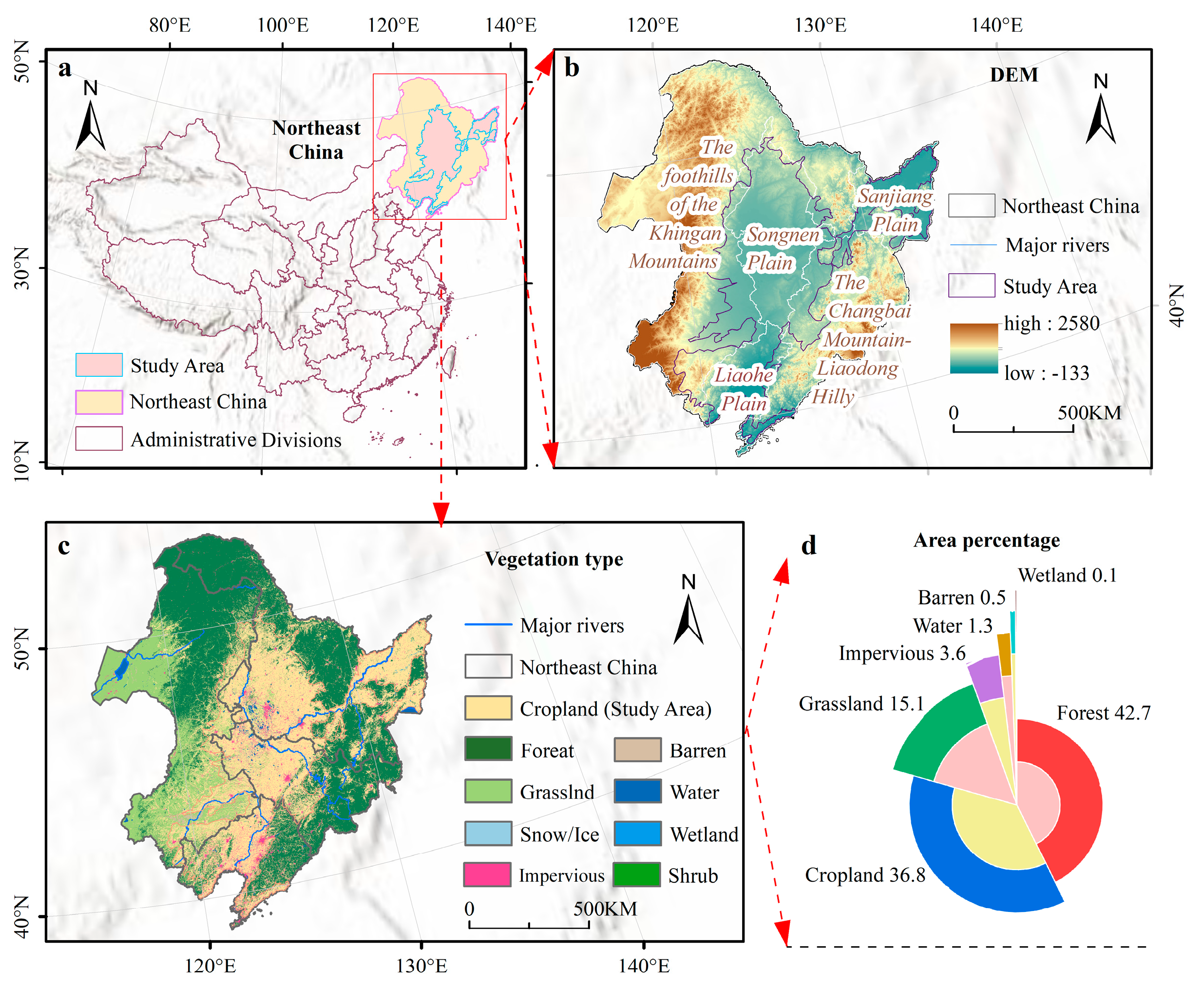
Figure 1. Geographic location and environmental background of Northeast China and the cropland study area used in this study: (a) location of Northeast China within China; (b) DEM and the five ecological zones of Northeast China; (c) spatial distribution of vegetation types, with cropland defined as the study area; and (d) area percentages of major land-cover types.
Agronomy 16 01031 g001
Figure 2. Schematic illustration of extracting start of season (SOS), end of season (EOS), and growing season length (LOS) from NDVI using a dynamic threshold (50% of annual NDVImax).
Agronomy 16 01031 g002
Figure 3. Schematic diagram of drought-event identification from monthly SPEI-1 based on run theory, illustrating drought duration, severity, peak intensity, and event merging.
Agronomy 16 01031 g003
Figure 4. Temporal dynamics of drought in croplands of Northeast China during 2001–2020: (a) annual drought-event counts by severity class with corresponding annual drought severity and peak intensity; (b) monthly SPEI-1 heatmap for 2001–2020.
Agronomy 16 01031 g004
Figure 5. Examples of contrasting drought formation pathways in Northeast China croplands derived from SPEI-1: (a) Accumulation-dominated drought during 2001–2004. (b) Peak-dominated drought during 2017–2020.
Agronomy 16 01031 g005
Figure 6. Spatial patterns of run-theory drought characteristics over the full study period (2001–2020) in Northeast China croplands: (a) Cumulative drought duration. (b) Cumulative drought severity. (c) Peak drought intensity. Roman numerals (I–V) denote the five ecological zones: (I) the foothill zones of the Greater and Lesser Khingan Ranges; (II) the Songnen Plain; (III) the Liaohe Plain; (IV) the Changbai Mountains–Liaodong Hills; and (V) the Sanjiang Plain.
Agronomy 16 01031 g006
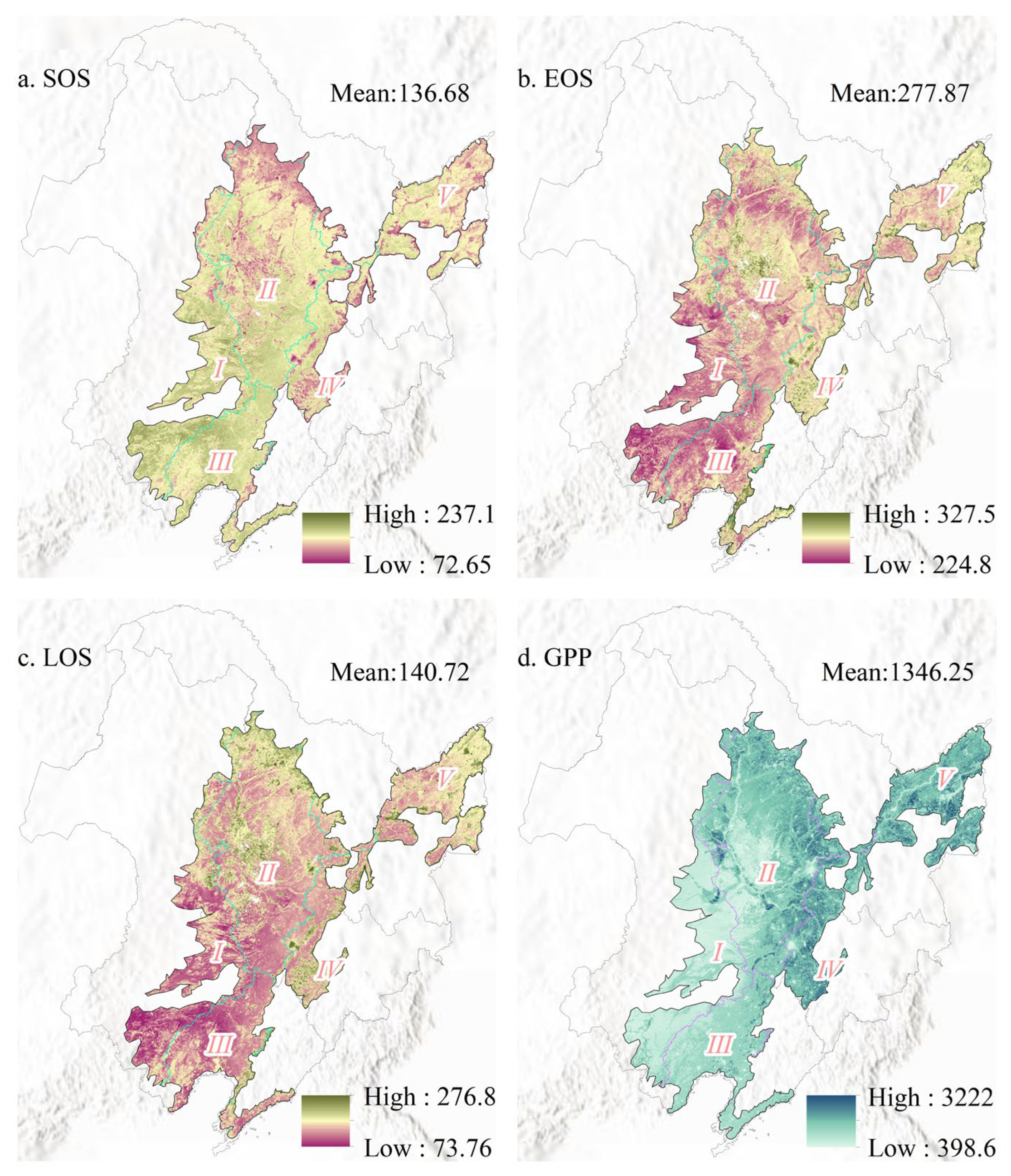
Figure 7. Spatial distributions of the 2001–2020 mean LOS (days), EOS (day of year, DOY), SOS (day of year, DOY), and GPP (g C m−2 yr−1) across the study area. Panels (ad) show the corresponding mean values of LOS, EOS, SOS, and GPP, respectively. Roman numerals (I–V) denote the five ecological zones: (I) the foothill zones of the Greater and Lesser Khingan Ranges; (II) the Songnen Plain; (III) the Liaohe Plain; (IV) the Changbai Mountains–Liaodong Hills; and (V) the Sanjiang Plain.
Agronomy 16 01031 g007
Figure 8. Spatial patterns of temporal trends (2001–2020) in LOS, EOS, SOS, and GPP across the study area. Panels (ad) show the corresponding Sen’s slopes. Insets indicate pixels with statistically significant trends identified using the modified Mann–Kendall test after FDR correction (p < 0.05). Roman numerals (I–V) denote the five ecological zones: (I) the foothill zones of the Greater and Lesser Khingan Ranges; (II) the Songnen Plain; (III) the Liaohe Plain; (IV) the Changbai Mountains–Liaodong Hills; and (V) the Sanjiang Plain.
Agronomy 16 01031 g008
Figure 9. Spatial correlations between cropland phenology anomalies (SOS and EOS) and monthly SPEI across Northeast China: (ac) correlations between SOS anomalies and SPEI in March, April, and May, respectively; (df) correlations between EOS anomalies and SPEI in August, September, and October, respectively. Insets show pixels with statistically significant correlations after lag-1 effective sample size adjustment and FDR correction (p < 0.05). Roman numerals (I–V) denote the five ecological zones: (I) the foothill zones of the Greater and Lesser Khingan Ranges; (II) the Songnen Plain; (III) the Liaohe Plain; (IV) the Changbai Mountains–Liaodong Hills; and (V) the Sanjiang Plain.
Agronomy 16 01031 g009
Figure 10. Spatial patterns of the relationships between SPEI-1 and LOS across Northeast China: (a) Pearson correlation coefficient (r) map. (b) Pixels with statistically significant correlations after lag-1 effective sample size adjustment and FDR correction (p < 0.05), where red indicates positive correlations and blue indicates negative correlations. (c) Proportions of positive versus negative correlations across croplands. Roman numerals (I–V) denote the five ecological zones: (I) the foothill zones of the Greater and Lesser Khingan Ranges; (II) the Songnen Plain; (III) the Liaohe Plain; (IV) the Changbai Mountains–Liaodong Hills; and (V) the Sanjiang Plain.
Agronomy 16 01031 g010
Figure 11. Spatial patterns of the relationships between SPEI-1 and GPP across Northeast China: (a) Pearson correlation coefficient (r) map. (b) Pixels with statistically significant correlations after lag-1 effective sample size adjustment and FDR correction (p < 0.05), where red indicates positive correlations and blue indicates negative correlations. (c) Proportions of positive versus negative correlations across croplands. Roman numerals (I–V) denote the five ecological zones: (I) the foothill zones of the Greater and Lesser Khingan Ranges; (II) the Songnen Plain; (III) the Liaohe Plain; (IV) the Changbai Mountains–Liaodong Hills; and (V) the Sanjiang Plain.
Agronomy 16 01031 g011
Table 1. SPEI-based drought severity classification.
Drought CategorySPEI Range
Extreme droughtSPEI ≤ −2.0
Severe drought−2.0 < SPEI ≤ −1.5
Moderate drought−1.5 < SPEI ≤ −1.0
Mild drought−1.0 < SPEI ≤ −0.5
Table 2. Regional mean run-theory drought characteristics for the five agricultural subregions in Northeast China during 2001–2020. Duration denotes cumulative drought duration (months), severity denotes cumulative drought severity (the absolute sum of SPEI deficits), and intensity denotes mean drought intensity (severity divided by duration). Roman numerals (I–V) denote the five ecological zones: (I) the foothill zones of the Greater and Lesser Khingan Ranges; (II) the Songnen Plain; (III) the Liaohe Plain; (IV) the Changbai Mountains–Liaodong Hills; and (V) the Sanjiang Plain.
AreaDurationSeverityIntensity
I75.22342.2122.289
II77.01744.4092.521
III75.11841.4792.224
IV72.74541.3522.524
V73.01840.5393.023
Table 3. Temporal trends in annual drought characteristics in the Songnen Plain (II) and Sanjiang Plain (V) during 2001–2020 based on Sen’s slope and the modified Mann–Kendall test.
RegionMetricSen’s SlopeMK p-ValueTrend
IIDuration+1.020.044significant increase
IISeverity+0.610.048significant increase
IIIntensity+0.110.040significant increase
VDuration−0.160.201slight decline
VSeverity−0.130.297slight decline
VIntensity−0.080.266slight decline
Table 4. Sensitivity of drought-event characteristics to threshold selection.
ScenarioThreshold SettingMain Change in Drought MetricsSpatial Pattern Compared with BaselineRobustness
S0 Baseliner1 = 0, r2 = −0.5, r3 = −1.0BaselineBaselineBaseline
S1r1 = 0.5Fewer but longer eventsSimilarRobust
S2r1 = −0.3More but shorter eventsSimilarRobust
S3r2 = −0.7Fewer but stronger eventsSimilarRobust
S4r3 = −1.2Weak events removed;
severity increased
SimilarRobust
Table 5. Zonal-mean Sen’s slopes of SOS, EOS, LOS, and GPP across the five ecological zones in Northeast China during 2001–2020.
AreaSOS (d a−1)EOS (d a−1)LOS (d a−1)GPP (g C m−2 a−1)
I−0.190.300.4922.73
II0.11−0.07−0.18−9.12
III−0.310.370.6818.61
IV−0.090.280.3717.07
V0.270.330.067.84
Table 6. Proportions of significantly correlated areas between SOS/EOS anomalies and monthly SPEI after autocorrelation-adjusted Pearson correlation and FDR correction.
Dependent
Variables
Independent
Variables
Sig Negative
(p < 0.05)
Sig Positive
(p < 0.05)
Total
(p < 0.05)
SOS anomalySPEI-April8.13%2.02%10.15%
SOS anomalySPEI-May10.14%1.40%11.54%
SOS anomalySPEI-June8.74%1.20%9.94%
EOS anomalySPEI-Sept2.11%10.97%13.08%
EOS anomalySPEI-Oct1.37%9.57%10.94%
EOS anomalySPEI-Nov1.22%10.06%11.28%
Disclaimer/Publisher’s Note: The statements, opinions and data contained in all publications are solely those of the individual author(s) and contributor(s) and not of MDPI and/or the editor(s). MDPI and/or the editor(s) disclaim responsibility for any injury to people or property resulting from any ideas, methods, instructions or products referred to in the content.