Article

Diagnosis of Soil Quality in Barley Farmlands in Central and Northern Hubei Province

1
Hubei Hongshan Laboratory, College of Plant Science and Technology, Huazhong Agricultural University, Wuhan 430070, China
2
Department of Biology, Saint Mary’s University, Halifax, NS B3H 3C3, Canada
*
Author to whom correspondence should be addressed.
These authors contributed equally to this work.
Agronomy 2026, 16(11), 1023; https://doi.org/10.3390/agronomy16111023
Submission received: 31 March 2026 / Revised: 18 May 2026 / Accepted: 19 May 2026 / Published: 22 May 2026

Abstract

Soil quality is a critical determinant of crop productivity. This study assessed the soil quality of 61 barley farmlands in central and northern Hubei Province based on ten soil chemical properties: pH, soil organic matter (SOM), ammonium nitrogen (NH4+-N), nitrate nitrogen (NO3-N), hydrolyzable nitrogen (HN), available phosphorus (AP), available potassium (AK), exchangeable calcium (Exc-Ca), exchangeable magnesium (Exc-Mg), and available sulfur (AS). A total of 68.85% of the farmlands were acidic (pH < 6.5). The average levels of SOM, NH4+-N, NO3-N, and HN were deficient, while AP was moderate, according to the Second State Soil Survey of China (SSSSC). AK, Exc-Ca, Exc-Mg, and AS were, on average, at moderate-to-abundant levels. Differences in preceding crops led to significant differences in pH and SOM between paddy and dryland fields. A minimum data set was established using six soil properties (HN, AS, AK, Exc-Ca, Exc-Mg, and NH4+-N) to calculate the soil quality index (SQI). SQI ranged from 0.27 to 0.69, with an average of 0.45, indicating overall low soil quality in the region. Both accuracy importance and R2-weighted importance revealed that HN was the most influential factor driving SQI variation among the soil properties examined. This study elucidates the status of soil nutrients, offering a diagnostic basis for developing targeted fertilization strategies for barley in this region.

1. Introduction

Soil is a fundamental component of the Earth’s biosphere and serves as the primary medium supporting terrestrial plant life, which in turn sustains most other terrestrial life forms [1]. The soil environment and its functions are shaped by the parent materials and the formation factors that determine the soil’s physical, chemical, and biological properties [2]. One of the key factors determining crop yield is soil quality, which is influenced by soil nutrient status, effective rooting depth, and soil pollution [3]. Among these, soil nutrient availability often constitutes the primary constraint to achieving high crop yield and economic efficiency [4].
Soil quality evaluation, which is the assessment of soil productive capacity, is a comprehensive measure of soil fertility, soil environmental quality, and soil health [5]. As an intrinsic attribute of soil itself, soil quality cannot be obtained through direct measurement [6,7,8]. It requires an integrated analysis of various soil functions, which is conducive to the effective management and protection of soil. To objectively and accurately evaluate soil quality, it is necessary to integrate different soil properties into a single index [9]. When many soil parameters are available, integrated principal component analysis (PCA) and correlation analysis can be used to calculate soil quality index (SQI) by constructing a minimal data set (MDS) of soil properties [10,11,12,13].
Some soil chemical properties have been used as the foundation for evaluating soil quality in agricultural ecosystems [14]. Among them, soil pH is generally regarded as a master soil indicator because it governs the solubility and availability of nutrients, regulates microbial activity, and influences soil structure, thereby affecting plant growth and soil functioning [15,16]. In barley (Hordeum vulgare), pH below 4.9 caused a more dramatic yield loss than pH above 5.0 [17]. Soil organic matter (SOM) enhances soil structure stability by promoting aggregate formation, which improves porosity and water retention [18]. Additionally, SOM serves as a reservoir of nutrients and an energy source of microorganisms, driving nutrient cycling and sustaining agroecosystem productivity [19]. Nitrogen (N), phosphorus (P), and potassium (K) are the three primary macronutrients essential for plant growth, and their availability is a fundamental indicator of soil nutritional status [20]. Moreover, the stoichiometric ratios of N, P and K can reflect the sustainability of plant growth [21]. In soil, the main forms of nitrogen that can be absorbed by plants are ammonium nitrogen (NH4+-N) and nitrate nitrogen (NO3-N). Under acidic conditions, barley plants yielded more with NO3-N compared with NH4+-N when grown in the greenhouse. However, in field experiment, barley yield was similar with both NO3-N and NH4+-N [22]. Calcium (Ca) and magnesium (Mg) are secondary macronutrients and they play an important role in regulating soil pH [23], while sulfate (S) is another secondary macronutrient essential for plant nutrition but does not directly regulate pH under typical aerobic agricultural soil conditions. Ca is involved in the composition of plant cell walls and the transport of organic matter [24], and Mg is one of the components of chlorophyll in plants [25]. S also plays a critical role in crop growth and development by being involved in processes such as protein synthesis, photosynthesis, and antioxidant reactions [26].
Soil quality evaluation has been extensively studied in farmlands planted with maize (Zea mays), rice (Oryza sativa), and wheat (Triticum aestivum) across diverse agroecosystems [27,28,29,30]. In contrast, barley, a crop increasingly used for feed and brewing in China, has received far less attention in this domain. A small number of barley farmlands in China have been investigated to assess soil quality [13]. This research gap is particularly concerning, given the unique challenges of barley production. Historically, rates of fertilizer application to barley crops have been low, as barley was perceived to perform well on poor soils and in low-fertility situations. However, this is not the case; in fertile soils, barley yields are often 20% higher than those of wheat [31]. Fertilization practices for barley are frequently borrowed from those used for wheat; however, the N demands of the two crops are not identical [32]. Generally, barley plants receive less than 50 lbs/acre or 56 kg/ha of N before reaching the jointing stage [33]. Inadequate N nutrition is expressed as pale green plants with reduced bulk and tiller formation. P deficiency symptoms include reduced early growth and vigor, with spindly plants under severe deficiency, and slight mottling visible on the oldest leaf with the tip beginning to yellow. The maximum barley grain yield was reached with a P-application rate of 98 kg P ha−1 [34]. When K is inadequate, plants appear stunted with short, stout stems and pale yellow–green stems and leaves, often appearing limp or wilted. S deficiency symptoms indicate that crops grow poorly, lack vigor, and mature more slowly, resulting in reduced tillering, low grain yields, and low protein content. These deficiency symptoms highlight the detrimental effects of nutrient limitations in low-quality soils on barley productivity, underscoring the urgent need for comprehensive soil quality assessments to identify and address such constraints.
Barley cultivation is believed to have been present in China around 2000 BC [35]. In the middle and lower reaches of the Yangtze River, barley is primarily used for feed and brewing purposes. Therefore, soil quality plays an important role in influencing barley yield under high-intensity planting activities (a double-cropping or triple-cropping system) in this area [13]. Previous studies on the Tibetan Plateau have demonstrated that soil quality was improved by 11% and 21%, respectively, under multi-year barley–wheat and barley–rape rotations, and the corresponding barley yield increased by 17% and 12%, respectively, compared with long-term continuous cropping [36]. These findings, while derived from a distinctly different pedoclimatic context, suggest the need to explore whether improved soil management could similarly benefit barley production in the middle and lower reaches of the Yangtze River, rather than directly extrapolating the results. To address the research gap (i.e., barley farmlands have received far less attention than maize, rice, and wheat), geographical gap (i.e., soil quality has rarely been assessed in the middle–lower Yangtze region) and practical gap (i.e., fertilization practices for barley are frequently borrowed from those used for wheat), we evaluated the soil quality of 61 barley farmlands in the central and northern regions of Hubei Province by investigating ten soil chemical properties (pH, SOM, NH4+-N, NO3-N, hydrolyzable nitrogen (HN), available phosphorus (AP), available potassium (AK), exchangeable calcium (Exc-Ca), exchangeable magnesium (Exc-Mg), and available sulfur (AS)). This selection encompasses indicators of the fundamental soil environment (pH and SOM), primary macronutrients (N, P, K), and secondary macronutrients (Ca, Mg, S), thereby capturing the multidimensional nature of soil fertility. Our findings indicated that SOM, NH4+-N, NO3-N, and HN were deficient, while AK, Exc-Ca, Exc-Mg, and AS were all at moderate-to-abundant levels. Moreover, the SQI across the region was generally low. This diagnosis identifies the actual limiting factors, and thereby provides a scientific basis for developing site-specific fertilization strategies for barley cultivation in this region.

2. Materials and Methods

2.1. Study Areas

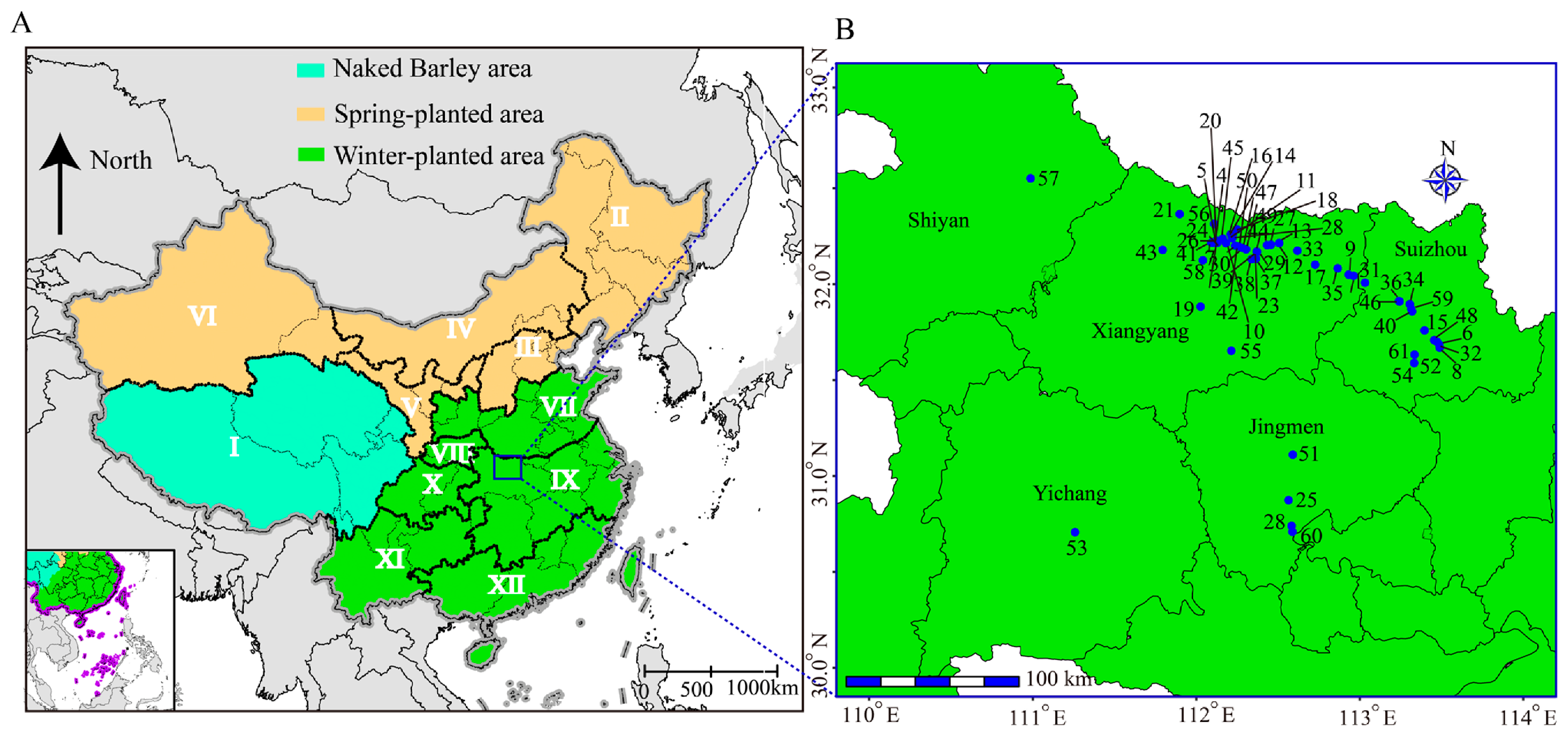
The division of barley agro-ecological areas in China is primarily based on differences in cropping systems, the intended uses of barley products, the adaptability of barley varieties, and the actual sowing dates. Therefore, China is classified into Naked barley area, Spring-planted barley area and Winter-planted barley area, and these areas are further divided into 12 barley agro-ecological areas (Figure 1A). Maintenance of soil quality is an important topic in the Winter-planted barley area of China, which is characterized by intensive cropping systems such as the double cropping system (e.g., winter barley/wheat followed by summer rice/maize) or triple cropping system (often including rice-rice-barley/wheat) [13]. Hubei Province is located in the Winter-planted barley area of southern China (Figure 1A). In 2022, we collected soil samples from 61 farmland plots across five cities in central and northern Hubei Province (i.e., Yichang, Jingmen, Xiangyang, Suizhou, and Shiyan). This region has a subtropical monsoon climate. The annual average temperatures for these cities are 17.1 °C, 16.6 °C, 16.5 °C, 15.9 °C, and 15.9 °C, respectively, and the annual average rainfall is 1161 mm, 1216 mm, 973 mm, 960 mm, and 861 mm, respectively (Figure 1B; https://zh.climate-data.org/ (accessed on 30 March 2026)). This region practices mechanical tillage, with a tillage depth of 20–35 cm. In this region, barley is grown as a winter crop following summer rice or maize under conventional tillage, typically sown in mid-to-late October and harvested in the following April or early May. After the summer crop (e.g., rice or maize) is harvested, with rice typically harvested in early October and maize in mid-to-late September, the fields are typically plowed and harrowed to prepare a seedbed for barley. During the barley growing season (winter and spring), irrigation is generally not applied, as rainfall is usually sufficient. However, the preceding rice crop is typically grown in paddy conditions with flood irrigation. Fertilization practices vary among farmers, and are often based on empirical experience rather than soil testing [37].

2.2. Sampling

To provide guidance for barley fertilization, we collected soil samples from 61 farmlands prior to barley sowing and fertilizer application to capture baseline soil conditions. Soil samples were collected from 1 to 15 October 2022, immediately after the harvest of the preceding crops (predominantly rice or maize). The purpose of this single pre-sowing sampling was to diagnose soil nutrient status specifically for basal fertilizer recommendation. In this region, local farmers typically apply all fertilizers (N, P, and K) only once as basal dressing before or at sowing, and no topdressing is performed during the barley growing season. Therefore, while we acknowledge that soil inorganic N fractions (NH4+-N, NO3-N) fluctuate dynamically with seasonal conditions, the pre-sowing nutrient level is the most relevant and practical indicator for determining the total fertilizer requirement for the entire cropping cycle under this specific farming practice. A single ‘snapshot’ at this critical time point directly informs the farmers’ single fertilizer application event, whereas multiple monitoring during the growth period, though more accurate for topdressing, is not applicable in this system due to the absence of topdressing practice. It is important to note that these fields are referred to as “barley farmlands” in the context of this study because they represent the winter barley planting season within the annual crop rotation. Moreover, soil quality was assessed prior to barley sowing, with the sampled fields belonging to either a rice–barley rotation or a maize–barley cropping system. Accordingly, the soils were classified based on their preceding crop: those preceded by rice were designated as paddy soils, while those preceded by maize were designated as dryland soils. To facilitate international comparison, these soil types were further referenced against the World Reference Base for Soil Resources (WRB) framework. Accordingly, the paddy soils (rice-preceded) correspond to the Hydragric Anthrosols Reference Soil Group—soils that typically feature an anthraquic horizon and an underlying hydragric horizon formed by long-term rice cultivation. The dryland soils (maize-preceded) are comparable to the Cambisols/Luvisols groups, which represent weakly-to-moderately developed upland soils. This pre-planting assessment formed the basis for our site-specific fertilization recommendations.
The 61 farmlands were selected according to the criterion that all sampling sites be located away from roads, houses, ditches, manure piles, and fertilizer storage areas. At each farmland, five sub-samples were collected using a cross five-point sampling method within a central 25 m2 area. Each sub-sample was taken from the 0–20 cm topsoil layer, and all sub-samples from each studied farmland were composited into a single sample. The soil samples were categorized into paddy field (preceding crop: rice, 20 samples) and dryland (preceding crop: mainly maize, 41 samples) groups based on the preceding crops.
The soil samples collected from the farmlands were placed in a well-ventilated indoor area to air-dry naturally. After drying, stones and plant residues were removed. Then soil samples were sieved through a 20-mesh sieve (0.85 mm aperture). Finally, the processed soil samples (the <0.85 mm fraction) were packed into labeled sample bags for storage.

2.3. Determination of Soil Chemical Properties

We measured 10 chemical parameters in the College of Plant Science and Technology, Huazhong Agricultural University, using air-dried soil fractions. Soil pH was measured potentiometrically using a 1:2.5 (w/v) ratio of soil to deionized water (10 g soil with 25 mL water). SOM was determined according to the chromic acid digestion combined with spectrophotometric procedure [38]. NH4+-N was determined by the Nessler colorimetry method [39]. NO3-N was detected using GB/T 32737-2016 [40] and is described in the Supplementary Text S1. HN was determined by the Alkaline Hydrolysis Diffusion Method [41]. AP and AK were measured by the Molybdenum blue colorimetry method [42] and Turbidimetric ultramicro titration [43], respectively. Exc-Ca and Exc-Mg were determined by Ethylene Diamine Tetraacetic Acid (EDTA) titrations [44]. The concentration of soil AS was determined by Barium sulfate turbidimetry [45].

2.4. Estimating Soil Quality Index (SQI) by Establishing a Minimum Data Set (MDS)

The methodology for calculating the soil quality index follows the approach established by Vasu et al. [46] for croplands in the semi-arid tropics of India. This method has been validated in our earlier research, where it was used to assess soil quality across seven barley-producing regions in China [13]. It was similarly adopted by Kongor et al. to evaluate soil quality in six cocoa-growing regions in Ghana, to enhance cocoa production [11]. Given the functional redundancy among soil properties, soil quality is often evaluated using an MDS of chemical indicators [10,11,12,13]. Combining PCA and correlation analysis is an effective method for evaluating soil quality, as principal components can convert a large number of variables into a smaller set of variables while maximizing the explanatory power of the variables [10]. Correlation analysis can distinguish highly correlated variables and remove redundant variables in each principal component. In this study, PCA was performed using the psy package in R software (v4.4.2). For each principal component, soil chemical properties with high factor loadings were defined as those whose absolute values fell within 10% of the highest factor loading value [10,11]. When multiple soil chemical properties with high factor loading appeared in a principal component, the Pearson correlation coefficients between these parameters were calculated to determine their retention in that component. If the absolute value of correlation between any two properties exceeded 0.7, the property with lower factor loading value within that principal component was discarded.
After establishing the minimum data set (MDS) of soil chemical properties, these selected parameters were used to evaluate the soil quality index (SQI). Firstly, the weighting factor (Wi) for each soil chemical parameter in MDS is measured by the following formula:
W i = V i / i = 1 n V i
where Vi is the variability explained by the i-th principal component, and n is the number of selected principal components. Secondly, the score (Si) of each soil chemical parameter of each farmland was estimated by linear scoring techniques [11,47]. Importantly, the assignment of scoring functions was based on the established nutritional requirements of barley, rather than statistical properties of the dataset. The Si ranging from 0 to 1 was assigned according to “more is better”, “less is better”, or “optimum” rules, as described by Liebig et al. [47]. The “more is better” standard was applied to parameters whose higher values positively contribute to barley growth and development. For these parameters, each measured value was normalized by dividing it by the maximum value in the dataset, resulting in scores ranging from 0 to 1, with the highest value receiving a score of 1.0. However, the “less is better” rule was applied to parameters whose higher values negatively affect barley growth and development. For these parameters, each measured value was divided by the minimum value in the dataset, such that the lowest value received a score of 1.0. The “optimum” was applied to parameters having a positive influence up to a certain level beyond which the influence could be considered detrimental. For these parameters, values were scored as “more is better” up to a predetermined threshold, and as “less is better” above that threshold, ensuring that values within the optimal range received the highest scores. Therefore, the “more is better” rule is appropriate for SOM, NH4+-N, HN, AP, AK, Exc-Ca, Exc-Mg and AS, which are macronutrients and have a favorable impact on barley when they exhibit higher concentration, while pH is proper for the “optimum” rule because it has a suitable level of 6.5–7.8 for barley growth and development [13]; soil pH value below or above this threshold can induce nutrient deficiencies (e.g., P fixation) or toxicities (e.g., Al toxicity) for barley, thereby constraining productivity. NO3-N is also appropriate for the “optimum” rule, because elevated NO3-N beyond crop demand increases leaching risk, denitrification losses, and potential nitrate toxicity in waterlogged paddy conditions. For barley, an optimum soil NO3-N value of 60 kg ha−1 (approximately 15 mg kg−1, based on a sampling depth of 0–30 cm and a bulk density of 1.3 g cm−3) was used in this study. This threshold is recommended by the Nitrogen guidelines for spring barley based on nitrate-N soil tests from Ontario, Canada (https://fieldcropnews.com/2025/04/fertility-management/; accessed on 15 May 2026). Finally, the soil quality index (SQI) of each farmland was calculated as follows:
S Q I = i = 1 n W i × S i
where Wi is the PCA weighting factor of the soil chemical properties in MDS. Si is the corresponding score.

2.5. Statistical Analyses

The ten soil chemical properties (pH, SOM, NH4+-N, NO3-N, HN, AP, AK, Exc-Ca, Exc-Mg and AS) were analyzed to evaluate the nutrient adequacy according to the Second State Soil Survey of China (SSSSC) (Table S1). For each soil chemical property, if the data met the assumptions of both homogeneity of variance (assessed by Levene’s test, p > 0.05) and normal distribution (assessed by the Shapiro–Wilk test, p > 0.05), Student’s t-test was used to compare paddy and dryland farmlands. Otherwise, the Wilcoxon rank-sum test was employed. The Wilcoxon rank-sum test was used instead of Student’s t-test because the assumptions of normality and homoscedasticity required for the parametric t-test were not met for the datasets. The non-parametric Wilcoxon test does not rely on these assumptions, making it a more robust and appropriate choice for comparing the two groups. The Student’s t-test and Wilcoxon rank-sum test were performed in evaluating the differences between paddy and dryland farmlands on all determined soil chemical properties using R software package ggpubr. To evaluate the reliability of these comparisons, post hoc power analysis was conducted using the pwr package in R. Wi, Si and SQI were calculated by Excel (v2016), and were shown by TBtools v1.045 [48]. To confirm that extremely low SQI values reflect genuine soil degradation, rather than artifacts of scoring function miscalibration, we performed an outlier diagnostic analysis. Using the boxplot criterion (values below Q1 − 1.5 × IQR), SQI outliers were identified. For each outlier site, we verified raw data accuracy and reviewed field sampling records. No data entry errors or anomalous field conditions (e.g., local salinity patches, wet depressions) were recorded. The outlier sites exhibited consistently low raw values across multiple soil properties, confirming that their low SQI classification was diagnostically meaningful. To evaluate the relative importance of soil chemical properties, we applied a gradient forest machine-learning approach using the gradientForest R package [49], with the ten soil chemical properties as predictors and the SQI as the response variable. The model was grown with an ensemble of 100 regression trees, which is above the default setting of 10 trees in the gradientForest package.

3. Results

3.1. Levels of Adequacy of Soil Chemical Properties

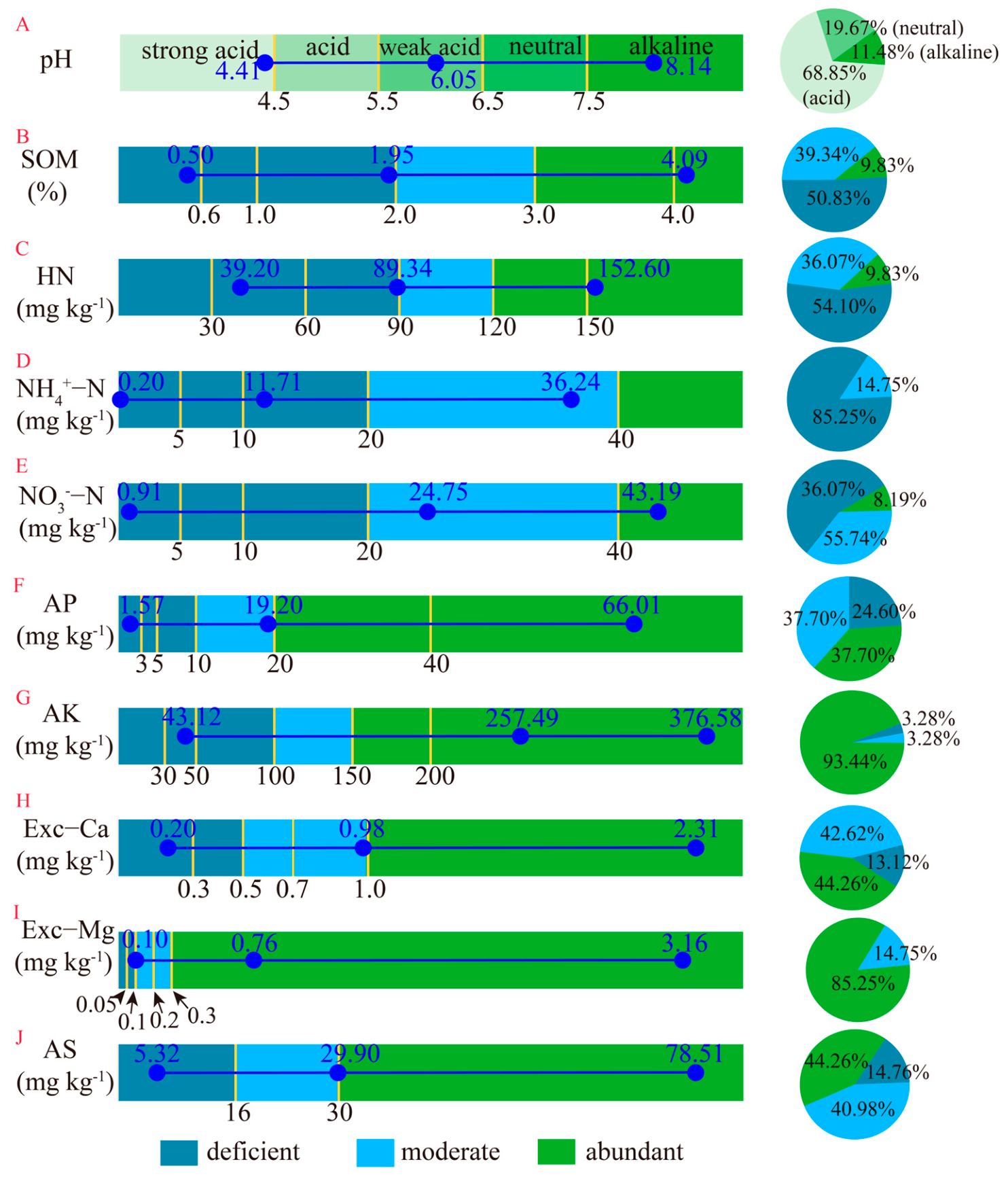
Soil chemical analysis revealed an average pH of 6.05 (range: 4.41–8.14) across all samples, with 68.85% farmlands classified as acidic soils (pH < 6.5), 19.67% as neutral soils (pH 6.5–7.5), and 11.48% as alkaline soils (pH > 7.5) (Figure 2A), suggesting that barley farmlands in central and northern Hubei Province are predominantly acidic. The mean SOM concentration was 1.95%, with a range of 0.50% to 4.09% (Figure 2B). According to the SSSSC, 9.83% of fields showed high fertility status (SOM > 3.0%), 39.34% showed moderate fertility status (SOM 2.0–3.0%), while 50.83% were low fertility soils (SOM < 2.0%) before planting barley (Figure 2B).
The data revealed mean concentrations of 11.71 mg kg−1 for NH4+-N, 24.75 mg kg−1 for NO3-N, and 89.34 mg kg−1 for HN (Figure 2C–E). Deficiency conditions were observed in 85.25% (NH4+-N), 36.07% (NO3-N), and 54.10% (HN) of samples, while moderate levels occurred in 14.75%, 55.74%, and 36.07%, respectively (Figure 2C–E). Abundant levels were absent for NH4+-N but present in 8.19% (NO3-N) and 9.83% (HN) of soils (Figure 2C–E). The mean AP concentration measured 19.20 mg kg−1, with deficiency, moderation, and sufficiency observed in 24.60%, 37.70%, and 37.70% of samples, respectively (Figure 2F). For AK, the average concentration reached 257.49 mg kg−1 (range: 43.12–376.58 mg kg−1), demonstrating sufficiency in 93.44% of farmlands, with only 3.28% showing deficiency or adequate levels (Figure 2G). These results indicate that barley farmlands in central and northern Hubei exhibit (1) adequate AK and (2) intermediate levels of HN, AP, and NO3-N, but (3) widespread NH4+-N deficiency.
Secondary macronutrients showed the following patterns: Exc-Ca: 0.98 g kg−1 (13.12% deficient, 42.62% moderate, 44.26% sufficient); Exc-Mg: 0.76 g kg−1 (0% deficient, 14.75% moderate, 85.25% sufficient); AS: 29.90 mg kg−1 (14.76% deficient, 40.98% moderate, 44.26% sufficient). Overall, these nutrients ranged from moderate to sufficient availability (Figure 2H–J).
According to the criteria proposed by Wilding [50], coefficient of variation (CV) < 15% is considered low variability, 15% ≤ CV ≤ 35% moderate variability, and CV > 35% high variability for soil properties. Based on this classification, pH, HN, and AK were moderately variable, while SOM, NH4+-N, NO3-N, AP, AS, Exc-Ca, and Exc-Mg were highly variable (Table S2). No soil property fell into the low variability category (Table S2). This moderate-to-high degree of variability suggests considerable heterogeneity in soil chemical properties across the study region.

3.2. Differences in Soil Properties of Barley Farmlands with Different Preceding Crops

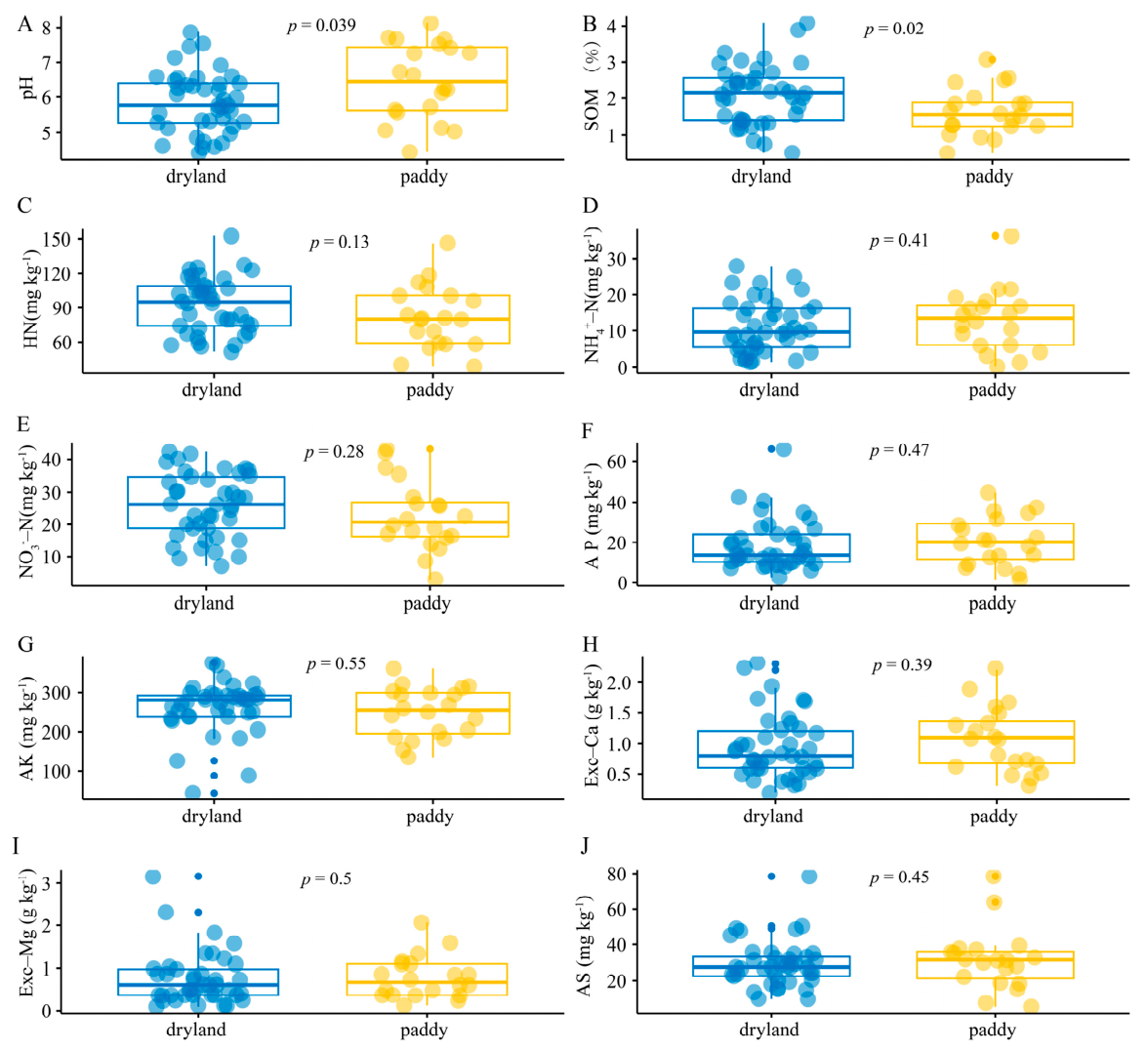
The data showed no significant difference in HN and NH4+-N between dryland and paddy fields, while soil pH and SOM differed significantly (p < 0.05) (Figure 3A–D). The soil pH value of paddy fields (6.46; closed neutrality) was significantly higher than that of dryland (5.86; acidity) (Figure 3A). SOM content of dryland farmlands (2.10%) was significantly higher than that of paddy farmlands (1.64%) (Figure 3B). According to the SSSSC, the dryland farmlands showed a status with no lack of SOM, while paddy farmlands showed deficient status (Figure 3B). Moreover, no significant differences were observed in NO3-N, AP, AK, Exc-Ca, Exc-Mg and AS contents between dryland and paddy farmlands in central and northern Hubei (Figure 3E–J). Post hoc power analysis revealed that pH (power value = 0.635) and SOM (power value = 0.606), which showed significant differences between paddy and dryland fields, had marginal statistical power. For all other properties, power was consistently below 0.4 (Table S3), indicating that non-significant results are likely attributable to insufficient statistical power, due to high spatial variability and unbalanced sample sizes.

3.3. Development of a Minimum Dataset Using PCA and Correlation Analysis

The results of PCA revealed that the first six principal components (PC1–PC6) were selected because they explained 82% of the total variability of the 10 soil properties (Table 1). Among the first six principal components, each principal component could be represented by soil properties with high absolute loading values. In PC1, HN had the highest absolute loading (0.85), and thus was selected to represent PC1. Similarly, PC2, PC3, PC4, PC5, and PC6 were represented by AS, Exc-Mg, NH4+-N, Exc-Ca, and AK, respectively (Table 1). Therefore, HN, AS, Exc-Mg, NH4+-N, Exc-Ca and AK were selected into the MDS, respectively (Table 1).
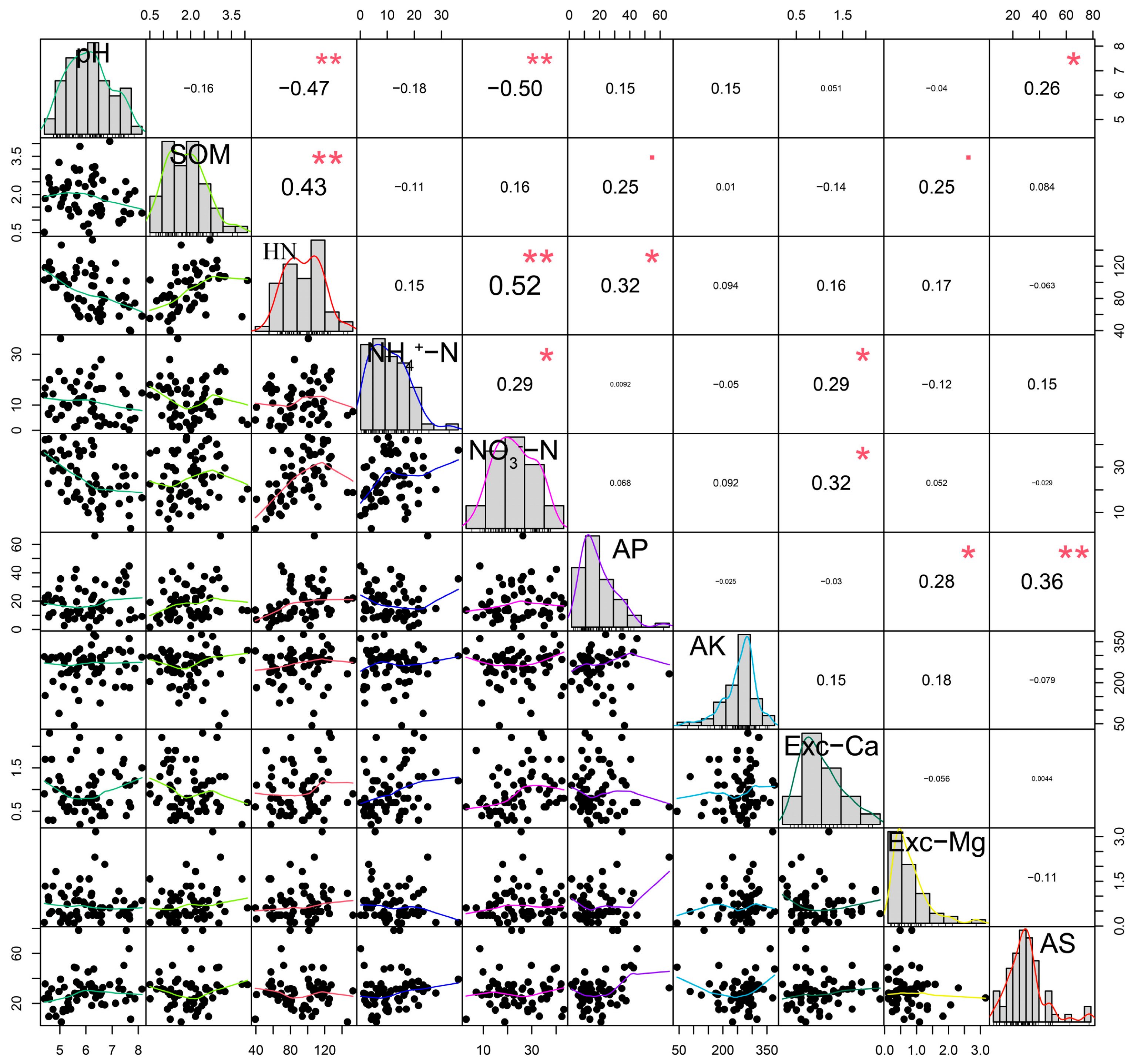
Additionally, correlation analysis revealed no strong correlations (absolute value of r > 0.7) between any two soil chemical properties (Figure 4). Therefore, all six properties (Table 1) were retained in the MDS. Consequently, the soil properties of barley farmlands in the central and northern Hubei can be effectively characterized by the MDS comprising HN, AS, Exc-Mg, NH4+-N, Exc-Ca and AK.

3.4. SQI of 61 Sampled Farmlands

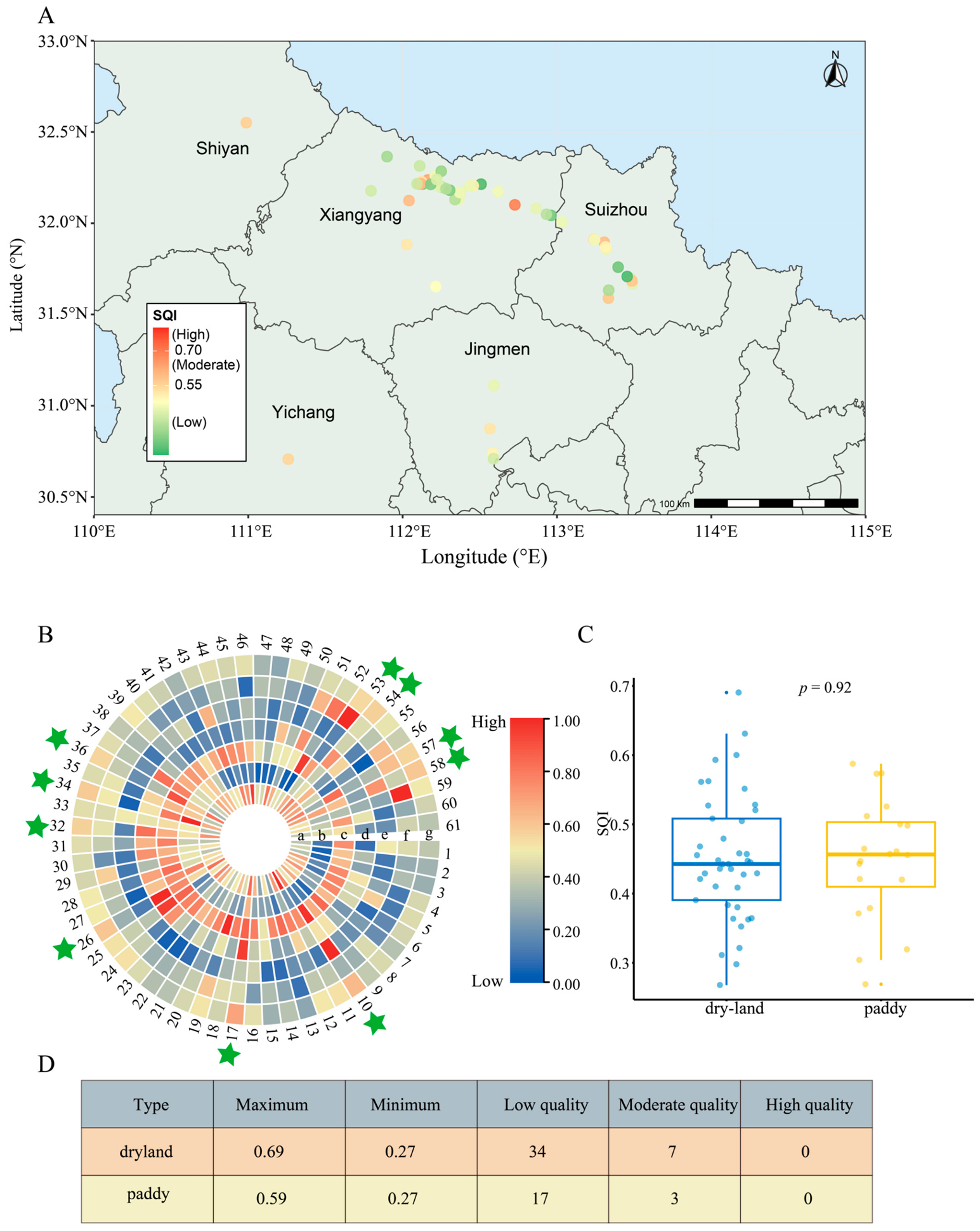
Among the 61 barley farmlands, the scores (Si) of soil properties in the MDS and the SQI are presented in Figure 5. Based on the established criteria from Marzaioli et al. [51], SQI values are classified as follows: SQI < 0.55 indicates low-quality soil, 0.55 ≤ SQI ≤ 0.70 indicates moderate-quality soil, and SQI > 0.70 indicates high-quality soil (Figure 5A). Taking Suizhou and Xiangyang as examples, substantial variation in SQI was observed even among sampling farmlands that were geographically close to each other (Figure 5A). Statistical analysis of the 61 sampled barley farmlands revealed that the average SQI in the central and northern Hubei Province was 0.45, with a range of 0.27–0.69, and no outliers were identified (Figure 5B; Table S4). Moreover, the number of high-, moderate- and low-quality farmlands were 0, 10 and 51, respectively (Figure 5A; Table S4). These results demonstrate that the overall soil quality of barley farmlands in central and northern Hubei is relatively poor. To test the robustness of this classification, a sensitivity analysis was performed by excluding NH4+-N from the MDS and recalculating the SQI using the same procedure, because widespread NH4+-N deficiency was found in this region. Following the criteria of Marzaioli et al. [51], the recalculated SQI values resulted in a different distribution: 21 farmlands (34.4%) were classified as low-quality (SQI < 0.55), 27 (44.3%) as moderate-quality (0.55 ≤ SQI ≤ 0.70), and 13 (21.3%) as high-quality (SQI > 0.70) (Table S5). This indicated that the SQI classification is highly sensitive to the inclusion or exclusion of individual indicators, particularly those with extreme deficiency. SQI between dryland and paddy farmlands was compared, and no difference was found (Figure 5C). According to the classification with NH4+-N in the MDS, we found 34 and 17 low-quality farmlands in dryland and paddy types (Figure 5D), respectively. This suggests that we need to take different measures to improve these low-quality farmlands based on the differences in preceding crops, by focusing on the properties of MDS.

3.5. HN Contributes the Most to SQI Variation

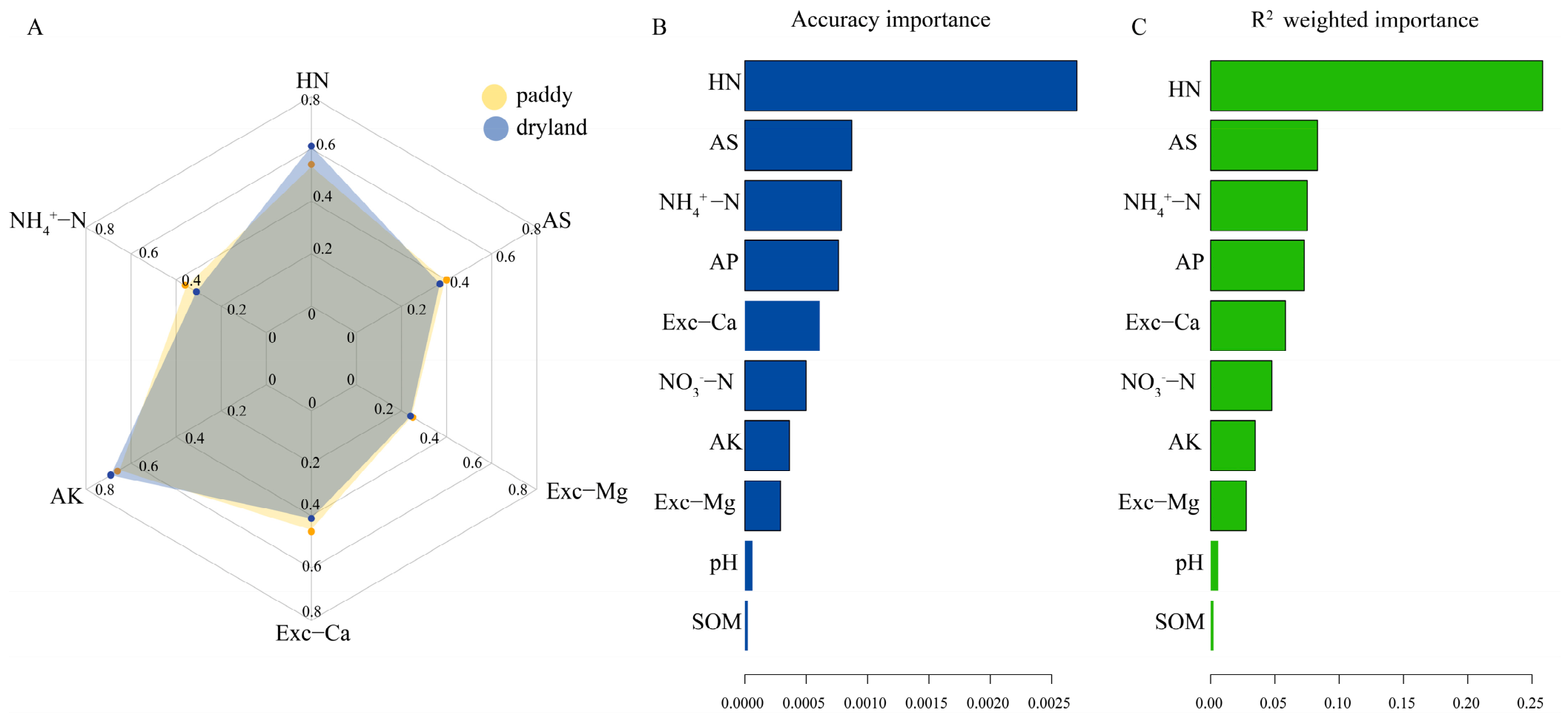
The radar plot visually represents the scores of soil properties, aiming to identify the limiting soil properties in paddy and dryland fields. When the plotted lines of different preceding crop treatments intersect with each axis, their respective scores are projected onto the web. A greater distance from the grid center indicates a better performance of that soil property, whereas a shorter distance reflects a poorer status. The results showed that dryland fields exhibited higher scores in HN and AK, while paddy fields performed better in NH4+-N, AS, Exc-Ca, and Exc-Mg (Figure 6A). We applied gradient forest modeling to assess the relative importance of ten soil properties in explaining the variation in the SQI. As a result, both accuracy importance and R2-weighted importance consistently revealed that HN exerted the greatest influence on SQI variation compared to the other soil properties examined (Figure 6B,C).

4. Discussion

4.1. The Central and Northern Hubei Province Was Dominated by Low-Quality Soils

The MDS for barley farmlands in central and northern Hubei Province comprised the following chemical properties: HN, AS, AK, Exc-Ca, Exc-Mg and NH4+-N (Table 1). These indicators are well-established and effective tools for evaluating the impact of short-term agronomic management practices on soil chemical fertility. Evaluation according to the SSSSC (Table S1) indicated the prevalence of moderate-to-sufficient levels of AK, AS, Exc-Ca, and Exc-Mg in most sampled farmlands (Figure 2G–J). The assessment revealed a contrast between the non-deficient status of AP in most farmlands and the extreme deficiency of NH4+-N (Figure 2D,F). Despite the fact that four soil properties (AS, AK, Exc-Ca and Exc-Mg) in the MDS are in a sufficient or non-deficient state, based on the average values (Figure 2G–J), the SQI of barley farmlands in the central and northern regions of Hubei Province is generally low (Figure 5B). Specifically, among the 61 sampled farmlands, low-quality farmlands (SQI < 0.55) account for 83.61% (Figure 5B). It should be noted that the SQI classification thresholds adopted from Marzaioli et al. [51] were originally developed under Mediterranean pedoclimatic conditions. Despite their application in other regions, including China, regional-scale calibration is needed for future studies. The categorical assignments should therefore be considered relative rather than absolute. This sensitivity analysis demonstrates that the SQI classification is sensitive to the inclusion or exclusion of individual indicators. Excluding NH4+-N led to a substantial change in the classification outcome (from 83.6% to 34.4% low-quality). This suggests that the original classification should be interpreted with caution, as the overall SQI value is influenced by the specific composition of the MDS. The extreme deficiency of NH4+-N contributed notably to this sensitivity, but it is not the sole driver. Collectively, these findings indicate that while the SQI provides a useful integrated assessment, its absolute classification (e.g., the 83.6% low-quality figure) is partly a function of MDS composition and scoring decisions.
Although the sensitivity of the SQI classification to MDS composition represents a methodological limitation, several pedoclimatic and agronomic causes likely explain the observed low soil quality. Among the 10 soil properties measured, the average pH was 6.05, indicating that the soil is weakly acidic (5.5–6.5). This outcome closely parallels the results of Wu et al. [52], who also found comparable soil conditions based on an analysis of 701 agricultural topsoil samples (mean pH 6.46) in Shiyan City, Hubei Province. The significant negative correlations between soil pH and soil HN/NO3-N (Figure 4) are consistent with the well-documented effect of N fertilization on soil acidification, which is primarily driven by the nitrification of ammonium-based fertilizers [53,54,55]. The primary driver of variation in cropland soil pH across this region is likely attributable to differential crop rotation systems, evidenced by the distinction between paddy and dryland soils (Figure 3A) and supported by findings from Kong et al. [56]. Notably, this conclusion remains speculative because pedoclimatic conditions were not taken into account when comparing the findings of previous studies with ours. It should be noted that when soil pH falls below 5, crops may experience impaired water and nutrient uptake, owing to aluminum toxicity [57]. In fact, lower soil pH can severely hinder the absorption of other nutrients by crops [15,16]. Other soil properties, including NO3-N, AP, AK, Exc-Ca, Exc-Mg, and AS, all showed moderate-to-sufficient levels at most farmlands (Figure 2; Table S1). However, among the 61 sampled farmlands, NH4+-N was still found to be deficient in 22 of them (Table S3). A sufficient level of AK might be due to the large application and low consumption of potassium fertilizer in barley farmlands, which was consistent with the findings of Duan et al. [58]. Given that rice—the preceding crop in a barley rotation—exhibits a high potassium demand (1.93–3.39 kg K2O per 100 kg grain) [59], this necessitates significant K fertilizer inputs from farmers to maintain rice productivity within the rice–barley cropping system. Several important soil chemical properties that determine soil quality, such as HN, NH4+-N, and SOM, all show deficiency states, with the deficiency of NH4+-N being the most pronounced (Figure 2). This partly explains the low SQI in the region, because NH4+-N is one of the components of the MDS (Table 1). The content of soil NH4+-N varies with time and space, and is relatively low (below 20 mg kg−1) in November in the Taihu Lake region, which belongs to the middle and lower reaches of the Yangtze River [60]. These findings, together with ours, raise the possibility that NH4+-N deficiency may be associated with strong agricultural activity in the middle and lower reaches of the Yangtze River. This region is characterized by intensive cropping systems (e.g., double or triple cropping per year). A plausible explanation is that after the harvest of summer crops such as maize or rice, soil N is largely depleted by crop uptake, and there is limited time for N replenishment before the next planting season, resulting in low NH4+-N concentrations. However, direct measurements of N dynamics throughout the cropping cycle would be needed to confirm this hypothesis. It is noted that NH4+-N deficiency alone should not be claimed as an indication of “nitrogen deficiency”, but rather as an indicator of “unstable or imbalanced N supply”, given the local high-leaching environment. We acknowledge that when the two nitrogen forms (NH4+-N + NO3-N) are summed, some farmlands may already possess adequate total inorganic nitrogen. Thus, the real concern is nitrogen form imbalance, rather than total nitrogen deficiency. The co-occurrence of HN being the most influential (Figure 6B,C), yet also a deficient, factor (54.10% of samples), is a critical finding (Figure 2). Soil HN is recognized as a critical indicator of soil N-supply potential, as it represents the pool of readily mineralizable organic N that supports crop growth. Previous studies have demonstrated that both plant-available N forms (NH4+-N and NO3-N) and integrative N-supply indicators such as HN play essential roles in soil quality assessment, as they significantly influence soil enzyme activities, microbial biomass, and, ultimately, crop productivity [37,61]. Notably, the HN fraction has been identified as a key component of the MDS for evaluating soil N-supply capacity in agricultural systems [61]. Our results about widespread HN and NH4+-N deficiency (Figure 2C,D) provide a clear and actionable management priority: addressing the widespread N deficiency through improved management practices is likely the most effective strategy for enhancing soil quality and sustainability in central and northern Hubei’s barley production systems [62]. It should be noticed that mineralization of organic N, nitrification, and NH3 volatilization might influence the content of NH4+-N, NO3-N and HN during the soil air-drying process. Therefore, the relatively low measured values of these properties may also be related to the use of air-dried soil. HN contributed the most to SQI variation among the soil properties analyzed (Figure 6B,C). However, the gradient forest modeling is intended for exploratory purposes, and does not serve as an independent validation of the SQI. Specifically, the fact that HN explains the greatest proportion of SQI variation should not be overinterpreted as indicating that HN is a limiting factor for SQI. SOM content is governed by the balance between organic inputs (e.g., crop residues, root exudates, organic amendments) and losses (e.g., heterotrophic respiration, leaching of dissolved organic carbon, erosion). High biomass production systems generally exhibit higher SOM content, due to greater carbon inputs. However, in the middle and lower reaches of the Yangtze River, intensive cropping systems such as double- or triple-cropping per year [63] result in a short interval between the harvest of the preceding crop (e.g., rice or maize) and the sowing of barley. Preceding crops are typically harvested in early October, while barley is sown in late October, leaving only about two to three weeks for residue decomposition and subsequent SOM stabilization. When soil samples were collected prior to barley sowing, crop residues had likely not yet been fully incorporated into stabilized SOM pools through mechanisms such as organo-mineral associations, aggregate occlusion, and hydrophobicity. Consequently, the limited time for both residue decomposition and SOM stabilization may contribute to the relatively low SOM content observed in the study area. Additionally, the subtropical climate likely accelerates decomposition and carbon losses, further reducing the potential for SOM accumulation, despite high biomass inputs.
According to our results on soils with different preceding crops in the central and northern regions of Hubei Province, there are no significant differences in other chemical properties between paddy (preceding crop as rice) and dryland farmlands (preceding crop as maize), except for pH and SOM (Figure 3). This suggests that different preceding crops might have influenced pH and SOM. Previous studies have found that the rice-barley rotation system can decrease the pH value of saline–alkali soils [64]. However, in acid soil, our study found that the pH value of paddy soils (i.e., a rice–barley rotation system) showed higher pH value compared to dryland soils (Figure 3A). Moreover, previous research found that the rotation system increases SOM content [63,64]. Under different crop rotation systems, our study found that the SOM content in paddy field soils (i.e., rice–barley rotation system) was significantly lower than that in dryland soils (maize–barley rotation system) (Figure 3B). This is primarily due to differences in residue quantity/quality and oxygen-dependent stabilization mechanisms. Specifically, the lower SOM content in the rice–barley rotation system compared to the maize–barley rotation system can be attributed to three main factors. First, the alternating wetting and drying cycles in the rice–barley system accelerate organic matter decomposition. Previous studies have shown that, compared to constant moisture conditions, drying–rewetting cycles reduce the temperature sensitivity of soil organic-carbon decomposition by 0.30–0.44 units, indicating faster organic matter turnover under fluctuating moisture regimes [65]. Moreover, although rapid microbial decomposition under wetting–drying conditions promotes temporary aggregate formation, it also stimulates microbial activity and carbon mineralization, leading to accelerated organic-matter turnover [66]. Second, differences in residue quality affect decomposition rates. Rice (a C3 plant) and maize (a C4 plant) produce residues with distinct chemical compositions: maize residues have higher lignin content and a higher C:N ratio, resulting in slower decomposition [67], which favors the formation of stable soil organic-matter pools. Third, the timing of soil sampling (prior to barley sowing) captures different stages of residue decomposition. Rice is harvested in early October, leaving only 2–3 weeks for residue decomposition before sampling, during which time residues are still in the initial rapid decomposition phase and have not yet been transformed into stable organic matter. In contrast, maize is often harvested earlier (mid-to-late September), allowing a longer period for residue decomposition and stabilization. Collectively, these factors explain the observed differences in SOM content between the two cropping systems.

4.2. Fertilization Advice in the Central and Northern Hubei Province for Optimized Barley Yield

The lower soil quality in the Central and Northern Hubei Province needs to be improved through rational fertilization to ensure the stability of barley yield. Although six soil chemical properties were determined in the MDS of soil properties, the other soil chemical properties might also act as constraints on soil quality. Therefore, some fertilization management recommendations for the central and northern Hubei Province are proposed, as follows:
Firstly, straw incorporation is a common practice to enhance SOM, as the return of plant litter represents a major flux in organic carbon, particularly in intensive double- or triple-cropping systems. However, the direct incorporation of straw, especially with a high C:N ratio, can induce transient microbial N immobilization during the initial decomposition phase, which may temporarily exacerbate the already deficient NH4+-N status in the soil (Figure 2D). This short-term N limitation is particularly critical in the middle and lower reaches of the Yangtze River, where the 2–3 week window between rice harvest and barley sowing leaves insufficient time for net N mineralization to resume before the subsequent crop is established. Therefore, to improve SOM without compromising N availability for the following barley crop, straw incorporation should be accompanied by appropriate N fertilization (e.g., adjusting the C:N ratio of the incorporated residue or applying a small amount of starter N fertilizer). This strategy balances the long-term benefit of SOM augmentation with the short-term agronomic requirement for available N. Secondly, moderate application of lime to some acidic farmlands improves pH. The optimal pH range for barley growth is from 6.5 to 7.8 [13]. However, some sampled farmlands in the central and northern region of Hubei Province are strongly acidic (pH < 4.5) (Table S3), which is not conducive to barley growth. According to previous studies, the combined application of appropriate lime and N fertilizer can inhibit soil acidification [52]. Although a quantitative lime recommendation specific to this region is not yet available, the lime requirement can be estimated from soil pH buffer capacity. For strongly acidic soils (pH < 5.0), a general guideline is to apply 2.0 t ha−1 of agricultural lime, to raise pH by 1.0 units [68]. We recommend that future research establish region-specific lime requirement curves for the rice–barley or maize–barley rotation systems in Hubei Province, to enable more precise recommendations. Thirdly, adequate N fertilizer should be applied as a base fertilizer to ensure the nutritional growth of barley. Although N fertilizer is one of the main causes of soil acidification [53,54,55], N is an essential element for crop growth. Moreover, the soil in the central and northern region of Hubei Province is generally deficient in NH4+-N. Therefore, it is necessary to increase the application of N fertilizer, to ensure barley yield. For barley planted in late fall, small amounts of N are needed until the end of January or early February [69]. It is crucial to provide sufficient quantities of N for early growth while keeping in mind that excessive N could lead to leaching losses when winter rains occur, lodging, and increasing frost risks [70]. It is generally recommended that 50–70% of the total N be applied at sowing. Fourthly, the use of organic fertilizer is essential. In recent years, with the rise of organic farming, the use of organic fertilizer has gradually become more widespread. Organic fertilizer contains a variety of organic acids, peptides, and a rich array of nutrients, including nitrogen, phosphorus, and potassium. It can not only provide comprehensive nutrition for crops, but also has a long-lasting effect. It can increase and renew SOM, promote microbial proliferation, and improve the physicochemical properties and biological activity of the soil [71]. Finally, rotating barley with other crops, such as rice, is beneficial to soil quality. According to Figure 3, the pH of paddy field soil is significantly higher than that of dryland soil. It can be inferred that using rice as a preceding crop can help reduce soil acidity, compared to using maize as a preceding crop. Therefore, rice–barley rotation can inhibit soil acidification and provide a favorable environment for barley growth. In southern Denmark, long-term continuous cropping of barley has led to a yield reduction of approximately 50% [72]. Moreover, on the Qinghai–Tibet Plateau, this cropping system was found to reduce available soil nitrogen by 54% after only six years of experimentation [73]. We also recommend barley–legume intercropping because it shows promise for sustainable production systems, especially at low soil P [74]. When fababeans were used as the preceding crop, grain and total-plant biomass of barley were 116% greater than those from the continuous grain treatment [75].

5. Conclusions

In this study, according to the SSSSC, SOM, NH4+-N, NO3-N, and HN were found to be deficient, while AK, Exc-Ca, Exc-Mg, and AS were all at moderate-to-abundant levels. Consequently, the SQI within the sampled farmlands was generally low, suggesting a potential widespread pattern that warrants further investigation across the region. HN was identified as the primary contributor to SQI variation.
Our study focuses specifically on soil chemical fertility, and we do not claim to provide a comprehensive assessment of overall soil quality. Several limitations should be acknowledged. First, the MDS was selected solely based on PCA, and correlation analysis may reflect statistical variance rather than functional importance. To address this, after establishing the MDS, we calculated the SQI using scoring rules based on the nutritional requirements of barley, specifically applying the “more is better,” “less is better,” or “optimum” criteria. This approach linked the MDS, to some extent, with barley nutrient uptake. Nevertheless, the selected indicators do not fully integrate crop production potential, which remains a limitation. Second, the SQI constructed here reflects the soil capacity as a nutrient reservoir and chemical medium, but it does not capture information on soil structure and biological health. Some key physical indices, such as soil temperature and moisture, have been proven to be the important factors influencing soil chemical properties and crop growth. Future research should incorporate key physical (e.g., soil temperature and moisture, aggregate stability, bulk density, water-holding capacity) and biological (e.g., microbial biomass carbon, enzyme activities, soil respiration) indicators, along with barley nutrient uptake, yield, and biomass, to enable a more comprehensive and functionally meaningful assessment of soil quality, as well as the degree of nutrient adequacy or deficiency in relation to barley nutrient uptake. Several limitations regarding the statistical analysis should also be acknowledged. For example, our gradient forest model was based on a relatively small sample size (n = 61) with ten predictors, raising the potential risk of overfitting. Although we used 100 trees to stabilize the estimates, this does not fully eliminate the concern. Therefore, the variable importance rankings should be interpreted with appropriate caution, and future studies with larger sample sizes are needed to validate these findings.
Despite these limitations, the ten chemical indicators selected for this study represent the most direct and relevant variables for barley nutrient supply and the soil chemical environment. These indicators are well-established and effective tools for evaluating the impact of short-term agronomic management practices on soil chemical fertility. The findings provide a preliminary diagnostic basis for understanding the soil nutrient status. However, the development of targeted fertilization strategies for barley would require further experimental validation (e.g., field trials) before any prescriptive guidance can be offered.

Supplementary Materials

The following supporting information can be downloaded at: https://www.mdpi.com/article/10.3390/agronomy16111023/s1. Text S1. Determination of nitrate nitrogen in soil: Ultraviolet spectrophotometry method. Table S1. Nutrient classification standards of the Second State Soil Survey of China (SSSSC). Table S2. The adequacy levels of the ten soil chemical properties in 61 sampled farmlands. Table S3. Balanced one-way analysis of variance power calculation. Table S4. Ten soil properties and SQI in 61 barley farmlands. Table S5. Number of low-, moderate-, and high-quality farmlands with and without NH4+-N in the MDS.

Author Contributions

Conceptualization: X.R. and G.S.; data curation: C.W.; formal analysis: Y.Z. and Y.T.; funding acquisition: X.R.; investigation: Y.Z. and C.W.; methodology: Y.Z. and C.W.; project administration: X.R.; resources: X.R.; software: Y.Z., Q.C. and X.F.; supervision: X.R.; validation: L.L.; visualization: Y.T. and X.F.; writing—original draft: Y.Z.; writing—review and editing: X.R. and G.S. All authors have read and agreed to the published version of the manuscript.

Funding

This work was supported by funding from the China Agriculture Research System of MOF and MARA (CARS-5).

Data Availability Statement

All original data from this study are provided in Table S3.

Acknowledgments

We like to thank the three anonymous journal reviewers for their critical reading of this manuscript with helpful suggestions.

Conflicts of Interest

The authors declare no conflicts of interest.

References

  1. Chen, S.; Lin, B.; Li, Y. Spatial and temporal changes of soil properties and soil fertility evaluation in a large grain-production area of subtropical plain, China. Geoderma 2020, 357, 113937. [Google Scholar] [CrossRef]
  2. Mahdi, M.A.; Rattan, L.; Kenneth, R.O.; Birl, L. Chapter 1—Fundamentals and Functions of Soil Environment. In Soil Health and Intensification of Agroecosytems; Academic Press: Cambridge, MA, USA, 2017; pp. 1–23. [Google Scholar]
  3. Fuess, L.T.; Garcia, M.L. Implications of stillage land disposal: A critical review on the impacts of fertigation. J. Environ. Manag. 2014, 145, 210–229. [Google Scholar] [CrossRef]
  4. Pan, X.; Lv, J.; Dyck, M.; He, H. Bibliometric analysis of soil nutrient research between 1992 and 2020. Agriculture 2021, 11, 223. [Google Scholar] [CrossRef]
  5. Doran, J.W.; Parkin, T.B. Defining and Assessing Soil Quality. In Defining Soil Quality for a Sustainable Environment; John Wiley and Sons, Ltd.: Hoboken, NJ, USA, 2015. [Google Scholar]
  6. Doran, J.W. Soil health and global sustainability: Translating science into practice. Agric. Ecosyst. Environ. 2002, 88, 119–127. [Google Scholar] [CrossRef]
  7. Masto, R.E.; Chhonkar, P.K.; Singh, D.; Patra, A.K. Alternative soil quality indices for evaluating the effect of intensive cropping, fertilisation and manuring for 31 years in the semi-arid soils of India. Environ. Monit. Assess. 2008, 136, 419–435. [Google Scholar] [CrossRef] [PubMed]
  8. Sharma, K.L.; Raju, K.R.; Das, S.K.; Prasad-Rao, B.R.C.; Kulkarni, B.S.; Srinivas, K.; Grace, J.K.; Madhavi, M.; Gajbhiye, P.N. Soil fertility and quality assessment under tree-, crop-, and pasture-based land-use systems in a rainfed environment. Commun. Soil Sci. Plant Anal. 2009, 40, 1436–1461. [Google Scholar] [CrossRef]
  9. Rezaei, S.; Gilkes, R.; Andrews, A. A minimum data set for assessing soil quality in rangelands. Geoderma 2006, 136, 229–234. [Google Scholar] [CrossRef]
  10. Armenise, E.; Redmile-Gordon, M.; Stellacci, A.; Ciccarese, A.; Rubino, P. Developing a soil quality index to compare soil fitness for agricultural use under different managements in the Mediterranean environment. Soil Tillage Res. 2013, 130, 91–98. [Google Scholar] [CrossRef]
  11. Kongor, J.E.; Boeckx, P.; Vermeir, P.; de Walle, D.V.; Baert, G.; Afoakwa, E.O.; Dewettinck, K. Assessment of soil fertility and quality for improved cocoa production in six cocoa growing regions in Ghana. Agrofor. Syst. 2019, 93, 1455–1467. [Google Scholar] [CrossRef]
  12. Li, P.; Zhang, T.; Wang, X.; Yu, D. Development of biological soil quality indicator system for subtropical China. Soil Tillage Res. 2013, 126, 112–118. [Google Scholar] [CrossRef]
  13. Zhou, Y.; Fan, Y.; Lu, G.; Zhang, A.; Zhao, T.; Sun, G.; Sun, D.; Yu, Q.; Ren, X. Assessment of soil quality for guided fertilization in 7 barley agro-ecological areas of China. PLoS ONE 2022, 17, e0261638. [Google Scholar] [CrossRef]
  14. Guo, L.; Sun, Z.; Ouyang, Z.; Han, D.; Li, F. A comparison of soil quality evaluation methods for Fluvisol along the lower Yellow River. Catena 2017, 152, 135–143. [Google Scholar] [CrossRef]
  15. Karlen, D.L.; Mausbach, M.J.; Doran, J.W.; Cline, R.G.; Harris, R.F.; Schuman, G.E. Soil quality: A concept, definition, and framework for evaluation. Soil Sci. Soc. Am. J. 1997, 61, 4–10. [Google Scholar] [CrossRef]
  16. Minasny, B.; Hong, S.Y.; Hartemink, A.E. Soil pH increase under paddy in South Korea between 2000 and 2012. Agric. Ecosyst. Environ. 2016, 221, 205–213. [Google Scholar] [CrossRef]
  17. Were, J.O.; Ochuodho, J.O. Sensitivity of Barley (Hordeum vulgare) to Phosphate fertilizer formulations under acidic soils in Kenya. Int. J. Res. Stud. Biosci. 2014, 2, 50–59. [Google Scholar]
  18. Van, H.; Cammeraat, R.L.; Keesstra, S.; Zorn, M. Impact of secondary vegetation succession on soil quality in a humid Mediterranean landscape. Catena 2017, 149, 836–843. [Google Scholar] [CrossRef]
  19. Kundu, S.; Bhattacharyya, R.; Prakash, V.; Ghosh, B.N.; Gupta, H.S. Carbon sequestration and relationship between carbon addition and storage under rainfed soybean-wheat rotation in a sandy loam soil of the Indian Himalayas. Soil Tillage Res. 2007, 92, 87–95. [Google Scholar] [CrossRef]
  20. Durgesh, K.T.; Vijay, P.S.; Devendra, K.C.; Sheo, M.P.; Nawal, K.D. Role of Macronutrients in Plant Growth and Acclimation: Recent Advances and Future Prospective. In Improvement of Crops in the Era of Climatic Changes; Springer: Berlin/Heidelberg, Germany, 2024; pp. 197–216. [Google Scholar]
  21. Zhang, W.; Qiao, W.; Gao, D.; Da, X.; Deng, J.; Yang, G.; Han, X.; Ren, G. Relationship between soil nutrient properties and biological activities along a restoration chronosequence of Pinus tabulaeformis plantation forests in the Ziwuling Mountains, China. Catena 2018, 161, 85–95. [Google Scholar] [CrossRef]
  22. Malhi, S.S.; Nyborg, M.; Caldwell, C.D.; Hoyt, P.B.; Leitch, R.H. Effect of ammonium and nitrate on growth and yield of barley on acid soils. Commun. Soil Sci. Plant Anal. 1988, 19, 1049–1063. [Google Scholar] [CrossRef]
  23. White, P.J.; Greenwood, D.J. Properties and management of cationic elements for crop growth. Soil Cond. Plant Growth 2013, 12, 160–194. [Google Scholar]
  24. Shi, S.; Li, S.; Asim, M.; Mao, J.; Xu, D.; Ullah, Z.; Liu, G.; Wang, Q.; Liu, H. The Arabidopsis calcium-dependent protein kinases (CDPKs) and their roles in plant growth regulation and abiotic stress responses. Int. J. Mol. Sci. 2018, 19, 1900. [Google Scholar] [CrossRef] [PubMed]
  25. Fan, Y.; Li, Y.; Li, H.; Cheng, F. Evaluating heavy metal accumulation and potential risks in soil-plant systems applied with magnesium slag-based fertilizer. Chemosphere 2018, 197, 382–388. [Google Scholar] [CrossRef]
  26. Mir, B.A.; Kumari, R.; Rakhra, G.; Parihar, P.; Singh, R.; Raju, A.D.; Srivastava, P.K.; Prasad, S.M.; Singh, R.; Gulliya, S. Sulfur assimilation and regulation of abiotic stress via OMICS. Plant Stress 2024, 14, 100630. [Google Scholar] [CrossRef]
  27. Benintende, S.M.; Benintende, M.C.; Sterren, M.A.; De-Battista, J.J. Soil microbiological indicators of soil quality in four rice rotations systems. Ecol. Indic. 2008, 8, 704–708. [Google Scholar] [CrossRef]
  28. Braimoh, A.K.; Vlek, P.L.G. Soil quality and other factors influencing maize yield in northern Ghana. Soil Use Manag. 2006, 22, 165–171. [Google Scholar] [CrossRef]
  29. Lima, A.D.; Hoogmoed, W.; Brussaard, L. Soil quality assessment in rice production systems: Establishing a minimum data set. J. Environ. Qual. 2008, 37, 623–630. [Google Scholar] [CrossRef] [PubMed]
  30. Govaerts, B.; Sayre, K.D.; Deckers, J. A minimum data set for soil quality assessment of wheat and maize cropping in the highlands of Mexico. Soil Tillage Res. 2006, 87, 163–174. [Google Scholar] [CrossRef]
  31. GRDC. Barley—Section 5: Nutrition and Fertiliser; GRDC: Barton, Australia, 2018; pp. 1–33. [Google Scholar]
  32. GRDC. Wheat Versus Barley–Managing Nitrogen for Profitability Following Canola and Wheat; Farm Table; GRDC: Barton, Australia, 2025. [Google Scholar]
  33. Delogu, G.; Cattivelli, L.; Pecchioni, N.; De Falcis, D.; Maggiore, T.; Stanca, A.M. Uptake and agronomic efficiency of nitrogen in winter barley and winter wheat. Eur. J. Agron. 1998, 9, 11–20. [Google Scholar] [CrossRef]
  34. Dari, B.; Rogers, C.W.; Liang, X. Plant, grain, and soil response of irrigated malt barley as affected by cultivar, phosphorus, and sulfur applications on an alkaline soil. J. Plant Nutr. 2019, 42, 1601–1671. [Google Scholar] [CrossRef]
  35. Zhou, M. Barley production and consumption. In Genetics and Improvement of Barley Malt Quality; Springer: Berlin/Heidelberg, Germany, 2019; pp. 1–17. [Google Scholar]
  36. Wu, H.; Liu, E.; Jin, T.; Liu, B.; Gopalakrishnan, S.; Zhou, J.; Shao, G.; Mei, X.; Delaplace, P.; De Clerck, C. Crop rotation increases Tibetan barley yield and soil quality on the Tibetan Plateau. Nat. Food 2024, 6, 151–160. [Google Scholar] [CrossRef]
  37. Yang, R.; Harrison, M.T.; Wang, X. Current state and limiting factors of wheat yield at the farm level in Hubei Province. Agronomy 2023, 13, 2043. [Google Scholar] [CrossRef]
  38. Heanes, D. Determination of total organic-C in soils by an improved chromic acid digestion and spectrophotometric procedure. Commun. Soil Sci. Plant Anal. 1984, 15, 1191–1213. [Google Scholar] [CrossRef]
  39. Rhine, E.D.; Mulvaney, R.L.; Pratt, E.J.; Sims, G.K. Improving the berthelot reaction for determining ammonium in soil extracts and water. Soil Sci. Soc. Am. J. 1998, 62, 473–480. [Google Scholar] [CrossRef]
  40. GB/T 32737-2016; Determination of Nitrate Nitrogen in Soil—Ultraviolet Spectrophotometry Method. China National Standards: Beijing, China, 2016.
  41. Lu, R. Methods for Soil Agro-Chemical Analysis; China Agricultural Science and Technology Press: Beijing, China, 2000; p. 150. (In Chinese) [Google Scholar]
  42. Itaya, K.; Ui, M. A new micro method for the colorimetric determination of inorganic phosphate. Clin. Chim. Acta 1966, 14, 361–366. [Google Scholar] [CrossRef]
  43. Karrman, K.; Bladh, E.; Gedda, P.O. Turbidimetric ultramicro titration of potassium. Microchim. Acta 1959, 47, 779–785. [Google Scholar] [CrossRef]
  44. Tucker, B.; Kurtz, L. Calcium and Magnesium determinations by EDTA Titrations. Soil Sci. Soc. Am. J. 1961, 25, 27–29. [Google Scholar] [CrossRef]
  45. Chesnin, L.; Yien, C. Turbidimetric determination of Available Sulfates. Soil Sci. Soc. Am. J. 1951, 15, 149–151. [Google Scholar] [CrossRef]
  46. Vasu, D.; Singh, S.K.; Ray, S.K.; Duraisami, V.P.; Tiwary, P.; Chandran, P.; Nimkar, A.M.; Anantwar, S.G. Soil quality index (SQI) as a tool to evaluate crop productivity in semi-arid Deccan plateau, India. Geoderma 2016, 282, 70–79. [Google Scholar] [CrossRef]
  47. Liebig, M.A.; Varvel, G.; Doran, J. A simple performance-based index for assessing multiple agroecosystem functions. Agron. J. 2001, 93, 313–318. [Google Scholar] [CrossRef]
  48. Chen, C.; Chen, H.; Zhang, Y.; Thoms, H.R.; Frank, M.H.; He, Y.; Xia, R. TBtools: An integrative toolkit developed for interactive analyses of big biological data. Mol. Plant 2020, 13, 1194–1202. [Google Scholar] [CrossRef]
  49. Ellis, N.; Smith, S.J.; Pitcher, C.R. Gradient forests: Calculating importance gradients on physical predictors. Ecology 2012, 93, 156–168. [Google Scholar] [CrossRef]
  50. Wilding, L.P. Spatial variability: Its documentation, accommodation and implication to soil surveys. In Spatial Variability; Pudoc Wageningen: Wageningen, The Netherlands, 1985; pp. 166–194. [Google Scholar]
  51. Marzaioli, R.; D’Ascoli, R.; De-Pascale, R.A.; Rutigliano, F.A. Soil quality in a Mediterranean area of Southern Italy as related to different land use types. Appl. Soil Ecol. 2010, 44, 205–212. [Google Scholar] [CrossRef]
  52. Wu, Z.; Zhou, Y.; Muhtar, A.; Li, Q. Spatial variability of soil pH value and its influencing factors in the soil layer of northwestern Hubei Province. Resour. Environ. Yangtze Basin 2020, 29, 488–498. (In Chinese) [Google Scholar]
  53. Guo, J.H.; Liu, X.J.; Zhang, Y.; Shen, J.L.; Han, W.X.; Zhang, W.F.; Christie, P.; Goulding, K.W.T.; Vitousek, P.M.; Zhang, F.S. Significant acidification in major Chinese croplands. Science 2010, 327, 1008–1010. [Google Scholar] [CrossRef]
  54. Huang, P.; Zhang, J.; Xin, X.; Zhu, A.; Zhang, C.; Ma, D.; Zhu, Q.; Yang, S.; Wu, S. Proton accumulation accelerated by heavy chemical nitrogen fertilization and its long-term impact on acidifying rate in a typical arable soil in the Huang-Huai-Hai Plain. J. Integr. Agric. 2015, 14, 148–157. [Google Scholar] [CrossRef]
  55. Matsuyama, N.M.; Saigusa, E.; Sakaiya, K.; Tamakawa, Z.; Oyamada, K.K. Acidification and soil productivity of allophanic Andosols affected by heavy application of fertilizers. Soil Sci. Plant Nutr. 2005, 51, 117–123. [Google Scholar] [CrossRef]
  56. Kong, D.; Zhang, H.; He, X.; Ren, W.; Hu, Q.; Xiao, S.; Wu, X. Influencing factors of farmland soil pH in southwest Hubei based on PLSPM model. Soils 2021, 53, 809–816. [Google Scholar]
  57. Rengel, Z. Handbook of Soil Acidity; CRC Press: Boca Raton, FL, USA, 2003. [Google Scholar]
  58. Duan, B.; Sun, A.; Wang, F.; Zhao, M.; Yang, J.; Xiang, J. Soil quality comprehensive evaluation of farmlands under different use patterns in Jingmen City, Hubei Province. Soils 2023, 55, 1371–1379. (In Chinese) [Google Scholar]
  59. Gao, Z.; Lu, J.; Ren, T.; Cong, R.; Lu, Z.; Zhang, Y.; Liao, S.; Li, X. Integrative analysis of nutrient uptakes for 100 kg-grain production of rice and the impact factors. J. Plant Nutr. Fertil. 2023, 29, 1587–1596. (In Chinese) [Google Scholar]
  60. Chen, X.; Wu, H.; Sun, J. Time-Spatial variability of ammonium and Nitrate in farmland soil of Taihu Lake region. Environ. Sci. 2006, 27, 1217–1222. (In Chinese) [Google Scholar]
  61. Zhu, N.; Wang, J.; Ma, W.; Zhang, Y.; Li, C.; He, W.; Li, G. Water and nitrogen management drive soil Nutrient dynamics and microbial–enzyme activity in Silage maize systems in Northwest China. Agronomy 2025, 15, 2405. [Google Scholar] [CrossRef]
  62. Zhang, X.; Davidson, E.A.; Mauzerall, D.L.; Searchinger, T.D.; Dumas, P.; Shen, Y. Managing nitrogen for sustainable development. Nature 2015, 528, 51–59. [Google Scholar] [CrossRef]
  63. Yang, B.; Liu, Q.; Liu, N.; Huang, Y.; Huang, G. Effects on soil aggregates and organic carbon under a triple-cropping system in the middle reaches of the Yangtze River. Agronomy 2025, 15, 46. [Google Scholar] [CrossRef]
  64. Fu, Q.; Ding, N.; Liu, C.; Lin, Y.; Guo, B. Soil development under different cropping systems in a reclaimed coastal soil chronosequence. Geoderma 2014, 230–231, 50–57. [Google Scholar] [CrossRef]
  65. Lin, J.; Zhang, W.; Kumar, A.; Hui, D.; Zhang, C.; Shan, S.; Yu, Z.; Zhu, B.; Kuzyakov, Y. Drying-rewetting cycles decrease temperature sensitivity of soil organic matter decomposition. Agric. For. Meteorol. 2025, 364, 110442. [Google Scholar] [CrossRef]
  66. Rabbi, S.M.F.; Warren, C.R.; Swarbrick, B.; Minasny, B.; McBratney, A.B.; Young, I.M. Microbial decomposition of organic matter and wetting-drying promotes aggregation in artificial soil but porosity increases only in wet-dry condition. Soil Biol. Biochem. 2024, 447, 116924. [Google Scholar] [CrossRef]
  67. Shahbaz, M.; Kuzyakov, Y.; Sanaullah, M.; Heitkamp, F.; Zelenev, V.; Kumar, A.; Blagodatskaya, E. Microbial decomposition of soil organic matter is mediated by quality and quantity of crop residues: Mechanisms and thresholds. Soil Biol. Biochem. 2017, 53, 287–301. [Google Scholar] [CrossRef]
  68. Hin, S.; Touch, V.; Lim, V.; Eberhard, J.; Melland, A.R.; Mcphee, J.; Jones, S.; Ives, S.; Seng, V. Lime and Fertiliser Applications Increase Yield of Leafy Vegetable Crops in Cambodia. Proceedings 2019, 36, 179. [Google Scholar]
  69. Munier, D.; Kearney, T.; Pettygrove, G.S.; Brittan, K.; Mathews, M.; Jackson, L. Fertilization of small grains. In Small Grain Production Manual; ANR Publication: Davis, CA, USA, 2006; p. 8208. [Google Scholar]
  70. Alley, M.H.; Pridgen, T.H.; Brann, D.E.; Hammons, J.L.; Mulford, R.L. Nitrogen Fertilization of Winter Barley: Principles and Recommendations. Virginia Cooperative Extension 2024. Available online: https://www.pubs.ext.vt.edu/424/424–801/424-801.html (accessed on 30 March 2026).
  71. Si, H.; Ji, L.; Liu, J.; Liu, X.; Zheng, S. Effects of organic fertilizer application rate on maize yield, soil nutrients and biological activity. Southwest China J. Agric. Sci. 2022, 35, 740–747. (In Chinese) [Google Scholar]
  72. Jensen, J.L.; Thomsen, I.K.; Eriksen, J.; Christensen, B.T. Spring barley grown for decades with straw incorporation and cover crops: Effects on crop yields and N uptake. Field Crops Res. 2021, 270, 108228. [Google Scholar] [CrossRef]
  73. Yao, Y.; Yao, X.; An, L.; Bai, Y.; Xie, D.; Wu, K. Rhizosphere bacterial community response to continuous cropping of Tibetan barley. Front. Microbiol. 2020, 11, 551444. [Google Scholar] [CrossRef] [PubMed]
  74. Darch, T.; Giles, C.D.; Blackwell, M.S.; George, T.S.; Brown, L.K.; Menezes-Blackburn, D.; Shand, C.A.; Stutter, M.I.; Lumsdon, D.G.; Mezeli, M.M.; et al. Inter- and intra-species intercropping of barley cultivars and legume species, as affected by soil phosphorus availability. Plant Soil 2018, 427, 125–138. [Google Scholar] [CrossRef]
  75. Wani, S.P.; McGill, W.B.; Robertson, J.A. Soil N dynamics and N yield of barley grown on Breton loam using N from biological fixation or fertilizer. Biol. Fertil. Soils 1991, 12, 10–18. [Google Scholar] [CrossRef]
Figure 1. The distribution of 61 sampled farmlands across central and northern Hubei Province in the middle and lower reaches of the Yangtze River. (A) The sampled area belongs to the Winter-planted barley area. (B) The 61 farmlands were sampled across Yichang, Jingmen, Xiangyang, Suizhou, and Shiyan of Hubei Province. Figure 1A was drawn according to our previous figure [13]. The original map was obtained from Natural Earth (http://www.naturalearthdata.com/) and was further processed using the software Arcgis 10.2 version.
Agronomy 16 01023 g001
Figure 2. The adequacy levels of the ten soil chemical properties in 61 sampled farmlands. (AJ) Each figure consists of two panels. The left panel shows the distribution and classification criteria of soil properties. The blue dots on the left, middle, and right represent the minimum, mean, and maximum values, respectively. The yellow line indicates the ranking based on the SSSSC (see Table S1 for details). For pH, the right panel presents the percentages of soil samples classified as acidic, neutral, and alkaline. For the other soil properties, the right panel shows the percentages of samples categorized as deficient, moderate, or sufficient.
Agronomy 16 01023 g002
Figure 3. Mean comparison between dryland and paddy farmlands on pH (A), SOM (B), HN (C), NH4+-N (D), NO3-N (E), AP (F), AK (G), Exc-Ca (H), Exc-Mg (I), and AS (J).
Agronomy 16 01023 g003
Figure 4. Correlation analysis among the ten soil chemical properties; * and ** denote the significant level of correlation at 0.05 and 0.01, respectively. The black dots represent soil properties.
Agronomy 16 01023 g004
Figure 5. SQI of the 61 sampled farmlands. (A) SQI distribution across the 61 sampled barley farmlands. The SQI values of the 61 barley farmlands were presented from low (green) to high (red). (B) Scores for the six soil chemical properties (a–f) in MDS and SQI (g) of each farmland: a. HN; b. NH4+-N; c. AK; d. Exc-Ca; e. Exc-Mg; and f. AS. The green star indicates that the barley farmland has moderate soil quality (0.55 ≤ SQI ≤ 0.70), while the farmland without the green star indicates low quality (SQI < 0.55). (C) Difference in SQI between dryland and paddy farmlands was assessed using the Wilcoxon rank-sum test. (D) The number of paddy and dryland fields with moderate-quality soil and low-quality soil.
Agronomy 16 01023 g005
Figure 6. HN explains the greatest proportion of SQI variation. (A) Radar plot of scores in each soil property selected in MDS. (B,C) Variable importance (including accuracy and R2-weighted importance) based on gradient forest modeling.
Agronomy 16 01023 g006
Table 1. Six principal components were selected for developing a minimum dataset of soil properties.
Principal ComponentPC1PC2PC3PC4PC5PC6
Variability (%)221512121110
Cumulative (%)223749617282
Weighting factor0.270.180.150.150.130.12
Eigenvector loading
pH−0.700.420.01−0.280.210.21
SOM0.610.310.11−0.41−0.260.07
HN0.850.100.16−0.020.130.04
NH4+-N0.150.13−0.060.890.13−0.01
NO3-N0.73−0.06−0.020.290.300.08
AP0.170.710.46−0.080.08−0.13
AK0.03−0.040.10−0.020.080.97
Exc-Ca0.100.00−0.050.140.940.09
Exc-Mg0.09−0.020.93−0.05−0.070.13
AS−0.090.85−0.200.19−0.070.01
Note: The bold loading values indicate that the corresponding soil properties were considered high-weight factors and were therefore selected into the minimum dataset (MDS).
Disclaimer/Publisher’s Note: The statements, opinions and data contained in all publications are solely those of the individual author(s) and contributor(s) and not of MDPI and/or the editor(s). MDPI and/or the editor(s) disclaim responsibility for any injury to people or property resulting from any ideas, methods, instructions or products referred to in the content.