1. Introduction
Tomato (
Solanum lycopersicum L.) is a globally important vegetable crop, and greenhouse cultivation has become crucial for a stable year-round supply, especially in adverse climatic regions [
1,
2,
3,
4]. The Gobi Desert, characterized by severe water scarcity, high evaporation, poor soils, and large diurnal temperature fluctuations [
5,
6], poses great challenges to conventional tomato cultivation, making substrate-based soilless systems increasingly necessary.
In substrate-based cultivation, the root-zone environment (e.g., substrate temperature, moisture, and electrical conductivity (EC)) affects root activity, nutrient uptake, and ultimately tomato yield and quality [
7,
8,
9]. Cultivation structures (buckets, non-woven bags, and underground troughs) differ significantly in shaping root-zone conditions: non-woven bags are low-cost but prone to rapid environmental fluctuations, while buckets and underground troughs may provide more stable conditions [
10,
11,
12,
13].
Previous studies have shown that cultivation systems influence tomato growth, but most were conducted under moderate climates; their effectiveness in the extremely arid Gobi Desert remains unclear [
14,
15,
16,
17,
18]. Additionally, comprehensive evaluations linking cultivation methods, root-zone dynamics, plant growth, and fruit quality are limited.
This study evaluated three cultivation methods (bucket, non-woven bag, and underground trough) in a Gobi Desert greenhouse to: (i) clarify their effects on root-zone stability under arid conditions, (ii) assess impacts on tomato growth, yield, and quality, and (iii) provide a scientific basis for suitable cultivation system selection in arid regions.
2. Materials and Methods
2.1. Experimental Site Overview and Climate Conditions
The experiment was conducted from August 2024 to February 2025 at the Shuixigou Gobi Experimental Base (87°28′ E, 43°27′ N, altitude 1641 m) in Urumqi, Xinjiang, China, which has a typical temperate continental arid climate (mean annual temperature 5–7 °C, precipitation 250–300 mm, potential evaporation 1800–2000 mm). The trial was performed in a single-span greenhouse (110 m × 12 m × 4.5 m) with an integrated environmental control system (monitoring and regulating air temperature and humidity). During tomato growth, the average daily greenhouse air temperature and relative humidity were 22.21 °C and 82.25%, respectively.
2.2. Growing Substrate
All treatments adopted a soilless substrate composed of 60% fine coconut coir (0–6 mm) and 40% coarse coconut coir (10–20 mm). Before transplanting, the initial chemical properties of the substrate were analyzed and were consistent across all experimental units (see
Table 1 for details).
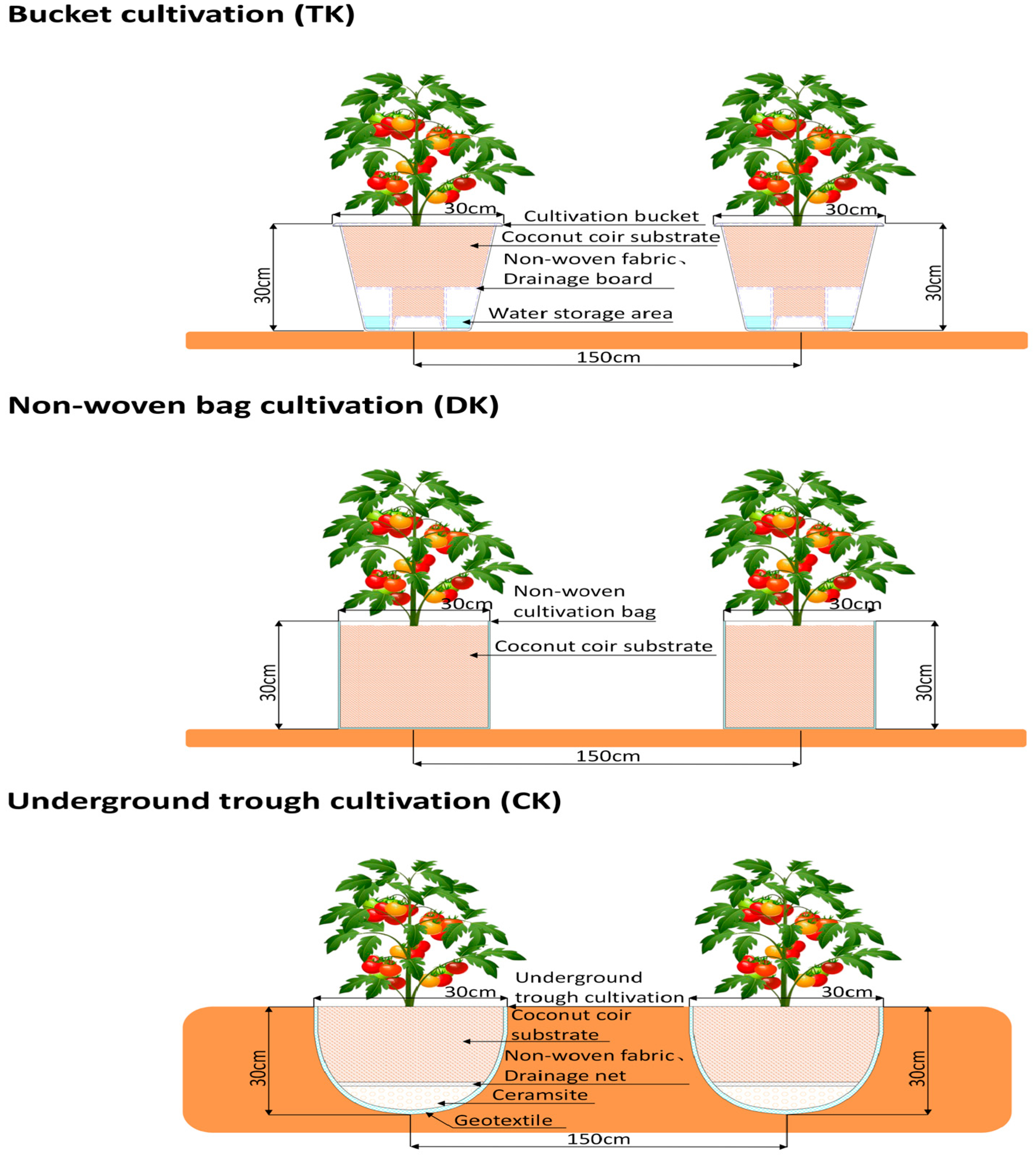
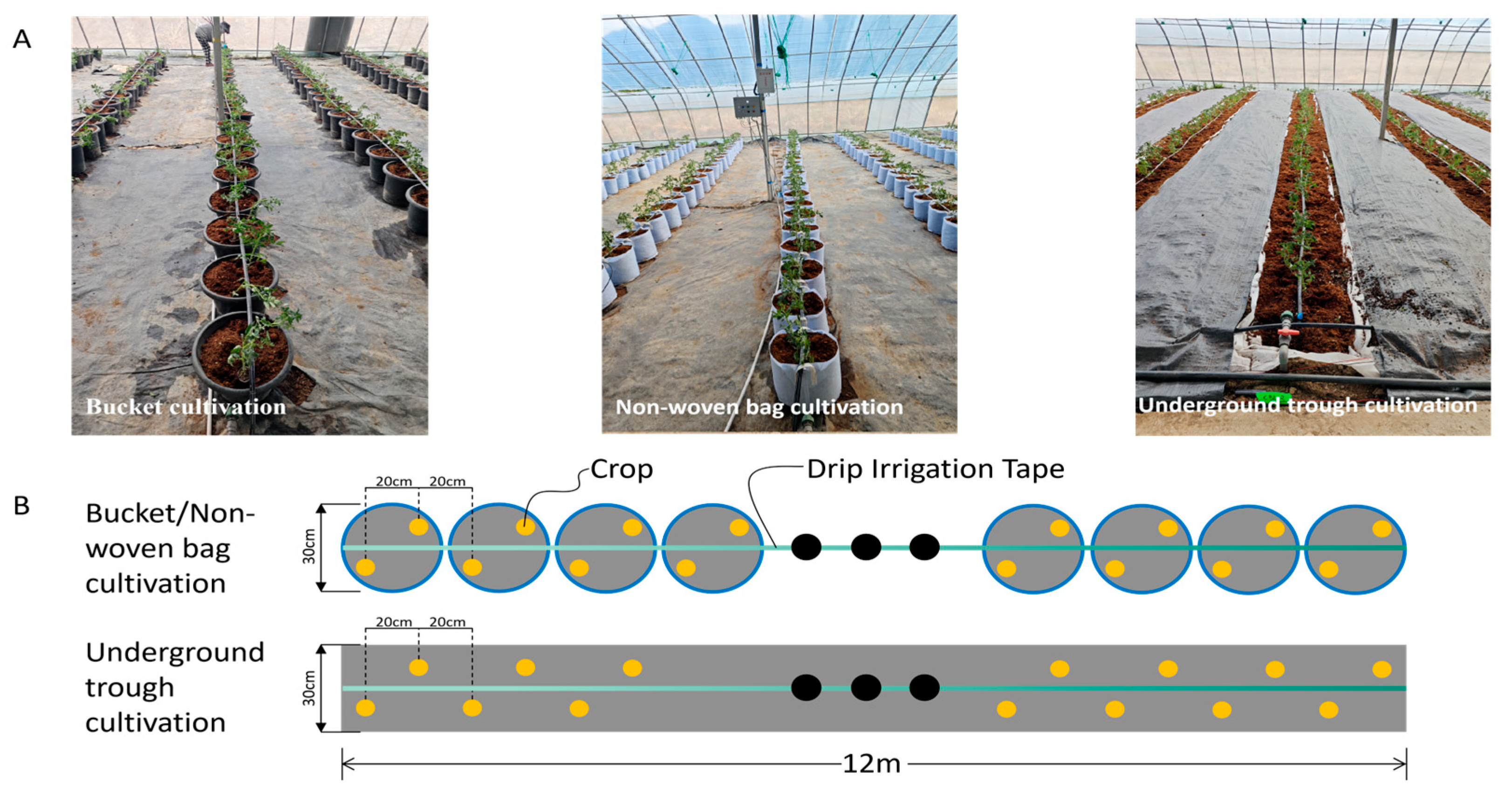
2.3. Experimental Design and Cultivation Treatments
A single-factor completely randomized design with three biological replications was adopted in this study, with a total of 9 experimental plots (3 cultivation methods × 3 replications). Each plot was a 12-m-long single row containing approximately 60 tomato plants, with 180 plants per cultivation method. For the determination of yield and quality, 1 m at both ends of each row was discarded to eliminate edge effects. The three cultivation treatments were as follows:
Five-leaf stage tomato seedlings (Solanum lycopersicum L. cv. ‘Provence’) were transplanted on 15 August 2024, with 1.5 m row spacing and 20 cm plant spacing. Treatments were randomly assigned within each block to minimize greenhouse environmental variability effects.
2.4. Irrigation, Fertigation, and Crop Management
Each treatment was equipped with pressure-compensating drip irrigation tape (flow rate: 1.0 L h−1; emitter spacing: 20 cm). All treatments adopted the same daily fixed-time and fixed-quantity irrigation schedule with consistent fertigation frequency and equal nutrient solution supply throughout the growing period. The total fertilizer application rates were 340 kg/hm2 for nitrogen (N), 180 kg/hm2 for phosphorus (P), and 300 kg/hm2 for potassium (K). Fertilizers were uniformly applied through drip fertigation to ensure consistent nutrient input across all cultivation treatments. All other agronomic practices, including pruning, pollination and pest management, were consistently conducted following standard commercial greenhouse management protocols for high-wire tomato production.
2.5. Data Collection and Measurements
2.5.1. Substrate Physicochemical Properties
Before transplanting, five random substrate samples per plot were collected from each plot, mixed, air-dried, and analyzed for physicochemical properties including total nitrogen (TN), soil organic matter (SOM), alkali-hydrolyzable nitrogen, available phosphorus (AP), pH, electrical conductivity (EC), and bulk density, following conventional analytical methods [
19,
20].
2.5.2. Root-Zone Environment Monitoring
Throughout the entire tomato growing season, fixed sensors were used for all-day continuous monitoring of root-zone substrate moisture content, temperature and electrical conductivity. In each experimental plot, three measuring points were arranged in an S-shaped pattern at a uniform soil depth of 15 cm. The collected data were finally used to calculate daily average values and treatment average values for statistical analysis.
2.5.3. Plant Growth and Physiological Measurements
At 30, 45, 60, 75, and 90 days after transplanting (DAT), five uniform plants per plot were tagged. Plant height (cotyledonary node to apical meristem), stem diameter (1 cm above cotyledonary node), and number of fully expanded main stem leaves were measured. Chlorophyll relative content (SPAD) was determined on the youngest fully expanded leaf using a SPAD-502 (Konica Minolta, Tokyo, Japan).
2.5.4. Yield and Fruit Quality Analysis
Marketable fruits were harvested multiple times at commercial ripeness (full red color). Total fresh weight per plot was recorded and converted to yield per hectare; average fruit weight was calculated from 10 random fruits per plot. At peak harvest, 15 fruits per treatment (5 per replication) were sampled for quality analysis: lycopene (spectrophotometric method after acetone-hexane extraction), vitamin C (2,6-dichlorophenol-indophenol titration), nitrate (ultraviolet spectrophotometry after water extraction), and soluble sugar (anthrone-sulfuric acid method). All analyses were conducted at the certified analysis and testing center of the College of Horticulture, Tarim University.
2.6. Statistical Analysis
Data were organized using Microsoft Excel 2016 (Microsoft Corporation, Redmond, WA, USA) and analyzed with SPSS Statistics 25.0 (IBM Corp., Armonk, NY, USA). One-way ANOVA was used to evaluate differences among treatments, and Fisher’s LSD test (p < 0.05) was used for mean comparisons. All figures were generated with OriginPro 2025 (OriginLab Corporation, Northampton, MA, USA). All growth parameters were analyzed separately at each sampling date, and the time effect was not included in the one-way ANOVA model.
3. Results
3.1. Daily Mean and Hourly Variations in Substrate Temperature, Moisture Content, and Electrical Conductivity (EC) Under Different Cultivation Methods
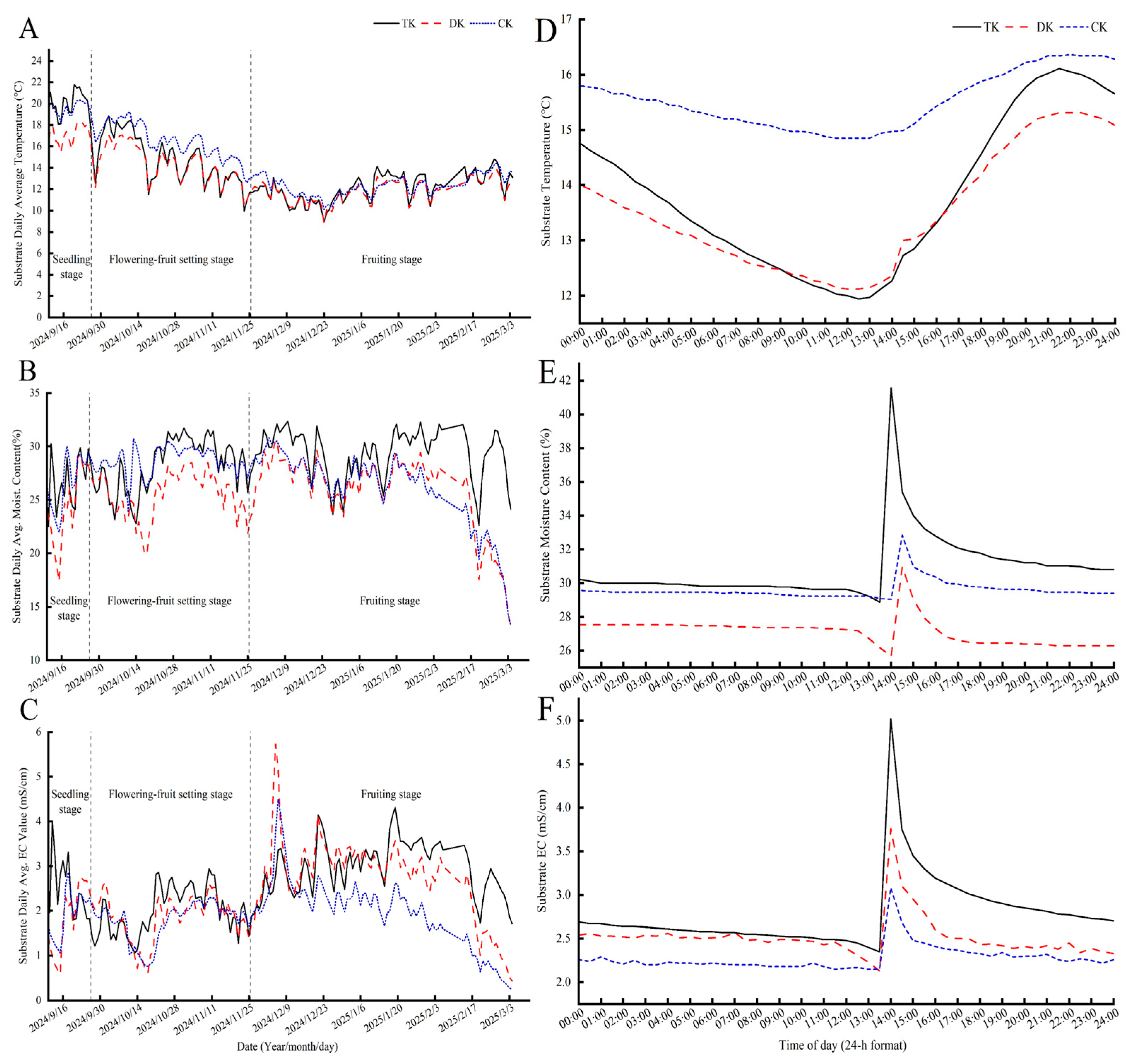
Figure 3 presents the daily mean and hourly variations in substrate temperature, moisture content, and electrical conductivity (EC) under three cultivation methods (bucket cultivation, TK; non-woven bag cultivation, DK; underground trough cultivation, CK). For the daily mean values (
Figure 3A–C), substrate temperature (
Figure 3A) differed among the systems: TK maintained relatively lower and more stable temperatures, DK exhibited greater fluctuations, and CK maintained relatively higher temperatures with moderate variation. Moisture content (
Figure 3B) showed a similar pattern: TK maintained relatively high moisture levels during most of the monitoring period, DK exhibited more pronounced variation, and CK displayed intermediate and relatively stable moisture levels. EC values (
Figure 3C) also varied among treatments: TK showed relatively higher EC levels, DK exhibited greater temporal variability, and CK maintained lower and more stable EC levels. Overall, the three cultivation systems showed distinct patterns in substrate temperature, moisture, and EC, reflecting differences in their root-zone environmental conditions. For the hourly variations (
Figure 3D–F), substrate temperature followed a typical diurnal pattern, with increases during the daytime and decreases at night across all treatments. CK maintained the highest temperatures, followed by TK, while DK showed the lowest temperatures with greater fluctuations. Moisture content responded clearly to irrigation events, with TK maintaining relatively high levels, DK showing lower levels with greater variability, and CK exhibiting intermediate fluctuations. EC remained relatively stable during most daytime periods but increased after irrigation, with TK showing higher EC peaks, DK exhibiting more pronounced variation, and CK maintaining lower levels.
Overall, the three cultivation systems exhibited distinct daily mean and hourly variation patterns, highlighting differences in root-zone environmental conditions.
3.2. Effects of Different Cultivation Methods on Tomato Agronomic Traits
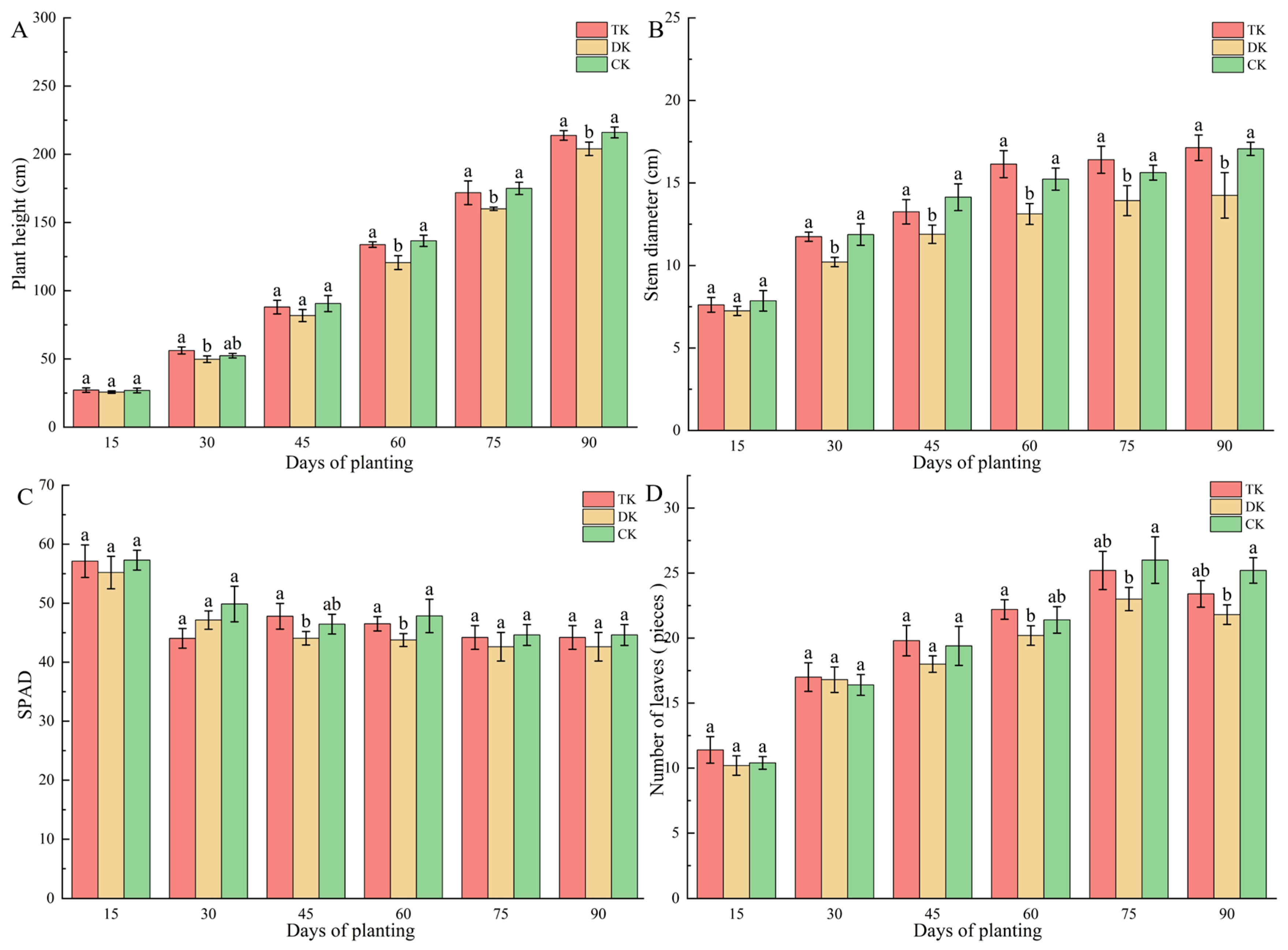
Figure 4 shows the dynamic changes in tomato growth traits under different cultivation methods (TK, DK, CK). As shown in
Figure 4A, tomato plant height increased with days after transplanting (DAT), and cultivation methods significantly affected plant height, especially during 60–90 DAT. During this period, plant heights under TK and CK were significantly greater than under DK, with increases of 4.80–10.95% and 5.88–13.27%, respectively.
As shown in
Figure 4B, tomato stem diameter also increased with DAT, with significant differences among cultivation methods, particularly during 60–90 DAT. Stem diameter grew rapidly in the first 60 DAT, then slowed down. During 60–90 DAT, stem diameters under TK and CK were significantly greater than under DK, with no significant difference between TK and CK. Compared to DK, TK increased stem diameter by 15.00%, 11.47%, 23.03%, 17.78%, and 20.25% at 30, 45, 60, 75, and 90 DAT, respectively; CK increased stem diameter by 16.29%, 18.89%, 16.10%, 12.18%, and 19.80% at the same time points.
As shown in
Figure 4C, tomato SPAD values decreased with DAT, with significant differences among cultivation methods, especially during 45–60 DAT. No significant differences were observed among treatments in the first 30 DAT. From 60 to 90 DAT, SPAD values stabilized across all treatments. During 45–60 DAT, SPAD values under TK and CK were significantly higher than under DK (no significant difference between TK and CK), with increases of 6.26–8.44% and 5.45–9.32%, respectively, compared to DK.
As shown in
Figure 4D, tomato leaf number increased with DAT, with significant differences among cultivation methods, particularly during 60–90 DAT. Leaf number increased markedly in the first 75 DAT, then slowed down and stabilized during 75–90 DAT. During 60–90 DAT, leaf numbers under TK and CK were significantly greater than under DK (no significant difference between TK and CK). Compared to DK, TK increased leaf number by 9.90%, 9.56%, and 7.33% at 60, 75, and 90 DAT, respectively; CK increased leaf number by 5.94%, 13.04%, and 15.59% at the same time points.
3.3. Effects of Different Cultivation Methods on Tomato Yield
As shown in
Table 2, different cultivation methods significantly affected tomato yield per plant and total yield per unit area but had no significant effect on the number of fruits per plant. There was no significant difference in the number of fruits per plant among bucket cultivation (TK), non-woven bag cultivation (DK), and underground trough cultivation (CK); compared with DK, TK and CK increased the number of fruits per plant by 7.39% and 5.56%, respectively.
Yield per plant was significantly higher in TK (2.71 kg) and CK (2.60 kg) than in DK, with increases of 23.18% and 18.18%, respectively, and no significant difference was found between TK and CK. Similarly, total yield per unit area was highest in TK (87.36 t) and CK (86.81 t), which were significantly higher than DK by 19.31% and 18.55%, respectively, with no significant difference between TK and CK.
3.4. Effects of Different Cultivation Methods on Tomato Quality
As shown in
Table 3, cultivation methods significantly affected all measured tomato quality indicators. Non-woven bag cultivation (DK) had the highest lycopene and soluble sugar contents, intermediate vitamin C (VC) and organic acid contents, and the lowest nitrate content. Underground trough cultivation (CK) had the highest VC and organic acid contents, while bucket cultivation (TK) had the highest nitrate content.
Specifically, DK’s lycopene content was significantly higher than TK’s (76.33% increase) and CK’s (136.04% increase). CK’s VC content was significantly higher than DK (26.09% increase) and TK (45.87% increase). TK’s nitrate content was significantly higher than CK’s and DK’s; DK had the lowest nitrate content, 67.16% and 65.89% lower than TK and CK, respectively. DK’s soluble sugar content was significantly higher than TK (17.60% increase) and CK (53.60% increase). CK’s organic acid content was significantly higher than that of DK and TK, while no significant difference was found between DK and TK.
4. Discussion
The root-zone environment is critical for crop performance, and our results show that different cultivation methods significantly affect the physical and chemical stability of the root zone in Gobi Desert greenhouses: underground trough cultivation (CK) provides the most stable root-zone environment with minimal fluctuations in temperature, moisture, and EC; bucket cultivation (TK) maintains high moisture levels but tends to accumulate salt; and non-woven bag cultivation (DK) has the highest variability in root-zone parameters due to limited substrate volume and poor buffering capacity. These differences in root-zone environment may contribute to variations in tomato growth, with CK and TK supporting superior plant growth in terms of plant height, stem diameter, and SPAD values, while DK constrains growth due to unstable root-zone conditions.
In terms of fruit quality, CK and TK improve vitamin C and organic acid contents, while DK has the highest lycopene and soluble sugar contents with the lowest nitrate concentration. On the other hand, it also indicates that the substrate water retention capacity and root-zone environmental buffering performance of DK are weaker than those of TK and CK. Although DK inhibits plant growth to a certain extent and reduces yield, the moderate rhizosphere microenvironmental stress formed under this condition is conducive to promoting the accumulation of flavor and nutritional substances such as lycopene and soluble sugar in fruit, and meanwhile reduces the nitrate content.
Overall, underground trough cultivation (CK) is the most robust system for greenhouse tomato cultivation in arid Gobi regions, bucket cultivation (TK) is a viable high-yield alternative requiring proper irrigation management to avoid salt accumulation, and non-woven bag cultivation (DK) is less suitable for long-term stable production due to its poor environmental buffering capacity, despite its advantage in improving intrinsic fruit quality via moderate rhizosphere stress.
5. Conclusions
This study clarified the effects of different cultivation systems on the root-zone environment and growth of greenhouse tomatoes in the arid Gobi Desert. The results confirm that cultivation structure significantly shapes root-zone temperature, moisture, and salinity, thereby affecting tomato growth and yield. Underground trough cultivation maintained stable root-zone conditions, supporting balanced plant growth and higher yield. Bucket cultivation promoted vigorous plant growth and high productivity but required reasonable irrigation management to mitigate salt accumulation. Non-woven bag cultivation exhibited greater variability in root-zone environmental parameters. Cultivation systems also differed markedly in regulating fruit quality at the peak harvest stage: underground trough and bucket cultivation improved yield and conventional nutritional indexes, while non-woven bag cultivation obtained higher lycopene and soluble sugar contents in harvested fruits. This study highlights the importance of cultivation system design for optimizing root-zone microenvironments in arid protected agriculture and provides a scientific basis for selecting and optimizing tomato cultivation patterns in the Gobi Desert and similar arid regions. From a practical production perspective, underground trough cultivation is recommended as the priority mode for large-scale stable production in Gobi greenhouses. Bucket cultivation can be adopted as a high-yield alternative, with strict irrigation and salt regulation management. Non-woven bag cultivation is not suitable for long-term continuous cropping but can be appropriately applied for high-quality fruit production under a limited planting scale.
This study was conducted with a single tomato cultivar and only in one growing season, and economic benefit analysis was not included. Future research should expand to multiple cultivars and growing seasons and further combine economic evaluation to provide more comprehensive theoretical and technical support for the sustainable development of facility agriculture in arid Gobi regions.
Author Contributions
Conceptualization, W.Z. and Y.M.; methodology, P.Z.; software, J.L. and L.W.; validation, W.Z.; formal analysis, W.Z. and Y.M.; investigation, X.L.; resources, P.Z.; data curation, W.Z.; writing—original draft preparation, W.Z.; writing—review and editing, W.Z. and H.W.; visualization, W.Z.; supervision, X.L.; project administration, W.Z.; funding acquisition, H.W. and P.Z. All authors have read and agreed to the published version of the manuscript.
Funding
This work was supported by the Demonstration of Key Technologies for Green Development of Ecological Agriculture in Gobi (2023B02024-2); the Xinjiang Autonomous Region “Agriculture, Rural Areas and Farmers” Backbone Talent Training Program (2024SNGGGCC037); the Project of Fund for Stable Support to Agricultural Sci-Tech Renovation (xjnkywdzc-2026002-9-2); the National Natural Science Foundation of China (52509081); the Natural Science Foundation of Beijing (8254048); and the Central Public-interest Scientific Institution Basal Research Fund (No.BSRF202607).
Data Availability Statement
The original data presented in this study are included in the article. Further inquiries can be directed to the corresponding author.
Acknowledgments
We thank all who contributed to the research effort and the earlier version of the manuscript.
Conflicts of Interest
The authors declare no conflicts of interest.
References
- Niu, N.; Guo, J.F.; Jing, B.; Jiang, X.Y.; Zhao, M.W.; Diao, M. Effects of different irrigation methods on growth and quality of facility cherry tomato. Xinjiang Agric. Sci. 2021, 58, 2094–2102. [Google Scholar] [CrossRef]
- Institute of Vegetables and Flowers, Chinese Academy of Agricultural Sciences. Chinese Vegetable Cultivation; Agriculture Press: Beijing, China, 1987; p. 624. [Google Scholar]
- Yue, D.; Liu, N.; Zhu, W.M.; Guo, S.R. Analysis of Amino Acid Composition and Several Quality Indicators of Cherry Tomato and Common Tomato. Food Sci. 2015, 36, 92–96. [Google Scholar] [CrossRef]
- Feng, X.H.; Wang, Y.G.; Feng, R.L.; Chang, C.C.; Dong, J.L. Effect of Different Cultivation Methods in Greenhouseon Tomato Growth, Yield and Quality. Ningxia Agric. For. Sci. Technol. 2023, 64, 30–32+44. [Google Scholar] [CrossRef]
- Zhang, B.D.; Lu, J.S.; Lan, Z.; Jiang, J. The Effects of Cultivation Patterns on Growth, Yield andQuality ofJingxin No. 3 Watermelon in Protected Production. China Cucurbits Veg. 2013, 26, 20–22. [Google Scholar] [CrossRef]
- Ma, R.H.; Huang, C.Y.; Cui, H.M.; Zheng, Y.H.; Fang, Y.; Wang, D.W. Effects of different planting modes of yellow sand substrateon tomato yield and quality in solar greenhouse. Xinjiang Agric. Sci. 2025, 62, 903–910. [Google Scholar] [CrossRef]
- Li, C.Y.; Tan, Z.M.; Cheng, Y.X.; Shu, S.; He, T.; Jin, Y.J.; Ma, X.C.; Du, J.G.; Zhang, J. The Influence of Water and Fertilizer Coupling on the Growth-development and Quality of Sand Culture Tomato. Xinjiang Agric. Sci. 2022, 59, 2158–2169. [Google Scholar] [CrossRef]
- Chen, L.; Yang, S.M.; Luan, Q.Q.; Yan, Z.S.; Wang, C.L.; Wang, Z.H. Effects of Yellow Sand Substrate Cultivation on Plant Growth andYield Quality of Facility Strawberry. North. Hortic. 2021, 61–69. [Google Scholar]
- Yan, Z.S.; Yang, S.M.; Zhang, Y.P.; Wang, L.; Chen, L.; Wang, C.L.; Zhang, X.P. Effects of different yellow sand cultivation modes on growth, yield, photo-synthetic characteristics and quality of tomato in greenhouse. China Cucurbits Veg. 2023, 36, 100–106. [Google Scholar]
- Yang, S.M.; Wang, S.Y.; Yan, Z.S.; Wang, C.L.; Chen, L.; Zhang, X.P. Effects of Different Cultivation Patterns of Yellow Sand onGrowth, Yield and Quality of Tomato in Greenhouse. North. Hortic. 2021, 25–29. [Google Scholar]
- Zhang, X.Y.; Tian, L.; Wu, P.; Gao, Y.M.; Li, J.S. Changes of soil nutrients and microbial community diversity in responses todifferent growth environments and cultivation practices in 30 years. J. Plant Nutr. Fertil. 2015, 21, 1585–1593. [Google Scholar] [CrossRef]
- Han, Y.; Lu, L.; Wang, L.; Liu, Z.; Huang, P.; Chen, S.; Li, Y.; Sun, M.; He, C.; Wang, J.; et al. In-situ straw return, combined with plastic film use, influences soil properties and tomato quality and yield in greenhouse conditions. Agric. Commun. 2024, 2, 100028. [Google Scholar] [CrossRef]
- Maikairebang, T.; Wang, Z.Z.; Dang, Y.L.; Nie, W.D.; Du, C. Investigation and Correlation Analysis of Agronomic Traits Diversityof 70 Fresh Food Tomato Germplasm Resources. Chin. J. Trop. Crops 2025, 46, 2102–2116. [Google Scholar] [CrossRef]
- Collins, E.J.; Bowyer, C.; Tsouza, A.; Mridula, C. Tomatoes: An extensive review of the associated health impacts of tomatoes and factors that can affect their cultivation. Biology 2022, 11, 239. [Google Scholar] [CrossRef]
- Helyes, L.; Dimény, J.; Pék, Z.; Lugasi, A. Effect of the variety and growing methods as well as cultivation conditions on the composition of tomato (Lycopersicon lycopersicum (L.) Karsten) fruit. In Proceedings of the IV International Conference on Managing Quality in Chains-The Integrated View on Fruits and Vegetables Quality 712, Bangkok, Thailand, 30 June 2006; pp. 511–516. [Google Scholar] [CrossRef]
- Tzortzakis, N.G.; Economakis, C.D. Impacts of the substrate medium on tomato yield and fruit quality in soilless cultivation. Hortic. Sci. 2008, 35, 83–89. [Google Scholar] [CrossRef]
- Fanourakis, D.; Tsaniklidis, G.; Makraki, T.; Nikoloudakis, N.; Bartzanas, T.; Sabatino, L.; Fatnassi, H.; Ntatsi, G. Climate Change Impacts on Greenhouse Horticulture in the Mediterranean Basin: Challenges and Adaptation Strategies. Plants 2025, 14, 3390. [Google Scholar] [CrossRef] [PubMed]
- Fanourakis, D.; Makraki, T.; Spyrou, G.P.; Karavidas, I.; Tsaniklidis, G.; Ntatsi, G. Environmental Drivers of Fruit Quality and Shelf Life in Greenhouse Vegetables: Species-Specific Insights. Agronomy 2025, 16, 48. [Google Scholar] [CrossRef]
- He, Z.X.; Zhu, H.X.; Zhang, Y.X.; Wei, M.; Tao, X.L.; Lu, L.X. Effects of chemical fertilizer reduction and organic fertilizer on yield andquality of tomato. China Cucurbits Veg. 2025, 38, 146–151. [Google Scholar] [CrossRef]
- Wen, Z.; Wang, Y.; Wen, X.Z.; Li, Y.L. Effects of different cultivation methods on yield and quality of substrate-cultured tomato in solar greenhouse. Agric. Eng. Technol. 2021, 41, 58–63. [Google Scholar] [CrossRef]
| Disclaimer/Publisher’s Note: The statements, opinions and data contained in all publications are solely those of the individual author(s) and contributor(s) and not of MDPI and/or the editor(s). MDPI and/or the editor(s) disclaim responsibility for any injury to people or property resulting from any ideas, methods, instructions or products referred to in the content. |




 and
and