Article

Quantifying Manure’s Fertilizer Nitrogen Equivalence to Optimize Chemical Fertilizer Substitution in Potato Production


1
College of Agronomy, Inner Mongolia Agricultural University, Huhhot 010019, China
2
Inner Mongolia Academy of Agricultural & Animal Husbandry Sciences, Huhhot 010031, China
3
College of Resource and Environment, Inner Mongolia Agricultural University, Huhhot 010011, China
*
Author to whom correspondence should be addressed.
These authors contributed equally to this work.
Agronomy 2025, 15(12), 2817; https://doi.org/10.3390/agronomy15122817
Submission received: 4 November 2025 / Revised: 4 December 2025 / Accepted: 4 December 2025 / Published: 8 December 2025

Abstract

Accurate quantification of the Fertilizer Nitrogen Equivalence (FNE) of manure is crucial for optimizing integrated nitrogen (N) management and reducing chemical fertilizer use in potato production. However, uncertainties persist regarding FNE’s response to varying application rates and estimation methodologies. A two-year field experiment in Inner Mongolia, China, evaluated multi-gradient sheep manure applications in potato systems to determine whether FNE exhibits diminishing returns with increasing manure rates and to assess the influence of different estimation approaches. Potato N uptake, tuber yield, and growth parameters were measured. FNE was estimated using four methods: total N uptake, fertilizer-derived N uptake, absolute tuber yield, and yield increment. The key findings were: (1) Potato yield and total N uptake increased with higher N inputs but followed the law of diminishing returns. Notably, FNE values remained statistically stable across a wide application range (180–1200 kg N ha−1, equivalent to 8–53 t ha−1 of sheep manure), with no significant decline observed (p > 0.05), regardless of the estimation method. (2) Yield-based FNE values were, on average, 41% lower than those based on N uptake, indicating inefficiencies in converting absorbed N into tuber biomass. Among the methods, the yield increment approach demonstrated the highest consistency and robustness across treatments. In conclusion, our study demonstrates that the FNE of sheep manure remains stable across a broad application range in potato systems, with no evidence of diminishing returns. For practical fertilizer substitution, we recommend using the yield increment-based FNE estimation, as it provides a reliable and agronomically relevant measure for guiding manure application aimed at reducing chemical N inputs while maintaining crop productivity.

1. Introduction

Livestock manure is a valuable source of nitrogen (N) in agricultural systems, offering a range of benefits beyond nutrient supply. Its application enhances soil fertility, improves water retention capacity, and promotes better soil structure [1], while also helping to reduce environmental pollution linked to excessive use of synthetic fertilizers. This practice has gained renewed global attention, particularly in regions where overreliance on chemical fertilizers has led to declining soil quality, environmental degradation, and concerns over food safety.
Despite its advantages, substantial evidence indicates that fully replacing chemical N fertilizers with manure can lead to reduced crop yields [2,3]. As a result, integrated nutrient management strategies that combine organic and inorganic sources have emerged as a balanced approach to sustain crop productivity while progressively enhancing soil health [2,4].
Potato (Solanum tuberosum L.) presents unique challenges in N management due to its high N demand, shallow root system, and low root density [5,6], all of which contribute to relatively low nitrogen use efficiency (NUE). This biological context necessitates precise coordination between organic amendments and mineral N fertilization to ensure adequate N availability while minimizing environmental risks. Long-term studies have shown that the agronomic value of manure cannot be directly equated to its total N content [7], as Kjeldahl-measured organic N often exceeds the amount of N mineralized within the application year [8].
Regional studies consistently demonstrate that substituting chemical fertilizers with manure based on equivalent measured N contents often leads to yield reductions in potato production [9,10,11,12]. This highlights the importance of accurately quantifying the actual N availability in manure using frameworks such as Fertilizer Nitrogen Equivalence (FNE) or Nitrogen Fertilizer Replacement Value (NFRV) [13].
Current FNE estimation methods typically involve: (1) establishing crop yield or N uptake response curves to chemical N fertilizer, (2) determining the amount of N fertilizer required to achieve equivalent yield or N uptake under manure application, and (3) calculating FNE as the ratio of this equivalent to the applied manure-derived N [14,15,16]. FNE values have been reported across various crop–manure–region scenarios [16,17,18,19,20]. However, it remains unclear whether the FNE of manure follows the law of diminishing returns, a well-established phenomenon for chemical fertilizers. Understanding this relationship is essential for optimizing organic–inorganic fertilization ratios and developing effective manure management strategies.
Moreover, divergent FNE estimation methods often yield inconsistent values, and no consensus currently exists on the most appropriate approach for guiding manure application rates. Critically, no previous studies have explicitly tested whether manure FNE exhibits diminishing returns with increasing application rate in potato systems. To address these gaps, we conducted field experiments involving multi-gradient sheep manure applications in potato production in Inner Mongolia, China’s largest potato-producing region. The objectives of this study were to: (1) quantify the effects of manure nitrogen application rates on FNE, and (2) evaluate how different estimation methods influence FNE values.

2. Materials and Methods

2.1. Experimental Site Description

Field experiments were conducted during the 2023 and 2024 growing seasons in Kebul, Inner Mongolia, China (41°06′–41°29′ N, 111°55′–112°49′ E; altitude 1780 m). The experimental period extended from May to September in both years, covering the local potato growing cycle. The region has an average annual temperature of 1.3 °C, approximately 3000 h of sunshine, a frost-free period of around 100 days, and low annual precipitation averaging 300 mm. The soil at the experimental site is classified as chestnut limestone. Baseline soil chemical properties and manure nutrient content, determined from four replicated analyses, are presented in Table 1.

2.2. Experimental Design

The potato cultivar Jinshu 16 was used in the experiments. In 2023, treatments included five sheep manure N application rates (180, 360, 540, 720, and 900 kg N ha−1), five chemical fertilizer N rates (90, 180, 270, 360, and 450 kg N ha−1), and a no-N control (CK). In 2024, four manure N rates (300, 600, 900, and 1200 kg N ha−1), four fertilizer N rates (150, 300, 450, and 600 kg N ha−1), and CK were tested (Table 2).
All treatments received basal applications of 180 kg P2O5 ha−1 and 300 kg K2O ha−1. Drip irrigation was employed throughout the growing season. For chemical N treatments, 30% of urea–N was applied basally, followed by 40% and 30% through fertigation at the tuber initiation and bulking stages, respectively. Sheep manure was applied as a basal amendment prior to planting, with nutrient content detailed in Table 1.
The experiment followed a randomized complete block design with three replications. Each plot measured 10 × 9 m2, containing 405 plants to maintain a uniform planting density of 45,000 plants ha−1 across all treatments.

2.3. Measurements and Analytical Methods

Biomass: At five key growth stages—seedling (20 days after emergence, DAE), tuber initiation (40 DAE), tuber bulking (60 DAE), starch accumulation (80 DAE), and harvest (100 DAE)—four plants were randomly sampled from each plot. Plants were separated into tubers, roots, underground stems, aboveground stems, and leaves. Samples were oven-dried at 110 °C for 30 min to deactivate enzymes, then dried at 80 °C for 72 hours to constant weight for dry biomass determination.
Plant nitrogen concentration: Dried plant tissues (including tubers, roots, stems, and leaves) were ground to pass through a 0.5 mm sieve. Total nitrogen concentration was determined by the Kjeldahl method [21]. Approximately 0.2 g of ground sample was digested with H2SO4 and a catalyst mixture (K2SO4/CuSO4/Se) at 380 °C. The digest was then distilled with NaOH, and the released ammonia was trapped in H3BO3 and titrated with standardized HCl.
Leaf area index (LAI): LAI was determined using the punch method [22]. Briefly, thirty leaves per plant were randomly selected and aligned by the midrib. A 1 cm2 punch was used to obtain disks from both sides of the midrib. The total area of a leaf (Aleaf cm2) was calculated based on the dry weight ratio using the following equation:
Aleaf = (Wleaf/Wdisks) × Adisks
where Wleaf is the dry weight of the entire leaf, Wdisks is the dry weight of all disks punched from that leaf, and Adisks is the total area of the disks. The total leaf area per plant was the sum of Aleaf for all sampled leaves. LAI was then calculated as the total leaf area per plant divided by the ground area occupied per plant (0.222 m2, based on a planting density of 45,000 plants ha−1).
Tuber yield: At harvest, yield was assessed by sampling eight 2 m ridge segments per plot. Total yield (t ha−1) and marketable tuber rate (tubers ≥ 150 g) were recorded.

2.4. Statistical Analysis and Calculations

Data were analyzed using SPSS 25.0 (SPSS Inc., Chicago, IL, USA) and analysis of variance (ANOVA) were conducted at p < 0.05. Regression analyses were performed using Microsoft Excel 2016 (Microsoft Corp., Redmond, WA, USA) and SPSS 25.0 (SPSS Inc., Chicago, IL, USA). Nitrogen recovery efficiency (RE) (%) was calculated as:
RE = (Plant N uptake in fertilized plot − Plant N uptake in unfertilized plot)/Total N applied × 100%
The Fertilizer Nitrogen Equivalence (FNE) of sheep manure was estimated by comparing the crop response (N uptake or yield) under manure application to the response curve generated from chemical fertilizer treatments. Specifically, regression equations (e.g., quadratic models) were developed to describe the relationship between the chemical fertilizer N rate (x) and the observed crop response (y), including total N uptake, fertilizer-derived N uptake, tuber yield, and yield increment relative to the control. The assumptions of the regression models, including linearity and homoscedasticity, were checked and found to be satisfactory. All regression models were statistically significant (p < 0.05).
Fertilizer-derived N uptake was calculated for both chemical fertilizer and manure treatments using the difference method:
Fertilizer-derived N uptake = (Plant N uptake in fertilized plot) − (Plant N uptake in the unfertilized control plot)
This value represents the net increase in N uptake attributable to the applied nitrogen source.
To calculate FNE for a given manure treatment, the observed manure-induced response (e.g., fertilizer-derived N uptake) was substituted into the corresponding chemical fertilizer regression equation. The equation was then solved to find the equivalent chemical fertilizer N rate required to achieve the same response level. The FNE was finally calculated as:
FNE (%) = (Equivalent fertilizer N rate/Applied manure N rate) × 100%

3. Results

3.1. Plant Growth and Tuber Yield

As shown in Table 3, potato tuber yield exhibited a significant response to increasing nitrogen (N) application rates from both chemical and sheep manure sources. Direct comparison reveals that chemical N fertilizer resulted in superior maximum tuber yields compared to sheep manure. Specifically, the highest yields under chemical fertilizer (F360/F450 in 2023; F300/F450 in 2024) significantly exceeded those achieved under the highest manure treatment (M900) in both years. Additionally, chemical fertilizer reached its yield plateau at a lower N rate (300–360 kg N ha−1) than sheep manure (900 kg N ha−1), indicating higher efficiency at optimal yield levels. However, at low to intermediate N rates, certain manure treatments produced yields comparable to their chemical fertilizer counterparts. Comparisons were made only among treatments within the same year. Marketable tuber rate also improved with increasing N application, a trend consistent across both N sources and years. Statistical analysis revealed that nitrogen application significantly enhanced marketable tuber quality. Compared to the no-N control (84.69% in 2023 and 85.90% in 2024), the marketable tuber rate under the M900 treatment increased significantly to 95.95% and 93.73%, respectively. In contrast, tuber number per plant remained statistically unchanged across most treatments. Consequently, the improvement in total yield was driven mainly by a significant increase in average tuber weight in response to higher N rates. Nitrogen uptake by potatoes was highly responsive to N application, increasing significantly from 153.95 to 160.37 kg ha−1 in the no-N control (CK) to a maximum of 272.95–285.51 kg ha−1 under the highest chemical fertilizer treatments across the two years. A clear dose–response relationship was observed for both nitrogen sources. Furthermore, at comparable application rates, chemical fertilizer treatments generally resulted in higher N uptake relative to sheep manure, highlighting differences in nitrogen availability and uptake efficiency between the two sources. Figure 1 illustrates dry matter accumulation across growth stages. During early development, no significant differences in plant dry weight were observed among treatments. As growth progressed, differences became more pronounced, with higher N rates leading to greater biomass accumulation. This trend was especially evident under manure treatments. For example, at 40 days after emergence (DAE) in 2023, dry weight was 14% higher under M720 than M360; by 100 DAE, this difference expanded to approximately 20%.
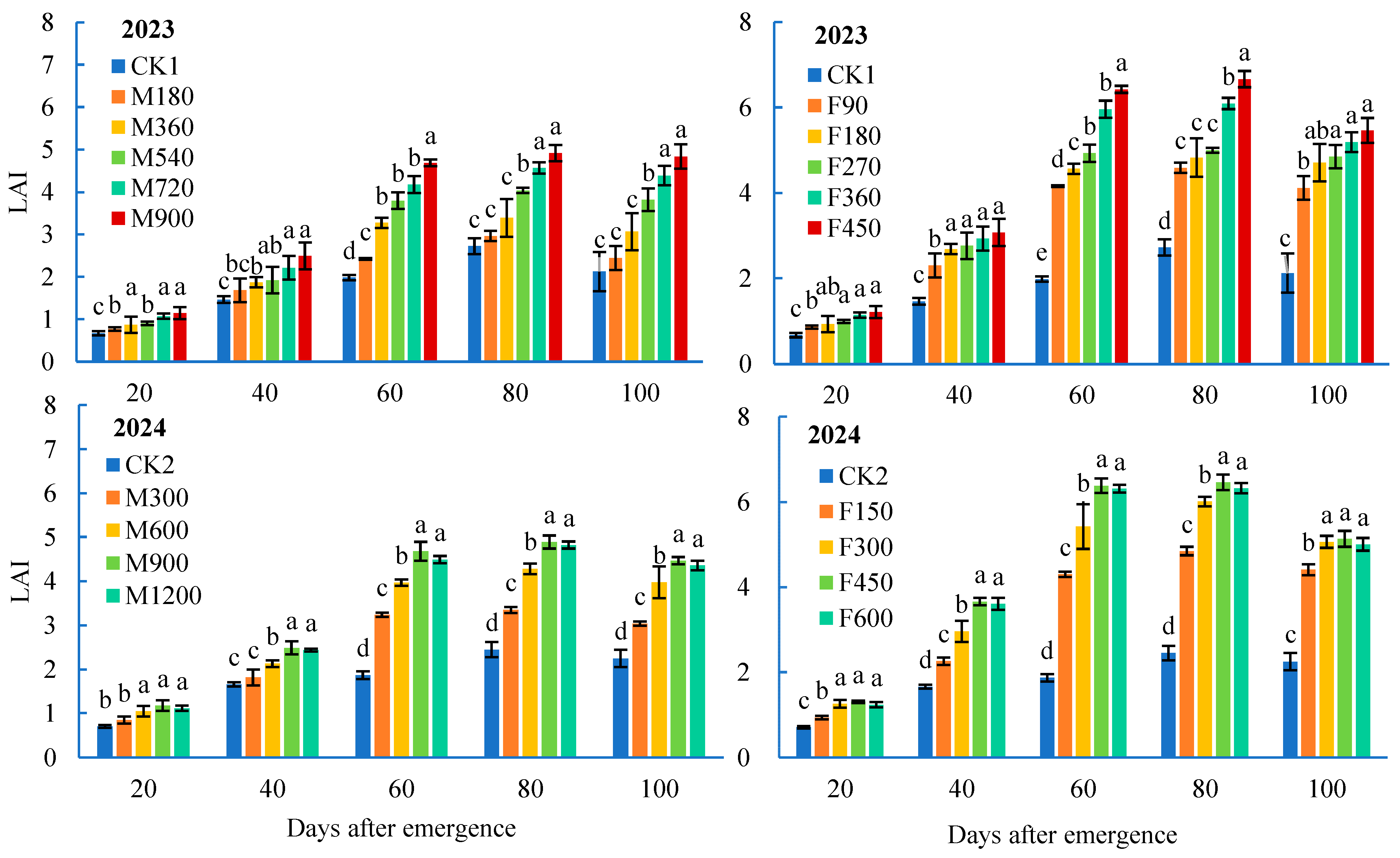
Leaf area index (LAI) increased with manure application rate at all growth stages in 2023, reaching a peak of approximately 5. In 2024, LAI plateaued beyond M900, with no significant difference between M900 and M1200 (p > 0.05). Under chemical fertilizer treatments, LAI continued to rise with increasing N rates, reaching a maximum of approximately 6.5 across both years. After 80 DAE (starch accumulation stage), LAI declined in all treatments, with a greater reduction observed under chemical fertilizer compared to manure treatments (Figure 2). Yield analysis indicated that maximum tuber yield occurred when LAI ranged between 5.5 and 6.0 during the bulking stage, with yield declining when LAI exceeded 6.0 (Table 3).

3.2. Nitrogen Uptake by Potato Plants

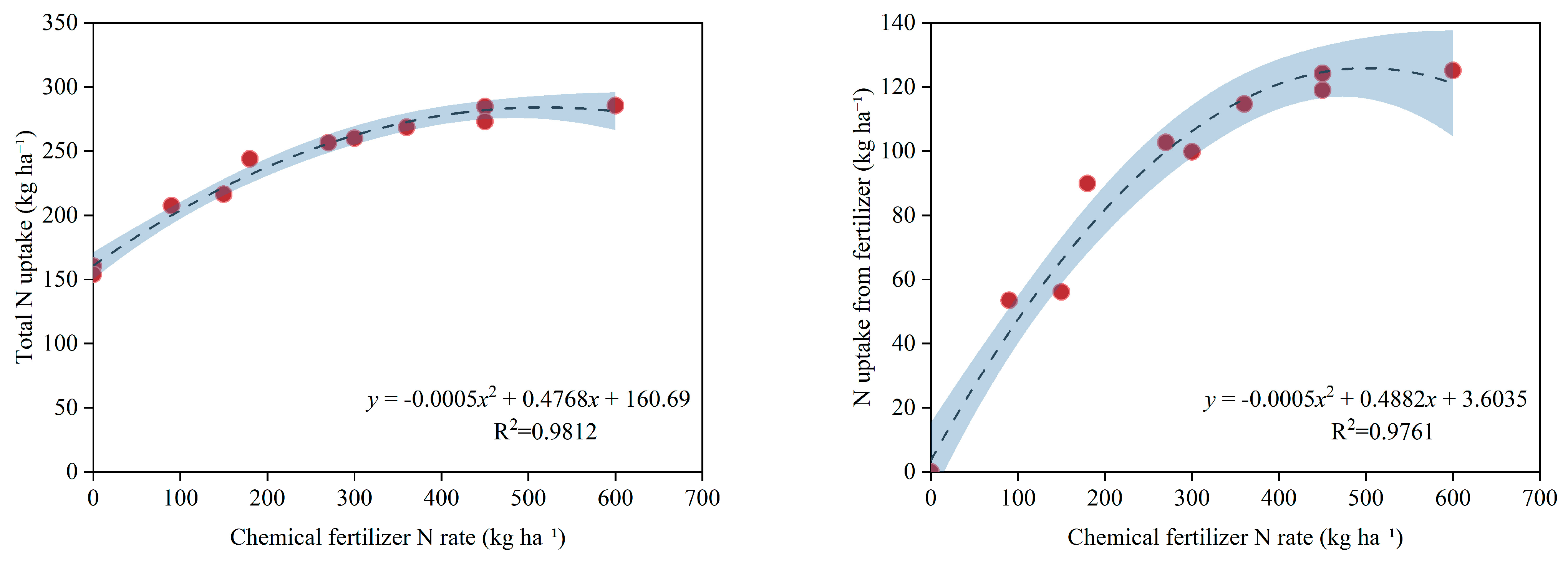
Total nitrogen uptake under chemical fertilizer treatments ranged from 207 to 285 kg N ha−1. Uptake increased with higher N application rates, but the rate of increase diminished progressively (Table 3). A significant quadratic relationship was observed between N uptake and fertilizer N rate (p < 0.05) in both years (Figure 3). As no significant year-to-year variation was detected (p > 0.05), a pooled regression model was developed.
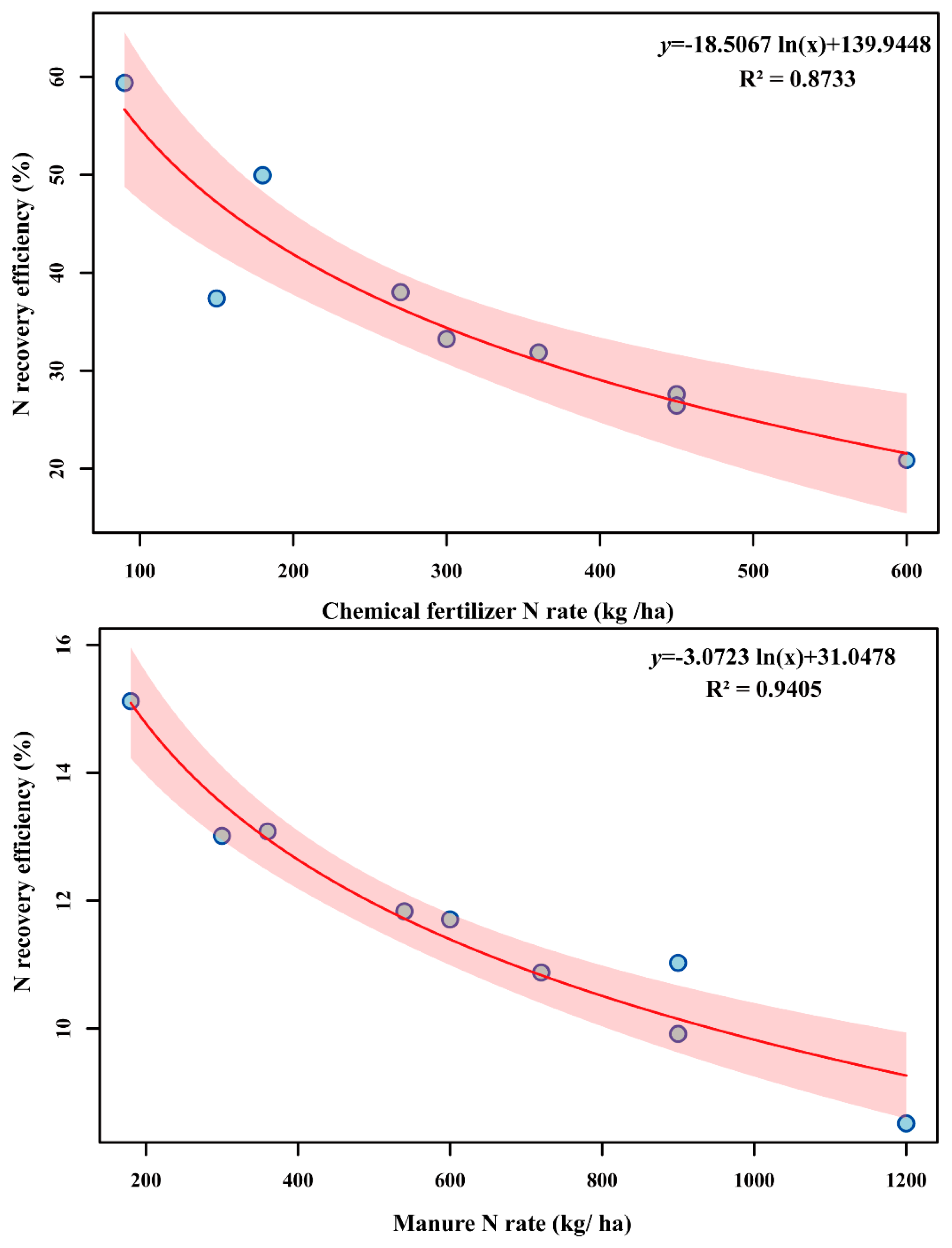
Nitrogen recovery efficiency (RE) declined with increasing fertilizer N rates. For example, RE was 60% at 90 kg N ha−1 (F150), but dropped to 25% at 600 kg N ha−1 (F600). RE exhibited a significant logarithmic relationship with N application rate (p < 0.05) (Figure 4).
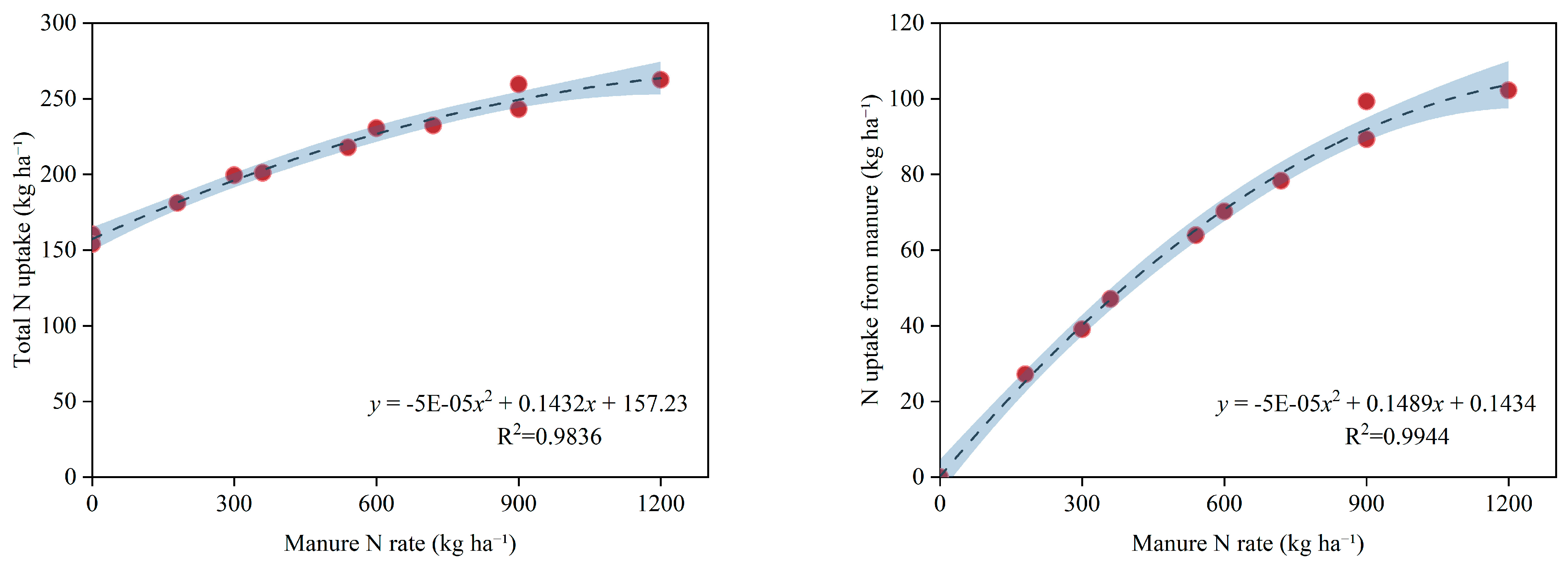
Under sheep manure treatments, total N uptake ranged from 181 to 262 kg N ha−1, significantly lower than that under chemical fertilizer (Table 3). Similarly to chemical N treatments, N uptake increased with manure application rate, but the rate of increase diminished at higher levels (Figure 5). RE also declined with increasing manure rates, from ~15% at M180 to ~10% at M900. A significant logarithmic relationship was observed between manure rate and RE (p < 0.05) (Figure 4).

3.3. Fertilizer Nitrogen Equivalence (FNE) of Sheep Manure in Potato Production

Manure-induced N uptake values (i.e., fertilizer-derived N uptake calculated via the difference method) from Table 3 were substituted into the fertilizer-derived N uptake equation. The equation was solved for x to obtain the equivalent chemical N rate. For instance, at M720 with a fertilizer-derived N uptake of 78 kg N ha−1, the equivalent fertilizer N rate was calculated to be 190 kg N ha−1, resulting in an FNE of (190/720) × 100%.
A parallel regression analysis was conducted using tuber yield and yield increase relative to the control. Significant quadratic relationships were observed (p < 0.05) (Supplemental Figure S1). Substituting yield or yield increase values (compared to the control) at each manure application rate into these equations allowed estimation of equivalent chemical N rates and corresponding FNE values. Table 4 summarizes FNE estimates across treatments and years. FNE values based on total N uptake ranged from 18.07% to 30.62%, with no significant decline at higher manure rates (p > 0.05). For instance, although M900 applied 2.5 times more N than M360, the FNE values were 22.16% and 22.87%, respectively. FNE estimates based on fertilizer-derived N uptake ranged from 23.78% to 30.14%, showing greater consistency (coefficient of variation, CV = 6.6%) than total N uptake-based estimates (CV = 16.1%).
FNE values derived from tuber yield ranged from 8.49% to 23.95%, while those based on incremental yield ranged from 10.78% to 24.30%. No manure rate-dependent decline in FNE was observed with either method (p > 0.05). The incremental yield method yielded more consistent results (CV = 28.1%) compared to absolute yield (CV = 31.8%, p < 0.05).
Overall, FNE estimates based on tuber yield were, on average, 41% lower than those derived from N uptake (Table 4), highlighting the importance of method selection in evaluating manure N equivalence.

4. Discussion

4.1. Yield and N Uptake Responses and Implications for Manure–Fertilizer Substitution

In this study, potato yield and total nitrogen uptake increased with rising manure-N inputs, yet both responses exhibited a clear diminishing-return pattern. This behavior mirrors the classical quadratic response commonly observed with mineral N fertilizers and reflects the physiological limitations of potato N assimilation. Unlike mineral fertilizers, however, where high N inputs typically trigger a sharp decline in agronomic efficiency, manure treatments displayed a more gradual plateauing of yield and N uptake. This suggests that sheep manure provides a steadier and more prolonged N release throughout the growing season.
Comparable findings from cool-temperate potato systems have reported similar ranges of first-year manure-N availability (approximately 10–40%) and similarly modest but stable yield responses [23,24]. In agreement with these studies, manure-N uptake in our experiment increased with application rate but remained consistently lower than uptake from equivalent mineral N additions. This reflects the inherently slower and more buffered N release from sheep manure. Such temporal extension of mineralization likely improves synchrony between N supply and potato growth, particularly under cold climatic conditions where N mineralization is strongly temperature-limited.

4.2. Stability of FNE Across Manure Gradients and Its Mechanistic Interpretation

A notable contribution of this study is the demonstration that the Fertilizer Nitrogen Equivalence (FNE) of sheep manure remained statistically stable across a wide application range (180–1200 kg N ha−1). This stability was consistent across four estimation methods—total N uptake, fertilizer-derived N uptake, absolute yield, and yield increment—indicating that the substitution value of manure relative to chemical fertilizer is largely independent of manure application rate.
This result challenges the prevailing assumption that manure efficiency inevitably declines at higher application levels due to intensified N immobilization or saturation of mineralization processes. Understanding this discrepancy requires distinguishing between nitrogen recovery efficiency (RE) and FNE. Whereas RE reflects absolute uptake efficiency, FNE is a relative indicator that compares the marginal crop response to manure versus fertilizer N. Thus, even when both manure and fertilizer exhibit diminishing marginal returns, the ratio between their responses (i.e., FNE) may remain stable if the curvature of their response functions is similar.
Several mechanisms observed or supported by previous studies help explain this phenomenon.
First, the sheep manure used here had a relatively low C/N ratio, favoring progressive, season-long mineralization that sustains plant-available N even at high input levels.
Second, high organic matter inputs stimulate microbial biomass, which temporarily immobilizes N early in the season and re-mineralizes it later, thereby buffering short-term fluctuations in available N [24,25].
Third, manure applications improve soil structure, porosity, and water-holding capacity, enhancing N acquisition efficiency across application rates [26].
In combination, these mechanisms explain why FNE remained constant across manure gradients despite declining RE. This result aligns with manure studies in other cool-temperate cropping systems but differs from observations in warmer cereal-based regions [17], where higher temperatures accelerate mineralization and cause FNE to increase with application rate.

4.3. Divergence Between Uptake-Based and Yield-Based FNE and Constraints of Potato Physiology

Yield-based FNE values were, on average, 41% lower than uptake-based FNE values, highlighting a fundamental physiological constraint in potato production. Although the crop absorbed substantial amounts of manure-derived N, this N was not always efficiently converted into tuber biomass, particularly under cool environmental conditions.
In the cold, short growing season typical of Inner Mongolia, early-season temperatures restrict canopy expansion and limit photosynthetic capacity. These factors shorten the effective tuber bulking period and disrupt the synchrony between N uptake and carbohydrate supply [6]. As a result, a larger proportion of absorbed N accumulates in vegetative tissues rather than in tubers, causing yield responses to lag behind N uptake responses. This explains the greater variability and generally lower magnitude of yield-based FNE values.
Consistent with results from other manure–crop systems [15,16], yield-increment FNE emerged as the most robust indicator, showing the lowest variation and strongest agronomic relevance. This metric therefore provides the most reliable basis for guiding manure-to-fertilizer substitution strategies.

4.4. FNE Patterns Across Temperature Regimes and Manure Types: Contextualizing the Findings

The broader literature indicates that FNE patterns vary substantially across climatic zones and manure types. Our results are highly consistent with studies from cool-temperate potato systems, where manure-derived N availability tends to be low but stable [23,24]. In contrast, research from temperate and warm cereal-based systems frequently reports increasing manure-N substitution values with higher application rates [19,27], reflecting accelerated mineralization in warmer soils. Tropical environments often exhibit even higher mineralization rates due to the combined effects of elevated temperature and moisture [24].
Substantial differences across manure types also shape FNE behavior. High-mineralization materials—such as poultry manure, pig slurry, or dairy effluents—often show increasing FNE with higher application rates. In comparison, bulkier manures with slower decomposition rates—such as sheep manure or traditional farmyard manure—tend to exhibit stable FNE trends across application gradients [27,28].
Together, these observations indicate that the stability of FNE observed here is characteristic of cool-temperate environments and manure types with moderate decomposition rates and low C/N ratios.

4.5. Agronomic Implications for Integrated N Management in Potato Systems

The stability of FNE across a broad manure application gradient provides a strong foundation for designing manure–fertilizer substitution strategies in potato production. Because manure offers a predictable relative effectiveness compared with mineral fertilizer, farmers can substitute a consistent proportion of chemical N with manure across a wide application range.
Nevertheless, the plateauing of both yield and RE at high manure rates indicates that excessive manure application remains agronomically inefficient and environmentally undesirable. Thus, yield-increment FNE represents the most reliable basis for determining substitution ratios that balance productivity with sustainable nutrient management. Improving synchrony between manure-derived N release and early-season potato demand—through practices such as split application, compost maturation, or manure–fertilizer co-application—may further enhance N use efficiency.
Overall, the integrated evidence demonstrates that sheep manure applied within moderate ranges can substantially reduce chemical N fertilizer requirements while maintaining high potato productivity in cool-temperate agroecosystems.

5. Conclusions

This study enhances our understanding of the Fertilizer Nitrogen Equivalence (FNE) of sheep manure in potato (Solanum tuberosum L.) production, addressing a key gap in integrated nutrient management. Two years of multi-gradient field trials revealed that FNE remains relatively stable across a wide range of manure application rates (180–1200 kg N ha−1, or 8–53 t ha−1), with no significant decline observed as rates increased (p > 0.05), regardless of the estimation method used.
Comparative analysis showed that yield-based FNE values were 41% lower than those based on nitrogen uptake, suggesting limited efficiency in converting absorbed nitrogen into tuber biomass under cold temperate conditions. This underscores the need for better synchrony between nitrogen release from manure and crop demand. Among the methods evaluated, the incremental yield response approach proved most consistent and robust, making it the preferred method for determining manure application rates aimed at substituting chemical nitrogen fertilizers.
Beyond its regional implications, this study provides a scientific foundation for optimizing sheep manure use in potato systems more broadly—supporting soil fertility, reducing chemical N inputs, and sustaining yields. Future research should focus on overcoming the yield conversion bottleneck observed under manure application, particularly by improving the timing and alignment of N mineralization with crop uptake during critical tuber bulking and starch accumulation phases.

Supplementary Materials

The following supporting information can be downloaded at: https://www.mdpi.com/article/10.3390/agronomy15122817/s1, Figure S1: Response of tuber yield (upper panel) or yield increase (lower panel) to chemical fertilizer N application rate; Table S1: N uptake (kg hm−2) by potato plants under different treatments and at different growth stages.

Author Contributions

J.Y.: Investigation, Data curation, Formal analysis, Funding acquisition, Writing—Original Draft; Z.Z.: Investigation, Data curation, Formal analysis, Writing—Original Draft; X.S. and Y.Q.: Conceptualization, Resources; Y.C. and L.J.: Methodology, Investigation; M.F.: Conceptualization, Funding acquisition, Resources, Supervision, Writing—review and editing. All authors have read and agreed to the published version of the manuscript.

Funding

This research was funded by the National Key R&D Projects of China [2022YFD1900302-03], The National Natural Science Foundation of China [31960637], and the National Key R&D Projects of China [2022YFD1500904-4].

Data Availability Statement

The original contributions presented in the study are included in the article/Supplementary Materials, and further inquiries can be directed to the corresponding author.

Conflicts of Interest

The authors declare that they have no known competing financial interests or personal relationships that could have appeared to influence the work reported in this paper.

Abbreviations

The following abbreviations are used in this manuscript:
FNEFertilizer nitrogen equivalence
NNitrogen
NUENitrogen use efficiency
DAEDays after emergence
ANOVAData were analyzed using analysis of variance
LAILeaf area index
CVCoefficient of variation
RERecovery efficiency

References

  1. van Zwieten, L. The long-term role of organic amendments in addressing soil constraints to production. Nutr. Cycl. Agroecosyst. 2018, 111, 99–102. [Google Scholar] [CrossRef]
  2. Zhang, X.; Fang, Q.; Zhang, T.; Ma, W.; Velthof, G.L.; Hou, Y.; Oenema, O.; Zhang, F. Benefits and trade-offs of replacing synthetic fertilizers by animal manures in crop production in China: A meta-analysis. Glob. Change Biol. 2020, 26, 888–900. [Google Scholar] [CrossRef]
  3. Ren, K.; Sun, Y.; Zou, H.; Li, D.; Lu, C.; Duan, Y.; Zhang, W. Effect of replacing synthetic nitrogen fertilizer with animal manure on grain yield and nitrogen use efficiency in China: A meta-analysis. Front. Plant Sci. 2023, 14, 1153235. [Google Scholar] [CrossRef]
  4. Alemayehu, M.; Jemberie, M.; Yeshiwas, T.; Aklile, M. Integrated application of compound NPS fertilizer and farmyard manure for economical production of irrigated potato (Solanum tuberosum L.) in highlands of Ethiopia. Cogent Food Agric. 2020, 6, 1724385. [Google Scholar] [CrossRef]
  5. Dechassa, N.; Schenk, M.K.; Claassen, N.; Steingrobe, B. Phosphorus efficiency of cabbage (Brassica oleraceae L. var. capitata), carrot (Daucus carota L.), and potato (Solanum tuberosum L.). Plant Soil 2003, 250, 215–224. [Google Scholar] [CrossRef]
  6. Iwama, K. Physiology of the Potato: New Insights into Root System and Repercussions for Crop Management. Potato Res. 2008, 51, 333–353. [Google Scholar] [CrossRef]
  7. Holliday, R.; Harris, P.M.; Baba, M.R. Investigations into the mode of action of farmyard manure. I. The influence of soil moisture conditions on the response of main crop potatoes to farmyard manure. J. Agric. Sci. 1965, 64, 161–166. [Google Scholar] [CrossRef]
  8. Standford, G. Assessment of soil nitrogen availability. In Nitrogen in Agricultural Soils; Stevenson, F.J., Ed.; Agronomy Monograph; American Society of Agronomy: Madison, WI, USA, 1982; Volume 22, pp. 651–688. [Google Scholar]
  9. Roy, S.K.; Sharma, R.C.; Trehan, S.P. Integrated nutrient management by using farmyard manure and fertilizers in potato–sunflower–paddy rice rotation in the Punjab. J. Agric. Sci. 2001, 137, 271–278. [Google Scholar] [CrossRef]
  10. Srikumar, T.S.; Öckerman, P.A. The effects of fertilization and manuring on the content of some nutrients in potato. Food Chem. 1990, 37, 47–60. [Google Scholar] [CrossRef]
  11. Zhang, L.; Sun, L.; Su, H.; Yu, H.; Fu, Q.; Fan, S.; Cheng, Y. Effects of Organic and Inorganic Fertilizers on Growth and Tuber Yield of Potato. Soil 2020, 52, 862–866, (In Chinese with English Abstract and Title). [Google Scholar]
  12. Liu, S. Effect of organic fertilizer combined with inorganic fertilizer on growth, yield and quality of potato. J. Henan Agric. Sci. 2020, 49, 32–39, (In Chinese with English Abstract and Title). [Google Scholar]
  13. Jensen, L.S. Animal manure fertiliser value, crop utilisation and soil quality impacts. In Animal Manure Recycling: Treatment and Management; Sommer, S.G., Christensen, M.L., Schmidt, T., Jensen, L.S., Eds.; John Wiley & Sons, Ltd.: Chichester, UK, 2013; pp. 295–328. [Google Scholar]
  14. Gutser, R.; Ebertseder, T.; Weber, A.; Schraml, M.; Schmidhalter, U. Short-term and residual availability of nitrogen after long-term application of organic fertilizers on arable land. J. Plant Nutr. Soil Sci. 2005, 168, 439–446. [Google Scholar] [CrossRef]
  15. Schröder, J.J.; Uenk, D.; Hilhorst, G.J. Long-term nitrogen fertiliser replacement value of cattle manures applied to cut grassland. Plant Soil. 2007, 299, 83–99. [Google Scholar] [CrossRef]
  16. Montealegre, J.P.G.; Charles, W.; Richard, F.; Timothy, S.; Richard, L.; James, S. Fertilizer equivalence of organic nitrogen applied in beef cattle manure. Nutr. Cycl. Agroecosyst. 2019, 114, 225–235. [Google Scholar] [CrossRef]
  17. Curless, M.A.; Kelling, K.A.; Speth, P.E. Nitrogen and phosphorus availability from liquid dairy manure to potatoes. Am. J. Potato Res. 2005, 82, 287–297. [Google Scholar] [CrossRef]
  18. Pikula, D.; ten Berge, H.F.M.; Goedhart, P.W.; Schröder, J.J. Apparent nitrogen fertilizer replacement value of grass–clover leys and of farmyard manure in an arable rotation. Part II: Farmyard manure. Soil Use Manag. 2016, 32 (Suppl. S1), 20–31. [Google Scholar] [CrossRef]
  19. Xu, J.; Yuan, L.; Wen, Y.; Zhang, S.; Li, Y.; Mi, G.; Zhao, B. Nitrogen and Phosphorus Replacement Value of Three Representative Livestock Manures Applied to Summer Maize in the North China Plain. Agronomy 2022, 12, 2716. [Google Scholar] [CrossRef]
  20. Westerik, D.; Hof, E.; Hijbeek, R. Nitrogen fertilizer replacement values of organic amendments: Determination and prediction. Nutr. Cycl. Agroecosyst. 2024, 129, 445–458. [Google Scholar] [CrossRef]
  21. Bremner, J.M. Nitrogen–total. In Methods of Soil Analysis; Sparks, D.L., Page, A.L., Helmke, P.A., Loeppert, R.H., Soltanpour, P.N., Tabatabai, M.A., Johnston, C.T., Sumner, M.E., Eds.; Part 3: Chemical Methods; SSSA Book Set. 5; Soil Science Society of America: Madison, WI, USA, 1996; pp. 1085–1121. [Google Scholar]
  22. Norman, J.M.; Campbell, G.S. Canopy structure. In Plant Physiological Ecology: Field Methods and Instrumentation; Pearcy, R.W., Ehleringer, J.R., Mooney, H.A., Rundel, P.W., Eds.; Springer: Berlin/Heidelberg, Germany, 1989; pp. 301–325. [Google Scholar]
  23. Curless, M.A.; Kelling, K.A. Preliminary estimates of nitrogen availability from liquid dairy manure to potato. HortTechnology 2003, 13, 593–597. [Google Scholar] [CrossRef]
  24. Hoffland, E.; Kuyper, T.W.; Comans, R.N.J.; Creamer, R.E. Eco-functionality of soil organic matter: Linking OM quality to ecosystem functions. Plant Soil. 2020, 455, 1–22. [Google Scholar] [CrossRef]
  25. Wild, B.; Schnecker, J.; Alves, R.J.E.; Barsukov, P.; Bárta, J.; Čapek, P.; Gentsch, N.; Gittel, A.; Guggenberger, G.; Lashchinskiy, N.; et al. Input of easily available organic C and N stimulates microbial decomposition of soil organic matter in arctic permafrost soil. Soil Biol. Biochem. 2014, 75, 143–151. [Google Scholar] [CrossRef] [PubMed]
  26. Xu, J.; Yuan, L.; Wen, Y.; Zhang, S.; Li, Y.; Mi, G.; Zhao, B. Relative substitution equivalent of nitrogen from livestock manure for chemical nitrogen fertilizer in a winter wheat season. J. Plant Nutr. Fertil. 2023, 29, 421–434, (In Chinese with English Abstract and Title). [Google Scholar]
  27. Patni, N.K.; Culley, J.L.B. Corn Silage Yield, Shallow Groundwater Quality and Soil Properties Under Different Methods and Times of Manure Application. Trans. ASABE 1989, 32, 2123–2129. [Google Scholar] [CrossRef]
  28. Dimande, P.; Arrobas, M.; Correia, C.M.; Rodrigues, M.Â. Sewage sludge showed high agronomic value, releasing nitrogen faster than farmyard manure. Soil Use Manag. 2025, 41, e70033. [Google Scholar] [CrossRef]
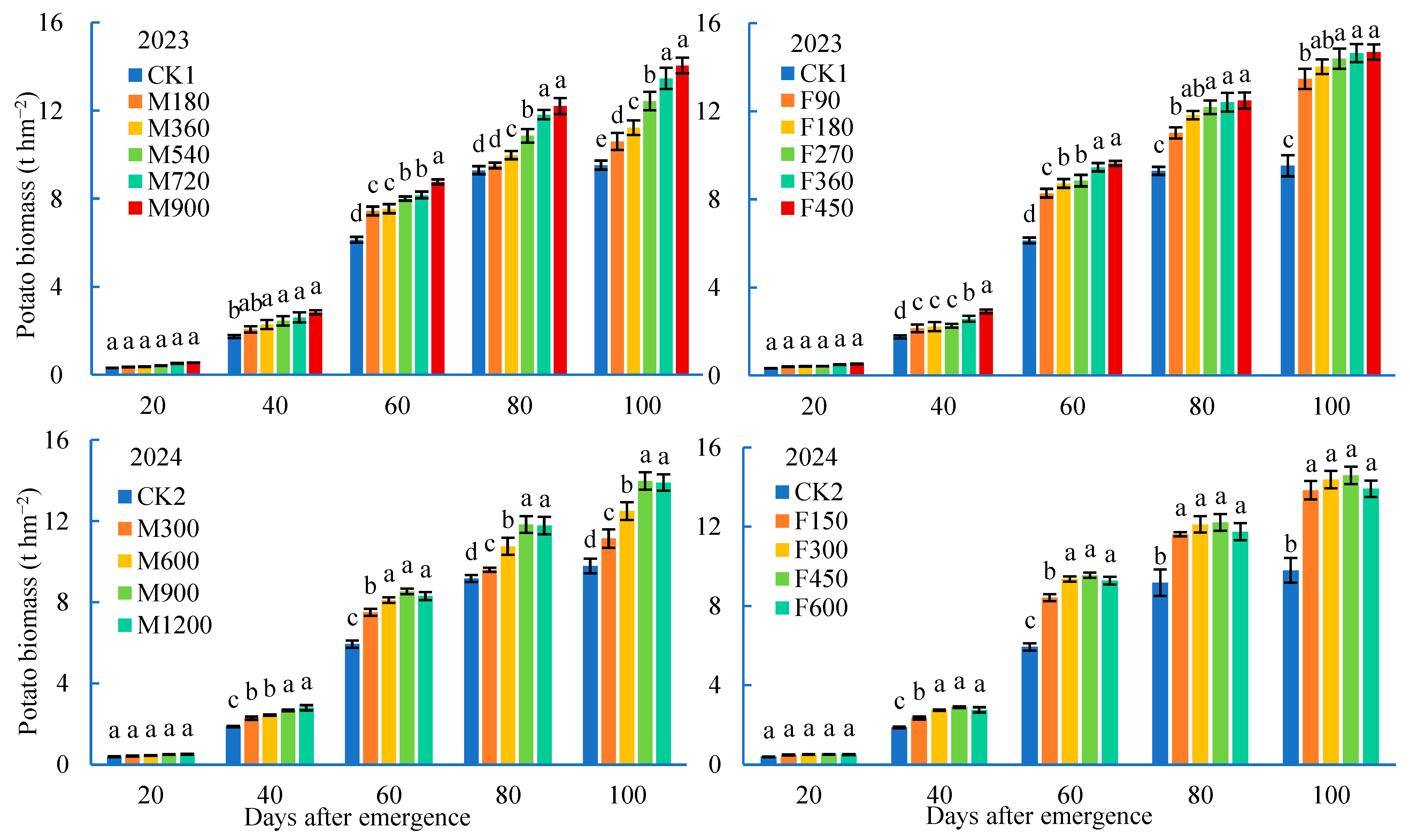
Figure 1. Dry biomass accumulation of potato (t ha−1) across growth stages under different treatments. The (left panel) illustrates biomass trends in response to varying sheep manure application rates, while the (right panel) shows trends under different chemical nitrogen fertilizer rates. Treatments M180 to M1200 represent manure nitrogen application rates ranging from 180 to 1200 kg N ha−1, and F90 to F600 represent chemical nitrogen fertilizer rates from 90 to 600 kg N ha−1. Analysis of variance (ANOVA) was conducted, and means followed by different lowercase letters are significantly different according to Duncan’s multiple range test at p < 0.05.
Agronomy 15 02817 g001
Figure 2. Leaf area index (LAI) of potato plants under different nitrogen treatments across growth stages. The (left panel) illustrates LAI trends in response to varying sheep manure application rates, while the (right panel) shows LAI trends under different chemical nitrogen fertilizer rates. Treatments M180 to M1200 correspond to manure nitrogen application rates ranging from 180 to 1200 kg N ha−1, and F90 to F600 represent chemical nitrogen fertilizer rates from 90 to 600 kg N ha−1. Analysis of variance (ANOVA) was conducted, and means followed by different lowercase letters are significantly different according to Duncan’s multiple range test at p < 0.05.
Agronomy 15 02817 g002
Figure 3. Total nitrogen uptake and fertilizer-derived nitrogen uptake by potato plants in response to increasing chemical nitrogen application rates. The (left panel) shows the relationship between total nitrogen (N) uptake and applied chemical N rates, while the (right panel) illustrates fertilizer-derived nitrogen uptake across the same gradient. In the regression equations, y represents either total nitrogen uptake (left) or fertilizer-derived nitrogen uptake (right), and x denotes the applied chemical nitrogen rate (kg ha−1).
Agronomy 15 02817 g003
Figure 4. Nitrogen recovery rates in potato plants under different nitrogen sources. The (upper panel) presents recovery rates under chemical fertilizer application, while the (lower panel) shows recovery rates under sheep manure application.
Agronomy 15 02817 g004
Figure 5. Response of total nitrogen uptake (left panel) and manure-derived nitrogen uptake (right panel) by potato plants to increasing sheep manure nitrogen application rates.
Agronomy 15 02817 g005
Table 1. Chemical properties of surface soil (0–20 cm) in the experimental fields and nutrient content of the applied sheep manure.
Soil Chemical PropertiesManure Nutrient Content %
YearpHOrganic Matter (g/kg)Total N
(g/kg)
Olsen P
(mg/kg)
Exchangeable K (mg/kg)NP2O5K2O
20237.824.22.1016.8126.42.340.421.52
20247.923.72.0814.3128.52.270.451.59
Table 2. Nitrogen treatment levels and application details used in the experiment.
YearTreatmentsManure N
(kg ha−1)
Urea N (kg ha−1)
2023CK00
M1801800
M3603600
M5405400
M7207200
M9009000
F90090
F1800180
F2700270
F3600360
F4500450
2024CK00
M3003000
M6006000
M9009000
M120012000
F1500150
F3000300
F4500450
F6000600
Table 3. Nitrogen uptake and tuber yield, number, weight, and rate under varying rates of chemical fertilizer and sheep manure.
YearTreatmentsTuber Yield
(t ha−1)
Tuber Number per PlantAverage Tuber Weight (kg Tuber−1)Marketable Tuber Rate (%)N Uptake by Potatoes (kg ha−1)
2023CK34.21 f4.13 a0.21 g84.69 d153.95 h
M18037.43 e4.00 a0.23 f91.47 c181.17 g
M36039.48 de4.06 a0.24 ef89.50 c201.05 f
M54041.42 d4.13 a0.25 e92.92 bc217.85 e
M72045.38 c4.06 a0.28 d97.36 ab232.26 d
M90050.99 b4.10 a0.31 c95.95 ab243.20 c
F9046.09 c4.13 a0.21 g84.69 d207.41 ef
F18049.77 b3.67 a0.31 c96.31 ab243.87 c
F27051.32 b3.89 a0.32 bc97.68 a256.60 b
F36053.73 a3.89 a0.33 ab97.15 b268.65 a
F45054.59 a3.83 a0.35 a98.03 a272.95 a
2024CK35.64 e4.62 a0.19 f85.90 d160.37 f
M30039.71 d4.52 a0.22 e87.28 d199.41 e
M60043.41 c4.48 a0.24 d91.17 c230.61 c
M90049.53 b4.27 a0.29 c93.73 b259.61 b
M120049.05 b4.23 a0.29 c94.45 b262.57 b
F15048.10 b4.62 a0.19 f85.93 a216.45 d
F30052.02 a4.09 a0.29 c96.94 a260.10 b
F45053.69 a4.05 a0.32 b98.46 a284.57 a
F60051.91 a3.72 a0.36 a97.58 a285.51 a
Analysis of variance (ANOVA) was conducted, and means followed by different lowercase letters are significantly different according to Duncan’s multiple range test at p < 0.05.
Table 4. Fertilizer Nitrogen Equivalence (FNE) of sheep manure in potato production estimated using different methods.
YearManure N Rate (kg ha−1)FNE (%)
Based on Total N UptakeBased on N Uptake from FertilizerBased on Tuber YieldBased on Tuber Yield Increase
202318018.0728.358.4912.59
36022.1627.5510.9212.89
54023.0826.8611.7412.99
72023.3726.3916.3717.18
90022.8925.4723.9524.30
202430029.8826.3214.0310.78
60027.1627.3414.9612.88
90030.6230.1420.7418.45
120024.2423.7814.8213.18
Disclaimer/Publisher’s Note: The statements, opinions and data contained in all publications are solely those of the individual author(s) and contributor(s) and not of MDPI and/or the editor(s). MDPI and/or the editor(s) disclaim responsibility for any injury to people or property resulting from any ideas, methods, instructions or products referred to in the content.