Article

Effects of High Nitrogen and Biochar Addition on the Stability of Soil Organic Carbon Pools in Restored Grassland on the Chinese Loess Plateau

1
College of Forestry, Gansu Agricultural University, Lanzhou 730070, China
2
College of Grasslands, Gansu Agricultural University, Lanzhou 730070, China
3
College of Agriculture, Gansu Agricultural University, Lanzhou 730070, China
4
College of Agricultural and Ecological Engineering, Hexi University, Zhangye 734000, China
*
Author to whom correspondence should be addressed.
Agronomy 2025, 15(12), 2800; https://doi.org/10.3390/agronomy15122800
Submission received: 12 November 2025 / Revised: 28 November 2025 / Accepted: 3 December 2025 / Published: 5 December 2025
(This article belongs to the Section Soil and Plant Nutrition)

Abstract

Increased atmospheric nitrogen (N) deposition alters the formation and stability of soil organic carbon (SOC) in fragile ecosystems. While biochar (BC) amendment represents a promising strategy for augmenting soil carbon sequestration, its impact on the stability of the SOC pool under high N deposition remains unclear. In this study, we conducted a two-year field trial with three replicates to investigate the effects of combined N (0 and 9 g N·m−2·yr−1) and BC (0, 20, and 40 t·ha−1) addition on the stability of the SOC pool in restored grasslands on the Loess Plateau. We assessed SOC pool stability by examining the influence of soil microbial carbon utilization efficiency (CUE), metabolic constraints, and community composition on the content of particulate organic carbon (POC) and mineral-associated organic carbon (MAOC). The results indicate that in comparison to the control treatment (N0BC0), the addition of both high N (N9BC0) and BC (N0BC20 and N0BC40) significantly promoted the accumulation of POC by 15.78%, 9.87%, and 11.05%, respectively. Conversely, the content of MAOC was suppressed under the N9BC0 (−10.64%) and N0BC40 (−8.29%) treatments. However, the combination of high N and BC treatments resulted in increased levels of SOC, POC, and MAOC, while simultaneously reducing the MAOC/POC ratio, with all parameters reaching their peak under the N9BC40 treatment. Meanwhile, high N and BC additions led to differences in bacterial community structure, increased CUE, and enzyme vector angle. Notably, high N shifted the dominant factor of BC on MAOC/POC from physicochemical properties to biological factors. Microbes drive CUE to influence changes in MAOC by adapting to metabolic limitations and stoichiometric imbalances. In contrast, POC is primarily influenced by physicochemical properties. Overall, high additions of N and BC have been shown to reduce the stability of SOC by promoting the accumulation of POC. However, an addition rate of 40 t·ha−1 of BC was found to be more effective in mitigating the negative impacts of high N addition on MAOC. This strategy can serve as an effective management approach for enhancing SOC sequestration in vulnerable regions of the Loess Plateau.

1. Introduction

Soil carbon pools are essential terrestrial reservoirs that maintain ecosystem carbon stability and regulate climate change [1,2]. Among these, soil organic carbon (SOC) is the primary component, comprising multiple fractions that possess distinct functions and stability [3,4]. Moreover, the interactions between unstable and persistent carbon fractions play a crucial role in determining the stability of SOC [4]. To more accurately assess the stability of the SOC pool and its response to climate change, an increasing number of scholars have classified SOC into particulate organic carbon (POC) and mineral-associated organic carbon (MAOC) based on particle size [4,5,6]. In general, POC primarily consists of semi-decomposed or undecomposed products derived from plant, animal, and root residues, with a relatively short turnover time [5,6]. The stability of POC is influenced by biological refractoriness, agglomerate sequestration, and microbial inhibition [7]. However, MAOC is more strongly linked to soil minerals and is a major contributor to keeping SOC stable over time [3,8]. It mainly comprises residual compounds generated by plants or microorganisms that bind to minerals through various physicochemical interactions, including hydrogen bonding, covalent bonding, and complexation [4]. Consequently, analyzing the characteristics of the SOC pool (i.e., POC and MAOC) and their regulatory factors has emerged as a key focus in investigating the processes and stabilization mechanisms of soil carbon cycling in terrestrial ecosystems. The formation of SOC is influenced by a multitude of factors, including climate change, land-use practices, soil microbial communities, and basal nutrients [5,9]. Microbial carbon utilization efficiency (CUE) serves as a key determinant of SOC dynamics by mediating microbial biomass conversion processes and substrate allocation strategies [6]. Recent evidence indicates that higher CUE promotes the formation of MAOC by increasing the number of microbial residues associated with minerals, potentially enhancing the stability of the SOC pool [10,11]. Microbiota mediate the dynamics of SOC through enzyme-driven organic matter mineralization, with the production of extracellular enzymes a primary response to environmental perturbations [9]. Previous studies have demonstrated that the ecological enzyme stoichiometry theory can effectively predict nutrient availability in the environment and is a diagnostic tool for microbial metabolic constraints [10,12]. Consequently, microorganisms can adapt to conditions of metabolic limitation by modifying their preferences for soil substrate nutrients, thereby reducing carbon assimilation and increasing the proportion of POC [12,13,14]. In addition, the growth and metabolic status of soil microbial communities (bacteria/fungi) play a crucial role in regulating microbial carbon production, which subsequently influences the partitioning between POC and MAOC [15]. For instance, fast-growing bacteria tend to exert a more pronounced negative impact on CUE, thereby inhibiting MAOC formation [6,13]. In contrast, fungi, which have lower nutrient requirements, allocate a greater proportion of their metabolic resources to enhancing the degradation capacity of extracellular enzymes that act on complex substrates, ultimately facilitating SOC accumulation [3]. Overall, soil microbe-mediated turnover pathways are central processes regulating SOC formation and stabilization [3,16]. Consequently, understanding the relationship between key soil microbial properties and SOC is crucial for evaluating the potential mechanisms involved in the stabilization process of SOC. Due to the burning of fossil fuels and the use of chemical fertilizers, nitrogen (N) deposition in terrestrial ecosystems is increasing worldwide and is expected to be nearly three times higher in 2050 than it was before the Industrial Revolution [17,18]. An increasing number of studies indicate that elevated N deposition may diminish the abundance of microbial genes associated with cellulose degradation [19], CUE [6]. Additionally, it may enhance carbon catabolic enzyme activity and non-mineral-related carbon accumulation [7]. This trend could further destabilize the SOC pool, impacting SOC accumulation and formation [4,20]. Therefore, developing effective solutions to address the future challenges posed by high N deposition on SOC has become a pressing issue that has garnered significant attention from scholars in recent years. Biochar (BC), a carbonaceous material synthesized via biomass pyrolysis under oxygen-deprived conditions, exhibits high aromaticity and carbon sequestration potential [15,21]. The addition of BC is often considered an effective solution for improving soil quality and increasing SOC stability, and it is widely used in a variety of ecosystems [15,22,23]. Numerous scholars have explored various mechanisms to elucidate the effects of BC addition on SOC stability. Several studies suggest that BC contributes carbon-containing compounds characterized by highly stable aromatic polycyclic structures [24,25] and directly enhances SOC stability by resisting microbial degradation [23,26]. Additionally, other research indicates that BC can indirectly influence the proportions of POC and MAOC in soil through mechanisms such as enhancing CUE [27], increasing enzyme activity [25], regulating microbial community metabolism [21,26], and reducing the SOC desorption index [24]. However, the reported results regarding the effect of BC addition on SOC formation and stabilization through alterations in soil microbial community structure are inconsistent [15,21,22]. For instance, studies have found that BC addition increased the community richness of oligotrophic bacteria [11] while negatively impacting copiotrophic bacteria (e.g., Proteobacteria, Bacteroidetes) responsible for the turnover of unstable organic carbon [28]. However, it has also been demonstrated that BC addition promotes SOC accumulation primarily by influencing soil physicochemical properties, without significant changes in microbial community structure [29] and/or α-diversity [30]. Overall, existing research has elucidated mechanisms that explain the impact of BC on SOC stability. However, the variability in results underscores uncertainties surrounding the effectiveness of BC addition. In particular, the potential of BC to mitigate challenges to SOC stability posed by future increases in N deposition remains insufficiently demonstrated.
The Loess Plateau region of China suffers from severe soil erosion and degradation, making it a representative ecologically fragile area affected by atmospheric nitrogen deposition [13,31]. To mitigate the pressures of soil degradation in the Loess Plateau, the government has increased soil carbon reserves through the revegetation of degraded land [12,32]. Among these, grasslands that naturally regenerate following abandonment represent the most fundamental pattern of vegetation restoration in the Loess Plateau region, accounting for over 42% of the total restored area [31,33]. Restoration of grassland can regulate the carbon cycling process in the Loess Plateau region [31] by altering the composition of aboveground plant and soil microbial communities [33,34] and by supplying substantial amounts of elemental carbon to the soil [1]. Previous research has primarily focused on the influences of vegetation restoration types [32], land-use patterns [35], vegetation planting configurations [36], and agroecosystems [37] on soil carbon accumulation and loss in the Loess Plateau region. Existing studies have reported that BC addition can improve soil physical structure [38], nutrient status [39], and carbon-related enzyme activity [40] in this region, promoting plant root growth [38] and enhancing SOC sequestration [41]. However, overall, the impact of BC addition on restoring stable SOC in grasslands under high N deposition conditions in the Loess Plateau region remains poorly understood.
To this end, we carried out a field study of the effects of the addition of high N, BC, and their combination on restored grassland in the Loess Plateau region of China. This study aimed to analyze the effects of soil physicochemical properties, microbial community composition, and microbial physiological characteristics (i.e., CUE and microbial metabolic limitation) on the stabilization of SOC pools (i.e., SOC, POC, and MAOC). To simulate the effects of future high-intensity atmospheric N deposition on ecosystems, this study employed urea solution addition to achieve quantitative high N addition. The primary objectives of this study were: (1) to determine differences in changes to the SOC pool under high N, BC, and their combination, and (2) to investigate whether the addition of BC affects the stability of the SOC pool under high N addition. We hypothesize that (1) the addition of BC may promote the accumulation of MAOC under varying N treatments by alleviating microbial metabolic constraints and enhancing CUE; (2) in contrast, the accumulation of POC is more sensitive to changes in aboveground biomass and soil physicochemical properties induced by high N and BC additions.

2. Materials and Methods

2.1. Study Area

Situated in the Anding District of Dingxi City (104°39′03″ E, 35°34′45″ N; 2200 m above sea level) within China’s Loess Plateau critical zone. The study area exhibits a mesothermal semi-arid climate, characterized by a mean annual temperature of 6.30 °C and a total precipitation of 386.70 mm, with 52.70% of the precipitation occurring during June and July [42]. The soil is a loess soil formed from loess parent material [33,42]. Historically, soil degradation and erosion in the district have been exacerbated by prolonged intensive agricultural practices and regional climate change [34]. Since the 1990s, the area has transformed into a naturally restored secondary successional grassland, following the abandonment of degraded farmland to mitigate soil degradation [8,34]. This region has been recognized as an experimental base for monitoring vegetation restoration by the China Institute of Soil and Water Conservation. The test site was a naturally restored grassland that has been abandoned for 15 years after the land was converted to farmland. The dominant species in this area included Stipa bungeana Trin., Setaria viridis (L.) Beauv., Leymus secalinus (Georgi) Tzvel., and Artemisia frigida Willd., among others. The soil in the test area (0–40 cm depth) exhibited a SOC content of 8.05 g·kg−1, total nitrogen of 0.79 g·kg−1, total phosphorus of 0.22 g·kg−1, and C:N of 10.19.

2.2. Experimental Design

This study was conducted in June 2022 and established three replicate plot groups (20 m × 20 m, spaced ≥ 10 m apart) with nearly identical vegetation growth conditions as a random factor to control for spatial heterogeneity inherent in field experiments. Within each replicate sample plot, a two-factor randomized block design was employed to set the N addition (N0: 0 g N·m−1·yr−1; N9: 9 g N·m−1·yr−1) and BC addition (BC0: 0 t·ha−1; BC20: 20 t·ha−1; BC40: 40 t·ha−1), resulting in a total of six treatments. A total of 18 replicate treatment plots were used in this experiment. A 1 m buffer strip was implemented between each treatment plot (2 m × 2 m) to mitigate potential cross-contamination.
This study simulated elevated N deposition inputs by periodically applying urea solution to the soil [31,43]. The simulation was based on the recent background value of N deposition in the Loess Plateau (2.11 g N·m−2·yr−1) and the threshold range (0–12 g N·m−2·yr−1) used in existing studies to model concentrated N addition [19,31,32,44]. This study expanded regional N deposition by approximately 4.5 times to simulate a future scenario of high N deposition (9 g N·m−2·yr−1) in the study area. We divided urea into three equal portions based on the total annual amount and applied it to the sample plots in 2022 (June, August, and October) and in 2023–2024 (March, June, and September). A quantitative amount of urea, dissolved in 2 L of distilled water was uniformly sprayed on the plots during each addition, resulting in an additional 1.5 mm of precipitation per year. Control plots were administered with isovolumetric distilled water additions. Although urea, as a chemical fertilizer, differs from natural atmospheric N deposition in both form and input dynamics, this method is widely used to systematically study ecosystem responses to simulated N deposition [31,43,45]. In the BC addition treatment, we established the BC addition gradient according to the research threshold range for BC addition in the Loess Plateau region [46,47]. In June 2022, manual tillage was employed to thoroughly incorporate the BC mixture into the top 0–40 cm layer of soil before the commencement of the experiment. BC was added only at the beginning of the experiment, while the control group underwent excavation and backfilling without the addition of BC. The BC used in this study was produced by Henan Sanli New Energy Co., Ltd. in Shangqiu City, China, utilizing wheat straw through oxygen-limited pyrolysis at a temperature of 400 °C. The basic characteristics of BC are shown in Table S1 and Figure S1.

2.3. Sample Collection

To reliably assess the overall impact of treatments on the SOC pool, this study collected soil samples from the aforementioned replicate plots in October 2023, as well as in April, July, and October 2024. This approach minimizes variations in soil samples caused by random errors associated with single sampling and seasonal fluctuations. The initial soil sampling took place 16 months after the addition of BC, allowing for a complete growing season of aging and stabilization. Notably, there was no rainfall during the week preceding the sampling, and the interval between soil sampling and N addition exceeded one month in all instances. Previous reports indicate that the plant root systems and soil microbial biomass that restore grasslands are more concentrated in the topsoil layer [34,48]. Simultaneously, the topsoil layer is the key region in which microbial activity and nutrient cycling are most active, and it is more sensitive to changes in external management practices [3,49]. Therefore, five surface soil samples (0–10 cm depth) were acquired from each replicated plot through an S-shaped sampling trajectory, employing a cylindrical core with a 50 mm internal diameter. These samples were combined into a single sample after being sieved through a 2 mm mesh. All soil samples were strictly confined to the central area of each plot to ensure that the composite samples effectively avoided interference from edge effects. Each mixed soil sample was transported to the laboratory for the determination of indicators. Samples intended for assessing soil microbial community abundance were immediately frozen using liquid N and subsequently stored at −80 °C in the laboratory.

2.4. Indicator Measurement

Aboveground biomass, soil water content, and temperature were measured in situ using the drying method and a thermometer (JM624, Jinming Instrument Co., Tianjin, China), respectively [5,42]. SOC was quantified through oxidative titration with potassium dichromate, while total nitrogen and total phosphorus were analyzed using the Kjeldahl method and the molybdenum–antimony colorimetric method, respectively [8,23]. Additionally, microbial biomass carbon, nitrogen, and phosphorus (MBC, MBN, MBP) were analyzed using chloroform fumigation extraction methods [10,13]. We determined the activities of five hydrolytic enzymes: carbon (β-glucosidase (BG) and cellulase), N (β-N-acetyl-glucosidase (NAG) and urease), and phosphorus (alkaline phosphatase (AP)) using a microtiter plate colorimetric technique, following the protocols established by previous researchers [50].
POC and MAOC were separated using standard wet sieve methods. To maximize the isolation of organic carbon fractions that are most sensitive to treatment, no specific aggregate protection was applied [5,6]. Specifically, fifty grams of air-dried soil, which had been passed through a 2 mm sieve, was divided into five equal portions. Each portion was placed into a 150 mL conical flask, followed by the addition of 100 mL of sodium hexametaphosphate solution (5 g·L−1). The sample solution was shaken at 180 r·min−1 for 20 h at room temperature. Subsequently, the dispersed sample was washed on a 53 μm sieve. The soil retained on the sieve was rinsed repeatedly with deionized water until the eluting liquid was clear. The particle fraction retained on the sieve was defined as particulate organic matter (>53 μm), while the fraction that passed through the sieve was classified as mineral-bound organic matter (<53 μm). These two fractions were collected separately, dried at 60 °C to a constant weight, and weighed to calculate their mass fractions. The carbon concentration of each component was determined based on its mass percentage and by potassium dichromate oxidation titration analysis, yielding POC and MAOC. Furthermore, the ratio of MAOC to POC (MAOC/POC) was employed to assess the stability of SOC [3].

2.5. Analysis of Soil Stoichiometric Imbalances, Microbial Metabolic Limitations, and C Utilization Efficiency

We assessed soil–microbe stoichiometric imbalances (i.e., C:Nimb, C:Pimb, and N:Pimb) by analyzing the relationships between soil nutrient stoichiometry ratios (C:N, C:P, and N:P) and microbial biomass stoichiometry ratios (MBC:MBN, MBC:MBP, and MBN:MBP) [42]. These stoichiometric imbalances serve as indicators of the degree of mismatch between soil resources and microbial growth requirements [13].
In addition, we assessed and validated the nutrient limitation status of microorganisms under various treatments using a vector analysis model of ecological enzyme stoichiometry. The degree of microbial metabolic limitation was quantified through the enzyme vector length (VL) and vector angle (VA) [3,6]. The VL indicates the extent of carbon limitation, with higher VL values signifying a stronger relative carbon nutrient limitation, while the VA reflects the degree of N and P limitation. Specifically, VA < 45° suggests that microorganisms are relatively limited by N, and the degree of N limitation decreases as the VA value increases. The vector analysis model was computed using the following formula:
V L = ( l n B G l n N A G ) 2 + ( l n B G l n A P ) 2
V A = D e g r e e s   ( A T A N 2 l n B G l n A P , l n B G l n N A G )
Microbial CUE refers to the proportion of carbon elements utilized for microbial growth relative to the total carbon absorbed. Based on the research method of Wu et al. [3], the ecological enzyme stoichiometry method was used to evaluate the microbial CUE value, and the calculation formula is as follows:
C U E = C U E m a x × ( S C : N × S C : P ) / ( K C : N + S C : N ) × ( K C : P + S C : P ) 0.5
S C : N = 1 E E A C : N × M C : N N C : N
S C : P = 1 E E A C : P × M C : P N C : P
where CUEmax represents the upper limit of soil microbial growth efficiency, and was set to 0.6. KC:N and KC:P are the CUE half-saturation constants based on C, N, and P availability and were set to 0.5. These parameter values are widely used in model calculations for studies on microbial CUE in terrestrial ecosystems [3,13,31] and have been validated by subsequent research [51,52]. SC:N (SC:P) represents the intensity of compensation between the C:N (C:P) ratios of soil extracellular enzyme activity, microbial biomass, and nutrients. Furthermore, EEAC:N and EEAC:P represent enzyme activities ratios, specifically BG:NAG and BG:AP, respectively. MC:N and MC:P represent microbial mass ratios, specifically MBC:MBN and MBC:MBP, respectively. Lastly, NC:N and NC:P represent the ratios of SOC to total nitrogen and total phosphorus, respectively.

2.6. Soil Microbial Communities

DNA extraction and purification of soil samples were performed according to the instructions provided by the Power Soil® DNA extraction kit (Mo Bio Laboratories, Carlsbad, CA, USA). Extracted DNA from the soil samples was utilized as a template, with universal primers 338F (5′-ATCCCTACGGGGGGGGGAGGCAG-3′) and 806R (5′-GGATTACHVGGGTWTCTAAT-3′) employed to amplify the highly variable V3–V4 region of bacterial 16S rRNA. Concurrently, primers ITS1 (5′-CTGGTCATTTAGGGAAGTAA-3′) and ITS2 (5′-GTGCGTTCTTCATCGATGC-3′) were utilized to amplify soil fungi [34]. The PCR amplification products were sent to Biomarker Technologies Co., Ltd. (Beijing, China) for high-throughput sequencing using the Illumina MiSeq platform (Illumina Inc., San Diego, CA, USA). Following the assembly, quality control, and filtering of the raw sequencing reads, operational taxonomic units were clustered at 97% similarity using UPARSE software (v7.0.1001) [53]. To avoid analytical biases caused by varying sequencing depths, the obtained data were rarefied to the minimum sequence count across all samples. Bioinformatics analysis was subsequently performed on the rarefied data.

2.7. Statistical Analysis

To evaluate the overall treatment effects of N and BC on the SOC pool, data from all four sampling time points were pooled for analysis. The main and interactive effects of N and BC addition on the SOC pool (SOC, POC, MAOC, and their ratios), enzyme activities (BG, NAG, AP), stoichiometric imbalance, and microbial physiological traits (CUE, VL, VA) were assessed using two-way ANOVA in SPSS (v25.0), with LSD post hoc tests identifying significant differences (p < 0.05). In this analysis, N and BC additions were treated as fixed effects, while plots were considered random factors to account for background variation resulting from spatial differences. Before analyzing variance, the assumptions of normal distribution and homogeneity of variance were assessed for all variables. In cases where the assumption of homogeneity of variance was not satisfied, logarithmic transformations were applied to the corresponding variables, and inverse sine-square root transformations were utilized for ratio data (e.g., POC/SOC and MAOC/SOC). Based on the standardized data, microbial community composition was analyzed on the BMK Cloud platform (Biomarker Technologies Co., Ltd., Beijing, China). Differences in community structure across treatments were assessed using non-metric multidimensional scaling (NMDS), and the statistical significance of these differences was tested with analysis of similarities (ANOSIM).
Using Origin 2024 software, we analyzed Pearson correlations among soil properties, microbial communities, and the SOC pool. We assessed the relative importance of soil environmental factors on the MAOC/POC ratio in the context of N additions (N0 and N9) using the rfPermute package in R software (version 4.2.1). Subsequently, the partial least squares path model (PLS-PM) was constructed using the plspm package in R software (version 4.2.1) to further explore the direct and indirect driving mechanisms affecting changes in POC and MAOC. During the model optimization process, we systematically eliminated non-significant paths until we achieved an adequate model fit. The predictive validity of the PLS-PM framework was quantified via the goodness-of-fit metric (GOF). A GOF value greater than 0.600 indicates that the model demonstrates strong overall predictive capability and effective path performance. In this context, the R2 coefficient reflects the relationship between the explained variance of the latent variables and the total variance.

3. Results

3.1. Characterization of Changes in the SOC Pool

The interaction between high N and BC additions had a significant effect on the SOC pool (SOC, POC, and MAOC) (Figure 1, Table S3, p < 0.01). In comparison to the N0BC0 treatment, the N9BC0 treatment significantly increased the POC content (15.78%) and decreased the MAOC content (10.64%) and MAOC/POC values (23.31%) (p < 0.05). In the context of N0 addition, the addition of BC significantly increased the contents of POC and MAOC while simultaneously decreasing the MAOC/SOC values. Notably, the BC40 treatment resulted in an increase in POC content by 11.05% and a decrease in MAOC/SOC values (p < 0.05) when compared to the BC0 treatment. Furthermore, the MAOC values under the BC40 treatment were 8.29% lower than those under the BC20 treatment (Figure 1A, p < 0.05). Conversely, in the context of N9 addition, the SOC, POC, MAOC, and POC/SOC values generally exhibited gradual increases with increasing BC addition. In contrast, the MAOC/SOC values displayed a consistent decline (p < 0.05). Additionally, the addition of BC led to a reduction in the MAOC/POC values under both N0 and N9 additions (Figure 1D). These findings indicate that the addition of BC diminished the stability of SOC in the context of varying N additions.

3.2. Soil Enzyme Activity and Microbial Community Composition

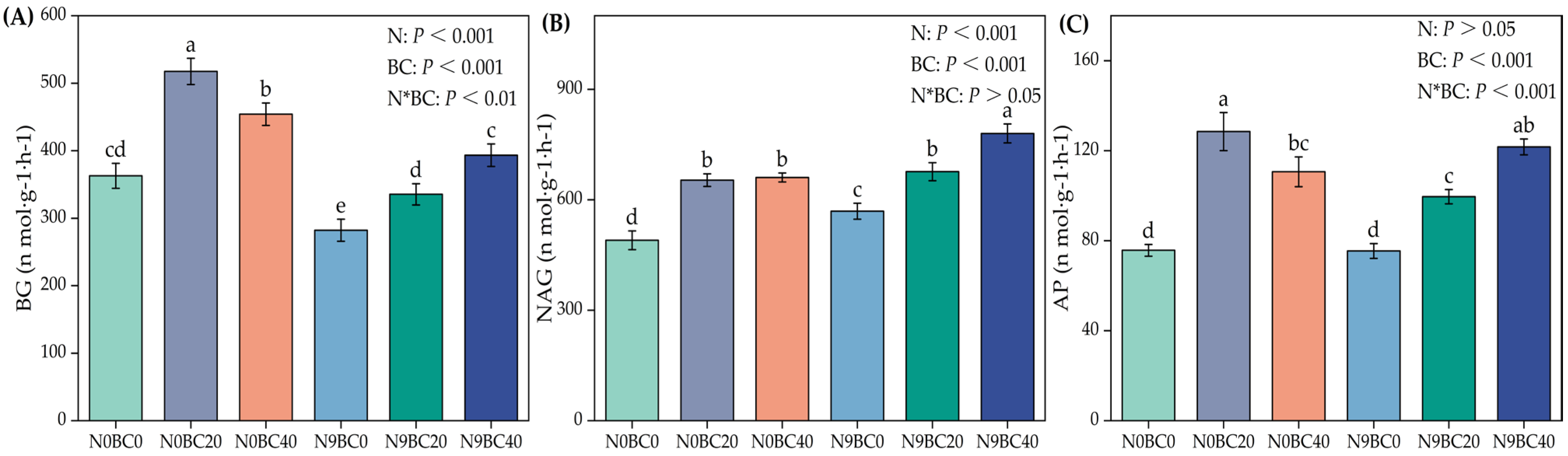
There were significant differences in soil enzyme activities resulting from the additions of high N and BC (Figure 2). Among them, the interaction between N and BC significantly affected the changes in BG and AP (Table S3, p < 0.01). In comparison to the N0BC0 treatment, the N9BC0 treatment resulted in a significant reduction in BG content by 22.23% and an increase in NAG content by 16.10% (p < 0.05). In the context of N0 addition, the addition of BC increased the contents of BG, NAG, and AP. Notably, both BG and AP contents were highest under the BC20 treatment, surpassing those of the BC0 treatment by 42.16% and 69.72%, respectively (p < 0.05). Conversely, in the context of N9 addition, the contents of BG, NAG, and AP increased progressively with higher BC additions, peaking under the BC40 treatment (p < 0.05).
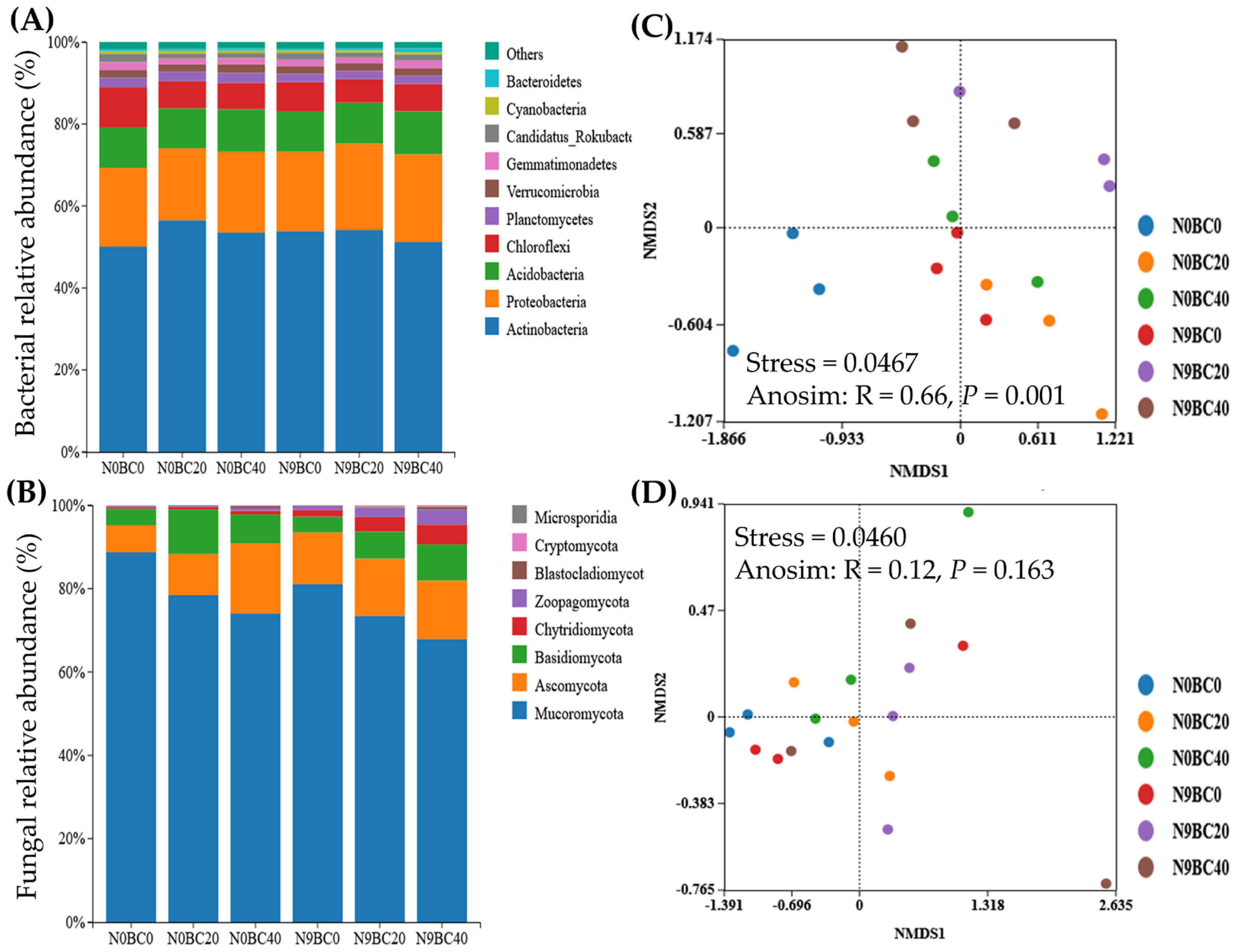
The dominant populations of bacteria and fungi at the phylum level were largely consistent across treatments, with bacterial composition exhibiting greater complexity than that of fungi (Figure 3A,B). Actinobacteria (50.10–56.53%), Proteobacteria (17.55–21.31%), Acidobacteria (9.76–10.52%), Chloroflexi, and Planctomycetes were the dominant species (top 5 in relative abundance) in the soil bacterial community (Figure 3A). Notably, the individual addition of both N9 and BC increased the relative abundance of Actinobacteria while simultaneously decreasing those of Chloroflexi and Planctomycetes. Conversely, mixed treatments led to gradual increases in the relative abundances of Proteobacteria and Acidobacteria as the addition of BC increased. Furthermore, the introduction of N9 and BC also influenced the dominant species within the soil fungal community (Figure 3B). Specifically, both single and mixed additions of N9 and BC enhanced the relative abundance of Ascomycota while decreasing that of Mucoromycota. In contrast, the addition of BC increased the relative abundance of Basidiomycota, although the extent of this change varied between the N0 and N9 additions.
NMDS analysis revealed that the stress function values for both soil bacterial and fungal communities were below 0.1. This finding indicates that the true distribution of the sample sites is accurately represented (Figure 3C,D). A significant difference was observed in the soil bacterial community structure between the treatments (p = 0.001), whereas no significant difference was found in the fungal communities (p = 0.163). Furthermore, the bacterial community structure exhibited a significant divergence between the N9 and BC addition treatments compared to the N0BC0 treatments. This finding suggests that the additions of N9 and BC contributed to alterations in the bacterial community structure to some extent.

3.3. Soil Microbial C Utilization Efficiency and Metabolic Limitation Status

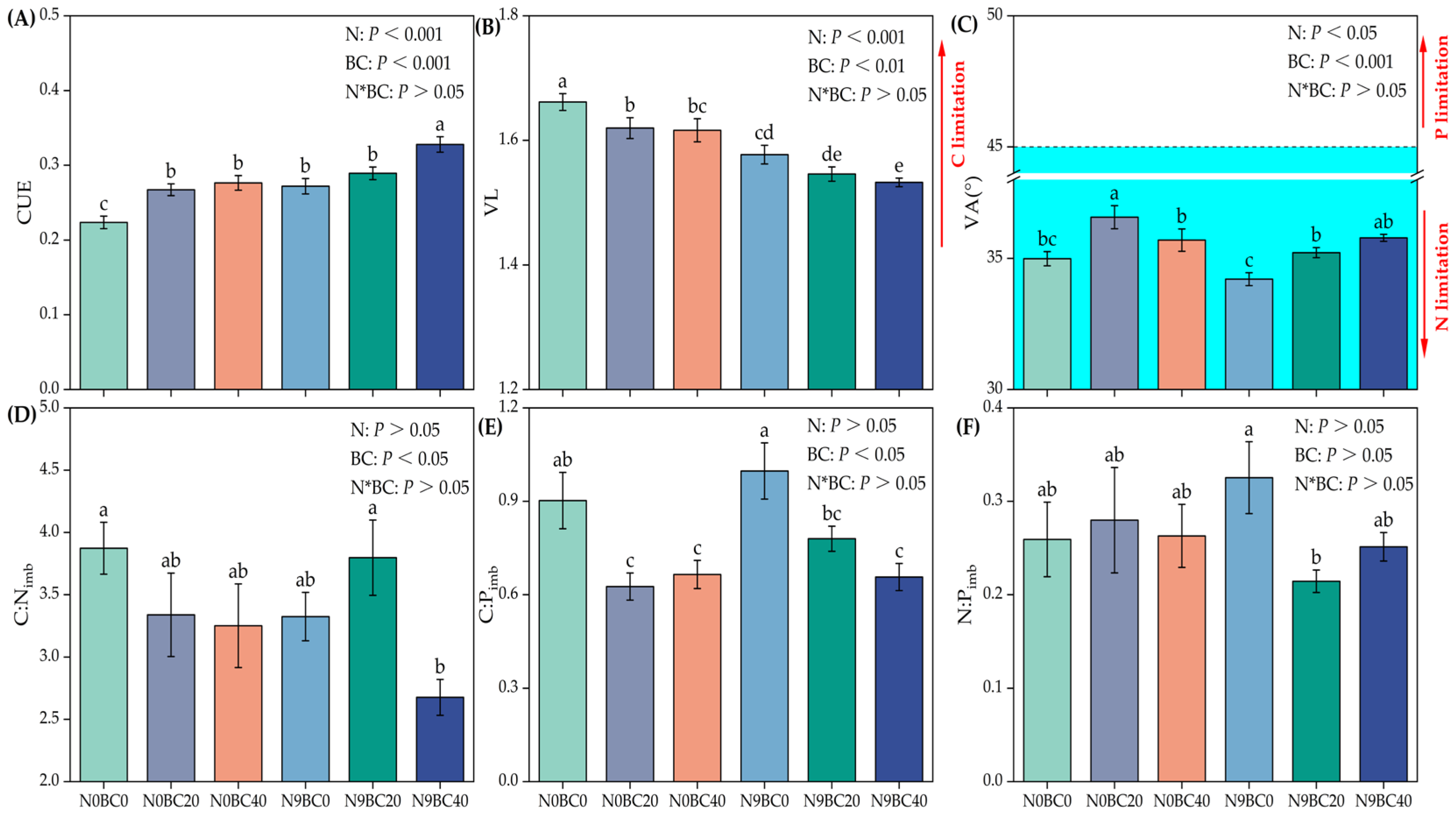
Significant variations in microbial CUE, VL, and VA were observed across different treatments (Figure 4). The primary effects of N and BC addition significantly influenced changes in CUE, VL, and VA (p < 0.05), while their interaction effects were not pronounced (Figure 4, Table S3). In comparison to the N0BC0 treatment, the N9BC0 treatment resulted in a significant increase in the CUE value (21.57%) and a notable decrease in the VL value (5.08%). However, the impact of the N9BC0 treatment on stoichiometric imbalance values was not statistically significant (Figure 4). In the context of N0 addition, the addition of BC led to an increase in the CUE value (21.53%) and a decrease in both the VL (2.62%) and C:Pimb values (28.47%) (p < 0.05). The VA value reached its highest point in the BC20 treatment, showing an increase of 4.52% compared to the BC0 treatment (p < 0.05). Conversely, in the context of N9 addition, the CUE and VA values exhibited gradual increases, while the VL values significantly decreased (p < 0.05) with increased BC addition.

3.4. Relationship Between Soil Properties and SOC Stability

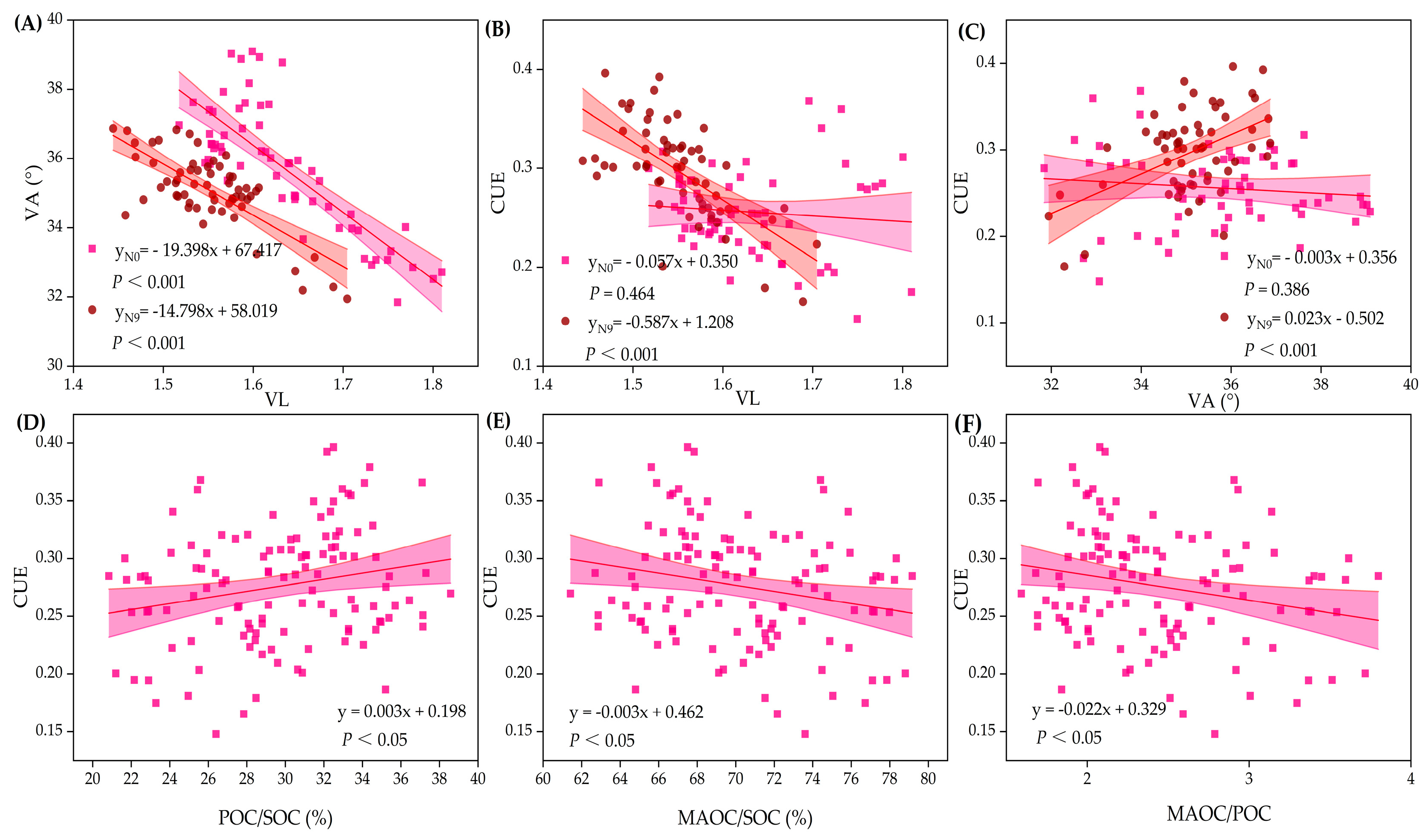
Relationships between CUE and microbial metabolic limitation and relative proportions of carbon fractions were investigated in restored grassland (Figure 5). Significant negative correlations (p < 0.001) were observed between the extracellular enzyme vectors (VL vs. VA), as illustrated in Figure 5A. This finding suggests that the limitation of soil microbial N was intensified by carbon limitation under both N0 and N9 additions. Meanwhile, both soil microbial carbon and N limitations suppressed CUE under the N9 addition (Figure 5B,C, p < 0.001). Additionally, significant negative correlations were found between MAOC/SOC and MAOC/POC with CUE (p < 0.05).
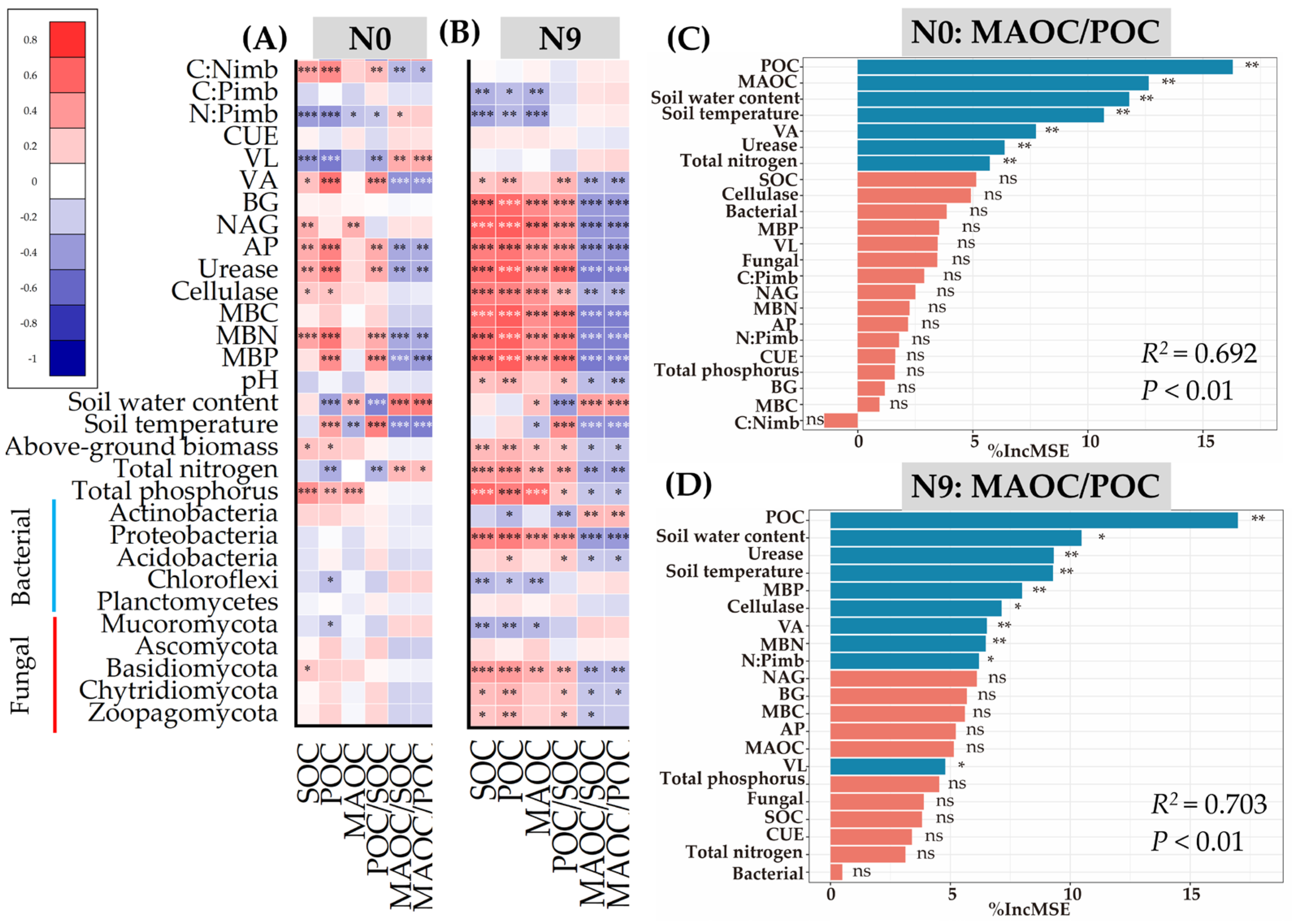
There were some differences in the factors affecting SOC changes under different N additions (Figure 6A,B). Under the N0 addition, SOC exhibited a significant positive correlation with C:Nimb, VA, enzyme activity, and aboveground biomass, while a negative correlation was observed with N:Pimb and VL (Figure 6A, p < 0.05). Conversely, under N9 addition, SOC demonstrated a significant negative correlation with C:Pimb and N:Pimb, alongside a positive correlation with pH, microbial biomass, enzyme activity, and Total nitrogen (Figure 6B, p < 0.05). Under N0 and N9 treatments, POC showed a significant positive correlation with aboveground biomass (p < 0.05). The N9 addition enhanced the interaction between SOC and both bacteria and fungi, leading to significant positive correlations with Proteobacteria and Basidiomycota while displaying negative correlations (p < 0.05) with Mucoromycota (Figure 6B). Furthermore, random forest analysis effectively elucidated the variation in MAOC/POC under the N0 (69.2%) and N9 (70.3%) addition (Figure 6C,D). Specifically, the physicochemical properties (soil water content, soil temperature, and total nitrogen) explained most of the changes in MAOC/POC under N0 addition. In contrast, enzyme activities (urease and cellulase), microbial biomass (MBN and MBP), and microbial metabolic limitation (VA and VL) emerged as significant predictors of MAOC/POC changes under N9 addition. Meanwhile, POC demonstrated greater sensitivity to variations in MAOC/POC across different N additions.
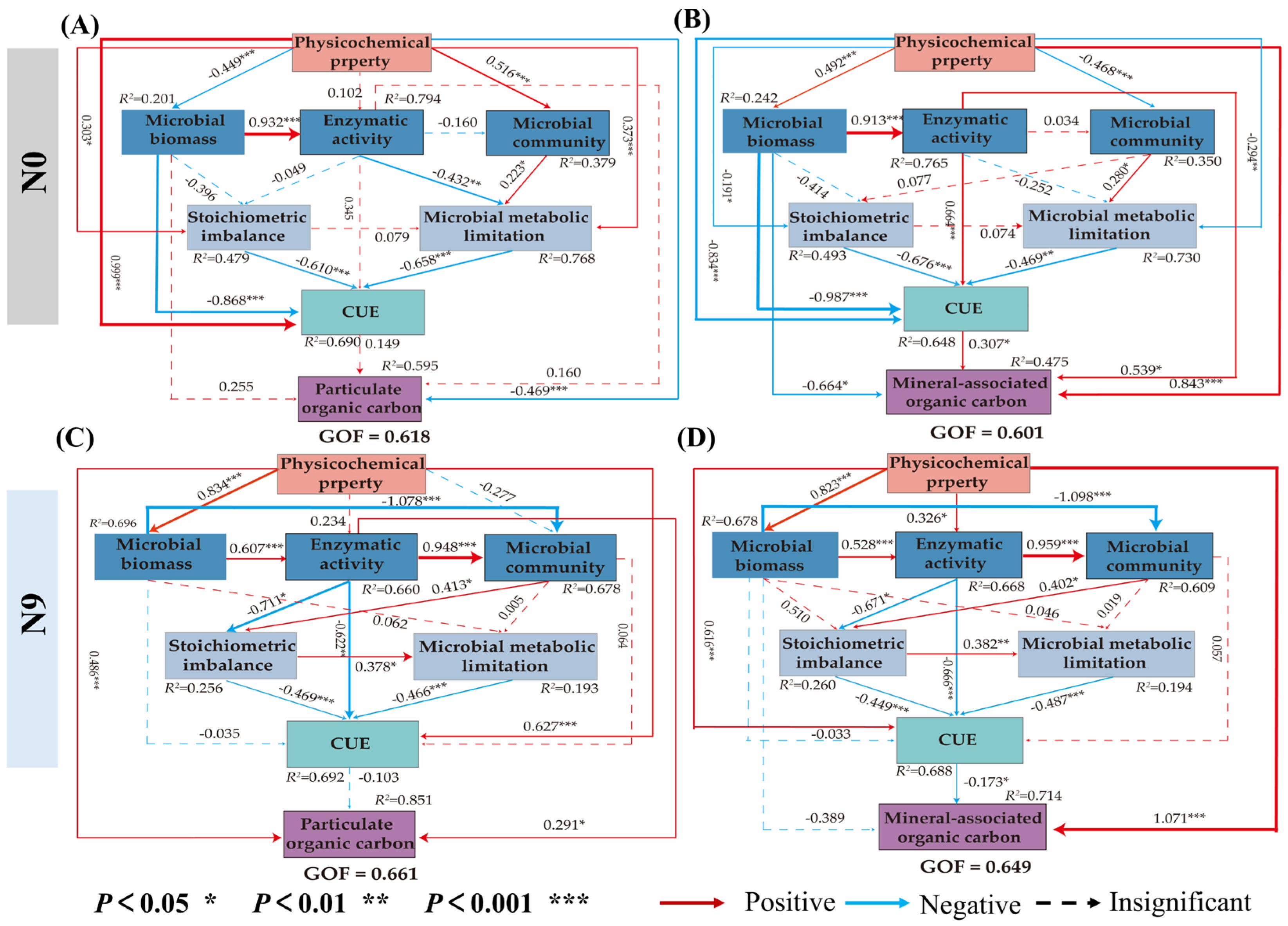
The PLS-PM explained 60.1% to 66.1% of the variation in soil POC and MAOC contents under N0 and N9 additions, suggesting that our hypotheses are plausible (Figure 7A–D). Notably, there were differences in the pathways influencing changes in POC and MAOC under varying N additions. For instance, physicochemical properties emerged as the primary factor directly regulating POC changes under N0 addition (total effect = −0.631) (Figure S2A). In contrast, both physicochemical properties and enzyme activities collectively contributed to the accumulation of POC content under N9 addition (total effects = 0.855 and 0.374) (Figure S2C). Furthermore, physicochemical properties, enzyme activities, CUE, and microbial biomass were significant factors directly regulating changes in MAOC under N0 addition. In contrast, physicochemical properties and CUE jointly regulated changes in MAOC under N9 addition (total effects = 0.802 and −0.173). Interestingly, neither soil microbial community, microbial metabolic limitation, nor stoichiometric imbalance directly affected MAOC under N0 and N9 addition, instead playing a key indirect role in MAOC changes by regulating CUE (Figure 7B,D).

4. Discussion

4.1. Effects of High N and BC Additions on SOC

Previous reports have indicated that increased N deposition may significantly impact carbon cycling processes in terrestrial ecosystems [4,6]. However, there is currently no academic consensus regarding the changes in SOC under N addition [7,54]. For instance, (i) N addition can have a positive effect, promoting SOC accumulation by enhancing vegetation growth [7,55]; (ii) N addition may exacerbate organic matter leaching, increase carbon mineralization, and/or elevate soil respiration, leading to SOC loss [4]; (iii) N addition may cause SOC content to reach a dynamic equilibrium between accumulation and decomposition, resulting in no significant overall effect [54,56].
Consistent with the findings of Wang et al. [56] in the grassland ecosystem of Inner Mongolia, China, our study revealed that high N addition did not significantly affect SOC content in the Loess Plateau region. However, it is noteworthy that high N addition may enhance the positive accumulation effect of BC on SOC. We observed that a combination of high N and BC addition effectively increased SOC content, exhibiting a positive trend with increasing BC addition levels. The reasons for this phenomenon may be multifaceted. Firstly, high N levels stimulate the metabolic functions of symbiotic bacteria, such as Proteobacteria, in unstable carbon environments. This process facilitates the decomposition and conversion of the unstable carbon present in BC, leading to a positive correlation between the addition of BC and the increasing SOC content (Figure 3A and Figure 6B) [27,28]. Secondly, the addition of N enhances the coupling relationship between soil carbon and N elements [57], stimulating a positive correlation between SOC accumulation and total nitrogen under N9 addition (Figure 6B). Additionally, adequate N content was beneficial for enhancing the activity of carbon-related enzymes, such as BG and cellulase (Figure 2A, Table S2) [17,40], thereby facilitating SOC accumulation as the addition of BC increased. Furthermore, mixed additions of N and BC alleviated the elemental limitations on plant growth (Table S2, Figure 6B) and increased SOC accumulation by enhancing exogenous carbon inputs such as apoplast [58]. Previous studies have reported that N addition can mitigate BC-induced SOC decomposition [59] and reduce SOC loss by suppressing soil respiration [60]. This may also be one of the reasons the mixed addition of high N and BC increased the SOC content.

4.2. Effects of High N and BC Additions on POC and MAOC

4.2.1. Effect of High N Addition on POC and MAOC

It is well established that POC and MAOC are crucial components of the SOC pool, accurately reflecting changes in carbon cycling within terrestrial ecosystems in the context of climate change [5,10]. Previous research has found that POC and MAOC exhibit differing sensitivities to atmospheric N deposition, resulting in significant controversy regarding their responses to N addition [4,55]. For instance, the effects of N addition on POC and MAOC can be positive [7], negative [4,6], or show no significant changes [55]. These inconsistent responses may be attributed to variations in the amount and type of N addition, the specific ecosystem type, and the inherent soil properties.
We observed that high N addition increased soil POC content while decreasing the MAOC content. This finding is generally consistent with results reported by Duan et al. [6], Sun et al. [7], and other scholars regarding the response of SOC pool components to N addition in karst and agroecosystems. The observed effects may be attributed to the multifaceted impacts of N addition on aboveground plant growth, soil properties, and microbial characteristics. Firstly, N addition alleviated N limitation in plant growth and enhanced POC accumulation by increasing plant residue input (Table S2, Figure 7B) [7,55]. In this study, high N addition increased plant aboveground biomass (Table S2), and a significant positive correlation was observed between aboveground biomass and POC (Figure 6B), supporting this view. Furthermore, N addition satisfied the microbial demand for elemental N, reducing VL values and alleviating carbon and N limitations in microbial communities (Figure 4B and Figure 5A). This reduction in microbial respiration helped maintain a stoichiometric C:N balance (Figure 4D), ultimately leading to an increase in CUE (Figure 5B) [61]. Meanwhile, elevated CUE values negatively influenced soil initiation effects and decreased the number of microbial residues that are readily bound to minerals following the decomposition of exogenous materials (Figure 7D) [62]. This may partially explain the observed reduction in MAOC formation due to high N addition (Figure 4A and Figure 7D). On the other hand, the addition of N accelerated soil acidification and increased the relative abundance of Acidobacteria, which are tolerant to acidic soils (Table S2, Figure 3A). This exacerbated the toxic effects, thereby inhibiting the microbial decomposition of POC (Table S2, Figure 6B) [55,63]. In this study, the N fertilizers applied were organic N. Compared to inorganic N additions, organic N can supply a greater quantity of organic matter, including carbohydrates, lignin, and proteins, which are readily decomposed by microorganisms [64,65]. This decomposition results in the production of significant amounts of low-molecular-weight organic compounds, such as organic acids and amino acids [64]. Previous studies have shown that low-molecular-weight organic compounds such as organic acids and amino acids can directly form POC [66], but excessive organic acids may disrupt MAOC accumulation [67]. This mechanism warrants further exploration in our research.

4.2.2. Effect of BC Addition on POC and MAOC

We observed a gradual accumulation of soil POC content with increasing BC addition at the N0 level. The increase in POC content was affected by several factors. Firstly, BC addition promotes plant growth and provides increased input of residues such as dead roots for POC formation (Table S2, Figure 6A) [24,27]. Studies have demonstrated that the addition of BC can stimulate increases in underground biomass and promote the formation of large aggregates [3,27]. Furthermore, increasing the rates of BC addition gradually reduces the contact between macromolecular carbon polymers and microorganisms [21], which in turn facilitates the accumulation of POC. In this study, BC significantly enhanced microbial CUE (Figure 4A), further indicating that microorganisms redirected more carbon toward biomass synthesis, thereby providing essential precursors for POC accumulation [21]. The addition of BC increased the total nitrogen and phosphorus contents, alleviated the microbial nutrient imbalance, and reduced microbial carbon limitation (Table S2, Figure 4). Previous studies indicated that enhanced soil nutrient availability increases plant root biomass and decomposition rates, thereby promoting the accumulation of POC through the production of substantial amounts of polymethoxyformaldehyde (Table S2) [14,68].
In our study, we found that a low amount of BC (BC20) addition effectively increased soil MAOC content. Previous studies have demonstrated that the porous structure of BC enhances the adsorption and immobilization of low-molecular-weight organic compounds in soil (Figure S1) [15,27], thereby facilitating the formation of organic–mineral complexes [24]. In this study, BC addition increased the dominance of oligotrophic bacteria such as Actinobacteria (Figure 3A). Oligotrophic bacteria are capable of secreting abundant metabolites with functional groups (e.g., carboxylic acids and phenolics), which accelerate the aromatization and/or condensation reactions of SOC, thereby positively influencing the accumulation of MAOC [10,27]. Additionally, soil physicochemical properties, enzyme activity, and CUE may be the primary factors governing changes in MAOC under BC addition (Figure S2B and Figure 7B). Firstly, the addition of BC enhances soil physicochemical properties and boosts CUE by alleviating microbial metabolic constraints and imbalance values (Table S2, Figure 4D and Figure 7B). This enhancement stimulates soil C conversion efficiency and increases the accumulation of mineral-associated microbial residues through “in vivo turnover”, subsequently driving MAOC production [10,11]. Secondly, BC addition promotes microbial proliferation and the release of large amounts of extracellular enzymes (Table S2, Figure 2) [21,23], thereby facilitating microbial-derived MAOC formation through an “in vitro modification” pathway [34].
We also found that a high BC addition (BC40) attenuated the promotion of MAOC by BC. The results of the PLS-PM indicate that soil enzyme activity, CUE, and microbial biomass are critical factors that directly regulate the variation in MAOC. Previous studies have suggested that the addition of high levels of BC may significantly immobilize available soil nutrients and enhance the isolation effect between microorganisms and undecomposed macromolecular polymers, thereby inhibiting microbial growth and reproduction [21,28]. In this study, the addition of high levels of BC resulted in a reduction in total nitrogen, total phosphorus, and microbial biomass content in the soil, which supports this perspective (Table S2). Simultaneously, high BC addition reduced VA values and the relative abundance of Actinobacteria, intensifying microbial N limitation (Figure 3A and Figure 4C). To adapt to N-limited conditions, microorganisms shifted their metabolic strategies and reduced the input of microbial residues by suppressing the secretion of hydrolytic enzyme activity (Figure 2) [3]. This further diminished MAOC accumulation formed via the “in vivo turnover” pathway [5,15]. On the other hand, excessive BC addition can also disrupt the optimal growth environment for microorganisms (Table S2) [11,23] and inhibit the activity of hydrolytic enzymes such as BG and NAG, by interfering with the contact between nutrient substrates and enzyme catalytic sites (Figure 2) [27]. This reduces the availability of low-molecular-weight carbon compounds capable of binding to minerals, thereby diminishing the positive impact of the “in vitro modification” process on MAOC formation [15,69]. Furthermore, compared to low BC addition, high BC addition did not significantly affect microbial CUE (Figure 4A). This indicates that the efficiency with which microorganisms convert absorbed carbon into their own biomass remained largely unchanged [16,31]. This further indicates that high BC addition primarily reduces MAOC accumulation by disrupting the soil microbial environment, inhibiting hydrolytic enzyme activity, and decreasing the total amount of microbial residues undergoing conversion.

4.2.3. Effect of Mixed High N and BC Additions on POC and MAOC

Interestingly, in the context of N9 addition, the contents of POC and MAOC gradually increased with the addition of BC. The factors contributing to the changes in POC and MAOC under mixed high N and BC additions may be multifaceted. On one hand, high N and BC additions can increase the proportion of POC in the SOC pool by promoting plant growth [7,27] and supplying low-molecular-weight organic compounds [64,66] through complex processes, thereby providing more plant residues to the soil (Table S2). On the other hand, the mixed addition of high N and BC significantly increased VA values while decreasing VL and C:Pimb values, with both exhibiting increasing and decreasing trends, respectively, as BC addition rates increased (Figure 4). This indicates that the mixed treatment alleviated carbon and N limitations on soil microorganisms, enabling them to secrete large amounts of hydrolytic enzymes and redirect resources toward growth and reproduction (Table S2, Figure 2), thereby providing more microbial residues to the soil [3,21]. In this study, significant correlations were observed between POC and VA, VL, C:Pimb, microbial biomass, and hydrolytic enzyme activity, supporting this perspective (Figure 6B). This phenomenon may explain the observed increase in POC content with BC addition under conditions of high N addition (Figure 1A). The MAOC/SOC values exhibited a gradual decline with the increasing addition of BC (Figure 1C). This observation indicates that the mixed treatments resulted in a lesser increase in MAOC content compared to POC, suggesting a more complex change process. In this study, the mixed addition treatment significantly altered the bacterial community structure (Figure 3C). This finding highlights the substantial contribution of bacteria to the alterations in the SOC pool through the rapid decomposition of small molecular organic compounds [21]. The relative abundance of Proteobacteria increased with increasing BC addition under N9 addition (Figure 3A). Fast-growing commensal bacteria are capable of utilizing unstable carbon in the soil, which accelerates the conversion of nutrient substrates into microbial residues [10,21]. Simultaneously, the mixed addition alleviated soil microbial nutrient limitations (Figure 4), reduced the energy allocated by microorganisms to resource acquisition, and increased the sustained accumulation of microbial residues, thereby enhancing the stability of soil carbon [21]. In this study, the CUE value gradually increased with rising BC addition levels under N9 supplementation (Figure 4A). However, elevated CUE may adversely affect the initiation effect in soils with a high N background, leading to a reduction in the amount of microbial residues that readily bind to minerals (Figure 7D) [62]. This results in an increased availability of minerals in the soil for the adsorption of small-molecule organic matter, both in terms of quantity and surface area [5,14]. This surplus promotes the enhancing effect of high amounts of BC addition on MAOC and increases MAOC accumulation by facilitating the immobilization of small-molecule organic compounds in the soil [15,70]. Additionally, a prior study suggested that high N facilitates the structural degradation of BC, which in turn stimulates the presence of potential phenolic compounds on its surface [71]. This process enhances the physical binding of BC to minerals, thereby decelerating the decomposition rate of MAOC [27,70]. This may also be one reason that MAOC content increases with rising BC addition levels under high N addition conditions. Consequently, the variations in MAOC content were affected by the combined effects of high N and BC additions on the promotion effect and inhibition of MAOC formation.

4.3. Effect of High N and BC Addition on SOC Stability

The stability of the SOC pool is a critical factor regulating C cycling in terrestrial ecosystems [3]. An increasing number of researchers have utilized MAOC/POC values to assess the carbon sequestration potential of soils and the effects of climate change on SOC stability [3,6]. However, POC and MAOC exhibit heterogeneity in their formation and stabilization mechanisms. This variability leads to differing responses to exogenous inputs, resulting in substantial alterations in the stability of the SOC pool [4,20]. We observed that BC addition decreased the MAOC/POC values in different N-addition contexts, and its decrease increased with increasing BC addition. This finding aligns with previous research on the stability of SOC pools in response to BC and N additions in the Greater Khingan Range [22] and subtropical karst regions [6]. In our study, random forest analysis indicated that the contribution of POC to MAOC/POC was greater than that of MAOC (Figure 6C,D). This suggests that both high N and BC additions diminished SOC stability and promoted the accumulation of unstable C (POC). Under conditions of N0 and N9 additions, POC/SOC and MAOC/SOC exhibited increasing and decreasing trends, respectively, with the addition of BC (Figure 1B,C). This further demonstrates that high N and BC additions resulted in a lesser increase in MAOC content compared to POC. This may be attributed to the specific formation mechanisms of POC and MAOC [6,20]. For instance, high N and BC additions can enhance soil properties, promote plant growth (Table S2), and stimulate the aggregation of soil macroaggregates [7,24]. This process provides a substantial source of plant residues and establishes an effective physical barrier for the accumulation of POC [3,27]. Furthermore, the changes in MAOC are regulated by multiple factors, leading to a lower response to exogenous additions compared to POC. Notably, high N and BC additions not only promote the formation of MAOC [10,70] but also influence its loss [62,63,67]. In our study, the addition of BC enhanced the dominance of oligotrophic bacteria (e.g., Actinobacteria) in the context of N0 addition. Furthermore, a substantial increase in BC addition led to heightened microbial N limitation (Figure 3A and Figure 4C). This finding aligns with the conclusions drawn by Wu et al. [3], which suggest that the reduction in SOC stability may be influenced by the increased dominance of oligotrophic populations and the subsequent enhancement of microbial carbon and N limitations. However, the mixed addition of high N and BC increased the relative abundance of commensal bacteria (e.g., Proteobacteria) (Figure 3A). Meanwhile, VA and VL could influence SOC stability under N9 addition by exerting both positive and negative effects on CUE (Figure 5B,C,F). This demonstrates that a mixed addition of high N and BC can supply adequate amounts of unstable carbon organic compounds to the soil, facilitating the rapid growth of co-nutrient bacteria [15,21]. This process alleviates microbial limitations related to carbon and N, thereby reducing the stability of SOC [10].

4.4. Limitations

In this study, we investigated the mechanisms underlying the composition and stability of SOC in restored grasslands of the ecologically fragile Loess Plateau under high N and BC addition. It should be noted that this study employed high-dose urea addition (9 g N·m−2·yr−1) to simulate future elevated atmospheric N deposition in the region, focusing primarily on the overall effects of high N and BC addition treatments. This specific rate was informed by local background N deposition levels and aimed to project scenarios that may emerge after several decades of agricultural intensification or in N deposition hotspots, such as East Asia. This research holds practical relevance for numerous vulnerable ecosystems worldwide that are impacted by N deposition. Although the method of applying organic N to soil is widely utilized in simulated N deposition experiments across various ecosystems globally, the dosage and type of applied N differ from actual atmospheric deposition (such as dry and wet deposition of nitrate or ammonium salts) in terms of both form and input dynamics. Furthermore, while the ecological enzyme stoichiometry method employed in this study to estimate CUE is commonly used at the ecosystem scale, it may overlook the dynamic changes in these fixed parameters that occur with shifts in microbial community composition or in response to environmental stress. To accurately reflect the potential microbial mechanisms underlying SOC stability, this study focused exclusively on the topsoil layer, which is particularly sensitive to external influences. However, this approach may lead to an underestimation of the actual amount of BC present in the topsoil compared to the nominal addition rate. Additionally, the migration of BC into deeper soil layers is a possibility, which imposes certain limitations on the assessment of the overall effect of BC. Therefore, future research should integrate methods such as ecological enzyme stoichiometry and isotope tracing to evaluate microbial CUE. Additionally, it is imperative to further consider the contributions of seasonal dynamics, soil vertical profiles, and different forms of N addition (e.g., organic, inorganic, and mixed) to SOC stability in ecologically vulnerable regions.

5. Conclusions

Our experiments indicate that high N addition enhances the content of POC in restored grasslands on the Loess Plateau, while suppressing the accumulation of MAOC and reducing the stability of the SOC pool. Furthermore, BC addition alone had a direct promoting effect on POC and MAOC through soil physicochemical properties and biological factors, respectively. However, higher BC addition was found to inhibit the formation of MAOC. Interestingly, the interaction between high N and BC enhanced the positive effect of BC on the SOC pool, causing it to increase continuously with rising BC levels. High N also altered the regulatory pathways of the SOC pool, enhancing the direct regulation of enzyme activity on POC while weakening its effect on MAOC. This shift transformed the primary driver of MAOC/POC dynamics from physicochemical properties to microbial processes. Notably, soil microorganisms influenced CUE by adapting to microbial metabolic limitation and imbalance values, thus playing a positive/negative indirect role in the variation of MAOC under N0 and N9 additions. Overall, high N and BC addition reduced the stability of SOC in restored grasslands on the Loess Plateau by promoting soil POC accumulation. However, the addition of BC at a rate of 40 t·ha−1 effectively mitigated the negative impacts of high N additions on MAOC and optimized the functional composition of SOC pools. These insights provide critical theoretical foundations for carbon management and the sustainable restoration of degraded grasslands in ecologically fragile regions.

Supplementary Materials

The following supporting information can be downloaded at: https://www.mdpi.com/article/10.3390/agronomy15122800/s1, Figure S1: Photographs and scanning electron microscope images of the BC samples used in the experiment; Figure S2: Factors (A–D) and their standardized total effects (E,F) affecting soil POC and MAOC changes under N0 and N9 additions based on Random Forest and PLS-PM models; Figure S3: Seasonal variations in soil POC (A), MAOC (B), and microbial CUE (C) under high N and BC addition; Table S1: Basic Characteristics of Biochar; Table S2: Changes in soil environmental factors and aboveground biomass under different treatments; Table S3: Two-Way ANOVA table for the effects of high N and BC on variables; Table S4: Mean changes in the SOC pool and enzyme activity under different treatments.

Author Contributions

Conceptualization, S.L.; methodology, S.L. and M.X.; formal analysis, M.X. and L.Y.; investigation, M.X. and L.Y.; data curation, S.L. and M.X.; writing—original draft preparation, S.L.; writing—review and editing, G.L.; supervision, G.L.; project administration, G.L.; funding acquisition, G.L. All authors have read and agreed to the published version of the manuscript.

Funding

This research was funded by the Leading Talent Project of Gansu Province, China (No. GSBJLJ-2023-09); the Fostering Foundation for the Excellent PH.D. dissertation of Gansu Agricultural University (No. YB2023002); the Gansu Provincial Science and Technology Program (No. 24JRRA682); and the National Natural Science Foundation of China (No. 32360438).

Data Availability Statement

The original contributions presented in this study are included in the article/Supplementary Materials. Further inquiries can be directed to the corresponding author.

Conflicts of Interest

The authors declare no conflicts of interest.

References

  1. Wang, X.; Li, Y.; Gong, X.; Niu, Y.; Chen, Y.; Shi, X.; Li, W. Storage, pattern and driving factors of soil organic carbon in an ecologically fragile zone of northern China. Geoderma 2019, 343, 155–165. [Google Scholar] [CrossRef]
  2. Li, Y.; Wang, X.; Niu, Y.; Lian, J.; Luo, Y.; Chen, Y.; Gong, X.; Yang, H.; Yu, P. Spatial distribution of soil organic carbon in the ecologically fragile Horqin Grassland of northeastern China. Geoderma 2018, 325, 102–109. [Google Scholar] [CrossRef]
  3. Wu, M.; Chen, L.; Chen, S.; Chen, Y.; Ma, J.; Zhang, Y.; Pang, D.; Li, X. Soil microbial carbon and nitrogen limitation constraints soil organic carbon stability in arid and semi-arid grasslands. J. Environ. Manag. 2025, 373, 123675. [Google Scholar] [CrossRef]
  4. Liu, L.; Yang, J.; Wang, J.; Yu, Q.; Wei, C.; Jiang, L.; Huang, J.; Zhang, Y.; Jiang, Y.; Zhang, H.; et al. Increase in mineral-associated organic carbon does not offset the decrease in particulate organic carbon under long-term nitrogen enrichment in a steppe ecosystem. Soil Biol. Biochem. 2025, 202, 109695. [Google Scholar] [CrossRef]
  5. Wang, K.; Ma, Z.; Qin, W.; Li, X.; Shi, H.; Hasi, B.; Liu, X. Soil nutrients and pH modulate carbon dynamics in particulate and mineral-associated organic matter during restoration of a Tibetan alpine grassland. Ecol. Eng. 2025, 212, 107522. [Google Scholar] [CrossRef]
  6. Duan, P.; Wang, K.; Li, D. Nitrogen addition effects on soil mineral-associated carbon differ between the valley and slope in a subtropical karst forest. Geoderma 2023, 430, 116357. [Google Scholar] [CrossRef]
  7. Sun, T.; Mao, X.; Han, K.; Wang, X.; Cheng, Q.; Liu, X.; Zhou, J.; Ma, Q.; Ni, Z.; Wu, L. Nitrogen addition increased soil particulate organic carbon via plant carbon input whereas reduced mineral−associated organic carbon through attenuating mineral protection in agroecosystem. Sci. Total Environ. 2023, 899, 165705. [Google Scholar] [CrossRef]
  8. Jia, B.; Liang, Y.; Mou, X.; Mao, H.; Jia, L.; Chen, J.; Yakov, K.; Li, X.G. Soil mineral–associated organic carbon fraction maintains quantitatively but not biochemically after cropland abandonment. Soil Tillage Res. 2025, 246, 106355. [Google Scholar] [CrossRef]
  9. Luo, T.; He, Z.; Xia, D.; Xu, Y.; Xia, L.; Guo, T.; Xu, W.; Fang, J. Relationship between soil organic carbon fractions and microbial nutrient limitations among different woodlands in the western karst region of Hubei. Environ. Technol. Innov. 2025, 38, 104074. [Google Scholar] [CrossRef]
  10. Mao, X.; Sun, T.; Zhu, L.; Wanek, W.; Cheng, Q.; Wang, X.; Zhou, J.; Liu, X.; Ma, Q.; Wu, L.; et al. Microbial adaption to stoichiometric imbalances regulated the size of soil mineral-associated organic carbon pool under continuous organic amendments. Geoderma 2024, 445, 116883. [Google Scholar] [CrossRef]
  11. Li, Q.; Song, X.; Yrjälä, K.; Lv, J.; Li, Y.; Wu, J.; Qin, H. Biochar mitigates the effect of nitrogen deposition on soil bacterial community composition and enzyme activities in a Torreya grandis orchard. For. Ecol. Manag. 2020, 457, 117717. [Google Scholar] [CrossRef]
  12. Wang, X.; Chen, F.; Liu, J.; Wang, Z.; Zhang, Z.; Li, X.; Zhang, Q.; Liu, W.; Liu, H.; Zeng, J.; et al. Linking the soil carbon pool management index to ecoenzymatic stoichiometry and organic carbon functional groups in abandoned land under climate change. Catena 2024, 235, 107676. [Google Scholar] [CrossRef]
  13. Zhong, Z.; Li, W.; Lu, X.; Gu, Y.; Wu, S.; Shen, Z.; Han, X.; Yang, G.; Ren, C. Adaptive pathways of soil microorganisms to stoichiometric imbalances regulate microbial respiration following afforestation in the Loess Plateau, China. Soil Biol. Biochem. 2020, 151, 108048. [Google Scholar] [CrossRef]
  14. Lavallee, J.M.; Soong, J.L.; Cotrufo, M.F. Conceptualizing soil organic matter into particulate and mineral-associated forms to address global change in the 21st century. Glob. Change Biol. 2019, 26, 261–273. [Google Scholar] [CrossRef] [PubMed]
  15. Yang, F.; Wang, W.; Wu, Z.; Peng, J.; Xu, H.; Ge, M.; Lin, S.; Zeng, Y.; Sardans, J.; Wang, C.; et al. Fertilizer reduction and biochar amendment promote soil mineral-associated organic carbon, bacterial activity, and enzyme activity in a jasmine garden in southeast China. Sci. Total Environ. 2024, 954, 176300. [Google Scholar] [CrossRef]
  16. Duan, P.; Fu, R.; Nottingham, A.T.; Domeignoz-Horta, L.A.; Yang, X.; Du, H.; Wang, K.; Li, D. Tree species diversity increases soil microbial carbon use efficiency in a subtropical forest. Glob. Change Biol. 2023, 29, 7131–7144. [Google Scholar] [CrossRef]
  17. Hu, Y.; Chen, J.; Olesen, J.E.; van Groenigen, K.J.; Hui, D.; He, X.; Chen, G.; Deng, Q. Mycorrhizal association controls soil carbon-degrading enzyme activities and soil carbon dynamics under nitrogen addition: A systematic review. Sci. Total Environ. 2024, 948, 175008. [Google Scholar] [CrossRef]
  18. Yuan, X.; Qi, Y.; Guo, Y.; Dong, Y.; Peng, Q.; Yan, Z.; Li, Z.; Dong, R.; Zheng, Y. Effect of 9-year water and nitrogen additions on microbial necromass carbon content at different soil depths and its main influencing factors. Sci. Total Environ. 2024, 954, 176825. [Google Scholar] [CrossRef]
  19. Zhang, Y.; Niu, D.; Li, Q.; Liu, H.; Wang, Y.; Xu, J.; Du, B.; Guo, D.; Liu, Y.; Fu, H.; et al. Nonlinear response of soil microbial network complexity to long-term nitrogen addition in a semiarid grassland: Implications for soil carbon processes. Agric. Ecosyst. Environ. 2025, 380, 109407. [Google Scholar] [CrossRef]
  20. Tang, B.; Rocci, K.S.; Lehmann, A.; Rillig, M.C. Nitrogen increases soil organic carbon accrual and alters its functionality. Glob. Change Biol. 2023, 29, 1971–1983. [Google Scholar] [CrossRef]
  21. Zhang, Y.; Wang, T.; Yan, C.; Li, Y.; Mo, F.; Han, J. Microbial life-history strategies and particulate organic carbon mediate formation of microbial necromass carbon and stabilization in response to biochar addition. Sci. Total Environ. 2024, 950, 175041. [Google Scholar] [CrossRef]
  22. Huang, M.; Hu, T.; Wang, J.; Ding, Y.; Köster, K.; Sun, L. Effects of biochar on soil carbon pool stability in the Dahurian larch (Larix gmelinii) forest are regulated by the dominant soil microbial ecological strategy. Sci. Total Environ. 2024, 951, 175725. [Google Scholar] [CrossRef]
  23. Ji, H.; Yuan, G.; Liu, Y.; Yu, J.; Li, S.; Wu, Q.; Qin, H.; Chen, J. Short-Term Effects of Bamboo Biochar and Oyster Shell Powder on Soil Organic Carbon Fraction, Microbial Respiration, and Enzymatic Stoichiometry in a Lei Bamboo Plantation. Forests 2023, 14, 853. [Google Scholar] [CrossRef]
  24. Lu, T.; Wang, X.; Du, Z.; Wu, L. Impacts of continuous biochar application on major carbon fractions in soil profile of North China Plain’s cropland: In comparison with straw incorporation. Agric. Ecosyst. Environ. 2021, 315, 107445. [Google Scholar] [CrossRef]
  25. Sandhu, S.; Sekaran, U.; Ozlu, E.; Hoilett, N.O.; Kumar, S. Short-term impacts of biochar and manure application on soil labile carbon fractions, enzyme activity, and microbial community structure. Biochar 2019, 1, 271–282. [Google Scholar] [CrossRef]
  26. Bekchanova, M.; Kuppens, T.; Cuypers, A.; Jozefczak, M.; Malina, R. Biochar’s effect on the soil carbon cycle: A rapid review and meta-analysis. Biochar 2024, 6, 88. [Google Scholar] [CrossRef]
  27. Qiu, H.; Hu, Z.; Liu, J.; Zhang, H.; Shen, W. Effect of Biochar on Labile Organic Carbon Fractions and Soil Carbon Pool Management Index. Agronomy 2023, 13, 1385. [Google Scholar] [CrossRef]
  28. Wu, H.; Zeng, G.; Liang, J.; Chen, J.; Xu, J.; Dai, J.; Li, X.; Chen, M.; Xu, P.; Zhou, Y.; et al. Responses of bacterial community and functional marker genes of nitrogen cycling to biochar, compost and combined amendments in soil. Appl. Microbiol. Biotechnol. 2016, 100, 8583–8591. [Google Scholar] [CrossRef]
  29. Sarauer, J.L.; Coleman, M.D. Microbial communities of biochar amended forest soils in northwestern USA. Appl. Soil Ecol. 2023, 188, 104875. [Google Scholar] [CrossRef]
  30. Hu, Y.; Cong, M.; Yan, H.; Sun, X.; Yang, Z.; Tang, G.; Xu, W.; Zhu, X.; Jia, H. Effects of biochar addition on aeolian soil microbial community assembly and structure. Appl. Microbiol. Biotechnol. 2023, 107, 3829–3845. [Google Scholar] [CrossRef]
  31. Zhao, X.; Lu, X.; Yang, J.; Zhang, D.; Ren, C.; Wang, X.; Zhang, X.; Deng, J. Effects of Nitrogen Addition on Microbial Carbon Use Efficiency of Soil Aggregates in Abandoned Grassland on the Loess Plateau of China. Forests 2022, 13, 276. [Google Scholar] [CrossRef]
  32. Gong, S.; Zhang, X.; Zhang, H.; Gao, L.; Zha, T. Nitrogen addition promotes the coupling of deep soil carbon and nitrogen under different vegetation restoration types in the Chinese Loess Plateau. Geoderma 2025, 455, 117236. [Google Scholar] [CrossRef]
  33. Tian, X.; Zhang, Y.; Liang, Y.; Fu, R.; Sun, L.; Yu, Z.; Shi, J.; Sailike, A.; Hao, H.; Zhang, W. Differential response of soil bacteria and fungi to carbon and respiration components in abandoned grasslands on the Loess Plateau, China. Plant Soil 2024, 504, 347–365. [Google Scholar] [CrossRef]
  34. Yang, Y.; Li, T.; Wang, Y.; Dou, Y.; Cheng, H.; Liu, L.; An, S. Linkage between soil ectoenzyme stoichiometry ratios and microbial diversity following the conversion of cropland into grassland. Agric. Ecosyst. Environ. 2021, 314, 107418. [Google Scholar] [CrossRef]
  35. Pan, Z.; Cai, X.; Bo, Y.; Guan, C.; Cai, L.; Haider, F.U.; Li, X.; Yu, H. Response of soil organic carbon and soil aggregate stability to changes in land use patterns on the Loess Plateau. Sci. Rep. 2024, 14, 31775. [Google Scholar] [CrossRef]
  36. Zhao, Y.; Zhao, H.; Kang, L.; Li, M.; Zhang, G.; Cao, Y. Beyond monocultures: Optimizing soil carbon sequestration with diverse planting strategies on the Loess Plateau. Catena 2024, 246, 108447. [Google Scholar] [CrossRef]
  37. Yang, C.; Zhang, N.; Zhao, F.; Wang, J. Mulching practices decreased soil microbial carbon degradation potential under spring maize in the Loess Plateau of China. Agric. Ecosyst. Environ. 2025, 381, 109465. [Google Scholar] [CrossRef]
  38. Ruan, R.; Zhang, P.; Lambers, H.; Xie, W.; Zhang, Z.; Xie, S.; Wang, Y.; Wang, Y. Biochar application improves maize yield on the Loess Plateau of China by changing soil pore structure and enhancing root growth. Sci. Total Environ. 2024, 956, 177379. [Google Scholar] [CrossRef]
  39. Luo, C.; Yang, J.; Chen, W.; Han, F. Effect of biochar on soil properties on the Loess Plateau: Results from field experiments. Geoderma 2020, 369, 114323. [Google Scholar] [CrossRef]
  40. Yan, M.; Li, X.; Liu, Y.; Li, Y.; He, L.; Zhang, J. Biochar enhanced soil aggregation and C-related enzyme activity in post-mining land on the Loess Plateau, China. Land Degrad. Dev. 2022, 33, 1054–1061. [Google Scholar] [CrossRef]
  41. Han, J.; Zhang, A.; Kang, Y.; Han, J.; Yang, B.; Hussain, Q.; Wang, X.; Zhang, M.; Khan, M.A. Biochar promotes soil organic carbon sequestration and reduces net global warming potential in apple orchard: A two-year study in the Loess Plateau of China. Sci. Total Environ. 2022, 803, 150035. [Google Scholar] [CrossRef]
  42. Liu, S.; Xie, M.; Lu, W.; Zhang, X.; Du, M.; Yao, Y.; Yuan, J.; Li, G. Biochar Addition Reduces the Effect of High Nitrogen on Soil–Microbial Stoichiometric Imbalance in Abandoned Grassland on the Loess Plateau of China. Ecol. Evol. 2025, 15, e70875. [Google Scholar] [CrossRef] [PubMed]
  43. Zhang, J.; Ai, Z.; Liang, C.; Wang, G.; Xue, S. Response of soil microbial communities and nitrogen thresholds of Bothriochloa ischaemum to short-term nitrogen addition on the Loess Plateau. Geoderma 2017, 308, 112–119. [Google Scholar] [CrossRef]
  44. Li, P.-p.; Wang, B.; Yang, Y.-f.; Liu, G.-b. Effects of nitrogen addition on the soil detachment in the typical grasslands of the Loess Plateau. J. Mt. Sci. 2022, 19, 3503–3516. [Google Scholar] [CrossRef]
  45. Zhu, T.; Xia, G.; Yuan, Y.; Lu, Q.; Jiang, X.; Huang, C.; Zhou, W. Nitrogen Addition Promotes Soil Carbon Sequestration and Alters Carbon Pool Stability by Affecting Particulate Organic Carbon in a Karst Plantation. Forests 2025, 16, 730. [Google Scholar] [CrossRef]
  46. Li, W.; Hou, Y.; Long, M.; Wen, X.; Han, J.; Liao, Y. Long-term effects of biochar application on rhizobacteria community and winter wheat growth on the Loess Plateau in China. Geoderma 2023, 429, 116250. [Google Scholar] [CrossRef]
  47. Pan, Z.; Haider, F.U.; Hussain, S.; Farooq, M.; Cai, X.; Cai, L. Biochar amendment enhanced soil nitrogen fractions and wheat yield after four to five years of aging in Loess Plateau, China. Arab. J. Geosci. 2022, 15, 523. [Google Scholar] [CrossRef]
  48. Kelleher, L.A.; Anderson, Z.; Stratford, J.A.; Fortunato, C.S. Deciphering Soil Microbial Dynamics in Northeastern American Grasslands with Goldenrods (Solidago sp.). Microb. Ecol. 2025, 88, 53. [Google Scholar] [CrossRef]
  49. Lattacher, A.; Le Gall, S.; Rothfuss, Y.; Gao, C.; Harings, M.; Pagel, H.; Giraud, M.; Alahmad, S.; Hickey, L.T.; Kandeler, E.; et al. Rooting for microbes: Impact of root architecture on the microbial community and function in top- and subsoil. Plant Soil 2025, 513, 333–351. [Google Scholar] [CrossRef]
  50. Medeiros, E.V.d.; Oliveira Silva, É.d.; Duda, G.P.; Andrade Lira Junior, M.; dos Santos, U.J.; Hammecker, C.; da Costa, D.P.; Araujo, F.F.; de Araujo Pereira, A.P.; Mendes, L.W.; et al. Microbial enzymatic stoichiometry and the acquisition of C, N, and P in soils under different land-use types in Brazilian semiarid. Soil Ecol. Lett. 2023, 5, 220159. [Google Scholar] [CrossRef]
  51. Sinsabaugh, R.L.; Manzoni, S.; Moorhead, D.L.; Richter, A.; Elser, J. Carbon use efficiency of microbial communities: Stoichiometry, methodology and modelling. Ecol. Lett. 2013, 16, 930–939. [Google Scholar] [CrossRef]
  52. Sun, L.; Wanek, W.; Moorhead, D.L.; Yang, X.; Gao, W.; Domeignoz-Horta, L.A. Interpreting differences in microbial carbon and nitrogen use efficiencies estimated by isotope methods and the ecoenzyme stoichiometry model. Soil Biol. Biochem. 2025, 209, 109914. [Google Scholar] [CrossRef]
  53. Wu, J.; Lu, Y.; Wang, H.; Li, G. Effects of nitrogen and phosphorus additions on CH4 flux in wet meadow of Qinghai-Tibet Plateau. Sci. Total Environ. 2023, 887, 163448. [Google Scholar] [CrossRef]
  54. Zeng, C.; He, S.; Long, B.; Zhou, Z.; Hong, J.; Cao, H.; Yang, Z.; Tang, X. Minor Effects of Canopy and Understory Nitrogen Addition on Soil Organic Carbon Turnover Time in Moso Bamboo Forests. Forests 2024, 15, 1144. [Google Scholar] [CrossRef]
  55. Chen, J.; Zhang, Q.; Dai, H.; Feng, J.; Zeng, Q.; Sun, X.; Peng, Y.; Chen, W.; Zhu, B.; Chen, Y. Nitrogen Addition Promotes the Accumulation of Soil Particulate Organic Carbon in a Subtropical Forest. Forests 2024, 15, 619. [Google Scholar] [CrossRef]
  56. Wang, M.; Li, F.; Dong, L.; Wang, X.; Han, L.; Olesen, J.E. Effects of exogenous organic/inorganic nitrogen addition on carbon pool distribution and transformation in grassland soil. Sci. Total Environ. 2023, 858, 159919. [Google Scholar] [CrossRef]
  57. Gaudel, G.; Xing, L.; Shrestha, S.; Poudel, M.; Sherpa, P.; Raseduzzaman, M.; Zhang, X. Microbial mechanisms regulate soil organic carbon mineralization under carbon with varying levels of nitrogen addition in the above-treeline ecosystem. Sci. Total Environ. 2024, 917, 170497. [Google Scholar] [CrossRef]
  58. Liu, T.; Zhang, X.; Dong, X.; Guo, K.; Singh, B.P.; Wang, J.; Liu, X.; Sun, H. Biochar promoted halophyte growth and enhanced soil carbon stock in a coastal salt-affected soil. J. Soils Sediments 2024, 24, 2012–2022. [Google Scholar] [CrossRef]
  59. Zhou, X.; Feng, Z.; Yao, Y.; Liu, R.; Shao, J.; Jia, S.; Gao, Y.; Xue, K.; Chen, H.; Fu, Y.; et al. Nitrogen input alleviates the priming effects of biochar addition on soil organic carbon decomposition. Soil Biol. Biochem. 2025, 202, 109689. [Google Scholar] [CrossRef]
  60. Wang, X.; Zhu, Z.; Huang, N.; Wu, L.; Lu, T.; Hu, Z. Impacts of biochar amendment and straw incorporation on soil heterotrophic respiration and desorption of soil organic carbon. Geosci. Lett. 2023, 10, 38. [Google Scholar] [CrossRef]
  61. Shi, J.; Deng, L.; Wu, J.; Bai, E.; Chen, J.; Shangguan, Z.; Kuzyakov, Y. Soil Organic Carbon Increases With Decreasing Microbial Carbon Use Efficiency During Vegetation Restoration. Glob. Change Biol. 2024, 30, e17616. [Google Scholar] [CrossRef]
  62. Li, Z.; Duan, X.; Guo, X.; Gao, W.; Li, Y.; Zhou, P.; Zhu, Q.; O’Donnell, A.G.; Dai, K.; Wu, J. Microbial metabolic capacity regulates the accrual of mineral-associated organic carbon in subtropical paddy soils. Soil Biol. Biochem. 2024, 195, 109457. [Google Scholar] [CrossRef]
  63. Chen, J.; Xiao, W.; Zheng, C.; Zhu, B. Nitrogen addition has contrasting effects on particulate and mineral-associated soil organic carbon in a subtropical forest. Soil Biol. Biochem. 2020, 142, 107708. [Google Scholar] [CrossRef]
  64. Qi, P.; Chen, J.; Wang, X.; Zhang, R.; Cai, L.; Jiao, Y.; Li, Z.; Han, G. Changes in soil particulate and mineral-associated organic carbon concentrations under nitrogen addition in China—A meta-analysis. Plant Soil 2023, 489, 439–452. [Google Scholar] [CrossRef]
  65. Wang, M.; Frey, B.; Li, D.; Liu, X.; Chen, C.; Liu, Y.; Zhang, R.; Sui, X.; Li, M.-H. Effects of organic nitrogen addition on soil microbial community assembly patterns in the Sanjiang Plain wetlands, northeastern China. Appl. Soil Ecol. 2024, 204, 105685. [Google Scholar] [CrossRef]
  66. Lu, X.; Yu, H.; Gilliam, F.S.; Yue, X.; Huang, J.; Tang, S.; Kuang, Y. Contrasting responses of soil organic carbon dynamics to long-term canopy and understory nitrogen addition in a subtropical forest. Catena 2024, 247, 108536. [Google Scholar] [CrossRef]
  67. Feng, X.; Qin, S.; Zhang, D.; Chen, P.; Hu, J.; Wang, G.; Liu, Y.; Wei, B.; Li, Q.; Yang, Y.; et al. Nitrogen input enhances microbial carbon use efficiency by altering plant–microbe–mineral interactions. Glob. Change Biol. 2022, 28, 4845–4860. [Google Scholar] [CrossRef]
  68. Wang, W.; Li, M.-Y.; Wang, Y.; Li, J.-M.; Zhang, W.; Wen, Q.-H.; Huang, S.-J.; Chen, G.-R.; Zhu, S.-G.; Wang, J.; et al. Legume intercropping improves soil organic carbon stability in drylands: A 7-year experimental validation. Agric. Ecosyst. Environ. 2025, 381, 109456. [Google Scholar] [CrossRef]
  69. Tiwari, R.; Kumar, K.; Singh, S.; Nain, L.; Shukla, P. Molecular Detection and Environment-Specific Diversity of Glycosyl Hydrolase Family 1 β-Glucosidase in Different Habitats. Front. Microbiol. 2016, 7, e01597. [Google Scholar] [CrossRef]
  70. El-Desouki, Z.; Li, Y.; Abd-Elkader, A.M.; Riaz, M.; Wang, J.; Babar, S.; Wang, X.; Xia, X.; Jiang, C. Alterations of bacterial community related C cycle by affecting soil carbon fractions under aged biochar application. Soil Use Manag. 2024, 40, e13075. [Google Scholar] [CrossRef]
  71. Oladele, S.; Adeyemo, A.; Adegaiye, A.; Awodun, M. Effects of biochar amendment and nitrogen fertilization on soil microbial biomass pools in an Alfisol under rain-fed rice cultivation. Biochar 2019, 1, 163–176. [Google Scholar] [CrossRef]
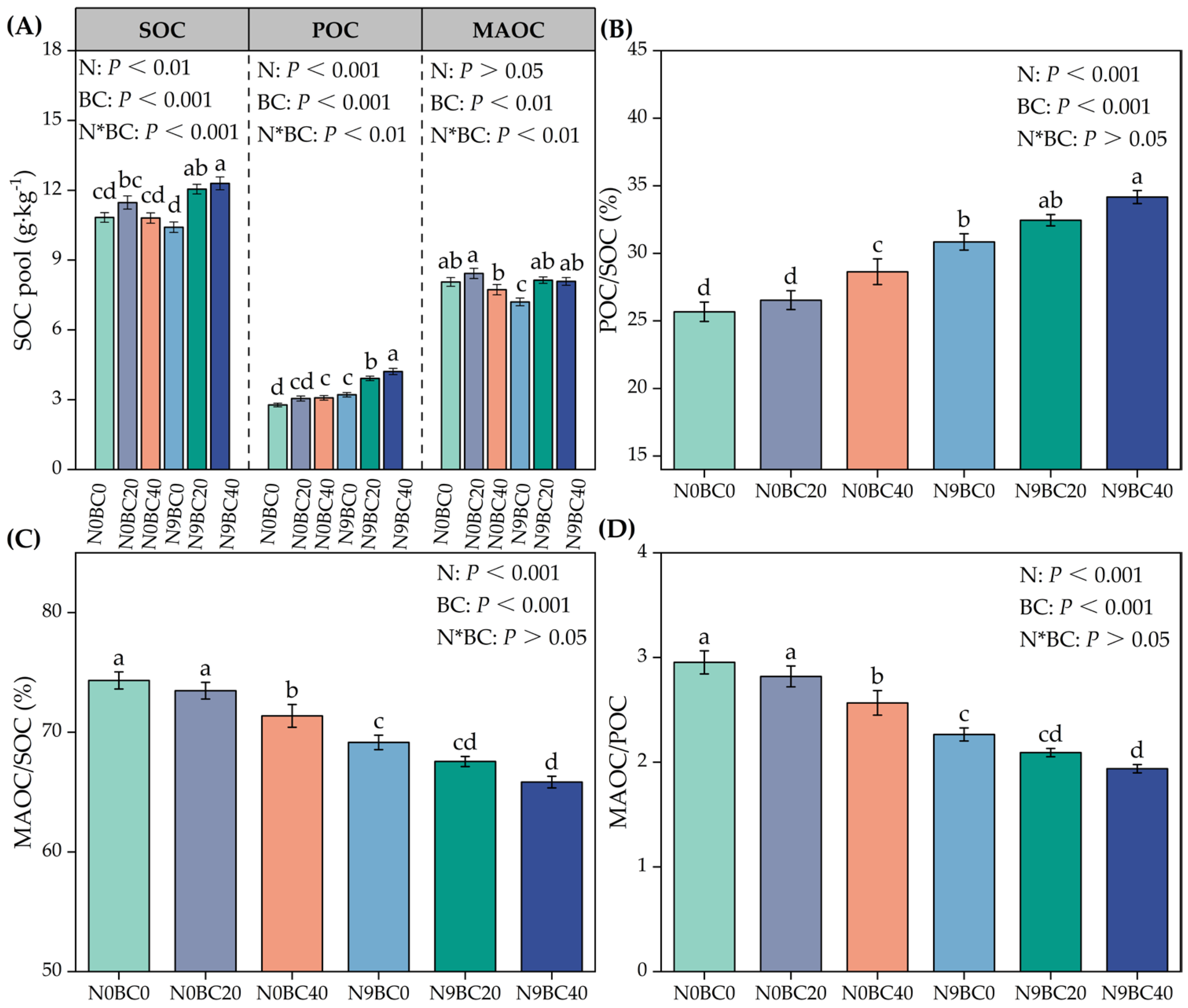
Figure 1. Characterization of soil organic carbon (SOC) pool (A) SOC; particulate organic carbon, POC; mineral-associated organic carbon, MAOC) contents, and relative proportions of carbon fractions (BD) under high N and BC addition. Note: N and BC represent N and BC treatment, respectively. N*BC denotes the interaction between N and BC treatment. POC/SOC: the ratio of POC to SOC; MAOC/SOC: the ratio of MAOC to SOC; MAOC/POC: the ratio of MAOC to POC. Different letters indicate significant differences between treatments (p < 0.05, LSD test). Data shown are the pooled mean ± SE from four sampling dates.
Agronomy 15 02800 g001
Figure 2. Activities of soil β-glucosidase ((A): BG), β-N-acetyl-glucosidase ((B): NAG), and alkaline phosphatase ((C): AP) under high N and BC addition. Note: N and BC represent N and BC treatment, respectively. N*BC denotes the interaction between N and BC treatment. Different letters indicate significant differences between treatments (p < 0.05, LSD test). Data shown are the pooled mean ± SE from four sampling dates.
Agronomy 15 02800 g002
Figure 3. Relative abundance of soil bacteria (A) and fungi (B) at the phylum level and non-metric multidimensional scaling analysis (NMDS) of bacterial communities (C) and fungal communities (D) based on Bray–Curtis differences.
Agronomy 15 02800 g003
Figure 4. Changes in soil microbial carbon utilization efficiency ((A): CUE), enzyme vector length ((B): VL), vector angle ((C): VA), and stoichiometric imbalance (DF) under high N and BC addition. Note: The enzyme VL represents the requirement status of microbial metabolism of C, and the VA indicates the limitation of microbial metabolism by nitrogen (N)/phosphorus (P). C:Nimb, C:Nimb, and N:Pimb indicate the stoichiometric imbalance between soil and microbes. N and BC represent N and BC treatment, respectively. N*BC denotes the interaction between N and BC treatment. The red arrows in (B,C) indicate the directions of the C, N, and P limitations, respectively. Different letters indicate significant differences between treatments (p < 0.05, LSD test). Data shown are the pooled mean ± SE from four sampling dates.
Agronomy 15 02800 g004
Figure 5. Relationships among soil microbial metabolic limitations, the relative proportions of soil organic carbon (SOC), and microbial carbon utilization efficiency (CUE). (A) Relationship between the enzyme vector angle (VA) and vector length (VL). (B,C) Relationships of CUE with VL (B) and VA (C), respectively. (DF) Relationships between CUE and the relative proportions of SOC components, i.e., POC/SOC (D), MAOC/SOC (E), and MAOC/POC (F). Note: Shaded areas indicate 95% confidence intervals for regression lines. POC/SOC: ratio of particulate organic carbon to SOC; MAOC/SOC: ratio of mineral-associated organic carbon to SOC; MAOC/POC: ratio of mineral-associated organic carbon to particulate organic carbon.
Agronomy 15 02800 g005
Figure 6. Relationships between soil organic carbon (SOC), particulate organic carbon (POC), mineral-associated organic carbon (MAOC), and their relative proportions, as well as soil properties, in the context of N0 and N9 additions. (A,B) Correlations between SOC pools and their relative proportions with soil properties; (C,D): environmental factors affecting changes in MAOC/POC, as screened based on Random Forest Analysis. Note: ns, *, **, and *** are significant at p > 0.05, p < 0.05, p < 0.01, and p < 0.001 levels, respectively. MSE (%) is the percentage increase in mean square error. C:Nimb, C:Nimb, and N:Pimb indicate the stoichiometric imbalance between soil and microbes. CUE: microbial carbon utilization efficiency; VL: vector length; VA: vector angle; BG: β-glucosidase; NAG: β-N-acetyl-glucosidase; AP: alkaline phosphatase; MBC: microbial biomass carbon; MBN: microbial biomass nitrogen; MBP: microbial biomass phosphorus.
Agronomy 15 02800 g006
Figure 7. Partial least squares path modeling (PLS-PM) of the effect of soil properties on soil particulate organic carbon (POC) and mineral-associated organic carbon (MAOC) under N0 and N9 additions. Model pathways for soil POC (A) and MAOC (B) under N0 addition conditions; Model pathways for soil POC (C) and MAOC (D) under N9 addition conditions. Note: Red and blue arrows indicate positive and negative paths, respectively. Solid or dashed lines indicate significant paths (p < 0.05) or non-significant paths (p > 0.05), respectively. Numbers next to the path arrows indicate the standardized path coefficients obtained after 1000 bootstrap calculations, and the arrows’ thickness indicates the path coefficients’ size. R2 indicates the degree to which the response variable is explained. Physicochemical properties include soil water content, soil temperature, SOC (soil organic carbon), and total nitrogen. Microbial biomass includes MBC (microbial biomass carbon), MBN (microbial biomass nitrogen), and MBP (microbial biomass phosphorus). Enzyme activities include BG (β-glucosidase), cellulase, NAG (β-N-acetyl-glucosidase), urease, and AP (alkaline phosphatase). Stoichiometric imbalances include C:Pimb and N:Pimb. microbial communities include fungi and bacteria. Microbial metabolism limits VA (vector angle) and VL (vector length). CUE: microbial carbon utilization efficiency.
Agronomy 15 02800 g007
Disclaimer/Publisher’s Note: The statements, opinions and data contained in all publications are solely those of the individual author(s) and contributor(s) and not of MDPI and/or the editor(s). MDPI and/or the editor(s) disclaim responsibility for any injury to people or property resulting from any ideas, methods, instructions or products referred to in the content.