You are currently viewing a new version of our website. To view the old version click .
Agronomy
  • Article
  • Open Access

4 December 2025

A Novel Semi-Hydroponic Root Observation System Combined with Unsupervised Semantic Segmentation for Root Phenotyping


,
,
,
,
,
,
and
1
College of Information Engineering, Sichuan Agricultural University, Ya’an 625000, China
2
Potsdam Institute for Climate Impact Research e. V. (PIK), Telegrafenberg A 31, 14473 Potsdam, Germany
3
College of Agronomy, Sichuan Agricultural University, Ya’an 625000, China
4
Centre for the Research and Technology of Agroenvironmental and Biological Sciences (CITAB), Inov4Agro, Universidade de Trás-os-Montes e Alto Douro (UTAD), Quinta de Prados, 5000-801 Vila Real, Portugal
This article belongs to the Special Issue Enhancing Crop Production: Unveiling the Vital Role of Plant Roots and Their Dynamic Interplay with Soil and the Environment

Abstract

Root system analysis remains methodologically challenging in plant research: traditional soil cultivation obstructs comprehensive root observation, whereas hydroponic visualization lacks ecological relevance due to soil environment exclusion—a critical limitation for crops like soybean. This manuscript developed a cost-effective hybrid imaging system integrating transparent acrylic plates, semi-permeable membranes, and natural soil substrates with high-resolution imaging and controlled illumination, enabling non-destructive root monitoring in quasi-natural soil conditions. Complementing this hardware innovation, this manuscript proposed an unsupervised semantic segmentation algorithm that synergizes path planning with an enhanced DBSCAN framework, achieving the precise extraction of primary and lateral root architectures. Experimental validation demonstrated superior performance in soybean root analysis, with segmentation metrics reaching 0.8444 accuracy, 0.9203 recall, 0.8743 F1-score, and 0.7921 mIoU—significantly outperforming existing unsupervised methods ( p < 0.01 ). Strong correlations (R2 > 0.94) with WinRHIZO in quantifying root length, projected area, dimensional parameters, and lateral root counts confirmed system reliability. This soil-compatible phenotyping platform establishes new opportunities for root research, with future developments targeting multi-crop adaptability and complex soil condition applications through modular hardware redesign and 3D reconstruction algorithm integration.

1. Introduction

As a key organ for water and nutrient uptake, the root system serves important functions such as anchoring the plant, storing energy, and mediating plant–microbe interactions [1,2,3]. Its morphology and physiological characteristics directly affect the efficiency of the crop utilization of soil resources, which in turn determines the crop yield potential. As exemplified by soybean, the species’ robust taproot system demonstrates distinctive symbiotic nodulation capacity for nitrogen fixation along with pronounced genotype-specific root architectural plasticity, which collectively determine its spatial acquisition efficiency of key soil nutrients. Research indicates that the targeted optimization of soybean root architecture can enhance nitrogen and phosphorus utilization efficiency by more than 15%. Therefore, it is important to accurately analyze the root system configuration and its dynamic changes for crop genetic improvement and cultivation optimization.
Current root phenotyping methods still face significant technical challenges under soil cultivation conditions (whether in laboratory or field environments), making it difficult to achieve the visual observation of the complete root system architecture. A critical limitation remains the inability to non-destructively monitor the dynamic growth process of roots. According to existing technical principles and application scenarios, root phenotyping observation methods can be systematically classified into three main categories: field analysis methods, soil-free analysis methods, and soil-based analysis methods [4,5]. The micro-root tube method [6,7,8], as a representative technique in the field analysis method that can non-destructively monitor the root system structure, can dynamically observe the growth, senescence, death, and decomposition of the root system attached to the wall of the tube and be used to obtain the root system characteristics such as root elongation, root density, root surface area, the number of roots, etc., but it can only observe localized roots near the root tube, which makes it difficult to reflect the overall conformation. The paper-based pouch method [9,10], hydroponic culture [11], and agar-based cultivation [12,13] all enable the clear imaging and observation of intact root system architectures. However, these soilless phenotyping approaches are typically employed to evaluate seedling growth performance and may not fully represent the characteristics of mature root systems. Moreover, such analyses overlook soil properties, the physical environment of root growth, and other essential growth conditions while failing to account for root–microbe interactions or the physiological correlations between root traits and environmental variations [14]. Soil-based non-destructive analysis methods, including the transparent potting method [15] and root box method [16] in combination with X-ray CT [17,18,19], PET [20], or MRI [21,22], can be used to visualize the three-dimensional structure of the root system in the soil but are disadvantaged in that the equipment is expensive, and the radiation generated by X-CT may affect the growth of the root system of the plant to some extent.
Based on the above technical bottlenecks, this study innovatively and systematically improves the traditional root box method and proposes a novel soil–hydroponic coupled root observation system. By optimizing the optical transparency and environmental controllability of the cultivation device, this technical solution successfully achieves the following key breakthroughs: (1) the high-resolution visualization of the intact root system structure under the premise of maintaining the natural soil cultivation environment; (2) the effective overcoming of the imaging difficulties of soil particle interference in the traditional soil cultivation method; and (3) the establishment of a non-destructive observation system applicable to long-term dynamic monitoring.
Secondly, traditional root phenotyping usually relies on manual measurements, which are time-consuming, labor-intensive, and subjective. These shortcomings limit the ability to conduct in-depth studies of root properties. However, with the rapid development of machine vision technology, plant root phenotyping systems are undergoing a revolutionary change. Machine vision technology [23], which combines automated imaging and advanced image processing algorithms, enables the rapid, precise, and objective analysis of plant root systems. With high-resolution cameras and specialized imaging software, detailed images of the plant root system can be captured in a short period of time, and various morphological indicators of the root system, such as root length, thickness, surface area, and structure, can be automatically measured [24]. These data are important for understanding plant growth dynamics, evaluating plant responses to environmental changes, and breeding studies.
In the research history of plant root image segmentation, following the early manual measurement methods, the application of machine learning algorithms in this field has been advancing, providing new solutions to the limitations of traditional methods. For example, Tajima and Kato (2011) [25], in their study of threshold segmentation algorithms, found that the Triangle algorithm in ImageJ was able to efficiently estimate the length of rice root systems and was highly correlated with the results of the commercial software WinRHIZO (r = 0.986). However, the method relies on color contrast, and segmentation accuracy decreases significantly when the root system is similar in color to the soil background or when the lighting conditions are not uniform. Bodner et al. (2018) [26], on the other hand, explored hyperspectral imaging technology, which enables the automatic segmentation of the root system in the soil background by analyzing the reflectance characteristics of the root system in the spectral range from 1000 to 1700 nm and was able to extract information on the physical and chemical properties of the root system. Although this method performs well in complex backgrounds, its large data volume, complex processing flow, and high hardware equipment requirements limit its wide application. Yu et al. (2020) [27] proposed a root segmentation method based on multiple example learning (MIL), which requires only image-level labels to train the model and significantly reduces the annotation cost. Among the methods, the miSVM algorithm has the best detection performance, but this method is more sensitive to labeling accuracy, and the MIForests algorithm is less stable and sensitive to the selection of training samples.
Although current root segmentation techniques have been able to realize the separation of the root system from the background, they still face many challenges in further distinguishing the main root from the lateral roots at the semantic level. The aim of this study is to construct an automated, non-destructive, and dynamic root detection system by utilizing machine vision technology. Based on the soybean root time-series image dataset collected by this system, we propose a new unsupervised machine learning algorithm based on the DBSCAN algorithm [28,29,30] to achieve the semantic segmentation of root images. By measuring seven commonly used phenotypic features of the soybean root system, this study aims to reveal the dynamic change patterns of soybean root system phenotypes with the growth process under a soil cultivation environment. In addition, to further validate the segmentation effect of the algorithm and the accuracy of the phenotypic feature measurements, another set of root system scanning data was used in this study for evaluation.

2. Materials and Methods

2.1. Cultivation Method

This study used soil-cultivated soybean seeds (variety: improved Zhonghuang 13) from the research laboratory of the College of Information Engineering, Sichuan Agricultural University. Healthy seeds with good plumpness, intact seed coats, and no disease spots were selected. After 5 days of hydroponic germination, they were transplanted into an improved root box cultivation system. The growth conditions were maintained at 25 ± 1 °C and 55 ± 5% relative humidity in an artificial climate chamber, with long-day treatment (16 h light/8 h dark) applied after seedling emergence.
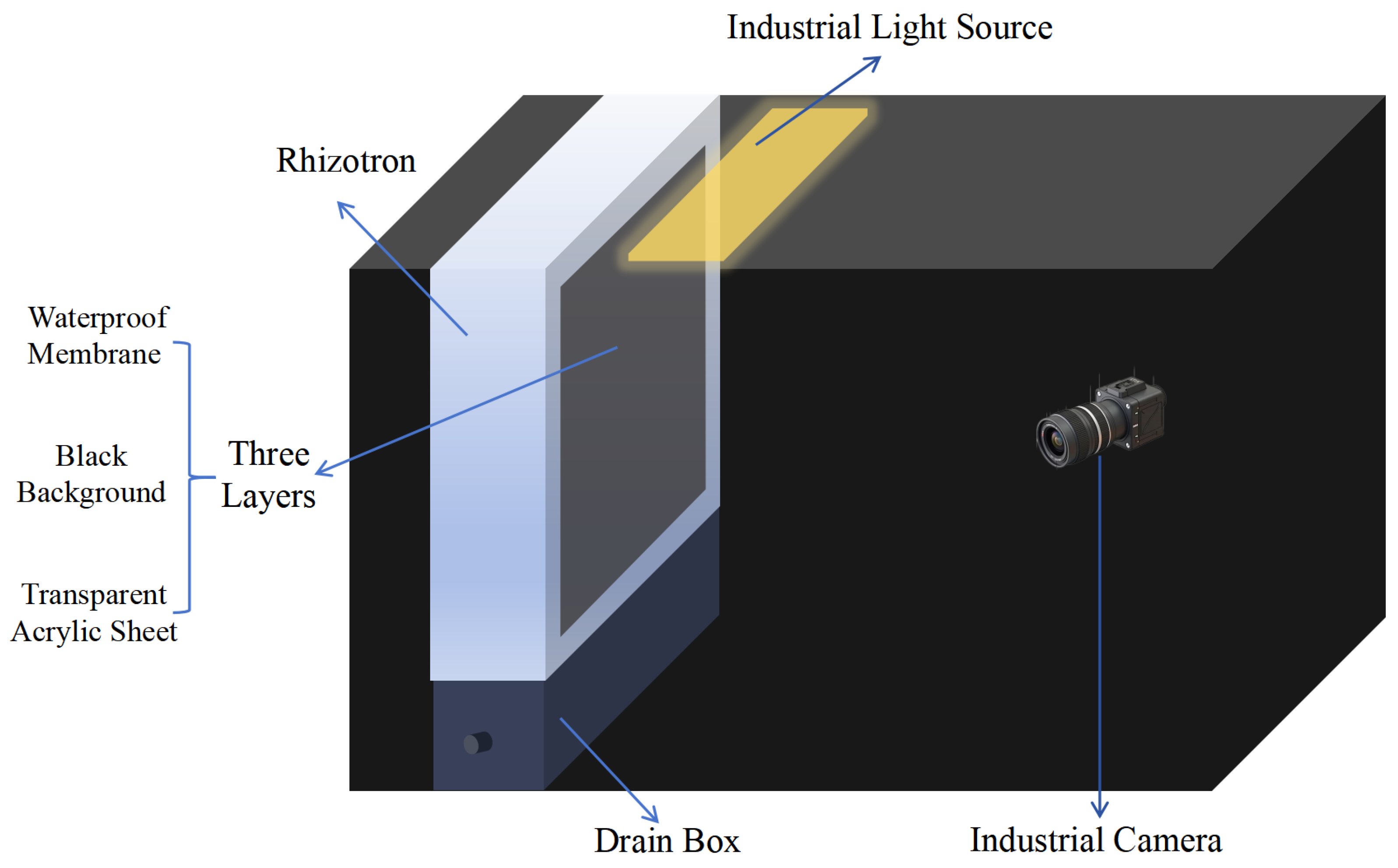
This experiment utilized a self-improved acrylic root observation system, referred to as a novel semi-hydroponic root observation system, with external dimensions of 45 cm (L) × 15 cm (W) × 45 cm (H), as illustrated in Figure 1 and Figure 2A. The root box was equipped with drainage holes at the bottom to prevent waterlogging. A key innovation of the system is the internal “black cloth–permeable membrane” composite layer installed along the transparent observation wall. Soybean plants were fixed in the narrow space between the black cloth and the inner wall, while a mixed substrate of soil and coconut coir was placed outside the permeable membrane.
Figure 1. A schematic of the 3D structure of the NRMS (non-destructive root monitoring system).
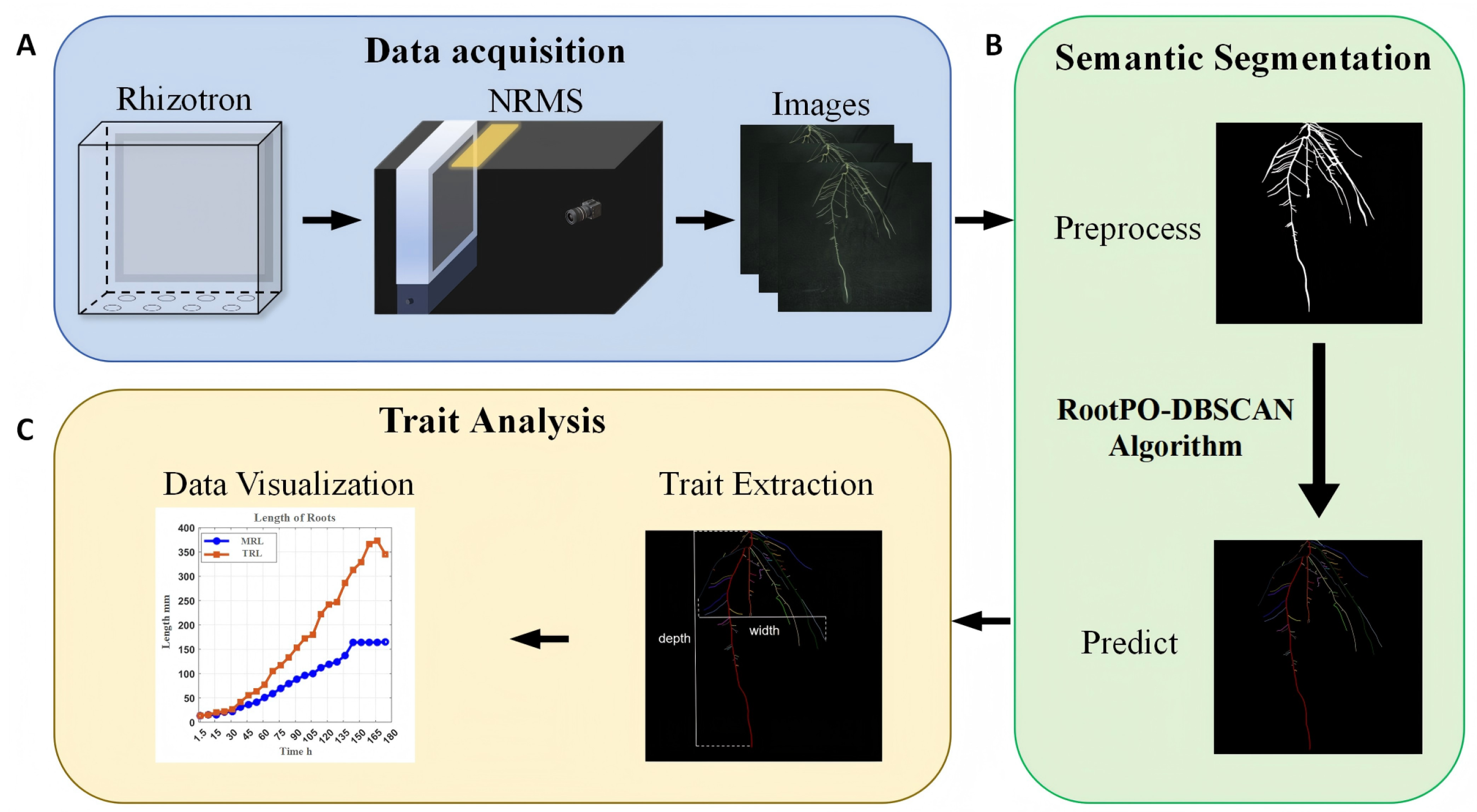
Figure 2. An overview of the high-throughput phenotyping process using the NRMS and unsupervised clustering algorithms. (A) Plants were cultivated in Rhizotron and the NRMS to obtain in situ images of the root system in png format. (B) After preprocessing, the batch semantic segmentation of the images was performed using the RootPO-DBSCAN algorithm. (C) Root system traits were extracted based on the segmented images and analyzed for temporal growth.
This system is defined as a semi-hydroponic platform because it integrates the controllability of hydroponics with the ecological relevance of soil cultivation. The configuration compresses and guides the root system to develop along a well-defined two-dimensional plane adjacent to the observation window, thereby restricting unrestricted three-dimensional expansion. Functionally, it establishes a coupled soil–hydroponic cultivation mode: the roots are confined within a clean, membrane-delimited space resembling a hydroponic environment while still accessing water and nutrients from the soil-based substrate through the combined capillary action of the black cloth and the permeability of the membrane. The system offers several key advantages:
  • It physically separates the roots from the soil, which have a similar color, thereby significantly improving root image contrast and clarity.
  • The permeable membrane, together with the capillary action of the black cloth, facilitates continuous water and nutrient supply from the outer substrate while preventing root penetration into the soil, thus maintaining observation quality.
  • The incorporation of coconut coir into the soil mixture enhances substrate aeration and looseness, promoting natural root extension and reducing overall weight.
  • The non-destructive nature of the setup allows for the dynamic quantification of root phenotypic parameters, offering a reliable platform for studying root development patterns.

2.2. Image Acquisition Devices

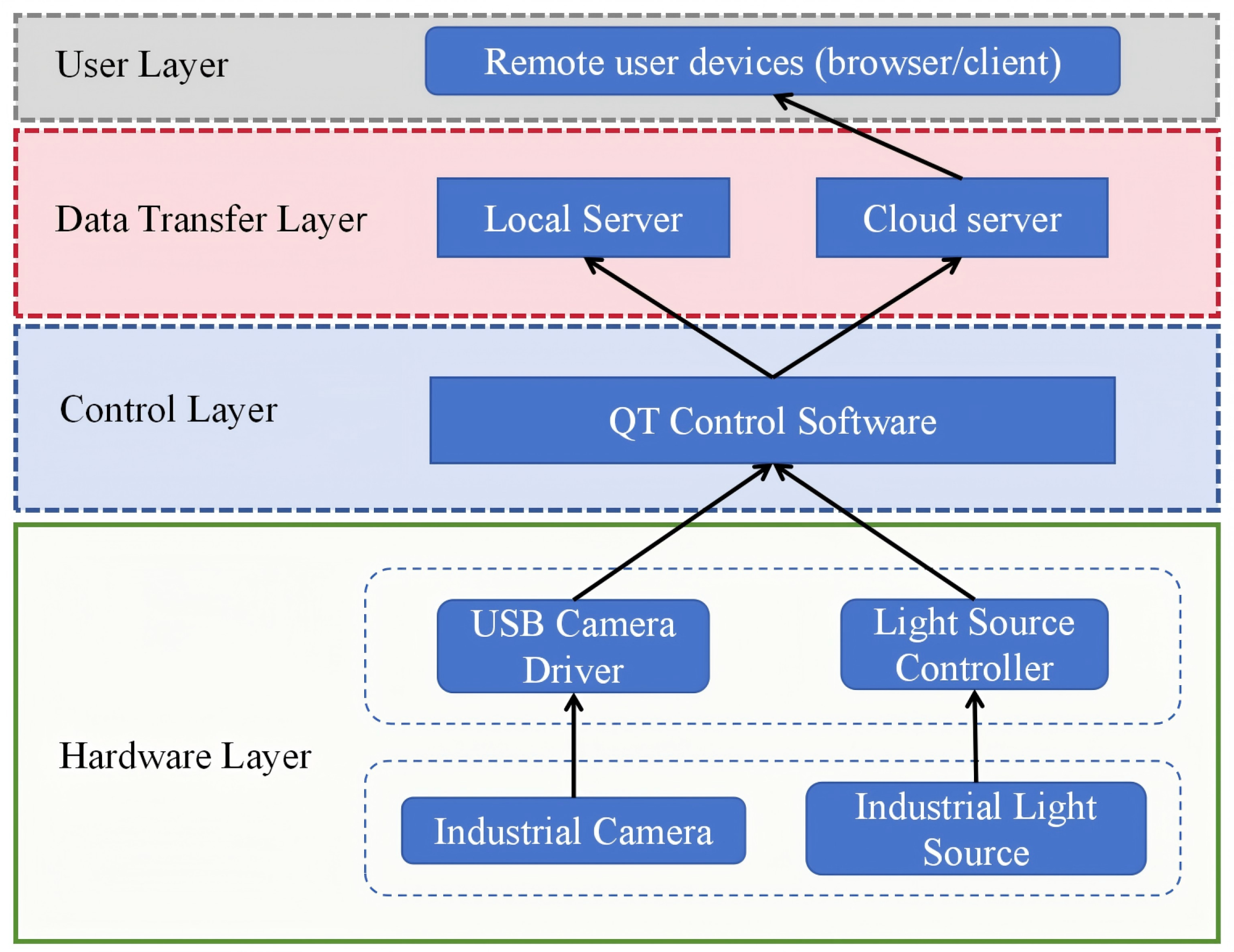
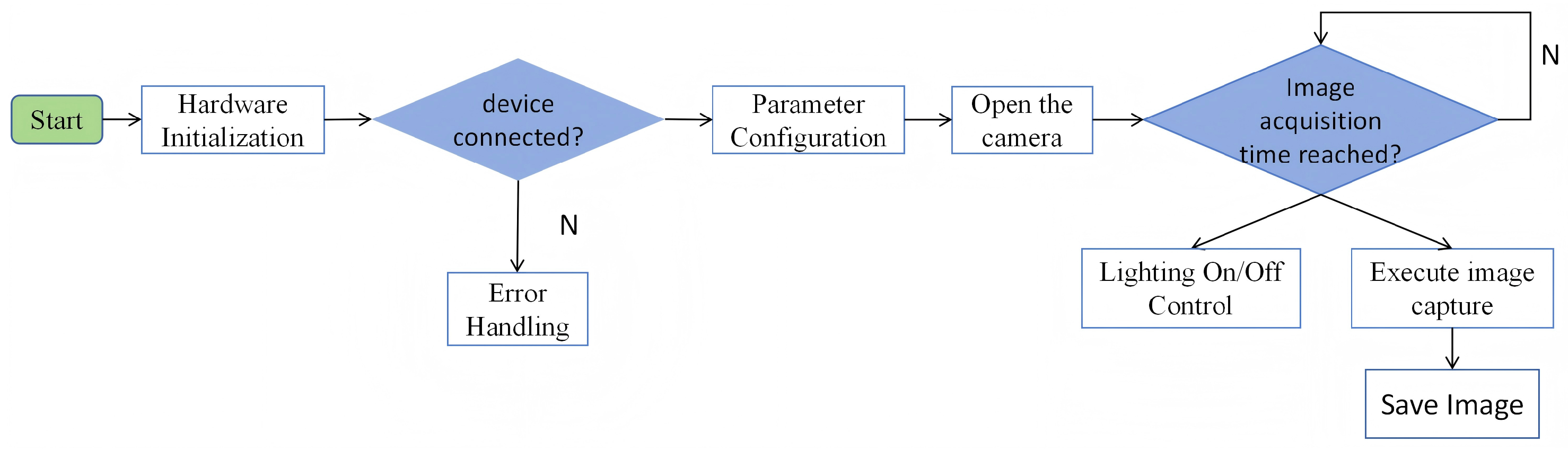
This study employed a self-developed non-invasive root monitoring system (NRMS) for semi-hydroponic cultivation to conduct experimental observations. The system consists of three parts: a picture capturing module, intelligent control module, and cloud data management module (Figure 3). The picture capturing module adopts a modular design, mainly including the following: (1) an image capturing unit (Huaray USB industrial camera A3A20CU24 (manufacturer: Huaray, Hangzhou, China) with Hikvon industrial lens MVL-HF0624M (manufacturer: Hikvision Digital Technology, Hangzhou, China)); (2) customized lighting unit (45 cm × 15 cm industrial-grade LED light source, computerized control through light modulator); and (3) three-dimensional adjustable bracket system (the structure of the picture capturing module is shown in Figure 1). The system realizes parameter configuration and automated capturing through PC control software, which can accurately set the acquisition time interval (1 min–24 h adjustable) and light source intensity (0–100% continuously adjustable). Through iterative experimental optimization to achieve optimal image clarity and contrast for root phenotyping, the following parameters were established: acquisition interval = 90 min; light source intensity = 20%; frame rate = 32; exposure time = 80,000 µs; gain = 5; gamma = 0.5; and brightness = 25. After completing the optimization and calibration of optical parameters such as camera focal length, aperture, white balance, etc., the system can automatically execute the preset capturing tasks and synchronously upload the captured high-resolution in situ root images (in PNG format with a resolution of 4000 × 3000) to the local storage server and cloud database, supporting remote real-time monitoring and data download. A detailed flowchart illustrating the parameter configuration and automated image acquisition process is provided in Figure 4. The temporal and spatial resolution of the system can be flexibly adjusted by software parameters to meet the dynamic monitoring needs of soybean roots at different growth stages, and combined with the improved unsupervised segmentation algorithm presented in this paper, it permits high-throughput temporal root phenotyping (Figure 2).
Figure 3. Soybean root non-destructive dynamic monitoring system architecture diagram.
Figure 4. Automation control software flowchart.

2.3. Root System Image Acquisition and Time-Series Dataset Construction

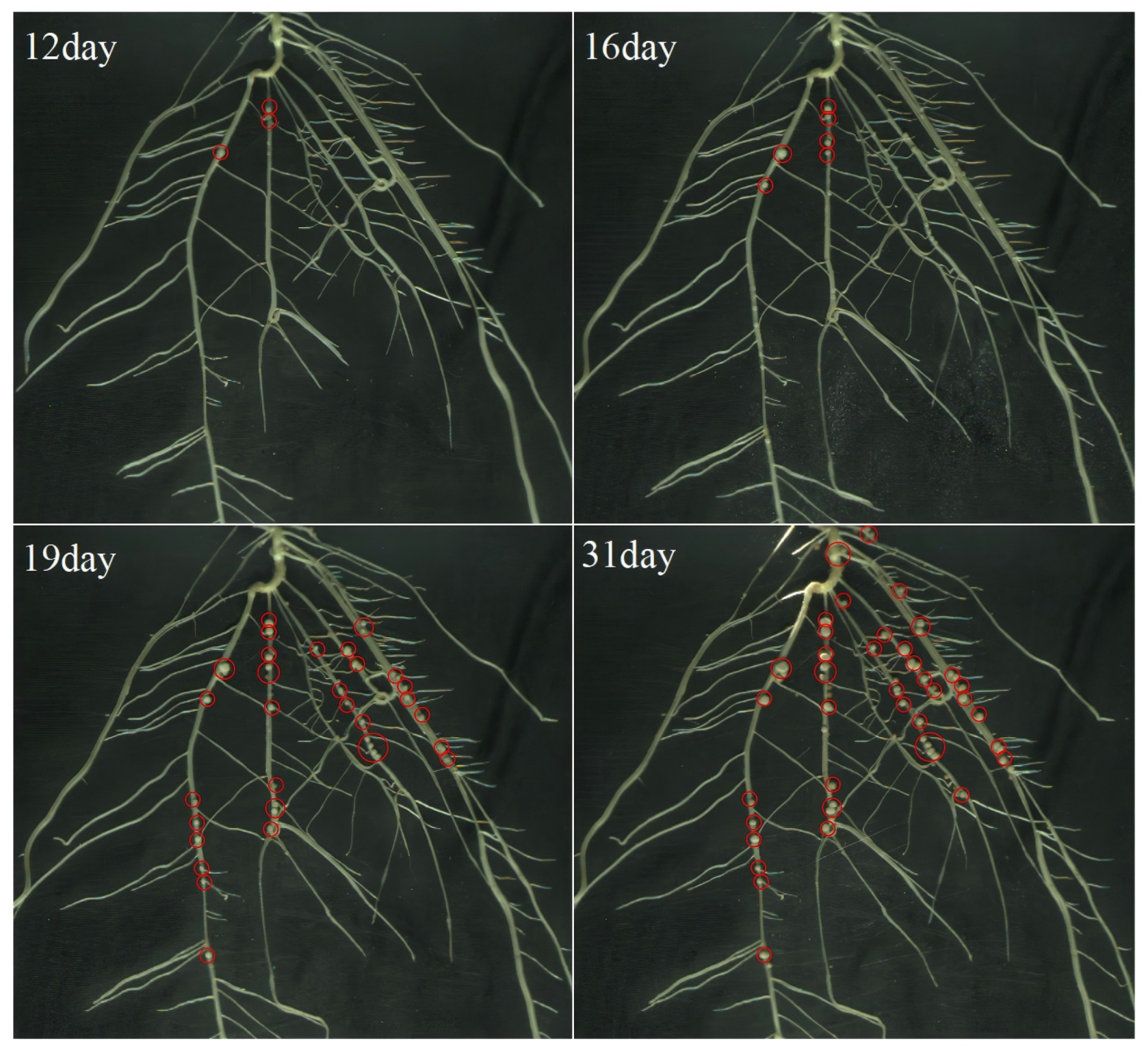
In this study, two experimental schemes were used to capture soybean root image data to construct a multi-source time-series of root development. First, the image time-series were captured by the NRMS, which was activated immediately after the soybean plants were colonized in the special root box, and image capturing was performed in trigger mode with a fixed 90 min interval. A total of 240 high-resolution PNG-format images of 4000 × 3000 pixels were captured during the 18-day continuous culture cycle conducted in December 2024, which covered the most active phase of root development. The dataset is characterized by excellent imaging quality, complete dynamic information, and standardized visual conditions: the black background significantly enhanced the contrast of the root system, ensuring a clear target and clean background. The growth processes of primary root elongation, lateral root occurrence, and the dynamic distribution of rhizomes were completely recorded. To further document subsequent physiological processes, the observation was extended beyond the initial 18-day period. As shown in Figure 5, which displays images from Days 12, 16, 19, and 31, the system successfully captured not only the dynamic root architecture changes but also the distribution and development of root nodules at later stages. The constant illumination conditions and fixed shooting angle throughout the entire observation period effectively reduced the environmental noise interference. This comprehensive time-series demonstrates that the system is capable of supporting future research on root nodule development in addition to capturing root dynamics.
Figure 5. Distribution of root nodule (the red circles indicate the root nodules).
In order to verify the generalization ability of the algorithm, an independent validation dataset was constructed using plants grown in pots filled with standard potting soil. After 30 or more soybean plants were grown for 14 days, the root samples were obtained by complete excavation and cleaned with deionized water, and then 125 images of the isolated root system were acquired using an HP G4010 scanner (manufacturer: Hewlett-Packard, Palo Alto, CA, USA) with 200 dpi resolution. This dataset is characterized by rich structural diversity and high precision but captures only the last development stage. It covers the root conformation variation in different genotypes of soybean, such as taproots and branched roots. The scanned images can clearly identify the microstructure of root hairs and root tips, which can provide the basis for the algorithm to provide a fine annotation. Methodologically, this dataset contrasts with and complements the in situ dataset in two key ways. In terms of spatial and temporal dimensions, it offers static high-precision data versus the in situ dataset’s dynamic time-series observations. Meanwhile, in acquisition methods, it relies on in vitro scanning, whereas the in situ dataset uses non-destructive in situ techniques. This dual complementarity strengthens this study’s conclusions and establishes a reliable foundation for quantitative root phenotype analysis and growth modeling.

2.4. Root Image Processing

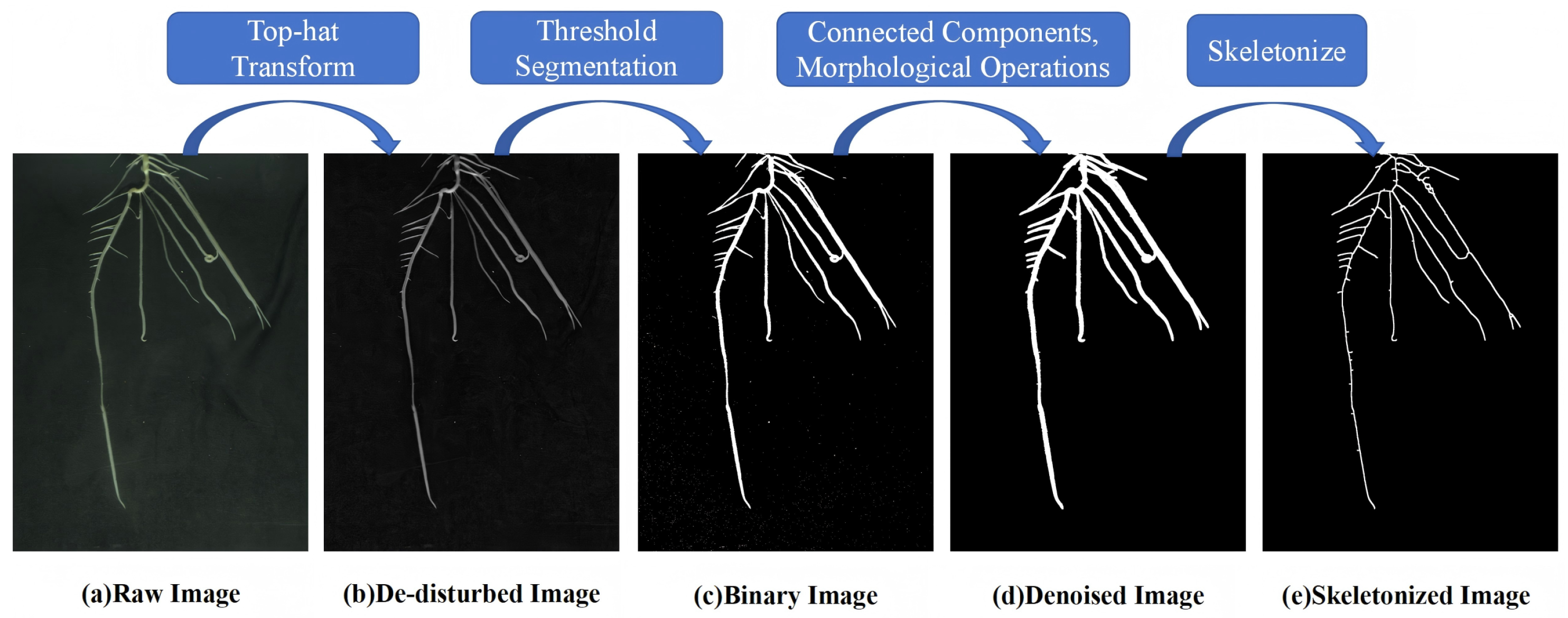
In the non-destructive dynamic monitoring of soybean root systems, the imaging system provides constant illumination and effectively reduces environmental noise interference. However, the raw images obtained still exhibit slight noise and uneven lighting effects, primarily due to water mist around the root system and minor illumination fluctuations. To further mitigate these residual interferences and enhance segmentation accuracy, we introduce a set of image preprocessing procedures (Figure 6).
Figure 6. Flowchart of root image preprocessing.
First, we applied a top-hat transform to reduce the water mist interference and balance the lighting conditions of the image to provide a more homogeneous background for the subsequent threshold segmentation. After threshold segmentation, the edges of the root system obtained from the initial segmentation were not smooth enough due to the high resolution of the image, which may lead to excessive small lateral roots in the subsequent skeletonization process [31]. To address this problem, we extracted the maximum connectivity component of the white region after segmentation to remove the noise points underneath the image. Subsequently, the root system was highlighted and smoothed by morphological operations [32], including erosion and swelling, to reduce noise and optimize the representation of the root structure. After these processes, the skeletonized images obtained reflect the structural characteristics of the soybean root system more accurately.

2.5. Algorithm for Semantic Segmentation of Root Systems (RootPO-DBSCAN)

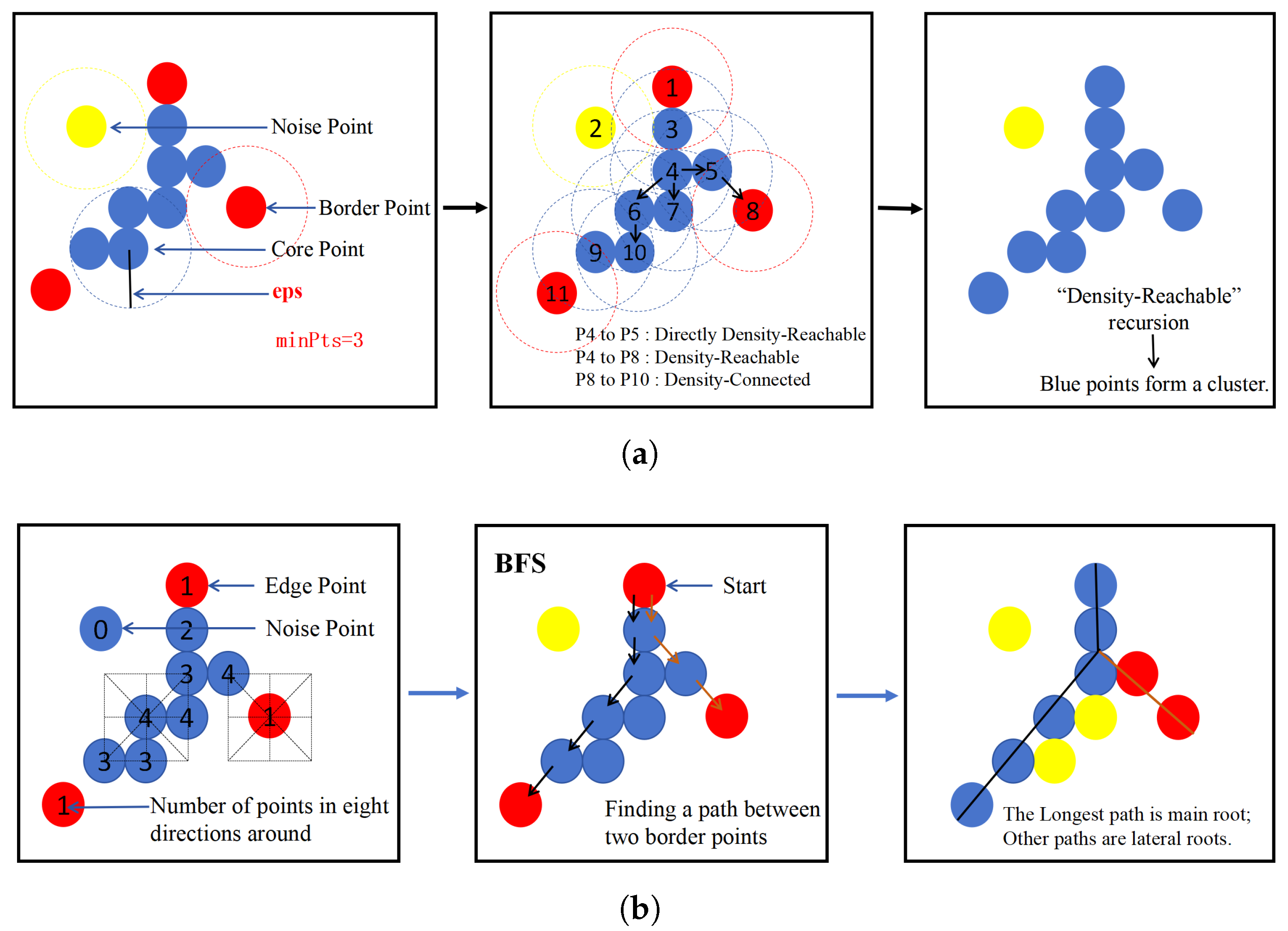
In the field of plant root image segmentation, traditional machine learning segmentation methods often fail in accurate segmentation due to the complexity and small-scale morphology of the root system. DBSCAN is a density-based spatial clustering algorithm, which forms clusters by identifying high-density regions separated by low-density regions. It is able to recognize clusters of arbitrary shapes, with low sensitivity to noise or outliers, and does not need to preset the number of clusters [33,34]. Theoretically DBSCAN is able to cluster individual branches of the root system into different classes, if they can be separated by regions of low root density. However, in practice it fails to achieve the desired separation and usually only clusters the entire root system into one class. Here we propose a novel combination of DBSCAN with path optimization via the the breadth-first search (BFS) [35,36], called RootPO-DBSCAN (Root Path Optimization–density-based spatial clustering), to overcome this problem. The aim of the RootACo-DBSCAN algorithm is to identify the root system in the captured images and separate them into the main and side roots. Therefore, DBSCAN is used to identify the whole root system, and the BFS algorithm is used to separate the main root from the side roots.
In the DBSCAN algorithm, each point defines its neighborhood based on the minimum number of points MinPts in its surrounding epsilon (eps) radius. If the number of points within the eps radius of a given point reaches or exceeds MinPts, the point becomes a core point. The core points and their directly reachable points (i.e., all points in the neighborhood) constitute the clusters, while points that are neither core points nor in the neighborhood of any core point are regarded as noise [33], the principle of which is shown in Figure 7a. The RootPO-DBSCAN algorithm is based on the DBSCAN algorithm, with four major modifications made (Figure 7b): (1) The algorithm adapts DBSCAN by employing the Chebyshev distance [37] metric (instead of Euclidean) with fixed parameters eps = 1 and MinPts = 2. Edge points are specifically identified when MinPts = 1, where a point is classified as an edge if its 8-directional neighborhood contains exactly one other point. (2) The BFS algorithm is added to find the path. The root system structure is similar to the structure of the tree, so the first edge point is equivalent to the apex of the tree. The shortest path between the first edge point and the other edge points can facilitate the identification of root branches. (3) We distinguish between the main root path and the side root path. By comparing the lengths of all the paths, the longest path is selected as the main root path, and the rest of the paths are treated as the side root paths after removing the points of the main root path. (4) Color rendering: We assign distinct colors to each path to differentiate the primary root from every lateral root, achieving the semantic segmentation of the root system.
Figure 7. Algorithm diagram. (a) DBSCAN schematic diagram. (b) RootPO-DBSCAN schematic diagram.
In this study, four metrics—precision, recall, F1-score, and Mean Intersection over Union (MIoU)—are employed to evaluate the effectiveness of the improved algorithm in the soybean root semantic segmentation task. The ground truth annotations for root systems are manually labeled using labelme, categorizing each pixel into three classes: background, primary root, and lateral root. Among these, MIoU serves as a core evaluation metric in semantic segmentation, quantifying model accuracy by measuring the overlap between the predicted segmentation results and ground truth annotations. MIoU is computed by first determining the Intersection over Union (IoU) for each class, defined as the ratio of the intersection to the union of the predicted and true regions. The final MIoU is obtained by averaging the IoU values across all classes. The mathematical formulation of MIoU is as follows:
M I o u = 1 k i = 1 k T P i T P i + F P i + F N i
where k denotes the number of classes (e.g., primary root, lateral roots, and background), while T P i , F P i , and F N i represent the true positives, false positives, and false negatives for the i-th class, respectively. A higher MIoU (closer to 1) indicates better agreement between the segmentation results and ground truth, reflecting superior model performance.

2.6. Root Phenotypic Characterization

In order to determine the conversion relationship between pixel distances in the captured root images and real-world distances as a means of measuring accurate root phenotypic characterization data, we used a camera calibration technique. First, keeping the relative position of the camera to the root box constant, a 9 × 6 black and white checkerboard calibration plate (in which each small square is 27 mm wide, as shown in Figure 8) was taped to the root box, and the camera was used to take an image containing the calibration plate, and the real-world distance represented by each pixel was calculated by the conversion algorithm to be 0.094 mm.
Figure 8. Calibration board.
We performed accurate phenotypic measurements based on the semantically segmented root images, combined with the described calibration techniques through an algorithm that measured seven phenotypic features, including the main root length, total root length, root depth, root width, width-to-depth ratio, total number of roots, and projected area, as shown in Table 1. After identifying the main and lateral roots using the RootPO-DBSCAN algorithm, the pixels corresponding to each feature were calculated and then converted into millimeters.
Table 1. Measurable root characteristics.

3. Results

This experiment was conducted using the following hardware and software configurations: An NVIDIA RTX 3060 graphics card with 12 GB VRAM was employed, coupled with a 12th Gen Intel Core i5-12490F hexa-core processor (base frequency 3.0 GHz) and 12 GB system memory. The platform ran on the Windows 10 operating system with Python 3.8 as the development environment. To validate algorithm performance, two independently constructed soybean root datasets were selected for semantic segmentation prediction. Dataset I comprised 240 time-series soybean root images acquired through the NRMS and preprocessed (originating from a single plant), while Dataset II consisted of 30 diverse soybean root samples obtained via a scanner. Considering that Dataset I only contained temporal data from a single plant, to comprehensively verify the algorithm’s adaptability to different root architectures, this study first conducted preliminary predictions on Dataset I, followed by further validation experiments on Dataset II which exhibited higher sample diversity.

3.1. RootPO-DBSCAN Algorithm Segmentation Effect and Comparison

In this section, we compare the experimental results of RootPO-DBSCAN with those of the traditional DBSCAN algorithm and other related mainstream unsupervised clustering algorithms, thereby highlighting the proposed algorithm’s advantages and effectiveness.
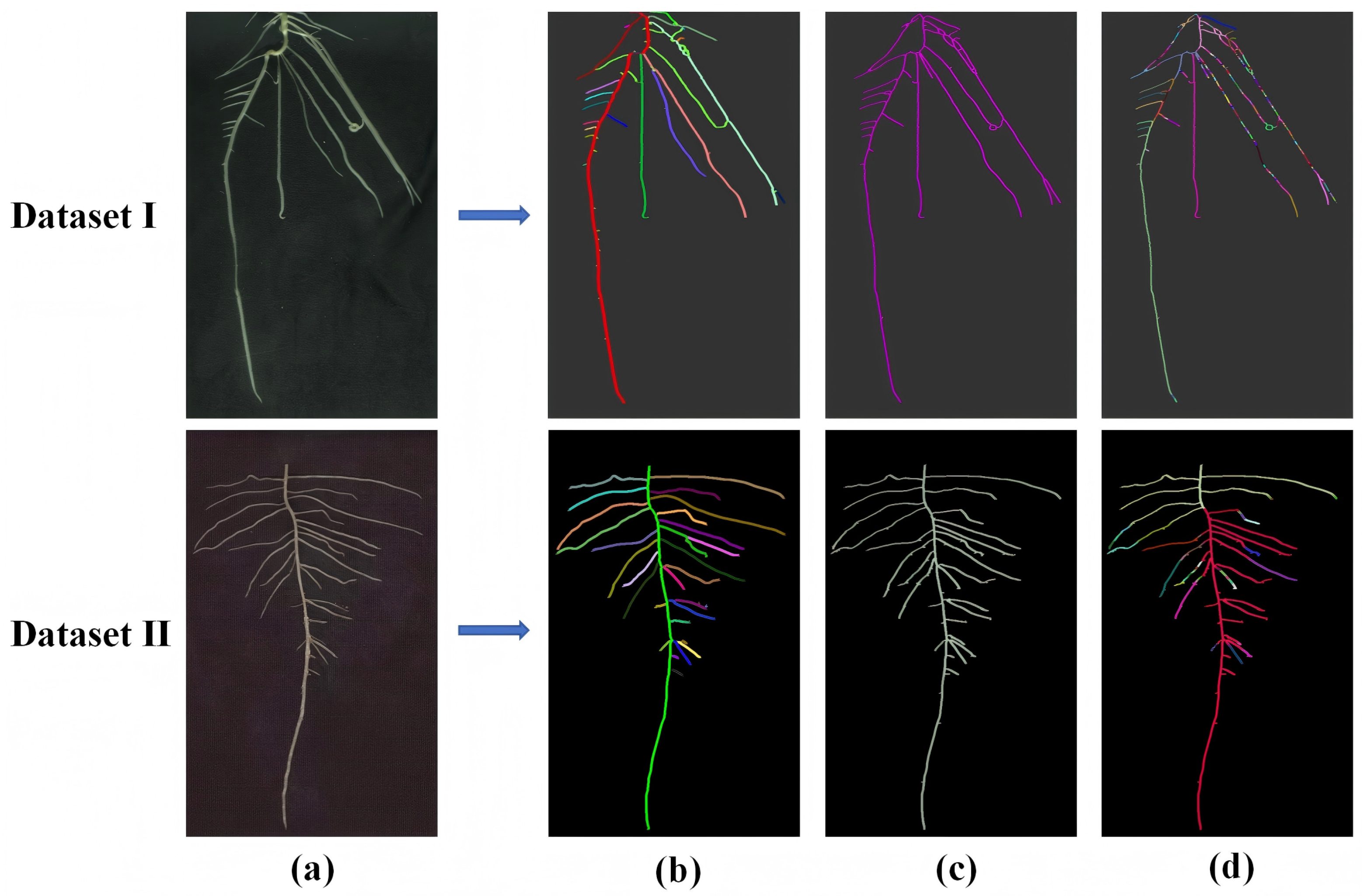
To systematically evaluate the performance of the RootACo-DBSCAN algorithm, this study employed two self-collected soybean root image datasets representing typical morphological characteristics: a primary root-dominant type (Dataset I) and a lateral root-intensive type (Dataset II). As shown in Figure 9b, the algorithm achieved the hierarchical analysis of root architecture by integrating DBSCAN clustering with breadth-first search (BFS) path recognition. Taking Dataset I(b) as an example, the red path represents the primary root topological skeleton, while multicolored branches correspond to different orders of lateral roots. Unlike traditional DBSCAN that relies solely on cluster-based coloring, our algorithm explicitly reconstructs root topology through path tracing, effectively addressing the semantic distinction between primary and lateral roots.
Figure 9. (a) is the original image; (b) is the RootPO-DBSCAN algorithm segmentation image. (c) is the DBSCAN algorithm segmentation image with parameter settings eps = 2.3 and min_samples = 3; (d) is the DBSCAN algorithm segmentation image with parameter settings eps = 2.3 and min_samples = 4.
Comparative experiments with conventional DBSCAN underscore the adaptive improvements of our approach. As shown in Figure 9c,d, the fixed-parameter DBSCAN suffered from fragmentation (over-segmentation) in the primary root–lateral root transition zones of Dataset I while merging multiple lateral branches (under-segmentation) in the dense fibrous clusters of Dataset II. In contrast, RootACo-DBSCAN dynamically adapts to local root structures, maintaining primary root continuity while accurately separating adjacent lateral roots—evident in the precise identification of branching points and hierarchical relationships in complex regions (Dataset II(b)).The quantitative results confirm the method’s robustness, showing higher topological accuracy and better structural consistency with manual annotations across diverse root architectures.
This enhancement stems from the algorithm’s inherent modeling of root growth patterns, where path continuity constraints optimize the clustering outcome, moving beyond a pure dependence on geometric features. Although the current study focused on two representative samples to elucidate the algorithm’s mechanism—covering the most challenging morphological scenarios in root image analysis—future work will expand the dataset scale for more comprehensive statistical validation.
In the study of plant root image segmentation, to systematically evaluate the performance of the RootACo-DBSCAN algorithm, this paper compares it with several mainstream clustering algorithms, including k-means [38], hierarchical clustering [39], spectral clustering, and Gaussian mixture models (GMMs). To ensure fairness and consistency in the comparative experiments, all algorithms were applied to the same preprocessed image (as shown in Figure 6) for cluster analysis. Specifically, the white pixels representing the root system in the preprocessed image were first extracted and their values set to 1, followed by clustering based on the spatial coordinates of these pixels. It should be noted that the proposed RootACo-DBSCAN algorithm incorporates an additional skeletonization step in the preprocessing stage (as shown in Figure 10e) to enhance the perception of root morphology, which was not applied to the other compared algorithms.
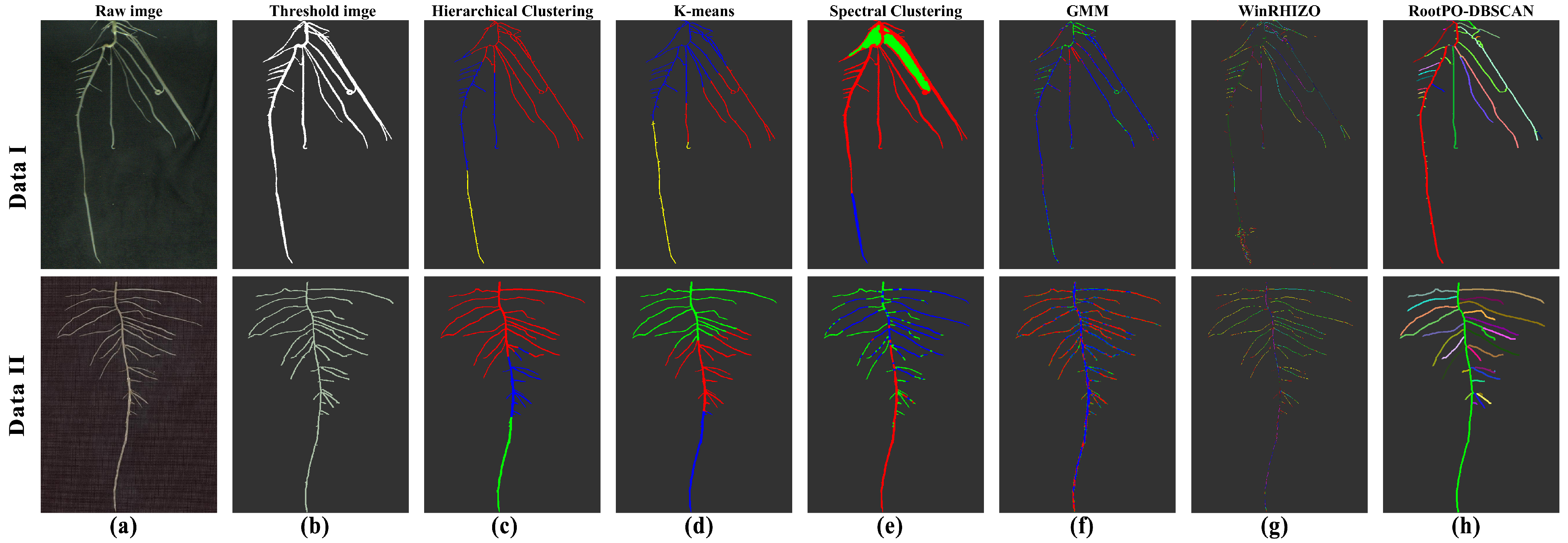
Figure 10. Comparison of segmentation results of RootPO-DBSCAN with common unsupervised clustering algorithms on two root dataset images. (a) Raw image. (b) Threshold binary image. (c) Hierarchical Clustering. (d) K-means. (e) Spectral clustering. (f) GMM. (g) WinRhizo. (h) RootPO-DBSCAN.
The comparative results of the algorithms are shown in Figure 10. Among them, spectral clustering demonstrated relatively better performance, capable of roughly distinguishing the primary root from lateral roots, while the other algorithms completely failed to separate the two. In contrast, the proposed RootACo-DBSCAN algorithm not only clearly achieved the semantic segmentation of the primary and lateral roots but also further accomplished the instance-level distinction of each individual lateral root. K-means, due to its reliance on a pre-defined number of clusters, struggled to adapt to the dynamic changes in root branching, resulting in under-segmentation or over-segmentation (Figure 10d). Hierarchical clustering suffered from high computational complexity and sensitivity to noise, easily producing chain-like false connections that violate the true topology (Figure 10c). Although spectral clustering can handle non-convex distributions, its similarity matrix fails to effectively capture the slender and interlaced topological characteristics of root systems. Moreover, its high computational cost limits its application to high-resolution images (Figure 10e). Gaussian mixture models (GMMs) assume that the data follows a Gaussian distribution, which often deviates from the pixel features of roots (such as color gradients and background interference). Additionally, its neglect of spatial information tends to generate isolated noise points and blurred boundaries (Figure 10f). All these methods were limited by the mismatch between their theoretical assumptions and the complex morphology of root systems. RootACo-DBSCAN, through an innovative combination of density clustering and path search, completely circumvents these limitations (Figure 10f).
Table 2 displays the precision, recall, F1-score, and Mean Intersection over Union (mIoU) of six algorithms on Dataset II. As shown in the table, RootPO-DBSCAN achieves significantly higher mIoU, precision, recall, and F1-score compared to the other five algorithms. These high metrics fully demonstrate the effectiveness and feasibility of the algorithm in root segmentation tasks, confirming its ability to consistently produce high-quality segmentation results. Specifically, compared to the basic DBSCAN algorithm, RootPO-DBSCAN improves mIoU by 26.23%, recall by 29.4%, and the F1-score by 24.23%. This enhancement is due to the integration of adaptive density clustering and a BFS-based path-tracking mechanism in RootPO-DBSCAN. This combination allows for the accurate identification of the root topology, thereby effectively distinguishing primary roots from lateral roots.
Table 2. Segmentation results of different methods.
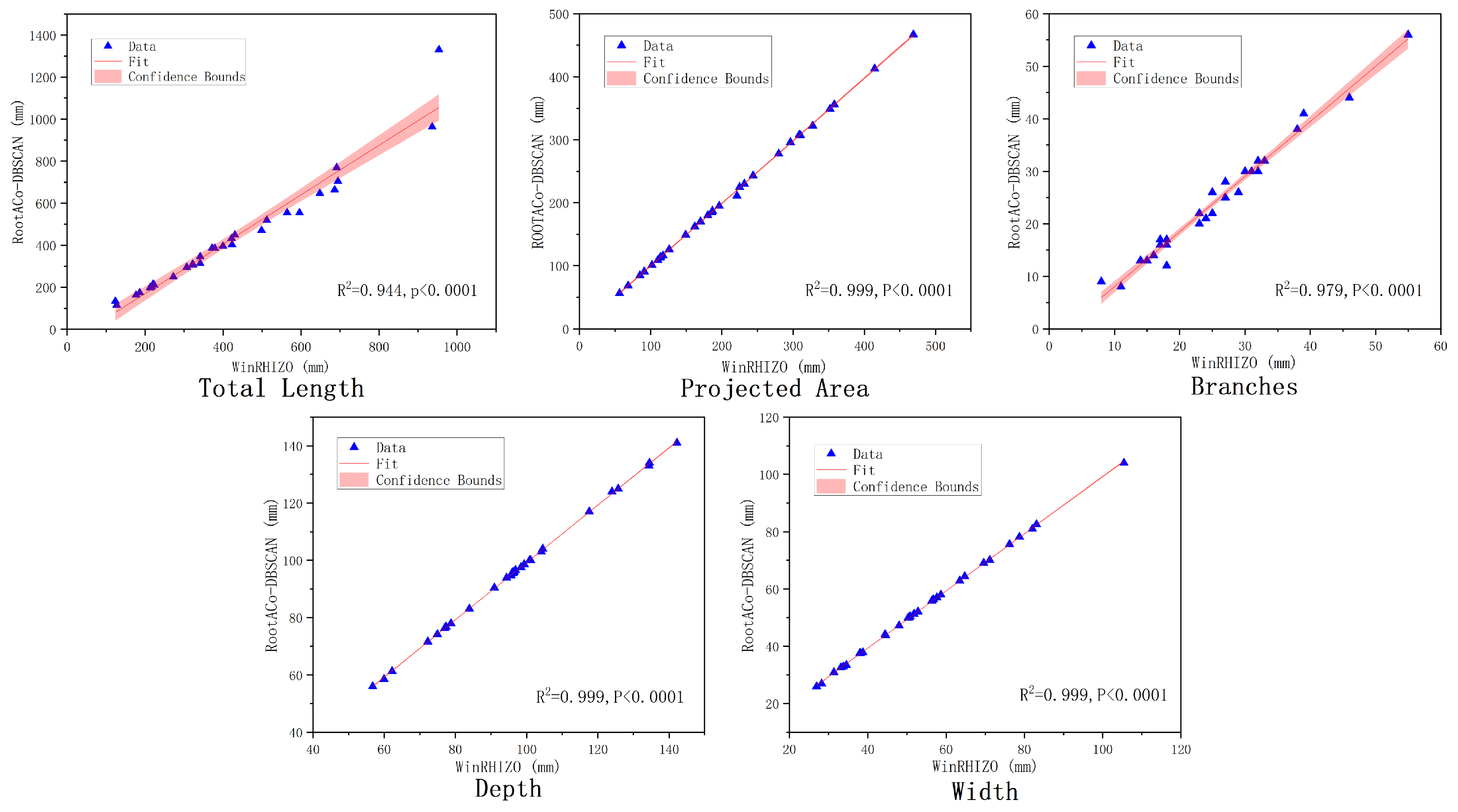
WinRHIZO [40,41] is a professional plant root image analysis system and widely regarded as the industry-standard software for root morphology research. It is specifically designed for the automated scanning and analysis of root images obtained after root washing. To validate the accuracy of the six root phenotype features extracted by the RootACo-DBSCAN algorithm, we selected a dataset of 30 root scan images and conducted measurements using both WinRHIZO and the proposed algorithm. The results were compared and analyzed using Pearson correlation. The segmentation results of WinRHIZO are shown in Figure 10g, which is fragmented and unable to effectively perform the semantic segmentation of the root system. Although WinRHIZO’s results cannot achieve semantic segmentation, its performance measurement results for length are accurate because it is a pixel-based length measurement method.
Analysis across multiple samples showed strong correlations between the two methods in estimating total root length, projected area, width, depth, and number of branches. The Pearson correlation analysis revealed very high coefficients of determination (R2) exceeding 94%, 99%, 99%, 99%, and 97%, with all p-values < 0.01, indicating that the correlations are extremely significant, as illustrated in Figure 11. The 95% confidence intervals for the correlation coefficients further confirmed the robustness of these relationships. The relatively lower goodness of fit for total root length and branch count is mainly attributed to the partial loss of fine, light-colored root structures during preprocessing steps—such as threshold segmentation or noise removal—which reduced the recognition completeness of such structures compared to WinRHIZO’s results.
Figure 11. The correlation between root traits calculated using this algorithm and WinRHIZO system image segmentation. Each point represents an estimated trait value obtained from 30 root scan images. The red solid line and the pink interval indicate the fitted curve and the 95% confidence limits, respectively. The R2 values indicate a good agreement between the results of the present algorithm and the WinRHIZO system image segmentation and trait calculation.

3.2. Growth Curve Plotting

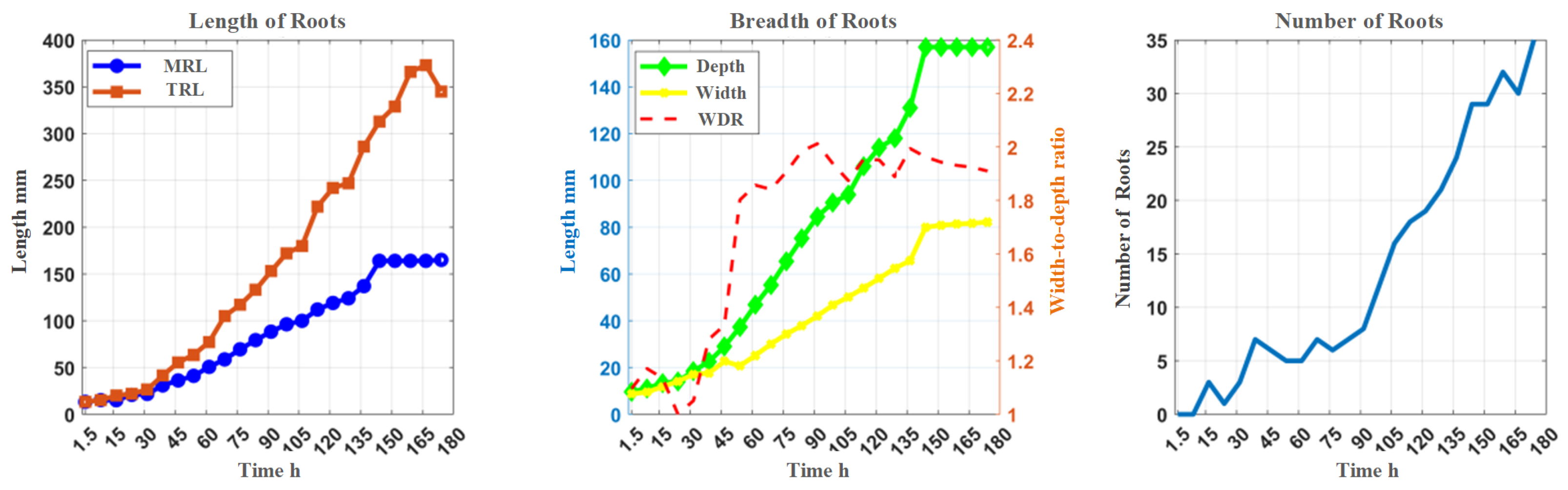
We selected 240 sequential images of soybean roots, captured over a time span of 18 days (approximately 432 h in total), and extracted six phenotypic traits including total root length (TRL), primary root length, root depth, root width, root number, and depth-to-width ratio. To demonstrate the system’s capability for continuous phenotyping, we performed real-time dynamic tracking of these traits, with a specific focus on the rapid growth phase from 0 to 180 h, and plotted the dynamic growth curves of the soybean root system (Figure 12). Although the total observation period covered 18 days, morphological changes slowed after 180 h as the roots entered a stable growth phase; therefore, the analysis primarily focused on the first 180 h.
Figure 12. Trends in root phenotypes over growth time.
In terms of root length dynamics, both primary root length and total root length showed continuous increases over time. During the 0–60 h period, the primary root elongated significantly at an average rate of 0.833 mm/h. By 180 h, TRL reached a maximum value of approximately 165 mm. After 60 h, the growth rate of total root length accelerated markedly, accompanied by substantial lateral root emergence. By 180 h, lateral roots contributed more than 55.7% of the total root length, indicating a structural shift from primary root dominance to increased lateral root development—a transition clearly captured by our continuous monitoring approach.
Regarding root breadth, root depth increased steadily over time, reaching a maximum depth of 160 mm by the end of the cultivation period—approaching the bottom of the root box—demonstrating strong geotropism and deep soil exploration capabilities. Root width expanded slowly between 0 and 120 h, with accelerated growth after 120 h, eventually reaching 80 mm. This reflects enhanced lateral expansion in the later growth stages.
Root number exhibited a consistent upward trend, with the total number of branches reaching a maximum of 35 by 180 h. Branching was slow during the initial stage but increased noticeably after 90 h, consistent with typical exponential growth characteristics in soybean root systems. The real-time tracking of root number further confirmed the method’s sensitivity to growth stage-dependent changes.
The observed phenotypic trends and architectural shifts provide valuable insights into early root development dynamics. Our findings can be contextualized within the broader framework of soybean root diversity, as documented in large-scale studies such as Liu et al.’s (2021) [42], which characterized a wide range of root traits in 171 soybean genotypes at a later growth stage (39 DAS). While a direct numerical comparison is not applicable due to the difference in plant ages, the progression of traits like total root length and the increasing contribution of lateral roots in our study align with the developmental patterns that underpin the extensive variation reported in such germplasm screens. This consistency in developmental trends supports the validity of our phenotyping approach in capturing meaningful biological processes, demonstrating its utility for a detailed temporal analysis of root system architecture from early stages onward.
It should be noted that the current study is based on a single time-series image dataset, serving primarily to validate the feasibility of the RootACo-DBSCAN algorithm for continuous phenotyping. This methodological focus aims to demonstrate the system’s ability to monitor phenotypic dynamics across growth stages, rather than to investigate genetic expression or internal physiological mechanisms. These preliminary results demonstrate the method’s high sensitivity in tracking root developmental dynamics. However, future work should incorporate more biological replicates to improve statistical reliability and further investigate changes in root morphology and physiological function beyond 180 h.

4. Discussion

4.1. Advantages of RootPO-DBSCAN Algorithm and NMRS

The experimental results demonstrate that our novel soil–hydroponic coupled non-destructive root monitoring system (NMRS) effectively strikes a balance between preserving key aspects of natural root growth and achieving high image quality. While it is acknowledged that the root growth medium in our system is not pure soil, the design mimics certain physical constraints (e.g., structural support, root–soil contact geometry) absent in standard hydroponics, thereby promoting a more natural root architecture compared to traditional hydroponic methods. This setup provides a practical and non-destructive technical platform for studying the spatiotemporal dynamics of root development, overcoming the opacity of soil and offering a viable alternative to purely hydroponic systems for specific phenotypic studies.
When applied to two soybean root image datasets, the RootPO-DBSCAN algorithm demonstrated significant advantages in root image segmentation and phenotypic analysis. These strengths stem from its unique design, which addresses several limitations of existing methods. Unlike traditional clustering methods (e.g., K-means, Watershed) which often require manual intervention for optimal parameter selection or seed point marking [43], or even standard DBSCAN which is sensitive to eps and min_samples parameters, our algorithm reduces the need for parameter adjustment. This not only improves operational efficiency but also enhances its adaptability and reproducibility across different root images. Second, by incorporating the BFS algorithm to identify the shortest paths, it explicitly reconstructs root topology. This contrasts with methods that focus solely on pixel-wise clustering [34] but fail to capture the inherent tree-like connectivity and branching hierarchy of root systems. This approach accurately detects branching events, laying a foundation for distinguishing primary and lateral roots. Furthermore, the strategy for separating primary and lateral root paths, along with color-based visualization, clarifies the semantic representation of root structures. While recent deep learning studies [44,45] have made progress in semantic segmentation, they typically require large, pixel-level annotated datasets. Our method provides a clear, rule-based pathway to achieve comparable semantic interpretation without extensive data annotation, thereby helping researchers better understand root growth patterns.
The methodological framework developed in this study holds significant potential for extension to other plant species, particularly cereals and legumes with diverse root system architectures. The core strength of the RootPO-DBSCAN algorithm lies in its foundation in topological analysis and adaptive clustering, rather than species-specific morphological templates. This makes it inherently suitable for analyzing any root system that exhibits a tree-like, branching structure—a common architectural motif across a wide range of dicotyledons (like soybean) and even some monocotyledons. For instance, in cereal crops such as maize or wheat, which develop complex fibrous root systems, the algorithm’s ability to trace paths and identify branching points could be directly applied to quantify traits like root density, branching frequency, and network connectivity. Similarly, for other leguminous species with taproot-dominant systems analogous to soybean, the semantic segmentation of primary and lateral roots would be immediately transferable.
Compared to traditional root measurement methods such as WinRHIZO, this approach significantly reduces cost and technical barriers. It does not require high-precision scanners or specialized software—only standard imaging devices and algorithm processing—to achieve root trait quantification, greatly improving accessibility and applicability. The algorithm also shows strong accuracy and robustness. By integrating adaptive density clustering with breadth-first search for path tracing, RootPO-DBSCAN accurately identifies root topology and distinguishes primary from lateral roots. Moreover, the experimental setup better meets practical needs. Image acquisition can be performed non-destructively and in situ, allowing for the continuous monitoring of root development and offering a feasible technical solution for crop growth tracking and precision agriculture.

4.2. Broader Implications and Future Translation

The high-resolution, dynamic root phenotyping capabilities demonstrated in this study offer practical solutions for precision agriculture and breeding.
For precision agriculture, our non-destructive monitoring of root dynamics enables data-driven resource management. Temporal traits, such as the rate of deep rooting, can predict a plant’s water and nutrient foraging strategy, allowing for predictive irrigation and fertilization schedules tailored to specific root phenotypes, thereby enhancing resource use efficiency.
In breeding programs, our automated pipeline overcomes the bottleneck of high-throughput root phenotyping. It allows for the rapid screening of large germplasms for ideal root traits, such as deep roots for drought tolerance or prolific lateral roots for nutrient uptake. This accelerates the development of climate-resilient and nutrient-efficient crop varieties.
Meanwhile, the methodological framework established in this study directly advances the objectives of efficient phenotyping systems, as articulated in foundational work like that of Chen et al. (2011) [46]. Our automated, topology-aware pipeline enables the high-throughput quantification of root architectural traits, which is essential for uncovering genetic intrinsic variation across large germplasm collections. Furthermore, the algorithm’s ability to extract semantically rich, hierarchical root structures provides a superior data foundation for constructing accurate three-dimensional root architecture models, thereby bridging a critical gap between phenotyping and modeling for breeding programs.

4.3. Study Limitations

While this study yielded valuable findings within its scope, several limitations remain to be addressed in future research. First, regarding image acquisition, the current system is limited to a two-dimensional imaging environment. It cannot capture the true three-dimensional spatial distribution of roots in soil, which may lead to the omission of critical morphological information. Additionally, although measures were taken during image preprocessing to reduce uneven lighting and fog interference, the limitations in the precision of threshold segmentation algorithms still make it difficult to separate roots with very light colors or fine structures from the background. Furthermore, certain preprocessing steps (e.g., top-hat transform, morphological operations, and skeletonization), while enhancing segmentation robustness, may inadvertently suppress or discard fine root hairs and intricate structures, particularly in regions with severe overlap. At the algorithmic level, the proposed RootPO-DBSCAN method may still exhibit segmentation inaccuracies when handling extremely complex root structures, such as crossing and overlapping regions, and faces a trade-off between maintaining fine structural details and ensuring robust topological analysis. Its robustness and generalizability require further improvement. Furthermore, the current experimental validation, while comprehensive for soybean, represents a necessary first step. The promising results warrant future studies to actively explore and validate the method’s applicability across a broader spectrum of crop types, as discussed in Section 4.1.

4.4. Future Research Directions

To address the current limitations of this study, future work can be advanced and expanded in several directions. First, in terms of image acquisition, a systematic investigation can be conducted into how different imaging parameters—such as light intensity, hydroponic setup dimensions, camera type, and multispectral techniques—affect image quality and segmentation performance. Establishing more robust image acquisition standards will help improve data consistency. At the algorithm level, deep learning models based on convolutional neural networks or attention mechanisms, such as U-Net and DeepLabV3++, could be introduced and integrated with the existing RootPO-DBSCAN method. This integration is expected to enhance the accuracy of identifying and segmenting complex root structures, including crossed and overlapping roots. Concurrently, future efforts will focus on optimizing the algorithm’s balance, particularly by refining preprocessing pipelines to better preserve fine root details without compromising segmentation robustness, potentially through multi-scale analysis or adaptive parameter tuning. Furthermore, future studies should expand both the size and diversity of experimental samples. This should include not only more crop species but also different varieties within the same species and plants grown under varying conditions. Such an approach will allow for a more comprehensive evaluation of root phenotypic variation and its relationship with the algorithm’s generalization capability, thereby providing a stronger theoretical foundation for applying this technology in precision agriculture.

5. Conclusions

In this study, a machine vision-based phenotyping method for soybean root analysis was proposed, and a high-quality time-series root image dataset was acquired by improving the soil cultivation method and constructing an automated non-destructive root detection system. On this basis, the developed RootPO-DBSCAN algorithm performs excellently in the root image segmentation task with obvious advantages over traditional algorithms and is able to accurately extract a variety of phenotypic features of the root system and plot growth curves, which provides an intuitive visual representation of soybean root growth dynamics.
Although this study has some limitations, it provides a new analytical tool for soybean root system research and valuable data support for crop growth monitoring and phenotyping. In the future, with the continuous progress of technology and in-depth research, it is expected to further improve the root system analysis method and promote the development of agricultural scientific research and precision agriculture practice.

Author Contributions

Conceptualization, K.L., S.X., B.L. and C.Y.; Methodology, K.L. and S.X.; Software, S.X.; Validation, S.X.; Formal Analysis, K.L., S.X. and C.M.; Investigation, K.L., S.X., F.Y., H.F. and J.A.S.; Resources, K.L., S.X., F.Y., B.L. and C.Y.; Data Curation, C.M. and J.A.S.; Writing—Original Draft, S.X.; Writing—Review & Editing, K.L., C.M., F.Y., H.F., J.A.S., B.L. and C.Y.; Visualization, K.L., S.X., H.F. and J.A.S.; Supervision, B.L. and C.Y.; Project Administration, F.Y. and C.Y.; Funding Acquisition, C.Y. All authors have read and agreed to the published version of the manuscript.

Funding

This study is funded and supported by Sichuan Science and Technology program (Grant No. 2025YFHZ0140), China Postdoctoral Science Foundation Funded Project (Grant No. 2024M762265), National Natural Science Foundation of China (Grant No. 32502596), National Funds by FCT–Portuguese Foundation for Science and Technology, under the projects UID/04033/2023: Centre for the Research and Technology of Agro-Environmental and Biological Sciences and LA/P/0126/2020 (https://doi.org/10.54499/LA/P/0126/2020), Sichuan TianFu Emei Talent program (No. 2617).

Data Availability Statement

The data presented in this study are openly available in [GitHub] at [https://github.com/xusiyue/RootPO_DBSCAN/tree/master/project_rootSystem/data (accessed on 31 October 2025)].

Acknowledgments

The authors are grateful to the anonymous reviewers for their valuable comments and suggestions.

Conflicts of Interest

All authors declare that this research was conducted in the absence of any commercial or financial relationships that could be construed as potential conflicts of interest.

References

  1. Hodge, A.; Berta, G.; Doussan, C.; Merchan, F.; Crespi, M. Plant root growth, architecture and function. Plant Soil 2009, 321, 153–187. [Google Scholar] [CrossRef]
  2. Wang, Z.; Yung, W.S.; Gao, Y.; Huang, C.; Zhao, X.; Chen, Y.; Li, M.W.; Lam, H.M. From phenotyping to genetic mapping: Identifying water-stress adaptations in legume root traits. BMC Plant Biol. 2024, 24, 749. [Google Scholar] [CrossRef]
  3. Khan, M.; Gemenet, D.C.; Villordon, A. Root system architecture and abiotic stress tolerance: Current knowledge in root and tuber crops. Front. Plant Sci. 2016, 7, 1584. [Google Scholar] [CrossRef] [PubMed]
  4. Maqbool, S.; Hassan, M.A.; Xia, X.; York, L.M.; Rasheed, A.; He, Z. Root system architecture in cereals: Progress, challenges and perspective. Plant J. 2022, 110, 23–42. [Google Scholar] [CrossRef] [PubMed]
  5. Afonso, P.; Castro, I.; Couto, P.; Leal, F.; Carnide, V.; Rosa, E.; Carvalho, M. Root Phenotyping: A Contribution to Understanding Drought Stress Resilience in Grain Legumes. Agronomy 2025, 15, 798. [Google Scholar] [CrossRef]
  6. Lu, W.; Wang, X.; Wang, F. Adaptive minirhizotron for pepper roots observation and its installation based on root system architecture traits. Plant Methods 2019, 15, 29. [Google Scholar] [CrossRef]
  7. Ohashi, A.Y.P.; Pires, R.d.M.; Silva, A.; dos Sanots, L.; Matsura, E.E. Minirhizotron as an in-situ tool for assessing sugarcane root system growth and distribution. Agric. Res. Technol. 2019, 22, 10–19080. [Google Scholar]
  8. Liao, R.; Liu, J. Progresses in methods for observing crop root pattern system. Meteorol. Sci. Technol. 2008, 36, 429–435. [Google Scholar]
  9. Adeleke, E.; Millas, R.; McNeal, W.; Faris, J.; Taheri, A. Variation analysis of root system development in wheat seedlings using root phenotyping system. Agronomy 2020, 10, 206. [Google Scholar] [CrossRef]
  10. Passot, S.; Gnacko, F.; Moukouanga, D.; Lucas, M.; Guyomarc’h, S.; Ortega, B.M.; Atkinson, J.A.; Belko, M.N.; Bennett, M.J.; Gantet, P.; et al. Characterization of pearl millet root architecture and anatomy reveals three types of lateral roots. Front. Plant Sci. 2016, 7, 829. [Google Scholar] [CrossRef]
  11. Slota, M.; Maluszynski, M.; Szarejko, I. An automated, cost-effective and scalable, flood-and-drain based root phenotyping system for cereals. Plant Methods 2016, 12, 34. [Google Scholar] [CrossRef]
  12. Iyer-Pascuzzi, A.S.; Symonova, O.; Mileyko, Y.; Hao, Y.; Belcher, H.; Harer, J.; Weitz, J.S.; Benfey, P.N. Imaging and analysis platform for automatic phenotyping and trait ranking of plant root systems. Plant Physiol. 2010, 152, 1148–1157. [Google Scholar] [CrossRef] [PubMed]
  13. Nagel, K.A.; Lenz, H.; Kastenholz, B.; Gilmer, F.; Averesch, A.; Putz, A.; Heinz, K.; Fischbach, A.; Scharr, H.; Fiorani, F.; et al. The platform GrowScreen-Agar enables identification of phenotypic diversity in root and shoot growth traits of agar grown plants. Plant Methods 2020, 16, 89. [Google Scholar] [CrossRef] [PubMed]
  14. Paez-Garcia, A.; Motes, C.M.; Scheible, W.R.; Chen, R.; Blancaflor, E.B.; Monteros, M.J. Root traits and phenotyping strategies for plant improvement. Plants 2015, 4, 334–355. [Google Scholar] [CrossRef] [PubMed]
  15. Richard, C.A.; Hickey, L.T.; Fletcher, S.; Jennings, R.; Chenu, K.; Christopher, J.T. High-throughput phenotyping of seminal root traits in wheat. Plant Methods 2015, 11, 13. [Google Scholar] [CrossRef]
  16. Nagel, K.A.; Putz, A.; Gilmer, F.; Heinz, K.; Fischbach, A.; Pfeifer, J.; Faget, M.; Blossfeld, S.; Ernst, M.; Dimaki, C.; et al. GROWSCREEN-Rhizo is a novel phenotyping robot enabling simultaneous measurements of root and shoot growth for plants grown in soil-filled rhizotrons. Funct. Plant Biol. 2012, 39, 891–904. [Google Scholar] [CrossRef]
  17. Mooney, S.J.; Pridmore, T.P.; Helliwell, J.; Bennett, M.J. Developing X-ray computed tomography to non-invasively image 3-D root systems architecture in soil. Plant Soil 2012, 352, 1–22. [Google Scholar] [CrossRef]
  18. Zhou, X.; Cao, X.; Zhang, C.; Yan, H.; Li, Y.; Luo, X. A method of 3D nondestructive detection for plant root in situ based on CBCT imaging. In Proceedings of the 2014 7th International Conference on Biomedical Engineering and Informatics, Dalian, China, 14–16 October 2014; pp. 110–115. [Google Scholar]
  19. Pfeifer, J.; Kirchgessner, N.; Colombi, T.; Walter, A. Rapid phenotyping of crop root systems in undisturbed field soils using X-ray computed tomography. Plant Methods 2015, 11, 41. [Google Scholar] [CrossRef]
  20. Atkinson, J.A.; Wingen, L.U.; Griffiths, M.; Pound, M.P.; Gaju, O.; Foulkes, M.J.; Le Gouis, J.; Griffiths, S.; Bennett, M.J.; King, J.; et al. Phenotyping pipeline reveals major seedling root growth QTL in hexaploid wheat. J. Exp. Bot. 2015, 66, 2283–2292. [Google Scholar] [CrossRef]
  21. Van Dusschoten, D.; Metzner, R.; Kochs, J.; Postma, J.A.; Pflugfelder, D.; Bühler, J.; Schurr, U.; Jahnke, S. Quantitative 3D analysis of plant roots growing in soil using magnetic resonance imaging. Plant Physiol. 2016, 170, 1176–1188. [Google Scholar] [CrossRef]
  22. Pflugfelder, D.; Metzner, R.; Van Dusschoten, D.; Reichel, R.; Jahnke, S.; Koller, R. Non-invasive imaging of plant roots in different soils using magnetic resonance imaging (MRI). Plant Methods 2017, 13, 102. [Google Scholar] [CrossRef]
  23. Chen, Y.R.; Chao, K.; Kim, M.S. Machine vision technology for agricultural applications. Comput. Electron. Agric. 2002, 36, 173–191. [Google Scholar] [CrossRef]
  24. Atkinson, J.A.; Pound, M.P.; Bennett, M.J.; Wells, D.M. Uncovering the hidden half of plants using new advances in root phenotyping. Curr. Opin. Biotechnol. 2019, 55, 1–8. [Google Scholar] [CrossRef]
  25. Tajima, R.; Kato, Y. Comparison of threshold algorithms for automatic image processing of rice roots using freeware ImageJ. Field Crops Res. 2011, 121, 460–463. [Google Scholar] [CrossRef]
  26. Bodner, G.; Nakhforoosh, A.; Arnold, T.; Leitner, D. Hyperspectral imaging: A novel approach for plant root phenotyping. Plant Methods 2018, 14, 84. [Google Scholar] [CrossRef]
  27. Yu, G.; Zare, A.; Sheng, H.; Matamala, R.; Reyes-Cabrera, J.; Fritschi, F.B.; Juenger, T.E. Root identification in minirhizotron imagery with multiple instance learning. Mach. Vis. Appl. 2020, 31, 43. [Google Scholar] [CrossRef]
  28. Tran, T.N.; Nguyen, T.T.; Willemsz, T.A.; van Kessel, G.; Frijlink, H.W.; van der Voort Maarschalk, K. A density-based segmentation for 3D images, an application for X-ray micro-tomography. Anal. Chim. Acta 2012, 725, 14–21. [Google Scholar] [CrossRef] [PubMed]
  29. Lamine, B.; Nadia, B. Image segmentation using clustering methods. In Proceedings of the SAI Intelligent Systems Conference, London, UK, 21–22 September 2016; pp. 129–141. [Google Scholar]
  30. Shen, J.; Hao, X.; Liang, Z.; Liu, Y.; Wang, W.; Shao, L. Real-time superpixel segmentation by DBSCAN clustering algorithm. IEEE Trans. Image Process. 2016, 25, 5933–5942. [Google Scholar] [CrossRef]
  31. Saha, P.K.; Borgefors, G.; di Baja, G.S. A survey on skeletonization algorithms and their applications. Pattern Recognit. Lett. 2016, 76, 3–12. [Google Scholar] [CrossRef]
  32. Goyal, M. Morphological image processing. IJCST 2011, 2, 59. [Google Scholar]
  33. Ester, M.; Kriegel, H.P.; Sander, J.; Xu, X. A density-based algorithm for discovering clusters in large spatial databases with noise. In Proceedings of the KDD, Portland, OR, USA, 2–4 August 1996; Volume 96, pp. 226–231. [Google Scholar]
  34. Khan, K.; Rehman, S.U.; Aziz, K.; Fong, S.; Sarasvady, S. DBSCAN: Past, present and future. In Proceedings of the Fifth International Conference on the Applications of Digital Information and Web Technologies (ICADIWT 2014), Chennai, India, 17–19 February 2014; pp. 232–238. [Google Scholar]
  35. Bundy, A. Catalogue of artificial intelligence tools. In Catalogue of Artificial Intelligence Tools; Springer: Berlin/Heidelberg, Germany, 1986; pp. 7–161. [Google Scholar]
  36. Silvela, J.; Portillo, J. Breadth-first search and its application to image processing problems. IEEE Trans. Image Process. 2001, 10, 1194–1199. [Google Scholar] [CrossRef]
  37. Gultom, S.; Sriadhi, S.; Martiano, M.; Simarmata, J. Comparison analysis of K-means and K-medoid with Ecluidience distance algorithm, Chanberra distance, and Chebyshev distance for big data clustering. In IOP Conference Series: Materials Science and Engineering; IOP Publishing: Bristol, UK, 2018; Volume 420, p. 012092. [Google Scholar]
  38. Ahmed, M.; Seraj, R.; Islam, S.M.S. The k-means algorithm: A comprehensive survey and performance evaluation. Electronics 2020, 9, 1295. [Google Scholar] [CrossRef]
  39. Murtagh, F.; Contreras, P. Algorithms for hierarchical clustering: An overview. Wiley Interdiscip. Rev. Data Min. Knowl. Discov. 2012, 2, 86–97. [Google Scholar] [CrossRef]
  40. Pang, W.; Crow, W.; Luc, J.; McSorley, R.; Giblin-Davis, R.; Kenworthy, K.; Kruse, J. Comparison of water displacement and WinRHIZO software for plant root parameter assessment. Plant Dis. 2011, 95, 1308–1310. [Google Scholar] [CrossRef]
  41. Pornaro, C.; Macolino, S.; Menegon, A.; Richardson, M. WinRHIZO technology for measuring morphological traits of bermudagrass stolons. Agron. J. 2017, 109, 3007–3010. [Google Scholar] [CrossRef]
  42. Liu, S.; Begum, N.; An, T.; Zhao, T.; Xu, B.; Zhang, S.; Deng, X.; Lam, H.-M.; Nguyen, H.T.; Siddique, K.H.M. Characterization of root system architecture traits in diverse soybean genotypes using a semi-hydroponic system. Plants 2021, 10, 2781. [Google Scholar] [CrossRef]
  43. Zhou, R.; Xi, J.; Ding, Y.; Duan, J.; Qi, B.; Yao, T.; Dong, S.; Liu, Y.; Ding, C.; Yang, G.; et al. Research on Curing Tobacco Image Segmentation Based on K-means Clustering Algorithm. J. Anhui Agric. Sci. 2024, 52, 232–237. [Google Scholar]
  44. Li, Y.; Huang, Y.; Wang, M.; Zhao, Y. An improved U-Net-based in situ root system phenotype segmentation method for plants. Front. Plant Sci. 2023, 14, 1115713. [Google Scholar] [CrossRef] [PubMed]
  45. Wang, T.; Rostamza, M.; Song, Z.; Wang, L.; McNickle, G.; Iyer-Pascuzzi, A.S.; Qiu, Z.; Jin, J. SegRoot: A high throughput segmentation method for root image analysis. Comput. Electron. Agric. 2019, 162, 845–854. [Google Scholar] [CrossRef]
  46. Chen, Y.L.; Dunbabin, V.M.; Diggle, A.J.; Siddique, K.H.; Rengel, Z. Development of a novel semi-hydroponic phenotyping system for studying root architecture. Funct. Plant Biol. 2011, 38, 355–363. [Google Scholar] [CrossRef] [PubMed]
Disclaimer/Publisher’s Note: The statements, opinions and data contained in all publications are solely those of the individual author(s) and contributor(s) and not of MDPI and/or the editor(s). MDPI and/or the editor(s) disclaim responsibility for any injury to people or property resulting from any ideas, methods, instructions or products referred to in the content.

Article Metrics

Citations

Article Access Statistics

Multiple requests from the same IP address are counted as one view.