You are currently viewing a new version of our website. To view the old version click .
Agronomy
  • Article
  • Open Access

29 November 2025

Enhanced Micropropagation of Lachenalia ‘Rainbow Bells’ and ‘Riana’ Bulblets Using a Temporary Immersion Bioreactor Compared with Solid Medium Cultures


,
,
,
,
,
,
and
1
Department of Ornamental Plants and Garden Art, University of Agriculture in Krakow, al. 29 Listopada 54, 31-425 Kraków, Poland
2
CREA Research Centre for Vegetable and Ornamental Crops (CREA-OF), Corso Degli Inglesi 508, 18038 Sanremo, Italy
3
Department of Agriculture, Food and Environment, University of Pisa, Via del Borghetto 80, 56124 Pisa, Italy
*
Author to whom correspondence should be addressed.
Agronomy2025, 15(12), 2757;https://doi.org/10.3390/agronomy15122757 
(registering DOI)
This article belongs to the Special Issue Plant Tissue Culture and Plant Somatic Embryogenesis–2nd Edition

Abstract

This study evaluated the effect of the culture system (temporary immersion bioreactor (TIB) vs. solid culture) on the micropropagation efficiency of two Lachenalia cultivars, ‘Rainbow Bells’ and ‘Riana’. Morphological and biochemical responses were analyzed under different immersion frequencies (15 min every 24 h, 15 min every 8 h, and 5 min every 8 h) and on solid medium. TIB, regardless of the immersion frequency, was more efficient in terms of biomass growth (3.27–3.95-fold increase) and the number of obtained bulblets (17.80–19.08 bulbs). The response to culture conditions was genotype-dependent. ‘Rainbow Bells’ exhibited higher biomass growth and bulblet number, whereas ‘Riana’ produced fewer but heavier bulblets (4.39 and 2.09 of biomass growth, 23.19 and 9.97 bulbs per 1 g, 0.23 and 0.31 g per bulb, respectively, for ‘Rainbow Bells’ and Riana’). The most effective bulblet multiplication was obtained under the 1 × 15 min regime for ‘Rainbow Bells’; the same frequency promoted bulblet enlargement in ‘Riana’. Principal component analysis (PCA) explained 77% of total variance, revealing strong genotype separation: ‘Rainbow Bells’ clustered with traits linked to growth intensity and phenolic accumulation, while ‘Riana’ correlated with bulb storage parameters. The results support the use of TIBs to improve Lachenalia micropropagation, bulb quality, and future automation, and indicate that further research should focus on optimizing culture parameters for each genotype.

1. Introduction

Lachenalia Jacq. ex Murray (Asparagaceae), commonly known as Cape cowslip, is a genus of bulbous plants native to South Africa, appreciated for their bright, tubular flowers and compact growth habit []. Owing to their high ornamental value, several Lachenalia species and cultivars have been described as pot and cut-flower crops [,]. In addition to its ornamental potential and horticultural value, Lachenalia also represents a genus of considerable conservation concern. Many species are endemic to restricted regions of South Africa and face threats from habitat loss and overcollection []. Consequently, in vitro propagation and other biotechnological approaches are being explored not only for commercial multiplication but also as part of conservation strategies aimed at preserving the genetic resources of endangered Lachenalia species [,]. Traditional propagation of Lachenalia through leaf cutting, chipping or scoring, or seed is slow and seasonally restricted, often resulting in limited multiplication rates [,,]. These constraints have stimulated interest in tissue culture as a tool for rapid, large-scale, and uniform propagation. Micropropagation techniques enable the production of disease-free, genetically stable plantlets under controlled conditions and have been successfully applied to a wide range of geophytes, including Hyacinthus, Narcissus, Tulipa and Lachenalia [,,,,]. Multiple studies confirm that different cultivars of the same ornamental bulbous plant can respond differently to in vitro propagation protocols. These differences are observed in propagation rates, morphogenetic responses, and stability of desired traits [,,]. Understanding these cultivar-dependent responses is crucial for optimizing micropropagation protocols and achieving consistent plant quality and multiplication rates. Among the various factors influencing in vitro propagation efficiency, the physical form of the culture medium (solid vs. liquid) and the duration of explant exposure to the liquid phase are particularly critical. Liquid media can enhance nutrient uptake, stimulate shoot proliferation, and reduce labor costs [], but prolonged immersion often induces hyperhydricity or morphological abnormalities []. Temporary immersion systems have therefore gained attention as a compromise between nutrient efficiency and morphological stability [].
The key advantages of temporary immersion systems over solid-medium cultures include the possibility of automated bioreactor control, more uniform contact between plant tissues and the culture medium (which enhances diffusion and nutrient availability), the capacity for simultaneous cultivation of a larger number of explants, and the elimination of organic gelling agents [,]. Additional benefits include a reduction in hyperhydricity compared to continuous immersion, decreased mechanical stress on plant tissues relative to other bioreactor systems, more efficient removal of metabolic by-products (such as phenolic compounds), and periodic air exchange, which prevents the accumulation of gases like CO2 and ethylene [,,].
Micropropagation protocols for Lachenalia have traditionally relied on solid media [,,] and have demonstrated that optimizing medium composition and culture conditions can significantly improve shoot multiplication and bulb formation [,]. However, the effects of liquid medium immersion duration on the micropropagation efficiency of Lachenalia remain underexplored, both across different species and among cultivars, which may vary in their physiological responses.
The present study investigates the effects of medium type (liquid versus solid) and immersion time and frequency on the micropropagation efficiency of two Lachenalia cultivars. It examines how these factors influence multiplication rate and bulb growth and development. In addition to morphological assessment, biochemical analyses were conducted to evaluate physiological and biochemical responses under different culture conditions. The study also explores possible interactions between medium type and immersion duration, as well as varietal differences in response.
The findings of this study may contribute to a better understanding of the physiological responses of Lachenalia species/cultivars to different in vitro culture conditions and support the optimization of efficient, genotype-specific micropropagation protocols that are valuable both for the conservation of threatened species and for commercial cultivation of specific cultivars.

2. Materials and Methods

2.1. Plant Material

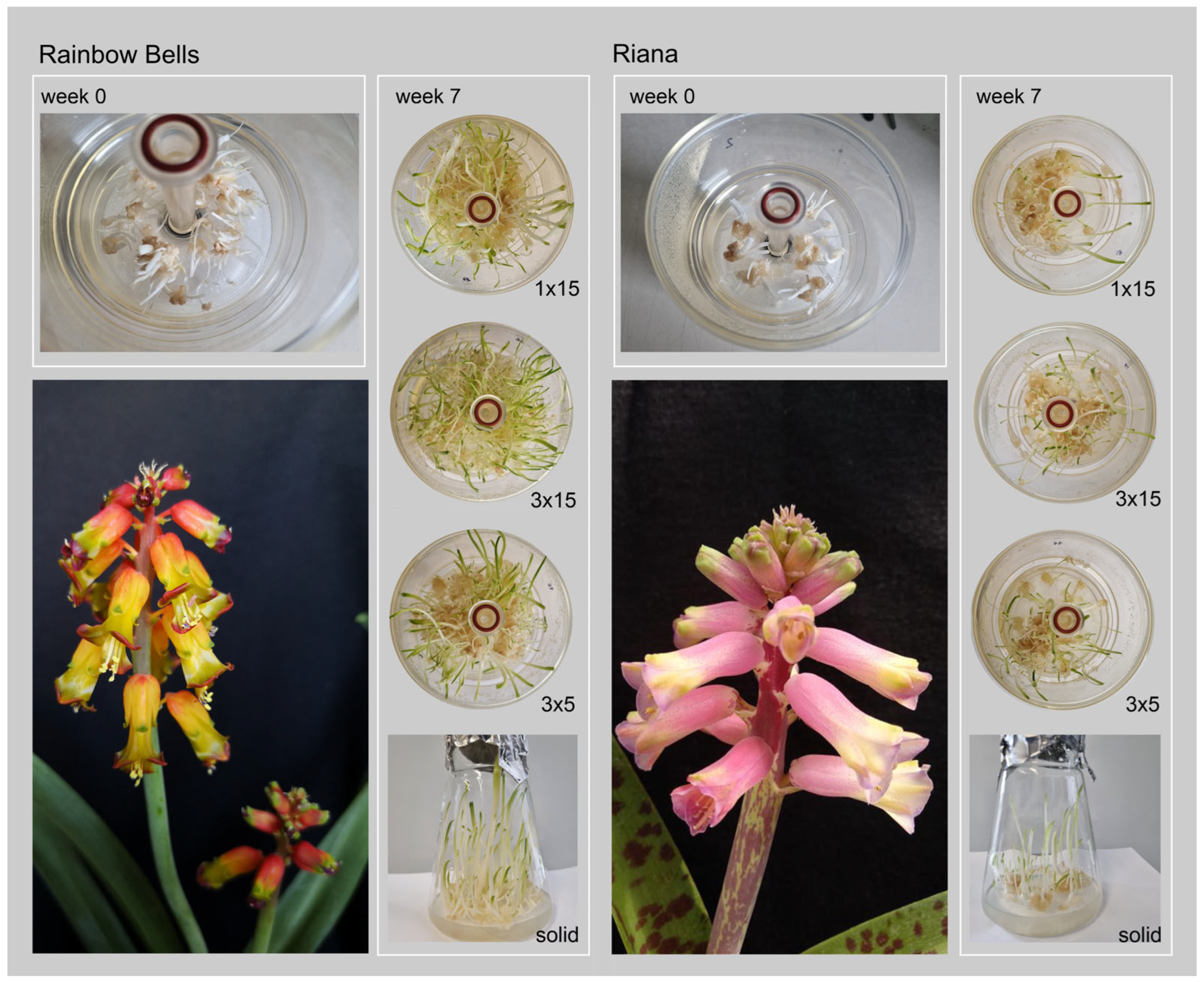
Bulb clumps of two Lachenalia cultivars, ‘Rainbow Bells’ and ‘Riana’ (Figure 1), multiplied in vitro on solid Murashige and Skoog (MS) [] medium supplemented with 5 µM BA, 0.5 µM NAA (Duchefa Biochemie, Haarlem, The Netherlands), 6% (w/v) sucrose, and 0.5% (w/v) Lab-Agar™ (Biocorp, Warsaw, Poland), and adjusted to pH 5.8 before autoclaving, were used in the experiment. The cultures were grown in 300 mL jars containing 40 mL of medium and subcultured every two months and were maintained in darkness at 25 ± 2 °C. The initial explants used to establish these cultures were 1 cm leaf segments excised from greenhouse-grown plants.
Figure 1. Lachenalia cultivars ‘Rainbow Bell’ with yellow flowers and ‘Riana’ with pink flowers at the beginning of the experiment (week 0) and after 7 weeks of cultivation (week 7) in liquid medium in a temporary immersion system using a RITA® bioreactor with different immersion frequencies: 1 × 15 min (1 × 15); 3 × 15 min (3 × 15); 3 × 5 min (3 × 5); and on solid medium (solid).

2.2. Culture Systems Used for Propagation

The propagation and development of bulbs were studied in two culture systems: (1) solid medium solidified with 0.5% (w/v) Lab-Agar™ (Biocorp, Warsaw, Poland); (2) liquid medium in a temporary immersion system (TIS) using a RITA® bioreactor (CIRAD Ltd., Montpellier, France) with three different immersion frequencies: 15 min every 24 h (1 × 15), 15 min every 8 h (3 × 15), and 5 min every 8 h (3 × 5).
For propagation the basal MS medium was supplemented with 5 µM BA, 0.5 µM NAA, and 3% (w/v) sucrose, with the pH adjusted to 5.8 before autoclaving. Cultures were maintained in darkness at 23 ± 2 °C.
Each RITA® vessel containing 200 mL of liquid medium was inoculated with 8 ± 1 g of plant material with trimmed leaves. Cultures on solid medium were maintained in 250 mL Erlenmeyer flasks containing 40 mL of medium, each inoculated with 2.5 ± 0.5 g of plant material (Figure 1).

2.3. Morphometric Observations

After seven weeks of culture in different systems, the following parameters were determined: biomass growth, number of bulbs per 1 g of initial tissue (Bulb No.), average bulb weight (Bulb W, g), dry matter content of bulbs (Bulb DM, %), and dry matter content of leaves (Leaf DM, %). Biomass growth was calculated using the formula: (final fresh weight − initial fresh weight)/initial fresh weight. Dry matter content was calculated using the formula: (dry weight/fresh weight) × 100%. Dry matter in bulbs and leaves was determined based on the weight of samples dried in a laboratory air sterilizer at 65 °C (Sanyo Electric Co., MOV-112S, Tokyo, Japan) until a constant weight was reached.

2.4. Biochemical Analysis

2.4.1. Photosynthetic Pigment Content

The chlorophyll a, b and carotenoid contents in bulbs (Bulb Chl-a, Bulb Chl-b and Bulb Carot.) and leaves (Leaf Chl-a, Leaf Chl-b and Leaf Carot.) were determined spectrophotometrically using a method developed by Lichtenthaler []. About 100 mg of dry tissue was extracted in 10 mL of 99% ethanol. The samples were incubated in darkness at 4 °C for 24 h to ensure complete pigment extraction. After incubation, the extracts were centrifuged and the absorbance of the supernatant was measured at wavelengths 470, 648, and 664 nm with a T60 UV VIS Spectrophotometer (PG Instruments Limited, Leicestershire, UK). The following equations were used to calculate pigment concentrations: chlorophyll a (µg·mL−1) = 13.36 × A664 − 5.19 × A648 (Chl-a); chlorophyll b (µg·mL−1) = 27.43 × A648 − 8.12 × A664 (Chl-b); total carotenoids (µg·mL−1) = (1000 × A470 − 2.13 × Chl-a − 97.64 × Chl-b)/209 (Carot.).

2.4.2. Total Phenolic Compounds Content

To determine total phenolics content in bulbs (Bulb TP) and leaves (Leaf TP) dried and finely powdered plant material (0.02 g) was homogenized in 1 mL of 70% (v/v) methanol and centrifuged. 100 µL of the supernatant was mixed with 0.5 mL of Folin–Ciocalteu reagent and 1 mL of 25% (w/v) Na2CO3 solution, according to the method of Singleton and Rossi []. The mixture was incubated in the dark at room temperature for 30 min and the absorbance was measured at λ = 765 nm using a T60 UV VIS Spectrophotometer (PG Instruments Limited, Leicestershire, UK). The total phenolic content was expressed as gallic acid equivalents (GAE) per gram of dry weight (mg GAE g−1 DW).

2.4.3. Soluble Sugar Content

Soluble sugars were extracted from dried and finally powdered bulb and leaf material (0.02 g) using 80% (v/v) aqueous ethanol. The homogenate was centrifuged and the supernatant was collected for analysis. The total soluble sugar content in bulbs (Bulb SS) and leaves (Leaf SS) was investigated by the phenol–sulphuric acid method [], which involves incubation of each sample at 95 °C for 20 min, after the addition 0.2% (w/v) sulphuric acid solution. The absorbance (λ = 490 nm) of the samples was measured spectrophotometrically with a T60 UV VIS Spectrophotometer (PG Instruments Limited, Leicestershire, UK).

2.5. Statistical Data Analysis

The experiment followed a two-factorial design with genotype and immersion frequency as the main factors. Each treatment combination was replicated three times, and each replication consisted of three vessels (2 cultivars × 4 immersion frequency levels × 3 replicates × 3 vessels). For biochemical and physiological analyses, both bulbs and leaves were collected from the same plantlets to ensure that they represented identical experimental units. Statistical analyses were performed using Statistica software, version 13.3 (TIBCO Software Inc., Palo Alto, CA, USA). The experimental data were evaluated by analysis of variance (ANOVA), and mean values were compared using Tukey’s multiple range test at p ≤ 0.05. For a more detailed examination of the interrelations among the experimental factors and the studied traits of the cultivars, the data were further analyzed using principal component analysis (PCA) and the point-biserial correlation coefficient (rpb). The PCA included fifteen active variables representing the studied traits and two supplementary variables corresponding to the main experimental factors. All variables were standardized prior to analysis. The number of principal components considered in the analysis was established according to the Kaiser criterion and the proportion of explained variance []. A PCA biplot was generated to visualize the relationships among variables and observations. The point-biserial correlation coefficient (rpb) was additionally used to complement the PCA results by assessing the strength of the relationships between the genotype factor, treated as a dichotomous variable coded into dummy (binary) variables, and the studied traits [].

3. Results and Discussion

3.1. Genotype Effect

The growth and development of bulblets of Lachenalia ‘Riana’ and ‘Rainbow Bells’ cultured either in a RITA® temporary immersion bioreactor or on solid media were observed (Figure 1).
The response to culture conditions was genotype-dependent. ‘Rainbow Bells’ was characterized by higher biomass growth, bulblet number, Leaf TP, Bulb TP, and leaf chlorophyll b content (Leaf Chl-b), whereas ‘Riana’ exhibited higher values for bulb weight (Bulb W), bulb dry matter (Bulb DM), bulb soluble sugars (Bulb SS), and leaf soluble sugars (Leaf SS). Similar values were recorded for both cultivars in terms of leaf dry matter (Leaf DM), chlorophyll a and b and carotenoid content in bulbs, as well as leaf chlorophyll a (Leaf Chl-a) and carotenoid (Leaf Carot) contents (Table 1).
Table 1. Two-way ANOVA results indicating the main effects of genotype (G), immersion frequency (F), and their interaction (G × F) on growth-related traits (biomass, bulb number, bulb weight, and dry matter content) in Lachenalia ‘Rainbow Bells’ and ‘Riana’ cultures.
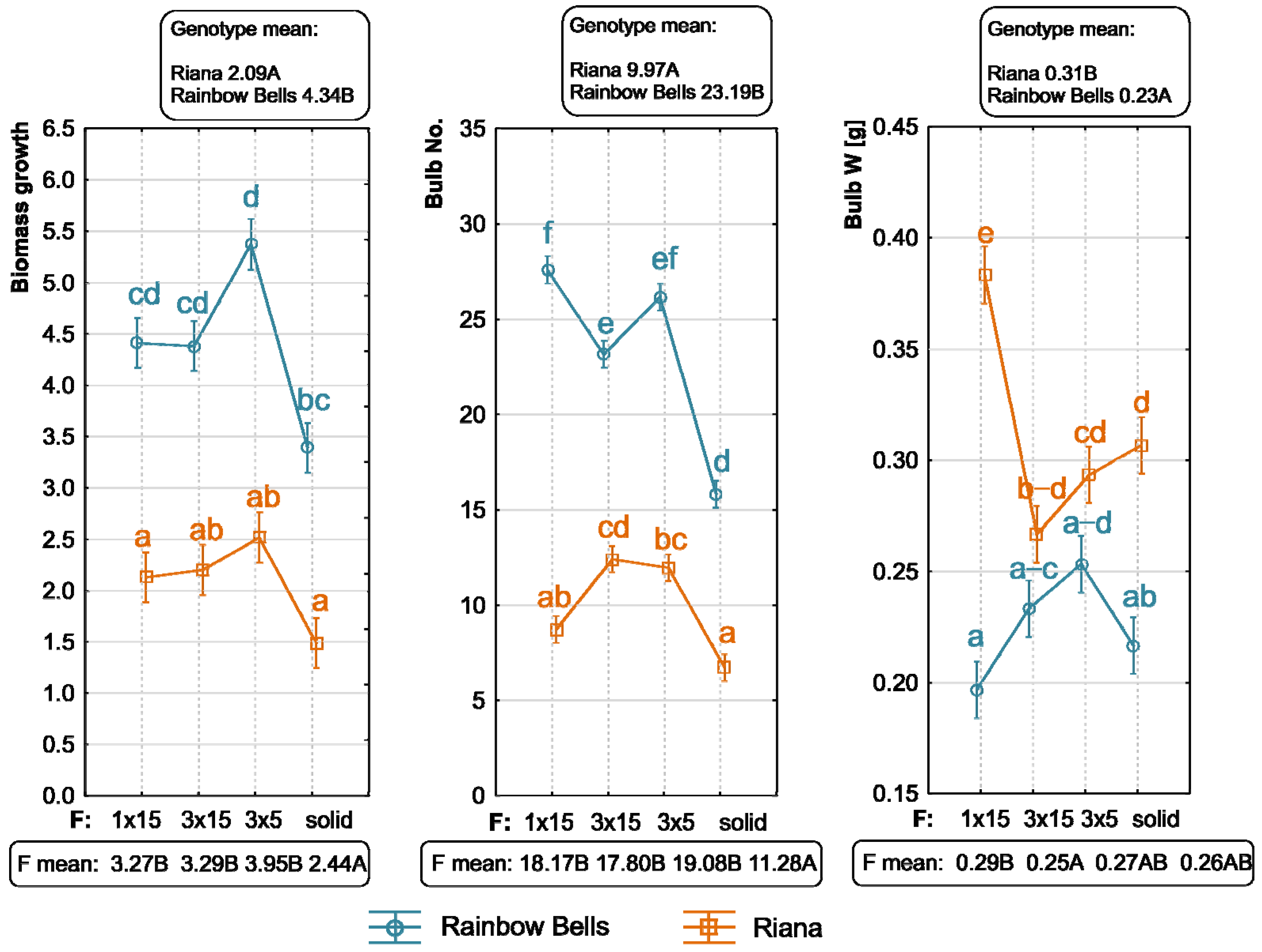
Biomass growth in ‘Rainbow Bells’ cultures was more than twice that observed in ‘Riana’, regardless of the culture system (4.34 and 2.09, respectively), and the number of bulblets was nearly 2.5 times higher (23.19 bulbs per g and 9.97 bulbs per 1 g, respectively). However, ‘Riana’ bulblets were about 50% heavier (0.31 g) than those of ‘Rainbow Bells’ (0.23 g) (Figure 2).
Figure 2. The effect of genotype and immersion frequency (F) on bulb biomass growth, number of bulbs (Bulb No.), and bulb weight (Bulb W) of two Lachenalia cultivars, ‘Rainbow Bells’ and ‘Riana’. Mean values ± SE followed by different lowercase letters, as well as those with different uppercase letters within a trait, differ significantly according to Tukey’s multiple range test at p < 0.05.
The presented results clearly demonstrate distinct cultivar differences in response to the type of culture medium applied. Other studies on bulblet induction in two other Lachenalia cultivars confirmed that the efficiency of bulb formation in in vitro cultures, both in terms of number and size, may follow a different pattern. It was demonstrated that under different light quality (white, blue, red) Lachenalia ‘Rupert’ formed a greater number of adventitious bulbs (3.0–4.2 bulbs per explant) than ‘Ronina’ (0.2–0.3 bulbs per explant), and the bulb diameter of ‘Rupert’ was also larger (4.5–5.0 mm) compared to ‘Ronina’ (3.3–3.8 mm) []. The research of Bach et al. [] on Lachenalia has also demonstrated that light conditions affected bulb induction, with red, blue, and white light reducing bulb formation in ‘Ronina’, while ‘Rupert’ remained largely unaffected, confirming that different plant genotypes respond differently to identical cultivation conditions []. Interestingly, Maślanka et al. [] found that the type of explant influenced regeneration efficiency of endangered Lachenalia viridiflora. Callus tissue proved to be a less favorable source for bulb formation (2.6 bulbs per explant), whereas bulb and leaf explants produced nearly twice as many bulbs (5.1–5.6 bulbs), highlighting the importance of tissue origin in determining morphogenetic response. These findings confirm that both genotype and factors play an important role in regulating bulb organogenesis in Lachenalia.

3.2. TIB Effect

In this study, we evaluated factors such as immersion frequency and genotype in relation to the propagation and quality of Lachenalia bulbs using a TIB, and compared the results with those obtained from cultures grown on solid medium. TIB represents an effective alternative to conventional solid-medium culture, particularly when the goal is large-scale plant production where efficiency and potential automation are of major importance. Recent studies emphasize the stimulating effect of temporary immersion conditions on plant tissue and organ proliferation, mainly due to the provision of optimal aeration and periodic nutrient uptake [,].
Among the numerous factors influencing the efficiency of propagation in temporary immersion bioreactor systems—including culture medium volume, explant density, container capacity, and bioreactor design—the frequency and duration of immersion are considered the most critical parameters [,,,].
In the present research, immersion frequency (regardless of genotype) significantly affected biomass accumulation, bulblet number, bulb weight, leaf and bulb dry matter content, as well as chlorophyll and carotenoid concentrations in both bulbs and leaves, and the soluble sugar content in leaves. However, it had no significant effect on sugar content in bulbs or on the total phenolic content in either bulbs or leaves (Table 1 and Table 2).
Table 2. Two-way ANOVA results indicating the main effects of genotype (G), immersion frequency (F), and their interaction (G × F) on biochemical traits (soluble sugars, pigments, and total phenolics) in Lachenalia ‘Rainbow Bells’ and ‘Riana’ cultures.
The application of TIBs has been widely recognized as an effective strategy for improving the efficiency of plant micropropagation [,]. In Lachenalia, biomass growth was higher in plants propagated via the RITA® system (3.27–3.95, irrespective of immersion frequency) than in those cultured on solid medium (2.44). Similarly, a greater number of bulblets were produced under temporary immersion conditions (17.8–19.08 bulblets per g) compared with solid medium (11.28 bulblets per g) (Figure 1 and Figure 2). Several studies have shown that this system considerably enhances shoot multiplication and biomass accumulation relative to conventional semisolid or solid media. For instance, in Agave angustifolia ‘Bacanora’ cultures, the use of a RITA® bioreactor with an immersion frequency of 1 min every 6 h resulted in significantly greater shoot production and a higher growth index than the semisolid control []. In Hylocereus undatus, immersion for 2 min every 4 h in liquid medium markedly improved micropropagation efficiency compared to the traditional semisolid method []. Similarly, for Musa sp. ‘Rasthali’ (Silk AAB), shoot multiplication in TIBs with an immersion frequency of 2 min every 6 h was 2.7 times higher than in semisolid cultures []. A comparable trend was observed in Crocus sativus, where corm cultures maintained in a Plantform™ bioreactor with 5 min immersions every 4 h demonstrated a substantial improvement in growth and microcorm formation relative to conventional in vitro cultures on semisolid medium [].

3.3. Interaction Between Genotype and Immersion Frequency

The two genotypes showed different responses to immersion frequencies. For ‘Rainbow Bells’, 23.17–27.60 bulblets per g were obtained in the bioreactor, whereas only 15.82 were produced on solid medium. The highest number of bulblets was obtained at an immersion frequency of 1 × 15 min, which proved more effective than 3 × 15 min. In ‘Riana’, the greatest bulblet numbers were achieved at frequencies of 3 × 15 (12.43 bulblets per g) and 3 × 5 (11.98 bulblets per g), while the fewest bulblets formed on solid medium (6.73 bulblets per g) (Figure 2). The obtained results indicate that the two examined cultivars exhibit a high potential for bulb formation, as the number of bulbs produced substantially exceeded that reported for other Lachenalia genotypes, such as Lachenalia ‘Rupert’, Lachenalia ‘Ronina’ [], Lachenalia viridiflora [], or Lachenalia montana []. The heaviest bulblets (0.38 g) were produced under the 1 × 15 min immersion regime. In ‘Riana’, less frequent immersion favored the formation of larger bulblets, whereas more frequent immersion (3 × 15 or 3 × 5) promoted higher bulblet numbers. This trend was not observed in ‘Rainbow Bells’.
In temporary immersion bioreactors, higher immersion frequencies typically enhance multiplication efficiency but sometimes result in smaller bulblets. Conversely, lower frequencies favor the development of fewer but larger individuals. For Lilium candidum [], more frequent yet shorter immersion cycles proved advantageous for biomass accumulation. The highest number of bulblets was obtained at an immersion regime of 3 × 15 min, although the bulblets produced under these conditions were smaller, as also observed for the cultivar ‘Riana’. In contrast, a lower immersion frequency (1 × 15 min) promoted the formation of larger bulblets with higher individual weight. Pałka et al. [] attribute the increased multiplication at higher immersion frequencies to prolonged contact of the tissue with the medium, improving nutrient availability, as well as to the intensive mixing of the culture during the immersion phase, which disrupts apical dominance and allows the formation of a greater number of, but smaller, bulblets. However, such a tendency is not always observed. In some cases, an increase in immersion frequency is accompanied by enhanced biomass production or a higher multiplication rate, along with the formation of larger plants []. Nevertheless, high immersion frequencies may sometimes limit propagation and plant quality due to the occurrence of hyperhydricity [,,].

3.4. Effect of Culture System on Biochemical Parameters

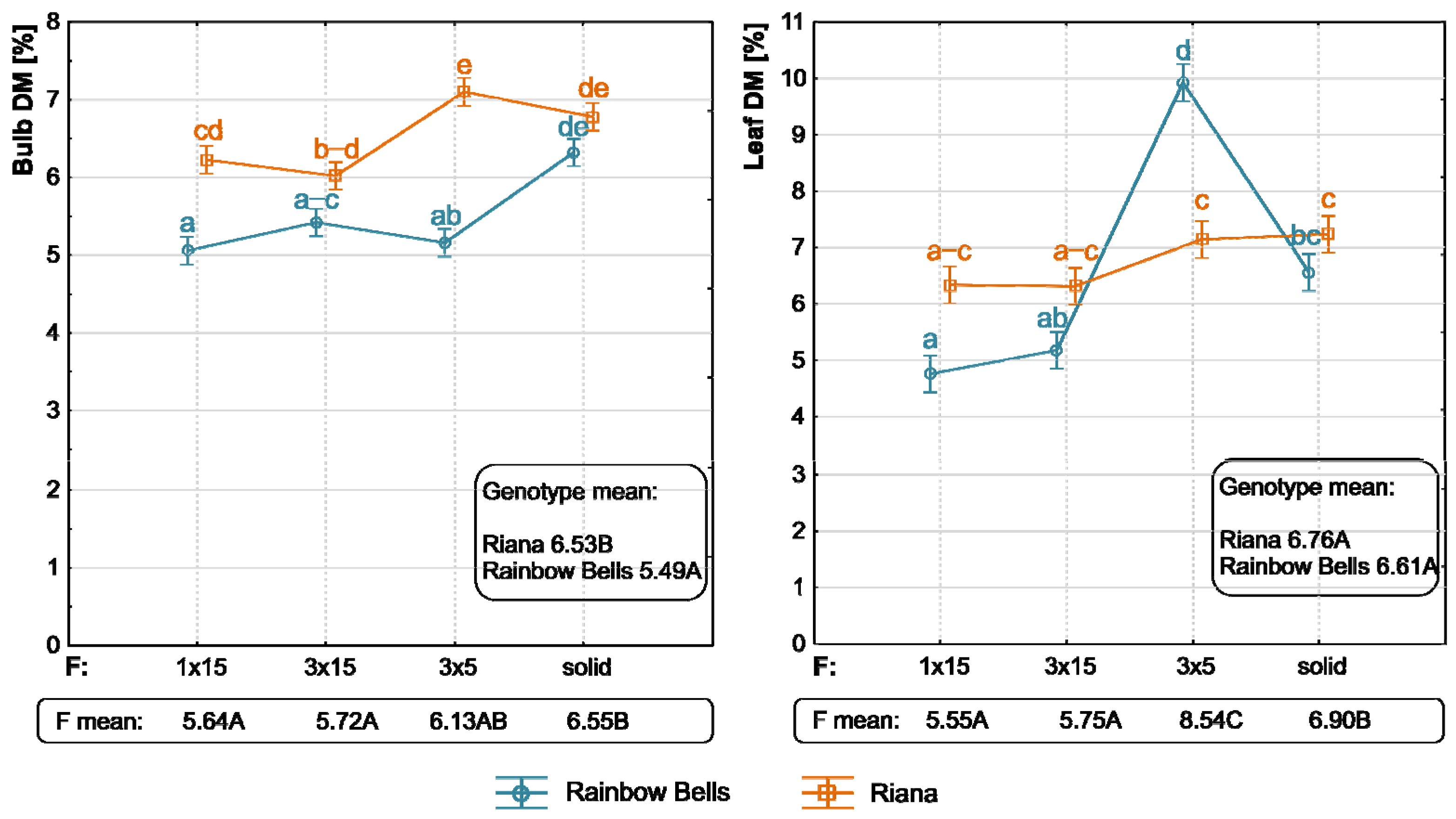
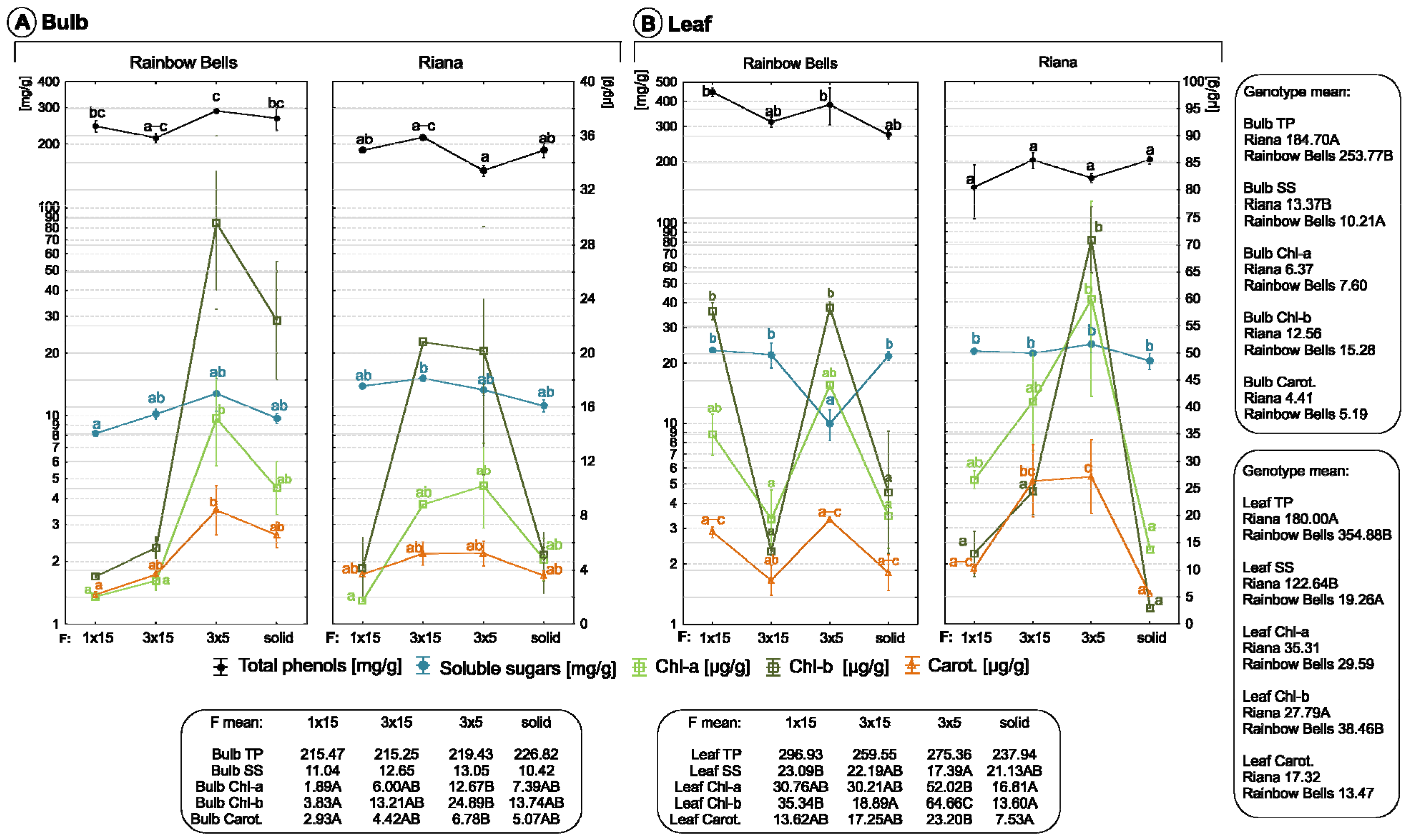
Biochemical parameters were also influenced by the culture system and genotype. Dry matter accumulation in bulbs was higher in ‘Riana’ than in ‘Rainbow Bells’. The highest dry matter content for both cultivars was observed in solid-medium cultures, with similar or even higher values for ‘Riana’ under the 3 × 5 frequency (Figure 3). Leaf dry matter content did not differ significantly between cultivars. The 3 × 5 frequency promoted dry matter accumulation in leaves of ‘Rainbow Bells’, whereas extending the immersion duration to 15 min or applying a single 15 min immersion reduced leaf dry matter content in this cultivar. Under the 3 × 5 frequency, higher levels of chlorophylls a and b, as well as carotenoids, were also recorded in bulbs (compared with the 1 × 15 frequency) and in leaves (relative to those of plants grown on solid medium) (Figure 4).
Figure 3. The effect of genotype and immersion frequency (F) on dry matter content of bulbs (Bulb DM) and leaves (Leaf DM) of two Lachenalia cultivars, ‘Rainbow Bells’ and ‘Riana’. Mean values ± SE followed by different lowercase letters, as well as those with different uppercase letters within a trait, differ significantly according to Tukey’s multiple range test at p < 0.05.
Figure 4. The effect of genotype and immersion frequency (F) on total phenols, soluble sugars, chlorophyll a (Chl-a), chlorophyll b (Chl-b), and carotenoid contents in bulbs (A) and leaves (B) of two Lachenalia cultivars, ‘Rainbow Bells’ and ‘Riana’. Mean values ± SE followed by different lowercase letters, as well as those with different uppercase letters within a trait, differ significantly according to Tukey’s multiple range test at p < 0.05.
In ‘Riana’, more sugars accumulated in bulbs (Bulb SS) and leaves (Leaf SS), whereas in ‘Rainbow Bells’, higher levels of phenolic compounds in bulbs (Bulb TP) and leaves (Leaf TP) were observed. The sugar content in the bulbs was not affected by immersion frequency, nor was any interaction between frequency and cultivar detected (Table 2). However, sugar content in the leaves did depend on immersion frequency, and a significant interaction between frequency and genotype was found. In the leaves, sugars accumulated more in cultures immersed once a day for 15 min than in those immersed three times for 5 min each. This pattern was specific to the cultivar ‘Rainbow Bells’ (Figure 4). The observed dependence of sugar accumulation in leaves on immersion frequency can be explained by differences in gas exchange, photosynthetic activity, and tissue water status between treatments. Less frequent immersion likely provided longer periods of aeration, enhancing photosynthetic efficiency and promoting carbohydrate biosynthesis in the leaves. In contrast, more frequent immersion reduced gas exchange and light interception due to prolonged contact with the liquid medium, which may have caused partial hypoxia and decreased photosynthetic activity, thus lowering sugar accumulation [,,].
For phenolic compounds in Lachenalia, there was no significant main effect of immersion frequency, but a significant interaction with genotype was detected (Table 2). Although immersion frequency alone did not have a significant effect, its influence depended on the genotype. Immersion treatments of 3 × 5 min and 1 × 15 min resulted in a more intense accumulation of phenolic compounds in ‘Rainbow Bells’ than in ‘Riana’ under the same immersion frequencies. It was also observed that in ‘Rainbow Bells’ cultures immersed 3 × 5 min, reduced sugar accumulation in the leaves was accompanied by increased accumulation of phenolic compounds (Figure 4). This suggests that frequent immersion caused physiological stress, most likely due to reduced aeration and lower photosynthetic efficiency, which redirected carbon flow from primary metabolism toward secondary metabolism. Such metabolic reallocation commonly occurs under stress conditions, when the phenylpropanoid pathway is activated and carbon skeletons derived from sugars are utilized for the synthesis of phenolic compounds [,]. In our study on solid medium and under the 3 × 15 min immersion regime—when the total contact time with the medium was the longest—the phenolic content in both cultivars was similar.

3.5. Structure of Trait Interrelations

In this study, principal component analysis (PCA) was performed to assess the general structure of interrelations between studied traits of two Lachenalia cultivars ‘Riana’ and ‘Rainbow Bells’ and immersion frequency. The analysis was conducted for fifteen active variables and two supplementary variables. The first three principal components (PCs) explained 77.00% of the total variation (Table 3).
Table 3. Component loadings of 15 active and two supplementary (*) variables, eigenvalues, proportion of total variability represented by the first three principal components (PCs), and cumulative variability.
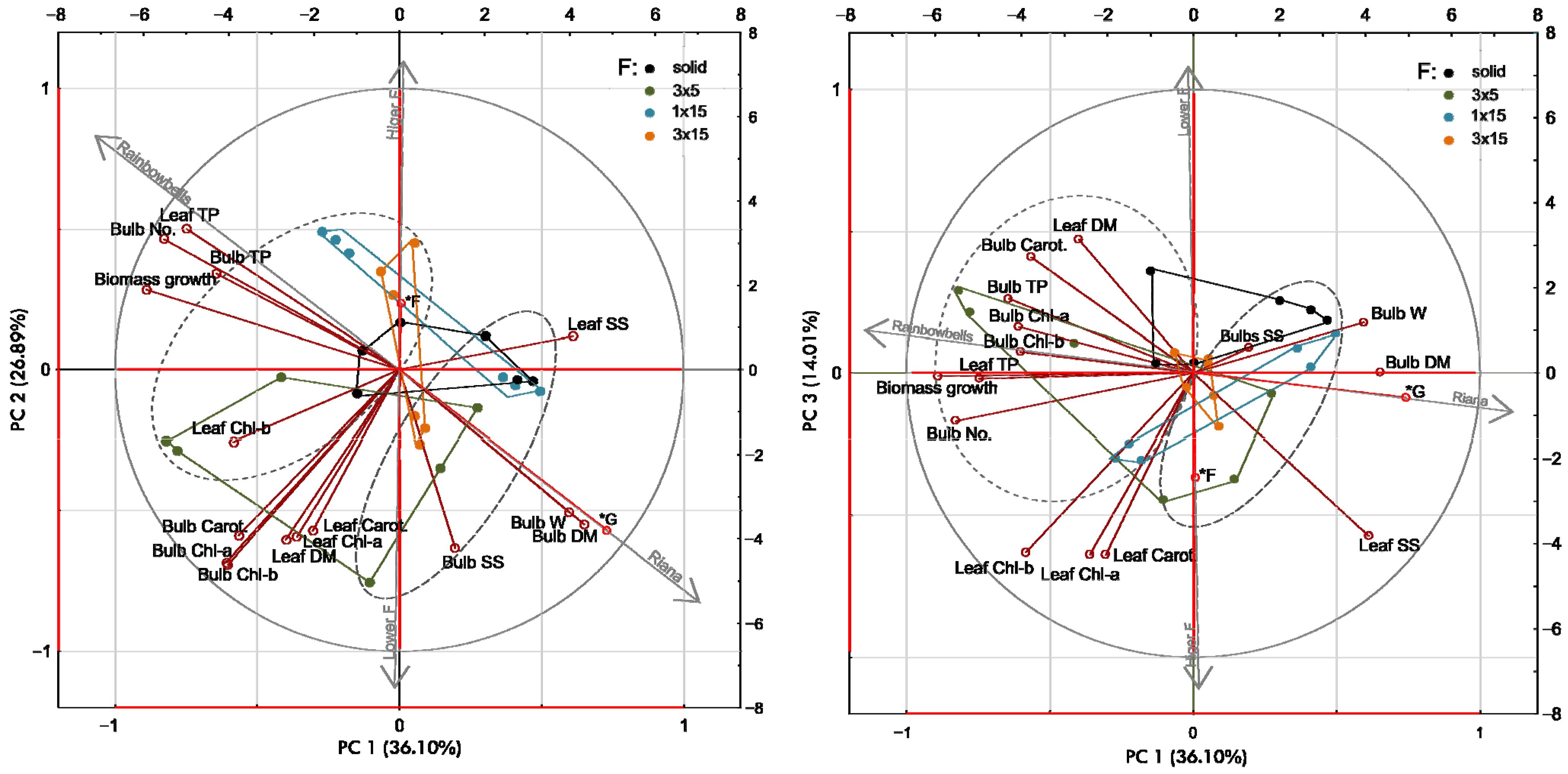
The PCA outcomes and their graphical representation on the biplots enabled the identification of groups of related variables and the characterization of the main components (Table 3, Figure 5). The first principal component (PC1) explained the primary differences in growth-related traits, while the second (PC2) and third (PC3) components complemented the information provided by PC1 regarding pigment and dry matter parameters, as well as soluble sugar distribution between leaves and bulbs.
Figure 5. PCA Biplot of the principal component analysis (PCA) showing the projection of variable vectors and observation points on the planes defined by PC1 × PC2 (left) and PC1 × PC3 (right), illustrating associations among the studied traits, genotype, and immersion frequency. The colors of the observation points correspond to different immersion frequencies (see legend), while the connecting lines indicate the range of their distribution. Dashed lines mark clusters of observations grouped according to genotype. (*) Supplementary variables are marked with asterisks.
Variables that contributed most strongly to the first principal component (PC1) were Biomass Growth (−0.89) and Bulb No. (−0.83). The position of their vectors on the biplot, close to Leaf TP (−0.74) and Bulb TP (−0.64), indicates a close association between total phenolic content in plant organs and increased biomass production and bulb multiplication. The location of the vectors Bulb W and Bulb DM on the biplot, as well as the positive direction of their factor loadings, indicates a negative association with the previously mentioned group of variables. All these variables appeared to be strongly genotype-dependent, which is confirmed by the location and the loading on PC1 of the supplementary variable Genotype. The projections of the observation points on the PCA biplot primarily indicated clear cultivar-related clustering, with the observations divided by the first principal component into two groups (Figure 5). Observations representing the cultivar ‘Rainbow Bells’ were located closer to the variable vectors indicating growth intensity (Biomass Growth, Bulb No.) and higher phenol accumulation in organ tissues (Bulb TP, Leaf TP). The observations representing the ‘Riana’ cultivar clustered towards the vectors associated with bulb weight and soluble sugar content (Bulb Weight, Bulb DM, Bulb SS). These relationships are in line with and confirm previous analyses concerning the characteristics of the studied cultivars and the strong impact of the genotype factor on their responses.
Based on the PCA results, relationships can be observed among dry matter, soluble sugar, and pigments content in plant organs. The first component (PC1) described the association between bulb dry matter and leaf soluble sugars, suggesting carbohydrate translocation between photosynthetic and storage organs. Other research strongly supports that, during micropropagation of bulbous plants, carbohydrates are translocated from leaves or stems to newly formed storage organs, enabling successful bulblet development and storage compound accumulation [,]. The second principal component (PC2) showed negative loadings for bulb soluble sugars, bulb pigments (chlorophylls and carotenoids), and leaf dry matter, indicating that the biosynthesis of pigments is energetically demanding and often upregulated when sugar levels are high. This is because sugars provide both the carbon skeletons and the energy required for pigment production. Thus, as bulbs accumulate sugars, pigment synthesis in the same tissues is enhanced, reflecting a shared metabolic pathway. As the plant shifts its metabolic focus toward storage tissues, resources are diverted away from leaf growth. This results in a decrease in leaf dry weight, as less biomass is allocated to leaves and more to storage tissues. This trade-off is a common plant strategy, especially in geophytes to ensure survival and regrowth in the next season [,]. The third component (PC3) was primarily influenced by leaf traits—leaf soluble sugars (−0.57), leaf pigments (−0.64, −0.63, −0.64), and leaf dry matter (0.47)—representing variation within the photosynthetic tissues. This pattern suggests shifts in pigment synthesis and carbohydrate accumulation between vegetative and storage organs.
The immersion frequency, used as a supplementary variable, showed low to moderate loadings for PC2 and PC3, indicating that this factor may have influenced the metabolic balance between photosynthetic and storage tissues. When considering immersion frequency factor, a slight separation of observations was noticed on the biplots along PC3 and PC2. This clustering was slightly more pronounced for ‘Rainbow Bells’, which may suggest stronger cultivar-specific response to the treatment compared with ‘Riana’.
The PCA results were further supported by the point-biserial correlation coefficient, which showed a strong correlation of genotype with the variables most important for the first principal components (Table 4).
Table 4. Point-biserial correlation coefficients between genotype and selected morphological and physiological traits of Lachenalia cultivars ‘Riana’ and ‘Rainbow Bells’. Statistically significant correlations are highlighted in red.
Positive correlations between genotype and bulb traits such as bulb weight, dry weight, and soluble sugar content indicate that the ‘Riana’ cultivar is characterized by higher storage capacity and biomass accumulation in bulbs. In contrast, negative correlations with biomass growth, bulb number, and total phenols in both leaves and bulbs suggest that ‘Rainbow Bells’ exhibits a more vigorous growth strategy combined with higher phenolic activity. The content of photosynthetic pigments showed only weak correlations with genotype, indicating that pigment variability was mainly affected by environmental factors such as immersion frequency. Temporary immersion systems and the frequency of immersion affect nutrient uptake, gas exchange, and water availability, which in turn modulate pigment synthesis and plantlet vigor [,]. These findings confirm that the observed clustering in the PCA reflects genotypic differentiation in growth dynamics and metabolic profiles. As reported by Kapczyńska [], these cultivars also exhibits clear morphological and phenological contrasts. ‘Rainbow Bells’ develops taller inflorescences with long pedicels, fewer but larger and multicolored in yellow to red shades flowers, and flowers earlier, whereas ‘Riana’ produces shorter inflorescences with short pedicels, more numerous pink flowers, and a later onset of flowering. These differences indicate that ‘Rainbow Bells’ combines greater height and earliness with lower floral density, while ‘Riana’ displays compact, fuller inflorescences and delayed flowering, reflecting distinct ornamental and developmental characteristics between the two cultivars.

4. Conclusions

This study demonstrates for the first time that temporary immersion bioreactors can effectively enhance Lachenalia micropropagation. The results reveal genotype-specific responses in bulblet growth and biomass accumulation, supporting the use of in vitro propagation for conservation of genetic resources and for potential automated commercial production of this geophyte. The findings highlight the need to adjust immersion frequency for each genotype, as cultivars respond differently to the duration and number of immersion cycles. Such an approach may increase multiplication rates, produce uniform and well-developed bulblets, and facilitate automation of TIB-based propagation.

Author Contributions

Conceptualization, M.M. (Małgorzata Malik) and A.K.; methodology, M.M. (Małgorzata Malik) and A.C. (Andrea Copetta); software, M.M. (Małgorzata Malik), J.M.; validation, M.M. (Małgorzata Malik), A.K. and J.M.; formal analysis, M.M. (Małgorzata Malik), A.K., A.C. (Andrea Copetta), and A.C. (Arianna Cassetti); investigation, M.M. (Małgorzata Malik), A.K., A.C. (Andrea Copetta), A.C. (Arianna Cassetti) and M.M. (Michela Montone); resources, M.M. (Małgorzata Maślanka) and A.K.; data curation, M.M. (Małgorzata Malik) and A.C. (Andrea Copetta); writing—original draft preparation A.K., M.M. (Małgorzata Malik) and J.M.; writing—review and editing, A.K., M.M. (Małgorzata Malik), J.M., A.C. (Andrea Copetta), A.C. (Arianna Cassetti), M.M. (Małgorzata Maślanka) and M.S.; visualization, J.M.; supervision, M.M. (Małgorzata Malik) and A.K.; project administration, M.M. (Małgorzata Malik) and A.K.; funding acquisition, M.M. (Małgorzata Malik). All authors have read and agreed to the published version of the manuscript.

Funding

This research was supported by the Ministry of Science and Higher Education of the Republic of Poland from subvention funds for the University of Agriculture in Krakow.

Data Availability Statement

Data are contained within the article.

Conflicts of Interest

The authors declare no conflicts of interest.

Abbreviations

The following abbreviations are used in this manuscript:
TIBTemporary immersion bioreactor
MSMurashige and Skoog (1962) medium
PCAPrincipal Component Analysis
Bulb WBulb weight
Bulb No.Bulb number per 1 g of initial tissue
Bulb DMBulb dry matter content
Bulb TPTotal phenolics content in bulbs
Bulb SSSoluble sugars content in bulbs
Bulb Chl-aChlorophyll a content in bulbs
Bulb Chl-bChlorophyll b content in bulbs
Bulb Carot.Carotenoid content in bulbs
Leaf DMLeaf dry matter content
Leaf TPTotal phenolics content in leaves
Leaf SSSoluble sugars content in leaves
Leaf Chl-aChlorophyll a content in leaves
Leaf Chl-bChlorophyll b content in leaves
Leaf Carot.Carotenoid content in leaves

References

  1. Kleynhans, R. Lachenalia, spp. In Flower Breeding & Genetics: Issues, Challenges, and Opportunities for the 21st Century; Anderson, N.O., Ed.; Springer: Dordrecht, The Netherlands, 2006; pp. 491–516. [Google Scholar]
  2. Kapczyńska, A. Morphological and botanical profile of Lachenalia cultivars. S. Afr. J. Bot. 2022, 147, 472–481. [Google Scholar] [CrossRef]
  3. Kapczyńska, A.; Maślanka, M.; Mazur, J. Longevity of Lachenalia cut flowers. Acta Hortic. 2025, 1435, 249–256. [Google Scholar] [CrossRef]
  4. Duncan, G. The Genus Lachenalia: A Botanical Magazine Monograph; Kew Publishing, Royal Botanic Gardens: London, UK, 2012. [Google Scholar]
  5. Maślanka, M.; Kapczyńska, A. Cold treatment promotes in vitro germination of two endangered Lachenalia species. S. Afr. J. Bot. 2021, 142, 430–432. [Google Scholar] [CrossRef]
  6. Maślanka, M.; Mazur, J.; Kapczyńska, A. In Vitro Organogenesis of Critically Endangered Lachenalia viridiflora. Agronomy 2022, 12, 475. [Google Scholar] [CrossRef]
  7. Kapczyńska, A. Propagation of Lachenalia cultivars from leaf cuttings. Acta Sci. Pol. Hortorum Cultus 2019, 18, 189–195. [Google Scholar] [CrossRef]
  8. Kapczyńska, A. Effect of chipping and scoring techniques on bulb production of Lachenalia cultivars. Acta Agrobot. 2019, 72, 1760. [Google Scholar] [CrossRef]
  9. Kapczyńska, A. Critically endangered Lachenalia viridiflora—From seeds to flowering bulbs. S. Afr. J. Bot. 2023, 157, 228–230. [Google Scholar] [CrossRef]
  10. El-Naggar, H.M.; Shehata, A.M.; Moubarak, M.; Osman, A.R. Optimization of Morphogenesis and In Vitro Production of Five Hyacinthus orientalis Cultivars. Horticulturae 2023, 9, 176. [Google Scholar] [CrossRef]
  11. Berkov, S.; Georgieva, L.; Sidjimova, B.; Nikolova, M.; Stanilova, M.; Bastida, J. In vitro propagation and biosynthesis of Sceletium-type alkaloids in Narcissus pallidulus and Narcissus cv. Hawera. S. Afr. J. Bot. 2021, 136, 190–194. [Google Scholar] [CrossRef]
  12. Rahimi Khonakdari, M.; Rezadoost, H.; Heydari, R.; Mirjalili, M.H. Effect of photoperiod and plant growth regulators on in vitro mass bulblet proliferation of Narcissus tazzeta L. (Amaryllidaceae), a potential source of galantamine. Plant Cell Tissue Organ Cult. 2020, 142, 187–199. [Google Scholar] [CrossRef] [PubMed]
  13. Sochacki, D.; Marciniak, P.; Ciesielska, M.; Zaród, J.; Sutrisno. The Influence of Selected Plant Growth Regulators and Carbohydrates on In Vitro Shoot Multiplication and Bulbing of the Tulip (Tulipa L.). Plants 2023, 12, 1134. [Google Scholar] [CrossRef] [PubMed]
  14. Podwyszyńska, M.; Marasek-Ciolakowska, A. Micropropagation of Tulip via Somatic Embryogenesis. Agronomy 2020, 10, 1857. [Google Scholar] [CrossRef]
  15. Bach, A.; Kapczyńska, A.; Dziurka, K.; Dziurka, M. Phenolic compounds and carbohydrates in relation to bulb formation in Lachenalia ‘Ronina’ and ‘Rupert’ in vitro cultures under different lighting environments. Sci. Hortic. 2015, 188, 23–29. [Google Scholar] [CrossRef]
  16. Bach, A.; Kapczyńska, A.; Dziurka, K.; Dziurka, M. The importance of applied light quality on the process of shoot organogenesis and production of phenolics and carbohydrates in Lachenalia sp. cultures in vitro. S. Afr. J. Bot. 2018, 114, 14–19. [Google Scholar] [CrossRef]
  17. Etienne, H.; Berthouly, M. Temporary immersion systems in plant micropropagation. Plant Cell Tissue Organ Cult. 2002, 69, 215–231. [Google Scholar] [CrossRef]
  18. Ziv, M. Simple bioreactors for mass propagation of plants. Plant Cell Tissue Organ Cult. 2005, 81, 277–285. [Google Scholar] [CrossRef]
  19. Georgiev, V.; Schumann, A.; Pavlov, A.; Bley, T. Temporary immersion systems in plant biotechnology. Eng. Life Sci. 2014, 14, 607–621. [Google Scholar] [CrossRef]
  20. Mujib, A.; Ali, M.; Isah, T.; Dipti. Somatic embryo mediated mass production of Catharanthus roseus in culture vessel (bioreactor)—A comparative study. Saudi J. Biol. Sci. 2014, 21, 442–449. [Google Scholar] [CrossRef] [PubMed]
  21. De Carlo, A.; Tarraf, W.; Lambardi, M.; Benelli, C. Temporary Immersion System for Production of Biomass and Bioactive Compounds from Medicinal Plants. Agronomy 2021, 11, 2414. [Google Scholar] [CrossRef]
  22. Afreen, F. Temporary Immersion Bioreactor. In Plan Tissue Culture Engineering; Gupta, S.D., Ibaraki, Y., Eds.; Springer: Dordrecht, The Netherlands, 2007; Volume 6, pp. 187–201. [Google Scholar]
  23. Mirzabe, A.H.; Hajiahmad, A.; Fadavi, A.; Rafiee, S. Temporary immersion systems (TISs): A comprehensive review. J. Biotechnol. 2022, 357, 56–83. [Google Scholar] [CrossRef]
  24. Baskaran, P.; Van Staden, J. Ultrastructure of somatic embryo development and plant propagation for Lachenalia montana. S. Afr. J. Bot. 2017, 109, 269–274. [Google Scholar] [CrossRef]
  25. Ascough, G.D.; van Staden, J.; Erwin, J.E. In Vitro Storage Organ Formation of Ornamental Geophytes. In Horticultural Reviews; Janick, J., Ed.; Wiley: Hoboken, NJ, USA, 2007; Volume 34, pp. 417–445. [Google Scholar]
  26. Murashige, T.; Skoog, F. A Revised Medium for Rapid Growth and Bio Assays with Tobacco Tissue Cultures. Physiol. Plant. 1962, 15, 473–497. [Google Scholar] [CrossRef]
  27. Lichtenthaler, H.K. [34] Chlorophylls and carotenoids: Pigments of photosynthetic biomembranes. In Plant Cell Membranes, Methods in Enzymology; Packer, L., Douce, R., Eds.; Academic Press: New York, NY, USA, 1987; Volume 148, pp. 350–382. [Google Scholar]
  28. Singleton, V.L.; Rossi, J.A. Colorimetry of Total Phenolics with Phosphomolybdic-Phosphotungstic Acid Reagents. Am. J. Enol. Vitic. 1965, 16, 144–158. [Google Scholar] [CrossRef]
  29. Das, B.K.; Choudhury, B.K.; Kar, M. Quantitative estimation of changes in biochemical constituents of mahua (Madhuca indica syn. bassia latifolia) flowers during postharvest storage. J. Food Process. Preserv. 2010, 34, 831–844. [Google Scholar] [CrossRef]
  30. Hair, J.F.; Babin, B.J.; Anderson, R.E.; Black, W.C. Multivariate Data Analysis, 8th ed.; Cengage: Andover, UK, 2019. [Google Scholar]
  31. Kornbrot, D. Point Biserial Correlation. In Wiley StatsRef: Statistics Reference Online; Wiley: Hoboken, NJ, USA, 2014. [Google Scholar]
  32. Jasenovska, L.; Brestic, M.; Barboricova, M.; Ferencova, J.; Filacek, A.; Zivcak, M. Analysis of the effects of various light spectra on microgreen species. Folia Hortic. 2024, 36, 197–209. [Google Scholar] [CrossRef]
  33. Zhang, B.; Sarsaiya, S.; Pan, X.; Jin, L.; Xu, D.; Zhang, B.; Duns, G.J.; Shi, J.; Chen, J. Optimization of nutritional conditions using a temporary immersion bioreactor system for the growth of Bletilla striata pseudobulbs and accumulation of polysaccharides. Sci. Hortic. 2018, 240, 155–161. [Google Scholar] [CrossRef]
  34. Minchala-Buestán, N.; Hoyos-Sánchez, R.A.; Correa-Londoño, G.A. Micropropagation of iraca palm (Carludovica palmata Ruiz y Pav) using a temporary immersion system. Vitr. Cell. Dev. Biol. Plant 2023, 59, 563–573. [Google Scholar] [CrossRef]
  35. Méndez-Hernández, H.A.; Loyola-Vargas, V.M. Plant Micropropagation and Temporary Immersion Systems. In Plant Cell Culture Protocols. Methods in Molecular Biology; Loyola-Vargas, V., Ochoa-Alejo, N., Eds.; Humana: New York, NY, USA, 2024; Volume 2827. [Google Scholar] [CrossRef]
  36. Ramírez-Mosqueda, M.A.; Cruz-Cruz, C.A.; Cano-Ricárdez, A.; Bello-Bello, J.J. Assessment of different temporary immersion systems in the micropropagation of anthurium (Anthurium andreanum). 3 Biotech 2019, 9, 307. [Google Scholar] [CrossRef] [PubMed]
  37. Bello-Bello, J.J.; Schettino-Salomón, S.; Ortega-Espinoza, J.; Spinoso-Castillo, J.L. A temporary immersion system for mass micropropagation of pitahaya (Hylocereus undatus). 3 Biotech 2021, 11, 437. [Google Scholar] [CrossRef]
  38. Monja-Mio, K.M.; Olvera-Casanova, D.; Herrera-Alamillo, M.Á.; Sánchez-Teyer, F.L.; Robert, M.L. Comparison of conventional and temporary immersion systems on micropropagation (multiplication phase) of Agave angustifolia Haw. ‘Bacanora’. 3 Biotech 2021, 11, 77. [Google Scholar] [CrossRef]
  39. Uma, S.; Karthic, R.; Kalpana, S.; Backiyarani, S.; Saraswathi, M.S. A novel temporary immersion bioreactor system for large scale multiplication of banana (Rasthali AAB—Silk). Sci. Rep. 2021, 11, 20371. [Google Scholar] [CrossRef]
  40. Tarraf, W.; İzgü, T.; Şimşek, Ö.; Cicco, N.; Benelli, C. Saffron In Vitro Propagation: An Innovative Method by Temporary Immersion System (TIS), Integrated with Machine Learning Analysis. Horticulturae 2024, 10, 454. [Google Scholar] [CrossRef]
  41. Aremu, A.O.; Plačková, L.; Masondo, N.A.; Amoo, S.O.; Moyo, M.; Novák, O.; Doležal, K.; Van Staden, J. Regulating the regulators: Responses of four plant growth regulators during clonal propagation of Lachenalia montana. Plant Growth Regul. 2017, 82, 305–315. [Google Scholar] [CrossRef]
  42. Pałka, P.; Malik, M.; Pawłowska, B. Effects of pretreatment in a temporary immersion bioreactor on organogenesis efficacy of Lilium candidum L. bulbscales. Acta Soc. Bot. Pol. 2024, 93, 1–12. [Google Scholar] [CrossRef]
  43. Arano-Avalos, S.; Gómez-Merino, F.C.; Mancilla-Álvarez, E.; Sánchez-Páez, R.; Bello-Bello, J.J. An efficient protocol for commercial micropropagation of malanga (Colocasia esculenta L. Schott) using temporary immersion. Sci. Hortic. 2020, 261, 108998. [Google Scholar] [CrossRef]
  44. Gago, D.; Vilavert, S.; Bernal, M.Á.; Sánchez, C.; Aldrey, A.; Vidal, N. The Effect of Sucrose Supplementation on the Micropropagation of Salix viminalis L. Shoots in Semisolid Medium and Temporary Immersion Bioreactors. Forests 2021, 12, 1408. [Google Scholar] [CrossRef]
  45. Daurov, D.; Daurova, A.; Sapakhova, Z.; Kanat, R.; Akhmetzhanova, D.; Abilda, Z.; Toishimanov, M.; Raissova, N.; Otynshiyev, M.; Zhambakin, K.; et al. The Impact of the Growth Regulators and Cultivation Conditions of Temporary Immersion Systems (TISs) on the Morphological Characteristics of Potato Explants and Microtubers. Agronomy 2024, 14, 1782. [Google Scholar] [CrossRef]
  46. Mommer, L.; Pons, T.L.; Wolters-Arts, M.; Venema, J.H.; Visser, E.J.W. Submergence-Induced Morphological, Anatomical, and Biochemical Responses in a Terrestrial Species Affect Gas Diffusion Resistance and Photosynthetic Performance. Plant Physiol. 2005, 139, 497–508. [Google Scholar] [CrossRef]
  47. Grace, S.C.; Logan, B.A. Energy dissipation and radical scavenging by the plant phenylpropanoid pathway. Philos. Trans. R. Soc. Ser. B Biol. Sci. 2000, 355, 1499–1510. [Google Scholar] [CrossRef]
  48. Akula, R.; Ravishankar, G.A. Influence of abiotic stress signals on secondary metabolites in plants. Plant Signal. Behav. 2011, 6, 1720–1731. [Google Scholar] [CrossRef]
  49. Wu, Y.; Ren, Z.; Gao, C.; Sun, M.; Li, S.; Min, R.; Wu, J.; Li, D.; Wang, X.; Wei, Y.; et al. Change in Sucrose Cleavage Pattern and Rapid Starch Accumulation Govern Lily Shoot-to-Bulblet Transition in vitro. Front. Plant Sci. 2021, 11, 564713. [Google Scholar] [CrossRef]
  50. Wang, M.; Le Gourrierec, J.; Jiao, F.; Demotes-Mainard, S.; Perez-Garcia, M.-D.; Ogé, L.; Hamama, L.; Crespel, L.; Bertheloot, J.; Chen, J.; et al. Convergence and Divergence of Sugar and Cytokinin Signaling in Plant Development. Int. J. Mol. Sci. 2021, 22, 1282. [Google Scholar] [CrossRef] [PubMed]
  51. Wingler, A.; Henriques, R. Sugars and the speed of life—Metabolic signals that determine plant growth, development and death. Physiol. Plant. 2022, 174, e13656. [Google Scholar] [CrossRef] [PubMed]
  52. Gago, D.; Sánchez, C.; Aldrey, A.; Christie, C.B.; Bernal, M.Á.; Vidal, N. Micropropagation of Plum (Prunus domestica L.) in Bioreactors Using Photomixotrophic and Photoautotrophic Conditions. Horticulturae 2022, 8, 286. [Google Scholar] [CrossRef]
  53. Martínez-Estrada, E.; Islas-Luna, B.; Pérez-Sato, J.A.; Bello-Bello, J.J. Temporary immersion improves in vitro multiplication and acclimatization of Anthurium andreanum Lind. Sci. Hortic. 2019, 249, 185–191. [Google Scholar] [CrossRef]
Disclaimer/Publisher’s Note: The statements, opinions and data contained in all publications are solely those of the individual author(s) and contributor(s) and not of MDPI and/or the editor(s). MDPI and/or the editor(s) disclaim responsibility for any injury to people or property resulting from any ideas, methods, instructions or products referred to in the content.

Article Metrics

Citations

Article Access Statistics

Multiple requests from the same IP address are counted as one view.