1. Introduction
Capsicum spp. are a major vegetable and spice crop worldwide and the most economically important genus within the
Solanaceae family. The genus originated in Central and South America, where it was first domesticated and diversified [
1,
2]. Annually, approximately 37 million tons of chili peppers are produced globally, with China being the largest producer, accounting for nearly 46% of total production [
3]. In Colombia, national production reached about 100,000 tons in 2023, with an average yield of 10 tons per hectare [
4]. Approximately 30
Capsicum species have been described, of which five—
Capsicum annuum,
C. chinense,
C. frutescens,
C. baccatum, and
C. pubescens—are domesticated and widely cultivated [
5]. The selection of
Capsicum fruits is based on traits such as fruit size, shape, color, pungency, and chemical composition, which are key for their use in the food, pharmaceutical, and cosmetic industries. Agronomic traits including fruit number, weight, and plant architecture also determine yield potential, highlighting the importance of understanding both genetic and environmental factors influencing these characteristics, particularly under changing climatic conditions [
6].
The global genetic diversity of
Capsicum has been extensively characterized using morphological and molecular approaches. A recent large-scale analysis of 10,000 accessions using genotyping-by-sequencing (GBS) identified nearly 500,000 single-nucleotide polymorphisms (SNPs), providing unprecedented resolution of the evolutionary history and global dispersal of the genus [
7]. Regional studies have also revealed significant intra- and inter-specific variability, such as the clustering of Spanish germplasm into seven genetic groups [
8], and the observation of higher within-group diversity in Indian collections [
5]. In Colombia,
Capsicum germplasm has shown high genetic heterogeneity, with six distinct clusters identified among 95 accessions, and the Andean group exhibiting the highest diversity [
9]. More recently, the first comprehensive pangenomic characterization of the entire national
Capsicum germplasm collection was conducted using genotyping-by-sequencing (GBS) and reference-guided pangenomic assembly [
10]. This study integrated genomic and structural variation data from the Colombian collection, revealing five ancestral populations as inferred from ancestry and unsupervised clustering analyses, and demonstrating extensive admixture among domesticated species. These results confirmed the broad genetic structure and high intra-specific diversity within the Colombian
Capsicum panel, positioning this germplasm as one of the most genetically diverse regional resources reported to date. Consequently, this dataset constitutes a foundational genomic reference for future association studies, genomic prediction, and pre-breeding initiatives in
Capsicum spp. at the national scale.
Large information about
Capsicum genomic variability is available, however the elucidation of the genetic background of phenotypic and biochemical quantitative traits remains unclear. Understanding the genetic basis of such traits may accelerate improvements in the crop. The chemical composition of
Capsicum fruits is complex, including vitamins, carotenoids, phenolic compounds, proteins, and minerals, which together determine organoleptic quality and industrial value [
11]. The concentration of these substances exerts a significant influence on their organoleptic properties, a factor that is of leading importance for its industrial utilization. Organoleptic properties are influenced by a multitude of social and cultural factors, which in turn shape consumer preferences and market needs. The chemical composition of the fruits is subjected to environmental variations and management factors present within the cropping system. It is therefore essential to comprehend the interaction between the individual and their environment if improvements are to be made to
Capsicum yield and quality. Multi-environment studies are useful in understanding Genotype-Environment-Management (GxExM) interactions in crops and in uncovering their performance under a range of growing conditions [
12]. In addition, given that the majority of yield- and quality-related traits are inherited quantitatively, leveraging the genomic and phenotypic diversity from local collections is key for crop improvement [
13].
In Colombia, the national Capsicum germplasm collection represents a valuable regional genetic resource encompassing wide diversity within the five domesticated species. Characterizing this collection across different environments would enable the identification of superior accessions for targeted breeding objectives and industry-specific applications. The use of multi-environment trials and stability models such as AMMI (Additive Main Effect and Multiplicative Interaction) has proven effective in evaluating phenotypic stability and adaptation patterns. Through these analyses, accessions showing either broad stability or environment-specific performance can be identified, supporting selection strategies aligned with agro-industrial needs.
In parallel, the rise in genomic selection (GS) has transformed modern breeding by enabling the prediction of genetic merit through genome-wide marker information [
14,
15,
16]. Genomic prediction models capture the additive effects of numerous small-effect loci underlying quantitative traits, overcoming the limitations of GWAS in detecting rare variants or low-effect alleles [
17,
18]. Bayesian and semi-parametric regression methods—such as BayesA [
14], BayesB (Meuwissen et al., 2001) [
14], BayesC [
19], Bayesian LASSO (Park and Casella 2012) [
20], Bayesian Ridge Regression, and Reproducing Kernel Hilbert Spaces (RKHS) [
15,
21,
22]—have been successfully applied in several crops as beans [
16], maize [
23], or wheat [
24] to increase selection accuracy and accelerate genetic gain per cycle.
However, despite the extensive application of genomic prediction in cereals and legumes, its integration with stability and adaptability models such as AMMI has not yet been widely implemented for genetic improvement. The combined use of genomic prediction and AMMI represents an innovative framework. This allows the simultaneous estimation of genomic-estimated breeding values (GEBVs) and the partitioning of G × E interactions (GEIs) within a unified predictive architecture. This integrative approach enhances the capacity to identify accessions that exhibit both high genomic merit and environmental stability, improving prediction ability for genomic-assisted selection under multi-environment conditions. To our knowledge, this study constitutes the first attempt to integrate genomic prediction with AMMI analysis in Capsicum spp., providing a novel methodological contribution to the pre-breeding strategies of this genus.
Accordingly, the present study aims to (i) characterize the physicochemical and chemical variability of Capsicum fruits under contrasting Colombian environments; (ii) assess the influence of genotype-by-environment interaction (GEI) using the AMMI model; (iii) estimate the narrow sense genomic heritability and genomic prediction accuracy of key agro-industrial traits; and (iv) explore the integration of phenotypic stability analysis with genomic prediction for the selection of superior and broadly adapted accessions, based on their genomic breeding values (GBVs) as a novel framework for the genetic improvement of Capsicum spp.
2. Materials and Methods
2.1. Plant Material and Experimental Design
The field trials were conducted with 32 Capsicum genotypes belonging to four domesticated species C. annuum, C. chinense, C. pubescens, and C. baccatum. They are part of the Colombian germplasm collection which comprises approximately 300 accessions and represents a wide genetic diversity of the five domesticated Capsicum species. Plants were cultivated in three different locations with contrasting environmental conditions. Palmira (Valle del Cauca), located at 1000 m asl, had a yearly mean temperature of 25 °C; while Timbío (Cauca), located at 1700 m asl had a mean temperature of 24 °C. La Selva (Antioquia), located at 2100 m asl had a mean temperature of 17 °C.
Capsicum seedlings were grown in mulched plots previously prepared with organic matter and covered with agricultural plastic. Plants were watered using a localized drip irrigation system maintaining optimal soil moisture (10–30 kPa). A complete randomized block design was applied for plants cultivation at each location. Nutrition was applied by supplying essential macro and micronutrients to the plants. Seven plants per plot, located in the middle, were used to collect fruits which were harvested at full ripening stage. Border plants located at the edge of the plots served as microenvironmental controls to ensure representative sampling. Harvest was performed at the maximum production stage of the plants, approximately after 90 days of sowing. Three replications per trait measurement were conducted evaluating three different fruits.
2.2. Physicochemical Characterization of Fruits
Capsicum fruits were processed to produce homogenous paste which was used to analyze physicochemical traits. Three replications of each accession were analyzed to assess the parameters. Fruits were collected in the three cultivated plots from plants located in the middle. The pH was measured using a pH meter and soluble solids were quantified using a digital refractometer on juice obtained from the paste.
Color parameters were evaluated measuring the CIELab attributes red-green coordinate (
a*), blue-yellow coordinate (
b*), lightness (
L*), chroma (C) and hue (
h) angle using a high-quality spectrophotometer NS810 (3nh Global, Guangzhou, China). Color index was calculated using the attributes
a*,
L* and
h implemented in the formula suggested by [
11].
On the other hand, textural properties were evaluated using a TA-XT Plus Texture Analyzer (Stable Micro Systems Ltd., Godalming, UK) fitted with a 35 mm diameter back-extrusion ring assembly. The instrument was employed to quantify four key textural parameters: firmness (Firm), consistency (Con), cohesiveness (Coh), and viscosity index (Wcoh). The analytical protocol was configured with operational parameters comprising a trigger force threshold of 5 g, differential probe velocities of 1 mm/s during the pre-test phase, 5 mm/s throughout the testing sequence, and 10 mm/s for the post-test withdrawal stage. The penetration depth was standardized at 20 mm, adhering to the experimental methodology established by Sert et al. (2017) [
25].
Finally, total solids and moisture content were determined gravimetrically through thermogravimetric analysis following standardized drying procedures. Triplicate samples of 2.0 g were accurately weighed into pre-dried aluminum trays and subjected to thermal dehydration in a forced-air convection oven (Venticell, MMM Medcenter Einrichtungen GmbH, Planegg/München, Germany) at 105 °C for 2 h [
26].
2.3. Chemical Characterization of Fruits
2.3.1. Capsaicinoid Analysis by High-Performance Liquid Chromatography (HPLC)
Sample Preparation and Extraction
Capsaicinoid extraction was performed following a modified solid-phase extraction protocol. Precisely weighed samples (200 mg) of dehydrated chili paste powder were subjected to methanolic extraction using reagent-grade methanol (Merck, Darmstadt, Germany) at a sample-to-solvent ratio of 1:10 (w/v). The extraction procedure involved mechanical agitation using a vortex mixer for 3 min, followed by ultrasonic-assisted extraction at 45 °C for 20 min to enhance analyte recovery. After sonication, samples were allowed to equilibrate for 3 min to facilitate phase separation.
The resulting supernatant was subjected to solid-phase extraction (SPE) cleanup using pre-conditioned Oasis HLB cartridges (1 mL, Waters Corporation, Milford, MA, USA). Cartridge activation was performed with methanol prior to sample loading, and capsaicinoids were eluted using methanol as the desorption solvent. Purified extracts were stored under controlled conditions at 4 °C until chromatographic analysis.
2.3.2. Chromatographic Analysis
Capsaicinoid quantification was performed using a Hitachi LaChrome Ultra high-performance liquid chromatography system (Hitachi High-Technologies Corporation, Tohio, Japan) equipped with a quaternary pump, inline vacuum degasser, thermostated autosampler, and column oven. Chromatographic separation was achieved on a Luna® C18 reversed-phase column (150 mm × 4.6 mm i.d., 5 μm particle size; Phenomenex Inc., Torrance, CA, USA) maintained at 40 °C. The injection volume was set at 10 μL to ensure optimal peak resolution and sensitivity.
The mobile phase consisted of a binary gradient system comprising (A) ultrapure water (Type I) acidified with 0.1% (v/v) formic acid (Sigma Aldrich, St. Lous, MO, USA) and (B) HPLC-grade methanol (Merck, Darmstadt, Germany). The gradient elution profile was programmed as follows: initial conditions of 23% A (0 min), decreasing to 18.5% A at 7 min, further reduction to 10% A at 8.5 min, followed by 7% A at 12 min, and finally reaching 2% A at 14 min. The flow rate was maintained at 0.8 mL/min throughout the analysis.
2.3.3. Detection and Quantification
Capsaicinoid detection was performed using UV-visible spectrophotometry at 280 nm (Hunter Associates Laboratory, Resto, VA, USA), corresponding to the maximum absorption wavelength of capsaicinoid compounds. Quantitative analysis was conducted using external standard calibration curves constructed with authentic standards of capsaicin and dihydrocapsaicin. Peak identification was based on retention time comparison with reference standards, while quantification was performed by peak area integration.
The analytical method was adapted and optimized from the protocol described by [
27]. Data acquisition and processing were performed using EZ-Chrome Elite chromatography software (Hitachi High-Technologies Corporation, Tokyo, Japan).
2.3.4. Total Carotenoids Expressed as β-Carotene
Total carotenoids were determined using an optimized liquid–liquid extraction protocol adapted to the sample matrix. Briefly, 100 mg of powdered paste were extracted with 5.0 mL of a binary solvent system of ethyl acetate/dichloromethane (Sigma Aldrich, St. Lous, MO, USA) (8:2,
v/
v) supplemented with 0.1% (
w/
v) butylated hydroxytoluene (BHT) (Anmol chemicals, New York, NY, USA) to prevent oxidative degradation during extraction. The mixture was homogenized by vortex mixing for 3 min, followed by ultrasound-assisted extraction at 40 °C for 30 min to maximize analyte recovery. The resulting extract was filtered to remove particulate matter, evaporated to dryness under controlled conditions, and reconstituted in 5.0 mL HPLC-grade methanol. Quantification was performed by microplate spectrophotometry, transferring 200 µL aliquots to individual wells and recording absorbance at 465 nm. Concentrations were calculated by external calibration using an analytical-grade reference standard of β-carotene and expressed as milligrams of β-carotene equivalents per gram of dry weight (mg g
−1 DW) [
11].
2.3.5. Quantification of Total Phenolics Compounds (TPC)
Total phenolics were quantified by the Folin–Ciocalteu colorimetric assay adapted to pepper fruit extracts. Briefly, fresh pericarp was homogenized, and 0.50 g of tissue was extracted with 5.0 mL of 80% (v/v) methanol acidified with 0.1% (v/v) HCl. The slurry was vortexed for 1 min, sonicated at room temperature (20–22 °C) for 15 min, and centrifuged at 10,000× g for 10 min; the supernatant was collected and, when necessary, diluted with extraction solvent to fall within the calibration range. For the colorimetric reaction (performed in microtubes), 50 µL of appropriately diluted extract, 425 µL of distilled water, and 125 µL of Folin–Ciocalteu reagent were combined, vortexed, and allowed to stand for 6 min. Then, 400 µL of 7.1% (w/v) Na2CO3 solution was added. After 60 min of incubation in the dark at room temperature, an aliquot of the reaction mixture (200 µL) was transferred to a 96-well microplate, and absorbance was read at 760 nm (pathlength-corrected). A reagent blank (all components except sample) was included and subtracted from sample readings. External calibration was constructed with gallic acid (analytical grade) prepared in the same extraction solvent (e.g., 0–250 mg L−1; R2 ≥ 0.99). All measurements were performed in triplicate (independent extracts). Results were expressed as mg gallic acid equivalents per gram of fresh weight (mg GAE g−1 FW); when required, values were converted to dry-weight basis using the corresponding moisture data.
2.4. Determination of Antioxidant Capacity
2.4.1. DPPH Radical Scavenging (TEAC)
The assay was adapted from [
28] for pepper fruit extracts. Extracts were prepared from fresh pericarp as described above (80% methanol, 0.1% HCl), and diluted with the same solvent to fall within the calibration range. A 0.10 mM DPPH solution was prepared in methanol and equilibrated in the dark for 30 min. For the reaction, 20 µL of appropriately diluted extract (or Trolox standard) were mixed with 180 µL of DPPH solution in 96-well microplates. Solvent blanks received 20 µL extraction solvent instead of sample. Plates were incubated 30 min at room temperature in the dark, and absorbance was recorded at 517 nm (pathlength-corrected). Percent inhibition was calculated relative to the solvent control, and antioxidant capacity was obtained by external calibration with Trolox (e.g., 0–400 µM; R
2 ≥ 0.99). Results are reported as TEAC: µmol Trolox equivalents per gram of sample (µmol TE g
−1), on a fresh-weight basis (convertible to dry weight using moisture data). All measurements were performed in triplicate (independent extracts), including reagent blanks.
2.4.2. Ferric Reducing Antioxidant Power (FRAP; AEAC)
Ferric reducing antioxidant power (FRAP) was determined following [
28] protocol with minor modifications. The FRAP working reagent was freshly prepared by mixing 300 mM acetate buffer (pH 3.6), 10 mM TPTZ in 40 mM HCl, and 20 mM FeCl
3·6H
2O in a 10:1:1 (
v/
v/
v) ratio and equilibrating at 37 °C for 10 min. In microplates, 20 µL of diluted pepper extract (or ascorbic acid standard) were combined with 180 µL of FRAP reagent. After 30 min at 37 °C in the dark, absorbance was read at 593 nm (pathlength-corrected). A calibration curve was prepared with ascorbic acid in extraction solvent (e.g., 0–500 mg L
−1; R
2 ≥ 0.99). Activities were expressed as AEAC: mg ascorbic acid equivalents per gram of sample (mg AAE g
−1 FW; convertible to DW). Analyses were conducted in triplicate with reagent blanks.
2.5. Phenotypic Stability and AMMI Analysis
Physicochemical and chemical data from fruits were analyzed using the open software R 4.4.1 (Core Team, 2023) [
29]. Descriptive statistics were computed to estimate means and standard deviations among genotypes and environments, and analysis of variance (ANOVA) were conducted to evaluate the effect of plant growing locations. Classification of the genotypes, based on fruits properties, was conducted applying principal component analysis (PCA) and K-means cluster analysis. Before PCA and cluster analysis, trait means for each accession and environment were standardized using z-scores.
To estimate the proportion of the phenotypic variance accounted by genetic variation among genotypes, the broad-sense heritability (
H2) of each trait was calculated according to [
30], using the data obtained in Palmira, Cauca, and La Selva trials.
where σ
2G is the genotypic variance, σ
2G×E is the genotype environment interaction (GEI) variance, σ
2 is the error variance,
n is the number of environments and
r is the number of replications.
To identify the more promising genotypes for breeding purposes in the
Capsicum spp. collection, we conducted phenotypic stability analysis, using the additive main effect multiplicative interaction (AMMI) model, in traits selected by their relevance in the agroindustry sector. Biplots were used to illustrate the results obtained in the AMMI test. AMMI procedures for calculating traits stability were carried out with the R library Metan [
31].
2.6. Genomic Dataset
Genomic data for the 283
Capsicum accessions, including 30 inter-environmental lines from La Selva locality, were obtained through a genotyping-by-sequencing (GBS) approach as described by Vega-Muñoz et al. (2025) [
10]. Specifically, DNA extraction followed AGROSAVIA’s in-house protocol (Mosquera, Colombia) using 20 mg of young leaf tissue per accession, and DNA quality and concentration were verified by NanoDrop and Qubit fluorometry. Libraries were prepared using the ApeK1 restriction enzyme and the NEBNext
® Ultra™ II kit (Illumina
®, San Diego, CA, USA, NEB, Ipswich, MA, USA), quantified with Qubit, and size-checked using the TapeStation 4200. Sequencing was performed on the Illumina HiSeq X Ten platform (Macrogen, Seoul, Republic of Korea), generating paired-end reads. Raw sequences were quality-checked with FastQC [
32] and trimmed using Trimmomatic [
33], ensuring Phred scores > Q30. Reads were aligned to the
Capsicum annuum reference genome GCA_002878395.3 (UCD10Xv1.1) [
34], and SNP calling was conducted using the GATK4 HaplotypeCaller pipeline implemented in the automated workflow (GitHub repository:
https://github.com/FelipeLopez2019/Mr_Capsicum_SNP_Calling, accessed on 19 June 2024). Alignment statistics were computed with SAMtools v1.9 [
35], and the final SNP matrix was filtered in TASSEL v5.2.94 [
36] using standard thresholds for genomic prediction (read depth ≥ 3×, missing data ≤ 30%, and MAF ≥ 0.05). Following these quality-control filters, 68,481 polymorphic SNP loci were retained, representing the final high-quality dataset used for genomic heritability estimation and prediction modeling.
2.7. Pre-Breeding Strategy and Genomic Prediction Framework
The pre-breeding strategy envisioned by this study was designed to integrate genomic prediction into the
Capsicum improvement pipeline by leveraging the expanded genetic panel [
10,
11] from La Selva locality. This approach aimed to estimate trait-specific genomic heritability and to develop predictive models trained in a control characterization environment (La Selva research station), subsequently evaluated across contrasting environments to assess their transferability and predictive accuracy.
Initially, the genomic heritability (
) of each quantitative variable was estimated following the additive infinitesimal model Meuwissen et al. 2001 [
14], partitioning phenotypic variance into additive (
) and residual (
) components using the relationship:
These variance components were computed for each trait using the genomic dataset.
Once the genomic heritability was estimated, a genomic prediction model was constructed using the phenotypic and genotypic data from La Selva environment, representing the baseline characterization reference. This model was subsequently validated in two additional contrasting environments, where its predictive performance was examined using multiple accuracy metrics. The primary indicator of predictive ability (rγ) was computed as the Pearson and Spearman correlation coefficient between observed phenotypic values (y) and predicted genomic-estimated breeding values (GEBVs). In addition, complementary metrics were calculated to provide a more robust assessment of prediction quality, including the mean absolute error (MAE), and the root mean square error (RMSE). These metrics jointly allowed quantifying not only the linear association between observed and predicted values but also their rank consistency and deviation magnitude, thus offering a comprehensive evaluation of the model’s generalization capacity across environments.
The genomic prediction model followed a standard linear mixed framework expressed as:
where
y is the vector of phenotypic records,
μ the population mean,
X the genotype matrix of
n individuals and
m SNPs,
β the vector of SNP effects, and
ε the random residual error (ε~N (0, σ
2eI)). Model calibration was implemented using six Bayesian and semi-parametric regression methods—BayesA, BayesB, BayesC, Bayesian Ridge Regression (BRR), Bayesian LASSO (BL), and Reproducing Kernel Hilbert Spaces (RKHS)—as implemented in the BGLR R-package [
18] each using 10,000 MCMC iterations and 1000 burn-in steps.
To avoid overfitting, a five-fold cross-validation (CV) scheme was used for model training and testing, with 80% of the data randomly assigned to the training set and 20% to the validation set in each iteration. For each trait and SNP dataset, the mean predictive ability (rγ), genomic heritability (h2g), and mean squared error (MSE) were retained across folds.
Finally, based on the most robust predictive model (BayesC), we identified genotypes with superior genomic breeding values (GBVs). The best-performing subset derived from La Selva training environment offers a putative genomic selection panel, suggested for initial deployment within La Selva breeding population. This panel will serve as a basis for early-stage genomic selection and for optimizing the selection of superior lines with predicted high stability and performance across environments.
3. Results
3.1. Genotype × Environment Interaction (GEI) for Chemical and Physicochemical Traits
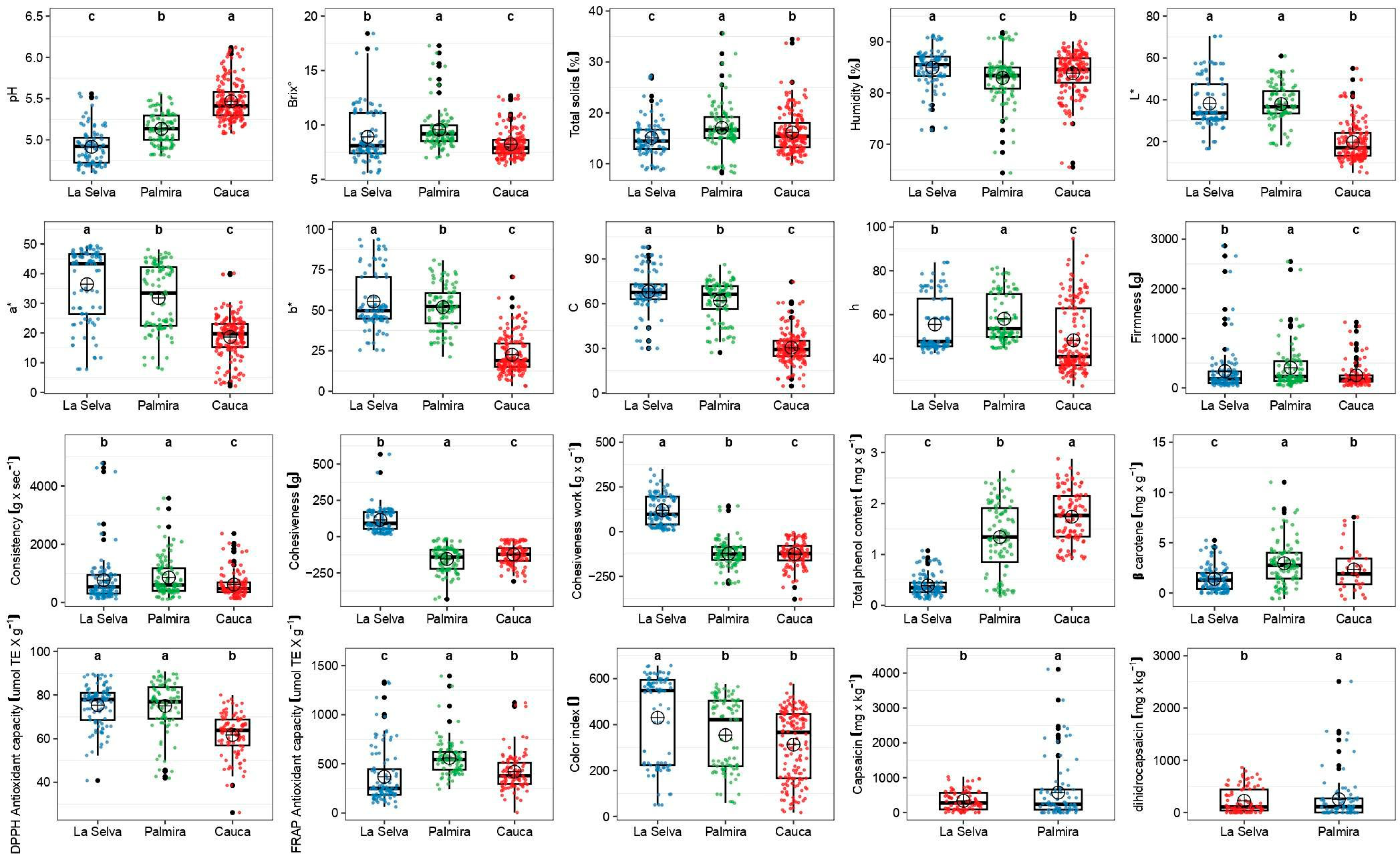
A significant effect of location was observed for all evaluated chemical and physicochemical traits (
Figure 1). Additionally, significant GEIs were observed for all the traits (
Table 1). The pH and cohesiveness values exhibited lower variation within locations, whereas color property values were less homogeneous. The color luminosity (L*) of the fruits was higher in plants grown at La Selva and Palmira than in those grown in Cauca. Similarly, significant differences in β-carotene concentration and total phenol content were observed among locations. Broad-sense heritability (
H2) values were high for most traits; the largest values were observed for humidity, total solids, brix and firmness while the lowest values were found for β-carotene, total phenol content, and antioxidant capacity (
Table 1).
The contributions of genotypes, environments, and GEI to the evaluated traits were calculated using the linear model applied in ANOVA. For most traits, residual values were low, ranging from 2% to 16%, indicating a good overall fit of the model. The highest value, 35%, was observed for the capsaicin concentration (
Table 1). For most traits, the total amount of variance attributed to
Capsicum accessions was predominant (from 30% to 72%). However, for pH, color attributes, total phenol content and cohesiveness, this value was lower than the proportion attributed to the environment. The traits most influenced by GEI were β-carotene concentration and antioxidant activity, while pH, total solids content and humidity percentage were the least influenced (
Table 1).
3.2. Capsicum Classification by Cluster Analysis and PCA Revealed Different Fruit Properties at Three Locations
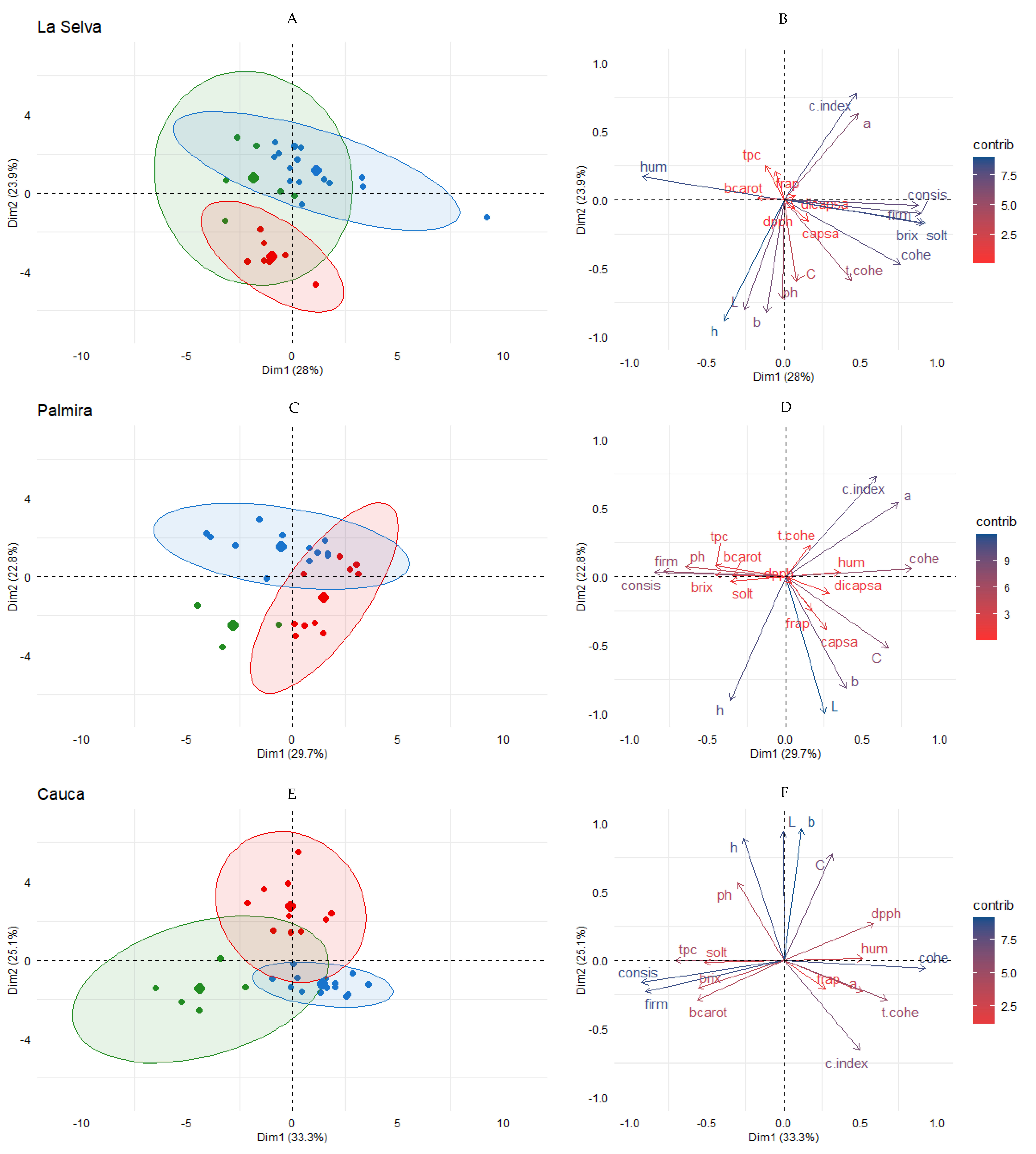
Principal component analysis (PCA) followed by k-means clustering was applied to classify
Capsicum genotypes using fruit chemical and physicochemical descriptors measured across three field environments. All variables were z-standardized to equalize scale and ensure that principal components (PCs) reflected covariance structure rather than measurement units. The number of clusters (k = 3) was selected using the silhouette criterion (
Figure S1). Across environments, the first two PCs accounted for >52% of total phenotypic variance (
Figure 2). PC1 was dominated by textural traits—cohesiveness, consistency, and firmness exhibited the strongest loadings, whereas PC2 was driven by colorimetric parameters (L*, b*, h°) with a notable contribution from the color index, underscoring the chromatic basis of this axis.
Clustering patterns were environment specific. In Cauca, groups separated mainly along PC1, consistent with contrasts in biochemical composition (e.g., β-carotenoid and antioxidant capacity-DPPH and FRAP). In Palmira and La Selva, dispersion occurred mostly along PC2, indicating marked differences in lightness (L*) and yellowness (b*). Examination by site revealed no persistent geographic clustering suggesting that environmental effects did not overwhelm the underlying genetic structure. The K-means consistently resolved three phenotypic fruit types: (i) high-lightness/yellow fruits (elevated L*, b*, h°), (ii) high-red/intense fruits (greater a*, chroma, and color index), and (iii) bioactive-enriched fruits (higher β-carotenoids and antioxidant capacity, with favorable texture). In Cauca, the commercial accessions Cayena, Habanero, and Rocoto co-clustered (blue cluster), exhibiting desirable combinations of cohesiveness, moisture, antioxidant capacity, and color index. Genotypes 36 and 198 showed phenotypic stability, clustering together across all environments with consistently high consistency and cohesiveness (
Table S1).
These results show that an integrated PCA–k-means framework provides a basis for identifying genotype sets with commercially desirable trait combinations, thereby informing pre-breeding and selection strategies aimed at developing Capsicum varieties aligned with agro-industrial specifications and market needs.
3.3. Broad and Narrow Sense Performance of Capsicum Genotypes for Industry Relevant Traits
The elucidation of GEI in the multi-environment trials was conducted by applying an additive main effect multiplicative interaction (AMMI) analysis. This test integrates additive effects for genotypes and environments with multiplicative effects for GEI, estimated by PCA [
37]. A selection of four out of 17 traits was made for the purpose of conducting an AMMI analysis, with the selection being based on their importance in the food industry. The parameters in question were pH, humidity, firmness, and cohesion. The influence of genotypes, environments, and GEI was significant in the evaluated traits (
Table 2).
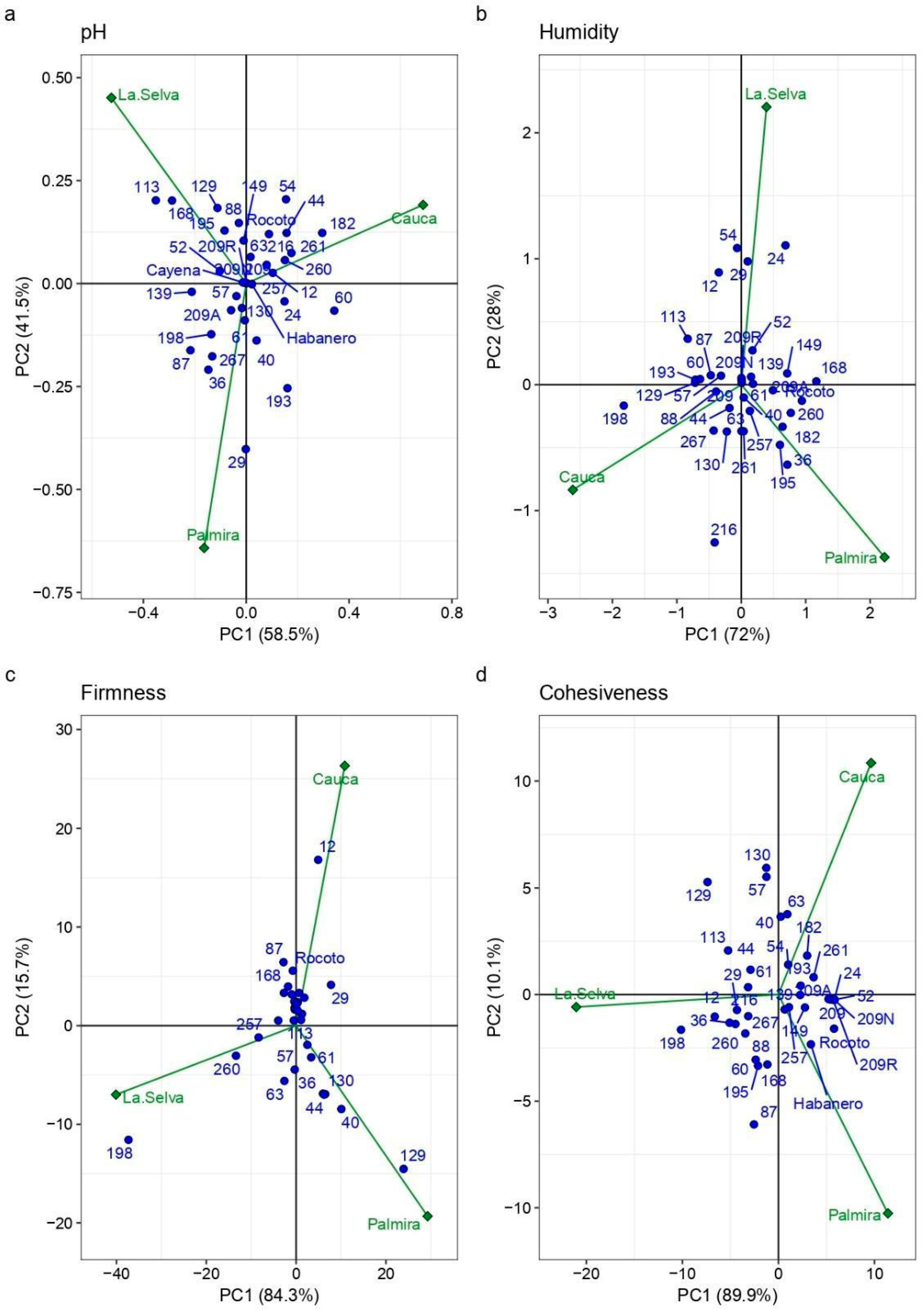
The analysis of variance (ANOVA) for pH, humidity, firmness, and cohesiveness revealed that PC1 accounts for at least 58.5% and PC2 for 10.1% of the GEI variance (
Figure 3). The three environments contributed significantly to GEI. For pH, genotypes positioned close to the biplot origin (Habanero, cayenna and 209) exhibited minimal contribution to GEI, indicating a stable pH across environments (
Figure 3a). For humidity, this was observed for genotypes 61, 139 and 209 (
Figure 3b). For firmness and cohesiveness, the most stable genotypes across locations were identified as 113 and 139, respectively (
Figure 3c,d). Commercial accessions, such as rocoto and habanero, exhibited superior performance in terms of firmness and cohesiveness when cultivated in Palmira. Conversely, rocoto demonstrated a narrow adaptation, showing an affinity for higher pH levels in Cauca.
Additive main effect multiplicative interaction (AMMI) analysis revealed two types of adaptation: broad adaptation, which is applicable to accessions stable across environments, and narrow adaptation, which refers to genotypes that demonstrated superior performance in a single locality (
Table 3). This approach generally permits the selection of accessions, particularly those regarded as stable across various environments, as well as those that exhibited adaptation to particular sites. Genotypes with the best stability across localities were identified in the evaluated panel. The selection criterion for stability was based on the distance from the origin to the first component in the AMMI analysis for the point representing each genotype and phenotypic stability index (PSI), which incorporates both mean of the trait and stability in a single criterion. Low values of PSI show desirable accessions with high means and stability (
Table 3). On the other hand, predicted values of the selected traits were calculated across the analyzed locations (
Table S2).
3.4. Genomic Heritability Reveals High Additive Control of pH and Pungency Traits
Narrow sense genomic heritability (
h2) estimates across traits indicated that pH and pungency-related compounds exhibited the strongest additive genetic control within the
Capsicum panel. Among all analyzed traits, pH showed the highest genomic heritability, with values ranging between 0.470 and 0.484 across Bayesian models and a standard deviation below 0.003. Similarly, capsaicinoid-related traits showed moderate-to-high heritabilities:
h2 = 0.344 ± 0.006 for total capsaicinoids, 0.394 ± 0.004 for capsaicin, and 0.476 ± 0.003 for dihydrocapsaicin, suggesting strong additive genetic contributions to pungency (
Table 4).
These results confirm that both pH and alkaloid biosynthetic traits were predominantly controlled by additive loci, with limited environmental noise, which supports their use as primary targets for genomic selection and prediction. Such high and stable heritability values reinforce the potential of incorporating genomic prediction for improving fruit quality and pungency-related attributes in Capsicum spp.
3.5. BayesC Achieved the Highest Predictive Accuracy and Model Stability
Among the evaluated models (BayesA, BayesB, BayesC, Bayesian Ridge Regression, Bayesian LASSO, and RKHS), BayesC consistently outperformed all others in predictive ability and stability across traits. It yielded the lowest mean squared errors (MSE) in both training and testing datasets, and the highest validation correlations R_testing, confirming its superior capacity to capture relevant additive effects while minimizing overfitting (
Table S3).
For example, BayesC achieved R_testing = 0.94 for pH, 0.94 for Brix, 0.97 for dry matter, and above 0.93 for most texture and color parameters. In the case of pungency traits, BayesC maintained high predictive consistency (r = 0.94 for capsaicinoids, 0.98 for capsaicin, and 0.94 for dihydrocapsaicin) with the lowest residual variance among all models. The robust performance of BayesC arises from its hierarchical prior structure, which incorporates both shrinkage and sparsity, allowing non-informative markers to be effectively down-weighted. This property makes BayesC particularly suited for moderate-size genomic datasets, such as the Colombian Capsicum germplasm, where the number of SNPs far exceeds the number of observations.
3.6. Genomic Prediction Models Trained in La Selva Showed Broad Environmental Transferability
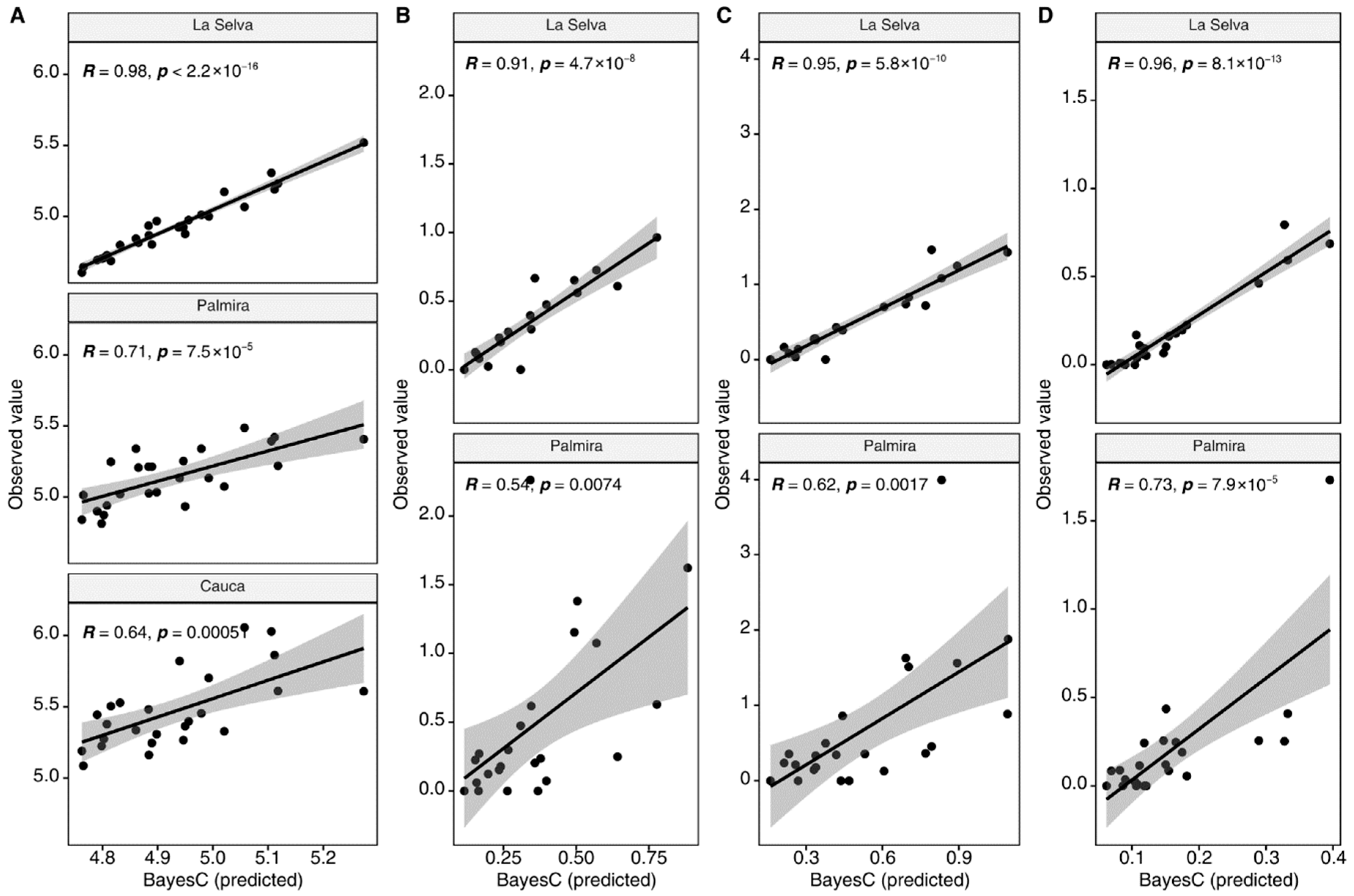
The genomic prediction model trained in La Selva environment displayed high predictive accuracy and strong transferability across distinct agroecological zones (
Figure 4). Validation metrics, including Pearson and Spearman correlation coefficients, mean absolute error (MAE), and root mean square error (RMSE), indicated excellent model performance in La Selva, with the expected reduction in predictive accuracy under contrasting environmental conditions (
Table 5). For pH, the predictive ability in La Selva reached a Pearson correlation of 0.976 and a Spearman correlation of 0.960, with MAE and RMSE values of 0.0768 and 0.0981, respectively. When applied to the external environments of Palmira and Cauca, the predictive correlations decreased to 0.708 and 0.644, respectively, indicating a moderate but consistent level of transferability.
Similarly, for pungency-related traits, the model maintained high predictive consistency across environments. In La Selva, correlation values were 0.949 for total capsaicinoids, 0.914 for capsaicin, and 0.963 for dihydrocapsaicin, whereas in Palmira, the correlations declined to 0.617, 0.543, and 0.729, respectively. These results demonstrate that the BayesC model retains substantial predictive capacity when transferred between environments, especially for traits exhibiting high genomic heritability such as pH and pungency components. Consequently, La Selva environment can serve as a robust calibration reference for the development and deployment of genomic recommendation models applicable across multiple production regions within the Colombian Capsicum improvement program.
3.7. Genomic Breeding Value (GBV) Ranking in La Selva Environment
The genomic breeding values (GBVs) estimated under La Selva environment provided a robust quantitative framework for ranking
Capsicum accessions according to their predicted performance for key quality and pungency-related traits. Rankings were derived from the BayesC model calibrated with genomic and phenotypic data from La Selva, which exhibited the highest predictive ability across environments (
Table S4).
For pH, accessions 113, 70, and 277 exhibited the highest positive GBVs (0.396, 0.337, and 0.274, respectively), suggesting stable buffering capacity and favorable fruit acidity levels under the temperate highland conditions of La Selva. Regarding total capsaicinoids, accessions 160, 161, and 231 showed the strongest predicted accumulation (5.18, 3.20, and 2.68 mg g−1, respectively). Similarly, for capsaicin, accessions 160, 161, and 178 reached the highest predicted concentrations (4.57, 2.77, and 1.99 mg g−1, respectively). In the case of dihydrocapsaicin, accessions 231, 222, and 280 exhibited the top predicted values (0.43, 0.39, and 0.38 mg g−1, respectively), with accession 160 also ranking within the upper range across all pungency-related traits.
This cross-trait consistency indicates a shared genetic basis for capsaicinoid biosynthesis and supports the use of these genotypes as elite donors in breeding programs aimed at enhancing flavor intensity and biochemical uniformity in
Capsicum spp. Interestingly, several of the top-performing genotypes in La Selva—particularly 160, 161, 231, 168, 216, and 260—exhibited consistently high GBVs for pungency-related traits (
Table 6), confirming their strong additive potential for total capsaicinoid production and metabolite stability. Accessions 160 and 161 showed superior performance across all pungency metabolites, while 231 and 168 stood out for dihydrocapsaicin accumulation. Additionally, 216 and 260 maintained intermediate-to-high rankings across traits, suggesting broad adaptability and potential for use as multi-environment donors.
In parallel, accession 113 maintained one of the highest GBVs for fruit pH, reflecting a stable buffering capacity that is desirable for processing quality and product stability. The co-occurrence of these high-performing accessions among the 30 inter-environmental lines evaluated in Palmira and Cauca further supports the transferability of genomic predictions across distinct agroecological conditions.
Moreover, the consistent ranking of accessions such as 113 (high pH and moderate pungency) and 160 or 231 (extremely high capsaicinoid content) suggested the potential to design genomic selection panels combining genotypes with complementary industrial attributes. These lines could be strategically integrated into Capsicum pre-breeding pipeline to exploit additive GEI and enhance both flavor stability and heat intensity in future breeding populations.
Overall, La Selva-based GBV ranking demonstrated the feasibility of implementing a genomic-assisted selection strategy capable of identifying elite accessions within a single, broad-characterization environment while ensuring predictive transferability across other agroecological contexts such as Palmira and Cauca, as validated by phenotypic stability analysis.
4. Discussion
Capsicum breeding programs are mainly focused on plant yield attributes [
2], often disregarding other traits such as chemical and physicochemical properties that are crucial for several industrial sectors. Evaluating the performance and phenotypic stability of diverse accessions across environments is therefore essential to identify genotypes best suited for specific processing or industrial purposes. This information is particularly valuable to accelerate progress in conventional breeding programs that must respond to the demands of growers, processors, and the chili pepper industry [
6]. In the present study, we characterized the
Capsicum collection through multivariate analysis and the estimation of heritability for key physicochemical and phytochemical traits. These results provide a relevant basis to address local breeding challenges using the Colombian germplasm collection. Building on this general characterization, we first examined the extent and structure of phenotypic diversity across environments to identify the major axes of variation underlying fruit quality traits.
4.1. Phenotypic Diversity Across Environments
The physicochemical and biochemical profiling of
Capsicum fruits revealed substantial phenotypic dispersion both among genotypes and across sites, consistent with a pronounced G × E component. Quality-related traits—particularly texture (firmness, consistency, cohesiveness), color attributes (L*, a*, b*, h°, color index), and total solids—exhibited wide interspecific ranges, corroborating the breadth of diversity present in the Colombian
Capsicum collection. These observations align with prior reports documenting marked morphological and metabolic variability within domesticated
Capsicum spp. [
7,
8,
9].
The differential environmental responsiveness observed across trait categories in this study aligns with emerging evidence from multi-environment crop studies, revealing fundamental differences in the genetic architecture and environmental sensitivity of mechanical versus optical fruit properties. The structure of phenotypic variation demonstrated clear trait-dependent patterns, with texture-related attributes (cohesiveness, consistency, firmness) primarily explaining the first principal component, while chromatic parameters (L*, b*, hue angle) dominating the secondary axis of variation. This orthogonal segmentation suggests partially independent physiological control mechanisms governing mechanical versus pigment-associated properties, consistent with the distinct genetic pathways underlying cell wall modification and carotenoid biosynthesis [
38]
The greater environmental responsiveness of optical traits (L*, b*) compared to compositional attributes (pH, moisture) observed in our study is supported by recent findings in
Capsicum multi-environment trials. Tripodi et al. (2018) [
39] demonstrated that environmental factors explained the variation for carotenoids, ascorbic acid, and tocopherols in hot pepper varieties, whereas structural compounds like capsaicinoids remained remarkably stable across environments. This differential sensitivity reflects the inherent biological constraints of these trait categories: colorimetric attributes are directly influenced by light quality, temperature fluctuations, and water stress through their effects on carotenoid biosynthesis and degradation pathways [
40], while basic compositional traits operate within narrower physiological ranges dictated by cellular homeostasis requirements [
41].
The trait-specific GEI documented in our analysis are consistent with broader patterns reported across crop species. Multi-environment association mapping in
Capsicum has revealed quantitative trait loci (QTLs) showing significant interactions with environmental gradients, with many QTLs affecting phenotypic plasticity rather than trait means alone [
42]. Notably, genome-wide association studies have identified distinct sets of candidate genes for texture-related traits (including cell-wall modifying enzymes) versus color-determining loci (cytochrome P450s, MYB transcription factors), reinforcing the independent genetic control of these trait categories [
43].
The observed environmental stability of texture and total solids traits have important implications for breeding strategy optimization. Singh et al. demonstrated that structural traits including pericarp thickness and fruit dimensions exhibit moderate to high heritability with consistent genetic effects across environments, making them reliable targets for broad-adaptation breeding programs. Conversely, the site-specific variation in chromatic parameters suggests that color-related selection should incorporate environment-specific evaluation protocols, particularly for market classes where specific color attributes are critical quality determinants [
44].
These findings collectively support a trait-stratified approach to multi-environment breeding, where mechanically related properties provide transferable differentiation across production environments, while optical attributes warrant location-specific optimization. Such strategies can maximize genetic gains by exploiting stable QTLs for broad adaptation while leveraging environment-specific genetic effects for targeted market development [
45]. Furthermore, the orthogonal nature of texture and color variation axes suggests opportunities for simultaneous improvement of both trait categories without significant trade-offs and negative correlations, facilitating the development of varieties combining superior processing characteristics with desired visual appeal.
From a breeding perspective, the observed phenotypic heterogeneity represents a strategic asset rather than a limitation, expanding the genetic search space for complementary trait combinations while facilitating the pyramiding of attributes critical to agro-industrial applications. This heterogeneity can be leveraged through advanced selection strategies such as genomic-assisted recurrent backcrossing (GABC), capable of exploiting GEI. Some recent advances [
46,
47] in phenomic selection demonstrate similar behavior to that found in this work, but using phenotyping techniques based on near-infrared spectral data captured across genotype × environment combinations. Crossa et al. (2022) [
48] found that they can model non-additive G × E components with prediction accuracies comparable to genomic approaches, enabling sparse testing while maintaining selection efficiency. Such approaches are particularly valuable for identifying complementary trait combinations, such as high color index paired with favorable texture profiles, by capturing the full covariance structure of trait expression across environments. While phenotypic diversity reflects the combined effects of genotype and environment, quantifying heritability provides a complementary perspective on the genetic determinism of key traits. Therefore, we next focused on identifying physicochemical traits with high heritable components and direct industrial relevance.
4.2. Heritable Physicochemical Traits of Industrial Value
Fruit pH emerged as a highly heritable and stable trait across environments, showing low intra-location variability and a broad-sense heritability of 0.83. Moreover, its genomic heritability reached 0.49, indicating that a large portion of variance is attributable to additive genetic effects [
49]. This trait is critical for fruit preservation, flavor, and microbial stability [
50], and thus of major relevance for the food and fermentation industries. Similarly, moisture content exhibited minimal environmental influence (4%) and high heritability (0.93), suggesting strong genetic control. Cohesiveness and firmness followed similar trends, both being highly heritable and fundamental to processing quality, texture, rehydration capacity, and structural stability of chili-derived products [
50]. These findings reinforce the potential of these traits as early-selection targets for food industry-oriented breeding programs. Beyond physicochemical properties, biochemical traits such as phenolics and carotenoids contribute critically to industrial and nutritional quality. To understand how these secondary metabolites respond to environmental variation, we evaluated their compositional plasticity across contrasting environments.
4.3. Environmental Effects on Biochemical Composition
Phenolic compounds and carotene content in peppers are of particular interest to the pharmaceutical and nutraceutical industries because of their antioxidant properties and potential health benefits [
51]. The substantial environmental variation observed across locations in our study, with Palmira and Cauca exhibiting higher bioactive compound levels compared to the cooler La Selva environment, is consistent with recent multi-environment studies [
39,
52] demonstrating that carotenoid concentrations are strongly influenced by location and year effects, while phenolic acid variation is primarily driven by annual climatic conditions and GEI [
53]. The differential response patterns observed—where total phenolic content variation was largely explained by environment while carotenoid variation showed stronger GEI effects—align with controlled temperature studies showing that elevated temperatures (30 °C vs. 20 °C) significantly enhance carotenoid biosynthesis through upregulation of key pathway genes, including a 5.5-fold increase in phytoene synthase expression, alongside concurrent increases in total phenolics and ascorbic acid content [
54].
The lower broad sense heritability estimates observed for these bioactive compounds compared to physicochemical traits reflect their greater environmental sensitivity, biosynthetic phenomena that extend beyond temperature or altitude effects to encompass complex interactions, e.g., light × temperature interaction. Postharvest studies have shown that specific light spectra can induce dramatic biochemical changes in carotenoid expression in peppers—red light (660 nm) increases total carotenoids by more than 3.5 times in 24 h, while exposure to far-red light (730 nm) for 72 h can increase capsaicinoid content by more than 8 times, thereby driving phytochrome-mediated regulation of phenylpropanoid biosynthesis (Pashkovskiy et al., 2023) [
55]. This example of context-dependent biochemical plasticity represents a fundamental feature of secondary metabolite production in
Capsicum species, where the interaction between genetic potential and environmental triggers the final expression of bioactive compound profiles crucial for both nutritional quality and commercial value. Given the contrasting environmental sensitivity of physicochemical versus biochemical traits, we next assessed the heritability patterns underlying fruit quality parameters to elucidate their potential for genetic improvement.
4.4. Heritability Estimates for Fruit Quality Traits
Understanding trait heritability is fundamental for achieving higher genetic gains in breeding programs and ensuring that new varieties meet consumer and market demands. The high broad heritability values observed here suggest that fruit texture, moisture content, and pH represent promising starting points for the development of food-industry-oriented breeding schemes. Recent genomic studies have identified candidate loci underlying these traits in
Capsicum [
10,
11], including SNPs associated with firmness and cohesiveness distributed across multiple chromosomes. Functional annotation of these loci revealed genes involved in cell wall remodeling and cuticular structure, indicating a polygenic genomic architecture governing fruit texture [
10]. To translate these trait-level insights into practical breeding implications, we used multivariate analyses to integrate the phenotypic data and classify genotypes according to their industrial suitability.
4.5. Multivariate Classification and Industrial Grouping
Multivariate approaches such as PCA and hierarchical clustering have proven effective in capturing phenotypic diversity and grouping accessions with similar industrial potential [
11,
13,
56]. In the present study, PCA and cluster analysis distinguished three main genotype groups characterized by distinct combinations of fruit physicochemical properties: (i) soluble solids, firmness, consistency, and total solids, (ii) color and pH parameters, and (iii) texture-related traits such as cohesiveness and work of cohesion. One cluster—comprising accessions 12, 29, 36, 129, and 198—displayed superior performance for group (i) traits, while accessions 54, 60, 88, and 113 were distinguished by higher color and acidity values. These patterns indicate that multivariate classification can guide the identification of contrasting genotypes for targeted industrial purposes within the Colombian germplasm.
A previous classification of the same genotypes based on physicochemical and phytochemical descriptors identified three industrial categories—pharmaceutical, food, and cosmetic [
11]. The clusters identified in the present study correspond closely to these functional groupings, reinforcing the utility of multivariate analysis as a tool to align breeding strategies with specific industrial value chains. Identification of broadly adapted genotypes is especially important given that
Capsicum spp. are highly sensitive to climate variability [
56], and agronomic and phytochemical traits can be strongly affected by GEI [
13]. Because industrial performance ultimately depends on trait stability under variable conditions, we further explored genotype × environment interactions to identify stable and broadly adapted accessions
4.6. Genotype × Environment Interactions (GEIs) and Phenotypic Stability
The analysis of variance (ANOVA) and the AMMI model further revealed significant genotype × environment interactions for most traits, confirming that the performance of genotypes was strongly influenced by environmental conditions. Nonetheless, some genotypes exhibited low interaction scores and high mean values, indicating phenotypic stability across contrasting environments. These accessions are valuable as stable parents for selection in breeding programs, especially those targeting fruit quality traits with industrial relevance. The combination of high trait expression and low GEI magnitude is an important criterion for identifying broadly adapted genotypes under variable agroecological conditions.
The estimation of broad-sense heritability (H2) indicated that traits such as pH, firmness, and total soluble solids have a considerable genetic component, suggesting that additive and dominant effects explain a large portion of their phenotypic variance. In contrast, color parameters exhibited lower heritability, implying a stronger environmental component. These differences reflect the complex nature of fruit traits, where biochemical pathways and environmental responses interact to shape final phenotypes. The high heritability values obtained for physicochemical attributes suggest that these traits can be improved effectively through recurrent selection or, more efficiently, via genomic-assisted approaches. To complement the phenotypic analyses, we incorporated genomic data to dissect the additive genetic basis of key traits and evaluate the predictive performance of different genomic models.
4.7. Genomic Heritability and Model Performance
Beyond the phenotypic assessment, the integration of genomic prediction provided a deeper understanding of the genetic control underlying key industrial traits in
Capsicum spp. The high genomic heritability (h
2) values estimated for pH and pungency-related compounds confirmed that these traits are strongly governed by additive genetic effects, supporting their suitability for marker-assisted and genomic selection. Specifically, the BayesC model revealed h
2 values of 0.484 for pH, 0.344 for total capsaicinoids, 0.394 for capsaicin, and 0.476 for dihydrocapsaicin. Although estimates of genomic-based narrow-sense heritability for these traits are scarce in
Capsicum, the magnitudes observed here are consistent with the highly additive genetic architecture reported for related metabolic and quality traits in other Solanaceae species [
57,
58], where key biosynthetic pathways—such as phenylpropanoid and capsaicinoid synthesis—are under strong additive control.
Among all models tested, BayesC achieved the highest predictive accuracy and lowest error variance across traits and environments. This performance arises from its selective-shrinkage Bayesian structure, which effectively captures major-effect loci while minimizing noise from small-effect SNPs—a critical advantage for moderately sized training populations. Similar model superiority has been reported in other crops including common beans, maize, sorghum, and rice [
16,
18,
37], highlighting the robustness of BayesC under high-dimensional genomic data. Therefore, BayesC represents a reliable and computationally efficient method for genomic prediction in
Capsicum, particularly when integrating multi-environment datasets.
This study applied single-trait genomic prediction models; therefore, genotype-by-trait (genetic) correlations were not estimated. Given the limited number of genotypes with multi-environment phenotyping and the heterogeneous heritability profiles, multivariate genomic models were not feasible. Nonetheless, closely related traits (e.g., capsaicin and dihydrocapsaicin) showed consistent GEBV rankings, suggesting shared additive control. Future multivariate genomic analyses could formally quantify genetic correlations and co-selection potential among traits.
A crucial question for practical breeding is whether genomic models trained in one environment can be effectively applied to others. Thus, we assessed the cross-environment transferability of prediction accuracy.
4.8. Cross-Environment Transferability of Genomic Models
The cross-environment validation demonstrated that genomic models trained under La Selva environment maintain strong predictive power when applied to contrasting locations such as Palmira and Cauca. Predictive correlations reached up to r = 0.976 for pH and 0.963 for dihydrocapsaicin in La Selva, with moderate but consistent transferability (0.54–0.73) across other environments. These results suggest that a single calibration environment, characterized by moderate stress and wide variability, can serve as a robust reference for model training, reducing the need for multi-environment calibration phases. This finding parallels evidence from cereals and legumes, where genomic models trained under representative conditions retain significant predictive ability across target environments [
59,
60]. Consequently, La Selva emerges as a key environment for developing and calibrating genomic selection pipelines within the Colombian
Capsicum improvement network. Having validated the robustness of the genomic models across environments, we next ranked the genotypes by their genomic breeding values to identify elite candidates for selection.
4.9. Genomic Breeding Value Ranking and Candidate Selection
The ranking of accessions by their genomic breeding values (GBVs) in La Selva further enabled the identification of superior accessions with stable additive potential. Genotypes such as 113, 70, and 277 exhibited high predicted pH stability, while lines 160, 161, and 231 displayed outstanding potential for total capsaicinoid and capsaicin accumulation. Importantly, several of these top-ranked genotypes—113, 129, 139, 149, 193, 216, 257, 260, and 261—were among the 30 inter-environmental accessions shared with Palmira and Cauca, maintaining consistent performance across locations. The GBVs allow the prediction of “superior” individuals at different environmental conditions. Such accessions might be selected as parental lines for hybridization in a breeding program [
6]. This concordance confirms the robustness of genomic predictions and the potential of these lines as multi-environment donors for pre-breeding and hybridization. The convergence of high GBVs in acidity and pungency traits also suggests opportunities for complementary parental combinations, enabling the development of cultivars with optimized flavor, quality, and industrial suitability. Together, these integrative analyses demonstrate that combining phenotypic and genomic data across environments can substantially accelerate the improvement of
Capsicum germplasm for diverse industrial applications.
4.10. Integrative Framework for Genomic-Assisted Breeding
The combination of phenotypic stability (AMMI-based) and genomic prediction results provides a comprehensive framework for identifying elite Capsicum genotypes that combine high performance, phenotypic stability, and genomic prediction accuracy across environments. Traits such as pH and capsaicinoid content, characterized by high heritability and robust genomic predictability, can now be targeted for early selection in genomic-assisted breeding cycles. Integrating these genomic tools into breeding pipelines will accelerate genetic gain, enhance selection precision, and reduce phenotyping costs in multi-environment trials.
Overall, this study represents the first implementation of a genome-enabled prediction framework for Capsicum germplasm improvement in Colombia. By coupling high-throughput GBS data, Bayesian genomic models, and multi-environment validation, it establishes the foundation for a national genomic selection platform. Such integration will strengthen the capacity to develop new Capsicum varieties with enhanced quality, stability, and adaptability—addressing both local production needs and global market demands.




 ,
,