Article

Soil Phosphorus Fraction Characteristics in Different Alpine Grassland Types of the Qinghai–Tibet Plateau


1
College of Agronomy, Yanbian University, Yanji 133002, China
2
Key Laboratory of Soil Resource Sustainable Utilization for Jilin Province Commodity Grain Bases, College of Resource and Environmental Science, Jilin Agricultural University, Changchun 130118, China
3
Key Laboratory of Ecosystem Network Observation and Modeling, Institute of Geographic Sciences and Natural Resources Research, Chinese Academy of Sciences (CAS), Beijing 100101, China
4
Institute of Carbon Neutrality, School of Ecology, Northeast Forestry University, Harbin 150040, China
*
Authors to whom correspondence should be addressed.
Agronomy 2025, 15(12), 2689; https://doi.org/10.3390/agronomy15122689
Submission received: 22 October 2025 / Revised: 12 November 2025 / Accepted: 20 November 2025 / Published: 22 November 2025
(This article belongs to the Section Grassland and Pasture Science)

Abstract

The alpine grassland ecosystem of the Tibetan Plateau is a vital base for animal husbandry and a key ecological security barrier in China. Phosphorus (P), an essential nutrient, is among the primary factors limiting grassland productivity. However, the spatial distribution of soil P fractions across alpine grasslands on the Tibetan Plateau and their environmental drivers remain unclear, limiting our understanding of P cycling and grassland productivity. This study examined the composition and distribution of soil P in three representative alpine grasslands (meadow, steppe, and desert) using a combination of chemical fractionation and 31P nuclear magnetic resonance (NMR) spectroscopy. The results revealed pronounced spatial heterogeneity, with total soil P content varying by approximately 2.4-fold among the grassland types. Alpine meadows had the highest total P (0.73 g kg−1) and available P (4.02 mg kg−1) concentrations, with the latter being nearly twice that of alpine steppes and deserts. Alpine meadows were characterized by a predominance of labile and moderately labile organic P (e.g., NaOH-Po) and a diverse array of phosphate monoesters and diesters, whereas alpine deserts were dominated by stable, calcium-bound inorganic P (HCl-Pi). Temperature, precipitation, pH, and phosphatase activity were identified as key factors regulating the distribution and transformation of P fractions. The distinct P fractions and availability uncovered in this study are essential for predicting grassland ecosystem responses to environmental change and guiding sustainable pasture management on the Tibetan Plateau.

1. Introduction

Phosphorus (P) is an essential macronutrient for plant growth and development and plays a critical role in determining soil quality and ecosystem productivity [1,2]. It occurs mainly in inorganic (Pi) and organic (Po) forms, with Po requiring biochemical conversion to become bioavailable as Pi [3]. The formation and transformation of soil P fractions are fundamental processes in ecosystem development, as they directly determine P bioavailability and govern plant P uptake and nutrient-use efficiency [4,5,6]. Accordingly, the composition of soil P fractions strongly influences plant P acquisition and ecosystem P-use efficiency, and P bioavailability often emerges as a key factor constraining net primary productivity in grasslands [7,8]. Furthermore, P is crucial for regulating the accumulation of soil organic matter (SOM), nitrogen fixation, and carbon stabilization in grassland ecosystems [9,10]. Therefore, elucidating the variations in soil P fractions and the mechanisms underlying their transformation is essential for understanding P dynamics and maintaining grassland productivity under future climate change scenarios.
Characterized by its high elevation and unique vegetation, the Tibetan Plateau is highly susceptible to climatic variability [11,12]. The region has undergone dramatic environmental shifts, including climate warming, altered precipitation regimes, and permafrost degradation [13,14], all of which directly affect P cycling processes, such as mineralization and solubilization. These changes have profoundly influenced nutrient cycling and primary productivity in alpine grassland ecosystems [15]. As the dominant ecosystem on the Plateau, covering nearly 50% of its total area [11,16], alpine grasslands are vital for regional ecological stability and sustainable animal husbandry [2]. Therefore, they provide an ideal natural system for investigating how environmental gradients shape P cycling [17]. Despite growing research on soil P storage and total P concentrations in alpine grasslands [18,19], systematic studies on P availability and transformation processes remain limited, particularly regarding differentiation among distinct grassland types at a regional scale. Key uncertainties include the relative importance of organic P fractions, enzyme-mediated transformations, and quantitative relationships between specific P chemical forms and their bioavailability across grassland types. This knowledge gap significantly constrains our ability to predict how grassland productivity responds to variations in soil P availability.
We hypothesize that climatic and structural differences among alpine grassland types (meadow, steppe, and desert) regulate P fractionation and availability in distinct ways. In this study, the distribution characteristics of soil total P, available P, Pi, and Po in three representative alpine grassland types on the Tibetan Plateau were examined using chemical fractionation and solution 31P nuclear magnetic resonance (NMR) spectroscopy. This study further explored the key environmental drivers shaping P fraction distribution. Two central scientific questions were addressed. (1) What are the compositional and spatial differentiation patterns of soil P fractions across different alpine grassland types? (2) What are the primary environmental factors controlling the distribution and transformation of soil P fractions? By elucidating the mechanistic linkages between the chemical speciation and bioavailability of P in alpine grasslands, this study enhances our theoretical understanding of P cycling processes. These findings provide essential data for predicting nutrient limitation patterns and ecosystem responses under global environmental change and offer critical insights for improving terrestrial ecosystem models globally, particularly in simulating the vulnerability and resilience of similar ecosystems under future climate scenarios.

2. Materials and Methods

2.1. Study Sites and Sample Collection

The investigation was conducted along an approximately 2200 km east–west transect established in August 2023, centered on Nagqu County in the Qinghai–Tibet Plateau. This transect encompassed nine evenly distributed sampling sites (Figure 1), representing three typical alpine grassland types: alpine meadow, alpine steppe, and alpine desert. These grassland types form the foundation of regional livestock production and are characterized by distinct, dominant plant communities. Alpine meadows are dominated by Kobresia pygmaea and K. humilis, forming dense turf; alpine steppes are dominated by Stipa purpurea and S. pinnata, representing typical forage grasses; and alpine deserts are dominated by the dwarf shrub S. glareosa and the forb O. thoroldii, indicative of harsh environmental conditions. Correspondingly, aboveground biomass (AGB) exhibited a clear decreasing trend from meadow (mean = 141 g m−2) to steppe (mean = 75 g m−2) and desert (mean = 29 g m−2), reflecting the inherent productivity potential of these vegetation types (Table 1). Table 1 summarizes the basic characteristics of the sampling sites, including longitude, latitude, elevation, mean annual precipitation (MAP), mean annual temperature (MAT), and soil physicochemical properties.
To ensure data reliability and representativeness, a 100 m transect was established at each site, and five sampling points were randomly selected along an “S”-shaped pattern. In total, 45 independent soil samples were collected (3 grassland types × 3 sites per type × 5 sampling points per site). Each sample was treated as an independent biological replicate for all subsequent chemical and spectroscopic analyses. Before sampling, the surface litter layer was carefully removed to avoid interference from undecomposed organic residues. Surface soil (0–10 cm depth) was collected from each point, gently disaggregated by hand, and passed through a 2 mm sieve to remove roots and gravel, followed by homogenization. The soil samples were then air-dried in the dark, passed sequentially through 0.25 mm and 0.15 mm sieves, and stored in sealed containers until analysis.

2.2. Determination of Total P, Available P, and Inorganic and Organic P Concentrations in Soil Samples

Soil P fractions were quantified using standard chemical methods. Total P was determined by digesting soil samples with concentrated H2SO4 and HClO4 [20], and available P was extracted with 0.5 M NaHCO3 (pH 8.5) [21]. Soil Po was measured using the ignition method [22,23], in which the difference in P concentration between ignited (550 °C for 1 h) and unignited samples extracted with 1.0 M H2SO4 was used to calculate organic P. Soil Pi was obtained by subtracting the measured Po from total P. Phosphorus concentrations in all extracts were determined using the molybdate colorimetric method [24].

2.3. Sequential Fractionation

Soil P fractionation was performed using the Hedley sequential extraction procedure [25], as modified by Tiessen and Moir [26]. Briefly, 1.0 g of air-dried soil (<0.25 mm) was sequentially extracted with 30 mL of H2O, 0.5 M NaHCO3 (pH 8.5), 0.1 M NaOH, and 1.0 M HCl. Each extraction was conducted at 25 °C for 16 h. The total P concentration in each extract was determined using the molybdate blue method [27,28] after autoclave digestion (120 kPa, 120 °C) with H2SO4 and (NH4)2S2O8. Inorganic P in the extracts was measured directly by colorimetry [24], and organic P was calculated as the difference between total and inorganic P.

2.4. Solution 31P NMR Spectroscopy

Soil P compounds were further analyzed using solution 31P NMR spectroscopy, following established protocols [29,30,31]. Air-dried soil (4.0 g, <0.25 mm) was extracted with 40 mL of 0.25 M NaOH and 0.05 M EDTA and shaken for 16 h. An aliquot of the extract was digested (H2SO4 + potassium persulfate, 120 kPa, 120 °C, 1 h) to determine total P using the molybdate blue method. The remaining extract was frozen at −80 °C, lyophilized, and re-dissolved in 1.0 mL of 0.25 M NaOH and 50 µL of deuterium oxide (D2O) as a field-frequency lock. For analysis, 0.8 mL of this solution was transferred into a 5 mm NMR tube. Spectra were acquired using an AVANCE III HD 500 NMR spectrometer (Bruker, Switzerland) operating at 202.5 MHz for 31P with the following acquisition parameters: 13.0 µs pulse width, 0.4 s acquisition time, 3.0 s delay, and 15,000 scans.
Phosphorus compounds were identified based on their chemical shifts (ppm), with orthophosphate peaks standardized to 6 ppm, following Liu [32]. Spectral regions were quantified using MestReNova software (version 5.3.1), supplemented by manual integration. Compound concentrations were calculated by multiplying the NaOH–EDTA-extractable total P by the relative integrated peak area of each compound. To improve identification accuracy, samples were spiked with reference compounds, including adenosine 5′-monophosphate, myo-inositol hexakisphosphate (myo-IHP), phosphocholine, α- and β-glycerophosphate, α-D-glucose 1-phosphate, and D-glucose 6-phosphate, following previous recommendations [30,33,34,35]. All reference standards were purchased from Sigma-Aldrich (St. Louis, MI, USA).

2.5. Determination of Phosphatase Activity

The activities of soil acid phosphatase (AcP), neutral phosphatase (NeP), alkaline phosphatase (AlP), and phosphodiesterase (PD) were quantified using a colorimetric assay with a commercial enzyme activity kit (Suzhou Grace Biotechnology Co., Ltd., Suzhou, China). The procedure was adapted from the p-nitrophenyl phosphate method originally described by Tabatabai [36], with modifications specific to this study.
In this assay, phosphatases catalyze the hydrolysis of the substrate p-nitrophenyl phosphate disodium salt, releasing p-nitrophenol a yellow compound with a maximum absorbance at 405 nm. The absorbance intensity was directly proportional to the enzyme activity of the soil sample. To ensure accuracy and reproducibility, substrate concentration, pH (optimized individually for each enzyme), and incubation time were standardized according to the manufacturer’s instructions.
Enzyme activity was expressed as the amount of p-nitrophenol released per unit time and calculated as micrograms of product generated per gram of dry soil per hour (µg g−1 h−1). This standardized unit ensured consistency among soil samples and facilitated cross-study comparisons.

2.6. Statistical Analysis

All statistical analyses were performed using SPSS 16.0 (Chicago, IL, USA). To determine statistically significant differences in soil P fractions among alpine grassland types, a one-way analysis of variance (ANOVA) was conducted. The assumptions of normality and homogeneity of variance were verified using the Shapiro–Wilk test and Levene’s test, respectively. When these assumptions were violated, data were appropriately transformed (e.g., square root or logarithmic transformation) before reanalysis. When ANOVA indicated a significant effect, Fisher’s Least Significant Difference (LSD) test was used for post hoc comparisons. Correlations between P fractions and environmental factors (including climate, vegetation, and soil properties) were assessed using Pearson’s correlation analysis. Statistical significance was set at p < 0.05 for all tests, and correlations with p < 0.01 were additionally reported to indicate higher significance. Redundancy analysis (RDA) was performed using Canoco software (v5.0; Microcomputer Power, Ithaca, NY, USA) on standardized environmental data to identify the primary drivers of soil P fraction distribution across grassland types.
Additionally, we conducted a series of statistical analyses in R (v4.4.2) to identify the drivers of P availability. Correlations between P fractions and environmental variables were evaluated using the Mantel test (linkET package). Key predictors were determined using Random Forest analysis (randomForest and rfPermute packages), and their linear relationships were examined using regression modeling. Finally, a structural equation model (SEM package) was developed to quantify the causal pathways by which environmental factors influence P availability.

3. Results

3.1. Total Soil P, Available P, and Po Concentrations in Soil Samples

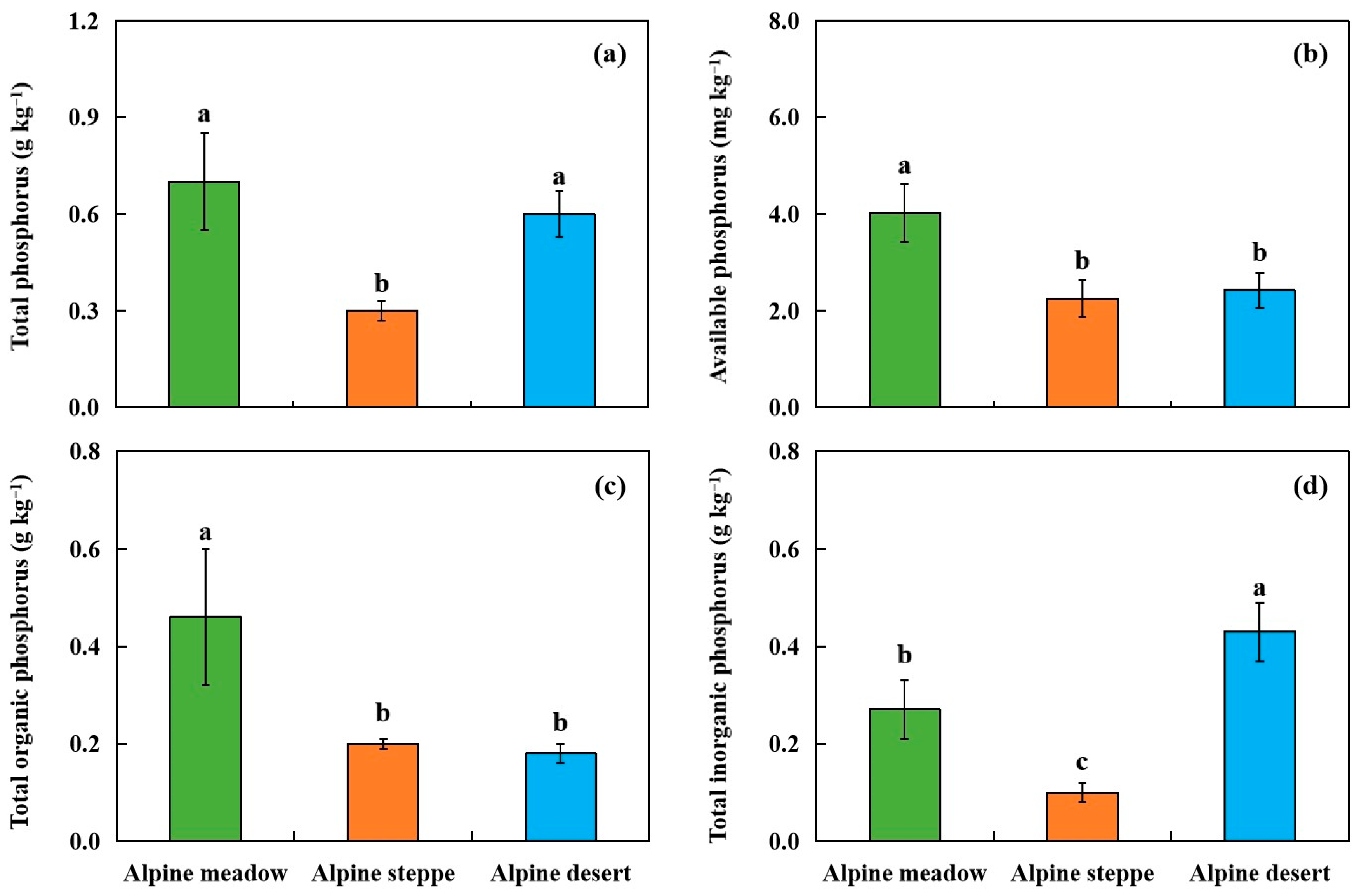
The concentrations of total P, available P, Pi, and Po varied significantly among the alpine grassland types on the Tibetan Plateau (Figure 2). Total P content was the highest in alpine meadow soils (0.73 g kg−1), followed by alpine desert (0.58 g kg−1) and alpine steppe (0.30 g kg−1). Both alpine meadow and alpine desert exhibited significantly higher total P concentrations than alpine steppe (p < 0.05). Similarly, available P was most abundant in alpine meadow soils (4.02 mg kg−1), whereas lower concentrations were observed in alpine desert (2.43 mg kg−1) and alpine steppe (2.26 mg kg−1). Available P in alpine meadow was significantly higher than that in both alpine desert and alpine steppe (p < 0.05).
The distribution pattern of Po closely mirrored that of available P. Po concentration was the highest in alpine meadow soils (0.46 g kg−1), followed by alpine steppe (0.20 g kg−1) and alpine desert (0.18 g kg−1). Po in alpine meadow was significantly higher than that in the other two grassland types (p < 0.05). In contrast, Pi concentration peaked in alpine desert soils (0.43 g kg−1), followed by alpine meadow (0.27 g kg−1) and alpine steppe (0.10 g kg−1), with significant differences among all three types (p < 0.05).

3.2. Soil P Forms Determined by Sequential Chemical Fractionation

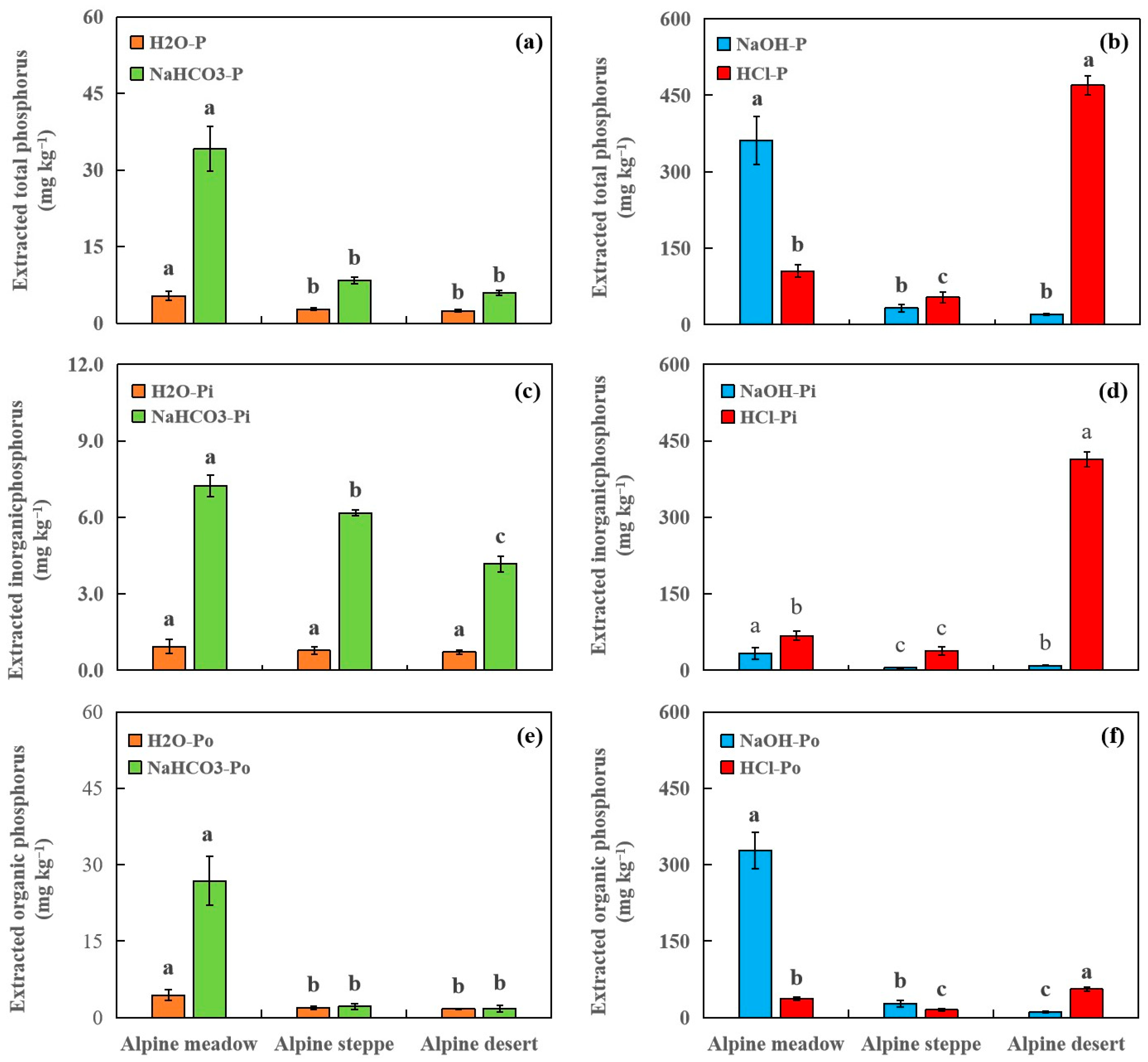
Among the sequentially extracted fractions, the HCl fraction contained the highest total P concentration (53.8–469.6 mg kg−1), followed by NaOH (20.2–361.4 mg kg−1) and NaHCO3 (5.96–34.1 mg kg−1), whereas the H2O fraction contained the lowest (2.43–5.37 mg kg−1) (Figure 3a,b). Across grassland types, total P concentrations in the H2O, NaHCO3, and NaOH fractions were higher in alpine meadow soils than in alpine steppe and alpine desert soils. In contrast, the total P concentration in the HCl fraction was greater in alpine desert soils than in alpine meadow and alpine steppe soils.
The concentrations of Pi fractions followed the order: HCl-Pi (38.5–413.8 mg kg−1) > NaOH-Pi (5.26–33.8 mg kg−1) > NaHCO3-Pi (4.17–7.24 mg kg−1) > H2O-Pi (0.72–0.94 mg kg−1) (Figure 3c,d). The distribution patterns of Pi forms differed markedly among grassland types. NaHCO3-Pi and NaOH-Pi levels were significantly higher in alpine meadow soils than in alpine steppe and alpine desert soils (p < 0.05), whereas HCl-Pi levels were significantly higher in alpine desert soils than in alpine meadow and alpine steppe soils (p < 0.05).
The concentrations of Po fractions were in the order: NaOH-Po (11.0–327.6 mg kg−1) > HCl-Po (15.4–37.4 mg kg−1) > NaHCO3-Po (1.79–26.9 mg kg−1) > H2O-Po (1.71–4.43 mg kg−1) (Figure 3e,f). Distinct distribution patterns were evident among grassland types. Alpine meadow soils contained significantly higher concentrations of H2O-Po, NaHCO3-Po, and NaOH-Po than alpine steppe and alpine desert soils (p < 0.05). Conversely, alpine desert soils exhibited significantly higher HCl-Po concentrations than alpine meadow and alpine steppe soils (p < 0.05).

3.3. Soil P Forms Measured by 31P NMR Spectroscopy

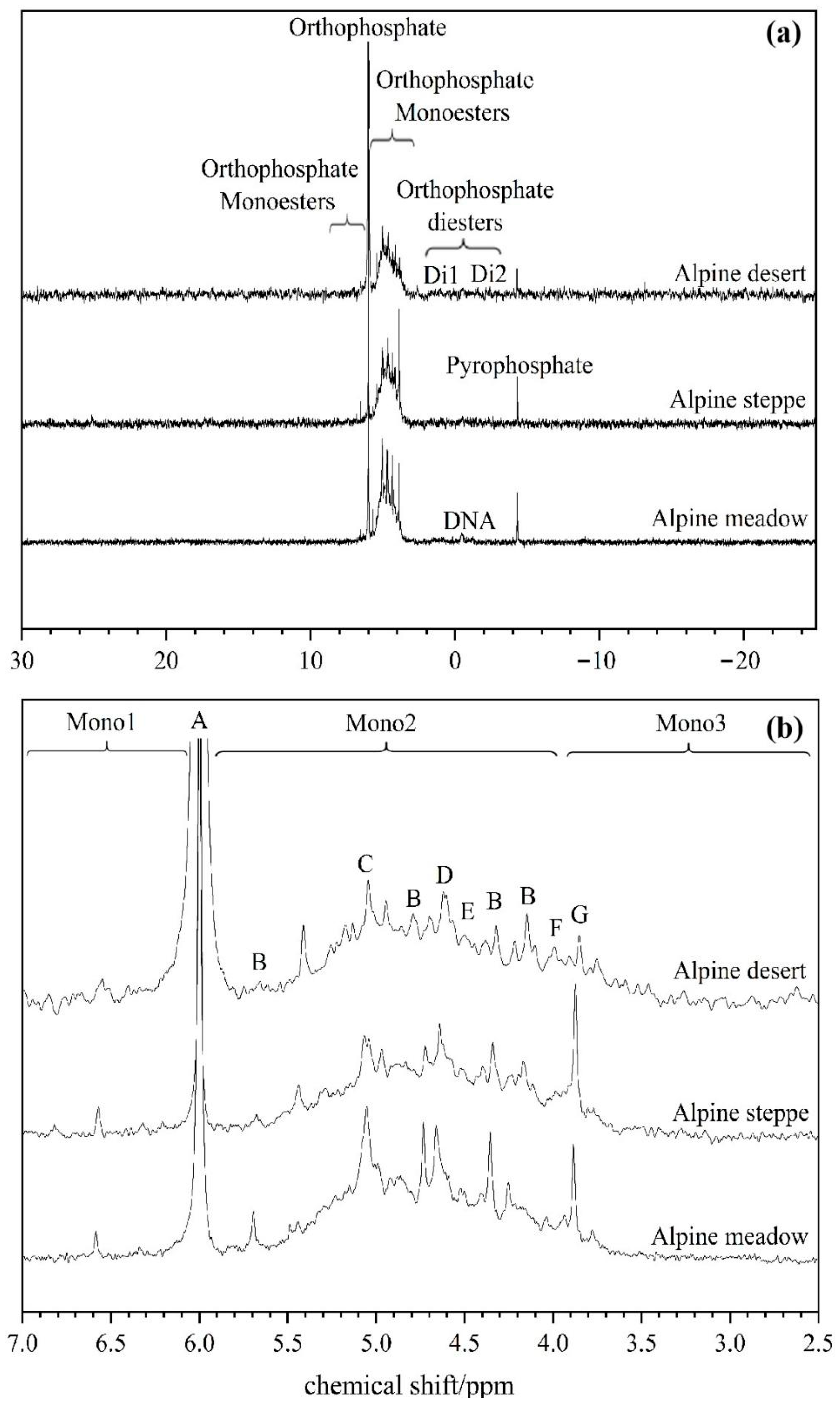
The soil P forms identified by 31P NMR comprised both Pi and Po. Pi forms included orthophosphate and pyrophosphate, whereas Po forms consisted of orthophosphate monoesters and diesters. Among the monoesters, myo-IHP, scyllo-IHP, α-glycerophosphate, β-glycerophosphate, mononucleotides, and phosphocholine were detected, along with three additional groups classified as unidentified monoesters (monoester-1, monoester-2, and monoester-3). Among the diesters, deoxyribonucleic acid (DNA) was identified, and two additional groups were categorized as unidentified diesters (diester-1 and diester-2) (Figure 4a,b).
The proportion of NaOH–EDTA-extractable P in the total soil P ranged from 25.7% to 57.4% (Table 2). The highest extraction rate was recorded in alpine meadow soils (57.4%), whereas the lowest was observed in alpine desert soils (25.7%). The extractable P content decreased in the order: alpine meadow (421.2 mg kg−1) > alpine desert (154.0 mg kg−1) > alpine steppe (116.1 mg kg−1). In alpine meadow and alpine steppe soils, the proportion of Po (sum of orthophosphate monoesters and diesters) exceeded that of Pi (sum of orthophosphate and pyrophosphate), whereas in alpine desert soils, Pi content was higher than Po.
Within the Pi fractions (Table 2), orthophosphate was the dominant form and was significantly more abundant than pyrophosphate. Orthophosphate concentrations decreased in the order alpine meadow > alpine desert > alpine steppe, whereas pyrophosphate decreased in the order alpine meadow > alpine steppe > alpine desert. Among the Po fractions, unidentified monoesters accounted for the largest proportion, followed by inositol hexakisphosphate (myo- and scyllo-IHP combined), glycerophosphates (α- and β-glycerophosphate combined), unidentified diesters, mononucleotides, and phosphocholine. DNA represented the smallest fraction. The concentrations of all Po components consistently decreased in the order: alpine meadow > alpine steppe > alpine desert.

3.4. Phosphatase Activity

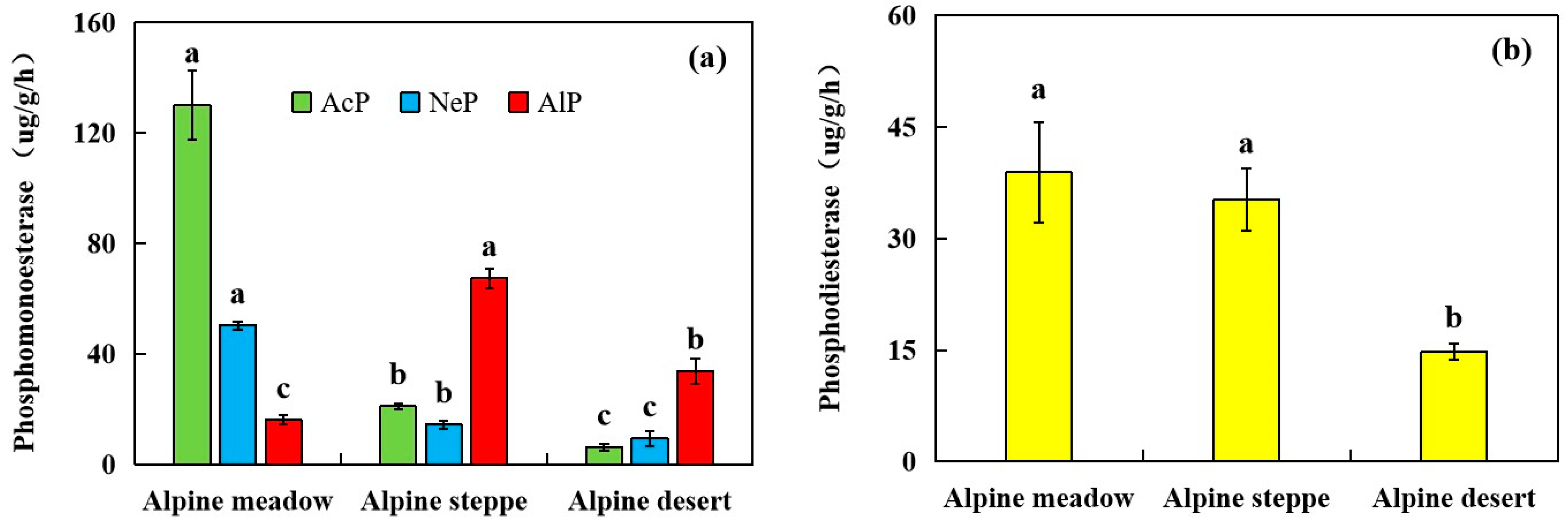
Phosphomonoesterase activity across grassland types on the Qinghai–Tibet Plateau exhibited clear spatial differentiation (Figure 5a). AcP activity predominated in alpine meadows, whereas AlP activity was higher in alpine steppe and alpine desert soils. The activities of AcP and NeP were the highest in alpine meadow soils (130.15 and 50.32 μg g−1 h−1, respectively), followed by alpine steppe (21.03 and 14.42 μg g−1 h−1), and lowest in alpine desert (6.28 and 9.41 μg g−1 h−1), with significant differences among the three grassland types (p < 0.05). For AlP, alpine meadows again exhibited the highest activity (67.34 μg g−1 h−1), followed by alpine desert (33.78 μg g−1 h−1), whereas alpine steppe showed the lowest value (16.06 μg g−1 h−1), with significant differences among types (p < 0.05).
The distribution of PD activity followed a pattern similar to that of AcP activity (Figure 5b). Alpine meadow soils exhibited the highest PD activity (38.90 μg g−1 h−1), followed by alpine steppe (35.25 μg g−1 h−1), whereas alpine desert had the lowest (14.77 μg g−1 h−1). Both alpine meadow and alpine steppe soils exhibited significantly higher PD activity than alpine desert soils (p < 0.05).

3.5. Relationship Between P Forms and Environmental Factors

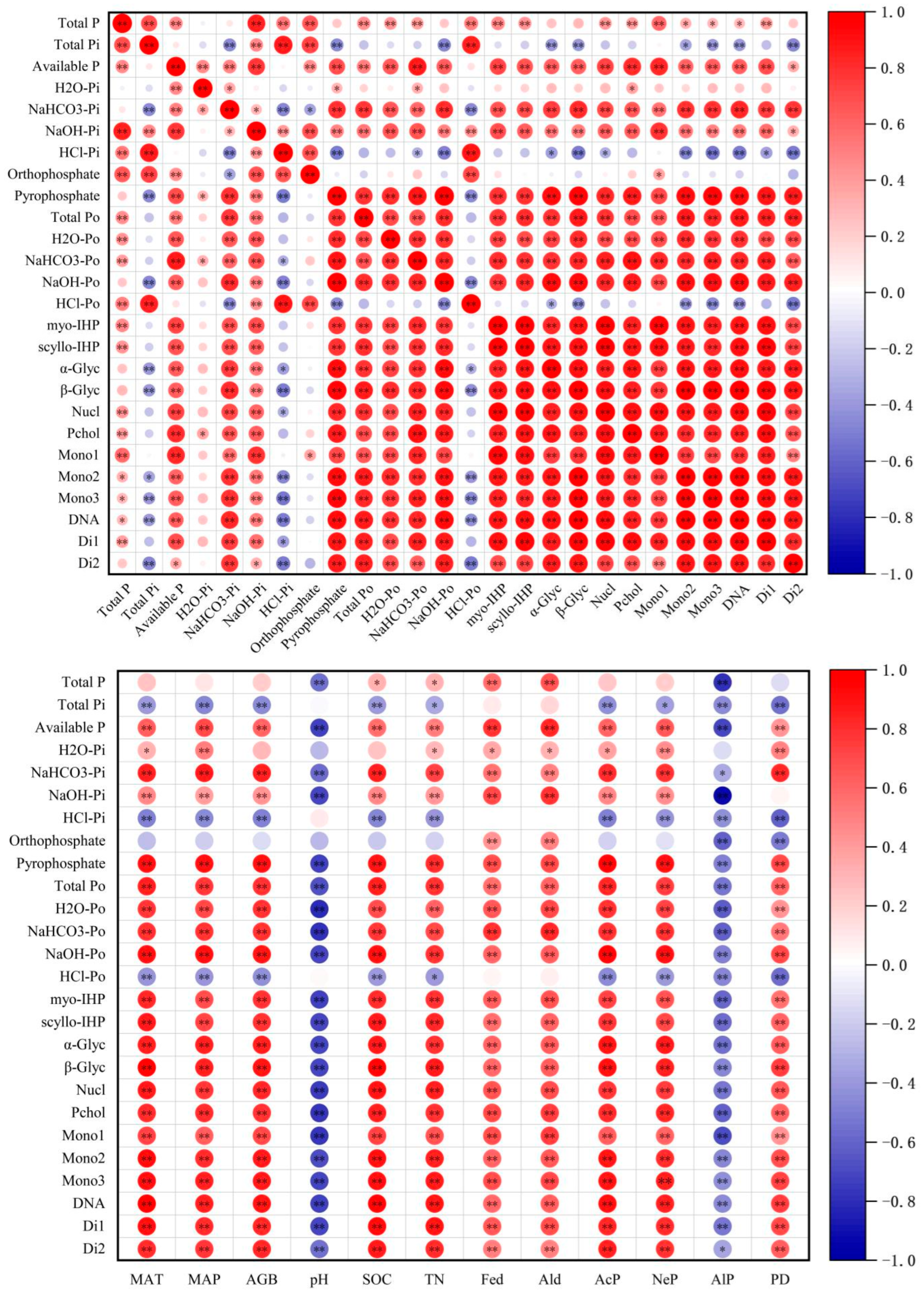
Soil total P showed significant positive correlations with Pi, Po, and several specific fractions, including NaOH-Pi, orthophosphate, H2O-Po, NaHCO3-Po, NaOH-Po, IHP, glycerophosphate (Glyc), phosphocholine (Pchol), Mono1, and Di1 Similarly, soil available P exhibited significant positive correlations with multiple Pi fractions (H2O-Pi, NaOH-Pi, and pyrophosphate) and Po fractions (H2O-Po, NaHCO3-Po, NaOH-Po, IHP, Glyc, Pchol, Mono1, Mono2, DNA, and Di1). Notably, NaHCO3-Pi and NaOH-Pi were strongly and positively associated with most Po fractions (Figure 6). Grassland type also influenced specific relationships. The soil total P correlated positively with Ald but negatively with AlP. Environmental and edaphic factors, including MAP, MAT, AGB, SOC, TN, Ald, Fed, AcP, and NeP, were positively correlated with available P, Pi fractions (NaHCO3-Pi, NaOH-Pi, and pyrophosphate), and most Po fractions (except HCl-Po). In contrast, soil pH and AlP displayed significant negative correlations (Figure 6).
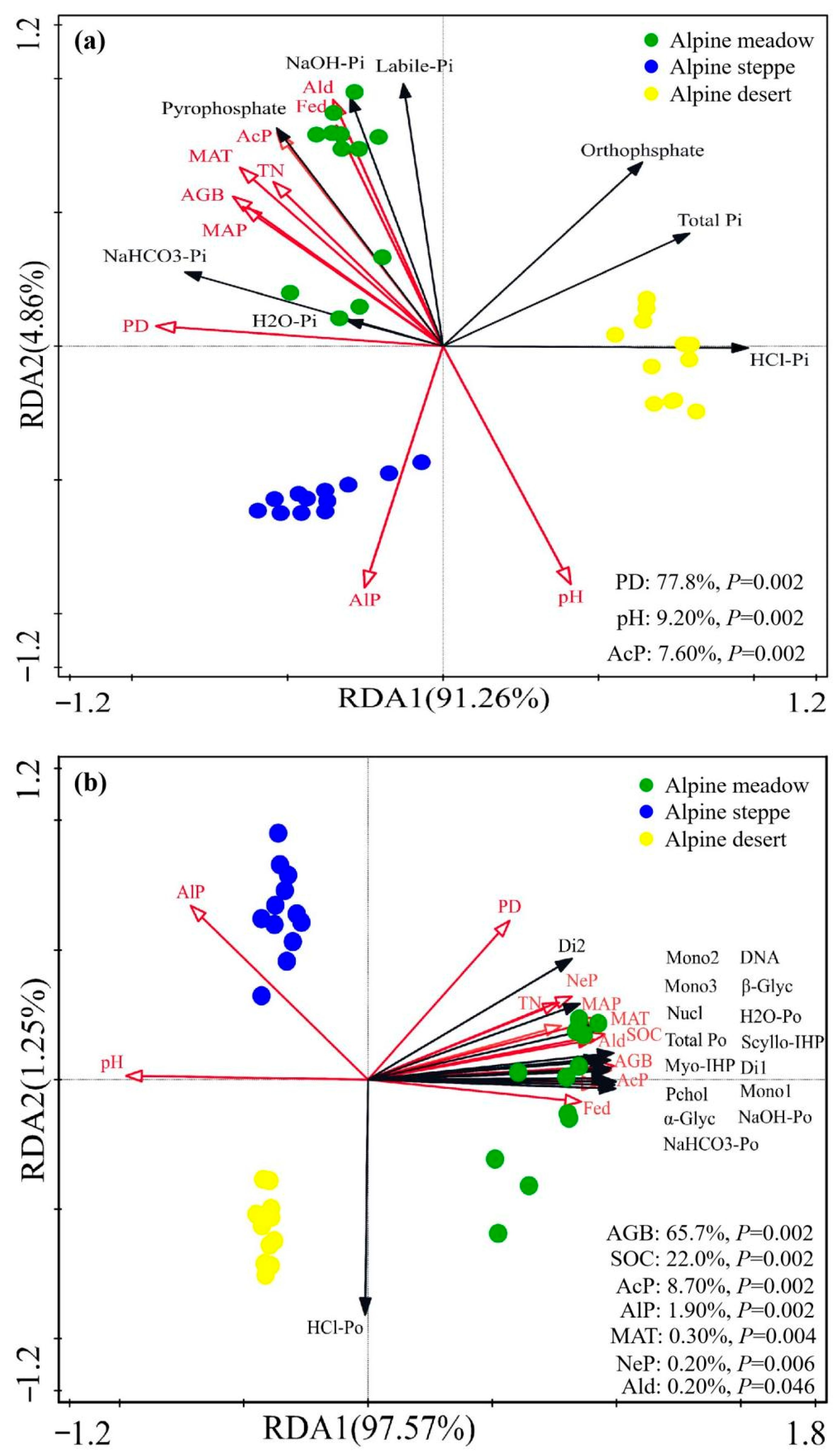
RDA further revealed that environmental factors collectively explained 96.3% and 99.3% of the variance in Pi and Po fractions, respectively (Figure 7a,b). The first RDA axis (RDA1) alone explained over 90% of the variance in both P pools, indicating that their distributions were structured primarily along a single dominant environmental gradient. For inorganic P, RDA1 and RDA2 accounted for 91.26% and 4.86% of the total variance, respectively. PD, pH, and AcP were identified as the dominant drivers (p < 0.05), explaining 77.8%, 9.20%, and 7.60% of the variation, respectively. For organic P, RDA1 and RDA2 explained 97.57% and 1.25% of the variance, respectively. AGB (65.7%) and SOC (22.0%) were the most influential factors, followed by AcP (8.70%) and AlP (1.90%), whereas MAT, PD, NeP, and Ald contributed marginally (each ≤ 0.30%).
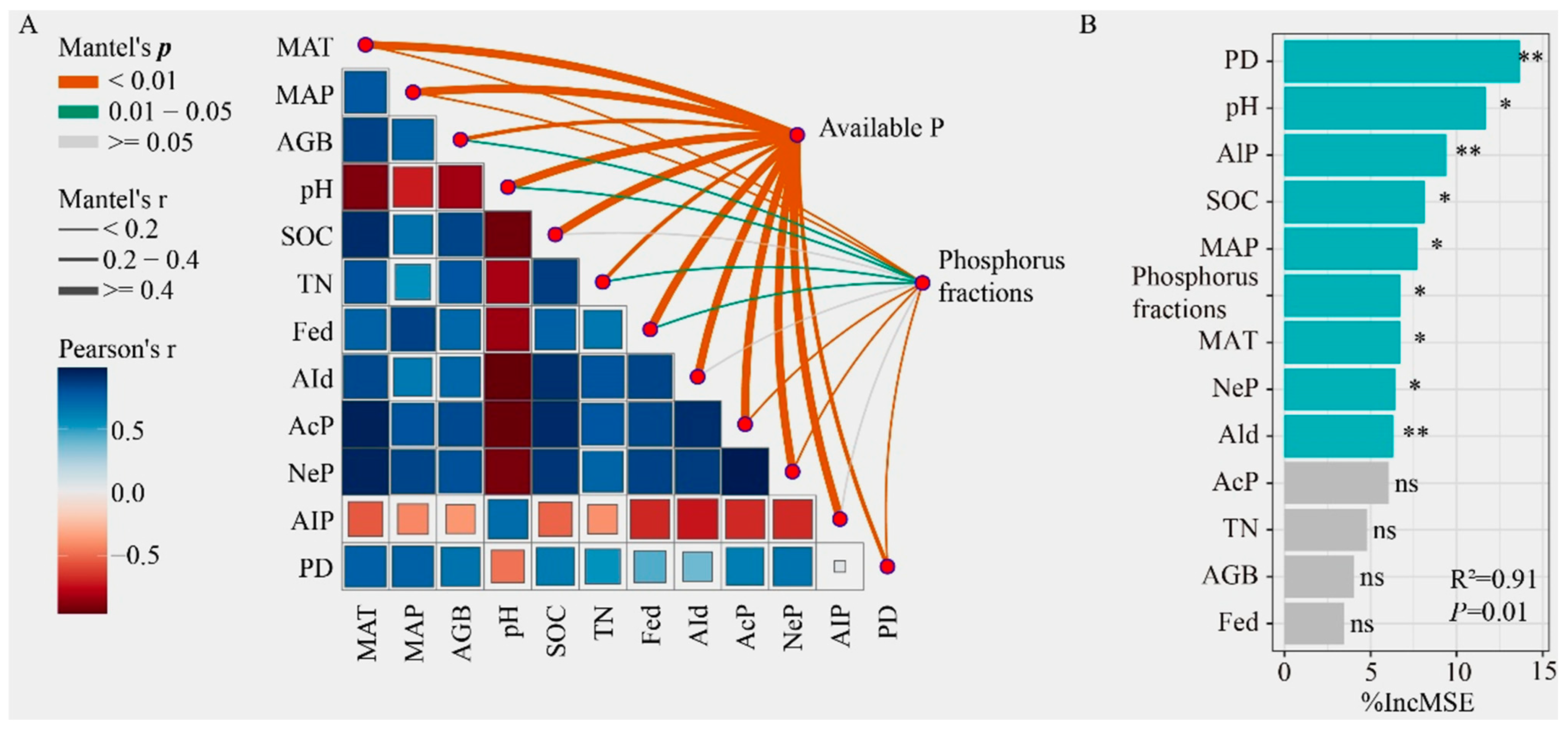
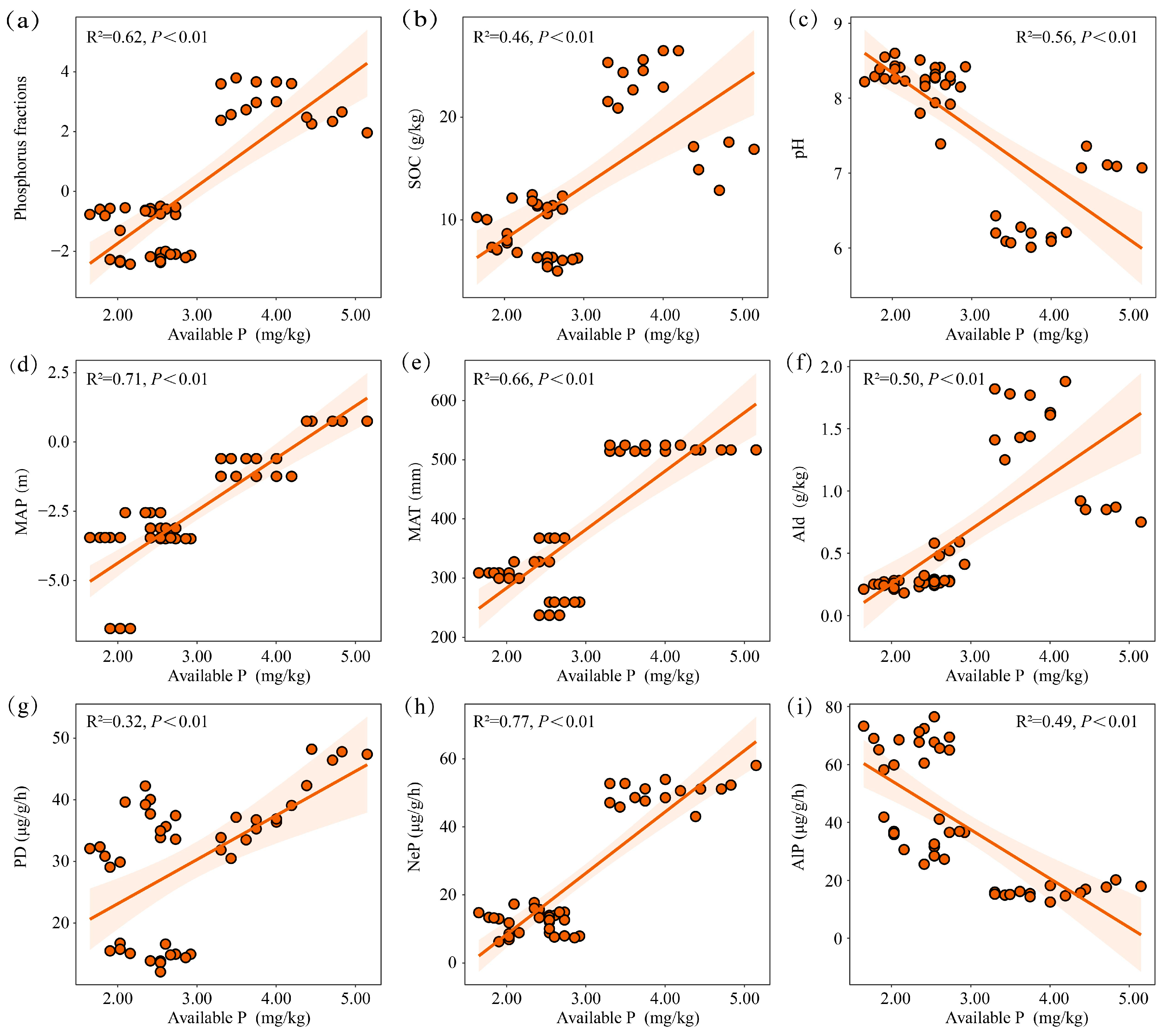
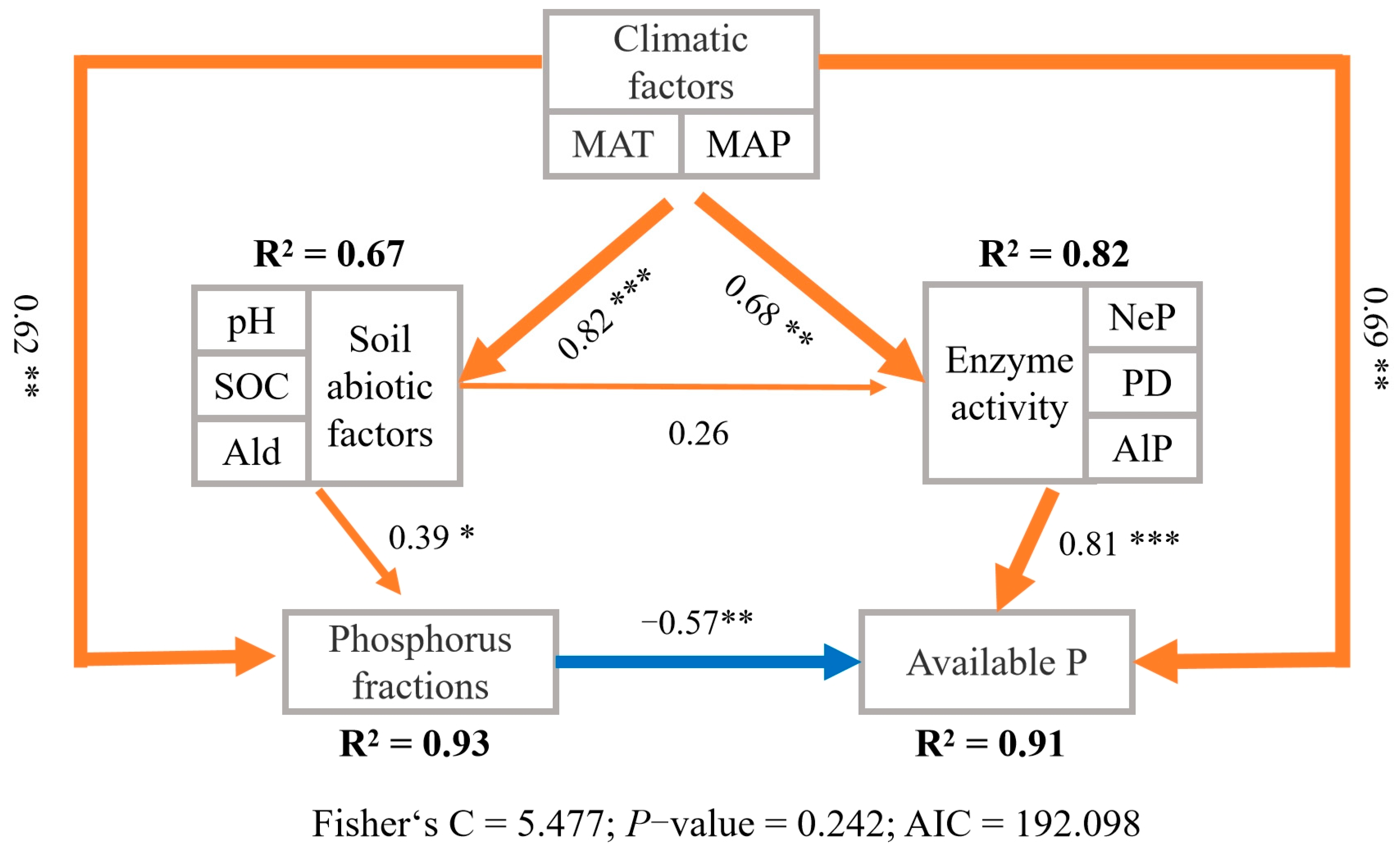
Random Forest analysis identified phosphatase activity, pH, SOC, and climatic factors as the primary drivers of soil available P (Figure 8), a finding corroborated by RDA. Linear regression indicated that, except for the negative correlation between pH and AIP, most environmental factors were positively correlated with available P (Figure 9). SEM integrated these relationships and explained 91% of the variance in P availability (Figure 10). The model demonstrated that climatic factors acted as overarching controls, exerting significant positive effects on soil abiotic properties, enzyme activity, P fractions, and available P. Notably, climatic factors showed the strongest total effects on enzyme activity (standardized path coefficient = 0.68, p < 0.001), and P fractions (standardized path coefficient = 0.62, p < 0.001). Phosphatase activity emerged as the most powerful direct predictor of available P, with a path coefficient of 0.81 (p < 0.001).

4. Discussion

4.1. Spatial Variability of Soil Total P and Influencing Factors

Representing the aggregate pool of various P forms, soil total P serves as a crucial indicator for evaluating soil P reserves and reflects the maximum potential of soils to replenish available P upon consumption [37]. Our results revealed distinct horizontal distribution patterns of soil total P across alpine grassland types on the Qinghai–Tibet Plateau. Specifically, alpine meadows and alpine deserts exhibited significantly higher soil total P content than alpine steppes (Figure 2a). The pronounced disparities in total P content among grassland types can be attributed to their distinct environmental and biological contexts, which correspond to the measured soil properties and P fractions [38]. In alpine desert soils, pedogenesis is weak, with physical weathering dominating and chemical weathering and leaching being minimal. Consequently, primary P minerals such as apatite released from the parent material are effectively retained, forming a typical “primary P pool”. The relatively high total P content in these soils may be associated with the P-rich nature of their parent material and the extremely low P losses. In contrast, alpine meadow soils develop under favorable hydrothermal conditions, where weathering and pedogenesis are more intense. The relatively high total P content in these soils is likely influenced by active biological cycling, as suggested by the highest productivity and biomass observed in the sampled ecosystems (Table 1). It is plausible that through the “biological pump” effect of plant roots and the abundant return of litter, P could continuously accumulate in surface organic matter, forming a substantial organic P pool [9,39]. In this context, the significant positive correlation observed between soil total P and most organic P fractions (Figure 6) is consistent with the expected pool structure. More importantly, the variation in the composition and magnitude of these organic P fractions among grassland types highlights the critical role of biological processes. Alpine meadows, which exhibited the strongest productivity and thus a potentially stronger “biological pump” showed a more dynamic and readily cycling organic P profile than the other ecosystems. This dynamic organic pool may underpin the long-term fertility resilience of meadows, whereas the dominance of HCl–Pi in alpine deserts reflects a system constrained by slow mineral dissolution, and thus a higher risk of long-term P limitation. Alpine steppes occupy an intermediate position between alpine deserts and alpine meadows. Their higher chemical weathering and leaching intensities compared with alpine deserts, cause notable P loss; however, their relatively low biological productivity and litter return limit P enrichment via biological pathways. This combination of “limited input and relatively high output” explains the comparatively low soil total P content observed in alpine steppes. However, the specific contributions of parent material and biological controls to the observed P distribution patterns remain to be quantitatively resolved in future studies.
Hydrological and topographic processes further shape the redistribution of P, reinforcing spatial patterns governed by parent material and biological activity [19]. Alpine meadows situated at lower elevations with saturated soil moisture can function as material “sinks”, intercepting and retaining water along with P transported from adjacent upslope units. This process effectively reduces net P output from alpine meadows. In contrast, alpine grasslands typically located on well-drained plateau surfaces and slopes, facilitating lateral migration and vertical leaching of soluble and particulate P through runoff and infiltration [40,41]. Consequently, alpine grasslands act as “sources” of P rather than “sinks”. In alpine deserts, extremely low precipitation renders leaching negligible. Regardless of P form, once released through weathering, P is largely preserved in situ, reinforcing the characterization of alpine deserts as “conservation-type” P pools.
Correlation analysis (Figure 6) identified the principal factors controlling the spatial distribution of soil total P at the microscale. Soil phosphatase was identified as a key biological factor influencing the horizontal distribution of total soil P. By catalyzing the mineralization of Po compounds, such as nucleic acids and phospholipids, phosphatases mediate the conversion of Po to Pi [42], thereby exerting a strong influence on the size and stability of the soil P pool. From a geochemical perspective, soil total P was significantly positively correlated with Ald (Figure 6). Ald primarily immobilizes phosphate ions in soil solutions through specific adsorption, forming stable aluminum–phosphorus complexes that enhance soil P retention [43]. This adsorption and fixation process is strongly dependent on pH. By modulating the surface charge and reactivity of metal oxides such as Ald, soil pH indirectly determines the chemical behavior and ultimate fate of P.

4.2. Spatial Variability of Soil Pi Forms and Influencing Factors

Our findings revealed pronounced spatial heterogeneity in the distribution of available P and Pi fractions among alpine grassland types on the Qinghai–Tibet Plateau. Specifically, alpine meadows exhibited significantly higher concentrations of available P, labile Pi, moderately labile Pi, orthophosphate, pyrophosphate, and enzymatically hydrolyzable Pi than alpine steppes and deserts. In contrast, alpine deserts showed the highest levels of stable Pi, underscoring the functional importance of alpine meadows as key reservoirs of readily available P. These patterns are consistent with the observations of Guan [44], who reported a predominance of labile and moderately labile Pi fractions in alpine meadows, thereby supporting the reliability of our results. The spatial distribution of soil available P and Pi fractions across alpine grasslands is regulated not only by the composition and abundance of P-containing compounds but also by environmental drivers, including climate, vegetation traits, enzyme activities, and soil physicochemical properties [45].
First, the high vegetation biomass characteristic of alpine meadows enhances surface litter accumulation, facilitating the return of plant-derived labile Pi through decomposition [46]. This process elevates soil available P, whereas dense vegetation cover reduces bare soil exposure [5], thereby mitigating erosion and leaching losses of labile Pi [47]. In contrast, alpine steppes and deserts with sparse vegetation cover receive limited litter inputs and are more susceptible to erosion, resulting in markedly lower labile Pi concentrations. AGB showed significant positive correlations with available P, labile Pi, moderately labile Pi, and enzymatically hydrolyzable Pi, consistent with previous studies linking litter production and decomposition to P accumulation [46]. However, RDA and Random Forest analysis (Figure 7 and Figure 8) indicated that AGB was not the dominant factor shaping the spatial distribution of Pi fractions, suggesting the involvement of additional regulatory mechanisms.
Second, climate has a major influence on P turnover rates. Elevated MAT and MAP in alpine meadows and steppes accelerate the transformation of stable mineral P into labile forms, thereby enhancing overall P activity and promoting the mineralization of Po into plant-available Pi [48]. The elevated labile Pi in meadows thus reflects a synergistic effect of high biomass input, favorable weathering conditions, and phosphatase-mediated Po mineralization, forming a positive feedback loop for P availability. Furthermore, our SEM revealed (Figure 10) that climatic factors and phosphatase activity are the two most influential direct drivers of soil phosphorus availability within this complex synergistic network. In contrast, the colder and drier alpine desert conditions suppress mineral weathering and reduce plant P uptake efficiency, resulting in the accumulation of stable calcium-bound Pi [49], a trend also reported by Feng [9] for northern grasslands. Both linear regression and SEM indicated that climate factors exerted a positive influence on soil available P and were the primary factors affecting its distribution (Figure 9 and Figure 10). Warming has been shown to increase P availability by accelerating Po hydrolysis [50]. Significant positive correlations between Pi fractions and MAT, MAP, and phosphatase activity (RDA) further highlight the regulatory roles of AcP and PD in enhancing P availability (Figure 7a). This observation agrees with the findings of Xu [51], who emphasized the microbial contribution to soil P bioavailability. Enhanced phosphatase activity in wetter alpine meadows likely reflects the synergistic effect of resource abundance and microbial adaptation to P demand. Our SEM quantitatively confirmed the central role of this process (Figure 10), identifying enzyme activity as the most potent direct predictor of available P (path coefficient = 0.81, p < 0.001). This robust statistical relationship strongly supports the proposed mechanism, in which high litter input from productive vegetation provides a sustained substrate (Po) for enzyme production, whereas strong plant and microbial P demand creates biochemical pressure to mineralize Po, thereby accelerating P cycling to meet nutritional requirements. Consequently, accelerated P cycling driven by phosphatase activity directly enhances P bioavailability, enabling the ecosystem to meet its nutrient requirements.
Third, phosphate ions can interact with Fe and Al oxides to form moderately labile Pi fractions [52,53]. These mineral-adsorbed P forms constitute a major reservoir of bioavailable P [9]. Under P-deficient conditions, plants release organic acid anions that chelate Fe and Al ions, unblocking sorption sites and facilitating the release of labile Pi [54,55]. This process can be further intensified at higher temperatures through metal–organic complexation. Consequently, alpine meadows with elevated Fed and Ald exhibit greater potential for bioavailable P supply than alpine steppes and deserts. The significant positive correlations between Ald and the labile P pool (available P and labile P) (Figure 6 and Figure 9) strongly support the proposed mechanism and highlight the crucial role of Ald in controlling phosphorus distribution.
Finally, soil pH exerts a pivotal influence on P cycling and transformation by regulating Po mineralization and the dissolution of insoluble Pi compounds, thereby controlling P bioavailability and mobility [56]. In this study, alpine meadow soils, with a measured pH of 7.15 ± 0.14 (Table 1), fall within the neutral to slightly alkaline range. Such near-neutral conditions are generally conducive to microbial and enzymatic activity, enhancing both Po mineralization and the dissolution of certain mineral P forms, which contribute to the labile Pi pool [57,58]. This is supported by our correlation and redundancy analyses, which identified soil pH as the major determinant of Pi distribution patterns. Furthermore, previous studies have shown that near-neutral pH conditions accelerate organic matter decomposition and promote the formation of phosphate complexes with Al and Fe oxides, thereby influencing P retention and bioavailability [59,60]. In contrast, strongly alkaline conditions favor the precipitation of insoluble calcium phosphates [61]. This mechanism explains the elevated HCl-Pi content observed in the more alkaline alpine desert and steppe soils in our study, highlighting how soil pH variation among grassland types shapes distinct P fraction patterns.

4.3. Spatial Variability of Soil Po Forms and Influencing Factors

Soil Po constitutes a major component of the total P pool in alpine ecosystems and serves as an essential reservoir of bioavailable P, playing a critical role in maintaining soil fertility and regulating nutrient cycling [5,62]. A pronounced spatial gradient in soil Po fractions was observed across alpine grassland types on the Qinghai–Tibet Plateau. Alpine meadows contained significantly higher concentrations of labile Po, moderately labile Po, orthophosphate monoesters and diesters, and enzymatically hydrolysable Po (including simple monoesters, phytate-like P, and polynucleotides) than alpine steppes and deserts. In contrast, alpine desert soils exhibited the highest levels of stable Po, reinforcing the view that alpine meadows act as key potential sources of bioavailable P. These findings are consistent with those of Guan [44], who reported greater Po accumulation in alpine meadows than in alpine and desert steppes. The spatial distribution of soil Po fractions is primarily regulated by the following factors.
First, plant-derived inputs are the major source of soil Po [63]. The high AGB in alpine meadows promotes the return of plant-derived P compounds (e.g., monoesters and diesters) through litter decomposition. In contrast, reduced plant biomass in steppes and deserts results in diminished Po inputs, particularly under cold and arid conditions, where limited litter production decreases NaOH-Po accumulation and promotes Po stabilization [64]. Consistent with previous studies [63,65], Po was the dominant soil P form in alpine grasslands, and plant litter input strongly influenced Po spatial distribution [2]. Both correlation and redundancy analyses (Figure 6 and Figure 7) identified AGB and SOC as the major determinants of Po distribution.
Second, phosphatase activity plays a pivotal role in Po transformation and its spatial dynamics [66]. Enhanced phosphatase activity in alpine meadows reflects a microbial response to abundant Po substrates and high ecosystem P demand, tightly coupling Po mineralization to Pi replenishment. Significant positive correlations were observed between Po fractions and AcP and NeP activities, whereas AlP activity showed a negative correlation. Higher temperatures further enhance phosphatase activity, accelerating Po mineralization and turnover [67,68]. RDA identified monoesterase activity and MAT as the principal factors governing Po distribution. The large and labile Po pool in alpine meadows, coupled with elevated phosphatase activity, underpins greater long-term fertility resilience than desert soils. This organic reservoir can be progressively mineralized to buffer against periods of low P availability, whereas the recalcitrant HCl-Pi pool in deserts offers little short-to-medium-term buffering capacity, rendering these ecosystems more susceptible to P limitation. This interplay suggests that high phosphatase activity in meadows is not merely a by-product of favorable conditions but a key adaptive mechanism. Microbial communities respond to abundant Po substrates derived from litter input by producing phosphatases, and this process is further intensified by the strong P demand required to sustain productivity, ensuring efficient Po recycling.
Third, interactions with metal oxides are essential for Po retention. Fe and Al oxides form complexes with Po through surface precipitation, hydrogen bonding, and ligand exchange, thereby enhancing the accumulation of labile and moderately labile Po [9]. Significant positive correlations between Ald/Fed and labile Po, moderately labile Po, monoesters/diesters, and enzymatically hydrolysable Po (Simple-P, Phytate-P, and Polynucle-P) indicate that higher Ald and Fed contents in alpine meadows enhance Po adsorption and storage. SEM further confirmed that labile and moderately labile Po were the most influential fractions contributing to soil available P. Similarly, Singh [69] reported that NaHCO3-Pi, NaOH-Pi, NaOH-Po, and WE-P were the most active fractions for supplying P to crops, consistent with our findings.
Fourth, soil pH exerts a decisive influence on adsorption–desorption behavior and Po stabilization. Under acidic conditions, Fe/Al oxide reactivity increases, thereby enhancing Po retention [70,71]. Conversely, alkaline conditions reduce adsorption capacity, leading to lower Po concentrations, as observed in alkaline desert soils [72]. Significant negative correlations between pH and multiple Po fractions further highlight the importance of pH in regulating Po distribution across grassland types. Specifically, acidic soils promote Po accumulation, whereas high pH values suppress adsorption and stimulate microbial and enzymatic degradation of Po [71]. Thus, soil pH is a key regulator of Po dynamics and its distribution.
Among individual Po compounds, myo-IHP, primarily derived from plant residues, is the dominant monoester form, whereas scyllo-IHP, a phytate isomer, is mainly of microbial origin [35,73]. Enhanced plant and microbial inputs in alpine meadows promote the accumulation of myo- and scyllo-IHP, thereby increasing the relative proportion of monoester P. The strong affinity of inositol phosphates for mineral surfaces and organic matter facilitates their persistence in soil [73], as reflected by their positive correlations with AGB, SOC, and Fed/Ald. Moreover, significant correlations between inositol phosphates and available P suggest that their enzymatic mineralization can replenish the labile P pool under conditions of P scarcity [74]. Likewise, α- and β-glycerophosphates (α-Glyc and β-Glyc) derived from phospholipid decomposition in plant and microbial residues closely reflect spatial variations in litter input and microbial activity [75]. Consequently, the labile Po pool in alpine meadows serves as a mineralizable buffer against P scarcity, providing greater fertility resilience than the recalcitrant Pi pools characteristic of desert soils.
Overall, this study revealed a complex regulatory network controlling soil Po dynamics across alpine grasslands of the Qinghai–Tibet Plateau. The distribution and transformation of Po forms are not governed by a single factor but emerge from the interplay of coupled biogeochemical processes and environmental feedbacks. Within this ecosystem, alpine meadows function as key hotspots for Po turnover, sustaining regional P cycling and ecosystem productivity. Future research employing metagenomic and metatranscriptomic approaches to characterize microbial communities and quantify the abundance and expression of phosphatase-encoding genes (e.g., phoA, phoD, and phoX) across these grassland types would be a logical next step. Such work could directly link specific microbial taxa and their functional gene expression to observed Po mineralization rates, advancing the mechanistic understanding of how microbial communities drive P transformations along environmental gradients.

5. Conclusions

This study revealed pronounced spatial heterogeneity in soil P fractions across alpine grassland types on the Qinghai–Tibet Plateau. Alpine meadows and steppes were dominated by NaOH-Po, whereas alpine deserts were primarily characterized by HCl-Pi. Overall, alpine meadows contained significantly higher concentrations of multiple labile P fractions, including H2O-P, NaHCO3-P, NaOH-P, enzymatically hydrolysable P, and various phosphate esters, than alpine steppes and deserts. The predominance of this labile and enzymatically hydrolyzable Po pool in alpine meadows indicates a greater capacity for internal P replenishment, suggesting that these ecosystems are better equipped to sustain productivity under environmental fluctuations. In contrast, the dominance of stable mineral-bound P in alpine deserts reflects stronger long-term constraints on P bioavailability. In addition, phosphatase activity was identified as a key factor affecting P availability. The spatial distribution of Pi fractions was primarily governed by soil pH and phosphatase activities (AcP and PD), whereas Po fractions were mainly influenced by MAT, AGB, SOC, phosphomonoesterase activity, and dithionite-extractable oxides (Fed and Ald). Collectively, these findings demonstrate that alpine meadows possess higher P availability and replenishment potential, driven by their larger labile Po pool and enhanced microbial enzyme-mediated processes. This mechanistic understanding highlights the need for ecosystem-specific management strategies to sustain grassland productivity, including maintaining soil organic matter and biological activity in meadows while potentially applying external inputs to alleviate P limitation in desert systems. Overall, this study provides critical insights into the biogeochemical cycling of P in high-altitude ecosystems and advances predictive understanding of how climate change may alter P dynamics and grassland productivity in this vulnerable region.

Author Contributions

Conceptualization, Z.L. and N.Z.; methodology, X.L., C.L. and Z.C.; software, X.L. and Z.L.; validation, Z.L., C.L., N.Z., N.H. and J.Z.; formal analysis, X.L., Z.L. and J.Z.; investigation, C.L., N.Z. and Z.C.; resources, C.L., N.Z., N.H., Z.C. and J.Z.; data curation, X.L., C.L., Z.C. and J.Z.; writing—original draft, X.L.; writing—review & editing, N.H., Z.C. and J.Z.; visualization, X.L.; supervision, C.L., N.H., Z.C. and J.Z.; project administration, C.L., N.H., Z.C. and J.Z.; funding acquisition, N.H. and Z.C. All authors have read and agreed to the published version of the manuscript.

Funding

This research was supported by the Second Tibetan Plateau Scientific Expedition and Research Program (Grant No. 2019QZKK060602) and the Yanbian University Doctoral Initiation Fund (Grant No. 602025068).

Data Availability Statement

The original contributions presented in this study are included in this article. Further inquiries should be directed to the corresponding authors.

Acknowledgments

We sincerely thank all the reviewers who participated in the review for its linguistic assistance during the preparation of this manuscript. We also acknowledge the assistance of generative AI tools for language polishing and editing during manuscript preparation.

Conflicts of Interest

The authors declare that the research was conducted in the absence of any commercial or financial relationships that could be construed as a potential conflict of interest.

References

  1. Zhu, J.D.; Wu, A.; Zhou, G.Y. Spatial distribution patterns of soil total phosphorus influenced by climatic factors in China’s forest ecosystems. Sci. Rep. 2021, 11, 5357. [Google Scholar] [CrossRef]
  2. Tang, Y.X.; Xu, D.H.; Yang, Y.T.; Huang, B.Y.; Fang, X.W.; Yao, G.Q.; Zhou, W.H.; Wu, Y.G. Response of Soil Phosphorus Fractions and Available Phosphorus to Phosphorus Plus Silicon Addition in Alpine Meadows. J. Soil Sci. Plant Nutr. 2025, 25, 8075–8088. [Google Scholar] [CrossRef]
  3. Zhang, Z.T.; Luo, R.Y.; Liu, Q.H.; Qiang, W.; Liang, J.; Hou, E.Q.; Zhao, C.Z.; Pang, X.Y. Linking soil phosphorus fractions to abiotic factors and the microbial community during subalpine secondary succession: Implications for soil phosphorus availability. Catena 2023, 12, 107501. [Google Scholar] [CrossRef]
  4. Stutter, M.I.; Shand, C.A.; George, T.S.; Blackwell, M.; Haygarth, P.M. Recovering Phosphorus from Soil: A Root Solution? Environ. Sci. Technol. 2012, 46, 1977–1978. [Google Scholar] [CrossRef] [PubMed]
  5. Fu, D.G.; Wu, X.N.; Duan, C.Q.; Chadwick, D.R.; Jones, D.L. Response of soil phosphorus fractions and fluxes to different vegetation restoration types in a subtropical mountain ecosystem. Catena 2020, 193, 104663. [Google Scholar] [CrossRef]
  6. Zhu, M.K.; Huang, B.C.; Liu, Z.Y.; Wang, Y.; Teng, J.; Tian, X.S.; Ai, X.Y.; Sheng, M.H.; Ai, Y.W. The distribution, effectiveness and environmental threshold of soil aggregate phosphorus fractions in the sub-alpine region of Southwest China. Land Degrad. Dev. 2023, 34, 3–15. [Google Scholar] [CrossRef]
  7. Zhou, Q.L.; Daryanto, S.; Xin, Z.M.; Liu, Z.M.; Liu, M.H.; Cui, X.; Wang, L.X. Soil phosphorus budget in global grasslands and implications for management. J. Arid Environ. 2017, 144, 224–235. [Google Scholar] [CrossRef]
  8. Li, Q.; Yang, J.Y.; Guan, W.H.; Liu, Z.G.; He, G.X.; Zhang, D.G.; Liu, X.N. Soil fertility evaluation and spatial distribution of grasslands in Qilian Mountains Nature Reserve of eastern Qinghai-Tibetan Plateau. PeerJ 2021, 23, e10986. [Google Scholar] [CrossRef]
  9. Feng, J.; Turner, B.L.; Lü, X.; Chen, Z.H.; Wei, K.; Tian, J.H.; Wang, C.; Luo, W.; Chen, L.J. Phosphorus transformations along a large-scale climosequence in arid and semiarid grasslands of northern China. Glob. Biogeochem. Cycles 2016, 30, 1264–1275. [Google Scholar] [CrossRef]
  10. Gao, X.L.; Li, X.G.; Zhao, L.; Kuzyakov, Y. Regulation of soil phosphorus cycling in grasslands by shrubs. Soil Biol. Biochem. 2019, 133, 1–11. [Google Scholar] [CrossRef]
  11. Cao, Z.Y.; Wang, Y.; Li, J.; Zhang, J.J.; He, N.P. Soil organic carbon contents, aggregate stability, and humic acid composition in different alpine grasslands in Qinghai-Tibet Plateau. J. Mt. Sci. 2016, 13, 2015–2027. [Google Scholar] [CrossRef]
  12. Zhao, Y.; Qin, F.; Cui, Q.Y.; Li, Q.; Cui, Y.F.; Birks, H.J.B.; Liang, C.; Zhao, W.W.; Li, H.; Ren, W.H.; et al. Three-and-a-half million years of Tibetan Plateau vegetation dynamics in response to climate change. Nat. Ecol. Evol. 2025, 9, 1153–1167. [Google Scholar] [CrossRef] [PubMed]
  13. Yu, C.Q.; Zhang, Y.J.; Holzapfel, C.; Zeng, R.; Zhang, X.Z.; Wang, J.S. Ecological and environmental issues faced by a developing Tibet. Environ. Sci. Technol. 2012, 46, 1979–1980. [Google Scholar] [CrossRef] [PubMed]
  14. Liu, X.J.; Zhang, Y.; Han, W.X.; Tang, A.H.; Shen, J.L.; Cui, Z.L.; Vitousek, P.; Erisman, J.W.; Goulding, K.; Christie, P.; et al. Enhanced nitrogen deposition over China. Nature 2013, 494, 459–462. [Google Scholar] [CrossRef]
  15. Wei, B.; Zhang, D.Y.; Voigt, C.; Zhou, W.; Bai, Y.C.; Zheng, Z.H.; Xie, Y.H.; Zhao, C.B.; Wang, F.Q.; Huang, L.Y.; et al. Progressive decline in soil nitrogen stocks with warming in a Tibetan permafrost ecosystem. Nat. Geosci. 2025, 9, 2. [Google Scholar] [CrossRef]
  16. Zhao, H.D.; Wu, X.Y.; Zhang, Y.; Su, X.K.; Li, Y.Y.; Wang, X.X.; Liu, S.L.; Dong, S.K.; Tang, T. The relationship between soil physical properties and alpine plant diversity on Qinghai-Tibet Plateau. Eurasian J. Soil Sci. 2015, 4, 88–93. [Google Scholar] [CrossRef][Green Version]
  17. Fu, G.; Shen, Z.X. Response of alpine soils to nitrogen addition on the Tibetan Plateau: A meta-analysis. Appl. Soil Ecol. 2017, 114, 99–104. [Google Scholar] [CrossRef]
  18. Tian, L.M.; Zhao, L.; Wu, X.D.; Hu, G.J.; Fang, H.B.; Zhao, Y.H.; Sheng, Y.; Chen, J.; Wu, J.C.; Li, W.P.; et al. Variations in soil nutrient availability across Tibetan grassland from the 1980s to 2010s. Geoderma 2019, 338, 197–205. [Google Scholar] [CrossRef]
  19. Hong, J.T.; Pang, B.; Zhao, L.R.; Shu, S.M.; Feng, P.Y.; Liu, F.; Du, Z.Y.; Wang, X.D. Soil phosphorus crisis in the Tibetan alpine permafrost region. Nat. Commun. 2025, 16, 6204. [Google Scholar] [CrossRef]
  20. Olsen, S.R.; Sommers, L.E. Phosphorus. In Methods of Soil Analysis. Part 2. Chemical and Microbiological Properties; Page, A.L., Miller, R.H., Keeney, D.R., Eds.; American Society of Agronomy: Madison, WI, USA, 1982. [Google Scholar]
  21. Olsen, S.R.; Cole, C.V.; Watanabe, F.S.; Dean, L.A. Estimation of Available Phosphorus in Soils by Extraction with Sodium Bicarbonate; US Department of Agriculture: Washington, DC, USA, 1954.
  22. Walker, T.W.; Adams, A.F.R. Studies on Soil Organic Matter: I. Influence of phosphorus content of parent materials on accumulations of carbon, nitrogen, sulfur, and organic phosphorus in Grassland Soils. Soil Sci. 1958, 85, 307–318. [Google Scholar] [CrossRef]
  23. Achat, D.L.; Bakker, M.R.; Zeller, B.; Pellerin, S.; Bienaimé, S.; Morel, C. Long-term organic phosphorus mineralization in Spodosols under forests and its relation to carbon and nitrogen mineralization. Soil Biol. Biochem. 2010, 42, 1479–1490. [Google Scholar] [CrossRef]
  24. Murphy, J.; Riley, J.P. A modified single solution method for the determination of phosphate in natural waters. Anal. Chim. Acta 1962, 27, 31–36. [Google Scholar] [CrossRef]
  25. Hedley, M.J.; Stewart, J.W.B.; Chauhan, B.S. Changes in inorganic and organic soil phosphorus fractions induced by cultivation practices and by laboratory incubations. Soil Sci. Soc. Am. J. 1982, 46, 970–976. [Google Scholar] [CrossRef]
  26. Tiessen, H.; Moir, J.O. Characterization of available P by sequential extraction. In Soil Sampling and Methods of Analysis, 2nd ed.; Carter, M.R., Gregorich, E.G., Eds.; CRC Press: Boca Raton, FL, USA, 1993. [Google Scholar]
  27. Zhu, X.Y.; Zhao, X.R.; Lin, Q.M.; Alamus; Wang, H.; Liu, H.L.; Wei, W.X.; Sun, X.C.; Li, Y.T.; Li, G.T. Distribution characteristics of soil organic phosphorus fractions in the Inner Mongolia steppe. J. Soil Sci. Plant Nutr. 2020, 20, 2394–2405. [Google Scholar] [CrossRef]
  28. Mahmood, M.; Ahmed, W.; Ayyoub, A.; Elrys, A.S.; Mustafa, A.; Li, W.D.; Xu, Z.W. Impacts of land use change on soil carbon storage and phosphorus fractions in tropics. Catena 2024, 247, 108550. [Google Scholar] [CrossRef]
  29. Wei, K.; Chen, Z.H.; Zhu, A.N.; Zhang, J.B.; Chen, L.J. Application of 31P NMR spectroscopy in determining phosphatase activities and P composition in soil aggregates influenced by tillage and residue management practices. Soil Tillage Res. 2014, 138, 35–43. [Google Scholar] [CrossRef]
  30. Cade-Menun, B.; Barbara, J. Improved peak identification in 31P-NMR spectra of environmental samples with a standardized method and peak library. Geoderma 2015, 257–258, 102–114. [Google Scholar] [CrossRef]
  31. Zhang, J.J.; Sun, Y.H.; Tang, J.Y.; Li, C.L.; Zhu, M.; Zhu, P. Influences of Long-Term Fertilization on Phosphorus Forms and Availability Within Particle-Size Fractions in a Mollisol. J. Soil Sci. Plant Nutr. 2024, 25, 6740–6755. [Google Scholar] [CrossRef]
  32. Liu, J.; Yang, J.J.; Cade-Menun, B.J.; Liang, X.Q.; Hu, Y.F.; Liu, C.W.; Zhao, Y.; Li, L.; Shi, J.Y. Complementary phosphorus speciation in agricultural soils by sequential fractionation, solution 31P nuclear magnetic resonance, and phosphorus K-edge X-ray absorption near-edge structure spectroscopy. J. Environ. Qual. 2013, 42, 1763–1770. [Google Scholar] [CrossRef]
  33. Doolette, A.L.; Smernik, R.J.; Dougherty, W.J. Spiking Improved solution phosphorus-31 Nuclear magnetic resonance identification of soil phosphorus compounds. Soil Sci. Soc. Am. J. 2009, 73, 919–927. [Google Scholar] [CrossRef]
  34. Mcdowell, R.W.; Cade-Menun, B.; Stewart, I. Organic phosphorus speciation and pedogenesis: Analysis by solution 31P nuclear magnetic resonance spectroscopy. Eur. J. Soil Sci. 2007, 58, 1348–1357. [Google Scholar] [CrossRef]
  35. Zhang, J.J.; Sun, Y.H.; Cao, Z.Y.; Li, C.L.; Zhu, M.; Zhu, P. Long-term fertilization impacts on soil phosphorus forms using XANES and NMR spectroscopy. Arch. Agron. Soil Sci. 2023, 69, 1266–1281. [Google Scholar] [CrossRef]
  36. Tabatabai, M. Methods of Soil Analysis, Part 2—Microbiological and Biochemical Properties; Soil Enzymes; John Wiley & Sons: Hoboken, NJ, USA, 1994; pp. 775–833. [Google Scholar]
  37. He, X.J.; Augusto, L.; Goll, D.S.; Ringeval, B.; Wang, Y.P.; Helfenstein, J.L.; Huang, Y.Y.; Yu, K.L.; Wang, Z.Q.; Yang, Y.C.; et al. Global patterns and drivers of soil total phosphorus concentration. Earth Syst. Sci. 2021, 13, 5831–5846. [Google Scholar] [CrossRef]
  38. He, J.B.; Wu, Y.H.; Zhu, H.; Zhou, J.; Luo, C.Y.; Bing, H.J. Soil phosphorus fractions dynamics along a 22-ka chronosequence of landslides, western Sichuan, China. Catena 2024, 235, 107674. [Google Scholar] [CrossRef]
  39. Peng, Z.Y.; Wu, Y.T.; Guo, L.L.; Yang, L.; Wang, B.; Wang, X.; Liu, W.X.; Su, Y.J.; Wu, J.; Liu, L.L. Foliar nutrient resorption stoichiometry and microbial phosphatase catalytic efficiency together alleviate the relative phosphorus limitation in forest ecosystems. New Phytol. 2023, 238, 1033–1044. [Google Scholar] [CrossRef]
  40. Chen, Z.X.; Guo, M.M.; Liu, X.; Wang, L.X.; Chen, Q.; Qi, J.R.; Shen, Q.S.; Zhang, X.Y. Gully transforms the loss pattern of runoff, sediment, nitrogen, and phosphorus in agricultural catchment of Northeast China. J. Hydrol. 2025, 660, 133503. [Google Scholar] [CrossRef]
  41. Sutor, F.W.; Roy, E.D.; Schroth, A.W.; Michaud, A.B.; Emerson, D.; Herndon, E.M.; Kinsman-Costello, L.; Hurley, S.E.; Bowden, W.B. Geochemical phosphorus sequestration in tundra soils impedes delivery of bioavailable phosphorus to the Kuparuk River, Alaska, USA: Implications for the broader Arctic region. J. Geophys. Res. Biogeosci. 2025, 130, e2025JG008803. [Google Scholar] [CrossRef]
  42. Richardson, A.E.; George, T.S.; Hens, M.; Delhaize, E.; Ryan, P.R.; Simpson, R.J.; Hocking, P.J. Organic anions facilitate the mobilization of soil organic phosphorus and its subsequent lability to phosphatases. Plant Soil 2022, 476, 20. [Google Scholar] [CrossRef]
  43. McKenna, B.A.; Kopittke, P.M.; Bell, M.J.; Lombi, E.; Klysubun, W.; McLaren, T.I.; Doolette, C.L.; Meyer, G. Phosphorus availability and speciation in the fertosphere of three soils over 12 months. Geoderma 2024, 447, 10. [Google Scholar] [CrossRef]
  44. Guan, X.X.; Wang, C.Y.; Li, C.L.; Li, J.Y.; Xu, L.; Zhang, J.Y.; Zhang, J.J.; He, N.P. The distribution and influencing factors of soil phosphorus in different types of grasslands on the Qinghai Tibet Plateau in Chinese. J. Soil Water Conserv. 2022, 5, 36. [Google Scholar]
  45. Luo, X.Z.; Guo, C.H.; He, X.J.; Helfenstein, J.L.; Lambers, H.; Ren, Q.Q.; Ibrahim, M.M.; Li, Z.M.; Lin, H.Y.; Chang, Z.F.; et al. Global Distribution and Influencing Factors of Plant-Available Phosphorus in (Semi-)Natural Soils. Glob. Biogeochem. Cycles 2025, 39, e2025GB008513. [Google Scholar] [CrossRef]
  46. Zhou, J.; Bing, H.J.; Wu, Y.H.; Yang, Z.J.; Wang, J.P.; Sun, H.Y.; Luo, J.; Liang, J.H. Rapid weathering processes of a 120-year-old chronosequence in the Hailuogou Glacier foreland, Mt. Gongga, SW China. Geoderma 2016, 267, 78–91. [Google Scholar] [CrossRef]
  47. Wu, Y.H.; Zhou, J.; Bing, H.J.; Sun, H.Y.; Wang, J.P. Rapid loss of phosphorus during early pedogenesis along a glacier retreat choronosequence, Gongga Mountain (SW China). PeerJ 2015, 3, e1377. [Google Scholar] [CrossRef] [PubMed]
  48. Zhang, Y.; Chen, X.M.; Zhang, C.C.; Pan, G.X.; Zhang, X.H. Availability of soil nitrogen and phosphorus under elevated [CO2] and temperature in the Taihu Lake region, China. J. Plant Nutr. Soil Sci. 2014, 177, 343–348. [Google Scholar] [CrossRef]
  49. Li, C.Y.; He, M.Z.; Xin, C.M.; Zhang, Z.H. Phosphorus sorption-desorption changes phosphorus fraction dynamic in a desert revegetation chronosequence. Land Degrad. Dev. 2024, 35, 3422–3433. [Google Scholar] [CrossRef]
  50. Shaw, A.N.; Cleveland, C.C. The effects of temperature on soil phosphorus availability and phosphatase enzyme activities: A cross-ecosystem study from the tropics to the Arctic. Biogeochemistry 2020, 151, 113–125. [Google Scholar] [CrossRef]
  51. Xu, M.Y.; Wu, Y.H.; Bing, H.J.; Luo, C.Y.; Zhu, H.; He, J.B. Microorganisms Promote Soil Phosphorus Bioavailability at the Beginning of Pedogenesis. Glob. Chang. Biol. 2025, 31, e70419. [Google Scholar] [CrossRef]
  52. Wang, J.C.; Ren, C.Q.; Cheng, H.T.; Zou, Y.K.; Bughio, M.A.; Li, Q.F. Conversion of rainforest into agroforestry and monoculture plantation in China: Consequences for soil phosphorus forms and microbial community. Sci. Total Environ. 2017, 595, 769–778. [Google Scholar] [CrossRef]
  53. Yang, X.Y.; Chen, X.W.; Guo, E.; Yang, X.T. Path analysis of phosphorus activation capacity as induced by low-molecular-weight organic acids in a black soil of Northeast China. J. Soils Sediments 2019, 19, 840–847. [Google Scholar] [CrossRef]
  54. Wei, L.L.; Xu, C.Z. Citric acid enhances the mobilization of organic phosphorus in subtropical and tropical forest soils. Biol. Fertil. Soils 2010, 46, 765–769. [Google Scholar] [CrossRef]
  55. Jia, X.; Zhao, Y.H.; Wang, W.K.; He, Y.H. Elevated temperature altered photosynthetic products in wheat seedlings and organic compounds and biological activity in rhizopshere soil under cadmium stress. Sci. Rep. 2015, 5, 14426. [Google Scholar] [CrossRef]
  56. Penn, C.J.; Camberato, J.J. A critical review on soil chemical processes that control how soil pH affects phosphorus availability to plants. Agriculture 2019, 9, 120. [Google Scholar] [CrossRef]
  57. Zhou, J.; Wu, Y.H.; Prietzel, J.; Bing, H.J.; Yu, D.; Sun, S.Q.; Luo, J.; Sun, H.Y. Changes of soil phosphorus speciation along a 120-year soil chronosequence in the Hailuogou Glacier retreat area (Gongga Mountain, SW China). Geoderma 2013, 195, 251–259. [Google Scholar] [CrossRef]
  58. Li, C.L.; Zhang, P.; Zhang, J.J.; Zhu, P.; Wang, L.C. Forms, transformations and availability of phosphorus after 32 years of manure and mineral fertilization in a Mollisol under continuous maize cropping. Arch. Agron. Soil Sci. 2021, 67, 1256–1271. [Google Scholar] [CrossRef]
  59. Barrow, N.J.; Hartemink, A.E.E. The effects of pH on nutrient availability depend on both soils and plants. Plant Soil 2023, 487, 21–37. [Google Scholar] [CrossRef]
  60. Yang, Z.Y.; Huang, Y.J.; Li, Y.G.; Han, Z.L.; Zhang, S.J.; Zhang, Q.; Ma, X.X.; Jing, C.Q.; Gao, Y.Z.; Zhou, X.B.; et al. Patch size indirectly influences the distribution characteristics of phosphorus fractions in temperate desert moss crust soils. Catena 2025, 251, 108821. [Google Scholar] [CrossRef]
  61. Amin, E.E.A.Z. Chemical Properties of Some Alkaline Sandy Soils and Their Effects on Phosphorus Dynamics with Bone Char Application as a Renewable Resource of Phosphate Fertilizer. J. Soil Sci. Plant Nutr. 2023, 23, 1589–1598. [Google Scholar] [CrossRef]
  62. Vincent, A.G.; Sundqvist, M.K.; Wardle, D.A.; Giesler, R. Bioavailable soil phosphorus decreases with increasing elevation in a subarctic tundra landscape. PLoS ONE 2014, 9, e92942. [Google Scholar] [CrossRef]
  63. Wang, C.; Wang, X.B.; Liu, D.W.; Wu, H.H.; Lü, X.; Fang, Y.T.; Cheng, W.; Luo, W.; Jiang, P.; Shi, J.; et al. Aridity threshold in controlling ecosystem nitrogen cycling in arid and semi-arid grasslands. Nat. Commun. 2014, 5, 4799. [Google Scholar] [CrossRef]
  64. Delgado-Baquerizo, M.; Maestre, F.T.; Gallardo, A.; Bowker, M.A.; Wallenstein, M.D.; Quero, J.L.; Ochoa, V.; Gozalo, B. Decoupling of soil nutrient cycles as a function of aridity in global drylands. Nature 2013, 502, 672–676. [Google Scholar] [CrossRef]
  65. Zhao, Q.; Zeng, D.; Fan, Z.; Yu, Z.Y.; Hu, Y.L.; Zhang, J.W. Seasonal variations in phosphorus fractions in semiarid sandy soils under different vegetation types. For. Ecol. Manag. 2009, 258, 1376–1382. [Google Scholar] [CrossRef]
  66. He, X.L.; Zhou, J.; Wu, Y.H.; Bing, H.J.; Sun, H.Y.; Wang, J.P. Leaching disturbed the altitudinal distribution of soil organic phosphorus in subalpine coniferous forests on Mt. Gongga, SW China. Geoderma 2018, 326, 144–155. [Google Scholar] [CrossRef]
  67. Rui, Y.C.; Wang, Y.F.; Chen, C.R.; Zhou, X.Q.; Wang, S.P.; Xu, Z.H.; Duan, J.C.; Kang, X.M.; Lu, S.B.; Luo, C.Y. Warming and grazing increase mineralization of organic P in an alpine meadow ecosystem of Qinghai-Tibet Plateau, China. Plant Soil 2012, 357, 73–87. [Google Scholar] [CrossRef]
  68. Cao, Z.Y.; Xu, L.; Zong, N.; Zhang, J.J.; He, N.P. Impacts of climate warming on soil phosphorus forms and transformation in a Tibetan Alpine Meadow. J. Soil Sci. Plant Nutr. 2022, 22, 2545–2556. [Google Scholar] [CrossRef]
  69. Singh, D.; Ranjha, R.; Sharma, S.K.; Kaistha, P.; Parmar, V. Soil Phosphorus Fractions and Balance in Response to Integrated Phosphorus Management in an Acid Alfisol of North West Himalayas. J. Soil Sci. Plant Nutr. 2025, 25, 5272–5282. [Google Scholar] [CrossRef]
  70. Tian, J.H.; Wei, K.; Condron, L.; Chen, Z.H.; Xu, Z.W.; Chen, L.J. Impact of land use and nutrient addition on phosphatase activities and their relationships with organic phosphorus turnover in semi-arid grassland soils. Biol. Fertil. Soils 2016, 52, 675–683. [Google Scholar] [CrossRef]
  71. Hou, E.G.; Chen, C.G.; Luo, Y.Q.; Zhou, G.Y.; Kuang, Y.W.; Zhang, Y.G.; Heenan, M.; Lu, X.K.; Wen, D.Z. Effects of climate on soil phosphorus cycle and availability in natural terrestrial ecosystems. Glob. Change Biol. 2018, 24, 3344–3356. [Google Scholar] [CrossRef] [PubMed]
  72. Turner, B.L.; Engelbrecht, B.M.J. Soil organic phosphorus in lowland tropical rain forests. Biogeochemistry 2011, 103, 297–315. [Google Scholar] [CrossRef]
  73. Xin, X.L.; Zhang, X.F.; Chu, W.Y.; Mao, J.D.; Yang, W.L.; Zhu, A.N.; Zhang, J.B.; Zhong, X.Y. Characterization of fluvo-aquic soil phosphorus affected by long-term fertilization using solution 31P NMR spectroscopy. Sci. Total Environ. 2019, 692, 89–97. [Google Scholar] [CrossRef] [PubMed]
  74. Almeida, D.S.; Menezes-Blackburn, D.; Turner, B.L.; Wearing, C.; Haygarth, P.M.; Rosolem, C.A. Urochloa ruziziensis cover crop increases the cycling of soil inositol phosphates. Biol. Fertil. Soils 2018, 54, 935–947. [Google Scholar] [CrossRef]
  75. Liu, J.; Sui, P.; Cade-Menun, B.J.; Hu, Y.F.; Yang, J.J.; Huang, S.M.; Ma, Y.B. Molecular-level understanding of phosphorus transformation with long-term phosphorus addition and depletion in an alkaline soil. Geoderma 2019, 353, 116–124. [Google Scholar] [CrossRef]
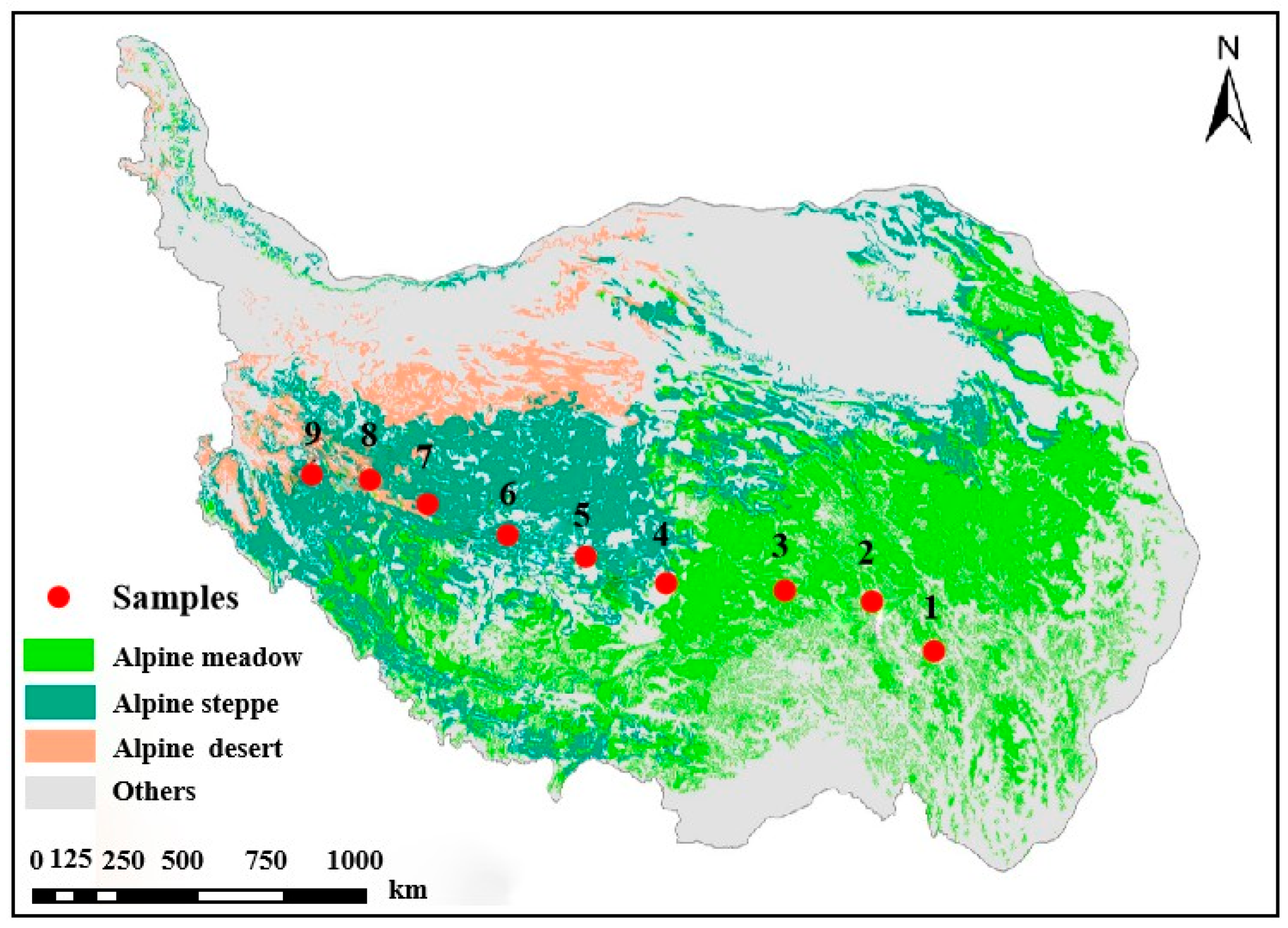
Figure 1. Location of sampling sites representing different alpine grassland types on the Qinghai–Tibet Plateau.
Agronomy 15 02689 g001
Figure 2. Concentrations of total phosphorus (a), available phosphorus (b), organic phosphorus (c), and inorganic phosphorus (d) in soils from different alpine grassland types on the Qinghai–Tibet Plateau. Different small letters indicate significant differences among treatments (p < 0.05).
Agronomy 15 02689 g002
Figure 3. Concentrations of phosphorus (P) fractions, including total P (a,b), inorganic P (Pi) (c,d), and organic P (Po) (e,f), obtained by chemical sequential fractionation with H2O, NaHCO3, NaOH, and HCl in soils form different alpine grassland types on the Qinghai–Tibet Plateau. Different small letters indicate significant differences among treatments (p < 0.05).
Agronomy 15 02689 g003
Figure 4. Solution 31P nuclear magnetic resonance (NMR) spectra of NaOH–EDTA-extracted soil samples from different alpine grassland types on the Qinghai–Tibet Plateau. (a) Di1 and Di2 represent unidentified orthophosphate diesters from regions 1 and 2, respectively. (b) Assignments of peaks in the orthophosphate monoester region, with A, B, C, D, E, F, and G representing orthophosphate, myo-inositol hexakisphosphate, α-glycerophosphate, β-glycerophosphate, mononucleotide, choline phosphate, and scyllo-inositol hexakisphosphate, respectively. Mono1, Mono2, and Mono3 represent unidentified orthophosphate monoesters in regions 1, 2, and 3, respectively.
Agronomy 15 02689 g004
Figure 5. Phosphomonoesterase (a) and phosphodiesterase (b) activities in soils from different alpine grassland types on the Qinghai–Tibet Plateau. Different small letters indicate significant differences among treatments (p < 0.05).
Agronomy 15 02689 g005
Figure 6. Spearman correlations between soil phosphorus (P) forms and environmental factors in different alpine grassland types on the Qinghai–Tibet Plateau. Po: organic P; Pi: inorganic P; myo-IHP: myo-inositol hexakisphosphate; scyllo-IHP: scyllo-inositol hexakisphosphate; α-Glyc: α-glycerophosphate; β-glyc: β-glycerophosphate; Nucl: mononucleotides; Pchol: choline phosphate; Mono1, Mono2, and Mono3 unidentified orthophosphate monoesters from regions 1, 2, and 3, respectively; DNA: deoxyribonucleic acid; Di1 and Di2 unidentified orthophosphate diesters from regions 1 and 2, respectively. Red and purple colors represent positive and negative correlations, respectively. Significance levels are denoted with * p < 0.05 and ** p < 0.01.
Agronomy 15 02689 g006
Figure 7. Redundancy analysis (RDA) illustrating relationships between soil phosphorus (P) forms and environmental factors under different alpine grassland types on the Qinghai–Tibet Plateau. (a) Inorganic P (Pi); (b) organic P (Po). Environmental factors: MAT, mean annual temperature; MAP, mean annual precipitation; AGB, aboveground biomass; SOC, soil organic carbon; Ald, free Al oxides; Feo, amorphous Fe; Alo, Al oxides; AcP, acid phosphatase; AlP, alkaline phosphatase; NeP, neutral phosphatase; PD, phosphodiesterase.
Agronomy 15 02689 g007
Figure 8. Responses of soil phosphorus fractions and availability to environmental factors. Mantle test showing correlations between phosphorus fractions, availability, and environmental factors (A). Random forest analysis illustrating the relative importance of environmental factors (B). Significance levels are indicated as follows: * p < 0.05 and ** p < 0.01.
Agronomy 15 02689 g008
Figure 9. Linear regression analysis illustrating the relationships between environmental factors and phosphorus availability. The solid lines represent the fitted regression models, and the shaded areas denote 95% confidence intervals. (a) Phosphorus fractions; (b) SOC, soil organic carbon; (c) pH, (d) MAP, mean annual precipitation; (e) MAT, mean annual temperature; (f) Ald, free Al oxides; (g) PD, phosphodiesterase; (h) NeP, neutral phosphatase; (i) AlP, alkaline phosphatase.
Agronomy 15 02689 g009
Figure 10. Structural equation model illustrating the effects of climatic factor, soil properties, and phosphatase activity on phosphorus availability. The numerical values adjacent to the arrows represent the standardized path coefficients, which are analogous to the partial regression weights, and indicate the magnitude of the relationships. The arrow width is proportional to the strength of the path coefficients. Similarly to other linear models, R2 values, denoting the proportion of the explained variance, are shown above each response variable in the model. Significance levels are indicated as follows: * p < 0.05, ** p < 0.01, and *** p < 0.001. Orange arrows indicate positive effects, and blue arrows indicate negative effects.
Agronomy 15 02689 g010
Table 1. Basic information and soil physicochemical properties of sampling sites in different alpine grassland types on the Qinghai–Tibet Plateau.
No.LongitudeLatitudeElevation
(m)
MAP
(mm)
MAT
(°C)
Soil TypeSoil TextureGrassland
Type
Dominant
Plant Species
AGB
(g m−2)
pHSOC
(g kg−1)
TN
(g kg−1)
Fed
(g kg−1)
Ald
(g kg−1)
197°12′30°24′4207516.60.75Subalpine
meadow soil
Sand
loam
Alpine
meadow
K. pygmaea,
K. humilis
115.7 ± 39.57.15 ± 0.1416.61 ± 1.181.47 ± 0.274.35 ± 0.090.85 ± 0.07
296°26′31°24′3931514.4−0.60Subalpine
meadow soil
Sand
loam
Alpine
meadow
K. pygmaea,
K. humilis
177.7 ± 44.56.16 ± 0.0522.46 ± 1.622.43 ± 0.634.54 ± 0.061.43 ± 0.16
395°36′31°36′4618524.7−1.24Subalpine
meadow soil
Sand
loam
Alpine
meadow
K. pygmaea,
K. humilis
129.1 ± 44.96.20 ± 0.1725.65 ± 1.022.59 ± 0.514.39 ± 0.111.77 ± 0.12
489°42′31°32′4578367.5−3.11Alpine
steppe soil
Sand
loam
Alpine
steppe
S. purpurea,
S. pinnate
86.2 ± 22.48.25 ± 0.0411.33 ± 0.731.32 ± 0.173.34 ± 0.080.26 ± 0.02
587°50′31°52′4527327.4−2.55Alpine
steppe soil
Sand
loam
Alpine
steppe
S. purpurea,
S. pinnate
75.4 ± 43.48.36 ± 0.1211.83 ± 0.561.67 ± 0.283.72 ± 0.110.27 ± 0.03
685°50′31°55′4907308.7−3.45Alpine
steppe soil
Sand
loam
Alpine
steppe
S. purpurea,
S. pinnate
64.1 ± 56.58.34 ± 0.178.78 ± 1.601.08 ± 0.153.47 ± 0.120.25 ± 0.03
783°20′32°24′4517259.2−3.49Alpine
desert soil
SandAlpine
desert
S. glareosa,
O. thoroldii
31.8 ± 17.58.23 ± 0.236.12 ± 0.291.06 ± 0.103.96 ± 0.090.52 ± 0.09
882°36′32°30′4370299.5−6.72Alpine
desert soil
SandAlpine
desert
S. glareosa,
O. thoroldii
24.2 ± 10.08.38 ± 0.137.66 ± 0.841.15 ± 0.153.11 ± 0.070.22 ± 0.04
981°14′32°17′4527237.3−3.46Alpine
desert soil
SandAlpine
desert
S. glareosa,
O. thoroldii
30.2 ± 18.78.26 ± 0.115.80 ± 0.680.56 ± 0.033.67 ± 0.120.28 ± 0.03
MAP, mean annual precipitation; MAT, mean annual temperature; AGB, aboveground biomass; SOC, soil organic carbon; TN, total nitrogen; Fed and Ald, free iron and aluminum oxides. Soils were classified according to the Chinese Genetic Soil Classification. Soil texture was named following the International System. Grassland types were identified based on the Chinese Rangeland Resources Distribution Map.
Table 2. Proportions (%) and contents (mg kg−1) of phosphorus (P) compounds in NaOH–EDTA extracts of soils from different alpine grassland types on the Qinghai–Tibet Plateau.
TreatmentEPtPiPo
OrthoPyroMonoestersDiesters
myo-IHPscyllo-IHPα-Glycβ-GlycNuclPcholMono1Mono2Mono3DNADi1Di2
Proportions (%)
Alpine meadow57.4 ± 4.33 a16.3 ± 2.88 b1.69 ± 0.26 a19.53 ± 2.22 a4.56 ± 0.43 a11.4 ± 1.55 a8.61 ± 0.85 a2.67 ± 0.24 b4.16 ± 0.19 a2.34 ± 0.24 a18.6 ± 1.23 b3.78 ± 0.89 b1.74 ± 0.16 a2.88 ± 0.40 a1.01 ± 0.08 b
Alpine steppe39.1 ± 9.76 b14.1 ± 0.57 b1.43 ± 0.07 a12.97 ± 1.75 b3.62 ± 0.57 a3.23 ± 0.11 b5.53 ± 0.14 b4.40 ± 0.97 a3.43 ± 0.99 a1.55 ± 0.77 a b36.2 ± 3.54 a7.44 ± 0.90 a1.62 ± 0.12 a2.64 ± 0.43 a2.46 ± 0.56 a
Alpine desert25.7 ± 3.42 c42.2 ± 7.83 a0.58 ± 0.13 b7.79 ± 1.98 c2.30 ± 0.68 b1.97 ± 0.52 b2.24 ± 0.39 c2.58 ± 0.88 b2.17 ± 0.24 b1.19 ± 0.26 b20.1 ± 3.14 b3.38 ± 0.17 b0.64 ± 0.13 b1.55 ± 0.23 b0.69 ± 0.18 b
Contents (mg kg–1)
Alpine meadow421.2 ± 100.2 a80.8 ± 18.7 a6.95 ± 0.82 a83.4 ± 26.6 a19.4 ± 5.88 a47.0 ± 6.34 a36.8 ± 11.7 a11.4 ± 3.34 a17.7 ± 4.88 a9.97 ± 3.02 a78.3 ± 18.8 a16.3 ± 6.78 a7.25 ± 1.39 a12.4 ± 4.35 a4.29 ± 1.29 a
Alpine steppe116.1 ± 17.1 b16.4 ± 2.39 b1.65 ± 0.20 b15.3 ± 4.37 b4.27 ± 1.30 b3.74 ± 0.45 b6.44 ± 1.08 b5.19 ± 1.67 b4.05 ± 1.51 b1.89 ± 1.21 b41.6 ± 2.67 b8.54 ± 0.58 a b1.89 ± 0.35 b3.06 ± 0.60 b2.79 ± 0.28 a
Alpine desert154.0 ± 20.7 b66.8 ± 5.86 a0.88 ± 0.20 b12.0 ± 3.05 b3.48 ± 0.74 b2.96 ± 0.46 b3.41 ± 0.36 b3.97 ± 1.41 b3.32 ± 0.14 b1.86 ± 0.62 b30.7 ± 4.18 c5.21 ± 0.85 b0.98 ± 0.14 b2.36 ± 0.25 b1.04 ± 0.16 b
Different lowercase letters indicate significant differences (p < 0.05; mean ± standard deviation, n = 15). EPt, NaOH–EDTA extractable total P; Ortho, orthophosphate; Pyro, pyrophosphate; myo-IHP, myo-inositol hexakisphosphate; scyllo-IHP, scyllo-inositol hexakisphosphate; α-Glyc, α-glycerophosphate; β-Glyc, β-glycerophosphate; Nucl, mononucleotides; Pchol, choline phosphate; Mono1, Mono2, and Mono3, unidentified orthophosphate monoesters from regions 1, 2, and 3, respectively; DNA, deoxyribonucleic acid; Di1 and Di2, unidentified orthophosphate diesters from regions 1 and 2, respectively.
Disclaimer/Publisher’s Note: The statements, opinions and data contained in all publications are solely those of the individual author(s) and contributor(s) and not of MDPI and/or the editor(s). MDPI and/or the editor(s) disclaim responsibility for any injury to people or property resulting from any ideas, methods, instructions or products referred to in the content.