Review

Use of Digital Technologies into Agroforestry Systems: A Review

1
Department of Agriculture, Food and Environment, University of Pisa, Via del Borghetto 80, 56124 Pisa, Italy
2
University School for Advanced Studies IUSS Pavia, Piazza della Vittoria 15, 27100 Pavia, Italy
3
Department of Information Engineering, University of Pisa, Via Girolamo Caruso 16, 56122 Pisa, Italy
4
Centre for Agri-Enviromental Research “Enrico Avanzi”, University of Pisa, Via Vecchia di Marina 6, 56122 Pisa, Italy
*
Author to whom correspondence should be addressed.
Agronomy 2025, 15(12), 2671; https://doi.org/10.3390/agronomy15122671
Submission received: 14 October 2025 / Revised: 12 November 2025 / Accepted: 18 November 2025 / Published: 21 November 2025

Abstract

Agroforestry, an integrated land-use practice combining trees and woody shrubs with crop and animal farming, offers significant ecological and agricultural benefits, including enhanced biodiversity, improved soil fertility, and increased resilience to environmental pressures. Despite its advantages, agroforestry faces challenges such as high initial investments, long maturation periods for trees, land tenure issues and a high level of complexity in technical management. Digital agriculture introduces advanced technologies and sensors, which provide precise data on soil moisture, nutrient levels, and plant health, enabling more efficient resource use and better farm management. Integrating these sensing technologies into agroforestry can address key challenges, optimize irrigation and nutrient management, and enhance overall system productivity and sustainability. This review explores the interaction between agroforestry and digitalization, highlighting case studies, and discusses the potential for these technologies to support sustainable agriculture and climate change mitigation. Increased investment in research and development, along with supportive policies, is essential for advancing the adoption of these innovative practices in agroforestry.

1. Introduction

Agroforestry, the practice of deliberately integrating woody vegetation (trees or shrubs) with crop and/or animal systems to benefit from the resulting ecological and economic interactions [1], is a sustainable land-use strategy that contributes to more resilient and environmentally friendly agricultural landscapes [2]. Systems such as silvopasture, forest farming, alley cropping, and riparian buffer strips combine productivity with ecological benefits by enhancing biodiversity, conserving soil, improving nutrient dynamics and water quality, and increasing carbon (C) sequestration [3,4]. In silvopasture and forest farming, for instance, trees offer shade and shelter, mitigating heat stress and promoting the health and productivity of both livestock and crops [5]. Their deep root systems also access water and nutrients from lower soil horizons, making them available to surface vegetation [6,7,8]. Similarly, alley cropping and riparian buffers help control runoff and nutrient losses, filter surface pollutants, and create habitats for wildlife [9,10]. From an economic perspective, agroforestry diversifies farm income through products such as timber, fruits, and nuts, an advantage particularly relevant in areas with limited agricultural returns [11,12]. This diversification contributes to financial stability and reduces economic vulnerability for farmers [13].
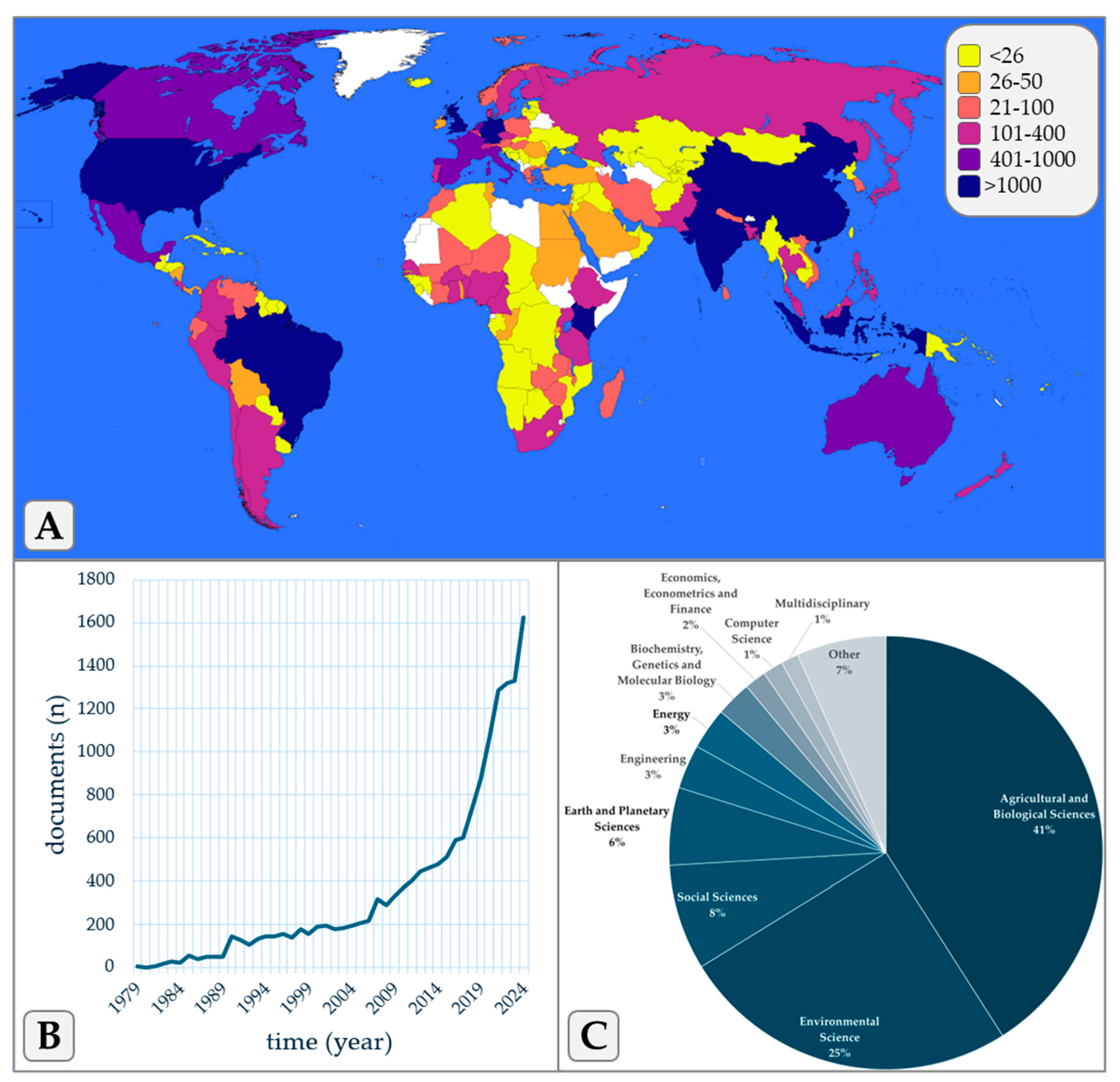
The benefits of agroforestry systems are extensively documented in the scientific literature, underscoring their abovementioned role in climate change mitigation, biodiversity conservation, and increased productivity. As illustrated in Figure 1, drawn from the literature collected using the keyword ‘agroforestry’ in the Scopus database (https://www.scopus.com, accessed on 31 July 2025), international research efforts reflect a growing recognition of agroforestry as a key approach in the global transition toward sustainable agriculture. In particular, the United States, India, Brazil, Indonesia, and China collectively account for 43% of the global research output on agroforestry (Figure 1A), demonstrating significant engagement from both developed and emerging economies. This trend highlights a shared acknowledgment of agroforestry’s potential to address critical environmental and agricultural challenges. The increasing volume of scientific publications in the field further confirms its rising importance in modern agricultural systems (Figure 1B). Moreover, the disciplinary spread of agroforestry research (Figure 1C)—with major contributions from agricultural and biological sciences (41%), environmental science (25%), social sciences (8%), and earth and planetary sciences (6%)—emphasizes its inherently interdisciplinary nature and wide-reaching impact.
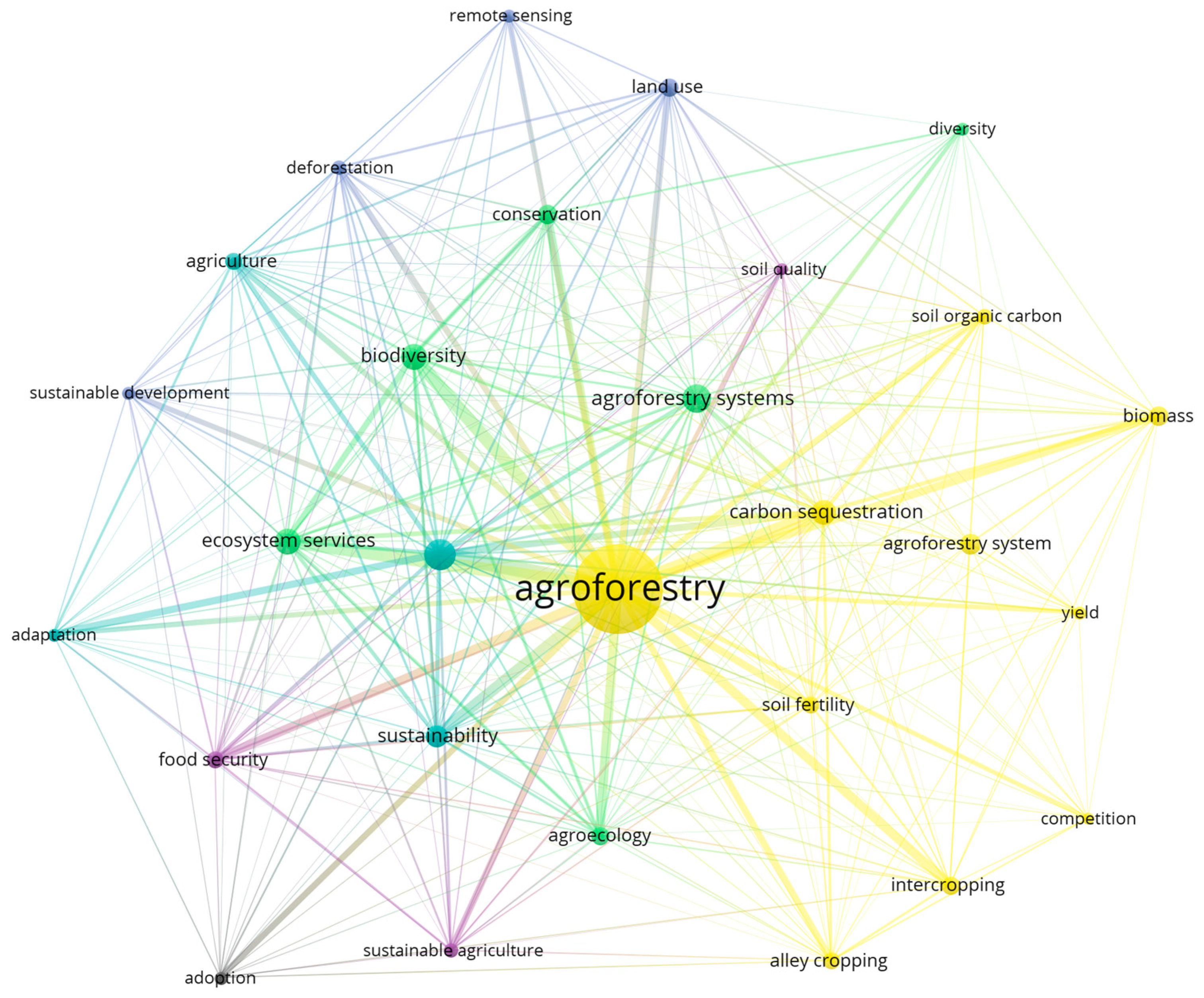
Abovementioned features and benefits are further confirmed and highlighted by the network visualization of indexed keywords in agroforestry research published over the last ten years, illustrating the interconnections between various keywords related to agroforestry (Figure 2; generated by VOSviewer 1.6.20, https://www.vosviewer.com).
Despite these known benefits and the efforts made by policymakers and researchers to support the adoption of agroforestry systems [14], this approach faces several challenges that hinder its widespread adoption [15]. For instance, the long-term nature of agroforestry investments can discourage the implementation of these systems, as trees may take years to yield returns, posing challenges for farmers reliant on short-term income [16]. Market access is also limited; timber and non-timber products often depend on niche or underdeveloped markets, typically inaccessible to smallholders. Strengthening value chains and improving market linkages is therefore essential for economic viability [17]. Moreover, inconsistent or vague policy support often favors monocultures, leaving agroforestry without adequate incentives or institutional backing [18]. In addition to these systemic barriers, farmers face practical challenges, including the inherent complexity of managing multiple plant and animal species within a single agroecosystem, high labor demands, and the need for context-specific long-term management strategies [19]. Furthermore, limited technical knowledge can hinder effective implementation; many farmers need training in species selection, planting techniques, and system maintenance to reduce the risk of failure and ensure long-term success [17,20]. In this scenario, the integration of advanced digital technologies can provide real-time data and insights that are crucial for managing the complexity of agroforestry systems and help farmers optimize resource use, monitor ecological interactions, and implement precise management practices [21].
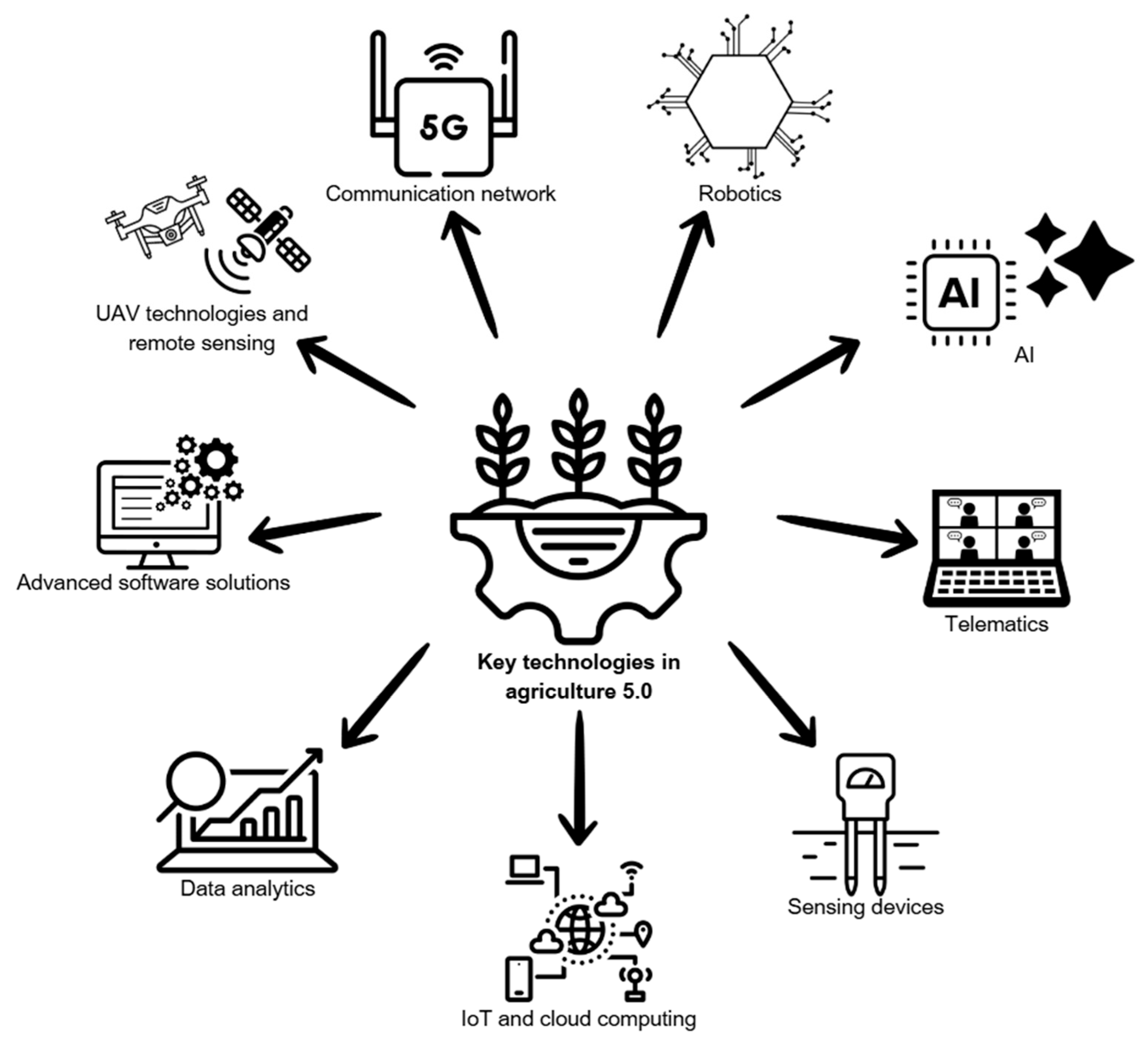
Actually, digital agriculture, also referred to as smart farming, represents the latest phase in the evolution of agricultural practices, marked by the integration of advanced technologies such as sensors, Internet of Things (IoT), cloud computing, machine learning (ML), artificial intelligence (AI), and unmanned aerial vehicles (UAVs) to optimize productivity and sustainability (Figure 3; [22,23]). These innovations, central to the concept of digital agriculture, enable real-time monitoring and data-driven decision-making across multiple dimensions of agricultural management, including precision irrigation, fertilization, crop health monitoring, and machinery optimization [24,25,26]. Through the continuous collection and analysis of environmental and operational data (i.e., soil moisture, nutrient levels, weather conditions, and plant health), digital tools support more targeted, efficient, and environmentally sustainable farming practices. AI and ML, in particular, are increasingly used to analyze large datasets, predict yields, detect diseases, and improve logistics and market forecasting [27,28,29]. Meanwhile, the integration of IoT and cloud-based platforms facilitates remote access to real-time and historical data, while the advent of 5G enhances connectivity and responsiveness in agricultural systems [30,31]. UAVs, including drones and satellites, further enrich this technological landscape by providing high-resolution spatial imagery, allowing for early detection of pests, diseases, or abiotic stress, and enabling targeted interventions [32,33,34,35].
While digital technologies are well established in conventional agriculture, their application in complex and diversified systems such as agroforestry remains limited and underexplored, as reflected in the only and marginal presence just of the keyword “remote sensing” in related literature and research networks (Figure 2). This underutilization represents a significant knowledge gap and may hinder the wider implementation of agroforestry practices, which are crucial for fostering sustainable and resilient agricultural landscapes. Currently, the structural and functional diversity of agroforestry presents both unique challenges and promising opportunities for innovation [36]. Advanced sensing technologies can offer real-time insights that support informed decision-making, enabling precise irrigation and fertilization tailored to the specific needs of trees, crops, and livestock. These tools have the potential to enhance productivity, sustainability, and resource-use efficiency, while facilitating management and improving system resilience, especially in areas affected by water-scarcity soil degradation. Targeted research and the demonstration of practical outcomes are therefore essential to validate these technologies and promote their integration across diverse agroforestry systems.
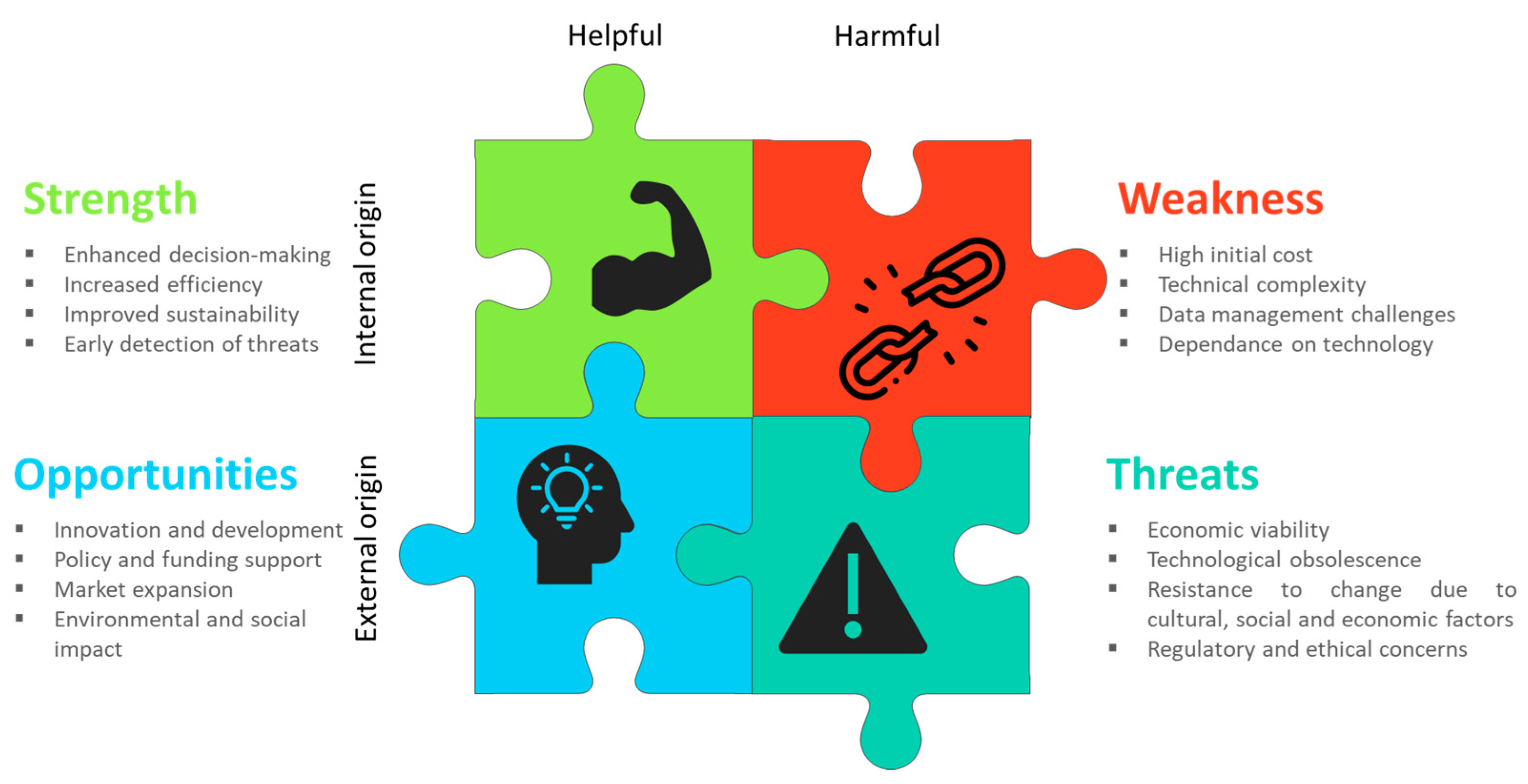
To encourage further research in this area, this paper reviews the current state of digital agriculture in agroforestry systems. First, it reviews the literature on the use of advanced sensing technologies—including livestock, plant and soil remote sensing and advanced monitoring—within agroforestry contexts. Then, it explores case studies where digital tools have been applied in agroforestry systems, emphasizing implementation strategies, observed outcomes, and practical implications for stakeholders. Finally, a SWOT analysis is presented to identify benefits and knowledge gaps and propose perspectives for future research and innovation. The peer-reviewed literature included in this review was sourced from Web of Science (Thompson-ISI, Philadelphia, PA, USA) and Scopus (Elsevier, Amsterdam, Netherlands) databases, using multiple combinations of “agroforestry”, “digital agriculture”, “remote sensing” and “sensors” keywords. Database research was conducted in December 2024, covering publications from 1990 onward. In order to identify other suitable references, the reference lists of articles recorded by this literature search were examined.

2. The Use of Digital Technologies in Agroforestry

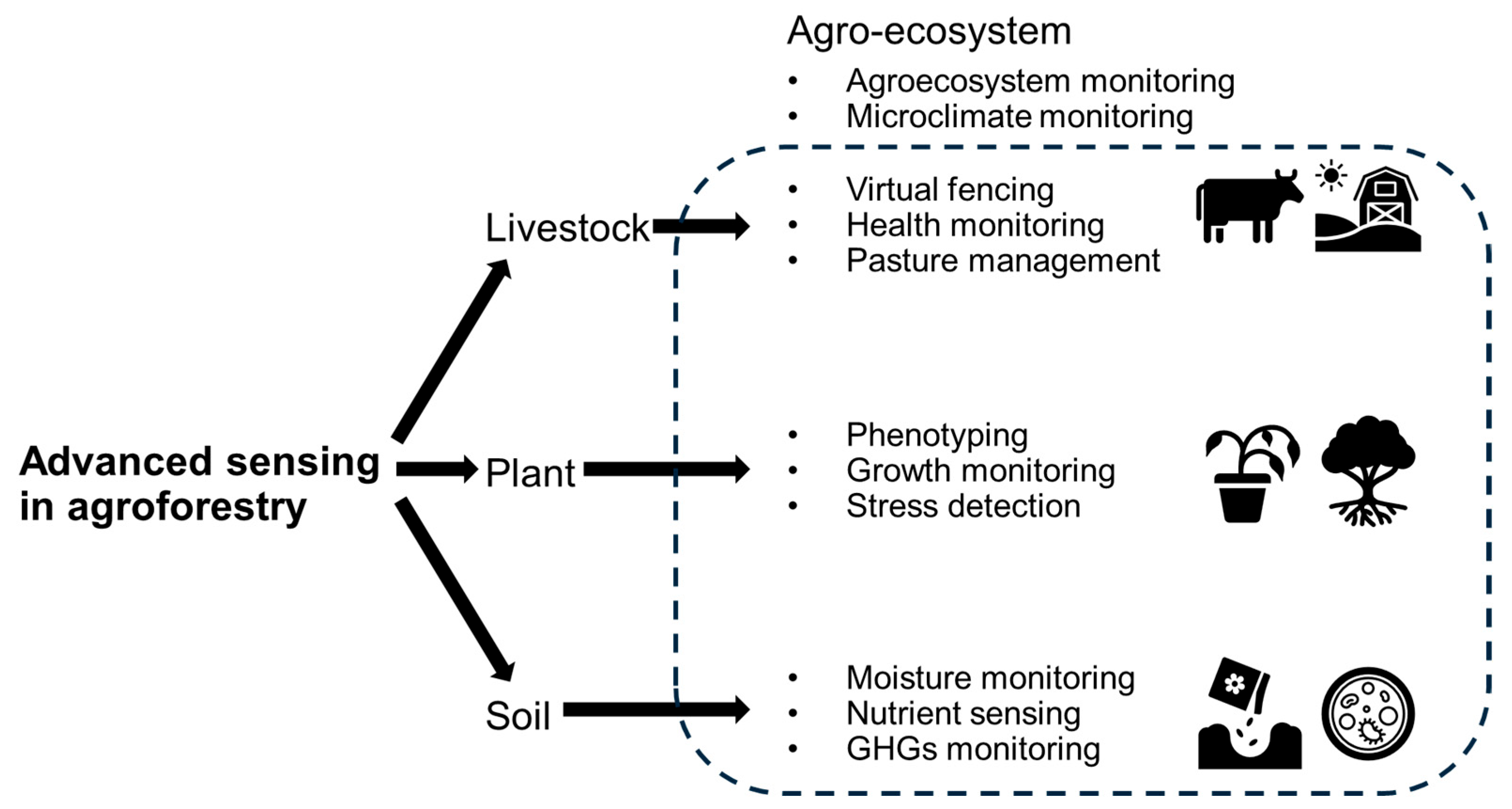
In the scenario of digital agriculture, the integration of advanced sensors has paved the way for groundbreaking approaches to enhance productivity, efficiency, and sustainability in agroforestry systems. Among these technological innovations, precision agriculture (PA) and precision livestock farming (PLF) have emerged as transformative paradigms, equipping farmers with tools to make data-driven decisions and optimize management practices. These approaches not only lead to improved yields, enhanced environmental performance, and increased animal welfare, but also redefine how complex, diversified land-use systems are managed. Figure 4 illustrates this evolution, highlighting how digital technologies are being tailored to the specific characteristics of agroforestry systems. In this context, PA and PLF are not simply enhancing productivity; they are enabling a systemic transition toward adaptive and knowledge-based agroforestry management. For instance, digital tools such as virtual fencing and animal health monitoring facilitate sustainable livestock integration within forested landscapes, while plant phenotyping and stress-detection systems support targeted interventions in diverse tree–crop combinations. Similarly, soil and microclimate monitoring technologies, including soil moisture, nutrient, and greenhouse gas (GHG) sensors, provide actionable insights for maintaining soil health and mitigating environmental impacts (Table S1).

2.1. Monitoring Agroecosystem Functionality in Agroforestry Systems

One of the primary areas benefiting from digital monitoring is the overall agroecosystem monitoring, capturing its intricate spatial and ecological diversity. Multisource satellite imagery, including data from Sentinel-2, MODIS, GEDI, and SMOS, offers a broad-scale perspective for characterizing the multiple ecosystem services provided by agroforestry systems [37]. These remotely sensed data are crucial for the accurate and effective characterization of these complex environments, enabling detailed land cover classification [38] and broad-scale aboveground biomass estimates to assess forest recovery [39]. For instance, combining Sentinel-1 (radar) and Sentinel-2 (optical) Earth Observation satellites allows for accurate mapping and discrimination of agroforestry cocoa from open canopy forest, crucial for sustainable land management [40]. Similarly, high-spatial resolution optical satellite imagery, such as that from WorldView-3, facilitates accurate species-level tree mapping and enables landscape-scale carbon accounting [41]. The integration of Landsat-5 Thematic Mapper and Sentinel 2A Multispectral Instrument data supports long-term monitoring of land use and land cover changes, vital for sustainable development and planning [42]. Beyond mere mapping, multi-temporal and multi-spectral remote sensing data can discriminate landscape characteristics linked to ecosystem and socio-cultural benefits, aiding in targeted land management interventions [43].
Understanding microclimatic conditions within agroforestry systems is another critical aspect of functionality monitoring, directly impacting crop yield, quality, and overall revenue. In situ microclimate sensors, including those for air temperature, soil moisture, soil temperature, and photosynthetically active radiation (PAR), provide detailed insights into how trees buffer environmental conditions [44]. For example, infrared thermography effectively monitors microclimate, leading to improved agroforestry management [45], while PAR and air temperature sensors help evaluate microclimate effects on yield [46]. More comprehensive setups, featuring net radiometers, humidity sensors, and wind speed sensors, allow for the calculation of evapotranspiration and an assessment of how tree buffers influence microclimate over crops [47]. Such detailed monitoring not only enhances agroforestry resilience but also informs land use planning in freeze-prone drylands [48]. In coffee cultivation, Granier thermal dissipation sensors, microclimate sensors, soil moisture sensors, and rainfall sensors collectively assess the impact of different cultivation systems on water consumption and understand inter-species water dynamics [49].
Furthermore, digital technologies are increasingly used to monitor environmental impacts and assess the overall health of agroecosystems. Static chamber systems for in situ measurement of soil CO2, nitrous oxide (N2O), and methane (CH4) fluxes accurately quantify greenhouse gas emissions across diverse agroforestry systems [50,51]. For land degradation and recovery assessments, tools like UAVs combined with Landsat 8 and Sentinel-2 satellite imagery support microclimate improvement and agroecosystem recovery in degraded farmland [52]. Similarly, the use of UAV-borne sensors for Digital Elevation Models, discharge sensors, and suspended sediment sensors can help reduce downstream sediment yields and support gully rehabilitation strategies [53]. These integrated monitoring approaches are essential for quantifying the benefits of agroforestry and guiding sustainable management practices.

2.2. Monitoring Livestock in Agroforestry Systems

In silvopastoral systems, where trees and grazing livestock coexist, animal monitoring is essential for understanding the complex interactions among vegetation structure, microclimatic conditions, and livestock behavior. The presence of trees modifies local conditions such as shade, air temperature, and forage distribution, which influence animal movement, grazing patterns, and overall welfare. In this context, Global Positioning System (GPS) collars provide valuable data, enabling detailed analysis of spatial behavior, habitat use, and resource selection [54,55]. Such monitoring is critical for improving both productivity and animal welfare in agroforestry systems. The integration of multiple sensors, such as GPS units and accelerometers, enables comprehensive monitoring of livestock behavior and physiological responses. This multi-sensor approach allows for the detection of key behavioral states, such as resting, walking, and grazing, as well as the estimation of energy expenditure and welfare status, thereby supporting more informed management decisions [54,55]. Wearable biometric sensors measuring heart rate, body temperature, and rumination patterns have been developed to monitor physiological status in real time. These integrations facilitate early detection of heat stress, disease, or nutritional deficits, particularly important in silvopastoral systems where tree shade modifies microclimatic conditions [56]. Remote sensing technologies, such as thermal imaging cameras mounted on drones or fixed towers, can detect animal heat signatures, enabling the assessment of herd distribution and identification of individuals under stress or injury [57]. In another study, an online monitoring system was used to early detect pigs’ infection through advanced biosensors and accelerometers [58].
Furthermore, another hot topic is the development of virtual fencing (i.e., the use of GPS collars and audio cues or electric shocks to control animal movement and grazing patterns) systems, to enhance grazing management in extensive livestock systems [59]. This technology allows farmers to create and adjust virtual boundaries without the need for physical fences [54], facilitating the implementation of ration stocking aiming to optimize the use of available resources, such as grass and other vegetation, while preventing both overgrazing and overbrowsing, thereby promoting the growth of desirable biomass in both grassland and forestland. Furthermore, by setting virtual boundaries, farmers can restrict livestock access to areas that need to be conserved or regenerated, such as riparian zones, wetlands, or areas with young trees, preserving biodiversity and water quality, and preventing soil erosion [54,55].
Additionally, digital technology is also applied directly to pasture management. For instance, proximal canopy reflectance sensors are used for the estimation of key variables to aid in stocking rate adjustments [60]. Furthermore, sensors monitoring pasture variables, soil moisture, and microclimatic conditions help to better understand the belowground and aboveground competition for resources within these integrated systems [61].

2.3. Plant Monitoring in Agroforestry Systems

The plant components of agroforestry systems, comprising trees, crops, and understory vegetation, demand multi-scale and multi-temporal monitoring to capture the dynamic interactions shaping system productivity and resilience [19]. Recent advancements in digital sensing technologies, coupled with the power of AI and ML, have revolutionized plant monitoring capabilities. These technologies range from remote sensing to proximal sensors, providing unprecedented insights into plant health and growth.
On the landscape scale, satellite imagery from platforms such as Sentinel-2, Landsat, and MODIS provides crucial data on vegetation cover, phenology, and biomass estimation [62]. Vegetation indices such as the Normalized Difference Vegetation Index (NDVI) and the Enhanced Vegetation Index (EVI) derived from these datasets enable quantification of plant vigor and photosynthetic activity, which are particularly useful for assessing tree-crop interactions and identifying zones of stress [63]. For instance, satellite imagery allows for the spatio-temporal analysis of grassland in agroforestry systems at high spatial resolution, crucial for managing forage resources [64]. Additionally, passive optical sensors (e.g., multispectral radiometers on Sentinel-2/MODIS) and active sensors (e.g., LiDAR and radar) can assess the phenological, morphological, and physiological responses of shade-adapted cultivars of winter wheat and barley, providing insights into crop performance under tree canopies [65].
UAVs equipped with multispectral, hyperspectral, and thermal cameras capture detailed information about canopy structure, leaf pigmentation, water status, and disease symptoms [66,67,68,69]. Light Detection and Ranging (LiDAR) technology is especially valuable in agroforestry, allowing the reconstruction of three-dimensional canopy architecture, tree height, and biomass distribution [65,70,71]. For example, UAV-borne RGB imagery systems are used to detect coffee plantations in tropical regions with complex agroforestry systems, aiding in mapping and management [72]. In another recent study employed UAV-borne multispectral mapping was employed to assess the impacts of stocking density and rotational grazing practices, focusing on how grazing animals influence soil health through trampling pressure, depending on whether forested areas are available for grazing or not [73]. Furthermore, UAV-borne multispectral imagery systems can map crop yield and litter, estimate tree influence distance, and compute Land Equivalent Ratio without needing sole crop data, offering a comprehensive view of system productivity [74].
Proximal sensors enable rapid, on-site assessments of plant physiological status. Chlorophyll meters and fluorescence sensors measure photosynthetic efficiency and nutrient status, while leaf temperature sensors provide indirect indicators of water stress [75,76]. For example, portable time domain reflectometry, thermal dissipation probe, and ultrasonic anemometers coupled with Campbell 2D anemometers and four temperature and humidity probes can monitor drought stress in young apple trees in a semiarid agroforestry system [77]. Soil moisture and sap flow sensors enable precise monitoring of tree water use under drought stress, allowing for optimized irrigation strategies [78]. Dendrometers provide continuous, high-resolution measurements of stem diameter variations, serving as sensitive indicators of plant water status and growth dynamics [79]. Photosynthetic photon flux density (PPFD) sensors, air temperature sensors, leaf temperature sensors, soil temperature sensors, and relative humidity sensors assess microclimate modulation and its impact on crop ecophysiology under different tree genotypes, vital for understanding tree-crop interactions [80]. Linear quantum sensors connected to a Campbell CR1000 or CR1000X datalogger are used for monitoring light availability for pasture growth under tree canopies, crucial for silvopastoral management [60]. Heat-pulse sap flow sensors and soil-moisture probes (e.g., time domain reflectometry or capacitance sensors) can accurately, timely, and spatially estimate forest aboveground biomass [81]. These same sensors, along with sap flow sensors (i.e., heat-pulse and thermal-dissipation probes), determine the microclimate of agroforestry systems and their effects on yield and income, providing comprehensive insights into system performance [82]. Onset HOBO Data Loggers measure high-resolution, continuous micro-climate data (e.g., temperature and solar radiation) across different elevations and shade conditions within agroforestry systems [83]. Mini microclimate sensors and UAV-borne thermal images can assess spatial and temporal microclimate and land surface temperature variability, aiding in understanding the microclimatic effects of trees [84]. Wind speed sensors and uredospore traps measure how shade tree traits alter wind flow and spore dispersal, which is important for disease management in agroforestry [85]. Finally, air temperature sensors, rainfall gauges, and leaf temperature sensors capture key microclimatic factors driving coffee leaf rust development to forecast lesion emergence, sporulation, and infectious area growth, enabling proactive disease management [86].
Finally, emerging AI and ML techniques have been integrated with imaging sensors to automate pest and disease detection, a critical component of plant health management in agroforestry systems. Image recognition algorithms identify characteristic symptoms, enabling early intervention that reduces yield losses and limits pesticide use [87,88]. Beyond pest and disease detection, AI/ML models are increasingly used for yield prediction, plant phenotyping, and optimizing resource allocation based on sensor data. For example, the parameterization of agroforestry systems using AI/ML can enhance efficiency to limit spore propagation [89].
Integrating diverse plant monitoring data streams into coherent management frameworks remains a challenge. Continued development of IoT-enabled sensor networks and user-friendly decision support systems is essential to translate sensor data into actionable insights [30,87,90].

2.4. Soil Monitoring in Agroforestry Systems

Soil is the bedrock of agroforestry productivity, critically influencing water availability, nutrient cycling, and biological activity [18]. Monitoring soil properties in these complex systems is challenging due to the inherent spatial heterogeneity introduced by tree roots, diverse litter inputs, and varied microclimatic conditions [18,91]. Fortunately, significant advancements in digital soil sensors and data acquisition technologies are addressing these complexities, providing sophisticated tools for precise soil management.
Accurate soil moisture assessment is paramount for efficient water use, a critical factor given the competition for resources between trees and crops in agroforestry systems. Various sensors offer continuous, non-destructive measurements of volumetric water content. Capacitive sensors, Time Domain Reflectometry, and Frequency Domain Reflectometry sensors are widely used to reveal distinct moisture regimes beneath tree canopies and in open crop alleys [92,93]. This real-time data is invaluable for optimizing irrigation schedules, conserving water, and preventing water stress, ultimately leading to improved crop yields and enhanced sustainability [24,94]. For instance, Electrical Resistivity Tomography can map soil moisture dynamics [95], while sap flow sensors combined with micro-lysimeters enable precise assessment of water use efficiency [96]. The integration of soil moisture and sap flow sensors can also help assess the potential of silvopastoral conversion for mitigating climate change impacts and sustaining hydrological regulation [97]. By identifying areas with poor water retention or optimizing irrigation timing to match crop water requirements, these sensors significantly improve water use efficiency, particularly in water-scarce regions [35,94,98].
Nutrient availability and soil fertility are crucial for plant growth and are monitored using advanced in situ sensing technologies. Ion-selective electrodes and portable X-ray fluorescence spectrometers facilitate rapid analysis of key macro- and micronutrients directly in the field [99]. These tools support site-specific nutrient management, which optimizes fertilizer use efficiency and minimizes environmental impacts [100,101]. Recent innovations, such as optical and electrochemical sensors, including ion-selective electrodes, are revolutionizing real-time nutrient monitoring capabilities, allowing continuous, non-destructive assessment of nutrient concentrations [23,102,103]. For example, a VIS-NIR hyperspectral imager offers accurate, mobile, and cost-effective prediction of soil organic carbon and nitrogen [104]. This precision in nutrient management not only optimizes plant growth but also mitigates the risk of environmental pollution from excess nutrients [23,102,103]. Furthermore, a combination of a VNIR spectrometer, a dry combustion analyzer, and other data sources can accurately predict and map soil organic carbon [105].
Soil is a dynamic living system, playing a vital role in the global carbon cycle by storing and releasing GHGs like CO2, N2O, and CH4. Monitoring these emissions is essential for quantifying global GHG budgets and informing land management decisions for climate change mitigation [106,107]. Advanced sensing techniques provide farmers with tools to monitor GHG emissions from their soils. Chamber systems, such as static, vented chambers, are commonly used to measure GHG fluxes from the soil surface [106,108]. These, along with sensors for soil microclimate monitoring, allow for quantification of N2O and CO2 emissions, soil temperature, water content, and surface-soil inorganic nitrogen [109]. Micrometeorological methods, like eddy covariance, offer another valuable tool by measuring vertical turbulent fluxes of GHGs, providing insights into gas exchange between the soil and atmosphere [109]. Eddy covariance towers are particularly useful in extensive agroforestry systems that are clearly separated from specialized agricultural or forest stands, where edge effects may disturb flux measurements. Furthermore, the availability of lower-cost or ‘mini-tower’ setups now enables flux monitoring at smaller spatial scales, enhancing spatial replication and representativity [110]. Additionally, advances in biosensors allow the measurement of soil biological activity, including microbial respiration and enzymatic activity, which are critical indicators of soil health and carbon cycling [111]. Automated soil temperature sensors, combined with moisture data and weather station inputs, provide comprehensive environmental monitoring, enhancing our understanding of soil-plant-atmosphere interactions [95,96,97,112].
The aggregation and real-time transmission of diverse soil data have been greatly facilitated by Wireless Sensor Networks and IoT platforms, enabling adaptive management practices even in remote agroforestry areas. However, challenges persist regarding sensor calibration, data standardization, and energy management, which need to be addressed for widespread adoption [113]. Despite these challenges, the information gathered empowers farmers to make informed land management decisions that contribute to climate change mitigation and promote sustainable agroforestry practices. For instance, X-ray computed micro-tomography can evaluate soil void phase characteristics and heterogeneity of soil matrix radiodensity, helping to characterize differences in soil surface microstructure [99]. Ultimately, comprehensive soil monitoring supports optimized resource management and enhances the resilience and environmental benefits of agroforestry systems.

3. Strengths, Weaknesses, Opportunities and Threats (SWOT Analysis) on the Use of Digital Technologies in Agroforestry Systems

3.1. Strenghts

Advanced sensing technologies provide precise and real-time data on various environmental factors such as soil moisture, nutrient levels, pest and pathogens spread and weather conditions, enabling data-driven decision-making in agriculture [34,94]. This allows for informed decision-making, optimizing resource use, and improving overall farm management [114,115]. By utilizing sensors, farmers can automate processes like irrigation and fertilization, ensuring they are applied at the right time and in the right amount, so reducing waste and costs, and enhancing crop and livestock productivity [30,116].
In agroforestry systems, these technologies support the understanding of complex interactions between trees, crops, and livestock by enabling site-specific management and long-term monitoring of ecological dynamics [17]. Such integrated monitoring helps identify optimal spatial arrangements and management regimes, enabling site-specific decisions that maintain both productivity and ecosystem stability. Furthermore, these technologies can facilitate PA practices, allowing farmers to tailor their inputs to the specific needs of each part of their field. For example, variable-rate technology can be used to apply fertilizers or agrochemicals at different rates across the field, based on real-time sensor data on soil conditions and crop health. This not only improves efficiency but also minimizes environmental impact [117,118]. By integrating sensing technologies into agroforestry, practitioners can better manage biodiversity, soil health, and microclimatic conditions, contributing to more resilient and sustainable land-use systems [119].

3.2. Weaknesses

The adoption of advanced sensing technologies, while offering significant potential, also presents several challenges. A major hurdle is that the substantial upfront investment in hardware, software, and training can be a barrier for small-scale and resource-limited farmers [13,120,121]. Implementing and maintaining these sophisticated systems often demands specialized technical knowledge and expertise, necessitating ongoing training and support. This can be time-consuming, costly, and potentially disruptive to existing farming operations [20,122].
In agroforestry systems, these challenges are further compounded by the complexity of managing multiple interacting components—trees, crops, and livestock—across heterogeneous landscapes. Furthermore, the sheer volume of data generated by these sensors presents significant challenges in terms of data storage, processing, analysis, and interpretation. Ensuring data security and privacy, especially in a connected and increasingly digitalized agricultural landscape, is paramount [123]. Over-reliance on technology can also create vulnerabilities. System failures, connectivity problems, or technical malfunctions can disrupt operations and potentially lead to significant losses [13,117,122].
Additionally, in agroforestry contexts, the risk of sidelining traditional ecological knowledge is particularly relevant, as these systems often rely on deep, site-based understanding of natural cycles and biodiversity. Excessive dependence on digital tools may inadvertently marginalize these insights, which are crucial for long-term sustainability and resilience [124].
Moreover, despite their potential, current sensing and monitoring approaches often capture only isolated parameters (e.g., soil moisture or canopy temperature) without fully integrating them into system-level analyses capable of describing the dynamic interactions among trees, crops, and livestock. This limitation restricts the ability of digital tools to model the energy, water, and nutrient fluxes that drive agroforestry performance [19,74,105,110,125]. Developing interoperable data frameworks and modelling platforms able to link biophysical signals to ecosystem functions (e.g., competition, facilitation, and resource sharing) remains a key challenge for advancing digital agroforestry [30,61,64,119]. Finally, the spatial and temporal heterogeneity typical of agroforestry systems often requires high-resolution, multi-sensor integration to achieve meaningful interpretation [68,69,126]. Without this, the risk is to generate fragmented information that fails to reflect the complexity such systems are designed to harness. This highlights the need for coordinated research efforts that move beyond isolated technology testing and towards holistic frameworks for monitoring and decision support in agroforestry [9,31,92,113].

3.3. Opportunities

Despite the challenges, advanced sensing technologies present numerous opportunities to revolutionize agroforestry. The field is ripe for innovation, with significant potential for developing more cost-effective, user-friendly, and integrated sensing solutions tailored to the unique needs of diverse agroforestry systems [121,127]. Growing global awareness of the urgent need for sustainable agriculture is driving increased policy support, subsidies, and funding for the adoption of these technologies [120]. Particularly promising are opportunities to use digital technologies to simulate and model biophysical processes within agroforestry systems (e.g., C sequestration, evapotranspiration, and nutrient fluxes) by integrating data from soil, plant, and atmospheric sensors. This system-level approach supports the design of management strategies that maximize facilitative interactions (e.g., shading, nitrogen fixation) while reducing resource competition. In this way, sensing technologies become not only diagnostic tools but also components of predictive and adaptive management frameworks for agroforestry. This creates a favorable environment for market expansion, enabling companies to develop innovative products and services specifically for the agroforestry sector, fostering economic growth and job creation [116,128].
Furthermore, these technologies can play a crucial role in addressing pressing global challenges such as climate change, food security, and biodiversity loss. By enabling practices, optimizing resource use, and enhancing ecosystem resilience, advanced sensing technologies can contribute significantly to the development of sustainable and resilient agroforestry systems, delivering substantial environmental, social, and economic benefits for communities worldwide [24,116,129].
To ensure inclusive and equitable access to these opportunities, it is crucial to prioritize the development of technologies that are affordable and accessible to smallholder farmers and marginalized communities [122,128,130,131].

3.4. Threats

Several significant threats could hinder the widespread adoption of advanced sensing technologies in agroforestry. The high costs associated with these technologies, including hardware, software, data storage, and maintenance, can pose a significant economic barrier for many farmers, particularly in developing countries or regions with low agricultural profitability [13,121,122]. Rapid technological advancements can quickly render existing sensing systems obsolete, necessitating continuous investments in upgrades and new technologies, which can be financially burdensome and create a sense of technological obsolescence [132]. Furthermore, because agroforestry systems are inherently long-term and dynamic, technologies designed for short-term monitoring may fail to capture slow ecological processes such as soil carbon accumulation or tree-crop competition over time. In addition, fragmented land ownership, mixed management objectives, and limited digital infrastructure in forested or rural areas further complicate its adoption. Resistance to change due to cultural, social, or psychological factors can also impede adoption, as farmers accustomed to traditional practices may be hesitant to embrace new technologies or may lack the necessary digital literacy [122,128,131].
Furthermore, the use of advanced sensing technologies raises critical ethical and regulatory concerns. Issues related to data privacy, security, and ownership of data generated by these systems require careful consideration and robust regulatory frameworks [15,36,123]. Ensuring equitable access to these technologies and their benefits, while mitigating potential risks and ensuring responsible data management, is crucial for their successful and sustainable integration into agroforestry systems.
To mitigate these threats and ensure the responsible and equitable adoption of these technologies, it is essential to prioritize the development of affordable and accessible solutions, support continuous education and training programs, and establish clear and transparent regulatory frameworks that protect farmers’ rights and data privacy. Building trust between farmers, technology providers, and policymakers is crucial for addressing concerns and fostering a supportive environment for the responsible adoption of advanced sensing technologies in agroforestry (Figure 5).

4. Conclusions and Perspectives

The integration of advanced sensing technology into agroforestry systems has the potential to accelerate their adoption and improve management efficiency, productivity, and sustainability. By providing real-time data and actionable insights, sensing technologies can help farmers and advisors manage the inherent complexity of agroforestry systems, optimize resource use, and minimize trade-offs among system components.
Building on the “ecosystem–livestock–plant–soil” framework discussed in this review, future research should prioritize the development of cross-scale monitoring approaches capable of linking biophysical data (e.g., soil, plant, and microclimate dynamics) with management decisions and socioeconomic outcomes. In particular, there is a need for interoperable sensor networks and data fusion models that integrate remote, proximal, and in situ sensing to provide a holistic view of system performance.
Furthermore, targeted studies should assess the cost-effectiveness, scalability, and energy requirements of digital technologies in smallholder agroforestry contexts, where economic and infrastructural constraints often limit adoption. Strengthening collaborations among engineers, ecologists, and social scientists will be essential to co-design context-specific solutions and translate technical innovation into practical tools.
Capacity building remains important, but should now focus on developing digital literacy and participatory decision-support systems that empower farmers to interpret and apply sensor-derived information. Policy frameworks should also move beyond generic incentives to include data-sharing standards, open-access platforms, and funding schemes that foster innovation in multi-actor agroforestry networks.
By aligning technological development with the ecological and social complexity of agroforestry, future research can transform digitalization from a set of isolated tools into an integrative strategy for resilient and sustainable land-use systems.

Supplementary Materials

The following supporting information can be downloaded at: https://www.mdpi.com/article/10.3390/agronomy15122671/s1, Table S1: Overview of the applications of advanced sensing in scientific studies focused on agroforestry [37,38,39,40,41,42,43,44,45,46,48,49,50,52,53,54,55,58,60,61,63,64,65,70,71,72,74,77,78,80,81,82,83,84,85,86,89,90,95,96,97,99,100,101,104,105,109,112,126,133,134,135,136,137,138,139,140,141,142,143,144,145,146,147,148,149,150,151,152].

Author Contributions

Conceptualization, L.C., G.C., M.F. (Marco Fontanelli) and M.M.; and S.R.; data curation, L.P.; formal analysis, L.P. and S.R.; investigation, M.A., M.F. (Matteo Finocchi) and A.R.; methodology, S.R. and L.G.T.; supervision, D.A., L.C., C.N., E.P., A.P., N.S. and L.C.; writing—original draft preparation, L.P. and S.R.; writing—review and editing, M.A., D.A., G.C., L.G.T., M.F. (Matteo Finocchi), M.F. (Marco Fontanelli), M.M., C.N., E.P., A.P., A.R., N.S. and L.C. All authors have read and agreed to the published version of the manuscript.

Funding

This research was funded by the University of Pisa under the “PRA—Progetti di Ricerca di Ateneo” (Institutional Research Grants)—Project no. PRA_2022_42 “iAgroforestry: Application of digital techniques in management and defense of agroforestry systems”.

Data Availability Statement

The original contributions presented in the study are included in the article, further inquiries can be directed at the corresponding author.

Acknowledgments

This paper and related research have been conducted during and with the support of the Italian national inter-university PhD course in Sustainable Development and Climate change (https://www.phd-sdc.it/). This publication was produced while attending the PhD program in PhD in Sustainable Development And Climate Change at the University School for Advanced Studies IUSS Pavia, Cycle XXXVIII, with the support of a scholarship financed by the Ministerial Decree no. 351 of 9 April 2022, based on the NRRP–funded by the European Union–NextGenerationEU–Mission 4 “Education and Research”, Component 1 “Enhancement of the offer of educational services: from nurseries to universities”–Investment 4.1 “Extension of the number of research doctorates and innovative doctorates for public administration and cultural”.

Conflicts of Interest

The authors declare no conflicts of interest.

References

  1. Burgess, P.J.; Rosati, A. Advances in European agroforestry: Results from the AGFORWARD project. Agroforest. Syst. 2018, 92, 801–810. [Google Scholar] [CrossRef]
  2. Wilson, M.H.; Lovell, S.T. Agroforestry—The Next Step in Sustainable and Resilient Agriculture. Sustainability 2016, 8, 574. [Google Scholar] [CrossRef]
  3. Garrett, H.E.; Wolz, K.J.; Walter, W.D.; Godsey, L.D.; McGraw, R.L. Alley Cropping Practices. In North American Agroforestry; John Wiley & Sons, Ltd.: Bognor Regis, UK, 2021; pp. 163–204. [Google Scholar] [CrossRef]
  4. Terasaki Hart, D.E.; Yeo, S.; Almaraz, M.; Beillouin, D.; Cardinael, R.; Garcia, E.; Kay, S.; Lovell, S.T.; Rosenstock, T.S.; Sprenkle-Hyppolite, S.; et al. Priority science can accelerate agroforestry as a natural climate solution. Nat. Clim. Change 2023, 13, 1179–1190. [Google Scholar] [CrossRef]
  5. Broom, D.M.; Galindo, F.A.; Murgueitio, E. Sustainable, Efficient Livestock Production with High Biodiversity and Good Welfare for Animals. Proc. R. Soc. B Biol. Sci. 2013, 280, 20132025. [Google Scholar] [CrossRef]
  6. Jose, S. Agroforestry for Ecosystem Services and Environmental Benefits: An Overview. Agroforest. Syst. 2009, 76, 1–10. [Google Scholar] [CrossRef]
  7. Nair, P.K.R. Carbon Sequestration Studies in Agroforestry Systems: A Reality-Check. Agroforest. Syst. 2012, 86, 243–253. [Google Scholar] [CrossRef]
  8. Bayala, J.; Prieto, I. Water acquisition, sharing and redistribution by roots: Applications to agroforestry systems. Plant Soil 2020, 453, 17–28. [Google Scholar] [CrossRef]
  9. Udawatta, R.; Rankoth, L.; Jose, S. Agroforestry and Biodiversity. Sustainability 2019, 11, 2879. [Google Scholar] [CrossRef]
  10. Udawatta, R.P.; Anderson, S.H.; Motavalli, P.P.; Garrett, H.E. Calibration of a water content reflectometer and soil water dynamics for an agroforestry practice. Agroforest. Syst. 2021, 82, 61–75. [Google Scholar] [CrossRef]
  11. Quandt, A.; Neufeldt, H.; McCabe, J.T. The Role of Agroforestry in Building Livelihood Resilience to Floods and Drought in Semiarid Kenya. Ecol. Soc. 2017, 22, 10. [Google Scholar] [CrossRef]
  12. Thorlakson, T.; Neufeldt, H. Reducing Subsistence Farmers’ Vulnerability to Climate Change: Evaluating the Potential Contributions of Agroforestry in Western Kenya. Agric. Food Secur. 2012, 1, 15. [Google Scholar] [CrossRef]
  13. Current, D.; Lutz, E.; Scherr, S.J. The Cost and Benefits of Agroforestry to Farmers. World Bank Res. Obs. 1995, 10, 151–180. [Google Scholar] [CrossRef]
  14. Plieninger, T.; Muñoz-Rojas, J.; Buck, L.E.; Scherr, S.J. Agroforestry for Sustainable Landscape Management. Sustain. Sci. 2020, 15, 1255–1266. [Google Scholar] [CrossRef]
  15. Tranchina, M.; Burgess, P.; Cella, F.G.; Cumplido-Marin, L.; Gosme, M.; den Herder, M.; Kay, S.; Lawson, G.; Lojka, B.; Palma, J.; et al. Exploring Agroforestry Limiting Factors and Digitalization Perspectives: Insights from a European Multi-Actor Appraisal. Agroforest. Syst. 2024, 98, 2499–2515. [Google Scholar] [CrossRef]
  16. Valdivia, C.; Barbieri, C.; Gold, M.A. Between Forestry and Farming: Policy and Environmental Implications of the Barriers to Agroforestry Adoption. Can. J. Agr. Econ. 2012, 60, 155–175. [Google Scholar] [CrossRef]
  17. Dissanayaka, D.M.N.S.; Dissanayake, D.K.R.P.L.; Udumann, S.S.; Nuwarapaksha, T.D.; Atapattu, A.J. Agroforestry—A Key Tool in the Climate-Smart Agriculture Context: A Review on Coconut Cultivation in Sri Lanka. Front. Agron. 2023, 5, 1162750. [Google Scholar] [CrossRef]
  18. Fahad, S.; Chavan, S.B.; Chichaghare, A.R.; Uthappa, A.R.; Kumar, M.; Kakade, V.; Pradhan, A.; Jinger, D.; Rawale, G.; Yadav, D.K.; et al. Agroforestry Systems for Soil Health Improvement and Maintenance. Sustainability 2022, 14, 14877. [Google Scholar] [CrossRef]
  19. Gonçalves, B.; Morais, M.C.; Pereira, S.; Mosquera-Losada, M.R.; Santos, M. Tree–Crop Ecological and Physiological Interactions Within Climate Change Contexts: A Mini-Review. Front. Ecol. Evol. 2021, 9, 661978. [Google Scholar] [CrossRef]
  20. Giri, V.; Bhoi, T.K.; Samal, I.; Komal, J.; Majhi, P.K. Exploring the Agroforestry Systems for Ecosystem Services: A Synthesis of Current Knowledge and Future Research Directions. In Agroforestry to Combat Global Challenges: Current Prospects and Future Challenges; Jatav, H.S., Rajput, V.D., Minkina, T., Van Hullebusch, E.D., Dutta, A., Eds.; Springer Nature: Singapore, 2024; pp. 503–528. [Google Scholar] [CrossRef]
  21. Konfo, T.R.C.; Chabi, A.B.P.; Amoussouga Gero, A.; Lagnika, C.; Avlessi, F.; Biaou, G.; Sohounhloue, C.K.D. Recent Climate-Smart Innovations in Agrifood to Enhance Producer Incomes through Sustainable Solutions. J. Agric. Food Res. 2024, 15, 100985. [Google Scholar] [CrossRef]
  22. Martos, V.; Ahmad, A.; Cartujo, P.; Ordoñez, J. Ensuring agricultural sustainability through remote sensing in the era of agriculture 5.0. Appl. Sci. 2021, 11, 5911. [Google Scholar] [CrossRef]
  23. Paul, K.; Chatterjee, S.S.; Pai, P.; Varshney, A.; Juikar, S.; Prasad, V.; Bhadra, B.; Dasgupta, S. Viable Smart Sensors and Their Application in Data Driven Agriculture. Comput. Electron. Agric. 2022, 198, 107096. [Google Scholar] [CrossRef]
  24. de Carvalho, A.F.; Fernandes-Filho, E.I.; Daher, M.; Gomes, L.d.C.; Cardoso, I.M.; Fernandes, R.B.A.; Schaefer, C.E.G.R. Microclimate and Soil and Water Loss in Shaded and Unshaded Agroforestry Coffee Systems. Agroforest. Syst. 2021, 95, 119–134. [Google Scholar] [CrossRef]
  25. Lee, G.; Wei, Q.; Zhu, Y. Emerging Wearable Sensors for Plant Health Monitoring. Adv. Funct. Mater. 2021, 31, 2106475. [Google Scholar] [CrossRef]
  26. Mahlein, A.K. Plant Disease Detection by Imaging Sensors—Parallels and Specific Demands for Precision Agriculture and Plant Phenotyping. Plant Dis. 2016, 100, 241–251. [Google Scholar] [CrossRef]
  27. Oliveira, R.C.d.; Silva, R.D.d.S.e. Artificial Intelligence in Agriculture: Benefits, Challenges, and Trends. Appl. Sci. 2023, 13, 7405. [Google Scholar] [CrossRef]
  28. Pandey, D.K.; Mishra, R. Towards Sustainable Agriculture: Harnessing AI for Global Food Security. Artif. Intell. Agric. 2024, 12, 72–84. [Google Scholar] [CrossRef]
  29. Ahmad, A.; Liew, A.X.W.; Venturini, F.; Kalogeras, A.; Candiani, A.; Di Benedetto, G.; Ajibola, S.; Cartujo, P.; Romero, P.; Lykoudi, A.; et al. AI Can Empower Agriculture for Global Food Security: Challenges and Prospects in Developing Nations. Front. Artif. Intell. 2024, 7, 1328530. [Google Scholar] [CrossRef] [PubMed]
  30. Alahmad, T.; Neményi, M.; Nyéki, A. Applying IoT Sensors and Big Data to Improve Precision Crop Production: A Review. Agron 2023, 13, 2603. [Google Scholar] [CrossRef]
  31. Rehman, A.; Saba, T.; Kashif, M.; Fati, S.M.; Bahaj, S.A.; Chaudhry, H. A Revisit of Internet of Things Technologies for Monitoring and Control Strategies in Smart Agriculture. Agronomy 2022, 12, 127. [Google Scholar] [CrossRef]
  32. Calzone, A.; Cotrozzi, L.; Lorenzini, G.; Nali, C.; Pellegrini, E. Hyperspectral detection and monitoring of salt stress in pomegranate cultivars. Agronomy 2021, 11, 1038. [Google Scholar] [CrossRef]
  33. Cotrozzi, L. Spectroscopic Detection of Forest Diseases: A Review (1970–2020). J. For. Res. 2022, 33, 21–38. [Google Scholar] [CrossRef]
  34. Carli, M.; Pedrelli, A.; Pippi, L.; Risoli, S.; Panattoni, A.; Lorenzini, G.; Pellegrini, E.; Nali, C.; Cotrozzi, L. Using leaf hyperspectral data to early detect flavescence dorée before the onset of symptoms in a heavily affected vineyard of Tuscany (Central Italy). Plant Dis. 2025. [Google Scholar] [CrossRef]
  35. Zhu, X.; Liu, W.; Chen, J.; Bruijnzeel, L.A.; Mao, Z.; Yang, X.; Cardinael, R.; Meng, F.-R.; Sidle, R.C.; Seitz, S.; et al. Reductions in Water, Soil and Nutrient Losses and Pesticide Pollution in Agroforestry Practices: A Review of Evidence and Processes. Plant Soil 2020, 453, 45–86. [Google Scholar] [CrossRef]
  36. Tranchina, M.; Reubens, B.; Frey, M.; Mele, M.; Mantino, A. What Challenges Impede the Adoption of Agroforestry Practices? A Global Perspective through a Systematic Literature Review. Agroforest. Syst. 2024, 98, 1817–1837. [Google Scholar] [CrossRef]
  37. Leroux, L.; Clermont-Dauphin, C.; Ndienor, M.; Jourdan, C.; Roupsard, O.; Seghieri, J. A spatialized assessment of ecosystem service relationships in a multifunctional agroforestry landscape of Senegal. Sci. Total Environ. 2022, 853, 158707. [Google Scholar] [CrossRef] [PubMed]
  38. Ndao, B.; Leroux, L.; Gaetano, R.; Diouf, A.A.; Soti, V.; Bégué, A.; Sambou, B. Landscape heterogeneity analysis using geospatial techniques and a priori knowledge in Sahelian agroforestry systems of Senegal. Ecol. Indic. 2021, 125, 107481. [Google Scholar] [CrossRef]
  39. Aragón, S.; Salinas, N.; Nina-Quispe, A.; Qquellon, V.H.; Paucar, G.R.; Huaman, W.; Roman-Cuesta, R.M. Aboveground biomass in secondary montane forests in Peru: Slow carbon recovery in agroforestry legacies. Glob. Ecol. Conserv. 2021, 28, e01696. [Google Scholar] [CrossRef]
  40. Ashiagbor, G.; Forkuo, E.K.; Asante, W.A.; Acheampong, E.; Quaye-Ballard, J.A.; Boamah, P.; Foli, E. Pixel-based and object-oriented approaches in segregating cocoa from forest in the Juabeso-Bia landscape of Ghana. Remote Sens. Appl. Soc. Environ. 2020, 19, 100349. [Google Scholar] [CrossRef]
  41. Kearney, S.P.; Coops, N.C.; Chan, K.M.; Fonte, S.J.; Siles, P.; Smukler, S.M. Predicting carbon benefits from climate-smart agriculture: High-resolution carbon mapping and uncertainty assessment in El Salvador. J. Environ. Manag. 2017, 202, 287–298. [Google Scholar] [CrossRef]
  42. Mishra, P.K.; Rai, A.; Rai, S.C. Land use and land cover change detection using geospatial techniques in the Sikkim Himalaya, India. Egypt. J. Remote Sens. Space Sci. 2020, 23, 133–143. [Google Scholar] [CrossRef]
  43. Weissteiner, C.J.; García-Feced, C.; Paracchini, M.L. A new view on EU agricultural landscapes: Quantifying patchiness to assess farmland heterogeneity. Ecol. Indic. 2016, 61, 317–327. [Google Scholar] [CrossRef]
  44. Moreira, S.L.; Pires, C.V.; Marcatti, G.E.; Santos, R.H.; Imbuzeiro, H.M.; Fernandes, R.B. Intercropping of coffee with the palm tree, macauba, can mitigate climate change effects. Agric. For. Meteorol. 2018, 256, 379–390. [Google Scholar] [CrossRef]
  45. Junior, N.K.; Miyagi, E.S.; de Oliveira, C.C.; Barreto, C.D.; Mastelaro, A.P.; Bungenstab, D.J.; Alves, F.V. Infrared thermography for microclimate assessment in agroforestry systems. Sci. Total Environ. 2020, 731, 139252. [Google Scholar] [CrossRef]
  46. Yang, T.; Ma, C.; Lu, W.; Wan, S.; Li, L.; Zhang, W. Microclimate, crop quality, productivity, and revenue in two types of agroforestry systems in drylands of Xinjiang, northwest China. Eur. J. Agron. 2021, 124, 126245. [Google Scholar] [CrossRef]
  47. Svoma, B.M.; Fox, N.I.; Pallardy, Q.; Udawatta, R.P. Evapotranspiration differences between agroforestry and grass buffer systems. Agric. Water Manag. 2016, 176, 214–221. [Google Scholar] [CrossRef]
  48. Ding, B.; Zhang, Y.; Yu, X.; Jia, G.; Wang, Y.; Zheng, P.; Li, Z. Comparative study of seasonal freeze–thaw on soil water transport in farmland and its shelterbelt. Catena 2023, 225, 106982. [Google Scholar] [CrossRef]
  49. Sarmiento-Soler, A.; Vaast, P.; Hoffmann, M.P.; Rötter, R.P.; Jassogne, L.; Van Asten, P.J.; Graefe, S. Water use of Coffea arabica in open versus shaded systems under smallholder’s farm conditions in Eastern Uganda. Agric. For. Meteorol. 2019, 266, 231–242. [Google Scholar] [CrossRef]
  50. Baah-Acheamfour, M.; Carlyle, C.N.; Lim, S.S.; Bork, E.W.; Chang, S.X. Forest and grassland cover types reduce net greenhouse gas emissions from agricultural soils. Sci. Total Environ. 2016, 571, 1115–1127. [Google Scholar] [CrossRef] [PubMed]
  51. Pecchioni, G.; Bosco, S.; Volpi, I.; Mantino, A.; Dragoni, F.; Giannini, V.; Tozzini, C.; Mele, M.; Ragaglini, G. Carbon Budget of an Agroforestry System after Being Converted from a Poplar Short Rotation Coppice. Agronomy 2020, 10, 1251. [Google Scholar] [CrossRef]
  52. Villani, L.; Castelli, G.; Sambalino, F.; Oliveira, L.A.A.; Bresci, E. Influence of trees on landscape temperature in semi-arid agro-ecosystems of East Africa. Biosyst. Eng. 2021, 212, 185–199. [Google Scholar] [CrossRef]
  53. Alfonso-Torreño, A.; Schnabel, S.; Gómez-Gutiérrez, Á.; Crema, S.; Cavalli, M. Effects of gully control measures on sediment yield and connectivity in wooded rangelands. Catena 2022, 214, 106259. [Google Scholar] [CrossRef]
  54. Campbell, D.L.M.; Lea, J.M.; Keshavarzi, H.; Lee, C. Virtual fencing is comparable to electric tape fencing for cattle behavior and welfare. Front. Vet. Sci. 2019, 6, 445. [Google Scholar] [CrossRef] [PubMed]
  55. Colusso, P.I.; Clark, C.E.F.; Ingram, L.J.; Thomson, P.C.; Lomax, S. Dairy Cattle Response to a Virtual Fence When Pasture on Offer Is Restricted to the Post-Grazing Residual. Front. Anim. Sci. 2021, 2, 791228. [Google Scholar] [CrossRef]
  56. Li, J.; Zhou, Y.; Feng, M.; Song, L.; Liu, Y.; Yang, H.; Guo, J. Tree Shade Improves Milking Performance, Apparent Digestibility, Antioxidant Capacity, and Immunity of Dairy Cows in Open Sheds. Animals 2025, 15, 1673. [Google Scholar] [CrossRef] [PubMed]
  57. Mufford, J.T. Use of Unmanned Aerial Vehicles to Study Cattle Heat Stress. Doctoral Dissertation, Thompson Rivers University, Kamloops, BC, Canada, 2020. Available online: https://tru.arcabc.ca/node/2289 (accessed on 31 July 2025).
  58. Martínez-Avilés, M.; Fernández-Carrión, E.; López García-Baones, J.M.; Sánchez-Vizcaíno, J.M. Early Detection of Infection in Pigs through an Online Monitoring System. Transbound. Emerg. Dis. 2017, 64, 364–373. [Google Scholar] [CrossRef] [PubMed]
  59. Aquilani, C.; Confessore, A.; Bozzi, R.; Sirtori, F.; Pugliese, C. Review: Precision Livestock Farming Technologies in Pasture-Based Livestock Systems. Animal 2022, 16, 100429. [Google Scholar] [CrossRef] [PubMed]
  60. Pezzopane, J.R.M.; Bosi, C.; de Campos Bernardi, A.C.; Muller, M.D.; de Oliveira, P.P.A. Managing eucalyptus trees in agroforestry systems: Productivity parameters and PAR transmittance. Agric. Ecosyst. Environ. 2021, 312, 107350. [Google Scholar] [CrossRef]
  61. Bosi, C.; Huth, N.I.; Sentelhas, P.C.; Pezzopane, J.R.M. APSIM model performance in simulating Piatã palisade grass growth and soil water in different positions of a silvopastoral system with eucalyptus. Agric. Syst. 2022, 195, 103302. [Google Scholar] [CrossRef]
  62. Pieruschka, R.; Schurr, U. Plant Phenotyping: Past, Present, and Future. Plant Phenomics 2019, 2019, 7507131. [Google Scholar] [CrossRef]
  63. Magalhães, C.A.; Zolin, C.A.; Lulu, J.; Lopes, L.B.; Furtini, I.V.; Vendrusculo, L.G.; Pezzopane, J.R.M. Improvement of thermal comfort indices in agroforestry systems in the southern Brazilian Amazon. J. Therm. Biol. 2020, 91, 102636. [Google Scholar] [CrossRef]
  64. Wengert, M.; Piepho, H.P.; Astor, T.; Graß, R.; Wachendorf, M.; Wijesingha, J. Spatial-temporal heterogeneity of yield, protein concentration, and leaf area index in grassland agroforestry systems can be modeled from UAV-borne imagery. Comput. Electron. Agric. 2025, 237, 110575. [Google Scholar] [CrossRef]
  65. Arenas-Corraliza, M.G.; López-Díaz, M.L.; Rolo, V.; Cáceres, Y.; Moreno, G. Phenological, morphological and physiological drivers of cereal grain yield in Mediterranean agroforestry systems. Agric. Ecosyst. Environ. 2022, 340, 108158. [Google Scholar] [CrossRef]
  66. Caruso, G.; Palai, G.; Tozzini, L.; Gucci, R. Using Visible and Thermal Images by an Unmanned Aerial Vehicle to Monitor the Plant Water Status, Canopy Growth and Yield of Olive Trees (cvs. Frantoio and Leccino) under Different Irrigation Regimes. Agronomy 2022, 12, 1904. [Google Scholar] [CrossRef]
  67. Messina, G.; Modica, G. Applications of UAV thermal imagery in precision agriculture: State of the art and future research outlook. Remote Sens. 2020, 12, 1491. [Google Scholar] [CrossRef]
  68. Neupane, K.; Baysal-Gurel, F. Automatic identification and monitoring of plant diseases using unmanned aerial vehicles: A review. Remote Sens. 2021, 13, 3841. [Google Scholar] [CrossRef]
  69. Zarco-Tejada, P.J.; González-Dugo, V.; Berni, J.A. Fluorescence, temperature and narrow-band indices acquired from a UAV platform for water stress detection using a micro-hyperspectral imager and a thermal camera. Remote Sens. Environ. 2012, 117, 322–337. [Google Scholar] [CrossRef]
  70. Kang, H.; Wang, X. Semantic segmentation of fruits on multi-sensor fused data in natural orchards. Comput. Electr. Agric. 2023, 204, 107569. [Google Scholar] [CrossRef]
  71. Wei, H.; Xu, E.; Zhang, J.; Meng, Y.; Wei, J.; Dong, Z.; Li, Z. BushNet: Effective semantic segmentation of bush in large-scale point clouds. Comput. Electron. Agric. 2022, 193, 106653. [Google Scholar] [CrossRef]
  72. Arriola-Valverde, S.; Rimolo-Donadio, R.; Villagra-Mendoza, K.; Chacón-Rodriguez, A.; García-Ramirez, R.; Somarriba-Chavez, E. A Comparative Study of Deep Learning Frameworks Applied to Coffee Plant Detection from Close-Range UAS-RGB Imagery in Costa Rica. Remote Sens. 2024, 16, 4617. [Google Scholar] [CrossRef]
  73. Ripamonti, A.; Mantino, A.; Annecchini, F.; Cappucci, A.; Casarosa, L.; Turini, L.; Foggi, G.; Mele, M. Outcomes of a comparison between pastoral and silvopastoral management on beef cattle productivity, animal welfare and pasture depletion in a Mediterranean extensive farm. Agroforest. Syst. 2023, 97, 1071–1086. [Google Scholar] [CrossRef]
  74. Roupsard, O.; Audebert, A.; Ndour, A.P.; Clermont-Dauphin, C.; Agbohessou, Y.; Sanou, J.; Leroux, L. How far does the tree affect the crop in agroforestry? New spatial analysis methods in a Faidherbia parkland. Agric. Ecosyst. Environ. 2020, 296, 106928. [Google Scholar] [CrossRef]
  75. Flexas, J.; Briantais, J.M.; Cerovic, Z.; Medrano, H.; Moya, I. Steady-state and maximum chlorophyll fluorescence responses to water stress in grapevine leaves: A new remote sensing system. Remote Sens. Environ. 2000, 73, 283–297. [Google Scholar] [CrossRef]
  76. Urban, L.; Aarrouf, J.; Bidel, L.P. Assessing the effects of water deficit on photosynthesis using parameters derived from measurements of leaf gas exchange and of chlorophyll a fluorescence. Front. Plant Sci. 2017, 8, 2068. [Google Scholar] [CrossRef]
  77. Zhao, L.; Gao, X.; An, Q.; Ren, X.; Zhang, Y.; Luo, L.; Zhao, X. A shift from isohydric to anisohydric water-use strategy as a result of increasing drought stress for young apple trees in a semiarid agroforestry system. Agric. For. Meteorol. 2023, 336, 109484. [Google Scholar] [CrossRef]
  78. Zhao, L.; Gao, X.; He, N.; Zhao, X. Ecohydrological advantage of young apple tree-based agroforestry and its response to extreme droughts on the semiarid Loess Plateau. Agric. For. Meteorol. 2022, 321, 108969. [Google Scholar] [CrossRef]
  79. Ziegler, Y.; Grote, R.; Alongi, F.; Knüver, T.; Ruehr, N.K. Capturing drought stress signals: The potential of dendrometers for monitoring tree water status. Tree Physiol. 2024, 44, tpae140. [Google Scholar] [CrossRef] [PubMed]
  80. Zhao, Y.; Qiao, J.; Feng, Y.; Wang, B.; Duan, W.; Zhou, H.; Yang, C. The optimal size of a Paulownia-crop agroforestry system for maximal economic return in North China Plain. Agric. For. Meteorol. 2019, 269, 1–9. [Google Scholar] [CrossRef]
  81. Lourenço, P.; Godinho, S.; Sousa, A.; Gonçalves, A.C. Estimating tree aboveground biomass using multispectral satellite-based data in Mediterranean agroforestry system using random forest algorithm. Remote Sens. Appl. Soc. Environ. 2021, 23, 100560. [Google Scholar] [CrossRef]
  82. Wang, X.; Shen, L.; Liu, T.; Wei, W.; Zhang, S.; Li, L.; Zhang, W. Microclimate, yield, and income of a jujube–cotton agroforestry system in Xinjiang, China. Ind. Crop Prod. 2022, 182, 114941. [Google Scholar] [CrossRef]
  83. Cassamo, C.T.; Draper, D.; Romeiras, M.M.; Marques, I.; Chiulele, R.; Rodrigues, M.; Ramalho, J.C. Impact of climate changes in the suitable areas for Coffea arabica L. production in Mozambique: Agroforestry as an alternative management system to strengthen crop sustainability. Agric. Ecosyst. Environ. 2023, 346, 108341. [Google Scholar] [CrossRef]
  84. Donfack, L.S.; Röll, A.; Ellsäßer, F.; Ehbrecht, M.; Irawan, B.; Hölscher, D.; Zemp, D.C. Microclimate and land surface temperature in a biodiversity enriched oil palm plantation. For. Ecol. Manag. 2021, 497, 119480. [Google Scholar] [CrossRef]
  85. Gagliardi, S.; Avelino, J.; Beilhe, L.B.; Isaac, M.E. Contribution of shade trees to wind dynamics and pathogen dispersal on the edge of coffee agroforestry systems: A functional traits approach. Crop Prot. 2020, 130, 105071. [Google Scholar] [CrossRef]
  86. Merle, I.; Tixier, P.; de Melo Virginio Filho, E.; Cilas, C.; Avelino, J. Forecast models of coffee leaf rust symptoms and signs based on identified microclimatic combinations in coffee-based agroforestry systems in Costa Rica. Crop Prot. 2020, 130, 105046. [Google Scholar] [CrossRef]
  87. Chen, C.J.; Huang, Y.Y.; Li, Y.S.; Chang, C.Y.; Huang, Y.M. An AIoT based smart agricultural system for pests detection. IEEE Access 2020, 8, 180750–180761. [Google Scholar] [CrossRef]
  88. Jiang, B.; He, J.; Yang, S.; Fu, H.; Li, T.; Song, H.; He, D. Fusion of machine vision technology and AlexNet-CNNs deep learning network for the detection of postharvest apple pesticide residues. Artif. Intell. Agric. 2019, 1, 1–8. [Google Scholar] [CrossRef]
  89. Dupont, S.; Irvine, M.R.; Motisi, N.; Allinne, C.; Avelino, J.; Beilhe, L.B. Wind-flow dynamics and spore-like particle dispersal over agroforestry systems: Impact of the tree density distribution. Agric. For. Meteorol. 2022, 327, 109214. [Google Scholar] [CrossRef]
  90. Putra, B.T.W. A new low-cost sensing system for rapid ring estimation of woody plants to support tree management. Inf. Process. Agric. 2020, 7, 369–374. [Google Scholar] [CrossRef]
  91. Guillot, E.; Bertrand, I.; Rumpel, C.; Gomez, C.; Arnal, D.; Abadie, J.; Hinsinger, P. Spatial heterogeneity of soil quality within a Mediterranean alley cropping agroforestry system: Comparison with a monocropping system. Eur. J. Soil Biol. 2021, 105, 103330. [Google Scholar] [CrossRef]
  92. Zhu, Y.; Irmak, S.; Jhala, A.J.; Vuran, M.C.; Diotto, A. Time-domain and frequency-domain reflectometry type soil moisture sensor performance and soil temperature effects in fine-and coarse-textured soils. Appl. Eng. Agric. 2019, 35, 117–134. [Google Scholar] [CrossRef]
  93. Jackson, N.A.; Wallace, J.C. Analysis of soil water dynamics in an agroforestry system based on detailed soil water records from time-domain reflectometry. Hydrol. Earth Syst. Sci. 1999, 3, 517–527. [Google Scholar] [CrossRef]
  94. Kashyap, B.; Kumar, R. Sensing Methodologies in Agriculture for Soil Moisture and Nutrient Monitoring. IEEE Access 2021, 9, 14095–14121. [Google Scholar] [CrossRef]
  95. Coussement, T.; Maloteau, S.; Pardon, P.; Artru, S.; Ridley, S.; Javaux, M.; Garré, S. A tree-bordered field as a surrogate for agroforestry in temperate regions: Where does the water go? Agric. Water Manag. 2018, 210, 198–207. [Google Scholar] [CrossRef]
  96. Padovan, M.D.P.; Brook, R.M.; Barrios, M.; Cruz-Castillo, J.B.; Vilchez-Mendoza, S.J.; Costa, A.N.; Rapidel, B. Water loss by transpiration and soil evaporation in coffee shaded by Tabebuia rosea Bertol. and Simarouba glauca dc. compared to unshaded coffee in sub-optimal environmental conditions. Agric. For. Meteorol. 2022, 248, 1–14. [Google Scholar] [CrossRef]
  97. Coble, A.P.; Contosta, A.R.; Smith, R.G.; Siegert, N.W.; Vadeboncoeur, M.; Jennings, K.A.; Asbjornsen, H. Influence of forest-to-silvopasture conversion and drought on components of evapotranspiration. Agric. Ecosyst. Environ. 2020, 295, 106916. [Google Scholar] [CrossRef]
  98. Payero, J.O.; Mirzakhani-Nafchi, A.; Khalilian, A.; Qiao, X.; Davis, R. Development of a Low-Cost Internet-of-Things (IoT) System for Monitoring Soil Water Potential Using Watermark 200SS Sensors. Adv. Internet Things 2017, 7, 71–86. [Google Scholar] [CrossRef]
  99. Jefferies, D.A.; Heck, R.J.; Thevathasan, N.V.; Gordon, A.M. Characterizing soil surface structure in a temperate tree-based intercropping system using X-ray computed tomography. Agrofor. Syst. 2014, 88, 645–656. [Google Scholar] [CrossRef]
  100. Mugunga, C.P.; Giller, K.E.; Mohren, G.M.J. Tree-crop interactions in maize-eucalypt woodlot systems in southern Rwanda. Eur. J. Agron. 2017, 86, 78–86. [Google Scholar] [CrossRef]
  101. Taugourdeau, S.; Le Maire, G.; Avelino, J.; Jones, J.R.; Ramirez, L.G.; Quesada, M.J.; Roupsard, O. Leaf area index as an indicator of ecosystem services and management practices: An application for coffee agroforestry. Agric. Ecosyst. Environ. 2014, 192, 19–37. [Google Scholar] [CrossRef]
  102. Burton, L.; Jayachandran, K.; Bhansali, S. Review—The “Real-Time” Revolution for In Situ Soil Nutrient Sensing. J. Electrochem. Soc. 2020, 167, 037569. [Google Scholar] [CrossRef]
  103. Lo Presti, D.; Di Tocco, J.; Massaroni, C.; Cimini, S.; De Gara, L.; Singh, S.; Raucci, A.; Manganiello, G.; Woo, S.L.; Schena, E.; et al. Current Understanding, Challenges and Perspective on Portable Systems Applied to Plant Monitoring and Precision Agriculture. Biosens. Bioelectron. 2023, 222, 115005. [Google Scholar] [CrossRef] [PubMed]
  104. Pellikka, P.; Luotamo, M.; Sädekoski, N.; Hietanen, J.; Vuorinne, I.; Räsänen, M.; Klami, A. Tropical altitudinal gradient soil organic carbon and nitrogen estimation using Specim IQ portable imaging spectrometer. Sci. Total Environ. 2023, 883, 163677. [Google Scholar] [CrossRef]
  105. Kinoshita, R.; Roupsard, O.; Chevallier, T.; Albrecht, A.; Taugourdeau, S.; Ahmed, Z.; van Es, H.M. Large topsoil organic carbon variability is controlled by Andisol properties and effectively assessed by VNIR spectroscopy in a coffee agroforestry system of Costa Rica. Geoderma 2016, 262, 254–265. [Google Scholar] [CrossRef]
  106. Oertel, C.; Matschullat, J.; Zurba, K.; Zimmermann, F.; Erasmi, S. Greenhouse Gas Emissions from Soils—A Review. Geochem 2016, 76, 327–352. [Google Scholar] [CrossRef]
  107. Ullah, A.; Mishra, A.K.; Bavorova, M. Agroforestry Adoption Decision in Green Growth Initiative Programs: Key Lessons from the Billion Trees Afforestation Project (BTAP). Environ. Manag. 2023, 71, 950–964. [Google Scholar] [CrossRef]
  108. Mandal, A.; Majumder, A.; Dhaliwal, S.S.; Toor, A.S.; Mani, P.K.; Naresh, R.K.; Mitran, T. Impact of agricultural management practices on soil carbon sequestration and its monitoring through simulation models and remote sensing techniques: A review. Crit. Rev. Environ. Sci. Technol. 2022, 52, 1–49. [Google Scholar] [CrossRef]
  109. Franzluebbers, A.J.; Chappell, J.C.; Shi, W.; Cubbage, F.W. Greenhouse gas emissions in an agroforestry system of the southeastern USA. Nutr. Cycl. Agroecosyst. 2017, 108, 85–100. [Google Scholar] [CrossRef]
  110. Callejas-Rodelas, J.A.; Knohl, A.; van Ramshorst, J.; Mammarella, I.; Markwit, C. Comparison between lower-cost and conventional eddy covariance setups for CO2 and evapotranspiration measurements above monocropping and agroforestry systems. Agric. For. Meteor. 2024, 354, 110086. [Google Scholar] [CrossRef]
  111. Semenov, M.V.; Zhelezova, A.D.; Ksenofontova, N.A.; Ivanova, E.A.; Nikitin, D.A.; Semenov, V.M. Microbiological indicators for assessing the effects of agricultural practices on soil health: A review. Agronomy 2025, 15, 335. [Google Scholar] [CrossRef]
  112. Siegwart, L.; Bertrand, I.; Roupsard, O.; Duthoit, M.; Jourdan, C. Root litter decomposition in a sub-Sahelian agroforestry parkland dominated by Faidherbia albida. J. Arid Environ. 2022, 198, 104696. [Google Scholar] [CrossRef]
  113. Miller, T.; Mikiciuk, G.; Durlik, I.; Mikiciuk, M.; Łobodzińska, A.; Śnieg, M. The IoT and AI in Agriculture: The Time Is Now—A Systematic Review of Smart Sensing Technologies. Sensors 2025, 25, 3583. [Google Scholar] [CrossRef]
  114. Khanal, S.; Kc, K.; Fulton, J.P.; Shearer, S.; Ozkan, E. Remote Sensing in Agriculture—Accomplishments, Limitations, and Opportunities. Remote Sens. 2020, 12, 3783. [Google Scholar] [CrossRef]
  115. Sishodia, R.P.; Ray, R.L.; Singh, S.K. Applications of Remote Sensing in Precision Agriculture: A Review. Remote Sens. 2020, 12, 3136. [Google Scholar] [CrossRef]
  116. Castle, S.E.; Miller, D.C.; Ordonez, P.J.; Baylis, K.; Hughes, K. The Impacts of Agroforestry Interventions on Agricultural Productivity, Ecosystem Services, and Human Well-Being in Low- and Middle-Income Countries: A Systematic Review. Campbell Syst. Rev. 2021, 17, e1167. [Google Scholar] [CrossRef]
  117. Fabiani, S.; Vanino, S.; Napoli, R.; Zajíček, A.; Duffková, R.; Evangelou, E.; Nino, P. Assessment of the Economic and Environmental Sustainability of Variable Rate Technology (VRT) Application in Different Wheat Intensive European Agricultural Areas. A Water Energy Food Nexus Approach. Environ. Sci. Policy 2020, 114, 366–376. [Google Scholar] [CrossRef]
  118. Wolf, S.A.; Buttel, F.H. The Political Economy of Precision Farming. Am. J. Agric. Econ. 1996, 78, 1269–1274. [Google Scholar] [CrossRef]
  119. Soussi, A.; Zero, E.; Sacile, R.; Trinchero, D.; Fossa, M. Smart Sensors and Smart Data for Precision Agriculture: A Review. Sensors 2024, 24, 2647. [Google Scholar] [CrossRef] [PubMed]
  120. DeLonge, M.S.; Miles, A.; Carlisle, L. Investing in the Transition to Sustainable Agriculture. Environ. Sci. Policy 2016, 55, 266–273. [Google Scholar] [CrossRef]
  121. Owombo, P.T.; Idumah, F.O. Determinants of Agroforestry Technology Adoption among Arable Crop Farmers in Ondo State, Nigeria: An Empirical Investigation. Agroforest. Syst. 2017, 91, 919–926. [Google Scholar] [CrossRef]
  122. Smidt, H.J.; Jokonya, O. Factors Affecting Digital Technology Adoption by Small-Scale Farmers in Agriculture Value Chains (AVCs) in South Africa. Inf. Technol. Dev. 2022, 28, 558–584. [Google Scholar] [CrossRef]
  123. Amiri-Zarandi, M.; Dara, R.A.; Duncan, E.; Fraser, E.D.G. Big Data Privacy in Smart Farming: A Review. Sustainability 2022, 14, 9120. [Google Scholar] [CrossRef]
  124. Sekhar, M.; Rastogi, M.; Rajesh, C.M.; Saikanth, D.R.K.; Rout, S.; Kumar, S.; Patel, A.K. Exploring Traditional Agricultural Techniques Integrated with Modern Farming for a Sustainable Future: A Review. J. Sci. Res. Rep. 2024, 30, 185–198. [Google Scholar] [CrossRef]
  125. Zhang, R.; Xu, X.; Liu, M.; Zhang, Y.; Xu, C.; Yi, R.; Luo, W. Comparing evapotranspiration characteristics and environmental controls for three agroforestry ecosystems in a subtropical humid karst area. J. Hydrol. 2018, 563, 1042–1050. [Google Scholar] [CrossRef]
  126. Leroux, L.; Falconnier, G.N.; Diouf, A.A.; Ndao, B.; Gbodjo, J.E.; Tall, L.; Roupsard, O. Using remote sensing to assess the effect of trees on millet yield in complex parklands of Central Senegal. Agric. Syst. 2020, 184, 102918. [Google Scholar] [CrossRef]
  127. Khan, N.; Ray, R.L.; Sargani, G.R.; Ihtisham, M.; Khayyam, M.; Ismail, S. Current Progress and Future Prospects of Agriculture Technology: Gateway to Sustainable Agriculture. Sustainability 2021, 13, 4883. [Google Scholar] [CrossRef]
  128. Scherr, S.J. Building Opportunities for Small-Farm Agroforestry to Supply Domestic Wood Markets in Developing Countries. Agroforest. Syst. 2004, 61, 357–370. [Google Scholar] [CrossRef]
  129. Singh, R.K.; Biradar, C.M.; Behera, M.D.; Prakash, A.J.; Das, P.; Mohanta, M.R.; Krishna, G.; Dogra, A.; Dhyani, S.K.; Rizvi, J. Optimising Carbon Fixation through Agroforestry: Estimation of Aboveground Biomass Using Multi-Sensor Data Synergy and Machine Learning. Ecol. Inform. 2024, 79, 102408. [Google Scholar] [CrossRef]
  130. Andreotti, F.; Mao, Z.; Jagoret, P.; Speelman, E.N.; Gary, C.; Saj, S. Exploring Management Strategies to Enhance the Provision of Ecosystem Services in Complex Smallholder Agroforestry Systems. Ecol. Indic. 2018, 94, 257–265. [Google Scholar] [CrossRef]
  131. Russell, D.; Franzel, S. Trees of Prosperity: Agroforestry, Markets and the African Smallholder. Agroforest. Syst. 2004, 61, 345–355. [Google Scholar] [CrossRef]
  132. Sassenrath, G.F.; Heilman, P.; Luschei, E.; Bennett, G.L.; Fitzgerald, G.; Klesius, P.; Tracy, W.; Williford, J.R.; Zimba, P.V. Technology, Complexity and Change in Agricultural Production Systems. Renew. Agric. Food Syst. 2008, 23, 285–295. [Google Scholar] [CrossRef]
  133. Merle, I.; Villarreyna-Acuña, R.; Ribeyre, F.; Roupsard, O.; Cilas, C.; Avelino, J. Microclimate estimation under different coffee-based agroforestry systems using full-sun weather data and shade tree characteristics. Eur. J. Agron. 2022, 132, 126396. [Google Scholar] [CrossRef]
  134. Abera, T.; Heiskanen, J.; Maeda, E.; Odongo, V.; Pellikka, P. Impacts of land cover and management change on top-of-canopy and below-canopy temperatures in Southeastern Kenya. Sci. Total Environ. 2023, 874, 162560. [Google Scholar] [CrossRef]
  135. Castillo, M.S.; Tiezzi, F.; Franzluebbers, A.J. Tree species effects on understory forage productivity and microclimate in a silvopasture of the Southeastern USA. Agric. Ecosyst. Environ. 2020, 295, 106917. [Google Scholar] [CrossRef]
  136. Jiang, C.; Yang, Z.; Liu, C.; Dong, X.; Wang, X.; Zhuang, C.; Zhao, L. Win-win-win pathway for ecological restoration by balancing hydrological, ecological, and agricultural dimensions: Contrasting lessons from highly eroded agroforestry. Sci. Total Environ. 2021, 774, 145140. [Google Scholar] [CrossRef]
  137. Gessesse, B.; Tesfamariam, B.G.; Melgani, F. Understanding traditional agro-ecosystem dynamics in response to systematic transition processes and rainfall variability patterns at watershed-scale in Southern Ethiopia. Agric. Ecosyst. Environ. 2022, 327, 107832. [Google Scholar] [CrossRef]
  138. de Lima, G.S.A.; Ferreira, M.E.; Madari, B.E.; de Melo Carvalho, M.T. Carbon estimation in an integrated crop-livestock system with imaging sensors aboard unmanned aerial platforms. Remote Sens. Appl. Soc. Environ. 2022, 28, 100867. [Google Scholar] [CrossRef]
  139. Ketema, H.; Wei, W.; Legesse, A.; Wolde, Z.; Temesgen, H.; Yimer, F.; Mamo, A. Quantifying smallholder farmers’ managed land use/land cover dynamics and its drivers in contrasting agro-ecological zones of the East African Rift. Glob. Ecol. Conserv. 2020, 21, e00898. [Google Scholar] [CrossRef]
  140. Ashiagbor, G.; Asare-Ansah, A.O.; Amoah, E.B.; Asante, W.A.; Mensah, Y.A. Assessment of machine learning classifiers in mapping the cocoa-forest mosaic landscape of Ghana. Sci. Afr. 2023, 20, e01718. [Google Scholar] [CrossRef]
  141. Obunga, G.; Siljander, M.; Maghenda, M.; Pellikka, P.K.E. Habitat suitability modelling to improve conservation status of two critically endangered endemic Afromontane forest bird species in Taita Hills, Kenya. J. Nat. Conserv. 2022, 65, 126111. [Google Scholar] [CrossRef]
  142. Forkuor, G.; Zoungrana, J.B.B.; Dimobe, K.; Ouattara, B.; Vadrevu, K.P.; Tondoh, J.E. Above-ground biomass mapping in West African dryland forest using Sentinel-1 and 2 datasets-A case study. Remote Sens. Environ. 2020, 236, 111496. [Google Scholar] [CrossRef]
  143. Pulina, A.; Rolo, V.; Hernández-Esteban, A.; Seddaiu, G.; Roggero, P.P.; Moreno, G. Long-term legacy of sowing legume-rich mixtures in Mediterranean wooded grasslands. Agric. Ecosyst. Environ. 2023, 348, 108397. [Google Scholar] [CrossRef]
  144. Kheswa, E.Z.; Ramesh, T.; Kalle, R.; Downs, C.T. Habitat use by honey badgers and the influence of predators in iSimangaliso Wetland Park, South Africa. Mamm. Biol. 2018, 90, 22–29. [Google Scholar] [CrossRef]
  145. Pezzopane, J.R.M.; de Campos Bernardi, A.C.; Bosi, C.; Crippa, P.H.; Santos, P.M.; Nardachione, E.C. Assessment of Piatã palisadegrass forage mass in integrated livestock production systems using a proximal canopy reflectance sensor. Eur. J. Agron. 2019, 103, 130–139. [Google Scholar] [CrossRef]
  146. Wang, Q.; Zhang, D.; Zhang, L.; Han, S.; van der Werf, W.; Evers, J.B.; Anten, N.P. Spatial configuration drives complementary capture of light of the understory cotton in young jujube plantations. Field Crops Res. 2017, 213, 21–28. [Google Scholar] [CrossRef]
  147. Karlson, M.; Ostwald, M.; Reese, H.; Bazié, H.R.; Tankoano, B. Assessing the potential of multi-seasonal WorldView-2 imagery for mapping West African agroforestry tree species. Int. J. Appl. Earth Obs. Geoinf. 2016, 50, 80–88. [Google Scholar] [CrossRef]
  148. Sida, T.S.; Baudron, F.; Kim, H.; Giller, K.E. Climate-smart agroforestry: Faidherbia albida trees buffer wheat against climatic extremes in the Central Rift Valley of Ethiopia. Agric. For. Meteorol. 2018, 248, 339–347. [Google Scholar] [CrossRef]
  149. Maskell, G.; Chemura, A.; Nguyen, H.; Gornott, C.; Mondal, P. Integration of Sentinel optical and radar data for mapping smallholder coffee production systems in Vietnam. Remote Sens. Environ. 2021, 266, 112709. [Google Scholar] [CrossRef]
  150. Pippi, L.; Alibani, M.; Acito, N.; Antichi, D.; Caruso, G.; Fontanelli, M.; Moretti, M.; Nali, C.; Pampana, S.; Pellegrini, E.; et al. Hyperspectral Detection of Single and Combined Effects of Simulated Tree Shading and Alternaria alternata Infection on Sorghum bicolor, from Leaf to UAV-Canopy Scale. Agronomy 2025, 15, 2458. [Google Scholar] [CrossRef]
  151. Ndoli, A.; Baudron, F.; Schut, A.G.; Mukuralinda, A.; Giller, K.E. Disentangling the positive and negative effects of trees on maize performance in smallholdings of Northern Rwanda. Field Crops Res. 2017, 213, 1–11. [Google Scholar] [CrossRef]
  152. Rosati, A.; Wolz, K.J.; Murphy, L.; Ponti, L.; Jose, S. Modeling light below tree canopies overestimates net photosynthesis and radiation use efficiency in understory crops by averaging light in space and time. Agric. For. Meteorol. 2020, 284, 107892. [Google Scholar] [CrossRef]
Figure 1. Global distribution and trends in agroforestry research. (A) Geographical distribution of agroforestry-related research documents produced by different countries, (B) temporal trend in agroforestry-related research documents published annually from 1979 to 2023, and (C) scientific subject area distribution of agroforestry-related research documents across various scientific disciplines. All data were obtained using ‘agroforestry’ as a keyword on Scopus (https://www.scopus.com, accessed on 31 July 2025).
Agronomy 15 02671 g001
Figure 2. Network visualization of indexed (by authors) keywords in agroforestry research over the last ten years, illustrating the interconnections between various keywords related to agroforestry. Nodes represent keywords, with the size of each node indicating the frequency of keyword occurrence. The lines between nodes signify co-occurrences of keywords in research publications, with line thickness reflecting the strength of the relationship. Only keywords that appeared at least 100 times in the total number of articles retrieved from Scopus were selected for this analysis. This figure is generated using VOSviewer 1.6.20 (https://www.vosviewer.com/).
Agronomy 15 02671 g002
Figure 3. Key technologies in digital agriculture. Abbreviations: AI, artificial intelligence; IoT, internet of things; UAV, unmanned aerial vehicles.
Agronomy 15 02671 g003
Figure 4. Overview of the applications of advanced sensing in agroforestry. Abbreviation: GHGs, greenhouse gases.
Agronomy 15 02671 g004
Figure 5. SWOT analysis summarizing strengths, weakness, opportunities and threats associated with the integration of advanced sensing in agroforestry systems.
Agronomy 15 02671 g005
Disclaimer/Publisher’s Note: The statements, opinions and data contained in all publications are solely those of the individual author(s) and contributor(s) and not of MDPI and/or the editor(s). MDPI and/or the editor(s) disclaim responsibility for any injury to people or property resulting from any ideas, methods, instructions or products referred to in the content.