


Mathematical Models of the Dynamic Stability of Arid Pasture Ecosystems in the South of Russia
Abstract
1. Introduction
2. Materials and Methods
2.1. Analytical Modeling
2.2. Markov Circuits (MCs)
2.3. Autonomous Impulse Processes (AIP)
3. Results and Discussion
4. Conclusions
Author Contributions
Funding
Institutional Review Board Statement
Informed Consent Statement
Data Availability Statement
Conflicts of Interest
References
- Dedova, E.B.; Goldvarg, B.A.; Tsagan-Mandzhiev, N.L. Land degradation in the republic of Kalmykia: Problems and ways of their restoration. Arid Ecosyst. 2020, 2, 63–71. [Google Scholar]
- Turko, S.Y.; Vlasenko, M.V.; Trubakova, K.Y. Assessment and forecast of grain crop yields in the Volgograd region in connection with changes in economic activity and global climate change. Agrar. Bull. Ural. 2018, 9, 43–49. [Google Scholar] [CrossRef] [Scilit]
- Vlasenko, M.V.; Shagaipov, M.M. Elimination of the consequences of pasture digression in the desert-steppe zone with the help of phytomelioration. In Proceedings of the IOP Conference Series: Earth and Environmental Science, Moscow, Russia, 10 March 2021; Volume 867, p. 012081. [Google Scholar] [CrossRef] [Scilit]
- Vlasenko, M.V.; Kulik, A.K.; Salugin, A.N. Evaluation of the ecological status and loss of productivity of arid pasture ecosystems of the Sarpa lowland. Arid Ecosyst. 2019, 9, 273–281. [Google Scholar] [CrossRef] [Scilit]
- Vlasenko, M.V.; Tyutyuma, N.A. Productivity of pastoral ecosystems on the sand lands of the south of the European part of Russia. In Proceedings of the IOP Conference Series: Earth and Environmental Science, Moscow, Russia, 10 March 2020; Volume 579, p. 012079. [Google Scholar] [CrossRef] [Scilit]
- Lazareva, V.G.; Bananova, V.A.; Van Zung, N. Dynamics of modern vegetation for pasture use in the Northwestern Precaspian region. Arid Ecosyst. 2020, 4, 26–34. [Google Scholar] [CrossRef] [Scilit]
- Vlasenko, M.V.; Kulik, A.K.; Turko, S.Y.; Balkushkin, R.N.; Tyutyuma, N.V. Ecological and phytocenotic organization of psammophytic communities of the Tsimlyansk sand massif. South Russ. Ecol. Dev. 2019, 14, 35–45. [Google Scholar] [CrossRef] [Scilit]
- Vlasenko, M.V.; Rybashlykova, L.P.; Turko, S.Y. Restoration of Degraded Lands in the Arid Zone of the European Part of Russia by the Method of Phytomelioration. Agriculture 2022, 12, 437. [Google Scholar] [CrossRef] [Scilit]
- Vinogradov, B.V. Fundamentals of Landscape Ecology; GEOS: Moscow, Russia, 1998; p. 418. [Google Scholar]
- Vinogradov, B.V.; Kulik, K.N.; Salugin, A.N. Forecasting of desertification processes in Western Caspian pastures based on aerospace photographic information. For. Reclam. Landsc. 1993, 1, 67–82. [Google Scholar]
- Vinogradov, B.V.; Cherkashin, A.K.; Gornov, A.Y.; Kulik, K.N. Dynamic monitoring of degradation and restoration of pastures of the Black Lands of Kalmykia. Probl. Dev. Deserts 1990, 1, 10–19. [Google Scholar]
- Gusev, A.P. Features of the initial stages of restoration succession in the anthropogenic landscape (on the example of the south-east of Belarus). Ecology 2009, 3, 174–179. [Google Scholar]
- Kulik, K.N.; Salugin, A.N. Modeling the deflation of arid pastures using Markov chains. Ecosyst. Ecol. Dyn. 2017, 1, 5–22. [Google Scholar]
- Kulik, K.N.; Salugin, A.N.; Sidorova, E.A. Dynamic stability of arid ecosystems. Arid Ecosyst. 2012, 2, 28–34. [Google Scholar] [CrossRef] [Scilit]
- Kust, G.S.; Andreeva, O.V.; Lobkovsky, V.A. Neutral balance of land degradation—A modern approach to the study of arid regions at the national level. Arid Ecosyst. 2020, 2, 3–9. [Google Scholar]
- Logofet, D.O.; Evstigneev, O.I.; Aleinikov, A.A.; Morozova, A.O. Beaver-induced succession: I. Lessons from the calibration of a simple Markov model. J. Gen. Biol. 2014, 2, 95–103. [Google Scholar]
- Marcus, R.; Mink, H. A Survey on Matrix Theory and Matrix Inequalities; The Science: Moscow, Russia, 1972; p. 232. [Google Scholar]
- Roberts, F.S. Discrete Mathematical Models with Applications to Social, Biological and Ecological Problems; Nauka: Moscow, Russia, 1986; p. 496. [Google Scholar]
- Salugin, A.N. Dynamic Modeling of Degradation Processes in Agroecology. Ph.D. Thesis, VNIALMI, Volgograd, Russia, 2006; p. 306. [Google Scholar]
- Salugin, A.N.; Ustichenko, A.A. Autonomous impulse processes. Internet Bull. VolgGASU 2013, 259–264. [Google Scholar]
- Samarsky, A.A.; Kurdyumov, S.P. Paradoxes of the multivariant non-linear world. In Hypotheses and Forecasts; Knowledge: Moscow, Russia, 1989; pp. 8–29. [Google Scholar]
- Dobrovolsky, G.V. Quiet Crisis of the Planet. Bull. Russ. Acad. Sci. 1997, 67, 313–320. [Google Scholar]
- Knyazeva, E.N.; Kurdyumov, S.P. Fundamentals of synergy. In Blow-Up Modes, Self-Organization, Tempo-Worlds; Aletheia: St. Petersburg, Russia, 2002; p. 414. [Google Scholar]
- Salugin, A.N. Dynamics and its forecast in non-equilibrium arid ecosystems. Ecology 2007, 4, 41–45. [Google Scholar]
- Logofet, D.O. Markov chains as models of succession: New perspectives of the classical paradigm. Lesovedenie 2010, 2, 46–59. [Google Scholar]
- Golubyatnikov, L.L.; Denisenko, E.A. Model estimates of climate change impact on habitats of zonal vegetation for the plain territories of Russia. Biol. Bull Russ. Acad. Sci. 2007, 34, 170–184. [Google Scholar] [CrossRef] [Scilit]
- Logofet, D.O. Successional dynamics of vegetation: Classical concepts and modern models. In Ecolody in Russia at the Turn of the XXI Century (Terrestrial Ecosystems); Nauchny Mir: Moscow, Russia, 1999; pp. 70–98. [Google Scholar]
- Logofet, D.O.; Golubyatnikov, L.L.; Denisenko, E.A. Heterogeneous Markov models of vegetation succession: New perspectives on an old paradigm. News Russ. Acad. Sci. Biol. Ser. 1997, 5, 613–623. [Google Scholar]
- Salugin, A.N.; Kulik, K.N. Mathematical Models of the Dynamics and Forecast of the Evolution of Arid Ecosystems; Volgograd Scientific Publishing House: Volgograd, Russia, 2006; p. 180. [Google Scholar]
- Salugin, A.N.; Kulik, K.N. Modeling, forecasting and optimal management in the ecology of the soil and vegetation cover of Kalmyk. Arid Ecosyst. 2001, 7, 11–21. [Google Scholar]
- Smirnov, V.I. Course of Higher Mathematics. T. III; Nauka: Moscow, Russia, 1974; p. 323. [Google Scholar]
- Onipchenko, V.G. Functional Phytocenology: Synecology of Plants; Krasandr: Moscow, Russia, 2014; p. 576. [Google Scholar]
- Prigogine, I. From the Existing to the Emerging; Nauka: Moscow, Russia, 1985; p. 327. [Google Scholar]
- Svirezhev, Y.M.; Logofet, D.O. Stability of Biological Communities; Nauka: Moscow, Russia, 1978; p. 352. [Google Scholar]
- Kemeny, D.D.; Snell, D.L. Finite Markov Chains; Nauka: Moscow, Russia, 1970; p. 272. [Google Scholar]
- Logofet, D.O.; Korotkov, V.N. ‘Hybrid’ optimisation: A heuristic solution to the Markov-chain calibration problem. Ecol. Model. 2002, 1, 51–61. [Google Scholar] [CrossRef] [Scilit]
- Kliot-Dashinsky, M.I. Algebra of Matrices and Vectors; Doe: Moscow, Russia, 2016; p. 160. [Google Scholar]
- Logofet, D.O.; Maslov, A.A. Analysis of the small-scale dynamics of two dominant species in the bilberry-cowberry-long-moss pine forest II. Heterogeneous Markov chain and averaged indicators. J. Gen. Biol. 2018, 2, 135–147. [Google Scholar]
- Titlyanova, A.A.; Sambuu, A.D. Determination and synchrony of fallow succession in the steppes of Tuva. News Russ. Acad. Sci. Biol. Ser. 2014, 6, 621–630. [Google Scholar]
- Solovov, A.V.; Menshikov, A.A. Discrete mathematical models in the study of automated learning processes. Inf. Technol. 2001, 12, 32–36. [Google Scholar]
- Petrov, Y.P. New Chapters of Control Theory and Computer Computing; BHV-Petersburg: St. Petersburg, Russia, 2004; p. 192. [Google Scholar]
- Samarsky, A.A. Mathematical Modeling in the Information Age. Bull. Russ. Acad. Sci. 2004, 9, 781–784. [Google Scholar]
- Horn, Z.; Johnson, C. Matrix Analysis; Mir: Moscow, Russia, 1989; p. 655. [Google Scholar]
- Shinkarenko, S.S. Spatio-temporal dynamics of desertification in the Black Lands. Mod. Probl. Remote Sens. Earth Space 2019, 16, 155–168. [Google Scholar] [CrossRef] [Scilit]
- Jorgensen, S.E.; Bendoricchio, G. Fundamentals of Ecological Modelling, 3rd ed.; Developments in Environmental Modelling, V. 21; Elsevier: Amsterdam, The Netherlands, 2001; p. 530. [Google Scholar]
- Logofet, D.O.; Ulanova, N.G.; Klochkova, I.N.; Demidova, A.N. Structure and dynamics of a clonal plant population: Classical model results in a non-classic formulation. Ecol. Model. 2006, 192, 95–106. [Google Scholar] [CrossRef] [Scilit]
- Maslov, A.A.; Logofet, D.O. Joint dynamics of blueberry and lingonberry populations in the protected post-fire pine forest-green moss. Model with averaged transition probabilities. J. Gen. Biol. 2020, 4, 243–256. [Google Scholar]
- Salguero-Gomez, R.; de Kroon, H. Matrix projection models meet variation in the real world. Ecology 2010, 2, 250–254. [Google Scholar] [CrossRef] [Scilit]
- Kust, G.S. To the treatment and interpretation of the “desertification” term in Russia. Arid Ecosyst. 2011, 4, 299–304. [Google Scholar] [CrossRef] [Scilit]
- Vlasenko, M.V. Influence of protective forest plantings and microrelief on the productivity of forage lands in the Sarpinskaya lowland. Arid Ecosyst. 2014, 4, 304–308. [Google Scholar] [CrossRef] [Scilit]
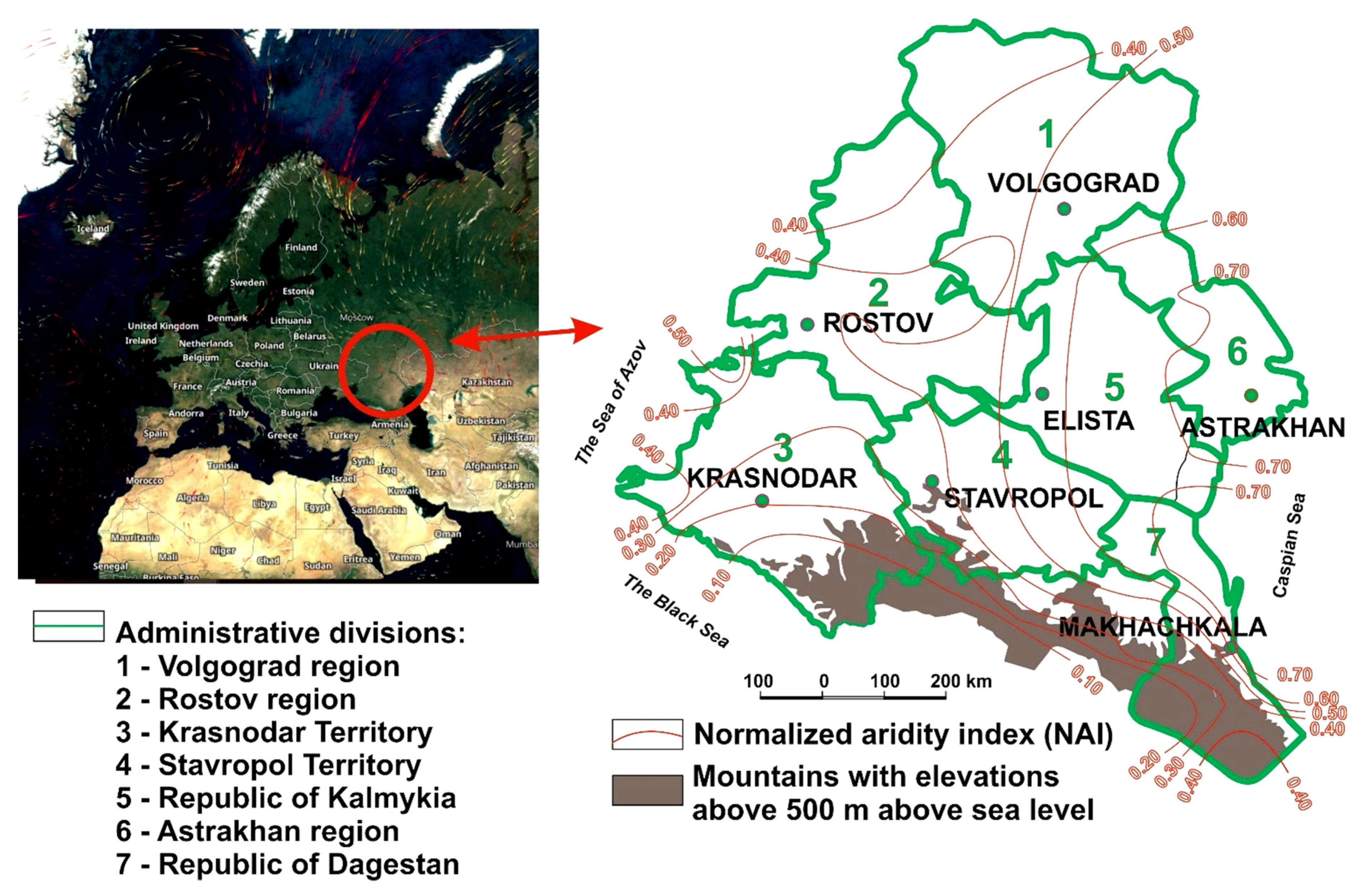
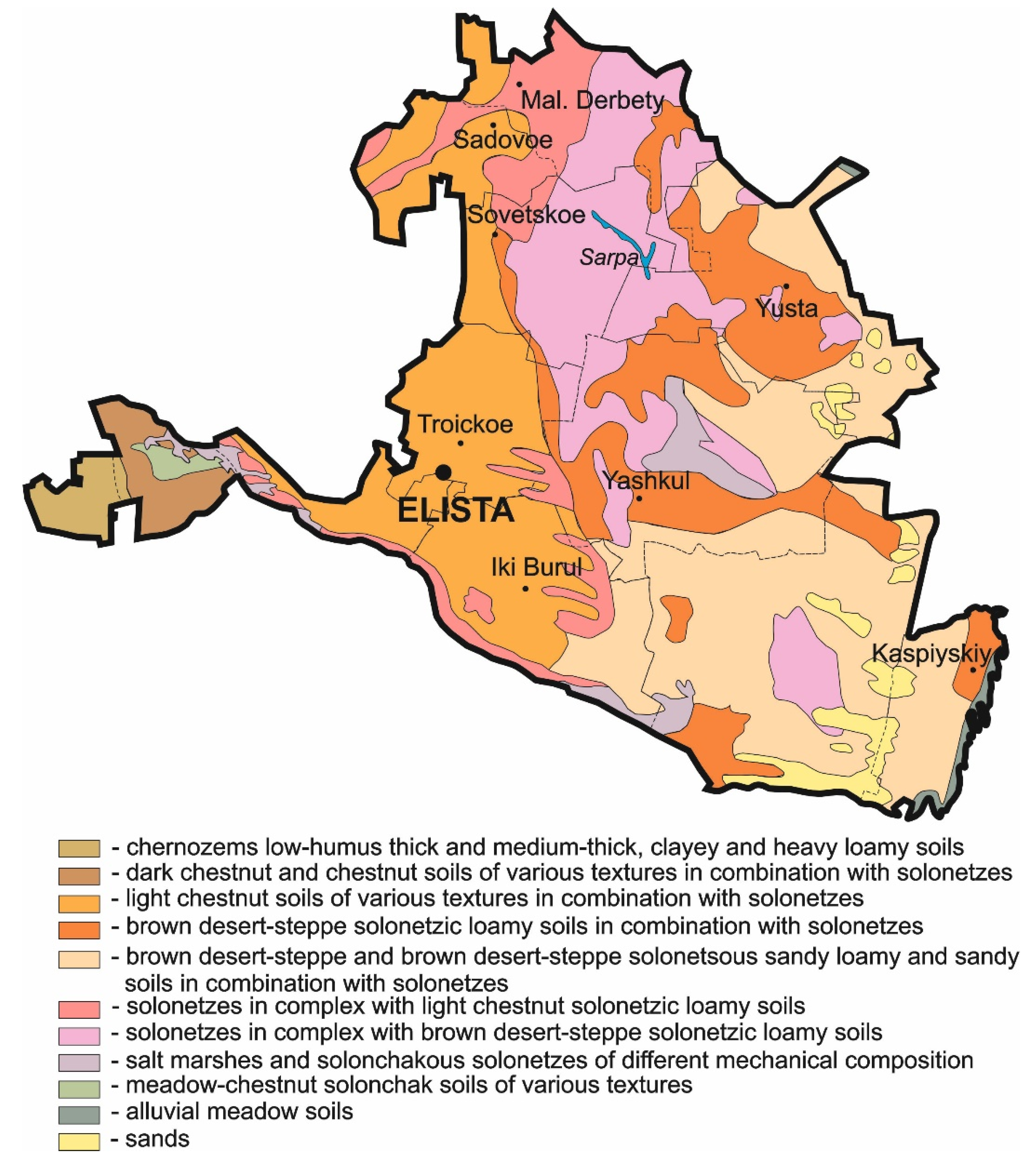
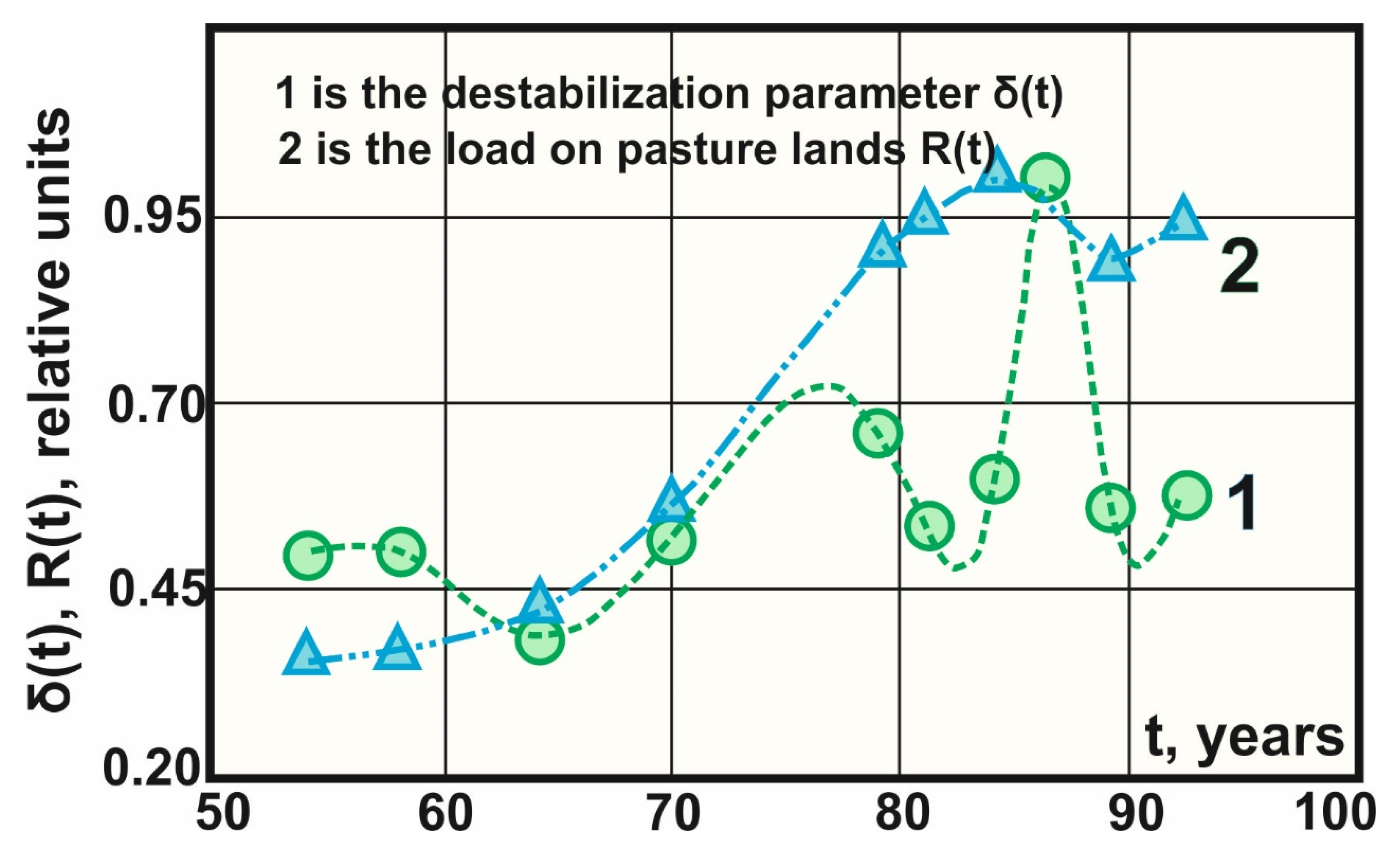
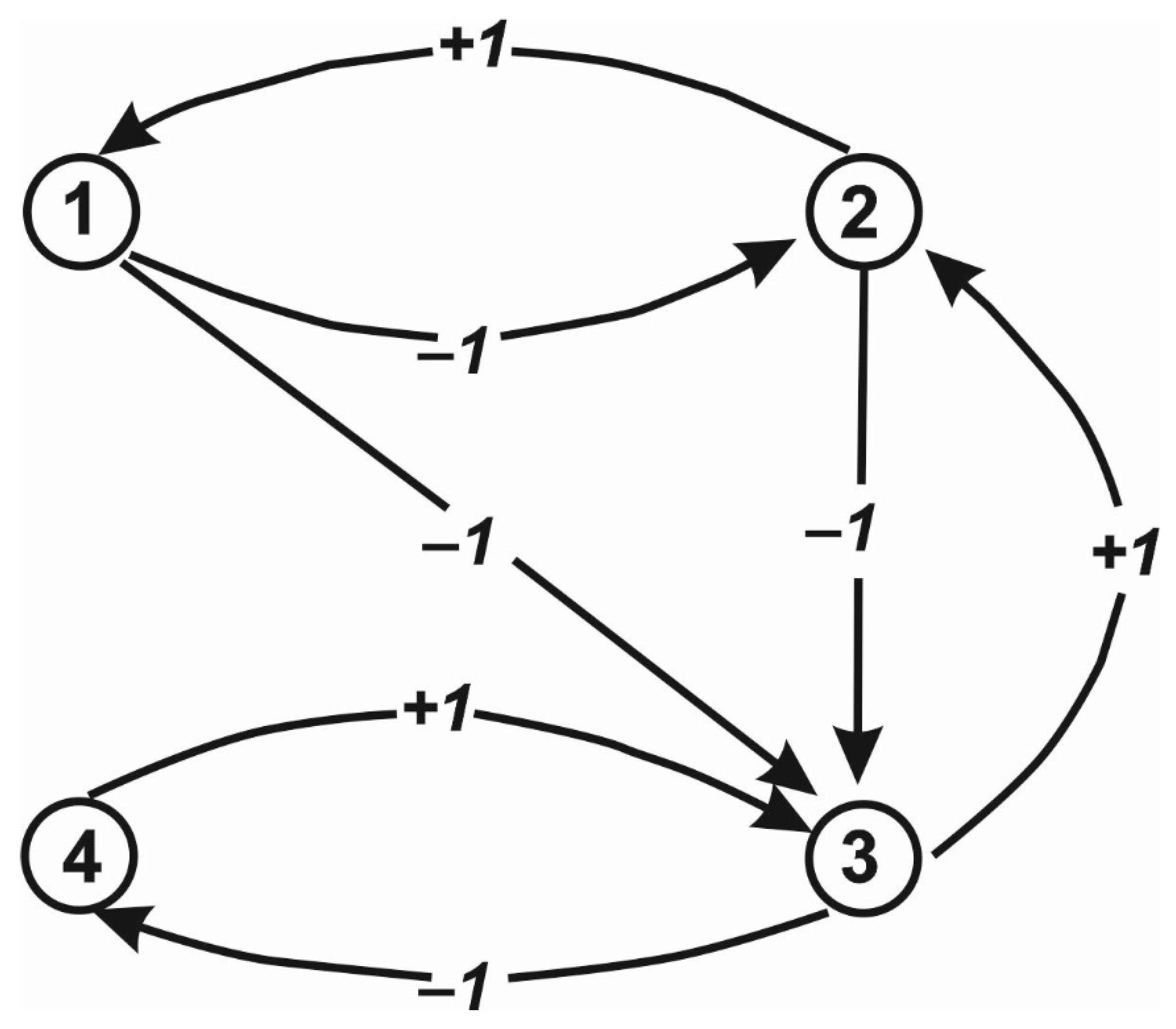

| Indicators | Western Part of the Territory | Central Part of the Territory | Eastern Part of the Territory |
|---|---|---|---|
| Average annual air temperature, °C | 9–10 | 8–10 | 9–10 |
| Sum of temperatures above 10 °C | 3200–3400 | 3200–3500 | 3500–3600 |
| Annual amount of precipitation, mm | 350 | 250–300 | 190–250 |
| Hydrothermal coefficient (according to Selyaninov) | 0.7–0.8 | 0.5–0.7 | 0.3–0.5 |
| Stocks of productive moisture in a meter layer of soil by the beginning of the growing season, mm | 130–140 | 70–80 | 30–40 |
| Number of dry wind days | 95–100 | 100–120 | 110–125 |
| Frost-free period (days) | 180–185 | 165–175 | 180–215 |
| including days with temperatures above 10 °C | 185 | 170–175 | 175–185 |
Publisher’s Note: MDPI stays neutral with regard to jurisdictional claims in published maps and institutional affiliations. |
© 2022 by the authors. Licensee MDPI, Basel, Switzerland. This article is an open access article distributed under the terms and conditions of the Creative Commons Attribution (CC BY) license (https://creativecommons.org/licenses/by/4.0/).
Share and Cite
Salugin, A.N.; Vlasenko, M.V. Mathematical Models of the Dynamic Stability of Arid Pasture Ecosystems in the South of Russia. Agronomy 2022, 12, 1448. https://doi.org/10.3390/agronomy12061448
Salugin AN, Vlasenko MV. Mathematical Models of the Dynamic Stability of Arid Pasture Ecosystems in the South of Russia. Agronomy. 2022; 12(6):1448. https://doi.org/10.3390/agronomy12061448
Chicago/Turabian StyleSalugin, Aleksandr Nikolaevich, and Marina Vladimirovna Vlasenko. 2022. "Mathematical Models of the Dynamic Stability of Arid Pasture Ecosystems in the South of Russia" Agronomy 12, no. 6: 1448. https://doi.org/10.3390/agronomy12061448
APA StyleSalugin, A. N., & Vlasenko, M. V. (2022). Mathematical Models of the Dynamic Stability of Arid Pasture Ecosystems in the South of Russia. Agronomy, 12(6), 1448. https://doi.org/10.3390/agronomy12061448

