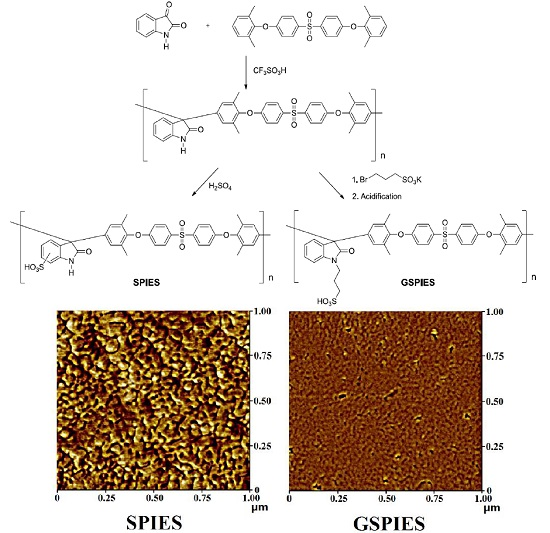
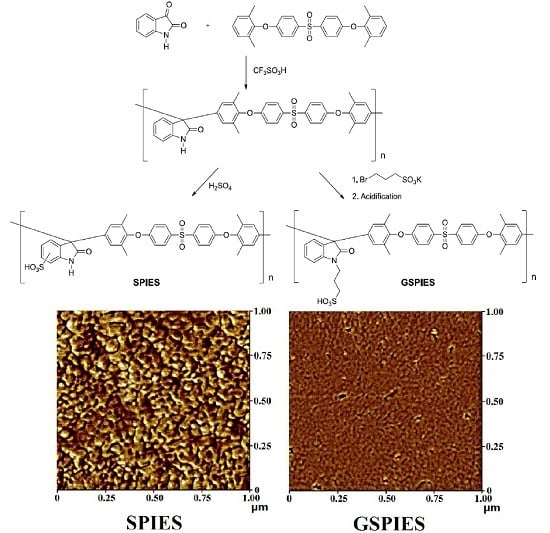
Studies of Grafted and Sulfonated Spiro Poly(isatin-ethersulfone) Membranes by Super Acid-Catalyzed Reaction

Abstract
Share and Cite
Jin, L.; Jang, H.; Yoo, J.; Ha, J.; Choi, K.; Ryu, T.; Lee, S.; Kim, W. Studies of Grafted and Sulfonated Spiro Poly(isatin-ethersulfone) Membranes by Super Acid-Catalyzed Reaction. Polymers 2016, 8, 114. https://doi.org/10.3390/polym8040114
Jin L, Jang H, Yoo J, Ha J, Choi K, Ryu T, Lee S, Kim W. Studies of Grafted and Sulfonated Spiro Poly(isatin-ethersulfone) Membranes by Super Acid-Catalyzed Reaction. Polymers. 2016; 8(4):114. https://doi.org/10.3390/polym8040114
Chicago/Turabian StyleJin, Lei, Hohyoun Jang, Jiho Yoo, Jaeseong Ha, Kunyoung Choi, Taewook Ryu, Sungkwun Lee, and Whangi Kim. 2016. "Studies of Grafted and Sulfonated Spiro Poly(isatin-ethersulfone) Membranes by Super Acid-Catalyzed Reaction" Polymers 8, no. 4: 114. https://doi.org/10.3390/polym8040114
APA StyleJin, L., Jang, H., Yoo, J., Ha, J., Choi, K., Ryu, T., Lee, S., & Kim, W. (2016). Studies of Grafted and Sulfonated Spiro Poly(isatin-ethersulfone) Membranes by Super Acid-Catalyzed Reaction. Polymers, 8(4), 114. https://doi.org/10.3390/polym8040114