Tensile Behavior of Carbon Fibers Impregnated with Thermoplastics Using Coextrusion Technique



Abstract
1. Introduction
2. Materials and Methods
2.1. Materials
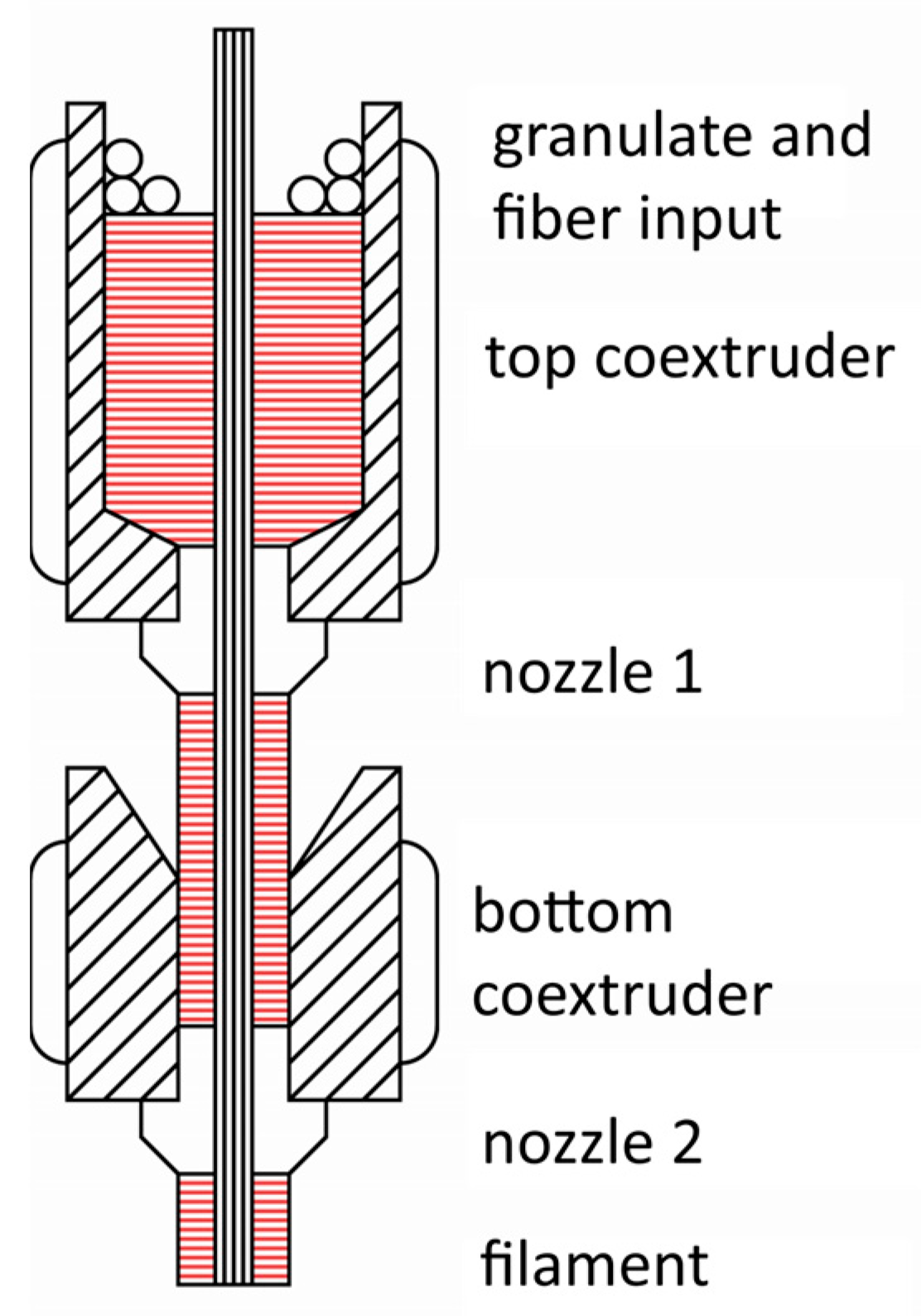
2.2. Preparation of Composite Filaments
- -
- PP H030 series, based on low-flow polypropylene grade H030, with a processing temperature of 220 °C;
- -
- PP H270 series, based on high-flow polypropylene grade H270, with a processing temperature of 220 °C;
- -
- EVA 28-40 (220) series, based on ethylene vinyl acetate copolymer grade 28–40, with a processing temperature of 220 °C;
- -
- EVA 28-40 (190) series based on ethylene vinyl acetate copolymer grade 28–40, with a processing temperature of 190 °C;
- -
- PP H270 50% EVA series based on a 1:1 blend of polypropylene H270 and ethylene vinyl acetate 28–40, with a processing temperature of 190 °C;
- -
- PP H270 25% EVA series based on a 3:1 blend of polypropylene H270 and ethylene vinyl acetate 28–40, with a processing temperature of 220 °C;
2.3. Investigation
3. Results and Discussion
4. Conclusions
Author Contributions
Funding
Institutional Review Board Statement
Data Availability Statement
Conflicts of Interest
References
- Koltsakidis, S.; Tzetzis, D. Review of the integration of fused filament fabrication with complementary methods for fabricating hierarchical porous polymer structures. Appl. Sci. 2025, 15, 9703. [Google Scholar] [CrossRef]
- Crapnell, R.D.; Bernalte, E.; Banks, C.E. Sustainable advancements in fused filament fabrication/fused deposition modelling additive manufacturing for electroanalysis. Green Chem. 2025, 28, 747–761. [Google Scholar] [CrossRef]
- Tao, Y.; Li, P.; Zhang, J.; Wang, S.; Shi, S.Q.; Kong, F. A review of fused filament fabrication of continuous natural fiber reinforced thermoplastic composites: Techniques and materials. Polym. Compos. 2023, 44, 8200–8222. [Google Scholar] [CrossRef]
- Kumar, S.; Singh, R.; Singh, T.P.; Batish, A. Fused filament fabrication: A comprehensive review. J. Thermoplast. Compos. Mater. 2023, 36, 794–814. [Google Scholar] [CrossRef]
- Fico, D.; Rizzo, D.; Casciaro, R.; Corcione, C.E. A review of polymer-based materials for fused filament fabrication (FFF): Focus on sustainability and recycled materials. Polymers 2022, 14, 465. [Google Scholar] [CrossRef]
- Dey, A.; Eagle, I.N.R.; Yodo, N. A review on filament materials for fused filament fabrication. J. Manuf. Mater. Process. 2021, 5, 69. [Google Scholar] [CrossRef]
- Pazhamannil, R.V.; Jishnu Namboodiri, V.N.; Govindan, P.; Edacherian, A. Property enhancement approaches of fused filament fabrication technology: A review. Polym. Eng. Sci. 2022, 62, 1356–1376. [Google Scholar] [CrossRef]
- Sola, A. Materials requirements in fused filament fabrication: A framework for the design of next-generation 3d printable thermoplastics and composites. Macromol. Mater. Eng. 2022, 307, 2200197. [Google Scholar] [CrossRef]
- Singh, S.; Singh, G.; Prakash, C.; Ramakrishna, S. Current status and future directions of fused filament fabrication. J. Manuf. Process. 2020, 55, 288–306. [Google Scholar] [CrossRef]
- Valino, A.D.; Dizona, J.R.C.; Espera, A.H., Jr.; Chena, Q.; Messmane, J.; Advinculaa, R.C. Advances in 3D printing of thermoplastic polymer composites and nanocomposites. Prog. Polym. Sci. 2019, 98, 101162. [Google Scholar] [CrossRef]
- Miao, Z.; Seo, J.; Hickner, M.A. Solvent-cast 3D printing of polysulfone and polyaniline composites. Polymer 2018, 152, 18–24. [Google Scholar] [CrossRef]
- Tian, X.; Liu, T.; Yang, C.; Wang, Q.; Li, D. Interface and performance of 3D printed continuous carbon fiber reinforced PLA composites. Compos. Part A Appl. Sci. Manuf. 2016, 88, 198–205. [Google Scholar] [CrossRef]
- Stepashkin, A.A.; Chukov, D.I.; Senatov, F.S.; Salimon, A.I.; Korsunsky, A.M.; Kaloshkin, S.D. 3D-printed PEEK-carbon fiber (CF) composites: Structure and thermal properties. Compos. Sci. Technol. 2018, 164, 319–326. [Google Scholar] [CrossRef]
- Fu, S.Y.; Feng, X.Q.; Lauke, B.; Mai, Y.W. Effects of particle size, particle/matrix interface adhesion and particle loading on mechanical properties of particulate–polymer composites. Compos. Part B Eng. 2008, 39, 933–961. [Google Scholar] [CrossRef]
- Nikzad, M.; Masood, S.; Sbarski, I. Thermo-mechanical properties of a highly filled polymeric composites for fused deposition modeling. Mater. Des. 2011, 32, 3448–3456. [Google Scholar] [CrossRef]
- Boparai, K.; Singh, R.; Singh, H. Comparison of tribological behaviour for Nylon6-Al-Al2O3 and ABS parts fabricated by fused deposition modelling: This paper reports a low cost composite material that is more wear-resistant than conventional ABS. Virtual Phys. Prototyp. 2015, 10, 59–66. [Google Scholar] [CrossRef]
- Joshua, R.N.; Sakthivel, A.R. Reinforced polymer composite filaments in fused deposition modeling of 3d printing technology: A review. Adv. Eng. Mater. 2025, 27, 2402509. [Google Scholar] [CrossRef]
- Jansson, A.; Pejryd, L. Characterization of carbon fibre-reinforced polyamide manufactured by selective laser sintering. Addit. Manuf. 2016, 9, 7–13. [Google Scholar]
- Wu, J.; Chen, H.; Wu, Q.; Liu, H.B.; Luo, Z.J. Surface modification of carbon fibers and the selective laser sintering of modified carbon fiber/nylon 12 composite powder. Mater. Design 2017, 116, 253–260. [Google Scholar]
- Guo, N.; Leu, M.C. Additive manufacturing: Technology, applications and research needs. Front. Mech. Eng. 2013, 8, 215–243. [Google Scholar] [CrossRef]
- Mo, C.; Jiang, Y.; Raney, J.R. Microstructural evolution and failure in short fiber soft composites: Experiments and modeling. J. Mech. Phys. Solids 2020, 141, 103973. [Google Scholar] [CrossRef]
- Huseynov, O.; Patterson, A.E.; Ali, M.A.; Gupta, A.; Gudavasov, S.; Mahmudov, M.; Hasanov, S.; Fidan, I. Critical review on short fiber-reinforced composite materials manufactured by material extrusion: From thermal perspective. Prog. Addit. Manuf. 2025, 10, 783–808. [Google Scholar] [CrossRef]
- Abualbandora, T.A.; Alshneeqat, M.G.; Mourad, A.-H.I. Impact of 3D printing parameters of short carbon fiber reinforced polymer CFRP on the mechanical and failure performance: Review and future perspective. Next Mater. 2025, 8, 100645. [Google Scholar] [CrossRef]
- Adumitroaie, A.; Antonov, F.; Khaziev, A.; Azarov, A.; Golubev, M.; Vasiliev, V. Novel continuous fiber bi-matrix composite 3-D printing technology. Materials 2019, 12, 3011. [Google Scholar] [CrossRef] [PubMed]
- Luo, M.; Tian, X.; Shang, J.; Zhu, W.; Li, D.; Qin, Y. Impregnation and interlayer bonding behaviours of 3D-printed continuous carbon-fiber-reinforced poly-ether-ether-ketone composites. Compos. Part A Appl. Sci. Manuf. 2019, 121, 130–138. [Google Scholar] [CrossRef]
- Wu, Y.; Wang, K.; Neto, V.; Peng, Y.; Valente, R.; Ahzi, S. Interfacial behaviors of continuous carbon fiber reinforced polymers manufactured by fused filament fabrication: A review and prospect. Int. J. Mater. Form. 2022, 15, 18. [Google Scholar] [CrossRef]
- Cai, H.; Chen, Y. A review of print heads for fused filament fabrication of continuous carbon fiber-reinforced composites. Micromachines 2024, 15, 432. [Google Scholar] [CrossRef]
- Zhang, Y.; Zheng, W.; Wang, Y.; Ma, K.; Feng, X.; Ji, Q.; Guo, W.; Lu, B. A review of 3D printing continuous carbon fiber reinforced thermoplastic polymers: Materials, processes, performance enhancement, and failure analysis. Polym. Compos. 2025, 46, 12619–12649. [Google Scholar] [CrossRef]
- Zhang, Z.; Hu, C.; Qin, Q.-H. The improvement of void and interface characteristics in fused filament fabrication-based polymers and continuous carbon fiber-reinforced polymer composites: A comprehensive review. Int. J. Adv. Manuf. Technol. 2025, 137, 1047–1087. [Google Scholar] [CrossRef]
- Xian, G.; Qi, X.; Shi, J.; Tian, J.; Xiao, H. Toughened and self-healing carbon nanotube/epoxy resin composites modified with polycaprolactone filler for coatings, adhesives and FRP. J. Build. Eng. 2025, 111, 113207. [Google Scholar] [CrossRef]
- Wang, Z.; Xian, G. Coupling effects of elevated temperature-prestress on the tensile properties of pultruded CFRP rods. J. Build Eng. 2025, 113, 114069. [Google Scholar] [CrossRef]
- Babu, N.; Massou, M.; Li, C.; Xiao, H.; Xian, G. Impact of Epoxy Resin Modification Using a Tannic Acid-Based Additive on Hydrothermal Durability of Carbon Fiber Reinforced Polymers. J. Appl. Polym. Sci. 2026, 143, e70154. [Google Scholar] [CrossRef]
- van de Werken, N.; Hurley, J.; Khanbolouki, P.; Sarvestani, A.N.; Tamijani, A.Y.; Tehrani, M. Design considerations and modeling of fiber reinforced 3D printed parts. Compos. Part B Eng. 2019, 160, 684–692. [Google Scholar] [CrossRef]
- Dickson, A.N.; Barry, J.N.; McDonnell, K.A.; Dowling, D.P. Dowling Fabrication of continuous carbon, glass and Kevlar fibre reinforced polymer composites using additive manufacturing. Addit. Manuf. 2017, 16, 146–152. [Google Scholar]
- Justo, J.; Tavara, L.; Garcia-Guzman, L.; Paris, F. Characterization of 3D printed long fibre reinforced composites. Compos. Struct. 2018, 185, 537–548. [Google Scholar] [CrossRef]
- Le Duigou, A.; Grabow, M.; Castro, M.; Toumi, R.; Ueda, M.; Matsuzaki, R.; Hirano, Y.; Dirrenberge, J.; Scarpa, F.; D’Elia, R.; et al. Thermomechanical performance of continuous carbon fibre composite materials produced by a modified 3D printer. Heliyon 2023, 9, e13581. [Google Scholar] [CrossRef]
- Távara, L.; Madrigal, C.; Aranda, M.T.; Justo, J. Anisotropy and ageing effect on the mechanical behaviour of 3D-printed short carbon-fibre composite parts. Compos. Struct. 2023, 321, 117196. [Google Scholar] [CrossRef]
- Li, L.; Liu, W.; Sun, L. Mechanical characterization of 3D printed continuous carbon fiber reinforced thermoplastic composites. Compos. Sci. Technol. 2022, 227, 109618. [Google Scholar] [CrossRef]
- Memarzadeh, A.; Safaei, B.; Tabak, A.; Sahmani, S.; Kizilors, C. Advancements in additive manufacturing of polymer matrix composites: A systematic review of techniques and properties. Mater. Today Commun. 2023, 36, 106449. [Google Scholar] [CrossRef]
- Yi, J.; Deng, B.; Peng, F.; Xie, X.; Yan, A.; Li, Z.; Yan, R.; Shen, R. Mechanistic study of fiber damage evolution in 3D printing of two-matrix continuous carbon fiber-reinforced composites based on electrical conductivity changes. Addit. Manuf. 2025, 107, 104826. [Google Scholar] [CrossRef]
- Rashvand, K.; Eder, M.A.; Sarhadi, A. In-situ and adhesive repair of continuous fiber composites using 3D printing. Addit. Manuf. 2024, 80, 103975. [Google Scholar] [CrossRef]
- Cheng, P.; Han, Z.; Chen, Y.; Ye, L. Recent progress in non-planar 3D printing of continuous fiber-reinforced composites. Compos. Part A Appl. Sci. Manuf. 2025, 194, 108900. [Google Scholar] [CrossRef]
- Matsuzaki, R.; Ueda, M.; Namiki, M.; Jeong, T.K.; Asahara, H.; Horiguchi, K.; Nakamura, T.; Todoroki, A.; Hirano, Y. Three-dimensional printing of continuous-fiber composites by in-nozzle impregnation. Sci. Rep. 2016, 6, 23058. [Google Scholar] [CrossRef]
- Li, N.; Li, Y.; Liu, S. Rapid prototyping of continuous carbon fiber reinforced polylactic acid composites by 3D printing. J. Mater. Process. Technol. 2016, 238, 218–225. [Google Scholar] [CrossRef]
- Bhushan, B.; Caspers, M. An overview of additive manufacturing (3D printing) for microfabrication. Microsyst. Technol. 2017, 23, 1117–1124. [Google Scholar] [CrossRef]
- Goodarzi, V.; Jafari, S.H.; Khonakdar, H.A.; Monemian, S.A.; Mortazavi, M. An assessment of the role of morphology in thermal/thermo-oxidative degradation mechanism of PP/EVA/clay nanocomposites. Polym. Degrad. Stab. 2010, 95, 859–869. [Google Scholar] [CrossRef]
- Valera-Zaragoza, J.M.; Rivas-Vázquez, L.P.; Ramírez-Vargas, E.; Sánchez-Valdes, S.; Ramos-deValle, L.F.; Medellín-Rodríguez, F.J. Influence of morphology on the dynamic mechanical characteristics of PP-EP/EVA/organoclay nanocomposites. Compos. Part B Eng. 2013, 55, 506–512. [Google Scholar] [CrossRef]
- Slonov, A.; Musov, I.; Zhansitov, A.; Khashirov, A.; Tlupov, A.; Musov, K.; Rzhevskaya, I.; Fomicheva, I.; Potapov, A.; Khashirova, S. Investigation of the properties of polyethylene and ethylene-vinyl acetate copolymer blends for 3d printing applications. Polymers 2023, 15, 4129. [Google Scholar] [CrossRef] [PubMed]
- Stepashkin, A.A.; Tcherdyntsev, V.V.; Odintsova, Y.V. Structure and mechanical behavior of carbon yarns impregnated with polypropylene and ethylene-vinyl acetate using 3D printing aimed sequential extruders system. Polymers 2026. submitted. [Google Scholar]
- ASTM D 4018-23; Standard Test Methods for Properties of Continuous Filament Carbon and Graphite Fiber Tows. ASTM International: West Conshohocken, PA, USA, 2023.
- ISO 10618:2004; Carbon Fibre—Determination of Tensile Properties of Resin-Impregnated Yarn. ISO: Geneva, Switzerland, 2004.
- ISO 291:2008; Plastics—Standard Atmospheres for Conditioning and Testing. ISO: Geneva, Switzerland, 2008.
- ISO 11357-1:2023; Plastics—Differential Scanning Calorimetry (DSC). Part 1: General Principles. ISO: Geneva, Switzerland, 2023.
- ISO 11357-3:2025; Plastics—Differential Scanning Calorimetry (DSC). Part 3: Determination of Temperature and Enthalpy of Melting and Crystallization. ISO: Geneva, Switzerland, 2025.
- Stepashkin, A.A.; Chavhan, S.; Gromov, S.V.; Khanna, A.; Tcherdyntsev, V.V.; Gupta, D.; Mohammad, H.; Medvedeva, E.V.; Gupta, N.; Alexandrova, S.S. ANN-based structure peciliaties evaluation of polymer composite reinforced with unidirectional carbon fiber. Alex. Eng. J. 2023, 82, 218–239. [Google Scholar] [CrossRef]
- Mihailova, M.; Kresteva, M.; Aivazova, N.; Krestev, V.; Nedkov, E. X-ray investigation of polypropylene and poly(ethylene-co vinyl acetate) blends irradiated with fast electrons WAXS investigation of irradiated i-PP/EVA blends. Radiat. Phys. Chem. 1999, 56, 581–589. [Google Scholar] [CrossRef]
- Dikobe, D.G.; Luyt, A.S. Morphology and properties of polypropylene/ethylene vinyl acetate copolymer/wood powder blend composites. Express Polym. Lett. 2009, 3, 190–199. [Google Scholar] [CrossRef]
- Huerta-Martinez, B.M.; Ramirez-Vargas, E.; Medellin-Rodrequez, F.J.; Garcia, R.C. Compatibility mechanisms between EVA and complex impact heterophasic PP-EPx copolymers as a function of EP content. Eur. Polym. J. 2005, 41, 519–525. [Google Scholar] [CrossRef]
- Stepashkin, A.A.; Mohammad, H.; Makarova, E.D.; Odintsova, Y.V.; Laptev, A.I.; Tcherdyntsev, V.V. Deformation Behavior of Single Carbon Fibers Impregnated with Polysulfone by Polymer Solution Method. Polymers 2023, 15, 570. [Google Scholar] [CrossRef]
- Stepashkin, A.A.; Makarova, E.D.; Mohammad, H.; Tcherdyntsev, V.V. Development of deformations in unidirectional carbon fiber—Thermoplastic matrix composite materials under long-term and cyclic loads. Polym. Compos. 2025, 46, S148–S165. [Google Scholar] [CrossRef]



| Polymer | PP H030 | PP H270 | EVA 28-40 | |
|---|---|---|---|---|
| Melting peak point. °C | 166.7 ± 0.2 | 162.7 ± 0.3 | 67.1 ± 0.2 | |
| Crystallization peak point. °C | 113.2 ± 0.3 | 120.2 ± 0.3 | 48.2 ± 0.3 | |
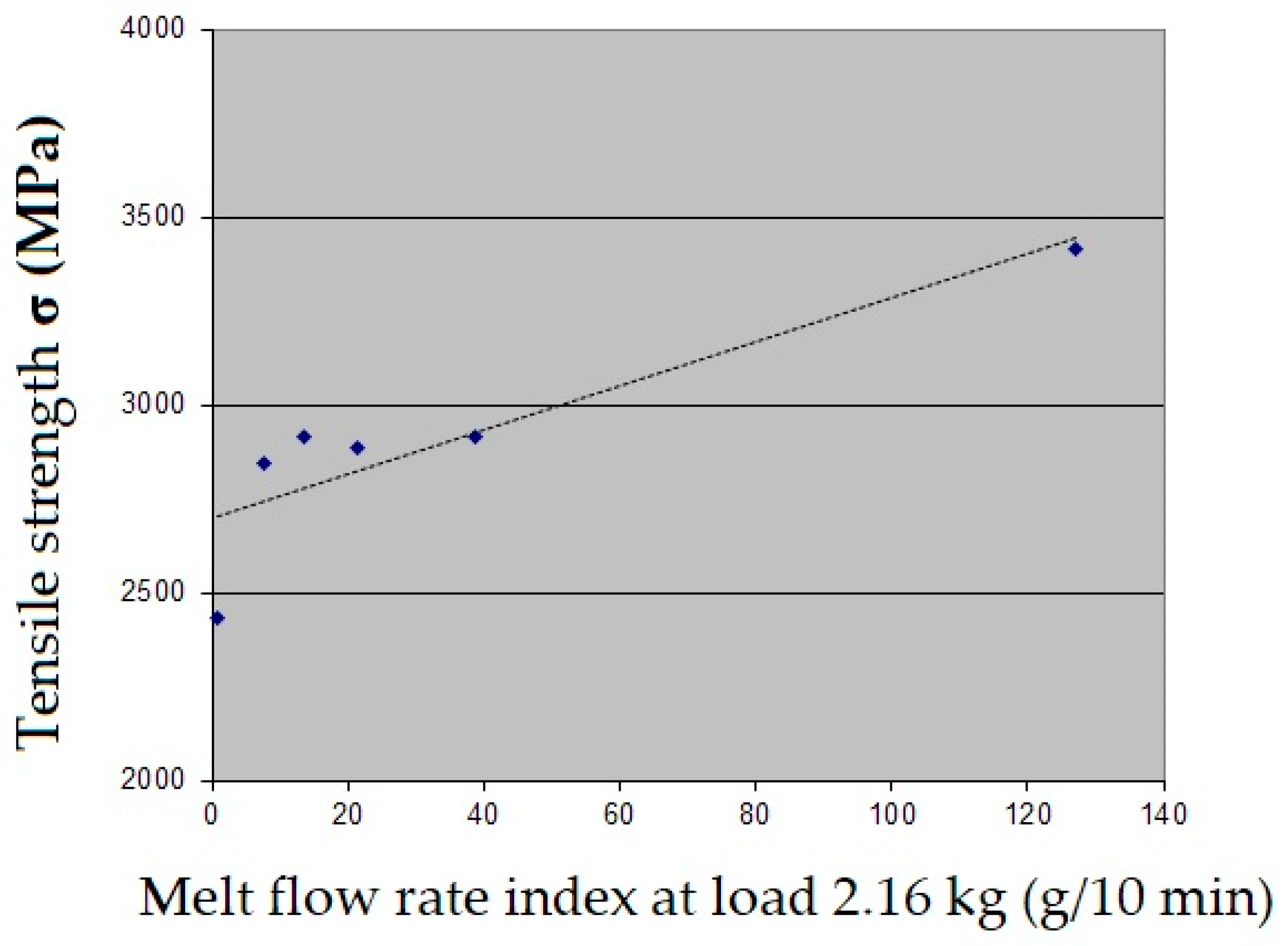
| Melt flow rate index. MVR g/10 min (load 2.16 kg) at temperature: | 190 °C | 0.9 ± 0.2 | 7.7 ± 0.3 | 38.9 ± 0.6 |
| 230 °C | 2.8 ± 0.2 | 27.6 ± 0.2 | 127 ± 3.3 | |
| Matrix Polymer | E, GPa | σ, MPa | ε, % | X, % wt. % | P, % |
|---|---|---|---|---|---|
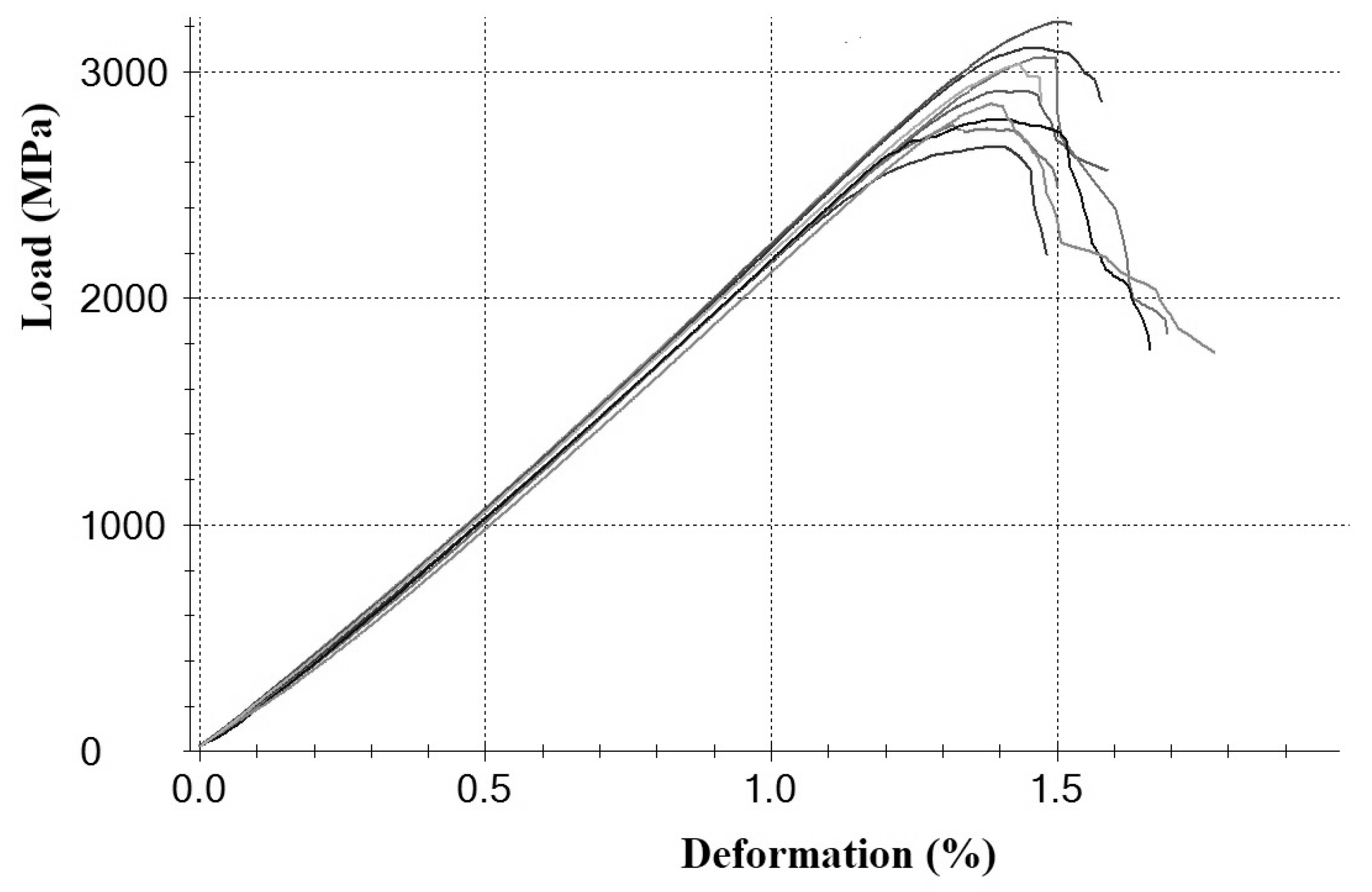
| PP H030 GP (extruded at 190 °C) | 228 ± 2.7 | 2432 ± 165 | 1.16 ± 0.05 | 73.2 ± 1.7 | 11.3 ± 0.4 |
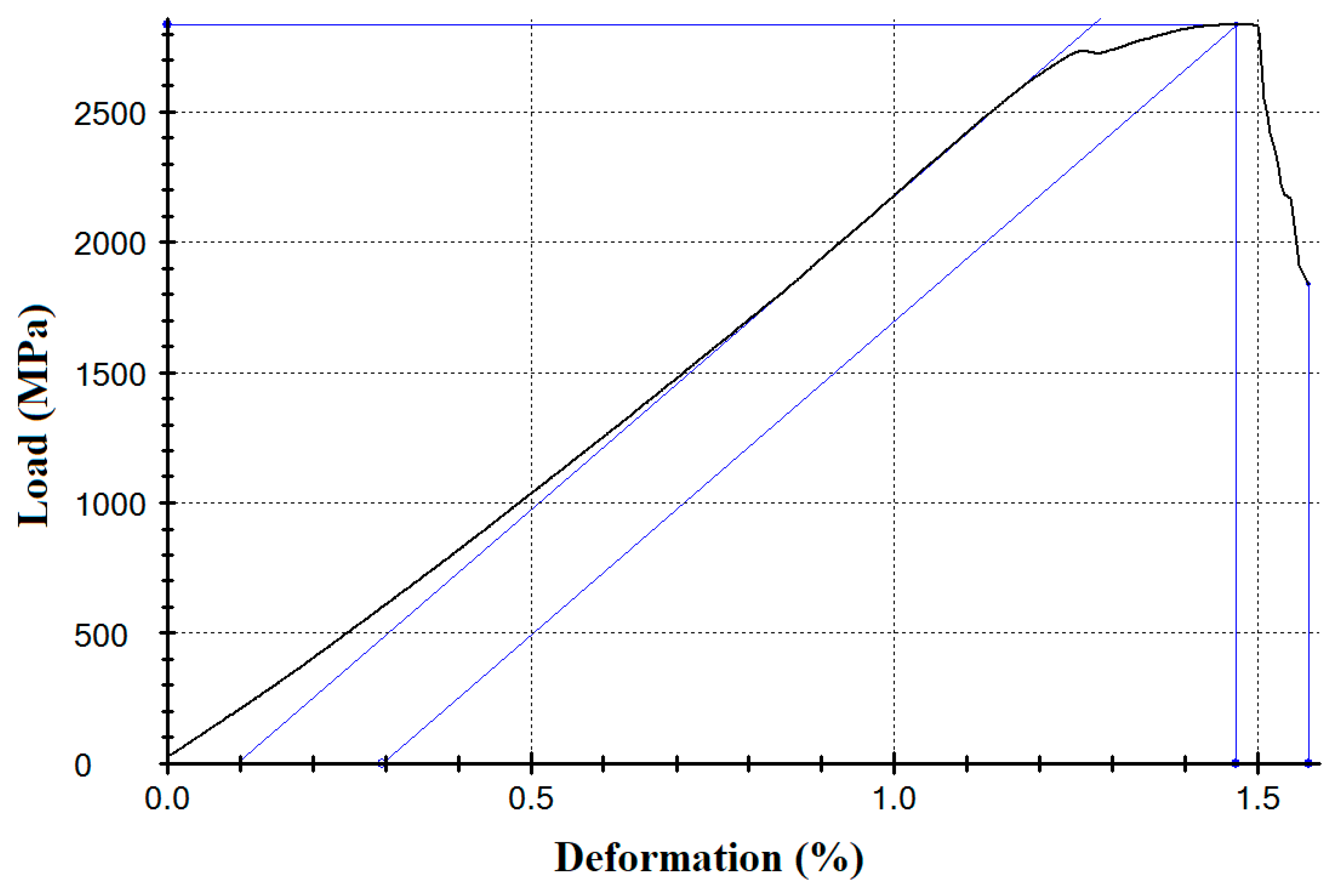
| PP H270 FF (extruded at 190 °C) | 225 ± 1.7 | 2846 ± 243 | 1.49 ± 0.12 | 76.2 ± 0.9 | 13.5 ± 0.5 |
| EVA 28-40 (extruded at 220 °C) | 230 ± 2.5 | 3414 ± 176 | 1.58 ± 0.10 | 70.5 ± 1.3 | 12.3 ± 0.4 |
| EVA 28-40 (extruded at 190 °C) | 221 ± 1.3 | 2916 ± 137 | 1.38 ± 0.07 | 80.1 ± 0.9 | 11.7 ± 0.6 |
| PP H270 FF/EVA 28-40 blend 50/50 (extruded at 190 °C) | 220 ± 2.1 | 2884 ± 159 | 1.41 ± 0.11 | 79.1 ± 1.0 | 13.4 ± 0.3 |
| PP H270 FF/EVA 28-40 blend 75/25 (extruded at 190 °C) | 224 ± 2.4 | 2916 ± 151 | 1.39 ± 0.10 | 81.2 ± 1.1 | 11.8 ± 0.5 |
Disclaimer/Publisher’s Note: The statements, opinions and data contained in all publications are solely those of the individual author(s) and contributor(s) and not of MDPI and/or the editor(s). MDPI and/or the editor(s) disclaim responsibility for any injury to people or property resulting from any ideas, methods, instructions or products referred to in the content. |
© 2026 by the authors. Licensee MDPI, Basel, Switzerland. This article is an open access article distributed under the terms and conditions of the Creative Commons Attribution (CC BY) license.
Share and Cite
Tcherdyntsev, V.V.; Stepashkin, A.A.; Veveris, A.A. Tensile Behavior of Carbon Fibers Impregnated with Thermoplastics Using Coextrusion Technique. Polymers 2026, 18, 651. https://doi.org/10.3390/polym18050651
Tcherdyntsev VV, Stepashkin AA, Veveris AA. Tensile Behavior of Carbon Fibers Impregnated with Thermoplastics Using Coextrusion Technique. Polymers. 2026; 18(5):651. https://doi.org/10.3390/polym18050651
Chicago/Turabian StyleTcherdyntsev, Victor V., Andrey A. Stepashkin, and Alnis A. Veveris. 2026. "Tensile Behavior of Carbon Fibers Impregnated with Thermoplastics Using Coextrusion Technique" Polymers 18, no. 5: 651. https://doi.org/10.3390/polym18050651
APA StyleTcherdyntsev, V. V., Stepashkin, A. A., & Veveris, A. A. (2026). Tensile Behavior of Carbon Fibers Impregnated with Thermoplastics Using Coextrusion Technique. Polymers, 18(5), 651. https://doi.org/10.3390/polym18050651