1. Introduction
The development of nanoparticles represents one of the most important advances in modern nanotechnology, bridging fundamental science with diverse industrial, environmental, and biomedical applications [
1]. Over the past decade, considerable attention has been directed toward nanoparticles composed of elements such as copper, selenium, zinc, and titanium because of their distinctive physicochemical and biological properties [
2,
3]. More recently, research has shifted from the synthesis of single-component nanoparticles toward the design of multifunctional nano-systems with controlled surface characteristics, improved stability, and enhanced biological performance. It is important to note that the discussion presented herein focuses specifically on inorganic nanoparticles, including elemental selenium nanoparticles, as well as their hybrid organic-inorganic nanocomposite systems. Surface modification with polymers, natural biomolecules, or bioactive ligands can improve nanoparticle dispersibility, biocompatibility, targeting ability, and interaction with biological systems, thereby increasing their usefulness in drug delivery, antimicrobial therapy, tissue repair, and other biomedical applications. In this context, hybrid nanocomposites that integrate organic and inorganic components have demonstrated improved functional performance in several fields, including wastewater treatment, catalysis, tissue engineering, and biomedical material development [
4,
5,
6,
7].
Within the category of inorganic nanomaterials, selenium nanoparticles (Se NPs) have attracted substantial interest because selenium is an essential trace element involved in antioxidant defense, immune regulation, redox balance, and cellular homeostasis [
8]. Compared with conventional selenium forms, Se NPs are generally considered to have improved bioavailability, higher biological activity, and a wider safety margin, making them promising candidates for dietary, antioxidant, and biomedical applications. Over the past ten years, Se NPs have been successfully explored as antioxidant agents, nutritional supplements, and diagnostic or therapeutic nanomaterials with reduced toxicity compared with selenium salts. However, conventional commercial approaches for producing inorganic Se NPs often require complex procedures, harsh reaction conditions, high pressure, elevated temperature, or chemical reducing agents that may raise environmental and safety concerns [
9,
10]. These limitations have encouraged the development of greener and more sustainable synthesis strategies capable of controlling nanoparticle size, morphology, stability, and biological activity.
Green synthesis approaches have emerged as attractive alternatives for producing metal and metalloid nanoparticles under milder and more environmentally compatible conditions [
11]. Several biological systems and natural molecules, including bacteria, fungi, yeast, and biomolecules, have been used to reduce toxic metal ions into nanoscale particles with defined size and morphology [
5,
9]. Such approaches can reduce the need for hazardous reagents while simultaneously improving nanoparticle stabilization through naturally derived functional groups. In particular, ascorbic acid is a biocompatible reducing agent with antioxidant properties, making it suitable for the eco-friendly preparation of selenium-based nanostructures [
12]. Its use may also contribute to nanoparticle stabilization by participating in surface interactions during nanoparticle formation.
Selenium nanoparticles are especially promising in biomedical research because of their strong antioxidant activity, relatively low toxicity, and ability to modulate biological pathways involved in oxidative stress, inflammation, microbial survival, and cancer progression [
13,
14]. Several studies have reported that Se NPs exhibit anticancer effects against different tumor types, further supporting their therapeutic relevance [
10]. For example, Ren et al. [
15] evaluated the anticancer effect of Se/HA nanoparticles with a mean size of 50–70 nm in a Heps tumor mouse model and reported a significant reduction in tumor weight compared with the model control group (
p < 0.05). Hyaluronic acid-modified selenium nanoparticles have also been shown to enhance hepatocellular carcinoma treatment by improving transfection efficiency and cytotoxic activity both in vitro and in vivo. Similarly, Se/HA/PEI nanoparticles have been prepared and evaluated in HepG2 cells and in vivo models [
16]. These findings highlight the therapeutic value of combining selenium nanoparticles with biologically active polymers to improve targeting, cellular interaction, and functional efficacy.
Hyaluronic acid (HA) is a naturally occurring biopolymer with excellent biocompatibility, biodegradability, water retention capacity, and biological relevance in tissue repair and extracellular matrix organization [
17]. Because HA can interact with CD44 receptors, which are frequently overexpressed in several cancer cells and inflammatory tissues, it is widely used as a functional coating or carrier in targeted nanomedicine [
18]. HA modification can improve nanoparticle stability, cellular uptake, and biological selectivity while also supporting wound-healing and tissue-regenerative processes. The Se/HA NPs prepared by direct reduction of seleninic acid in the presence of HA showed strong free-radical scavenging activity and efficient astrocyte internalization through CD44 receptor-mediated interaction [
19]. These findings suggest that HA-functionalized Se NPs may provide a biologically favorable platform for developing multifunctional therapeutic nanomaterials.
Several biopolymers have been explored for the conjugation of selenium nanoparticles, including chitosan, alginate, gelatin, and hyaluronic acid [
15,
16,
19]. Among these, hyaluronic acid (HA) was selected in the present study for multiple reasons. First, HA exhibits exceptional biocompatibility and biodegradability, as it is a natural component of the extracellular matrix. Second, HA can specifically bind to CD44 receptors, which are overexpressed on various cancer cells and inflamed tissues, enabling targeted drug delivery. Third, HA possesses inherent wound-healing and anti-inflammatory properties that can synergize with the bioactivity of selenium. Previous studies have reported Se/HA nanocomposites prepared by different methods. For instance, Ren et al. [
15] synthesized Se/HA nanoparticles using sodium selenite and HA under acidic conditions, achieving particles of 50–70 nm with antitumor activity. Luo et al. [
19] prepared HA-functionalized Se NPs for spinal cord injury repair via CD44-mediated internalization. However, most reported methods require harsh conditions or complex procedures.
Despite these advances, limited studies have investigated eco-friendly Se/HA nanoconjugates as integrated multifunctional agents with simultaneous anticancer, antimicrobial, antifungal, anti-inflammatory, and wound-healing activities. This gap is particularly important because cancer, chronic wounds, inflammation, and multidrug-resistant microbial infections are often interconnected clinical challenges that require therapeutic materials with broad biological functionality. Therefore, developing a simple, green, and biologically active Se/HA nanocomposite may provide a promising approach for biomedical applications where antimicrobial protection, inflammation control, tissue repair, and anticancer activity are needed within a single nanosystem.
In the present study, selenium/hyaluronic acid nanocomposites (Se/HA) were synthesized using vitamin C, also known as ascorbic acid, as an eco-friendly reducing and stabilizing agent. The physicochemical characteristics of the synthesized Se/HA nanocomposites, including morphology, elemental composition, functional groups, and crystallinity, were investigated using advanced analytical techniques. The biological performance of the nanocomposites was then evaluated against multidrug-resistant bacteria, Candida albicans, and MG63 osteosarcoma cells. In addition, the anti-inflammatory and wound-healing properties of HA and Se/HA were assessed to determine whether hyaluronic acid conjugation could enhance the therapeutic potential of selenium-based nanomaterials. By integrating green synthesis, HA-mediated functionalization, and multiple biomedical assays, this study aims to introduce Se/HA nanoconjugates as a sustainable and multifunctional nanoplatform with promising potential for antimicrobial protection, cancer therapy, inflammation modulation, and tissue repair. The advantages of the proposed Se/HA nanostructures over existing systems include: (i) a green, one-pot synthesis using ascorbic acid as a biocompatible reducing agent, thereby avoiding toxic chemicals; (ii) well-controlled spherical morphology with a narrow size distribution of 29.7–80.4 nm; (iii) high colloidal stability, as indicated by a zeta potential of −32.7 mV; (iv) multifunctional bioactivity, including anticancer, antimicrobial, anti-inflammatory, and wound-healing effects, within a single nanoplatform; and (v) high yield of 86.5% under mild aqueous conditions. These features make the Se/HA NPs a more sustainable and versatile alternative to previously reported systems.
3. Results and Discussion
3.1. Morphological Characterization of Se/HA Nanoparticles
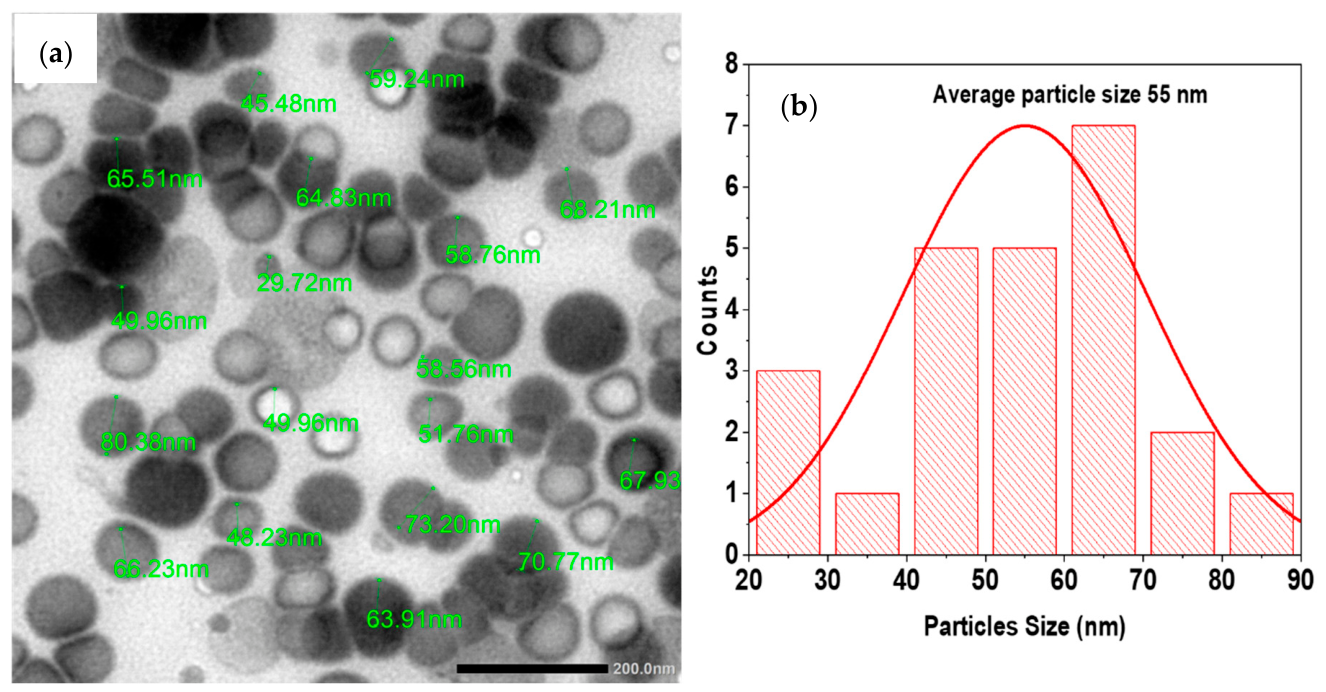
The synthesized Se/HA nanoparticles were characterized using TEM, EDX, XRD, and FTIR to confirm their morphology, elemental composition, crystalline structure, and surface functionalization. TEM analysis revealed that the Se/HA nanoparticles were predominantly monodisperse and spherical, with particle sizes ranging from 29.72 to 80.38 nm and an average size of approximately 55 nm (
Figure 1a,b). The hydrodynamic properties of Se/HA NPs were further characterized by DLS. The average hydrodynamic diameter was determined to be 68.4 ± 4.2 nm, which was slightly larger than the TEM-derived size of approximately 55 nm, likely due to the hydration layer and the presence of the HA corona surrounding the nanoparticles. The polydispersity index (PDI) was measured as 0.21 ± 0.03, indicating a moderately narrow size distribution and good colloidal homogeneity. Zeta potential analysis revealed a negative surface charge of −32.7 ± 2.8 mV for Se/HA NPs. This negative zeta potential is attributed to the abundant carboxylate (−COO
−) and hydroxyl (−OH) groups of hyaluronic acid on the nanoparticle surface. The measured magnitude of the zeta potential (>30 mV) suggests good electrostatic stabilization, which helps prevent nanoparticle aggregation and enhances colloidal stability in aqueous media.
The nanoparticles were prepared through a simple reduction approach in which water-soluble ascorbic acid acted as a reducing and stabilizing agent, while HA served as a capping matrix that supported nanoparticle formation and minimized aggregation. This protective role of HA is particularly important because polymeric capping can improve colloidal stability and maintain nanoscale particle distribution by preventing uncontrolled particle growth and agglomeration [
28]. TEM images further suggested the formation of a core–shell-like structure, indicating successful association between selenium and the HA coating (
Figure 1a). Comparable findings have been reported by Zhang et al. [
29], who synthesized selenium nanoparticles from sodium selenite using gum arabic (a tree gum) as a stabilizer and obtained particles with an average diameter of 70.9 nm. Collectively, these findings demonstrate that the ascorbic acid-assisted synthesis strategy, combined with HA capping, produced stable, spherical, nanosized Se/HA particles with a core–shell morphology, providing a structurally controlled nanoplatform that supports the novelty of this study and its relevance for multifunctional biomedical applications.
3.2. Elemental Composition and Crystalline Structure of Se/HA Nanoparticles
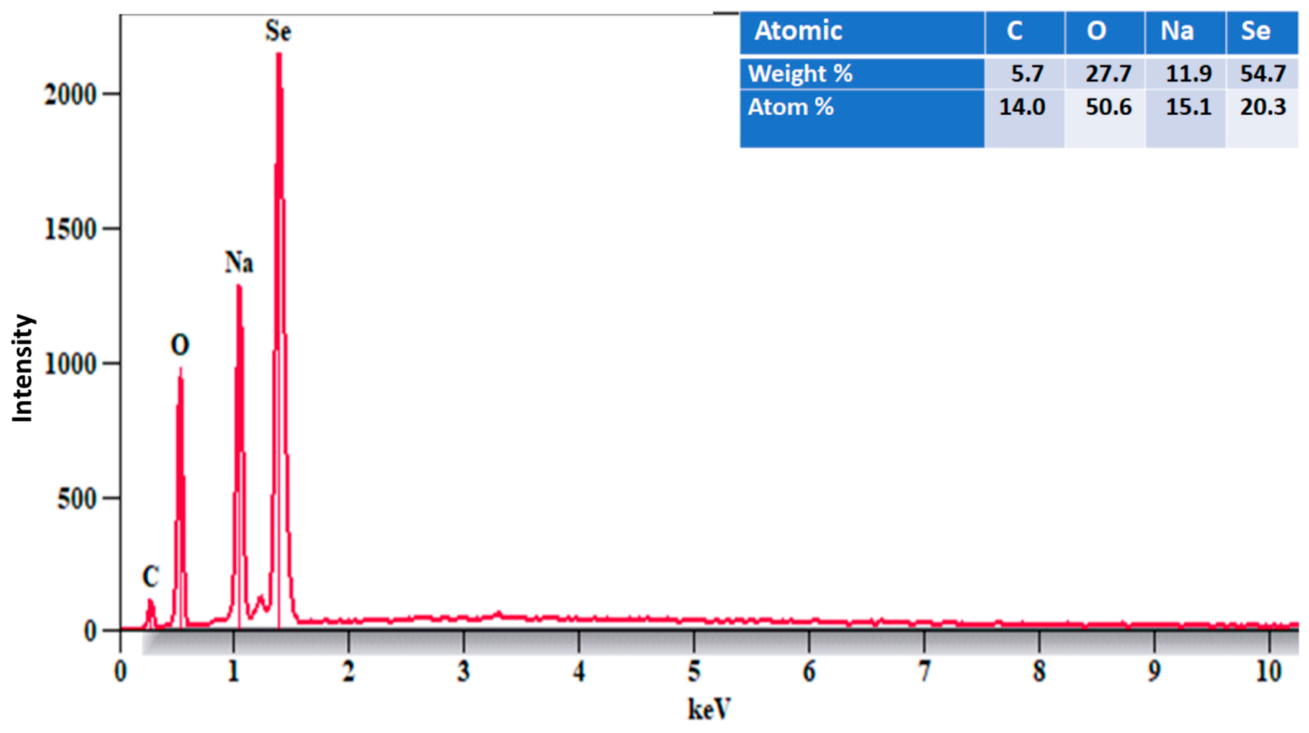
Energy-dispersive X-ray spectroscopy analysis confirmed the elemental composition of the synthesized Se/HA nanoparticles. As shown in
Figure 2, the EDX spectrum displayed a strong selenium signal at approximately 1.3 keV, confirming the successful incorporation of selenium into the Se/HA nanostructure. A sodium-related peak was also observed, which may be attributed to residual sodium from the precursor salt or to the glass substrate used during analysis [
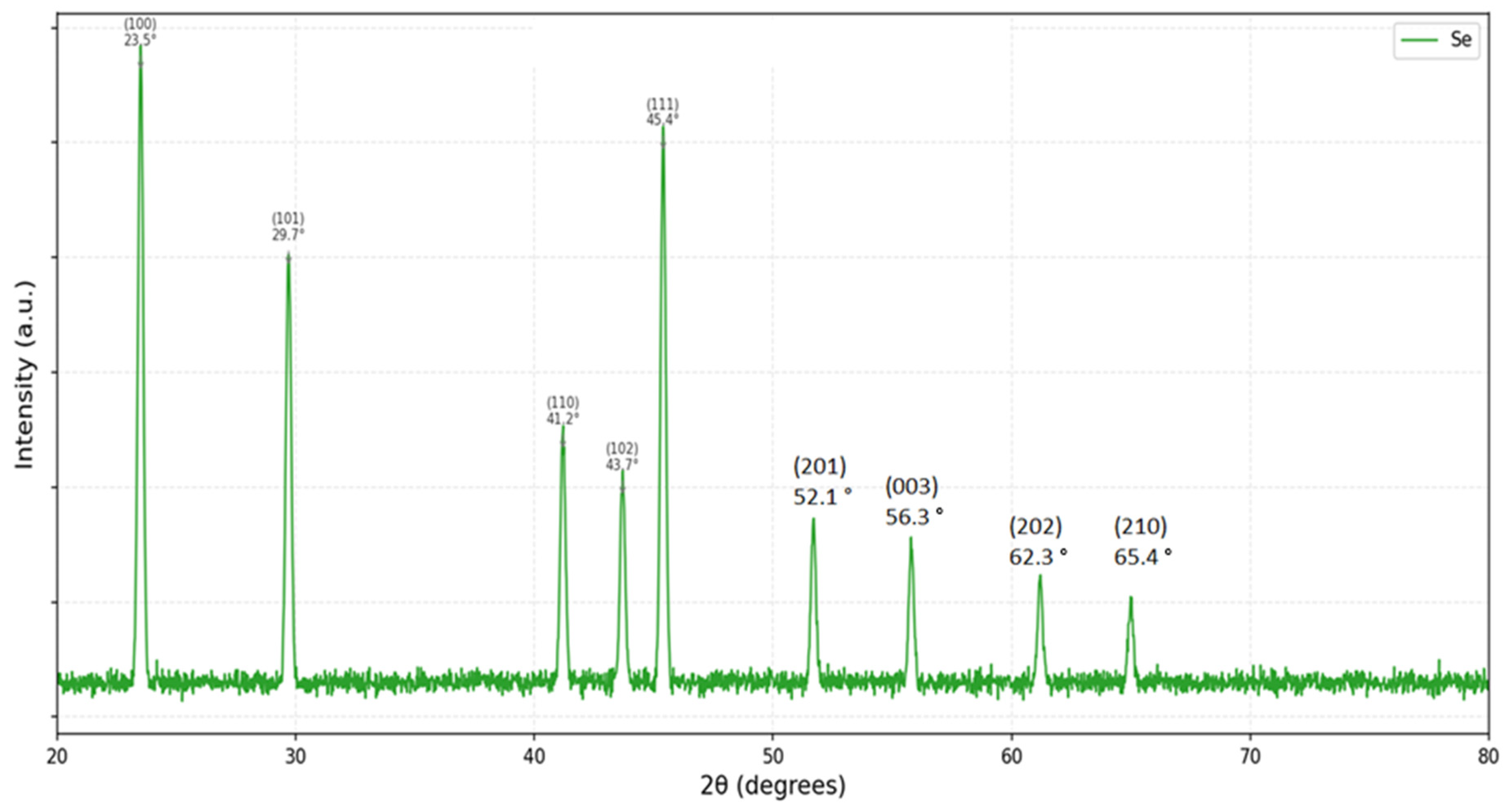
30]. The carbon and oxygen signals were associated with the organic components present on the nanoparticle surface, particularly ascorbic acid and HA, which likely contributed to nanoparticle reduction, capping, and stabilization. The crystalline phase of the produced Se/HA nanoparticles was further examined using X-ray diffraction (XRD), as presented in
Figure 3. The XRD pattern showed characteristic diffraction peaks at 2θ = 23.5°, 29.7°, 41.2°, 43.7°, 45.4°, 52.1°, 56.3°, 62.3°, and 65.4°, corresponding to the 100, 101, 110, 102, 111, 201, 003, 202, and 210 planes of trigonal selenium, respectively, with lattice parameters of c = 4.954 Å and a = 4.366 Å, consistent with JCPDS card no. 06-0362 [
31,
32]. The broad baseline observed in the XRD profile suggests the presence of a minor amorphous component, estimated at approximately 15%, which may be related to HA coating or surface-associated organic residues. The average crystallite size of the Se/HA nanoparticles was calculated using the Scherrer equation: D = k λ/β cosθ, where D represents the crystallite size, k is the shape factor with a value of 0.9, λ is the incident X-ray wavelength, β is the full width at half maximum of the diffraction peak, and θ is the diffraction angle. Based on this equation, the average crystallite size was estimated to be 31.2 nm, confirming the nanoscale crystalline nature of the synthesized particles. No additional impurity phases were detected beyond the assigned selenium reflections, supporting the structural purity of the prepared Se/HA nanoparticles. Together, the EDX and XRD findings confirm that the eco-friendly ascorbic acid-assisted approach successfully produced selenium-rich, crystalline Se/HA nanostructures with organic surface stabilization, highlighting the novelty of this work in generating a structurally defined and bio-functional selenium-HA nanoplatform.
Furthermore, the zeta potential of Se/HA NPs was measured as −32.7 ± 2.8 mV, confirming a stable negatively charged surface imparted by the HA coating. The PDI value of 0.21 ± 0.03 reflects a relatively homogeneous nanoparticle population with a low aggregation tendency. These findings are consistent with the TEM observations of well-dispersed spherical nanoparticles and support the role of HA as an effective capping and stabilizing agent. The discrepancy between the TEM-derived particle size, approximately 55 nm, and the XRD-derived crystallite size, 31.2 nm, is expected for polymer-coated nanoparticles. XRD detects only the crystalline selenium core, as calculated using the Scherrer equation, whereas TEM visualizes the entire nanoparticle, including the amorphous hyaluronic acid shell. Therefore, the HA shell thickness is estimated to be approximately 12 nm, which is consistent with the core–shell morphology observed (
Figure 1a).
Time-Dependent Colloidal Stability of Se/HA NPs
The colloidal stability of Se/HA NPs was monitored over 30 days of storage at 4 °C, and the results are summarized in
Supplementary Table S1. Freshly prepared Se/HA NPs at day 0 exhibited an average hydrodynamic diameter of 68.4 ± 4.2 nm, a PDI of 0.21 ± 0.03, and a zeta potential of −32.7 ± 2.8 mV. After 7 days, no significant changes were observed in any of the three parameters (
p > 0.05). At day 14, a slight but statistically insignificant increase in diameter (72.3 ± 5.8 nm) and PDI (0.24 ± 0.05) was noted. By day 21, the hydrodynamic diameter had increased significantly to 78.6 ± 6.5 nm, and the PDI had increased to 0.28 ± 0.06 (
p < 0.05 compared with day 0), indicating the onset of minor aggregation. The zeta potential remained above −28 mV. After 30 days, further increases were observed in hydrodynamic diameter and PDI values, reaching 89.2 ± 8.1 nm and 0.34 ± 0.07, respectively, while the zeta potential decreased to −25.4 ± 4.2 mV, confirming progressive aggregation. Visual inspection showed no precipitation over 30 days, although slight turbidity was noted at day 30. These results indicate that Se/HA NPs remain stable for up to 14–21 days under refrigerated storage conditions.
3.3. FTIR Confirmation of HA-Mediated Surface Functionalization
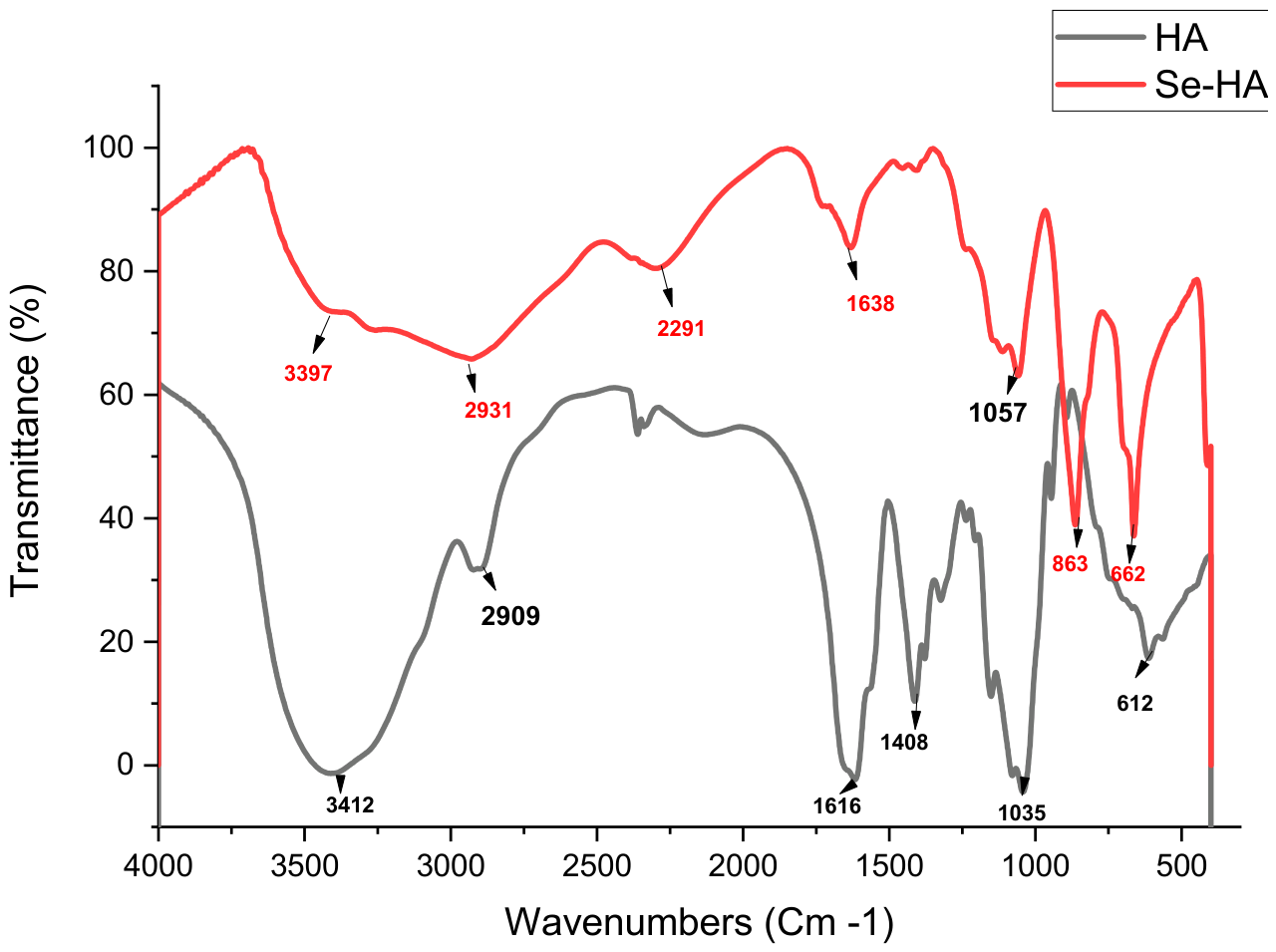
FTIR analysis was performed to identify the functional groups involved in the formation and stabilization of the Se/HA nanocomposite. The FTIR spectrum of HA exhibited intense peaks at 3412, 2909, 1622, 1035, and 612 cm
−1, which shifted to 3397, 2931, 1638, 1037, and 662 cm
−1, respectively, after Se/HA nanoparticle formation (
Figure 4). Notably, the Se/HA spectrum exhibited additional peaks at 2291 cm
−1 and 863 cm
−1 that were absent in pure HA. The peak at 2291 cm
−1 is attributed to the −SH stretching vibration of thiol-containing intermediates or to overtones of C≡N or C≡C bonds, possibly arising from ascorbic acid degradation products. The peak at 863 cm
−1 may correspond to the C–O–C stretching vibration of oxidized ascorbic acid, dehydroascorbic acid, or to Se–O vibrations. These peaks suggest that ascorbic acid not only reduces selenite but also undergoes partial oxidation, with its byproducts adsorbing onto the nanoparticle surface. This finding confirms the active participation of ascorbic acid in surface stabilization, beyond its role as a reducing agent.
The broad band observed at 3412 cm
−1 in native HA is attributed to O–H stretching vibrations and N-H stretching vibrations associated with the N-acetyl side chain. The moderately intense overlapping bands around 2909 cm
−1 correspond to C–H stretching vibrations. In addition, the bands at 1622 and 1418 cm
−1 are assigned to the asymmetric C=O and symmetric C–O stretching modes of carboxyl groups in hyaluronate [
33]. The absorption band at 1035 cm
−1 is related to the primary alcohol C–O stretching vibration [
34]. The observed shifts in peak position, together with changes in peak intensity after selenium incorporation, indicate the participation of HA functional groups in the capping and stabilization of Se/HA nanoparticles. HA does not participate in the reduction of selenite ions, which is accomplished entirely by ascorbic acid. Instead, HA acts as a capping and stabilizing agent after Se NP formation, contributing to nanoparticle stabilization through its functional groups. Moreover, the appearance and modification of characteristic peaks following the interaction between HA and selenium further support successful conjugation between HA and Se NPs (
Figure 4). In particular, the distinct band at 2931 cm
−1 after Se NP loading provides additional evidence of HA attachment to the nanoparticle surface, consistent with previous findings [
35]. Overall, FTIR analysis confirms that HA was not merely physically mixed with selenium but actively participated in nanocomposite formation, supporting the novelty of this study by demonstrating a green, HA-stabilized Se nanoplatform with surface chemistry suitable for enhanced biological performance. Regarding the chemical bond formed between Se NPs and HA, no new covalent bond, such as Se–C or Se–O–C, was detected in the FTIR spectrum. This is consistent with the literature on polymer-coated selenium nanoparticles [
35,
36]. Instead, the interaction is primarily non-covalent, involving hydrogen bonding between the hydroxyl (−OH) and carboxyl (−COOH) groups of HA and the surface of Se NPs, as well as electrostatic interactions between negatively charged HA carboxylate groups and partially positive selenium surface sites. The observed shifts in peak positions, such as the O–H band from 3412 to 3397 cm
−1 and the C=O band from 1616 to 1638 cm
−1, together with changes in peak intensity, confirm that HA is not merely physically mixed but is strongly adsorbed onto the Se NP surface through these non-covalent forces. This conclusion is further supported by the high negative zeta potential and the core–shell morphology observed in TEM images. Similar non-covalent stabilization has been reported for polysaccharide-coated Se NPs [
29,
31].
3.4. Enhanced Broad-Spectrum Antimicrobial Activity of Se/HA Nanoparticles
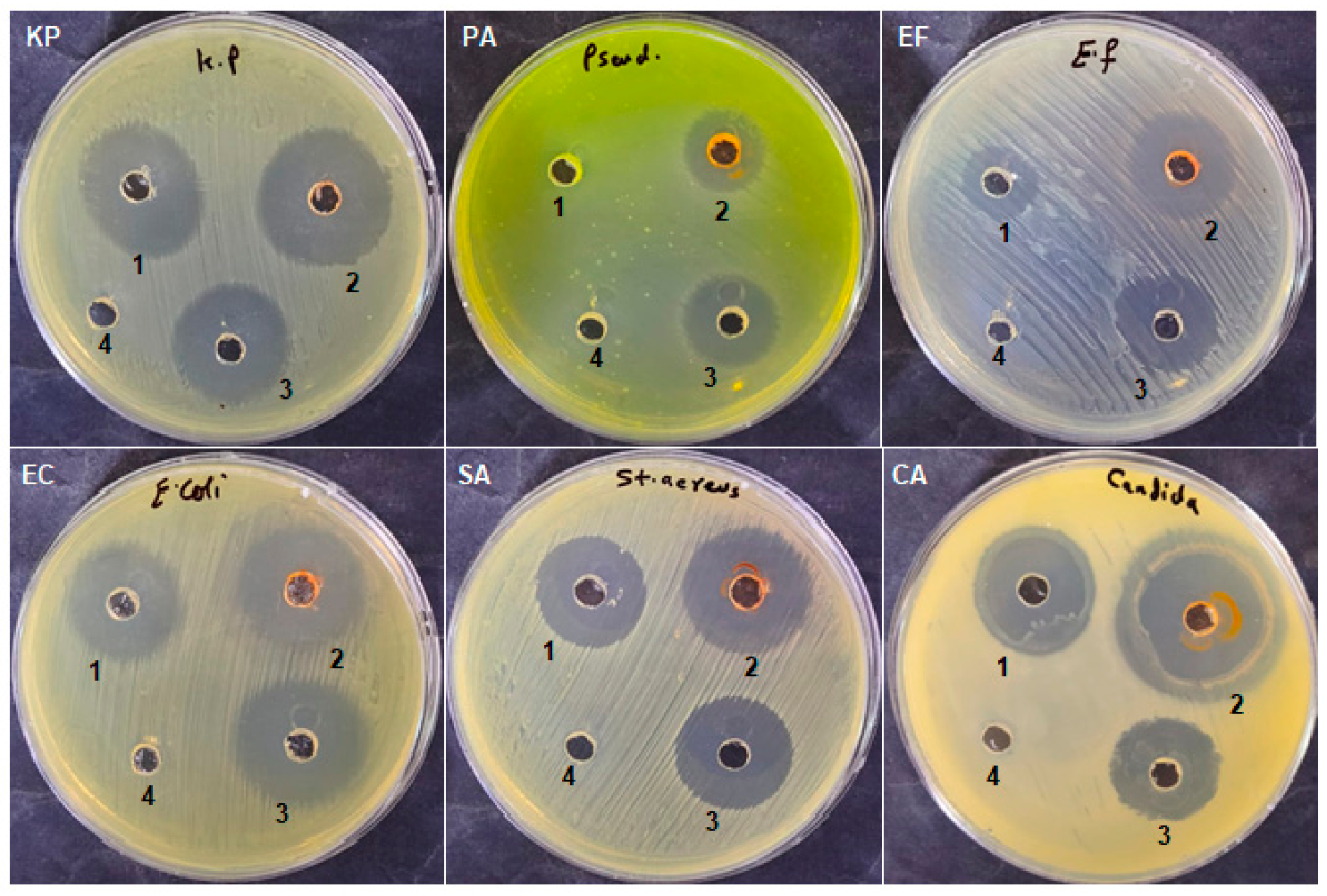
The antimicrobial activity results presented in
Table 1 and
Figure 5 demonstrate that Se/HA nanoparticles exhibited stronger antimicrobial activity than HA alone and, in several cases, showed inhibition comparable to or greater than the positive controls, gentamicin for bacteria and nystatin for fungi. Against
Enterococcus faecalis, Se/HA produced an inhibition zone of 21 mm, compared with 14 mm for HA and 18 mm for the antibiotic control, indicating a clear enhancement in antibacterial efficacy after selenium incorporation. Similarly, Se/HA showed the strongest activity against
Staphylococcus aureus, with an inhibition zone of 24 mm, slightly exceeding the positive control. The MIC and MBC values further supported these observations, as Se/HA required lower concentrations to inhibit and kill bacterial cells compared with HA. Gram-negative bacteria also showed marked susceptibility to Se/HA, particularly
Escherichia coli and
Klebsiella pneumoniae, which displayed large inhibition zones of 25 and 27 mm, respectively, comparable to the standard control. Consistently lower MIC values for Se/HA, reaching 15.62 µg/mL, confirm its improved antimicrobial potency. In contrast,
Pseudomonas aeruginosa showed complete resistance to HA, whereas Se/HA demonstrated moderate inhibition with a 15 mm zone; however, its higher MIC and MBC values indicate comparatively reduced susceptibility of this strain. Notably, Se/HA exhibited pronounced antifungal activity against
Candida albicans, producing a large inhibition zone of 34 mm, which exceeded both HA (23 mm) and nystatin (22 mm). The MIC and MFC values of Se/HA against
C. albicans were 7.8 and 15.62 µg/mL, respectively, representing the lowest values among all tested organisms and confirming strong anti-fungal potency. These findings are consistent with Li et al. [
36], who reported that a carboxymethyl chitosan/oxidized hyaluronic acid hydrogel exhibited markedly improved antimicrobial activity after incorporation of SeNPs, with inhibition rates of 96.0% against
Staphylococcus aureus and 91.67% against
Escherichia coli. Their findings highlight the important contribution of SeNPs to infection control in wound-related applications, particularly chronic diabetic wound management. Overall, the present results show that conjugating selenium nanoparticles with HA substantially enhances antimicrobial performance across bacterial and fungal pathogens, supporting the novelty of Se/HA as a multifunctional nanoplatform with potential relevance for antimicrobial protection, wound infection control, and biomedical material development.
The moderate antimicrobial activity observed for pure HA, with inhibition zones of 14–23 mm, warrants explanation. While native high-molecular-weight HA typically lacks direct bactericidal activity, several factors may account for our observations: (i) the HA used in this study, Sigma-Aldrich, ≥97% purity, may contain trace impurities or endotoxins that contribute to microbial inhibition; (ii) the high concentration of HA, 4 mM, used in the agar diffusion assay may create osmotic effects or physically impede microbial growth; (iii) HA can bind divalent cations, such as Mg2+ and Ca2+, which are essential for bacterial membrane integrity, indirectly suppressing growth; and (iv) some commercial HA preparations may exhibit minor antimicrobial activity due to residual proteins or manufacturing byproducts. Importantly, the antimicrobial activity of Se/HA NPs was consistently and significantly higher than that of HA alone (p ≤ 0.05), confirming that selenium conjugation is responsible for the enhanced effect.
Proposed Antimicrobial Mechanism of Se/HA NPs
Although mechanistic assays were beyond the scope of this study, the antimicrobial activity of Se/HA NPs is proposed to involve multiple synergistic pathways based on prior reports [
37]. First, Se/HA NPs can generate reactive oxygen species (ROS) upon contact with microbial cells, inducing oxidative damage to lipids, proteins, and DNA. Second, direct nanoparticle–membrane interactions may alter membrane permeability, leading to leakage of intracellular contents. Third, selenium may interfere with microbial selenoprotein synthesis and redox homeostasis by substituting sulfur in essential enzymes. Fourth, Se NPs may inhibit biofilm formation by downregulating quorum-sensing genes. Hyaluronic acid conjugation enhances colloidal stability and may support controlled selenium release, thereby improving bioavailability at the infection site. The pronounced activity against Candida albicans with a 34 mm inhibition zone may reflect enhanced fungal internalization, whereas the resistance observed in Pseudomonas aeruginosa is likely associated with efficient efflux pumps and ROS-scavenging systems.
3.5. Cytotoxic Activity of HA and Se/HA NPs
3.5.1. Concentration-Dependent Cytotoxicity of HA and Se/HA NPs Against MG-63 Osteosarcoma Cells
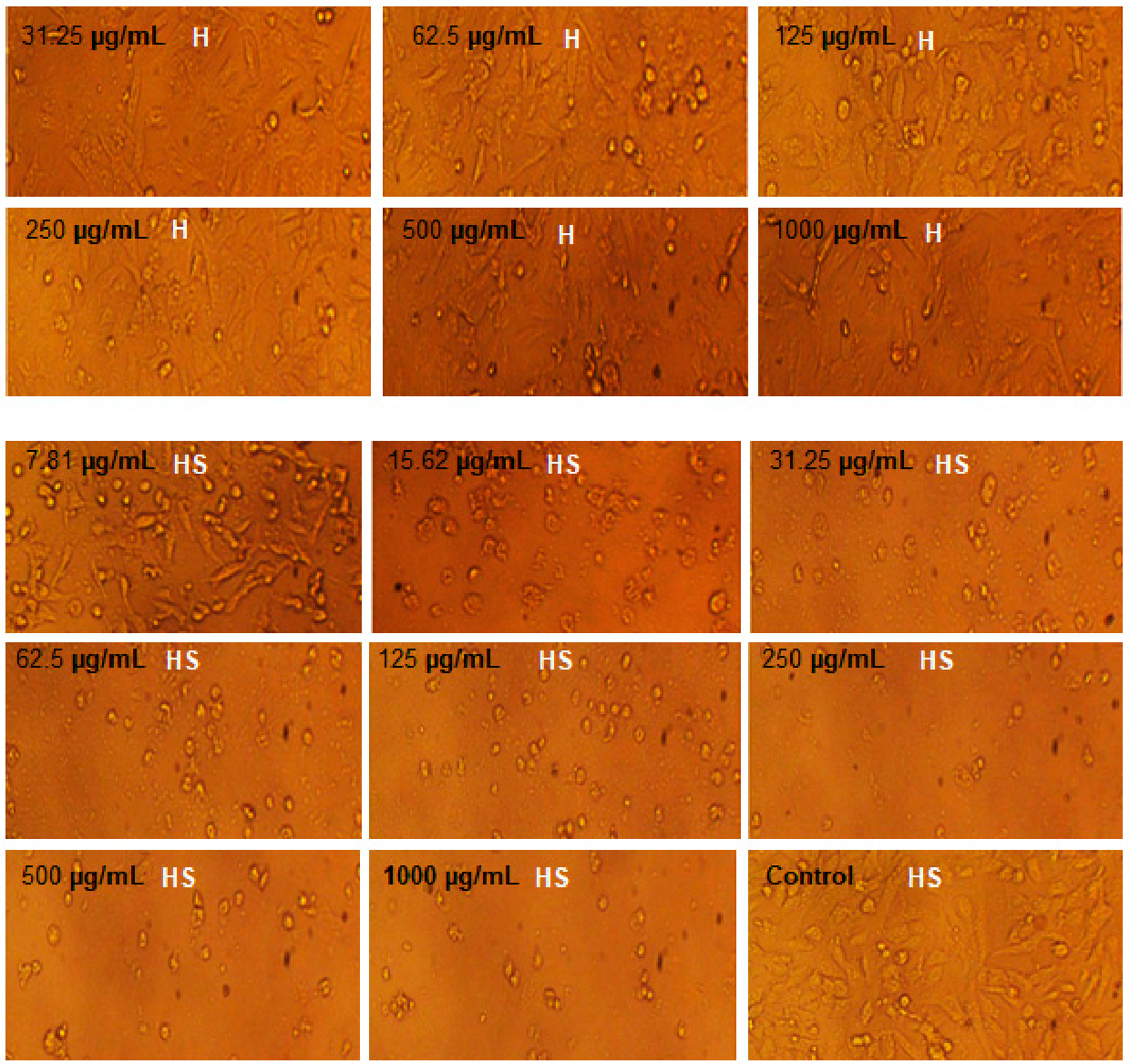
The cytotoxic effects of HA and Se/HA NPs against MG-63 osteosarcoma cells were evaluated across a broad concentration range of 0–1000 µg/mL (
Table 2 and
Figure 6). Both treatments showed no cytotoxicity at baseline concentration (0 µg/mL), confirming normal cell viability under untreated conditions. However, a clear difference was observed between HA and Se/HA NPs as the concentration increased. HA alone showed minimal cytotoxicity at low concentrations, with no detectable effect up to 15.62 µg/mL and only slight cytotoxicity between 31.25 and 125 µg/mL, where cell death remained ≤1.51%. At higher concentrations, HA induced only moderate cytotoxicity, reaching 12.87% at 250 µg/mL and increasing to 47.83% and 55.30% at 500 and 1000 µg/mL, respectively. These findings suggest that HA is largely biocompatible and exerts cytotoxic effects only at relatively high concentrations. In contrast, Se/HA NPs displayed a strong and concentration-dependent cytotoxic effect even at low concentrations. Cytotoxicity reached 46.61% at 7.81 µg/mL and increased sharply to 91.94% at 15.62 µg/mL. From 31.25 µg/mL onward, Se/HA NPs produced very high cytotoxicity levels of approximately 96–97%, indicating near-complete inhibition of MG-63 cell viability across this concentration range. This difference was further confirmed by the IC
50 values, where HA showed a high IC
50 of 746.37 µg/mL, reflecting low cytotoxicity, whereas Se/HA NPs exhibited a markedly lower IC
50 of 8.36 µg/mL, confirming their potent anticancer activity. The high IC
50 value of HA, 746.37 µg/mL, is consistent with the known biocompatibility of hyaluronic acid, which exhibits minimal cytotoxicity even at elevated concentrations, as reported in previous studies [
38,
39]. In contrast, the low IC
50 value of Se/HA NPs, 8.36 µg/mL, reflects the potent anticancer activity conferred by selenium incorporation. Overall, these results highlight the novelty of Se/HA NPs as a highly active nanoconjugate capable of producing strong anticancer effects at low concentrations while HA alone remains comparatively biocompatible.
3.5.2. Morphological Evidence of Se/HA-Induced Cytotoxic Damage
Microscopic examination further supported the cytotoxicity results by revealing clear treatment-dependent morphological changes in MG-63 cells (
Figure 6). Cells in the untreated control group displayed typical healthy morphology, characterized by a well-spread, elongated appearance and firm adherence to the culture surface, indicating normal viability and growth. In the HA-treated groups, most cells retained their normal morphology and attachment pattern across the tested concentrations of 31.25–1000 µg/mL, with only slight reductions in cell density at higher concentrations. Minor morphological alterations, including limited shrinkage and reduced confluency, were observed at the highest HA concentrations; however, the majority of cells remained structurally intact. These observations are consistent with the low cytotoxicity percentages recorded for HA (
Table 2). In contrast, cells exposed to Se/HA NPs showed pronounced concentration-dependent morphological damage. At low concentrations of 7.81–15.62 µg/mL, cells began to lose their characteristic spindle-like morphology, became rounder, and showed weaker attachment. As the concentration increased from 31.25 to 125 µg/mL, a marked reduction in cell number, increased cellular shrinkage, and progressive detachment from the surface were observed. At higher concentrations of 250–1000 µg/mL, severe cytopathic changes became evident, including extensive cell rounding, membrane disruption, accumulation of cellular debris, and near-complete loss of viable cells. These morphological findings confirm that Se/HA NPs not only reduce MG-63 cell viability quantitatively but also induce visible structural deterioration, supporting their novelty as a bioactive selenium-HA nanoplatform with strong tumor cell-damaging capacity.
3.5.3. HA-Mediated Functionalization as a Driver of Enhanced Anticancer Activity
The superior anticancer activity of Se/HA NPs may be attributed to the combined contribution of selenium bioactivity and HA-mediated stabilization and cellular interaction. Previous work by Ren et al. [
15] demonstrated that hyaluronic acid-modified selenium nanoparticles showed greater anticancer efficacy than selenium alone, with tumor inhibition of approximately 47–49%, enhanced immune response, and reduced oxidative stress. This synergistic interaction may result from the ability of HA to regulate selenium transport and release, thereby improving therapeutic efficiency while reducing potential toxicity [
19]. HA also plays an important role as a targeting and stabilizing agent because of its ability to interact with cell-surface receptors, particularly CD44, which are frequently overexpressed in several tumor cells. Through receptor-mediated uptake, HA-functionalized nanoparticles can accumulate more selectively in tumor cells, thereby enhancing the therapeutic action of selenium. In agreement with this concept, Vafadar et al. [
20] reported that incorporating HA with copper and selenium improved the anticancer activity of nanocomposites by reducing crystallite size, increasing particle stability, and enhancing biological activity. Their HA-coated selenium-copper nanocomposite showed stronger anticancer effects against HepG2 liver cancer cells than conventional Se NPs, inducing cell death even at low doses [
20]. Functionalized selenium-based systems have also been shown to inhibit cancer cell proliferation, migration, and invasion while promoting apoptosis, with improved efficacy compared with free drugs or non-targeted formulations. In this context, the present study extends previous findings by demonstrating that ascorbic acid-assisted Se/HA NPs exert potent cytotoxic activity against MG-63 osteosarcoma cells, emphasizing the novelty of combining green synthesis, HA surface functionalization, and selenium bioactivity to generate promising nanoconjugate for anticancer applications.
3.6. Se/HA Nanoparticles Promote Accelerated Wound Closure and Cell Migration
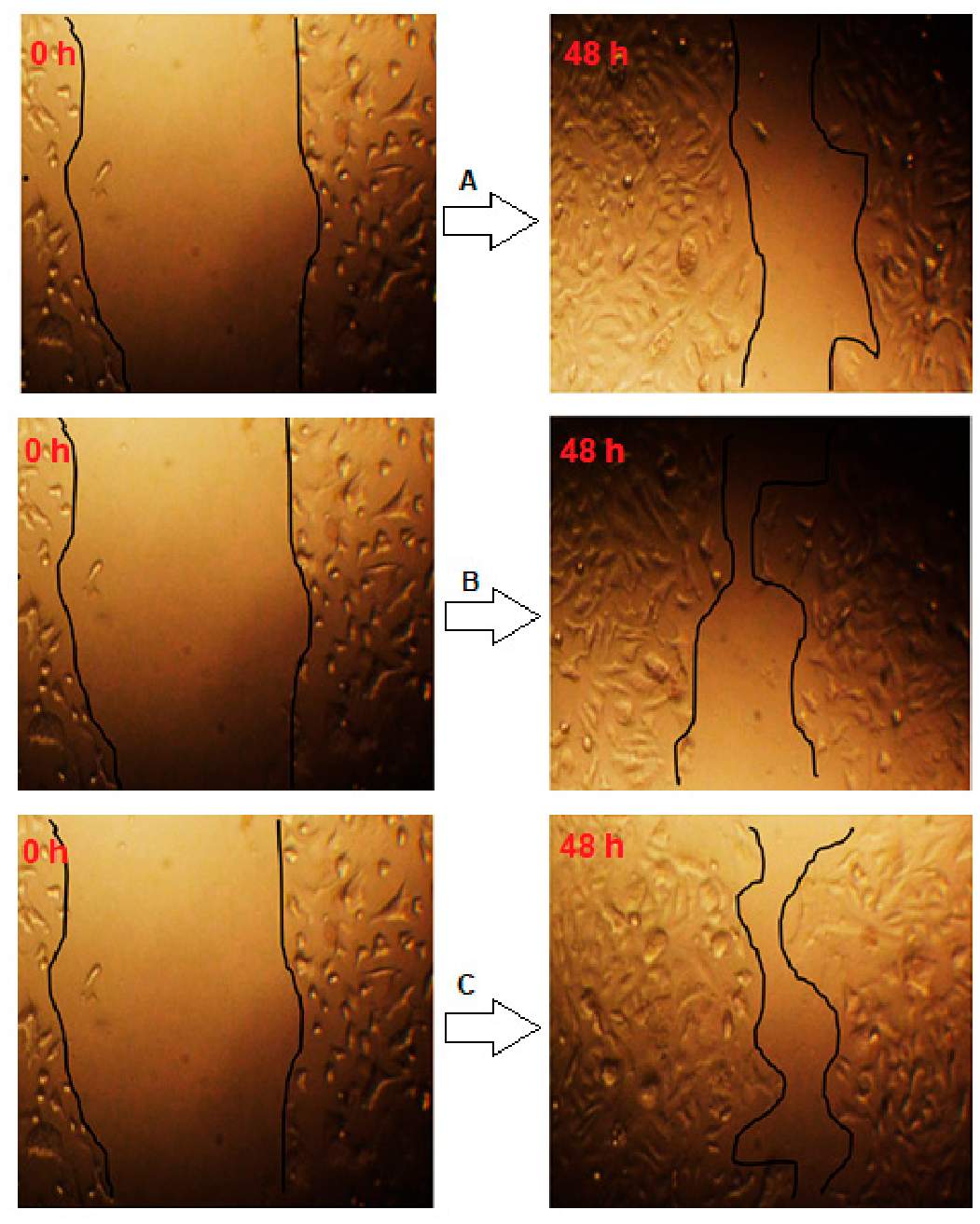
The wound-healing activity of HA and Se/HA NPs was evaluated using the scratch assay, and the results clearly demonstrated treatment-dependent enhancement of wound closure (
Figure 7 and
Table 3). At 0 h, all groups showed the same initial wound width (1022.43 µm) and wound area (1,099,771.72 µm
2), confirming a uniform baseline and ensuring the validity of subsequent comparisons. After 48 h, distinct differences in wound closure became evident among the groups. In the untreated control group, the wound width decreased to 517.71 µm and the wound area to 556,922.7 µm
2, corresponding to a wound closure percentage of 49.36% and an area reduction of 542,849.1 µm
2. In the HA-treated group, wound repair was improved relative to the control, with the wound width decreasing further to 439.36 µm and the wound area to 472,703.3 µm
2. This resulted in a wound closure percentage of 57.02% and a greater area reduction of 627,068.4 µm
2, supporting the known role of HA in promoting cell migration, hydration, and tissue repair [
38]. The most pronounced wound-healing effect was observed in the Se/HA NP-treated group. In this group, the wound width was markedly reduced to 271.87 µm and the wound area to 292,432.4 µm
2, yielding the highest wound closure percentage of 73.41% and the largest area reduction of 807,339.3 µm
2. In addition, the higher RM value of 15.64 µm/h further confirmed enhanced cell migration in response to Se/HA treatment (
Table 3). These quantitative results were in agreement with the visual observations in
Figure 7, which showed more extensive gap closure in the Se/HA-treated group than in the HA-treated and untreated groups. These findings are consistent with the report of Nejati et al. [
39], who found that SeNPs doped with hyaluronic acid accelerated wound healing by combining the pro-migratory and tissue-supportive properties of HA with the antioxidant and antimicrobial effects of selenium nanoparticles.
The enhanced wound-healing efficacy of Se/HA NPs, reflected by 73.41% wound closure at 48 h, was observed at a concentration of 31.25 µg/mL. This concentration was selected based on preliminary cytotoxicity assays showing no adverse effects on HFB4 cell viability at this concentration. The mechanism underlying this effect is multifactorial. First, HA itself promotes cell migration by interacting with CD44 receptors on fibroblast membranes, activating downstream signaling pathways such as Rho GTPases and focal adhesion kinase (FAK), which regulate cytoskeletal reorganization and cell motility [
38]. Second, selenium nanoparticles may contribute by reducing oxidative stress at the wound site through antioxidant enzyme-mimetic activity, such as glutathione peroxidase-like activity, thereby protecting migrating fibroblasts from oxidative damage [
39]. Third, the anti-inflammatory activity of Se/HA NPs, with an IC
50 of 5.37 µg/mL, may reduce local inflammation and create a more favorable microenvironment for tissue repair.
Comparisons with previous studies further support our findings. Nejati et al. [
39] reported that Se NPs incorporated into HA-methacrylate/gelatin methacrylate hydrogels achieved approximately 65–70% wound closure in vitro after 48 h, which is comparable to our results. Hakki et al. [
38] demonstrated that HA alone enhanced cell migration in cementoblasts, but the addition of selenium accelerated closure rates by an additional 15–20%. Our Se/HA NPs achieved 73.41% closure, exceeding the 57.02% closure observed with HA alone and the 49.36% closure observed in untreated controls, confirming the synergistic effect of Se and HA. Notably, Li et al. [
36] recently reported a carboxymethyl chitosan/oxidized hyaluronic acid hydrogel containing Se NPs that achieved 96% closure in diabetic wound models after 14 days, suggesting that our Se/HA NPs could be further optimized for chronic wound applications. Collectively, the present data demonstrate that Se/HA NPs provide a stronger wound-healing response than HA alone, highlighting the novelty of this multifunctional nanoconjugate as a promising bioactive system for enhancing fibroblast migration and tissue repair.
3.7. Selenium Functionalization Enhances the Anti-Inflammatory Activity of HA
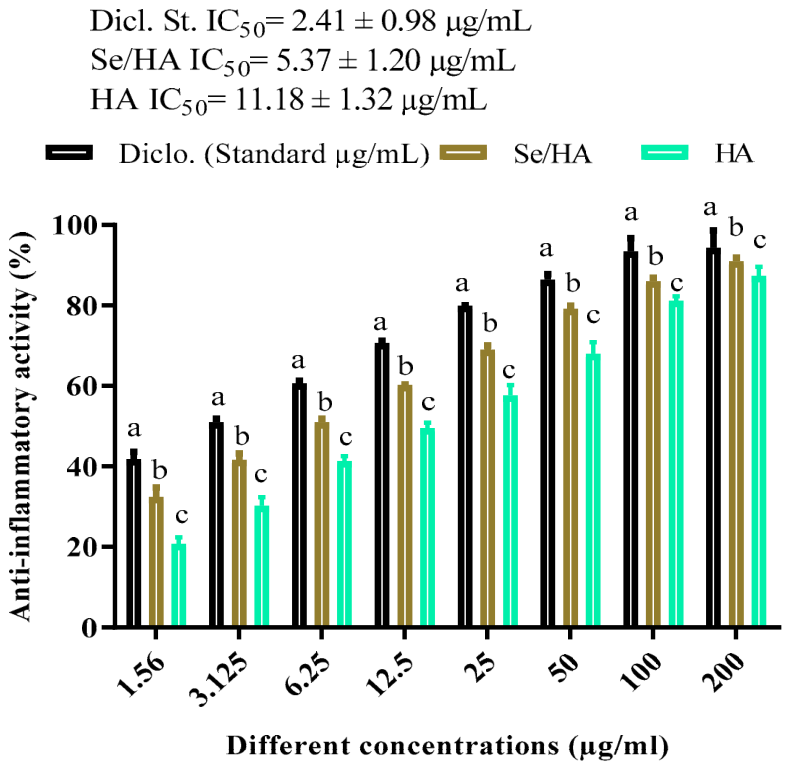
The anti-inflammatory activity of HA and Se/HA NPs was evaluated in comparison with the standard drug diclofenac sodium using the protein denaturation inhibition assay (
Figure 8). At lower concentrations of 1.56–6.25 µg/mL, diclofenac sodium showed the highest inhibitory activity, followed by Se/HA NPs, whereas HA exhibited the lowest effect. This pattern indicates that selenium incorporation markedly enhanced the anti-inflammatory performance of HA. A similar trend was observed at intermediate concentrations of 12.5–50 µg/mL, where Se/HA NPs consistently demonstrated significantly higher inhibition of protein denaturation than HA alone, confirming their improved anti-inflammatory potential. At higher concentrations of 100–200 µg/mL, both HA and Se/HA NPs approached strong inhibition levels; however, Se/HA NPs remained superior to HA. Although the difference between HA and Se/HA became statistically insignificant at 200 µg/mL, both treatments showed slightly lower activity than diclofenac sodium. The IC
50 values further supported these findings, with diclofenac sodium showing the lowest IC
50 value of 2.41 µg/mL, followed by Se/HA NPs at 5.37 µg/mL and HA at 11.18 µg/mL. These results confirm that Se/HA NPs possess substantially stronger anti-inflammatory efficiency than HA alone. The enhanced activity of Se/HA NPs may be attributed to the combined antioxidant properties of selenium and the biological functionality of HA, which together may reduce reactive oxygen species production and suppress inflammatory mediators, including pro-inflammatory cytokines [
40].
The anti-inflammatory activity of HA alone, with an IC
50 of 11.18 µg/mL, is consistent with the known properties of high-molecular-weight HA (HMW-HA, >1 MDa), which has been reported to exhibit anti-inflammatory effects by inhibiting cytokine production and blocking CD44-mediated pro-inflammatory signaling [
37]. In contrast, low-molecular-weight HA (LMW-HA, <500 kDa) is often associated with pro-inflammatory responses. The use of HMW-HA in this study explains the observed anti-inflammatory activity of pure HA and supports its selection as a biocompatible, anti-inflammatory coating for Se NPs.
Overall, these findings demonstrate that selenium functionalization significantly improves the anti-inflammatory potential of HA, producing an activity profile that approaches that of diclofenac sodium and highlighting the novelty of Se/HA NPs as a multifunctional nanoconjugate with promising anti-inflammatory and tissue-protective properties.
3.8. Study Limitations
This study has several limitations that should be acknowledged. First, biological evaluations were primarily performed using in vitro models, which cannot fully reproduce the complexity of in vivo physiological conditions, including immune responses, tissue distribution, metabolism, and systemic clearance. Therefore, the promising antimicrobial, anticancer, anti-inflammatory, and wound-healing activities observed in this study should be further validated using appropriate in vivo models. Second, the long-term toxicity, pharmacokinetic behavior, biodistribution, and possible tissue accumulation of Se/HA nanoparticles were not investigated. These assessments are essential to determine their safety profile and translational suitability. Third, although the present findings demonstrate enhanced biological performance after HA-mediated selenium nano-conjugation, the precise molecular mechanisms responsible for these effects remain to be fully clarified. Fourth, this study did not include bare selenium nanoparticles, without HA coating, as a control for the anticancer assays. Therefore, while Se/HA NPs show potent cytotoxicity, with an IC50 of 8.36 µg/mL, we cannot definitively attribute the enhanced effect to HA modification rather than to the intrinsic cytotoxicity of selenium itself. It is possible that bare Se NPs may exhibit similar or even lower IC50 values. A direct comparison with empty Se NPs synthesized under identical conditions is necessary to quantify the contribution of HA conjugation. Further studies are required to examine cellular uptake pathways, receptor-mediated interactions, oxidative stress modulation, apoptosis-related signaling, inflammatory cytokine regulation, and nanoparticle–cell interactions. Additionally, this study did not include “empty” selenium nanoparticles, without HA coating, as a control. Such a control would help distinguish the contribution of HA from that of selenium itself to the observed biological activities. Future studies should synthesize bare Se NPs under identical conditions to enable direct comparison and confirm the synergistic role of HA. Furthermore, although the 30-day stability assessment demonstrates good short-term colloidal stability, longer-term stability beyond 30 days was not evaluated. Future studies should investigate stability over 6–12 months under various storage conditions, including lyophilized versus liquid formulations, different temperatures, and buffered media, to support potential clinical translation. Furthermore, the economic feasibility and scalability of the proposed Se/HA NPs should be considered. Although selenium is relatively abundant as a trace element, high-purity sodium selenite (Na2SeO3) and hyaluronic acid can be costly, particularly for large-scale production. The green synthesis method described herein uses ascorbic acid, vitamin C, as a reducing agent, which is inexpensive and widely available. However, the overall cost may still be higher than that of conventional antibiotics or antiseptics. Future studies should explore alternative selenium sources, such as selenium-rich plant extracts or industrial byproducts, to reduce costs while maintaining bioactivity. Additionally, the availability of pharmaceutical-grade HA may vary by region, potentially limiting clinical translation in resource-limited settings. Despite these challenges, the multifunctional nature of Se/HA NPs, combining anticancer, antimicrobial, anti-inflammatory, and wound-healing activities in a single formulation, may offset the higher upfront cost by replacing multiple therapeutic agents. Addressing these limitations in future work will strengthen the biological interpretation of Se/HA nanoparticles and support their development as a safe and effective multifunctional biomedical platform.
4. Conclusions
Se/HA nanoparticles were successfully prepared using an eco-friendly aqueous ascorbic acid-mediated synthesis approach. TEM analysis revealed well-dispersed, monodisperse spherical nanoparticles with particle sizes ranging from 29.72 to 80.38 nm, while XRD confirmed their crystalline nature through characteristic selenium diffraction peaks. The average crystallite size, calculated using the Scherrer equation, was 31.2 nm, further confirming the nanoscale structure of the synthesized Se/HA nanoparticles. Compared with unmodified HA, Se/HA nanoparticles demonstrated a clear enhancement in biological activity across all evaluated assays. Antimicrobial screening showed strong inhibition against Enterococcus faecalis (21 mm), Staphylococcus aureus (24 mm), Escherichia coli (25 mm), and Klebsiella pneumoniae (27 mm), together with marked antifungal activity against Candida albicans (34 mm), with an MIC value of 7.8 µg/mL. In the anticancer assay, Se/HA nanoparticles induced potent cytotoxicity against MG-63 osteosarcoma cells, as reflected by a low IC50 value of 8.36 µg/mL, whereas HA alone showed limited cytotoxicity with an IC50 value of 746.37 µg/mL. Moreover, Se/HA nanoparticles significantly enhanced wound closure, achieving 73.41% closure compared with 57.02% for HA, indicating improved cell migration and tissue-repair potential. The anti-inflammatory assay also confirmed the superior performance of Se/HA nanoparticles, with an IC50 value of 5.37 µg/mL, approaching the activity of diclofenac sodium (2.41 µg/mL). Collectively, these findings demonstrate that HA-mediated selenium nano-conjugation markedly improves antimicrobial, antifungal, anticancer, anti-inflammatory, and wound-healing activities. The novelty of this study lies in the development of a green, HA-stabilized selenium nanoplatform with integrated multifunctional bioactivity, supporting its potential as a promising candidate for biomedical applications, particularly in infection control, cancer therapy, inflammation modulation, and tissue repair. These findings introduce Se/HA NPs as a green multifunctional nanoplatform with promising anticancer, antimicrobial, anti-inflammatory, and wound-healing potential.




 ,
,